
Submitted:
20 June 2026
Posted:
23 June 2026
You are already at the latest version
Abstract
Star formation in Galactic dense clumps is commonly interpreted using nearly uniform protostellar evolutionary timescales, yet the extent to which such assumptions obscure variations in star formation efficiency remains uncertain. Using 60 ATLASGAL dense clumps associated with MIPSGAL Class I protostars and \( \mathrm{NH_3} \) velocity information, we show that compactness and dense-gas evolutionary state provide a stronger explanation of instantaneous and cumulative star formation behavior than adopting a universal Class I lifetime. By combining cumulative efficiencies with a dense-gas star formation calibration, we find that star formation proceeds with systematically mass- and density-dependent timescales, implying that a single evolutionary clock can significantly bias inferred efficiencies across the clump population. The lower-limit cumulative star formation efficiency was observed to increase with decreasing clump radius following \( R_{\mathrm{cl}}^{-1.30 \pm 0.09} \), while no significant correlation is found with Galactocentric radius. Upper- and lower-limit cumulative efficiencies exhibit a sublinear relation with slope \( 0.66 \pm 0.08 \), suggesting possible stellar initial mass function incompleteness. The dense-gas star formation timescale follows \( \tau_{\mathrm{SF,dense}} \propto M_{\mathrm{cl}}^{-0.77 \pm 0.04} \), with a median value of \( 0.54\,\mathrm{Myr} \). Assuming a relatively uniform timescale of \( 0.50\,\mathrm{Myr} \) could overestimate and underestimate star formation rates in low-mass and massive clumps by factors of \( \sim 32 \) and \( \sim 25 \), respectively.
Keywords:
stars
; formation – stars
; protostars – ISM
; clouds – ISM
; structure – galaxy
; disk
1. Introduction
Star formation (SF) in Galactic dense clumps is commonly interpreted using nearly uniform protostellar evolutionary timescales, yet the extent to which such assumptions obscure variations in star formation efficiency (SFE) remains uncertain. Using 60 ATLASGAL dense clumps associated with MIPSGAL Class I protostars and velocity information, we show that compactness and dense-gas evolutionary state provide a stronger explanation of instantaneous and cumulative SF behavior than adopting a universal Class I lifetime. By combining cumulative efficiencies with a dense-gas SF calibration, we find that SF proceeds with systematically mass- and density-dependent timescales, implying that a single evolutionary clock can significantly bias inferred efficiencies across the clump population.
Stars in the universe are mainly formed in giant molecular clouds (GMCs), where SF is driven by gravitational collapse until stellar feed-back consumes or expels the available gas (e.g. Chevance et al. [1], Menon et al. [2,3], Jiménez et al. [4]). The emergence of newborn stars and stellar clusters inside galaxies adheres to a series of interstellar processes that gradually reorganize gas into denser, more compact structures (Heyer et al. [5]). Clouds composed mainly of molecular gas form from the diffuse atomic interstellar medium (ISM) (Heyer et al. [5]) due to gravito-magnetic-thermal instabilities within spiral arms or converging flows of warm, neutral material (Kim and Ostriker [6], Dobbs et al. [7]), or may coalesce into larger complexes from the aggregation of smaller, pre-existing molecular clouds (MCs) (Dobbs [8]).
Large star-forming MCs often fracture into clumps exhibiting increased volume and column density, which constitute 5-10% of the cloud’s mass (Battisti and Heyer [9]). The clumps disintegrate into localized gas parcels (cores) exhibiting even greater volume densities (Schneider et al. [10]). Isolated, newborn stars arise from these confined cores, whereas young stellar clusters form if the clump is gravitationally unstable (Heyer et al. [5], Vázquez-Semadeni et al. [11]). Comprehending how each phase in this sequence constrains the pace and yield of stellar births is essential for formulating a comprehensive and predictive account of SF in galaxies (Heyer et al. [5]).
GMCs that form stars feature massive stars () and H II regions, exhibit supersonic turbulent internal gas dynamics (Larson [12]), and may possess self-gravitational properties (McKee and Tan [13]). Research suggests that star-forming clouds evolve via a collaboration of stellar and protostellar feedback, supersonic magnetohydrodynamic turbulence, and gravity (Chevance et al. [1], Menon et al. [2,3], Jiménez et al. [4], McKee and Ostriker [14], Grudić et al. [15]).
The SFE of a MC - the percentage of the mass of molecular gas transformed to stars - may be the most effective indicator of the impact of these physical processes (Grudić et al. [15]). The rate and proportion of mass conversion from MCs to stars is an essential subject in the theory of SF (Heyer et al. [5], Grudić et al. [15]). Feedback, magnetic fields, and turbulence can all impede the gravitational collapse that induces SF, thereby reducing the SFE to varying degrees (Grudić et al. [15]).
There is much debate over the star formation rate (SFR) and SFE at the scale of GMCs and smaller (Lee et al. [16]). Only about 1-10% of the gas in GMCs is transformed into stars during each free-fall time (Krumholz and Tan [17], Leroy et al. [18], Utomo et al. [19]), indicating that the SF process is inefficient (e.g., Mattern et al. [20], Soam et al. [21], Escamilla et al. [22]). However, a measured proportion of star-forming clumps in the Milky Way (MW) was reported by [5].
Nonetheless, the SFR of the MW has been estimated using a variety of methods, and many SFR estimates have been published (e.g., Soler et al. [23]). This outcome is wholly independent of any specific hypothesis on the lifetime or evolution of MCs (Krumholz and Tan [17]). A gradual SF has been observed (up to three orders of magnitude in density) in denser entities within the ISM, such as infrared (IR) dark clouds and dense molecular clumps (Krumholz and Tan [17]).
The gradual pace of SF suggests that star cluster creation cannot occur by a single global collapse, but must unfold across several free-fall times (Krumholz and Tan [17], Tan et al. [24]). These observations are sufficiently unexpected to have prompted various theories for their elucidation (Krumholz and Tan [17]). These theories range from the proposition that robust magnetic fields (e.g., Allen and Shu [25]) or turbulence (e.g., Krumholz and McKee [26]) within clouds impede SF, to the notion that Galactic-scale gravitational instability governs SF (e.g., Li et al. [27]), and the assertion that GMCs are, contrary to the majority of prior observational assessments (Blitz et al. [28]), gravitationally unbound (e.g., Clark and Bonnell [29]).
Spitzer imaging surveys of nearby MCs in the MW have yielded substantial statistical samples of young stellar object (YSO) candidates (e.g., Evans et al. [30], Heiderman et al. [31], Rebull et al. [32]). These surveys have enabled direct estimates of the number of low-mass stars () that are forming and, consequently, the determination of SFRs (Heiderman et al. [31]). They also provide a means of probing the low-mass SF regime, which is largely inaccessible to traditional tracers such as H, ultraviolet, far-infrared (FIR), and [O II] emission that are commonly used to establish extragalactic SFR-gas relations (Heiderman et al. [31]). However, deriving SFRs from YSO counts requires assumptions about the underlying stellar population, particularly the stellar initial mass function (IMF).
“The IMF is the distribution of stellar masses at birth within a stellar population (Salpeter [33], Jerabkova et al. [34], Guo et al. [35]) and is a fundamental ingredient in many areas of astrophysics." In particular, it is important for deriving SFRs (Kennicutt [36]), estimating stellar mass-to-light ratios (Bernardi et al. [37], Haslbauer et al. [38]), and reconstructing the SF histories of galaxies (Madau and Dickinson [39], Annibali and Tosi [40]). Observational tracers mainly trace the formation of massive stars, so the IMF has to be extrapolated to lower stellar masses when inferring total SFRs (Heiderman et al. [31]). As a consequence, such SFR estimates are very sensitive to the assumed low-mass slope and functional form of the IMF (Heiderman et al. [31]).
[30] contrasted total MC observations from the Spitzer c2d survey with extragalactic observed SFR-gas interactions. Galactic clouds (Heyer et al. [5], Evans et al. [30], Heiderman et al. [31], Gutermuth et al. [41]) were seen to be positioned above the SFR-gas relations predicted by extragalactic research (Kennicutt [36], Bigiel et al. [42]) and marginally above the extrapolated relation derived from an analysis of massive dense clumps (Wu et al. [43]):
where [43], have assumed that (e.g., Gao and Solomon [44]), and use the fit to both dense cores with and galaxies (Wu et al. [43]). This result suggests that examining SFR-gas relationships in our Galaxy might be beneficial for clarifying SF in neighboring and high-redshift galaxies (e.g., Heyer et al. [5], Heiderman et al. [31]).
The SFR in MCs is usually measured as the amount of new stellar mass created over time (e.g., Zhang et al. [45]). The SFR in a star-forming ATLASGAL clump was estimated by calculating the ratio of the total mass () of early-stage MIPSGAL YSOs associated with the clump to the timescale () for Class I protostars (Heyer et al. [5]).
The MIPSGAL Survey is a Spitzer Space Telescope Legacy Program that scanned both the 24 and 70 m emissions along the Galactic plane to an effective depth of 1 mJy (Carey et al. [46]) across longitudes , , and latitudes , , respectively (Heyer et al. [5]).
YSOs have often been classified based on three criteria (e.g., Fiorellino and Somigliana [47]): (1) IR spectral index () between 2 and 24 m, calculated with (Lada [48]); (2) bolometric temperature () (Myers and Ladd [49]); and (3) the ratio of submillimeter to bolometric luminosity (), with defined at wavelengths m (Andre et al. [50]). The has also been analyzed between 4.5 and 24 m, as the 4.5 m Spitzer channel is less affected by extinction than the 2 m (Kryukova et al. [51], Furlan et al. [52]). Acoording to [47], the link between observational classes and the evolutionary phases of accreting YSOs is as follows:
- i.
- Class 0 or the earliest evolutionary phase: The protostars are deeply enshrouded within their natal envelopes that have accreted only a small fraction of their final stellar mass. The sources in this stage typically have bolometric temperatures less than 70 K and spectral indices of . The statistical analyses indicate that the duration of the Class 0 phase is on the order of - years (e.g., André [53], Dunham et al. [54]). This evolutionary stage is also connected to episodic and recurrent accretion events with relatively high mass accretion rates (Fiorellino and Somigliana [47]).
- ii.
- Class I: This stage follows the Class 0 phase. The protostars are still surrounded by large circumstellar envelopes but are generally more optically transparent than in the previous phase. The spectral indices of and the bolometric temperatures of define this phase. It is still an open question whether the majority of the final stellar mass has been formed at this stage. Observations suggest that the Class I phase lasts on average about 100,000 years (Evans et al. [30], Dunham et al. [54]). Class I objects are thought to be subject to enhanced mass accretion, made of repeated and powerful episodic accretion events, which make their growth very dynamic during this evolutionary phase, similarly to Class 0 protostars (Fiorellino and Somigliana [47]).
- iii.
- The flat spectrum stage: This stage (Fiorellino and Somigliana [47]) is usually interpreted as an evolutionary intermediate stage between the protostellar stage and the pre-main-sequence (PMS). Objects in this category have spectral indices in the range () and bolometric temperatures of (. At this stage, these sources are thought to have accumulated most of their eventual stellar mass (e.g., Fiorellino and Somigliana [47]). They are believed to have typical lifetimes of order () yr, but the uncertainties involved remain large (e.g., Evans et al. [30], Greene et al. [55]). Flat- spectrum sources could be explained by objects with relatively low-density envelopes or by objects with denser envelopes but viewed at low inclination angles (Calvet et al. [56], Federman et al. [57]). This stage (Fiorellino and Somigliana [47]) tends to exhibit lower mass accretion rates and infrequent episodic accretion events than the earlier protostellar stages.
- iv.
- Class II (PMS phase): Class II objects are PMS stars with circumstellar disks, but generally without envelopes. They are also called Classical T Tauri stars (CTTSs). They are characterized by and (e.g., Fiorellino and Somigliana [47]), and their stellar masses are basically set (although they are still actively accreting material from the disk around them). The Class II phase typically lasts about two to three mega-years (Evans et al. [30], Haisch et al. [58]).
- v.
- Class III: This is the last SF phase. They have little or no infrared excess, and most of their circumstellar disks have dissipated, consistent with weakly or non-accreting young stars (e.g., Fiorellino and Somigliana [47]). This phase lasts a few mega-years, with characteristic timescales ≳ five to ten mega-years (Haisch et al. [58], Fedele et al. [59]).
However, the classification of YSOs obtained with these various diagnostics is not homogeneous (e.g., Fiorellino and Somigliana [47]). It could be due to inconsistent classifications (e.g., Enoch et al. [60]), as the classifications are not absolute. The discrepancy could also be the result of misclassifications in the viewing angle (Furlan et al. [52], Masunaga and Inutsuka [61], Robitaille et al. [62]) or as a result of accretion variability (Dunham et al. [63]).
Notably, the class I protostars are not always the same age. The age of Class I protostars is estimated to be 0.50 Myr by studies of nearby clouds that are predominantly forming low mass stars (Evans et al. [30], Gutermuth et al. [64]). [65] proposed that the age of embedded protostars (Class 0 + I) be set at 0.54 Myr. Conversely, other studies have implemented either 0.54 Myr (Zhang et al. [66]) or 0.50 Myr (Heyer et al. [5], Grudić et al. [15], Mattern et al. [20], Román-Zúniga et al. [67]) as the age of Class I protostars. According to a recent statistical investigation of star cluster-forming clumps, embedded protostars may have an age range of 0.50-1.50 Myr (Rawat et al. [68]).
In this study, we adopt the [5] value for all YSO masses. We calculate the clumps lower “cumulative” SFE, thus (Das et al. [69]):
where represents the total mass of the YSOs associated to a clump and is the mass of the clump. We calculate the upper limit to SFE () by replacing with , where is the fully sampled IMF (Kroupa [70]) (see Table 3 of [5]).
In other to merge the clumps cumulative SFE with their SFE per free-fall time (), the “instantaneous” efficiency, to probe evolutionary stage and physical drivers, we adopt the [43] SFR-gas linear relationship for massive dense clumps (i.e., Eq. 1).
Here, is the free-fall time. The [43] relation of Eq. (1), was established for sources whose true, total . Below this threshold, the - correlation becomes invalid. However, the values reported in [5] (Table 2) are only for the detected Class I YSOs. This detection is biased towards low-mass stars if the APEX telescope could not fully sample the IMF. As a result, the reported is a significant underestimate of the clump’s true total luminosity. Our choice of Eq. (1) for the estimation of were due to the following reasons. First, we believe that if the IMF were fully sampled, the clumps would probably contain many more (and more massive) stars. This would naturally result in a total that is much higher than the reported values, likely pushing them above the threshold. Moreover, the fact that the [5] (Table 3) predicted stellar masses () from a fully sampled IMF is far greater than the detected masses (), directly suggests that the total luminosities are also far greater. Secondly, we relied on the established report of the close link between dense molecular gas (with ) and SF on both Galactic and extragalactic scales (Shimajiri et al. [71]) and on the existent linear relationship between the SFR in galactic disks and the mass of dense gas above some critical density threshold (Mattern et al. [20]).
Despite substantial progress in understanding Galactic SF, several important questions remain unresolved. First, it is still not clear whether cumulative and instantaneous SF efficiencies trace the same physical processes in dense clumps. Second, the validity of adopting a relatively uniform Class I protostellar lifetime for all star-forming clumps remains uncertain. Third, the relative importance of local clump properties and the large-scale Galactic environment in regulating SF efficiency is still debated. In this work, we address these issues using ATLASGAL dense clumps associated with MIPSGAL Class I protostars. Specifically, we (1) investigate the relationship between cumulative and instantaneous SF efficiencies, (2) examine the dependence of SF efficiency on clump physical properties and Galactic environment, and (3) constrain Class I protostellar evolutionary timescales using a dense-gas SF formalism. This paper is structured as follows: Section 2 shows the sample and data selection; Section 3 is the methodology; Section 4 shows the results, Section 5 is the discussion and in Section 6 we provide the summary and conclusion of the study.
2. Materials and Methods
We start with the collection of 219 star-forming ATLASGAL clumps with distances from [5] (Table 3). Only clumps with accessible velocity dispersion values from [72] are chosen from this sample. As a result, 60 dense clumps make up the final sample.
2.1. ATLASGAL Clump Properties
The APEX Telescope Large Area Survey of the Galaxy (ATLASGAL) mapped the 870 m thermal dust continuum emission over longitudes and latitudes , with more extended latitude coverage, between and (Heyer et al. [5]), with an angular resolution of (Schuller et al. [73], Csengeri et al. [74]). SExtractor (Bertin and Arnouts [75]) was used to create source catalogs that included integrated flux densities and mask pictures that showed the solid angle of each clump (Urquhart et al. [76]).
2.2. Clumps Classifications
This analysis divided the ATLASGAL clumps into five types. The categories were derived from the ATLASGAL Compact Source Catalogue (CSC; Urquhart et al. [76], Contreras et al. [77], Urquhart et al. [78]), identified via 8, 24, and 70 m wavelengths (Asogwa et al. [79]). The categories are shown below, as adopted from [79].
- 1.
- Quiescents: Cold clumps (10-15 K) without any embedded objects and dark at 70 m.
- 2.
- Protostellar: Clumps visible at 70 m with no counterparts at 3 to 8 m within 12 arcsec of the center of the clump, may have counterparts at 24 m and with an unresolved emission at all mid-infrared.
- 3.
- YSOs: Clumps visible at 3-8 m, 24 m and has an unresolved emission at all mid-infrared wavelengths.
- 4.
- H II regions: Clumps visible at 8, 24 and 70 m wavelengths, either compact or extended with providence of radio emission with the extended 3 to 8 m, infrared bright and associated with high-mass stars.
- 5.
- Photodissociation Regions (PDRs): Areas that display infrared emission but may not have pronounced submillimeter continuum, possibly heated externally by nearby massive stars or H II regions.
Four quiescent clumps, twenty-four protostellar clumps, twenty-six YSOs, four H II regions, and two PDRs were identified using this categorization system.
2.3. Class I YSOs from MIPSGAL
The Galactic plane was photographed at 24 and 70 m by the MIPSGAL survey (Carey et al. [46]). Using infrared color criteria, [80] created a 24 m point source database and categorized YSOs (Gutermuth et al. [64]). Rising spectral energy distributions between 1-25 m were used to identify Class I (deeply embedded) protostars. If the YSO location was within the SExtractor mask of the clump, [5] linked these YSOs to ATLASGAL clumps. Consequently, [5] linked 219 ATLASGAL star-forming clumps to 290 MIPSGAL Class I YSOs, as some clumps were associated with multiple protostars (see Table 3 of [5]).
2.4. Distances and Velocity Dispersions
2.5. Clump Physical Properties
The clump mass is derived from the 870 m integrated flux density (Heyer et al. [5]):
represents the integrated flux density at 870 m, D denotes the distance to the clump (Wienen et al. [81], Ellsworth-Bowers et al. [82]), signifies the Planck function at 870 m for a dust temperature , denotes the dust opacity (; Ossenkopf and Henning [84]), and R equals 100, representing the gas-to-dust ratio. The clump radius () is calculated from the effective angular radius (from the ATLASGAL CSC; Contreras et al. [77]):
where D is the distance to the clump in parsec (pc) and to convert in arcsecond to radian, it was divided by 206265. The Galactic radius () of the clumps is calculated from the relationship between the azimuthal velocity () for a flat rotation curve (Reid et al. [83]) and the orbital period () of an ATLASGAL source (Heyer et al. [5])
The clumps mean volume density () is calculated assuming spherical symmetry as:
where represents the mean molecular weight and denotes the mass of the hydrogen atom. For the free-fall time calculation of the clumps we used (e.g., Heyer et al. [5], Krumholz and McKee [26]):
where G is the gravitational constant. Using and , we estimate the lower and upper star formation timescales () as:
and
2.6. Caveats of the Dense-Gas Star Formation Calibration
The dense-gas calibration proposed by [43] (i.e., Eq. 1) was originally established using larger Galactic and extragalactic dense-gas systems. In this work, we adopt the relation as an empirical proxy for estimating SFRs at clump scales. We therefore interpret the resulting efficiencies and timescales primarily within the context of the adopted dense-gas formalism. Since scales directly with dense-gas mass, correlations involving may partially reflect mathematical coupling between the adopted quantities. Consequently, the observed dependence on density should be interpreted as consistency with free-fall-regulated SF rather than an independent confirmation of the volumetric SF law. Table 1 and Table 2 provide the calculated clump properties and that of the related YSOs, respectively.
3. Results
To evaluate the robustness of the derived correlations, we computed both Pearson and Spearman correlation coefficients for all major scaling relations. The Spearman coefficient was included because several relations exhibit non-linear trends and substantial dynamic range. We additionally report fitting uncertainties derived from linear regression in logarithmic space. Linear regressions were performed in logarithmic space using least-squares fitting. However, in our analysis, correlations with p-values are considered statistically significant.
3.1. Comparison of Definitions
To evaluate systematic differences resulting from the constant of 0.50 Myr assumption; we compare with . covers 0.0004-0.0127, while spans 0.0004-0.0400. Nevertheless, both , and , have the same median values of 0.0036, respectively. Figure 1 below illustrates the link.
The in Figure 1 comes from the dense-gas SFR (Wu et al. [43]), whereas the is from the constant 0.50 Myr Class I YSO lifetime SFR. There seems to be no consistent bias since both instantaneous efficiencies have the same median value (0.0036) and lower limits (0.0004). The ranges are quite different. For example, the efficiency ranges from 0.0004 to 0.0127, which is a factor of 32, while the efficiency ranges from 0.0004 to 0.0400, representing a factor of 100. The wider range in , suggests that the assumption of a relatively uniform 0.50 Myr Class I YSO lifetime is biased and that the MIPSGAL YSO detections are not particularly thorough. The constant-lifetime assumption may systematically bias the for clumps including massive protostars, or the actual Class I lifetime may be less than 0.50 Myr. The 0.50 Myr Class I lifetime may be too short for clumps with few detections or with genuine lifetime that last longer. Nevertheless, yields a narrower range and represents a physical upper limit defined by the mass of the dense-gas and the free-fall time. Therefore even if the median instantaneous efficiencies are identical, the dense-gas tracer seems to offer a better and more unbiased picture of how well SF is proceeding right now.
The mechanisms governing SF in MCs remain inadequately understood (e.g., Das et al. [69]). In the following figures, we explore the regulators of among the clump parameters.
There is a strong negative correlation between and on a log-log scale in Figure 2. The power-law best fit has the equation . The tight correlation in Figure 2 suggests that clumps with smaller radii (i.e., compact clumps) may already have transformed a significant fraction of their gas into stars, whereas the more diffuse clumps have lower cumulative SFE. The scatter in Figure 2 around the line of best-fit is small and suggests that the clump radius is a primary physical driver of the total SF yield.
Figure 3 investigates the extent to which SF in the dense clumps is influenced on a global or local scale by means of the Galactocentric distance. Figure 3 shows no significant statistical relationship between and . This means that the clumps’ cumulative SF efficiency does not rely on the Galactocentric distance. The Spearman rank correlation coefficient is , and the p-value is 0.14, which is higher than the 0.05 limit of statistical significance. Our results suggest that differences in local clump characteristics account for a greater proportion of the observed variability than Galactocentric distance.
Assuming a completely sampled [70] IMF, Figure 4 compares the two cumulative SFEs: the and the . The power-law fit has a shallow slope (less than 1) with the equation . However, the shallow slope together with the significant offset in median values ( and ) shows that the detected mass of protostars is a small and variable fraction of the total stellar population predicted by the [70] fully sampled IMF and consistent with the idea that the IMF is under-sampled in most of our clumps. It also suggests that the MIPSGAL YSOs detections are incomplete, particularly for the low-mass stars. The correlation exhibits some scatter but is statistically significant. This reflects the clump-to-clump variations in the completeness of YSO detections and the true extent of the IMF sampling.
A strong link between dense molecular gas () and the formation of stars has been known for a long time, both in our galaxy and in other galaxies (Shimajiri et al. [71]). On smaller scales, individual stars of low to intermediate masses are known to emerge from the collapse of prestellar dense cores (e.g., Heyer et al. [5], Myers [85]), which are commonly found in dense gas clumps that are forming clusters inside MCs (e.g., Lada [86]). Figure 5 illustrates the correlation between the volume density of our clump sample and the instantaneous star formation efficiency measured per free-fall time.
Figure 5 has the best-fit power law equation . It has a coefficient of determination of 0.9996, a Spearman rank correlation coefficient of , and a p-value of . Our clump sample straddles the gray dashed line with median value of 0.0036. The observed slope () is consistent with the free-fall time dependence implied by the adopted dense-gas SF formalism (Krumholz and McKee [26]).
The distribution of for the full sample of 60 clumps is shown in Figure 6. The histogram is color-coded according to the clump five evolutionary phases and although some clumps are limited in number compared to others, an overlap among the clump phases is obvious, indicating no significant difference or trend among them. The absence of a distinct high efficiency tail in Figure 6 implies that SF in these dense clumps proceeds at a low, roughly constant rate per free-fall time, independent of the specific evolutionary phase of the associated protostellar population.
The color gradient in Figure 7 reveals that compact clumps (i.e., clumps with smaller radii) tend to occupy the upper-right region (i.e., high , and ), whereas larger clumps scatter across the lower-left region. The observed stronger Spearman correlation implies a significant monotonic (but non-linear) negative trend. Clumps that already may have converted a larger fraction of their gas into stars (i.e., clumps with high ) generally exhibit lower instantaneous efficiencies. Moreover, the weak Pearson correlation coefficient () suggests that the relationship is not linear. Figure 7 suggests that and are not directly coupled in a simple linear pattern; instead, the underlying parameter, the clump radius, modulates the efficiency in both metrics.
For the estimation of protostellar age, many studies have adopted the value of [30]. The age of Class I protostars was estimated to be 0.50 Myr by studies of nearby clouds that are predominantly forming low mass stars (Evans et al. [30], Gutermuth et al. [64]). Notably, class I protostars do not uniformly share the same age. Figure 8 illustrates how our dense gas estimated Class I YSO SF timescales scale with the clump radius.
The best-fit power-law relation in Figure 8 has the equation . The tight correlation () implies that clump mass is the primary factor controlling . The negative slope () suggests that more massive clumps have significantly shorter SF timescales. The median is 0.54 Myr, the same as was proposed by [65] as well as [66]. It equally matches the canonical Class I lifetime of 0.50 Myr (Evans et al. [30], Gutermuth et al. [64], Rawat et al. [68], Dunham et al. [88]). Notably, the aligns with the stellar mass buildup estimate , reinforcing its role as an effective Class I protostellar evolutionary timescale.
4. Discussion
4.1. Implications of the Efficiency Comparison
There is a small but important difference between and (Figure 1). The median value (0.0036) and lower limit (0.0004) for both measurements are the same, which means that they provide the same efficiency on average for the least active clumps. On the other hand, the top ranges are completely unique. For example, , goes up to 0.0400, while , only rises up to 0.0127. The range of (a factor of 100) is more than three times bigger than the range of (a factor of 32).
This behavior may be due to these limitations: (1) inadequate sampling of the IMF in the MIPSGAL YSOs detections, and (2) the presumption of a constant 0.50 Myr Class I lifetime. For clumps with a few massive YSOs that are found (and not saturated), can be pretty high, which can make high, even higher than the physical upper limit based on the dense gas mass. On the other hand, is low for clumps where only low-mass YSOs are found (the majority of the sample). On the other hand, is bound because .
Notably, the medians are the same. It implies that for an average clump in our sample, the two methods yield comparable results. The much wider range of , however, suggests that the constant lifetime assumption may introduce significant uncertainty that varies depending on the specific clump. The high-efficiency tail of , is probably not real. It probably comes from clumps where the real Class I lifetime is much shorter than 0.50 Myr (massive protostars) or likely where the detected overestimates the actual current stellar mass due to limitation or saturation. The dense-gas tracer, on the other hand, likely provides a clear, physically meaningful range that is completely in line with the free-fall time dependence implied by the adopted dense-gas SF formalism (Krumholz and McKee [26], Padoan et al. [87]).
Recent PHANGS results similarly emphasize that variations in cannot be explained solely by free-fall arguments and likely reflect additional physical regulation mechanisms (Meidt et al. [89]).
4.1.1. Dense-Gas Star Formation Efficiency and the Limitations of a Universal Class I Timescale
Recent cloud-scale studies indicate that molecular gas properties and inferred evolutionary timescales depend strongly on local environmental conditions rather than a single universal evolutionary sequence (Schinnerer and Leroy [90]). Our results extend this picture to Galactic dense clumps by showing that dense-gas efficiency estimates vary systematically with clump structure and evolutionary state.
4.2. The Strong Dependence of Cumulative Efficiency on Clump Radius
Figure 2 reveals a powerful and physically intuitive result: the cumulative star formation efficiency () decreases steeply with increasing clump radius. In a linear form, . This exponent is significantly steeper than , meaning that compactness is rewarded far more than linearity. A clump that is twice as small has an efficiency that is more than twice as high (by a factor of ).
Chance is ruled out by the low p-value () and the tight correlation (; Spearman ). Rather, a basic physical process is reflected in the relationship: smaller clumps have greater mean density. From the least dense to the most dense clump in our sample, the mean density changes by around 152 according to the volume density scaling as . A greater percentage of the gas may be transformed into stars before feedback or turbulence can disturb the clump because higher densities result in shorter free-fall times and stronger gravitational binding.
This result is consistent with theoretical models of turbulent fragmentation and core collapse. In the picture of hierarchical SF, smaller, denser cores are more likely to be gravitationally dominated and thus form stars more efficiently (e.g., Krumholz and McKee [26], Padoan et al. [87]). Conversely, larger clumps may be younger or less evolved, still in the process of assembling their stellar population, or they may be supported by internal turbulence that suppresses the formation of dense cores.
The tight association in Figure 2 suggests that future efforts to estimate the total star output of a dense clump should focus on its size (or mean density) rather than broader characteristics such as the Galactic radius or total mass alone. It probably also provides numerical simulations of star cluster formation, a way to verify their work: models must not only match the immediate SFR but also the overall efficiency as the size of the clump changes.
Our interpretation that dense-gas efficiency estimates depend on evolutionary structure is consistent with recent Galactic dense-gas studies suggesting that dense gas conversion is regulated primarily through filament fragmentation and local cloud structure rather than density alone (Mattern et al. [20]). In fact, dense molecular gas studies increasingly show that SFE reflects changing interstellar conditions rather than a single universal conversion law (Jiao et al. [91]).
4.3. The Independence of Cumulative Efficiency on Galactic Environment
As shown in Figure 3, our examination of the 60 ATLASGAL clumps yields a startling finding: there is no statistically significant link between the Galactic radius and the cumulative star formation efficiency, (Spearman ; ). values show no clear radial trend and scatter evenly throughout the whole measured range from the inner Galaxy (including the CMZ) to the outer disk.
This study adds to and expands on earlier research on SF activity across the Galactic disk. Using a larger sample of ATLASGAL clumps, [5] discovered that the CMZ () has a much smaller percentage of star-forming clumps than the remainder of the Galactic disk. They explained this by saying that the CMZ’s increased turbulent velocity dispersion increases the threshold density needed for SF. Our findings, however, point to a different nuance: although there may be fewer active, star-forming clumps in the CMZ than in the outer disk (Kruijssen et al. [92]), those clumps that do manage to form stars seem to accumulate a comparable amount of stellar mass in relation to their gas reservoir. In other words, the efficiency of the CMZ may be more of a chance effect - fewer clumps become active at all - than a cumulative effect - those that do form stars are consistently less effective.
Research on the amount of dense gas and how well stars form across the Galactic disk backs up this idea. [93] combined the SEDIGISM and ATLASGAL studies to show that the global SFR and gas surface density change with Galactic radius. But it looks like the link for dense gas is more complicated. Our study is only about the SFE of the dense clumps. The fact that we don’t find a radial gradient fits with the idea that local factors inside a clump, like how turbulent and dense it is, mostly control how much gas turns into stars.
This result is in line with studies on how well stars form during free-fall times (). Theoretical models and simulations have consistently shown that a constant is a good approximation for SF in a variety of settings, as long as measurements are taken at the scale of dense gas (Krumholz and McKee [26], Padoan et al. [87]). We found that does not change with Galactocentric radius, which supports the idea that the ability of a dense clump to turn gas into stars is a property of the clump itself, not where it is in the Galaxy. The lack of a radial gradient in shows that the overall SF output of a clump is mostly affected by the local, sub-parsec scale dynamics of gravitational collapse and turbulence control, not the vast galactic environment.
A comparison examination of dense gas tracers in the MW and distant galaxies has shown a consistent relation between SFR and dense mass, covering eight orders of magnitude in luminosity (Wu et al. [43], Gao and Solomon [44,94]). This ubiquitous behavior on a galactic scale logically follows from the observation that the SF efficiency inside discrete, dense, star-forming clumps is mostly independent of their Galactic environment, as posited by [95] in their assessment of stellar formation interactions.
Nevertheless, our result is consistent with the recent MW studies that increasingly support an evolutionary picture in which molecular clouds, filaments, and dense clumps coevolve, implying that internal structure provides a stronger control on SF than the global galactic environment (Zhang et al. [45]).
4.4. IMF Sampling and the Relationship Between Upper and Lower Cumulative Efficiencies
Figure 4 shows the relationship between the upper-limit cumulative star formation efficiency (, which comes from a complete [70] IMF) and the lower-limit efficiency (, which comes only from observed Class I protostars). The observations lead to many important conclusions.
The slope of is obviously less than one. This means that goes up faster than . If we took a full sample of the IMF from all clumps, we would expect a 1:1 correlation (a slope of one) because the total star mass would always be a constant multiple of the observed mass. The sub-unity slope therefore provides strong statistical evidence that the IMF is incompletely sampled in a substantial fraction of our clump sample.
This finding is in line with what [5] found, which was that the MIPSGAL 24 m detections were limited by sensitivity and saturation, resulting in an incomplete census of YSOs, especially at the low-mass end. Our study shows how incomplete this is by showing that the upper limit is ten times bigger than the lower limit for a typical clump (median , vs. ). In other words, the protostars that were found make up only about 10% of the stellar mass that a fully sampled IMF predicted.
Several authors have examined the notion that dense clumps within the MW have not yet completely sampled the IMF. [77] and [74] investigated ATLASGAL clumps and determined that approximately 30-40% of these clumps were linked to SF tracers (e.g., MSX, WISE), suggesting that a significant number of clumps are either devoid of stars or in the nascent stages of formation. Our research expands upon this by indicating that, even within clumps that are actively generating stars, the extent of IMF sampling exhibits significant variability. The scatter around the best-fit line in Figure 4 () shows that the ratio changes by about an order of magnitude from clump to clump. This scatter probably shows that the YSO population has different ages, that the MIPSGAL observations are limited in depth (because of local background), and that the clump properties are different.
[30] and [88] reported that the Class I YSO phase lasts about 0.50 Myr on average, but there is a lot of variation depending on the mass of the protostar. Our results fit with this picture: clumps that are still in the early stages of SF (low ) may have only just started to sample the IMF, while clumps that are more evolved (higher ) have had time to build up a larger part of their final stellar population. The positive correlation in Figure 4 () supports an evolutionary sequence: clumps with larger cumulative stellar fractions also tend to exhibit more advanced SF activity.
[96] examined the SFR of dense MCs and identified a linear correlation between SFR and dense gas mass. That relationship pertains to instantaneous SF, whereas our research focuses on cumulative efficiency. Since is almost the same () and fluctuates, it suggests that the total stellar mass expected from a likely full IMF scales linearly with clump mass (since ). This is a natural result of the fact that the IMF is relatively uniform on scales where it is likely fully sampled (Salpeter [33], Kroupa [70]).
Our analysis directly tackles a shortcoming of the [5] study. [5] calculated the SFR using the detected Class I YSO masses () and the formula . Unlike previous approaches that assume a nearly uniform Class I evolutionary timescale, our analysis demonstrates that SFE and dense-gas evolutionary timescale are coupled to clump structure and mass, suggesting that local physical conditions-not a universal protostellar clock-govern the observed progression of SF. Nevertheless, our findings indicate that the observed is generally approximately of the mass anticipated by a comprehensively sampled IMF. Thus, the [5] SFRs are consistently biased for clumps with incomplete IMF sampling. The size of this bias depends on the clump and can be anywhere from a few times to an order of magnitude, as shown by the spread in Figure 4. The [43] calibration, may partly mitigate this bias, since the dense-gas tracer does not rely directly on detecting individual YSOs. The observation that our -based timescales (median of about ) match up so well with the recommendations (Heiderman and Evans II [65], Zhang et al. [66]), the canonical (Evans et al. [30], Gutermuth et al. [64], Dunham et al. [88]), and the 0.50-1.50 Myr numerical statistical study of [68] all support our approach.
Moreover, the moderate implies a clear monotonic trend with considerable scatter, likely due to several factors: (1) Distance uncertainties affecting and ; (2) Diversity of intrinsic clump structures and evolutionary phases influencing star formation efficiency; (3) Variable completeness in YSO detection due to spatially varying sensitivity in the MIPSGAL 24 m survey; (4) Cluster contamination resulting in detected masses being dominated by massive YSOs, artificially inflating compared to .
An additional motivation for adopting the dense-gas SF calibration of [43] () is its reduced dependence on the detailed sampling of the protostellar IMF. The stellar masses used to estimate cumulative star formation efficiencies in protostellar counting methods are commonly derived by extrapolating the observed protostellar population to a fully populated IMF. “However, growing observational and theoretical evidence suggests that the IMF may not be strictly universal and can vary with SFR, gas surface density, metallicity, and local physical conditions (Jeřábková et al. [97], Li et al. [98], Guo et al. [99], Kroupa et al. [100]).” Such variations, together with incomplete sampling of embedded protostellar populations, introduce systematic uncertainties into stellar-mass estimates and consequently into star formation efficiencies derived from protostellar counts. In contrast, the [43] relation is based on an empirical calibration between dense-gas mass and SF activity over a broad range of Galactic and extragalactic environments and does not require explicit reconstruction of the underlying IMF. Although the calibration itself is not free from uncertainty, its reliance on the observed dense-gas reservoir rather than on the detailed mass distribution of detected protostars makes it less susceptible to biases arising from IMF incompleteness or possible IMF variations. Therefore, the dense-gas formulation provides a useful complementary framework for assessing SF activity in ATLASGAL clumps while mitigating one of the principal uncertainties associated with protostellar-counting approaches.
4.5. Comparison with Theoretical Predictions
The relatively small dispersion in in Figure 5 and 6, respectively, is broadly consistent with theoretical models in which SF proceeds with modest variation in efficiency per free-fall time. Under the adopted dense-gas formalism, part of the observed reduction in scatter may arise from the assumed proportionality between and dense-gas mass.
However, the predictions of the turbulence-regulated SF hypothesis align well with the median . [26] assert that the interplay between turbulence support and gravity inherently leads to . [101] and [87] conducted additional simulations that indicated should approximate this value under standard MC conditions.
Various methods and tracers of molecular gas mass and stellar mass have been used to measure the SFE of star-forming clouds (Grudić et al. [15]). However, most studies of Local Group clouds have found that the average (i.e., median) value is around (Heiderman et al. [31], Myers et al. [102], Williams and McKee [103], Murray [104], Vutisalchavakul et al. [105], Ochsendorf et al. [106]). However, the cited studies have consistently identified considerable variability in the SFE, typically exceeding 0.5 dex (Grudić et al. [15]). But even with recent progress, one of the most hotly debated questions in astronomy is still what regulates SF in galaxies (Mattern et al. [20]). The mainstream view is that turbulence and feedback control SF on all scales, from Galactic clouds to high-redshift galaxies. SFE is about 1-2% or less per local free-fall time (Mattern et al. [20]). In another case, the mass of dense gas over a critical density barrier of about is directly linked to the SF rate in galaxy disks (Mattern et al. [20]).
Our observations are in line with the results of [20]. The SF efficiency was found to be constant in dense gas above a critical density threshold of , i.e., independent of free-fall time (Mattern et al. [20]). However, measurements of Class I YSOs in nearby clouds have yielded ambiguous results, which can be interpreted both as evidence for the existence of a density threshold and for a density-dependent SF efficiency above that threshold (Mattern et al. [20]).
Nevertheless, comparing our distribution to that of is intriguing. The distribution becomes significantly broader and more dispersed when the same histogram is constructed for (assuming a constant Class I YSO lifetime of 0.50 Myr). This is apparent from the 0.0004-0.0400 coverage, which is a factor of three more than the in range. The artificial broadening may be due to the inclusion of the extremely uncertain (the observed mass of Class I YSOs) in the definition. The adopted dense-gas formalism mitigates some of the dispersion linked to the ambiguous Class I protostellar lifetime assumption.
4.6. The Interplay Between Instantaneous and Cumulative Efficiency: The Role of Clump Radius
Figure 7 shows a comparison of the cumulative star formation efficiency () to the instantaneous efficiency per free-fall time (). The general trend is weakly negative, indicating that clumps with larger accumulated stellar fractions tend to have somewhat lower efficiencies at the present time. This behavior is broadly compatible with an evolutionary picture in which gas depletion and stellar feedback gradually reduce the instantaneous star formation activity with clump evolution.
The clump radius color coding reveals an additional dependence on compactness. We observe that the compact clumps tend to reside in the upper-right portion of Figure 7, where the cumulative and instantaneous efficiencies are relatively high, while the larger clumps are more commonly found in the lower-left portion. This suggests that compact clumps may be able to maintain relatively elevated star formation efficiencies, perhaps because their high densities promote continued gravitational collapse.
Unlike previous approaches that assume a nearly uniform Class I evolutionary timescale, our analysis demonstrates that star formation efficiency and dense-gas evolutionary timescale are coupled to clump structure and mass, suggesting that local physical conditions-not a universal protostellar clock-govern the observed progression of star formation. The observed behavior is qualitatively consistent with dense-gas SF models in which the SF activity is dominated by the highest density structures (e.g., Krumholz and McKee [26], Heiderman et al. [31], Lada et al. [107]).
The scatter in Figure 7 may also be partly due to differences in Class I protostellar evolutionary timescales. Compact clumps, with relatively high cumulative and instantaneous efficiencies, may evolve more rapidly than their larger counterparts. The difference between the Pearson and Spearman correlation coefficients further suggests that the relation is not strictly linear, underlining the importance of considering both parametric and rank-based statistics when analyzing broad-dynamic-range astrophysical datasets.
4.7. The Mass Dependence of the Star Formation Timescale
Among all derived relations, the strong mass dependence of the inferred Class I protostellar timescale represents the most significant result of this study. Figure 8 illustrates the correlation between the SF timescale (the duration required to accumulate the observed protostellar mass at the prevailing SFR) and the clump mass . We discuss this significant result as follows.
4.7.1. Massive Clumps Evolve More Rapidly
The negative slope () suggests that the SF timescale decreases steeply with increasing clump mass. A clump ten times more massive has a SF timescale approximately times that of a clump ten times less massive, i.e., about six times faster. This suggests substantially shorter protostellar growth timescales in massive clumps. One possible interpretation is that high-mass clumps are more gravity dominated, whereas lower-mass clumps may experience relatively stronger magnetic or turbulent support, thereby slowing collapse (Krumholz and Tan [17], Asogwa et al. [79], Nakamura and Li [108], Cunningham et al. [109], Hull and Zhang [110], Pattle et al. [111]).
Moreover, the observed exponent of is more pronounced than (as expected from the free-fall scaling relation ), suggesting that additional physical processes beyond simple free-fall scaling may contribute to the rapid evolution of massive clumps.
4.7.2. Agreement with Theoretical and Observational Studies
Several previous studies (e.g., Heyer et al. [5], Gutermuth et al. [64], Heiderman and Evans II [65], Zhang et al. [66], Dunham et al. [88]) have assume a nearly uniform Class I evolutionary timescale for all clumps, rather than explicitly computing a mass-dependent timescale. This assumption simplifies the underlying physical diversity among clumps, as observed in our Figure 8. The observed inverse relation suggests that assuming a constant 0.50 Myr timescale consistently biases the inferred evolutionary timescale for high-mass clumps, which become stars much more rapidly, and the inferred timescale for low-mass clumps, which may require longer than 0.50 Myr to build up their observed protostellar populations. This is consistent with the possibility that effective Class I evolutionary timescales vary systematically with clump mass, as also suggested in previous observational studies (Evans et al. [30], Dunham et al. [88]).
Subsequent research has recorded analogous mass-dependent timescales. [107] found that the rate of SF per unit of dense gas mass stays the same, but the depletion period () does not depend on mass. Our is different because it uses the identified protostellar mass instead of the total gas mass. This lets us estimate how long it took to form the observed protostars. The observed mass dependence suggests that the mass of a clump is an important factor in how rapidly a star population grows.
In a quiet region beyond the edge of the prominent star-forming cluster NGC 346 in the Small Magellanic Cloud (SMC), [112] recently studied SF properties and the characteristics of young stars using isochrone analysis to identify populations with ages of about 10, 60, 400 million, and 5 billion years. [113] investigated the properties of young stellar populations in the NGC 299 cluster in the SMC and found evidence for two populations of pre-main-sequence stars, one with a median age of about 25 Myr and another one about 50 Myr old. For the low-mass stars in the NGC 376 cluster in the same SMC, a similar median age of 28 million years (with the 25th and 75th percentiles being approximately 20 and 40 million years, respectively) was derived (Tsilia et al. [114]). All these extragalactic results are in agreement with our observations of possible different ages of young stars instead of a single age assumption.
4.7.3. Implications for the Constant 0.50 Myr Assumption
The YSO lifetimes are primarily based on the IR photometric classifications by Spitzer investigations (Fiorellino and Somigliana [47]), and it has often been assumed that these classes represent the evolution of YSOs. But the photometric data alone cannot trace the evolution of these objects. Several protostars have shown photospheric absorption and T Tauri star accretion signals from near-IR spectroscopic studies (Fiorellino and Somigliana [47], Fiorellino et al. [115], Le Gouellec et al. [116]). Also many luminous Class I protostars may not be in the main accretion phase (Fiorellino and Somigliana [47]) and may be older than previously thought (White and Hillenbrand [117]).
Figure 8 shows a strong correlation () and a wide range of (0.02-16.05 Myr), quantitatively illustrating the bias that comes from assuming a constant 0.50 Myr timescale. For a low-mass clump with an inferred of about 16 Myr, the uniform 0.50 Myr Class I protostellar lifetime aproach overestimates the SFR by a factor of 32 (16/0.50). For a high-mass clump with an inferred of about 0.02 Myr, it underestimates the SFR by a factor of . These results suggest that assuming a universal Class I protostellar lifetime may introduce systematic biases into SFR estimates across clumps spanning a wide mass range.
The median value of (0.54 Myr) is consistent with the standard Class I YSO lifetime (e.g., Evans et al. [30]), but the wide range (0.02-16.05 Myr) suggests that a universal 0.50 Myr lifetime is unlikely to apply to all dense Galactic clumps. The shorter timescales observed in massive clumps may reflect more rapid gravitational collapse, whereas lower-mass clumps may evolve more slowly because of stronger magnetic or turbulent support. The agreement between and the independent stellar mass buildup estimate further supports the interpretation of as an effective protostellar evolutionary timescale.
4.8. Uncertainties and Caveats
Several sources of uncertainty may affect the derived efficiencies and SF timescales. The ATLASGAL clump masses depend on assumptions regarding dust temperature, opacity, and distance, all of which may introduce systematic uncertainties. The identified Class I protostellar masses are also subject to incompleteness effects, particularly for low-luminosity sources. Furthermore, since several derived quantities depend explicitly on clump mass and density, partial covariance between variables may contribute to some observed correlations. In particular, the relation between and volume density partly reflects the adopted dense-gas formalism. Consequently, this correlation should not be interpreted as a completely independent observational confirmation of the volumetric SF law.
Despite these caveats, the strong mass dependence of the inferred Class I protostellar timescale remains significant because the two independent timescale estimates and , show broad consistency despite not being algebraically identical. This consistency supports the interpretation that the derived timescales trace physically meaningful protostellar evolutionary behavior.
The assumption that the observed Class I protostellar population appropriately samples the stellar IMF may lead to an additional uncertainty. The IMF is commonly used to infer total stellar masses from observed populations, but a growing body of observational and theoretical work suggests that the IMF is not universally invariant but depends on local star-forming conditions (see, e.g., Jeřábková et al. [97], Kroupa et al. [100]). “For example, some studies showed evidence for relatively top-heavy IMFs in environments of vigorous SF (Guo et al. [99], Gunawardhana et al. [118], Yan et al. [119,120]).” Conversely, top-light IMFs have been reported in areas of lower gas densities or higher metallicities (Li et al. [98], Lee et al. [121], Chávez et al. [122]). Therefore, estimates of total stellar mass from the observed Class I population may be affected by systematic biases from incomplete IMF sampling and intrinsic IMF variations. Such effects may result in the measured sublinear relation between and and should be taken into account for the interpretation of the estimated SFE and protostellar evolutionary times.
The significant scatter present in the derived , SFE, and relations likely reflects a combination of measurement uncertainties and genuine evolutionary differences among clumps. [22] showed that much of the scatter in observationally inferred may arise naturally from cloud evolutionary state and methodological assumptions rather than from intrinsic differences between clouds. This interpretation is consistent with the substantial dispersion observed in our efficiency and timescale estimates and suggests that part of the scatter may reflect evolutionary diversity among ATLASGAL clumps rather than measurement uncertainty alone.
5. Conclusions
We investigated cumulative and instantaneous star formation efficiencies together with Class I protostellar evolutionary timescales in 60 ATLASGAL dense clumps associated with velocities and MIPSGAL Class I protostars from the sample of [5]. Instead of assuming a relatively uniform protostellar lifetime of 0.50 Myr, we estimated star formation rates using the dense-gas calibration of [43].
Our principal results are summarized as follows:
- 1.
- The instantaneous efficiency per free-fall time follows , consistent with the free-fall dependence implied by the adopted dense-gas formalism.
- 2.
- The lower-limit cumulative star formation efficiency increases systematically toward compact clumps, indicating that smaller and denser clumps tend to exhibit larger cumulative star formation efficiencies.
- 3.
- No significant correlation is found between cumulative efficiency and Galactocentric radius, suggesting that variations in local clump properties explain a larger fraction of the observed scatter than Galactocentric distance.
- 4.
- The relation between upper- and lower-limit cumulative efficiencies is sublinear, suggesting incomplete sampling of the stellar initial mass function.
- 5.
- The inferred dense-gas star formation timescale exhibits a strong mass dependence, following with a median value of 0.54 Myr.
- 6.
- Assuming a relatively uniform Class I protostellar lifetime of 0.50 Myr introduces systematic biases in star formation rate estimates, overestimating SFRs in low-mass clumps and underestimating them in massive clumps.
Overall, our results suggest that clump compactness and evolutionary state are closely linked to star formation efficiency and protostellar evolutionary timescales in Galactic dense clumps.
Author Contributions
Conceptualization, Moses Onyemaechi Asogwa; methodology, Gemechu Muleta Kumssa; software, Seblu Humne Negu; validation, Seblu Humne Negu, Gemechu Muleta Kumssa and Innocent Okwudili Eya; formal analysis, Moses Onyemaechi Asogwa; investigation, Innocent Okwudili Eya; resources, Seblu Humne Negu, Gemechu Muleta Kumssa, Innocent Okwudili Eya; Moses Onyemaechi Asogwa, Innocent Okwudili Eya; writing—original draft preparation, Moses Onyemaechi Asogwa; writing—review and editing, Innocent Okwudili Eya; visualization, Innocent Okwudili Eya; supervision, Seblu Humne Negu, Gemechu Muleta Kumssa; project administration, Seblu Humne Negu, Gemechu Muleta Kumssa. All authors have read and agreed to the published version of the manuscript.
Funding
This research was sponsored by the Pan-African Planetary and Space Science Network (PAPSSN), an academic mobility initiative (grant No. 624224) funded by the Intra-African Mobility Scheme of the European Education and Culture Executive Agency (EACEA). PAPSSN envisages the establishment of a mobility program for students, academic staff, and support staff among partners in Botswana, Ethiopia, Nigeria, South Africa, and Zambia, focusing on the thematic areas of Science, Technology, Engineering, and Mathematics (STEM) and Information and Communications Technology (ICT), with a special focus on Planetary and Space Sciences (PSS).
Acknowledgments
The authors have reviewed and edited the output and take full responsibility for the content of this publication.
Conflicts of Interest
The authors declare no conflicts of interest. The funders had no role in the design of the study; in the collection, analyses, or interpretation of data; in the writing of the manuscript; or in the decision to publish the results.
References
- Chevance, M.; Kruijssen, J.D.; Hygate, A.P.; Schruba, A.; Longmore, S.N.; Groves, B.; Henshaw, J.D.; Herrera, C.N.; Hughes, A.; Jeffreson, S.M.; et al. The lifecycle of molecular clouds in nearby star-forming disc galaxies. Mon. Not. R. Astron. Soc. 2020, 493, 2872–2909. [Google Scholar]
- Menon, S.H.; Federrath, C.; Krumholz, M.R. Infrared radiation feedback does not regulate star cluster formation. Mon. Not. R. Astron. Soc. 2022, 517, 1313–1338. [Google Scholar] [CrossRef]
- Menon, S.H.; Lancaster, L.; Burkhart, B.; Somerville, R.S.; Dekel, A.; Krumholz, M.R. The Interplay between the Initial Mass Function and Star Formation Efficiency through Radiative Feedback at High Stellar Surface Densities. Astrophys. J. Lett. 2024, 967, L28. [Google Scholar] [CrossRef]
- Jiménez, S.; Kománek, D.; Wünsch, R.; Palouš, J.; Ehlerová, S.; Martínez-González, S.; Srbljanović, A. The star formation factory revisited: I. The impact of metallicity on collapsing star-forming clouds. Astron. Astrophys. 2026, 709, A100. [Google Scholar] [CrossRef]
- Heyer, M.; Gutermuth, R.; Urquhart, J.; Csengeri, T.; Wienen, M.; Leurini, S.; Menten, K.; Wyrowski, F. The rate and latency of star formation in dense, massive clumps in the Milky Way. Astron. Astrophys. 2016, 588, A29. [Google Scholar] [CrossRef]
- Kim, W.T.; Ostriker, E.C. Formation of spiral-arm spurs and bound clouds in vertically stratified galactic gas disks. Astrophys. J. 2006, 646, 213–231. [Google Scholar] [CrossRef]
- Dobbs, C.L.; Krumholz, M.R.; Ballesteros-Paredes, J.; Bolatto, A.D.; Fukui, Y.; Heyer, M.; Low, M.; Ostriker, E.C.; Vázquez-Semadeni, E. Formation of molecular clouds and global conditions for star formation. Protostars Plan. VI 2014, 1312, 3–26. [Google Scholar] [CrossRef]
- Dobbs, C. GMC formation by agglomeration and self gravity. Mon. Not. R. Astron. Soc. 2008, 391, 844–858. [Google Scholar] [CrossRef]
- Battisti, A.J.; Heyer, M.H. The dense gas mass fraction of molecular clouds in the milky way. Astrophys. J. 2014, 780, 173. [Google Scholar]
- Schneider, N.; Ossenkopf, V.; Csengeri, T.; Klessen, R.S.; Federrath, C.; Tremblin, P.; Girichidis, P.; Bontemps, S.; André, P. Understanding star formation in molecular clouds-I. Effects of line-of-sight contamination on the column density structure. Astron. Astrophys. 2015, 575, A79. [Google Scholar] [CrossRef]
- Vázquez-Semadeni, E.; Gómez, G.C.; Jappsen, A.K.; Ballesteros-Paredes, J.; Klessen, R.S. High-and low-mass star-forming regions from hierarchical gravitational fragmentation. High local star formation rates with low global efficiencies. Astrophys. J. 2009, 707, 1023–1033. [Google Scholar] [CrossRef]
- Larson, R.B. Turbulence and star formation in molecular clouds. Mon. Not. R. Astron. Soc. 1981, 194, 809–826. [Google Scholar] [CrossRef]
- McKee, C.F.; Tan, J.C. The formation of massive stars from turbulent cores. Astrophys. J. 2003, 585, 850–871. [Google Scholar] [CrossRef]
- McKee, C.F.; Ostriker, E.C. Theory of star formation. Annu. Rev. Astron. Astrophys. 2007, 45, 565–687. [Google Scholar] [CrossRef]
- Grudić, M.Y.; Hopkins, P.F.; Lee, E.J.; Murray, N.; Faucher-Giguère, C.A.; Johnson, L.C. On the nature of variations in the measured star formation efficiency of molecular clouds. Mon. Not. R. Astron. Soc. 2019, 488, 1501–1518. [Google Scholar] [CrossRef]
- Lee, E.J.; Miville-Deschênes, M.A.; Murray, N.W. Observational evidence of dynamic star formation rate in milky way giant molecular clouds. Astrophys. J. 2016, 833, 229. [Google Scholar] [CrossRef]
- Krumholz, M.R.; Tan, J.C. Slow star formation in dense gas: evidence and implications. Astrophys. J. 2007, 654, 304–315. [Google Scholar] [CrossRef]
- Leroy, A.K.; Schinnerer, E.; Hughes, A.; Kruijssen, J.D.; Meidt, S.; Schruba, A.; Sun, J.; Bigiel, F.; Aniano, G.; Blanc, G.A.; et al. Cloud-scale ISM structure and star formation in M51. Astrophys. J. 2017, 846, 71. [Google Scholar] [CrossRef]
- Utomo, D.; Sun, J.; Leroy, A.K.; Kruijssen, J.D.; Schinnerer, E.; Schruba, A.; Bigiel, F.; Blanc, G.A.; Chevance, M.; Emsellem, E.; et al. Star formation efficiency per free-fall time in nearby galaxies. Astrophys. J. Lett. 2018, 861, L18. [Google Scholar] [CrossRef]
- Mattern, M.; André, P.; Zavagno, A.; Russeil, D.; Roussel, H.; Peretto, N.; Schuller, F.; Shimajiri, Y.; Di Francesco, J.; Arzoumanian, D.; et al. Understanding the star formation efficiency in dense gas: Initial results from the CAFFEINE survey with ArTéMiS. Astron. Astrophys. 2024, 688, A163. [Google Scholar] [CrossRef]
- Soam, A.; Eswaraiah, C.; Seta, A.; Dewangan, L.; Maheswar, G. Turbulence and magnetic fields in star formation. J. Astrophys. Astron. 2024, 45, 17. [Google Scholar] [CrossRef]
- Escamilla, A.; Grudić, M.Y.; Rosen, A.L. Bridging Theory and Observation: Synthetic Far-infrared Insights into Star Formation Efficiency. Astrophys. J. 2026, 1004, 14. [Google Scholar] [CrossRef]
- Soler, J.; Zari, E.; Elia, D.; Molinari, S.; Mininni, C.; Schisano, E.; Traficante, A.; Klessen, R.; Glover, S.; Hennebelle, P.; et al. A comparison of the Milky Way’s recent star formation revealed by dust thermal emission and high-mass stars. Astron. Astrophys. 2023, 678, A95. [Google Scholar] [CrossRef]
- Tan, J.C.; Krumholz, M.R.; McKee, C.F. Equilibrium star cluster formation. Astrophys. J. Lett. 2006, 641, L121–L124. [Google Scholar] [CrossRef]
- Allen, A.; Shu, F.H. A toy model of giant molecular clouds. Astrophys. J. 2000, 536, 368–379. [Google Scholar] [CrossRef]
- Krumholz, M.R.; McKee, C.F. A general theory of turbulence-regulated star formation, from spirals to ultraluminous infrared galaxies. Astrophys. J. 2005, 630, 250–268. [Google Scholar] [CrossRef]
- Li, Y.; Mac Low, M.M.; Klessen, R.S. Control of star formation in galaxies by gravitational instability. Astrophys. J. Lett. 2005, 620, L19–L22. [Google Scholar] [CrossRef]
- Blitz, L.; Fukui, Y.; Kawamura, A.; Leroy, A.; Mizuno, N.; Rosolowsky, E. Giant molecular clouds in local group galaxies. arXiv 2006. [Google Scholar]
- Clark, P.C.; Bonnell, I.A. Star formation in transient molecular clouds. Mon. Not. R. Astron. Soc. 2004, 347, L36–L40. [Google Scholar] [CrossRef]
- Evans, N.J.; Dunham, M.M.; Jørgensen, J.K.; Enoch, M.L.; Merín, B.; Van Dishoeck, E.F.; Alcalá, J.M.; Myers, P.C.; Stapelfeldt, K.R.; Huard, T.L.; et al. The Spitzer c2d legacy results: star-formation rates and efficiencies; evolution and lifetimes. Astrophys. J. Suppl. Ser. 2009, 181, 321–350. [Google Scholar] [CrossRef]
- Heiderman, A.; Evans, N.J.; Allen, L.E.; Huard, T.; Heyer, M. The star formation rate and gas surface density relation in the milky way: implications for extragalactic studies. Astrophys. J. 2010, 723, 1019–1037. [Google Scholar] [CrossRef]
- Rebull, L.M.; Padgett, D.L.; McCabe, C.E.; Hillenbrand, L.A.; Stapelfeldt, K.R.; Noriega-Crespo, A.; Carey, S.J.; Brooke, T.; Huard, T.; Terebey, S.; et al. The taurus spitzer survey: New candidate taurus members selected using sensitive mid-infrared photometry. Astrophys. J. Suppl. Ser. 2010, 186, 259–307. [Google Scholar] [CrossRef]
- Salpeter, E.E. The luminosity function and stellar evolution. Astrophys. J. vol. 121, 161 1955, 121, 161.
- Jerabkova, T.; Romano, D.; Kroupa, P.; André, P.; Chruślińska, M.; Fontanot, F.; Hopkins, A.; Jadhav, V.; Lahén, N.; Lee, Y.N.; et al. Cosmic Threads: Interlinking the Stellar Initial Mass Function from Star-Birth to Galaxies. arXiv 2025, arXiv:2509.06886. [Google Scholar]
- Guo, Z.; Romano, D.; Yan, Z.; Zhang, Z.Y.; Fu, X.; Xie, L.; Jerabkova, T.; De Lucia, G.; Hirschmann, M.; Fontanot, F.; et al. Limited imprint of high-mass IMF variations on sodium abundances in main-sequence galaxies. arXiv 2026, arXiv:2605.26221. [Google Scholar]
- Kennicutt; Jr, R.C. The global Schmidt law in star-forming galaxies. Astrophys. J. 1998, 498, 541–552. [Google Scholar] [CrossRef]
- Bernardi, M.; Sheth, R.; Dominguez-Sanchez, H.; Fischer, J.; Chae, K.; Huertas-Company, M.; Shankar, F. M*/L gradients driven by IMF variation: large impact on dynamical stellar mass estimates. Mon. Not. R. Astron. Soc. 2018, 477, 2560–2571. [Google Scholar] [CrossRef]
- Haslbauer, M.; Yan, Z.; Jerabkova, T.; Gjergo, E.; Kroupa, P.; Hasani Zonoozi, A. The effect of the environment-dependent stellar initial mass function on the photometric properties of star-forming galaxies. Astron. Astrophys. 2024, 689, A221. [Google Scholar] [CrossRef]
- Madau, P.; Dickinson, M. Cosmic star-formation history. Annu. Rev. Astron. Astrophys. 2014, 52, 415–486. [Google Scholar] [CrossRef]
- Annibali, F.; Tosi, M. Chemical and stellar properties of star-forming dwarf galaxies. Nat. Astron. 2022, 6, 48–58. [Google Scholar] [CrossRef]
- Gutermuth, R.; Pipher, J.; Megeath, S.; Myers, P.; Allen, L.; Allen, T. A correlation between surface densities of young stellar objects and gas in eight nearby molecular clouds. Astrophys. J. 2011, 739, 84. [Google Scholar] [CrossRef]
- Bigiel, F.; Leroy, A.; Walter, F.; Brinks, E.; De Blok, W.; Madore, B.; Thornley, M.D. The star formation law in nearby galaxies on sub-kpc scales. Astron. J. 2008, 136, 2846–2871. [Google Scholar] [CrossRef]
- Wu, J.; Evans, N.J., II; Gao, Y.; Solomon, P.M.; Shirley, Y.L.; Vanden Bout, P.A. Connecting dense gas tracers of star formation in our galaxy to high-z star formation. Astrophys. J. Lett. 2005, 635, L173–L176. [Google Scholar] [CrossRef]
- Gao, Y.; Solomon, P.M. HCN survey of normal spiral, infrared-luminous, and ultraluminous galaxies. Astrophys. J. Suppl. Ser. 2004a, 152, 63–80. [Google Scholar] [CrossRef]
- Zhang, W.; Zhou, J.; Esimbek, J.; Baan, W.; Tang, X.; Li, D.; He, Y.; Wu, G.; Zhou, D.; Ma, Y.; et al. Coevolution of Giant Molecular Clouds, Filaments, and Clumps as a Function of the Dense Gas Mass Fraction. Astrophys. J. Suppl. Ser. 2024, 275, 7. [Google Scholar] [CrossRef]
- Carey, S.; Noriega-Crespo, A.; Mizuno, D.; Shenoy, S.; Paladini, R.; Kraemer, K.; Price, S.; Flagey, N.; Ryan, E.; Ingalls, J.; et al. MIPSGAL: A Survey of the Inner Galactic Plane at 24 and 70 μm. Publ. Astron. Soc. Pac. 2009, 121, 76–97. [Google Scholar] [CrossRef]
- Fiorellino, E.; Somigliana, A. The Accretion Process on Protostars. arXiv 2026, arXiv:2605.13189. [Google Scholar]
- Lada, C.J. Star formation: from OB associations to protostars. In Proceedings of the Symposium-International astronomical union; Cambridge University Press, 1987; Vol. 115, pp. 1–18. [Google Scholar]
- Myers, P.; Ladd, E. Bolometric temperatures of young stellar objects. Astrophys. J. Part 2-Letters (ISSN 0004-637X) 1993, vol. 413(no. 1 413), L47-L50. L47–L50. [Google Scholar]
- Andre, P.; Ward-Thompson, D.; Barsony, M. Submillimeter continuum observations of Rho Ophiuchi A-The candidate protostar VLA 1623 and prestellar clumps. Astrophys. J. Part 1 (ISSN 0004-637X) 1993, vol. 406(no. 1 406), 122-141. 122–141. [Google Scholar]
- Kryukova, E.; Megeath, S.; Gutermuth, R.; Pipher, J.; Allen, T.; Allen, L.; Myers, P.; Muzerolle, J. Luminosity functions of Spitzer-identified protostars in nine nearby molecular clouds. Astron. J. 2012, 144, 31. [Google Scholar] [CrossRef]
- Furlan, E.; Fischer, W.; Ali, B.; Stutz, A.; Stanke, T.; Tobin, J.; Megeath, S.; Osorio, M.; Hartmann, L.; Calvet, N.; et al. The Herschel orion protostar survey: spectral energy distributions and fits using a Grid of protostellar models. Astrophys. J. Suppl. Ser. 2016, 224, 5. [Google Scholar] [CrossRef]
- André, P. Ward-Thompson, D., Barsony, M. 2000. Protostars Plan. IV 2000. [CrossRef]
- Dunham, M.M.; Vorobyov, E.I.; Arce, H.G. On the reliability of protostellar disc mass measurements and the existence of fragmenting discs. Mon. Not. R. Astron. Soc. 2014, 444, 887–901. [Google Scholar] [CrossRef]
- Greene, T.P.; Wilking, B.A.; Andre, P.; Young, E.T.; Lada, C.J. Further mid-infrared study of the rho Ophiuchi cloud young stellar population: Luminosities and masses of pre-main-sequence stars. Astrophys. J. Part 1 (ISSN 0004-637X) vol. 434(no. 2 434), 614-626 1994 614–626.
- Calvet, N.; Hartmann, L.; Kenyon, S.; Whitney, B. Flat spectrum T Tauri stars: The case for infall. Astrophys. J. Part 1 (ISSN 0004-637X) 1994, vol. 434(no. 1 434), 330-340 330–340. [Google Scholar]
- Federman, S.; Megeath, S.T.; Tobin, J.J.; Sheehan, P.D.; Pokhrel, R.; Habel, N.; Stutz, A.M.; Fischer, W.J.; Hartmann, L.; Stanke, T.; et al. 300: An ACA 870 μ m Continuum Survey of Orion Protostars and Their Evolution. Astrophys. J. 2023, 944, 49. [Google Scholar] [CrossRef]
- Haisch; Jr, K.E.; Lada, E.A.; Lada, C.J. Disk frequencies and lifetimes in young clusters. Astrophys. J. Lett. 2001, 553, L153–L156. [Google Scholar] [CrossRef]
- Fedele, D.; Van Den Ancker, M.; Henning, T.; Jayawardhana, R.; Oliveira, J. Timescale of mass accretion in pre-main-sequence stars. Astron. Astrophys. 2010, 510, A72. [Google Scholar] [CrossRef]
- Enoch, M.L.; Evans, N.J.; Sargent, A.I.; Glenn, J. Properties of the youngest protostars in Perseus, Serpens, and Ophiuchus. Astrophys. J. 2009, 692, 973–997. [Google Scholar] [CrossRef]
- Masunaga, H.; Inutsuka, S.i. A radiation hydrodynamic model for protostellar collapse. II. The second collapse and the birth of a protostar. Astrophys. J. 2000, 531, 350–365. [Google Scholar] [CrossRef]
- Robitaille, T.P.; Whitney, B.A.; Indebetouw, R.; Wood, K.; Denzmore, P. Interpreting spectral energy distributions from young stellar objects. I. A grid of 200,000 YSO model SEDs. Astrophys. J. Suppl. Ser. 2006, 167, 256–285. [Google Scholar] [CrossRef]
- Dunham, M.M.; Evans, N.J.; Terebey, S.; Dullemond, C.P.; Young, C.H. Evolutionary signatures in the formation of low-mass protostars. II. Toward reconciling models and observations. Astrophys. J. 2010, 710, 470–502. [Google Scholar] [CrossRef]
- Gutermuth, R.; Megeath, S.; Myers, P.; Allen, L.; Pipher, J.; Fazio, G. A spitzer survey of young stellar clusters within one kiloparsec of the sun: cluster core extraction and basic structural analysis. Astrophys. J. Suppl. Ser. 2009, 184, 18–83. [Google Scholar] [CrossRef]
- Heiderman, A.; Evans, N.J., II. The Gould Belt “MISFITS” survey: The real solar neighborhood protostars. Astrophys. J. 2015, 806, 231. [Google Scholar] [CrossRef]
- Zhang, M.; Kainulainen, J.; Mattern, M.; Fang, M.; Henning, T. Star-forming content of the giant molecular filaments in the Milky Way. Astron. Astrophys. 2019, 622, A52. [Google Scholar] [CrossRef]
- Román-Zúñiga, C.G.; Palau, A.; Ballesteros-Paredes, J.; Zamora-Avilés, M.; Peltonen, J.; Gutiérrez-Davila, K. Comparing the M gas–N yso relation inside a giant molecular cloud. Mon. Not. R. Astron. Soc. 2026, 547, stag510. [Google Scholar] [CrossRef]
- Rawat, V.; Samal, M.; Zavagno, A.; Dib, S.; Elia, D.; Jose, J.; Ojha, D.; Srivastav, K. Star formation efficiency and scaling relations in parsec-scale cluster-forming clumps. Mon. Not. R. Astron. Soc. 2025, 540, 2377–2395. [Google Scholar] [CrossRef]
- Das, S.R.; Jose, J.; Samal, M.R.; Zhang, S.; Panwar, N. Testing the star formation scaling relations in the clumps of the North American and Pelican nebulae cloud complex. Mon. Not. R. Astron. Soc. 2021, 500, 3123–3141. [Google Scholar]
- Kroupa, P. On the variation of the initial mass function. Mon. Not. R. Astron. Soc. 2001, 322, 231–246. [Google Scholar] [CrossRef]
- Shimajiri, Y.; André, P.; Braine, J.; Könyves, V.; Schneider, N.; Bontemps, S.; Ladjelate, B.; Roy, A.; Gao, Y.; Chen, H. Testing the universality of the star-formation efficiency in dense molecular gas. Astron. Astrophys. 2017, 604, A74. [Google Scholar] [CrossRef]
- Wienen, M.; Wyrowski, F.; Schuller, F.; Menten, K.; Walmsley, C.; Bronfman, L.; Motte, F. Ammonia from cold high-mass clumps discovered in the inner Galactic disk by the ATLASGAL survey. Astron. Astrophys. 2012, 544, A146. [Google Scholar] [CrossRef]
- Schuller, F.; Menten, K.; Contreras, Y.; Wyrowski, F.; Schilke, P.; Bronfman, L.; Henning, T.; Walmsley, C.; Beuther, H.; Bontemps, S.; et al. ATLASGAL–The APEX telescope large area survey of the galaxy at 870 m. Astron. Astrophys. 2009, 504, 415–427. [Google Scholar] [CrossRef]
- Csengeri, T.; Urquhart, J.; Schuller, F.; Motte, F.; Bontemps, S.; Wyrowski, F.; Menten, K.; Bronfman, L.; Beuther, H.; Henning, T.; et al. The ATLASGAL survey: a catalog of dust condensations in the Galactic plane. Astron. Astrophys. 2014, 565, A75. [Google Scholar] [CrossRef]
- Bertin, E.; Arnouts, S. SExtractor: Software for source extraction. Astron. Astrophys. Suppl. Ser. 1996, 117, 393–404. [Google Scholar] [CrossRef]
- Urquhart, J.; Csengeri, T.; Wyrowski, F.; Schuller, F.; Bontemps, S.; Bronfman, L.; Menten, K.; Walmsley, C.; Contreras, Y.; Beuther, H.; et al. ATLASGAL–Complete compact source catalogue: 280°<ℓ <60°. Astron. Astrophys. 2014a, 568, A41. [Google Scholar] [CrossRef]
- Contreras, Y.; Schuller, F.; Urquhart, J.; Csengeri, T.; Wyrowski, F.; Beuther, H.; Bontemps, S.; Bronfman, L.; Henning, T.; Menten, K.; et al. ATLASGAL–compact source catalogue: 330°<ℓ <21°. Astron. Astrophys. 2013, 549, A45. [Google Scholar]
- Urquhart, J.; Wells, M.; Pillai, T.; Leurini, S.; Giannetti, A.; Moore, T.; Thompson, M.; Figura, C.; Colombo, D.; Yang, A.; et al. ATLASGAL–evolutionary trends in high-mass star formation. Mon. Not. R. Astron. Soc. 2022, 510, 3389–3407. [Google Scholar]
- Asogwa, M.O.; Negu, S.H.; Kumssa, G.M.; Eya, I.O. The Influential Roles of Gravity, Turbulence, and Magnetic Fields in Shaping the Physical Evolution of Dense Massive Clumps. Res. Astron. Astrophys. 2026, 26, 035001. [Google Scholar] [CrossRef]
- Gutermuth, R.A.; Heyer, M. A 24 μ m POINT SOURCE CATALOG OF THE GALACTIC PLANE FROM SPITZER/MIPSGAL. Astron. J. 2015, 149, 64. [Google Scholar] [CrossRef]
- Wienen, M.; Wyrowski, F.; Menten, K.; Urquhart, J.; Csengeri, T.; Walmsley, C.; Bontemps, S.; Russeil, D.; Bronfman, L.; Koribalski, B.; et al. ATLASGAL–Kinematic distances and the dense gas mass distribution of the inner Galaxy. Astron. Astrophys. 2015, 579, A91. [Google Scholar] [CrossRef]
- Ellsworth-Bowers, T.P.; Rosolowsky, E.; Glenn, J.; Ginsburg, A.; Evans, N.J., II; Battersby, C.; Shirley, Y.L.; Svoboda, B. THE BOLOCAM GALACTIC PLANE SURVEY. XII. DISTANCE CATALOG EXPANSION USING KINEMATIC ISOLATION OF DENSE MOLECULAR CLOUD STRUCTURES WITH 13CO (1–0). Astrophys. J. 2015, 799, 29. [Google Scholar] [CrossRef]
- Reid, M.; Menten, K.; Zheng, X.; Brunthaler, A.; Moscadelli, L.; Xu, Y.; Zhang, B.; Sato, M.; Honma, M.; Hirota, T.; et al. Trigonometric parallaxes of massive star-forming regions. VI. Galactic structure, fundamental parameters, and noncircular motions. Astrophys. J. 2009, 700, 137–148. [Google Scholar] [CrossRef]
- Ossenkopf, V.; Henning, T. Dust opacities for protostellar cores. Astron. Astrophys. (ISSN 0004-6361) vol. 291(no. 3 291), 943-959 1994 943–959.
- Myers, P. Dense cores in dark clouds. III-Subsonic turbulence. Astrophys. J. Part 1 (ISSN 0004-637X) Research supported by the Harvard-Smithsonian Center for Astrophysics. 1983, 270, 105–118.. 1983, vol. 270, 105–118. [Google Scholar] [CrossRef]
- Lada, E.A. Global star formation in the L1630 molecular cloud. Astrophys. J. Part 2-Letters (ISSN 0004-637X) Research supported by Amelia Earhart Fellowship. 1992, 393, L25–L28.. 1992, vol. 393(no. 1), L25–L28. [Google Scholar] [CrossRef]
- Padoan, P.; Haugbølle, T.; Nordlund, Å. A simple law of star formation. Astrophys. J. Lett. 2012, 759, L27. [Google Scholar] [CrossRef]
- Dunham, M.M.; Allen, L.E.; Evans, N.J., II; Broekhoven-Fiene, H.; Cieza, L.A.; Di Francesco, J.; Gutermuth, R.A.; Harvey, P.M.; Hatchell, J.; Heiderman, A.; et al. Young stellar objects in the Gould Belt. Astrophys. J. Suppl. Ser. 2015, 220, 11. [Google Scholar] [CrossRef]
- Meidt, S.E.; Glover, S.C.; Klessen, R.S.; Leroy, A.K.; Sun, J.; Agertz, O.; Emsellem, E.; Henshaw, J.D.; Neumann, L.; Rosolowsky, E.; et al. Reconciling extragalactic star formation efficiencies with theory: Insights from PHANGS. Astron. Astrophys. 2025, 700, A123. [Google Scholar] [CrossRef]
- Schinnerer, E.; Leroy, A.K. Molecular Gas and the Star Formation Process on Cloud Scales in Nearby Galaxies. arXiv 2024, arXiv:2403.19843. [Google Scholar]
- Jiao, Q.; Gao, Y.; Tan, Q.; Gao, Y. Dense gas star formation efficiency and the L HCN (4- 3)’/LHCO+(4- 3)’ ratio: insights from a statistical study of infrared bright star-forming galaxies. Front. Astron. Space Sci. 2023, 10, 1246978. [Google Scholar] [CrossRef]
- Kruijssen, J.D.; Longmore, S.N.; Elmegreen, B.G.; Murray, N.; Bally, J.; Testi, L.; Kennicutt, R.C., Jr. What controls star formation in the central 500 pc of the Galaxy? Mon. Not. R. Astron. Soc. 2014, 440, 3370–3391. [Google Scholar] [CrossRef]
- Urquhart, J.; Figura, C.; Cross, J.; Wells, M.; Moore, T.; Eden, D.; Ragan, S.; Pettitt, A.R.; Duarte-Cabral, A.; Colombo, D.; et al. SEDIGISM-ATLASGAL: dense gas fraction and star formation efficiency across the Galactic disc. Mon. Not. R. Astron. Soc. 2021, 500, 3050–3063. [Google Scholar]
- Gao, Y.; Solomon, P.M. The star formation rate and dense molecular gas in galaxies. Astrophys. J. 2004b, 606, 271–290. [Google Scholar] [CrossRef]
- Kennicutt, R.C., Jr.; Evans, N.J. Star formation in the Milky Way and nearby galaxies. Annu. Rev. Astron. Astrophys. 2012, 50, 531–608. [Google Scholar] [CrossRef]
- Lada, C.J.; Lombardi, M.; Alves, J.F. On the star formation rates in molecular clouds. Astrophys. J. 2010, 724, 687–693. [Google Scholar] [CrossRef]
- Jeřábková, T.; Hasani Zonoozi, A.; Kroupa, P.; Beccari, G.; Yan, Z.; Vazdekis, A.; Zhang, Z.Y. Impact of metallicity and star formation rate on the time-dependent, galaxy-wide stellar initial mass function. Astron. Astrophys. 2018, 620, A39. [Google Scholar] [CrossRef]
- Li, J.; Liu, C.; Zhang, Z.Y.; Tian, H.; Fu, X.; Li, J.; Yan, Z.Q. Stellar initial mass function varies with metallicity and time. Nature 2023, 613, 460–462. [Google Scholar] [CrossRef] [PubMed]
- Guo, Z.; Zhang, Z.Y.; Yan, Z.; Gjergo, E.; Man, A.W.; Ivison, R.; Fu, X.; Shi, Y. First detection of CO isotopologues in a high-redshift main-sequence galaxy: evidence of a top-heavy stellar initial mass function. Astrophys. J. 2024, 970, 136. [Google Scholar] [CrossRef]
- Kroupa, P.; Gjergo, E.; Jerabkova, T.; Yan, Z. The initial mass function of stars. In Encyclopedia of Astrophysics (First Edition), First Edition ed.; Mandel, I., Ed.; Elsevier: Oxford, 2026; pp. 173–210. [Google Scholar] [CrossRef]
- Federrath, C. The origin of physical variations in the star formation law. Mon. Not. R. Astron. Soc. 2013, 436, 3167–3172. [Google Scholar] [CrossRef]
- Myers, P.; Dame, T.; Thaddeus, P.; Cohen, R.; Silverberg, R.; Dwek, E.; Hauser, M. Molecular clouds and star formation in the inner galaxy-A comparison of CO, H II, and far-infrared surveys. Astrophys. J. Part 1 (ISSN 0004-637X) 1986, 301, 398–422.. 1986, vol. 301, 398–422. [Google Scholar] [CrossRef]
- Williams, J.P.; McKee, C.F. The galactic distribution of OB associations in molecular clouds. Astrophys. J. 1997, 476, 166–183. [Google Scholar] [CrossRef]
- Murray, N. Star formation efficiencies and lifetimes of giant molecular clouds in the Milky Way. Astrophys. J. 2011, 729, 133. [Google Scholar] [CrossRef]
- Vutisalchavakul, N.; Evans, N.J., II; Heyer, M. Star formation relations in the Milky Way. Astrophys. J. 2016, 831, 73. [Google Scholar] [CrossRef]
- Ochsendorf, B.B.; Meixner, M.; Roman-Duval, J.; Rahman, M.; Evans, N.J. What sets the massive star formation rates and efficiencies of giant molecular clouds? Astrophys. J. 2017, 841, 109. [Google Scholar] [CrossRef]
- Lada, C.J.; Forbrich, J.; Lombardi, M.; Alves, J.F. Star formation rates in molecular clouds and the nature of the extragalactic scaling relations. Astrophys. J. 2012, 745, 190. [Google Scholar] [CrossRef]
- Nakamura, F.; Li, Z.Y. Clustered star formation in magnetic clouds: properties of dense cores formed in outflow-driven turbulence. Astrophys. J. 2011, 740, 36. [Google Scholar] [CrossRef]
- Cunningham, A.J.; Krumholz, M.R.; McKee, C.F.; Klein, R.I. The effects of magnetic fields and protostellar feedback on low-mass cluster formation. Mon. Not. R. Astron. Soc. 2018, 476, 771–792. [Google Scholar] [CrossRef]
- Hull, C.L.; Zhang, Q. Interferometric observations of magnetic fields in forming stars. Front. Astron. Space Sci. 2019, 6, 3. [Google Scholar] [CrossRef]
- Pattle, K.; Fissel, L.; Tahani, M.; Liu, T.; Ntormousi, E. Magnetic fields in star formation: from clouds to cores. arXiv 2022, arXiv:2203.11179. [Google Scholar]
- Dik, C.; De Marchi, G. Photometric determination of the mass accretion rates of pre-main sequence stars. IX. Recent star formation in the periphery of NGC 346. arXiv 2026, arXiv:2605.12486. [Google Scholar]
- Vlasblom, M.; De Marchi, G. Photometric determination of the mass accretion rates of pre-main-sequence stars-VIII. Recent star formation in NGC 299. Astron. Astrophys. 2023, 675, A204. [Google Scholar] [CrossRef]
- Tsilia, S.; De Marchi, G.; Panagia, N. Photometric determination of the mass accretion rates of pre-main-sequence stars-VII. The low-density cluster NGC 376 in the Small Magellanic Cloud. Astron. Astrophys. 2023, 675, A203. [Google Scholar] [CrossRef]
- Fiorellino, E.; Manara, C.F.; Nisini, B.; Ramsay, S.; Antoniucci, S.; Giannini, T.; Biazzo, K.; Alcalà, J.; Fedele, D. KMOS study of the mass accretion rate from Class I to Class II in NGC 1333. Astron. Astrophys. 2021, 650, A43. [Google Scholar] [CrossRef]
- Le Gouellec, V.J.; Greene, T.P.; Hillenbrand, L.A.; Yates, Z. New Insights on the Accretion Properties of Class 0 Protostars from 2 μ m Spectroscopy. Astrophys. J. 2024, 966, 91. [Google Scholar] [CrossRef]
- White, R.J.; Hillenbrand, L.A. On the evolutionary status of class I stars and Herbig-Haro energy sources in Taurus-Auriga. Astrophys. J. 2004, 616, 998–1032. [Google Scholar] [CrossRef]
- Gunawardhana, M.L.; Hopkins, A.M.; Sharp, R.G.; Brough, S.; Taylor, E.; Bland-Hawthorn, J.; Maraston, C.; Tuffs, R.J.; Popescu, C.C.; Wijesinghe, D.; et al. Galaxy and Mass Assembly (GAMA): the star formation rate dependence of the stellar initial mass function. Mon. Not. R. Astron. Soc. 2011, 415, 1647–1662. [Google Scholar] [CrossRef]
- Yan, Z.; Jerabkova, T.; Kroupa, P. The star formation timescale of elliptical galaxies-Fitting [Mg/Fe] and total metallicity simultaneously. Astron. Astrophys. 2019, 632, A110. [Google Scholar] [CrossRef]
- Yan, Z.; Jeřábková, T.; Kroupa, P. Downsizing revised: Star formation timescales for elliptical galaxies with an environment-dependent IMF and a number of SNIa. Astron. Astrophys. 2021, 655, A19. [Google Scholar] [CrossRef]
- Lee, J.C.; Gil de Paz, A.; Tremonti, C.; Kennicutt, R.C., Jr.; Salim, S.; Bothwell, M.; Calzetti, D.; Dalcanton, J.; Dale, D.; Engelbracht, C.; et al. Comparison of Hα and UV star formation rates in the local volume: systematic discrepancies for dwarf galaxies. Astrophys. J. 2009, 706, 599–613. [Google Scholar] [CrossRef]
- Chávez, R.; González-Lópezlira, R.A.; Bruzual, G. The youngest star clusters in the Large Magellanic Cloud. Mon. Not. R. Astron. Soc. 2025, 538, 2989–3000. [Google Scholar] [CrossRef]
Figure 1.
Comparison of instantaneous star formation efficiencies per free-fall time with . The different symbols represent the clumps’ evolutionary stages. The gray dashed line shows the one-to-one relationship between the two efficiencies.
Figure 1.
Comparison of instantaneous star formation efficiencies per free-fall time with . The different symbols represent the clumps’ evolutionary stages. The gray dashed line shows the one-to-one relationship between the two efficiencies.
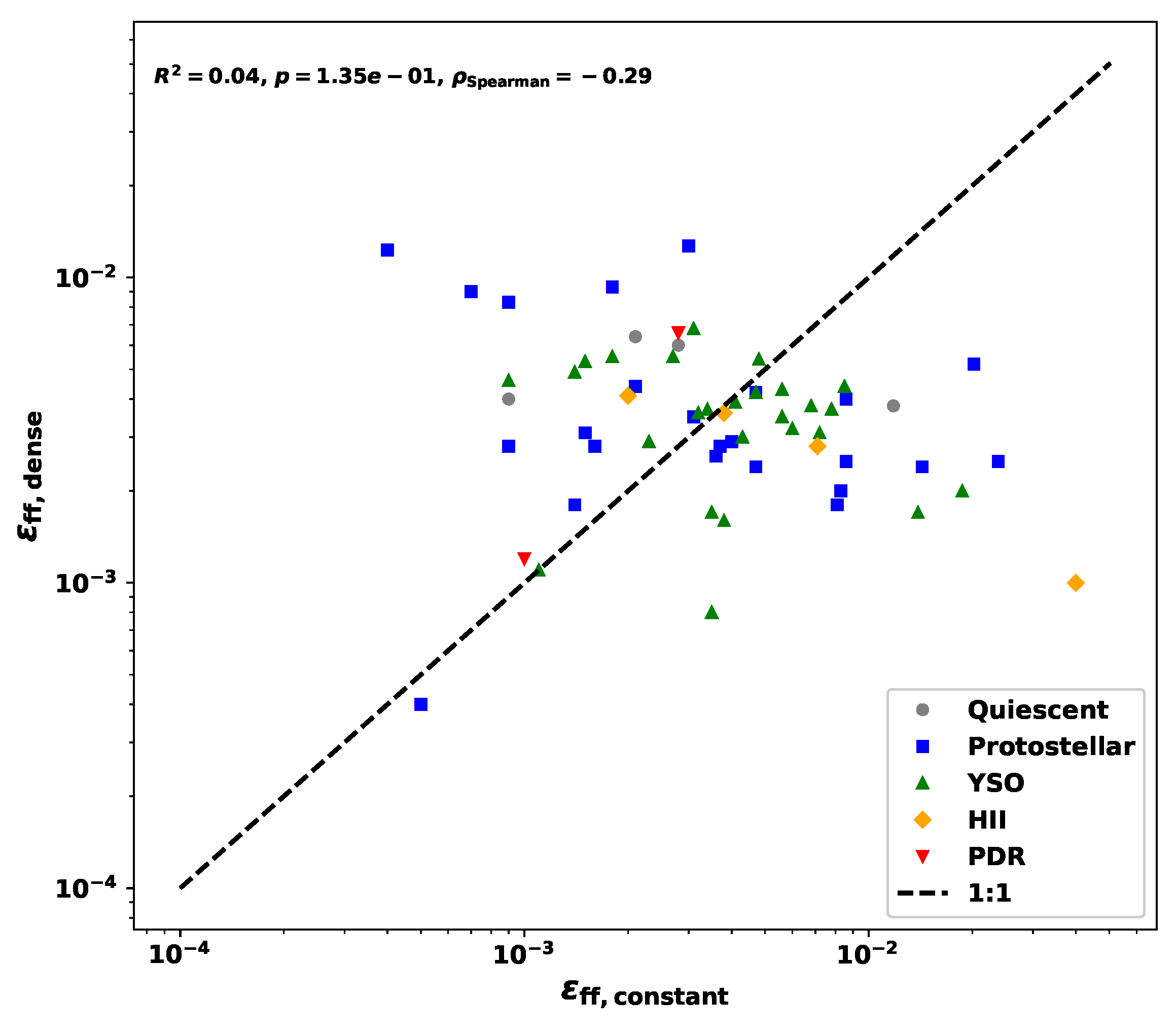
Figure 2.
Lower limit cumulative star formation efficiency () as a function of the clump radius (). The different symbols are the same as in Figure 1. The dark dashed line represents the power-law best-fit. The coefficient of determination ; the ; and the Spearman rank correlation coefficient .
Figure 2.
Lower limit cumulative star formation efficiency () as a function of the clump radius (). The different symbols are the same as in Figure 1. The dark dashed line represents the power-law best-fit. The coefficient of determination ; the ; and the Spearman rank correlation coefficient .
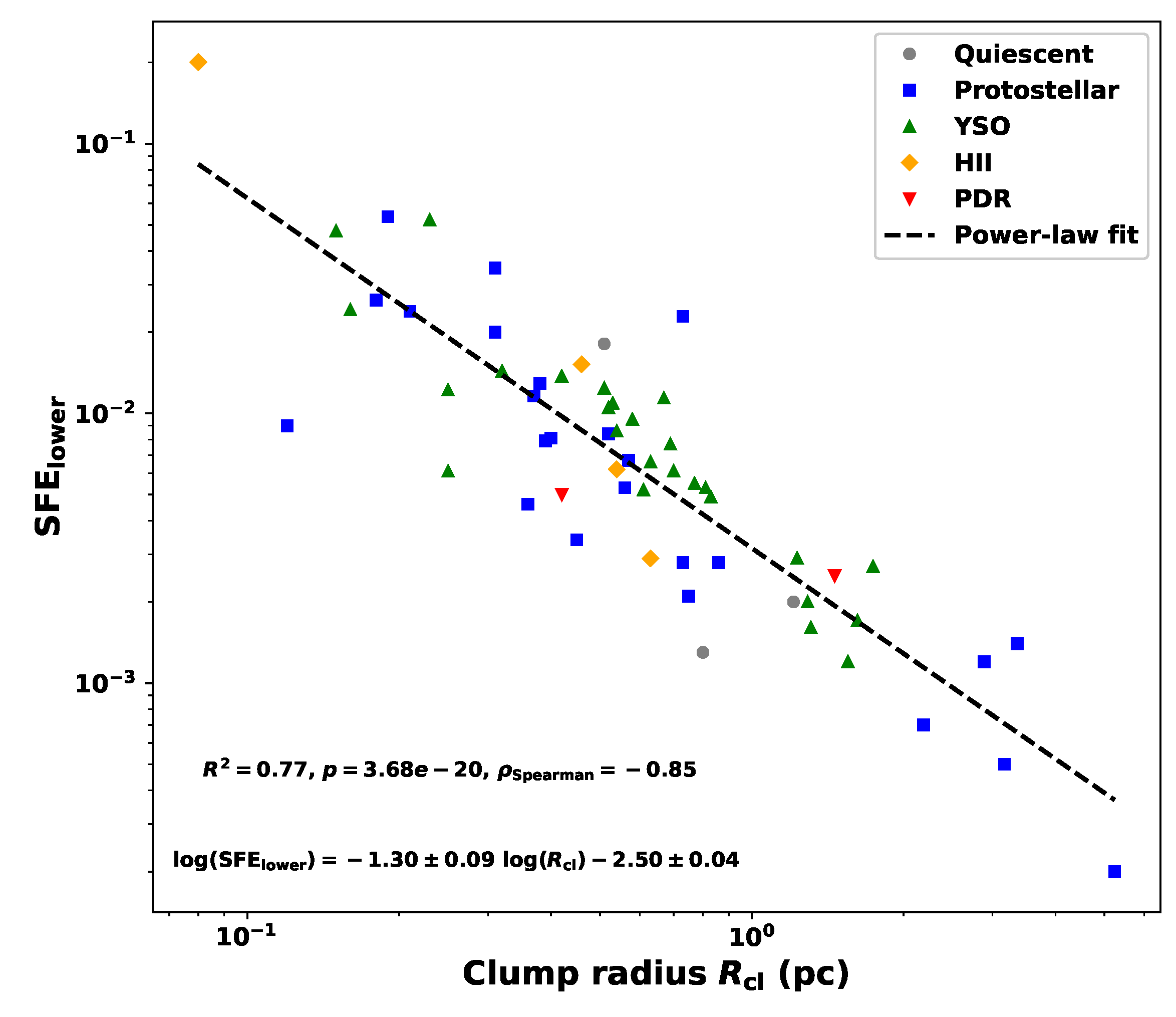
Figure 3.
The lower limit cumulative star formation efficiency () as a function of the Galactic radius (). The dark vertical dashed line depicts the Sun’s position at , whereas the gray areas () approximately show the Central Molecular Zone (CMZ) and the inner Galactic disk. The points are the same as in the preceding figures, and they show the five different stages of evolution of the clumps.
Figure 3.
The lower limit cumulative star formation efficiency () as a function of the Galactic radius (). The dark vertical dashed line depicts the Sun’s position at , whereas the gray areas () approximately show the Central Molecular Zone (CMZ) and the inner Galactic disk. The points are the same as in the preceding figures, and they show the five different stages of evolution of the clumps.
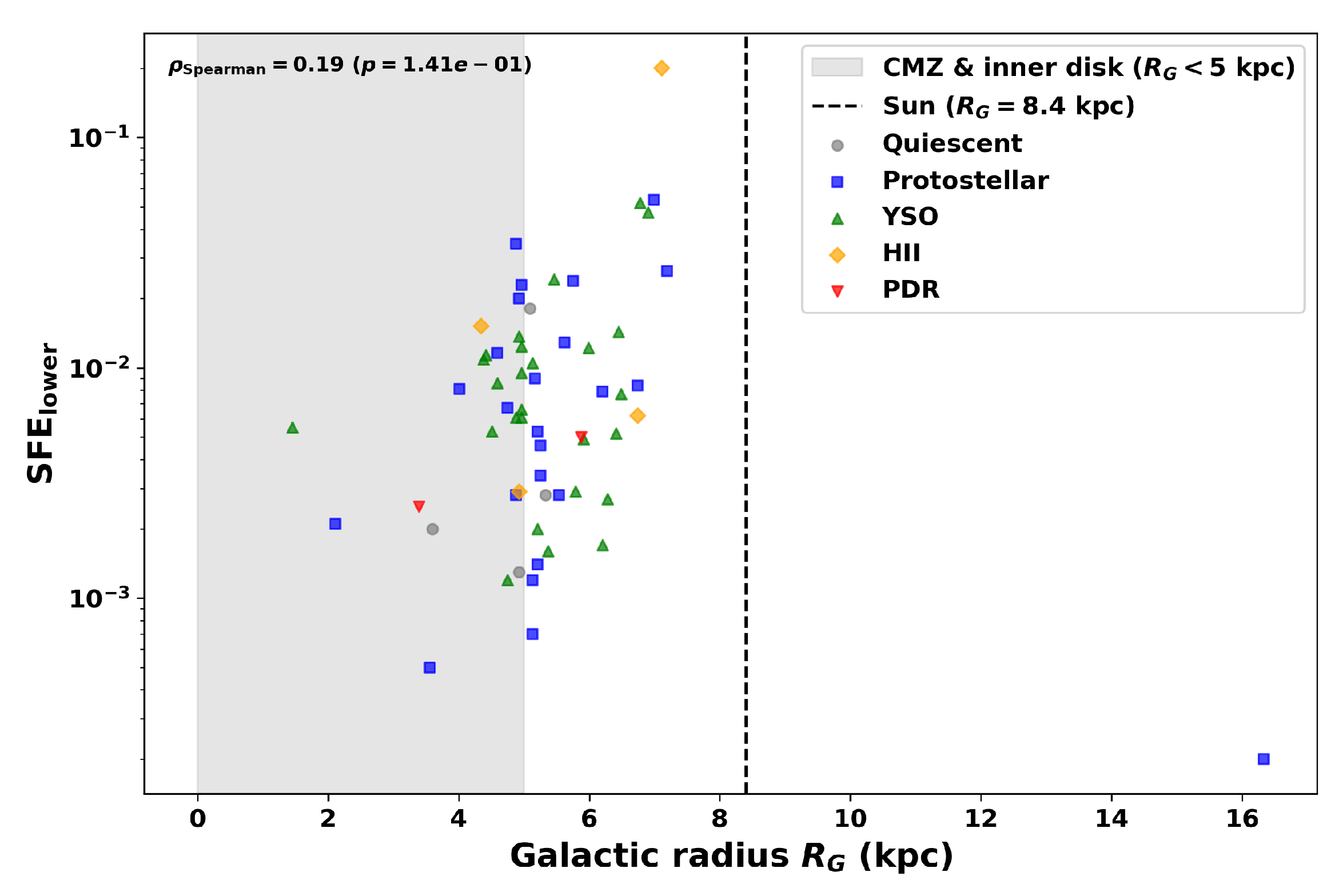
Figure 4.
The upper-limit cumulative star formation efficiency () as a function of the lower-limit (). The best-fit power law is denoted by the dark dashed line. It has a coefficient of determination of 0.55; a Spearman rank correlation coefficient of 0.71; and a p-value of .
Figure 4.
The upper-limit cumulative star formation efficiency () as a function of the lower-limit (). The best-fit power law is denoted by the dark dashed line. It has a coefficient of determination of 0.55; a Spearman rank correlation coefficient of 0.71; and a p-value of .
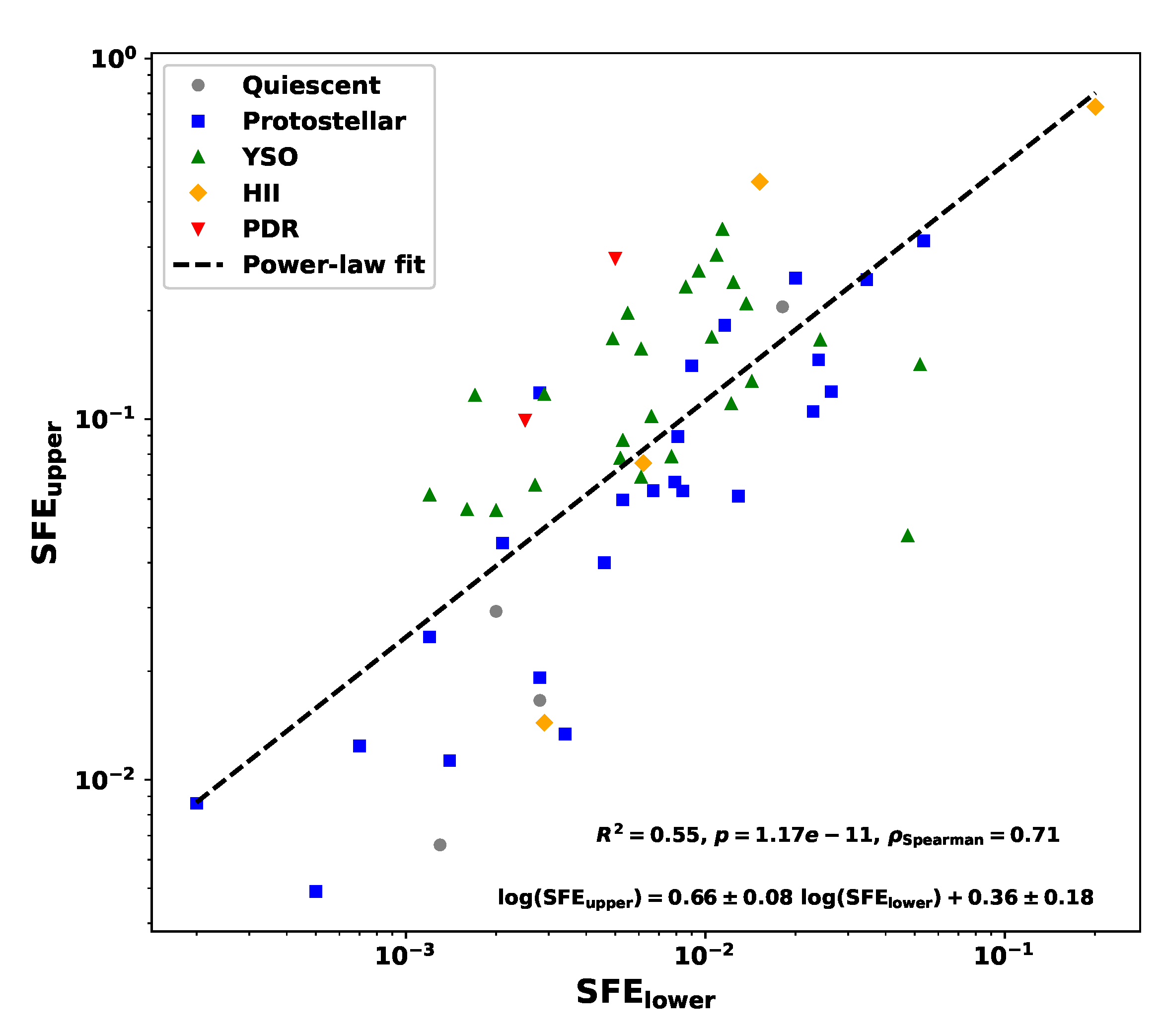
Figure 5.
Instantaneous star formation efficiency per free-fall time as a function of the clump volume density. The dark dashed line represents the best-fit power-law relation. The gray dashed horizontal line marks , the canonical value predicted by turbulence-regulated SF models (Krumholz and McKee [26], Padoan et al. [87]). The observed trend is consistent with the free-fall dependence implied by the adopted dense-gas formalism.
Figure 5.
Instantaneous star formation efficiency per free-fall time as a function of the clump volume density. The dark dashed line represents the best-fit power-law relation. The gray dashed horizontal line marks , the canonical value predicted by turbulence-regulated SF models (Krumholz and McKee [26], Padoan et al. [87]). The observed trend is consistent with the free-fall dependence implied by the adopted dense-gas formalism.
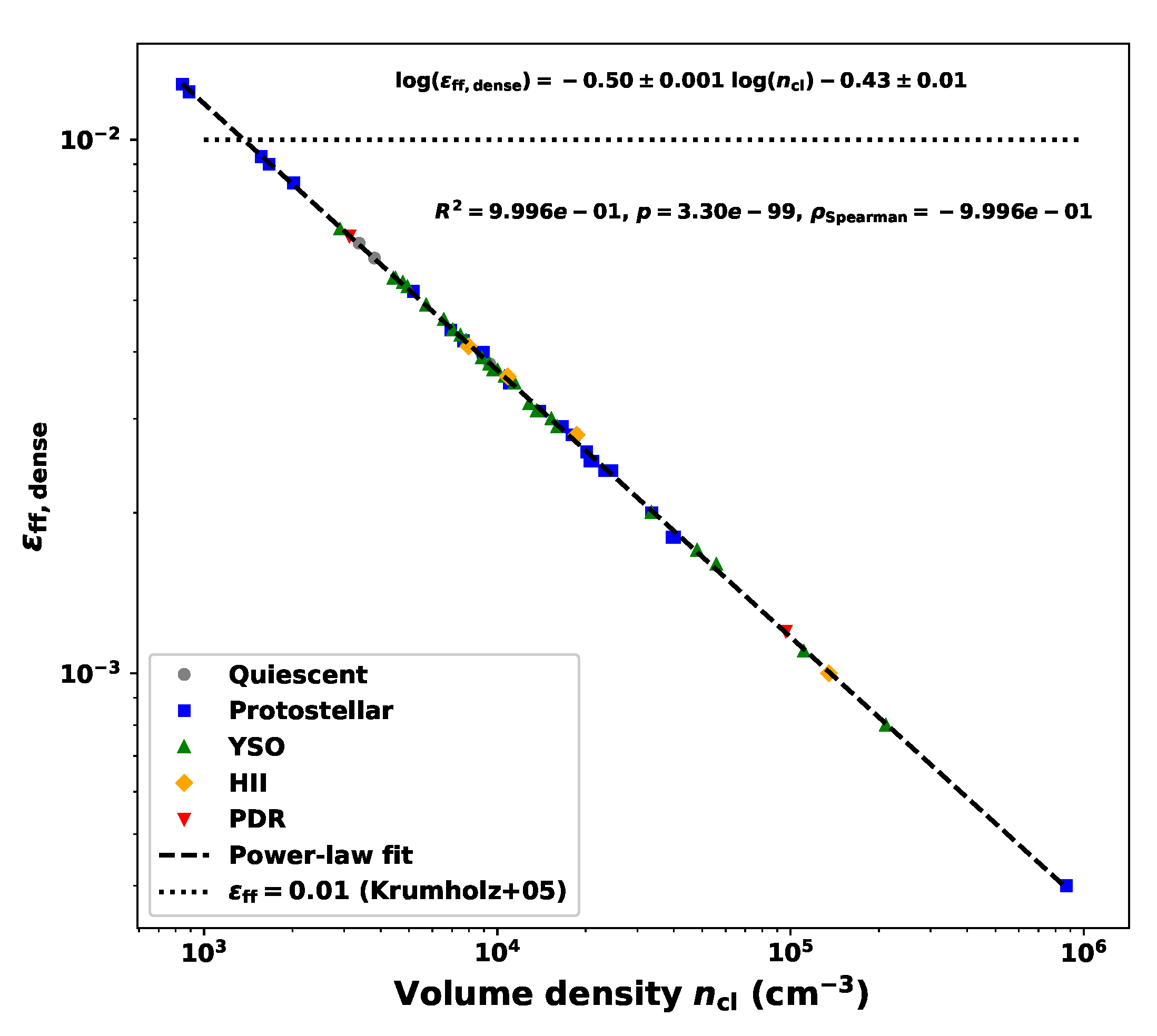
Figure 6.
Probability density distribution of the instantaneous star formation efficiency per free-fall time. The dark dotted line represents 0.0036, the median value of the distribution. The distribution covers the range 0.0004-0.0127.
Figure 6.
Probability density distribution of the instantaneous star formation efficiency per free-fall time. The dark dotted line represents 0.0036, the median value of the distribution. The distribution covers the range 0.0004-0.0127.
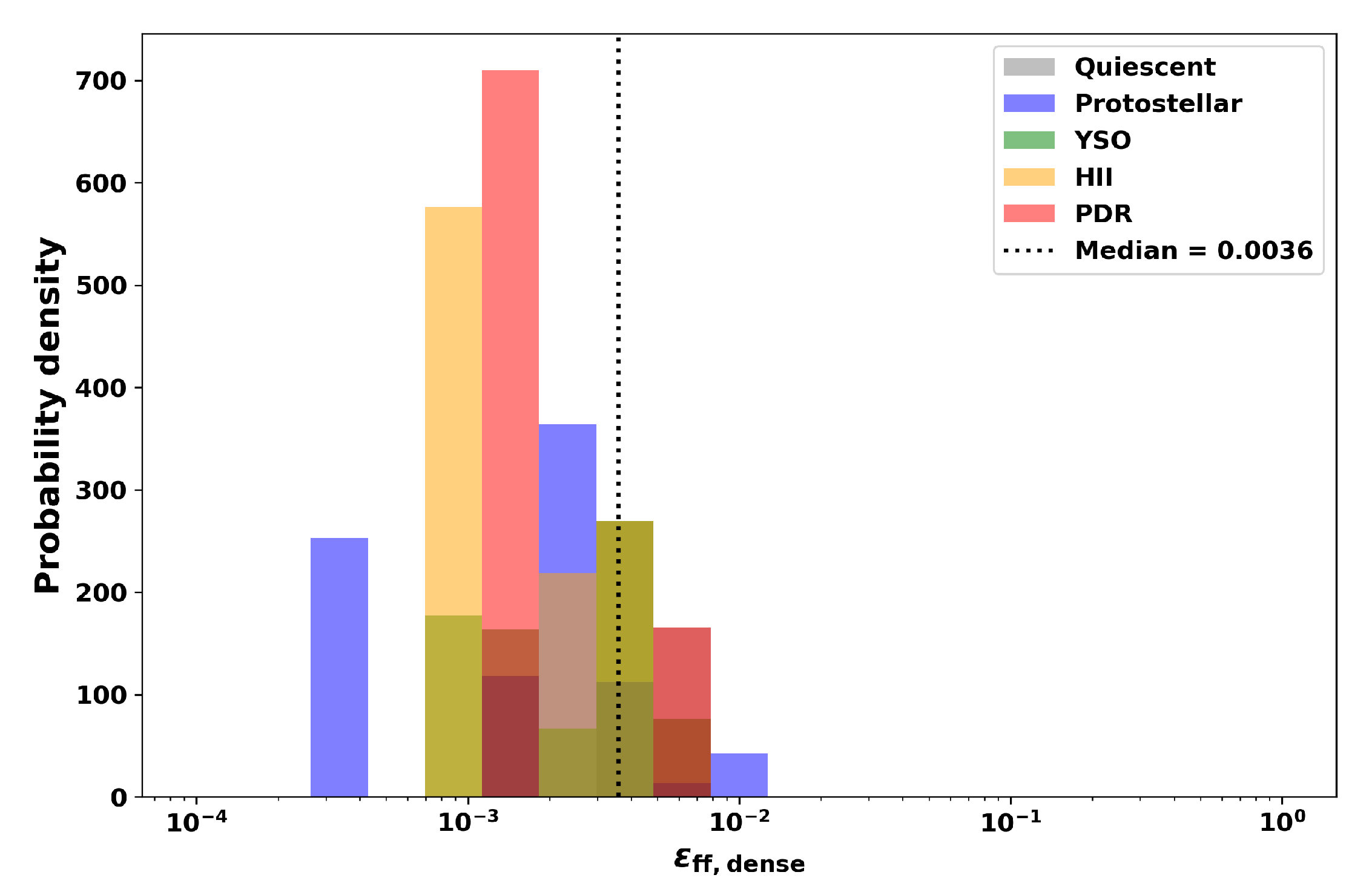
Figure 7.
Instantaneous star formation efficiency per free-fall time versus lower-limit cumulative star formation efficiency, with points color-coded by clump radius. The Pearson correlation coefficient r is (p-value of ), whereas the Spearman rank correlation coefficient is (with p-value of ).
Figure 7.
Instantaneous star formation efficiency per free-fall time versus lower-limit cumulative star formation efficiency, with points color-coded by clump radius. The Pearson correlation coefficient r is (p-value of ), whereas the Spearman rank correlation coefficient is (with p-value of ).
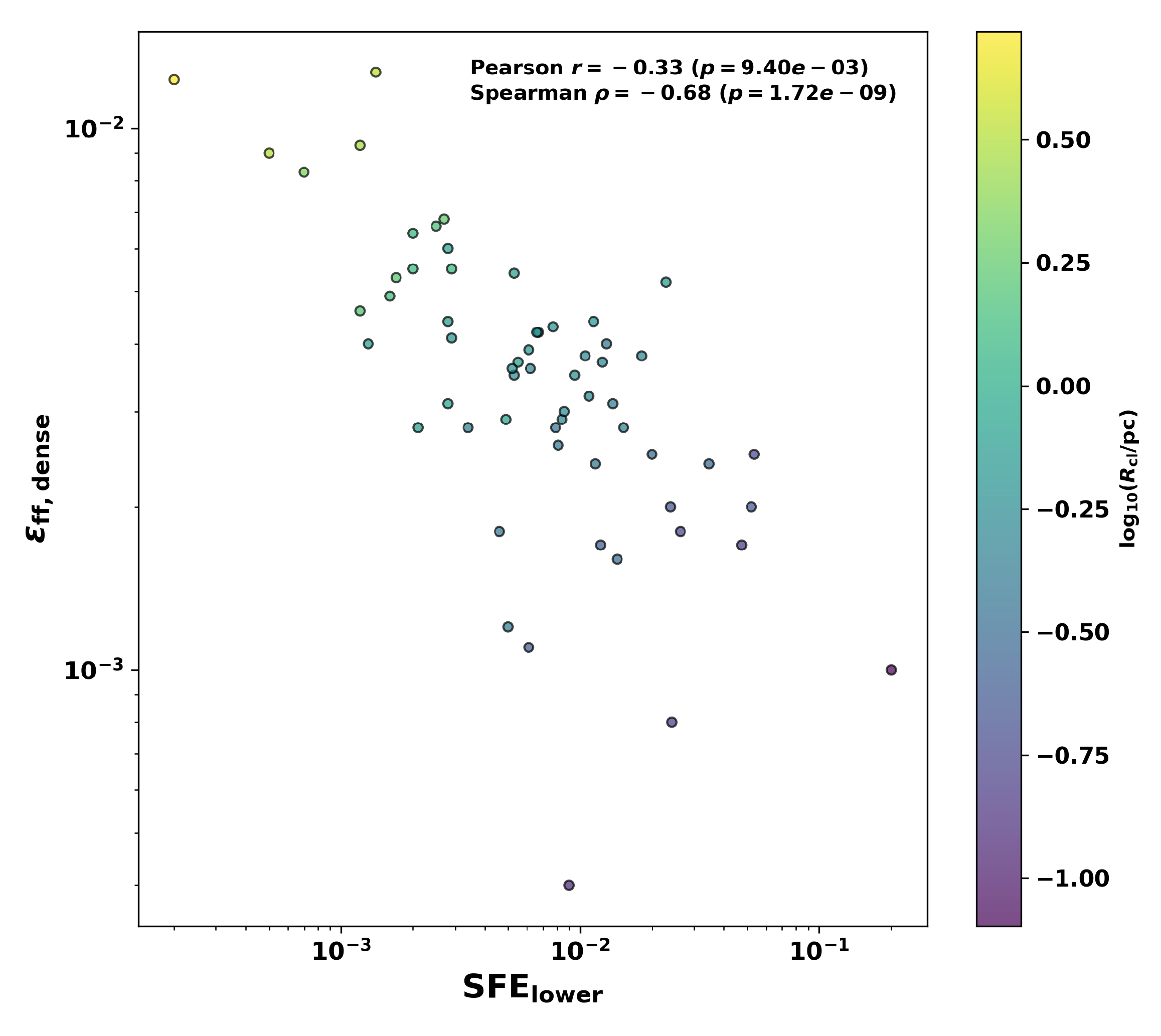
Figure 8.
The star formation timescale as function of the clump mass. The symbols are identical to those in the earlier figures. The best-fit power-law (dark dashed line) is described with a coefficient of determination, ; a Spearman rank correlation coefficient, ; and a p-value of .
Figure 8.
The star formation timescale as function of the clump mass. The symbols are identical to those in the earlier figures. The best-fit power-law (dark dashed line) is described with a coefficient of determination, ; a Spearman rank correlation coefficient, ; and a p-value of .
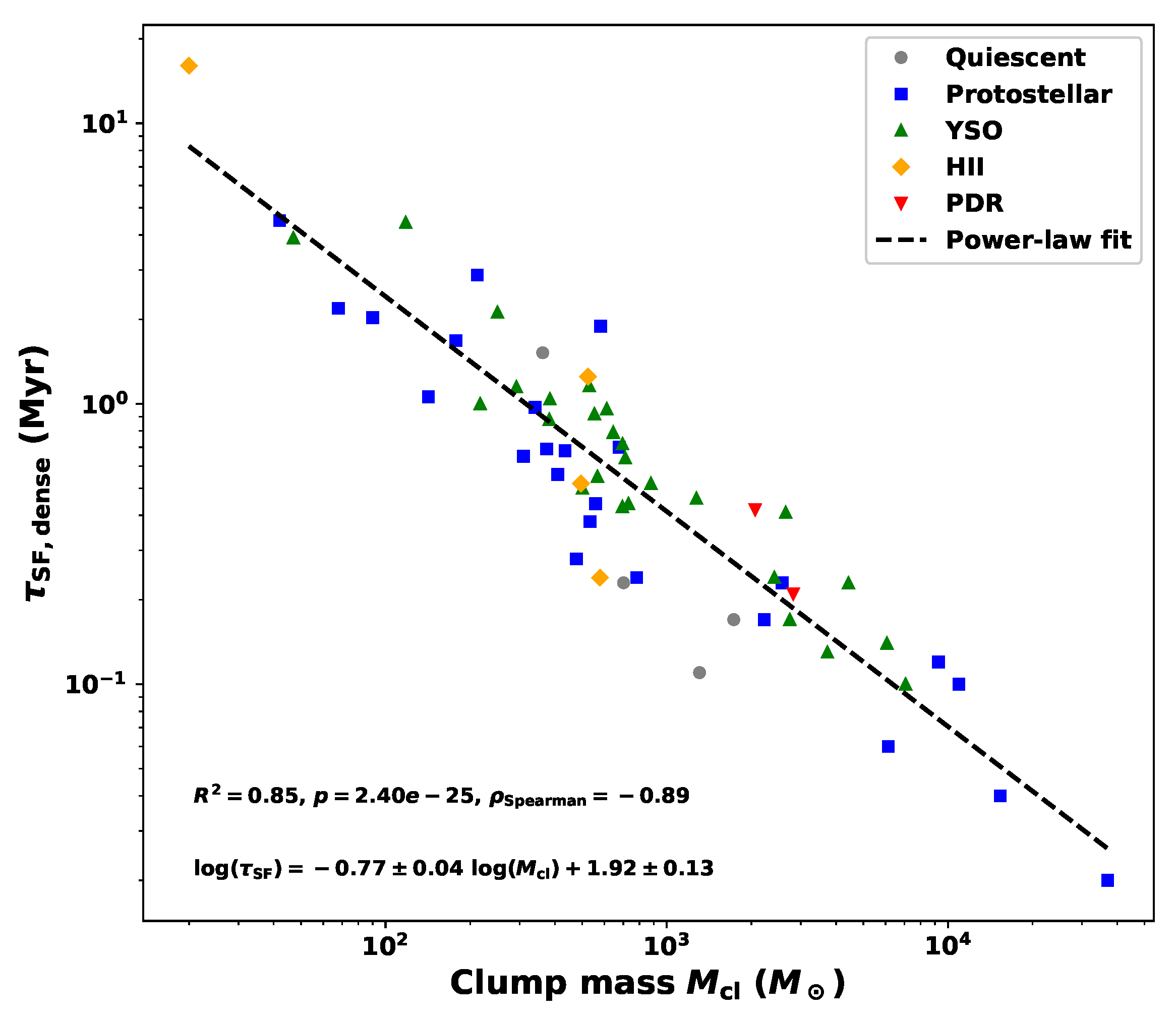

Table 1.
Calculated properties of the ATLASGAL star-forming clumps with available .
| ATLASGAL name | Evolutionary | |||||||||||
|---|---|---|---|---|---|---|---|---|---|---|---|---|
| () | (pc) | (kpc) | () | (Myr) | (Myr) | (Myr) | phase | |||||
| AGAL005.397+00.194 | 142 | 0.38 | 5.62 | 8948.87 | 0.0129 | 0.0612 | 0.0086 | 0.0040 | 0.33 | 1.06 | 5.05 | Protostellar |
| AGAL005.617-00.082 | 37030 | 5.24 | 16.33 | 888.08 | 0.0002 | 0.0086 | 0.0004 | 0.0123 | 1.03 | 0.02 | 0.72 | Protostellar |
| AGAL007.166+00.131 | 2223 | 0.75 | 2.11 | 18203.97 | 0.0021 | 0.0453 | 0.0009 | 0.0028 | 0.23 | 0.17 | 3.72 | Protostellar |
| AGAL007.333-00.567 | 567 | 0.63 | 4.96 | 7826.00 | 0.0066 | 0.1016 | 0.0047 | 0.0042 | 0.35 | 0.55 | 8.47 | YSO |
| AGAL007.636-00.192 | 1276 | 0.77 | 1.45 | 9663.41 | 0.0055 | 0.1962 | 0.0034 | 0.0037 | 0.31 | 0.46 | 16.44 | YSO |
| AGAL008.206+00.191 | 90 | 0.21 | 5.75 | 33583.77 | 0.0239 | 0.1461 | 0.0083 | 0.0020 | 0.17 | 2.03 | 12.42 | Protostellar |
| AGAL008.544-00.341 | 374 | 0.40 | 4.01 | 20177.48 | 0.0081 | 0.0894 | 0.0036 | 0.0026 | 0.22 | 0.69 | 7.56 | Protostellar |
| AGAL008.706-00.414 | 15356 | 3.17 | 3.56 | 1667.28 | 0.0005 | 0.0049 | 0.0007 | 0.0090 | 0.75 | 0.04 | 0.41 | Protostellar |
| AGAL008.954-00.532 | 9264 | 3.36 | 5.21 | 843.85 | 0.0014 | 0.0113 | 0.0030 | 0.0127 | 1.06 | 0.12 | 0.94 | Protostellar |
| AGAL010.404-00.201 | 309 | 0.39 | 6.20 | 17999.81 | 0.0079 | 0.0669 | 0.0037 | 0.0028 | 0.23 | 0.65 | 5.50 | Protostellar |
| AGAL010.742-00.126 | 781 | 0.73 | 4.88 | 6941.33 | 0.0028 | 0.0192 | 0.0021 | 0.0044 | 0.37 | 0.24 | 1.61 | Protostellar |
| AGAL010.991-00.082 | 702 | 0.86 | 5.33 | 3810.92 | 0.0028 | 0.0166 | 0.0028 | 0.0060 | 0.50 | 0.23 | 1.38 | Quiescent |
| AGAL012.496-00.222 | 362 | 0.51 | 5.09 | 9425.23 | 0.0181 | 0.2048 | 0.0118 | 0.0038 | 0.32 | 1.52 | 17.25 | Quiescent |
| AGAL013.259-00.409 | 579 | 0.63 | 4.92 | 7996.13 | 0.0029 | 0.0144 | 0.0020 | 0.0041 | 0.34 | 0.24 | 1.19 | HII region |
| AGAL014.707-00.156 | 582 | 0.73 | 4.96 | 5171.97 | 0.0229 | 0.1050 | 0.0202 | 0.0052 | 0.43 | 1.89 | 8.68 | Protostellar |
| AGAL014.851-00.990 | 217 | 0.25 | 5.99 | 47976.81 | 0.0122 | 0.1103 | 0.0035 | 0.0017 | 0.14 | 1.00 | 9.08 | YSO |
| AGAL015.531-00.407 | 382 | 0.52 | 5.13 | 9391.20 | 0.0105 | 0.1684 | 0.0068 | 0.0038 | 0.32 | 0.88 | 14.18 | YSO |
| AGAL016.318-00.531 | 7069 | 1.55 | 4.75 | 6567.04 | 0.0012 | 0.0616 | 0.0009 | 0.0046 | 0.38 | 0.10 | 5.09 | YSO |
| AGAL016.418-00.634 | 1308 | 0.80 | 4.92 | 8812.76 | 0.0013 | 0.0066 | 0.0009 | 0.0040 | 0.33 | 0.11 | 0.54 | Quiescent |
| AGAL016.442-00.384 | 178 | 0.31 | 4.92 | 20653.85 | 0.0200 | 0.2460 | 0.0086 | 0.0025 | 0.21 | 1.68 | 20.66 | Protostellar |
| AGAL016.459-00.669 | 292 | 0.42 | 4.92 | 13610.44 | 0.0137 | 0.2086 | 0.0072 | 0.0031 | 0.26 | 1.15 | 17.50 | YSO |
| AGAL016.986-00.922 | 10944 | 2.89 | 5.13 | 1565.20 | 0.0012 | 0.0249 | 0.0018 | 0.0093 | 0.78 | 0.10 | 2.09 | Protostellar |
| AGAL018.231+00.652 | 3728 | 1.31 | 5.37 | 5716.39 | 0.0016 | 0.0561 | 0.0014 | 0.0049 | 0.41 | 0.13 | 4.69 | YSO |
| AGAL018.286-00.707 | 6137 | 2.19 | 5.13 | 2017.75 | 0.0007 | 0.0124 | 0.0009 | 0.0083 | 0.69 | 0.06 | 1.03 | Protostellar |
| AGAL018.549+00.036 | 2571 | 0.86 | 5.54 | 13950.70 | 0.0028 | 0.1183 | 0.0015 | 0.0031 | 0.26 | 0.23 | 9.92 | Protostellar |
| AGAL018.606-00.074 | 558 | 0.56 | 5.21 | 10990.43 | 0.0053 | 0.0597 | 0.0031 | 0.0035 | 0.29 | 0.44 | 4.95 | Protostellar |
| AGAL018.789-00.286 | 612 | 0.67 | 4.42 | 7043.40 | 0.0114 | 0.3357 | 0.0085 | 0.0044 | 0.37 | 0.96 | 28.23 | YSO |
| AGAL019.539-00.456 | 731 | 0.81 | 4.51 | 4763.65 | 0.0053 | 0.0872 | 0.0048 | 0.0054 | 0.45 | 0.44 | 7.27 | YSO |
| AGAL019.977-00.214 | 2740 | 1.29 | 5.21 | 4423.39 | 0.0020 | 0.0557 | 0.0018 | 0.0055 | 0.46 | 0.17 | 4.66 | YSO |
| AGAL021.563-00.132 | 2817 | 1.46 | 3.39 | 3127.00 | 0.0025 | 0.0994 | 0.0028 | 0.0066 | 0.55 | 0.21 | 8.28 | PDR |
| AGAL022.376+00.447 | 477 | 0.45 | 5.25 | 18101.89 | 0.0034 | 0.0134 | 0.0016 | 0.0028 | 0.23 | 0.28 | 1.10 | Protostellar |
| () | (pc) | (kpc) | () | (Myr) | (Myr) | (Myr) | phase | |||||
| AGAL022.434-00.169 | 6073 | 1.62 | 6.20 | 4933.79 | 0.0017 | 0.1163 | 0.0015 | 0.0053 | 0.44 | 0.14 | 9.66 | YSO |
| AGAL022.484-00.936 | 410 | 0.57 | 4.75 | 7655.87 | 0.0067 | 0.0633 | 0.0047 | 0.0042 | 0.35 | 0.56 | 5.28 | Protostellar |
| AGAL022.559+00.171 | 42 | 0.19 | 6.99 | 21164.24 | 0.0536 | 0.3119 | 0.0238 | 0.0025 | 0.21 | 4.50 | 26.20 | Protostellar |
| AGAL022.699+00.404 | 1731 | 1.21 | 3.60 | 3375.39 | 0.0020 | 0.0293 | 0.0021 | 0.0064 | 0.53 | 0.17 | 2.43 | Quiescent |
| AGAL022.832-00.437 | 879 | 0.70 | 4.88 | 8846.79 | 0.0061 | 0.1561 | 0.0041 | 0.0039 | 0.33 | 0.52 | 13.21 | YSO |
| AGAL027.016+00.202 | 553 | 0.53 | 4.38 | 12827.84 | 0.0109 | 0.2842 | 0.0060 | 0.0032 | 0.27 | 0.92 | 23.98 | YSO |
| AGAL028.608-00.027 | 2062 | 0.42 | 5.87 | 96293.88 | 0.0050 | 0.2793 | 0.0010 | 0.0012 | 0.10 | 0.42 | 23.28 | PDR |
| AGAL028.841+00.494 | 696 | 0.54 | 4.59 | 15277.72 | 0.0086 | 0.2321 | 0.0043 | 0.0030 | 0.25 | 0.72 | 19.34 | YSO |
| AGAL028.881-00.021 | 525 | 0.46 | 4.34 | 18646.31 | 0.0152 | 0.4554 | 0.0071 | 0.0028 | 0.23 | 1.25 | 37.41 | HII region |
| AGAL030.368+00.484 | 20 | 0.08 | 7.11 | 135083.64 | 0.2006 | 0.7341 | 0.0400 | 0.0010 | 0.08 | 16.05 | 58.73 | HII region |
| AGAL030.623+00.547 | 212 | 0.31 | 4.88 | 24600.87 | 0.0346 | 0.2437 | 0.0143 | 0.0024 | 0.20 | 2.88 | 20.31 | Protostellar |
| AGAL030.769-00.804 | 384 | 0.51 | 4.96 | 10003.67 | 0.0124 | 0.2389 | 0.0078 | 0.0037 | 0.31 | 1.04 | 20.02 | YSO |
| AGAL031.076+00.457 | 4429 | 1.74 | 6.28 | 2905.83 | 0.0027 | 0.0655 | 0.0031 | 0.0068 | 0.57 | 0.23 | 5.49 | YSO |
| AGAL031.901+00.344 | 340 | 0.37 | 4.59 | 23205.80 | 0.0116 | 0.1819 | 0.0047 | 0.0024 | 0.20 | 0.97 | 15.16 | Protostellar |
| AGAL033.518-00.057 | 645 | 0.58 | 4.96 | 11432.77 | 0.0095 | 0.2568 | 0.0056 | 0.0035 | 0.29 | 0.79 | 21.28 | YSO |
| AGAL035.226-00.359 | 2648 | 0.83 | 5.91 | 15992.27 | 0.0049 | 0.1668 | 0.0023 | 0.0029 | 0.24 | 0.41 | 13.80 | YSO |
| AGAL035.681-00.176 | 118 | 0.23 | 6.78 | 33515.71 | 0.0521 | 0.1414 | 0.0187 | 0.0020 | 0.17 | 4.43 | 12.02 | YSO |
| AGAL036.839-00.022 | 2413 | 1.23 | 5.79 | 4491.45 | 0.0029 | 0.1169 | 0.0027 | 0.0055 | 0.46 | 0.24 | 9.78 | YSO |
| AGAL036.899-00.409 | 533 | 0.36 | 5.25 | 39470.28 | 0.0046 | 0.0400 | 0.0014 | 0.0018 | 0.15 | 0.38 | 3.33 | Protostellar |
| AGAL037.031-00.039 | 435 | 0.12 | 5.17 | 871068.28 | 0.0090 | 0.1405 | 0.0005 | 0.0004 | 0.03 | 0.68 | 10.54 | Protostellar |
| AGAL037.599+00.426 | 501 | 0.25 | 4.96 | 110925.10 | 0.0061 | 0.0689 | 0.0011 | 0.0011 | 0.09 | 0.50 | 5.64 | YSO |
| AGAL039.048-00.880 | 250 | 0.16 | 5.46 | 210961.85 | 0.0242 | 0.1656 | 0.0035 | 0.0008 | 0.07 | 2.12 | 14.49 | YSO |
| AGAL040.907-00.249 | 47 | 0.15 | 6.90 | 47976.81 | 0.0474 | 0.0474 | 0.0139 | 0.0017 | 0.14 | 3.90 | 3.90 | YSO |
| AGAL051.691-00.946 | 696 | 0.61 | 6.41 | 10582.12 | 0.0052 | 0.0778 | 0.0032 | 0.0036 | 0.30 | 0.43 | 6.48 | YSO |
| AGAL052.341+00.324 | 530 | 0.32 | 6.45 | 55802.81 | 0.0143 | 0.1270 | 0.0038 | 0.0016 | 0.13 | 1.16 | 10.32 | YSO |
| AGAL052.511-00.967 | 712 | 0.69 | 6.49 | 7485.74 | 0.0077 | 0.0786 | 0.0056 | 0.0043 | 0.36 | 0.64 | 6.58 | YSO |
| AGAL053.739+00.012 | 68 | 0.18 | 7.19 | 40150.80 | 0.0263 | 0.1192 | 0.0081 | 0.0018 | 0.15 | 2.19 | 9.93 | Protostellar |
| AGAL056.064-00.126 | 678 | 0.52 | 6.74 | 16672.79 | 0.0084 | 0.0632 | 0.0040 | 0.0029 | 0.24 | 0.70 | 5.23 | Protostellar |
| AGAL056.127+00.216 | 495 | 0.54 | 6.74 | 10854.33 | 0.0062 | 0.0755 | 0.0038 | 0.0036 | 0.30 | 0.52 | 6.29 | HII region |
Column 1, is the ATLASGAL name, (column 2), is the clump mass, (column 3), is the clump radius, (column 4), is the clumps Galactocentric radius, (column 5), is the volume density. (column 6), is the lower-limit SFE, (column 7), is the upper-limit SFE, (column 8), is the SFE per free-fall time based on a constant 0.50 Myr Class I protostellar lifetime approach, (column 9), is the dense gas SFE per free-fall time based on the dense-gas (Wu et al. [43]) approach, (column 10), refers to the free-fall time, (column 11), is the estimated lower-limit YSO SF timescale, column 12 (), is the estimated upper-limit YSO SF timescale and column 13, refers to the clumps evolutionary phases.
Table 2.
The clumps and their associated MIPSGAL stellar properties.
| ATLASGAL name | MIPSGAL name | |||
|---|---|---|---|---|
| () | () | () | ||
| AGAL005.397+00.194 | MG005.3946+00.1939 | 1.85 | 0.81 | 9.25 |
| AGAL005.617-00.082 | MG005.6181-00.0821 | 7.10 | 86 | 319.50 |
| AGAL007.166+00.131 | MG007.1654+00.1314 | 4.59 | 21 | 105.57 |
| AGAL007.333-00.567 | MG007.3349-00.5665 | 3.77 | 10 | 64.09 |
| AGAL007.636-00.192 | MG007.6351-00.1922 | 7.08 | 84 | 311.52 |
| AGAL008.206+00.191 | MG008.2032+00.1917 | 2.20 | 1.80 | 15.40 |
| AGAL008.544-00.341 | MG008.5486-00.3394 | 3.06 | 5.90 | 36.72 |
| AGAL008.706-00.414 | MG008.7038-00.4121 | 3.45 | 6.70 | 75.10 |
| AGAL008.706-00.414 | MG008.7081-00.4162 | 4.06 | 14 | ... |
| AGAL008.954-00.532 | MG008.9392-00.5303 | 4.59 | 20 | 105.60 |
| AGAL008.954-00.532 | MG008.9555-00.5352 | 4.03 | 14 | ... |
| AGAL008.954-00.532 | MG008.9565-00.5426 | 4.58 | 17 | ... |
| AGAL010.404-00.201 | MG010.4082-00.2013 | 2.46 | 3 | 22.14 |
| AGAL010.742-00.126 | MG010.7415-00.1256 | 2.18 | 1.50 | 15.26 |
| AGAL010.991-00.082 | MG010.9893-00.0893 | 1.98 | 0.95 | 11.88 |
| AGAL012.496-00.222 | MG012.4986-00.2281 | 4.34 | 17 | 93.24 |
| AGAL012.496-00.222 | MG012.4992-00.2223 | 2.32 | 2.20 | ... |
| AGAL013.259-00.409 | MG013.2639-00.4064 | 1.69 | 0.54 | 8.45 |
| AGAL014.707-00.156 | MG014.7065-00.1568 | 3.93 | 12 | 68.25 |
| AGAL014.707-00.156 | MG014.7091-00.1589 | 1.82 | 0.69 | ... |
| AGAL014.707-00.156 | MG014.7117-00.1529 | 3.81 | 11 | ... |
| AGAL014.707-00.156 | MG014.7156-00.1494 | 4.09 | 13 | ... |
| AGAL014.851-00.990 | MG014.8517-00.9887 | 2.69 | 4 | 26.90 |
| AGAL015.531-00.407 | MG015.5296-00.4067 | 4.07 | 13 | 77.33 |
| AGAL016.318-00.531 | MG016.3185-00.5311 | 8.28 | 140 | 463.68 |
| AGAL016.418-00.634 | MG016.4126-00.6284 | 1.74 | 0.48 | 8.70 |
| AGAL016.442-00.384 | MG016.4462-00.3872 | 3.63 | 9.20 | 58.08 |
| AGAL016.459-00.669 | MG016.4564-00.6707 | 4.05 | 13 | 76.95 |
| AGAL016.986-00.922 | MG016.9822-00.9259 | 4.65 | 17 | 279.62 |
| AGAL016.986-00.922 | MG016.9832-00.9308 | 4.53 | 16 | ... |
| AGAL016.986-00.922 | MG016.9870-00.9207 | 5.37 | 26 | ... |
| AGAL016.986-00.922 | MG016.9883-00.9175 | 3.52 | 7.90 | ... |
| AGAL016.986-00.922 | MG016.9921-00.9110 | 9.19 | 240 | ... |
| AGAL018.231+00.652 | MG018.2283+00.6484 | 6.15 | 43 | 221.40 |
| AGAL018.286-00.707 | MG018.2860-00.7114 | 4.05 | 12 | 76.95 |
| AGAL018.549+00.036 | MG018.5509+00.0354 | 7.34 | 98 | 344.98 |
| AGAL018.606-00.074 | MG018.5945-00.0739 | 2.95 | 5.70 | 35.40 |
| AGAL018.789-00.286 | MG018.7942-00.2891 | 7.03 | 75 | 309.32 |
| AGAL019.539-00.456 | MG019.5339-00.4561 | 3.88 | 10 | 69.84 |
| AGAL019.977-00.214 | MG019.9799-00.2127 | 5.39 | 36 | 161.70 |
| AGAL021.563-00.132 | MG021.5583-00.1282 | 7.07 | 79 | 311.08 |
| AGAL022.376+00.447 | MG022.3763+00.4462 | 1.62 | 0.43 | 6.48 |
| AGAL022.434-00.169 | MG022.4352-00.1692 | 10.38 | 540 | 799.26 |
| AGAL022.484-00.936 | MG022.4851-00.9343 | 2.77 | 4.90 | 27.70 |
| AGAL022.559+00.171 | MG022.5599+00.1697 | 2.38 | 2.50 | 19.04 |
| AGAL022.699+00.404 | MG022.7053+00.4046 | 3.48 | 7.60 | 52.20 |
| () | () | () | ||
| AGAL022.832-00.437 | MG022.8347-00.4381 | 5.42 | 32 | 162.60 |
| AGAL027.016+00.202 | MG027.0163+00.2003 | 6.10 | 47 | 219.60 |
| AGAL028.608-00.027 | MG028.6088-00.0264 | 10.38 | 540 | 799.26 |
| AGAL028.841+00.494 | MG028.8423+00.4937 | 6.01 | 45 | 210.35 |
| AGAL028.881-00.021 | MG028.8800-00.0196 | 8.13 | 110 | 439.02 |
| AGAL030.368+00.484 | MG030.3571+00.4871 | 1.49 | 0.36 | 55.22 |
| AGAL030.368+00.484 | MG030.3703+00.4826 | 3.53 | 8.40 | ... |
| AGAL030.623+00.547 | MG030.6239+00.5456 | 3.92 | 11 | 68.31 |
| AGAL030.623+00.547 | MG030.6263+00.5450 | 3.67 | 9.40 | ... |
| AGAL030.769-00.804 | MG030.7698-00.8043 | 4.82 | 24 | 120.50 |
| AGAL031.076+00.457 | MG031.0739+00.4599 | 4.87 | 24 | 310.18 |
| AGAL031.076+00.457 | MG031.0764+00.4579 | 7.06 | 82 | ... |
| AGAL031.901+00.344 | MG031.9003+00.3411 | 3.98 | 12 | 75.62 |
| AGAL033.518-00.057 | MG033.5184-00.0568 | 6.19 | 54 | 222.84 |
| AGAL035.226-00.359 | MG035.2252-00.3596 | 8.80 | 160 | 530.13 |
| AGAL035.226-00.359 | MG035.2261-00.3543 | 4.13 | 14 | ... |
| AGAL035.681-00.176 | MG035.6717-00.1764 | 1.91 | 0.85 | 19.44 |
| AGAL035.681-00.176 | MG035.6771-00.1745 | 2.09 | 1.40 | ... |
| AGAL035.681-00.176 | MG035.6812-00.1756 | 2.48 | 3.10 | ... |
| AGAL036.839-00.022 | MG036.8393-00.0223 | 7.10 | 94 | 319.50 |
| AGAL036.899-00.409 | MG036.8983-00.4093 | 2.47 | 2.80 | 22.23 |
| AGAL037.031-00.039 | MG037.0301-00.0385 | 3.95 | 12 | 71.10 |
| AGAL037.599+00.426 | MG037.6036+00.4292 | 3.09 | 6.20 | 37.08 |
| AGAL039.048-00.880 | MG039.0466-00.8846 | 3.48 | 7.70 | 49.60 |
| AGAL039.048-00.880 | MG039.0479-00.8806 | 2.72 | 4.30 | ... |
| AGAL040.907-00.249 | MG040.9059-00.2487 | 1.15 | 0.17 | 2.34 |
| AGAL040.907-00.249 | MG040.9108-00.2478 | 1.19 | 0.19 | ... |
| AGAL051.691-00.946 | MG051.6852-00.9479 | 3.67 | 9.90 | 58.72 |
| AGAL052.341+00.324 | MG052.3410+00.3234 | 3.62 | 9.40 | 77.10 |
| AGAL052.341+00.324 | MG052.3410+00.3258 | 4.09 | 14 | ... |
| AGAL052.511-00.967 | MG052.5077-00.9584 | 1.83 | 0.76 | 60.72 |
| AGAL052.511-00.967 | MG052.5133-00.9579 | 3.69 | 9.80 | ... |
| AGAL053.739+00.012 | MG053.7421+00.0102 | 1.84 | 0.81 | 9.20 |
| AGAL056.064-00.126 | MG056.0651-00.1273 | 2.44 | 2.90 | 45.76 |
| AGAL056.064-00.126 | MG056.0729-00.1271 | 3.28 | 7.20 | ... |
| AGAL056.127+00.216 | MG056.1272+00.2147 | 3.11 | 6.40 | 40.43 |
Column 1, is the ATLASGAL name, MIPSGAL name (column 2), is the clump associated stellar name, (column 3), is the stellar mass, (column 4), is the stellar infra-red luminosity, and (column 5), is the fully sampled initial mass function (IMF) according to [70]. Columns 1-4, were extracted from Table 2 of [5], while column 5 was calculated from the same Table.
Disclaimer/Publisher’s Note: The statements, opinions and data contained in all publications are solely those of the individual author(s) and contributor(s) and not of MDPI and/or the editor(s). MDPI and/or the editor(s) disclaim responsibility for any injury to people or property resulting from any ideas, methods, instructions or products referred to in the content. |
© 2026 by the authors. Licensee MDPI, Basel, Switzerland. This article is an open access article distributed under the terms and conditions of the Creative Commons Attribution (CC BY) license.
Copyright: This open access article is published under a Creative Commons CC BY 4.0 license, which permit the free download, distribution, and reuse, provided that the author and preprint are cited in any reuse.


