
Submitted:
19 June 2026
Posted:
22 June 2026
You are already at the latest version
Abstract
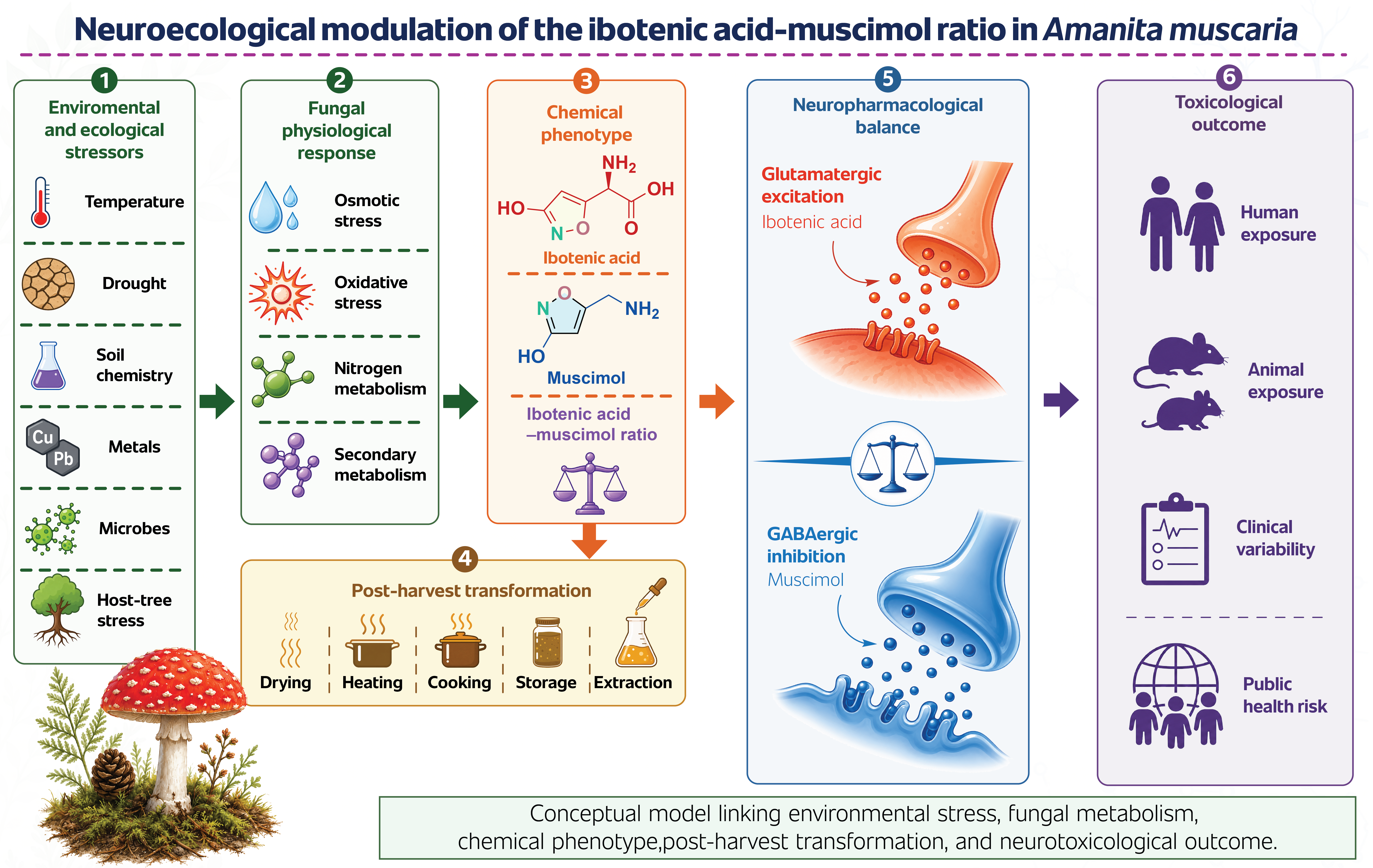
Amanita muscaria is one of the most recognizable toxic mushrooms, yet its chemical and toxicological variability remains insufficiently understood. Its principal neuroactive isoxazole compounds, ibotenic acid and muscimol, differ substantially in pharmacological profile: ibotenic acid is associated mainly with glutamatergic excitatory activity, whereas muscimol is a potent GABAergic compound. Because ibotenic acid can be converted to muscimol through decarboxylation, the ibotenic acid–muscimol ratio may represent a dynamic marker of chemical phenotype rather than a fixed species-level trait. This review proposes a neuroecological model in which environmental and post-harvest stressors influence the biosynthesis, stability, and transformation of ibotenic acid and muscimol in A. muscaria. Abiotic factors such as temperature, drought, soil chemistry, nitrogen availability, and xenochemical exposure, as well as biotic factors including microbial interactions, host-tree physiology, developmental stage, and fungivory, may contribute to variation in fungal secondary metabolism. Post-harvest conditions such as drying, heating, cooking, extraction, and storage may further modify the ibotenic acid–muscimol ratio. This chemical variability may influence neurotoxicological outcome by shifting the balance between excitatory and inhibitory effects after human or animal exposure. The review integrates fungal stress biology, analytical toxicology, neuropharmacology, clinical toxicology, veterinary exposure, and public health concerns related to emerging A. muscaria products. Current evidence supports developmental variability, pro-cessing-related chemical transformation, and the need for standardized analytical quantification, but direct controlled studies linking specific environmental stressors to ibotenic acid biosynthesis remain limited. The proposed model identifies the ibotenic acid–muscimol ratio as a testable mechanistic marker connecting environmental stress in A. muscaria with variable neurotoxicological risk.
Keywords:
Amanita muscaria
; ibotenic acid
; muscimol
; fungal stress
; secondary metabolites
; neurotoxicology
; GABA
; glutamate
; environmental stress
; mushroom poisoning
; LC–MS/MS
; public health
Copyright: This open access article is published under a Creative Commons CC BY 4.0 license, which permit the free download, distribution, and reuse, provided that the author and preprint are cited in any reuse.


