

Submitted:
17 June 2026
Posted:
18 June 2026
You are already at the latest version
Abstract
The sustainable management and valorization of agri-food by-products is a key challenge in the development of circular and resource-efficient food systems. This study aimed to evaluate the effect of adding varying amounts of black chokeberry (Aronia melanocarpa) pomace, a fruit processing by-product, on the quality of beef burgers. Pomace was incorporated at levels of 0.0%, 0.5%, 1.0%, 2.0%, and 3.0%. The burgers were baked, vacuum-packed, and stored (+4 °C, 14 days). On the production day, the cooking properties and chemical composition of burgers were determined. During storage, pH, shear force, color parameters (CIEL*a*b*), organoleptic attributes, and microbiological quality were assessed. The results showed that increasing pomace levels in burgers increased (p < 0.05) thermal loss and diameter shrinkage, while shear force gradually decreased. Compared to the control, burgers containing chokeberry pomace were significantly (p < 0.05) darker with reduced redness and yellowness. In organoleptic evaluation, burgers containing 0.5% and 1.0% of pomace received scores similar to those of the control. Importantly, the addition of chokeberry pomace did not negatively affect microbiological quality throughout storage. These findings indicate that incorporating chokeberry pomace into burger recipe composition could serve as a sustainable approach for utilizing by-products in meat processing, aiding in food waste reduction.
Keywords:
agri-food by-product utilization
; chokeberry pomace
; sustainable meat product
; beef burg-ers
; shelf-life
; meat product quality properties
1. Introduction
Sustainable development represents one of the key challenges facing contemporary food production systems, driven by increasing environmental constraints, limited natural resources, and growing consumer awareness regarding responsible and transparent food manufacturing practices [1]. These challenges are particularly evident in the meat sector, which is frequently criticized due to its environmental footprint and resource intensity. Consequently, improving the sustainability profile and social acceptance of meat products has become a priority for both researchers and industry stakeholders. One promising strategy involves adopting sustainable processing practices, including the incorporation of agri-food by-products into meat formulations, thereby supporting resource efficiency and circular economy principles [2,3].
Beef burgers, also known as hamburgers or hamburger steaks, are among the most popular meat-based fast-food products worldwide. Although their definitions may vary slightly across countries, they are generally characterized by the use of ground beef shaped into patties, with the possible addition of salt, spices, or other food ingredients [4,5]. Within the European Union, beef burgers are classified as “meat preparations,” meaning that applied technological processes do not substantially alter the internal structure of muscle fibers [6]. The proportions of meat, fat, and functional ingredients in burger formulations significantly influence the physicochemical, sensory, and microbiological quality of the final product [7]. In response to consumer demand for so-called “clean label” products, many manufacturers have reduced or eliminated the use of non-meat additives, flavor enhancers, and synthetic preservatives. Despite their popularity, beef burgers are increasingly criticized for their relatively high fat and energy content, which may limit their nutritional value [8,9,10].
In recent years, various strategies have been proposed to enhance the quality features and consumer perception of beef burgers, such as incorporating ingredients with added health benefits like vegetable oils [10], pea fiber [7], Chlorella vulgaris powder [11], and brown flaxseed powder [12]. An alternative and increasingly promoted approach is the valorization of plant-derived agri-food by-products in meat product formulations. This strategy aligns closely with the principles of sustainable food production and circular economy by contributing to food waste reduction, improved resource utilization, and the development of value-added products, while simultaneously meeting growing consumer expectations for environmentally responsible food choices [13,14]. Fruit and vegetable by-products, in particular, are recognized as rich sources of dietary fiber and bioactive compounds with antioxidant and antimicrobial properties, which may help limit oxidative deterioration and microbial growth in meat products, thereby extending shelf life and maintaining quality during storage [15,16]. Various fruit and vegetable by-products have been successfully used in beef burgers, including dried tomato peels [17], dried papaya peels [18], freeze-dried carrot pomace [19], and dried grape pomace [20]. Similar valorization strategies have also been reported for pork burgers using, for example, Kinnow mandarin pomace powder [21] and freeze-dried berry pomace [22].
Among the most common by-products generated during fruit processing are pomaces. In Poland, black chokeberry (Aronia melanocarpa) represents one of the major sources of fruit pomace, as the country is among the leading global producers of this crop [23]. It is estimated that more than 90% of domestic chokeberry production is processed, generating substantial quantities of pomace, which may account for up to several percent of the fresh fruit mass [24]. Black chokeberry pomace is rich in biologically active compounds, including highly bioavailable antioxidants, as well as dietary fiber, making it a promising nutritional and functional ingredient for food production, including comminuted meat products [25,26,27]. However, fresh chokeberry pomace has a limited shelf life due to its high moisture content, which necessitates immediate utilization or further processing aimed at increasing its stability and technological usability [28].
Common valorization methods for chokeberry pomace include drying, extrusion, extraction of bioactive compounds, and microencapsulation of anthocyanin-rich extracts [29,30,31,32]. While these techniques can enhance the functional properties of pomace, they often require additional energy inputs and investment costs, potentially limiting their industrial scalability and sustainability [16,33]. Moreover, inappropriate processing parameters or storage conditions may lead to the degradation of valuable bioactive compounds [28]. As a result, despite their high application potential, valorized chokeberry pomace products remain scarcely available on the market, and their use is still largely confined to experimental studies rather than widespread industrial practice.
Recent studies suggest that black chokeberry pomace can be successfully incorporated into comminuted meat products in a shredded, non-dried form, thereby avoiding energy-intensive drying processes and supporting more sustainable processing approaches [34,35]. However, scientific data regarding the application of fresh black chokeberry pomace in beef burgers, particularly concerning its impact on quality attributes during refrigerated storage, remains limited. Therefore, the aim of this study was to evaluate the effects of incorporating shredded black chokeberry (Aronia melanocarpa) pomace at varying levels (0–3%) on the physical, chemical, sensory, and microbiological quality of beef burgers during refrigerated storage (1–14 days). The study also sought to identify the optimal level of pomace addition that allows for maintaining product quality, consumer acceptability and microbial safety, while simultaneously contributing to the development of more sustainable meat products consistent with circular economy principles.
2. Materials and Methods
2.1. Materials
The experimental material consisted of beef burgers with the addition of various amounts of black chokeberry pomace. The raw materials of animal origin—meat trimmings from beef forequarters and beef fat—were sourced from the meat processing plant located in central-eastern Poland. The raw meat and fat were purchased in quantities sufficient to experiment with two separate series. They were transported to the laboratory by a delivery truck from a meat processing plant under controlled cold conditions.
The production of black chokeberry pomace and the production and quality assessment of beef burgers were conducted at the Institute of Food Sciences, Warsaw University of Life Sciences (WULS SGGW).
For the production of pomace from black chokeberry (Aronia melanocarpa), the cultivar ‘Galicjanka’ was used. The fruit was sourced from a conventional plantation in eastern Poland (Lublin Voivodeship) and harvested in mid-September 2024. Approximately 10 kg of chokeberry fruit was purchased one day after harvesting and transported to the WULS-SGGW laboratory under refrigerated conditions. Upon arrival, the fruits were washed with running water and then pressed using a laboratory hydraulic press (BUCHER Unipektin AG HPL 14; Bucher Unipektin AG, Niederweningen, Switzerland), which was equipped with a drainage filter recommended for berry and stone fruit processing. The pressing was conducted in three cycles at a pressure of 5 bar. Between the pressing cycles, the plant material was loosened to enhance juice yield and reduce the moisture content of the resulting pomace. The hydraulic press and fresh black chokeberry pomace are presented in Figure S1. After juicing, the pomace underwent enzymatic treatment with Brent Pect Acid Colors (Brenntag GmbH, Essen, Germany), an enzyme preparation that does not degrade anthocyanins. The treatment was applied to promote pectin degradation and to improve the softness of the pomace. The pomace was divided into portions of approximately 0.5 kg each and vacuum-packed in 0.70 mm PA/PE bags using a Multivac C200 packaging machine (Multivac, Wolfertschwenden, Germany). The packaged chokeberry pomace was subsequently frozen and stored at -60 °C ± 1 °C. On the day of burger production, the required amount of pomace was thawed in a microwave oven for 4 minutes at 900 W. It was then shredded to a paste-like consistency using a Thermomix® (Vorwerk, Warsaw, Poland) at a knife speed of 4000 rpm for 5 min, with the maximum processing temperature limited to 37 °C. The appearance of the shredded black chokeberry pomace is shown in Figure S2.
2.1.1. Analysis of the Properties of Chokeberry Pomace
Shredded chokeberry pomace was evaluated for its potential usefulness in the production of processed meat products. The total content of polyphenols and anthocyanins in the chokeberry pomace was determined, and its antioxidant activity was assessed.
Analyses conducted on pomace were preceded by the preparation of extracts from this by-product. Extracts from shredded pomace were prepared according to the method described by Grobelna et al. [36] with slight modifications. The extraction solvent contained 20% distilled water and 80% methanol, which was acidified with 1 mL HCl per litre of solution. Centrifuge tubes were weighed with an accuracy of 0.01 g, after 0.5 g of shredded pomace. The extraction mixture was then added to each sample tube up to a volume of 12 mL and placed in an ultrasonic cleaner (Sonoswiss SH-3H, Ramsen, Switzerland) for 3 min to increase the extraction efficiency. The prepared samples were centrifuged in a laboratory centrifuge (MPW-350R, Warsaw, Poland) (10000 rpm/min, 10 min). The steps were repeated until the samples were completely discolored. The extracts were collected into 100 mL volumetric flasks in which the extraction mixture was added.
The total polyphenol content was determined using the Folin-Ciocalteu reagent, following the guidelines outlined by Gao et al. [37]. The results were expressed in milligrams per 100 grams of fresh pomace weight and were calculated as gallic acid equivalents.
The anthocyanin content in the chokeberry pomace extracts was determined using high-performance liquid chromatography with a diode-array detector (HPLC-PDA) method, following the methodology established by Grobelna et al. [36]. This analysis utilized Shimadzu equipment (Kyoto, Japan). The total anthocyanin content was expressed in milligrams per 100 grams of fresh pomace and was calculated as cyanidin 3-O-glucoside.
Additionally, the antioxidant activity of the chokeberry pomace extracts was evaluated using the Trolox equivalent antioxidant capacity (TEAC) with DPPH (2,2-diphenyl-1-picrylhydrazyl) radicals. The TEAC assay was conducted according to the method described by Chen and Yen [38]. The results were expressed as micromoles of Trolox equivalents per 100 grams of fresh pomace.
The microbiological quality of chokeberry pomace is characterized in sections 2.2.7. and 3.8.
2.1.2. Production of Beef Burgers with Varying Amounts of Added Chokeberry Pomace
The beef burgers were produced by grinding of 20 kg of beef and 5 kg of beef tallow using a Mesko WN40 laboratory grinder (Mesko-AGD Sp. z o.o., Skarżysko-Kamienna, Poland) fitted with a 4.5 mm plate. The ground meat and fat were subsequently mixed at an 80:20 ratio using a Mainca RM-40 paddle mixer (Equipamientos cárnicos, S.L. MAINCA, Barcelona, Spain) to obtain a uniform meat-fat batter. Five variants of beef burgers were manufactured, each differing in the amount of black chokeberry pomace added, as outlined in Table 1.
Meat batters for BC–B3 burgers were prepared using Kenwood Major laboratory mixers (Kenwood Ltd., Havant, UK). Initially, meat-fat batter and table salt were mixed for 10 min. In the B0.5–B3 variants, shredded chokeberry pomace was subsequently incorporated into the meat batter, followed by an additional 5 min of mixing to ensure uniform distribution of this plant material. The batters were then formed into flat, round patties with a target mass of 120 g ± 2 g using a manual molding device (Hendi BV, Rhenen, the Netherlands). The burgers were baked in a convection–steam oven (Rational SCC WE61; Rational AG, Landsberg am Lech, Germany) at 180 °C and 10% relative humidity until a core temperature of 80 °C was reached, with the burgers turned during heat treatment. After baking, the burgers were cooled at ambient temperature (approximately 18 °C) for 30 min. The appearance of the baked beef burgers is shown in Figure S3. The burgers of each variant were then divided into four batches, each containing 16 pieces. One batch was analyzed on the day of production, while the remaining batches were vacuum-packed in 0.70 mm PA/PE bags using a Multivac packaging machine and stored at 4 °C ± 1 °C under dark conditions for 1, 7, and 14 days, respectively. Samples intended for microbiological analysis were packaged separately.
2.1.3. Experimental Design
On the day of production, the burgers were assessed for thermal loss and diameter reduction (shrinkage) following heat treatment, as well as the content of selected chemical components. Additional quality characteristics of burgers, including pH, color, texture, organoleptic properties, and microbiological quality, were evaluated after 1, 7, and 14 days of refrigerated storage. The experimental design took into account organizational factors and the availability of laboratories. The study was carried out in two independent experimental series.
2.2. Methods
2.2.1. Cooking Characteristics of Beef Burgers
The cooking characteristics of burgers were evaluated according to the methods described by Basiri et al. [12]. Briefly, for each product variant, three burgers were randomly selected to determine weight and diameter before and after heat treatment within each experimental series (n = 3 2). The thermal loss of burgers was measured gravimetrically and calculated using equation (1):
Thermal loss = (weight of raw burger [g] – weight of baked burger [g])/weight of raw burger [g] ×100%
To measure the diameters of burgers, an electronic caliper was utilized. The reduction in the diameter of the burgers following heat treatment (shrinkage) was calculated using equation (2):
Shrinkage = (diameter of raw burger [mm] – diameter of baked burger [mm])/diameter of raw burger [mm] ×100%
Shrinkage = (diameter of raw burger [mm] – diameter of baked burger [mm])/diameter of raw burger [mm] ×100%, (2)
2.2.2. Determination of Chemical Composition of Beef Burgers
The content of selected chemical components in beef burgers, including water, protein, fat, and sodium chloride, was analyzed in heat-treated products. The procedure followed the guidelines of the PN-A-82109:2010 standard [39]. Measurements were conducted using a FoodScan™2 near-infrared spectrometer (Foss Analytical A/S, Hillerød, Denmark), operating in the wavelength range of 850–1500 nm and employing an artificial neural network model for meat product analysis. For each product variant, a sample was prepared by grinding three randomly selected burgers using a grinder (Diana 886.8, Zelmer, Rzeszów, Poland) equipped with a 2 mm mesh. The sample was ground twice, thoroughly mixed, and placed in the measuring cuvette. The measurement was then initiated, and chemical composition was automatically determined, with results displayed on a computer monitor. For each burger variant, measurements were performed in duplicate within each experimental series, and mean values were reported as the final results (n = 2 × 2).
2.2.3. Measurement of pH of Beef Burgers and Chokeberry Pomace
The pH of the beef burgers was measured using a portable pH meter, the Testo 206-pH2 (Testo SE and Co. KGaA, Titisee-Neustadt, Germany). Before taking the measurements, the device was calibrated with buffer solutions at pH 4.0 and 7.0. To prepare the burger samples, three randomly selected burgers were ground twice using a meatgrinder equipped with a 2 mm mesh. Then, 10 g ± 0.01 g of the ground sample was mixed with 30 mL of distilled water in glass beaker. The pH was determined by immersing the electrode directly into the prepared sample. For each variant of the burgers, three samples were analyzed within each experimental series, and the mean values were calculated as the final results (n = 3 x 2). On the day of burger production, the pH of chokeberry pomace was also measured. The samples were prepared in the same manner as the burgers.
2.2.4. Measurement of Color Parameters in Beef Burgers
The color parameters of beef burgers were evaluated on days 1, 7, and 14 of refrigerated storage. Color measurements were performed on the burgers’ surface using a Minolta® CR-200 colorimeter (Minolta, Tokyo, Japan) operating with a D65 illuminant, a 10° standard observer, and an 8-mm measurement aperture. Color was expressed according to the CIEL*a*b* color space using the parameters: L* (lightness), a* (red–green component), and b* (yellow–blue component). Before measurements, the instrument was calibrated using a standard white calibration plate (L* = 97.83, a* = +0.45, b* = +1.88), and the vacuum-packaged burgers were conditioned for 60 min at ambient temperature (approximately 18 °C). In each experimental series, two burgers per treatment variant were randomly selected for color analysis. Measurements were conducted in six replicates (three measurement points per burger; n = 3 x 2), and mean values were used for subsequent analysis. To evaluate the effect of black chokeberry pomace addition on the color stability of beef burgers during refrigerated storage, the total color difference (ΔE) was calculated according to the method described by Mokrzycki and Tatol [40] and the equation:
where: ΔL*, Δa*, and Δb* represent the differences in color parameters between the control product (BC) and burgers with the addition of black chokeberry pomace (B0.5, B1, B2, and B3).
2.2.5. Measurement of SHEAR Force in Beef Burgers
The shear force of beef burgers was determined on days 1, 7, and 14 of refrigerated storage. The shear force was measured using a Zwicki 1120® universal testing machine (Zwick GmbH & Co., Ulm, Germany) equipped with a flat cutting blade. The shear force was defined as the maximum force recorded during cutting. Measurements were taken at a blade speed of 50 mm/min, with a pre-load force of 0.5 N and a force deactivation threshold set at 50% of the maximum recorded force. Before analysis, vacuum-packed burgers were conditioned for 60 min at ambient temperature (approximately 18 °C). Cuboid-shaped test samples measuring 90 mm 30 mm 7 mm were then prepared. In each experimental series, six samples were analyzed for each burger variant, and the final results were expressed as the arithmetic means (n = 6 2).
2.2.6. Evaluation of the Organoleptic Quality of Beef Burgers
The organoleptic evaluation of beef burgers focused on the following quality attributes: appearance and color, aroma, taste, and texture. The criteria for assessing individual quality attributes, developed for the purposes of this study, were established based on relevant literature [41] and are presented in Table 2. Evaluation sessions were conducted under laboratory conditions on days 1, 7, and 14 of the burgres’ storage. Prior to evaluation, the burgers were removed from their packaging and heated on an electric grill (Stalgast, Warsaw, Poland) to approximately 60 °C. After heating, each burger was cut into four equal portions. The samples were served to the panelists on white plates and identified using random three-digit codes. The sensory panel consisted of food technology students and staff members of the Institute of Food Science with experience in food quality assessment. A total of ten trained panelists evaluated the organoleptic attributes using a five-point rating scale, where scores were defined as follows: 1—poor quality (does not meet established criteria), 2—sufficient quality (noticeable deviations from criteria that do not disqualify the product), 3—satisfactory quality (persistent noticeable deviations), 4—good quality (minor deviations), and 5—very good quality (no deviations from the established requirements). Half-scores were not permitted. Panelists were provided with evaluation forms, still water, and wheat bread for palate cleansing, and were allowed to record additional observations regarding specific quality characteristics of the samples. Before participation in the sensory evaluation, all panelists provided written informed consent (Figure S4). The consent form was created in line with the guidelines established by the Rector’s Committee on Ethics in Research Involving Human Subjects at the WULS SGGW.
2.2.7. Evaluation of the Microbiological Quality of Beef Burgers
The microbiological quality of beef burgers was assessed on days 1, 7, and 14 of refrigerated storage. Burger packages intended for microbiological evaluation were opened under aseptic conditions. Sample preparation was conducted following the Polish Standard PN-EN ISO 6887–2:2017 [42]. Microbiological analyses included the determination of the total count of mesophilic aerobic microorganisms [43], psychrotrophic bacteria [44], lactic acid bacteria (LAB) [45], Enterobacteriaceae [46], and Escherichia coli [47]. Microbial counts were expressed as colony-forming units per gram of product (cfu/g). Detailed procedures for the microbiological assessment have been reported previously [48,49]. In each experimental series, microbiological analyses were performed in duplicate for each burger variant (on a given storage day: n = 2 × 2). Additionally, the microbiological quality of chokeberry pomace was assessed by measuring the total count of mesophilic aerobic microorganisms, psychrotrophic bacteria, LAB, Enterobacteriaceae, and yeasts and molds [50].
2.2.8. Statistical Analysis of Results
Statistical analysis was conducted using Statistica® software (version 13.0; StatSoft Inc., Tulsa, OK, USA). One-way analysis of variance (ANOVA) was applied to assess the effect of black chokeberry pomace level on the selected quality parameters of the burgers, as well as the effect of storage time within each burger variant. When significant effects were observed, differences between means were identified using Tukey’s honestly significant difference (HSD) test. Statistical significance was set at α ≤ 0.05.
3. Results
3.1. Properties of Chokeberry Pomace
The chokeberry pomace incorporated into beef burgers was characterized by a high total polyphenol content of 1417.31 ± 7.97 mg GAE/100 g fresh weight, including anthocyanins at a concentration of 207.04 ± 7.37 mg/100 g fresh weight. Moreover, this plant material exhibited an antioxidant activity of 11.90 μM TE/100 g fresh weight. The anthocyanin profile was predominantly composed of cyanidin-3-galactoside, which accounted for 66.8% of the total anthocyanins, followed by cyanidin-3-arabinoside (27.9%), cyanidin-3-xyloside (2.9%), and cyanidin-3-glucoside (2.5%).
3.2. Cooking Characteristics of Beef Burgers
Weight loss in beef burgers following heat treatment ranged from 29.9% to 35.5% (Figure 1), with significant differences (p < 0.05) depending on the level of chokeberry pomace added. The control burgers (BC) exhibited the lowest thermal loss. In contrast, burgers B1 and B2, containing 1% and 2% pomace, respectively, showed a significant increase (p < 0.05) in weight loss compared with the control. The highest thermal loss (p < 0.05) was observed in burger B3, which contained the greatest amount of chokeberry pomace (3.0%).
Thermal processing of beef burgers resulted not only in weight loss but also in a reduction in diameter. The extent of shrinkage increased with higher levels of chokeberry pomace, corresponding to the observed weight losses. Diameter reduction ranged from 20.6% in control (BC) burgers to 23.5% in B3 burgers (Figure 1). Burgers with the highest chokeberry pomace content (B2 and B3) exhibited significantly greater shrinkage (p < 0.05) compared with the control burgers (BC).
3.3. Chemical Composition of Beef Burgers
The content of the basic chemical components in beef burgers is presented in Table 3. The mean water content ranged from 54.50% in product B3 to 57.06% in product BC. Protein content varied from 24.20% in BC to 25.89% in B3, while NaCl content ranged from 1.29% in BC to 1.36% in B0.5.
The addition of shredded chokeberry pomace (0.5–3.0%) did not significantly affect (p > 0.05) the water, protein, or NaCl content of the burgers after heat treatment. However, a trend toward lower water and NaCl content, accompanied by higher protein content, was observed with increasing levels of pomace.
Significant differences (p < 0.05) were observed only in fat content. Specifically, burgers containing the highest levels of pomace (B2 and B3) exhibited significantly lower fat content compared with the control (BC).
3.4. pH Value of Beef Burgers
The average pH of beef burgers ranged from 6.09 to 6.27. The lowest and highest values were recorded in burgers B3 (day 14) and BC (days 1 and 7), respectively (Table 4). Although the maximum difference between the variants was only 0.18 pH units, a significant (p < 0.05) effect of both the addition of black chokeberry pomace and storage time on this parameter was demonstrated. Increasing the share of black chokeberry pomace in the recipe led to a gradual decrease in the pH of the burgers, and regardless of storage time, the lowest values were significantly (p < 0.05) recorded in burgers B3, which contained the highest pomace addition.
During the 14-day storage period, a general decline in pH was observed across all burger variants; however, significant changes (p < 0.05) were identified specifically in products containing 1.0% to 3.0% chokeberry pomace (B1–B3). The reduction in pH observed in burgers enriched with chokeberry pomace (B0.5–B3) may be attributed to differences in the acidity of the raw materials used. The pH of the meat and fat components was measured at 6.39, whereas the chokeberry pomace exhibited a substantially lower pH value of 3.75.
3.5. Color Parameters of Beef Burgers
Significant differences (p < 0.05) in all color parameters (L*, a*, b*) were observed among the analyzed beef burgers, depending on both the level of chokeberry pomace addition and the duration of storage (Table 5).
The highest lightness (L*) value was observed in the control burgers (BC), reaching 43.80 on the first day after production. In contrast, the lowest L* value (34.74), indicating the darkest color, was recorded for burgers containing the highest level of chokeberry pomace (B3), also on day 1. The L* value decreased progressively with increasing levels of chokeberry pomace, reflecting a gradual darkening of the product surface. Throughout the storage period, burgers containing 2% and 3% pomace (B2 and B3) remained significantly darker (p < 0.05) than the control (BC). Over time, the L* values of BC and B1 samples remained relatively stable, whereas the remaining treatments exhibited a slight but statistically significant (p < 0.05) increase in this parameter.
The mean a* values of the refrigerated beef burgers ranged from 6.12 for sample B3 on day 1 to 8.39 for the control sample (BC) on day 14. On day 1, the control burgers exhibited significantly higher redness compared to burgers containing chokeberry pomace (B0.5–B3) (p < 0.05). On days 7 and 14, the BC burgers continued to show the highest a* values (p < 0.05), whereas samples B1 and B2 displayed significantly lower redness (p < 0.05).
Over time, a gradual and significant increase (p < 0.05) in a* values was observed in samples BC, B0.5, and B3. In contrast, no significant changes (p > 0.05) in redness were detected for samples B1 and B2 over the storage period.
The b* parameter of beef burgers was most strongly influenced by the pomace addition. The highest b* value (+5.81) was recorded on day 1 for the control sample (BC), whereas the lowest value (−2.06) was observed for sample B3 on day 14. Increasing the proportion of chokeberry pomace resulted in a significant (p < 0.05) decrease in the b* parameter, with values shifting from positive (BC, B0.5), indicative of yellow tones, to negative (B2, B3), corresponding to blue hues. Furthermore, a decreasing trend in b* values was observed over the storage period for all burger variants; however, statistically significant changes (p < 0.05) were detected only in samples B1 and B2.
The total color difference (ΔE) values indicate a pronounced effect of chokeberry pomace incorporation on the color of beef burgers relative to the control sample (Table 6). In most cases, ΔE values exceeded 3.5, suggesting that color differences between the control (BC) and pomace-enriched burgers were perceptible. The burger treatment with 0.5% chokeberry pomace exhibited the lowest ΔE values. A significant increase in ΔE (p < 0.05) was observed with increasing levels of the chokeberry by-product in burger’s recipes. ΔE values exceeding 5.0, recorded for samples B1, B2, and B3 irrespective of storage time, indicate that the color differences compared to the control burgers were readily noticeable to consumers.
3.6. Shear Force of Beef Burgers
The mean shear force values of the beef burgers ranged from 17.88 to 23.21 N, with the difference between the extreme values not exceeding 23%. The lowest shear force was recorded for sample B3 on day 1 of storage, whereas the highest value was observed for the control sample (BC) on day 14 (Figure 2). An inverse relationship was identified between the proportion of chokeberry plant by-product incorporated into the meat batter and the shear force values. On day 1, the addition of pomace did not significantly affect shear force (p > 0.05). However, by day 7, the control burgers (BC) exhibited higher shear force compared to samples B2 and B3. This pattern persisted through day 14 of refrigerated storage, with shear force decreasing further as the pomace content increased. Despite differences in burgers’ formulation (BC–B3), storage time did not significantly influence burger texture, as indicated by the slight (p > 0.05) increase in shear force over time.
3.7. Organoleptic Properties of Beef Burgers
The results of the organoleptic evaluation of beef burgers supplemented with varying levels of chokeberry pomace indicate that the mean scores for all assessed quality attributes remained high throughout the 14-day refrigerated storage period, with none falling below 3.3 on a five-point scale (Table 7). The organoleptic properties of the burgers were significantly (p < 0.05) influenced by the level of ground chokeberry pomace addition. In contrast, storage time did not significantly affect these attributes (p > 0.05). For most evaluated organoleptic parameters, only slight, non-significant decreasing trends were observed over the storage period.
Increasing the proportion of chokeberry pomace in the formulation resulted in lower scores for the appearance and color of the burgers. However, a significant deterioration (p < 0.05) in these attributes, relative to the control sample (BC), was observed only in products with the highest pomace content (B2 and B3). The color of these burgers was perceived as excessively dark and did not fully meet the established quality criteria (Table 2). Additionally, some panelists noted that burger B3 appeared “overcooked.”
Similar trends were identified in the aroma assessment. Irrespective of storage duration, samples BC and B0.5 received the highest scores, significantly outperforming sample B3 (p < 0.05). The aroma of burger B3 was rated as only “moderately acceptable” according to the evaluation criteria. Furthermore, several panelists reported a perceptible “fruity note” in the aroma of burgers containing higher levels of chokeberry pomace.
In the taste assessment conducted on days 1, 7, and 14 of storage, significant differences (p < 0.05) were identified between samples BC and B0.5, which constituted a single homogeneous group, and samples B2 and B3. The lower taste scores assigned to burgers with higher levels of chokeberry pomace were attributed to the presence of “sour” and “fruity” notes, which were perceived by the panelists as atypical for this type of meat product.
The incorporation of chokeberry pomace also adversely affected the texture of the beef burgers, resulting in consistently lower scores for samples B0.5–B3 compared to the control (BC). Moreover, variation in texture ratings among the different formulations of burgers increased over the storage period. On day 1, the texture of samples B2 and B3 was rated significantly lower (p < 0.05) than that of BC and B0.5. On day 14, significant differences (p < 0.05) were observed among all tested burger variants (BC, B0.5, B1, B2, and B3). Panelists suggested that the reduced texture in burgers with higher pomace content may be associated with the presence of fine particles perceived during mastication, as well as a slight reduction in juiciness, potentially related to increased thermal losses observed in these products.
3.8. Microbiological Quality of Beef Burgers
The microbiological quality of chokeberry pomace was assessed based on the number of selected microbial groups. The total count of mesophilic aerobic microorganisms was 4.3 × 10³ cfu/g. The count of lactic acid bacteria (LAB) was 1.9 × 10² cfu/g. The count of yeasts and molds was 2.9 × 10² cfu/g. The obtained results indicate a moderate level of microbiological contamination of the tested material [51].
Modifying the beef burger formulation by incorporating chokeberry pomace resulted in an improvement in microbiological quality throughout 14 days of refrigerated storage (Table 8). The number of mesophilic aerobic microorganisms ranged from undetectable levels in 0.1 g (product B3, day 1) to 1.8 × 10⁴ cfu/g (product BC, day 14). From the first day of storage, an inverse relationship was observed between pomace level and microbial counts; however, on day 1, these differences were not significant (p > 0.05). By days 7 and 14, this effect became significant (p < 0.05). Regardless of the product variant, mesophilic aerobic microorganism counts increased significantly with storage time (p < 0.05).
A more pronounced antimicrobial effect of bioactive compounds in chokeberry pomace was observed against psychrotrophic bacteria. On day 1 post-production, burgers containing pomace (B0.5–B3) were characterized by significantly lower counts than the control sample (p < 0.05). Throughout the storage period, the lowest numbers of these microorganisms were recorded in product B3, which contained the highest level of pomace. In this variant, psychrotrophic bacteria were not detected in 0.1 g on day 1, whereas after 14 days their count reached 3.2 × 10² cfu/g. As with mesophilic microorganisms, a significant increase in psychrotrophic bacterial counts over storage time was observed (p < 0.05) in all analyzed samples.
The presence of lactic acid bacteria (LAB) was confirmed in all burger variants, regardless of the level of chokeberry pomace addition. Their counts ranged from 3.0 × 101 cfu/g (product B2, day 1) to 3.3 × 10² cfu/g (product B3, day 14). The incorporation of chokeberry pomace significantly reduced the growth rate of LAB throughout the storage period (p < 0.05), with the most pronounced effect observed at addition levels of 2–3% (products B2 and B3), particularly on days 7 and 14 of storage.
In none of the analyzed beef burger variants were bacteria of the Enterobacteriaceae family or Escherichia coli detected in 0.1 g of the product, indicating the high quality of the raw materials used and the maintenance of appropriate hygienic conditions during the production and packaging processes.
4. Discussion
4.1. Properties of Chokeberry Pomace
Black chokeberry is recognized as a rich source of bioactive compounds exhibiting health-promoting, antioxidant, and antimicrobial properties. Owing to its high concentrations of anthocyanins, responsible for the characteristic dark coloration of the fruit, and catechins, which contribute to its astringent taste, chokeberry is often regarded as combining the beneficial properties of red wine and green tea. During juice extraction, a substantial proportion of these bioactive constituents remains in the pomace, which may subsequently serve as a valuable functional ingredient in food production [52,53].
Previous studies have demonstrated considerable variability in the concentration of individual bioactive compounds in chokeberry fruits, depending on cultivar, agronomic practices, and harvesting conditions. The total polyphenol content in chokeberry fruits has been reported to range from 778 mg GAE/100 g fresh mass [54] to 2340 mg GAE/100 g fresh mass [55], whereas in chokeberry pomace it may reach up to 6310 mg GAE/100 g fresh weight. Furthermore, according to Vagiri and Jensen [56], the anthocyanin content in chokeberry pomace varies from 114.4 to 1221.1 mg/100 g fresh mass. Therefore, the values obtained in the present study fall within the ranges previously reported in the literature.
4.2. Cooking Characteristics of Beef Burgers
Thermal processing of meat burgers, which determines their suitability for consumption, induces physicochemical transformations of muscle proteins, leading to modifications in the structure of the product matrix. These changes may reduce the matrix’s water-holding capacity, thereby affecting cooking losses [7]. In the beef burgers analyzed in this study, an increasing proportion of chokeberry pomace was associated with increased mass losses and shrinkage after baking.
There are relatively few reports in the literature concerning the use of raw, shredded fruit pomace in the development of more sustainable meat products. Previous studies have demonstrated that the addition of fresh chokeberry pomace [35] as well as freeze-dried and rehydrated apple pomace [57] may increase cooking losses and intensify changes in burger geometry, which is attributed to modifications in the protein–fat matrix and a reduced water-binding capacity.
More extensively, the effects of dried fruit and vegetable by-products on the quality of ground beef products such as burgers have been investigated, including raspberry and blackberry pomace [58], tomato peel flour [17], dried papaya peel [18], and freeze-dried carrot pomace [19]. These components, rich in dietary fiber, may enhance water retention in meat products without deteriorating their culinary properties. However, findings regarding cooking losses and burger shrinkage remain inconsistent: de Alencar et al. [20] reported an increase in cooking losses following the addition of grape skin flour, whereas Peiretti et al. [22] did not observe significant changes in the shrinkage of pork patties containing dried blueberry pomace.
4.3. Chemical Composition of Beef Burgers
The chemical composition of meat products, including beef burgers, is primarily determined by the relative proportions of water, protein, and fat. The nutritional value of beef burgers can be modified through the incorporation of plant-based components into the formulation, such as pea fibre [7], tomato peel flour [17], freeze-dried carrot pomace [19], or grape skin flour [20]. The application of chokeberry pomace in beef burgers may likewise affect their nutritional profile, which is attributable, among other factors, to the physicochemical characteristics of this raw material. According to Kulling and Rawel [59], chokeberry pomace is characterized by a high dry matter content (17–29%), in which carbohydrates predominate. Cegiełka et al. [35] reported that the dry matter content of comminuted chokeberry pomace was 26.6%, indicating a high moisture fraction in this by-product. The effect of fruit and vegetable pomace on the chemical composition of ground meat products depends on both the form and the level of this material incorporated into the formulation. Pork burgers containing comminuted chokeberry pomace (2–5%) were characterized by a significantly (p < 0.05) lower water content, accompanied by an increase in protein and fat levels with increasing pomace addition [35]. This phenomenon was interpreted by the authors as a result of enhanced cooking losses. Different trends were observed in the case of freeze-dried carrot pomace (1.0–4.2%) incorporated into raw beef burgers, where no significant (p > 0.05) effect on protein and fat content was found, and only a decreasing tendency in these components was noted [19]. In contrast, the observed reduction in water content in beef burgers resulted from the substitution of meat with a plant-based component containing less water than meat, which simultaneously enabled enrichment of the product with dietary fiber. Similar relationships were reported by Karslıoğlu et al. [17] in beef burgers containing dried tomato peels (1–4%). Gracey et al. [60], in a study on the quality of beef meatballs supplemented with rehydrated apple pomace (10% and 20% w/w), demonstrated that increasing the proportion of this by-product in the formulation resulted in higher moisture and dietary fiber contents, alongside a reduction in protein content, without a significant effect on fat levels in the beef meatballs.
4.4. pH of Beef Burgers
The incorporation of plant-derived components into meat product formulations may lead to a reduction in pH, resulting from the introduction of acidic compounds into the meat matrix. This relationship has been confirmed, among other factors, in studies on the quality of beef burgers, in which the addition of açaí and sea buckthorn juices caused a significant decrease in pH [61]. A similar trend to that observed in the present study was reported for pork burgers containing shredded chokeberry pomace, where its inclusion at levels of 2–5% significantly (p < 0.05) lowered pH values compared with the control sample [35]. This effect may be attributed to the presence of organic acids characteristic of chokeberry, such as neochlorogenic, cryptochlorogenic, chlorogenic, and galacturonic acids [25,62].
The use of dried fruit and vegetable processing by-products in meat processing may also significantly contribute to a decrease in pH. For example, Karslıoğlu [17] demonstrated that the addition of dried tomato pomace (1–4%) significantly (p < 0.05) lowered the pH value of beef burgers, which was attributed to the presence of tartaric and citric acids in the plant material. A similar effect was observed when beef in burger formulations was replaced with dried papaya peel at levels ranging from 1% to 3% [18]. However, in contrast to the findings of the present study, a slight but significant increase in pH was observed in these meat products over the storage period.
According to the other study [58], the addition of dried raspberry and blackberry pomace (at levels of 1–5%) to beef patties resulted in a significant (p < 0.05) reduction in pH compared to the control sample. This change was already noticeable by day 3 of storage, but it was only observed at the highest pomace addition level (5%). The authors suggested that this effect resulted from the release of organic acids, such as citric, malic, tartaric, and oxalic acids, during storage. In contrast, the incorporation of freeze-dried carrot pomace at levels up to 4.2% did not significantly affect the pH of beef burgers (p > 0.05), despite an observed decreasing tendency [19].
4.5. Color Parameters of Beef Burgers
The color of meat products is primarily determined by the muscle pigment myoglobin and its transformations during meat processing, which are highly influenced by such technological factors as the addition of sodium nitrite and thermal processing [63]. Furthermore, modifications of the formulation composition, particularly the incorporation of plant-derived ingredients rich in natural pigments, may substantially affect the color of meat products [19].
In the present study, the addition of chokeberry pomace was shown to significantly affect the color of beef burgers, resulting in darker coloration, a decrease in the contribution of the yellow component (b*), and a modification of the intensity of the red component (a*). The obtained results are consistent with previous reports [35], in which the application of fresh comminuted chokeberry pomace (2–5%) in pork burgers led to a significant (p < 0.05) decrease in L* and b* values and an increase in the a* parameter compared with the control sample. Additionally, during refrigerated storage (days 7 and 14), negative b* values were observed at higher levels of chokeberry pomace addition (3.5% and 5%), indicating a pronounced shift in color toward blue hues. The observed changes in burger color parameters may be associated with the presence and transformations of bioactive compounds in chokeberry, particularly anthocyanins. These compounds, responsible for colors ranging from red to purple, may reduce the contribution of yellow coloration (b*) and influence other color components of meat [64]. At the same time, as phenolic compounds with strong antioxidant properties, anthocyanins may inhibit the oxidation of myoglobin to metmyoglobin, thereby contributing to the retardation of unfavorable color changes in meat products [65]. However, it should be emphasized that the effect of these compounds on the a* parameter is complex and depends on both the level of addition and processing conditions. In studies on beef burgers supplemented with açaí berry juice, variability in a* values was attributed to transformations and degradation of plant pigments occurring during thermal processing [61].
The effect of plant-based by-products on the color of ground beef products remains inconclusive and depends on both their type and form of processing. In the study by López-Parra et al. [66], the addition of freeze-dried cherry extract (2–10%) to hamburgers resulted only in a significant (p < 0.05) decrease in L* values. Similarly, the incorporation of grape skin powder (up to 2%) resulted in progressive darkening of burger color during refrigerated storage, which was attributed to the presence of anthocyanins, including malvidin [20]. In contrast, increasing the proportion of tomato peel powder to 4% in beef burgers led to a decrease (p < 0.05) in L* values and an increase in b* values [17]. Somewhat different results from those obtained in the present study were reported by Babaoğlu et al. [67], who found no significant effect (p > 0.05) of water extracts from berry fruit pomace on the lightness of beef burger color, while observing that changes in a* and b* parameters depended on both the level of addition and the storage time.
4.6. Shear Force of Beef Burgers
Texture constitutes a key quality attribute of meat products, contributing to their sensory attractiveness. It is defined as the rheological and structural properties of food resulting from the spatial arrangement and interactions of its components [63]. Studies have demonstrated that the texture parameters of ground meat products are strongly determined by raw material composition and may be modified by the incorporation of plant-based ingredients, which influence the structure of the meat matrix [68,69].
Concerning the effect of comminuted chokeberry pomace on the textural properties of burger-type products, previous studies [35] reported a significant increase (p < 0.05) in the shear force of pork burgers with increasing levels of shredded chokeberry pomace (2–5%) in the formulation, as well as during 14 days of refrigerated storage, irrespective of the formulation composition. The increase in shear force and the development of a more compact structure were attributed to greater losses of water and fat during cooking, as well as a higher degree of thermal shrinkage in burgers containing chokeberry pomace compared with the control sample.
A contrasting trend was observed in the application of apple pomace (10% and 20%) in beef meatballs, where no significant differences (p > 0.05) were found in hardness, cohesiveness, or chewiness [60]. In contrast, the incorporation of freeze-dried grape pomace (0.5–2.0%) into beef burgers resulted in a significant increase in instrumental hardness, which—according to the authors—was due to the fiber components present in the pomace, particularly cellulose and lignin [20].
According to the literature, the texture parameters of burgers are determined not only by the presence of plant-based components but also, to a large extent, by the type of meat used as the raw material [69]. Studies on beef and pork burgers supplemented with apple fiber preparation (1.5% and 3.0%) demonstrated that product hardness was significantly influenced (p < 0.05) by the type of meat. Regardless of the level of fiber addition, beef burgers exhibited lower hardness compared with pork burgers, which was attributed to the greater water-binding capacity of beef within the structure of the final product.
In texture profile analysis (TPA) of pork burgers, the substitution of lean meat with dried kinnow mandarin pomace powder (4% and 6%) resulted in a significant increase (p < 0.05) in product hardness compared with the control sample [21]. This effect was linked to improved binding properties of the meat batter after thermal processing, associated with an increased content of dietary fiber. A similar relationship was reported for beef burgers containing dried tomato pomace (2–4%), where a significant increase (p < 0.05) in hardness and chewiness was observed [17]. According to other researchers [70], the increase in hardness of meat products formulated with plant-based additives may be attributed not only to dietary fiber fractions but also to plant proteins, which promote the formation of a more compact protein network.
4.7. Organoleptic Properties of Beef Burgers
Similar to other quality attributes of meat products, the incorporation of plant-based ingredients—including preparations obtained from fruit and vegetable processing by-products (e.g., pomace)—may significantly modify their sensory characteristics, highlighting the need for individual evaluation of such modifications [33,71]. However, previous research indicates that the effects of these additives are not consistent and depend on the type of meat product, the nature of the plant component, its form (e.g., fresh, dried, extract), and the level of incorporation [19,68].
The results obtained in the present study are consistent with earlier findings concerning the application of shredded chokeberry pomace in pork burgers, where addition levels of 0.5% and 1.0% did not significantly (p > 0.05) affect the organoleptic scores of color, aroma, taste, and texture compared with the control sample [72]. However, increasing the pomace level to 5.0% resulted in a significant (p < 0.05) reduction in all organoleptic properties of the burgers evaluated. Different findings were reported by Gracey et al. [60], who observed no significant differences (p > 0.05) in the sensory evaluation of beef meatballs containing up to 20% rehydrated apple pomace compared with the control product.
In studies focusing on the optimization of freeze-dried carrot pomace addition to beef patties, it was demonstrated that a 3% inclusion level did not result in significant differences (p > 0.05) in sensory attributes; however, increasing the addition to 4.2% led to a decrease in flavor scores, which was attributed to the presence of undesirable plant-derived notes [19]. Karslıoğlu et al. [17] similarly reported that the maximum acceptable level of tomato peel flour in beef burgers should not exceed 2%, beyond which a deterioration in sensory characteristics is observed.
In turn, the application of water extracts from fruit pomace (blackberry, chokeberry, blueberry, blackcurrant) in beef burgers did not significantly (p > 0.05) affect most sensory parameters during the initial stage of storage, except for taste [67]. During refrigerated storage, a significant (p < 0.05) decline in sensory quality was observed in the control sample, associated with lipid oxidation processes and microbial growth. In contrast, the addition of pomace extracts slowed these changes, thereby maintaining the stability of sensory scores (p > 0.05) up to day 6 of storage.
4.8. Microbial Quality of Beef Burgers
The results of the present study indicate that adding chokeberry pomace up to 3% does not adversely affect the microbiological quality of beef burgers and, during refrigerated storage, may even improve it.
In meat products, the application of ingredients with antimicrobial properties is intended to enhance product safety and extend shelf life, as meat and its products are particularly susceptible to spoilage processes driven by microbial activity. In addition to preservatives, the storage stability of meat products is influenced by technological process parameters, including thermal treatment, as well as storage conditions, particularly the packaging method. In response to increasing consumer demand and the need to limit the use of synthetic additives, intensive research is underway on natural methods of food preservation that align with the principles of a circular economy. The literature highlights the applicability of plant-derived preparations, such as extracts and essential oils, which exhibit both antioxidant and antimicrobial properties. The bioactive compounds they contain, particularly polyphenols, may inhibit microbial growth by disrupting cell membranes and limiting lipid oxidation via free radical scavenging and metal ion chelation [73]. Black chokeberry fruits represent a rich source of polyphenols, with the highest concentrations found in the peel, which constitutes the main component of pomace. The predominant polyphenolic compounds present in chokeberry include anthocyanins, flavonoids, and phenolic acids, such as chlorogenic and neochlorogenic acids [52,53].
Literature data on the antimicrobial effects of raw comminuted chokeberry pomace in meat products are limited. In agreement with the findings of the present study, Cegiełka et al. [35] demonstrated that its addition (2–5%) to pork burgers did not deteriorate microbiological quality during 14 days of refrigerated storage. On days 1 and 7 of storage, no significant differences (p > 0.05) were observed between the control sample and the burgers containing pomace. However, in the final stage of storage, a moderate antimicrobial effect of the pomace was observed, manifested by significantly (p < 0.05) lower counts of lactic acid bacteria and Pseudomonas spp. in samples with pomace addition compared with the control. During the 14-day storage of pork burgers, no Enterobacteriaceae, yeasts, or molds were detected, regardless of the level of pomace incorporation.
The effect of chokeberry pomace on the microbiological quality of meat products has also been investigated using it in a valorized form. In raw beef patties containing water extracts from berry fruits, including black chokeberry, an increase in the counts of mesophilic bacteria, psychrotrophic aerobic bacteria, lactic acid bacteria, staphylococci, and coliform bacteria were observed during 9 days of storage. However, within the first six days, products containing fruit pomace extracts exhibited improved microbiological quality than the control sample [67]. The lack of significant differences (p > 0.05) in microbiological quality between beef patties observed on day 9 of storage was attributed to reduced antimicrobial activity of the extracts, likely due to degradation of bioactive compounds. In another study [74], it was demonstrated that the antimicrobial efficacy of chokeberry pomace extracts depends on the method of their preparation, particularly the solvent used. In pork burgers, ethanolic extracts showed stronger inhibitory effects against Gram-positive bacteria (e.g., Leuconostoc mesenteroides, Weissella viridescens, Brochothrix thermosphacta, Listeria monocytogenes) and Gram-negative bacteria (e.g., Campylobacter jejuni, Pseudomonas putida) than aqueous extracts.
5. Conclusions
The results of this study indicate that shredded black chokeberry pomace may be used as a plant-derived by-product in beef burger formulation; however, its technological effects should be considered dose-dependently. Increasing the pomace level significantly increased cooking loss and diameter shrinkage, indicating a negative effect on cooking properties, particularly at higher inclusion levels. At the same time, pomace addition reduced shear force and modified the color of burgers, producing darker products with lower redness and yellowness compared with the control.
From a practical perspective, the most acceptable levels of black chokeberry pomace were 0.5% and 1.0%, as these burgers maintained organoleptic quality comparable to the control while enabling the valorization of fruit-processing by-products. In contrast, higher additions, especially 2.0% and 3.0%, caused more pronounced changes in cooking characteristics and color, which may limit their direct application without further formulation optimization.
Importantly, the incorporation of black chokeberry pomace did not negatively affect the microbiological quality of vacuum-packed beef burgers during 14 days of refrigerated storage. Therefore, the use of shredded, non-dried chokeberry pomace can be considered a promising circular-economy strategy in meat product development, provided that the level of addition is carefully selected to balance sustainability benefits with technological and sensory quality. Further studies should focus on improving water/fat retention during cooking and verifying consumer acceptance under market conditions.
Supplementary Materials
The following supporting information can be downloaded at the website of this paper posted on Preprints.org. Figure S1: Hydraulic press used for pressing chokeberry fruits (a) and fresh chokeberry pomace leaving the hydraulic press (b) [source: own photos].; Figure S2: Fresh chokeberry pomace obtained using a hydraulic press (a) and shredded chokeberry pomace produced using a Thermomix device (b) [source: own photos].; Figure S3: Backed beef burgers differing in the amount of black chokeberry pomace added [source: own photo].; Figure S4: Consent form for participation in the organoleptic quality test of beef burgers signed by the evaluator.
Author Contributions
Conceptualization, A.C.; methodology, A.C., M.C. and I.S.; software, L.A.; validation, M.C., I.S. and E.H.-S.; formal analysis, D.P.; investigation, A.C., E.H-S. and S.K.; resources, A.C. and D.P.; data curation, L.A.; writing—original draft preparation, A.C.; writing—review and editing, M.C. and I.S.; visualization, L.A.; supervision, I.S.; project administration, A.C.; funding acquisition, not applicable. All authors have read and agreed to the published version of the manuscript.
Funding
This research received no external funding.
Institutional Review Board Statement
The study was conducted in accordance with the Declaration of Helsinki. Written informed consent was obtained from all panelists, following the guidelines set by the Rector’s Committee on Ethics in Research Involving Human Subjects at WULS-SGGW.
Informed Consent Statement
Written informed consent was obtained from all panelists involved in the study.
Data Availability Statement
The original contributions presented in this study are included in the article. Further inquiries can be directed to the corresponding authors.
Acknowledgments
During the preparation of this manuscript, the authors used GRAMMARLY tool to improve the linguistic quality of the manuscript. The authors have reviewed and edited the output and take full responsibility for the content of this publication.
Conflicts of Interest
The authors declare no conflicts of interest.
References
- McDonagh, M.; O’Donovan, S.; Moran, A.; Ryan, L. An Exploration of Food Sustainability Practices in the Food Industry across Europe. Sustainability 2024, 16, 7119. [CrossRef]
- Garcez de Oliveira Padilha, L.; Malek, L.; Umberger, W.J. Sustainable Meat: Looking through the Eyes of Australian Consumers. Sustainability 2021, 13, 5398. [CrossRef]
- Caccialanza, A.; Cerrato, D.; Galli, D. Sustainability Practices and Challenges in the Meat Supply Chain: a Systematic Literature Review. Br. Food J. 2023, 125, 4470–4497. [CrossRef]
- Rust, R.E.; Knipe, C.L. Ethnic Meat Products. North America. In Encyclopedia of Meat Sciences, 2nd ed.; Dikeman, M., Devine, C., Eds.; Academic Press: Oxford, 2014, pp. 555–557. [CrossRef]
- Berger, L.M.; Witte, F.; Terjung, N.; Weiss, J.; Gibis, M. Influence of Processing Steps on Structural, Functional, and Quality Properties of Beef Hamburgers. Appl. Sci. 2022, 12, 7377. [CrossRef]
- Regulation (EC) No 853/2004 of the European Parliament and of the Council of 29 April 2004 Laying Down Specific Hygiene Rules for Food of Animal Origin. Available online: https://eur-lex.europa.eu/eli/reg/2004/853/oj/eng (accessed on 10 October 2025).
- Polizer-Rocha, Y.J.; Lorenzo, J.M.; Pompeu, D.; Rodrigues, I.; Baldin, J.C.; Pires, M.A.; Freire, M.T.A.; Barba, F.J.; Trindade, M.A. Physicochemical and Technological Properties of Beef Burger as Influenced by the Addition of Pea Fibre. Int. J. Food Sci. Technol. 2020, 55, 1018–1024. [CrossRef]
- Soladoye, P.; Hrynets, Y.; Betti, M.; Pietrasik, Z. Effect of Glucosamine and Ascorbic Acid Addition on Beef Burger Textural and Sensory Attributes. Pol. J. Food Nutr. Sci. 2021, 71, 411–421. [CrossRef]
- Cole, E.; Goeler-Slough, N.; Cox, A.; Nolden, A. Examination of the Nutritional Composition of Alternative Beef Burgers Available in the United States. Int. J. Food Sci. Nutr. 2022, 73, 425–432. [CrossRef]
- Oliveira, T.S.; Almeida, R.C.d.C.; Silva, V.d.L.; Ribeiro, C.V.D.M.; Bezerra, L.R.; Ferreira Ribeiro, C.D. Enhancing Beef Hamburger Quality: A Comprehensive Review of Quality Parameters, Preservatives, and Nanoencapsulation Technologies of Essential and Edible Oils. Foods 2025, 14, 147. [CrossRef]
- Abdel-Moatamed, B.R.; El-Fakhrany, A.-E.M.A.; Elneairy, N.A.A.; Shaban, M.M.; Roby, M.H.H. The Impact of Chlorella vulgaris Fortification on the Nutritional Composition and Quality Characteristics of Beef Burgers. Foods 2024, 13, 1945. [CrossRef]
- Basiri, S.; Yousefi, M.H.; Shekarforoush, S.S. Functional and Quality Attributes of Beef Burgers Fortified by Brown Linseed Powder. Funct. Foods Health Dis. 2022, 12(1), 1-11. [CrossRef]
- Pšurný, M.; Baláková, I.; Stávková, J.; Langr, A. Perceived Determinants of Food Purchasing Behavior Applicable for Behavioral Change Toward Sustainable Consumption. Front. Sustain. Food Syst. 2024, 7, 1258085. [CrossRef]
- Grasso, S.; Estévez, M.; Lorenzo, J.M.; Pateiro, M.; Ponnampalam, E.N. The Utilisation of Agricultural By-Products in Processed Meat Products: Effects on Physicochemical, Nutritional and Sensory Quality – Invited Review. Meat Sci. 2024, 211, 109451. [CrossRef]
- Calderón-Oliver, M.; Escalona-Buendía, H.B.; Ponce-Alquicira, E. Effect of the Addition of Microcapsules with Avocado Peel Extract and Nisin on the Quality of Ground Beef. Food Sci. Nutr. 2020, 8, 1325–1334. [CrossRef]
- Skwarek, P.; Karwowska, M. Fruit and Vegetable Processing By-Products as Functional Meat Product Ingredients -a Chance to Improve the Nutritional Value. LWT 2023, 189, 115442. [CrossRef]
- Karslıoğlu, B.; Soncu, E.D.; Nekoyu, B.; Karakuş, E.; Bekdemir, G.; Şahin, B. From Waste to Consumption: Tomato Peel Flour in Hamburger Patty Production. Foods 2024, 13, 2218. [CrossRef]
- Ahmed, R.; Abdel-Rahman, A. Effect of Papaya Wastes on Quality Characteristics of Meat Burger. New Val. J. Agric. Sci. 2022, 2, 483–511. https://doi.10.21608/nvjas.2022.172933.1110.
- Richards, J.; Lammert, A.; Madden, J.; Cahn, A.; Kang, I.; Amin, S. Addition of Carrot Pomace to Enhance the Physical, Sensory, and Functional Properties of Beef Patties. Foods 2024, 13, 3910. [CrossRef]
- de Alencar, M.G.; de Quadros, C.P.; Luna, A.L.L.P.; Neto, A.F.; da Costa, M.M.; Queiroz, M.A.Á.; de Carvalho, F.A.L.; da Silva Araújo, D.H.; Gois, G.C.; dos Anjos Santos, V.L.; et al. Grape Skin Flour Obtained from Wine Processing as an Antioxidant in Beef Burgers. Meat Sci. 2022, 194, 108963. [CrossRef]
- Kumar, D.; Mehta, N.; Chatli; M.K.; Malav, O.P.; Kumar, P. Quality Attributes of Functional Pork Patties Incorporated with Kinnow (Citrus reticulata) Pomace Powder. J. Anim. Res. 2019, 9, 411–417. [CrossRef]
- Peiretti, P.G.; Gai, F.; Zorzi, M.; Aigotti, R.; Medana, C. The Effect of Blueberry Pomace on the Oxidative Stability and Cooking Properties of Pork Patties during Chilled Storage. J. Food Process. Preserv. 2020, 44, 14520. [CrossRef]
- GUS (Polish Central Statistical Office). Szacunek przed-rezultatowy głównych upraw rolnych i ogrodniczych w 2025 roku. Available online: https://stat.gov.pl/pl/tematy/rolnictwo-leśnictwo/uprawy-rolnicze-i-ogrodnicze/szacunek-przed-rezultatowy-głównych-upraw-rolnych-i-ogrodniczych-w-2025-2025,9,2.html (accessed on 28 October 2025).
- Sady, S. Wytłoki Aronii Jako Komponent Innowacyjnych Osłonek Jadalnych, 1st ed.; Wydawnictwo Uniwersytetu Ekonomicznego w Poznaniu: Poznań, Poland, 2023, pp. 42–49.
- Jurendić, T.; Ščetar, M. Aronia melanocarpa Products and By-Products for Health and Nutrition: A Review. Antioxidants 2021, 10, 1052. [CrossRef]
- Tamkutė, L.; Vaicekauskaitė, R.; Melero, B.; Jaime, I.; Rovira, J.; Venskutonis, P.R. Effects of Chokeberry Extract Isolated with Pressurized Ethanol from Defatted Pomace on Oxidative Stability, Quality and Sensory Characteristics of Pork Meat Products. LWT 2021, 150, 111943. [CrossRef]
- Saracila, M.; Untea, A.E.; Oancea, A.G.; Varzaru, I.; Vlaicu, P.A. Comparative Analysis of Black Chokeberry (Aronia melanocarpa L.) Fruit, Leaves, and Pomace for Their Phytochemical Composition, Antioxidant Potential, and Polyphenol Bioaccessibility. Foods 2024, 13, 1856. [CrossRef]
- Kusur, A.; Selimović, A.; Hodžić, S. Antioxidant and Physicochemical Properties of Chokeberry Pomace as Valuable Food Industry By-Product. Int. J. Sci. Res. Sci. Eng. Technol. 2025, 12, 76–83. [CrossRef]
- Kitrytė, V.; Kraujalienė, V.; Šulniūtė, V.; Pukalskas, A.; Venskutonis, P.R. Chokeberry Pomace Valorization into Food Ingredients by Enzyme-Assisted Extraction: Process Optimization and Product Characterization. Food Bioprod. Process. 2017, 105, 36–50. [CrossRef]
- Witczak, T.; Stępień, A.; Gumul, D.; Witczak, M.; Fiutak, G.; Zięba, T. The Influence of the Extrusion Process on the Nutritional Composition, Physical Properties and Storage Stability of Black Chokeberry Pomaces. Food Chem. 2021, 334, 127548. [CrossRef]
- Catalkaya, G.; Guldiken, B.; Capanoglu, E. Encapsulation of Anthocyanin-Rich Extract from Black Chokeberry (Aronia melanocarpa) Pomace by Spray Drying Using Different Coating Materials. Food Funct. 2022, 13, 11579–11591. [CrossRef]
- Diez-Sánchez, E.; Quiles, A.; Hernando, I. Use of Berry Pomace to Design Functional Foods. Food Rev. Int. 2023, 39, 3204–3224. [CrossRef]
- ‘Aqilah, N.M.N.; Rovina, K.; Felicia, W.X.L.; Vonnie, J.M.A. Review on the Potential Bioactive Components in Fruits and Vegetable Wastes as Value-Added Products in the Food Industry. Molecules 2023, 28, 2631. [CrossRef]
- Cegiełka, A.; Perchuć, J.; Pietrzak, D.; Chmiel, M. An Attempt to Use Black Chokeberry Pomace in the Production of Hamburgers. Food Biotechnol. Agric. Sci. 2024, 78, 68–73. [CrossRef]
- Cegiełka, A.; Piątkowska, J.; Chmiel, M.; Hać-Szymańczuk, E.; Kalisz, S.; Adamczak, L. Changes in Quality Features of Pork Burgers Prepared with Chokeberry Pomace During Storage. Appl. Sci. 2025, 15, 2337. [CrossRef]
- Grobelna, A.; Kalisz, S.; Kieliszek, M. Effect of Processing Methods and Storage Time on the Content of Bioactive Compounds in Blue Honeysuckle Berry Purees. Agronomy 2019, 9, 860. [CrossRef]
- Gao, X.; Ohlander, M.; Jeppsson, N.; Björk, L.; Trajkovski, V. Changes in Antioxidant Effects and Their Relationship to Phytonutrients in Fruits of Sea Buckthorn (Hippophae Rhamnoides L.) during Maturation. J. Agric. Food Chem. 2000, 48, 1485–1490. [CrossRef]
- Chen, H.-Y.; Yen, G.-C. Antioxidant Activity and Free Radical-Scavenging Capacity of Extracts from Guava (Psidium Guajava L.) Leaves. Food Chem. 2007, 101, 686–694. [CrossRef]
- PN-A-82109:2010; Meat and Meat Products—Determination of Fat, Protein and Water Content—Near Infrared Transmission Spectrometry (NIT) Method Using Calibration on Artificial Neural Networks (ANN). Polish Committee for Standardization: Warsaw, Poland, 2010.
- Mokrzycki, W.S.; Tatol, M. Color difference ΔE: A survey. Mach. Graph. Vis. 2011, 20, 383–411.
- Baryłko-Pikielna, N.; Matuszewska I. Sensoryczne Badania Żywności: Podstawy, Metody, Zastosowania, 1st ed.; Wydawnictwo Naukowe PTTŻ: Cracow, Poland, 2009, pp. 267–298.
- PN-EN ISO 6887-2:2017; Microbiology of the Food Chain. Preparation of Test Samples, Initial Suspension and Decimal Dilutions for Microbiological Examination. Part 2: Specific Rules for the Preparation of Meat and Meat Products (ISO 6887-2:2017). Polish Committee for Standardization: Warsaw: Poland, 2017.
- PN-EN ISO 4833-2:2013-12; Microbiology of the Food Chain—Horizontal Method for the Enumeration of Microorganisms—Part 2: Colony Count at 30 degrees C by the Surface Plating Technique (ISO 4833-2:2013-12). Polish Committee for Standardization: Warsaw, Poland, 2013.
- PN-ISO 17410:2004; Microbiology of Food and Animal Feeding Stuffs. Horizontal Method for the Detection of Psychrotrophic Microorganisms (ISO 17410:2004). Polish Committee for Standardization: Warsaw, Poland, 2004.
- PN-ISO 15214:2002; Microbiology of Food and Animal Feeding Stuffs: Horizontal Method for the Enumeration of Mesophilic Lactic Acid Bacteria. Plate method at degrees C (ISO 15214:2002). Polish Committee for Standardization: Warsaw, Poland, 2002.
- PN-EN ISO 21528-1:2017; Microbiology of the Food Chain. Horizontal Method for the Detection and Enumeration of Enterobacteriaceae. Part 1: Detection of Enterobacteriaceae (ISO 21528-1:2017). Polish Committee for Standardization: Warsaw, Poland, 2017.
- PN-ISO 7251:2006; Microbiology of Food and Animal Feeding Stuffs—Horizontal Method for the Detection and Enumeration of Presumptive Escherichia Coli - Most Probable Number Technique (ISO- 7251:2006). Polish Committee for Standardization: Warsaw, Poland, 2006.
- Chmiel, M.; Roszko, M.; Hać-Szymańczuk, E.; Adamczak, L.; Florowski, T.; Pietrzak, D.; Cegiełka, A.; Bryła, M. Time Evolution of Microbiological Quality and Content of Volatile Compounds in Chicken Fillets Packed Using Various Techniques and Stored under Different Conditions. Poult. Sci. 2020, 99, 1107–1116. [CrossRef]
- Cegiełka, A.; Chmiel, M.; Hać-Szymańczuk, E.; Pietrzak, D. Evaluation of the Effect of Sage (Salvia officinalis L.) Preparations on Selected Quality Characteristics of Vacuum-Packed Chicken Meatballs Containing Mechanically Separated Meat. Appl. Sci. 2022, 12, 12890. [CrossRef]
- PN-ISO 21527-1:2009; Microbiology of Food and Animal Feeding Stuffs—Horizontal Method for the Enumeration of Yeasts and Molds Part 1: Colony Count Technique in Products with Water Activity Greater Than 0,95 (ISO 21527-1:2008). Polish Committee for Standardization: Warsaw, Poland, 2009.
- Sady, S.; Ligaj, M.; Pachołek, B.; Błaszczyk, A.; Płaczek, Z.; Dłużniewska, N.; Kawałek, P.; Pakuła, K.; Konopelski, A.; Gołaszewski, E. Designing the Quality Characteristics of Berry Processing Byproducts Using Fermentation. Appl. Sci. 2024, 14, 3110. [CrossRef]
- Kaloudi T.; Tsimogiannis, D.; Oreopoulou, V. Aronia Melanocarpa: Identification and Exploitation of Its Phenolic Components. Molecules 2022, 27, 4375. [CrossRef]
- Xu, J.; Li, F.; Zheng, M.; Sheng, L.; Shi, D.; Song, K. A Comprehensive Review of the Functional Potential and Sustainable Applications of Aronia melanocarpa in the Food Industry. Plants 2024, 13, 3557. [CrossRef]
- Rop, O.; Mlcek, J.; Jurikova, T.; Valsikova, M.; Sochor, J.; Reznicek, V.; Kramarova, D. Phenolic Content, Antioxidant Capacity, Radical Oxygen Species Scavenging and Lipid Peroxidation Inhibiting Activities of Extracts of Five Black Chokeberry (Aronia melanocarpa (Michx.) Elliot) Cultivars. J. Med. Plants Res. 2010, 4, 2431–2437.
- Ochmian, I.; Grajkowski, J.; Smolik, M. Comparsion of Some Morphological Features, Quality and Chemical Content of Four Cultivars of Chokeberry Fruits (Aronia melanocarpa). Not. Bot. Horti Agrobot. Cluj-Napoca 2012, 40, 253–260. [CrossRef]
- Vagiri, M.; Jensen, M. Influence of Juice Processing Factors on Quality of Black Chokeberry Pomace as a Future Resource for Colour Extraction. Food Chem. 2017, 217, 409–417. [CrossRef]
- Koishybayeva, A.; Uzakov, Y.; Korzeniowska, M. Utilization of Apple Pomace in Meat Products: A Review. Acta Sci. Pol. Technol. Aliment. 2025, 24, 397–407. [CrossRef]
- Tarasevičienė, Ž.; Čechovičienė, I.; Paulauskienė, A.; Gumbytė, M.; Blinstrubienė, A.; Burbulis, N. The Effect of Berry Pomace on Quality Changes of Beef Patties during Refrigerated Storage. Foods 2022, 11, 2180. [CrossRef]
- Kulling, S.E.; Rawel, H.M. Chokeberry (Aronia melanocarpa) – A Review on the Characteristic Components and Potential Health Effects. Planta Med. 2008, 74, 1625–1634. [CrossRef]
- Gracey, P.; Padilla-Zakour, O.I.; Tako, E. Sensory Acceptance and Physicochemical Properties of Beef Meatballs Fortified With Apple (Malus domestica) Pomace. Food Sci. Nutr. 2025, 13, e70955. [CrossRef]
- Wojtaszek, A.; Salejda, A.M.; Nawirska-Olszańska, A.; Zambrowicz, A.; Szmaja, A.; Ambrozik-Haba, J. Physicochemical, Antioxidant, Organoleptic, and Anti-Diabetic Properties of Innovative Beef Burgers Enriched with Juices of Açaí (Euterpe oleracea Mart.) and Sea Buckthorn (Hippophae rhamnoides L.) Berries. Foods 2024, 13, 3209. [CrossRef]
- Raczkowska, E.; Nowicka, P.; Wojdyło, A.; Styczyńska, M.; Lazar, Z. Chokeberry Pomace as a Component Shaping the Content of Bioactive Compounds and Nutritional, Health-Promoting (Anti-Diabetic and Antioxidant) and Sensory Properties of Shortcrust Pastries Sweetened with Sucrose and Erythritol. Antioxidants 2022, 11, 190. [CrossRef]
- Dasiewicz, K.; Szymanska, I.; Opat, D.; Hac-Szymanczuk, E. Development and Characterization of Hybrid Burgers Made from Pork and Multi-Ingredient Plant Mixtures and Protected with Lactic Acid Bacteria. Appl. Sci. 2024, 14, 6272. [CrossRef]
- Sui, X.; Bary, S.; Zhou, W. Changes in the Color, Chemical Stability and Antioxidant Capacity of Thermally Treated Anthocyanin Aqueous Solution over Storage. Food Chem. 2016, 192, 516–524. https://doi.10.1016/j.foodchem.2015.07.021.
- Orădan, A.C.; Tocai, A.C.; Rosan, C.A.; Vicas, S.I. Fruit Extracts Incorporated into Meat Products as Natural Antioxidants, Preservatives, and Colorants. Processes 2024, 12, 2756. [CrossRef]
- López-Parra, M.M.; Barraso, C.; Martín-Mateos, M.J.; Curbelo, P.; Ortiz, A.; León, L.; Tejerina, D.; García-Torres, S. Use of Cherry as a Natural Antioxidant and Its Influence on the Physicochemical, Technological and Sensory Properties of Lamb Burgers. Meas. Food 2024, 13, 100143. [CrossRef]
- Babaoğlu, A.S.; Unal, K.; Dilek, N.M.; Poçan, H.B.; Karakaya, M. Antioxidant and Antimicrobial Effects of Blackberry, Black Chokeberry, Blueberry, and Red Currant Pomace Extracts on Beef Patties Subject to Refrigerated Storage. Meat Sci. 2022, 187, 108765. [CrossRef]
- Pateiro, M.; Gómez-Salazar, J.A.; Jaime-Patlán, M.; Sosa-Morales, M.E.; Lorenzo, J.M. Plant Extracts Obtained with Green Solvents as Natural Antioxidants in Fresh Meat Products. Antioxidants 2021, 10, 181. [CrossRef]
- Adamska, A.; Wielguszewska, A.I. A Sustainable Approach to New Generation Food Thickeners: Apple Fibre in Meat and Vegetable Burgers. Postępy Tech. Przetw. Spoż. 2023, 1, 1–7. [CrossRef]
- Zaini, H.B.M.; Sintang, M.D.B.; Pindi, W. The Roles of Banana Peel Powders to Alter Technological Functionality, Sensory and Nutritional Quality of Chicken Sausage. Food Sci. Nutr. 2020, 8, 5497–5507. [CrossRef]
- Calderón-Oliver, M.; López-Hernández, L.H. Food Vegetable and Fruit Waste Used in Meat Products. Food Rev. Int. 2022, 38, 628–654. [CrossRef]
- Cegiełka, A.; Chmiel, M.; Hać-Szymańczuk, E. 2025: The Effect of Adding Black Chokeberry Pomace on the Physicochemical, Organoleptic, and Microbiological Quality Attributes of Beef Burger. In Proceedings of the 6th International Electronic Conference on Foods, 28–30 October 2025, MDPI: Basel, Switzerland. Available online: https://sciforum.net/paper/view/25368.
- Elgadir, M.A.; Alhudhaibi, A.M.; Abdallah, E.M.; Adiletta, G. Plant-Based Preservation of Meat: A Critical Narrative Review of Bioactive Extracts, Essential Oils, and Next-Generation Delivery Systems. Front. Sustain. Food Syst. 2025, 9, 1722227. [CrossRef]
- Tamkutė, L.; Vaicekauskaitė, R.; Gil, B.M.; Rovira Carballido, J.; Venskutonis, P.R. Black Chokeberry (Aronia melanocarpa L.) Pomace Extracts Inhibit Food Pathogenic and Spoilage Bacteria and Increase the Microbiological Safety of Pork Products. J. Food Process. Preserv. 2021, 45, e15220. [CrossRef]
Figure 1.
Thermal loss and the change in diameter (shrinkage) of beef burgers with varying amounts of black chokeberry pomace added. Notes: Explanation of burger variant codes: BC/0.5/1/2/3 – beef burger variants with 0/0.5/1/2/3% addition of chokeberry pomace; a-c mean values (for the given quality feature) marked with different letters differ significantly (p < 0.05).
Figure 1.
Thermal loss and the change in diameter (shrinkage) of beef burgers with varying amounts of black chokeberry pomace added. Notes: Explanation of burger variant codes: BC/0.5/1/2/3 – beef burger variants with 0/0.5/1/2/3% addition of chokeberry pomace; a-c mean values (for the given quality feature) marked with different letters differ significantly (p < 0.05).
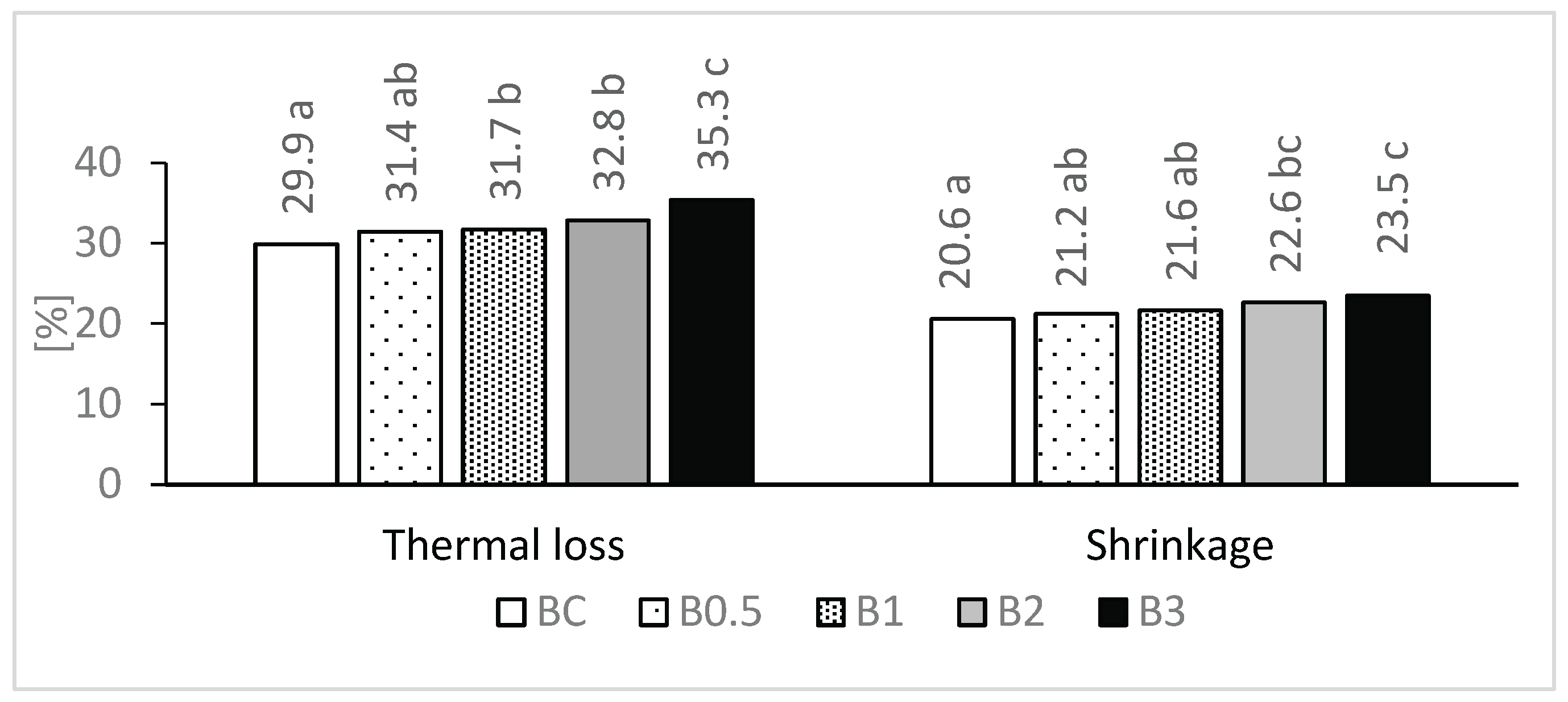
Figure 2.
Changes in shear force of beef burgers with varying amounts of black chokeberry pomace added during storage under refrigeration. Notes: Explanation of burger variant codes: BC/0.5/1/2/3 – beef burger variants with 0/0.5/1/2/3% addition of chokeberry pomace; a-d mean values marked with different letters differ significantly (p < 0.05) between burger treatments on a given day of storage; A-B mean values of a given burger treatment (for the same bar pattern) marked with different letters differ significantly (p < 0.05) between storage days.
Figure 2.
Changes in shear force of beef burgers with varying amounts of black chokeberry pomace added during storage under refrigeration. Notes: Explanation of burger variant codes: BC/0.5/1/2/3 – beef burger variants with 0/0.5/1/2/3% addition of chokeberry pomace; a-d mean values marked with different letters differ significantly (p < 0.05) between burger treatments on a given day of storage; A-B mean values of a given burger treatment (for the same bar pattern) marked with different letters differ significantly (p < 0.05) between storage days.
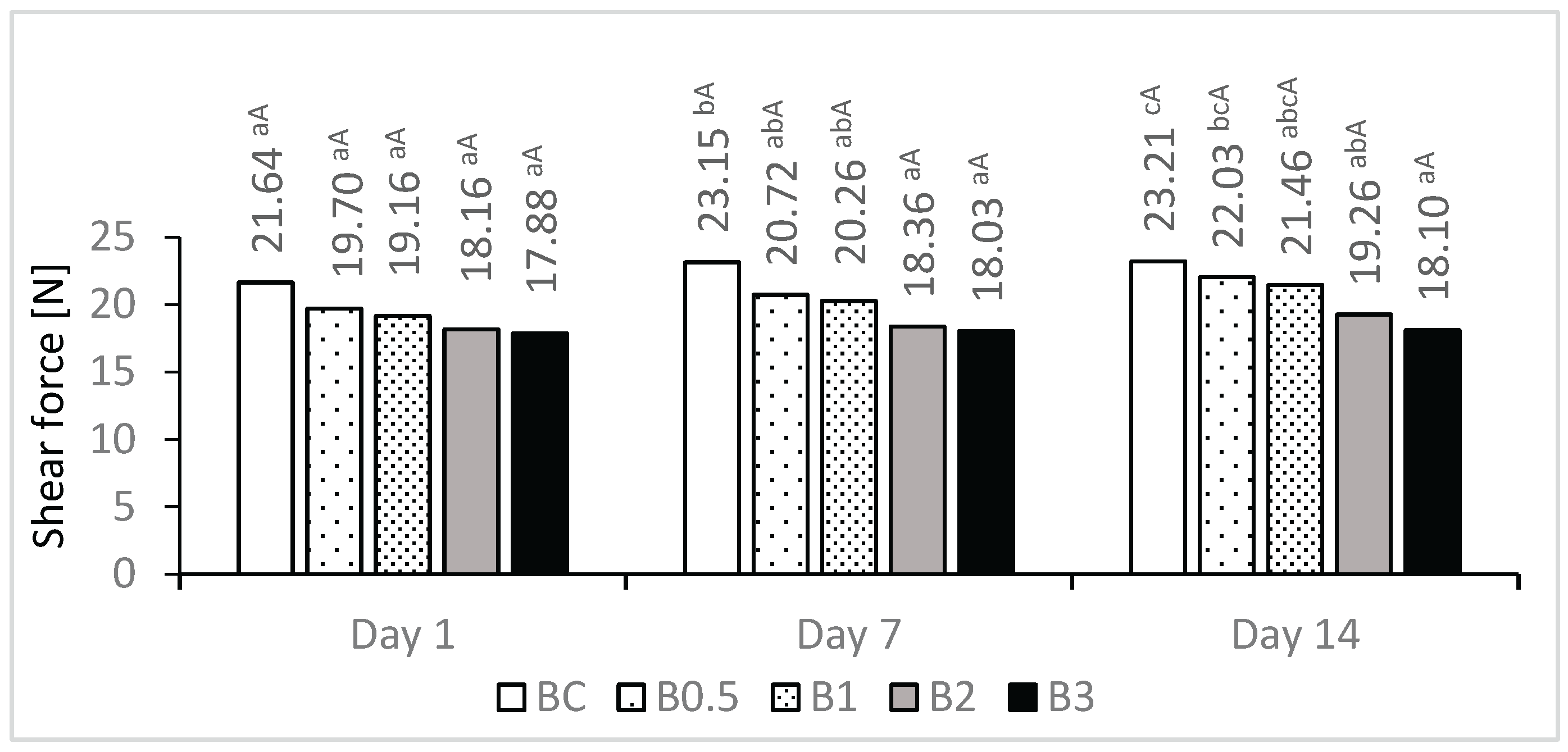

Table 1.
Recipe of beef burgers.
| Burger variant 1 | Meat-fat raw materials [%] |
Chokeberry pomace 2 [%] |
Table salt (NaCl) 3 [%] |
|---|---|---|---|
| BC | 100 | 0.0 | 1.5 |
| B0.5 | 0.5 | ||
| B1 | 1.0 | ||
| B2 | 2.0 | ||
| B3 | 3.0 |
1 Explanation of burger variant codes: BC/0.5/1/2/3 – beef burger variants with 0/0.5/1/2/3% addition of chokeberry pomace. 2 The amount of pomace added was calculated in relation to the weight of the meat and fat raw material. 3 The amount of NaCl added was calculated in relation to the weight of the meat and fat raw material and black chokeberry pomace.
Table 2.
Organoleptic quality attributes for beef burgers [established by the authors].
| Organoleptic quality attribute | Description of organoleptic quality criteria |
|---|---|
| Appearance and color | Surface clean, no cracks, product does not fall apart; color characteristic of the raw materials used and the technological process applied, from brown to dark brown, unacceptable color indicating product deterioration during storage. |
| Aroma | Aroma characteristic of the raw materials used and the technological process employed; unacceptable is a musty, unusual, foreign, or stale odor of the product. |
| Taste | Taste is characteristic of the raw materials used and the technological process employed; an unacceptable taste is musty, unusual, or foreign, indicating that the product is not fresh. |
| Texture | Homogeneous structure, uniform degree of grinding of meat and fat raw materials; consistency sufficiently firm, not falling apart; a piece of product that can be easily broken up in the mouth and swallowed; unacceptable consistency, very hard, crumbling, rubbery. |
Table 3.
Content of selected chemical components in beef burgers with varying amounts of black chokeberry pomace added (mean value ± standard deviation).
Table 3.
Content of selected chemical components in beef burgers with varying amounts of black chokeberry pomace added (mean value ± standard deviation).
| Feature | BC | B0.5 | B1 | B2 | B3 |
|---|---|---|---|---|---|
| Water content [%] | 57.06 a ± 1.47 | 54.75 a ± 1.89 | 54.16 a ± 0.09 | 54.66 a ± 0.68 | 54.50 a ± 2.05 |
| Protein content [%] | 24.20 a ± 0.18 | 24.47 a ± 1.15 | 25.48 a ± 0.31 | 25.42 a ± 0.01 | 25.89 a ± 0.60 |
| Fat content [%] | 16.15 b ± 0.01 | 16.01 b ± 0.08 | 15.89 b ± 0.18 | 14.96 a ± 0.28 | 14.67 a ± 0.06 |
| NaCl content [%] | 1.36 a ± 0.04 | 1.36 a ± 0.04 | 1.33 a ± 0.02 | 1.30 a ± 0.01 | 1.29 a ± 0.05 |
Notes: Explanation of burger variant codes: BC/0.5/1/2/3 – beef burger variants with 0/0.5/1/2/3% addition of chokeberry pomace; a-c mean values in the same row marked with different letters differ significantly (p < 0.05).
Table 4.
Changes in pH values of beef burgers with varying amounts of black chokeberry pomace added during storage under refrigeration (mean value ± standard deviation).
Table 4.
Changes in pH values of beef burgers with varying amounts of black chokeberry pomace added during storage under refrigeration (mean value ± standard deviation).
| Storage time [days] | BC * | B0.5 * | B1 * | B2 * | B3 * |
|---|---|---|---|---|---|
| 1 | 6.27 cA ± 0.05 | 6.23 bA ± 0.01 | 6.21 bB ± 0.02 | 6.19 bB ± 0.01 | 6.12 aB ± 0.01 |
| 7 | 6.27 dA ± 0.02 | 6.21 cA ± 0.02 | 6.19 bcA ± 0.02 | 6.18 bB ± 0.01 | 6.10 aAB ± 0.02 |
| 14 | 6.27 dA ± 0.01 | 6.21 cA ± 0.01 | 6.18 bA ± 0.01 | 6.16 bA ± 0.01 | 6.09 aA ± 0.01 |
Notes: Explanation of burger variant codes: BC/0.5/1/2/3 – beef burger variants with 0/0.5/1/2/3% addition of chokeberry pomace; a-d mean values (in the same row) marked with different letters differ significantly (p < 0.05) between burger treatments on a given day of storage; A-B mean values of a given burger treatment (in the same column) marked with different letters differ significantly (p < 0.05) between storage days.
Table 5.
Changes in color parameters L*, a* and b* of beef burgers with varying amounts of black chokeberry pomace added during storage under refrigeration (mean value ± standard deviation).
Table 5.
Changes in color parameters L*, a* and b* of beef burgers with varying amounts of black chokeberry pomace added during storage under refrigeration (mean value ± standard deviation).
| Storage time [days] | BC | B0.5 | B1 | B2 | B3 |
|---|---|---|---|---|---|
| L* (lightness) | |||||
| 1 | 43.80 cA ± 2.03 | 42.63 cA ± 1.11 | 39.56 bA ± 1.46 | 36.11 aA ± 1.06 | 34.74 aA ± 1.32 |
| 7 | 44.75 dA ± 2.57 | 43.27 dAB± 1.32 | 40.09 cA ± 0.76 | 37.59 bB ± 1.39 | 34.96 aA ± 1.17 |
| 14 | 45.84 cA ± 1.72 | 44.07 cB ± 1.26 | 40.10 bA ± 0.52 | 38.81 bB ± 1.19 | 36.93 aB ± 2.63 |
| +a*/-a* (redness/greenness) | |||||
| 1 | 7.54 bA ± 0.76 | 6.70 aA ± 0.66 | 6.13 aA ± 0.31 | 6.15 aA ± 0.30 | 6.12 aA ± 0.41 |
| 7 | 8.17 cAB ± 0.76 | 7.33 bB ± 0.62 | 6.18 aA ± 0.52 | 6.29 aA ± 0.62 | 7.57 bcB ± 0.50 |
| 14 | 8.39 cB ± 0.87 | 7.59 bB ± 0.50 | 6.22 aA ± 0.41 | 6.41 aA ± 0.65 | 7.61 bB ± 0.76 |
| +b*/-b* (yellowness/blueness) | |||||
| 1 | 5.81 dA ± 1.65 | 3.03 cA ± 0.59 | 0.72 bB ± 0.68 | -0.17 abB ± 0.88 | -1.17 aA ± 1.01 |
| 7 | 5.50 dA ± 1.21 | 2.23 cA ± 1.12 | 0.61 bB ± 0.80 | -0.73 abAB ± 1.02 | -1.61 aA ± 1.72 |
| 14 | 4.73 dA ± 0.93 | 2.20 cA ± 1.13 | -0.25 bA ± 0.91 | -1.29 abA ± 0.85 | -2.06 aA ± 0.72 |
Notes: Explanation of burger variant codes: BC/0.5/1/2/3 – beef burger variants with 0/0.5/1/2/3% addition of chokeberry pomace; a-d mean values (in the same row) marked with different letters differ significantly (p < 0.05) between burger treatments on a given day of storage; A-B mean values of a given burger treatment (in the same column) marked with different letters differ significantly (p < 0.05) between storage days.
Table 6.
Total color difference (ΔE) for beef burgers with different amounts of black chokeberry pomace added during storage.
Table 6.
Total color difference (ΔE) for beef burgers with different amounts of black chokeberry pomace added during storage.
| Storage time [days] | ΔE | |||
|---|---|---|---|---|
| BC—B0.5 | BC—B1 | BC—B2 | BC—B3 | |
| 1 | 3.1 | 6.8 | 9.8 | 11.5 |
| 7 | 3.7 | 7.0 | 9.7 | 12.1 |
| 14 | 3.2 | 7.9 | 9.5 | 11.2 |
Notes: Explanation of burger variant codes: BC/0.5/1/2/3 – beef burger variants with 0/0.5/1/2/3% addition of chokeberry pomace.
Table 7.
Changes in organoleptic properties of beef burgers with varying amounts of black chokeberry pomace added during storage under refrigeration (mean ± standard deviation).
Table 7.
Changes in organoleptic properties of beef burgers with varying amounts of black chokeberry pomace added during storage under refrigeration (mean ± standard deviation).
| Storage time [days] | BC | B0.5 | B1 | B2 | B3 |
|---|---|---|---|---|---|
| Appearance and color | |||||
| 1 | 4.9 bA ± 0.31 | 4.8 bA ± 0.41 | 4.7 bA ± 0.47 | 3.9 aA ± 0.55 | 3.6 aA ± 0.50 |
| 7 | 4.8 bA ± 0.41 | 4.7 bA ± 0.47 | 4.6 bA ± 0.50 | 3.9 aA ± 0.31 | 3.6 aA ± 0.50 |
| 14 | 4.8 bA ± 0.41 | 4.7 bA ± 0.47 | 4.4 bA ± 0.50 | 3.7 aA ± 0.47 | 3.3 aA ± 0.47 |
| Aroma | |||||
| 1 | 4.9 bA ± 0.31 | 4.8 bA ± 0.41 | 4.7 abA ± 0.47 | 4.6 abA ± 0.50 | 4.4 aA ± 0.50 |
| 7 | 4.8 bA ± 0.41 | 4.7 abA ± 0.47 | 4.6 abA ± 0.50 | 4.6 abA ± 0.50 | 4.3 aA ± 0.47 |
| 14 | 4.8 bA ± 0.41 | 4.7 bA ± 0.47 | 4.6 abA ± 0.50 | 4.5 abA ± 0.51 | 4.2 aA ± 0.41 |
| Taste | |||||
| 1 | 4.9 bA ± 0.31 | 4.9 bA ± 0.31 | 4.4 abA ± 0.68 | 4.2 aA ± 0.70 | 4.0 aA ± 0.79 |
| 7 | 4.9 bA ± 0.31 | 4.8 bA ± 0.41 | 4.3 aA ± 0.80 | 4.1 aA ± 0.55 | 3.9 aA ± 0.31 |
| 14 | 4.9 cA ± 0.31 | 4.8 cA ± 0.41 | 4.3 bA ± 0.66 | 4.0 aA ± 0.46 | 3.8 aA ± 0.41 |
| Texture | |||||
| 1 | 4.9 cA ± 0.31 | 4.9 cA ± 0.31 | 4.5 bcA ± 0.51 | 4.2 abA ± 0.62 | 3.9 aA ± 0.72 |
| 7 | 4.9 cA ± 0.31 | 4.9 cA ± 0.31 | 4.4 bA ± 0.50 | 4.1 abA ± 0.55 | 3.8 aA ± 0.41 |
| 14 | 4.9 cA ± 0.31 | 4.9 cA ± 0.31 | 4.4 bA ± 0.50 | 4.0 aA ± 0.46 | 3.8 aA ± 0.62 |
Notes: Explanation of burger variant codes: BC/0.5/1/2/3 – beef burger variants with 0/0.5/1/2/3% addition of chokeberry pomace; a-d mean values (in the same row) marked with different letters differ significantly (p < 0.05) between burger treatments on a given day of storage; A-B mean values of a given burger treatment (in the same column) marked with different letters differ significantly (p < 0.05) between storage days.
Table 8.
Changes in microbial quality of beef burgers with varying amounts of black chokeberry pomace added during storage at refrigeration temperature (mean value ± standard deviation).
Table 8.
Changes in microbial quality of beef burgers with varying amounts of black chokeberry pomace added during storage at refrigeration temperature (mean value ± standard deviation).
| Storage time [days] | BC | B0.5 | B1 | B2 | B3 |
|---|---|---|---|---|---|
| Mesophilic aerobic microorganisms [cfu/g] | |||||
| 1 | 2.3 101 aA | 2.0 101 aA | 1.8 102 bA | 1.0 101 aA | nd in 0.1 g aA |
| 7 | 5.3 102 bA | 2.0 102 aA | 2.3 102 aA | 8.8 102 cB | 5.9 101 aA |
| 14 | 1.8 104 eB | 1.0 104 dB | 1.1 103 aB | 3.5 103 bC | 5.6 103 cB |
| Psychrotrophic bacteria [cfu/g] | |||||
| 1 | 9.4 102 bA | 7.8 101 aA | 1.8 102 aA | 3.1 101 aA | nd in 0.1 g aA |
| 7 | 1.2 103 cAB | 9.3 101 abA | 2.1 102 abA | 2.5 102 bB | 3.6 101 aA |
| 14 | 1.4 103 cB | 1.0 103 bB | 2.4 103 dB | 4.0 102 aB | 3.2 102 aB |
| Lactic acid bacteria [cfu/g] | |||||
| 1 | 1.3 102 cA | 1.4 102 bcA | 1.1 102 cA | 3.0 101 aA | 4.7 101 abA |
| 7 | 1.5 102 bA | 2.1 102 cA | 1.6 102 bcA | 4.7 101 aA | 5.3 101 aA |
| 14 | 1.3 103 bB | 2.2 103 cB | 2.4 103 cB | 4.6 101 aA | 3.3 102 aB |
| Enterobacteriaceae [cfu/g] | |||||
| 1 | nd in 0.1 g | nd in 0.1 g | nd in 0.1 g | nd in 0.1 g | nd in 0.1 g |
| 7 | nd in 0.1 g | nd in 0.1 g | nd in 0.1 g | nd in 0.1 g | nd in 0.1 g |
| 14 | nd in 0.1 g | nd in 0.1 g | nd in 0.1 g | nd in 0.1 g | nd in 0.1 g |
| Escherichia coli [cfu/g] | |||||
| 1 | nd in 0.1 g | nd in 0.1 g | nd in 0.1 g | nd in 0.1 g | nd in 0.1 g |
| 7 | nd in 0.1 g | nd in 0.1 g | nd in 0.1 g | nd in 0.1 g | nd in 0.1 g |
| 14 | nd in 0.1 g | nd in 0.1 g | nd in 0.1 g | nd in 0.1 g | nd in 0.1 g |
Notes: Explanation of burger variant codes: BC/0.5/1/2/3 – beef burger variants with 0/0.5/1/2/3% addition of chokeberry pomace; a-d mean values (in the same row) marked with different letters differ significantly (p < 0.05) between burger treatments on a given day of storage; A-B mean values of a given burger treatment (in the same column) marked with different letters differ significantly (p < 0.05) between storage days; nd not detected.
Disclaimer/Publisher’s Note: The statements, opinions and data contained in all publications are solely those of the individual author(s) and contributor(s) and not of MDPI and/or the editor(s). MDPI and/or the editor(s) disclaim responsibility for any injury to people or property resulting from any ideas, methods, instructions or products referred to in the content. |
© 2026 by the authors. Licensee MDPI, Basel, Switzerland. This article is an open access article distributed under the terms and conditions of the Creative Commons Attribution (CC BY) license.
Copyright: This open access article is published under a Creative Commons CC BY 4.0 license, which permit the free download, distribution, and reuse, provided that the author and preprint are cited in any reuse.


