
Submitted:
15 June 2026
Posted:
16 June 2026
You are already at the latest version
Abstract
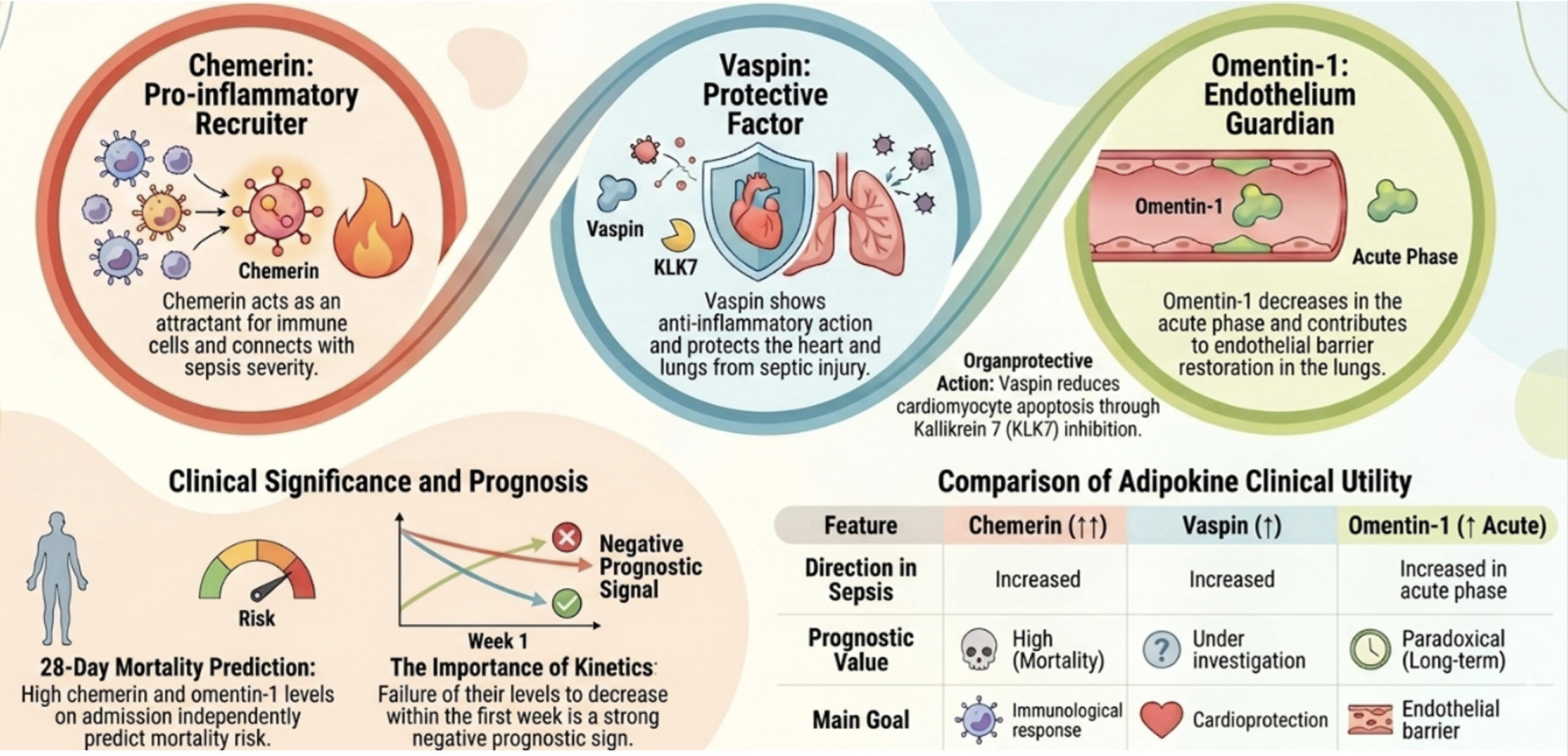
Adipose tissue has emerged as a pivotal endocrine organ, secreting bioactive proteins termed adipokines that regulate metabolic and immune processes across multiple organ systems. In the context of sepsis and critical illness, conditions defined by a dysregulated host response to infection with life-threatening organ dysfunction, the role of novel adipokines has attracted considerable research interest. This review focuses on three novel adipokines, chemerin, vaspin (SERPINA12), and omentin-1 (intelectin-1). We will discuss current in vitro, in vivo experimental animal models, and clinical evidence, emphasizing their biology, mechanisms of action, and potential as diagnostic and prognostic biomarkers in critically ill patients. All three adipokines are elevated in sepsis compared with healthy controls and correlate with established severity scores, including APACHE II and SOFA. Chemerin and omentin-1 have both been independently associated with 28-day mortality in prospective cohort studies. Vaspin exhibits robust cardioprotective effects in murine sepsis models via inhibition of kallikrein 7 (KLK7) and attenuates lipopolysaccharide (LPS)-induced acute lung injury (ALI) both in vitro and in vivo. Omentin-1 suppresses LPS-induced macrophage activation through TLR4/MyD88/NF-κB inhibition in vitro and protects against LPS-induced ALI in murine models. Despite these promising findings, substantial methodological heterogeneity and limited large-scale clinical data currently preclude clinical implementation. Future research that standardizes assays, expands to multicenter cohorts, and investigates therapeutic modulation of these pathways is urgently needed.
Keywords:
adipokines
; chemerin
; vaspin
; omentin-1
; sepsis
; critical illness
; biomarkers
; in vitro models
; in vivo models
; inflammation
Copyright: This open access article is published under a Creative Commons CC BY 4.0 license, which permit the free download, distribution, and reuse, provided that the author and preprint are cited in any reuse.


