

Submitted:
15 June 2026
Posted:
17 June 2026
You are already at the latest version
Abstract
Liquefied natural gas (LNG) is increasingly used in maritime propulsion systems as a means to reduce atmospheric emissions. However, methane slip from dual-fuel engines remains a critical limitation due to the high global warming potential of methane. This study presents a comprehensive experimental assessment of greenhouse gas (GHG) emissions from a new-generation four-stroke dual-fuel engine installed on a cruise vessel and operating on both LNG and marine gas oil (MGO). Measurements were carried out during full-scale sea trials under real navigation conditions. Results show that methane slip remains strongly dependent on engine load, with low and stable values at medium-to-high loads (1.95 g/kWh average over the 60–90% range) and a significant increase at low load. Compared with a previous engine generation (46DF), the 46TS-DF engine exhibits an approximate 18% reduction in methane slip above 60% load. On a well-to-wake basis, this results in an overall CO₂-equivalent emission reduction of about 6%, of which 42% is attributable to methane slip reduction and the remainder to improved energy efficiency. In contrast, switching from LNG to MGO operation leads to a 23.5% increase in CO₂-equivalent emissions. Black carbon (BC) emissions were measured and as expected despite the limited number of available studies, they were found to be significantly lower in LNG mode, with reductions exceeding 90% compared with MGO operation. Finally, an Engine Load Monitoring (ELM) analysis based on one year of operational data highlights the strong influence of vessel operating profiles on methane slip. The application of both IMO and FuelEU methodologies yields consistent methane slip coefficients (1.34% and 1.36%, respectively), significantly lower than current default values, noting that these estimates do not include crankcase emissions. These results demonstrate the importance of integrating real operational conditions into emission assessment frameworks for LNG-fuelled vessels.
Keywords:
LNG
; methane slip
; marine engine
; greenhouse gas emissions
; black carbon
; FuelEU Maritime
; Engine Load Monitoring
1. Introduction
Liquefied natural gas (LNG) propulsion is a relevant option for meeting strict regulatory requirements on atmospheric emissions in maritime transport. It allows reductions in nitrogen oxides (NOx), particle emissions [1,2,3], and black carbon (BC) [2] compared with conventional propulsion systems, as well as negligible sulphur oxides (SOx) emissions due to the very low sulphur content of LNG. Low-pressure four-stroke dual-fuel engines are currently widely used [4] and can operate on either natural gas or marine gas oil (MGO), providing operational flexibility. They also have fast start-up capability and lower vibration levels than two-stroke engines used on large vessels such as LNG carriers or cargo ships, which makes them suitable for passenger-oriented applications. This type of four-stroke engine is commonly used in ro-pax vessels and diesel-electric configurations, including cruise ships. It also allows lower CO₂ emissions compared with diesel-based marine fuels, as natural gas is mainly composed of methane and has a higher hydrogen-to-carbon (H/C) ratio than diesel fuel [5]. However, as with all internal combustion engines, these systems emit a fraction of unburned fuel. In the case of LNG, this is mainly methane, a greenhouse gas with a high global warming potential. This phenomenon, referred to as “methane slip” [6,7], is a limitation of the technology. It is linked to several combustion mechanisms, including quenching [7], which is more pronounced at low engine load due to lower combustion temperatures, leading to increased methane emissions observed for all LNG engine types [4]. Although the number of available studies remains limited [8], existing results indicate lower methane slip levels in recent engine generations compared with earlier systems [9]. In this context, the present study is based on measurements performed on a new-generation engine installed on a recently built vessel and allows comparison with the previous engine generation.
NOx regulatory frameworks are based on emission factors measured at steady-state operating points (25, 50, 75, and 100% load) in accordance with the International Maritime Organization (IMO) NOx Technical Code [10]. Recent greenhouse gas assessment methodologies, however, introduce an additional 10% load point [11] to better account for low-load operation, where methane slip increases. These greenhouse gas emissions are converted into CO₂-equivalent values for inclusion in greenhouse gas accounting frameworks.
At the international level, the IMO has defined a pathway for reducing greenhouse gas emissions from maritime transport, together with tools for monitoring ship energy efficiency. It has also advanced methodological frameworks for greenhouse gas accounting, including the approval of a life-cycle assessment (LCA) [12] approach for marine fuels, covering well-to-wake greenhouse gas intensity calculations. However, methane slip is not yet explicitly addressed within dedicated regulatory standards currently under development at the IMO.
At the European level, the Fit for 55 package integrates maritime transport into the European Union climate framework. The MRV [13] regulation requires monitoring, reporting, and verification of greenhouse gas emissions from ships operating in the European Economic Area. In parallel, the FuelEU Maritime regulation sets limits on the annual average well-to-wake greenhouse gas intensity of the energy used on board ships. These regulatory developments increase the need for consistent quantification of CO₂-equivalent emissions. In this context, the present study analyses emissions using tank-to-wake, well-to-tank, and well-to-wake system boundaries to assess overall greenhouse gas (GHG) emission factors of the engine in both MGO and LNG operating modes.
Finally, current regulatory frameworks allow ship operators to report emissions based on actual engine operating conditions [11]. Operational profiles of ships have been shown to have a strong influence on actual emissions in several recent studies [14,15,16]. This approach, referred to as “Engine Load Monitoring”, uses recorded engine load profiles to calculate unburned methane emissions. In this context, the present work proposes an emission assessment based on the annual recorded engine load distribution of the vessel, corresponding to the year following the onboard measurement campaign. Two calculation methods are applied, based on two regulatory frameworks: the European FuelEU Maritime regulation and the guidelines recently adopted by the International Maritime Organization (IMO) at MEPC 84.
2. Materials and Methods
2.1. Ship, Engine and operating conditions
The experimental campaign was carried out aboard a cruise vessel during a five-day sea trial period in May 2024, conducted by the shipbuilder Chantiers de l’Atlantique as part of the final validation phase prior to delivery. These trials are performed in the presence of the ship owner and classification society, who validate that the vessel complies with its contractual performance requirements. Modern cruise vessels typically rely on diesel-electric power plant architectures, in which electrical generation is decoupled from propulsion and must continuously adapt to variable demands. These demands arise not only from propulsion systems but also from a wide range of onboard consumers, including auxiliary machinery and hotel services. In this context, the vessel is equipped with six 12 cylinders Wärtsilä 46 TS-DF 4-stroke low pressure dual-fuel engines. Each unit operates at a constant speed of 600 rpm and provides a mechanical output of 15.60 MW. Compared with the conventional 46DF engine [15,16,17], the 46TS-DF engine investigated in this study features two-stage turbocharging, resulting in an increase in power output per cylinder from 1145 kW to 1300 kW, together with improved overall energy efficiency. The engines are coupled with alternators and collectively supply the electrical power required for all shipboard operations. These engines are designed to operate using two different fuel strategies. In gas mode, liquefied natural gas (LNG) is first vaporized and then used as the main fuel, while a limited quantity of pilot marine gas oil (MGO) is injected to initiate combustion. Alternatively, the engines can function in a conventional diesel configuration, relying solely on MGO.
Sea trials involve a series of validation procedures aimed at assessing system performance under a variety of conditions, including prolonged operation and high-load scenarios in both LNG and MGO modes. In the present study, we had no direct control over engine load. However, we continuously monitored exhaust emissions during both dynamic operating periods, characterized by rapidly changing loads and fuel modes, and intervals of stabilized engine operation. So, despite this variability due to sea trial conditions, intervals of steady operation were identified across a range of loads for both LNG and MGO use. The LNG bunkered for the sea trials was methane-rich, with a high methane content (95.3 mol-%), the remainder consisting of ethane (3.57 mol-%), propane (0.66 mol-%), butane (0.32 mol-%), pentane (0.014 mol-%), hexane (0.0004 mol-%), and nitrogen (0.153 mol-%). The pilot fuel share, consisting of a low-sulfur fuel, ranged from approximately 1% at high load to about 5% at low load conditions.
The determination of emission factors requires not only the measurement of exhaust gas concentrations, but also an estimation of the exhaust flow rate, which is derived from both the fuel consumption and the composition of the exhaust gases, as well as the power output of the engine. These data on LNG gas and pilot MGO fuel consumption, as well as the delivered power, are recorded with a time resolution of one second and were provided by the ship’s manufacturer after the measurement campaign.
2.2. Emission Measurements
Exhaust gas sampling was performed using a probe installed on a DN100 flange located less than 10 m from the engine outlet. The sampled flow was distributed across several heated lines to enable simultaneous characterization of both gaseous and particulate emissions. The experimental setup is shown in Figure 1. Gaseous emissions were analyzed directly in the raw exhaust stream: concentrations of methane (CH₄), carbon monoxide (CO), and carbon dioxide (CO₂) were measured using a non-dispersive infrared (NDIR) analyzer (VA-5000, Horiba, Japan). Nitrogen oxides (NOₓ) concentrations were determined with an ECOM J2KN flue gas analyzer (ECOM, Germany), based on electrochemical sensor technology. Black carbon (BC) emissions measurements were carried out using an MA300 aethalometer (AethLabs, US), after dilution and cooling by a DEKATI e-diluter Pro (Dekati, Finland) operated at a fixed dilution rate of 25:1., allowing measurements to be conducted under both MGO and LNG operating conditions. All instruments record data with a one-second time resolution.
Emission factors, expressed in g·kWh⁻¹ were derived from the measured concentrations using a carbon balance approach in accordance with ISO 8178 [18] and the NOₓ Technical Code [10]. This method enables the estimation of the exhaust mass flow based on the fuel consumption data combined with the exhaust gas composition. As exhaust gas concentrations, engine power output, and fuel consumption were all recorded at a one-second resolution.
3. Results
3.1. Stabilized point CH4 emission factors
Based on the onboard measurements, time periods were identified during which engine load conditions were as stable as possible and as close as practicable to the requirements defined for engine bench testing in the NOₓ Technical Code. According to these guidelines, a stabilized operating point should correspond to a ten-minute recording period with a one-second sampling frequency, during which the coefficient of variation of the engine load remains below 5%. Under the present test conditions, these criteria were not strictly met. Nevertheless, for both LNG and MGO operating points, the duration of the selected periods ranged from a minimum of five minutes to a maximum of thirty minutes, with an average duration of approximately eleven minutes. The measured emission factors, calculated from average parameters (engine load, exhaust gas concentrations, fuel consumption, and power output), are presented in Figure 2 as a function of engine load. The results obtained in this study for the 46 TS-DF engine are compared with recent measurements reported for a conventional 46 DF engine architecture by Kuittinen et al. [15] and Sagot et al. [17].
It can be observed that, as reported in many previous studies ([4,16,19]), the methane slip emission factor increases at low engine loads. Relatively little difference is seen between the 46 DF and 46 TS-DF engines at loads below 40%. In contrast, the results indicate a significant reduction of approximately 18% in methane slip for engine loads above 60% when comparing the 46DF and the 46TS-DF engines.
Based on the measured values covering a load range from 13% to 90%, a linear interpolation was applied to extrapolate the data at 100% engine load, allowing the calculation of weighted averages according to the E2 cycle. The E2 cycle defined by IMO regulations is commonly used as a reference for engine comparison as it provides a standardized weighting of multiple load points. It is applicable to constant-speed marine engines for ship main propulsion, including diesel-electric propulsion architectures such as the one installed on the vessel studied in this work. From our measurement data, E2-weighted values of 2.20 g·kWh⁻¹ for the emission factor and 1.36% for the average methane slip coefficient were obtained, placing this engine within the lower range of values reported in the study by Kuittinen et al. [4] for four-stroke low-pressure dual-fuel (LPDF 4-S) engines. These values remain well below the default methane slip factors of 3.1% and 3.5% currently used within the FuelEU Maritime framework and IMO guidelines for the estimation of ship emissions, although it should be noted that the present analysis does not account for emissions associated with crankcase losses.
More recently, Kuittinen et al. [15] reported emission factors and methane slip coefficients averaged over a modified E2 cycle for the 46 DF engine. In that study, conducted onboard a vessel in operation, it was not possible to strictly follow the standard E2 cycle, particularly the 100% load point, which was replaced by an 80% load corresponding to the maximum load observed in service. The engine load points and their respective weightings for this adjusted E2 cycle were 25%–0.15, 54%–0.15, 75%–0.5, and 80%–0.2. Based on this modified cycle, Kuittinen et al. reported an emission factor of 2.8 g·kWh⁻¹ and a methane slip coefficient of 1.7%. Applying the same approach to the 46 TS-DF engine investigated in the present study yielded values of 2.21 g·kWh⁻¹ and 1.35%, respectively, corresponding to a significant 20% reduction for both metrics compared to the 46 DF engine.
3.2. Black Carbon (BC) Emission Factors under Stabilized Conditions
Figure 3 presents the measured emission factors for the two types of fuel used in this engine during these sea trials (MGO and LNG), based on stabilized operating points. Error bars denote standard deviation of results over each measurement periods. Emissions measured in MGO mode are significantly higher than those observed in LNG mode, with emission factors increasing as engine load decreases. For loads above 50%, average values of 0.33 mg·kWh⁻¹ in LNG mode and 5.9 mg·kWh⁻¹ in MGO mode are observed, corresponding to a 94% reduction when operating in LNG mode compared to MGO.
4. Discussion
4.1. BC emission factors, comparison with related studies.
As observed by Corbin [20], the literature contains very limited data on particulate emissions from marine LNG engines. To enable comparison with the data reported in their study, Table 1 presents (BC) concentrations, along with average values across the E2 cycle modes. Over this E2 cycle, the emission factors in LNG and MGO modes are 0.40 and 5.9 mg·kWh⁻¹, respectively, compared with 0.7 and 19 mg·kWh⁻¹ reported by Peng et al. [3] for the same cycle.
The lower emission levels observed in this study may reflect improvements in engine performance as well as the higher power operating conditions considered (480 kW/cylinder at 720 rpm for Peng et al., and 1300 kW/cylinder at 600 rpm in this study). Over the E2 cycle, the reduction between LNG and MGO reaches 90% in this study, although this is lower than reported in the literature, primarily due to a significantly lower weighted emission factor in MGO mode for the 46TS-DF engine. Corbin [20] and Peng [3] both investigated emissions at idle conditions, noting, as highlighted by Peng, that this operating point can be relevant for coastal vessel operations. Our 13% load point does not allow the reduction in BC emissions observed by Corbin et al. at idle conditions in MGO mode to be captured. Emission factors in LNG mode exhibit a minimum around 30% engine load, whereas in MGO mode, they decrease continuously with increasing engine load. It is worth noting that Peng et al. [3] also observed an increase between 50% and 75% load in LNG mode, although with a much smaller amplitude. Corbin et al. similarly reported that engine emissions in LNG mode do not follow a clear trend with load referring in particular to earlier work by Lehtoranta et al. [21], which reported total PM emission factors of 32, 9, and 20 mg·kWh⁻¹ at 40%, 75%, and 85% load, respectively, indicating a non-monotonic behavior with a minimum at 75% load.
One of the objectives of Corbin et al. [20] was to compare (BC) measurements obtained with different instruments, and they observed good consistency among the results. They also emphasized the difficulties instruments may encounter when quantifying high (BC) concentrations. This point was also highlighted in the study by Aakko-Saksa et al. [22], which showed that dilution is an important parameter for the use of (BC) measurement instruments. In our measurements, a dilution factor of 25 was appropriate for MGO operation (maximum concentrations of approximately 0.15 mg.m⁻³ as measured by the Aethalometer after dilution), although a lower dilution factor could have reduced measurement uncertainty in LNG mode. The main difficulty during the test campaign was selecting a dilution factor suitable for both modes, given the unexpected transitions between operating conditions.
4.2. Analysis of the relative contributions of methane slip and (BC) to GHG emissions.
To analyze the relative contributions of greenhouse gas emissions under the two propulsion modes, MGO and LNG, methane (CH₄) and (BC) emissions were converted into CO₂,eq. values using 100-year global warming potential (GWP100) factors. A value of 29.8 was applied for CH₄ [15,17,19], 298 for nitrous oxide (N₂O), and 900 for BC [23,24].
In addition, to place these emissions within the framework of the FuelEU Maritime regulation, emissions were evaluated using the prescribed emission factors. These include values of 0.00011 g N₂O per g of LNG and 0.00018 g N₂O per g of MGO, together with a methane (CH₄) slip factor of 0.00005 g per g of MGO fuel. These factors correspond to tank-to-wake (TtW) emissions and were subsequently converted into CO₂,eq. values. Furthermore, the FuelEU framework accounts for well-to-tank (WtT) emissions associated with fuel production, expressed as CO₂ emission factors in g/MJ for each fuel.
All results, together with the calculation rules used to derive CO₂,eq. emissions, are summarized in Table 2. To enable comparison with literature data, mean emission factors over the E2 cycle are also provided.
Measurement : (a) NDIR for CO2 and CH4, aethalometer for BC
FuelEU, TtW :(b) Cf CH4=0.00005 gCH4/gFuel for MGO/LFO, (c) Cf N2O=0.00018 gN2O/gFuel for MGO/LFO, (d) Cf N2O=0.00011 gN2O/gFuel for LNG
FuelEU, WtT : (e) CO2eq =18.5 gCO2/MJ for LNG, with LCV=0.0491 MJ/g fuel, (f) CO2eq =14.4 gCO2/MJ for MGO/MDO, with LCV=0.0427 MJ/g fuel
As shown in Table 2, the contribution of BC to total CO₂-equivalent emissions remains very limited. On the E2 cycle, BC accounts for only 5.3 gCO₂equ./kWh in MGO mode and 0.36 gCO₂equ./kWh in LNG mode, corresponding to less than 1% and 0.1% of total tank-to-wake CO₂-equivalent emissions, respectively. Consequently, despite the substantial reduction in BC emissions when operating on LNG, its influence on the overall greenhouse gas balance remains negligible compared with methane slip. Nevertheless, the reduction in BC emissions may still provide important environmental benefits through improved air quality and reduced atmospheric particulate emissions.
Figure 4 shows the variation of the contribution of methane slip to CO₂ emissions as a function of engine load, where CO₂-equivalent values also include estimated nitrous oxide (N₂O) emissions. It remains limited to approximately 12% for engine loads above 60% and is relatively independent of load, over 50% load.
The following Figure 5 presents TtW CO₂,eq. emission factors for the LNG and MGO modes, showing a crossover at low load. The calculation includes the contribution of BC converted into CO₂ equivalent, as well as calculated N₂O emissions. Due to the contribution of methane slip, CO₂,eq. emissions at low load are higher in LNG mode, whereas in the typical operating range of the engine, above 30% load, LNG becomes more advantageous. A relative average gain of approximately 20% is observed for loads above 60%, increasing to 21% when evaluated over the E2 cycle (See Table 1).
The same type of analysis can be conducted on a Well-to-Wake (WtW) basis, considering the regulated emissions during the WtT phase. For the calculation of WtT emissions, we rely on the FuelEU regulation, which requires accounting for CO₂ emissions associated with the production of fuels such as LNG and MGO, as well as N₂O emissions (see Table 1). As shown in Figure 6, the relative gain of LNG at high load is then limited to 12%, due to a penalty associated with fuel production during the WtT phases, with an equivalent value on the E2 cycle (See Table 1).
4.3. Evolution of WtW CO2,equivalent emissions between 46DF and 46TS-DF.
To allow a relative and global assessment of the gains achieved with this new 46-TSDF engine compared to the 46DF [17], the following figure presents the total cumulative CO₂,eq. emissions for both engine types and fuel types over an E2 cycle. The comparison does not include the contribution of (BC), which was not available in the study on the 46DF engine. For the gas mode, the total CO₂,eq. emissions over this E2 cycle decrease from 692 to 652 g/kWh, corresponding to an approximate 6% reduction in overall emissions on a WtW basis. Of the 40 g·kWh⁻¹ reduction, approximately 18 g·kWh⁻¹ (42% of the gain) are associated with the reduction in methane slip, while the remainder results from improved energy efficiency. In MGO mode, the observed difference between the two studies is less than 1% and switching this 46TS-DF from LNG to MGO results in a 23.5% relative increase in CO2 equivalent emissions.
4.4. Engine Load monitoring (ELM) based evaluation of methane slip.
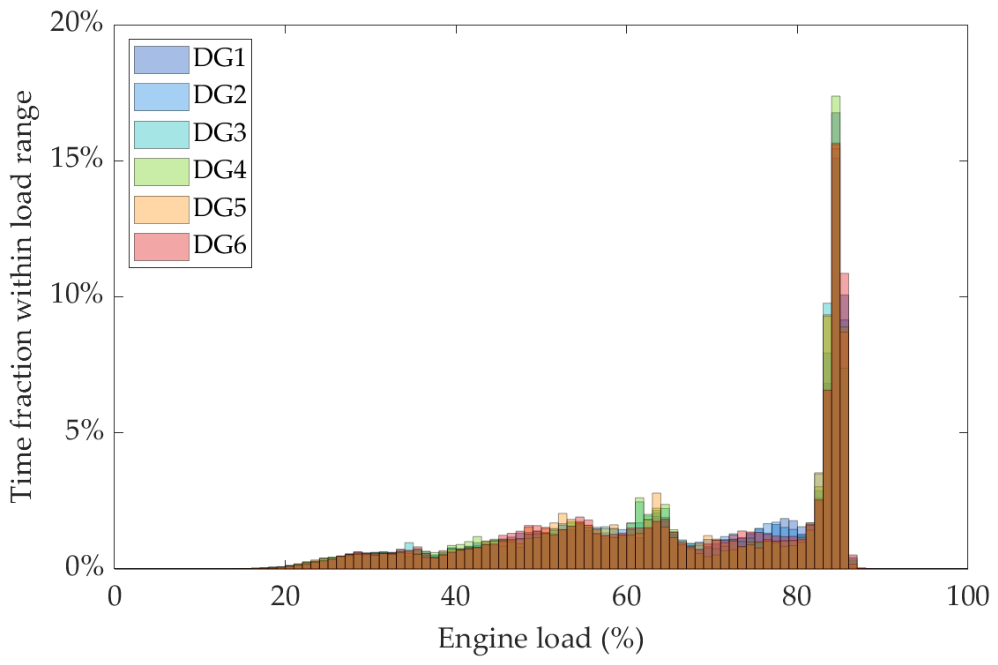
The previous analysis was based on an E2 cycle to allow an overall comparison between the 46DF and TSDF engines. However, current regulations allow shipowners to report actual emissions based on engine load recordings over an annual basis. This so-called Engine Load Monitoring (ELM) methodology combines engine emission slip coefficient factors, with a year-long analysis of engine operation. To carry out this procedure, we therefore collected after the experimental campaign these recordings for the six engines installed on the vessel for the period from July 2024 to July 2025 with a one-minute resolution. As shown in Figure 9, there is very little variation among the annual load distributions of the six engines, which are used alternately. It can be observed that they operate predominantly above 40% load (the cumulative average operating time of the six engines below 40% load is 10%), with a usage peak centered around 85% load.
Figure 7.
Well to Wake CO2 equivalent (g/kWh) greenhouse gas emissions comparison between 46DF and 46TS-DF, for both LNG and MGO mode for E2 cycle.
Figure 7.
Well to Wake CO2 equivalent (g/kWh) greenhouse gas emissions comparison between 46DF and 46TS-DF, for both LNG and MGO mode for E2 cycle.
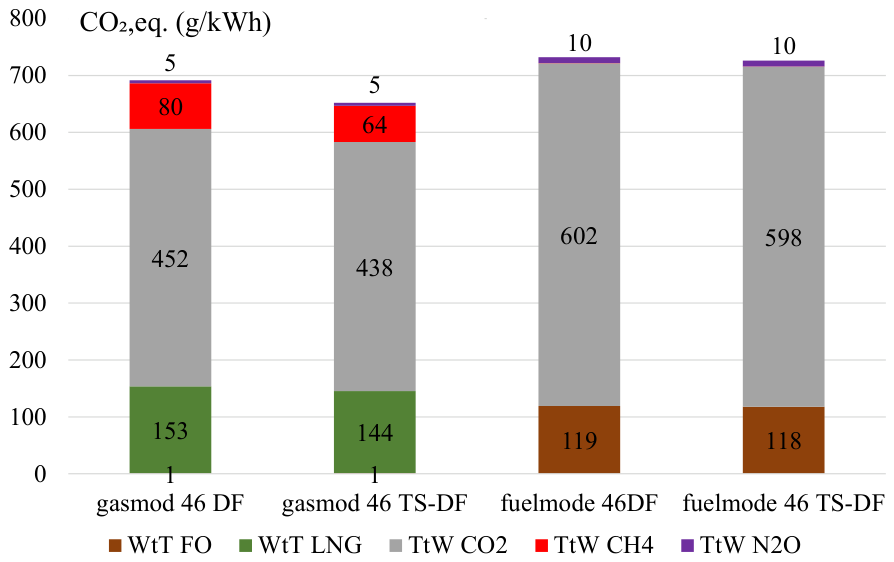
Figure 8.
Load distribution for the 6 engines DG1 to DG6.
The ELM calculation procedure, recently adopted at MEPC 84 by the International Maritime Organization (IMO), is based on the framework previously described [17] in [12]. It is based on continuous monitoring of engine load and a segmentation into 30-minute intervals, within which average engine load, gas consumption, and methane slip are determined using a load-dependent slip coefficient. The IMO guidelines also specify that the methane slip coefficient is determined by linear interpolation between the closest measured data points above and below the considered load, while for engine loads below the lowest measured load point, the emission value at this point is used, and for loads above the highest measured load point, the value at the highest measured load is retained. By aggregating fuel consumption and methane emissions over a full year of gas-mode operation, an equivalent annual slip coefficient is obtained. At the same time, the new EU directive [11] also defines procedures for verifying actual methane slip emissions from marine diesel engines. Although the two procedures are highly similar, they differ in two specific aspects. First, the FuelEU methodology introduces a more detailed calculation by refining the assessment under dynamically varying engine loads, through the reduction of the 30-minute intervals when load variations exceed 10%: “Engine load is averaged in 30-minute intervals average if the range does not exceed 10% of the rated power or rated speed of the engine—if above that range the 30-minute period should be reduced to the point where that criterion is met, or to the data recording and processing device period, whichever is higher” [11]. Second, the FuelEU framework requires the methane slip coefficient curve to be extrapolated beyond the measured range at both low and high engine loads. The methane slip coefficient curves derived from the IMO and FuelEU methodologies are both shown in Figure 10 for this study.
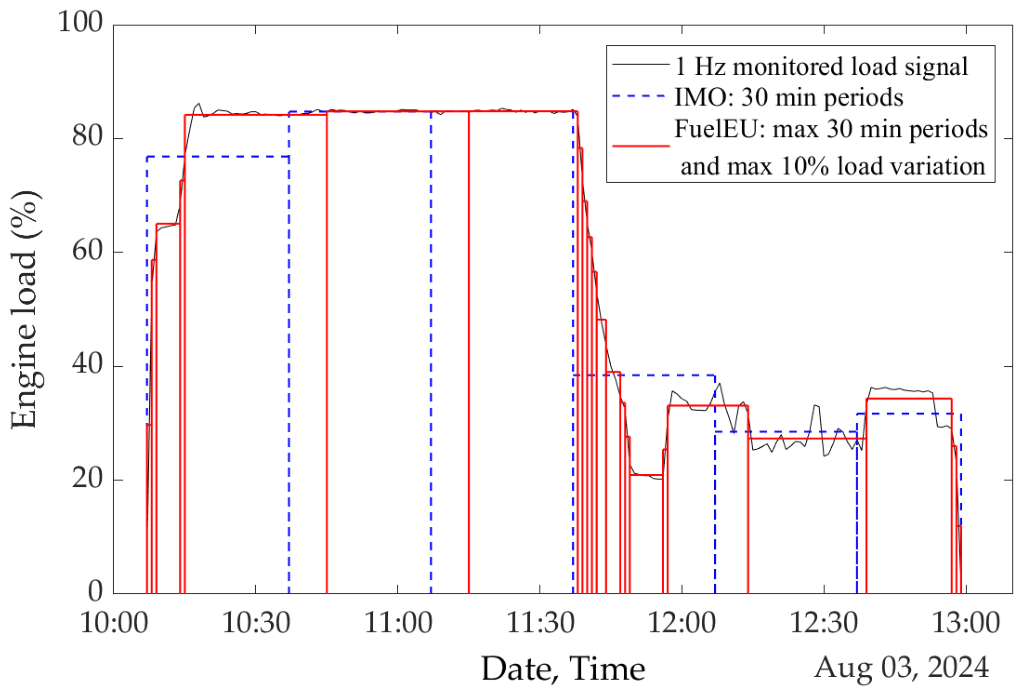
Based on one year of data and with a 1-minute sampling period of the DG6 engine load, we evaluated the average annual methane slip coefficient using both the IMO and FuelEU procedures. Figure 9 illustrates the 30-minute intervals of the IMO methodology (only the last interval is truncated) and the variable-length intervals used in the FuelEU methodology to follow load variations. In both cases, this procedure, illustrated here over a navigation period of approximately three hours, must be applied for the full year, covering the navigation phases in LNG mode.
Figure 9.
Illustration of the IMO and FuelEU Engine Load Monitoring averaging procedure.
Applying these FuelEU and IMO calculation procedures over one year results in methane slip coefficients of Cslip, IMO = 1.34% and Cslip, FuelEU = 1.36%, respectively, with only a negligible difference between the two methods. This small discrepancy is related to the time segmentation: indeed, there is almost no use of engines at low load. This is confirmed by the application of the FuelEU methodology, together with the IMO methane slip curve, which yields the same annual value. The additional calculation complexity does not appear to be justified in this case, given an engine operating profile characterized by relatively limited acceleration phases.
These values are low compared to those currently reported in the literature for real-world operation (1.7 for both Kuittinen et al. [15] and Sagot et al. [17] on the diesel-electric architecture, and 1.57 for Sagot et al. [16] on a ship with a direct mechanical propulsion system). It is related to the low methane slip level of the engine studied here as well as to the operating profile of this diesel-electric architecture. The impact of the operating profile was assessed by applying the emission factor of this 46TS-DF engine to the load profile reported by Sagot et al. for the year 2024, corresponding to a mechanically driven vessel. Figure 10 presents the two annual engine load distributions, as well as the interpolated methane slip curve derived from the measurements conducted in this study.
Figure 10.
Load distribution for two different ship architectures, Diesel-electric (this study) and Direct mechanical propulsion [16].
Figure 10.
Load distribution for two different ship architectures, Diesel-electric (this study) and Direct mechanical propulsion [16].
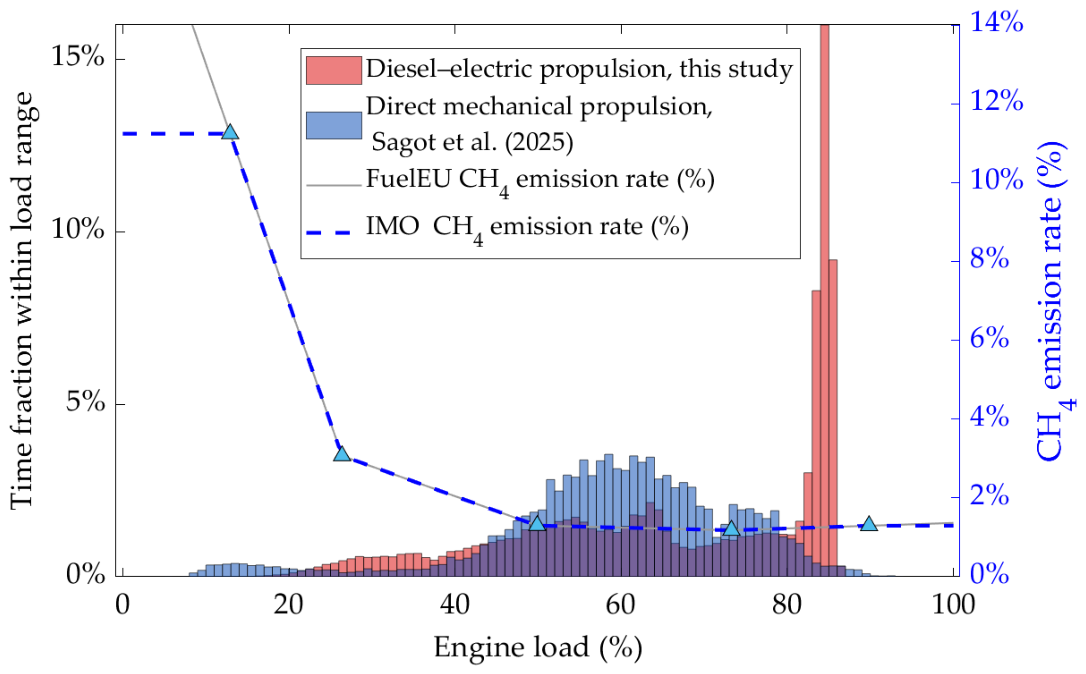
With the 46TS-DF engine used in this study and the annual operating profile of the LNG-powered RoPax vessel with direct mechanical propulsion from Sagot et al. [16], the yearly equivalent slip coefficient would be Cslip, IMO = 1.40% and Cslip, FuelEU = 1.42%. Using the IMO methodology as reference, this comparison indicates that, for the same engine, the diesel-electric propulsion profile reduces the annual methane slip coefficient from 1.40% to 1.34%, corresponding to an approximate 4–5% decrease, which is, however, dependent on the considered operating profiles.
5. Conclusion
This study investigated methane slip, (BC) emissions, and associated CO₂-equivalent greenhouse gas emissions from a new-generation four-stroke dual-fuel marine engine operating on both LNG and MGO during full-scale sea trials. The analysis combined stabilized operating points and annual Engine Load Monitoring to provide a comprehensive assessment of emissions under real operating conditions and across different regulatory perspectives. The results show that methane slip remains a key contributor to greenhouse gas emissions in LNG operation, particularly at low engine loads. However, the investigated 46 TS-DF engine exhibits relatively low methane slip levels compared with values reported in the literature for similar engine architectures. When evaluated over stabilized operating points and standardized E2 cycle weighting, methane slip coefficients and emission factors place the engine in the lower range of published values, with an approximate 18% reduction in methane slip observed over the E2 cycle compared with a previous 46 DF engine [15].
By performing measurements in both MGO and LNG modes, we were able to provide a compared analysis of CO₂ emissions on a tank-to-wake and well-to-wake basis. Based on the E2 cycle and on a well-to-wake basis, switching from LNG mode to MGO mode results in an approximately 23% increase in CO₂ emissions. It should be noted, however, that this assessment does not include crankcase emissions nor black carbon. BC was not measured on the 46DF engine. However, the analysis performed on the 46TS-DF engine showed that its contribution to the overall GHG balance is negligible. Finally, the comparison between the 46DF and the new 46TS-DF engine indicates an overall well-to-wake improvement of approximately 6% over the E2 cycle, of which 42% is attributable to methane slip reduction, the remainder being associated with improved energy efficiency.
Based on the most recent regulatory approaches for the evaluation of real-world emissions, combining measured engine emission factors with an analysis of engine load distributions over a reference period, it was possible to derive an equivalent global emission factor representative of actual vessel operation. Applying these FuelEU and IMO calculation procedures over one year results in methane slip coefficients of Cslip, IMO = 1.34% and Cslip, FuelEU = 1.36%, respectively, with only a negligible difference between the two methods despite differences in temporal aggregation rules. These values are significantly lower than the default methane slip factors of 3.1% and 3.5% specified in the FuelEU Maritime regulation and IMO LCA guidelines. It should be noted that the E2 cycle produces comparable results to the ELM approach, indicating that for this diesel-electric vessel characterized by very limited operation at low engine load, it provides a good representation of real-world methane slip. These results highlight the incentive nature of recent regulations aimed at reducing methane slip emissions, promoting optimized engine load management by shipowners and vessel design solutions developed by shipbuilders such as Chantiers de l’Atlantique to support these operational strategies.
Author Contributions
Conceptualization, Benoit Sagot; Formal analysis, Benoit Sagot and Aurélia Miquel; Investigation, Benoit Sagot and Raphael Defossez; Methodology, Benoit Sagot and Raphael Defossez; Writing—original draft, Benoit Sagot and Aurélia Miquel; Writing—review & editing, Benoit Sagot and Aurélia Miquel.
Funding
This research was supported by the French ADEME agency through the Digit+ project (grant number 2182D0412-B) and the AQACIA EMINAV project (grant number 2266D0003).
Data Availability Statement
All the data relevant to interpretation of results are available in the article.
Acknowledgments
The authors gratefully acknowledge the financial and operational support of the French ADEME agency. They also thank the technical team and crew involved in the sea trials for their assistance and collaboration during the measurement campaign. Special thanks are extended to Franck Faux and David Perez for their valuable support in preparing the measurement campaigns and in the design and integration of the sampling system.
Conflicts of Interest
The authors declare no conflicts of interest.:
Abbreviations
The following abbreviations are used in this manuscript:
| BC | Black Carbon |
| LNG | Liquefied natural gas |
| IMO | International Maritime Organization |
| NDIR | Non-dispersive infrared |
| GHG | Greenhouse gas |
| GWP | Global Warming Potential |
| MGO | Marine gas oil |
References
- Anderson, M.; Salo, K.; Fridell, E. Particle- and Gaseous Emissions from an LNG Powered Ship. Environ. Sci. Technol. 2015, 49, 12568–12575. [CrossRef]
- Aakko-Saksa, P.T.; Lehtoranta, K.; Kuittinen, N.; Järvinen, A.; Jalkanen, J.P.; Johnson, K.; Jung, H.; Ntziachristos, L.; Gagné, S.; Takahashi, C.; et al. Reduction in Greenhouse Gas and Other Emissions from Ship Engines: Current Trends and Future Options. Prog. Energy Combust. Sci. 2023, 94. [CrossRef]
- Peng, W.; Yang, J.; Corbin, J.; Trivanovic, U.; Lobo, P.; Kirchen, P.; Rogak, S.; Gagné, S.; Miller, J.W.; Cocker, D. Comprehensive Analysis of the Air Quality Impacts of Switching a Marine Vessel from Diesel Fuel to Natural Gas. Environmental Pollution 2020, 266. [CrossRef]
- Kuittinen, N.; Heikkilä, M.; Lehtoranta, K. Review of Methane Slip from LNG Engines; GREEN RAY Project. Deliverable D1.1; GREEN RAY, EU: Brussels, Belgium, 2023.
- Fun-sang Cepeda, M.A.; Pereira, N.N.; Kahn, S.; Caprace, J.D. A Review of the Use of LNG versus HFO in Maritime Industry. Marine Systems and Ocean Technology 2019, 14, 75–84. [CrossRef]
- Ushakov, S.; Stenersen, D.; Einang, P.M. Methane Slip from Gas Fuelled Ships: A Comprehensive Summary Based on Measurement Data. Journal of Marine Science and Technology (Japan) 2019, 24, 1308–1325. [CrossRef]
- Stenersen, D.; Thonstad, O. GHG and NOx Emissions from Gas Fuelled Engines: Mapping, Verification, Reduction Technologies; Trondheim, Norway, 2017.
- Moutik, B.; Benedetti, G. Onboard Methane Slip Emissions Measurement: Practical Insights and Industry Lessons Learned; SGMF: London, UK, 2025.
- Lehtoranta, K.; Vesala, H.; Flygare, N.; Kuittinen, N.; Apilainen, A.R. Measuring Methane Slip from LNG Engines with Different Devices. J. Mar. Sci. Eng. 2025, 13. [CrossRef]
- MEPC IMO Resolution 177 (58) Amendments to the Technical Code on Control of Emission of Nitrogen Oxides from Marine Diesel Engines (NOx Technical Code 2008); London, 2008.
- European Commission; Directorate-General for Mobility and Transport GUIDELINES FOR REPORTING AND VERIFICATION OF ACTUAL METHANE SLIP TANK-TO-WAKE EMISSION FACTORS FROM MARINE DIESEL ENGINES UNDER THE SCOPE OF FUELEU MARITIME REGULATION; Brussels, Belgium, 2025.
- MEPC 81-2024 GUIDELINES ON LIFE CYCLE GHG INTENSITY OF MARINE FUELS (2024 LCA GUIDELINES).
- European Commission The EU ETS and MRV Maritime General Guidance for Shipping Companies; Brussels, Belgium, 2025.
- Balcombe, P.; Heggo, D.A.; Harrison, M. Total Methane and CO2Emissions from Liquefied Natural Gas Carrier Ships: The First Primary Measurements. Environ. Sci. Technol. 2022, 56, 9632–9640. [CrossRef]
- Kuittinen, N.; Koponen, P.; Vesala, H.; Lehtoranta, K. Methane Slip and Other Emissions from Newbuild LNG Engine under Real-World Operation of a State-of-the Art Cruise Ship. Atmos. Environ. X 2024, 23. [CrossRef]
- Sagot, B.; Defossez, R.; Mahi, R.; Villot, A.; Joubert, A. An Engine Load Monitoring Approach for Quantifying Yearly Methane Slip Emissions from an LNG-Powered RoPax Vessel. J. Mar. Sci. Eng. 2025, 13. [CrossRef]
- Sagot, B.; Giraudier, G.; Decuniac, F.; Lefebvre, L.; Miquel, A.; Thomas, A. On-Board Measurement of Emissions on a Dual Fuel LNG Powered Cruise Ship: A Sea Trial Study. Atmos. Environ. X 2025, 25. [CrossRef]
- ISO 8178-1:2020 Internal Combustion Engines — Exhaust Emission Measurement 1: Test-Bed Measurement Systems of Gaseous and Particulate Emissions 2020.
- Lehtoranta, K.; Kuittinen, N.; Vesala, H.; Koponen, P. Methane Emissions from a State-of-the-Art LNG-Powered Vessel. Atmosphere (Basel). 2023, 14. [CrossRef]
- Corbin, J.C.; Peng, W.; Yang, J.; Sommer, D.E.; Trivanovic, U.; Kirchen, P.; Miller, J.W.; Rogak, S.; Cocker, D.R.; Smallwood, G.J.; et al. Characterization of Particulate Matter Emitted by a Marine Engine Operated with Liquefied Natural Gas and Diesel Fuels. Atmos. Environ. 2020, 220. [CrossRef]
- Lehtoranta, K.; Aakko-Saksa, P.; Murtonen, T.; Vesala, H.; Ntziachristos, L.; Rönkkö, T.; Karjalainen, P.; Kuittinen, N.; Timonen, H. Particulate Mass and Nonvolatile Particle Number Emissions from Marine Engines Using Low-Sulfur Fuels, Natural Gas, or Scrubbers. Environ. Sci. Technol. 2019, 53, 3315–3322. [CrossRef]
- Aakko-Saksa, P.; Kuittinen, N.; Murtonen, T.; Koponen, P.; Aurela, M.; Järvinen, A.; Teinilä, K.; Saarikoski, S.; Barreira, L.M.F.; Salo, L.; et al. Suitability of Different Methods for Measuring Black Carbon Emissions from Marine Engines. Atmosphere (Basel). 2022, 13. [CrossRef]
- Olmer, N.; Comer, B.; Roy, B.; Mao, X.; Rutherford, D. Greenhouse Gas Emissions from Global Shipping, 2013–2015: Detailed Methodology; Int Counc Clean Transp; 2017.
- Bond, T.C.; Doherty, S.J.; Fahey, D.W.; Forster, P.M.; Berntsen, T.; Deangelo, B.J.; Flanner, M.G.; Ghan, S.; Kärcher, B.; Koch, D.; et al. Bounding the Role of Black Carbon in the Climate System: A Scientific Assessment. Journal of Geophysical Research Atmospheres 2013, 118, 5380–5552. [CrossRef]
Figure 1.
Measurement setup.
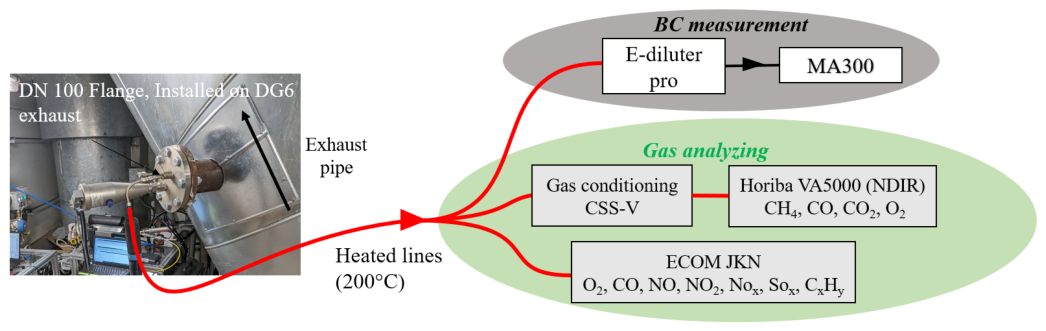
Figure 2.
CH4 emission factor as a function of engine load.
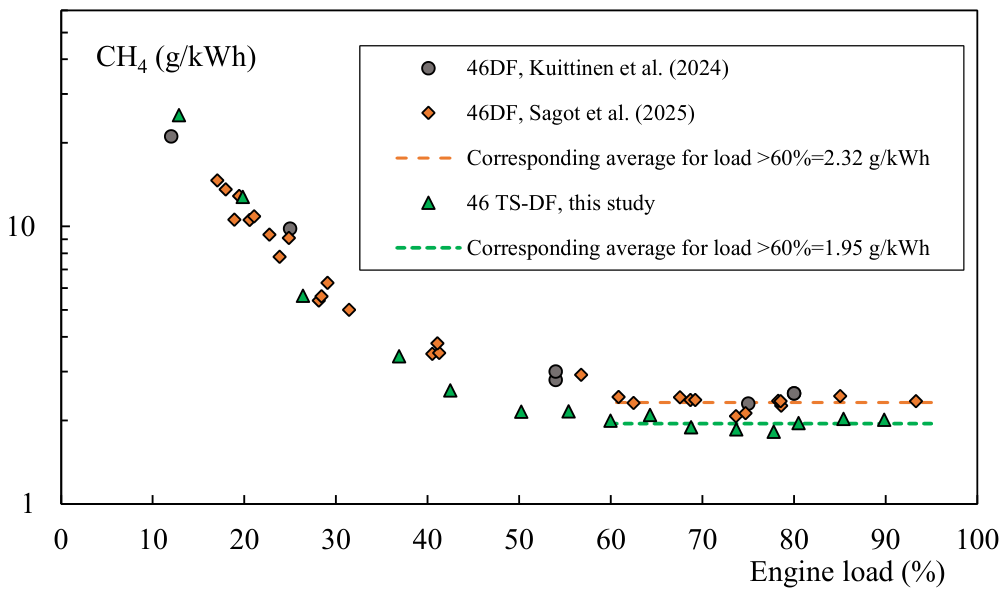
Figure 3.
BC Emission factor as a function of engine load.
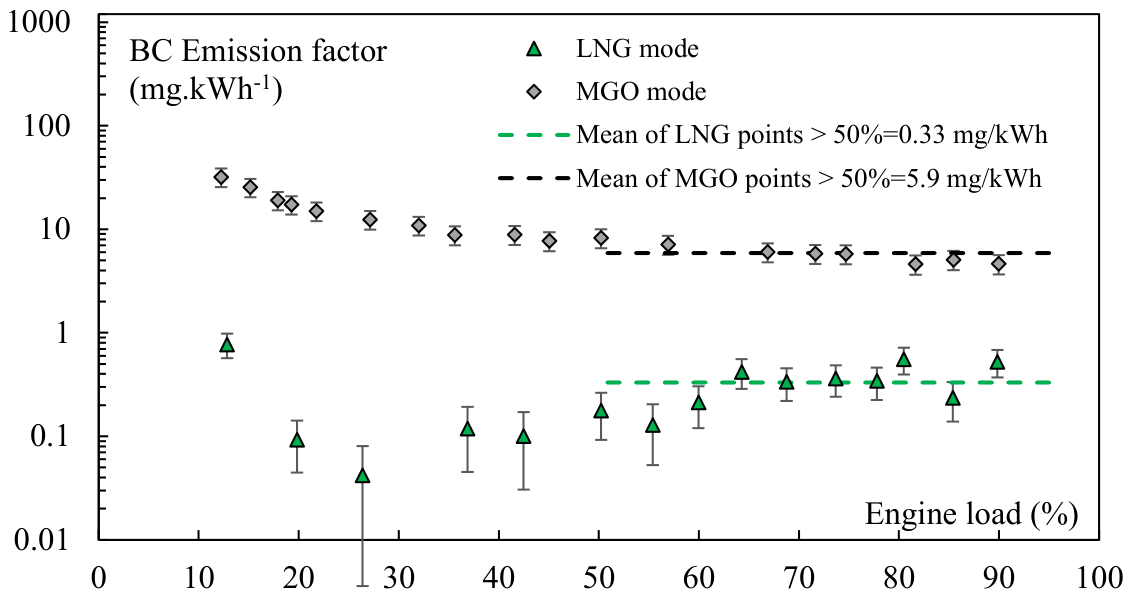
Figure 4.
Relative contribution of methane slip to CO2 equivalent Tank to Wake emission, as a function of engine load.
Figure 4.
Relative contribution of methane slip to CO2 equivalent Tank to Wake emission, as a function of engine load.
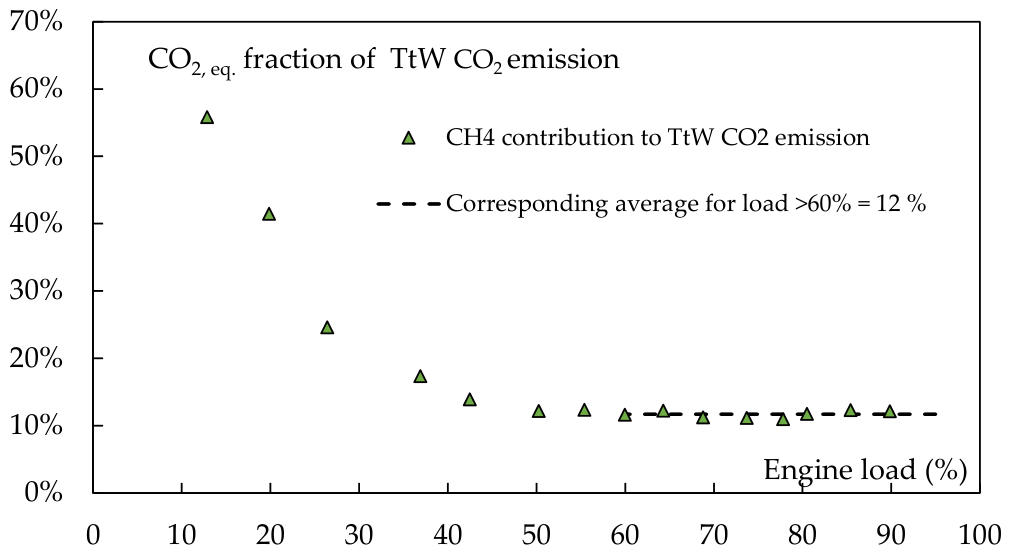
Figure 5.
Comparison of CO2 equivalent Tank to Wake emission for both MGO and LNG fuel, as a function of engine load.
Figure 5.
Comparison of CO2 equivalent Tank to Wake emission for both MGO and LNG fuel, as a function of engine load.
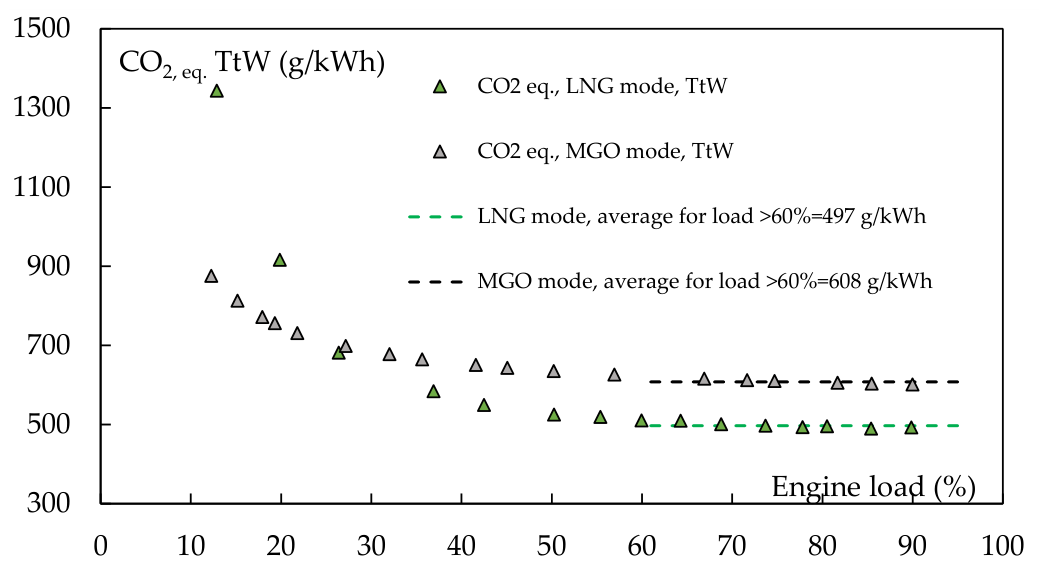
Figure 6.
Well to Wake CO2 equivalent greenhouse gas emissions for both MGO and LNG mode, as a function of engine load.
Figure 6.
Well to Wake CO2 equivalent greenhouse gas emissions for both MGO and LNG mode, as a function of engine load.
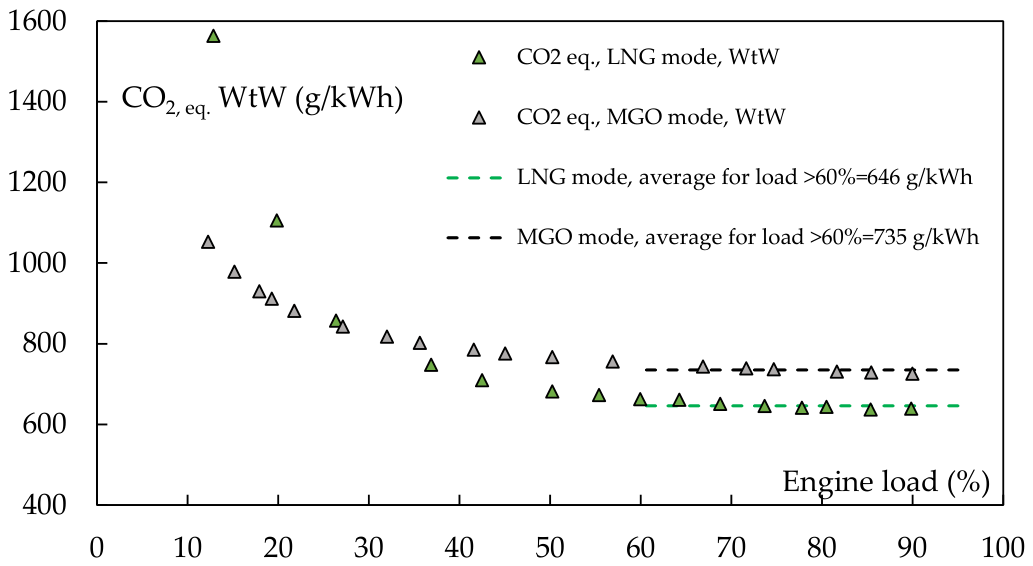

Table 1.
(BC) Emission factors.
| MGO Mode | Mg.kWh-1 | LNG Mode | Mg.kWh-1 | ||
|---|---|---|---|---|---|
| Engine load (E2 wt.) | BC | Engine load (E2 wt.) | BC | ||
| 12.3% | (-) | 32.1 | 12.8% | (-) | 0.77 |
| 27.1%* | (0.15) | 12.5 | 26.4%* | (0.15) | 0.04 |
| 50.2%* | (0.15) | 8.3 | 50.2%* | (0.15) | 0.18 |
| 74.7%* | (0.5) | 5.8 | 73.7%* | (0.5) | 0.36 |
| 85.4% | (-) | 5.1 | 85.4% | (-) | 0.24 |
| 90% | (-) | 4.7 | 89.8% | (-) | 0.53 |
| 100%** | (0.2) | 3.9 | 100%** | (0.2) | 0.63 |
| E2 cycle | 5.9 | E2 cycle | 0.40 | ||
* Load points near 25%, 50%, and 75% are used for E2 averaging. ** Results at 100% load are linearly extrapolated from measurements at 75% and 90%.
Table 2.
Summary of CO₂,eq. emissions for the two propulsion modes, MGO and LNG.
| MGO Mode | gCO2/kWh TtW | TtW | WtT | WtT | WtW | ||||
| Engine load (E2 wt.) | CO2 | CH4 as CO2,equ. | N2O as CO2,equ. | BC as CO2,equ. | Total CO2,equ. | LNG as CO2,equ. | MGO as CO2,equ. | Total CO2,equ. | Total CO2,equ. |
| (a) | (b) | (c) | (a) | (f) | |||||
| 12.3% (-) | 815.3 | 0.4 | 14.0 | 28.9 | 859 | 0 | 160 | 160 | 1019 |
| 27.1%* (0.15) | 675.8 | 0.3 | 11.6 | 11.2 | 699 | 0 | 133 | 133 | 832 |
| 50.2%* (0.15) | 616.9 | 0.3 | 10.6 | 7.4 | 635 | 0 | 121 | 121 | 757 |
| 74.7%* (0.5) | 594.6 | 0.3 | 10.2 | 5.2 | 610 | 0 | 117 | 117 | 727 |
| 85.4% (-) | 588.7 | 0.3 | 10.1 | 4.6 | 604 | 0 | 116 | 116 | 720 |
| 90% (-) | 586.6 | 0.3 | 10.1 | 4.2 | 601 | 0 | 115 | 115 | 717 |
| 100%** (0.2) | 581.3 | 0.3 | 10.0 | 3.5 | 595 | 0 | 114 | 114 | 709 |
| E2 cycle | 598 | 0.3 | 10.3 | 5.3 | 614 | 0.0 | 117.7 | 118 | 732 |
| LNG Mode | gCO2/kWh TtW | TtW | WtT | WtT | WtW | ||||
| Engine load (E2 wt.) | CO2 | CH4 as CO2,equ. | N2O as CO2,equ. | BC as CO2,equ. | Total CO2,equ. | LNG as CO2,equ. | MGO as CO2,equ. | Total CO2,equ. | Total CO2,equ. |
| (a) | (a) | (c)(d) | (a) | (e) | (f) | ||||
| 12.8% (-) | 585.1 | 749.9 | 8.0 | 0.70 | 1344 | 205 | 7.0 | 212 | 1556 |
| 26.4%* (0.15) | 507.3 | 167.8 | 6.3 | 0.04 | 681 | 167 | 3.4 | 170 | 851 |
| 50.2%* (0.15) | 455.4 | 64.0 | 5.5 | 0.16 | 525 | 149 | 1.7 | 151 | 676 |
| 73.7%* (0.5) | 435.2 | 51.4 | 5.3 | 0.33 | 492 | 143 | 1.1 | 144 | 636 |
| 85.4% (-) | 428.6 | 60.4 | 5.2 | 0.21 | 494 | 142 | 1.0 | 143 | 637 |
| 89.8% (-) | 426.8 | 59.9 | 5.2 | 0.47 | 492 | 141 | 0.9 | 142 | 634 |
| 100%** (0.2) | 421.4 | 65.3 | 5.1 | 0.56 | 492 | 140 | 0.8 | 141 | 633 |
| E2 cycle | 438 | 63.6 | 5.3 | 0.36 | 507 | 144.2 | 1.2 | 145 | 652 |
| Rel. difference LNG/MGO | -21% | 19% | -12% | ||||||
* Load points near 25%, 50%, and 75% are used for E2 averaging. ** Results at 100% load are linearly extrapolated from measurements at 75% and 90%.
Disclaimer/Publisher’s Note: The statements, opinions and data contained in all publications are solely those of the individual author(s) and contributor(s) and not of MDPI and/or the editor(s). MDPI and/or the editor(s) disclaim responsibility for any injury to people or property resulting from any ideas, methods, instructions or products referred to in the content. |
© 2026 by the authors. Licensee MDPI, Basel, Switzerland. This article is an open access article distributed under the terms and conditions of the Creative Commons Attribution (CC BY) license (http://creativecommons.org/licenses/by/4.0/).
Copyright: This open access article is published under a Creative Commons CC BY 4.0 license, which permit the free download, distribution, and reuse, provided that the author and preprint are cited in any reuse.


