

Submitted:
12 June 2026
Posted:
18 June 2026
You are already at the latest version
Abstract
A field experiment was conducted at the Agronomy Field Laboratory of Bangladesh Agricultural University to evaluate the effects of arbuscular mycorrhizal fungi (AMF) inoculation and foliar supplementation of nitrogen (N) and phosphorus (P) on the performance of maize (Zea mays L.) under irrigated and rainfed conditions. The experiment followed a randomized complete block design with two levels of AMF (inoculated and non-inoculated) and four foliar treatments (no N and P, N only, P only, and combined N + P). Recommended dose of fertilizers (RDF) was applied as soil application to all treatments AMF inoculation significantly increased grain yield by 23% under rainfed and 35% under irrigated conditions compared with non-inoculated plants. Foliar application of N and P, especially when they were applied together, significantly improved yield components including cob length, number of grains cob-1, and 1000-grain weight. The highest grain yield (9.08 t ha⁻¹ under rainfed and 10.91 t ha⁻¹ under irrigated conditions) was obtained from the combined treatment of AMF inoculation and foliar N + P application. Redundancy analysis (RDA) and linear mixed-effects modelling (LMM) confirmed that water availability was the dominant factor controlling maize productivity, while AMF inoculation exhibited a stronger independent effect than foliar fertilization. Under rainfed conditions, the treatment responses were reduced, and maize responded better to foliar N application in combination with AMF than combined N + P application. These findings indicate that integrated use of AMF and foliar nutrient management enhances maize productivity, but optimal combinations depend strongly on moisture regime.
Keywords:
arbuscular mycorrhizal fungi
; drought stress
; foliar supplementation
; maize
; nitrogen
; phosphorus
1. Introduction
Cereal crops play a vital role in ensuring global food and nutritional security by providing a major share of dietary energy and protein. Rice, wheat and maize are major staple foods, also a key component of livestock feed and agro-industry [1,2]. Therefore, sustainable improvement in cereal is essential to meet the increasing food demand [2]. Maize (Zea mays) is the most widely produced cereal globally, surpassing rice and wheat in production. It plays a central role as food, feed and industrial raw material, making it vital to global agri-food systems. With rising population and increasing demand for animal-based products worldwide sustainable expansion and intensification of maize cultivation are essential to ensure food security [3]. Biotic and abiotic stress are major concerns and causes substantial reduction in yield in maize [4]. Among all the abiotic stress, drought is the most common and detrimental for maize [5]. Drought impairs physiological processes, limiting nutrient uptake and ultimately reducing grain yield of maize under rainfed and water-scarce conditions [5,6].
There has been an increasing interest in beneficial soil microbes including arbuscular mycorrhizal fungi (AMF) in crop production. AMF are obligate symbionts and function as mycorrhizal symbionts with the root of approximately 80% of terrestrial plants [7]. It enhances plant performance against several stresses particularly drought [8,9]. They improve plant water relations by increasing root hydraulic conductivity, leaf water potential, relative water content and by regulating stomatal conductance [10]. AMF can also improve nutrient uptake from soil [10,11]. Moreover, AMF stimulate antioxidant defense systems, increasing the activity of enzymes such as catalase, superoxide dismutase and peroxidase which help neutralize reactive oxygen species (ROS) generated during drought and it reduces oxidative damage [12].
Among the essential nutrient elements for plants, nitrogen (N) is crucial for vegetative growth, protein synthesis, chlorophyll formation, promoting leaf expansion and overall biomass accumulation [13]. Additionally, it facilitates plants use of other elements like potassium, phosphorus and others [14,15]. Phosphorus (P), on the other hand, is critical for energy transfer, root development, early reproductive growth, ensuring strong root systems and efficient grain formation [16]. Optimal amount of these elements in the soil cannot be utilized efficiently if nitrogen is deficient in plants [17].
Nutrient can be supplied in maize field in both basal and foliar application method. Foliar application of P and N is more effective than basal soil application in certain conditions due to the direct and rapid uptake of nutrients through the leaves [18,19]. Unlike basal application, which relies on root absorption and can be limited by soil factors such as pH, moisture or nutrient fixation, foliar feeding bypasses these constraints, ensuring immediate availability to the plant during critical growth stages [20,21]. This method enhances photosynthesis, promotes vegetative growth and improves nutrient use efficiency, particularly under stress conditions such as drought or low soil fertility [22,23,24]. Additionally, foliar application in maize can correct nutrient deficiencies quickly, leading to higher grain yield and better crop quality compared to traditional soil-applied fertilizers [22,25]. Thus, foliar supplementation of macro- and micronutrients at low concentrations is often adopted to correct nutrient deficiencies, provide a rapid nutrient boost [26], enhance tolerance of crops to specific environmental or physiological stresses [27] and biofortify crops with essential nutrient elements [28].
Both AMF inoculation and foliar fertilization are effective to improve maize performance, but their combined effects under contrasting water regimes are poorly understood. Water availability can significantly influence the efficiency of both AMF-mediated nutrient uptake and foliar nutrient assimilation, and modify their interaction and overall impact on crop productivity. Specifically, it is not clear whether the synergistic benefits of AMF and combined N and P application remain the same under moisture stress conditions, or whether nutrient limitations are shifted under drought conditions. Therefore, this study will evaluate the interactive effects of AMF inoculation and foliar N and P application on maize productivity under irrigated and rainfed conditions.
2. Materials and Methods
2.1. Study Location and Climate
The experiment was conducted at the Agronomy Field Laboratory, Department of Agronomy, Bangladesh Agricultural University, Mymensingh during the dry season of winter. The site falls under the Old Brahmaputra Floodplain (AEZ-9) and is characterized by non-calcareous dark grey floodplain soil. The area experiences a subtropical monsoon climate, with high temperature, humidity, and heavy rainfall during the Kharif season (April–September), and comparatively low temperature with limited rainfall during the Rabi season (October–March). The experimental soil was a non-calcareous dark grey floodplain soil with silt loam texture and a pH of approximately 6.8, having 0.93% organic matter and 0.13% nitrogen with moderate drainage condition. Amount of rainfall recorded in the study site during the crop growing season is shown in Figure 1.
2.2. Experimental Design and Treatments
The study was conducted under both rainfed and irrigated conditions, following a randomized complete block design (RCBD) with three replications. Treatments comprised two factors: (i) arbuscular mycorrhizal fungi (AMF) inoculation (inoculated and non-inoculated), and (ii) foliar supplementation of nitrogen (N) and phosphorus (P) [no application, 2% N, 1% P, and combined 2% N + 1% P]. This resulted in 24 plots under rainfed and 24 plots under irrigated conditions, totaling 48 plots. Each plot measured 10 m² (4 m × 2.5 m), with spacing of 1 m between replications, 75 cm between plots, and 1.5 m between irrigated and rainfed units. Data from rainfed and irrigated experiments were analyzed separately to assess treatment interactions. Hybrid maize seeds of the variety Kohinoor were used as planting material in this experiment.
2.3. Preparation of Experimental Plot and AMF Inoculant
The experimental site was characterized by clay loam soil. Before sowing, the land was thoroughly ploughed and organic manure in the form of cow dung was incorporated at a rate of 5–6 t ha-1. Basal doses of chemical fertilizers were applied uniformly across the plots, consisting of urea (500 kg ha-1), triple superphosphate (TSP, 240 kg ha-1), muriate of potash (MoP, 180 kg ha-1), gypsum (240 kg ha-1), zinc sulfate (15 kg ha-1), and boron (7 kg ha-1). AMF inoculation was carried out in designated plots according to treatment specifications, with inocula applied at 15 g kg-1 soil at a depth of 3 cm. As no commercial AMF inoculum was available in Bangladesh, inoculation was performed using a commercial product, Serakinkon powder (The Central Glass Company, Tokyo, Japan). This inoculant contained approximately 50 spores of Gigaspora margarita Becker & Hall (BEG 34) per gram of powder. The inoculum was imported from Japan and applied to the soil of the respective treatment plots to ensure effective colonization.
2.4. Agronomic Management
Maize seeds were sown in field, where each plot had four rows and row to row distance was around 65 cm. Sowing was done at the rate of 2 seeds/pit and pit to distance was about 0.25 m. Care was taken to protect the seedlings from birds and rodents up to 20 days after sowing. Standard intercultural operations were carried out to ensure uniform crop establishment and growth. Thinning was performed to maintain one healthy plant per pit, with excess seedlings carefully uprooted to avoid damage to the remaining plants. Gap filling was undertaken in pits with poor germination by transplanting vigorous seedlings to maintain plant population. Weed management involved four scheduled weedings at 20, 35, 55, and 70 days after sowing (DAS) using traditional niri implement, supplemented by hand pulling as necessary. The predominant weed species observed were Chenopodium album (Bathua) and Cyperus rotundus (Mutha), along with several broadleaf weeds. Irrigation was applied only to the irrigated experimental units, with three waterings scheduled at critical growth stages: vegetative (35 DAS), silking and tasseling (88 DAS), and grain filling (110 DAS). Fertilizer management was carried out following the recommendations of BARC [29]. Basal application included triple superphosphate (240 kg ha-1), muriate of potash (180 kg ha-1), and gypsum (240 kg ha-1), which were broadcasted and incorporated into the soil during final land preparation. Nitrogen was supplied as urea (500 kg ha⁻¹) in three equal splits: the first one-third applied at final land preparation, the second one-third top-dressed at 25 days after sowing (DAS), and the remaining one-third at 45 DAS. This split application ensured adequate nutrient availability during critical growth stages while minimizing losses. Pest management was conducted manually, as minor infestations of Fall Armyworm (Spodoptera frugiperda) larvae were observed during the early vegetative stage and controlled by hand removal, eliminating the need for pesticide application. Foliar supplementation of nitrogen and phosphorus was applied at the silking and tasseling stage according to treatment specifications: 2% urea solution for nitrogen and 1% triple superphosphate (TSP) solution for phosphorus. Sprays were applied uniformly until leaves were thoroughly wetted and solution began to drip, with water spray used for control plots. All foliar applications were conducted in the morning (around 10:00 AM) to optimize absorption and minimize evaporation losses.
2.5. Data Collection at Harvest
At physiological maturity (144 DAS), the maize crop was harvested plot-wise on. To ensure representative sampling, five plants were randomly selected from each plot for detailed measurement, while all harvested plants were bundled, tagged, and transported to a clean threshing floor for processing. Plant height was recorded from the ground level to the tip of the uppermost tassel using a meter scale and expressed in centimeters. Cobs were de-husked, and their length (cm) and diameter (cm) were measured with a measuring tape. The number of grain rows per cob and the number of grains per row were counted manually. For grain yield assessment, cobs were sun-dried, grains were separated, and the weight of 1000 grains was determined in grams. In addition, the harvested plants were thoroughly sun-dried, and their dry biomass weight was measured in grams. These parameters collectively provided a comprehensive dataset on plant growth, yield components, and biomass accumulation under the respective treatments.
2.6. Statistical Analysis
Statistical analyses were conducted using ‘R’ (version 4.4.1) [30] and the visualizations were prepared with the ‘ggplot2’ package of ‘R’. Analysis of variance (ANOVA) technique was used to find out if the experimental factors and their interaction had any significant effect on growth, yield related parameters, yield of maize. Mean comparison was carried out by Tukey’s post hoc test with the help of ‘agricolae’ package of ‘R’. The assumption of normality was tested on the data set by the Shapiro-Wilk test. Homogeneity of variance was assessed prior to ANOVA to ensure compliance with model assumptions.
Redundancy analysis (RDA) was performed to evaluate the relationships between maize growth and yield traits (response variables) and the explanatory variables (AMF inoculation and foliar NP application). Before analysis, the response variables were standardized (z-score transformation) to remove scale effects and ensure comparability among variables. RDA was conducted using the ‘vegan’ package in R [31]. The variance inflation factor (VIF) values for the parameters ranged from 1.0 to 1.5, confirming no multicollinearity among treatment variables and validating the model results.
Grain yield was analyzed using linear mixed-effects models (LMMs) to evaluate the effects of AMF inoculation, foliar N and P application, and irrigation condition. Three candidate models were fitted using the ‘lme4’ package in R [32]. In Model 1, grain yield was modeled as a function of the interaction between AMF inoculation and foliar N and P application, with replication nested within irrigation regime included as a random effect. In Model 2, the three-way interaction among mycorrhizal inoculation, foliar N and P application, and irrigation regime was considered a fixed effect, while replication was treated as a random effect. Model 3 considered variation in treatment (interaction of mycorrhizal inoculation and NP foliar application) responses across irrigation conditions by including random slopes of the interaction.
Model 1: y ~ myco × foliar + (1 | condition/replication)
Model 2: y ~ myco × foliar × condition + (1 | replication)
Model 3: y ~ myco × foliar + (1 + myco × foliar | condition)
Here, y = maize grain yield; myco = AMF inoculation (M0 or M1); foliar = foliar spray with N and/or P; and condition = irrigation regime (irrigated or rainfed).
Among the three candidate models, model 2 was selected based on its Akaike information criterion (AIC) and log Likelihood (logLik) and likelihood ratio test (Table 1). The lowest AIC value, the highest logLik value and a significant likelihood ratio test determined the best model. The selected models was tested for heteroscedasticity and overdispersion of residuals (‘testDispersion’ function of the R package ‘DHARMa’) [33]. The result of the residual diagnostics of the model is given in Supplementary Figure 1.
3. Results
3.1. Growth Performance
3.1.1. Plant Height
Plant height of maize was significantly influenced by mycorrhizal inoculation under both rainfed and irrigated conditions (Table 2). Plants under M1 produced significantly taller plants than M0. Under rainfed conditions, plant height increased from (215.82 cm) in M0 to (230.00 cm in M1), while under irrigated conditions it increased from (231.75 cm) to (236.25 cm). Foliar application of nitrogen and phosphorus also significantly affected plant height under rainfed conditions, while the effect was non-significant under irrigated conditions (Table 2). Among the treatments, the highest plant height under rainfed conditions (224.83 cm) was recorded in N1P0, statistically similar with every treatment except N0P0. While the lowest plant height was observed in N0P0 (220.90 cm). Though significant interaction was observed between mycorrhiza and foliar fertilization in rainfed condition, it was non-significant in irrigated condition (Table 2). Tallest plant in rainfed was observed in combination of M1 × N1P1, which was 234.00 cm statistically similar with M1 × N1P0 and M1 × N0P0. In contrast, the shortest plant 213.8 cm was recorded in M0 × N0P0 statistically similar with M0 × N0P1, M0 × N1P0 and M0 × N1P1.
3.1.2. SPAD Value
SPAD was significantly influenced by mycorrhizal inoculation under both conditions. Highest value was measured in M1 (40.92) compared to M0 (29.97) in both rainfed and irrigated condition (Table 2). In addition to mycorrhizal inoculation, foliar fertilization also influenced SPAD value significantly in both conditions. The highest value was observed in N1P1 (39.37) under rainfed and (44.49) under irrigated conditions, both were statistically similar with N1P0. Whereas, the lowest values were recorded in N0P1 (31.83) under rainfed and in N0P0 (32.03) under irrigated condition, statistically similar with N0P0 in both conditions (Table 1). The interaction effect of mycorrhiza and foliar fertilization was not significant for SPAD value (Table 2).
3.1.3. Cob Length
Mycorrhiza had significant effect on cob length under irrigated as well as non-irrigated condition (Table 2). Under rainfed condition cob length was highest in M1 (19.85 cm) compared to M0 (18.27 cm) and in the irrigated condition it increased from 19.47 cm to 20.72 cm. Foliar application of nitrogen and phosphorus significantly affected cob length under rainfed conditions, while the effect was non-significant under irrigated conditions (Table 2). Under rainfed conditions, the highest cob length (20.50 cm) was recorded in N1P1, whereas the lowest cob length (17.40 cm) was observed in N0P0. The interaction between mycorrhiza and foliar fertilization significantly affected cob length under both rainfed and irrigated conditions (Table 2). The longest cob was recorded (21.8 cm) in the M1 × N1P1 treatment under rainfed condition. Whereas, smallest cob (16.67 cm) was found in M0 × N0P0, statistically similar with M0 × N0P0, M0 × N0P1 and M1 × N0P0. Under irrigated condition, longest cob (21.4 cm) was observed at M1 × N1P1, which was statistically similar with M0 × N0P0, M1 × N0P0, M1 × N0P1 and M1 × N1P0
3.1.4. Cob diameter
Cob diameter was significantly influenced by mycorrhizal inoculation under both rainfed and irrigated conditions (Table 2). M1 produced significantly thicker cobs compared with M0. Under rainfed conditions, cob diameter increased from 17.03 cm in M0 to 17.44 cm in M1, while under irrigated conditions it increased from 17.4 cm to 18.2 cm. Foliar fertilization significantly affected cob diameter under both moisture conditions (Table 2). Under rainfed conditions, the highest cob diameter (17.61 cm) was recorded in N1P0 statistically similar with N1P1 and N0P1, whereas the lowest (16.49 cm) was observed in N0P0. Under irrigated conditions, the highest cob diameter (18.34 cm) was recorded in N1P1, while the lowest value was observed in N1P0 (17.53 cm) statistically similar with N0P1 and N0P0. The interaction effect of mycorrhiza and foliar fertilization on cob diameter was statistically non-significant under both rainfed and irrigated conditions (Table 2).
3.2. Yield Contributing Traits and Yield
3.2.1. Number of Cobs Plant-1
Number of cobs per plant was significantly influenced by mycorrhizal inoculation under both rainfed and irrigated conditions (Table 2). Plants under M1 produced significantly higher number of cobs than M0. Under rainfed conditions, number of cobs per plant increased from 1.10 (M0) to 1.30 (M1) similarly under irrigated conditions, it increased from 1.17 to 1.34. Though foliar fertilization significantly affected cobs number per plant under irrigated conditions, there was no significant effect under rainfed conditions (Table 3). The highest number of cobs per plant (1.44) was found in N1P1 which was statistically similar with N1P0. While the lowest number (1.10) was found in N0P0 statistically similar with N0P0. The interaction effect of mycorrhiza and foliar fertilization on number of cobs per plant was statistically non-significant under both rainfed and irrigated conditions (Table 3).
3.2.2. Number of Grains Cob-1
Number of grains per cob was markedly influenced by mycorrhizal inoculation under both rainfed and irrigated conditions (Table 3). Mycorrhiza-treated plants showed significantly higher number of grains per cob than the non-treated plants. The number of grains per cob increased from 410 (M0) to 435 (M1) under rainfed conditions and from 456 (M0) to 551 (M1) under irrigated conditions. Foliar treatment of nitrogen and phosphorus also significantly affected the number of grains per cob under both rainfed and irrigated conditions (Table 3). Under rainfed conditions, the highest number of grains per cob (469) was recorded in N1P1 which was statistically similar to N1P0, whereas the lowest value (365) was found in N0P0. The interaction effect of mycorrhiza and foliar fertilization significantly affected the number of grains per cob under rainfed conditions however, the effect was found non-significant under irrigated conditions (Table 3). The maximum number of grains per cob (495) was observed in the combined treatment M1 × N1P1 which was statistically similar with M1 × N1P0 under rainfed conditions, while the minimum value (353) was observed in the treatment M0 × N0P0 statistically similar with M1 × N0P0.
3.2.3. Weight of 1000 Grains
Mycorrhizal inoculation significantly influenced the weight of 1000 grains under irrigated conditions. However, it had no significant effect under rainfed conditions (Table 3). Under irrigated conditions, mycorrhizal treatment increased the weight of 1000 grains from (412.7 g) to (428.6 g). Foliar fertilization significantly affected on the weight of 1000 grains under both rainfed and irrigated conditions (Table 3). Under rainfed conditions, the maximum 1000- grain weight (431 g) was recorded in N1P1 whereas the minimum weight (374.8 g) was found in N0P0. A similar pattern was observed under irrigated conditions where the maximum weight (444.5 g) was recorded in N1P1 and the minimum weight (399.7 g) in N0P0. The interaction effect of mycorrhiza and foliar fertilization significantly affected the 1000-grain weight under irrigated environments while the effect remained non-significant under rainfed conditions (Table 3). Under irrigated conditions, the highest weight of 1000 grains (459.7 g) was observed in the combined treatment (M1 × N1P1), while the lowest weight of 397.6 g was observed in the treatment (M1 × N0P0) statistically similar with every treatment except M1 × N1P0 and M0 × N1P1.
3.2.4. Grain Yield
Grain yield of maize was significantly influenced by mycorrhizal inoculation in both rainfed (Figure 2A) and irrigated (Figure 2D) condition. Plants under M1 produced significantly higher grain yield compared to M0. The grain yield increased from 7.26 t ha-1 in M0 to 7.85 t ha-1 in M1 in rainfed condition and 8.6 t ha-1 in M0 to 9.46 t ha-1 in M1 in irrigated condition. Foliar application of nitrogen and phosphorus significantly affected grain yield of maize (Figure 2B) and (Figure 2E). Among the treatments, N1P1 recorded the highest grain yield (8.78 t ha-1), followed by N0P1 (7.78 t ha-1) and N1P0 (7.31 t ha-1), whereas the lowest grain yield (6.36 t ha-1) was observed in N0P0 (control) in rainfed condition (Figure 2B). The highest grain yield (10.23 t ha-1) was recorded in the treatment N1P1 while the lowest grain yield (8.21 t ha-1) was observed in N0P0 in irrigated condition (Figure 2E). The interaction between mycorrhizal inoculation and foliar spray of N and P also significantly influenced grain yield in both rainfed (Figure 2C) and irrigated (Figure 2F) condition. The highest grain yield (9.08 t ha-1) was recorded in the treatment combination M1 × N1P1while the lowest grain yield (6.26 t ha-1) was observed in M0 × N0P0 which was statistically similar with M0 × N1P0 in rainfed (Figure 2C) condition. Whereas in irrigated condition (Figure 2E) the highest grain yield (10.91 t ha-1) was obtained in the treatment combination M1 × N1P1, while the lowest (8.07 t ha-1) was recorded in M0 × N0P0 statistically similar with M0 × N0P1. Overall, the combined treatment of AMF inoculation and foliar N + P application con-sistently produced the highest grain yield under both moisture regimes.
3.2.5. Harvest Index
The effect of mycorrhizal inoculation on harvest index was highly significant under both rainfed and irrigated conditions (Table 3). Despite the highly significant effect, harvest index decreased in inoculated plants under both moisture conditions. Under rainfed conditions, it declined from 54.01% (M0) to 46.13% (M1) and similarly from 48.75% to 44.04% under irrigated conditions. Foliar fertilization showed a significant effect on harvest index under rainfed conditions but remained non-significant in case of irrigated conditions (Table 3). Under rainfed conditions, N1P1 resulted in the maximum value of harvest index (51.91%) statistically similar with N0P1 and N1P0. While minimum value (47.63%) was observed in N0P0. The interaction effect of mycorrhiza and foliar fertilization significantly affected harvest index under rainfed conditions. However, the effect was found non-significant under irrigated conditions (Table 3). Under rainfed conditions, the highest harvest index (56.33%) was obtained from the combined treatment (M0 × N1P1) statistically similar with M0×N0P1 while the lowest value (43.48%) was recorded in the treatment (M1 × N0P0) statistically similar with M1 × N1P1, M1 × N1P0 and M1 × N0P1.
3.3. Modeling Maize Performance as Influenced by AMF and Foliar Spray
3.3.1. Redundancy Analysis (RDA)
The RDA model was highly significant (p = 0.001) and it explained 53.77% of the total variation in maize yield (R² = 0.538; adjusted R² = 0.495). The redundancy analysis (RDA) biplots, together with the permutation ANOVA results, clearly demonstrated that irrigation regime, AMF inoculation, and foliar nitrogen (N) and phosphorus (P) application significantly influenced maize yield. Irrigated treatments (blue points) were mainly distributed on the positive side of RDA1, whereas rainfed treatments (red points) were mostly positioned on the negative side of RDA1 (Figure 3A). This indicates that water availability was the strongest determining factor that affected maize yield. The wider spread of irrigated samples in comparison to those of non-irrigated ones also suggested positive treatment responsiveness under adequate moisture, while rainfed condition showed more constrained responses due to drought stress.
Both explanatory variables (AMF inoculation and foliar application of N and P) were highly significant (both p = 0.001) (Figure 3B). This suggests that both factors enahanced the performance of maize, but AMF inoculation has a stronger independent effect than foliar N and P application. Among the foliar treatments, combined N + P (foliar N1P1) aligned most closely with grain yield and yield components, indicating the best performance. Similarly, AMF inoculation (mycoM1) was associated with positive growth and yield vectors, especially under irrigated conditions.
3.3.2. Linear Mixed Model
The linear mixed model (LMM) evaluated the effects of AMF inoculation (M1), foliar application of N and P, irrigation regimes, and their interactions on maize grain yield, while considering the replication as a random effect. The model reveals strong and significant treatment influences on grain productivity. The intercept represents the predicted grain yield (8.07 t ha-1) of the reference treatment: no mycorrhizal inoculation + no foliar application of N and P + irrigated condition (Table 4). This indicates that under irrigation, maize without AMF and without foliar nutrients still produced a relatively high baseline yield.
AMF inoculation (M1) significantly increased grain yield only by 0.29 t ha-1 (p < 0.001) under irrigated condition, indicating that mycorrhizal association increased maize productivity (Table 4). Only foliar P and foliar N application enhance maize yield by 0.21 and 0.44 t ha-1, respectively. However, their combined foliar application contrinuted to 1.49 t ha-1 increase (p < 0.001) in maize grain yield. No irrigation (rainfed condition) significantly reduced grain yield by 1.81 t ha-1 (p < 0.001), confirming that water deficit strongly depressed maize production (Table 4).
Strong positive interactions were observed between AMF inoculation and foliar N and P application under irrigated condition. Foliar application of both N and P coupled with AMF inoculation increase maize grain yield by 1.07 t ha-1 (p < 0.001). Foliar application of nitrogen alone coupled with AMF inoculation produced the strongest positive interaction effect on grain yield (1.28 t ha⁻¹, p < 0.001) (Table 4). However, M1 × N0P1 was non-significant, suggesting phosphorus alone did not strongly synergize with AMF. Under rainfed condition, strong positive effect of foliar application was observed when only P was supplemented as foliar spray (1.52 t ha-1, p < 0.001) (Table 4). This suggests foliar application partly compensated for drought stress under rainfed condition, especially P spray. From the three-way interactions, it is evident that AMF combined with nitrogen alone performed better, whereas AMF combined with foliar spray of P or N + P had reduced additional benefits.
4. Discussion
The experiment was conducted under both rainfed and irrigated conditions simultaneously. No supplemental irrigation was applied to the rainfed experiment. Rainfall records for the study period (Figure 1) indicate that the rainfed crop received only 24 mm of total precipitation, accompanied by a prolonged dry spell extending across the vegetative, reproductive, and early grain-filling stages. These growth phases are particularly sensitive to water deficit in maize, especially during tasseling and the milk stage [34,35]. Therefore, the rainfed crop experienced significant moisture stress during the growing season.
The results of this study revealed that water availability was the main driver of maize productivity while AMF inoculation and foliar nutrient application were important secondary drivers. The irrigated conditions always gave better performance than the rainfed conditions for all parameters measured. This confirms that moisture availability is the overriding factor controlling maize growth and yield. This is consistent with previous findings indicating that drought stress restricts nutrient uptake, photosynthesis and grain formation in maize [5,6].
The plant height, chlorophyll content (SPAD), cob traits and grain yield were significantly improved with AMF inoculation under both moisture regimes. These improvements can be attributed to the higher absorption of nutrients and water through the extensive hyphal network of AMF, which increases the root absorptive capacity, especially for phosphorus [11,36]. Furthermore, AMF enhances plant water relations and physiological resilience by regulating stomatal conductance and maintaining higher leaf water status under stress [10]. The higher SPAD values in inoculated plants observed in this study supported increased chlorophyll synthesis and photosynthetic efficiency which in turn contribute to higher biomass and yield [37].
Foliar application of nitrogen and phosphorus also had an important role in improving maize performance, especially under rainfed conditions. The combination of N and P treatment (N1P1) showed a better performance indicating a strong synergistic effect of these nutrients on growth and yield. Vegetative growth and chlorophyll formation require nitrogen, whereas phosphorus is a key element for energy transfer and reproductive growth [13,16]. The success of foliar application under moisture-limited conditions can be attributed to its capacity to circumvent soil limitations and supply nutrients directly to the plant at crucial growth stages [18,20].
The interaction between AMF and foliar nutrient application signifies the importance of integrated nutrient management. The highest grain yield and yield components were consistently observed in combined treatment (M1 × N1P1) under both the irrigation regimes indicating the complementary relationship between the biological and chemical inputs. AMF improves the uptake of nutrients and physiological efficiency, while foliar fertilization provides immediate nutrient availability especially during reproductive stages. Similar synergistic effects have been reported in maize where combined nutrient and microbial management improved productivity more than individual applications [38].
But the size of these benefits was smaller in rainfed conditions. Water stress in critical stages such as grain filling reduces the photosynthetic activity and the translocation of photosynthates, which leads to reduced kernel development and grain weight [39,40]. This explains the reduced response of some of the yield traits under drought in spite of AMF inoculation. Interestingly, the LMM results showed that under rain-fed condition, AMF along with nitrogen alone was relatively better than the combinations involving phosphorus which shows a shift in nutrient limitation under water stress. This means that nitrogen could be the dominant limiting factor with limited availability of water.
The results of the RDA further support these conclusions; they show a clear distinction between the irrigated and rainfed treatments and a significant correlation of yield-related traits with AMF inoculation and the application of combined N and P . The results overall suggest that maize productivity is a function of a complex interaction between water, nutrients and biological inputs and that optimal management strategies need to be adapted to moisture conditions, particularly in drought-prone environments. However, the present study was conducted during a single growing season and further multi-season evaluations under diverse environmental conditions would strengthen the broader applicability of these findings.
5. Conclusions
The results indicate water availability as the main determinant of maize productivity, with AMF inoculation and foliar nutrient application as important complementary factors. AMF inoculation resulted in significant increase in growth, yield components and grain yield under irrigated and rainfed conditions whereas combined foliar supplementation of N and P, over the recommended soil application, further improved crop performance. The highest productivity under irrigated conditions was consistently recorded from the combination of AMF with combined foliar N and P, showing a strong synergistic effect. However, the extent of these benefits was reduced under rainfed conditions, with AMF combined with nitrogen alone showing relatively greater effectiveness and a change in nutrient limitation under moisture stress. In conclusion, the present study suggests that the best nutrient-AMF interactions are strongly dependent on water availability. Therefore, integrated management strategies need to be adapted to the different moisture regimes to increase maize productivity, in drought-prone areas.
Supplementary Materials
The supporting information can be downloaded at the website of this paper posted on Preprints.org.
Author Contributions
Conceptualization, M.H.R.; methodology, M.L.F., S.B., and M.N.; software, M.H.R. and M.R.; validation, F.M.J.U. and S.K.P. and M.R.; formal analysis, M.L.F., S.B., A.T.A., M.I. and N.I.; investigation, M.L.F., S.B., A.T.A., M.I. and N.I.; resources, M.H.R.; data curation, F.M.J.U., S.K.P. and M.N.; writing—original draft preparation, M.L.F., S.B., A.T.A., M.I. and N.I.; writing—M.H.R, M.R.; visualization, M.H.R. M.L.F. and A.T.A.; M.H.R; project administration, M.H.R.; funding acquisition, M.H.R. All authors have read and agreed to the published version of the manuscript.
Funding
This research was funded by Bangladesh Agricultural University Research System [2021/30/BAU].
Data Availability Statement
The data that support the findings of this study are available on request from the corresponding author.
Conflicts of Interest
The authors declare no conflicts of interest.
References
- Farooq, A.; Farooq, N.; Akbar, H.; Hassan, Z.U.; Gheewala, S.H. A Critical Review of Climate Change Impact at a Global Scale on Cereal Crop Production. Agronomy 2023, 13. [Google Scholar] [CrossRef]
- Yamini, V.; Singh, K.; Antar, M.; El Sabagh, A. Sustainable cereal production through integrated crop management: a global review of current practices and future prospects. Front. Sustain. Food Syst. 2025, 9. [Google Scholar] [CrossRef]
- Sinyolo, S. Technology adoption and household food security among rural households in South Africa: The role of improved maize varieties. Technol. Soc. 2020, 60. [Google Scholar] [CrossRef]
- Kim, K.H.; Lee, B.M. Effects of Climate Change and Drought Tolerance on Maize Growth. Plants 2023, 12. [Google Scholar] [CrossRef] [PubMed]
- Szeles, A.; Horvath, E.; Simon, K.; Zagyi, P.; Huzsvai, L. Maize Production under Drought Stress: Nutrient Supply, Yield Prediction. Plants 2023, 12. [Google Scholar] [CrossRef] [PubMed]
- Sheoran, S.; Kaur, Y.; Kumar, S.; Shukla, S.; Rakshit, S.; Kumar, R. Recent Advances for Drought Stress Tolerance in Maize (Zea mays L.): Present Status and Future Prospects. Front Plant Sci. 2022, 13, 872566. [Google Scholar] [CrossRef] [PubMed]
- Chen, W.; Meng, P.; Feng, H.; Wang, C. Effects of Arbuscular Mycorrhizal Fungi on Growth and Physiological Performance of Catalpa bungei C.A.Mey. under Drought Stress. Forests 2020, 11. [Google Scholar] [CrossRef]
- Mostofa, M.; Anwar, M.; Ahmed, I.; Hossain, M.; Moni, M.; Rashid, M. Influence of irrigation regimes and mycorrhizal inoculation on the performance of wheat in pot culture. Fundam. Appl. Agric. 2022, 7. [Google Scholar] [CrossRef]
- Zou, Y.N.; Wu, Q.S.; Kuca, K. Unravelling the role of arbuscular mycorrhizal fungi in mitigating the oxidative burst of plants under drought stress. Plant Biol. (Stuttg) 2021, 23 Suppl 1, 50–57. [Google Scholar] [CrossRef] [PubMed]
- Zhu, B.; Gao, T.; Zhang, D.; Ding, K.; Li, C.; Ma, F. Functions of arbuscular mycorrhizal fungi in horticultural crops. Sci. Hortic. 2022, 303. [Google Scholar] [CrossRef]
- Wang, F.; Zhang, L.; Zhou, J.; Rengel, Z.; George, T.S.; Feng, G. Exploring the secrets of hyphosphere of arbuscular mycorrhizal fungi: processes and ecological functions. Plant Soil 2022, 481, 1–22. [Google Scholar] [CrossRef]
- Wahab, A.; Muhammad, M.; Munir, A.; Abdi, G.; Zaman, W.; Ayaz, A.; Khizar, C.; Reddy, S.P.P. Role of Arbuscular Mycorrhizal Fungi in Regulating Growth, Enhancing Productivity, and Potentially Influencing Ecosystems under Abiotic and Biotic Stresses. Plants 2023, 12. [Google Scholar] [CrossRef] [PubMed]
- Luo, L.; Zhang, Y.; Xu, G. How does nitrogen shape plant architecture? 2020. [Google Scholar] [CrossRef] [PubMed]
- Schleuss, P.A.-O.; Widdig, M.A.-O.; Heintz-Buschart, A.A.-O.; Kirkman, K.A.-O.; Spohn, M.A.-O. Interactions of nitrogen and phosphorus cycling promote P acquisition and explain synergistic plant-growth responses. 2020. [Google Scholar] [CrossRef] [PubMed]
- Morris, T.F.; Murrell, T.S.; Beegle, D.B.; Camberato, J.J.; Ferguson, R.B.; Grove, J.; Ketterings, Q.; Kyveryga, P.M.; Laboski, C.A.M.; McGrath, J.M.; et al. Strengths and Limitations of Nitrogen Rate Recommendations for Corn and Opportunities for Improvement. Agron. J. 2018, 110, 1–37. [Google Scholar] [CrossRef]
- Khan, F.; Siddique, A.B.; Shabala, S.; Zhou, M.; Zhao, C. Phosphorus Plays Key Roles in Regulating Plants' Physiological Responses to Abiotic Stresses. Plants 2023, 12. [Google Scholar] [CrossRef] [PubMed]
- Grzebisz, W.; Zielewicz, W.; Przygocka-Cyna, K. Deficiencies of Secondary Nutrients in Crop Plants—A Real Challenge to Improve Nitrogen Management. Agronomy 2022, 13. [Google Scholar] [CrossRef]
- Lyu, X.; Liu, Y.; Li, N.; Ku, L.; Hou, Y.; Wen, X. Foliar applications of various nitrogen (N) forms to winter wheat affect grain protein accumulation and quality via N metabolism and remobilization. Crop J. 2022, 10, 1165–1177. [Google Scholar] [CrossRef]
- Niu, J.; Liu, C.; Huang, M.; Liu, K.; Yan, D. Effects of Foliar Fertilization: a Review of Current Status and Future Perspectives. J. Soil Sci. Plant Nutr. 2021, 21, 104–118. [Google Scholar] [CrossRef] [PubMed]
- Ferrari, M.; Dal Cortivo, C.; Panozzo, A.; Barion, G.; Visioli, G.; Giannelli, G.; Vamerali, T. Comparing Soil vs. Foliar Nitrogen Supply of the Whole Fertilizer Dose in Common Wheat. Agronomy 2021, 11, 2138. [Google Scholar] [CrossRef]
- Rafiullah; Khan, M.J.; Muhammad, D.; Fahad, S.; Adnan, M.; Wahid, F.; Alamri, S.; Khan, F.; Dawar, K.M.; Irshad, I.; et al. Phosphorus Nutrient Management through Synchronization of Application Methods and Rates in Wheat and Maize Crops. [CrossRef] [PubMed]
- Ssemugenze, B.; Ocwa, A.; Kuunya, R.; Gumisiriya, C.; Bojtor, C.; Nagy, J.; Széles, A.; Illés, Á. Enhancing Maize Production Through Timely Nutrient Supply: The Role of Foliar Fertiliser Application. Agronomy 2025, 15, 176. [Google Scholar] [CrossRef]
- Shahrajabian, M.H.; Sun, W.; Cheng, Q. Foliar application of nutrients on medicinal and aromatic plants, the sustainable approaches for higher and better production. Beni-Suef Univ. J. Basic Appl. Sci. 2022, 11, 26. [Google Scholar] [CrossRef]
- Dass, A.; Rajanna, G.A.; Babu, S.; Lal, S.K.; Choudhary, A.K.; Singh, R.; Rathore, S.S.; Kaur, R.; Dhar, S.; Singh, T.; et al. Foliar Application of Macro- and Micronutrients Improves the Productivity, Economic Returns, and Resource-Use Efficiency of Soybean in a Semiarid Climate. Sustainability 2022, 14, 5825. [Google Scholar] [CrossRef]
- Rácz, D.; Szőke, L.; Tóth, B.; Kovács, B.; Horváth, É.; Zagyi, P.; Duzs, L.; Széles, A. Examination of the Productivity and Physiological Responses of Maize (Zea mays L.) to Nitrapyrin and Foliar Fertilizer Treatments. Plants 2021, 10, 2426. [Google Scholar] [CrossRef] [PubMed]
- Soppelsa, S.; Kelderer, M.; Casera, C.; Bassi, M.; Robatscher, P.; Matteazzi, A.; Andreotti, C. Foliar Applications of Biostimulants Promote Growth, Yield and Fruit Quality of Strawberry Plants Grown under Nutrient Limitation. Agronomy 2019, 9. [Google Scholar] [CrossRef]
- Ahmad, Z.; Anjum, S.; Waraich, E.A.; Ayub, M.A.; Ahmad, T.; Tariq, R.M.S.; Ahmad, R.; Iqbal, M.A. Growth, physiology, and biochemical activities of plant responses with foliar potassium application under drought stress – a review. J. Plant Nutr. 2018, 41, 1734–1743. [Google Scholar] [CrossRef]
- Niu, J.; Liu, C.; Huang, M.; Liu, K.; Yan, D. Effects of Foliar Fertilization: a Review of Current Status and Future Perspectives. J. Soil Sci. Plant Nutr. 2020, 21, 104–118. [Google Scholar] [CrossRef]
- BARC. Fertilizer Recommendation Guide; Bangladesh Agricultural Research Council, Dhaka, Bangladesh: 2018.
- R Core Team. R: The R Project for Statistical Computing. 2024.
- Oksanen, J.; Simpson, G.; Blanchet, F.G.; Kindt, R.; Legendre, P.; Minchin, P.; hara, R.; Solymos, P.; Stevens, H.; Szöcs, E.; et al. Vegan community ecology package version 2.6-2; The Comprehensive R Archive Network: 2022.
- Bates, D.; Mächler, M.; Bolker, B.; Walker, S. Fitting Linear Mixed-Effects Models Using lme4. J. Stat. Soft. 2015, 67. [Google Scholar] [CrossRef]
- Hartig, F. DHARMa: Residual Diagnostics for Hierarchical (Multi-Level / Mixed) Regression Models. 2016. [CrossRef]
- Kiranmai, Y.; Potdar, M.P. Influence of induced moisture stress at critical crop growth stages on yield, yield attributes and economics of rabi maize. Int. J. Res. Agron. 2024, 7, 514–518. [Google Scholar] [CrossRef]
- Denmead, O.T.; Shaw, R.H. The Effects of Soil Moisture Stress at Different Stages of Growth on the Development and Yield of Corn1. Agron. J. 1960, 52, 272–274. [Google Scholar] [CrossRef]
- Fan, L.; Zhang, P.; Cao, F.; Liu, X.; Ji, M.; Xie, M. Effects of AMF on Maize Yield and Soil Microbial Community in Sandy and Saline Soils. Plants 2024, 13, 2056. [Google Scholar] [CrossRef] [PubMed]
- Khan, Y.; Shah, S.; Hui, T. The Roles of Arbuscular Mycorrhizal Fungi in Influencing Plant Nutrients, Photosynthesis, and Metabolites of Cereal Crops—A Review. Agronomy 2022, 12, 2191. [Google Scholar] [CrossRef]
- Shi, Z.; Liu, D.; Luo, W.; Hafeez, M.B.; Li, J.; Wen, P.; Wang, X. Combined nitrogen and phosphorus management based on nitrate nitrogen threshold for balancing crop yield and soil nitrogen supply capacity. Agric. Ecosyst. Environ. 2022, 337, 108071. [Google Scholar] [CrossRef]
- Santana, L.R.; da Silva, L.N.; Tavares, G.G.; Batista, P.F.; Cabral, J.S.R.; Souchie, E.L. Arbuscular mycorrhizal fungi associated with maize plants during hydric deficit. Sci. Rep. 2023, 13, 1519. [Google Scholar] [CrossRef] [PubMed]
- Ouhaddou, R.; Ech-chatir, L.; Ikan, C.; Soussani, F.E.; Errouh, F.; Boutasknit, A.; Rodrigez, J.C.; Er-Raki, S.; Duponnois, R.; Meddich, A. Investigation of the impact of dual inoculations of arbuscular mycorrhizal fungi and plant growth-promoting rhizobacteria on drought tolerance of maize grown in a compost-amended field under Mediterranean conditions. Front. Microbiol. 2024, Volume 15 - 2024. [Google Scholar]
Figure 1.
Recorded rainfall in the study site in respect to different growth phases of maize
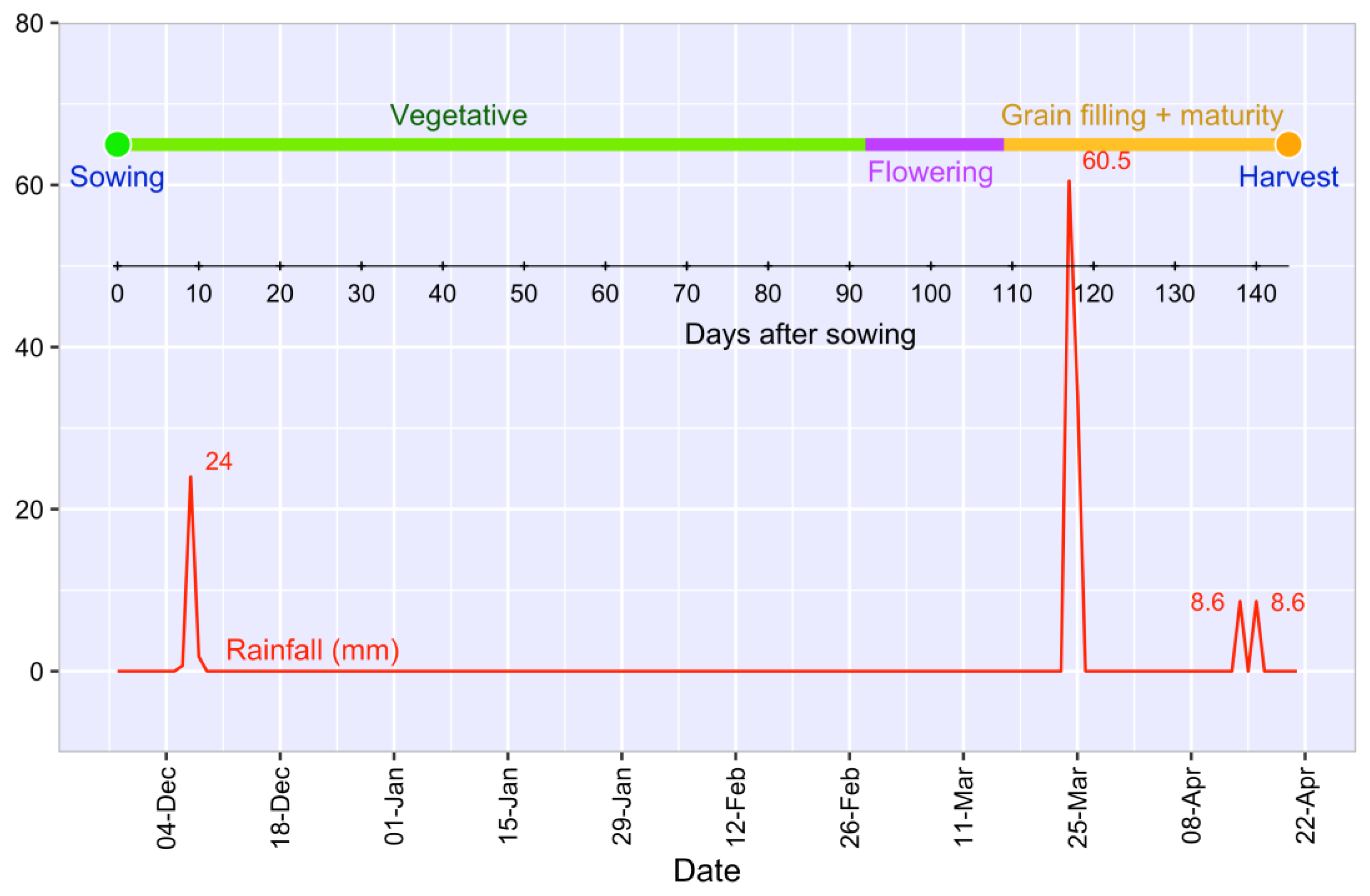
Figure 2.
Effect of AMF interaction with foliar supplementation of N and P on grain yield of maize under rainfed (A, B, C) and irrigated (D, E, F) conditions. M0 = AMF non-inoculation; M1 = AMF inoculation; N0P0 = no foliar supplementation of nitrogen and phosphorus; N0P1 = foliar supplementation of only phosphorus; N1P0 = foliar supplementation of only nitrogen; N1P1 = foliar supplementation of nitrogen and phosphorus.
Figure 2.
Effect of AMF interaction with foliar supplementation of N and P on grain yield of maize under rainfed (A, B, C) and irrigated (D, E, F) conditions. M0 = AMF non-inoculation; M1 = AMF inoculation; N0P0 = no foliar supplementation of nitrogen and phosphorus; N0P1 = foliar supplementation of only phosphorus; N1P0 = foliar supplementation of only nitrogen; N1P1 = foliar supplementation of nitrogen and phosphorus.
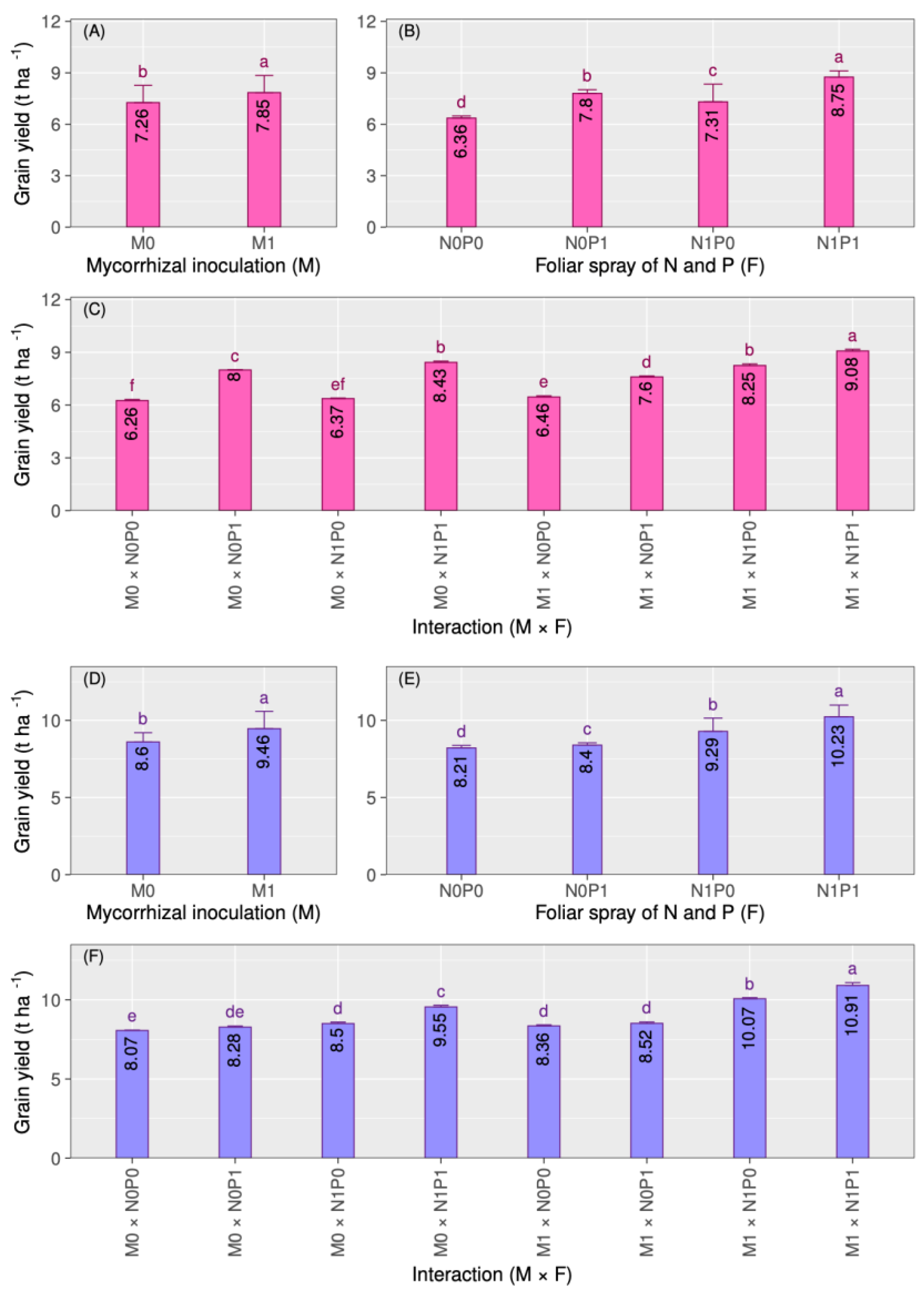
Figure 3.
Redundancy analysis for yield-related traits such as grain yield (GrainYiled), number of grains cob-1 (GrainCob), cob length (CobLen), number of cobs plant-1 (CobNum), SPAD value, and thousand seed weight (WTS) were strongly oriented toward the positive side of RDA1. This confirms that these traits were positively associated with irrigation and favourable nutrient management. Only harvest index (HI) was separated upward on RDA2. It suggests that this variable responded independently of the maize grain yield trend in response to the treatments.
Figure 3.
Redundancy analysis for yield-related traits such as grain yield (GrainYiled), number of grains cob-1 (GrainCob), cob length (CobLen), number of cobs plant-1 (CobNum), SPAD value, and thousand seed weight (WTS) were strongly oriented toward the positive side of RDA1. This confirms that these traits were positively associated with irrigation and favourable nutrient management. Only harvest index (HI) was separated upward on RDA2. It suggests that this variable responded independently of the maize grain yield trend in response to the treatments.
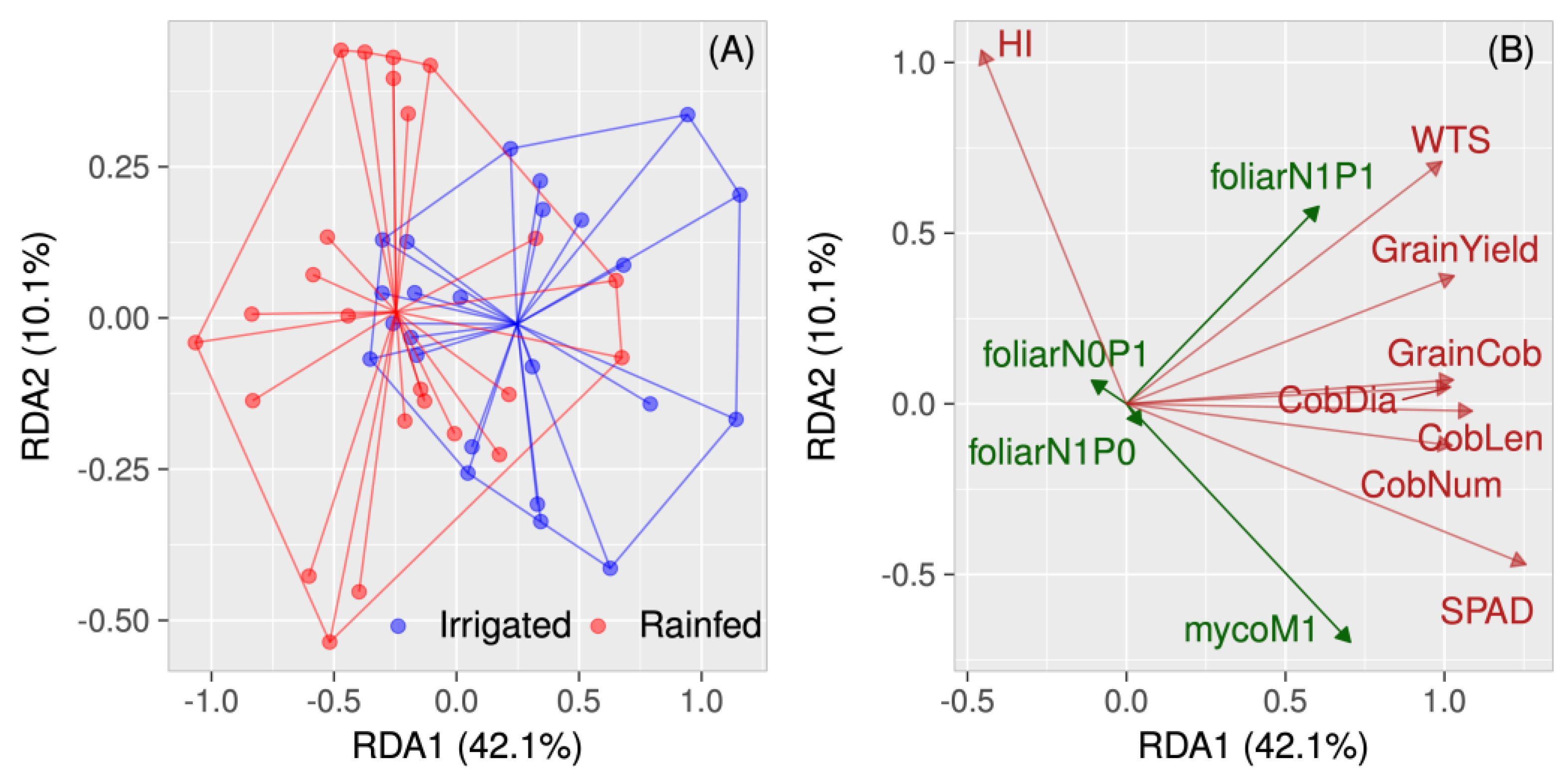

Table 1.
Selection of the best model from three candidate models based on AIC, logLik and likelihood ratio test
Table 1.
Selection of the best model from three candidate models based on AIC, logLik and likelihood ratio test
| npar | AIC | BIC | logLik | Deviance | Chisq | df | p-value | |
|---|---|---|---|---|---|---|---|---|
| Model1 | 11 | 56.03 | 76.62 | -17.02 | 34.03 | |||
| Model2† | 18 | -86.26 | -52.58 | 61.13 | -122.26 | 156.29 | 7 | <0.001*** |
| Model3 | 45 | -14.09 | 70.11 | 52.05 | -104.09 | 0 | 27 |
† Best model.
Table 2.
Effect of AMF interaction with foliar supplementation of N and P on different growth parameters of maize plant at rainfed and irrigated condition
Table 2.
Effect of AMF interaction with foliar supplementation of N and P on different growth parameters of maize plant at rainfed and irrigated condition
| Treatment | Plant height (cm) | SPAD value | Cob length (cm) | Cob diameter (cm) | ||||
|---|---|---|---|---|---|---|---|---|
| Rainfed | Irrigated | Rainfed | Irrigated | Rainfed | Irrigated | Rainfed | Irrigated | |
| AMF (M) | ||||||||
| M0 | 215.82 b | 231.75 b | 29.97 b | 29.97 b | 18.27 b | 19.472 b | 17.03 b | 17.40 b |
| M1 | 230.00 a | 236.25 a | 40.92 a | 40.92 a | 19.85 a | 20.72 a | 17.44 a | 18.2 a |
| Sig. level | <0.01 | 0.027 | <0.01 | <0.01 | <0.01 | <0.01 | <0.01 | <0.01 |
| NP foliar spray (F) | ||||||||
| N0P0 | 220.90 b | 233.17 | 32.03 b | 36.62 b | 17.40 c | 19.97 | 16.49 b | 17.56 b |
| N0P1 | 221.90 ab | 230.33 | 31.83 b | 36.66 b | 19.53 b | 19.77 | 17.26 a | 17.77 ab |
| N1P0 | 224.83 a | 236.17 | 38.54 a | 43.99 a | 18.80 b | 20.03 | 17.61 a | 17.53 b |
| N1P1 | 224.00 ab | 236.33 | 39.37 a | 44.49 a | 20.50 a | 20.60 | 17.57 a | 18.34 a |
| Sig. level | 0.032 | 0.109 | <0.01 | <0.01 | <0.01 | 0.09 | <0.01 | 0.02 |
| Interaction (M × F) | ||||||||
| M0 × N0P0 | 213.8 c | 229 | 26.76 | 31.47 | 16.67 e | 20.07 abc | 16.12 | 16.89 |
| M0 × N0P1 | 218.13 c | 228 | 26.16 | 28.80 | 19.4 bcd | 19.13 c | 17.21 | 17.43 |
| M0 × N1P0 | 217.33 c | 235.67 | 33.35 | 39.05 | 17.8 de | 18.87 c | 17.41 | 17.08 |
| M0 × N1P1 | 214.00 c | 234.33 | 33.60 | 38.04 | 19.2 bcd | 19.8 bc | 17.37 | 18.19 |
| M1 × N0P0 | 228 ab | 237.33 | 37.29 | 41.77 | 18.13 cde | 19.87 abc | 16.87 | 18.23 |
| M1 × N0P1 | 225.67 b | 232.67 | 37.50 | 44.52 | 19.67 bc | 20.4 abc | 17.31 | 18.11 |
| M1 × N1P0 | 232.33 a | 236.67 | 43.73 | 48.92 | 19.8 b | 21.2 ab | 17.80 | 17.97 |
| M1 × N1P1 | 234 a | 238.33 | 45.15 | 50.95 | 21.8 a | 21.4 a | 17.77 | 18.49 |
| Sig. level | 0.002 | 0.586 | 0.976 | 0.291 | 0.019 | 0.007 | 0.432 | 0.276 |
| CV (%) | 1.03 | 1.93 | 7.73 | 7.03 | 8.16 | 4.81 | 3.4 | 3.77 |
M0 = AMF non-inoculation; M1 = AMF inoculation; N0P0 = no foliar supplementation of nitrogen and phosphorus; N0P1 = foliar supplementation of only phosphorus; N1P0 = foliar supplementation of only nitrogen; N1P1 = foliar supplementation of nitrogen and phosphorus.
Table 3.
Effect of AMF interaction with foliar supplementation of N and P on different yield parameters of maize plant at rainfed and irrigated condition
Table 3.
Effect of AMF interaction with foliar supplementation of N and P on different yield parameters of maize plant at rainfed and irrigated condition
| Treatment | Cobs plant-1 | Grains cob-1 | WTS (g) | HI (%) | ||||
|---|---|---|---|---|---|---|---|---|
| Rainfed | Irrigated | Rainfed | Irrigated | Rainfed | Irrigated | Rainfed | Irrigated | |
| AMF (M) | ||||||||
| M0 | 1.10 b | 1.17 b | 410 b | 456 b | 405.8 | 412.7 b | 54.01 a | 48.75 a |
| M1 | 1.30 a | 1.34 a | 435 a | 551 a | 403.2 | 428.6 a | 46.13 b | 44.04 b |
| Sig. level | <0.01 | <0.01 | 0.014 | <0.01 | 0.463 | 0.003 | <0.001 | <0.01 |
| NP foliar spray (F) | ||||||||
| N0P0 | 1.20 | 1.10 c | 365 c | 468 b | 374.8 c | 399.7 c | 47.63 b | 45.39 |
| N0P1 | 1.17 | 1.18 bc | 412 b | 497 b | 411.7 b | 418.1 b | 51.11 a | 44.34 |
| N1P0 | 1.17 | 1.29 ab | 444 ab | 491 b | 400.5 b | 420.2 b | 49.63 ab | 47.92 |
| N1P1 | 1.27 | 1.44 a | 469 a | 560 a | 431.0 a | 444.5 a | 51.91 a | 47.93 |
| Sig. level | 0.615 | <0.01 | <0.01 | <0.01 | <0.01 | <0.01 | <0.01 | 0.091 |
| Interaction (M × F) | ||||||||
| M0 × N0P0 | 1.20 | 1.07 | 353 e | 431 | 377.5 | 401.8 cd | 51.78 c | 47.60 |
| M0 × N0P1 | 1.13 | 1.07 | 427 bcd | 460 | 416.8 | 413.6 bcd | 55.98 ab | 47.89 |
| M0 × N1P0 | 1.00 | 1.19 | 417 bcd | 441 | 404.9 | 406.0 bcd | 51.96 bc | 48.89 |
| M0 × N1P1 | 1.07 | 1.35 | 442 abc | 491 | 424.0 | 429.4 abc | 56.33 a | 50.61 |
| M1 × N0P0 | 1.20 | 1.13 | 378 de | 504 | 372.0 | 397.6 d | 43.48 d | 43.17 |
| M1 × N0P1 | 1.20 | 1.29 | 397 cde | 533 | 406.6 | 422.5 bcd | 46.24 d | 40.79 |
| M1 × N1P0 | 1.33 | 1.39 | 470 ab | 541 | 396.2 | 434.4 ab | 47.30 d | 46.95 |
| M1 × N1P1 | 1.47 | 1.53 | 495 a | 628 | 438.0 | 459.7 a | 47.50 d | 45.25 |
| Sig. level | 0.083 | 0.507 | 0.018 | 0.209 | 0.085 | 0.046 | 0.043 | 0.463 |
| CV (%) | 12.27 | 7.5 | 11.49 | 13.04 | 5.57 | 5.14 | 2.95 | 5.99 |
M0 = AMF non-inoculation; M1 = AMF inoculation; N0P0 = no foliar supplementation of nitrogen and phosphorus; N0P1 = foliar supplementation of only phosphorus; N1P0 = foliar supplementation of only nitrogen; N1P1 = foliar supplementation of nitrogen and phosphorus.
Table 4.
Fixed effect estimates as derived from the linear mixed-effect model (LMM)
| Estimate | Std. Error | df | t-value | p-value | Sig. level | |
|---|---|---|---|---|---|---|
| Intercept | 8.07 | 0.05 | 32 | 168.482 | <0.001 | *** |
| M1 | 0.29 | 0.07 | 32 | 4.283 | <0.001 | *** |
| N0P1 | 0.21 | 0.07 | 32 | 3.151 | 0.004 | ** |
| N1P0 | 0.44 | 0.07 | 32 | 6.449 | <0.001 | *** |
| N1P1 | 1.49 | 0.07 | 32 | 21.956 | <0.001 | *** |
| Rainfed | -1.81 | 0.07 | 32 | -26.682 | <0.001 | *** |
| M1 × N0P1 | -0.05 | 0.10 | 32 | -0.557 | 0.581 | NS |
| M1 × N1P0 | 1.28 | 0.10 | 32 | 13.332 | <0.001 | *** |
| M1 × N1P1 | 1.07 | 0.10 | 32 | 11.174 | <0.001 | *** |
| M1 × Rainfed | -0.09 | 0.10 | 32 | -0.905 | 0.372 | NS |
| N0P1 × Rainfed | 1.52 | 0.10 | 32 | 15.908 | <0.001 | *** |
| N1P0 × Rainfed | -0.33 | 0.10 | 32 | -3.411 | 0.002 | ** |
| N1P1 × Rainfed | 0.68 | 0.10 | 32 | 7.136 | <0.001 | *** |
| M1 × N0P1 × Rainfed | -0.54 | 0.14 | 32 | -4.012 | <0.001 | *** |
| M1 × N1P0 × Rainfed | 0.40 | 0.14 | 32 | 2.954 | 0.006 | ** |
| M1 × N1P1 × Rainfed | -0.63 | 0.14 | 32 | -4.628 | <0.001 | *** |
M0 = AMF non-inoculation; M1 = AMF inoculation; N0P0 = no foliar supplementation of nitrogen and phosphorus; N0P1 = foliar supplementation of only phosphorus; N1P0 = foliar supplementation of only nitrogen; N1P1 = foliar supplementation of nitrogen and phosphorus.
Disclaimer/Publisher’s Note: The statements, opinions and data contained in all publications are solely those of the individual author(s) and contributor(s) and not of MDPI and/or the editor(s). MDPI and/or the editor(s) disclaim responsibility for any injury to people or property resulting from any ideas, methods, instructions or products referred to in the content. |
© 2026 by the authors. Licensee MDPI, Basel, Switzerland. This article is an open access article distributed under the terms and conditions of the Creative Commons Attribution (CC BY) license (http://creativecommons.org/licenses/by/4.0/).
Copyright: This open access article is published under a Creative Commons CC BY 4.0 license, which permit the free download, distribution, and reuse, provided that the author and preprint are cited in any reuse.


