

Submitted:
25 June 2026
Posted:
26 June 2026
You are already at the latest version
Abstract
We develop the quantum layer of the finite relational algebraic substrate: observation as the interaction of a Subject and an Object, phase-coherent cyclic subsystems of a common finite Carrier shell. Four identifications carry the construction, each a derivation rather than an interpretation. The wave function is phase: pure states are windings of the Object's cycle, selected by stationarity under the drive, with \( E=hf \) an identity. The probability amplitude is Object-to-Subject projection onto a forced orthogonal basis, so that completeness, the selection rules, and the Lüders update are finite character theory rather than postulates. Probability is a coincidence count in the Subject's ledger, the cyclotomic ring \( \mathbb Z[i] \) of the shared quarter-turn core. This derives the Born rule within the coherence horizon, with the quarter-turn core supplying the canonical complex sector of the amplitudes. Composition is conservation: the single drive conserves the relative offset of a pair, synchronised orbits are the Bell states, and the framework saturates the Tsirelson bound exactly, \( S=2(\zeta_8+\zeta_8^{-1})=2\sqrt2 \), while reproducing the network behaviour of the real-versus-complex discrimination. The same conservation makes gravity an entangling channel. Its distinctive parameter-free signature is equal force but unequal entanglement: a source gravitates by its full mass yet entangles only through its coherent fraction, and entanglement forms at the Newtonian rate under the complementarity \( V^2+C^2=1 \). Every claim is https://github.com/gamayos/frc-numerics/tree/main/22-quantum, verified by exact finite arithmetic in three worked configurations, and the experimental confrontation closes in a single falsifiability ledger on one committed carrier scale.
Keywords:
finite ring cosmology
; finite-field quantum mechanics
; Bell physics
; Tsirelson bound
; real-versus-complex discrimination
; gravity as synchronisation
; quantum observation
; probability amplitude
; Born rule
; Lüders projection
; entanglement
; complementarity
1. Introduction
Standard quantum mechanics is a calculus of extraordinary accuracy whose primitives are stipulated rather than derived: a complex Hilbert space of states, unitary evolution, an observation basis, the Born rule, and the projection postulate. A century of work has approached the stipulation from several directions. Finite and discrete quantum kinematics (Schwinger’s unitary operator bases [1], Wootters’s discrete phase spaces and the finite-field construction of complete sets of mutually unbiased bases [2,3,4], the finite Weil representation [5]) show how much quantum structure finite algebra can carry, but keep the complex numbers as coefficients and the Born rule as a postulate. Galois-field and modal quantum theories [6,7,8] take the coefficients finite and meet a known obstruction: a finite field is not ordered, so no native probability calculus survives and only possibilistic statements remain. The interpretational programmes locate the difficulty in the observer. Relational quantum mechanics makes facts frame-relative [9], epistemic-restriction models reproduce much of the phenomenology while remaining local [10], and the cellular-automaton interpretation posits a deterministic finite substrate [11]; the Bell–Kochen–Specker–Tsirelson results [12,13,14] bound every such account quantitatively. A complementary ontological reading takes the quantum domain to be a structured realm of real possibilities rather than spacetime actualities [15], a stance the present construction sharpens by giving that realm a finite algebraic identity. Most recently the number field itself has become an empirical question: real-amplitude quantum theory with the standard composition rules has been falsified in network experiments [16,17,18], the predicted gap is now known to be arbitrarily large [19], and the remaining dispute concerns precisely the independence axioms [20]. In parallel, a finitist current holds that the continuum, not finiteness, is the idealisation: Lev’s quantum theory over finite mathematics, of which the standard theory is a degenerate limit [21,22], and Zeilberger’s reading of real analysis as a degenerate case of discrete analysis [23]. What this landscape lacks is a single finite structure from which the quantum calculus follows rather than being transplanted: the basis, the amplitude, the Born weight, the update, and the complexity of the amplitudes.
The finite ring cosmology (FRC) framework proposes such a structure. It reconstructs physics over a large but ultimately finite relational algebraic substrate [24,25], standing in the finitist lineage above, and its method is Noetherian in the founding sense [26]: what exists is what the symmetries of the substrate force, and conserved quantities are read off the invariances. Below, conservation of probability is the orthogonality of the Subject’s own characters, and the measurement basis is forced by the frame’s symmetry rather than chosen. Earlier corpus papers have so far supplied the kinematic and dynamical layers of a finite quantum theory while explicitly deferring its observational layer: the Schrödinger–Dirac formalism constructs Frobenius-Hermitian forms, unitary Cayley propagators, and Clifford–Dirac operators over finite coefficient fields, but states plainly that it supplies no probability calculus and no measurement theory [27]; the fractional Fourier paper constructs the finite rotation between coordinate and spectral representation charts and reads it as a chronon-indexed Schrödinger evolution [28]; the gravity paper consumes shared-core phase comparison as its only measurement primitive and defers the observation formalism to the present paper [29]; and the Riemann realisation computes the finite spectrum of the scale-evolution generator in the Carrier’s own frame, reduces the hypothesis to a completeness clause closed by the finite totality, and announces payoffs at the quantum end of the observational horizon [30]. The measurement kinematics itself, observation as Subject-relative quotient projection, entails four requirements: a state-preparation rule, a pointer rule, a probability readout convention, and a measurement dynamics. The present paper supplies the readout and the dynamics, forces the pointer’s form, and constructs in addition the layer no earlier paper attempted: the composite rule (Section 7), through which the framework’s Bell physics, network behaviour, and gravitational channel all pass.
The programme’s Riemann realisation [30] announces a payoff at the quantum end of the observational horizon; the present formalism supplies its measurement-theoretic reading: in what sense a Carrier-scale spectrum is observable, by whom, and at what price (Section 8.3). The number-theoretic claims remain with [30], and nothing below depends on them.
The observational layer is built here on the setting fixed in Section 2: the ambient arena is a symmetry-complete prime Carrier shell whose nonzero residues form a cyclic phase cycle; a Subject and an Object are phase-coherent cyclic subsystems embedded in that common cycle; observation is the Subject-relative projection of the Object phase into the quotient by the shared core. On this kinematics we establish four identifications, each in the following strong sense.
First, the wave function is phase (Section 3). The Object’s phase cycle is the set of -th roots of unity inside the Carrier field, so the cycle and the coefficient arithmetic share one domain and the characters of the cycle are the power maps : the value of the pure wave function at a chart point is the phase of that point, wound s times. No external wave structure is invoked. The drive, time as multiplication by the frame generator [25,29], has exactly these windings as its stationary states; the winding index is the energy, the unit-capacity normalisation of [29] is the quantum of action, and enters as an identity, not a postulate.
Second, the probability amplitude is Object-to-Subject phase projection (Section 4). The Subject can compare phases only on the shared core; its pointer channels are the core characters, and the structures it can resolve are the cosets of the core in the Object cycle. Transporting the pointer characters onto those fibres produces a family of vectors that is forced (no basis is chosen) and is orthogonal and complete by finite character theory. The measurement amplitude is precisely the Hermitian pairing of the Object state against these vectors; Parseval’s identity delivers conservation of total probability, and the Lüders projection postulate becomes a one-line consequence of idempotence.
Third, probability is a coincidence count (Section 5). A finite field is not ordered, and this has been the standing obstruction to native probabilities in every finite-field quantum theory [6,7,8]. We locate the obstruction precisely: conjugation is cycle inversion, which is not a ring automorphism of the prime field. We resolve it by separating the substrate from the bookkeeping. Amplitudes are tallied in the Subject’s ledger, the cyclotomic ring of the shared core, where conjugation is native, squared amplitudes are nonnegative integers, and the squared amplitude of an outcome is identically a count of phase-agreement pairs in its fibre. The carrier-internal amplitudes are the reduction of the ledger modulo p, and the readout convention they leave open is derived: within the coherence horizon the ledger count is the unique lift of its shadow, so the Born rule on this class is a theorem of counting rather than a postulate. For the universal quarter-turn core the ledger is the ring of Gaussian integers, which is the paper’s answer to the question of why quantum amplitudes are complex (Section 6).
Fourth, composition is conservation (Section 7). Composite states live on the product of cycles (dimensions multiply at ledger level), while the carrier contributes not a smaller state space but a conserved quantity: the single drive acts diagonally on a pair, so the relative offset is a constant of motion, synchronised orbits are the Bell states, and entanglement is orbit coherence. The consequences are computed exactly: the correlators obey the singlet law, the CHSH functional saturates the Tsirelson bound as a cyclotomic ring identity and never exceeds it, the Bell-state measurement is the readout of the conserved offset, and the framework reproduces the full conditional behaviour of the entanglement-swapping network on which the real-versus-complex discrimination rests. The same conservation turns the corpus’s gravity-as-synchronisation into an entangling channel with a dated forward prediction, and fixes the framework’s exact positions on spontaneous collapse, time-dilation decoherence, and the equivalence principle (Section 9).
The formalism is exercised throughout on the three carriers of Table 1. In the Subject resolves the Object through three coherent outcomes, the paper’s running worked example, computed to exact arithmetic. In the Subject resolves through seven outcomes while absorbing with no outcome structure at all (Section 8): quantumness is a subgroup relation between phase cycles, not a property of either system, and the classical limit is containment. And in the composite gate and the Bell-test configuration are computed in full (Section 7). Section 11 evaluates how far the construction reaches: against the FRC corpus, against the standard quantum formalism, and against the comparison literature from finite-field quantum mechanics and collapse models to the experimental discrimination between real and complex quantum theory. Throughout, every statement carries one status tag (imported, a bridge, a definition, a theorem, a prediction, or -hard), and the full dependency ledger is collected in Section 12; Section 13 consolidates the experimental confrontation into a single table on one carrier scale. Every numbered claim that admits a finite check is machine-verified by exact arithmetic over modular integers, Gaussian integers, and cyclotomic rings, in the thirteen validation suites accompanying the paper (Appendix B). The only floating point is the numeric image of exact quantities: the exhaustive CHSH sweep confirming the exact Tsirelson optimum, the hardware compilations, and a few labelled numeric illustrations. None of it grounds an exactness claim.
The paper adds no physical premise to the programme. Its inputs are the framework already developed in the corpus and the definitions and unit conventions established there; everything below is finite character theory exercised on that structure. In particular the gravity paper’s single physical premise (locked composites) is here reduced to conservation: Lemma 3 and Proposition 18 show a synchronised orbit is a superselected sector the drive cannot leave, leaving the orbit’s formation and the correspondence that observed masses are such composites as the bridge.
2. Setting: Carrier, Subject, Object
This section gives a concise primer on the FRC substrate, then fixes the notation used throughout. The framework items are developed and priced in the corpus [24,25,27,28,29]; Appendix A restates the imported results without proof and tabulates the correspondence between the formalism and standard quantum mechanics.
The framed shell.
The substrate is built from framed finite fields [24]. A symmetry-complete shell is a prime field with on which an observer fixes a frame datum : an origin, a unit, and a primitive phase generator. The marks are frame data, not absolute structure: nothing in the field distinguishes them, and every identity of the framework is covariant under their change. The frame induces the shell’s constants: the capacity , the half-period , the oriented quarter-turn with (whose existence is exactly the condition ), and the exponential unit . Figure 1 shows the smallest symmetry-complete shell, on , in its two canonical presentations. On the orbital sphere, additive structure runs along meridians (depth from the origin) and multiplicative structure along latitudes: the latitudes are the phase cycle that carries everything in this paper, the red quarter-turn meridian crosses it in the core , and the drive defined below advances every cell along its latitude. On the framed-complex chart, the same data flatten into : the prime meridian is the real axis, the quarter-turn meridian the imaginary axis, the latitudes the norm circles. The classical continuum enters nowhere as substrate; it is recovered only as a degenerate comparison chart of the scale-periodic framed-rational refinement the shell already carries [24,30]. Everything below is the interaction of such shells embedded in a common Carrier. The shell of the figure itself returns as the Object of both worked examples, resolved into three quantum outcomes by (Figure 5) and absorbed classically by (Figure 6b).
Chronon, cardinality, capacity.
The frame datum carries three distinct quantities, kept apart throughout [29,30]. The chronont is the observer’s present tick, the scale-dilation coordinate of the drive . It is a frame datum the observer assigns, not a property of any shell and shared by none; what two shells share is the quarter-turn core , by construction. It is written without a subscript. The cardinality (p for a shell, for the Carrier totality, which being unique is unsubscripted) is the shell’s size and its subscript label. The capacity is the shell’s quarter-period, the count of phase cells it resolves; derived from the cardinality, it enters the framed objects only as an exponent, as in the quarter-turn and the half-period , so equivalently . For the unsubscripted Carrier the corresponding objects are bare: the half-period and the capacity , so no bare is needed.
The Carrier.
The ambient arena is a symmetry-complete prime shell: a finite field with , framed by a primitive generator g. Its phase cycle is the multiplicative group
with half-period and capacity , and the unique quarter-turn subgroup . Following the programme’s fixed chart convention, the oriented quarter-turn of the frame is , so that the imaginary axis stands up from the unit and the drive rotates phases clockwise [28,30]. The Carrier’s frames form a torsor under : no origin, unit, or generator is privileged, so no clock is universal. What two subsystems share is the core , not a tick.
Subject and Object.
A shell label with dividing N contributes its phase cycle into the Carrier’s:
and is exactly the set of n-th roots of unity in . The Subject is a phase-coherent subsystem with cycle of order together with its pointer channels (Section 4); the Object is a phase-coherent subsystem with cycle of order together with a phase state (Section 3). Their shared core is
by elementary cyclic subgroup arithmetic. Both shells being symmetry-complete forces , and when the non-common factors are coprime and jointly spanning, exactly: the generic shared core of two symmetry-complete subsystems is the quarter-turn group, the finite analogue of the complex phase core.
The drive.
Time is multiplication by the generator: under the drive each subsystem’s phase advances one step of its own cycle per chronon, the chronon being the observer’s tick [25,29]. The tick is shared by none: the Carrier frames form a torsor with no privileged generator, so an embedded observer reads only its own projection of the scale action, what two subsystems share is not a clock but the quarter-turn core , by construction. On the Object this is the map with . The mass–energy reading is imported with it: mass is winding rate, the rest energy of a coherent system is its phase advance per chronon, and is an identity ([29], Def. 3.1). The unit of action is the unit-capacity normalisation: one phase quantum per chronon per coherence channel, in frame units ([29], Lem. 3.4).
Amplitude coefficients.
Three coefficient domains appear, and keeping them distinct is load-bearing. (i) The carrier-internal domain itself, in which the phase cycle and all its characters live natively. (ii) The ledger , the Subject-side tally ring introduced in Section 5, where probabilities are counted. (iii) The quadratic extension with Frobenius involution, the coefficient field of the boost and spinor layer [25,27]; it is not needed for the phase-observation formalism below, and Section 5 explains why.
3. The Wave Function Is Phase
3.1. States and Windings
Definition 1
(Phase state). A phase state of the Object is a function from the Object cycle to an amplitude domain A ( internally, on the ledger). A pure winding mode is a character of the cycle. The state space is a free A-module of rank .
Because is exactly the group of -th roots of unity of , its internal characters admit no choice:
Lemma 1
(Characters are power maps). The -valued characters of are exactly
and they are pairwise distinct.
Proof.
Each is multiplicative. Conversely a character is determined by its value on the generator , which must be an -th root of unity, hence for a unique s; then . Distinctness is the distinctness of the values . □
Equation (4) is the precise content of the slogan in the section title. The value of the pure wave function at the chart point u is the phase u itself, wound s times: the wave function is not a map into an external state space that happens to oscillate, it is the phase cycle read through a winding index. Wave and chart share one finite arithmetic domain, the self-duality that the continuum formalism simulates with is exact here.
3.2. Stationarity Selects the Windings
Proposition 1
(Stationary states are winding modes). Let U be the drive on states, . Then over any amplitude domain containing the -th roots of unity with their inverses,
the eigenvalues are pairwise distinct; over or the cyclotomic fraction field the eigenspaces are one-dimensional and every eigenvector of U is a scalar multiple of some . A state keeps its chart shape under time evolution if and only if it is a pure winding; it then acquires a global phase of weight s per chronon.
Proof.
. The eigenvalues are distinct because has exact order ; over or the operator U, whose minimal polynomial is squarefree, is diagonalisable with one-dimensional eigenspaces, each spanned by the corresponding character. Verified exhaustively for all s on (validation suite). □
Remark 1
(Energy, Planck relation, Schrödinger evolution). With the drive read in the programme’s orientation (the representation rotation runs on the inverse generator [28]), a winding mode evolves as : the finite form of with the winding index s in the seat of E, the chronon τ in the seat of t, and the unit capacity of [29] Lem. 3.4 in the seat of ℏ. The identification is not an analogy: by the mass reading [29] Def. 3.1, energy is phase advance per chronon, so holds by construction and the stationary Schrödinger phase factor is the literal s-fold generator step. A general state evolves by , the chronon-indexed meridional rotation of [28], whose fractional Fourier family supplies the conjugate representation charts. Interacting Hamiltonians and their form-preserving Cayley propagators are supplied by [27]. The free Schrödinger equation is the first difference of winding: , with the winding-number operator as Hamiltonian.
Remark 2
(de Broglie reading). The fractional Fourier rotation exchanges the coordinate chart and the spectral chart on the same cycle [28]. A mode of winding s, read in the quarter-rotated chart, is a function of spatial period : the momentum of the mode is its winding index read in the conjugate chart, and is the chart-rotated form of the same identity that gives in the temporal chart. The boost tilt between the two readings belongs to the quadratic-extension layer [25,27] and is not needed below.
Remark 3
(The Carrier-scale spectrum and the Riemann realisation). The Hamiltonian of Remark 1 is the winding-number operator: the generator of scale evolution read on a single cycle. Read at Carrier scale in the framed-rational chart, the same generator is the scale-evolution operator whose finite spectrum the Riemann realisation computes from the primes [30]. The present formalism contributes only the observational reading of that result: a spectrum is always a spectrum for a frame, and Section 8.3 identifies the frame in which it closes. The strong number-theoretic claims, including any bearing on the Hilbert–Pólya proposal, belong to [30] and are not relied on below.
Remark 4
(Exact boost transport and the finite double cover). The Lorentzian layer of the windings is likewise exact rather than approximate. The boost-transport identities of [27] (Clifford relations, spin conjugation, transported factorisation, covariance) have been re-verified exhaustively on : the Clifford and spin-conjugation identities over all 168 boost parameters of , and exact covariance and closure over the complete norm-one cycle (all of its elements) acting on a fixed spinor field over , with zero residual at every lattice point (validation suite, D1–D7). Two consequences. First, the spinor double cover is present in exact finite arithmetic: the coordinate boost of a norm-one generator has order , while the spin lift returns , so the frame cycle closes in one circuit and the spinor only in two. Second, nothing accumulates: dispersion in discrete substrates is approximation error compounding along propagation, and here there is no error to compound, so no energy-dependent velocity arises at any sub-horizon order, and the gamma-ray-burst time-of-flight bounds that exclude generic Planck-scale discreteness [31,32] leave the framework untouched.
4. Amplitude Is Object-to-Subject Projection
4.1. Observation as Quotient, Measurement Vectors as Forced Basis
Observation is the Subject frame’s quotient of the Object cycle by what the two share,
with outcomes and fibres for coset representatives . The Subject cannot distinguish phases within a fibre as different external outcomes, because they differ by phases internal to its own frame. Its pointer channels are the characters of the core, ; on the generic core these are the four maps .
Definition 2
(Measurement vectors). For a channel r and an outcome α, the measurement vector is the pointer character transported onto the fibre:
No choice has been made: the fibres are fixed by the subgroup relation, the characters by the core. The family is the Subject’s entire observational repertoire, and it has exactly the right size: d channels times outcomes equals vectors in a rank- module.
Write for conjugation in the amplitude domain, cycle inversion, made precise in Section 5, and for the induced pairing. The measurement amplitude,
is therefore the Hermitian projection of the Object state onto the Subject’s transported pointer wave: the probability amplitude is the Object-to-Subject phase projection, the finite native form of .
Proposition 2
(Forced basis: orthogonality, completeness, Parseval). The measurement vectors satisfy
- (i)
- ;
- (ii)
- for every state ψ;
- (iii)
- , and channel-resolved, where is the projector onto the channel-r component.
Proof. (i) Vectors on distinct fibres have disjoint supports; on one fibre, character orthogonality on the core gives
(ii) Fix ; the left side at u is
using . (iii) follows from (i) and (ii) by expanding in the basis. All three identities verified by exact arithmetic on a fixed state over , including the total (validation suite). □
Item (iii) is conservation of total probability; item (ii), divided by d, is the resolution of the identity. Over the integral ledger the family is an orthogonal tight frame of redundancy d, and a basis after adjoining in the fraction field . In the standard formalism both are axioms attached to a chosen orthonormal basis. Here there is no choice anywhere in sight: the basis is the Subject’s own phase anatomy, which also disposes of the preferred-basis problem, the pointer basis is einselected not by an environment model [33] but by the algebra of the frames themselves.
Proposition 3
(Selection rule). Let be a Subject harmonic and an Object winding. Their shared-core kernel obeys
so a pointer channel couples to an Object mode only when their core phases agree. Verified over all channel pairs in and all pairs in .
4.2. The Update Rule Is Projection
Proposition 4
(Lüders update). Define . Then ; with d invertible in the amplitude domain, is the projector onto the registered outcome, and an immediately repeated measurement returns the same outcome with certainty. Verified on .
Proof.
by Proposition 2(i). □
Remark 5
(Collapse is re-metrisation). In the FRC framework the distance between two systems is their decoherence count [29] Def. 3.3. A registration therefore changes the Subject–Object relation, the Subject’s chart of the Object is restricted to a fibre, and nothing else: “collapse” is the update of a relational chart, the same operation that defines the metric, performed once more. No mechanical disturbance propagates anywhere, because there is no third, frame-independent state for it to propagate through. What this dissolves is the measurement problem’s dynamical reading within the present formalism; the consistency of sequential registrations by distinct Subjects is settled by Proposition 5.
Proposition 5
(Inter-Subject consistency). Let be two Subjects of a common Carrier reading one Object , with cores and , common core of order with and generically equal to . Then:
- (i)
- Joint refinement. Each non-empty intersection of an -fibre with an -fibre is a single coset of , the same for both registration orders; the two fibre partitions of refine to the partition by .
- (ii)
- Shared-core agreement. On a winding the selection rule (Proposition 3) admits only in channels and only in , so and the two Subjects induce the one common-core character on .
- (iii)
- No contradiction. A sequential pair of registrations is realisable in a given order exactly when its first registration is selection-allowed, the two fibres meet, and the channels agree on the common core, . Whenever realisable, in either order, the joint cell is the single -coset of (i) and the registered state read on it is the character of (ii). Distinct Subjects therefore never assign different values to what they share; the residual order-dependence is the back-action of the earlier registration, carried off the common core on the later frame’s fibre.
Proof. (i) In the abelian group the intersection of a coset of Q with a coset of is empty or a coset of , and set intersection is symmetric. (ii) Reduce the two selection congruences modulo e, which divides both and . (iii) After the first registration the state is the transported pointer character on its fibre (Proposition 4); the second amplitude is the character sum of over the overlap, a coset of , which is nonzero exactly when and is then the character by (ii). The surviving cell is the coset of (i), independent of order. Verified by exact arithmetic in the ledger on : two Subjects reading one Object with equal cores ( on ) and with embedded cores (, on ), exhaustively over windings, channels, outcomes, and both orders, with a Gaussian-integer superposition input and an incomparable-core refinement control (validation suite intersubject, 22 checks). □
5. The Ledger: Conjugation, Counting, and the Born Rule
5.1. Conjugation Is Cycle Inversion, and Where It Lives
The continuum formalism uses one involution, complex conjugation, for two distinct jobs: inverting phases and defining Hermitian norms. The finite programme separates the jobs, and the separation is forced by the corpus’s own structure. On the boost cycle, the norm-one circle of the quadratic extension , of order , the Frobenius involution acts as inversion, and this is the conjugation of the Lorentzian and spinor layer [25,27]. On the phase cycle , inversion is exponent negation , and this map is not a ring automorphism of ; the Frobenius of fixes pointwise and cannot serve. The unified statement is that conjugation is cycle inversion, implemented by Frobenius on the boost cycle and by exponent negation on the phase cycle. The kernels above already use the phase-side convention (the of Proposition 3 carries ); what was missing was a domain in which inversion-conjugated quadratic forms have nonnegative values. The prime field has none, is not ordered, and this single fact is the obstruction that has confined finite-field quantum theories to modal statements without native probabilities [6,7,8].
The resolution is that probability does not live in the substrate at all. It lives in the Subject’s accounting.
Definition 3
(The ledger). The ledger of a Subject with core Q of order d is the cyclotomic ring of core character values, the rational component of the group ring , with conjugation ; at Object resolution it extends to . A ledger state assigns to each chart point a Λ-amplitude; phases enter the ledger by exponent, . For the universal core the ledger is the ring of Gaussian integers . Three domains stay distinct: the integral tally lattice , where coincidence counts live; its fraction field , where state geometry and the normalised Lüders projector live, d not being a unit of ; and the carrier reduction , the mod-p shadow.
The ledger is not a second substrate: it is the Subject’s bookkeeping of phase comparisons, the formal tally of coincidences. Counting is an operation of the observer, not a field the world is made of; the framework’s arithmetic supplies the phases, the observer’s ledger counts their agreements. All formulas of Section 3 and Section 4 hold verbatim over the ledger, since they use only character algebra.
5.2. Squared Amplitudes Are Coincidence Counts
Proposition 6
(Pair-count identity and positivity). For a ledger state ψ and the amplitude (8),
the tally over ordered pairs of fibre samples, each weighted by the pointer phase of the pair’s offset. For a state of definite drive eigenvalue the amplitude is a core-ledger element carried by an outcome-dependent unit phase, so its weight descends to the core ledger ; for the universal core that weight is a Gaussian-integer norm, hence
and for a pure winding the weights are the exact counts . A superposition of windings with distinct drive eigenvalues carries fibre amplitudes outside , so the snapshot then lies in the totally real subring ; the quantity the Subject registers is in that case the drive-frequency count of Definition 5, again a nonnegative integer. Verified: ledger amplitudes for all equal exactly when and vanish otherwise, over (validation suite).
Proof.
Equation (10) is the Born rule’s microscopic content laid bare: the squared amplitude is not a postulated quadratic functional but the number of coherent coincidences, ordered pairs of core-offset samples whose phase comparison agrees with the pointer, that the fibre contributes. Interference is pair bookkeeping: amplitudes add before squaring because the count runs over pairs of samples, not over samples. And because the count runs over pairs and nothing else, the entire Sorkin hierarchy [34] collapses at third order:
Corollary 1
(Sorkin nullity). For slit components with and weights , the Sorkin combinations satisfy: is generically nonzero, and identically for every , every channel, every outcome.
Proof.
Sesquilinearity writes as a sum of functions of at most two slit indices; the k-fold inclusion–exclusion operator annihilates every function of fewer than k slits. Verified by exact arithmetic on and with fixed Gaussian-integer slit states: and vanish on every channel and outcome while (validation suite). □
5.3. The Carrier Amplitudes Are the Ledger’s Shadow, and the Readout Is Derived
Proposition 7
(Reduction). The assignment extends to a ring homomorphism , and it intertwines the two amplitude calculi: for every ledger state,
Proof.
Since , the cyclotomic polynomial splits into linear factors over and , of exact order , is one of its roots; hence , , is well defined. Both amplitudes are the same polynomial expression in respectively . Verified on a fixed Gaussian-integer state (reduction commutes on all channels and outcomes) and on all winding modes over , (validation suite). □
The carrier-internal formalism is thereby placed: it is the mod-p shadow of the ledger, exact as algebra, silent about magnitude, as it must be, since is unordered. The remaining Born-rule step was a readout map , left as a convention. It is now derived on a stated class:
Definition 4
(Sub-horizon class). A ledger state ψ is sub-horizon if its total tally satisfies . By Proposition 2(iii) every outcome weight then satisfies .
Theorem 1
(Counting Born rule). On stationary sub-horizon states the outcome weights are determined by their carrier shadows: is the unique lift of to . The probability of outcome α in channel r,
is therefore a ratio of coincidence counts, well defined whenever the channel registers at all, normalised by Proposition 2(iii), and conserved under the drive and under every form-preserving propagator. The readout convention is on this class not a convention but the unique window lift. On a general sub-horizon state the registered weight is the drive-frequency count of Definition 5, equal to on the stationary sector and an ordinary integer throughout, so is rational on every sub-horizon state.
Proof.
Uniqueness of the lift is . Nonnegativity and rationality are Proposition 6; normalisation is Parseval; invariance under unitaries is invariance of the pairing [27]. The extension to non-stationary states is Lemma 2. □
Definition 5
(Registered weight). Write for the amplitude at drive time t, with U the scale step. The registered weight is the drive-frequency count
the coincidence tally accumulated over one joint recurrence. By Lemma 2 it is a nonnegative integer on every sub-horizon state, and the registered probability is .
Lemma 2
(Stationary identification and dephasing). On a state of definite drive eigenvalue, and on a conserved-offset superposition (Proposition 10), is independent of t, so : the snapshot weight of Proposition 6 is itself the registered count up to the recurrence length, and Proposition 6, Theorem 1, and Corollary 1 hold verbatim on this stationary sector, where every interference, Bell, and network statement of this paper is set. For a superposition of windings with distinct drive eigenvalues the off-diagonal part of carries a nontrivial character of t and sums to zero over the recurrence; is then the incoherent diagonal count, an ordinary integer, and the algebraic snapshot is the transient that the finite recurrence dephases (Section 9).
Proof.
Stationarity gives with , so and the sum is . For one has with ; the cross term in carries , a nontrivial character of t for , whose sum over a whole number of cycles is zero, leaving the windings’ own integer counts. Verified in on : the snapshot is the algebraic , while the registered count for every outcome (), so (validation suite decoherence). □
Remark 6
(Probability as frequency along the drive). The drive presents each fibre element once per Object period, and the recurrence time of the joint configuration is , finite and exact. Probability is then long-run frequency with the long run completed in finitely many chronons: no measure theory, no limit, and no ignorance interpretation, since the generator’s primitivity makes the sampling uniform by algebra. Interference is registered exactly when the substrate carries a phase reference for it, a conserved offset or a co-driven partner; without one a distinct-eigenvalue superposition registers its incoherent count, the finite form of the clock-dependence of coherence.
Remark 7
(Beyond the window). Beyond the sub-horizon class the lift, hence the probability reading, is frame-dependent: counts wrap the modulus. This is the same coherence horizon that bounds the decidability window of the programme’s Riemann realisation [30] and sets the locality horizon of the gravity paper [29]. The Born rule is exact physics within the horizon and a frame artefact beyond it, which the programme reads not as a defect of the formalism but as its prediction about where probabilistic phenomenology ends. (For cores larger than the snapshot weights live in the totally real subring ; the registered count is their drive-average over the recurrence, whose algebraic shadow is the field trace, and the statements hold per Galois embedding.) The wrap is moreover quantised: since the true Sorkin combinations vanish (Corollary 1), the observed combination built from lifted shadows is always an integer multiple of p, either exactly zero or of order unity when normalised, never small-but-nonzero. Verified: sub-horizon states give exactly zero; deliberately super-window states produced eight nonzero cases, every one a multiple of 157 (validation suite). The band where a generic post-quantum theory would sit is empty: a single statistically confirmed small , at any precision, falsifies the framework outright, with no parameter to absorb it.
Proposition 8
(Granularity of the sub-horizon class). In any cyclotomic ledger the element has exact denominator 2 (the prime 2 is ramified), so a state prepared by k coherent two-way splittings has minimal integer-tally norm ; and on the sub-horizon class every outcome probability is a multiple of . Hence the representable coherent-splitting depth in a carrier is exactly , and single-shot probability resolution finer than lies outside the derived Born regime. Verified: the denominator law for with minimality, and the onset of lift ambiguity at depth in the toy carrier , (validation suite).
With the corpus carrier the ceiling sits at splitting levels (window ; for ), exactly located and unobservably remote, since fault-tolerant algorithms read their answers through events of order-unity probability. The framework therefore predicts that quantum computation succeeds exactly as standard quantum mechanics prescribes at every accessible depth, and licenses no near-term failure claim; the first deviation, if it exists, is quantised rather than gradual.
6. Why Amplitudes Are Complex
Proposition 9
(The universal ledger is Gaussian). For any two symmetry-complete subsystems of a common Carrier, 4 divides the order of the shared core, and under the genericity condition the core is exactly . The minimal ledger common to all generic Subject–Object pairs is therefore ; amplitudes are read there up to an outcome-dependent unit phase, and every weight is a rational integer.
Proof.
Symmetry completeness means , so each cycle order is divisible by 4 and the unique order-4 subgroups coincide inside the Carrier’s cyclic group; gcd of two multiples of 4 is a multiple of 4. Genericity (coprime non-common factors) caps it at 4. □
Complex amplitudes are thus not an axiom of the quantum layer but the arithmetic of the minimal inter-shell comparison: two observers whose frames each contain a quarter-turn share, generically, only the quarter-turn, and their mutual bookkeeping is forced into , whose degenerate continuum completion is . The two real dimensions of the quantum amplitude are the two independent signs of the quarter-turn core.
The contrast class makes the point sharper. Shells with are not symmetry-complete; their cycle orders are , and two such subsystems generically share only . Their ledger is : a real-amplitude quantum theory, with sign interference but no quadrature. The presence or absence of the internal quarter-turn, the corpus’s priced condition for symmetry completeness [24], is exactly the difference between complex and real quantum mechanics.
This places the formalism in direct contact with a live experimental discrimination. Real-amplitude quantum theory with the standard composition rules makes network predictions that differ from the complex theory’s, and the difference has been tested: the real-valued formalism was falsified in entanglement-swapping experiments [16,17,18], the predicted gap is now known to be arbitrarily large [19], while a recent analysis argues that the discrimination rests on the tensor-product independence axioms rather than on the number field [20]. The FRC formalism dissolves the dichotomy the dispute presupposes. Real and complex are not two coefficient fields here but one finite character ring read with or without an internal quarter-turn: a shell with carries the order-four core and the ledger , a shell with carries no such element, and both are exact finite arithmetic. There is no coefficient-field ontology for the network data to force; the one fact at issue is whether the shared core contains the quarter-turn. The composition rule on which the continuum dispute turns is constructed in Section 7, where Theorem 3 reproduces the complex-quantum network table exactly, functional by functional, so the quarter-turn core is the structural origin of the behaviour the continuum labels complex, and the experiments confirm that the shells we observe carry it. The independence axiom identified as the locus of the discrimination [20] is, in this reading, that composition rule, fixed by carrier arithmetic rather than posited.
7. Composites: One Drive, One Offset, the Quantum Boundary
The composite rule is where finite proposals usually die: in standard quantum mechanics independent systems compose by tensor product and dimensions multiply, while the join of two cycles in a carrier has order , not the product. This section resolves the mismatch and computes its consequences. The two constructions answer different questions (the ledger composes states, the carrier constrains dynamics), and the constraint is not imposed but supplied by the substrate itself. Nothing in this section adds a physical premise; every statement is character theory and conservation, exercised on the imported structure of Section 2.
7.1. The Composite Ledger and the Carrier Constraint
Definition 6
(Composite ledger). For Objects , with phase cycles in a common Carrier, the composite ledger space is : ledger amplitudes assigned to joint phase configurations. Its rank is (dimensions multiply, as the Subject’s bookkeeping of joint tallies requires), and local operations act on single factors. The pair-count Born rule of Section 5 extends verbatim.
Proposition 10
(One drive, conserved offset). The Carrier supplies the drive, which acts diagonally on a joint configuration, . For a pair of equal cycles the relative offset is a constant of motion: the joint configuration space foliates into drive orbits, and no carrier evolution connects distinct offsets. Verified on all 256 joint configurations of the pair in ; the synchronised orbit through has length exactly 16 (validation suite, C2).
Definition 7
(Bell orbit states). A synchronised orbit state is the coherent ledger superposition of one drive orbit, ; in the winding representation, up to offset phases, the maximally correlated state of the pair.
Entanglement is therefore orbit coherence: a synchronised orbit state assigns one amplitude to each configuration of a single orbit and cannot factor into independent single-cycle states (Figure 2).
The carrier does not forbid product states; it makes correlation the default, because any two symmetry-complete subsystems already share the quarter-turn core, and are co-driven by the Carrier’s drive. This localises, within the framework, exactly the independence assumption whose status the real-versus-complex dispute has isolated [16,20]: in a finite relational substrate nothing is ever fully independent, and the quality of an “independent sources” idealisation is itself a carrier quantity, what the two cycles share beyond the universal core.
The pair statement extends to a cluster of any size, the case the gravity paper’s locked composite requires (a mass m is m identical phase quanta).
Lemma 3
(m-body synchronisation; equal cycles). Let be a common elementary cycle of order N, and let the single drive act on the joint space diagonally, . Write the offset vector . Then (i) ρ is D-invariant; (ii) every D-orbit has length exactly N, and ρ labels the orbits bijectively, so no drive evolution connects configurations of different offset (offset superselection); (iii) the synchronised orbit is the unique orbit with , on which the amplitudes add coherently, for every character χ, , , against offset-uniform expectation (root-mean-square ). Exhaustively verified in (, ) and (, ), the character orthogonality exact in (validation suite, MB1–MB5).
Proof. (i) . (ii) iff iff , so every orbit has length N and there are orbits; is surjective with every fibre of size N ( free, the rest determined) and is D-invariant, so each fibre is a single orbit and is a complete invariant. (iii) iff ; writing and , on all coincide so , while , the cross terms vanishing for by . □
Definition 8
(Composite). Acompositeof m identical cells is a cluster on a single synchronised drive orbit (Lemma 3): its constituents share one coherent phase, offset vector , i.e., an element of the diagonal Δ, the unique zero-offset orbit.
Lemma 3 extends the conserved offset of Proposition 10 from a pair to an m-cell cluster of identical cells, the equal-cycle case, distinct from the unequal-cycle gate left open in Section 12. A composite (Definition 8) is therefore either the synchronised orbit , one coherent phase, the locked cluster of cardinality m, or a fixed offset sector the drive can never leave: coherence is a conserved, superselected property of the cluster, not an assumption renewed at each step. The linear coupling m of the synchronised sector against the of an offset-spread sector is the amplitude content that Proposition 18 reads as the gravitational coefficient. This reduces, within the substrate, the gravity paper’s locked-composite premise [29]: conservation makes a synchronised orbit a superselected sector the drive can never leave, so a composite, once formed, stays locked. The single bridge is the identification of observed masses with synchronised composites (Definition 8): conservation makes that orbit a superselected, stable sector, and the one imported premise is that observed masses occupy it.
7.2. Qubits from Doublets, Settings from Repositioning
The Bell-test configuration of Table 1 supplies dichotomic observables natively. In (, ), the Object pair contributes cycles with the half-turn identity , and the Subjects contribute cycles whose core with each Object is : the forced quotient has exactly two outcomes.
Proposition 11
(Channel conditioning yields qubits). A pointer channel of the core- Subject projects onto windings in one class mod 8; applied to a Object this leaves the two-winding doublet . Conditioning both wings of a synchronised orbit state leaves : a two-qubit maximally entangled state in winding space, prepared entirely by the Lüders update of Proposition 4.
Proposition 12
(The forced readout is ). For a doublet state with phase λ, the forced two-outcome readout of gives, in the matched channel ,
outcome weights , an exact measurement on the doublet, with the sign supplied by the half-turn . Verified exactly in for all 16 windings and all 80 settings (C3).
Definition 9
(Settings are relational repositionings). An analyser setting is a repositioning of Subject against Object along the carrier, with : on a winding doublet it acts as the relative phase , granularity . The dial is physical, the Subject–Object relative carrier phase, the same relational datum the decoherence metric reads [29], and its resolution is set by the carrier, not by the subsystems.
7.3. Exact Tsirelson Saturation
Theorem 2
(Singlet law and the quantum boundary from below). In the configuration above, with wings repositioned by , and read in matched channels, the joint weights are , so the correlator obeys the singlet law
as a cyclotomic ring identity; over the exhaustive sweep of all admissible setting triples never exceeds ; no-signalling holds exactly (each marginal is independently of the far setting); and the ledger-to-carrier reduction commutes with every joint weight. All statements machine-verified (C4–C8).
Proposition 13
(The boundary from above). Through the comparison embedding, no FRC composite configuration exceeds : the ledger embeds in with Hermitian pairings, observables are involutions on the embedded space, and Cirel’son’s theorem [14] applies to every such model. This universal ceiling is inherited from the embedding; for the constructed configuration it is also confirmed natively by the exhaustive sweep (Theorem 2). The framework then sits exactly on the quantum boundary: strictly above the classical and epistemic-restriction bound 2 [10,12], strictly below the algebraic 4, in agreement with the loophole-free Bell experiments [38,39,40].
Remark 8
(Why saturation is exact). The ceiling itself is inherited, not discovered here: by Proposition 13 every FRC composite embeds in a complex Hilbert space with Hermitian pairings, so Cirel’son’s theorem [14] fixes the upper bound at . What the framework contributes is the exact saturation of that inherited bound as a ring identity rather than a numerical limit. Irrationality is a feature of the rational comparison chart, not of the ledger: is an exact ledger element, and , are exact finite residue identities. The same arithmetic that places amplitudes in the quarter-turn sector (Section 6) makes the quantum boundary exactly attainable; measured CHSH values, in the framework as in the laboratory, are rational frequency estimates of a cyclotomic exact value.
7.4. The Network Game
The discrimination experiments of Section 6 use a three-party line network [16,17,18]: independent sources emit ; Alice measures one of ; Bob performs the Bell-state measurement on his two qubits; Charlie measures one of the six . Real-amplitude quantum theory with the standard composition rules caps the protocol’s score at ; the complex theory reaches , and the experiments decide for the complex side. Every element of the protocol is native here (Figure 4), the sources are synchronised orbit pairs, the analysers are forced readouts with repositionings, and Bob’s measurement receives its most natural reading anywhere in the literature:
Proposition 14
(The Bell-state measurement is the offset readout). The four Bell states of Bob’s two doublet qubits are exactly the four synchronised orbit-sector states of his pair, the two values of the conserved relative offset, each with two signs. Verified: mutually orthogonal with norm 2, forming the Bell basis exactly (R1). Entanglement swapping, mysterious as a “projection onto entangled states,” is the measurement of the one joint quantity the drive conserves.
Theorem 3
(The network table is the complex-quantum table). In exact arithmetic: conditioned on each Bell outcome b, the Alice–Charlie state is exactly; ; and the full conditional correlation table equals the complex-quantum table entry by entry, for all combinations. Consequently every linear score functional takes its complex-quantum value; the canonical witness evaluates to (ring identity ), the network ceiling, strictly above the real-quantum bound. Machine-verified (R2–R5).
The table-equality form is stronger than any single score: the framework’s predictions for this network are indistinguishable from complex quantum mechanics functional by functional, so the experimental verdicts against real-amplitude theory are verdicts for the quarter-turn core, the structural claim of Section 6, now carried through composition. The contested independence axioms [20] are likewise settled into arithmetic: the two orbit offsets are separately conserved, the sources are independently prepared sectors (R5), and residual source dependence is measured by what the cycles share beyond the universal core. One construction item remains and is recorded in Section 12: the mixed-polar analyser families are ledger-native, but their explicit assembly from corpus operations is open.
8. One Carrier, Two Regimes
We return from composites to single Subject–Object pairs and exercise the formalism end to end on the remaining carriers of Table 1: the running example in , the two-regime dichotomy in , and, closing the section, the frame in which every regime is classical, the Carrier’s own.
8.1. The Quantum Regime:
The running example, computed to exact arithmetic and shown in Figure 5: Carrier with and ; Subject contributing ; Object contributing . The core is with oriented quarter-turn ; the pair jointly spans the Carrier, . The Subject resolves : three outcomes, each a four-element fibre, with the selection rule of Proposition 3 verified over all channel pairs. On this example every identity of Sections 3–5 is machine-checked: the forced basis, Parseval, the Lüders projector, the ledger amplitudes with their Gaussian-integer weights, and the commutation of the reduction , .
8.2. The Two Regimes Side by Side: and
The Carrier (, ) hosts the cycles of , , and simultaneously, since 60, 28, and 12 all divide 420. Two pairs share the same Subject (Figure 6):
Quantum pair reads : , so the core is exactly the quarter-turn, with oriented ; , so the pair jointly spans the Carrier; the Subject resolves , seven outcomes, fibres listed in Table 2, selection rule verified over all channel pairs.
Classical pair reads : , so , the Object’s entire cycle is contained in the Subject’s frame. The quotient is : one outcome, no fibre structure, no superposition surviving projection, no quantum residue. The Subject’s frame already holds every distinction the Object can express.
The same Object that absorbs classically is resolved by into three quantum outcomes in Section 8.1. Quantumness is therefore not a property of the Object, nor of the Subject, but of the subgroup relation between their phase cycles: a measurement is quantum exactly when the index exceeds one. The classical limit acquires a mechanism with no extra structure: laboratory-scale Subjects are vast phase-locked composites ([29], Prem. 3.2) whose cycles are highly divisible, so generic Objects are contained, classicality is the divisibility of the observer’s frame. Decoherence theory’s qualitative picture, that macroscopic apparatus absorbs phase distinctions [33], here becomes a divisibility statement in exact arithmetic.
Remark 9
(Uncertainty). The coordinate and spectral charts of the Object cycle are exchanged by the finite fractional Fourier rotation [28], and under any complex embedding of the ledger the finite uncertainty principle applies as is: [41], with Tao’s refinement on prime-order cycles [42]. A state cannot be narrow in a chart and in its quarter-rotated chart at once; the granularity of the bound is set by the same core that sets the quantum of the measurement.
8.3. The Carrier Frame: Total Absorption and the Riemann Realisation
Corollary 2
(Carrier classicality). With the Carrier itself in the Subject seat, contains every contributed cycle, so for every Object the core is entire and the quotient is trivial: to the totality, every observation is total absorption, one outcome, no fibre structure, no quantum residue.
Proof.
by construction (Section 2), so and . □
Remark 10
(The closing frame and the classical limit). Corollary 2 identifies the Carrier’s own frame as the unique Subject for which every quotient is trivial: all measurement is absorption, no outcome multiplicity survives, and the formalism is classical there because nothing is projected away. This is the same frame in which the Riemann realisation’s completeness clause closes [30]; that connection is developed there and is not relied on here. The two regimes of Section 8 are thus the two ends of one observational horizon: a nested Subject buys resolution at the price of outcome multiplicity and its counting Born rule, while the closing frame resolves nothing and absorbs everything, what a nested frame cannot absorb it must count.
9. The Gravitational Channel and the Physical Floors
The composite gate turns the corpus’s identification of gravity with phase synchronisation [29] into quantum predictions. This section derives the framework’s position on the three physical frontiers where finite proposals are usually exposed: gravitationally induced entanglement, intrinsic decoherence, and the equivalence principle. As before, no premise is added.
9.1. Gravity Entangles: The BMV Mechanism and a Dated Prediction
For two locked clusters each in a two-path superposition, the configuration of the entanglement-witness proposals [43,44], the gravitational interaction acts as a branch-pair-dependent phase accumulating at the Newtonian rate, with the potential supplied by the gravity paper’s derived lattice Green’s function. The structural fact is that this coupling is offset-diagonal: it acts on the same conserved joint quantity whose readout is the Bell-state measurement of Proposition 14. Gravity talks directly to the degree of freedom that carries entanglement.
Proposition 15
(The channel entangles, exactly). For the joint branch state with coupling phase : at the state remains an exact product; for the concurrence obeys as a ring identity over the full sweep; the CHSH witness reaches for every , attaining at (consistency with Theorem 2); the coupling commutes with the drive; one party’s marginal is invariant under arbitrary local operations on the other (no signalling); and the interferometric visibility obeys
exactly, the which-path complementarity that constitutes the observable pair (Figure 7). All machine-verified (B1–B4).
Remark 11
(The forward prediction). The framework predicts, with no adjustable parameter, that gravity entangles: visibility and concurrence trade off as , with entanglement forming at the Newtonian rate and corrections bounded by the coherence horizon (), unobservable at any proposed mass and separation. The Newtonian rate alone does not discriminate the framework from a standard perturbative quantisation of gravity, which predicts the same; it discriminates only against semiclassical models, which predict no entanglement [45] (constrained-dynamics variants relax the experimental requirements [46]). The framework’s distinctive dated prediction is the pairing established in Section 9.3, equal force, unequal entanglement : a source gravitates by its full mass while entangling only through its coherent fraction. Coherence is the entangling resource in any quantisation; what is distinctive here is the exact, parameter-free form, as a ring identity with entanglement at the Newtonian rate, fixed before data, where no semiclassical model entangles at all. Both predictions are filed before the first data and falsifiable in both directions: entanglement at a non-Newtonian rate, a robust null at the Newtonian rate, or gravitational pull and induced entanglement that fail to decouple as mass versus coherent fraction, each kills the gravitational sector outright.
9.2. The Decoherence Floor: Forbidden Collapse, Dilation Dephasing, Exact Revival
Proposition 16
(No spontaneous collapse). Below registration every framework evolution conserves ledger norms exactly, so an isolated superposition retains unit fringe contrast at every drive time and every mass. Verified as a ring identity across drive times and phase offsets (Q1). The framework forbids GRW/CSL-type spontaneous collapse [47,48] and has no parameter with which to acquire it: the molecular and nanoparticle interference records, beyond 25 kDa [49] and beyond amu [50], are passed tests, and a single confirmed collapse-signature decoherence falsifies the framework.
Proposition 17
(The dilation floor, with revival). The one intrinsic floor is gravitational and parameter-free. A locked cluster with internal winding distribution whose interferometer arms accumulate proper-time differential τ has visibility
the characteristic function of its internal energy distribution, which for thermal distributions decays with the Gaussian envelope of gravitational time-dilation decoherence [51], derived here from mass is winding rate alone. Because the spectrum is integer windings, the visibility revives exactly at the cycle period, : dephasing, never collapse, the discriminator separating the framework from every dynamical-reduction model, in the regime the high-mass roadmaps target [52]. Exact ring form, Gaussian envelope, and exact recurrence verified (Q2–Q3).
9.3. The Two Scaling Laws and the Equivalence Principle
The gravity paper’s coherent-additivity lemma, a locked cluster couples with coefficient m, an unlocked single-site ensemble with , receives its experiment-facing reading here: a hot source gravitates by its full mass while its induced entanglement tracks only the coherent fraction.
Proposition 18
(Power additivity and the exact EP null). (i) The stationary bias field is linear in its sources with coefficient exactly m per locked cluster: a gas of internally locked atoms sources its entire mass, since thermal centre-of-mass motion does not unlock atoms. Verified by exact rational solution of the lattice Poisson equation: superposition and the m-coefficient exact on every cell (E1). (ii) The pull on a locked test cluster is against inertia : the acceleration is independent of mass and composition identically, exactly (E2), MICROSCOPE’s [53] and atom-interferometric tests at [54] are exact nulls, and any confirmed violation falsifies. (iii) The lives exclusively in amplitude-coherent observables: for m mutually incoherent phases at one site, exactly, against for a locked cluster (E3–E4).
The pairing yields the framework’s sharpest novel gravitational signature: equal force, unequal entanglement. The entangling channel of Proposition 15 is amplitude-coherent, so the entanglement visibility of a BMV-type experiment degrades by the coherent fraction when the source mass’s collective phase is incoherent, while its gravitational pull, a power observable, is unchanged. The distinctive content is this parameter-free decoupling, the pull set by the full mass and the entanglement by the coherent fraction; in the substrate it is the offset-sector split of Proposition 18, the synchronised fraction coupling as m and the offset-spread remainder as , which fixes the concurrence as a function of the coherent fraction directly.
10. Dividends: The Problems the Construction Resolves
A reconstruction earns its keep by the problems it removes, not the ones it renames. This section lists those problems. Some belong to the foundations of quantum mechanics. Some are the obstructions that have defeated earlier finite-substrate theories. Others are open experimental questions. For each, we state whether the construction settles it as a theorem on the stated class, reproduces it from the complex embedding, or files it as a parameter-free prediction. Section 11 gives the full list of derived results; this section reads that list as a record of what gets solved.
10.1. Postulates of the Standard Formalism Become Theorems
Five of the stipulations that open a standard quantum-mechanics course are, on the stated class, consequences here.
The Born rule comes first. Its origin is the subject of Gleason’s theorem and of the envariance and decision-theoretic programmes. Here the squared amplitude is a count. It is the number of coherent coincidences in a fibre (Proposition 6), nonnegative in by construction. Below the coherence horizon it is the unique lift of its carrier shadow (Theorem 1). Interference is the bookkeeping of pairs, so amplitudes add before they are squared.
The preferred-basis problem does not arise. The measurement basis is fixed by the Subject’s own phase anatomy. It is not chosen, and it is not selected by a model of the environment (Proposition 2).
The complexity of amplitudes is no longer a mystery. Any two symmetry-complete observers must share the quarter-turn core, and its ledger is (Proposition 9). Shells without the internal quarter-turn give a real-amplitude theory instead.
The projection postulate is the idempotence of the forced projector (Proposition 4). Collapse becomes the re-metrisation of a relational chart, not a physical disturbance (Remark 5). This removes the dynamical reading of the measurement problem. The consistency of registrations by different Subjects is settled by Proposition 5.
The classical limit gains a mechanism. A measurement is quantum when the index exceeds one. It is classical when the observer’s frame is divisible enough to contain the Object (Section 8). This is exact arithmetic, not an appeal to a limit.
10.2. Obstructions that Have Defeated Finite and Discrete Theories
Three failure modes have confined or refuted earlier finite-substrate proposals. The construction clears all three.
The first is the unordered-field obstruction. A finite field has no order, so it carries no native probability. This held Galois-field and modal quantum theories to possibilistic statements [6,7,8]. The resolution is to separate the substrate from the bookkeeping. Counts live in the Subject’s ledger. The result is, to our knowledge, the first native Born rule over a finite substrate.
The second is the dispersion problem. Discrete kinematics usually predict a light speed that depends on energy and compounds along propagation, which the timing of gamma-ray bursts excludes [31,32]. Here boost transport is exact, so there is nothing to compound (Remark 4).
The third is the worry that any finite theory must predict a near-term quantum-computer failure. It does not. The granularity ceiling is located precisely, but it sits unobservably far away. Computation succeeds exactly as standard quantum mechanics prescribes at every reachable depth, and any first deviation would be quantised, not gradual (Proposition 8).
10.3. Live Experimental Discriminations
On each contested frontier the construction takes a definite and falsifiable position.
Higher-order interference: the Sorkin hierarchy vanishes exactly at third order and above. The prediction is sharpened to a forbidden region, where no small nonzero value can sit (Corollary 1, Remark 7).
The real-versus-complex discrimination: the framework reproduces the complex-quantum network table functional by functional (Theorem 3). It also explains the real-versus-complex distinction itself as the presence or absence of an internal quarter-turn in a shell, and it locates the contested independence axiom as carrier arithmetic.
The Bell and Tsirelson boundary: the bound is inherited from the complex embedding (Proposition 13). The exact saturation of that bound is a cyclotomic ring identity (Theorem 2). This separates the formalism from epistemic-restriction and local models, which cap at 2.
Gravitationally induced entanglement: gravity acts as an entangling channel and obeys . The distinctive prediction is equal force but unequal entanglement (Section 9.3): a parameter-free decoupling of the full-mass pull from the coherent-fraction entanglement, beyond the standard quantised Newtonian interaction.
Spontaneous collapse: GRW and CSL dynamics are forbidden, with no parameter that could supply them. The one universal decoherence the literature does predict, gravitational time dilation, is derived parameter-free. It carries an exact revival that no reduction model can copy (Propositions 16–17).
The equivalence principle: the acceleration null is exact, with identically. Hot matter sources its full mass while its induced entanglement tracks the coherent fraction (Proposition 18).
10.4. Coherence and Falsifiability
Two further dividends are structural. First, the construction supplies the measurement layer the corpus deferred, and it does so from a single finite structure. The basis, the amplitude, the Born weight, the update, and the complexity of the amplitudes all follow from the same character theory. , the ℏ of unit capacity, the Schrödinger and de Broglie relations, and the uncertainty principle all enter as identities rather than as inputs. Second, the whole experimental confrontation reduces to one committed number. There is a single anchor for , a family of exact nulls with no parameter behind them, and one dated forward prediction (Section 13). The framework can be killed, but it cannot be retuned.
10.5. Explicability Dividends
Read as a list, the surplus is what the standard calculus must postulate and what earlier finite theories could not reach, here a consequence of the one structure.
- (i)
- The Born rule is a coincidence count, the unique window lift of its carrier shadow, not a postulated quadratic functional (Proposition 6, Theorem 1).
- (ii)
- The complexity of amplitudes is the arithmetic of the shared quarter-turn core, the canonical complex sector ; a shell without the internal quarter-turn gives a real-amplitude theory instead (Proposition 9).
- (iii)
- The preferred basis is the Subject’s own phase anatomy, einselected by the algebra of the frames rather than by a model of the environment (Proposition 2).
- (iv)
- The dynamical measurement problem dissolves: collapse is the re-metrisation of a relational chart, no disturbance propagates, and distinct Subjects never disagree on what they share (Remark 5, Proposition 5).
- (v)
- The classical limit has a mechanism, containment, the divisibility of the observer’s frame, exact arithmetic rather than an appeal to a limit (Section 8).
- (vi)
- Native probability over a finite substrate: the unordered-field obstruction is cleared by keeping counts in the observer’s ledger, the first native Born rule over a finite field (Section 5).
- (vii)
- The Tsirelson boundary is attained as a ring identity, , so a relational finite substrate carries full quantum correlation strength, not merely quantum vocabulary (Theorem 2).
- (viii)
- Higher-order interference is forbidden exactly: the Sorkin hierarchy is zero with a forbidden neighbourhood, not a small number to be measured down (Corollary 1, Remark 7).
11. Discussion: Reach and Position
11.1. Within the FRC Corpus
The construction closes the gap the corpus left deliberately open. The Schrödinger–Dirac paper supplies the Hermitian-unitary layer and declares the absence of a probability calculus and measurement theory [27]; Section 4Section 5 supply both, on the stated class, using only character theory. The fractional Fourier paper supplies the free dynamics and the conjugate charts [28]; Proposition 1 identifies its meridional rotation as the Schrödinger evolution of the windings. The gravity paper contributes three load-bearing identifications and receives one: it supplies the mass reading that makes an identity, the unit-capacity normalisation that occupies the seat of ℏ, and the decoherence metric that turns collapse into re-metrisation; it receives the full observation formalism that its shared-core comparisons presuppose [29]. The integration with the Riemann realisation is structural: the drive whose windings quantise every Object is the same scale generator the Riemann realisation studies [30], the decidability window of that realisation and the Born readout window are the same finite-frame boundary (Remark 7), and the frame that closes its completeness clause is the total-absorption frame of Corollary 2. This shared scale generator is one face of a single finite frame group: the observer frames form a torsor under , whose split, unipotent, and non-split tori are the scale-time, translation, and boost freedoms and whose spinor double cover is the Clifford layer of Section 2, and the gravity paper builds its tensor from exactly that torsor and that cover [29,30], so the quantum spinor structure, the Riemann observer geometry, and the three dimensions of space are three readings of one group. The number-theoretic claims remain with [30]; the present paper supplies only their observational reading. The composite gate (Section 7) and the gravitational channel (Section 9) extend the exchange in both directions: the conserved offset turns the gravity paper’s phase synchronisation into an entangling channel with a dated prediction, and the two scaling laws of Proposition 18 supply the experiment-facing corollary of the gravity paper’s coherent-additivity lemma, that hot matter gravitates by its full mass. Across all of this the accounting of premises does not merely hold fixed but shrinks: Lemma 3 and Proposition 10 derive, from the drive alone, that a composite is a superselected synchronised orbit (Definition 8), and Proposition 18 supplies its coupling, so what the gravity paper stated as its single physical premise of the dynamical sector (locked composites) is here reduced to a superselection theorem about the drive, consumed through the classicality mechanism of Section 8.2 and the cluster couplings of Section 9, leaving the orbit’s formation and the correspondence that observed masses are such composites as the bridge.
11.2. Against the Standard Formalism
What the construction derives rather than assumes (from the state space and its Hermitian pairing through the forced measurement basis, the counting Born rule, the composite rule, exact Tsirelson saturation, the gravitational channel, and the equivalence-principle null) is set out as a ledger of resolutions in Section 10. Imported: the framework itself, namely the finite substrate, the drive, the mass and distance readings, and the frame conventions. Open: the apparatus model for channel selection, the general preparation rule, the formation of the synchronised composite orbit, spin statistics on the Clifford layer, quantitative spectra, the explicit corpus construction of the mixed-polar analyser families, and the unequal-cycle multi-partite generalisation of the composite gate beyond pairs (the equal-cycle m-body case is Lemma 3). Kochen–Specker contextuality [13] poses no separate threat: the noncontextual global value assignment whose impossibility the theorem proves is precisely what the formalism never posits, since values exist only as Subject-relative quotient phases. The framework now demonstrates that this relational stance carries quantum correlation strength, not merely quantum vocabulary: relational values and , simultaneously (Theorem 2).
11.3. Against the Comparison Literature
This subsection records the construction’s relationship to each neighbouring programme; the experimental verdicts those relationships yield (where the framework agrees with, departs from, or discriminates against each) are collected in Section 10 and are not restated here. Finite and discrete quantum kinematics have a long lineage: Schwinger’s unitary operator bases [1], Wootters’s discrete phase spaces and the finite-field construction of complete sets of mutually unbiased bases [2,3,4], and the finite Weil representation [5] that the programme’s Fourier paper matches on the cardinal skeleton [28]. Those constructions keep as the coefficient field and use finite structures as index sets; the FRC formalism inverts the roles, keeping the coefficients finite and recovering complexity as the ledger of the quarter-turn core: the same arithmetic fact, completeness of MUBs in prime-power dimension, appearing here as the self-duality of Lemma 1. Galois-field quantum mechanics [6,8] and modal quantum theory [7] accept the unordered-field obstruction and retreat to possibilistic statements; the ledger is the structural point of departure from that lineage, carrying probability by counts rather than by an order the field lacks. Spekkens’s toy theory [10] shows how far an epistemic restriction alone can mimic quantum phenomenology while remaining local; the present formalism is not an epistemic restriction (its states are relational but its interference is exact pair-counting), which is the structural reason it is not confined to the ceiling that bounds that family. The relational stance itself is Rovelli’s [9], here given an exact algebraic implementation: “relative facts” are quotient phases, and the consistency question RQM answers informally becomes the inter-Subject problem settled by Proposition 5. Against ’t Hooft’s cellular-automaton interpretation [11], the substrate is likewise finite and deterministic, but the price paid for Bell differs: not the superdeterministic correlation of settings, but the relational denial of frame-independent values. Against the dynamical-reduction programme [47,48], the framework is maximally exposed rather than adjacent: it stands opposite collapse models both on the mechanism they require and on the gravitational mechanism it shares with the wider decoherence literature [51]. The real-versus-complex discrimination [16,17,18,19,20] is the frontier it engages most directly, through the quarter-turn origin of complexity (Proposition 9) and the network reproduction of Theorem 3.
The worked configurations are, finally, small enough to run. The forced-basis measurement compiles to a shallow circuit, index the cycle by outcome and core registers, apply an inverse quarter-turn Fourier transform on the core register, read both, so the example is a twelve-level circuit and the Tsirelson configuration a sixteen-level one, within reach of trapped-ion qudits or small qubit registers. Appendix C records the compilation and the experiment cards; a hardware run does not test nature, but it certifies the formalism’s statistics on a physical platform and exercises precisely the circuits whose large-carrier limits carry the physical claims.
12. Status: What Is Assumed and Derived
The construction’s dependency structure is collected here in one place, so that every result above can be traced to its inputs and the surface of assumptions is made explicit. Each row carries one status tag. Every derived statement is a residue of the Carrier, never a conjecture: a small residue a bounded observer can access (theorem or prediction), or an -hard residue fixed beyond the horizon. The remaining tags mark imported inputs, interpretive bridges, and definitions. The Born rule (C10) is derived on the sub-horizon class; every machine-checkable row is verified by exact arithmetic in the thirteen validation suites (140 checks; Appendix B).
| tag | meaning |
| I | Import. A standard result or measured datum imported without reproof. |
| B | Bridge. An identification of a mathematical object with a physical one. |
| D | Definition. A naming or set-up move, carrying no empirical content. |
| T | Theorem. Derived within this paper from the rows above it. |
| P | Prediction. Falsifiable empirical claim, not yet measured. |
| -hard. Decided by the totality; not closeable by a bounded observer. |
| # | Move | Status | Source |
| A. Inputs: imported, not derived here | |||
| A1 | The framed symmetry-complete shell (): the frame datum, the phase cycle , the quarter-turn core with (capacity ), and the drive (the frame generator’s scale action, one step per chronon in the observer’s frame). | I | [24] |
| A2 | The Lorentzian split: the quadratic extension , the Frobenius involution, the norm-one boost cycle of order , and the spinor double cover (the Dirac layer). | I | [25,27] |
| A3 | The fractional Fourier rotation exchanging the coordinate and spectral charts on one cycle, with the chart and orientation conventions. | I | [28] |
| A4 | The mass and capacity readings: mass is winding rate, rest energy is phase advance per chronon ( an identity), the unit channel capacity in the seat of ℏ; distance is decoherence; the Newtonian potential. | I | [29] |
| A5 | The scale-evolution spectrum and the window discipline: the coherence horizon , the decidability horizon , and the committed cardinality . | I | [30] |
| A6 | The finiteness of the substrate: a finite ring, with the continuum recovered only as a degenerate large-cardinality limit. | I | [24] |
| A7 | Imported mathematics used without reproof: cyclotomic rings and finite character orthogonality, the finite uncertainty principle, and the Kochen–Specker theorem. | I | [13,41,42] |
| A8 | Comparison results and experiments used for confrontation only: the Sorkin interference hierarchy and triple-slit bounds, the real-versus-complex network discrimination, the gravitational-entanglement proposals, the gamma-ray-burst dispersion bounds, and prior finite-field quantum theories. | I | [7,16,31,34,35,43,44] |
| B. Bridges: mathematics → physics (the interpretive moves) | |||
| B1 | The wave function is phase: a pure state is a winding (character) of the Object cycle, and the chart point and the wave share one finite arithmetic domain. | B | §3, Lem. 1 |
| B2 | Energy is the winding index: the drive generator is the Hamiltonian, the index s sits in the seat of E, and is the finite . | B | Prop. 1, Rem. 1 |
| B3 | The amplitude is Object-to-Subject projection: observation is the Subject’s quotient of the Object cycle by the shared core, and the amplitude is the Hermitian projection onto the transported pointer wave. | B | §4, Def. 2 |
| B4 | Probability is a coincidence count, kept in the Subject’s ledger ( for the generic core): the tally of phase agreements, not a field of the substrate. | B | Def. 3, Prop. 6 |
| B5 | Composition is conservation: one drive conserves the relative offset of a pair, a synchronised orbit is a Bell state, and a composite is a superselected synchronised orbit. | B | Prop. 10, Def. 8 |
| B6 | Collapse is re-metrisation: a registration restricts the Subject’s relational chart to a fibre and nothing else, since distance is decoherence. | B | Rem. 5 |
| B7 | Measurement settings are relational repositionings of the analyser along the carrier, . | B | Def. 9 |
| B8 | Gravity is an entangling channel: the conserved offset turns the gravity paper’s phase synchronisation into entanglement. | B | §9, Prop. 15 |
| C. Derived: theorems and consequences within this paper | |||
| C1 | Characters are power maps , pairwise distinct: the wave function is the cycle read through a winding index. | T | Lem. 1 |
| C2 | Stationary states are the winding modes: the drive’s eigenvalues are distinct and a winding acquires a global phase of weight s per chronon. | T | Prop. 1 |
| C3 | The measurement vectors are a forced orthogonal basis: orthogonality , resolution of identity, and Parseval are character theory, and the pointer basis is einselected by the algebra of the frames. | T | Prop. 2 |
| C4 | The selection rule: a pointer channel couples to an Object mode only when their core phases agree, . | T | Prop. 3 |
| C5 | The Lüders update is projection, , so an immediately repeated measurement returns the same outcome. | T | Prop. 4 |
| C6 | Conjugation is cycle inversion, separated from the Hermitian norm: Frobenius on the boost cycle, exponent negation on the phase cycle. | D | §5 |
| C7 | Squared amplitudes are coincidence counts (the pair-count identity), nonnegative integers on for states of definite drive eigenvalue; a distinct-eigenvalue superposition registers the integral drive-frequency count; for a pure winding the weights are . | T | Prop. 6, Lem. 2 |
| C8 | Sorkin nullity: for every , exactly, on every channel and outcome, with generically nonzero. | T | Cor. 1 |
| C9 | Reduction: the carrier-internal amplitude is the mod-p shadow of the ledger (), exact as algebra and silent about magnitude. | T | Prop. 7 |
| C10 | The counting Born rule on sub-horizon states: the weight is the unique window lift of its shadow and the probability a ratio of coincidence counts, the frequency along the drive completed in finitely many chronons. | T | Thm. 1, Def. 5, Rem. 6 |
| C11 | Complex amplitudes are forced: the generic shared core of two symmetry-complete shells is , so the minimal ledger is ; shells give a real-amplitude theory. | T | Prop. 9 |
| C12 | The granularity ceiling: the representable coherent-splitting depth is , and resolution finer than lies outside the derived Born regime. | T | Prop. 8 |
| C13 | The composite ledger and the conserved offset: synchronised orbits are the Bell states, the m-body locked cluster carries the offset as a superselected label. | T | Prop. 10, Lem. 3 |
| C14 | Qubits from doublets: the forced readout is through the hinge . | T | Prop. 11, 12 |
| C15 | Exact Tsirelson saturation: the singlet law , , , the exhaustive sweep never exceeding it; no-signalling and the composite reduction commute. | T | Thm. 2, Prop. 13 |
| C16 | The network table is the complex-quantum table, and the Bell-state measurement is the offset readout. | T | Prop. 14, Thm. 3 |
| C17 | The gravitational channel entangles exactly, , with the complementarity . | T | Prop. 15 |
| C18 | No spontaneous collapse; the dilation floor dephases with an exact revival . | T | Prop. 16, 17 |
| C19 | The two scaling laws and the exact equivalence-principle null: coherent against incoherent m, . | T | Prop. 18 |
| C20 | Inter-Subject consistency: two distinct Subjects reading one Object agree on the shared core , order-independent joint refinement, the same core character by the selection rule, and order-independence on the shared cell. | T | Prop. 5 |
| C21 | Carrier classicality: to the totality every observation is total absorption; quantumness is the subgroup index , and classicality is the divisibility of the observer’s frame. | T | Cor. 2 |
| C22 | The measurement problem dissolved: Kochen–Specker poses no separate threat because values exist only as Subject-relative quotient phases, carried together with the Tsirelson strength . | T | B | §10 |
| D. Predictions and residues | |||
| D1 | Gravitationally induced entanglement at exactly the Newtonian rate, with : equal force but unequal entanglement (a source gravitates by its full mass yet entangles through its coherent fraction). The one dated forward prediction. | P | Rem. 11 |
| D2 | Third-order interference exactly zero at every accessible scale, any wrap quantised to a multiple of p: a single confirmed small falsifies outright. | P | Cor. 1, Rem. 7 |
| D3 | The Tsirelson value exact and the network behaviour of complex (not real) quantum theory: vacuum dispersion, , or non-quantum network behaviour each falsify. | P | Thm. 2, 3 |
| D4 | No vacuum dispersion at any sub-horizon order (the finite double cover accumulates nothing): the gamma-ray-burst time-of-flight bounds leave the framework untouched. | P | Rem. 4 |
| D5 | Quantum computation succeeds as standard quantum mechanics prescribes at every accessible depth; the first deviation, if any, is quantised at ( for ), not gradual. | P | Prop. 8 |
| D6 | The coherence horizon: the Born rule is exact within and a frame artefact beyond it, the same boundary as the Riemann decidability window and the gravity locality horizon . | Rem. 7, [29,30] | |
| D7 | The committed anchor and the binding floor: the carrier scale is fixed by the verified Riemann height through , and a single off-line zero below falsifies from a desk. | §13, Table 4, [30] | |
Read by block, the surface is small. Imported (A1–A8) are the framed substrate and its drive, the Lorentzian–Dirac layer, the fractional-Fourier charts, the mass–capacity–distance readings of the gravity paper, the scale spectrum and window discipline of the Riemann realisation, the finitude premise, and the mathematics and comparison experiments used without reproof. Interpreted (B1–B8) are the eight bridges from the substrate to its quantum reading: the wave function as phase, energy as winding index, the amplitude as Subject projection, probability as coincidence count, composition as conservation, collapse as re-metrisation, settings as repositionings, and gravity as an entangling channel. Everything else is derived (block C): from the character algebra of the frames and one composite correspondence, with no Hilbert space, Born postulate, or projection postulate assumed, the forced basis, the selection rule, the Lüders update, the counting Born rule, complex amplitudes, the Sorkin nullity, Tsirelson saturation, the network table, the gravitational channel, the equivalence-principle null, and the consistency of distinct Subjects come out as outputs. The predictions D1–D5 are the scoped, falsifiable signatures on one committed scale; D6–D7 are the -hard residues fixed beyond the horizon. The bounded residues a later construction can close are few: the apparatus model (which pointer channel a physical device realises), the general state-preparation rule, the mixed-polar analyser families, the multi-partite composite gate beyond pairs for unequal cycles (the equal-cycle case is Lemma 3), spin statistics on the Clifford layer, and quantitative spectra.
What the relational reading adds to quantum theory is the provenance of each postulate: the orthonormal basis from the Subject’s own phase anatomy, the Born weights from coincidence counts in the ledger, complex amplitudes from the quarter-turn core, the projection rule from the re-metrisation of the relational chart, and the Tsirelson bound from the cyclotomic arithmetic of a single shared core. One substrate, one drive, one shared core ; the postulates are its bookkeeping.
13. The Ledger
The framework has one free quantity, and the corpus has already spent it: the cardinality of the finite totality, with the locality and coherence horizon and the decidability horizon . The gravity paper reads off the rotation-curve acceleration floor [29], fixing . Every experimental channel of this paper constrains that one number, and Table 4 consolidates them: one anchor, three floors from null results, six exact -independent nulls, and one dated forward prediction, equal gravitational force with unequal induced entanglement (Section 9.3).
The joint window contains the anchor with seventy-two orders of magnitude of margin, and the corpus scale usages are coherent powers of the one (machine-verified, O1–O3). The binding floor is supplied by no laboratory: it is the verified height of the Riemann zeros, raised through the decidability horizon , number theory presently polices the carrier more tightly than any interferometer, a fitting circumstance for a programme whose carrier constraint the Riemann realisation ties to the verified height of the zeros (Remark 3), and a single off-line zero found below falsifies the framework at any time, from a desk. The ledger is the paper’s standing falsifiability statement: one committed number, many exact nulls, one dated prediction , and nothing to retune, because the anchor has already spent the only free quantity.
14. Conclusions
Within the finite ring cosmology, the quantum formalism of observation is not a layer of postulates on top of the physics but the character theory of the physics itself. The wave function is the phase cycle read through a winding index; the stationary states are the windings because time is the generator; the measurement basis is the Subject’s own anatomy; the amplitude is the projection of the Object’s phase onto the Subject’s pointer; the squared amplitude counts coincidences; the Born rule is the uniqueness of a lift within the horizon; and the complex numbers are the ledger of the quarter-turn that any two complete observers must share. Composition itself proved to be conservation: one drive forces the offset that carries entanglement, the Bell-state measurement reads a constant of motion, and the framework sits exactly on the quantum boundary, as a ring identity, while reproducing the network behaviour that experiment has used to rule out real amplitudes. At the top of the tower the same algebra closes on itself: the totality’s frame absorbs every cycle, observes no quantum residue, and the spectrum it alone realises in full is the one the Riemann hypothesis asks about. What remains, the apparatus, preparation, statistics, spectra, is stated and finite. The experimental posture is consolidated in one ledger: a single committed carrier scale, a family of exact nulls with no parameter behind them, and one dated forward prediction for the gravitational channel. Earlier corpus papers supplied a quantum theory without measurement; this paper supplies the measurement, and in doing so finds that the most mysterious parts of the standard formalism were the bookkeeping of a finite observer all along.
Reproducibility
Every machine-checkable claim of the paper is independently verified by exact arithmetic (modular integers, Gaussian integers, cyclotomic rings) in thirteen validation suites totalling 140 checks: validate (the single-system formalism on both worked carriers), sorkin (the interference hierarchy and wrap quantisation), dispersion (exhaustive boost transport and the finite double cover), composite (the composite gate and Tsirelson saturation), synchronisation (the m-body locked cluster, Lemma 3), renou (the network table), bmv (the gravitational channel), decoherence (forbidden collapse, the dilation floor, the exact revival, and the integral registered count for a distinct-eigenvalue superposition), equivalence (the two scaling laws and the EP null), granularity (the depth ceiling), emulation (the hardware compilations of Appendix C), omega (the joint consistency of Table 4), and intersubject (consistency of sequential registrations by distinct Subjects, Proposition 5). The only floating point is the numeric image of exact quantities: the exhaustive CHSH sweep confirming the exact Tsirelson optimum, the emulation hardware compilations, and a few labelled numeric illustrations; none of it grounds an exactness claim. Appendix B maps each numbered claim to its checks. The suite is available at: https://github.com/gamayos/frc-numerics/tree/main/22-quantum.
Author Contributions
The authors conceived, conducted and directed the research, and take full responsibility for every definition, statement, and argument herein. The development, and the machine verification of the claims, were carried out with extensive assistance from an artificial-intelligence system.
Funding
This research received no external funding.
Institutional Review Board Statement
This research did not involve any experiments requiring ethical approval.
Data Availability Statement
No new empirical data were created or analysed in this study.
Conflicts of Interest
The authors declare that the research was conducted in the absence of any commercial or financial relationships that could be construed as a potential conflict of interest.
Appendix A. Imported Preliminaries and a Correspondence Dictionary
This appendix makes the paper self-contained in the sense of the scope note. Section A.1 states, without proof, the structural results the construction imports from the corpus, so that the arguments of Sections 3–9 can be followed without recourse to the wider corpus; each item is developed and priced in the cited paper. Table A1 and Table A2 then translate every object of the formalism into its standard quantum-mechanical counterpart. Neither part adds to the development; both are navigational.
Appendix A.1. Imported Structure, Stated Without Proof
The framed shell [24].
A symmetry-complete shell is a prime field with carrying a frame datum : an origin, a unit, and a primitive generator. Its phase cycle is the multiplicative group , with half-period and capacity , and the condition is exactly the existence of the oriented quarter-turn with , generating the order-four core . Every identity of the framework is covariant under change of the frame datum.
The drive [25,29].
Time is multiplication by the generator: under the drive a subsystem with cycle evolves by , one step of its own cycle per chronon in the observer’s frame. The scale action is the only dynamics, read per frame and shared by no clock; all evolution below is this map restricted to subsystems.
Mass, capacity, distance [29].
Mass is winding rate and the rest energy of a coherent system is its phase advance per chronon, so is an identity (Def. 3.1). The unit-capacity normalisation fixes one phase quantum per chronon per coherence channel, in frame units, occupying the seat of ℏ (Lem. 3.4). Relational distance is read from phase decoherence. Macroscopic and bound systems are phase-locked composites (Def. 3.2): the present paper derives this coherence from the drive (Lemma 3, Proposition 10) and its coupling (Proposition 18), so what the gravity paper stated as a premise is here a theorem, consumed through the classicality mechanism of Section 8.2 and the cluster couplings of Section 9, leaving the correspondence that observed masses are such composites.
Conjugate charts [28].
The finite fractional Fourier rotation exchanges the coordinate and spectral charts of a cycle and is read as the chronon-indexed Schrödinger evolution of the windings; its cardinal quarter-rotation is the finite Fourier transform on the cycle.
The Hermitian–unitary–Clifford layer [27].
Over the quadratic extension with Frobenius involution , the corpus constructs Frobenius-Hermitian forms, Cayley unitary propagators, and Clifford–Dirac operators. That paper states explicitly that it supplies no probability calculus and no measurement theory , the gap the present paper fills.
The scale spectrum and its windows [30].
The scale-evolution generator has a Carrier-frame finite spectrum realising the Riemann heights; the sub-horizon and decidability windows of that realisation fix the class on which the Born readout below is the unique lift of its carrier shadow.
Finiteness [24].
The substrate is a finite ring; the continuum is recovered only as a degenerate large-cardinality limit, not assumed.
Coefficient domains.
Three are kept distinct and the distinction is load-bearing: the carrier-internal field , in which phases and characters live natively; the ledger , the Subject-side tally ring in which probabilities are counted; and the quadratic extension of the boost–spinor layer, which the phase-observation formalism does not require.
Appendix A.2. Correspondence with Standard Quantum Mechanics
Each row names a primitive of the standard formalism and the finite object that plays its role here; the final column points to where the identification is established. The translation is exact on the stated class rather than analogical: in each case the standard object is recovered as the continuum or complex-embedding image of the finite one.

Table A1.
Correspondence dictionary: the single-system formalism.
| Standard quantum mechanics | Finite ring cosmology realisation | § |
|---|---|---|
| State vector, wave function | a winding of the Object cycle ; the pure state is the winding index s | 3 |
| Superposition | a -combination of windings on ( for the universal core) | 3 |
| Complex amplitude | an element of the ledger , the cyclotomic ring of the core ( for the universal ) | 6 |
| Observable, measurement basis | the forced basis: core characters transported onto the cosets (fibres) of Q in | 4 |
| Orthonormality, resolution of identity | finite character orthogonality () and Parseval | 4 |
| Born probability | a coincidence count , phase-agreement pairs in a fibre, a nonnegative integer in ; the unique lift within the horizon | 5 |
| Projection (Lüders) postulate | idempotence of the forced projector; collapse is re-metrisation of a relational chart | 4 |
| Unitary evolution, Schrödinger equation | the drive (multiplication by the generator); the fractional Fourier rotation of the windings | 3 |
| Energy eigenvalue | the winding index (windings per chronon); as an identity | 3 |
| Planck constant ℏ | the unit-capacity normalisation | 2 |
| Hilbert-space dimension | the rank of the state module (d channels outcomes); a fixed channel sector has dimension | 4 |
| Complex vs. real quantum theory | internal quarter-turn present () or absent (): ledger or | 6 |
| Classical limit | containment: , the Object cycle lying inside the Subject frame | 8 |
| Uncertainty principle | the finite support bound under the finite Fourier rotation | 9 |
Table A2.
Correspondence dictionary: composites, correlations, and the gravitational channel.
| Standard quantum mechanics | Finite ring cosmology realisation | § |
|---|---|---|
| Tensor product, joint state space | the composite ledger over the product of cycles , dimensions multiply | 7 |
| Entanglement | orbit coherence under the offset conserved by the single drive | 7 |
| Bell state | a synchronised orbit (constant relative offset) | 7 |
| Qubit | a winding doublet conditioned by a core- Subject | 7.2 |
| Pauli readout | the forced two-outcome readout , | 7.2 |
| Measurement setting (analyser angle) | a relational repositioning , , of granularity in | 7.2 |
| CHSH correlator | the singlet law , exact in | 7.3 |
| Tsirelson bound | the ring identity , in | 7.3 |
| Bell-state measurement | the readout of the conserved offset and its sign (the four orbit-sector states) | 7.4 |
| No-signalling | each marginal , independent of the far setting | 7.3 |
| Gravitationally induced entanglement | an offset-diagonal conditional phase: , | 9 |
| Spontaneous collapse (GRW/CSL) | forbidden (unitarity ⇒ contrast 1); the only floor is dilation dephasing, with exact revival | 9.2 |
Appendix B. Per-Claim Validation Map
| claim | suite: checks | content verified |
| Prop. 1 | validate | drive eigenstates for all windings, |
| Prop. 2, 3, 4 | validate | orthogonality, Parseval (), selection over all channel pairs, idempotence |
| Prop. 6, 7 | validate | ledger weights, selection over , reduction commutation |
| Cor. 1; Rem. 7 | sorkin | on and ; sub-horizon exactness; wrap in |
| Rem. 4 | dispersion: D1–D7 | all 168 boosts; full-cycle covariance; |
| Prop. 8 | granularity: G1–G4 | denominator law; tally growth; ambiguity onset at |
| Prop. 10–12 | composite: C1–C3 | admissibility; conserved offset; identity () |
| Thm. 2 | composite: C4–C8 | singlet law; reduction; no-signalling; sweep; |
| Lem. 3; Def. 8 | synchronisation: MB1–MB5 | m-body conserved offset; orbit length N; bijective labelling ( orbits); coherent vs incoherent m, |
| Prop. 14; Thm. 3 | renou: R1–R5 | Bell basis = orbit sectors; swapping; full table; witness |
| Prop. 15 | bmv: B1–B4 | ; witness; no-signalling; |
| Prop. 16, 17; Lem. 2 | decoherence: Q1–Q4 | contrast ; characteristic-function law; ; registered count integral, |
| Prop. 18 | equivalence: E1–E4 | exact lattice Poisson; ; |
| Table 4 | omega: O1–O4 | floors below anchor; joint window; scale coherence |
| Prop. 5 | intersubject: 22 | joint refinement; selection agreement on ; order-independent shared cell; equal and embedded cores, |
| Appendix C | emulation: M1–M5 | circuit unitarity; statistics against exact predictions |
Appendix C. Hardware Compilations and Experiment Cards
The forced-basis measurement compiles to a shallow circuit. Index the object cycle by (outcome, core) registers, with q the number of outcomes; the measurement vectors factor as , so measuring in the forced basis is: apply the inverse Fourier transform on the core register, read both registers. Verified: the compiled unitaries are exactly the normalised forced bases, and the circuit statistics reproduce the exact ledger predictions to , selection rules and uniform outcomes for all windings, the three-outcome interference law , and the doublet law over the sweep (emulation suite, M1–M5).
Card 1 (157/53/13).
Twelve levels, with , ; prepare winding states (phase ramps) or doublets; apply (the textbook two-qubit circuit H–CS–H–SWAP, verified entry-by-entry); read . Platforms: trapped-ion qudits ( native) or a four-qubit embedding using 12 of 16 levels. Certifies: the selection rule, the uniform-outcome law, the interference law.
Card 2 (641/41/17).
Sixteen levels; ; certifies the law at the setting granularity and, with two copies and the offset readout of Proposition 14, the Tsirelson-saturating statistics of Theorem 2. A hardware run does not test nature; it certifies the formalism’s statistics on a physical platform.
References
- Schwinger, J. Unitary Operator Bases. Proceedings of the National Academy of Sciences 1960, 46, 570–579. [CrossRef]
- Wootters, W.K. A Wigner-Function Formulation of Finite-State Quantum Mechanics. Annals of Physics 1987, 176, 1–21. [CrossRef]
- Wootters, W.K.; Fields, B.D. Optimal State-Determination by Mutually Unbiased Measurements. Annals of Physics 1989, 191, 363–381. [CrossRef]
- Gibbons, K.S.; Hoffman, M.J.; Wootters, W.K. Discrete Phase Space Based on Finite Fields. Physical Review A 2004, 70, 062101. [CrossRef]
- Weil, A. Sur certains groupes d’opérateurs unitaires. Acta Mathematica 1964, 111, 143–211. [CrossRef]
- Vourdas, A. Quantum Systems with Finite Hilbert Space: Galois Fields in Quantum Mechanics. Journal of Physics A: Mathematical and Theoretical 2007, 40, R285–R331. [CrossRef]
- Schumacher, B.; Westmoreland, M.D. Modal Quantum Theory. Foundations of Physics 2012, 42, 918–925. [CrossRef]
- Chang, L.N.; Lewis, Z.; Minic, D.; Takeuchi, T. Galois Field Quantum Mechanics. Modern Physics Letters B 2013, 27, 1350064. [CrossRef]
- Rovelli, C. Relational Quantum Mechanics. International Journal of Theoretical Physics 1996, 35, 1637–1678. [CrossRef]
- Spekkens, R.W. Evidence for the Epistemic View of Quantum States: A Toy Theory. Physical Review A 2007, 75, 032110. [CrossRef]
- ’t Hooft, G. The Cellular Automaton Interpretation of Quantum Mechanics; Vol. 185, Fundamental Theories of Physics, Springer, 2016. [CrossRef]
- Bell, J.S. On the Einstein Podolsky Rosen Paradox. Physics Physique Fizika 1964, 1, 195–200. [CrossRef]
- Kochen, S.; Specker, E.P. The Problem of Hidden Variables in Quantum Mechanics. Journal of Mathematics and Mechanics 1967, 17, 59–87.
- Cirel’son, B.S. Quantum Generalizations of Bell’s Inequality. Letters in Mathematical Physics 1980, 4, 93–100. [CrossRef]
- Kastner, R.E.; Kauffman, S.; Epperson, M. Taking Heisenberg’s Potentia Seriously. arXiv:1709.03595, 2018.
- Renou, M.O.; Trillo, D.; Weilenmann, M.; Le, T.P.; Tavakoli, A.; Gisin, N.; Acín, A.; Navascués, M. Quantum Theory Based on Real Numbers Can Be Experimentally Falsified. Nature 2021, 600, 625–629. [CrossRef]
- Chen, M.C.; et al. Ruling Out Real-Valued Standard Formalism of Quantum Theory. Physical Review Letters 2022, 128, 040403. [CrossRef]
- Li, Z.D.; et al. Testing Real Quantum Theory in an Optical Quantum Network. Physical Review Letters 2022, 128, 040402. [CrossRef]
- Sarkar, S.; Trillo, D.; Renou, M.O.; Augusiak, R. Gap Between Quantum Theory Based on Real and Complex Numbers Is Arbitrarily Large. arXiv:2503.09724, 2025.
- Hoffreumon, T.; Woods, M.P. Quantum Theory Based on Real Numbers Cannot Be Experimentally Falsified. arXiv:2603.19208, 2026.
- Lev, F.M. Finite Mathematics as the Foundation of Classical Mathematics and Quantum Theory: With Applications to Gravity and Particle Theory; Fundamental Theories of Physics, Springer: Cham, 2020. [CrossRef]
- Lev, F.M. Discussion of foundation of mathematics and quantum theory. Open Mathematics 2022, 20. [CrossRef]
- Zeilberger, D. “Real” Analysis Is a Degenerate Case of Discrete Analysis. In New Progress in Difference Equations (Proceedings of ICDEA 2001); Aulbach, B.; Elaydi, S.; Ladas, G., Eds.; Taylor & Francis: London, 2004.
- Akhtman, Y. Relativistic Algebra over Finite Ring Continuum. Axioms 2025, 14, 636. [CrossRef]
- Akhtman, Y. Euclidean-Lorentzian Dichotomy and Algebraic Causality in Finite Ring Continuum. Entropy 2025, 27, 1098. [CrossRef]
- Noether, E. Invariante Variationsprobleme. Nachrichten von der Gesellschaft der Wissenschaften zu Göttingen, Mathematisch-Physikalische Klasse 1918, 1918, 235–257.
- Akhtman, Y. Schrödinger–Dirac Formalism in Finite Ring Continuum. Preprints 2026. [CrossRef]
- Akhtman, Y. Scale-Shift and Fractional Fourier Transform as Rotations in Representation Space over Finite Fields. Preprints 2026. [CrossRef]
- Akhtman, Y.; Voether, E. Gravitation as Phase Synchronisation over a Finite Relational Substrate. Preprints 2026. [CrossRef]
- Akhtman, Y.; Voether, E. Finite Field Realisation of the Riemann Hypothesis. Preprints 2026. [CrossRef]
- Vasileiou, V.; et al. Constraints on Lorentz Invariance Violation from Fermi-Large Area Telescope Observations of Gamma-Ray Bursts. Physical Review D 2013, 87, 122001. [CrossRef]
- Abdo, A.A.; et al. A Limit on the Variation of the Speed of Light Arising from Quantum Gravity Effects. Nature 2009, 462, 331–334. [CrossRef]
- Zurek, W.H. Decoherence, Einselection, and the Quantum Origins of the Classical. Reviews of Modern Physics 2003, 75, 715–775. [CrossRef]
- Sorkin, R.D. Quantum Mechanics as Quantum Measure Theory. Modern Physics Letters A 1994, 9, 3119–3127. [CrossRef]
- Sinha, U.; Couteau, C.; Jennewein, T.; Laflamme, R.; Weihs, G. Ruling Out Multi-Order Interference in Quantum Mechanics. Science 2010, 329, 418–421. [CrossRef]
- Kauten, T.; Keil, R.; Kaufmann, T.; Pressl, B.; Brukner, Č.; Weihs, G. Obtaining Tight Bounds on Higher-Order Interferences with a 5-Path Interferometer. New Journal of Physics 2017, 19, 033017. [CrossRef]
- Clauser, J.F.; Horne, M.A.; Shimony, A.; Holt, R.A. Proposed Experiment to Test Local Hidden-Variable Theories. Physical Review Letters 1969, 23, 880–884. [CrossRef]
- Hensen, B.; et al. Loophole-Free Bell Inequality Violation Using Electron Spins Separated by 1.3 Kilometres. Nature 2015, 526, 682–686. [CrossRef]
- Giustina, M.; et al. Significant-Loophole-Free Test of Bell’s Theorem with Entangled Photons. Physical Review Letters 2015, 115, 250401. [CrossRef]
- Shalm, L.K.; et al. Strong Loophole-Free Test of Local Realism. Physical Review Letters 2015, 115, 250402. [CrossRef]
- Donoho, D.L.; Stark, P.B. Uncertainty Principles and Signal Recovery. SIAM Journal on Applied Mathematics 1989, 49, 906–931. [CrossRef]
- Tao, T. An Uncertainty Principle for Cyclic Groups of Prime Order. Mathematical Research Letters 2005, 12, 121–127. [CrossRef]
- Bose, S.; et al. Spin Entanglement Witness for Quantum Gravity. Physical Review Letters 2017, 119, 240401. [CrossRef]
- Marletto, C.; Vedral, V. Gravitationally Induced Entanglement Between Two Massive Particles Is Sufficient Evidence of Quantum Effects in Gravity. Physical Review Letters 2017, 119, 240402. [CrossRef]
- Struyve, W. Absence of Gravitationally Induced Entanglement in Certain Semi-Classical Theories of Gravity. arXiv:2510.20991, 2025.
- Williams, H. Gravity-Induced Entanglement under Constrained Dynamics. arXiv:2605.00967, 2026.
- Ghirardi, G.C.; Rimini, A.; Weber, T. Unified Dynamics for Microscopic and Macroscopic Systems. Physical Review D 1986, 34, 470–491. [CrossRef]
- Bassi, A.; Lochan, K.; Satin, S.; Singh, T.P.; Ulbricht, H. Models of Wave-Function Collapse, Underlying Theories, and Experimental Tests. Reviews of Modern Physics 2013, 85, 471–527. [CrossRef]
- Fein, Y.Y.; Geyer, P.; Zwick, P.; Kiałka, F.; Pedalino, S.; Mayor, M.; Gerlich, S.; Arndt, M. Quantum Superposition of Molecules Beyond 25 kDa. Nature Physics 2019, 15, 1242–1245. [CrossRef]
- Pedalino, S.; et al. Probing Quantum Mechanics with Nanoparticle Matter-Wave Interferometry. Nature 2026, 649, 866–870. [CrossRef]
- Pikovski, I.; Zych, M.; Costa, F.; Brukner, Č. Universal Decoherence due to Gravitational Time Dilation. Nature Physics 2015, 11, 668–672. [CrossRef]
- A Roadmap for Universal High-Mass Matter-Wave Interferometry. AVS Quantum Science 2022, 4, 020502. [CrossRef]
- Touboul, P.; et al. MICROSCOPE Mission: Final Results of the Test of the Equivalence Principle. Physical Review Letters 2022, 129, 121102. [CrossRef]
- Asenbaum, P.; Overstreet, C.; Kim, M.; Curti, J.; Kasevich, M.A. Atom-Interferometric Test of the Equivalence Principle at the 10-12 Level. Physical Review Letters 2020, 125, 191101. [CrossRef]
Figure 1.
The framed shell : chronon t in the frame slot, primitive generator , capacity , oriented quarter-turn , exponential unit , and half-period . Left: the orbital 2-sphere : the observer origin 0 at the north pole, the additive prime meridian (blue), the quarter-turn meridian (red), and the multiplicative latitudes (green), the phase cycle of the present formalism. Right: the framed-complex Euclidean chart over : the prime meridian as the real axis, the quarter-turn meridian as the imaginary axis (), and the latitudes as norm circles [24]. The same shell reappears as the Object of Figure 5 and Figure 6b.
Figure 1.
The framed shell : chronon t in the frame slot, primitive generator , capacity , oriented quarter-turn , exponential unit , and half-period . Left: the orbital 2-sphere : the observer origin 0 at the north pole, the additive prime meridian (blue), the quarter-turn meridian (red), and the multiplicative latitudes (green), the phase cycle of the present formalism. Right: the framed-complex Euclidean chart over : the prime meridian as the real axis, the quarter-turn meridian as the imaginary axis (), and the latitudes as norm circles [24]. The same shell reappears as the Object of Figure 5 and Figure 6b.
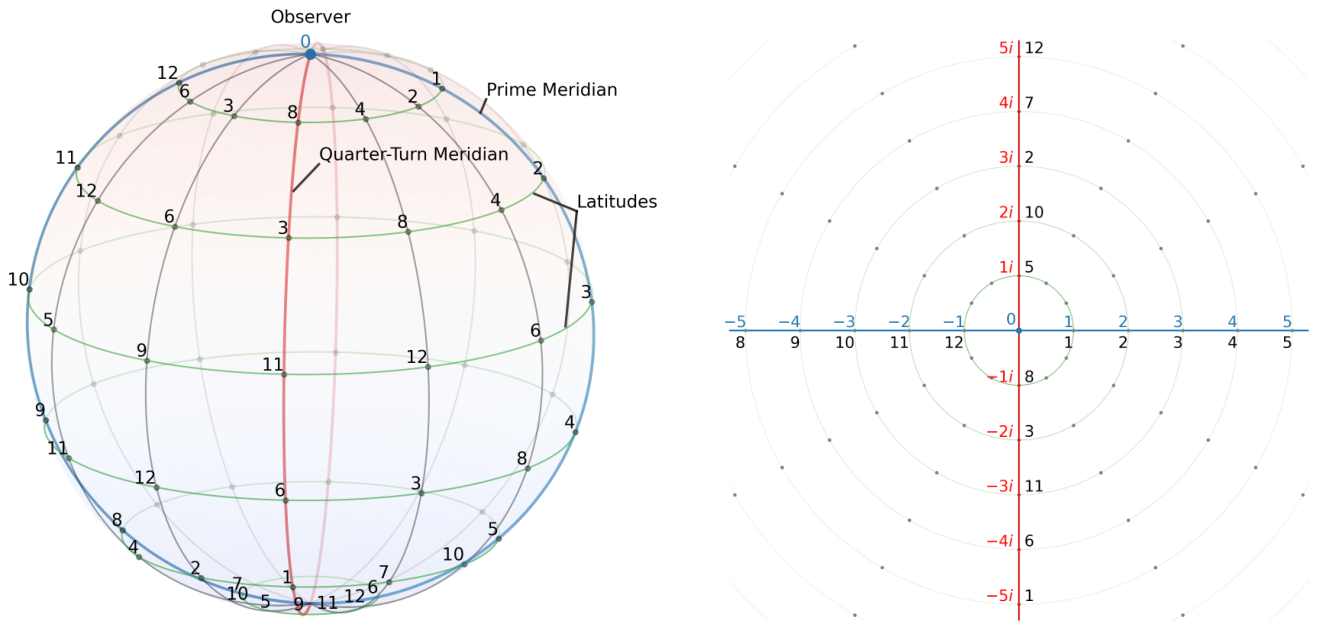
Figure 2.
The carrier constraint of the composite gate: one drive acts diagonally on a pair of cycles, so the relative offset is conserved (Proposition 10), and the synchronised orbit (grey links) is the Bell state of Definition 7. Quantum correlation is conservation.
Figure 2.
The carrier constraint of the composite gate: one drive acts diagonally on a pair of cycles, so the relative offset is conserved (Proposition 10), and the synchronised orbit (grey links) is the Bell state of Definition 7. Quantum correlation is conservation.
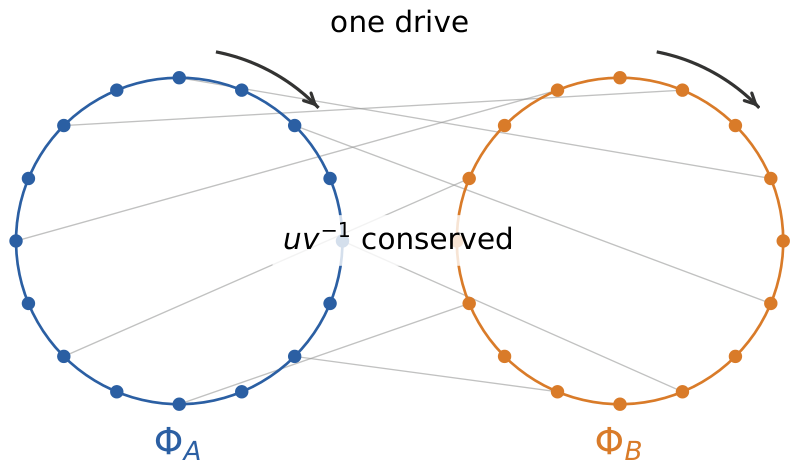
Figure 3.
The singlet law of Theorem 2, exact at each of the 80 native settings (dots): analyser settings are relational repositionings along the carrier, with phase granularity . The highlighted settings realise exactly, and the exhaustive sweep never exceeds it.
Figure 3.
The singlet law of Theorem 2, exact at each of the 80 native settings (dots): analyser settings are relational repositionings along the carrier, with phase granularity . The highlighted settings realise exactly, and the exhaustive sweep never exceeds it.
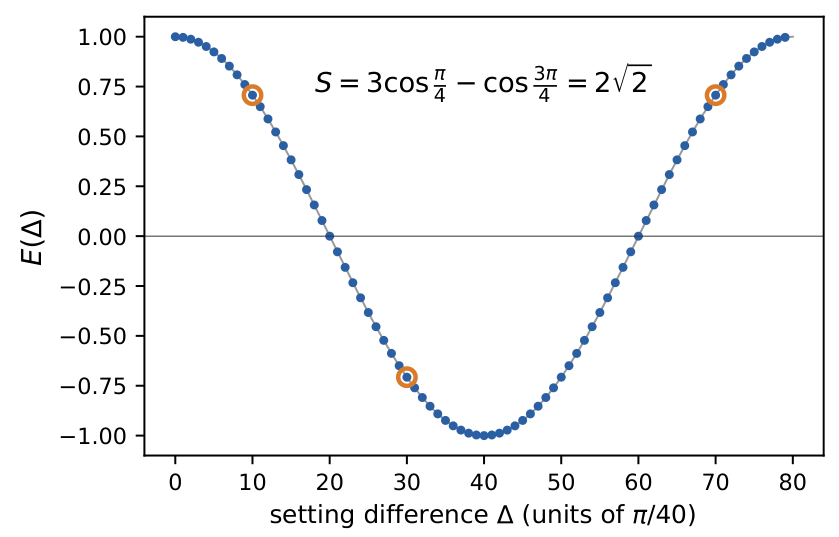
Figure 4.
The discrimination network of Theorem 3: two synchronised-orbit sources, local forced readouts with repositioning settings at A and C, and Bob’s Bell-state measurement as the readout of the conserved offset of his pair (Proposition 14).
Figure 4.
The discrimination network of Theorem 3: two synchronised-orbit sources, local forced readouts with repositioning settings at A and C, and Bob’s Bell-state measurement as the readout of the conserved offset of his pair (Proposition 14).
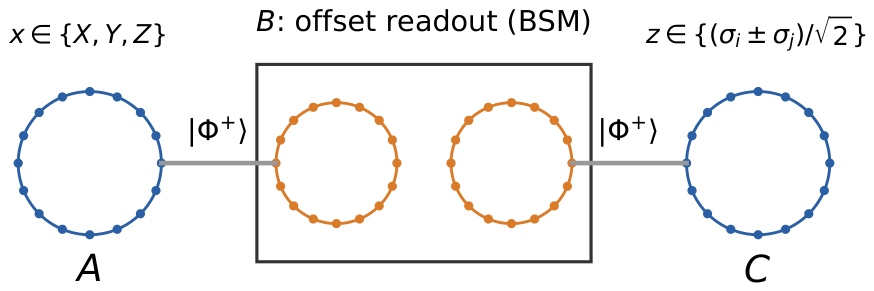
Figure 5.
Observation in the Carrier , drawn to exact arithmetic. The Subject resolves crosses, not points within a cross.
Figure 5.
Observation in the Carrier , drawn to exact arithmetic. The Subject resolves crosses, not points within a cross.
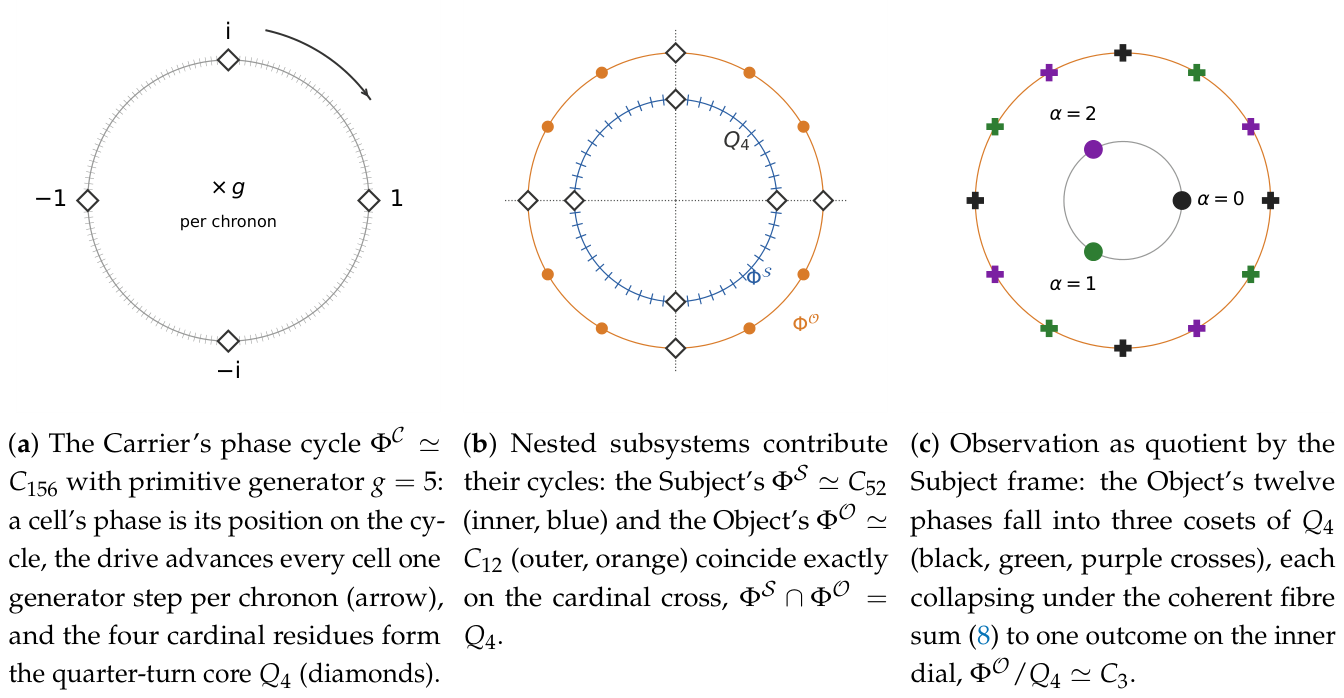
Figure 6.
One Carrier, two regimes: with and the same Subject (, the sixty-tick dial, blue) in both panels. Quantumness is the subgroup relation, not a property of either system.
Figure 6.
One Carrier, two regimes: with and the same Subject (, the sixty-tick dial, blue) in both panels. Quantumness is the subgroup relation, not a property of either system.
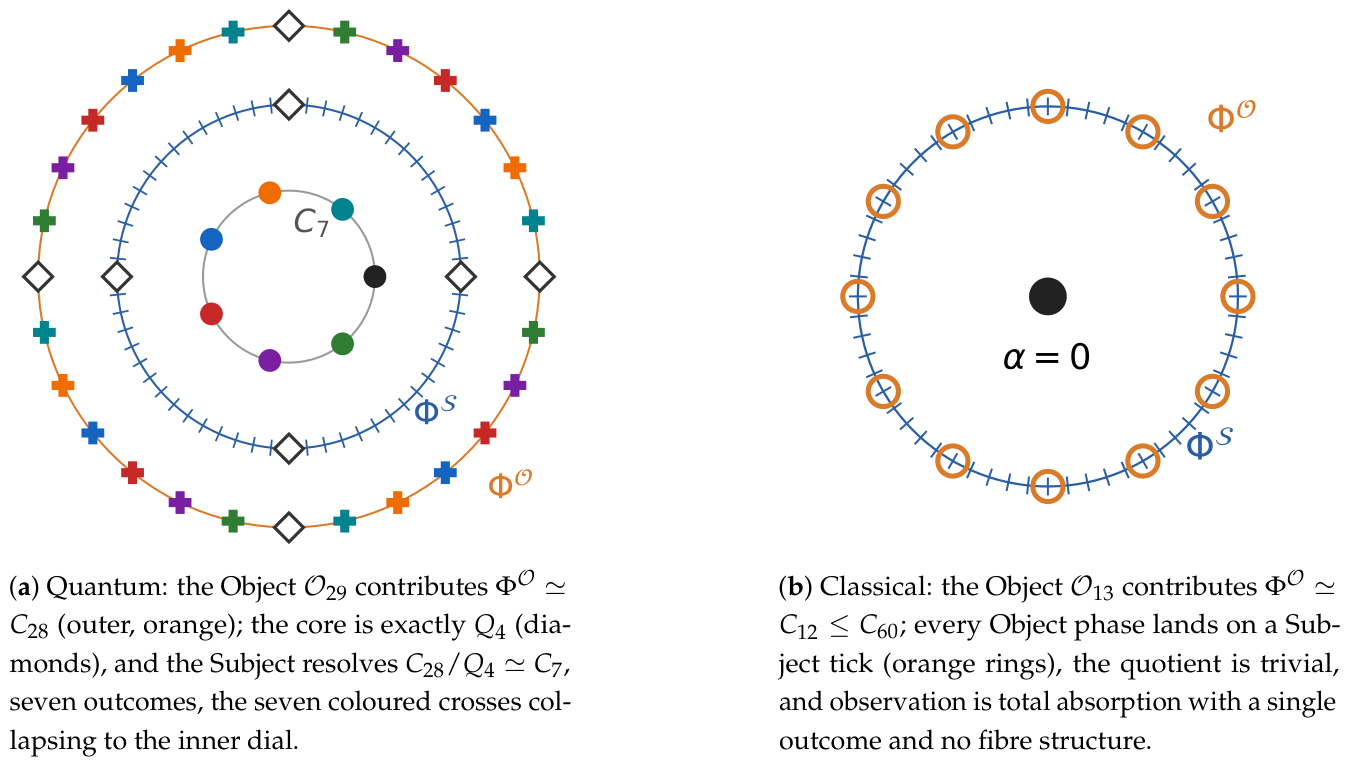
Figure 7.
The gravitational which-path complementarity , exact over the full coupling sweep (Proposition 15). The witness reaches the Tsirelson value at , and the visibility revives exactly at the cycle period, dephasing, never collapse (Proposition 17).
Figure 7.
The gravitational which-path complementarity , exact over the full coupling sweep (Proposition 15). The witness reaches the Tsirelson value at , and the visibility revives exactly at the cycle period, dephasing, never collapse (Proposition 17).
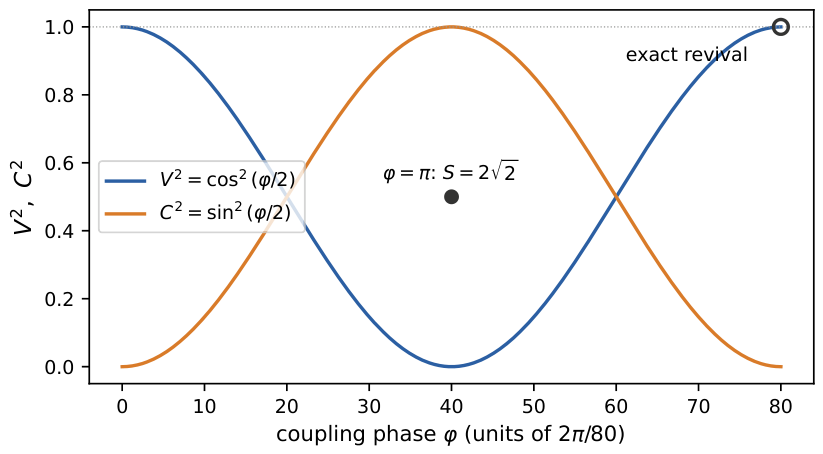
Table 1.
The three worked configurations of the paper. All admissibility data exact (validation suite).
Table 1.
The three worked configurations of the paper. All admissibility data exact (validation suite).
| Carrier | g | Subject(s) | Object(s) | core | quotient | role |
|---|---|---|---|---|---|---|
| 5 | () | () | observation and the ledger (Section 4 and Section 5, Figure 5) | |||
| 2 | () | , | ; | ; | two regimes (Section 8, Figure 6) | |
| 3 | () | () | composites and the quantum boundary (Section 7, Figure 2, Figure 3 and Figure 4) |
Table 2.
The seven Subject-relative outcomes of the quantum pair in : fibres of in .
| outcome | exponents in | residues in |
|---|---|---|
Table 4.
The ledger, June 2026. Anchor fixes ; floor is a lower bound from a null result at the scale probed; exact is an -independent null; forward is a filed prediction.
Table 4.
The ledger, June 2026. Anchor fixes ; floor is a lower bound from a null result at the scale probed; exact is an -independent null; forward is a filed prediction.
| channel | type | constraint | falsification trigger |
|---|---|---|---|
| SPARC acceleration floor [29] | anchor | environment-dependence of the floor | |
| Riemann verification [30] | floor | an off-line zero below (binding floor) | |
| Sorkin nullity; Born window | floor | confirmed ; quantised Born anomalies | |
| Granularity ceiling | floor | Born anomaly at achieved coherent depth | |
| Dispersion; Tsirelson; network table | exact | — | vacuum dispersion; ; non-quantum network behaviour |
| No-collapse; equivalence principle | exact | — | confirmed spontaneous collapse; any EP violation |
| Gravitational entanglement | forward | corr. | pull and entanglement failing to decouple (mass vs. coherent fraction); entanglement off the Newtonian rate; or |
Disclaimer/Publisher’s Note: The statements, opinions and data contained in all publications are solely those of the individual author(s) and contributor(s) and not of MDPI and/or the editor(s). MDPI and/or the editor(s) disclaim responsibility for any injury to people or property resulting from any ideas, methods, instructions or products referred to in the content. |
© 2026 by the authors. Licensee MDPI, Basel, Switzerland. This article is an open access article distributed under the terms and conditions of the Creative Commons Attribution (CC BY) license (http://creativecommons.org/licenses/by/4.0/).
Copyright: This open access article is published under a Creative Commons CC BY 4.0 license, which permit the free download, distribution, and reuse, provided that the author and preprint are cited in any reuse.


