
Submitted:
12 June 2026
Posted:
15 June 2026
You are already at the latest version
Abstract
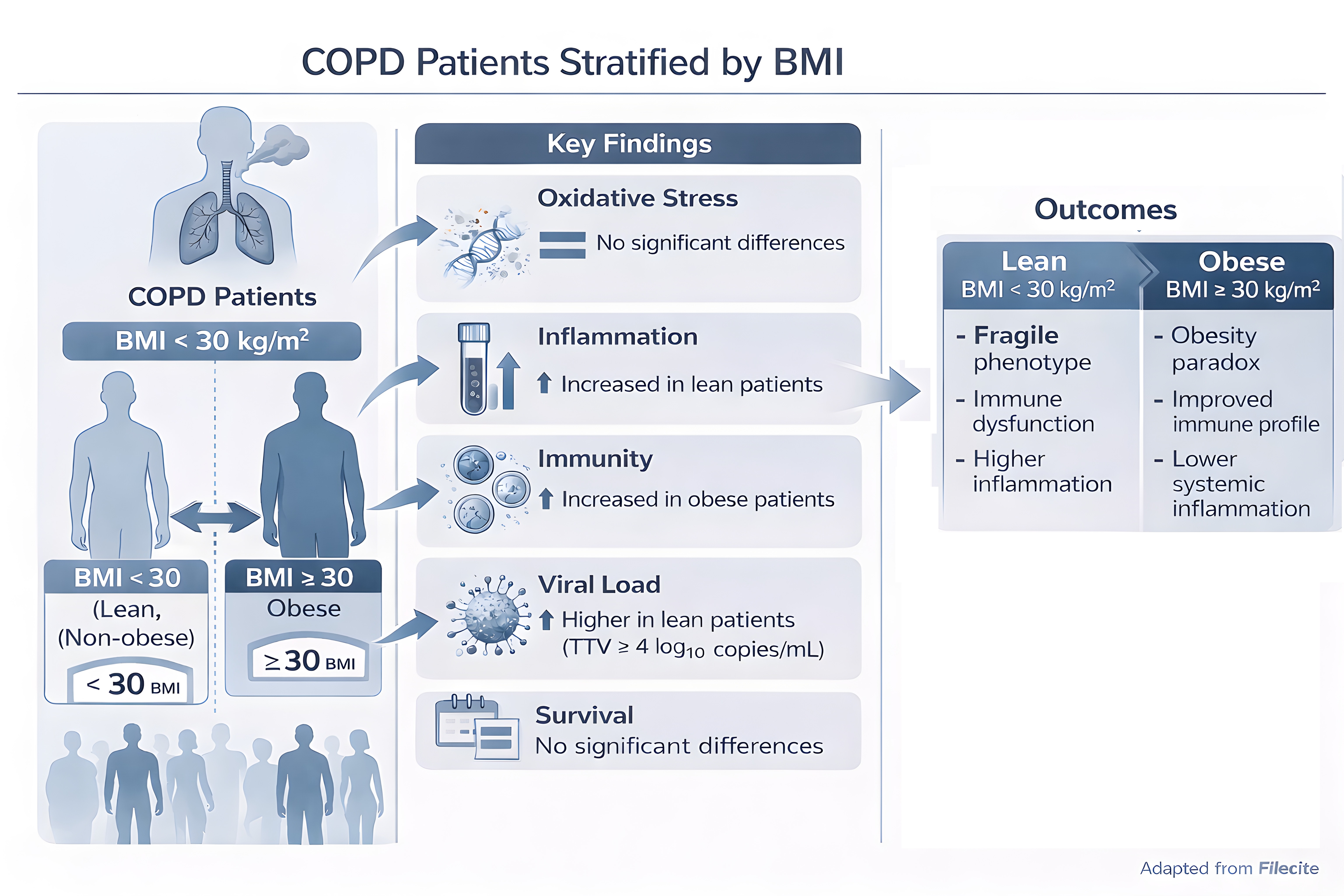
Chronic obstructive pulmonary disease (COPD) is characterized by systemic inflammation, immune dysregulation, and increased susceptibility to infections. Obesity may influence these processes and has been proposed as a potential contributor to the so-called “obesity paradox”, although its effects on immune competence, viral burden, and survival are not yet fully understood. Seventy patients with severe to very severe COPD (GOLD stage 3–4) were stratified according to BMI (<30 vs. ≥30 kg/m²). Clinical and functional parameters were assessed together with biomarkers of oxidative stress, DNA damage, systemic inflammation, and T-cell subsets. A comprehensive viral panel, including Torque Teno virus (TTV), was also analyzed. Five-year survival was evaluated using Kaplan–Meier curves and Cox regression models. Patients with BMI ≥30 showed higher lymphocyte counts and increased CD4⁺ and CD8⁺ T-cell levels, accompanied by lower systemic inflammatory indices. No significant differences were observed in oxidative stress or DNA damage markers. In addition, TTV viremia (>4 log₁₀ copies/mL) was more frequently observed among patients with lower BMI. Despite these differences, five-year survival did not significantly differ between the two groups. These findings suggest that BMI alone may have limited value as a predictor of outcomes in patients with advanced COPD. Conversely, immune-inflammatory indices and viral burden, particularly TTV viremia, could provide complementary information for risk assessment and may deserve further investigation as potential tools for personalized patient stratification.
Keywords:
COPD
; obesity paradox
; systemic inflammation
; T-cell immunity
; Torque Teno virus (TTV)
; viral biomarkers
; oxidative markers
; rehabilitation
Copyright: This open access article is published under a Creative Commons CC BY 4.0 license, which permit the free download, distribution, and reuse, provided that the author and preprint are cited in any reuse.


