Submitted:
13 June 2026
Posted:
17 June 2026
You are already at the latest version
Abstract
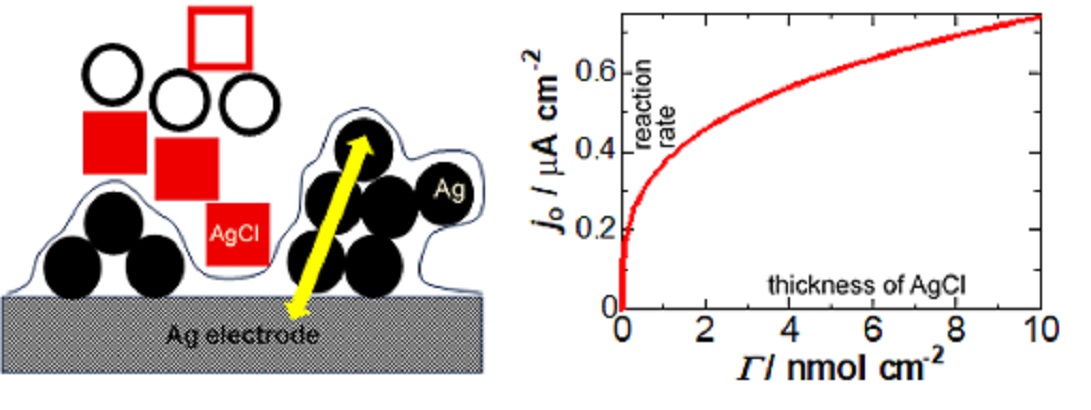
An Ag|AgCl redox couple has been thought to work as a reversible reference electrode although metal dissolution often occurs irreversibly. This report examines the kinetics by means of ac–impedance of AgCl films at the Ag electrode. A brief result is that the reaction rate for conventional voltammetric currents is totally irreversible although it can be enhanced with a thickness of the AgCl film. According to the frequency–dependence of the imaginary admittance, the double layer capacitance is determined only by the geometrical area of the Ag–electrode to exhibit 140 mF cm–2. This value is caused by the delocalized charge of AgCl dipoles rather than water dipoles. The charge transfer rate of AgCl + e– « Ag + Cl– was evaluated from the variation of the real admittance with the frequency to yield the charge transfer rate constant with the order of 10–9 cm s–1. The rate constants increased with the surface density (G) of the deposited AgCl in proportion to G0.3. The fractional power of the increase indicates that the reaction should occur not only at the geometrical area of the Ag–electrode but also at fluctuated Ag–particles in electric connection with the Ag–electrode caused by percolation. The reversibility of Ag|AgCl can be realized at current densities smaller than 0.1 mA mm–2, exemplified by 10 nA at a 0.3 mm disk. Then, Ag|AgCl can be used for a counter electrode at ultramicroelectrode techniques in a two–electrode system.