
Submitted:
11 June 2026
Posted:
15 June 2026
You are already at the latest version
Abstract
Studying critically endangered North African dama gazelles (Nanger dama ruficollis) raised as exotic livestock on Texas rangeland, U.S.A., we discovered that lone individuals make occasional excursions beyond their core area and home range. This realization should help monitoring of reintroductions as in Chad and Morocco. For 1 year each, we tracked gazelles at 2 sites. In a very large West Texas pasture (8996 ha), we put Global Positioning System (GPS)-radio collars on 3 adult males and 2 subadult males in an established population. In Central Texas, we collared a group totaling 9 to 13 gazelles of both sexes released into a medium size pasture (202 ha). We classified movements as excursions if the animal (1) went out a long distance (as long as 9.12 km recorded) alone, or sometimes 2 individuals for at least part, (2) remained out for several hours or days (0.50 to 3.50 days recorded), (3) then returned to approximately the same place as the start. These explorations may help males find territory sites and females determine which female group to join. This paper introduces MATLAB as a flexible and sophisticated tool for analyzing animal movements. Ability to rotate graphs of tracks for 3D inspection proved invaluable.
Keywords:
excursions
; dama gazelle
; Nanger dama ruficollis
; GPS-radio collars
; behavior
; management
; MATLAB
1. Introduction
In this paper we describe preliminary analysis for, and subsequent review of, excursions by eastern dama gazelles (Nanger dama ruficollis) fitted with GPS-radio collars (Figure 1). “Excursions” are, in this context, defined as unusually large movements by 1 animal, or sometimes 2 animals, as compared with their daily routine, which end with a return to the approximate place of their start.
In our field study of these North African dama gazelles raised as exotics in Texas, U.S.A., we took one year of Global Positioning System (GPS)-radio collar fixes. Our subject animals were male dama gazelles in a very large pasture of 8996 ha in West Texas, and dama gazelles of both sexes in a medium size pasture of 202 ha on the Edwards Plateau in the Hill Country of Central Texas. Mungall and Cooper (2021) give pasture sizes for 27 groups of exotic dama gazelles surveyed in Texas. More than 40 percent of these pastures were in the medium size pasture 40 to 200 ha range. This range is typical for keeping exotics on ranches in Central Texas. Only 1 of the pastures was in the exceptionally large 4,000 to 10,000 ha range. This was the very large 8996 ha pasture studied in West Texas.
Within both study pastures, we were surprised to find excursions by lone animals. In the medium size pasture where both sexes were collared, we found excursions for females as well as for males.
This tendency to trek out and then back to about the point of origin is important to investigate because it has conservation implications for this critically endangered species. Plans for reintroductions in their native range have been put forward and are particularly serious options in Morocco and Mauritania (Abáigar et al. 2019, Mallon et al. 2019). Releases from local breeding pens have already begun in Chad (Dama Gazelle Network 2026). Issues of space use are part of the information needed for choosing appropriate areas in either native habitat or for exotics. Managers seeing an animal go off alone should not think that this is abnormal behavior for dama gazelles.
Native homelands for dama gazelles stretch across North Africa along the Sahelo-Saharan edges of the Sahara Desert. Even with this huge expanse, today’s total individuals in the wild for all three subspecies combined, N. dama ruficollis, N. dama dama, N. dama mhorr, has shrunk to probably fewer than 250 adults and possibly as low as 100 or even 85 (RZSS and IUCN Antelope Specialist Group 2014, IUCN SSC Antelope Specialist Group 2016, Sahara Conservation 2024). The total for this critically endangered species is separated into only as many as 5, or possibly 6, small populations in the wild (Mallon et al. 2016). Zoos and wildlife parks keep perhaps as many dama gazelles (Eyres 2018). Private ranches in the United States – all or almost all in Texas - have an estimated 1,510 (Mungall 2018b). These Texas animals form a security population against total extinction as well as offering a pool of stock from which animals for ruficollis reintroductions could be drawn. For both of these reasons, it is important to understand how these animals behave in their environment.
The present work gives information for dama gazelles on rangeland in Texas which should also help understanding of the species in the wild. Similar studies in native habitat would be useful, but political unrest and the low number of animals make this sort of study unlikely. Individual Texas ranches also offer only limited numbers of dama gazelles in each, but it is possible to use animals for study and to follow the animals long-term.
2. Materials and Methods
2.1. Study Sites
Work was carried out on two sites, first a very large West Texas pasture in Terrell County close to the border with Mexico and then a medium size Central Texas pasture in Uvalde County (Figure 2).
The initial study was done at Stevens Forest Ranch in West Texas. The very large size of the 8996 ha pasture gave the dama gazelles room to hold core areas and home ranges without being limited by fences. The breeding population of more than 50 dama gazelles shared their pasture with other exotic ungulates. There were addax (Addax nasomaculatus), aoudad (Ammotragus lervia), blackbuck antelope (Antilope cervicapra), and gemsbok (Oryx gazella). In addition, native mule deer (Odocoileus hemionus) and white-tailed deer (Odocoileus virginianus) inhabited the pasture. There were a few domestic cattle and occasional predators such as coyotes (Canis latrans), bobcats (Lynx rufus), and mountain lions (Puma concolor).
This region is classified as a warm temperate semi-desert with mean minimum and maximum daily temperatures from 1 ᴼC to 16 ᴼC in January to 22 ᴼC to 35 ᴼC in July. Mean annual rainfall is 379 mm, falling mainly from May through October (Texas State Historical Association 2021). The native distribution of the dama gazelle in the Sahel of North Africa has similar climatic conditions, although when wild dama gazelles trek into the adjoining Sahara Desert, conditions can be more extreme.
As discussed in more detail by Mungall and Cooper (2020), the elevation and roughness of the terrain increase from east to west in the pasture, from 730 to 975 m, but vegetation is fairly similar throughout. There is a diverse array of low-growing shrubs also typical of the adjacent Central Texas Edwards Plateau ecoregion. Junipers (Juniperus spp.) and oaks (Quercus spp.) are common in the upper story, and prickly pear cactus (Opuntia spp.) and yuccas (Yucca spp.) are conspicuous mixed with the brush components. Grasses and forbs are scarce and dependent on rainfall. Range conditions in the study pasture are good. The dama gazelles are browsers and subsist on natural vegetation. The only supplemental feed provided is occasional hay for the cattle if winter temperatures go below freezing.
At the Central Texas study site on Morani River Ranch, the 202 ha medium size pasture is more mesic, classified as humid subtropical. Annual precipitation averages about 654 mm but is highly variable (Texas State Historical Association 2019). As measured during the study, typical temperature range is 7 ᴼC to 24 ᴼC in January and 22 ᴼC to 38 ᴼC in July. Drought is common. As discussed in Mungall and Cooper (2020), many of the plants are similar to those at the West Texas site, the grass cover is still sparce on this pasture, and forb densities increase as spring and fall rains bring out a wide variety of species. Blackbrush (Acacia (renamed Vachellia) rigidula) is a particular favorite in the diet of the Central Texas study animals in their hard-used pasture. All of the 9 to 13 dama gazelles studied in this medium size pasture, both males and females, wore collars. Exotic ungulates co-habiting with the exotic dama gazelles here are aoudad (Ammotragus lervia), axis deer (Axis axis), blackbuck antelope (Antilope cervicapra), Catalina goats (Capra hircus), common eland (Tragelaphus oryx), Iranian red sheep (Ovis orientalis gmelina hybrid with Ovis vignei arkal), plains zebras (Equus quagga), red lechwe (Kobus leche leche), red stag (Cervus sp.), scimitar-horned oryx (Oryx dammah), common waterbuck (Kobus ellipsiprymnus ellipsiprymnus), and a yak (Bos mutus). Native bison (Bison bison) and several domestic longhorn cattle were also in the pasture. Supplemental pelleted feed was provided, but the large animals like the cattle and especially the scimitar-horned oryx routinely crowded out the smaller animals like the dama gazelles. Fences are tight enough and patrolled enough to keep out predators.
From January 23, 2013 (1 week after capture in case the animals needed to settle down), 3 adult male dama gazelles and 2 subadult male dama gazelles on the very large pasture at Stevens Forest Ranch in West Texas were set up to be tracked for 1 year with GPS-radio collars (Model: Lotek GPS 3300S; Lotek Wireless Inc., Newmarket, ON, Canada). The collars were programmed to record a location every 3 hours and then to drop off after 12 months. Success rate of the GPS collars in obtaining locations of the gazelles was 95.91 ± 3.04%. Each collar except the one on subadult “Purple” recorded 2866 ± 60 fixes of the 2920 possible year of locations. The collar on “Purple” failed on September 20, 2013, after recording 1785 locations. Damage found when his collar was retrieved by hand at the end of the study indicated fighting. The project data was published in the Mendeley depository on 4 December 2025. It can be retrieved at Cooper, Susan (2025), “Dama Gazelles Texas GPS Collar Data Mungall and Cooper,” Mendeley Data, V1, doiI:10.17632/yk4mbfc5xj.1,
Each collar was wrapped with a different color of tape so that the individuals could be identified visually during monthly wellness checks. Notes were then recorded by color. All animal handling was approved by Texas A&M Agricultural Animal Care and Use Committee, Animal Use Protocol # 2012-098A and 2014-018A.
On Morani River Ranch in Central Texas, all dama gazelles in the medium size pasture were fitted with GPS collars. Individuals were designated by the first letter of their collar color plus “M” for adult male, “m” for maturing male, or “F” for adult female. Note taking started on December 19, 2014, and ended on December 19, 2015, for the initial animals but went until June 30, 2016, for males added part way through the study. Eight adult females and 1 maturing male were present throughout the study. Depending on the social phase being examined, there were also another adult female or 1 to 3 other adult males (Mungall and Cooper 2022). Again, the collars were programmed to record a location every 3 hours and to drop off after 12 months. One female collar quit recording 6 weeks early and another female collar fell off 2 weeks early but otherwise seemed normal.
To start determining home ranges and core areas, Susan Cooper (one of the paper authors here) first processed the data through differential correction software (N4Win, Lotek Wireless Inc.) to give a positional accuracy of ± 2 m. She then imported the corrected collar data into ArcView (ESRI, Redlands, CA) for spatial analysis. She used the HRE extension in ArcView 3 to calculate the annual and seasonal Kernel Home Ranges (KHR) of the animals and applied the volume method to view the home range in 10% increments. She divided the KHRs into progressive 10% increments and then calculated percentages of overlap of the 95% KHRs as well as identifying zones of the home range where no overlap of distribution occurred. We treated these latter zones as exclusive-use core areas.
Locations beyond the 95% KHR are considered indicative of exploratory behavior rather than being included as part of the animal’s home range. In this paper, we identify movements beyond the 95% KHR as an excursion if the animal (1) went out for a long distance alone, or sometimes two individuals for at least part of the way, (2) remained out for several hours or even several days (0.50 to 3.50 days recorded) but not for weeks or months, and (3) then returned to approximately the same place from which the animal had left. Note that this is not a migration. Within the medium size 202 ha pasture, where animal movements were restricted by fences, excursions were identified as periods when a lone gazelle remained outside its core home range area for at least 3 time periods, which equates to 9 hours.
For the excursions, MATLAB, by MathWorks (The MathWorks, Inc., 3 Apple Hill Drive, Natick, MA 01760-2098, USA), was chosen as the programming language for coding our data analysis software. With 70,000 or more functions or subroutines and capability to rotate graphical track displays in 3D, MATLAB was ideal for this part of the study. Martinez and Martinez (2007) give many insights into the statistical capabilities of MATLAB. Code custom-written by Christian Mungall (another of the authors here) for the terrestrial examination was dubbed “MOVEPROG.” This was to indicate its similarity to “SOCPROG” as devised by Hal Whitehead for social structure analysis - particularly in marine situations (Whitehead 2008).
Figure 3 lists the standard “MOVEPROG” routines developed. They were divided between group detection or presentation and supporting information (a movement-centered adjunct to Whitehead’s “SOCPROG”). MOVEPROG was used for basic analysis – as for inclusion in monthly summaries. Christian Mungall wrote three additional programs for excursion analysis. The first two of these investigated large, continuously increasing straight-line movements from each potential starting point and then the next similar return movement type that ended close to the potential departure point. The first program concentrated on detailed printed summaries, the second concentrated on track plots of the same (with the additional careful specification of preliminary start date, followed by dates of end of outward trip, then the end of the “completed” “homeward” trip until movements settled down again). The third program concentrated on daily polygon boundary plot studies, for both rectangular and elliptical boundary shapes, and on other items of ever-changing interest. Small pasture areas presented track plotting challenges when straight lines between successive locations led to parts of the excursion seeming to be outside the fences!
The initial analysis for the two study pastures was carried out by author Susan Cooper as detailed in Mungall and Cooper (2021 and 2022). Then the special MATLAB manipulations by author Christian Mungall illustrated the tendency of the gazelles to make excursions. Use was made of distances per day 2D line plots (Figure 4) followed by 3D line plots (so-called 3D “spaghetti plots,” Figure 5). In Figure 4, note how this 2D line plot shows that most of the animals are moving together whereas the female with the green collar and the female with the yellow collar each made an extensive movement alone. With so many gazelles wearing collars in the medium size pasture, the MATLAB capability manually to rotate the 3D spaghetti plots via cursor control was especially important. The graphs could show the relationships of all the animals in space over time, making tracks that seemed to be overlapping when viewed from one angle, show as either together or separate when viewed from another angle.
The 2D line plot in Figure 6 from the very large pasture illustrates that not all large peaks represent excursions beyond the routine areas used by the individuals. The large peaks for adult Orange early in the month and then later in the month come from movement around his core area and home range rather than excursions beyond. Similarly, only the taller peak for adult Green took this male for what qualifies as a possible exploration of interest in this examination. Then the modest twin peaks of subadult Purple and adult Stripe for April 14, 2013, circled on the graph turned out to be the beginning of a paired excursion in which each of these males returning separately. In other words, each possibility shown in the graph needed to be evaluated further. The 3D spaghetti plot done next clarified the situation (Figure 7).
3. Results
In 3. adult and 2 subadult males who were using the east side of the pasture of 8996 ha. This pasture has a well-established breeding population with both sexes and all ages represented. Looking at the excursions registered by the collared males during each month in 2013 (considering the >4 to 5 km category, the >5 to 6 km category, and the >6 km category), average was 6.33 km with a range of 4.48 to 9.12 km.
Excursions 4. km were common for both adults and subadults. There were 77 total excursions of more than 4 km but not more than 5 km. The average number of these excursions per month was 6 with a range of 1 to 14. Excursions of this type occurred in all months. The gazelles took 49 longer excursions of over 5 km (tallied as >5 to 6 km plus >6 km). The monthly average for such excursions was 4 with a range of 0 to 14. February, October, and November were months showing no extended movements of this type. Again, both adults and subadults were involved. Because we were interested only in excursions that took the male outside his core area, and often out of his home range, we concentrated analysis on excursions of more than 5 km (Table 1).
For the excursions, either an adult or a subadult could make his excursion alone. However, occasionally the 2 subadults would go off together or 1 adult would go with 1 subadult. As an example, here is the summary of the long-distance excursion mentioned above involving 2 males for part of the way, several days were involved, and both returning separately to near where each had started. Note that in this instance, one of the males was a subadult and the other was an adult. Subadult Purple and adult Stripe shared part of an excursion between April 14 and April 16 in the very large West Texas pasture where fences did not seem to limit movement. Subadult Purple had left part of his home range that he shared with adult Stripe at midnight early on April 14 and went west along a valley. At 6 AM the same day, adult Stripe left from near the same place and also followed the valley west. They made contact along the way, and at 6 PM they started moving west together. On April 15 they stayed together. On April 16 at 3 AM, Stripe started home to where he had begun. On April 17, Purple also returned east to the place where he had begun. Thus, this was a long-distance movement which lasted more than 2 days for Stripe and more than 3 days for Purple (Figure 8, A and B). Figure 8A also shows locations for the other collared males in their home ranges during the main outward trek by subadult Purple and adult Stripe. Figure 8B includes tracks for adult Orange and adult Green as well as the part of subadult Yellow’s tracks where subadult Purple intersects his path on the return by subadult Purple to the core area he shared with subadult Yellow.
By contrast, with all the 9 to 13 dama gazelles in the 202 ha medium size pasture wearing collars, we quickly learned that females as well as males make excursions (Table 2). In fact, all the dama gazelles in this population made one or more excursions at some time during the study year. Unlike the large pasture West Texas case, there were some months in which no excursions were found for males even though all months had excursion activity for females.
Using spaghetti plots, excursions were identified as long treks alone, or mostly alone, which lasted for at least 3 time-steps (i.e., 3 x 3 hours = 9 hours). Excursions began and ended at the same place. All of the dama gazelles used all of the pasture at one time or another, so all had the whole pasture as a home range. This means that all of the excursions were within the individual’s home range even though the excursion could go outside of a core area. Unlike the very large pasture situation, fences were limiting.
A particularly interesting excursion involved the adult female GF on October 4 to 6, 2015 (Figure 9, A and B). Female GF left her group at midnight early on October 4, travelled to the far end of the pasture, where she crossed through another female group as she returned. An adult male (black lines on graph) with this other group followed GF through his group until she passed beyond his core area (Figure 9A). By the time GF got back to her starting point at 21:00, her group had moved away (Figure 9B). She spent the night of October 4 to 5 alone. Next, GF followed the course her group had taken and met up with them by midnight early on October 6 (Figure 10).
4. Discussion
In the tables, maximum distances travelled in the monthly data are emphasized in Table 1 because the very large pasture gives the collared males room for unlimited travel. Managers then can see how far a gazelle might go under Texas conditions if fences are not restricting the animals. For the smaller pasture where the entire pasture is part of the animal’s home range (Table 2), the number of days spent on an excursion gives useful information.
Looking at Table 1 for the established population in the very large pasture in West Texas, we noted that the number of male excursions had a conspicuous peak during the main Texas birth and subsequent breeding season of August and September. After this time, some of the females go anestrus until about March (Wojtusik et al. 2017). Then March to April showed a secondary rise, the time when Texas can have a secondary peak in reproductive activity and before the excessively hot summer (Mungall 2018a). Possibly these extra explorations increase breeding possibilities for the males.
Table 2 for the smaller population, newly in a pasture of medium size, also shows interesting points. With females as well as males represented, the table shows that the females made excursions in every month, although at a low frequency. Both females and males had a modest rise in rate of excursions from September with the males peaking in November. This peak being later than in the very large pasture probably resulted from there having been no adult males in the pasture from June 22, 2015, until 3 were added on August 5, 2015 (as discussed in Mungall and Cooper 2022).
Similarly, there being no male excursions in the medium size pasture from February through April may have resulted from there being only 1 adult male whereas male excursions were seen in the previous two months when there were 2 adult males. The young growing male “Rm” did not start showing excursions until reaching the subadult stage. This was the stage at which the 2 subadults in the very large pasture were noted to make excursions. Before the subadult stage, the adolescent “Rm” stayed with the females.
Excursions allow individual dama gazelles to extend the exploration of their environment. For males, especially for maturing males like the subadult Purple in the very large pasture examined in this paper, excursions can show new areas and opportunities to meet new conspecifics. This would be important as the time comes to establish a territory. The long time (more than 3 days) that Purple stayed away from his original core area indicated that his excursions found a new area to try. The rakes across his haunches and damage to his collar indicated that he may have found a new area already inhabited by other males.
Excursions by adult females like GF in the medium size pasture show that females also take chances to explore beyond the area being used by whatever group she is with. An adult female like GF will sometimes change her membership from one female group to another. Her pasture exploration may influence her choices.
A release of mhorr gazelles, the western subspecies of dama gazelles, in native habitat in southern Morocco, Africa, demonstrated that, even after generations in captivity, dama gazelles can use long explorations to find suitable habitat in which to establish their home range (Abáigar et al. 2019, Abáigar et al. 2020). After three months of excursions as far as 50 km, the gazelles settled in home ranges and, after that, averaged only 8.39 ± 5.71 km travel per day. However, during this time, one or more of the mhorr gazelles would take an excursion back to the enclosure from which they had originally been released. Whether on their own or as a result of fleeing poachers, they showed an admirable ability to return to their new home range. Some of this may be helped by their tendency to follow dry riverbed channels (oueds), but they still made it back in spite of having gone into unfamiliar terrain. These gazelles showed no tendency to change areas with the seasons, probably because both weather conditions and food availability were fairly uniform throughout the year.
Other species also employ excursions. As for both eastern and western dama gazelles, a main aspect of excursions seems to be exploration. Some other species are considered to benefit in additional ways, but exploration is still a key element. Exploration examples studied for other species include mountain gazelles (Gazella gazella) released in Arabia. They used excursions of as much as 12.1 km before settling in favorable habitat (Dunham 2000 in Abáigar et al. 2019). Excursions outside of the home range seen by male white-tailed deer during fall and winter are assumed to be related to the breeding season (Karns et al. 2011). Additionally, excursions are found within a wider variety of mammalian populations. For example, red foxes were found to have two types of movements beyond their territories: for dispersal and, during the breeding season, when searching neighboring territories for mating opportunities (Soulsbury et al. 2011). The dispersal movements were straighter, but the reproductive movements were longer. Studying a medium-density population of European badgers (Meles meles), Kelly et al. (2020) found that most individual badgers made excursions outside of their territory throughout the year. Peaks of this activity matched the main breeding seasons, while the shorter, more frequent summer excursions may let badgers monitor possibilities beyond their home group. This system allows female badgers a mating system employing excursions to favor outcrossing without having to abandon familiar family ties.
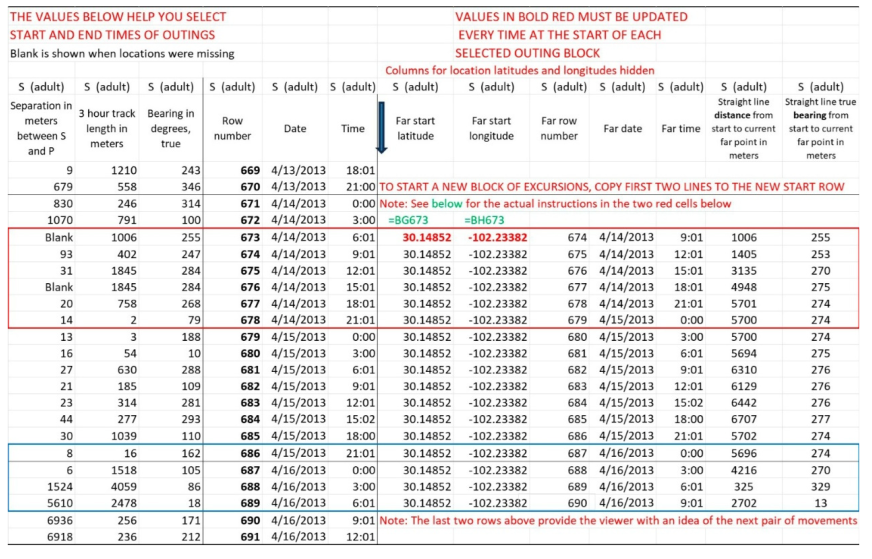
The number of locations (2948) multiplied by the number of subject animals (5), along with the need to access advanced mathematics functions (e.g., matrices), made MATLAB an excellent choice for analyzing such large amounts of data. As many as 12 or so months were analyzed sequentially in one program run. Nevertheless, researchers investigating large excursions can benefit from seeing well-selected animal movement numbers, for example as presented here in EXCEL table form. Table 3 shows adult Stripe (S) along with separations from subadult Purple (P). Four days (32 periods) are covered. The outing for Stripe starts on row 673. Animal movement slows by 6 PM and stays low overnight (row 677 and through midnight). Technically, the outbound trek could be said to end at row 677. Row 686 shows an end of small track lengths. Then Stripe separated from Purple and is on his return by row 688. Consequently, numbers like these in the EXCEL table help a researcher dissect what the animals are doing over time. Row numbers are included in the table for completeness and to aid in quality control as each new block of movements is coded in the original Excel table.
Completing a similar EXCEL exploration of the data for each of the study animals for each of the year’s months could take more time and more of the project budget than available. So an EXCEL exploration would probably be limited to a few, particularly representative, cases. For the majority of cases, the use of MATLAB for a combination of 2D line plots, 3D spaghetti plots, and mapping on pasture diagrams would satisfy.
5. Conclusions
Both for conservation efforts and for ranch managers, it can be kept in mind that dama gazelles are likely to separate from their group and make a long-distance excursion alone. This is normal for the species, having been seen in individuals from both the east and the west of the species distributional area as well as for exotics in Texas. Either a male or a female can make an excursion. This behavior for a male to go off on excursions began at the subadult stage.
There seems to be a tendency for the gazelle to follow a channel that goes in the desired direction. In the very large West Texas pasture, this could be a valley. In native habitat in southern Morocco, a dry riverbed (oued) was used. Even over long distances, the individual on an excursion could go out and return on essentially the same path. However, as demonstrated in the medium size Central Texas pasture by the adult female GF, the individual does not necessarily return over the same track in spite of ending back at the same place.
The explorations involved in an excursion can expand an individual’s knowledge of resources outside the usual home range. This may also hold true for animals like white-tailed deer in the Americas, but white-tailed deer are not necessarily as gregarious as dama gazelles. Animals like the dama gazelle GF on her excursion left her group for the excursion discussed. Afterwards, she caught up with her group again, but she also sometimes switched group affiliations during the yearlong study. And the maturing male Purple in the very large pasture in West Texas on his excursions may have been scouting for a place to establish a territory. So, when managing a dama gazelle population, allowing the animals room to separate and rejoin may help preserve natural social behavior.
Although visual observations were still needed, the GPS collar data added much more to the study than could have been found by direct observation alone. Examining the GPS data by time steps and days went a long way toward approximating what might have been found by visual observation if time, light, and brush cover had not so often made direct observations impossible.
This paper is an investigation of excursions with the focus on behavior. A “follow-up” paper could make use of custom-written MATLAB software that provides more mathematical information about excursions to the analyst. Use could be made of detecting excursions via consideration of continuously increasing distances as opposed to daily track distances. Distance travelled and time taken would be evaluated for each succeeding time step to determine whether the criteria for an excursion are met. This would be accompanied by side-by-side graphical displays of straight-line tracks for consecutive time steps. This would facilitate the careful review of excursions by one or more animals, along with the regular movements of the other animals. For this sort of intensive study, investigators would want a shorter sampling period than the 3 hr. time step dictated here in order to get a full year of locations from each collar.
Acknowledgments
Principal Investigator Dr. Elizabeth Cary Mungall thanks all the many people who helped this project succeed. The late Steve Forest at Stevens Forest Ranch in West Texas started off the project by allowing dama gazelles from his population to be collared – a first for this species. He even flew the capture helicopter himself. Carlos Chapas III did the expert dart gun work, and Leon Tealer coordinated from the ground. At Morani River Ranch in the Hill Country of Central Texas, Kevin L. Reid generously made his dama gazelles available. Operations Manager Cole L. Reid and Ranch Manager John Fredericks handled ground operations. Everyone at Morani River Ranch and Stewards of Wildlife Conservation, Uvalde, Texas, pitched in to add help and observations. After assisting in the field, the late Dr. Christian Mungall performed overall final analysis. This followed initial data collection, presentation, and initial analysis by Dr. Susan M. Cooper. Aided by associates Shane Sieckenius and Andrea Silva, Dr. Susan M. Cooper used her expert skills in collar placement and tracking throughout the study. We appreciated the way Dr. Daniel I. Leskovar, the director who oversees the Texas A&M AgriLife Research laboratory where Dr. Cooper was working, was supportive of the project. Both parts of the study were done through the Second Ark Foundation in conjunction with the Exotic Wildlife Association. Funding for the work came from Bisbee’s Fish & Wildlife Conservation Fund (Wayne Bisbee and Brian White), Texas Hill Country and Austin Chapters of Safari Club International (Tim Fallon), Dallas Safari Club (Ben Carter), Fossil Rim Wildlife Center (Dr. Patrick R. Condy), and Kevin L. Reid of Morani River Ranch. Article Processing Charges (APC) for this paper received no external funding.
Conflicts of Interest
The authors declare no conflict of interest. The sponsors had no role in the design, execution, interpretation, or writing of the study.
References
- Teresa, Abáigar; Rodríguez-Caballero, Emilio; Martínez, Cristina; Amaouch, Zouhair; Samlali, Mohamed L.; Aparicio, Fernando; El Balla, Taufik; Essalhi, Abderrahim; Fernández, Jesús; García, Francisco; Haya, Moulaye; M’Bareck, Abba; M’Bareck, Hamady; González, Luis M.; de Larrínoa, Pablo Fernandez. The first reintroduction project for mhorr gazelle (Nanger dama mhorr) into the wild: knowledge and experience gained to support future conservation actions. Global Ecology and Conservation 2019, 19, e00680. [Google Scholar] [CrossRef]
- Abáigar, Teresa; Martínez, Cristina; Amaouch, Zouhair; Alifal, Mohamed; Lemdimigh, Ali; El Makki, Sid’Ahmed; El Mokhtar, Mohamed; Samlali, Mohamed L.; de Larrínoa, Pablo Fernández; Almería, Emilio Rodriguez-Caballero. Habitat requirements of the mhorr gazelle: what does this species need to survive in the wild? Global Ecology and Conservation 2020, 24, e01389. [Google Scholar] [CrossRef]
- Dama Gazelle Network. Dama gazelle Nanger dama: 2026 summary update at SSIG Cairo, Egypt. Strategy 2018-2028 7 Year Update SSIG Cairo Egypt 2026. 2026. [Google Scholar]
- Available online: https://sites.google.com/site/damagazellenetwork/conservation-strategy?authuser=0 (accessed on 25 May 2026).
- Dunham, K.M. Dispersal pattern of mountain gazelles Gazella gazella released in central Arabia. J. Arid Environ. 2000, 44, 247e258. [Google Scholar] [CrossRef]
- Eyres, Adam. 2018. Parks and preserves. In: Elizabeth Cary Mungall, ed. The Dama Gazelles: Last Members of a Critically Endangered Species. Texas A&M University Press, College Station, TX.
- IUCN SSC Antelope Specialist Group. Nanger dama. The IUCN red list of threatened species 2016:e.T8968A50186128. 2016. [Google Scholar] [CrossRef]
- Karns, Gabriel R.; Lancia, Richard A.; DePerno, Christopher S.; Conner, Mark C. Investigation of adult male white-tailed deer excursions outside their home range. Southeastern Naturalist 2011, 10(1), 39–52. [Google Scholar] [CrossRef]
- Kelly, David J.; Gaughran, Aoibheann; Mullen, Enda; MacWhite, Teresa; Maher, Peter; Good, Margaret; Maples, Nicola M. Extra territorial excursions by European badgers are not limited by age, sex or season. Scientific Reports 2020, vol. 10(issue 1), part 12–nature.com. [Google Scholar] [CrossRef]
- Mallon, David; Banfield, Lisa; Senn, Helen; Al Qahtani, Hessa. 2019. Dama gazelle (Nanger dama) conservation strategy 2019-2028. Al Ain Zoo, Abu Dhabi: Al Ain Zoo, IUCN SSC Antelope Specialist Group and Royal Zoological Society Scotland.
- Martinez, Wendy L.; Martinez, Angel R. 2007. Computational Statistics Handbook with MATLAB, 2nd ed. CRC Computer Science and Data Analysis Series. Chapman & Hall, New York, NY. 792 pp.
- Mungall, Elizabeth Cary. 2018a. The Dama Gazelles: Last Members of a Critically Endangered Species. Texas A&M University Press, College Station, TX. 252 pp.
- __________, ed. 2018b. Species numbers through the years. Exotic Wildlife, official magazine of the Exotic Wildlife Association, Kerrville, Texas, USA, vol. 6. pp 61–62.
- __________ and Susan M. Coope. Habitat selection by exotic dama gazelles (Nanger dama ruficollis) in Texas. Texas Journal of Science. 2020, 72(1), 101–129. [Google Scholar] [CrossRef]
- txjsci_72_1_Article7.
- __________ and __________ Home range size of male dama gazelles, Nanger dama, in an ex situ population in West Texas. African Zoology. 2021, 56(2), 124–132. [CrossRef]
- __________ and __________ Social dynamics of exotic dama gazelles (Nanger dama) on Texas ranch land. International Journal of Animal Science and Technology. 2022, 6(1), 620. [CrossRef]
- RZSS; IUCN Antelope Specialist Group. 2014. Conservation review of the dama gazelle (Nanger dama). Royal Zoological Society of Scotland, Edinburgh, UK.
- Sahara Conservation. 2024. 2024 Annual Report. Sahara Conservation. Saint Maur des Fossés, France. 20 pp.
- Soulsbury, Carl D.; Iossa, Graziella; Baker, Philip J.; White, Piran C. L.; Harris, Stephen. Behavioral and spatial analysis of extraterritorial movements in red foxes (Vulpes vulpes). Journal of Mammalogy. 2011, 92(1), 190–199. [Google Scholar] [CrossRef]
- Texas State Historical Association. 2021. Texas counties: annual precipitation. https://www.texascounties.net/statistics/precipitation.htm. [Accessed 22 February 2021].
- Whitehead, Hal. Analyzing animal societies: quantitative methods for vertebrate social analysis; University of Chicago Press: Chicago, IL, 2008. [Google Scholar]
- Wojtusik, J.; Brown, J. L.; Pukazhenthi, B. S. Non-invasive hormonal characterization of the ovarian cycle, pregnancy, and seasonal anestrus of the female addra gazelle (Nanger dama ruficollis). Theriogenology. 2017, 95, 96–104. [Google Scholar] [CrossRef] [PubMed]
Figure 1.
Dama gazelles wearing their GPS-radio collars in the medium size Central Texas pasture.
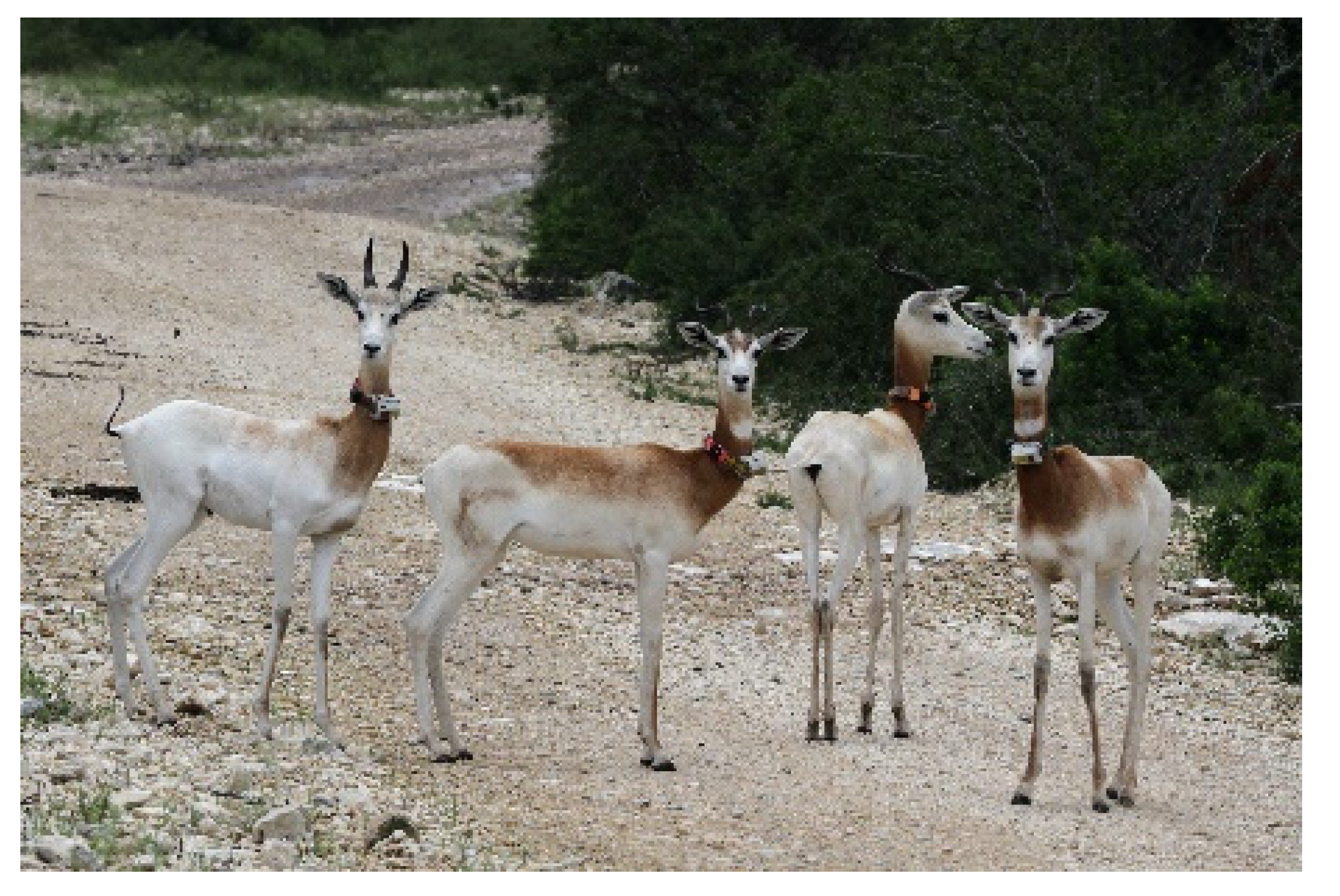
Figure 2.
Terrell County (left) where the very large West Texas pasture is located, and Uvalde County (right) where the medium size Hill Country Central Texas pasture is located. Continental United States is shown above.
Figure 2.
Terrell County (left) where the very large West Texas pasture is located, and Uvalde County (right) where the medium size Hill Country Central Texas pasture is located. Continental United States is shown above.
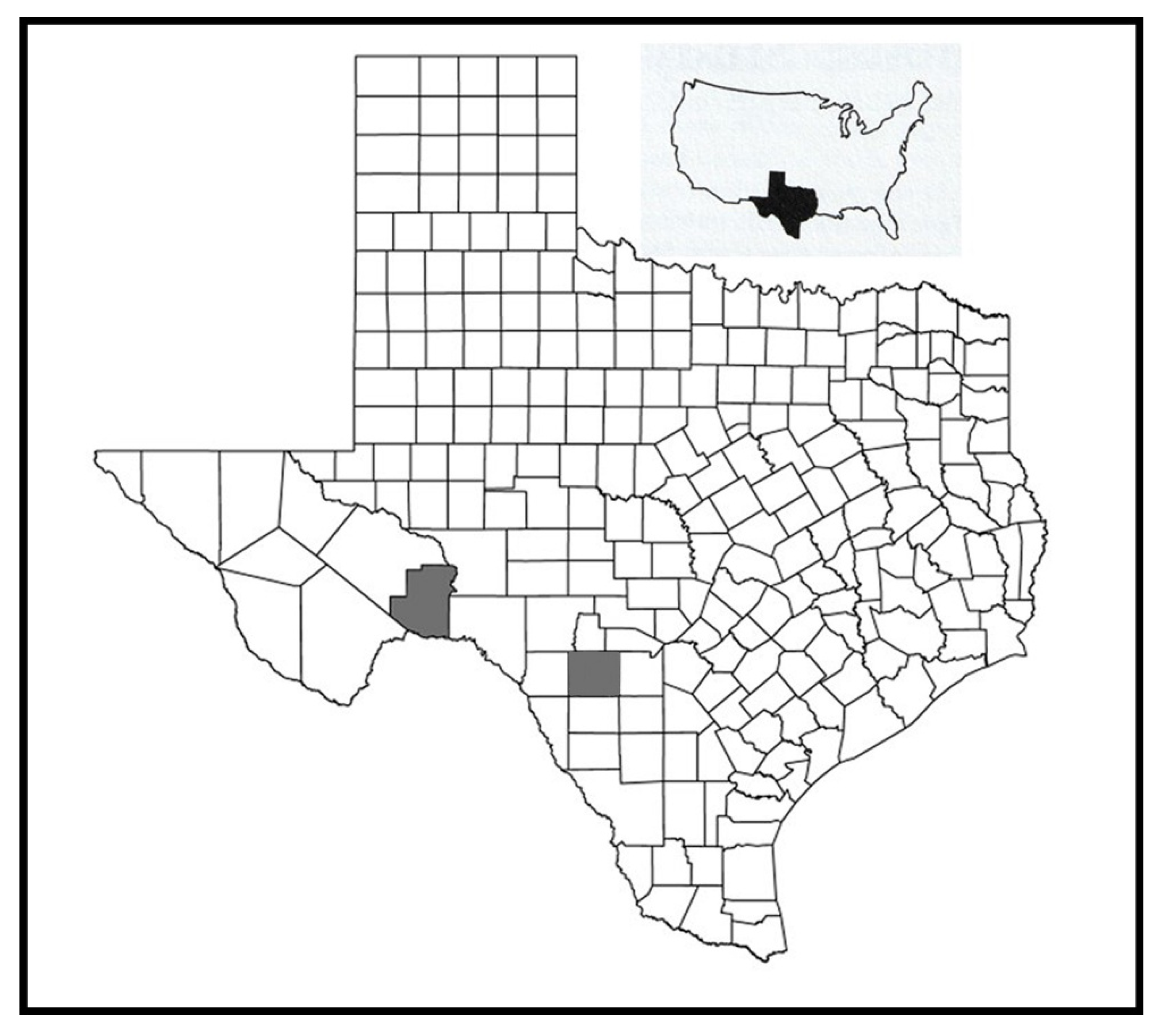
Figure 3.
This computer screen shot for “MOVEPROG” gives the standard list of 28 routines (e.g., weekly or monthly) analysis alternatives that were developed.
Figure 3.
This computer screen shot for “MOVEPROG” gives the standard list of 28 routines (e.g., weekly or monthly) analysis alternatives that were developed.
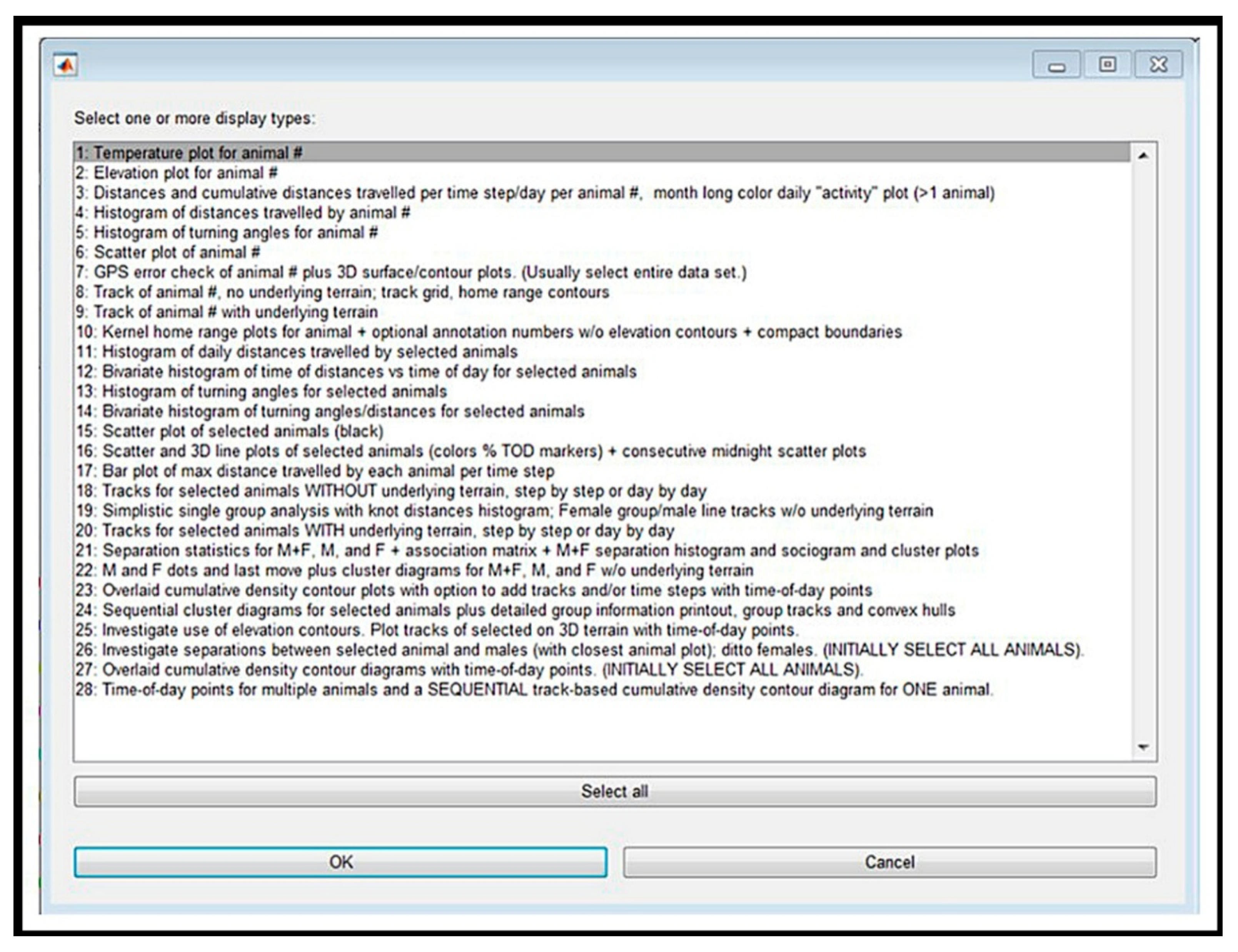
Figure 4.
Example of 2D line plot. Distance [sums of 3-hourly track lengths] per day travelled by collared dama gazelles in the medium size pasture, April 1, 00:01, to May 1, 03:01, 2015.
Figure 4.
Example of 2D line plot. Distance [sums of 3-hourly track lengths] per day travelled by collared dama gazelles in the medium size pasture, April 1, 00:01, to May 1, 03:01, 2015.
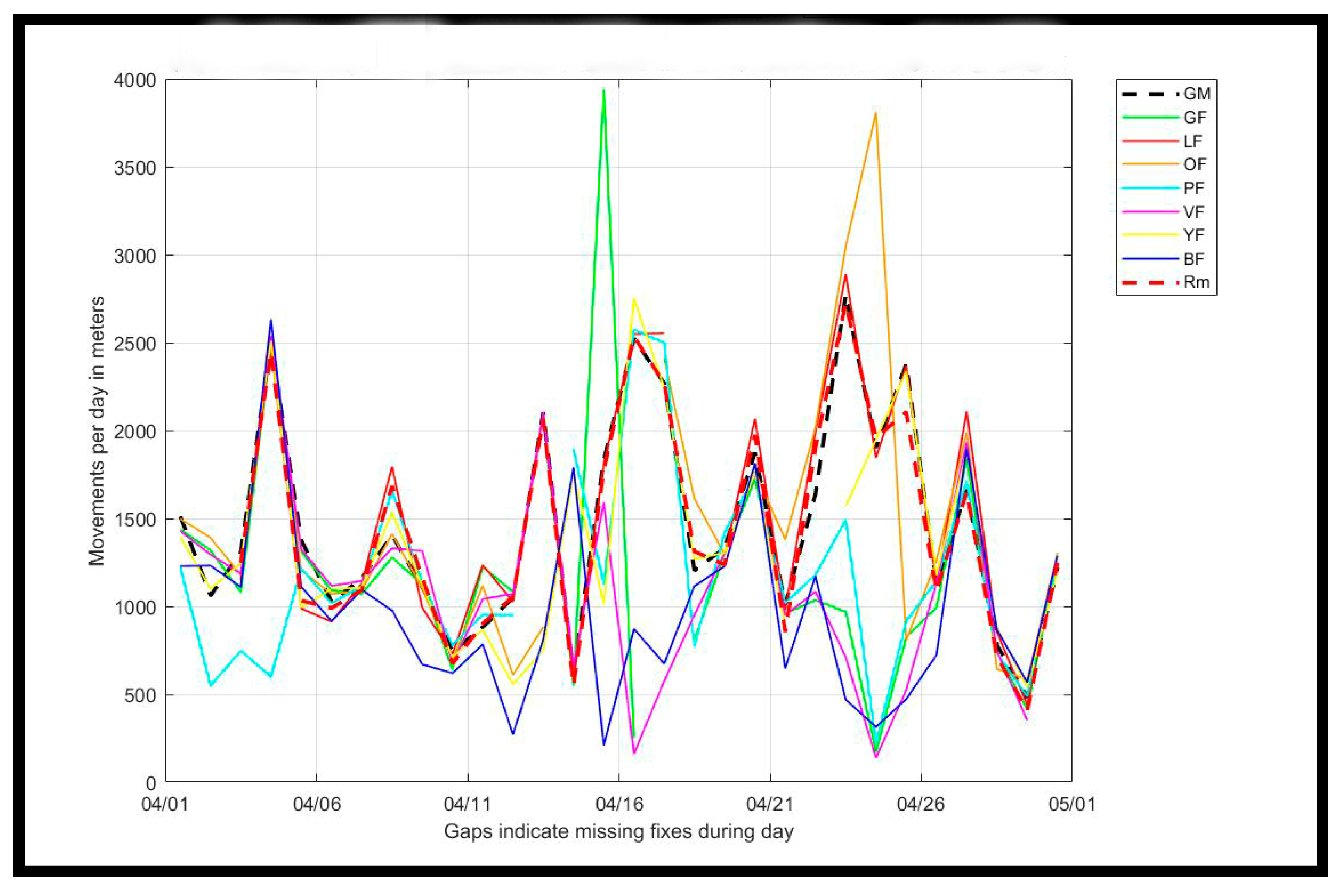
Figure 5.
a and b. Example of 3D spaghetti plots that illustrate gazelle locations over time in the medium size pasture. (a) view from southwest; (b) view from southeast (July 1, 00:01 to August 1, 03:01, 2015). Orange outline at top and bottom shows the boundaries of the pasture.
Figure 5.
a and b. Example of 3D spaghetti plots that illustrate gazelle locations over time in the medium size pasture. (a) view from southwest; (b) view from southeast (July 1, 00:01 to August 1, 03:01, 2015). Orange outline at top and bottom shows the boundaries of the pasture.
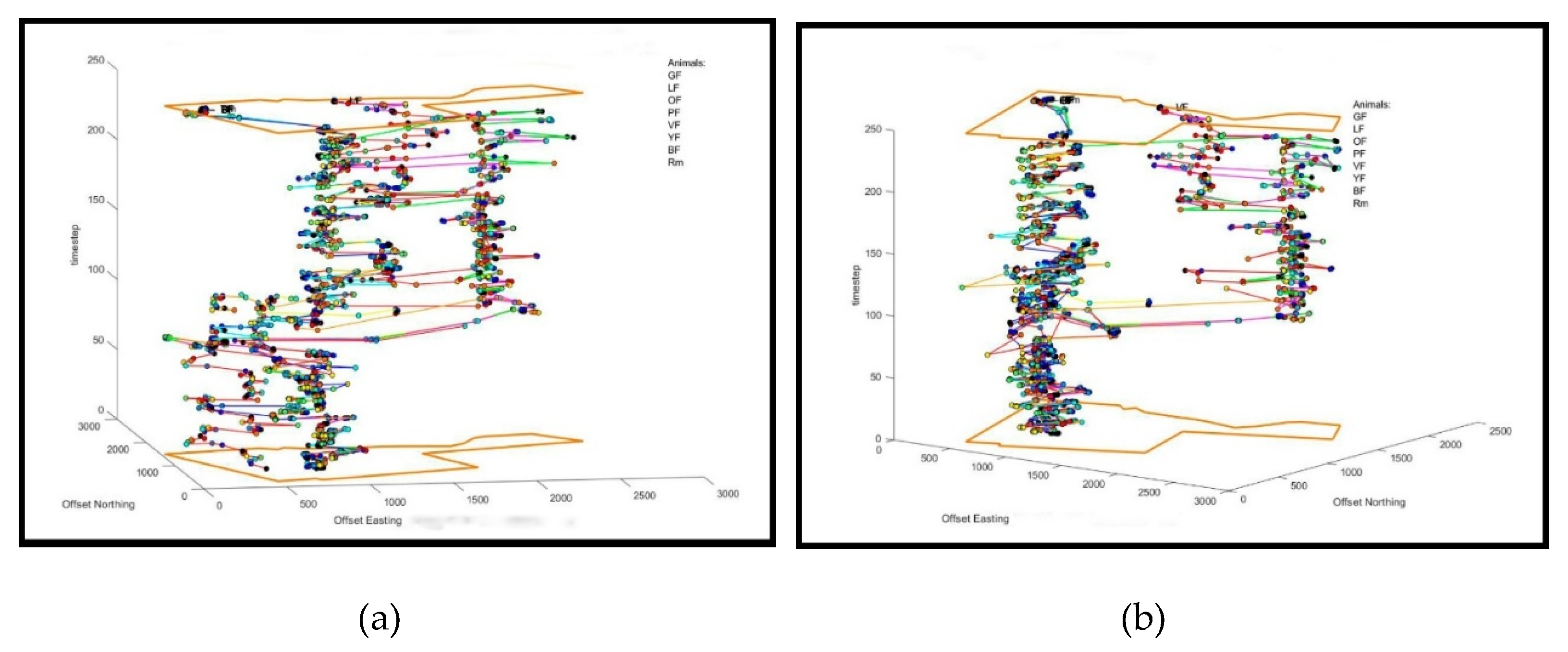
Figure 6.
2D line plot showing sums of track lengths per day for 5 males during April 2013 in the very large pasture.
Figure 6.
2D line plot showing sums of track lengths per day for 5 males during April 2013 in the very large pasture.
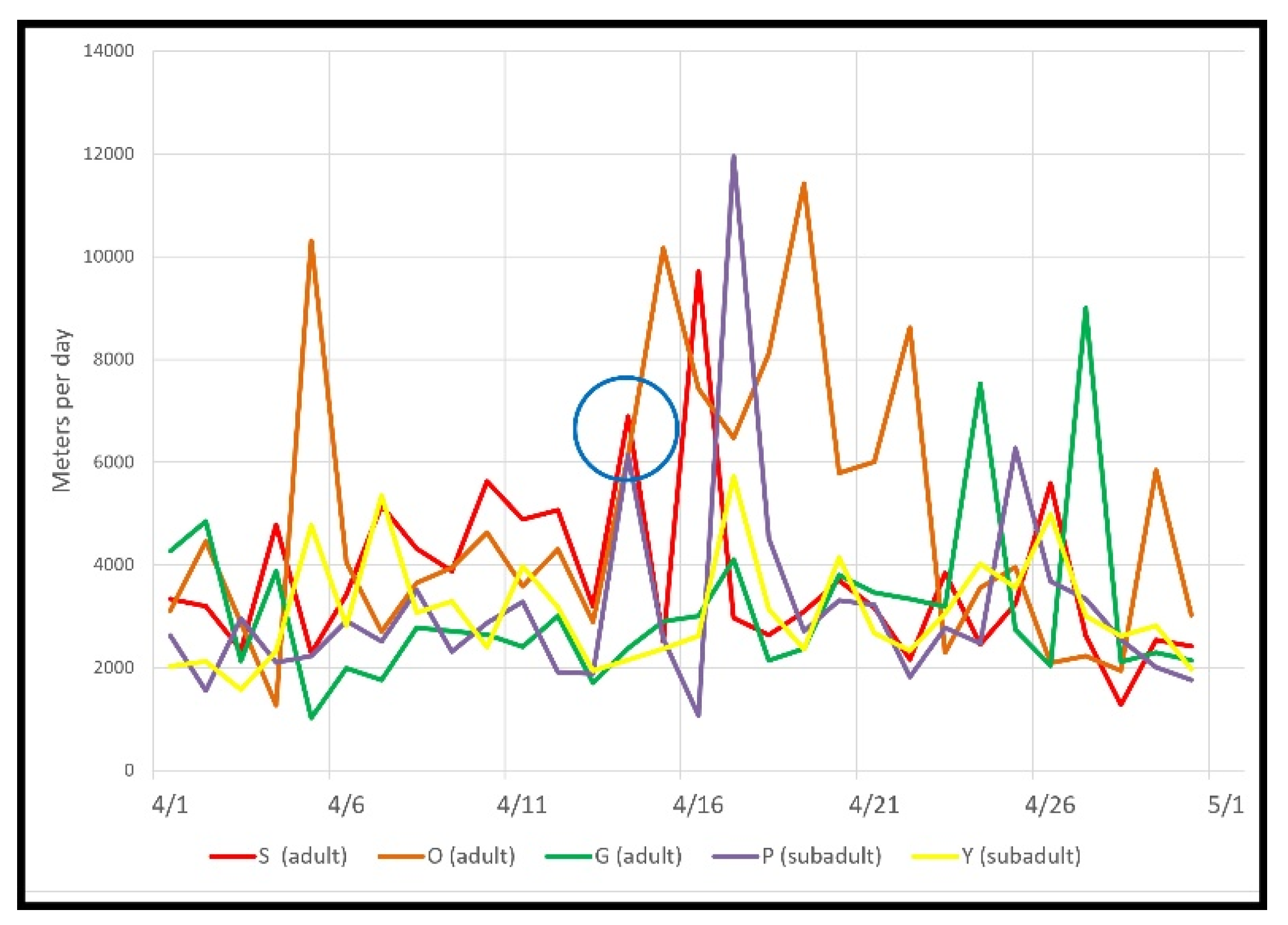
Figure 7.
3D spaghetti plot showing the excursion by subadult Purple joined by adult Stripe going out on April 14, 2013, followed by Stripe and then Purple going back separately. Later in April, adult Green made an excursion alone. Black polygon at top and bottom represents pasture boundaries.
Figure 7.
3D spaghetti plot showing the excursion by subadult Purple joined by adult Stripe going out on April 14, 2013, followed by Stripe and then Purple going back separately. Later in April, adult Green made an excursion alone. Black polygon at top and bottom represents pasture boundaries.
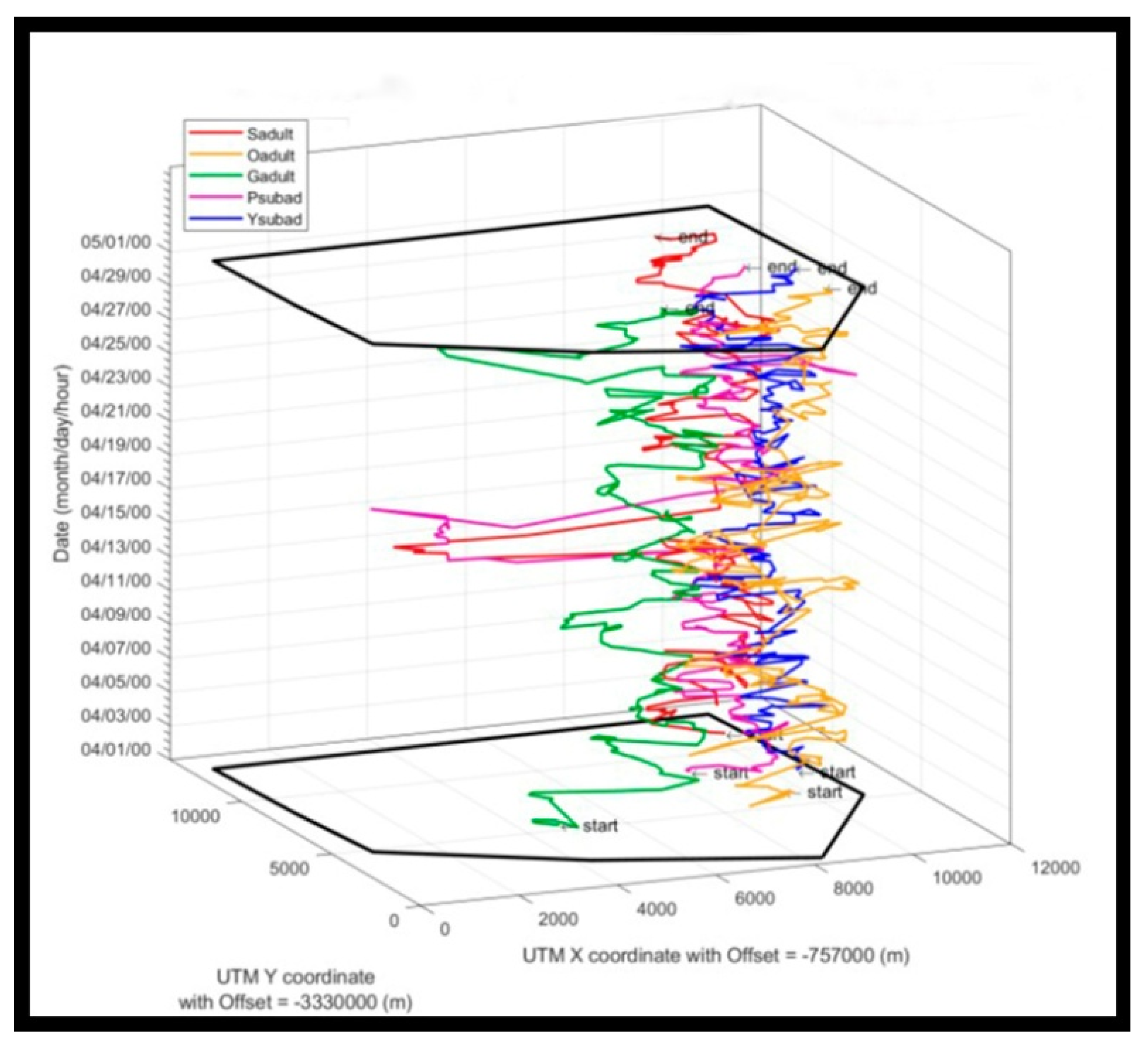
Figure 8.
a and b. Excursion in the very large pasture showing 2 males together for part of the way. (a) 2 males meet on outward journey. Box enlarges tracks for April 14. (b) males return separately.
Figure 8.
a and b. Excursion in the very large pasture showing 2 males together for part of the way. (a) 2 males meet on outward journey. Box enlarges tracks for April 14. (b) males return separately.
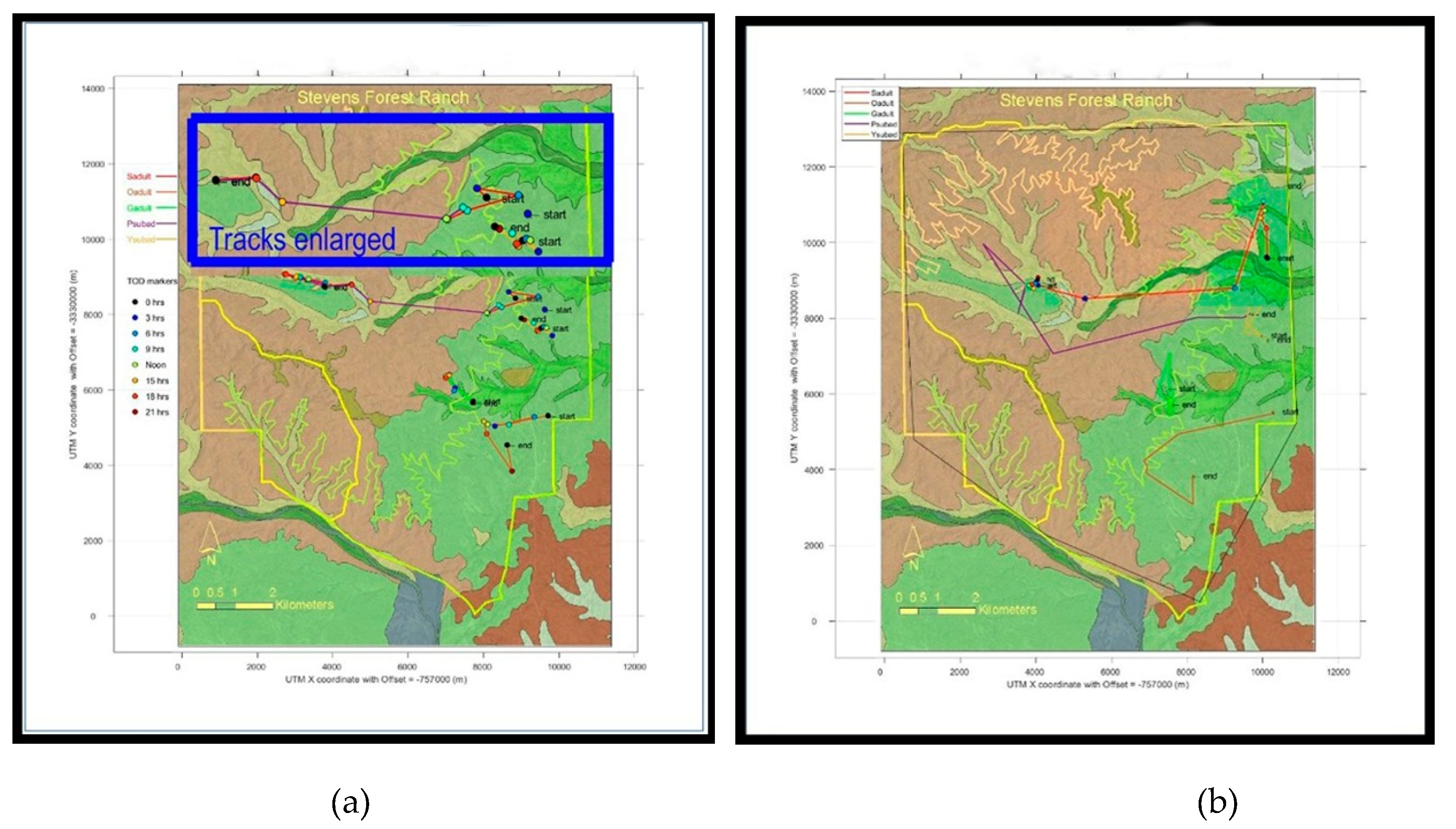
Figure 9.
a and b. Green line shows excursion by GF in medium size pasture. (a) October 4, 2015, 00:00, to 15:00. (b) October 4, 2015, 00:00 to 21:00. (Because lines are drawn straight between sequential locations, lines sometimes go outside the orange pasture boundary. However, the animals are always within the pasture.).
Figure 9.
a and b. Green line shows excursion by GF in medium size pasture. (a) October 4, 2015, 00:00, to 15:00. (b) October 4, 2015, 00:00 to 21:00. (Because lines are drawn straight between sequential locations, lines sometimes go outside the orange pasture boundary. However, the animals are always within the pasture.).
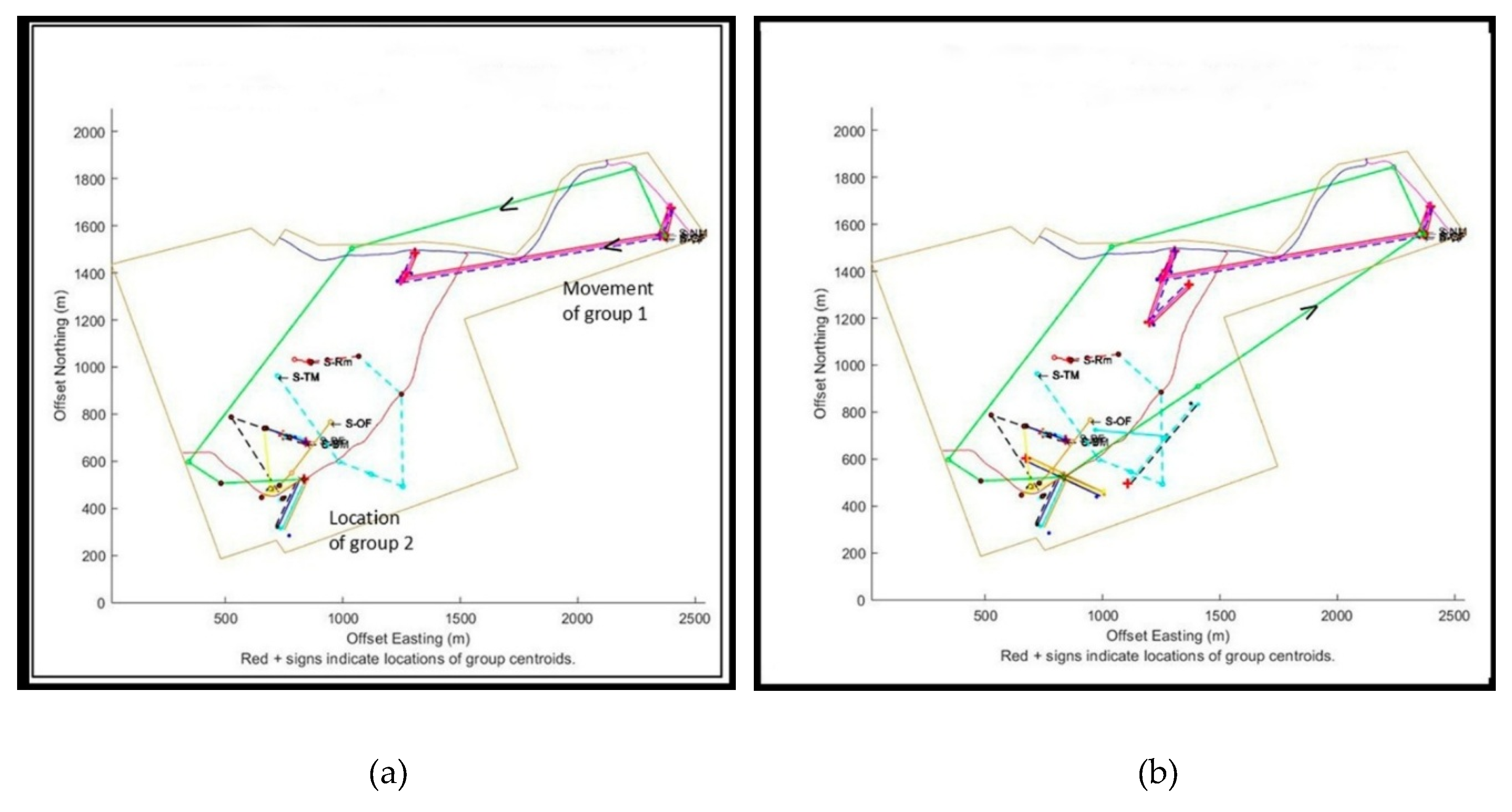
Figure 10.
3D spaghetti plot showing the excursion by GF as she separates from her group on October 4, 2015, and finally rejoins them by midnight early on October 6, 2015.
Figure 10.
3D spaghetti plot showing the excursion by GF as she separates from her group on October 4, 2015, and finally rejoins them by midnight early on October 6, 2015.
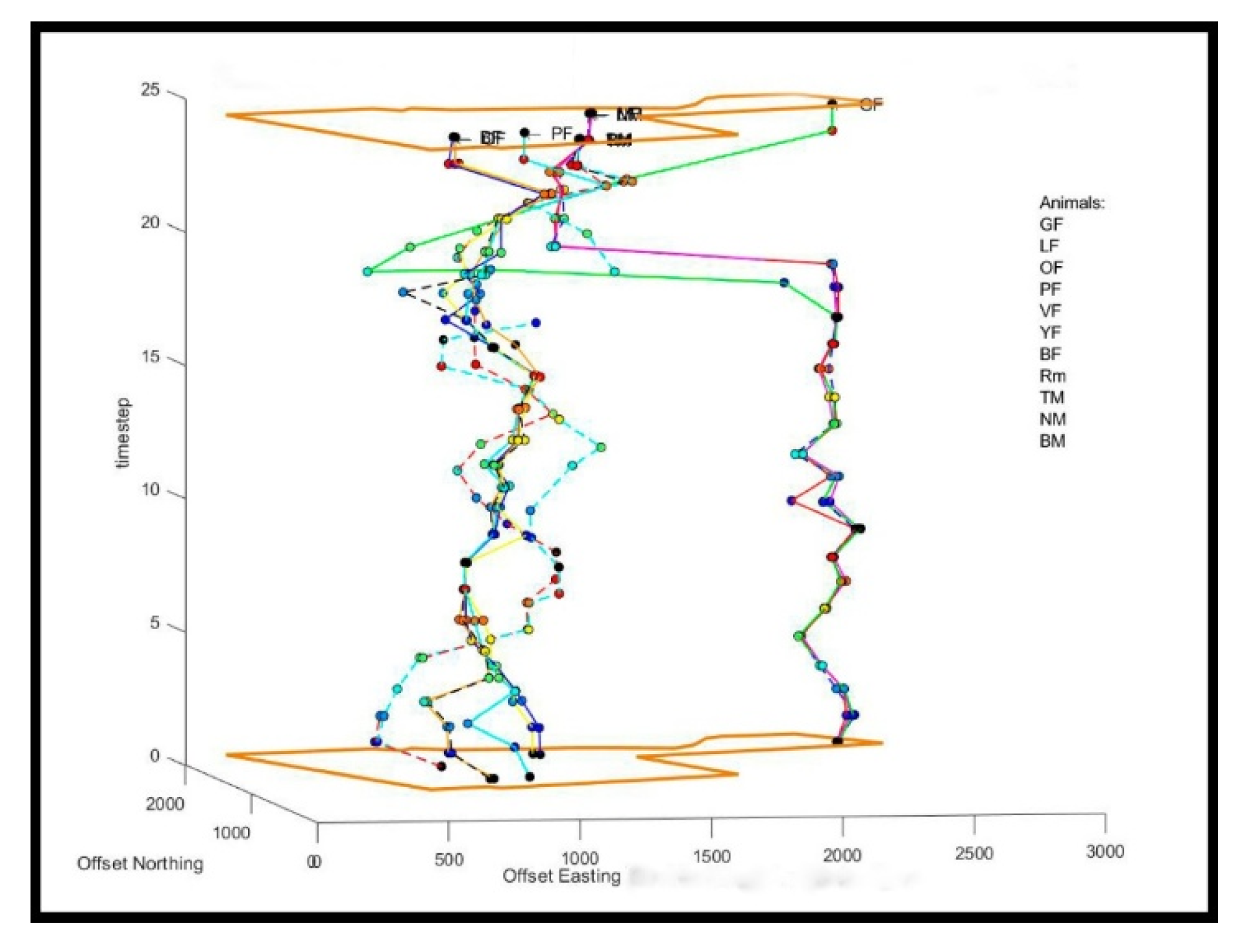

Table 1.
Number of excursions with outward travel of more than 4 km found for collared males in the very large West Texas pasture for one year (January 23, 2013, to January 23, 2014). (One subadult collar failed September 20 before study year ended.).
Table 1.
Number of excursions with outward travel of more than 4 km found for collared males in the very large West Texas pasture for one year (January 23, 2013, to January 23, 2014). (One subadult collar failed September 20 before study year ended.).
| MONTH 2013-2014 | 4> PEAK <=5 km | 5> PEAK <=6 km | 6 > PEAK | TOTAL | MAX. DISTANCE in km PER MONTH |
|---|---|---|---|---|---|
| January 2013 | 4 | 3 | 3 | 10 | 9.12 |
| February | 3 | 0 | 0 | 3 | 4.93 |
| March | 6 | 5 | 0 | 11 | 5.85 |
| April | 11 | 5 | 5 | 21 | 7.53 |
| May | 4 | 2 | 2 | 8 | 6.92 |
| June | 3 | 1 | 0 | 4 | 7.02 |
| July | 5 | 2 | 3 | 10 | 7.81 |
| August | 12 | 2 | 0 | 14 | 5.39 |
| September | 14 | 9 | 5 | 28 | 7.61 |
| October | 7 | 0 | 0 | 7 | 4.97 |
| November | 1 | 0 | 0 | 1 | 4.48 |
| December | 3 | 2 | 0 | 5 | 5.66 |
| January 2014 | 4 | 0 | 0 | 4 | 4.95 |
| TOTALS | 77 | 31 | 18 | 126 | MAXIMUM 9.12 |
Table 2.
Number of excursions with outward travel of at least 3 time steps (1 time step = 3 hr.) found for collared males and females in medium size Central Texas pasture for one year (December 19, 2014, to December 19, 2015) and maximum number of days spent. (Two female collars came off early in December.).
Table 2.
Number of excursions with outward travel of at least 3 time steps (1 time step = 3 hr.) found for collared males and females in medium size Central Texas pasture for one year (December 19, 2014, to December 19, 2015) and maximum number of days spent. (Two female collars came off early in December.).
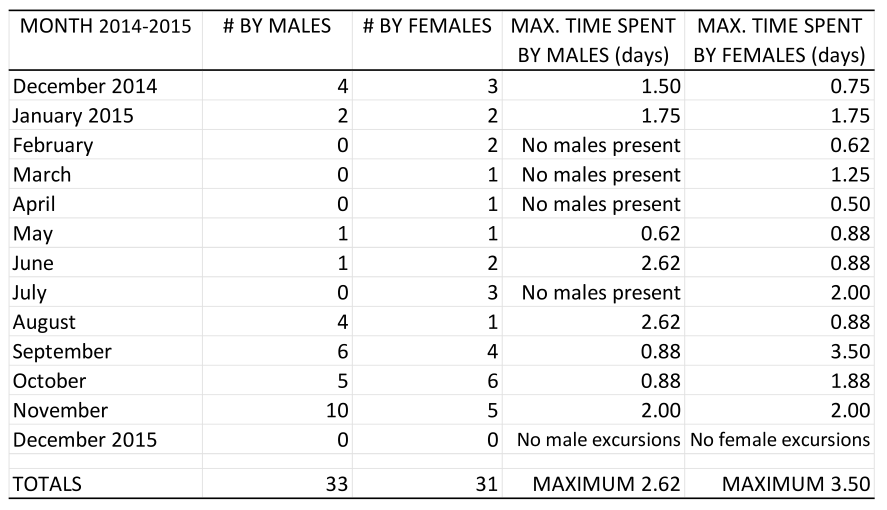 |
Table 3.
Excel investigation of one male, adult Stripe (S), for the period April 14-18, 2013, verifying movements which satisfy excursion criteria, paired with subadult Purple (P) for the outward trek in this study.
Table 3.
Excel investigation of one male, adult Stripe (S), for the period April 14-18, 2013, verifying movements which satisfy excursion criteria, paired with subadult Purple (P) for the outward trek in this study.
 |
Disclaimer/Publisher’s Note: The statements, opinions and data contained in all publications are solely those of the individual author(s) and contributor(s) and not of MDPI and/or the editor(s). MDPI and/or the editor(s) disclaim responsibility for any injury to people or property resulting from any ideas, methods, instructions or products referred to in the content. |
© 2026 by the authors. Licensee MDPI, Basel, Switzerland. This article is an open access article distributed under the terms and conditions of the Creative Commons Attribution (CC BY) license (http://creativecommons.org/licenses/by/4.0/).
Copyright: This open access article is published under a Creative Commons CC BY 4.0 license, which permit the free download, distribution, and reuse, provided that the author and preprint are cited in any reuse.