

Submitted:
11 June 2026
Posted:
12 June 2026
You are already at the latest version
Abstract
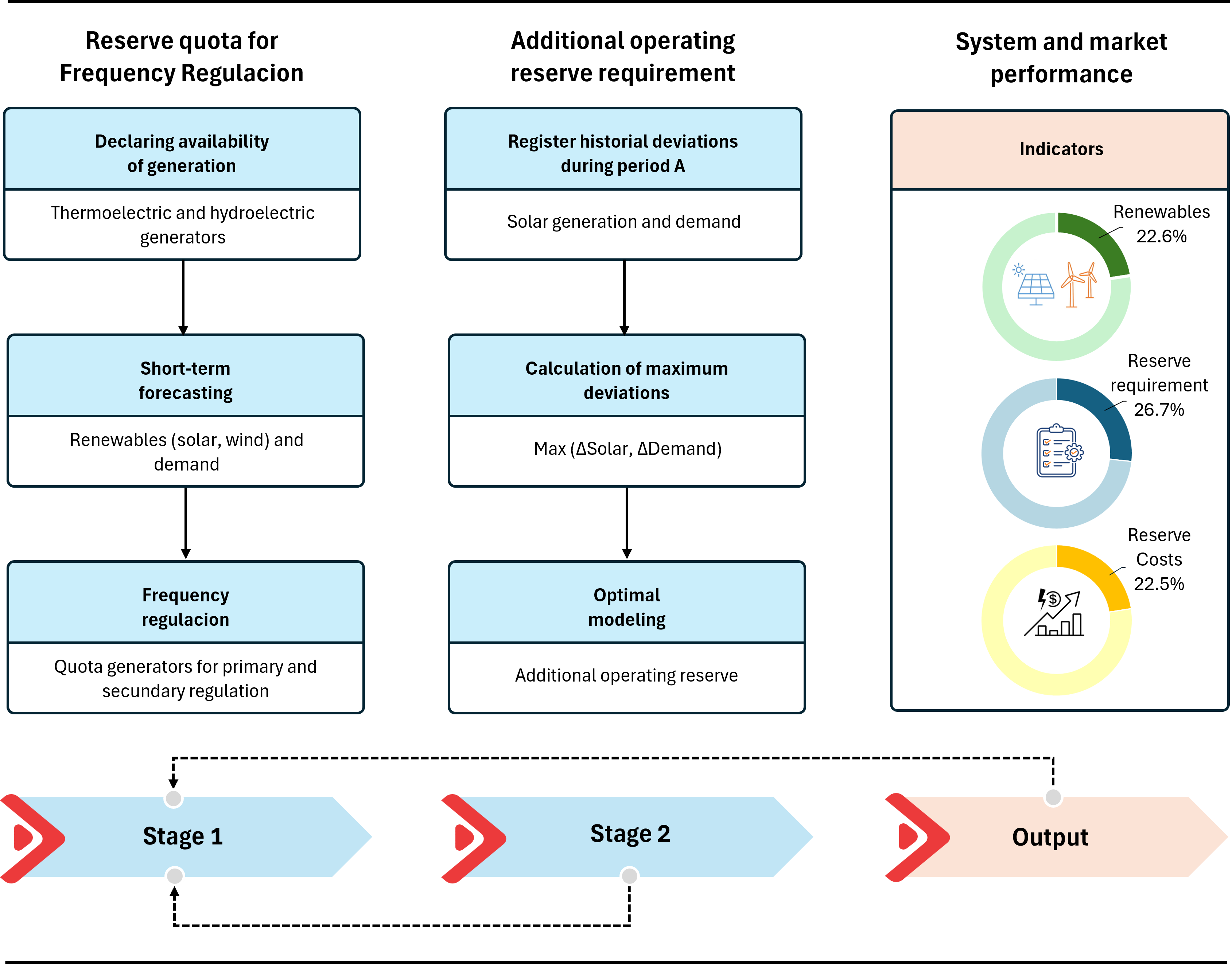
Data-constrained island power systems with increasing shares of variable renewable energy (VRE) face growing challenges in maintaining reliability while preserving market efficiency. Existing reserve sizing practices typically rely on either fixed deterministic rules or data-intensive probabilistic methods, both presenting practical limitations in Small Island Developing States (SIDS). This paper develops a market-based framework for the co-optimization of energy and operating reserves in low-inertia island power systems, in which reserve requirements are determined from historically observed extreme generation or load deviations that represent operationally validated high-risk system conditions, while reserve allocation and pricing emerge from the co-optimization process. By relying on observed operational variability, the proposed approach avoids explicit probabilistic uncertainty modeling while retaining sensitivity to system stress conditions. The approach is evaluated using a stylized island power system representative of Caribbean SIDS. Results show that reserve requirements are highly sensitive to operating conditions, reaching up to 26.7% of demand under high variability and significantly exceeding conventional fixed reserve criteria. The framework reduces non-served energy, improves reserve allocation efficiency, and generates scarcity-consistent reserve prices under stressed conditions. These findings demonstrate that the proposed methodology provides a practical intermediate solution between deterministic and probabilistic reserve sizing approaches while remaining suitable for data-constrained island power systems.
Keywords:
co-optimization
; operating reserves
; scarcity pricing
; data-constrained power systems
; island power systems
; electricity market design
Copyright: This open access article is published under a Creative Commons CC BY 4.0 license, which permit the free download, distribution, and reuse, provided that the author and preprint are cited in any reuse.


