

Submitted:
11 June 2026
Posted:
12 June 2026
You are already at the latest version
Abstract
Metallic powder systems containing niobium play a key role in the development of advanced materials for structural, biomedical, energy, and surface-engineering applications. The incorporation of niobium into metallic powders influences particle behavior during processing, phase stability, microstructural evolution, and the resulting mechanical and corrosion properties of consolidated materials. This review examines the scientific and technological advances related to niobium-containing metallic powders, covering powder production routes, particle characterization methods, processing techniques, and performance evaluation. Publications on powder metallurgy, additive manufacturing, thermal processing, surface modification, and corrosion-resistant materials were analyzed to identify relationships among powder characteristics, processing conditions, and material performance. The available evidence indicates that niobium contributes to grain refinement, precipitation control, microstructural stabilization, improved resistance to wear, and localized corrosion. The element also expands the applicability of metallic powders in functional coatings, biomaterials, engineered surfaces, and components manufactured from particulate feedstocks. Current challenges involve powder homogeneity, process reproducibility, economic considerations, and the prediction of long-term service behavior. The analysis highlights niobium's contribution to the design of high-performance metallic powder systems and identifies research directions for developing materials with enhanced reliability and industrial applicability.
Keywords:
niobium-containing powders
; metallic powder systems
; powder processing
; particle characterization
; powder metallurgy
; microstructural evolution
1. Introduction
Metallic powder systems have become increasingly important in modern manufacturing because they enable the production of components with controlled composition, tailored microstructures, and near-net-shape geometries. Powder-based technologies are currently employed in powder metallurgy, additive manufacturing, thermal spraying, and advanced coating processes, offering opportunities to improve material utilization and enhance engineering performance [1,2,3]. The continuous expansion of these technologies has spurred significant research to elucidate the relationships among powder characteristics, processing conditions, microstructural evolution, and final material properties [4].
Particle-related parameters, including particle size distribution, morphology, apparent density, and flowability, strongly influence the performance of powder-derived materials. These characteristics affect powder handling, packing behavior, layer deposition, densification kinetics, and defect formation during manufacturing operations [5,6]. Consequently, particle engineering and powder characterization have become essential components of modern powder technology, particularly in applications requiring high dimensional accuracy and reproducible performance.
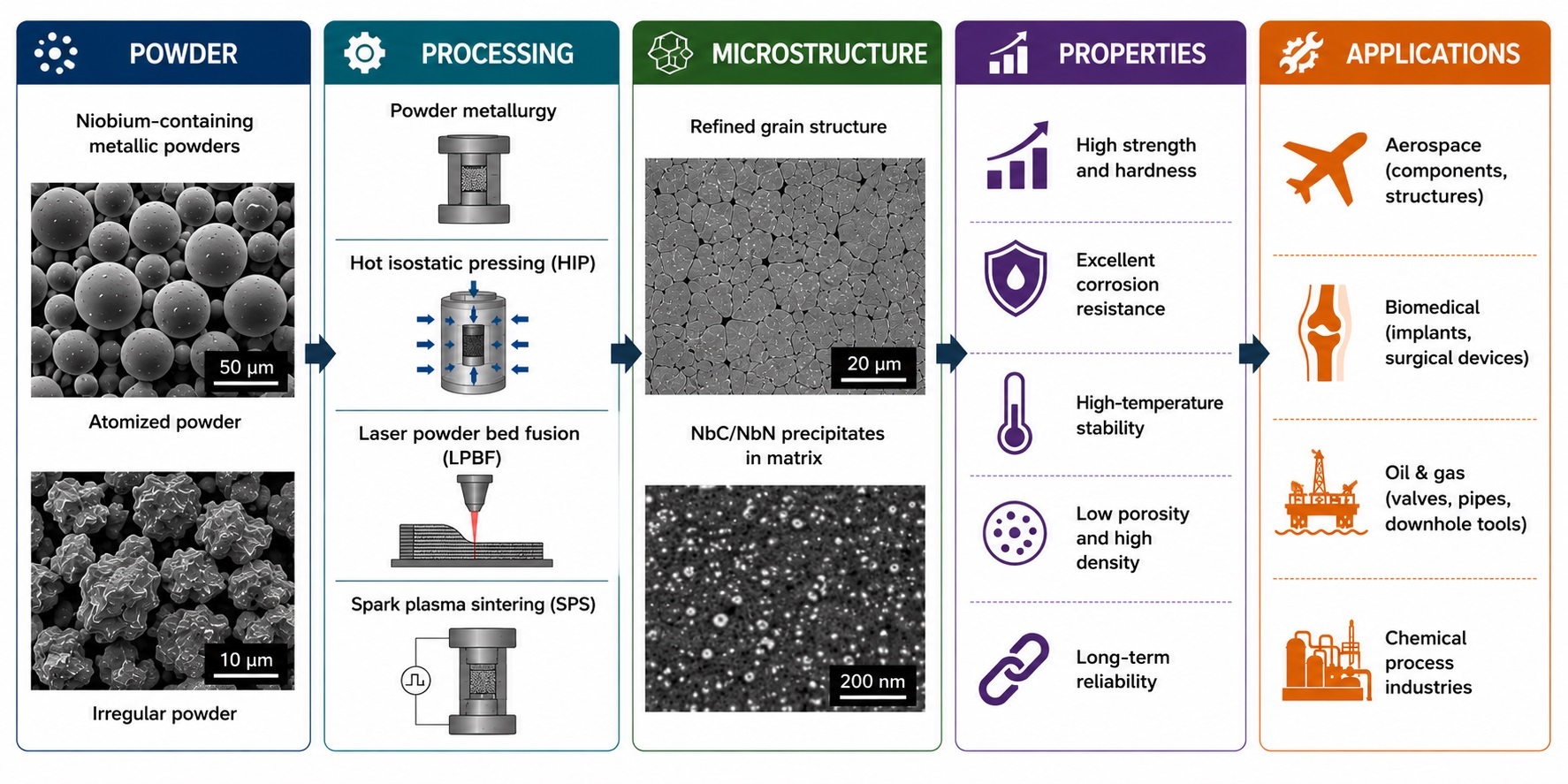
Among the alloying elements used in advanced metallic materials, niobium has attracted increasing attention for its effects on phase stability, precipitation behavior, grain refinement, and corrosion resistance [7]. In recent years, the growing availability of niobium-containing powders and the development of advanced processing technologies have expanded the potential application of niobium in powder-derived materials [8]. Furthermore, niobium-containing systems have been investigated in fields ranging from additive manufacturing to biomedical engineering, where enhanced microstructural stability and long-term reliability are frequently required [9,10]. The broad scientific relationships connecting powder production, characterization, processing routes, microstructural evolution, corrosion performance, sustainability, and engineering applications are illustrated in Figure 1.
To facilitate the interpretation of the processing–microstructure–property relationships discussed throughout this review, selected illustrative micrographs were incorporated into the figures as representative examples of particle morphology, microstructural evolution, and phase-related features reported for metallic powders and niobium-containing powder systems [11,12,13,14,15,16,17,18,19,20,21,22,23,24,25,26,27,28,29,30,31,32,33,34,35,36,37,38,39,40]. These images provide visual support for concepts discussed in the literature, including powder production, particle characterization, consolidation behavior, phase stability, and microstructural development [11,12,13,14,15,16,17,18,19,20,21,22,23,24,25,26,27,28,29,30,31,32,33,34,35,36,37,38,39,40]. Representative optical and scanning electron microscopy observations were derived from research activities conducted at the Federal University of Itajubá (UNIFEI) between 2013 and 2026 in the fields of powder metallurgy, additive manufacturing, metallic biomaterials, surface engineering, and materials characterization. Metallographic specimens associated with these investigations were prepared using conventional grinding and polishing procedures followed by alloy-specific chemical etching to reveal characteristic microstructural features. Optical characterization was performed using an Olympus BX53M microscope, while higher-magnification observations were obtained with a TESCAN VEGA 3 scanning electron microscope, operating primarily in secondary-electron imaging mode. Typical SEM operating conditions involved accelerating voltages between 5 and 20 kV and working distances between 8 and 15 mm, selected according to particle size, surface morphology, and microstructural scale. The micrographs presented in this review are intended exclusively as qualitative and illustrative material to support the interpretation of mechanisms discussed in the cited literature. They should not be interpreted as a quantitative dataset for direct comparison among studies.
The increasing adoption of advanced powder-processing technologies has intensified interest in niobium-containing metallic powders, as these materials often undergo complex thermal histories during manufacturing. Processes such as laser powder bed fusion, directed energy deposition, and advanced sintering involve rapid heating and cooling cycles, steep thermal gradients, and non-equilibrium solidification conditions that can significantly alter phase formation and microstructural stability [3,7,43,44,45,46,47,48,49,50]. Under these conditions, the material’s response depends not only on alloy composition but also on particle characteristics, powder homogeneity, and processing parameters. For niobium-containing systems, these interactions are particularly important because niobium influences diffusion behavior, phase stability, and precipitation phenomena, all of which contribute to the final mechanical and corrosion performance of powder-derived components [31,32,33,34,35,36,37,38,39,40,54,55,56,57,58,59,60].
Although substantial progress has been made in the study of niobium-containing materials, the available literature remains dispersed across several research domains, including powder metallurgy, additive manufacturing, biomaterials, corrosion science, and surface engineering. Consequently, information concerning powder production, particle characterization, processing routes, microstructural evolution, and engineering performance is often fragmented across specialized disciplines. An integrated assessment is therefore necessary to establish broader scientific connections and identify future research directions relevant to powder technology.
The influence of powder characteristics on processing behavior and final material performance is summarized in Table 1. These parameters constitute the foundation of powder engineering and directly affect densification, microstructural evolution, and engineering reliability.
The objective of this review is to provide a comprehensive assessment of niobium-containing metallic powder systems, with emphasis on powder production, particle characterization, processing routes, microstructural evolution, corrosion behavior, sustainability aspects, and industrial applications. Attention is given to the mechanisms through which niobium influences powder-derived materials and to the opportunities that may support future developments in particulate materials engineering.
2. Review Methodology
2.1. Literature Search and Classification
This review was developed to provide a comprehensive and critical assessment of niobium-containing metallic powder systems, with emphasis on powder production, particle characterization, processing routes, microstructural evolution, corrosion behavior, sustainability aspects, and engineering applications. The methodological approach was designed to identify scientific advances and technological trends relevant to powder technology while maintaining a direct connection with the scope of particulate materials and powder-based manufacturing processes [1,2,3,4].
The literature survey was conducted using peer-reviewed journal articles, review papers, conference proceedings, books, and technical reports addressing metallic powders, powder metallurgy, additive manufacturing, particle characterization, niobium-containing alloys, corrosion behavior, and advanced engineering applications. Attention was given to publications describing powder-related phenomena, processing–microstructure relationships, and performance evaluation of powder-derived materials [5,6,7,8,9,10]. The methodological sequence adopted for literature identification, thematic classification, critical evaluation, and synthesis is presented in Figure 2.
The collected literature was subsequently organized into thematic categories corresponding to the principal stages of the life cycle of metallic powder systems. The classification strategy enabled the integration of studies originating from different scientific disciplines while preserving a powder-technology perspective. This approach facilitated the evaluation of relationships among powder characteristics, processing conditions, microstructural evolution, and engineering performance [3,5,6,7,8].
To facilitate a systematic evaluation of the literature, the collected studies were organized into thematic categories according to their primary scientific focus. The classification framework adopted in this review is presented in Table 2.
The review emphasizes studies that provide detailed information concerning powder characteristics and their influence on processing and performance. Preference was given to publications presenting quantitative analyses, reproducible methodologies, and clear descriptions of powder-processing conditions. Recent studies published during the last decade were prioritized, while classical references were retained when necessary to establish the theoretical foundations of powder metallurgy, particle characterization, corrosion science, and phase-transformation behavior [1,2,3,4,5,6].
A critical-analysis approach was adopted throughout the review rather than a simple descriptive compilation of published information. The selected literature was evaluated to identify convergent findings, unresolved scientific questions, technological limitations, and future research opportunities. Emphasis was placed on understanding the role of niobium in modifying the behavior of metallic powder systems and on identifying knowledge gaps relevant to the future development of powder-based technologies [7,8,9,10].
The resulting framework provides the basis for the subsequent sections of this review, which examine fundamental aspects of metallic powder systems, the characteristics of niobium-containing powders, processing routes, microstructural evolution, corrosion performance, sustainability considerations, and emerging research directions in powder technology.
2.2. Bibliometric Overview of the Reviewed Literature
In addition to the thematic classification adopted in this review, a qualitative bibliometric assessment was conducted to examine the temporal evolution of the scientific literature on niobium-containing metallic powder systems. The objective was not to conduct a formal bibliometric study but rather to identify the principal research trends represented within the body of literature analyzed in this review.
The reviewed publications indicate a progressive expansion of research activity in this field over the last two decades. Early investigations were primarily focused on powder metallurgy fundamentals, powder production technologies, particle characterization methods, and the influence of alloying elements on phase stability and processing behavior [1,2,3,4,5,6,7,8,9,10]. As powder-based manufacturing technologies evolved, research efforts increasingly addressed microstructural development, phase transformations, and the relationships between processing parameters and material performance [11,12,13,14,15,16,17,18,19,20,21,22,23,24,25].
A significant increase in scientific interest is evident during the period of rapid development of additive manufacturing technologies and advanced powder-processing routes. During this stage, studies expanded beyond conventional powder metallurgy to emphasize process optimization, thermal history effects, corrosion performance, and application-specific alloy development [26,27,28,29,30,31,32,33,34,35,36,37,38,39,40,41,42,43,44,45,46,47,48,49,50]. More recently, the literature has increasingly incorporated computational thermodynamics, CALPHAD-based methodologies, sustainability considerations, powder recycling strategies, and data-driven approaches for materials design and process optimization [51,52,53,54,55,56,57,58,59,60,61,62,63,64,65,66,67,68,69,70,71,72,73,74,75,76,77,78,79,80].
The evolution of the principal research topics represented in the reviewed literature is summarized in Table 3. The observed progression demonstrates how the field has evolved from traditional powder-processing investigations toward integrated studies combining powder engineering, advanced manufacturing, microstructural design, corrosion science, sustainability assessment, and computational materials development.
The bibliometric trends identified in the reviewed literature suggest that future research will increasingly focus on integrated processing–microstructure–performance relationships supported by computational modeling, advanced characterization techniques, and sustainability-oriented manufacturing strategies. This evolution reflects the growing complexity of powder-based technologies and the increasing demand for materials capable of simultaneously meeting mechanical, corrosion, environmental, and industrial performance requirements.
Although the present assessment is qualitative, the observed evolution of research topics clearly indicates increasing convergence among powder engineering, advanced manufacturing, corrosion science, computational materials design, and sustainability. This multidisciplinary trend provides the foundation for the thematic organization adopted throughout the present review.
3. Fundamentals of Metallic Powder Systems
Metallic powder systems constitute the foundation of numerous manufacturing technologies, including powder metallurgy, additive manufacturing, thermal spraying, and metal injection molding. The performance of powder-derived materials is strongly influenced by powder characteristics established during production, such as particle size distribution, morphology, internal defects, chemical composition, and surface condition [11,12,13]. Consequently, understanding the fundamental aspects of powder generation and characterization is essential for the development of advanced metallic materials.
Several production routes are currently employed to manufacture metallic powders. Among them, gas atomization, water atomization, plasma atomization, and mechanical comminution are the most widely used industrial techniques. Each route produces powders with distinct particle morphologies, size distributions, and surface characteristics, which directly influence subsequent processing stages [14,15]. The selection of a production method, therefore, depends on the intended application, required powder quality, and economic considerations.
The growing adoption of powder-based manufacturing technologies has increased the demand for powders exhibiting high reproducibility and controlled particle characteristics. In additive-manufacturing applications, particle morphology and particle-size distribution significantly affect powder spreading, layer uniformity, and process stability [16,17]. The principal powder-production routes and their influence on particle characteristics and manufacturing applications are summarized in Figure 3.
Particle morphology is one of the most important parameters affecting powder behavior. Spherical particles exhibit superior flowability and packing characteristics when compared with irregular particles, making them particularly attractive for additive manufacturing applications [18,19]. However, irregular particles may be advantageous in certain powder metallurgy operations where mechanical interlocking contributes to green strength and compaction behavior. The influence of particle morphology, therefore, depends on both the manufacturing route and the intended engineering application.
In addition to morphology, particle size distribution plays a critical role in powder performance. Narrow particle size distributions may improve process consistency, whereas broader distributions can enhance packing density through the occupation of interparticle voids by smaller particles [20,21]. The optimization of particle size distribution is therefore frequently used as a strategy to improve powder-bed quality, densification efficiency, and the integrity of the final component.
The reuse and recycling of metallic powders have become increasingly important topics in powder technology. Repeated processing cycles may alter particle morphology, surface chemistry, oxygen content, and flowability characteristics, potentially affecting manufacturing consistency and final material properties [22,23]. Consequently, continuous powder characterization has become an essential requirement for ensuring process reliability and maintaining quality standards in advanced manufacturing environments.
The principal production routes for metallic powders differ in particle morphology, powder quality, and industrial applicability. These characteristics are summarized in Table 4.
Recent advances in powder characterization techniques have enabled a more comprehensive evaluation of powder behavior prior to processing. Modern approaches integrate particle-size analysis, flowability measurements, density evaluation, image analysis, and surface characterization to establish relationships between powder properties and manufacturing performance [24]. These developments contribute to improved process control and support the production of components with higher quality and reliability.
Metallic powder systems exhibit behavior that results from the combined effects of particle characteristics, processing conditions, and application-specific requirements. Consequently, powder production and characterization are not merely preliminary manufacturing steps but key factors governing densification, microstructural evolution, and final component performance. These aspects are particularly relevant when evaluating the role of niobium in powder-derived materials, as discussed in the following section [25].
4. Niobium-Containing Metallic Powders
Niobium has attracted considerable interest in materials engineering because of its ability to modify phase stability, precipitation behavior, grain growth, and diffusion-controlled transformations. These characteristics have promoted the incorporation of niobium into a wide range of metallic systems intended for structural, functional, biomedical, and surface-engineering applications [26,27,28]. In powder-based technologies, the addition of niobium offers opportunities to tailor microstructural evolution during consolidation and thermal processing, contributing to the development of materials with enhanced performance and reliability.
The increasing availability of high-quality metallic powders has facilitated the development of niobium-containing systems produced via powder metallurgy and additive manufacturing. The use of niobium as an alloying element has been associated with improvements in strength, thermal stability, and corrosion resistance, depending on alloy composition and processing conditions [29,30]. In addition, niobium may influence phase formation and transformation mechanisms, which are particularly important in powder-derived materials subjected to rapid thermal cycles and non-equilibrium solidification conditions.
Among the most widely investigated systems are titanium-based alloys containing niobium. These materials have received significant attention because niobium serves as a strong β-phase stabilizer and may enhance mechanical compatibility and corrosion resistance in biomedical applications [31,32,33,34,35]. The principal mechanisms by which niobium influences phase stability, grain refinement, precipitation behavior, and engineering performance are schematically illustrated in Figure 4.
In addition to titanium-based alloys, niobium has been incorporated into nickel-containing systems and shape-memory materials. The presence of niobium may modify transformation behavior, precipitation kinetics, and microstructural stability, thereby influencing the functional response of these materials [30,31]. Such effects are particularly relevant in powder-derived alloys where thermal processing conditions can strongly affect phase evolution and the resulting engineering properties.
Recent developments have also expanded the application of niobium to advanced alloy concepts, including refractory alloys and multi-principal-element systems. In these materials, niobium frequently contributes to phase stabilization and high-temperature performance, making it attractive for demanding engineering environments [36,37,38,39,40]. The increasing interest in these systems reflects the broader trend toward designing materials capable of operating under severe thermal and mechanical conditions.
The influence of niobium on powder-derived metallic materials cannot be attributed to a single strengthening mechanism. Instead, its effects arise from interactions among thermodynamic phase stability, diffusion kinetics, and precipitation phenomena that occur during thermal processing. In titanium-based systems, niobium acts primarily as a β-phase stabilizer, reducing the tendency for α-phase formation and promoting a lower elastic modulus, which is desirable for biomedical applications [26,31,33]. In iron-containing alloys, niobium frequently contributes to grain refinement through the formation of Nb-rich carbides and carbonitrides that restrict grain-boundary migration during thermal exposure [36,37].
The mechanisms by which niobium influences powder-derived metallic systems vary with alloy family, niobium content, and processing route. In titanium-based systems, niobium is associated with β-phase stabilization and reduced elastic modulus. In contrast, in iron-containing alloys, it is commonly related to carbide or carbonitride precipitation and grain-boundary pinning [26,31,33,36,37]. In nickel- and NiTi-based systems, niobium may modify transformation behavior, precipitation kinetics, and corrosion response [30,32]. These differences are summarized in Table 5, which compares representative niobium-containing powder systems according to composition range, processing route, microstructural effect, and performance outcome.
Although the beneficial effects of niobium additions are widely recognized, the magnitude of the reported improvements varies according to alloy composition, niobium concentration, powder characteristics, and processing route. Representative quantitative trends extracted from the literature are summarized in Table 6. The reported ranges should be interpreted as indicative values because processing conditions, thermal history, and characterization methodologies differ among investigations [26,27,28,29,30,31,32,33,34,35,36,37,38,39,40].
The information presented in Table 6 signifies that the contribution of niobium cannot be associated with a single strengthening or stabilization mechanism. Instead, its influence results from a combination of phase stabilization, precipitation control, grain refinement, and diffusion-related effects whose relative importance depends on the alloy system and processing history. These observations reinforce the need to evaluate niobium-containing powder systems within a processing–microstructure–performance framework rather than considering composition alone [31,32,33,34,35,36,37,38,39,40].
Reported improvements associated with niobium additions vary among alloy systems and processing routes [26,31,33,36,37,38,39,40]. While Ti–Nb alloys are primarily investigated for reductions in elastic modulus and improvements in biocompatibility [26,31,33], Fe–Nb systems are more commonly associated with precipitation strengthening and grain-boundary pinning [36,37], whereas Ni–Nb and NiTiNb systems have been linked to transformation control, surface stability, and corrosion-related benefits [29,30,32]. These differences indicate that the contribution of niobium should be interpreted in the context of the specific alloy system, processing route, and target application rather than as a universally transferable effect [31,32,33,34,35,36,37,38,39,40].
The behavior of niobium-containing powder systems cannot be generalized across different alloy families. While Ti–Nb alloys are primarily associated with β-phase stabilization and biomedical performance, Fe–Nb systems often derive their benefits from precipitation-assisted grain refinement, and refractory Nb-containing alloys are commonly investigated for thermal stability at elevated temperatures [31,32,33,34,35,36,37,38,39,40]. These differences emphasize that the contribution of niobium must be evaluated within the context of each alloy system, processing route, and intended application.
The next section examines the principal processing routes employed in metallic powder systems, emphasizing the relationships among powder characteristics, consolidation mechanisms, thermal history, and material behavior in niobium-containing alloys.
5. Processing Routes
The performance of metallic powder systems is strongly dependent on the processing route employed during consolidation and manufacturing. Although powder characteristics establish the initial conditions for processing, the thermal and mechanical history imposed during manufacturing determines phase evolution, defect formation, densification behavior, and final material performance [41,42]. Consequently, the selection and optimization of processing routes represent critical stages in the development of niobium-containing metallic powder systems.
Powder metallurgy remains one of the most widely used technologies for consolidating metallic powders. This route typically involves powder preparation, compaction, and sintering, allowing the production of components with controlled composition and low material waste [41]. The effectiveness of powder metallurgy processing depends on powder characteristics, compaction conditions, diffusion mechanisms, and thermal treatment parameters, all of which influence densification and microstructural development [42].
The rapid expansion of additive manufacturing has significantly increased the importance of powder-based processing technologies. Additive manufacturing enables the fabrication of complex geometries while maintaining a high degree of material utilization efficiency [43,44]. The relationships among the principal powder-processing routes, densification mechanisms, thermal history, and engineering performance are illustrated in Figure 5.
Among additive-manufacturing technologies, laser powder bed fusion has emerged as one of the most important methods for producing high-performance metallic components. In this process, thin layers of powder are selectively melted using a focused laser beam, generating highly localized thermal gradients and rapid cooling rates [43,46]. These conditions frequently result in non-equilibrium microstructures and complex phase-transformation phenomena, which are particularly relevant in niobium-containing alloys due to their sensitivity to thermal history and diffusion-controlled processes.
Thermal spraying represents another important processing route for metallic powders. Unlike powder metallurgy and additive manufacturing, thermal-spray technologies are primarily employed to produce coatings rather than fully consolidated components [47,48]. In these processes, powder particles are heated and accelerated toward a substrate, forming protective or functional surface layers that improve wear resistance, corrosion resistance, thermal insulation, and surface durability.
Electrodeposition and powder-assisted electrochemical processing routes have also been investigated to incorporate metallic particles into coatings and composite surface layers. These approaches provide opportunities for tailoring surface composition and microstructure through the controlled incorporation of metallic powders and reinforcing phases [49]. Such strategies have become increasingly attractive for applications involving corrosion protection and surface engineering.
The principal processing routes currently employed for metallic powder systems, along with their associated characteristics, are summarized in Table 7.
Recent developments have increasingly focused on hybrid processing routes that combine multiple manufacturing technologies to leverage the advantages of each [50]. These approaches seek to improve microstructural control, reduce defect formation, and enhance material performance by integrating powder-based manufacturing with complementary processing techniques. Such developments are particularly relevant for niobium-containing metallic powders, where processing history strongly influences phase stability and microstructural evolution.
The literature consistently shows that processing routes directly influence the evolution of metallic powder systems. Powder characteristics, thermal history, and consolidation mechanisms collectively determine phase formation, defect distribution, densification efficiency, and the resulting engineering properties. Therefore, interpretation of the behavior of niobium-containing powder systems requires simultaneous consideration of alloy chemistry and processing history, particularly when comparing results obtained using different manufacturing technologies [41,42,43,44,45,46,47,48,49,50].
6. Microstructural Evolution and Phase Stability
Microstructural evolution is one of the key factors governing the performance of metallic powder systems. Regardless of the manufacturing route employed, the final properties of powder-derived materials are determined by the interaction among phase transformations, diffusion mechanisms, precipitation phenomena, grain-structure development, and defect formation during processing [51]. Consequently, understanding the mechanisms responsible for microstructural evolution is essential for optimizing the performance of niobium-containing metallic powder systems.
The thermal history imposed during powder processing directly influences phase formation and stability. Processes involving melting and solidification, such as laser powder bed fusion and directed energy deposition, frequently generate non-equilibrium microstructures characterized by high cooling rates and steep thermal gradients [52,53]. In contrast, solid-state consolidation routes, including conventional powder metallurgy, promote diffusion-controlled transformations and progressive microstructural homogenization [51]. These differences demonstrate the strong relationship between processing routes and microstructural development.
Diffusion phenomena play a fundamental role in powder-derived materials, as they govern densification, phase redistribution, chemical homogenization, and precipitation behavior [51,53]. During thermal processing, diffusion mechanisms determine the stability of existing phases and influence the formation of new microstructural constituents. The effectiveness of these processes depends on both alloy chemistry and the thermal conditions imposed during manufacturing.
Niobium-containing systems are particularly sensitive to diffusion-controlled phenomena because niobium can influence transformation kinetics and phase stability through its interaction with alloying elements and matrix phases [54,55,56]. Wang et al. [31] emphasized the role of niobium as a β-phase stabilizer in Ti–Nb systems. In contrast, Bahl et al. [33] highlighted the combined influence of niobium content and processing route on mechanical compatibility and phase stability. The presence of niobium may contribute to grain-growth inhibition, precipitation control, and microstructural refinement, thereby improving stability during thermal exposure. These effects are especially relevant in powder-derived materials subjected to repeated heating and cooling cycles.
The influence of niobium on mechanical performance is associated with the microstructural mechanisms discussed above. In powder-derived metallic systems, improvements in yield strength, hardness, and wear resistance are frequently attributed to grain refinement, precipitation strengthening, and enhanced phase stability [54,55,56,57,58]. The interactions among processing routes, thermal history, diffusion phenomena, phase transformations, and engineering properties are summarized in Figure 6.
The formation of Nb-rich carbides and carbonitrides may restrict grain-boundary mobility and function as effective obstacles to dislocation motion [55,56,57,58], whereas β-phase stabilization in Ti–Nb alloys contributes to improved combinations of strength and elastic modulus [26,31,33]. However, the magnitude of these improvements varies across studies because mechanical performance depends not only on niobium concentration but also on powder characteristics, consolidation efficiency, porosity, and thermal history [21,24,41,42,43,44,45]. Consequently, comparisons between different investigations should consider processing route and resulting microstructure rather than alloy composition alone [53,54,55,56,57].
Although grain refinement is frequently reported in niobium-containing powder systems, the magnitude of this effect varies among studies. Differences in cooling rate, powder particle size distribution, consolidation route, and alloy chemistry often produce distinct microstructural responses, even when similar niobium concentrations are employed [54,55,56,57]. For example, additive manufacturing processes may generate significant grain refinement due to rapid solidification. In contrast, conventional powder metallurgy routes frequently rely on precipitation-assisted grain-boundary pinning during sintering and subsequent thermal treatments. These observations indicate that microstructural refinement should not be interpreted as an intrinsic consequence of niobium addition alone but rather as the result of interactions among composition, processing history, and thermodynamic stability.
Grain refinement is frequently cited as one of the most beneficial microstructural effects of niobium additions. Fine-grained microstructures provide improved mechanical performance, enhanced microstructural stability, and more uniform phase distributions [54,55]. In powder systems, grain refinement may result from the combined effects of rapid solidification, restricted grain growth, and precipitation-assisted stabilization mechanisms.
Precipitation phenomena also play a decisive role in the behavior of niobium-containing alloys. Depending on its composition and thermal history, niobium may participate in the formation of precipitates that modify phase balance, strengthening mechanisms, and transformation behavior [56,57]. The distribution, morphology, and stability of these precipitates frequently determine the long-term performance of the material under service conditions.
The increasing availability of computational thermodynamics tools has significantly improved the understanding of phase stability in metallic systems. CALPHAD-based approaches and related thermodynamic models enable the prediction of phase equilibria, precipitation behavior, and transformation sequences under different processing conditions [58,59]. These methodologies have become valuable tools for the design and optimization of powder-derived alloys because they provide insights that are difficult to obtain exclusively through experimental investigations.
The combined effects of niobium on phase stability, grain growth, precipitation behavior, and diffusion processes influence the mechanical response of powder-derived materials. Representative relationships between microstructural evolution and mechanical performance reported for niobium-containing metallic powder systems are summarized in Table 8.
Recent investigations have increasingly combined experimental characterization with thermodynamic modeling to establish relationships among processing parameters, microstructural evolution, and engineering performance [57,58,59,60]. Such approaches contribute to a more comprehensive understanding of powder-derived materials and facilitate the development of alloys with tailored microstructures and predictable behavior.
Microstructural evolution and phase stability result from the interaction among powder characteristics, processing parameters, diffusion phenomena, and alloy chemistry. In niobium-containing systems, these variables govern grain refinement, precipitation behavior, phase transformations, and microstructural stability, influencing both mechanical performance and corrosion resistance. Understanding these relationships is essential for establishing reliable processing–microstructure–property correlations in powder-derived materials [51,52,53,54,55,56,57,58,59,60].
7. Corrosion Behavior and Surface Performance
Corrosion resistance is a critical performance parameter for metallic materials produced via powder-based technologies, as the electrochemical behavior of these systems is strongly influenced by microstructural characteristics developed during processing. Factors such as porosity, phase distribution, grain structure, chemical homogeneity, and defect population directly affect passive-film formation and corrosion susceptibility [61,62,63]. Consequently, understanding the relationship between powder processing and corrosion performance is essential for the development of durable engineering materials.
The corrosion behavior of powder-derived materials differs from that of conventionally processed alloys because powder processing may introduce unique microstructural features. Residual porosity, incomplete particle bonding, local compositional variations, and non-equilibrium phase distributions can modify electrochemical activity and influence degradation mechanisms [64,65,66]. As a result, corrosion assessment has become an increasingly critical component of material qualification in powder metallurgy and additive manufacturing.
Microstructural evolution plays a leading role in determining corrosion performance. Grain refinement, phase stability, and microstructural homogeneity influence passive film formation and the material’s resistance to localized attack [61,63]. The relationships linking powder processing, microstructural development, passive-film stability, and corrosion mechanisms are illustrated in Figure 7.
Localized corrosion represents one of the principal degradation mechanisms affecting metallic materials exposed to aggressive environments. Pitting corrosion, crevice corrosion, and galvanic interactions frequently initiate at microstructural discontinuities, compositional heterogeneities, or surface defects [61,62]. In powder-derived materials, such features may originate from processing conditions and consolidation history, highlighting the importance of process optimization for corrosion control.
The incorporation of niobium may influence corrosion behavior through mechanisms associated with phase stabilization, microstructural refinement, and modification of passive-film characteristics. Several studies have reported improved corrosion performance in niobium-containing systems, particularly when microstructural uniformity is enhanced, and the formation of detrimental phases is minimized [68,69]. These effects are especially relevant for biomedical, energy-related, and corrosion-resistant engineering applications.
The increasing use of additive manufacturing has intensified research concerning corrosion in powder-derived alloys. Rapid solidification and repeated thermal cycling frequently generate microstructures that differ from those produced by conventional manufacturing routes [64,65,66,67]. Consequently, corrosion performance must be evaluated considering both the characteristics of the powder feedstock and the processing conditions used during component fabrication.
The influence of niobium on corrosion behavior remains a subject of ongoing investigation because reported results depend strongly on alloy composition and microstructural condition. In several stainless-steel and titanium-based systems, improvements in corrosion resistance have been associated with increased microstructural homogeneity and enhanced passive-film stability [68,69]. However, the literature also indicates that the beneficial effects of niobium may be diminished when processing-induced porosity, segregation, or secondary-phase formation introduces preferential sites for localized corrosion initiation [64,65,66,67]. These findings highlight the importance of considering both alloy chemistry and processing history when evaluating the corrosion performance of niobium-containing powder-derived materials.
Corrosion behavior in powder-derived metallic materials arises from the combined influence of alloy chemistry, microstructural development, passive-film stability, and defects generated during powder processing and consolidation. Uniform corrosion is associated with the alloy’s intrinsic electrochemical characteristics. In contrast, localized degradation mechanisms such as pitting, crevice corrosion, and galvanic attack are strongly influenced by porosity, compositional heterogeneities, secondary phases, and microstructural discontinuities introduced during manufacturing [61,62,63,64,65,66,67]. Table 9 summarizes the principal relationships between corrosion mechanisms and their underlying microstructural factors. These observations indicate that improvements in corrosion resistance depend not only on alloy selection but also on the ability of processing routes to promote chemical homogeneity, microstructural stability, and controlled defect populations throughout the material [64,65,66,67,68,69,70].
The information presented in Table 9 demonstrates that corrosion behavior is strongly dependent on microstructural integrity and phase stability. Processing routes that minimize porosity, segregation, and unstable phase formation exhibit superior resistance to localized degradation mechanisms. Consequently, corrosion performance should be evaluated as a direct consequence of the interaction between processing history and microstructural development rather than as an isolated material property.
Surface engineering approaches have increasingly been employed to improve the corrosion resistance of powder-derived materials. Coatings, surface modifications, and compositional adjustments are frequently used to enhance passive-film stability and mitigate degradation under aggressive environmental conditions [67,69]. Such strategies are particularly attractive because they enable performance improvements without substantial modifications to the bulk material composition.
Recent investigations have also emphasized the importance of integrating electrochemical characterization with advanced microstructural analysis. Corrosion performance can only be fully understood when electrochemical measurements are interpreted alongside phase analysis, microstructural characterization, and processing history [68,69,70]. This integrated approach has become increasingly important for the design of powder-derived materials intended for demanding service environments.
The relationship between powder feedstock characteristics and the final performance of consolidated materials remains insufficiently understood, particularly when different alloy systems and manufacturing routes are compared. Existing studies have provided valuable information regarding powder processing, phase evolution, microstructural development, and engineering behavior; however, these variables are often investigated separately. As a result, the mechanisms through which particle morphology, particle-size distribution, thermal history, and phase stability collectively influence long-term material performance are not yet fully established. Future research should prioritize the development of quantitative frameworks capable of connecting powder-level attributes with microstructural evolution and service behavior, providing a more reliable basis for alloy design, process qualification, and industrial implementation of niobium-containing metallic powder systems [43,44,45,46,47,48,49,50,54,55,56,57,58,59,60,71,72,73,74,75,76,77,78,79,80].
8. Technological Applications and Functional Performance of Niobium-Containing Metallic Powder Systems
The continuous development of metallic powder systems has expanded their utilization across a broad range of industrial sectors. The combination of compositional flexibility, process adaptability, and microstructural control has enabled powder-derived materials to satisfy increasingly demanding engineering requirements. In recent years, the incorporation of niobium into metallic powder systems has further increased the potential of these materials by contributing to phase stability, corrosion resistance, and long-term reliability in advanced technological applications [71,72].
Additive manufacturing represents one of the fastest-growing application areas for metallic powders. Powder-bed fusion and directed-energy deposition technologies enable the fabrication of complex geometries that would be difficult or economically impractical to produce using conventional manufacturing routes [71]. In these applications, powder quality, processing stability, and microstructural control are critical factors governing component performance. Niobium-containing powders have attracted attention because their enhanced phase stability may improve performance under demanding thermal and mechanical conditions [74].
The technological relevance of niobium-containing powders differs among application sectors. Biomedical systems primarily benefit from improved corrosion resistance, passive-film stability, and favorable mechanical compatibility, particularly in Ti–Nb-based materials developed for long-term implantation [31,33,68,69]. In contrast, energy and aerospace applications emphasize phase stability, high-temperature performance, and microstructural reliability under severe operating conditions, where niobium contributes to thermal resistance and structural integrity [38,39,40,71,72,73,74,75]. Consequently, future alloy development strategies should be application-driven rather than focused exclusively on composition optimization, considering the specific performance requirements of each technological sector [71,72,73,74,75].
Biomedical engineering is another important field in which niobium-containing metallic powders have demonstrated significant potential. Powder-based manufacturing technologies facilitate the production of customized implants, porous structures, and patient-specific devices while maintaining strict control over material composition and microstructure [72,73]. Representative technological sectors benefiting from niobium-containing metallic powder systems are presented in Figure 8. In addition, niobium-containing systems have been associated with improved corrosion resistance and biocompatibility, characteristics that are particularly important for long-term biomedical applications.
Surface engineering has also benefited from the development of advanced metallic powders. Powder-fed coating technologies and thermal-spray processes are widely employed to improve wear resistance, corrosion resistance, thermal protection, and surface durability [71]. The incorporation of niobium into these systems may contribute to microstructural stabilization and enhanced performance in aggressive service environments, supporting the development of multifunctional surface-engineering solutions.
The energy sector represents an additional area of growing interest for niobium-containing metallic powders. Advanced energy systems frequently require materials capable of operating under severe thermal, mechanical, and chemical conditions. The combination of powder-based manufacturing and niobium alloying strategies offers opportunities to develop materials with improved stability and durability under such conditions [74]. These characteristics are particularly relevant to emerging technologies operating at elevated temperatures and in demanding service environments.
The increasing complexity of modern engineering systems has stimulated interest in multifunctional materials capable of simultaneously providing structural performance, corrosion resistance, thermal stability, and functional behavior. Powder technology offers significant advantages in this context because it allows precise control over composition and microstructure during manufacturing [71,72]. As a result, powder-derived materials are increasingly integrated into advanced industrial systems that require highly specialized performance characteristics.
Although numerous studies have demonstrated the technological potential of niobium-containing metallic powder systems, differences in alloy composition, powder characteristics, processing route, and evaluation methodology often make direct comparisons difficult. Representative findings and limitations reported in the literature are summarized in Table 10.
Industrial implementation of niobium-containing metallic powders increasingly requires a combination of process qualification, feedstock control, and performance predictability [43,44,45,46,47,48,49,50,71,72,73,74,75]. As manufacturing routes become more complex, particularly in additive manufacturing and advanced surface-engineering applications, the ability to correlate powder characteristics with microstructural evolution and service behavior becomes a prerequisite for large-scale adoption [43,44,45,46,47,48,49,50,54,55,56,57,58,59,60]. Consequently, future industrial growth will depend as much on process reliability as on alloy development itself, especially in sectors where component performance, durability, and manufacturing consistency are critical requirements [71,72,73,74,75].
The range of applications discussed in this section illustrates how niobium-containing metallic powders have expanded beyond conventional powder-metallurgy components and become relevant to advanced manufacturing sectors. Biomedical devices, surface engineering technologies, energy systems, and high-performance structural applications benefit from niobium’s ability to influence phase stability, microstructural evolution, corrosion behavior, and long-term reliability [71,72,73,74,75]. The successful implementation of these materials depends not only on alloy design but also on the integration of appropriate powder processing and consolidation strategies. As industrial adoption continues to grow, attention has progressively shifted toward resource efficiency, powder reuse, and life-cycle considerations, topics examined in the following section [76,77,78,79,80].
9. Sustainability and Industrial Applications
Sustainability has become an increasingly important consideration in the development and industrial implementation of metallic powder systems. Compared with conventional subtractive manufacturing routes, powder-based technologies frequently offer advantages in material utilization efficiency, reduced waste generation, and near-net-shape production [76]. These characteristics contribute to lower raw-material consumption and support manufacturing strategies focused on resource efficiency and environmental responsibility.
The growing industrial adoption of additive manufacturing and powder metallurgy has intensified interest in the life-cycle performance of metallic powders. Beyond the production of high-performance components, attention has increasingly shifted toward powder reuse, powder recycling, and process optimization to reduce environmental impact and manufacturing costs [76,77]. As a result, sustainability considerations are becoming integrated into the evaluation of powder systems alongside traditional performance metrics such as strength, corrosion resistance, and microstructural stability.
Powder recycling represents one of the most relevant sustainability challenges in powder technology. Repeated powder utilization may alter particle morphology, particle-size distribution, surface chemistry, and flowability characteristics, potentially affecting process consistency and final component quality [76,78]. Consequently, effective recycling strategies require continuous powder characterization and quality control to ensure that recycled powders maintain acceptable performance during manufacturing operations.
The utilization of industrial by-products and secondary raw materials has also emerged as an important research direction. Steel slag, for example, has attracted attention for its potential applications in construction materials, environmental technologies, and resource-recovery strategies [77,78]. The valorization of industrial residues contributes to waste reduction while supporting circular-economy principles that extend material life cycles and reduce dependence on primary raw materials.
From an industrial perspective, the sustainability of metallic powder systems is intricately linked to durability, service life, and resource efficiency throughout the product life cycle [76,77,78,79,80]. Materials exhibiting enhanced corrosion resistance, thermal stability, and structural reliability require less frequent replacement and maintenance, and lower material consumption during service, thereby contributing to more sustainable manufacturing and operational practices [76,77,78,79,80]. In niobium-containing powder systems, these benefits have been associated with improved phase stability, microstructural integrity, and resistance to degradation under demanding operating conditions [38,39,40,68,69,70]. Consequently, the contribution of niobium to sustainability extends beyond alloy composition itself and includes its potential to support long-term performance and life-cycle optimization in advanced engineering applications [71,72,73,74,75,76,77,78,79,80].
The transition toward circular-economy models has further increased the importance of sustainable powder technologies. Modern manufacturing strategies increasingly emphasize material recovery, powder reuse, waste minimization, and life-cycle optimization as essential components of industrial competitiveness [79,80]. These principles are particularly relevant to advanced metallic powders because producing high-quality feedstocks often requires significant energy and material inputs.
Recent studies indicate that future developments in powder technology will depend on integrating sustainability objectives with process optimization, materials design, and performance evaluation [76,77,78,79,80]. Advances in powder characterization, manufacturing control, and computational modeling may contribute to more efficient utilization of raw materials while meeting the performance requirements of industrial applications.
Sustainability considerations are increasingly influencing the industrial adoption of metallic powder technologies. Powder reuse, recycling protocols, life-cycle optimization, and resource-efficiency strategies are no longer treated as independent objectives but as factors linked to manufacturing competitiveness and process qualification [76,77,78,79,80]. For niobium-containing powder systems, the combination of durability, corrosion resistance, and extended service life may reduce material consumption and replacement frequency, reinforcing the relevance of sustainability-oriented materials design.
9.1. Current Challenges in Niobium-Containing Metallic Powder Systems
Despite considerable progress in powder metallurgy, additive manufacturing, and advanced surface engineering technologies, several challenges continue to limit the broader industrial implementation of niobium-containing metallic powder systems. One of the most critical issues is establishing reliable relationships between powder feedstock characteristics and the final performance of consolidated materials. Variations in particle morphology, particle-size distribution, surface condition, and powder homogeneity may affect densification behavior, phase evolution, defect formation, and long-term engineering performance [18,21,24,43,44,45,46,47,48,49,50].
Another important challenge concerns process reproducibility. Powder-based manufacturing technologies frequently involve complex thermal histories characterized by rapid heating and cooling cycles, repeated thermal exposure, and non-equilibrium phase transformations. Consequently, small variations in powder characteristics or processing parameters may generate significant differences in microstructural development and final material properties [43,44,45,46,47,48,49,50,54,55,56,57,58,59,60].
The influence of niobium additions also remains strongly dependent on alloy composition and processing route. Although improvements in phase stability, grain refinement, precipitation control, and corrosion resistance have been widely reported, the magnitude of these effects varies among alloy systems and manufacturing technologies [31,32,33,34,35,36,37,38,39,40,54,55,56,57,58,59,60]. Such variability complicates direct comparisons among studies and highlights the need for standardized methodologies to establish more robust processing–microstructure–performance correlations.
From an industrial perspective, powder reuse and recycling represent additional challenges. Repeated processing cycles may alter particle morphology, oxygen content, flowability, and surface chemistry, potentially affecting manufacturing consistency and component reliability [76,77,78,79,80]. The development of qualification protocols that ensure powder quality after multiple reuse cycles remains an important research priority.
Economic considerations also influence industrial adoption. Although niobium provides valuable microstructural and functional benefits, optimizing alloy composition, powder production routes, and manufacturing efficiency remain essential for achieving economically viable large-scale implementation. Consequently, future advances will require not only improvements in alloy design but also enhanced process control, quality assurance, and predictive capability throughout the powder-processing chain [71,72,73,74,75,76,77,78,79,80].
9.2. Future Trends in Metallic Powder Systems Containing Niobium
Future developments in metallic powder technology are expected to be driven by the integration of advanced manufacturing, computational materials science, and sustainability-oriented design strategies. In this context, niobium-containing powder systems are likely to play an increasingly key role due to their ability to promote phase stability, microstructural refinement, and corrosion resistance across a broad range of engineering applications [54,55,56,57,58,59,60,71,72,73,74,75,76,77,78,79,80].
One emerging trend is the growing use of computational thermodynamics and CALPHAD-based methodologies for alloy design and process optimization. These approaches enable the prediction of phase stability, precipitation behavior, and microstructural evolution under different processing conditions, supporting the accelerated development of powder-derived materials with tailored properties [58,59,60].
The growing availability of machine-learning techniques and data-driven materials engineering platforms is expected to further transform powder technology. By integrating powder characterization data, processing parameters, thermodynamic calculations, and performance measurements, these tools may facilitate process qualification, defect prediction, and accelerated alloy development while reducing experimental costs and development times [58,59,60].
Advanced additive manufacturing technologies are also expected to expand the applications of niobium-containing powders. Future developments will focus on improved process monitoring, digital manufacturing platforms, and enhanced control of thermal histories, enabling more precise management of phase transformations and microstructural evolution during component fabrication [43,44,45,46,47,48,49,50].
Sustainability considerations will continue to influence future research directions. Powder recycling, resource efficiency, life-cycle assessment, and circular-economy principles are expected to become increasingly integrated into powder production and manufacturing strategies. The combination of enhanced durability, corrosion resistance, and extended service life may further strengthen the role of niobium-containing powder systems in sustainable engineering applications [76,77,78,79,80].
Finally, the development of multifunctional materials capable of simultaneously providing structural performance, corrosion resistance, thermal stability, and application-specific functionality represent a promising direction for future investigation. Such advances may contribute to the next generation of powder-derived materials for biomedical, aerospace, energy, and surface-engineering applications [39,40,71,72,73,74,75,76,77,78,79,80].
10. Research Opportunities
Despite significant advances in metallic powder technology over the last decade, several scientific and technological challenges remain unresolved. The literature reviewed in this work demonstrates that important opportunities exist to improve understanding of the relationships among powder characteristics, processing conditions, microstructural evolution, and engineering performance. These challenges are particularly relevant to niobium-containing powder systems because the influence of niobium often depends on complex interactions among alloy composition, thermal history, and phase-transformation behavior [24,25,39,40].
A particularly important research challenge is establishing quantitative processing–microstructure–performance relationships that link powder feedstock characteristics to long-term engineering behavior in niobium-containing metallic systems [43,44,45,46,47,48,49,50,54,55,56,57,58,59,60]. Although particle-size distribution, morphology, surface condition, and flowability are widely recognized as critical variables, their combined influence on microstructural development, corrosion behavior, and long-term performance remains insufficiently understood [18,21,24]. Numerous studies have investigated individual aspects of powder processing, microstructural evolution, and mechanical or corrosion performance; however, integrated predictive frameworks that correlate powder characteristics, processing response, and service behavior across different alloy systems and manufacturing routes remain scarce [58,59,60]. Future developments should therefore focus on developing multiscale approaches that integrate powder morphology, particle-size distribution, thermal history, phase evolution, and service conditions into unified design strategies. Such efforts may accelerate alloy optimization, process qualification, and industrial implementation while improving the predictability and reliability of powder-derived materials intended for advanced engineering applications [71,72,73,74,75,76,77,78,79,80].
Additional opportunities exist in the field of additive manufacturing. Powder-bed fusion and directed-energy deposition technologies generate complex thermal histories characterized by rapid solidification, repeated thermal cycling, and non-equilibrium phase formation [43,44,45,46]. While substantial progress has been made in understanding these phenomena, predictive frameworks that link powder characteristics, process parameters, phase evolution, and engineering performance remain limited. The development of such frameworks would significantly improve process reliability and material optimization.
Microstructural design represents another important research direction. The literature indicates that niobium can influence grain refinement, precipitation behavior, diffusion processes, and phase stability; however, the magnitude of these effects frequently depends on alloy composition and processing route [54,55,56,57,58,59]. Further studies integrating experimental characterization with computational thermodynamics and CALPHAD-based methodologies may contribute to the development of more robust alloy-design strategies for powder-derived materials.
Corrosion science also offers important opportunities for future investigation. Although numerous studies have reported improvements in corrosion resistance associated with microstructural refinement and phase stabilization, the mechanisms governing passive-film development in powder-derived materials remain incompletely understood [64,65,66,67,68,69,70]. Future work should emphasize integrating electrochemical testing, advanced surface characterization, and microstructural analysis to establish stronger correlations between processing history and long-term corrosion performance.
The growing availability of computational tools, machine-learning techniques, and digital-manufacturing platforms is expected to transform powder technology in the coming years. Data-driven methodologies may facilitate powder qualification, process optimization, defect prediction, and alloy design by integrating experimental and computational information into unified development frameworks [58,59,60]. Such approaches have the potential to accelerate materials development while reducing experimental costs and development times.
Sustainability-related topics are also expected to become increasingly important. Powder reuse, recycling strategies, circular-economy principles, and life-cycle assessment methodologies have emerged as critical issues for industrial implementation [76,77,78,79,80]. Future studies should evaluate not only the effects of powder recycling on manufacturing performance but also the broader environmental implications associated with powder production, utilization, and end-of-life management.
Another promising research area involves the development of multifunctional powder-derived materials that simultaneously deliver structural performance, corrosion resistance, thermal stability, and application-specific functional properties. The combination of advanced powder-processing routes with tailored alloy design may create opportunities to develop next-generation metallic materials for biomedical, energy, aerospace, and surface-engineering applications [39,40,71,72,73,74,75].
Future progress in niobium-containing metallic powder systems will depend on the ability to establish robust links between powder characteristics, processing conditions, microstructural evolution, and engineering performance. The integration of advanced characterization techniques, computational materials design, data-driven methodologies, and sustainability assessment may enable more efficient alloy development and process optimization. Such efforts are expected to accelerate the transition from laboratory-scale investigations to industrially validated powder technologies.
The research opportunities identified throughout this review indicate that future advances in niobium-containing metallic powder systems will increasingly depend on multidisciplinary approaches that integrate powder engineering, advanced manufacturing, computational materials science, corrosion engineering, and sustainability assessment. Although substantial progress has been made in understanding the influence of niobium on phase stability, precipitation behavior, microstructural evolution, and corrosion performance, significant challenges remain in predicting long-term behavior across different alloy systems and processing routes [43,44,45,46,47,48,49,50,51,52,53,54,55,56,57,58,59,60].
Attention should be devoted to developing integrated processing–microstructure–performance frameworks that quantitatively correlate powder characteristics, manufacturing parameters, microstructural evolution, and service behavior. Such approaches may provide a more reliable basis for alloy optimization, process qualification, and industrial implementation, while reducing reliance on empirical trial-and-error methodologies that still dominate many areas of powder technology [54,55,56,57,58,59,60,71,72,73,74,75,76,77,78,79,80].
In addition, the increasing availability of computational thermodynamics, machine-learning tools, digital manufacturing platforms, and advanced characterization techniques creates opportunities to accelerate materials development and improve process predictability. The integration of these methodologies with sustainability-oriented strategies, including powder recycling, life-cycle optimization, and resource-efficiency assessment, is expected to play a decisive role in the future evolution of powder-based manufacturing technologies [58,59,60,76,77,78,79,80].
Future progress in niobium-containing metallic powder systems will therefore depend on the ability to establish robust links between powder characteristics, processing conditions, microstructural evolution, and engineering performance. The integration of advanced characterization techniques, computational materials design, data-driven methodologies, and sustainability assessment may enable more efficient alloy development and process optimization. Such efforts are expected to accelerate the transition from laboratory-scale investigations to industrially validated powder technologies.
11. Conclusions
Niobium-containing metallic powder systems represent an important and expanding field within powder technology due to their potential to combine controlled microstructural evolution, improved phase stability, enhanced corrosion resistance, and application-specific functional properties. The literature reviewed demonstrates that the interaction among powder characteristics, processing conditions, alloy chemistry, and resulting microstructural features governs the performance of these systems.
Powder production and particle characterization constitute fundamental stages in the development of reliable metallic powder systems. Parameters such as particle size distribution, morphology, flowability, and chemical homogeneity directly influence processing behavior and subsequent material performance. Consequently, advances in powder characterization methodologies continue to play a vital role in improving the reproducibility and quality of powder-based manufacturing technologies.
The incorporation of niobium provides opportunities for microstructural control through its influence on phase stability, precipitation behavior, grain refinement, and diffusion-controlled transformations. These effects are particularly relevant in powder-derived materials because modern processing routes frequently involve complex thermal histories that can modify phase evolution and long-term material performance.
The review also demonstrates that processing route selection is a decisive factor governing the behavior of niobium-containing metallic powders. Powder metallurgy, additive manufacturing, thermal spraying, and related technologies impose distinct thermal and consolidation conditions that directly affect microstructural development and engineering performance. As a result, optimizing processing parameters remains essential to maximizing the benefits of niobium additions.
Microstructural evolution and corrosion performance are closely interconnected in powder-derived materials. The available evidence indicates that phase stability, microstructural homogeneity, and passive-film development play fundamental roles in determining long-term durability and environmental resistance. These relationships are particularly important for applications involving aggressive service environments, biomedical devices, advanced coatings, and high-performance engineering components.
The technological relevance of niobium-containing metallic powder systems is reflected in their growing utilization across additive manufacturing, biomedical engineering, surface engineering, energy systems, and other advanced industrial sectors. At the same time, sustainability considerations are becoming increasingly important, emphasizing powder reuse, recycling strategies, circular-economy approaches, and resource-efficient manufacturing practices.
The evidence reviewed in this work indicates that the technological relevance of niobium-containing metallic powders extends beyond conventional alloying effects. The available literature suggests that niobium exerts its greatest influence when phase stability, precipitation behavior, microstructural evolution, and corrosion resistance are evaluated as interconnected phenomena rather than as isolated material attributes. Consequently, future advances are expected to arise from integrated processing–microstructure–performance approaches that combine powder engineering, advanced characterization, computational materials design, and sustainability-oriented manufacturing strategies. Such a perspective may facilitate the development of powder-derived materials with improved reliability, predictability, and industrial applicability across a broad range of engineering sectors.
AI Statement
Generative artificial intelligence tools provided by Grammarly® were used exclusively for language editing, spelling correction, punctuation revision, and readability improvement. The author reviewed and edited all AI-assisted content and takes full responsibility for the accuracy, integrity, and final content of the manuscript.
Author Contributions
Single author: Conceptualization, Methodology, Investigation, Writing—Original Draft, Writing—Review & Editing.
Funding
This research received no external funding.
Data Availability Statement
No new data were created or analyzed in this study. Data sharing does not apply to this article.
Acknowledgments
The author gratefully acknowledges the Federal University of Itajubá (UNIFEI) for its continuous institutional support. Appreciation is extended to the research laboratories and multiuser characterization facilities of UNIFEI, particularly those dedicated to materials science, powder metallurgy, corrosion engineering, and electron microscopy. The availability of advanced characterization infrastructure, including scanning electron microscopy resources, was fundamental to the research activities that inspired and supported the illustrative material presented in this review. The author also recognizes the contributions of faculty members, researchers, students, and technical personnel who participated in research projects developed between 2013 and 2026.
Conflicts of Interest
The author declares no conflict of interest.
References
- German, R.M. Powder Metallurgy and Particulate Materials Processing; Metal Powder Industries Federation: Princeton, NJ, USA, 2005; Available online: https://books.google.com.br/books/about/Powder_Metallurgy_and_Particulate_Materi.html?id=xiUeAgAACAAJ&redir_esc=y (accessed on 8 June 2026).
- ASM International. ASM Handbook . In Powder Metal Technologies and Applications; ASM International: Materials Park, OH, USA, 2015; Volume 7, Available online: https://www.asminternational.org/results/-/journal_content/56/23412238/PUBLICATION/ (accessed on 8 June 2026).
- DebRoy, T.; Wei, H.L.; Zuback, J.S.; Mukherjee, T.; Elmer, J.W.; Milewski, J.O.; Beese, A.M.; Wilson-Heid, A.; De, A.; Zhang, W. Additive manufacturing of metallic components—Process, structure, and properties. Prog. Mater. Sci. 2018, 92, 112–224. [Google Scholar] [CrossRef]
- Frazier, W.E. Metal additive manufacturing: A review. J. Mater. Eng. Perform. 2014, 23, 1917–1928. [Google Scholar] [CrossRef]
- Sutton, A.T.; Kriewall, C.S.; Leu, M.C.; Newkirk, J.W. Powder characterization techniques and effects of powder characteristics on part properties in powder-bed fusion processes. Virtual Phys. Prototyp. 2017, 12, 3–29. [Google Scholar] [CrossRef]
- Slotwinski, J.A.; Garboczi, E.J.; Stutzman, P.E.; Ferraris, C.F.; Watson, S.S.; Peltz, M.A. Characterization of metal powders used for additive manufacturing. J. Res. Natl. Inst. Stand. Technol. 2014, 119, 460–493. [Google Scholar] [CrossRef]
- Ladani, L.; Sadeghilaridjani, M. Review of powder bed fusion additive manufacturing for metals. Metals 2021, 11, 1391. [Google Scholar] [CrossRef]
- Popov, V.V.; Grilli, M.L.; Koptyug, A.; Jaworska, L.; Katz-Demyanetz, A.; Klobčar, D.; Balos, S.; Postolnyi, B.O.; Goel, S. Powder bed fusion additive manufacturing using critical raw materials: A review. Materials 2021, 14, 909. [Google Scholar] [CrossRef] [PubMed]
- Khalid, M.U.; Rudokaite, A.; da Silva, A.M.H.; Kirsnyte-Snioke, M.; Stirke, A.; Melo, W.C.M.A. A comprehensive review of niobium nanoparticles: Synthesis, characterization, applications in health sciences, and future challenges. Nanomaterials 2025, 15, 106. [Google Scholar] [CrossRef]
- Keller, T.; et al. Additive manufacturing of refractory niobium alloys: A review of processing, properties, modeling, and applications. In Prog. Addit. Manuf.; 2026. [Google Scholar] [CrossRef]
- Gu, D.D.; Meiners, W.; Wissenbach, K.; Poprawe, R. Laser additive manufacturing of metallic components: Materials, processes, and mechanisms. Int. J. Mach. Tools Manuf. 2012, 57, 133–164. [Google Scholar] [CrossRef]
- Herzog, D.; Seyda, V.; Wycisk, E.; Emmelmann, C. Additive manufacturing of metals. Acta Mater. 2016, 117, 371–392. [Google Scholar] [CrossRef]
- Körner, C. Additive manufacturing of metallic components by selective electron beam melting—A review. Int. Mater. Rev. 2016, 61, 361–377. [Google Scholar] [CrossRef]
- Lewandowski, J.J.; Seifi, M. Metal additive manufacturing: A review of mechanical properties. Annu. Rev. Mater. Res. 2016, 46, 151–186. [Google Scholar] [CrossRef]
- Yap, C.Y.; Chua, C.K.; Dong, Z.L.; Liu, Z.H.; Zhang, D.Q.; Loh, L.E.; Sing, S.L. Review of selective laser melting: Materials and applications. Appl. Phys. Rev. 2015, 2, 041101. [Google Scholar] [CrossRef]
- Guo, N.; Leu, M.C. Additive manufacturing: Technology, applications, and research needs. Front. Mech. Eng. 2013, 8, 215–243. [Google Scholar] [CrossRef]
- Olakanmi, E.O.; Cochrane, R.F.; Dalgarno, K.W. A review on selective laser sintering/melting of aluminum alloy powders: Processing, microstructure, and properties. Prog. Mater. Sci. 2015, 74, 401–477. [Google Scholar] [CrossRef]
- Spierings, A.B.; Voegtlin, M.; Bauer, T.; Wegener, K. Powder flowability characterization methodology for powder-bed-based metal additive manufacturing. Prog. Addit. Manuf. 2016, 1, 9–20. [Google Scholar] [CrossRef]
- Markusson, L. Powder Characterization for Additive Manufacturing Processes; Chalmers University of Technology: Gothenburg, Sweden, 2017; Available online: https://www.diva-portal.org/smash/get/diva2:1084670/FULLTEXT01.pdf.
- Kiani, P.; et al. A statistical analysis of powder flowability in metal additive manufacturing. Adv. Eng. Mater. 2020, 22, 2000022. [Google Scholar] [CrossRef]
- Brika, S.E.; Letenneur, M.; Dion, C.A.; Brailovski, V. Influence of particle morphology and size distribution on the powder flowability and laser powder bed fusion manufacturability of Ti-6Al-4V alloy. Addit. Manuf. 2020, 31, 100929. [Google Scholar] [CrossRef]
- Cordova, L.; Bor, T.; de Smit, M.; Carmignato, S.; Campos, M. Effects of powder reuse on the microstructure and mechanical behaviour of Al–Mg–Sc–Zr alloy processed by laser powder bed fusion. Addit. Manuf. 2020, 36, 101625. [Google Scholar] [CrossRef]
- Mussatto, A.; Groarke, R.; O’Neill, A.; Obeidi, M.A.; Delaure, Y.; Brabazon, D. Influences of powder morphology and spreading parameters on the powder bed topography uniformity in powder bed fusion metal additive manufacturing. Addit. Manuf. 2021, 38, 101807. [Google Scholar] [CrossRef]
- Sun, X.; et al. Characterization, preparation, and reuse of metallic powders for additive manufacturing. Int. J. Extrem. Manuf. 2024, 6, 032003. [Google Scholar] [CrossRef]
- Lanzutti, A.; Lekka, M. The Challenges and Advances in Recycling/Re-Using Powder for Metal 3D Printing: A Comprehensive Review. Metals 2024, 14, 886. [Google Scholar] [CrossRef]
- Zhang, L.C.; Chen, L.Y. A review on biomedical titanium alloys: Recent progress and prospect. Adv. Eng. Mater. 2019, 21, 1801215. [Google Scholar] [CrossRef]
- Niinomi, M. Mechanical biocompatibilities of titanium alloys for biomedical applications. J. Mech. Behav. Biomed. Mater. 2008, 1, 30–42. [Google Scholar] [CrossRef] [PubMed]
- Geetha, M.; Singh, A.K.; Asokamani, R.; Gogia, A.K. Ti-based biomaterials, the ultimate choice for orthopaedic implants—A review. Prog. Mater. Sci. 2009, 54, 397–425. [Google Scholar] [CrossRef]
- Prasad, K.; Bazaka, O.; Chua, M.; Rochford, M.; Fedrick, L.; Spoor, J.; Symes, R.; Tieppo, M.; Collins, C.; Cao, A.; et al. Metallic biomaterials: Current challenges and opportunities. Materials 2017, 10, 884. [Google Scholar] [CrossRef]
- Teixeira, R.L.P.; de Lacerda, J.C.; Conceição, I.C.; da Silva, S.N.; Siqueira, G.O.; Moura Filho, F. The effects of niobium on the bioactivity of Ni-Ti-Al-Nb shape memory alloys. Arch. Metall. Mater. 2021, 66(2), 437–442. [Google Scholar] [CrossRef]
- Khimich, M.A.; Prosolov, K.A.; Mishurova, T.; Evsevleev, S.; Monforte, X.; Teuschl, A.H.; Slezak, P.; Ibragimov, E.A.; Saprykin, A.A.; Kovalevskaya, Z.G.; Dmitriev, A.I.; Bruno, G.; Sharkeev, Y.P. Advances in laser additive manufacturing of Ti-Nb alloys: From nanostructured powders to bulk objects. Nanomaterials 2021, 11, 1159. [Google Scholar] [CrossRef]
- Bansiddhi, A.; Sargeant, T.D.; Stupp, S.I.; Dunand, D.C. Porous NiTi for bone implants: A review. Acta Biomater. 2008, 4, 773–782. [Google Scholar] [CrossRef]
- Bahl, S.; Suwas, S.; Chatterjee, K. Comprehensive review on alloy design, processing, and performance of β titanium alloys as biomedical materials. Int. Mater. Rev. 2021, 66, 114–139. [Google Scholar] [CrossRef]
- Banerjee, D.; Williams, J.C. Perspectives on titanium science and technology. Acta Mater. 2013, 61, 844–879. [Google Scholar] [CrossRef]
- Li, Y.H.; et al. New developments of Ti-based alloys for biomedical applications. Materials 2014, 7, 1709–1800. [Google Scholar] [CrossRef]
- Senkov, O.N.; Miracle, D.B. Generalization of intrinsic ductile-to-brittle criteria by Pugh and Pettifor for materials with a cubic crystal structure. Sci. Rep. 2021, 11, 4531. [Google Scholar] [CrossRef]
- Senkov, O.N.; Miller, J.D.; Miracle, D.B.; Woodward, C. Accelerated exploration of multi-principal element alloys with solid solution phases. Nat. Commun. 2015, 6, 6529. [Google Scholar] [CrossRef]
- Zhang, Y.; Zuo, T.T.; Tang, Z.; Gao, M.C.; Dahmen, K.A.; Liaw, P.K.; Lu, Z.P. Microstructures, and properties of high-entropy alloys. Prog. Mater. Sci. 2014, 61, 1–93. [Google Scholar] [CrossRef]
- Miracle, D.B.; Senkov, O.N. A critical review of high entropy alloys and related concepts. Acta Mater. 2017, 122, 448–511. [Google Scholar] [CrossRef]
- Gao, M.C.; Yeh, J.W.; Liaw, P.K.; Zhang, Y. High-Entropy Alloys: Fundamentals and Applications; Springer: Cham, Switzerland, 2016; Available online: https://link.springer.com/book/10.1007/978-3-319-27013-5.
- Mostafaei, A.; Elliott, A.M.; Barnes, J.E.; Li, F.; Tan, W.; Cramer, C.L.; Nandwana, P.; Chmielus, M. Binder jet 3D printing—Process parameters, materials, properties, modeling, and challenges. Prog. Mater. Sci. 2021, 119, 100707. [Google Scholar] [CrossRef]
- Suwanpreecha, C.; Manonukul, A. A review of material extrusion additive manufacturing of metal and how it compares with metal injection molding. Metals 2022, 12, 429. [Google Scholar] [CrossRef]
- Tan, C.; Weng, F.; Sui, S.; Chew, Y.; Bi, G. Progress and perspectives in laser additive manufacturing of key aeroengine materials. Int. J. Mach. Tools Manuf. 2021, 170, 103804. [Google Scholar] [CrossRef]
- Vafadar, A.; Guzzomi, F.; Rassau, A.; Hayward, K. Advances in metal additive manufacturing: A review of common processes, industrial applications, and current challenges. Appl. Sci. 2021, 11, 1213. [Google Scholar] [CrossRef]
- Kladovasilakis, N.; Charalampous, P.; Kostavelis, I.; Tzetzis, D.; Tzovaras, D. Impact of metal additive manufacturing parameters on the powder bed fusion and direct energy deposition processes: A comprehensive review. Prog. Addit. Manuf. 2021, 6, 349–365. [Google Scholar] [CrossRef]
- Teixeira, R.L.P.; Nascimento, R.; Damasceno, A.I.P.; Nogueira, C.O.S.; Machado, A.R.T. Laser processing risks and constraints. Rev. Gest. Soc. Ambient. 2026, 20, e014189. [Google Scholar] [CrossRef]
- Pawłowski, L. The Science and Engineering of Thermal Spray Coatings, 2nd ed.; Wiley: Chichester, UK, 2008; Available online: https://onlinelibrary.wiley.com/doi/book/10.1002/9780470754085.
- Davis, J.R. Thermal Spray Technology; ASM International: Materials Park, OH, USA, 2013; Available online: https://www.amazon.com.br/ASM-Handbook-Thermal-Spray-Technology/dp/1615039961 (accessed on 8 June 2026).
- Oriňáková, R.; Turoňová, A.; Kladeková, D.; Gálová, M.; Smith, R.M. Recent developments in the electrodeposition of nickel and some nickel-based alloys. J. Appl. Electrochem. 2006, 36, 957–972. [Google Scholar] [CrossRef]
- Teixeira, R.L.P.; Damasceno, A.I.P.; de Lacerda, J.C. Applications and properties of ferritic stainless steels with laser welding. Concilium 2024, 24, 155–168. [Google Scholar] [CrossRef]
- Porter, D.A.; Easterling, K.E.; Sherif, M.Y. Phase Transformations in Metals and Alloys, 3rd ed.; CRC Press: Boca Raton, FL, USA, 2009; Available online: https://gateformme.wordpress.com/wp-content/uploads/2017/04/phase-transformations-in-metals-and-alloys.pdf.
- Teixeira, R.L.P.; de Lacerda, J.C.; Florencio, K.C.; da Silva, S.N.; Henriques, A.B. TRIP effect produced by cold rolling of austenitic stainless steel AISI 316L. J. Mater. Sci. 2023, 58, 3334–3345. [Google Scholar] [CrossRef]
- Chadha, K.; Tian, Y.; Spray, J.G.; Aranas, C. Effect of annealing heat treatment on the microstructural evolution and mechanical properties of hot isostatic pressed 316L stainless steel fabricated by laser powder bed fusion. Metals 2020, 10, 753. [Google Scholar] [CrossRef]
- Sohrabi, M.J.; Mirzadeh, H.; Dehghanian, C. Significance of martensite reversion and austenite stability to the mechanical properties and transformation-induced plasticity effect of austenitic stainless steels. J. Mater. Eng. Perform. 2020, 29, 3233–3242. [Google Scholar] [CrossRef]
- Kheiri, S.; Mirzadeh, H.; Naghizadeh, M. Tailoring the microstructure and mechanical properties of AISI 316L austenitic stainless steel via cold rolling and reversion annealing. Mater. Sci. Eng. A 2019, 759, 90–96. [Google Scholar] [CrossRef]
- Shahri, M.G.; Salehi, M.; Hosseini, S.R.; Naderi, M. Effect of nanostructured grains on martensite formation during plasma nitriding of AISI 321 austenitic stainless steel. Surf. Coat. Technol. 2017, 310, 231–238. [Google Scholar] [CrossRef]
- Teixeira, R.L.P.; Damasceno, A.I.P.; Nascimento, R.; Vilas Boas, S.B.; de Lacerda, J.C.; Penha, R.N.; Brito, R.F.; Hasegawa, H.L.; de Brito, T.G.; da Silva, E.M. Phase stability, microstructural evolution, and corrosion behavior of GTAW-welded AISI 316L austenitic stainless steel. Mater. Today Commun. 2026, 50, 114537. [Google Scholar] [CrossRef]
- Andersson, J.O.; Helander, T.; Höglund, L.; Shi, P.; Sundman, B. Thermo-Calc and DICTRA, computational tools for materials science. Calphad 2002, 26, 273–312. [Google Scholar] [CrossRef]
- Saunders, N.; Miodownik, A.P. CALPHAD: Calculation of Phase Diagrams—A Comprehensive Guide; Pergamon: Oxford, UK, 1998; Available online: http://moemesto.ru/portonik6/file/3717877/CALPHAD_Calculation-of-Phase-Diagrams.pdf (accessed on 8 June 2026).
- Olson, G.B. Computational design of hierarchically structured materials. Science 1997, 277, 1237–1242. [Google Scholar] [CrossRef]
- Frankel, G.S. Pitting corrosion of metals: A review of the critical factors. J. Electrochem. Soc. 1998, 145, 2186–2198. [Google Scholar] [CrossRef]
- Francis, R. Pitting and Crevice Corrosion. In The Corrosion of Duplex Stainless Steels; AMPP: Houston, TX, USA, 2018; Volume Chapter 5, pp. 53–78. [Google Scholar] [CrossRef]
- Revie, R.W.; Uhlig, H.H. Corrosion and Corrosion Control: An Introduction to Corrosion Science and Engineering, 4th ed.; John Wiley & Sons: Hoboken, NJ, USA, 2008; ISBN 9780471732792. [Google Scholar] [CrossRef]
- Ko, G.; Kim, W.; Kwon, K.; Lee, T.-K. The corrosion of stainless steel made by additive manufacturing: A review. Metals 2021, 11, 516. [Google Scholar] [CrossRef]
- Villabona, E.; Veiga, F.; Rivero, P.J.; Uralde, V.; Suárez, A. Corrosion behavior of additively manufactured steels: A comprehensive review. Steel Res. Int. 2025, 96, 51–79. [Google Scholar] [CrossRef]
- Sander, G.; Babu, A.P.; Gao, X.; Jiang, D.; Birbilis, N. Corrosion of additively manufactured alloys: A review. Corrosion 2018, 74, 1318–1350. [Google Scholar] [CrossRef]
- Renner, P.; Jha, S.; Chen, Y.; Raut, A.; Mehta, S.G.; Liang, H. A review on corrosion and wear of additively manufactured alloys. J. Tribol. 2021, 143, 050802. [Google Scholar] [CrossRef]
- de Lacerda, J.C.; Teixeira, R.L.P.; Souza, R.M.R.; Soares, R.B.; Lins, V.F.C. Pitting corrosion behavior of UNS S31803 and UNS S32304 duplex stainless steels in 3.5 wt.% NaCl solution. Matéria 2020, 25, e-12622. [Google Scholar] [CrossRef]
- de Lacerda, J.C.; Freitas, L.L.; Brito, R.F.; Moura Filho, F.; Teixeira, R.L.P. Comparative study between the sensitization degree of the 0.4% Mo austenitic stainless steel and UNS S31803 duplex stainless steel. Mater. Res. 2021, 24, e20200408. [Google Scholar] [CrossRef]
- Baghdadchi, A.; Cary, C.; Sridhar, N.; Valiente Bermejo, M.A.; Fink, C.; Andersson, J. Corrosion resistance and microstructure analysis of additively manufactured 22% chromium duplex stainless steel by laser metal deposition with wire. J. Mater. Res. Technol. 2023, 26, 6741–6756. [Google Scholar] [CrossRef]
- Gibson, I.; Rosen, D.; Stucker, B.; Khorasani, M. Additive Manufacturing Technologies, 3rd ed.; Springer: Cham, Switzerland, 2021; ISBN 978-3-030-56126-0. [Google Scholar] [CrossRef]
- Niinomi, M.; Nakai, M.; Hieda, J. Development of new metallic alloys for biomedical applications. Acta Biomater. 2012, 8, 3888–3903. [Google Scholar] [CrossRef] [PubMed]
- Teixeira, R.L.P.; Silva, P.C.D. Advancing metallic biomaterials for biomedical implants: A comprehensive integrative review. Rev. Gest. Soc. Ambient. 2024, 18, e05255. [Google Scholar] [CrossRef]
- Awasthi, P.D.; Dhal, A.; Michael, F.N.; Mishra, R.S. Near crack free additive manufacturing of a novel W-Nb-C alloy. Mater. Res. Lett. 2025. [Google Scholar] [CrossRef]
- Vora, P.; Mumtaz, K.; Todd, I.; Hopkinson, N. AlSi12 in-situ alloy formation and residual stress reduction using anchorless selective laser melting. Addit. Manuf. 2015, 7, 12–19. [Google Scholar] [CrossRef]
- Ford, S.; Despeisse, M. Additive manufacturing and sustainability: An exploratory study of the advantages and challenges. J. Clean. Prod. 2016, 137, 1573–1587. [Google Scholar] [CrossRef]
- Neves, L.; Melo, V.D.O.; Teixeira, R.L.P.; Gouveia, L.L.A.; Paiva, P.R.P. Sustainable utilization of steel slag. Tecnol. Metal. Mater. Min. 2025, 22, e3074. [Google Scholar] [CrossRef]
- Lim, J.W.; Chew, L.H.; Choong, T.S.Y.; Tezara, C.; Yazdi, M.H. Utilizing steel slag in environmental application—An overview. IOP Conf. Ser. Earth Environ. Sci. 2016, 36, 012067. [Google Scholar] [CrossRef]
- Kellens, K.; Mertens, R.; Paraskevas, D.; Dewulf, W.; Duflou, J.R. Environmental impact of additive manufacturing processes: Does AM contribute to a more sustainable way of part manufacturing? Procedia CIRP 2017, 61, 582–587. [Google Scholar] [CrossRef]
- Hapuwatte, B.M.; Jawahir, I.S. Closed-loop sustainable product design for circular economy. J. Ind. Ecol. 2021, 25, 1430–1446. [Google Scholar] [CrossRef]
Figure 1.
Schematic representation of the processing–microstructure–property relationships governing the behavior and technological applications of niobium-containing metallic powder systems.
Figure 1.
Schematic representation of the processing–microstructure–property relationships governing the behavior and technological applications of niobium-containing metallic powder systems.
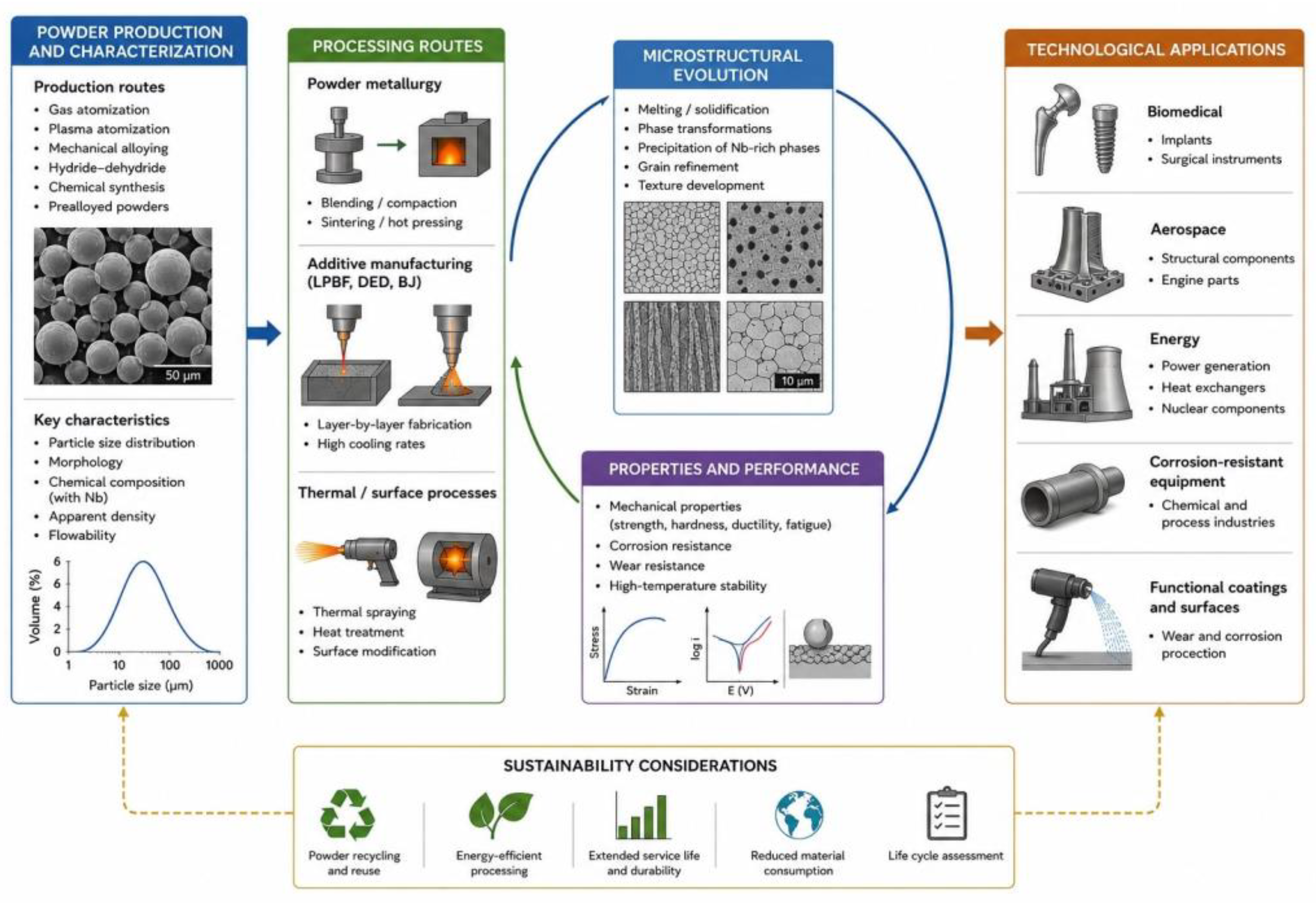
Figure 2.
Methodological workflow adopted for the development of this review, including literature identification, screening, thematic classification, critical analysis, and synthesis of research opportunities.
Figure 2.
Methodological workflow adopted for the development of this review, including literature identification, screening, thematic classification, critical analysis, and synthesis of research opportunities.
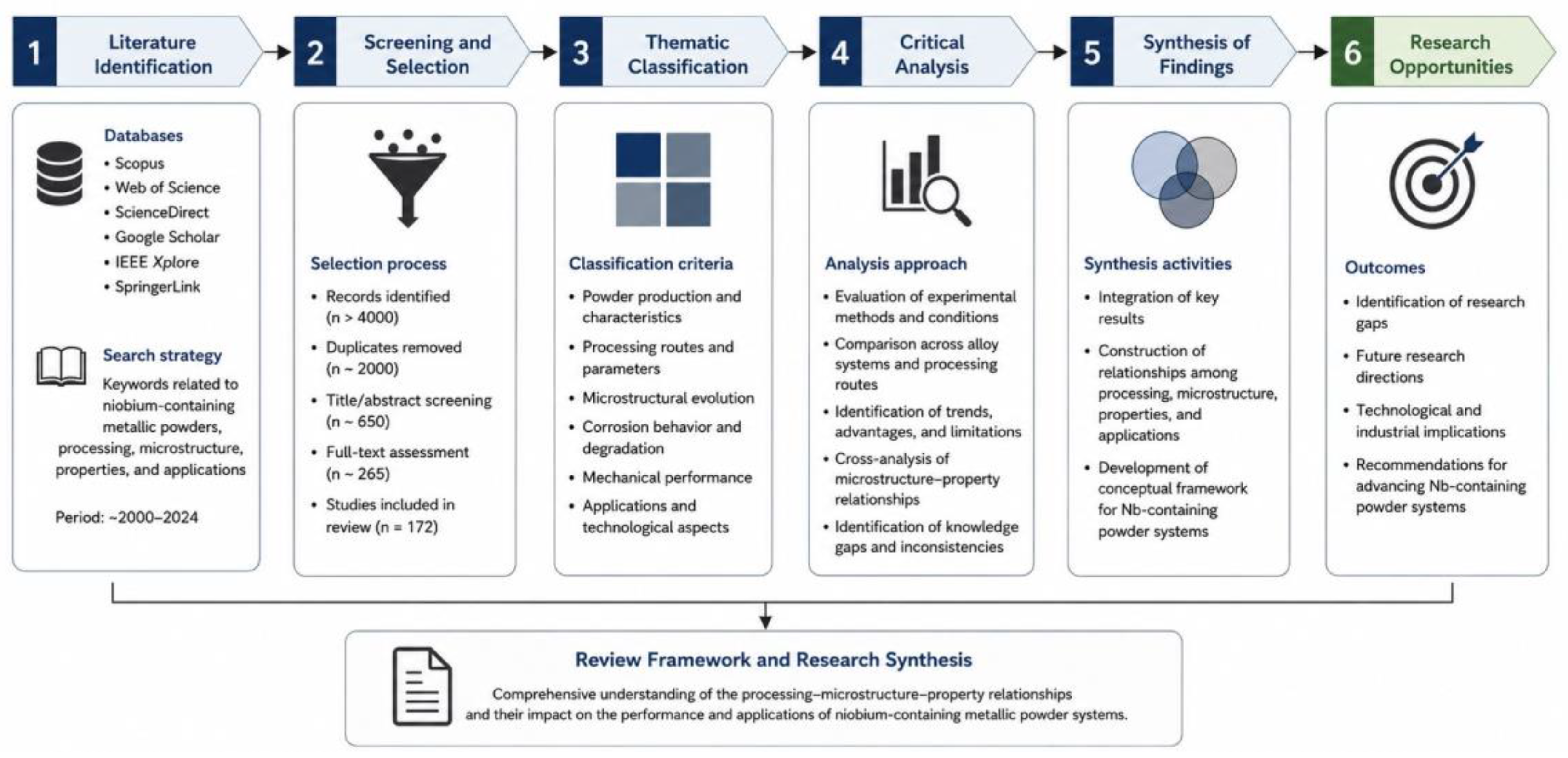
Figure 3.
Principal production routes for metallic powders and their influence on particle morphology, particle size distribution, powder quality, and manufacturing applications.
Figure 3.
Principal production routes for metallic powders and their influence on particle morphology, particle size distribution, powder quality, and manufacturing applications.
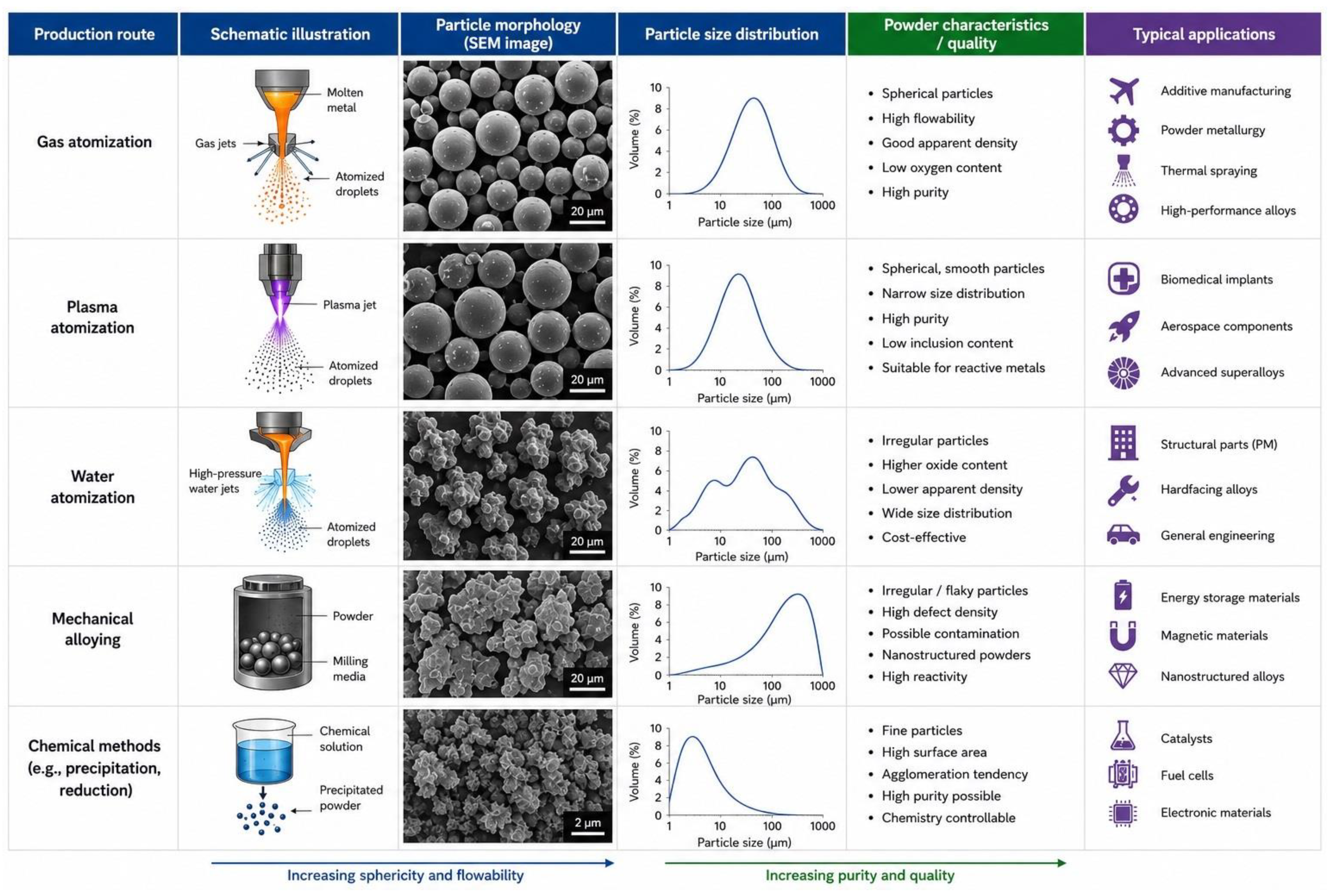
Figure 4.
Mechanistic framework illustrating the influence of niobium additions on phase stability, grain refinement, precipitation behavior, and the resulting mechanical and corrosion performance of metallic powder systems.
Figure 4.
Mechanistic framework illustrating the influence of niobium additions on phase stability, grain refinement, precipitation behavior, and the resulting mechanical and corrosion performance of metallic powder systems.
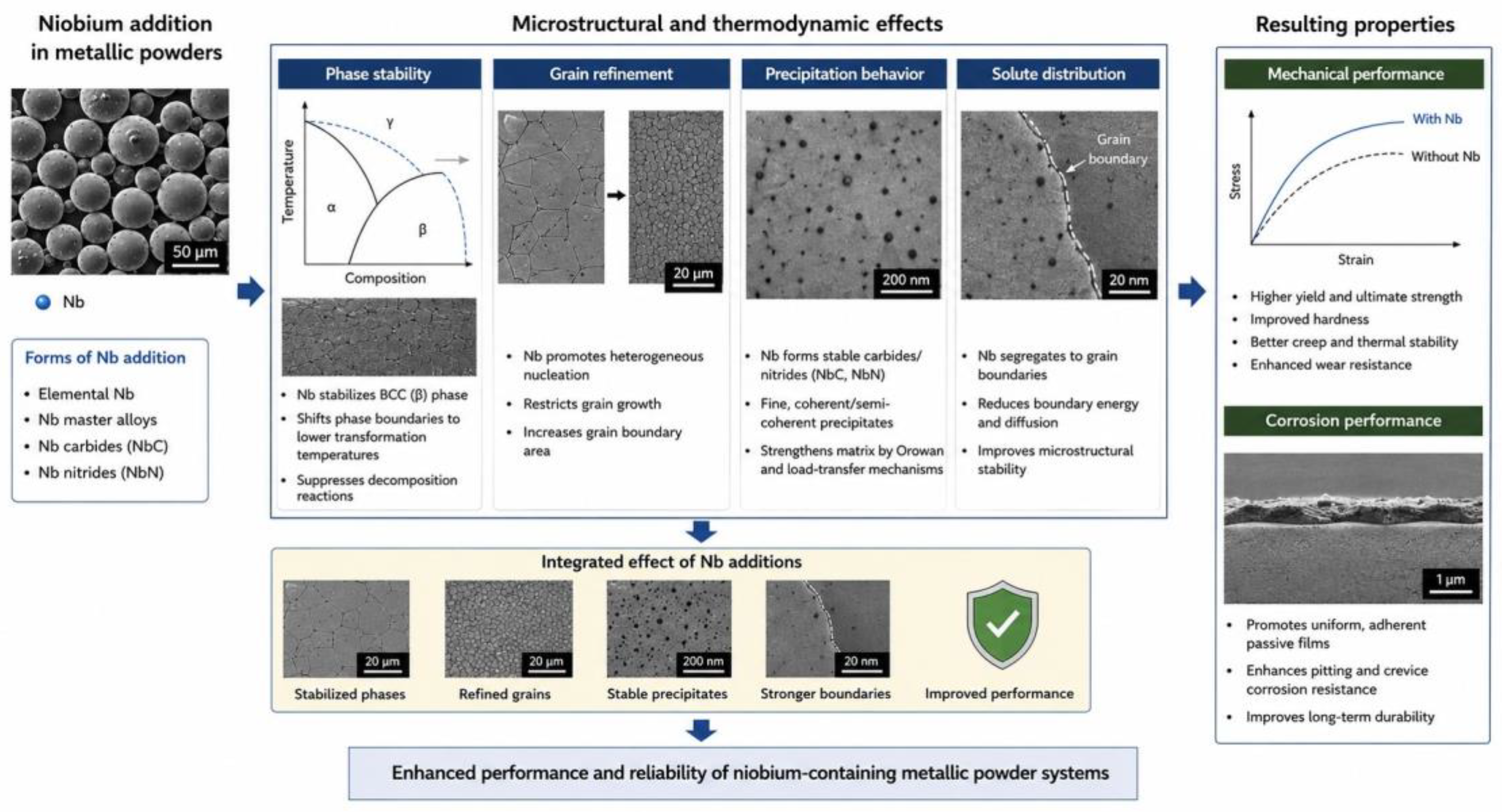
Figure 5.
Principal processing routes employed in metallic powder systems and their relationships with densification, thermal history, microstructural evolution, and engineering performance.
Figure 5.
Principal processing routes employed in metallic powder systems and their relationships with densification, thermal history, microstructural evolution, and engineering performance.
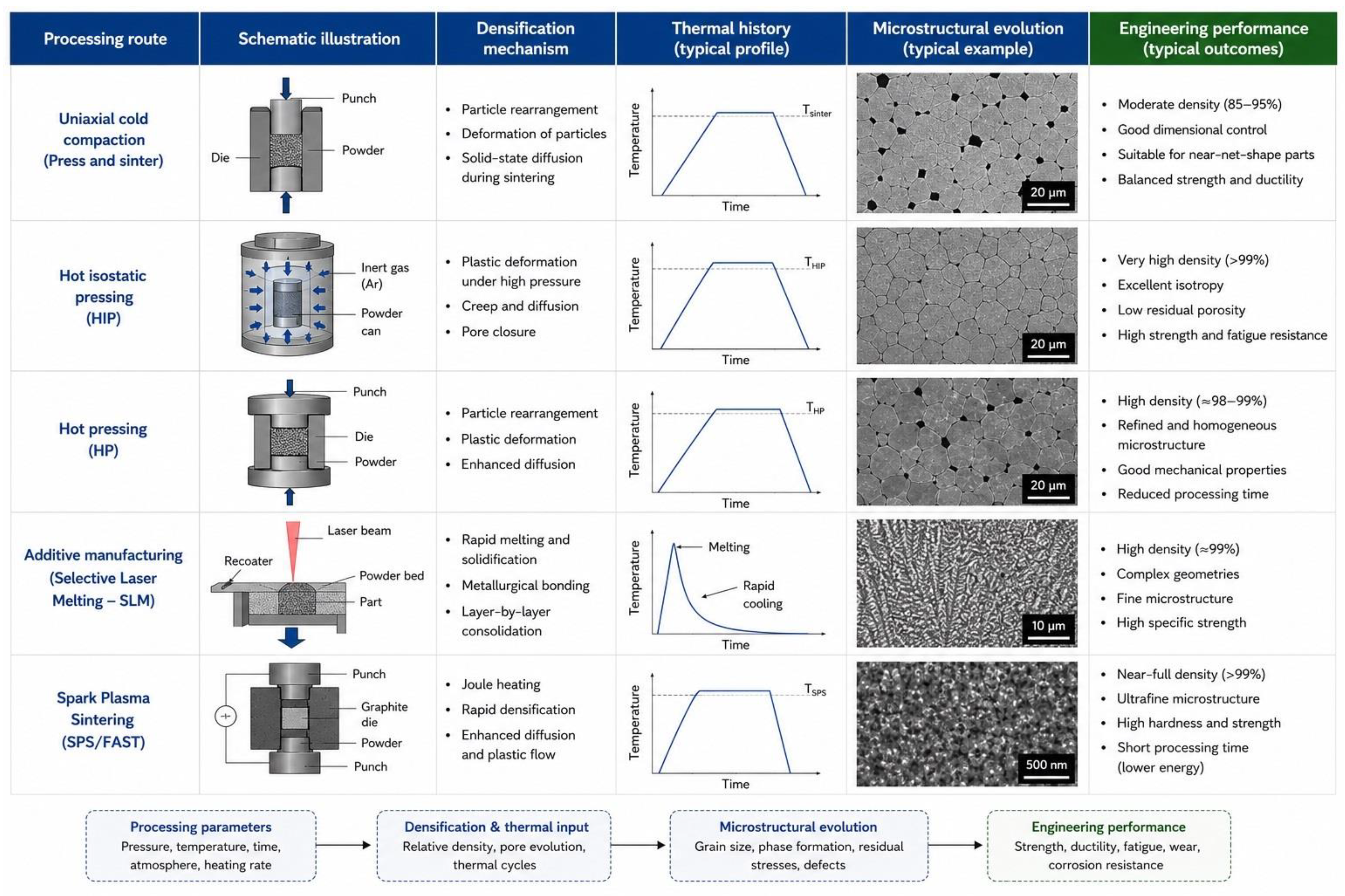
Figure 6.
Relationship between processing route, thermal history, diffusion mechanisms, phase transformations, microstructural evolution, and resulting engineering properties in niobium-containing metallic powder systems.
Figure 6.
Relationship between processing route, thermal history, diffusion mechanisms, phase transformations, microstructural evolution, and resulting engineering properties in niobium-containing metallic powder systems.
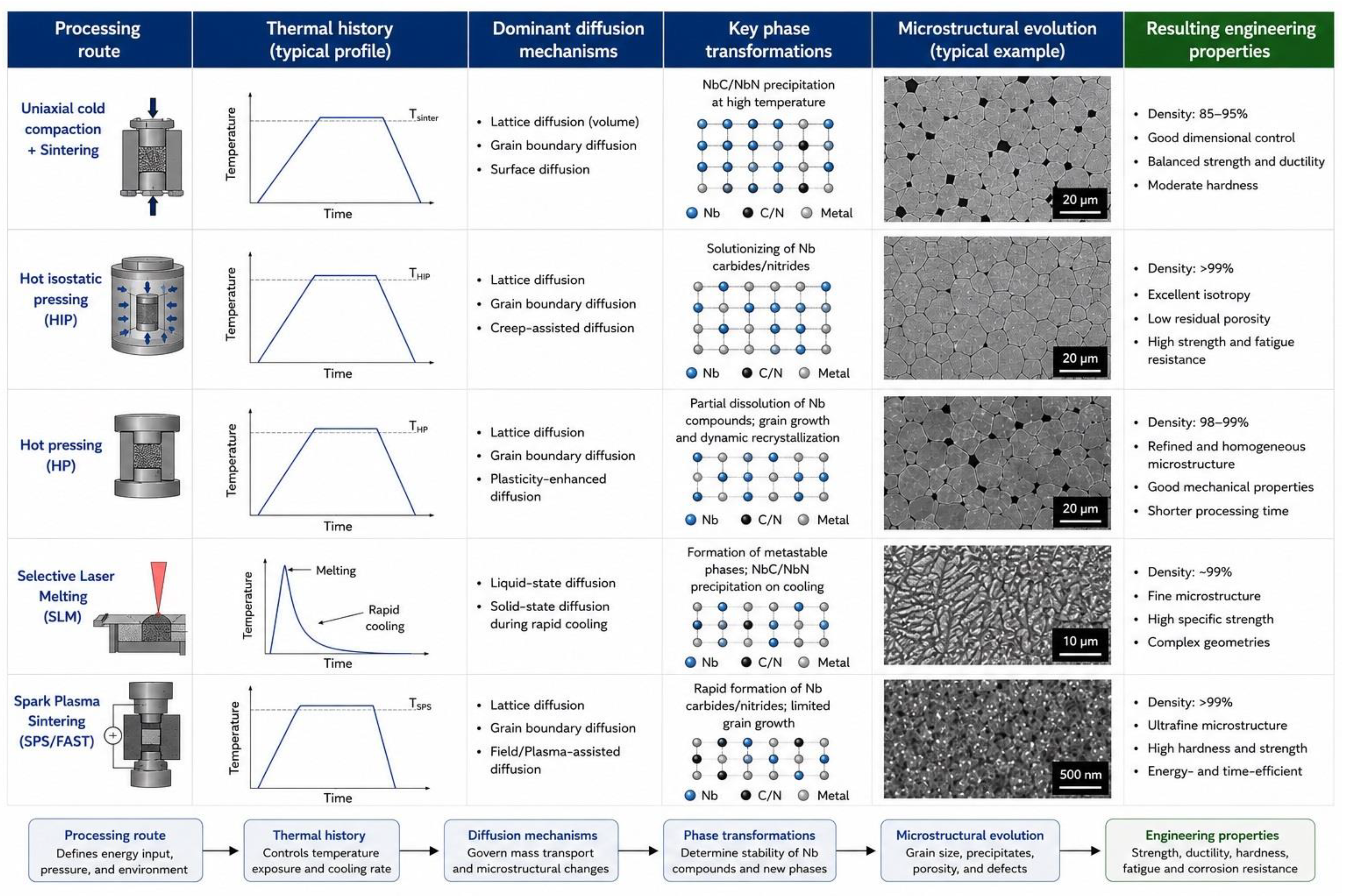
Figure 7.
Relationship among powder processing, microstructural evolution, passive-film formation, corrosion mechanisms, and long-term surface performance in metallic powder systems.
Figure 7.
Relationship among powder processing, microstructural evolution, passive-film formation, corrosion mechanisms, and long-term surface performance in metallic powder systems.
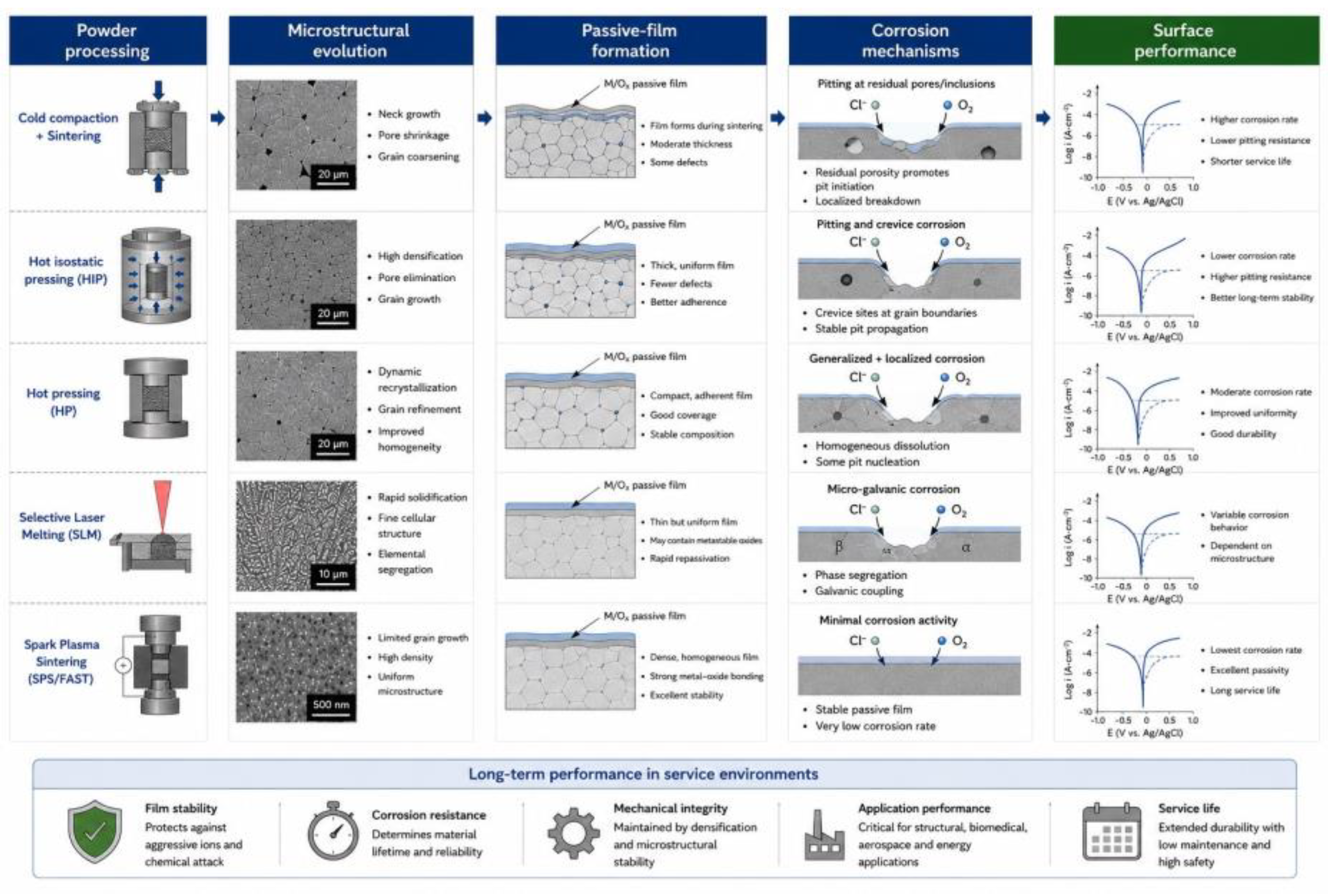
Figure 8.
Representative industrial applications of niobium-containing metallic powder systems, highlighting the relationships among powder technology, processing routes, material performance, and end-use sectors.
Figure 8.
Representative industrial applications of niobium-containing metallic powder systems, highlighting the relationships among powder technology, processing routes, material performance, and end-use sectors.
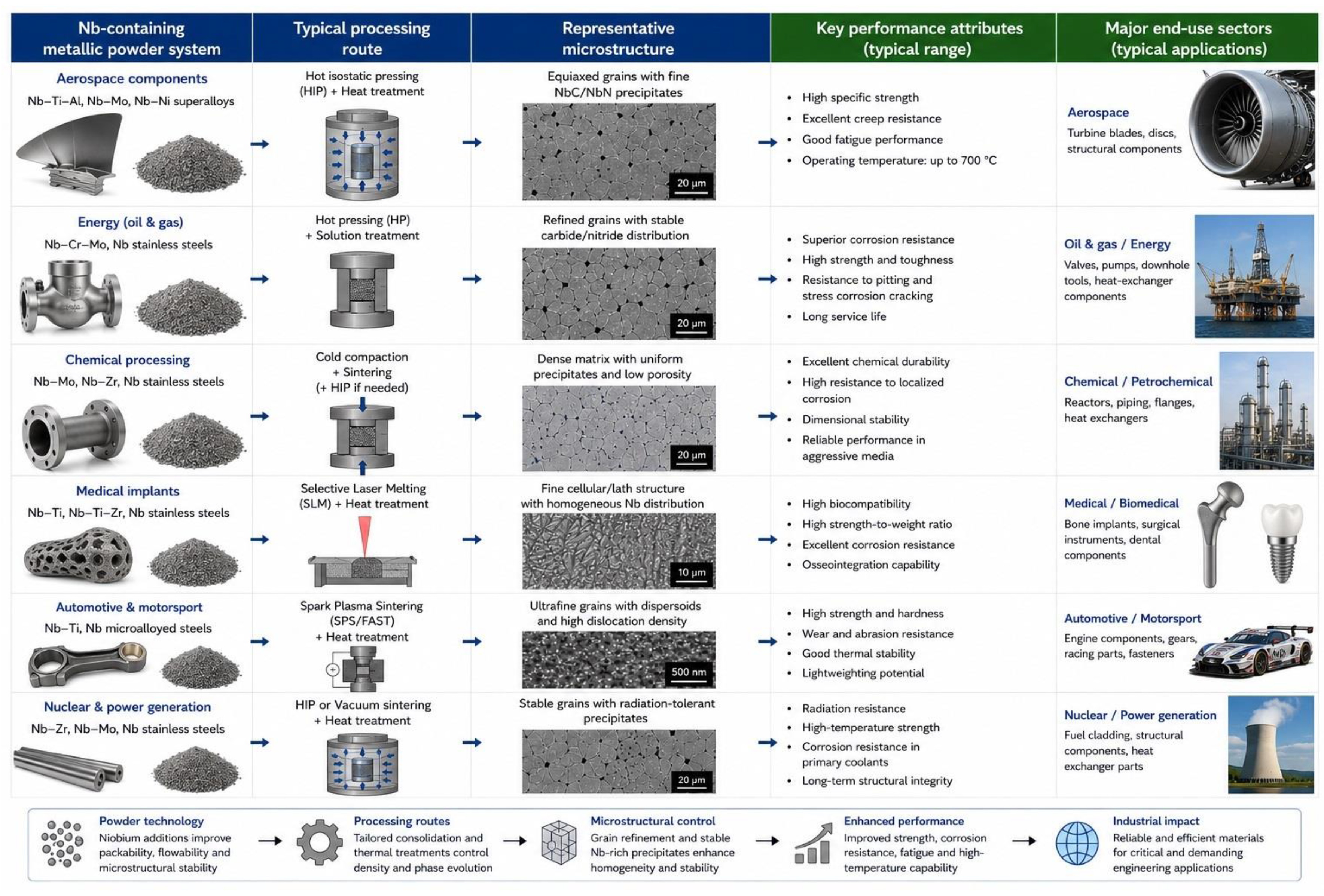

Table 1.
Principal powder characteristics and their influence on processing and performance in metallic powder systems.
Table 1.
Principal powder characteristics and their influence on processing and performance in metallic powder systems.
| Powder characteristic | Influence on processing | Influence on final properties |
| Particle size distribution | Packing efficiency and densification | Microstructural uniformity |
| Particle morphology | Flowability and powder spreading | Defect susceptibility |
| Surface condition | Particle interaction and oxidation behavior | Corrosion performance |
| Apparent density | Powder-bed stability | Consolidation efficiency |
| Chemical homogeneity | Phase formation and diffusion behavior | Mechanical and functional properties |
Table 2.
Thematic classification was adopted to organize the literature database used in this review.
Table 2.
Thematic classification was adopted to organize the literature database used in this review.
| Thematic area | Principal topics evaluated |
| Metallic powder systems | Powder production, morphology, particle size distribution |
| Particle characterization | Flowability, apparent density, powder quality |
| Niobium-containing powders | Alloy design, powder composition, functional properties |
| Processing routes | Powder metallurgy, additive manufacturing, thermal spraying |
| Microstructural evolution | Phase transformations, precipitation, grain refinement |
| Corrosion behavior | Passivation, localized corrosion, and electrochemical performance |
| Sustainability and applications | Recycling, industrial implementation, resource efficiency |
Table 3.
Qualitative evolution of research topics represented in the literature reviewed for niobium-containing metallic powder systems.
Table 3.
Qualitative evolution of research topics represented in the literature reviewed for niobium-containing metallic powder systems.
| Publication Period | Predominant Research Topics |
| Before 2005 | Powder metallurgy fundamentals, powder production, particle characterization |
| 2005–2015 | Alloy development, phase stability, powder-processing optimization |
| 2015–2020 | Additive manufacturing, microstructural evolution, corrosion behavior |
| 2020–Present | Sustainability, computational materials design, CALPHAD, machine learning, multifunctional materials |
Table 4.
Principal metallic powder production routes and their typical characteristics.
| Production route | Typical particle morphology | Main advantages | Typical applications |
| Gas atomization | Spherical | High flowability and purity | Additive manufacturing |
| Water atomization | Irregular to semi-spherical | Lower production cost | Powder metallurgy |
| Plasma atomization | Highly spherical | Excellent powder quality | Aerospace and biomedical applications |
| Mechanical milling | Irregular | Alloying flexibility | Composite and experimental powders |
| Chemical reduction | Fine particles | Controlled composition | Functional materials |
Table 5.
Representative effects of niobium additions in metallic powder systems are reported in the literature.
Table 5.
Representative effects of niobium additions in metallic powder systems are reported in the literature.
| Material System | Nb Content | Processing Route | Principal Microstructural Effect | Performance Improvement | Ref. |
| Ti–Nb | 10–35 wt. % | Powder metallurgy | β-phase stabilization and reduced elastic modulus | Improved biomechanical compatibility | [26,31,33] |
| Ti–Nb | 15–40 wt. % | Additive manufacturing | Grain refinement and phase stabilization | Enhanced mechanical reliability | [31,33] |
| NiTiNb | 3–10 wt. % | Powder metallurgy | Modification of transformation temperatures | Improved shape-memory response | [30,32] |
| Fe–Nb | 0.1–1.0 wt. % | Conventional powder metallurgy | NbC precipitation and grain-boundary pinning | Increased strength and thermal stability | [36,37] |
| Ni–Nb | 1–10 wt. % | Powder processing and coating technologies | Suppression of undesirable phase transformations | Improved corrosion resistance | [29,30] |
| Refractory Nb alloys | Variable | Additive manufacturing | High-temperature phase stabilization | Improved thermal performance | [38,39,40] |
Table 6.
Representative quantitative effects of niobium additions reported for metallic powder systems.
Table 6.
Representative quantitative effects of niobium additions reported for metallic powder systems.
| Material System | Typical Nb Content | Principal Effect | Representative Improvement | Ref. |
| Ti–Nb alloys | 10–40 wt. % | β-phase stabilization | Elastic modulus reduction of 20–40% compared with conventional Ti alloys | [26,31,33] |
| Ti–Nb alloys | 15–40 wt. % | Grain refinement and phase stabilization | Improved strength-to-modulus ratio and enhanced biomechanical compatibility | [31,33,34,35] |
| Fe–Nb systems | 0.1–1.0 wt. % | NbC/Nb (C, N) precipitation | Yield-strength increases typically reported between 10–30% depending on processing conditions | [36,37] |
| NiTiNb alloys | 3–10 wt. % | Transformation control | Improved shape-memory stability and transformation reproducibility | [30,32] |
| Ni–Nb systems | 1–10 wt. % | Phase stabilization and microstructural homogenization | Improved corrosion resistance and enhanced surface stability in aggressive environments | [29,30] |
| Refractory Nb-containing alloys | Variable | High-temperature phase stabilization | Enhanced thermal stability and improved elevated-temperature performance | [38,39,40] |
Table 7.
Principal processing routes employed for metallic powder systems and their main characteristics.
Table 7.
Principal processing routes employed for metallic powder systems and their main characteristics.
| Processing route | Consolidation mechanism | Principal advantage | Typical application |
| Powder metallurgy | Solid-state sintering | Material efficiency | Structural components |
| Laser powder bed fusion | Localized melting and solidification | Complex geometries | Additive manufacturing |
| Directed energy deposition | Simultaneous powder feeding and melting | Component repair and fabrication | Aerospace and energy sectors |
| Thermal spraying | Particle deposition on substrates | Surface modification | Protective coatings |
| Electrodeposition | Electrochemical incorporation | Surface engineering | Corrosion-resistant coatings |
| Hybrid processing | Combined manufacturing approaches | Property optimization | Advanced engineering applications |
Table 8.
Representative relationships between microstructural evolution and engineering performance in niobium-containing metallic powder systems.
Table 8.
Representative relationships between microstructural evolution and engineering performance in niobium-containing metallic powder systems.
| Phenomenon | Principal Mechanism | Typical Effect on Microstructure | Engineering Consequence | Ref. |
| β-phase stabilization | Solute partitioning | Increased β-phase fraction | Reduced elastic modulus | [54,55] |
| Grain refinement | NbC/Nb (C, N) precipitation | Restricted grain growth | Increased strength | [55,56] |
| Phase stabilization | Reduced transformation kinetics | Enhanced thermal stability | Improved service reliability | [56,57] |
| Precipitation strengthening | Formation of Nb-rich precipitates | Obstacle to dislocation motion | Improved mechanical performance | [55,56,57,58] |
| Chemical homogenization | Diffusion-assisted redistribution | Reduced segregation | Improved corrosion behavior | [58,59,60] |
Table 9.
Principal corrosion mechanisms and microstructural factors influencing corrosion behavior in metallic powder systems.
Table 9.
Principal corrosion mechanisms and microstructural factors influencing corrosion behavior in metallic powder systems.
| Corrosion mechanism | Dominant microstructural factor | Typical consequence |
| Uniform corrosion | General surface reactivity | Material loss |
| Pitting corrosion | Local heterogeneities and inclusions | Localized attack |
| Crevice corrosion | Restricted electrolyte access | Accelerated degradation |
| Galvanic corrosion | Phase and compositional differences | Selective dissolution |
| Intergranular corrosion | Grain-boundary instability | Loss of structural integrity |
Table 10.
Representative findings and limitations reported for niobium-containing metallic powder systems.
Table 10.
Representative findings and limitations reported for niobium-containing metallic powder systems.
| Material System | Processing Route | Principal Finding | Main Limitation | Ref. |
| Ti–Nb alloys | Powder metallurgy | Improved biomechanical compatibility | Limited long-term corrosion evaluation | [31,33] |
| Ti–Nb alloys | Additive manufacturing | Grain refinement and phase stabilization | Process-parameter sensitivity | [33,34] |
| NiTiNb alloys | Powder metallurgy | Improved shape-memory response | Limited fatigue assessment | [30,32] |
| Fe–Nb systems | Powder metallurgy | Enhanced strength through precipitation | Reduced information on corrosion performance | [36,37] |
| Ni–Nb systems | Surface engineering routes | Improved corrosion resistance | Limited long-term exposure studies | [29,30] |
| Refractory Nb alloys | Additive manufacturing | High-temperature stability | Scarcity of industrial-scale validation | [38,39,40] |
Disclaimer/Publisher’s Note: The statements, opinions and data contained in all publications are solely those of the individual author(s) and contributor(s) and not of MDPI and/or the editor(s). MDPI and/or the editor(s) disclaim responsibility for any injury to people or property resulting from any ideas, methods, instructions or products referred to in the content. |
© 2026 by the authors. Licensee MDPI, Basel, Switzerland. This article is an open access article distributed under the terms and conditions of the Creative Commons Attribution (CC BY) license (http://creativecommons.org/licenses/by/4.0/).
Copyright: This open access article is published under a Creative Commons CC BY 4.0 license, which permit the free download, distribution, and reuse, provided that the author and preprint are cited in any reuse.