

Submitted:
10 June 2026
Posted:
10 June 2026
You are already at the latest version
Abstract
Huperzine A (HupA) is a natural Lycopodium alkaloid known for its potent neuro-protective properties through the inhibition of acetylcholinesterase. Nevertheless, the limited understanding of its biosynthesis restricts its broader application. This study integrates full-length and second-generation transcriptomes with the quantification of HupA and its precursor, huperzine B, across various tissues of Huperzia serrata, the primary source plant. By employing phylogenetic clustering, expression profiling, and correlation analysis between gene expression and metabolite abundance, we identified 71 candidate genes from seven enzyme families potentially involved in the synthesis of the HupA backbone, including lysine/ornithine decarboxylases, copper amine oxidases (CAOs), chalcone synthases, and cytochrome P450 monooxygenases. Additionally, 28 genes from two families were identified for modification reactions, specifically 2-oxoglutarate/Fe(II)-dependent dioxygenases and caffeoyl shikimate esterases. Comparative analysis between young and mature leaves revealed 3,801 up-regulated genes in young leaves, with 84 showing a high correlation with HupA content across seven families. Protein–protein interaction network analysis indicated interactions with transcription factors from the MYB, NF-YC, GRAS, ERF, BHLH, and SAP families. Functional validation of two candidate CAOs in planta confirmed their catalytic roles in amine/alkaloid metabolism. This study provides a theoretical foundation and a set of candidate genes for elucidating the biosynthetic pathway of HupA and related alkaloids in H. serrata.
Keywords:
huperzine A
; Huperzia serrata
; comparative transcriptomic analysis
; biosynthetic pathway
; lycopodium alkaloid
; copper amine oxidase
1. Introduction
Huperzia serrata, a traditional Chinese medicinal plant within the family Huperziaceae, is distinguished by its abundance of bioactive compounds, notably the Lycopodium alkaloid huperzine A (HupA) [1,2]. HupA functions as a potent, selective, and reversible inhibitor of acetylcholinesterase and has shown considerable efficacy in the treatment of neurodegenerative disorders such as Alzheimer’s disease [3,4]. Despite its clinical potential, the sustainable supply of HupA presents a significant challenge. The compound is primarily extracted from wild H. serrata plants and a limited number of other Huperziaceae species, which are characterized by extremely slow growth and increasingly scarcity, resulting in a severe supply bottleneck [5]. Therefore, elucidating the complete biosynthetic pathway of HupA is crucial for the development of alternative production platforms through synthetic biology [6].
Previous research has established a foundational understanding of this pathway, tracing its origins to feeding experiments conducted by Ian Spenser and other researcheres [7−9]. These investigations revealed that the biosynthesis of lycopodium alkaloids, including HupA, originates from the decarboxylation of lysine. The initial stages involve intermediates such as cadaverine, ∆1-piperideine, 4-(2-piperidyl) acetoacetate (4PAA) (or 4-(2piperidyl) acetoacetyl-CoA, 4PAACoA), and pelletierine [7−9]. Further studies identified several critical enzymes, including lysine decarboxylases (LDCs) [10,11], copper amine oxidases (CAOs) [12], and piperidyl ketide synthases (PKSs) [13−15], which are sufficient to convert these primary metabolites. Recently, through D2O labeling studies and paried transcriptomic and metabolomic analyses, Nett et al. confirmed that de novo HupA biosynthesis is specific to new growth in the shoots of Phlegmariurus tetrastichus and preliminarily elucidated the biosynthesis pathway of HupA, which is broadly divided into four stages [16−18]. As previously menthioned, the pathway initiates with the formation of 8-carbon scaffold precursors, pelletierine [16,18]. In the second stage, pelletierine undergoes sequential modifications, including ketone reduction, O-acetylation, and oxidative desaturation, catalyzed by the short-chain dehydrogenase/reductases (SDRs), the BAHD acyltransferases (ACTs), and the cytochrome P450s (CYP450s), respectively [18]. It is then coupled with 4PAA by a α-carbonic anhydrases (α-CAs) to form the phlegmarane-type scaffold [18]. The subsequent third stage may involve the reconstruction of the core skeleton: the phlegmarane-type scaffold is converted into the lycodane tetracyclic core through a series of steps not yet fully elucidated; this core is then acted upon by isomerases and acetyltransferases, among others, to generate the key intermediate flabellidine [18]. In the final fourth stage, flabellidine undergoes a series of precise oxidative modifications and ring-cleavage reactions mediated by 2-oxoglutarate-dependent dioxygenases (2OGDs) and an α/β-hydrolase (ABH). These reactions convert it successively into HupB, then HupC, and finally yield the target product HupA [16,18] (Figure 1).
Several other studies also have explored the hypothesized biosynthesis pathway of HupA in various Lycopodium species. Comparative analysis of 454-ESTs from H. serrata and P. carinatus have predicted potential genes involved in lycopodium alkaloid biosynthesis, including LDC-likes and some CYP450s [19,20]. Comprehensive transcriptome analysis across all tissues of H. serrata has yielded further insights into the early and late stages of HupA biosynthesis [21]. Recent investigations comparing the in vitro H. serrata thallus with wild H. serrata, utilizing transcriptome and widely targeted metabolome analysis, have identified seven significant enzyme genes and 13 transcription factors (TFs) associated with HupA biosynthesis [6]. Despite these advancements, several aspects of the pathway remain to be elucidated; specifically, conversion process from the phlegmarane scaffold to the lycodane core and the genes corresponding to several hypothesized enzymatic steps require identification and functional validation.
To address these knowledge gaps, we conducted an comparative transcriptomic analysis of various tissues (roots, stems, young leaves, and mature leaves) of H. serrata. Utilizing phylogenetic clustering, gene expression profiling, correlation analysis with HupA content, and protein-protein interaction network prediction, we systematically identified candidate genes potentially involved in HupA biosynthesis. Furthermore, we successfully cloned two candidate CAOs, and demonstrated its crucial roles in amine and alkaloid synthesis and metabolism in planta. Our study not only provides valuable genetic resources but also establishes a foundational framework for fully elucidating the HupA biosynthetic pathway, thereby facilitating its future production through synthetic biology.
2. Materials and Methods
2.1. Plant Materials
The three-branched (THB) H. serrata specimens were collected from Longsheng Huaping Nature Reserve located in Guilin City, Guangxi Zhuang Autonomous Region, China. The roots, stems and leaves of THB H. serrata were either immediately frozen in liquid nitrogen for the purpose of RNA extraction or dried in an oven at 60 °C to assess the contents of HupA and HupB.
2.2. Determination of HupA and HupB Contents
The quantification of HupA and HupB in various tissues of H. serrata was conducted in accordance with the method outlined by Zhu et al. [22], with minal modifications. Specifically, 0.5 g of homogenized powder was precisely weighed and combined with 4 mL of a 0.2% hydrochloric acid solution. The mixture was thoroughly vortexed and subjected to ultrasonic-assisted extraction at 25 °C for 60 min. Following centrifugation, the supernatant was collected, and the residue was re-extracted using the same procedure. The combined supernatants were diluted to a final volume of 8 mL with 0.2% hydrochloric acid, vortex-mixed for homogeneity, and filtered through a 0.22 μm nylon membrane prio to high performance liquid chromatography (HPLC) analysis. HPLC separation was performed on a C18 reversed-phase column (250 × 4.6 mm, 5 μm) maintained at 25 °C. An isocratic mobile phase consisting of acetonitrile and 0.085% formic acid (80:20, v/v) was employed at a flow rate of 1.0 mL/min. Detection was carried out at 309 nm using a VWD detector, with an injection volume was 20 μL.
2.3. RNA Extraction, RNA-seq and Functional Annotation
Total RNA was extracted from various tissues of THB H. serrata, using the Trizol reagent kit (Invitrogen, Carlsbad, CA, USA). RNA quality was assessed using an Agilent 2100 Bioanalyzer (Agilent Technologies, Palo Alto, CA, USA) and RNase free agarose gel electrophoresis. Poly(A) mRNA was enriched using Oligo(dT) beads and fragmented with a fragmentation buffer. These fragments were reverse transcribed into first-strand cDNA using the M-MuLV reverse transcriptase system. Second-strand cDNA was performed using RNase H, DNA polymerase I, dNTP and buffer. The cDNA fragments were then purified with the QiaQuick PCR extraction kit (Qiagen, Venlo, The Netherlands), end-repaired, poly(A) were added, and they were ligated to Illumina sequencing adapters. The ligation products were size-selected via agarose gel electrophoresis, PCR amplified, and sequenced using Illumina HiSeqTM 4000 by Gene Denovo Biotechnology Co., Ltd. (Guangzhou, China). To ensure high quality clean reads, the original and low-quality data were filtered using fastp (version 0.18.0) [23].
For the full-length transcriptome sequecing, total RNA was extracted using TRIzol (Invitrogen, Carlsbad, CA, USA), followed by mRNA enrichment with Oligo(dT) magnetic beads. Enriched mRNA was reverse-transcribed into cDNA using the Clontech SMARTER kit (Takara, Kusatsu, Shiga, Japan). After PCR cycle optimization, double-stranded cDNA was generated; a portion was size-selected (> 4 kb) using BluePippin and mixed with non-size-selected cDNA. SMRTbell libraries were constructed and sequenced on the PacBio Sequel platform. For bioinformatics analysis, raw reads were processed with SMRT Link v5.0.1 [24] to obtain circular consensus sequences, which were classified into full-length non-chimeric (FLNC) reads. FLNC reads were clustered by Iterative Clustering for Error Correction software, polished with Quiver (accuracy ≥ 99%), and low-quality isoforms were error-corrected using Illumina short reads. Redundant sequences were removed with software CD-HIT-v4.6.7 (0.99 identity). Clean reads from the second-generation transcriptome were mapped to the full-length transcriptome and quantified using RSEM software [25].
All assembled sequences were subjected to BLAST analysis across various databases, including kyoto encyclopedia of genes and genomes (KEGG), the NCBI nonredundant protein sequences (Nr), a manually annotated and reviewed protein sequence database (SwissPro), gene ontology (GO), cluster of orthologous groups of proteins (COG), eukaryotic ortholog groups (KOG), and the translation of EMBL (TrEMB) [26]. The GO functional annotation was derived from the annotations of transcripts in Swissprot and TrEMBL. The KEGG Automatic Annotation Server was employed to obtain KEGG annotation information. Open reading frmes were predicted by ANGEL [27], protein domains by Pfam [28] and SMART, transcription factors by PlantTFdb ((http://planttfdb.cbi.pku.edu.cn/), R-genes by PRGdb (http://prgdb.crg.eu/wiki/Main_Page), and alternative splicing by Cogent [29].
2.4. Differential Gene Analysis
The abundance of each gene was normalized to Fragments Per Kilobase of exon model per Million mapped fragments (FPKM) score. Genes with a false discovery rate (FDR) below 0.05 and an absolute fold change greater than one were identified as differentially expressed genes (DEGs) [30]. Principal Component Analysis (PCA) was employed to elucidate the relationships among the samples and was conducted using R package models (http://www.r-project.org/) in this study. Furthermore, a functional enrichment analysis using the KEGG database was performed to determine which DEGs were significantly enriched in KEGG metabolic pathways.
2.5. Identification of Candidate Genes Involved in the HupA Biosynthetic Pathway
This study employed two distinct methodologies for the systematic identification and selection of candidate genes potentially involved in HupA biosynthesis.
2.5.1. Candidate Gene Screening Combining Phylogenetic and Co-Expression Analysis
The screening process commenced with the retrieval of Hidden Markov Models (HMMs) corresponding to nine protein families previously identified as participatants in the HupA biosynthetic pathway in P. tetrastichus (Table 1) [16,18]. These HMM profiles were sourced from the Arabidopsis database (TAIR, https://www.arabidopsis.org/) and utilized for domain-based screening of the H. serrata transcriptome-encoded proteins (Figure S1). The resultant sequences underwent multiple sequence alignment with functionally validated homologous proteins, followed by the construction of a phylogenetic tree to preliminarily assess potential functions based on evolutionary clustering patterns (Figure S1). Subsequently, by integrating tissue-specific expression profiles, genes exhibiting high expression levels in young leaves were selected. The Pearson correlation coefficients between their expression levels and the contents of HupA and HupB were calculated. Genes demonstrating statistically significant positive correlations (p < 0.05) were retained as high-confidence candidates (Figure S1).
2.5.2. Candidate Gene Screening Leveraging Differential Expression and Functional Annotation
The alternative approach commenced with the identification of transcripts significantly upregulated in young leaves compared to mature leaves across all genes expressed in H. serrata (Figure S1). Subsequently, a correlation analysis was conducted between their expression levels and HupA content. Genes exhibiting strong positive correlations (correlation coefficient > 0.8) were selected for further analysis (Figure S1). Following functional domain annotation, these genes were mapped to protein families with experimentally validated roles in prior studies, facilitating the inference of their potential catalytic or regulatory functions within the HupA biosynthetic pathway (Figure S1).
2.5.3. Phylogenetic and Correlation Analysis
Multiple amino acid sequence alignments were conducted using MAFFT (v7) [40]. Phylogenetic trees were generated employing the Neighbor-Joining method in MEGA (v11) [41], with 1000 bootstrap replications. Pearson correlation analysis was performed to investigate the relationships between the expression of alkaloid-related genes and the relative content of HupA and HupB. Multiple group comparisons were analyzed using one-way analysis of variance, followed by Tukey’s multiple comparisons test, implemented in the OmicShare online tool (http://www.omicshare.com/tools) [42]. A p-value less than 0.05 was considered statistically significant.
2.6. Network Analysis of Key Alkaloid Biosynthesis Genes
The significant correlation network, characterized by a p-value of less than 0.01 and a correlation coefficient exceeding 0.9, or an interaction score greater than 700, was visualized using Cytoscape software [43].
2.7. Gene Cloning and Agrobacterium-Mediated Transient Expression
Total RNA was extracted from a composite sample comprising roots, stems, young leaves, and mature leaves of H. serrata using the Plant RNA Prep Pure Plant Kit (Vazyme, Nanjing, China) in accordance with the manufacturer’s protocols. The quantity, purity, and integrity of the RNA were evaluated through 1% agarose gel electrophoresis and spectrophotometry (Thermo Fisher Scientific, Waltham, Massachusetts, USA). cDNA synthesis was conducted utilizing the TransScript One-Step gDNA Removal and cDNA Synthesis SuperMix (Vazyme, Nanjing, China). The coding sequence (CDS) of HsCAO1 was amplified using 2×SparkHiFi Max Master Mix (SparkJade, Jinan, China) along with gene specfic primers (Table S1). The cDNA of HsCAO genes was determined based on the CDS of HsCAO1 employing a SMARTer RACE 5’/3’ kit (Takara, Kusatsu, Shiga, Japan), with specific primers (Table S18). The CDSs of HsCAO1, HsCAO2, and HsCAO3 were lingated into the overexpressing vector, respectively. The empty vector (EV) or recombinant vector was introduced into the leaves of N. benthamiana via Agrobacterium-mediated transformation. Gene expression levels were assessed using DNA or cDNA templates from transgenic and EV tobacco leaves 48 to 72 h post-injection.
2.8. Determination of Amines and Alkaloids in the Leaves of N. benthamiana
The quantification of the three biogenic amines—putrescine, spermidine, and spermine—was conducted using reversed-phase HPLC with pre-column derivatization. The samples underwent extraction with perchloric acid, followed by ultrasonication and centrifugation. The resulting supernatant was derivatized through the addition of sodium hydroxide, saturated sodium bicarbonate, and dansyl chloride in acetone, and subsequently incubated at 50 °C in the dark for 40 min. Ammonia was then introduced, and the mixture was allowed to stand at room temperature for 30 min prior to dilution with methanol and filtration. Separation was achieved using a Compass C18(2) column (250 mm × 4.6 mm, 5 μm) maintained at 30 °C, with a mobile phase gradient of methanol and water at a flow rate of 1 mL/min, and detection at 254 nm. For quantification purposes, standard solutions of each amine were derivatized in an identical manner and injected under the same conditions; calibration curves were generated by plotting peak area against content.
The quantification of nicotine was conducted using reversed-phase HPLC. The sample was initially ground, and 0.2 g was extracted with 10 mL of 75% methanol containing 0.1 mol/L NaOH through ultrasonication for 1 h, followed by centrifugation and filtration. The separation process was executed on a Compass C18(2) column (250 mm × 4.6 mm, 5 μm) maintained at 30 °C, utilizing a mobile phase composed of methanol and 0.1% triethylamine (45:55) at a flow rate of 1.0 mL/min, with detection occurring at 260 nm. Quantification was accomplished via a standard curve generated using nicotine standards dissolved in methanol.
The quantification of total alkaloids was conducted via a colorimetric method employing bromocresol green. Dried and powdered samples (0.1 g, 80-mesh) were subjected to extraction with 1 mL of 80% ethanol through ultrasonication for 60 min, followed by centrifugation at 8000 g for 10 min. The resulting supernatant was treated with reagent 1 and reagent 2, allowed to react for 5 min, and subsequently subjected to chloroform extraction. After a shaking period of 40 min, the chloroform layer was analyzed at a wavelength of 416 nm. Quantification was achieved using a standard curve defined by the equation y = 2.7614x + 0.0116.
3. Results
3.1. HupA and HupB Content in Different Tissues of H. serrata
H. Serrata (Figure 2A-B, Figure S2A-C), a terrestrial species thriving in shaded, damp, mossy, and acid soil beneath woodlands, exhibits a notably slow growth rate, typically requiring 15 to 20 years to reach maturity from spore germination [2]. As the plant ages, it develops taller and more dichotomous branches (Figure S2B-D). Previous studies utilizing P. tetrastichus have demonstrated that HupA accumulates to a significant level across all tissues, with de novo HupA biosynthesis being specific to new growth in the shoots of P. tetrastichus [16,17]. In this study, we quantified the contents of HupA and HupB in the roots, stems, young leaves, and mature leaves of H. serrata with varying numbers of branches using HPLC. The results indicated that HupA and HupB were predominantly accumulated in the young leaves of H. Serrata, irrespective of the number of branches (Figure 2C-D, Figure S2E-F). This finding aligns with the accumulation pattern of HupA observed in the various tissues of P. tetrastichus [16,17], suggesting that active biosynthesis of HupA also occurs in the newly developed tissues of H. serrata.
3.2. Analysis of Transcriptomic Differences Between Various Tissues of H. serrata
To further elucidate the molecular mechanisms underlying HupA biosynthesis in H. serrata, transcriptome sequencing was conducted on variable tissues, including roots, stems, mature leaves and young leaves of THB H. serrata, utilizing Illumina HiSeqTM 4000 platform. The transcriptome sequencing of these tissues of H. serrata yielded between 5.92 and 7.36 Gb of raw bases, with Q20 and Q30 values exceeding 98.19% and 94.68%, respectively, and a GC content ranging from 43.48% to 44.05% (Table S2). Following quality control analysis, 5.87 to 7.29 Gb of clean bases were obtained, comprising 39,502,296 to 49,043,080 reads (Table S2). The average GC content of the clean bases was determined to be 43.39% and 43.97%, with Q20 and Q30 above 98.33% and 94.85%, respectively (Table S2), indicating high-quality data suitable for subsequent bioinformatic analysis.
In total, the analysis of these transcription profiles targeted the expression intensity of 51,804 genes. PCA of global gene expression effectively distinguished the variances among different samples, while samples within the same group clustered closely, indicating strong biological repeatability within the sample group and high reliability of the transcriptome data (Figure 3A,Table S3).
To identify DEGs across various tissues, we calculated the log2-fold changes in gene expression levels among the six tissues. Genes exhibiting an absolute fold change greater than 1 and a FDR less than 0.05 following correction were classified as DEGs. A total of 17,259 DEGs were identified between young leaves and other tissues of the THB H. serrata (Table S4). Furthermore, 1,953 DEGs were common to all compared groups (Figure 3B, Table S5).
KEGG pathway classification was conducted to categorize the functions of 1,953 DEGs in the young leaves of the THB H. serrata (Table S6). A total of 417 candidate genes with pathway annotations were assigned to 81 KEGG pathways (Table S6). Among these, 156 genes were classified under the “Biosynthesis of other secondary metabolites (ko01110)” pathway, which includes genes such as chalcone synthase, shikimate O-hydroxycinnamoyltransferase, and ornithine decarboxylase (Table S7).
To investigate comprehensive and accurate transcript isoforms, including alternative splicing, novel genes, and fusion transcripts, and to significantly enhance the precision of quantification and isoform-level analysis in short-read RNA-seq data from individual tissues, full-length transcriptome sequencing of a mixed sample comprising six tissues was conducted on the PacBio Sequel II platform. A total of 35.63 Gb of raw reads were generated, encompassing 20,659,204 subreads with an average length of 1,725 bp (Table S8). Following reads clustering and correction, 41,414 polished high-quality isoforms were obtained. To further refine the accuracy of PacBio ISO-seq results, Illumina RNA-seq results were employed for isoforom correction. Consequently, a total of 34,514 non-redundant transcripts with an N50 of 2,257 bp, a length distribution ranging from 61 to 8,058 bp and GC content of 43.74% (Figure 4A, Table S9).
Within the entire set of transcripts,, 32,858 (95.2%), 31,607 (91.6%), 26,845 (77.8%) and 20,646 (59.8%) unigenes were successfully annotated in NR, KEGG, SwissProt and KOG databases, respectively (Figure 4B). In total, 32,900 unigenes were annotated in at least one database, representing approximately 95.32% of all genes (Figure 4B). In NR database, 95.2% of the unigenes exhibited similarity with other plant species, including 31.1% (10,731 unigenes) of all ungenes with Selaginella moellendorffii, 18.3% (6,330 unigenes) with Physcomitrella patens, 1.8% (618 unigenes) with Cinnamomum micranthum f. kanehirae, 1.5% (510 unigenes) with Amborella trichopoda, and 1.5% (504 unigenes) with Quercus suber (Figure 4C, Table S10). Furthermore, 13,557 genes were categorized into 25 groups in the KOG database, including “general function prediction only” (4,471 genes), “posttranslational modification, protein turnover, chaperones” (3,304 genes), and “signal transduction mechanisms” (2,501 genes) (Figure 4D, Table S11). TFs are pivotal in plant development and metabolite biosynthesis processes by modulating gene expression. In this study, 1,201 putative TFs, classified into 39 families, were identified (Figure 4E, Table S12). The majority of TFs belonged to the ERF family (160 genes, 13.32%), followed by the WRKY (99 genes, 8.24%), GRAS (94 genes, 7.83%), Trihelix (91 gnes, 7.58%), and bZIP (88 genes, 7.33%) (Figure 4E, Table S12). Additionally, a total of 749 alternative splicing events were predicted. The analysis revealed that intron retention was the most frequent event, occurring 372 times (49.67%), followed by alternative 5’ donor sites occurring 158 times (21.11%), alternative 3’ donor sites occurring 154 times (20.56%), while alternative last exons were the least frequent, with only 10 occurrences (1.34%) (Figure 4F).
3.3. Candidate Genes Involved in the Biosynthetic Pathway of HupA
Through the application of phylogenetic tree clustering, expression level analysis, and correlation analysis between gene expression and metabolite content, we identified 71 genes potentially involved in the backbone synthesis of HupA. These genes belongs to multiple enzyme families, including LDC, CAO, chalcone synthase (CSH), neomenthol dehydrogenase-like (NMRL), CYP450, BAHD ACT, and α-CA (Figure 5, Figure S3-S9). Furthermore, 28 genes likely participating in the modification of the HupA skeleton were identified, primarily encompassing 2OGD and caffeoyl shikimate esterase (CSE) (Figure 6, Figure S9-S10). Among these, five CSH genes (HsCSH-2, HsCSH-3, HsCSH-4, HsCSH-10, HsCSH-11), five CYP450 genes (HsF3’M-1 to HsF3’M-5), five BAHD ACT genes (HsACT-1, HsACT-2, HsHCT-1, HsHCT-2, HsHCT-3), thirteen α-CA genes, four 2OGD genes (Hs2OGD-1, Hs2OGD-2, Hs2OGD-3, HsGA2OX-3), and one CSE gene (HsCSE-15) were highly expressed in young leaves and demonstrated a significant correlation with HupA content.
To mitigate the confounding effects of tissue-specific gene expression on the analysis of candidate differential genes involved in HupA biosynthesis, a differential gene expression analysis conducted between young and mature leaves, with respect to HupA content. This analysis identified 3,801 up-regulated genes in young leaves (Figure 7A-C, Table S13). Among these, 113 genes exhibited a significant correlation with HupA content (Pearson correlation coefficient (PCC) > 0.8), encompassing 422 enzyme families (Table S14). Notably, this included 86 genes from seven protein families implicated in HupA biosynthesis: LDC, CSE, NMR, CYP450, α-CA, 2OGD, and CSE, all of which demonstrated high expression levels in young leaves (Figure 7D, Table S15).
3.4. Network Analysis of Key Alkaloid Biosynthesis Genes
To further investigate additional genes implicated in the regulation of HupA biosynthesis, the previously identified seven candidate genes were analyzed using protein-protein interaction (PPI) network analysis. This analysis demonstrated that these proteins not only interact with each other but also associate with multiple proteins involved in HupA biosynthesis. These include shikimate O-hydroxycinnamoyltransferase and acyltransferase from the BAHD acyltransferase family, gibberellin 2-beta-dioxygenase from the Hs2OGD family, and the CYP782B7 subfamily protein from the CYP450 family (Figure 8A, Table S16). Furthermore, interactions were identified with calcium-transporting ATPase, cyanate hydratase, caffeoyl-CoA O-methyltransferase, cinnamoyl-CoA reductase, trans-cinnamate 4-monooxygenase, 4-coumarate-CoA ligase, flavonoid 3’,5’-hydroxylase, and zeaxanthin epoxidase, among others (Figure 8B, Table S17).
Furthermore, the seven candidate genes previously identified for HupA biosynthesis were utilized for TF interaction network analysis. The findings revealed that the proteins encoded by these genes interact with members of various TF families, including MYB, NF-YC, GRAS, ERF, bHLH, GRF, and SAP (Figure 8C, Table S18).
3.5. HsCAOs Was Involved in the Alkaloid Synthesis and Metabolism in Nicotiana benthamiana
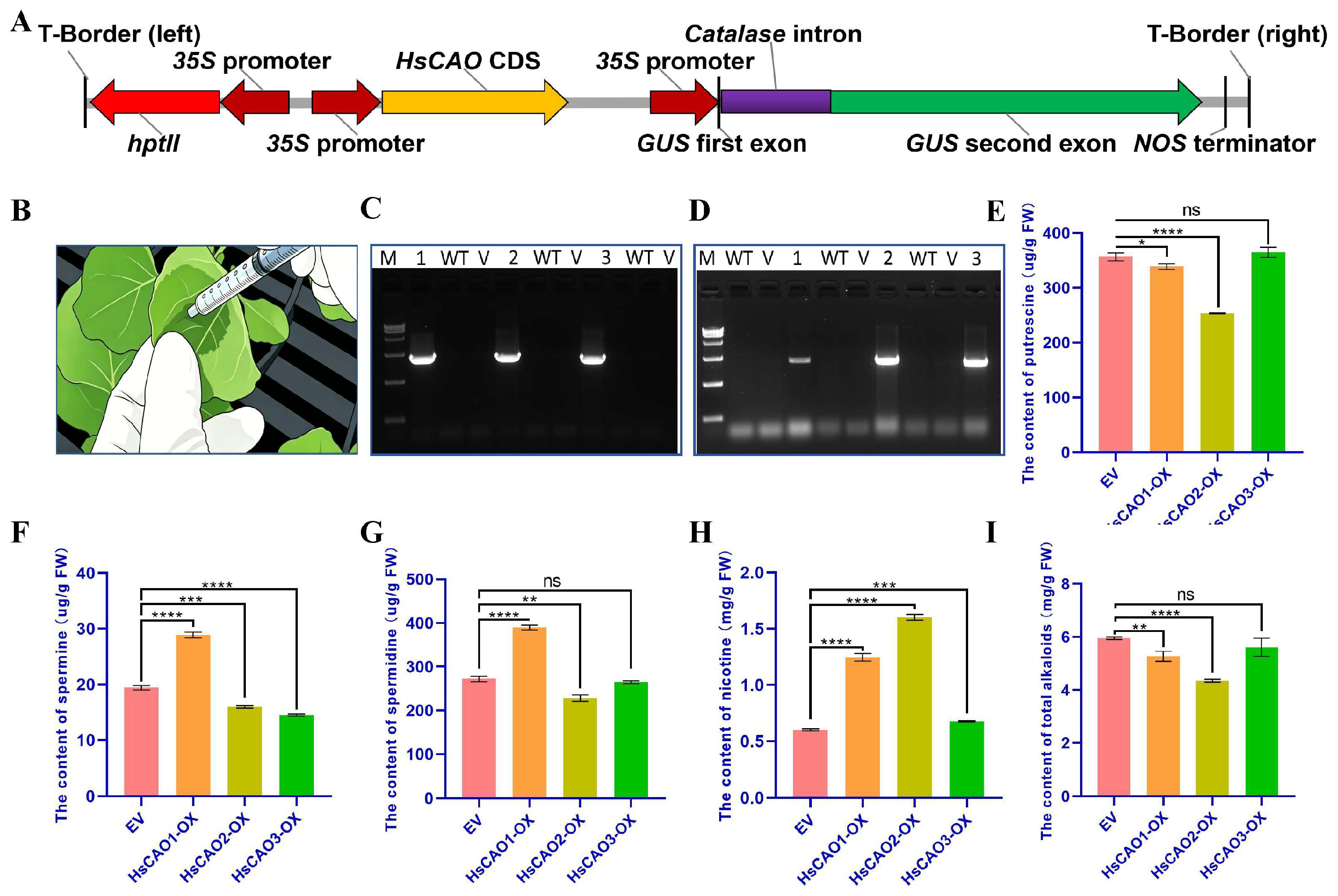
As previously mentioned, CAOs have the potential to catalyze cadaverine to form ∆1-piperideine, a crucial precursor in the initial stage of HupA biosynthesis [1,5,16,18]. Sun et al. successfully cloned a CAO (HsCAO) from the roots of H. serrata [12], reporting that HsCAO could utilize not only cadaverine as a substrate but also several others, including putrescine, spermidine, histamine, benzylamine, tyramine, 4-aminomethylpyridine, 3- aminomethylpyridine, and 2-aminoethylpyridine [12]. In this study, we identified no isoforms identical to HsCAO (herein referred to as HsCAO1) in the transcriptome and full-transcriptome data. Consequently, primers were designed based on the CDS of HsCAO1, facilitating the successful cloning of two additional highly conserved sequences through the 3’- and 5’-RACE methods,, which we have designated as HsCAO2 and HsCAO3, respectively. To evaluate the putative substrates of these CAOs, we attempted to express and purify the three recombinant HsCAO proteins using various prokaryotic protein expression systems and the Pichia pastoris expression system. Regrettably, no active HsCAO proteins were obtained, including HsCAO1. Subsequently, we overexpressed HsCAOs and assessed the content of several amines and alkaloids in the leaves of N. benthamiana. The results indicated a decrease in putrescine content and a significant increase in nicotine content in HsCAO-overexpressed lines (HsCAO-OX) compared to those in the empty vector-injected N. benthamiana leaves. Furthermore, the content of spermidine, spermine, and total alkaloids in HsCAO-OX varied compared to those in EV, suggesting the complex roles of different HsCAOs in the amines and alkaloid synthesis and metabolism in planta.
Figure 9.
The contents of amines and alkaloids in HsCAO-overexpressed N. benthamiana lines. (A) The schematic representation of the overexpression vector structure. (B) The schematic representation of the tobacco injection procedure. (C)~(I) The contents of putrescine, spermine, spermidine, nicotine, and total alkaloids in HsCAO-overexpressed N. benthamiana lines, respectively. M: DL2000 maker; WT: the wild type N. benthamiana; V: N. benthamiana injected with EV; 1,2, and 3: N. benthamiana injected with HsCAO1-OX, HsCAO2-OX, and HsCAO3-OX vectors, respectively.
Figure 9.
The contents of amines and alkaloids in HsCAO-overexpressed N. benthamiana lines. (A) The schematic representation of the overexpression vector structure. (B) The schematic representation of the tobacco injection procedure. (C)~(I) The contents of putrescine, spermine, spermidine, nicotine, and total alkaloids in HsCAO-overexpressed N. benthamiana lines, respectively. M: DL2000 maker; WT: the wild type N. benthamiana; V: N. benthamiana injected with EV; 1,2, and 3: N. benthamiana injected with HsCAO1-OX, HsCAO2-OX, and HsCAO3-OX vectors, respectively.
4. Discussion
The biosynthesis of natural products via biotechnological systems constitutes a progressive approach [44]. In this context, synthetic biology has facilitated new pathways for the efficient large-scale production of bioactive compounds [44]. As an emerging and rapidly advancing interdisciplinary field within biotechnology, synthetic biology has been predominantly utilized with microbes and plants for the synthesis of bioactive compounds [45]. This methodology is particularly advantageous for bioactive compounds with limited production, such as HupA, due to the scarcity of plant resources, the minimal quantities present in plants, and the complexity of their chemical synthesis [46].
The identification of key missing enzymes, and consequently the elucidation of the biosynthetic pathway of bioactive compounds in medicinal plants through proteomics, metabolics, particularly transcriptomics and genomics, forms the basis for the heterologous biosynthesis of these bioactive compounds [46]. Unfortunately, extant lycophytes, especially homosporous Lycopodiaceae, inculding H. serrata and and other HupA-producing species, possess large genome size, high chromosome numbers, and significant chromosome polyploidization [47,48], which impede the acquisition of high-quality genome information for these species. To date, only a limited number of nuclear and organellar genomes of Lycopodiaceae species have been characterized [47,49,50]. As an alternative, identification of key missing enzymes via transcriptomics may present a viable strategy. This approach has been successfully employed in the elucidation of biosynthetic pathway for various natural products, including colchicine [51], strychnine [52], galanthamine [53], thereby confirming the feasibility of analyzing biosynthetic pathways based on transcriptome analysis.
By integrating PacBio long-read and Illumina short-read sequencing technologies, this study successfully assembled a high-quality transcriptome database for H. serrata. This dataset not only serves as a valuable resource for research on HupA biosynthesis but also offers new insights into the evolutionary biology of the Lycopodiaceae family. Comparisons with the NR database revealed that H. serrata exhibits the highest sequence similarity to S. moellendorffii and P. patens (Figure 4C), further supporting its primitive status in the evolutionary tree of land plants. KOG functional classification indicated that “General function prediction only,” “Posttranslational modification, protein turnover, chaperones,” and “Signal transduction mechanisms” were the categories with the highest number of genes (Figure 4D). This pattern reflects the biological characteristics of H. serrata as a perennial slow-growing plant [54]. Its extended life cycle and slow growth rate may necessitate sophisticated mechanisms for maintaining protein homeostasis to cope with long-term environmental stresses. Meanwhile, a complex signal transduction network likely enables it to precisely perceive and respond to specific environmental conditions such as shaded habitats and acidic soils [55].
The study determined that the contents of HupA and its precursor HupB were markedly elevated in young leaves compared to other tissues of H. serrata (Figure 2C-D, Figure S2E-F). This finding suggests that young leaves serve as the primary site for HupA biosynthesis, which was consistent with the finding observed in P. tetrastichus [17], thereby offering a definitive target for gene screening within this pathway. Through phylogenetic clustering, expression level analysis, and correlation analysis between gene expression and metabolite content, 71 candidate genes potentially involved in the skeleton synthesis of HupA and 28 candidate genes potentially involved in its modification were identified (Figure 5A-G, Figure 6A-B). An association analysis between DEGs in young and mature leaves and the contents of HupA and HupB identified 113 genes significantly correlated with HupA content (PCC > 0.8) (Table S13). The partial overlap between the gene sets obtained through the two screening methods underscores the reliability of the strategy and provides essential entry points for elucidating this complex pathway.
In the initial stage of HupA biosynthetic pathway, three catagories of enzymes—LDC, CAO, and PKS—are involved (Figure 1). LDC, which catalyzes the decarboxylation of L-lysine to yield cadaverine, is identified as the initial and rate-limiting enzyme in the HupA biosynthetic pathway [6,10]. To date, six HsLDCs have been successfully cloned and reported; however, only two possess the capacity to decarboxylate L-lysine to yield cadaverine [10,11,56]. Additionally, these two HsLDCs could decarboxylate L-ornithine to produce putrescine [10,56]. Phylogenetic clustering analysis in our study indicated that these two HsLDCs are classified into one group (Figure 5A). Furthermore, 51 isoforms potentially encoding LDCs were identified in our study (Figure S3), suggesting that these LDCs may be generally involved in the synthesis of various alkaloids and may have developed substrate specificity and subcellular localization specificity through gene duplication and functional differentiation [57]. Comparative transcriptome analysis has identified nine HsLDC isozyme genes highly expressed in young leaves, among which HsLDC-9 exhibited the highest expression level in young leaves, with its expression pattern showing a strong positive correlation with HupA content (Figure 5A). It is hypothesized that HsLDC-9 might be localized in the cytoplasm and responsible for providing the cadaverine precursor for HupA synthesis. Further investigation should be conducted to verify this hypothesis.
CAO is the subsequent key enzyme downstream of LDC in the HupA biosynthetic pathway, catalyzing the oxidative deamination of cadaverine to produce Δ1-piperideine [12]. This reaction introduces a critical aldehyde group and constructs the core piperidine ring structure of HupA [58]. Seven isoforms potentially encoding CAOs were identified in our study (Figure S3); however, the expression of all these isoforms in young leaves does not strongly correlate with HupA content (Figure 6B). As HsCAO1 was reported to be a functional CAO involved in HupA biosynthesis [12], we successfully cloned it. Interestingly, other two highly conserved CDSs were also identified. However, we were unable to purify the recombinant HsCAOs because of their insoluble nature. Alternatively, we overexpressed them in the leaves of N. benthamiana, respectively, and the results demonstrated their different roles in amines and alkaloids synthesis and metabolites (Figrue 9E-I). Bewilderingly, Nett et al. reported the HsCAO1 could not catalyze cadaverine to be Δ1-piperideine in vitro [16], which cotrodicts the result reported by Sun et al. [12]. Phylogenetic clustering analysis in our study indicated that HsCAOs and functional CAOs identified from P. tetrastichus were not closely related (Figure 6B), indicating their functional differentiation. Taken together, the function of HsCAOs requires further investigation.
The CYP450 enzyme superfamily represents one of the most catalytically diverse classes of enzymes in plants, capable of facilitating reactions such as hydroxylation, epoxidation, dealkylation, and desaturation [59]. Prior research on P. tetrastichus has revealed that the CYP450 enzyme PtCYP782C1 is involved in the desaturation reaction that forms the HupA skeleton [18]. The CYP782B7 subfamily members identified in this study are linked to the synthesis of specialized alkaloids in other plants, and their elevated expression in young leaves aligns with their established roles in alkaloid diversification (Figure 5E). This indicates that these enzymes may play a crucial role in HupA biosynthesis. The BAHD ACT is noted for its extensive substrate specificity and catalytic versatility [60]. In P. tetrastichus, PtACT-1 has been verified to catalyze the formation of the amide bond within the HupA skeleton [18]. This investigation identified five BAHD family enzymes (e.g., HsHCT-1, HsACT-2) (Figure 6F), which may exhibit analogous functions.
CAs are typically involved in CO2 fixation and pH balance regulation [61]. However, recent research has demonstrated that certain members of this family can directly participate in the biosynthesis of lycopodium alkaloids [18]. For example, PtCAL-3 catalyzes the stereoselective condensation of Δ1-piperideine and 3-oxoglutaric acid to produce (S)-4-(2-piperidyl)acetoacetic acid, while PtCAL-1a/1b and PtCAL-2a/2b must be co-expressed to catalyze subsequent condensation reactions [18]. This study identified multiple carbonic anhydrase genes highly homologous to PtCAL (Figure 5G), with expression levels strongly positively correlated with HupA and HupB content, suggesting their potential involvement in similar condensation reactions.
2OGDs are frequently involved in the hydroxylation of secondary metabolites in plants [62]. In P. tetrastichus, five 2OGD enzymes have been shown to participate in the modification of the HupA skeleton, including pyridone ring formation, piperidine ring cleavage, and A-ring carbonylation [16,18]. In this study, Hs2OGD-1, Hs2OGD-2, and Hs2OGD-3 were highly homologous to Pt2OGD-1 and significantly positively correlated with HupA and HupB content (Figure 6A). It is hypothesized that these enzymes may catalyze the cleavage of the piperidine ring of HupB, resulting in the loss of one carbon atom and the generation of HupC.
The biosynthesis of HupA is likely governed by a complex, multi-tiered network that integrates developmental signals, environmental factors, and transcriptional regulation. PPI analysis has indicated that the candidate proteins not only interact with each other but also exhibit extensive connections with enzymes involved in phenylpropanoid metabolism (e.g., C4H, 4CL, CCR) (Figure 8A-B). This suggests potential crosstalk between HupA biosynthesis and pathways such as phenylpropanoid metabolism and plant hormone signal transduction. Such metabolic network interconnections may represent a common strategy for plants to coordinate the synthesis of multiple defense compounds. TF interaction analysis revealed that multiple candidate genes could interact with members of the MYB, bHLH, and ERF TF families (Figure 8C). These factors play central roles in the regulation of plant secondary metabolism: MYB transcription factors often act as hubs integrating developmental and environmental signals [63]; bHLH transcription factors frequently form complexes with MYB to activate metabolic pathways; ERF transcription factors typically respond to hormonal signals such as jasmonic acid and ethylene to coordinate defense responses [64,65]. For example, the MYB-bHLH-WD40 complex regulates flavonoids and anthocyanin synthesis in other plants [66,67], and similar mechanisms may exist in the regulatory network of HupA synthesis.
In summary, this study presents the inaugural comprehensive multi-tissue transcriptomic atlas of H. serrata, serving as a valuable resource for molecular research on this species. Utilizing a multi-dimensional screening strategy that integrates expression patterns, co-expression analysis, and evolutionary relationships, the study successfully identified multiple high-confidence candidate genes and constructed a preliminary regulatory network. Nonetheless, this study has certain limitations: A majority of functional predictions are based on bioinformatics analysis and lack validation through in vivo or in vitro experiments; the complete biosynthetic pathway of HupA, particularly the isomerization steps of key intermediates, remains to be elucidated; and the current data do not fully explain the low accumulation of HupA in H. serrata or its ecological function and evolutionary origin. Future research should focus on systematically validating the roles of candidate genes through functional experiments to further refine the biosynthetic pathway and regulatory mechanisms of this important medicinal compound.
5. Conclusions
This study employed integrated multi-omics analysis to systematically elucidate the tissue distribution pattern of HupA in H. serrata. It constructed a high-quality transcriptomic resource, identified multiple high-confidence candidate genes, and preliminarily uncovered their potential regulatory network. These findings not only establish a robust foundation for fully elucidating the biosynthetic pathway of HupA but also provide critical targets for enhancing its production through synthetic biology strategies. Future research should focus on the functional validation of the candidate genes and an in-depth examination of the regulatory mechanisms, ultimately achieving sustainable production of HupA to meet clinical demands while conserving this valuable medicinal plant resource.
Supplementary Materials
The following supporting information can be downloaded at the website of this paper posted on Preprints.org, Figure S1: Overview of transcriptomic-guided workflow for identifying enzyme candidates involved in HupA biosynthesis. Figure S2: The H. serrata and the contents of HupA and HupB in various tissues of H. serrata. (A) A representive plant of H. serrata. (B) H. serrata plants with different branches. (C) A representive plant of one-branched H. serrata. (D) The height of different branched H. serrata. (E) HupA content in different tissues of H. serrata. (E) HupB content in different tissues of H. serrata. ZB, OB, TWB, and THB represents H. serrata plants with no branch, one branch, two branches, and three branches, respectively.; Figure S3: Phylogenetic trees of L/ODCs from H. serrata and other species. Figure S4: Phylogenetic trees of CAOs from H. serrata and other species. Figure S5: Phylogenetic trees of CHSs from H. serrata and other species. Figure S6: Phylogenetic trees of SDRs from H. serrata and other species. Figure S7: Phylogenetic trees of α/β-hydrolases from H. serrata and other species. Figure S8: Phylogenetic trees of CYP450s from H. serrata and other species. Figure S9: Phylogenetic trees of CALs from H. serrata and other species. Figure S10: Phylogenetic trees of 2OGDs from H. serrata and other species. Figure S11: Phylogenetic trees of ACTs from H. serrata and other species. Table S1: Table S2: Comprehensive overview of RNA-seq reads from diverse tissues of H. serrata; Table S3: Principle composition of diverse tissues of H. serrata; Table S4: Differentially expressed genes in young leaves of three-branched H. serrata; Table S5: Common differentially expressed genes in all compared groups of three-branched H. serrata; Table S6: KEGG pathway enrichment of 1,953 differentially expressed genes in young leaves of the three-branched H. serrata; Table S7: The statistics of 156 differentially expressed genes involved in the biosynthesis of secondary metabolites pathway; Table S8: Raw data statistics of full-length transcriptome sequencing of three-branched H. serrata; Table S9: The statistics of non-redundant transcripts in the three-branched H. serrata utilizing full-length transcriptome sequencing; Table S10: The species statistics of Nr annotations of unigenes in three-branched H. serrata utilizing full-length transcriptome sequencing; Table S11: The classification of isoforms identified in three-branched H. serrata based on the KOG database; Table S12: The statistics of transcriptional factor family members identified in three-branched Huperzia serrata utilizing full-length transcriptome sequencing; Table S13: The list of up-regulated genes identified utilizing the comparative transcriptome analysis between young leaves and mature leaves of three-branched H. serrata; Table S14: Summary of 113 correlated genes and 422 enzyme families associated with HupA accumulation; Table S15: Summary of 86 genes potentially involved in HupA biosynthesis utilizing the comparative transcriptome analysis between young leaves and mature leaves of three-branched H. serrata; Table S16: Interactions between key proteins and HupA biosynthetic partners using protein-protein interaction network analysis; Table S17: Additional protein interactors associated with the HupA biosynthetic network; Table S18: Pearson correlation coefficient of candidate genes and transcription factors.
Author Contributions
Conceptualization, M.L. and Z.Z..; methodology, M.L., J.W., Han.L. and X.O.; software, J.W., Han.L. and X.O.; validation, C.L., X.O., Z.W. and Z.Z.; formal analysis, X.O., C.L. and M.L.; investigation, M.L., C.L., X.L. Hong.L., W.Y. and X.O.; resources, X.L. Hong.L., Y.H. and S.F.; data curation, M.L., J.W., Han.L., X.O. and Z.Z.; writing—original draft preparation, M.L. and X.O.; writing—review and editing, M.L., X.O. and Z.Z.; visualization, J.W., Han.L. and X.O.; supervision, C.L. and Z.Z.; project administration, M.L. and Z.Z.; funding acquisition, M.L., X.O. and Z.Z. All authors have read and agreed to the published version of the manuscript.
Funding
This research was funded by “the National Natural Science Foundation of China, grant number 32260107”, “the Natural Science Foundation of Guangxi, grant number 2026GXNSFBA00640358”, “Guangxi Qihuang Scholars Training Program, grant number GXQH202402”, and “Guangxi Key Laboratory of Medicinal Resources Protection and Genetic Improvement, grant number KL2025ZZ01”.
Data Availability Statement
The RNA-seq data presented in this study are openly available in the NCBI SRA under BioProject PRJNA1474194 at https://www.ncbi.nlm.nih.gov/sra/PRJNA1474194 (accessed date on). The original data of full-length transcriptome presented in this study are openly available in the NCBI SRA BioProject PRJNA1475084.
Conflicts of Interest
The authors declare no conflicts of interest. The funders had no role in the design of the study; in the collection, analyses, or interpretation of data; in the writing of the manuscript; or in the decision to publish the results.
Abbreviations
The following abbreviations are used in this manuscript:
| HupA | huperzine A |
| CAO | copper amine oxidase |
| 4PAA | 4-(2-piperidyl) acetoacetate |
| 4PAACoA | 4-(2piperidyl) acetoacetyl-CoA |
| LDC | lysine decarboxylase |
| PKS | piperidyl ketide synthase |
| SDR | short-chain dehydrogenase/reductase |
| ACT | acyltransferase |
| CYP450 | cytochrome P450 |
| α-CA | α-carbonic anhydrase |
| 2OGD | 2-oxoglutarate-dependent dioxygenase |
| ABH | α/β-hydrolase |
| TF | transcription factor |
| ABH | α/β-hydrolase |
| THB | three-branched |
| HPLC | high performance liquid chromatography |
| FLNC | full-length non-chimeric |
| KEGG | kyoto encyclopedia of genes and genomes |
| NR | the NCBI nonredundant protein sequences |
| GO | gene ontology |
| COG | cluster of orthologous groups of proteins |
| KOG | eukaryotic ortholog groups |
| TrEMB | the translation of EMBL |
| FPKM | Fragments Per Kilobase of exon model per Million mapped fragment |
| FDR | false discovery rate |
| DEG | differentially expressed gene |
| PCA | Principal Component Analysis |
| HMM | Hidden Markov Model |
| CDS | coding sequence |
| EV | Empty vector |
| CSH | chalcone synthase |
| NMRL | neomenthol dehydrogenase-like |
| CSE | caffeoyl shikimate esterase |
| PCC | Pearson correlation coefficient |
| PPI | protein-protein interaction |
| OX | overexpressed |
References
- Ferreira, A.; Rodrigues, M.; Fortuna, A.; Falcão, A.; Alves, G. Huperzine A from Huperzia Serrata: A Review of Its Sources, Chemistry, Pharmacology and Toxicology. Phytochem. Rev. 2014. [Google Scholar] [CrossRef]
- Ma, X.; Tan, C.; Zhu, D.; Gang, D.R. A Survey of Potential Huperzine A Natural Resources in China: The Huperziaceae. J. Ethnopharmacol. 2005, 104, 54–67. [Google Scholar] [CrossRef]
- Ghassab-Abdollahi, N.; Mobasseri, K.; Dehghani Ahmadabad, A.; Nadrian, H.; Mirghafourvand, M. The Effects of Huperzine A on Dementia and Mild Cognitive Impairment: An Overview of Systematic Reviews. Phytother. Res. 2021, 35, 4971–4987. [Google Scholar] [CrossRef]
- Gul, A.; Bakht, J.; Mehmood, F. Huperzine-A Response to Cognitive Impairment and Task Switching Deficits in Patients with Alzheimer’s Disease. J. Chin. Med. Assoc. 2019, 82, 40–43. [Google Scholar] [CrossRef]
- Ma, X.; Tan, C.; Zhu, D.; Gang, D.R. Is There a Better Source of Huperzine A than Huperzia Serrata? Huperzine A Content of Huperziaceae Species in China. J. Agric. Food Chem. 2005, 53, 1393–1398. [Google Scholar] [CrossRef]
- Wu, H.; Shen, Y.; Zou, F.; Yao, S.; Chen, Y.; Yang, H.; Luo, X. Combined Transcriptome and Widely Targeted Metabolome Analysis Reveals the Potential Mechanism of HupA Biosynthesis and Antioxidant Activity in Huperzia Serrata. Front. Plant Sci. 2024, 15, 1411471. [Google Scholar] [CrossRef]
- Hemscheidt, T.; Spenser, I.D. A Classical Paradigm of Alkaloid Biogenesis Revisited: Acetonedicarboxylic Acid as a Biosynthetic Precursor of Lycopodine. J. Am. Chem. Soc. 1996, 118, 1799–1800. [Google Scholar] [CrossRef]
- Gerdes, H.J.; Leistner, E. Stereochemistry of Reactions Catalysed by L-Lysine Decarboxylase and Diamine Oxidase. Phytochemistry 1979, 18, 771–775. [Google Scholar] [CrossRef]
- Ma, X.; Gang, D.R. The Lycopodium Alkaloids. Nat. Prod. Rep. 2004, 21, 752–752. [Google Scholar] [CrossRef]
- Xu, B.; Lei, L.; Zhu, X.; Zhou, Y.; Xiao, Y. Identification and Characterization of L-Lysine Decarboxylase from Huperzia Serrata and Its Role in the Metabolic Pathway of Lycopodium Alkaloid. Phytochemistry 2017, 136, 23–30. [Google Scholar] [CrossRef]
- Bunsupa, S.; Hanada, K.; Maruyama, A.; Aoyagi, K.; Komatsu, K.; Ueno, H.; Yamashita, M.; Sasaki, R.; Oikawa, A.; Saito, K.; et al. Molecular Evolution and Functional Characterization of a Bifunctional Decarboxylase Involved in Lycopodium Alkaloid Biosynthesis. Plant Physiol. 2016, 171, 2432–2444. [Google Scholar] [CrossRef]
- Sun, J.; Morita, H.; Chen, G.; Noguchi, H.; Abe, I. Molecular Cloning and Characterization of Copper Amine Oxidase from Huperzia Serrata. Bioorg Med. Chem. Lett. 2012, 22, 5784–5790. [Google Scholar] [CrossRef]
- Wang, J.; Wang, X.-H.; Liu, X.; Li, J.; Shi, X.-P.; Song, Y.-L.; Zeng, K.-W.; Zhang, L.; Tu, P.-F.; Shi, S.-P. Synthesis of Unnatural 2-Substituted Quinolones and 1,3-Diketones by a Member of Type III Polyketide Synthases from Huperzia Serrata. Org. Lett. 2016, 18, 3550–3553. [Google Scholar] [CrossRef]
- Wang, J.; Zhang, Z.-K.; Jiang, F.-F.; Qi, B.-W.; Ding, N.; Hnin, S.Y.Y.; Liu, X.; Li, J.; Wang, X.; Tu, P.-F.; et al. Deciphering the Biosynthetic Mechanism of Pelletierine in Lycopodium Alkaloid Biosynthesis. Org. Lett. 2020, 22, 8725–8729. [Google Scholar] [CrossRef]
- Wanibuchi, K.; Zhang, P.; Abe, T.; Morita, H.; Kohno, T.; Chen, G.; Noguchi, H.; Abe, I. An Acridone-producing Novel Multifunctional Type III Polyketide Synthase from Huperzia Serrata. FEBS J. 2007, 274, 1073–1082. [Google Scholar] [CrossRef]
- Nett, R.S.; Dho, Y.; Low, Y.-Y.; Sattely, E.S. A Metabolic Regulon Reveals Early and Late Acting Enzymes in Neuroactive Lycopodium Alkaloid Biosynthesis. Proc. Natl. Acad. Sci. U.S.A. 2021, 118. [Google Scholar] [CrossRef]
- Nett, R.S.; Guan, X.; Smith, K.; Faust, A.M.; Sattely, E.S.; Fischer, C.R. D2O Labeling to Measure Active Biosynthesis of Natural Products in Medicinal Plants. AIChE J. 2018, 64, 4319–4330. [Google Scholar] [CrossRef]
- Nett, R.S.; Dho, Y.; Tsai, C.; Passow, D.; Grundman, J.M.; Low, Y.-Y.; Sattely, E.S. Plant Carbonic Anhydrase-like Enzymes in Neuroactive Alkaloid Biosynthesis. Nature 2023, 624, 182–191. [Google Scholar] [CrossRef]
- Luo, H.; Sun, C.; Li, Y.; Wu, Q.; Song, J.; Wang, D.; Jia, X.; Li, R.; Chen, S. Analysis of Expressed Sequence Tags from the Huperzia Serrata Leaf for Gene Discovery in the Areas of Secondary Metabolite Biosynthesis and Development Regulation. Physiol. Plant. 2009, 139, 1–12. [Google Scholar] [CrossRef]
- Luo, H.; Li, Y.; Sun, C.; Wu, Q.; Song, J.; Sun, Y.; Steinmetz, A.; Chen, S. Comparison of 454-ESTs from Huperzia Serrata and Phlegmariurus Carinatus Reveals Putative Genes Involved in Lycopodium Alkaloid Biosynthesis and Developmental Regulation. BMC Plant Biol. 2010, 10, 209. [Google Scholar] [CrossRef]
- Yang, M.; You, W.; Wu, S.; Fan, Z.; Xu, B.; Zhu, M.; Li, X.; Xiao, Y. Global Transcriptome Analysis of Huperzia Serrata and Identification of Critical Genes Involved in the Biosynthesis of Huperzine A. BMC Genom. 2017, 18, 245. [Google Scholar] [CrossRef]
- Zhu, D.; Wang, J.; Zeng, Q.; Zhang, Z.; Yan, R. A Novel Endophytic Huperzine A-Producing Fungus, Shiraia Sp. Slf14, Isolated from Huperzia Serrata. J. Appl. Microbiol. 2010, 109, 1469–1478. [Google Scholar] [CrossRef]
- Chen, S.; Zhou, Y.; Chen, Y.; Gu, J. Fastp: An Ultra-Fast All-in-One FASTQ Preprocessor. Bioinformatics 2018, 34, i884–i890. [Google Scholar] [CrossRef]
- Gordon, S.P.; Tseng, E.; Salamov, A.; Zhang, J.; Meng, X.; Zhao, Z.; Kang, D.; Underwood, J.; Grigoriev, I.V.; Figueroa, M.; et al. Widespread Polycistronic Transcripts in Fungi Revealed by Single-Molecule mRNA Sequencing. PLoS ONE 2015, 10, e0132628–e0132628. [Google Scholar] [CrossRef]
- Li, B.; Dewey, C.N. RSEM: Accurate Transcript Quantification from RNA-Seq Data with or without a Reference Genome. BMC Bioinform. 2011, 12, 323. [Google Scholar] [CrossRef]
- Buchfink, B.; Xie, C.; Huson, D.H. Fast and Sensitive Protein Alignment Using DIAMOND. Nat. Methods 2014, 12, 59–60. [Google Scholar] [CrossRef]
- SHIMIZU, K.; ADACHI, J.; MURAOKA, Y. ANGLE: A SEQUENCING ERRORS RESISTANT PROGRAM FOR PREDICTING PROTEIN CODING REGIONS IN UNFINISHED cDNA. J. Bioinform. Comput. Biol. 2006, 04, 649–664. [Google Scholar] [CrossRef]
- Finn, R.D.; Coggill, P.; Eberhardt, R.Y.; Eddy, S.R.; Mistry, J.; Mitchell, A.L.; Potter, S.C.; Punta, M.; Qureshi, M.; Sangrador-Vegas, A.; et al. The Pfam Protein Families Database: Towards a More Sustainable Future. Nucleic Acids Res. 2015, 44, D279–D285. [Google Scholar] [CrossRef]
- Li, J.; Harata-Lee, Y.; Denton, M.D.; Feng, Q.; Rathjen, J.R.; Qu, Z.; Adelson, D.L. Long Read Reference Genome-Free Reconstruction of a Full-Length Transcriptome from Astragalus Membranaceus Reveals Transcript Variants Involved in Bioactive Compound Biosynthesis. Cell Discov. 2017, 3, 17031. [Google Scholar] [CrossRef]
- Love, M.I.; Huber, W.; Anders, S. Moderated Estimation of Fold Change and Dispersion for RNA-Seq Data with DESeq2. Genome Biol. 2014, 15, 550. [Google Scholar] [CrossRef]
- Wang, L.; Zhang, J.; Wang, R.; Huang, Z.; Cui, R.; Zhu, H.; Yang, Y.; Zhang, D. Genome-Wide Identification, Evolution, and Expression Analysis of Carbonic Anhydrases Genes in Soybean (Glycine Max). Funct. Integr. Genom. 2023, 23, 37. [Google Scholar] [CrossRef]
- Ghosh, A.K.; Chauhan, N.; Rajakumari, S.; Daum, G.; Rajasekharan, R. At4g24160, a Soluble Acyl-Coenzyme A-Dependent Lysophosphatidic Acid Acyltransferase. Plant Physiol. 2009, 151, 869–881. [Google Scholar] [CrossRef]
- Hu, H.; Shi, B.; Zhu, W.; Zheng, B.; Zhou, K.; Qian, M.; Wu, H. Genome-Wide Identification, Characterization and Expression Analysis of Mango (Mangifera Indica L.) Chalcone Synthase (CHS) Genes in Response to Light. Horticulturae 2022, 8, 968. [Google Scholar] [CrossRef]
- Han, J.; Wang, X.; Niu, S. Genome-Wide Identification of 2-Oxoglutarate and Fe (II)-Dependent Dioxygenase (2ODD-C) Family Genes and Expression Profiles under Different Abiotic Stresses in Camellia Sinensis (L.). Plants 2023, 12, 1302. [Google Scholar] [CrossRef]
- Zhang, Y.; Fu, C.; Wen, S.; Zhang, T.; Wang, X. Genome-Wide Analysis and Characterization of the SDR Gene Superfamily in Cinnamomum Camphora and Identification of Synthase for Eugenol Biosynthesis. Int. J. Mol. Sci. 2024, 25, 10084. [Google Scholar] [CrossRef]
- Wu, Y.; Wang, H.; Liu, H.; Li, D. Genome-Wide Identification and Analysis of the Cytochrome P450 Family Elucidate Flavonoid Biosynthesis in Safflower. BMC Plant Biol. 2025, 25, 1045. [Google Scholar] [CrossRef]
- Zhang, Z.; Xiong, T.; Li, K.; Huang, K.; Wu, S.; Wu, L. The Tree of Life of Copper-Containing Amine Oxidases. Front. Plant Sci. 2025, 16, 1544527. [Google Scholar] [CrossRef]
- Kanjee, U.; Gutsche, I.; Alexopoulos, E.; Zhao, B.; El Bakkouri, M.; Thibault, G.; Liu, K.; Ramachandran, S.; Snider, J.; Pai, E.F.; et al. Linkage between the Bacterial Acid Stress and Stringent Responses: The Structure of the Inducible Lysine Decarboxylase. EMBO J. 2011, 30, 931–944. [Google Scholar] [CrossRef]
- Zhang, W.; Li, J.; Dong, Y.; Huang, Y.; Qi, Y.; Bai, H.; Li, H.; Shi, L. Genome-Wide Identification and Expression of BAHD Acyltransferase Gene Family Shed Novel Insights into the Regulation of Linalyl Acetate and Lavandulyl Acetate in Lavender. J. Plant Physiol. 2024, 292, 154143. [Google Scholar] [CrossRef]
- Katoh, K.; Standley, D.M. MAFFT Multiple Sequence Alignment Software Version 7: Improvements in Performance and Usability. Mol. Biol. Evol. 2013, 30, 772–780. [Google Scholar] [CrossRef]
- Tamura, K.; Stecher, G.; Kumar, S. MEGA11: Molecular Evolutionary Genetics Analysis Version 11. Mol. Biol. Evol. 2021, 38, 3022–3027. [Google Scholar] [CrossRef] [PubMed]
- Mu, H.; Chen, J.; Huang, W.; Huang, G.; Deng, M.; Hong, S.; Ai, P.; Gao, C.; Zhou, H. OmicShare Tools: A Zero-code Interactive Online Platform for Biological Data Analysis and Visualization. Imeta. 2024, 3, e228. [Google Scholar] [CrossRef]
- Shannon, P.; Markiel, A.; Ozier, O.; Baliga, N.S.; Wang, J.T.; Ramage, D.; Amin, N.; Schwikowski, B.; Ideker, T. Cytoscape: A Software Environment for Integrated Models of Biomolecular Interaction Networks. Genome Res. 2003, 13, 2498–2504. [Google Scholar] [CrossRef] [PubMed]
- Guo, M.; Lv, H.; Chen, H.; Dong, S.; Zhang, J.; Liu, W.; He, L.; Ma, Y.; Yu, H.; Chen, S.; et al. Strategies on Biosynthesis and Production of Bioactive Compounds in Medicinal Plants. Chin. Herb. Med. 2024, 16, 13–26. [Google Scholar] [CrossRef]
- Lee, S.; Kwon, M. Editorial: Biomolecule Production in Plant Synthetic Biology. Front. Plant Sci. 2026, 17, 1857952. [Google Scholar] [CrossRef]
- Liu, Y.; Ji, A.; Jia, H.; Sun, H. Advanced Applications of Synthetic Biology Technology in Biosynthesis of Bioactive Compounds from Medicinal Plants. Chin. Herb. Med. 2026, 18, 11–28. [Google Scholar] [CrossRef]
- Li, C.; Wickell, D.; Kuo, L.-Y.; Chen, X.; Nie, B.; Liao, X.; Peng, D.; Ji, J.; Jenkins, J.; Williams, M.; et al. Extraordinary Preservation of Gene Collinearity over Three Hundred Million Years Revealed in Homosporous Lycophytes. Proc. Natl. Acad. Sci. U.S.A. 2024, 121. [Google Scholar] [CrossRef]
- Wang, F.-G.; Wang, A.-H.; Bai, C.-K.; Jin, D.-M.; Nie, L.-Y.; Harris, A.; Che, L.; Wang, J.-J.; Li, S.-Y.; Xu, L.; et al. Genome Size Evolution of the Extant Lycophytes and Ferns. Plant Divers. 2022, 44, 141–152. [Google Scholar] [CrossRef]
- Guo, Z.; Zhang, H.; Shrestha, N.; Zhang, X. Complete Chloroplast Genome of a Valuable Medicinal Plant, Huperzia Serrata (Lycopodiaceae), and Comparison with Its Congener. Appl. Plant Sci. 2016, 4, 1600071. [Google Scholar] [CrossRef]
- Yu, J.-G.; Tang, J.-Y.; Wei, R.; Lan, M.-F.; Xiang, R.-C.; Zhang, X.-C.; Xiang, Q.-P. The First Homosporous Lycophyte Genome Revealed the Association between the Recent Dynamic Accumulation of LTR-RTs and Genome Size Variation. Plant Mol. Biol. 2023, 112, 325–340. [Google Scholar] [CrossRef] [PubMed]
- Nett, R.S.; Lau, W.; Sattely, E.S. Discovery and Engineering of Colchicine Alkaloid Biosynthesis. Nature 2020, 584, 148–153. [Google Scholar] [CrossRef] [PubMed]
- Hong, B.; Grzech, D.; Caputi, L.; Sonawane, P.; López, C.E.R.; Kamileen, M.O.; Lozada, N.J.H.; Grabe, V.; O’Connor, S.E. Biosynthesis of Strychnine. Nature 2022, 607, 617–622. [Google Scholar] [CrossRef]
- Mehta, N.; Meng, Y.; Zare, R.; Kamenetsky-Goldstein, R.; Sattely, E. A Developmental Gradient Reveals Biosynthetic Pathways to Eukaryotic Toxins in Monocot Geophytes. Cell 2024, 187, 1–18. [Google Scholar] [CrossRef] [PubMed]
- Manchanda, P.; Kaur, M.; Sharma, S.; Sidhu, G.S. Biotechnological Interventions for Reducing the Juvenility in Perennials. Horticulturae 2022, 9, 33. [Google Scholar] [CrossRef]
- Kollist, H.; Zandalinas, S.I.; Sengupta, S.; Nuhkat, M.; Kangasjärvi, J.; Mittler, R. Rapid Responses to Abiotic Stress: Priming the Landscape for the Signal Transduction Network. Trends. Plant. Sci. 2019, 24, 25–37. [Google Scholar] [CrossRef]
- Li, S.-N.; Wang, W.-J.; Zhang, B.-B.; Zhang, Z.-K.; Ge, X.-Y.; Du, Y.; Zhang, X.-X.; Wang, J.; Shi, S.-P. Gene Cloning and Functional Characterization of A Lysine Decarboxylase from Huperzia Serrata. Acta Pharm. Sin. 2022, 57, 3437–3445. [Google Scholar] [CrossRef]
- Wink, M. Evolution of Secondary Metabolites from an Ecological and Molecular Phylogenetic Perspective. Phytochemistry 2003, 64, 3–19. [Google Scholar] [CrossRef] [PubMed]
- Li, X.; Li, W.; Tian, P.; Tan, T. Delineating Biosynthesis of Huperzine A, A Plant-Derived Medicine for the Treatment of Alzheimer’s Disease. Biotechnol. Adv. 2022, 60, 108026–108026. [Google Scholar] [CrossRef] [PubMed]
- Das, A.; Begum, K.; Akhtar, S.; Ahmed, R.; Tamuli, P.; Kulkarni, R.; Banu, S. Genome-Wide Investigation of Cytochrome P450 Superfamily of Aquilaria Agallocha: Association with Terpenoids and Phenylpropanoids Biosynthesis. Int. J. Biol. Macromol. 2023, 234, 123758. [Google Scholar] [CrossRef]
- Moghe, G.; Kruse, L.H.; Petersen, M.; Scossa, F.; Fernie, A.R.; Gaquerel, E.; D’Auria, J.C. BAHD Company: The Ever-Expanding Roles of the BAHD Acyltransferase Gene Family in Plants. Annu. Rev. Plant Biol. 2023, 74, 165–194. [Google Scholar] [CrossRef] [PubMed]
- DiMario, R.J.; Machingura, M.C.; Waldrop, G.L.; Moroney, J.V. The Many Types of Carbonic Anhydrases in Photosynthetic Organisms. Plant. Sci. 2018, 268, 11–17. [Google Scholar] [CrossRef]
- Yang, S.; Xing, J.; Liu, D.; Song, Y.; Yu, H.; Xu, S.; Zuo, Y. Review and New Insights into the Catalytic Structural Domains of the Fe(Ll) and 2-Oxoglutarate Families. Int. J. Biol. Macromol. 2024, 278, 134798. [Google Scholar] [CrossRef]
- Peng, W.; Zhang, Y.; Xie, H.; Yu, Y.; Zhu, M. Research Progress on the Synergistic Regulation of MYB Transcription Factor-Mediated Developmental Plasticity and Stress Responses in Rice. Front. Plant Sci. 2025, 16, 1668800. [Google Scholar] [CrossRef] [PubMed]
- Shoji, T.; Yuan, L. ERF Gene Clusters: Working Together to Regulate Metabolism. Trends. Plant. Sci. 2021, 26, 23–32. [Google Scholar] [CrossRef] [PubMed]
- Lakehal, A.; Dob, A.; Rahneshan, Z.; Novák, O.; Escamez, S.; Alallaq, S.; Strnad, M.; Tuominen, H.; Bellini, C. ETHYLENE RESPONSE FACTOR 115 Integrates Jasmonate and Cytokinin Signaling Machineries to Repress Adventitious Rooting in Arabidopsis. New Phytol. 2020, 228, 1611–1626. [Google Scholar] [CrossRef]
- Yue, M.; Jiang, L.; Zhang, N.; Zhang, L.; Liu, Y.; Lin, Y.; Zhang, Y.; Luo, Y.; Zhang, Y.; Wang, Y.; et al. Regulation of Flavonoids in Strawberry Fruits by FaMYB5/FaMYB10 Dominated MYB-bHLH-WD40 Ternary Complexes. Front. Plant Sci. 2023, 14, 1145670. [Google Scholar] [CrossRef] [PubMed]
- Mengxuan, Q.; Xinyue, T.; Yuqing, C.; Yongkang, L.; Yanping, Z. WD40 Proteins PaTTG1 Interact with Both bHLH and MYB to Regulate Trichome Formation and Anthocyanin Biosynthesis in Platanus Acerifolia. Plant Sci. 2025, 352, 112385. [Google Scholar] [CrossRef]
Figure 1.
The biosynthetic pathway of HupA in P. tetrastichus. Solid arrows represent the established steps, while dashed arrows indicate the hypothetical steps. LDC: lysine decarboxylase; CAO: copper amine oxidase; PKS: piperidyl ketide synthase; SDR: short-chain dehydrogenase/reductase; ACT: BAHD acyltransferase; CYP: cytochrome P450; α-CA: α-carbonic anhydrase; 2OGD: 2-oxoglutarate-dependent dioxygenase; ABH: α/β-hydrolase.
Figure 1.
The biosynthetic pathway of HupA in P. tetrastichus. Solid arrows represent the established steps, while dashed arrows indicate the hypothetical steps. LDC: lysine decarboxylase; CAO: copper amine oxidase; PKS: piperidyl ketide synthase; SDR: short-chain dehydrogenase/reductase; ACT: BAHD acyltransferase; CYP: cytochrome P450; α-CA: α-carbonic anhydrase; 2OGD: 2-oxoglutarate-dependent dioxygenase; ABH: α/β-hydrolase.
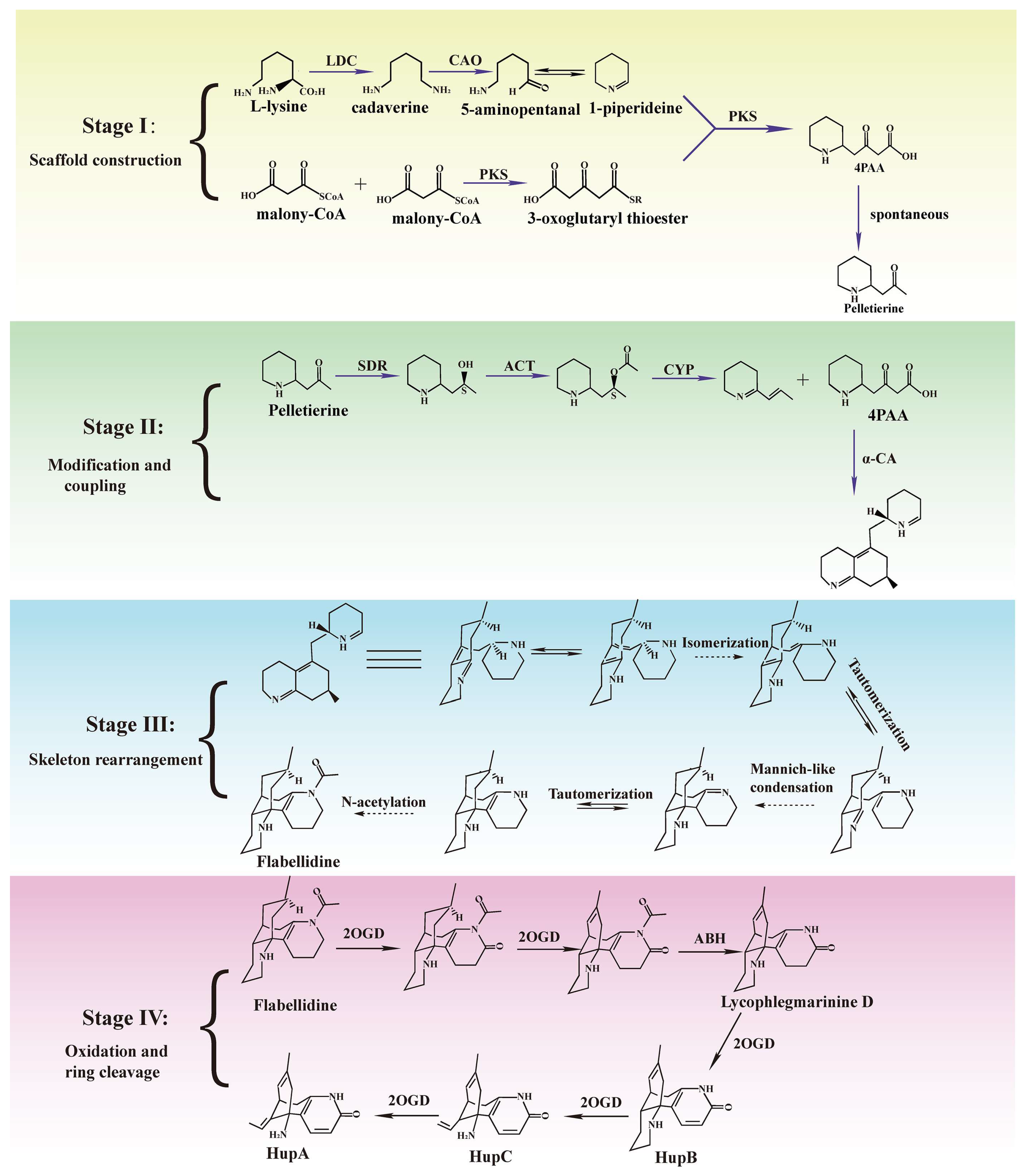
Figure 2.
The THB H. serrata and the contents of HupA and HupB in various tissues of THB H. serrata. (A) A representive plant of THB H. serrata. (B) A schematic illustration of THB H. serrata. (C) HupA content in different tissues of THB H. serrata. (D) HupB content in different tissues of THB H. serrata.
Figure 2.
The THB H. serrata and the contents of HupA and HupB in various tissues of THB H. serrata. (A) A representive plant of THB H. serrata. (B) A schematic illustration of THB H. serrata. (C) HupA content in different tissues of THB H. serrata. (D) HupB content in different tissues of THB H. serrata.
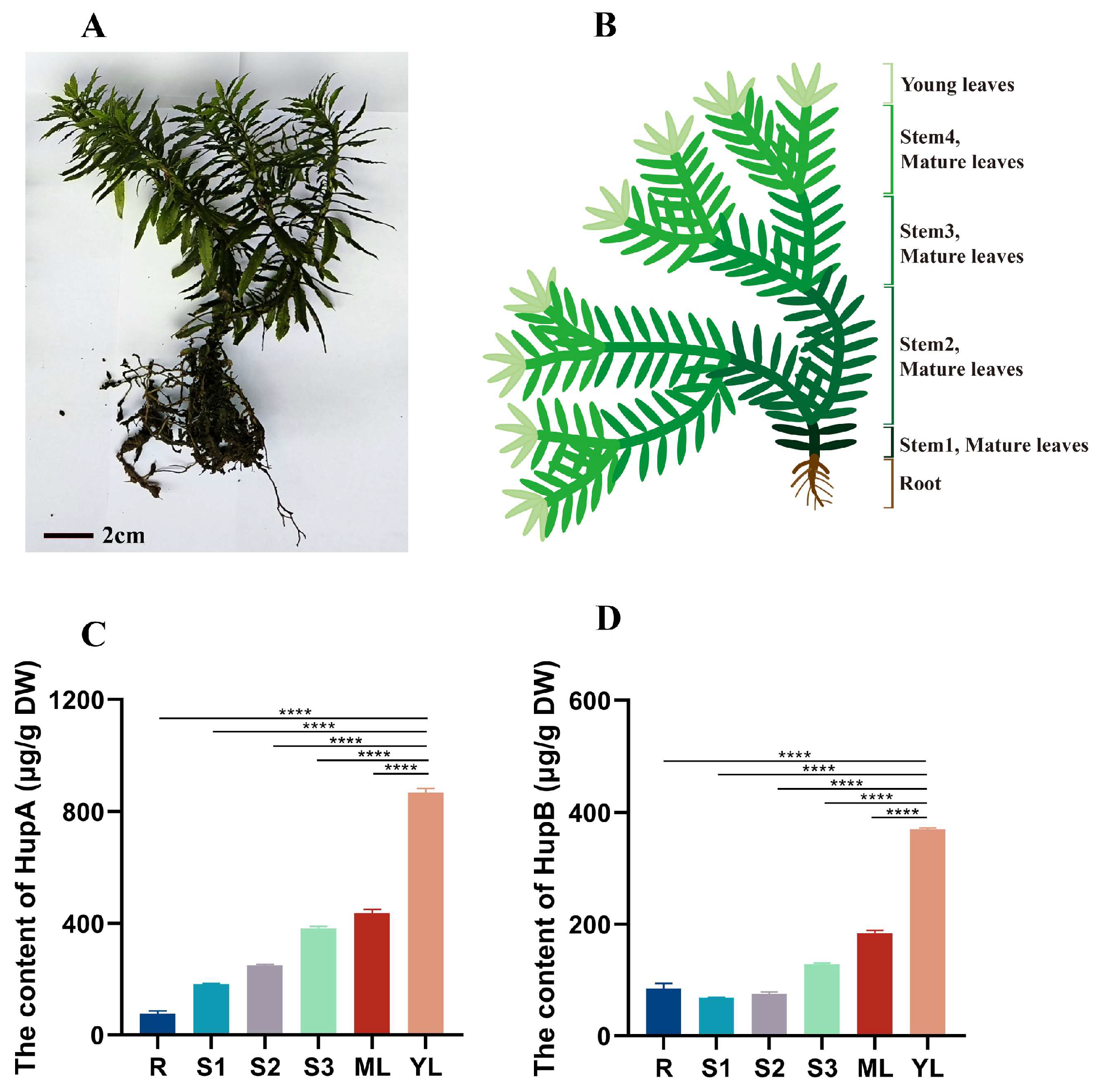
Figure 3.
Transcriptomic landscape across various tissues of THB H. serrata. (A) PCA of all gene transcripts in different tissues of THB H. serrata, with PC1 and PC2 representing the first and second principal components, respectively. (B) Overlap of DEGs between young leaves and other tissues of THB H. serrata. (C) Kyoto encyclopedia of genes and genomes (KEGG) pathway enrichment of DEGs in young leaves of THB H. serrata.
Figure 3.
Transcriptomic landscape across various tissues of THB H. serrata. (A) PCA of all gene transcripts in different tissues of THB H. serrata, with PC1 and PC2 representing the first and second principal components, respectively. (B) Overlap of DEGs between young leaves and other tissues of THB H. serrata. (C) Kyoto encyclopedia of genes and genomes (KEGG) pathway enrichment of DEGs in young leaves of THB H. serrata.
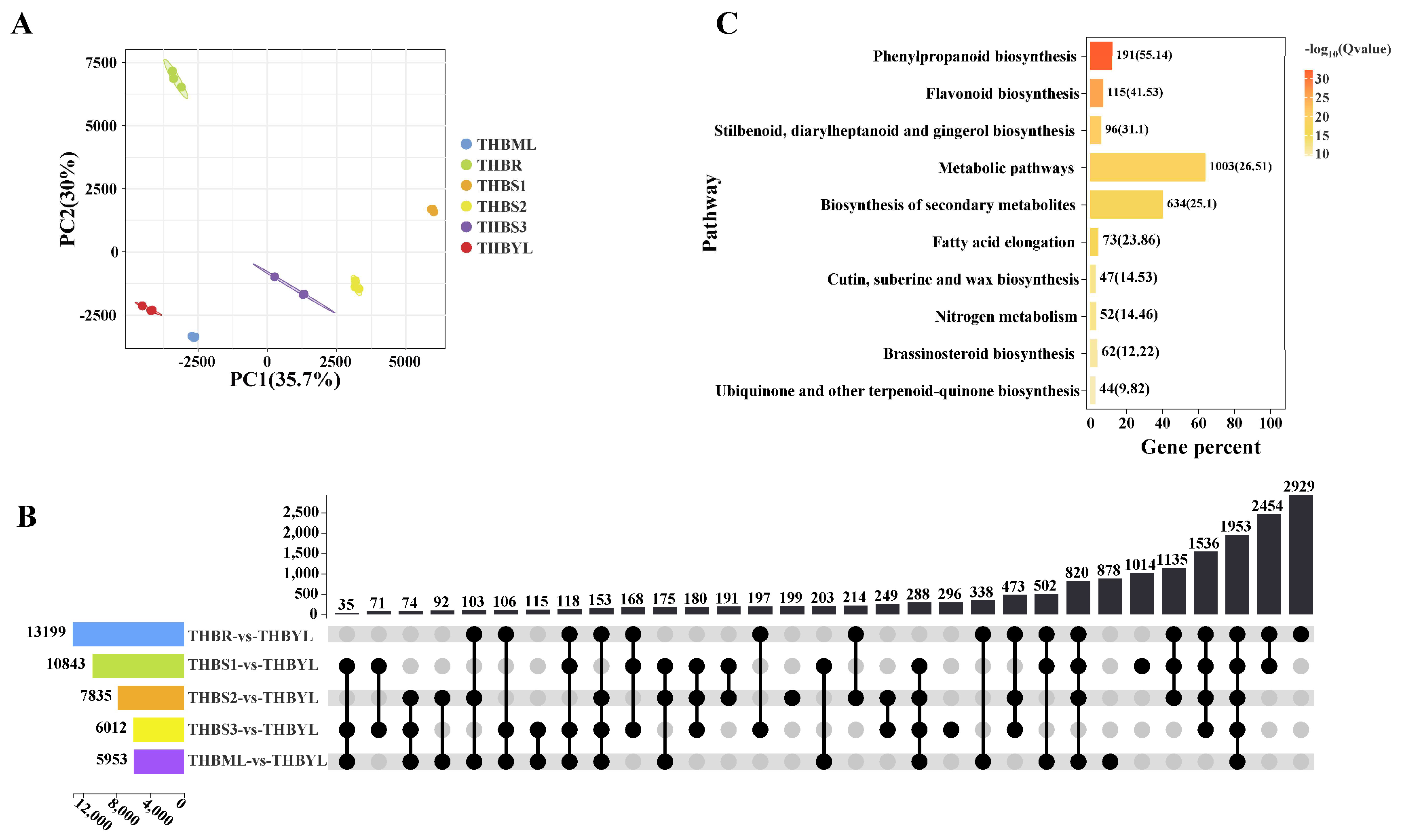
Figure 4.
The statistics of full-length transcriptome sequencing of THB H. serrata. (A) Length distribution of isoforms identified in THB H. serrata utilizing full-length transcriptome sequencing. (B) The statistics of annotation for unigenes of H. serrata in four public databases. (C) Species distribution in Nr database; (D) KOG annotations. The x-axis represents KOG categories and the y-axis represents the number of isoforms. (E) Gene number of each TF family. (F) Statistics of the number of alternative splicing events.
Figure 4.
The statistics of full-length transcriptome sequencing of THB H. serrata. (A) Length distribution of isoforms identified in THB H. serrata utilizing full-length transcriptome sequencing. (B) The statistics of annotation for unigenes of H. serrata in four public databases. (C) Species distribution in Nr database; (D) KOG annotations. The x-axis represents KOG categories and the y-axis represents the number of isoforms. (E) Gene number of each TF family. (F) Statistics of the number of alternative splicing events.
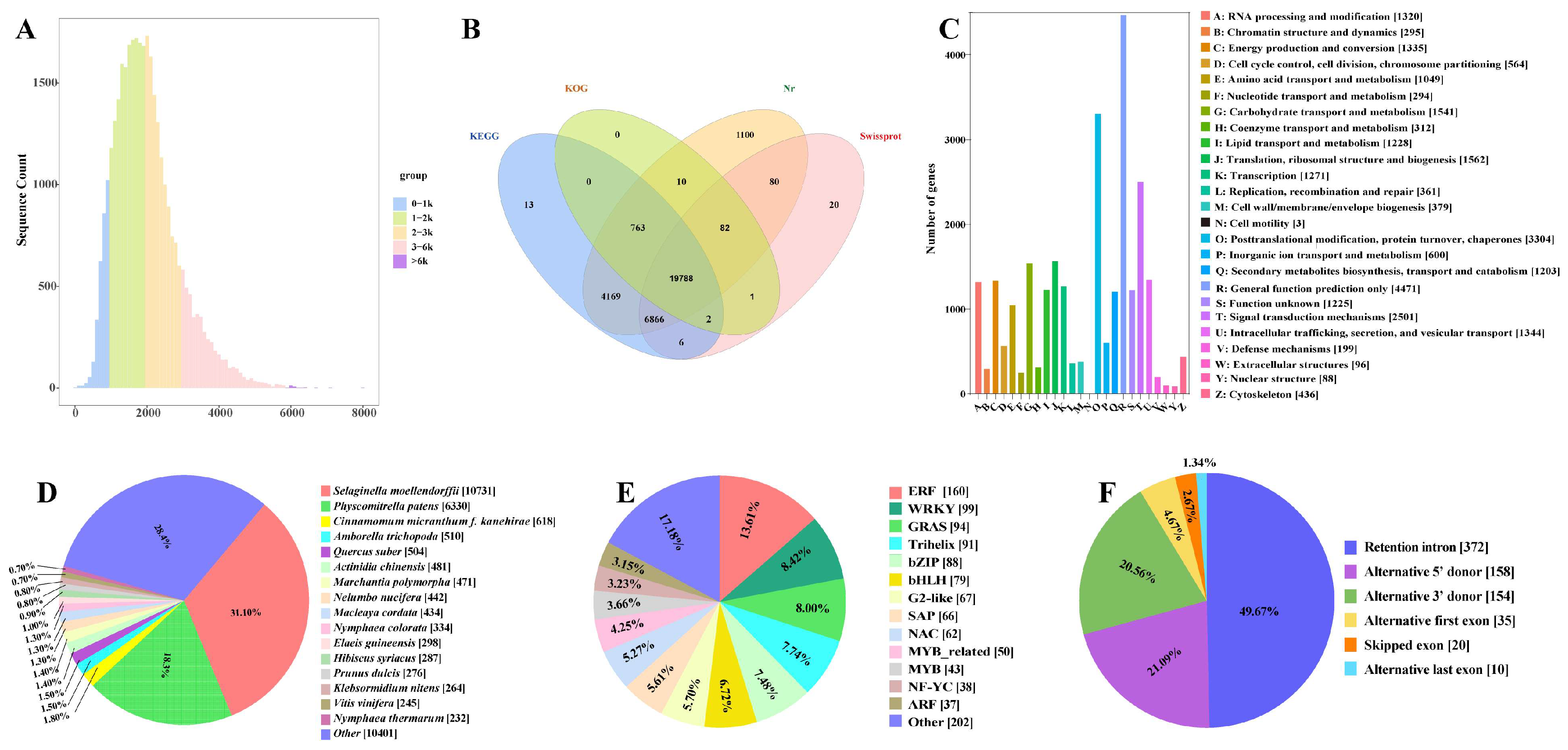
Figure 5.
Phylogenetic trees, an expression heatmap, and Pearson correlation analysis of HupA and HupB and genes associated with the biosynthesis of HupA backbone in H. serrata. The expression levels are represented as normalized fragments per kilobase of transcript per million mapped fragments (FPKM) values (log2(FPKM+1)). Significance values are denoted as follows: * 0.01 < p < 0.05; ** 0.001 < p < 0.01; *** p ≤ 0.001.
Figure 5.
Phylogenetic trees, an expression heatmap, and Pearson correlation analysis of HupA and HupB and genes associated with the biosynthesis of HupA backbone in H. serrata. The expression levels are represented as normalized fragments per kilobase of transcript per million mapped fragments (FPKM) values (log2(FPKM+1)). Significance values are denoted as follows: * 0.01 < p < 0.05; ** 0.001 < p < 0.01; *** p ≤ 0.001.
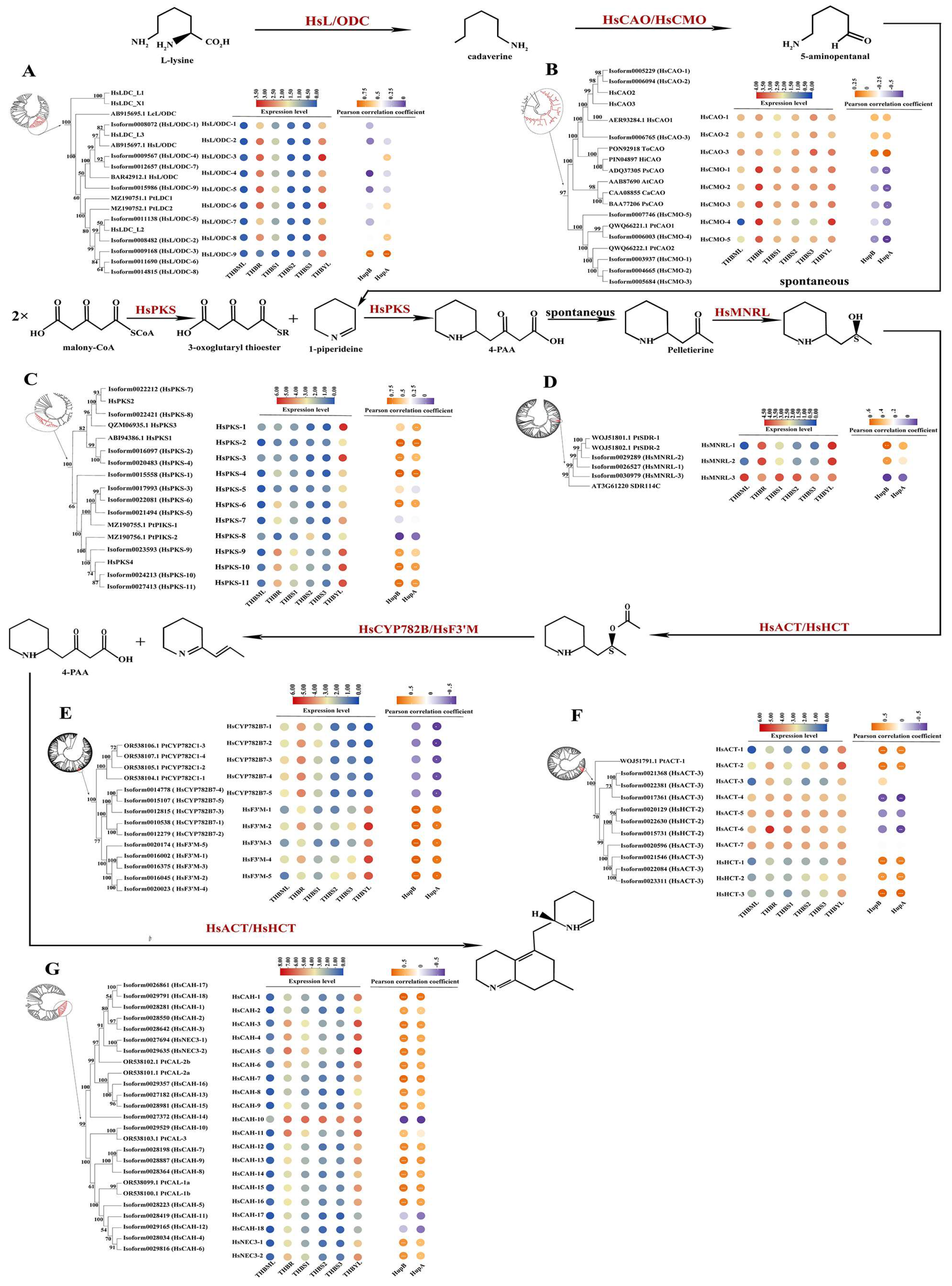
Figure 6.
Phylogenetic trees, an expression heatmap, and Pearson correlation analysis of HupA and HupB and genes associated with the modification of HupA backbone in H. serrata. The expression levels are represented as normalized FPKM values (log2(FPKM+1)). Significance values are denoted as follows: * 0.01 < p < 0.05; ** 0.001 < p < 0.01; *** p ≤ 0.001.
Figure 6.
Phylogenetic trees, an expression heatmap, and Pearson correlation analysis of HupA and HupB and genes associated with the modification of HupA backbone in H. serrata. The expression levels are represented as normalized FPKM values (log2(FPKM+1)). Significance values are denoted as follows: * 0.01 < p < 0.05; ** 0.001 < p < 0.01; *** p ≤ 0.001.
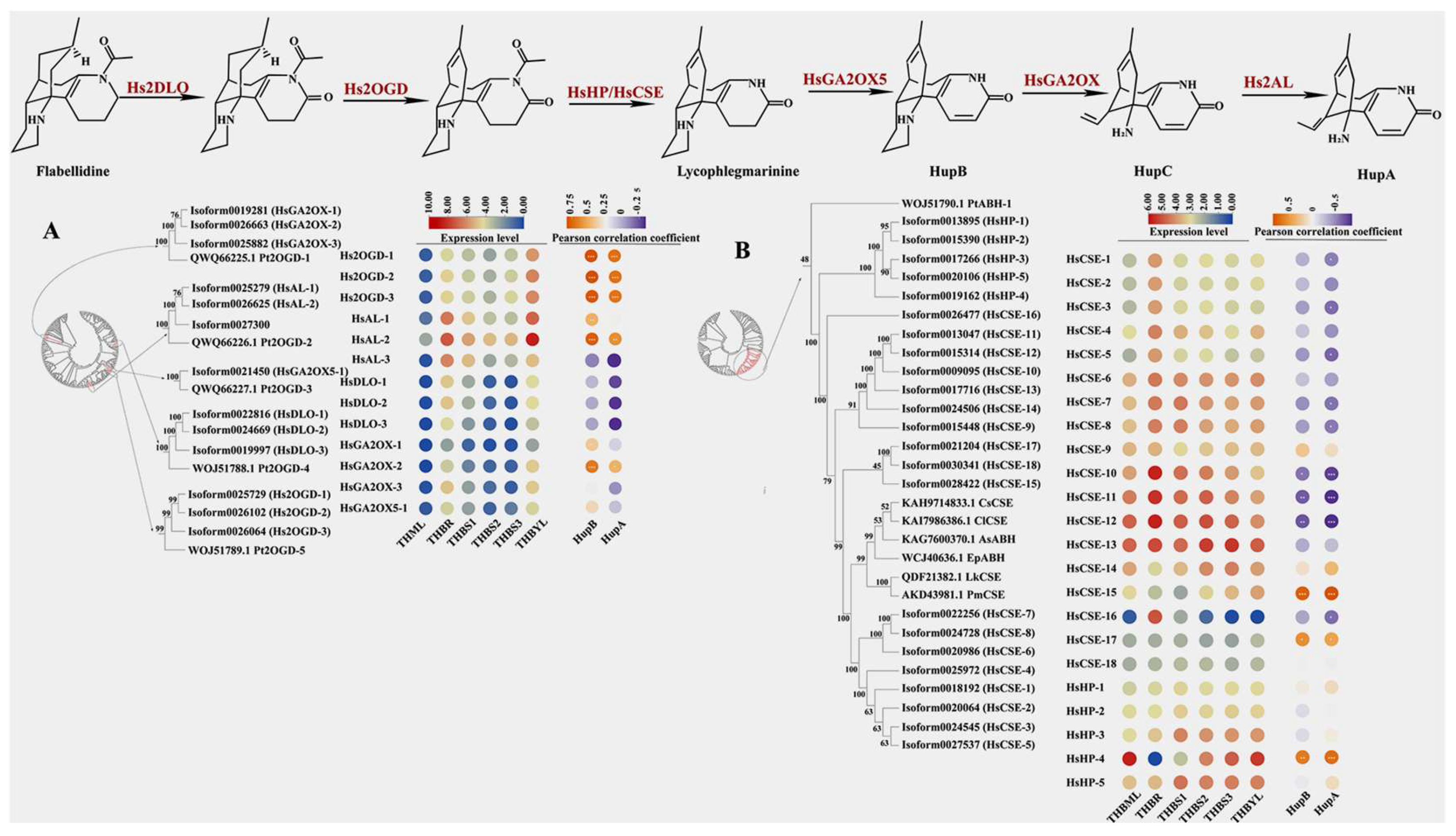
Figure 7.
Identification of candidate genes implicated in the HupA biosynthetic pathway through comparative transcriptome analysis between young leaves and mature leaves of THB H. serrata. (A) Workflow for identifying candidate genes. (B) The DEGs identified in the comparison of young leaves and mature leaves of THB H. serrata. (C) The correlation analysis of 3,801 up-regulated genes with the contents of HupA and HupB. (D) The 81 enzyme-encoding transcripts significantly correlated with HupA content.
Figure 7.
Identification of candidate genes implicated in the HupA biosynthetic pathway through comparative transcriptome analysis between young leaves and mature leaves of THB H. serrata. (A) Workflow for identifying candidate genes. (B) The DEGs identified in the comparison of young leaves and mature leaves of THB H. serrata. (C) The correlation analysis of 3,801 up-regulated genes with the contents of HupA and HupB. (D) The 81 enzyme-encoding transcripts significantly correlated with HupA content.
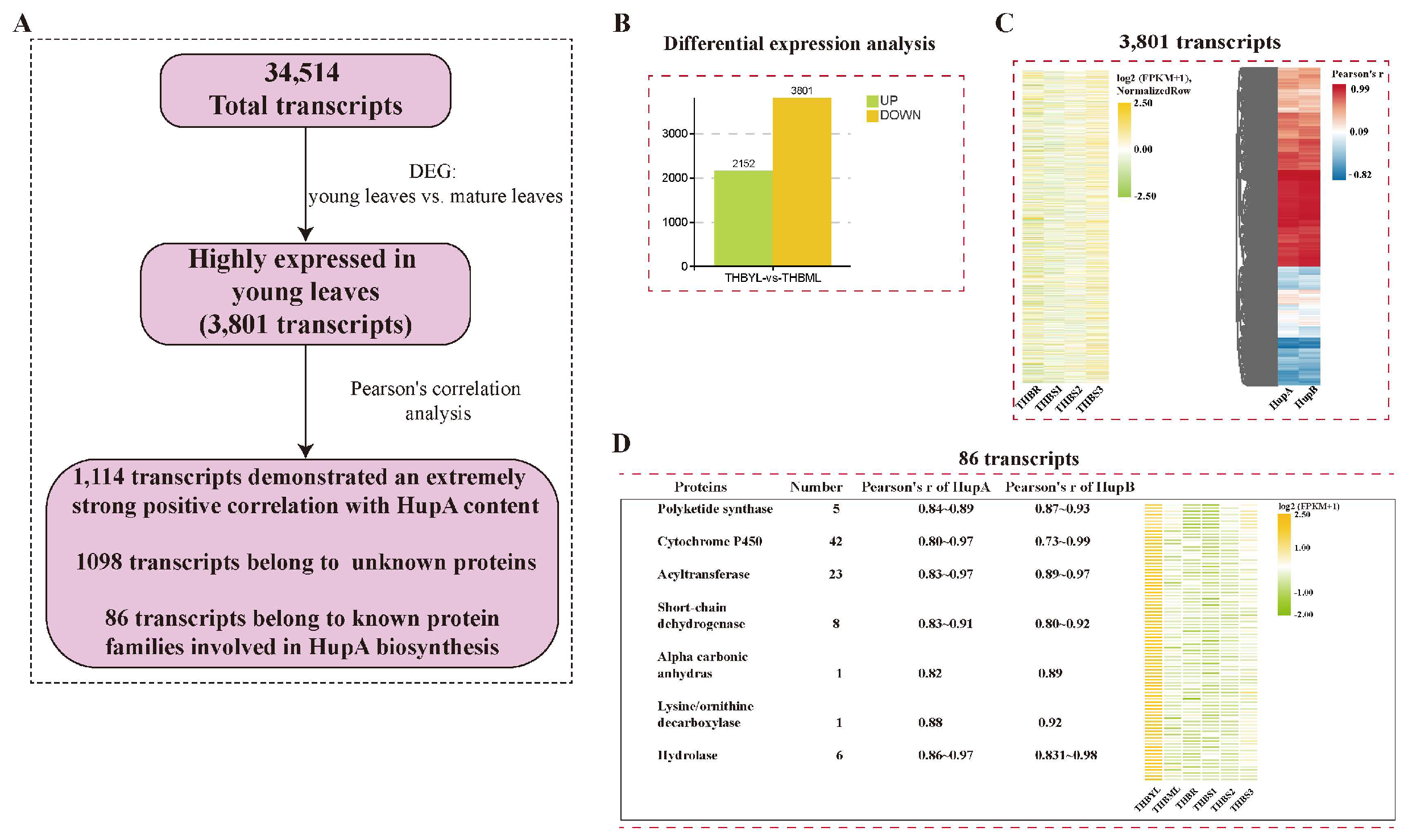
Figure 8.
PPI network analysis of candidate genes involved in the regulation of HupA biosynthesis. (A) PPI network of the seven previously identified candidate proteins. (B) Extended PPI network illustrating additional interactions of the candidate proteins with other relevant enzymes. (C) TF interaction network of the seven candidate genes involved in HupA biosynthesis.
Figure 8.
PPI network analysis of candidate genes involved in the regulation of HupA biosynthesis. (A) PPI network of the seven previously identified candidate proteins. (B) Extended PPI network illustrating additional interactions of the candidate proteins with other relevant enzymes. (C) TF interaction network of the seven candidate genes involved in HupA biosynthesis.
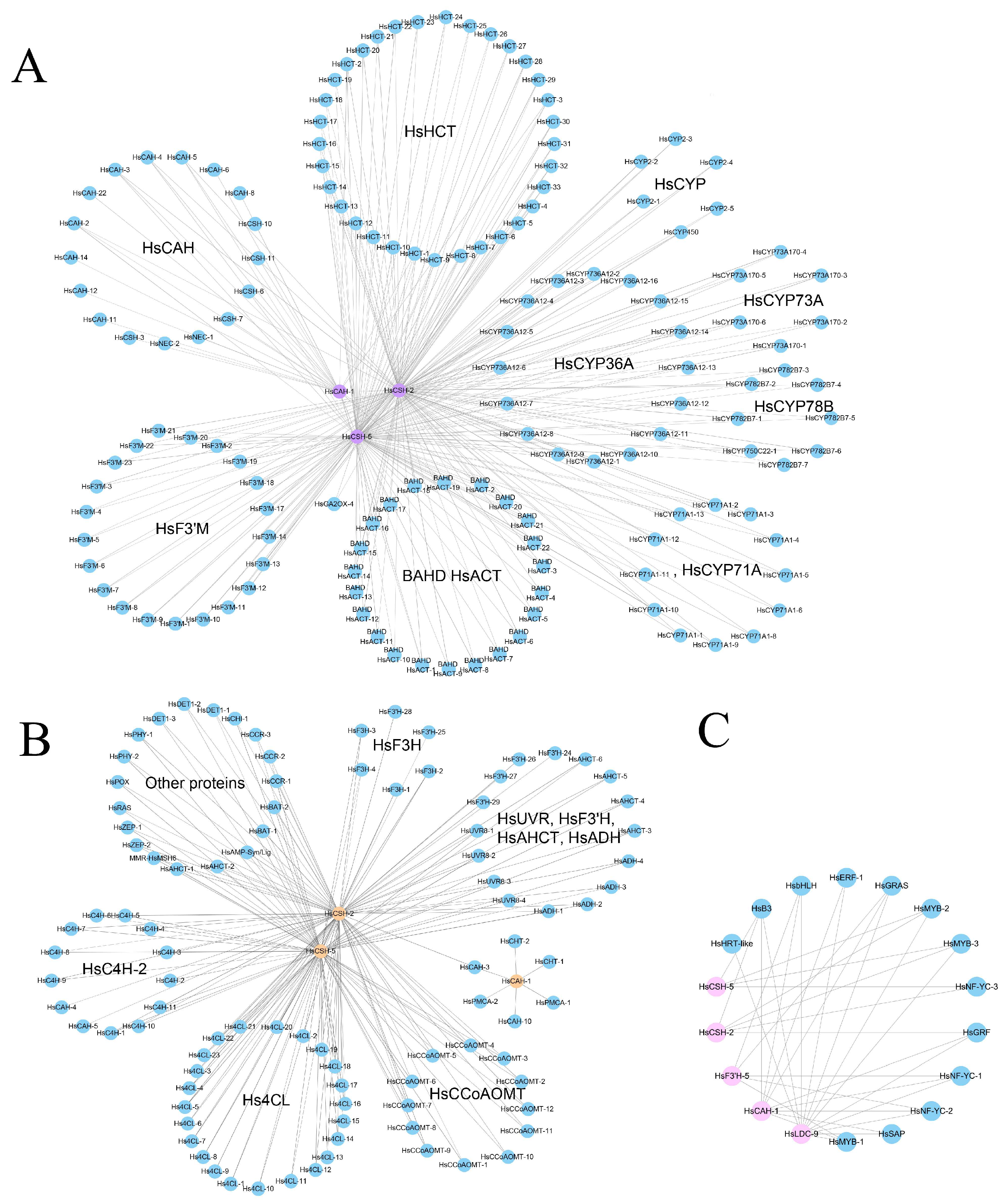

Table 1.
Pfam HMM profiles of protein families investigated in HupA biosynthesis
| The protein families | Pfam HMM profile | References |
|---|---|---|
| CA | PF00194(α), PF00484(β) | [31] |
| ABH | PF12695, PF12697 | [32] |
| Chalcone synthase (CHS) | PF02797, PF00195 | [33] |
| 2OGD | PF14226, PF03171 | [34] |
| SDR | PF00106, PF01370, PF01073 | [35] |
| CYP450 | PF00067 | [36] |
| CAO | PF01179, PF02727 | [37] |
| LDC | PF03711, PF00278 | [38] |
| BAHD ACT | PF02458 | [39] |
Disclaimer/Publisher’s Note: The statements, opinions and data contained in all publications are solely those of the individual author(s) and contributor(s) and not of MDPI and/or the editor(s). MDPI and/or the editor(s) disclaim responsibility for any injury to people or property resulting from any ideas, methods, instructions or products referred to in the content. |
© 2026 by the authors. Licensee MDPI, Basel, Switzerland. This article is an open access article distributed under the terms and conditions of the Creative Commons Attribution (CC BY) license (http://creativecommons.org/licenses/by/4.0/).
Copyright: This open access article is published under a Creative Commons CC BY 4.0 license, which permit the free download, distribution, and reuse, provided that the author and preprint are cited in any reuse.


