
Submitted:
10 June 2026
Posted:
10 June 2026
You are already at the latest version
Abstract
Beam–column joints represent one of the most critical and vulnerable regions in reinforced concrete frames subjected to seismic loading. Failure of these joints can significantly compromise the overall structural integrity of the system and may trigger progressive collapse during severe earthquakes. To enhance the seismic performance of beam–column joints, composite Steel Reinforced Concrete (SRC) systems have been increasingly adopted due to their superior strength, stiffness, and ductility characteristics. Despite their advantages, accurate prediction of the shear capacity of composite SRC beam–column joints remain a challenging task. The complexity arises from severe stress concentrations, nonlinear material behavior, and multidirectional force transfer mechanisms inherent in such connections. Furthermore, experimental investigations required to evaluate the seismic performance of these joints are often time-consuming and cost-consuming and costly, highlighting the need for reliable and cost-effective predictive approaches. This study presents the development of a machine learning-based predictive model for estimating the shear capacity of composite SRC beam–column joints subjected to seismic loading. A dataset comprising 25 experimentally tested specimens was utilized, covering a wide range of joint configurations, material properties, and loading conditions. The model incorporates 16 input parameters, including concrete compressive strength, steel yield strength, geometric characteristics of the joint, axial load ratio, steel section properties, column height, beam length, and joint classification (interior or exterior). The proposed model was trained and validated to predict the ultimate shear capacity of unseen cases accurately. The results demonstrated that the model successfully captured complex nonlinear interactions among the governing parameters and provided stable and consistent predictions across the entire dataset. Compared with conventional numerical approaches, which commonly exhibit coefficients of variation (COV) ranging from 100% to 169%, the proposed model achieved a significantly lower COV of approximately 30%. The findings of this study provide structural engineers with a practical and efficient predictive tool that can assist in the analysis and optimization of composite SRC beam–column joint design under seismic loading conditions.
Keywords:
shear capacity
; beam-column joints
; machine learning
; seismic loads
; exterior joints
; interior joints
; prediction of shear capacity
; composite joints
; steel reinforced concrete (SRC) joints
; embedded steel sections in RC members
1. Introduction
Beam–column joints represent crucial regions within framed structural systems where axial forces, shear forces, and bending moments are transferred between horizontal and vertical structural members, [1]. These connections play a fundamental role in preserving the structural integrity, geometric stability, and continuity of the frame, particularly under dynamic or extreme loading conditions such as seismic events. In addition to facilitating force transfer, [2], beam–column joints contribute significantly to the mechanisms of energy dissipation and load redistribution within the structural system. As emphasized by [3,4], the performance of these joints strongly influences the overall ductility, strength, and failure mechanisms of framed structures. Consequently, their design and behavior are of paramount importance in ensuring reliable and resilient structural performance under severe loading conditions.
These joints are particularly vulnerable under seismic excitation due to the complex interaction of multidirectional forces acting simultaneously within the joint region, [5]. Observations from major earthquakes, such as the 1995 Kobe earthquake and the 2008 Sichuan earthquake have demonstrated that inadequate performance or failure of these joints can lead to severe structural damage and, in extreme cases, progressive collapse, [6]. These events underscore the critical importance of proper joint design to ensure overall structural integrity during seismic events.
Among the various joint configurations, reinforced concrete (RC) beam-column joints remain one of the most widely used due to their cost-effectiveness and compatibility with monolithic construction practices, [7]. Despite their widespread application, RC joints are often identified as one of the most vulnerable components in moment-resisting frame systems subjected to seismic loading, [8]. When insufficiently detailed, particularly in older buildings or in regions with less stringent seismic design provisions, the joint core is exposed to significant shear stresses. Under such conditions, brittle shear failure mechanisms may develop, comprising the structural performance and ductility of the frame [9].
Steel-reinforced concrete (SRC) joints have been developed as an alternative structural configuration to address the limitations associated with conventional reinforced concrete join systems. In SRC joints, structural steel sections are embedded within the concrete joint core, [10], as illustrated in Figure 1, thereby enabling an effective composite interaction between steel and concrete This integration allows the two materials to complement each other’s mechanical properties, resulting in enhanced structural performance, [11].
The presence of the steel profile within the joint region significantly improves shear resistance, confinement, ductility, and the overall seismic resilience of the connection.. Experimental investigations reported by [12] and [13] have demonstrated that SRC joints exhibit behavior compared with conventional reinforced concrete joints when subjected to cyclic loading. In particular, SRC joints show improved energy dissipation capacity and a delayed damage onset of damage, indicating a more stable and ductile response under seismic actions.
However, the accurate prediction of shear capacity in such composite beam–column joints using conventional numerical models remains a challenging task. This difficulty arises primarily from the complex stress distribution within the joint core, [14], where pronounced stress concentrations develop under the simultaneous action of axial forces, shear forces, and bending moments. The interaction of these multidirectional forces leads to highly nonlinear structural behavior that is difficult to capture using conventional analytical or empirical formulations, [15]. Furthermore, experimental investigation of joint performance typically requires extensive laboratory testing, which is both time-consuming and costly due to the scale of the specimens, specialized loading equipment, and the need for detailed instrumentation, [16]. These practical constraints limit the availability of large experimental datasets and hinder the development of comprehensive design provisions. Consequently, there is a growing need for reliable and cost-effective predictive approaches capable of accurately representing the complex nonlinear interactions among geometric, material, and loading parameters governing the shear behavior of composite beam–column joints, [17]. In this context, advanced data-driven modeling techniques offer a promising alternative for improving predictive accuracy while reducing dependence on extensive experimental programs.
2. Objective
The main objective of this research is to develop and validate machine-learning models capable of accurately predicting the shear capacity of composite beam-column joints under dynamic seismic loading, for both interior and exterior joint configurations. The study aims to overcome the limitations of conventional analytical and empirical methods by providing a reliable predictive tool that accurately captures the nonlinear behavior and complex interaction mechanisms within the joint. Ultimately, the proposed model is intended to support safer and more efficient structural design of seismic-resistant composite structures.
3. Experimental Work
Research on SRC beam-column joints can be traced back to [18] and [19] in Japan during the 1980s. Later, [20] examined seven SRC beam-column subassemblies with H-shaped steel columns, focusing on the effects of their proposed diaphragm scheme.
[21] conducted low reversed cyclic loading tests on ten SRC joints and investigated the failure mode, force transfer mechanisms, and shear strength of the joints. Based on their findings they proposed a practical calculation method for determining joint strength. Earlier experimental studies by [22] and [23] examined fifteen beam-column joints in composite structures. Their results demonstrated that rectangular SRC beam-column joints exhibit high load-bearing capacity and good ductility, and they subsequently proposed corresponding design and calculation formulas for such joints.
[24] conducted low-cycle loading experiments on full-scale joints of SRC columns and steel beams. The results indicated that SRC column-steel beam joints exhibited satisfactory seismic performance, as the concrete encasement effectively confined and protected the embedded beam, thereby promoting ductile behavior and high energy dissipation without premature joint failure. [25] also conducted cyclic loading experiments on cross-shaped joints connecting SRC columns and steel beams.
[26] conducted cyclic loading tests on five SRC beam- RC column joints with different steel sections, including I-shaped and tubular sections. The experimental results showed that the steel-reinforced concrete specimens were able to sustain very large deflections prior to collapse. At high deformation levels, the specimen with a square tubular section exhibited significantly lower resistance than the HEB section due to the greater flexural efficiency of the H-shaped steel section. In addition, the SRC specimen with a tubular section and greater thickness achieved the most efficient performance ratio, highlighting the beneficial effect of concrete confinement.
[13] conducted reversed on eleven SRC beam-column joints. The results indicated that the axial compression ratio and the stirrup volumetric ratio are two key parameters governing the shear behavior of steel-reinforced concrete frame exterior beam-column joints. [27] also conducted experimental investigations on six specimens of SRC column-RC beam joint with varying axial load ratio and volumetric stirrup ratio. Their results were consistent with those reported by [13].
In addition, [12] investigated the seismic performance of steel-reinforced concrete (SRC) beam–column joints subjected to unidirectional lateral cyclic loading. The authors constructed and tested file full-scale SRC joint specimens. The results indicated that greater anchorage depth of beam reinforcement and embedded steel sections in SRC joints significantly improved shear strength, ductility, and energy dissipation capacity. These details provided strong confinement, enhanced seismic performance, and delayed brittle shear failure.
4. Methodology
4.1. Conventional Numerical Methods
The accurate assessment of shear capacity in composite column-beam joints remains a fundamental challenge in structural engineering, particularly in regions of high seismic activity. These joints are critical components in moment-resisting frames, and are often subjected to complex stress states during earthquake loading. To enhance the predictive accuracy of joint behavior, numerous researchers have proposed analytical models that integrate both empirical data and theoretical mechanics. Various numerical methods have been developed by researchers to explore the analysis and prediction of joint performance including the methods by Cheng-Cheng Chen, and Wei Liu and Jinqing Jia.
4.1.1. Cheng-Cheng Chen Method
[12] validated the effectiveness of SRC joint detailing under seismic conditions and highlighted the crucial role of steel–concrete interaction in enhancing joint performance under cyclic loading. In their study, the authors calculated the shear strength of beam-column joint using Eq. (1).
Vsrc = Vrc + Vsw + Vslf
Where
Vrc = shear strength provided by the concrete joint area;
Vsw = shear strength provided by the web; and
Vslf = shear strength provided by the flange.
In Equation 1, the shear strength provided by concrete joint area (Vrc) can be calculated using Equations (2) – (4), depending on the concrete confinement.
Where
= specified compressive strength of the concrete;
= x = effective area of the joint;
= joint width; and
= joint depth.
In concentric joints, the joint width () should satisfy Eq.(5). The shear strength provided by the web is calculated as illustrated in Eq. (6), and the shear strength provided by the flange is calculated as illustrated in Eq. (7).
Where
= column depth;
x = horizontal distance between the beam and column edges;
= yield stress of the column web;
= column depth;
tw = column web thickness;
= yield stress of the column flange;
= width of column flange; and
tf = column flange thickness.
4.1.2. Wei Liu and Jinqing Jia Method
[13] calculated the shear strength of beam-column joint as the sum of several contributing components. Their approach considers the combined contribution of the different resisting mechanisms within the joint region to estimate the overall shear capacity as illustrated in Eq. (8).
in Eq. (8).
Vj = Vnih + Voust + Vsv
Where
Vnih = effective shear strength contributed by the inner concrete compression strut;
Voust = effective shear strength contributed by the outer concrete compression strut; and
Vsv = shear strength provided by the stirrups.
The effective shear strength is also contributed by the outer concrete compression strut, which assists in resisting shear forces within the joint region. This mechanism enhances the overall shear capacity by distributing compressive stresses through the surrounding concrete. The effective shear strength contributed by the outer concrete compression strut can be estimate using Eq. (10).
Where
= effective inner concrete strength
The effective shear strength is also contributed by the outer concrete compression strut, which assists in resisting shear forces within the joint region. This mechanism enhances the overall shear capacity by distributing compressive stresses through the surrounding concrete. The effective shear strength contributed by the outer concrete compression strut can be estimate using Eq. (10).
Where
= effective outer concrete strength; and
= width of the outer strut expressed as follows
= min [( - ) , ( - ) + 0.5 ]
The shear strength is also provided by the stirrups, which contribute to resisting shear forces within the joint region. The stirrups enhance the overall shear capacity by confining the concrete and providing additional resistance against shear deformation. The shear strength provided by the stirrups can be estimate using Eq. (11).
Where
= effective stirrups area; and
= yield stress of stirrups.
4.2. Machine Learning as Predictive Tools
Shear capacity is governed by a complex and nonlinear relationship among multiple forces and parameters. Machine learning approaches are particularly effective in addressing such complexity. Machine learning techniques have been successfully applied in numerous complex applications and can be used to address a wide range of engineering challenges. With the advancement of machine learning methodologies, the development of numerical systems capable of comprehensively capturing the context of the problem under investigation has become increasingly feasible.
To enhance the understanding of the variables affecting joint shear strength, this study investigates whether machine learning can accurately replicate the behavior of beam-column joints. Specifically, the study focuses on employing neural network models to predict the shear strength of beam-column (BC). Furthermore, this research provides a foundation for future studies by encouraging the exploration of machine learning approaches to problems pertaining to beam-column joints.
Despite their advantages, predicting the shear capacity of SRC joints under complex seismic loading conditions remains highly challenging. Classical analytical methods often struggle to accurately capture the nonlinear behavior of the large number of interacting variables involved [28].
4.3. Estimating Shear Capacity Using Machine Learning Methods
Under seismic loads, the behavior of composite beam-column joints is complex. Traditional methods may not accurately predict shear capacity because of material interactions, confinement effects, and cyclic degradation. Machine learning methods, such as artificial neural networks (ANN), can learn from experimental data, identify hidden patterns, and effectively model nonlinear relationships; therefore, they provide a powerful alternative. In this study, ANNs are used to generate more reliable and accurate predictions of joint shear capacity dynamic seismic effects.
As illustrated in Figure 2 , a neural network mimic the properties of the human brain and operates in a manner similar to biological neurons. A neural network consists of an arrangement of interconnected nodes organized into different layers. An artificial neural network (ANN) typically comprises three main layers: the input layer, the hidden layer, and the output layer. Neurons are distributed across these layers, and connections between neurons are defined by weights and biases. Before reaching the summing node, each input is multiplied by its corresponding weight [29]. In addition, the artificial neuron shown in Figure 2 includes a bias term that is subsequently added to the summing node.
The input layer collects information from the external environment and transmits it to the hidden layer, where the data are aggregated and processed. The activation function then receives this aggregated value and introduces non-linearity into the model, enabling the network to produce more accurate outputs. The predicted outputs are compared with the actual values; if significant prediction errors occur, the weights are adjusted iteratively until the errors are minimized. Once the network has sufficiently trained, the ANN can be used to predict outputs for new input data. Eqs. (13) and (14) describe the operation of a three-layer feed-forward network.
Where
Ha = activity levels generated at the ath hidden neuron;
Ob = activity levels generated at the bth hidden neuron;
jx = normalized data sent from the xth neuron in input layer;
jn = normalized data sent from the nth neuron in the hidden layer;
wx,a = weights on the connections to the hidden layer;
wn,b = weights on the output layer of neurons;
ba = bias at the hidden layer; and
bb = bias at the outer layer.
The input variables for the ANN were selected based on their significant influence on the behavior of SRC joints, as identified from the previously discussed experimental data. These variables include the yield stress of the steel sections and stirrups, the concrete compressive strength (fc’), column width (bc), column depth (dc), beam width (bb), beam depth (db), column height ( representing the distance between the points of contraflexure along the axial axis of the upper and lower columns at the joint), and beam length. To minimize the discrepancy between the experimental results and the predicted values, the ANN input and output variables were normalized. Accordingly, all inputs and outputs were scaled to the range of [−1,1].as follows, [30,31]:
Where,
Isi = scale input ranged between 0 and 1;
Iimax = maximum Ini; and
Iimin = minimum Ini.
Where,
Qus = scale output ranged between 0 and 1;
Qumax = maximum Qui ; and
Qumin = minimum Qui.
It is important to note that the formulation of the adopted activation functions determines the scaling criteria applied to the data. Consequently, Data scaling significantly influences the convergence of the ANN training process. During the training stage, the architectures of several neural networks were investigated by varying the number of neurons in the hidden layer and adjusting the coefficients of the training function to obtain a stable and appropriate ANN model.
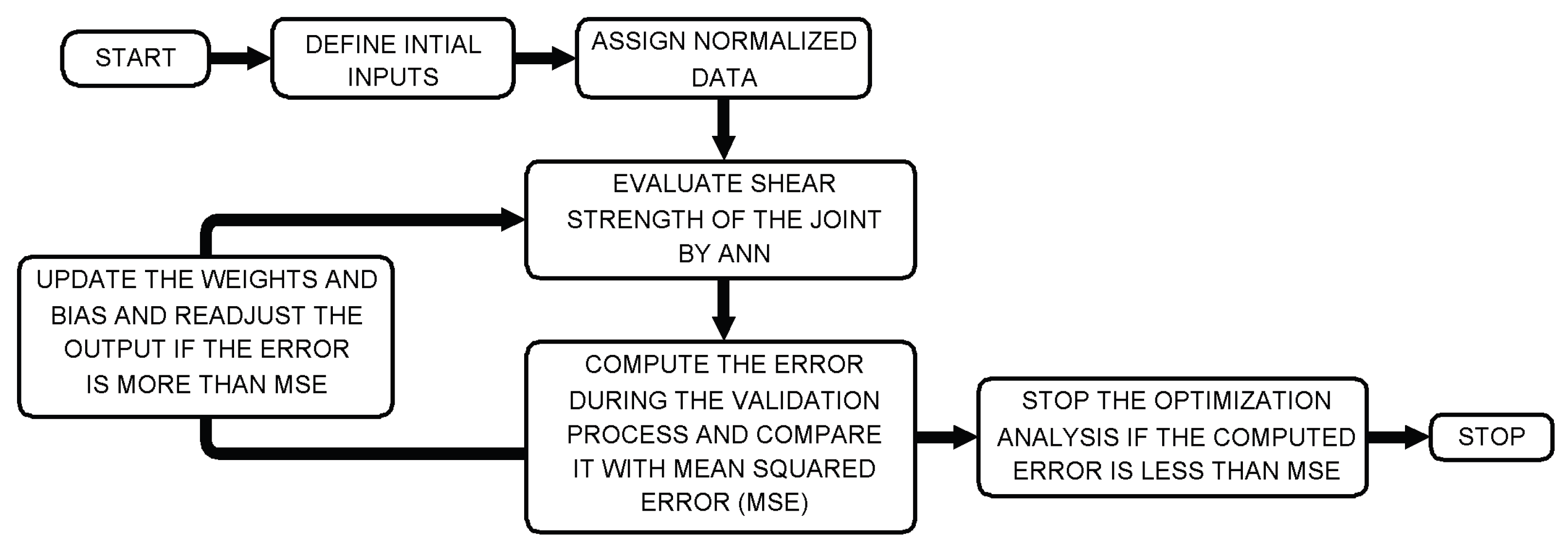
During training, the magnitudes of the neural network weights and biases are adjusted to maximize the performance of the network. Approximately, 73% and 26% of the normalized data were used for the training and testing processes, respectively, to enhance the network’s ability to predict the desired output. The present study employed this iterative approach for network optimization, with a minimum performance gradient of 10−7 and a maximum of 5000 training epochs. Figure 2 illustrates the iterative algorithm used for the network training. Because the initial weights of the neural network are randomly assigned, the convergence of this model relies on a trial-and-error process.
Figure 3.
Flow chart of the ANN analysis of shear strength of the joint.
4.4. Modeling Main Parameters Affecting Column-Beam Joint
4.4.1. Influence of Concrete Compressive Strength (fc`)
Concrete compressive strength is related to the strength of beam–column joints. Numerous studies have been conducted using laboratory tests on beam–column specimens to evaluate the effects of varying concrete strengths on joint behavior. The use of higher-strength concrete in the column is known to enhance the structural response of the joint. An increase in the compressive strength of concrete improves the shear resistance through two primary mechanisms: the formation of a stronger compressive strut within the joint core and the development of a stronger bond between the reinforcement and the surrounding concrete [32].
4.4.2. Influence of Steel Yield Strength (fy)
The yield strength of steel significantly influences the structural behavior and performance of steel-reinforced concrete (SRC) beam–column joints under seismic loading. Steel with higher yield strength generally results in a stronger joint, allowing it to resist larger seismic forces before yielding. This characteristic enhances the overall strength and resilience of the structural system.
The yield strength of steel also affects the energy dissipation capacity of the joint. The ability of a structure to absorb and dissipate energy is critical for reducing damage during seismic events. Higher-yield-strength steel can improve the joint’s energy dissipation capacity, thereby contributing to improved seismic performance. [33].
4.4.3. Influence of Joint Aspect Ratio
The strength of a beam–column joint is largely governed by its geometric dimensions, which influence both the level of joint shear stress and the overall shear capacity of the joint. In addition, specific anchorage requirements must be satisfied, particularly the ratios of beam depth to column bar diameter (hb / dc) and f column depth-to-beam bar diameter (hc / db).
Previous studies [34,35,36] have reported that axial load applied to columns can influence joint strength. In cases of weak column–strong beam design, increasing the column axial load up to the equilibrium level can enhance joint shear strength because of its positive effect on column moment capacity. However, in strong column–weak beam configurations commonly observed in many experimental studies—the influence of column axial load on joint shear strength can be both beneficial and detrimental. Overall, when the column axial load is less than approximately 0.2 fc‘ Ag, its influence on joint shear strength is generally limited and somewhat ambiguous.
4.4.4. Influence of Joint Stirrups
Vertically distributed bars within the column can enhance the shear strength of beam-column joints by withstanding vertical shear forces. While the ACI 318-14 code [37] does not include provisions for vertical shear reinforcement, it does require the positioning of intermediate column bars with prescribed spacing on each face of the column. In contrast, the New Zealand Standard [38] and European [39] offer specific guidelines for vertical reinforcement in relation to horizontal shear reinforcement.
4.4.5. Influence of Beam Steel Section Height (hb)
It is evident that increases in both ultimate bearing capacity and initial stiffness are directly and strongly influenced by the sectional height. Consequently, the web height of the steel beam plays a critical role in determining the bearing capacity and initial stiffness of SRC variable-column exterior joints. Moreover, as the sectional height increases, the overall performance of the joints continues to improve [12].
4.4.6. Influence of Steel Shape
The interaction between the steel shapes used in columns and the beam–column joint is a critical factor in the overall structural behavior of a building, particularly under seismic loading. Careful consideration of the design and performance of these components is essential to ensure structural stability and earthquake resilience.
The choice of steel shapes in columns significantly influences the transfer of seismic forces from beams to columns. For instance, different column profiles—such as pipe sections or hollow structural sections—can perform more effectively than standard IPE sections in controlling load transfer within the structure. These shapes improve the efficiency of force distribution and help minimize stress concentrations at the joint.
Ductility, defined as the ability of a structure to undergo deformation without significant loss of strength, is another critical parameter in seismic design. Adequate ductility in the column and joint system allows the structure to absorb and dissipate energy during seismic events, reducing the likelihood of catastrophic failure and enhancing seismic performance.[26].
4.4.7. Effect of Steel Web
The inclusion of the steel web within the beam element plays a critical role in enhancing the structural behavior of steel-reinforced concrete (SRC) column-beam joints, particularly under seismic or lateral loading conditions [33]. The steel web serves as an effective medium for shear force transmission, facilitating a more uniform distribution of stresses within the joint core [40]. This leads to an increase in the joint’s shear capacity and overall stiffness [41]. Furthermore, the steel web contributes to the reduction of localized joint deformations and delays the initiation and propagation of cracking within the surrounding concrete [42].
4.4.8. Effect of Axial Load Ratio
The influence of axial load on the behavior of beam–column joints has been a subject of ongoing debate. While some researchers argue that axial load has a beneficial effect, others contend that its impact is limited or even detrimental. Proponents of the positive effect suggest that axial load enhances the shear resistance of beam–column joints by providing additional confinement to the joint core. However, research findings on this topic remain inconclusive and vary across studies. It is generally accepted that axial compression on the column can improve confinement within the joint core to some degree, thereby enhancing the bond between reinforcement and surrounding concrete and contributing to joint performance [4,43].
4.5. Developing an Experimental Data Set
A data set of exterior and interior composite SRC joints is developed for the ANN modelling to predict the joint shear strength of composite SRC joints. The data set has been compiled from research articles [12,13,44,45,46,47] available in the existing literature. Figure 4 shows a schematic representation of the variables of the experimental data for the joint element which were considered in the data set and ANN analysis.
These testing information included: specimen ID, web dimensions of steel sections in SRC connection and the grade of the steel sections (fy), geometrical dimensions of beam and columns (Width (bb-bc) and depths (db-dc)), number, grade of stirrups steel (fy) and stirrups ratio in the connection, length of the beam (Lb) from joint face to the location where the load is applied, column height (Hc), grade of concrete (fc`), column axial load ratio. details of the structural design, material strength, and joint response to applied quasistatic and dynamic loading are among the testing data.
Beam and column sub-assemblages were taken into account in the data set. Between the joint interface and the nearest point of zero flexural moment, these members stood in for the section of the building structure. At the end of the right beam or upper column, the majority of the experimental data gathered pertains to beam-column joints subjected to transverse monotonic or cyclic loads. In numerous instances of beam-column sub-assemblages, the experiments selected a combined effect of the upper column’s axial force and the beam’s transverse load.
The final model was developed for forecasting the horizontal shear strength of a joint using twenty-five parameters in the current ANN analysis. When creating ANN models, the independent parameters that had a significant impact on the expected values were used. The data set in Table 1, including concrete strength, yield strength of steel sections and stirrups, joint geometry, axial load ratio, steel sections (hw and tw) embedded in the column and beam, the height of column, the length of the beam and whether the connection was interior or exterior, took into consideration the performance of the exterior and interior SRC joints.
Current ANN data collection was based on recent experimental studies that looked at the loading capacity of SRC joints. Joint specimens should be designed according to the “weak joint and strong member” principle in order for the joints to exhibit shear failure first in order to investigate the shear capacity of SRC beam-column joints. The shear capacity should be determined based on joint failure, which is why this deviates from the current design codes for structures. In contrast to the strong joint failure mode, the “weak joint” scenario’s ultimate shear force is more precise. Approximately equal flexural strength was designed into the specimens’ beams and columns to force joint damage to occur at the joint region.
4.6. Verification of the Proposed Model
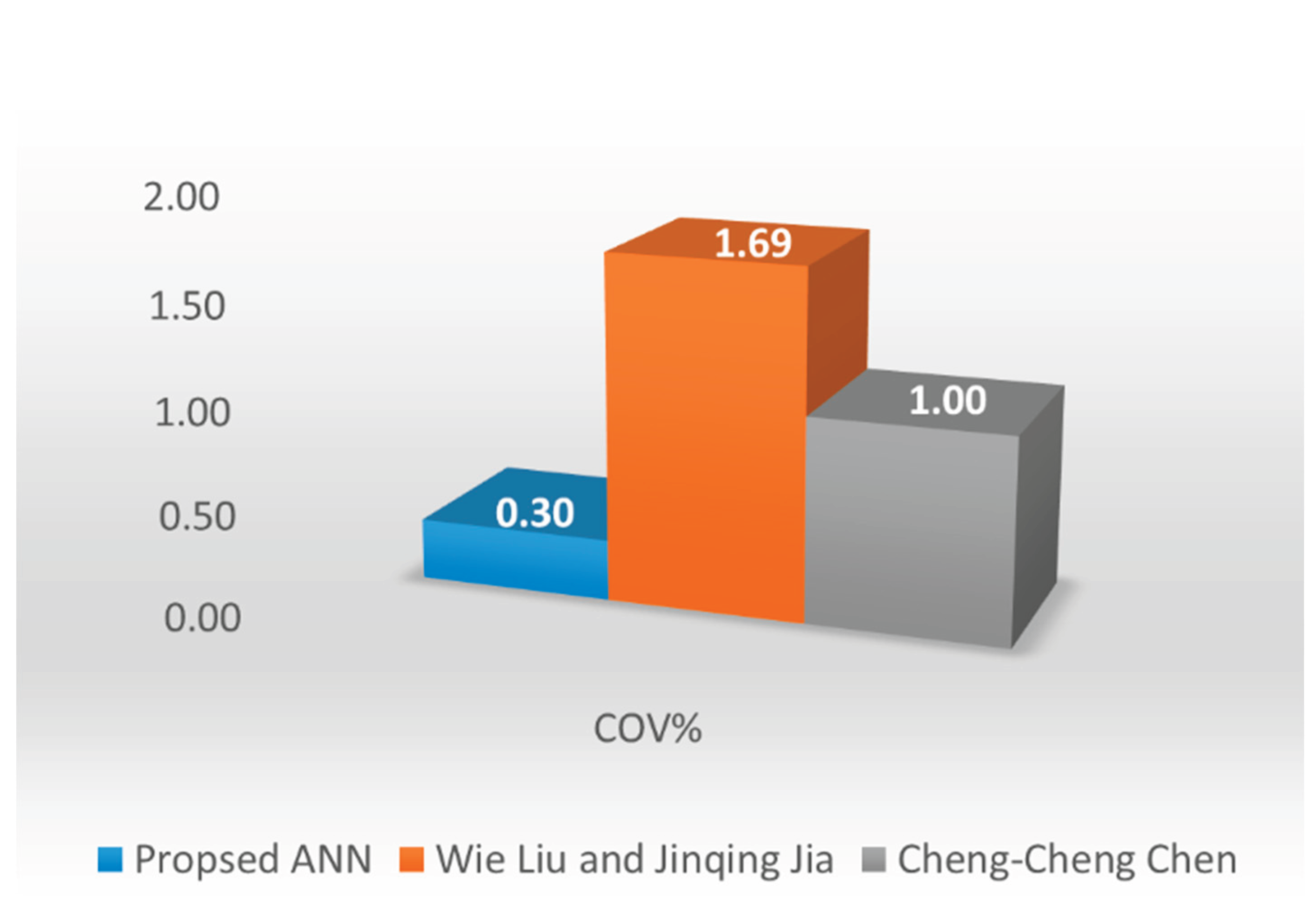
A dataset that includes the previously mentioned (16) factors governing input features and a total of 25 specimens. The most important factors influencing the joint shear strength for beam-column composite connections were the materials used, the geometry dimensions, steel web dimensions and axial compression ratio applied on the connection. The statistical descriptions are shown in Table 2. minimum (Min), median, mean, standard deviation (SD), upper or third quartile, which is the middle of the distribution between the median and the highest number (Q3), and maximum (Max) of the input features (variables) in this dataset to predict the joint shear strength. The lower quartile, also referred to as the first quartile, is the number that lies between the dataset’s smallest and median values (Q1). Additionally, Figure 4 Compares the joint shear strength determined by the suggested models with that determined by other models to demonstrate the accuracy of the models [12,13]. The comparison between the experimental and predicted results shows that the predicted strength, as determined by the suggested ANN model, has exceptional reliability. Thus, the smallest COV in Figure 6 Was determined by the proposed ANN model, the model for [13], was found to have the lowest accuracy. This is explained by the fact that the ANN formulation incorporates numerous joint geometrical and material properties, which has increased the accuracy of current models.
Figure 5.
Comparison between proposed ANN of composite column beams joint shear strength and existing numerical models by [12] and [13].
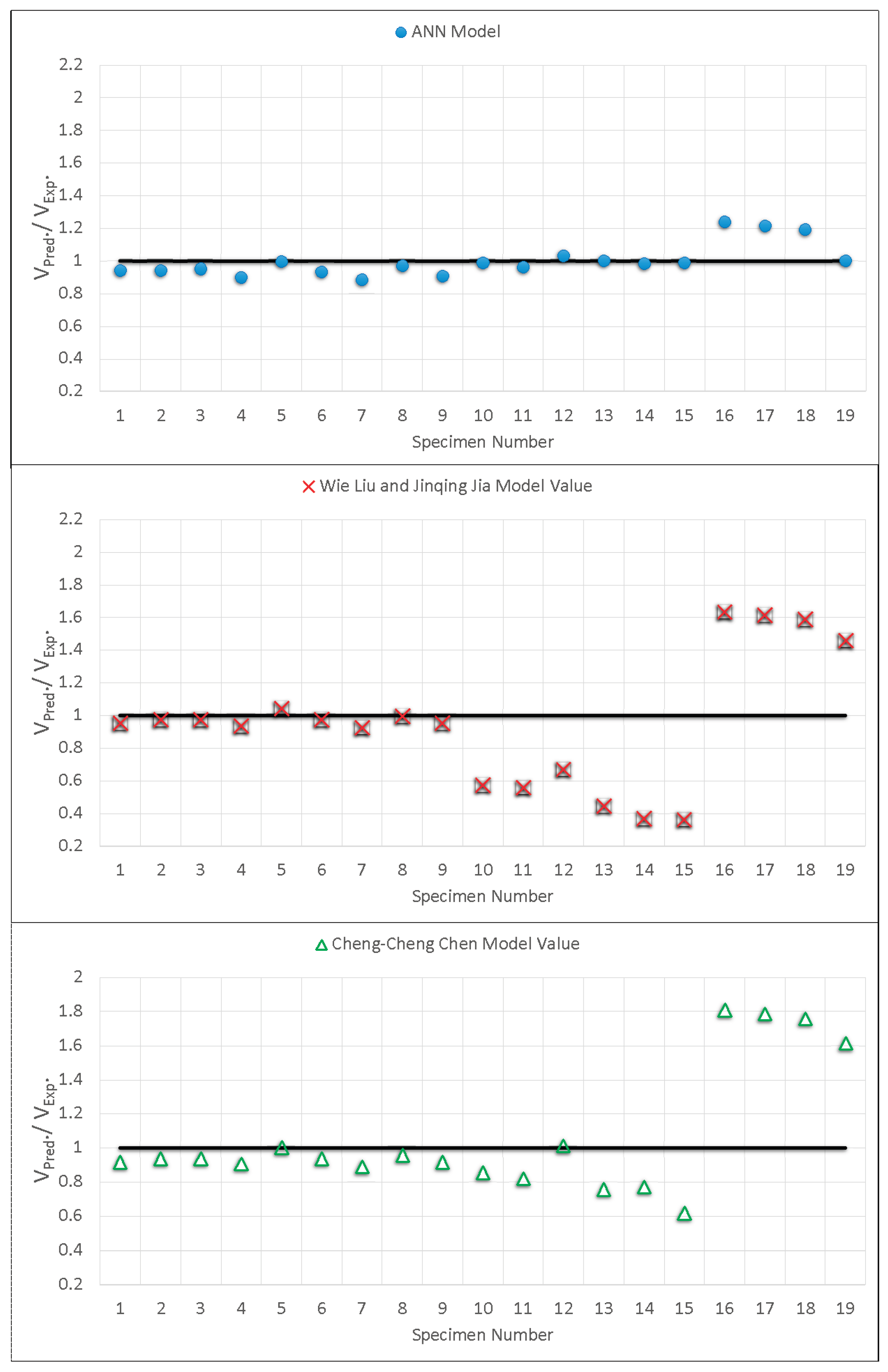
Figure 6.
Agreement between predicted and experimental data for composite column beams joint shear strength in terms of COV.
Figure 6.
Agreement between predicted and experimental data for composite column beams joint shear strength in terms of COV.
Where xi, pi and n are experimental data, predicted data and number of samples.
5. Discussion of ANN Results
The proposed ANN models were based on (11) key parameters that had the highest importance factors. Concrete compressive strength, yielding strength for steel sections, yielding strength for stirrups, stirrups ratio, Column and beam dimensions, column and beam steel web sizes (hw and tw) and axial load ratio were these mathematical formulations’ primary parameters (independent variables). These parameters’ roles and contributions are hypothesized in the way described above, with particular formulation. Evaluation of the suggested models’ fitness in relation to each of these independent variables is therefore deemed crucial. The following figures. Based on the independent parameters, the variance of the ratio between the experimental and predicted shear strengths is displayed. These graphical [12] relationships show how this ratio depends on each of the parameters. Overall, despite these parameters’ wide range of variation, no discernible dependence on the predicted shear strength is found. The weight of each parameter, this indicates that taking these factors into account significantly increases the fitness of the suggested ANN models.
Figure 7 shows values for concrete compressive strength ranging from 23.90 to 100 N/mm2, The experimental values from [13] Shows more variation, with some underestimations (ratios < 1.0) from the range of (20-60) N/mm2, particularly at lower compressive strengths. This is indicative of the inherent variability in physical testing and may be due to material or geometric inconsistencies.
C. Chen dataset demonstrates a greater range, with some data points surpassing a ratio of 2.0 from the (20–60) N/mm2 range. This suggests that the experimental capacity was either significantly overestimated or underestimated. This could imply that either the predictions made in their work were not always conservative or that the tested joints showed abnormally low strength under experimental conditions.
For predicting joint behavior under seismic shear demand, the ANN model is a useful tool because it shows excellent predictive performance overall with little deviation from experimental results, particularly in the high-strength concrete domain.
Figure 8 shows values for steel sections yield strength with range from 230.60 to 371 N/mm2, [13], More variability is seen in the dataset. The pred./Exp. ratios at fy≈ 280–360 N/mm² range from roughly 0.5 to 1.45, with some significant under predictions (< 0.6) at higher grades of steel. Performance may be impacted by material inhomogeneity, insufficient confinement, or detailing discrepancies.
C. Chen , The dataset also shows a greater range of values, with some findings surpassing 2.0, especially at finer 280–320 N/mm². This points to either conservatively calibrated prediction models or potential underperformance of tested specimens, particularly in complex loading scenarios.
The ANN model is the most dependable and consistent approach, producing precise shear capacity predictions independent of yield strength fluctuations. This demonstrates how AI-based models have the potential to perform better than conventional empirical or code-based methods, especially when handling a variety of material properties.
Figure 9 shows values for stirrups yield strength with range from 309.50 to 470 N/mm2, [13] exhibit more dispersion. Some pred./Exp. ratios, for example, fall as low as 0.55 at fy≈ 400 N/mm2, while others reach as high as 1.45. This indicates variation in stirrup effectiveness, which may be caused by variations in specimen spacing, anchorage, or confinement.
C. Chen displays results that are similarly scattered, with some values surpassing 2.0 even at relatively moderate stirrup strengths of 350–370 N/mm2, suggesting that actual joint capacity may have been impacted by testing anomalies or confinement efficiency problems.
The ANN model’s ability to accurately predict shear behavior as a function of transverse reinforcement properties is supported by its consistent predictive performance over the whole stirrup strength range (310–460 N/mm²), even in the face of experimental dataset fluctuations.
Figure 10 shows values for stirrups ratio with range from 0.41% to 2.20%, [13] demonstrates a noticeable range of pred./Exp. shear ratios across the stirrup ratio range. At ρs≈ 1.5 percent, for instance, some ratios fall below 0.6, while others rise above 1.4, indicating discrepancies that most likely result from variations in the stirrup design, detailing, or testing environment.
C. Chen shows even more variation; despite moderate stirrup ratios of 1.0–1.8 percent, several pred./Exp. ratios surpass 2.0. These variations raise the possibility that the shear capacity was overestimated, either as a result of assumptions in the model formulation that do not translate well to different specimen geometries or unconsidered confinement effects.
Across all stirrup ratios, however, the ANN model keeps a steady and closely clustered range of predicted/experimental ratios around 1.0 (0.3 percent–2.2 percent). This suggests that the model accurately depicts the relationship between stirrup ratio and shear capacity, notwithstanding variations in experimental data, and shows strong predictive consistency.
Figure 11 shows values of column height ranging from 575 to 1060 mm, [13] shows significant variability across column heights, especially at Hc ≈ 900–1050 mm, where predicted-to-experimental ratios are less than 0.6. It is possible that scale effects or limitations in taking into account slenderness and energy dissipation over longer shear spans are the reason why their model may understate shear capacity in taller columns.
C. Chen Additionally, there are multiple points that surpass 2.0 at column heights of approximately 850–950 mm, indicating a marked over prediction. These notable variations might point to a discrepancy between the assumptions of the model and actual boundary conditions or confinement behavior in taller specimens, which frequently undergo distinct stress distributions than shorter columns.
ANN model, on the other hand, reliably and accurately predicts shear strength at all observed column heights (600–1000 mm). The predicted/experimental ratios show good generalization abilities and model robustness to geometric variations, remaining tightly clustered around 1.0. This helps the ANN avoid overfitting to particular data regions while still capturing nonlinear interactions between column height and shear mechanisms.
Figure 12 shows values of beam length ranging from 1020 to 2390 mm, [13] demonstrates a significant degree of variability across beam lengths, with predicted/experimental ratios roughly falling between 0.5 and 1.45. At Lb ≈ 1350–2400 mm in particular, some predictions are much below 1.0, suggesting that the shear strength in longer beams is underestimated. This could be attributed to higher span-to-depth ratios or to shortcomings in their model’s handling of boundary effects and shear-span interaction.
C. Chen shows a similar high degree of variability, particularly at (Lb ≈ 1350–2200 mm), where a number of predictions surpass 1.5–2.0. Because of these significant overestimations, the model may overestimate beam length or overlook important factors such as the effective depth and shear span ratio, which would lower the reliability for longer members.
In contrast, the ANN model performs consistently across the dataset’s entire range of beam lengths (≈1000–2400 mm). The model’s resilience to geometrical changes in beam length is demonstrated by the predicted/experimental ratios, which stay closely clustered around the ideal value of 1.0. This strengthens the ANN’s ability to take into consideration the intricate relationship between beam span and shear behavior without introducing a sizable bias in predictions.
Figure 13 shows values for the depth of column steel web ranging from 126 to 396 mm, [13] shows significant variation in predicted-to-experimental shear ratios, which range from roughly 0.45 to 1.45, across the range of steel web heights (hw≈100-400 mm). Interestingly, a number of predictions for taller web configurations (hw>250 mm) fall below 0.6, suggesting a significant underestimation of shear capacity. This pattern points to possible shortcomings in the model’s ability to represent flange–web interaction or height-dependent stress distribution, especially in deeper column sections.
C. Chen demonstrates a significant lack of consistency as well, with multiple data points surpassing a ratio of 1.5 and peaking above 2.0 at (hw≈200-350 mm). Particularly in taller steel columns, these overestimations suggest that the model may overestimate shear resistance by oversimplifying web contribution or failing to adequately account for local buckling effects.
By comparison, the ANN model consistently produces accurate predictions over the entire web height range. The predicted/experimental ratios show little scatter and stay closely clustered around the ideal value of 1.0. This consistent performance demonstrates how robust the ANN is at simulating intricate nonlinear relationships between shear behavior and geometric parameters. Because of its accuracy across a range of hw values, it has the potential to be a dependable tool for predicting shear strength in steel column design.
Figure 14 shows values for the depth of beam steel web ranging from 126 to 300 mm, [13] shows significant variability in their predictions within the range of observed beam web heights (hw≈120-300 mm), with predicted-to-experimental shear ratios roughly falling between 0.45 and 1.45. Underestimation is especially noticeable for web heights greater than 200 mm, where several values are below 0.6. Either a simplified treatment of shear-transfer mechanisms in taller beams or the model’s limited sensitivity to geometric variations in web depth could be the cause of this discrepancy.
C. Chen additionally exhibits a broad range of expected values, with multiple occurrences surpassing 1.5 and reaching up to roughly 2.1, especially at (hw≈200-250 mm). The model may overestimate the web’s contribution to overall shear capacity or neglect to take into consideration local instabilities and interaction effects, which become more noticeable as web height increases, according to these overestimations.
The ANN model, on the other hand, exhibits excellent predictive consistency for every beam web height taken into account. There is little variation from experimental results as predicted/experimental ratios stay tightly centered around the ideal value of 1.0. The ANN’s ability to model nonlinear relationships between structural geometry and shear behavior without overfitting or bias is further supported by its consistent performance at low & high web heights.
Figure 15 shows values for the thickness of column steel web ranging from 5 to 11 mm, [13] exhibit noticeable irregularities in the predicted-to-experimental shear ratios, which range from roughly 0.45 to 1.45, for the range of column web thicknesses (tw≈5-11 mm). Specifically, at tw>6 mm, a number of values fall below 0.6, indicating that the model greatly underestimates shear strength for sections of thicker web. Either oversimplified assumptions about stiffness contributions in compact cross-sections or the model’s limited capacity to represent the nonlinear relationship between web thickness and shear resistance could be the cause of this behavior.
C. Chen exhibits a high degree of variability as well, particularly in the tw≈6–9 mm range, where a number of ratios surpass 1.5 and even reach 2.1. These overestimations suggest that the model might overlook important interaction effects like flange restraint and local buckling, which become more important in thick-walled columns, or it might overemphasize the impact of web thickness on shear capacity.
On the other hand, the ANN model maintains predicted/experimental ratios tightly clustered around the ideal value of 1.0, showing excellent agreement with experimental results across all web thicknesses. Its ability to capture intricate geometrical dependencies and shear behavior across a range of column thicknesses without introducing systematic overestimation or underestimation is demonstrated by this consistency.
Figure 16 shows values for the thickness of beam steel web ranging from 5 to 19 mm, [13] displays a broad range of experimental and predicted shear ratios for beam web thicknesses (tw≈4.5-20 mm), with values ranging from roughly 0.45 to 1.45. Interestingly, the model yields notable underestimations for both thicker sections (tw≈19 mm) and thinner webs (tw≈4.5-6 mm), with multiple points falling well below 0.6. This implies that the model’s formulation is not robust to variations in web thickness, possibly as a result of local instability effects being ignored or oversimplified assumptions about shear stiffness.
C. Chen shows a similar high degree of variability, with predicted ratios for moderate web thicknesses (tw≈5-8 mm) exceeding 1.5 and surpassing 2.0. The model may overestimate web thickness as a factor in shear capacity or may not sufficiently penalize for instability effects that could lower effective shear strength, especially in beams with moderate stiffness, according to these consistent overestimations.
On the other hand, over the whole observed range of beam web thicknesses, the ANN model continues to exhibit strong predictive accuracy. With little variation across thin and thick web configurations, predicted-to-experimental shear ratios stay closely clustered around the ideal value of 1.0. The ability of the ANN to generalize across different geometric properties is demonstrated by this performance, which successfully captures intricate relationships between beam section parameters and shear response without showing bias toward any particular thickness range.
Figure 17 shows values for the axial load ratio ranging from 0 to 0.45, Liu & Jia displays a broad range of experimental and predicted ratios on the observed axial load ratios (P/Py≈0-0.45), with values roughly falling between 0.4 and 1.45. At zero axial load, significant underestimations are observed, with ratios falling below 0.5, indicating that the model might not accurately represent the baseline shear resistance when axial force is absent. The predictions differ significantly at moderate axial load ratios (P/Py≈0.35–0.45), suggesting limited sensitivity to the interplay between axial and shear forces.
C. Chen show significant variability, especially at low axial loads. When axial effects are minimal, some predictions surpass the ratio of 1.5, even surpassing 2.0 close to (P/Py0), indicating an overestimation of shear strength. This could be due to the model’s propensity to overcompensate for stiffening or confinement effects that don’t exist at low axial ratios.
On the other hand, over the whole range of axial load ratios, the ANN model consistently produces accurate shear predictions. Regardless of the axial load level, the predicted/experimental ratios stay closely clustered around the ideal value of 1.0. This demonstrates the model’s robustness in accounting for the effects of axial shear interactions without introducing systematic prediction bias and demonstrates its strong ability to capture the nonlinear influence of axial loading on shear.
6. Conclusions
This study presented the development of a machine learning model for predicting the shear capacity of composite column-beam joints subjected to seismic loading. Based on the analyses conducted, the following conclusions can be drawn:
- The proposed model was trained and validated using a developed experimental dataset and demonstrated markedly improved predictive performance compared with existing analytical models. Specifically, when evaluated against the models proposed by [13] and [12], the coefficient of variation ( Cov%) associated with the model predictions was approximately 30%, whereas the corresponding values for the other models were about 169% and 100%, respectively. This substantial reduction in variability indicates a significantly higher level of predictive consistency.
- The model achieved an average prediction ratio of 99.75%, while the models by [13] and [12] produced average prediction ratios about 51.90% and 32.74%, respectively. These results clearly demonstrate the superior accuracy of the proposed machine learning approach in estimating the shear strength of composite column–beam joints under seismic loading conditions.
- Overall, the findings confirm that the developed model provides a more accurate and reliable prediction framework than the existing empirical formulations considered in this study. Consequently, the model represents a potentially valuable computational tool for structural engineers engaged in the seismic design and assessment of composite joints. More broadly, the results highlight the growing potential of machine learning techniques to enhance structural analysis methodologies and contribute to safer and more efficient seismic design practices.
- Despite the encouraging performance of the proposed model, certain limitations should be acknowledged. The model was trained and validated using a relatively limited dataset. Although the model produced predictions that closely matched experimental shear capacities across the considered parameters, the restricted size and variability of the dataset may limit the model’s generalizability. In particular, the available data represents relatively narrow ranges of specimen geometries, material properties, and loading conditions.
To further improve the robustness and reliability of the model, future research should aim to expand the experimental dataset by incorporating a broader spectrum of structural configurations, material characteristics, and boundary conditions. A more extensive dataset would facilitate more comprehensive model training, reduce the potential for overfitting, and enhance the model’s ability to capture the complex nonlinear interactions governing shear behavior in composite joints subjected to seismic actions. Until such expansions are achieved, the current model should be regarded as a promising yet preliminary predictive framework with considerable potential for further development.
Author Contributions
Conceptualization, M.A., A.S. and A.K.; methodology, A.S.; software, A.E.; validation, A.E., B.A. and A.K.; formal analysis, B.A.; investigation, A.S.; resources, A.K.; data curation, B.A.; writing—original draft preparation, A.S.; writing—review and editing, M.A.; visualization, A.E.; funding acquisition, M.A. All authors have read and agreed to the published version of the manuscript.
Funding
The research was funded by KAU Endowment (WAQF) at king Abdulaziz University, Jeddah, Saudi Arabia. The authors, therefore, acknowledge with thanks WAQF and the Deanship of Scientific Research (DSR) for technical and financial support.
Data Availability Statement
The original contributions presented in this study are included in the article material. Further inquiries can be directed at the corresponding author.
Conflicts of Interest
The authors declare no conflicts of interest.
References
- Saha, P.; Meesaraganda, L.P. Experimental and numerical investigation of RC beam-column subassemblies strengthened with spiral reinforcement under seismic loading. Pract. Period. Struct. Des. Constr. 2022, 27. [CrossRef]
- Csernak, S.F.; McCormac, J.C. Structural Steel Design; Pearson: Upper Saddle River, NJ, USA, 2012.
- Chian, S.C. Post-earthquake reconnaissance: Theories versus observations. In Civil Engineering for Disaster Risk Reduction; Springer: Singapore, 2021; pp. 191–207. [CrossRef]
- Paulay, T.; Priestley, M.N. Seismic Design of Reinforced Concrete and Masonry Buildings; Wiley: New York, NY, USA, 1992; Vol. 768.
- Yang, X.; Dong, Y.; Liu, X.; Qiu, T.; Zhou, J. Seismic behavior of concrete beam-column joints reinforced with steel-jacketed grouting. Buildings 2024, 14, 3239. [CrossRef]
- Attari, N.; Youcef, Y.S.; Amziane, S. Seismic performance of reinforced concrete beam-column joint strengthening by FRP sheets. Structures 2019, pp. 353–364. [CrossRef]
- Noor, U.A.; Javed, M.F.; Shahzada, K. Experimental and numerical approaches for evaluating steel fiber reinforced concrete beam column joints: A state-of-the-art review. Adv. Struct. Eng. 2025, 28, 2961–2998. [CrossRef]
- Masi, A.; Santarsiero, G.; Lignola, G.P.; Verderame, G.M. Study of the seismic behavior of external RC beam-column joints through experimental tests and numerical simulations. Eng. Struct. 2013, 52, 207–219. [CrossRef]
- Hakuto, S.; Park, R.; Tanaka, H. Seismic load tests on interior and exterior beam-column joints with substandard reinforcing details. ACI Struct. J. 2000, 97, 11–25. [CrossRef]
- Wu, C.; Liu, J.; Shi, W. Seismic performance of composite joints between prefabricated steel-reinforced concrete columns and steel beams: Experimental study. Bull. Earthq. Eng. 2020, 18, 3817–3841. [CrossRef]
- Mukaddam, M.A.; Kasti, M.B. Reinforced concrete joints under cyclic loading. J. Struct. Eng. 1986, 112, 937–942. [CrossRef]
- Chen, C.-C.; Suswanto, B.; Lin, Y.-J. Behavior and strength of steel reinforced concrete beam–column joints with single-side force inputs. J. Constr. Steel Res. 2009, 65, 1569–1581. [CrossRef]
- Liu, W.; Jia, J. Experimental study on the seismic behavior of steel-reinforced ultra-high-strength concrete frame joints with cyclic loads. Adv. Struct. Eng. 2018, 21, 270–286. [CrossRef]
- Wu, C.; Zhou, Y.; Liu, J.; Mou, B.; Shi, J. Experimental and finite element analysis of modular prefabricated composite beam-column interior joints. J. Build. Eng. 2021, 43, 102853. [CrossRef]
- Fasan, M.; Bedon, C.; Amadio, C.; Pecce, M.R. Non-linear component-based modelling strategy for beam-to-column steel-concrete composite joints under seismic loads. J. Constr. Steel Res. 2024, 212, 108314. [CrossRef]
- Shen, M. Structural Behaviour of Shear Connection in Composite Structures under Complex Loading Conditions; The Hong Kong Polytechnic University: Hong Kong, China, 2013. Available online: https://theses.lib.polyu.edu.hk/handle/200/7398.
- Kataoka, M.N.; El Debs, A.L.H. Parametric study of composite beam-column connections using 3D finite element modelling. J. Constr. Steel Res. 2014, 102, 136–149. [CrossRef]
- Wakabayashi, M. Design of Earthquake-Resistant Buildings; McGraw-Hill: New York, NY, USA, 1986.
- Sheikh, T.M. Moment Connections between Steel Beams and Concrete Columns; The University of Texas at Austin: Austin, TX, USA, 1987.
- Teraoka, M.; Morita, K.; Sasaki, S.; Katsura, D. Experimental study on simplified steel reinforced concrete beam-column joints in construction technology. Steel Compos. Struct. 2001, 1, 295–312.
- Chu, L.; Tian, Y.; Li, D.; He, Y.; Feng, H. Shear behavior of steel reinforced concrete column-steel beam joints with or without reinforced concrete slab. J. Build. Eng. 2021, 35, 102063. [CrossRef]
- Sheikh, T.M.; Deierlein, G.G.; Yura, J.A.; Jirsa, J.O. Beam-column moment connections for composite frames: Part 1. J. Struct. Eng. 1989, 115, 2858–2876. [CrossRef]
- Deierlein, G.G.; Sheikh, T.M.; Yura, J.A.; Jirsa, J.O. Beam-column moment connections for composite frames: Part 2. J. Struct. Eng. 1989, 115, 2877–2896. [CrossRef]
- Chou, C.-C.; Uang, C.-M. Cyclic performance of a type of steel beam to steel-encased reinforced concrete column moment connection. J. Constr. Steel Res. 2002, 58, 637–663. [CrossRef]
- Wang, D.; Zhao, J.; Ju, Y.; Shen, H.; Li, X. Behavior of beam-column joints with high performance fiber-reinforced concrete under cyclic loading. Structures 2022, pp. 171–185. [CrossRef]
- Montava, I.; Irles, R.; Pomares, J.C.; Gonzalez, A. Experimental study of steel reinforced concrete (SRC) joints. Appl. Sci. 2019, 9, 1528. [CrossRef]
- Yan, C.W.; Jia, J.Q.; Zhang, J. Crack resistance of connections of cross shaped steel encased ultra high-strength concrete column to RC beam under cycle loads. Adv. Mater. Res. 2011, 150–151, 1005–1008. [CrossRef]
- Sarıdemir, M. Prediction of compressive strength of concretes containing metakaolin and silica fume by artificial neural networks. Adv. Eng. Softw. 2009, 40, 350–355. [CrossRef]
- Mulay, A.; Ben, B.S.; Ismail, S.; Kocanda, A. Prediction of average surface roughness and formability in single point incremental forming using artificial neural network. Arch. Civ. Mech. Eng. 2019, 19, 1135–1149. [CrossRef]
- Abdul-Razzak, A.A.; Yousif, S.T. Artificial neural networks model for predicting nonlinear response of rectangular plates. In Proceedings of the Second Scientific Engineering Conference; 2013.
- Zhang, T.; Vaccaro Jr., M.; Zaghi, A.E. Application of neural networks to the prediction of the compressive capacity of corroded steel plates. Front. Built Environ. 2023, 9. [CrossRef]
- Bakir, P. Seismic resistance and mechanical behaviour of exterior beam-column joints with crossed inclined bars. Struct. Eng. Mech. 2003, 16, 493–517.
- Shishesaz, M.; Hosseini, M. Effects of joint geometry and material on stress distribution, strength and failure of bonded composite joints: An overview. J. Adhes. 2020. [CrossRef]
- Jirsa, J.O.; Breen, J.; Bergmeister, K.; Barton, D.; Anderson, R.; Bouadi, H. Experimental studies of nodes in strut-and-tie models. In Proceedings of the IABSE Colloquium on Structural Concrete; 1991; pp. 525–532.
- Kurose, Y.; Guimaraes, G.N.; Liu, Z.; Kreger, M.E.; Jirsa, J.O. Study of Reinforced Concrete Beam-Column Joints under Uniaxial and Biaxial Loading; PMFSEL Report, 1988.
- Pantazopoulou, S.; Bonacci, J. Consideration of questions about beam-column joints. ACI Struct. J. 1993, 89, 27–36. [CrossRef]
- ACI Committee. Building Code Requirements for Structural Concrete (ACI 318-08) and Commentary; American Concrete Institute: Farmington Hills, MI, USA, 2008.
- Standards Association of New Zealand. Code of Practice for General Structural Design and Design Loadings for Buildings; Standards Association of New Zealand: Wellington, New Zealand, 1984.
- European Committee for Standardization. Eurocode 8: Design of Structures for Earthquake Resistance—Part 1: General Rules, Seismic Actions and Rules for Buildings; European Committee for Standardization: Brussels, Belgium, 2005.
- Ji, X.; Cheng, Y.; Leong, T.; Cui, Y. Seismic behavior and strength capacity of steel coupling beam-to-SRC wall joints. Eng. Struct. 2019, 201, 109820. [CrossRef]
- Zhang, Z.-W.; Li, D.; Wang, H.-J.; Qian, H.-L.; Fang, W.-Q.; Jing, X.-F.; Fan, F. Study of mechanical properties of a novel column-beam-column prefabricated steel frame joint. Adv. Steel Constr. 2024, 20, 0–344. http://dx.doi.org/10.18057/IJASC.2024.20.4.2.
- Xu, C.; Liu, X.; Zha, X.; Peng, S. Experimental research on seismic damage of a full-web SRC frame structure. J. Build. Eng. 2020, 27, 100959. [CrossRef]
- Chen, Q.-J.; Cai, J.; Bradford, M.A.; Liu, X.; Zuo, Z.-L. Seismic behaviour of a through-beam connection between concrete-filled steel tubular columns and reinforced concrete beams. Eng. Struct. 2014, 80, 24–39. [CrossRef]
- Xu, Z.-H.; Bai, G.-L.; Zhao, J.-Q.; Liu, B. Study on seismic performance of SRC special-shaped interior joints in NPP. Eng. Struct. 2021, 234, 111736. [CrossRef]
- Wang, Q.; Shi, Q.; Tian, H. Experimental study on shear capacity of SRC joints with different arrangement and sizes of cross-shaped steel in column. Steel Compos. Struct. 2016, 21, 267–287. http://dx.doi.org/10.12989/scs.2016.21.2.267.
- Xu, Z.-H.; Bai, G.-L.; Zhao, J.-Q. Experimental and numerical investigation on seismic performance of SRC variable-column exterior joints in CAP1400 NPP. Structures 2021, 29, 663–683. [CrossRef]
- Zhang, J.; Yan, C.W.; Jia, J.Q. Crack pattern and ductility of connections composed of CSSEUHSC columns and RC beams subjected to reversal cycle loads. Appl. Mech. Mater. 2011, 44–47, 3884–3887. [CrossRef]
Figure 1.
Graphical illustration of a steel-reinforced concrete joint.
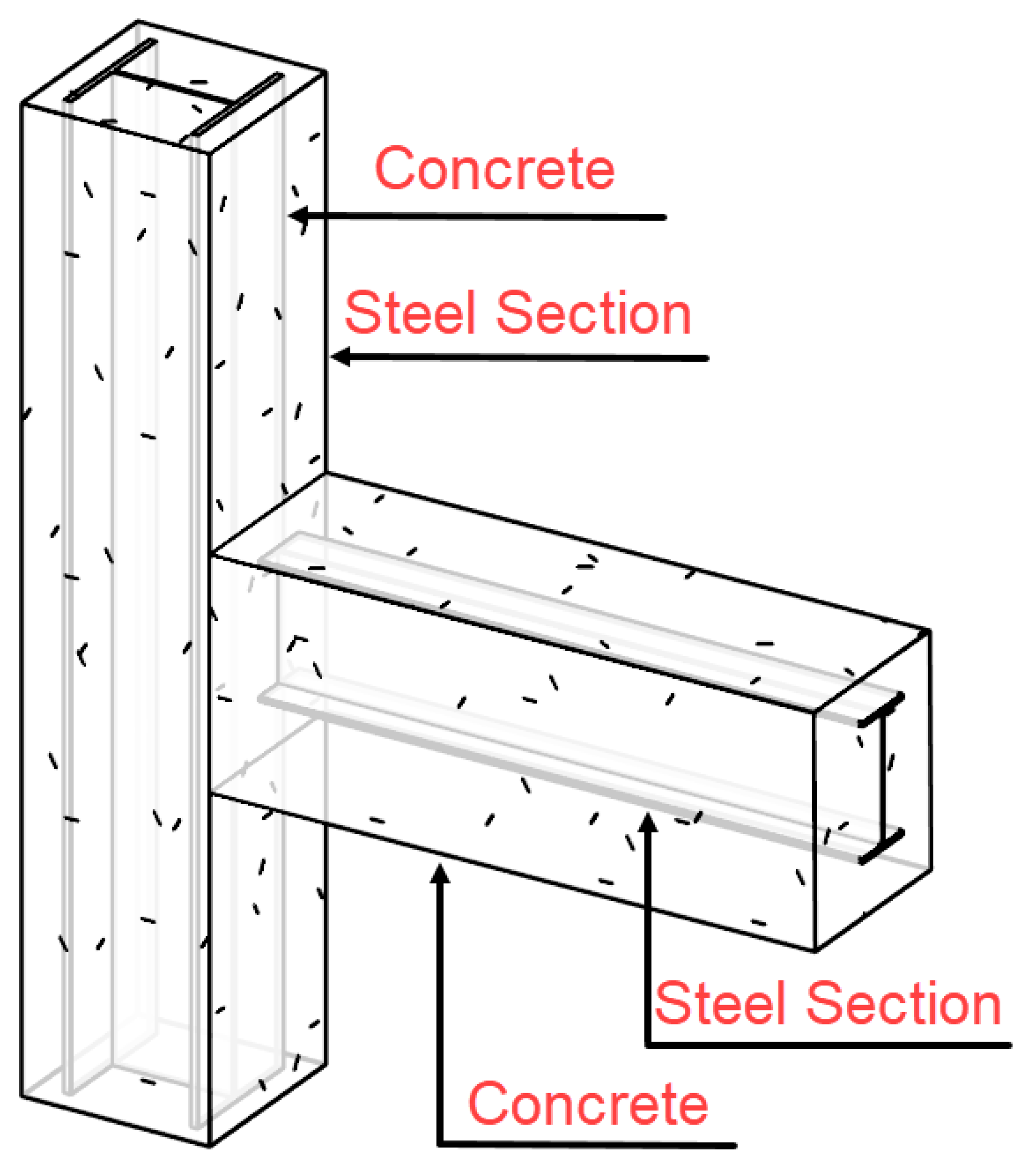
Figure 2.
Structure of artificial neural network.
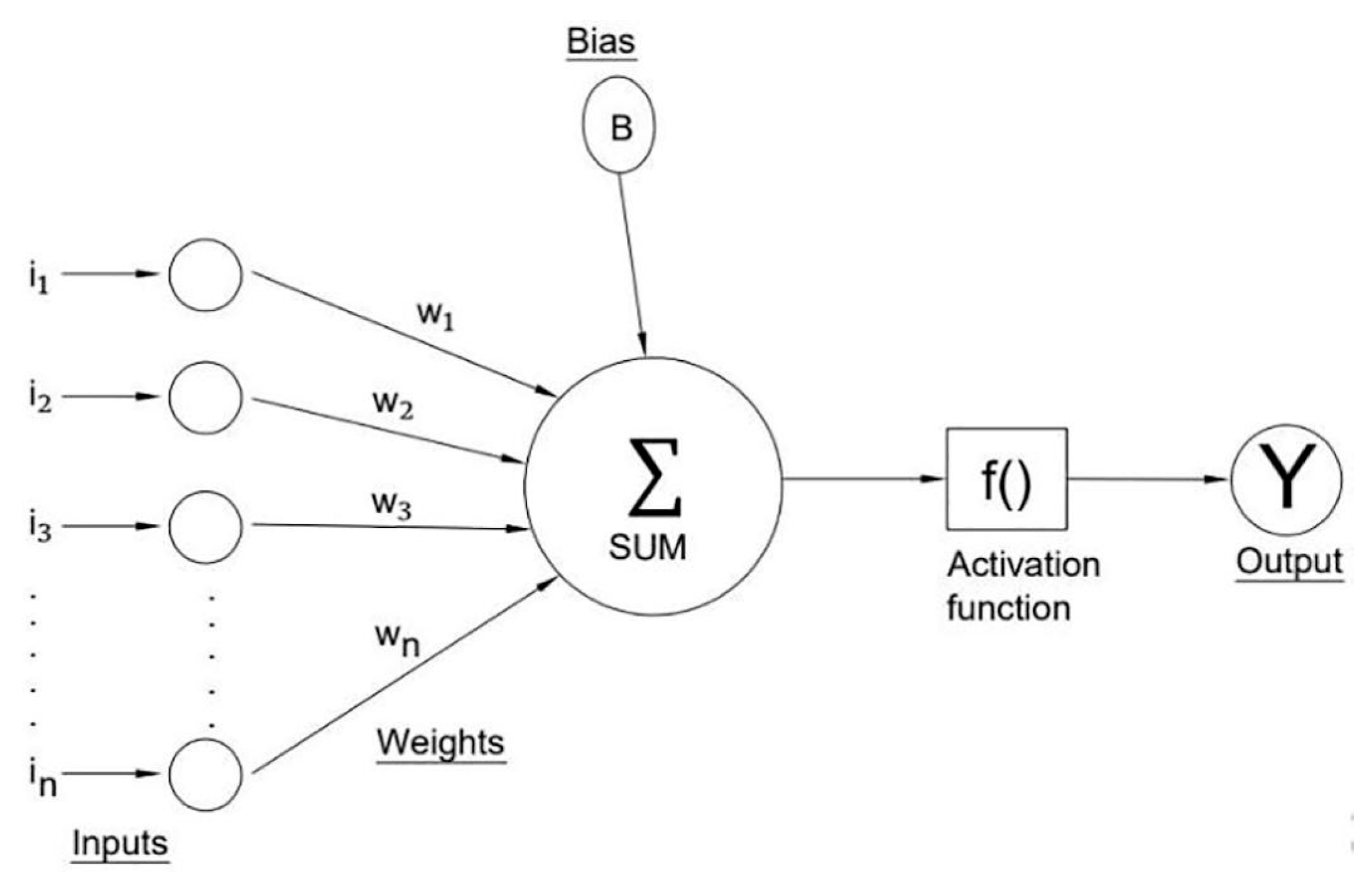
Figure 4.
Graphical sketch of composite beam-column joint.
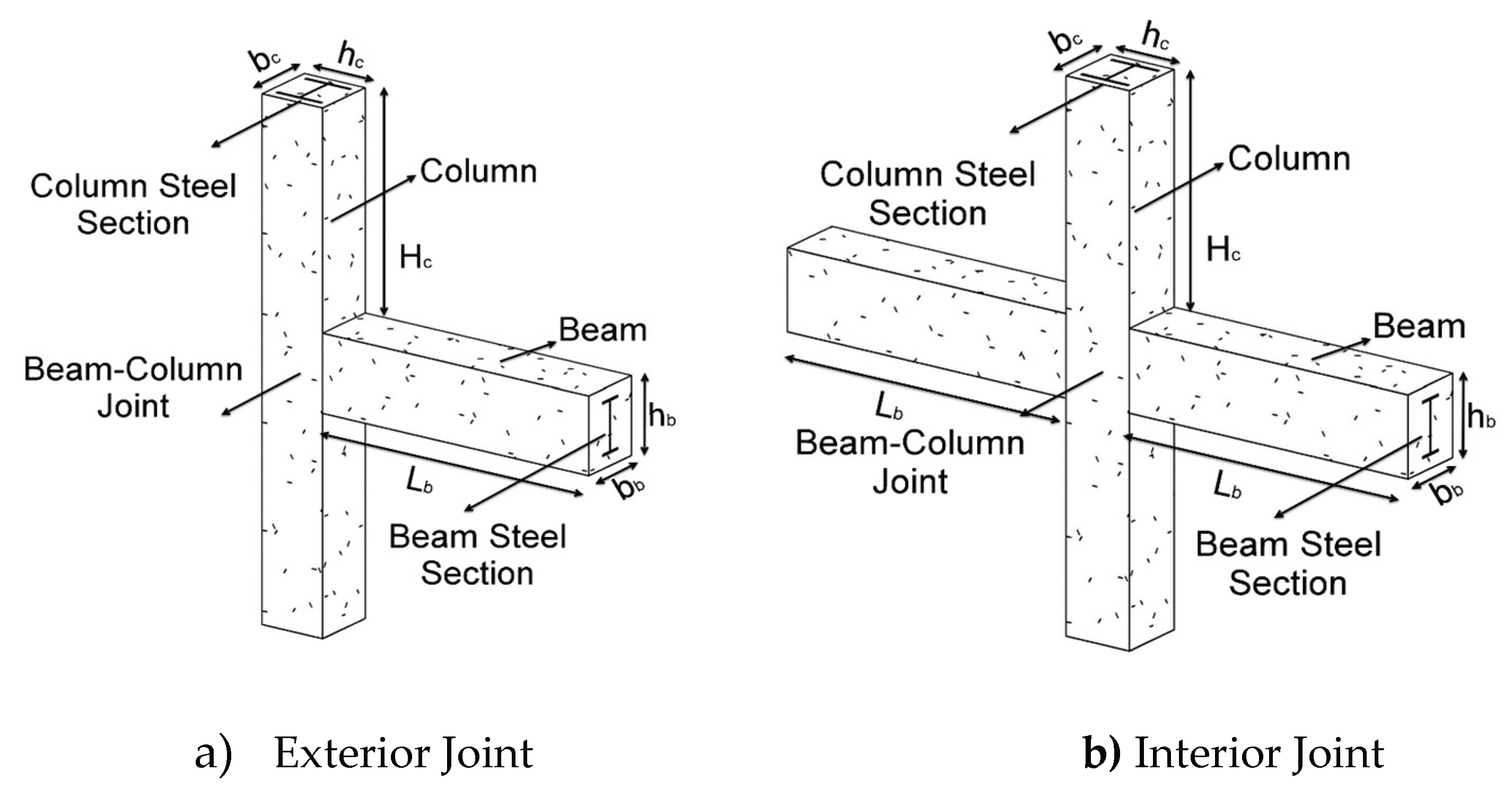
Figure 7.
Influence of compressive concrete strength (fc`).
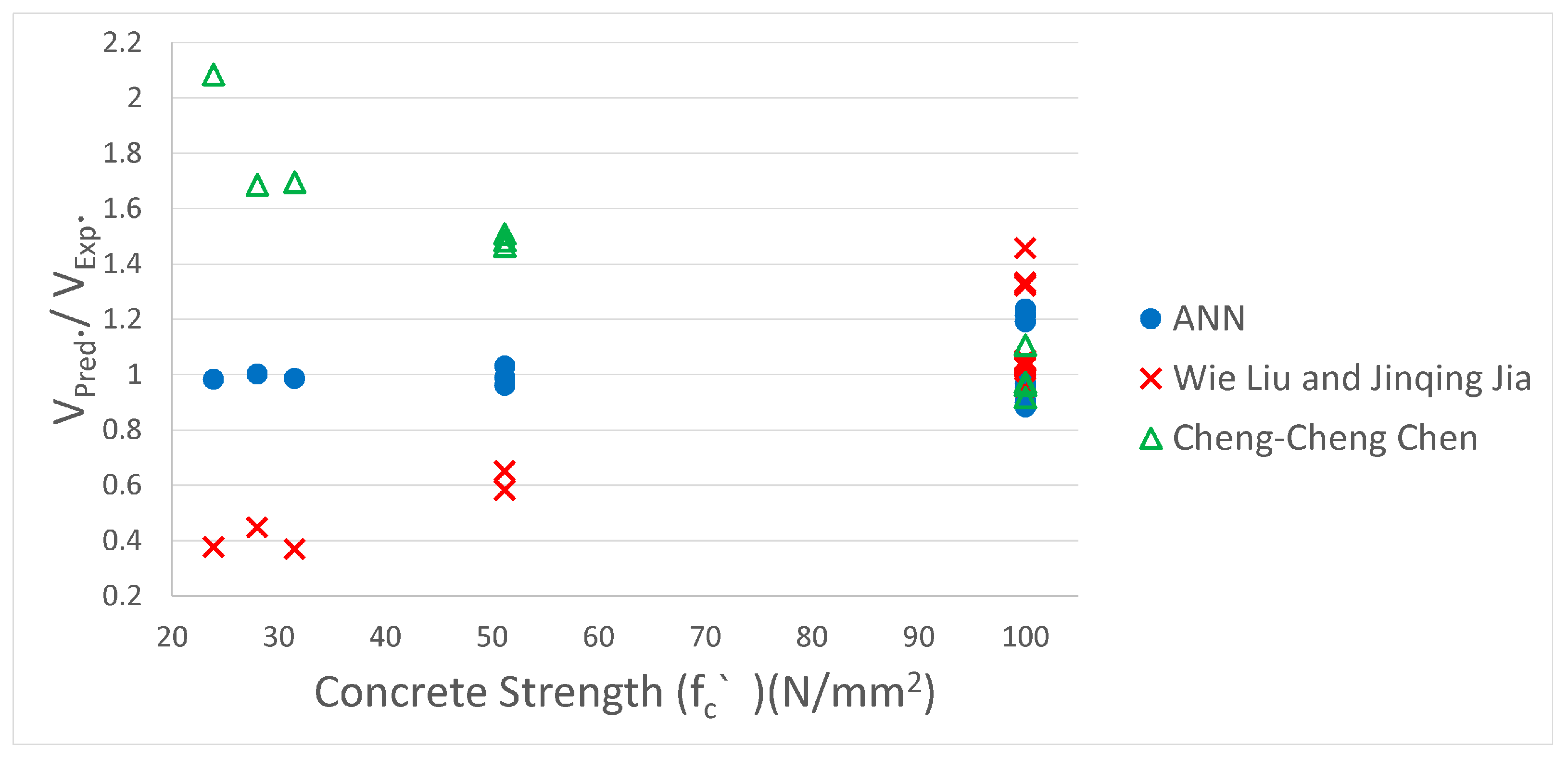
Figure 8.
Influence of Yield strength of steel section (fy).
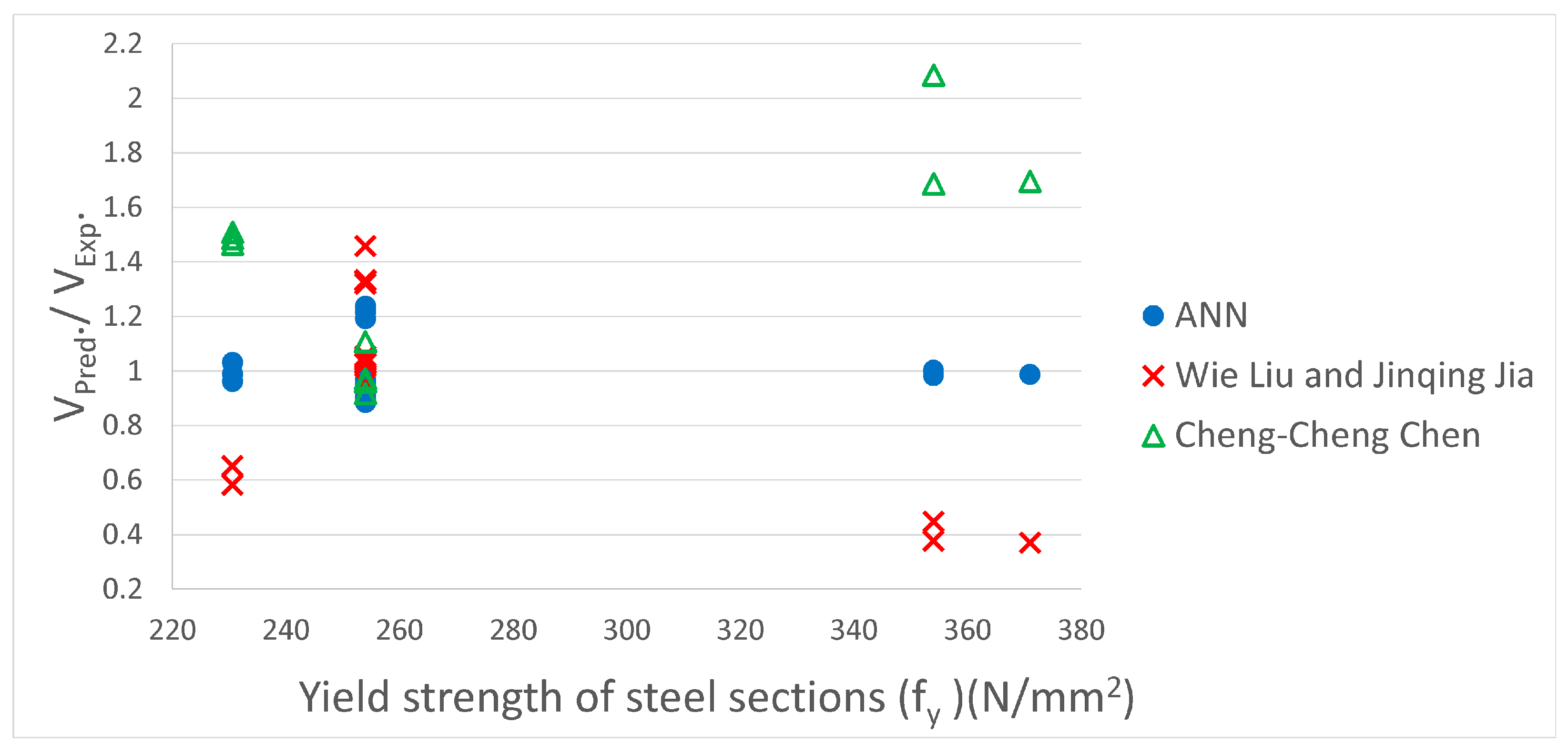
Figure 9.
Influence of Yield strength of stirrups (fy).
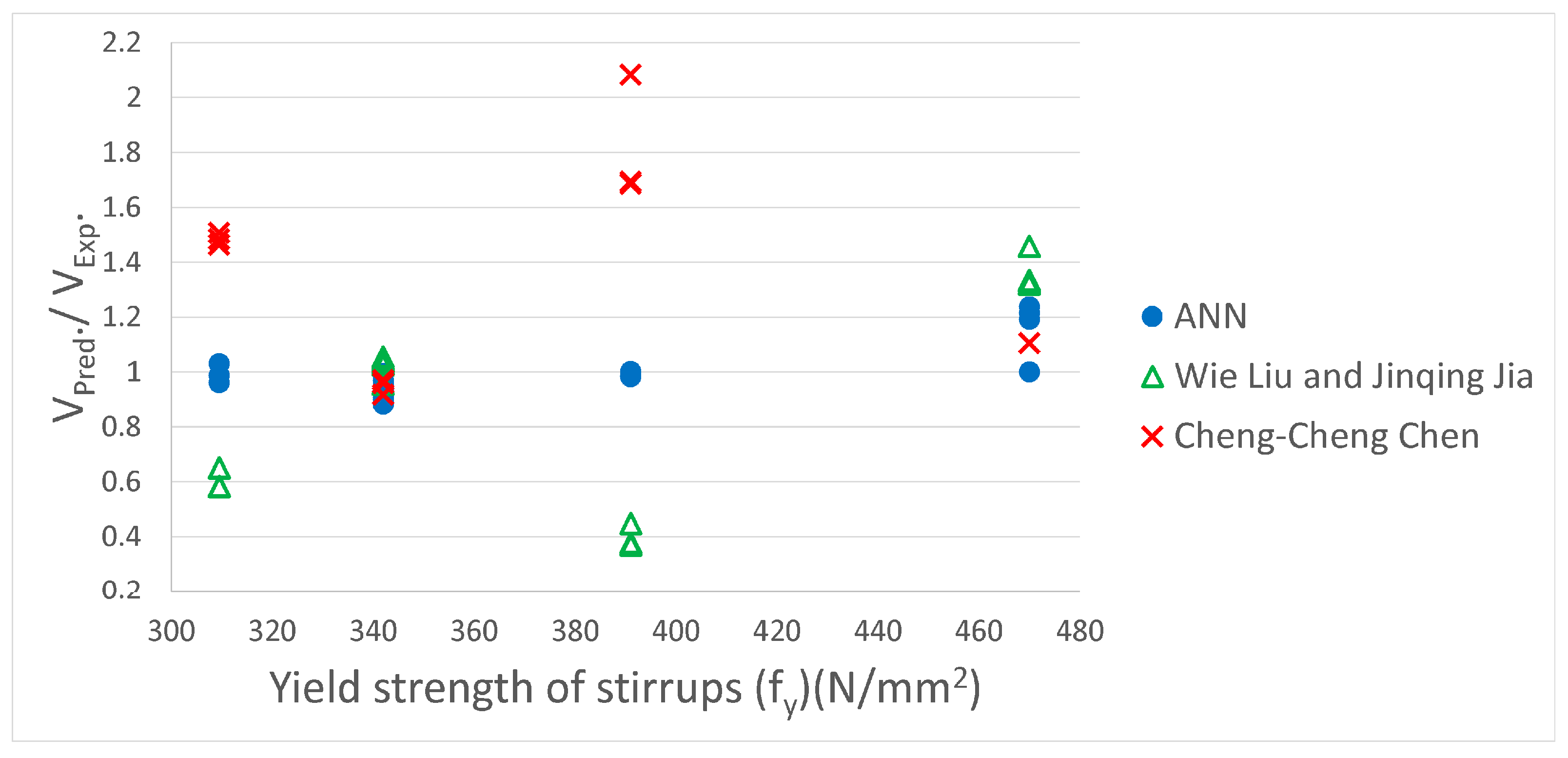
Figure 10.
Influence of stirrups ratio.
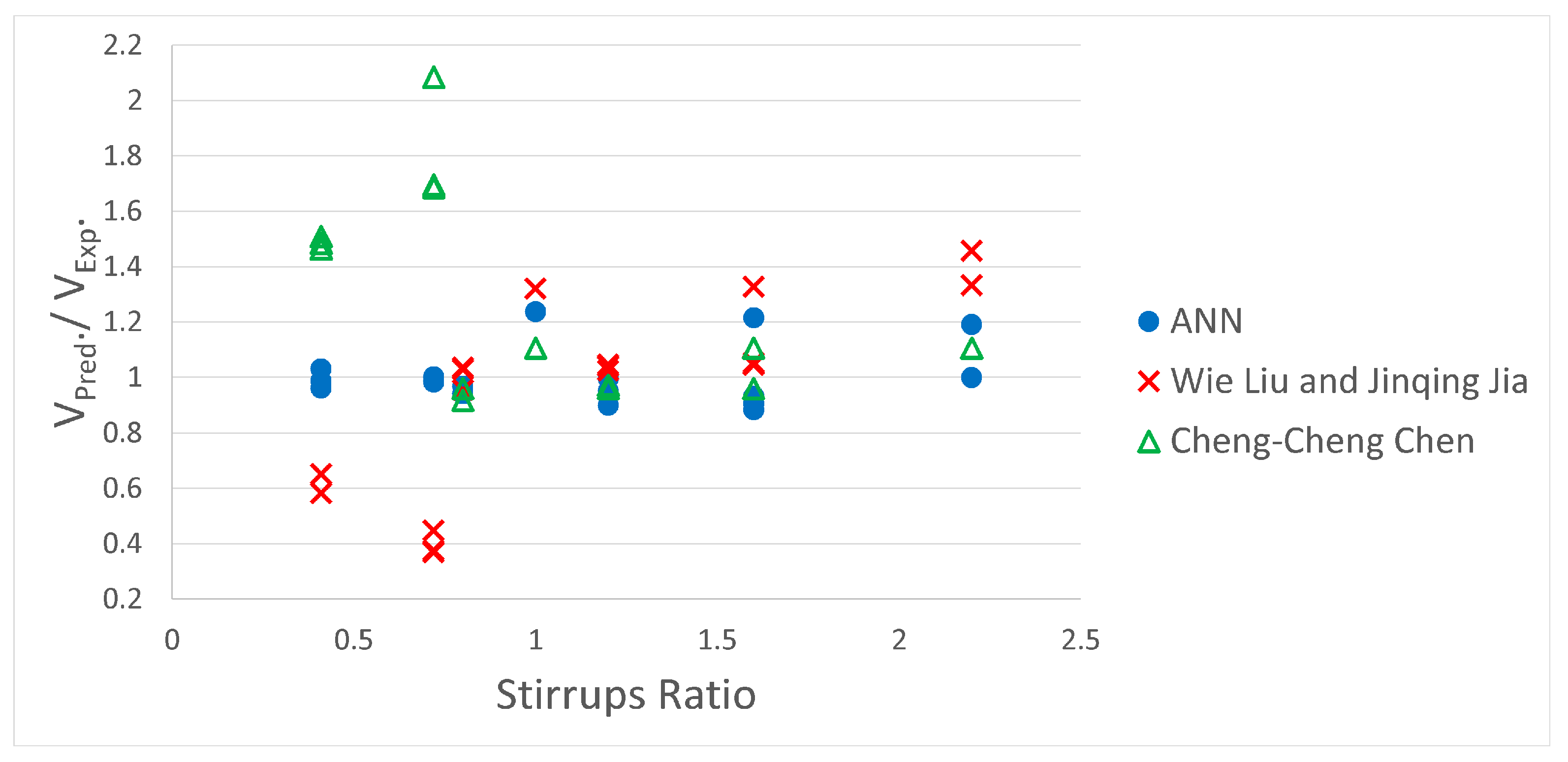
Figure 11.
Influence of column height (Hc).
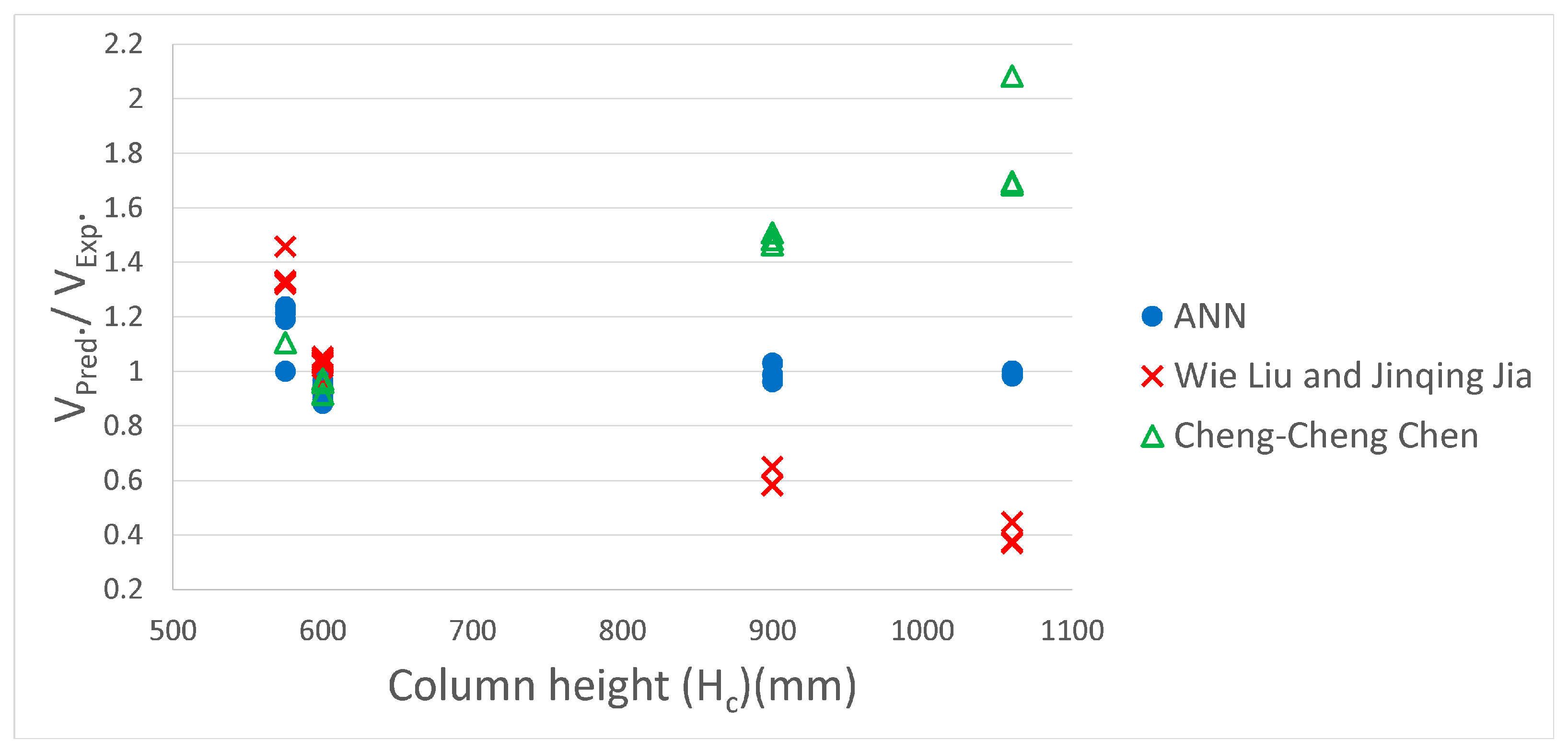
Figure 12.
Influence of beam length (Lb).
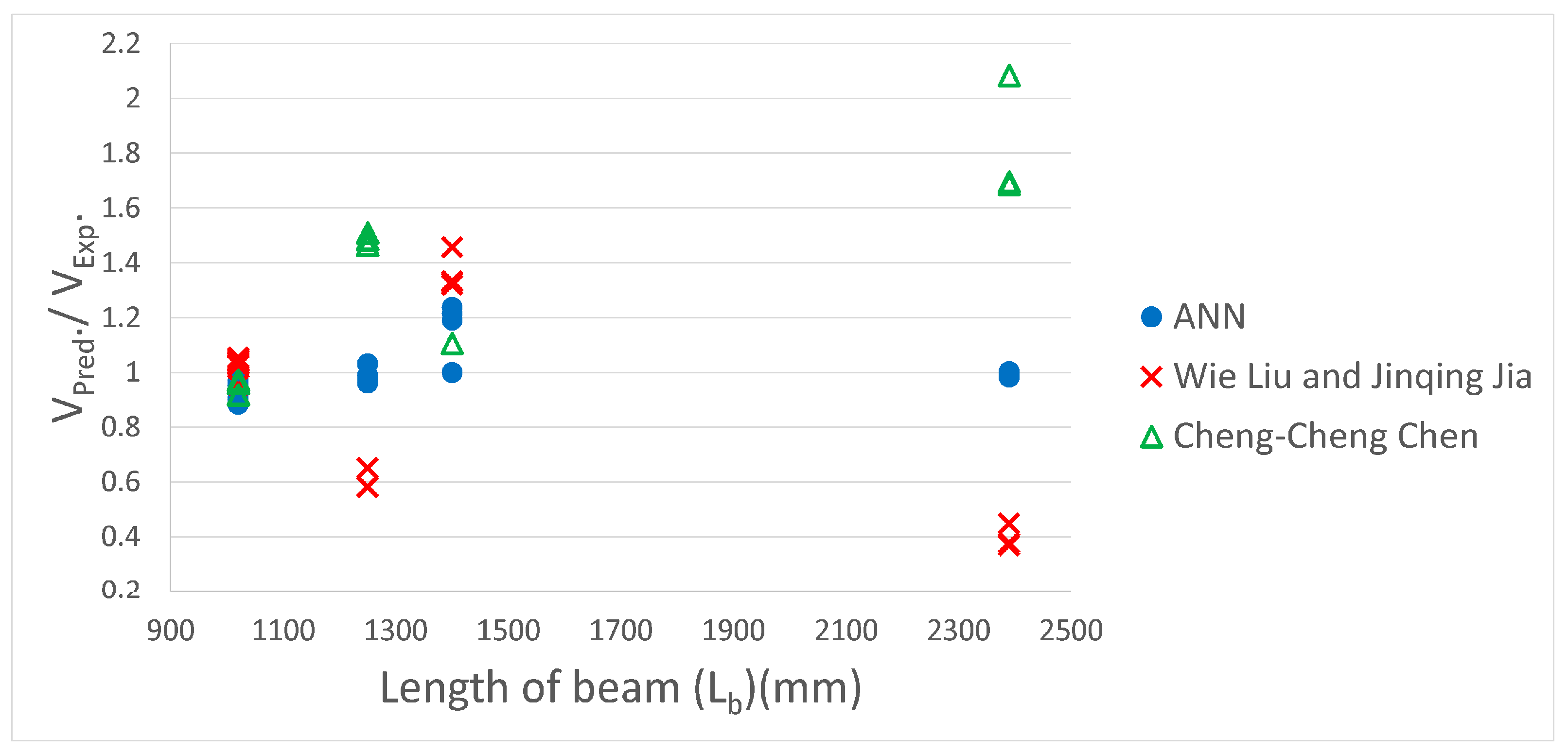
Figure 13.
Influence of depth of column steel web (hw).
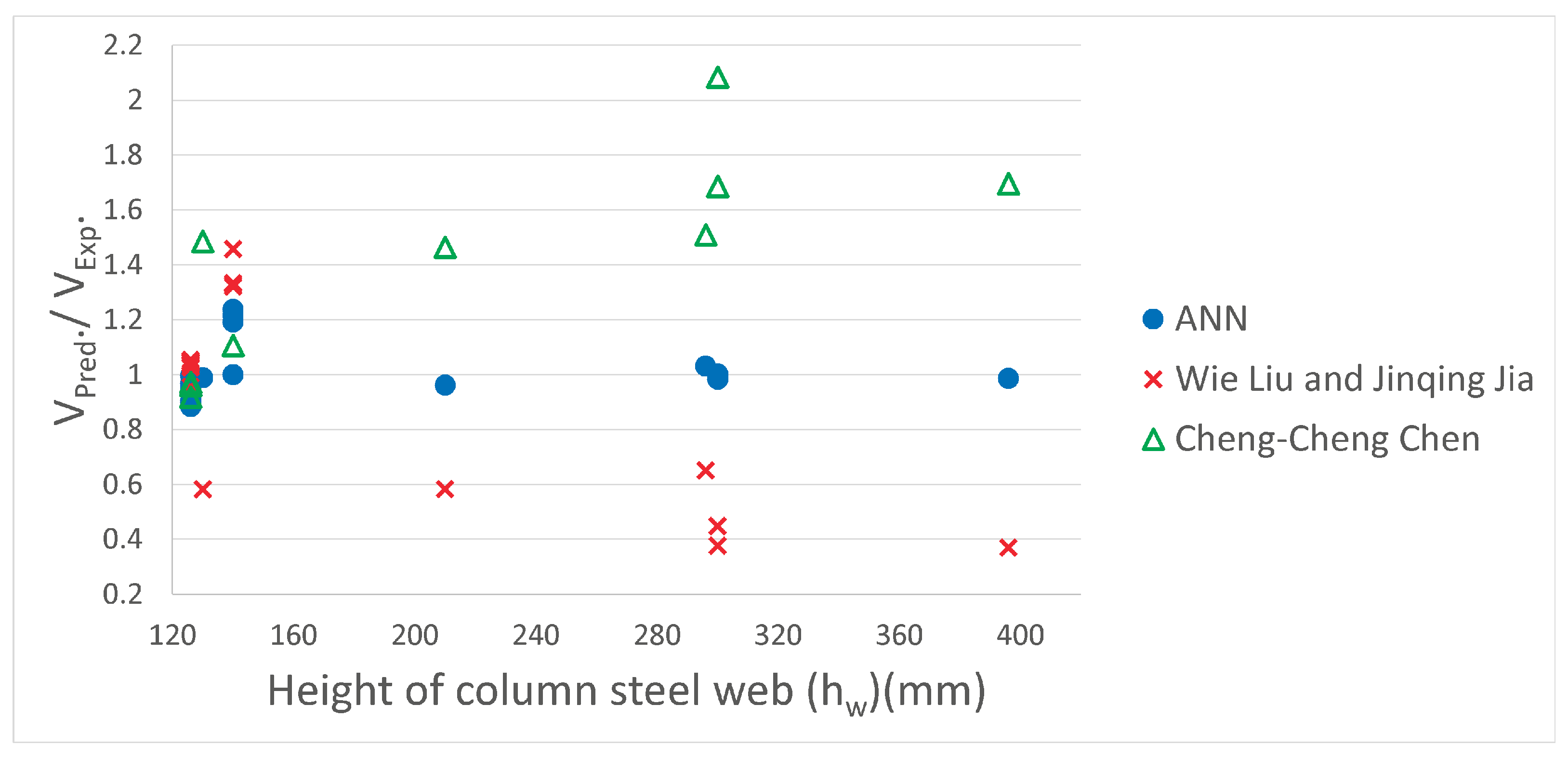
Figure 14.
Influence of depth of beam steel web (hw).
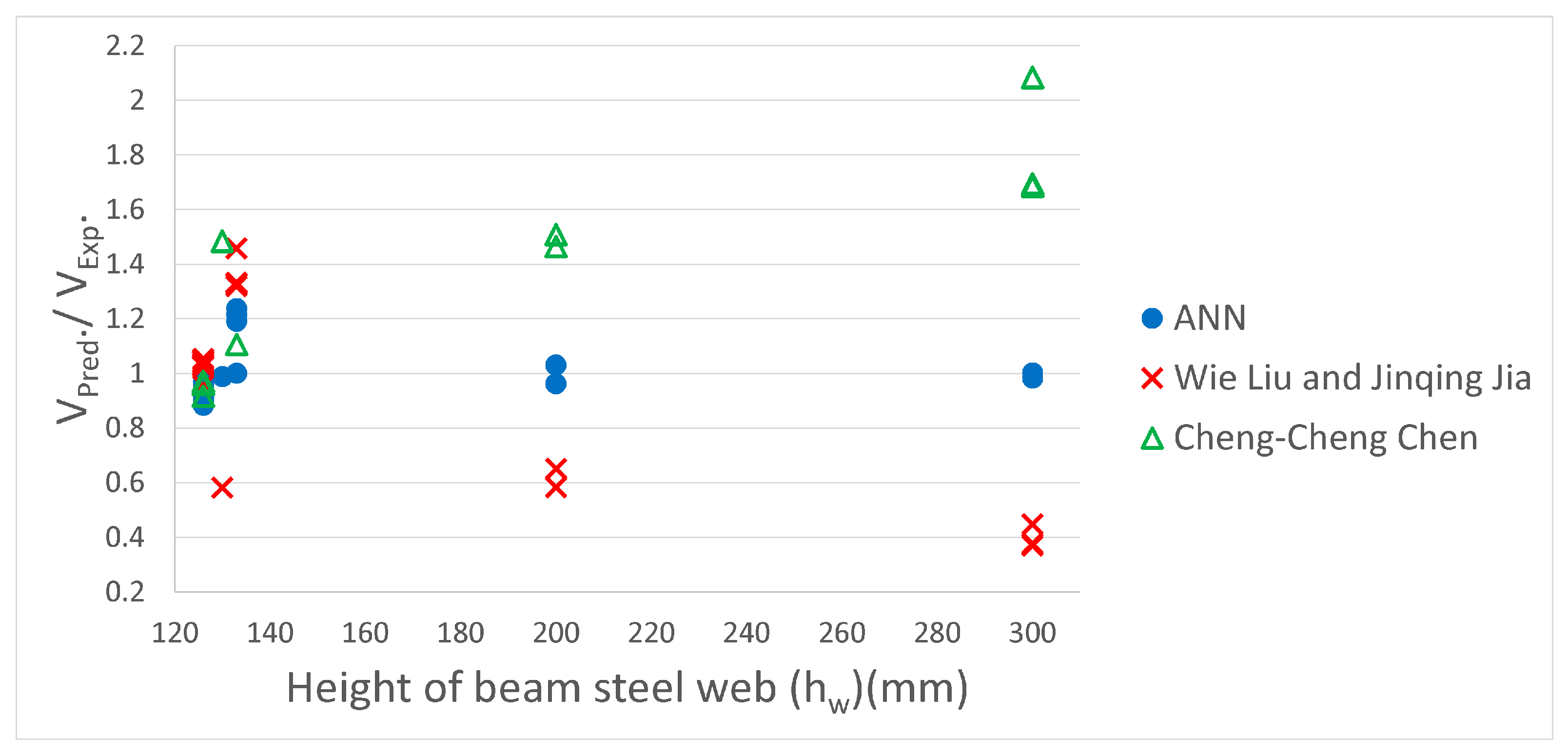
Figure 15.
Influence of thickness of column steel web (tw).
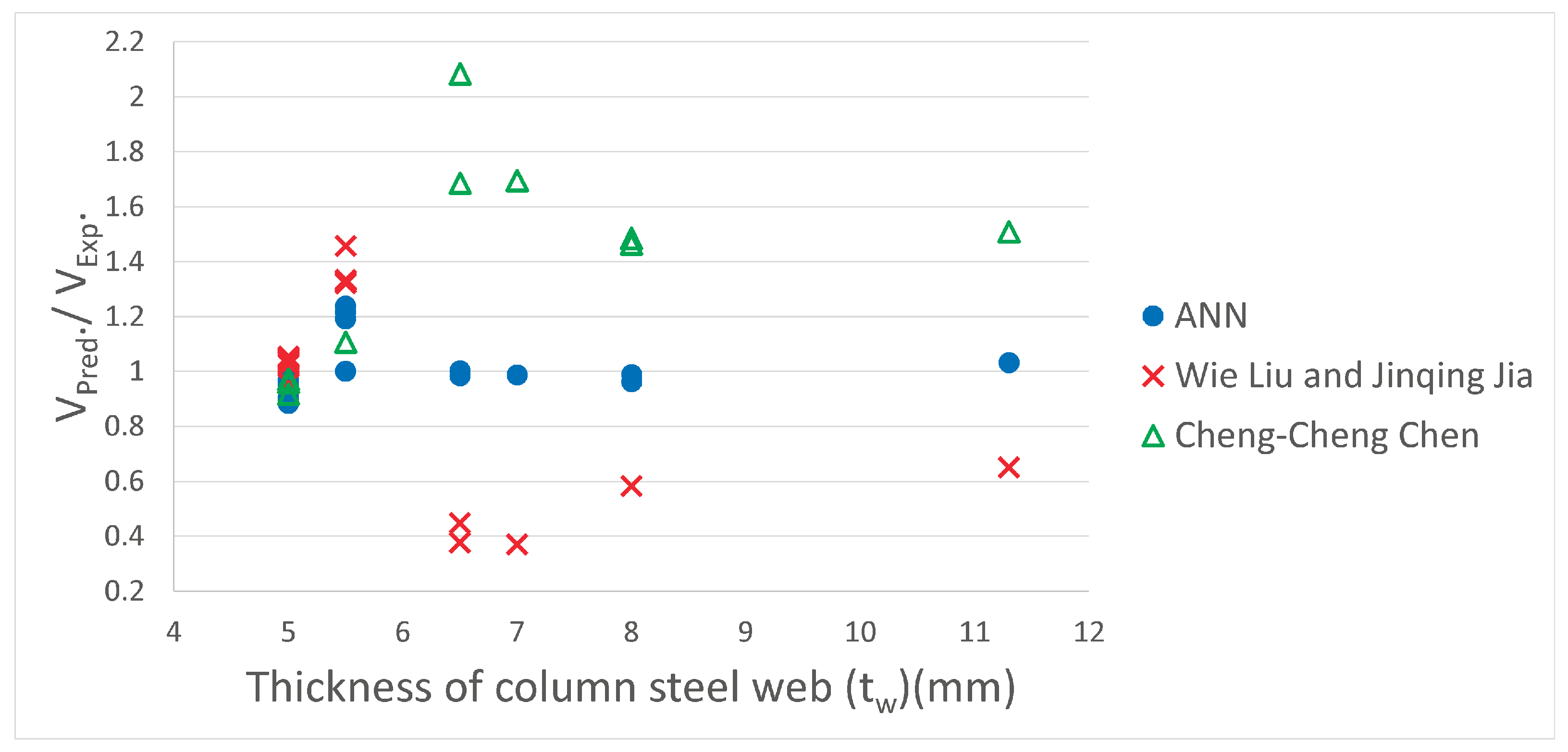
Figure 16.
Influence of thickness of beam steel web (tw).
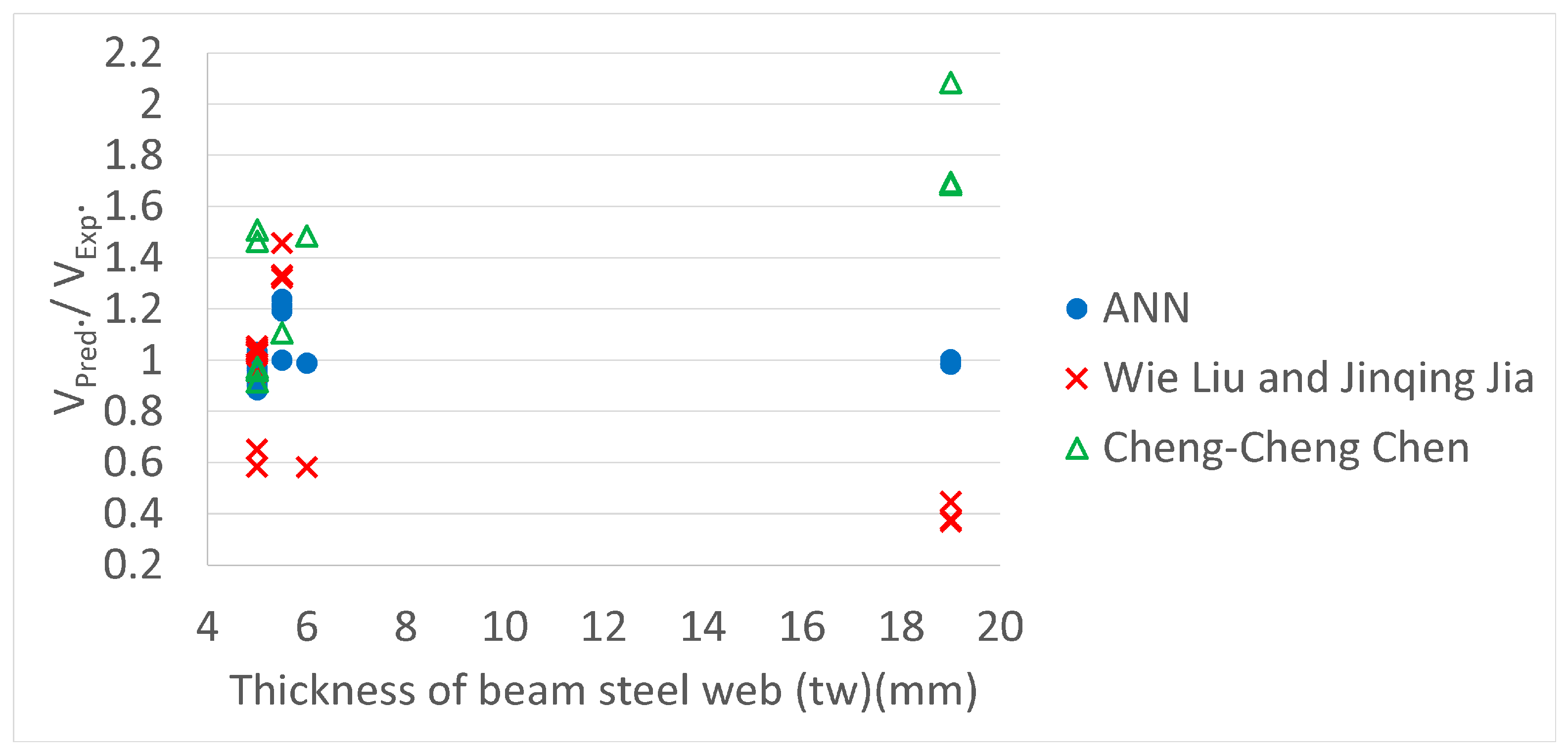
Figure 17.
Influence of axial load ratio.
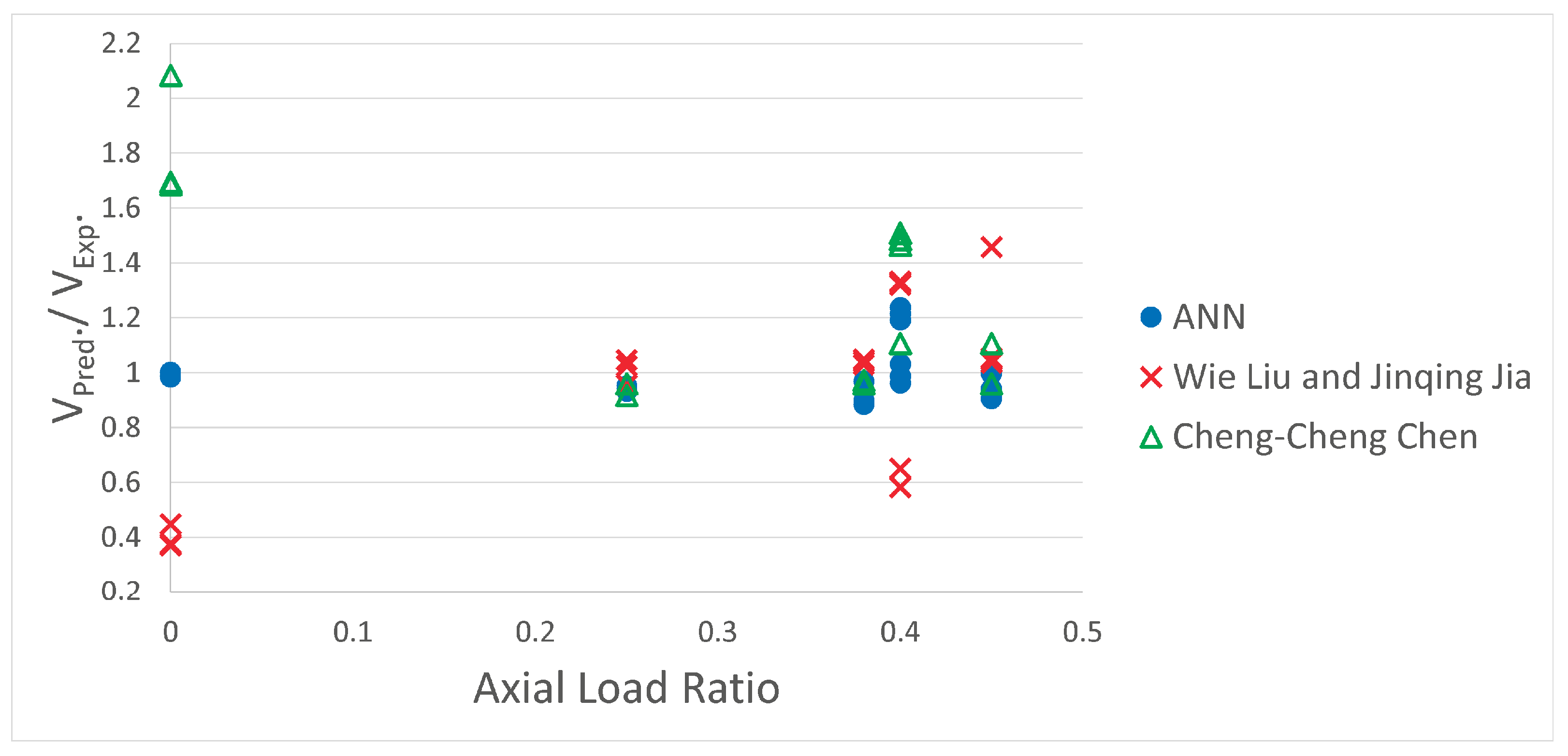

Table 1.
Data set of the beam-column joints.
| SOURCE | Specimen | FC` | FYSEC | FYST | STIRRUPS RATIO | hwc | twc | Hc | hwb | twb | Lb | hc | bc | hb | bb | inner =1 oter = 0 | axial | Vt (Exp.) |
|---|---|---|---|---|---|---|---|---|---|---|---|---|---|---|---|---|---|---|
| Wei Liu and Jinqing Jia (2017) | SRUHSC-1 | 100 | 254 | 342 | 0.8 | 126 | 5 | 600 | 126 | 5 | 1020 | 200 | 200 | 300 | 160 | 0 | 0.25 | 678.3 |
| SRUHSC-2 | 100 | 230.6 | 309.5 | 0.8 | 100 | 5.3 | 600 | 100 | 5.3 | 1020 | 200 | 200 | 300 | 160 | 0 | 0.25 | 685.44 | |
| SRUHSC-3 | 100 | 254 | 342 | 0.8 | 126 | 5 | 600 | 126 | 5 | 1020 | 200 | 200 | 300 | 160 | 0 | 0.45 | 664.02 | |
| SRUHSC-4 | 100 | 265 | 342 | 0.8 | 100 | 5.3 | 600 | 100 | 5.3 | 1020 | 200 | 200 | 300 | 160 | 0 | 0.38 | 685.44 | |
| SRUHSC-5 | 100 | 254 | 342 | 1.2 | 126 | 5 | 600 | 126 | 5 | 1020 | 200 | 200 | 300 | 160 | 0 | 0.25 | 664.02 | |
| SRUHSC-6 | 100 | 254 | 342 | 1.2 | 126 | 5 | 600 | 126 | 5 | 1020 | 200 | 200 | 300 | 160 | 0 | 0.38 | 692.58 | |
| SRUHSC-7 | 100 | 254 | 342 | 1.2 | 126 | 5 | 600 | 126 | 5 | 1020 | 200 | 200 | 300 | 160 | 0 | 0.45 | 621.18 | |
| SRUHSC-8 | 100 | 254 | 342 | 1.6 | 126 | 5 | 600 | 126 | 5 | 1020 | 200 | 200 | 300 | 160 | 0 | 0.25 | 664 | |
| SRUHSC-9 | 100 | 254 | 342 | 1.6 | 126 | 5 | 600 | 126 | 5 | 1020 | 200 | 200 | 300 | 160 | 0 | 0.38 | 699.7 | |
| SRUHSC-10 | 100 | 254 | 342 | 0.8 | 126 | 5 | 600 | 126 | 5 | 1020 | 200 | 200 | 300 | 160 | 0 | 0.38 | 649.7 | |
| SRUHSC-11 | 100 | 254 | 342 | 1.6 | 126 | 5 | 600 | 126 | 5 | 1020 | 200 | 200 | 300 | 160 | 0 | 0.45 | 678.3 | |
| Qiuwei Wang (2016) | SSRCJ1 | 51.2 | 230.6 | 309.5 | 0.41 | 130 | 8 | 900 | 130 | 6 | 1250 | 250 | 250 | 300 | 200 | 1 | 0.4 | 904.86 |
| SSRCJ2 | 51.2 | 230.6 | 309.5 | 0.41 | 194 | 8 | 900 | 200 | 5 | 1250 | 250 | 250 | 300 | 220 | 1 | 0.4 | 942.56 | |
| SSRCJ3 | 51.2 | 230.6 | 309.5 | 0.41 | 210 | 8 | 900 | 200 | 5 | 1250 | 250 | 250 | 300 | 220 | 1 | 0.4 | 1047.91 | |
| SSRCJ4 | 51.2 | 230.6 | 309.5 | 0.41 | 296 | 11.3 | 900 | 200 | 5 | 1250 | 250 | 250 | 300 | 220 | 1 | 0.4 | 1076.9 | |
| Cheng-Cheng Chen (2009) | SC-XH1 | 28 | 354 | 391 | 0.72 | 300 | 6.5 | 1060 | 300 | 19 | 2390 | 500 | 500 | 520 | 400 | 0 | 0 | 2766 |
| SRC-XH2 | 27.5 | 371 | 391 | 0.72 | 396 | 7 | 1060 | 300 | 19 | 2390 | 500 | 500 | 520 | 400 | 0 | 0 | 3773 | |
| SRC-XH1-TB | 23.9 | 354 | 391 | 0.72 | 300 | 6.5 | 1060 | 300 | 19 | 2390 | 500 | 500 | 520 | 400 | 0 | 0 | 2975 | |
| SRC-XH2-A2 | 31.5 | 371 | 391 | 0.72 | 396 | 7 | 1060 | 300 | 19 | 2390 | 500 | 500 | 520 | 400 | 0 | 0 | 4263 |
Table 2.
The components of joint shear strength using statistical descriptions.
| Specimen | FC` | FYSEC | FYST | ST RATIO | hwc | twc | Hc | hwb | twb | Lb | hc | bc | hb | bb | inner =1 oter = 0 | axial | Vt (Exp.) |
|---|---|---|---|---|---|---|---|---|---|---|---|---|---|---|---|---|---|
| Min | 23.9 | 230.6 | 309.5 | 0.41 | 100 | 5 | 575 | 100 | 5 | 1020 | 200 | 200 | 300 | 160 | 0 | 0 | 446.29 |
| Q1 | 51.2 | 254 | 342 | 0.72 | 126 | 5.3 | 600 | 126 | 5 | 1020 | 200 | 200 | 300 | 160 | 0 | 0.25 | 649.7 |
| Median | 100 | 254 | 342 | 0.8 | 140 | 5.5 | 600 | 133 | 5.3 | 1250 | 220 | 220 | 300 | 180 | 0 | 0.38 | 678.3 |
| Mean | 80.6 | 267.1 | 374.1 | 1.1 | 175.8 | 6.0 | 715.6 | 162.5 | 7.4 | 1367.2 | 260.8 | 260.8 | 347.2 | 212.0 | 0.4 | 0.3168 | 1123.7756 |
| SD | 29.0 | 42.9 | 59.2 | 0.5 | 86.6 | 1.5 | 187.2 | 65.1 | 5.1 | 472.1 | 105.8 | 105.8 | 78.2 | 84.3 | 0.5 | 0.151465 | 1053.199577 |
| Q3 | 100 | 254 | 391 | 1.6 | 210 | 7 | 900 | 200 | 5.5 | 1400 | 250 | 250 | 350 | 2000 | 1 | 0.4 | 942.56 |
| Max | 100 | 371 | 470 | 2.2 | 396 | 11.3 | 1060 | 300 | 19 | 2390 | 500 | 500 | 520 | 400 | 1 | 0.45 | 4263 |
Disclaimer/Publisher’s Note: The statements, opinions and data contained in all publications are solely those of the individual author(s) and contributor(s) and not of MDPI and/or the editor(s). MDPI and/or the editor(s) disclaim responsibility for any injury to people or property resulting from any ideas, methods, instructions or products referred to in the content. |
© 2026 by the authors. Licensee MDPI, Basel, Switzerland. This article is an open access article distributed under the terms and conditions of the Creative Commons Attribution (CC BY) license (http://creativecommons.org/licenses/by/4.0/).
Copyright: This open access article is published under a Creative Commons CC BY 4.0 license, which permit the free download, distribution, and reuse, provided that the author and preprint are cited in any reuse.


