
Submitted:
09 June 2026
Posted:
10 June 2026
You are already at the latest version
Abstract
The deployment of Autonomous Underwater Vehicle (AUV) swarms has become pivotal for oceanographic exploration and monitoring. However, the efficacy of swarm formation control is heavily constrained by the harsh characteristics of underwater acoustic communication networks (UACNs), particularly in non-fully connected networks where topology changes dynamically. To tackle high packet collision rates and excessive signaling overhead in existing Medium Access Control (MAC) protocols, this paper proposes a novel Cluster-based Mobile MAC (CM-MAC) protocol tailored for hierarchical clustered AUV networks. The CM-MAC protocol operates under a distributed two-tier architecture. The first-level cluster head initiates scheduling, followed by the second-level cluster heads, which coordinate transmissions within their sub-clusters by exploiting locally known state information and scheduling decisions. We establish the transmission constraints that prevent packet collisions among mobile nodes amid topology changes. Building upon the transmission constraints, genetic algorithms are applied across all layers’ transmission scheduling to optimize the sending sequence and timing, reducing overall latency. Simulation results indicate that the CM-MAC protocol significantly improves network throughput and decreases information-sharing update intervals compared to traditional TDMA, pure Aloha, and random-access CM-MAC. This study provides a robust communication framework for large-scale AUV swarm coordination in complex underwater environments.
Keywords:
autonomous underwater vehicles
; medium access control
; underwater acoustic communication networks
; cluster-based network
; transmission scheduling
1. Introduction
In recent years, Autonomous Underwater Vehicle (AUV) swarms have emerged as a transformative technology for ocean exploration, offering superior capabilities in cooperative target tracking, oceanographic mapping, and distributed sensing compared to single-vehicle systems [1,2,3,4,5]. Effective AUV swarm formation control is critically dependent on the timely and reliable exchange of state information (e.g., position, velocity, and attitude) among distributed nodes [6,7,8,9,10,11,12]. Unlike terrestrial wireless networks, underwater environments require the use of acoustic waves for long-range communication [13,14]. However, the underwater acoustic channel is characterized by limited bandwidth, high propagation latency, severe multipath effects, and rapid time-varying fading[15]. These inherent physical limitations impose severe constraints on the design of Medium Access Control (MAC) protocols, which define the transmission rules for nodes to share the limited underwater acoustic channel resource[16].
To address these challenges, existing research has extensively explored various MAC mechanisms, which can be broadly categorized into contention-based and non-contention-based protocols. Contention-based MAC protocols do not require pre-allocation of channel resources to network nodes. Instead, nodes dynamically share the same channel through contention. They are less constrained by the physical-layer limitations of Underwater Acoustic Communication Networks (UACNs) and can better adapt to changes in network topology. Contention-based MAC protocols can be further divided into random-access and handshake-based protocols. A random-access protocol occurs when a sender initiates transmission without the prior consent of the intended receiver[17,18,19,20,21]. However, due to the existence of the hidden terminal problem, random-access protocols suffer from low channel utilization caused by frequent packet collisions. In contrast, a handshake-based protocol involves the receiver feeding back the contention results to the senders after receiving multiple access requests[22,23,24,25,26]. But the handshaking-based random access MAC protocols prolong the waiting time caused by the exchange of control packets [27], making them unsuitable for high network traffic load demands.
Non-contention-based MAC protocols are mostly based on the Time Division Multiple Access (TDMA) framework and incorporate additional MAC mechanisms, such as scheduling and reservation, to allocate transmission slots to nodes, thereby using limited time resources more efficiently. In particular, scheduling-based MAC protocols coordinate node transmissions via predefined rules or centralized controllers, thereby improving bandwidth utilization by enabling more concurrent transmissions and reducing collisions at the receiver[22]. Nevertheless, most existing scheduling schemes rely on complete topological knowledge to generate conflict-free schedules[28,29,30,31,32], making them non-trivial to apply in large-scale AUV swarms. Specifically, in a non-fully connected network, the distance between some AUV nodes exceeds the maximum communication distance. In a multicast communication scenario for information sharing between adjacent nodes reachable via one-hop communication, nodes can obtain only the status information of some nodes in the network, and the information received by each node is incomplete and asymmetric. Therefore, global slot allocation is impractical due to the high signaling overhead and latency required to maintain global consistency. Furthermore, static slot allocation is ill-suited for the highly dynamic nature of AUV swarms, where nodes are constantly moving, and the network topology changes rapidly.
To support large-scale AUV swarms and reduce the complexity of global coordination, clustered network architectures have been widely adopted due to their scalability and energy efficiency[33,34,35,36,37,38]. In such architectures, the large-scale network is decomposed into manageable local topologies, enabling distributed scheduling. However, designing an efficient MAC for such architectures remains challenging. Existing research on non-contention-based MAC protocols for clustered UACNs typically falls into the following two categories, yet each has limitations when applied to AUV swarms. Some studies assign orthogonal carrier frequencies or spreading codes to adjacent clusters to eliminate inter-cluster interference[39,40,41]. While effective, this approach significantly reduces the already scarce bandwidth available to each cluster, limiting the network capacity for high-volume formation data. The other works utilize graph coloring or conflict graphs to maximize spatial reuse[42,43,44,45]. However, these algorithms often rely on global topology knowledge and complex calculations. In dynamic AUV swarms, the overhead of collecting global information and updating the schedule is too high to support real-time control.
Therefore, designing a distributed scheduling-based MAC protocol that supports high-concurrency multicast interactions for AUV formation control while mitigating inter-cluster interference remains an open challenge. The protocol must leverage the collision-avoidance advantages of scheduling without incurring the prohibitive overhead of global coordination. Motivated by these challenges, this paper proposes a hierarchical scheduling-based MAC protocol tailored for clustered AUV swarm networks. The main contributions of this paper are summarized as follows:
- 1.
- A Novel Hierarchical Scheduling-based MAC Protocol: We propose a Cluster-based Mobile MAC (CM-MAC) protocol specifically tailored for hierarchical clustered AUV networks. Unlike traditional centralized approaches, CM-MAC operates on a distributed two-tier architecture where cluster heads coordinate transmissions based on locally known state information. This design significantly reduces the prohibitive signaling overhead associated with global topology collection in dynamic underwater environments.
- 2.
- Theoretical Analysis of Packet Collision Avoidance: We establish rigorous transmission constraints to guarantee collision-free communication among mobile nodes despite dynamic topology changes. These constraints guarantee collision-free communication between two nodes based solely on their inter-node distance, eliminating the need for the locations of neighboring receivers.
- 3.
- Scheduling Optimization via Genetic Algorithms: We introduce a genetic algorithm-based scheduling mechanism across all network layers.By optimizing the transmission sequence and timing, the proposed method effectively reduces overall network latency and improves channel utilization.
- 4.
- Performance Verification: Extensive simulations demonstrate that CM-MAC outperforms traditional protocols, including TDMA, pure Aloha, and random-access CM-MAC. The results confirm that our protocol achieves significant improvements in network throughput and reduces information-sharing update intervals, providing a robust communication framework for large-scale AUV swarms.
2. Hierarchical Clustered Network Model
This paper describes a network scenario in which N AUV nodes migrate as a swarm to a specified target area and share state information with adjacent nodes within their communication range. As the AUV cluster moves to a specified wide range of target areas, the distance between AUV nodes keeps increasing, so that some nodes cannot directly communicate with each other due to the maximum communication distance. This network topology is called a non-fully connected network. This paper only considers the information exchange between adjacent AUV nodes in a non-fully connected network. The communication requirements are to ensure that each node’s state information is transmitted to all adjacent nodes as quickly and successfully as possible. This communication requirement is equivalent to neighborhood multicasting in a non-fully connected network. The CM-MAC protocol governs the allocation of nodes’ transmission timing. The bit-error ratio due to channel quality is not considered, and time synchronization and positioning errors are ignored.
As illustrated in Figure 1, a hierarchical clustered network consisting of first-level cluster head nodes, second-level cluster head nodes, and surrounding nodes is considered in this paper. The length of the packet sent by the first-level cluster head is , the length of the packet sent by the second-level cluster head node is , and the length of the packet sent by the surrounding node is L. The first-level cluster head is represented as , and the second-level cluster head is denoted as , . The set of second-level cluster heads controlled by the first-level cluster head is defined as . Similarly, the set of surrounding nodes controlled by the second-level cluster head () is defined as .
3. Overview of the CM-MAC Protocol
We assume that the AUV swarm network transitions from a fully connected state to a non-fully connected state during its movement. When the network is in the fully connected stage, the sending times of nodes are determined according to existing global scheduling protocols, such as the AB-MAC protocol[46]. Once the control node makes a scheduling decision for a node, it must calculate the distance between that node and the control node at the designated transmission time. This calculation is essential to verify whether the node remains within the control node’s communication range when sending. If any node exceeds the control node’s communication range at the specified transmission time, the network will transition to a non-fully connected state. In this case, the control node broadcasts a state transition packet to inform the pre-specified first-level cluster head to manage scheduling control using the CM-MAC protocol. The following details the main flow of the CM-MAC protocol.
3.1. The First-Level Cluster Head Arranges the Sending Time for the Second-Level Cluster Head
Upon receiving the state transition packet, the first-level cluster head calculates the distances to other nodes based on their current state information and identifies all single-hop adjacent nodes. It then schedules the sending times for these adjacent nodes. If an adjacent node falls outside the communication range of the first-level cluster head at the designated sending time, the first-level cluster head will cancel the time assignment for that node. After this decision-making process, any node that has a sending time successfully scheduled by the first-level cluster head is designated as a second-level cluster head. The broadcast packet from the first-level cluster head contains its own state information, along with the sending times and state information of all second-level cluster heads.
The critical challenge in this scheduling process is to select and arrange the second-level cluster heads so that they are all within communication range when sending, while also allowing as many nodes as possible to transmit as soon as possible. Once the selection process is complete, the final second-level cluster heads can be determined. We will outline the specific scheduling algorithm in Section 6.1.
3.2. The Second-Level Cluster Head Arranges the Sending Time for the Surrounding Nodes in Its Sub-Cluster
A second-level cluster head gathers the state information and transmission times of all other second-level cluster heads by receiving broadcast packets from the first-level cluster head. Using this information, the second-level cluster head identifies surrounding nodes in its sub-cluster: these are all nodes within its communication range that are not within the communication range of any other second-level cluster head with an earlier transmission time. After identifying the surrounding nodes, the second-level cluster head schedules their transmission times accordingly. The broadcast packet sent by the second-level cluster head contains its own state information, as well as the scheduled transmission times and state information for all surrounding nodes in its sub-cluster. The specific scheduling algorithm used is detailed in Section 6.2.
3.3. The First-Level Cluster Head Executes the Next Round of Scheduling Process
After receiving broadcast packets from all the second-level cluster heads, the first-level cluster head gathers the transmission times of all surrounding nodes. The latest transmission time plus the maximum propagation delay is set as the sending time of the first-level cluster head for the next round. Afterward, the network periodically executes the CM-MAC protocol as described above.
4. Transmission Constraints for Collision-free Neighborhood Multicasting Between Mobile Nodes
Collision-free neighborhood multicast communication ensures that all adjacent neighbors successfully receive each node’s transmitted packets. To achieve this, the packets sent by any transmitter must not collide with those from any interfering nodes at neighboring receivers. In the following, we analyze the transmission constraints that an interfering node must satisfy to avoid disrupting the primary transmitter’s transmission, particularly when the location of the adjacent receiver is unknown.
Assume that node j sends a packet with a length of at time , while node i sends a packet of length at time . Let represent the transmission rate, and c denote the speed of sound in water. To prevent collisions between the packets sent by nodes j and i at the adjacent receiver q, the sending times of nodes j and i must satisfy
or
which can be expressed as
or
where represents the distance between node i and node q at the sending time , and represents the distance between node j and node q at the sending time . Here, we assume that the variation in distance between the transmitter and the receiver is negligible during the packet transmission period (i.e., the time from when the packet is transmitted until it is fully received). If the sending time for node i is known, but the sending time for node j is unknown, and can be rewritten as and , respectively. If the AUV in the network moves with uniform linear motion, then there is
where refers to the relative velocity of two AUVs moving in opposite directions, and represents the maximum velocity at which an AUV can move. According to (3) and (4), if there is a possibility of packet collision between node i and node j, the difference in their sending times must satisfy
where is the maximum communication distance, and is the maximum packet transmission duration sent by nodes in the network. Then (3) can be derived as
Similarly, (4) can be derived as
Let . Based on (7) and (8), in order to ensure that node i and node j do not suffer from packet collisions at any receiver, the relaxed condition can be written as
where represents the set of all adjacent receivers. According to the tripartite relationship of a triangle, there is , where is the distance between node i and node j at time . Overall, the sending time constraints of collision avoidance between mobile node pairs in the network can be summarized as
The distance parameter is estimated based on the known transmission time, and the estimation error is compensated for using the protection time interval .
5. Collision Avoidance Constraints in Hierarchical Clusters
In our hierarchical clustered network, packet collision scenarios can be categorized into four distinct types: 1) collisions between second-level cluster heads, 2) collisions between second-level cluster heads and surrounding nodes in other sub-clusters, 3) collisions between surrounding nodes in the same sub-cluster, and 4) collisions between surrounding nodes across different sub-clusters. This section addresses transmission constraints designed to prevent these various types of collisions.
5.1. Transmission Constraints Between Second-Level Cluster Heads
As illustrated in Figure 2, when the first-level cluster head schedules the transmission times for the second-level cluster heads, it is essential to ensure that these second-level cluster heads do not affect each other’s neighborhood multicast communication. Assume that the sending time of the firs-level cluster head is , and the order in which the second-level cluster heads determine their sending times is , where is a complete permutation of (). It’s important to note that is not the final transmission order.
The sending times for all second-level cluster heads must be set to occur only after they have received the packets broadcast by the first-level cluster head, that is
where is the distance between node and node at time . Additionally, indicates the transmission duration of the broadcast packet from the first-level cluster head.
In addition, to prevent packet collisions between node () and node ( and ), if the time has already been determined, then must satisfy
5.2. Transmission Constraints Between Surrounding Nodes and Second-Level Cluster Heads
As illustrated in Figure 3, when a second-level cluster head schedules the transmission time for surrounding nodes in its sub-cluster, it must ensure that the surrounding nodes in its sub-cluster and the second-level cluster heads from other sub-clusters do not interfere with each other’s neighborhood multicast communication. Before initiating transmission, the second-level cluster head can obtain the transmission times and locations of other second-level cluster heads through the broadcast packets received from the first-level cluster head. In other words, when second-level cluster head () allocates transmission times for surrounding nodes (), it already knows the location of node ( and ) and the transmission time .
To avoid packet collision between node and node , the sending time must satisfy
5.3. Transmission Constraints Between Intra-Cluster Surrounding Nodes
As illustrated in Figure 4, when the second-level cluster head schedules the sending times for surrounding nodes in its sub-cluster, it must ensure that the surrounding nodes do not interfere with each other’s neighborhood multicast communication. Assume that the sending time for second-level cluster head is , the order in which the surrounding nodes will determine their sending times is represented by , where is the complete permutation of (). It is important to note that does not represent the final sending order.
The sending time of all surrounding nodes within the sub-cluster should be restricted after they receive the packets broadcast by the second-level cluster head , that is
where is the distance between node and node while is transmitting. The term denotes the transmission duration of the packet sent by the second-level cluster head.
To avoid packet collisions between node () and node ( and ), once has been determined, the sending time must satisfy
5.4. Transmission Constraints Between Inter-Cluster Surrounding Nodes
(13) indicates that a second-level cluster head with a later sending time will receive the packet from its neighboring second-level cluster head before sending. The obtained information includes the locations and the sending times of the neighboring second-level cluster head and the surrounding nodes in the neighboring sub-cluster.
As illustrated in Figure 5, consider second-level cluster heads and (and ). If the distance and , then the sending time and the location of surrounding node () are known when second-level cluster head allocates a sending time for the surrounding node ().
To avoid packet collision between node and node , the sending time must satisfy
It should be noted that if two second-level cluster head nodes are not within each other’s communication range, they cannot avoid packet collisions among inter-cluster surrounding nodes because they cannot obtain information from each other’s broadcast packets.
6. Transmission Scheduling Optimization Algorithm
The principle of transmission scheduling is to ensure that a node with a newly assigned sending time does not cause a packet collision with any node that has an established transmission time. Two aspects of scheduling are mainly considered. One is to identify the set of second-level cluster heads and assign a sending time to each. Second, each second-level cluster head is responsible for allocating sending times to the surrounding nodes within its sub-cluster. This section outlines the specific scheduling algorithms.
6.1. Transmission Scheduling Optimization for Second-Level Cluster Heads
Assuming that the number of single-hop adjacent nodes of the first-level cluster head at the sending time of is m, we denote the sequence of single-hop adjacent nodes as . The first-level cluster head is responsible for scheduling transmissions for the second-level cluster heads. The scheduling task involves selecting all second-level cluster heads from and allocating transmission times to them to ensure collision-free neighborhood multicast communication.
To solve this combinatorial optimization problem, an improved genetic algorithm is employed. As illustrated in Algorithm 1, the specific algorithm for selecting second-level cluster heads and allocating sending times comprises five steps: chromosome coding, selection of excellent individuals, crossover and recombination, mutation, and an elite strategy.
| Algorithm 1 GA-based Allocation Scheme |
|
1) Chromosomal coding: Different transmission sequences are represented as distinct chromosomes, i.e., individuals. The full permutation of the sequence of adjacent nodes describes all possible transmission sequences, expressed as . The same node number must not be repeated in each chromosome. A population contains M individuals.
2) Excellent individuals selection: The fitness function of an individual is defined as
where is the cost function value of the l-th individual, defined as the latest send time of all second-level cluster heads.
For individual , the sending time will be calculated sequentially. The sending time must satisfy the transmission constraints given by (12) and (13). Each time a is calculated, it is essential to verify whether the distance between node and the first-level cluster head is still less than the maximum communication distance. If , then the node does not meet the criteria to become a second-level cluster head. In this case, only the first nodes are considered as second-level cluster heads. Accordingly, the latest transmission time allocated for the first node is used as the cost function value of individual .
In a population, the probability of selecting the l-th individual is , where M is the total number of individuals in the population. The corresponding cumulative probability can be expressed as . Generate a random number , if the l-th individual satisfies and , this individual will be selected. Two individuals are chosen from the population each time for the next crossover and mutation operations.
3) Crossover and recombination: Every two selected individuals will undergo crossover with a probability of . Firstly, generate two random integers , . Then, swap the sequence from to between the two individuals.
However, there may be duplicate node numbers among the crossed individuals that do not meet the requirements for chromosome coding. To correct invalid codes, chromosome recombination operations must be performed on the crossed individuals, as outlined in Algorithm 2.
| Algorithm 2 Recombination procedure |
|
4) Mutation: Generate two random integers , , and then flip the sequence between the and indices of a given individual.
5) Elite strategy: To retain exceptional individuals in each generation, individuals with higher fitness function values are allowed to be directly inherited into the next generation without undergoing crossover or mutation. Specifically, the top of individuals with high fitness function values from population , along with the top from population , will collectively form the next generation population. After that, update to the next generation population.
Repeat operations 2) to 5) until the maximum number of genetic generations is reached. In the last generation, the individual with the highest fitness function value represents the optimized sending order for the nodes.
6.2. Transmission Scheduling Optimization for Surrounding Nodes
According to the CM-MAC protocol, the second-level cluster head determines the set of surrounding nodes in its sub-cluster before making scheduling decisions. Assume that the number of surrounding nodes in the sub-cluster of node is n, and the sequence of surrounding nodes in the sub-cluster is denoted as . The second-level cluster head performs transmission scheduling for these surrounding nodes. The objective of the scheduling task is to allocate transmission times to all nodes in to ensure collision-free neighborhood multicast communication.
The transmission scheduling process resembles that in Algorithm 1, but there are differences in the specifics of chromosome coding and the selection of excellent individuals. Below, we detail the differences involved in these two steps.
1) Chromosome coding: The complete permutation of the sequence of the surrounding nodes in its sub-cluster is utilized to represent all transmission sequences, expressed as . The same node number must not appear more than once in each chromosome. A group consists of M individuals.
2) Selecting excellent individuals: The latest sending time of all surrounding nodes in its sub-cluster is defined as a cost function. For an individual , the sending time will be calculated sequentially. The sending time must adhere to the transmission constraints outlined in (14), (15), (16), and (17). Consequently, the latest transmission time allocated to all surrounding nodes in its sub-cluster serves as the cost function value for the individual .
7. Simulation
To evaluate the effectiveness of optimizing the transmission order during scheduling, we propose a random-access variant of the CM-MAC protocol, called randCM-MAC, as a benchmark. In the randCM-MAC protocol, the transmission order is assigned randomly rather than being optimized. For comparison, we use three typical protocols: the conventional TDMA protocol, the Aloha protocol, and randCM-MAC. In the conventional TDMA protocol, each node is assigned a slot equal to the packet transmission duration plus the propagation delay corresponding to the maximum transmission range. Aloha is a typical contention-based MAC protocol, in which nodes attempt to transmit when the channel is idle. Both TDMA and Aloha can be effectively used in mobile UACNs for neighborhood multicast communications.
7.1. Simulation Setup
All simulations are conducted using MATLAB. A square area is defined within a horizontal plane at a depth of 6 km below the sea surface. This area is divided into several square sub-regions, each with a side length of . Each sub-region is assigned to an AUV node as its target area. The side length of the sub-regions is determined to ensure that each AUV has other AUVs within its communication range while operating in its designated target area. We assume that all nodes move from the same point on the sea surface to random locations within their assigned target areas. The nodes follow predefined straight-line trajectories from the origin to their destinations with uniform linear motion, and their speeds are controlled to keep all nodes within the same horizontal plane. The maximum speed of any node is set to 2.5 m/s. To simulate communication in a non-fully connected mobile UACN, the simulation begins when the network transitions to a non-fully connected state and continues until any node moves beyond the two-hop communication range of a first-level cluster head.
In this simulation, we utilize the commercial spherical transducer specifications of D/17 from NEPTUNE SONAR[47]. For this transducer, the transmission central frequency is 17 kHz, the bandwidth is about 3 kHz, the transmit sensitivity is 148 dB re 1µPa/V @ 1m, and the maximum continuous transmit voltage is 190 Vrms @ 100% (use 40 Vrms to reduce energy consumption). From these parameters, we can calculate that the transmitting source level is 180 dB, and the transmission power is 8.5 W. With a common spectral efficiency of 0.5[48], the data rate is 1500 bps. According to the Wenz curve[49], derived from measured environmental noise data, the environmental noise power spectral density at sea state 2 is about 43 dB/Hz. Assuming that receivers utilize a conventional Recursive Least Squares (RLS) algorithm, the SNR threshold is set at 17 dB for a bit-error ratio of [50]. The maximum transmission range is set to 8 km. The lengths of packets sent by first-level cluster heads, second-level cluster heads, and surrounding nodes are 4000 bits, 4000 bits, and 2000 bits, respectively.
In the Genetic Algorithm (GA)-based approach, the population size (M), maximum population number (), probability of crossover (), probability of mutation (), and inheritance ratio () are configured as follows: 20, 100, 0.97, 0.05, and 5, respectively. The final results are obtained by averaging the outcomes of 20 repeated simulations, where the positions of all nodes’ destinations are randomly reset in each simulation.
7.2. Performance Metrics
The performance metrics used to evaluate simulated protocols include network throughput, average update interval, average packet collision ratio, and packet collision ratio.
1) Network Throughput: The network throughput refers to the average number of packets successfully received by a node per second. For an investigated network with N nodes, if the total number of successfully received packets during the simulation time is , then the network throughput S can be expressed as
where is measured in seconds, and S is expressed in packets/s.
2) Average Update Interval: The average update interval for state information is defined as the time gap between two consecutive instances when a node receives packets from a specific other node. If the time when node i receives a packet from node j for the k-th time is denoted as , the average update interval can be expressed as
where is the total number of packets successfully received by node i from node j. The interval between updates of state information is critical for the effectiveness of online swarm control algorithms.
3)Average Packet Collision Ratio: A packet collision occurs when multiple packet signals overlap at the receiver. Let represent the total number of successfully received packets, and represent the total number of collided packets. The average packet collision ratio R can be expressed as
4) Packet Collision Ratio: Assume that the numbers of successfully received packets from first-level cluster heads, second-level cluster heads, and surrounding nodes are , , and , respectively. Correspondingly, let , , and denote the numbers of collided packets. The packet collision ratios for these three categories can be expressed as:
7.3. Simulation Results and Discussion
In the following, we analyze the performance of the CM-MAC protocol from two perspectives: the effectiveness of packet collision mitigation and the efficiency of the scheduling optimization algorithm.
7.3.1. Effectiveness of Packet Collision Mitigation
The CM-MAC protocol employs two strategies to reduce packet collision rates. First, it establishes transmission constraints to avoid packet collisions. Second, it uses a hierarchical clustered network architecture for partitioned scheduling, enabling effective use of local information.
Figure 6 shows the average packet collision ratio for all data packets in the network. Both the CM-MAC and randCM-MAC protocols exhibit significantly lower collision rates compared to the fully random-access ALOHA protocol. This substantial reduction demonstrates the effectiveness of the proposed transmission constraints designed to avoid collisions. However, the collision probability cannot be eliminated. The remaining collisions primarily occur between packets sent by peripheral nodes belonging to different sub-clusters, a phenomenon further investigated in Figure 7.
Figure 7 illustrates the packet collision breakdown by node type within the hierarchical clustered network. The results show that packets from both first-level and second-level cluster heads achieve a zero collision rate, highlighting the effectiveness of the hierarchical scheduling in eliminating intra-cluster interference. In contrast, less than of packets from surrounding nodes experience collisions. This discrepancy arises from the information asymmetry inherent in the scheduling process. A second-level cluster head schedules transmission times for its own sub-cluster surrounding nodes based on their location information and the schedules of known neighboring second-level cluster heads, effectively avoiding both intra-cluster and known inter-cluster collisions. However, the second-level cluster head lacks global network information. As a result, it cannot account for surrounding nodes in distant sub-clusters whose scheduling information is unavailable, which leads to the observed low-probability packet collisions.
In summary, the simulation results confirm that the proposed transmission constraints are highly effective in mitigating packet collisions. The CM-MAC protocol successfully leverages available local information to reduce interference. The remaining collisions do not result from a failure of the constraints but are an inevitable consequence of the lack of global network state information in a distributed environment.
7.3.2. Efficiency of the Scheduling Optimization Algorithm
The main distinction between the CM-MAC and randCM-MAC protocols lies in their transmission scheduling strategy. Specifically, CM-MAC employs a Genetic Algorithm to optimize the transmission order of nodes, whereas randCM-MAC uses a random transmission order.
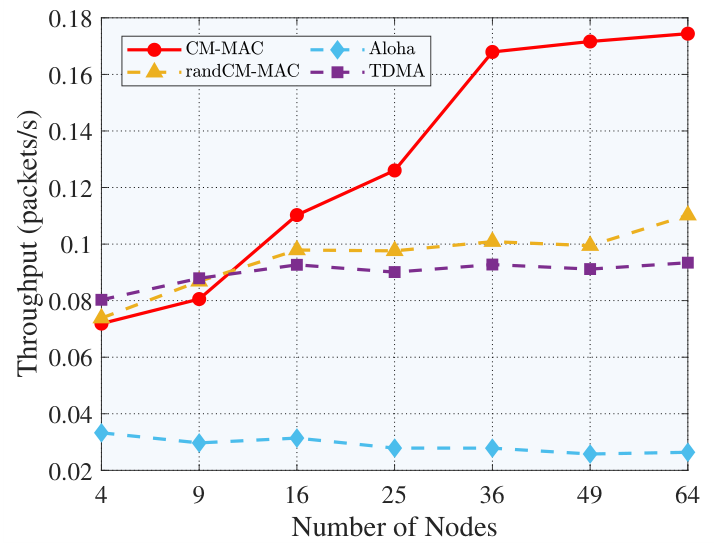
Figure 8 and Figure 9 illustrate the performance of these protocols in terms of average update interval and network throughput, respectively. As shown in these figures, the ALOHA protocol significantly underperforms compared to the other three TDMA-based MAC protocols. This clearly demonstrates that in UACNs designed for AUV swarm information sharing, scheduling-based protocols offer considerable advantages over random-access protocols.
Among CM-MAC, randCM-MAC, and traditional TDMA protocols, CM-MAC delivers the best performance due to its GA-based optimization of transmission order. Notably, the performance advantage of CM-MAC becomes increasingly evident as the network scale expands. Additionally, although randCM-MAC employs a random order, it still outperforms the traditional TDMA protocol. This is because randCM-MAC schedules transmission times that satisfy transmission constraints, enabling concurrent transmissions among different nodes in the network.
8. Conclusions
This paper presents the CM-MAC protocol, a hierarchical scheduling-based solution designed to support reliable neighborhood multicasting in clustered AUV swarms. By establishing a two-tier cluster-based architecture, the protocol effectively decomposes the global coordination problem into localized scheduling sub-tasks. This approach reduces control signaling redundancy and adapts to dynamic network topologies. Theoretical analysis has identified the transmission constraints necessary to avoid packet collisions among mobile nodes, accounting for the unique challenges posed by underwater propagation delays. Simulation experiments have validated the performance of the CM-MAC protocol, demonstrating a significant reduction in packet collision ratios compared to contention-based Aloha protocols. Furthermore, the GA-based scheduling optimization showed superior throughput and shorter average update intervals when compared to random scheduling variants.
Although the proposed deterministic scheduling protocol ensures reliability through strict collision-free constraints, it imposes stringent requirements on the information availability at each node. Consequently, the current protocol does not explicitly mitigate interference from inter-cluster nodes where such information is absent. To address this limitation, future research will focus on integrating deterministic scheduling with data-driven optimization paradigms, such as Reinforcement Learning (RL). By leveraging the adaptive capabilities of RL, we aim to further suppress inter-cluster interference and enhance network robustness without relying on rigorous prior information.
Author Contributions
Conceptualization, Meiyan Liu; methodology, Meiyan Liu; software, Meiyan Liu; validation, Meiyan Liu; writing—original draft preparation, Meiyan Liu; writing—review and editing, Guangjie Han; funding acquisition, Guangjie Han. All authors have read and agreed to the published version of the manuscript.
Funding
This research was funded by the Fundamental Research Funds for the Central Universities, No. B250201201, the China Postdoctoral Science Foundation under Grant No. 2025M780264. The APC was funded by the China Postdoctoral Science Foundation under Grant No. 2025M780264.
Data Availability Statement
No data links were provided because the data are available from the corresponding author upon reasonable request.
Acknowledgments
During the preparation of this manuscript, the authors used Grammarly for the purposes of checking English grammar, spelling, and writing style. The authors have reviewed and edited the output and take full responsibility for the content of this publication.
Conflicts of Interest
The authors declare no conflicts of interest.
References
- Ni, R.; Wang, J.; Qin, D.; He, Z.; Li, Q.; Zhang, C. Review of autonomous underwater vehicle path planning. Symmetry 2026, 18, 476. [Google Scholar] [CrossRef]
- Tan, J.; Sun, Y.; Cai, K.; Zhang, Y.; Zhang, L. Energy-efficient AUV path planning under multiple constraints using a synergistic differential evolution algorithm. J. Mar. Sci. Appl. 2025, 21, 153–169. [Google Scholar] [CrossRef]
- Zhang, J.; Sha, J.; Han, G.; Liu, J.; Qian, Y. A cooperative-control-based underwater target escorting mechanism with multiple autonomous underwater vehicles for underwater Internet of Things. IEEE Internet Things J. 2021, 8, 4403–4416. [Google Scholar] [CrossRef]
- Yoon, S.; Qiao, C. Cooperative search and survey using autonomous underwater vehicles (AUVs). IEEE Trans. Parallel Distrib. Syst. 2011, 22, 364–379. [Google Scholar] [CrossRef]
- Petillo, S.; Schmidt, H.; Balasuriya, A. Constructing a distributed AUV network for underwater plume-tracking operations. Int. J. Distrib. Sens. Netw. 2012, 8, 191235–191247. [Google Scholar] [CrossRef]
- He, L.; Xie, M.; Zhang, Y. A review of path following, trajectory tracking, and formation control for autonomous underwater vehicles. Drones 2025, 9, 286. [Google Scholar] [CrossRef]
- Yan, T.; Xu, Z.; Yang, S.; Gadsden, A. Formation control of multiple autonomous underwater vehicles: a review. Intell. Robot. 2023, 3. [Google Scholar] [CrossRef]
- Er, M.J.; Gong, H.; Liu, Y.; Liu, T. Intelligent trajectory tracking and formation control of underactuated autonomous underwater vehicles: a critical review. IEEE Trans. Syst. Man. Cybern. Syst. 2024, 54, 543–555. [Google Scholar] [CrossRef]
- Hadi, B.; Khosravi, A.; Sarhadi, P. A review of the path planning and formation control for multiple autonomous underwater vehicles. J. Intell. Robot. Syst. 2021, 101, 67. [Google Scholar] [CrossRef]
- Yang, Y.; Xiao, Y.; Li, T. A survey of autonomous underwater vehicle formation: performance, formation control, and communication capability. IEEE Commun. Surv. Tut. 2021, 23, 815–841. [Google Scholar] [CrossRef]
- Yan, T.; Xu, Z.; Yang, S. Consensus formation tracking for multiple AUV systems using distributed bioinspired sliding mode control. IEEE Trans. Intell. Veh. 2023, 8, 1081–1092. [Google Scholar] [CrossRef]
- Chen, S.; Ho, D. Consensus control for multiple AUVs under imperfect information caused by communication faults. Inf. Sci. 2016, 370, 565–577. [Google Scholar] [CrossRef]
- Zhong, X.; Ji, F.; Chen, F.; Guan, Q.; Yu, H. A new acoustic channel interference model for 3-D underwater acoustic sensor networks and throughput analysis. IEEE Internet Things J. 2020, 7, 9930–9942. [Google Scholar] [CrossRef]
- Zhuo, X.; Liu, M.; Wei, Y.; Yu, G.; Qu, F.; Sun, R. AUV-aided energy-efficient data collection in underwater acoustic sensor networks. IEEE Internet Things J. 2020, 7, 10010–10022. [Google Scholar] [CrossRef]
- Stojanovic, M.; Preisig, J. Underwater acoustic communication channels: Propagation models and statistical characterization. IEEE Commun. Mag. 2009, 47, 84–89. [Google Scholar] [CrossRef]
- Chen, K.; Ma, M.; Cheng, E.; Yuan, F.; Su, W. A survey on MAC protocols for underwater wireless sensor networks. IEEE Commun. Surv. Tutor. 2014, 16, 1433–1447. [Google Scholar] [CrossRef]
- Han, Y.; Fei, Y. TARS: a traffic-adaptive receiver-synchronized MAC protocol for underwater sensor networks. ACM Trans. Sens. Netw. 2017, 13, 1–25. [Google Scholar] [CrossRef]
- Marinakis, D.; Wu, K.; Ye, N.; Whitesides, S. Network optimization for lightweight stochastic scheduling in underwater sensor networks. IEEE Trans. Wirel. Commun. 2012, 11, 2786–2795. [Google Scholar] [CrossRef]
- Li, C.; Xu, Y.; Xu, C.; An, Z.; Diao, B.; Li, X. DTMAC: a delay tolerant MAC protocol for underwater wireless sensor networks. IEEE Sens. J. 2016, 16, 4137–4146. [Google Scholar] [CrossRef]
- Han, Y.; Fei, Y. DAP-MAC: a delay-aware probability-based MAC protocol for underwater acoustic sensor networks. Ad. Hoc Netw. 2016, 48, 80–92. [Google Scholar] [CrossRef]
- Mandal, P.; De, S.; Chakraborty, S. S. A receiver synchronized slotted Aloha for underwater wireless networks with imprecise propagation delay information. Ad. Hoc Netw. 2013, 11, 1443–1455. [Google Scholar] [CrossRef]
- Wei, X.; Guo, H.; Wang, X.; Wang, X.; Qiu, M. Reliable data collection techniques in underwater wireless sensor networks: a survey. IEEE Commun. Surv. Tutor. 2022, 24, 404–431. [Google Scholar] [CrossRef]
- Noh, Y.; Lee, U.; Han, S.; Wang, P.; Torres, D.; Kim, J.; Gerla, M. DOTS: a propagation delay-aware opportunistic MAC protocol for mobile underwater networks. IEEE Trans. Mob. Comput. 2014, 13, 766–782. [Google Scholar] [CrossRef]
- Zhuo, X.; Qu, F.; Yang, H.; Wei, Y.; Wu, Y.; Li, J. Delay and queue aware adaptive scheduling-based MAC protocol for underwater acoustic sensor networks. IEEE Access 2019, 7, 56263–56275. [Google Scholar] [CrossRef]
- Ng, H. H.; Soh, W. S.; Motani, M. Saturation throughput analysis of the slotted BiCMAC protocol for underwater acoustic networks. IEEE Trans. Wirel. Commun. 2015, 14, 3948–3960. [Google Scholar] [CrossRef]
- Zhuo, X.; Yang, H.; Liu, M.; Wei, Y.; Yu, G.; Qu, F. Data concurrent transmission MAC protocol for application oriented underwater acoustic sensor networks. China Commun. 2022, 19, 220–237. [Google Scholar] [CrossRef]
- Diamant, R.; Shirazi, G.N.; Lampe, L. Robust spatial reuse scheduling in underwater acoustic communication networks. IEEE J. Ocean. Eng. 2014, 39, 32–46. [Google Scholar] [CrossRef]
- Diamant, R.; Casari, P.; Campagnaro, F.; Zorzi, M. Leveraging the near–far effect for improved spatial-reuse scheduling in underwater acoustic networks. IEEE Trans. Wirel. Commun. 2017, 16, 1480–1493. [Google Scholar] [CrossRef]
- ZZhang, R.; Cheng, X.; Cheng, X.; Yang, L. Interference-free graph based TDMA protocol for underwater acoustic sensor networks. IEEE Trans. Veh. Technol. 2018, 67, 4008–4019. [Google Scholar] [CrossRef]
- Bai, W.; Wang, H.; Shen, X.; Zhao, R. Link scheduling method for underwater acoustic sensor networks based on correlation matrix. IEEE Sens. J. 2016, 16, 4015–4022. [Google Scholar] [CrossRef]
- Hsu, C.-C.; Kuo, M.-S.; Chou, C.-F.; Lin, K.C.-J. The elimination of spatial-temporal uncertainty in underwater sensor networks. IEEE/ACM Trans. Netw. 2013, 21, 1229–1242. [Google Scholar] [CrossRef]
- Anjangi, P.; Chitre, M. Propagation-delay-aware unslotted schedules with variable packet duration for underwater acoustic networks. IEEE J. Ocean. Eng. 2017, 42, 977–993. [Google Scholar] [CrossRef]
- Ragavi, B.; Baranidharan, V.; Ramash Kumar, K. A novel hybridized cluster-based geographical opportunistic routing protocol for effective data routing in underwater wireless sensor networks. J. Electr. Comput. Eng. 2023, 2023, 5567483. [Google Scholar] [CrossRef]
- Zhang, W.; Wang, J.; Han, G.; Zhang, X.; Feng, Y. A cluster sleep-wake scheduling algorithm based on 3D topology control in underwater sensor networks. Sensors 2019, 19, 156. [Google Scholar] [CrossRef]
- Islam, T.; Lee, Y. A cluster based localization scheme with partition handling for mobile underwater acoustic sensor networks. Sensors 2019, 19, 1039. [Google Scholar] [CrossRef] [PubMed]
- Zhang, W.; Han, G.; Liu, Y. A coverage vulnerability repair algorithm based on clustering in underwater wireless sensor networks. Mob. Netw. Appl. 2021, 26, 1107–1121. [Google Scholar] [CrossRef]
- Lin, C.; Han, G.; Wang, T.; Bi, Y.; Du, J.; Zhang, B. Fast node clustering based on an improved birch algorithm for data collection towards software-defined underwater acoustic sensor networks. IEEE Sens. J. 2021, 21, 25480–25488. [Google Scholar] [CrossRef]
- Alkanhel, R.; Chaaf, A.; Samee, N.A.; Alohali, M.A.; Muthanna, M.S.A.; Poluektov, D.; Muthanna, A. DEDG: Cluster-based delay and energy-aware data gathering in 3D-UWSN with optimal movement of multi-AUV. Drones 2022, 6, 283. [Google Scholar] [CrossRef]
- Guo, J.; Song, S.; Liu, J.; Chen, H.; Cui, J.-H.; Han, G. A hybrid NOMA-based MAC protocol for underwater acoustic networks. IEEE/ACM Trans. Netw. 2024, 32, 1187–1200. [Google Scholar] [CrossRef]
- Li, J.; Zakharov, Y. V. Efficient use of space-time clustering for underwater acoustic communications. IEEE J. Ocean. Eng. 2018, 43, 173–183. [Google Scholar] [CrossRef]
- Guo, J.; Song, S.; Liu, J.; Wan, L.; Yu, Y.; Han, G. An MC-CDMA-based MAC protocol for efficient concurrent communication in mobile underwater acoustic networks. IEEE Trans. Mob. Comput. 2024, 23, 12428–12443. [Google Scholar] [CrossRef]
- Zhang, J.; Cai, M.; Han, G.; Qian, Y.; Shu, L. Cellular clustering-based interference-aware data transmission protocol for underwater acoustic sensor networks. IEEE Trans. Veh. Technol. 2020, 69, 3217–3230. [Google Scholar] [CrossRef]
- Chen, Y.; Jin, Z.; Zeng, Q.; Yang, Q. A collision-avoided MAC protocol with time synchronization and power control for underwater sensor networks. IEEE Sens. J. 2022, 22, 19073–19087. [Google Scholar] [CrossRef]
- Chen, Y.; Jin, Z.; Xing, G.; Zeng, Q.; Chen, Y.; Zhou, Z.; Yang, Q. An energy-efficient MAC protocol for three-dimensional underwater acoustic sensor networks with time synchronization and power control. IEEE Access 2023, 11, 20842–20860. [Google Scholar] [CrossRef]
- Li, X.; Zhao, H.; Han, S.; Wang, B.; Liu, Z. Robust joint resource allocation algorithm for hierarchical underwater acoustic communication networks based on outage probability minimization. Trans. Emerg. Tel. Tech. 2021, 32, e4292. [Google Scholar] [CrossRef]
- Liu, M.; Zhuo, X.; Yuan, Y.; Lu, Y.; Wei, Y.; Tu, X.; Qu, F. Adaptive scheduling MAC protocol in underwater acoustic broadcast communications for AUV formation. IEEE Internet Things J. 2023, 10, 6887–6901. [Google Scholar] [CrossRef]
- Sonar, Neptune. Spherical Projectors. Available online: https://www.neptune-sonar.co.uk/downloads/5c197ce2-7ea9-4dd5-b506-cbed9d540249/D-17.pdf (accessed on Feb. 10 2025).
- LinkQuest. LinkQuest Underwater Acoustic Modems UWM10000 Specifications. Available online: http://www.link-quest.com/html/uwm10000.htm (accessed on Feb. 10 2025).
- Wenz, G.M. Acoustic ambient noise in the ocean: Spectra and sources. J. Acoust. Soc. Am. 1962, 34, 1936–1956. [Google Scholar] [CrossRef]
- Tu, X.; Wei, Y.; Qu, F.; Song, A. Low computational complexity RLS-based decision-feedback equalization in underwater acoustic communications. IEEE J. Ocean. Eng. 2024, 49, 1067–1088. [Google Scholar] [CrossRef]
Figure 1.
Hierarchical clustered network structure.
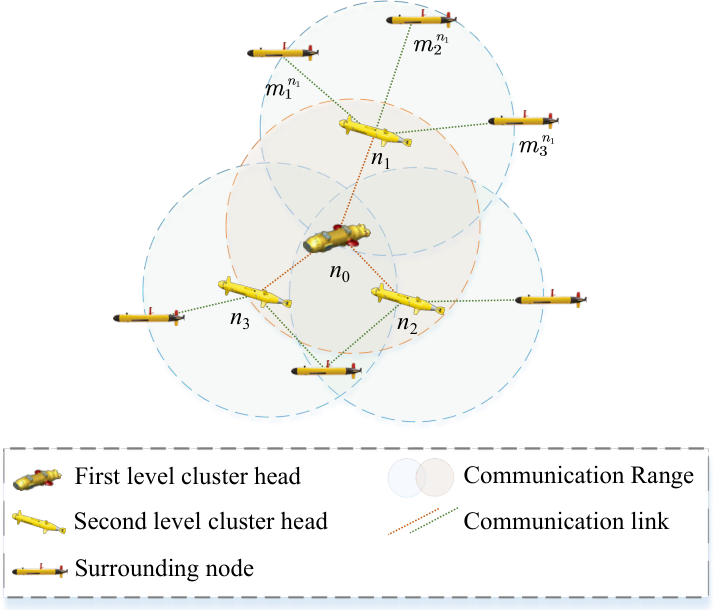
Figure 2.
Transmission constraints between second-level cluster heads.
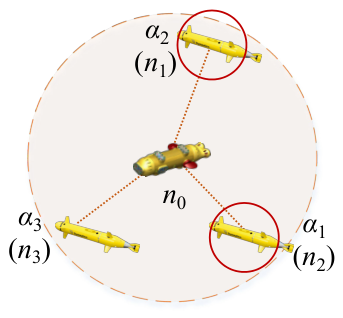
Figure 3.
Transmission constraints between surrounding nodes and second-level cluster heads.
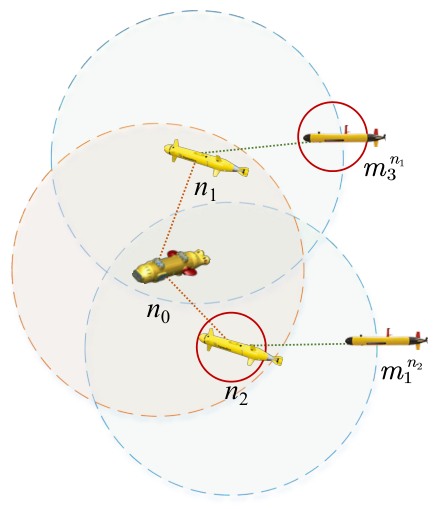
Figure 4.
Transmission constraints between intra-cluster surrounding nodes.
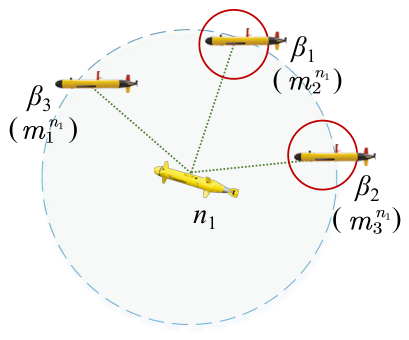
Figure 5.
Transmission constraints between inter-cluster surrounding nodes.
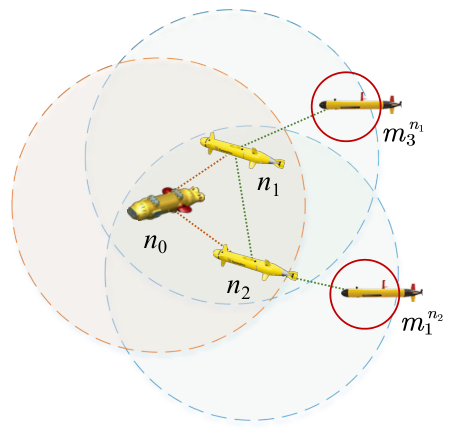
Figure 6.
Average packet collision ratio with different numbers of nodes.
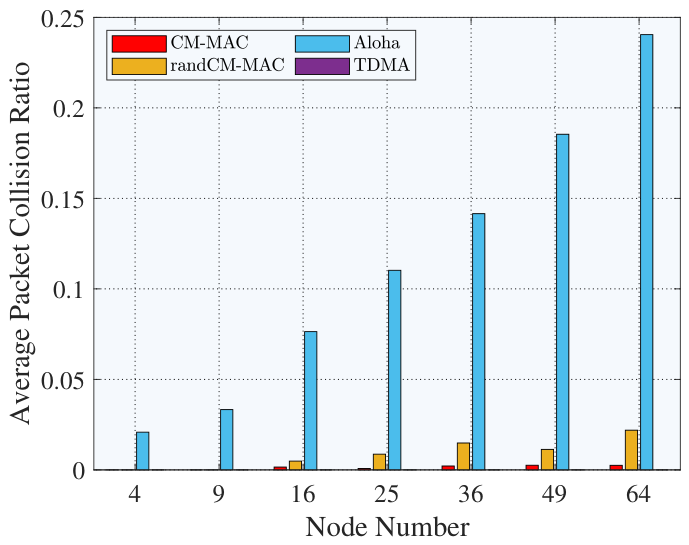
Figure 7.
Packet collision ratio with different numbers of nodes.
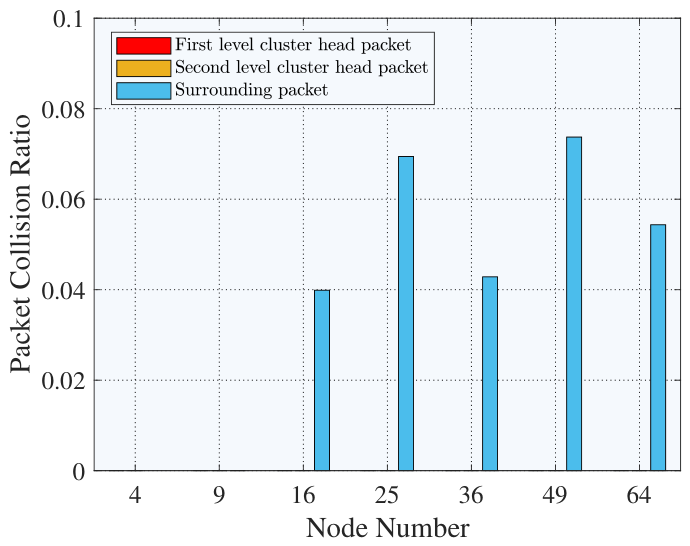
Figure 8.
Average update interval with different numbers of nodes.
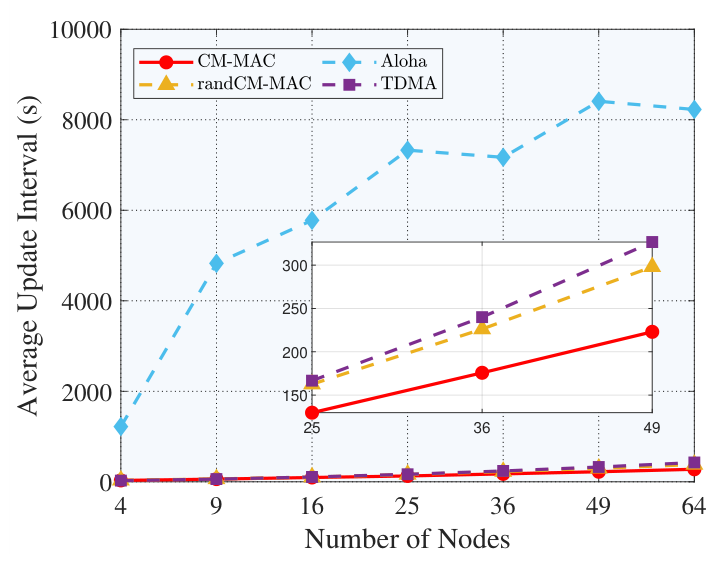
Figure 9.
Throughput with different numbers of nodes.
Disclaimer/Publisher’s Note: The statements, opinions and data contained in all publications are solely those of the individual author(s) and contributor(s) and not of MDPI and/or the editor(s). MDPI and/or the editor(s) disclaim responsibility for any injury to people or property resulting from any ideas, methods, instructions or products referred to in the content. |
© 2026 by the authors. Licensee MDPI, Basel, Switzerland. This article is an open access article distributed under the terms and conditions of the Creative Commons Attribution (CC BY) license (http://creativecommons.org/licenses/by/4.0/).
Copyright: This open access article is published under a Creative Commons CC BY 4.0 license, which permit the free download, distribution, and reuse, provided that the author and preprint are cited in any reuse.


