

Submitted:
09 June 2026
Posted:
10 June 2026
You are already at the latest version
Abstract
Plant genomics faces a paradox: genomic, phenotypic and literature resources continue to expand, yet discovery remains limited by the workflow needed to integrate dispersed literature, heterogeneous analytical tools and iterative reasoning into a defensible candidate hypothesis. We argue that this gap reflects a systems-level constraint: in current human-centred practice, literature depth, analytical breadth and time efficiency are difficult to improve simultaneously, producing an empirical trade-off frontier that bounds many existing workflows. Here we frame the frontier as a conceptual and measurable evaluation agenda for assessing computational systems in plant genomics discovery. On this basis, we propose a four-level based plant-genomics capability hierarchy for autonomous agents, defined by functional and falsifiable criteria rather than by model architecture: L1 knowledge integration, L2 tool orchestration, L3 closed-loop computational discovery, and L4 self-evolving systems. Existing plant-focused systems provide evidence mainly for L1 capabilities and early L2 orchestration, whereas L3 remains an open empirical target and L4 is speculative. To make these distinctions testable, we outline PlantAgentBench, a plant-focused benchmark spanning literature-based gene prioritisation, reproducible multi-tool workflow execution, and iterative candidate-gene refinement. Relevant metrics include recall, provenance completeness, autonomous cycles and human-intervention count. We conclude that autonomous agents are most valuable not as replacements for plant scientists, but as auditable infrastructure for extending expert-guided discovery.
Keywords:
plant genomics
; autonomous agents
; workflow trade-off frontier
; plant agent benchmark
; bioinformatics
Introduction
Plant genomics has moved from a phase defined by data scarcity to one defined by data abundance (Politsch et al., 2026). Studies of drought tolerance, grain quality, disease resistance, or flowering time can now begin with population-scale genotypes, pan-genome resources, multi-omic atlases, field phenotypes, and accumulated functional evidence across related crops. Yet this abundance has not yielded proportional gains in biological understanding. In rice genomics, a substantial proportion of genes remain functionally uncharacterized even after two decades of research (Yang et al., 2025b), and even routine workflows such as genome-wide association studies (GWAS) still demand the coordination of more than a dozen tools across multiple programming environments (Xu et al., 2025a). The harder question is no longer simply whether a genomic interval is associated with a trait, but whether a candidate gene remains plausible once comparative, regulatory, phenotypic, environmental, and literature-based evidence have been reconciled.
This difficulty is visible in ordinary candidate-gene work. A rapid association scan can generate a shortlist of candidates, but it may miss known homologues, negative functional evidence, or context-dependent findings from related species. Manual review can recover some of this information, but often at the cost of slower iteration and weaker reproducibility. Broader workflows that combine association mapping with expression, network and orthology evidence may be biologically richer, yet they also increase the burden of software setup, parameter choice, data conversion, and provenance tracking. Pan-genome resources further compound this: structural and presence–absence variation, and non-reference sequences expand the candidate space, while multiplying the genome versions and mapping assumptions that each analytical step must account for (Shi et al., 2023). These frictions are therefore interdependent constraints on the pace, scope, and reliability of discovery.
We describe these coupled constraints as an empirical trade-off frontier in current plant-genomics workflows. The frontier is a proposed conceptual framing rather than a formal law or fitted empirical surface: in human-centred practice, literature depth, analytical breadth, and time efficiency are difficult to improve simultaneously (Berger and Yu, 2023). Deep synthesis of prior knowledge improves biological grounding but costs time; broader workflows increase the chance of convergent evidence but also multiply integration overhead; and rapid screening is useful for triage but often narrows the evidential base. A stronger statistical model may improve one step of a pipeline, and a richer database may improve one evidence source, but neither automatically reduces the labour required to connect evidence, execute analyses, revise assumptions, and preserve a defensible record of how a hypothesis evolved. What is needed are approaches that shift the boundary of the feasible region outward, rather than merely reposition effort along it.
Autonomous agents offer one possible way to act on this boundary. Here, we use the term in a narrow scientific-workflow sense: a computational system that can combine planning, external knowledge retrieval, tool use, state tracking and iterative refinement (Qi et al., 2026). For plant genomics, the central value is to convert parts of the integration burden currently carried by individual researchers into procedures that are explicit, executable, logged, and repeatable. Usefulness therefore depends on whether evidence is source-grounded, version-aware, and traceable to the analyses that changed a candidate ranking. We frame agentic potential in terms of capability: how far a system can integrate knowledge, coordinate analytical steps, and support iterative cycles of hypothesis generation and evaluation.
This framing builds on rapid progress in biomedical and bioinformatics agents, where models can query databases, call analysis tools, execute code, and coordinate multi-step workflows in fields including genomics, multi-omics, cellular analysis, and molecular design (Dip et al., 2026). These systems provide important precedents, but their evidence cannot be transferred directly to plant genomics. Crop research presents a distinctive evidence structure, shaped by uneven cross-species annotation, genotype-by-environment interactions, seasonal field validation, governance constraints around germplasm data, and breeding decisions that depend on chains of partial evidence rather than single ground-truth labels (Williamson et al., 2021). Plant-science agents therefore need to be judged against the structure of plant discovery.
This review therefore focuses on computational discovery workflows in plant genomics, especially literature integration, candidate-gene prioritisation, multi-omics analysis, and iterative computational refinement. We make three related claims: the principal bottleneck is a workflow bottleneck, not only a shortage of data or algorithms; agent systems should be judged by the scientific bottleneck they demonstrably relieve, not by generic tool use; and plant-specific benchmarks are needed to separate genuine improvement from persuasive but unreliable reasoning. On this basis, we formalise the trade-off, introduce a capability hierarchy from L1 knowledge integration to L4 self-evolving systems, and propose PlantAgentBench as a route toward quantitative evaluation.
1. The Trade-Off Frontier in Plant Genomics
Discovery in plant genomics is rarely reducible to a single model invocation or database query, but a sequence of interpretive decisions about prior evidence, genome annotations, statistical assumptions, cross-species comparability, and validation priorities (Dominguez Del Angel et al., 2018). The trade-off frontier arises because these decisions are cumulative and path dependent: each requires time and expertise, and errors or omissions at one stage can propagate through the workflow and reshape the biological conclusion (Salzberg, 2019).
1.1. Three Operational Dimensions of the Frontier
We describe this constraint space along three operational axes: literature depth, analytical breadth, and time efficiency (Figure 1). These axes are not intended to exhaust all sources of variation, but to capture recurring questions in real projects: how much relevant knowledge was incorporated, how broadly the analytical landscape was explored, and whether the workflow produced a result quickly enough to guide the next experiment. In practice, each axis is evaluated through operational proxies rather than treated as a single scalar metric.
Literature depth refers to the extent to which prior knowledge is incorporated into analysis. In candidate-gene studies, this includes recovery of known homologues and prior functional evidence, together with trait associations, expression evidence, and contradictory findings (Kaňovská et al., 2024). Operational proxies include recall of known gene–trait associations within a fixed time budget and traceability of claims to cited evidence. Downstream analyses often draw on only a selective subset of available knowledge because gene names change, crop-specific databases remain incomplete, and relevant evidence is scattered across species (Olson et al., 2026).
Analytical breadth captures how much of the computational landscape a workflow explores. A GWAS workflow, for example, may span data preprocessing, association testing and peak definition, candidate annotation, and downstream evidence integration (Xu et al., 2025a). Broader workflows may additionally consult pan-genome summaries, structural variants, or gene presence–absence matrices. Each added component can improve biological context, but it also introduces dependencies, file-format conversions, and new failure modes.
Time efficiency is the person-time required to move from a biological question to an actionable computational result. Runtime is only one component: Researchers also spend substantial time on data preparation, tool configuration, error diagnosis, parameter tuning, and interpretation of intermediate outputs (Wratten et al., 2021), which for many interpretive workflows dominate the budget (Michael, 2026).
These axes are deliberately operational rather than purely numerical. Literature depth is not simply the number of papers cited, analytical breadth is not the number of tools invoked, and time efficiency is not compute time alone. The value of the frontier trade-off is that it asks whether a workflow improves these dimensions jointly, not at a single convenient point.
1.2. Why the Constraint Persists
Cross-species inference makes the coupling among these dimensions concrete. Functional evidence from rice may or may not be relevant to maize, wheat, potato, or soybean. Its relevance depends on orthology confidence, regulatory conservation, and trait context (Gabaldón and Koonin, 2013). Assessing these conditions may require additional literature review, database reconciliation, and computational analysis. Manual workflows can address these steps carefully, but rarely at scale or with complete reproducibility.
The constraint persists because the burden of integration is structurally distributed. Plant knowledge is fragmented across genome versions, databases, laboratory traditions, and publication types (Heuermann et al., 2025). Computational workflows span programming languages, operating systems, file formats, and parameter conventions (Reiter et al., 2021). Experimental decisions are in turn distributed across molecular biologists, bioinformaticians, and field teams (Robinson et al., 2024). This overhead is often invisible in publications, but it determines which analyses are attempted, repeated, or abandoned.
This distribution makes results path-dependent: small analytical choices can lead to different biological conclusions (Stark et al., 2019). Plant-genomics evidence is also rarely decisive: a candidate gene is usually supported by several incomplete signals rather than one definitive assay, and teams can reasonably weigh those signals differently, especially for environmentally sensitive traits or regulatory variants. Reproducing such a result means recording how the evidence was assembled, not merely rerunning the final command.
1.3. What Would Count as a Shift
Conversational language models can help researchers understand methods, summarise papers, and draft analysis plans, although reliable end-to-end execution of complex bioinformatics workflows remains challenging (Nikita et al., 2025). Specialised methods, including GWAS models, genomic prediction frameworks, and network analyses, improve performance along individual dimensions of the workflow. Yet researchers still need to coordinate these methods, reconcile their outputs, and carefully document each decision: the challenge lies not in a lack of software, but in the significant cost of coordinating it effectively within reviewable workflows.
Shifting the frontier would require capabilities that act on the three axes together: retrieval and tracing of fragmented evidence across species and data types; coordination of diverse tools and data modalities within a reproducible process; and repeated computational cycles quickly enough to support hypothesis refinement rather than one-pass analysis. The relevant unit of evaluation is therefore an end-to-end workflow, not a single prompt, database query, or tool call (Dionizije et al., 2026).
Agents do not remove trade-offs, but they may change their scale by externalising routine cognitive load and making repeated analysis easier to audit (Lu et al., 2026). The key question is whether agentic systems can expand the feasible region of plant-genomics discovery while humans remain responsible for interpretation, experimental design, and high-cost biological decisions. Answering it requires a capability framework organised around the scientific work a system performs, rather than the architecture it uses.
2. A Capability Hierarchy for Autonomous Agents in Plant Genomics
A useful hierarchy should classify what a system does for plant-science discovery, not which model architecture it uses. The relevant questions are functional: whether the system recovers overlooked evidence, makes a multi-tool workflow reproducible, or revises a candidate ranking after new computational evidence appears. The L1–L4 hierarchy below is organised around these scientific tasks, complementing general research-agent taxonomies that classify systems by autonomy, responsibility allocation and workflow closure (Tie et al., 2026), while asking which plant-genomics bottleneck each level can demonstrably relieve.
2.1. Levels Defined by Scientific Work
A system belongs at a given level because of what it demonstrably accomplishes in a plant-science task. L1–L3 describe capabilities that can in principle be tested now, whereas L4 is retained as a long-term upper bound. Table 1 defines L1–L4 by minimum qualifying criteria and boundary conditions, summarises current evidence status, and specifies the human role at each level.
Unaugmented conversational language models provide a practical baseline but not capability level, because they do not reliably retrieve traceable evidence, execute workflows, or preserve state across iterative analysis (Chelli et al., 2024; Zhou et al., 2025). The hierarchy (Figure 2) begins at L1, where external knowledge sources are retrieved and cited; moves to L2, where external tools are executed and logged; and reaches L3 only when hypothesis, computation, and refinement form a closed loop. L4 is reserved for self-evolving systems that improve across repeated projects, for which plant-specific evidence remains absent.
The hierarchy also separates capability from evidence status. An architecturally sophisticated system provides weak plant genomics evidence if untested on plant tasks, whereas a narrower retrieval system can support a strong L1 claim if it performs well on crop-specific questions with traceable citations. This distinction matters where many precedents come from biomedicine, chemistry, protein design, or single-cell analysis (Asai et al., 2026; Dip et al., 2026; Qi et al., 2026). Each level is therefore defined by falsifiable criteria. L3, for example, requires at least three autonomous hypothesis–test–refinement cycles on a defined task, which separates iterative discovery from single-step automation.
2.2. L1: Knowledge Integration
L1 systems connect distributed biological knowledge into traceable evidence (Asai et al., 2026; Yu et al., 2026). In plant science, this matters because relevant knowledge is distributed across crop-specific databases, genome versions, gene identifiers, and experimental contexts. A single biological signal may surface as a cloned gene in one crop, a QTL candidate in another, a stress-responsive transcript in an expression dataset, or a weakly annotated orthologue in a related species. Current plant-focused systems illustrate different L1 strategies, which primarily differ along two dimensions: knowledge representation and update mode (Table S1).
Regarding knowledge representation, systems can be divided into graph-centred and corpus-centred approaches. Graph-centred systems, represented by SeedLLM.Rice and PlantScience.ai, store gene–trait–pathway relationships as explicit nodes and edges, making them suited to tests of relational recovery and citation-grounded evidence assembly (Yang et al., 2025b; Yu et al., 2026). They should therefore be judged by relational accuracy as well as explanation fluency. Conversely, corpus-centred systems retrieve and synthesise text directly from the literature, preserving the context of original claims but often leaving relationships implicit. PlantGPT illustrates this pattern in Arabidopsis functional genomics through retrieval-augmented generation (Zhang et al., 2025b), while OpenScholar provides a cross-domain comparator for retrieval-augmented literature integration and citation evaluation (Asai et al., 2026). Such systems are therefore better assessed by citation precision, coverage and the ability to surface conflicting evidence. Regarding update mode, a curated resource like Potato Knowledge Hub (Li et al., 2026) provides stable and auditable functional-genomics knowledge, whereas a continuously updated system like PlantScience.ai maintains timeliness but requires stronger checks for duplicate identifiers, outdated annotations, and unverified claims (Yu et al., 2026).
The most informative L1 evaluations are therefore gene- and trait-centred rather than based on question-answering demonstrations alone. A system asked to prioritise drought-tolerance candidates should separate direct crop evidence from model-species analogy, distinguish association evidence from functional validation, avoid treating expression correlation as causal proof, and flag uncertainty around gene identifiers or genome versions. These checks are essential, because an apparently precise gene name can mask orthology ambiguity, annotation drift, or a family-level signal that should not be attributed to a single locus (Shi et al., 2023). By surfacing missed orthologues, contradictory phenotypes, or annotation problems, L1 systems can improve evidence gathering before downstream analysis, but do not by themselves constitute autonomous discovery.
2.3. L2: Tool Orchestration
L2 systems move from evidence retrieval to execution by turning tools, code, and intermediate files into repeatable workflows with limited human intervention. This capability addresses the gap between a biological question and a reproducible computational pipeline (Nikita et al., 2025). A typical workflow may involve command-line tools, R packages, Python scripts, genome-specific files, and manual quality checks (Wratten et al., 2021); L2 agents aim to make this scattered activity traceable.
Plant-domain L2 evidence is still early and heterogeneous (Table S1). PhenoAssistant illustrates phenotype-oriented tool orchestration by connecting a language-model interface to curated tools for phenotype extraction, visualisation, and model training (Chen et al., 2026). ABC (Agricultural Breeding Claw) and BOLE extend this pattern toward natural-language orchestration of breeding workflows, though both remain prototypes with limited systematic evaluation (volcanooooooooo, 2026; Wang et al., 2026). GEAIR provides a stronger plant-domain example of coupling genome editing with robot-assisted pollination, but its validation target is breeding automation rather than general genomics workflow orchestration (Xie et al., 2025). Cross-domain systems are useful mainly as mechanism precedents: GeneGPT and BioAgents illustrate database and tool access; AutoBA, DrBioRight 2.0 and SciToolAgent illustrate workflow automation and tool selection; ProteinMCP and BioinfoMCP illustrate protocol-based tool interfaces; STAgent and SpatialAgent add spatial-biology examples of the same orchestration pattern (Lin et al., 2025; Wang et al., 2025a); and transcriptomic or multi-omics systems such as SeqMate and PromptBio show reusable execution templates in adjacent bioinformatics settings (Devam and Atharva, 2024; Ding et al., 2025; Jin et al., 2024; Lei et al., 2024; Liu et al., 2025; Nikita et al., 2025; PromptBio, 2025; Widjaja et al., 2025; Xu et al., 2026; Zhou et al., 2024).
Established workflow management systems (WMS, such as Snakemake, Nextflow/nf-core, Galaxy) provide an important baseline for L2, but they do not decide which tools are appropriate, how to interpret an ambiguous input, or when a biological assumption has been violated (Alam and Roy, 2025; Community, 2024; Ewels et al., 2020; Mölder et al., 2021). An L2 agent operates above this layer: translating a biological question into a workflow and adapting it when inputs are imperfect. In a post-GWAS analysis, for example, a WMS can run a preset workflow for peak delineation, gene extraction, identifier harmonisation, and expression summarisation; an L2 agent should additionally recognise a mismatched genome build, record why a default interval was chosen, and trigger expert review when the inconsistency affects interpretation (Kaňovská et al., 2024). The two are therefore complementary: a well-designed L2 agent should build on WMSs, inheriting reproducible execution while adding accessibility, monitoring, and adaptive control.
2.4. L3: Closed-Loop Computational Discovery
L3 systems perform iterative cycles of hypothesis generation, computational testing, and refinement, in which an agent begins to resemble a computational research collaborator rather than a searchable assistant or workflow runner. We define a minimal criterion as at least three consecutive hypothesis–test–refinement cycles executed without human intervention on a defined plant-science task. Each cycle must articulate a hypothesis, retrieve evidence or run a test, and update a ranking or interpretation; the next cycle must use the previous output as input rather than restart from the original prompt. The threshold is intentionally conservative: it distinguishes closed-loop discovery from single-pass automation, while remaining measurable in a benchmark setting.
To our knowledge, no peer-reviewed plant system yet satisfies this criterion in a general and well-benchmarked way. Aleks is one of the closest plant-domain attempts, reporting autonomous, multi-cycle problem formulation and model refinement, although only within a single exploratory case study (Jin et al., 2025a). Cross-domain examples nevertheless demonstrate that iterative scientific agents are technically possible. The AI Scientist automates idea generation, experiment execution, and analysis in machine-learning research (Lu et al., 2026); Co-Scientist and Robin show multi-agent scientific discovery workflows in biomedical and experimental biology settings (Ghareeb et al., 2026; Gottweis et al., 2026). Chemical, genome-editing, single-cell and general research-agent systems extend the landscape (Table S1), but their feedback loops, validation labels and task structures differ from plant-genomics candidate refinement.
The distinction between L3 and L2 is not the number of steps, but whether outputs from one analytical cycle determine the next test. Even a complex GWAS-to-report workflow remains L2 if it follows a preset sequence and stops at summarisation; it becomes L3 only when the system revises its next test after evidence such as contradictory mutant data, paralogy, or tissue-specific expression undermines the original hypothesis. The output should be a more defensible set of hypotheses for expert review, not experimental confirmation. Establishing causal function still requires wet-lab or field validation, so L3 quality should therefore be judged by whether successive cycles make the reasoning trajectory more robust.
2.5. L4: Self-Evolving Systems
L4 systems would adapt their own capabilities over time, for example by generating new tools, improving workflow templates, or creating specialised sub-agents (Bu et al., 2026). In plant genomics, this might eventually mean a system that learns from repeated gene-discovery projects across crops and updates its evidence-gathering strategy. Recent BioMedAgent and STELLA illustrate biomedical precedents for adaptive agent behaviour, while SkillEvolver and EmbodiSkill offer more general mechanisms for skill evolution; however, none has yet been evaluated on plant-genomics tasks (Table S1) (Bu et al., 2026; Jin et al., 2025b; Ju et al., 2026; Zhang et al., 2026). L4 is therefore included as a conceptual upper bound rather than a near-term objective. Practical progress should be judged first at L1 and L2, and then through carefully benchmarked L3 demonstrations.
3. Technical Substrate for Auditable Agentic Workflows
3.1. From Plant-Science Pain Points to Agent Paradigms
Agentic systems are easiest to evaluate when they are tied to specific plant-science bottlenecks. Three recur in plant genomics, each calling for a different capability level (Table 1): scattered evidence (knowledge dispersed across literature, databases, genome versions and identifiers) calls for evidence reconciliation with traceable citations (L1); analyst-dependent workflows call for logged, reproducible tool orchestration (L2); and slow iterative refinement calls for closed-loop cycles in which each test updates the next (L3) (Berger and Yu, 2023; Heuermann et al., 2025; Olson et al., 2026). This mapping keeps the term “agent” from becoming a generic label: each bottleneck maps to a different level, a system should be evaluated at the level its evidence supports, and whatever the level, the workflow must remain auditable (Table 2).
3.2. From Tool Use to Auditable Execution
Agentic workflows become auditable only when execution is organised rather than improvised. In bioinformatics, this means separating three kinds of action: calling established tools, reusing tested workflows, and generating code only for local tasks that are not already covered by a workflow (Table 2) (Nikita et al., 2025). The purpose of this separation is to keep the path from biological instruction to computational output visible.
Tool calling allows an agent to invoke configured programs without requiring the user to manually switch environments. For a plant breeder or experimental biologist, the key point is that a multi-step analysis can be executed, logged, and repeated from a biological instruction. Interoperability efforts such as the Model Context Protocol (MCP), described as an emerging standard for connecting language models to external tools and resources, can reduce fragmentation in tool access (Hou et al., 2025). Reusable agent skills and workflow templates represent a related but less standardised implementation strategy.
Reusable workflows provide the stable substrate (Wratten et al., 2021). Agent skills can encapsulate standard analytical protocols, and established WMS can supply auditable execution contexts for multi-step bioinformatics (Yang et al., 2025c). In this framing, the agents can call, inspect, or adapt the workflow infrastructure (Alam and Roy, 2025), which reduces dependence on one analyst’s habits and make local expertise reusable.
Code generation should be the exception. It is useful for local transformations, such as identifier conversion, table reshaping, or customised visualisation, where no predefined workflow exists (Tang et al., 2024), but it is also the easiest way to embed unreviewed assumptions into a workflow (Zhang et al., 2024). Generated code should therefore remain sandboxed, logged, and reviewable; an agent that silently generates code or overwrites intermediate files cannot be considered auditable, even if its final report appears plausible.
3.3. Scope and Limits of Cross-Domain Evidence
Cross-domain studies show that many components of agentic systems are technically feasible (Dip et al., 2026; Qi et al., 2026). Yet autonomy is domain-conditioned, depending on reliability, provenance, validation speed and accountability (Tie et al., 2026). The question for plant genomics is which patterns from adjacent biological fields transfer to crop biology, and which depend on evidence structures that differ from those of plant science.
The transferable lessons are mainly infrastructural: standardised tool interfaces, provenance and audit logging, retrieval-augmented reasoning, and planner-executor-verifier decompositions. Recent systems and benchmarks suggest that retrieval-augmented reasoning, evidence grounding and process-level evaluation are important design features for biological agents (Asai et al., 2026; Dionizije et al., 2026; Mitchener et al., 2025). Biomedical and bioinformatics systems have connected language models to domain-specific databases, tool registries, code execution, workflow templates, and report generation (Dip et al., 2026; Huang et al., 2025; Jin et al., 2025b). Single-cell, spatial-biology and virtual-cell agents such as CellAgent, SpatialAgent and CellForge add a methodological precedent: multi-step biological analyses can be benchmarked against published analytical decisions rather than only demonstrated on curated examples (Tang et al., 2025; Wang et al., 2025a; Xiao et al., 2024).
Other patterns transfer poorly. Protein-design, drug-discovery, therapeutic-reasoning and clinical-agent studies, such as ProtAgents, DrugAgent, PharmAgents and MedAgents, show that agentic architectures can be adapted to specialised biomedical decision contexts (Table S1) (Gao et al., 2025a; Ghafarollahi and Buehler, 2024; Liu et al., 2024b; Tang et al., 2023). Their feedback loops, safety constraints and validation labels differ sharply from crop functional genomics. Single-cell biology has denser benchmark labels than crop functional genomics; protein engineering and some biomedical design tasks allow fast in silico or in vitro feedback, whereas plant validation often requires seasonal field cycles; and closed-loop wet-lab paradigms from synthetic chemistry do not transfer straightforwardly for crop breeding (Tom et al., 2024; Xu et al., 2025b; Zhang et al., 2025a). Cross-domain evidence therefore supports technical feasibility for L1 and L2, and plausibility for L3 computational pre-screening, but not closed-loop experimental discovery in plant systems. Plant-specific benchmarks are needed to determine which patterns actually improve discovery rather than merely reproduce a familiar agent architecture.
3.4. Reliability and Boundary Conditions
Reliability matters when agent outputs influence experimental design or breeding decisions. Useful safeguards include database-grounded self-verification, multi-agent or adversarial review to identify unstable conclusions, human-in-the-loop escalation for high-cost or irreversible decisions, and provenance-aware logging of workflow composition (Table 2) (Ghareeb et al., 2026; Wang et al., 2025b). GeneAgent offers a concrete pattern, in which gene-set claims are checked against domain databases before being reported (Wang et al., 2025b). Comparable safeguards are especially important in plant genomics when workflows cross genome builds, gene-model releases, or coordinate systems. Reliability should be evaluated at the workflow level, including reproducibility across runs, supervision required, and provenance completeness.
Some constraints remain even when agentic workflows become more capable. Non-model crops lack validation data; genomic signals rarely determine phenotype on their own; and genotype-by-environment interactions with field heterogeneity complicate causal interpretation (Xu et al., 2025b). Commercial breeding programmes also face privacy, access-control and data-governance requirements that make unrestricted data sharing or deployment difficult (Gogna et al., 2025). These limitations define where agents belong: evidence integration, reproducible computation, and prioritisation, not replacement of biological validation or expert judgement.
3.5. From Case Studies to Benchmarks
Individual case studies show that agentic workflows can be assembled, but they do not by themselves create field-level evidence (Mitchener et al., 2025). Evidence accumulates only when tasks, inputs, scoring rules, and baselines are comparable across systems. Recent benchmarks move evaluation beyond fact recall toward workflow execution, code generation, dataset exploration, marker-evidence attribution and robustness under perturbation (Table S1), where PlantMarkerBench is especially relevant as it scores evidence-grounded marker reasoning across plant species (Acharjee Dip et al., 2026). These benchmarks also expose current limits: an agent may still produce a plausible plan while failing at data handling, step-level reasoning, evidence grounding or reproducibility (Dionizije et al., 2026).
Plant science needs analogous benchmark tasks with public inputs, defined outputs, transparent scoring and independent baselines (Mitchener et al., 2025). We therefore propose PlantAgentBench (Box 1, Figure 3) as a plant-specific framework that samples the three workflow bottlenecks: evidence integration, reproducible multi-tool execution, and iterative computational refinement. The numerical scales and scenarios in Box 1 are design parameters rather than fixed requirements, and the task family sets should not be interpreted as covering the full diversity of plant-genomics discovery. Future versions can incorporate pan-genome-aware interpretation, structural variation, phenomics, and genomic-prediction diagnosis when suitable datasets, scoring rules, and expert standards are available. At minimum, PlantAgentBench should combine public and hidden tasks, independent baselines, standardized inputs, transparent scoring and expert adjudication that records disagreement.
Box 1. PlantAgentBench task families for evaluating autonomous plant-genomics agents. PlantAgentBench maps the L1–L3 hierarchy onto three recurring plant-genomics bottlenecks: literature-based gene prioritisation, statistical-genomics workflow execution and iterative computational hypothesis refinement. For each task family, the table defines representative inputs, expected outputs, reference baselines, stressors and task-specific metrics. The scenarios are design examples rather than fixed requirements; benchmark-design conventions are discussed in Section 3.5.
| Task Family (Target Level) | Inputs/Scenario | Outputs | Baseline | Stressors | Metrics |
| Literature-based gene prioritisation (L1) | Candidate-gene list, fixed literature/database snapshot, identifier metadata (e.g., rice drought tolerance) | Ranked genes with evidence summaries and citations | Expert consensus, known validated genes | Synonyms, orthology ambiguity, contradictory evidence, outdated annotations | Recall@5/10; MAP; citation precision; provenance completeness; unsupported-claim rate |
| Statistical-genomics workflow execution (L2) | Genotype matrix, phenotype table, genome annotation, expected formats (e.g., maize GWAS follow-up) | QC summary; Manhattan/QQ plots; significant SNPs; effect sizes; logs | Expert-curated reference workflow; WMS-only; published outputs | Missing metadata, genome-build mismatch, file-format variation, parameter ambiguity | Automated steps; reproducibility; effect-size correlation; SNP-list agreement; intervention count |
| Iterative computational hypothesis refinement (L3) | Initial association signals, multi-omics + causal evidence, stopping rules (crop-trait refinement) | Final ranked genes; evidence trail; iteration log with decision trace | Expert panel with disagreement recorded; validated functional evidence where available | Conflicting mutant data, paralogy, tissue-specific expression, partial evidence | Autonomous cycles; evidence-type coverage; NDCG@10; runtime per cycle; intervention count |
PlantAgentBench should evaluate process as well as output. Its core requirement is not merely a correct gene ranking, but an auditable reasoning path: a correct gene ranking without citations is incomplete; a Manhattan plot without recorded software versions and parameters is not reproducible; a final candidate list without an iteration log cannot distinguish iterative refinement from a longer one-pass report (Acharjee Dip et al., 2026; Huang et al., 2025; Qu et al., 2026b). These requirements match how plant scientists decide whether a computational result can guide experimental work.
Benchmark design must avoid two traps. Overly clean tasks reward systems that perform well on curated examples but fail on real crop data; overly open tasks are difficult to score and may reward verbose reasoning over accurate prioritisation. PlantAgentBench therefore combines controlled tasks with known or expert-curated outputs and messier tasks judged by expert panel.
Governance is also part of benchmark design. Public tasks are needed for reproducibility and method development, but hidden or periodically refreshed tasks are needed to limit benchmark overfitting. Gold standards should record expert disagreement rather than hide it, since candidate-gene prioritisation often involves partial evidence. Reporting should be stratified by crop, trait type, and task level: a single aggregate score would obscure systems that perform well on literature retrieval but fail at workflow execution, or systems that execute workflows but remain weak at biological interpretation.
4. Challenges, Roadmap, and Call to Action
4.1. Challenges to Deployment
The main barriers are not peripheral. Long validation cycles magnify reliability problems, crop diversity magnifies data-standardisation problems, and the commercial value of breeding datasets magnifies governance issues. These risks extend existing weaknesses in plant-genomics workflows, including irreproducible pipelines, inconsistent gene-trait mappings, and undocumented analytical choices (Nikita et al., 2025). Agents can amplify these existing problems or help mitigate them, depending on the constraints under which they operate (Table 3).
Adoption will depend on risks and incentives. Literature triage is a low-risk entry point, whereas candidate nomination, breeding decisions, and other high-cost choices require stronger validation and explicit human approval. Breeding programmes may also value local deployment and inspectable decision traces more than marginal gains in model capability. A staged adoption path can therefore accumulate evidence without allowing immature systems to influence expensive biological decisions prematurely.
4.2. A Staged Roadmap
The roadmap should be read as a set of proposed evaluation milestones rather than predictions (Figure 3).
Near-term milestone (2025–2026): L1 and L2 deployment. Crop-specific knowledge systems and tool-orchestration agents should be evaluated in routine gene-discovery and phenotyping workflows. Useful milestones include independent demonstrations of improved literature-search efficiency, citation traceability, workflow reproducibility, or reduced intervention count.
Mid-term milestone (2027–2028): L3-like computational refinement. The key milestone is a peer-reviewed demonstration of at least three autonomous computational refinement cycles in a plant-genomics task, with documented improvement across cycles and limited human intervention. The output should be a candidate ranking with an evidence trail, not a claim of experimental proof.
Long-term milestone (2029–2030): adaptive agent ecosystems. Longer-term progress may involve systems that improve reusable workflows, generate analysis modules, or learn from accumulated laboratory experience. Adoption should be judged by independent reuse and reproducibility rather than by novelty alone.
These milestones also remain revisable. Weak citation precision should return the priority to curation and evidence representation, and automation that misses common data mismatches should not be mistaken for workflow reliability. Failure to meet the L3 criterion on public plant-genomics tasks should lead to revision of the hierarchy rather than relabelling weaker evidence as L3.
4.3. Cost, Privacy, and Local Deployment
Although model access is becoming easier, peer-reviewed quantification of biological-agent deployment costs remains limited (Qi et al., 2026). For plant-science laboratories, the limiting factor is likely to be engineering integration, data harmonisation, validation infrastructure, and governance rather than model access alone. Local or institution-specific deployment may be especially important, because unpublished germplasm data, field-trial records, and proprietary breeding information cannot always be sent to external services. Smaller specialised models, local knowledge graphs, and private tool registries may therefore be more valuable than general cloud systems when reproducibility and data control are priorities.
4.4. Immediate Priorities and Unresolved Questions
Three priorities follow directly from the framework. First, a benchmark consortium for plant-specific agentic workflows across model crops and underrepresented crops, with PlantAgentBench as a shared community instrument. Second, data standardisation and interoperable infrastructure are equally scientific investments: harmonised gene identifiers, stable annotation mappings, provenance-aware databases, and tool interfaces will determine whether agents can reason across crops reliably. Third, training for human–agent collaboration: the relevant skill is auditing evidence trails, recognising biological implausibility, inspecting workflow provenance, and deciding when an automated result is ready for experimental follow-up.
Several questions remain outside the reach of the framework. The biological limits of cross-species functional transfer are real, genotype-by-environment interactions in field phenotyping are not mere engineering inconveniences, and breeding-data governance cannot be solved by better models alone. Responsibility for agent outputs must also be allocated among the analyst, principal investigator, institution, and system provider. The value of plant-genomics agents will depend on whether they operate transparently and safely within these constraints.
Conclusions
The trade-off frontier in plant genomics, spanning literature depth, analytical breadth, and time efficiency, captures a structural feature of discovery work. Plant scientists increasingly have access to rich datasets and powerful methods, but the work of connecting evidence, executing analyses, and revising hypotheses remains difficult to scale.
The plant-genomics L1–L4 hierarchy links agent capabilities to specific bottlenecks. L1 systems address fragmented knowledge; L2 systems address tool coordination and reproducibility; L3 systems define a testable target for autonomous computational discovery; and L4 remains a long-term conceptual upper bound. The hierarchy is valuable because it prevents vague claims about AI capability by making visible the constraint relieved, the benchmark used, the provenance recorded, the evidence supported, and the level of human intervention required. PlantAgentBench translates this argument into an evaluation agenda, where agents that aspire to be trusted infrastructure must be tested on tasks that resemble real gene-discovery workflows: retrieving evidence, executing analyses, revising candidate rankings, and preserving a decision trace. Such benchmarks would allow the field to tell whether agents truly expand the feasible region of discovery or merely make existing steps more convenient.
Autonomous agents will not replace domain expertise. The more useful question is whether auditable, benchmarked, and domain-grounded agents can extend the reach of expert reasoning. If they can, the next phase of plant genomics may be defined not only by larger datasets or more accurate models, but by a better organised discovery process.
Supplementary Materials
The following supporting information can be downloaded at: Preprints.org.
Author Contributions
J.Y. and X.W. conceived the project. J.Y., F.X., T.W., and Q.C. drafted the manuscript. X.W. reviewed and revised the manuscript. All authors reviewed and approved the final version.
Acknowledgments
This work was supported by the National Key Research and Development Program of China (2023YFF1000100), the National Natural Science Foundation of China (32341036), the Pinduoduo-China Agricultural University Research Fund (PC2024A01003/PC2024A02002), and the Guiding Special Fund for Central Universities to Build World-Class Universities (Disciplines) and Promote Characteristic Development (2025AC030).
Conflicts of Interest
The authors declare that they have no conflicts of interest.
References
- Acharjee Dip, S.; Li, S.; Zhang, L. PlantMarkerBench: A Multi-Species Benchmark for Evidence-Grounded Plant Marker Reasoning. arXiv 2026, arXiv:2605.10032. [Google Scholar]
- Alam, K.; Roy, B. From Prompt to Pipeline: Large Language Models for Scientific Workflow Development in Bioinformatics. arXiv 2025, arXiv:2507.20122. [Google Scholar] [CrossRef]
- Alber, S.; Chen, B.; Sun, E.; Isakova, A.; Wilk, A.J.; Zou, J. CellVoyager: AI CompBio agent generates new insights by autonomously analyzing biological data. Nat. Methods 2026, 23, 749–759. [Google Scholar] [CrossRef] [PubMed]
- Asai, A.; He, J.; Shao, R.; Shi, W.; Singh, A.; Chang, J.C.; Lo, K.; Soldaini, L.; Feldman, S.; D’Arcy, M.; et al. Synthesizing scientific literature with retrieval-augmented language models. Nature 2026, 650, 857–863. [Google Scholar] [CrossRef]
- Bao, Z.; Liu, Q.; Guo, Y.; Ye, Z.; Shen, J.; Xie, S.; Peng, J.; Huang, X.; Wei, Z. PIORS: Personalized Intelligent Outpatient Reception based on Large Language Model with Multi-Agents Medical Scenario Simulation. arXiv 2024, arXiv:2411.13902. [Google Scholar] [CrossRef]
- Berger, B.; Yu, Y.W. Navigating bottlenecks and trade-offs in genomic data analysis. Nat. Rev. Genet. 2023, 24, 235–250. [Google Scholar] [CrossRef]
- Boiko, D.A.; MacKnight, R.; Kline, B.; Gomes, G. Autonomous chemical research with large language models. Nature 2023, 624, 570–578. [Google Scholar] [CrossRef]
- Bu, D.; Sun, J.; Li, K.; He, Z.; Huang, W.; Hu, J.; Zhang, S.; Lei, S.; Huo, P.; Wang, Z.; et al. Empowering AI data scientists using a multi-agent LLM framework with self-evolving capabilities for autonomous, tool-aware biomedical data analyses. Nat. Biomed. Eng. 2026. [Google Scholar] [CrossRef]
- Chelli, M.; Descamps, J.; Lavoué, V.; Trojani, C.; Azar, M.; Deckert, M.; Raynier, J.-L.; Clowez, G.; Boileau, P.; Ruetsch-Chelli, C. Hallucination Rates and Reference Accuracy of ChatGPT and Bard for Systematic Reviews: Comparative Analysis. J. Med. Internet Res. 2024, 26, e53164. [Google Scholar] [CrossRef]
- Chen, F.; Stogiannidis, I.; Wood, A.; Bueno, D.; Williams, D.; Macfarlane, F.; Grieve, B.D.; Wells, D.; Atkinson, J.A.; Hawkesford, M.J.; et al. A conversational multi-agent AI system for automated plant phenotyping. Nat. Commun. 2026. [Google Scholar] [CrossRef] [PubMed]
- Community, T.G. The Galaxy platform for accessible, reproducible, and collaborative data analyses: 2024 update. Nucleic Acids Res. 2024, 52, W83–W94. [Google Scholar] [CrossRef]
- Devam, M.; Atharva, I. SeqMate: A Novel Large Language Model Pipeline for Automating RNA Sequencing. arXiv 2024. [Google Scholar] [CrossRef]
- Ding, K.; Yu, J.; Huang, J.; Yang, Y.; Zhang, Q.; Chen, H. SciToolAgent: A knowledge-graph-driven scientific agent for multitool integration. Nat. Comput. Sci. 2025, 5, 962–972. [Google Scholar] [CrossRef]
- Dionizije, F.; Marko, Č.; Bruno, P.; Mateo, Č. BioAgent Bench: An AI Agent Evaluation Suite for Bioinformatics. arXiv 2026. [Google Scholar] [CrossRef]
- Dip, S.A.; Mallick, D.; Shuvo, U.A.; Soumma, S.B.; Rafsani, F.; Paul, B.K.; Moumi, N.A.; Ahmed, S.; Zhang, L. Large language model agents for biological intelligence across genomics, proteomics, spatial biology, and biomedicine. Brief. Bioinform. 2026, 27, bbag110. [Google Scholar] [CrossRef]
- Dominguez Del Angel, V.; Hjerde, E.; Sterck, L.; Capella-Gutierrez, S.; Notredame, C.; Vinnere Pettersson, O.; Amselem, J.; Bouri, L.; Bocs, S.; Klopp, C.; et al. Ten steps to get started in Genome Assembly and Annotation. F1000Research 2018, 7. [Google Scholar] [CrossRef] [PubMed]
- Ewels, P.A.; Peltzer, A.; Fillinger, S.; Patel, H.; Alneberg, J.; Wilm, A.; Garcia, M.U.; Di Tommaso, P.; Nahnsen, S. The nf-core framework for community-curated bioinformatics pipelines. Nat. Biotechnol. 2020, 38, 276–278. [Google Scholar] [CrossRef]
- Gabaldón, T.; Koonin, E.V. Functional and evolutionary implications of gene orthology. Nat. Rev. Genet. 2013, 14, 360–366. [Google Scholar] [CrossRef]
- Gao, B.; Huang, Y.; Liu, Y.; Xie, W.; Ma, W.-Y.; Zhang, Y.-Q.; Lan, Y. PharmAgents: Building a virtual pharma with large language model agents. arXiv 2025. [Google Scholar] [CrossRef]
- Gao, S.; Zhu, R.; Kong, Z.; Noori, A.; Su, X.; Ginder, C.; Tsiligkaridis, T.; Zitnik, M. TxAgent: An AI agent for therapeutic reasoning across a universe of tools. arXiv 2025. [Google Scholar] [CrossRef]
- Ghafarollahi, A.; Buehler, M.J. ProtAgents: Protein discovery via large language model multi-agent collaborations combining physics and machine learning. Digit. Discov. 2024, 3, 1389–1409. [Google Scholar] [CrossRef]
- Ghafarollahi, A.; Buehler, M.J. SciAgents: Automating scientific discovery through bioinspired multi-agent intelligent graph reasoning. Adv. Mater. 2025, 37, e2413523. [Google Scholar] [CrossRef] [PubMed]
- Ghareeb, A.E.; Chang, B.; Mitchener, L.; Yiu, A.; Szostkiewicz, C.J.; Shved, D.; Gyimesi, G.J.; Laurent, J.M.; Wright, S.M.; Razzak, M.T.; et al. A multi-agent system for automating scientific discovery. Nature 2026. [Google Scholar] [CrossRef] [PubMed]
- Gogna, A.; Arend, D.; Beier, S.; Rezaei, E.E.; Würschum, T.; Zhao, Y.; Chu, J.; Reif, J.C. Order from entropy: Big data from FAIR data cohorts in the digital age of plant breeding. Theor. Appl. Genet. 2025, 138, 257. [Google Scholar] [CrossRef] [PubMed]
- Gottweis, J.; Weng, W.-H.; Daryin, A.; Tu, T.; Sirkovic, P.; Myaskovsky, A.; Glowaty, G.; Weissenberger, F.; Orlandi, A.; Popovici, D.; et al. Accelerating scientific discovery with Co-Scientist. Nature 2026. [Google Scholar] [CrossRef]
- Guo, N.; Guo, J.; Liu, Y.; Wei, S.; Dong, L.; Du, H.; Bai, Y.; Zhao, Y.; Wang, X.; Zeng, D.; et al. MS4MS: LLMs-driven multi-agent system for small-molecule identification via LC-MS/MS. bioRxiv 2025. [Google Scholar]
- Heuermann, M.C.; Barros, P.; Beier, S.; Gundlach, H.; Alvarez-Jarreta, J.; Hassani-Pak, K.; König, P.; Fiebig, A.; Godec, T.; Gruden, K.; et al. White paper: Standards for handling and analyzing plant pan-genomes. F1000Research 2025, 14, 739. [Google Scholar] [CrossRef]
- Hou, X.; Zhao, Y.; Wang, S.; Wang, H. Model Context Protocol (MCP): Landscape, Security Threats, and Future Research Directions. arXiv 2025, arXiv:2503.23278. [Google Scholar] [CrossRef]
- Huang, K.; Zhang, S.; Wang, H.; Qu, Y.; Lu, Y.; Roohani, Y.; Li, R.; Qiu, L.; Li, G.; Zhang, J.; et al. Biomni: A General-Purpose Biomedical AI Agent. bioRxiv 2025. [Google Scholar] [CrossRef]
- Jin, D.; Gunner, N.; Carvajal Janke, N.; Baruah, S.; Gold, K.M.; Jiang, Y. Aleks: AI powered Multi Agent System for Autonomous Scientific Discovery via Data-Driven Approaches in Plant Science. arXiv 2025, arXiv:2508.19383. [Google Scholar] [CrossRef]
- Jin, Q.; Yang, Y.; Chen, Q.; Lu, Z. GeneGPT: Augmenting large language models with domain tools for improved access to biomedical information. Bioinformatics 2024, 40. [Google Scholar] [CrossRef]
- Jin, R.; Zhang, Z.; Wang, M.; Cong, L. STELLA: Self-Evolving LLM Agent for Biomedical Research. arXiv 2025, arXiv:2507.02004. [Google Scholar] [CrossRef]
- Ju, R.; Wang, X.; Ding, X.; Yang, Y.; Wu, H.; Jiang, S.; Zhang, Q.; Wen, H.; Li, X.; Wang, W.; et al. EmbodiSkill: Skill-Aware Reflection for Self-Evolving Embodied Agents. arXiv 2026, arXiv:2605.10332. [Google Scholar]
- Kaňovská, I.; Biová, J.; Škrabišová, M. New perspectives of post-GWAS analyses: From markers to causal genes for more precise crop breeding. Curr. Opin. Plant Biol. 2024, 82, 102658. [Google Scholar] [CrossRef] [PubMed]
- Lei, W.; Fuster-Barceló, C.; Reder, G.; Muñoz-Barrutia, A.; Ouyang, W. BioImage.IO Chatbot: A community-driven AI assistant for integrative computational bioimaging. Nat. Methods 2024, 21, 1368–1370. [Google Scholar] [CrossRef] [PubMed]
- Li, B.; Yan, T.; Pan, Y.; Luo, J.; Ji, R.; Ding, J.; Xu, Z.; Liu, S.; Dong, H.; Lin, Z.; et al. MMedAgent: Learning to Use Medical Tools with Multi-modal Agent. arXiv 2024. [Google Scholar]
- Li, J.; Jia, Y.; Li, F.; Su, X.; Luo, J.; Dong, Y.; Sun, C.; Cui, Q.; Wang, L.; Li, A.; et al. An AI-powered knowledge hub for potato functional genomics. Plant Commun. 2026, 7, 101730. [Google Scholar] [CrossRef]
- Li, J.; Lai, Y.; Li, W.; Ren, J.; Zhang, M.; Kang, X.; Wang, S.; Li, P.; Zhang, Y.-Q.; Ma, W.; et al. Agent Hospital: A Simulacrum of Hospital with Evolvable Medical Agents. arXiv 2024. [Google Scholar]
- Lin, Z.; Wang, W.; Marin-Llobet, A.; Li, Q.; Pollock, S.D. STAgent: Spatial transcriptomics AI agent charts hPSC-pancreas maturation in vivo. bioRxiv 2025. [Google Scholar]
- Liu, H.; Chen, S.; Zhang, Y.; Wang, H. GenoTEX: An LLM Agent Benchmark for Automated Gene Expression Data Analysis. arXiv 2024. [Google Scholar]
- Liu, S.; Lu, Y.; Chen, S.; Hu, X.; Zhao, J.; Lu, Y.; Zhao, Y. DrugAgent: Automating AI-aided drug discovery programming through LLM multi-agent collaboration. arXiv 2024. [Google Scholar]
- Liu, W.; Li, J.; Tang, Y.; Zhao, Y.; Liu, C.; Song, M.; Ju, Z.; Kumar, S.V.; Lu, Y.; Akbani, R.; et al. DrBioRight 2.0: An LLM-powered bioinformatics chatbot for large-scale cancer functional proteomics analysis. Nat. Commun. 2025, 16, 2256. [Google Scholar] [CrossRef]
- Liu, Y.; Zhou, L.; Du, X.; He, R.; Zhang, X.; Shen, R.; Li, Y. Benchmarking LLM-based agents for single-cell omics analysis. Genome Biol. 2026, 27, 123. [Google Scholar] [CrossRef] [PubMed]
- Lu, C.; Lu, C.; Lange, R.T.; Yamada, Y.; Hu, S.; Foerster, J.; Ha, D.; Clune, J. Towards end-to-end automation of AI research. Nature 2026, 651, 914–919. [Google Scholar] [CrossRef]
- Michael, T.P. Plant genome assembly and annotation. Curr. Opin. Plant Biol. 2026, 90, 102859. [Google Scholar] [CrossRef]
- Mitchener, L.; Laurent, J.M.; Andonian, A.; Tenmann, B.; Narayanan, S.; Wellawatte, G.P.; White, A.; Sani, L.; Rodriques, S.G. BixBench: A Comprehensive Benchmark for LLM-based Agents in Computational Biology. arXiv 2025, arXiv:2503.00096. [Google Scholar]
- Mölder, F.; Jablonski, K.P.; Letcher, B.; Hall, M.B.; van Dyken, P.C.; Tomkins-Tinch, C.H.; Sochat, V.; Forster, J.; Vieira, F.G.; Meesters, C.; et al. Sustainable data analysis with Snakemake. F1000Research 2021, 10, 33. [Google Scholar] [CrossRef]
- Nicholas, M.; Hyunjun, C.; Jay, M.; Miguel, E.H.; Mythreye, V.; Xi, L.; Jui-Hsuan, C.; Paul, W.; Jason, H.M. ESCARGOT: An AI Agent Integrating Graph-of-Thought and Biomedical Knowledge Graphs. Bioinformatics 2025. [Google Scholar]
- Nikita, M.; Amanda, K.H.; Olesya, M.; Yulia, D.; Daniel, T.; David, B.; Ahmed, A.; Scott, S.; Venkat, S.M. BioAgents: Bridging the gap in bioinformatics analysis with multi-agent systems. Sci. Rep. 2025. [Google Scholar]
- Olson, A.; Kumari, S.; Wei, X.; Chougule, K.; Lu, Z.; Tello-Ruiz Marcela, K.; Kumar, V.; Van Buren, P.; Olson, A.; Kim, C.; et al. Gramene 2025: Expanded comparative genomics and pathway resources, integrated search, and pan-genome portals for crop research. Nucleic Acids Res. 2026, 54, D1720–D1732. [Google Scholar] [CrossRef] [PubMed]
- Politsch, J.E.; González-Delgado, A.; Wabnik, K. From big data to mechanistic insights: Decoding plant complexity with models. Curr. Opin. Biotechnol. 2026, 97, 103428. [Google Scholar] [CrossRef]
- PromptBio, T. PromptBio: A Modular Multi-Agent AI Platform for Bioinformatics Analysis. bioRxiv 2025. [Google Scholar]
- Qi, C.; Wang, W.; Jiang, S.; Liu, Q.; Song, X.; Fang, H.; Wei, Z. Artificial Intelligence agents for biological research: A survey. Brief. Bioinform. 2026, 27. [Google Scholar] [CrossRef]
- Qu, Y.; Huang, K.; Yin, M.; Zhan, K.; Liu, D.; Yin, D.; Cousins, H.C.; Johnson, W.A.; Wang, X.; Shah, M.; et al. CRISPR-GPT for agentic automation of gene-editing experiments. Nat. Biomed. Eng. 2026, 10, 245–258. [Google Scholar] [CrossRef]
- Qu, Y.; Lu, Y.; Tu, X.; Zhang, S.; She, T.; Shaw, A.G.; Shih, J.-H.; Zhao, B.; Shen, M.; Yang, H.; et al. BiomniBench: Process-level Evaluation of LLM Agents for Real-world Biomedical Research. bioRxiv 2026. [Google Scholar]
- Reiter, T.; Brooks, P.T.; Irber, L.; Joslin, S.E.K.; Reid, C.M.; Scott, C.; Brown, C.T.; Pierce-Ward, N.T. Streamlining data-intensive biology with workflow systems. GigaScience 2021, 10. [Google Scholar] [CrossRef] [PubMed]
- Robinson, M.D.; Cai, P.; Emons, M.; Gerber, R.; Germain, P.-L.; Gunz, S.; Luo, S.; Moro, G.; Sonder, E.; Sonrel, A.; et al. Ten simple rules for computational biologists collaborating with wet lab researchers. PLoS Computational Biol. 2024, 20, e1012174. [Google Scholar] [CrossRef] [PubMed]
- Roohani, Y.; Lee, A.; Huang, Q.; Vora, J.; Steinhart, Z.; Huang, K.; Marson, A.; Liang, P.; Leskovec, J. BioDiscoveryAgent: An AI Agent for Designing Genetic Perturbation Experiments. arXiv 2024, arXiv:2405.17631. [Google Scholar]
- Ruofan, J.; Yucheng, G.; Yuanhao, Q.; Ming, Y.; Qirong, Y.; Linlin, C.; Chun, S.; Yi, Z.; Ruilai, X.; Ziyao, X. BioLab: End-to-End Autonomous Life Sciences Research with Multi-Agents System Integrating Biological Foundation Models. bioRxiv 2025. [Google Scholar]
- Salzberg, S.L. Next-generation genome annotation: We still struggle to get it right. Genome Biol. 2019, 20, 92. [Google Scholar] [CrossRef]
- Schmidgall, S.; Su, Y.; Wang, Z.; Sun, X.; Wu, J.; Yu, X.; Liu, J.; Moor, M.; Liu, Z.; Barsoum, E. Agent Laboratory: Using LLM agents as research assistants. arXiv 2025. [Google Scholar] [CrossRef]
- Shi, J.; Tian, Z.; Lai, J.; Huang, X. Plant pan-genomics and its applications. Mol. Plant 2023, 16, 168–186. [Google Scholar] [CrossRef] [PubMed]
- Stark, R.; Grzelak, M.; Hadfield, J. RNA sequencing: The teenage years. Nat. Rev. Genet. 2019, 20, 631–656. [Google Scholar] [CrossRef]
- Su, H.; Feng, J.; Lu, Y.; Xu, Y.; Yang, J.; Lu, H.; Yang, J.; Yang, X.; Xie, S.; Long, W.; et al. BioMaster: Multi-agent system for automated bioinformatics analysis workflow. bioRxiv 2025. [Google Scholar]
- Sunghyun, K.; Seokwoo, Y.; Youngseo, Y.; Youngrak, L.; Sangsoo, L. MARBLE: Multi-Agent Reasoning for Bioinformatics Learning and Evolution. arXiv 2026. [Google Scholar] [CrossRef]
- Swanson, K.; Wu, W.; Bulaong, N.L.; Pak, J.E.; Zou, J. The Virtual Lab of AI agents designs new SARS-CoV-2 nanobodies. Nature 2025, 646, 716–723. [Google Scholar] [CrossRef]
- Tang, X.; Qian, B.; Gao, R.; Chen, J.; Chen, X.; Gerstein, M.B. BioCoder: A benchmark for bioinformatics code generation with large language models. Bioinformatics 2024, 40, i266–i276. [Google Scholar] [CrossRef]
- Tang, X.; Yu, Z.; Chen, J.; Cui, Y.; Shao, D.; Wang, W.; Wu, F.; Zhuang, Y.; Shi, W.; Huang, Z.; et al. CellForge: Agentic Design of Virtual Cell Models. arXiv 2025, arXiv:2508.02276. [Google Scholar]
- Tang, X.; Zou, A.; Zhang, Z.; Li, Z.; Zhao, Y.; Zhang, X.; Cohan, A.; Gerstein, M. MedAgents: Large Language Models as Collaborators for Zero-shot Medical Reasoning. arXiv 2023. [Google Scholar]
- Tie, G.; Shi, J.; Song, D.; Huang, Y.; Sheng, Z.; Zhou, X.; Liu, D.; Zhou, P.; Chen, Y.; Xu, R.; et al. AutoResearch AI: Towards AI-Powered Research Automation for Scientific Discovery. arXiv 2026, arXiv:2605.23204. [Google Scholar]
- Tom, G.; Schmid, S.P.; Baird, S.G.; Cao, Y.; Darvish, K.; Hao, H.; Lo, S.; Pablo-García, S.; Rajaonson, E.M.; Skreta, M.; et al. Self-Driving Laboratories for Chemistry and Materials Science. Chem. Rev. 2024, 124, 9633–9732. [Google Scholar] [CrossRef]
- Vlastimil, M.; Andrea, G.; Dimosthenis, T.; Aitor Alberdi, E.; Edward, B.; David, C.; Luke, C.; Alessandro, B.; Panagiotis, A. Agentomics-ML: Autonomous Machine Learning Experimentation Agent for Genomic and Transcriptomic Data. arXiv 2024. [Google Scholar]
- volcanooooooooo (2026). ABC: Agricultural Breeding Claw—An AI-Powered Agricultural Breeding Research Assistant (GitHub).
- Wang, H.; He, Y.; Coelho, P.P.; Bucci, M. SpatialAgent: An Autonomous AI Agent for Spatial Biology. bioRxiv 2025. [Google Scholar] [CrossRef]
- Wang, Z.; Jin, Q.; Wei, C.-H.; Tian, S.; Lai, P.-T.; Zhu, Q.; Day, C.-P.; Ross, C.; Leaman, R.; Lu, Z. GeneAgent: Self-verification language agent for gene-set analysis using domain databases. Nat. Methods 2025b, 22, 1677–1685. [Google Scholar] [CrossRef] [PubMed]
- Wang, Z.; Liang, C.; Zhang, X.; Wei, W.; Li, K. BOLE: A Knowledge-Enhanced Multi-Agent Framework for Intelligent Genomic Breeding. bioRxiv 2026. [Google Scholar]
- Wei, X.; Gang, L.; Weiyu, M.; Xiaobing, Z.; Keli, Z.; Ji, W.; Yanrong, L.; Abao, X.; Junrong, L.; Zhifan, L.; et al. MRAgent: An LLM-based Automated Agent for Causal Knowledge Discovery in Disease via Mendelian Randomization. Brief. Bioinform. 2025. [Google Scholar]
- Widjaja, F.; Chen, Z.; Zhou, J. BioinfoMCP: A Unified Platform Enabling MCP Interfaces in Agentic Bioinformatics. arXiv 2025, arXiv:2510.02139. [Google Scholar] [CrossRef]
- Williamson, H.F.; Brettschneider, J.; Caccamo, M.; Davey, R.P.; Goble, C.; Kersey, P.J.; May, S.; Morris, R.J.; Ostler, R.; Pridmore, T.; et al. Data management challenges for artificial intelligence in plant and agricultural research. F1000Research 2021, 10, 324. [Google Scholar] [CrossRef]
- Wratten, L.; Wilm, A.; Göke, J. Reproducible, scalable, and shareable analysis pipelines with bioinformatics workflow managers. Nat. Methods 2021, 18, 1161–1168. [Google Scholar] [CrossRef]
- Xiao, Y.; Liu, J.; Zheng, Y.; Jiao, S.; Hao, J.; Xie, X.; Li, M.; Wang, R.; Ni, F.; Li, Y.; et al. CellAgent: An LLM-driven multi-agent framework for automated single-cell data analysis. bioRxiv 2024. [Google Scholar]
- Xie, Y.; Zhang, T.; Yang, M.; Lyu, H.; Zou, Y.; Sun, Y.; Xiao, J.; Lian, W.; Tao, J.; Han, H.; et al. Engineering crop flower morphology facilitates robotization of cross-pollination and speed breeding. Cell 2025, 188, 5809–5830.e5827. [Google Scholar] [CrossRef]
- Xin, Q.; Kong, Q.; Ji, H.; Shen, Y.; Liu, Y.; Sun, Y.; Zhang, Z.; Li, Z.; Xia, X.; Deng, B.; et al. BioInformatics Agent (BIA): Unleashing the Power of Large Language Models to Reshape Bioinformatics Workflow. bioRxiv 2024. [Google Scholar] [CrossRef]
- Xu, F.; Cheng, Q.; Liu, S.; Jiang, S.; Zhang, J.; Mao, X.; Wang, X.; Lai, J.; Yan, J. MRBIGR: A versatile toolbox for genetic regulation inference from population-scale multi-omics data. Plant Commun. 2025, 6, 101197. [Google Scholar] [CrossRef] [PubMed]
- Xu, F.; Wu, T.; Cheng, Q.; Wang, X.; Yan, J. Foundation models in plant molecular biology: Advances, challenges, and future directions. Front. Plant Sci. 2025, 16. [Google Scholar] [CrossRef] [PubMed]
- Xu, X.; Feng, C.; Zha, C.; He, W.; He, M.; Xiao, B.; Gao, X. ProteinMCP: An Agentic AI Framework for Autonomous Protein Engineering. bioRxiv 2026. [Google Scholar] [CrossRef]
- Yang, E.-W.; Waldrup, B.; Velazquez-Villarreal, E. Conversational AI agent for precision oncology: AI-HOPE-WNT integrates clinical and genomic data to investigate WNT pathway dysregulation in colorectal cancer. Front. Artif. Intell. 2025, 8. [Google Scholar] [CrossRef] [PubMed]
- Yang, F.; Kong, H.; Ying, J.; Chen, Z.; Luo, T.; Jiang, W.; Yuan, Z.; Wang, Z.; Ma, Z.; Wang, S.; et al. SeedLLM·Rice: A large language model integrated with rice biological knowledge graph. Mol. Plant 2025, 18, 1118–1129. [Google Scholar] [CrossRef]
- Yang, T.; Xiao, Y.; Bao, Z.; Hao, J.; Peng, J. The rise and potential opportunities of large language model agents in bioinformatics and biomedicine. Brief. Bioinform. 2025, 26, bbaf601. [Google Scholar] [CrossRef]
- Yu, H.; Zhou, S.; Huang, M.; Ding, L.; Chen, Y.; Wang, Y.; Ren, Y.; Cheng, N.; Wang, X.; Liang, J.; et al. PlantScience.ai: An LLM-powered virtual scientist for plant science. Mol. Plant 2026, 19, 1117–1123. [Google Scholar] [CrossRef]
- Zhang, D.; Xu, F.; Wang, F.; Le, L.; Pu, L. Synthetic biology and artificial intelligence in crop improvement. Plant Commun. 2025, 6. [Google Scholar] [CrossRef]
- Zhang, G.; Zhu, E.; Zhou, J.; Jia, C.; Wang, H. SkillEvolver: Skill Learning as a Meta-Skill. arXiv 2026, arXiv:2605.10500. [Google Scholar] [CrossRef]
- Zhang, R.; Wang, Y.; Yang, W.; Wen, J.; Liu, W.; Zhi, S.; Li, G.; Chai, N.; Huang, J.; Xie, Y.; et al. PlantGPT: An Arabidopsis-Based Intelligent Agent that Answers Questions about Plant Functional Genomics. Adv. Sci. 2025, 12, e03926. [Google Scholar] [CrossRef]
- Zhang, Z.; Wang, Y.; Wang, C.; Chen, J.; Zheng, Z. LLM Hallucinations in Practical Code Generation: Phenomena, Mechanism, and Mitigation. arXiv 2024, arXiv:2409.20550. [Google Scholar] [CrossRef]
- Zhou, J.; Zhang, B.; Li, G.; Chen, X.; Li, H.; Xu, X.; Chen, S.; He, W.; Xu, C.; Liu, L.; et al. An AI Agent for Fully Automated Multi-Omic Analyses. Adv. Sci. 2024, 11, 2407094. [Google Scholar] [CrossRef]
- Zhou, L.; Ling, H.; Fu, C.; Huang, Y.; Sun, M.; Yu, W.; Wang, X.; Li, X.; Su, X.; Zhang, J.; et al. Autonomous Agents for Scientific Discovery: Orchestrating Scientists, Language, Code, and Physics. arXiv 2025, arXiv:2510.09901. [Google Scholar]
- Zuo, K.; Jiang, Y.; Mo, F.; Lio, P. KG4Diagnosis: A Hierarchical Multi-Agent LLM Framework with Knowledge Graph Enhancement for Medical Diagnosis. arXiv 2024. [Google Scholar]
Figure 1.
Conceptual trade-off frontier in plant genomics. (A). Schematic discovery space defined by literature depth, analytical breadth, and time efficiency. The semi-transparent surface denotes a conceptual trade-off frontier rather than a fitted empirical surface. Representative workflows (GWAS, candidate gene prioritization, gene family analysis, marker-assisted breeding) are positioned illustratively to show that gains along one dimension often impose costs on others. The relationship can be expressed heuristically as L × B × (1/T), where L denotes literature depth, B analytical breadth, and T person-time. This expression is illustrative rather than fitted, because the axes have different operational units. (B). Two-dimensional projection of the trade-off between literature depth and time efficiency. (C). Practical pattern: deeper evidence integration generally requires more time, whereas faster analyses often operate with a shallower evidential base.
Figure 1.
Conceptual trade-off frontier in plant genomics. (A). Schematic discovery space defined by literature depth, analytical breadth, and time efficiency. The semi-transparent surface denotes a conceptual trade-off frontier rather than a fitted empirical surface. Representative workflows (GWAS, candidate gene prioritization, gene family analysis, marker-assisted breeding) are positioned illustratively to show that gains along one dimension often impose costs on others. The relationship can be expressed heuristically as L × B × (1/T), where L denotes literature depth, B analytical breadth, and T person-time. This expression is illustrative rather than fitted, because the axes have different operational units. (B). Two-dimensional projection of the trade-off between literature depth and time efficiency. (C). Practical pattern: deeper evidence integration generally requires more time, whereas faster analyses often operate with a shallower evidential base.
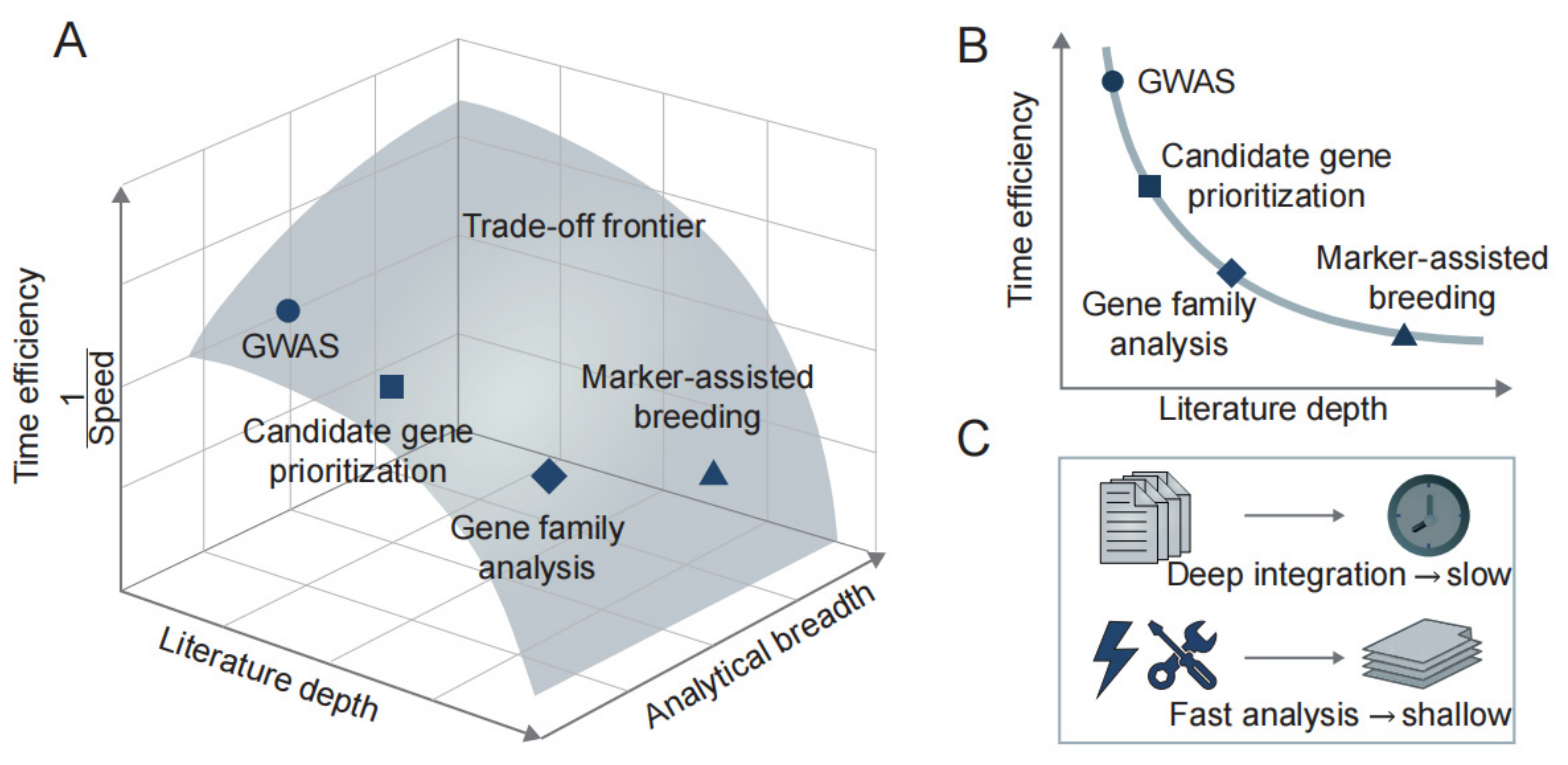
Figure 2.
Capability hierarchy and frontier shift in plant-science agents. (A). Capability space defined by the three axes, with nested regions representing progressively stronger agent capabilities from L1 to L4. (B). Representative capability types: L1 knowledge integration, L2 multi-tool orchestration and L3 iterative autonomous discovery. (C). Hypothesised expansion of the feasible region under agent-assisted workflows (orange) relative to the current trade-off frontier (grey).
Figure 2.
Capability hierarchy and frontier shift in plant-science agents. (A). Capability space defined by the three axes, with nested regions representing progressively stronger agent capabilities from L1 to L4. (B). Representative capability types: L1 knowledge integration, L2 multi-tool orchestration and L3 iterative autonomous discovery. (C). Hypothesised expansion of the feasible region under agent-assisted workflows (orange) relative to the current trade-off frontier (grey).
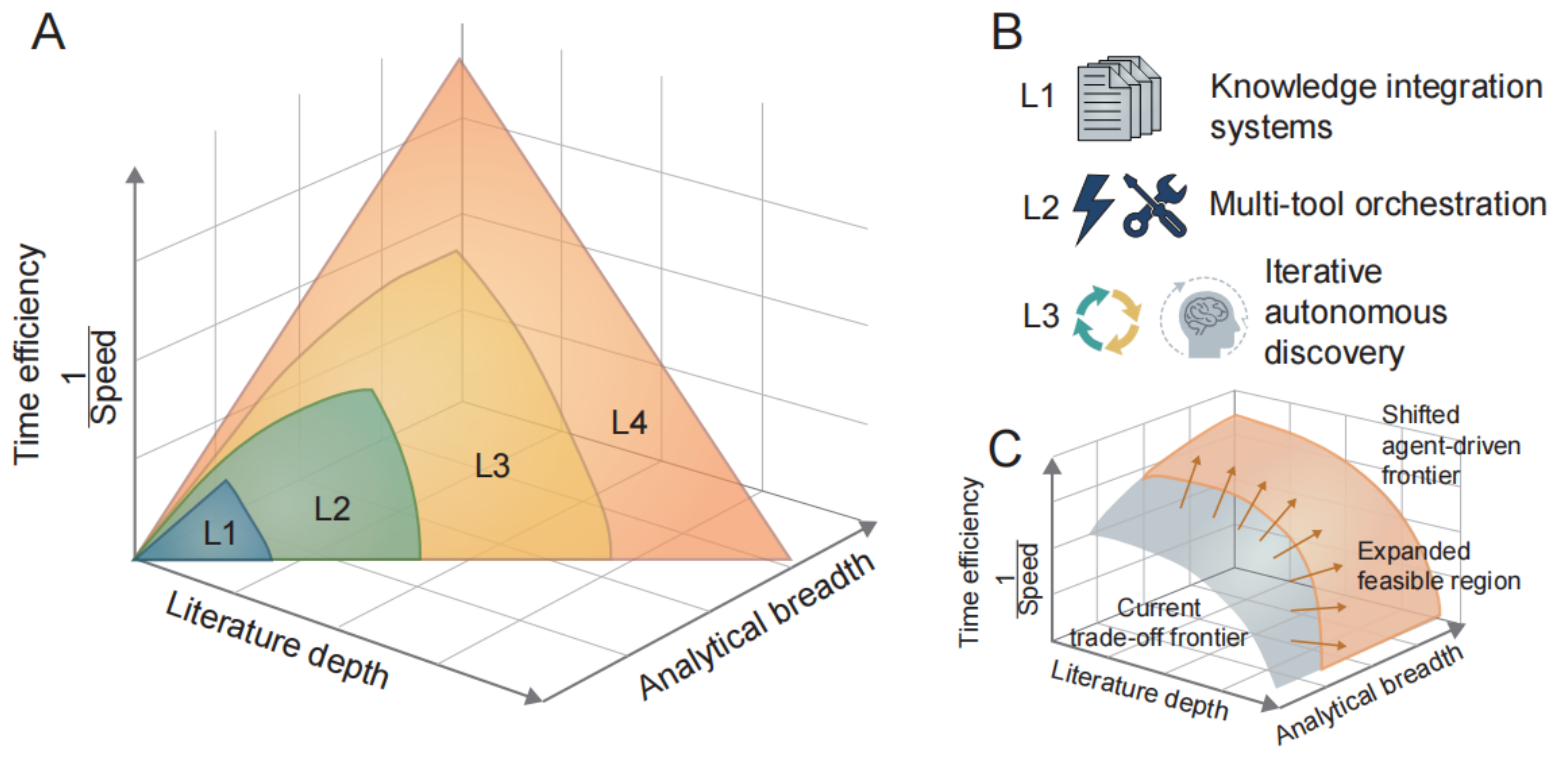
Figure 3.
Roadmap and PlantAgentBench framework. (A). PlantAgentBench structure exemplified by three representative tasks in a GWAS pipeline: literature-based gene prioritisation, multi-step workflow execution, and iterative candidate-gene refinement. (B) Closed-loop workflow concept linking literature, data, analysis, and ranking through repeated computational refinement. (C). Proposed evaluation milestones from near-term L1/L2 deployment in routine knowledge integration and tool use, through the emergence of L3 systems capable of closed-loop computational refinement, toward longer-term L4 self-improving systems.
Figure 3.
Roadmap and PlantAgentBench framework. (A). PlantAgentBench structure exemplified by three representative tasks in a GWAS pipeline: literature-based gene prioritisation, multi-step workflow execution, and iterative candidate-gene refinement. (B) Closed-loop workflow concept linking literature, data, analysis, and ranking through repeated computational refinement. (C). Proposed evaluation milestones from near-term L1/L2 deployment in routine knowledge integration and tool use, through the emergence of L3 systems capable of closed-loop computational refinement, toward longer-term L4 self-improving systems.
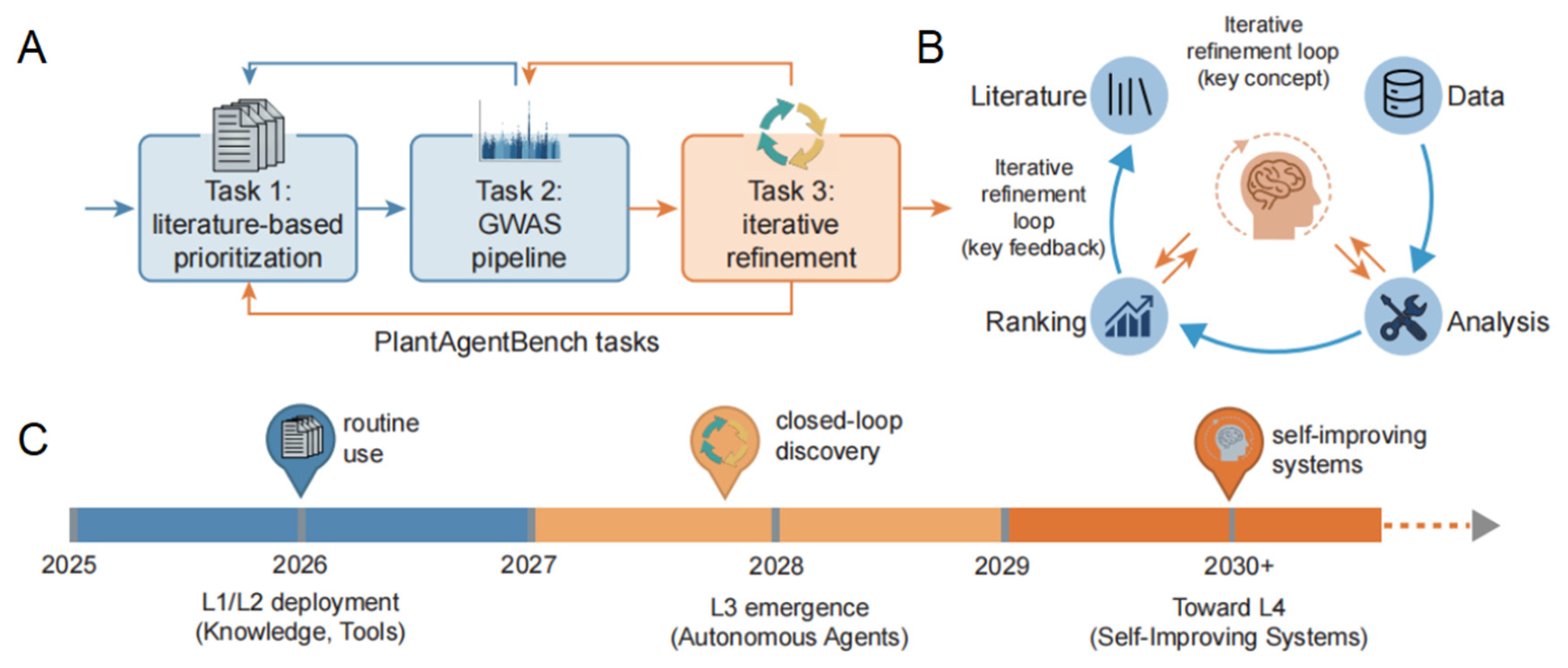

Table 1.
Capability hierarchy for autonomous agents in plant genomics. Levels L1–L4 are defined by the scientific work a system demonstrably performs, and each level is specified by a minimum qualifying criterion and an explicit boundary condition stating what is not sufficient, so that level claims are falsifiable. Evidence status is summarised here at the level of the field; representative systems and their classification are indexed in Table S1.
Table 1.
Capability hierarchy for autonomous agents in plant genomics. Levels L1–L4 are defined by the scientific work a system demonstrably performs, and each level is specified by a minimum qualifying criterion and an explicit boundary condition stating what is not sufficient, so that level claims are falsifiable. Evidence status is summarised here at the level of the field; representative systems and their classification are indexed in Table S1.
| Agent Level | Core Capability | Minimum Qualifying Criterion | Boundary/Not Sufficient | Evidence Status in Plant Genomics | Human Role |
|---|---|---|---|---|---|
| L1 Knowledge integration | Retrieve, reconcile and cite distributed literature, database and multi-omics evidence with provenance | External evidence sources are retrieved, cited and linked to a plant-science question | Ungrounded summarisation, citation-free answers, or gene descriptions without provenance | Supported: several plant-focused systems, mostly at retrieval/curation/knowledge-graph level (Table S1) | Judge biological plausibility and causal interpretation |
| L2 Tool orchestration | Translate a biological question into executable, logged, reproducible multi-step workflows | External tools, files and parameters are invoked, logged and checked with limited human intervention | A static script or preset workflow without adaptive selection, monitoring or audit; execution that stops at summarisation | Emerging: early plant phenotyping/breeding prototypes; broader support from cross-domain bioinformatics agents and WMS (Table S1) | Approve context-sensitive assumptions and high-impact analytical choices |
| L3 Closed-loop computational discovery | Iterative hypothesis generation, computational testing and refinement, where each cycle changes the next analysis or ranking | ≥3 autonomous hypothesis–test–refinement cycles on a defined plant-science task, with improvement across cycles | A multi-step report or one-pass workflow where later tests do not depend on earlier outputs; does not establish causality without wet-lab/field validation | Open target: no general, peer-reviewed, well-benchmarked plant system yet meets the criterion (Table S1) | Decide whether refined hypotheses justify experimental follow-up |
| L4 Self-evolving systems | Improve reusable tools, workflows or sub-agents across repeated projects | Validated, reusable capability gains demonstrated across tasks and independently reused | Memory, self-prompting or ad hoc code generation without validated, reusable improvement | Speculative: no plant-specific evidence; cross-domain examples are conceptual comparators only (Table S1) | Govern adoption, validation scope and responsibility for system evolution |
Table 2.
Design requirements for auditable plant-genomics agents.
| Design Requirement | Why it Matters in Plant Genomics | Required Implementation Feature | Audit Evidence to Report |
|---|---|---|---|
| Source-grounded knowledge retrieval | Evidence scattered across species, genome versions, identifiers and publication types | Tie every claim to citation, species, gene model and genome build | Source list; citation trace; evidence-type labels; identifier conflicts |
| Version-aware data handling | Interpretation shifts with assembly, annotation, coordinate system or gene model | Record reference genome, annotation version, coordinate conversion and database release | Version log; checksum; mapping table; build-mismatch warnings |
| Workflow-manager-backed execution | Manual reconstruction of commands and parameters is unreliable | Prefer reusable workflows/established tools; limit generated code to local transformations | Command log; environment file; parameters; software versions; rerun steps |
| Failure detection and escalation | Silent failures yield plausible but biologically wrong rankings | Catch missing inputs, bad formats, failed steps and consequential inconsistencies | Error log; failed-step report; human-review flag |
| Provenance-preserving reasoning | Prioritisation rests on partial, weighted evidence, not one label | Record which evidence changed each ranking update | Decision trace; evidence-to-rank mapping |
| Human-in-the-loop governance | Breeding and experimental decisions are costly, slow or irreversible | Require explicit approval for high-cost decisions and sensitive data | Approval checkpoint; data-access log; decision owner; privacy record |
Table 3.
Deployment risks, decision gates and residual risks for plant-genomics agents.
| Deployment Risk | Plant-Genomics Manifestation | Decision Gate | Residual Risk |
|---|---|---|---|
| Hallucinated or weakly grounded evidence | Wrong gene–trait claims, unsupported orthology transfer, overconfident annotation | No candidate nomination without a complete, reviewable evidence trace | Wrong chains persist if source databases are incomplete |
| Irreproducible computational workflow | Missing versions, undocumented parameters, non-rerunnable scripts | No reported result without rerun instructions and a provenance record | A reproducible command may still encode a wrong analytical choice |
| Genome-build or identifier mismatch | Genes mapped to the wrong assembly, annotation or coordinate system | Human review when build/identifier conflicts affect interpretation | Legacy annotations and minor crops may stay weakly covered |
| Over-automation of biological inference | Association or expression correlation treated as causal function | Never present a candidate ranking as experimental proof | Causality unestablished until wet-lab/field validation |
| Cross-crop non-transfer | Evidence from one crop applied to another without justification | Require crop-specific validation and stated uncertainty before cross-species claims | True biological non-equivalence may stay computationally unresolved |
| Benchmark overfitting | Good on curated tasks, poor on messy crop data | Do not infer field readiness from public benchmarks alone | Incomplete crop coverage remains possible |
| Governance and privacy failure | Proprietary germplasm or field data exposed to unsuitable services | No sensitive-data processing without documented approval and deployment limits | Governance limits may cap full reproducibility |
| Cultural and operational adoption | Opaque recommendations distrusted or un-inspectable | Deploy first in triage/review before high-cost breeding decisions | Trust may stay low where outputs conflict with local expertise |
Disclaimer/Publisher’s Note: The statements, opinions and data contained in all publications are solely those of the individual author(s) and contributor(s) and not of MDPI and/or the editor(s). MDPI and/or the editor(s) disclaim responsibility for any injury to people or property resulting from any ideas, methods, instructions or products referred to in the content. |
© 2026 by the authors. Licensee MDPI, Basel, Switzerland. This article is an open access article distributed under the terms and conditions of the Creative Commons Attribution (CC BY) license (http://creativecommons.org/licenses/by/4.0/).
Copyright: This open access article is published under a Creative Commons CC BY 4.0 license, which permit the free download, distribution, and reuse, provided that the author and preprint are cited in any reuse.


