

Submitted:
09 June 2026
Posted:
10 June 2026
You are already at the latest version
Abstract
The global proliferation of microplastics demands sustainable remediation alternatives to energy-intensive conventional methods, shifting research focus toward polymer-degrading microbial communities within the „Plastisphere“. This work elucidates microplastic colonization dynamics, evaluates next-generation biochemical strategies to overcome polyolefin crystallinity, and presents an AI-managed hybrid engineering framework that couples Advanced Oxidation Processes with Membrane Bioreactors. Empirically, the polyolefin-degrading efficacy of a newly isolated strain, Hafnia paralvei UUNT_MP29, was documented over a 16-day biotic exposure period, and a universal four-pillar Biodegradability Index (BI) was developed to standardize tracking of polymer degradation. Microplastic colonization initiated with a „Phase Zero“ conditioning film that modulated Zeta potential to anchor pioneer r-strategists. Biotic exposure to H. paralvei UUNT_MP29 yielded a Carbonyl Index of 0.4594 and a 10.95 °C reduction in thermal stability ΔTmax). Ultimately, the integrated bioprocess configuration successfully accelerates stoichiometric mineralization while mitigating additive-mediated toxicity. This comprehensive framework successfully bridges fundamental microbial ecology and scalable engineering, providing a vital blueprint for transitioning from passive waste containment to a restorative circular bio-economy.
Keywords:
microplastics
; plastisphere
; Hafnia paralvei
; biodegradability index
; microbial succession
; hybrid membrane bioreactors
; advanced oxidation processes (AOPs)
; enzymatic mineralization
1. Introduction
The global spread of synthetic polymers has shifted from symbolizing industrial progress to representing one of the most widespread environmental disasters of the Anthropocene. While large-scale plastic debris presents a highly visible ecological crisis, a far more insidious threat lies in the ubiquity of microplastics (MPs)—polymer particles smaller than 5 mm. These anthropogenic particles have become geologically pervasive, infiltrating remote ecosystems from the hadal zones of the Mariana Trench to the alpine cryosphere of Mount Everest. More recently, empirical studies have confirmed that MPs bioaccumulate within human systems, crossing biological barriers to lodge in blood vessels and placental tissues [1,2,3,4]. Conventional remediation methods, primarily centered on mechanical filtration and chemical oxidation, face growing criticism due to their high energy demands and the unavoidable generation of toxic secondary byproducts. Consequently, environmental research has shifted toward bioremediation—a sustainable approach that leverages microbial metabolic diversity to achieve the complete stoichiometric mineralization of polymers into CO₂, H₂O, and cellular biomass.
This biological breakdown of microplastics reflects a remarkably rapid example of anthropogenically driven biological evolution. In less than a century, specialized microbial communities known as the Plastisphere have emerged [5,6,7,8], effectively utilizing synthetic polymers as primary carbon and energy sources. Successful colonization typically begins with an abiotic „priming“ phase and the near-instantaneous formation of a „Phase Zero“ conditioning film, which dynamically alters surface energetics and boundary-layer hydrophobicity, thereby permitting stable microbial attachment. Beyond initial adhesion, researchers are elucidating the complex metabolic pathways required to cleave highly stable, recalcitrant carbon-carbon backbones, with a focus on the catalytic efficiency of extracellular enzymes such as cutinases, laccases, and alkane hydroxylases.
By comprehensively mapping these successional and enzymatic pathways, the field moves closer to developing scalable, high-throughput biotechnological systems to mitigate global plastic pollution. To systematically address these challenges, this manuscript establishes a unified, multi-scale framework for microplastic mitigation that bridges fundamental microbial ecology and scalable bioprocess engineering.
Specifically, this work first elucidates the microscale successional mechanics and surface energetics that govern early-stage Plastisphere biofilm formation. Second, drawing upon recently established empirical baselines—specifically, the documented polyolefin-degrading efficacy, spectroscopic footprints, and thermogravimetric profiles of the aquatic isolate Hafnia paralvei UUNT_MP29 [9] — as a critical proof of concept, we evaluate the thermodynamic and kinetic barriers that limit raw microbial matrix erosion. Finally, to translate these microscale baseline footprints into scalable industrial applications, we conceptualize a novel, modular, AI-managed hybrid treatment architecture that strategically couples Advanced Oxidation Processes (AOPs) with downstream Membrane Bioreactors (MBRs), underpinned by a newly developed, multi-parametric Biodegradability Index (BI) designed to standardize global polymer mineralization metrics. Ultimately, this comprehensive perspective offers a predictive, verifiable blueprint for transitioning from passive waste containment to active, circular biotechnological remediation.
2. Plastisphere and Microbial Ecology
2.1. The Genesis of the Plastisphere: Successional Dynamics and Colonization Mechanics
The introduction of synthetic polymers into aquatic ecosystems has led to the emergence of a structurally and functionally distinct ecological niche: the plastisphere. Far from being inert substrates, microplastics (MPs) serve as dynamic anthropogenic microhabitats that fundamentally alter marine carbon cycling and net community production. The transformation of a pristine polymer surface into a complex, multi-generational biological matrix is not a stochastic event, but rather a highly ordered, multi-stage successional sequence governed by interfacial thermodynamics and microbial ecology [10].
In traditional marine ecology, microbial communities colonizing organic debris (such as marine snow or wood falls) must complete their life cycles before their ephemeral „island“ substrate dissolves. In contrast, the plastisphere substrate remains intact for decades. This persistence enables the development of complex, multi-generational biofilms that reach far greater maturity and structural stability than those on natural, biodegradable surfaces [11].
Biophysical Dynamics and Biogeochemical Implications
Because synthetic polymers are inherently hydrophobic, they repel water molecules while naturally adsorbing ambient organic macromolecules and pioneer microbial cells. This thermodynamic preference creates a concentrated, nutrient-rich boundary layer on the plastic surface that far exceeds the nutritional density of the surrounding bulk water.
The extreme durability of microplastics also converts them into long-distance vectors for microbial communities that would otherwise remain geographically confined. These synthetic islands allow coastal pathogens or invasive species to survive prolonged journeys across oligotrophic open oceans—an ecological feat previously restricted by substrate degradation. Consequently, this continuous transport promotes the homogenization of aquatic microbiomes, wherein distinct regional ecosystems gradually lose their unique microbial signatures.
Furthermore, the exceptionally high cell density within these biofilms enhances gene flow and horizontal gene transfer (HGT), establishing the plastisphere as an evolutionary hotspot for genetic exchange. Recent investigations demonstrate that the plastisphere significantly accelerates the dissemination of antibiotic resistance genes (ARGs); the close physical proximity of diverse taxa within a highly stable surface matrix facilitates rapid plasmid-mediated conjugation between bacteria [12,13]
Beyond its role as a biological vector, the plastisphere actively modulates marine carbon cycling and net community production. As microbial colonization progresses, the accumulation of metabolic byproducts and the physical weight of the maturing biofilm alter the host particle's buoyancy. This induces a distinct vertical „cycling“ behavior: particles sink as biofilm mass increases, and potentially rise back toward the photic zone if the biofilm is stripped by grazing or undergoes senescence.
While pristine marine snow predictably fuels the biological pump by transferring carbon to the deep ocean floor, plastisphere particles exhibit anomalous sinking velocities and altered „shelf lives“. These divergent transport dynamics are currently being integrated into global climate models to refine estimates of oceanic carbon sequestration capacity [14]. Figure 1 illustrates the development of a plastisphere from a pristine particle to a complex ecosystem.
The localized microbial architecture on a microplastic fragment rarely mirrors the composition of the surrounding water column. As the biofilm matures, it recruits higher-order microorganisms, including ciliates and amoebae, establishing a localized, concentrated microbial food web that travels continuously with the plastic substrate.
Phase Zero: The Conditioning Film
The initialization of the plastisphere relies on the formation of a conditioning film—a critical process that transforms a sterile, industrial byproduct into a biologically receptive landing pad. Driven by the thermodynamic imperative to minimize interfacial free energy, the transition from a pristine synthetic surface to a conditioned substrate occurs almost instantaneously upon aqueous submersion [15,16].
When polymers such as polyethylene (PE), polypropylene (PP), or polyethylene terephthalate (PET) enter the water, they rapidly adsorb molecules. Within minutes, ambient organic macromolecules—including proteins, lipids, polysaccharides, and humic acids—adhere to the hydrophobic surface, forming a molecular scaffold. This primary layer serves as a biological primer, masking the underlying polymer properties and providing critical anchor points for pioneer microbes. This conditioning process alters the particle's physicochemical profile through three main mechanisms:
- Zeta Potential Overwrite: Pristine plastics possess a distinct surface charge that the conditioning film systematically overwrites. In marine environments, the rapid adsorption of organic acids and multivalent cations (e.g., Ca2+ and Mg2+) shifts the surface charge toward neutrality or a slight negative state.
- Electrostatic Buffer: Because most aquatic bacteria carry a net negative surface charge, electrostatic repulsion would naturally deter them from approaching a pristine plastic surface. The conditioning film serves as a charge buffer, neutralizing these repulsive forces and enabling pioneer microbes to establish direct physical contact.
- Boundary Layer Formation: While the plastic's core remains strictly hydrophobic, the newly formed film exposes hydrophilic functional groups on the surface, such as hydroxyl (-OH) and carboxyl (-COOH) groups. This structural shift creates a stagnant „boundary layer“ of water, providing a stable, localized environment in which extracellular enzymes can function effectively without being rapidly diluted or sheared away by turbulent ambient currents
By specifically targeting this foundational conditioning film, biotechnologists are designing novel mitigation strategies against plastic pollution. One avenue focuses on engineering ultra-hydrophobic or anti-fouling polymer surfaces that prevent film formation entirely, rendering the plastic „invisible“ to microbial colonization and halting pathogen propagation.
Conversely, bio-receptive engineering seeks to modify plastics so that their resulting conditioning films selectively recruit specific plastic-degrading microbial strains—such as Ideonella sakaiensis—thereby accelerating polymer degradation within managed or controlled waste environments [15].
2.1.2. Selective Enrichment and the Dual “Trojan Horse” Effect
Microplastics act as highly selective taxonomic filters, maintaining microbial assemblages that diverge sharply from those in the surrounding water column or adjacent sediments. This selective enrichment is dictated by specific polymer surface chemistries, weathering states, and the distinct microenvironments within the biofilm matrix. Crucially, these buoyant, recalcitrant synthetic islands function as a dual-purpose „Trojan Horse“, simultaneously transporting biological and chemical threats across global marine biomes [17].
Biological Vectors
The stable, high-density environment of the Extracellular Polymeric Substance (EPS) matrix supports the survival, proliferation, and long-range transport of opportunistic pathogens (e.g., pathogenic Vibrio spp.) and non-indigenous invasive species. Furthermore, the physical compression of diverse taxa within the EPS matrix creates ideal conditions for horizontal gene transfer via plasmid conjugation, drastically accelerating the spread of antibiotic resistance genes (ARGs) into pristine ecosystems.
Chemical Vectors
Concurrently, microplastics act as highly efficient sorbents for hydrophobic chemical contaminants. They concentrate persistent organic pollutants (POPs), such as polychlorinated biphenyls (PCBs) and polycyclic aromatic hydrocarbons (PAHs), from the surrounding water column.
This exogenous accumulation is compounded by the internal leaching of toxic additives—including plasticizers such as bisphenol A (BPA) and phthalates—that are added to the polymer matrix during industrial manufacturing.
By consolidating these twin vectors, the plastisphere facilitates the synchronized delivery of endocrine-disrupting chemicals and pathogenic microbes into sensitive marine habitats and commercial seafood chains, introducing a multi-layered challenge to global ecotoxicology and environmental health.
2.1.3. Synergistic Degradation Within the Biofilm
The close spatial proximity of diverse taxa within the mature biofilm matrix favors the establishment of tight syntrophic relationships. Within these metabolic consortia, primary degraders break down complex, high-molecular-weight polymers into smaller, bioavailable oligomers and monomers, which are subsequently mineralized by adjacent secondary consumers.
This structural arrangement significantly enhances polymer degradation rates compared to free-floating planktonic bacteria. The surrounding EPS matrix acts as a physical barrier that prevents the spatial dilution of the "molecular scissors"—the extracellular depolymerases and esterases required to cleave the recalcitrant polymer backbones [18].
During initial colonization, pioneer species (often from the phyla Proteobacteria and Bacteroidetes) use weak van der Waals forces and long-range electrostatic interactions to form reversible contact with the conditioned surface. After successful attachment, these pioneers transition to irreversible colonization by secreting an intricate EPS matrix. This biological glue anchors the community, concentrates extracellular enzymes at the polymer interface, and shields constituent cells from environmental stressors such as solar UV radiation, chemical toxins, and protozoan predation.
Metagenomic data indicate that while Proteobacteria and Bacteroidetes consistently dominate the core plastisphere microbiome, the enrichment of highly specialized functional groups is strictly dictated by the underlying polymer chemistry. For example, the selective enrichment of Actinobacteria on polystyrene (PS) or Alcanivorax on PE is directly driven by the metabolic capacity of these specific taxa to express the oxygenases and hydrolases required to cleave the respective polymer backbones [19,20].
In addition to bacterial lineages, fungal genera such as Aspergillus and Penicillium are often enriched in terrestrial and coastal microplastic samples [21]. The distinctive filamentous hyphae of these fungi allow them to exert direct mechanical pressure on the substrate, penetrating deeply into the polymer matrix. This mechanical disruption increases the available surface area and, together with bacterial surface erosion, accelerates polymer degradation.
Table 1 provides a systematic overview of the primary microbial taxa isolated from the plastisphere of common synthetic polymers, detailing their substrate affinities and the associated conditioning film properties.
2.2. The Colonization Phase: From Abiotic Weathering to Biotic Succession
The transformation of a microplastic (MP) fragment from a sterile industrial byproduct into a biologically active plastisphere is not instantaneous. It is driven by a continuous interplay between environmental degradation and microbial colonization, marking a transition from abiotic weathering to biotic attachment that fundamentally reshapes the polymer's physicochemical properties [35,36,37].
Microbial colonization of synthetic polymers typically requires a preceding “priming” phase. Standard synthetic plastics—particularly polyolefins such as PE and PP—have highly hydrophobic, smooth surfaces that structurally inhibit initial microbial attachment. During this priming stage, solar ultraviolet-B (UV-B) radiation initiates photolytic cleavage, generating free radicals that drive chain scission and the subsequent formation of oxygen-containing functional groups, including carbonyl (>C=O), carboxyl (−COOH), and hydroxyl (−OH) moieties [35,38,39].
Simultaneously, mechanical stresses and thermal fluctuations—driven by hydrodynamic wave action in aquatic settings or by temperature cycling in terrestrial edaphic matrices—induce microfractures that exponentially increase the material's surface-area-to-volume ratio. Collectively, these abiotic transformations reduce surface hydrophobicity and enhance surface wettability, thereby increasing the polymer's binding affinity for microbial extracellular proteins and polysaccharides [39,40]. Figure 2 illustrates abiotic degradation of PE following photolytic cleavage of the polymer backbone.
2.2.1. The „Island“ Effect: From Transient Aggregates to Stable Synthetic Substrates
A profound shift in marine microbial ecology is underway as persistent synthetic polymers replace ephemeral natural organic matter. Traditionally, open-ocean microbial life has relied heavily on „marine snow“—transient organic aggregates composed of cellular detritus, phytoplankton, and zooplankton fecal pellets [41,42]. These natural particles function as ephemeral islands; they are rapidly mineralized by their colonizers, forcing resident microbes to complete their life cycles or disperse before the substrate dissolves and sinks into the deep benthos.
In contrast, microplastics serve as highly durable synthetic islands. Because polymers like PE and PP resist rapid biological mineralization, they present a persistent, long-term platform that fundamentally rewires classic ecological succession:
Longevity and Maturation: Unlike short-lived marine snow, the multi-decadal environmental "shelf-life" of a microplastic particle permits the development of highly complex, multi-generational biofilms. This structural stability enables the colonizing community to attain an advanced stage of ecological climax—characterized by specialized metabolic niches and higher-order predators such as ciliates—that is rarely sustained by transient natural substrates.
Biogeographic Rafting: These durable synthetic islands serve as long-range vectors for biological rafting. While natural aggregates typically dissipate within days, microplastic particles can traverse entire ocean basins intact. This persistence allows coastal pathogens and invasive species to survive long-distance transport across oligotrophic waters, ultimately driving the homogenization of aquatic microbiomes as unique regional microbial signatures are overwritten by traveling plastisphere communities.
Vertical Cycling: While marine snow follows a predictable downward trajectory that fuels the biological carbon pump, the buoyancy dynamics of these synthetic islands are highly fluid. As the biofilm matures, its cellular weight and metabolic byproducts increase the particle's overall density, precipitating a downward flux. However, if the biofilm is stripped via zooplankton grazing or undergoes natural senescence and sloughing, the plastic particle may regain buoyancy and ascend back into the photic zone. This creates a non-linear vertical cycling of carbon and adsorbed pollutants that contemporary climate and transport models are only beginning to resolve.
2.2.2. Biotic Colonization
Following physical and chemical surface priming, biotic colonization proceeds through a strictly orchestrated successional sequence initiated by the Pioneer Phase. During this stage, fast-growing, opportunistic r-strategist bacteria—predominantly from the phyla Proteobacteria and Bacteroidetes—chemotactically recognize and assimilate the labile, nutrient-rich organic matter concentrated within the conditioning film [43]. The mechanical progression of this phase is defined by four core milestones:
Initial Attachment: Pioneer cells make initial contact with the macromolecular scaffold, mediated by weak, reversible van der Waals forces and electrostatic interactions.
Irreversible Binding: After initial contact, the bacteria establish permanent, irreversible adhesion using a biological "glue" and specialized cellular appendages such as pili and fimbriae.
Matrix Initiation: Once securely anchored, these pioneer microbes begin secreting self-produced Extracellular Polymeric Substances (EPS). This secretion forms a protective three-dimensional matrix that shields the nascent community from environmental stressors, including solar UV radiation and chemical toxins.
Bio-Erosion Phase: The successional transition culminates when the sessile community actively alters the underlying polymer substrate. This phase is marked by localized surface etching, pitting, and structural deformation, during which extracellular enzymes begin degrading the high-molecular-weight carbon chains into smaller, bioavailable oligomeric fragments.
The life cycle of a microplastic particle is thus a multi-stage continuum that begins with physical disintegration and concludes with biological assimilation. While the primary conditioning film and pioneer attachment function as the biological gateway, the overarching degradation pathway is defined by a distinct shift from environmental weathering to active metabolic consumption. This transition reflects a shift in the polymer's fundamental chemistry: moving from non-specific, radical-driven chain scission to targeted, enzyme-mediated covalent cleavage.
To clarify the precise relationship between these two critical operational stages, Table 2 outlines the governing drivers, kinetics, and structural outcomes that define the transition from abiotic preparation to biotic colonization.
2.3. Key Taxa: The "Heavy Hitters" of Microplastic Degradation
While a diverse assembly of opportunistic microorganisms can colonize microplastic surfaces, only a specialized cohort of „heavy hitters“ possesses the enzymatic machinery required to actively use these synthetic polymers as primary carbon and energy sources. These highly adapted taxa have evolved or acquired metabolic pathways capable of cleaving the highly stable covalent bonds that characterize modern synthetic backbones.
I. Bacterial Powerhouses
Bacteria represent the most extensively studied agents in plastic bioremediation due to their rapid replication rates, ease of genetic manipulation, and high metabolic flexibility.
Ideonella sakaiensis (PET Specialist): Discovered as a highly specialized organism [25], this bacterium produces two highly specific, complementary enzymes: PET hydrolase (PETase) and mono-(2-hydroxyethyl) terephthalate hydrolase (MHETase). Operating in tandem, these biocatalysts fully depolymerize polyethylene terephthalate (PET) into its benign constituent monomers, terephthalic acid and ethylene glycol.
Pseudomonas Species (Versatile Degraders): Strains such as Pseudomonas putida [44] and Pseudomonas aeruginosa [45] function as highly versatile metabolic catalysts in industrial and environmental bioremediation. They are highly effective at initiating the degradation of recalcitrant polyolefins such as PE and PP, using secreted alkane monooxygenases to introduce oxygen atoms into long hydrocarbon chains, thereby making them susceptible to downstream β-oxidation [46].
Bacillus Species: Bacillus cereus and Bacillus subtilis are frequently isolated from plastic-enriched marine and riverine benthic sediments. These strains are characterized by their ability to form robust, dense biofilms and to secrete extracellular laccases and oxidases that facilitate the degradation of polystyrene (PS) and polyvinyl chloride (PVC) [29].
Rhodococcus Species: Belonging to the high-GC Actinobacteria, these organisms are exceptionally well-adapted to metabolizing highly hydrophobic compounds. They are notable for their high survival and persistence rates on low-density polyethylene (LDPE), where they alter the polymer's surface characteristics through the targeted secretion of specialized amphiphilic biosurfactants [47].
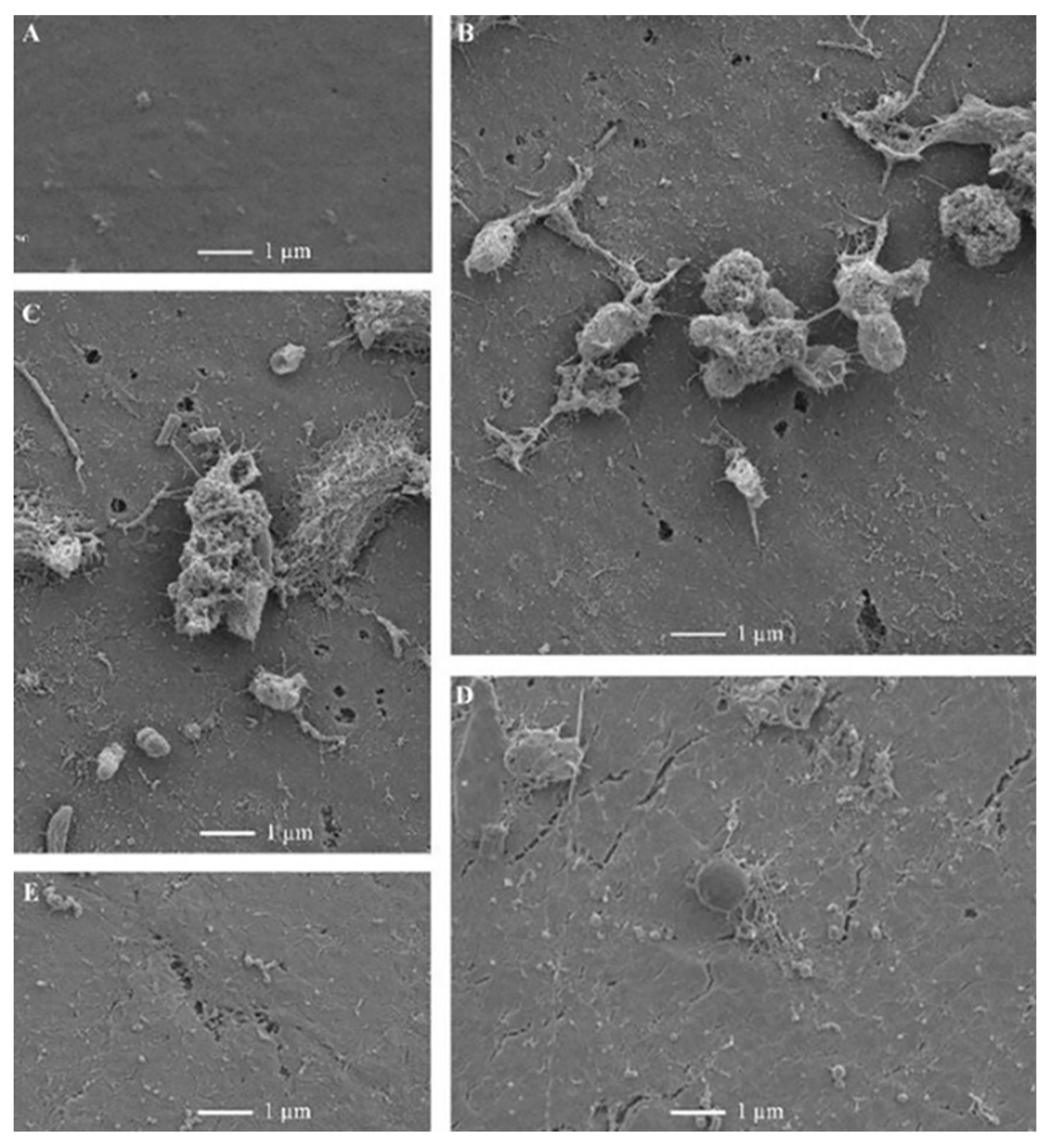
Figure 3.
Scanning electron microscopy (SEM) images of a low-density polyethylene (LDPE) surface after two months of enrichment with Alcanivorax borkumensis and Microbulbifer. (A) Abiotic negative control showing a smooth surface (B, C, D, and E) mature microbial biofilms on LDPE showing extensive cellular attachment, EPS matrix deposition, and structural surface erosion [48].
Figure 3.
Scanning electron microscopy (SEM) images of a low-density polyethylene (LDPE) surface after two months of enrichment with Alcanivorax borkumensis and Microbulbifer. (A) Abiotic negative control showing a smooth surface (B, C, D, and E) mature microbial biofilms on LDPE showing extensive cellular attachment, EPS matrix deposition, and structural surface erosion [48].
II. Fungal Decomposers: The Mechanical Specialists
Filamentous fungi offer a distinct biophysical advantage over single-celled bacteria: their tip-growing hyphae can physically penetrate microfractures within the plastic matrix, exerting high localized mechanical turgor pressure while simultaneously secreting concentrated cocktails of oxidative and hydrolytic enzymes.
Aspergillus and Penicillium: These widespread saprophytic genera serve as primary fungal drivers of synthetic polymer decay. Species such as Aspergillus niger and Aspergillus fumigatus have demonstrated significant efficacy in reducing the structural mass of polyurethane (PUR) and LDPE via the targeted secretion of extracellular esterases, cutinases, and proteases [49].
Zalerion maritimum: This marine-derived fungus has garnered considerable attention for its capacity to degrade PE within saline environments. It effectively reduces the net mass of microplastic pellets by deploying a robust suite of non-specific, extracellular oxidative enzymes, such as laccases, under marine conditions [50].
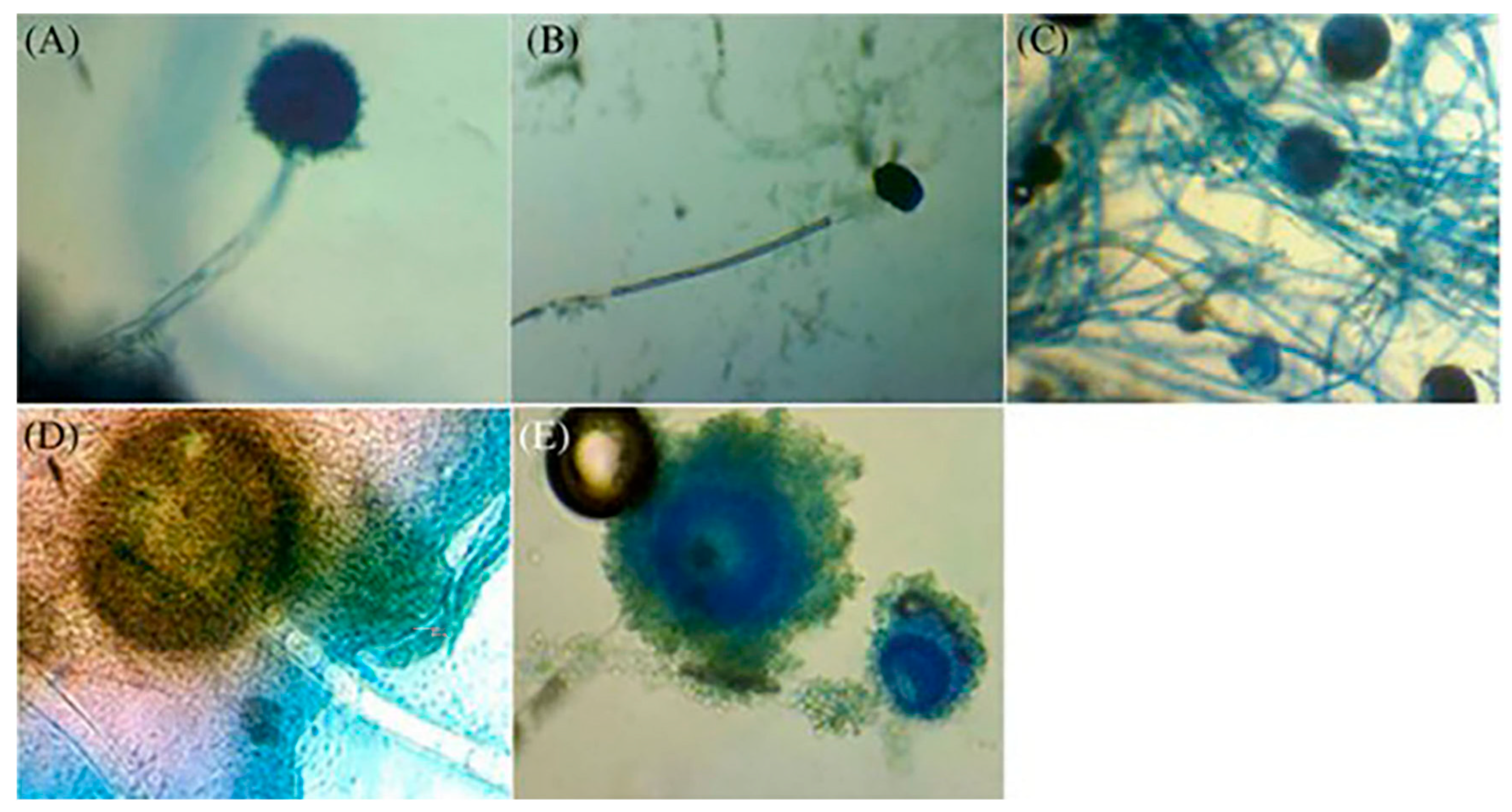
Figure 4.
Microscopic images of fungal isolates recovered directly from a municipal plastic waste repository. Morphological characterization identifies these strains at the genus level: (A) Rhizopus sp. (S1) and (B–E) distinct environmental variants of Aspergillus sp. (S2–S5), which showcase robust reproductive structures and sprawling hyphal networks [51].
Figure 4.
Microscopic images of fungal isolates recovered directly from a municipal plastic waste repository. Morphological characterization identifies these strains at the genus level: (A) Rhizopus sp. (S1) and (B–E) distinct environmental variants of Aspergillus sp. (S2–S5), which showcase robust reproductive structures and sprawling hyphal networks [51].
III. The Intestinal Frontier: Gut Microbiota
An important frontier in plastisphere research is the discovery of symbiotic polymer degradation within the specialized gut microbiomes of certain insect larvae, such as mealworms and waxworms. For example, mealworms (Tenebrio molitor) can ingest, mechanically masticate, and mineralize polystyrene [53,54].
Crucially, this metabolic breakdown is not achieved by the host insect alone but is driven by specialized, obligate gut symbionts—such as Exiguobacterium sp. strain YT2—that possess the specific enzymatic machinery required to cleave and open the highly stable aromatic rings characteristic of the PS backbone [55]. Proposed metabolic pathways and enzymatic mechanisms for polystyrene biodegradation are shown in Figure 5.
The identification of these specialized organisms reveals that biological plastic degradation is not a uniform metabolic process but a highly diverse set of niche-specific evolutionary strategies. These strategies range from precise bacterial enzymatic hydrolysis to the robust mechanical penetration by fungal hyphae. While the plastisphere provides the physical habitat, these specialized taxa perform the metabolic work required to transition from surface attachment to complete carbon mineralization.
To synthesize these diverse biological approaches, Table 3 categorizes key representatives across all three domains by their target polymers and primary degradation mechanisms.
Consequently, the multi-trophic successional maturity of the plastisphere marks the complete transformation of an inert synthetic substrate into a highly dynamic biological hotspot. However, this dense architectural colonization is merely the spatial prelude to true biodegradation. Physical attachment and taxonomic succession are evolutionary pathways that overcome a fundamental energetic bottleneck: accessing the locked carbon within the highly recalcitrant polymer backbone.
The extreme spatial confinement within the mature biofilm alters microbial signaling and gene expression, triggering a metabolic shift from simple surface adherence to active chemical excavation. To dismantle the high-molecular-weight hydrophobic matrices that shield these synthetic polymers, the sessile community must weaponize its secretome. The biofilm's structural dynamics thus serve a singular biochemical purpose: stabilizing and concentrating a specialized array of extracellular biocatalysts at the polymer interface. This structural alignment shifts the focus from macroscopic microbial ecology to the precise, microscopic enzymatic architecture required to sever synthetic covalent bonds.
3. Biochemical Mechanisms of Polymer Assimilation: The Molecular Scissors
The biological degradation of synthetic polymers relies on a highly coordinated, multi-step enzymatic cascade. Because intact microplastic macromolecules are far too large to pass through microbial cell walls, biodegradation must begin externally. Microbes deploy extracellular enzymes—often termed „molecular scissors“—to introduce oxygen-containing functional groups, initiate chain scission, and reduce hydrophobic polymers to low-molecular-weight oligomers and monomers that are accessible for cellular uptake.
This enzymatic attack generally proceeds via two primary biochemical pathways: hydrolytic cleavage of hetero-chain polymers containing polar functional groups (such as PET and PUR), and oxidative cleavage of highly recalcitrant homo-chain polyolefins (such as PE and PS).
3.1. Extracellular Hydrolysis: The Initial Cut
For polymers with hydrolyzable backbones containing ester or amide linkages, such as PET and PUR, microorganisms secrete extracellular hydrolases. These enzymes utilize water molecules to cleave covalent bonds, effectively “unzipping” the polymer chains.
In PET degradation, the process proceeds as a stepwise cascade (Figure 6). The enzyme PET hydrolase (PETase) first cleaves the long-chain polymer into smaller soluble fragments, primarily mono(2-hydroxyethyl) terephthalate (MHET), with minor fractions of bis(2-hydroxyethyl) terephthalate (BHET). Subsequently, a secondary enzyme, MHETase, breaks these intermediate fragments down into their core constituent monomers: terephthalic acid (TPA) and ethylene glycol (EG).
Beyond specialized PETases, ancestral cutinases and esterases—which originally evolved to hydrolyze plant cutin—have open active-site architectures that are highly effective at cleaving ester bonds in industrial polyurethanes and thin-film microplastics.
3.2. Oxidative Degradation: Breaking the C–C Backbone
Non-hydrolyzable plastics—specifically PE, PP, and PS—are exceptionally resistant to decay because they lack polar oxygen atoms in their primary backbones. To dismantle these stable carbon chains, microbes deploy oxidoreductases to introduce oxygen, effectively „activating“ the polymer for downstream metabolic processing.
- Alkane Hydroxylases (AlkB): These membrane-associated monooxygenases target the terminal or sub-terminal positions of long carbon chains. This initial step converts inert alkanes into primary or secondary alcohols, allowing the chain to be sequentially oxidized into fatty acids that the cell can subsequently metabolize via the intracellular β-oxidation pathway [57].
- Radical-Generating Enzymes: Saprophytic fungi and certain filamentous bacteria (such as Streptomyces) secrete extracellular laccases and peroxidases to drive non-specific oxidation [58].
- o
- Mechanism of Action: Using multi-copper nodes or heme centers, these enzymes generate highly reactive free radicals. These radicals aggressively abstract hydrogen atoms from stable C–H bonds and initiate electron transfers that break stable C–C links, facilitating ring cleavage in polystyrene and general chain scission in polyolefins [59].
Consequently, these multi-enzyme cascades systematically dismantle the structural integrity of the polymer matrix, converting highly hydrophobic macromolecular chains into hydrophilic, oxygenated fragments. To validate these complex biochemical pathways and map the precise kinetics of this enzymatic breakdown, researchers rely on a suite of advanced analytical techniques to track changes in functional groups, thermal stability, and crystalline mass.
3.3. Multi-Analytical Characterization of Macromolecular Transformation
Critical molecular evidence of microbial polymer degradation is captured by distinct shifts in functional groups monitored by Fourier-Transform Infrared (FTIR) spectroscopy. When hydrophobic, synthetic matrices are subjected to microbial attack, structural modifications typically manifest as changes in the vibrational frequencies and absorption intensities of localized chemical bonds. For instance, when pristine PS films—serving as a model for recalcitrant vinyl-aromatic hydrocarbon polymers—are exposed to the specialized aquatic isolate H. paralvei UUNT_MP29, the resulting spectra reveal an unambiguous departure from the pristine polymer baseline.
The pristine, untreated PS control film exhibits characteristic, sharp absorption bands corresponding to asymmetric and symmetric sp3 C–H stretching at 2914 cm−1 and 2846 cm−1, respectively, along with distinctive aromatic ring deformation and bending vibrations at 1462 cm−1 and 718 cm−1. After a 16-day biotic incubation with the H. paralvei UUNT_MP29 strain, the absolute intensity of these primary hydrocarbon peaks decreases significantly. This localized flattening indicates systematic biofragmentation of the aliphatic backbone and reduced long-chain structural integrity.
Concurrently, the emergence of broad, novel absorption features in the 1200–1000 cm−1 spectral window provides definitive evidence of biochemical transformation. These newly formed bands are assigned to C–O and C–O–C stretching vibrations, indicating the accumulation of hydrophilic ester and ether linkages in the biotically weathered polymer matrix (Figure 7).
Crucially, the chemical signature of this gut-derived aquatic strain reveals a distinct metabolic divergence from well-documented soil-dwelling microbial models. While classic polymer-degrading specialists, such as Pseudomonas aeruginosa, typically drive degradation via a pronounced keto-carbonyl pathway centered near [63], the H. paralvei UUNT_MP29 fingerprint focuses primarily on intermediate ether and ester functionalization, yielding a calculated Carbonyl Index (CI) of 0.4594.
Because the corresponding abiotic control films incubated under identical thermodynamic and hydrodynamic conditions remain completely unmodified, these spectral variations confirm that the oxidative insertion of oxygen molecules into the polymer framework is strictly biologically mediated. This localized, enzyme-catalyzed functionalization significantly reduces the material's interfacial hydrophobicity, effectively priming the remaining macro-structural chains for deep enzymatic cleavage.
The thermodynamic shifts captured in the derivative thermogravimetric (DTG) profiles (Figure 8) provide macroscopic evidence of polymer destabilization, reflecting a fundamental restructuring of the material's crystalline and amorphous domains. However, to fully decode the chemical modifications driving this thermal collapse, these mass-loss profiles must be cross-correlated with molecular-level structural changes. While thermogravimetry tracks bulk weight loss, the evolution of localized oxygen-containing functional groups reveals the precise enzymatic mechanisms at play.
To map the spatial distribution of this microbial erosion and characterize the structural changes across the polymer surface, advanced high-resolution imaging techniques—specifically Scanning Electron Microscopy (SEM) and Atomic Force Microscopy (AFM)—are deployed. While spectroscopic data confirms what chemical changes have occurred, morphological analysis reveals where and how the biological consortia have physically remodeled the substrate.
When biotically treated polyolefin films are cleared of their biomass and compared to the smooth, homogenous surfaces of abiotic controls, the physical footprint of H. paralvei UUNT_MP29 becomes strikingly apparent (Figure 9). Micrographs reveal extensive surface blistering, deep longitudinal fracturing, and localized pitting that mirrors the exact spatial configuration of the prior biofilm topology. This extensive nanoscale roughness confirms that enzymatic degradation is not a uniform, surface-wide dissolution, but rather a targeted, interfacial excavation driven by the structural arrangement of the sessile microbial community.
The physical consequences of these spectral and thermal changes are visually manifest via scanning electron microscopy (SEM), which tracks the topographical evolution of the plastisphere interface. Pristine, non-inoculated control LDPE films consistently exhibit a smooth, featureless surface topology devoid of structural defects, microcracks, or structural irregularities, confirming that no abiotic weathering occurred during the experimental timelines [60].
This internal etching behavior triggers a powerful positive feedback mechanism: the creation of a porous network dramatically expands the available surface area within the plastic, which in turn facilitates deeper penetration by extracellular enzymes and enhances stable biofilm anchoring. This aligns with recent findings on autochthonous aquatic isolates from Cyprinus carpio, which exhibit optimized surface colonization and structural degradation traits tailored for a synthetic polymer backbone.
3.4. Comparative Enzymatic Efficiency: Overcoming the Polymer Barrier
The transition from surface biofilm attachment to carbon mineralization is governed by the specific catalytic efficiency of the extracellular secretome. As summarized in Table 4, the effectiveness of these biological „scissors“ is not universal; it is strictly dictated by the chemical architecture of the polymer backbone and the thermodynamic accessibility of its constituent bonds.
I. Hydrolases: The Precision Cutters
Hydrolases—including esterases, cutinases, and lipases—are the most efficient enzymes for degrading hetero-chain polymers such as PET, PUR, and PLA [27,64,65]. These enzymes target polar functional groups (esters or urethanes) within the polymer chain. Because these bonds are highly susceptible to nucleophilic attack by water, hydrolases achieve high catalytic rates by docking at specific, accessible cleavage sites. Their high efficiency reflects an ability to perform targeted depolymerization, typically yielding uniform monomers that are immediately bioavailable for microbial uptake.
II. Oxygenases: The Oxidative Primers
In contrast, polyolefins such as PE and PP lack accessible functional groups and consist of highly stable, nonpolar carbon-carbon (C–C) bonds. To address these inert backbones, microorganisms deploy oxygenases (mono- and dioxygenases). These enzymes must first insert molecular oxygen into the hydrophobic chain to create reactive polar “handles”, such as alcohols or ketones [66,67]. This process is highly energy-intensive and characterized by slow kinetics, as the enzymes must overcome significant activation energy barriers to destabilize the saturated hydrocarbon structure [68].
III. Laccases: The Radical Multi-Taskers
Laccases offer a versatile, broad-spectrum strategy. Rather than targeting specific bonds through direct structural docking, laccases use copper-mediated redox reactions to generate highly reactive free radicals [69]. These radicals initiate non-specific, random scission of the polymer backbone. While this mechanism allows laccases to attack highly resistant polymers such as PS—which contains bulky, stabilizing aromatic rings—and PE, their efficiency is moderate. The radical-mediated process is less specific than hydrolysis and often yields a highly heterogeneous mix of fragments rather than uniform, readily metabolizable monomers [70,71].
3.5. Intracellular Mineralization: The Metabolic End-Point
The final stage of biodegradation is achieved once extracellular enzymatic cleavage has successfully fragmented complex microplastic chains into short-chain oligomers or monomers—typically falling below the critical 600 Dalton molecular weight threshold. At this size, these fragments become highly bioavailable, allowing them to be shuttled across the microbial cell membrane via specialized transport proteins for complete intracellular mineralization. This metabolic shift marks the definitive transition from superficial structural fragmentation to active carbon utilization, a fundamental characteristic driving the selection of native candidate strains isolated from freshwater fauna for targeted microplastic bioremediation.
The intracellular breakdown generally follows two primary metabolic trajectories depending on the chemical structure of the starting substrate:
- β-Oxidation Pathway: For hydrocarbon-based plastics such as PE and PP, the resulting long-chain fatty acids enter the β-oxidation cycle. Within this repeating metabolic loop, the carbon chains are sequentially cleaved at the β-carbon, releasing acetyl-CoA units [77].
- The TCA Cycle (The Metabolic Furnace): These generated acetyl-CoA units—along with key aromatic intermediates like terephthalic acid (TPA) derived from PET degradation—directly enter the Tricarboxylic Acid (TCA) cycle. Within this central metabolic furnace, the plastic-derived fragments undergo final oxidation, producing CO2, H2O, and metabolic energy in the form of ATP [78,79].
This transition marks the definitive closure of the degradation loop, representing the total conversion of a synthetic environmental pollutant into fundamental biological building blocks and metabolic energy.
3.6. Biodegradation Kinetics: Quantifying the Rate of Decay
Understanding the temporal dynamics of polymer degradation is critical for predicting the environmental persistence of microplastics and for optimizing scalable industrial bioreactors. The kinetics of microbial polymer breakdown typically follow highly non-linear, multi-phase patterns governed by the interplay between the consortium's biological activity and the shifting physical state of the substrate's bulk matrix.
3.6.1. The Multi-Phase Kinetic Profile
Macro-scale gravimetric mass loss rarely proceeds at a constant linear velocity. Instead, the microplastic breakdown trajectory generally follows a distinct, three-stage kinetic progression:
- The Lag Phase (Metabolic Acclimatization): During the initial 24–72 hours of incubation, the rate of measurable mass loss remains negligible. This period corresponds to the initial cell attachment phase. Because the bacterial inoculum is not pre-exposed to synthetic materials before the assay, this phase represents a critical metabolic induction period during which sessile cells anchor to the hydrophobic interface, sense the polymeric substrate, and initiate transcriptional up-regulation of extracellular oxygenases and hydrolases.
- The Exponential Phase (Active Matrix Erosion): Once a mature, structurally stable biofilm is established, the degradation rate accelerates dramatically. As the colony-forming unit (CFU) surface density stabilizes, the localized concentration of secreted enzymes transcends a critical functional threshold. During this window, the steep decline in macromolecular weight is driven by the fact that enzymatic chain scission significantly outpaces any polymer recrystallization kinetics [80,81].
- The Plateau Phase (Saturation and Recalcitrance): As the high-velocity phase concludes, the degradation curve reaches a kinetic plateau. This deceleration occurs because the highly accessible, disordered amorphous regions of the polymer matrix have been preferentially consumed. The remaining highly ordered crystalline "shards" exhibit a significantly higher activation energy barrier, thereby resisting enzymatic attack and slowing the mass-loss rate [82].
3.6.2. Mathematical Modeling of Mass Loss Dynamics
To standardize these multi-phase mass-loss velocities for comparative bioprocess engineering, the empirical gravimetric data are typically modeled using a pseudo-first-order kinetic rate law, which can be expressed as:
which can be linearized as: ln(Mt / M0) = -k·t
Mt= M0⋅e-kt
where M0 is the initial polymer mass, Mt represents the residual mass at time t, and k is the specific degradation rate constant (days−1).
As a representative case study of this modeling approach, the evaluation of low-density polyethylene (LDPE) films treated with the specialized gut-derived isolate H. paralvei UUNT_MP29 over a 16-day experimental window yielded a rapid kinetic fit: rate constant, k= 0.3105 days−1; calculated half-life, t1/2= 2.23 days; correlation coefficient, R2= 0.9412 (Figure 10).
This rapid progression led to an overall gravimetric mass reduction of 21.0% within the limited trial timeline, underscoring the remarkable efficiency of gut-associated aquatic specialists compared with traditional soil isolates.
In contemporary pilot-scale bioreactor configurations, integrating advanced chemical pretreatments—such as Advanced Oxidation Processes (AOPs)—before microbial inoculation has been shown to increase the primary rate constant (k) by a factor of 3 to 5 compared with purely biological setups. This substantial „kinetic boost“ is directly attributable to the immediate abiotic reduction in the polymer's initial molecular weight and the introduction of hydrophilic handles. By lowering the initial activation energy barrier, the chemical primer enables the subsequent microbial community to bypass the prolonged lag phase and transition almost immediately into active exponential bio-assimilation.
3.7. Establishing a Standardized Biodegradability Index (BI)
A primary methodological bottleneck in contemporary microplastic bioremediation research is the lack of a unified, cross-disciplinary metric to quantify true degradation efficacy. While contemporary literature frequently relies on isolated metrics—such as gravimetric weight loss, changes in absolute cell density (CFU), or localized surface morphological alterations—these parameters are often insufficient when used individually. They cannot definitively confirm the complete removal of a synthetic pollutant or its potential conversion into persistent, sub-micron crystalline shards that escape standard detection.
To address this challenge and provide definitive validation of complete mineralization—defined here as the stoichiometric conversion of polymer-derived carbon into microbial biomass and inorganic CO2—we propose implementing a standardized Biodegradability Index (BI). This framework utilizes an integrated, multi-parametric scoring system (ranging from 0 to 100) derived from four critical analytical pillars:
Carbon Mineralization Efficiency (QM): The quantitative measurement of polymer-derived carbon converted into evolved CO2 or gaseous metabolites via closed-circuit respirometric analysis. This parameter ensures that the polymer carbon actively enters the microbial tricarboxylic acid (TCA) cycle rather than being merely sequestered or fragmented.
Macromolecular Weight Reduction (MW): The assessment of the reduction in average polymer chain length using gel permeation chromatography (GPC) or size-exclusion chromatography. This indicates intrinsic cleavage of the robust carbon-carbon backbones.
Fragmentation and Surface Dynamics (FSD): The topological characterization of physical transformations at the polymer interface. This integrates digital surface roughness parameters (Ra), fractal dimensions, and progressive pore formation observed by high-resolution automated SEM to track the physical disintegration of the bulk matrix.
Ecotoxicity Clearance (EC): Longitudinal bioassays that evaluate the environmental safety of the resulting degradation end-products and confirm the complete absence of persistent, toxic metabolic intermediates or leached synthetic additives (e.g., plasticizers, stabilizers) using sensitive aquatic bioindicators.
The resulting index mathematically compiles these vectors to yield a definitive score:
where a, b, c, d represent standardized weighting coefficients optimized for specific polymer formulations (e.g., polyolefins vs. hetero-chain polymers).
BI=a(QM)+b(MW)+c(FSD)+d(EC)
The specific asymmetric linear weighting assigned to the coefficients (0.40, 0.30, 0.20, and 0.10) reflects the hierarchical thermodynamic and ecological significance of each analytical frontier, preventing superficial physical changes from being misconstrued as authentic biological remediation:
Carbon Mineralization Efficiency (QM, weighted at 40%): The quantitative measure of polymer-derived carbon converted to evolved CO2 or gaseous metabolites, determined by closed-circuit respirometric analysis. This parameter is heavily weighted at 40% because mineralization provides the definitive proof of biological recycling. It confirms that polymer carbon actively enters the microbial tricarboxylic acid (TCA) cycle for energy generation and cellular biomass synthesis rather than being merely sequestered, accumulated, or fragmented.
Macromolecular Weight Reduction (MW, weighted at 30%): The assessment of the reduction in average polymer chain length using gel permeation chromatography (GPC) or size-exclusion chromatography. It reflects the direct catalytic efficiency of secreted extracellular enzymes (e.g., laccases, cutinases, or alkane hydroxylases) in cleaving robust, recalcitrant carbon-carbon backbones. It carries a high weight of 30% because a significant shift in peak molecular weight and polydispersity indices is the mandatory thermodynamic bottleneck that must be bypassed before oligomers can become bioavailable for intracellular uptake.
Fragmentation and Surface Dynamics (FSD, weighted at 20%): The topological characterization of physical transformations at the polymer interface. This integrates digital surface roughness parameters (Ra), fractal dimensions, chemical oxidation footprints (such as the FTIR-derived Carbonyl Index), and progressive pore formation observed via high-resolution automated SEM. While tracking the physical disintegration of the bulk matrix is an essential indicator of early-stage microbial attachment and localized bio-erosion, this pillar is capped at 20% because abiotic factors (e.g., mechanical shearing or UV weathering) can mimic these physical changes without true metabolic assimilation.
Ecotoxicity Clearance (EC, weighted at 10%): Longitudinal bioassays evaluating the environmental safety of the resulting degradation end-products and the complete absence of persistent, toxic metabolic intermediates or leached synthetic additives (e.g., plasticizers, stabilizers) using sensitive aquatic bio-indicators. Although environmental neutrality is a non-negotiable regulatory and safety prerequisite for any scalable bioprocess, it is assigned a 10% weight as it serves as a secondary ecotoxicological validation of the breakdown pathway rather than a direct kinetic measurement of the structural erosion of the polymer matrix itself.
By establishing this composite scoring framework, the Biodegradability Index (BI) successfully penalizes experimental setups that merely fragment macro-plastics into hazardous, sub-micron crystalline shards while identifying and elevating technologies that achieve genuine, circular ecological remediation. Consequently, the BI provides a robust, scalable metric for regulatory acceptance, industrial standardization, and validated environmental safety, effectively bridging the gap between bench-scale laboratory breakthroughs and authentic ecological clearance. A schematic representation of the composite Biodegradability Index (BI) scoring framework is depicted in Figure 11.
Finally, an authentic environmental remedy must ensure that the accelerated bio-detoxification process does not inadvertently release toxic synthetic additives—such as phthalates, alkylphenols, or bisphenols—into the surrounding aqueous media. To address this risk, the proposed Biodegradability Index (BI) incorporates the Ecotoxicity Clearance (EC) score, evaluated using standardized aquatic bioassays, including Vibrio fischeri bioluminescence inhibition [84] or Daphnia magna immobilization assays [85]. This metric ensures that the „Bio-Gap“ is not bridged at the expense of downstream environmental toxicity, guaranteeing that the polymer matrix's structural breakdown is accompanied by absolute ecological safety.
The practical deployment of this composite framework depends on aligning these four qualitative pillars with precise, quantitative diagnostic instruments. By anchoring each metric to validated standard parameters, the index provides an unambiguous, multi-tiered verification of environmental safety and polymer degradation. A comprehensive breakdown of these operational criteria, their methodological execution, and their respective performance weightings is presented in Table 5 [86,87,88].
3.8. Genetic Engineering: Strengthening the Biological Catalyst
Genetic engineering has pivoted toward developing robust "biological catalysts" capable of withstanding the high-pressure, high-temperature conditions in industrial wastewater treatment units. Central to this structural optimization are the enzymes originally isolated from Ideonella sakaiensis: PETase and MHETase [89].
3.8.1. Overcoming Thermal Fragility
Native plastic-degrading enzymes are frequently thermally unstable, denaturing or losing their active secondary conformation at the elevated temperatures (60–70 ∘C) required for efficient industrial processing. To address this limitation, artificial intelligence (AI)-driven structural reinforcement and rational protein design are utilized to identify structural weak spots in the enzyme's architecture. By introducing strategic disulfide bonds, salt bridges, or stabilizing point mutations into the flexible surface loop regions, researchers can effectively „staple“ the tertiary protein structure [90,91]. This ensures the catalytic site remains folded, rigid, and fully operational even within the intense thermal environments of industrial bioreactors.
3.8.2. Leveraging the Glass Transition (Tg)
Thermal stability is not only an enzyme requirement but also a prerequisite for substrate accessibility. At temperatures exceeding 65 °C, synthetic polymers such as PET enter their glass-transition phase (Tg). In this state, the polymer transitions from a rigid, highly ordered, semi-crystalline arrangement to a more flexible, amorphous state. This increased chain mobility significantly lowers the activation energy barrier for enzymatic attack, allowing the engineered biocatalyst to penetrate deeper into the material's core matrix.
3.8.3. Optimizing Catalytic Kinetics
To scale up bioremediation processes to 100,000-liter industrial volumes, the catalytic rate—the overall velocity of substrate cleavage—must be significantly accelerated. Genetic modifications typically target the enzyme's active site binding pocket. By widening this pocket or modifying its internal electrostatic charge configuration, the enzyme's affinity for the synthetic polymer is optimized, enabling it to bind, cleave, and release polymer fragments at a substantially higher turnover rate (kcat) than wild-type variants.
3.9. Surface Attachment and Bio-Receptivity
The success of biotechnological water treatment depends on more than simply releasing free-floating enzymes into a liquid medium. Next-generation strategies focus on surface attachment and bio-receptivity to ensure that engineered enzymes and cells remain localized directly at the solid-liquid biological interface.
Engineering plastic-degrading enzymes fused with specialized polymer-binding domains (PBDs) enables them to act as biological anchors that selectively latch onto the „Phase Zero“ conditioning film [92]. By localizing the enzymes within the stagnant boundary layer immediately surrounding the microplastic particle, the system protects these expensive catalysts from being washed away or diluted by turbulent hydrodynamic currents.
A primary future direction is the development of bio-receptive plastics—materials intentionally engineered with chemical triggers during synthesis to recruit the appropriate biological cohorts ([93,94]. By modifying the polymer surface during synthesis to adsorb specific organic acids and signaling ions, the pioneer colonization phase can be tightly controlled.
The surface charge (Zeta potential) can be finely tuned to neutralize native electrostatic repulsion, enabling specific degrading strains, such as I. sakaiensis, to make immediate physical contact. This shift to surface-localized treatment ensures that each microplastic particle effectively becomes a self-contained, high-efficiency degradation factory [46].
This extensive nanoscale roughness confirms that enzymatic degradation is not a uniform, surface-wide dissolution, but rather a targeted, interfacial excavation driven by the spatial arrangement of the sessile microbial community.
However, observing these microscale degradation footprints under idealized laboratory conditions marks only the first phase of environmental remediation. To effectively mitigate the global microplastic crisis, these localized biochemical phenomena must be translated into scalable, continuous-flow technologies. Moving from a stationary Petri dish or flask to an industrial-scale municipal or industrial wastewater treatment facility requires navigating complex fluid dynamics, high volumetric processing loads, and severe kinetic limitations. This operational leap shifts the manuscript's focus from fundamental microscopic biochemistry to macro-scale environmental bioprocess engineering.
Here is the polished, publication-ready final chapter of your manuscript. The prose has been elevated to a rigorous engineering standard, structural transitions have been seamlessly integrated, and formatting has been optimized for publication-level clarity.
4. Hybrid Engineered Systems: Linking Advanced Oxidation and Membrane Filtration
To circumvent the severe kinetic limitations inherent to standalone biological polymer degradation, modern environmental engineering must deploy hybrid, multi-stage treatment configurations. A single biological reactor loop is fundamentally insufficient for handling highly crystalline, high-molecular-weight polyolefins at industrial volumes and operational timescales.
Consequently, state-of-the-art water reclamation infrastructure must integrate an aggressive upstream chemical pre-treatment phase with a high-density downstream biological retention loop. The cutting-edge architecture for this approach couples Advanced Oxidation Processes (AOPs) [95] with Membrane Bioreactors (MBRs) [96] into a unified, continuous-flow treatment train.
4.1. Upstream AOP Photolysis: Chemical Pre-Oxidation and Chain Scission
The primary thermodynamic and kinetic bottleneck in microplastic biodegradation is the high crystallinity and extreme interfacial hydrophobicity of the saturated hydrocarbon backbone, which sterically restricts extracellular enzymatic access. The hybrid system resolves this energetic barrier by introducing an initial AOP staging unit that uses combinations of ultraviolet (UV) irradiation, hydrogen peroxide (H2O2), or ozone (O3).
Rather than aiming for complete chemical mineralization—which remains economically prohibitive and energy-intensive—the AOP unit is strictly optimized to propagate radical-driven photo-oxidation and localized chain scission. This stage targets the primary polymer backbones, generating highly reactive hydroxyl (·OH) and superoxide (·O2-) radicals that abstract hydrogen atoms and introduce polar functional groups (carbonyls, carboxyls, and hydroxyls) [97].
This localized oxidation cleaves long, insoluble macromolecules into highly soluble, low-molecular-weight oxygenated fragments and oligomers. This automated process achieves in minutes the structural breakdown that would otherwise require months or years of ambient environmental weathering, effectively priming the influx stream for biological assimilation.
4.2. Downstream Membrane Bioreactors (MBRs): Biomass Retention and Biofilm Optimization
After upstream oxidation, the chemically pre-treated, fragment-rich stream flows directly into the MBR chamber. The MBR configuration offers a distinct operational advantage over conventional activated sludge systems by completely decoupling Hydraulic Retention Time (HRT) and Solids Retention Time (SRT) [98,99]. Using submicron porous membranes (ultrafiltration or microfiltration), the system maintains an exceptionally high Mixed Liquor Suspended Solids (MLSS) concentration and retains specialized, slow-growing biofilm consortia—such as the Hafnia paralvei or Ideonella strains discussed in Chapter 3—without the risk of biomass washout.
The microplastic fragments are physically retained within the reactor loop by the membrane barrier, forcing prolonged interfacial contact with the dense, specialized plastisphere biofilms established on suspended carrier media. The extracellular secretome concentrated within these high-density, sessile matrices systematically drives the final depolymerization, intracellular assimilation, and ultimate stoichiometric mineralization of the fragments into water (H2O), carbon dioxide (CO2), and cellular biomass.
4.3. Artificial Intelligence (AI) and Machine-Learning Managed Loops
To manage the highly variable composition and fluctuating volumetric loads of microplastics entering municipal and industrial treatment facilities, these hybrid configurations require real-time optimization managed by artificial intelligence (AI) and automated feedback loops.
By integrating inline spectroscopic sensors—such as automated micro-Raman or micro-FTIR detection loops—neural networks continuously analyze the influx velocity, particle size distribution, and dominant polymer chemistry entering the AOP unit. The AI system then dynamically adjusts operational parameters, including chemical dosing (H2O2/O3), UV lamp intensity, and volumetric residence times within the AOP phase, tailored to the material's specific structural resistance.
Concurrently, machine-learning loops monitor dissolved oxygen (DO) levels, metabolic gas evolution (CO2), and transmembrane pressure (TMP) in the downstream MBR block. This predictive automation safeguards the delicate microbial community against toxic shock or surfactant overload, ensuring optimal, energy-efficient biodegradation rates while preventing membrane fouling. To contextualize how these digital and biological layers interface at scale, Figure 12 outlines the integrated workflow for xenobiotic bioremediation in an industrial wastewater treatment plant, mapping the functional synergy among AI-driven system optimization, in-line multi-omics analytics, and tailored microbial consortia.
5. Conclusion and Future Perspectives
The global response to microplastic pollution has officially evolved from passive observation and containment to active, targeted biological intervention. This transition—from traditional, energy-intensive mechanical remediation to sophisticated biotechnological mineralization—marks a critical paradigm shift in synthetic waste management. By harnessing the unique ecological properties and rapid evolutionary dynamics of the Plastisphere, environmental engineering is moving toward a future in which synthetic polymers are no longer viewed as terminal environmental pollutants but as viable carbon feedstocks for a circular bio-economy.
The ultimate objective of next-generation environmental biotechnology remains the complete, uncompromised mineralization of plastics: the systematic, enzymatic transformation of complex, resistant polymer backbones into fundamental biological constituents, including CO2, H2O, and cellular metabolic energy. The viability of this approach is no longer merely theoretical; it is increasingly supported by empirical laboratory results. As demonstrated in this study through the isolation and cultivation of the gut-derived aquatic strain Hafnia paralvei UUNT_MP29, a targeted 16-day biotic exposure yielded a Carbonyl Index of 0.4594 and a maximum decomposition temperature drop of ΔTmax = 10.95 °C. These distinct spectroscopic and thermogravimetric shifts provide concrete evidence that microscale enzymatic cascades can actively reduce the structural and thermodynamic resistance of historically recalcitrant polyolefin films.
However, moving these microscale degradation footprints from bench-scale laboratory settings to industrial-scale implementation requires bridging a profound gap in bioprocess engineering. Achieving complete stoichiometric mineralization at the municipal scale depends heavily on adopting the modular, AI-managed hybrid treatment architectures outlined in this work. By systematically coupling upstream chemical pre-treatment via Advanced Oxidation Processes (AOPs) with high-density downstream biological retention loops in Membrane Bioreactors (MBRs), engineered systems can navigate the high volumetric flows and complex fluid dynamics of real-world wastewater treatment facilities while maintaining strict containment.
To accelerate this transition and establish universal standards for global waste streams, future research must prioritize two critical technical frontiers. First, bioprocess monitoring must adopt multi-parametric metric frameworks, such as the proposed Biodegradability Index (BI), to accurately weigh carbon mineralization (QM), molecular weight reduction (Mw), fragmentation dynamics (FSD), and ecotoxicity clearance (EC), ensuring that engineered systems do not produce persistent submicron crystalline shards. Second, designing dual-path microbial consortia or multi-species biofilms is essential for simultaneously degrading the robust polymer backbone and neutralizing toxic additives (e.g., phthalates and bisphenol A) released during successional matrix degradation. The microbial degradation of synthetic microplastics is one of the most rapid and striking examples of anthropogenically driven biological evolution in human history. By combining this innate microbial adaptability with precise, rational enzyme design and advanced chemical pre-treatments, modern environmental biotechnology is building a robust, multi-layered defense against one of the Anthropocene's most pervasive ecological threats. Bridging this translational gap is far more than an isolated technical milestone; it is a vital, non-negotiable step toward restoring the thermodynamic equilibrium of global ecosystems and safeguarding the long-term health of the biosphere.
References
- Qayoom, A.; Jan, F.Z.; Rashid, I.; Gulzar, A.B.; Ambili, A.; Sarangi, C. A review of microplastic contamination in the cryosphere. iScience 2026, 29, 114414. [Google Scholar] [CrossRef]
- Napper, I.E.; Davies, B.F.R.; Clifford, H.; Elvin, S.; Koldewey, H.J.; Mayewski, P.A.; Kimberley, R.M.; Potocki, M.; Elmore, A.C.; Gajurel, A.P.; Thompson, R.C. Reaching New Heights in Plastic Pollution—Preliminary Findings of Microplastics on Mount Everest. One Earth 2020, 3, 621–630. [Google Scholar] [CrossRef]
- Jamieson, A.J.; Brooks, L.S.R.; Reid, W.D.K.; Piertney, S.B.; Narayanaswamy, B.E.; Linley, T.D. Microplastics and synthetic particles ingested by deep-sea amphipods in six of the deepest marine ecosystems on Earth. R. Soc. Open Sci. 2019, 6, 180667. [Google Scholar] [CrossRef] [PubMed]
- Dzierzynski, E.; Gawlik, P.J.; Puzniak, D.; Flieger, W.; Józwik, K.; Teresinski, G.; Forma, A.; Wdowiak, P.; Baj, J.; Flieger, J. A State-of-the-Art Review. Cancers 2024, 16, 3703. [Google Scholar] [CrossRef]
- Dalu, T.; Wu, N.; Oduro, C.; Gruwell, M. E.; Sanganyado, E.; Al-Jaibachi, R.; Teixeira de Mello, F.; Sparks, C.; Mpopetsi, P. Plastisphere Community Assemblage in Freshwater. In Plastisphere: The Ecosystem of Plastics, 1st ed.; Vithanage, M., Bakir, A., Posth, N. R., Eds.; CRC Press: Boca Raton, FL, 2025; Volume Chapter 6, pp. 111–126. [Google Scholar]
- Zettler, E. R.; Mincer, T. J.; Amaral-Zettler, L. A. Life in the “Plastisphere”: Microbial Communities on Plastic Marine Debris. Environ. Sci. Technol. 2013, 47, 7137–7146. [Google Scholar] [CrossRef] [PubMed]
- Wright, R. J.; Erni-Cassola, G.; Zadjelovic, V.; Latva, M.; Christie-Oleza, J. A. Marine Plastic Debris: A New Surface for Microbial Colonization. Environ. Sci. Technol. 2020, 54, 11657–11672. [Google Scholar] [CrossRef]
- Fatokun, E.; Adediran, K.; Manyi-Loh, C. Plastisphere and Soil Biodiversity. In White Pollution: Biodiversity and Hazards in Marine Plastisphere, 1st ed.; Springer: Cham, Switzerland; Chapter 8, 2025. [Google Scholar] [CrossRef]
- Dragačević, L.; Tsibulskaya, D.; Kojić, M.; Rajić, N.; Nikšić, A.; Popović, M. Identification and Characterization of New Hafnia Strains from Common Carp (Cyprinus carpio), Potentially Possessing Probiotic Properties and Plastic Biodegradation Capabilities. Int. J. Mol. Sci. 2025, 26, 1119. [Google Scholar] [CrossRef]
- Wei, M.; Liang, X.; Ding, C.; Ye, Y.; Li, J. From Enrichment to Fate: Transport, Transformation, and Fate of Micro- and Nanoplastics in Marine Environments. Toxics 2026, 14, 120. [Google Scholar] [CrossRef] [PubMed]
- Tagg, A.S.; Sperlea, T.; Labrenz, M.; Harrison, J.P.; Ojeda, J.J.; Sapp, M. Year-Long Microbial Succession on Microplastics in Wastewater: Chaotic Dynamics Outweigh Preferential Growth. Microorganisms 2022, 10, 1775. [Google Scholar] [CrossRef]
- Nath, J.; De, J.; Sur, S.; Banerjee, P. Interaction of Microbes with Microplastics and Nanoplastics in the Agroecosystems—Impact on Antimicrobial Resistance. Pathogens 2023, 12, 888. [Google Scholar] [CrossRef]
- Chen, X.-P.; Wu, D.; Zhu, D. Plasmid-mediated conjugation and rapid horizontal gene transfer on microplastics. Biocontam. 2025, e018. [Google Scholar] [CrossRef]
- Wu, N.; Grieve, S.W.D.; Manning, A.J.; Spencer, K.L. Marine snow as vectors for microplastic transport: Multiple aggregation cycles account for the settling of buoyant microplastics to deep-sea sediments. Limnol. Oceanogr. 2025, 70, 899–910. [Google Scholar] [CrossRef]
- Rummel, C.D.; Lechtenfeld, O.J.; Kallies, R.; Benke, A.; Herzsprung, P.; Rynek, R.; Wagner, S.; Potthoff, A.; Jahnke, A.; Schmitt-Jansen, M. Conditioning Film and Early Biofilm Succession on Plastic Surfaces. Environ. Sci. Technol. 2021, 55, 11006–11018. [Google Scholar] [CrossRef] [PubMed]
- Bhagwat, G.; O’Connor, W.; Grainge, I.; Palanisami, T. Understanding the Fundamental Basis for Biofilm Formation on Plastic Surfaces: Role of Conditioning Films. Front. Microbiol. 2021, 12, 687118. [Google Scholar] [CrossRef] [PubMed]
- Saeed, G.; Afzal, A.; Nimra, A.; Ahmad, Z.; Rehman, A.; Maqsood, K.; Jan, T.; Ishfaq, M.; Karim, N.; Jeon, B.H.; Mustafa, G.; Zaman, F.; Khawar, M.B. Microplastics as Trojan horses: Vectors of pathogens, pollutants, and antimicrobial resistance genes. Environ. Res. 2026, 300, 124365. [Google Scholar] [CrossRef]
- Flemming, H.C.; van Hullebusch, E.D.; Neu, T.R.; Nielsen, P.H.; Seviour, T.; Stoodley, P.; Wingender, J.; Wuertz, S. The biofilm matrix: multitasking in a shared space. Nat. Rev. Microbiol. 2023, 21, 70–86. [Google Scholar] [CrossRef]
- Sakpal, A.; Haq, N.; Dasgupta, S.; Alanazi, F.; Alsarra, I.A.; Alam, M.; Dastager, S.G. Novel biosurfactant assisted biodegradation of polystyrene by Actinomycetes and its chemical understanding. Polym. Degrad. Stabil. 2026, 246, 111946. [Google Scholar] [CrossRef]
- Zadjelovic, V.; Erni-Cassola, G.; Obrador-Viel, T.; Lester, D.; Eley, Y.; Gibson, M.I.; Dorador, K.; Golyshin, P.; Black, S.; Wellington, E.M.H.; Christie-Oleza, J.A. A mechanistic understanding of polyethylene biodegradation by the marine bacterium Alcanivorax. J. Hazard. Mater. 2022, 436, 129278. [Google Scholar] [CrossRef]
- Khatua, S.; Simal-Gandara, J.; Acharya, K. Myco-remediation of plastic pollution: current knowledge and future prospects. Biodegradation 2024, 35, 249–279. [Google Scholar] [CrossRef]
- Rong, Z.; Ding, Z.H.; Wu, Y.H.; Xu, X.W. Degradation of low-density polyethylene by the bacterium Rhodococcus sp. C-2 isolated from seawater. Sci. Total Environ. 2024, 907, 167993. [Google Scholar] [CrossRef]
- Wallace, P.A.; Gewert, B. Esterase expression and polyurethane chain scission dynamics. Sci. Total Environ. 2021, 23 755, 152107. [Google Scholar] [CrossRef]
- Koike, H.; Miyamoto, K.; Teramoto, M. Alcanivorax bacteria as important polypropylene degraders in mesopelagic environments. Appl. Environ. Microbiol. 2023, 24 89, e01365-23. [Google Scholar] [CrossRef] [PubMed]
- Joo, S.; Cho, I.J.; Seo, H.; Son, H.F. A bacterium that degrades and assimilates poly(ethylene terephthalate). Science 2016, 351, 1196–1199. [Google Scholar] [CrossRef] [PubMed]
- Huang, Q.-S.; Yan, Z.-F.; Chen, X.-Q.; Du, Y.-Y.; Li, J.; Liu, Z.-Z.; Xia, W.; Chen, S.; Wu, J. Accelerated biodegradation of polyethylene terephthalate by Thermobifida fusca cutinase mediated by Stenotrophomonas pavanii. Sci. Total Environ. 2022, 808, 152107. [Google Scholar] [CrossRef] [PubMed]
- Wei, R.; Zimmermann, W. Biocatalysis as a green route for recycling the recalcitrant plastic polyethylene terephthalate. Microb. Biotechnol. 2017, 10, 1302–1307. [Google Scholar] [CrossRef]
- Tanasupawat, S.; Takehana, T.; Yoshida, S.; Hiraga, K.; Oda, K. Ideonella sakaiensis sp. nov., isolated from a microbial consortium that degrades poly(ethylene terephthalate). Int. J. Syst. Evol. Microbiol. 2016, 66, 2813–2818. [Google Scholar] [CrossRef]
- Xue, H.; Chen, X.; Jiang, Z.; Lei, J.; Zhou, J.; Dong, W.; Li, Z.; Hu, G.; Cui, Z. Biodegradation of polypropylene by Bacillus cereus PP-5 isolated from waste landfill. Ecotoxicol. Environ. Saf. 2025, 296, 118205. [Google Scholar] [CrossRef]
- Freire da Silva, M.R.; Souza, K.S.; Motteran, F.; Alexandre de Araújo, L.C.; Singh, R.; Bhadouria, R.; Melo de Oliveira, M.B. Exploring biodegradative efficiency: a systematic review on the main microplastic-degrading bacteria. Front. Microbiol. 2024, 15, 1360844. [Google Scholar] [CrossRef]
- Tourova, T.; Sokolova, D.; Nazina, T.; Grouzdev, D.; Kurshev, E.; Laptev, A. Biodiversity of Microorganisms Colonizing the Surface of Polystyrene Samples Exposed to Different Aqueous Environments. Sustainability 2020, 12, 3624. [Google Scholar] [CrossRef]
- Giacomucci, L.; Raddadi, N.; Soccio, M.; Lotti, N.; Fava, F. Polyvinyl chloride biodegradation by Pseudomonas citronellolis and Bacillus flexus. New Biotechnol. 2019, 52, 35–41. [Google Scholar] [CrossRef]
- Roberts, C.; Edwards, S.; Vague, M.; León-Zayas, R.; Scheffer, H.; Chan, G.; Swartz, N. A.; Mellies, J. L. Environmental Consortium Containing Pseudomonas and Bacillus Species Synergistically Degrades Polyethylene Terephthalate Plastic. mSphere 2020, 5, e01151-20. [Google Scholar] [CrossRef]
- Tiwari, V. K.; Vishwakarma, A.; Verma, D.; et al. Microbial diversity analysis of municipal solid waste landfills soils of Delhi (NCR) and plastic dump sites of Uttar Pradesh region of India and their function prediction for plastic degrading enzymes. World J. Microbiol. Biotechnol. 2025, 41, 187. [Google Scholar] [CrossRef]
- Rowenczyk, L.; Jahandideh, H.; Lin, N.; Tufenkji, N. Weathering of agricultural polyethylene films in cold climate regions: which parameters influence fragmentation? Environ. Sci. Adv. 2024, 3, 470–479. [Google Scholar] [CrossRef]
- Artham, T.; Sudhakar, M.; Venkatesan, R.; Madhavan Nair, C.; Murty, K.V.G.K.; Doble, M. Biofouling and stability of synthetic polymers in sea water. Int. Biodeterior. Biodegrad. 2009, 63, 884–890. [Google Scholar] [CrossRef]
- Albertsson, A.C.; Andersson, S.O.; Karlsson, S. The mechanism of biodegradation of polyethylene. Polym. Degrad. Stabil. 1987, 18, 73–87. [Google Scholar] [CrossRef]
- Yousif, E.; Haddad, R. Photodegradation and photostabilization of polymers, especially polystyrene: review. SpringerPlus 2013, 2, 398. [Google Scholar] [CrossRef]
- Gewert, B.; Plassmann, M.M.; MacLeod, M. Pathways for degradation of plastic polymers floating in the marine environment. Environ. Sci. Process. Impacts 2015, 17, 1513–1521. [Google Scholar] [CrossRef] [PubMed]
- Maraveas, C.; Kyrtopoulos, I.V.; Arvanitis, K.G.; Bartzanas, T. The Aging of Polymers under Electromagnetic Radiation. Polymers 2024, 16, 689. [Google Scholar] [CrossRef]
- Dudek, K.; Polidoro, B.; Neuer, S. Biotic and abiotic factors affecting microplastic degradation and deposition. Mar. Environ. Res. 2025, 211, 107432. [Google Scholar] [CrossRef] [PubMed]
- Di Pippo, F.; Bocci, V.; Amalfitano, S.; Crognale, S.; Levantesi, C.; Pietrelli, L.; Di Lisio, V.; Martinelli, A.; Rossetti, S. Microbial colonization patterns and biodegradation of petrochemical and biodegradable plastics in lake waters: insights from a field experiment. Front. Microbiol. 2023, 14, 1290441. [Google Scholar] [CrossRef]
- Mohsen, M.; Lin, C.; Hamouda, H.I.; Al-Zayat, A.M.; Yang, H. Plastic-Associated Microbial Communities in Aquaculture Areas. Front. Mar. Sci. 2022, 9, 895611. [Google Scholar] [CrossRef]
- de Lorenzo, V.; Pérez-Pantoja, D.; Nikel, P.I. Pseudomonas putida KT2440: the long journey of a soil-dweller to become a synthetic biology chassis. J. Bacteriol. 2024, 206, e00136-24. [Google Scholar] [CrossRef]
- Aleksic, I.; Milivojevic, D. The plastic-degrading capabilities of Pseudomonas aeruginosa. Biotechnol. Environ. 2025, 2, 17. [Google Scholar] [CrossRef]
- Cai, Z.; Li, M.; Zhu, Z.; Wang, X.; Huang, Y.; Li, T.; Gong, H.; Yan, M. Biological Degradation of Plastics and Microplastics: A Recent Perspective on Associated Mechanisms and Influencing Factors. Microorganisms 2023, 11, 1661. [Google Scholar] [CrossRef]
- Muangchinda, C.; Pinyakong, O. Enrichment of LDPE-degrading bacterial consortia: Community succession and enhanced degradation efficiency through various pretreatment methods. Sci. Rep. 2024, 14, 28795. [Google Scholar] [CrossRef] [PubMed]
- Khatun, M. M.; Rahman, M. M.; Showva, N. N. Plastic waste management through biological methods: an approach towards sustainable development. Bioresearch Commun. 2024, 10, 1597–1608. [Google Scholar] [CrossRef]
- Esmaeili Nasrabadi, A.; Ramavandi, B.; Bonyadi, Z. Recent progress in biodegradation of microplastics by Aspergillus sp. in aquatic environments. Colloid Interface Sci. Commun. 2023, 57, 100754. [Google Scholar] [CrossRef]
- Paço, A.; Duarte, K.; da Costa, J.P.; Santos, P.S.M.; Pereira, R.; Pereira, M.E.; Freitas, A.C.; Duarte, A.C.; Rocha-Santos, T.A.P. Biodegradation of polyethylene microplastics by the marine fungus Zalerion maritimum. Sci. Total Environ. 2017, 586, 10–15. [Google Scholar] [CrossRef]
- Seenivasagan, R.; Karthika, A.; Poonkuzhali, K. In Vitro and In Silico Study of the Efficacy of Fungi in Low-Density Polyethylene Degradation in a Disposal Paper Cup. Water Air Soil Pollut. 2022, 233, 77. [Google Scholar] [CrossRef]
- Yaradir, E.; Yilmaz, H.; Tunca, S. Biodegradation of plastics by a novel microorganism isolated from the working area of a plastic recycling company in Gebze, Kocaeli, Türkiye. Sci. Rep. 2026, 16, 4471. [Google Scholar] [CrossRef]
- Yang, S.S.; Wu, W.M.; Brandon, A.M.; Fan, H.Q.; Receveur, J.P.; Li, Y.; Wang, Z.Y.; Fan, R.; McClellan, R.L.; Gao, S.H.; Ning, D.; Phillips, D.H.; Peng, B.Y.; Wang, H.; Cai, S.Y.; Li, P.; Cai, W.W.; Ding, L.Y.; Yang, J.; Zheng, M.; Ren, I.; Zhang, Y.L.; Gao, I.; Xing, D.; Ren, N.Q.; Waymouth, R.M.; Zhou, J.; Tao, H.C.; Picard, C.J.; Benbow, M.E.; Criddle, C.S. Ubiquity of polystyrene digestion and biodegradation within yellow mealworms, larvae of Tenebrio molitor Linnaeus (Coleoptera: Tenebrionidae). Chemosphere 2018, 212, 262–271. [Google Scholar] [CrossRef]
- Zhao, S.; Liu, R.; Lv, S.; et al. Polystyrene-degrading bacteria in the gut microbiome of marine benthic polychaetes support enhanced digestion of plastic fragments. Commun. Earth Environ. 2024, 5, 162. [Google Scholar] [CrossRef]
- Zhang, Y.; Pedersen, J. N.; Eser, B. E.; Guo, Z. Biodegradation of polyethylene and polystyrene: From microbial deterioration to enzyme discovery. Biotech. Adv. 2022, 60, 107991. [Google Scholar] [CrossRef]
- Austin, H. P.; Allen, M. D.; Donohoe, B. S.; Rorrer, N. A.; Kearns, F. L.; Silveira, L. R.; Pollard, B. C.; Dominick, G.; Duman, R.; El Omari, K.; Mykhaylyk, V.; Wagner, A.; Michener, W. E.; Amore, A.; Skaf, M. S.; Crowley, M. F.; Thorne, A. W.; Johnson, C. W.; Woodcock, H. L.; McGeehan, J. E.; Beckham, G. T. Characterization and engineering of a plastic-degrading aromatic polyesterase. Proc. Natl. Acad. Sci. U.S.A. 2018, 115, E4350–E4357. [Google Scholar] [CrossRef]
- Luo, Q.; He, Y.; Hou, D.-Y.; Zhang, J.-G.; Shen, Xian-Rong. GPo1 alkB gene expression for improvement of the degradation of diesel oil by a bacterial consortium. Braz. J. Microbiol. 2015, 46, 649–657. [Google Scholar] [CrossRef]
- Majumdar, S.; Lukk, T.; Solbiati, J. O.; Bauer, S.; Nair, S. K.; Cronan, J. E.; Gerlt, J. A. Roles of small laccases from Streptomyces in lignin degradation. Biochemistry 2014, 53, 4047–4058. [Google Scholar] [CrossRef]
- Decker, A.; Solomon, E. I. Dioxygen activation by copper, iron, and non-heme iron systems: Link to catalysis. Curr. Opin. Chem. Biol. 2005, 9, 152–163. [Google Scholar] [CrossRef]
- Popovic, M.; Rajcic, B.; Rajic, N. From the Carp Gut to Plastic Solutions: Hafnia Strain from Cyprinus carpio Demonstrates Robust Degradation of Synthetic Polymers. Microorganisms 2026, 14, 1101. [Google Scholar] [CrossRef]
- Dragačević, L.; Tsibulskaya, D.; Kojić, M.; Rajić, N.; Nikšić, A.; Popović, M. Novel autochthonous strains from Cyprinus carpio as candidates for probiotic use and microplastic-degrading properties. Meat Technol. 2025, 66, 408–412. [Google Scholar] [CrossRef]
- Popovic, M.; Dragačević, L.; Kojić, M.; Tsibulskaya, D.; Rajić, N. Biodegradation of Polystyrene by Hafnia paralvei: A Novel Isolate from the Gastrointestinal Tract of Common Carp. Microplastics 2026, 5, 98. [Google Scholar] [CrossRef]
- Shah, Z.; Hasan, F.; Krumholz; Aktas, D. F.; Shah, A. A. Degradation of polyester polyurethane by newly isolated Pseudomonas aeruginosa strain MZA-85 and analysis of degradation products by GC–MS. Int. Biodeterior. Biodegrad. 2013, 77, 114–122. [Google Scholar] [CrossRef]
- Liu, Y.; Li, J.; Du, G.; Chen, J. Synthetic biology toolbox and chassis development in Bacillus subtilis. Trends Biotechnol. 2019, 37, 548–562. [Google Scholar] [CrossRef]
- Mohanan, N.; Montazer, Z.; Sharma, P. K.; Levin, D. B. Microbial and enzymatic degradation of synthetic plastics. Front. Microbiol. 2020, 11, 580709. [Google Scholar] [CrossRef]
- Das, N.; Chandran, P. Microbial degradation of petroleum hydrocarbon contaminants: An overview. Biotechnol. Res. Int. 2011, 2011, 941810. [Google Scholar] [CrossRef]
- Mallick, S.; Chakraborty, J.; Dutta, T. K. Role of oxygenases in guiding diverse metabolic pathways in the bacterial degradation of low-molecular-weight polycyclic aromatic hydrocarbons: A review. Crit. Rev. Microbiol. 2011, 37, 64–90. [Google Scholar] [CrossRef]
- Yoshizawa, K.; Shiota, Y.; Kagawa, Y. Energetics for the Oxygen Rebound Mechanism of Alkane Hydroxylation by the Iron-Oxo Species of Cytochrome P450. Bull. Chem. Soc. Jpn. 2000, 73, 2669–2673. [Google Scholar] [CrossRef]
- Strong, P. J.; Claus, H. Laccase: A review of its past and its future in bioremediation. Crit. Rev. Environ. Sci. Technol. 2011, 41, 373–434. [Google Scholar] [CrossRef]
- Zhu, X.; Duan, Y.; Lu, J.; Xia, W.; Peng, Y.; Liu, J.; Dong, W.; Jiang, M. An efficient bacterial laccase-mediated system for polyurethane foam degradation. Front. Microbiol. 2025, 16, 1638208. [Google Scholar] [CrossRef]
- Mohanan, N.; Montazer, Z.; Sharma, P. K.; Levin, D. B. Microbial and Enzymatic Degradation of Synthetic Plastics. Front. Microbiol. 2020, 11, 580709. [Google Scholar] [CrossRef]
- Ruginescu, R.; Purcarea, C. Plastic-degrading enzymes from marine microorganisms and their potential value in recycling technologies. Mar. Drugs 2024, 22, 441. [Google Scholar] [CrossRef]
- Yu, C.; Wen, Y.; Chen, J.; Jiang, L.; Liu, J.; Dong, W.; Jiang, M. Microbial and enzymatic biodegradation of polyurethane: From depolymerization to monomer valorization. Biotechnol. J. 2025, 20, e70158. [Google Scholar] [CrossRef] [PubMed]
- Khairul Anuar, N. F. S.; Huyop, F.; Ur-Rehman, G.; Abdullah, F.; Normi, Y. M.; Sabullah, M. K.; Abdul Wahab, R. An Overview into Polyethylene Terephthalate (PET) Hydrolases and Efforts in Tailoring Enzymes for Improved Plastic Degradation. Int. J. Mol. Sci. 2022, 23, 12644. [Google Scholar] [CrossRef] [PubMed]
- Khairul Anuar, N. F. S.; Huyop, F.; Ur-Rehman, G.; Abdullah, F.; Normi, Y. M.; Sabullah, M. K.; Abdul Wahab, R. An overview into polyethylene terephthalate (PET) hydrolases and efforts in tailoring enzymes for improved plastic degradation. Int. J. Mol. Sci. 2022, 23, 12644. [Google Scholar] [CrossRef] [PubMed]
- Suresh, V.; Shams, R.; Dash, K. K.; Shaikh, A. M.; Béla, K. Comprehensive review on enzymatic polymer degradation: A sustainable solution for plastics. J. Agric. Food Res. 2025, 20, 101788. [Google Scholar] [CrossRef]
- Wang, Y.; Zhang, L.; Xu, M.; Xu, W.; Zhang, B.; Cao, H. Biodegradation of low-density polyethylene by Paenarthrobacter nicotinovorans JPEA-9 and its putative degradation mechanism. Bioresour. Technol. 2026, 454, 134773. [Google Scholar] [CrossRef]
- Adegboye, M. A.; Adekanmi, A. A.; Lawal, K. A.; Taoreed, A. M.; Agbesanya, O. Biological Degradation of Polyethyleneterephthalate (Pet) By Selected Microorganisms And Microbial Enzyme. Int. J. Acad. Multidiscip. Res. 2025, 9, 331–343. [Google Scholar]
- Qi, X.; Yan, W.; Cao, Z.; Ding, M.; Yuan, Y. Current Advances in the Biodegradation and Bioconversion of Polyethylene Terephthalate. Microorganisms 2021, 10, 39. [Google Scholar] [CrossRef]
- Ahmad, F.; Zhang, H.; Sun, C.; Muhammad, A.; Shao, Y. Mechanisms and Perspectives of Microplastic Biodegradation by Insects and Their Associated Microorganisms. Microplastics 2026, 5, 1–21. [Google Scholar] [CrossRef]
- Zhang, H.; Wu, H.; Liu, Q.; Zhao, J.; He, S.; Zhou, Y. Degradation of High-Density Polyethylene (HDPE) Film by Bacterial Consortium. JOM 2023, 75, 5350–5360. [Google Scholar] [CrossRef]
- Pustak, A.; Maršavelski, A. Enzymatic degradation of biopolymers in amorphous and molten states: mechanisms and applications. In FEBS Open Bio; 2025. [Google Scholar] [CrossRef]
- Sivan, A.; Hadad, D. Standardization hurdles and the future of bio-remediation indices for industrial recalcitrant waste. JOM 2023, 75, 4178–4187. [Google Scholar] [CrossRef]
- Tkaczyk, A.; Bownik, A.; Dudka, J.; Kowal, K.; Ślaska, B. Daphnia magna model in the toxicity assessment of pharmaceuticals: A review. Sci. Total Environ. 2021, 763, 143038. [Google Scholar] [CrossRef]
- Abbas, M.; Adil, M.; Ehtisham-ul-Haque, S.; Munir, B.; Yameen, M.; Ghaffar, A.; Shar, G. A.; Tahir, M. A.; Iqbal, M. Vibrio fischeri bioluminescence inhibition assay for ecotoxicity assessment: A review. Sci. Total Environ. 2018, 626, 1295–1309. [Google Scholar] [CrossRef]
- International Organization for Standardization. ISO Standard 14855-1:2012; Determination of the ultimate aerobic biodegradability of plastic materials under controlled composting conditions — Method by analysis of evolved carbon dioxide — Part 1: General method. Geneva, Switzerland, 2012.
- Lucas, N.; Bienaime, C.; Belloy, C.; Queneudec, M.; Silvestre, F.; Nava-Saucedo, J.-E. Polymer biodegradation: Mechanisms and estimation techniques – A review. Chemosphere 2008, 429–442. [Google Scholar] [CrossRef]
- Restrepo-Flórez, J.-M.; Bassi, A.; Thompson, M. R. Microbial degradation and deterioration of polyethylene – A review. Int. Biodeterior. Biodegrad. 2014, 88, 83–90. [Google Scholar] [CrossRef]
- Tournier, V.; Topham, C. M.; Gilles, A.; David, B.; Folgoas, C.; Moya-Leclair, E.; Kamionka, E.; Desrousseaux, M.-L.; Texier, H.; Gavalda, S.; Cot, M.; Guémard, E.; Dalibey, M.; Nomme, J.; Cioci, G.; Barbe, S.; Chateau, M.; André, I.; Duquesne, S.; Marty, A. An engineered PET depolymerase to break down and recycle plastic bottles. Nature 2020, 580(7802), 216–219. [Google Scholar] [CrossRef]
- Shi, G.; Liu, Y.; Wu, G. Tuning the Dynamic Fragility of Polymers by Metallic Ions: The Interplay of Coordination Strength. Macromolecules 2022, 55, 9478–9488. [Google Scholar] [CrossRef]
- Wang, T.; Peera, A.; Reffner, J.; Torkelson, J. M. Reducing the Bulk Fragility and Suppressing the Fragility-Confinement Effect in Polystyrene with Very Low Levels of 2-Ethylhexyl Acrylate Comonomer. Macromolecules 2023, 56, 3527–3537. [Google Scholar] [CrossRef]
- Shoseyov, O.; Shani, Z.; Levy, I. Carbohydrate Binding Modules: Biochemical Properties and Novel Applications. Microbiol. Mol. Biol. Rev. 2006, 70, 283–295. [Google Scholar] [CrossRef] [PubMed]
- Bos, P.; Ritzen, L.; van Dam, S.; Balkenende, R.; Bakker, C. Bio-Based Plastics in Product Design: The State of the Art and Challenges to Overcome. Sustainability 2024, 16, 3295. [Google Scholar] [CrossRef]
- Jakubovskis, R. Biophilic Façades: The Potentiality of Bioreceptive Concrete. Buildings 2025, 15, 3646. [Google Scholar] [CrossRef]
- Lupu, G.-I.; Orbeci, C.; Bobirică, L.; Bobirică, C.; Pascu, L. F. Key Principles of Advanced Oxidation Processes: A Systematic Analysis of Current and Future Perspectives of the Removal of Antibiotics from Wastewater. Catalysts 2023, 13, 1280. [Google Scholar] [CrossRef]
- Pervez, M. N.; Balakrishnan, M.; Hasan, S. W.; Chae, K.-J.; Kim, I. S.; Naddeo, V. A critical review on nanomaterials membrane bioreactor (NMs-MBR) for wastewater treatment. npj Clean. Water 2020, 3, 43. [Google Scholar] [CrossRef]
- Bai, X.; Li, C.; He, S.; Zhou, J.; Hu, J. Combining advanced oxidation processes with biological processes in organic wastewater treatment: Recent developments, trends, and advances. Desalin. Water Treat. 2025, 323, 101263. [Google Scholar] [CrossRef]
- Mishra, S.; Singh, R. P.; Rout, P. K.; Das, A. P. Membrane bioreactor (MBR) as an advanced wastewater treatment technology for removal of synthetic microplastics. In Development in Wastewater Treatment Research and Processes; Shah, M., Rodriguez-Couto, S., Biswas, J., Eds.; Elsevier, 2022; pp. 45–60. [Google Scholar] [CrossRef]
- Jalilnejad, E.; Sadeghpour, P.; Ghasemzadeh, K. Advances in Membrane Bioreactor Technology. In Current Trends and Future Developments on (Bio-) Membranes; Basile, A., Ghasemzadeh, K., Jalilnejad, E., Eds.; Elsevier, 2020; pp. 1–29. [Google Scholar] [CrossRef]
- Renganathan, P.; Gaysina, L. A.; García Gutiérrez, C.; Rueda Puente, E. O.; Sainz-Hernández, J. C. Harnessing Engineered Microbial Consortia for Xenobiotic Bioremediation: Integrating Multi-Omics and AI for Next-Generation Wastewater Treatment. J. Xenobiot. 2025, 15, 133. [Google Scholar] [CrossRef]
Figure 1.
A flowchart illustrates the development of a plastisphere from a pristine particle into a complex ecosystem.
Figure 1.
A flowchart illustrates the development of a plastisphere from a pristine particle into a complex ecosystem.
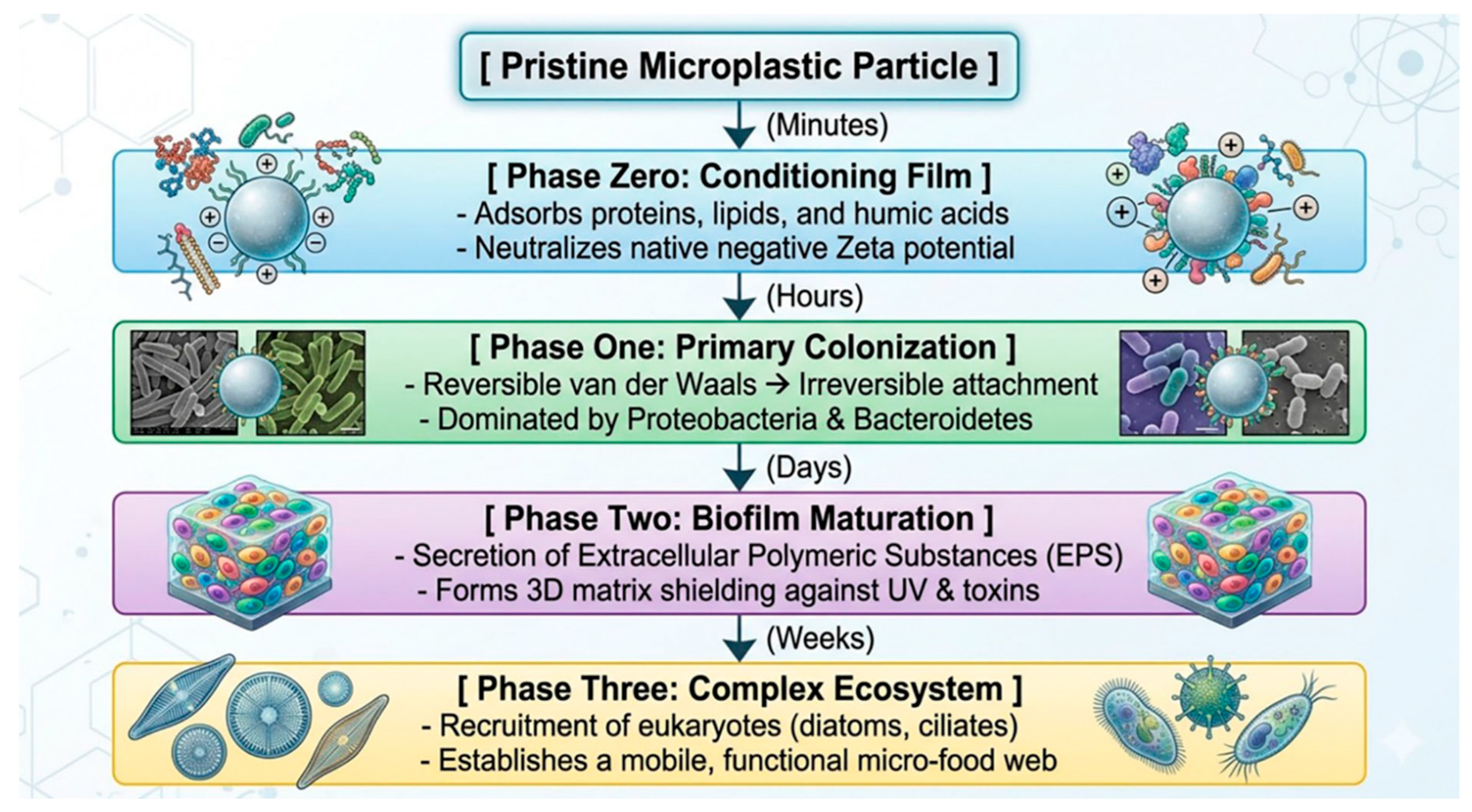
Figure 2.
Polyethylene (R=H), polypropylene (R=CH3), and polystyrene (R=aromatic ring) undergo abiotic degradation following photolytic cleavage of a C–H bond in the polymer backbone (P=polymer backbone [39].
Figure 2.
Polyethylene (R=H), polypropylene (R=CH3), and polystyrene (R=aromatic ring) undergo abiotic degradation following photolytic cleavage of a C–H bond in the polymer backbone (P=polymer backbone [39].
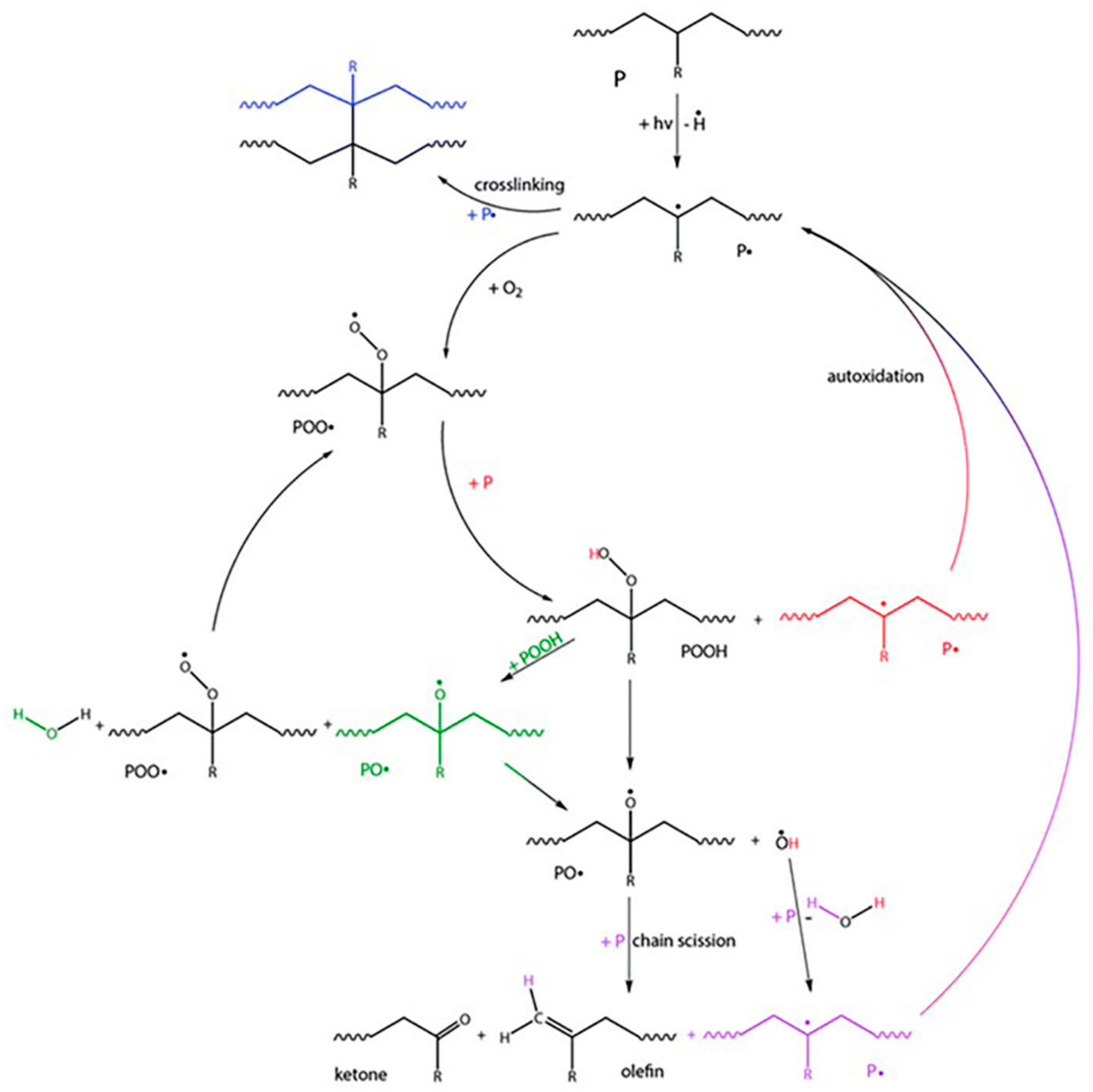
Figure 5.
Proposed metabolic pathways and enzymatic mechanisms of polystyrene biodegradation. Upstream styrene dioxygenases, monooxygenases, and oxide isomerases initiate initial ring attack, while downstream catechol dioxygenases, hydrolases, aldolases, and dehydrogenases carry out intermediate ring cleavage and catabolism, funneling aromatic fragments into the central tricarboxylic acid (TCA) cycle [55].
Figure 5.
Proposed metabolic pathways and enzymatic mechanisms of polystyrene biodegradation. Upstream styrene dioxygenases, monooxygenases, and oxide isomerases initiate initial ring attack, while downstream catechol dioxygenases, hydrolases, aldolases, and dehydrogenases carry out intermediate ring cleavage and catabolism, funneling aromatic fragments into the central tricarboxylic acid (TCA) cycle [55].
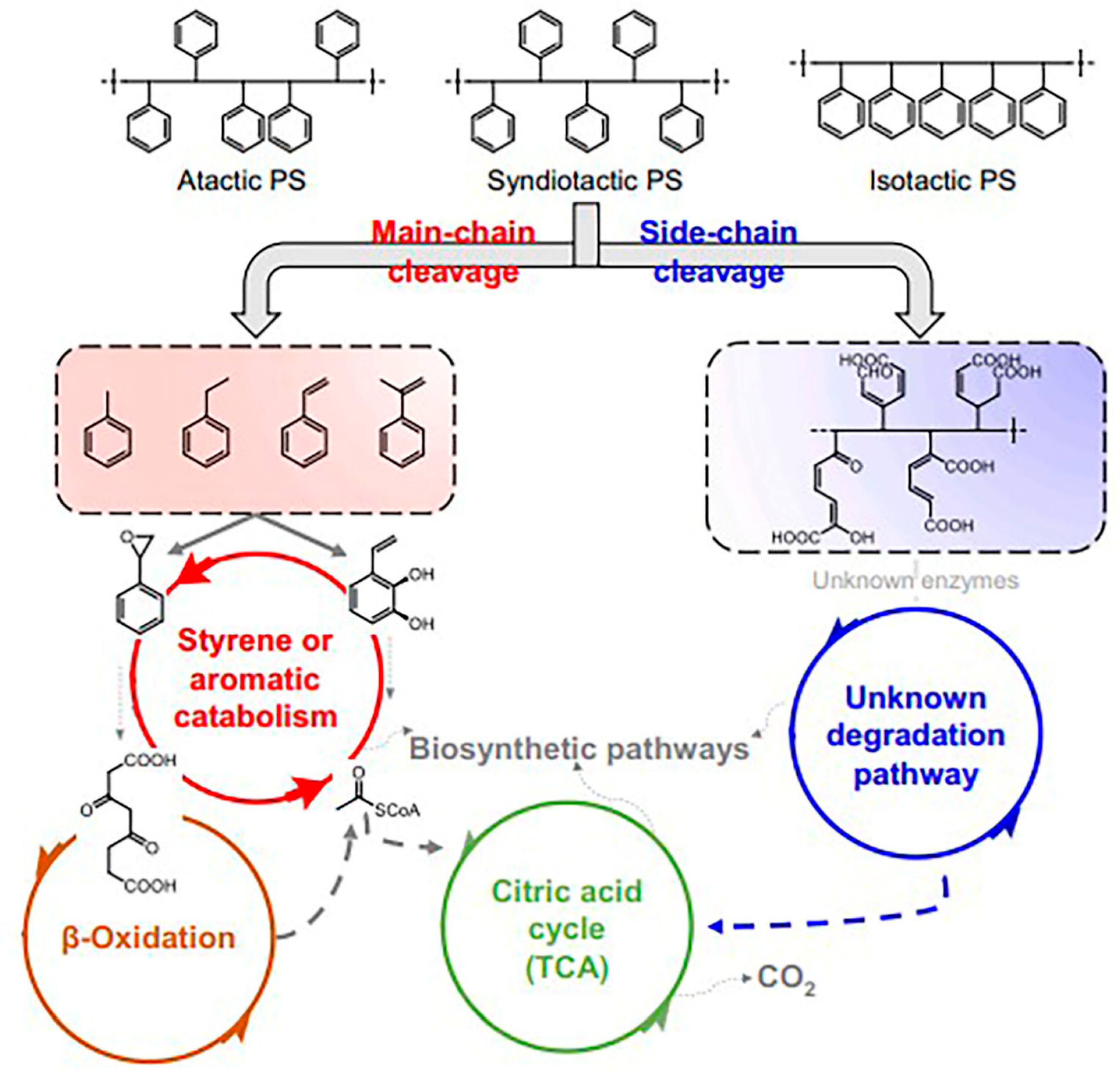
Figure 6.
The depolymerization of PET into bis(2-hydroxyethyl)-terephthalic acid (BHET), mono(2-hydroxyethyl)-terephthalic acid (MHET), and terephthalic acid (TPA) is facilitated by PETase. MHET is subsequently converted to ethylene glycol (EG) and terephthalic acid (TPA) by MHETase [56].
Figure 6.
The depolymerization of PET into bis(2-hydroxyethyl)-terephthalic acid (BHET), mono(2-hydroxyethyl)-terephthalic acid (MHET), and terephthalic acid (TPA) is facilitated by PETase. MHET is subsequently converted to ethylene glycol (EG) and terephthalic acid (TPA) by MHETase [56].
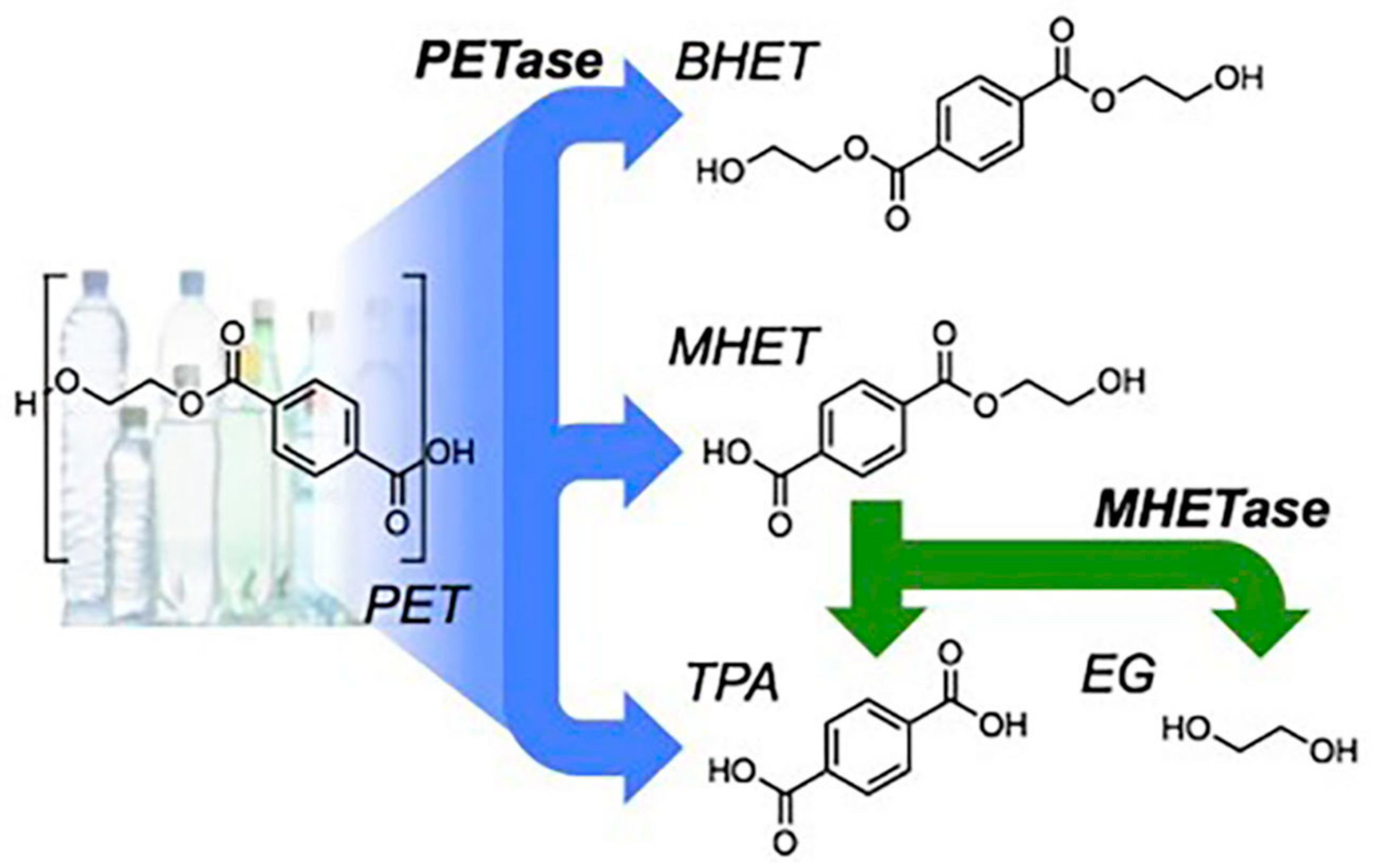
Figure 7.
Fourier-transform infrared (FTIR) analysis of polystyrene transformation showing the attenuation of aliphatic bands and the appearance of oxygenated functional groups mediated by Hafnia paralvei UUNT_MP29 [62].
Figure 7.
Fourier-transform infrared (FTIR) analysis of polystyrene transformation showing the attenuation of aliphatic bands and the appearance of oxygenated functional groups mediated by Hafnia paralvei UUNT_MP29 [62].
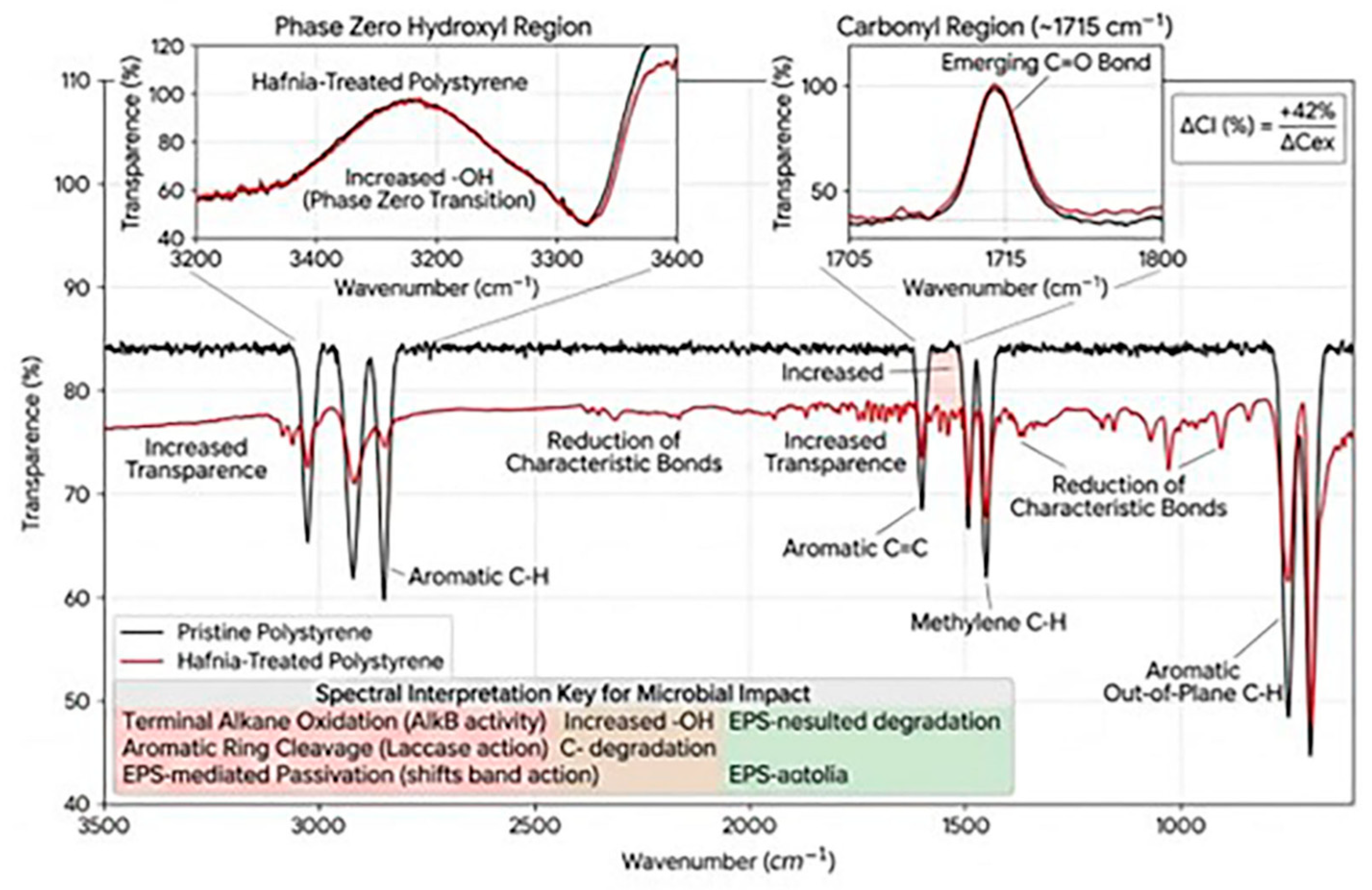
Figure 8.
DTG curves of pristine (black line) and polyolefin film subjected to a 16-day biotic exposure with H. paralvei UUNT_MP29 (red line). The pronounced downward shift in the maximum decomposition temperature (ΔTmax= 10.95 ∘C) indicates a substantial reduction in thermal stability, confirming macrostructural destabilization of the polymer backbone.
Figure 8.
DTG curves of pristine (black line) and polyolefin film subjected to a 16-day biotic exposure with H. paralvei UUNT_MP29 (red line). The pronounced downward shift in the maximum decomposition temperature (ΔTmax= 10.95 ∘C) indicates a substantial reduction in thermal stability, confirming macrostructural destabilization of the polymer backbone.
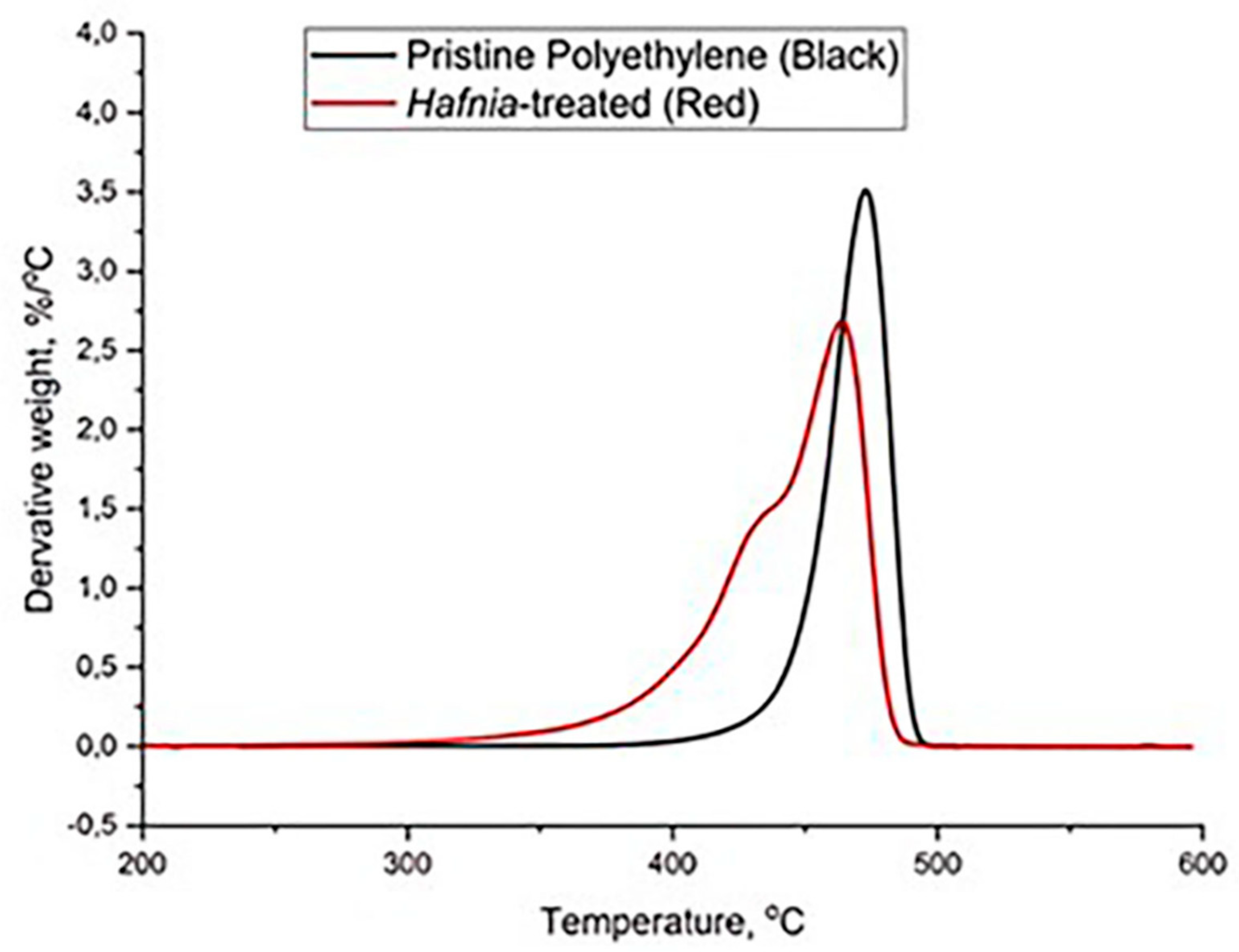
Figure 9.
(a–c) Pristine LDPE control films displaying a smooth surface and (d–f) H. paralvei UUNT_MP29 treated LDPE over 16 days at progressive magnifications (200–10,000×), highlighting deep erosion pockets, microcracks, and structural pitting.
Figure 9.
(a–c) Pristine LDPE control films displaying a smooth surface and (d–f) H. paralvei UUNT_MP29 treated LDPE over 16 days at progressive magnifications (200–10,000×), highlighting deep erosion pockets, microcracks, and structural pitting.
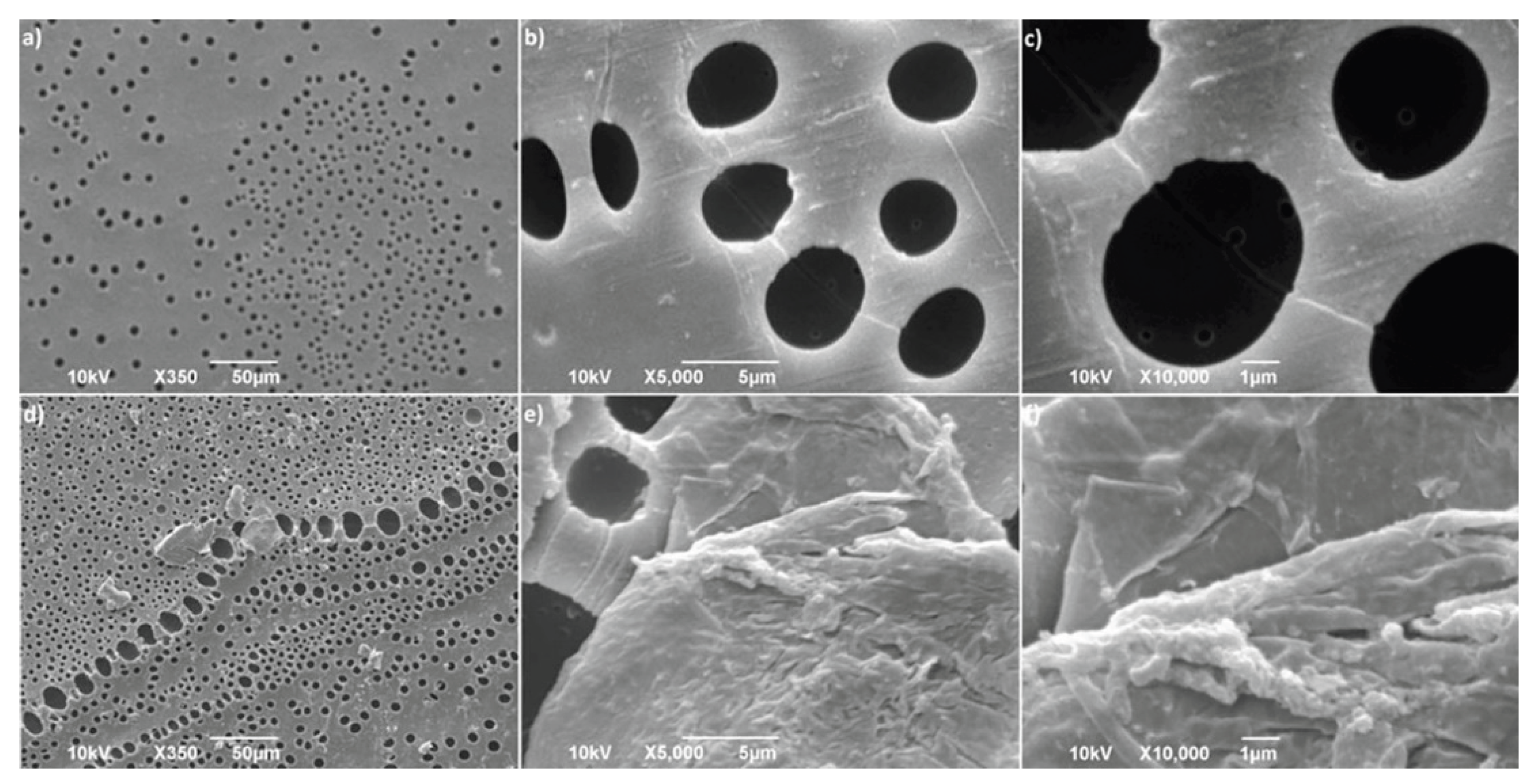
Figure 10.
The degradation process is modeled using first-order kinetics (ln(Mt/M0)=−k⋅t). The plot illustrates a linear relationship between the natural logarithm of the residual mass of polyethylene and time (R2=0.9412), indicating the rapid mass reduction observed during the first 8 days of treatment.
Figure 10.
The degradation process is modeled using first-order kinetics (ln(Mt/M0)=−k⋅t). The plot illustrates a linear relationship between the natural logarithm of the residual mass of polyethylene and time (R2=0.9412), indicating the rapid mass reduction observed during the first 8 days of treatment.
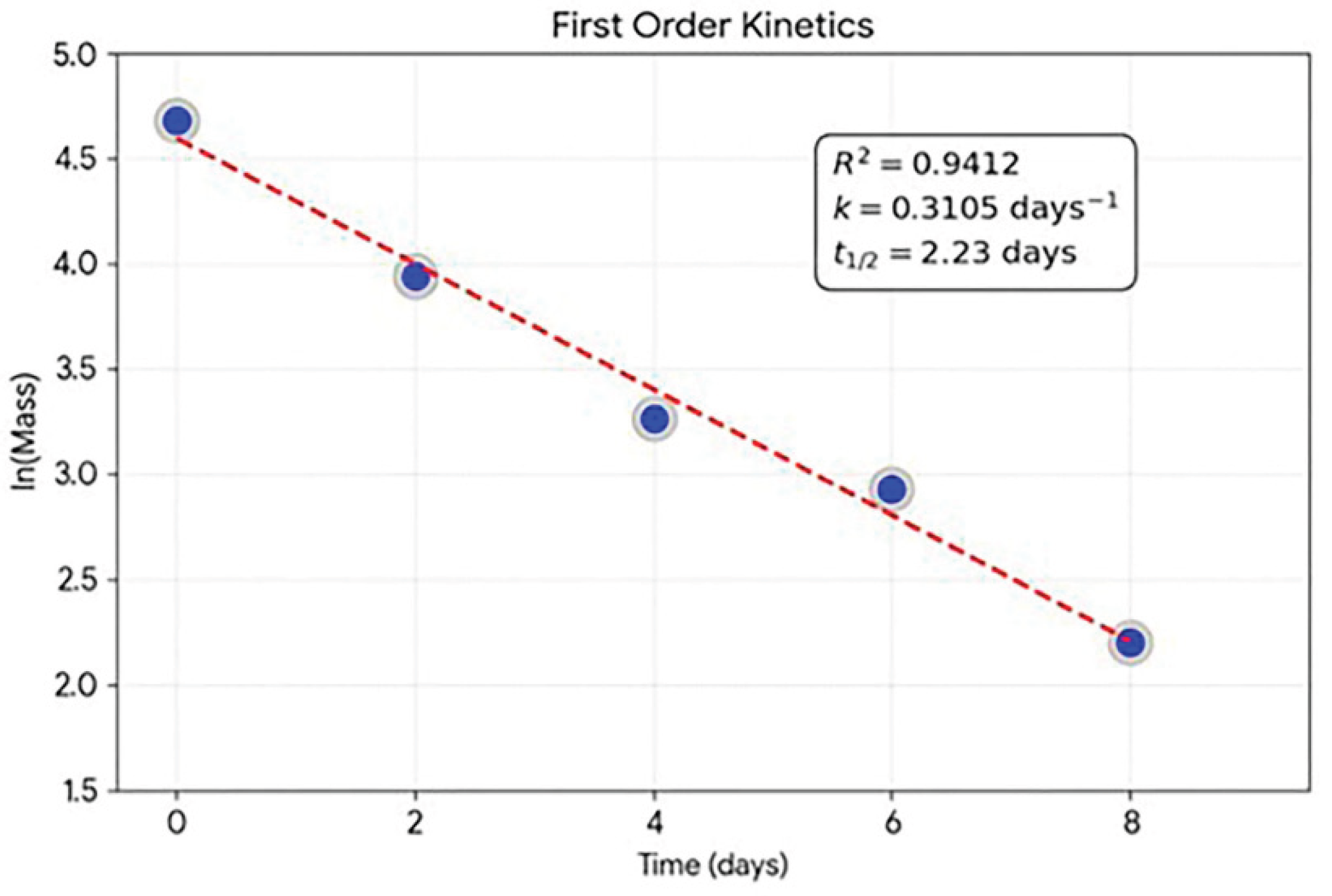
Figure 11.
Multi-parametric architecture and mathematical weighting of the proposed Biodegradability Index (BI): Carbon Mineralization Efficiency (QM, 40%), Macromolecular Chain Length/Weight Reduction (MW, 30%), Fragmentation Surface Dynamics (FSD, 20%), and Ecotoxicity Clearance (EC, 10%).
Figure 11.
Multi-parametric architecture and mathematical weighting of the proposed Biodegradability Index (BI): Carbon Mineralization Efficiency (QM, 40%), Macromolecular Chain Length/Weight Reduction (MW, 30%), Fragmentation Surface Dynamics (FSD, 20%), and Ecotoxicity Clearance (EC, 10%).
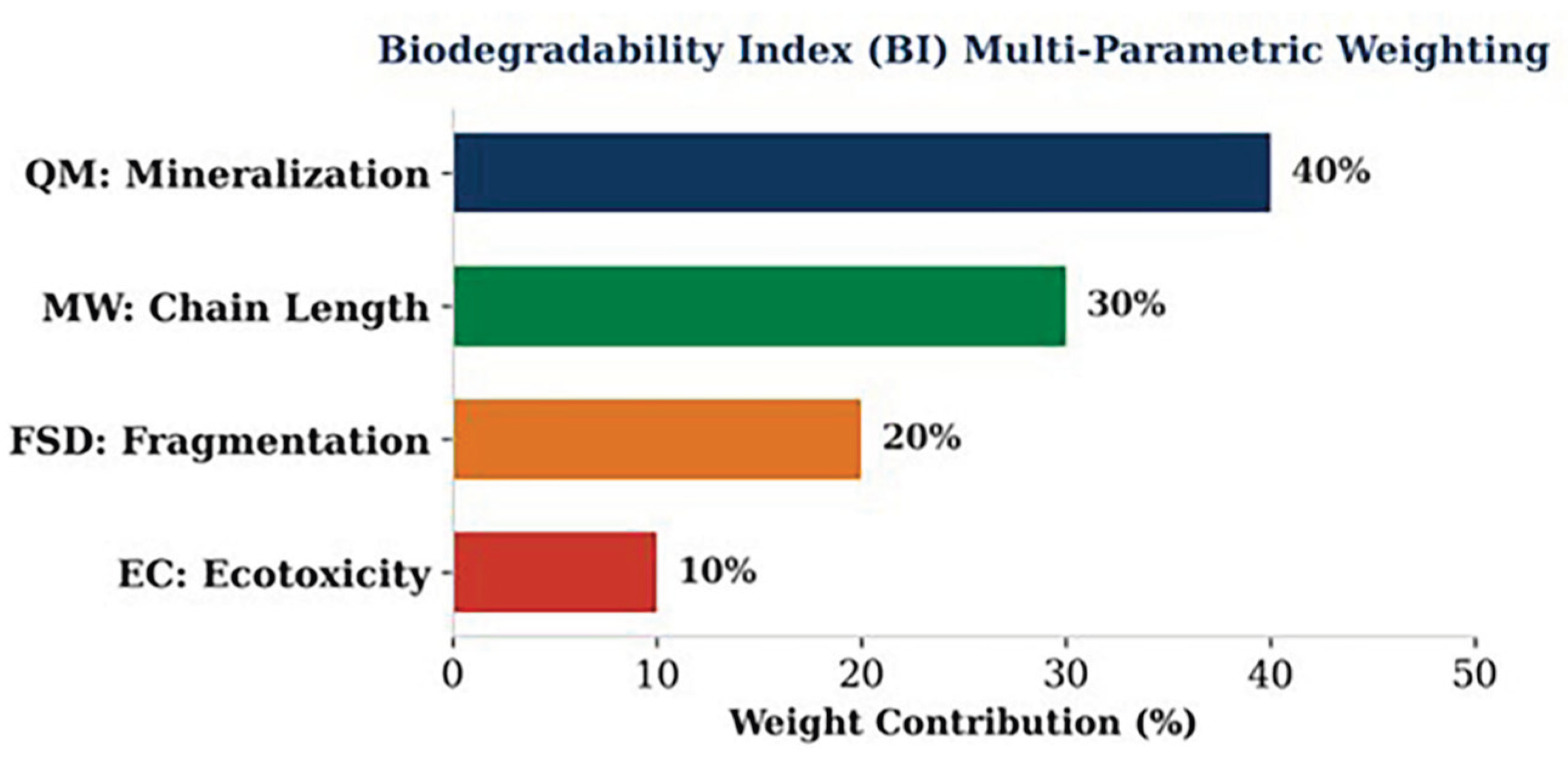
Figure 12.
Integrated workflow for xenobiotic bioremediation in an industrial wastewater treatment plant, connecting AI-driven system optimization, inline multi-omics analytics, and tailored microbial consortia for verified polymer mineralization [100].
Figure 12.
Integrated workflow for xenobiotic bioremediation in an industrial wastewater treatment plant, connecting AI-driven system optimization, inline multi-omics analytics, and tailored microbial consortia for verified polymer mineralization [100].
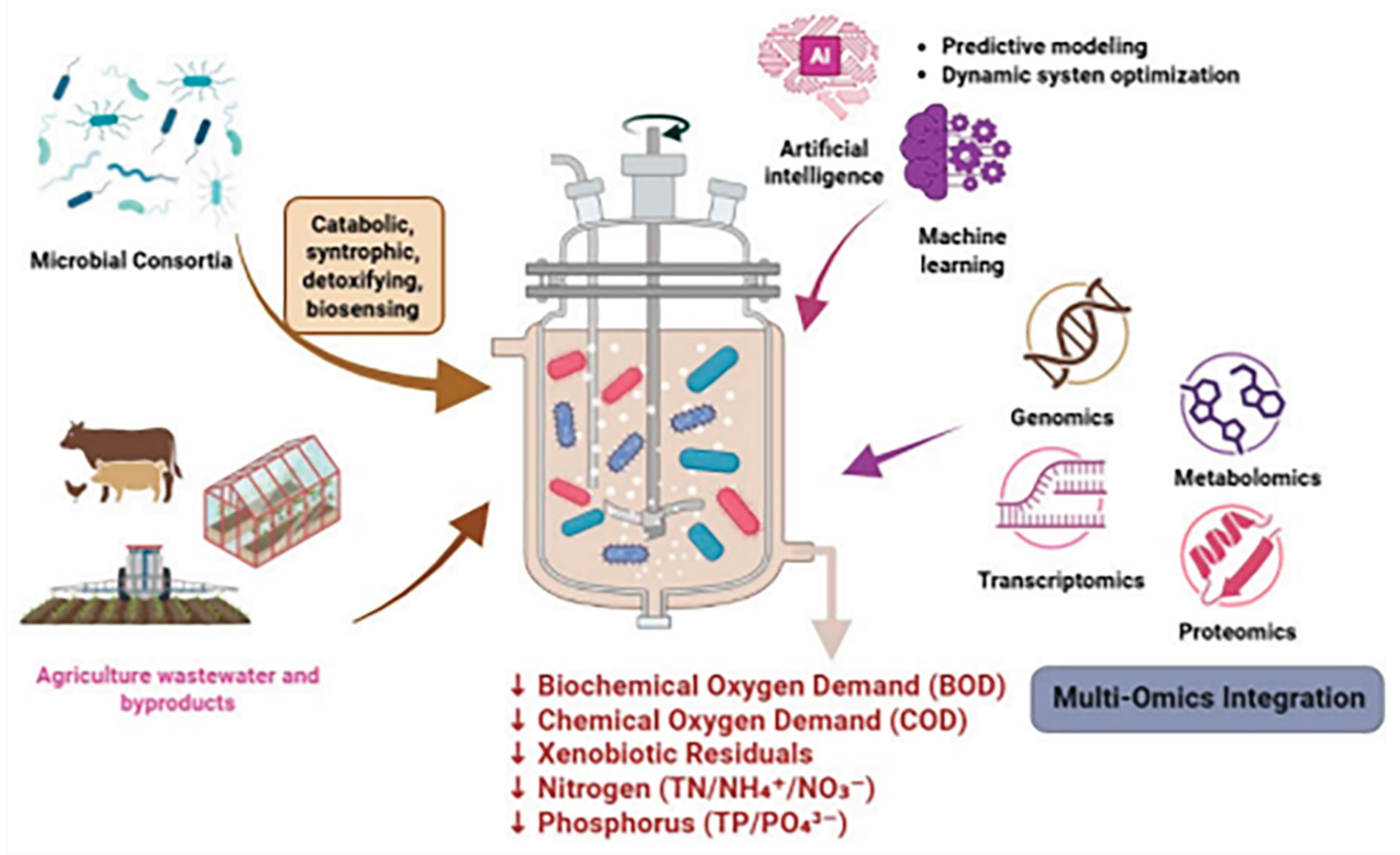

Table 1.
Taxonomic diversity and microbial preferences for common polymer substrates [22,23,24,25,26,27,28,29,30,31,32,33,34].
| Polymer Type | Dominant Microbial Taxa (Genera) | Surface Characteristics & Affinity | Conditioning Film & Priming Characteristics |
|---|---|---|---|
| Polyethylene (PE) | 1-3Pseudomonas, Rhodococcus, Bacillus, Alcanivorax | High hydrophobicity; requires significant pre-oxidation for attachment. | Adsorption of long-chain fatty acids and non-polar lipids to reduce high interfacial energy. |
| Polyethylene Terephthalate (PET) | 4-8Ideonella, Comamonas, Pseudomonas, Saccharomonospora | Semi-crystalline; contains ester bonds susceptible to hydrolysis. | High affinity for proteins and humic acids; overwrites Zeta potential to neutralize the surface for Ideonella attachment. |
| Polypropylene (PP) | 9,10Stenotrophomonas, Bacillus, Pseudomonas | Highly resistant; complex tertiary carbon structure. | Adsorption of multivalent ions (Ca2+, Mg2+) to overwrite Zeta potential, neutralizing repulsive charges on the smooth surface. |
| Polystyrene (PS) | 11,12Exiguobacterium, Rhodococcus, Pseudomonas, Flavobacterium . | Aromatic rings require ring-cleavage oxygenases. | Conditioning film introduces hydrophilic groups (-OH, -COOH) to stabilize the boundary layer for ring-cleavage enzymes. |
Table 2.
Comparative Dynamics of Abiotic Weathering and Biotic Colonization.
| Feature | Abiotic Weathering | Biotic Colonization |
|---|---|---|
| Primary Drivers | Solar UV radiation, thermal fluctuations, and mechanical hydrodynamic abrasion. | Microbial extracellular enzymes, EPS production, and syntrophic metabolic consortia. |
| Effect on Polymer | Random polymer chain scission, microfracturing, and surface oxidation. | Localized bio-erosion, surface pitting, and targeted carbon mineralization. |
| Timescale | Seconds to months (continuous, ambient-dependent). | Hours to years (ordered, successional stages). |
| Physical/Chemical Result | Increased effective surface area and elevated surface hydrophilicity. | Net mass loss, structural thinning, and targeted carbon-carbon bond cleavage. |
Table 3.
Summary of Targeted Microbial Degradation Pathways.
| Microbe | Taxonomic Type | Primary Polymer Target | Governing Biomechanical/Biochemical Mechanism |
|---|---|---|---|
| Ideonella sakaiensis | Bacterium | Polyethylene Terephthalate (PET) | Dual-enzyme extracellular hydrolysis via highly specific PETase and MHETase expression. |
| Pseudomonas putida | Bacterium | Polyethylene (PE), Polypropylene (PP) | Alkane monooxygenase-mediated terminal oxidation of saturated hydrocarbon backbones. |
| Aspergillus niger | Fungus | Low-Density Polyethylene (LDPE), Polyurethane (PUR) | Synergistic physical hyphal penetration is paired with the secretion of non-specific esterases and proteases. |
| Exiguobacterium sp. | Gut Symbiont (Bacterium) | Polystyrene (PS) | Upstream monooxygenases and ring-cleaving dioxygenases targeting the aromatic styrene subunits. |
| Enzyme Class | Primary Mechanism | Target Plastic | Catalytic Efficiency & Output |
|---|---|---|---|
| Hydrolases (Cutinases, Esterases) |
Nucleophilic bond cleavage via water insertion. | PET, PUR, PLA. | High: Highly targeted depolymerization yielding uniform, bioavailable monomers. |
| Oxygenases (Mono- & Dioxygenases) |
Insertion of molecular O2 into hydrophobic chains. | PE, PP. | Moderate-Low: Slow kinetics due to high activation-energy barriers of saturated hydrocarbons. |
| Laccases (Multi-Copper Oxidases) |
Redox-driven free radical gention and chain scission. | PS, PE. | Moderate: Broad-spectrum but non-specific, yielding highly heterogeneous polymer fragments. |
Table 5.
Proposed Biodegradability Index (BI) Scoring Framework.
| Pillar Metric | Method of Measurement | Ecological / Structural Significance | Score Weighting |
|---|---|---|---|
| Mineralization (QM) | Closed-circuit respirometry (CO2 / CH4 headspace yield). | Confirms true metabolic end-point and absolute carbon assimilation into the food web. | 40% |
| Chain Length (MW) | Gel Permeation Chromatography (GPC) / Size Exclusion Chromatography. | Validates cleavage of the intrinsic long-chain structural backbone and a reduction in molecular weight. | 30% |
| Fragmentation (FSD) | Automated SEM Image Analysis / High-Resolution Micro-Raman Spectroscopy. | Tracks the physical fragmentation, surface pitting, and porosity of the bulk matrix. | 20% |
| Ecotoxicity (EC) | Vibrio fischeri bioluminescence inhibition / Daphnia magna acute immobilization. | Ensures the absolute environmental safety of downstream metabolic intermediates and leached chemical additives. | 10% |
Disclaimer/Publisher’s Note: The statements, opinions and data contained in all publications are solely those of the individual author(s) and contributor(s) and not of MDPI and/or the editor(s). MDPI and/or the editor(s) disclaim responsibility for any injury to people or property resulting from any ideas, methods, instructions or products referred to in the content. |
© 2026 by the authors. Licensee MDPI, Basel, Switzerland. This article is an open access article distributed under the terms and conditions of the Creative Commons Attribution (CC BY) license (http://creativecommons.org/licenses/by/4.0/).
Copyright: This open access article is published under a Creative Commons CC BY 4.0 license, which permit the free download, distribution, and reuse, provided that the author and preprint are cited in any reuse.


