

Submitted:
09 June 2026
Posted:
10 June 2026
You are already at the latest version
Abstract
A programmable Cas12a-based biosensing system is developed for sensitive and se-lective detection of Pectobacterium polaris, a newly emerging pathogen affecting a wide range of agriculturally important plants. The system relies on asymmetric PCR (aPCR) and PAM-independent recognition of single-stranded DNA by a Cas12a/gRNA complex and allowed to determine P. polaris with limit of detection of 10 copies of bacterial genome per reaction. The overall assay time is about 2 h. The detection is achieved by using PCR primers specific for Pectobacterium species and gRNA selectively recognizing sequence unique for P. polaris. With no PAM requirement, the system selectivity was fine-turned by properly positioning gRNA spacer on single-stranded amplicons. The designed aPCR/Cas12a biosensing system is compatible with the introduction of uracil into ampli-cons to prevent carryover contamination and with visual detection. In a broad context, the findings suggest that PCR tests for pathogen detection can be easily adapted to a format of aPCR/Cas12a programmable biosensing by converting PCR into aPCR and by coupling aPCR to PAM-independent Cas12a analysis of single-stranded amplicons. This may pave the way to modify current laboratory-based PCR tests into on-site tests conducted on con-ventional inexpensive thermocyclers with subsequent visual detection for on-site screen-ing or initial decision-making.
Keywords:
programmable biosensing
; P. polaris detection
; asymmetric PCR
; single-stranded DNA
; Cas12a nuclease
; protospacer adjacent motif
1. Introduction
Plant diseases caused by phytopathogens pose a severe threat to agriculture. They result in 20%–40% losses of crop yield annually around the world and can also impair the quality of agricultural production [1]. Among plant pathogens, Pectobacterium species are known to affect a wide range of agriculturally important plants and can cause plant diseases such as soft rot, stem rot, wilt, and blackleg [2]. Agricultural plants affected by Pectobacterium spp. include potato, carrot, leafy greens, tomato, pepper, cucumber, and some others. Among them, potato is by far the most important crop. Potato is ranked as the third globally consumed staple food and recommended as a food security crop by the UN Food and Agriculture Organization [3]. The blackleg and soft rot are known to result in significant losses of potato harvest both on the field and during potato storage [4].
Pectobacterium polaris is a newly emerging pathogenic species of Pectobacterium genus, first classified in 2017 [5]. To date, the species is found in different regions of the world [5,6,7,8,9,10]. In potato, P. polaris causes symptoms such as blackleg, stem soft rot, and tuber decay. Also, it can potentially infect and cause diseases in a wide range of other agricultural plants [11]. Presently, molecular detection of P. polaris is only possibly by using polymerase chain reaction (PCR), with two sets of primers. One of them is for the endpoint PCR detection and provides the limit of detection (LOD) of 1 pg of P. polaris genomic DNA per PCR tube, whereas another – for real-time PCR detection with LOD of 100 pg of genomic DNA per PCR tube [10].
The timely and accurate identification of pathogens is of importance for controlling plant diseases and pathogen spread. Along with conventional methods of molecular diagnostics such as PCR or immunochemical techniques, the combination of CRISPR/Cas nucleases with methods of nucleic acid amplification has appeared as an emerging trend in plant pathogen detection over the last several years [12]. Due to the ability of CRISPR/Cas nucleases to be precisely directed to a particular sequence in DNA or RNA via complexing with guide RNA (gRNA), the CRISPR/Cas-based detection systems are often referred to as programmable biosensing systems [13]. The advantages of such biosensing systems are their enhanced selectivity, high sensitivity, and the adaptability to a format of on-site detection [12,13].
Among CRISPR nucleases, the Cas12a nuclease is most often used for a design of programmable biosensing systems, including those for plant pathogen detection [12,14]. Yet, the prerequisite for a protospacer adjacent motif (PAM) in an amplicon sequence remains the bottleneck for their design. The requirement for PAM imposes an additional restriction on amplification primers so that the most effective primer sets cannot necessarily be utilized when coupling Cas12 nuclease to a DNA amplification method. Moreover, the PAM requirement also limits the choice of a gRNA spacer sequence since one becomes predetermined by a location of PAM in an amplicon. To overcome the PAM problem, it has been suggested to diversify PAM sequences by employing engineered Cas12a variants [15,16]. However, such variants can be not easily available to a researcher interested in a design of a Cas12a-based biosensing system. In another approach, PAM sequences were introduced into amplicons with specially designed primers (e.g., [17,18]). This requires a modification of primers that can in general worsen their performance in amplification reaction. Besides, in both approaches, PAM location still predefines the sequence of gRNA spacer, making the design of Cas12a-based detection systems quite inflexible.
The conceptually different strategy to solve the PAM problem is to switch from double stranded DNA (dsDNA) to single-stranded DNA (ssDNA) as a target recognized by a Cas12a/gRNA complex. It exploits the ability of Cas12a nuclease to be activated by hybridization of a gRNA spacer with a single-stranded protospacer in the absence of PAM. This strategy has initially been suggested for coupling recombinase polymerase amplification (RPA) to the PAM-independent Cas12a analysis of RPA amplicons [19,20]. Later, it has also been realized to couple Cas12a nuclease to loop-mediated isothermal amplification (LAMP), in particular for detecting plant pathogen C. sepedonicus [21]. Very recently, this approach was used to combine PCR and the post-PCR Cas12a-based analysis in a PAM-independent manner [22]. In the case of LAMP, the PAM-free Cas12a detection relied on targeting ssDNA loops which are a part of regular LAMP amplicons [21]. In contrast, DNA amplicons produced in RPA or PCR are supposed to be entirely double-stranded. Consequently, the coupling of Cas12a to RPA or PCR for a PAM-free detection has required a particular mode of amplification, known as asymmetric [19,20,22]. In asymmetric amplification, primer concentrations are taken unequal so that the ssDNA amplicons are generated along with the common dsDNA amplicons [23]. Alongside with taking the primer concentrations unequal, in the particular case of PCR, ssDNA amplicons can be produced by selecting primers so that their melting temperatures substantially differ – the amplification mode sometimes referred to as asynchronous PCR [24]. For simplicity, we will further refer to PCR methods with a mixed output of ss- and dsDNA amplicons as asymmetric PCR (aPCR).
In another alternative approach to design PAM-independent Cas12a-based biosensing systems by targeting ssDNA, the post-amplification denaturation of dsDNA amplicons by heating or alkaline treatment has been suggested [25]. After cooling or neutralization with acid, double-stranded amplicons produced by PCR or RPA appear not to renature completely, leaving DNA strands partially in a single-stranded state [25]. The approach is simple and robust. However, it is thought that the amplicon size can be crucial for its successful practical implementation in general since short dsDNA amplicons may be expected to renature effectively and practically completely.
In the present study, we have developed a PAM-independent aPCR/Cas12a-based programmable biosensing system for sensitive and selective detection of P. polaris. The study also pushes further the development of aPCR/Cas12a programmable biosensing systems in general by demonstrating that (i) a highly sensitive and selective detection of bacterial species can be achieved by a species-specific PAM-independent Cas12a-based analysis of ssDNA amplicons generated by aPCR with a genus-specific primer set; (ii) in the absence of PAM requirement, the selectivity of Cas12a analysis can be fine-turned by properly positioning gRNA spacer on the ssDNA amplicon; (iii) the uracil-modified ssDNA amplicons generated by aPCR with uracil deoxynucleotide triphosphate (dUTP) can activate Francisella tularensis Cas12a nuclease; (iv) the testing can be performed with a visual Cas12a-based detection of specific amplicons. The later can potentially simplify the adaptation of the developed biosensing system to on-site testing if aPCR is to be carried out in an endpoint mode on an inexpensive conventional thermocycler or a portable autonomous thermocycler [26]. To achieve the study goals, we employed the widely used PCR primers developed by Darrasse et al. against species of Pectobacterium genus, known as primers Y1 and Y2 [27]. These primers target the pectate lyase-encoding gene (pel1 gene) shared by many Pectobacterium spp. P. polaris was selectively detected by directing gRNA to the amplicon section with a sequence unique for that species.
2. Materials and Methods
Strains from genera Pectobacterium (9 strains; 8 species), Dickeya (2 strains; 2 species), Clavibacter (7 strains; 6 species), Agrobacterium (1 strain, 1 species), and Escherichia (1 strain, 1 species) used in the study are listed in Table S1. Except for Clavibacter species and E. coli, bacteria were cultivated as suspension in standard LB medium (Dia-M, Moscow, Russia) at 28 °С. E. coli were cultivated at 37 °С. The Clavibacter species were grown on Petri dishes with agar medium at 28 °C as described elsewhere [21]. DNA was extracted from bacteria with the “innuPREP Bacteria DNA Kit” (IST Innuscreen GmbH, Berlin, Germany) after their pelleting by centrifugation, following the manufacturer’s instructions for Gram-positive or Gram-negative bacteria. For extracting DNA from potato, the “SKYSuper Plant Genomic DNA” isolation kit (SkyGen, Moscow, Russia) was used. DNA was isolated from 100 mg potato samples either non-contaminated or artificially contaminated with P. polaris. Contaminated potato samples were prepared by spiking them with 10 µL of 10-fold dilutions of P. polaris suspension in sterile distilled water. The number of bacterial genomes in DNA extracted from contaminated potato samples was quantified by real-time PCR, using the commercial kit for Pectobacterium spp. detection in plant tissue (“Pectobacterium spp-РВ”; Syntol, Moscow, Russia) and the standard curve kindly provided by the kit’s manufacturer. For that, the real-time PCR was conducted on a DTprime5 thermal cycler (DNA-Technology, Moscow, Russia). DNA concentrations were determined on a Qubit 4 fluorimeter (Thermo Fisher Scientific, Waltham, MA, USA) with the “Qubit dsDNA BR Assay” kit (Thermo Fisher Scientific). All DNA preparations were aliquoted right after DNA isolation and aliquots were stored at –20 °С until further use.
To perform PCR, the commercial PCR master mix “5X qPCRmix-HS SYBR” from Evrogen (Moscow, Russia) was used. Uracil-modified ssDNA amplicons were produced by PCR with the Evrogen’s master mix “5X qPCRmix-HS (UDG)”. In the latter case, where necessary, the EvaGreen fluorescent dye (Lumiprobe, Moscow, Russia) was added to PCR reaction at a 40-fold dilution of the commercial stock solution of the dye to monitor amplification in real time. Bacterial and/or potato DNA was introduced into PCR reaction by adding 1 µL of DNA solution of desired concentration. The final volume of PCR mixture was 20 µL. Primers Y1 and Y2 [27] used to perform PCR were chemically synthesized and HPLC-purified by Lumiprobe and their sequences are provided in Table S2. The concentrations of primers were either 400 nM of each or the concentration of one of the primers varied from 400 nM to 40 nM while that of another was kept at 400 nM. All dilutions were made with deionized (18 MΩ) Milli-Q water. Real-time PCR and melting curve analysis were carried out on a Bio-Rad CFX96 thermal cycler (Bio-Rad Laboratories, Hercules, CA, USA). Unless otherwise indicated, amplification runs were started with 10 min pre-heat at 95 °С, followed by 30 to 60 cycles with 1 min at 95 °С, 1 min at 65 °С, and 1.5 min at 72 °С, and finished with 3 min final extension at 72 °С. Where required, PCR samples were subjected to heating for 5 min at 95 °С post-PCR and then placed in an ice water bath for sharp cooling. To verify the sequence of the amplified segment of bacterial genomic DNA, amplicons from Pectobacterium species were subjected to Sanger sequencing carried out by Evrogen. Corresponding sequences retrieved from the NCBI databases and those obtained by the Sanger sequencing are provided in Table S3.
To perform the Cas12a-based analysis of ssDNA amplicons, the recombinant CRISPR-nuclease Cas12a from Francisella tularensis was heterologously expressed and purified as described in Ref. [28]. gRNAs (Table 1) were produced enzymatically, using “TranscriptAid T7 High Yield Transcription Kit” (Thermo Fisher Scientific). To produce gRNAs, one of the templates for gRNA synthesis and the oligonucleotide T7P, listed in Table S2, were mixed at equimolar concentrations. gRNAs were purified as described in Ref. [28]. If not stated otherwise, Cas12a nuclease and gRNA (each at the final concentration of 60 nM) were mixed in the reaction buffer composed of 40 mM Tris-HCl, 40 mM glycine, 6 mM MgCl2, 1 mM dithiothreitol, 0.001% Triton X-100, 0.4% polyethylene glycol (pH 8.6) and left on a bench for 10 min. As a rule, 19 µL of the prepared Cas12a/gRNA mixture were combined with 1 µL of a solution of “molecular reporters” (MRs) so that the final MR concentration was 1 µM. MR sequence is provided in Table S2. MR is a short DNA oligonucleotide labeled with FAM (6-carboxyfluorescein) and BHQ-1 (fluorescence quencher) at its termini. Right thereafter, 1 µL or 5 µL aliquot of completed aPCR reaction has been added. For control, the same volume of PCR no-template control (PCR NTC) was used. The prepared Cas12a reaction mixtures were used immediately for fluorescence measurements. The real-time monitoring of Cas12a trans-cleavage activity was carried out on a DTprime5 thermal cycler at a constant temperature of 37 °C. The fluorescence intensity was measured in 1 min intervals. For visual detection, the test tubes were placed either on a blue light transilluminator SkyLight-Pad Edge 20-blue V1 (Viber, Eberhardzell, Germany) or illuminated with a Blue Light LED flashlight (TaoYuan Optoelectronics Shenzhen Co., Shenzhen, China) against a dark background. The test tube images were captured with a smartphone camera through an orange filter.
Arithmetic means, standard deviations, and confidence level p-values were calculated using Microsoft Excel’s statistical functions, based on results of 3 to 5 independent experiments.
3. Results
3.1. The Performance of the Y1-Y2 Primer Pair in PCR
Firstly, the performance of the Y1-Y2 primer set (Table S2) in conventional real-time PCR has been assessed at their molar ratio of 1:1, using the originally suggested duration times of 60 s, 60 s, and 90 s for denaturation, annealing, and extension steps, respectively [27]. This PCR regime will be further referred to as “60-60-90”. Figure 1 shows amplification curves for Pectobacterium strains listed in Table S1. As seen, for all Pectobacterium species used in the study, the typical S-shaped amplification curves are observed. However, a sharp increase of fluorescence at late PCR cycles was also observed for the control test tubes with no bacterial DNA (PCR NTCs) within 40 cycle runs, as illustrated in Figure 1a. The melting curve analysis showed that amplicons produced in PCR NTC have melting temperature (Tm) noticeably lower than Tm of amplicons produced in PCR with DNA of Pectobacterium species (81 °С vs. 87 °С, Figure 1b). Apparently, non-specific amplification products are generated in PCR NTC at the late PCR cycles, likely due to some susceptibility of Y1-Y2 primers to a formation of primer-dimers and, probably, the primer-dimer concatemers, as may be judged by the relatively high melting temperature of 81 °С.
The detection sensitivity of PCR with the Y1-Y2 primer pair was evaluated with genomic DNA of P. polaris, P. carotovorum, and P. brasilience. The series of 10-fold dilutions of genomic DNA were prepared so that the number of copies of bacterial genomes varied from 106 copies down to 1 copy per µL of solution. The size of genomes in Pectobacterium species lies in the range of 4.7·106 to 5.0·106 base pairs (bp) [29] and can be taken as 4.85·106 bp at average. Thus, the number of genome copies in µL, Cn, was calculated as follows: Cn = C·NA / 650·4.85·106, where 650 (g/mol) is the average molecular weight of base pare (bp), 4.85·106 is the average genome size in bp, NA = 6.02·1023 mol–1 is Avogadro’s number, and C (g/µL) is DNA concentration. The concentration dependences of quantitation cycle (Cq, provided by a PCR thermocycler software) on the number of genome copies in a PCR tube were linear in a semi-logarithmic scale (Figure S1). It should be noted that for a load of 1 genome copy, only Cq values corresponding to specific PCR products (as judged by the melting curve analysis) have been taken into consideration. If melting curve analysis demonstrated that products may be unspecific (Tm is around of 81 °С compared to that of about 87 °С for specific products, Figure 1b) or represent a mixture of specific and unspecific amplicons (as exemplified in Figure S2), such Cq values have been excluded. For loads of 10 genome copies or above, merely specific products (Tm ≈ 87 °С) were observed. Thus finally, the load of 10 genome copies per PCR reaction may be taken as a LOD value for PCR-based detection of Pectobacterium species with the Y1-Y2 primer pair.
3.2. Asymmetric PCR with the Y1-Y2 Primer Pair and Detection of Single-Stranded Amplicons with a Cas12a/gRNA Complex
To convert PCR with Y1-Y2 primer pair into aPCR, an arbitrary primer molar ratio of Y1/Y2 = 2 has been taken at the first step. The twofold excess of Y1 primer has to favor the synthesis of DNA strand which is targeted by a complex of Cas12a nuclease with gRNA1 (Table 1). The gRNA1 spacer was designed so to target the segment in PCR amplicons with sequence identical for Pectobacterium species used in the study (nucleotide positions from 252 through 271, Table S3). As seen from Figure 2, the PCR amplicons generated at the Y1/Y2 molar ratio of 2 did induce the Cas12a activation, as exemplified with PCR products from genomic DNA of P. polaris. Since gRNA1 was designed to target a segment in dsDNA amplicons with no corresponding PAM (Table S3), this evidently indicates that ssDNA amplicons can be produced in aPCR with the twofold excess of Y1 primer and that such single-stranded amplicons do not require PAM to activate Cas12a nuclease.
With the original cycle duration time [27], the overall time of PCR was about 3 hours for 40 cycles and almost 4 hours for 60 cycles. Thus, as a second step, the PCR conditions such as the total amplification time and the primers ratio were optimized so to reasonably minimize the total amplification time and to enhance the yield of ssDNA amplicons. As seen from Table 2, for the case of P. polaris, Cq values increased when the cycle duration time decreased. However, the overall time of a PCR run with 40 cycles has become markedly lesser for the PCR regime “15-15-30” (the durations of denaturation, annealing, and extension steps are 15 s, 15 s, and 30 s, respectively).
The variations of the cycle duration time appeared not to affect the production of target ssDNA amplicons to a substantial extent since the kinetics of MR cleavage by Cas12a nuclease was approximately the same (Figure 2). In fact, as may be judged by the cleavage kinetics, the yield of target ssDNA amplicons for the shortest cycle duration time can even be somewhat higher. So, the PCR regime “15-15-30” has been selected for further experiments. For this PCR regime, the primer molar ratios were further varied in the range of 1 to 10. Either primer Y1 (the Y1/Y2 ratio) or primer Y2 (the Y2/Y1 ratio) was present in excess to favor synthesis of target or non-target DNA strand, respectively. Furthermore, PCR samples were either subjected or not subjected to the post-PCR heat treatment (the heating/cooling step). PCR products in all PCR samples were tested with the Cas12a/gRNA1 complex.
The results of systematic variations of the primer molar ratio are presented in Figure 3 for the case of P. polaris. The amplification efficiency declines when the concentration of one of the primers decreases as may be judged by comparing Cq values (Figure 3a). The decline was more pronounced for the excess of Y1 primer. At the same time, the yield of target ssDNA amplicons negligible at the equimolar primer concentrations has been greatly enhanced at the Y1/Y2 molar ratios of 2 to 10 (Figure 3b). The yield was estimated by comparing the Cas12a activation, based on the initial rate of MR cleavage, V0. Here V0 is a slope of the near-linear increase of fluorescence at the beginning of a kinetic curve, as illustrated by Figure S3. If PCR products were subjected to the post-PCR heat treatment, the marked Cas12a activation was already observed at Y1/Y2 molar ratio of 1. For the higher Y1/Y2 molar ratios, the trans-cleavage activities of Cas12a were statistically undistinguishable between the heat-treated and untreated samples (Figure 3b). The expected excessive production of the non-target DNA strand in aPCR with the Y2/Y1 primer molar ratios > 1 resulted in PCR products unable to activate Cas12a nuclease, irrespectively of the post-PCR heat treatment. It should also be noted that activation of Cas12a nuclease by amplicons generated in PCR at the Y1/Y2 molar ratio of 1 and subjected to the post-PCR heat treatment resulted in a greater scatter of V0 values (Figure 3b). Thus, as a reasonable compromise, the Y1/Y2 molar ratio of 4 has been chosen for further experiments.
3.3. Analytical Characteristics of aPCR/Cas12a Detection System
The sensitivity of the optimized aPCR (the regime “15-15-30”, Y1/Y2 = 4) has been determined for bacterial DNA alone and in the presence of 100 ng of potato DNA, using P. polaris as an example. As seen from Figure 4, the dependencies of Cq on DNA loads were linear in a semi-logarithmic scale in both cases and practically coincided. The performance of the optimized aPCR in regard to generation of specific and non-specific amplicons at loads of 1 copy of bacterial genome per PCR tube and for PCR NTC was similar to that observed earlier for PCR with the regime “60-60-90” and the Y1/Y2 molar ratio of 1 (as illustrated by Figure 1b and Figure S2). Therefore, the value of LOD for the optimized aPCR may be taken as 10 copies of bacterial genome per PCR reaction as well. To validate this LOD value, we have conducted 30 runs of the optimized aPCR with the load of 10 copies of P. polaris genome and the corresponding PCR NTCs. The PCR products were tested with the Cas12a/gRNA1 complex and, in all cases, the response similar to that presented in Figure 2, has been obtained. It implies that the overall sensitivity of the aPCR/Cas12a detection system is determined by the sensitivity of aPCR and may be also taken as 10 copies of bacterial genomes per PCR reaction.
The specificity of the optimized aPCR in conjunction with Cas12a analysis of aPCR products has been evaluated with strains listed in Table S1 and gRNA1. At the load of 10 genome copies per PCR reaction, all Pectobacterium strains from Table S1 were identified by a subsequent Cas12a analysis of amplicons as belonging to genus Pectobacterium (Figure S4). For non-Pectobacterium species, some PCR products were also generated in the optimized aPCR as manifested by the occurrence of S-shaped amplification curves (Figure S5), though at a rather high load of bacterial DNA of 0.5 ng. Yet, these products were not recognized by the Cas12a/gRNA1 complex as target amplicons. Thus, the other species from Table S1, belonging to genera Dickeya, Clavibacter, Agrobacterium, and Escherichia, are not identified by the Cas12/gRNA1 analysis of aPCR products as Pectobacterium species (Figure S4).
3.4. The Selective Identification of P. Polaris Among Pectobacterium Species with the aPCR/Cas12a System
To selectively detect P. polaris, three gRNA variants (gRNA2, gRNA3, and gRNA4, Table 1) have been designed to target the 27-nucleotide long segment of ssDNA amplicons whose sequence was not identical among Pectobacterium spp. used in the study. Compared to the sequence of P. polaris, this segment (nucleotides from 78 through 104 in the amplicon sequence alignment in Table S3) contained 2 to 6 nucleotide substitutions for other Pectobacterium species studied, accordingly to their sequences retrieved from NCBI databases. The presence of substitutions was confirmed by Sanger sequencing, except for P. brasiliense. For the P. brasiliense strains used in the study, the additional nucleotide substitution in the position 90 has been found compared to the retrieved sequence (Table S3). Within this 27-nucleotide segment, 20-nucleotide spacers of the designed gRNAs align with 3-4 nucleotide shifts so to have 3 to 6 mismatched nucleotides for Pectobacterium species other than P. polaris. (Figure S6).
Figure 5 shows representative curves for cleavage kinetics for complexes of Cas12a nuclease with gRNA2, gRNA3, and gRNA4. The Cas12a nuclease was activated by ssDNA amplicons generated in the optimized aPCR for different Pectobacterium species. Clearly, gRNA3 demonstrates the best selectivity towards P. polaris amplicons. The relative values of V0
For each Pectobacterium strain and gRNA are also presented as histograms in Figure 6. The relative V0 values were calculated for a given gRNA by taking the mean V0 value for P. polaris as unity. Each histogram bar is accompanied by the sequence of relevant protospacer with mismatches indicated with bold capital letters. Statistically, P. polaris differed significantly (p-values < 0.0001) by the mean V0 values from other Pectobacterium species for any of these gRNAs. As seen, there is a single three-nucleotide mismatch (GTT) in the gRNA/DNA heteroduplexes for species P. odoriferum, P. brasiliensis, P. versatile, and P. carotovorum (Figure 6). For these species, mean V0 values declined by 75-83% for gRNA2 and by 65-78% for gRNA4 but their absolute values were still appreciable (Figure 5, a and c). The mean V0 values were statistically indistinguishable (p-values > 0.05) among these four species for each gRNA. In contrast, the same mismatch resulted in practically no MR cleavage for gRNA3 (Figure 5b and Figure 6). Clearly, the position of such a mismatch may be of decisive importance for the Cas12a nuclease activation. Yet, it could be also a complex interplay between a spacer sequence per se and the relative position of a mismatch (or mismatches, in general). For instance, in P. parmantieri, the three-nucleotide mismatch GTT reduces to the two-nucleotide mismatch GT. In the case of gRNA2, this mismatch is accompanied by an additional single-nucleotide mismatch, while for gRNA3 and gRNA4 – by four or three additional single-nucleotide mismatches, respectively (Figure 6). Despite the higher overall number of mismatches for gRNA4 than that for gRNA2, the Cas12a/gRNA4 complex can nonetheless acquire a noticeable trans-cleavage activity (Figure 5 and Figure 6). The corresponding mean V0 values differs statistically, with p-value less than 0.0002. For another Pectobacterium species, P. aquaticum, the four-nucleotide mismatch has resulted into a practically complete absence of the Cas12a trans-activity for gRNA4. However, the occurrence of the additional single-nucleotide mismatch (dT → dC) in the case of gRNA3 resulted in an observable trans-activity of Cas12a nuclease (Figure 6).
To demonstrate the applicability of the aPCR/Cas12a system with gRNA3 to detection of P. polaris in potato tuber tissue, DNA was extracted from the artificially contaminated potato samples and examined with both the commercial real-time PCR assay against Pectobacterium spp. And the developed detection system. The PCR results were concordant with those obtained with the PAM-independent aPCR/Cas12a detection system (Table S4).
3.5. The Recognition of Uracil-Modified ssDNA Amplicons by a Cas12a/gRNA Complex
In PCR, the introduction of uracil into DNA amplicons are routinely employed to prevent false-positive results due to carryover contamination [30]. To evaluate whether and how the efficiencies of aPCR and subsequent Cas12a analysis may be affected by the uracil introduction, the commercial PCR master mix with 50% replacement of deoxythymidine-5’-triphosphate (dTTP) with dUTP was used. The performance of the optimized aPCR with 50% substitution of dTTP by dUTP was found to worsen: the Cq values increased by about 4 to 5 cycles at average. The uracil-modified ssDNA amplicons generated in the optimized aPCR were able to activate Cas12a complexed with gRNA3 (Figure S7). However, the cleavage kinetics was substantially slower than that with unmodified ssDNA amplicons (Figure S7 vs. Figure 5b). To increase the cleavage rate, the magnesium concentration in the Cas12a reaction mixture was varied in the range of 6 mM to 30 mM. Earlier, the increase of magnesium concentration in the Cas12a reaction mixture has allowed us to boost the MR cleavage in the Cas12a analysis of LAMP products [21]. Indeed, the increase of magnesium concentration to 18 mM has speeded up the cleavage rate, followed by a decline of the rate at higher magnesium concentrations (Figure S8). As seen from Figure 7, the kinetics of MR cleavage by Cas12a nuclease with 18 mM of magnesium after addition of uracil-modified PCR products has become comparable with that of unmodified PCR products at 6 mM of magnesium under otherwise identical conditions (Figure 7 vs. Figure 5b).
3.6. The Visual Detection Mode
Alongside with instrumental analysis, the outcome of MR cleavage by activated Cas12a nuclease was evaluated by visual observation of test tubes upon their illumination with blue light. For that, reaction tubes were placed on a transilluminator equipped with an orange filter. The aPCR was conducted with “5X qPCRmix-HS (UDG)” master mix (uracil-modified amplicons) with 10 genome copies of P. polaris DNA as a template. 1 µL or 5 µL aliquots of the completed PCR reactions or the corresponding PCR NTCs were used for the Cas12a analysis. The MR cleavage reaction proceeded at ambient temperature and the development of yellowish color was evident in 30 min after the aliquot addition (Figure 8a). At the same time, no appreciable color development was observed up to 60 min of incubation for reactions with PCR NTCs. The addition of 5 µL instead of 1 µL had no obvious advantage. The larger added volume of PCR reaction was expected to increase the number of ssDNA targets in the Cas12a reaction mixture and to speed the MR cleavage. Probably, the expected positive effect was offset by a negative impact of a simultaneous increase in the amount of PCR components brought in the Cas12a reaction.
The Cas12a analysis with visual detection allowed to selectively discriminate Pectobacterium species other than P. polaris (exemplified by Figure 8a). We also tested the option of illuminating the reaction tubes with a blue light flashlight instead of a laboratory transilluminator. As seen from Figure 9b, the visual detection is quite possible with such a simple and unexpensive autonomous source of blue light.
4. Discussion
The development of Cas12a-based programmable biosensing systems is seriously impeded by the PAM requirement. The presence of PAM is mandatory for the Cas12a activation by a dsDNA target since Cas12a originally binds to dsDNA at a PAM site. This binding initiates subsequent steps of molecular recognition such as local destabilization of DNA duplex, followed by a formation of R-loop with RNA:DNA heteroduplex via gRNA spacer invasion [31]. A perfect or near-perfect spacer-protospacer pairing results in a Cas12a activation. For recognition to occur, a PAM site has to be located right next to the 5′-end of the sequence complementary to the protospacer sequence in dsDNA. In the case of Cas12a nuclease, the consensus PAM sequence is “TTTN” [32]. Although for a dsDNA amplicon of more than a hundred bp in length the probability to find at least a single stretch of three thymidines approaches unity, the probability to find it in a desirable location in such an amplicon would be about 1%, thus severely constraining choice of amplicon sections for gRNA targeting. In contrast, for ssDNA, the formation of “spacer-protospacer” duplex can occur directly and does not require steps of the initial Cas12a binding, dsDNA destabilization, and R-looping. That makes the PAM presence unnecessary. Thus, to switch from dsDNA to ssDNA as a target appears as a universal solution of the PAM problem.
The conventional PCR is commonly assumed to produce dsDNA amplicons. By making the amplification asymmetric, ssDNA amplicons can be generated alongside with the dsDNA amplicons and can consequently induce the Cas12a activation even in the absence of PAM. The aPCR is known for decades and has broadly been used to produce ssDNA for various applications [24,33]. The yield of ssDNA in aPCR depends in a complex manner on several parameters [34,35]. Such parameters include primers’ Tm values and Tm difference (ΔTm), the annealing temperature, a primer molar ratio and primer absolute concentrations [24,34,35]. In fact, in many presently existing PCR tests, Tm values of primers are not exactly the same and differ to a greater or lesser extent. However, to make PCR with an equal primer molar ratio truly asymmetric, the primers’ ΔTm has to exceed 15 °С [24]. In the particular case of Y1 and Y2 primers, melting temperatures of the primers are respectively 66 °С and 59 °С, as calculated with the on-line Oligonucleotide Properties Calculator (https://oligocalc.eu/, last accessed on March 23, 2026). As a result, no appreciable amount of ssDNA has been produced at the Y1/Y2 molar ratio of 1 (Figure 3b). By progressively shifting the equilibrium towards the synthesis of the target DNA strand with the increase of Y1/Y2 molar ratio, Cas12a nuclease was effectively activated by aPCR products. As expected, when the synthesis of the non-target strand has been favored by increasing the Y2/Y1 molar ratio, no Cas12a activation has been observed.
The post-PCR heat treatment of the mostly double-stranded amplicons produced in PCR with equimolar primer concentrations resulted in an effective Cas12a activation (Figure 3b). Such technically simple treatment may represent a valuable alternative to aPCR to circumvent the PAM requirement [25]. Yet, this approach relies on incomplete reannealing of amplicon strands. This incompleteness may be temporal and vary substantially, depending on amplicon’s length and sequence. Indeed, the reannealing of amplicon strands is a particular case of DNA hybridization for which effects of length and sequence are well known (reviewed in [36]). DNA strands can fold upon itself to form various intramolecular structures (hairpins, stems-loops, pseudoknots, etc.), thus slowing kinetics of reannealing and leaving some sections of DNA strands in a single-stranded state for some time [36]. Clearly, the shorter the amplicons, the quicker and more efficiently they reanneal. In contrast, the use of aPCR appears as a more general approach to designing PAM-independent Cas12a-based biosensing systems. By simply varying the primer molar ration, the substantial and stable yield of ssDNA can be obtained.
In ideal, parameters governing the ssDNA production in aPCR have to be carefully evaluated to maximize its yield. However, in practical terms, for coupling the Cas12a-based analysis to aPCR, the yield does not need to be maximal but rather sufficient for an efficient Cas12a activation. That makes a thorough optimization of aPCR unnecessary, thus simplifying the design of aPCR/Cas12a detection systems. In our case, concentrations of 400 nM and 100 nM for Y1 and Y2 primers, respectively, were accepted as suitable for production of the target DNA strand in sufficient amount. The other PCR parameters, except for a cycle duration, have been left unchanged.
The designed aPCR/Cas12a biosensing system detects P. polaris with high sensitivity. The detection sensitivity was determined by that of aPCR and a physical limit of detection as low as 1 copy of bacterial genome per reaction can be reached. However, at such a load, the detection was irreproducible. Since the analytical LOD is defined as a minimal amount of reliably detected analyte [37], it has been set at 10 copies of P. polaris genome per PCR reaction. At that load, the detection was highly reproducible – 10 genome copies were constantly detected in 30 consecutive aPCR/Cas12a-based tests. It should be noted that this LOD value is 20 and 2 000 times lower the LOD values reported to date for P. polaris detection: 200 and 20 000 genome copies per PCR reaction with the endpoint and real-time PCR, respectively [10]. The overall time of the aPCR/Cas12a-based assay with visual or instrumental detection was about 2 h which is compatible with the duration of routine PCR analysis.
The Cas12a-based analysis of amplicons can in general either provide or enhance detection selectivity. For the genus-specific Y1-Y2 primer pair, the Cas12a analysis of ssDNA amplicons allowed to differentiate P. polaris from other Pectobacterium species. Since for ssDNA the sequence of gRNA spacer is no longer predefined by a PAM site location, the particular section of amplicons has been selected for gRNA targeting. Compared to amplicons from P. polaris, there are multiple nucleotide substitutions in this section for other Pectobacterium species. By priming gRNA spacer to different positions within this section, the detection selectivity was fine-tuned so to completely discriminate all other Pectobacterium species by the rate of MR cleavage. That can be thought to be especially important for visual detection. Indeed, while instrumental detection allows one to reliably differentiate P. polaris from other Pectobacterium species by a shape of MR cleavage kinetic curves or mean V0 values (Figure 5 and Figure 6), it may not be easy to distinguish shades of color in the case of visual detection. With gRNA3 which provided the best selectivity the differences in color were undoubtable (Figure 5 and Figure 9b).
Presently, there are no rationales for a choice of a particular sequence for priming of the gRNA spacer. From general considerations, the more nucleotide substitutions in the spacer-primed sequence, the better non-target species would be discriminated since mismatches in the spacer/protospacer duplex are known to affect functional activities of Cas12a nucleases [38,39]. However, trans- and cis-activities can be altered in different ways by a mismatch. For example, in the case of Cas12a nuclease from Francisella tularensis, a mismatch in the seed region (first eight 3′-end nucleotides of gRNA) has been reported to increase the Cas12a trans-cleavage activity while decreasing on-target (cis-) activity [40]. In general, the Cas12a trans-cleavage activity is known to depend in a complex and, in many instances, unpredictable manner on the number of mismatches, their positions, spacer length, and even spacer sequence per se [21,41,42,43]. Currently, the choice of spacer-priming site has to be done empirically on a case-by-case basis.
The Cas12a nucleases are not thermophilic and would not tolerate high temperatures used in PCR. That assumes that an aPCR/Cas12a detection system cannot be designed as an “one-pot assay” and Cas12a analysis has to be done post-PCR in a separate test tube. The most important issue resolved with one-pot assays is that there is no need for transferring amplification products from one reaction tube to another. That prevents aerosol contamination of working area with amplicons. However, in routine practice of PCR laboratories, one of the ways to solve the problem of cross-contamination by PCR products is to modify amplicons by inserting deoxyuridines into DNA during PCR reaction [30]. The consequent introduction of uracil-DNA glycosylase (UDG) treatment into a PCR protocol as a preliminary step prior to amplification (dUTP-UDG-PCR) results in degradation of cross-contaminating modified amplicons. Previously, the ability of Cas12a nuclease to recognize uracil-modified amplification products has been demonstrated for LAMP amplicons [44]. However, it has been done with Cas12a nuclease from Lachnospiraceae bacterium. Since Cas12a orthologs can be known to exhibit a variability in specific characteristics of DNA recognition [31], we successfully tested the ability of Cas12a nuclease from Francisella tularensis, used in this study, to recognize uracil-modified ssDNA amplicons. Thus, a probability of false-positive results due to cross-contamination can be effectively decreased for the aPCR/Cas12a detection system if home-made or commercial dUTP- and UDG-containing PCR mixtures are employed for aPCR.
It is worth noting that the designed aPCR/Cas12a biosensing system obviously holds potential for on-site testing, both in a particular application to P. polaris detection and in a broader context. The endpoint PCR relying on a simple visual (colorimetric) or immunochemical (by using lateral flow devices) [45] evaluation of amplification outcome is a technique quite suitable for on-site testing. It can provide qualitative results sufficient for routine on-site screening or for supporting initial decision-making. The endpoint PCR requires thermocyclers which are much more affordable and simpler in operation than real-time PCR devices. Clearly, there are no fundamental obstacles to conducting dUTP-UDG-PCR in an asymmetric mode on such a thermocycler. The subsequent Cas12a-based analysis would bring about the enhanced selectivity and the option for visual detection. Furthermore, as a discussion point, the developed P. polaris detection assay can potentially be converted into field-deployable. Presently, there are commercially available autonomous (powered by rechargeable batteries) handheld thermocyclers [26], alongside with numerous prototypes of portable autonomous devices suggested for conducting PCR in resource-limited settings ([46,47,48,49,50], to mention a few). However, the most low-cost and technically simple solutions rely on the use of convective PCR [51]. In convective PCR, programmable thermal cycles are replaced with thermal cycling relying on buoyancy-driven fluid circulation (convection). Such circulation requires to fine-tune the reaction mixture viscosity. Besides, in convective PCR, fast DNA polymerases are usually needed to make amplification efficient [51]. The Cas12a-based analysis of PCR products should not be affected by these modifications of PCR reaction mixtures. At the same time, to conduct asymmetric dUTP-UDG-PCR as convective PCR, a careful re-evaluation and adjustment of PCR conditions would be required. This is believed to be more of a subject of a dedicated study.
5. Conclusions
The present study demonstrates a design of programmable biosensing system for sensitive and selective detection of P. polaris, a recently classified pathogenic species of Pectobacterium genus. The system is based on coupling PAM-independent recognition of ssDNA by a Cas12a/gRNA complex to asymmetric PCR and allowed to determine P. polaris with LOD of 10 genome copies per reaction. The overall assay time was about 2 h. The detection is achieved by using PCR primers specific for Pectobacterium species and gRNA selectively recognizing sequence unique for P. polaris. In the absence of PAM requirement, the selectivity of Cas12a analysis has been fine-turned by properly positioning gRNA spacer on ssDNA amplicons. Furthermore, the designed system is compatible with the introduction of uracil into amplicons for prevention of carryover contamination and suitable for on-site testing with conventional thermocycles. In a broader context, it is believed that a considerable part of current PCR tests can be easily adapted to a format of aPCR/Cas12a programmable biosensing by simply varying the primer molar ratio to convert PCR into aPCR and by testing PCR products with Cas12a/gRNA complexes to find the acceptable rate of MR cleavage for visual detection. This may pave the way to modify the current laboratory-based PCR tests into field-deployable aPCR/Cas12a tests when combined with portable autonomous PCR machines.
Supplementary Materials
The following supporting information can be downloaded at the website of this paper posted on Preprints.org.
Author Contributions
Conceptualization, S.P.R.; methodology, S.P.R., K.G.P. and L.K.K.; validation, L.K.K. and O.S.T.; formal analysis, E.V.S. and O.S.T.; investigation, K.G.P., S.A.K., L.K.K., A.A.S., and E.M.N.; resources, A.V.L.; writing—original draft preparation, S.P.R. and E.V.S.; writing—review and editing, A.V.L.; visualization, S.A.K.; supervision, S.P.R. and A.V.L.; project administration, A.V.L.; funding acquisition, A.V.L. All authors have read and agreed to the published version of the manuscript.
Funding
The study was performed within the framework of the Program for Basic Research in the Russian Federation for a long-term period (2021–2030) (No. 122030100170-5).
Institutional Review Board Statement
Not applicable.
Informed Consent Statement
Not applicable.
Data Availability Statement
Data is contained within the article and Supplementary Materials.
Conflicts of Interest
The authors declare no conflicts of interest.
Abbreviations
The following abbreviations are used in this manuscript:
| aPCR | asymmetric polymerase chain reaction |
| RPA | recombinase polymerase amplification |
| LAMP | loop-mediated isothermal amplification |
| ssDNA | single-stranded DNA |
| dsDNA | double-stranded DNA |
| gRNA | guide RNA |
| PAM | protospacer adjacent motif |
| LOD | limit of detection |
| PCR NTC | PCR no-template control |
| dUTP | 2’-deoxyuridine 5’-triphosphate |
| dTTP | 2’-deoxythymidine-5’-triphosphate |
References
- Gai, Y.; Wang, H. Plant Disease: A Growing Threat to Global Food Security. Agronomy 2024, 14, 1615. [CrossRef]
- Zhang, Y.; Fan, Q.; Loria, R. A Re-Evaluation of the Taxonomy of Phytopathogenic Genera Dickeya and Pectobacterium Using Whole-Genome Sequencing Data. Syst Appl Microbiol 2016, 39, 252–259. [CrossRef]
- Devaux, A.; Kromann, P.; Ortiz, O. Potatoes for Sustainable Global Food Security. Potato Res. 2014, 57, 185–199. [CrossRef]
- Singh, K.S.; Sail, P.; Hasan, W.; Singh, P.P.; Yadav, S.; Tomar, H.; Singh, S.K.; Pandey, P.; Kumar, S. Post-Harvest Losses and Disease Management in Potatoes: Challenges and Emerging Solutions | European Journal of Nutrition & Food Safety.
- Dees, M.W.; Lysøe, E.; Rossmann, S.; Perminow, J.; Brurberg, M.B. Pectobacterium Polaris Sp. Nov., Isolated from Potato (Solanum Tuberosum). International Journal of Systematic and Evolutionary Microbiology 2017, 67, 5222–5229. [CrossRef]
- Öztürk, M. First Report of Pectobacterium Polaris Causing Blackleg Disease on Potato Plants in Turkey. J Plant Pathol 2022, 104, 1145–1145. [CrossRef]
- Wang, J.; Han, W.; Li, Z.; Cheng, J.; Pan, Y.; Zhao, D.; Zhang, D.; Li, Q.; Yang, Z.; Zhu, J. First Report of Pectobacterium Polaris Causing Aerial Stem Rot of Potato in China. Plant Disease 2022, 106, 755. [CrossRef]
- Voronina, M.V.; Lukianova, A.A.; Shneider, M.M.; Korzhenkov, A.A.; Toschakov, S.V.; Miroshnikov, K.A.; Vasiliev, D.M.; Ignatov, A.N. First Report of Pectobacterium Polaris Causing Soft Rot and Blackleg of Potato in Russia. Plant Disease 2021, 105, 1851. [CrossRef]
- Handique, U.; Cao, Y.; Feng, Z.; Sun, Q.; Zhang, R.; Wu, J. First Report of Pectobacterium Polaris Causing Blackleg on Potato in Inner Mongolia and Sichuan Province, China. Plant Disease 2022, 106, 1292. [CrossRef]
- Chen, C.; Li, X.; Bo, Z.; Du, W.; Fu, L.; Tian, Y.; Cui, S.; Shi, Y.; Xie, H. Occurrence, Characteristics, and PCR-Based Detection of Pectobacterium Polaris Causing Soft Rot of Chinese Cabbage in China. Plant Dis 2021, 105, 2880–2887. [CrossRef]
- Ozturk, M. Determination of the Host Range of Pectobacterium Polaris Causing Bacterial Soft Rot Disease. MKU. J. Agric. Sci. 2022, 27, 234–240. [CrossRef]
- Tian, Y.; Li, C.; Zhao, E.; Chen, Y.; Shen, X.; Xu, S.; Yu, Y.; Sun, L. Recent Advances in the Detection of Plant Diseases Based on the CRISPR-Cas System. Anal Chem 2026, 98, 13951–13966. [CrossRef]
- Zhang, Y.; Wu, Y.; Wu, Y.; Chang, Y.; Liu, M. CRISPR-Cas Systems: From Gene Scissors to Programmable Biosensors. TrAC Trends in Analytical Chemistry 2021, 137, 116210. [CrossRef]
- Du, K.; Zeng, Q.; Jiang, M.; Hu, Z.; Zhou, M.; Xia, K. CRISPR/Cas12a-Based Biosensing: Advances in Mechanisms and Applications for Nucleic Acid Detection. Biosensors 2025, 15, 360. [CrossRef]
- Jiao, J.; Liu, Y.; Yang, M.; Zheng, J.; Liu, C.; Ye, W.; Song, S.; Bai, T.; Song, C.; Wang, M.; et al. The Engineered CRISPR-Mb2Cas12a Variant Enables Sensitive and Fast Nucleic Acid-Based Pathogens Diagnostics in the Field. Plant Biotechnol J 2023, 21, 1465–1478. [CrossRef]
- Zhang, H.-X.; Zhang, C.; Lu, S.; Tong, X.; Zhang, K.; Yin, H.; Zhang, Y. Cas12a-Based One-Pot SNP Detection with High Accuracy. Cell Insight 2023, 2, 100080. [CrossRef]
- Liang, Y.; Lin, H.; Zou, L.; Zhao, J.; Li, B.; Wang, H.; Lu, J.; Sun, J.; Yang, X.; Deng, X.; et al. CRISPR-Cas12a-Based Detection for the Major SARS-CoV-2 Variants of Concern. Microbiol Spectr 2021, 9, e0101721. [CrossRef]
- Tantai, W.; Xu, Q.; Zhang, W.; Li, Y.; Liu, H. A One-Pot CRISPR/Cas12a-Based Platform for Contamination-Free Nucleic Acid Amplification Detection. Biosensors 2026, 16, 170. [CrossRef]
- Cao, G.; Yang, N.; Xiong, Y.; Shi, M.; Wang, L.; Nie, F.; Huo, D.; Hou, C. Completely Free from PAM Limitations: Asymmetric RPA with CRISPR/Cas12a for Nucleic Acid Assays. ACS Sens. 2023, 8, 4655–4663. [CrossRef]
- Yang, L.; Chen, G.; Wu, J.; Wei, W.; Peng, C.; Ding, L.; Chen, X.; Xu, X.; Wang, X.; Xu, J. A PAM-Free One-Step Asymmetric RPA and CRISPR/Cas12b Combined Assay (OAR-CRISPR) for Rapid and Ultrasensitive DNA Detection. Anal Chem 2024, 96, 5471–5477. [CrossRef]
- Ptitsyn, K.G.; Kurbatov, L.K.; Khmeleva, S.A.; Morozova, D.D.; Timoshenko, O.S.; Suprun, E.V.; Radko, S.P.; Lisitsa, A.V. PAM-Independent Cas12a Detection of Specific LAMP Products by Targeting Amplicon Loops. International Journal of Molecular Sciences 2025, 26, 8014. [CrossRef]
- Zheng, L.; Zhou, X.; Zhang, Y.; Wang, W.; Chen, C.; Lin, X.; Zheng, Y.; Lou, Y. Rapid Bacterial Identification and Antimicrobial Susceptibility Testing Directly from Urine Samples via an Asymmetric Polymerase Chain Reaction-Cas12a Platform. Anal. Chem. 2025, 97, 26466–26474. [CrossRef]
- Sanchez, J.A.; Pierce, K.E.; Rice, J.E.; Wangh, L.J. Linear-After-The-Exponential (LATE)–PCR: An Advanced Method of Asymmetric PCR and Its Uses in Quantitative Real-Time Analysis. Proceedings of the National Academy of Sciences 2004, 101, 1933–1938. [CrossRef]
- Chen, C.; Ruff, D.; Halsey, J. Asynchronous PCR. Methods Mol Biol 2011, 687, 231–243. [CrossRef]
- Ai, J.; Deng, J.; Hu, J.; Pu, X.; Yuan, T.; Teng, Y.; Li, H.; Chen, B.; Du, J.; Jiang, L.; et al. PAM-Independent CRISPR-Cas12a System for Specific Assays of Single Nucleotide Variants. JACS Au 2025, 5, 1392–1401. [CrossRef]
- Shrestha, K.; Farhana, F.Z.; Koo, K.M.; Darwish, N.; Ross, A.G.; Shiddiky, M.J.A. Challenges in the Development and Implementation of Point-of-Care Handheld qPCR Devices. Small 2026, 22, e06233. [CrossRef]
- Darrasse, A.; Priou, S.; Kotoujansky, A.; Bertheau, Y. PCR and Restriction Fragment Length Polymorphism of a Pel Gene as a Tool to Identify Erwinia Carotovora in Relation to Potato Diseases. Appl Environ Microbiol 1994, 60, 1437–1443. [CrossRef]
- Kurbatov, L.K.; Radko, S.P.; Khmeleva, S.A.; Ptitsyn, K.G.; Timoshenko, O.S.; Lisitsa, A.V. Application of DETECTR for Selective Detection of Bacterial Phytopathogen Dickeya Solani Using Recombinant CRISPR-Nuclease Cas12a Obtained by Single-Stage Chromatographic Purification. Appl Biochem Microbiol 2024, 60, 17–25. [CrossRef]
- Portier, P.; Pédron, J.; Taghouti, G.; Dutrieux, C.; Barny, M.-A. Updated Taxonomy of Pectobacterium Genus in the CIRM-CFBP Bacterial Collection: When Newly Described Species Reveal “Old” Endemic Population. Microorganisms 2020, 8, 1441. [CrossRef]
- Berra, C.M.; Torrezan, G.T.; de Paula, C.A.; Hsieh, R.; Lourenço, S.V.; Carraro, D.M. Use of Uracil-DNA Glycosylase Enzyme to Reduce DNA-Related Artifacts from Formalin-Fixed and Paraffin-Embedded Tissues in Diagnostic Routine. Appl Cancer Res 2019, 39, 7. [CrossRef]
- Paul, B.; Montoya, G. CRISPR-Cas12a: Functional Overview and Applications. Biomed J 2020, 43, 8–17. [CrossRef]
- Bandyopadhyay, A.; Kancharla, N.; Javalkote, V.S.; Dasgupta, S.; Brutnell, T.P. CRISPR-Cas12a (Cpf1): A Versatile Tool in the Plant Genome Editing Tool Box for Agricultural Advancement. Front. Plant Sci. 2020, 11. [CrossRef]
- Millican, D.S.; Bird, I.M. Preparation of Single-Stranded Antisense cDNA Probes by Asymmetric PCR. Methods Mol Biol 1998, 105, 337–350. [CrossRef]
- Pierce, K.E.; Sanchez, J.A.; Rice, J.E.; Wangh, L.J. Linear-After-The-Exponential (LATE)-PCR: Primer Design Criteria for High Yields of Specific Single-Stranded DNA and Improved Real-Time Detection. Proceedings of the National Academy of Sciences 2005, 102, 8609–8614. [CrossRef]
- Marpaung, D.S.S.; Sinaga, A.O.Y.; Damayanti, D.; Taharuddin, T. Bridging Biological Samples to Functional Nucleic Acid Biosensor Applications: Current Enzymatic-Based Strategies for Single-Stranded DNA Generation. Anal Sci 2024, 40, 1225–1237. [CrossRef]
- Wong, K.L.; Liu, J. Factors and Methods to Modulate DNA Hybridization Kinetics. Biotechnology Journal 2021, 16, 2000338. [CrossRef]
- Taleuzzaman, M. Limit of Blank (LOB), Limit of Detection (LOD), and Limit of Quantification (LOQ). Organic & Medicinal Chemistry International Journal 2018, 7. [CrossRef]
- Swarts, D.C.; van der Oost, J.; Jinek, M. Structural Basis for Guide RNA Processing and Seed-Dependent DNA Targeting by CRISPR-Cas12a. Mol Cell 2017, 66, 221-233.e4. [CrossRef]
- Strohkendl, I.; Saifuddin, F.A.; Rybarski, J.R.; Finkelstein, I.J.; Russell, R. Kinetic Basis for DNA Target Specificity of CRISPR-Cas12a. Mol Cell 2018, 71, 816-824.e3. [CrossRef]
- Baranova, S.V.; Zhdanova, P.V.; Pestryakov, P.E.; Chernonosov, A.A.; Koval, V.V. Key Thermodynamic Characteristics of Cas9 and Cas12a Endonucleases’ Cleavage of a DNA Substrate Containing a Nucleotide Mismatch in the Region Complementary to RNA. Biochem Biophys Res Commun 2025, 768, 151892. [CrossRef]
- Mao, X.; Xu, J.; Jiang, J.; Li, Q.; Yao, P.; Jiang, J.; Gong, L.; Dong, Y.; Tu, B.; Wang, R.; et al. Iterative crRNA Design and a PAM-Free Strategy Enabled an Ultra-Specific RPA-CRISPR/Cas12a Detection Platform. Commun Biol 2024, 7, 1454. [CrossRef]
- Nguyen, L.T.; Smith, B.M.; Jain, P.K. Enhancement of Trans-Cleavage Activity of Cas12a with Engineered crRNA Enables Amplified Nucleic Acid Detection. Nat Commun 2020, 11, 4906. [CrossRef]
- Rananaware, S.R.; Vesco, E.K.; Shoemaker, G.M.; Anekar, S.S.; Sandoval, L.S.W.; Meister, K.S.; Macaluso, N.C.; Nguyen, L.T.; Jain, P.K. Programmable RNA Detection with CRISPR-Cas12a. Nat Commun 2023, 14, 5409. [CrossRef]
- Qian, C.; Wang, R.; Wu, H.; Zhang, F.; Wu, J.; Wang, L. Uracil-Mediated New Photospacer-Adjacent Motif of Cas12a To Realize Visualized DNA Detection at the Single-Copy Level Free from Contamination. Anal. Chem. 2019, 91, 11362–11366. [CrossRef]
- Urusov, A.E., Zherdev, A.V., Dzantiev, B.B. Towards Lateral Flow Quantitative Assays: Detection Approaches. Biosensors (Basel) 2019, 9, 89. [CrossRef]
- Mahardika, I.H.; Huh, E.; Seo, Y.; Kin, S.; Chun, S.; Lee, S.H.; Nam, S.; Ryu, S.R.; Kim, S.J.; Kang, S.; et al. A Low-Cost, Battery-Powered PCR Thermocycler with Enhanced Thermal Stability for on-Site Detection of Harmful Cyanobacteria. Talanta Open 2026, 13, 100644. [CrossRef]
- Luo, K.; Cheng, W.; Chen, Y.; Zhang, Q.; Liang, C.; Li, J.; Wang, W. A Portable Low-Cost Polymerase Chain Reaction Device. HardwareX 2025, 21, e00635. [CrossRef]
- Wu, D.; Wu, W. Battery Powered Portable Thermal Cycler for Continuous-Flow Polymerase Chain Reaction Diagnosis by Single Thermostatic Thermoelectric Cooler and Open-Loop Controller. Sensors 2019, 19, 1609. [CrossRef]
- İnce, G.T.; Yüksekkaya, M.; Haberal, O.E. Polymerase Chain Reaction Microchip and PID Controller Based Thermal Cycler Design. IJFMR - International Journal For Multidisciplinary Research 2024, 6. [CrossRef]
- Chan, K.; Wong, P.-Y.; Yu, P.; Hardick, J.; Wong, K.-Y.; Wilson, S.A.; Wu, T.; Hui, Z.; Gaydos, C.; Wong, S.S. A Rapid and Low-Cost PCR Thermal Cycler for Infectious Disease Diagnostics. PLoS One 2016, 11, e0149150. [CrossRef]
- Miao, G., Zhang, L., Zhang, J., Ge, S., Xia, N., Qian, S., Yu, D., Qiu, X. Free convective PCR: From principle study to commercial applications – A critical review. Anal. Chim. Acta 2020, 1108, 177–197. [CrossRef]
Figure 1.
PCR analysis of Pectobacterium species. PCR regime – “60-60-90”; the Y1/Y2 molar ratio of 1; the load of bacterial DNA – 1 pg per PCR reaction. (a) Representative amplification curves. F – fluorescence in arbitrary units (a.u.). Pectobacterium species are indicated by the curve color. NTC – no template control. (b) The corresponding melting curves for PCR products. The color designation as in Panel (a).
Figure 1.
PCR analysis of Pectobacterium species. PCR regime – “60-60-90”; the Y1/Y2 molar ratio of 1; the load of bacterial DNA – 1 pg per PCR reaction. (a) Representative amplification curves. F – fluorescence in arbitrary units (a.u.). Pectobacterium species are indicated by the curve color. NTC – no template control. (b) The corresponding melting curves for PCR products. The color designation as in Panel (a).
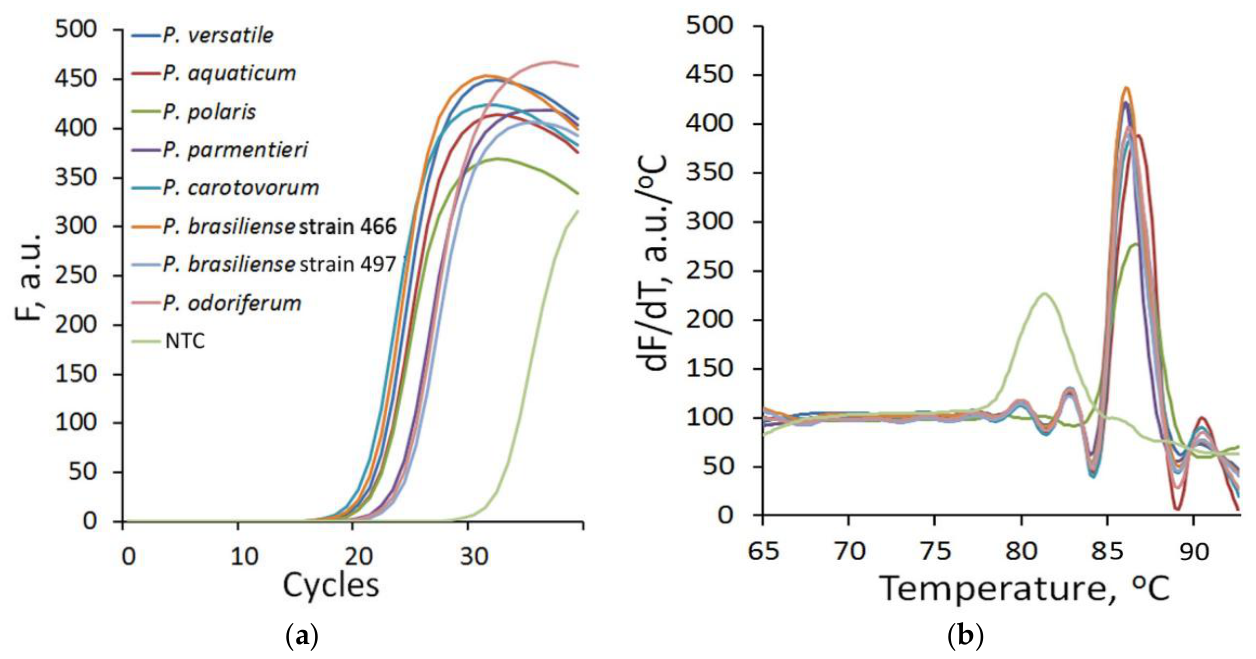
Figure 2.
Activation of Cas12a nuclease by PCR amplicons produced with the Y1/Y2 molar ratio of 2. Representative kinetic curves for MR cleavage. gRNA1. 1 µL of the completed PCR reaction or PCR NTC per 20 µL of Cas12a reaction mixture, 37 °C. PCR with genomic DNA of P. polaris, 200 genome copies per PCR reaction. PCR regimes are indicated in the figure as in Table 2. F – fluorescence in arbitrary units (a.u.).
Figure 2.
Activation of Cas12a nuclease by PCR amplicons produced with the Y1/Y2 molar ratio of 2. Representative kinetic curves for MR cleavage. gRNA1. 1 µL of the completed PCR reaction or PCR NTC per 20 µL of Cas12a reaction mixture, 37 °C. PCR with genomic DNA of P. polaris, 200 genome copies per PCR reaction. PCR regimes are indicated in the figure as in Table 2. F – fluorescence in arbitrary units (a.u.).
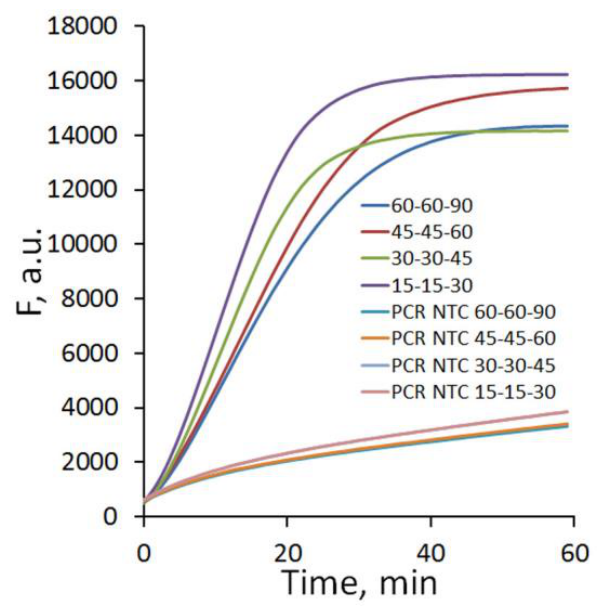
Figure 3.
The impact of primer ratio on aPCR performance and the yield of ssDNA amplicons. PCR regime – “15-15-30”. The load of P. polaris DNA – 100 genome copies per PCR reaction. The mean values and the corresponding standard deviations are shown. (a) Dependence of the quantification cycle, Cq, on the molar ratio of Y1 and Y2 primers. (b) Dependence of the initial rate of MR cleavage by the activated Cas12a nuclease, V0, on the molar ratio of Y1 and Y2 primers. The V0 values were obtained by subtracting the corresponding values for PCR NTCs. 1 µL of PCR reaction per 20 µL of Cas12a reaction mixture, 37 °C.
Figure 3.
The impact of primer ratio on aPCR performance and the yield of ssDNA amplicons. PCR regime – “15-15-30”. The load of P. polaris DNA – 100 genome copies per PCR reaction. The mean values and the corresponding standard deviations are shown. (a) Dependence of the quantification cycle, Cq, on the molar ratio of Y1 and Y2 primers. (b) Dependence of the initial rate of MR cleavage by the activated Cas12a nuclease, V0, on the molar ratio of Y1 and Y2 primers. The V0 values were obtained by subtracting the corresponding values for PCR NTCs. 1 µL of PCR reaction per 20 µL of Cas12a reaction mixture, 37 °C.
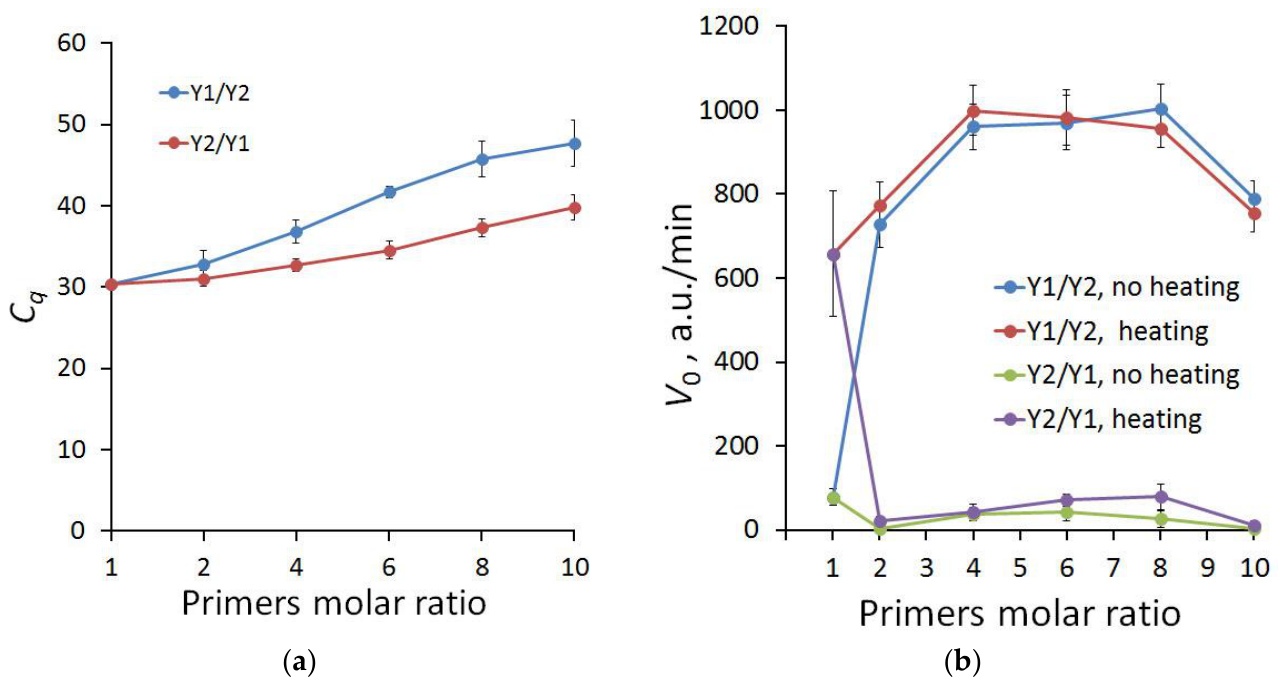
Figure 4.
The detection of P. polaris with the optimized aPCR. Dependences of the quantification cycle, Cq, on the number of bacterial genomes per PCR reaction. 1 – bacterial DNA alone, 2 – bacterial DNA in the presence of 100 ng of potato DNA. The mean values and corresponding standard deviations are shown.
Figure 4.
The detection of P. polaris with the optimized aPCR. Dependences of the quantification cycle, Cq, on the number of bacterial genomes per PCR reaction. 1 – bacterial DNA alone, 2 – bacterial DNA in the presence of 100 ng of potato DNA. The mean values and corresponding standard deviations are shown.
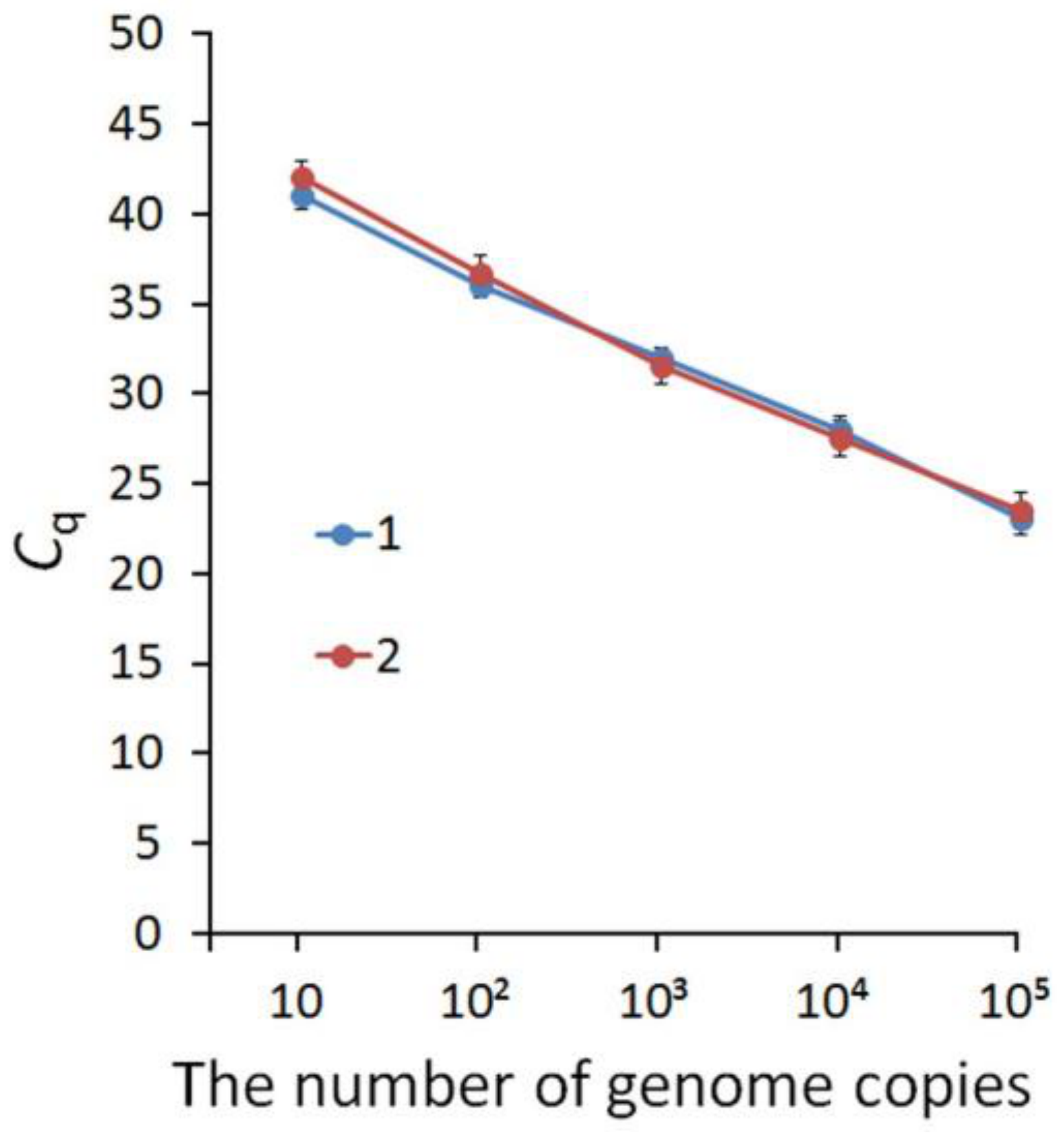
Figure 5.
Representative kinetic curves for MR cleavage by Cas12a nuclease complexed with gRNA2 (a), gRNA3 (b), and gRNA4 (c). 1 µL of the completed aPCR reaction per 20 µL of Cas12a reaction mixture, 37 °C. The optimized aPCR (“15-15-30”, Y1/Y2 = 4). 100 copies of bacterial genomes per PCR reaction. Pectobacterium species tested are indicated in the figure. F and F0 – fluorescence with 1 µL of completed aPCR and PCR NTC, respectively.
Figure 5.
Representative kinetic curves for MR cleavage by Cas12a nuclease complexed with gRNA2 (a), gRNA3 (b), and gRNA4 (c). 1 µL of the completed aPCR reaction per 20 µL of Cas12a reaction mixture, 37 °C. The optimized aPCR (“15-15-30”, Y1/Y2 = 4). 100 copies of bacterial genomes per PCR reaction. Pectobacterium species tested are indicated in the figure. F and F0 – fluorescence with 1 µL of completed aPCR and PCR NTC, respectively.
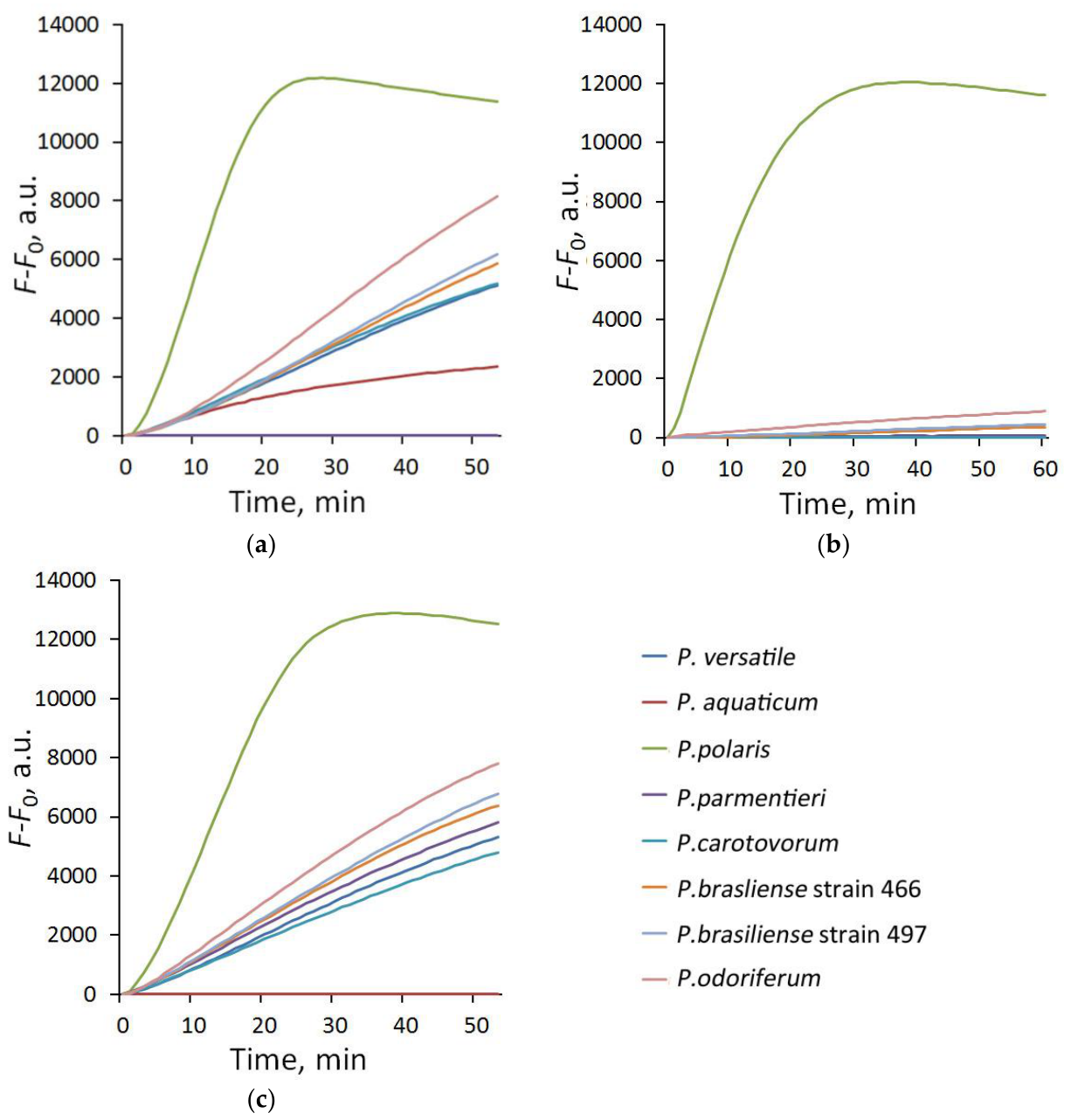
Figure 6.
Impact of mismatches on cleavage kinetics. Histograms representing the relative mean values of V0 for various Pectobacterium strains and gRNA2, gRNA 3, and gRNA4. The mean V0 values for P. polaris are taken as unity. Each bar is accompanied by a relevant protospacer sequence with mismatches indicated by capital bold letters Pp, Pa, Pc, Pv, Pb_466, Pb_497, Po, and Ppol stand for P. parmantieri, P. aquaticum, P. carotovorum, P. versatile, P. brasliensis strain 466, P. brasiliensis strain 497, P. odoriferum, and P. polaris, respectively. The mean values and corresponding standard deviations are shown. Other conditions as in Figure 5.
Figure 6.
Impact of mismatches on cleavage kinetics. Histograms representing the relative mean values of V0 for various Pectobacterium strains and gRNA2, gRNA 3, and gRNA4. The mean V0 values for P. polaris are taken as unity. Each bar is accompanied by a relevant protospacer sequence with mismatches indicated by capital bold letters Pp, Pa, Pc, Pv, Pb_466, Pb_497, Po, and Ppol stand for P. parmantieri, P. aquaticum, P. carotovorum, P. versatile, P. brasliensis strain 466, P. brasiliensis strain 497, P. odoriferum, and P. polaris, respectively. The mean values and corresponding standard deviations are shown. Other conditions as in Figure 5.
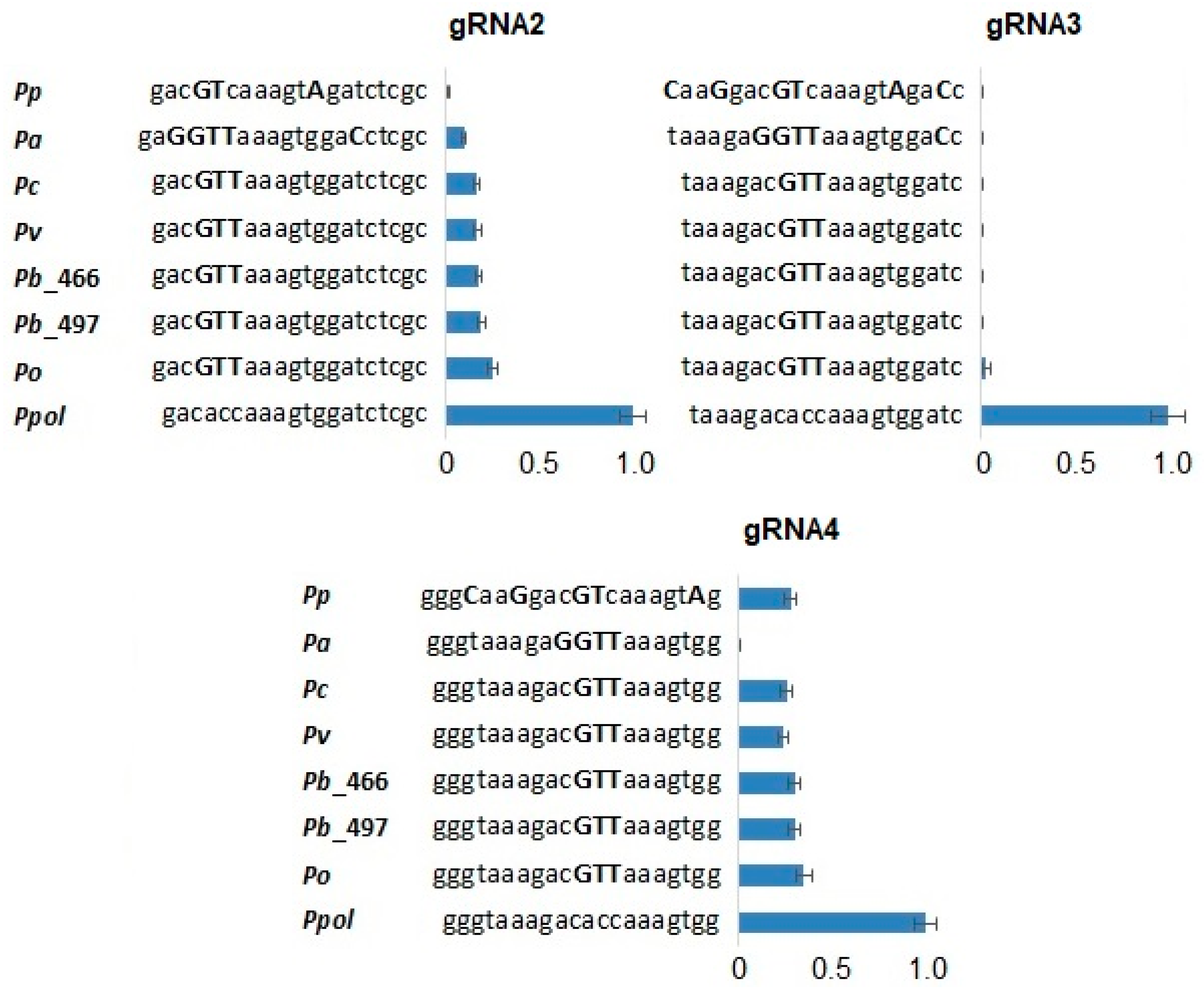
Figure 7.
Representative kinetic curves for MR cleavage by Cas12a nuclease activated by unmodified and uracil-modified PCR amplicons. 1 µL of the completed aPCR reaction per 20 µL of Cas12a reaction mixture, 37 °C; the elevated magnesium concentration of 18 mM. The optimized aPCR (“15-15-30”, Y1/Y2 = 4), 10 copies of P. polaris genomes per PCR reaction.
Figure 7.
Representative kinetic curves for MR cleavage by Cas12a nuclease activated by unmodified and uracil-modified PCR amplicons. 1 µL of the completed aPCR reaction per 20 µL of Cas12a reaction mixture, 37 °C; the elevated magnesium concentration of 18 mM. The optimized aPCR (“15-15-30”, Y1/Y2 = 4), 10 copies of P. polaris genomes per PCR reaction.
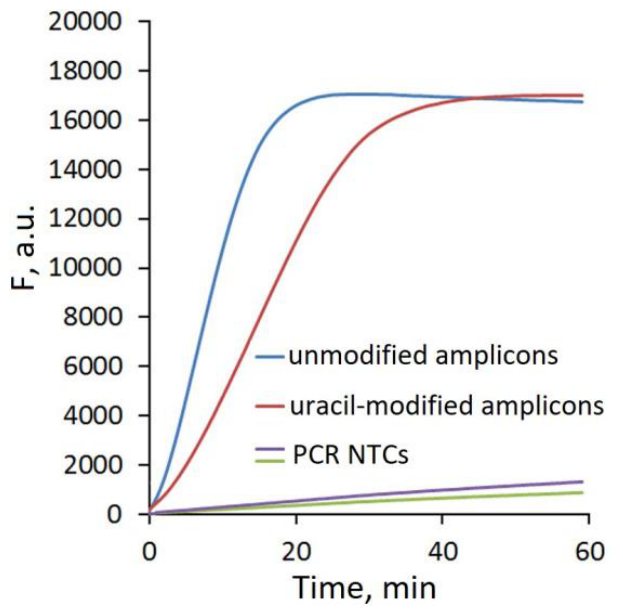
Figure 8.
The visual analysis of MR cleavage by the trans-activated Cas12a nuclease. Activation by uracil-modified ssDNA amplicons, 18 mM magnesium in the Cas12a reaction. (a) The time course of yellowish color development after the addition of PCR products. 1 and 3 – the optimized aPCR with 10 genome copies of P. polaris, 2 and 4 – the corresponding PCR NTCs. The addition of 1 µL (tubes 1 and 2) or 5 µL (tubes 3 and 4) aliquots of aPCR reactions. (b) Various Pectobacterium species. In 30 min after the addition of 1 µL aliquot of PCR reaction to a Cas12a reaction mixture. 1 to 7 – P. polaris, P. carotovorum, P. parmantieri, P. aquaticum, P. versatile, P. odoriferum, P. brasliensis strain 466, respectively. 8 – PCR NTC. The optimized aPCR with 100 copies of bacterial genomes per PCR reaction.
Figure 8.
The visual analysis of MR cleavage by the trans-activated Cas12a nuclease. Activation by uracil-modified ssDNA amplicons, 18 mM magnesium in the Cas12a reaction. (a) The time course of yellowish color development after the addition of PCR products. 1 and 3 – the optimized aPCR with 10 genome copies of P. polaris, 2 and 4 – the corresponding PCR NTCs. The addition of 1 µL (tubes 1 and 2) or 5 µL (tubes 3 and 4) aliquots of aPCR reactions. (b) Various Pectobacterium species. In 30 min after the addition of 1 µL aliquot of PCR reaction to a Cas12a reaction mixture. 1 to 7 – P. polaris, P. carotovorum, P. parmantieri, P. aquaticum, P. versatile, P. odoriferum, P. brasliensis strain 466, respectively. 8 – PCR NTC. The optimized aPCR with 100 copies of bacterial genomes per PCR reaction.
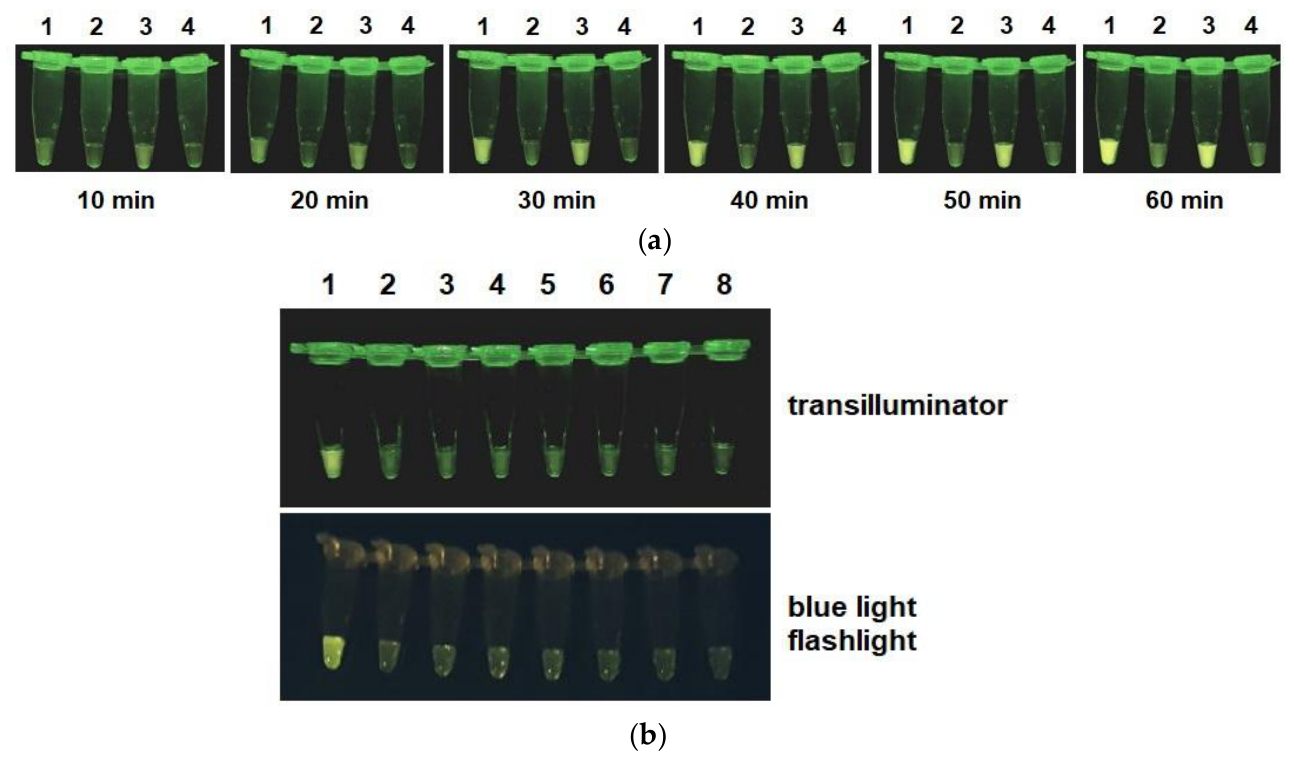

Table 1.
The sequences of gRNAs. The spacer sequences are shown by italic.
| Name | Sequence (5′→3′) |
|---|---|
| gRNA1 | GGGAAUUUCUACUGUUGUAGAUCAUCAGCAUAUUGUCUGUUG |
| gRNA2 | GGGAAUUUCUACUGUUGUAGAUGCGAGAUCCACUUUGGUGUC |
| gRNA3 | GGGAAUUUCUACUGUUGUAGAUGAUCCACUUUGGUGUCUUUA |
| gRNA4 | GGGAAUUUCUACUGUUGUAGAUCCACUUUGGUGUCUUUACCC |
Table 2.
PCR with different durations of cycle steps. The Y1/Y2 molar ratio = 2. 200 copies of P. polaris genome per PCR reaction.
Table 2.
PCR with different durations of cycle steps. The Y1/Y2 molar ratio = 2. 200 copies of P. polaris genome per PCR reaction.
| PCR regime (denaturation-annealing-extension) |
Mean Cq value | The duration of 40 cycle run, h |
|---|---|---|
| “60-60-90” | 24 | 2.7 |
| “45-45-60” | 25 | 2.0 |
| “30-30-45” | 27 | 1.5 |
| “15-15-30” | 29 | 1.0 |
Disclaimer/Publisher’s Note: The statements, opinions and data contained in all publications are solely those of the individual author(s) and contributor(s) and not of MDPI and/or the editor(s). MDPI and/or the editor(s) disclaim responsibility for any injury to people or property resulting from any ideas, methods, instructions or products referred to in the content. |
© 2026 by the authors. Licensee MDPI, Basel, Switzerland. This article is an open access article distributed under the terms and conditions of the Creative Commons Attribution (CC BY) license (http://creativecommons.org/licenses/by/4.0/).
Copyright: This open access article is published under a Creative Commons CC BY 4.0 license, which permit the free download, distribution, and reuse, provided that the author and preprint are cited in any reuse.


