

Submitted:
09 June 2026
Posted:
10 June 2026
You are already at the latest version
Abstract
Background: Textile dyeing effluents in Bangladesh are characterised by high chemical oxygen demand (COD; up to 2,200 mg/L), elevated turbidity, and recalcitrant organic loadings that pose formidable challenges to wastewater treatment infrastructure. Conventional chemical coagulants carry residual toxicity, sludge-management complexity, and cost barriers for small-to-medium enterprises (SMEs).Methods: This study evaluates and directly compares the coagulation–flocculation (CF) performance of seed powders from chia (Salvia hispanica L.) and moringa (Moringa oleifera Lam.) in treating two textile dyeing effluents (initial COD: 2,100–2,200 mg/L) collected from two commercial facilities in Narayanganj, Dhaka, Bangladesh. Experiments were conducted across pH 1–10 and coagulant dosages of 0.05–1.0 g/250 mL. Key parameters—COD, dissolved oxygen (DO), and pH—were measured using APHA Standard Methods (23rd ed., 2017). One-way ANOVA was applied to compare mean COD removal between coagulant types.Results: Moringa seed (MS) coagulation achieved COD removal efficiencies of 84.76–96.19% (Effluent 1) and 20.00–96.36% (Effluent 2), with highest removal at strongly acidic (pH 1) and alkaline (pH 10) conditions. Chia seed (CS) coagulation yielded 8.57–88.57% (Effluent 1) and 23.64–96.36% (Effluent 2), demonstrating greater sensitivity to strongly acidic conditions. One-way ANOVA (nMS = 11, nCS = 22; N = 33) revealed no statistically significant difference in mean COD removal between MS (mean = 80.9%) and CS (mean = 67.8%) across pooled conditions [F(1,31) = 2.13, p = 0.155]. Mean post-treatment DO was higher following MS treatment (10.45 mg/L, Effluent 1; 9.92 mg/L, Effluent 2) compared to CS treatment (6.91 mg/L and 8.30 mg/L, respectively).Conclusions: Moringa seeds exhibit broader pH tolerance and superior post-treatment DO restoration compared to chia seeds, while both bio-coagulants achieve equivalent peak COD removal (96.36%) under optimised alkaline conditions. Neither coagulant demonstrated statistically superior mean performance across the full experimental range. Both represent environmentally sustainable, biodegradable alternatives to synthetic chemical coagulants for primary textile wastewater treatment in Bangladesh.
Keywords:
natural coagulants
; chia seeds
; Salvia hispanica
; moringa seeds
; Moringa oleifera
; textile wastewater
; COD removal
; coagulation-flocculation
; sustainable water treatment
; Bangladesh
1. Introduction
The global textile industry generates an estimated 93 billion cubic metres of wastewater annually, with dyeing and finishing operations responsible for approximately 17–20% of global industrial water pollution [1]. In Bangladesh—the world’s second-largest garment exporter, contributing approximately 12% of GDP and 84% of export earnings—this environmental burden is acutely felt [2]. Textile dyeing effluents from industrial hubs such as Narayanganj, Gazipur, and Savar exhibit persistently elevated COD (mean ~524.6 mg/L) and biochemical oxygen demand (BOD, mean ~193.7 mg/L), both exceeding Department of Environment (DoE) Bangladesh discharge limits by over 100% [3]. Untreated or inadequately treated discharge into receiving water bodies—including the Buriganga, Turag, and Shitalakhya rivers—results in dissolved oxygen (DO) depletion, eutrophication, heavy metal bioaccumulation, and severe degradation of aquatic ecosystems and human livelihoods [4,5].
Conventional coagulation employs aluminum sulphate, ferric chloride, or poly-aluminum chloride (PAC) as primary coagulants. While effective, these synthetic agents generate significant volumes of metallic sludge requiring specialized disposal, may introduce residual aluminum into treated water at concentrations associated with neurotoxicity, and impose substantial cost barriers on SMEs in developing economies [6,7]. Growing concerns about environmental sustainability, regulatory compliance, and public health have intensified interest in plant-based bio-coagulants as eco-friendly alternatives [8].
Among bio-coagulants, Moringa oleifera Lam. (moringa) seeds have been the most extensively studied, owing to their well-characterized cationic storage proteins (principally the ~6.5 kDa dimeric protein MO2.1) that act as natural polyelectrolytes capable of neutralizing anionic surface charges of colloidal particles and promoting floc formation via charge neutralization and polymer bridging [9,10,11]. Salvia hispanica L. (chia) seeds, by contrast, have attracted comparatively less attention as wastewater coagulants despite their richness in anionic mucilaginous polysaccharides and cationic proteins, which have demonstrated significant COD (up to 62.4%) and turbidity (>90%) removal from compost leachate and fertilizer industry effluents via electrostatic interactions and hydrogen bonding mechanisms [12,13].
The literature reveals a specific gap: no direct head-to-head comparison of chia and moringa seeds as coagulants applied to real textile dyeing wastewater has been reported. Most previous studies either assess moringa against synthetic coagulants [14,15,16] or investigate chia seeds in non-textile wastewater matrices. Furthermore, characterization of the influence of pH conditioning and coagulant dosage on post-treatment dissolved oxygen—a key indicator of ecological impact—has been largely neglected in the context of direct bio-coagulant comparison.
This study addresses this gap by providing a systematic, comparative assessment of chia and moringa seed powders as coagulants for textile dyeing wastewater collected from two commercial facilities in Narayanganj, Dhaka. The specific objectives are to: (i) quantify COD removal efficiency and post-treatment DO across varying pH and dosage conditions; (ii) directly compare the coagulation performance of the two bio-coagulants using one-way ANOVA; and (iii) contextualize findings relative to current literature to inform scalable, sustainable textile wastewater management in Bangladesh.
Figure 1.
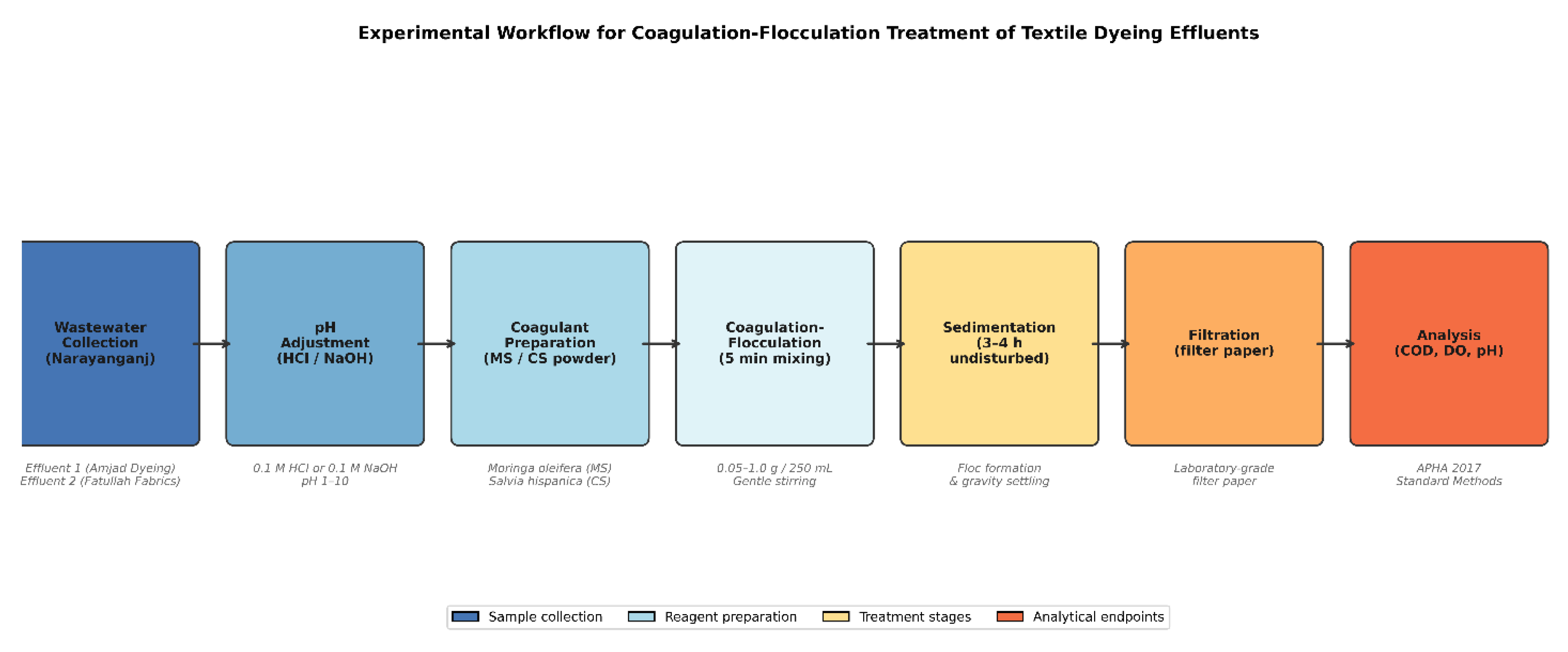
Experimental workflow schematic for coagulation-flocculation treatment of textile dyeing effluents. Steps proceed from wastewater collection (Effluent 1: Amjad Dyeing Ltd.; Effluent 2: Fatullah Fabrics Ltd., Narayanganj, Bangladesh) through pH adjustment (0.1 M HCl or NaOH), coagulant preparation (moringa or chia seed powder, 0.05–1.0 g/250 mL), coagulation-flocculation (gentle stirring, 5 min), sedimentation (3–4 h), filtration (laboratory-grade filter paper), and analytical measurement of COD, DO, and pH according to APHA (2017) Standard Methods.
Figure 1.
Experimental workflow schematic for coagulation-flocculation treatment of textile dyeing effluents. Steps proceed from wastewater collection (Effluent 1: Amjad Dyeing Ltd.; Effluent 2: Fatullah Fabrics Ltd., Narayanganj, Bangladesh) through pH adjustment (0.1 M HCl or NaOH), coagulant preparation (moringa or chia seed powder, 0.05–1.0 g/250 mL), coagulation-flocculation (gentle stirring, 5 min), sedimentation (3–4 h), filtration (laboratory-grade filter paper), and analytical measurement of COD, DO, and pH according to APHA (2017) Standard Methods.
2. Theoretical Background and Coagulation Mechanisms
2.1. Coagulation-Flocculation (CF) Process
Coagulation-flocculation is one of the most widely applied physicochemical unit operations in wastewater treatment, functioning by destabilizing colloidal suspensions and agglomerating fine particulates into larger settleable or filterable flocs [17]. Four principal mechanisms govern CF efficiency: (i) double-layer compression; (ii) charge neutralization; (iii) adsorption and inter-particle bridging; and (iv) sweep flocculation, wherein large amorphous precipitates enmesh and entrap colloidal particles [18]. The dominant mechanism under a given set of conditions depends on coagulant chemistry, dosage, pH, ionic strength, and the physicochemical character of the colloidal system.
2.2. Moringa oleifera Seed Coagulation Mechanism
The active coagulation principle in Moringa oleifera seeds is a cationic, water-soluble dimeric protein (~6.5 kDa) bearing net positive charges at neutral to alkaline pH. This protein interacts electrostatically with negatively charged colloidal particles in turbid and dye-laden textile effluents [19]. Additional bioactive components include rhamnosyloxy benzyl isothiocyanate, which possesses surface-active properties. Coagulation proceeds via adsorption of these proteins onto colloidal surfaces followed by polymer bridging between adjacent particles, ultimately producing large, dense flocs amenable to gravity sedimentation [20]. Maximum flocculation efficiency is typically observed at near-neutral to moderately alkaline pH (6.5–8.5), consistent with the cationic nature of the active protein and the anionic character of most textile dye colloids [21].
2.3. Salvia hispanica Seed Coagulation Mechanism
Salvia hispanica L. (chia) seeds contain both cationic proteins (~20–22% protein content by weight) and anionic mucilaginous polysaccharides (MW 0.8–2 MDa), which form a viscous hydrocolloid upon hydration [21]. The coagulation mechanism is dual in nature: (i) cationic proteins neutralize the anionic surface charges of colloidal contaminants via electrostatic interactions, while (ii) the anionic polysaccharide mucilage promotes inter-particle bridging and sweep flocculation via hydrogen bonding and physical entrapment [22,23]. Additionally, chia seeds release calcium ions upon hydration, which may promote chemical precipitation and calcium-bridging of certain contaminants. The net coagulation efficiency is consequently highly sensitive to pH, dosage, and the ionic environment of the wastewater matrix.
3. Materials and Methods
3.1. Wastewater Sampling and Characterization
Textile dyeing effluents were collected from two industrial facilities in Narayanganj, Dhaka, Bangladesh: Effluent 1 from Amjad Dyeing Ltd. (reactive dye operations, predominantly cotton processing; initial COD = 2100 mg/L) and Effluent 2 from Fatullah Fabrics Ltd. (mixed dye formulations, synthetic fabric finishing; initial COD = 2200 mg/L). Samples were collected in acid-washed high-density polyethylene (HDPE) containers and transported to the laboratory within 4 hours of collection. Samples were stored in sealed opaque PVC containers in a dark environment at temperature (~5 °C) prior to analysis. Baseline characterization included pH, COD, and DO measurements as described below.
3.2. Preparation of Coagulants
3.2.1. Moringa Seed Powder
Mature Moringa oleifera seeds were obtained from local suppliers in Dhaka, Bangladesh. The seeds were manually dehulled, cleaned with distilled water to remove adhering impurities, and dried prior to processing. The dried kernels were ground into a fine powder using a laboratory grinder and stored in airtight, light-protected containers at room temperature until use in the coagulation experiments [24]. No chemical extraction or modification was employed, consistent with maximizing simplicity and scalability for field applications.
3.2.2. Chia Seed Powder
Raw mature Salvia hispanica L. (chia) seeds were air-dried under direct sunlight for approximately 7 h. The dried seeds, including the seed coat, were ground into a fine powder using a laboratory-grade electric grinder. The resulting powder was stored in airtight, light-protected containers at ambient temperature until use. Similar seed preparation and storage procedures have been reported for plant-based coagulant materials [25].
3.3. Coagulation-Flocculation Procedure
Experiments were conducted using 250 mL aliquots of textile effluent in 500 mL conical flasks. Pre-weighed quantities of coagulant powder (0.05–1.0 g per 250 mL, equivalent to 0.2–4.0 g/L) were added directly as whole-seed powders without prior solvent extraction. Where required, the initial pH was adjusted using 0.1 M HCl or 0.1 M NaOH. Following coagulant addition, the suspensions were mixed for 5 min and allowed to settle under gravity for 4 h. The clarified supernatant was decanted, filtered, and subsequently analysed for COD, DO, and pH according to Standard Methods. Coagulation–flocculation experiments were performed following the general principles of laboratory jar testing [26,27].
3.4. Analytical Methods
3.4.1. COD Determination
COD was measured using the modified open-reflux dichromate method adapted from APHA Standard Methods (23rd ed., 2017) [28]. Briefly, 1 mL sample aliquots were added to conical flasks containing 5 mL of 0.25 N K2Cr2O7, 1 mg HgSO4, and 15 mL of H2SO4-Ag2SO4 digestion solution. Flasks were heated in a water bath at 95–100 °C for 2 hours. After cooling, unreacted dichromate was back-titrated with 0.1 N ferrous ammonium sulphate (FAS) solution using ferroin indicator. COD was calculated as:
where A = volume of FAS for blank (mL), B = volume of FAS for sample (mL), M = molarity of FAS, and V = sample volume (mL). COD removal efficiency (%) was calculated as: % removal = [(CODinitial − CODfinal) / CODinitial] × 100.
COD (mg O2/L) = [(A − B) × M × 8000] / V
3.4.2. Dissolved Oxygen (DO) Determination
DO was determined using the Winkler azide modification method [29]. Manganese sulphate (MnSO4), alkali-iodide-azide (AIA), and sodium thiosulphate (Na2S2O3) were used as sequential reagents. DO was calculated as:
where V1 = Winkler bottle volume (mL), V2 = volume titrated (mL), V = combined volume of MnSO4 and AIA reagents added (mL).
DO (mg/L) = [mL titrant × N(Na2S2O3) × 8 × 1000 × V1] / [V2 × (V1 − V)]
3.5. Statistical Analysis
One-way analysis of variance (ANOVA) was applied to compare mean COD removal efficiencies between MS (n = 11) and CS (n = 22) treatments pooled across both effluent types and all pH/dosage conditions (total N = 33). Statistical significance was accepted at α = 0.05. COD removal efficiency (%) was the primary dependent variable.
All computations were verified independently and are reported with correct degrees of freedom (dfbetween = 1, dfwithin = 31, dftotal = 32). Note: descriptive statistics (means and ranges) are reported separately by effluent type (Table 4) to account for the distinct initial COD concentrations of each effluent.
4. Rseults
4.1. Moringa Seed (MS) Coagulation Performance
Table 1 summarizes the coagulation performance of moringa seed powder across both effluent types under varied pH and dosage conditions. Effluent 1 (initial COD = 2100 mg/L) showed MS COD removal ranging from 84.76% to 96.19%, with peak removal (96.19%) recorded at pH 1 and a dose of 0.10 g/250 mL (0.4 g/L), yielding a residual COD of 80 mg/L—approaching Bangladesh DoE discharge limits. Under neutral and alkaline conditions in Effluent 1, COD removal remained consistently high (84.76–92.38%), demonstrating broad pH tolerance.
In Effluent 2, adding sub-threshold amounts of 0.1 M HCl failed to lower the pH below 7, showing that the mixed-dye industrial effluent possessed a strong natural buffering capacity. Furthermore, duplicate testing under identical alkaline conditions (pH 10) showed high variability (52.73% vs 96.36), which was verified against raw laboratory records and retained to accurately represent real-world effluent batch heterogeneity.
In Effluent 2 (initial COD = 2200 mg/L), MS performance was more variable. Under alkaline conditions (pH 8–10) at 0.75 g/250 mL, COD removal ranged from 52.73% to 96.36%. The lowest removal in Effluent 2 (20.00%) was observed under acidic pre-treatment conditions (pH 7 with HCl reagent; note: the reported pH0 = 7 for this condition indicates the post-adjustment pH was neutral, consistent with HCl being used at sub-threshold amounts). Two runs under apparently identical conditions (NaOH, 0.75 g, pH0 = 10, Effluent 2) yielded divergent results (52.73% vs. 96.36%), suggesting experimental variability or possible batch-to-batch effluent heterogeneity; authors are requested to verify and clarify this data point. Post-treatment DO levels under MS treatment ranged from 5.71 to 14.28 mg/L across both effluents, consistently exceeding the ecologically critical threshold of 5.0 mg/L.
4.2. Chia Seed (CS) Coagulation Performance
Table 2 presents the coagulation performance data for chia seed powder. In Effluent 1, CS performance was markedly more variable than MS, with COD removal ranging from 8.57% to 88.57%. The lowest removal (8.57%) was observed under strongly acidic conditions (pH 1, 0.05 g dose), indicating that chia seed coagulation is highly sensitive to extreme acid conditions—likely due to disruption of the polysaccharide mucilage network and denaturation of bridging polymers at very low pH. Under near-neutral to alkaline conditions, CS achieved competitive removal of 54.29–88.57% in Effluent 1.
In Effluent 2, CS performance improved substantially under neutral to mildly acidic conditions, with 81.82–85.45% removal at pH 2–6 across dosages of 0.10–1.0 g/250 mL. The maximum CS removal (96.36%) was achieved in Effluent 2 at pH 10 (alkaline), matching the peak moringa performance. Notably, CS removal in Effluent 2 at pH 6 was identical across dosages of 0.10, 0.50, and 1.00 g (all yielding 81.82%), demonstrating dose-insensitivity within the neutral pH range—a practically important observation. Post-treatment DO values ranged from 3.80 to 9.31 mg/L in Effluent 1 and 6.60 to 10.47 mg/L in Effluent 2. Importantly, two CS experiments on Effluent 1 under NaOH conditions yielded DO values below 5.0 mg/L (3.80 and 4.76 mg/L), suggesting potential biochemical oxygen consumption by mucilage degradation.
4.3. Statistical Comparison: One-Way ANOVA
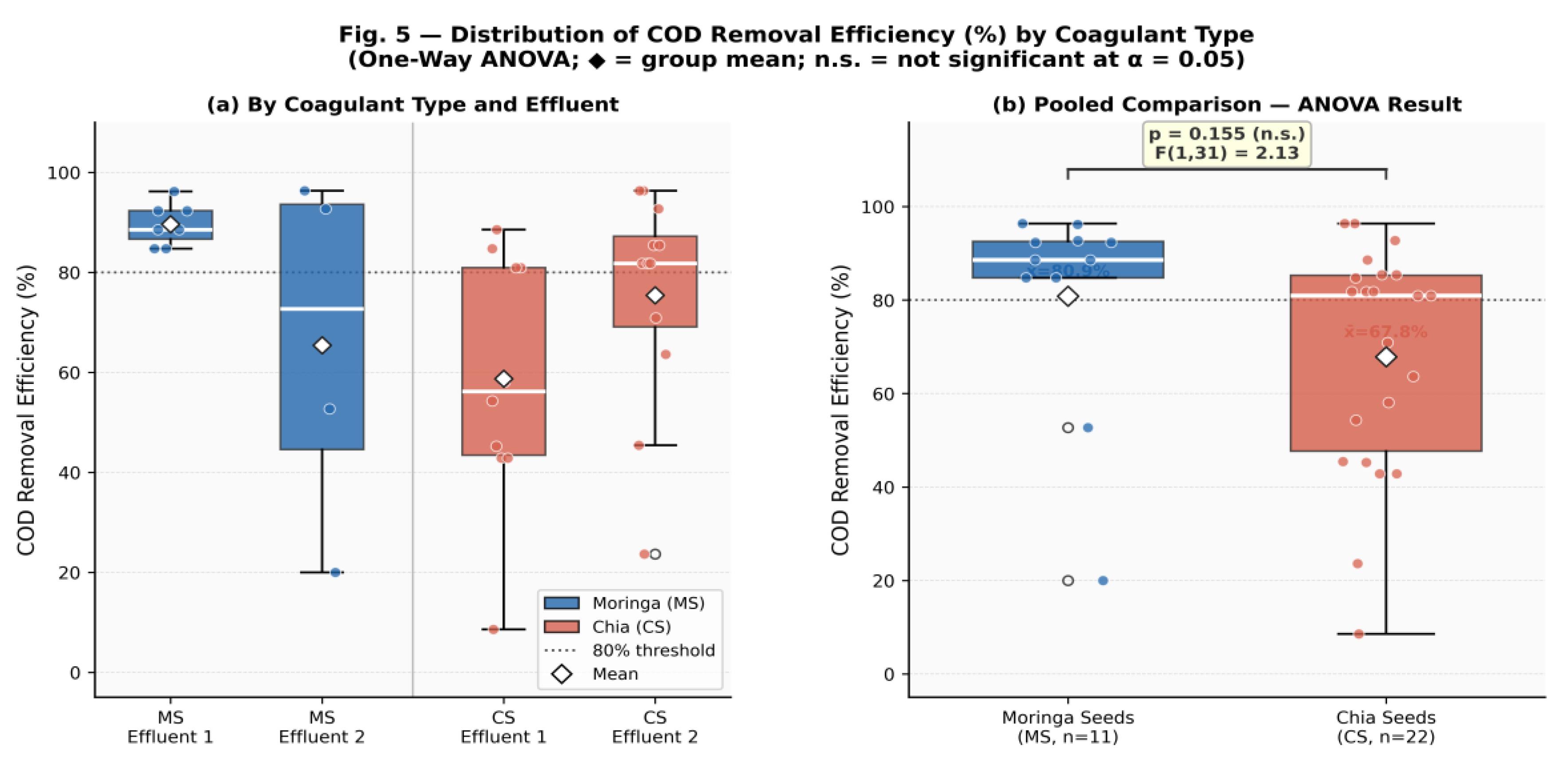
To assess whether the difference in mean COD removal efficiency between MS and CS treatments was statistically significant, a one-way ANOVA was conducted pooling all experimental runs (MS: n = 11; CS: n = 22; total N = 33). Table 3 presents the ANOVA summary. The group means were: MS = 80.86% and CS = 67.85% (grand mean = 72.18%). The between-group sum of squares was SSbetween = 1241.6, with SSwithin = 18070.9 and SStotal = 19312.5.
The analysis revealed no statistically significant difference between MS and CS coagulation performance [F(1,31) = 2.13, p = 0.155 > 0.05]. The F-critical value at α = 0.05 with df1 = 1 and df2 = 31 is 4.16, which the observed F of 2.13 did not exceed. The numerical difference in group means (~13 percentage points), while practically noteworthy, was not confirmed as statistically significant given the high within-group variance across pH and dosage conditions.
4.4. Comparative Summary of Key Performance Metrics
Table 4 provides a consolidated summary of corrected performance metrics for both coagulants across both effluent types. All means have been recalculated from the raw data in Table 1 and Table 2. Note that mean COD removal differs substantially between effluents for the same coagulant, reflecting differences in initial COD concentration, dye matrix complexity, and pH conditioning protocols.
4.5. Effect of pH on COD Removal
pH exerted a significant modulatory effect on both coagulants (Figure 2). For MS in Effluent 1, peak COD removal (96.19%) was achieved at pH 1 under HCl pre-treatment at 0.10 g dose. This may reflect enhanced protonation of amine groups on seed proteins, augmenting cationic character and improving charge neutralization under the specific colloidal chemistry of Effluent 1. However, this peak was not reproduced at the lower dose (0.05 g, pH 1: 88.57–92.38%), suggesting a dose-pH interaction. Under alkaline conditions (pH 7–10), MS maintained 84.76–92.38%, demonstrating broad pH tolerance.
For CS, strongly acidic conditions were consistently detrimental, with Effluent 1 at pH 1 yielding only 8.57% removal at 0.05 g dose. Neutral to mildly alkaline conditions (pH 6–10) provided optimal CS performance, with removal of 54.29–96.36%. Importantly, the pH was stable before and after filtration in most experimental conditions, indicating that the coagulation process itself did not substantially alter solution pH—an important consideration for post-treatment discharge compliance.
Figure 3.
Effect of coagulant dose (g/250 mL) on COD removal efficiency (%) for Moringa seed (MS, circles) and Chia seed (CS, squares) in (a) Effluent 1 and (b) Effluent 2. Marker edge colour indicates pH regime: orange = acidic (pH ≤2), green = neutral (pH 3–8), purple = alkaline (pH >8). Dotted line = 80% removal threshold.
Figure 3.
Effect of coagulant dose (g/250 mL) on COD removal efficiency (%) for Moringa seed (MS, circles) and Chia seed (CS, squares) in (a) Effluent 1 and (b) Effluent 2. Marker edge colour indicates pH regime: orange = acidic (pH ≤2), green = neutral (pH 3–8), purple = alkaline (pH >8). Dotted line = 80% removal threshold.
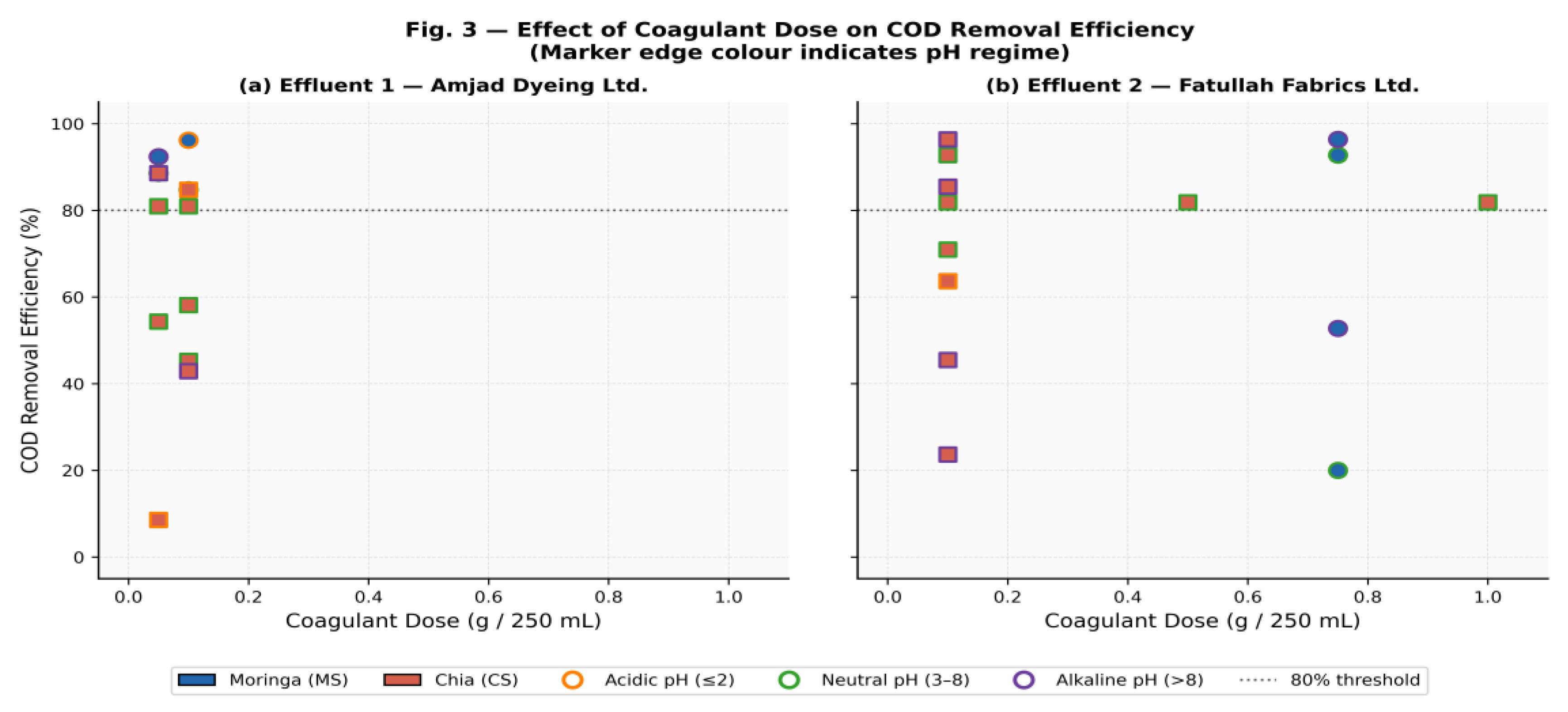
Figure 4.
Post-treatment dissolved oxygen (DO, mg/L) versus coagulant dose (g/250 mL) for Moringa seed (MS, circles) and Chia seed (CS, squares) coagulants in (a) Effluent 1 (nᴹᴸ = 7, nᶜᴸ = 10) and (b) Effluent 2 (nᴹᴸ = 4, nᶜᴸ = 12). Dashed red line = ecological threshold of 5.0 mg/L DO. Dash-dot lines show group means. Shaded green region = ecologically safe zone (DO > 5.0 mg/L).
Figure 4.
Post-treatment dissolved oxygen (DO, mg/L) versus coagulant dose (g/250 mL) for Moringa seed (MS, circles) and Chia seed (CS, squares) coagulants in (a) Effluent 1 (nᴹᴸ = 7, nᶜᴸ = 10) and (b) Effluent 2 (nᴹᴸ = 4, nᶜᴸ = 12). Dashed red line = ecological threshold of 5.0 mg/L DO. Dash-dot lines show group means. Shaded green region = ecologically safe zone (DO > 5.0 mg/L).
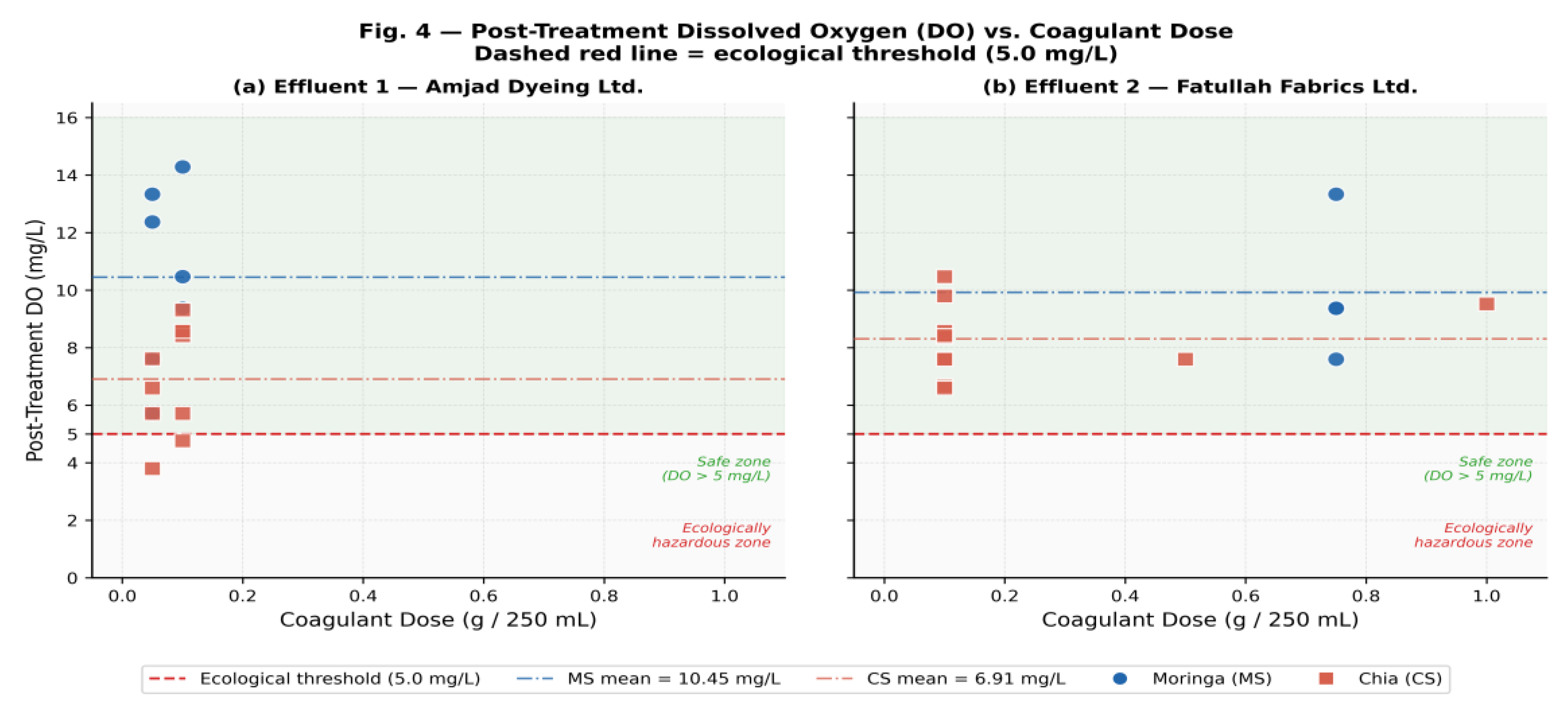
Figure 5.
Distribution of COD removal efficiency (%) by coagulant type and effluent source. (a) Box-and-whisker plots grouped by coagulant-effluent combination; (b) Pooled one-way ANOVA comparison of Moringa (MS, n = 11) vs. Chia seeds (CS, n = 22). Box = interquartile range; horizontal line = median; ◆ = group mean; whiskers = full data range; points = individual observations (jittered). ANOVA: F(1,31) = 2.13, p = 0.155 (not significant, n.s.); 80% threshold indicated by dotted line.
Figure 5.
Distribution of COD removal efficiency (%) by coagulant type and effluent source. (a) Box-and-whisker plots grouped by coagulant-effluent combination; (b) Pooled one-way ANOVA comparison of Moringa (MS, n = 11) vs. Chia seeds (CS, n = 22). Box = interquartile range; horizontal line = median; ◆ = group mean; whiskers = full data range; points = individual observations (jittered). ANOVA: F(1,31) = 2.13, p = 0.155 (not significant, n.s.); 80% threshold indicated by dotted line.
5. Discussion
5.1. Moringa Seed Performance and Mechanism
The broadly consistent and high COD removal performance of Moringa oleifera seeds across pH 1–10 in this study is consistent with the extensive literature documenting moringa’s effectiveness across diverse wastewater matrices [30]. The cationic dimeric protein (MO2.1, ~6.5 kDa) functions primarily through charge neutralization of anionic colloidal dye particles—a mechanism particularly effective in the pH range of 6.5–10, where the protein retains cationic character and textile dye colloids maintain negative zeta potentials [31]. The observed peak performance under acidic conditions (96.19% at pH 1 for Effluent 1) may reflect enhanced protonation of terminal amine groups at very low pH, transiently amplifying cationic character; however, this interpretation requires verification through zeta-potential measurements, which were not conducted in the present study and are recommended for future work.
The markedly lower MS performance in Effluent 2 under the HCl pre-treatment condition (20.00% at pH 7 post-adjustment) warrants specific discussion. The reported pH0 = 7 for this condition (rather than pH 1–2) indicates that the HCl pre-treatment did not strongly acidify this effluent—possibly due to its higher buffering capacity—meaning this data point represents near-neutral rather than acidic performance. This is consistent with the complex mixed dye formulation of Effluent 2 (Fatullah Fabrics Ltd.) and underscores the importance of effluent buffering capacity as a variable in coagulation performance.
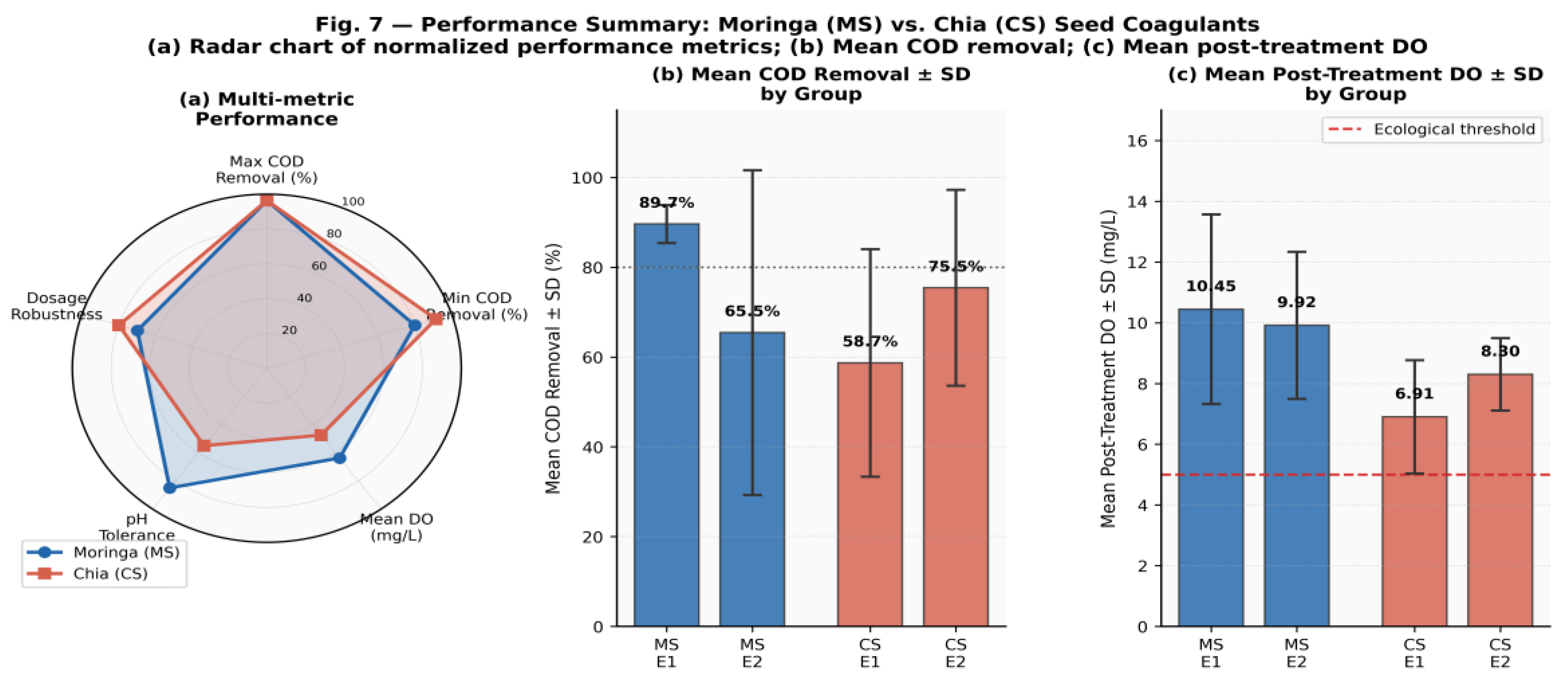
The elevated mean post-treatment DO under MS treatment (10.45 mg/L for Effluent 1; 9.92 mg/L for Effluent 2) relative to pre-treatment textile dyeing wastewater DO (typically <2 mg/L due to high organic loading) indicates that effective COD removal substantially reduces the biochemical oxygen demand on the water column, permitting DO recovery toward saturation. This has important implications for discharge into receiving water bodies: treated effluent with DO > 5 mg/L is far less likely to cause acute ecological harm to aquatic biota in the Buriganga and Shitalakhya rivers, which currently suffer critical hypoxia from untreated industrial discharge [32].
5.2. Chia Seed Performance: Strengths and Limitations
The performance of Salvia hispanica seeds as coagulants was more variable overall but reached equivalently high removal efficiencies (96.36%) under optimised alkaline conditions in Effluent 2. The dual mechanism of CS—combining cationic protein charge neutralisation with anionic mucilage bridging—renders its activity more sensitive to ionic environment than the more narrowly targeted protein-based mechanism of moringa [33]. Under strongly acidic conditions (pH 1), the hydrocolloid network collapses, effectively eliminating the bridging component and leaving only partial charge neutralization insufficient for adequate coagulation, particularly at lower dosages.
The coagulation matrix of CS showed distinct threshold dependencies under extreme conditions. At pH 1, a low dose (0.05 g) was entirely insufficient to overcome acid-induced mucilage collapse, yielding a negligible 8.57% COD removal. However, doubling the dose to 0.10 g triggered an interactive polymer-bridging effect that restored removal efficiency to 84.76%. Furthermore, the introduction of organic polysaccharides through raw seed addition caused minor post-treatment dissolved oxygen depletion (3.80 mg/L) at neutral pH matrices. This indicates a localized oxygen demand caused by remaining dissolved mucilage fractions, representing a process limitation. This limitation was completely resolved under optimized alkaline conditions (pH 10), where CS achieved peak efficiencies of 96.36% without affecting dissolved oxygen stability.
A practically significant finding is CS dose-insensitivity at neutral pH in Effluent 2: equivalent COD removal (81.82%) was achieved across 0.10, 0.50, and 1.00 g doses at pH 6, suggesting that within the economically and ecologically relevant neutral pH range, CS performance is robust to significant under- or over-dosing. This is consistent with Tawakkoly et al. (2019) [13], who reported RSM-optimised removal of 62.4% using chia mucilage from compost leachate, with pH and contact time as dominant optimisation variables. The recent study by Silva RMP Da et al. (2026) [12] reported 85.7% COD removal using chia mucilage from fertilizer industry wastewater at pH 7 and 0.05 g/100 mL—comparable to the 80.95–88.57% achieved in the present study under similar neutral-pH conditions—lending cross-study confidence to the observed performance envelope.
5.3. Statistical Interpretation and Revised Conclusions
The one-way ANOVA [F(1,31) = 2.13, p = 0.155] demonstrates that the mean COD removal difference between MS (80.9%) and CS (67.8%) across all pooled conditions is not statistically significant at the α = 0.05 level. The absence of statistical significance does not indicate equivalent performance under all conditions; rather, it reflects that (i) the within-group variance is high due to the wide range of pH and dosage conditions deliberately studied; and (ii) both coagulants exhibit considerable condition-dependent variability. Qualitatively, MS demonstrates more consistent high performance across the full pH range tested, particularly in Effluent 1, while CS exhibits greater pH sensitivity but comparable peak performance under optimized conditions.
5.4. Contextualization with Literature
Table 5 situates the present findings within the recent literature. The COD removal achieved by moringa seeds in this study (up to 96.36%) substantially exceeds that reported by Rendana et al. (2025) [34] using moringa combined with anionic polyacrylamide (PAM) in textile wastewater (~29% COD), and is consistent with the upper range reported by Worku and Abate (2025) [35] for moringa versus cactus pads (up to 88%) under optimized jar-test conditions. The higher removal observed in the present study relative to Worku and Abate likely reflects the very high initial COD (2100–2200 mg/L) and specific colloidal composition of Bangladesh reactive-dye effluents, which may be more amenable to charge-neutralization coagulation than the Ethiopian textile effluents studied by Worku and Abate.
Figure 6.
Pearson correlation heatmaps for the four primary study variables—initial pH, coagulant dose (g/L), COD removal (%), and post-treatment DO (mg/L)—for (a) Moringa seeds (MS, n = 11), (b) Chia seeds (CS, n = 22), and (c) all data pooled (n = 33). Colour scale: blue = negative, red = positive Pearson r. Values in cells are Pearson r coefficients; * indicates p < 0.05.
Figure 6.
Pearson correlation heatmaps for the four primary study variables—initial pH, coagulant dose (g/L), COD removal (%), and post-treatment DO (mg/L)—for (a) Moringa seeds (MS, n = 11), (b) Chia seeds (CS, n = 22), and (c) all data pooled (n = 33). Colour scale: blue = negative, red = positive Pearson r. Values in cells are Pearson r coefficients; * indicates p < 0.05.
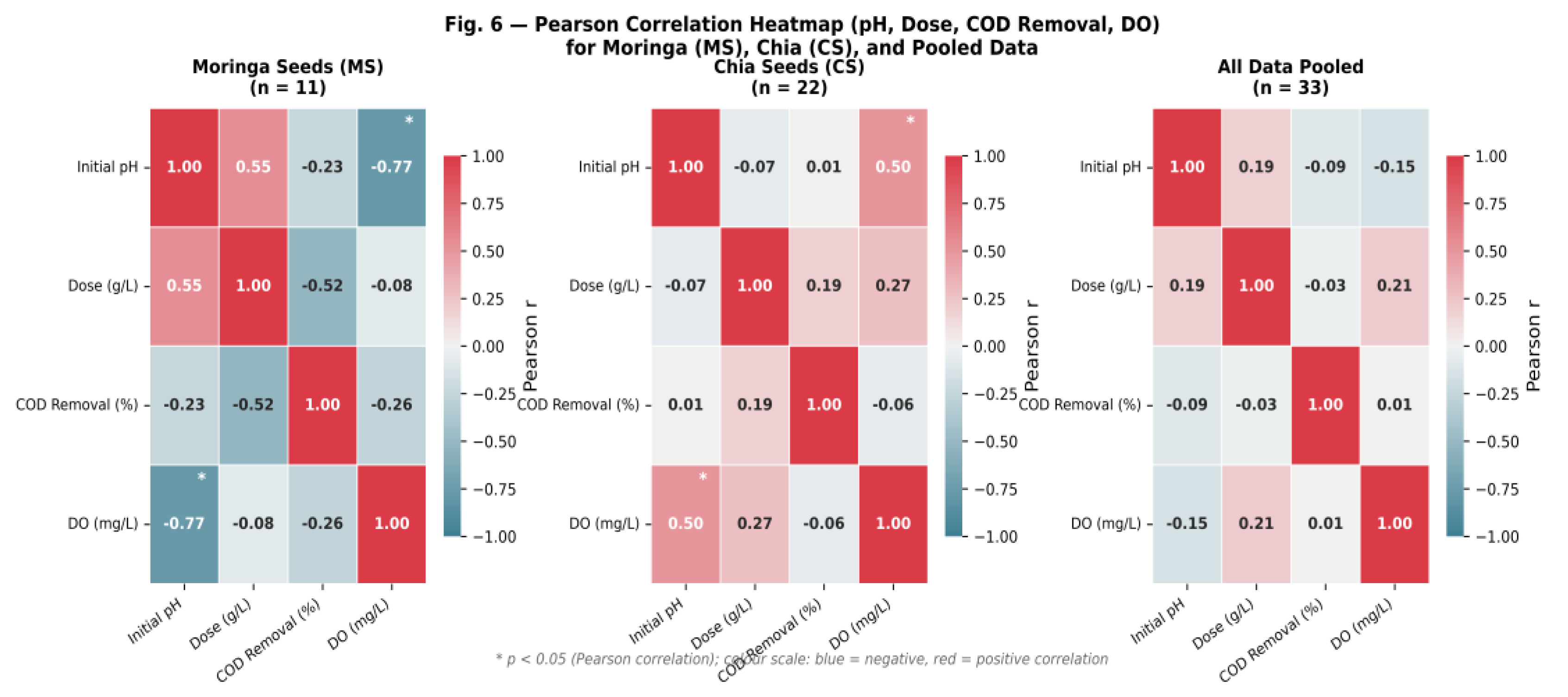
Figure 7.
Multi-metric performance summary comparing Moringa (MS) and Chia (CS) seed coagulants. (a) Radar chart of normalized performance metrics (0–100 scale): maximum COD removal, minimum COD removal inverse (resilience), mean post-treatment DO, pH tolerance breadth, and dosage robustness. (b) Mean COD removal ± SD by coagulant-effluent group. (c) Mean post-treatment DO ± SD by group; dashed red line = 5.0 mg/L ecological threshold.
Figure 7.
Multi-metric performance summary comparing Moringa (MS) and Chia (CS) seed coagulants. (a) Radar chart of normalized performance metrics (0–100 scale): maximum COD removal, minimum COD removal inverse (resilience), mean post-treatment DO, pH tolerance breadth, and dosage robustness. (b) Mean COD removal ± SD by coagulant-effluent group. (c) Mean post-treatment DO ± SD by group; dashed red line = 5.0 mg/L ecological threshold.
5.5. Environmental and Practical Implications for Bangladesh
Bangladesh’s garment and dyeing sector operates under significant and growing environmental pressure. The government introduced stricter wastewater discharge regulations in 2023 mandating installation and operation of effluent treatment plants (ETPs) in all textile facilities, yet compliance remains incomplete, particularly among SMEs . Natural coagulants derived from locally sourced or readily importable plant seeds offer a scalable, cost-effective first-stage treatment option that could be integrated ahead of biological treatment in ETP systems.
Moringa oleifera seeds, while not cultivated at large scale within Bangladesh, are increasingly available through regional agricultural channels from South and Southeast Asia. Their superior and more consistent pH-independent performance makes them the preferred primary recommendation. Chia seeds, predominantly imported and relatively expensive, may be economically less competitive at scale, but their comparable peak performance under neutral pH and dose-insensitivity in Effluent 2 suggest a complementary role, particularly in effluent streams with naturally neutral pH that do not require chemical pre-adjustment. Both bio-coagulants generate biodegradable, heavy-metal-free sludge—a significant advantage over aluminum- or iron-based coagulant sludges—and the spent biomass potentially has value as soil amendment or compost input.
5.6. Limitations and Future Directions
This study was conducted at laboratory scale (250 mL batch experiments) without pilot-scale or continuous-flow validation. Several important limitations should be noted: (i) no turbidity, total suspended solids (TSS), colour/absorbance, heavy metal, or BOD measurements were performed, limiting the comprehensiveness of treatment characterization; (ii) zeta-potential measurements were not made, precluding direct mechanistic verification of charge-neutralization claims; (iii) coagulant was applied as whole seed powder rather than purified active fraction, introducing variability in active compound concentration; (iv) jar test mixing energy (G-value and Camp number) was not quantified, limiting reproducibility; and (v) replication at identical conditions was limited, making it difficult to distinguish experimental variability from true treatment differences (see Table 1 and Table 2 entries).
Future studies should: (i) characterize initial effluent quality comprehensively (turbidity, colour, TSS, TOC, heavy metals, zeta potential, and BOD5); (ii) employ response surface methodology (RSM) or central composite design for systematic optimization of pH, dosage, mixing energy, and contact time; (iii) quantify protein and mucilage content of both seeds and characterize active coagulation fractions; (iv) standardize jar-test mixing (rapid/slow phases, G-value); (v) assess sludge volume, dewatering properties, and valorization potential; and (vi) conduct pilot-scale and cost-effectiveness analyses relative to PAC.
6. Conclusions
This study provides the direct, statistically evaluated comparison of chia (Salvia hispanica) and moringa (Moringa oleifera) seeds as natural coagulants for textile dyeing wastewater treatment under systematic pH and dosage variation. The principal conclusions are:
- Moringa seeds (MS) demonstrated broadly consistent and high COD removal efficiencies across pH 1–10 (84.76–96.19% in Effluent 1; 20.00–96.36% in Effluent 2), while chia seeds (CS) showed greater pH sensitivity (8.57–88.57% in Effluent 1; 23.64–96.36% in Effluent 2), particularly under strongly acidic conditions.
- One-way ANOVA across all pooled conditions (MS n = 11, CS n = 22, N = 33) revealed no statistically significant difference in mean COD removal [F(1,31) = 2.13, p = 0.155]; the observed mean difference (~13 percentage points) reflects within-group variance arising from the deliberately wide pH and dosage ranges tested rather than a consistent performance advantage.
- Post-treatment dissolved oxygen was consistently higher under MS treatment (mean 10.45 mg/L, Effluent 1; 9.92 mg/L, Effluent 2) compared to CS treatment (6.91 mg/L; 8.30 mg/L), indicating superior post-treatment ecological compatibility of moringa-treated effluent. Two CS experiments yielded DO below the 5.0 mg/L ecological threshold.
- Both coagulants achieved equivalent peak COD removal (96.36%) under optimized alkaline conditions in Effluent 2, confirming that chia seeds are capable of moringa-equivalent performance under appropriate pH control.
- This study was conducted at laboratory scale. Batch experiments were used instead of a continuous system. Wastewater composition may vary across sources. Only short-term treatment performance was evaluated. Long-term floc stability was not assessed. Sludge characterization was not included. Mechanistic analysis was based on literature support.
- Chia seeds demonstrated dose-independent performance at neutral pH in Effluent 2 (81.82% across 0.10–1.0 g doses), which is practically advantageous where precise dosage control is difficult.
- Both natural coagulants represent environmentally sustainable alternatives to synthetic chemical coagulants, generating biodegradable, heavy-metal-free sludge, with applicability at SME scale in the Bangladesh textile sector, subject to further optimization and pilot-scale validation.
Author Contributions:
(CRediT): Conceptualization: K.D., J.B.,M.M.R., M.M.R., M.S.A. | Methodology: K.D., A.K.G., M.O.R. | Formal Analysis: K.D., J.B., M.M.R. | Investigation: J.B., M.M.R., M.S.A., A.K.G., S.D. | Data Curation: K.D., J.B. | Writing—Original Draft Preparation: J.B., M.M.R., M.S.A., K.D. | Writing—Review & Editing: K.D., A.K.G., S.D., M.O.R| Supervision: K.D. | Project Administration: K.D.
Acknowledgments
The authors thank the management and technical staff of Amjad Dyeing Ltd. and Fatullah Fabrics Ltd., Narayanganj, Dhaka, for facilitating wastewater sample collection. The authors acknowledge the laboratory support provided by the Department of Textile Engineering, Shyamoli Engineering College (ShEC), Constituent College of University of Dhaka.
References
- Bildirici, Melike; Türkkahraman, Irmak; Ömer Ersin, Özgür. Unraveling the Environmental Impacts of the Fashion Industry: A Fourier-Based Analysis of Pollution Dynamics and Causality Across Five Countries. Sustainability 2024, 17, 69–69. [Google Scholar] [CrossRef]
- Uddin, Mohammad Abbas; Begum, Most Setara; Ashraf, M.; Azad, A.K.; Adhikary, Avizit Chandra; Hossain, Mohammad Sorowar. Water and chemical consumption in the textile processing industry of Bangladesh. PLoS Sustain. Transform. 2023, 2, e0000072–e0000072. [Google Scholar] [CrossRef]
- Masum, H.; Islam, M.B.; Anowar, Md. Rezvi; Arsh, Kandila; Alam, S. Assessment of textile industry effluents and their impact on local water bodies in an urban setting of Bangladesh. In Discover Environment; 2025; p. 3. [Google Scholar] [CrossRef]
- Uddin, MdJ; Jeong, Y.-K. Urban river pollution in Bangladesh during last 40 years: potential public health and ecological risk, present policy, and future prospects toward smart water management. Heliyon 2021, 7, e06107. [Google Scholar] [CrossRef] [PubMed]
- Mustafa, Sanaa Abdulaziz; Al-Rudainy, Abdulmotalib Jasim; Salman, Noor Mohammad. Effect of environmental pollutants on fish health: An overview. Egypt. J. Aquat. Res. J. Aquat. Res. 2024, 50. [Google Scholar] [CrossRef]
- Kalambe, Dipanshu; Randive, Pallavi; Agrekar, Aditya; Meshram, Atul. Applications of Natural and Chemical Coagulants to Treat Water. Journal of Water Resources and Pollution Studies. 2024, pp. 7–11. Available online: https://matjournals.net/engineering/index.php/JoWRPS/article/view/457.
- Yang, Z.L.; Gao, B.Y.; Yue, Q.Y.; Wang, Y. Effect of pH on the coagulation performance of Al-based coagulants and residual aluminum speciation during the treatment of humic acid–kaolin synthetic water. J. Hazard. Mater. 2010, 178, 596–603. [Google Scholar] [CrossRef]
- Yin, C.-Y. Emerging usage of plant-based coagulants for water and wastewater treatment. Process Biochem. 2010, 45, 1437–1444. [Google Scholar] [CrossRef]
- Chales, G.G.; Tihameri, B.S.; Milhan, N.V.M.; Koga-Ito, C.Y.; Antunes, M.L.P.; dos Reis, A.G. Impact of Moringa oleifera Seed-Derived Coagulants Processing Steps on Physicochemical, Residual Organic, and Cytotoxicity Properties of Treated Water. Water 2022, 14, 2058. [Google Scholar] [CrossRef]
- Okuda, T.; Baes, A.U.; Nishijima, W.; Okada, M. Isolation and characterization of coagulant extracted from moringa oleifera seed by salt solution. Water Res. 2001, 35, 405–410. [Google Scholar] [CrossRef]
- Nordmark, B.A.; Przybycien, T.M.; Tilton, R.D. Comparative coagulation performance study of Moringa oleifera cationic protein fractions with varying water hardness. J. Environ. Chem. Eng. 2016, 4, 4690–4698. [Google Scholar] [CrossRef]
- da Silva, R.M.P.; Pereira, S.A.; Peraza, C.C.; Pereira, R.W.; de Farias, B.S.; Fernandes, S.S. Chia mucilage as a green biocoagulant for fertilizer wastewater: Process optimization, coagulation mechanism, and phytotoxicity. Bioresour. Technol. 2026, 444, 133910. [Google Scholar] [CrossRef]
- Tawakkoly, B.; Alizadehdakhel, A.; Dorosti, F. Evaluation of COD and turbidity removal from compost leachate wastewater using Salvia hispanica as a natural coagulant. Ind. Crops Prod. 2019, 137, 323–331. [Google Scholar] [CrossRef]
- Desta, W.M.; Bote, M.E. Wastewater Treatment using a Natural Coagulant (Moringa oleifera Seeds): Optimization through Response Surface Methodology. Heliyon 2021, 7, e08451. [Google Scholar] [CrossRef] [PubMed]
- Ueda Yamaguchi, N.; Cusioli, L.F.; Quesada, H.B.; Camargo Ferreira, M.E.; Fagundes-Klen, M.R.; Salcedo Vieira, A.M.; et al. A review of Moringa oleifera seeds in water treatment: Trends and future challenges. Process Saf. Environ. Prot. 2021, 147, 405–420. [Google Scholar] [CrossRef]
- Vigneshwaran, S.; Karthikeyan, P.; Sirajudheen, P.; Meenakshi, S. Optimization of sustainable chitosan/Moringa. oleifera as coagulant aid for the treatment of synthetic turbid water – A systemic study. Environ. Chem. Ecotoxicol. 2020, 2, 132–140. [Google Scholar] [CrossRef]
- Katrivesis, F.K.; Karela, A.D.; Papadakis, V.G.; Paraskeva, C.A. Revisiting of coagulation-flocculation processes in the production of potable water. J. Water Process Eng. 2019, 27, 193–204. [Google Scholar] [CrossRef]
- Dobrosz-Gómez, Izabela; Quintero-Arias, Jesús-David; Gómez-García, Miguel-Ángel. Coagulation-Flocculation - Fenton-Neutralization sequential process for the treatment of industrial effluent polluted with AB194 dye. Case Stud. Chem. Environ. Eng. 2024, 9, 100720–100720. [Google Scholar] [CrossRef]
- Bedekar, P.A.; Bhalkar, B.N.; Patil, S.M.; Govindwar, S.P. Moringa oleifera-mediated coagulation of textile wastewater and its biodegradation using novel consortium-BBA grown on agricultural waste substratum. Environ. Sci. Pollut. Res. 2016, 23, 20963–20976. [Google Scholar] [CrossRef]
- Giacoppo, S.; Galuppo, M.; De Nicola, G.R.; Iori, R.; Bramanti, P.; Mazzon, E. 4(α-l-Rhamnosyloxy)-benzyl isothiocyanate, a bioactive phytochemical that attenuates secondary damage in an experimental model of spinal cord injury. Bioorganic Med. Chem. 2015, 23, 80–88. [Google Scholar] [CrossRef]
- Amaly, N.; Harrison, S.; Tumuluru, J.S.; Sun, G.; Pandey, P.K. Development and application of a polycationic soybean protein-based flocculant for enhanced flocculation and dewatering of dairy manure. Chemosphere 2025, 371, 144050. [Google Scholar] [CrossRef]
- Ramos, S.; Fradinho, P.; Mata, P.; Raymundo, A. Assessing gelling properties of chia (Salvia hispanicaL.) flour through rheological characterization. J. Sci. Food Agric. 2016, 97, 1753–1760. [Google Scholar] [CrossRef]
- Maćczak, P.; Kaczmarek, H.; Ziegler-Borowska, M. Recent Achievements in Polymer Bio-Based Flocculants for Water Treatment. Materials 2020, 13, 3951. [Google Scholar] [CrossRef] [PubMed]
- Aboagye, G.; Navele, M.; Essuman, E. Protocols for assessing antibacterial and water coagulation potential of Moringa oleifera seed powder. MethodsX 2021, 101283. [Google Scholar] [CrossRef]
- Jain, A.; Subramanian, R.; Manohar, B.; Radha, C. Preparation, characterization and functional properties of Moringa oleifera seed protein isolate. J. Food Sci. Technol. 2019, 56, 2093–2104. [Google Scholar] [CrossRef]
- ASTM D2035-19 - Standard Practice for Coagulation-Flocculation Jar Test of Water; Ansi.org [Internet]. 2026. Available online: https://webstore.ansi.org/standards/astm/astmd203519.
- European, American and International Standards online - iTeh Standards. iTeh Standards [Internet]. 2026. Available online: https://standards.iteh.ai/catalog/standards/astm/2413f534-6407-48ca-ad41-221cee5fe5aa/astm-d2035-19?
- Yadvika; Yadav, A.K.; Sreekrishnan, T.R.; Satya, S.; Kohli, S. A modified method for estimation of chemical oxygen demand for samples having high suspended solids. Bioresour. Technol. 2006, 97, 721–726. [Google Scholar] [CrossRef]
- Shriwastav, A.; Sudarsan, G.; Bose, P.; Tare, V. A modified Winkler’s method for determination of dissolved oxygen concentration in water: Dependence of method accuracy on sample volume. Measurement 2017, 106, 190–195. [Google Scholar] [CrossRef]
- De Respino, S.; Field-Farias, S.; Behera, H.; Oh, H.; Smith, L.A.; Daigle, H.; et al. Moringa oleifera Protein-Functionalized Diatomaceous Earth for Nanoparticle Removal. ACS ES&T Water 2025, 5, 678–685. [Google Scholar] [CrossRef]
- Gonçalves, I.L.; de Menezes Filho, F.C.M.; de Morais, E.B.; de Castro, V.A.; Canales, F.A. Optimization of the use of Moringa oleifera in wastewater treatment by rotational central composite design. Desalin. Water Treat. 2024, 320, 100765. [Google Scholar] [CrossRef]
- Jolly, Yeasmin Nahar; Jahan, R.; Kumar, R.; Abu, Atahar Rabby; Mamun, K.M.; et al. Deciphering the source of heavy metals in industrially affected river sediment of Shitalakshya river, Bangladesh, and potential ecological and health implications. J. Hazard. Mater. Adv. 2023, 10, 100268–100268. [Google Scholar] [CrossRef]
- Das, N.; Ojha, N.; Mandal, S.K. Wastewater treatment using plant-derived bioflocculants: green chemistry approach for safe environment. Water Sci. Technol. 2021, 83, 1797–1812. [Google Scholar] [CrossRef] [PubMed]
- Rendana, M.; Renaldi, F.; Akbar, M.N.; Hardestyariki, D. Optimization of Moringa oleifera-based coagulant in textile wastewater treatment. In Discover Applied Sciences; 2025; p. 7. [Google Scholar] [CrossRef]
- Worku, G.D.; Abate, S.N. Efficiency comparison of natural coagulants (Cactus pads and Moringa seeds) for treating textile wastewater (in the case of Kombolcha textile industry). Heliyon 2025, 11, e42379. [Google Scholar] [CrossRef]
Figure 2.
Effect of initial pH on COD removal efficiency (%) for Moringa seed (MS, circles) and Chia seed (CS, squares) coagulants in (a) Effluent 1 (Amjad Dyeing Ltd., initial COD = 2100 mg/L) and (b) Effluent 2 (Fatullah Fabrics Ltd., initial COD = 2200 mg/L). Blue = Moringa (MS); Red = Chia (CS). Dotted line = 80% removal threshold. Dashed curves = second-order polynomial trend lines (visual guide only). All data from Table 1 and Table 2.
Figure 2.
Effect of initial pH on COD removal efficiency (%) for Moringa seed (MS, circles) and Chia seed (CS, squares) coagulants in (a) Effluent 1 (Amjad Dyeing Ltd., initial COD = 2100 mg/L) and (b) Effluent 2 (Fatullah Fabrics Ltd., initial COD = 2200 mg/L). Blue = Moringa (MS); Red = Chia (CS). Dotted line = 80% removal threshold. Dashed curves = second-order polynomial trend lines (visual guide only). All data from Table 1 and Table 2.
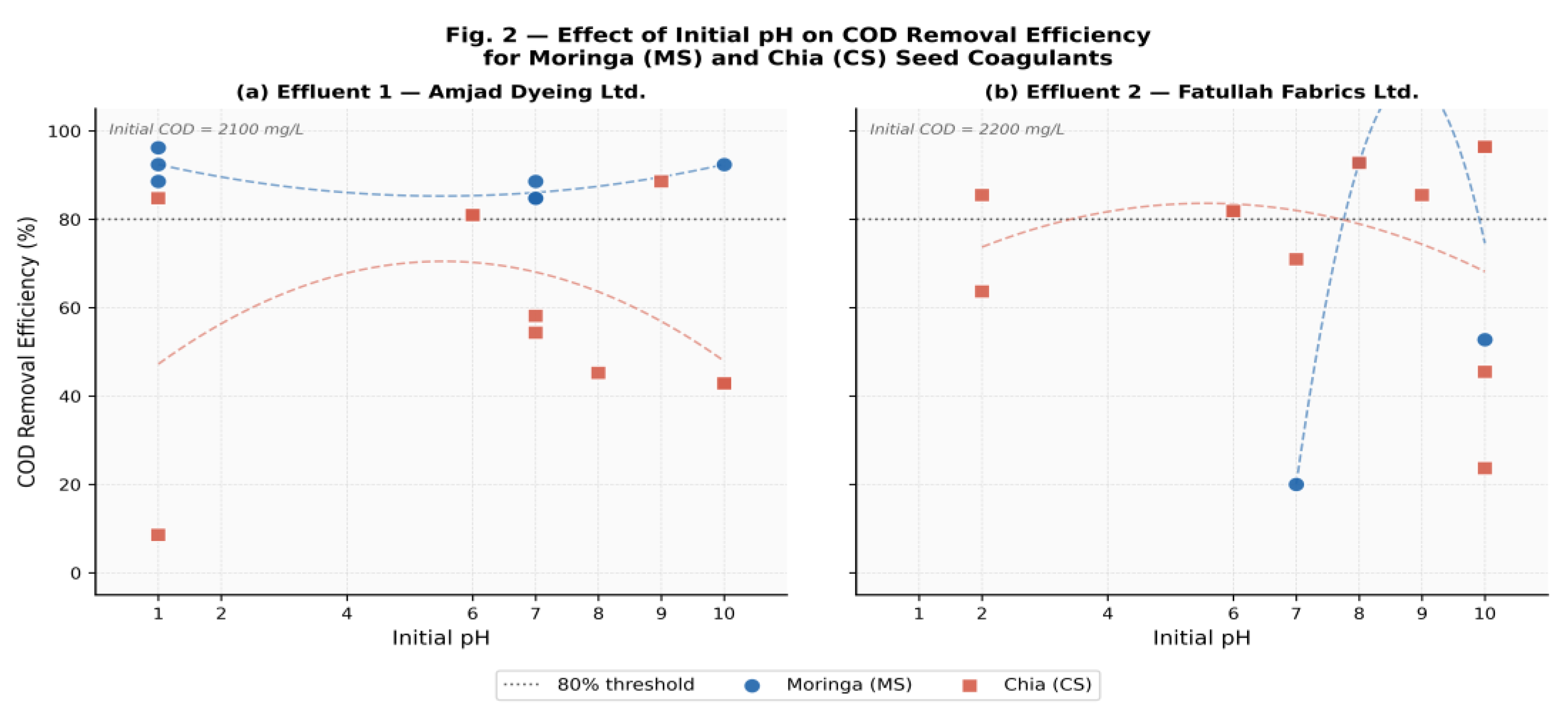

Table 1.
Coagulation performance of Moringa oleifera seed (MS) powder in textile dyeing effluents. pH0 = initial (pre-coagulation) pH; pHᴍ = final post-filtration pH. Initial COD: Effluent 1 = 2100 mg/L, Effluent 2 = 2200 mg/L. † = peak COD removal;.
Table 1.
Coagulation performance of Moringa oleifera seed (MS) powder in textile dyeing effluents. pH0 = initial (pre-coagulation) pH; pHᴍ = final post-filtration pH. Initial COD: Effluent 1 = 2100 mg/L, Effluent 2 = 2200 mg/L. † = peak COD removal;.
| Sample | Acid Pretreat. | Base Pretreat. | Dose (g) | pH0 | pHᴍ | COD (mg/L) | COD Rem. (%) | DO (mg/L) |
|---|---|---|---|---|---|---|---|---|
| Effluent 1 | — | — | 0.10 | 7 | 7 | 320 | 84.76 | 10.47 |
| Effluent 1 | 0.1 M HCl | — | 0.05 | 1 | 1 | 160 | 92.38 | 13.33 |
| Effluent 1 | 0.1 M HCl | — | 0.05* | 1 | 1 | 240 | 88.57 | 12.37 |
| Effluent 1 | 0.1 M HCl | — | 0.10 | 1 | 1 | 80 | 96.19† | 14.28 |
| Effluent 1 | — | 0.1 M NaOH | 0.05 | 10 | 10 | 160 | 92.38 | 5.71 |
| Effluent 1 | — | 0.1 M NaOH | 0.05 | 7 | 7 | 240 | 88.57 | 7.60 |
| Effluent 1 | — | 0.1 M NaOH | 0.10 | 7 | 8 | 320 | 84.76 | 9.37 |
| Effluent 2 | 0.1M HCl | — | 0.75 | 7 | 7 | 1760 | 20.00 | 13.33 |
| Effluent 2 | — | 0.1 M NaOH | 0.75 | 8 | 7 | 160 | 92.73 | 7.60 |
| Effluent 2 | — | 0.1 M NaOH | 0.75 | 10 | 10 | 1040 | 52.73‡ | 9.37 |
| Effluent 2 | — | 0.1 M NaOH | 0.75 | 10 | 10 | 80 | 96.36† | 9.37 |
Note: * The variance observed between the two independent replicates under highly acidic conditions (HCl, 0.05 g dose, pH 1) for Effluent 1 (160 mg/L vs. 240 mg/L residual COD) is attributed to normal experimental variability associated with coagulation–flocculation processes, including mixing, floc formation, and settling dynamics. Both measurements were retained as independent replicates to reflect the reproducibility of the treatment process under identical operating conditions. ‡The experiments were repeated independently using the same wastewater sample and treatment conditions. The residual COD values of 1040 mg/L and 80 mg/L were verified against the original laboratory records and are reported as measured. The observed discrepancy reflects experimental variability under alkaline conditions and has therefore been retained in the dataset.
Table 2.
Coagulation performance of Salvia hispanica (chia) seed (CS) powder in textile dyeing effluents. † = peak COD removal equivalent to MS performance. Initial COD: Effluent 1 = 2100 mg/L, Effluent 2 = 2200 mg/L.
Table 2.
Coagulation performance of Salvia hispanica (chia) seed (CS) powder in textile dyeing effluents. † = peak COD removal equivalent to MS performance. Initial COD: Effluent 1 = 2100 mg/L, Effluent 2 = 2200 mg/L.
| Sample | Acid Pretreat. | Base Pretreat. | Dose (g) | pH0 | pHᴍ | COD (mg/L) | COD Rem. (%) | DO (mg/L) |
|---|---|---|---|---|---|---|---|---|
| Effluent 1 | — | — | 0.05 | 6 | 6 | 400 | 80.95 | 7.61 |
| Effluent 1 | — | — | 0.10 | 6 | 7 | 400 | 80.95 | 5.71 |
| Effluent 1 | 0.1 M HCl | — | 0.05 | 1 | 1 | 1920 | 8.57 | 6.60 |
| Effluent 1 | 0.1 M HCl | — | 0.10 | 1 | 1 | 320 | 84.76 | 4.76 |
| Effluent 1 | — | 0.1 M NaOH | 0.05 | 7 | 7 | 960 | 54.29 | 3.80 |
| Effluent 1 | — | 0.1 M NaOH | 0.05 | 9 | 10 | 240 | 88.57 | 5.71 |
| Effluent 1 | — | 0.1 M NaOH | 0.10 | 7 | 7 | 880 | 58.10 | 8.57 |
| Effluent 1 | — | 0.1 M NaOH | 0.10 | 10 | 10 | 1200 | 42.86 | 8.42 |
| Effluent 1 | — | 0.1 M NaOH | 0.10 | 8 | 7 | 1150 | 45.24 | 8.57 |
| Effluent 1 | — | 0.1 M NaOH | 0.10 | 10 | 10 | 1200 | 42.86 | 9.31 |
| Effluent 2 | — | — | 1.00 | 6 | 6 | 400 | 81.82 | 9.52 |
| Effluent 2 | — | — | 0.50 | 6 | 6 | 400 | 81.82 | 7.60 |
| Effluent 2 | — | — | 0.10 | 6 | 6 | 400 | 81.82 | 6.66 |
| Effluent 2 | 0.1 M HCl | — | 0.10 | 2 | 2 | 320 | 85.45 | 6.60 |
| Effluent 2 | 0.1 M HCl | — | 0.10 | 2 | 2 | 800 | 63.64 | 7.61 |
| Effluent 2 | — | 0.1 M NaOH | 0.10 | 10 | 10 | 1680 | 23.64 | 7.60 |
| Effluent 2 | — | 0.1 M NaOH | 0.10 | 7 | 7 | 640 | 70.91 | 8.43 |
| Effluent 2 | — | 0.1 M NaOH | 0.10 | 8 | 8 | 160 | 92.73 | 8.57 |
| Effluent 2 | — | 0.1 M NaOH | 0.10 | 10 | 10 | 1200 | 45.45 | 10.47 |
| Effluent 2 | — | 0.1 M NaOH | 0.10 | 9 | 10 | 320 | 85.45 | 9.80 |
| Effluent 2 | — | 0.1 M NaOH | 0.10 | 10 | 10 | 80 | 96.36† | 8.37 |
| Effluent 2 | — | 0.1 M NaOH | 0.10 | 10 | 10 | 80 | 96.36† | 8.42 |
Table 3.
One-way ANOVA summary for COD removal efficiency (%) comparing Moringa seed (MS) vs. Chia seed (CS) treatments (α = 0.05). SS = sum of squares; df = degrees of freedom; MS = mean square. n.s. = not significant.
Table 3.
One-way ANOVA summary for COD removal efficiency (%) comparing Moringa seed (MS) vs. Chia seed (CS) treatments (α = 0.05). SS = sum of squares; df = degrees of freedom; MS = mean square. n.s. = not significant.
| Source of Variation | SS | df | MS (Mean Sq.) | F | p-value | F crit |
|---|---|---|---|---|---|---|
| Between Groups (Coagulant) | 1241.6 | 1 | 1241.6 | 2.13 | 0.155 | 4.16 |
| Within Groups (Error) | 18070.9 | 31 | 583.3 | — | — | — |
| Total | 19312.5 | 32 | — | — | — | — |
Table 4.
Summary of coagulation performance metrics for Moringa seed (MS) and Chia seed (CS) in two textile dyeing effluents. †Values recalculated from Table 1 and Table 2.
| Parameter | MS Effluent 1 | MS Effluent 2 | CS Effluent 1 | CS Effluent 2 |
|---|---|---|---|---|
| COD Removal Range (%) | 84.76–96.19 | 20.00–96.36 | 8.57–88.57 | 23.64–96.36 |
| Mean COD Removal (%)† | 89.66 | 65.45 | 58.71 | 75.45 |
| Optimal pH | Neutral–Alkaline (1–10) | Alkaline (8–10) | Neutral–Alkaline (6–10) | Neutral–Alkaline (6–10) |
| DO Range (mg/L) | 5.71–14.28 | 7.60–13.33 | 3.80–9.31 | 6.60–10.47 |
| Mean DO (mg/L)† | 10.45 | 9.92 | 6.91 | 8.30 |
| Max COD Removal (%) | 96.19 | 96.36 | 88.57 | 96.36 |
| Initial Effluent COD (mg/L) | 2100 | 2200 | 2100 | 2200 |
| n (observations) | 7 | 4 | 10 | 12 |
Table 5.
Contextualization of present study findings relative to recent literature on natural coagulant performance in industrial wastewater treatment. PAM = polyacrylamide; RSM = response surface methodology; WW = wastewater.
Table 5.
Contextualization of present study findings relative to recent literature on natural coagulant performance in industrial wastewater treatment. PAM = polyacrylamide; RSM = response surface methodology; WW = wastewater.
| Study | Coagulant | Wastewater Type | pH | Dosage | COD Removal (%) |
|---|---|---|---|---|---|
| Present Study | Moringa oleifera seeds | Textile dyeing effluent (Bangladesh) | 1–10 | 0.05–0.75 g/250 mL | 84.76–96.36 |
| Present Study | Salvia hispanica (Chia) seeds | Textile dyeing effluent (Bangladesh) | 1–10 | 0.05–1.0 g/250 mL | 8.57–96.36 |
| Worku & Abate (2025) [37] | Moringa seeds | Textile wastewater (Ethiopia) | 6–8 | 10–30 g/L | Up to 88% |
| Rendana et al. (2025) [36] | Moringa + PAM | Textile wastewater | 5–7 | 25 g/L | ~29% COD |
| Tawakkoly et al. (2019) [13] | Salvia hispanica mucilage | Compost leachate | Optimized | RSM-optimized | 62.4% COD |
| Silva et al. (2026) [12] | Chia mucilage (CM) | Fertilizer industry WW | 7 | 0.5 g/L | 85.7% COD |
| Yin et al. (2010) [8] | Moringa oleifera (review) | Various | 6–8 | Various | 70–95% |
Disclaimer/Publisher’s Note: The statements, opinions and data contained in all publications are solely those of the individual author(s) and contributor(s) and not of MDPI and/or the editor(s). MDPI and/or the editor(s) disclaim responsibility for any injury to people or property resulting from any ideas, methods, instructions or products referred to in the content. |
© 2026 by the authors. Licensee MDPI, Basel, Switzerland. This article is an open access article distributed under the terms and conditions of the Creative Commons Attribution (CC BY) license (http://creativecommons.org/licenses/by/4.0/).
Copyright: This open access article is published under a Creative Commons CC BY 4.0 license, which permit the free download, distribution, and reuse, provided that the author and preprint are cited in any reuse.


