

Submitted:
09 June 2026
Posted:
10 June 2026
You are already at the latest version
Abstract
Electric micromobility may reduce transport emissions, but its system-level benefits depend on which journeys and vehicles it replaces. This study assesses e-bike, e-scooter and e-cargo-bike pathways in an electrifying UK transport system using an expanded Transport Energy Air pollution Model (TEAM-UK). Socio-technical scenarios are modelled annually to 2050, estimating travel activity, energy demand, direct CO2 and NOX emissions, life-cycle greenhouse gas emissions and local air pollutants, including non-exhaust sources. Fleet electrification dominates long-run reductions in tailpipe CO2 and NOX. However, e-bike-led pathways deliver the largest additional reductions in car-kilometres, energy demand, cumulative life-cycle emissions and non-exhaust PM2.5. E-cargo bike pathways provide more targeted benefits, while e-scooter pathways produce modest system-level gains. Electric micromobility is most effective when embedded in policies that substitute car and van travel with lighter, low-energy modes.
Keywords:
electric micromobility
; e-bikes
; e-scooters
; e-cargo bikes
; transport energy
; carbon emissions
; air pollution
; scenario analysis
; United Kingdom
1. Introduction
Transport remains the UK’s largest single source of CO₂ emissions, with road vehicles accounting for most of those emissions (DESNZ, 2024). Road traffic also contributes to urban air pollution, congestion, noise, energy demand and wider public-health costs (DESNZ, 2024; WHO, 2021; IPCC, 2022). Transport decarbonisation addresses therefore not only a carbon problem, but also air quality, resource use and urban systems problems.
While domestic emissions from the sector have begun to plateau, progress is still too slow. Current policy is strongly oriented toward vehicle electrification. Battery electric vehicles are central to reducing tailpipe carbon dioxide, nitrogen oxides and exhaust particulate emissions as electricity generation decarbonises (IPCC, 2022; IEA, 2023). However, electrification alone does not solve the environmental impacts of road transport. Upstream emissions from vehicle production, battery manufacture and electricity supply remain material during the transition period, while non-exhaust particulate matter from tyre wear, brake wear, road-surface abrasion and resuspension persists even after tailpipe emissions are removed (Peters et al., 2017; Timmers and Achten, 2016; AQEG, 2019; Harrison et al., 2021; OECD, 2020). As exhaust emissions decline, non-exhaust sources become proportionally more important regarding traffic-related PM2.5 exposure. There is therefore consensus now that beyond technological substitution we also need to reduce vehicle kilometres travelled, vehicle mass, material demand and dependence on private motorised mobility (Anable, 2024).
These limitations have renewed interest in demand-side transport strategies and modal substitution. Electric micromobility (or eMM), including e-bikes, e-scooters and e-cargo bikes, can contribute to decarbonisation by replacing short car trips, reducing final energy demand, and extending the practical range and payload capacity of active travel (Fishman and Cherry, 2016; Castro et al., 2019; Philips et al., 2022; Lovelace et al., 2011). Yet its environmental benefits are highly conditional. E-bikes, e-scooters and e-cargo bikes differ in typical trip length, payload, user groups, substitution patterns, energy use, lifetime and life-cycle emissions (Hollingsworth et al., 2019; de Bortoli and Christoforou, 2021; Wang et al., 2023; Temporelli et al., 2022). Treating eMM as a single homogeneous category therefore risks obscuring important differences in system-level environmental performance.
Existing research suggests that individual micromobility modes can deliver substantial environmental benefits, particularly where e-bikes substitute for car travel, but it remains unclear how those benefits scale up when alternative transition pathways are assessed at national level (Asensio et al., 2022; McQueen et al., 2020; Philips et al., 2022). Much of the literature remains focused on individual modes, local trials or emission targets, whereas less attention has been given to cumulative impacts and transition dynamics across a whole transport system (Hollingsworth et al., 2019; de Bortoli and Christoforou, 2021; Cass et al., 2025a). This matters because emissions reductions delivered between now and 2040 can materially affect cumulative climate outcomes and population exposure to harmful pollutants, even if long-run targets eventually converge (Brand et al., 2020; Craglia et al., 2020; IPCC, 2022; Winkler et al., 2023).
This paper addresses these gaps using TEAM-UK, a bottom-up systems model integrating transport demand, vehicle stock evolution, direct energy use and emissions, and life-cycle environmental impacts (see Brand et al., 2019 for methods and Brand et al., 2025 for a recent application in scenario modelling). We evaluate three eMM scenario families under four ambition levels: Business-as-Usual (a conservative reference case), Policy-enabled, Technology & Market Driven, and Radical/Car-light Society. The scenarios are implemented alongside a common background vehicle-electrification trajectory, allowing the effects of modal substitution to be isolated from road transport fleet decarbonisation. Here we report on projections of tailpipe and life cycle CO2 emissions, as well as two key air quality pollutants, i.e., NOX and PM2.5 including non-exhaust PM2.5.
The paper addresses three questions. First, how do different eMM pathways affect direct and life-cycle carbon emissions in an electrifying transport system? Second, to what extent can eMM reduce non-exhaust air pollutant emissions once tailpipe emissions are largely eliminated? Third, how do transition dynamics differ across eMM pathways? The results show that fleet electrification dominates long-term reductions in direct CO2 and NOX emissions, but that pathway choice materially affects cumulative carbon emissions, final energy demand and long-term particulate pollution. E-bike-focused pathways produce the largest reductions in passenger car kilometres, life cycle CO2-equivalent emissions and non-exhaust PM2.5, while e-cargo bike pathways provide intermediate benefits, particularly where household utility trips and light freight substitution occur, and e-scooter-focused pathways deliver more modest system-level gains despite high adoption rates. These findings suggest that transport policy must shift the focus from fuel switching alone. In electrified transport systems, environmental performance increasingly depends on reducing vehicle mass, vehicle-kilometres travelled and life-cycle material demand (Brand et al., 2020; Milovanoff et al., 2020; AQEG, 2019; OECD, 2020; Harrison et al., 2021).
Section 2 reviews evidence on transport electrification in meeting climate goals and the role eMM can play in mode shift and reducing life-cycle carbon emissions and local air pollution. Section 3 describes the scenario modelling framework, core methods and data assumptions. Section 4 presents the carbon, energy and air-quality results while Section 5 discusses implications for transport and environmental policy. Section 6 concludes with the key findings and contributions of the study.
2. Literature Review
2.1. Electrification Is Necessary, But Not Sufficient
Road-transport electrification is a central element of transport decarbonisation because electric drivetrains remove tailpipe emissions and can become progressively cleaner as electricity systems decarbonise (IPCC, 2022). However, the literature is now clear that electrification alone does not deliver transport decarbonisation. System-level outcomes depend on fleet turnover, electricity carbon intensity, battery production, vehicle size and annual mileage, and on whether electrification is accompanied by demand reduction and mode shift (Milovanoff et al., 2020; Brand et al., 2020). Life-cycle studies show that electric vehicles typically deliver lower lifetime greenhouse-gas emissions than comparable internal-combustion vehicles, especially under decarbonising electricity systems, but embodied emissions from battery and vehicle production can be substantial (Peters et al., 2017; IEA, 2023). These emissions are incurred early in the vehicle life cycle, meaning that rapid vehicle replacement can generate near-term carbon costs even where long-term operational emissions fall. The broader mitigation literature therefore frames transport decarbonisation as an ‘avoid-shift-improve’ challenge rather than a simple technology substitution problem (Creutzig et al., 2022; IPCC, 2022; Brand et al., 2025; Arnz et al., 2024). Recent transport modelling work reinforces this point by showing that vehicle substitution alone is often too slow to deliver the emissions reductions required for net zero, especially where road traffic and private-car dependence remain high (Brand et al., 2020; Milovanoff et al., 2020; Winkler et al., 2023).
2.2. Electric Micromobility and Travel Behaviour Changes
Electric micromobility is environmentally relevant primarily to the extent that it displaces other modes, and the literature shows that e-bikes, e-scooters and e-cargo bikes occupy distinct niches in that substitution process. E-bikes have the strongest evidence base as a substitute for car travel. They extend the feasible distance, speed and accessibility of cycling, making them relevant for trips that may be too long, hilly or physically demanding for conventional bicycles (Fishman and Cherry, 2016; Castro et al., 2019; McQueen et al., 2020; Philips et al., 2022). The strongest evidence comes from a meta-analysis showing that mode substitution is context dependent but that car displacement is substantial in Europe and North America; median reported substitution across 38 observations was 24% for automobile travel, with higher substitution for public transport in some settings and recent studies showing stronger displacement of driving and weaker displacement of cycling trips (Bigazzi and Wong, 2020). Recent studies strengthen that conclusion: rebate programmes in northern California changed mode choice and produced measurable travel-related GHG reductions, while a 2024 synthetic-population study in Sweden found that replaceable car trips are more common in high-density areas and that e-bike substitution can be substantial when the method accounts for daily activity schedules rather than isolated trips (Johnson et al., 2023; Tozluoğlu et al., 2024; Bigazzi et al., 2024). One study on dual-mode ownership shows that e-bikes can reduce car dependence, but the extent of replacement versus complementarity varies by household travel patterns (Johnson et al.).
The evidence for shared e-scooters on displacing car travel is less clear. A study using London rental-scooter data shows that trip purpose and alternative mode are difficult to infer from service data alone, which itself underscores a key gap in the literature: e-scooter impacts are often estimated from incomplete behavioural information (Wan and Bendavid, 2024). A mode choice study using GPS, booking and survey data found that trip distance, precipitation and access distance are fundamental determinants of micromobility choice, and that shared e-scooters and shared e-bikes can emit more CO2 than the modes they replace, whereas personal e-bikes and e-scooters can emit less than their displaced modes (Reck et al., 2022). Other work finds that shared e-scooters can enhance public transport access and reduce driving in some settings, but that the substitution pattern varies markedly across locations, user groups and trip types, so the net environmental outcome remains context dependent (Christoforou et al., 2021; Wan and Bendavid, 2024; Reck et al., 2022; Wang et al., 2023; Mouratidis et al., 2021; Sanders et al., 2020). Evidence from the UK indicates that privately owned e-scooters may be used more often for utility travel, such as commuting and shopping, and may be more likely than shared e-scooters to replace car trips (Cass et al., 2026). However, because private e-scooter use remains illegal on UK public roads, it is uncertain whether these patterns would persist under legalisation.
E-cargo bikes occupy a distinct position because they can substitute not only for passenger car trips but also for light freight and service-vehicle movements. Philips et al. (2025) conducted Suburban trials in the UK, in which 49 households borrowed e-cargo bikes for extended periods, found that over 50% of the collective distance of approx. 8,000 kilometres replaced car trips, demonstrating that e-cargo bikes can serve as practical alternatives for household logistics, school runs and shopping trips (Philips et al., 2025; Cass et al., 2025b). A 2022 review showed that e-cargo-bike users are mainly replacing private car trips for children’s transport, shopping and leisure, while safety and infrastructure are the main barriers to adoption (Carracedo and Mostofi, 2022). Regarding freight, e-cargo bikes are particularly important in dense urban areas, where vans contribute to congestion, kerbside pressure, NOₓ and particulate emissions. Evidence from urban logistics suggests that e-cargo bikes can reduce emissions where delivery routes are short, loads are compatible, and consolidation or micro-depot infrastructure is available (Melo and Baptista, 2017; Temporelli et al., 2022; Galkin et al., 2025).
EMM may also alter destination choice by expanding the feasible range of cycling, enabling local shopping and utility trips, or changing access to public transport. For example, recent modelling of e-bike substitution explicitly evaluated whole daily plans, travel duration and distance, estimating that a large share of car trips could be replaceable by e-bikes under feasible routing and time constraints (Tozluoğlu et al., 2024; Reck et al., 2022). Reviews also find that e-cycling affects travel frequency, duration and purposes, but note that destination choice and activity-location changes remain under-researched (Bourne et al., 2020). For e-cargo bikes, the destination-shift mechanism is plausible but not yet well quantified. In practice, cargo capacity could allow households to shop locally rather than drive to larger supermarkets, consolidate errands differently, or replace van-based delivery trips with micro-hub logistics. But most evidence still frames this as trip substitution or logistics reorganisation, not destination choice in a formal travel-demand sense.
The key implication is that eMM should not be treated as a homogeneous class: the three modes differ in trip length, payload, user group, infrastructure needs and substitution potential. This justifies the use of mode-, purpose- and distance-specific transport demand modelling in this study.
2.3. Life-Cycle Emissions, Durability and Utilisation
Operational electricity use is only one part of eMM’s environmental performance. The life cycle emissions literature shows that manufacturing, batteries, maintenance, charging infrastructure and vehicle lifetimes can materially affect emissions per passenger-kilometre (or tonne-kilometre in case of freight). Shared systems have added emissions from redistribution operations, particularly when involving diesel vans. An integrated life cycle analysis (LCA) of shared micromobility in Paris found that impacts are driven largely by vehicle manufacturing and lifetime mileage, and that the sole carbon footprint can be misleading because different impact categories do not necessarily rank modes in the same way (de Bortoli and Christoforou, 2021). For shared e-scooters, this point is especially important: short service life and collection/repositioning can erode or reverse climate gains, whereas longer-lived, better-managed systems using the latest generation vehicle designs perform substantially better (Hollingsworth et al., 2019; Kazmaier et al., 2020; International Transport Forum, 2024). By contrast, e-cargo-bike LCA studies find favourable results relative to vans, but again the outcome depends on load, route structure, logistics design and service life rather than on electricity use alone (Temporelli et al., 2022; Galkin et al., 2025). The carbon benefits of eMM are expected to improve further as electricity grids decarbonise and battery recycling infrastructure matures. Multiple UK LCA studies confirm that e-bike performance improves with cleaner electricity mixes and enhanced battery recycling systems (Wang et al, 2025).
2.4. Air Pollution and Non-Exhaust PM2.5 in Electrified Transport Systems
Non-exhaust emissions of highly toxic ultra-fine particulate matter (PM2.5) are influenced by vehicle mass, speed, tyre and brake materials, driving behaviour, road surface, congestion and meteorology (Grigoratos and Martini, 2015; AQEG, 2019; Harrison et al., 2021). Battery electric vehicles can reduce brake-wear emissions through regenerative braking, but their higher average mass may increase tyre and road-wear emissions relative to lighter vehicles (Timmers and Achten, 2016; Beddows and Harrison). The OECD therefore identifies non-exhaust PM2.5 as an increasingly important environmental-policy challenge in electrified road-transport systems.
For eMM, the non-exhaust evidence base is weaker than for cars and vans. Because e-bikes, e-scooters and e-cargo bikes are much lighter than cars, it is reasonable to expect lower tyre and road-wear emissions per kilometre (Huang et al., 2022). However, there is limited empirical evidence on particulate emissions from micromobility fleets, especially at scale. Small wheels, tyre materials, pavement interaction, maintenance quality and infrastructure conditions may all matter, but these effects remain under-studied. The strongest claim the literature supports is therefore not that micromobility eliminates non-exhaust PM2.5, but that replacing heavier vehicles with lighter modes is likely to reduce mass-related non-exhaust emissions (Harrison et al., 2021; OECD, 2020; Beddows and Harrison, 2021; Wan and Bendavid, 2024). This distinction is important for the present study. Direct CO2, NOX and exhaust PM2.5 are expected to fall strongly under electrification, but non-exhaust PM2.5 may persist in car-centred futures. Micromobility pathways may therefore be more important for long-term air quality outcomes than for long-term tailpipe emissions, especially once the vehicle fleet is largely electrified.
2.5. Relevance to This Study
Taken together, the literature points to a single analytical problem: the environmental value of eMM cannot be inferred from adoption rates alone. E-scooter pathways may deliver limited net benefit (or even a net disbenefit) if trips mostly replace walking or public transport, while e-bike and e-cargo-bike pathways may deliver substantially larger gains if they replace car and van kilometres. At the same time, an electrified car fleet can reduce direct CO2 and NOX substantially while leaving unresolved life-cycle emissions, embodied material demand and non-exhaust PM2.5. The key question is therefore not simply whether mobility becomes electric, but which trips, vehicles and emissions sources are displaced (Reck et al., 2022; Wan and Bendavid, 2024; Johnson et al., 2024).
This creates the gap addressed by the present study. First, although recent studies have improved understanding of e-bike substitution, e-scooter trip purpose and cargo-bike use, most evidence remains mode-specific, local or trial-based rather than nationally integrated (Bigazzi and Wong, 2020; Wan and Bendavid, 2024; Carracedo and Mostofi, 2022; Galkin et al., 2025). Second, much of the literature emphasises direct emissions or short-run impacts, whereas cumulative emissions and transition timing are crucial for both climate and air quality. Third, fewer studies compare the three eMM modes within a single framework that holds background vehicle electrification constant, which makes it difficult to identify whether mode choice or fleet decarbonisation drives the environmental outcome. The scenario analysis in this paper is designed to address precisely that gap by comparing e-bike-, e-scooter- and e-cargo-bike-led pathways under alternative ambition levels and a common electrification (supply, car/van technology adoption) trajectory. It is a structured test of the conditions under which eMM strengthens, or fails to strengthen, transport decarbonisation and air-quality strategies.
3. Material and Methods
This section describes the scenario design, modelling framework and core assumptions used to compare alternative eMM pathways in the UK. The scenario design draws conceptually on low-energy-demand and demand-side transition frameworks that emphasise modal substitution and mobility system transformation alongside technological substitution such as electrification (Barrett et al., 2022; Creutzig et al., 2022; Brand et al., 2025). Crucially, these studies used qualitative narratives that were translated into quantitative modelling assumptions across demand, technology and policy levers. The purpose is not to forecast a most likely future, but to examine internally consistent pathways that test the transport, energy and environmental consequences of different eMM transitions.
3.1. Scenario Design and Narrative Development
The scenario set comprises one conservative baseline (ELEV0) and nine eMM transition scenarios grouped into three mode “families”: e-bike (ELEV1a-c), e-scooter (ELEV2a-c) and e-cargo bike (ELEV3a-c). Within each family, three levels of ambition (a-c) represent progressively stronger policy, market and social conditions: (a) Policy-enabled; (b) Technology & Market; and (c) Radical/car-light.
The ambition levels differ in the degree of policy pull, infrastructure support and car restraint assumed in the storyline. As shown in Table 1, policy-enabled scenarios represent moderate extensions of current practice, including protected infrastructure, purchase incentives and clearer, more supportive rules for ownership and use. Technology- and market-led scenarios assume faster diffusion driven by lower prices, better products, leasing models and broader social acceptance vis-à-vis car-based alternatives. Radical/car-light scenarios assume deeper system change, including road-space reallocation, congestion and parking restraint, tight integration with public transport, and wider normalisation of eMM modes beyond urban areas.
The central modelling assumption is that the environmental effect of eMM depends less on gross uptake alone than on which car trips are replaced. E-bike scenarios therefore concentrate on the 2-10 mile and, in ambitious cases such as speed-pedelecs, 10-25-mile bands; e-scooter scenarios concentrate on sub-2 mile and short urban trips; and e-cargo bike scenarios concentrate on shopping, school run, household goods and urban logistics trips. These distinctions matter because the environmental benefit of eMM depends less on adoption rates than on the trips, destinations and vehicle-kilometres displaced.
3.2. The Transport-Energy-Environment Systems Modelling Framework
Scenario outcomes were estimated using the UK Transport Energy Air pollution Model (TEAM-UK), a bottom-up transport-energy-environment systems model that integrates passenger demand, freight demand, vehicle stock turnover, energy use, direct emissions and life-cycle impacts (Brand et al., 2019). TEAM has previously been used in UK transport decarbonisation studies (see e.g. Brand et al., 2025) and is designed to represent technology diffusion, consumer choice and emissions accounting in a consistent framework. The model structure comprises four linked components. The transport demand model (TDM) projects passenger travel demand by journey purpose, distance band and main mode. The vehicle stock model (VSM) projects the annual turnover of the vehicle fleet and the diffusion of relevant vehicle technologies. The direct energy and emissions model (DEEM) converts activity into energy demand and tailpipe emissions using speed-emission factors and cold start excess emissions. The life-cycle and environmental impacts model (LCEIM) adds embodied emissions from vehicle, battery and fuel supply chains.
In the present study, TEAM was extended to represent e-bikes (both pedal-assisted and speed-pedelecs), e-scooters and e-cargo bikes as separate modes and vehicle technologies. This extension required mode-specific assumptions for travel activity, fleet turnover, energy intensity, vehicle life, charging and rebalancing operations, and life-cycle inventory parameters for vehicle and battery manufacture. The key assumptions are provided in the SI.
3.3. Transport Demand and Vehicle Supply
Passenger transport demand is disaggregated by eight trip purposes and eight distance bands: under 1 mile, 1-2 miles, 2-5 miles, 5-10 miles, 10-25 miles, 25-50 miles, 50-100 miles and over 100 miles. The scenario assumptions operate through distance-band mode shift matrices that shift car (as driver) and car (as passenger) kilometres to eMM modes within each band and purpose. This allows the model to capture the fact that e-bikes are most plausible for short and medium trips, e-scooters for shorter urban access trips and e-cargo bikes for household utility and urban logistics trips.
Vehicle stock evolution was modelled from base year 2012 out to 2050 for 1274 vehicle technology categories, including 283 car and 28 eMM technologies such as increasingly efficient diesel cars, battery electric vehicles, e-bikes and e-cargo bikes. Key performance and cost metrics for the four micromobility modes (e-bikes, speed-elecs, e-scooters, e-cargo bikes) were obtained from a review of the largely grey literature of typical urban/rural speeds, upfront, operating and maintenance costs, energy consumption and battery capacity and vehicle/battery lifetime data (see SI2 for details). Technology turnover of eMM modes were modelled using typical scrappage probability functions and a simplified discrete choice model (based on costs, performance and market availability) (see Brand et al., 2019; Brand et al., 2017).
In all scenarios, a common (and somewhat ambitious) background electrification trajectory is applied to the car, bus and freight fleets, allowing the incremental effects of eMM mode shift to be isolated. This pathway assumes rapid diffusion of battery electric cars after 2030 and progressive electrification of buses and light freight, with strong declines in gasoline and diesel demand by 2050. The eMM scenarios therefore test how far modal substitution can add to, accelerate or reshape the environmental effects of a transport system already undergoing substantial electrification.
3.4. Energy, Emissions and Life Cycle Emissions Inventory
Direct energy use and emissions are calculated from vehicle activity using technology-specific, speed-sensitive emission factors. Road-transport factors are based on established emission-inventory methods, including HBEFA (INFRAS, 2009), COPERT (EEA, 2017) and, for non-exhaust PM2.5 emissions, the UK National Atmospheric Emissions Inventory (DEFRA, 2022). This framework is used to estimate direct energy use and CO2, NOX and PM2.5 emissions from cars, buses, motorcycles, vans, freight and the three eMM modes. PM2.5 is represented as both total direct emissions and non-exhaust emissions. The non-exhaust component includes tyre wear, brake wear, road-surface abrasion and resuspension (DEFRA, 2022).
Life cycle GHG emissions are reported as CO2-equivalent (CO2-eq) emissions using 100-year global warming potentials. The life cycle boundary includes vehicle manufacture, battery production, fuel extraction and refining, electricity generation and operational energy use. For shared micromobility, the emissions also capture collection, redistribution and service-life assumptions. Typical material compositions of eMM vehicles, including rare earth materials, as well as embedded energy use and emissions are given in SI3.
3.5. Scenario Plausibility and Interpretation
The developed eMM scenarios are exploratory, not predictive. Their purpose is to test the environmental consequences of plausible but contrasting sociotechnical futures. The Policy-enabled scenarios represent moderate extensions of current trends: regulated e-scooter deployment, expanding e-bike markets, local cargo-bike pilots, and incremental improvements in active travel infrastructure. These futures are relatively plausible under existing UK policy trajectories, although they still require sustained implementation capacity and stable funding. The Technology & Market scenarios assume faster diffusion driven by improving batteries, falling costs, better product availability, stronger leasing models and greater consumer familiarity. These pathways are plausible where market growth is supported by infrastructure and regulation, but they remain sensitive to affordability, safety perceptions, theft risk, battery supply chains and urban-rural differences in trip patterns. The Radical/car-light scenarios are deliberately more transformative. They require not only faster eMM adoption, but also substantial changes in urban governance and road-space allocation. Their feasibility depends on protected networks, secure parking, traffic restraint, logistics consolidation, integration with public transport, and public acceptability of restrictions on private car use. These futures are more demanding politically and institutionally, but they are not technically implausible: many of the required interventions already exist in leading European cycling and low-car cities. Their plausibility therefore depends less on vehicle technology than on whether policy packages can align infrastructure, regulation, pricing and social norms at sufficient scale.
All scenarios assume near-complete electrification of the remaining car fleet by 2050 (99% BEV share). This reflects the UK government’s commitment to phase out new petrol and diesel car sales by 2030/35 and the expected fleet turnover by 2050. This assumption is critical for interpreting carbon implications: eMM competes primarily with electric cars rather than internal combustion engine vehicles by the 2040s.
4. Results
4.1. Electric Micromobility Reduces Transport Energy Demand, But the Effect Is Highly Pathway-Specific
Total domestic transport energy demand declines substantially across all scenarios because the model projects a common electrification trajectory, particularly for cars and vans. EMM adds an additional reduction, but the size of that effect depends strongly on the pathway. In the 2019 baseline, transport energy demand is 1,574 PJ. In the BAU case, demand falls to 661 PJ in 2040 and 401 PJ in 2050. The micromobility pathways reduce demand further, but the magnitude differs markedly across modes.
The e-bike pathway consistently produces the largest additional savings (Figure 1). In 2050, energy demand falls to 389 PJ (-3% when compared to BAU) under the policy-enabled e-bike case, 374 PJ (-7%) under the tech-and-markets case and 361 PJ (-10%) under the radical/car-light case. The e-cargo-bike pathway is intermediate, while the e-scooter pathway produces only marginal additional savings because it displaces comparatively little car travel. So, eMM lowers the residual demand left after fleet electrification rather than transforming energy demand on its own. It also reduces total electricity demand by up to 11% in the longer term (2050) as eMM is significantly more energy efficient than the (e-)cars.
4.2. Lowering Transport Energy Demand Through Mode Shift Makes Increased Climate Ambition Possible, Even Though the Effect Is Relatively Small Overall
The transition to electric road transport (common to all scenarios) dominates direct CO2 emissions reductions particularly in the longer term. Even in the BAU case, direct emissions from cars decline from 67.6 MtCO2 in 2019 to 36.6 MtCO2 in 2030 and only 0.4 MtCO2 in 2050. By 2050, the micromobility pathways differ only slightly in annual direct CO2 because the direct-emissions total is increasingly driven by the electrified car and van fleets and by the residual emissions that remain in the transport system from road freight, rail and air.
The main effect of micromobility is therefore not to change the 2050 endpoint dramatically, but to reduce cumulative emissions during the transition. The e-bike pathway is strongest, saving 38.3 MtCO2 over 2025-2040 and 43.9 MtCO2 over 2025-2050 under the radical scenario (Figure 2 and Table 2). The e-cargo-bike pathway is smaller but still material, while the e-scooter pathway delivers only marginal cumulative savings. This reinforces a central point in the transport decarbonisation literature: early modal shift matters because cumulative emissions are shaped by the pathway taken to net zero, not only by the final endpoint.
Life cycle CO2-eq emissions provide a broader measure of climate impact than tailpipe CO₂ alone. For land-based passenger transport, annual life-cycle emissions decline from 147.6 MtCO2-eq in 2019 to 68.0 MtCO2-eq in 2050 under BAU, reflecting the common electrification trajectory. The micromobility pathways reduce the endpoint further, but again the more important effect is cumulative (Table 2). The largest cumulative reductions occur in the e-bike scenarios. Under the radical e-bike pathway, life-cycle emissions are reduced by 96.4 MtCO₂-eq over 2025-2050 relative to BAU. The radical e-cargo-bike pathway delivers smaller but still meaningful savings of 31.1 MtCO₂-eq over the same period. By contrast, the radical e-scooter pathway reduces cumulative emissions by only 3.4 MtCO₂-eq by 2050, reflecting its smaller displacement of car travel.
The timing of these reductions is important. In the long-term differences in annual emissions are relatively small because much of the passenger fleet has already electrified. Earlier reductions carry greater climate value: they reduce cumulative emissions, ease pressure on carbon budgets and avoid locking in high-energy travel patterns during the transition. The consistent ranking across ambition levels (e-bikes delivering the largest savings, followed by e-cargo bikes and then e-scooters) indicates that the climate value of eMM depends less on vehicle uptake per se than on the extent to which it substitutes medium-distance car travel early enough to affect cumulative emissions.
4.3. The Underlying Changes in Road Passenger Travel
To understand the above energy and emissions trajectories it is worth looking at the underlying changes in road passenger travel. Total road passenger distance travelled per capita decreases slightly from 5,766 miles per person per year in 2019 to around 5,338-5,348 miles in 2050 across the alternative scenarios, a reduction of approximately 7%. This is not a large contraction in mobility demand. Rather, it is comparable in scale to recent observed variation in travel behaviour in England (Department for Transport, 2025e). By 2050, people are making fewer trips overall (918 compared to 986 in 2019), with fewer commuting, shopping and school trips but more leisure trips. This pattern is consistent with wider post-pandemic trends in which commuting has remained below pre-pandemic levels, while the distribution of trip purposes has shifted (ibid.).
Across the e-bike scenarios, a larger share of commuting, utility and leisure travel shifts away from car-driver and car-passenger modes into e-bikes (see Table 3). In the radical, car-light e-bike scenario, car-driver distance falls from 3,232 miles per person per year in 2019 to 1,994 miles in 2050, a reduction of 38%. Relative to the 2050 BAU case, the reduction is 26%. Over the same period, e-bike travel rises to 1,103 miles per person per year, and combined eMM travel reaches 1,174 miles per person per year, equivalent to 22% of total road passenger distance, which is more than all other non-car road transport modes combined. Overall, the more ambitious e-bike scenarios are the only pathways in which eMM becomes a major component (>10%) of everyday mobility rather than a marginal supplement.
Even in the radical e-scooter case, car-driver distance falls marginally to 2,641 miles per person per year in 2050 (2.1% below 2050 BAU), while e-scooter travel rises to 109 miles per person per year. This is more than current cycling but below walking levels. Combined eMM travel reaches 321 miles per person per year, or 6% of road passenger distance. This reflects the concentration of e-scooter substitution in short-distance travel markets, where the total volume of displaced car mileage is relatively limited.
The e-cargo-bike pathway sits between these two extremes. In the radical e-cargo-bike scenario, car-driver distance falls to 2,470 miles per person per year in 2050 (8% below 2050 BAU), while e-cargo-bike travel rises to 331 miles per person per year. Combined eMM travel reaches 540 miles per person per year, or 10% of total road passenger distance. This indicates a more substantial shift than in the e-scooter pathway, but one that remains narrower than the e-bike-led transition because cargo-bike use is concentrated in specific household utility, shopping and logistics-related trip purposes.
The journey-purpose decomposition of trip frequencies and average trip lengths (ATL) shows that the relative performance of eMM pathways is driven less by aggregate vehicle uptake and trip-making changes than by the amount of car mileage displaced within higher ATL trip purposes. E-bike substitution reaches the broadest set of journey purposes and therefore produces the largest reductions in car-driver distance, whereas e-scooter substitution remains concentrated in a much smaller travel market and e-cargo-bike substitution provides an intermediate, more specialised contribution.
Any link between eMM adoption and car ownership should be interpreted cautiously. We do not explicitly model whether households sell, postpone or avoid acquiring cars in response to eMM adoption. Nevertheless, the scale of car-driver mileage reduction in the e-bike and, to a lesser extent, e-cargo-bike pathways is consistent with reduced dependence on private cars and potentially weaker incentives for multi-car ownership (Yin et al., 2024; Philips et al., 2025). This remains an inferred mechanism rather than a directly modelled outcome.
4.4. Shifting Trips Away from Heavier Vehicles Reduces Air Pollution Most Effectively
In the 2019 baseline, direct PM2.5 emissions from cars and eMM were 8,396 tonnes, while tailpipe NOX emissions were 138,420 tonnes. Under BAU, NOX falls sharply to 656 tonnes by 2050, reflecting the common electrification pathway. PM2.5 declines much less, to 6,991 tonnes in 2050, only 16.7% below 2019, because non-exhaust emissions remain after tailpipe exhaust is largely removed. This contrast is important: electrification is highly effective for NOₓ, but much less effective for residual particulate pollution from non-exhaust sources.
Consistent with the travel results, eMM produces the largest additional local air pollution gains in the e-bike pathways (see Figure 3). By 2050, the radical e-bike scenario reduces PM2.5 emissions to 5,215 tonnes, 25% below BAU, and NOX emissions to 487 tonnes, 26% below BAU. The technology & markets e-bike scenario is also substantial, reducing 2050 PM2.5 by 17% and NOX by 18% relative to BAU. The e-cargo bike pathways deliver intermediate benefits of approx. 8% reductions for both pollutants. By contrast, e-scooter pathways produce only small additional reductions; even the radical e-scooter scenario reduces 2050 PM2.5 and NOX by only about 2% relative to BAU.
The key implication is that local air pollution benefits do not follow automatically from electrification alone. They depend on whether the transition reduces car dependence and lowers the mass and intensity of traffic (Timmers and Achten, 2016; Beddows and Harrison). In that sense, micromobility is more important for residual PM2.5 than for tailpipe CO2. Once the fleet is largely electrified, the remaining pollution burden increasingly comes from non-exhaust sources, and the strongest route to reducing it is to shift trips away from heavier vehicles.
4.5. Synthesis and Interpretation
The results qualify the role of eMM in transport decarbonisation. EMM does not materially alter the long-run tailpipe CO2 endpoint once (and if) the car fleet is highly electrified. EMM’s more important contribution is to reduce car-kilometres, final energy demand, cumulative life cycle emissions and residual non-exhaust PM2.5 during the transition. In this sense, eMM is not primarily a fuel-switching intervention, but a demand- and mass-reduction intervention.
The ‘ranking’ of environmental benefits of the pathways is consistent across outcomes. E-bike scenarios deliver the largest benefits because they substitute a broad set of car trips, including medium-distance commuting, personal business and leisure travel. E-cargo-bike scenarios provide a more targeted contribution, with value concentrated in household utility and urban logistics contexts. E-scooter scenarios have the weakest system-level effect because their travel market is shorter-distance and less strongly connected to car-kilometre reduction. This does not imply that e-scooters lack transport value, but it does suggest that their climate and air quality contribution is likely to be limited unless deployment is explicitly linked to car restraint rather than simply added to existing urban mobility options (Wan and Bendavid, 2024; Reck et al., 2022; Wang et al., 2023).
The central implication is that the environmental value of eMM depends on substitution quality, not adoption volume. More micromobility trips are not necessarily better if they replace walking, cycling or public transport, or if short device lifetimes increase embodied impacts. Conversely, even modest levels of uptake can be consequential where they displace high-mileage car use or reduce the need for heavier vehicles, including heavier electric cars (Brand, 2024).
5. Discussion
5.1. Implications for Transport and Environmental Policy
The results imply that eMM should be governed as a targeted demand-side intervention rather than as a generic low-carbon technology category. Its policy value depends on whether it displaces car kilometres, reduces vehicle mass and delivers emissions reductions early enough to affect cumulative climate impacts. On these criteria, e-bikes and e-cargo bikes warrant stronger policy attention than e-scooters where the primary objective is climate and air-quality mitigation.
This distinction is particularly relevant in the UK because the regulatory baseline is uneven. Standard electrically assisted pedal cycles are legally supported under the EAPC framework, provided they meet requirements including the 250 W motor limit and 15.5 mph assistance cut-off (Department for Transport, 2024; Department for Transport, 2025a). By contrast, private e-scooters remain illegal on public roads, with legal use restricted to authorised rental trials (Department for Transport, 2025c; Department for Transport, 2025d). Recent consultation on changing EAPC rules, including higher-power cycles and throttle use, also illustrates the unresolved regulatory status of faster or more powerful e-cycles (Department for Transport, 2025b). The modelling results suggest that any regulatory change should be assessed against a clear environmental test: whether the mode is likely to replace car travel rather than add additional, “low value” vehicle kilometres.
The strongest policy case is for e-bikes and speed-pedelecs. They produce the largest reductions in car travel, energy demand, cumulative life-cycle CO2-eq and residual PM2.5 because they reach trip purposes and journey lengths with greater car-use reduction effects. This is consistent with UK spatial modelling showing substantial theoretical capability for e-bikes to replace car travel, especially in places with high car dependence and fewer public transport alternatives (Philips et al., 2022). It is also consistent with behavioural evidence from e-bike loan and rebate studies, which show that access to e-bikes can change mode choice and replace some car trips (Cairns et al., 2017; Johnson et al., 2023; Sundfør et al., 2024; Bigazzi et al., 2025). The policy implication is not simply to maximise e-bike ownership, but to target adoption where car substitution is most likely: commuting, personal business, local leisure, business and medium-distance utility trips.
Financial support is therefore justified, but it should be selective. Affordability remains a major barrier, particularly for e-cargo bikes and higher-quality e-bikes. Evidence from incentive programmes suggests that rebates can increase uptake and reduce car use, but programme design matters. Income-conditioned incentives in Saanich, Canada, were associated with regular e-bike use and travel-related GHG reductions, with larger rebates reaching more marginal purchasers and higher pre-purchase car users (Bigazzi et al., 2025). Evidence from Oslo similarly found that e-bike subvention increased bicycle mode share and reduced car and public transport use (Sundfør et al., 2024). UK policy should therefore prioritise targeted purchase support, leasing, employer schemes and try-before-you-buy programmes, rather than untargeted subsidies that risk supporting purchases with low additionality.
Infrastructure is the second condition. The radical scenarios assume not merely more vehicles, but safer, high-quality and better-connected networks that allow eMM to compete with car travel for everyday trips in terms of convenience, speed and cost. This is supported by wider evidence that active travel interventions are most effective when infrastructure improvements are combined with behavioural, social or access-based measures (Roaf et al., 2024). In practical terms, eMM policy should prioritise safe and protected routes, safe junctions, secure residential and destination parking, charging where appropriate and integration with public transport (Oeschger et al., 2020). Active Travel England’s funding framework already supports walking, wheeling and cycling infrastructure, behaviour change and local authority capability-building; eMM policy should build on this rather than develop as a separate technology-led agenda (Active Travel England, 2025).
For e-cargo bikes, the policy opportunity is narrower but still important. Their strongest role is likely to be in household utility travel, school-run substitution, local shopping, service trips and last-mile logistics. The relevant policy package is therefore different from commuter e-bike policy: purchase grants or leasing for households and small firms, secure storage, consolidation hubs, kerbside-loading reform, cargo-bike access privileges and restrictions or pricing for inefficient van movements in dense urban areas. These measures are most defensible where e-cargo bikes replace car or van kilometres rather than merely adding new delivery capacity.
The e-scooter results support a more cautious policy stance. E-scooters may improve accessibility and first-/last-mile connectivity, but the modelled system-wide climate and air-quality benefits are small because their trip market is short-distance and less car-intensive. Their environmental case is further weakened where they substitute for walking, cycling or public transport, or where short device lifetimes and operational servicing increase life-cycle impacts (Christoforou et al., 2021; Felipe-Falgas et al., 2022; Hollingsworth et al., 2019). Legalisation should therefore be conditional on evidence about safety, parking, durability, public realm impacts and effective modal substitution. In environmental terms, e-scooters are most defensible when integrated with public transport and car-restraint measures, not when deployed simply as an additional convenience mode.
The broader lesson is that single measures are unlikely to realise the environmental potential of eMM. Subsidies without safe infrastructure risk limited or recreational uptake. Infrastructure without affordability support risks inequitable access. Legalisation without parking and street-management rules risks public-realm conflict. Micromobility without car demand management risks additional mobility rather than modal shift. The scenarios with the largest benefits combine eMM access with measures that reduce the relative convenience of car use, including road-space reallocation, parking restraint, congestion pricing, low-traffic neighbourhoods and public-transport integration.
Equity should be central to this policy package. If eMM is to contribute to decarbonisation rather than remain a niche consumer market, support should prioritise people and places where car dependence is high, public transport is limited, and short-to-medium car trips are common. This includes suburban, peri-urban and smaller-town contexts, not only dense city centres. Targeted e-bike and e-cargo-bike programmes should therefore be designed as accessibility policies as much as climate policies.
Overall, electrification and micromobility address different parts of the transport decarbonisation challenge. Fleet electrification reduces combustion emissions, but leaves residual energy demand, embodied emissions, vehicle mass and non-exhaust PM2.5. EMM can reduce these residual burdens when it replaces car travel with lighter vehicles. The UK policy priority should therefore be to support eMM modes and use cases with high car-substitution potential, while regulating more cautiously where substitution benefits remain uncertain.
5.2. Limitations and Future Research
The study has several limitations. The scenarios are exploratory rather than predictive, and the results depend on assumptions about uptake, trip substitution, eMM vehicle lifetimes, background electrification and life-cycle inventories. TEAM does not directly model household car ownership decisions (apart from second or third cars and the associations with availability of public transport), spatial exposure to air pollution or the operational details of shared micromobility systems. The results should therefore be interpreted as system-level estimates of plausible pathways, not forecasts of realised behaviour. Future research should examine sensitivity to substitution assumptions, vehicle durability in everyday contexts, charging and servicing practices, spatial exposure to changes in air pollution, equity outcomes and interactions with parking policy, public transport and urban form.
6. Conclusions
This study assessed how alternative electric micromobility pathways could affect UK transport energy demand, carbon emissions and local air pollution in an electrifying transport system. The central finding is that eMM is environmentally valuable when it displaces car travel at meaningful scale. E-bike pathways produce the largest reductions in car driver distance, final energy demand, cumulative life-cycle CO2-eq and non-exhaust PM2.5 because they substitute a wider range of car trips, including commuting, business, leisure and utility travel. E-cargo bike pathways provide more targeted but still material benefits, especially for shopping, household utility and urban logistics. E-scooter pathways generate much smaller system-level gains because they displace fewer car miles.
The results clarify the relationship between electrification and micromobility. Fleet electrification drives the long-run decline in tailpipe CO2 and NOX, but does not remove residual energy demand, embodied emissions or non-exhaust particulate pollution. EMM acts through a different mechanism: it reduces car activity and vehicle mass. This is why its long-run contribution is proportionally more important for residual PM2.5 than for tailpipe CO2. In an increasingly electrified fleet, shifting trips from heavy cars, including heavier electric cars, to lightweight modes becomes an air quality and resource efficiency strategy as much as a carbon strategy.
The policy implication is selective rather than universal support for eMM. UK policy should prioritise eMM use cases with high car substitution potential, especially e-bikes and e-cargo bikes, through targeted incentives, safe connected infrastructure, secure parking, public-transport integration and car demand management, and road space reallocation. E-scooter policy should remain conditional on evidence of car trip substitution, safety, durability and public realm impacts. The study’s main contribution is to show that eMM is not a single intervention: e-bikes, e-scooters and e-cargo bikes occupy different niches and produce different system effects. The strongest pathway combines fleet electrification with deliberate shifts toward lighter, lower energy modes that replace car use.
References
- Active Travel England Funding, 2025. Active Travel England, London.
- Air Quality Expert Group. 2019. Non-exhaust emissions from road traffic. Department for Environment, Food and Rural Affairs: London. [Google Scholar]
- Anable, J. 2024. Decarbonisation pathways for UK transport. IPPR Progressive Review 31: 187–196. [Google Scholar] [CrossRef]
- Arnz, M., L. Göke, J. Thema, F. Wiese, N. Wulff, M. Kendziorski, K. Hainsch, P. Blechinger, and C. von Hirschhausen. 2024. Avoid, Shift or Improve passenger transport? Impacts on the energy system. Energy Strategy Reviews 52: 101302. [Google Scholar] [CrossRef]
- Asensio, O.I., C.Z. Apablaza, M.C. Lawson, E.W. Chen, and S.J. Horner. 2022. Impacts of micromobility on car displacement with evidence from a natural experiment and geofencing policy. Nature Energy 7, 11: 1100–1108. [Google Scholar] [CrossRef]
- Barrett, J., S. Pye, S. Betts-Davies, O. Broad, J. Price, N. Eyre, J. Anable, C. Brand, G. Bennett, R. Carr-Whitworth, A. Garvey, J. Giesekam, G. Marsden, J. Norman, T. Oreszczyn, P. Ruyssevelt, and K. Scott. 2022. Energy demand reduction options for meeting national zero-emission targets in the United Kingdom. Nature Energy 7: 726–735. [Google Scholar] [CrossRef]
- Beddows, D. C. S., and R. M. Harrison. 2021. PM10 and PM2.5 emission factors for non-exhaust particles from road vehicles: Dependence upon vehicle mass and implications for battery electric vehicles. Atmospheric Environment 244: 117886. [Google Scholar] [CrossRef]
- Bigazzi, A., A. Hassanpour, and E. Bardutz. 2025. Travel behaviour and greenhouse gas impacts of income-conditioned e-bike purchase incentives. Transportation Research Part D: Transport and Environment 138: 104519. [Google Scholar] [CrossRef]
- Bigazzi, A., and K. Wong. 2020. Electric bicycle mode substitution for driving, public transit, conventional cycling, and walking. Transportation Research Part D: Transport and Environment 85: 102412. [Google Scholar] [CrossRef]
- Bourne, J., J. G. Levine, C. Landeg-Cox, and S. E. Bartington. 2022. Environmental and health impacts of e-cycling: Policy briefing note produced by the TRANSITION Clean Air Network. TRANSITION Clean Air Network Policy Briefing Notes. [Google Scholar]
- Brand, C. 2024. Confronting mobesity is vital for the global electrification of transport. Nature Energy 9: 909. [Google Scholar] [CrossRef]
- Brand, C., J. Anable, I. Ketsopoulou, and J. Watson. 2020. Road to zero or road to nowhere? Disrupting transport and energy in a zero carbon world. Energy Policy 139: 111334. [Google Scholar] [CrossRef]
- Brand, C., C. Cluzel, and J. Anable. 2017. Modelling the uptake of plug-in vehicles in a heterogeneous car market using a consumer segmentation approach. Transportation Research Part A: Policy and Practice 97: 121–136. [Google Scholar] [CrossRef]
- Brand, C., G. Marsden, J. Anable, J. Dixon, and J. Barrett. 2025. Achieving deep transport energy demand reductions in the United Kingdom. Renewable and Sustainable Energy Reviews 207: 114941. [Google Scholar] [CrossRef]
- Brand, C., M. Tran, and J. Anable. 2012. The UK transport carbon model: An integrated life cycle approach to explore low carbon futures. Energy Policy 41: 107–124. [Google Scholar] [CrossRef]
- Cairns, S., F. Behrendt, D. Raffo, C. Beaumont, and C. Kiefer. 2017. Electrically-assisted bikes: Potential impacts on travel behaviour. Transportation Research Part A: Policy and Practice 103: 327–342. [Google Scholar] [CrossRef]
- Carracedo, D., and H. Mostofi. 2022. Electric cargo bikes in urban areas: A new mobility option for private transportation. Transportation Research Interdisciplinary Perspectives 16: 100705. [Google Scholar] [CrossRef]
- Cass, N., I. Philips, L. Azzouz, and N. Marks. 2025a. E-cargo bikes: how does a bike-car hybrid negotiate vélomobility and automobility in the UK? (preprint March 04, 2025). Available online: https://ssrn.com/abstract=6574442. [CrossRef]
- Cass, N., I. Philips, L. Azzouz, and N. Marks. 2025b. How do electric cargo bikes fit with real life? A social practice analysis in the United Kingdom. Energy Research & Social Science 130: 104439. [Google Scholar]
- Cass, N. 2026. Illegal use of private e-scooters in the UK. ITS Research Report, Leeds. [Google Scholar]
- Castro, A., M. Gaupp-Berghausen, E. Dons, A. Standaert, M. Laeremans, A. Clark, E. Anaya-Boig, T. Cole-Hunter, I. Avila-Palencia, D. Rojas-Rueda, M. Nieuwenhuijsen, R. Gerike, L. Int Panis, A. de Nazelle, C. Brand, E. Raser, S. Kahlmeier, and T. Götschi. 2019. Physical activity of electric bicycle users compared to conventional bicycle users and non-cyclists: Insights based on health and transport data from an online survey in seven European cities. Transportation Research Interdisciplinary Perspectives 1: 100017. [Google Scholar] [CrossRef]
- Christoforou, Z., C. Gioldasis, A. de Bortoli, and R. Seidowsky. 2021. Who is using e-scooters and how? Evidence from Paris. Transportation Research Part D: Transport and Environment 92: 102708. [Google Scholar] [CrossRef]
- Craglia, M., and J. Cullen. 2020. Modelling transport emissions in an uncertain future: What actions make a difference? Transportation Research Part D: Transport and Environment 89: 102614. [Google Scholar] [CrossRef]
- Creutzig, F., L. Niamir, X. Bai, M. Callaghan, J. Cullen, J. Díaz-José, M. Figueroa, A. Grubler, W. F. Lamb, A. Leip, E. Masanet, É. Mata, L. Mattauch, J. C. Minx, S. Mirasgedis, Y. Mulugetta, S. B. Nugroho, M. Pathak, P. Perkins, J. Roy, S. de la Rue du Can, Y. Saheb, S. Some, L. Steg, J. Steinberger, and D. Ürge-Vorsatz. 2022. Demand-side solutions to climate change mitigation consistent with high levels of well-being. Nature Climate Change 12: 36–46. [Google Scholar] [CrossRef]
- de Bortoli, A., and Z. Christoforou. 2021. Environmental performance of shared micromobility and personal alternatives using integrated modal LCA. Transportation Research Part D: Transport and Environment 93: 102743. [Google Scholar] [CrossRef]
- Department for Energy Security and Net Zero. 2024. 2023 UK greenhouse gas emissions, provisional figures. Department for Energy Security and Net Zero, London. [Google Scholar]
- Department for Environment, and Food and Rural Affairs. 2022. National Atmospheric Emissions Inventory (NAEI), Department for Environment, Food and Rural Affairs: London.
- Department for Transport. 2024. EAPC standards and legal requirements. Department for Transport, London. [Google Scholar]
- Department for Transport. 2025a. Electrically assisted pedal cycles (EAPCs) in Great Britain: Information sheet. Department for Transport: London. [Google Scholar]
- Department for Transport. 2025b. Smarter regulation: Proposed changes to legislation for electrically assisted pedal cycles — outcome. Department for Transport: London. [Google Scholar]
- Department for Transport. 2025c. Riding an electric scooter: The rules. Department for Transport: London. [Google Scholar]
- Department for Transport. 2025d. Rental e-scooter trials. Department for Transport: London. [Google Scholar]
- Department for Transport. 2025e. National Travel Survey: 2024. Department for Transport: London. [Google Scholar]
- European Environment Agency. 2017. COPERT 5.1. European Environment Agency, Copenhagen. [Google Scholar]
- Felipe-Falgas, P., C. Madrid-Lopez, and O. Marquet. 2022. Assessing environmental performance of micromobility using LCA and self-reported modal change: The case of shared e-bikes, e-scooters, and e-mopeds in Barcelona. Sustainability 14: 4139. [Google Scholar] [CrossRef]
- Fishman, E., and C. Cherry. 2016. E-bikes in the mainstream: Reviewing a decade of research. Transport Reviews 36: 72–91. [Google Scholar] [CrossRef]
- Galkin, A., L. Švadlenka, R. Vrba, and L. K. de Oliveira. 2025. Evaluation of cargo bike program for parcel deliveries in a medium-sized city. Transportation Research Part D: Transport and Environment 140: 104609. [Google Scholar] [CrossRef]
- Glachant, C., A. de Séjournet, I. Philips, F. Behrendt, and S. Cairns. 2025. Experienced and imagined barriers to e-cargo bike adoption: Findings from trial loans in the UK. Preprints, 2025080437. [Google Scholar]
- Grigoratos, T., and G. Martini. 2015. Brake wear particle emissions: A review. Environmental Science and Pollution Research 22: 2491–2504. [Google Scholar] [CrossRef]
- Haghani, M., F. Sprei, K. Kazemzadeh, Z. Shahhoseini, and J. Aghaei. 2023. Trends in electric vehicles research. Transportation Research Part D: Transport and Environment 123: 103881. [Google Scholar] [CrossRef]
- Harrison, R. M., J. Allan, D. Carruthers, M. R. Heal, A. C. Lewis, B. Marner, T. Murrells, and A. Williams. 2021. Non-exhaust vehicle emissions of particulate matter and VOC from road traffic: A review. Atmospheric Environment 262: 118592. [Google Scholar] [CrossRef]
- Hollingsworth, J., B. Copeland, and J. X. Johnson. 2019. Are e-scooters polluters? The environmental impacts of shared dockless electric scooters. Environmental Research Letters 14: 084031. [Google Scholar] [CrossRef]
- INFRAS. 2009. Handbook of emission factors for road transport (HBEFA), version 3.1. INFRAS: Bern. [Google Scholar]
- Intergovernmental Panel on Climate Change. 2022. Transport. In Climate Change 2022: Mitigation of Climate Change. Contribution of Working Group III to the Sixth Assessment Report of the Intergovernmental Panel on Climate Change. Cambridge University Press: Cambridge. [Google Scholar]
- International Energy Agency. 2023. Global EV Outlook 2023: Catching up with Climate Ambitions. International Energy Agency: Paris. [Google Scholar]
- International Transport Forum. 2024. Greener Micromobility. International Transport Forum, OECD Publishing: Paris: Available online: https://www.itf-oecd.org/greener-micromobility.
- Johnson, N., D. T. Fitch-Polse, and S. L. Handy. 2023. Impacts of e-bike ownership on travel behavior: Evidence from three northern California rebate programs. Transport Policy 140: 163–174. [Google Scholar] [CrossRef]
- Kazmaier, M., T. Taefi, and T. Hettesheimer. 2020. Techno-Economical and Ecological Potential of Electrical Scooters: A Life Cycle Analysis. European Journal of Transport and Infrastructure Research 20: 233–251. [Google Scholar] [CrossRef]
- Lovelace, R., S.B.M. Beck, M. Watson, and A. Wild. 2011. Assessing the energy implications of replacing car trips with bicycle trips in Sheffield, UK. Energy Policy 39, 4: 2075–2087. [Google Scholar] [CrossRef]
- McQueen, M., J. MacArthur, and C. Cherry. 2020. The e-bike potential: Estimating regional e-bike impacts on greenhouse gas emissions. Transportation Research Part D: Transport and Environment 87: 102482. [Google Scholar] [CrossRef]
- Melo, S., and P. Baptista. 2017. Evaluating the impacts of using cargo cycles on urban logistics: Integrating traffic, environmental and operational boundaries. European Transport Research Review 9: 30. [Google Scholar] [CrossRef]
- Milovanoff, A., I. D. Posen, and H. L. MacLean. 2020. Electrification of light-duty vehicle fleet alone will not meet mitigation targets. Nature Climate Change 10: 1102–1107. [Google Scholar] [CrossRef]
- Mouratidis, K., S. Peters, and B. van Wee. 2021. Transportation technologies, sharing economy, and teleactivities: Implications for built environment and travel. Transportation Research Part D: Transport and Environment 92: 102716. [Google Scholar] [CrossRef]
- OECD. 2020. Non-exhaust Particulate Emissions from Road Transport: An Ignored Environmental Policy Challenge. OECD Publishing: Paris. [Google Scholar]
- Oeschger, G., P. Carroll, and B. Caulfield. 2020. Micromobility and public transport integration: The current state of knowledge. Transportation Research Part D: Transport and Environment 89: 102628. [Google Scholar] [CrossRef]
- Peters, J. F., M. Baumann, B. Zimmermann, and J. Braun. 2017. The environmental impact of Li-ion batteries and the role of key parameters: A review. Renewable and Sustainable Energy Reviews 67: 491–506. [Google Scholar] [CrossRef]
- Philips, I., J. Anable, and T. Chatterton. 2022. E-bikes and their capability to reduce car CO2 emissions. Transport Policy 116: 11–23. [Google Scholar] [CrossRef]
- Philips, I., S. Cairns, A. de Séjournet, J. Anable, L. Azzouz, F. Behrendt, C. Brand, N. Cass, M. Darking, C. Glachant, E. Heinen, N. Marks, and T. Nelson. 2025. E-cargo bikes as a personal transport mode in the UK: Insights from surveys and suburban trials. Journal of Cycling and Micromobility Research 6: 100093. [Google Scholar] [CrossRef]
- Reck, D. J., H. Martin, and K. W. Axhausen. 2022. Mode choice, substitution patterns and environmental impacts of shared and personal micro-mobility. Transportation Research Part D: Transport and Environment 102: 103134. [Google Scholar] [CrossRef]
- Roaf, E., H. Larrington-Spencer, and E. R. Lawlor. 2024. Interventions to increase active travel: A systematic review. Journal of Transport & Health 38: 101860. [Google Scholar] [CrossRef]
- Sanders, R.L., M. Branion-Calles, and T.A. Nelson. 2020. To scoot or not to scoot: Findings from a recent survey about the benefits and barriers of using E-scooters for riders and non-riders. Transportation Research Part A: Policy and Practice 139: 217–227. [Google Scholar] [CrossRef]
- Sundfør, H. B., S. Berntsen, E. T. Bere, and A. Fyhri. 2024. The effects of subsidising e-bikes on mode share and physical activity: A natural experiment. Journal of Transport & Health 35: 101752. [Google Scholar]
- Temporelli, A., P. C. Brambilla, E. Brivio, and P. Girardi. 2022. Last mile logistics life cycle assessment: A comparative analysis from diesel van to e-cargo bike. Energies 15: 7817. [Google Scholar] [CrossRef]
- Timmers, V. R. J. H., and P. A. J. Achten. 2016. Non-exhaust PM emissions from electric vehicles. Atmospheric Environment 134: 10–17. [Google Scholar] [CrossRef]
- Tozluoğlu, C., Y. Liao, and F. Sprei. 2024. Potential of e-bikes to replace passenger car trips and reduce greenhouse gas emissions. Journal of Cycling and Micromobility Research 2: 100043. [Google Scholar] [CrossRef]
- Wan, L., and I. Bendavid. 2024. Inferring trip purposes and mode substitution effect of rental e-scooters in London. Transportation Research Part D: Transport and Environment 126: 104034. [Google Scholar] [CrossRef]
- Wang, K., X. Qian, D. T. Fitch, Y. Lee, J. Malik, and G. Circella. 2023. What travel modes do shared e-scooters displace? A review of recent research findings. Transport Reviews 43: 1–24. [Google Scholar] [CrossRef]
- Winkler, L., D. Pearce, J. Nelson, and O. Babacan. 2023. The effect of sustainable mobility transition policies on cumulative urban transport emissions and energy demand. Nature Communications 14, 1: 2357. [Google Scholar] [CrossRef] [PubMed]
- World Health Organization. 2021. WHO Global Air Quality Guidelines: Particulate Matter, Ozone, Nitrogen Dioxide, Sulfur Dioxide and Carbon Monoxide. World Health Organization: Geneva. [Google Scholar]
- Yin, A., X. Chen, F. Behrendt, A. Morris, and X. Liu. 2024. How electric bikes reduce car use: A dual-mode ownership perspective. Transportation Research Part D: Transport and Environment 133: 104304. [Google Scholar] [CrossRef]
Figure 1.
Final transport energy demand by e-micromobility mode and scenario (PJ), excluding aviation fuel. (Note the y axis scale differs on left and right hand plots).
Figure 1.
Final transport energy demand by e-micromobility mode and scenario (PJ), excluding aviation fuel. (Note the y axis scale differs on left and right hand plots).
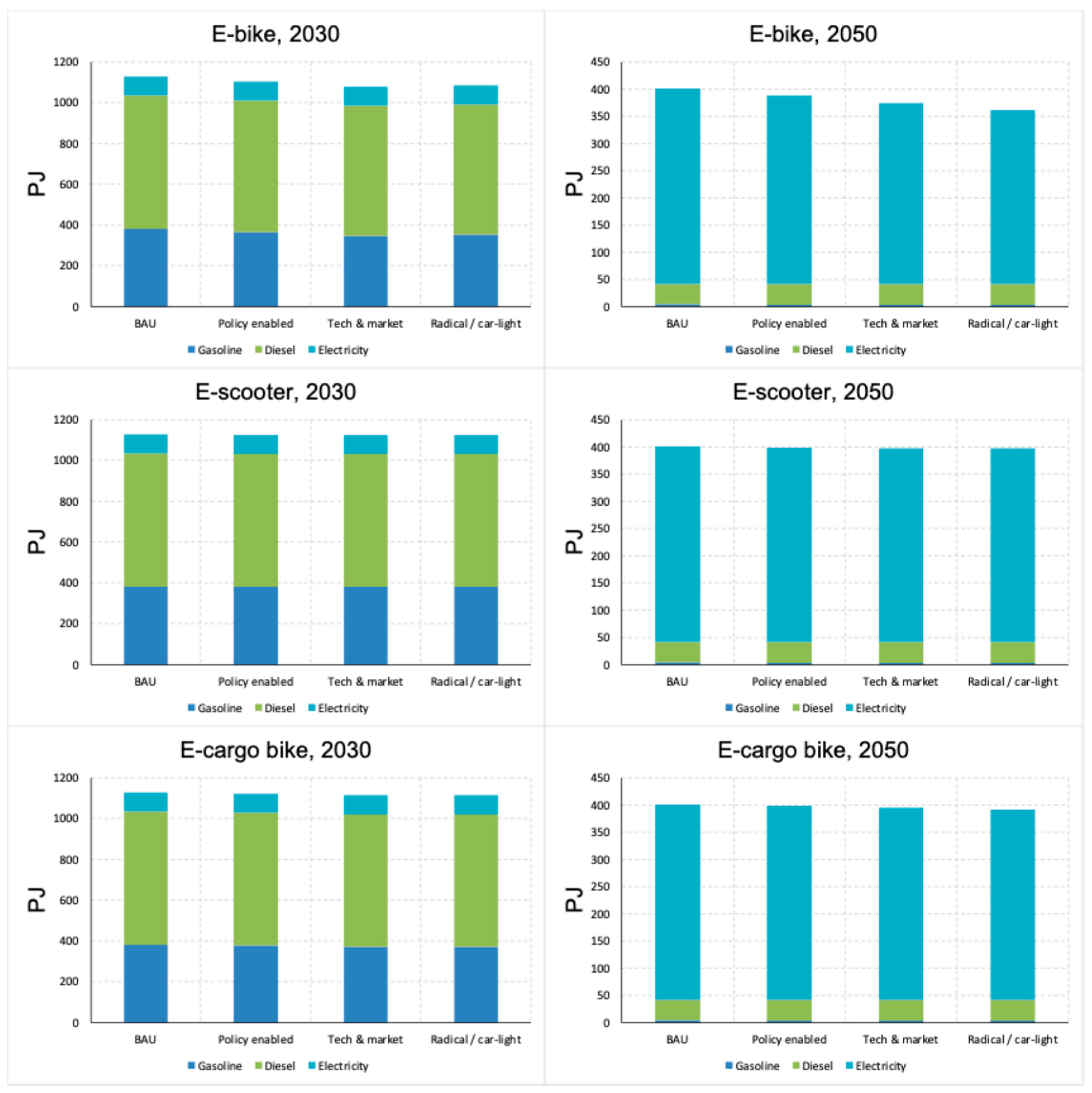
Figure 2.
Tailpipe CO2 emissions, cumulative 2025-2050 - cars only (NB: y-axis shows reduced scale).
Figure 2.
Tailpipe CO2 emissions, cumulative 2025-2050 - cars only (NB: y-axis shows reduced scale).
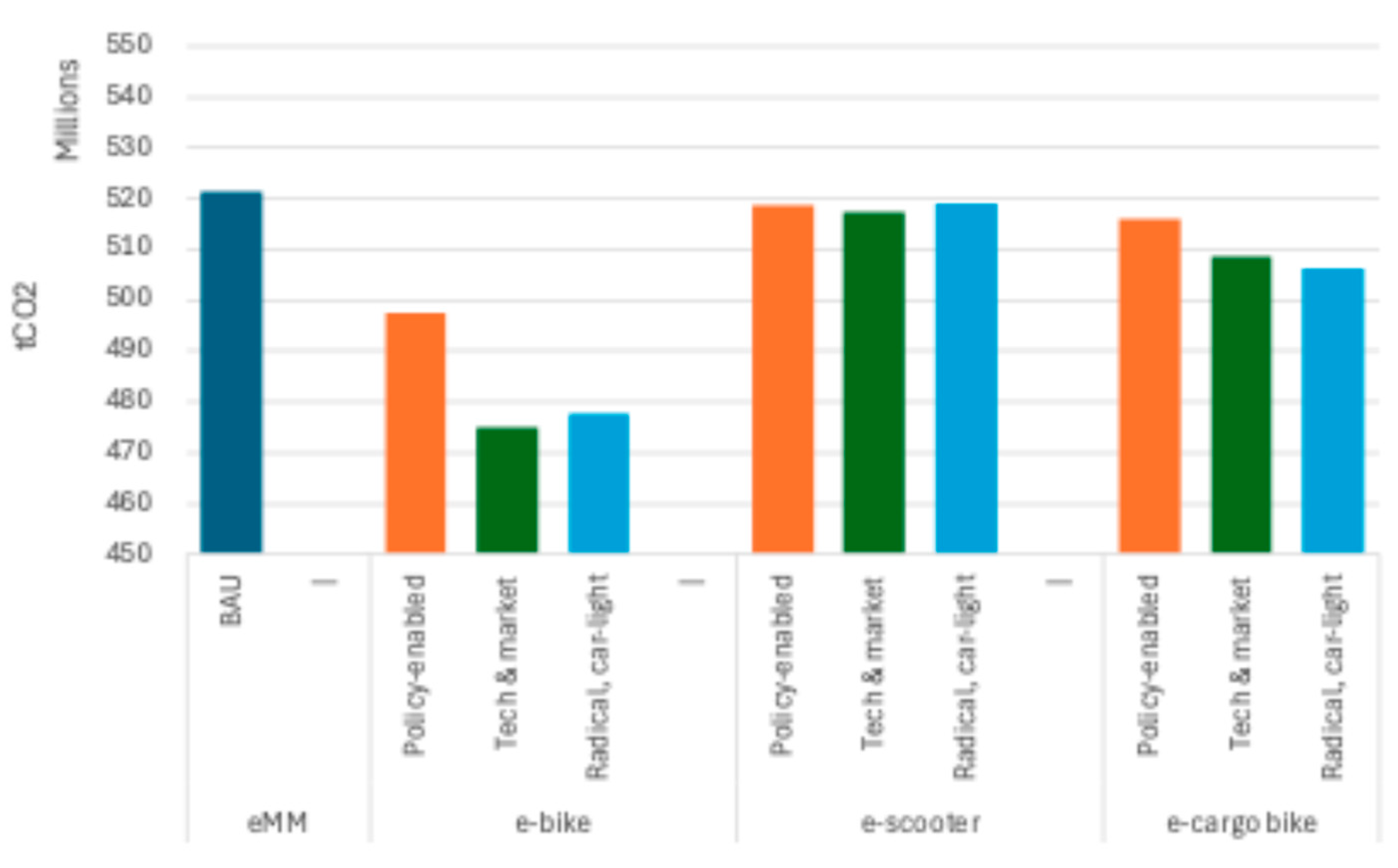
Figure 3.
Direct PM2.5 emissions (tailpipe and non-tailpipe) from cars, e-bikes, e-scooters and e-cargo bikes, by pathway for 2030 and 2050, in tonnes of PM2.5. Note: direct PM2.5 emissions from eMM are relatively small, hence almost invisible in this graph.
Figure 3.
Direct PM2.5 emissions (tailpipe and non-tailpipe) from cars, e-bikes, e-scooters and e-cargo bikes, by pathway for 2030 and 2050, in tonnes of PM2.5. Note: direct PM2.5 emissions from eMM are relatively small, hence almost invisible in this graph.
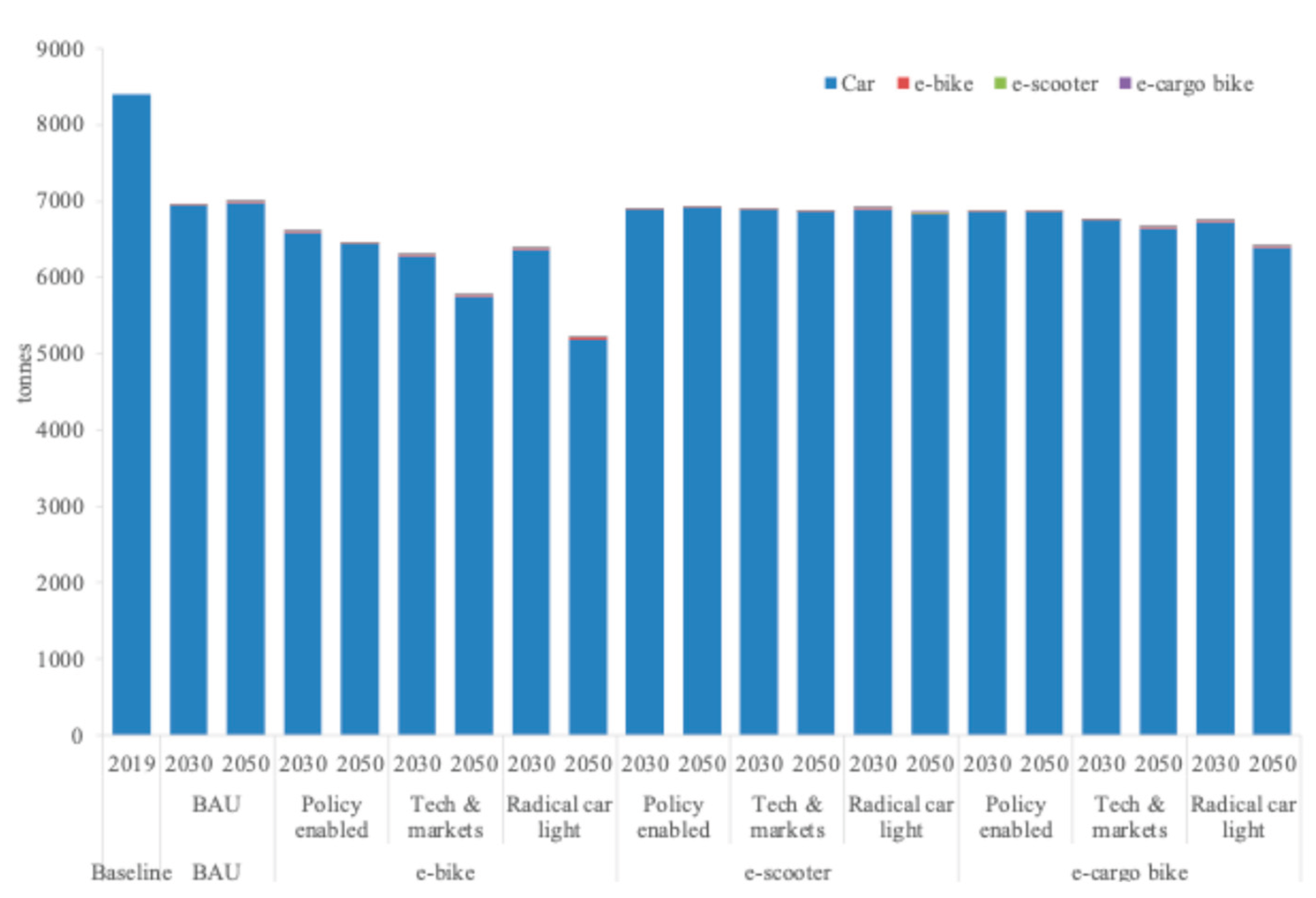

Table 1.
Summary of the scenario matrix used in the study.
| Ambition level | E-bike pathways | E-scooter pathways | E-cargo-bike pathways | Scenario rationale |
| ELEV0: Conservative / BAU | Modest growth through shared schemes and early adopters; limited car-trip substitution. | Limited legalisation and small-scale trial use; mainly short urban access trips. | Slow uptake due to high cost, mainly niche household and urban logistics use. | Conservative continuation of current policy with no private e-scooter legality and modest e-bike growth. |
| ELEV1: Policy-enabled | Protected lanes, purchase incentives and some car restraint support mainstream car-trip substitution. | Clearer rules, parking provision and integration with public transport support-controlled uptake. | Grants, secure parking and logistics encourage adoption for household utility and short freight trips. | Policy lowers adoption barriers and supports substitution for journey purposes and travel distances where eMM is most plausible. |
| ELEV2: Technology & Market | Falling prices, improved batteries, infrastructure investment and leasing/ retail growth accelerate more shift. | Larger shared fleets and improved durability expand use, though substitution remains mixed. | Better products, leasing and business uptake increase household and commercial use. | Rapid diffusion is driven by product improvement, falling prices, investment and market expansion rather than by policy pull alone. |
| ELEV3: Radical / car-light | Strong car restraint, speed-pedelec normalisation and network integration enable large-scale replacement of car travel not just in urban areas. | Dense shared fleets and radical car restraint in urban areas increase use under strict regulation. | High uptake for household logistics and last-mile freight, with potential car-renunciation effects. | Deep policy change combines pricing, access management and mobility-system redesign. |
Table 2.
Cumulative CO2 savings relative to BAU (radical/car-light scenarios only).
| Scenario | Direct CO2 2025-2040 | Direct CO2 2025-2050 | Life-cycle CO2-eq 2025-2040 | Life-cycle CO2-eq 2025-2050 |
| e-bike, radical (ELEV1c) | 38.3 | 43.9 | 61.9 | 96.4 |
| e-scooter, radical (ELEV2c) | 2.1 | 2.5 | 2.5 | 3.4 |
| e-cargo, radical (ELEV3c) | 13.2 | 15.1 | 20.6 | 31.1 |
Table 3.
Road passenger travel patterns by scenario, 2030 and 2050 (miles per person per year).
| SCENARIO | YEAR | CAR DRIVER | CAR PASSENGER | CAR INCL. TAXI | E-BIKE | E-SCOOTER | E-CARGO BIKE | EMM TOTAL | TOTAL ROAD PASSENGER | EMM SHARE |
| BASELINE | 2019 | 3,232 | 1,798 | 5,077 | 0.5 | 0.5 | 0.1 | 1 | 5,766 | 0% |
| BAU | 2030 | 2,736 | 1,671 | 4,452 | 139 | 27 | 30 | 196 | 5,296 | 3.7% |
| BAU | 2050 | 2,697 | 1,680 | 4,422 | 175 | 34 | 37 | 246 | 5,348 | 4.6% |
| E-BIKE POLICY-ENABLED | 2030 | 2,601 | 1,631 | 4,277 | 312 | 27 | 30 | 369 | 5,294 | 7.0% |
| E-BIKE POLICY-ENABLED | 2050 | 2,482 | 1,617 | 4,144 | 450 | 34 | 37 | 521 | 5,346 | 9.7% |
| 2030 | 2,477 | 1,580 | 4,102 | 485 | 27 | 30 | 542 | 5,292 | 10.2% | |
| 2050 | 2,216 | 1,513 | 3,774 | 814 | 34 | 37 | 885 | 5,341 | 16.6% | |
| E-BIKE RADICAL | 2030 | 2,512 | 1,592 | 4,149 | 438 | 27 | 30 | 495 | 5,292 | 9.4% |
| E-BIKE RADICAL | 2050 | 1,994 | 1,443 | 3,482 | 1,103 | 34 | 37 | 1,174 | 5,338 | 22.0% |
| E-SCOOT POLICY-ENABLED | 2030 | 2,720 | 1,665 | 4,430 | 139 | 48 | 30 | 217 | 5,295 | 4.1% |
| E-SCOOT POLICY-ENABLED | 2050 | 2,670 | 1,670 | 4,385 | 175 | 69 | 37 | 281 | 5,348 | 5.3% |
| 2030 | 2,714 | 1,664 | 4,423 | 139 | 56 | 30 | 225 | 5,295 | 4.2% | |
| 2050 | 2,651 | 1,665 | 4,361 | 175 | 93 | 37 | 305 | 5,348 | 5.7% | |
| E-SCOOT RADICAL | 2030 | 2,724 | 1,666 | 4,435 | 139 | 43 | 30 | 212 | 5,295 | 4.0% |
| E-SCOOT RADICAL | 2050 | 2,641 | 1,659 | 4,345 | 175 | 109 | 37 | 321 | 5,348 | 6.0% |
| E-CARGO POLICY-ENABLED | 2030 | 2,705 | 1,659 | 4,409 | 139 | 27 | 72 | 238 | 5,295 | 4.5% |
| E-CARGO POLICY-ENABLED | 2050 | 2,648 | 1,661 | 4,354 | 175 | 34 | 104 | 313 | 5,348 | 5.9% |
| 2030 | 2,665 | 1,648 | 4,358 | 139 | 27 | 123 | 289 | 5,295 | 5.5% | |
| 2050 | 2,568 | 1,638 | 4,251 | 175 | 34 | 206 | 415 | 5,347 | 7.8% | |
| E-CARGO RADICAL | 2030 | 2,658 | 1,647 | 4,350 | 139 | 27 | 131 | 297 | 5,295 | 5.6% |
| E-CARGO RADICAL | 2050 | 2,470 | 1,610 | 4,125 | 175 | 34 | 331 | 540 | 5,346 | 10.1% |
Note: “Car incl. taxi” combines car (as driver), car (as passenger) and Uber/taxi distance. Total road passenger combines car, motorcycle, bus, express coach, taxi, eMM, conventional bike and walking. eMM total combines e-bike, e-scooter and e-cargo-bike distance. eMM share is eMM total divided by total road passenger distance.
Disclaimer/Publisher’s Note: The statements, opinions and data contained in all publications are solely those of the individual author(s) and contributor(s) and not of MDPI and/or the editor(s). MDPI and/or the editor(s) disclaim responsibility for any injury to people or property resulting from any ideas, methods, instructions or products referred to in the content. |
© 2026 by the authors. Licensee MDPI, Basel, Switzerland. This article is an open access article distributed under the terms and conditions of the Creative Commons Attribution (CC BY) license (http://creativecommons.org/licenses/by/4.0/).
Copyright: This open access article is published under a Creative Commons CC BY 4.0 license, which permit the free download, distribution, and reuse, provided that the author and preprint are cited in any reuse.


