
Submitted:
09 June 2026
Posted:
10 June 2026
You are already at the latest version
Abstract
During the conceptual design phase, detailed geometric models are often unavailable, hindering energy-driven decisions for nearly zero-energy buildings. This paper proposes a geometry simplification strategy for office buildings in hot-humid regions using only length, width, and number of stories. Based on 130,976 geometric parameter combinations, a standardized rectangular energy model is built, and EnergyPlus simulates orientations from 0° to 179° (1° step), totaling 23.6 million runs. Three simplification methods are compared: aspect ratio, floor area, and the proposed length-width combination. The length-width combination method achieves the lowest average relative deviation (6.88%), outperforming aspect ratio (8.41%) and floor area (6.91%), thus meeting conceptual design accuracy requirements. Using this simplified model, the optimal orientation is identified as 0° (true south-north), accounting for 83.14% of cases. The orientation range 39°–86° should be avoided, as it contains over 99% of worst-case orientations. The proposed strategy enables rapid energy estimation and orientation guidance from basic parameters, shifting energy-efficient design from late verification to early-stage driving, and providing quantifiable support for conceptual design of nearly zero-energy buildings in hot-humid regions.
Keywords:
geometry simplification
; conceptual design
; orientation optimization
; nearly zero-energy building
; hot-humid region
; EnergyPlus
1. Introduction
Global climate warming has become a severe challenge for human society, and the resulting pressure to reduce greenhouse gas emissions is increasingly urgent. In China’s building sector, carbon emissions from building operations account for 22% of total societal carbon emissions[1], while the whole-life-cycle carbon emissions of buildings account for as much as 50.6% of the national total [2]. This means that the building sector is a “critical link” in achieving the “dual carbon” goals. Achieving carbon neutrality in the building sector primarily relies on the synergistic effect of three technical pathways: “demand reduction – efficiency enhancement – energy generation”. “Demand reduction” refers to the use of passive energy-saving technologies[3], which constitute the “first move” in emission reduction. “Efficiency enhancement” refers to the use of high-efficiency equipment [4,5,6] to improve energy utilization efficiency, representing the “second move”. “Energy generation” means using buildings as carriers to harness renewable energy for energy supply[7,8,9,10]. The combination logic of these three pathways determines the ultimate form of carbon neutrality – nearly zero-energy buildings. In China’s hot summer and warm winter climate zone, hot-humid conditions pose special challenges for building energy efficiency[11]. Office buildings, in particular, due to their high energy-saving potential, dense occupancy, and long operating hours (typically exceeding 10 hours/day), become typical and urgent candidates for zero-energy technology applications.
At the start of the conceptual design phase, detailed geometric models are usually not yet determined. However, decisions made at this phase have a decisive impact on the final performance of the building[12]. Traditional design methods often treat energy-saving design as a “late add-on”, lacking an integrated, performance-driven design approach that runs through the project from its inception[13,14].
Existing solutions to this problem mainly fall into two categories. The first involves conducting energy-efficiency design or performance verification after the conceptual design is finalized (i.e., with detailed geometric models available), for example by using energy simulation software such as EnergyPlus to perform detailed simulations on established building schemes[15]. The second is to optimize building form and functional layout by establishing fast energy consumption prediction algorithms[12].
Regardless of the method, relatively detailed model information is required. However, in the conceptual design phase, detailed geometric models are not yet available. If energy performance verification is postponed until the design scheme is finalized, designers will lack energy-performance-based guidance during the design of nearly zero-energy buildings. Moreover, if verification fails, it leads to design rework, causing losses in both efficiency and cost.
To address the above problem, this paper proposes a geometry simplification strategy suitable for the conceptual design of office buildings in hot-humid regions. The strategy requires only basic parameters such as building length, width, and number of stories to quickly estimate energy consumption and guide orientation decisions, thus transforming energy-efficient design from “late-stage verification” to “early-stage driving”, and providing a quantifiable methodological support for the conceptual design of nearly zero-energy buildings. Specific research objectives include:
- Based on a parametric survey of 20 typical office building projects in hot-humid regions, construct a large-scale parametric sample library covering a reasonable geometric space (130,976 cases);
- Compare the energy estimation accuracy of three geometry simplification strategies (aspect ratio, floor area, and length-width combination) to select the optimal method;
- Based on the optimal simplified model, conduct full-orientation simulations to determine the optimal orientation and the orientation range to be avoided for office buildings in hot-humid regions (for detailed definitions and simulation settings, see Section 2.5).
2. Materials and Methods
2.1. Survey of Typical Office Building Parameters and Database Construction
To establish a representative geometry simplification model, this study first conducted a statistical survey of core geometric parameters from 20 built typical office building projects in the hot-humid region (China’s hot summer and warm winter climate zone). Survey indicators included: building total length, building total width, depth along the long side of the standard floor, and depth along the short side of the standard floor. The results are shown in Table 1.
Based on the survey results, a parameter generation tool was developed to generate geometric parameter combinations covering different scales with a step size of 1 m. To avoid parameter redundancy and irrationality, the constraints shown in Table 2 were set, resulting in a valid parameter sample library of 130,976 cases.
2.2. Baseline Energy Model Setup
- 4.
- Geometric model
Referring to typical office building layouts in hot-humid regions, a baseline model containing perimeter zones, interior zones, and a core was constructed (as shown in Figure 1). The core, located in the middle of the building, contains stairwells and elevator shafts to meet egress and transportation functions. The perimeter zone is the office space along the building envelope, and the interior zone is the office space around the core (influenced only by internal loads). This zoning approach follows common practice in energy simulation.
As annotated in Figure 1, the four key geometric parameters surveyed in Table 1 correspond to: building length (L), building width (W), depth along the long side (LD), and depth along the short side (WD).
Based on the design principles of minimizing façade complexity and heat dissipation area, and maximizing space for renewable energy deployment in nearly zero-energy buildings – with all floors identical – this study assumes identical floor plans for all stories, ignoring inter-story variations. The floor-to-floor height is fixed at 4.2 m (a common value for office buildings in hot-humid regions). Furthermore, to reduce uncertainty in the conceptual design phase, the window-to-wall ratio is uniformly set to a middle value of 0.5, and external shading is not considered for now.
The total number of stories is set to 5. A larger number of stories would substantially increase the difficulty of achieving nearly zero-energy building (especially zero-energy building) status due to higher overall energy demand and more complex envelope interactions.
- 5.
- Thermal and operational parameters
The thermal performance of the building envelope complies with the limit requirements of the Technical standard for nearly zero energy buildings (GB/T 51350-2019)[16], avoiding interference from variations in thermal parameters on energy consumption comparison results. Parameters such as indoor occupant density, equipment power density, lighting power density, and hourly schedules are set according to national and industry standards (see Table 3, Table 4, Table 5 and Table 6 for details), ensuring consistency in the energy simulation baseline.
- 6.
- Ideal air conditioning system
To avoid the influence of air conditioner capacity selection on the simulation results, this study employs an ideal air conditioning system within EnergyPlus. The reported energy performance is based on calculated cooling and heating loads (rather than actual compressor or chiller energy use) to maintain the indoor setpoint temperatures. This approach ensures that the comparison reflects only the passive thermal response of the building envelope.
- 7.
- Simulation tool and batch computation
EnergyPlus 24.02 is used as the energy simulation engine. For each set of geometric parameters, simulations are performed for orientations from 0° to 179° (1° increments), resulting in a total of 130,976 × 180 = 23,575,680 simulation runs. Distributed parallel computing technology is employed to allocate simulation tasks to multi-core processors across multiple computers, significantly reducing total computation time. The core output indicator is annual energy consumption per unit floor area (kWh/(m²·a)).
2.3. Definition of Geometry Simplification Strategies
To select the most suitable simplification method for the conceptual design phase, three strategies are defined and compared. Each strategy aims to select a representative subset from the 130,976 samples for rapid energy estimation, and then compare the deviation against the actual energy consumption of all samples.
- Strategy 1: Grouping by aspect ratio
The aspect ratio (AR = length/width) is calculated for each sample. Samples with the same AR value are grouped together. Within each group, the sample whose energy consumption is closest to the group average is selected as the representative model for that AR value.
- 2.
- Strategy 2: Grouping by floor area**
The standard floor area (SA = length × width) is calculated for each sample. Samples with the same SA value (rounded to the nearest integer) are grouped together. Within each group, the sample with energy consumption closest to the group average is selected as the representative model.
- 3.
- Strategy 3: Grouping by length-width combination (proposed in this paper)**
A two-dimensional grid is constructed with length and width as the two dimensions, with a grid step of 1 m. Each grid node (length i, width j) contains the set of all depth values for that specific length-width combination. For each grid node, the sample with energy consumption closest to the average is selected as the representative model for that combination. This strategy preserves the independent information of length and width, offering finer granularity than single-parameter grouping.
2.4. Orientation Optimization Analysis Method
Based on the full-sample, full-orientation simulation results, statistical methods are used to determine optimal and worst orientations as follows:
- Optimal orientation: For each geometric sample, find the orientation angle (0°–179°) that minimizes its energy consumption, and count the frequency distribution of optimal orientations across all samples.
- Worst orientation: Similarly, find the orientation angle that maximizes energy consumption, and count its frequency distribution.
The angle with the highest frequency proportion is finally recommended as the optimal orientation and the orientation to be avoided.
2.5. Orientation Definition and Simulation Range
In this study, the building orientation angle is defined as follows: 0°represents true north. A positive angle indicates rotation towards the east, and a negative angle indicates rotation towards the west. Consequently, a building facing true east has an orientation of +90°, and true west corresponds to -90° (or +270°).
Because all geometric models used in this paper are symmetric rectangles (i.e., rotating a rectangle by 180° results in an identical geometry), the simulation range is limited to 0° to 179°. This range covers all unique orientations without redundant simulations.
3. Results
3.1. Optimal Orientation Distribution
Based on the energy simulation results for 130,976 geometric samples over the orientation range of 0°–179°, the optimal orientation (the angle minimizing energy consumption) for each sample was determined. The frequency distribution is shown in Figure 2 and Table 7.
The results show that true south-north (0°) is the dominant optimal orientation. A total of 108,892 samples (83.14% of all samples) have their optimal orientation at 0°. In addition, angles close to 0°, such as 1°, 177°, 178°, and 179°, also account for a certain proportion (approximately 16.3% in total). Only in the case of square floor plans (aspect ratio = 1) do a very few samples (less than 0.01% of total) show optimal orientations at 89°–90°. If 0° and its adjacent angles (177°–179°, 0°–1°) are combined, the coverage exceeds 99%. This indicates that for office buildings in hot-humid regions, the true south-north orientation achieves the lowest energy consumption for the vast majority of geometric forms.
3.2. Worst Orientation Distribution
Similarly, the worst orientation (the angle maximizing energy consumption) for each sample was determined. The results are shown in Figure 3 and Table 8.
The worst orientations are concentrated in the range of 39°–86°, which covers more than 99% of worst-case cases. Among these, 45° has the highest frequency, with 17,635 samples (13.46% of total). Other high-frequency angles range from 52° to 85°, each accounting for 1.5%–4.0%. In the single case where aspect ratio = 1 (square plan), a worst orientation of 135° appears once, but its proportion is negligible. Overall, building orientations where the long side faces southeast to northeast (39°–86°) should be strictly avoided, as this range experiences intense direct solar radiation during morning to noon hours in summer.
3.3. Energy Estimation Deviations of the Three Simplification Strategies
To evaluate the representativeness of each simplification strategy, the estimated energy consumption of each representative model was compared with the actual average energy consumption of all samples within the same group, and the absolute and relative deviations were calculated. The statistical results are shown in Table 9.
- 1.
- Aspect ratio strategy (Strategy 1):
The average relative deviation is 8.41%, with a maximum of 49.62%. Figure 4 shows that estimated energy consumption initially increases and then decreases with increasing aspect ratio, indicating that simplification by aspect ratio alone results in relatively large and dispersed deviations, failing to effectively represent the energy characteristics of buildings with different scales within the same aspect ratio group.
- 2.
- Floor area strategy (Strategy 2):
The average relative deviation is 6.91%, with a maximum of 32.07%, which is better than the aspect ratio strategy. Figure 5 shows that estimated energy consumption decreases as single-story floor area increases, indicating that floor area is an important scale factor affecting energy consumption.
- 3.
- Length-width combination strategy (Strategy 3):
The average (Figure 6) relative deviation is 6.88%, with a maximum of 27.86%, which is the lowest among the three. The deviation distribution is the most compact. Compared to the floor area strategy, the average absolute deviation is reduced by 0.03 percentage points, and the maximum deviation is reduced by 4.21 percentage points. Although the margin is small, given the need for rapid decision-making in the conceptual design phase, this strategy maintains a similar average deviation to the floor area strategy while further reducing extreme deviations, thereby improving estimation robustness.
4. Discussion
4.1. Accuracy and Applicability of the Simplification Strategies
Among the three strategies, the “length-width combination” strategy achieves an average relative deviation of 6.88%, which is significantly lower than the aspect ratio strategy (8.41%) and the floor area strategy (6.91%). This result can be attributed to the fact that the length-width combination preserves the two-dimensional information of the building floor plan shape, whereas single-parameter compression (aspect ratio or area) loses information dimensions. For example, two buildings with the same aspect ratio of 2 could be “100 m × 50 m” or “40 m × 20 m”, and their energy characteristics (e.g., perimeter zone volume fraction, heat loss paths) differ significantly. Although the area strategy accounts for scale, it cannot distinguish between an elongated rectangle and a near-square plan. Therefore, the length-width combination strategy is the optimal choice for the conceptual design phase, with accuracy (deviation <7%) sufficient for preliminary energy estimation and orientation comparison. If higher accuracy is required at later stages, detailed models should be used.
4.2. Physical Mechanisms Behind the Orientation Optimization Results
The optimal orientation is 0° (true south-north) for as many as 83.14% of samples. This result aligns well with the solar movement patterns in hot-humid regions: a true south-north layout minimizes the area of east and west facades. Low-angle direct sunlight in the morning and afternoon strikes east and west walls, causing significant heat gain; the north-south orientation avoids this problem while allowing low-angle winter solar radiation to enter the interior. Hence, true south-north is the best choice.
The orientation range to be avoided, 39°–86°, covers southeast to northeast directions. Within this range, the building’s long side faces the direction of direct solar radiation during morning to noon hours. This conclusion provides architects with a clear “forbidden zone”, advising against sacrificing energy performance for architectural form or views.
4.3. Implications for Conceptual Design Practice
The simplification strategy proposed in this study requires only three basic parameters (length, width, and number of stories) to rapidly generate a standard energy model and provide orientation recommendations. This enables architects to obtain quantitative decision support even before the conceptual design scheme is finalized (i.e., during the site analysis phase), truly achieving “performance-driven design”.
4.4. Limitations
This study has the following limitations:
- Geometric limitations: The simplified model only considers rectangular floor plans; actual buildings may include setbacks, curved shapes, L-shapes, and other complex forms. Future research should develop equivalent simplification methods for non-rectangular plans.
- Climatic limitations: The conclusions are based on hot-humid regions (represented by Guangzhou, Zhuhai, etc.). Extension to cold or mild regions requires revalidation.
- Building type limitations: The study focuses only on office buildings. Internal load patterns (e.g., occupant density, equipment usage) differ for other building types, so the parameters of the simplification strategy would need corresponding adjustments.
5. Conclusions
This study addresses the core problem of missing geometric models and delayed energy performance evaluation during the conceptual design phase of office buildings in hot-humid regions. It proposes a geometry simplification method based on “length-width combination” and applies it to orientation optimization decisions. The main conclusions are as follows:
- The length-width combination simplification strategy achieves an average relative energy deviation of 6.88%, which is superior to the aspect ratio strategy (8.41%) and the floor area strategy (6.91%). It meets the accuracy requirements of the conceptual design phase (error <10%). The method requires only three basic parameters – building length, width, and number of stories – making it highly practical.
- Based on batch simulations of 23,575,680 cases, the optimal orientation for office buildings in hot-humid regions is determined to be true south-north (0°), with approximately 83.14% of geometric samples achieving their lowest energy consumption at this orientation. The orientation range to be strictly avoided is 39°–86°, where more than 99% of worst-case orientations are concentrated.
- The proposed simplification strategy and orientation findings can provide immediate, quantitative performance feedback to architects during the conceptual design phase, transforming energy-efficient design from “late-stage verification” to “early-stage driving”. This provides methodological support for the large-scale promotion of nearly zero-energy office buildings in hot-humid regions.
Author Contributions
Conceptualization, L.H.Z.; methodology, L.H.Z.; software, X.D.; investigation, X.D.; formal analysis, X.D.; writing—original draft preparation, X.D. and Z.L.; writing—review and editing, Z.L. and D.L.; validation, D.L.; supervision, L.H.Z. All authors have read and agreed to the published version of the manuscript.
Funding
This research received no external funding.
Data Availability Statement
No new data were created or analyzed in this study.
Conflicts of Interest
The authors declare no conflicts of interest.
References
- Xu, W.; Zhang, S.; Wang, K.; Wang, Q. Comparative Research of Carbon Peak and Carbon Neutral Implementation Paths in the Building Sector. Jiangsu Constr. 2022, 1–6. [Google Scholar] [CrossRef]
- China Association of Building Energy Efficiency Research Report on Building Energy Consumption and Carbon Emissions in China (2021). Research Report on Building Energy Consumption and Carbon Emissions in China(2021) 2021.
- Yu, J.; Yang, C.; Tian, L. Low-Energy Envelope Design of Residential Building in Hot Summer and Cold Winter Zone in China. Energy Build. 2008, 40, 1536–1546. [Google Scholar] [CrossRef]
- Huo, M. Analysis and Optimization on the Central Air Conditioning Energy Consumption of Building in Moist Heat Areas of China. PhD Thesis, Guangdong University of Technology, 2014. [Google Scholar]
- Wang, J. Analysis on Technical Route of “Chongqing design for energy efficiency 75% of public building” and Energy Saving Index of the Cold Source System. Thesis, Chongqing University, 2013. [Google Scholar]
- Zhao, D.; Zhang, X.; Xu, Q. Overtime operating energy consumption analysis of VRF system in office buildings based on measured data. HV&C 2019, 49, 43–48. [Google Scholar] [CrossRef]
- Deng, X. Research of Optimization and Design Method for PV Building. Thesis, Hunan University, 2012. [Google Scholar]
- Deng, X.; Liu, Z.; Zhang, L.; Li, Y.; Zhao, L. Advancements and Applications of Building-Integrated Photovoltaics (BIPV) in China. In Proceedings of the 3rd International Joint Conference on Energy, Electrical and Power Engineering, CoEEPE 2023, November 22, 2023 - November 24, 2023; Springer Science and Business Media Deutschland GmbH: Melbourne, VIC, Australia, 2024; Vol. 1208 LNEE, pp. 579–590. [Google Scholar]
- Deng, X.; Li, Z.; Ling, R. Analysis of Solar Irradiation for Building-Integrated Photovoltaic (BIPV) Systems. China Constr. Metal. Struct. 2012, 32–36. [Google Scholar] [CrossRef]
- Yang, R.; Zang, Y.; Yang, J.; Wakefield, R.; Nguyen, K.; Shi, L.; Trigunarsyah, B.; Parolini, F.; Bonomo, P.; Frontini, F.; et al. Fire Safety Requirements for Building Integrated Photovoltaics (BIPV): A Cross-Country Comparison. Renew. Sustain. Energy Rev. 2023, 173, 113112. [Google Scholar] [CrossRef]
- Feng, W.; Zhang, Q.; Ji, H.; Wang, R.; Zhou, N.; Ye, Q.; Hao, B.; Li, Y.; Luo, D.; Lau, S.S.Y. A Review of Net Zero Energy Buildings in Hot and Humid Climates: Experience Learned from 34 Case Study Buildings. Renew. Sustain. Energy Rev. 2019, 114, 109303. [Google Scholar] [CrossRef]
- Lin, B.; Li, Z. Building energy-saving approach in early design stage. Sci. China Press 2016, 61, 113–121. [Google Scholar] [CrossRef]
- Yao, G.; Chen, Y.; Han, C.; Duan, Z. Research on the Decision-Making Method for the Passive Design Parameters of Zero Energy Houses in Severe Cold Regions Based on Decision Trees. Energies 2024, 17, 506. [Google Scholar] [CrossRef]
- Torcellini, P.; Pless, S.; Deru, M.; Griffith, B.; Long, N.; Judkoff, R. Lessons Learned from Case Studies of Six High-Performance Buildings. 2006. [Google Scholar] [CrossRef]
- Crawley, D.B.; Lawrie, L.K.; Winkelmann, F.C.; Buhl, W.F.; Huang, Y.J.; Pedersen, C.O.; Strand, R.K.; Liesen, R.J.; Fisher, D.E.; Witte, M.J.; et al. EnergyPlus: Creating a New-Generation Building Energy Simulation Program. Energy Build. 2001, 33, 319–331. [Google Scholar] [CrossRef]
- Ministry of Housing and Urban-Rural Development of the People’s Republic of China China Architecture Publishing & Media Co., Ltd. Technical Standard for Nearly Zero Energy Buildings GB/T 51350-2019; 2019. [Google Scholar]
- Ministry of Housing and Urban-Rural Development of the People’s Republic of China China Architecture Publishing & Media Co., Ltd. Code for Thermal Design of Civil Building; GB 50176-2016; 2016. [Google Scholar]
- Ministry of Housing and Urban-Rural Development of the People’s Republic of China China Architecture Publishing; Media Co.; Ltd. Assessment Standard for Green Building: GB 50378-2019 (2024 Edition); GB/T 50378-2019 (2024 Edition); 2024. [Google Scholar]
- Ministry of Housing and Urban-Rural Development of the People’s Republic of China China Architecture Publishing & Media Co.., Ltd. Standard for Green Performance Calculation of Civil Buildings: JGJ/T 449-2018; 2018. [Google Scholar]
- Ministry of Housing and Urban-Rural Development of the People’s Republic of China China Architecture Publishing & Media Co., Ltd. General Code for Energy Efficiency and Renewable Energy Application in Building; GB 55015-2021.
- Ministry of Housing and Urban-Rural Development of the People’s Republic of China China Architecture Publishing & Media Co.., Ltd. Standard for Lighting Design of Buildings; GB/T 50034-2024.
Figure 1.
Baseline model with dimension definitions: L = building length, W = building width, LD = depth along long side, WD = depth along short side.
Figure 1.
Baseline model with dimension definitions: L = building length, W = building width, LD = depth along long side, WD = depth along short side.
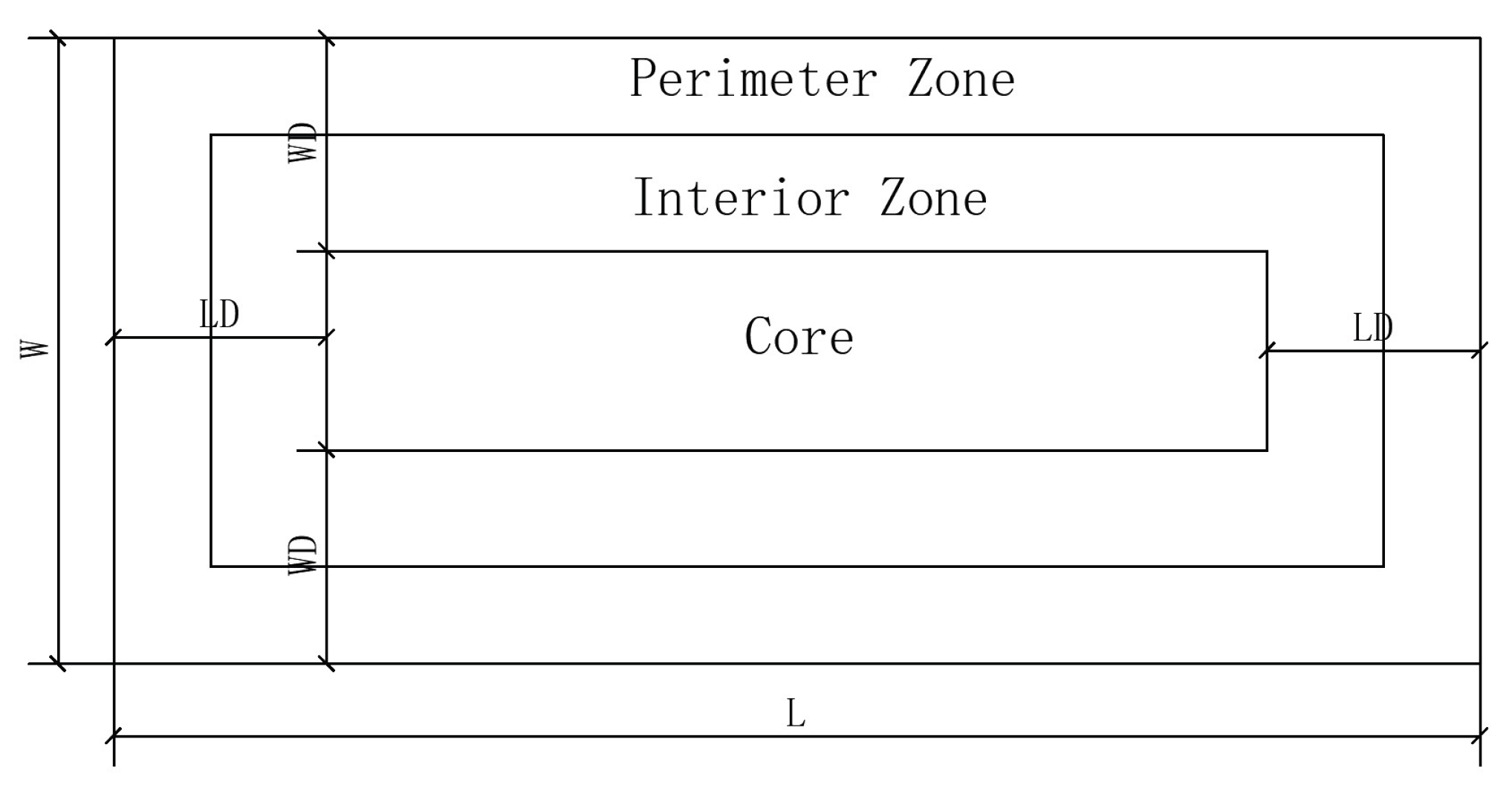
Figure 2.
Proportional distribution of optimal azimuth angles.
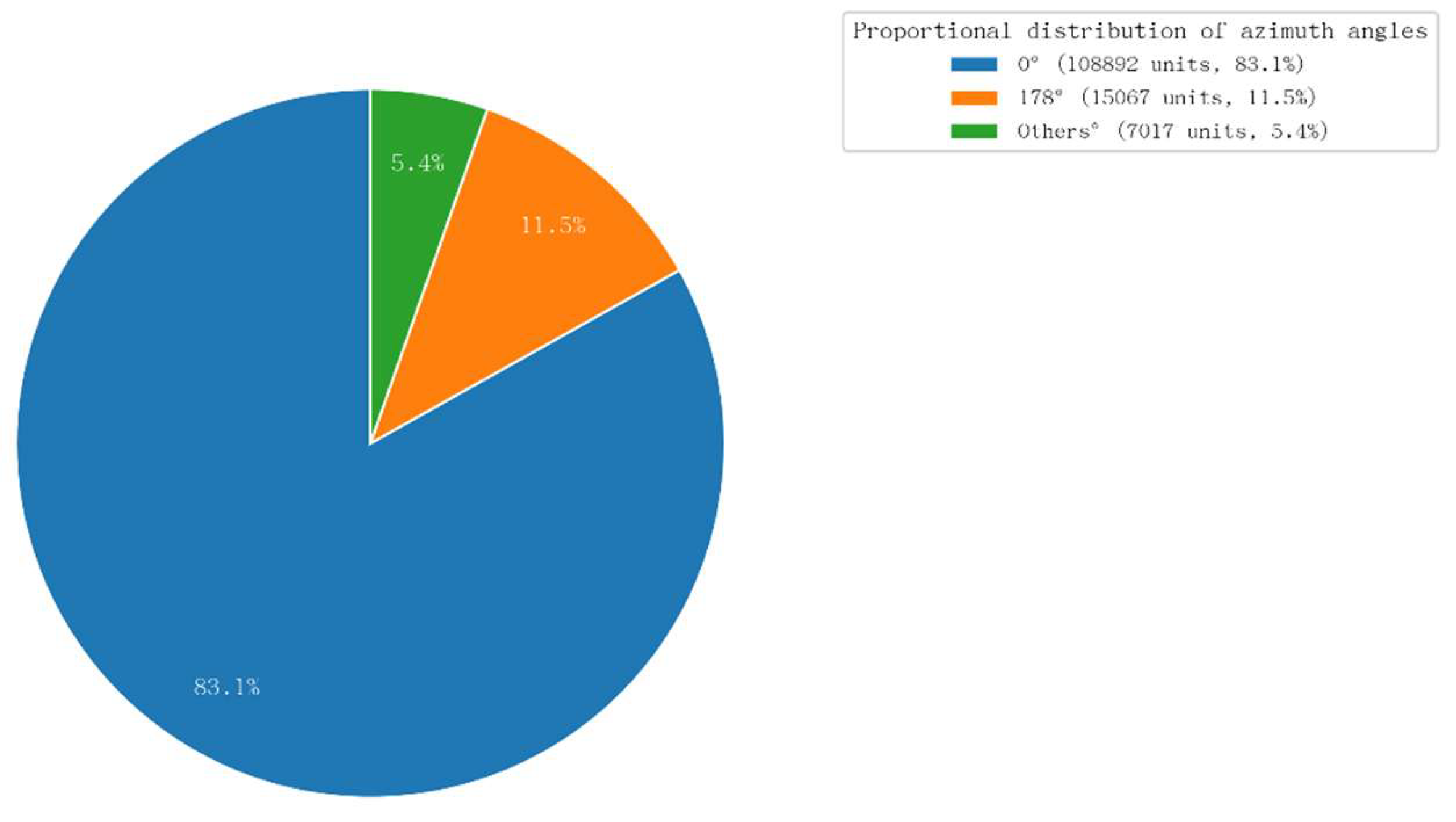
Figure 3.
Proportional distribution of optimal azimuth angles.
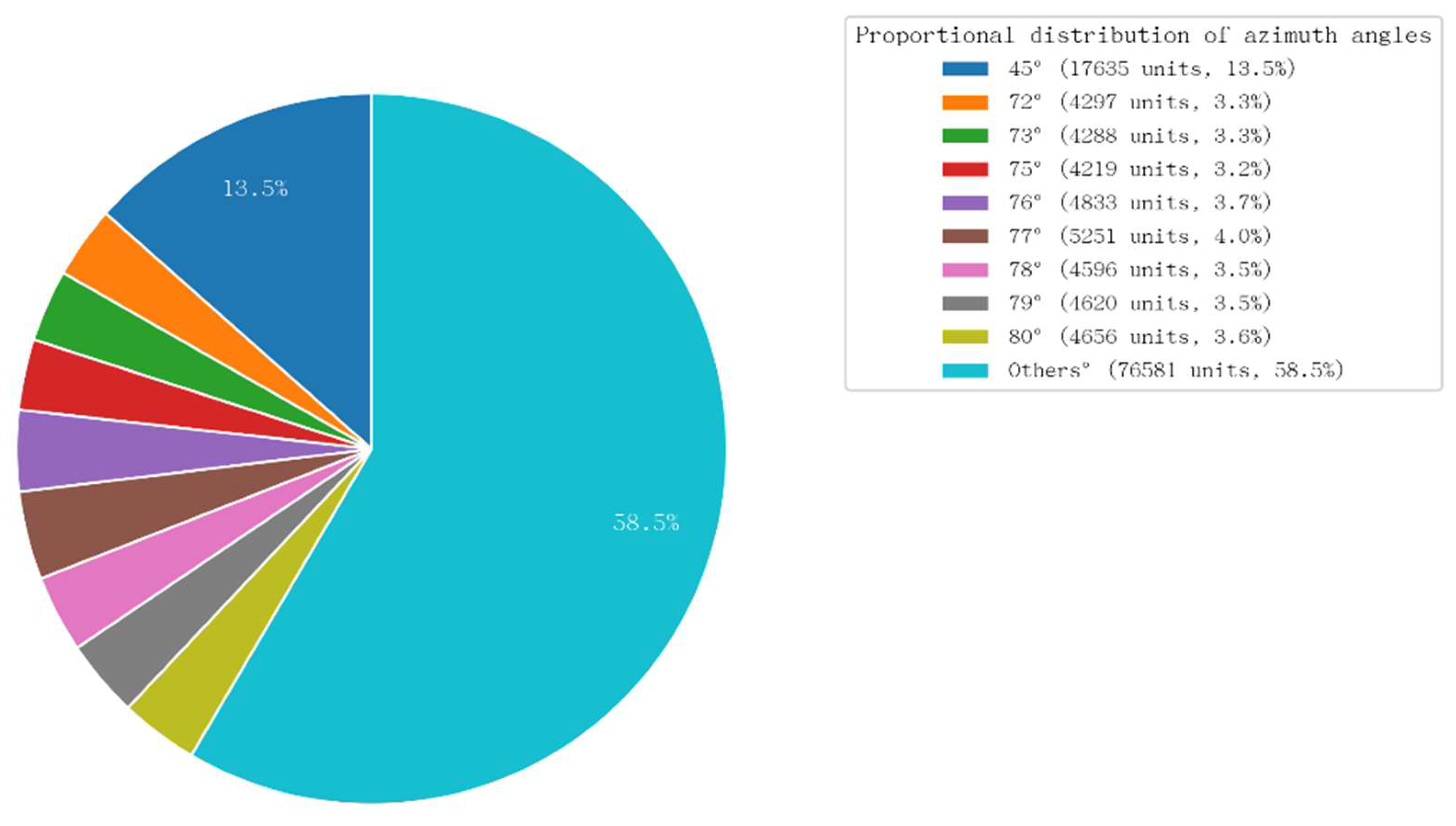
Figure 4.
Estimated energy consumption after simplification by aspect ratio.
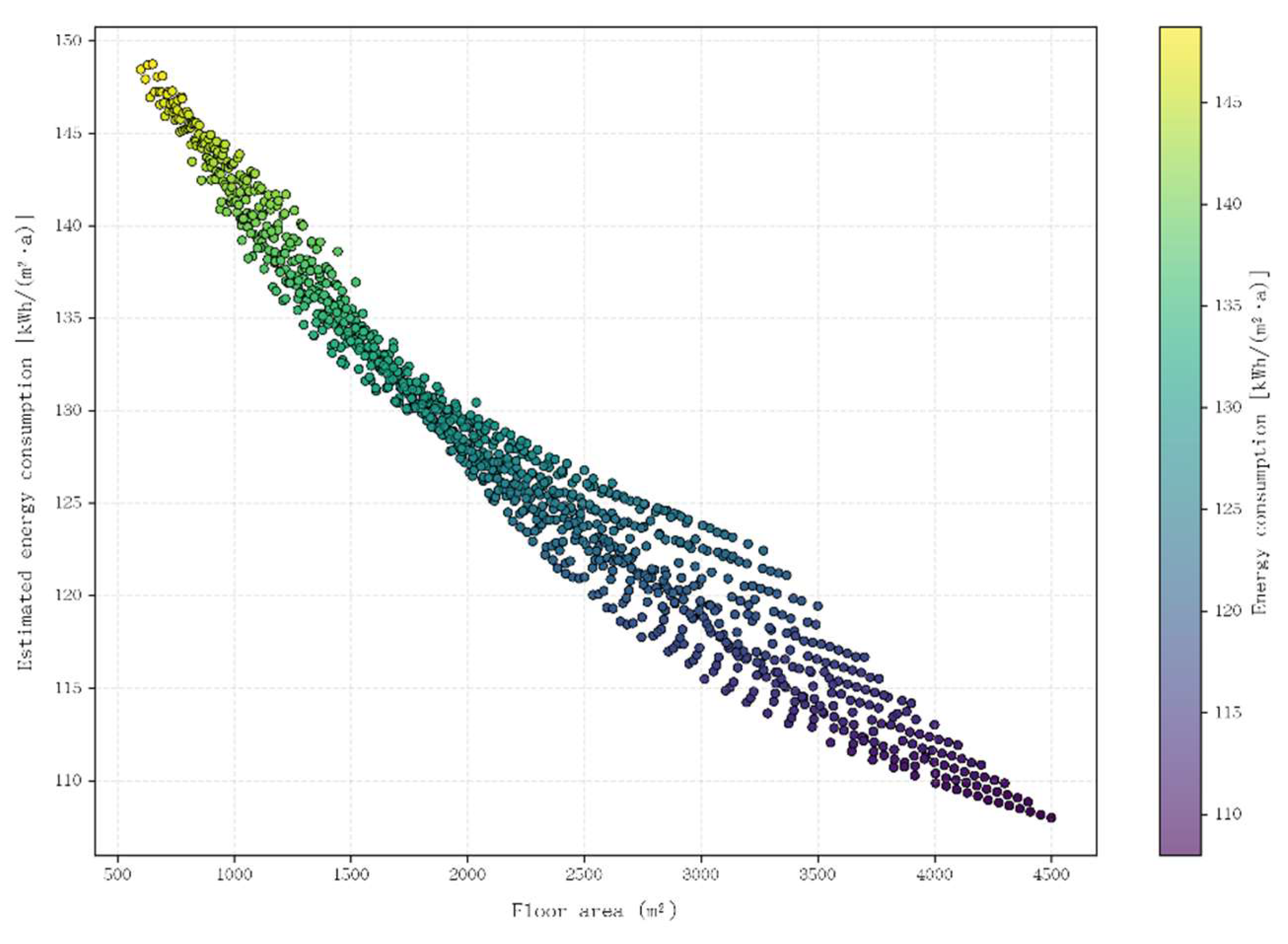
Figure 5.
Estimated energy consumption after simplification by floor area.
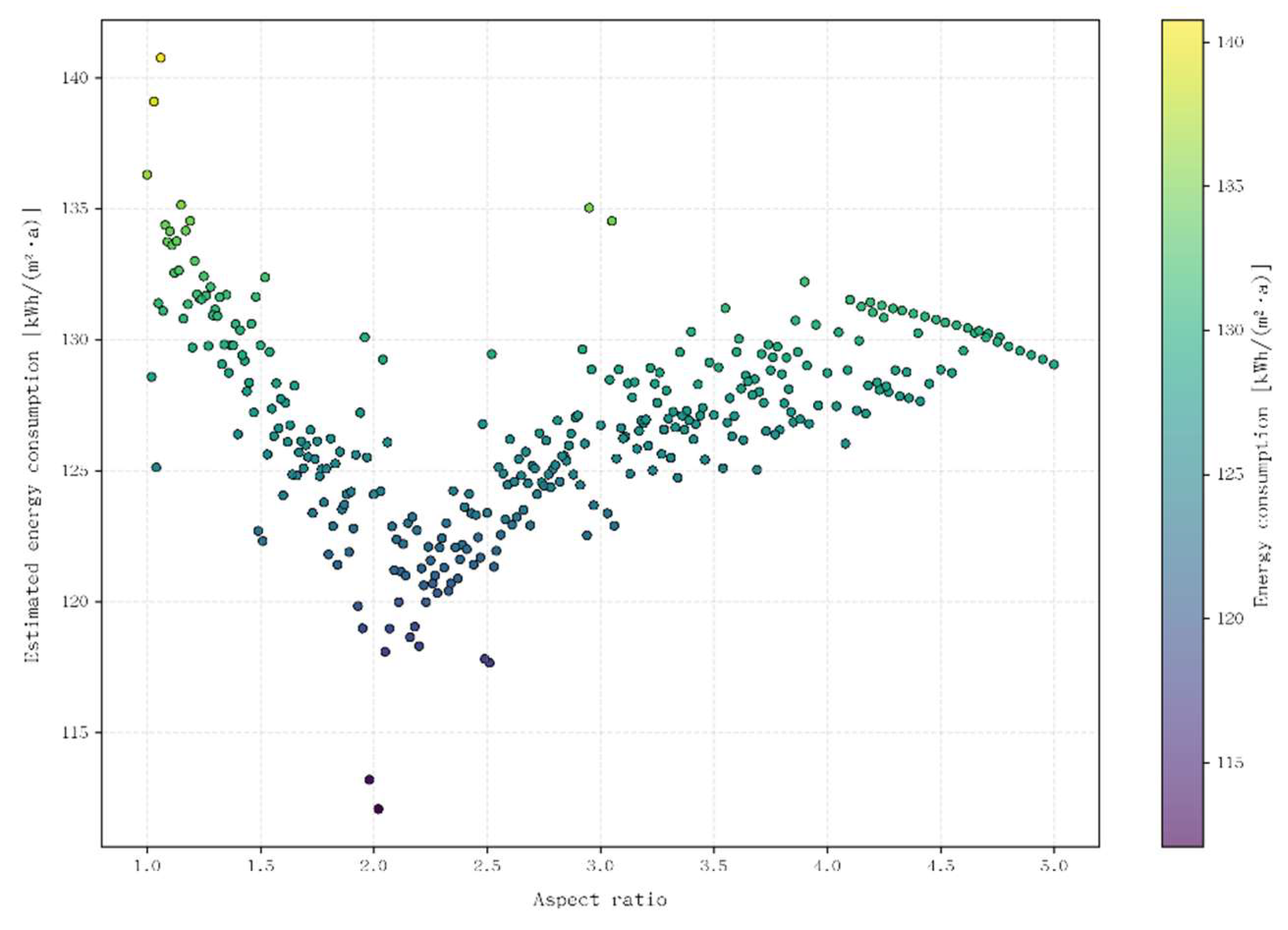
Figure 6.
Estimated energy consumption after simplification by length-width combination.
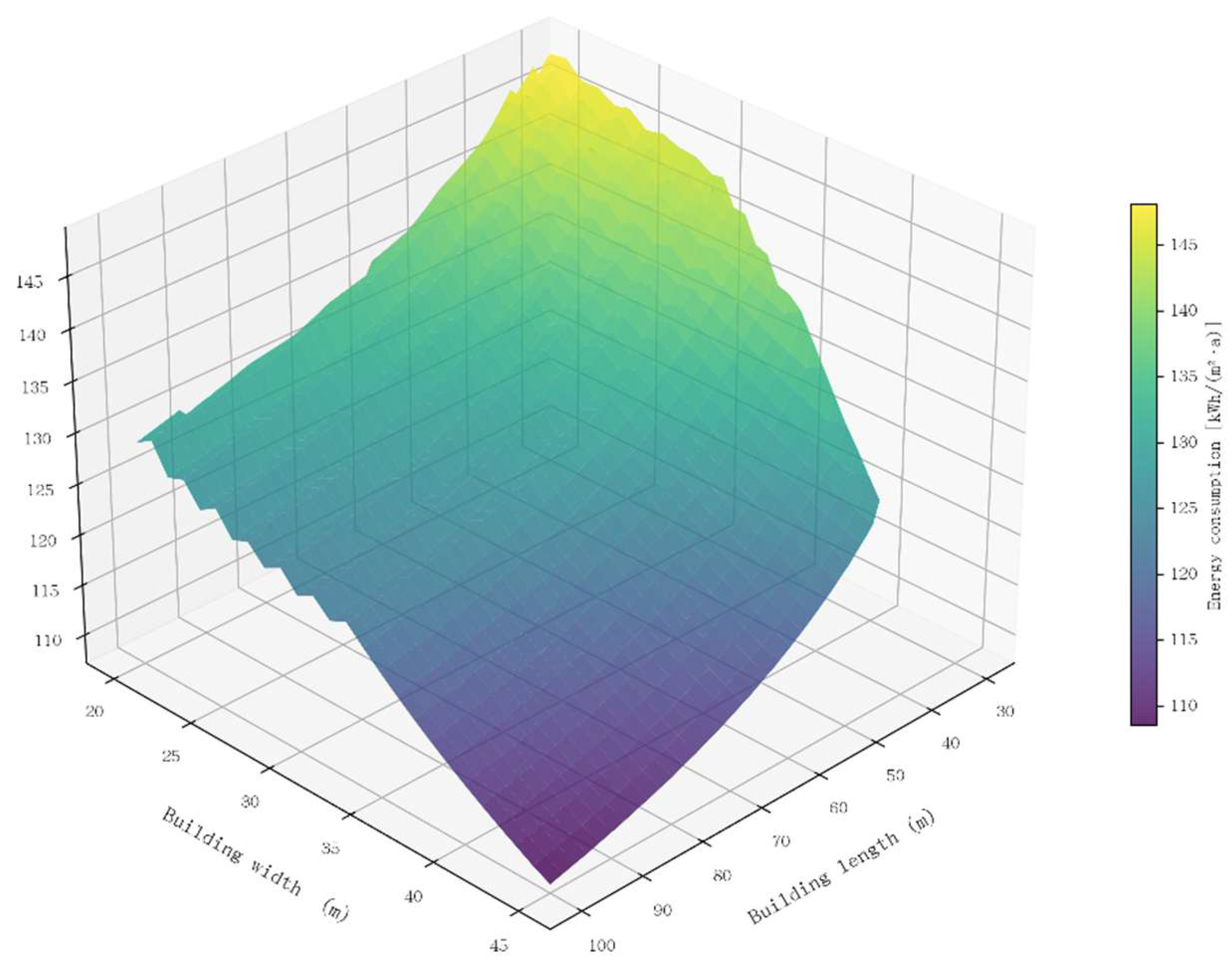

Table 1.
Core parameter ranges of typical office buildings.
| Value type | Building length (m) | Building width (m) | Depth along long side (m) | Depth along short side (m) |
|---|---|---|---|---|
| Maximum | 95.7 | 41.6 | 16 | 14 |
| Minimum | 32.6 | 20.6 | 6.9 | 6.4 |
| Average | 49.83 | 31.75 | 9.78 | 9.42 |
Table 2.
Parameter constraints.
| No. | Constraint condition | Purpose |
|---|---|---|
| 1 | Building length > Building width | Avoid parameter duplication |
| 2 | Depth along long side > 5; Depth along short side > 5 |
Meet conventional office space size requirements |
| 3 | Building length > Depth along long side + 4; Building width > Depth along short side + 4 |
Reserve space for core (stairwells, elevator shafts) to ensure model practicality |
| 4 | When building length = building width, then Depth along long side ≥ Depth along short side |
Avoid duplication for square floor plans, ensure sample uniqueness |
Table 3.
Overall model parameters.
| Parameter type | Parameter name | Value | Basis |
|---|---|---|---|
| Geometric parameters | Floor-to-floor height | 4.2m | Typical public building dimension |
| Number of stories | 5 | Assumed for conceptual design (see Section 2.2 for rationale) | |
| Frame-to-window area ratio | 0.15 | Conventional dimension | |
| Material parameters | Glass SHGC | 0.3 | Typical for double-silver Low-E glass; 0.255 if considering frame |
| Window heat transfer coefficient | 2.8W/(m²•K) | GB/T 51350-2019[16] | |
| Roof average heat transfer coefficient | 0.45W/(m²•K) | ||
| Wall average heat transfer coefficient | 0.55W/(m²•K) | ||
| Interior surface coefficient of heat transfer (wall/roof) | 8.7W/(m²•K) | GB 50176-2016[17] | |
| Exterior surface coefficient of heat transfer (wall/roof) | 19W/(m²•K) | GB 50176-2016[17], summer value for Guangzhou; office buildings in this area do not need heating |
|
| Indoor surface reflectance | Ceiling:0.75 Wall:0.6 Floor:0.3 |
GB 50378-2019 (2024 edition)[18] and JGJ/T 449-2018[19] |
Table 4.
Room parameters.
| No. | Parameter | Unit | Office | Stairwell | Basis |
|---|---|---|---|---|---|
| 1 | Occupant density | person/m² | 0.125 | - | JGJ/T 449-2018[19] |
| 2 | Occupant heat gain | W/ person | 134 | - | |
| 3 | Lighting power density | W/m² | 6.5 | 1.5 | GB/T 50034-2024 (target values for general offic[21] |
| 4 | Illuminance | lx | 300 | 50 | Same as above |
| 5 | Equipment power density | W/m² | 15 | 15 | JGJ/T 449-2018[19] |
| 6 | Summer cooling setpoint | ℃ | 26 | - | |
| 7 | Winter heating setpoint | ℃ | 20 | - | |
| 8 | Fresh air supply rate | L/(s·person) | 8.333 | - | |
| 9 | Maximum relative humidity | % | 60% | - | GB/T 51350-2019[16] |
| 10 | Minimum relative humidity | % | 30% | - | |
| 10 | Holidays | - | - | - | Based on 2025 calendar |
Table 5.
Hourly operational schedules (hours 1–12).
| Hour | |||||||||||||
|---|---|---|---|---|---|---|---|---|---|---|---|---|---|
| Category | Condition | 1 | 2 | 3 | 4 | 5 | 6 | 7 | 8 | 9 | 10 | 11 | 12 |
| Lighting schedule (%) | Weekday (interior) |
10 | 10 | 10 | 10 | 10 | 10 | 10 | 50 | 100 | 100 | 100 | 80 |
| Weekday (perimeter) |
10 | 10 | 10 | 10 | 10 | 10 | 10 | 36 | 62 | 56 | 54 | 43 | |
| Holiday | 0 | 0 | 0 | 0 | 0 | 0 | 0 | 0 | 0 | 0 | 0 | 0 | |
| Equipment usage rate (%) | Weekday | 0 | 0 | 0 | 0 | 0 | 0 | 10 | 50 | 100 | 100 | 100 | 100 |
| Holiday | 0 | 0 | 0 | 0 | 0 | 0 | 0 | 0 | 0 | 0 | 0 | 0 | |
| Occupancy rate (%) | Weekday | 0 | 0 | 0 | 0 | 0 | 0 | 10 | 50 | 100 | 100 | 100 | 30 |
| Holiday | 0 | 0 | 0 | 0 | 0 | 0 | 0 | 0 | 0 | 0 | 0 | 0 | |
| Fresh air operation (0=off, 1=on) | Weekday | 0 | 0 | 0 | 0 | 0 | 0 | 1 | 1 | 1 | 1 | 1 | 1 |
| Holiday | 0 | 0 | 0 | 0 | 0 | 0 | 0 | 0 | 0 | 0 | 0 | 0 | |
| Summer hourly temperature for air-conditioned rooms (°C) | Weekday | 37 | 37 | 37 | 37 | 37 | 37 | 29 | 26 | 26 | 26 | 26 | 26 |
| Holiday | 37 | 37 | 37 | 37 | 37 | 37 | 37 | 37 | 37 | 37 | 37 | 37 | |
| Winter hourly temperature for air-conditioned rooms (°C) | Weekday | 10 | 10 | 10 | 10 | 10 | 12 | 16 | 20 | 20 | 20 | 20 | 20 |
| Holiday | 10 | 10 | 10 | 10 | 10 | 10 | 10 | 10 | 10 | 10 | 10 | 10 | |
Table 6.
Hourly operational schedules (hours 1–12).
| Hour | |||||||||||||
|---|---|---|---|---|---|---|---|---|---|---|---|---|---|
| Category | Condition | 13 | 14 | 15 | 16 | 17 | 18 | 19 | 20 | 21 | 22 | 23 | 24 |
| Lighting schedule (%) | Weekday (interior) |
100 | 100 | 100 | 100 | 50 | 20 | 10 | 10 | 10 | 10 | 10 | 10 |
| Weekday (perimeter) |
53 | 55 | 58 | 67 | 40 | 18 | 10 | 10 | 10 | 10 | 10 | 10 | |
| Holiday | 0 | 0 | 0 | 0 | 0 | 0 | 0 | 0 | 0 | 0 | 0 | 0 | |
| Equipment usage rate (%) | Weekday | 100 | 100 | 100 | 100 | 50 | 20 | 10 | 0 | 0 | 0 | 0 | 0 |
| Holiday | 0 | 0 | 0 | 0 | 0 | 0 | 0 | 0 | 0 | 0 | 0 | 0 | |
| Occupancy rate (%) | Weekday | 100 | 100 | 100 | 100 | 50 | 20 | 10 | 0 | 0 | 0 | 0 | 0 |
| Holiday | 0 | 0 | 0 | 0 | 0 | 0 | 0 | 0 | 0 | 0 | 0 | 0 | |
| Fresh air operation (0=off, 1=on) | Weekday | 1 | 1 | 1 | 1 | 1 | 1 | 1 | 0 | 0 | 0 | 0 | 0 |
| Holiday | 0 | 0 | 0 | 0 | 0 | 0 | 0 | 0 | 0 | 0 | 0 | 0 | |
| Summer hourly temperature for air-conditioned rooms (°C) | Weekday | 26 | 26 | 26 | 26 | 26 | 26 | 37 | 37 | 37 | 37 | 37 | 37 |
| Holiday | 37 | 37 | 37 | 37 | 37 | 37 | 37 | 37 | 37 | 37 | 37 | 37 | |
| Winter hourly temperature for air-conditioned rooms (°C) | Weekday | 20 | 20 | 20 | 20 | 20 | 20 | 18 | 10 | 10 | 10 | 10 | 10 |
| Holiday | 10 | 10 | 10 | 10 | 10 | 10 | 10 | 10 | 10 | 10 | 10 | 10 | |
* Given actual conditions in Guangzhou, the summer hourly temperature for air-conditioned rooms is set to 26 °C or 29 °C during occupied periods and turned off otherwise.
Table 7.
Proportional distribution of optimal azimuth angles.
| Optimal angle | Frequency | Proportion |
|---|---|---|
| 0 | 108892 | 83.14% |
| 1 | 8 | 0.01% |
| 89 | 27 | 0.02% |
| 90 | 1 | 0.00% |
| 177 | 3138 | 2.40% |
| 178 | 15067 | 11.50% |
| 179 | 3843 | 2.93% |
| 合计 | 130976 | 100% |
Table 8.
Proportional distribution of worst azimuth angles.
| West angle | Frequency | Proportion |
|---|---|---|
| 39 | 3 | 0.00% |
| 40 | 27 | 0.02% |
| 41 | 61 | 0.05% |
| 42 | 117 | 0.09% |
| 43 | 152 | 0.12% |
| 44 | 147 | 0.11% |
| 45 | 17635 | 13.46% |
| 46 | 152 | 0.12% |
| 47 | 156 | 0.12% |
| 48 | 145 | 0.11% |
| 49 | 105 | 0.08% |
| 50 | 215 | 0.16% |
| 51 | 1206 | 0.92% |
| 52 | 2322 | 1.77% |
| 53 | 2771 | 2.12% |
| 54 | 2808 | 2.14% |
| 55 | 2682 | 2.05% |
| 56 | 2443 | 1.87% |
| 57 | 2294 | 1.75% |
| 58 | 3293 | 2.51% |
| 59 | 3142 | 2.40% |
| 60 | 3136 | 2.39% |
| 61 | 3246 | 2.48% |
| 62 | 3311 | 2.53% |
| 63 | 3006 | 2.30% |
| 64 | 3336 | 2.55% |
| 65 | 3317 | 2.53% |
| 66 | 3576 | 2.73% |
| 67 | 3338 | 2.55% |
| 68 | 3783 | 2.89% |
| 69 | 3866 | 2.95% |
| 70 | 3657 | 2.79% |
| 71 | 3413 | 2.61% |
| 72 | 4297 | 3.28% |
| 73 | 4288 | 3.27% |
| 74 | 3662 | 2.80% |
| 75 | 4219 | 3.22% |
| 76 | 4833 | 3.69% |
| 77 | 5251 | 4.01% |
| 78 | 4596 | 3.51% |
| 79 | 4620 | 3.53% |
| 80 | 4656 | 3.55% |
| 81 | 3597 | 2.75% |
| 82 | 2394 | 1.83% |
| 83 | 1340 | 1.02% |
| 84 | 277 | 0.21% |
| 85 | 82 | 0.06% |
| 86 | 2 | 0.00% |
| 135 | 1 | 0.00% |
| 合计 | 130976 | 100% |
Table 9.
Deviations of energy consumption estimates using different parameter simplifications.
| Grouping parameter | Deviation type | Minimum | Maximum | Average |
|---|---|---|---|---|
| Aspect ratio | Absolute | 0.00 | 43.11 | 10.28 |
| Relative | 0.00% | 49.62% | 8.41% | |
| Floor area | Absolute | 0.00 | 29.51 | 8.44 |
| Relative | 0.00% | 32.07% | 6.91% | |
| Length-width combination | Absolute | 0.00 | 29.51 | 8.39 |
| Relative | 0.00% | 27.86% | 6.88% |
Disclaimer/Publisher’s Note: The statements, opinions and data contained in all publications are solely those of the individual author(s) and contributor(s) and not of MDPI and/or the editor(s). MDPI and/or the editor(s) disclaim responsibility for any injury to people or property resulting from any ideas, methods, instructions or products referred to in the content. |
© 2026 by the authors. Licensee MDPI, Basel, Switzerland. This article is an open access article distributed under the terms and conditions of the Creative Commons Attribution (CC BY) license (http://creativecommons.org/licenses/by/4.0/).
Copyright: This open access article is published under a Creative Commons CC BY 4.0 license, which permit the free download, distribution, and reuse, provided that the author and preprint are cited in any reuse.


