

Submitted:
08 June 2026
Posted:
09 June 2026
You are already at the latest version
Abstract
Increasing high-impact, low-probability (HILP) disruptions require a paradigm shift in emergency power for critical infrastructure (CI), moving away from traditional cost-driven assessments toward physical resilience. To address this gap, this article develops a resilience-oriented screening framework to prequalify energy technologies (including CHP and CCHP) for CI facing prolonged outages. Diverging from pure economic optimization, the methodology prioritizes survivability criteria: islanding readiness, black-start capability, fuel autonomy, multivector energy coverage, implementation feasibility, and operational safety. A hospital serves as the reference CI due to its rigorous demand for simultaneous electricity, heat, cooling, and process loads. The framework employs a two-stage procedure: a Stage I go/no-go boundary filter and a Stage II weighted scoring matrix. This methodology evaluates a broad technology basket encompassing gas, biogas, and biomass CHP, CCHP with absorption cooling, hybrid CHP/BESS, RES+BESS, and diesel generators. Rather than providing a definitive techno-economic ranking, this study establishes a transparent, replicable front-end engineering tool. Ultimately, the results define boundary conditions for prequalifying multivector energy architectures, creating a foundation for future modeling and dynamic simulations of CI microgrids.
Keywords:
critical infrastructure resilience
; hybrid microgrids
; energy autonomy
; emergency power supply
; multivector energy systems
1. Introduction
Over the past decade, the European energy sector has become exposed to both physical and cyber disruptions. The turning point and definitive end of the era of theorizing about such threats came in December 2015, when a precise cyberattack on the Western Ukrainian distribution network cut off power in the middle of winter to hundreds of thousands of residents [1,2,3]. One year later, in a similar pattern, transmission nodes in Kyiv were targeted using even more advanced cyber tools, once again demonstrating the weaknesses of centralized networks to paralysis [4,5].
The vulnerability of large-scale systems in Europe were exposed at the beginning of Russia’s invasion of Ukraine in 2022, when an attacks on Viasat satellite modems not only disrupted military communications but also limited control over thousands of wind turbines nearly [6,7]. Also, at the beginning of 2022, a massive ransomware attack paralyzed the operational systems of German logistics giants Oiltanking and Mabanaft, cutting off fuel supplies across much of the country and showing that attacks on supporting digital networks can quickly trigger broader crises [8,9,10]. In May 2023, Denmark experienced a coordinated cyberattack on 22 energy network operators, forcing several companies to disconnect from the grid to prevent a wider blackout [11,12,13]. However, centralized infrastructure is equally vulnerable to its own internal instability. A prime example is the blackout on the Iberian Peninsula, where on April 28, 2025, the system lost much as 15GW of power. According to the ENTSO-E report published in March 2026, the cascading loss of voltage stability was the main reason of depriving millions of people of electricity [14,15,16]. There have been many such examples in recent years - the EU agency ENISA reports that hundreds of critical incidents occur annually, which only confirms the risks associated with relying on centralized energy architecture [17,18].
Understanding the scale of such threats, however, primarily requires defining the specific nature of infrastructure entities for which power outages are extremely dangerous. According to the Polish definition, critical infrastructure consists of systems and functionally connected components, including buildings, equipment, installations, and services that are essential for the security of the state and its citizens, and that ensure the efficient functioning of public administration bodies, as well as institutions and businesses [19].
Critical infrastructure facilities constitute a distinct category of energy consumers and cannot be assessed in the same way as residential or commercial buildings. Their operation requires maintaining a predefined functional minimum, often involving not only electricity but also heat, cooling, and, depending on the facility, process steam. In response to these requirements, several European countries have increasingly emphasized local resilience and energy autonomy for key infrastructure facilities. Finland is a prominent example, as its 2025 CER Act introduced a 72-hour energy autonomy requirement for selected critical infrastructure facilities, particularly hospitals and water supply systems [20,21,22,23]. Equally advanced measures are being taken by Sweden, which is developing its “Total Defence” (Totalförsvar) concept, requiring decentralization and islanded energy independence for the most important nodes supporting the state’s civilian and military functions [24,25].
Figure 1.
Diagram of the integrated resilience plan according to the CER Directive [own elaboration].
Figure 1.
Diagram of the integrated resilience plan according to the CER Directive [own elaboration].
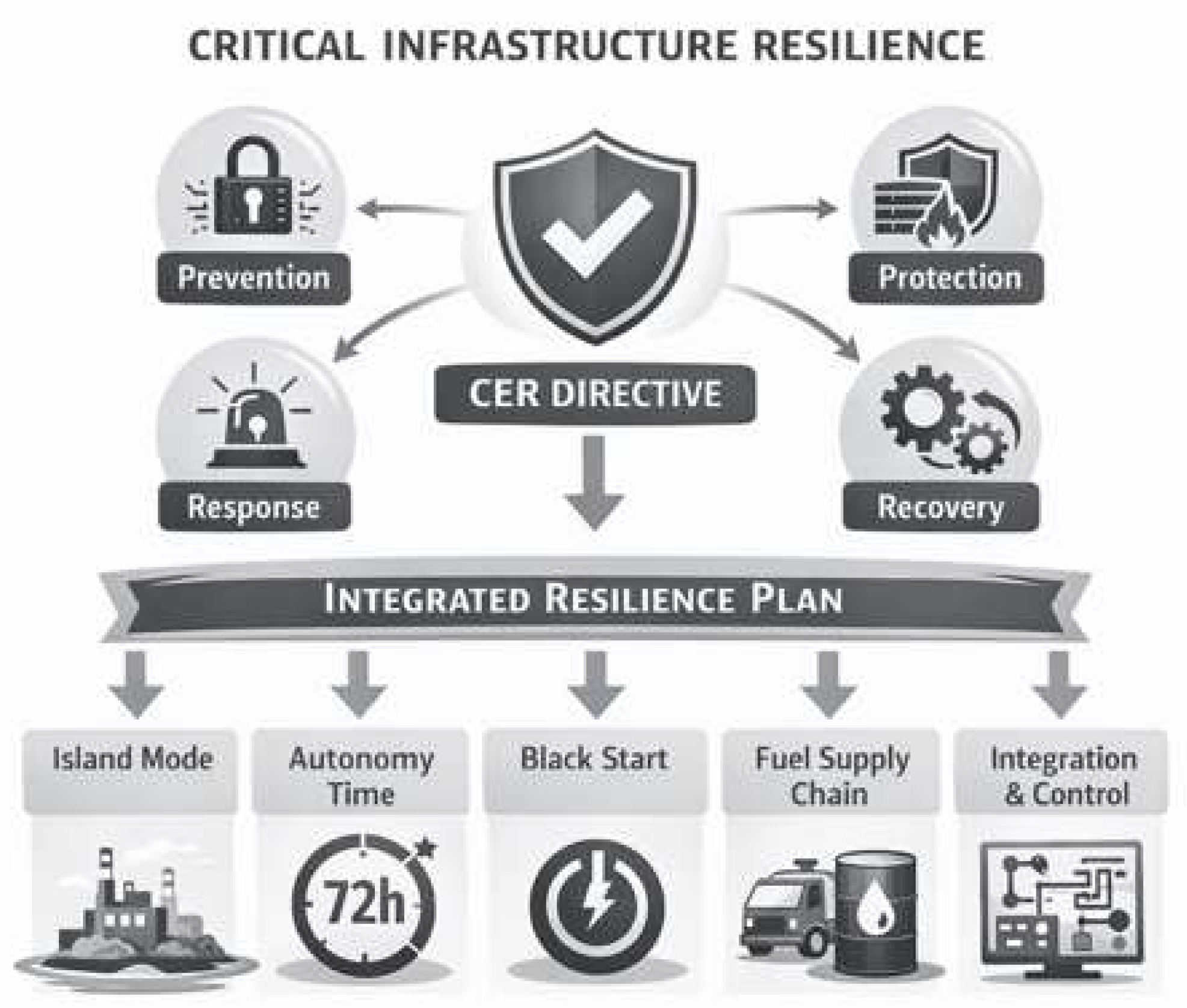
Building resilience in critical infrastructure is particularly important for frontline countries such as Poland. This need became more urgent in 2025, when Polish infrastructure faced a major wave of cyberattacks, culminating in the December Sandworm attack that damaged remote-control terminals in dozens of energy network facilities [26,27]. Such incidents point to the need for changes to the current emergency power supply model, which relies on diesel generators operating for several hours [28]. Increasing the safety margin and strengthening local energy and resource independence are crucial to improving resilience against system failures, human error, and the ever-growing risk of cyberattacks. Achieving multi-day autonomy in critical infrastructure therefore requires diversification based on locally available resources and reliable modern technologies.
Although it should be emphasized, that in safety engineering there is no single universal solution that would work for every critical infrastructure facility. Individual systems often exhibit fundamentally different parameters in terms of availability of fuel, logistics in island mode, operating costs, and stability. There is undoubtedly a need to model, simulate, and compare diverse technological variants, from modern hybrid microgrids to the modernization of traditional backup solutions with a dual-use option. Each facility has a specific load profile (thermal and electrical) as well as its own spatial and logistical constraints. Only multi-variant analysis enables to select an optimal configuration, with respect to reliability, stability, fuel availability and economic constraints [29,30,31].
Recent years definitively have set a new direction for development and improvement in the security systems sector. In response to such challenges, this article aims to develop and test a analytical framework for assessing the real capability of energy systems to sustain critical functions. Its main objective is a multi-criteria analysis and comparative evaluation of different emergency power supply variants.
2. Literature Review
For years, power systems have been designed primarily for reliability, understood as the ability to continuously supply energy in the required quantity and quality under conditions of low-impact, high-probability failures (LIHP). This concept focuses on preventing and minimizing interruptions in normal operation [32,33,34].
In response to the growing number of high-impact, low-probability (HILP) events, such as extreme weather phenomena, cyber-physical attacks or political and economic fluctuations, there has been a shift toward a model defined as resilience [33,35]. Resilience is understood as the ability of a system to absorb disturbances, adapt to them, and efficiently return to its normal state while minimizing the impact on end users. This approach accepts the possibility of complete failure but assumes that degradation will proceed in a controlled way and that adaptation and recovery will occur rapidly. Rather than relying solely on thick cables or redundant lines (i.e., robustness as passive reinforcement), resilience depends on active mechanisms such as automatic islanding, local balancing of generation and demand, and the capability to operate fully independently over extended periods [36,37,38,39].
Assessing islanding capability requires a precise definition of critical infrastructure (CI) load profiles. Unlike standard commercial consumers, facilities such as hospitals, water treatment plants, and data centers are characterized by strict multi-vector energy demands [40]. Maintaining the so-called functional minimum during a crisis is not limited solely to maintaining the power supply [41,42]. Reports on medical infrastructure failures and the analyses of García-Vera et al. show that hospitals require an uninterrupted and simultaneous supply of heat, cooling, and process steam to maintain critical functions, including sterilization and autoclave operation [43,44]. In addition, such facilities often generate dynamic loads with high inrush currents from pumps and compressors [45].
The traditional and most used solution for emergency power supply is diesel-powered generators [46]. From an engineering perspective, they offer high power density, relatively low CAPEX, and a mature market and service base [47]. However, under long-duration autonomous operation (e.g., 72 h), diesel generators face important operational limitations. A key problem is standby operation: regular low-load testing (below 30–40% of rated power) promotes wet stacking, i.e., the accumulation of unburned fuel and soot in the exhaust system, which reduces mechanical reliability and increases the risk of fail-to-run events after a sudden full-load demand during an outage [48,49,50,51,52]. Moreover, ensuring full-power operation for 72 h requires large on-site fuel storage, which creates significant space constraints and raises the risk of diesel fuel degradation during long-term storage [34,53,54]. As Ouyang points out in his work, reliance on continuous tanker-based fuel delivery is also problematic during HILP events, when external logistics chains may themselves be disrupted [55].
As an alternative, the literature considers zero-emission hybrid microgrids based on renewable energy sources (RES) and battery energy storage systems (BESS). Their main advantages are independence from external fossil-fuel supply chains, which can in principle support long-term autonomy, and the elimination of direct emissions in line with decarbonization goals [56,57,58]. However, scaling RES+BESS systems to critical infrastructure remains constrained by major physical and economic barriers. Zakeri and Syri show that sizing lithium-ion storage to cover a hospital’s multi-megawatt demand for 72 h in winter requires extremely high CAPEX and space that is often unavailable in dense urban areas [54,59,60]. In addition, inverter-based BESS and PV systems have limited capability to supply short-circuit and inrush currents, which in facilities with heavy motor loads may require substantial and costly oversizing of power electronics [61,62,63].
Given the limits of both diesel-only and BESS-only approaches, recent literature increasingly points to multigeneration technologies that can provide continuous operation while meeting multi-vector demand [40,56,64,65]. For data centers, Stoll (2025) and Keskin et al. (2025) show that CHP with heat recovery for absorption cooling improves PUE, reduces electric chiller demand, and enables seamless islanding by allowing the microgrid to operate as a primary source [66,67,68]. Similar benefits are confirmed by subsequent studies. In their review of energy storage systems integrated with CHP, Aslam et al. (2025) demonstrated improved resilience metrics alongside a reduction in ENS [69].
Yin et al. (2025) show that CCHP dispatch accounting for renewable uncertainty improves stability and reduces operating costs [70]. Castañeda-Arias et al. (2025) further indicate that CHP significantly increases the resilience of critical loads in multi-microgrid systems [71]. According to research by Macmillan et al. (2024), Hemmati et al. (2025), and Moosanezhad et al. (2024) combining CHP with local fuel storage (such as solid biomass or biogas) removes reliance on external supply chains and SCADA systems’ single points of failure [72,73,74].
Shareef et al. (2026) showed that in a biomass-anchored hybrid microgrid (biomass + PV + wind), biomass provided most of the annual generation and enabled full islanded operation even when solar and wind resources were unavailable [75].
Rico-Riveros et al. showed that a PV + biomass + BESS hybrid system can outperform diesel-based supply in both environmental and operational terms, with biomass from local waste providing a cheaper and more stable source of energy, particularly at night and during prolonged outages [76].
Wang et al. (2025) demonstrated in an optimization model for a biomass-hybrid microgrid with CHP and energy storage that BCHP (biomass CHP) integrated with storage reduces energy waste and improves fuel efficiency. Systems using wood pellets or waste biomass achieved a total efficiency of 80–90%, while ensuring long-term off-grid autonomy through simple solid fuel storage [77].
Studies by Dobre et al. (2024/2025), Anvari et al. (2025), and Seiler et al. (2025) indicate that biomass-based CHP integrated with PV and storage can outperform diesel in emissions, support islanded operation, and improve both cost performance and resilience through the use of locally available fuel [78].
Despite the extensive literature confirming the operational and environmental benefits of cogeneration systems and hybrid microgrids, their reliable evaluation and comparison with conventional systems remains a challenge. In power systems engineering, multi-criteria decision-making (MCDM) methods are most commonly used to evaluate competing technological options. As literature reviews indicate, techniques such as AHP (Analytic Hierarchy Process), TOPSIS, and PROMETHEE are commonly used to balance technical, economic, and environmental parameters [79,80,81,82]. Existing MCDM-based studies in the energy sector remain limited from a resilience perspective. Most models optimize microgrids for grid-connected operation, focusing on LCOE minimization, price arbitrage, or emission reduction [83,84,85]. Even when these models account for island operation, it is typically treated as a transient state lasting from a few to several hours.
Meanwhile, the requirement for 72 hours of full autonomy for critical infrastructure—as defined by modern regulations such as Finland’s CER Act (2025)—completely reshapes the hierarchy of evaluation criteria. Under extreme high-impact events (HILP) and widespread power outages, traditional metrics such as return on investment (ROI) or emissions reduction give way to parameters determining the physical survival of the facility. These include, above all: the source’s start-up readiness, the spatial density of energy carrier storage, the fuel’s chemical stability over time, logistical independence from external supply chains, and the system’s ability to simultaneously meet the minimum functional requirements for both electricity and heat [34,35,42].
The main research gap is the lack of transparent engineering frameworks for comparing multigeneration systems (CHP/CCHP and BESS-based hybrids) with diesel generators under multi-vector loads and continuous 72-h islanded operation. Existing studies often rely on complex heuristic or AI-based methods that obscure the basic physical and operational parameters most relevant to critical infrastructure design [35,42,85,86,87]. In response to the identified gap, this article aims to propose and test a classical evaluation methodology based on hard operational and logistical parameters. This will allow for an objective assessment of the ability of individual technologies to maintain the functional minimum of selected critical infrastructure profiles (a hospital and a data center) under a 72-hour power outage.
3. Methodology
3.1. Assumptions and Methodological Scope
The methodology proposed in this paper is intended for prequalification and is geared toward preliminary screening. Its purpose is not to identify the least expensive technology, but to determine which of the available energy solutions are realistically capable of sustaining the minimum operational requirements of a critical infrastructure facility during outages and prolonged disruptions in energy supply. In this sense, the methodological framework is based on the logic of resilience: the priority is the ability to absorb failures, switch to island operation, perform a black start, and maintain the facility’s critical services with limited external support. The method is intended to serve as an initial engineering filter, preceding detailed design, simulation, or optimization modeling for a specific facility.
The analysis is grounded in the realities of Poland and Central Europe. This means that the assessment of the technology considers not only technical parameters but also the local availability of fuels, the logistics of their storage, implementation readiness, safety requirements, spatial constraints, and the organizational capabilities of local operators. This location is methodologically significant because a solution that is theoretically attractive may prove to be operationally unreliable if it requires fuel or maintenance that is unavailable in a crisis scenario. For this reason, full economic optimization has been intentionally omitted at this stage. Parameters such as CAPEX, OPEX, and LCOE may be introduced at a later stage of the study, after some technologies have been eliminated for failing to meet basic resilience requirements.
In practice, this means that the evaluation hierarchy here is reversed compared to traditional energy analyses: priority has shifted to ensuring the continued operation of critical functions, while cost optimization is treated as a secondary consideration rather than the primary selection criterion.
3.2. Reference Object, Minimum Functional Requirements and Disruption Scenarios
A hospital was chosen as the reference facility because it represents one of the most demanding categories of civilian critical infrastructure. Unlike standard facilities, this type of facility requires an uninterrupted supply of electricity, heat, cooling, hot water, and even process steam. For methodological purposes, the hospital is treated as a model facility rather than a fully parameterized, specific design case. Thanks to this approach, the proposed framework can also be easily applied to other classes of critical infrastructure facilities, such as water treatment plants or government data centers.
Consequently, the functional minimum has been defined in operational terms - as a set of services and corresponding energy flows that must be maintained for the facility to perform its critical functions under disruptive conditions (Table 1). At the screening stage, it is not necessary to specify a particular design load - it is sufficient to assume a realistic range of load values. Additionally, it is necessary to verify whether the given technology is capable of meeting the required demand profile.
The reference disruption scenario assumes a complete blackout. This situation is defined as a loss of external power supply combined with limited logistical and maintenance support. Winter conditions were chosen as the baseline scenario because energy demand is highest during this time. Additionally, winter conditions much better illustrate the danger of a crisis to society and to people’s health and lives.
The analysis considered three time horizons for autonomy: 24, 48, and 72 hours. The 48-hour horizon was set as the minimum threshold for initial qualification in the selection process, while the 72-hour horizon corresponds to a rigorous resilience target, in line with current international trends in crisis management. The scenario also assumes the risk of interruptions in grid gas supply, a lack of external fuel supplies, limited availability of technical personnel, and the need for an automatic or semi-automatic transition to island operation.
3.3. A Technolodgy Portfolio and a Two-Stage Qualification Process
To avoid prematurely rejecting less common technologies and to ensure a comprehensive review, the procedure begins by defining a broad technology pool (Table 2). Qualification takes place in two stages. Stage I is a go/no-go filter (Table 3 and Figure 2), which eliminates technologies that do not meet basic boundary conditions (minimum 48-hour autonomy, appropriate order of magnitude of power, multi-vector profile, feasibility of implementation).
Stage II involves scoring the solutions that passed the initial screening (Table 4 and Figure 3.). This sequence is methodologically crucial: there is no point in scoring and comparing a technology that cannot operate in off-grid mode, does not cover the required energy sources, or lacks a reliable fuel supply chain in a crisis.
Stage II applies an ordinal 1–5 scoring scale with weights prioritizing islanding readiness, fuel autonomy, black-start capability, and multivector coverage, alongside reliability, scalability, implementation feasibility, and operational safety. Simple engineering indicators are used throughout to maintain interpretability:
- a power adequacy index (GAI = Pavail/Pmin),
- a thermal adequacy index (TAI = Qavail/Qmin),
- a cooling adequacy index (CAI = Cavail/Cmin),
- and a fuel autonomy index (FAI = taut/treq).
Values below 1.0 indicate a shortfall; values at or above 1.0 indicate that the minimum requirement is met.
3.4. Reporting of Results and Methodological Limitations
The direct output of the proposed methodology is not a final installation design, but a technology-matching matrix that combines technology class, facility requirements, and operational constraints. The results should be reported in a standardized technology-card format, covering power range, supported energy carriers, islanding capability, black-start capability, estimated fuel autonomy, spatial requirements, organizational framework, and the final screening result.
The methodology is intentionally simplified compared to full MILP (Mixed-Integer Linear Programming) analyses, Monte Carlo models, or metrics such as EENS/LOLE (Expected Energy Not Served / Loss of Load Expectation). Its main limitation-and at the same time its goal-is to offer a transparent front-end engineering tool that streamlines the decision-making process aimed at improving resilience and serves as a coherent bridge between a literature review and a subsequent, dedicated case study.
4. Case Study and Input Data
4.1. Scope and Limitations of the Input Data
The input dataset comprises two streams: (i) an hourly electricity profile for 2025 covering the hospital’s three metering points, and (ii) monthly district-heat consumption for 2024–2025 together with information on the main heat source and network parameters. Hourly heat data, cooling data, process-steam data, and a decomposition of loads into A/B/C criticality classes are not available. Accordingly, the analysis remains fully consistent with the methodological assumptions of the article: this is a pre-qualification exercise, not a final design balance
4.2. Step I – Reconstruction of the Facility Energy Profile
4.2.1. Electricity
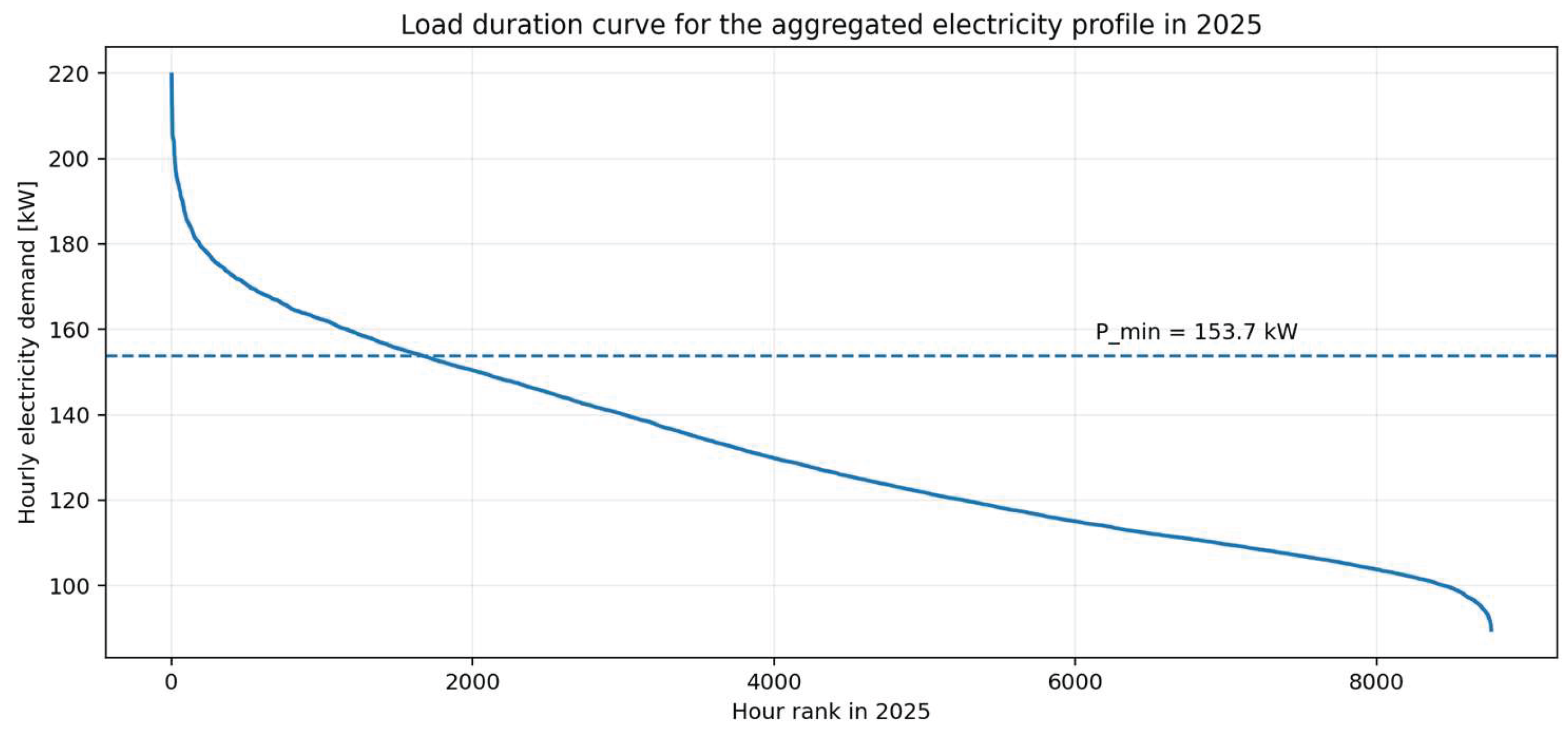
Total electricity consumption in 2025 amounted to 1,148.0 MWh (1.148 GWh), which corresponds to an average load of 131.1 kW. The maximum recorded hourly energy, interpreted as the average hourly power, was 219.6 kW. The 95th percentile of the hourly load was 171.8 kW, while the 5th percentile was 101.3 kW. This shows that even after excluding non-critical end uses, the hospital remains a facility with a stable, high base load around the clock.
4.2.2. Heat
Heat consumption in 2025 amounted to 6277.6 GJ, i.e. 1,743.8 MWhth. The main source is the Veolia district-heating network, and the installed/contracted capacity on the substation side equals 1,060 kW. The average monthly heat uptake in winter reached roughly 0.39–0.42 MW, while the heat-to-electricity energy ratio in January and February was approximately 3:1. This profile shows that purely electrical resilience architectures are insufficient for the analyzed hospital; a multivector configuration with a thermal component is required.

Table 5.
Key input parameters used in the case study.
| Electricity in 2025 | Heat in 2025 | P_peak,h | Adopted P_min |
|---|---|---|---|
| 1,148.0 MWh (1.148 GWh) | 6277.6 GJ (1,743.8 MWhth) | 219.6 kW | 153.7 kW |
Table 6.
Screening interpretation of the reconstructed demand profile.
| Indicator | Value | Screening interpretation |
|---|---|---|
| Annual electricity consumption | 1,148.0 MWh | Stable year-round profile with no clearly “empty” months. |
| Annual heat consumption | 6277.6 GJ | Pronounced thermal component; the facility cannot be assessed like a standard commercial building. |
| Maximum hourly electric load | 219.6 kW | Reference point for estimating the electrical functional minimum. |
| 95th percentile of hourly load | 171.8 kW | Represents a realistic sustained high-load level rather than a single outlier peak. |
| Heat-side capacity (substation) | 1,060 kW | Upper bound for the order of magnitude of the facility’s thermal needs. |
Figure 4.
Monthly electricity and heat consumption 2025 for analyzed hospital.
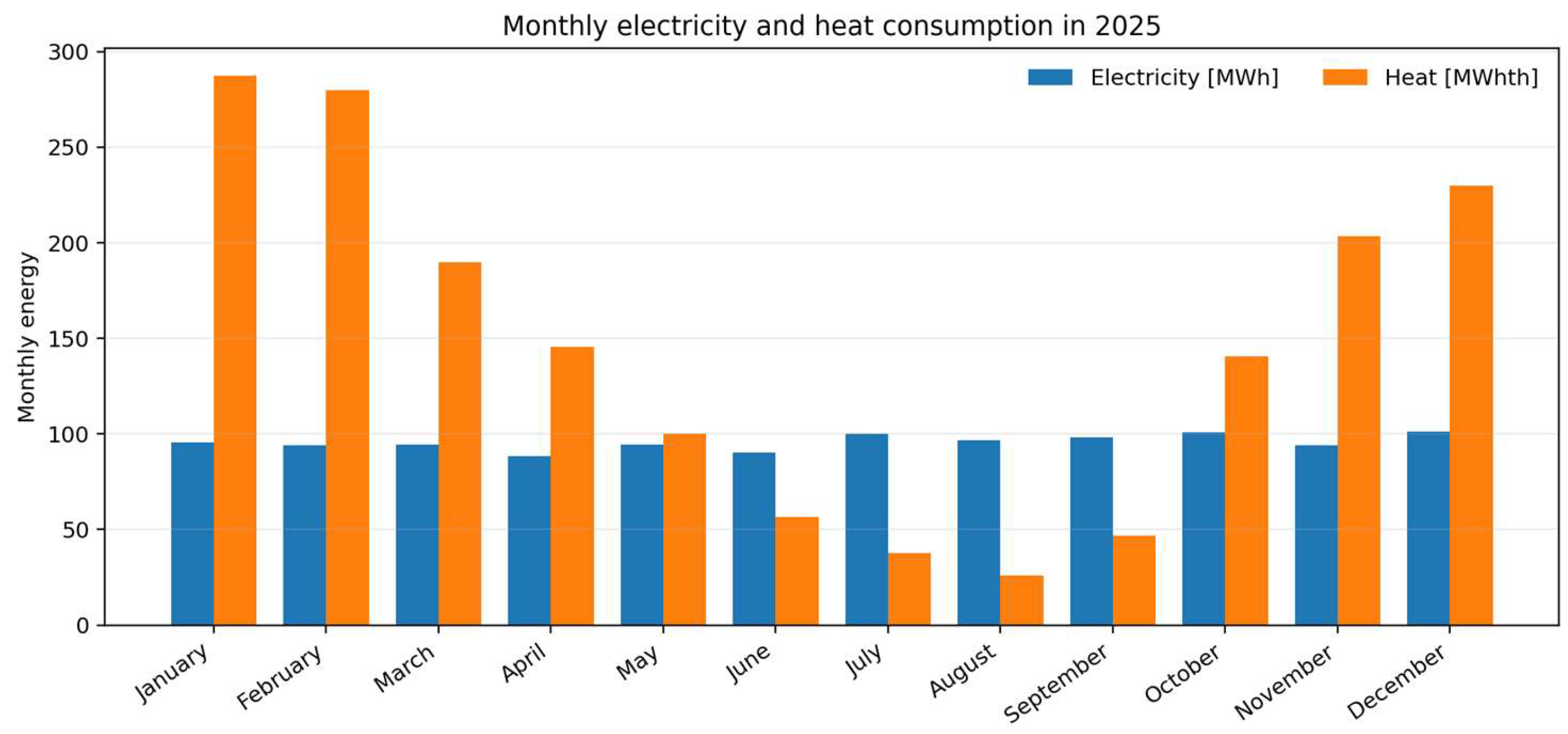
Figure 5.
Load-duration curve of the aggregated electricity profile in 2025 and the adopted baseline functional-minimum level Pmin.
Figure 5.
Load-duration curve of the aggregated electricity profile in 2025 and the adopted baseline functional-minimum level Pmin.
4.3. Step 2 – Definition of the Functional Minimum and Disruption Scenario
Functional minimum on the electricity side. Because the loads are not split into A/B/C classes, a simple and transparent screening proxy was adopted: Pmin=0.70 × Ppeak,h = 153.7 kW.
The 70% assumption represents the preservation of Class A functions together with the dominant share of Class B functions while selected support loads are curtailed. A sensitivity interpretation was additionally carried out for the interval 60–80% of Ppeak,h.
Functional minimum on the heat side. In the absence of an hourly heat profile, a baseline level of Qmin = 0.50 MWth was adopted. This value lies above the average winter heat uptake, yet well below the 1.06 MW capacity available at the substation. It therefore provides a conservative but defensible approximation of a crisis-mode minimum covering space heating, DHW, and essential technical functions. A qualitative sensitivity range of 0.45–0.60 MWth was also considered.
Disruption scenario. In line with the article methodology, the reference case is a winter blackout with loss of external electricity supply, limited-service availability, and a logistic risk of interruption in grid-gas delivery. As mentioned earlier, the 48-hour horizon serves as the initial qualification threshold, while 72 hours represents the target resilience level. In terms of the adopted functional minimum, this translates to an energy demand of 7.38 MWh of electricity and 24 MWhth of heat over 48 hours, and 11.07 MWh of electricity and 36 MWhth of heat over 72 hours.
Table 7.
Assumptions used to define the functional minimum and the disruption scenario.
| Parameter | Base case | Sensitivity range | Justification |
|---|---|---|---|
| Pmin | 153.7 kW | 0.60–0.80 Ppeak, h | No A/B/C decomposition available; a percentage share of peak load was used as the screening proxy. |
| Qmin | 0.50 MWth | 0.45–0.60 MWth | No hourly heat data; the range is anchored between the average winter load and the substation capacity. |
| Screening autonomy horizon |
48 h | 72 h as target | Consistent with the adopted technology-qualification logic. |
| Fuel scenario | Risk of interruption in grid-gas supply | Local fuel storage rewarded | Consistent with a resilience-oriented HILP framework. |
4.4. Step 3 – Portfolio of Analyzed Technology Architectures
This case study does not compare vendor catalogues but technology-architecture classes. Each option is specified at the order-of-magnitude level required to test consistency with the demand profile of the analyzed facility. Where the methodology allows “simple complementary components”, BESS and/or a peak-heat source were used to close a limited functional gap without deep reconstruction of the hospital.
Table 8.
Technology architectures subjected to preliminary qualification.
| Code | Architecture | Adopted screening configuration | Comment |
|---|---|---|---|
| V1 | Diesel generator | 250 kWe | Reference only; no own heat supply. |
| V2 | RES + BESS | 300 kWp PV + 2 MWh / 250 kW BESS | Short-term backup; unsuitable for multi-day winter use. |
| V3 | Gas-fired CHP | 200 kWe / 240 kWth | mature, but gas dependent. |
| V4 | Dual-fuel CHP + BESS + boiler | 200 kWe / 240 kWth + 0.5 MWh BESS + 300 kWth peak-heat source | Hybrid with local fuel storable. |
| V5 | Biomass CHP + BESS + boiler | 180 kWe / 270 kWth + 0.5 MWh BESS + 300 kWth biomass boiler | High fuel autonomy, but space/logistics intensive. |
| V6 | Dual-fuel CCHP + BESS + boiler | 200 kWe / 240 kWth + 120 kWc absorption cooling + 0.5 MWh BESS + 300 kWth peak-heat source | V4 +cooling; justified only if cooling is confirmed as critical. |
5. Results of the Methodology Application
5.1. Step 4 – Stage I: Go/No-Go Screening
For each architecture, three simple engineering indicators were calculated. GAI = Paval/Pmin expresses electrical capacity adequacy, TAI = Qavail/Qmin expresses thermal adequacy, and FAI = taut/treq expresses fuel autonomy against the required horizon.
Values < 1.0 indicate a shortfall. In Stage I, TAI < 1 avoids automatic rejection if the deficit can be covered by simple, non-invasive components.
Table 9.
Stage I results – verification of architectures in go/no-go logic.
| Code | Variant | GAI | TAI | FAI48 | Result |
|---|---|---|---|---|---|
| V1 | Diesel generator 250 kWe | 1.63 | 0.00 | 1.50 | NO-GO |
| V2 | RES + BESS 300 kWp + 2 MWh / 250 kW | 1.63 | 0.00 | 0.27 | NO-GO |
| V3 | Gas-fired CHP 200 kWe / 240 kWth | 1.30 | 0.48 | 0.00 | NO-GO |
| V4 | Dual-fuel CHP + BESS + peak boiler | 1.30 | 1.08 | 1.50 | GO |
| V5 | Biomass CHP + BESS + peak boiler | 1.17 | 1.14 | 1.50 | GO |
| V6 | Dual-fuel CCHP + BESS + peak boiler | 1.30 | 1.08 | 1.50 | GO |
Stage I Screening Results
Variants V1 (diesel generator) and V2 (RES + BESS) were rejected due to the absence of thermal and cooling coverage; V2 additionally failed the multi-day fuel-autonomy criterion in a winter scenario. Option V3 (gas cogeneration) was ruled out because, in the assumed scenario of gas supply disruptions, no realistic path to fuel self-sufficiency could be identified, despite its favorable technical parameters. Variants V4 (dual-fuel cogeneration + BESS + peak boiler) and V6 (dual-fuel cogeneration + BESS + peak boiler) met three out of three thresholds, providing full electrical and thermal profiles with the ability to start from zero and local fuel stock autonomy; Variant V6 additionally offers absorption cooling, contingent upon confirmed critical cooling demand. Variant V5 (biomass cogeneration + BESS + peak boiler) also passed the selection process, demonstrating high autonomy and full profile coverage, although its site feasibility rating is lower than that of variant V4.
Already at the boundary-filter level it becomes clear that the demand profile of the analyzed hospital eliminates purely electrical architecture. The diesel generator remains a useful reference point and may protect part of the electric load, but it does not satisfy the multivector requirement. The stand-alone RES+BESS option does not achieve 48-hour autonomy under winter conditions. Conventional natural-gas CHP is eliminated not because of efficiency, but because of the assumed fuel-risk scenario. Consequently, only hybrid solutions with locally secured fuel and a simple storage/start-up component pass to Stage II in a methodologically defensible manner.
5.2. Step 5 – Stage II: Scoring of Admitted Solutions
Variants V4, V5, and V6 were ultimately selected for Phase II. The base weights specified in the methodology were applied: 0.20 each for readiness for island mode operation and fuel autonomy, 0.15 for readiness for cold start, 0.15 for multi-vector range, 0.10 for reliability and maturity, 0.05 for scalability and modularity, 0.10 for implementation feasibility, and 0.05 for operational safety.
Table 10.
Stage II results – scoring assessment od prequalified architectures.
| Criterion | Weight | V4 | V5 | V6 |
|---|---|---|---|---|
| Islanding readiness | 0.20 | 5 | 4 | 5 |
| Fuel autonomy | 0.20 | 4 | 5 | 4 |
| Black-start readiness | 0.15 | 5 | 4 | 5 |
| Multivector coverage | 0.15 | 4 | 4 | 5 |
| Reliability and maturity | 0.10 | 5 | 3 | 4 |
| Scalability and modularity | 0.05 | 4 | 3 | 4 |
| Implementation feasibility | 0.10 | 4 | 2 | 3 |
| Operational safety | 0.05 | 3 | 3 | 3 |
| Total weighted score | 1.00 | 4.40 | 3.80 | 4.35 |
Table 11.
Ranking of architectures after stage II.
| Rank | Code | Variant | Weighted score | Conclusion |
|---|---|---|---|---|
| 1 | V4 | Dual-fuel CHP + BESS + peak boiler | 4.40 | The most balanced option for the analyzed profile: strong islanding readiness, technical maturity, and complete electric-and-thermal coverage. |
| 2 | V6 | Dual-fuel CCHP + BESS + peak boiler | 4.35 | A very strong option, but its added value becomes visible only when a critical cooling requirement is confirmed. |
| 3 | V5 | Biomass CHP + BESS + peak boiler | 3.80 | The strongest fuel autonomy, but weaker local deploy ability and higher logistics complexity. |
5.3. Step 6 – Sensitivity Analysis and Interpretation of the Result
Decision stability. Within the range Pmin = 0.60–0.80 Ppeak, h and Qmin = 0.45–0.60 MWth, the Stage I result remains stable: V1, V2, and V3 still fail the boundary conditions, whereas V4–V6 remain prequalified. What changes is the margin between the admitted architectures. As the relevance of cooling increases, V6 becomes more attractive; in contrast, when stronger emphasis is placed on fuel independence and lower dependence on external deliveries, the relative position of V5 improves.
Importance of the heat-to-electricity relation. The most important conclusion from the real-world data is that the analyzed hospital is not a facility for which “extra electrical capacity” alone is sufficient. In winter months, thermal energy is approximately three times larger than electrical energy. Therefore, the resilience architecture must combine islanded electrical operation with a credible local thermal source. This is precisely the factor that disqualifies simple diesel-only configurations as target solutions.
6. Conclusions and Implications for Further Design
First, the hospital’s real operating data confirms the validity of the adopted methodology: the demand profile itself eliminates part of the technology basket even before any economic optimization is attempted.
Second, for a facility with the analyzed, assumed profile, the most promising direction for further modeling is a hybrid CHP/CCHP architecture with energy storage, locally secured fuel, and a simple heat source for peak demand.
Third, the biomass CHP + BESS option remains very interesting from the perspective of 72-hour autonomy, but before initiating a full feasibility study, it is necessary to verify site-specific spatial, organizational, and environmental constraints.
Fourth, to move from the preliminary selection stage to the FEED stage and a quantitative design model, the following input data must be added:
- (i)
- hourly heat demand profile,
- (ii)
- data on cooling and HVAC demand,
- (iii)
- A/B/C load structure, and
- (iv)
- information on existing backup generators, ATS/SZR systems, UPS systems, and the possibility of isolating the microgrid at the switchgear level.
Based on the present case study, it can be concluded that for the analyzed hospital the methodology favors multivector and fuel-autonomous solutions. The first-choice option for detailed follow-up analysis is dual-fuel CHP + BESS + a peak-heat source, whereas biomass CHP + BESS should be treated as a strong resilience-oriented alternative, especially where local solid-fuel security can be achieved.
Author Contributions
Conceptualization, T.M., P.P., T.S. and K.Z.; methodology, T.M., P.P., J.D., T.S. and K.Z.; formal analysis, T.M., P.P. and T.S.; investigation, T.M. and P.P.; validation, T.S. and K.Z.; data curation, T.M., P.P. and J.D.; visualization, T.M. and P.P.; writing—original draft preparation, T.M., P.P. and J.D.; writing—review and editing, T.M., P.P., J.D., T.S. and K.Z.; supervision, T.M., J.D., T.S. and K.Z.; project administration, T.M. and J.D. All authors have read and agreed to the published version of the manuscript.
Funding
This research received no external funding.
Data Availability Statement
No new data were created or analyzed in this study. The analysis was based on realistic operational data obtained from an existing medical facility. Due to security reasons and confidentiality restrictions related to critical infrastructure, the source data cannot be publicly disclosed and are not publicly available.
Conflicts of Interest
The authors declare no conflicts of interest.
Abbreviations
The following abbreviations are used in this manuscript:
| ATSSZR | Automatic Transfer Switch |
| BESS | Battery Energy Storage System |
| CAPEX | Capital Expenditure |
| CCHP | Combined Cooling, Heating and Power |
| CER | Critical Entities Resilience |
| CHP | Combined Heat and Power |
| CI | Critical Infrastructure |
| DHW | Domestic Hot Water |
| EENSLOLE | Expected Energy Not Served / Loss of Load Expectation |
| ENTSO-E | European Network of Transmission System Operators for Electricity |
| FEED | Front-End Engineering Design |
| HILP | High-Impact Low-Probability |
| HVAC | Heating, Ventilation, and Air Conditioning |
| ICU | Intensive Care Unit |
| LCOE | Levelized Cost of Energy |
| LIHP | Low-Impact High-Probability |
| MCDM | Multi-Criteria Decision-Making |
| OPEX | Operational Expenditure |
| PUE | Power Usage Effectiveness |
| RES | Renewable Energy Sources |
| UPS | Uninterruptible Power Supply |
Appendix A
Table A1.
Monthly data used in the screening analysis.
| Month | Electricity [MWh] | Heat [GJ] | Heat [MWhth] |
|---|---|---|---|
| January | 95.386 | 1034.62 | 287.394 |
| February | 94.176 | 1007.55 | 279.875 |
| March | 94.292 | 682.73 | 189.647 |
| April | 88.424 | 524.52 | 145.700 |
| May | 94.290 | 360.88 | 100.244 |
| June | 90.325 | 203.48 | 56.522 |
| July | 99.996 | 136.25 | 37.847 |
| August | 96.815 | 93.20 | 25.889 |
| September | 98.293 | 168.28 | 46.744 |
| October | 100.746 | 506.62 | 140.728 |
| November | 94.095 | 731.77 | 203.269 |
| December | 101.166 | 827.73 | 229.925 |
References
- Oughton, E.J.; Ralph, D.; Pant, R.; Leverett, E.; Copic, J.; Thacker, S.; Dada, R.; Ruffle, S.; Tuveson, M.; Hall, J.W. Stochastic Counterfactual Risk Analysis for the Vulnerability Assessment of Cyber-Physical Attacks on Electricity Distribution Infrastructure Networks. Risk Anal. 2019, 39, 2012–2031. [Google Scholar] [CrossRef]
- Cyber-Attack Against Ukrainian Critical Infrastructure | CISA. Available online: https://www.cisa.gov/news-events/ics-alerts/ir-alert-h-16-056-01 (accessed on 23 March 2026).
- NERC | Report Title | Report Date I Analysis of the Cyber Attack on the Ukrainian Power Grid Defense Use Case. 2016.
- Dragos. CRASHOVERRIDE: Analyzing the Threat to Electric Grid Operations, June 2017. Not Classified. | National Security Archive. Available online: https://nsarchive.gwu.edu/document/15319-dragos-crashoverride-analyzing-threat (accessed on 23 March 2026).
- Salazar, L.; Castro, S.R.; Lozano, J.; Koneru, K.; Zambon, E.; Huang, B.; Baldick, R.; Krotofil, M.; Rojas, A.; Cardenas, A.A. A Tale of Two Industroyers: It Was the Season of Darkness. Proc. IEEE Symp. Secur. Priv. 2024, 312–330. [Google Scholar] [CrossRef]
- Kazi, A.; Bhosale, S. INVISIBLE BATTLEFIELDS: ANALYZING THE VIASAT ATTACK AND ITS BROADER IMPLICATIONS. 2025. [Google Scholar] [CrossRef]
- Case Study: Viasat Attack | CyberPeace Institute. Available online: https://cyberconflicts.cyberpeaceinstitute.org/law-and-policy/cases/viasat (accessed on 23 March 2026).
- Bermudez, M.A.; González, A.C.; Arreaga, A.P.; Moya, J.G. Tendencias de Ataques Cibernéticos En Las Industrias de Países Europeos. Atlas Res. J. 2025, 3, 19–36. [Google Scholar] [CrossRef]
- Cyberattack Targets Systems at Oiltanking, Mabanaft Group, Impacting Operations - Industrial Cyber. Available online: https://industrialcyber.co/threats-attacks/cyberattack-targets-systems-at-oiltanking-mabanaft-group-impacting-operations/ (accessed on 23 March 2026).
- Cyberattacks Continue to Extend across Europe, BlackCat Ransomware May Be Involved - Industrial Cyber. Available online: https://industrialcyber.co/threats-attacks/cyberattacks-continue-to-extend-across-europe-blackcat-ransomware-may-be-involved/ (accessed on 23 March 2026).
- The Attack against Danish, Critical Infrastructure.
- Forescout Research: Clearing the Fog of War - Forescout. Available online: https://www.forescout.com/blog/analysis-of-energy-sector-cyberattacks-in-denmark-and-ukraine/ (accessed on 23 March 2026).
- Steinwand, N. Battle-Tested Power Systems Resilience and Preparedness for Europe’s Electricity Sector Eurelectric Report, 2026.
- A Review of Reports on Spanish Blackout Causes and Solutions • Grid Strategies. Available online: https://gridstrategiesllc.com/project/a-review-of-reports-on-spanish-blackout-causes-and-solutions/ (accessed on 23 March 2026).
- Lara, J.D.; Kroposki, B.; Elgindy, T.; Henriquez-Auba, R.; Wright, J. April 28 Th 2025 Iberian Blackout: Analysis of Available Information, 2025.
- 28 April 2025 Blackout. Available online: https://www.entsoe.eu/publications/blackout/28-april-2025-iberian-blackout/ (accessed on 23 March 2026).
- ENISA’s Cyber Europe 2024 Exposes Critical Vulnerabilities in EU Energy Sector - Cybersec 365. Available online: https://www.cybersec-365.com/articles/enisas-cyber-europe-2024-exposes-critical-vulnerabilities-in-eu-energy-sector (accessed on 23 March 2026).
- ENISA THREAT LANDSCAPE 2025.
- Ustawa z Dnia 26 Kwietnia 2007 r. o Zarządzaniu Kryzysowym (t.j. Dz.U. z 2022 r. Poz. 261 Ze Zm.), Art. 3 Pkt 2. Available online: https://isap.sejm.gov.pl/isap.nsf/download.xsp/WDU20070890590/T/D20070590L.pdf (accessed on 23 March 2026).
- What Is National Security? - Ministry of the Interior. Available online: https://intermin.fi/en/national-security/critical-infrastructure-protection (accessed on 23 March 2026).
- New Legislation to Strengthen Protection of Critical Infrastructure and Resilience of Society - Ministry of the Interior. Available online: https://intermin.fi/en/-/new-legislation-to-strengthen-protection-of-critical-infrastructure-and-resilience-of-society (accessed on 23 March 2026).
- Paalanen, A. National Resilience System of Finland Blueprint for a Shock Proof Society. 2025. [Google Scholar]
- Ruggiero, A.; Piotrowicz, W.D.; John, L. Enhancing Societal Resilience through the Whole-of-Society Approach to Crisis Preparedness: Complex Adaptive Systems Perspective – The Case of Finland. Int. J. Disaster Risk Reduct. 2024, 114. [Google Scholar] [CrossRef]
- Total Defence – You Are Part of Sweden’s Overall Emergency Preparedness. Available online: https://www.mcf.se/en/advice-for-individuals/swedish-defence/total-defence--you-are-part-of-swedens-overall-emergency-preparedness/ (accessed on 23 March 2026).
- Resilient Energy Supply within NATO. Available online: https://www.energimyndigheten.se/en/energy-preparedness/energy-preparedness/resilient-energy-supply-within-nato/ (accessed on 23 March 2026).
- Energy Sector Incident Report – 29 December.
- Dragos 2026 OT Cybersecurity Report: A Year in Review. Available online: https://www.dragos.com/ot-cybersecurity-year-in-review#download-report-2026 (accessed on 23 March 2026).
- Marqusee, J.; Jenket, D. Reliability of Emergency and Standby Diesel Generators: Impact on Energy Resiliency Solutions. Appl. Energy 2020, 268, 114918. [Google Scholar] [CrossRef]
- Miao, H.; Yu, Y.; Kharrazi, A.; Ma, T. Multi-Criteria Decision Analysis for the Planning of Island Microgrid System: A Case Study of Yongxing Island, China. Energy 2023, 284, 129264. [Google Scholar] [CrossRef]
- Kiptoo, M.K.; Bode Adewuyi, O.; Furukakoi, M.; Mandal, P.; Senjyu, T. Integrated Multi-Criteria Planning for Resilient Renewable Energy-Based Microgrid Considering Advanced Demand Response and Uncertainty. 2023. [Google Scholar] [CrossRef]
- Hosseina, M.; Moghaddam, M.S.; Hassannia, A. Optimizing Energy and Load Management in Island Microgrids for Enhancing Resilience against Resource Interruptions. Sci. Rep. 2025, 15, 1 2025 16297. [Google Scholar] [CrossRef]
- Raoufi, H.; Vahidinasab, V.; Mehran, K. Power Systems Resilience Metrics: A Comprehensive Review of Challenges and Outlook. Sustainability 2020, 12, 1–24. [Google Scholar] [CrossRef]
- Wang, Y.; Chen, C.; Wang, J.; Baldick, R. Research on Resilience of Power Systems under Natural Disasters - A Review. IEEE Trans. Power Syst. 2016, 31, 1604–1613. [Google Scholar] [CrossRef]
- Panteli, M.; Mancarella, P. The Grid: Stronger, Bigger, Smarter?: Presenting a Conceptual Framework of Power System Resilience. IEEE Power Energy Mag. 2015, 13, 58–66. [Google Scholar] [CrossRef]
- Panteli, M.; Pickering, C.; Wilkinson, S.; Dawson, R.; Mancarella, P. Power System Resilience to Extreme Weather: Fragility Modeling, Probabilistic Impact Assessment, and Adaptation Measures. IEEE Trans. Power Syst. 2017, 32, 3747–3757. [Google Scholar] [CrossRef]
- Sun, X.; Ruan, J.; Hu, Z.; Liu, Y.; Zhang, A.; Xu, Z. Review and Rethink of Power System Resilience Against Extreme Weather Events: Current Practices, Challenges, and Future Trends. 2024 6th International Conference on Energy Systems and Electrical Power; ICESEP 2024 2024, pp. 670–675. [CrossRef]
- Power System Resilience: Definition, Features and Properties | CSE. Available online: https://cse.cigre.org/cse-n030/power-system-resilience-definition-features-and-properties.html (accessed on 25 March 2026).
- Stasinos, E.I.E.; Trakas, D.N.; Hatziargyriou, N.D. Microgrids for Power System Resilience Enhancement. iEnergy 2022, 1, 158–169. [Google Scholar] [CrossRef]
- Akram Bajwa, A.; Mokhlis, H.; Mekhlief, S.; Mubin, M.; Azam, M.M.; Sarwar, S. Resilience-Oriented Service Restoration Modelling Interdependent Critical Loads in Distribution Systems with Integrated Distributed Generators. 2020. [Google Scholar] [CrossRef]
- Mancarella, P. MES (Multi-Energy Systems): An Overview of Concepts and Evaluation Models. Energy 2014, 65, 1–17. [Google Scholar] [CrossRef]
- uoslahti, H. Business Continuity for Critical Infrastructure Operators. Ann. Disaster Risk Sci. 2020, 3. [Google Scholar] [CrossRef]
- Ulusan, A.; Ergun, O. Restoration of Services in Disrupted Infrastructure Systems: A Network Science Approach. PLoS ONE 2018, 13, e0192272. [Google Scholar] [CrossRef]
- Vera, Y.E.G.; Dufo-López, R.; Bernal-Agustín, J.L. Energy Management in Microgrids with Renewable Energy Sources: A Literature Review. Appl. Sci. 2019, 9. [Google Scholar] [CrossRef]
- Combined Heat and Power: Enabling Resilient Energy Infrastructure for Critical Facilities Prepared for: Oak Ridge National Laboratory, 2013.
- Gursoy, M.; Mirafzal, B. Dynamic Load Inrush Current Mitigation in Islanded Microgrids Powered by Grid-Forming Inverters. 2022 1st IEEE International Conference on Industrial Electronics: Developments & Applications (ICIDeA), 2022, 2022; pp. 73–77. [Google Scholar] [CrossRef]
- Bie, Z.; Lin, Y.; Li, G.; Li, F. Battling the Extreme: A Study on the Power System Resilience. Proc. IEEE 2017, 105, 1253–1266. [Google Scholar] [CrossRef]
- Al-Shammari, Z.W.J.; Azizan, M.M.; Rahman, A.S.F.; Hasikin, K. Optimal Sizing of Standalone for Hybrid Renewable Energy System by Using PSO Optimization Technique. Int. J. Power Electron. Drive Syst. (IJPEDS) 2023, 14, 426–432. [Google Scholar] [CrossRef]
- Fehr, Stephen John. Emergency Diesel-Electric Generator Set Maintenance and Test Periodicity. Available online: https://digitalcommons.odu.edu/cgi/viewcontent.cgi?article=1024&context=emse_etds (accessed on 25 March 2026).
- Reliability Evaluation of Emergency Diesel Generator Systems (EDGS) for VVER-1000/V446 Reactor by Markov Model | Request PDF. Available online: https://www.researchgate.net/publication/366297759_Reliability_Evaluation_of_Emergency_Diesel_Generator_Systems_EDGS_for_VVER-1000V446_Reactor_by_Markov_Model (accessed on 25 March 2026).
- Issa, M.; Ibrahim, H.; Hosni, H.; Ilinca, A.; Rezkallah, M. Effects of Low Charge and Environmental Conditions on Diesel Generators Operation. Eng 2020, 1, 137–152. [Google Scholar] [CrossRef]
- Mohd Noor, C.W.; Mamat, R.; Najafi, G.; Wan Nik, W.B.; Fadhil, M. Application of Artificial Neural Network for Prediction of Marine Diesel Engine Performance. IOP Conf. Ser. Mater. Sci. Eng. 2015, 100, 012023. [Google Scholar] [CrossRef]
- Daya, A.A.; Lazakis, I. Component Criticality Analysis for Improved Ship Machinery Reliability. Machines 2023, 11. [Google Scholar] [CrossRef]
- Erdmann, M.; Kleinbub, S.; Wachtendorf, V.; Schutter, J.D.; Niebergall, U.; Böhning, M.; Koerdt, A. Photo-Oxidation of PE-HD Affecting Polymer/Fuel Interaction and Bacterial Attachment. npj Mater. Degrad. 2020 2020, 4, 18. [Google Scholar] [CrossRef]
- Zakeri, B.; Syri, S. Electrical Energy Storage Systems: A Comparative Life Cycle Cost Analysis. Renew. Sustain. Energy Rev. 2015, 42, 569–596. [Google Scholar] [CrossRef]
- Ouyang, M. Review on Modeling and Simulation of Interdependent Critical Infrastructure Systems. 2013. [Google Scholar] [CrossRef]
- Hussain, A.; Bui, V.H.; Kim, H.M. Microgrids as a Resilience Resource and Strategies Used by Microgrids for Enhancing Resilience. Appl. Energy 2019, 240, 56–72. [Google Scholar] [CrossRef]
- Hanna, R.; Marqusee, J. Designing Resilient Decentralized Energy Systems: The Importance of Modeling Extreme Events and Long-Duration Power Outages. iScience 2022, 25. [Google Scholar] [CrossRef]
- Anderson, K.; DiOrio, N.; Cutler, D.; Butt, B.; Richards, A. Increasing Resiliency Through Renewable Energy Microgrids, 2017.
- Shan, R.; Reagan, J.; Castellanos, S.; Kurtz, S.; Kittner, N. Evaluating Emerging Long-Duration Energy Storage Technologies. Renew. Sustain. Energy Rev. 2022, 159. [Google Scholar] [CrossRef]
- El-Khozondar, H.J.; El-batta, F.; El-Khozondar, R.J.; Nassar, Y.; Alramlawi, M.; Alsadi, S. Standalone Hybrid PV/Wind/Diesel-electric Generator System for a COVID-19 Quarantine Center. Environ. Prog. Sustain. Energy 2022, 42, e14049. [Google Scholar] [CrossRef]
- Rocabert, J.; Luna, A.; Blaabjerg, F.; Rodríguez, P. Control of Power Converters in AC Microgrids. IEEE Trans. Power Electron. 2012, 27, 4734–4749. [Google Scholar] [CrossRef]
- Qoria, T.; Gruson, F.; Colas, F.; Guillaud, X.; Debry, M.S.; Prevost, T. Tuning of Cascaded Controllers for Robust Grid-Forming Voltage Source Converter. 20th Power Systems Computation Conference, PSCC 2018, PSCC 2018, 2018. [Google Scholar] [CrossRef]
- Vartanian, C. Energy Storage Systems for Addressing Bulk Power System Impacts from Distributed Energy Resources Pacific Northwest National Laboratory; 2019. [Google Scholar]
- Combined Heat and Power (CHP) and District Energy | Department of Energy. Available online: https://www.energy.gov/cmei/ito/combined-heat-and-power-chp-and-district-energy (accessed on 25 March 2026).
- ourollahi, R.; Salyani, P.; Zare, K.; Mohammadi-Ivatloo, B. Resiliency-Oriented Optimal Scheduling of Microgrids in the Presence of Demand Response Programs Using a Hybrid Stochastic-Robust Optimization Approach. Int. J. Electr. Power Energy Syst. 2021, 128. [Google Scholar] [CrossRef]
- Keskin, I.; Soykan, G. Optimal Cost Management of the CCHP Based Data Center with District Heating and District Cooling Integration in the Presence of Different Energy Tariffs. Energy Convers. Manag. 2022, 254. [Google Scholar] [CrossRef]
- Keskin, I.; Soykan, G. Reliability, Availability, and Life-Cycle Cost (LCC) Analysis of Combined Cooling, Heating and Power (CCHP) Integration to Data Centers Considering Electricity and Cooling Supplies. Energy Convers. Manag. 2023, 291. [Google Scholar] [CrossRef]
- Stoll, T.; Young, D.; Bandhauer, T. Data Center Sustainability: The Role of Flexible Fuel CCHP in Mitigating Grid Emissions and Power Constraints. Energy Convers. Manag. 2025, 326, 119455. [Google Scholar] [CrossRef]
- Aslam, M.U.; Miah, M.S.; Amin, B.M.R.; Shah, R.; Amjady, N. Application of Energy Storage Systems to Enhance Power System Resilience: A Critical Review. Energies 2025, 18. [Google Scholar] [CrossRef]
- Yin, Y.; Jin, P. A Economic Optimal Dispatch Model for Combined Heat and Power Microgrids Supporting China’s Carbon Neutrality. Sci. Rep. 2025, 15, 22415. [Google Scholar] [CrossRef]
- Castañeda-Arias, N.; Díaz-Aldana, N.L.; Hernandez, A.L.; Jutinico, A.L. Energy Management in Microgrid Systems: A Comprehensive Review Toward Bio-Inspired Approaches for Enhancing Resilience and Sustainability. Electricity 2025, 6. [Google Scholar] [CrossRef]
- Macmillan, M.; Zolan, A.; Bazilian, M.; Villa, D.L. Microgrid Design and Multi-Year Dispatch Optimization under Climate-Informed Load and Renewable Resource Uncertainty. Appl. Energy 2024, 368, 123355. [Google Scholar] [CrossRef]
- Hemmati, R.; Mahdavi, S.; Mehrjerdi, H. A Resilient Microgrid Formation Framework: Mobile Battery-Swapping Station Deployment for Effective Load Restoration and Voltage Collapse Prevention. Energy 2025, 318, 134754. [Google Scholar] [CrossRef]
- Moosanezhad, J.; Basem, A.; khalafian, farshad; Alkhayer, A.G.; Al-Rubaye, A.H.; Khosravi, M.; Azarinfar, H. Day-Ahead Resilience-Economic Energy Management and Feeder Reconfiguration of a CCHP-Based Microgrid, Considering Flexibility of Supply. Heliyon 2024, 10, e31675. [Google Scholar] [CrossRef] [PubMed]
- Shareef, S.N.; Gude, V.G.; Marufuzzaman, M. Hybrid Renewable Biomass Energy Systems for Decarbonization and Energy Security—A Case Study of Grenada County. Biomass 2026, 6. [Google Scholar] [CrossRef]
- Rico-Riveros, L.F.; Trujillo-Rodríguez, C.L.; Díaz-Aldana, N.L.; Rus-Casas, C. Analysis of a Sustainable Hybrid Microgrid Based on Solar Energy, Biomass, and Storage for Rural Electrification in Isolated Communities. Appl. Sci. 2025, 15, 10646. [Google Scholar] [CrossRef]
- Wang, Z.; Zheng, Y. Optimal Scheduling of Biomass-Hybrid Microgrids with Energy Storage: An LSTM-PMOEVO Framework for Uncertain Environments. Appl. Sci. 2025, 15. [Google Scholar] [CrossRef]
- Dobre, C.; Costin, M.; Constantin, M. A Review of Available Solutions for Implementation of Small–Medium Combined Heat and Power (CHP) Systems. Inventions 2024, 9. [Google Scholar] [CrossRef]
- Mardani, A.; Jusoh, A.; Zavadskas, E.K.; Khalifah, Z.; Nor, K.M.D. Application of Multiple-Criteria Decision-Making Techniques and Approaches to Evaluating of Service Quality: A Systematic Review of the Literature. J. Bus. Econ. Manag. 2015, 16, 1034–1068. [Google Scholar] [CrossRef]
- Pohekar, S.D.; Ramachandran, M. Application of Multi-Criteria Decision Making to Sustainable Energy Planning—A Review. Renew. Sustain. Energy Rev. 2004, 8, 365–381. [Google Scholar] [CrossRef]
- Kolios, A.; Mytilinou, V.; Lozano-Minguez, E.; Salonitis, K. A Comparative Study of Multiple-Criteria Decision-Making Methods under Stochastic Inputs. Energies 2016, 9. [Google Scholar] [CrossRef]
- Siksnelyte, I.; Zavadskas, E.K.; Streimikiene, D.; Sharma, D. An Overview of Multi-Criteria Decision-Making Methods in Dealing with Sustainable Energy Development Issues. Energies 2018, 11. [Google Scholar] [CrossRef]
- Uddin, M.; Mo, H.; Dong, D. Cost-Effective Design of Grid-Tied Community Microgrid. 2025. [Google Scholar]
- Yaniv, A.; Beck, Y. Optimal Battery Scheduling in Solar-plus-Storage Grid-Connected Microgrid for Profit and Cost Efficiency: A Use Case on an Israeli Microgrid. J. Energy Storage 2024, 77, 109697. [Google Scholar] [CrossRef]
- Paul, K.; Jyothi, B.; Kumar, R.S.; Singh, A.R.; Bajaj, M.; Hemanth Kumar, B.; Zaitsev, I. Optimizing Sustainable Energy Management in Grid Connected Microgrids Using Quantum Particle Swarm Optimization for Cost and Emission Reduction. Sci. Rep. 2025, 15, 5843. [Google Scholar] [CrossRef]
- Mohammadi, H.; Jokar, S.; Mohammadi, M.; Kavousifard, A.; Dabbaghjamanesh, M. AI-Based Optimal Scheduling of Renewable AC Microgrids with Bidirectional LSTM-Based Wind Power Forecasting. Electr. Eng. Syst. Sci. 2022, 9. [Google Scholar]
- Mohammadi, H.; Jokar, S.; Mohammadi, M.; Kavousi Fard, A.; Dabbaghjamanesh, M.; Karimi, M. A Deep Learning-to-Learning Based Control System for Renewable Microgrids. IET Renew. Power Gener. 2025, 19, e12727. [Google Scholar] [CrossRef]
Figure 2.
Sequential decision tree for GO/NO-GO qualification of distributed energy resources.
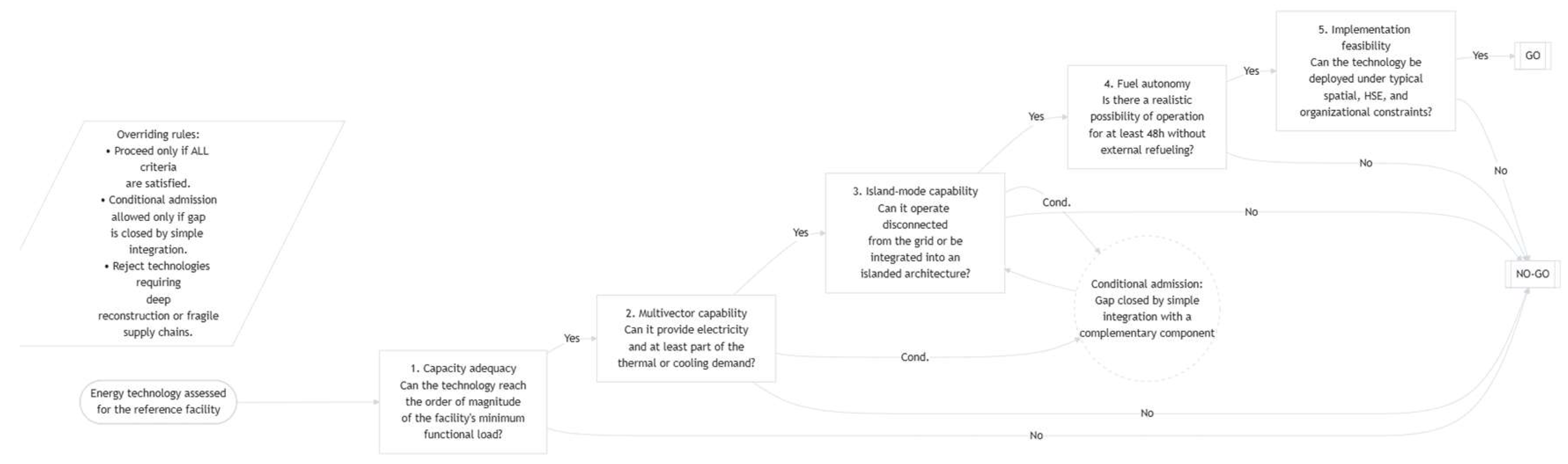
Figure 3.
Block scheme of methodology in stage II (with weights and scoring scale).
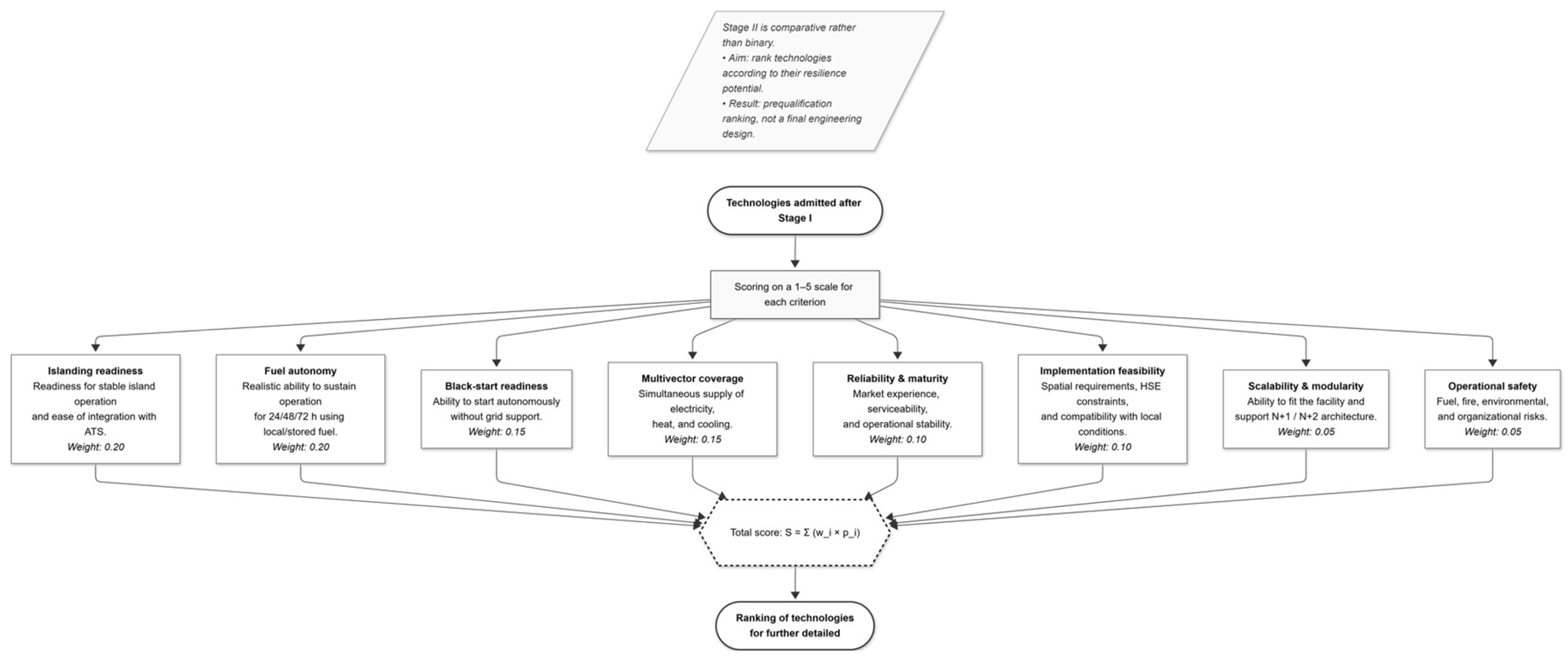
Table 1.
Operational classification of the functional minimum of an CI object.
| Class | Operational meaning | Illustrative loads | Permissible reduction |
|---|---|---|---|
| A-life critical | Non-interruptible functions directly linked to life safety and security | ICU, operating theatres, ventilators, core medical equipment, safety systems | None; continuous supply required |
| B – mission critical | Functions required to maintain medical and technical activity | Sterilization, IT systems, hospital pharmacy, pumping systems, ventilation of critical zones | Limited reduction or short interruptions only |
| C – support critical | Support functions needed for crisis-mode operation | Part of administration, part of lighting, selected support service | Partial reduction acceptable |
Table 2.
Technology portfolio for phase I (prequalification).
| Technology group | Scope of solutions | Role in the methodology |
|---|---|---|
| Gas-engine CHP | Units fired by natural gas or dual-fuel configurations | Mature, High efficiency; fuel-dependent |
| Microturbines and gas turbines | Systems from tens of kW to several MW | For stable, high-power demand facilities |
| Biogas CHP | Systems integrated with wastewater plants or local biogas production | Highly attractive with local fuel autonomy |
| Biomass CHP | Solid-biomass CHP, boilers with cogeneration, or gasification-based systems | Strong candidates for longer autonomy, with complex logistics |
| CCHP with absorption cooling | CHP integrated with absorption chilling | For critical continuity cooling requirement |
| Hybrid CHP/BESS systems | CHP or CCHP supported by electrical storage | Improves black-start capability and flexibility |
| RES+BESS | PV or other RES supported by storage | Supporting option; rarely sufficient for multi-day autonomy |
| Diesel generators | Conventional standby generators | Comparator and fallback option |
Table 3.
Phase I – threshold criteria (GO/NO-GO).
| Criterion | Verification question | Threshold | Decision |
|---|---|---|---|
| Power adequacy | Does it meet the facility's minimum functional load? | Yes / No | Go / No-go |
| Multivector capability | Does it provide multivector (power + heat/cooling) coverage? | Yes / No | Go / No-go |
| Islanding capability | Is it capable of islanded or off-grid operation? | Yes / Conditional / No | Go / No-go |
| Fuel autonomy | Can it sustain 48h of operation without external fuel? | Yes / No | Go / No-go |
| Implementation feasibility | Does it meet typical space, safety, and operational constraints? | Yes / No | Go / No-go |
Table 4.
Phase II – proposed scoring criteria and assigned weights.
| Criterion | Interpretation | Scale | Default weight |
|---|---|---|---|
| Islanding readiness | Stable island operation and ease of integration with ATS/SZR logic | 1–5 | 0.20 |
| Fuel autonomy | Ability to sustain operation for 24/48/72 h using local or stored fuel | 1–5 | 0.20 |
| Black-start readiness | Ability to restart without support from the main grid | 1–5 | 0.15 |
| Multivector coverage | Simultaneous coverage of electricity, heat, and cooling | 1–5 | 0.15 |
| Reliability and maturity | Market experience, serviceability, and operational stability | 1–5 | 0.10 |
| Scalability and modularity | Ability to match the object and build N+1/N+2 configurations | 1–5 | 0.05 |
| Implementation feasibility | Space, safety, and local-operability requirements | 1–5 | 0.10 |
| Operational safety | Fuel, fire, environmental, and organizational risk profile | 1–5 | 0.05 |
Disclaimer/Publisher’s Note: The statements, opinions and data contained in all publications are solely those of the individual author(s) and contributor(s) and not of MDPI and/or the editor(s). MDPI and/or the editor(s) disclaim responsibility for any injury to people or property resulting from any ideas, methods, instructions or products referred to in the content. |
© 2026 by the authors. Licensee MDPI, Basel, Switzerland. This article is an open access article distributed under the terms and conditions of the Creative Commons Attribution (CC BY) license.
Copyright: This open access article is published under a Creative Commons CC BY 4.0 license, which permit the free download, distribution, and reuse, provided that the author and preprint are cited in any reuse.


