
Submitted:
08 June 2026
Posted:
09 June 2026
You are already at the latest version
Abstract
Agricultural intensification degrades farmland biodiversity, prompting the use of wildflower strips to restore natural enemies. However, their spatio-temporal effects on predators in arid agroecosystems remain unclear. We investigated ground-dwelling spiders in sown wildflower strips versus natural margins across four cropping systems in arid northwestern China using pitfall traps along a spatial gradient throughout the growing season. While overall diversity did not differ significantly between treatments, three key patterns emerged. First, spider abundance remained stable across the spatial gradient, but taxonomic diversity increased significantly toward the crop interior. Second, while communities in natural margins peaked early and declined during the hot, dry mid-summer, wildflower strips maintained high populations, acting as crucial temporal refuges. Third, wildflower strips reorganized species co-occurrence networks, fostering more resilient community structures. We conclude that in water-limited environments, wildflower strips stabilize predator populations during harsh weather and enhance community resilience. These findings highlight the value of wildflower strips in designing sustainable ecological pest management strategies for arid agroecosystems.
Keywords:
wildflower strips
; farmland spiders
; spatio-temporal dynamics
; edge effect
; temporal refuge
; Yinchuan Plain
; ecological pest control
1. Introduction
Global agricultural intensification has delivered substantial gains in food production but at considerable ecological cost. Monoculture cropping, habitat fragmentation, and excessive agrochemical inputs have degraded farmland ecosystem functioning and substantially reduced biodiversity and the ecosystem services it sustains, including pollination and natural pest control[1,2,3]. Losses of natural enemy-mediated pest suppression in intensified agricultural landscapes have been estimated at over 40%, while global insect abundance has declined by nearly 50% over the past four decades[4]. Nature-based Solutions (NbS) have been widely promoted as a key response to these challenges. Within this framework, the establishment of ecological infrastructure — such as vegetated buffer strips, ecological ditches, and wildflower strips (WFS) — at field margins or within cropped areas has been identified as a central strategy for restoring functional diversity in agroecosystems[5], as re-establishing predator-prey dynamics appears critical to recovering ecosystem services[6].
Wildflower strips (WFS) provide a multidimensional ecological baseline within agricultural matrices[7]. By supplying nectar, pollen, alternative prey, and structurally heterogeneous microhabitats, they support the persistence of diverse natural enemies[8]. Positive population responses have been well documented among parasitic wasps[9], lacewings[10], ladybirds[11], and carabid beetles[12]. Orchard-based interventions in the UK, for example, have been reported to drive substantial increases in spider and parasitoid abundance[13]; while field experiments in Germany have demonstrated enhanced spider body-size differentiation and functional spillover effects[14].
This body of evidence, however, contains an important methodological limitation. Previous studies have predominantly relied on cross-sectional snapshots of biodiversity metrics[15,16], whereas spatial gradients of dispersal decay and temporal successional trajectories have been insufficiently characterized. Real-world ecological radiation from marginal habitats into intensive farmland is rarely uniform; rather, it is modulated by edge effects, species colonization capacity, and phenological asynchrony across seasons[17,18]. Whether "stable increases" observed in existing studies represent genuine restoration of agroecosystem resilience, or transient aggregation within a particular spatial-temporal window, remains unresolved. Moreover, empirical validations of WFS are heavily biased toward temperate and semi-humid environments[19], their applicability to arid agroecosystems — where physiological constraints imposed by moisture deficits and temperature variability differ fundamentally — has received comparatively little attention[20].
Spiders constitute one of the most abundant and functionally diverse groups of invertebrate predators in agroecosystems, employing foraging strategies (cursorial, web-building, and ambush) that play a critical role in suppressing pest outbreaks[21,22]. In contrast to highly mobile parasitoids, ground-dwelling spiders have limited dispersal ability and are therefore particularly sensitive to fine-scale habitat configurations and seasonal environmental fluctuations[23]. Non-crop habitats, such as WFS, can serve both as permanent refugia and as "temporal refuges" during periods of agricultural disturbance or elevated environmental stress[24]. Landscape and local habitat attributes also significantly shape spider taxonomic composition[25]. Nevertheless, the mechanisms by which WFS restructure the spatial distribution of farmland spider assemblages and buffer seasonal fluctuations remain insufficiently quantified.
The Yinchuan Plain anchors high-yield agriculture within China's arid and semi-arid Northwest. The region is characterized by large-scale monoculture cropping compounded by ongoing urbanization, which has substantially simplified the native habitat matrix[26]. Under these conditions, the behavioral ecology of epigeal predator communities is likely shaped by physiological constraints imposed by moisture deficits and large diurnal temperature fluctuations. Whether floral marginalia retain their proposed buffering capacity in such dryland settings, and what spatio-temporal dynamics underlie their ecological function, remain open questions.
We addressed these questions through a field experiment embedding symmetrical configurations of engineered WFS and bare-margin controls across four dominant cropping architectures (wheat, maize, tomato, and apple orchard). Ground-dwelling spider assemblages were monitored continuously via pitfall trapping across a full growing season. This study pursued three specific objectives: (i) quantify total spider abundance, species richness, and Shannon diversity in WFS versus control margins, both overall and stratified by spatial position and month; (ii) identify spatial gradients in assemblage composition and associated key taxa from margin edges into the crop interior; and (iii) characterize the co-occurrence network structure and its response to WFS deployment, with particular attention to shifts in keystone species roles across treatments.
2. Materials and Methods
2.1. Study Area
The Yinchuan Plain, located in the arid and semi-arid northwest of China, is a critical region for intensive agricultural production. The expansion of large-scale monoculture cropping and ongoing urbanization have simplified the native habitat matrix, leading to pronounced habitat fragmentation. To address the context dependency of WFS effects in arid agroecosystems, we established a field experiment across four dominant cropping systems (wheat, maize, tomato, and apple orchards), pairing engineered WFS with conventional bare-margin controls to characterize habitat coupling across a full growing season.
2.2. Experimental Design and Spider Sampling
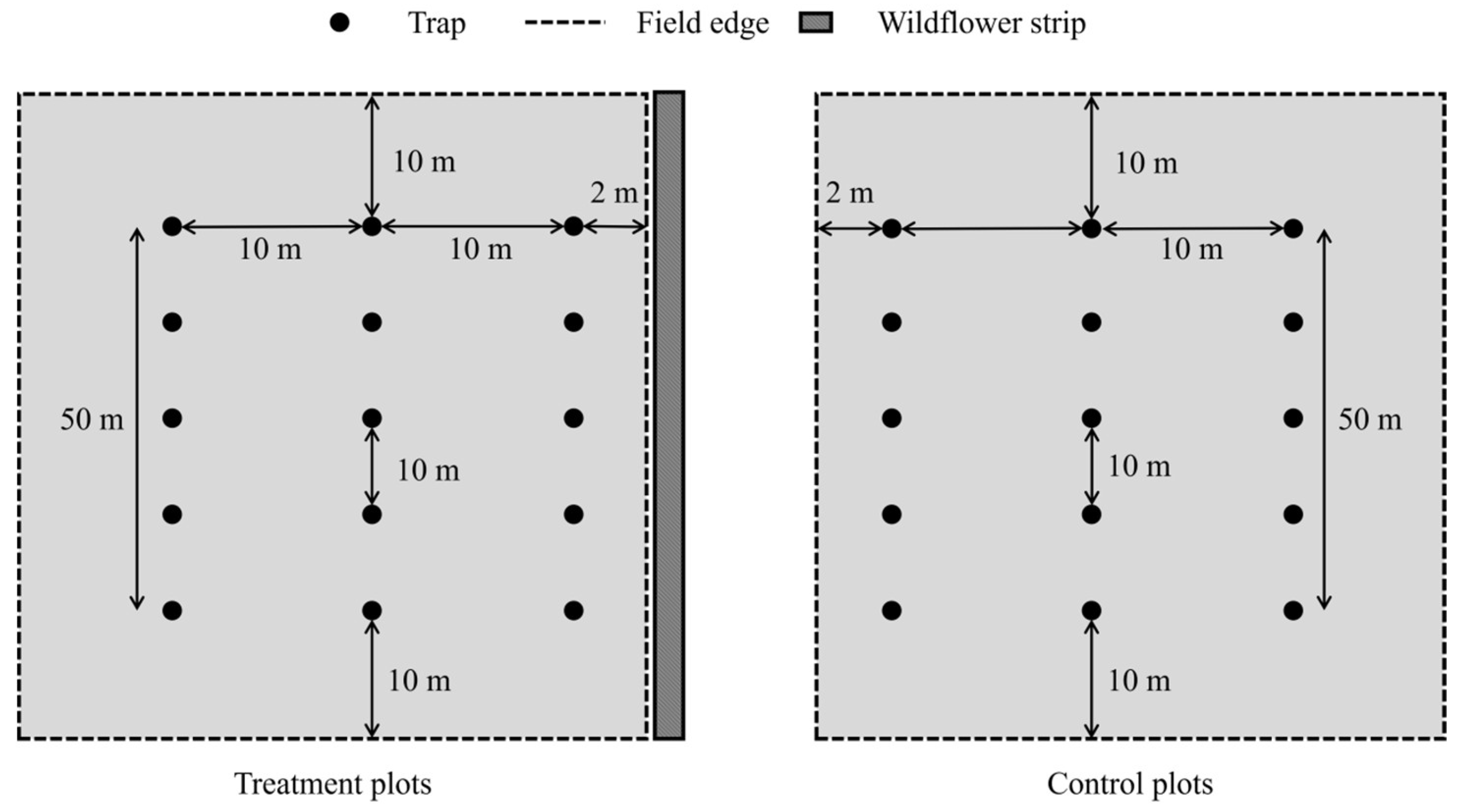
Epigeal spider assemblages were monitored using standardized pitfall trapping arrays between 10 May and 28 August 2024 (Fig. 1). Spatial replication was strictly enforced. Within each experimental block, we established a sown WFS along the field margin, pairing it with a naturally regenerated control plot. To capture the gradient of predator spillover, trap transects were deployed perpendicular to the crop–margin interface.
Nominal distances from the boundary were set at 0 m, 10 m, and 20 m into the crop field. Recognizing that trap placement directly on the physical edge can introduce significant microclimatic and physical artifacts, the "0 m" array was deliberately offset 2 m into the crop interior. At each of the three nominal distances, five traps were deployed as spatial replicates, spaced at least 5 m apart parallel to the field margin to minimize spatial autocorrelation. A minimum 10 m buffer from lateral field margins was maintained to reduce confounding edge effects. Identical spatial configurations were mirrored in the control plots, with three independent spatial replicates (blocks) per treatment.
Traps operated continuously and were serviced at six-day intervals, yielding 12 discrete sampling events. The trapping units consisted of 200 mL hard plastic cups (7.3 cm depth, 7.5 cm internal diameter). Each cup was filled with approximately 100 mL of a 1:5 (v/v) propylene glycol-water solution, amended with an unscented surfactant to reduce surface tension. To prevent precipitation-induced overflow and subsequent specimen loss, drainage apertures were drilled 1 cm sub-marginally. Retrieved specimens were transferred to the laboratory for taxonomic identification.
Figure 1.
Experimental design and spatial layout of pitfall trapping arrays. Trap transects were deployed perpendicular to the crop–margin interface at three nominal distances (0 m, 10 m, and 20 m) into the crop field, across paired WFS and control margin treatments and four cropping systems.
Figure 1.
Experimental design and spatial layout of pitfall trapping arrays. Trap transects were deployed perpendicular to the crop–margin interface at three nominal distances (0 m, 10 m, and 20 m) into the crop field, across paired WFS and control margin treatments and four cropping systems.
2.3. Wildflower Strip Characteristics
2.4 Calculation of Diversity Indices
To comprehensively evaluate the spider assemblages, both alpha and beta diversity metrics were calculated.Alpha diversitywas assessed using four indices:
(1) Species diversity (H′) was evaluated using the Shannon-Wiener index:
where is the relative abundance of the -th species.
(2) Species richness () was assessed using the Margalef richness index:
where denotes the total number of species and is total abundance.
(3) Species evenness () was determined using Pielou's evenness index:
(4) Species dominance () was analyzed using the Simpson dominance index:
.
Beta diversity, representing the turnover in community composition across treatments and temporal gradients, was quantified using the Bray-Curtis dissimilarity matrix, which served as the foundation for subsequent multivariate ordination analyses.
2.5. Data Analysis
Species identification followed the Fauna Sinica [30] and the Ecological Atlas of Chinese Spiders [31]. Juvenile individuals were excluded from all subsequent analyses because they cannot be reliably identified to the species level and because adult spiders are the primary agents of biological pest control.
Differences in alpha diversity metrics (abundance, richness, and Shannon index) between treatments (WFS vs. Control) and across spatial distances (0, 10, and 20 m) were analyzed using Wilcoxon rank-sum tests. To align with the seasonal successional analysis, data from the six-day interval sampling events were aggregated into monthly totals (May, June, July, and August).
Non-metric Multidimensional Scaling (NMDS) ordination based on the Bray-Curtis dissimilarity matrix was performed to evaluate shifts in overall community composition (beta diversity) driven by margin treatments and seasonality. The 95% confidence ellipses and community centroids were plotted to visualize spatial segregation and temporal successional trajectories. Indicator Species Analysis (ISA) was performed using the point-biserial correlation coefficient to identify taxa strongly associated with specific spatial zones (e.g., field edge vs. crop interior).
Species co-occurrence networks were constructed based on Spearman correlation coefficients to evaluate community structural shifts and intra-guild interactions. To reduce noise and focus on robust biological associations, only statistically significant (P < 0.05) and strong positive correlations (Spearman's r > 0.6) were retained. Network topological properties, including modularity, node degree, and identification of hub/keystone taxa, were calculated. All statistical analyses, network constructions, and visualizations were performed using R version 4.1.8 (with packages including vegan for NMDS, indicspecies for ISA, and igraph for network topology). A PERMANOVA (999 permutations) was used to validate multivariate patterns.
3. Results
3.1. Taxonomic Composition and Species Abundance.
After excluding unidentifiable juveniles, a total of 2,521 adult spider individuals were retained for analysis across all sampling events, representing 22 species from 10 families (Table S1). Lycosidae was the most species-rich and abundant family, comprising 7 species and 1,123 individuals (44.5% of the total community). Gnaphosidae, Thomisidae, and Araneidae were also well represented (3 species each). The assemblage was highly dominated by two cursorial lycosids: Pardosa astrigera and Arctosa stigmosa, which collectively accounted for nearly half of all individuals. P. astrigera was the most ubiquitous (655 individuals; 26.0% relative abundance; 73.3% occurrence frequency), followed by A. stigmosa (468 individuals; 18.6%; 60.8% frequency). A cohort of 11 subdominant species (including Pardosa laura, Lycosa coelestis, Gnaphosa kansuensis, and Xysticus hedini) exhibited moderate abundances (71–91 individuals). The remaining nine species (e.g., Neoscona scylla, Agelena labyrinthica) were relatively rare. Descriptive comparisons revealed distinct species-specific treatment responses. Dominant agrobionts like P. astrigera (375 vs. 280 individuals) and X. hedini (47 vs. 24) exhibited notably higher abundances in WFS plots. Conversely, specific subdominant taxa appeared more prevalent in naturally regenerated control margins, including Lycosa sinesis (34 vs. 47) and Xysticus pseudoblitea (24 vs. 47), indicating varying microhabitat preferences.
3.2. Overall Effects of Wildflower Strips on Spider Alpha Diversity
When data were aggregated across all sampling dates and spatial distances, the main effect of sown WFS on overall alpha diversity metrics was not statistically significant compared to natural control margins. Boxplot analyses revealed no significant differences between treatments in total spider abundance (Wilcoxon rank-sum test, P > 0.05, Figure 2A), species richness (P > 0.05, Figure 2D), or Shannon diversity index (P > 0.05, Figure 2G).
3.3. Context-Dependent Spatial Heterogeneity Across Cropping Systems and Distance Gradients
While the aggregated analyses (Section 3.2) indicated no overarching main effect of WFS on alpha diversity, multivariate ordination revealed that spider assemblages were profoundly structured by local site conditions and cropping system contexts. NMDS ordination based on the Bray-Curtis dissimilarity matrix demonstrated distinct spatial segregation among the four sampling sites (Figure 3A). The 95% confidence ellipses for each site exhibited minimal overlap, indicating that the fundamental taxonomic composition of the ground-dwelling spider community was highly site-specific, likely driven by the distinct crop architectures (wheat, maize, tomato, and apple orchard) and localized microhabitat conditions. Notably, within each site-specific cluster, the geometric shapes representing WFS (circles) and control (squares) treatments showed extensive overlap, corroborating the PERMANOVA results that margin treatment alone did not drastically shift the overarching beta diversity compared to the strong environmental filtering imposed by the cropping system.
This context dependency was further reflected in the univariate alpha diversity metrics stratified by site and distance into the crop field (Figure 3B, 3C). Total spider abundance exhibited pronounced site-specific variations, with certain cropping systems supporting substantially higher predator densities than others, yet the within-site response to the distance gradient (0, 10, and 20 m) remained highly heterogeneous and non-linear across the four locations. Similarly, Shannon diversity index varied significantly among the four sites, underscoring that the baseline biodiversity pool and the subsequent spillover dynamics from the margin into the crop interior are fundamentally modulated by the specific agroecosystem matrix rather than operating as a uniform, landscape-wide response.
3.4. Spatial Gradients Dictate Biodiversity Rather Than Abundance
Despite the absence of an aggregated treatment effect, spatial analysis (from 0 m to 20 m into the crop) revealed a strong decoupling of abundance and diversity. Overall spider abundance remained relatively stable and showed no significant response to distance in either the WFS (P = 0.29) or control (P = 0.74) treatments (Figure 2C). In contrast, taxonomic diversity exhibited a highly significant positive edge-to-interior gradient. Species richness increased significantly toward the crop interior (20 m) in both WFS (P = 0.0003) and control (P = 0.004) plots (Figure 2F). Similarly, the Shannon diversity index showed a significant positive correlation with distance into the field (WFS: P = 0.04; Control: P = 0.011; Figure 2I). This indicates that the crop interior inherently supports a significantly more diverse spider assemblage than the immediate edge.
3.5. Divergent Seasonal Successional Trajectories
Temporal monitoring revealed distinct seasonal dynamics between the two margin managements. In the control plots, all community metrics (abundance, richness, and Shannon index) exhibited a pronounced early-season peak in June, rapidly followed by a steep decline during July and August (Figure 2B, E, H). Conversely, spider communities associated with WFS demonstrated a delayed and buffered phenological trajectory: rather than peaking in June and subsequently declining, abundance and diversity in WFS treatments were sustained through July, when control plots had already entered a period of low activity (Figure 2E, H). This temporal divergence resulted in significant differences in seasonal abundance trajectories between treatments (Figure 2B, P < 0.05).
The divergence coincides temporally with the period when regional meteorological station data indicate maximum air temperatures and minimum rainfall in the Yinchuan Plain. However, in the absence of in-situ microclimatic profiling, the extent to which WFS directly buffered spiders against environmental stress—versus merely supporting divergent phenological dynamics—remains to be empirically validated.
3.6. Taxonomic Drivers of Spatial Gradients: Interior-Associated Indicator Species
To identify the specific taxa driving the positive edge-to-interior diversity gradient, an Indicator Species Analysis (ISA) was conducted. The analysis identified four taxa — Neoscona scylla, Neoscona holmi, Thanatus miniaceus, and Xysticus pseudoblitea — as highly significant indicator species for the crop interior (10 m and 20 m zones). As illustrated in Figure 4, these taxa exhibited pronounced edge-avoidance behavior. At the immediate field boundary (0 m), their populations were sparse, with median abundances near zero. However, a substantial colonization shift occurred at 20 m into the crop field, where the abundance of all four taxa increased significantly. This spatial partitioning was robust across all identified indicators, with high indicator values (IndVal): X. pseudoblitea (stat = 0.426, P = 0.003), N. scylla (stat = 0.425, P = 0.008), T. miniaceus (stat = 0.481, P = 0.008), and N. holmi (stat = 0.430, P = 0.008).
3.7. Species-Specific Temporal Dynamics of Lycosa coelestis
SE. Statistically significant divergences between treatments were evaluated using Wilcoxon rank-sum tests and are denoted by asterisks (*P< 0.05).
The temporal abundance trajectory ofLycosa coelestisrevealed distinct, treatment-dependent seasonal patterns (Figure 5). Early in the season (May),L. coelestisestablished higher initial populations in WFS margins, whereas it was virtually absent in naturally regenerated control plots(Wilcoxon rank-sum test,W= 665.0, P = 0.0183).During June, abundances remained relatively low and comparable between the two treatments (P > 0.05).The most pronounced divergence occurred in July: whileL. coelestisabundance remained persistently low in the control margins, its population exhibited a distinct and significant peak within the WFS(W= 674.5, P = 0.0394). By late summer (August), as populations in the control margins eventually increased, abundance converged between the two treatments and the statistical difference was no longer significant(W= 502.5, P =0.2361).
3.8. Beta Diversity and Parallel Seasonal Successional Trajectories
NMDS ordination based on the Bray-Curtis dissimilarity matrix (Stress = 0.2219) revealed that, when the community data were faceted by month (Figure 6A), the 95% confidence ellipses for the WFS and control treatments exhibited extensive and consistent overlap across all four sampling periods. This structural overlap indicates that the overarching multivariate composition of the spider assemblages was broadly similar between the two margin types at any given point during the season.
Analysis of community centroids over time revealed a clear temporal successional trajectory (Figure 6B). Communities from early season (May) clustered distinctly on the positive side of the NMDS1 axis. As the season progressed into June and July, the centroids shifted substantially toward the negative end of NMDS1, before slightly rebounding in late summer (August).
PERMANOVA (999 permutations) provided quantitative validation. The main effect of margin treatment (WFS vs. Control) was not statistically significant (R² = 0.004, P = 0.354), corroborating the visual overlap in the NMDS plot. However, community assembly was strongly driven by distance from the margin (R² = 0.016, P = 0.001) and sampling month (R² = 0.021, P = 0.003).
Importantly, while the successional vectors for WFS and naturally regenerated control communities moved in near-parallel synchrony, the treatment month interaction was highly significant (R2 = 0.017, P = 0.008). This interaction suggests that the ecological difference between WFS and control margins is season-dependent, with a pronounced divergence during mid-summer. Furthermore, the significant distance × month interaction (R2= 0.041, P = 0.001) and three-way interaction (treatment × distance × month; R2= 0.028, P = 0.022) highlighted that predator spillover from marginal strips into the crop interior dynamically fluctuated across the growing season.
3.8. Fundamental Rewiring of Species Co-Occurrence Networks
While the NMDS analysis indicated parallel macro-successional trajectories, co-occurrence network analysis revealed that the internal architecture and species associations were fundamentally restructured by margin treatment (Figure 7). Both networks were characterized exclusively by positive correlations, suggesting shared environmental niches or potential facilitative interactions among the co-occurring taxa. However, their topologies diverged markedly.
The Control network exhibited a highly clustered and densely interconnected architecture, comprising five distinct modules, with key central nodes (hubs) reaching a maximum degree of 8 (e.g., Phlegra festiva). In contrast, the WFS network presented a more decentralized topology with four modules and comparatively lower overall connectivity, with the most connected nodes reaching a maximum degree of 6.
The keystone taxa anchoring these respective networks were entirely distinct, directly linking community architecture to the spatial indicator findings. In the control fields, the dense network core was heavily reliant on hub species Phlegra festiva and Thanatus miniaceus (the latter a significant interior-associated indicator species, P = 0.021). Conversely, in the WFS network, keystone roles shifted to Araneus ventricosus, Xysticus hedini, and Xysticus pseudoblitea. Most strikingly, X. pseudoblitea — the strongest edge-avoiding, interior-specialist indicator in the earlier analysis (P = 0.0005) — was elevated to a critical bridging node in the WFS network.
4. Discussion
4.1. WFS as Potential Temporal Refuges Buffering Mid-Season Community Decline
The divergent seasonal successional trajectories observed between sown WFS and natural control margins constitute one of the most significant findings of this study. While spider communities in control plots exhibited a pronounced early-season peak in June followed by a steep mid-summer decline, WFS sustained high abundance and diversity into July and August. This temporal buffering effect directly addresses our second research question and suggests that the primary conservation value of ecological infrastructure in arid systems may lie in its capacity to stabilize populations during periods of elevated environmental stress, rather than in inflating static abundance metrics[27,28,29].
This finding extends beyond the conventional "abundance enhancement" paradigm documented for WFS interventions[30,31,32] in temperate agroecosystems. For instance, Rischen et al. reported that wildflower-sown islands in farmland promoted spider diversity primarily through static enrichment of local species pools[14], and Zhang et al. found that flowering fields supported higher spider species richness at field edges than at interiors, yet their assessments were largely cross-sectional[33]. In contrast, the mid-summer buffering we documented in the Yinchuan Plain is more consistent with ecological patterns described in arid-zone studies[34], where microhabitat structures that provide localized thermal and desiccation buffering can be critically important for arthropod persistence.
The mechanism underlying this refuge effect likely involves multiple interacting pathways. First, the structural complexity of sown plant communities (Table 1), including Cosmos bipinnatus, Zinnia elegans, and Medicago sativa, is likely to generate shaded microhabitats with reduced soil-surface temperatures and evapotranspiration, though direct in-situ measurement is required to confirm this[35]. Second, the high plant species richness and abundant nectar-producing flora within annual wildflower strips (WFSs) provide favorable microhabitats that sustain diverse arthropod assemblages[36]. Consequently, these strips function as critical source habitats that 'export' ground-dwelling spiders and other epigeal predators into the adjacent crop field[37], thereby enhancing biological pest control in areas where the structurally simplified crop matrix offers limited ecological support[38]. The fact that Lycosa coelestis exhibited a pronounced population peak within WFS margins specifically during July — while remaining virtually absent in controls — provides taxon-specific evidence consistent with this temporal refuge hypothesis[39]. These dynamics suggest that WFS may be particularly important for maintaining populations of larger, less mobile cursorial hunters that lack the ballooning dispersal capacity of web-building taxa and are therefore more susceptible to localized population declines[40].
4.2. Spatial Gradients, Competitive Exclusion, and the Decoupling of Abundance from Diversity
A nuanced spatial pattern emerged from our fine-scale sampling: while overall spider abundance remained relatively stable across the 0–20 m gradient, taxonomic diversity and species richness increased significantly toward the crop interior. This spatial decoupling of abundance and diversity contradicts the intuitive expectation that field margins universally serve as biodiversity hotspots, and instead points to strong competitive exclusion and species-specific habitat partitioning at the immediate edge.
The classical edge-effect literature has produced mixed results regarding spider responses to habitat boundaries. Rodrigues et al. found in riparian forests that spider diversity responded strongly to edge effects, sometimes showing reduced diversity at margins due to microclimatic exposure[41]. In agricultural contexts, Clough et al. documented strong edge effects on spider assemblages in European cereal fields, with species richness often declining from boundaries inward[42]. More recently, Kent et al. confirmed significant spatial patterning between field interiors and edges in Canadian canola agroecosystems[43]. However, our findings reveal a qualitatively different pattern: rather than diversity declining toward the interior, it increased.
This inversion can plausibly be explained by the overwhelming numerical dominance of cursorial Lycosidae at the margin edge. Pardosa astrigera and Arctosa stigmosa collectively accounted for nearly half of all individuals and exhibited their highest densities in the immediate vicinity of the margin. These mobile, generalist agrobionts likely monopolize resources and exert competitive pressure that suppresses subdominant taxa in the edge zone[44]. In contrast, the crop interior may accommodate a more functionally heterogeneous assemblage, with web-building species (Neoscona scylla, N. holmi) and ambush-foraging taxa (Thanatus miniaceus, Xysticus pseudoblitea), as confirmed by our Indicator Species Analysis[45].
This pattern of interior-associated indicator species avoiding competitive margins is consistent with community assembly mechanisms described by Gallé et al., who found that within-field position drives functional diversity of spiders and carabids[46], and by Ferrante et al., who emphasized that habitat characteristics filter for specific traits along landscape gradients[47]. Furthermore, spider species richness has been shown to peak at field margins within organically managed agroecosystems, a pattern largely attributed to attenuated edge effects[48], but arid agroecosystems may exhibit pronounced spatial heterogeneity in disturbance intensity and resource availability at boundaries — conditions potentially favorable to strong competitive exclusion rather than coexistence[49]. The 20 m interior zone therefore appears to function as a spatially distinct community module, supporting functionally important guilds that contribute disproportionately to pest suppression but are constrained at the edge.
4.3. Network Rewiring and the Restructuring of Intra-Guild Interactions
While our NMDS ordination suggested parallel macro-successional trajectories for WFS and control communities, the co-occurrence network analysis revealed that the internal architecture of species associations was fundamentally rewired by margin treatment. The control network exhibited a densely clustered topology with five modules and high interconnectivity centered around Phlegra festiva and Thanatus miniaceus, whereas the wildflower network was more decentralized with four modules and keystone roles shifted toward Araneus ventricosus, Xysticus hedini, and X. pseudoblitea.
This network restructuring carries important ecological implications. In ecological network theory, densely clustered architectures with a few dominant hub species are often associated with communities under competitive pressure or resource limitation[50]. The centralized control network may reflect the constrained niche space of natural margins, where a limited number of dominant species monopolize interactions by establishing tight co-occurrence associations with subordinate taxa[51]. In contrast, the more open, decentralized WFS network suggests that the sown plant community expands the available niche space, reducing competitive bottlenecks and allowing a broader suite of species to form associations without relying on a single dominant hub[52]. This shift toward interior-associated specialist taxa (X. pseudoblitea in particular) becoming bridging nodes in the WFS network directly mirrors the spatial partitioning identified in our ISA and PERMANOVA results, confirming that sown strips not only alter where species occur but fundamentally restructure how they co-occur and interact.
The exclusive presence of positive correlations in both networks suggests that the ground-dwelling spider assemblages in this arid system are structured primarily by shared environmental filtering (e.g., tolerance to desiccation, preference for specific microhabitat structures) or potential facilitative interactions rather than by strong antagonistic relationships[53]. This finding is consistent with the observations of Ferrante et al., who emphasized that landscape and habitat characteristics filter for specific spider traits while shaping community assembly patterns[54]. Furthermore, the question of whether WFS function as "ecological traps" has been raised in European contexts, with Ganser et al. documenting detrimental overwintering effects on carabid beetles and spiders in some sown strip configurations[54]. Our data provide no evidence for an ecological trap scenario: on the contrary, WFS sustained key populations through the harshest period of the growing season and supported a more decentralized, resilient interaction network. This context-dependent outcome underscores that the ecological function of WFS is not universal but depends critically on regional climate, crop type, and the specific plant species composition of the strip[40,8,55].
4.4. Implications for Ecological Pest Control and NbS Design in Arid Landscapes
The spatial and temporal dynamics uncovered here offer actionable insights for deploying Nature-based Solutions in arid and semi-arid agricultural systems, where empirical validations of WFS remain scarce compared to temperate regions. The ability of sown margins to buffer spider population collapse during July–August is particularly significant because this period coincides with peak outbreak windows for many key agricultural pests in the Yinchuan Plain, including aphids (Aphididae), mites (Tetranychidae), and lepidopteran larvae[56]. Web-building spiders such as Neoscona species are highly effective at capturing flying adult stages of these pests, while cursorial Lycosidae and Thomisidae provide ground-level predation pressure on soil-dwelling and early-instar stages[57,58,59]. The fact that WFS sustains both guilds during the critical mid-summer period when control margins experience community collapse suggests that strategically placed wildflower strips could provide continuous biocontrol service delivery precisely when conventional margins fail.
Our spatial findings further inform practical strip deployment. The positive edge-to-interior diversity gradient extending to at least 20 m indicates that a single WFS along a field boundary influences predator community structure well into the crop matrix. However, for very large monoculture blocks exceeding 40 m in width, the beneficial effects of edge strips may not reach field centers, potentially creating predator-free zones where pest populations can escape top-down control[60]. This supports the recommendation by Tschumi et al. that natural enemy benefits from WFS are driven by flower availability and proximity, suggesting that distributed "wildflower island" configurations within large fields may be more effective than perimeter-only strips in expansive arid cropping systems[61]. Additionally, the fact that different spider guilds exhibit distinct spatial responses[62] highlights the importance of tailoring WFS plant species composition to support multiple functional groups. Mixed-species seed mixes that combine tall, structurally complex species (for web-building spiders) with low, dense ground cover (for cursorial hunters) are likely to maximize the functional diversity of the predator community[63,64], as suggested by Gagic et al. in their work on augmenting flower trait diversity for multiple ecosystem services [65].
4.5. The Critical Role of Context Dependency in NbS Deployment
A crucial insight emerging from our multivariate and site-stratified analyses is the profound context dependency of spider assemblages across the four cropping systems. The NMDS ordination revealed that the overarching community composition was overwhelmingly filtered by site-specific conditions—likely a composite of crop architecture, local microclimate, and regional species pools[66]—rather than by the binary presence of WFS versus control margins. This spatial segregation among wheat, maize, tomato, and apple orchard systems aligns with the "environmental filtering" paradigm in community ecology[67], where local habitat templates dictate the baseline species pool[68] before marginal interventions can exert their effects[66].
Furthermore, the highly heterogeneous responses of both abundance and Shannon diversity across the distance gradients within individual sites (Figure 3B, 3C) challenge the assumption of a uniform "spillover effect" radiating from ecological infrastructure[69]. In some cropping systems, the margin may act as a robust source habitat[70], while in others, the crop matrix may present insurmountable dispersal barriers[71] or hostile microclimatic conditions for specific guilds[72]. This context dependency carries significant implications for the upscaling of Nature-based Solutions (NbS) in arid landscapes[73,74]. It suggests that standardized, "one-size-fits-all" WFS seed mixes or deployment strategies[61] may yield unpredictable biocontrol outcomes across heterogeneous agricultural mosaics[75]. Instead, precision ecological engineering—where the botanical composition of the WFS is tailored to the specific structural and phenological requirements of the adjacent crop matrix[69] and its associated pest-predator food webs—will be essential to maximize the functional spillover of natural enemies into the crop interior[76].
4.6. Limitations and Future Directions
While this study elucidates the spatio-temporal dynamics of spider communities and their response to WFS in an arid agroecosystem, several limitations should be acknowledged. First, this study did not deploy in-situ microclimatic loggers within the wildflower strips or adjacent crop fields. Consequently, while the temporal buffering pattern observed in WFS-assembled spider communities coincides with the period of peak regional thermal and hydric stress, we cannot directly attribute this pattern to localized microclimatic amelioration versus alternative mechanisms such as resource provisioning or structural refuge independent of microclimate. Future studies incorporating fine-scale thermal and humidity profiling within strip and crop microhabitats are essential to mechanistically validate the proposed temporal refuge function[77,78]. Second, the single-growing-season design prevents assessment of interannual variability; given the pronounced climate fluctuations characteristic of the Yinchuan Plain, multi-year data would be needed to confirm the robustness of the temporal refuge effect across different drought and precipitation regimes. Third, while co-occurrence network analysis revealed important shifts in community architecture, it is based on correlation patterns rather than direct behavioral observations of intra-guild interactions[79,80]; future studies combining network analysis with controlled laboratory or field experiments on intra-guild predation and facilitation would provide more mechanistic insights into the observed rewiring[81]. Finally, while our study establishes that WFS sustain spider populations and restructure community interactions, the direct link between these biodiversity outcomes and measurable reductions in pest damage or crop yield enhancement remains to be quantified. Integrating pest population monitoring and yield metrics into future WFS trials in the Yinchuan Plain would provide the definitive evidence needed to promote large-scale adoption of wildflower strips as a biocontrol tool in arid agriculture[82,73,83].
5. Conclusions
This study elucidates the spatio-temporal dynamics of ground-dwelling spider assemblages in response to sown WFS across diverse cropping systems in the arid Yinchuan Plain. Although WFS did not significantly alter aggregated alpha diversity metrics compared to naturally regenerated margins, it restructured the ecological functioning of the predator community through three interconnected mechanisms.
First, WFS were associated with sustained high abundance and diversity through periods when control habitat assemblages exhibited pronounced seasonal decline. This pattern is consistent with the hypothesis that engineered margins may help ensure the persistence of natural enemy communities during windows of elevated environmental stress — though the precise microclimatic mechanisms warrant direct in-situ testing in future work.
Second, a significant spatial decoupling of abundance and diversity emerged: while overall abundance remained stable across the 0–20 m gradient due to overwhelming dominance of cursorial lycosids at the margin edge, taxonomic diversity and species richness increased markedly toward the crop interior. The identification of interior-associated indicator species (N. scylla, N. holmi, T. miniaceus, and X. pseudoblitea) confirms that functionally important guilds, including web-building and ambush-foraging taxa, actively avoid competitive edges to colonize the crop interior, where they likely contribute disproportionately to pest suppression.
Third, WFS were associated with fundamental rewiring of species co-occurrence networks — from a densely clustered, edge-dependent architecture to a more decentralized, open topology with keystone roles concentrated in interior-colonizing specialist taxa. This network-level restructuring demonstrates that the ecological value of sown margins may extend beyond passive species enrichment to active reorganization of community interaction webs.
Collectively, these findings challenge the conventional paradigm that ecological infrastructure should be evaluated primarily through static abundance metrics. In arid agroecosystems, the conservation value of WFS may lie substantially in temporal stabilization and the maintenance of spatial heterogeneity — both of which appear critical to the sustained delivery of biological pest control services.
Supplementary Materials
The following supporting information can be downloaded at the website of this paper posted on Preprints.org, Table S1: Taxonomic composition, relative abundance, and occurrence frequency of ground-dwelling spider species in the study area.
Author Contributions
Conceptualization, W.H. and X.L.; methodology, W.H. and Y.J.; software, D.W. and W.L.; validation, W.H., M.T. and S.W.; formal analysis, D.W. and W.L.; investigation, W.H., M.T., D.W., W.L., S.W. and Y.J.; resources, X.L.; data curation, M.T. and Y.J.; writing—original draft preparation, W.H.; writing—review and editing, W.H. and X.L.; visualization, W.H. and D.W.; supervision, W.H.; project administration, W.H.; funding acquisition, W.H. All authors have read and agreed to the published version of the manuscript.
Funding
This research was funded by Natural Science Foundation of Ningxia Province, grant number 2021AAC03212.
Data Availability Statement
The original contributions presented in this study are included in the article/supplementary material. Further inquiries can be directed to the corresponding author.
Acknowledgments
The authors would like to express their sincere gratitude to the farmers and landowners of the sampled fields for providing the experimental sites and for their valuable cooperation during the field sampling. During the preparation of this manuscript, the author(s) used Qwen 3.7-MAX for the purposes of language editing and improving the readability of the text. The authors have reviewed and edited the output and take full responsibility for the content of this publication.
Conflicts of Interest
The authors declare no conflicts of interest.
References
- Jing, H.; Liu, Y.; Hou, J. Impacts of Agricultural Intensification on Biodiversity: Habitat Loss, Agrochemical Use, Water Depletion, and Soil Degradation. J. Environ. Manag. 2025, 395, 128036. [Google Scholar] [CrossRef] [PubMed]
- Apoorva, M.S.; Kundlas, K. Negative Impacts of Intensive Agricultural Practices on Environment and Ecosystem: A Review. Int. J. Res. Agron. 2024. [Google Scholar] [CrossRef]
- Vogel, C.; Poveda, K.; Iverson, A.; Boetzl, F.; Mkandawire, T.; Chunga, T.; Küstner, G.; Keller, A.; Kerr, R.B.; Steffan-Dewenter, I. The Effects of Crop Type, Landscape Composition and Agroecological Practices on Biodiversity and Ecosystem Services in Tropical Smallholder Farms. J. Appl. Ecol. 2023. [Google Scholar] [CrossRef]
- González, E.; Landis, D.A.; Knapp, M.; Valladares, G. Forest Cover and Proximity Decrease Herbivory and Increase Crop Yield via Enhanced Natural Enemies in Soybean Fields. J. Appl. Ecol. 2020, 57, 2296–2306. [Google Scholar] [CrossRef]
- Tscharntke, T.; Graß, I.; Wanger, T.C.; Westphal, C.; Batáry, P. Beyond Organic Farming – Harnessing Biodiversity-Friendly Landscapes. Trends Ecol. Evol. 2021, 36, 919–930. [Google Scholar] [CrossRef]
- Stier, A.; Samhouri, J.; Novák, M.; Marshall, K.; Ward, E.; Holt, R.; Levin, P. Ecosystem Context and Historical Contingency in Apex Predator Recoveries. Sci. Adv. 2016, 2. [Google Scholar] [CrossRef] [PubMed]
- Serée, L.; Chiron, F.; Valantin-Morison, M.; Barbottin, A.; Gardarin, A. Flower Strips, Crop Management and Landscape Composition Effects on Two Aphid Species and Their Natural Enemies in Faba Bean. Agric. Ecosyst. Environ. 2022, 331, 107902. [Google Scholar] [CrossRef]
- Fountain, M. Impacts of Wildflower Interventions on Beneficial Insects in Fruit Crops: A Review. Insects 2022, 13, 304. [Google Scholar] [CrossRef]
- Tougeron, K.; Ferrais, L.; Gardin, P.; Lateur, M.; Hance, T. Flower Strips Increase the Control of Rosy Apple Aphids after Parasitoid Releases in an Apple Orchard. Ann. Appl. Biol. 2022, 182, 245–256. [Google Scholar] [CrossRef]
- Herrera, R.; Cotes, B.; Agustí, N.; Tasin, M.; Porcel, M. Using Flower Strips to Promote Green Lacewings to Control Cabbage Insect Pests. Anz. Für Schädlingskunde 2021, 95, 669–683. [Google Scholar] [CrossRef]
- Holland, J.; Bianchi, F.; Entling, M.; Moonen, A.; Smith, B.; Jeanneret, P. Structure, Function and Management of Semi-natural Habitats for Conservation Biological Control: A Review of European Studies. Pest Manag. Sci. 2016, 72, 1638–1651. [Google Scholar] [CrossRef] [PubMed]
- Hatt, S.; Boeraeve, F.; Artru, S.; Dufrêne, M.; Francis, F. Spatial Diversification of Agroecosystems to Enhance Biological Control and Other Regulating Services: An Agroecological Perspective. Sci. Total Environ. 2018, 621, 600–611. [Google Scholar] [CrossRef]
- Herz, A.; Cahenzli, F.; Penvern, S.; Pfiffner, L.; Tasin, M.; Sigsgaard, L. Managing Floral Resources in Apple Orchards for Pest Control: Ideas, Experiences and Future Directions. Insects 2019, 10, 247. [Google Scholar] [CrossRef]
- Rischen, T.; Geisbuesch, K.; Ruppert, D.; Fischer, K. Farmland Biodiversity: Wildflower-Sown Islands within Arable Fields and Grassy Field Margins Both Promote Spider Diversity. J. Insect Conserv. 2022, 26, 415–424. [Google Scholar] [CrossRef]
- Gonzalez, A.; Chase, J.; O’Connor, M. A Framework for the Detection and Attribution of Biodiversity Change. Philos. Trans. R. Soc. B Biol. Sci. 2023, 378. [Google Scholar] [CrossRef]
- Magurran, A.; Dornelas, M.; Moyes, F.; Henderson, P. Temporal β Diversity—A Macroecological Perspective. Glob. Ecol. Biogeogr. 2019, 28, 1949–1960. [Google Scholar] [CrossRef]
- Spake, R.; Barbosa, M.; Blowes, S.; Bowler, D.; Callaghan, C.; Garbowski, M.; Jurburg, S.; Klink, R.; Korell, L.; Ladouceur, E.; et al. Detecting Thresholds of Ecological Change in the Anthropocene. Annu. Rev. Environ. Resour. 2022, 47, 797–821. [Google Scholar] [CrossRef]
- Boetzl, F.; Krimmer, E.; Krauß, J.; Steffan-Dewenter, I. Agri-environmental Schemes Promote Ground-dwelling Predators in Adjacent Oilseed Rape Fields: Diversity, Species Traits and Distance-decay Functions. J. Appl. Ecol. 2018, 56, 10–20. [Google Scholar] [CrossRef]
- Hoffmann, H.; Peter, F.; Herrmann, J.; Donath, T.; Diekötter, T. Benefits of Wildflower Areas as Overwintering Habitats for Ground-Dwelling Arthropods Depend on Landscape Structural Complexity. Agric. Ecosyst. Environ. 2021, 314. [Google Scholar] [CrossRef]
- Sharma, S.; Sharma, U.; Sharma, S.; Sharma, S.; Likhita, J.; Thakur, S.; Sharma, I. Strategies for Sustainable Land Management Through Climate-Resilient Horticulture: A Systematic Review. Land Degrad. Dev. 2025. [Google Scholar] [CrossRef]
- Williams-Guillén, K.; Olimpi, E.; Maas, B.; Taylor, P.; Arlettaz, R. Bats in the Anthropogenic Matrix: Challenges and Opportunities for the Conservation of Chiroptera and Their Ecosystem Services in Agricultural Landscapes 2015, 151–186. [CrossRef]
- Scott-Brown, A.; Rial-Lovera, K.; Giannitsopoulos, M.; Rickson, R.; Staton, T.; Walters, K.; Burgess, P. Farmland Trees and Integrated Pest Management: A Review of Current Knowledge and Developing Strategies for Sustainable Systems. Ecol. Solut. Evid. 2025, 6. [Google Scholar] [CrossRef]
- Ganem, Z.; Ferrante, M.; Lubin, Y.; Steinpress, I.; Gish, M.; Sharon, R.; Harari, A.; Keasar, T.; Gavish-Regev, E. Effects of Natural Habitat and Season on Cursorial Spider Assemblages in Mediterranean Vineyards. Insects 2023, 14, 782. [Google Scholar] [CrossRef]
- Iuliano, B.; Gratton, C. Temporal Resource (Dis)Continuity for Conservation Biological Control: From Field to Landscape Scales. Front. Sustain. Food Syst. 2020, 4. [Google Scholar] [CrossRef]
- Niedobová, J.; Ouředníčková, J.; Kudláček, T.; Skalský, M. Leaf Litter in Fruit Orchards in Winter Is a Hot Spot for Invertebrate Predators and Biodiversity. 2023. [Google Scholar] [CrossRef]
- Wu, X.; Bu, X.; Dong, S.; Ma, Y.; Ma, Y.; Ma, Y.; Liu, Y.; Wang, H.; Wang, X.; Wang, J. The Impact of Restoration and Protection Based on Sustainable Development Goals on Urban Wetland Health: A Case of Yinchuan Plain Urban Wetland Ecosystem, Ningxia, China. Sustainability 2023, 15, 12287. [Google Scholar] [CrossRef]
- Lu, Z.; Li, W.; Wang, Y.; Zhou, S. Bibliometric Analysis of Global Research on Ecological Networks in Nature Conservation from 1990 to 2020. Sustainability 2022, 14, 4925. [Google Scholar] [CrossRef]
- Cumming, G.; Allen, C.; Ban, N.; Biggs, D.; Biggs, H.; Cumming, D.; Vos, A.; Epstein, G.; Étienne, M.; Maciejewski, K.; et al. Understanding Protected Area Resilience: A Multi-scale, Social-ecological Approach. Ecol. Appl. 2015, 25, 299–319. [Google Scholar] [CrossRef]
- Cumming, G.; Allen, C. Protected Areas as Social-ecological Systems: Perspectives from Resilience and Social-ecological Systems Theory. Ecol. Appl. 2017, 27, 1709–1717. [Google Scholar] [CrossRef]
- Jones, S.K.; Sánchez, A.C.; Juventia, S.D.; Estrada-Carmona, N. A Global Database of Diversified Farming Effects on Biodiversity and Yield. Sci. Data 2021, 8, 212. [Google Scholar] [CrossRef]
- Scheper, J.; Bommarco, R.; Holzschuh, A.; Potts, S.G.; Riedinger, V.; Roberts, S.P.M.; Rundlöf, M.; Smith, H.G.; Steffan-Dewenter, I.; Wickens, J.B.; et al. Local and Landscape-Level Floral Resources Explain Effects of Wildflower Strips on Wild Bees across Four European Countries. J. Appl. Ecol. 2015, 52, 1165–1175. [Google Scholar] [CrossRef]
- Balzan, M.V.; Bocci, G.; Moonen, A.-C. Augmenting Flower Trait Diversity in Wildflower Strips to Optimise the Conservation of Arthropod Functional Groups for Multiple Agroecosystem Services. J. Insect Conserv. 2014, 18, 713–728. [Google Scholar] [CrossRef]
- Zhang, X.; Axmacher, J.; Wu, P.; Zhang, X.; Liu, Y. Productive Oilseed Rape Strips Supplement Seminatural Field-Margins in Promoting Ground-Dwelling Predatory Invertebrates in Agricultural Landscapes. J. Insect Sci. 2019, 19. [Google Scholar] [CrossRef]
- Endicott, S.; Blasl, A.; Brice, M.-H.; Naujokaitis-Lewis, I. The Role of Field Margins in Microclimatic Temperature Buffering of Temperate Canadian Landscapes. In Authorea Prepr.; 2025. [Google Scholar]
- Li, F.; Lan, W.; Zhou, Q.; Liu, B.; Chen, F.; Zhang, S.; Bao, M.; Liu, G. Reduced Expression of CbUFO Is Associated with the Phenotype of a Flower-Defective Cosmos Bipinnatus. Int. J. Mol. Sci. 2019, 20, 2503. [Google Scholar] [CrossRef] [PubMed]
- Kujawa, K.; Bernacki, Z.; Kowalska, J.; Kujawa, A.; Oleszczuk, M.; Sienkiewicz, P.; Sobczyk, D. Annual Wildflower Strips as a Tool for Enhancing Functional Biodiversity in Rye Fields in an Organic Cultivation System. Agronomy 2020, 10, 1696. [Google Scholar] [CrossRef]
- Eccard, J. Can Rolling Composite Wildflower Blocks Increase Biodiversity in Agricultural Landscapes Better than Wildflowers Strips? J. Appl. Ecol. 2022, 59, 1172–1177. [Google Scholar] [CrossRef]
- Kujawa, K.; Bernacki, Z.; Kowalska, J.; Kujawa, A.; Oleszczuk, M.; Sienkiewicz, P.; Sobczyk, D. Annual Wildflower Strips as a Tool for Enhancing Functional Biodiversity in Rye Fields in an Organic Cultivation System. Agronomy 2020, 10, 1696. [Google Scholar] [CrossRef]
- Rocha, J. Neotropical Bromeliads as Food Sources for Birds: A Systematic Review and Perspectives on the Management of Ecological Interactions. Ibis 2022, 165, 17–33. [Google Scholar] [CrossRef]
- González, E.; Štrobl, M.; Venturo, A.; Pařízek, V.; Tajovský, K.; Knapp, M. Wildflower Strip Establishment Supports Beneficial Ground-Dwelling Arthropods and Pest Control but Has Limited Effects on Weed Seed Control and Spillover to Adjacent Fields. Proc. R. Soc. B Biol. Sci. 2025, 292. [Google Scholar] [CrossRef]
- Rodrigues, E.; Pires, M.; Mendonça, M. Seasonal Changes in Spider Diversity in Subtropical Riparian Forests: What Drives the Seasonality of the Araneofauna? J. Arachnol. 2023, 51. [Google Scholar] [CrossRef]
- Plath, E.; Rischen, T.; Mohr, T.; Fischer, K. Biodiversity in Agricultural Landscapes: Grassy Field Margins and Semi-Natural Fragments Both Foster Spider Diversity and Body Size. Agric. Ecosyst. Environ. 2021, 316, 107457. [Google Scholar] [CrossRef]
- Kent, K.; Martínez, A.; Guelly, K.; Pinzón, J.; Mori, B. Edge Effects and Pitfall Trap Design Influence Spider Diversity and Assemblages in Canola Agroecosystems on the Canadian Prairies. Ecol. Evol. 2025, 15. [Google Scholar] [CrossRef]
- Hatt, S.; Uytenbroeck, R.; Lopes, T.; Mouchon, P.; Osawa, N.; Piqueray, J.; Monty, A.; Francis, F. Identification of Flower Functional Traits Affecting Abundance of Generalist Predators in Perennial Multiple Species Wildflower Strips. Arthropod-Plant Interact. 2018, 13, 127–137. [Google Scholar] [CrossRef]
- Luqman, L.; Saeed, K.; Muhammad, K.; Ahmad, M.; Akbar, F.; Rasool, A.; Israr, M.; Jabeen, H.; Mehmood, S.; Ahmed, S.; et al. Biodiversity of Orb-Web Spiders (Family: Araneidae) of Buner Valley, Pakistan. Braz. J. Biol. 2022, 82. [Google Scholar] [CrossRef] [PubMed]
- Gallé, R.; Császár, P.; Makra, T.; Gallé-Szpisjak, N.; Ladányi, Z.; Torma, A.; Ingle, K.; Szilassi, P. Small-Scale Agricultural Landscapes Promote Spider and Ground Beetle Densities by Offering Suitable Overwintering Sites. Landsc. Ecol. 2018, 33, 1435–1446. [Google Scholar] [CrossRef]
- Ferrante, M.; Liebke, D.; Hass, A.; Wollenweber, M.; Zembold, K.; Arimond, I.; Schüler, S.; Westphal, C. Landscape Diversity Can Promote Functional Diversity of Spider Assemblages While Habitat Characteristics Filter for Specific Traits. Funct. Ecol. 2025. [Google Scholar] [CrossRef]
- Caprio, E.; Nervo, B.; Isaia, M.; Allegro, G.; Rolando, A. Organic versus Conventional Systems in Viticulture: Comparative Effects on Spiders and Carabids in Vineyards and Adjacent Forests. Agric. Syst. 2015, 136, 61–69. [Google Scholar] [CrossRef]
- Opatovsky, I.; Gavish-Regev, E.; Weintraub, P.G.; Lubin, Y. Various Competitive Interactions Explain Niche Separation in Crop-Dwelling Web Spiders. Oikos 2016, 125, 1586–1596. [Google Scholar] [CrossRef]
- Wong, S.; Cui, Y.; Chun, S.; Kaneko, R.; Masumoto, S.; Kitagawa, R.; Mori, A.; Lim, A.; Uchida, M. Vegetation as a Key Driver of the Distribution of Microbial Generalists That in Turn Shapes the Overall Microbial Community Structure in the Low Arctic Tundra. Environ. Microbiome 2023, 18. [Google Scholar] [CrossRef] [PubMed]
- Ma, B.; Wang, Y.; Ye, S.; Liu, S.; Stirling, E.; Gilbert, J.; Faust, K.; Knight, R.; Jansson, J.; Cardona, C.; et al. Earth Microbial Co-Occurrence Network Reveals Interconnection Pattern across Microbiomes. Microbiome 2020, 8. [Google Scholar] [CrossRef]
- Doublet, V.; Doyle, T.; Refoy, I.; Hedges, S.; Carvell, C.; Brown, M.; Wilfert, L. Increasing Flower Species Richness in Agricultural Landscapes Alters Insect Pollinator Networks: Implications for Bee Health and Competition. Ecol. Evol. 2022, 12. [Google Scholar] [CrossRef]
- Bar-Massada, A. Complex Relationships between Species Niches and Environmental Heterogeneity Affect Species Co-Occurrence Patterns in Modelled and Real Communities. Proc. R. Soc. B Biol. Sci. 2015, 282, 20150927. [Google Scholar] [CrossRef]
- Ferrante, M.; Liebke, D.; Hass, A.; Wollenweber, M.; Zembold, K.; Arimond, I.; Schüler, S.; Westphal, C. Landscape Diversity Can Promote Functional Diversity of Spider Assemblages While Habitat Characteristics Filter for Specific Traits. Funct. Ecol. 2025. [Google Scholar] [CrossRef]
- Kujawa, K.; Bernacki, Z.; Kowalska, J.; Kujawa, A.; Oleszczuk, M.; Sienkiewicz, P.; Sobczyk, D. Annual Wildflower Strips as a Tool for Enhancing Functional Biodiversity in Rye Fields in an Organic Cultivation System. Agronomy 2020, 10, 1696. [Google Scholar] [CrossRef]
- Liu, Y.; Liu, B.; Li, Q.; Sun, M.; Li, M.; Wyckhuys, K.; Wang, P.; Lu, Y. Perennial Flowering Plants Sustain Natural Enemy Populations in Gobi Desert Oases of Southern Xinjiang, China. Insects 2022, 13, 399. [Google Scholar] [CrossRef]
- Zhong, J.; Pan, W.; Jiang, S.; Hu, Y.; Yang, G.; Zhang, K.; Xia, Z.; Xiao, G.; Chen, B. Evaluating the Impact of Alyssum Flower Strips on Biological Control of Key Pests in Flue-cured Tobacco Agroecosystems. J. Appl. Entomol. 2024, 148, 1245–1260. [Google Scholar] [CrossRef]
- Nadeem, A.; Tahir, H.; Khan, A.; Bano, N.; Hassan, Z.; Khan, A. Species Composition, Seasonal Abundance and Population Dynamics of Predatory Spiders from Cotton Field Plots of Irrigated and Semi-Arid Regions of Punjab, Pakistan. Saudi J. Biol. Sci. 2023, 30, 103686. [Google Scholar] [CrossRef] [PubMed]
- Cotes, B.; González, M.; Benítez, E.; Mas, E.; Clemente-Orta, G.; Campos, M.; Rodríguez, E. Spider Communities and Biological Control in Native Habitats Surrounding Greenhouses. Insects 2018, 9, 33. [Google Scholar] [CrossRef]
- Tscharntke, T.; Karp, D.S.; Chaplin-Kramer, R.; Batáry, P.; DeClerck, F.; Gratton, C.; Hunt, L.; Ives, A.; Jonsson, M.; Larsen, A.; et al. When Natural Habitat Fails to Enhance Biological Pest Control–Five Hypotheses. Biol. Conserv. 2016, 204, 449–458. [Google Scholar] [CrossRef]
- Tschumi, M.; Albrecht, M.; Entling, M.H.; Jacot, K. High Effectiveness of Tailored Flower Strips in Reducing Pests and Crop Plant Damage. Proc. R. Soc. B Biol. Sci. 2015, 282. [Google Scholar] [CrossRef]
- Entling, W.; Schmidt, M.H.; Bacher, S.; Brandl, R.; Nentwig, W. Niche Properties of Central European Spiders: Shading, Moisture and the Evolution of the Habitat Niche. Glob. Ecol. Biogeogr. 2007, 16, 440–448. [Google Scholar] [CrossRef]
- Langellotto, G.A.; Denno, R.F. Responses of Invertebrate Natural Enemies to Complex-Structured Habitats: A Meta-Analytical Synthesis. Oecologia 2004, 139, 1–10. [Google Scholar] [CrossRef]
- Pearce, J.L.; Venier, L.A. The Use of Ground Beetles (Coleoptera: Carabidae) and Spiders (Araneae) as Bioindicators of Sustainable Forest Management: A Review. Ecol. Indic. 2006, 6, 780–793. [Google Scholar] [CrossRef]
- Gagic, V.; Kleijn, D.; Báldi, A.; Boros, G.; Jørgensen, H.B.; Elek, Z.; Garratt, M.P.; de Groot, G.A.; Hedlund, K.; Kovács-Hostyánszki, A.; et al. Combined Effects of Agrochemicals and Ecosystem Services on Crop Yield across Europe. Ecol. Lett. 2017, 20, 1427–1436. [Google Scholar] [CrossRef] [PubMed]
- Tscharntke, T.; Tylianakis, J.M.; Rand, T.A.; Didham, R.K.; Fahrig, L.; Batáry, P.; Bengtsson, J.; Clough, Y.; Crist, T.O.; Dormann, C.F.; et al. Landscape Moderation of Biodiversity Patterns and Processes-Eight Hypotheses. Biol. Rev. 2012, 87, 661–685. [Google Scholar] [CrossRef] [PubMed]
- Vellend, M. Conceptual Synthesis in Community Ecology. Q. Rev. Biol. 2010, 85, 183–206. [Google Scholar] [CrossRef]
- Kleijn, D.; Bommarco, R.; Fijen, T.P.; Garibaldi, L.A.; Potts, S.G.; Van Der Putten, W.H. Ecological Intensification: Bridging the Gap between Science and Practice. Trends Ecol. Evol. 2019, 34, 154–166. [Google Scholar] [CrossRef]
- Albrecht, M.; Kleijn, D.; Williams, N.M.; Tschumi, M.; Blaauw, B.R.; Bommarco, R.; Campbell, A.J.; Dainese, M.; Drummond, F.A.; Entling, M.H.; et al. The Effectiveness of Flower Strips and Hedgerows on Pest Control, Pollination Services and Crop Yield: A Quantitative Synthesis. Ecol. Lett. 2020, 23, 1488–1498. [Google Scholar] [CrossRef]
- Sutter, L.; Albrecht, M.; Jeanneret, P. Landscape Greening and Local Creation of Wildflower Strips and Hedgerows Promote Multiple Ecosystem Services. J. Appl. Ecol. 2018, 55, 612–620. [Google Scholar] [CrossRef]
- Gallé, R.; Happe, A.-K.; Baillod, A.B.; Tscharntke, T.; Batáry, P. Landscape Configuration, Organic Management, and within-Field Position Drive Functional Diversity of Spiders and Carabids. J. Appl. Ecol. 2019, 56, 63–72. [Google Scholar] [CrossRef]
- Akter, S.; Rizvi, S.; Haque, A.; Reynolds, O.; Furlong, M.; Melo, M.; Osborne, T.; Mo, J.; McDonald, S.; Johnson, A.; et al. Continent-wide Evidence That Landscape Context Can Mediate the Effects of Local Habitats on In-field Abundance of Pests and Natural Enemies. Ecol. Evol. 2023, 13. [Google Scholar] [CrossRef] [PubMed]
- Garibaldi, L.A.; Gemmill-Herren, B.; D’Annolfo, R.; Graeub, B.E.; Cunningham, S.A.; Breeze, T.D. Farming Approaches for Greater Biodiversity, Livelihoods, and Food Security. Trends Ecol. Evol. 2017, 32, 68–80. [Google Scholar] [CrossRef]
- Bommarco, R.; Kleijn, D.; Potts, S.G. Ecological Intensification: Harnessing Ecosystem Services for Food Security. Trends Ecol. Evol. 2013, 28, 230–238. [Google Scholar] [CrossRef]
- Karp, D.S.; Chaplin-Kramer, R.; Meehan, T.D.; Martin, E.A.; DeClerck, F.; Grab, H.; Gratton, C.; Hunt, L.; Larsen, A.E.; Martínez-Salinas, A.; et al. Crop Pests and Predators Exhibit Inconsistent Responses to Surrounding Landscape Composition. Proc. Natl. Acad. Sci. 2018, 115, E7863–E7870. [Google Scholar] [CrossRef]
- Boetzl, F.; Sponsler, D.; Albrecht, M.; Batáry, P.; Birkhofer, K.; Knapp, M.; Krauß, J.; Maas, B.; Martin, E.; Sirami, C.; et al. Distance Functions of Carabids in Crop Fields Depend on Functional Traits, Crop Type and Adjacent Habitat: A Synthesis. Proc. R. Soc. B Biol. Sci. 2024, 291. [Google Scholar] [CrossRef]
- Gurr, G.M.; Wratten, S.D.; Landis, D.A.; You, M. Habitat Management to Suppress Pest Populations: Progress and Prospects. Annu. Rev. Entomol. 2017, 62, 91–109. [Google Scholar] [CrossRef]
- Tschumi, M.; Albrecht, M.; Collatz, J.; Dubsky, V.; Entling, M.H.; Najar-Rodriguez, A.J.; Jacot, K. Tailored Flower Strips Promote Natural Enemy Biodiversity and Pest Control in Potato Crops. J. Appl. Ecol. 2016, 53, 1169–1176. [Google Scholar] [CrossRef]
- Blanchet, F.G.; Cazelles, K.; Gravel, D. Co-Occurrence Is Not Evidence of Ecological Interactions. Ecol. Lett. 2020, 23, 1050–1063. [Google Scholar] [CrossRef]
- Freilich, M.A.; Wieters, E.; Broitman, B.R.; Marquet, P.A.; Navarrete, S.A. Species Co-Occurrence Networks: Can They Reveal Trophic and Non-Trophic Interactions in Ecological Communities? Ecology 2018, 99, 690–699. [Google Scholar] [CrossRef]
- Sanders, D.; Platner, C. Intraguild Interactions between Spiders and Ants and Top-down Control in a Grassland Food Web. Oecologia 2007, 150, 611–624. [Google Scholar] [CrossRef] [PubMed]
- Dainese, M.; Martin, E.A.; Aizen, M.A.; Albrecht, M.; Bartomeus, I.; Bommarco, R.; Carvalheiro, L.G.; Chaplin-Kramer, R.; Gagic, V.; Garibaldi, L.A.; et al. A Global Synthesis Reveals Biodiversity-Mediated Benefits for Crop Production. Sci. Adv. 2019, 5, eaax0121. [Google Scholar] [CrossRef]
- Rusch, A.; Chaplin-Kramer, R.; Gardiner, M.M.; Hawro, V.; Holland, J.; Landis, D.; Thies, C.; Tscharntke, T.; Weisser, W.W.; Winqvist, C.; et al. Agricultural Landscape Simplification Reduces Natural Pest Control: A Quantitative Synthesis. Agric. Ecosyst. Environ. 2016, 221, 198–204. [Google Scholar] [CrossRef]
Figure 2.
Spatio-temporal dynamics of ground-dwelling spider alpha diversity in WFS and control margins, encompassing overall aggregated effects (A, D, G), temporal trajectories across sampling months (B, E, H), and spatial gradients from field edge into crop interior (C, F, I). Statistical differences between treatments were evaluated using Wilcoxon rank-sum tests; spatial and temporal variations used Kruskal-Wallis with post-hoc Dunn's tests.
Figure 2.
Spatio-temporal dynamics of ground-dwelling spider alpha diversity in WFS and control margins, encompassing overall aggregated effects (A, D, G), temporal trajectories across sampling months (B, E, H), and spatial gradients from field edge into crop interior (C, F, I). Statistical differences between treatments were evaluated using Wilcoxon rank-sum tests; spatial and temporal variations used Kruskal-Wallis with post-hoc Dunn's tests.
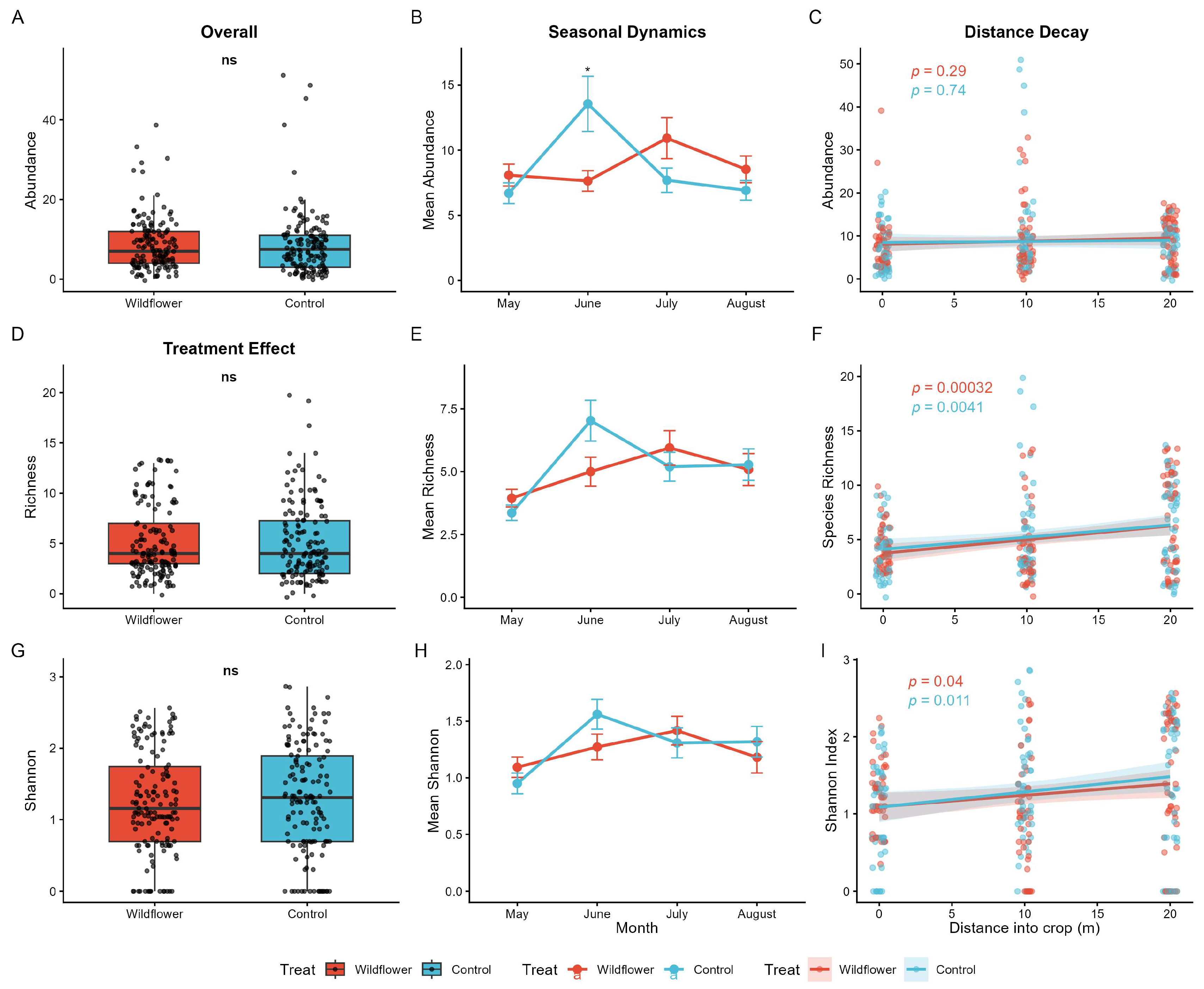
Figure 3.
Context-dependent spatial heterogeneity of spider assemblages across four cropping systems and distance gradients.(A)Non-metric Multidimensional Scaling (NMDS) ordination of spider community composition (beta diversity). Colors and 95% confidence ellipses represent the four distinct sampling sites (cropping systems), illustrating strong spatial segregation driven by local environmental filtering. Shapes denote margin treatments (circles: WFS; squares: Control), showing extensive overlap within sites.(B)Boxplots depicting total spider abundance across the spatial gradient (0, 10, and 20 m into the crop field) stratified by the four sampling sites.(C)Boxplots depicting Shannon diversity index across the same spatial and site gradients. Outliers are represented as individual points; box hinges represent the 25th and 75th percentiles, and the center line denotes the median.
Figure 3.
Context-dependent spatial heterogeneity of spider assemblages across four cropping systems and distance gradients.(A)Non-metric Multidimensional Scaling (NMDS) ordination of spider community composition (beta diversity). Colors and 95% confidence ellipses represent the four distinct sampling sites (cropping systems), illustrating strong spatial segregation driven by local environmental filtering. Shapes denote margin treatments (circles: WFS; squares: Control), showing extensive overlap within sites.(B)Boxplots depicting total spider abundance across the spatial gradient (0, 10, and 20 m into the crop field) stratified by the four sampling sites.(C)Boxplots depicting Shannon diversity index across the same spatial and site gradients. Outliers are represented as individual points; box hinges represent the 25th and 75th percentiles, and the center line denotes the median.
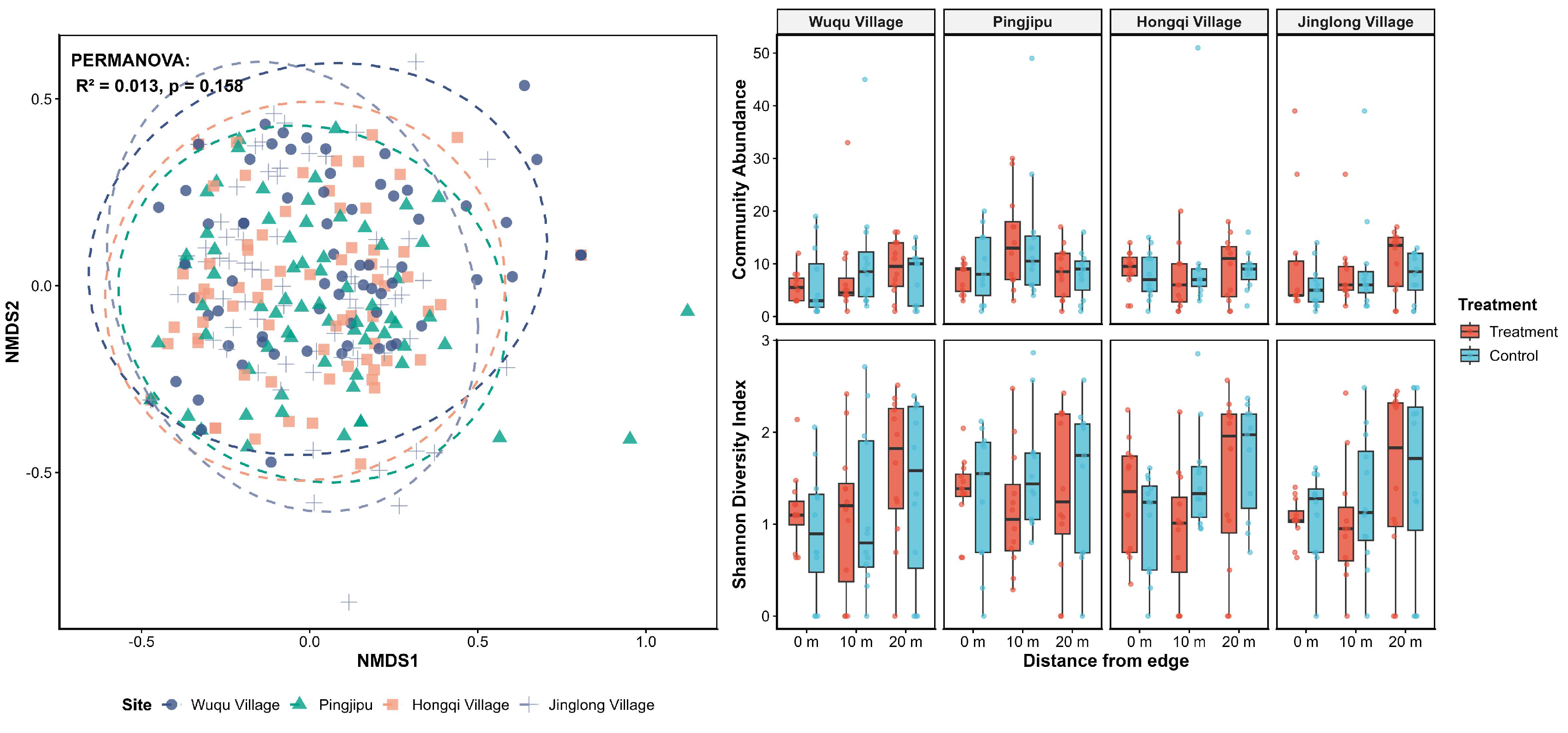
Figure 4.
Results from Indicator Species Analysis (ISA) identifying specific taxa strongly associated with the crop interior (10 m and 20 m zones). Four significant indicator species (Neoscona scylla, Neoscona holmi, Thanatus miniaceus, and Xysticus pseudoblitea) are shown with edge-avoidance behavior from 0 m to 20 m. Indicator values (IndVal) and corresponding P-values are annotated for each taxon.
Figure 4.
Results from Indicator Species Analysis (ISA) identifying specific taxa strongly associated with the crop interior (10 m and 20 m zones). Four significant indicator species (Neoscona scylla, Neoscona holmi, Thanatus miniaceus, and Xysticus pseudoblitea) are shown with edge-avoidance behavior from 0 m to 20 m. Indicator values (IndVal) and corresponding P-values are annotated for each taxon.
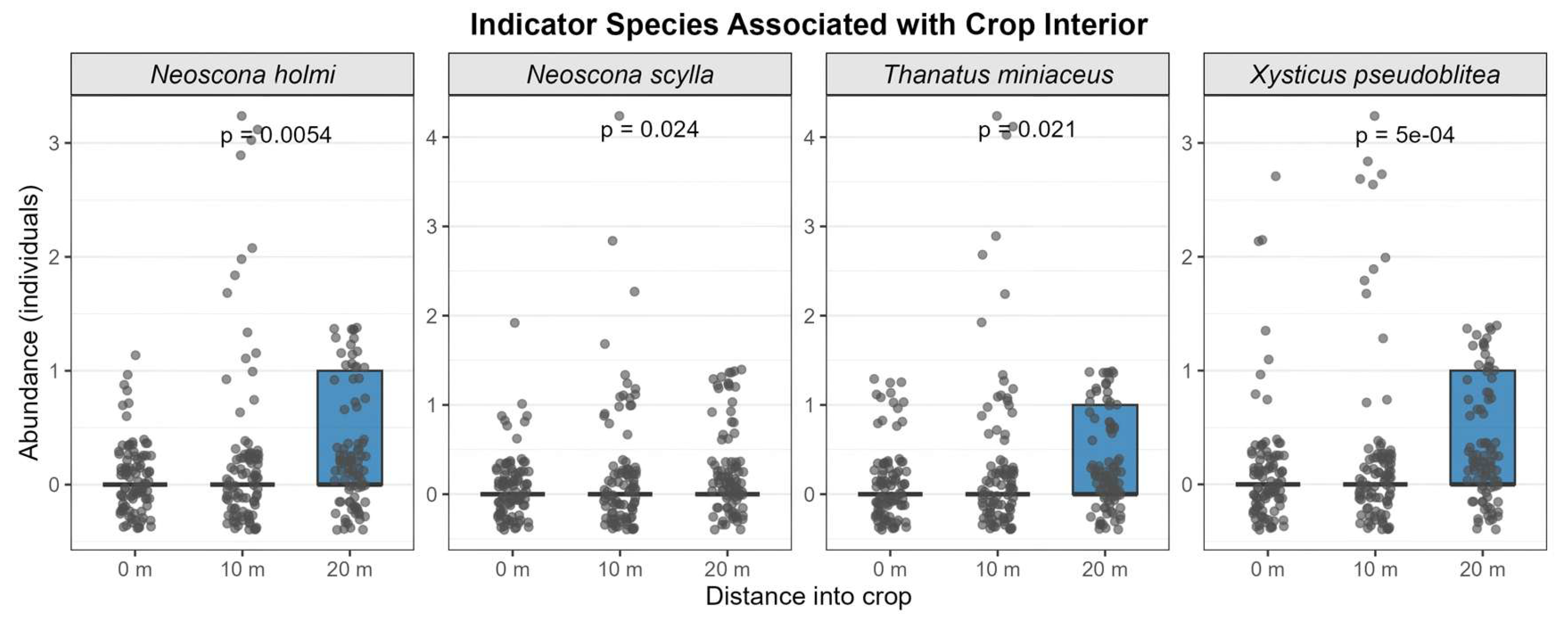
Figure 5.
Species-specific temporal dynamics ofLycosa coelestisabundance in WFS and control margins across sampling months. Data are presented as mean
Figure 5.
Species-specific temporal dynamics ofLycosa coelestisabundance in WFS and control margins across sampling months. Data are presented as mean
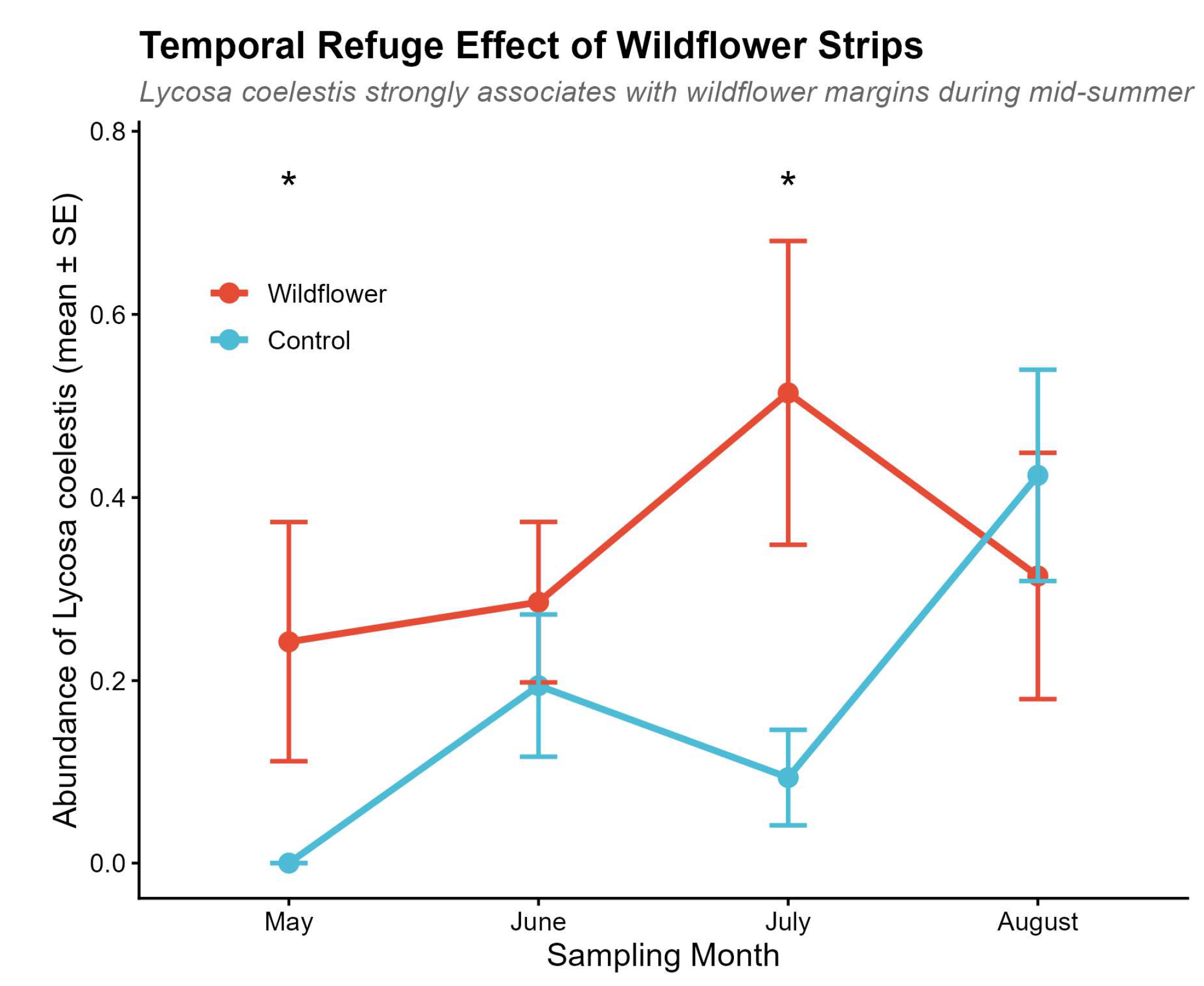
Figure 6.
Beta diversity and seasonal successional trajectories of spider assemblages based on NMDS. (A) NMDS ordination faceted by sampling month (Stress = 0.2219). (B) Temporal successional trajectories of community centroids from May to August.
Figure 6.
Beta diversity and seasonal successional trajectories of spider assemblages based on NMDS. (A) NMDS ordination faceted by sampling month (Stress = 0.2219). (B) Temporal successional trajectories of community centroids from May to August.
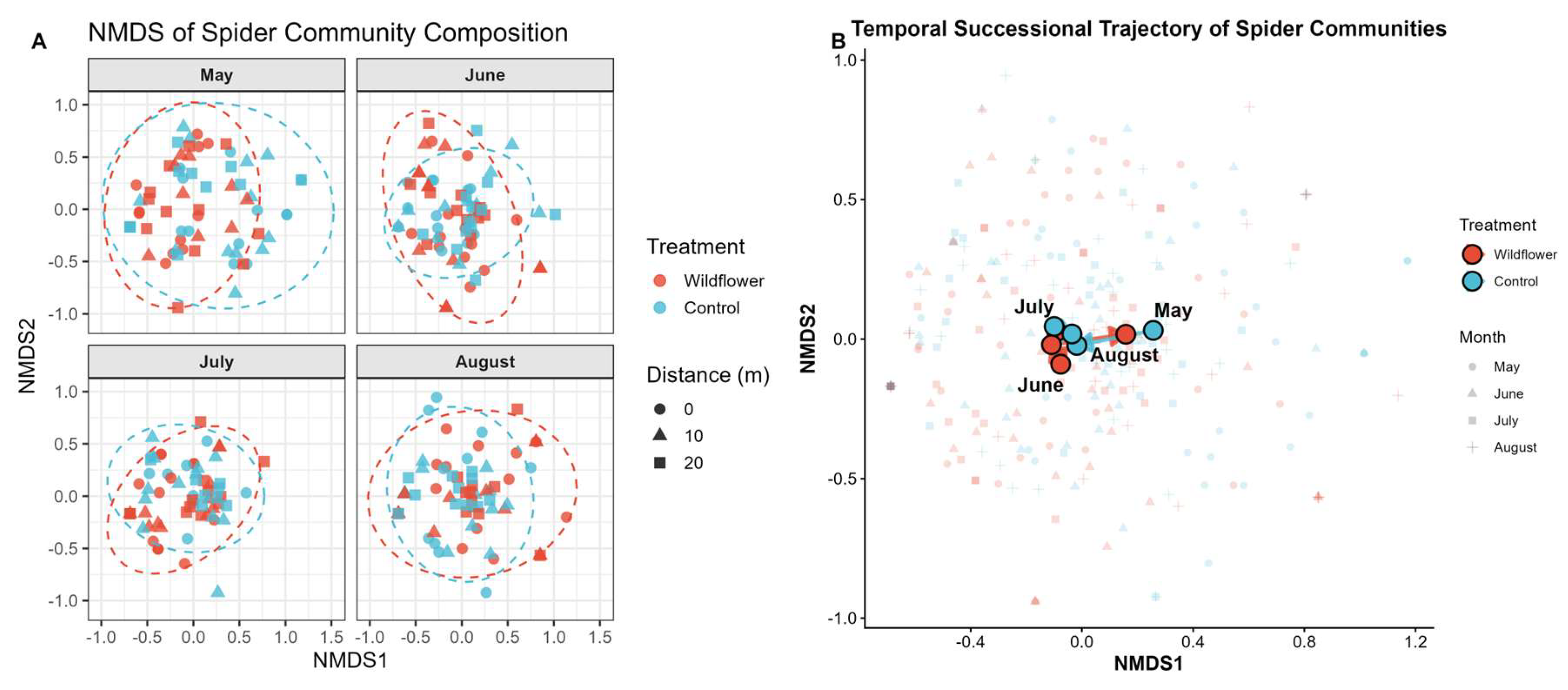
Figure 7.
Topological visualization of spider species co-occurrence networks based on strong, significant positive Spearman correlations (r > 0.6, P < 0.05), by treatment. Hub/keystone taxa are labeled for each network.
Figure 7.
Topological visualization of spider species co-occurrence networks based on strong, significant positive Spearman correlations (r > 0.6, P < 0.05), by treatment. Hub/keystone taxa are labeled for each network.
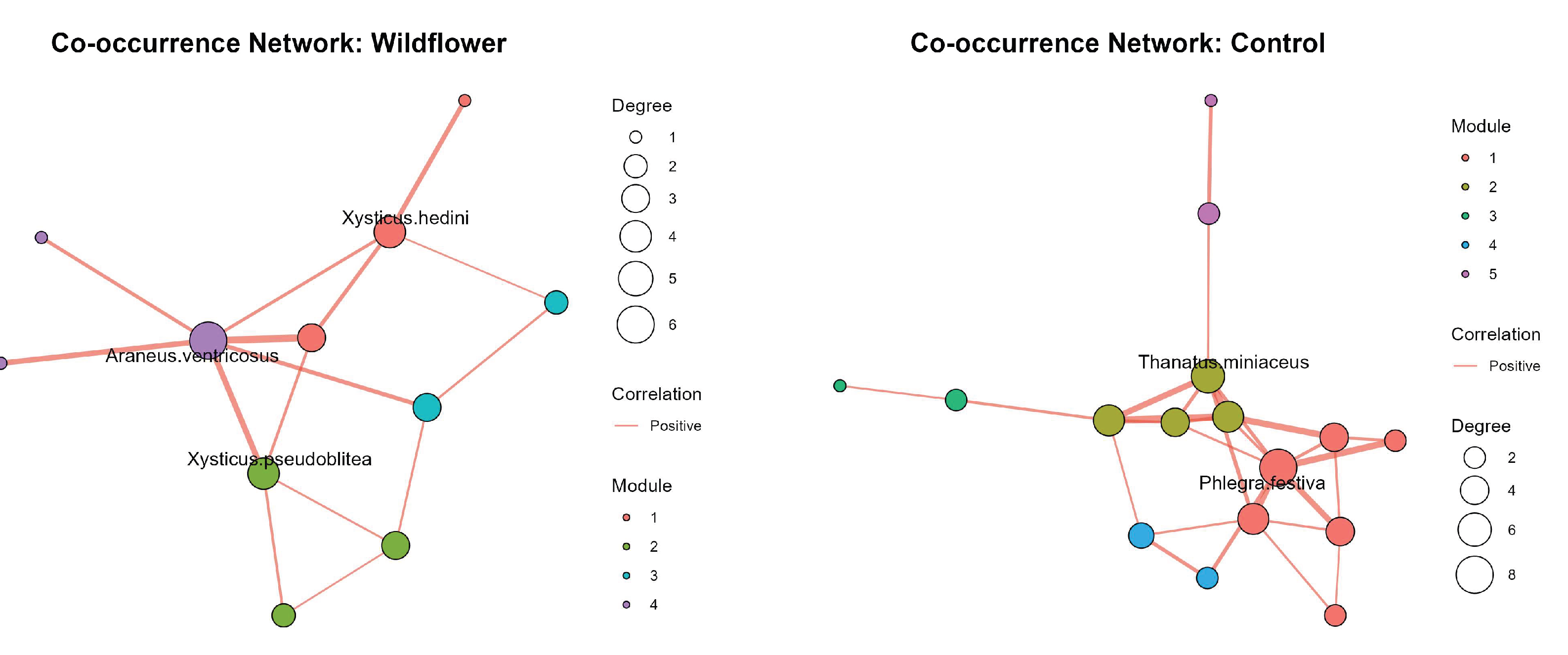

Table 1.
Botanical composition of sown wildflower strips and corresponding crop types across the study sites.
Table 1.
Botanical composition of sown wildflower strips and corresponding crop types across the study sites.
| District | Location | Species composition of wildflower strips (Sowing proportion) | Crop type |
|---|---|---|---|
| Helan County | Wuqu Village | Zinnia elegans (10%), Cosmos bipinnatus (10%), Calendula officinalis (20%), Centaurea cyanus (10%), Papaver rhoeas (10%), Cosmos sulphureus (10%), Coreopsis basalis (10%), Orychophragmus violaceus (10%), Gypsophila paniculata (5%), Gaillardia pulchella (5%) | Wheat |
| Helan County | Pingjipu | Astragalus adsurgens (20%), Iris lactea (20%), Coreopsis basalis (10%), Centaurea cyanus (10%), Orychophragmus violaceus (10%), Zinnia elegans (10%), Echinacea purpurea (5%), Medicago sativa (5%), Cosmos bipinnatus (5%), Lavandula angustifolia (5%) | Maize |
| Helan County | Hongqi Village | Melilotus officinalis (40%), Rudbeckia hirta (10%), Tagetes erecta (10%), Viola philippica (10%), Sorbaria kirilowii (5%), Rosa xanthina (5%), Orychophragmus violaceus (5%), Iris lactea (5%), Papaver rhoeas (5%), Cosmos bipinnatus (5%) | Tomato |
| Liangtian Town | Jinglong Village | Medicago sativa (100%) | Apple orchard |
Disclaimer/Publisher’s Note: The statements, opinions and data contained in all publications are solely those of the individual author(s) and contributor(s) and not of MDPI and/or the editor(s). MDPI and/or the editor(s) disclaim responsibility for any injury to people or property resulting from any ideas, methods, instructions or products referred to in the content. |
© 2026 by the authors. Licensee MDPI, Basel, Switzerland. This article is an open access article distributed under the terms and conditions of the Creative Commons Attribution (CC BY) license.
Copyright: This open access article is published under a Creative Commons CC BY 4.0 license, which permit the free download, distribution, and reuse, provided that the author and preprint are cited in any reuse.


