

Submitted:
08 June 2026
Posted:
09 June 2026
You are already at the latest version
Abstract
In Senegal, scaling up vector control has significantly reduced malaria, but coastal transmission remains a challenge due to secondary vectors like Anopheles melas. This exophilic and zoophilic species evades conventional indoor interventions, yet its bionomics and insecticide resistance profiles remain poorly characterized due to difficulties in laboratory colonization. Anopheles melas larvae were collected from brackish breeding sites in Mbine Coly (Mbour District). A laboratory colony was established from 26 PCR-confirmed founder females and stabilized up to the F17 generation by optimizing water salinity (10 g/L) and transitioning to communal oviposition. Standardized WHO tube bioassays were conducted on generations F2 to F9 to evaluate susceptibility to pyrethroids, organophosphates, and carbamates, alongside synergist tests using 4% piperonyl butoxide (PBO). The colony showed confirmed resistance to alpha-cypermethrin (81.7% mortality) and suspected resistance to deltamethrin (91.3%) and permethrin (94.3%). Pre-exposure to PBO fully restored susceptibility to deltamethrin and permethrin (100%), and significantly increased alpha-cypermethrin mortality to 96.3% (p < 0.001), demonstrating a major cytochrome P450-mediated metabolic resistance. High-intensity resistance was confirmed for alpha-cypermethrin at 5X diagnostic doses. Conversely, the population was 100% susceptible to pirimiphos-methyl and bendiocarb. This study reports the successful long-term colonization of a wild An. melas strain for the first time and provides the first comprehensive evidence of multi-insecticide resistance in this population. The presence of high-intensity, metabolic pyrethroid resistance strongly justifies the immediate deployment of next-generation PBO-LLINs and the integration of organophosphates or carbamates in indoor residual spraying rotations to manage resistance in coastal Senegal.
Keywords:
Anopheles melas
; laboratory colonization
; pyrethroid resistance
; piperonyl butoxide (PBO)
; residual transmission
; Senegal
1. Introduction
Senegal has scaled up insecticide-based vector control interventions, notably Indoor Residual Spraying (IRS) and Long-Lasting Insecticidal Nets (LLINs), over the past two decades. Despite steady progress, the country recorded 232,465 confirmed cases and 199 deaths in 2023, illustrating the persistence of malaria endemicity with marked regional disparities [1]. While incidence has significantly declined in the North and Central regions, offering a genuine opportunity to achieve the 2030 elimination goal set by health authorities, controlling transmission remains complex in transition zones. Previous studies have reported the presence of Anopheles melas in several coastal and estuarine areas, where it plays a central role in malaria dynamics [2,3,4]. However, the epidemiological, ecological, and entomological factors enabling An. melas to maintain residual transmission are not yet fully characterized.
In West-Central Senegal, this species ensures transmission alongside An. arabiensis, whose populations already exhibit high resistance to pyrethroids [5]. To address this threat, the National Malaria Control Programme (PNLP) introduced new strategies in its 2021–2025 National Strategic Plan, including the deployment of next-generation piperonyl butoxide (PBO) nets. However, shifts in species complex composition, with an increasing contribution from secondary vectors such as An. melas, pose a major challenge. Its zoophilic and exophilic behaviour places it beyond the reach of conventional interventions targeting endophilic vectors [6]. We hypothesise that An. melas could become the predominant local species by gradually replacing An. arabiensis, thereby becoming the primary driver of residual malaria within its distribution range. It is therefore imperative to document the bionomics, distribution, and genetic structure of its populations. Understanding its larval bionomics and genetic diversity would allow for the anticipation of epidemiological shifts, the assessment of insecticide resistance allele spread, and the early detection of entomological risks in pre-elimination zones. In the face of rising resistance, characterizing the susceptibility of Anopheles melas is now crucial to adapt PNLP tools and ensure the effectiveness of future public health investments.
2. Materials and Methods
2.1. Study Area and Entomological Collection
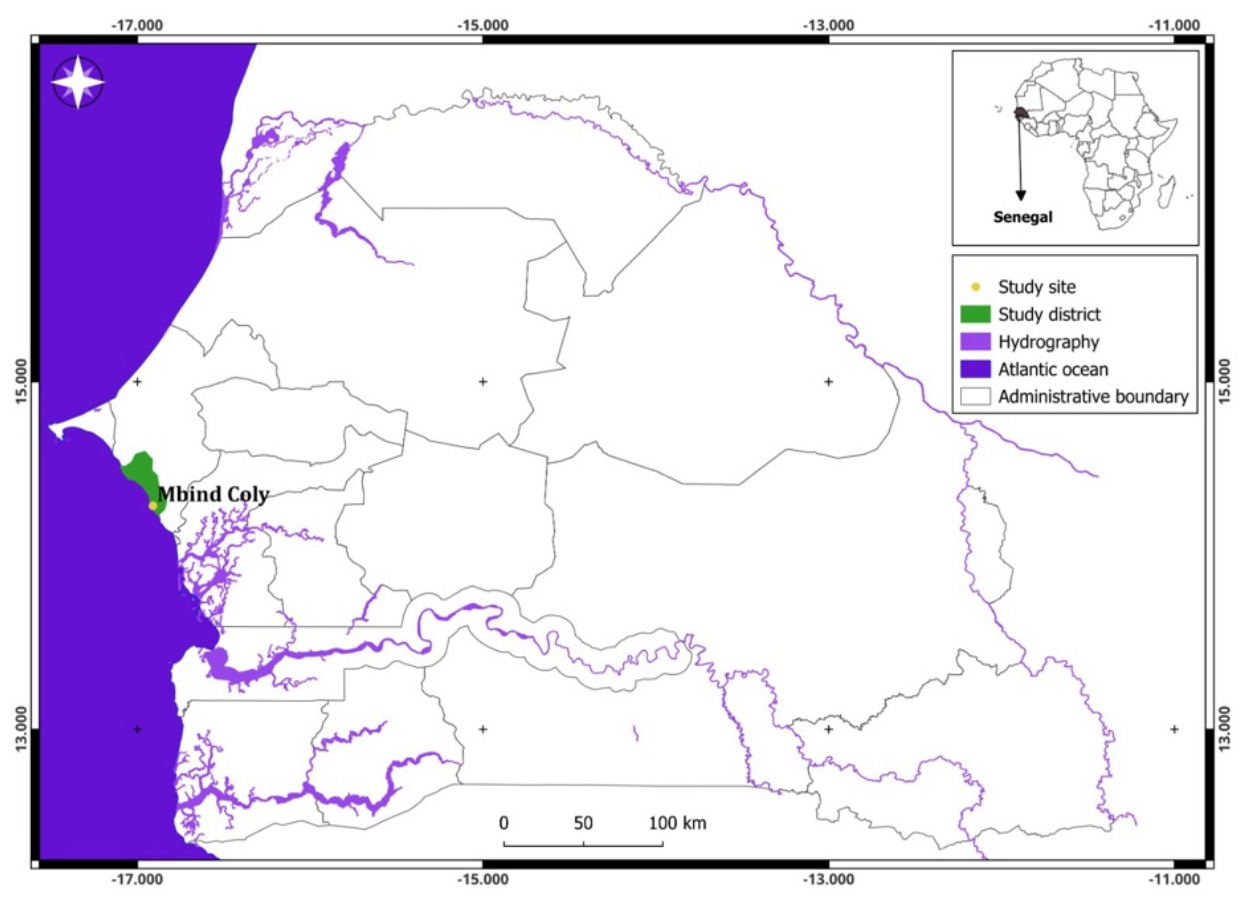
Larval surveys were conducted on September 26, 2024, in Mbine Coly (Mbour District, Senegal). This coastal site is characterized by “crab hole” type breeding sites and brackish flood zones. Larvae were collected using the dipping method in waters with salinity levels ranging from 10 to 18 g/L.
Figure 1.
Geolocation of Mbine Coly village in the Mbour district.
2.2. Colonization and Laboratory Rearing Optimization
The An. melas colony was established from 26 PCR-identified founder females (F0). Rearing was conducted under controlled insectarium conditions (25 °C and 70-80% humidity). A rigorous protocol was implemented to ensure the sustainability of the strain:
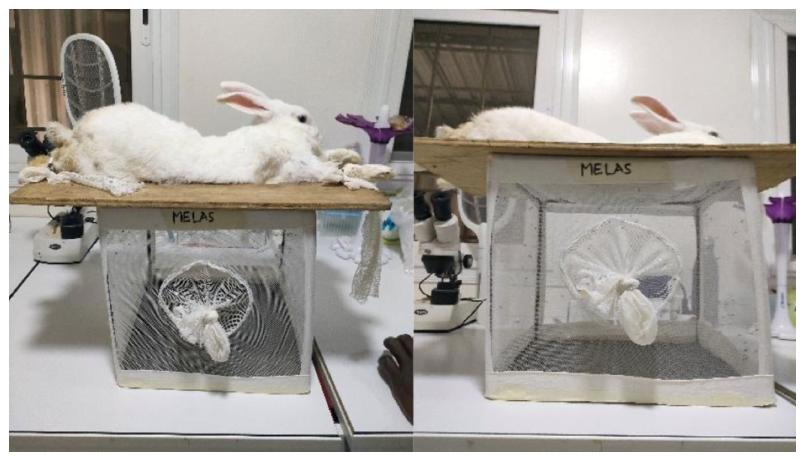
Blood-feeding and Oviposition: To stimulate egg production, F0 females were deprived of sugar solution for 48 hours before being blood-fed on a rabbit. Humidity was maintained using damp cloths placed over the cages. Following the blood meal, females were isolated in Eppendorf tubes for individual forced oviposition on moist filter paper. Transition to communal oviposition for subsequent generations was stabilized using cups containing 1 cm of water, where mosquitoes laid eggs directly on the surface.
Salinity Optimization: Although the species showed survival in brackish water at 18 g/L, our tests demonstrated that 10 g/L is the optimal salinity. This concentration allows for faster hatching and larval growth compared to freshwater, while avoiding the decline in fecundity observed at 18 g/L.
Larval Monitoring Schedule: The maintenance cycle was standardized to 12 days to ensure homogenous population sizes:
D1-D2: Flooding (100 ml) and initial hatching (24-48h).
D3-D5: Tray balancing at 400 larvae and progressive feeding (50 to 120 mg).
D6-D8: Critical stage involving complete brackish water renewal via filtration to prevent fouling, and increased ration (up to 250 mg).
D9-D12: Daily pupae collection and gradual cessation of feeding.
Figure 2.
Blood-feeding of Anopheles melas females on a rabbit.
2.3. Species Identification
Identification was performed by PCR according to the protocol by Wilkins et al. (2006) [7], on 26 F0 females that had oviposited individually. This analysis confirmed that the study population consisted of 100% Anopheles melas.
2.4. Susceptibility Bioassays (WHO)
To ensure a homogenous population for susceptibility testing, field-caught mosquitoes (F0) were maintained until the F9 generation, and tests were conducted on specimens from the F2 to F9 generations. A total of 1,314 specimens (F2 to F9) were tested following standardized WHO guidelines [8,9]. Control groups (exposed to solvent only) were systematically included to validate each test series.
2.4.1. Diagnostic and Intensity Tests (1X, 5X, 10X)
The WHO tube protocol was applied to evaluate susceptibility to pyrethroids (Deltamethrin 0.05%, Permethrin 0.75%, and Alpha-cypermethrin 0.05%), organophosphates (Pirimiphos-methyl 0.25%), and carbamates (Bendiocarb 0.1%) [9,10]. Groups of 20 to 25 mosquitoes per tube were exposed to impregnated papers for 60 minutes. Individuals were then transferred to holding tubes with access to a 10% sugar solution. Final mortality was recorded after a 24-hour recovery period at 27 °C (± 2 °C). For alpha-cypermethrin, 5X and 10X doses were used to characterize the intensity of resistance.
2.4.2. PBO Synergist Tests
To detect the involvement of metabolic mechanisms (cytochrome P450s), pre-exposure tests to 4% Piperonyl Butoxide (PBO) were performed. Four groups were established:
Control: Neutral paper.
Synergist only: 4% PBO (60 min) to verify the absence of inherent toxicity.
Insecticide only: 1X diagnostic dose (60 min).
PBO + Insecticide: Pre-exposure to PBO (60 min) followed immediately by exposure to the 1X insecticide dose (60 min).
2.5. Data Analysis and Interpretation Criteria
Mortality was interpreted according to WHO thresholds: susceptible (98–100%), suspected resistance (90–97%), and confirmed resistance (<90%). If control mortality was between 5% and 20%, Abbott’s formula was applied to correct mortality rates. The involvement of metabolic mechanisms was confirmed if PBO pre-exposure restored susceptibility to a level ≥ 98%.
2.6. Statistical Analyses
Observed mortality rates from bioassays were interpreted according to WHO criteria: full susceptibility (mortality ≥ 98%), suspected resistance (90–97%), and confirmed resistance (<90%). To validate the robustness of the results, the following analyses were performed:
Fisher’s exact test (or Pearson’s Chi-square test, χ2) was used to compare mortality rates between the insecticide alone (1X) and after pre-exposure to the synergist (PBO). A p-value < 0.05 was considered statistically significant to confirm the involvement of metabolic resistance mechanisms (P450 enzymes) or the effect of increasing doses (5X and 10X intensity tests). All calculations were performed using RStudio software.
3. Results
3.1. Species Identification and Establishment of the F1 Colony
Molecular identification by PCR confirmed the exclusive presence of Anopheles melas (100%) among the 26 founder females collected in Mbine Coly. Generations F2 to F9 were subsequently used for susceptibility bioassays.
3.2. Colonization Success and Rearing Parameters
The colonization trial of the An. melas population from Mbine Coly yielded conclusive results, enabling the transition from a wild population to a stabilized laboratory strain.
Developmental kinetics: Under controlled conditions (25 °C, 70-80% RH), the average egg-to-adult cycle duration was 10 to 12 days. Using a salinity level of 10 g/L reduced larval mortality by nearly 15% compared to trials conducted at 18 g/L, while maintaining ideal emergence synchronization for susceptibility testing.
Productivity and fecundity: Starting from the 26 founder females (F0), the oviposition rate increased steadily. The transition from forced oviposition (F1-F2 generations) to communal oviposition marked a turning point in the colony’s productivity, providing sufficient numbers (over 1,000 individuals per generation) to conduct large-scale bioassays (1X, 5X, and 10X doses).
Strain stability: The colony maintained constant vigor from generation F2 to F9, the period during which resistance tests were performed. Currently, the strain is sustained at generation F17, confirming its full adaptation to insectarium conditions.
3.3. Pyrethroid Susceptibility and Synergist Tests (PBO)
The bioassays revealed varying levels of resistance across molecules, as confirmed by significance analyses (Fisher’s exact test):
Deltamethrin and Permethrin: Suspected resistance was observed (91.3% and 94.3% mortality, respectively) (Figure 3). Pre-exposure to PBO led to full restoration of susceptibility (100%), representing a statistically significant increase (p=0.003 for deltamethrin; p=0.028 for permethrin). Alpha-cypermethrin: Resistance was confirmed with 81.7% mortality. The addition of PBO increased this rate to 96.3%. This improvement was highly significant (p<0.001), demonstrating the predominant role of cytochrome P450 enzymes in this population (Figure 3).
3.4. Resistance Intensity
Intensity bioassays (5X and 10X) further defined the strength of this resistance:
For deltamethrin and permethrin, full susceptibility was achieved at the 5X dose. For alpha-cypermethrin, mortality increased from 81.7% (1X) to 95.5% (5X). Although this progression was statistically significant (p<0.001), the persistence of survivors at the 5X dose confirms a moderate-to-high intensity resistance for this molecule (Table 1).
3.5. Susceptibility to Organophosphates and Carbamates
In contrast to pyrethroids, the Mbine Coly strain exhibited full susceptibility (100%) to pirimiphos-methyl and bendiocarb. The difference in mortality between these classes and alpha-cypermethrin is highly significant (p<0.0001), validating the absence of cross-resistance and highlighting the potential for insecticide rotation strategies (Table 2).
4. Discussion
The management of residual malaria transmission in West Africa relies on a detailed understanding of secondary vectors such as Anopheles melas. Our results in Mbine Coly reveal that a salinity of 10 g/L is optimal for larval development. This observation corroborates previous studies on this species, which highlight its high plasticity (euryhalinity); however, high salinity levels close to seawater (~35 g/L) slow down larval growth [2,3,4,5,6,7,8,9,10,11]. The use of reconstituted brackish water at 10 g/L appears to offer an ideal compromise, avoiding osmotic stress while mimicking the conditions of mangrove areas or estuary margins encountered in Mbour. The transition from forced oviposition to communal oviposition starting from the F2 generation was the key factor in increasing population size. Maintaining the colony until F9 for susceptibility testing ensures the homogeneity of the tested samples. The successful colonization beyond F12, reaching F17, indicates genetic adaptation to insectarium conditions, making this Mbine Coly strain a valuable tool for future screening tests of new insecticidal molecules [12]. The successful colonization of the Mbine Coly strain, now reaching the F17 generation, is a major result. Anopheles melas is notoriously difficult to rear due to its eurygamy (the requirement for large spaces for mating). The strategic shift from individual forced oviposition to communal cup-based oviposition allowed for the stabilization of large-scale adult production.
Insecticide resistance tests revealed confirmed resistance to alpha-cypermethrin (81.7%) and suspected resistance to deltamethrin and permethrin, thereby highlighting a loss of pyrethroid efficacy in this area. The full restoration of susceptibility following PBO pre-exposure demonstrates the predominant role of cytochrome P450 enzymes. This finding is consistent with recent genomic analyses; indeed, Whole Genome Sequencing (WGS) studies conducted on An. melas populations in West Africa have revealed duplications of the CYP9K1 gene, a major marker of metabolic pyrethroid resistance within the An. gambiae complex [13]. Furthermore, our results corroborate the work of Sy et al. (2021) [5], in Senegal, who had already identified kdr mutations in this species, suggesting the coexistence of target-site modification and enzymatic detoxification resistance mechanisms [14]. The observation of persistent resistance at the 5X dose for alpha-cypermethrin (95.5%) classifies this population within a moderate-to-high resistance intensity category. This situation is concerning as it exceeds the efficacy thresholds of standard insecticide-treated nets. However, the efficacy restored by PBO confirms that PBO-LLINs (next-generation nets) constitute a robust alternative. These results align with the regional trend observed in The Gambia and Guinea-Bissau, where the efficacy of conventional interventions is increasingly challenged by the exophilic behaviour and physiological plasticity of An. melas [3,4,5,6,7,8,9,10,11,12,13,14,15].
The salinity recorded in Mbine Coly (10–18 g/L) confirms the halophilic specialisation of An. melas. This tolerance to brackish environments provides it with a selective advantage over An. arabiensis in mangrove areas [2]. This environmental factor, coupled with its ability to bite outdoors (exophagy), explains why this species ensures residual transmission where other vectors are controlled by IRS or traditional LLINs [6]. Nevertheless, the full susceptibility observed to pirimiphos-methyl and bendiocarb offers serious avenues for insecticide rotation, particularly through indoor residual spraying.
5. Conclusions
This study documents, for the first time, the multi-insecticide susceptibility profile of an Anopheles melas population in Mbine Coly (Mbour), while marking a significant technical advancement in maintaining this species under insectarium conditions, now reaching the F17 generation. The stabilization of this wild strain into a sustainable colony provides a valuable biological tool for research. Our findings confirm that the Anopheles melas population from Mbine Coly (Mbour) has developed significant resistance to pyrethroids, driven by metabolic mechanisms that can be neutralized by PBO.
These results necessitate immediate strategic actions, such as the priority deployment of next-generation Long-Lasting Insecticidal Nets (PBO-LLINs) in the Mbour district. Furthermore, insecticide rotation in IRS programmes, involving the use of carbamates or organophosphates, should be considered for insecticide resistance management. Moving forward, detailed molecular characterization of the CYP9K1 and kdr genes in these specimens will clarify the genetic basis of this resistance and refine national entomological surveillance.
Author Contributions
O.S., EAN, EMD, LK, OG and OF designed the study. OS, LK, EMD and EAN supervised the study. MAN, AN, PCS, LIA, IS and OS carried out the field collections, laboratory rearing and performed the experiments. EMD, MAN, PCS, OS and EAN contributed toward data analysis. MAN, OS, PCS, AN, OG, OF, EMD and EAN, analyzed the data and wrote the manuscript. All authors read, and approved the final manuscript.
Funding
This research was funded in whole or in part by Science for Africa Foundation to [DEL-22-001] with support from Wellcome Trust and the UK Foreign, Commonwealth & Development Office and is part of the EDCTP 2 programme supported by the European Union. For purposes of open access, the author has applied a CC BY public copyright licence to any Author Accepted Manuscript version arising from this submission.
Ethics Approval and Consent to Participate
This study was approved by the National Ethics Committee of Senegal, N°0000294/MSHP/CNERS/SP.
Data availability Statement
The data presented in this study are available on request from the corresponding authors.
Acknowledgments
The authors would like to express their gratitude to the Ministry of Health through the National Malaria Control Programme (PNLP), MARCAD Plus consortium and the population of Mbine Coly (Pointe Sarène, Mbour, Senegal).
Competing Interests
The authors declare no competing interests.
Abbreviations
| CDC | Centers for Disease Control and Prevention |
| IRS | Indoor Residual Spraying |
| kdr | Knockdown resistance |
| LLINs | Long-Lasting Insecticidal Nets |
| MARCAD | Malaria Research Capacity Development |
| PBO | Piperonyl Butoxide |
| RH | Relative Humidity |
| WGS | Whole Genome Sequencing |
| WHO | World Health Organization |
References
- PNLP (2023). Bulletin Épidémiologique Annuel du Paludisme au Sénégal : Année 2023. Ministère de la Santé et de l’Action Sociale, Dakar, Sénégal.
- Diop A, et al. (2002). Rôle d’Anopheles melas Theobald dans la transmission du paludisme dans la mangrove du Saloum (Sénégal). Parasite, 9: 239-246.
- Caputo B, et al. (2008). Anopheles gambiae complex along The Gambia river, with particular reference to the molecular forms of An. gambiae s.s.Malaria Journal, 7: 182.
- Sy et al. (2018). Entomological impact of indoor residual spraying with pirimiphos-methyl: a pilot study in an area of low malaria transmission in Senegal. Malaria journal. 2018; 17(1):64. PubMed [journal] PMID: 29402274.
- Sy O, et al. (2021). Detection of kdr and ace-1 mutations in wild populations of Anopheles arabiensis and An. melas in a residual malaria transmission area of Senegal. Pesticide Biochemistry and Physiology, 176: 104783.
- Sy O, et al. (2023). Residual malaria transmission and the role of Anopheles arabiensis and Anopheles melas in central Senegal. J Med Entomol., 60(3): 546-553.
- Wilkins EE, et al. (2006). IMP PCR primers detect single nucleotide polymorphisms for Anopheles gambiae species identification. Malaria Journal, 5: 125.
- World Health Organization (2016). Test procedures for insecticide resistance monitoring in malaria vector mosquitoes. Second edition. Geneva: World Health Organization.
- WHO (2022a). Manual for monitoring insecticide resistance in mosquito vectors. Geneva: World Health Organization.
- WHO (2022b). Manual on practical entomology in malaria: Part I and II. Geneva: World Health Organization.
- Akogbeto M. (1995). Étude entomologique sur la transmission du paludisme côtier lagunaire : cas d’un village construit sur un lac d’eau saumâtre. Ann. Soc. Belge Méd. Trop., 75: 219-227.
- Djègbè I, et al. (2014). Molecular characterization of DDT resistance in Anopheles gambiae from Benin. Parasites & Vectors, 7: 409. doi.org.
- Moss S, et al. (2024). Whole genome sequence analysis of population structure and insecticide resistance markers in Anopheles melas from the Bijagós Archipelago, Guinea-Bissau. Parasit Vectors, 17(1): 396.
- Bass C, et al. (2007). Detection of knockdown resistance (kdr) mutations in Anopheles gambiae. Malar. J., 6: 111.
- Mawejje HD, et al. (2023). Characterizing pyrethroid resistance and mechanisms in Anopheles gambiae (s.s.) and Anopheles arabiensis from 11 districts in Uganda. Current Research in Parasitology & Vector-Borne Diseases, 3: 100106.
Figure 3.
Insecticide susceptibility profile of Mbine Coly strain.
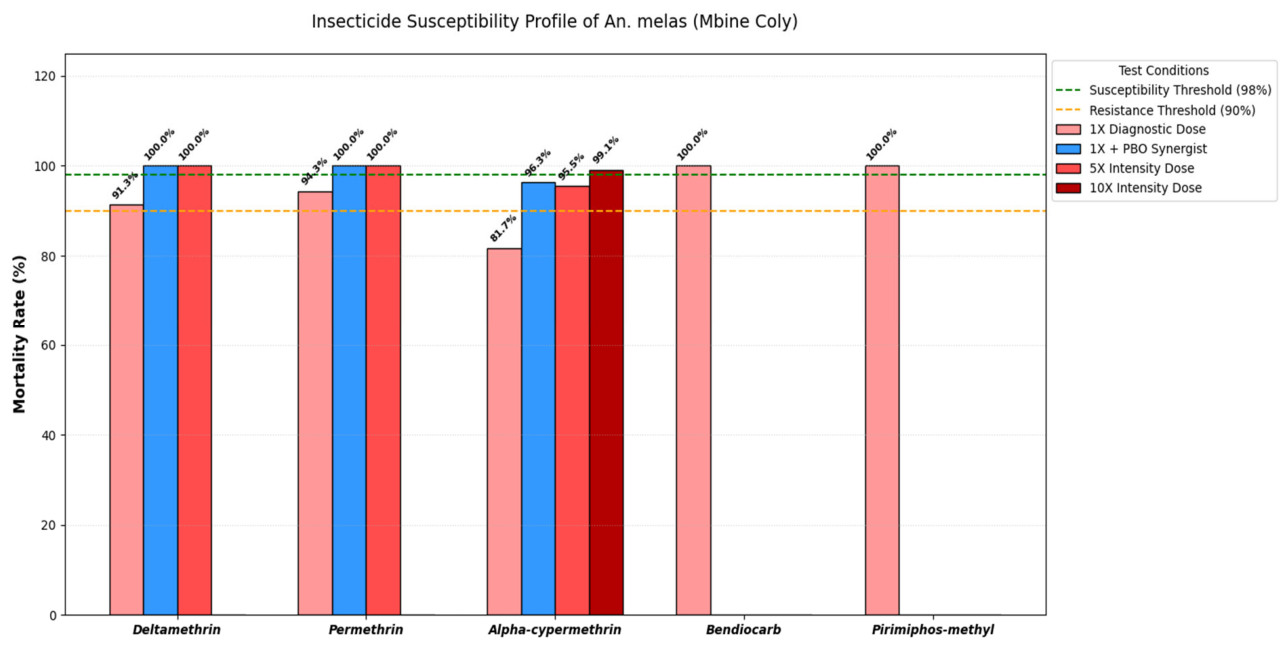

Table 1.
Susceptibility status of the An. melas population from Mbine Coly (Mbour) to pyrethroids.
| District | Salinity (g/L) | Molecule | Alive | Dead | TotalTested | Mortality (%) |
| Mbour | 10/18 | Deltamethrin (0.05%) 1X | 9 | 95 | 104 | 91.3 |
| Deltamethrin 0.05% after PBO | 0 | 110 | 110 | 100 | ||
| Deltamethrin 5X (0.25%) | 0 | 110 | 110 | 100 | ||
| Permethrin (0.75%) 1X | 6 | 100 | 106 | 94.3 | ||
| Permethrin 0.75% after PBO | 0 | 112 | 112 | 100 | ||
| Permethrin 5X (3.75%) | 0 | 110 | 110 | 100 | ||
| Alpha-cypermethrin (0.05%) 1X | 19 | 85 | 104 | 81.7 | ||
| Alpha-cypermethrin 0.05% after PBO | 4 | 105 | 109 | 96.3 | ||
| Alpha-cypermethrin 5X (0.25%) | 5 | 107 | 112 | 95.5 | ||
| Alpha-cypermethrin 10X (0.5%) | 1 | 116 | 117 | 99.1 |
Table 2.
Observed mortality after exposure of the Mbine Coly strain to organophosphates and carbamates.
Table 2.
Observed mortality after exposure of the Mbine Coly strain to organophosphates and carbamates.
| District | Salinity (g/L) | Molecule | Alive | Dead | TotalTested | Mortality (%) |
| Mbour | 10/18 | Pirimiphos-methyl (0.25%) | 0 | 110 | 110 | 100 |
| Bendiocarb (0.1%) | 0 | 110 | 110 | 100 |
Disclaimer/Publisher’s Note: The statements, opinions and data contained in all publications are solely those of the individual author(s) and contributor(s) and not of MDPI and/or the editor(s). MDPI and/or the editor(s) disclaim responsibility for any injury to people or property resulting from any ideas, methods, instructions or products referred to in the content. |
© 2026 by the authors. Licensee MDPI, Basel, Switzerland. This article is an open access article distributed under the terms and conditions of the Creative Commons Attribution (CC BY) license (http://creativecommons.org/licenses/by/4.0/).
Copyright: This open access article is published under a Creative Commons CC BY 4.0 license, which permit the free download, distribution, and reuse, provided that the author and preprint are cited in any reuse.


