

Submitted:
08 June 2026
Posted:
09 June 2026
You are already at the latest version
Abstract
The study examined the extent of bribery within the public healthcare system in Greece and the influence of its determinants at the macro-, meso-, and micro-levels, highlighting institutional and cultural influences, systemic weaknesses, inequalities, and high-risk groups. Structured questionnaires were administered to a representative sample of adult users of healthcare services in public hospitals located in urban areas. The analysis included descriptive statistics to examine variable distributions and trends, bivariate non-parametric tests to assess associations between informal payments and selected demographic and socioeconomic characteristics, as well as binary logistic regression modelling to estimate the probability of exposure to informal payments based on specific individual characteristics. The study sample comprised 2,072 adults, of whom 59.5% were female and 40.5% male, with the largest age group being 36–55 years. A proportion of 23.2% resided outside the metropolitan areas of Athens and Thessaloniki, while nearly 50% reported a monthly household income of up to €1,500, indicating a substantial representation of socio-economically disadvantaged groups. The analysis revealed the existence of a significant problem of informal payments within the Greek public healthcare system and identified specific institutional, cultural, and organizational determinants, as well as demographic and socioeconomic groups that are particularly vulnerable to such practices. The phenomenon disproportionately affects economically, educationally, and geographically disadvantaged populations. Addressing informal payments in healthcare is essential to preventing the erosion of the social fabric of the country and requires comprehensive transparency-oriented policies, the strengthening of equitable access to services, and targeted interventions for high-risk groups, in order to ensure the sustainability of the public healthcare system and the promotion of equitable and healthy living conditions for the population.
Keywords:
socio-economically disadvantaged groups
; informal payments
; healthcare inequalities
; access to healthcare services
; sustainability of public healthcare system socioeconomic determinants
1. Introduction
The study of social inequalities and the mechanisms that contribute to their persistence and reproduction constitutes a fundamental field of inquiry within public affairs and the social sciences. The international literature demonstrates that inequalities do not arise randomly but are instead shaped through complex, multi-layered processes involving social, economic, and institutional determinants [1].
Within this framework, corruption represents a key factor contributing to the widening of such inequalities, particularly to the detriment of lower socio-economic groups. The bribery of public officials, as a manifestation of corruption, is a long-standing phenomenon that affects contemporary societies to varying degrees and with differing characteristics across regions. The determinants influencing the extent of bribery and, more broadly, corruption within a country are multiple and include, inter alia, the type of political system, the quality of governance, the robustness of the institutional framework, the effectiveness of the judicial system, the degree of exposure to globalization, the level of competition and economic development, the structure and size of the public sector, as well as cultural and historical factors, and finally geographical location [2].
With regard to the geographical factor, previous research has demonstrated significant variations in corruption levels across countries in the Mediterranean basin, with Arab and Balkan countries exhibiting more severe problems compared to European states. Furthermore, a comparative study conducted across 29 transition economies found that informal payments occur at higher rates in countries of the former Soviet Union and in Southern European countries than in Eastern European counterparts [3]. According to a quantitative analysis of the Corruption Perceptions Index (CPI) at a global level, disaggregated by continents and major regions, European countries exhibit the lowest levels of perceived corruption, whereas African countries present the highest [4]. North American and Oceanian countries demonstrate CPI values close to those of Europe [5], as do countries in Latin America and the Caribbean [6].
Bribery (or informal payments or illegal payments or the Greek expression “fakelaki” in the present study), as a form of corruption, constitutes a multidimensional social practice shaped at the intersection of institutional weaknesses, cultural meanings, and power asymmetries. At the level of formal definition, it is understood as the provision of money or other benefits to a public official in order to secure preferential treatment or to circumvent established procedures [7,8].
The practice of bribery represents a characteristic example of the embeddedness of corruption within the functional everyday operation of healthcare systems [9]. A range of average-level factors contribute to its emergence. In contexts where insufficient funding, low remuneration, and bureaucratic inefficiencies undermine the effective delivery of services, bribery emerges as an informal “mechanism of acceleration,” promising to alleviate institutional delays [10]. Factors such as staff shortages and long waiting lists further reinforce social tolerance toward such practices. Thus, according to the so-called rational-choice perspective, while bribery formally constitutes antisocial behaviour, sociologically it may be interpreted as a form of everyday adaptive response to a system that fails to meet citizens’ basic expectations.
At the same time, the practice of bribery is shaped by deeper cultural schemas associated with the perception of personal relationships as a prerequisite for effective interaction with public administration. The personalization of service delivery, the emphasis on informal mediation, and widespread distrust toward formal institutions construct a framework within which bribery is not necessarily perceived as deviant behavior, but rather as an “adaptive” mechanism for navigating institutional inefficiencies [11]. Thus, at the macro level, the institutional framework, the governance quality, and prevailing cultural attitudes toward corruption jointly determine the social acceptability and persistence of the phenomenon, forming the core of a structural–institutional explanatory approach. Indeed, the institutional theoretical perspective highlights informal payments as an outcome of governance deficits and systemic dysfunctions [12]. Weak oversight mechanisms, deficient accountability structures, and limited transparency create fertile conditions for the emergence and reproduction of informal transactions. As noted by Transparency International [13], health systems characterized by low institutional trust and inadequate complaints and reporting mechanisms exhibit a higher prevalence of informal payments. This does not negate the illegal nature of bribery but rather underscores the ways in which it may become embedded within localized normative orders. At the macro level, beyond institutional design and governance quality, societal cultural orientations toward corruption play a decisive role in shaping and sustaining informal payments. In contexts where such practices are perceived as socially tolerated or even necessary for accessing services, they tend to become normalized and integrated into the routine functioning of healthcare systems [9,14,15,16].
Furthermore, bribery is closely associated with socio-economic inequalities, as the capacity or perceived “necessity” to engage in informal payments is shaped by unevenly distributed resources, opportunities, and expectations [17]. In the healthcare sector, this implies that economically advantaged individuals are more likely to secure preferential access to services, whereas economically disadvantaged groups, even when they perceive bribery as unjust or ethically problematic, may nevertheless resort to it as an “inescapable” strategy to ensure access to care for themselves or their dependents. In this context, a central explanatory role is played by the asymmetry of power and information that characterizes the patient–provider relationship [18]. Healthcare professionals operate as institutional gatekeepers, controlling access to diagnostic and therapeutic services. For socio-economically disadvantaged patients, this asymmetry is intensified by the fear of delays or denial of care, the urgency of medical needs, and their dependence on the provider’s professional judgment. Under such conditions, bribery is often experienced not as a voluntary exchange, but as a tacit precondition for securing adequate healthcare provision. Consequently, the concept of bribery extends beyond its narrow legal definition as corruption and functions as an analytical lens for understanding a complex set of relationships between the state, healthcare professionals, and citizens. Addressing the phenomenon therefore requires not only institutional control mechanisms, but also a deeper understanding of the social and cultural structures that sustain and reproduce it.
Although bribery concerns all sectors of public administration, as it is closely linked to the broader socio-economic and cultural context of each country, as previously noted, its consequences are not of equal social significance across different domains. More specifically, in highly sensitive sectors such as healthcare, the implications are particularly severe, as services in this field are directly related to quality of life and, in some cases, to the very survival of the population. This is because care is often required at critical and vulnerable moments for patients and their families, and delays in treatment or the provision of inadequate care may even result in loss of life [19].
Bribery in healthcare services, defined as informal or illegal payments made by patients to healthcare professionals or facilities beyond officially established fees, either in cash or in kind [20,21], constitutes a structural challenge for health systems, as it undermines equity in access, financial protection for patients, and trust in institutions. The World Health Organization [22] highlights those informal payments represent a significant barrier to achieving universal health coverage, particularly in resource-constrained systems. From a health policy perspective, informal payments function as a parallel financing mechanism, shifting the cost of care directly onto patients [23,24].
Beyond these general characteristics, bribery in healthcare also reflects inequalities between different socio-economic groups, as certain populations are more exposed to the phenomenon due to their economic conditions, social power, and varying capacity to access essential information regarding the use of public healthcare services [25]. Consequently, such disparities are not only observed between countries or broader world regions, but also within the same country or locality, across different socio-economic groups [26].
Understanding vulnerable social groups in relation to bribery, as well as the specific barriers they encounter in accessing appropriate and high-quality care, constitutes a necessary prerequisite for the design of effective and socially equitable health policies. Within the field of public health, the concept of vulnerable social groups refers to population categories that, due to social, economic, cultural, or biological factors, exhibit reduced capacity to access healthcare services and to fully exercise fundamental health-related rights. Factors such as income level, educational attainment, age, migratory status, employment insecurity, and geographic location contribute to the formation of unequal burdens of morbidity and to differentiated levels of access to care. The accumulation of disadvantages within these groups is associated with greater exposure to institutional deficiencies, information asymmetries, bureaucratic obstacles, and unequal quality of healthcare provision. From this perspective, vulnerability is not a static or purely individual attribute, but rather the outcome of dynamic interactions between social structures, institutional functioning, and access to health system resources.
International and Greek studies indicate that socio-economically vulnerable groups—particularly individuals with low income, older adults, chronic patients, migrants, unemployed persons, and residents of remote areas—are either compelled to engage in informal payments in order to secure necessary care or are silently excluded when they are unable to participate in such informal transactions. In this sense, corruption is not evenly distributed; rather, it reinforces existing social and health inequalities by producing a mechanism that reproduces and deepens disparities in access [27]. International evidence further demonstrates that individuals occupying lower socio-economic positions experience higher morbidity rates, reduced use of preventive services, and increased premature mortality [28], as income, education, and employment security operate as critical social determinants of health.
Similarly, older adults face heightened vulnerability due to a greater burden of chronic diseases, polypharmacy, frequent dependence on healthcare services, and limited digital literacy, all of which constrain their effective access to modern healthcare systems. Migrants, refugees, and individuals without stable legal status also constitute a high-risk category, as they encounter intersecting barriers such as language asymmetries, lack of insurance coverage, cultural distance, and often well-documented institutional mistrust—factors that significantly restrict their ability to utilize available health services. At the same time, individuals with chronic conditions and persons with disabilities experience structurally embedded dependence on healthcare systems, which is further exacerbated by the absence of accessible infrastructure and institutional mechanisms ensuring equitable and continuous care.
Moreover, populations experiencing social exclusion—such as homeless individuals, people who use substances, victims of exploitation and violence, and residents of hard-to-reach geographic areas—remain outside formal social protection networks and exhibit significantly higher levels of morbidity and mortality. Inequalities are also evident in younger populations: children and adolescents living in conditions of poverty or family instability face increased barriers to accessing preventive and healthcare services, while these deficits accumulate over time and persist into adulthood, generating intergenerational health inequalities [29].
Vulnerability, as an analytical category, does not represent a static attribute but rather a dynamic and evolving outcome of the interaction between structural factors—such as institutional deficiencies, inadequate social protection mechanisms, and persistent socio-economic inequalities—and socio-cultural as well as individual characteristics. The contribution of the international literature [30,31,32] underscores that health inequalities are the product of broader social determinants rather than isolated biological differences. This framework is particularly important, as it highlights the significance of empowering citizens through access to information and the institutional safeguarding of their rights. The systematic study and identification of vulnerable social groups constitute a critical prerequisite for the design of targeted public health policies capable of reducing social and health inequalities and strengthening the universality and equity of healthcare services [33].
Within this context, low-income users of public healthcare services are particularly vulnerable, as they lack the financial capacity to access the private sector and are therefore almost entirely dependent on the public health system for appointments, diagnostic procedures, or surgical interventions [19,34,35,36]. This structural dependence exposes them to increased pressure to comply with informal demands and to resort to illegal payments, despite their already strained economic conditions. In many cases, this leads to borrowing the required funds, thereby further exacerbating their financial hardship and deepening their socio-economic vulnerability, as indicated in recent research findings [19].
Individuals most exposed to morbidity—such as older adults, young children, patients with chronic conditions, and women in childbirth—due to heightened health-related vulnerability are more likely to engage in bribery in order to secure continuity of treatment or preferential access to repeated healthcare visits. The frequency of such interactions fosters a degree of familiarity and interpersonal proximity with healthcare personnel, which in turn contributes to the development of trust-based relationships that may facilitate the provision of informal payments [37,38,39].
It is evident that within the healthcare sector, bribery also varies in both frequency and magnitude depending on the type of service involved. For instance, surgical procedures or childbirth-related services are particularly associated with informal payments aimed at securing priority access or the selection of a preferred physician [40,41,42].
Other socially vulnerable groups, such as minorities—including migrants and refugees—despite often belonging to lower socio-economic strata, also resort to informal payments, particularly when uninsured, in order to obtain services or secure access to the healthcare system. For these populations, limited access to information due to language barriers or lack of awareness of their rights, combined with insecurity stemming from their status in a foreign country, further reinforces reliance on informal payments [43,44,45].
The educational level of healthcare users is also a significant differentiating factor in relation to bribery, with individuals of lower educational attainment being more vulnerable due to limited awareness of their rights and reduced access to information regarding healthcare procedures [46,47]. Conversely, other findings suggest that more highly educated users are also more likely to engage in bribery or unauthorized payments. This pattern has been observed in an African context, specifically in Nigeria [48], where extremely low levels of educational attainment combined with very low-income levels significantly restrict access to formal mechanisms, while simultaneously limiting the ability to afford informal payments. This apparent contradiction between developed and less developed socio-economic contexts highlights the complexity of the phenomenon and the variability of its manifestation across different regions of the world [49].
International organizations report that corruption in healthcare also exhibits gender-based differentiation [50,51]. Women are often more exposed to the adverse effects of corruption due to structural inequalities, socio-economic dependency, and prevailing gendered power dynamics. Their increased reliance on public healthcare services—particularly in relation to reproductive health and child-rearing—places them in situations where corrupt practices may directly jeopardize their access to essential care [5]. Women who simultaneously experience other dimensions of vulnerability, such as low income or residence in rural areas, face particularly heightened risks, as they often lack the financial resources or social power necessary to resist demands for bribery or sexual exploitation [52,53]. Empirical studies from Africa, however, present a more differentiated picture, indicating gender as a significant predictor of exposure to corruption in public healthcare facilities, but with men being more likely than women to encounter such practices when seeking healthcare services. This finding has been observed both in Nigeria specifically [48] and in a broader comparative study across 34 African countries [54].
In the Greek health care system, where long-standing structural weaknesses persist—such as understaffing, resource shortages, uneven geographical distribution of services, and delays in the provision of care—the phenomenon of informal payments emerges as one of the most detrimental informal practices. This form of corruption undermines the transparency and equity of the health system, disproportionately affecting individuals lacking financial resources, social capital, or adequate institutional information.
Finally, in the same country, the geographical factor is important as usually in areas with limited access to health services, such as rural, island or mountainous areas, residents are moved to illegal payments in order to be given priority to them or to ensure access to another area, usually urban, to which they will have to move in order to receive health services [25,26,55]. Empirical research in other countries such as Nigeria or Bosnia and Herzegovina [56], which are countries with a different socio-economic background than Western countries, suggests that residents in urban areas are more likely to encounter corruption and suffer bribery.
As far as the Greek health system is concerned, where structural weaknesses have been identified over time — such as understaffing, lack of resources, uneven geographical distribution of services and delays in the provision of care — the phenomenon of bribery emerges as one of the most harmful informal practices. This form of corruption undermines the transparency and equity of the health system, disproportionately affecting those who lack financial resources, social networking or adequate institutional information. In the Greek case—particularly in the health sector—informal payments cannot be interpreted solely as an illegal transaction; they also function as a mechanism regulating relationships of access, trust, and uncertainty within a system burdened by structural inefficiencies [24]. According to relevant Greek literature [57], vulnerable populations systematically face barriers not only in accessing health services and pharmaceuticals, but also in obtaining reliable information. This contributes to the widening of health inequalities and the systematic weakening of their capacity for self-protection.
On the basis of the above, examining the relationship of informal payments with the a) weaknesses of the Governance System and the Health System in Greece and b) the socioeconomic characteristics of health service users becomes a critical research priority. Understanding who is more exposed, which conditions increase the likelihood of involvement in “under-the-table payments,” and how institutional asymmetries affect accessibility and the effectiveness of care can substantially contribute to the design of targeted and evidence-based policy interventions.
2. Material and Methods
2.1. Objective
The central objective of the present study is to investigate the phenomenon of informal payments (“fakelaki”) in Greece, which are made by patients (users of health care services) to health professionals in order to obtain relevant services. More specifically, the article examines the following issues in the Greek context: (a) the role of the institutional framework and cultural attitudes towards corruption (institutional approach to the phenomenon), (b) the condition of the health care system as a driver of informal payments (rational choice theory), and (c) the degree of vulnerability of specific socio-economic and demographic groups to informal payments in the use of public health services (power asymmetry and information asymmetry theory), based on the perspectives of patients themselves, derived from primary statistical survey conducted in 2023 at a nationwide level.
On this basis, the study seeks to contribute to the relevant literature by utilizing original empirical data to document and analyses the phenomenon of informal payments in Greece. In doing so, it highlights the factors that determine the extent, magnitude, and underlying determinants of informal payments in Greece, which, as discussed in the introduction, operate at macro-, intermediate, and micro-levels respectively.
Furthermore, through the examination of social, demographic, and economic characteristics of health service users, the study aims to identify groups exhibiting increased vulnerability, to capture the mechanisms through which inequalities reinforce the prevalence of informal payments (“fakelaki”), and to highlight disparities in the realization of equal access to public health care services.
2.2. Research Questions of the Study
- –
- What is the magnitude of informal payments in the public health care system in Greece?
- –
- What is the contribution of the pathologies of the public health care system to the existence of informal payments, according to the perceptions of health service users (patients)?
- –
- What is the significance of governance quality and the cultural attitudes of the population in sustaining the phenomenon of informal payments?
- –
- Which socio-economic and demographic population groups are more vulnerable to informal payments in the provision of health care services, and what is the likelihood that patients with specific profiles will experience informal payments?
2.3. Study Population and Sample
The study population consists of citizens who have received health care services from the National Health System (NHS) and visited the hospitals included in the study during the period of data collection. The sample comprises 2,072 adult citizens residing in three geographical categories, namely Athens, Thessaloniki, and all other Regions of Greece. The selection of hospitals and other health care facilities was based on the need to cover the largest urban centers (Athens and Thessaloniki) as well as medium-sized cities (Patras, Larissa, Volos, Ioannina, and Alexandroupoli), in order to ensure sample representativeness. In this selection process, the population size of each area was taken into account, based on official data from the Hellenic Statistical Authority (ELSTAT), so that the distribution of respondents would reflect the actual population served by NHS facilities across regions. Stratified sampling procedures were applied, corresponding as closely as possible to geographical regions and population size. This approach ensured, to the extent possible, a proportional distribution of respondents across areas, reducing the likelihood of systematic bias and enhancing the reliability of the findings.
2.4. Research Design and Methodology
In the present study, a quantitative survey design was applied using a structured questionnaire. Closed-ended questions were formulated to obtain structured information regarding the main dimensions of the phenomenon, while open-ended questions were included to allow for more in-depth qualitative insights. Data collection was conducted between March and May 2023.
For sample selection, a screening method was employed. This technique is used to identify a sub-sample from a larger population - in this case, individuals entering health care facilities who have already received health services - from the broader population. In other words, the screening procedure involves a filtering process to identify respondents who had utilized services in the selected health care facilities. It is designed to reduce the population to a study-relevant sample by excluding individuals who do not meet the required criteria (i.e., use of services in the selected facilities). The screening method is particularly useful in cases where the population is highly specific and the research topic involves socially sensitive issues, while not all individuals in the target population possess the necessary characteristics for inclusion. It is also appropriate when a complete sampling frame is not available for direct random selection. The sampling error associated with the given sample size ranges from 0.43% to 2.15%.
There were three limitations in the design of the questionnaire:
- –
- The first limitation concerns the social acceptability of the phenomenon of informal payments (“fakelaki”). Referring to this issue may activate social biases, while also potentially generating feelings of personal guilt among respondents involved in such practices, thereby complicating data collection due to participants’ reluctance or hesitation to respond.
- –
- The second limitation relates to the nationality of the participants, as only Greek nationals were included in the study in order to ensure sufficient proficiency in the Greek language. Consequently, the participation of foreign nationals was not possible, although, according to the theoretical framework, they also constitute a vulnerable group with respect to informal payments.
- –
- The third limitation concerns the age of respondents, as only adults (aged over 18 years) were included in the study in order to ensure that participants could independently access and utilize health care services.
2.5. Data Analysis
For the analysis of the results, descriptive and inferential non-parametric statistical methods were employed, as the variables were categorical, a type of analysis widely used in the social sciences for the measurement of attitudes and perceptions [58]. Initially, in order to provide a concise and comprehensive presentation of the research data, descriptive statistical analysis was conducted to address the aforementioned research questions. The statistical significance of demographic and socio-economic factors differentiating the presence or absence of informal payments was examined using bivariate non-parametric Chi-square (χ²) tests.
To investigate the multivariable relationship between socio-economic characteristics and informal payment behavior, a Binary Logistic Regression model was applied, where the dependent variable was the presence or absence of informal payments, and the independent variables were the demographic and socio-economic characteristics of the participants. Parameter estimation was performed using the Maximum Likelihood method, while the statistical significance of the independent variables’ coefficients was assessed using the Wald test. Model fit was evaluated using the -2 Log Likelihood ratio, Cox & Snell R², Nagelkerke R², and the ROC-AUC test.
This methodological approach ensures a high level of validity and reliability, as it is based on a large sample, an appropriately designed (to the extent possible) sampling strategy, structured questionnaires, and multi-level statistical analysis. Furthermore, it allows for the exploration of social inequalities and the association between informal payments and vulnerable population groups, providing a comprehensive and evidence-based understanding of this phenomenon in the Greek context.
3. Results
3.1. Prevalence and Characteristics of Informal Payments in Health Care Services
According to the study findings, in 73% of respondents no informal payment was requested. Among the 27% of cases in which an informal payment was requested by health care personnel and subsequently provided by the patient, 10.8% involved lower amounts (less than €400), while 7.7% involved payments ranging between €600 and €1,200. Amounts exceeding €1,200 were reported by 4.2% of respondents (Table 1). In the open-ended questions, the majority of respondents also reported that they were not asked to provide an informal payment or that they did not do so due to personal choice or financial constraints. Among those who made informal payments, the largest group reported amounts between €501 and €1,000.
It is noteworthy that the vast majority of the amount paid (91.6%) derives from respondents’ income or personal savings, while a much smaller proportion comes from existing assets or other sources, which are likely less feasible given the time required to secure them (Table 2). The open-ended responses are consistent with these findings regarding the origin of funds, while additionally indicating that some respondents were forced to reallocate other essential expenditures (food, utility bills, children’s education).
It is also of particular interest to examine the timing of the informal payment request (Table 3), with 40.7% and 19.8% of cases reporting that the “fakelaki” was requested before or during the provision of healthcare services, respectively. These proportions indicate a more explicit intention of bribery compared to payments made after service delivery, which in some cases may be interpreted as a voluntary “gift”.
Based on the open-ended responses, it is further confirmed that for the majority of individuals who paid an informal fee, the amount was requested and paid prior to receiving healthcare services, typically following direct communication with the attending physician or administrative staff of the healthcare unit. Participants who made payments after service provision reported that this was either an expression of gratitude or an attempt to secure continuity of care. Finally, a small number of respondents reported partial payments, with part of the amount paid before and the remainder after the service, indicating that the process is often adapted to patients’ circumstances and financial capacity.
It is useful to identify the specific categories of healthcare personnel to whom informal payments are directed. As is evident (Table 4), bribery primarily concerns medical doctors (85.5%), while lower frequencies are observed for nurses (6%) and even smaller proportions for other categories of healthcare staff. According to the findings from the open-ended questions, the majority of informal payments were directed toward physicians and nursing staff, whereas a smaller number of cases involved stretcher-bearers and administrative personnel. In addition, approximately half of the respondents reported making payments to physicians for surgical or specialized procedures, believing that this ensured faster access and higher-quality medical care. Similarly, a number of respondents reported giving “fakelaki” to nursing staff in exchange for more personalized or immediate care during hospitalization. Four respondents reported payments to stretcher-bearers to facilitate smooth intra-hospital transport and assistance, while two respondents stated that they paid administrative staff to expedite bureaucratic procedures.
3.2. Bribery and the State of the Public Healthcare System
Regarding respondents’ satisfaction with the healthcare services provided by public healthcare facilities, 66.4% reported that they were not satisfied, whereas 33.6% stated that they were satisfied with the services provided (Table 5). Based on the open-ended responses, out of eighty participants who provided comments, thirty-six reported dissatisfactions, highlighting issues such as poor quality of facilities, insufficient staffing levels, procedural delays, and inappropriate staff behavior. In contrast, thirty-two participants stated that they were satisfied, emphasizing that despite existing shortcomings, the services met their basic needs and provided timely assistance. The remaining twelve participants reported a mixed experience, acknowledging positive aspects of care delivery while simultaneously pointing to significant weaknesses in infrastructure and administrative processes.
Respondents report that the main reasons discouraging them from visiting a healthcare unit include the distance of services from their place of residence (19.3%), delays in service provision (18.1%), perceived inefficiency of services (14.3%), and difficulties in access, while a further 6.6% report complete avoidance of accessing services within the public healthcare system (Table 6). Based on the open-ended responses, the primary reason for hesitation in visiting public healthcare facilities is related to uncertainty and waiting time. Out of eighty respondents who provided answers, forty-seven reported that fear of delays, long queues, and overcrowded facilities discouraged them from seeking timely care. Eighteen participants emphasized that previous negative experiences or perceptions of inappropriate staff behavior increased their reluctance to use public healthcare services. The remaining fifteen respondents cited practical barriers, such as distance from healthcare facilities or lack of direct transportation options.
The responses to the following question provide insight into patients’ perceptions regarding the causes of delays observed in public healthcare facilities. The primary reason identified as contributing to delays in patient service delivery within public healthcare structures, as reported by 45.6% of respondents, is the shortage of staff and medical specialties. A further 29.3% attribute delays to the high workload and patient volume within public healthcare facilities. In addition, 8.9% believe that delays are due to inadequate coverage of healthcare needs in their geographical area, while 8.1% consider that insufficient training and qualification of healthcare professionals is responsible. Finally, 8.1% of respondents perceive healthcare services as inefficient overall (Table 7). Based on the open-ended responses from eighty participants, thirty-five reported that insufficient staffing and the overburdening of healthcare facilities result in long waiting times. Twenty-two participants emphasized that bureaucratic procedures and administrative delays significantly contribute to service postponements, while eighteen highlighted problems in the organization of appointments and scheduled procedures. Additionally, five respondents pointed to the lack of adequate equipment or infrastructure as a factor that further slows down service delivery.
The next question provides a direct connection between the aforementioned weaknesses of the healthcare system and the recourse to informal payments. Overall, 27% of the total sample reported that they would be willing to give an informal payment in order to receive higher-quality healthcare services, 23.9% stated that they would respond to such a request to obtain faster access to services, and 15.1% indicated that they would pay to secure access to healthcare services (Table 8). According to the findings from the open-ended responses, frequent statements included: (a) respondents paid informal fees to ensure immediate access to healthcare services, mainly due to long waiting lists or urgent medical needs; (b) payments were made to improve the quality of care received, such as receiving greater attention from staff or better treatment during hospitalization; and (c) some respondents reported making payments under pressure from healthcare personnel within the facility.
3.3. Institutional Framework and Cultural Attitudes Towards Corruption
In the question assessing the adequacy of public administration mechanisms in combating “fakelaki” within the existing institutional framework, 71% of respondents evaluate the public administration as inadequate in addressing the phenomenon, while 18.5% also consider it inadequate, but acknowledge that some significant actions are being implemented. A further 6.2% regard the public administration as adequate in addressing informal payments, although they believe that more effective measures could still be taken. Finally, only 4.2% of respondents consider the “state apparatus” to be fully adequate in tackling the phenomenon (Table 9). It is noteworthy that the vast majority (89.5%) perceive the current system for addressing bribery as insufficient, even though only 18.5% of this group recognize that meaningful actions are underway. Based on the open-ended responses, most participants expressed doubts regarding the effectiveness of state mechanisms in combating “fakelaki.” Out of eighty respondents, more than fifty emphasized that underfunding, staff shortages, and weak administrative structures in public hospitals create an environment of tolerance in which the phenomenon becomes “normalized.” Fifteen respondents assessed existing monitoring and transparency procedures as insufficient to deter corruption, while ten highlighted that social norms and patient pressure on healthcare personnel further contribute to the persistence of the phenomenon.
But what is the attitude of the country's population towards bribery based on the results of the survey? The respondents’ attitudes towards the phenomenon of informal payments in healthcare are predominantly negative at 54%, while 17.8% report an indifferent stance. A further 12.7% express a supportive attitude, arguing that healthcare professionals are not adequately remunerated, while 9.3% declare a strongly negative position. Additionally, 5.4% report a supportive stance towards “fakelaki” for other reasons (Table 10). Although approximately two-thirds of respondents express either a negative or strongly negative attitude towards the phenomenon, a notable 18.1% demonstrate a supportive stance, while a further 17.8% remain indifferent. It is particularly noteworthy that a proportion almost equal to those who have actually paid informal fees either supports or is indifferent to the practice. Low wages in Greece in general, and particularly among physicians and nurses, are identified by a segment of the population (12.7%) as a factor generating sympathy towards healthcare workers and as a justification for informal payments.
Based on the qualitative responses, out of eighty participants, forty expressed a strongly negative stance, characterizing “fakelaki” as an act of corruption and injustice that undermines equity in access to healthcare services. Twenty respondents admitted that, despite their reservations, they were compelled to make such payments in order to secure timely access or better-quality care, mainly in emergency situations or due to delays in service provision. Finally, the remaining twenty participants adopted a neutral stance, arguing that the phenomenon has become part of everyday practice within a public healthcare system they perceive as unable to fully meet citizens’ needs.
3.4. Differences in Informal Payments Across Healthcare Providers According to Respondents’ Demographic and Socio-Economic Characteristics
Initially, the profile of respondents is presented based on their demographic and socio-economic characteristics (Table 11). The highest frequencies are observed among women, individuals aged 36–65, and residents of the major urban centers of Athens and Thessaloniki. A substantial proportion of respondents are married and belong to households of three or four or more members. They are predominantly characterized by a relatively high educational level, low to medium income (500–2,500 euros), and generally report a good or moderate economic status. In terms of occupational status, respondents are mainly salaried employees in the public or private sector and are insured within the public social security system.
To examine statistically significant differences in informal payments across demographic and socio-economic groups, and thereby identify, at an initial level, populations more vulnerable to bribery, non-parametric analysis using Chi-square (χ²) tests is employed. For the purposes of this analysis, the variable measuring informal payments (Table 1) is recoded into a dichotomous variable with the following categories: “Did not request nor give a fakelaki” and “Requested and gave a fakelaki.” For the sake of brevity, this variable is hereafter referred to as “Gave fakelaki: No/Yes.” This transformation allows for the application of contingency table analysis and facilitates the assessment of associations between the occurrence of informal payments and key socio-demographic and economic characteristics of respondents, thereby enabling the identification of groups exhibiting statistically higher exposure to the phenomenon.
According to the results of the above statistical tests, the occurrence of informal payments shows a highly significant association with almost all examined socio-demographic and economic characteristics (p = 0.000), with the exception of education level, where the relationship is marginally statistically significant (p = 0.045), and insurance status, which does not show a statistically significant association (Table 12).
More specifically, women report being asked to provide informal payments at a higher rate compared to men. The phenomenon is also more prevalent in Athens compared to Thessaloniki and other smaller cities included in the study. Older age groups (above 35 years) are similarly more exposed to informal payment requests compared to younger respondents. Married individuals also appear more affected, as do those living in smaller households (one-member households). Income-related differences are particularly pronounced, with higher rates of informal payments observed among individuals with middle incomes (501–1,500 euros) as well as among those whose income derives from benefits or self-employment. Respondents reporting either very poor or very good economic conditions also exhibit relatively high exposure (around 50%), although these results should be interpreted with caution due to small subgroup sizes. Education also plays a role, as individuals with no formal education (illiterate or not completing primary school) report very high exposure to informal payments (approximately 50%). In addition, higher prevalence is observed among private sector employees and economically inactive individuals (such as pensioners and homemakers). Finally, respondents with private or alternative forms of insurance (e.g. occupational or sectoral schemes) also report higher exposure to informal payments.
Based on the qualitative responses, the phenomenon of “fakelaki” appears to be influenced by a combination of demographic, economic, and social factors. Women reported greater perceived pressure compared to men, while residents of Athens described more frequent experiences of informal payments compared to those in Thessaloniki and rest of Greece. Participants over the age of thirty-five and married individuals also reported higher exposure. Economic status emerged as a key determinant: individuals with medium incomes or income from benefits or self-employment more frequently reported experiences of bribery, while those at both extremes of the economic scale also reported incidents, albeit less consistently. Respondents without formal education, private sector employees, and economically inactive groups similarly reported higher exposure, as did those with private or alternative insurance coverage.
3.5. Identification of Socio-Economic Vulnerable Groups to Informal Payments in Healthcare – Logistic Regression Analysis
The above χ² tests capture the association between informal payments and the individual characteristics of respondents, but they examine each factor separately, without accounting for the simultaneous effect of the other variables. In order to investigate which of the above characteristics influence informal payments when considered jointly, the Binary Logistic Regression method is applied. This approach allows the construction of a comprehensive multivariable model of the determinants of informal payments, the identification of categories within each variable that are associated with a higher probability of experiencing the phenomenon, and the estimation of the probability that an individual with a specific socio-demographic profile (e.g. gender, age, education, income, etc.) will engage in informal payments [60,61,62,63,64].
The probability in question is calculated using the following formula:
where b1, b2, …, bn = the regression coefficients of the independent variables included in the model.
By selecting the Forward Stepwise procedure, the variables that demonstrate statistical significance are included in the model, while those that do not contribute explanatory power are excluded. The dependent variable Y is the same transformed dichotomous variable expressing the presence or absence of informal payments: “Gave fakelaki / Did not give fakelaki,” coded as Yes = 1 and No = 0, in accordance with the requirements of the method. The independent variables, along with their corresponding categories, are those presented in Table 11. The number of household members, as well as the number of insured dependents, is included in the model as an expression of the individual’s family burden, which may influence vulnerability to informal payments in the provision of healthcare services. Income level may not fully capture the respondent’s overall household economic situation, as the latter also depends on financial obligations. For this reason, the variable “economic status” is also included in the model. Finally, the existence and type of insurance reflects the degree of coverage of each individual regarding healthcare needs, which may also constitute an important factor in the examination and interpretation of informal payments.
Initially, the forward stepwise procedure required 10 steps to reach the final model. The model demonstrates strong explanatory power according to the Generalized Likelihood Ratio (χ² = 268.276, df = 31, p = 0.000) at the final Step 10. Furthermore, the model explains 12.1% and 17.6% of the variance in the occurrence of informal payments, according to the Cox & Snell R² and Nagelkerke R² coefficients, respectively. These values indicate a relatively modest relationship between the predictor variables and the dependent variable; however, pseudo-R² measures in logistic regression do not carry the same interpretative strength as in linear regression and should therefore be interpreted with caution. The -2 Log Likelihood (-2LL) decreased from 2,371.18 at Step 1 to 2,149.862 at Step 10, indicating that the final model provides a better fit to the data compared to the earlier steps. The model’s discriminatory ability was assessed using the ROC curve. The Area Under the Curve (AUC = 0.718, p = 0.000) indicates an acceptable and statistically significant ability to distinguish between the two categories of the dependent variable. The ROC curve is presented in Figure 1. Finally, the model correctly classifies 73.7% of cases, compared to 73.0% in the null model.
Summarizing the model evaluation tests, we can conclude that the model demonstrates satisfactory performance, allowing us to proceed to the main results identifying the factors influencing the occurrence of informal payments in the public healthcare sector. The results of the method are presented in Table 13. Initially, the table reports the order in which variables entered the model, which also reflects the relative contribution of each variable to the model’s explanatory power. Gender enters at Step 1, income at Step 2, source of income at Step 3, followed by the remaining variables up to Step 10. All examined explanatory factors (except household size and education) show a highly statistically significant association with the dependent variable, indicating that they influence the occurrence of informal payments, as p = 0.000 for all variables. The type of insurance also shows strong statistical significance (p = 0.004). In Step 1, where only the constant term is included in the model, the results indicate that the overall sample has a 45% lower probability of experiencing informal payments compared to the alternative outcome of not experiencing them [Exp(b) = 0.550].
Based on the results of Table 13, the model of the present application is formulated as follows:
logit(p)=ln= - 0,598 – 0,926 X1.1 – 1,177 X2.1 – 0,459 X2.2 + 0,881 X3.1 + 0,542 X3.2 + 1,037 X4.1 + 1,009 X4.2 + 0,465 X4.3 + 1,367 X4.4 – 0,830 X5.1 – 0,141 X5.2 – 0,024 X5.3 – 1,886 X6.1 - 0,975 X6.2 – 0,0549 X6.3 + 18,832 X7.1 – 0,407 X7.2 – 3,041 X7.3 – 1,405 X7.4 – 0,687 X7.5 - 2,149 X8.1 + 0,965 X8.2 - 1,282 X8.3 + 1,215 X8.4 + 0,185 X9.1 – 0,722 X9.2 + 0,216 X9.3 + 2,514 X10.1 + 0,499 X10.2 - 0,150 X10.3 - 0,521 X10.4
According to the odds ratios [Exp(b) = 0.396], men have a 60.4% lower probability of experiencing informal payments compared to women (reference category). Individuals aged up to 35 and those aged 36–65 show a 69.2% and 36.8% lower probability, respectively, of experiencing informal payments compared to the oldest age group (65+). Therefore, the likelihood of informal payments increases with age, with the highest probability observed among older individuals. Residents of Athens have 2.4 times higher probability of experiencing informal payments compared to residents of other areas included in the study, while residents of Thessaloniki show a 1.7 times higher probability compared to the same reference category. Regarding marital status, widowed individuals present a 3.9 times higher probability of experiencing informal payments compared to the reference category (cohabiting/long-term relationship without marriage, single-parent households, or separated individuals). Married respondents show a 2.7 times higher probability, while single individuals show a 2.8 times higher probability relative to the same reference group. Middle-income individuals (501–1,500 euros) have a 2.65 times higher probability compared to the highest income category (2,500 euros and above), while those in the 1,500 – 2,500 euros category show a 1.7 times higher probability relative to the reference group. The lowest income group (below 500 euros) shows an 84.8% lower probability compared to the highest income category, likely due to limited financial capacity to engage in such payments. Based on the self-reported economic status variable, results differ partially: respondents reporting “very poor to good” economic conditions show a 61.9% to 88.3% lower probability of experiencing informal payments compared to those reporting “very good” economic status. This variable is likely more reliable than income level, as income is often considered a sensitive variable and may not always be reported accurately. Individuals with income from investments, real estate, or intellectual property rights show a 100% lower probability compared to salaried employees. In contrast, pensioners show a 1.5 times higher probability, individuals receiving benefits a 20.9 times higher probability, those with passive income (e.g. digital content, online services, subscriptions) a 4 times higher probability, and self-employed individuals a 2 times higher probability of experiencing informal payments. A notable finding requiring further investigation is that individuals with private insurance show a 2.0 times higher probability of experiencing informal payments compared to those with occupational or sectoral insurance (Bismarck-type systems). Uninsured individuals show a 19.5% lower probability compared to the reference group. Respondents with no insured household members have a 92% lower probability of experiencing informal payments compared to those with four or more insured members. Those with up to three insured members show a 14.0%–40.6% lower probability relative to the same reference category.
From the model, it is observed that education level and occupation did not enter the final model. The exclusion of education is noteworthy, as it is typically a key explanatory variable in social research. A possible technical explanation is that the forward stepwise method retains only variables that contribute additional explanatory power and stops when no further improvement is achieved. It should also be noted that education is the only variable that, in the bivariate χ² tests, showed only marginal statistical significance (p = 0.045) regarding its association with informal payments.
Finally, according to Equation 1, Table 14 presents the profile of respondents with a relative high predicted probability (65%) of experiencing informal payments, alongside those with a medium probability (50%) and those with a low probability (10%) of such an occurrence.
4. Discussion and Conclusions
The article investigates the phenomenon of informal payments in public healthcare providers in Greece, focusing specifically on the magnitude and characteristics of these payments, as well as the determining factors of the phenomenon within the existing theoretical framework. The value of the study lies in the fact that it is based on primary statistical survey of relatively large scale, conducted among individuals who had previously been hospitalized, who visited hospitals during the period of the survey, and who had experience with or without informal payments to healthcare personnel. The research was conducted in 2023 in hospitals located in the two major metropolitan centers of the country, Athens and Thessaloniki, as well as in five additional major cities in Greece, with a sample of 2,072 individuals who visited these hospitals during the data collection period. At the same time, narrative analysis based on open-ended questions from 80 participants revealed distinct patterns in experiences of informal payments, associated with demographic and social characteristics, thereby providing qualitative interpretation that complements the quantitative indicators.
The problem of informal payments in the healthcare system, according to the findings of the study, proves to be significant in Greece, as 27% of the sample reported that they were asked to pay a “fakelaki” and did so in order to receive the healthcare services for which they had been admitted to the hospital. In the open-ended questions, it was more frequently reported that no “fakelaki” was requested or that it was not paid due to personal choice or financial constraints. In most cases, the amount ranged up to 1,200 euros, while in 15.7% of cases, amounts above this threshold were requested. The magnitude of these sums is considered substantial, taking into account that they are mainly drawn from respondents’ income or savings, which are generally low in Greece, particularly after the 2007–2015 financial crisis. Specifically, the monthly income of approximately half of the respondents does not exceed 1,500 euros. The open-ended responses further revealed cases in which patients reduced other essential expenditures in order to pay the informal fee, a finding that highlights the severity and potential social consequences of the phenomenon. Both the quantitative analysis and qualitative responses indicate that in the majority of cases, the money was requested before or during the provision of healthcare services, suggesting that the payment was intended to ensure faster access, better service, or continuity of care. The recipient of the payment is, in a very large majority of cases, the physician, rather than other healthcare personnel. Based on these findings, informal payments appear to be primarily an individual practice involving doctors, rather than an organized process involving multiple healthcare actors. In some cases, however, coordination with administrative staff was reported, while smaller-scale payments to nurses or stretcher-bearers were also recorded. Most payments were made to physicians for surgical or specialized procedures. Greece appears to be a typical case within the Balkan and Southern European context, where, as noted in the introduction [3], corruption levels are higher compared to other regions of Europe.
Healthcare system governance should be strengthened through cooperation among all relevant stakeholders in order to better inform patients about their rights and to implement a coherent strategy for their protection. It is proposed that specialized units be established within the National Transparency Authority for the reporting and investigation of corruption incidents, along with the conduct of on-site inspections, audits of financial flows where appropriate, and the active involvement of independent bodies such as the Greek Ombudsman. At the hospital level, immediate administrative response mechanisms to complaints are required, as well as effective protection for patients who report incidents of corruption. At the same time, collaboration with international organizations and European anti-corruption networks should be reinforced. Finally, the enforcement of strict disciplinary, civil, and criminal sanctions is essential in order to deter malpractice and to strengthen transparency within the public healthcare system.
The problematic condition of the public healthcare system appears to be a key driving factor of informal payments in Greece, operating at an intermediate level of determinants, as discussed in the introduction [10]. Survey participants identify significant weaknesses in the healthcare system, which generally make them hesitant to seek care, while 6.6% report a complete rejection of public healthcare services. Delays in service provision, inefficiency, and difficulties in access are recorded as the main systemic shortcomings. The unequal spatial distribution of healthcare services is also highlighted as an important barrier to access, consistent with previous studies [25,55]. Patients point to shortages of medical staff and specialized personnel, which lead to workload pressure and long waiting time, as the primary causes of delays in public healthcare facilities. These, in turn, contribute to the provision of informal payments aimed at securing faster and better-quality service. Less frequently reported factors include insufficient training of healthcare personnel, perceived inefficiency of services, and geographic distance from healthcare units. Therefore, the structural weaknesses of the healthcare system, identified in the introduction as intermediate-level determinants of informal payments, appear to be strongly present in Greece. But do these weaknesses actually explain why patients pay “fakelaki” to doctors? Indeed, two-thirds of respondents in the study report that they would be willing to pay an informal fee in order to receive higher-quality services, faster access, or even basic access to healthcare services. This suggests that rational choice theory is applicable to the Greek healthcare context. Rational choice theory offers a foundational explanation by framing informal payments as the outcome of strategic interactions between patients and providers. Patients may resort to informal payments in order to reduce waiting times, improve the quality of care, or secure access to services, while providers accept them as a means of supplementing their income. However, in the case of socio-economically disadvantaged groups, the scope for choice is substantially constrained. Financial insecurity and dependency on the public sector transform informal payments into a coerced or necessity-driven practice, functioning as a regressive mechanism of healthcare financing. Finally, there are also cases in which patients reported paying “fakelaki” under pressure from healthcare personnel, further highlighting the coercive dimensions of the phenomenon.
The weaknesses of the healthcare system that contribute to the persistence of informal payments should be addressed through a set of targeted reforms. These include the adoption of technological tools such as electronic prescriptions, digital appointment systems, and comprehensive recording of clinical and administrative procedures. Such measures can reduce “grey zones” of discretion and informal interaction, thereby strengthening transparency and accountability. At the same time, improvements in healthcare governance are required. This involves better informing patients about their rights, reinforcing institutional oversight mechanisms, and adequately staffing Hospital Patient Support Offices. Strengthening these structures can enhance trust in the public healthcare system and provide effective channels for addressing complaints and preventing informal practices.
Moreover, a striking finding is the perception held by the vast majority of respondents that state mechanisms for combating informal payments are inadequate. Consequently, the macro-level factor that shapes the extent of corruption—namely weak governance quality and limited institutional capacity to effectively address corruption and informal payments—is strongly confirmed by the empirical results, both in the quantitative analysis and in the open-ended responses, as experienced by citizens-patients themselves. The institutional perspective identified in the introduction as a key determinant of corruption in the public sector more broadly [12,13] is therefore also applicable to healthcare services in Greece.
An additional finding of the study related to the institutional perspective is that a significant proportion of respondents—specifically more than one-third—appears to be tolerant of corruption, either justifying it or not opposing it. This indicates a notable level of social acceptance of the phenomenon within a substantial segment of the population. The long-standing tradition of informal payments and corruption in Greece appears to have become internalized as part of collective social norms and behavioral patterns. In this sense, it is not only an institutional issue but also a culturally embedded practice that shapes attitudes and expectations regarding interactions with the public healthcare system. Low salary levels in Greece in general, and particularly among physicians and nurses, are identified by a portion of respondents as a factor generating sympathy toward healthcare professionals and as a justification for informal payments. In this way, part of the population interprets the phenomenon through a moral or compensatory lens, viewing it as a form of informal income supplementation rather than strictly as a form of corruption.
The improvement of the institutional framework against corruption and informal payments, along with the implementation of a systematic campaign to reduce the long-standing tradition of such practices in Greece, is considered essential. In particular, addressing corruption in the public healthcare system requires strengthening the credibility and effectiveness of institutions. A key priority is the reform of the public health system, aimed at improving infrastructure, addressing staffing shortages, and ensuring better working conditions and fair remuneration for healthcare professionals. At the same time, it is necessary to reinforce institutional oversight mechanisms, provide targeted training for personnel regarding the consequences of corruption, and implement strict criminal and disciplinary sanctions for those involved in illegal practices. The effective enforcement of laws, improved accountability, and the establishment of coordinated monitoring mechanisms will reduce citizens’ dependence on informal payments and strengthen trust in public institutions.
Corruption in the public healthcare system is also a deeply rooted phenomenon with social and cultural dimensions. To address it, strengthening public awareness and education is essential in order to reduce tolerance toward illegal practices such as “fakelaki”. Cooperation with the Ministry of Education can support the introduction of awareness initiatives for pupils and students, fostering values of transparency and integrity from an early age. In parallel, the Ministry of Health should ensure that patients are properly informed about their rights, provide clear guidance and accessible contact points for reporting incidents, and implement public information campaigns through mass media. These actions can promote transparency, accountability, and a more responsible healthcare environment.
The examination of vulnerable socio-economic and demographic groups in relation to informal payments constituted a key objective of the study. Initially, the profile of respondents was analyzed in order to facilitate a clearer interpretation of the findings. Based on the survey results, users of public healthcare services are predominantly women, married individuals with relatively large households, belonging to middle or lower-middle income groups and reporting generally good or moderate economic conditions, while also displaying a relatively high level of education. They are mainly salaried employees in the public or private sector and are insured under the public social security system.
The bivariate non-parametric analysis revealed a range of demographic and socio-economic characteristics that are associated with informal payments in public healthcare. In particular, the occurrence of informal payments in public healthcare varies according to gender, age, place of residence, and marital status. It is also influenced by household-related factors, such as family size and the number of insured dependents reported by respondents. Furthermore, education level, economic characteristics (income level, perceived economic status, and source of income), and the type of health insurance coverage were all found to be relevant factors differentiating users’ exposure to informal payments in public healthcare services.
The logistic regression results show that men have a 62.8% lower probability of experiencing informal payments compared to women. Women are therefore exposed to informal payments in the public healthcare system at a higher rate than men. The study confirms that female vulnerability to corruption-related practices is also present in Greece, consistent with international findings reported by organizations such as UNDP [50] and the World Bank [51]. The qualitative responses further complement this result, indicating that the difference is not limited to incidence rates but also relates to how the phenomenon is perceived. Men tend to interpret informal payments more as a tool for speeding up procedures and securing better medical care, whereas women more often experience them as a form of pressure or an implicit institutional obligation. This combined interpretation suggests that the nature of the experience is shaped by social expectations and subjective perceptions, beyond purely statistical likelihoods. Although gender inequalities and socio-economic dependency have diminished in younger generations, they still appear to persist as structural characteristics of Greek society. Additionally, women’s greater interaction with public healthcare services—due to reproductive health needs and childcare responsibilities—increases their exposure to informal payment practices, making them more vulnerable to corruption in access to basic healthcare [5]. Finally, the gradual improvement of women’s economic autonomy in Greece allows them greater financial capacity to respond to informal payment demands, aligning them with patterns observed in other contexts. This differentiates Greece from low-income countries, such as several African states, where men are more frequently affected due to women limited financial independence [54].
Residents of the metropolitan centers of Athens and, to a lesser extent, Thessaloniki exhibit greater vulnerability to informal payments in the public healthcare system compared to the rest of the country (smaller urban centers and rural areas). According to the logistic regression results, residents of Athens have a 2.3 times higher probability of experiencing informal payments compared to other places, while Thessaloniki shows a 1.3 times higher probability. The geographical factor proves to be significant but in a direction that contrasts with the broader literature, which generally suggests that rural, island, or remote areas in Western countries are more vulnerable to informal payments [25,55]. The qualitative data from open-ended responses support this trend. Respondents from Athens and Thessaloniki more frequently reported delays in access to healthcare services due to overcrowding and high demand, which in turn led to informal payments in order to secure faster access and better service. In contrast, respondents from other places (Athens and Thessaloniki) except reported lower involvement in informal payment incidents. This pattern resembles findings from countries with different socio-economic contexts from Western Europe, where studies suggest that urban residents are more likely to encounter corruption and informal payments [56]. This result can be interpreted in light of the structural characteristics of the Greek healthcare system, which is highly centralized, with the majority of specialized medical staff and services concentrated in Athens and Thessaloniki. As a result, a large proportion of the population from other regions is required to travel to these urban centers for treatment [58]. This concentration creates system pressure, long waiting times, and increased demand, which in turn reinforces the likelihood of informal payments among urban healthcare users. Overall, the findings confirm the importance of spatial inequality in health, a phenomenon also highlighted in previous Greek and international studies. These works emphasize that spatial deprivation and unequal distribution of healthcare infrastructure are key drivers of health vulnerability [26,31]. Geographical vulnerability thus increases the perceived need to “accelerate” access through informal payments, particularly in contexts of limited availability of specialized services and high systemic pressure.
Older age groups, being more exposed to morbidity and therefore in greater and more frequent need of hospital care, are more likely to resort to informal payments in order to gain priority or to ensure continuity of treatment. This finding is consistent with the existing literature presented in the introduction [37,38,39]. The qualitative interview data reinforce this result. Participants aged 56–65 and those over 66 frequently reported using public healthcare facilities for follow-up examinations or scheduled procedures, and several of them stated that they were required to pay “fakelaki” in order to secure continuity of care or faster access to services. The higher exposure of older individuals to informal payments appears to be linked not only to age per se, but also to their specific health needs and the structural limitations of the healthcare system. Regular or urgent use of services, prioritization in treatment pathways, and delays within public facilities make older age groups particularly vulnerable. This phenomenon highlights that vulnerability to informal payments is not solely an economic or cultural issue, but is also closely related to demand pressures and accessibility constraints within the healthcare system.
Based on the results of the logistic regression analysis, widowed individuals exhibit a 3.7 times higher probability of experiencing informal payments, married individuals a 2.7 times higher probability, and single individuals a 1.6 times higher probability, compared to the reference category (cohabiting individuals, long-term relationships without marriage, single-parent households, or separated individuals). The findings from the open-ended questions confirm this pattern. Many participants who reported being married or widowed stated that, due to family responsibilities and caregiving obligations, they were compelled to resort either to informal payments in order to secure timely access or continuity of treatment. In particular, households with multiple dependents requiring regular medical care reported higher financial pressure and greater difficulty in waiting for scheduled public healthcare services. The results indicate that vulnerability to informal payments is closely linked to family obligations. As household responsibilities increase, so does the likelihood of resorting to informal payments in order to ensure adequate healthcare for family members. Family status thus appears to influence exposure to informal payments, with married individuals and those with four or more household members being particularly vulnerable. Overall, it is evident that the greater the burden of family responsibilities, the higher the probability that individuals may resort to informal payment practices in order to secure access to healthcare services.
According to the literature, low-income users of public healthcare services are more vulnerable to informal payments, as they have limited access to the private sector and therefore depend almost exclusively on the public healthcare system for appointments or surgical procedures [19,34,35,36,59]. Based on the survey results, in terms of income level, citizens with 501–1,500€ show a 2.9 times higher probability of experiencing informal payments, while those with 1,501–2,500€ show a 1.9 times higher probability. In contrast, the lowest income group (up to 500€) exhibits an 87.4% lower probability of informal payment involvement. Regarding income source, individuals with income from investments, property, or intellectual rights show a 100% lower probability of experiencing informal payments compared to salaried employees. Conversely, pensioners show a 1.5 times higher probability, self-employed individuals a 2 times higher probability, those with passive income a 4 times higher probability, and recipients of social benefits an exceptionally high probability (up to 20.9 times higher). Findings from the open-ended questions confirm these results, as participants with medium income—particularly those relying on benefits or working as self-employed - reported being required to pay informal fees in order to secure access or priority in healthcare services. In contrast, participants with very low income reported avoiding such payments due to financial inability, even if this resulted in delays or limited access to care. The results indicate that economic capacity is a decisive factor in vulnerability to informal payments. Middle-income groups appear more exposed, as they possess sufficient resources to pay “fakelaki,” while very low-income groups are effectively excluded from such practices due to financial constraints.
The study also confirms the existing literature suggesting that individuals with lower educational attainment are more vulnerable to informal payments due to limited awareness of their rights and insufficient knowledge of healthcare procedures [46,47]. Respondents with no formal education (illiterate individuals or those who did not complete primary education) show a significantly higher likelihood of experiencing informal payments. According to the logistic regression results, individuals with postgraduate or doctoral degrees—under certain profiles (e.g. males aged up to 35)—exhibit a relatively low probability of experiencing informal payments (around 12%), whereas women with secondary education show a higher probability (around 50%). This suggests that higher educational attainment is associated with a reduced likelihood of exposure to informal payments, possibly due to better awareness of rights, greater familiarity with administrative procedures, and a more critical stance toward corruption. The qualitative findings further support this interpretation, as highly educated participants reported a stronger understanding of the public healthcare system and their rights, which enables them to resist informal payments and seek alternative solutions without financial transactions. In contrast, participants with secondary education often reported feelings of uncertainty or pressure to pay “fakelaki” in order to secure access or faster treatment. Education therefore appears to function as a protective factor against corruption in healthcare. Awareness of rights, knowledge of procedures, and the development of civic values and institutional trust reduce the likelihood of participation in informal payment practices. It can thus be argued that education and overall educational attainment constitute an important anti-corruption factor in the healthcare sector. This is a positive developmental feature, given that the population’s educational level has improved considerably in recent decades. Strengthening educational content that promotes social values and respect for institutions may further contribute to reducing the normalization of informal payments identified in this study. However, it should also be noted that in the logistic regression model, the “education” variable was not retained as a significant predictor, a result that may be attributed to methodological or statistical constraints discussed in the results section.
Higher rates of informal payments were also observed among private-sector employees and economically inactive individuals, most likely due to the large proportion of retirees, homemakers, and persons unable to work included in these categories. In addition, individuals covered by private insurance or other forms of occupational insurance (e.g. employment-based or sectoral schemes of the Bismarck type) also show a higher likelihood of experiencing informal payments. Findings from the open-ended responses confirm that private employees and economically inactive respondents (such as pensioners and homemakers) are more vulnerable to informal payments when seeking access or priority in healthcare services. In contrast, public sector employees and self-employed individuals appear less exposed, possibly due to greater familiarity with the system and better awareness of procedures and rights. The presence of private insurance or multiple insured dependents increases the probability of encountering informal payments, suggesting that employment status, insurance type, and family obligations are key determinants of vulnerability. In particular, private insurance may be associated with expectations of enhanced benefits or faster access within the public system, which can indirectly facilitate informal payments. Group insurance schemes may also provide more comprehensive coverage, influencing patient behavior and expectations. Finally, a higher number of insured family members is associated with an increased likelihood of informal payments. Specifically, uninsured individuals have a 19.5% lower probability of experiencing informal payments compared to the reference category. Those with no insured dependents show a 92% lower probability, while those with up to three insured members present a 14.0-40.6% lower probability compared to households with four or more insured members. Overall, it is evident that the greater the burden of family-related insurance responsibilities, the higher the vulnerability to informal payment practices in the public healthcare system. In general, the existence of vulnerability to informal payments in healthcare—primarily concentrated among socially and economically disadvantaged groups—constitutes a set of determinants operating at a third level, the micro level as defined in the introduction. Within the present analysis, the concept of vulnerability to informal payments is embedded in the broader theoretical framework of social determinants of health in Greece.
A central role in understanding the phenomenon is played by the asymmetry of power and information that characterizes the patient–provider relationship. Healthcare professionals, and especially physicians according to the present study, function as institutional “gatekeepers,” controlling access to diagnostic and therapeutic services. For socially vulnerable patients, this asymmetry of power and information is further intensified by the fear of delays or denial of care, the urgent nature of health needs, and the dependence on the provider’s professional judgment. Under these conditions, informal payments are experienced not as a voluntary transaction but as a tacit prerequisite for securing adequate care.
From the analysis so far, it becomes evident that many of the factors differentiating exposure to informal payments coexist within the same individual—for example, in the case of a woman with low educational and occupational status, low income, and residence in Athens. Therefore, the use of the logistic regression model is considered the most appropriate method, as it allows the identification of the most (statistically) significant predictors among the above factors, while accounting for their simultaneous effects. At the same time, it enables the estimation of the profile of each participant in the study and their corresponding probability of experiencing informal payments. The relevant findings are expected to contribute to a more refined understanding of informal payments across population subgroups, the identification of at-risk groups, and the design of targeted policy interventions for their mitigation. In the presentation of results, profiles were provided for three representative categories with low, medium, and relative high probabilities of experiencing informal payments. This feature of the model allows the identification of population groups with specific characteristics that face increased likelihood of exposure to informal payments, thereby enabling the implementation of appropriate policy measures in each case. It also offers social research the ability to focus on population segments with varying levels of risk, depending on the objectives of each study.
Overall, the statistical analyses reveal that the phenomenon of informal payments is not evenly distributed across the population, but primarily affects economically insecure, educationally disadvantaged, and socially vulnerable groups. At the same time, the responses indicate that “fakelaki” is not confined to specific social groups; rather, it appears across different segments of society, under varying circumstances and for different reasons, reflecting a complex interplay of social and economic determinants. The data from the open-ended questions reinforce this picture, as participants from economically and socially vulnerable groups more frequently reported that they were compelled or felt pressured to pay informal fees in order to secure access or priority in healthcare services, whereas individuals with higher educational attainment or stable occupational experience appear to be better protected. This confirms that socio-economic factors constitute key determinants of vulnerability to informal payments. These findings are consistent both with international frameworks on social determinants of health and with the Greek literature, which conceptualizes informal payments as a structural outcome of historical path dependencies, institutional weaknesses, and culturally embedded practices [10,24,40,46].
The convergence of the findings of the present study with those of Transparency International [5], the OECD [28], and the WHO [32] confirms that corruption in healthcare is not an exception, but rather a reflection of deeper social inequalities, disproportionately affecting those with the least power and resources to protect themselves. Similar conclusions emerge from the analyses of Rontos et al. [2,6], which link corruption in the broader Mediterranean region to low institutional quality and socio-economic vulnerability. In turn, the present study demonstrates that informal payments/corruption threaten social sustainability of a society and that addressing them requires a multidimensional policy approach: strengthening transparency, reducing social inequalities, improving service provision in under-resourced regions, and systematically empowering patients—particularly those belonging to high-risk groups. It thus becomes clear that “fakelaki” is not merely an economic transaction, but a mechanism that reproduces social inequalities, undermining equal access to healthcare.
5. Final Remarks
The present study finds that the phenomenon of informal payments in Greece constitutes a systemic and socially determined practice, which disproportionately affects socially vulnerable groups. Low income, low educational attainment, and residence in large urban centers significantly increase the probability of experiencing informal payments. The present modeling performance demonstrates that socio-economic variables are strong and predictable risk factors. Evidence from the open-ended questions confirms the quantitative findings, as participants reported that individuals with lower income, limited education, or living in major urban areas are more frequently compelled to pay “fakelaki” in order to gain access to or priority in healthcare services. This highlights that vulnerability to informal payments is closely linked to socio-economic determinants and to the structure of the healthcare system. These findings are consistent with both international and Greek literature, which shows that healthcare corruption functions as a mechanism for reproducing inequalities, primarily affecting economically disadvantaged individuals, those with lower education levels, women, and residents of urban areas. In the Greek context, the results reinforce and extend previous research that has documented regional disparities and weak institutional transparency as key drivers of informal payments. Overall, the study concludes that addressing informal payments requires comprehensive policies aimed at reducing social inequalities, strengthening institutional accountability, and implementing targeted interventions for high-risk groups. Promoting equitable, universal, and transparent access to healthcare is essential for restoring public trust and ensuring the sustainability of the public healthcare system.
Author Contributions
“Conceptualization, D.A and K.R.; methodology, D.A and K.R.; software, D.A and K.R.; validation, D.A and K.R.; formal analysis, D.A and K.R.; investigation, D.A,; resources, D.A,; data D.A,; writing—original draft preparation, D.A and K.R.; writing—review and editing D.A and K.R.; visualization, D.A.; supervision, K.R.; project administration, D.A.;. All authors have read and agreed to the published version of the manuscript.”.
Funding
This research received no external funding.
Institutional Review Board Statement
The study does not involve animals. Humans are reviewed anonymously using questionnaires.
Informed Consent Statement
Informed consent was obtained from all subjects involved in the study.
Conflicts of Interest
The authors declare no conflict of interest.
References
- McCullagh, P. and Nelder, J.A., 1983. Generalized linear models. London: Chapman & Hall. [CrossRef]
- Rontos, K., Salvati, L., Sioussiouras, P. and Vavouras, I., 2013. Classification of the Mediterranean Countries According to Political, Economic and Social Factors of Corruption. Mediterranean Quarterly, 24(1), pp.81–97.
- Halfon, N. and Forrest, C.B., 2017. The emerging theoretical framework of life course health development. In: Halfon, N., Forrest, C.B., Lerner, R.M. and Faustman, E.M. (eds.) Handbook of Life Course Health Development. Springer, pp.19–43.
- Savvakis, M., 2014. Combining Quantitative and Qualitative Methodologies: A Critical Overview. Statistical Review, 8(1–2).
- Transparency International, 2019. Gender and Corruption in Health Services.
- Rontos, K., 1994. Organization and preparation of statistical research. Medical Bibliographic Information, 8(2).
- Rose-Ackerman, S., 1999. Corruption and Government: Causes, Consequences, and Reform. Cambridge University Press.
- Jain, A.K., 2001. Corruption: A review. Journal of Economic Surveys, 15(1), pp.71–121. [CrossRef]
- Stepurko, T., Pavlova, M., Gryga, I. and Groot, W., 2013. Informal payments for health care services – Corruption or gratitude? A study on public attitudes, perceptions and opinions in six Central and Eastern European countries. Communist and Post-Communist Studies, 46(4), pp.419–431. [CrossRef]
- Savedoff, W.D. and Hussmann, K., 2006. Why are health systems prone to corruption? In: Global Corruption Report 2006. London: Transparency International, pp.4–16.
- Transparency International, 2006. Global Corruption Report 2006. Berlin: Transparency International.
- Morris, J. and Polese, A., 2014. The Informal Post-Socialist Economy: Embedded Practices and Livelihoods. Routledge.
- Lewis, M., 2007. Informal payments and the financing of health care in developing and transition countries. Health Affairs, 26(4), pp.984–997. [CrossRef]
- Vian, T., 2008. Review of corruption in the health sector. Health Policy and Planning, 23(2), pp.83–94. [CrossRef]
- Mousoulis, G.P. et al., 2019. Determinants of health service utilization in Greece. BMC Health Services Research, 19, Article 383. [CrossRef]
- Mangafić, J. and Veselinović, L., 2020. The determinants of corruption at the individual level. Economic Research – Ekonomska Istraživanja, 33(1), pp.2670–2691. [CrossRef]
- Antonoglou, D., 2025. Pathologies of the national healthcare system and informal payments in healthcare services: A research approach. Doctoral dissertation. Department of Sociology, University of the Aegean.
- Belli, P., Gotsadze, G. and Shahriari, H., 2004. Out-of-pocket and informal payments in health sector: evidence from Georgia. Health Policy, 70(1), pp.109–123. [CrossRef]
- Habibov, N. and Cheung, A., 2017. Revisiting informal payments in 29 transitional countries. Social Science & Medicine, 178, pp.28–37. [CrossRef]
- World Health Organization (WHO), 2018. A Vision for Primary Health Care in the 21st Century: A New Era for Health Promotion. Geneva: WHO.
- Balabanova, D. and McKee, M., 2002. Understanding informal payments for health care: the example of Bulgaria. Health Policy, 62(3), pp.243–273. [CrossRef]
- Liaropoulos, L., Souliotis, K. and Kaitelidou, D., 2008. Informal payments in public hospitals in Greece: prevalence and determinants. Health Policy, 88(2–3), pp.282–293.
- Antonoglou, D. and Rontos, K., 2023. Problems and prospects of less developed regions in the contemporary socio-economic environment. In: Dalis, S. (ed.) Greece, Europe & the World – Studies on European and International Politics. Athens: Papazisis Publications.
- Antonoglou, D. and Rontos, K., 2024. A study of spatial inequality in healthcare infrastructure and services in Greece for cancer patients. In: Kostakis, A. (ed.) Demographic Analects. Volos: University of Thessaly, pp.243–277.
- Scambler, G., 2019. Sociology, social class, health inequalities. Frontiers in Sociology, 4, Article 56. [CrossRef]
- OECD, 2021. Health at a Glance: Europe 2021. Paris: OECD Publishing. [CrossRef]
- Chêne, M., 2010. Gender, Corruption and Health. U4 Publication. Bergen: Chr. Michelsen Institute.
- Marmot, M. and Wilkinson, R.G. (eds.), 2005. Social Determinants of Health. 2nd ed. Oxford: Oxford University Press. [CrossRef]
- World Health Organization (WHO), 2021. Strengthening Primary Health Care in the WHO European Region: Towards a Stronger Health Care System. Copenhagen: WHO Regional Office for Europe.
- Economou, C. and Giorno, C., 2009. Improving the Performance of the Public Health Care System in Greece. OECD Economics Department Working Paper No. 722. Paris: OECD.
- European Commission, 2022. Health Inequalities in Rural and Remote Areas of the EU. Brussels: European Commission.
- Siskou, O., Kaitelidou, D., Economou, C., Kostagiolas, P. and Liaropoulos, L., 2008. Private expenditure and the role of private health insurance in Greece: a systematic review. Health Policy, 87(1), pp.50–60.
- Gaal, P., Evetovits, T. and McKee, M., 2006. Informal payment for health care: evidence from Hungary. Health Policy, 77(1), pp.86–102. [CrossRef]
- European Commission, 2020. State of Health in the EU: Greece – Country Health Profile 2020. Brussels: European Commission.
- Light, D.W., 2020. Addressing health care disparities: A radical perspective and proposal. Frontiers in Sociology, 5, Article 29. [CrossRef]
- Kokkala, V., 2022. The Informal Economy in Healthcare: The Case of Informal Payments. Honorary undergraduate thesis. Hellenic Open University.
- Papadopoulos, T. and Roumpakis, A., 2013. The Greek welfare state in the age of austerity. Journal of International and Comparative Social Policy, 29(1), pp.13–28. [CrossRef]
- Kentikelenis, A., 2015. Five years of austerity in Greece: The social and public health impact. European Journal of Public Health, 25(4), pp.665–666. [CrossRef]
- Triantafyllidou, A. and Gropas, R., 2009. Migration and the New Greek Economy: Trends and Prospects. Palgrave Macmillan.
- Tountas, Y. et al., 2020. Health inequalities and access to health services in Greece: The role of social determinants. Journal of Public Health Policy, 41(4), pp.405–418.
- Nerlove, M. and Press, S.J., 1973. Univariate and Multivariate Log-Linear and Logistic Models. Technical Report R-1306-EDA/NIH. Santa Monica, CA: RAND Corporation.
- Agu, S.U., Onyishi, I.E. and Okwo, I.M., 2012. Information and communication technology (ICT) and administrative processes in universities in south eastern Nigeria. International Journal of Computer Applications, 57(11), pp.34–40.
- Ledeneva, A.V., 1998. Russia’s Economy of Favours: Blat, Networking and Informal Exchange. Cambridge University Press.
- Vian, T. and Burak, L.J., 2006. Informal payments in government health facilities in Albania: Results of a qualitative study. Social Science & Medicine, 62(4), pp.877–887.
- Bradby, H., Jasso, G., Outhwaite, W., Pulignano, V. and Woodward, K., 2022. Editorial: Inequalities. Frontiers in Sociology, 7, Article 937162. [CrossRef]
- Cox, D.R. and Snell, E.J., 1989. The Analysis of Binary Data. 2nd ed. London: Chapman & Hall.
- Rajan, S. et al., 2022. Gender differences in informal payments for healthcare. Health Policy and Planning, 37(1), pp.132–139. [CrossRef]
- Fotaki, M., 2009. Informal payments: a side effect of transition or a mechanism for sustaining the illusion of ‘free’ healthcare? Journal of Social Policy, 38(4), pp.649–670. [CrossRef]
- Marmot, M., 2015. The Health Gap: The Challenge of an Unequal World. London: Bloomsbury.
- Transparency International, 2019. Global Corruption Barometer – European Union.
- Antonoglou, D. and Rontos, K., 2023. Measuring the geographical unequal distribution of healthcare services in Greece. In: Nagopoulos, N. (ed.) Social Sciences Today. Athens: Themelio, pp.387–431.
- WHO, 2010. Health Systems Financing: The Path to Universal Coverage. Geneva: World Health Organization.
- Boehm, F. and Sierra, E., 2015. The Gendered Impact of Corruption. U4 Brief. Bergen: Chr. Michelsen Institute.
- Bishop, Y.M.M., Fienberg, S.E. and Holland, P.W., 1975. Discrete Multivariate Analysis: Theory and Practice. Cambridge, MA: MIT Press.
- Miller, W.L., Grødeland, A.B. and Koshechkina, T.Y., 2001. Culture of Corruption: Coping with Government in Post-Communist Europe. Central European University Press.
- Di Rosa, R.T., 2022. “Without social there is no health”: Social work perspectives in multidisciplinary healthcare. Frontiers in Sociology, 7, Article 1017077. [CrossRef]
- Hosmer, D.W. and Lemeshow, S., 1989. Applied Logistic Regression. New York: John Wiley & Sons.
- Kaitelidou, D.C. et al., 2013. Informal payments for maternity health services in Greece. Health Policy, 109(1), pp.23–30.
- Samkange-Zeeb, F. et al., 2020. “It’s the first barrier” – Lack of common language a major obstacle. Frontiers in Sociology, 5, Article 557563. [CrossRef]
- Kyriopoulos, J. and Tsiantou, V., 2010. Access to healthcare services in rural Greece: inequalities and informal payments. Rural and Remote Health, 10(3), Article 1278.
- Rontos, K., Salvati, L. and Vavouras, I., 2013. Corruption in the World: Its Economic, Political and Geographic Determinants and their Interactions. Journal of Regional Socio-Economic Issues, 3(2), pp.5–26.
- Kontaxakis, V. and Economou, M., 2016. Regional inequalities in access to healthcare in Greece. Greek Review of Social Research, 146(1), pp.45–63.
Figure 1.
Assessment of the model’s discriminatory ability using the ROC curve.
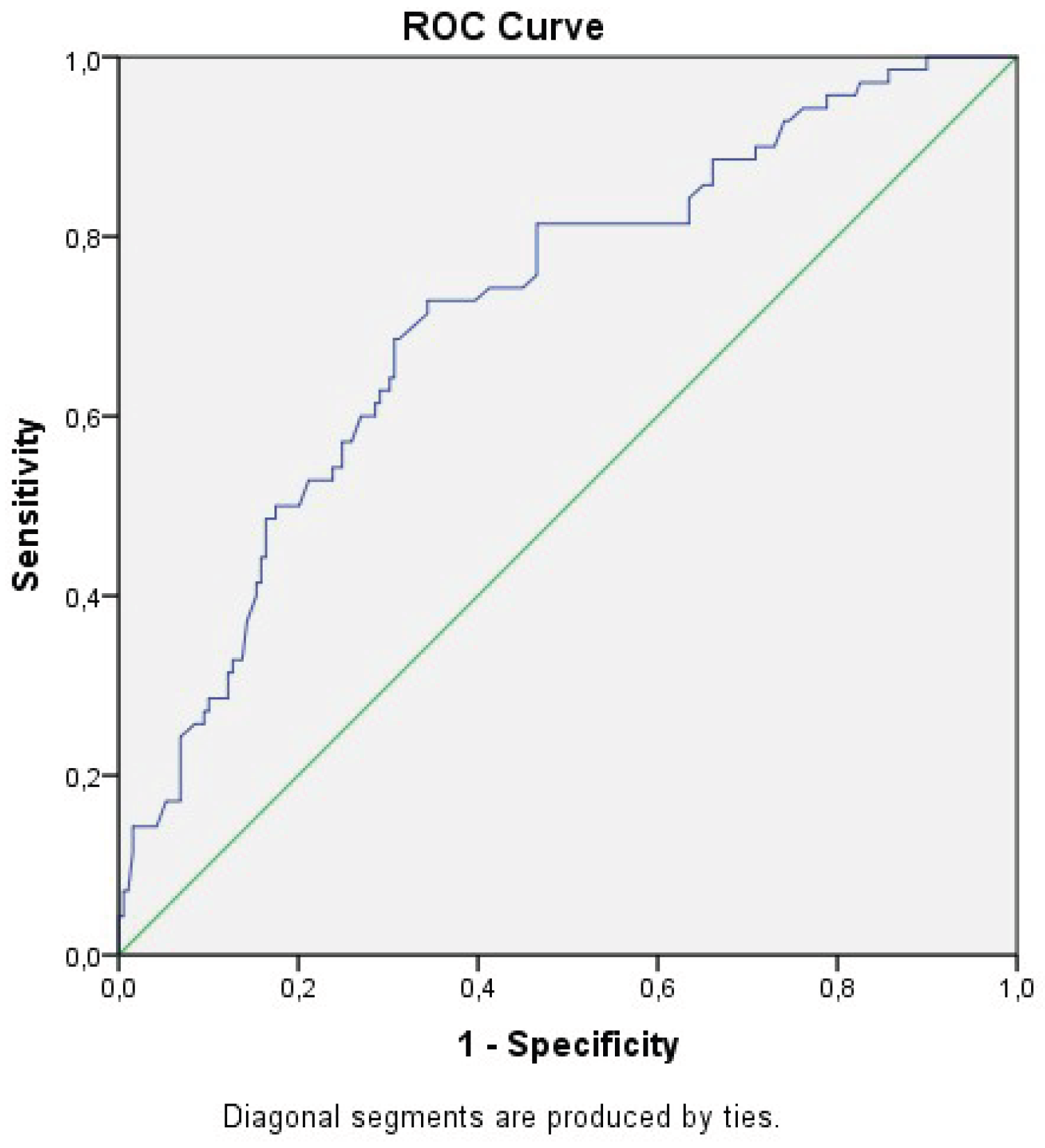

Table 1.
Monetary Amounts of Informal Payments (“Fakelaki”) Requested and Paid.
| Monetary Amount of Informal Payment (“Fakelaki”) Requested and Paid |
Frequency | Frequency % | Cumulative Percent % | |
|---|---|---|---|---|
| Valid values | No “fakelaki” was requested | 1512 | 73,0 | 73,0 |
| I paid “fakelaki” of up to €400 | 224 | 10,8 | 83,8 | |
| I paid “fakelaki” of €401–€600 | 88 | 4,2 | 88,0 | |
| I paid “fakelaki” of €600–€1,200 | 160 | 7,7 | 95,7 | |
| I paid “fakelaki” of over €1,200 | 88 | 4,2 | 100,0 | |
| Total | 2072 | 100,0 | ||
Source: Survey data (2023), SPSS statistical analysis.
Table 2.
Source of funds for informal payments (“fakelaki”).
| Sources of funds for informal (‘under-the-table’) payments | Frequency | Frequency % | Cumulative Percent % | ||
|---|---|---|---|---|---|
| Valid values | From personal income | 384 | 57,8 | 57,8 | |
| From savings | 224 | 33,8 | 91,6 | ||
| From the sale of assets | 16 | 2,4 | 94,0 | ||
| From financial support provided by friends and relatives | 24 | 3,6 | 97,6 | ||
| From a bank loan | 16 | 2,4 | 100,0 | ||
| Total | 664* | 100,0 | |||
* Valid value. Source: Survey data (2023), SPSS statistical analysis.
Table 3.
When was the informal payment (“fakelaki”) requested for services provided by a public healthcare unit?
Table 3.
When was the informal payment (“fakelaki”) requested for services provided by a public healthcare unit?
| When was an informal (‘under-the-table’) payment requested for the provision of healthcare services? |
Frequency | Frequency % | Cumulative Percent % | |
|---|---|---|---|---|
| Valid values | Before the provision of healthcare services | 264 | 40,7 | 40,7 |
| During the provision of healthcare services | 128 | 19,8 | 60,5 | |
| After the provision of healthcare services | 256 | 39,5 | 100,0 | |
| Total | 648* | 100,0 | ||
* Valid value. Source: Survey data (2023), SPSS statistical analysis.
Table 4.
Final recipient of informal payments (“fakelaki”).
| Final recipient of the informal (‘under-the-table’) payment |
Frequency | Frequency % | Cumulative Percent % | |
|---|---|---|---|---|
| Valid values | Doctor | 568 | 85,5 | 85,5 |
| Nurse | 40 | 6,0 | 91,5 | |
| Administrative staff | 24 | 3,6 | 95,1 | |
| Orderly | 16 | 2,4 | 97,5 | |
| Other | 16 | 2,4 | 100,0 | |
| Total | 664* | 100,0 | ||
* Valid value. Source: Survey data (2023), SPSS statistical analysis.
Table 5.
Satisfaction with healthcare services provided.
| Satisfaction level | Frequency | Frequency % | Cumulative Percent % | |
|---|---|---|---|---|
| Valid values | Yes | 696 | 33,6 | 33,6 |
| No | 1376 | 66,4 | 100,0 | |
| Total | 2072 | 100,0 | ||
Source: Survey data (2023), SPSS statistical analysis.
Table 6.
Main reason respondents hesitated to visit a public healthcare facility.
| What was the main reason respondents hesitated to visit a public healthcare facility? | Frequency | Frequency % | Cumulative Percent % | ||
|---|---|---|---|---|---|
| Valid values | No reason | 720 | 34,7 | 34,7 | |
| Delays in the provision of healthcare services | 376 | 18,1 | 52,8 | ||
| Difficulties in accessing healthcare services | 144 | 6,9 | 59,7 | ||
| Required healthcare services are not available in my area | 400 | 19,3 | 79,0 | ||
| The provided healthcare services are ineffective | 296 | 14,3 | 93,3 | ||
| Denial of access to healthcare services | 136 | 6,6 | 100,0 | ||
| Total | 2072 | 100,0 | |||
Source: Survey data (2023), SPSS statistical analysis.
Table 7.
Reasons for delayed service in a public healthcare facility.
| Causes of delays | Frequency | Frequency % | Cumulative Percent % | |
|---|---|---|---|---|
| Valid values | Lack of staff and medical specialties | 944 | 45,6 | 45,6 |
| Lack of staff training and education | 168 | 8,1 | 53,7 | |
| Workload – waiting lists | 608 | 29,3 | 83,0 | |
| Healthcare needs in my geographical area are not adequately met | 184 | 8,9 | 91,9 | |
| The provided healthcare services are not effective | 168 | 8,1 | 100,0 | |
| Total | 2072 | 100,0 | ||
Source: Survey data (2023), SPSS statistical analysis.
Table 8.
Reasons for paying informal (‘under-the-table’) payments.
| Reason for providing money | Frequency | Frequency % | Cumulative Percent % | |
|---|---|---|---|---|
| Valid values | I would never give an informal (‘under-the-table’) payment | 704 | 34,0 | 34,0 |
| To gain access | 312 | 15,1 | 49,1 | |
| To receive healthcare services more promptly | 496 | 23,9 | 73,0 | |
| For better quality healthcare services | 560 | 27,0 | 100,0 | |
| Total | 2072 | 100,0 | ||
Source: Survey data (2023), SPSS statistical analysis.
Table 9.
Respondents’ views on the adequacy of state mechanisms to combat informal payments.
| Perceptions of the adequacy of the anti-corruption system | Frequency | Frequency % | Cumulative Percent % | |
|---|---|---|---|---|
| Valid values | No, not at all | 1472 | 71,0 | 71,0 |
| No, but significant actions are being taken | 384 | 18,5 | 89,5 | |
| Yes, but they could be more effective | 128 | 6,2 | 95,7 | |
| Yes, they are adequate | 88 | 4,2 | 100,0 | |
| Total | 2072 | 100,0 | ||
Source: Survey data (2023), SPSS statistical analysis.
Table 10.
Attitudes towards informal payments.
| Attitudes towards informal payments | Frequency | Frequency % | Cumulative Percent % | |
|---|---|---|---|---|
| Valid values | Strongly negative | 192 | 9,3 | 27,0 |
| Negative | 1136 | 54,8 | 81,9 | |
| Neutral | 368 | 17,8 | 17,8 | |
| Supportive, due to the low remuneration of physicians and nurses | 264 | 12,7 | 100,0 | |
| Supportive, for other reasons | 112 | 5,4 | 87,3 | |
| Total | 2072 | 100,0 | ||
Source: Survey data (2023), SPSS statistical analysis.
Table 11.
Distribution of respondents according to demographic and socio-economic characteristics.
| Variables and values | Ν | Ν % |
|---|---|---|
| Gender | ||
| Male | 840 | 40,5 |
| Female | 1232 | 59,5 |
| Age | ||
| Up to 35 years | 624 | 30,1 |
| 36–65 years | 1272 | 61,4 |
| 66 years and over | 176 | 8,5 |
| Place of Residence | ||
| Athens | 816 | 39,4 |
| Thessaloniki | 776 | 37,5 |
| Other city | 480 | 23,2 |
| Marital Status | ||
| Single | 568 | 27,4 |
| Married | 1224 | 59,1 |
| Divorced | 168 | 8,1 |
| Widowed | 56 | 2,7 |
| Other * | 56 | 2.7 |
| Household Size | ||
| 1 member | 256 | 12,4 |
| 2 members | 416 | 20,1 |
| 3 members | 640 | 30,9 |
| 4 or more members | 760 | 36,7 |
| Educational Level | ||
| No formal education | 32 | 1,5 |
| Primary education | 64 | 3,1 |
| Secondary education (lower–upper) ** | 712 | 34,4 |
| Higher education *** | 544 | 26,3 |
| Postgraduate–Doctoral degree | 720 | 34,7 |
| Monthly Income (EUR) | ||
| Up to 500 | 80 | 3,9 |
| 501–1,500 | 928 | 44,8 |
| 1,501–2,500 | 704 | 34,0 |
| 2,500 and above | 360 | 17,4 |
| Source of Income | ||
| Investments **** | 48 | 2,3 |
| Pension | 176 | 8,5 |
| Allowance/benefit | 104 | 5,0 |
| Passive income | 40 | 1,9 |
| Self-employment | 104 | 5,0 |
| Salary | 1600 | 77,2 |
| Occupation | ||
| Self-employed | 328 | 15,8 |
| Private sector employee | 696 | 33,6 |
| Public sector employee | 680 | 32,8 |
| Economically inactive | 368 | 17,8 |
| Economic Situation | ||
| Very poor | 32 | 1,5 |
| Poor | 136 | 6,6 |
| Moderate | 536 | 25,9 |
| Good | 1288 | 62,2 |
| Very good | 80 | 3,9 |
| Insurance Status | ||
| Social Security (EFKA) | 1480 | 71,4 |
| Private insurance | 176 | 8,5 |
| Uninsured | 56 | 2,7 |
| Other case ***** | 360 | 17,4 |
| Insured Family Members | ||
| No members | 192 | 9,3 |
| 1 member | 656 | 31,7 |
| 2 members | 656 | 31,7 |
| 3 members | 440 | 21,2 |
| 4 or more members | 128 | 6,2 |
* Cohabitation, long-term non-marital relationship, single-parent household, separated. ** Including vocational schools. *** Universities and Technological Educational Institutes (A.E.I.–T.E.I.). **** Income from real estate, stocks, interest, investments, and intellectual property rights. ***** Occupational or sectoral insurance (Bismarck-type system). Source: Survey data (2023), SPSS statistical analysis.
Table 12.
Chi-square (χ²) test results between informal payments and respondents’ characteristics.
| Variables | N | Χ2 | Degrees of freedom (df) | Statistical significance (p-value) |
|---|---|---|---|---|
| Informal payments * Gender | 2072 | 45,6 | 1 | 0,0 |
| Informal payments * Age | 2072 | 19,6 | 2 | 0,0 |
| Informal payments * Place of residence | 2072 | 36,4 | 2 | 0,0 |
| Informal payments * Marital status | 2072 | 23,4 | 4 | 0,0 |
| Informal payments * Household size | 2072 | 12,7 | 3 | 0,005 |
| Informal payments * Educational level | 2072 | 9,7 | 4 | 0,045 |
| Informal payments * Income | 2072 | 27,7 | 3 | 0,0 |
| Informal payments * Source of income | 2072 | 35,5 | 5 | 0,0 |
| Informal payments * Occupation | 2072 | 18,2 | 3 | 0,0 |
| Informal payments * Economic status | 2072 | 32,1 | 4 | 0,0 |
| Informal payments * Insurance status | 2072 | 12,6 | 3 | 0,006 |
| Informal payments * Number of insured family members | 2072 | 5,5 | 4 | not statistically significant |
Source: Survey data (2023), SPSS statistical analysis.
Table 13.
Logistic regression results of respondents’ characteristics on informal payments in public healthcare. Final Step 10.
Table 13.
Logistic regression results of respondents’ characteristics on informal payments in public healthcare. Final Step 10.
| b | S.E. | Wald | df | Sig. | Exp(b) | |
|---|---|---|---|---|---|---|
| Male (X1.1) | -,926 | ,134 | 47,590 | 1 | ,000 | ,396 |
| Female (X1.2) | 0 | - | - | - | - | 1,000 |
| Age (Χ2) | 22,973 | 2 | ,000 | |||
| Up to 35 years (X2.1) | -1,177 | ,340 | 11,991 | 1 | ,001 | ,308 |
| 36–65 years (X2.2) | -,459 | ,311 | 2,183 | 1 | ,140 | ,632 |
| 66 years and over (X2.3) | 0 | - | - | - | - | 1,000 |
| Place of residence (X3) | 29,017 | 2 | ,000 | |||
| Athens (X3.1) | ,881 | ,164 | 28,830 | 1 | ,000 | 2,414 |
| Thessaloniki (X3.2) | ,542 | ,175 | 9,645 | 1 | ,002 | 1,720 |
| Other city (X3.3) | 0 | - | - | - | - | 1,000 |
| Marital status (X4) | 11,049 | 4 | ,026 | |||
| Single (X4.1) | 1,037 | ,433 | 5,729 | 1 | ,017 | 2,820 |
| Married (X4.2) | 1,009 | ,418 | 5,813 | 1 | ,016 | 2,742 |
| Divorced (X4.3) | ,465 | ,475 | ,961 | 1 | ,327 | 1,592 |
| Widowed (X4.4) | 1,367 | ,546 | 6,258 | 1 | ,012 | 3,922 |
| Other (X4.5) | 0 | - | - | - | - | 1,000 |
| Household size (X5) | 10,533 | 3 | ,015 | |||
| 1 member (X5.1) | -,830 | ,280 | 8,803 | 1 | ,003 | ,436 |
| 2 members (X5.2) | ,141 | ,229 | ,381 | 1 | ,537 | 1,152 |
| 3 members (X5.3) | ,024 | ,148 | ,027 | 1 | ,870 | 1,024 |
| 4+ members (X5.4) | 0 | - | - | - | - | 1,000 |
| Income (X6) | 44,920 | 3 | ,000 | |||
| Up to €500 (X6.1) | -1,886 | ,712 | 7,010 | 1 | ,008 | ,152 |
| €501–€1,500 (X6.2) | ,975 | ,194 | 25,354 | 1 | ,000 | 2,652 |
| €1,501–€2,500 (X6.3) | ,549 | ,185 | 8,792 | 1 | ,003 | 1,732 |
| €2,501 and above (X6.4) | 0 | - | - | - | - | 1,000 |
| Source of income (X7) | 35,133 | 5 | ,000 | |||
| Investments (X7.1) | -18,832 | 4998,748 | ,000 | 1 | ,997 | ,000 |
| Pension (X7.2) | ,407 | ,299 | 1,851 | 1 | ,174 | 1,503 |
| Allowance/benefit (X7.3) | 3,041 | ,579 | 27,547 | 1 | ,000 | 20,917 |
| Passive income (X7.4) | 1,405 | ,616 | 5,206 | 1 | ,023 | 4,077 |
| Self-employment income (X7.5) | ,687 | ,235 | 8,538 | 1 | ,003 | 1,988 |
| Salary (dependent employment) (X7.6) | 0 | - | - | - | - | 1,000 |
| Economic status (X8) | 22,766 | 4 | ,000 | |||
| Very poor (X8.1) | -2,149 | ,626 | 11,776 | 1 | ,001 | ,117 |
| Poor (X8.2) | -,965 | ,412 | 5,480 | 1 | ,019 | ,381 |
| Moderate (X8.3) | -1,282 | ,317 | 16,352 | 1 | ,000 | ,277 |
| Good (X8.4) | -1,215 | ,282 | 18,576 | 1 | ,000 | ,297 |
| Very good (X8.5) | 0 | - | - | - | - | 1,000 |
| Insurance status (X9) | 19,244 | 3 | ,000 | |||
| Social insurance (EFKA) (X9.1) | -,185 | ,165 | 1,251 | 1 | ,263 | ,831 |
| Private insurance (X9.2) | ,722 | ,246 | 8,590 | 1 | ,003 | 2,058 |
| Uninsured (X9.3) | -,216 | ,542 | ,159 | 1 | ,690 | ,805 |
| Other (X9.4) | 0 | - | - | - | - | 1,000 |
| Insured family members (X10) | 30,522 | 4 | ,000 | |||
| None (X10.1) | -2,514 | ,487 | 26,638 | 1 | ,000 | ,081 |
| 1 member (X10.2) | -,499 | ,290 | 2,965 | 1 | ,085 | ,607 |
| 2 members (X10.3) | -,150 | ,282 | ,281 | 1 | ,596 | ,861 |
| 3 members (X10.4) | -,521 | ,273 | 3,639 | 1 | ,056 | ,594 |
| 4 members (X10.5) | 0 | - | - | - | - | 1,000 |
| Constant | -,598 | ,682 | ,770 | 1 | ,380 | ,550 |
Notes: a. Variable(s) entered in Step 1: Gender. b. Variable(s) entered in Step 2: Income. c. Variable(s) entered in Step 3: Source of income. d. Variable(s) entered in Step 4: Place of residence. e. Variable(s) entered in Step 5: Number of insured family members. f. Variable(s) entered in Step 6: Insurance status. g. Variable(s) entered in Step 7: Economic status. h. Variable(s) entered in Step 8: Age. i. Variable(s) entered in Step 9: Household size. j. Variable(s) entered in Step 10: Marital status. Source: Survey data, SPSS analysis.
Table 14.
Probability (%) of experiencing informal payments for individuals with specific characteristics.
Table 14.
Probability (%) of experiencing informal payments for individuals with specific characteristics.
| Characteristics associated with probability: | ||
|---|---|---|
| 10% | 50% | 65% |
| Male, aged 36–65, residing in a region other than Athens–Thessaloniki, single, with a two-member household, holding a Master’s/PhD degree, with an income of 1,501–2,500 euros (good economic status), employed as a private-sector salaried employee, insured under the Social Security Fund (EFKA), with two insured dependents. | Female, aged 36–65, residing in Thessaloniki, married, with a three-member household, holding a Master’s/PhD degree, with an income above 2,500 euros, reporting a very good economic status, employed as a salaried employee, covered by another type of insurance, with three insured family members. | Female, aged 36–65, residing in Athens, married, with a three-member household, holding a Master’s/PhD degree, with an income of 501–1,500 euros and a moderate economic status, self-employed professional, insured under the Social Security Fund (EFKA), with two insured family members. |
Source: Survey results, SPSS processing.
Disclaimer/Publisher’s Note: The statements, opinions and data contained in all publications are solely those of the individual author(s) and contributor(s) and not of MDPI and/or the editor(s). MDPI and/or the editor(s) disclaim responsibility for any injury to people or property resulting from any ideas, methods, instructions or products referred to in the content. |
© 2026 by the authors. Licensee MDPI, Basel, Switzerland. This article is an open access article distributed under the terms and conditions of the Creative Commons Attribution (CC BY) license (http://creativecommons.org/licenses/by/4.0/).
Copyright: This open access article is published under a Creative Commons CC BY 4.0 license, which permit the free download, distribution, and reuse, provided that the author and preprint are cited in any reuse.


