

Submitted:
08 June 2026
Posted:
09 June 2026
You are already at the latest version
Abstract
Backgruond: During adolescence, depression is a major concern due to its high prevalence and long-term impact on well-being. Effective intervention requires accurate assessment through culturally and linguistically adapted instruments with strong psychometric properties. Aims: This study aims to adapt and evaluate the metric properties of the Beck Depression Inventory (BDI-II) in the Moroccan context and to perform a cross-cultural Spain-Morocco analysis according to sex and age. Method: A total of 1,141 students, 514 residents in Spain and 627 in Morocco, aged between 14 and 19 years, completed the BDI-II and BASC-S3 questionnaires. Results: The Spanish and Moroccan versions of the BDI-II showed adequate metric properties and invariance across gender and age within and between countries. Intra-country comparisons revealed that in Spain there were only sex differences in somatic-vegetative symptomatology, whereas in Morocco these differences by sex were only found in cognitive-affective symptomatology. No differences were observed according to age. Cross-country comparison showed differences between Spain and Morocco in both types of symptoms. Conclusions: The use of this adaptation of the BDI-II will favour more accurate assessments in Moroccan and Spanish adolescents. Understanding cultural differences in the manifestation of depressive symptomatology will help to improve their psychological care.
Keywords:
adolescence
; depression
; BDI-II
; cross-cultural study
; factorial invariance
1. Introduction
Adolescence is characterised by the occurrence of multiple individual and new and more complex social dynamics (Viejo y Ortega-Ruiz, 2015). Adaptation to these changes and the performance of new tasks is an important source of opportunities, but also of difficulties, which, if not properly managed, can increase the risk of suffering from maladjustments at this stage. In this context, depression emerges as a particularly relevant and concerning disorder (Garaigordobil et al., 2023) due to its high prevalence and profound, long-lasting impact on health and well-being, especially considering that, according to the World Health Organization (2025), depressive disorders affect approximately 1.3% of adolescents aged 10–14 years and 3.4% of those aged 15–19 years worldwide.
Although there has been considerable interest in recent decades in the study of cross-cultural variations in the epidemiology of depression, we still know little about the nature of depression and variations in its frequency and manifestations in different cultures (Birtel y Mitchell, 2023; Xiang et al., 2024). Several studies have found that industrialised countries have more cognitive-affective symptomatology while developing countries have more somatic-vegetative symptomatology. More specifically, less somatic symptomatology has been found in the North American or European population than in the Latin American (Guerrero, 2014; Koenig et al., 2021), Arab (Dardas et al., 2016; Sulaiman et al., 2003) and Eastern (Chang et al., 2017; Koenig et al., 2021; Stewart et al., 2004) population. Although there are also studies that contradict these results both in the East (Kim et al., 2021) and in Africa (De la Torre-Luque et al., 2020).
In addition to this lack of consistency in findings, there is a major gap in the scientific literature examining the phenomenon of cross-cultural differences in depressive symptomatology: most studies have been based on clinical samples of adults, so there is very little information on cross-cultural patterns in the normal adolescent population.
Depression during adolescence has unique characteristics that differentiate it from depression in other age groups. During this developmental stage, signs of depression can be difficult to detect because adolescents may express symptoms differently from adults. They may be irritable, experience changes in appetite or sleep, lose interest in activities they previously enjoyed, or present recurrent physical complaints with no apparent medical cause. Although these symptoms may also occur in adults with depression, in adolescents they are often mistaken for typical developmental or behavioural changes. As a result, these signs are frequently misunderstood or minimised (Garaigordobil et al., 2023), delaying diagnosis and appropriate intervention. This is particularly concerning given that the duration of untreated depressive illness is an important predictor of recurrence in adulthood and may increase the risk of suicide (Patton et al., 2014), making early detection essential (Pelkonen et al., 2008).
Therefore, the general objective of this study was to carry out a cross-cultural comparison of depressive symptomatology among adolescents born and residing in Spain and adolescents born and residing in Morocco. The Moroccan population was selected because Moroccans represent the largest immigrant population in Spain and one of the largest in Europe. Given the limited availability of assessment instruments with demonstrated validity for this population (El-Ammari et al., 2023), the first specific objective was to linguistically and culturally adapt the Beck Depression Inventory-II (BDI-II), one of the most widely used depression measures internationally, to the Moroccan context (French and Arabic versions) and to analyse its psychometric properties in a sample of Moroccan adolescents living in Morocco. The second objective was to compare adolescents from Spain and Morocco, two geographically close but culturally distinct contexts, through structural equation modelling and prevalence analyses. Ultimately, this study aims to contribute to more appropriate psychological care by promoting accurate assessment free from language barriers and sensitive to the cultural differences between countries of origin and destination.
2. Methods
2.1. Research Design
This was a descriptive, correlational, and cross-sectional study approved by the Ethics Committee of the University of the Basque Country (UPV/EHU; reference number: M10_2018_185).
2.2. Sample and Sampling
The study was cross-cultural and multicentre in nature. A non-probabilistic convenience sampling strategy was used and conducted in two stages, first in Spain and subsequently in Morocco. Schools were selected to ensure heterogeneity in terms of school type (public, publicly subsidised, and private) and geographical context (provincial capitals and smaller towns). Educational centres were contacted based on their accessibility and willingness to participate in the study.
All provisions of the General Personal Data Protection Regulation (EU) 2016/679 were complied with, i.e. the personal data obtained by completing the battery of instruments were processed with the consent of each participant, school management and family members, and for the sole purpose of scientific promotion and dissemination.
A total of 1,141 students participated, 514 residents in Spain, from 4 different educational centres, and 627 in Morocco, from 5 centres, aged between 14 and 19 years (M = 16.09; SD = 1.45) (see Table 1). Most participants (93.2%) came from urban environments, and the majority were classified as having a medium-high socioeconomic status based on the sociodemographic information collected during the study.
2.3. Instruments
A booklet was generated in which 3 questionnaires were included:
- Ad hoc questionnaire assessing sociodemographic and school-related characteristics (e.g., sex, age, place of residence, type of school, and participants’ and parents’ place of birth).
- BDI-II. Beck Depression Inventory (Beck, Steer, y Brown, 1996) in its Spanish version (Sanz et al., 2003). It is a self-report questionnaire that consists of 21 items in which the severity of each symptom during the previous two weeks is assessed on a descriptive scale of four options (0-3); the higher the score, the greater the severity. For its correction, all the answers that have been marked are added together. For interpretation, scores between 0 and 13 indicate minimal depressive symptomatology, between 14 and 19 mild symptomatology, between 20 and 28 moderate symptomatology and above 29, severe symptomatology. It is completed in 5- 10 min. It has shown good psychometric properties in Spanish, Chilean, Mexican and American adolescents.
- Depression subscale of the Behavioural Assessment System for Children and Adolescents (BASC-3S) (Reynolds y Kamphaus, 1992) in its Spanish adaptation (González et al., 2004). It consists of 185 true or false statements (0-1) grouped
into 14 scales and 3 global dimensions: personal adjustment, clinical maladjustment and school maladjustment. It takes 30-45 minutes to complete. It has shown adequate psychometric properties in Spanish, Basque and Persian samples.
2.4. Procedure
Following the guidelines of the International Test Commission (ITC, 2017), the intellectual property rights of the questionnaires have been checked and the process of linguistic, conceptual and cultural adaptation has been carried out entirely in Morocco in 3 steps:
1) Linguistic adaptation of the instruments: A bilingual Moroccan translator with experience in education produced the first version of the instruments in French and Moroccan Arabic. A second translator validated them following a back-translation procedure. Similarities and discrepancies are assessed taking into account Hambleton and Zenisky's (2011) checklist for the quality control of the translation-adaptation of the items.
2) Adaptation to the cultural context: This was done by expert judgement in a multidisciplinary committee consisting of a methodologist, three teachers, a head teacher and a mother. The relevance of the content of the tests and their local comprehensibility were assessed.
3) Analysis of metric properties: This involved the layout and paper-based administration of the instruments, contact with schools and approval of participation, group data collection in classrooms during school hours and always in the presence of the main researcher, as well as quality control, data entry, and data analysis.
2.5. Data Analysis
Initially, an analysis was carried out to assess the presence and type of missing and outliers.
The metric properties of the instruments were then evaluated in the samples of interest. In order to obtain a first approach to the behaviour of each of the items, descriptive statistics were calculated (% ground, % ceiling, mean and its 95% confidence interval, standard deviation, skewness, kurtosis and homogeneity index). Secondly, the relationships between the test items and their agreement with the theoretical model used in their construction were analysed by means of confirmatory factor analysis using the weighted least squares robust mean and variance adjusted (WLSMV) estimation method, which is suitable for ordinal variables with few categories, reliable with small samples and robust to non-normality. The assessment of the fit of the models to the data was based on the value of the chi-square/df ratio (2 /df), together with information provided by the incremental goodness-of-fit index (CFI), the root mean squared error of approximation (RMSEA) and its standardisation (SRMS). Models with values equal to or less than 5 in the ratio2/df, equal to or greater than .90 in CFI and equal to or less than .08 in RMSEA and SRMS (Tabachnick y Fidell, 2005) were considered acceptable. To obtain evidence of external convergence validity, the association with scores on the BASC-3S Depression scale was analysed using Spearman's correlation coefficient (r). Ordinal alpha (αo) and McDonald's omega (ω) reliability coefficients were also calculated for each dimension, thus providing indicators of the internal consistency of the scores in the two language versions. The minimum value considered good is .70 for both indicators.
Finally, the description of the questionnaire scores based on the dimensionality found and the analysis of possible cross-cultural differences were done in two steps. In a first step, a stepwise invariance analysis of the instruments between the groups (by gender, age and country) was carried out taking into account their ordinal nature (Tse et al., 2023). As an acceptance criterion for metric, scalar and strict invariance models we used the variation in fit indices, i.e. the change in CFI (CFI1 - CFI2 < .01), in RMSEA (RMSEA2 - RMSEA1 < .015), and in SRMR (SRMR2 - SRMR1 < .030) between nested models (Cheung y Rensvold, 2002). In a second step, differences in latent mean scores derived from the above models were calculated as a function of country and other socio-demographic characteristics. Effect sizes were assessed using Cohen's d parameter, splitting the latent mean difference by the pooled standard deviation across countries (Hong et al., 2003), according to the procedure described by Hancock (2001). Values lower than 0.20 were considered small, while values higher than 0.8 were considered large differences, resulting in Cohen's values in the interval [0.2, 0.8] judged as moderate (Cohen, 1988). The Spanish sample was set as the reference group, so its latent mean values were set to zero.
The analyses were carried out in the R environment (R Development Core Team, 2022).
3. Results
3.1. Adaptation Process
The linguistic adaptation to the Moroccan context was carried out through translation, back-translation, and expert review procedures. During the cultural adaptation stage, a multidisciplinary committee composed of researchers, educational professionals, and a parents’ representative evaluated the appropriateness of the questionnaire items for administration in the Moroccan school context. Following this review, the items referring to suicidal thoughts and loss of sexual interest were removed from the Moroccan French and Arabic versions due to concerns about their cultural and contextual acceptability in school settings. This decision was not based on assumptions regarding religious affiliation, but rather on recommendations aimed at facilitating the implementation of the assessment in the participating educational centres and ensuring adolescents’ and families’ acceptance of the instrument. The adapted bilingual version used in this study can be found in Appendix 1.
3.2. Psychometric Properties of the Beck Depression Inventory-II (BDI-II) in Spain and Morocco
Despite the presence of missing values, these did not exceed 10% of the cases in any item and did not follow a defined pattern. It was therefore decided not to use imputation procedures to replace them.
Table 2 shows the formal description of each of the items that make up the final questionnaire in Spain and Morocco. In both countries the averages are well below the theoretical mean of 1.5 points in all items and the skewness and kurtosis statistics, together with the presence of a floor effect, report a distribution of scores with a tendency to accumulate in the low scores (asymptomatic pole). All items showed homogeneity indices equal to or above the accepted minimum.
When the internal structure of the questionnaire was tested, both in Spain and Morocco, the model that showed the best results was the one with two highly correlated factors (as opposed to the unidimensional and the two-dimensional with a second order factor) with values of the ratio2 /df below 2, in CFI above 0.95, in RMSEA below .05 and in SRMR at .08. The associations between Cognitive-affective and Somatic- vegetative symptomatology were positive and high. See Figure 1 for more details.
Associations between scores on the Cognitive-Affective and Somatic-Vegetative symptomatology dimensions of the BDI-II and the BASC-3S depression dimension were positive, moderate and statistically significant in Spain (rCA = .73, p < .001; rSV = .51; p < .001) and Morocco (rCA = .64, p < .001; rSV = .52; p < .001).
In terms of reliability, internal consistency was found to be very high for both Cognitive-Affective and Somatic-Vegetative symptoms in both countries, exceeding .70 for all coefficients.
3.3. Cross-Country Differences in Cognitive-Affective and Somatic-Vegetative Symptom Dimensions
Regarding subgroup differences, the analysis started with the preliminary study of stepwise invariance, with scalar invariance being the minimum requirement to be able to compare means (latent and observed).
In the case of Spain, the fit indices obtained (Table 3) allowed us to accept the equivalence of the measurement model between sexes. Adding restrictions to the regression coefficients, the values listed in the table and the differences between ꭓ2 (Δꭓ2= 31.05, p = .014), CFI (ΔCFI = -.009), RMSEA (ΔRMSEA = .008) and SRMR (ΔSRMR= .024) led us to accept the metric invariance model, which allowed us to assess the equivalence between the values of the intercepts. The values obtained allowed us to accept the scalar invariance (Δꭓ2 = 35.64, p <.001, ΔCFI = -.012, ΔRMSEA = .003, ΔSRMR = .002) and test for strict invariance by adding restrictions on the residuals, which was also satisfied (Δꭓ2 = 21.9, p = .010, ΔCFI = -.015, ΔRMSEA = -.001, ΔSRMR= .017). Something similar occurred with the analyses as a function of age range, which allowed us to conclude the fulfilment of the configural invariance, metric (Δꭓ2 =-20.94, p = .369; ΔCFI = -.001, ΔRMSEA = .001, ΔSRMR = .016), scalar (Δꭓ2 = 20.04, p= .115, ΔCFI = -.006, ΔRMSEA = .000, ΔSRMR = .001) and strict (Δꭓ2 = 16.65, p =.454, ΔCFI = -.005, ΔRMSEA = .000, ΔSRMR = .007).
For Morocco, the fit indices (Table 3) allowed us to accept the strict equivalence of the model between sexes (metric: Δꭓ2 = -0.54, p = .277, ΔCFI = .016, ΔRMSEA =.001, ΔSRMR = .007; scalar: Δꭓ2 = 30.30, p < .001, ΔCFI = .001, ΔRMSEA = -.002, ΔSRMR = .001 and strict: Δꭓ2 = -93.88, p < .005, ΔCFI = - .009, ΔRMSEA = .002, ΔSRMR = .006). Strict invariance as a function of age range was also found (metric: Δꭓ2 = 36.05, p = .320, ΔCFI = -.009, ΔRMSEA = .008, ΔSRMR = .024; scalar: Δꭓ2 = 35.64, p = .019; ΔCFI = -.012, ΔRMSEA = .003, ΔSRMR = .002 and strict: Δꭓ2 = 35.52, p = .296, ΔCFI = -.015, ΔRMSEA = -.001, ΔSRMR = .017).
Cross-country invariance analyses yielded fit indices that made it possible to accept strong or scalar invariance (metric: Δꭓ2 = 4.85, p = .396, ΔCFI = -.009, ΔRMSEA = .007, ΔSRMR = .012; scalar: Δꭓ2 = 199.82, p < .001, ΔCFI = -.010, ΔRMSEA = .015, ΔSRMR = .012) but not strict (Δꭓ2 = 610.26, p < .001, ΔCFI = -.114, ΔRMSEA = -.032, ΔSRMR = .065).
These findings indicated that comparisons by gender, age group and between countries were feasible.
In Spain, there were no statistically significant sex differences in Cognitive- affective symptomatology (∆M = 0.07; ∆SEM = 0.03; Z = 1.96; p = .050), but there were significant differences in Somatic-vegetative symptomatology, which was higher among women (∆M = 0.15; ∆SEM = 0.05; Z = 3.11; p = .002), as can be seen in Table 4. There were no significant differences according to age range in Cognitive-affective symptomatology (∆M = 0.03; ∆SEM = 0.04; Z = 0.79; p = .430) or Somatic-vegetative symptomatology (∆M = 0.03; ∆SEM = 0.05; Z = 0.68; p = .498) either when attending to the sex*age range interaction. Somatic-vegetative symptomatology was significantly higher than Cognitive-affective symptomatology (∆M = 0.17; ∆SEM = 0.05; Z = 3.65; p< .001).
However, in Morocco, Cognitive-affective symptomatology was significantly higher among girls (∆M = 0.24; ∆SEM = 0.10; Z = 2.47; p = .013) but there were no significant sex differences in Somatic-vegetative symptomatology (∆M = 0.15; ∆SEM = 0.09; Z = 1.58; p = .114). There were also no differences due to age in Cognitive- affective (∆M = 0.16; ∆SEM = 0.09; Z = 1.66; p = .096) or Somatic-vegetative (∆M = 0.10; ∆SEM = 0.09; Z = 1.06; p = .276) symptomatology. There were no differences as a function of the sex*age range interaction or between Cognitive-affective and Somatic- vegetative symptomatology (∆M = 0.04; ∆SEM = 0.02; Z = 0.41; p = .168).
The cross-country comparison yielded large differences between Spain and Morocco in Cognitive-affective (∆M = 0.59; ∆SEM = 0.05; Z = 12.19; p < .001) and Somatic-vegetative (∆M = 0.45; ∆SEM = 0.05; Z = 9.05; p < .001) symptomatology, with Moroccan adolescents showing greater distress. This translated into a higher prevalence of adolescents at the highest levels of depressive symptomatology in Morocco (2(3) = 157.97; p < .001; VCramer = .42). n Spain, the majority of participants (89.6%) reported minimal symptomatology, with only a small proportion (7.0%) exhibiting slight symptoms, and an even smaller percentage showing moderate (1.6%) or serious (1.8%) symptoms. In contrast, Morocco showed a different distribution, with a significantly lower percentage (54.2%) of participants reporting minimal symptoms. The proportions of participants experiencing slight (16.4%), moderate (21.3%), and serious (8.1%) symptoms were considerably higher in Morocco compared to Spain.
4. Discussion
Childhood and adolescent depression is not only an individual burden, but also a significant challenge for society as a whole. The negative effects of depression during these early stages of life may have long-term repercussions on academic performance, interpersonal relationships, physical health, and socio-emotional development in both affected individuals and their families (Clayborne et al., 2019).
The first step for an adequate intervention is to ensure a correct assessment using culturally and linguistically adapted instruments with good metric properties. The results showed a behaviour of the final 19-item inventory (after eliminating the items related to suicidal ideation and decreased sexual desire) similar to that found in the original version, showing an optimal fit to the two-dimensional model and high internal consistency in the Affective-cognitive and Somatic-vegetative symptomatology dementias, in the Spanish and Moroccan samples. These findings are in line with those found by other authors (Contreras-Valdez et al., 2015; Melipillán et al., 2008) and support the use of the questionnaire with metric guarantees; contributing to alleviate the scarcity of validated tools in the Moroccan adolescent population (El-Ammari et al., 2023) and to increase the cross-cultural projection of the BDI-II, favouring the standardisation of the assessment of depression in adolescence. Furthermore, the confirmation of factorial invariance allows us to assume the similarity in the attribution of meanings to symptomatology between groups and to carry out the comparisons necessary to achieve the second objective.
In both Spain and Morocco, more depressive symptomatology was found among women compared to men, with no significant differences according to age group. This is in line with different studies that have shown a preponderance of depression among women compared to their male counterparts (Lewis et al., 2015; Wartberg et al., 2018). In non-Western countries, such as Morocco, the differences may be exacerbated by the greater social pressure, cultural constraints and religious forces faced by young women compared to their male counterparts (Rohlinger et al., 2020).
In the comparison between countries, more cognitive-affective and somatic- vegetative symptomatology was found in Morocco than in Spain. This resulted in a higher percentage of adolescents with moderate (21.3% vs. 1.6%) and severe (8.1% vs. 1.8%) depressive symptomatology in Morocco than in Spain. These results are consistent with those reported by a study on Moroccan adolescents in which the prevalence of major depressive disorder was estimated to be 26.5% (Kadri et al., 2010). Studies in Spain, on the other hand, estimated a prevalence of between 2.3% (Jaureguizar et al., 2015) and 19.5% (Aláez-Fernandez et al., 2000) for adolescent depression.
These differences between countries could be influenced by a variety of factors, including socioeconomic, cultural, and access to health care (Gautam et al., 2019). In general, Spain has a higher level of economic development than Morocco, which could imply that the adolescent population has access to more resources and opportunities, which may help reduce the risk of depression. In addition, Spain may have greater public awareness of depression and other mental disorders, as well as a more developed health care system with more extensive educational programs aimed at prevention and treatment.
In line with these findings, it is worth noting that variation in the domain of somatization is considered one of the most consistent findings in cross-cultural studies of depression (Dardas et al., 2016). In particular, people from non-Western countries such as Eastern and Arab cultures report a greater emphasis on the somatic component while those from Western cultures emphasise the emotional or psychological aspects (Chang et al., 2017; Chang y Jetten, 2015; Dardas et al., 2016; Ryder et al., 2008; Sulaiman et al., 2003). In addition, the stigma of having a mental disorder exists in all Arab countries and is associated with significant negative effects on affected individuals and their families (Abdullah y Brown, 2011; Dardas et al., 2016) which may explain why people in this context are inclined to describe mental health problems as physical symptoms.
Therefore, although Spain and Morocco may share similar challenges in terms of adolescent mental health, the differences found alert us to the need to take into account the idiosyncrasies of each culture in order to develop more specific assessment and intervention tools with the aim of increasing their effectiveness.
Limitations
The main limitations are the possible lack of representativeness of the sample derived from the incidental sampling, which compromises the generalizability of the results, and the fact that the fit of the factor models was not investigated in adolescents from the clinical population diagnosed with any of the depressive disorders included in the DSM-5.5.
5. Conclusions
In response to the need identified by El-Ammari et al. (2023) to provide culturally adapted assessment tools for the Moroccan population, the present study offers a valid, reliable, and culturally adapted version of the Beck Depression Inventory-II (BDI-II) for assessing depressive symptoms among Moroccan adolescents. Additionally, the use of this tool in Spain without language barriers for the Moroccan immigrant population will favour more accurate assessments and equal access to psychological care, which will reduce health inequalities and help in their school and social adaptation.
Although depression is a widespread clinical mental health disorder, it is essential to consider cultural and social context, as understanding these differences can help design more effective preventive interventions and improve psychological assessment and care.
Author Contributions
All authors contributed to the conception and design of the study. Material and data preparation was carried out by JJ and EB in Spain and by PB in Morocco. PB did the statistical analysis and wrote the main text of the manuscript. JJ and EB reviewed and commented on the manuscript. All authors read and approved the final text.
Funding
This research received no external funding.
Institutional Review Board Statement
The study was conducted in accordance with the Declaration of Helsinki, and approved by the Ethics Committee of the University of the Basque Country (EHU) (reference number: M10_2018_185).
Informed Consent Statement
Informed consent was obtained from all subjects involved in the study.
Data Availability Statement
The corresponding authors hold the data sets generated and analyzed. during the study and are willing to share them upon request.
Conflicts of Interest
The authors declare no conflicts of interest.
Appendix A
Appendix 1. French and Arabic version for the Moroccan adolescent population
Veuillez lire avec soin chacun de ces groupes puis, dans chaque groupe, choisissez l'énoncé qui décrit le mieux comment vous vous êtes senti(e) au cours des deux dernières semaines, incluant aujourd'hui.
1. Tristesse
- ☐
- Je ne me sens pas triste.
- ☐
- Je me sens triste.
- ☐
- Je me sens perpétuellement triste et je n'arrive pas à m'en sortir.
- ☐
- Je suis si triste ou si découragé(e) que je ne peux plus le supporter.
2. Pessimisme
- ☐
- Je ne me sens pas particulièrement découragé(e) en pensant à l'avenir.
- ☐
- Je me sens découragé(e) en pensant à l'avenir.
- ☐
- Il me semble que je n'ai rien à attendre de l'avenir.
- ☐
- L'avenir est sans espoir et rien ne s'arrangera.
3. Échecs dans le passé
- ☐
- Je n'ai pas l'impression d'être une(e) raté(e).
- ☐
- Je crois avoir connu plus d'échecs que le reste des gens.
- ☐
- Lorsque je pense à ma vie passée, je ne vois que des échecs.
- ☐
- Je suis un(e) raté(e).
4. Perte de plaisir
- ☐
- Je tire autant de satisfaction de ma vie qu'autrefois.
- ☐
- Je ne jouis pas de la vie comme autrefois.
- ☐
- Je ne tire plus vraiment de satisfaction de la vie.
- ☐
- Tout m'ennuie, rien ne me satisfait.
5. Sentiments de culpabilité
- ☐
- Je ne me sens pas particulièrement coupable.
- ☐
- Je me sens coupable une grande partie du temps.
- ☐
- Je me sens vraiment coupable la plupart du temps.
- ☐
- Je me sens constamment coupable.
6. Sentiment d'être puni(e)
- ☐
- Je n'ai pas l'impression d'être puni(e).
- ☐
- J'ai l'impression d'être parfois puni(e).
- ☐
- Je m'attends à être puni(e).
- ☐
- Je sens parfaitement que je suis puni(e).
7. Sentiments négatifs envers soi-même
- ☐
- Je ne me sens pas déçu(e) de moi-même.
- ☐
- Je suis déçu(e) de moi-même.
- ☐
- Je suis dégoûté(e) de moi-même.
- ☐
- Je me hais.
8. Attitude critique envers soi
- ☐
- Je ne crois pas être pire que les autres.
- ☐
- Je critique mes propres faiblesses et défauts.
- ☐
- Je me blâme constamment de mes défauts.
- ☐
- Je suis à blâmer pour tout ce qui arrive de déplaisant.
9. Pleurs
- ☐
- Je ne pleure pas plus que d'habitude.
- ☐
- Je pleure plus qu'autrefois.
- ☐
- Je pleure constamment.
- ☐
- Autrefois, je pouvais pleurer, mais je n'en suis même plus capable aujourd'hui.
10. Irritabilité
- ☐
- Je ne suis pas plus irritable qu'autrefois.
- ☐
- Je suis légèrement plus irritable que d'habitude.
- ☐
- Je me sens agacé(e) et irrité(e) une bonne partie du temps.
- ☐
- Je suis constamment irrité(e) ces temps-ci.
11. Perte d'intérêt
- ☐
- Je n'ai pas perdu mon intérêt pour les autres.
- ☐
- Je m'intéresse moins aux gens qu'autrefois.
- ☐
- J'ai perdu la plus grande partie de mon intérêt pour les autres.
- ☐
- Les gens ne m'intéressent plus du tout.
12. Indécision
- ☐
- Je prends mes décisions exactement comme autrefois.
- ☐
- Je remets les décisions au lendemain beaucoup plus fréquemment qu'autrefois.
- ☐
- J'éprouve de grandes difficultés à prendre des décisions de nos jours.
- ☐
- Je suis incapable de prendre des décisions.
- ☐
- ?
13. Dévalorisation
- ☐
- Je pense être quelqu'un de valable.
- ☐
- Je ne crois pas avoir autant de valeur ni être aussi utile qu'avant.
- ☐
- Je me sens moins valable que les autres.
- ☐
- Je sens que je ne vaux absolument rien.
14. Perte d'énergie
- ☐
- J'ai toujours autant d'énergie qu'avant.
- ☐
- J'ai moins d'énergie qu'avant.
- ☐
- Je n'ai pas assez d'énergie pour pouvoir faire grand-chose.
- ☐
- J'ai trop peu d'énergie pour faire quoi que ce soit.
15. Modifications dans les habitudes de sommeil
- ☐
- Je dors aussi bien que d'habitude.
- ☐
- Je ne dors pas aussi bien que d'habitude.
- ☐
- Je me réveille une à deux heures plus tôt que d'habitude et j'ai du mal à me rendormir.
- ☐
- Je me réveille plusieurs heures plus tôt que d'habitude et ne parviens pas à me rendormir.
16. Fatigue
- ☐
- Je ne me sens pas plus fatigué(e) que d'habitude.
- ☐
- Je me fatigue plus vite qu'autrefois.
- ☐
- Un rien me fatigue.
- ☐
- Je suis trop fatigué(e) pour faire quoi que ce soit.
17. Modifications de l'appétit
- ☐
- Mon appétit n'a pas changé.
- ☐
- Mon appétit n'est pas aussi bon que d'habitude.
- ☐
- Mon appétit a beaucoup diminué.
- ☐
- Je n'ai plus d'appétit du tout.
18. Difficulté à se concentrer
- ☐
- Je parviens à me concentrer toujours aussi bien qu'avant.
- ☐
- Je ne parviens pas à me concentrer aussi bien que d'habitude.
- ☐
- J'ai du mal à me concentrer longtemps sur quoi que ce soit.
- ☐
- Je me trouve incapable de me concentrer sur quoi que ce soit.
19. Agitation
- ☐
- Je ne suis pas plus agité(e) ou plus tendu(e) que d'habitude.
- ☐
- Je me sens plus agité(e) ou plus tendu(e) que d'habitude.
- ☐
- Je suis si agité(e) ou tendu(e) que j'ai du mal à rester tranquille.
- ☐
- Je suis si agité(e) ou tendu(e) que je dois continuellement bouger ou faire quelque chose.
يرجى قراءة هذه المجموعة من الأسئلة بعناية، في كل مجموعة اختر الجواب الذي يصف حالتك في الأسبوعين الماضيين بما فيهم اليوم.
1- الحــزن
☐ لا أحس بالحزن
☐ أحس بالحزن
☐ أحس دائما بالحزن ولا أقدر التخلص منه
☐ أنا حزين جدا أو محبط جدا لدرجة أني لا أستطيع تحمله.
2- التشــاؤم
☐ لا أشعر بالإحباط بشكل خاص عند التفكير في المستقبل.
☐ أشعر بالإحباط عند التفكير في المستقبل.
☐ يبدو لي أنه ليس لدي ما أتوقعه من المستقبل
☐ المستقبل بدون أمل ولا شيء سيتحسن.
3 – الفشـل في الماضـي
☐ لا أشعر بأنني عديم القيمة
☐ أظن أنني عرفت ا لفشل أكثر من الآخرين
☐ عندما أرى حياتي الماضية، لا أرى إلا الفشل.
☐ أنا فاشل.
4- فقــدان المتعـة
☐ أشعر بالرضا عن حياتي كما في السابق.
☐ لا أتمتع بالحياة كما في السابق.
☐ لم أعد أشعر بالرضا عن الحياة
☐ كل شيء يزعجني، لا شيء يرضيني
5- الشعـور بالذنـب
☐ لا أشعر بالذنب بشكل خاص
☐ أشعر بالذنب أكثر الأوقات
☐ أشعر بالذنب معظم الوقت
☐ أشعر بالذنب باستمرار.
6- مشاعـر العـقـاب
☐ لا أحس بأنني معاقب
☐ أشعر أحيانا أنني معاقب
☐ أتوقع أن أتعاقب
☐ أشعر تماما بأنني أعاقب
7- مشاعر سلبية لنفسي
☐ لا أشعر بخيبة أمل مع نفسي
☐ أشعر بخيبة الأمل مع نفسي
☐ أشعر بالاشمئزاز من نفسي
☐ أكره نفسي
8- موقف نقدي تجاه النفس
☐ لا أشعر أنني أسوأ من الآخرين
☐ أنتقد ضعفي وأخطائي
☐ ألوم نفسي باستمرار على أخطائي
☐ أستحق اللوم على كل الأحداث السيئة.
9- البكــاء
☐ لا أبكي أكثر من اللزوم
☐ أبكي أكثر من الماضي
☐ أبكي باستمرار
☐ في الماضي، كنت أقدر على البكاء، لكن الآن لا أستطيع ذلك.
10- التهيـــج
☐ أنا لست أكثر سرعة الانفعال من ذي قبل.
☐ أنا سريع الانفعال أكثر من المعتاد
☐ أشعر بالانزعاج والغضب في كثير من الأحيان
☐ أنا غاضب باستمرار هذه الأيام
11- فقـدان الاهتمـام
☐ لم أفقد اهتمامي بالآخرين
☐ أهتم بالناس أقل من الماضي.
☐ افتقدت لقسط كبير من اهتمامي بالآخرين
☐ لا يهمني الناس قط
12- التــردد
☐ آخذ قراراتي كما السابق
☐ أترك قراراتي للغد أكثر من الماضي
☐ أحس بعجز على أخذ القرارات هذه الأيام
☐ لم أعد أقدر على أخذ القرارات
13- فقـدان القيمـة
☐ أعتقد أنني شخص جدير
☐ لا أعتقد أن لدي قيمة أو فائدة كما كانت من قبل.
☐ أشعر بأقل قيمة من الآخرين
☐ أشعر أن لا قيمة لي على الإطلاق
14- فقدان الطاقـة
☐ لدي طاقة كما من قبل
☐ لدي أقل طاقة من السابق
☐ ليس لدي ما يكفي من الطاقة لفعل أي شيء
☐ لدي قليل من الطاقة لفعل أي شيء.
15- تغيرات في عادات النوم
☐ أنام جيدا كالمعتاد
☐ لا أنام جيدا كالمعتاد
☐ أستيقظ ساعة أو ساعتين قبل المعتاد وأجد صعوبة في العودة للنوم
☐ أستيقظ ساعات قبل المعتاد ولا أقدر على العودة للنوم.
16- التعــب
☐ لا أشعر بالتعب أكثر من المعتاد
☐ أتعب بشكل أسرع من ذي قبل.
☐ أقل الأشياء تتعبني
☐ أنا متعب جدا لفعل أي شيء.
17- تغير الشهية
☐ شهيتي لم تتغير
☐ لم تعد شهيتي جيدة كما في السابق
☐ انخفضت شهيتي كثيرا
☐ ليس لدي شهية على الإطلاق
18- صعوبة في التركيز
☐ أقدر على التركيز الجيد كما في السابق
☐ لا أقدر على التركيز الجيد كما في السابق.
☐ أجد صعوبة في التركيز لفترة طويلة في أي شيء.
☐ لا أقدر على التركيز في أي شيء.
19 – الهيجــان
☐ أنا لست أكثر توثرا من المعتاد
☐ أشعر بالتوتر أكثر من المعتاد
☐ أن مضطرب ومتوتر للغاية لدرجة أنني أجد صعوبة في البقاء ساكنا.
☐ أنا مضطرب ومتوتر للغاية لدرجة أنني يجب أن أتحرك أو أفعل شيئا.
References
- Abdullah, T.; Brown, T. L. Mental illness stigma and ethnocultural beliefs, values, and norms: an integrative review. Clin. Psychol. Rev. 2011, 31(6), 934–948. [Google Scholar] [CrossRef]
- Aláez-Fernández, M.; Martínez-Arias, R.; Rodríguez-Sutil, C. Prevalencia de trastornos psicológicos en niños y adolescentes, su relación con la edad y el género. Psicothema 2000, 12(4), 525–532. [Google Scholar]
- Beck, A.T.; Steer, R.A.; Brown, G.K. Manual for the Beck Depression Inventory-II; Psychological Corporation: San Antonio, TX, 1996; Volume 1, p. 82. [Google Scholar]
- Birtel, M. D.; Mitchell, B. L. Cross-cultural differences in depression between White British and South Asians: Causal attributions, stigma by association, discriminatory potential. Psychol. Psychother. 2023, 96(1), 101–116. [Google Scholar] [CrossRef] [PubMed]
- Chang, M. X. L.; Jetten, J.; Cruwys, T.; Haslam, C. Cultural identity and the expression of depression: A social identity perspective. J. Community Appl. Soc. Psychol. 2017, 27(1), 16–34. [Google Scholar] [CrossRef]
- Chang, M. X. L.; Jetten, J. Understanding cultural identification: Integrating the intersubjective approach with social identity theorizing. J. Cross Cult. Psychol. 2015, 46(10), 1291–1295. [Google Scholar] [CrossRef]
- Cheung, G. W.; Rensvold, R. B. Evaluating goodness-of-fit indexes for testing measurement invariance. Struct. Equ. Model. 2002, 9, 233–255. [Google Scholar] [CrossRef]
- Clayborne, Z. M.; Varin, M.; Colman, I. Systematic review and meta-analysis: Adolescent depression and long-term psychosocial outcomes. J. Am. Acad. Child Adolesc. Psychiatry 2019, 58(1), 72–79. [Google Scholar] [CrossRef]
- Cohen, J. Statistical Power Analysis for the Behavioral Sciences, 2nd edn; Laurence Erlbaum Associates. Inc CIT0006: Hillsdale, NJ, 1988. [Google Scholar]
- Contreras-Valdez, J. A.; Hernández-Guzmán, L.; Freyre, M.-Á. Validez de constructo del Inventario de Depresión de Beck II para adolescentes. Ter. Psicológica 2015, 33(3), 195–203. [Google Scholar] [CrossRef]
- Dardas, L. A.; Bailey, D. E., Jr.; Simmons, L. A. Adolescent Depression in the Arab Region: A Systematic Literature Review. Issues Ment. Health Nurs. 2016, 37(8), 569–585. [Google Scholar] [CrossRef]
- De la Torre-Luque, A.; Ojagbemi, A.; Caballero, F. F.; Lara, E.; Moreno-Agostino, D.; Bello, T.; Ayuso-Mateos, J. L. Cross-cultural comparison of symptom networks in late life major depressive disorder: Yoruba Africans and the Spanish Population. Int. J. Geriatr. Psychiatry 2020. [Google Scholar] [CrossRef]
- El-Ammari, A.; El Malki, H.; Moutawakkil, S. G.; El Hilaly, J.; El Houari, F.; El Gnaoui, S.; Ragala, M. E. A.; El Rhazi, K.; Zarrouq, B. Validation of the Center for Epidemiologic Studies Depression Scale (CES-D) in a Moroccan sample with substance use disorder. BMC Psychiatry 2023, 23(1), 723. [Google Scholar] [CrossRef]
- Garaigordobil, M.; Bernaras, E.; Jaureguizar, J. Depresión infantojuvenil: evaluación, prevención y tratamiento, 2ª edición; Consejo General de la Psicología de España, 2023. [Google Scholar]
- Gautam, K.; Pedersen, G. A.; Wahid, S. S.; Kohrt, B.A. Chapter Five - Ethical considerations for conducting cross-cultural biological psychiatry and prevention research on depression among adolescents in low- and middle-income countries . In Developments in Neuroethics and Bioethics; Cratsley, K., Radden, J., Eds.; Academic Press, 2019; pp. 95–123. [Google Scholar]
- Guerrero, M. J. Diferencias culturales en la estructuración de la depresión según el género: un análisis transcultural en las poblaciones española y cubana. Tesis de doctorado; Universidad de Murcia: Digitum; Repositorio Institucional de la Universidad de Murcia, 2014; Available online: http://hdl.handle.net/10201/40888.
- González, J.; Fernández, S.; Pérez, E.; Santamaría, P. Adaptación española del sistema de evaluación de la conducta en niños y adolescentes: BASC; TEA Ediciones: Madrid, 2004. [Google Scholar]
- Hambleton, R. K.; Zenisky, A. L. Translating and adapting tests for cross-cultural assessments . In Culture and psychology. Cross-cultural research methods in psychology; Matsumoto, D., van de Vijver, y F. J. R., Eds.; Cambridge University Press: New York, NY, US, 2011; pp. 46–74. [Google Scholar]
- Hancock, G. R. Effect size, power, and sample size determination for structured means modeling and MIMIC approaches to between-groups hypothesis testing of means on a single latent construct. Psychometrika 2001, 66(3), 373–388. [Google Scholar] [CrossRef]
- Hong, S.; Malik, M. L.; Lee, M.-K. Testing configural, metric, scalar, and latent mean invariance across genders in sociotropy and autonomy using a nonWestern sample. Educ. Psychol. Meas. 2003, 63(4), 636–654. [Google Scholar] [CrossRef]
- International Test Commission. The ITC Guidelines for Translating and Adapting Tests (Second edition) . 2017. Available online: www.InTestCom.org.
- Jaureguizar, J.; Bernaras, E.; Soroa, M.; Sarasa, M.; Garaigordobil, M. Sintomatologia depresiva en adolescentes y variables asociadas al contexto escolar y clínico. Behav. Psychol./ Psicol. Conduct. 23 2015, 245–264. [Google Scholar]
- Kadri, N.; Agoub, M.; Assouab, F.; Tazi, M. A.; Didouh, A.; Stewart, R.; Paes, M.; Toufiq, J.; Moussaoui, D. Moroccan national study on prevalence of mental disorders: a community-based epidemiological study. Acta Psychiatr. Scand. 2010, 121(1), 71–74. [Google Scholar] [CrossRef] [PubMed]
- Kim, H.; Kim, K.; Kim, J. W. The Reliability and Validity of the Korean Version of the Mood and Feelings Questionnaire for Depression in Youth: A Cross-Cultural Perspective. Child Psychiatry Hum. Dev. 2021, 24 52, 399–408. [Google Scholar] [CrossRef] [PubMed]
- Koenig, L. R.; Blum, R.W.; Shervington, D.; Green, J.; Li, M.; Tabana, H.; Moreau, C. Unequal Gender Norms Are Related to Symptoms of Depression Among Young Adolescents: A Cross-Sectional, Cross-Cultural Study. J. Adolesc. Health 2021, 69(1), 47–55. [Google Scholar] [CrossRef]
- Lewis, A. J.; Kremer, P.; Douglas, K.; Toumborou, J. W.; Hameed, M. A.; Patton, G. C.; Williams, J. Gender differences in adolescent depression: Differential female susceptibility to stressors affecting family functioning. Aust. J. Psychol. 2015, 67(3), 131–139. [Google Scholar] [CrossRef]
- Melipillán, A. R.; Cova, S. F.; Rincón, G. P.; Valdivia, P. M. Propiedades psicométricas del Inventario de depresión de Beck-II en adolescentes chilenos. Ter. Psicológica 2008, 26, 59–69. [Google Scholar] [CrossRef]
- Patton, G.C.; Coffey, C.; Romaniuk, H.; Mackinnon, A.; Carlin, J.B.; Degenhardt, L.; et al. The prognosis of common mental disorders in adolescents: A 14-year prospective cohort study. Lancet 2014, 383(9926), 1404–1411. [Google Scholar] [CrossRef]
- Pelkonen, M.; Marttunen, M.; Kaprio, J.; Huurre, T.; Aro, H. Adolescent risk factors for episodic and persistent depression in adulthood. A 16-year prospective follow-up study of adolescents. J. Affect. Disord. 2008, 106, 123–131. [Google Scholar] [CrossRef]
- R Development Core Team. R: A Language and Environment for Statistical Computing; R Foundation for Statistical Computing: Viena, Austria, 2022; Available online: https://www.R-project.org/.
- Reynolds, C. R.; Kamphaus, R. W. Behavior Assessment System for Children: Manual; American Guidance Service: Circle Pines, MN, 1992. [Google Scholar]
- Rohlinger, D. A.; Olsen, A.; Hewitt, L. Dualing discourse: Democracy, gender equity and discursive politics in rural Morocco. Women's Stud. Int. Forum 2020, 81, 102373. [Google Scholar] [CrossRef]
- Ryder, A. G.; Yang, J.; Zhu, X.; Yao, S.; Yi, J.; Heine, S. J.; Bagby, R. M. The cultural shaping of depression: somatic symptoms in China, psychological symptoms in North America? J. Abnorm. Psychol. 2008, 117(2), 300–313. [Google Scholar] [CrossRef]
- Sanz, J.; Perdigón, A. L.; Vázquez, C. Adaptación española del Inventario para la Depresión de Beck-II (BDI-II): 2. Propiedades psicométricas en población general. Clínica Y Salud [en linea] 2003, 14(3), 249–280. Available online: https://www.redalyc.org/articulo.oa?id=180617972001.
- Stewart, S.; Kennard, B.; Lee, P.; Hughes, C.; Mayes, T.; Emslie, G.; Lewinsohn, P. A Cross-Cultural Investigation of Cognitions and Depressive Symptoms in Adolescents. J. Abnorm. Psychol. 2004, 113, 248–57. [Google Scholar] [CrossRef]
- Sulaiman, S.; Dinesh, B.; Silva, P. Síntomas de la depresión en mujeres de Dubai: Un estudio piloto. The Eur. J. Psychiatry (edición en español) 2003, 17(1), 22–32. [Google Scholar] [CrossRef]
- Tabachnick, B. G.; Fidell, L. S.; Ullman, J.B. Using Multivariate Statistics, 5th Edn ed; Pearson: Boston, MA, 2005. [Google Scholar]
- Tse, W.; Lai, M.; Zhang, Y. Does strict invariance matter? Valid group mean comparisons with ordered-categorical items. Behav. Res. Methods 2023. [Google Scholar] [CrossRef]
- Viejo Almanzor, C.; Ortega Ruiz, R. Cambios y riesgos asociados a la adolescencia. Psychol. Soc. Educ. 2015, 7(2), 109–118. [Google Scholar] [CrossRef]
- Wartberg, L.; Kriston, L.; Thomasius, R. Depressive Symptoms in Adolescents. Dtsch. Arztebl. Int. 2018, 115(33-34), 549–555. [Google Scholar] [CrossRef]
- World Health Organization. Mental health of adolescents. 2025. Available online: https://www.who.int/news-room/fact-sheets/detail/adolescent-mental-health.
- Xiang, Y.; Cao, R.; Li, X. Parental education level and adolescent depression: A multi-country meta-analysis. J. Affect. Disord. 2024, 347, 645–655. [Google Scholar] [CrossRef] [PubMed]
Figure 1.
Standardised factor steps for each of the items and fit indices in Spain and Morocco.
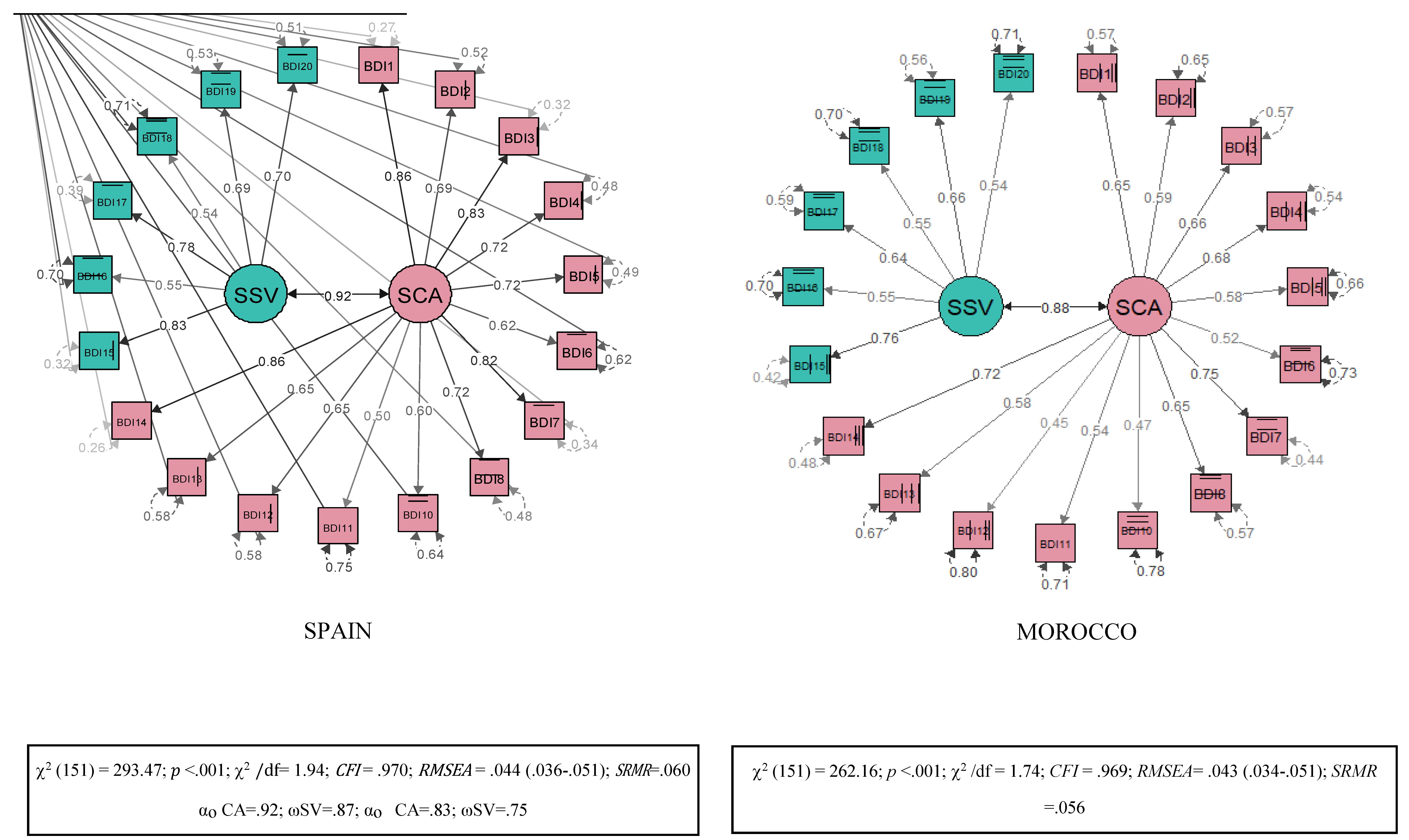

Table 1.
Characteristics of participants.
| Country | ||||
| Spain | Morocco | Total | ||
| Sex | ||||
| Woman | n (% country) | 306 (59.5) | 321 (51.2) | 627 (55.0) |
| Male | n (% country) | 208 (40.5) | 306 (48.8) | 514 (45.0) |
| Age | ||||
| 14 to 16 | n (% country) | 284 (55.3) | 420 (67.1) | 704 (61.7) |
| 17 to 18 | n (% country) | 230 (44.7) | 207 (32.9) | 437 (38.3) |
Table 2.
Descriptive statistics for each of the 19 items of the adapted version of the BDI-II to the Spanish/Moroccan adolescent population.
Table 2.
Descriptive statistics for each of the 19 items of the adapted version of the BDI-II to the Spanish/Moroccan adolescent population.
| Spain | Morocco | |||||||||||||
| Symptoms | %s | %t | M | DT | Thus | Curt | Hij | %s | %t | M | DT | Thus | Curt | Hij |
| Cognitive-affective | ||||||||||||||
| BDI1 Sadness | 90.1 | 0.2 | 0.13 | 0.42 | 3.55 | 13.11 | 0.64 | 54.4 | 9.7 | 0.73 | 0.99 | 1.18 | 0.20 | 0.59 |
| BDI2 Pessimism | 70.6 | 1.4 | 0.35 | 0.61 | 1.90 | 3.94 | 0.57 | 50.8 | 6.3 | 0.68 | 0.90 | 1.22 | 0.58 | 0.59 |
| BDI3 Feelings of failure | 86.0 | 0.4 | 0.17 | 0.45 | 3.04 | 10.25 | 0.62 | 55.1 | 4.4 | 0.67 | 0.93 | 1.10 | -0.07 | 0.62 |
| BDI4 Loss of pleasure | 87.0 | 0.4 | 0.15 | 0.43 | 3.18 | 11.62 | 0.53 | 48.0 | 9.8 | 0.85 | 1.04 | 0.95 | -0.36 | 0.63 |
| BDI5 Feelings of guilt | 72.8 | 0.6 | 0.29 | 0.50 | 1.76 | 3.94 | 0.56 | 54.0 | 7.8 | 0.67 | 0.97 | 1.24 | 0.31 | 0.45 |
| BDI6 Punitive or punitive feelings | 90.3 | 0.6 | 0.12 | 0.40 | 4.14 | 20.30 | 0.43 | 51.6 | 6.7 | 0.70 | 0.92 | 1.27 | 0.71 | 0.46 |
| BDI7 Dissatisfaction with self | 78.6 | 2.3 | 0.27 | 0.61 | 2.70 | 8.05 | 0.61 | 58.5 | 5.7 | 0.55 | 0.87 | 1.56 | 1.52 | 0.69 |
| BDI8 Self-criticism | 53.9 | 1.9 | 0.56 | 0.70 | 1.19 | 1.32 | 0.61 | 44.6 | 5.0 | 0.74 | 0.86 | 1.05 | 0.43 | 0.63 |
| BDI10 Crying | 78.6 | 1.8 | 0.27 | 0.60 | 2.53 | 6.85 | 0.47 | 46.9 | 15.3 | 0.99 | 1.15 | 0.71 | -1.02 | 0.45 |
| BDI11 Irritability | 67.7 | 1.6 | 0.38 | 0.63 | 1.79 | 3.54 | 0.40 | 46.5 | 6.8 | 0.75 | 0.99 | 1.05 | -0.14 | 0.40 |
| BDI12 Loss of interest | 77.6 | 0.2 | 0.24 | 0.46 | 1.72 | 2.01 | 0.48 | 42.6 | 11.0 | 0.91 | 1.06 | 0.91 | -0.45 | 0.45 |
| BDI13 Indecision | 73.5 | 1.9 | 0.32 | 0.62 | 2.24 | 5.64 | 0.50 | 46.7 | 6.7 | 0.80 | 0.99 | 0.88 | -0.53 | 0.50 |
| BDI14 Feelings of worthlessness | 91.8 | 0.6 | 0.13 | 0.46 | 3.97 | 15.73 | 0.58 | 59.5 | 7.0 | 0.58 | 0.97 | 1.43 | 0.62 | 0.70 |
% floor effect (%s), % ceiling effect (%t), arithmetic mean (M), standard deviation (SD), skewness (Asi.), kurtosis (Curt.) and corrected homogeneity index (Hij).
Table 3.
BDI-II factorial invariance fit indices by gender and age within and between countries.
| Model | χ2 | df | χ2/df | p | IFC | RMSEA (IC90%) | SRMR |
| Spain | |||||||
| Inv. Sex | |||||||
| Unrestricted | 353.30 | 302 | 1.17 | .022 | .988 | .022 (.009-.031) | .061 |
| Restricted weights | 389.35 | 319 | 1.22 | .004 | .979 | .030 (.018-.040) | .085 |
| Restricted intercepts | 424.99 | 336 | 1.26 | .001 | .967 | .033 (.022-.042) | .087 |
| Restricted waste | 446.89 | 355 | 1.26 | .001 | .952 | .032 (.022-.041) | .104 |
| Inv. Age group | |||||||
| Unrestricted | 377.09 | 302 | 1.25 | .002 | .998 | .025 (.016-.033) | .059 |
| Restricted weights | 356.15 | 319 | 1.12 | .074 | .997 | .026 (.000-.039) | .075 |
| Restricted intercepts | 376.19 | 336 | 1.12 | .065 | .989 | .026 (.000-.040) | .076 |
| Restricted waste | 392.84 | 355 | 1.11 | .081 | .984 | .026 (.000-.040) | .083 |
| Morocco | |||||||
| Inv. Sex | |||||||
| Unrestricted | 383.48 | 302 | 1.27 | .001 | .928 | .034 (.024-.047) | .059 |
| Restricted weights | 382.94 | 319 | 1.20 | .008 | .944 | .035 (.019-.048) | .066 |
| Restricted intercepts | 413.24 | 336 | 1.23 | .003 | .932 | .038 (.024-.050) | .069 |
| Restricted waste | 442.70 | 355 | 1.25 | .001 | .923 | .040 (.027-.052) | .075 |
| Inv. Age group | |||||||
| Unrestricted | 344.05 | 302 | 1.14 | .048 | .963 | .025 (.003-.037) | .055 |
| Restricted weights | 354.61 | 319 | 1.11 | .083 | .968 | .026 (.000-.041) | .061 |
| Restricted intercepts | 379.46 | 336 | 1.13 | .051 | .961 | .028 (.000-.042) | .063 |
| Restricted waste | 398.44 | 355 | 1.12 | .056 | .961 | 028 (.000-.042) | .066 |
| SPAIN-MOROCCO | |||||||
| Unrestricted | 460.13 | 302 | 1.52 | <.001 | .988 | .025 (.020-.030) | .044 |
| Restricted weights | 464.98 | 319 | 1.46 | <.001 | .979 | .032 (.025-.038) | .056 |
| Restricted intercepts | 664.80 | 336 | 1.98 | <.001 | .969 | .047 (.042-.052) | .068 |
| Restricted waste | 1275.06 | 355 | 3.59 | <.001 | .855 | .079 (.075-.084) | .133 |
Table 4.
Latent mean differences in cognitive-affective and somatic-vegetative depressive symptomatology according to sex and age within and between countries.
Table 4.
Latent mean differences in cognitive-affective and somatic-vegetative depressive symptomatology according to sex and age within and between countries.
| S. Cognitive-affective | S. Somatic-vegetative | |||
| M | SEM | M | SEM | |
| Spain | ||||
| Sex | ||||
| Women | 0.16 | 0.03 | 0.36 | 0.03 |
| Males | 0.09 | 0.03 | 0.21 | 0.03 |
| Age Group | ||||
| 14-16 Years | 0.12 | 0.02 | 0.29 | 0.03 |
| 17-18 Years | 0.15 | 0.03 | 0.32 | 0.04 |
| Total | 0.13 | 0.02 | 0.30 | 0.02 |
| Morocco | ||||
| Sex | ||||
| Women | 0.86 | 0.07 | 0.85 | 0.07 |
| Males | 0.62 | 0.10 | 0.70 | 0.07 |
| Age Group | ||||
| 14-16 Years | 0.79 | 0.06 | 0.81 | 0.06 |
| 17-18 Years | 0.63 | 0.07 | 0.71 | 0.07 |
| Total | 0.72 | 0.05 | 0.75 | 0.04 |
M=Latent Mean Estimated; SEM=Standard Error Latent Mean Estimated.
Disclaimer/Publisher’s Note: The statements, opinions and data contained in all publications are solely those of the individual author(s) and contributor(s) and not of MDPI and/or the editor(s). MDPI and/or the editor(s) disclaim responsibility for any injury to people or property resulting from any ideas, methods, instructions or products referred to in the content. |
© 2026 by the authors. Licensee MDPI, Basel, Switzerland. This article is an open access article distributed under the terms and conditions of the Creative Commons Attribution (CC BY) license (http://creativecommons.org/licenses/by/4.0/).
Copyright: This open access article is published under a Creative Commons CC BY 4.0 license, which permit the free download, distribution, and reuse, provided that the author and preprint are cited in any reuse.


