
Submitted:
07 June 2026
Posted:
10 June 2026
You are already at the latest version
Abstract
Academic stress represents a major challenge to university students’ wellbeing and is associated with both psychological and physiological consequences. Although dog-assisted interventions have shown promising effects in reducing stress and anxiety in higher education settings, methodological challenges remain regarding the integrated assessment of physiological responses. This study examined cardiovascular changes associated with dog-assisted university sessions and explored the usefulness of integrated cardiovascular indices for physiological stress monitoring. A quasi-experimental pre–post repeated-measures design was implemented within the StressLess program at the University of Granada. A total of 147 university students participated, generating 375 valid physiological records including systolic blood pressure, diastolic blood pressure, and heart rate measurements obtained before and after intervention sessions. Results revealed significant reductions in all cardiovascular variables following participation. Furthermore, the StressLess Cardiovascular Dynamics Index (SCDI) and alternative integrated cardiovascular formulations consistently detected physiological changes associated with the intervention, showing moderate-to-large effect sizes and high convergence among indices. The findings suggest that dog-assisted interventions may facilitate short-term physiological regulation in university students and that integrated cardiovascular approaches represent practical, non-invasive tools for stress assessment in real educational settings.
Keywords:
academic stress
; university students
; dog-assisted interventions
; animal-assisted interventions
; cardiovascular indices
; cardiovascular monitoring
; wellbeing
1. Introduction
1.1. Academic Stress and Dog-Assisted Interventions
Academic stress is one of the most prevalent challenges affecting university students worldwide and has been associated with a wide range of psychological, physiological, and academic consequences. Elevated stress levels have been linked to anxiety, emotional distress, reduced wellbeing, impaired academic performance, and an increased risk of academic disengagement and dropout (Beiter et al., 2015; Dyrbye et al., 2006; Pascoe et al., 2020; Stallman, 2010).
University students frequently experience periods of heightened stress associated with examinations, assignment deadlines, academic workload, financial concerns, and the transition to independent living. Although moderate levels of stress may contribute to motivation and adaptation, persistent or excessive stress can negatively affect both mental and physical health, making the promotion of student wellbeing an increasingly important priority for higher education institutions (Pascoe et al., 2020; Stallman, 2010).
In response to these concerns, universities have implemented a variety of wellbeing initiatives aimed at supporting students during periods of increased academic demand. Among these approaches, dog-assisted interventions have attracted growing attention due to their accessibility, positive acceptance among students, and potential capacity to reduce stress and anxiety in educational settings (Barker et al., 2016; Chute et al., 2023; Carr & Pendry, 2025; Sim et al., 2025).
Previous studies have reported beneficial effects of interactions with therapy dogs on perceived stress, mood, anxiety, and physiological indicators of stress among university students (Barker et al., 2016; Chute et al., 2023). Furthermore, systematic reviews and recent meta-analyses suggest that dog-assisted interventions may represent a valuable complementary strategy within broader university wellbeing programs (Sim et al., 2025). Nevertheless, despite the growing evidence supporting these interventions, important methodological challenges remain regarding the objective assessment of their physiological effects.
1.2. Physiological Assessment of Stress
The assessment of stress in university students has traditionally relied on self-report measures focused on perceived stress, anxiety, emotional wellbeing, and related psychological constructs. Although these instruments provide valuable information about subjective experiences, they do not always correspond closely to physiological responses associated with stress activation (Mauss et al., 2005).
From a psychophysiological perspective, stress involves coordinated changes across multiple biological systems, particularly the autonomic nervous system and the hypothalamic–pituitary–adrenal axis (McEwen, 1998). Among the physiological markers most frequently employed in stress research, blood pressure and heart rate have attracted considerable attention because they are non-invasive, inexpensive, and easily applicable in educational and community settings (Kim et al., 2018).
Stress-related cardiovascular responses are commonly reflected in increases in systolic blood pressure, diastolic blood pressure, and heart rate, which provide useful indicators of autonomic activation and physiological arousal. However, these variables capture partially different aspects of cardiovascular functioning and may exhibit distinct response patterns across individuals and situations (Mauss et al., 2005; Campbell & Ehlert, 2012). Consequently, the isolated interpretation of individual cardiovascular measures may not always provide a comprehensive representation of physiological stress responses.
These limitations have encouraged researchers to explore approaches capable of integrating multiple physiological signals in order to obtain more robust and informative indicators of stress and recovery processes. Such approaches are particularly relevant in applied contexts, where simple and practical methods are required to evaluate physiological changes associated with wellbeing interventions.
1.3. Integrated Cardiovascular Indicators
Recent developments in stress research have highlighted the growing importance of composite physiological indicators capable of integrating information from multiple biological measures. This perspective is consistent with multidimensional models of stress, such as allostatic load theory, which conceptualize physiological adaptation as the result of interactions among several biological systems rather than the activity of a single biomarker (Juster et al., 2010).
Recent reviews have further emphasized the potential value of combining physiological signals to improve the assessment of stress and recovery processes (Abd-Alrazaq et al., 2024; Li & Zhang, 2025). Integrated approaches may provide a more stable representation of physiological activation by reducing the influence of individual variability associated with isolated measures and by capturing broader patterns of cardiovascular response.
Several composite indicators have been proposed in the medical and physiological literature. Among the most widely used are mean arterial pressure (MAP), which combines systolic and diastolic blood pressure into a single estimate of circulatory load, and the rate-pressure product (RPP), an index reflecting the combined influence of blood pressure and heart rate on cardiovascular workload (Gobel et al., 1978). These approaches illustrate the broader methodological principle that integrated measures can provide additional information beyond that obtained from individual physiological variables considered separately.
Despite their potential advantages, integrated cardiovascular approaches remain relatively uncommon in educational and university wellbeing research. Most studies evaluating stress-reduction interventions continue to analyse blood pressure and heart rate independently, limiting the possibility of obtaining a unified representation of physiological responses.
In this context, the present study explores the usefulness of integrated cardiovascular indicators for monitoring physiological changes associated with dog-assisted university interventions. Rather than proposing a diagnostic tool, the aim is to examine whether different cardiovascular formulations can provide a practical and sensitive framework for summarising short-term physiological responses in real educational settings.
1.4. Objectives and Hypotheses
The present study had two complementary objectives. First, it aimed to examine short-term cardiovascular changes associated with participation in dog-assisted university interventions implemented within a real educational setting. Second, it sought to explore the usefulness of integrated cardiovascular indicators for monitoring physiological responses related to stress reduction.
To address these objectives, pre–post changes in systolic blood pressure (SBP), diastolic blood pressure (DBP), and heart rate (HR) were analysed following participation in sessions of the StressLess program. In addition, several integrated cardiovascular formulations were compared, including the StressLess Cardiovascular Dynamics Index (SCDI), a combined SBP + HR index, a MAP + HR index, and the rate-pressure product (RPP).
Based on previous evidence regarding the physiological effects of dog-assisted interventions and the potential value of integrated physiological approaches, the following hypotheses were proposed:
H1.
Participation in dog-assisted university sessions will be associated with significant reductions in cardiovascular indicators of physiological activation, including SBP, DBP, and HR.
H2.
Integrated cardiovascular indices will be sensitive to physiological changes associated with the intervention and will detect significant reductions between pre- and post-session measurements.
H3.
The different integrated cardiovascular formulations will show substantial convergence, reflecting a common underlying pattern of cardiovascular response associated with stress reduction.
By combining traditional cardiovascular measures with integrated physiological approaches, the study seeks to contribute both to the evaluation of dog-assisted interventions and to the development of practical methods for physiological stress monitoring in higher education contexts.
2. Materials and Methods
2.1. Study Design
A quasi-experimental pre–post repeated-measures design was employed to examine short-term physiological changes associated with participation in dog-assisted university interventions. The study was conducted within the framework of the StressLess program, a university wellbeing initiative implemented at the University of Granada to support students during periods of increased academic demand.
Physiological measurements were obtained immediately before and after each intervention session, allowing the assessment of cardiovascular changes associated with participation in the program. The design combined an applied objective, focused on evaluating the physiological effects of dog-assisted sessions, with a methodological objective aimed at exploring the usefulness of integrated cardiovascular indicators for stress monitoring.
The study was conducted under real-world university conditions and was designed to reflect the operational characteristics of wellbeing programs typically implemented in higher education settings. Consequently, the intervention was not conceived as a clinical trial but as an exploratory evaluation of physiological responses associated with participation in a naturally occurring university wellbeing activity.
Ethical approval for the study was obtained from the Human Research Ethics Committee of the University of Granada (Reference No. 3126/CEIH/2023). All participants provided informed consent prior to participation, and all procedures complied with the principles established in the Declaration of Helsinki.
2.2. Participants
A total of 147 university students voluntarily participated in the StressLess program (see Table 1) and provided physiological measurements during the study period. Participants were recruited from different undergraduate and postgraduate programs at the University of Granada through institutional announcements and dissemination activities associated with the wellbeing program.
The mean age of participants was 22.35 years (SD = 3.00), with ages ranging from 19 to 45 years. The sample was predominantly female, comprising 125 women (85.0%) and 22 men (15.0%). Most participants were enrolled in the Social Education degree program (86.4%), while the remaining participants were enrolled in the Master's Degree in Secondary Education Teacher Training (MAES) (13.6%).
Because participation in the StressLess program was voluntary and students could attend more than one session, repeated physiological measurements were obtained from some participants across different intervention sessions. After data cleaning and verification procedures, a total of 375 valid pre–post physiological records were available for analysis. Each record included systolic blood pressure (SBP), diastolic blood pressure (DBP), and heart rate (HR) measurements collected immediately before and after participation in a dog-assisted intervention session.
Participation was voluntary and uncompensated. Inclusion criteria consisted of being enrolled as a university student and voluntarily attending one of the StressLess sessions. No exclusion criteria related to academic program, age, or previous experience with animals were established, as the objective was to evaluate physiological responses under conditions representative of routine university wellbeing activities.
2.3. StressLess Program and Intervention Context
The study was conducted within the framework of the StressLess program, a university wellbeing initiative designed to provide students with opportunities for stress reduction during periods of increased academic demand. The program was implemented at the Faculty of Education Sciences of the University of Granada and formed part of a broader strategy aimed at promoting student wellbeing and emotional health.
Intervention sessions were conducted in familiar university environments, including library facilities, study areas, and common campus spaces. These locations were selected to maximize accessibility and to facilitate participation within students’ regular academic routines. Sessions were scheduled during periods of heightened academic pressure, particularly in the weeks preceding examination periods.
Participants interacted freely with trained intervention dogs under the supervision of certified handlers and professionals experienced in animal-assisted interventions. Activities primarily involved direct interaction, including petting, observation, informal communication, and spontaneous engagement with the dogs. No structured therapeutic protocol was implemented, as the primary objective was to create a supportive and relaxing environment rather than to provide clinical treatment.
Each session lasted approximately 30–40 minutes and was conducted in small groups, allowing participants to engage naturally with the animals and with other students present. Participation was entirely voluntary, and students could attend one or more sessions throughout the program period.
The dogs involved in the intervention had received specialized training for educational and wellbeing activities and were regularly monitored to ensure appropriate welfare conditions throughout the program. All sessions were designed to safeguard both participant safety and animal wellbeing.
Because the intervention was integrated into routine university life rather than conducted under laboratory conditions, the program provided an opportunity to examine physiological responses associated with human–dog interaction in a highly ecologically valid educational context.
2.4. Construction of Integrated Cardiovascular Indices
To explore the usefulness of integrated cardiovascular approaches for physiological stress monitoring, several composite indices were constructed from systolic blood pressure (SBP), diastolic blood pressure (DBP), and heart rate (HR) measurements obtained before and after each intervention session.
Because these variables are expressed in different units and ranges, standardized scores (z-scores) were first calculated to facilitate comparison and integration across measures. Standardization was performed using the conventional formula:
where x represents the observed value, μ the sample mean, and σ the standard deviation.
Based on these standardized values, the StressLess Cardiovascular Dynamics Index (SCDI) was calculated as the arithmetic mean of the standardized SBP, DBP, and HR scores:
The SCDI was conceived as an exploratory indicator intended to summarize overall cardiovascular activation through the integration of three commonly used physiological measures.
To examine the robustness of this approach, three additional cardiovascular formulations were also calculated and compared with the SCDI.
The first consisted of a combined SBP + HR Index, obtained by averaging the standardized systolic blood pressure and heart rate values:
The second formulation combined mean arterial pressure (MAP) and heart rate. MAP was calculated using the conventional expression:
Subsequently, a standardized MAP + HR Index was obtained:
Finally, the Rate-Pressure Product (RPP) was calculated as a traditional indicator of cardiovascular workload:
The inclusion of these alternative formulations allowed the comparison of different approaches to cardiovascular integration and facilitated the examination of convergence among indices derived from related physiological variables.
2.5. Statistical Analysis
Statistical analyses were performed using IBM SPSS Statistics (Version 26). Descriptive statistics were calculated for all physiological variables and integrated cardiovascular indices.
The normality of distributions was examined using the Shapiro–Wilk test. Because several variables deviated from normality assumptions, non-parametric procedures were adopted for the main analyses.
Pre–post differences in systolic blood pressure (SBP), diastolic blood pressure (DBP), heart rate (HR), and integrated cardiovascular indices were evaluated using the Wilcoxon signed-rank test for paired samples. Statistical significance was established at p < 0.05.
To estimate the magnitude of observed changes, effect sizes (r) were calculated using the following expression:
where Z represents the standardized test statistic and N the number of observations included in the analysis. Effect sizes were interpreted according to conventional criteria, with values of approximately 0.10, 0.30, and 0.50 representing small, medium, and large effects, respectively (Cohen, 1988).
Finally, Pearson correlation coefficients were calculated among the integrated cardiovascular indices to examine the degree of convergence between alternative cardiovascular formulations. Correlation strength was interpreted according to conventional guidelines, with values above 0.70 considered strong and values above 0.90 considered very strong associations.
All analyses were conducted using valid physiological records obtained from pre–post measurements collected during participation in the StressLess program.
3. Results
3.1. Descriptive Statistics and Preliminary Analyses
A total of 375 valid physiological records obtained from 147 university students were included in the analyses. Preliminary analyses revealed variability in the distribution of several physiological measures. Shapiro–Wilk tests indicated departures from normality for some variables, supporting the use of non-parametric procedures in subsequent analyses.
Following data cleaning and verification procedures, all valid physiological records were retained for the final analyses.
3.2. Pre–Post Physiological Changes
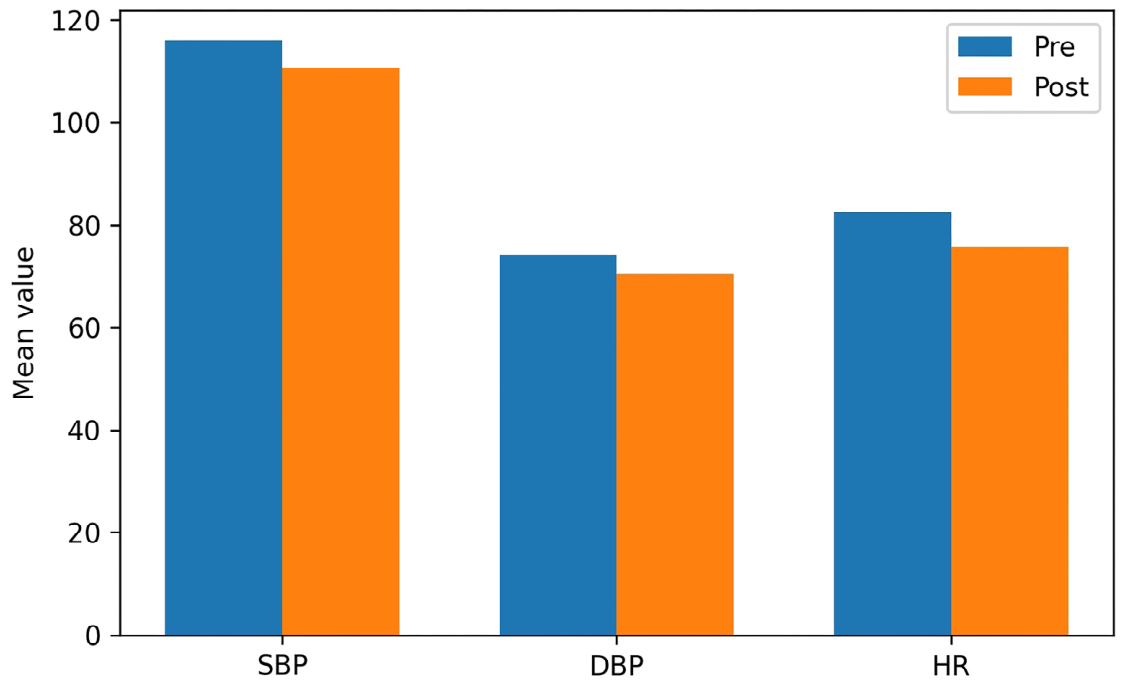
Significant reductions were observed across all cardiovascular variables following participation in the dog-assisted intervention sessions.
Systolic blood pressure (SBP) decreased from 116.08 mmHg before the intervention to 110.77 mmHg after participation, representing a mean reduction of 5.31 mmHg. Similar reductions were observed for diastolic blood pressure (DBP) and heart rate (HR).
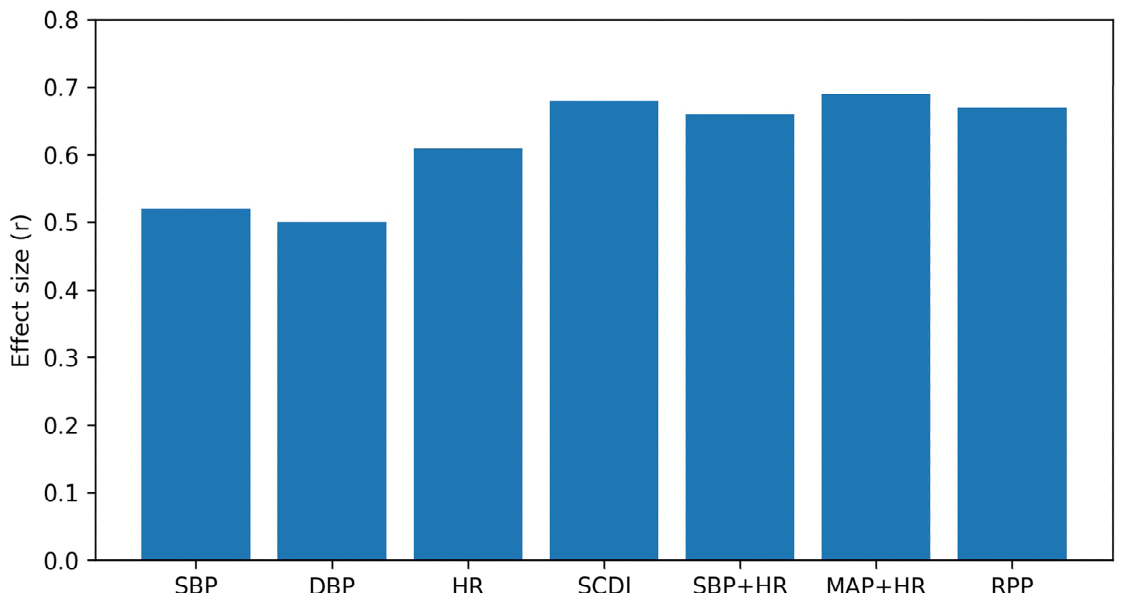
Wilcoxon signed-rank tests indicated statistically significant pre–post differences for all three cardiovascular variables (Table 2). Effect size analyses revealed moderate-to-large effects, with the strongest change observed for heart rate (r = 0.61), followed by systolic blood pressure (r = 0.52) and diastolic blood pressure (r = 0.50).
These findings indicate a consistent reduction in cardiovascular activation following participation in the dog-assisted intervention sessions.
Figure 1.
Pre-Post Cardiovascular Measures.
3.3. Analysis of the StressLess Cardiovascular Dynamics Index (SCDI)
The StressLess Cardiovascular Dynamics Index (SCDI) demonstrated a significant reduction between pre-session and post-session measurements. The mean standardized difference was 0.437, indicating a consistent decrease in overall cardiovascular activation following participation in the dog-assisted intervention sessions.
Wilcoxon signed-rank analysis confirmed the statistical significance of this reduction (Z = -13.19, p < 0.001). The corresponding effect size was large (r = 0.68), suggesting that the SCDI was highly sensitive to the physiological changes associated with the intervention.
These findings support the usefulness of integrated cardiovascular approaches for summarizing short-term physiological responses and provide initial evidence regarding the applicability of the SCDI in university wellbeing contexts.

Table 3.
Pre–Post Comparisons for Integrated Cardiovascular Indices.
| Index | Mean Difference | Z | p | r |
| SCDI (SBP + DBP + HR) | 0.437 | -13.19 | <0.001 | 0.68 |
| SBP + HR Index | 0.454 | -12.80 | <0.001 | 0.66 |
| MAP + HR Index | 0.481 | -13.38 | <0.001 | 0.69 |
| RPP | 0.588 | -12.99 | <0.001 | 0.67 |
Note: Wilcoxon signed-rank test. SCDI = StressLess Cardiovascular Dynamics Index; SBP = systolic blood pressure; DBP = diastolic blood pressure; HR = heart rate; MAP = mean arterial pressure; RPP = rate-pressure product.
3.4. Comparison with Alternative Cardiovascular Indices
To evaluate the robustness of the integrated cardiovascular approach, the SCDI was compared with three alternative formulations derived from related physiological variables.
All indices detected statistically significant reductions following participation in the intervention sessions and yielded remarkably similar effect sizes. The largest effect was observed for the MAP + HR Index (r = 0.69), closely followed by the SCDI (r = 0.68), the RPP (r = 0.67), and the SBP + HR Index (r = 0.66).
The similarity of these results suggests that different approaches to cardiovascular integration capture a common pattern of physiological change associated with participation in the dog-assisted intervention sessions. Rather than identifying a single superior formulation, the findings indicate substantial consistency across alternative methods of cardiovascular aggregation.
Figure 2.
Effect Sizes across Cardiovascular Measures and Integrated Indices.
3.5. Correlations Among Integrated Cardiovascular Indices
Correlation analyses revealed very strong associations among the integrated cardiovascular indices. The SCDI showed a correlation of r = 0.88 with the SBP + HR Index, r = 0.97 with the MAP + HR Index, and r = 0.86 with the RPP.
These findings indicate a high degree of convergence among the alternative cardiovascular formulations and suggest that they reflect a common underlying pattern of cardiovascular activation and recovery. The particularly strong association between the SCDI and the MAP + HR Index supports the stability of the integrated cardiovascular approach adopted in the present study.
Correlation coefficients among the integrated cardiovascular indices are presented in Table 4.
4. Discussion
4.1. Physiological Stress Reduction During Dog-Assisted University Sessions
The present study found significant reductions in systolic blood pressure, diastolic blood pressure, and heart rate following participation in dog-assisted university intervention sessions. These findings suggest that interaction with trained intervention dogs may contribute to short-term reductions in physiological activation among university students during periods of academic demand.
The observed reductions are consistent with previous studies reporting beneficial effects of dog-assisted interventions on stress-related outcomes in higher education settings (Barker et al., 2016; Chute et al., 2023; Carr & Pendry, 2025; Sim et al., 2025). Earlier research has shown that interactions with therapy dogs can reduce perceived stress, anxiety, and physiological indicators of arousal, particularly during examination periods and other academically demanding situations. The present findings extend this evidence by demonstrating consistent cardiovascular changes across a relatively large number of physiological records collected under routine university conditions.
The strongest effect among the individual cardiovascular variables was observed for heart rate, suggesting that autonomic regulation may be particularly responsive to brief human–dog interactions. At the same time, significant reductions in both systolic and diastolic blood pressure indicate that the observed effects were not limited to a single physiological marker but reflected broader cardiovascular changes.
An important strength of the study is its ecological validity. Unlike laboratory-based investigations, the intervention was implemented within the normal functioning of a university wellbeing program, allowing the assessment of physiological responses under conditions closely resembling those encountered in real educational environments.
4.2. Value of Integrated Cardiovascular Approaches
Beyond the physiological effects associated with the intervention itself, one of the most relevant findings of the present study concerns the performance of the integrated cardiovascular indices. The SCDI, the SBP + HR Index, the MAP + HR Index, and the RPP all detected significant reductions following participation in the intervention sessions and produced remarkably similar effect sizes.
These results suggest that integrated cardiovascular approaches may provide a useful framework for summarizing complex physiological responses that are otherwise distributed across multiple variables. Rather than examining systolic blood pressure, diastolic blood pressure, and heart rate separately, integrated indices offer the possibility of representing overall cardiovascular activation through a single composite measure. This approach may facilitate interpretation while preserving information derived from multiple physiological components.
The findings are consistent with contemporary perspectives that conceptualize stress as a multidimensional process involving coordinated changes across several physiological systems (Juster et al., 2010; Abd-Alrazaq et al., 2024; Li & Zhang, 2025). In this context, the use of composite indicators may help reduce the influence of variability associated with individual physiological measures and provide a more stable representation of stress-related cardiovascular dynamics.
Particularly noteworthy was the high degree of convergence observed among the alternative formulations. Correlations ranging from 0.86 to 0.97 indicate that the different indices captured highly similar patterns of physiological change. The strongest association was observed between the SCDI and the MAP + HR Index, suggesting that the integration of blood pressure and heart rate measures provides a robust representation of cardiovascular responses to stress-reduction interventions.
Importantly, the objective of the present study was not to validate a diagnostic instrument but to explore the feasibility of integrated cardiovascular approaches in an applied educational context. From this perspective, the results support the use of simple and non-invasive composite indicators as practical tools for monitoring physiological changes associated with wellbeing interventions in higher education.
4.3. Implications for University Wellbeing Programs
Universities are increasingly confronted with the psychological and emotional challenges experienced by students during their academic trajectories. High levels of stress, anxiety, and emotional distress have become important concerns for higher education institutions, highlighting the need for accessible and evidence-informed wellbeing initiatives (Pascoe et al., 2020; Stallman, 2010).
The present findings suggest that dog-assisted interventions may represent a valuable complementary component of broader university wellbeing strategies. Although such interventions should not be considered substitutes for professional psychological or counseling services, they may provide opportunities for temporary stress reduction and physiological recovery during periods of increased academic pressure.
A particularly relevant aspect of the present study is that the intervention was implemented under routine university conditions. The observed physiological changes therefore reflect responses obtained in real educational environments rather than under highly controlled laboratory conditions. This characteristic enhances the practical relevance of the findings and supports the feasibility of incorporating similar initiatives into existing student support programs.
The study also highlights the potential value of integrating objective physiological measures into the evaluation of university wellbeing initiatives. Combining traditional self-report instruments with simple cardiovascular indicators may contribute to a more comprehensive understanding of how students respond to stress-reduction programs and may support evidence-based decision-making in higher education settings.
Taken together, the findings support continued exploration of dog-assisted interventions as part of institutional efforts to promote healthier and more supportive university environments.
4.4. Future Perspectives: Multimodal Stress Assessment and Intelligent Monitoring Systems
The growing availability of wearable technologies and advances in physiological data analysis are creating new opportunities for stress monitoring in educational environments. Recent reviews have highlighted the potential of integrating multiple physiological signals, including cardiovascular, electrodermal, respiratory, and behavioral indicators, to improve the assessment of stress and emotional regulation processes (Lazarou & Exarchos, 2024; Abd-Alrazaq et al., 2024).
Within this context, the integrated cardiovascular approach explored in the present study may represent a useful starting point for the development of broader multimodal assessment frameworks. The use of simple physiological measures such as blood pressure and heart rate offers important advantages in terms of accessibility, low cost, and applicability in real-world educational settings. These characteristics make cardiovascular indicators particularly attractive for large-scale wellbeing initiatives implemented in universities and other educational institutions.
Future research could examine the extent to which integrated cardiovascular indices can be combined with additional sources of information, including self-report measures, wearable sensor data, and behavioral indicators. Such multimodal approaches may provide a more comprehensive understanding of how students respond to stress and to interventions designed to promote wellbeing.
Recent developments in artificial intelligence and machine learning have further expanded the possibilities for analyzing complex physiological datasets and identifying patterns associated with stress and recovery processes (Li & Zhang, 2025). Although the present study did not employ predictive models, the observed convergence among integrated cardiovascular indices suggests that simplified physiological indicators may contribute valuable information to future intelligent monitoring systems.
Consequently, future investigations should explore the integration of physiological, psychological, and behavioral data within longitudinal designs capable of examining both short-term and long-term effects of wellbeing interventions. Such approaches may contribute to the development of more personalized, evidence-informed strategies for supporting student wellbeing in higher education.
5. Limitations
Several limitations should be considered when interpreting the findings of the present study.
First, the study employed a quasi-experimental pre–post design without a control group. Consequently, causal inferences regarding the specific effects of the dog-assisted intervention should be made with caution. Although the observed physiological changes are consistent with previous research on animal-assisted interventions, additional controlled studies are needed to further examine the mechanisms underlying these effects.
Second, the sample was predominantly female and was drawn primarily from education-related degree programs. While this distribution reflects the demographic characteristics of the population participating in the StressLess program, the generalizability of the findings to other academic disciplines and more gender-balanced populations remains to be established.
Third, the physiological assessment focused on cardiovascular measures that are relatively simple and easily applicable in educational settings. Although this represents a practical advantage, future studies could incorporate additional physiological indicators, such as heart rate variability, electrodermal activity, or hormonal biomarkers, to obtain a more comprehensive understanding of stress-related processes.
Finally, some participants attended multiple intervention sessions, generating repeated physiological records. While this characteristic reflects the natural functioning of university wellbeing programs and increased the amount of available physiological information, future longitudinal studies may benefit from designs specifically structured to examine individual trajectories across repeated exposures.
Despite these limitations, the study provides evidence regarding the physiological effects of dog-assisted university interventions and contributes to the growing body of research exploring integrated approaches to stress assessment in higher education contexts.
6. Conclusions
The present study provides evidence that participation in dog-assisted university intervention sessions is associated with significant reductions in cardiovascular indicators of physiological activation. Significant decreases were observed in systolic blood pressure, diastolic blood pressure, and heart rate, suggesting a short-term reduction in cardiovascular arousal among university students participating in the StressLess program.
The findings also support the usefulness of integrated cardiovascular approaches for monitoring physiological responses associated with stress-reduction interventions. The StressLess Cardiovascular Dynamics Index (SCDI) and the alternative cardiovascular formulations examined in this study consistently detected significant physiological changes and demonstrated large effect sizes.
A particularly relevant finding was the high degree of convergence observed among the integrated cardiovascular indices. The strong correlations between alternative formulations suggest that different approaches to cardiovascular integration capture a common underlying pattern of physiological activation and recovery. These results support the feasibility of using simple composite indicators to summarize complex cardiovascular responses in applied educational settings.
Although further research is needed to confirm these findings across different populations and intervention contexts, the present study suggests that dog-assisted interventions and integrated cardiovascular monitoring represent promising avenues for promoting wellbeing and advancing physiological stress assessment in higher education.
Author Contributions
Conceptualization, J.G.P. and M.C.B.L.; methodology, J.G.P., M.K.G. and M.J.L.; formal analysis, M.J.L. and J.G.P.; investigation, M.K.G. and J.G.P.; data curation, M.K.G.; validation, M.J.L., J.G.P. and M.C.B.L.; resources, J.G.P.; writing—original draft preparation, J.G.P.; writing—review and editing, J.G.P., M.K.G., M.J.L. and M.C.B.L.; visualization, J.G.P. and M.K.G.; supervision, J.G.P. and M.C.B.L.; project administration, J.G.P.; funding acquisition, J.G.P. and M.C.B.L. All authors have read and agreed to the published version of the manuscript.
Funding
José Gijón, Meriem Khaled, María Jesus Lirola, and Miguel Cecilio Botella have received funding within the framework of the research project PID2021-128774OB-I00, Effects of the Application of a Dog-Assisted Activities Programme (AAP) on Academic Stress Levels in University Students (acronym: DAAP-SL). This project is funded by MICIU/AEI/10.13039/501100011033 and by the European Regional Development Fund (ERDF), European Union.
Institutional Review Board Statement
The study was conducted in accordance with the Declaration of Helsinki and approved by the Ethics Committee for Human Research of the University of Granada (protocol code 1650/CEIH/2020, approved on 29 July 2020, and protocol code 3126/CEIH/2023, approved on 19 January 2023.).
Informed Consent Statement
Written informed consent was obtained from all subjects involved in the study. Participants were informed about the aims of the research, the procedures employed, the voluntary nature of participation, the confidentiality and anonymous treatment of the data, and their right to withdraw at any stage without penalty.
Data Availability Statement
The datasets generated and analyzed during the current study are not publicly available due to ethical and privacy considerations associated with the physiological data collected from participants. Data may be made available by the corresponding author upon reasonable request and subject to approval by the research team and compliance with applicable ethical and data protection requirements.
Acknowledgments
The authors gratefully acknowledge the support provided by the Faculty of Education Sciences of the University of Granada in the development of the StressLess program. Special thanks are extended to the Library of the Faculty of Education Sciences for its continued collaboration and commitment to initiatives aimed at promoting student wellbeing and reducing academic stress. Their support was essential for the implementation of the intervention sessions and the successful completion of this study.
Conflicts of Interest
The authors declare no conflicts of interest. The funders had no role in the design of the study; in the collection, analyses, or interpretation of data; in the writing of the manuscript; or in the decision to publish the results.
Abbreviations
The following abbreviations are used in this manuscript:
| DBP | Diastolic Blood Pressure |
| HR | Heart Rate |
| MAP | Mean Arterial Pressure |
| RPP | Rate-Pressure Product |
| SBP | Systolic Blood Pressure |
| SCDI | StressLess Cardiovascular Dynamics Index |
| SD | Standard Deviation |
| bpm | Beats Per Minute |
References
- Abd-Alrazaq, A., Alajlani, M., Ahmad, R., AlSaad, R., Aziz, S., Ahmed, A., ... & Sheikh, J. (2024). The performance of wearable AI in detecting stress among students: systematic review and meta-analysis. Journal of Medical Internet Research, 26, e52622. [CrossRef]
- Barker, S. B., Barker, R. T., McCain, N. L., & Schubert, C. M. (2016). A randomized cross-over exploratory study of the effect of visiting therapy dogs on college student stress before final exams. Anthrozoös, 29(1), 35–46. [CrossRef]
- Beiter, R., Nash, R., McCrady, M., Rhoades, D., Linscomb, M., Clarahan, M., & Sammut, S. (2015). The prevalence and correlates of depression, anxiety, and stress in a sample of college students. Journal of Affective Disorders, 173, 90–96. [CrossRef]
- Campbell, J., & Ehlert, U. (2012). Acute psychosocial stress: Does the emotional stress response correspond with physiological responses? Psychoneuroendocrinology, 37(8), 1111–1134. [CrossRef]
- Carr, A. M., & Pendry, P. (2025). Effects of an animal-assisted drop-in program on first-year university students’ trajectory of psychological wellbeing. Pets, 2(1), 8. [CrossRef]
- Chute, A., Vihos, J., Johnston, S., Buro, K., & Velupillai, N. (2023). The effect of animal-assisted intervention on undergraduate students’ perception of momentary stress. Frontiers in Psychology, 14, 1253104. [CrossRef]
- Cohen, J. (1988). Statistical power analysis for the behavioral sciences (2nd ed.). Lawrence Erlbaum Associates.
- Dyrbye, L. N., Thomas, M. R., & Shanafelt, T. D. (2006). Systematic review of depression, anxiety, and other indicators of psychological distress among U.S. and Canadian medical students. Academic Medicine, 81(4), 354–373. [CrossRef]
- Gellisch, M., Bablok, M., Brand-Saberi, B., & Schäfer, T. (2024). Neurobiological stress markers in educational research: a systematic review of physiological insights in health science education. Trends in Neuroscience and Education, 37, 100242. [CrossRef]
- Gobel, F. L., Norstrom, L. A., Nelson, R. R., Jorgensen, C. R., & Wang, Y. (1978). The rate-pressure product as an index of myocardial oxygen consumption during exercise in patients with angina pectoris. Circulation, 57(3), 549–556. [CrossRef]
- Juster, R.-P., McEwen, B. S., & Lupien, S. J. (2010). Allostatic load biomarkers of chronic stress and impact on health and cognition. Neuroscience & Biobehavioral Reviews, 35(1), 2–16. [CrossRef]
- Kim, H.-G., Cheon, E.-J., Bai, D.-S., Lee, Y. H., & Koo, B.-H. (2018). Stress and heart rate variability: A meta-analysis and review of the literature. Psychiatry Investigation, 15(3), 235–245. [CrossRef]
- Lazarou, E., & Exarchos, T. P. (2024). Predicting stress levels using physiological data: Real-time stress prediction models utilizing wearable devices. AIMS Neuroscience, 11(2), 76–102. [CrossRef]
- Li, F., & Zhang, D. (2025). Multimodal physiological signals from wearable sensors for affective computing: A systematic review. Intelligent Sports and Health, 1(4), 210-222. [CrossRef]
- Mauss, I. B., Levenson, R. W., McCarter, L., Wilhelm, F. H., & Gross, J. J. (2005). The tie that binds? Coherence among emotion experience, behavior, and physiology. Emotion, 5(2), 175–190. [CrossRef]
- McEwen, B. S. (1998). Protective and damaging effects of stress mediators. New England Journal of Medicine, 338(3), 171–179. [CrossRef]
- Pascoe, M. C., Hetrick, S. E., & Parker, A. G. (2020). The impact of stress on students in secondary school and higher education. International Journal of Adolescence and Youth, 25(1), 104–112. [CrossRef]
- Sim, S. Q., Liu, Z., Wu, Z., Wang, S., & Nisa, C. (2025). Canine-assisted therapy in reducing stress and anxiety levels of university students: systematic review and meta-analysis of randomized controlled trials. BMC Complementary Medicine and Therapies, 25(1), 303. [CrossRef]
- Stallman, H. M. (2010). Psychological distress in university students: A comparison with general population data. Australian Psychologist, 45(4), 249–257. [CrossRef]
Table 1.
Participant characteristics (N = 147).
| Characteristic | Value |
| Age, mean (SD) | 22.35 (3.00) |
| Age range | 19–45 |
| Women, n (%) | 125 (85.0) |
| Men, n (%) | 22 (15.0) |
| Social Education students, n (%) | 127 (86.4) |
| MAES students, n (%) | 20 (13.6) |
| Valid physiological records | 375 |
Table 2.
Pre–Post Comparisons for Cardiovascular Variables Following Participation in Dog-Assisted Intervention Sessions.
Table 2.
Pre–Post Comparisons for Cardiovascular Variables Following Participation in Dog-Assisted Intervention Sessions.
| Variable | Pre Mean | Post Mean | Mean Difference | Z | p | r |
| SBP (mmHg) | 116.08 | 110.77 | 5.31 | -10.07 | <0.001 | 0.52 |
| DBP (mmHg) | 74.06 | 70.44 | 3.62 | -9.69 | <0.001 | 0.50 |
| HR (bpm) | 82.46 | 75.67 | 6.78 | -11.82 | <0.001 | 0.61 |
Note: Wilcoxon signed-rank test. SBP = systolic blood pressure; DBP = diastolic blood pressure; HR = heart rate; bpm = beats per minute.
Table 4.
Correlations between the StressLess Cardiovascular Dynamics Index (SCDI) and Alternative Cardiovascular Indices.
Table 4.
Correlations between the StressLess Cardiovascular Dynamics Index (SCDI) and Alternative Cardiovascular Indices.
| Comparison | r |
| SCDI – SBP + HR Index | 0.88 |
| SCDI – MAP + HR Index | 0.97 |
| SCDI – RPP | 0.86 |
Disclaimer/Publisher’s Note: The statements, opinions and data contained in all publications are solely those of the individual author(s) and contributor(s) and not of MDPI and/or the editor(s). MDPI and/or the editor(s) disclaim responsibility for any injury to people or property resulting from any ideas, methods, instructions or products referred to in the content. |
© 2026 by the authors. Licensee MDPI, Basel, Switzerland. This article is an open access article distributed under the terms and conditions of the Creative Commons Attribution (CC BY) license (http://creativecommons.org/licenses/by/4.0/).
Copyright: This open access article is published under a Creative Commons CC BY 4.0 license, which permit the free download, distribution, and reuse, provided that the author and preprint are cited in any reuse.


