
Submitted:
08 June 2026
Posted:
09 June 2026
You are already at the latest version
Abstract
The scarcity of resources is a major challenge for the livability of cities and sustainable urbanization. This study explores the socioeconomic dimensions of water scarcity in four low-income neighborhoods of Amman, the capital of Jordan, using a mixed-method approach. The study investigates how water scarcity intersects with socioeconomic vulnerability, spatial injustice, and behavioral adaptation. The main research findings are that income, the quality of the neighborhood, and infrastructure access commonly shape residents’ coping strategies and perceptions of fairness. While households adopt a range of adaptive behaviors, limited affordability and institutional neglect intensify existing inequalities. Temporal shifts in service provision, spatial disparities within and between neighborhoods, and gaps in awareness and governance deepen the sense of water insecurity. The study concludes that water scarcity in Amman is not only a technical or economic challenge but a socially embedded problem that requires equity-oriented policies, participatory planning, and spatially targeted investments.
Keywords:
livability of cities
; water scarcity
; socioeconomic inequalities
; spatial injustice
; sustainable urbanization
; Amman
1. Introduction
Rapid urbanization, coupled with a scarcity of resources, threatens the livability of cities worldwide and makes contemporary urban development increasingly unsustainable [1,2,3]. This is the case in Amman, the capital city of Jordan in the Middle East, which is home to 4.9 million residents [4,5]. Amman’s demographic growth in the past century has been driven mainly by the repeated influx of refugees, which put great pressure on resources and infrastructure [6,7,8,9]. The city’s urban fabric comprises excessive informal settlements, including high-density marginalized neighborhoods, due to the growing demand for housing associated with poor services and infrastructure. The lack of investment in the building stock and uncoordinated urban planning has resulted in spatial inequalities as far as the infrastructure and services are concerned, privileging formal neighborhoods over camps and older districts [5,10].
Jordan faces several pressing challenges due to its geopolitical situation, rapid urbanization and climate change [11,12,13]. These conditions accompanied by the uneven urban structure, create a critical context for understanding one of Amman’s most crucial challenges: water scarcity [14]. According to the United Nations water scarcity is one of the most pressing issues globally, and it can arise from multiple factors, including demand exceeding supply, insufficient water infrastructure, and institutional weaknesses in equitable management of water needs [15]. According to estimations, about 1.2 billion people live in areas of physical water scarcity where resources are overexploited, while 1.6 billion people live in areas of economic water scarcity where infrastructure or governance prevents access to available water [16].
Jordan’s water scarcity is among the most severe globally, with a per capita water availability far below the absolute water poverty line of 500 m³/year [17]. Hadadin et al. [18] projected that Jordan's per capita water availability would drop to 91 m³ by 2025, however, it had already declined to 61 m³ in 2023 [19], pointing to an even more severe decline than estimated.
Existing literature has explored water scarcity in Jordan and more specifically in Amman through technical, policy-oriented, or economic lenses [20,21,22], and there has been no research that would have studied the intersection of socioeconomic, behavioral, and spatial factors, especially in the everyday lives of marginalized urban communities. Therefore, this paper aims to address this research gap by offering a multi-dimensional, socio-economic perspective on water inequality in Amman. Using a mixed method and comparative approach by examining four neighborhoods in Amman, this study analyzes the intra-urban pattern of water scarcity. This approach complements and challenges existing policy documents and quantitative analyses dealing with water scarcity in Amman, because water scarcity is not just a technical issue but a deep social and spatial challenge.
This study aims to answer the following research questions:
- How do residents cope with water scarcity under varying socioeconomic and infrastructural conditions in the selected low-income neighborhoods in Amman?
- How do perceptions of fairness and inequality evolve in relation to past experiences and present disparities in water services?
- How does water insecurity affect residents’ quality of life, public awareness, and future expectations?
The remaining part of this study is structured as follows. In the next section, a literature review displays how the challenges of water scarcity in Jordan and, more specifically, in Amman have been addressed by existing literature. It is followed by an introduction to the research methodology and study areas. A section then follows with the main research results. Finally, we discuss the main findings and the limitations of the methodology and then conclude our study.
Water scarcity in Amman’s neighborhoods manifests through various challenges such as supply intermittency, rising unaffordability, infrastructural disparities, and governance dysfunction [23]. It intersects with broader urban inequalities [24] shaped by geography [14], planning decisions [25], and socioeconomic levels [26]. Existing studies on water scarcity in Jordan have approached the issue through a technical and macro-level lens, with a focus on national supply-demand imbalances, water use efficiency, and the construction of large-scale infrastructure projects [20,21,22]. These studies have offered valuable insights into system-wide challenges such as supply intermittency, service reliability, and institutional reforms. Nationwide statistics also reflected the relevance of these issues; for instance, 97.26% of households in Amman were supplied with water from the public network for only one to two days per week in 2018 [27].
The economic aspects, particularly the effects of pricing structures on household water consumption and coping behaviors have been addressed by other researchers. Klassert et al. [28] modeled how pricing structures interact with intermittent supply and household storage capacity. Their findings indicate the critical economic role of private tanker operators as it is the marginal water source for most households, the price of it has a greater impact on consumer surplus than piped water tariff. Any regulation or price change affecting tanker supply, whether through stricter enforcement of illegal extraction or adjustments in water pricing, can affect household welfare significantly, particularly in districts with high intermittency. Meanwhile, the increases in piped water tariffs reduce reliance on tanker water by promoting more equitable distribution of piped supply, thus improving the overall water sustainability. However, such tariff changes can create varied economic impacts across districts, producing both gains and losses in household consumer surplus, highlighting the need for carefully targeted measures to mitigate adverse effects on vulnerable groups.
In response to the increase in piped water tariffs that aimed to encourage residents to conserve water, Tabieh et al. [29] found that when the residential water demand in the Amman-Zarqa Basin – the main hydrological basin serving the city – is below a certain consumption threshold, household water demand becomes price inelastic which indicates that even when water prices rise, low-consumption households – often with low-income – do not significantly reduce their usage. Instead, water demand is more closely associated with household size, level of welfare, education, and number of bathrooms. The study concluded that price-based conservation tools are ineffective and socially inequitable, recommending instead non-price strategies such as market segmentation, technological interventions, and behavioral approaches that maintain better quality of life while encouraging conservation. Similarly, Telfah et al. [30] noted that water pricing has a limited impact on consumer behavior. Authors recommended more effective water management policies other than raising water prices to establish more effective strategies for conserving water.
Within the context of ineffective pricing mechanisms for the purpose of conserving water, households increasingly rely on alternative coping strategies to manage water intermittency. This has been described by Mustafa and Talozi [31] as infrastructure mediators, such as private tanker operators, wells, pressurized pumps, and storage tanks, However, they vary in terms of accessibility and affordability, and instead of mitigating scarcity they often become agents of inequality. Similarly, Gerlach and Franceys [26] mentioned how reliance on expensive private tanker operators, informal water-sharing practices, or unregulated connections might temporarily solve water shortage, but they reinforce hydro social inequality by making access dependent on household income and local infrastructure.
Regarding water conservation awareness, Potter and Darmame [32] found that high-income households reported less concern in water conservation education, suggesting that financial comfort reduces the need for such efforts. However, beyond awareness, other constraints strongly shape whether water conservation behaviors are implemented. For instance, Zietlow and Michalscheck [33] studied the factors influencing water conservation behavior in Jordan and found that gender (women showing lower levels of water conservation), the size of the water bill (higher bills were associated with lower conservation efforts), and the age of the household (residents of older households were more likely to engage in water conservation) played decisive role. In contrast, the age, income, and level of education of individuals did not significantly affect their commitment to water conservation.
Interestingly, despite the widespread intermittency and pricing challenges, 82.6% of Amman's residents in 2018 stated that there was no water shortage from the public network and they did not rely on alternative sources. Only 11.7% reported using private tankers, 3.9% relied on rainwater harvesting, and 1.8% used informal coping methods such as borrowing water from neighbors or collecting it from nearby natural springs [27]. This contradiction suggests that intermittent access has become normalized, shaping perceptions and expectations around what is adequate service.
In general, the bulk of the literature treats Amman as a single spatial unit without considering the internal socio-economic differences and the historically evolved uneven infrastructure development [34,35]. Krueger et al. [24] studied resilience as an outcome of complex interactions between people, water resources, and technological infrastructure, but neglected the city's internal division. While this approach is useful for understanding urban planning and policy trends, it does not capture how scarcity is experienced differently across neighborhoods with contrasting social, infrastructural, and legal characteristics. Similarly, Gerlach and Franceys [26] identified key patterns in pricing regimes, tanker reliance, and service gaps in Amman, yet the authors did not delve into how coping strategies differ by neighborhoods or social groups.
From a governance perspective, Rosenberg et al. [22] highlighted that water scarcity is intensified by the operational difficulties of managing an intermittent supply system, where weekly distribution schedules, pressure fluctuations, and aging infrastructure require utilities to continually balance limited resources against rising demand. In a complementary way, Al Kharabsheh and Ta’any [20] examined the regulatory side of water governance, noting that institutional fragmentation and limited enforcement power weaken the reliability of service provision. They came to the conclusion, that without coherent regulation, clear tariff structures, and stronger institutional coordination, operational improvement alone cannot stabilize supply and enhance user satisfaction.
To sum up, based on the literature it can be stated that while there is a robust amount of knowledge on water scarcity in Amman from technical, economic, and policy-oriented perspectives, a significant gap remains as far as the socioeconomic vulnerability and behavioral adaptations of residents are concerned, particularly in marginalized and underserved neighborhoods.
2. Materials and Methods
This study uses a mixed method approach in examining the socioeconomic consequences of water scarcity in four low-income neighborhoods of Amman. As the first step of research, based on data provided by the Department of Statistics a Principal Component Analysis (PCA) and hierarchical clustering analysis were conducted for Amman’s 314 neighborhoods. The standardized variables were grouped into three categories:
- Demographic variables: household size and dependency ratio.
- Socioeconomic variables: educational level, homeownership percentage, weighted average of rent, and housing area.
- Quality of life variables: presence of advanced heating systems, total number of devices and appliances per household, used wastewater disposal system, and main drinking water source.
The analysis resulted in four clusters:
- Cluster 1: Moderate-affluence, nuclear-family neighborhoods with moderate access to advanced drinking water sources.
- Cluster 2: High-income family enclaves with the highest levels of access to advanced drinking water and wastewater services.
- Cluster 3: Multi-generational family neighborhoods with the lowest access to advanced drinking water and insufficient wastewater infrastructure.
- Cluster 4: Poor residential areas with relatively low usage of advanced drinking water and wastewater systems.
For the sake of this study, neighborhoods from Cluster 3 and Cluster 4 were selected in order to focus on the most vulnerable socioeconomic neighborhoods with limited access to essential water-related infrastructure. This approach ensured that the chosen neighborhoods represented distinct but comparable cases regarding water scarcity and related social and environmental challenges. In addition to the four neighborhoods, the affluent neighborhood of “Um Al Summaq” from Cluster 2 was used as a test area, where a pilot study was conducted in order to try out the methodology and to check the situation where residents are not affected by water scarcity.
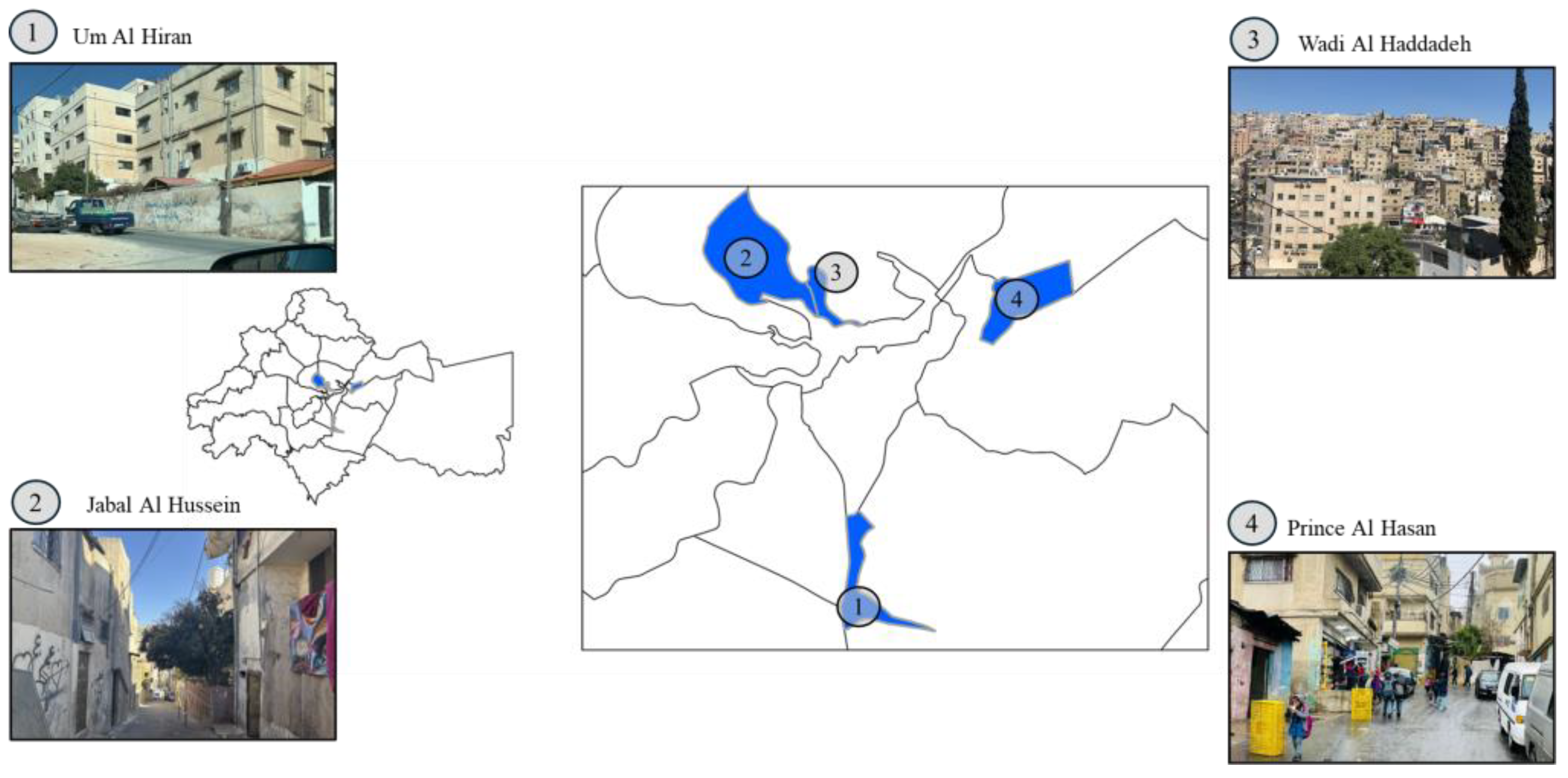
The empirical part of the research included 60 in-depth interviews with residents and local community stakeholders (e.g., school teachers, medical professionals, and water service providers). The interviews explored topics such as the availability and quality of water, coping strategies of deprived groups, governance perceptions, and the overall socioeconomic impacts of water scarcity. In site observations and photo documentations were carried out to record water infrastructure conditions, neighborhood topography, and water usage practices, the visible disparities in resource access both within and between neighborhoods. The four selected neighborhoods are as follows (Figure 1):
- Um Al Hiran: Situated in the eastern part of Amman, Um Al Hiran is functionally a mixed neighborhood that comprises both residential and commercial areas. Despite new urban developments that have recently taken place, the area is inhabited predominantly by low- to middle-income households, with partially developed infrastructure and varying access to services.
- Jabal Al Hussein: As a historically significant neighborhood with a dual character, Jabal Al Hussein is home to both a Palestinian refugee camp and adjacent non-camp areas. The camp suffers from acute water shortages due to outdated infrastructure and weak institutional support, while the surrounding non-camp areas enjoy slightly better access to water but continue to face affordability constraints and service intermittency.
- Wadi Al Haddadeh: Located near Amman’s historic core and downtown, Wadi Al Haddadeh can be characterized by high population density and steep terrain as Wadi means valley. These physical constraints, combined with socioeconomic marginalization, contribute to infrastructural challenges and limited water accessibility.
- Prince Al Hasan: Also located in eastern Amman, Prince al Hasan is predominantly home to low-income households and an informal refugee camp. It can be characterized by rapid demographic growth and underdeveloped infrastructure.
As an analytical framework three-dimensions were pre-defined to examine how water scarcity shapes and is shaped by the lived experiences of residents across the four neighborhoods.
- D1. Socioeconomic context and coping strategies: focuses on how income and household resources influence both access to water and the possible coping mechanisms of residents.
- D2. Temporal and spatial changes: captures how perceptions of water access have changed over time and how current conditions vary between the four neighborhoods.
- D3. Awareness, quality of life, and future expectations: explores the public understanding of water conditions in the city, household well-being, and future outlooks.
3. Results
3.1. Socioeconomic Context and Coping Strategies
Water scarcity in Amman unfolds differently across neighborhoods with different socioeconomic conditions, which play a role in shaping access to and affordability of water, and the vulnerability of households. In each neighborhood, socioeconomic status influences not only access to water but also the capacity to respond to its scarcity and the ability to manage water-related challenges.
Socioeconomic conditions in Um Al Hiran are relatively stable, which allows some households to invest in technical facilities such as filtration systems for drinking water, or the installation of additional storage tanks or water pumps to benefit from extra water quantities. Yet, financial burdens persist, especially for elderly residents with modest fixed incomes who complain about the high cost of the new metering system despite the unchanged consumption. However, income disparities in Jabal Al Hussein are greater, which shapes how differently residents manage water scarcity. In the refugee camp, where residents face extreme financial strain, it is very challenging for them to pay both the municipal bills and the alternative high-priced drinking water. As a result, some of the residents have to ration their water consumption, often borrowing water from neighbors and postponing non-essential water use. Outside the camp, although households have more financial flexibility, the rising costs of filtered water and municipal bills still create a problem, especially for those lacking abundant water storage infrastructure.
"In the camp, we have to share water sometimes. One family fills their jugs and passes them to another. Outside, each house has more than one tank and better connections, but even they complain about the high costs now"(Female, 30 years old, Jabal Al Hussein camp)
The intersection of poverty and water scarcity is also visible in Wadi Al Haddadeh, where the income of households directly influence the ability to adapt to and cope with supply shortages. Without having financial flexibility to install extra storage tanks or purchase pumps that enable higher and faster supply, residents are forced to rely on limited supply or purchasing water from private tankers only when the supply is extremely low. These coping strategies are neither sustainable nor sufficient to meet people’s basic daily needs. While nearby private institutions enjoy uninterrupted water services due to private funding and better infrastructure, this contrast causes disparities in infrastructure access and institutional privilege within the neighborhood.
"We try to use the supplied water during the ‘water days’ for as long as we can. After that we have to deal with the limited stored quantities like skipping laundry or washing dishes in stages. We can’t afford to buy water from private tankers each month, it’s very expensive. This year, the water utility company, Miyahuna installed the new ‘smart’ -as they say - meters and say it makes billing easier and more accurate, but the water bill tripled after installing them although our consumption is the same and maybe less than before "(Male, 55 years old, Wadi Al Haddadeh)
Some families in Prince Al Hasan neighborhood struggle with water cut-offs due to accumulated high unpaid bills, thus, the only solution is reliance on private tankers. The economic pressure is intensified within the refugee camp area, yet the school supported by UNRWA (The United Nations Relief and Works Agency for Palestine Refugees in the Near East) operates in a different socioeconomic context, and their better ability to provide clean water underscores how external support can bridge the gaps
A journalist who focuses on urban inequalities noted that infrastructural inequality is often manifested in the ability to store, treat, and purchase water, which shows how socioeconomic vulnerability overlaps with infrastructural and governance gaps, resulting in different livability across neighborhoods.
"The biggest issue in Amman is not just water scarcity but affordability. Families aren’t only facing water shortages; they’re being crushed by the cost of solving it. Whether it’s buying water from tankers or installing extra tanks, those with fewer means suffer more. The result is that water becomes both a social and economic barrier."(Journalist specializing in urban inequalities, Amman, interview conducted on August 2025)
Across all neighborhoods, socioeconomic status greatly influences households’ ability to access water and the coping strategies they can afford. While some households in Um Al Hiran show relative resilience, those in Wadi Al Haddadeh and Prince Al Hasan exhibit deeper vulnerabilities whereas Jabal Al Hussein shows greater intra-neighborhood inequalities. This reveals the coexistence of infrastructural inequalities and socioeconomic stratification regarding water consumption. The interviews gave evidence that low-income households face greater challenges with affordability, often turning to informal solutions to meet their needs. Residents across all neighborhoods expressed frustration with rising water costs, especially as coping mechanisms such as purchasing bottled water or using tankers remain expensive. This dissatisfaction aligns with the findings of Klassert et al. [28].
Behavioral responses to water scarcity demonstrate both adaptations and constraints, shaped by socioeconomic status, institutional support, and infrastructure access. Residents use a wide range of coping strategies, some of them are proactive, others reactive, to manage limited water availability, but the effectiveness and sustainability of these practices vary sharply across neighborhoods. Residents in Um Al Hiran follow mainly a structured adaptation, many plan household chores around weekly delivery schedules, some households invest in high-quality infrastructure, such as pressurized pumps, water filtration systems, or multi rooftop tanks to ensure more stable and safe water supply. Lower-income households usually adopt more cost-effective solutions, like reusing greywater for cleaning, coordinating with neighbors to share water tanker costs, or even boiling tap water for drinking purposes. The dense network of water shops in Um Al Hiran is essential for providing reliable alternatives, while a public school encourages long-term conservation habits through education and awareness campaigns. A local resident noted:
“We’ve adapted. Every Thursday and Friday are water days, and everyone knows we must finish laundry and cleaning before Saturday. We try to clean the tanks once every six months and if something breaks or leaks, it’s a disaster. You lose a week’s water if it is not maintained before the supply cycle, that’s how precise we must be. Even kids here are part of this process, kids here know how to ration water better than adults in other parts of Amman.”(Female, 55 years old, Um Al Hiran)
Behavioral responses in Jabal Al Hussein differ significantly between the refugee camp and non-camp areas. Camp residents are most vulnerable, relying heavily on emergency solutions, including water rationing, multiple boiling cycles for drinking purposes, and borrowing water from neighbors when supply runs low. Outside the camp, the slightly better financial situation enables residents to invest in filtration systems to reduce dependence on bottled water. However, trust in municipal water supply remains low for both groups.
While residents in Wadi Al Haddadeh attempt to manage scarcity through short-term solutions like strict rationing of their water use and purchasing water, these behaviors reveal deeper structural limits as most households can not afford long-term solutions and as these solutions lack long-term effectiveness and sustainability, residents start adapting uncomfortable and unhealthy habits which are becoming their daily routine. However, the private school’s uninterrupted water access allows students to develop habits of water overuse, weakening their awareness of local scarcity. This contrast highlights how different parts of the neighborhood experience water scarcity in very different ways.
Similarly, households in Prince Al Hasan cope with water scarcity, including prioritizing water use on supply days and water conservation practices such as reusing water, which is financially motivated rather than environmentally, according to the residents. These adaptation practices are often shaped by necessity rather than choice. A resident reflected:
“We try to re-use as much as we can, it’s not about being green—it’s because we can’t afford to waste anything. Especially in summer, when the water might come for less than 24 hours a week.”(Male, 24 years old, Prince Al Hasan camp)
In the absence of institutional support, residents have developed informal networks to adapt. A widely known community member is trusted to deliver critical issues to the authorities in order to solve them.
“We listen to Abu Jaber. He’s been here for 30 years and knows the system. If there’s a shortage or any issue not only related to water, he can deliver our concerns to the officials, most of the time they solve the issue, it’s easier and faster to contact him rather than the water utility company directly”(Male, 39 years old, Prince Al Hasan camp)
UNRWA institutions in the neighborhood face with rare shortages through organized temporary measures like rationing bathroom use and using water buckets, ensuring minimal disturbance until water tankers arrive. A representative from a water technology company in Amman shared his observation about residents’ limited adoption of household water technologies, stating:
“We try to promote filtration systems in low-income areas, but people say it’s too expensive. That’s why we offer payment plans. But still, many feel it's safer and easier to buy water than to install a system they can’t maintain. Affordability and trust are the biggest barriers.”(Sales and outreach representative, private water technology company, Amman, interview conducted August 2025)
Meanwhile, a water quality engineer at Amman’s water utility company highlighted the public perceptions around water quality stating:
“There’s a widespread belief that certain areas get better water than others, but that’s not entirely correct. Water from different sources is mixed and re-treated before distribution. The entire city receives water that meets the Jordanian drinking standards, which align with the international guidelines. The real issue is tank hygiene. Residents rarely clean their storage tanks, even though we recommend doing it every three months. We’ve encountered some disastrous tank conditions that seriously pollute water after delivery.”(Water quality engineer, Amman Water Utility Company, interview conducted September 2025)
Residents across all neighborhoods show resilience through different coping behaviors, these adaptations reveal both agency and constraint, they adapt actively, but within the limits of their resources and environments. These ‘infrastructure mediators’ as Mustafa and Talozi [31] described play as agents in increasing hydro social inequality according to what Gerlach and Franceys [26] mentioned earlier.
3.1. Temporal and Spatial Variations
Many residents reflected on how water services have changed over time. These changes reveal mixed trajectories: while residents in some of the neighborhoods reported relative improvements, others described worsening access and declining trust in institutions. Comparing past and present water conditions reveals a widespread perception of decline in terms of supplied quantities, quality, reliability, and affordability.
Many residents in Um Al Hiran acknowledge improvements, particularly with the introduction of the new water source with better quality and the improvement of the sewer system connections, but they also stress some emerging challenges.
“Things are now better than before, we receive proper water quality regularly, even if only for 2 days a week. I personally drink form the tap water directly, but my wife and children don’t accept it they drink from the filtered tap water, the only issue is the prices going up, it’s becoming difficult to cope with.”(male, 40 years old, Um Al Hiran)
These improvements created a sense of optimism among residents, though they are often restricted by affordability issues and persistent pressure drops, especially during the summer when the demand is high. At the same time, residents in Jabal Al Hussein noted a decline in water availability and quality over time, which is more severe and unmanageable in the refugee camp, where residents have always faced strained conditions in supply and scheduling reliability, and increasing dependency on alternative water supplies. Non-camp residents of Jabal al-Hussein noted that reduced water supply, combined with rising tanker costs, has led to the adoption of more efficient alternatives—such as pressurized pumps to improve flow and water filtration systems for drinking
Residents in Wadi Al Haddadeh reported significantly deteriorating water conditions over time. Respondents frequently recalled how water used to be supplied for five days a week and when tap water used to be safe to drink. The growing distrust in public services has increased reliance on market-based alternatives, causing a financial burden.
"I have been living in Wadi Al Haddadeh since I was 14 years old, I remember when we used to drink straight from the tap. It was clean and supplied regularly, nobody had to buy extra tanks or bottles then. Now, we can’t trust it anymore. We have to buy bottled water, and it’s expensive. You can’t rely on the public water anymore."(Female, 60 years old, Wadi Al Haddadeh)
Residents in Prince Al Hasan also referred to a decline in water service over time, particularly in supply duration, quality, and affordability. While infrastructure was once sufficient, growing demands and population pressures are currently straining the systems. The shift from tap water to bottled alternatives reflects decreasing trust in public water sources, even though it is not an option for all residents. The decline of water quality is also noticed by experts:
"I see more cases of people- especially children- coming in with stomach issues and skin rashes than ever before. Ten years ago, this wasn’t common. People used to use tap water for everything. Now they’re scared to even wash fruits using it. The deterioration in water quality is affecting our health."(Medical lab technician, Prince Al Hasan)
These narratives point to temporal disappointment with public resource management. However, the severity and direction of this change differ by neighborhoods. Um Al Hiran demonstrates some infrastructure expansions, leading to a sense of relative improvement. In contrast, residents of the three other neighborhoods feel increasingly deprived from healthy drinking water, both economically and technically. An example of the temporal change was the launch of the Disi Water Conveyance Project in 2013, which aimed to secure continuous water supply for Amman. Although the project was intended to replace the intermittent supply model, it only managed to increase average weekly supply from 24 to 48 hours [36]. While some residents appreciate this limited improvement, many remain disappointed. This disappointment is deepened by the gap between projections and current realities, due to the gap between the forecasted per capita water availability and the current estimates [19]. This reflects not only growing scarcity but also insufficient planning reinforcing public pessimism and worsening existing inequalities.
Water disparity in Amman is not merely an inter-neighborhood issue, but it has also intra-neighborhood characteristics, aligning with patterns of spatial inequality and infrastructure development.
The situation is mixed in Um Al Hiran. While some residents consider the local infrastructure to be relatively fair, however, comparisons with more affluent neighborhoods result the feelings of neglect. The quality of the water network and perceived responsiveness of authorities differ sharply across Amman, underlining systemic urban fragmentation. These comparisons, where people evaluate their own conditions relative to others, reveal a sense of spatial injustice rooted in Amman’s urban fabric. In Jabal Al Hussein the mix of the refugee camp and non-camp areas creates an extreme form of intra-neighborhood inequality, where camp residents experience severe shortages and neglect of infrastructure, while areas outside the camp have better access to water, even though residents still struggle with affordability over time. The stark contrast between these two areas illustrates how administrative and legal classifications of residency affect water distribution, in addition to socio-economic status and physical geography.
“We live on the same hill, but they get water every three days and we wait a week, when we ask why, they just say it's not under the municipality’s control.”(Male, 45 years old, Jabal Al Hussein camp)
Another resident from outside the camp observed:
“We have our issues with pressure and costs, but at least the municipality answers to our complaints. The camp is forgotten.”(Female, 28 years old, Jabal Al Hussein)
In Wadi Al Haddadeh some households manage to mitigate water shortages through personal investments, while others are trapped in cycles of unreliable municipal supply and poor infrastructure. In stark contrast, a private school located in the neighborhood benefits from institutional privilege, maintaining a robust water system with reliable supply. This produces a form of infrastructural dualism within the same neighborhood.
“We always ensure our tanks are full, even if it means calling a private tanker. We can’t afford to run out. It’s different for families nearby — they don’t have this buffer.”(School principal, Wadi Al Haddadeh)
The divide in Prince Al Hasan between the camp and non-camp residents is not that significant, both areas suffer from outdated infrastructure and frequent interruptions, however, the camp faces service cut-offs more frequently due to unpaid bills which exacerbates the existing socio-economic vulnerabilities. Institutions supported by UNRWA, perform better than surrounding neighborhoods, highlighting localized efforts to address systemic challenges.
In all four neighborhoods, spatial and infrastructural inequalities persist shaped by factors such as income, physical geography, and legal or administrative status yet the nature and extent of these disparities vary. For example, zoning classifications across Amman have historically reinforced uneven infrastructure development. According to Potter et al. [35], neighborhoods like Wadi Al-Haddadeh, Um Al Hiran, and Prince Al Hasan fall within residential zones C and D, areas characterized by weaker infrastructure and lower levels of municipal investment. Jabal Al Hussein contains mostly residential zone C land and a small portion classified as zone B, which explains the slightly better service in the non-camp areas. These findings underscore that spatial injustice between and within neighborhoods is also shaped by perception, governance narratives, and uneven investment priorities.
3.1. Awareness, Quality of Life, and Future Expectations
The effects of water scarcity extend beyond infrastructure and supply—they shape how residents perceive, navigate, and anticipate their everyday lives. This dimension examines how public awareness, daily well-being, and expectations for the future intersect with experiences of scarcity in the neighborhoods.
Public awareness of water scarcity and conservation practices varied greatly across the four neighborhoods shaped by socioeconomic background and access to institutional support. While residents in some areas showed basic knowledge about the issue of water scarcity and how to deal with it, many lacked the capacity and institutional encouragement to translate awareness into sustainable behavior.
Public awareness in Um Al Hiran varies greatly, most residents show strong engagement with conservation strategies and hygiene, and the presence of a dedicated public health teacher at the local school is also important in gaining trust.
“We have a public health teacher and one of her responsibilities is checking water availability and tanks quality, she also leads awareness campaigns and workshops with the students. The goal is to make saving water a habit, kids remind each other to turn off water taps and to inform us in case of any problem such as water leakage or cut-off. According to parents’ feedback, they go home and reflect that with in their houses too.”(Public school teacher, Um Al Hiran)
Similarly, a water shop owner gains customers’ trust and confidence by explaining the safety and quality management of the shop via showing them simple test results in the shop. This type of engagement partially compensates for the absence of broader institutional outreach.
Awareness in Jabal Al Hussein, especially within the refugee camp, is limited. Residents reported that no educational campaigns or institutional visits had ever reached them, leaving them to learn through experience and hardship. Residents in Wadi Al Haddadeh showed a moderate awareness of water issues which is growing through social media and neighbors’ discussions, yet, the ability to act on this knowledge remains uneven. The contrast is sharp at a private school where the principal described how stable infrastructure leads to student behaviors that weaken conservation efforts:
“We try to teach them to spare with water, but it’s hard and sometimes useless, just today during the break, a group of 11-12 year-olds were playing with the water and splashing each other. They all live in the same neighborhood and see their parents struggling with water at home but here, it’s like water is unlimited.”(School principal, Wadi Al Haddadeh)
In Prince Al Hasan, public awareness efforts are largely absent with no formal campaigns or institutional outreach, as a result, households rely on informal knowledge sharing and community elders to navigate water-related challenges.
At the institutional level, representatives from the Greater Amman Municipality point to ongoing efforts to spread awareness through the revised building codes that require rainwater harvesting system at each new residential construction as well as spreading awareness through media and schools’ campaigns. However, they acknowledge difficulties in reaching informal and marginalized communities due to the lack of sustained partnerships and trust. Yet, awareness alone does not shield households from the burdens of water insecurity. For many, especially in marginalized areas, the experience of scarcity is deeply embedded in their physical, emotional, and financial well-being. Water scarcity and service fragmentation greatly influence the quality of life of residents. Whether in financial strain, disrupted routines, or health-related consequences, the everyday experience of water insecurity reflects and re-produces urban inequalities in Amman.
In Jabal Al Hussein, the impact of water scarcity on the quality of life is felt in both physical and psychological terms as disparities are sharp between the refugee camp and surrounding non-camp areas, strengthening the feelings of inequality of daily lives. Within the camp, families face severe limitations in managing daily water consumption.
“We borrow from each other. If someone has water, we all share. But when the pumps fail or the pressure is too low, we just wait. The children have to skip showers, and we collect and reuse dishwashing water for irrigation.”(Male, 48 years old, Jabal Al Hussein camp)
Outside the camp, conditions are slightly better, but the uncertainty persists. A woman described:
“We have two tanks, but still, we buy extra water in summer when the supplied water is not enough. Everyone’s anxious, there’s no peace of mind, even if you have extra tanks, you’re worried if the bill is low this month, you know next month it might double.”(Female, 35 years old, Jabal Al Hussein)
In Wadi Al Haddadeh, residents face constant physical, financial, and mental stress related to water access. Older people struggle with the physical burden of lifting heavy water containers, especially in buildings without elevators. One elderly man suffered an injury while carrying water gallons up the stairs and now relies entirely on lighter weight bottled water despite its higher cost. The shift to higher cost alternatives results in trade-offs with other essential medical, educational or food expenses. For some families, financial pressure mounts due to frequent repairs, due to leaking tanks and damaged pumps leaving little left for other essentials.
The daily burdens in Prince Al Hasan are especially visible in health outcomes and mental stress. A father of three children explained the compounding challenges of his family:
“My 2 years old daughter got a skin rash from water last year, the doctor said it’s common now. Sometimes we have no choice but to use tap water even if we don’t trust it. We only wash clothes on Thursdays, when the water comes. If you miss it, you will wait another week. My wife wakes up very early just to get the household tasks done before the night.”(Male, 40 years old, Prince Al Hasan)
These testimonies show that water scarcity not only limit access to clean water but also reshape daily lives and social cohesion. The stress of unpredictability, health concerns, and economic sacrifices cause a multidimensional decline in residents’ quality of life.
Water insecurity is influenced in all four neighborhoods not only about access, but also by the negotiation of dignity and health. The persistent lack of long-term planning, responsive governance, and equitable investment continues to erode residents’ quality of life. Research results revealed how water related issues compound the existing vulnerabilities especially for the elderly and lower income households To address water scarcity and enhance service delivery, authorities in Jordan have introduced a new water tariff in recent years [37]. However, as Tabieh et al. [29] noted, consumption patterns are more closely linked to household size, income level, education, and the number of bathrooms rather than water prices.
The outlook on future water security across the four neighborhoods is shaped by a shared history of neglect and ongoing governance gaps. While some communities show optimism, others express doubts based on lived experiences of unresponsiveness, policy inconsistency, and financial suffering. These views highlight the disconnect between public expectations and institutional performance. Um Al Hiran residents showed a mixed but slightly hopeful outlook. Recent improvements have led to expectations for further upgrading.
“Things are better now, but not perfect. The supply is more stable. People are asking questions, they want to understand the new billing system and how to help in mitigating the issue-if there is any possibility-. The government listens, there’s still hope to improve, people want solutions and real investment, not just campaigns or tankers, we need reliable water source and responsive institutions.”(Female, 55 years old, Um Al Hiran)
However, in Jabal Al Hussein, low level of expectations is rooted in historical neglect. Within the refugee camp, residents no longer expect serious improvements, mentioning years of unmet needs and exclusion from planning processes. Outside the camp, the attitude of residents is less negative, but they still count on limited improvements. They acknowledge minor upgrades in nearby areas but remain uncertain about whether such improvements will ever reach them. Similarly, in Wadi Al Haddadeh, trust in government institutions is extremely low. Years of service deficiencies and limited communication created a sense of resignation, where complaints are seen as useless and improvements as uncertain. In Prince Al Hasan, particularly within the refugee camp, residents express some of the most pessimistic views. Years of neglect have worn not only services but also trust.
“You think they care about us? We live with cut-offs, old tanks, and dirty water. When we ask for help, we’re ignored. So why should I believe anything will improve?”(Female,30 years old, Prince Al Hasan camp)
Across all four neighborhoods, expectations for future water improvements remain low. Residents cite frequent service failures, policy uncertainty, and exclusion from decision-making as major barriers. The result is a shared sense of vulnerability, especially among marginalized groups. These expressions underscore an urgent call for transparent governance, equitable investments, and participatory planning.
4. Conclusions
This study presents a multidimensional intra-urban analysis of water scarcity in Amman, showing how socioeconomic, spatial, and behavioral differences shape residents’ daily experiences of this issue. Based on a mixed-method research in four neighborhoods, the findings reveal that water scarcity in the city cannot be addressed solely through technical, economic or policy frameworks. Instead, it must be understood as a socially embedded challenge, that intersects with class, geography, and infrastructural disparities.
The results showed that residents rely on a range of coping strategies shaped by their socioeconomic status and infrastructural opportunities. In better-served areas, some invest in filtration systems or additional storage. But in more vulnerable communities, particularly refugee camps, residents depend on less reliable, often informal solutions such as borrowing water, reusing wastewater, or using unsafe tap water. These strategies reflect resilience but are also an indicator of systemic neglect. These reactive coping strategies cause financial, physical, and emotional loads that are unsustainable for the marginalized residents.
This unequal exposure to water scarcity shapes residents’ perceptions of fairness and injustice. Many view the country’s water strategies as inattentive to residents’ realities, especially in areas excluded from formal planning. Past memories of better service paired with current deterioration have intensified the sense of abandonment. These experiences confirm the theory of spatial injustice and the dual city of Amman, where differences in legal status, infrastructural investment, and land zoning reproduce urban inequalities. Although improvements such as better water quality or extended supply hours in some neighborhoods offer hints of progress, they do not compensate for years of unequal investment and administrative neglect, as well as failing to overlook that some neighborhoods are left behind.
The quality-of-life consequences are severe and consequential. Water scarcity affects more than consumption, it affects dignity, health, mental well-being, and hope for the future. Residents across the neighborhoods suffer from chronic stress, disturbed routines, and frustration with poor service quality. Awareness campaigns rarely reach marginalized communities in meaningful ways, and even when awareness exists, it rarely translates into behavior change due to financial and infrastructural constraints which result in pessimistic future expectations shaped by exhaustion not engagement.
In a broader perspective, the findings reveal a threatening conflict as Amman’s urban space continues to expand, but without addressing the root causes of water scarcity and inequality. Under current conditions, such development is environmentally and socially unsustainable. If water scarcity deepens, as climate change, population growth, and regional pressures indicate, it may intensify not only resource shortages but also social fragmentation and systemic injustice. In this respect, Amman is not alone in the Middle East, thus, our findings can be relevant for other cities in the region, as well.
This study advocates for a shift away from technical solutions and toward an equity-based water governance model that addresses the social geography of water scarcity. In doing so, it contributes to a growing body of research that views water not only as a natural resource but as a site of struggle and urban belonging.
Author Contributions
Conceptualization, L.M.I. and Z.K.; methodology, L.M.I.; validation, Z.K.; formal analysis, L.M.I.; investigation, L.M.I.; writing—original draft preparation, L.M.I. and Z.K.; writing—review and editing, Z.K.; supervision, Z.K.; project administration, Z.K. All authors have read and agreed to the published version of the manuscript.
Funding
This research was funded by University of Szeged Open Access Fund, Grant ID: 8661.
Data Availability Statement
Data will be made available on request.
Conflicts of Interest
The authors declare no conflicts of interest and the funders had no role in the design of the study; in the collection, analyses, or interpretation of data; in the writing of the manuscript; or in the decision to publish the results.
Abbreviations
The following abbreviations are used in this manuscript:
| PCA | Principal Component Analysis |
| UNRWA | The United Nations Relief and Works Agency for Palestine Refugees in the Near East |
References
- Beleyur, P.R. Fragmented Urban Water Governance: A Case Study of Textile Mills and Water Tanks in Colonial Bangalore. Environ. Urban. 2025, 37, 208–225. [Google Scholar] [CrossRef]
- Sarikhani, A.; Joda, F.; Ledari, M.B.; Akbarnavasi, H. Fostering Self-Sustaining Water-Energy Regions: A Nexus Approach to Mitigate Water Scarcity. Sustain. Prod. Consum. 2023, 43, 230–250. [Google Scholar] [CrossRef]
- Almulhim, A.I.; Cobbinah, P.B. Dammam Metropolitan Area: Advancing the Pursuit of Urban Resilience. Habitat Int. 2025, 163, 103499. [Google Scholar] [CrossRef]
- Jordanian Department of Statistics Population Statistics. Available online: https://dosweb.dos.gov.jo/population/population-2/ (accessed on 28 December 2023).
- Matrouk, R.; Pál Szécsi, Z. An Assessment of the Informal Settlements of Palestinian Camps in Amman Urban Pattern. Period. Polytech. Archit. 2023. [Google Scholar] [CrossRef]
- Gannon, A.L. Amman’s Transition from Tents to Concrete: Building Identities of Old and New in Amman’s ‘Settlement City’ through Its Palestinian and Syrian Inhabitants; University of Delaware, 2019. [Google Scholar]
- Bataineh, I.A.H. Neoliberal Urban Transformations in the Arab City: The Case of Amman; Politecnico di Torino, 2022. [Google Scholar]
- Soliman, A.M. Hills of Urban Informality in Greater Amman, Jordan. In Urban Informality; Springer: Cham, 2021; pp. 333–369. [Google Scholar]
- Hamdan, D.M.A.; Di Raimo, A. Empirical Analysis of the Impacts of the Refugee Influxes on Amman Urban Characteristics. Adv. Sci. Technol. Innov. 2024, 171–192. [Google Scholar] [CrossRef]
- Alnsour, J.; Meaton, J. Housing Conditions in Palestinian Refugee Camps, Jordan. Cities 2014, 36, 65–73. [Google Scholar] [CrossRef]
- Abdeljawad, N.; Nagy, I. Urban Environmental Challenges and Management Facing Amman Growing City. Rigeo 2021, 11, 2021. [Google Scholar] [CrossRef]
- Al-Addous, M.; Bdour, M.; Alnaief, M.; Rabaiah, S.; Schweimanns, N. Water Resources in Jordan: A Review of Current Challenges and Future Opportunities. Water 2023, 15. [Google Scholar] [CrossRef]
- Al-Zu’bi, M. Water–Energy–Food–Climate Change Nexus in The Arab Cities: The Case of Amman City, Jordan; University of Calgary, 2017. [Google Scholar]
- Kim, Y. Water Scarcity, Power and Home Space from an Urban Political Ecology Perspective: A Case Study of Amman, Jordan; Seoul National University, 2025. [Google Scholar]
- UNESCO World Water Assessment Programme United Nations World Water Development Report 2021: Valuing Water. 2021.
- International Water Management Institute Water for Food, Water for Life: A Comprehensive Assessment of Water Management in Agriculture; Earthscan, Ed.; 2007; ISBN 9781844073962. [Google Scholar]
- Falkenmark, M.; Lundqvist, J.; Widstrand, C. Macro-Scale Water Scarcity Requires Micro-Scale Approaches: Aspects of Vulnerability in Semi-Arid Development. Nat. Resour. Forum 1989, 13, 258–267. [Google Scholar] [CrossRef] [PubMed]
- Hadadin, N.; Qaqish, M.; Akawwi, E.; Bdour, A. Water Shortage in Jordan —Sustainable Solutions. Desalination 2010, 250, 197–202. [Google Scholar] [CrossRef]
- Ministry of Water and Irrigation Jordan’s National Water Strategy 2023-2040. 2023.
- Al-Kharabsheh, A.; Ta’any, R. Challenges of Water Demand Management in Jordan. Water Int. 2005, 30, 210–219. [Google Scholar] [CrossRef]
- Ismail, L.M.; Kovács, Z. Improving Reclaimed Wastewater Quality in Jordan Using the Six Sigma Approach. Interdiscip. Descr. Complex Syst. 2025, 23, 250–261. [Google Scholar] [CrossRef]
- Rosenberga, D.E.; Talozib, S.; Lundc, J.R. Intermittent Water Supplies: Challenges and Opportunities for Residential Water Users in Jordan. Water Int. 2008, 33, 488–504. [Google Scholar] [CrossRef]
- Meaton, J.; Alnsour, J. Spatial and Environmental Planning Challenges in Amman, Jordan. Plan. Pract. Res. 2012, 27, 367–386. [Google Scholar] [CrossRef]
- Krueger, E.H.; Ma, Z.; Kassab, G.N.; Schulte-Römer, N. Reframing Resilience-Oriented Urban Water Management: Learning from Social–Ecological–Technological System Interactions and Uncertainties in a Water-Scarce City. Glob. Sustain. 2025, 8. [Google Scholar] [CrossRef]
- Tuffaha, A.; Sallay, Á. Street Level Urban Metabolism as a Tool for Mapping Urban Flows in Amman’s Neighborhoods. Sci. Rep. 2025, 15. [Google Scholar] [CrossRef]
- Gerlach, E.; Franceys, R. Regulating Water Services for the Poor: The Case of Amman. Geoforum 2009, 40, 431–441. [Google Scholar] [CrossRef]
- Jordanian Department of Statistics Environment Statistics. Available online: https://dosweb.dos.gov.jo/environment/environment-surveys/ (accessed on 22 September 2024).
- Klassert, C.; Sigel, K.; Gawel, E.; Klauer, B. Modeling Residential Water Consumption in Amman: The Role of Intermittency, Storage, and Pricing for Piped and Tanker Water. Water 2015, 7, 3643–3670. [Google Scholar] [CrossRef]
- Tabieh, M.; Salman, A.; Al-Karablieh, E.; Al-Qudah, H.; Al-khatib, H. The Residental Water Demand Function in Amman-Zarka Basin in Jordan. Wulfenia 2012, 19, 324–333. [Google Scholar]
- Telfah, D.B.; Jaradat, A.Q.; Ismail, R. Examining the Long-Run and Short-Run Relationship between Water Demand and Socio-Economic Explanatory Variables: Evidence from Amman. Sustainability 2024, 16, 2315. [Google Scholar] [CrossRef]
- Mustafa, D.; Talozi, S. Tankers, Wells, Pipes and Pumps: Agents and Mediators of Water Geographies in Amman, Jordan. Water Altern. 2018. [Google Scholar]
- Potter, R.B.; Darmame, K. Contemporary Social Variations in Household Water Use, Management Strategies and Awareness under Conditions of ‘Water Stress’: The Case of Greater Amman, Jordan. Habitat Int. 2010, 34, 115–124. [Google Scholar] [CrossRef]
- Zietlow, K.J.; Michalscheck, M.; Weltin, M. Water Conservation under Scarcity Conditions: Testing the Long-Run Effectiveness of a Water Conservation Awareness Campaign in Jordan. Int. J. Water Resour. Dev. 2016, 32, 997–1009. [Google Scholar] [CrossRef]
- Ababsa, M. Atlas of Jordan: History, Territories and Society; Presses de l’Ifpo: Beyrouth, 2013; ISBN 9782351594384. [Google Scholar]
- Potter, R.B.; Darmame, K.; Barham, N.; Nortcliff, S. “Ever-Growing Amman”, Jordan: Urban Expansion, Social Polarisation and Contemporary Urban Planning Issues. Habitat Int. 2009, 33, 81–92. [Google Scholar] [CrossRef]
- El Achi, N.; Rouse, M.J. A Hybrid Hydraulic Model for Gradual Transition from Intermittent to Continuous Water Supply in Amman, Jordan: A Theoretical Study. Water Supply 2020, 20, 118–129. [Google Scholar] [CrossRef]
- Jordan News. Cabinet Approves New Water Authority Board and Tariffs 2023.
Figure 1.
The selected case-study neighborhoods in Amman.
Disclaimer/Publisher’s Note: The statements, opinions and data contained in all publications are solely those of the individual author(s) and contributor(s) and not of MDPI and/or the editor(s). MDPI and/or the editor(s) disclaim responsibility for any injury to people or property resulting from any ideas, methods, instructions or products referred to in the content. |
© 2026 by the authors. Licensee MDPI, Basel, Switzerland. This article is an open access article distributed under the terms and conditions of the Creative Commons Attribution (CC BY) license (http://creativecommons.org/licenses/by/4.0/).
Copyright: This open access article is published under a Creative Commons CC BY 4.0 license, which permit the free download, distribution, and reuse, provided that the author and preprint are cited in any reuse.


