

Submitted:
07 June 2026
Posted:
09 June 2026
You are already at the latest version
Abstract
Post-Traumatic Stress Disorder (PTSD) is associated with well-documented alterations in reactive brain processing of stimuli or events, while yet little is known about proactive/anticipatory neural dynamics preceding and preparing for task execution. This study aimed at investigating both proactive and reactive brain control of PTSD patients during a cognitive task, using event-related potentials (ERPs) method. Twenty-one PTSD patients have been matched to thirty healthy controls. Proactive ERPs components, such as the Bereitschaftspotential (BP), prefrontal Negativity (pN) and visual Negativity (vN) were analysed to assess motor, cognitive, and sensory preparation, respectively. Reactive components such as the P1, N1, and P3 were also analysed to evaluate perceptual, attentional and decisional processes, respectively. Results revealed in PTSD patients a strong reduction in the amplitudes of all anticipatory components, suggesting a general compromission of top-down control in task preparation. Analysis of post-stimulus reactive processing revealed no differences in early components associated with sensorial and attentional processing (P1, N1), but a reduction of the P3 in the PTSD group, indicating impaired high-level cognitive processing as task closure and decision-making. Behaviourally, patients exhibited longer and more variable response times, though accuracy remained unaffected, consistent with a speed-accuracy trade-off. These results provide evidence of widespread proactive processing deficits in PTSD, supporting the documented hypoactivity in prefrontal, cingulate, and visual associative areas. Moreover, new findings about anticipatory components can represent a potential biomarker in clinical assessment.
Keywords:
EEG
; ERP
; PTSD
; anticipation
; decision-making
1. Introduction
Post-traumatic stress disorder (PTSD) is a mental health condition whose onset is directly or indirectly linked to the experience of traumatic, or, in some cases, highly stressful events, which typically result in significant trauma to a substantial portion of the population. Trauma can be defined as a type of damage to the human psyche reported as a consequence of a traumatic event that overwhelms the individual’s ability to cope or integrate ideas and emotions in it involved (Tahan et al.,2021). However, the critical factor is how the individual perceives, experiences, and internalizes the event. This suggests that a potentially traumatic event may be subjectively perceived as non-traumatic, and therefore, it does not necessarily lead to the onset of the disorder (Gabbard, 2014).
From a neurobiological perspective, PTSD is thought to be facilitated by dysfunctions in neurotransmitter systems, which lead to altered stress responses (Rasmusson et al., 2018). The traditional neurobiological model of PTSD (Rauch et al., 2006) attributes the disorder's origin to alterations in the cortico-subcortical network, which includes the prefrontal cortex (PFC), parietal regions, and limbic structures, such as the amygdala and hippocampus (e.g., Bryant et al., 2005; Hugs & Shin, 2011; Eckart et al., 2011; Ke et al., 2016). Specifically, amygdala hyperactivity (e.g., Rauch et al., 2000; Pissiota et al., 2002) is thought to occur in conjunction with inadequate regulation by the PFC, which may be due to either functional impairments (e.g. Rauch et al., 2006; Hughes and Shin, 2011) or structural reduction (e.g., Carrion et al., 2001; Fennema-Notestine et al., 2002). Additionally, a reduction in the hippocampal volume is associated with the memory deficits observed in individuals with PTSD (e.g., Kühn and Gallinat, 2013; Morey et al., 2012; Pavić et al., 2007; Sussman et al., 2016). This alteration, when combined with structural (Woodward et al., 2006) and functional (Bremner et al.,1999; Hou et al., 2007) reductions in the cingulate cortex, impairs the ability to contextualize past experiences in a coherent framework (Bremner et al., 1995; 1997). This dysfunction compromises the categorization of experiences as either threatening or non-threatening and contributes to the hallmark symptoms of avoidance and re-experiencing. Furthermore, dysfunctions in the visual association cortex have also been linked with the disorder (e.g., Bremner et al.,1999; Hou et al., 2007).
The neural correlates of PTSD have been extensively studied using event-related potential (ERP) methodologies, particularly in experimental paradigms involving sensorimotor cognitive discrimination tasks with affective or non-affective stimuli. These studies have consistently identified systematic alterations in various ERP components following the stimulus onset in patients with PTSD. Specifically, they found enhanced early processing of affective stimuli and impaired late processing of non-affective stimuli (e.g., Miller et al., 2021). Research utilizing non-affective visual stimuli has shown no dysfunction in early stimulus processing, as indexed by the P1 and N1 components. However, reduced amplitudes of the P3 component were found in response to both target and non-target stimuli, as well as diminished P3a amplitudes in response to unexpected novel stimuli (e.g., Karl et al., 2006). The P3 component is associated with post-perceptual attentional and decisional processes in the posterior parietal cortex and limbic regions, including the hippocampus. In PTSD, the reduction in P3 amplitude has been linked to difficulties in distinguishing stimulus relevance, likely resulting from disrupted concentration and working memory deficits, which may be attributed to noradrenergic and hippocampal dysfunctions (e.g., Bleich et al., 1996; Felmingham et al., 2002; Galletly et al., 2001, 2008; McFarlane et al., 1993; Veltmeyer et al. 2006, 2009). Furthermore, Felmingham et al. (2002) found a negative correlation between the intensity of numbness symptoms and P3 amplitude. These findings are in line with models positing a relationship between dysregulated arousal and attentional processes in PTSD. Thus, they support the hypothesis that P3 abnormalities reflect a reduction in cognitive processing, which impairs stimulus discrimination and the inability to allocate attentional resources effectively.
All the aforementioned studies primarily investigated reactive brain processing, defined as the brain’s response to sensory events (activated retrospectively to stimuli that require control, see Braver, 2012), with the suppression of the P3 ERP component which is associated with hippocampal dysfunction. However, no studies have yet explored proactive brain processing in PTSD - defined as the brain’s preparation and anticipation of upcoming events or tasks, based on the active maintenance of goals/context to guide future processing (Braver et al., 2012). This represents a significant gap in the PTSD literature, as anxiety is inherently anticipatory, and a reduced predictive control has been documented in individuals with PTSD (Leone et al., 2022). Thus, investigating anticipatory brain processing in PTSD is crucial for identifying neural correlates of predictive control dysfunction, potentially linked to the hypoactivity in the PFC and cingulate areas (e.g., Bremner et al.,1999; Hou et al., 2007; Hughes and Shin, 2011; Rauch et al., 2006).
To examine proactive brain processing using ERP techniques, three components may be particularly relevant. The most well-known of these is the Bereitschaftspotential (BP), or readiness potential. The BP is a slow negative wave associated with motor preparation and the planning of voluntary movements (for a review, see Shibasaki & Hallett, 2006). It reflects the progressive excitation of the supplementary motor area (SMA) and cingulate motor area (CMA) in anticipation of upcoming movements. Larger BP amplitudes are associated with faster response times in sensory-motor tasks (e.g., Di Russo et al., 2019). Another anticipatory component is the prefrontal negativity (pN), which is localized in prefrontal areas and related to cognitive preparation, particularly top-down inhibitory control (e.g., Berchicci et al., 2012). This component is localized in the PFC (e.g., Di Russo et al., 2016) and is reduced under conditions of increased anxiety (Mussini & Di Russo, 2023), a core symptom of PTSD. The pN differs from the contingent negative variation (CNV), wich reflects the temporal expectation contingent on cues anticipating a target. Instead, the pN emerges in complex tasks independently of cues (e.g., Aydin et al., 2022; Di Russo et al., 2021) and represents different brain functions (e.g., Di Russo et al., 2017, 2019. Finally, the visual negativity (vN), is an anticipatory component linked to sensory readiness (e.g., Bianco et al., 2020). It reflects the generation of a low-level mental representation of the upcoming stimulus to enhance perception (Thut et al., 2006; Busch and VanRullen, 2010). Larger vN amplitudes have been associated with faster response time (e.g., Di Russo et al., 2019).
The present study aims to investigate the neural correlates of PTSD by comparing proactive and reactive ERPs between individuals with PTSD and non-clinical controls. To achieve this, we employed a visuomotor cognitive discrimination task utilizing non-affective stimuli. This approach aims to substantiate the previously observed absence of differences in the early phases of stimulus processing, as indexed by the P1 and N1 components, and to further investigate the reduction in late task processing, reflected in the P3 component.
Of particular significance, we aim to examine, for the first time to our knowledge, the neural mechanisms underlying motor, cognitive, and visual anticipatory processing, indexed by the BP, pN, and vN components, respectively, in PTSD population. Drawing on prior findings mentioned above, we hypothesize that we will observe a general suppression of these anticipatory ERP components, given the consistent documentation of hypofunction in the cingulate, prefrontal, and visual associative brain areas in PTSD patients.
On the behavioral level, we expect a slowing of response times, which may correlate with the suppression of the BP and vN components and could be considered an index of cognitive inefficiency. The slowing is consistent with deficits in sustained attention, working memory, and inhibitory control, which typically manifest as impaired interference control in the presence of emotional or trauma-related stimuli, but result in delayed evaluation when processing non-emotional, trauma-unrelated stimuli (Hayes et al., 2012; Fani et al., 2019). These difficulties in filtering out generic interference (Hayes et al., 2012; Shucard et al., 2008) result in less stable executive control. So, also in light of previous research suggesting that increased response time variability serves as a marker of executive dysfunction in PTSD (Swick et al., 2013), we expect to observe an increase in the intraindividual coefficient of variation. Furthermore, we hypothesize a reduction in response accuracy in PTSD patients due to the suppression of the pN component. However, following the speed/accuracy trade-off principle, slower response times may compensate for this accuracy dysfunction, as seen in older healthy people (e.g., Berchicci et al., 2012).
2. Methods
Participants
The sample size was determined through a power analysis conducted using G*Power 3.1.9.7 software (Faul et al., 2009). According to the meta-analytic review on PTSD ERP studies of Karl et al., (2006), we set the effect size to d=0.81, which was the reported largest effect size for t-tests between P3b amplitude of PTSD patients and controls (extrapolated from Figure 6). The alpha level was set to 0.05 and the power to 0.80. These parameters resulted in a minimum required sample size of 50 participants. Accordingly, 24 PTSD patients and 30 healthy controls were recruited, but after drop-outs the final sample consisted of 21 PTSD patients (mean age 35.1 years ±17.1, 61% females) and 30 healthy controls (mean age 37.6 years ±10.9, 50% females). Preliminary analyses revealed no significant differences between the two groups in terms of numerosity, sex (X2(1)<1), and age (t(49)<1).
The diagnosis of PTSD was made based on the criteria outlined in the Diagnostic and Statistical Manual of Mental Disorders, 5th Edition, Text Revision (DSM-5-TR). All PTSD patients had a history of at least one traumatic event, including physical, emotional, or sexual abuse, childhood attachment trauma (e.g., dysfunctional home environment, physical and emotional neglect, abandonment, witnessing domestic violence, abortion, severe accidents, bereavement and loss trauma, living with a pathological dependent, such as an alcoholic, drug addict, pathological gambler, mourning and relationship end. Other inclusion criteria for PTSD patients were as follows: 1) legal capacity to consent to treatment; 2) age between 18 and 65 years. Exclusion criteria included: 1) a history of schizophrenia, psychotic symptoms, bipolar disorder or dementia or head trauma, severe personality disorder; 2) any substance abuse or addictive disorder (excluding nicotine) within the past six months; 3) severe visual impairments.
The control group comprised individuals matched to the experimental group by age and sex. The same exclusion criteria were applied, with the following inclusion criteria: 1) Absence of traumatic events or PTSD symptoms, as verified by clinical interview; 2) Age between 18 and 65 years; 3) The legal mental capacity to provide an informed consent for participation; 3) Normal or corrected vision. Notably, control participants were only assessed through the clinical interview to confirm the absence of psychiatric disorders and were not administered self-report questionnaires.
The experimental group included individuals who had voluntarily sought psychotherapy treatment. Control participants were recruited from students and staff at the University of Rome “Foro Italico.” All participants voluntarily consented to take part in the study and were naïve to the experimental objectives. The study adhered to the ethical standard set forth by the World Medical Association (Declaration of Helsinki) and received approval from the research ethics committee of the University of Rome “Foro Italico” obtained with protocol number CAR 172/2023.
Procedure
All patients underwent a preliminary clinical assessment conducted by qualified senior psychotherapists expert in PTSD and naïve to the experimental objectives. Self-report questionnaires were further used to assess the presence of PTSD symptoms. The following standardized questionnaires were administered: the State-Trait Anxiety Inventory (Spielberger et al., 1971); the Beck Depression Inventory-II (Beck et al., 1993); the Impact of Event Scale-Revised (Weiss and Marmar, 1997); the Dissociative Experiences Scale (Frischholz et al., 1990); the Adverse Childhood Experience questionnaire (Felitti et al., 1998). The outcome of these questionnaires will be reported in the Clinical Outcomes Result section to characterize the present PTSD group, but no analyses were made on them.
To assess cognitive functioning, participants completed a discriminative response task (DRT), specifically an equiprobable Go/No-go paradigm, during EEG recording. We used this task since it generates strong stimulus-locked anticipatory ERPs such as the pN, BP, and vN, which we predicted to be modulated in PTSD patients. Additionally, this task is usefull isolate intrinsic anticipatory/preparatory processes from expectancy-driven effects that arise when stimulus probabilities or cues bias the participant toward one response. For this task, participants were seated in a dimly lit, sound-attenuated room after the EEG cap was fitted to the scalp. They were positioned in front of a 32-inch monitor at a distance of 114 cm with a black screen displaying a central yellow fixation point (0.15°×0.15°) that remained in place for the whole run. The response was made by pressing a button, which participants held in their right hand, resting on their right leg. Before the experiment, participants received explicit instructions to fixate on the designated point and to suppress blinking and other ocular movements as much as possible during task performance. The task required participants to respond (i.e., press the key) to target stimuli and refrain from responding to non-target stimuli. Two target stimuli and two non-target stimuli appeared in rapid succession, in random order with equal probability (p=0.25). Each stimulus appeared for 250 ms, with the interstimulus interval ranging from 1500 to 2500 ms to mitigate potential learning effects. The stimuli were 4°x4° gray squares respectively containing vertical, horizontal lines or both orientations. The non-target stimuli resembled the target stimuli but were rotated by 90° relative to the target stimuli (Figure 1). Specifically, target stimuli contained horizontal lines or vertical lines overlaid with horizontal lines, while non-target stimuli contained vertical lines or horizontal lines followed by vertical lines. The use of two targets and two non-targets was functional to keep the task difficulty high and therefore to obtain large and reliable pN and BP components (e.g., Mussini et al., 2021). Participants performed 10 runs of this task, resulting in a total of 800 trials (400 target stimuli and 400 non-target stimuli). Participants were instructed to respond as quickly as possible while maintaining accuracy. Midway through the session, participants were allowed to take a short break. The total duration of the EEG recording was between 35 and 40 minutes.
Data Recording and Analysis
The EEG signal was recorded using the BrainAmpTM system (BrainProducts GmbH, Munich, Germany) with 64 scalp electrodes mounted according to the 10-10 International system. All electrodes were initially referenced to the left mastoid and then re-referenced to both mastoids. Horizontal and vertical electrooculogram (EOG) data were also recorded with bipolar montage, with electrodes placed at the right external canthus and below the left eye, respectively. Electrode impedances were maintained below 5KΩ. The EEG was digitized at 250 Hz, amplified with a band-pass (0.01-80 Hz including a 50 Hz notch filter), and stored for offline analysis using BrainProducts’ Analyzer 2.3 software. Eye movement artifacts were corrected using the Analyzer’s built-in regression-based procedure, which implements the Gratton, Coles, and Donchin (1983) method by removing EOG-related activity from the other channels. Artefact rejection was then performed to discard epochs contaminated by signals exceeding the amplitude threshold of ±60 μV, ensuring the removal of potential non-ocular artefacts. On average, 5% of trials were rejected, leaving 740 and 380 trials for the pre- and post-stimulus ERP, respectively. No differences in terms of blink number and rejection rate were found between groups (t<1).
For pre-stimulus ERP, the EEG was segmented into 1300 ms epochs, synchronized with stimulus onset, spanning from 1100 ms before to 200 ms after the stimulus. The baseline was set from -1100 to -900 ms. For the post-stimulus ERP, the EEG was segmented into 1000 ms epochs, synchronized with stimulus onset, extending from 100 ms before to 900 ms after the stimulus. The baseline was defined from -100 to 0 ms. Artefact-free trials were averaged into three sets of ERPs: 1) the pre-stimulus ERP, including all trials; 2) the post-stimulus target trials; and 3) the post-stimulus non-target trials. Correct trials only were included.
To identify scalp sites and the time intervals for subsequent statistical analyses, a spatiotemporal cluster permutation analysis based on Wilcoxon test was employed (Candia-Rivera & Valenza 2022). The cluster analysis was performed on two localizers: one for pre-stimulus data, averaging the ERP of the two groups, and another for the post-stimulus data, averaging the ERP of the two groups and two trial types (target and non-target). The two localizers were compared to zero using the following parameters: time range from -900 to 0 ms for pre-stimulus data and from 0 to 900 ms for post-stimulus data; 10,000 randomizations; critical alpha 0.01; minimum spatial cluster size of 3 channels; cluster alpha 0.01; and minimum cluster duration of 10 samples (120 ms) for pre-stimulus data and 3 samples (12 ms) for post-stimulus data.
For pre-stimulus data, the analysis revealed a single temporal cluster from -708 to 0 ms, with three spatial clusters: one prefrontal cluster (Fp1, Fpz, Fp2, AF7, AF3, AFz, AF4, AF8 electrodes), associated with the pN component; one central cluster (C1, Cz, C2, CP1, CPz, CP2 electrodes) associated with the BP component; one occipital cluster (PO1, POz, PO2, O1, Oz, O2 electrodes), associated with the vN component. For post-stimulus data, three temporal clusters were identified: from -116 to 140 ms, from 184 to 212, and from 472 to 556 ms, which were associable with the P1, N1, and P3 components, respectively. In the first two intervals, the same parieto-occipital spatial cluster was detected, including the PO7, PO3, O1, O2, PO4, and PO8 electrodes. In the P3 interval, a parietal spatial cluster was identified, including the CP1, CPz, CP2, P1, Pz, and P2 electrodes. The mean amplitudes of these spatial and temporal clusters were calculated for statistical analyses. Voltage maps from a top-flat view were used to visualize the scalp topographies of the studied components in the identified intervals. In addition, current source density (CSD) maps were also used since the Laplacian transformation of the voltage scalp distribution removes the influence of the reference electrode, identifying more precise areas of neural activity and current flow. This is particularly useful in the pre-stimulus interval, where the voltage maps may hide the activity of components overlapping over time. The spherical spline interpolation method was used to display the maps, setting the order of splines to 4 and a maximum degree of Legendre polynomials to 10. Since applying CSD requires that all scalp electrodes be free of artifacts, contaminated channels were interpolated at the individual level. The average number of interpolated channels per participant was 2.5 ±3.3, ranging from 0 to 6. EEG analyses were conducted on raw voltage data; CSD transformation was used for mapping purposes only.
Behavioral data were obtained by measuring the mean response time (RT) for target trials and its variability (RT standard deviation divided by the RT and transformed into percentage of RT variability). Accuracy was assessed by calculating the error rate, which was derived from the sum of the missed responses (i.e., omitted responses to target stimuli) and false alarms (i.e., responses to non-target stimuli).
Statistical Analysis
A t-test for independent samples was employed to compare the RT, the RT variability, accuracy, and the amplitude of the pre-stimulus ERP components (pN, BP, and vN) between the two groups. For the post-stimulus ERP components (P1, N1, and P3) amplitude, a 2×2 mixed ANOVA analysis of variance design was performed with Group as the between-subjects factor and Trial (target vs non-target) as the within-subjects factor. Effect sizes were reported in terms of Cohen's d for t-tests and partial eta squared (ηp2) for ANOVAs. The overall alpha level was set at 0.05. The statistical analyses were performed using Statsoft Statistica version 12 (StatSoft, Inc., Tulsa, OH, USA).
3. Results
Clinical Outcomes
All participants in the PTSD group met the DSM-5-TR PTSD criteria. Regarding the clinical assessments, it was observed that the patients exhibited elevated levels of PTSD symptoms, as indicated by the IES-R scores (mean=42.4, SD=18.0). Specifically, the mean score for the Avoidance subscale (IES-Evit) was 1.7 (SD=0.8), the mean score of the Intrusiveness subscale (IES-Intro) was 2.0 (SD=1.0), and for the Hyperactivation component (IES-Iper) the mean score was 2.2 (SD=1.0).
For state anxiety (STAI-Y), the mean score obtained was 49.2 (SD=14.3), while for trait anxiety (STAI-X), the mean score was 53.7 (SD = 11.9), suggesting a probable clinical level of anxiety. The assessment of dissociative experiences using the Dissociative Experiences Scale (DES-2) showed a mean of 18.5 (SD=13.7), suggesting a moderate level of dissociative experiences among the participants.
Concerning adverse childhood experiences, the mean score on the Adverse Childhood Experiences (ACE) was 2.7 (SD=2.2), indicating a relatively low prevalence of adverse experiences in the sample. The Beck Depression Inventory (BDI) yielded a mean of 17.7 (SD = 11.9), reflecting a moderate intensity of depressive symptoms in the patient group.
Behavioral Data
The t-tests carried out on RT and RT variability showed significant effects (t(52)>4.4, p<0.01), indicating that the patient group exhibited longer RT (d=1.06) and greater variability (d=0.70) compared to the control group. Specifically, patients had a mean RT of 515 ms (SD=53) with a variability of 21.3% (SD=6.5), while controls had a mean RT of 458 ms (SD=48) with a variability of 17.5% (SD=4.0). The t-test on accuracy was not significant (t<1). The error rates were 7.5% (SD=5.7) for the patient group and 7.4% (SD=5.1) for the control group. Figure 2 provides a graphical representation of the behavioral results.
ERP Data
The left side of Figure 3 displays the pre-stimulus ERP waveforms for the two groups across the three clusters of electrodes representing the pN, BP, and vN components. The right side of Figure 3 shows the voltage and CSD pre-stimulus scalp topography in the -708/0 ms intervals. In the CSD maps, ovals indicate the three potential current sources - prefrontal, central, and occipital current - as depicted by the maps. t-tests carried out on the mean amplitude in the -708 to 0 ms interval revealed significant differences for all components (t(52)>16.5, p<0.01), indicating lower amplitudes in the patient group. Specifically, the pN was -0.85 μV (SD=0.51) and -2.08 μV (SD=0.89) for the patient and control group, respectively (d=1.69). The BP amplitude for the patient group was -1.98 μV (SD=1.33), compared to -3.49 μV (SD=1.47) in the control group (d=1.08) . The vN amplitude was -0.37 μV (SD=0.99) and -1.21 μV (SD=1.02) for the patient and control group, respectively (d=0.83). Figure 4 graphically represents the mean amplitude and variability of these components.
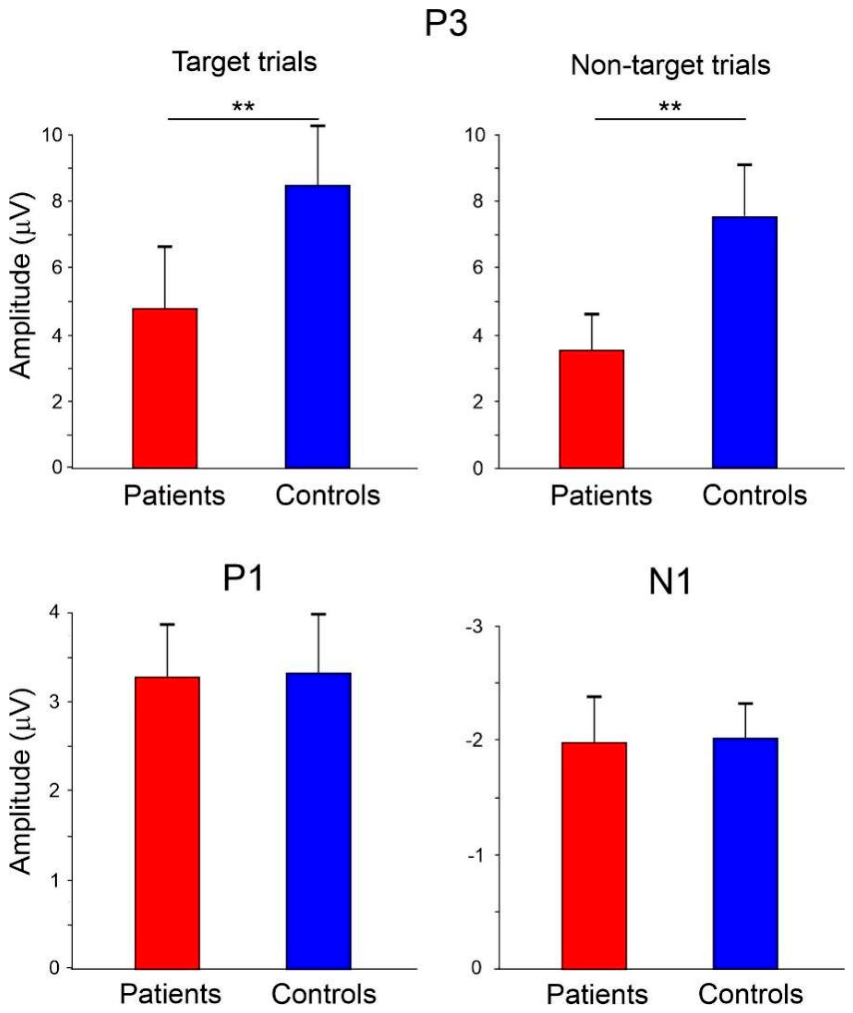
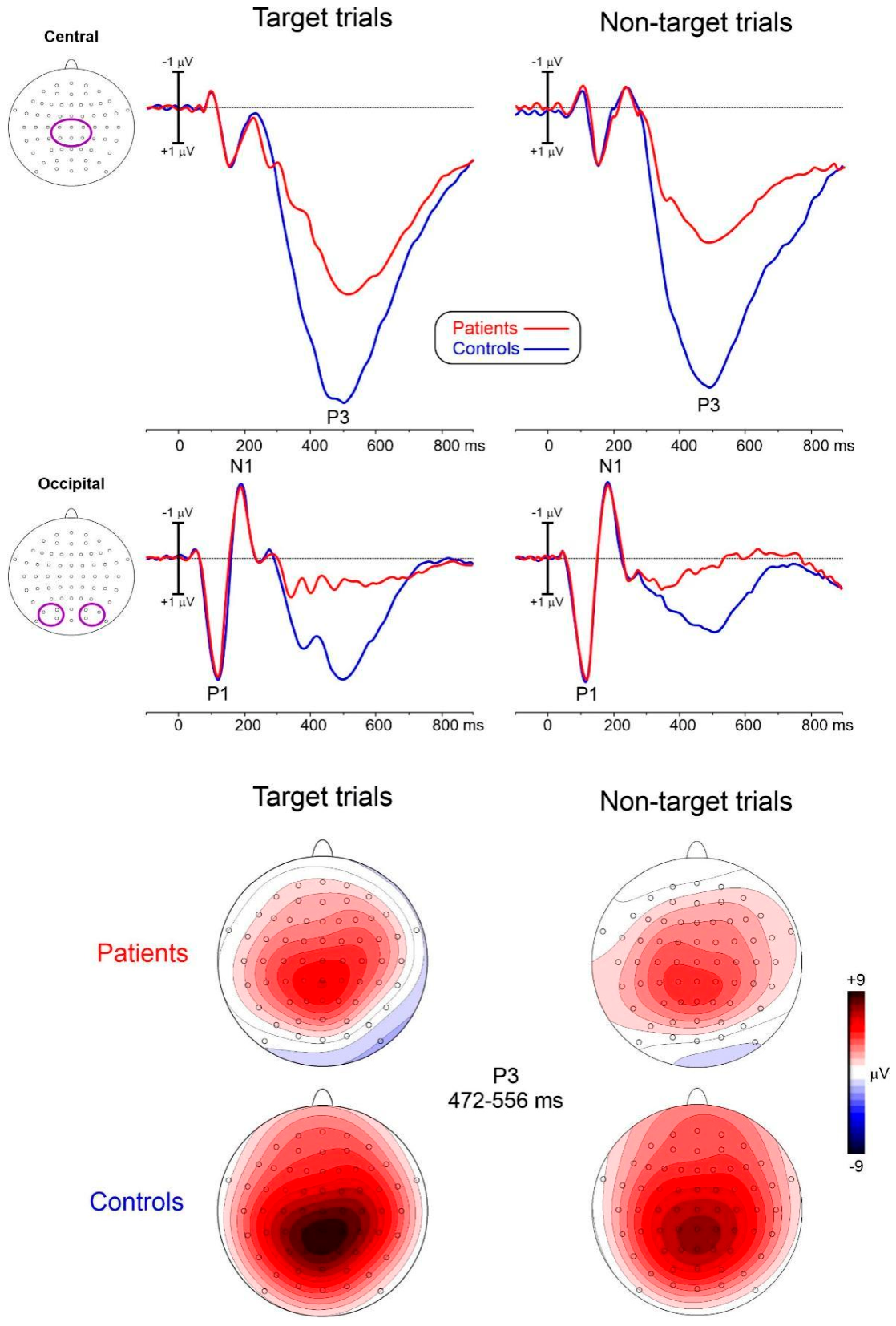
Figure 5 shows the post-stimulus ERP waveforms for the two groups across the three clusters of electrodes representing the P1, N1, and P3 components. The lower side of Figure 5 shows the voltage scalp topographies for the P3 component. The ANOVA on the P1 and the N1 components revealed no significant effects (F<1). However, the ANOVA on the P3 component showed a significant effect of Group (F(1,52)=10.15, p<0.01, ηp2=0.71), with lower amplitude observed in the patient group (4.15 μV SD=0.57) compared to the control group (7.98 μV SD=0.87). The effect of Trials was also significant (F(1,49)=6.24, p=0.02, ηp2=0.59), with larger amplitudes for target trials (6.60 μV SD=0.79) than for non-target trials (5.62 μV SD=0.65). The interaction between the Group and Trial factors was not significant (F<1). Figure 6 graphically represents the mean amplitude and variability of these components.
Figure 6.
Amplitudes of the post-stimulus components and their variability expressed as the 95% confidence interval. The significant differences are also indicated (**p<0.01).
Figure 6.
Amplitudes of the post-stimulus components and their variability expressed as the 95% confidence interval. The significant differences are also indicated (**p<0.01).
Pearson correlation between the considered ERP components' amplitude and the RT/RT variability showed that the RT correlated with the BP and vN amplitude and that the RT variability correlated with the pN (p<0.05, R>0.32) in both groups.
4. Discussion
The present work confirmed previous electrophysiological findings on PTSD patients, which suggest intact early stimulus processing and impaired post-perceptual cognitive processes during cognitive tasks using non-affective stimuli. (e.g., Felmingham et al., 2002; Karl et al., 2006; Miller et al., 2021; Veltmeyer et al., 2006). This cognitive dysfunction has been associated with hypofunctional posterior parietal areas and the hippocampus, both of which are involved in the generation of the P3 ERP (e.g., Derner et al., 2023). The P3 component is associated with post-perceptual attentional processes, such as stimulus categorization (decision-making) and task closure (e.g., Cohen et al., 2020). A reduced P3 amplitude is indicative of disturbed concentration and memory deficits (e.g., Smart et al., 2014) and has been negatively correlated with numbness symptoms (Felmingham et al., 2002), supporting a model that posits disordered memory and attention in PTSD (Galletly et al. 2001; 2008; Veltmeyer et al., 2009).
More importantly, the present study extends the existing literature on PTSD by investigating potential dysfunctions in anticipatory brain processing during cognitive task anticipation and motor response planning - an area neglected in prior research. We examined three proactive ERP components (the BP, pN, and vN), which are associated with motor, cognitive/inhibitory, and sensory preparation, respectively, and have been localized to brain areas affected by PTSD, including the PFC, the cingulate cortex, and secondary visual areas (e.g., Di Russo et al., 2016).
The main finding of the study was a general suppression of these three preparatory processes, which suggests a broadly reduced readiness for the upcoming cognitive task. Specifically, the diminished cognitive and motor preparation (i.e., reduced BP and pN) may reflect dysfunctions in networks involving prefrontal and cingulate regions, as suggested by prior literature. The prefrontal cortex plays a crucial role in the intentional control of negative emotions, fear extinction mechanisms, and the contextualization of stimuli - processes all compromised in PTSD due to the hypo-functionality and/or volumetric reduction of these brain regions (for a review see Liberzon & Sripada, 2007). The pN component may serve as a potential electrophysiological index of prefrontal involvement in cognitive control, and its reduction could be as taken evidence of PFC dysfunction (Perri et al., 2017). Notably reduced cognitive and motor preparation has also been observed in individuals with elevated levels of anxiety (Mussini et al., 2022; Mussini & Di Russo, 2023), suggesting that these alterations may involve the prefrontal and cingulate cortices and could resemble those reported in PTSD.
Moreover, the inability to contextualize internal motivational states and external situational stimuli contributes to symptoms such as anxiety, rumination, avoidance, and numbness (Liberzon & Sripada, 2007). Emotional numbness, in turn, is associated with a reduced attentional response, potentially explaining why the reduced P3 amplitude was observed in PTSD (Felmingham et al., 2002). The failure to interpret stimuli within the appropriate context is also linked to dysfunctions in the cingulate cortex, region involved in voluntary action preparation and is strongly interconnected with the SMA (Ngueyen et al., 2014). Alterations in the cingulate cortex observed in PTSD have been proposed as possible neural correlates of the disorder, while amygdala dysfunction may also reflect more general consequences of trauma exposure (Britton et al., 2005).
While these dysfunctions appear to be common to both anxious and PTSD patients, dysfunction in the top-down attention during the preparatory phase of processing - evidenced by the vN component - may be particularly characteristic of PTSD. In these patients, the reduced discriminative capacity is linked to an impaired ability to process visual signals during the recognition phase, which directly impacts the ability to discern sensory features for stimuli with overlapping neural representations (Popescu et al., 2021). Visual recognition underpins the dynamic allocation of attention, and a deficit in orienting selective attention directly affects the ability to promptly discriminate stimuli and their features (e.g., Block and Liberzon, 2016). The vN component has a role in top-down visual attention, generating low-level mental images of the upcoming stimulus (Di Russo et al., 2021), and its reduction may explain difficulties in subsequent attentional processing stages.
In this study, we also investigated the behavioral consequences of proactive brain processing in a visuomotor cognitive task, specifically, response time and accuracy. Our findings suggest that cortical anomalies observed at the ERP component level seem to be reflected at the behavioral level. Reduced motor and visual preparation likely leads to longer response times (e.g., Di Russo et al., 2019). Wu et al. (2010) previously found prolonged response times in PTSD, interpreting them as the result of a speed-accuracy trade-off. In the present study, we confirm this trade-off, showing that the PTSD group preserved accuracy at the expense of prolonged response times. Reduced cognitive preparation in the PFC has been linked to increased response time variability (Di Russo et al., 2019), a pattern also observed in the current PTSD group. The increased intraindividual coefficient of variation may be explained by impulsivity and depressive symptoms, as response inconsistency is often associated with deficits in top-down cognitive control, which may contribute to the persistence of PTSD symptoms (Swick et al., 2013; Swick et Ashley, 2020).
Pearson correlation confirmed in both groups the association reported in the literature (e.g., Di Russo et al. 2019) between the RT and the ERP components BP and vN, as well as between RT variability and the pN. This may indicate that, compared to healthy people, PTSD patients show similar patterns but suppressed anticipatory activity.
In summary, PTSD is associated with reduced motor, cognitive, and visual preparation, with anxiety compromising the availability of cognitive resources necessary for task performance. Impairment in top-down cognitive control processes prevents adequate suppression of irrelevant visual representations, while prefrontal hypofunction, characterizing the disorder, contributes to categorization difficulties, as evidenced by a depression of the pN and the P3 components. This pattern translates into symptoms of emotional numbness, leading to slower response times, but with maintained accuracy. The present work supports the hypothesis that both top-down and bottom-up attentional deficits play a critical role in PTSD, offering novel biomarkers of PFC, cingulate, and visual area dysfunctions for potential use in PTSD diagnosis.
The study's limitations include the relatively small sample size, which precludes conducting cluster analyses to identify possible correlations between specific symptoms and deficits in particular cognitive domains, which could account for the variability among individual patients across the examined dimensions. Additionally, future research should consider the potential effects of treatment on the neurocognitive indexes identified here, as well as the multiple cognitive deficits observed in PTSD patients.
Future Directions
Future research should include larger samples to enable more refined analyses disentangling PTSD-specific effects from those of comorbid conditions such as depression, generalized anxiety, or dissociation. A dimensional approach could further clarify how individual symptom clusters (e.g., avoidance, hyperarousal, anhedonia) relate to selective impairments in proactive and reactive control. Another key direction is to examine how psychotherapeutic or pharmacological treatments modulate these neurophysiological markers, with the goal of identifying ERP indices that are sensitive to change and potentially useful as predictive or outcome biomarkers. Finally, combining ERPs with complementary methodologies, such as fMRI or EEG functional connectivity, may provide a more comprehensive understanding of the neural networks underlying cognitive dysfunction in PTSD.
Acknowledgments
This work was supported by PNR DM 737/2021 (CUP H85F22000040001) to Francesco Di Russo and by grant EMDR Italia (CDR2.EMDR) to Sabrina Pitzalis.
Conflicts of Interest
Bianca Maria Di Bello, Raffaele Costanzo, Natalie Ferrulli, Margherita Filosa, Maria Gabriela Bevacqua, Francesca Strappini, Valentina Sulpizio, Francesco Di Russo, and Sabrina Pitzalis declare that they have no biomedical financial interests or potential conflicts of interest to disclose.
References
- Aydin, M., A. L. Carpenelli, S. Lucia, and F. Di Russo. 2022. The dominance of anticipatory prefrontal activity in uncued sensory–motor tasks. Sensors 22, 17: 6559. [Google Scholar] [CrossRef]
- Beck, A. T., R. A. Steer, and G. Brown. 1993. Dysfunctional attitudes and suicidal ideation in psychiatric outpatients. Suicide and Life-Threatening Behavior 23, 1: 11–20. [Google Scholar] [CrossRef] [PubMed]
- Beck, A. T., R. A. Steer, and G. Brown. 1996. Beck Depression Inventory–II (BDI-II) [Database record]. APA PsycTests.
- Berchicci, M., G. Lucci, C. Pesce, D. Spinelli, and F. Di Russo. 2012. Prefrontal hyperactivity in older people during motor planning. Neuroimage 62, 3: 1750–1760. [Google Scholar] [CrossRef] [PubMed]
- Bianco, V., R. L. Perri, M. Berchicci, F. Quinzi, D. Spinelli, and F. Di Russo. 2020. Modality-specific sensory readiness for upcoming events revealed by slow cortical potentials. Brain structure & function 225, 1: 149–159. [Google Scholar]
- Bleich, A., J. Attias, and V. Furman. 1996. Effect of repeated visual traumatic stimuli on the event related P3 brain potential in post-traumatic stress disorder. International Journal of Neuroscience 85, 1-2: 45–55.c. [Google Scholar] [CrossRef]
- Block, S. R., and I. Liberzon. 2016. Attentional processes in posttraumatic stress disorder and the associated changes in neural functioning. Experimental neurology 284: 153–167. [Google Scholar] [CrossRef]
- Braver, T. S. 2012. The variable nature of cognitive control: A dual mechanisms framework. Trends in Cognitive Sciences 16, 2: 106113. [Google Scholar] [CrossRef]
- Bremner, J. D., P. Randall, T. M. Scott, R. A. Bronen, J. P. Seibyl, S. M. Southwick, R. C. Delaney, G. McCarthy, D. S. Charney, and R. B. Innis. 1995. MRI-based measurement of hippocampal volume in patients with combat-related posttraumatic stress disorder. American Journal of Psychiatry 152, 7: 973–981. [Google Scholar] [CrossRef] [PubMed Central]
- Bremner, J. D., P. R. Randall, E. Vermetten, L. Staib, R. A. Bronen, C. Mazure, S. Capelli, G. McCarthy, R. B. Innis, and D. S. Charney. 1997. MRI-based measurement of hippocampal volume in posttraumatic stress disorder related to childhood physical and sexual abuse: A preliminary report. Biological Psychiatry 41, 1: 23–32. [Google Scholar] [CrossRef]
- Bremner, J. D., M. Narayan, L. H. Staib, S. M. Southwick, T. McGlashan, and D. S. Charney. 1999. Neural correlates of memories of childhood sexual abuse in women with and without posttraumatic stress disorder. American Journal of Psychiatry 156, 11: 1787–1795. [Google Scholar] [CrossRef]
- Britton, J. C., K. L. Phan, S. F. Taylor, L. M. Fig, and I. Liberzon. 2005. Corticolimbic blood flow in posttraumatic stress disorder during script-driven imagery. Biological psychiatry 57, 8: 832–840. [Google Scholar] [CrossRef]
- Bryant, R. A., K. L. Felmingham, A. H. Kemp, M. Barton, A. S. Peduto, C. Rennie, and L. M. Williams. 2005. Neural networks of information processing in posttraumatic stress disorder: a functional magnetic resonance imaging study. Biological psychiatry 58, 2: 111–118. [Google Scholar] [CrossRef] [PubMed]
- Busch, N. A., and R. VanRullen. 2010. Spontaneous EEG oscillations reveal periodic sampling of visual attention. Proceedings of the National Academy of Sciences 107, 37: 16048–16053. [Google Scholar] [CrossRef] [PubMed]
- Candia-Rivera, D., and G. Valenza. 2022. Cluster permutation analysis for EEG series based on non-parametric Wilcoxon–Mann–Whitney statistical tests. SoftwareX 19: 101170. [Google Scholar] [CrossRef]
- Carrion, V. G., C. F. Weems, S. Eliez, A. Patwardhan, W. Brown, R. D. Ray, and A. L. Reiss. 2001. Attenuation of frontal asymmetry in pediatric posttraumatic stress disorder. Biological psychiatry 50, 12: 943–951. [Google Scholar] [CrossRef]
- Cohen, M. A., K. Ortego, A. Kyroudis, and M. Pitts. 2020. Distinguishing the neural correlates of perceptual awareness and postperceptual processing. Journal of Neuroscience 40, 25: 4925–4935. [Google Scholar] [CrossRef] [PubMed]
- Derner, M., T. P. Reber, J. Faber, R. Surges, F. Mormann, and J. Fell. 2023. A key role of the hippocampal P3 in the attentional blink. NeuroImage 271: 120028. [Google Scholar] [CrossRef]
- Di Russo, F., M. Berchicci, V. Bianco, E. Mussini, R. L. Perri, S. Pitzalis, and D. Spinelli. 2021. Sustained visuospatial attention enhances lateralized anticipatory ERP activity in sensory areas. Brain Structure and Function 226: 457–470. [Google Scholar] [CrossRef]
- Di Russo, F., M. Berchicci, V. Bianco, R. L. Perri, S. Pitzalis, F. Quinzi, and D. Spinelli. 2019. Normative event-related potentials from sensory and cognitive tasks reveal occipital and frontal activities prior and following visual events. Neuroimage 196: 173–187. [Google Scholar] [CrossRef]
- Di Russo, F., M. Berchicci, C. Bozzacchi, R. L. Perri, S. Pitzalis, and D. Spinelli. 2017. Beyond the “Bereitschaftspotential”: Action preparation behind cognitive functions. Neuroscience & Biobehavioral Reviews 78: 57–81. [Google Scholar] [CrossRef]
- Di Russo, F., G. Lucci, V. Sulpizio, M. Berchicci, D. Spinelli, S. Pitzalis, and G. Galati. 2016. Spatiotemporal brain mapping during preparation, perception, and action. NeuroImage 126: 1–14. [Google Scholar] [CrossRef]
- Eckart, C., C. Stoppel, J. Kaufmann, C. Tempelmann, H. Hinrichs, T. Elbert, and I. T. Kolassa. 2011. Structural alterations in lateral prefrontal, parietal and posterior midline regions of men with chronic posttraumatic stress disorder. Journal of Psychiatry and Neuroscience 36, 3: 176–186. [Google Scholar] [CrossRef] [PubMed]
- Etkin, A., and T. D. Wager. 2007. Functional neuroimaging of anxiety: a meta-analysis of emotional processing in PTSD, social anxiety disorder, and specific phobia. American journal of Psychiatry 164, 10: 1476–1488. [Google Scholar] [CrossRef] [PubMed]
- Faul, F., E. Erdfelder, A. Buchner, and A. G. Lang. 2009. Statistical power analyses using G* Power 3.1: Tests for correlation and regression analyses. Behavior research methods 41, 4: 1149–1160. [Google Scholar] [CrossRef] [PubMed]
- Felitti, V. J., R. F. Anda, D. Nordenberg, D. F. Williamson, A. M. Spitz, V. Edwards, M. P. Koss, and J. S. Marks. 1998a. Adverse childhood experiences study questionnaire. PsycTESTS. [Google Scholar]
- Felmingham, K. L., R. A. Bryant, C. Kendall, and E. Gordon. 2002. Event-related potential dysfunction in posttraumatic stress disorder: the role of numbing. Psychiatry research 109, 2: 171–179. [Google Scholar] [CrossRef]
- Fennema-Notestine, C., M. B. Stein, C. M. Kennedy, S. L. Archibald, and T. L. Jernigan. 2002. Brain morphometry in female victims of intimate partner violence with and without posttraumatic stress disorder. Biological psychiatry 52, 11: 1089–1101. [Google Scholar] [CrossRef]
- Frischholz, E. J., B. G. Braun, R. G. Sachs, and L. Hopkins. 1990. The Dissociative Experiences Scale: Further replication and validation. Dissociation: Progress in the Dissociative Disorders 3, 3: 151–153. [Google Scholar]
- Galletly, C. A., A. C. McFarlane, and R. Clark. 2008. Differentiating cortical patterns of cognitive dysfunction in schizophrenia and posttraumatic stress disorder. Psychiatry Research 159, 1-2: 196–206. [Google Scholar] [CrossRef]
- Galletly, C., C. R. Clark, A. C. McFarlane, and D. L. Weber. 2001. Working memory in posttraumatic stress disorder—an event-related potential study. Journal of Traumatic Stress 14, 2: 295–309. [Google Scholar] [CrossRef] [PubMed]
- Hou, C., J. Liu, K. Wang, L. Li, M. Liang, Z. He, and T. Jiang. 2007. Brain responses to symptom provocation and trauma-related short-term memory recall in coal mining accident survivors with acute severe PTSD. Brain Research 1144: 165–174. [Google Scholar] [CrossRef]
- Hughes, K. C., and L. M. Shin. 2011. Functional neuroimaging studies of post-traumatic stress disorder. Expert review of neurotherapeutics 11, 2: 275–285. [Google Scholar] [CrossRef]
- Karl, A., L. S. Malta, and A. Maercker. 2006. Meta-analytic review of event-related potential studies in post-traumatic stress disorder. Biological psychology 71, 2: 123–147. [Google Scholar] [CrossRef] [PubMed]
- Ke, J., L. Zhang, R. Qi, W. Li, C. Hou, Y. Zhong, and G. Lu. 2016. A longitudinal fMRI investigation in acute post-traumatic stress disorder (PTSD). Acta Radiologica 57, 11: 1387–1395. [Google Scholar] [CrossRef]
- Kühn, S., and J. Gallinat. 2013. Gray matter correlates of posttraumatic stress disorder: a quantitative meta-analysis. Biological psychiatry 73, 1: 70–74. [Google Scholar] [CrossRef]
- Lakens, D. 2013. Calculating and reporting effect sizes to facilitate cumulative science: a practical primer for t-tests and ANOVAs. Frontiers in Psychology 4: 863. [Google Scholar] [CrossRef] [PubMed]
- Leone, G., C. Postel, A. Mary, F. Fraisse, T. Vallée, F. Viader, and P. Gagnepain. 2022. Altered predictive control during memory suppression in PTSD. Nature Communications 13, 1: 3300. [Google Scholar] [CrossRef]
- Lewine, J. D., R. J. Thoma, S. L. Provencal, C. Edgar, G. A. Miller, and J. M. Canive. 2002. Abnormal stimulus-response intensity functions in posttraumatic stress disorder: an electrophysiological investigation. American Journal of Psychiatry 159, 10: 1689–1695. [Google Scholar] [CrossRef]
- Liberzon, I., and C. S. Sripada. 2007. The functional neuroanatomy of PTSD: a critical review. Progress in brain research 167: 151–169. [Google Scholar]
- Marquardt, L., H. Eichele, A. J. Lundervold, J. Haavik, and T. Eichele. 2018. Event-related-potential (ERP) correlates of performance monitoring in adults with attention-deficit hyperactivity disorder (ADHD). Frontiers in psychology 9: 485. [Google Scholar] [CrossRef]
- Metzger, L. J., S. P. Orr, N. B. Lasko, and R. K. Pitman. 1997. Auditory event-related potentials to tone stimuli in combat-related posttraumatic stress disorder. Biological psychiatry 42, 11: 1006–1015. [Google Scholar] [CrossRef] [PubMed]
- Miller, L. N., J. G. Simmons, S. Whittle, D. Forbes, and K. Felmingham. 2021. The impact of posttraumatic stress disorder on event-related potentials in affective and non-affective paradigms: A systematic review with meta-analysis. Neuroscience & Biobehavioral Reviews 122: 120–142. [Google Scholar]
- Morey, R. A., A. L. Gold, K. S. LaBar, S. K. Beall, V. M. Brown, C. C. Haswell, and G. McCarthy. 2012. Amygdala volume changes in posttraumatic stress disorder in a large case-controlled veterans group. Archives of general psychiatry 69, 11: 1169–1178. [Google Scholar] [CrossRef]
- Mussini, E., M. Berchicci, V. Bianco, R. L. Perri, F. Quinzi, and F. Di Russo. 2021. Effect of task complexity on motor and cognitive preparatory brain activities. International Journal of Psychophysiology 159: 11–16. [Google Scholar] [CrossRef]
- Mussini, E., V. Bianco, S. Pitzalis, and F. Di Russo. 2022. Modulation of neurocognitive functions associated with action preparation and early stimulus processing by response-generated feedback. Biological Psychology 172: 108360. [Google Scholar] [CrossRef]
- Mussini, E., and F. Di Russo. 2023. Reduction of anticipatory brain activity in anxious people and regulatory effect of response-related feedback. Psychophysiology 60, 2: e14166. [Google Scholar] [CrossRef]
- Nguyen, V.T., M. Breakspear, and R. Cunnington. 2014. Reciprocal interactions of the SMA and cingulate cortex sustain premovement activity for voluntary actions. J Neurosci. 34, 49: 16397–407. [Google Scholar] [CrossRef] [PubMed]
- Pavić, L., R. Gregurek, M. Radoš, B. Brkljačić, L. Brajković, I. Šimetin-Pavić, and V. Kalousek. 2007. Smaller right hippocampus in war veterans with posttraumatic stress disorder. Psychiatry Research: Neuroimaging 154, 2: 191–198. [Google Scholar] [CrossRef] [PubMed]
- Perri, C., J. Stender, S. Laureys, and O. Gosseries. 2014. Functional neuroanatomy of disorders of consciousness. Epilepsy & Behavior 30: 28–32. [Google Scholar] [CrossRef]
- Perri, R. L., and F. Di Russo. 2017. Executive functions and performance variability measured by event-related potentials to understand the neural bases of perceptual decision-making. Frontiers in human neuroscience 11: 556. [Google Scholar] [CrossRef] [PubMed]
- Pissiota, A., Ö. Frans, M. Fernandez, L. von Knorring, H. Fischer, and M. Fredrikson. 2002. Neurofunctional correlates of posttraumatic stress disorder: a PET symptom provocation study. European archives of psychiatry and clinical neuroscience 252: 68–75. [Google Scholar] [CrossRef]
- Popescu, M., E. A. Popescu, T. J. DeGraba, and J. D. Hughes. 2021. Post-traumatic stress disorder is associated with alterations in evoked cortical activation during visual recognition of scenes. NeuroImage: Clinical 31: 102752. [Google Scholar] [CrossRef]
- Rasmusson, A. M., and S. L. Pineles. 2018. Neurotransmitter, peptide, and steroid hormone abnormalities in PTSD: biological endophenotypes relevant to treatment. Current psychiatry reports 20: 1–20. [Google Scholar] [CrossRef]
- Rauch, S. L., L. M. Shin, and E. A. Phelps. 2006. Neurocircuitry models of posttraumatic stress disorder and extinction: human neuroimaging research—past, present, and future. Biological psychiatry 60, 4: 376–382. [Google Scholar] [CrossRef]
- Rauch, S. L., P. J. Whalen, L. M. Shin, S. C. McInerney, M. L. Macklin, N. B. Lasko, and R. K. Pitman. 2000. Exaggerated amygdala response to masked facial stimuli in posttraumatic stress disorder: a functional MRI study. Biological psychiatry 47, 9: 769–776. [Google Scholar] [CrossRef]
- Reddi, B. A. J., and R. H. Carpenter. 2000. The influence of urgency on decision time. Nature neuroscience 3, 8: 827–830. [Google Scholar] [CrossRef]
- Shibasaki, H., and M. Hallett. 2006. What is Bereitschaftspotential? Clin Neurophysiol 117: 23412356. [Google Scholar] [CrossRef] [PubMed]
- Simen, P., J. D. Cohen, and P. Holmes. 2006. Rapid decision threshold modulation by reward rate in a neural network. Neural networks 19, 8: 1013–1026. [Google Scholar] [CrossRef]
- Smart, C. M., S. J. Segalowitz, B. P. Mulligan, and S. W. MacDonald. 2014. Attention capacity and self-report of subjective cognitive decline: A P3 ERP study. Biological Psychology 103: 144–151. [Google Scholar] [CrossRef] [PubMed]
- Spielberger, C. D., F. Gonzalez-Reigosa, A. Martinez-Urrutia, L. F. Natalicio, and D. S. Natalicio. 1971. The state-trait anxiety inventory. Revista Interamericana de Psicologia/Interamerican journal of psychology 5, 3 & 4. [Google Scholar]
- Sussman, D., E. W. Pang, R. Jetly, B. T. Dunkley, and M. J. Taylor. 2016. Neuroanatomical features in soldiers with post-traumatic stress disorder. BMC neuroscience 17: 1–11. [Google Scholar] [CrossRef] [PubMed]
- Swick, D., and V. Ashley. 2020. The specificity of inhibitory control deficits in post-traumatic stress disorder: a dissociation between the speed and reliability of stopping. Journal of anxiety disorders 75: 102278. [Google Scholar] [CrossRef]
- Swick, D., N. Honzel, J. Larsen, and V. Ashley. 2013. Increased response variability as a marker of executive dysfunction in veterans with post-traumatic stress disorder. Neuropsychologia 51, 14: 3033–3040. [Google Scholar] [CrossRef]
- Swick, D., N. Honzel, J. Larsen, V. Ashley, and T. Justus. 2012. Impaired response inhibition in veterans with post-traumatic stress disorder and mild traumatic brain injury. Journal of the international neuropsychological society 18, 5: 917–926. [Google Scholar] [CrossRef] [PubMed]
- Tahan, M., H. Taheri, and T. Saleem. 2021. Review of psychological trauma: theory, practice, policy and research. Rivista di psichiatria 56, 2: 64–73. [Google Scholar] [CrossRef]
- Thut, G., A. Nietzel, S. A. Brandt, and A. Pascual-Leone. 2006. α-Band electroencephalographic activity over occipital cortex indexes visuospatial attention bias and predicts visual target detection. Journal of Neuroscience 26, 37: 9494–9502. [Google Scholar] [CrossRef]
- Usher, M., and J. L. McClelland. 2001. The time course of perceptual choice: the leaky, competing accumulator model. Psychological review 108, 3: 550. [Google Scholar] [CrossRef] [PubMed]
- Veltmeyer, M. D., C. R. Clark, A. C. McFarlane, K. A. Moores, R. A. Bryant, and E. Gordon. 2009. Working memory function in post-traumatic stress disorder: an event-related potential study. Clinical Neurophysiology 120, 6: 1096–1106. [Google Scholar] [CrossRef]
- Veltmeyer, M. D., A. C. McFarlane, R. A. Bryant, T. Mayo, E. Gordon, and C. R. Clark. 2006. Integrative assessment of brain function in PTSD: brain stability and working memory. Journal of integrative neuroscience 5, 01: 123–138. [Google Scholar] [CrossRef] [PubMed]
- Weiss, D. S., and C. R. Marmar. 1997. The Impact of Event Scale-Revised. In Assessing psychological trauma and PTSD. Edited by J. P. Wilson and T. M. Keane. New York: The Guilford Press: pp. 399–411. [Google Scholar]
- Woodward, S. H., D. G. Kaloupek, C. C. Streeter, C. Martinez, M. Schaer, and S. Eliez. 2006. Decreased anterior cingulate volume in combat-related PTSD. Biological psychiatry 59, 7: 582–587. [Google Scholar] [CrossRef]
- Wu, J., Y. Ge, Z. Shi, X. Duan, L. Wang, X. Sun, and K. Zhang. 2010. Response inhibition in adolescent earthquake survivors with and without posttraumatic stress disorder: A combined behavioral and ERP study. Neuroscience letters 486, 3: 117–121. [Google Scholar] [CrossRef]
Figure 1.
Representation of the cognitive task, with features and timing of the stimuli.
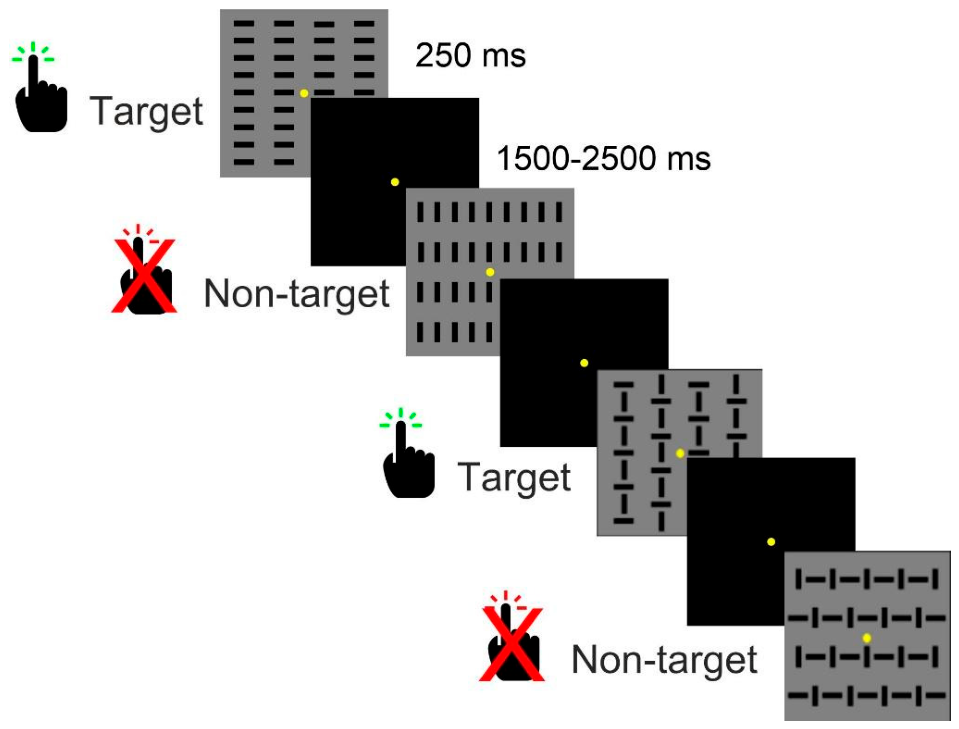
Figure 2.
Behavioral data of the two groups showing the mean response time, variability, and accuracy. The vertical lines represent the 95% confidence interval. Significant group differences are indicated (**p<0.01).
Figure 2.
Behavioral data of the two groups showing the mean response time, variability, and accuracy. The vertical lines represent the 95% confidence interval. Significant group differences are indicated (**p<0.01).
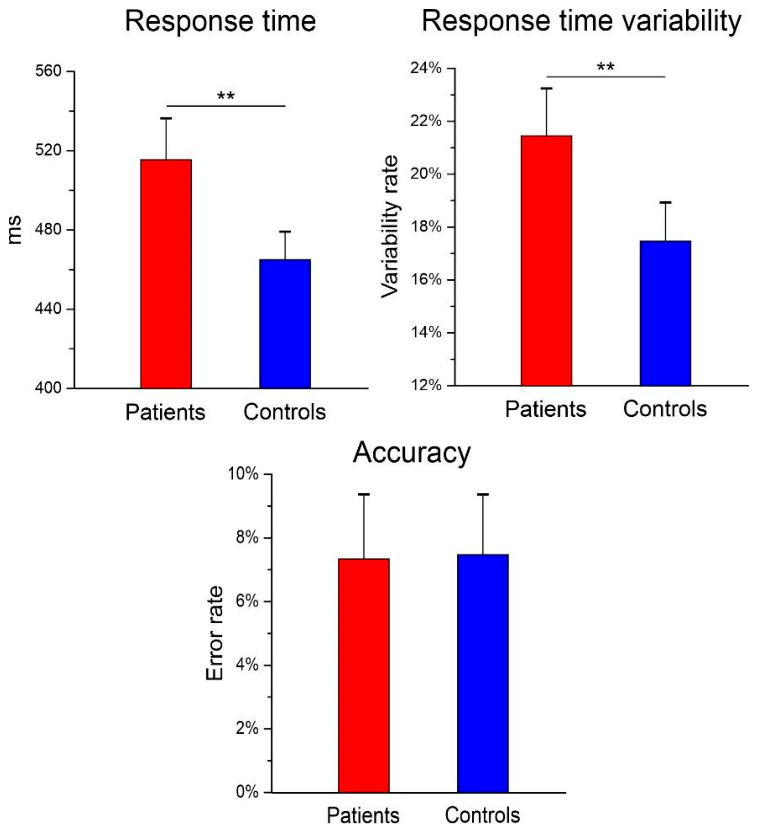
Figure 3.
Left: Pre-stimulus ERP waveforms of the two groups. The circles within the head figures indicate the electrodes included in the waveforms. Right: current source density (CSD) and voltage scalp topography (top-flat view) in the -708/0 ms interval. The circles within the CSD maps indicate the possible localization of the three pre-stimulus ERP components (from top to bottom: pN, BP, and vN).
Figure 3.
Left: Pre-stimulus ERP waveforms of the two groups. The circles within the head figures indicate the electrodes included in the waveforms. Right: current source density (CSD) and voltage scalp topography (top-flat view) in the -708/0 ms interval. The circles within the CSD maps indicate the possible localization of the three pre-stimulus ERP components (from top to bottom: pN, BP, and vN).
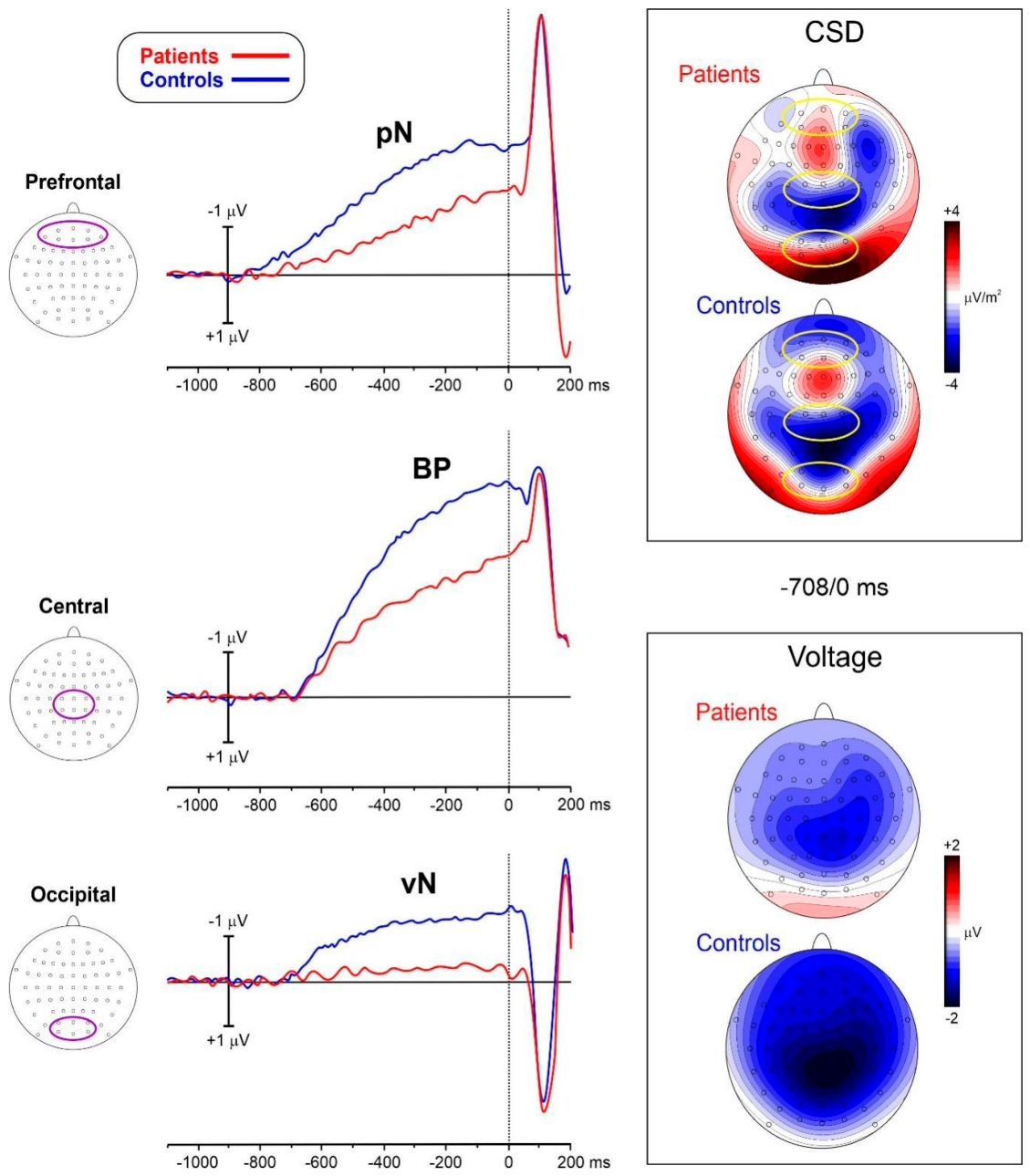
Figure 4.
Amplitudes of the pre-stimulus components and their variability expressed as the 95% confidence interval. Significant differences are also indicated (**p<0.01).
Figure 4.
Amplitudes of the pre-stimulus components and their variability expressed as the 95% confidence interval. Significant differences are also indicated (**p<0.01).
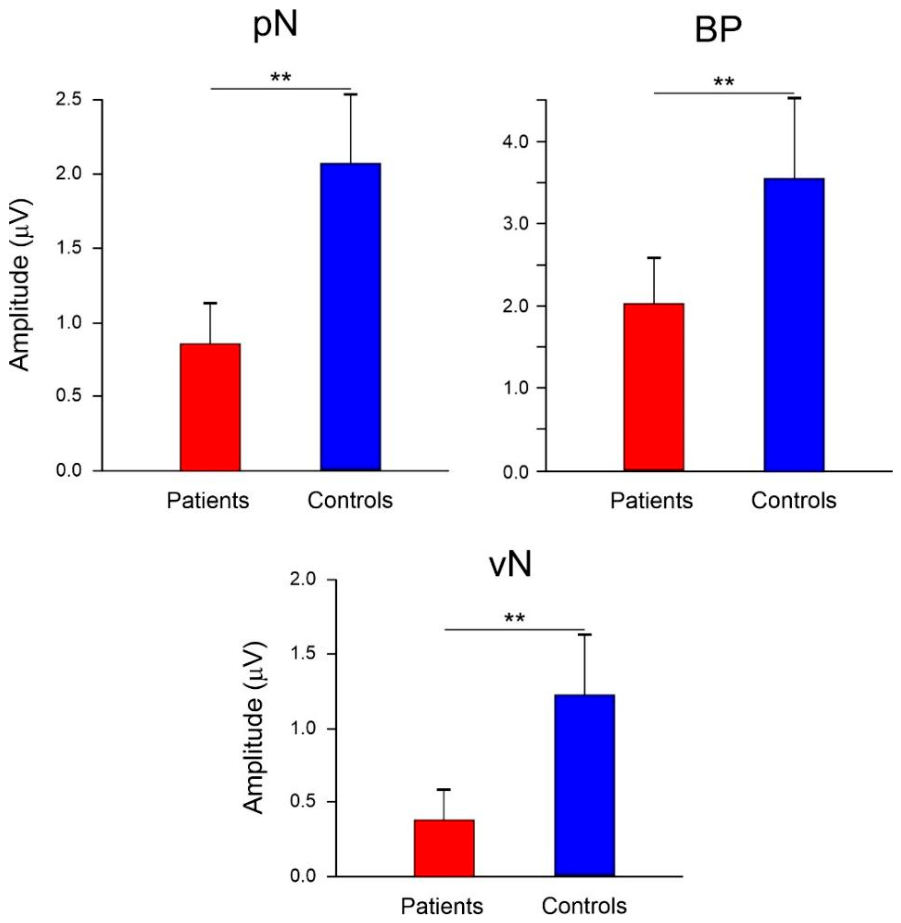
Figure 5.
Top: Post-stimulus ERP waveforms of the two groups and trial types. The circles within the head representation indicate the electrodes included in waveforms. Below: Voltage scalp topography (top-flat view) of the P3 in the 472-556 ms interval of the two groups and for the target and non-target trials.
Figure 5.
Top: Post-stimulus ERP waveforms of the two groups and trial types. The circles within the head representation indicate the electrodes included in waveforms. Below: Voltage scalp topography (top-flat view) of the P3 in the 472-556 ms interval of the two groups and for the target and non-target trials.
Disclaimer/Publisher’s Note: The statements, opinions and data contained in all publications are solely those of the individual author(s) and contributor(s) and not of MDPI and/or the editor(s). MDPI and/or the editor(s) disclaim responsibility for any injury to people or property resulting from any ideas, methods, instructions or products referred to in the content. |
© 2026 by the authors. Licensee MDPI, Basel, Switzerland. This article is an open access article distributed under the terms and conditions of the Creative Commons Attribution (CC BY) license (http://creativecommons.org/licenses/by/4.0/).
Copyright: This open access article is published under a Creative Commons CC BY 4.0 license, which permit the free download, distribution, and reuse, provided that the author and preprint are cited in any reuse.


