
Submitted:
07 June 2026
Posted:
09 June 2026
You are already at the latest version
Abstract
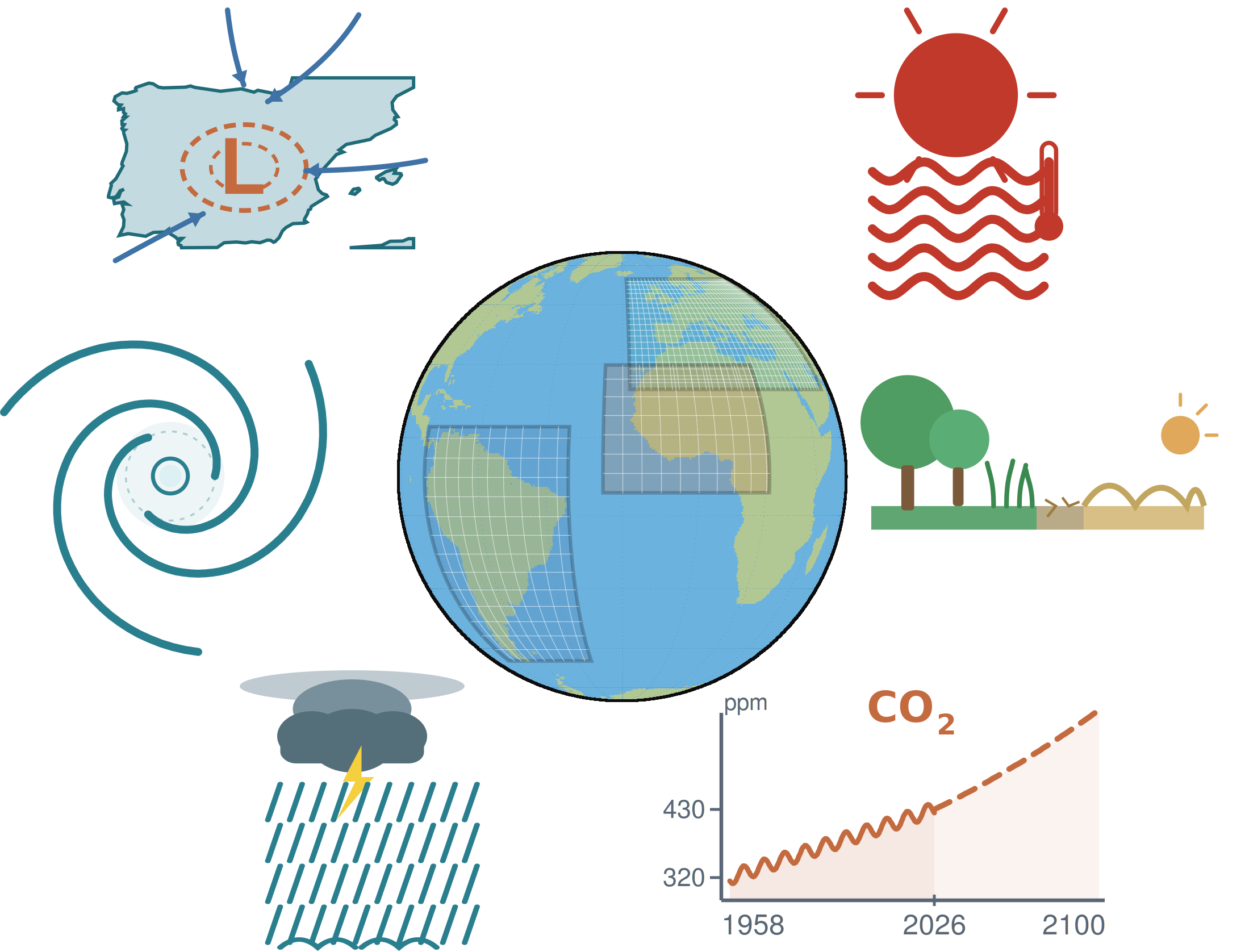
Regional climate models (RCMs) have become established as essential dynamical downscaling tools, providing physically consistent, high-resolution climate information where global climate models (GCMs) are unable to resolve. Added value is obtained over heterogeneous vegetation, coastal, urban or orographically complex zones. Temperature, precipitation or wind benefit whenever fine-scale processes govern the climate signal, as with extreme events. CORDEX initiative (since 2009) has further consolidated RCM research with coordinated multi-model ensembles covering all continental regions, enabling systematic uncertainty quantification of regional climate projections. PROMES RCM has been an active scientific contributor across three decades to the modelling community ensemble. This review synthesizes and documents PROMES’s development, performance across Europe, West Africa and South America, and assesses its scientific contributions. This includes climate change projections features, extreme events (droughts, heat waves, or Mediterranean tropical-like cyclones) or land surface–atmosphere studies. Its behaviour within the more relevant international multi-model ensembles (from PRUDENCE to EuroCORDEX), with structurally independent characteristics, represents a scientific asset for uncertainty characterization beyond the model’s individual results, offering a legacy argument for preserving RCM diversity in ensemble design strategies, as it is an essential and many times underappreciated key point of uncertainty analysis.
Keywords:
PROMES
; dynamical downscaling
; regional climate modelling
; climate change projections
; extreme events
; Europe
Copyright: This open access article is published under a Creative Commons CC BY 4.0 license, which permit the free download, distribution, and reuse, provided that the author and preprint are cited in any reuse.


