

Submitted:
06 June 2026
Posted:
08 June 2026
You are already at the latest version
Abstract
The spicules, flares, any plasma jets, and stellar lightning participate in the coronal heating dynamics of the Sun and Stars. The essential concept of the coronal heating problem in understanding how the upper atmosphere of stars and the Sun is heated to multi-million-degree temperatures, and its lower zone, the photosphere and chromosphere, still at 5000 K or 10000 K, remains one of the great unsolved issues in the history of astrophysics. Magnetic field dominates coronal heating dynamics since Magnetic pressure is higher than the thermal pressure of ions and particles. This tussle and equilibrium between them enhances the surface temperature and brightness of the star's outer atmosphere. The speed and temperature of the energetic particles in the plasma jets and stellar lightnings of the stars, the surface temperature, and the luminosity of stars could be determined mathematically. The particles with higher speed, momentum, and maximum equivalent temperature can leave the surface of a star with a speed higher than the escape velocity. The particles with a minimum speed and lower temperature in the plasma jets and spicules may fall back to the surface of stars as coronal rain. Particles in the Coronal mass ejection have enough energy and speed to escape from the external surface of stars as a solar wind. Plasma Jets and stellar lightning are energetic particles and ions that come out rapidly from the interior shells of the Sun and Stars to enhance coronal heating dynamics. Plasma jets and stellar lightning emerge vertically from the lower shells of stars, cause violent turbulence on their surfaces in the photosphere and chromosphere, and are involved in the coronal heating dynamics of the stars and the Sun. The central temperatures of stars range from 20 million kelvins to 3 billion kelvins due to nuclear fusion processes, causing ions and energetic particles to form powerful plasma jets, stellar lightning, nanoflares, spicules, solar wind, and coronal mass ejections on stellar surfaces. The thermal pressure prevailed over the magnetic pressure and increased the speed of energetic particles to leave the exterior surface of stars. The lifetime of stellar lightnings is a few seconds and difficult to detect with present technology, but the lifetime of spicules, stellar flares, and coronal loops is extended to several minutes and days. Maximum plasma jets and stellar lightnings may be displayed on the surface of a massive star due to the fusion of heavy elements in its fusion ball in the core, typically Oxygen, silicon, germanium, and manganese.
Keywords:
escape velocity of the energetic particles
; surface temperature of the stars
; luminosity of the stars
; nuclear fusion
; stellar jets
; stellar lightnings
; coronal heating dynamics
1. Introduction
A
star’s luminosity (its total power output) is determined by its surface
temperature and its radius (size), using the Stefan-Boltzmann Law. The
luminosity of the Sun is used as the standard unit of measurement (1 solar
luminosity ) for comparing with the luminosity of other stars. The surface
temperature of the Sun is approximately 5,000 Kelvin (ranging between 5,772 K
to 6000 K across different models). The surface temperature and Lumosity of a
star are related to the mass, radius, and amount of fuel that is burning in the
core of a star. The low-mass star can burn hydrogen to form helium gas. The
massive stars may burn multiple chemical elements at once to form several
elements and release a sufficient amount of energy into free space. The “Coronal
Heating Problem” persists because multiple mechanisms likely operate
simultaneously as Magnetic Reconnection (DC Heating), Wave Dissipation (AC
Heating), Magnetohydrodynamic (MHD) waves as the Alfvén waves, and Current
Sheet Dissipation. Powerful plasma jets and rapid lightning trees come out from
the interiors of the Sun and stars and are involved in solar and stellar
coronal heating dynamics. The heating dynamics of stellar coronae are the rapid
increase in the outer shell of stars and the Sun to millions of degrees. It is
a dynamic process driven by the equilibrium between magnetic pressure and
thermal pressure. In this environment, magnetic pressure dominates, confining
the plasma in loops, while thermal pressure tends to expand it. The continuous
struggle between these two forces dictates how magnetic energy is released,
acting as a “self-regulating cycle” that keeps the corona hot. Hottest and
energetic plasma particles rising from an interior shell of a star to enhance
the coronal heating dynamics and release energetic particles freely into space
with a speed higher than the escape velocity from the external surface of stars
[1,2]. Solar and stellar activities are
included: X-ray emission from stellar coronae, enhanced chromosphere emission
during stellar activity, is notably prominent in the (Hydrogen-alpha) line and
the Ca II H & K resonance lines, and Visible and radio emission from
stellar flares [3–7]. The central temperature and pressure
in the center of stars increased violently to enhance the chains of nuclear
fusion processes and release powerful plasma jets and stellar lightnings into
space. Indeed, Powerful plasma jets and stellar lightning are coming from
massive stars; typically, these stars have sufficient central pressure and
temperature to produce heavy elements such as silicon, germanium, copper,
manganese, and magnesium. Plasma jets and multiple stellar lightings that are
happening at once, such as lightning trees, are coming out from interior shell
of massive stars as evidence of violent events that happening in the core of
stars and their external surface. The jet speed of plasma and stellar lighting
may exceed the escape velocity of the stars. As a result, high-energy particles
may come out directly from the outer surface of stars and the Sun. high energy
particles are coming out from the Sun and stars rapidly with higher speed and
momentum. The plasma jets and stellar lightnings participate directly in the
turbulence, magnetic hydrodynamic waves, and heating up of the stellar
atmosphere and coronal heating dynamics. The figures and images in this
research work are based on theoretical concepts and sketches obtained by using
the advanced MATLAB program and mathematical equations to describe coronal
heating dynamics clearly.
The main objectives of this study are to calculate
the escape velocity of energetic particles v, the Radius R,
Surface Temperature T, and luminosity L of the stars.
2. An Escape Velocity and Temperature of the Energetic Particles in Plasma Jets
An escape velocity of the energetic particles at a
distance r from interior and surface of the massive stars can be
described by a Newtonian mechanic and thermodynamics. The wave lengthen,
frequency, mass, and typically the temperature of accelerated particles had
been used to calculate the escape velocity and kinetic energy of particles. The
temperature of accelerated particles and ions that come out from depth of stars
are depending on the interior temperature and pressure of stars. Following the
general equations of the Gravitational acceleration and Potential energy of the plasma jets and stellar lightnings
at a distance from the external surface of the massive stars:
(1)
(2)
Following is Wien’s Law,
which plays a crucial role in measuring the surface temperature of the hottest
stars and wavelength of the radiation which radiated from celestial objects:
(3)
where E is a thermal energy of particles and
celestial objects, and is the maximum wavelength of a photon
particle, it is inversely proportional with a temperature T. If
potential energy and Kinetic Energy were equalized, yield to:
(4)
where is the Mass of Star, is the radius of a star, and is the escape velocity of plasma jets , ions, and
energetic particles from the external surface of a star at the speed lower than
the speed of light in space. Thusly, a gravitational constant is ), and is the mass of accelerated particles which escaped
at a distance r from massive stars. If kinetic energy of particles in
the hottest plasma jets and lightning trees were thermalized yield to:
(5)
(6)
where is the temperature of accelerated particles
and plasma jets from external surface of the stars was changed immediately due
to the gravity, electromagnetic field, rapid temperature change, nuclear fusion
dynamic, central temperature effects, and internal thermal pressure of stars.
The Boltzmann constant plays a crucial role, and utilized in this
mechanism. Escape velocity is the minimum speed an object requires to break
free from a celestial body’s gravitational pull without further propulsion. On
a black hole, it is 300,000 km/s; on Earth, this threshold is approximately
11.2 km/s. To escape a gravitational field, an object’s total mechanical energy
must be at least zero at the surface, since the sum of kinetic energy and
gravitational potential energy is zero. An escape velocity on the surface of
stars is lower than the speed of light. But on the surface of a black hole
singularity, an escape velocity may exceed the speed of light [8–14]. The singularity has a tiny size as an
atom, and only superparticles can escape from its powerful gravity. An object
with a mass of stars, planets, and galaxies had been compressed into the size
of atoms and incredible density. The speed of superparticles can exceed the
speed of light to collide with a black hole singularity or leave it forever.
The theory of escape velocity was developed from Newtonian mechanics, General
relativity, and quantum mechanics, and applied to escape velocity from the
surface of a white, smooth ball of a singularity. The singularity is a compact,
physical object with a tiny size, immense gravity, maximum surface temperature,
huge thermal energy, central pressure, and high angular momentum.
Problem1: Calculate an escape
velocity v and T temperature of particles as powerful
plasma jets come out from surface of a blue star with a
Mass 20 times the mass of Sun and its radius 8 times the radius of a Sun while
escaping at speed 100 kilometers per second to 1000 kilometers per second
?.
The mass of a blue massive star is approximately 20
times of the solar masses , and its radius could be
eight times the radius of a Sun Then, the jet of plasma particles are accelerated
protons and the dominant plasma ions, they escaped from an external surface of
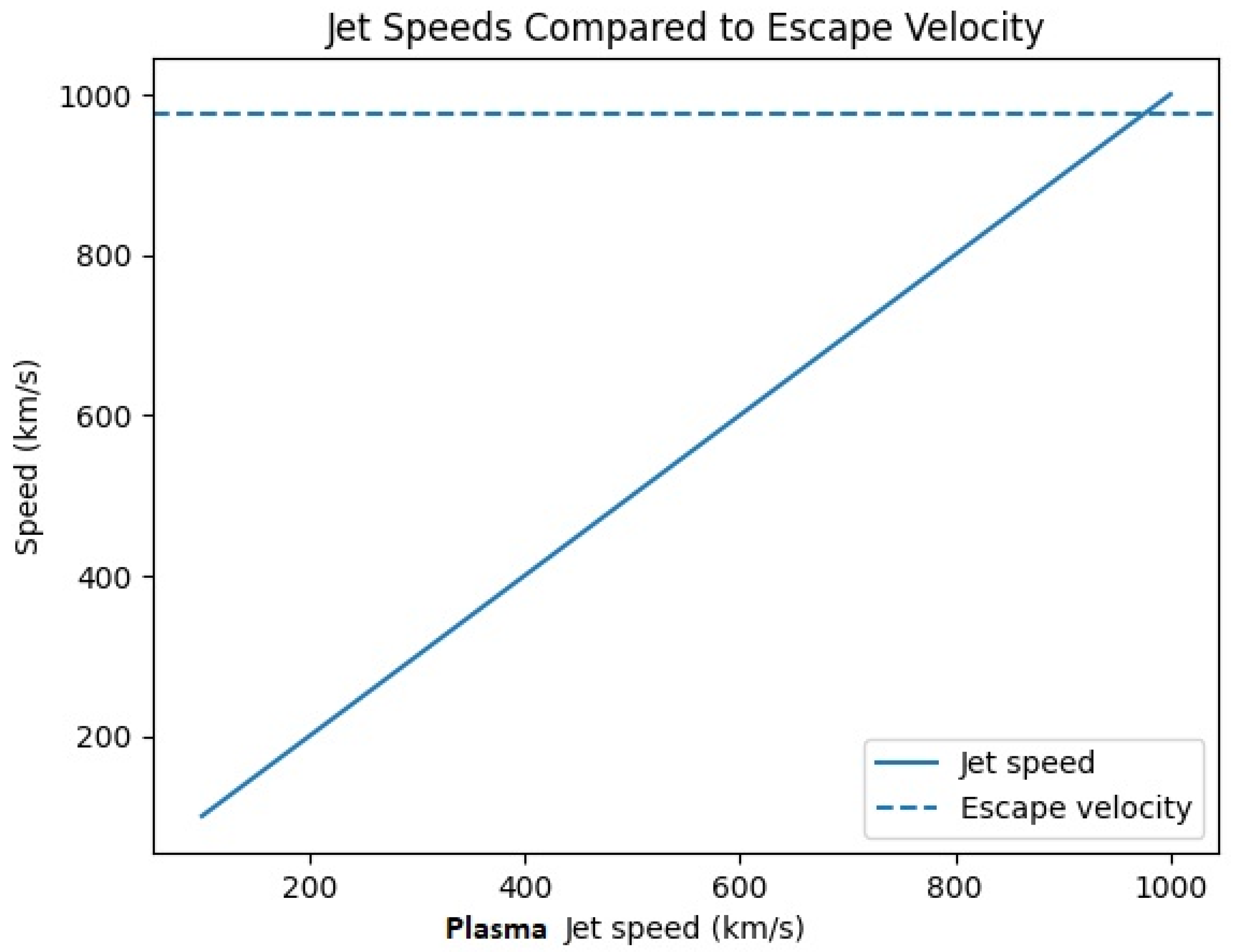
this massive star with a speed Only particles with a speed over (977
km/s) have the capacity to escape from this massive star without additional
magnetic or radiative driving. The jets below () are partially bound, and jets above this speed
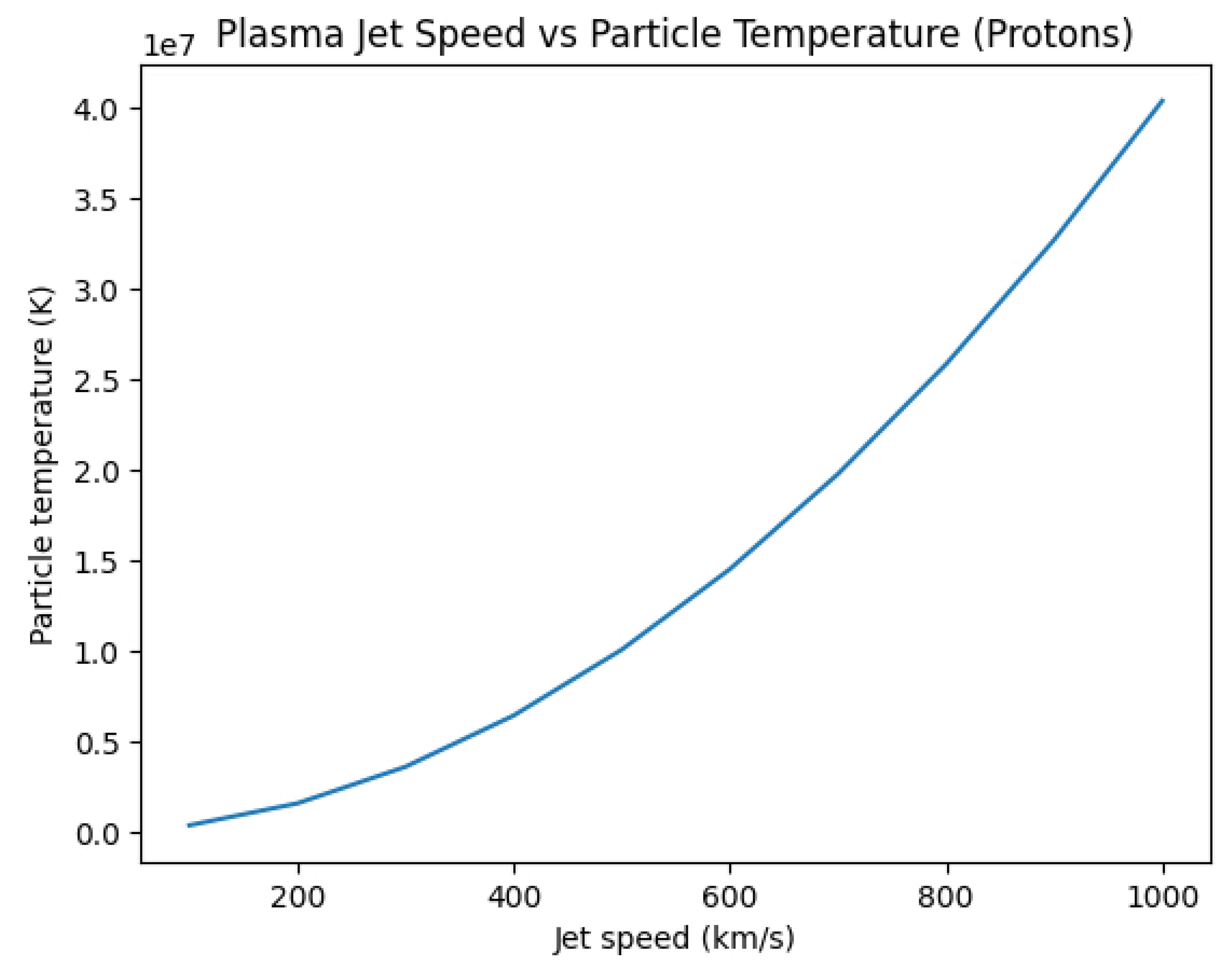
freely escaping plasma. Blue star, with a mass 20 times the mass of the Sun,
requires a speed of 1000 kilometers per second and a temperature of 40 million
kelvins to launch freely escaping lightning-driven plasma jets. The jet speed
of proton particles are (), the mass of a proton
particle is kg), then the temperature of a hydrogen
atom or proton particles on the surface of a massive star is very low, it is
approximately The jet speed of proton particles are (), the mass of a proton
particle is kg), then the temperature of proton
particles on the surface of a blue star is very high, it is approximately The jet speeds of ions and proton particles
are lower than 977 kilometers per second as compared to escape velocity of the
energetic particles may reach thousands of kilometers per second.
Figure 1.
Plasma Jet speed compared to escape velocity.
The proton particles and ions have variable speeds
vs Temperature since the powerful plasma jets and stellar lightnings (lightning
trees) are coming out rapidly from internal surface of a blue star. The speed
and temperature of proton particles had been increased rapidly, typically over
escape velocity point. The lightning tree has maximum speed and temperature.
The stars have huge mass, gravity, and intense electromagnetic field. The
particles with lower speed and minimum temperature may fall back on the surface
of star as a plasma rain. The plasma jets and stellar lightnings with higher
speed, energy, momentum, and maximum temperature may escape into space as
coronal mass ejection and cosmic radiations. The plasma jets and lightning
trees are main source of heating solar corona and stellar corona. The coronal
heating dynamic is activated by powerful plasma jets and lightning trees. The
plasma jets and stellar lightnings together may participate to enhance
turbulences in the surface of stars to accelerate particles and ions, and
release high-energy photon particles as gamma rays and x-rays. Nuclear fusion
takes place in the heart of stars, where light atoms fused to produce heavy
atomic nuclei, and releasing energetic particles, neutrino, and electromagnetic
radiations. Photon particles required longer time to come out from depth of
stars. The maximum number of photon particles trapped in the core of stars is
involved to enhance their central temperature, interior pressure, and
accelerate nuclear fusion processes. Nuclear fusion is a main source of the
plasma jets, lightning trees, stellar lightnings, photon particles, neutrino
particles, coronal mass ejection, cosmic radiations, and coronal heating
dynamics.
Figure 2.
Plasma jets’ speed vs particle temperature.
3. Nuclear Fusion Effects
The surface temperature and luminosity of stars
have increased violently while they are burning the maximum amount of nuclear
fuel. The nuclear fusion of stars acts directly on the formation and evolution
of stars. It is involved in the formation of plasma jets, stellar lightnings,
stellar flares, coronal mass ejection and increases the surface temperature,
luminosity, and coronal heating dynamics. The visible Universe has enough mass,
gravity, hydrogen fuel, stellar nebulae, and powerful black holes to form
low-mass and high-mass stars. We are living in a professional and intelligent
Universe. The Universe can create, develop and destroy itself. The visible
Universe was a superparticle that could be created from compressed amount of
matter inside a huge parent black hole and escaped into infinite space outside
an event horizon of a supergiant black hole, evaporating to form all galaxies,
celestial objects, and stars. The Universe is intelligent enough to make stars,
chemical elements, and the human body from star dust. We are survived
superparticle, star dust and grandchildren of stellar remnants due to supernova
events. Low-mass stars, like the Sun, can fuse hydrogen nuclei to form helium.
In the heart of massive stars, heavy chemical elements had been formed due to
nucleosynthesis. The central temperature and central pressure of stars are
increased violently through the burning of multiple types of chemical elements,
typically in massive stars. About half of the total mass of a star is
compressed into its core, combined, and squeezed into the 4 percent of the
total radius of the star to fuse light and Heavy chemical elements [15]. The star is a big ball of the hottest
gas and plasma; as a result, most of the mass of the star falls into the center
to ignite nuclear fusion. The central radius of a star is only four percent of
its total radius, and half of its mass is condensed into such a small fusion
ball to protect stars from explosion, and store the maximum amount of thermal
energy, and increase both the stellar central temperature and central pressure.
Problem 2: The
main-sequence star or the high-mass star with a mass of 20 times the mass of a Sun
, and its radius 8 times the radius of a Sun , the central mass of a star is half of its total
mass, and the central radius of a star is four percent of its total radius to
fuse heavy elements, calculate its central radius, central mass, maximum
central pressure, central temperature, minimum distance between two atomic
nuclei to fuse, speed of hydrogen or proton particles, DE Broglie wavelength of
hydrogen particles and its frequency ?.
Solution:
where is the central radius of a fusion ball, it
is about four percentage of the total radius of a star, where half percent of
the total mass of a massive star is compressed there to fuse heavy chemical
elements under huge central pressure and temperature:
where is the Central mass of a massive star, it
is about half of the total mass of star, because the star is a huge gaseous
sphere of condensed plasma. To initiate a nuclear fusion continuously in the
core of star, the star should compress most of its mass at its heart. The
nuclear fusion reaction is required massive stars, huge central pressure and
maximum central temperature.
.
.
where is the central density of a nuclear fusion ball.
The maximum central pressure is determined by using an equation of hydrostatic
equilibrium in the core of a blue star.
The mean molecular weight for the ionised gas the
hydrogen and helium atoms . Where is the maximum central temperature of
proton particles and ions in the core of massive Stars by using an equation of
ideal gas in hydrostatic balance of the main sequence stars.
=Assuming in proton—proton fusion processes , and is an electric charge. Then, is the minimum distance between any atomic
nuclei to fuse, and it is crucial to produce heavy elements, and release huge
amount of nuclear energy, photon particles, neutrino particles, and energetic
particles. Most photon particles are trapped in the heart of a star to increase
its internal temperature. The neutrino particles may come out from the heart of
stars for few seconds due to their huge power, maximum energy, easy
penetration, high frequency, minimum radius, narrow wavelength, less
interaction with matter, and rapid penetration through celestial objects except
the heart of black holes. At every second, millions of tons of stellar fuel
fuse into new heavy matter, and releasing huge amounts of energy into space.
About 97% of the gravitational energy of the star is converted into neutrino
particles in the supernovae event, and 3% may convert into photons, atoms,
subatomic particles, and fabriton particles in the structure of an exploded
stars. Most of the gravitational energy of the stars is converted into neutrino
particles in the collapsed stars, and a small portion of their energy is
dissipated as vibrational energy for exploded stars. In main sequence stars,
only few ratio of the gravitational energy is converted into neutrino particles
during nuclear fusion processes.
At the beginning, I have to calculate the
speed, wavelength, and frequency of protons or hydrogen ions, and much
necessary to find the distance between two protons or two hydrogen ions in the
core of massive stars:
.
Then, the speed of hydrogen ion or proton particle
has been determined is Then, is the thermal velocity of particles, specifically
hydrogen ions, is the mass of hydrogen ion equals to the mass of
proton particle.
=.
The de Broglie wavelength of the proton
particle in the core of a massive star has been determined as .
By using a speed equation of particles and an
electromagnetic waves to calculate the frequency of the vibrated hydrogen ions
and protons particles: .
Rearrange above equation to determine the frequency
of oscillating hydrogen ions or proton particles:At first step, I need to find number density of
hydrogen or proton Particles to calculate the minimum distance between two
hydrogens or two proton particles:
.
Then, substitute the value of into this equation to calculate (d) the distance
between two hydrogen ions or two protons: .
4. Plasma Jets and Stellar Lightnings
Massive stars drive some of the most violent
phenomena in the universe, characterized by high-velocity plasma ejections and
extreme electrical activity, or stellar lightnings during formation, fusion,
evolution, and ultimate death of stars. Plasma jets are well-documented
phenomena that emanate from massive stars, particularly during their birth and,
in some cases, throughout their evolution, and death as supernovae, when they
form stellar-mass black holes. These jets and lightning trees are highly collimated
streams of ionized matter (plasma) that shoot out from the poles of massive
stars or their remnants at near-light speeds. Powerful Magnetic fields of the
stars, typically massive stars, may ionize gas into twin plasma jets that can
stretch out for thousands kilometers, scaling in size with the star’s mass.
Twin plasma jets are two massive plasma jets of highly energetic particles that
come out from an external surface of a massive star at the same time. Massive,
and hot young stars (some over seven times the mass of our Sun) emit intense
stellar lightnings and radiation that make the surrounding gas glow.
High-energy X-rays from newborn stars and massive stars appear as sparkling.
Massive stars, such as those with masses above 8 to 200 solar masses, produce
powerful line-driven, hottest winds during their evolution, losing mass at high
rates. Plasma jets, spicules, and radiation, flares, and energetic particles
come out from low-mass stars and massive stars [16–22].
Nuclear fusion in massive stars with a mass of 20 times the solar mass powers
their evolution by converting lighter elements into heavier ones. The stellar
lightnings are a rapid explosion of highly energetic particles and ions that
are displayed as huge trees on the surface of stars, and enhance the turbulence
in the photosphere and chromosphere zones to heat them and release coronal
loops, spicules, and coronal mass ejections.
In the deep core of massive stars, an onion-like
structure of burning shells is created. The nuclear fusion process starts with
hydrogen fusing to form helium. Nuclear fusion can fuse light atoms to create
heavy elements, releasing energy and energetic particles. About 700 million
tons of hydrogen atoms are fused at any second in the heart of solar mass stars
to form 695 million tons of helium, releasing 5 million tons as energy. The
mass of fused elements could be higher than the mass of the produced elements
in the nuclear fusion processes due to the dissipation fraction of element mass
into energy in the nuclear fusion processes. Nuclear fusion processes in the
heart of massive stars are violent and powerful compared to those of low-mass
stars. In fact, massive stars can fuse the maximum amount of mass and multiple
elements at once to produce additional energy and form new heavy elements.
Chemical elements are formed abundantly in the heart of massive stars, and
powerful plasma jets are displayed on their surface. An additional mass of
star, maximum gravitational energy of the star, continuous nuclear fusion
processes in the core of a star, and an accumulation of photon particles there
in the lower shells of stars may increase the central temperature, thermal
energy, and central pressure of the star to start nuclear fusion processes
widely and produce new heavy elements, typically in the core of a massive star.
In the heart of massive stars, helium, carbon, neon, oxygen, Germanium,
magnesium, and silicon are fused under violent conditions, and even thermal
energy and pressure culminate in the hottest iron core, which leads to the
expansion of an outer shell of the massive stars or lead to a supernova event.
Most chemical elements in the periodic table, and those in the structure of
living creatures or celestial objects, could be formed in the heart of massive
stars, and those elements are distributed into space after a supernova event. A
supernova event is the violent death and explosion of a massive star. It occurs
after the star’s nuclear fuel is exhausted and its hydrostatic balance has
vanished entirely. About half of the mass of a massive star is concentrated in
a nuclear fusion ball or around it to trap as many photon particles as
possible, enhance thermal energy, and increase the star’s central pressure and
temperature, which leads to enhanced nuclear fusion processes and produces new
heavy elements. The star is a big ball of the hottest plasma, and its volume
changes due to nuclear fusion processes and the release of energy. The galaxy
contains millions to billions of main-sequence stars that are burning their
nuclear fuel to feed the universe with additional energy and chemical elements.
The thermal energy, central pressure, central temperature, external surface
temperature, luminosity, and total volume of the stars are dynamically
changeable, providing enough opportunity for stars to release photons, energy,
stellar lightnings, and plasma jets into space. The stars can expand out or
shrink inward since their internal energy or pressure increases or decreases
due to the continuous nuclear fusion process in the heart of stars.
(7)
(8)
where W is the work done by a star, F
is a force, d is a displacement, P is a pressure, A is the
surface area of the star, V is the volume of the star, and r is
the radius of spherical stars. The radius r and volume of star dV
are changeable due to an increment and decrement in the temperature, pressure,
and size of star. Indeed, any change in the size of a star, dV,
multiplied by a pressure P that is equalized to the work done by a star,
which is released as stellar luminosity, plasma jets, stellar lightnings, and
coronal mass ejections, or converted into energy that is lost every second as
luminosity and brightness. The internal energy and thermal energy in the heart
of a star have increased due to the sustainable nuclear fusion processes. The
size of a star is changeable due to an increase and decrement of the central
pressure and central temperature of the star. An external shell of a star is
expanding due to an increase in the central pressure and temperature of the
star. Powerful plasma jets and lightning trees may come out rapidly from the
deepest point of a massive star due to the expansion and weakening of the
external shell of a star. The lightning tree of ions and energetic particles
may come out from the inner shells of a massive star. The stellar lightnings
may come out as trees from the lower shells of a star. The stellar lightnings
are several ions and energetic particles that may come out from massive stars
and explode as a huge tree on the surface of stars. The external surface of
stars may rise as a hill and blow up to emanate a stellar lightning as a huge
tree of the hottest and energetic plasma particles. The lifetime of a stellar
lightning is a few seconds. The lightning tree may come out from the inner
shell of stars to expand vertically and annihilate on its surface at the
shortest time as compared to the lifetime of a powerful plasma jets. The plasma
jets contained a large number of energetic particles that may come from the
inner shells of stars and explode as hydrogen bombs. The plasma jets have a
longer lifetime and contained huge amount of accelerated particles. They can
persist on the surface of a massive star for hours, days, or weeks. The life
time of stellar lightning is few seconds since it is coming out urgently from
deep point of the star and annihilated on its surface after evaporation. The
stellar lightning may come out vertically as a thinner, denser and powerful string
of plasma jet from lower shell of a massive star, and annihilated immediately
on its external surface as branches of huge tree due to powerful gravitational
field and electromagnetic field of star. The stellar plasma jet may come out as
a huge explosion of the volcanic or hydrogen bomb plasma that stretched out
thousands kilometers on the surface of star and curved on its surface again due
to gravity and electromagnetic field of star. The plasma jets, solar flare,
spicules, coronal mass ejects and stellar lightnings are hottest photon and
energetic plasma particles may display on the surface of stars, and they could
be curved, and dropped back on the surface of stars as plasma rain are fall
down to heat up an external surface of stars. The plasma jet may come out from
the depth of a massive star and explode as a huge volcanic with a power of
millions of hydrogen bombs when explode at same moment at same position. Both
of plasma jets and lightning trees participated in the coronal heating dynamic.
The lower branch of the plasma jet, with a blue colour, is much hotter than the
top portion of the jet, which is evaporated and scattered in yellow and red
colours. The lower portion of the lightning tree or plasma jet contains
condensed, energetic, and hottest plasma particles. The upper portion of the
lightning tree or plasma jet could be stretched out, evaporated, and lose most
of its thermal energy and its kinetic energy after coming away from the surface
of the stars. The stars are surrounded by a powerful electromagnetic field, and
a huge gravitational field of the very distorted and condensed fabriton
particles. The photon particles and plasma particles are struggling to leave
the external surface of a star due to the powerful gravity and the electromagnetic
field of the star. Dark fabric matter and energy of the fabriton particles
could be distorted and compressed around massive stars, as a result these stars
have a powerful gravitational field and are induced to burn their fuel quickly
as compared to low-mass stars. Indeed, the central pressure and temperature of
the massive stars are increased due to nuclear fusion processes in the heart of
massive stars that lead to expand outer shells of the stars and release
powerful plasma jets and stellar lightnings into space over the surface of the
stars.
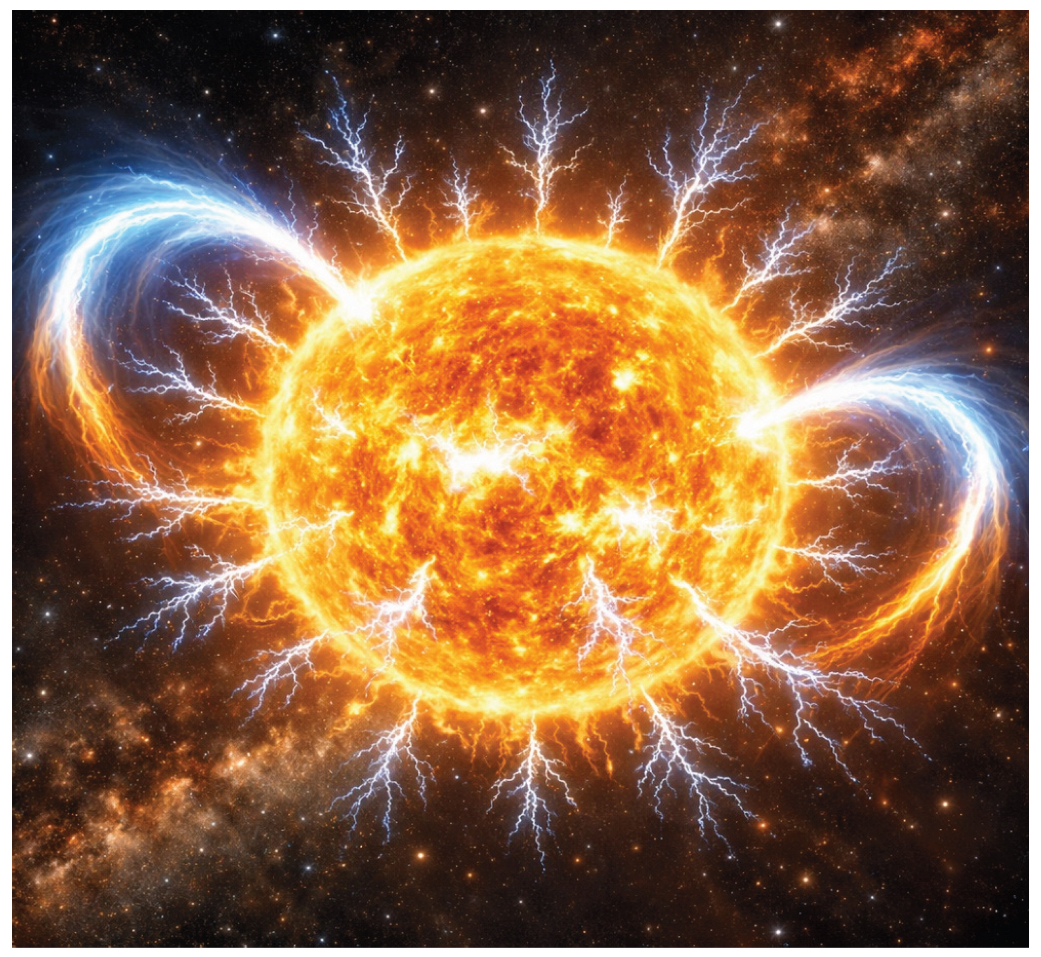
Figure 3.
Powerful Plasma Jets and Stellar Lightnings Come Out from a Massive Star.
5. Coronal Heating Dynamics
The solar corona extends above the photosphere and
chromosphere, reaching to the edge of the solar atmosphere, where it merges
with the solar wind. It is the hottest zone of the solar atmosphere and
contains mostly accelerated particles that are moving with extreme speed and
that radiate photons with higher energy. The solar corona is the hottest,
tenuous, outermost layer of the Sun’s atmosphere, extending from the
chromosphere’s top (above the photosphere) out to 5 million kilometers above
the photosphere. It is characterized by mostly ionized and energetic particles
with a million-degree plasma, which merges with the solar wind at the irregular
Alfvén surface. It is defined as a thin transition region that separates it
from the cooler chromosphere, and it is a most visible during total solar
eclipses or with solar equipment that tested at this time. The solar corona is
formed by strange structures such as prominences, coronal loops, and helmet
streamers. The solar corona is shaped by a complex interplay of magnetic field
gradients, temperature variations, gravitational field effects of the stars,
and variable plasma density from the interior structure of the stars and their
surface. Scientists proposed that these structures are all fundamentally
sculpted by the powerful Sun’s magnetic fields, which act as “highways” for
charged particles and energy. Coronal Loops are ropey, curving strands of
plasma that follow closed magnetic field lines connecting different magnetic
regions on the solar surface. They are displayed abundantly during solar
maximum and are often found near sunspots and active regions of the Sun. While
they glow for weeks, some change rapidly and are associated with the rapid
display of solar flares. Solar Prominences (and Filaments) are enormous, cool,
and dense plasma structures anchored in the photosphere and can persist for
months, sometimes erupting and escaping into space as Coronal Mass Ejections
(CMEs) and entering Earth’s magnetic field which glows as nice colours of polar
aurora. Helmet Streamers or coronal streamers, are large, cap-like structures
with long, pointed peaks of the plasma and accelerated particles that are
usually available in sunspots and active regions [23–26].
They are formed by closed intense magnetic loops that are trapping dense
coronal gases. The concept of coronal heating dynamics has been expanded
recently in the field of solar physics by using astronomical equipment.
5.1. Primary Heating Mechanisms
Scientific consensus and
numerical models indicate that the energy required to heat the solar corona (up
to millions of degrees) is indeed provided by the intense solar magnetic field,
which is constantly twisted, funnelled, warped, and violently turbulent, and is
entangled with turbulent convective motions in the photosphere. Magnetic
reconnection, often referred to as DC heating (direct current
heating) in the context of coronal heating, is a fundamental plasma process
where magnetic field lines break and reconnect, releasing stored magnetic
energy as heat and kinetic energy [27–30].
The nanoflares are impulsive energy releases that, individually, are tiny but
collectively heat the entire corona. This process is widely considered a
leading candidate for heating the solar corona to its multimillion-degree
temperatures. MHD Wave Heating (AC Heating): Magnetohydrodynamic
(MHD) waves, such as Alfvén waves, carry thermal energy as the hottest and most
energetic particles from the solar interior and release it into the corona.
This energy is dissipated into heat through processes like resonant absorption
(waves transferring energy to specific plasma layers) and phase mixing (waves
on adjacent field lines becoming out of sync and creating friction). Recent
research in solar physics suggests that magnetohydrodynamic (MHD) waves and
magnetic reconnection are not isolated events, but rather intricately linked
through a “Symbiosis of Waves and Reconnection (SWAR)”. Symbiosis (SWAR):
Modern research suggests these mechanisms are linked; waves can trigger
reconnection by collapsing magnetic null points, while reconnection events can
launch new waves. This interconnected framework indicates that waves can
trigger reconnection, while reconnection events simultaneously launch new waves
and turbulences.
5.2. Observed Dynamics and Structures
The coronal heating problem
is still a mystery of why the Sun’s outer atmosphere (the solar corona) is
millions of degrees Celsius hot, as compared to the lower surface temperature
of the solar surface in the photosphere and chromosphere are 5000 or 10000
degrees Celsius. Observed dynamics and structures indicate that the corona is
not heated uniformly but through highly dynamical processes, impulsive
phenomena, and spatially resolved, that is, observed and multi-scale magnetic
processes. Coronal Loops: These are closed magnetic structures
that trap hot plasma and solar energetic particles [31,32]. They often show impulsive heating,
where they brighten in gamma rays and X-rays at first moment and then cool down
rapidly through various Extreme Ultraviolet (EUV) wavelengths or visible light.
Coronal Rain: the Coronal rain is a phenomenon in the solar
corona where cool, dense plasma condensations form and fall along magnetic
field lines, typically in active region coronal loops [33]. When heating is concentrated at the
loop foot points, it can cause thermal instability, leading to the catastrophic
cooling of plasma that falls back directly toward the surface as “plasma rain”.
Solar Wind: The solar wind consists of ionized plasma particles
such as electrons, protons, and helium ions [34–40].
It is open magnetic field lines in coronal holes allow the hottest plasma state
and energetic particles to escape, forming the fast solar wind. Coronal holes
are low-density, cool, and dark regions on the Sun where open, unipolar
magnetic field lines allow plasma to escape freely into space, forming the
high-speed solar wind, which reaches speeds of 700 km/s to 850 km/s. The
Coronal holes act as funnels for mainly the solar wind, and abundant during
solar minimum. Accelerated by wave-driven heating, this fast solar wind
originates from the Sun’s polar regions or low-latitude coronal holes.
6. Stars Change Size
Stars change size throughout their central
pressure, temperature change, and lifecycles, typically expanding into red
giants as they exhaust hydrogen fuel, increasing their radius by hundreds of
times. This expansion occurs as the core collapses and the outer shell burns
hotter, causing the star’s outer layers to swell and cool [41–45]. Ultimately, intermediate stars
become white dwarfs, while massive stars end as neutron stars or supernovae to
give birth for a newborn stellar mass black hole. The volume of a star
changeable dynamically due to work done by central pressure of stars. The
star’s volume must change to supply the energy it radiates, assuming that
energy comes from work done by pressure.
Problem 3: The massive star with a mass of
20 times the mass of a Sun , and its radius 8 times the radius of a Sun , the central pressure in the heart of this massive
star is , and thermal energy that lost per a second
as a luminosity is calculate the volume that
change in the volume of star?.
Solution: by using equation (8) to calculate any change in the size of a star due to work done by central pressure or thermal energy of the massive Star.
Where dV is the tiny change in the volume
of a star due to an energy radiated per 1 second. Over millions of years, this
would accumulate into a large contraction unless nuclear energy dominates. Take
a massive star with a radius 8 times the Sun and its total volume is incredible
high about This fractional change in the volume of a massive
star per second has correct physical interpretation. This result nicely illustrates a classic
stellar-physics insight: Because core pressures are enormous, even tiny
contractions could in principle, power huge luminosities. But stars avoid
catastrophic contraction because fusion replaces gravitational energy loss.
Here is the requested information regarding stellar structure and energy
generation. Stellar Radiation Sources: Fusion vs. () Work, Stars do not radiate mainly via work (bulk
mechanical contraction/expansion). Main-Sequence Phase: Stars shine primarily
by producing energy through nuclear fusion in their cores. This fusion creates
the outward pressure necessary to counteract gravity, allowing the star to
exist in a stable hydrostatic equilibrium, rather than relying on contraction.
When is Relevant: Mechanical work (gravitational
contraction/expansion) is the primary energy source during Pre-main-sequence
contraction while the protostar is gathering mass and heating up before
hydrogen fusion ignites. Late evolutionary phases: when a star exhausts its
core fuel and collapses, leading to shell burning. Kelvin–Helmholtz Timescale:
This timescale represents the time a star can remain luminous based solely on
gravitational contraction (= work) rather than nuclear fusion. Pressure
Structure: Not Uniform Pressure within a star is not uniform; it is a function
of radius, P(r). Radial Dependence: Pressure, density, and temperature vary by
many orders of magnitude from the center of the star to its surface. Order of
Magnitude Estimates: Using a single pressure value (such as a mean pressure)
for a star is only an order of magnitude estimate (e.g., using the Virial
Theorem to find mean pressure). Detailed stellar models require solving
equations of stellar structure, which include the pressure gradient, to account for the actual change in pressure with
radius.
7. Surface Temperature and Luminosity of a Main Sequence Star
The surface temperature of
a Sun or a massive star could be increased rapidly due to an increment in the
nuclear fusion processes, powerful plasma jets, stellar lightnings, sunspots,
and solar flare display on the surface of most stars. About half of the mass of
a main-sequence star is contracted in its core to accelerate the nuclear fusion
processes and produce multiple chemical elements. The nuclear fusion process in
the heart of the Sun may fuse hydrogen isotopes to form a helium atom,
releasing enough energy into space. The photon particles require thousands of
years to come out from the deepest point in the heart of a Sun or stars after
many collisions, absorptions, reflections, scattering, and transitions with
matter and subatomic particles in the structure of a Sun or Stars. Most photon
particles are trapped and opaque in the inner shells of stars and are involved
directly in the burning of heavy elements since central temperature of the
stars has been increased widely. The tussle between thermal pressure and
gravity enhanced the stability of stars, typically main-sequence stars. The
main-sequence stars play a crucial role in the formation and evolution of
stars, and most of the chemical elements are formed in this stage of a stellar
lifetime. The volume or the radius of a fusion ball in the heart of a massive
star could be four percentage of its total radius, and most of its mass has
contracted and compressed in this tiny ball to capture additional photon
particles, increase thermal energy, enhance gravity and central pressure to
ignite nuclear fusion processes and burn new elements with releasing huge
amount of thermal energy and neutrino particles into space.
The mass of the Sun is very low, and its central
temperature could be 15 million kelvins or exceed 80 million degrees when half
of its mass is contracted and compressed in its core at 4 percentage of the
total radius of a Sun to sustain the nuclear fusion process strongly and form
helium or carbon elements. A high mass star has enough mass, density, gravity,
pressure, and maximum central temperature to 300 million degrees, which may
accelerate nuclear fusion processes for a few million years and produce most of
the chemical elements in its heart before its explosion. Most massive stars may
explode in a supernova event and feed the universe with crucial chemical
materials for life. The remnant core of a collapsed star may become a white
dwarf, black dwarf, neutron star, or stellar mass black hole, according to the
mass of the dead star. The black hole may grow step by step as it collects
enough mass from its surroundings, or its heart is bombarded by superparticles [46–50]. The mass of a black hole increased
to become a supermassive black hole and a supergiant black hole due to
collecting enough mass. An accretion disc of a black hole heats up steeply due
to singularity tunnel waves and superparticles that are propagating through it.
The surface temperature of a massive star or a blue star may reach 30 thousand
kelvins due to its huge central temperature. Most of the central temperature of
stars may be released as coronal mass ejections, stellar flares, powerful
plasma jets, neutrino particles escaping, and stellar lightnings. All these
dynamical phenomena are involved in coronal heating dynamics and stellar energy
evacuation. The surface temperature of a star relies on the mass, central
temperature, pressure, gravity, and burning ratio of the chemical elements in
the core of a star. The massive stars have higher central pressure and
temperature than pressure and temperature of low-mass stars; as a result, their
surface temperature is higher than that of low-mass stars. The radius, size,
density, pressure, and temperature of stars are changeable due to acceleration
and deceleration of the nuclear fusion processes in the heart of Stars and
stellar activities. The solar activity phenomena has been increased and
repeated every 11 years due to an increments in the ratio of burning hydrogen
fuel in Sun’s heart, that is releasing as energetic particles and coronal mass
ejection into space. Number of sunspots, solar flares, spicules, plasma jets,
solar lightnings, solar wind, and coronal mass ejections had been increased due
to solar activity event. Following an equation that make comparisons between
the luminosity, radius, and surface temperature of stars with different masses
and the Sun [51–57]. According to mass—luminosity
relation, the luminosity for massive main-Sequence stars with masses higher
than the Sun is determined by Equation (9):
(9)
Indeed, Equation (10) is a necessary equation to
determine the luminosity for main-Sequence stars with masses lower
than the Sun, typically below 0.43 solar mass, since :
(10)
The radius ratio for the star with a
mass lower or higher than the mass of a Sun is a crucial relation
to determine the radius of a Star directly by Equation (11) according to main
composition of a star:
(11)
where L is the luminosity of a star as
compared to the luminosity of a Sun . M is the mass of a star, and is the mass of a Sun.
(12)
(13)
(14)
(15)
where, σ is the Stefan–Boltzmann constant
with a value Then, T is an effective surface temperature
of the Star as compared to a Sun’s surface temperature . The surface temperature and luminosity of massive
stars are incredibly high as compared to the Sun’s Luminosity and its surface
temperature.
Problem 4: The massive star with a mass of
20 times the mass of a Sun , and its radius 8 times the radius of a Sun , the central pressure in the heart of this massive
star is , its central temperature is and the surface temperature
of a Sun is ( 5772 K) calculate
its surface temperature of this massive star T ?.
Solution: Massive main-sequence
star with a mass 20 times the Sun
has a huge luminosity Resubstitutethis
valuein:
By using Equation (12) the Stefan-Boltzmann law to
calculate an effective surface temperature of a massive star T in
first method. Substitute above values in this equation to determine an
effective surface temperature of a massive star:
Then surface temperature of a massive star is
incredibly high This star is a hot O-type star or an
early B-type star. It has a blue-white appearance, extremely high radiation
pressure, and emits a strongly intense electromagnetic spectrum, including
infrared, visible light, ultraviolet UV, X-rays, and gamma rays. Then maximum wavelength of an emitting
radiation from the external surface of a massive star is determined as:By using Equation (14) to calculate surface
temperature of massive star in a second method:
Take fourth root:
By using Equation (15) to calculate the surface
temperature of a massive star in Third method directly:
Then surface temperature of a massive star is It is the same result since determined in Equation
(12). The nuclear fusion causes stars to shine. However, any increase has been
occurred in a surface temperature and luminosity of stars depends on the stage
of the star’s life. Main Sequence (Most of a star’s life), where Fusion of
hydrogen into helium in the core provides a huge amount of energy. Fusion in
massive stars is violent, producing heavy elements and releasing enough energy
into space. The core is incredibly hot, and the surface temperature and
luminosity are generally stable. When a star burns through its hydrogen, the
helium core begins to contract under gravity. This contraction increases the
core temperature, which causes the outer layers to expand drastically. As the
star expands, its surface luminosity increases, turning it into a Red Giant.
When the star becomes a White Dwarf, its core fusion stops, and it slowly
cools, meaning the luminosity decreases due to radius contraction. The surface
temperature and luminosity increase most dramatically when a star leaves the
main sequence and enters its red giant phase. The white dwarf stars and neutron
stars have a smaller radius, but their surface temperature incredibly high, but
the luminosity of such compacted objects still lower and dim. The central
temperature of the star is higher than its external surface temperature because
the central sphere has a smaller radius than the total radius of a star. The
fusion ball is only four percent of the total radius of the star where nuclear
fusion active and sustainable in the core of a star to
enhance its central temperature.
Magnetic Pressure : This is the “pressure” exerted by the magnetic
field B. It is associated with the magnetic energy density. In a corona,
the magnetic field is often structured into loops or filaments.
(16)
The magnetic permeability of free space , also known as the magnetic constant, is a
physical constant defined as: This constant represents the ability of a vacuum
to allow magnetic flux to pass through it, acting as the reference for all
other materials.
Plasma Thermal Pressure : This is the standard gas pressure of the plasma,
where is the number density of energetic particles and
ions, is Boltzmann’s constant, and is temperature of particles and ions.
(17)
In the Magnetic pressure and thermal pressure
Equilibrium the magnetic field acts like a bottle or
container. It compresses the plasma from the sides (transverse to field lines)
and provides tension along the field lines. This means that in the solar corona
and stellar corona, the magnetic field is strong enough to constrain, heat, and
shape the incredibly hot plasma approximately millions of kelvins, preventing
it from expanding freely into space. Magnetic field can funnel thermal ionised
plasma particles to longer and thinner stellar lightnings or intense, hottest
plasma jets to heat up the stellar corona or solar corona. This equation
represents the magnetohydrostatic equilibrium (MHS) in stellar coronae, meaning
it describes how the magnetic field structure supports and compresses the hot
plasma (ionized gas) at a steady state. Magnetic Energy Conversion: The heating
of the corona is driven by this magnetic field, often through magnetic
reconnection (where magnetic field lines snap and reconnect, releasing energy)
or wave dissipation (energy traveling along field lines). Self-Regulating Loop
Structures: Magnetic loops are continuously filled with hot plasma. The
pressure equilibrium defines the structure of these loops, dictating that
regions with stronger magnetic fields generally support higher number density and temperature T plasmas.
(18)
If beta lower than 1, , meaning the magnetic pressure is much higher than the thermal pressure , allowing the magnetic field to dominate the
coronal heating dynamics. In summary, the formula shows that magnetic energy B
dictates the structure and heating of the stellar corona, forcing the plasma
into hot, pressurized loops that balance the magnetic pressure, leading to
stable coronal structures. This sequence of events describes the behaviour of a
magnetically dominated plasma , often seen in astrophysical jets, solar flare
filaments, and dense plasma focus experiments. Magnetic Pressure Dominates if : it means the magnetic field strength is high
enough to control the plasma dynamics, forcing the plasma to follow field lines
and constraining its expansion. Plasma Contracts (Z-pinch/Collimation): because
the magnetic pressure exceeds the internal thermal pressure of the plasma, the
plasma is squeezed inwards (radial compression or collimation), often forming
thin, dense filaments or “ropelike” structures. Filament Brightens: as the
plasma is squeezed into a smaller volume, the density increases, which increases
the intensity of the emission (increased bremsstrahlung or line emission).
Density Spikes Occur: this contraction is not always stable. The magnetic field
can pinch the plasma further at certain points, leading to localized, rapid
increases in density and temperature, often followed by instabilities that can
cause further brightening, heating and luminosity of stars, typically blue
stars.
8. Results and Discussion
The mass, radius, luminosity, and surface
temperature of stars are changeable over its stellar lifetime, primarily as it
moves through different stages of a stellar evolution. While these properties
are relatively stable for most of a star’s life, they are fundamentally linked
and shift as the star exhausts its nuclear fuel. Red brown stars or red giant
stars are cooler, while blue, yellow, and white stars are incredibly hot
surface stars. Hotter objects and hotter stars don’t just produce more light
and thermal energy; they produce different light or intensify the
electromagnetic spectrum. As the temperature increases, the peak intensity of
the emitted light or electromagnetic wave shifts toward shorter wavelengths,
more energetic wavelengths with higher energy, and higher frequency. The
Stefan-Boltzmann Law defines the fundamental relationship between a star’s
luminosity, radius, and surface temperature [58,59].
It states that the luminosity is directly proportional to the star’s surface
area and the fourth power of its surface temperature. The luminosity depends on
the fourth power of temperature, a small increase in temperature results in a
massive increase in brightness (e.g., doubling temperature increases luminosity
16-fold). The hotter the surface of a star is, the more light and energy it
produces; in physics, this phenomenon is known as thermal radiation (or
incandescence). A larger radius means a larger surface area, allowing a star to
emit more energy even if its surface temperature is lower than a smaller star.
This, combined with Wien’s displacement law, allows astronomers to determine
the size of distant stars by measuring their temperature and total energy
output. It is important to note that even when an object is not “glowing” red,
it is still producing light—it is just producing infrared light (heat
radiation) which our eyes cannot see. As it gets hotter, that infrared
radiation increases, and eventually, the emission spreads into the visible
spectrum. That is exactly right. This phenomenon is known as blackbody
radiation, and it explains why temperature and light are so intrinsically
linked. Even at room temperature, every object around you—including your own
body—is “shining,” just at wavelengths too long for human photoreceptors to
detect. This is how thermal imaging cameras work: they act as a different kind
of “eye” that can see in the infrared spectrum.
Problem 5: The star with a mass 10 times
lower than the mass of a Sun, calculate its surface temperature
T ?. Solution: To calculate the surface temperature T, we assume the
star is a main-sequence star and use the mass–luminosity and Stefan–Boltzmann
relations. Mass of star is Radius of a star is according to Equation (11).
The solar surface temperature is By using Equation (11) to determine the radius of
a low mass star that lower than a Sun:
=The mass–luminosity for low-mass stars below 0.43
solar mass, :
.
By using Equation (13) to calculate the
surface temperature of a star with a mass lower than the Sun: Substitute values
in this equation
Take fourth root:
The star with mass 0.1 solar mass is a red dwarf
star or brown star, cool, dim, spectral type-M, surface temperature about (3000
K to 4000 K), radius 10% of the radius of a Sun. Most of the low-mass stars
fail to ignite or start in nuclear fusion processes in their cores due to lower
pressure, density, and central temperature. The mass of the star must reach the
mass of a sun or over it, and its central temperature must exceed 10 million
kelvins to initiate nuclear fusion processes and form new heavy chemical
elements. The Sun is an average main-sequence star, and nuclear fusion
initiated at its core more than five billion years ago. Then, two hydrogen
isotopes fuse in the heart of the Sun, and a new helium atom is formed there in
any fusion process. If the star has the same mass as the Sun and it’s assumed
to be similar in structure and radius, it would have the same surface
temperature. So, the surface temperature would be 5772 K, like the Sun.
Problem 6: The star with a mass 3 times
higher than the mass of a Sun, the surface temperature of a Sun is 5772 K,
calculate its surface temperature T ?.
Solution: by using Equation (11) the mass—radius
relation to determine the radius of a high mass star with a mass 3 times
higher than the mass of a Sun:
=The mass–luminosity relation for high-mass stars
with a mass three times higher than a solar mass, :
By using Equation (15) to calculate the
surface temperature of a massive star directly:
The main-sequence star with a mass 3 solar mass is
typically: spectral type late B and early A, much brighter than the Sun,
hotter, its surface temperature about 9724 K. It is a bluer, and shorter life
time star. The star with a mass higher than the mass of the Sun may burn its
nuclear fuel quickly, and its core may collapse to form a neutron star or black
hole. In a seven problem, the star with a mass 10 times higher
than the mass of a Sun, calculate its surface temperature
T ?. By using Equation (11) the mass—radius relation to determine the
radius of a high mass star with a mass 10 times higher than the mass of
a Sun : if = Then The mass–luminosity relation for
high-mass stars with a mass ten times higher than a solar mass, : Substitute values in Equation (15) to
calculate the surface temperature of a massive star: Then, the surface temperature of
this star Indeed, a 10 solar mass star
is typically a hot and luminous blue B-type star. Its surface temperature more
than three times higher than a Sun. Real Stellar models usually give 17000 K to
25000 K, so our scaling estimate is reasonable. Furthermore, the star with a mass
25 times the mass of a Sun has a surface temperature about The star with a mass 50 times the sun has
hottest surface temperature about Astronomers have identified stars with masses
around or even exceeding 200 times the mass of a Sun. The most famous, and
currently considered the most massive star known, is R136a1. The most massive
star recently known to date, R136a1, with a mass at birth 320 times higher than
the mass of our sun [60,61]. Here are the key facts about it. It
is located in the Large Magellanic Cloud (a dwarf galaxy orbiting our Milky
Way) inside the Tarantula Nebula. They are rich in gas and young stars,
featuring active star-forming regions like the LMC’s Tarantula Nebula. Recent,
high-resolution observations (as of 2022-2024) estimate its current mass to be
around 150 to 230 solar masses. Initial studies suggested it could have been
over 300 solar masses at birth. This type of a star is a Wolf-Rayet star,
meaning it is extremely hot, luminous, and is losing mass rapidly through a
powerful stellar wind. Wolf-Rayet (WR) stars are rare, massive, and highly
evolved, characterized by intense stellar winds with speed over 3000 kilometers
per second, and surface temperatures of 20,000 K to over 200,000 K. They are
among the most luminous stars known, often thousands to millions of times
brighter than the Sun. They are, however, relatively rare, with only about
500-2,000 identified in the Milky Way. They represent the final, short-lived
stage before a core-collapse supernova, often appearing as nitrogen-rich (WN)
or carbon-rich (WC) types due to the loss of their outer hydrogen envelope [62–65]. These massive stars are burning fuel
rapidly, live fast and die young, lasting only a few million years. Their
spectra are defined by broad emission lines of ionized helium, nitrogen, or
carbon, indicating that the outer layers have been stripped away, exposing the
hot, helium-fusing core. It is important to note that size (radius and volume)
is different from mass. R136a1 is the heaviest (most massive) star, but it is
relatively small (about 30-40 times the radius of the Sun) compared to red
supergiant stars like UY Scuti, which are much larger in size but far less
massive.
Main properties of a UY Scuti Star are Size:
Its radius could be 900 times that of the sun. Brightness: It is a very
luminous star, roughly 500,000 times brighter than the Sun. Nature: Its
fuel finished as a red hypergiant, it is in the late stages of its life cycle,
likely ending in a supernova event within a few million years. Visibility:
Despite its size, it is not visible to the naked eye because of its distance
and the dust obscuring it. Size Constraints: Due to the
difficulty in defining the edge of a star’s atmosphere, its size has been
debated, and it may not be the absolute largest, with contenders like WOH G64
or VY Canis Majoris. Mass: While immense in size, UY Scuti is not the
most massive star, with only about 10 times the mass of the Sun [66,67]. The star with a mass 230
times the sun has the hottest surface temperature about It is hot, blue, and luminous, as the star R136a1
is millions of times brighter than the Sun. Massive stars lose mass rapidly
through stellar winds or may collapse in a supernova event after a few million
years of burning nuclear fuel to form a stellar mass black hole after ultimate
death. Powerful plasma jets (specifically spicules) and magnetic reconnection
events, stellar flares, and nanoflare-driven events are primary mechanisms
responsible for heating the solar and stellar corona to millions of degrees
Kelvin. Inject super-hot ionized gas into the outer atmosphere, maintaining its
temperature and driving the solar wind. These processes, observed in high
resolution by NASA’s Solar Dynamics Observatory (SDO) and the ESA/NASA Solar
Orbiter. The mass-radius relation, mass-luminosity relation, and
temperature-radius-luminosity relation are crucial mathematical equations for
determining the radius, surface temperature, and luminosity of stars. Coronal
heating in massive stars (O and B types) is primarily driven by violent,
shock-heated stellar winds rather than the magnetic, loop-dominated mechanism
found in solar-type stars. High-mass stars lack convective zones, so their
X-ray emission arises from instabilities within the radiatively driven wind,
which creates millions-of-degrees plasma in the outer atmosphere. Coronal
heating dynamics in low mass stars different from massive stars.
Main properties of the Coronal heating dynamics of
the massive stars are: Mechanism: unlike the magnetic “braiding”
in cool stars, massive star coronal heating relies on the Line-Deshadowing
Instability (LDI). This instability causes fast wind shells to collide with
slower ones, generating X-ray-emitting shocks throughout the wind.
Line-deshadowing instability (LDI) is an intrinsic, strong instability in the
line-driven winds of hot, luminous (OB) stars, causing the outflow to become
highly inhomogeneous, clumpy, and structured. Magnetospheres: In cases
where massive stars have strong magnetic fields (Magnetic Massive Stars), the
wind is trapped in the magnetic equator, forming a Centrifugal Magnetosphere
and turbulences due to continuous rotation of stars. Dynamic Features:
These trapped regions can form “slingshot prominences, dense, cool clouds of
neutral gas (10,000 K) that rotate with the star and are trapped in the hot
(2–10 MK) stellar corona. Stellar lightnings: The central
temperature of the massive stars exceeded 100 million kelvins, causing the
hottest particles to rise from the interior shells of stars and display as
lightning trees on their surface. Structure: The resulting corona is not
uniformly hot, but rather a dynamic, structured environment with both “centrifugal”
and “dynamical” magnetospheres, often undergoing cycles of heating and
catastrophic cooling (coronal rain) since cold plasma had been dropped on the
surface of stars, the hottest and energetic particles in the stellar coronal
maybe evaporated into space which called coronal mass ejections. Evolution:
The intense X-ray emission, gamma rays, energetic particles releasing, plasma
eruptions, stellar flares, spicules, and wind-driven dynamics are directly
linked to the rapid evolution and massive energy output from interior shells of
these stars. Coronal heating in massive stars (O, B-type) differs fundamentally
from low-mass stars, as they lack deep convection zones to drive a solar-like,
magnetic dynamo. Instead, X-ray emission about a million kelvins to 10 million
kelvins is driven by shocks within strong, radiation-driven stellar winds [68–71]. Key dynamics involve
line-deshadowing instability, resulting in shock-heated plasma, and potential
magnetic confinement (Magnetospheres). The lifetime of high-mass stars is
shorter than that of low-mass stars, because high-mass stars may burn most of their
fuel during a few million years, as low-mass stars require burning their fuel
for billions of years. The remnant core of a massive star may become a neutron
star or a black hole after ultimate death; the remnant core of a solar mass
star may give birth to a white dwarf or a black dwarf after billions or
trillions of years of its degeneracy pressure. The maximum number of plasma
jets and stellar lightnings may be shown on the surface of massive stars during
the stellar fusion moment, and near a supernova event.
Indeed, the core of a massive star is composed
primarily of silicon and sulfur after completing the Carbon-Nitrogen-Oxygen
(CNO) cycle. CNO is a nuclear fusion process began in massive stars. The core
temperature of stars rose violently to produce heavy elements near an iron
family. The exact temperature for nuclear fusion processes depends on the mass
of stars to create light or heavy elements. The star catastrophically collapses
and may explode in an event called a Type II supernova after its fuel is exhausted.
Its remnant core may become a neutron star or a stellar mass black hole.
Silicon burning appear for an 8 to 25-solar-mass star. The period lasts only a
few days to a single day before fuel exhaustion. Silicone burning begins when
gravitational contraction raises the star’s core temperature to 2– 4 billion
kelvin (2-4 GK), after which silicon and other elements can photodisintegrate,
emitting protons or alpha particles. Photodisintegration is a process initiated
when high-energy gamma-ray photons break existing Silicon-28 nuclei into alpha
particles [72,73]. Alpha Capture is another process
that starts after the free alpha particles fuse with the remaining Silicon-28
and other chemical elements to create new, heavier elements:
Then, several phenomena occur after Nickel and iron
elements are created in the core of a massive star. Nickel Decay: Radioactive
Nickel-56 later decays into Cobalt-56, then stable Iron-56. Iron-56 has the
highest binding energy, or huge energy barrier per nucleon and cannot support
further exothermic fusion. The star develops concentric layers of different
burning elements around the iron core called by Onion Shell Structure. Cosmic
radiations, positrons, neutrinos, beta decay, electromagnetic spectrum, and
gamma radiation appear during nuclear fusion processes in the heart of stars.
Structural support fails, triggering a Type II supernova explosion, and the
core ended within born a neutron star or black hole, this phenomena named a
Core Collapse. The atom with atomic number 25 is Manganese (Mn). It is a hard,
brittle, silvery transition metal essential for steel production. Manganese is
primarily formed in stars through supernova nucleosynthesis, specifically
during the explosions of Type Ia supernovae and, to a lesser extent,
core-collapse supernovae. Manganese Formation in Massive Stars
(Nucleosynthesis) during Supernova Explosions. Manganese is formed in the
intense, high-temperature conditions of supernovae, where rapid thermonuclear
reactions fuse lighter elements. Type Ia Supernovae are a major source [74,75]. They occur when white dwarf stars
(leftover cores of smaller stars) accumulate too much mass and explode.
Core-Collapse Supernovae are Massive stars near the end of their lives that
produce manganese, which is dispersed into space during their death. During
these explosive events, neutrons are released and combine with iron-group
nuclei to create manganese and other elements, which are then ejected into the
interstellar medium and incorporated into new stars and planets. Advanced
Burning in Massive Stars, typically, in very massive stars (≳ 8 solar masses), late
evolutionary stages include: Carbon burning, Neon burning, Oxygen burning, and
Silicon burning. During silicon burning, nuclear reactions create elements near
the iron peak, including: Iron (Fe), Chromium (Cr), Manganese (Mn), and Nickel
(Ni). However, most manganese remains locked inside the star until the next
stage. The primary source of manganese is supernova explosions, especially:
Type II Supernovae (core-collapse). Shock-driven nuclear reactions produce
radioactive isotopes like:
55Co → 55Fe
→ 55Mn
This sequence represents a common radioactive decay
chain in which unstable cobalt-55 decays to stable manganese-55 via iron-55.
Decay Mode: Primarily positron emission (76%) and electron capture (24%).
Half-life: Approximately 17.53 hours. Process: the proton in the cobalt nucleus
converts into a neutron, decreasing the atomic number from 27 (Co) to 26 (Fe)
while the mass number stays 55.In the massive star explosion ejects manganese
into interstellar space. The atom with the symbol Co is Cobalt. It is a chemical
element with the atomic number 27, located in Group 9 and Period 4 of the
periodic table. Cobalt is a hard, magnetic, transition metal known for its
silvery-gray appearance and its use in high-strength alloys and lithium-ion
batteries. Powerful plasma jets and stellar lightnings come out from massive
stars during the creation of heavy elements in the core of massive stars, and
moments before a supernova event, since the external shell of massive stars
expands or stars explode in a violent event called a supernova. A burst of
neutrino emission is displayed in Type Ia supernovae since electron captures on
free protons and nuclei in the hot, dense matter.
In the extreme environments of black hole accretion
discs, the hottest surfaces of stars, lightning belts, and plasma jets, atoms
are subjected to physical extremes that radically alter their structure. The
combination of strong gravitational fields, intense electromagnetic forces, and
high thermal energies causes electron orbits to undergo severe Stark
broadening, Zeeman splitting, and relativistic distortion. Powerful
Electromagnetic Forces (Zeeman & Stark Effects): In these highly
magnetized, high-density plasmas, immense magnetic fields and intense electric
microfields disrupt the spherical symmetry of standard atomic orbitals.
Electrons are pulled into elongated, asymmetrical trajectories as they align
with or are repelled by the dominant magnetic field lines [76–80]. High Thermal Energy: The extreme
temperatures provide electrons with massive amounts of kinetic energy. This
pushes them into highly excited, loosely bound energy states (such as Rydberg
states). Because these outer electrons are so weakly bound to the nucleus, the
slightest external magnetic or gravitational perturbation causes their orbits
to stretch and deform. Relativistic Frame-Dragging & Gravity: Near a
spinning black hole, spacetime itself is twisted (Lense-Thirring effect). This
distorts the background geometry in which the atoms exist, inherently
stretching and shearing the orbitals. The intense gravitational potential well
also stretches the atom’s associated emission wavelengths via extreme
gravitational redshift. When a high voltage or laser tears electrons free from
neutral gas, it leaves behind a highly conductive highway of positively charged
ions and free electrons. Because opposite charges attract and like charges
repel, the electric current inherently acts as a force that pulls these particles
into incredibly tight, organized chains or filaments along the electrical path.

Table 1.
Surface Temperature and luminosity of stars with lower and higher masses.
| Stellar Mass | Stellar Radius | Stellar Luminosity | Surface Temperature of Stars |
| 9.5 | |||
| 15.5 | |||
| 45 |
9. Conclusions
Indeed, Coronal
heating dynamics are primarily driven by the interaction between photosphere
convective motions and the solar magnetic field. While the exact mechanisms are
still being debated (the “Coronal Heating Problem”), scientific consensus
points to two or four main processes: Magnetic Reconnection (Nanoflares or
spicules), Wave Heating (Magnetohydrodynamic Waves), Plasma Jets, and the
Stellar Lightnings. Stellar wind, plasma jets, and stellar lightnings are
emanating from the external surface of the low-mass stars and high-mass stars.
Massive stars are initiated in the burning of several types of chemical
elements and produce much heavier elements, releasing a massive ratio of
energetic particles into space at a second. The central temperature of the
low-mass stars is lower than 100 million kelvins, but the central temperature
of the massive stars could exceed 100 million kelvins to form heavier chemical
elements and release powerful plasma jets and multiple types of stellar
lightnings into space. The massive stars have the hottest surface temperature,
they are the brightest, and most luminous kind of stars with a blue colour.
Indeed, the powerful electromagnetic spectrum and violent stellar wind come
from massive stars. The particles in the stellar jets can escape from stars at
a speed higher than the escape velocity of a star. Scientists believed the
spicules, flares, and Alfven waves are essential to heat the solar corona and
stellar corona. Powerful plasma jets and Stellar lightning are involved in the
coronal heating dynamic of the Sun and stars directly, and enhanced the
turbulences in the photosphere and chromosphere to heat up and glow.
This study is funded by myself.
We appreciate the cooperation with the Kurdistan
Space Agency.
I declare that I have no conflict of interests.
Funding
This study is funded by myself.
Acknowledgments
.
Conflicts of Interest
.
References
- De Colle, F.; del Burgo, C.; Raga, A.C. Diagnostics of inhomogeneous stellar jets. Astron. Astrophys. 2008, 485, 765–772. [Google Scholar] [CrossRef]
- Testa, P. X-ray emission processes in stars and their immediate environment. Proc. Natl. Acad. Sci. 2010, 107, 7158–7163. [Google Scholar] [CrossRef]
- Maralani, Rhangarzadeh; Tavabi, E.; Ajabshirizadeh, A. Evidence for coherent spicule oscillations from correcting Hinode/SOT Ca ii H in the south-east limb of the Sun. Mon. Not. R. Astron. Soc. 2017, Volume 467(Issue 3), 3393–3398. [Google Scholar] [CrossRef]
- Zeighami, S.; Ahangarzadeh Maralani, A.R.; Tavabi, E.; et al. Evidence of Energy Supply by Active-Region Spicules to the Solar Atmosphere. Sol. Phys. 2016, 291, 847–858. [Google Scholar] [CrossRef]
- Bourdin, P.-A. Driving solar coronal MHD simulations on high-performance computers. Geophys. Astrophys. Fluid Dyn. 2019, 114, 235–260. [Google Scholar] [CrossRef]
- Gudiksen, B.V. Coronal dynamics and heating theories. Adv. Space Res. 2009, 43, 108–112. [Google Scholar] [CrossRef]
- Peres, G.; Reale, F.; Serio, S. Hydrodynamics and Diagnostics of Coronal Loops Subject to Dynamic Heating; 1993; pp. 151–158. [Google Scholar] [CrossRef]
- Habbal, Shadia Rifai; Harvey, Karen L. Dynamic Nature of Coronal Heating as Inferred from Simultaneous, Observations of the Quiet Sun at 20 cm Radio and He I 10830 Å; 1988; pp. 215–218. [Google Scholar] [CrossRef]
- Williams, T.; Walsh, R.W.; Regnier, S.; Johnston, C.D. Multi-Stranded Coronal Loops: Quantifying Strand Number and Heating Frequency from Simulated Solar Dynamics Observatory (SDO) Atmospheric Imaging Assembly (AIA) Observations. Sol. Phys. 2021, 296, 1–22. [Google Scholar] [CrossRef]
- Tiwari, S.K.; Wilkerson, L.A.; Panesar, N.K.; Moore, R.L.; Winebarger, A.R. Dominance of Bursty over Steady Heating of the 4–8 MK Coronal Plasma in a Solar Active Region: Quantification Using Maps of Minimum, Maximum, and Average Brightness. Astrophys. J. 2022, 942, 2. [Google Scholar] [CrossRef]
- Wang, Y.; Liang, B.; Feng, S. Coronal Loop Detection Using Multiscale Convolutional Neural Networks. Astrophys. J. Suppl. Ser. 2023, 270, 4. [Google Scholar] [CrossRef]
- Owens, M.; Lockwood, M.; Macneil, A.; Stansby, D. Signatures of Coronal Loop Opening via Interchange Reconnection in the Slow Solar Wind at 1 AU. Sol. Phys. 2020, 295, 1–18. [Google Scholar] [CrossRef]
- Kohutova, P.; Verwichte, E.; Froment, C. Formation of coronal rain triggered by impulsive heating associated with magnetic reconnection. Astron. Astrophys. 2019, 630, A123. [Google Scholar] [CrossRef]
- Fisk, L.A. Acceleration of the solar wind as a result of the reconnection of open magnetic flux with coronal loops. J. Geophys. Res. 2003, 108. [Google Scholar] [CrossRef]
- Hundhausen, A.J. Solar activity and the solar wind. Rev. Geophys. 1979, 17, 2034–2048. [Google Scholar] [CrossRef]
- Borovsky, J.E.; Funsten, H.O. Role of solar wind turbulence in the coupling of the solar wind to the Earth’s magnetosphere. J. Geophys. Res. Space Phys. 2003, 108. [Google Scholar] [CrossRef]
- Vidotto, Aline A. The evolution of the solar wind. Living Rev. Sol. Phys. 2021, 18, 1–86. [Google Scholar] [CrossRef] [PubMed]
- Raouafi, N.E.; Stenborg, G.; Seaton, D.B.; Wang, H.; Wang, J.; DeForest, C.E.; Bale, S.D.; Drake, J.F.; Uritsky, V.M.; Karpen, J.T.; et al. Magnetic Reconnection as the Driver of the Solar Wind. Astrophys. J. 2023, 945, 28. [Google Scholar] [CrossRef]
- Akasofu, S.--I. Solar-wind disturbances and the solar wind-magnetosphere energy coupling function. Space Sci. Rev. 1983, 34, 173–183. [Google Scholar] [CrossRef]
- Nolte, J.T.; Krieger, A.S.; Timothy, A.F.; Gold, R.E.; Roelof, E.C.; Vaiana, G.; Lazarus, A.J.; Sullivan, J.D.; McIntosh, P.S. Coronal holes as sources of solar wind. Sol. Phys. 1976, 46, 303–322. [Google Scholar] [CrossRef]
- Beck, P.G.; Bedding, T.R.; Mosser, B.; Stello, D.; Garcia, R.A.; Kallinger, T.; Hekker, S.; Elsworth, Y.; Frandsen, S.; Carrier, F.; et al. Kepler Detected Gravity-Mode Period Spacings in a Red Giant Star. Science 2011, 332, 205–205. [Google Scholar] [CrossRef]
- Zhang, X.; Jeffery, C.S.; Li, Y.; Bi, S. Population Synthesis of Helium White Dwarf–Red Giant Star Mergers and the Formation of Lithium-rich Giants and Carbon Stars. Astrophys. J. 2020, 889, 33. [Google Scholar] [CrossRef]
- Soszyński, I. Long Secondary Periods and Binarity in Red Giant Stars. Astrophys. J. 2007, 660, 1486–1491. [Google Scholar] [CrossRef] [PubMed]
- Sadiq, S. “Life Cycle of a Low Mass Stars”. ASRJETS-Journal 2023, vol. 93(no. 1), 60–82. Available online: https://asrjetsjournal.org/American_Scientific_Journal/article/view/8308 (accessed on Mar. 06 2026).
- Sadiq, Sabir. “Life Cycle of High Mass Star”. ASRJETS-Journal 2023, vol. 97(no. 1), 11–29. Available online: https://asrjetsjournal.org/American_Scientific_Journal/article/view/9124 (accessed on Mar. 06 2026).
- Gaete, B.; Schleicher, D.R.G.; Lupi, A.; Reinoso, B.; Fellhauer, M.; Vergara, M.C. Supermassive black hole formation via collisions in black hole clusters. Astron. Astrophys. 2024, 690, A378. [Google Scholar] [CrossRef]
- Sadiq, Sabir. Singularity Bombardment by Superparticles. Eng. Technol. J. 2025, 10(08). Available online: https://www.europub.co.uk/articles/-A-774146. [CrossRef]
- SADIQ, Sabir. Distortion and Heating an Accretion Disc of a Black Hole. Engineering Technol. Journal, [S. l.] 2026, v. 11(n. 01), 8680–8696. Available online: https://everant.org/index.php/etj/article/view/2497. [CrossRef]
- Brockamp, M.; Baumgardt, H.; Britzen, S.; Zensus, A. “Unveiling Gargantua: A new search strategy for the most massive central cluster black holes”. Astron. Astrophys. Bibcode:2016A&A...585A.153B. 2016, arXiv:1509.04782585, A153. [Google Scholar] [CrossRef] [PubMed Central]
- Melia, Fulvio. The Galactic Supermassive Black Hole; 2007. [Google Scholar] [CrossRef]
- Feiden, G.A.; Chaboyer, B. REEVALUATING THE MASS-RADIUS RELATION FOR LOW-MASS, MAIN-SEQUENCE STARS. Astrophys. J. 2012, 757. [Google Scholar] [CrossRef]
- Demircan, O.; Kahraman, G. Stellar mass-luminosity and mass-radius relations. Astrophys. Space Sci. 1991, 181, 313–322. [Google Scholar] [CrossRef]
- Stassun, K.G.; Hebb, L.; López-Morales, M.; Prša, A. Eclipsing binary stars as tests of stellar evolutionary models and stellar ages. Proc. Int. Astron. Union 2008, 4, 161–170. [Google Scholar] [CrossRef]
- Mestel, L. The Hertzsprung-Russell diagram. Proc. R. Soc. London. Ser. A. Math. Phys. Sci. 1961, 260, 175–182. [Google Scholar] [CrossRef]
- Malkov, O.Y. Mass-luminosity relation of intermediate-mass stars. Mon. Not. R. Astron. Soc. 2007, 382, 1073–1086. [Google Scholar] [CrossRef]
- Prantzos, Nikos. Mass-Luminosity Relation; 2015; pp. 1505–1506. [Google Scholar] [CrossRef]
- Russell, H.N. Note on the Relations between the Mass, Temperature, and Luminosity of a Gaseous Star. Mon. Not. R. Astron. Soc. 1925, 85, 935–939. [Google Scholar] [CrossRef]
- Zaltsman, Iosif G. STEFAN-BOLTZMANN LAW. 2011. [Google Scholar] [CrossRef]
- S., G.F. The constant σ of the Stefan-Boltzmann law. J. Frankl. Inst. 1925, 199, 64. [Google Scholar] [CrossRef]
- Lattanzi, M.; Burg, R.; Hershey, J.; Taff, L.; Holfeltz, S.; Bucciarelli, B. Fringe Interferometry in Space: The Fine Structure of R136A with the Astrometer Fine Guidance Sensor Aboard HST. Symp.—Int. Astron. Union 1995, 166, 95–100. [Google Scholar] [CrossRef]
- Khorrami, Z.; Langlois, M.; Vakili, F.; Clark, P.C.; Buckner, A.S.M.; Gonzalez, M.; Crowther, P.; Wünsch, R.; Palouš, J.; Boccaletti, A.; et al. Extreme adaptive optics astrometry of R136. Astron. Astrophys. 2021, 649, L8. [Google Scholar] [CrossRef]
- Miyamoto, S. On the Emission Spectra of Wolf-Rayet Stars. Publ. Astron. Soc. Jpn. 1952, 4, 37–43. [Google Scholar] [CrossRef]
- Dsilva, K.; Shenar, T.; Sana, H.; Marchant, P. The multiplicity of Galactic Wolf-Rayet stars. Proc. Int. Astron. Union 2022, 18, 496–498. [Google Scholar] [CrossRef]
- Westerlund, B.E. Multicolor Photometry of Northern Wolf-Rayet Stars. Astrophys. J. 1966, 145, 724. [Google Scholar] [CrossRef]
- Merton, Thomas Ralph. On a spectrum associated with carbon, in relation to the Wolf-Rayet stars. Proceedings of the Royal Society of London. Series A, Containing Papers of a Mathematical and Physical Character 1915, 91, 498–503. [Google Scholar] [CrossRef]
- Li, L.-J.; Qian, S.-B.; Voloshina, I.; Metlov, V.G.; Zhu, L.-Y.; Liao, W.-P. Identification and period investigation of pulsation variable star UY Camelopardalis, an RR Lyrae star in binary system. Publ. Astron. Soc. Jpn. 2018, 70. [Google Scholar] [CrossRef]
- Arroyo-Torres, B.; Wittkowski, M.; Marcaide, J.M.; Hauschildt, P.H. The atmospheric structure and fundamental parameters of the red supergiants AH Scorpii, UY Scuti, and KW Sagittarii. Astron. Astrophys. 2013, 554, A76. [Google Scholar] [CrossRef]
- Güdel, M.; Nazé, Y. Plasma Motion and Kinematics in Cool and Hot Stars. Space Sci. Rev. 2010, 157, 211–228. [Google Scholar] [CrossRef]
- Owocki, S.P.; O Sundqvist, J. Characterizing the turbulent porosity of stellar wind structure generated by the line-deshadowing instability. Mon. Not. R. Astron. Soc. 2017, 475, 814–821. [Google Scholar] [CrossRef]
- Povich, M.S.; Busk, H.A.; Feigelson, E.D.; Townsley, L.K.; Kuhn, M.A. Candidate X-Ray-emitting OB Stars in MYStIX Massive Star-forming Regions. Astrophys. J. 2017, 838, 61. [Google Scholar] [CrossRef]
- Wheeler, J.C. Type IA Supernovae. Symp.—Int. Astron. Union 1992, 151, 225–234. [Google Scholar] [CrossRef]
- Clayton, Donald D. Principles of Stellar Evolution and Nucleosynthesis; University of Chicago Press, 1983; pp. 519–524. ISBN 9780226109534. [Google Scholar]
- Woosley, S.; Janka, T. “The physics of core collapse supernovae”. Nat. Phys. 2006, 1(3), 147–154. [Google Scholar] [CrossRef]
- Wang, L. Dust around Type Ia Supernovae. Astrophys. J. 2005, 635, L33–L36. [Google Scholar] [CrossRef]
- Kunugise, T.; Iwamoto, K. Neutrino Emission from Type Ia Supernovae. Publ. Astron. Soc. Jpn. 2007, 59, L57–L61. [Google Scholar] [CrossRef]
- Iwamae; Hayakawa, M.; Atake, M.; et al. Energy dissipation via electron energization in standing shear Alfvén waves’’. Phys. Plasmas 2005, 12, 042501. [Google Scholar] [CrossRef]
- Davies, R.; Wright, A. N.; Elsden, T. (‘’Alfvén wave propagation in a dipole magnetic field’’). Phys. Plasmas 2025, 32, 122101. [Google Scholar] [CrossRef]
- Sadiq, S. Gravitational Lensing and Tidal Effects of a Planetary Mass Black Hole. Preprints 2026. [Google Scholar] [CrossRef]
- Sadiq, S. “Angular Momentum and Surface Temperature of The Singularity and Superparticles” Preprints. 2026. [Google Scholar] [CrossRef]
- Damiano, P. A.; Wright, A. N.; Sydora, R. D.; Samson, J. C. (‘’Hybrid magnetohydrodynamic-kinetic electron closure methods and shear Alfvén waves in nonuniform plasmas’’). Phys. Plasmas 2005, 12, 042105. [Google Scholar] [CrossRef]
Disclaimer/Publisher’s Note: The statements, opinions and data contained in all publications are solely those of the individual author(s) and contributor(s) and not of MDPI and/or the editor(s). MDPI and/or the editor(s) disclaim responsibility for any injury to people or property resulting from any ideas, methods, instructions or products referred to in the content. |
© 2026 by the author. Licensee MDPI, Basel, Switzerland. This article is an open access article distributed under the terms and conditions of the Creative Commons Attribution (CC BY) license.
Copyright: This open access article is published under a Creative Commons CC BY 4.0 license, which permit the free download, distribution, and reuse, provided that the author and preprint are cited in any reuse.