

Submitted:
06 June 2026
Posted:
08 June 2026
You are already at the latest version
Abstract
Multilayer ceramic batteries (MLCBs) have emerged as promising chip-type all-solid-state energy-storage devices that combine the safety and thermal stability of oxide ceramic batteries with the manufacturing scalability of multilayer ceramic capacitor (MLCC) technologies. Demand for miniaturized, reliable, and thermally robust power sources in Internet of Things (IoT) systems, wearable electronics, autonomous sensors, and AI-driven edge devices has accelerated interest in ceramic-based multilayer energy-storage architectures. Unlike conventional lithium-ion batteries using flammable liquid electrolytes, MLCBs employ solid ceramic structures that improve nonflammability, thermal stability, and surface-mount-device (SMD) compatibility. This review summarizes recent advances in MLCB technologies, focusing on oxide solid electrolytes, cathode and anode materials, multilayer ceramic manufacturing, co-firing science, interface engineering, and reliability. Key manufacturing challenges include lithium volatilization, shrinkage mismatch, interfacial reactions, pore formation, and stress-induced delamination during multilayer co-sintering. Future directions such as low-temperature co-firing, glass-assisted or hybrid oxide electrolytes, and AI-driven smart manufacturing are discussed. MLCBs are therefore positioned not as miniaturized MLCCs, but as ceramic-integrated electrochemical energy platforms enabled by convergence of MLCC infrastructure and solid-state battery technologies. Unlike conventional solid-state-battery materials reviews, this work emphasizes MLCBs as manufacturing-constrained multilayer ceramic electrochemical systems in which electrolyte chemistry, electrode compatibility, co-firing atmosphere, interfacial reactions, and mechanical reliability must be co-designed.
Keywords:
multilayer ceramic batteries
; oxide solid electrolytes
; all-solid-state batteries
; multilayer ceramic processing
1. Introduction
The rapid growth of IoT systems, wearable electronics, autonomous sensor networks, embedded modules, and AI-driven edge devices has increased demand for compact and thermally stable energy-storage systems [1,2,3]. Conventional LIBs dominate portable electronics and electric vehicles because of their high energy density, but liquid electrolytes create safety concerns such as leakage, gas generation, swelling, flammability, and thermal runaway [4,5,6]. Metallic packaging, sealing, and protection circuits further limit miniaturization and integration into electronic components [1,6].
ASSBs address these limitations by replacing flammable liquid electrolytes with nonflammable solid electrolytes [6,7,8,9]. Thin-film solid-state batteries fabricated by sputtering, PLD, or ALD have demonstrated excellent miniaturization and interfacial control for microsystems [10,11]. However, vacuum-based routes suffer from low throughput, limited scalability, and high cost, restricting large-scale commercialization [12].
In parallel, the electronic-component industry has developed highly mature multilayer ceramic processing through MLCC mass production [13,14]. Tape casting, screen printing, lamination, stacking, and co-firing allow reproducible fabrication of dense multilayer ceramic architectures. MLCBs exploit these technologies by integrating cathode, oxide solid electrolyte, anode, and internal current-collector layers into monolithic chip-type solid-state batteries [15,16,17,18,19,20,21]. Unlike MLCCs, however, MLCBs operate through Li-ion transport and electrochemical redox reactions, so ionic conductivity, interfacial stability, and electro-chemo-mechanical reliability must be optimized simultaneously.
Recent industrial developments highlight the potential of this approach. TDK has commercialized ceramic-based solid-state batteries under the CeraCharge™ platform as SMD-compatible solid-state rechargeable batteries [16]. Murata Manufacturing has reported oxide-ceramic-electrolyte solid-state batteries developed by integrating process technologies used in MLCCs and other multilayer devices [18]. Samsung Electro-Mechanics has also announced oxide-based ultra-compact all-solid-state batteries for wearable applications using MLCC-derived multilayer printing and stacking processes [19]. Multilayer solid-state architectures reported by Samsung Advanced Institute of Technology further suggest that ultrathin electrochemical stacks and interface engineering can improve energy density and cycling stability [22].
Despite these advantages, MLCBs face critical processing and reliability challenges. Co-firing can induce lithium volatilization, shrinkage mismatch, interfacial reactions, pore formation, electrode discontinuity, and delamination. In addition, oxide electrolytes often show lower ionic conductivity than sulfide systems, while solid–solid interfaces can increase impedance and accelerate degradation [6,7,8,9,23,24]. This review therefore discusses MLCB materials, multilayer processing, co-firing science, interface engineering, industrial trends, and future directions toward ceramic-integrated energy-storage platforms.
Accordingly, the scope of this review is deliberately broader than that of a conventional solid-state-battery materials review. MLCBs are treated here as manufacturing-constrained electrochemical ceramic systems in which electrolyte selection, electrode chemistry, internal current collectors, debinding, sintering atmosphere, lithium retention, and multilayer mechanical reliability must be considered as a single integrated design problem.
2. Fundamentals and Materials of MLCBs
2.1. Definition and Structural Concept of MLCBs
Multilayer ceramic batteries are all-solid-state electrochemical devices in which multiple electrochemical cells are vertically stacked and interconnected within a monolithic ceramic body, as illustrated in Figure 1. A repeating unit typically consists of a cathode layer, solid electrolyte layer, anode layer, and internal current collectors. These functional layers are prepared as micrometer-scale ceramic sheets by tape casting and screen printing, then stacked, laminated, and co-fired to form a mechanically integrated chip structure.
Structurally, MLCBs resemble MLCCs because both use alternating ceramic functional layers and internal electrodes to enhance volumetric performance. Their operating principles are nevertheless fundamentally different. MLCCs store energy electrostatically through dielectric polarization, whereas MLCBs store energy electrochemically through Li-ion transport and redox reactions at electrode–electrolyte interfaces. Therefore, MLCB layers must simultaneously satisfy electrochemical and structural requirements, including high ionic conductivity, electronic insulation, reversible electrode reactions, and stable low-resistance interfaces.
MLCBs also differ from conventional bulk pellet-type ASSBs. Bulk systems generally employ thick electrolyte pellets and external stack pressure, while MLCBs rely on ultrathin ceramic sheets integrated by multilayer lamination and co-firing. Consequently, electrochemical behavior depends strongly on ceramic-processing factors such as shrinkage matching, pore evolution, residual strain, alignment accuracy, and interfacial continuity.
The multilayer configuration offers several advantages: increased areal capacity without a larger footprint, shortened Li-ion diffusion length, improved thermal stability, mechanical robustness, and SMD compatibility. At the same time, stacked ceramic structures introduce risks of crack formation, delamination, residual stress accumulation, lithium volatilization, and interfacial reaction layers. MLCBs should therefore be regarded as ceramic-integrated electrochemical platforms positioned between MLCCs and ASSBs, rather than simply as miniaturized solid-state batteries.
This device concept also changes the meaning of layer thinning. In MLCCs, thinner dielectric layers directly increase capacitance, whereas in MLCBs the electrolyte must remain dense, chemically stable, and mechanically continuous while still allowing low-resistance Li-ion transport. Therefore, the optimum layer thickness is determined by a balance among ionic resistance, defect probability, process yield, and interfacial reliability.
2.2. Operating Mechanisms of MLCBs and MLCCs
Figure 2 compares the energy-storage mechanisms of MLCCs and MLCBs. Although both use multilayer ceramic architectures with internal electrodes, the governing physics and reliability factors are distinct [13,14,15,16,17,18,19,20,21]. MLCCs are passive electrostatic devices, whereas MLCBs are active electrochemical systems involving coupled ionic and electronic transport.
In MLCCs, energy is stored through dielectric polarization under an applied electric field. Displacement of charge centers within the dielectric produces charge accumulation at electrode interfaces, but no ion transport or redox reaction occurs. This enables ultrafast charge–discharge response and excellent cycle stability [13,14]. The stored energy is expressed as Eq. (1):
E = 1/2 CV² (1)
where E is stored energy, C is capacitance, and V is applied voltage. MLCC performance is therefore governed mainly by dielectric constant, breakdown voltage, insulation resistance, and dielectric layer thickness.
In contrast, MLCBs store energy through electrochemical reactions involving Li-ion migration across solid electrolytes and redox reactions at electrode–electrolyte interfaces [6,7,8,9,10,11,12]. During charging, lithium ions are extracted from the cathode and migrate toward the anode while electrons move through the external circuit; discharge proceeds in the reverse direction. The reaction can be represented generally as:
LiₓMOy ⇌ Liₓ₋δMOy + δLi⁺ + δe⁻ (2)
MLCB performance is thus controlled by Li-ion diffusivity, interfacial charge-transfer kinetics, and coupled ionic/electronic transport within multilayer ceramic structures. Unlike MLCCs, MLCBs are diffusion-limited systems in which ionic conductivity, interfacial stability, and electro-chemo-mechanical reliability dominate device behavior.
Repeated lithiation and delithiation in MLCBs can generate volume change, stress accumulation, contact loss, crack formation, and impedance growth. This differs from MLCC operation, where no substantial structural change occurs and response times are typically much faster.
MLCC scaling strategies also cannot be transferred directly. Reducing dielectric thickness increases capacitance in MLCCs, but excessive thinning of MLCB electrolyte layers may cause local current concentration, ionic resistance variation, or interfacial instability.
From a manufacturing perspective, both technologies use tape casting, screen printing, lamination, and co-firing. However, MLCBs additionally require control of lithium volatilization, electrochemical compatibility, ionic pathways, and solid–solid interfacial reactions. They should therefore be considered a distinct class of ceramic-integrated electrochemical devices rather than “battery-shaped MLCCs.”
This distinction is important for reliability evaluation. MLCC reliability is commonly assessed through insulation resistance, dielectric breakdown, capacitance aging, and high-temperature load tests. MLCBs additionally require electrochemical impedance spectroscopy, charge–discharge cycling, self-discharge evaluation, interfacial failure analysis, and short-circuit screening after thermal processing.
2.3. Materials for MLCBs
The performance and reliability of MLCBs depend on the combined behavior of their cathodes, solid electrolytes, anodes, internal current collectors, and external terminations. Unlike conventional LIB materials, MLCB materials must be optimized not only for electrochemical performance but also for ceramic-processing compatibility, multilayer structural stability, co-firing reliability, and interfacial durability [16,17,18,19,20,21,23,24]. Oxide solid electrolytes are especially important because they act as both Li-ion conductors and structural ceramic frameworks.
2.3.1. Oxide Solid Electrolytes for MLCBs
Oxide-based solid electrolytes are core materials for MLCBs because they provide thermal stability, nonflammability, mechanical robustness, air stability, and compatibility with ceramic-processing routes [23,24,25,26,27,28,29,30,31]. Although oxide electrolytes generally exhibit lower ionic conductivity than sulfide electrolytes, their chemical and thermal durability make them attractive for chip-scale ceramic energy-storage systems.
As shown in Figure 3 and Table 1, representative oxide electrolytes can be classified as garnet-type, NASICON-type, perovskite-type, and LISICON-type materials. Each group has different Li-ion transport pathways, sintering behavior, and compatibility with multilayer co-firing.
Among these materials, garnet-type LLZO has attracted considerable attention because of its high lithium-ion conductivity and excellent chemical stability against lithium metal [23,25,26,27,32]. In particular, cubic LLZO possesses a three-dimensional lithium-ion diffusion network that enables relatively fast ionic transport.
LLZO also exhibits a wide electrochemical stability window and good compatibility with lithium metal. However, dense LLZO ceramics typically require very high sintering temperatures (~1100–1250 °C), which may cause lithium volatilization, secondary phase formation, shrinkage mismatch, and cracking. These issues make direct integration into multilayer ceramic stacks difficult despite the attractive bulk conductivity.
NASICON-type electrolytes such as LATP and LAGP are among the most promising oxide electrolytes for MLCBs [28,29,30,31]. Their three-dimensional phosphate framework provides continuous Li-ion migration pathways, and typical room-temperature conductivity falls in the following range:
σRT ≈ 10⁻⁴–10⁻³ S cm⁻¹ (3)
These representative values are sufficient for thin multilayer electrolyte layers when grain-boundary resistance, porosity, and interfacial impedance are controlled. NASICON electrolytes also require lower sintering temperatures (~850-1000 °C) than garnet-type materials, improving compatibility with ceramic co-firing. However, Ti-containing NASICON electrolytes, particularly LATP, are vulnerable to partial Ti⁴⁺ reduction under reducing atmospheres during co-firing or electrochemical operation:
Ti⁴⁺ + e⁻ → Ti³⁺ (4)
This reduction increases electronic conductivity, leading to leakage and self-discharge. Grain-boundary resistance and local compositional inhomogeneity may further reduce effective ionic conductivity in multilayer ceramic structures containing many interfaces.
For multilayer chip batteries, even a small increase in electrolyte electronic conductivity can be critical because many thin layers are connected within a confined volume. Local leakage paths can accelerate self-discharge and may also create nonuniform current distribution during cycling. Thus, oxygen partial pressure and current-collector chemistry must be optimized together with electrolyte composition.
Perovskite-type LLTO provides high bulk conductivity but suffers from severe grain-boundary resistance, Ti reduction instability, and limited co-firing compatibility. LISICON-type lithium silicates provide better chemical stability and moderate sintering temperatures, but their lower ionic conductivity limits use in high-performance MLCBs.
Glass-assisted oxide electrolytes and glass-ceramic composites are promising for MLCBs because glass additives can promote liquid-phase-assisted sintering, lower densification temperature, improve grain-boundary wetting, suppress lithium volatilization, and reduce shrinkage mismatch [30,33,34]. Representative additives include lithium borate, phosphate, silicate, and aluminosilicate glasses. Their content must be optimized because excessive glass may reduce mechanical strength or chemical durability.
Hybrid oxide electrolytes combining ceramic frameworks with polymer phases can improve electrode contact, relax local stress, and enable lower-temperature processing. Although their conductivity and thermal durability remain lower than fully ceramic electrolytes, they are useful intermediate strategies for improving interface reliability in multilayer architectures.
For practical MLCBs, electrolyte selection should therefore be based on effective multilayer performance rather than bulk ionic conductivity alone. A slightly lower-conductivity electrolyte may be preferable if it enables lower co-firing temperature, better shrinkage matching, reduced lithium loss, and more stable interfaces with printed electrode layers.
2.3.2. Cathode Materials and Interface Design for MLCBs
Cathode materials for MLCBs must provide capacity, co-firing stability, interfacial reliability, multilayer processability, and electro-chemo-mechanical durability. In this architecture, a cathode should be evaluated not only by specific capacity or voltage, but also by its compatibility with oxide electrolytes, sintering atmosphere, shrinkage behavior, printed-paste rheology, and resistance to interdiffusion during co-firing.
Among candidate cathode materials, LCO is currently the most widely adopted in commercially available ceramic chip batteries such as TDK CeraCharge™, owing to its relatively stable layered structure, high volumetric energy density, and compatibility with oxide electrolyte co-firing at moderate temperatures. Higher-capacity alternatives such as NCM and NCA remain future directions requiring further interface engineering and co-firing process optimization before practical multilayer integration becomes feasible.
Figure 4 summarizes major degradation pathways. LCO cathodes can become unstable above approximately 4.2–4.5V because oxygen-layer rearrangement and lattice contraction promote transformation into spinel-like or rock-salt phases. Lithium-rich layered oxides suffer oxygen release, transition-metal migration, surface degradation, voltage fading, and side reactions with oxide electrolytes.
Nickel-rich layered oxides such as NCM and NCA undergo Li/Ni cation mixing and anisotropic lattice expansion/contraction, causing intergranular cracking and contact loss. High-voltage spinels operating above approximately 4.7V can develop oxygen deficiency, Mn dissolution, and impurity phases that increase interfacial resistance.
These degradation modes are intensified in rigid ceramic stacks by thermal-expansion mismatch and sintering-shrinkage differences between cathode and electrolyte layers. Cathode design therefore requires simultaneous control of electrochemical performance, phase stability, interface reliability, strain accommodation, and processing compatibility. Figure 5 summarizes representative stabilization strategies.
Low-strain compositions using dopants such as Al, Mg, Ti, Zr, and W can suppress lattice distortion and oxygen release. Single-crystal cathodes reduce internal grain boundaries that initiate cracking, while particle-size engineering shortens diffusion pathways and controls interfacial area. Protective coatings such as LiNbO3, Li2ZrO3, phosphate layers, Al2O3, and double-coating structures suppress transition-metal diffusion and interfacial reactions while preserving Li-ion transport.
Composite cathodes containing active particles, oxide electrolytes, and conductive additives provide continuous ionic and electronic pathways in dense ceramic structures. Three-dimensional conductive frameworks can further improve transport kinetics, distribute local stress, and enhance cycling stability. Thus, cathode development for MLCBs extends beyond capacity enhancement toward integrated control of phase stability, interface chemistry, strain, and ceramic-processing compatibility.
From a processing viewpoint, cathode pastes must also maintain stable dispersion, appropriate rheology, binder burnout behavior, and co-firing compatibility with electrolyte sheets. Even highly active cathode powders may be unsuitable if they induce differential shrinkage, interfacial diffusion, or poor contact after sintering.
2.3.3. Anode Materials and Mechanical Stability for MLCBs
Anode materials for MLCBs must combine capacity with interface reliability, Li-ion transport continuity, current-collector compatibility, and ceramic-process robustness. In a co-fired multilayer chip, the most practical anode is not necessarily the highest-capacity material, but the material system that maintains stable contact, avoids excessive volume-change defects, and remains compatible with the selected electrolyte, firing atmosphere, and internal electrode chemistry.
Among candidate anode materials for near-term MLCB integration, lithium titanate (LTO, Li₄Ti₅O₁₂) is particularly relevant. Its negligible volume change during lithiation (~0.2%), making it a so-called “zero-strain” insertion material, suppresses mechanical degradation in rigid ceramic stacks. The spinel structure enables sintering at approximately 850–900 °C, which is compatible with NASICON-type electrolytes such as LATP. Chemical compatibility between LATP and LTO during co-firing has been recently confirmed, supporting their combined use as an electrolyte–anode pair in multilayer ceramic lithium batteries [21]. Although LTO operates at a higher anode potential (~1.55 V vs. Li/Li⁺) than carbon or lithium metal, reducing full-cell energy density, its structural stability, safe voltage window, and co-firing compatibility make it an attractive baseline anode for early MLCB development.
Lithium metal is attractive because of its ultrahigh theoretical capacity and low electrochemical potential. However, repeated stripping and plating in oxide-based systems can produce localized current concentration, voids, dendrite penetration, unstable solid–solid contact, and short-circuit failure. As summarized in Figure 6a, lithium deposition near defects can open cracks and drive filament growth in brittle ceramic electrolytes [35,36,37,38].
Interface-engineering strategies include Li–Si, Li–Al, and Li–Bi alloy interlayers to improve lithiophilic wettability, as well as LiPON, Li3N, LiF, mixed ionic/electronic conductive coatings, and mechanically compliant interlayers to homogenize Li-ion flux and reduce local stress.
Lithium-free anodes deposit lithium onto the current collector during charging, maximizing volumetric energy density for chip-scale devices. Their main limitation is nonuniform nucleation, which can be mitigated using lithiophilic nucleation layers, Ag–C composite interlayers, and mixed ionic/electronic frameworks, as illustrated in Figure 6b.
Silicon-based anodes offer very high theoretical capacity and compatibility with sputtering, slurry coating, tape casting, and lamination. However, lithiation can cause volume expansion exceeding 300%, generating compressive stress, cracks, pores, delamination, and impedance growth. Nonuniform lithiation and stress-assisted diffusion can further destabilize silicon/electrolyte interfaces, as shown in Figure 6c.
Porous silicon, hollow particles, silicon–carbon multilayers, and three-dimensional conductive scaffolds can provide internal free volume, improve electronic conductivity, homogenize Li-ion transport, reduce local current density, and distribute mechanical stress. Future anode development must therefore integrate capacity improvement with contact retention, strain accommodation, structural integrity, and ceramic-processing compatibility.
Among these options, the most practical anode for early MLCB products may not be the highest-capacity material, but the one that provides reproducible processing, stable contact, and low defect generation. This makes carbon-based, alloy-assisted, or lithium-free designs attractive when combined with suitable current collectors and protective interfaces.
Overall, Figure 6 highlights that anode reliability in MLCBs is governed not only by electrochemical capacity but also by interfacial stability, controlled Li flux, mechanical compliance, and defect suppression within rigid multilayer ceramic architectures.
Anode integration also depends on internal current-collector selection and processing sequence. Materials that appear electrochemically attractive at cell level may become problematic in a co-fired multilayer chip if they react with oxide electrolytes, generate excessive volume change, or require atmospheres incompatible with other ceramic layers.
2.4. Co-Firing Process Differences Between MLCCs and Oxide-Based MLCBs
Figure 7 summarizes a representative MLCC-derived fabrication flow for oxide-based MLCBs: slurry preparation, tape casting, screen printing, lamination, compression, cutting, debinding, co-firing, termination, plating, and inspection. Although the unit operations resemble MLCC manufacturing, the key process window differs because MLCBs rely on Li-ion transport and electrochemical reactions rather than dielectric polarization [15,21,30,39].
Conventional MLCCs commonly use Ni internal electrodes because of their low cost and high conductivity. To prevent Ni oxidation, they are co-fired under reducing atmospheres such as N2/H2, and BaTiO3 dielectrics are engineered to remain stable under these conditions. Oxide-based MLCBs cannot directly adopt this process because many oxide electrolytes, especially NASICON and perovskite materials, are unstable at low oxygen partial pressure. In LATP, Ti4+ reduction to Ti3+ increases electronic conductivity and may cause leakage or self-discharge. Therefore, oxidation-stable current collectors such as Ag, Ag–Pd, Pt, Au, or carbon-based conductive layers are generally preferred. Among these, Ag–Pd alloys with Pd contents ranging from approximately 15 to 30 wt% are most widely used in practice, as this composition range balances oxidation resistance and electrical conductivity while offering a cost advantage over pure Pt or Au. Higher Pd content improves high-temperature oxidation resistance but increases material cost and raises the risk of interdiffusion with oxide electrolytes at sintering temperatures.
Lithium volatilization is another major co-firing issue. Lithium-containing oxides have relatively high vapor pressure during sintering, and lithium loss can produce compositional deviation, secondary phases, higher grain-boundary resistance, and lower ionic conductivity. These effects are especially important in ultrathin multilayer structures, where small local composition changes can significantly affect electrochemical uniformity.
Lithium retention strategies include excess lithium precursor addition, sacrificial powder beds, sealed or covered setters, shorter high-temperature dwell times, glass-assisted densification, and selection of electrolyte compositions with lower sintering temperatures. However, each approach can also affect phase purity, microstructure, and interface chemistry, requiring careful process-window optimization.
Atmosphere optimization also differs from MLCC processing. Oxide-based MLCBs usually require air or controlled oxygen partial pressure to suppress electrolyte reduction, while oxidizing conditions may accelerate reactions between conductive layers and electrolytes. In addition, cathode, electrolyte, anode, and conductive layers have different thermal-expansion coefficients and densification kinetics, creating residual stresses during co-firing and cooling. Excess stress can produce pores, cracks, delamination, and interfacial debonding that interrupt ionic pathways.
Recent strategies therefore include low-temperature co-firing, glass-assisted sintering, hybrid oxide electrolytes, oxidation-stable conductors, and multilayer interface engineering. These approaches lower densification temperature, improve interface wetting, suppress lithium loss, and relax shrinkage mismatch. Successful MLCB fabrication requires integrated control of atmosphere stability, lithium retention, shrinkage compatibility, interfacial reactions, and multilayer densification.
Debinding is equally important because multilayer green bodies contain stacked organic binders, plasticizers, dispersants, and printed electrode pastes. Incomplete burnout or rapid gas evolution can create pores and delamination before final densification. A controlled debinding profile matched to each layer is therefore essential for high-yield MLCB production.
2.5. Typical Microstructural Defects and Interfacial Issues in Multilayer Ceramic Batteries
The electrochemical performance and reliability of MLCBs are strongly governed by microstructure. Because Li ions move through crystalline oxide electrolytes and grain-boundary regions, residual porosity, grain-boundary resistance, reaction layers, delamination, cracks, and surface contamination directly affect ionic transport and cycling stability. Figure 8 summarizes representative microstructural and interfacial degradation mechanisms [30,37,39,40,41,42].
Residual porosity is especially critical because pores interrupt Li-ion pathways, reduce electrode/electrolyte contact area, and concentrate local current. In ultrathin stacks, even isolated pores can significantly increase internal resistance. The effective ionic conductivity of porous electrolytes can be approximated as Eq. (5):
σeff = σ₀(1 − P)ⁿ (5)
where σeff is the effective conductivity, σ0 is intrinsic conductivity, P is porosity, and n is an empirical exponent reflecting pore geometry (typically n ≈ 1.5–2 for randomly distributed pores). Even small porosity increases can therefore substantially degrade ion transport in dense multilayer structures.
Grain-boundary resistance is another dominant limitation. Although oxide electrolytes may show high bulk conductivity, effective conductivity often decreases because grain boundaries contain impurities, secondary phases, local compositional deviations, and space-charge layers. Ionic conductivity generally follows Arrhenius-type behavior, Eq. (6):
σT = A exp(-Ea/kBT) (6)
where Ea is the activation energy for Li-ion migration (typically ~0.3–0.5eV for LATP grain boundaries), A is the pre-exponential factor, kB is the Boltzmann constant, and T is absolute temperature. Increased grain-boundary resistance effectively raises activation energy and lowers multilayer conductivity.
Interfacial reaction layers between electrodes and electrolytes are also severe because co-firing promotes elemental interdiffusion and high-temperature chemical reactions. Transition-metal diffusion from cathodes into phosphate electrolytes, for example, can form resistive interphases. Interfacial impedance may be represented as Eq. (7):
Zint ≈ Rct + 1/(jωCdl) (7)
where Rct is charge-transfer resistance and Cdl is double-layer capacitance. Reaction-layer growth increases Rct, reducing rate capability and electrochemical efficiency.
Delamination, interlayer cracking, and surface contamination further reduce reliability. Differential densification and thermal-expansion mismatch generate residual stress, while exposure of oxide electrolytes to air can form insulating lithium carbonate or related contaminants. Such defects destabilize electrode/electrolyte contact and may interrupt ionic pathways or induce short circuits.
Mitigation strategies include grain-boundary engineering, glass-assisted sintering, interface coating, optimized debinding, low-temperature densification, spark plasma sintering, cold sintering, and atmosphere-controlled processing. Finite-element and phase-field simulations are also useful for predicting densification, stress evolution, and crack initiation during multilayer fabrication.
Advanced characterization should be combined with these models. Cross-sectional SEM, FIB-SEM, impedance spectroscopy, X-ray CT, Raman/FT-IR surface analysis, and post-cycling failure analysis can identify whether performance loss originates from porosity, grain boundaries, reaction layers, cracks, current-collector discontinuity, or surface contamination.
2.6. Comparison of MLCCs, MLCBs, Thin-Film ASSBs, and Conventional Microbatteries
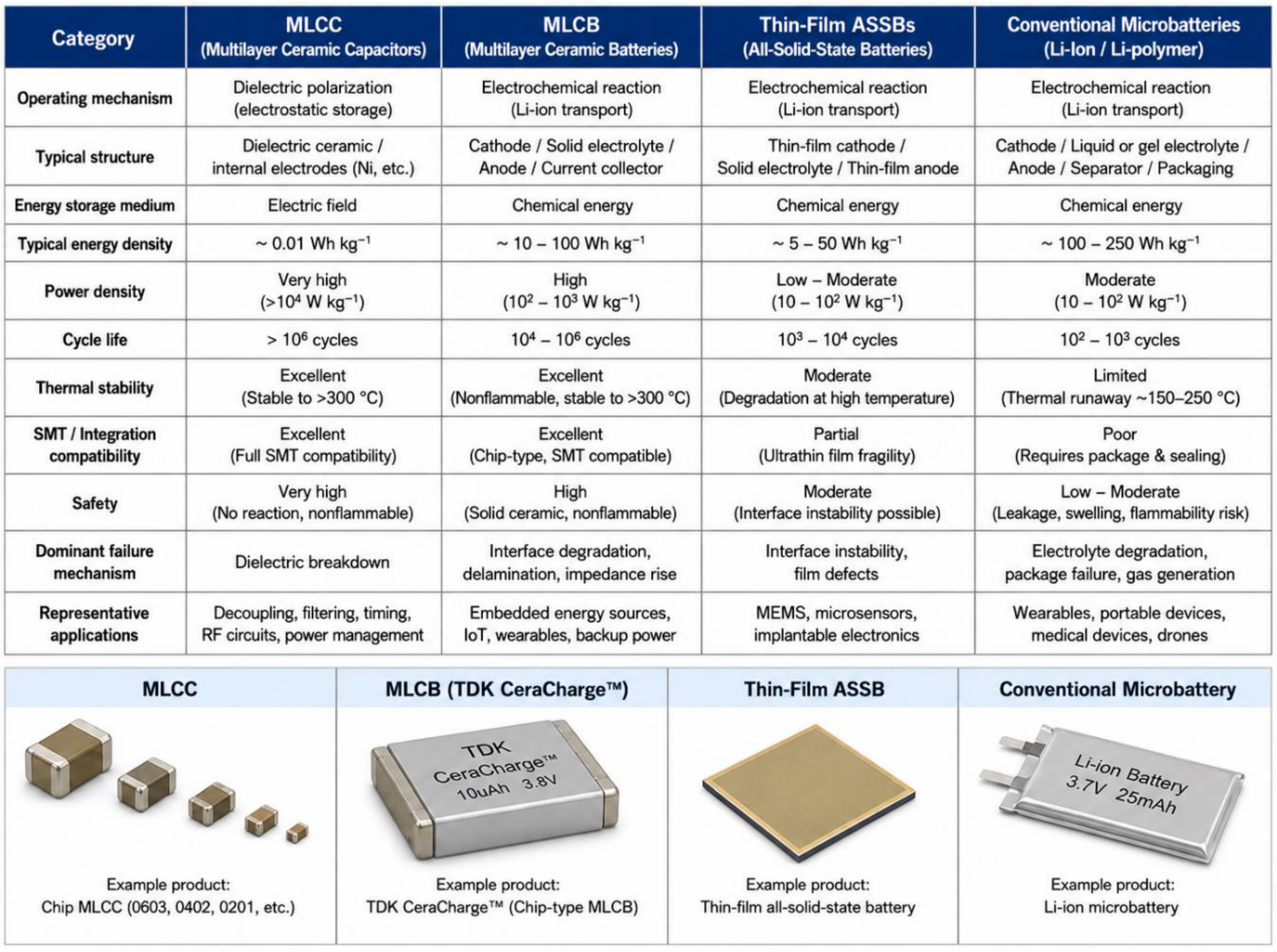
Table 2 compares MLCCs, MLCBs, thin-film ASSBs, and conventional microbatteries. Although all are used for energy storage or power support in electronic devices, their mechanisms, integration routes, thermal stability, and degradation modes differ significantly [1,10,11,16,17,18,19,43].
MLCCs store energy through dielectric polarization and therefore operate as passive electrostatic devices. Since no ionic transport or redox reaction occurs, MLCCs exhibit ultrafast charge–discharge, high power density, and excellent cycle life, commonly exceeding:
>10⁵–10⁶ cycles
They also provide excellent thermal stability, moisture resistance, and SMT compatibility because of their dense ceramic structure.
MLCBs store energy through Li-ion transport and redox reactions within multilayer ceramic architectures. They deliver higher energy density than MLCCs while retaining chip-type integration and superior thermal stability. Typical reported energy densities for oxide-based MLCBs are:
~10–100 Wh kg⁻¹
Although lower than conventional liquid-electrolyte microbatteries, MLCBs offer nonflammable ceramic structures, strong SMT compatibility, and reduced risks of leakage, swelling, and combustion.
Thin-film ASSBs provide excellent interfacial control through vacuum-deposited ultrathin layers, but their scalability, cost, and mechanical robustness are limited. Conventional liquid or gel microbatteries generally provide the highest energy density:
~100–250 Wh kg⁻¹
However, conventional microbatteries require packaging, sealing, and electrolyte containment, which limit embedded integration and introduce leakage, gas generation, swelling, and thermal-runaway risks. Degradation mechanisms also differ: MLCCs are mainly limited by dielectric breakdown, MLCBs by interface degradation and delamination, thin-film ASSBs by film defects, and liquid microbatteries by electrolyte and packaging reliability.
This comparison indicates that MLCBs should be evaluated by application-specific metrics rather than by energy density alone. For backup and embedded power applications, solder-reflow compatibility, leakage resistance, shelf life, footprint, safety, and process yield may be more important than gravimetric energy density.
Thermal stability is a major advantage of oxide-based MLCBs. Conventional lithium-ion systems may exhibit thermal runaway within the following approximate temperature range:
~120–250 °C, depending on chemistry and abuse condition
In contrast, oxide-based MLCBs use nonflammable ceramic structures and can maintain relatively stable characteristics under SMT reflow conditions, making them attractive for embedded electronic systems.
2.7. Patent Landscape and Industrial Trends of MLCBs
Figure 9 provides a qualitative overview of the patent landscape and industrial trends for MLCBs and oxide-based multilayer ASSBs, based on representative public reports and patent documents [16,17,18,19,20]. Unlike conventional LIB industries driven mainly by electrochemical materials, the MLCB field is closely linked to companies with advanced MLCC manufacturing infrastructure. Recent development has shifted from simple electrolyte research toward integrated ceramic energy platforms combining multilayer processing, co-firing, chip packaging, and interface engineering.
Public corporate disclosures indicate that electronic-component manufacturers with mature multilayer ceramic process infrastructure are actively developing chip-scale oxide-based solid-state batteries. TDK has demonstrated commercialization through CeraCharge™, while Murata Manufacturing and Samsung Electro-Mechanics have reported oxide-ceramic or oxide-based solid-state batteries for compact electronic and wearable applications [16,18,19]. These examples suggest that commercialization of MLCBs will depend strongly on MLCC-derived process infrastructure as well as on battery materials development.
TDK’s CeraCharge™ demonstrates the commercial feasibility of SMD-compatible solid-state rechargeable batteries based on ceramic multilayer component technology [16,17]. Murata’s reported solid-state battery development further supports the relevance of oxide ceramic electrolytes and MLCC-derived multilayer processing for wearable and compact electronic applications [18]. Samsung Electro-Mechanics has reported an oxide-based ultra-compact all-solid-state battery with a volumetric energy density of 200 Wh L−1 for wearable applications, and its related disclosures emphasize the use of MLCC-derived printing and stacking technologies [19]. Representative patent documents from Samsung Electro-Mechanics also indicate active development of oxide solid electrolytes and all-solid-state battery structures [20].
These patent trends suggest that MLCB commercialization will likely be led by electronic-component companies capable of integrating materials development with high-volume ceramic manufacturing. Battery companies may contribute electrochemical know-how, but multilayer printing, green-sheet handling, lamination precision, termination reliability, and statistical process control are equally decisive.
From a material perspective, oxide-based solid-state battery patents can be grouped into garnet, NASICON, perovskite, LiPON, and glass-ceramic electrolyte systems. Garnet-type LLZO is attractive because of high ionic conductivity and lithium-metal compatibility:
σLi⁺ ≈ 10⁻⁴–10⁻³ S cm⁻¹ (8)
However, garnet electrolytes require high sintering temperatures and are vulnerable to lithium volatilization and co-firing incompatibility. NASICON-type LATP and LAGP are more suitable for MLCB integration because they offer lower sintering temperatures, air stability, better multilayer ceramic compatibility, and lower thermal-expansion mismatch.
Glass-ceramic electrolyte technologies are becoming increasingly important because they improve low-temperature densification, grain-boundary wetting, interface stabilization, shrinkage matching, and co-firing compatibility. Recent patents increasingly emphasize glass-added LATP, glass-added LAGP, oxide–glass composites, and glass-frit-assisted multilayer densification. This reflects a transition from materials-driven patents to integrated materials–process–architecture strategies.
Overall, the qualitative patent and industrial trend map in Figure 9 suggests that MLCBs are evolving from simple solid-state microbatteries toward ceramic energy platforms for embedded electronics, wearables, IoT devices, and AI-edge systems. Future competitiveness will depend on simultaneous optimization of materials, multilayer process integration, interface engineering, and chip-scale packaging.
For late-entering companies, the patent landscape implies that material selection alone is unlikely to secure a strong position. A more defensible strategy is to connect proprietary slurry design, low-temperature co-firing windows, chip termination reliability, and application-specific packaging into an integrated process portfolio.
2.8. Applications and Future Perspectives of MLCBs
Figure 10 summarizes representative applications and future directions for MLCBs. Rather than directly competing with high-energy liquid-electrolyte batteries, MLCBs are better positioned as ceramic-integrated energy components optimized for miniaturization, thermal stability, SMD compatibility, and long-term reliability [16,17,18,19,24,30,43].
Promising applications include IoT sensors, ultralow-power wireless devices, industrial monitoring tags, smart logistics labels, structural health-monitoring systems, wearable electronics, medical implants, and bioelectronic devices. These applications value compact size, low leakage, nonflammability, maintenance-free operation, and stable performance under limited power consumption. Backup-power modules for real-time clocks, memory retention, and standby systems are among the most commercially feasible near-term markets, as demonstrated by TDK CeraCharge™ [16].
Medical and wearable applications require additional attention to biocompatibility, encapsulation, and long-term chemical stability. Although ceramic electrolytes reduce leakage and flammability risks, device-level qualification must still address moisture ingress, mechanical shock, sterilization compatibility, and stable operation under body-temperature or skin-contact conditions.
MLCBs may also become relevant to AI hardware and advanced semiconductor packaging. AI accelerators and high-performance computing modules experience rapid transient current fluctuations and require local power stabilization. While MLCCs currently serve as decoupling capacitors, future MLCBs could provide local backup power, embedded energy buffering, and transient power assistance near system-in-package architectures and edge-computing modules.
In this role, MLCBs would not replace MLCCs but could complement them. MLCCs provide ultrafast transient decoupling, whereas MLCBs could provide longer-duration local energy support. A hybrid capacitor–battery ceramic module may therefore become attractive for advanced packages where board area, power integrity, and thermal reliability are simultaneously constrained.
Market growth is expected to follow the expansion of IoT devices, wearables, edge-AI hardware, semiconductor packaging, and distributed sensor networks. Key technology directions include high-conductivity oxide electrolytes, low-temperature co-firing, interface engineering, glass-assisted oxide electrolytes, hybrid ceramic electrolytes, low-strain electrode materials, and defect-controlled multilayer structures.
From a manufacturing perspective, MLCC-derived multilayer processing may accelerate commercialization because it already provides high-throughput fabrication of hundreds of ceramic layers with excellent precision. In the long term, MLCBs may evolve into multifunctional ceramic energy platforms integrating embedded capacitors, multilayer batteries, thermal-management layers, ceramic substrates, and power-management circuits. Remaining challenges include limited oxide conductivity, high interfacial resistance, ceramic brittleness, and sensitivity to pores, cracks, delamination, and reaction layers.
From a product-design perspective, early commercialization should prioritize applications where safety, miniaturization, assembly compatibility, and long standby life are more valuable than maximum energy density. This positioning avoids direct competition with conventional microbatteries and leverages the unique strengths of ceramic multilayer manufacturing.
3. Conclusions
Multilayer ceramic batteries are emerging as ceramic-integrated energy-storage devices that combine the intrinsic safety of all-solid-state batteries with the mature multilayer ceramic manufacturing infrastructure of MLCCs. By using oxide solid electrolytes and monolithic ceramic stacks, they provide nonflammability, thermal stability, compact chip-type structures, and SMD compatibility. Their operation, however, is fundamentally different from MLCC dielectric polarization because energy storage depends on Li-ion transport and redox reactions.
This review examined the material systems and processing technologies required for oxide-based MLCBs, including LLZO, LATP, LAGP, cathode and anode materials, co-firing routes, interface engineering, and electro-chemo-mechanical reliability. The analysis indicates that bulk electrolyte conductivity alone is not sufficient for practical devices; lithium retention, shrinkage matching, interfacial reaction control, residual-porosity suppression, grain-boundary resistance, current-collector compatibility, and delamination resistance must be optimized together.
Industrial and patent trends suggest that MLCB technology is evolving toward highly integrated ceramic energy platforms. Companies with mature multilayer ceramic manufacturing capabilities, including TDK, Murata Manufacturing, and Samsung Electro-Mechanics, may play central roles because scalable multilayer ceramic integration, green-sheet handling, printed-electrode uniformity, termination reliability, and statistical process control are essential for commercialization [16,18,19].
Future progress will depend on low-temperature co-firing, glass-assisted or hybrid oxide electrolytes, chemically stable interface coatings, low-strain electrode designs, defect-controlled multilayer processing, and smart manufacturing. Early products should prioritize applications where safety, miniaturization, solder-reflow compatibility, long standby life, and leakage resistance are more valuable than maximum gravimetric energy density, including IoT sensors, wearable electronics, RTC backup power, semiconductor packaging, AI-edge modules, and medical electronics.
Author Contributions
Conceptualization, J.K.L., S.H.L., M.W.H. and J.R.Y.; data curation, J.K.L., W.S.L. and J.R.Y.; formal analysis, J.K.L. and J.R.Y.; funding acquisition, J.K.L. and J.R.Y.; investigation, J.K.L., W.S.L. and J.R.Y.; methodology, J.K.L. and J.R.Y.; project administration, J.K.L. and J.R.Y.; resources, J.K.L. and J.R.Y.; software, J.K.L.; supervision, J.K.L. and J.R.Y.; validation, J.K.L. and J.R.Y.; visualization, J.K.L. and W.S.L.; writing-original draft preparation, J.K.L.; writing-review and editing, J.K.L., S.H.L., M.W.H. and J.R.Y. All authors have read and agreed to the published version of the manuscript.
Data Availability Statement
No data was used for the research described in the article.
Acknowledgments
This work was supported by the Technology Innovation Program (No. RS-2023-00256202, Development of MLCB Design and Manufacturing Process Technology for Board Mounting) funded by the Ministry of Trade, Industry & Energy (MOTIE, Korea).
Conflicts of Interest
The authors declare that they have no known competing financial interests or personal relationships that could have appeared to influence the work reported in this paper.
References
- Z. Zhu, R. Kan, S. Hu, et al., Recent advances in high-performance microbatteries: Construction, application, and perspective, Small 16 (2020) 2003251. [CrossRef]
- J. A. Rogers, T. Someya, Y. Huang, Materials and mechanics for stretchable electronics, Science 327 (2010) 1603-1607. [CrossRef]
- M. Stoppa, A. Chiolerio, Wearable electronics and smart textiles: A critical review, Sensors 14 (2014) 11957-11992. [CrossRef]
- J. B. Goodenough, K. S. Park, The Li-ion rechargeable battery: A perspective, J. Am. Chem. Soc. 135 (2013) 1167-1176. [CrossRef]
- M. Armand, J. M. Tarascon, Building better batteries, Nature 451 (2008) 652-657. [CrossRef]
- R. Shang, T. Nelson, T. V. Nguyen, et al., A comprehensive review of solid-state lithium batteries: Fast charging characteristics and in-operando diagnostics, Nano Energy (2025) 111232. [CrossRef]
- J. Janek, W. G. Zeier, A solid future for battery development, Nat. Energy 1 (2016) 16141. [CrossRef]
- Manthiram, X. Yu, S. Wang, Lithium battery chemistries enabled by solid-state electrolytes, Nat. Rev. Mater. 2 (2017) 16103. [CrossRef]
- N. Boaretto, I. Garbayo, S. Valiyaveettil-SobhanRaj, et al., Lithium solid-state batteries: State-of-the-art and perspectives, J. Power Sources 502 (2021) 229919. [CrossRef]
- J. B. Bates, N. J. Dudney, B. Neudecker, et al., Thin-film lithium and lithium-ion batteries, Solid State Ionics 135 (2000) 33-45. [CrossRef]
- N. J. Dudney, Thin film micro-batteries, Electrochem. Soc. Interface 17 (2008) 44-48. [CrossRef]
- K. Takada, Progress and prospective of solid-state lithium batteries, Acta Mater. 61 (2013) 759-770. [CrossRef]
- R. E. Mistler, E. R. Twiname, Tape Casting: Theory and Practice, Wiley, New York, 2000.
- J. S. Reed, Principles of Ceramics Processing, 2nd ed., Wiley, New York, 1995.
- C. A. Randall, R. Eitel, B. Jones, et al., Nanostructural engineering of dielectric ceramics, J. Am. Ceram. Soc. 91 (2008) 2697-2706. [CrossRef]
- TDK Electronics AG, CeraCharge: Rechargeable Multilayer Ceramic Chips, product presentation, 2024. https://www.tdk-electronics.tdk.com/download/2427688/da625f5499b7f746ce45fa674781a152/06-dl-ceracharge-presentation.pdf.
- TDK Corporation, TDK successfully developed a material for solid-state batteries with 100-times higher energy density, press release, 2024. https://www.tdk.com/en/news_center/press/20240617_01.html.
- Murata Manufacturing Co., Ltd., Murata develops solid-state battery with industry’s highest energy density: For wearables applications, oxide ceramic electrolyte solution provides reliability and durability, news release, 2019. https://www.murata.com/en-eu/news/batteries/solid_state/2019/0626.
- Samsung Electro-Mechanics, Samsung Electro-Mechanics Develops All-Solid-State Battery for Wearables, news release, 2024. https://samsungsem.com/global/newsroom/news/view.do?id=8525.
- Samsung Electro-Mechanics Co., Ltd., Solid electrolyte and all-solid-state battery including the same, WO2023101459A1, 2023. https://patents.google.com/patent/WO2023101459A1/en.
- J. Li, X. Liu, Y. Zhang, et al., Chemical compatibility of Li1.3Al0.3Ti1.7(PO4)3 solid-state electrolyte co-sintered with Li4Ti5O12 anode for multilayer ceramic lithium batteries, Materials 18 (2025) 851. [CrossRef]
- Y.-G. Lee, S. Fujiki, C. Jung, et al., High-energy long-cycling all-solid-state lithium metal batteries enabled by silver-carbon composite anodes, Nat. Energy 5 (2020) 299-308. [CrossRef]
- V. Thangadurai, S. Narayanan, D. Pinzaru, Garnet-type solid-state fast Li ion conductors for Li batteries, Chem. Soc. Rev. 43 (2014) 4714-4727. [CrossRef]
- M. Umair, S. Zhou, W. Li, et al., Oxide solid electrolytes in solid-state batteries, Batteries Supercaps 8 (2025) e202400667. [CrossRef]
- R. Murugan, V. Thangadurai, W. Weppner, Fast lithium ion conduction in garnet-type Li7La3Zr2O12, Angew. Chem. Int. Ed. 46 (2007) 7778-7781. [CrossRef]
- J. Awaka, N. Kijima, H. Hayakawa, J. Akimoto, Synthesis and structure analysis of tetragonal Li7La3Zr2O12 with the garnet-related type structure, J. Solid State Chem. 182 (2009) 2046-2052. [CrossRef]
- J. Wolfenstine, J. Sakamoto, Li7La3Zr2O12 ceramic electrolytes for lithium batteries, J. Power Sources 208 (2012) 193-196. [CrossRef]
- H. Aono, E. Sugimoto, Y. Sadaoka, et al., Ionic conductivity of solid electrolytes based on lithium titanium phosphate, J. Electrochem. Soc. 137 (1990) 1023-1027. [CrossRef]
- Y. Ren, T. Liu, Y. Shen, et al., Oxide electrolytes for lithium batteries, J. Materiomics 1 (2015) 256-264. [CrossRef]
- M. Balaish, R. H. Basappa, A. D. Robertson, et al., Emerging processing guidelines for solid electrolytes in the era of oxide-based solid-state batteries, Chem. Soc. Rev. (2025). [CrossRef]
- Schreiber, M. Finsterbusch, O. Guillon, et al., Oxide ceramic electrolytes for all-solid-state lithium batteries, Green Chem. 25 (2023) 1345-1365. [CrossRef]
- R. H. Lee, C. Y. Kang, J. K. Lee, et al., Tailoring the grain boundary structure and chemistry of the dendrite-free garnet solid electrolyte Li6.1Ga0.3La3Zr2O12, NPG Asia Mater. 16 (2024) 42. [CrossRef]
- L. Lin, Z. Yang, J. Zheng, et al., Progress and perspective of glass-ceramic solid-state electrolytes for lithium batteries, Materials 16 (2023) 2655. [CrossRef]
- Y. Jo, Y. Choi, H. Shin, et al., Effects of storage humidity on the crystal structure and on the sheet properties of the lithium borosilicate glass for solid electrolyte, J. Non-Cryst. Solids 654 (2025) 123443. [CrossRef]
- P. Albertus, S. Babinec, S. Litzelman, A. Newman, Status and challenges in enabling the lithium metal electrode for high-energy and low-cost rechargeable batteries, Nat. Energy 3 (2018) 16-21. [CrossRef]
- J. Kasemchainan, S. Zekoll, D. Spencer Jolly, et al., Critical stripping current leads to dendrite formation on plating in lithium anode solid electrolyte cells, Nat. Mater. 18 (2019) 1105-1111. [CrossRef]
- J. A. Lewis, F. J. Q. Cortes, Y. Liu, et al., Linking void and interphase evolution to electrochemistry in solid-state batteries using operando X-ray tomography, Nat. Mater. 20 (2021) 503-510. [CrossRef]
- J. Wang, H. Zhu, Sulfide-based anode-free solid-state batteries: Key challenges and emerging solutions, ACS Energy Lett. 10 (2025) 2377-2391. [CrossRef]
- C. Y. Yu, B. R. Long, J. S. Park, et al., High-temperature chemical stability of Li1.4Al0.4Ti1.6(PO4)3 solid electrolyte with electrode materials, J. Phys. Chem. C 124 (2020) 13133-13142. [CrossRef]
- F. Han, T. Gao, Y. Zhu, et al., High electronic conductivity as the origin of lithium dendrite formation within solid electrolytes, Nat. Energy 4 (2019) 187-196. [CrossRef]
- J. Jamnik, J. Maier, Generalised equivalent circuits for mass and charge transport, Phys. Chem. Chem. Phys. 3 (2001) 1668-1678. [CrossRef]
- S. Cretu, N. Folastre, D. Troadec, et al., Investigation of microstructural evolution in all-solid-state micro-batteries through in situ electrochemical TEM, arXiv:2411.01581 (2024). [CrossRef]
- D. Han, Y. Wang, W. Lv, et al., Micro lithium batteries toward the next-generation smart microsystems: A review, Energy Storage Mater. 81 (2025) 104522. [CrossRef]
Figure 1.
Basic structure of MLCBs. (a) Schematic illustration of a single repeating unit in an MLCB. (b) Overall multilayer stacked architecture of an MLCB.
Figure 1.
Basic structure of MLCBs. (a) Schematic illustration of a single repeating unit in an MLCB. (b) Overall multilayer stacked architecture of an MLCB.
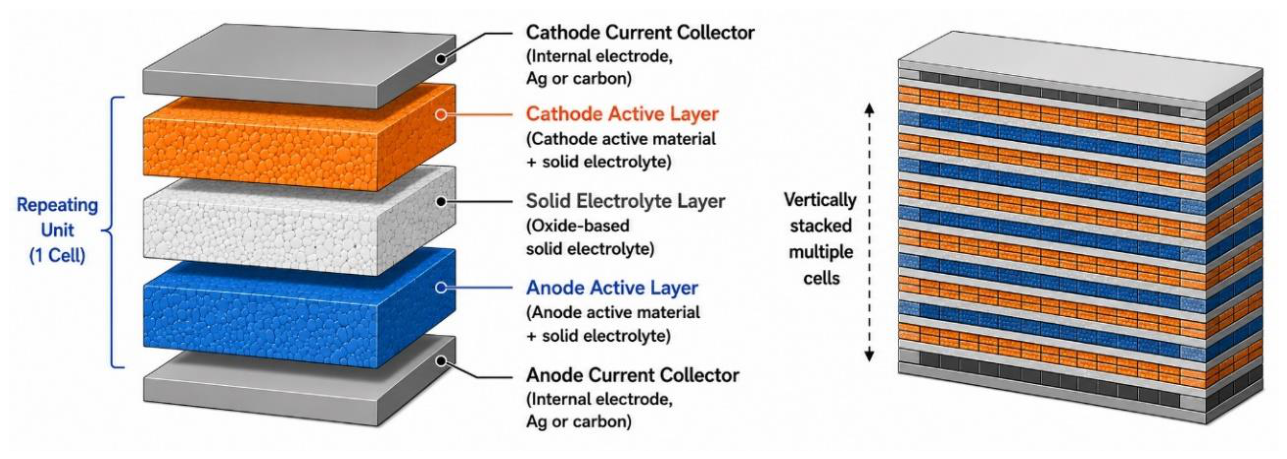
Figure 2.
Comparison of the operating mechanisms of MLCCs and MLCBs. (a) MLCCs store energy electrostatically through dielectric polarization without ion transport or electrochemical reactions. (b) MLCBs store energy electrochemically through lithium-ion transport across solid electrolytes and redox reactions at electrode–electrolyte interfaces.
Figure 2.
Comparison of the operating mechanisms of MLCCs and MLCBs. (a) MLCCs store energy electrostatically through dielectric polarization without ion transport or electrochemical reactions. (b) MLCBs store energy electrochemically through lithium-ion transport across solid electrolytes and redox reactions at electrode–electrolyte interfaces.
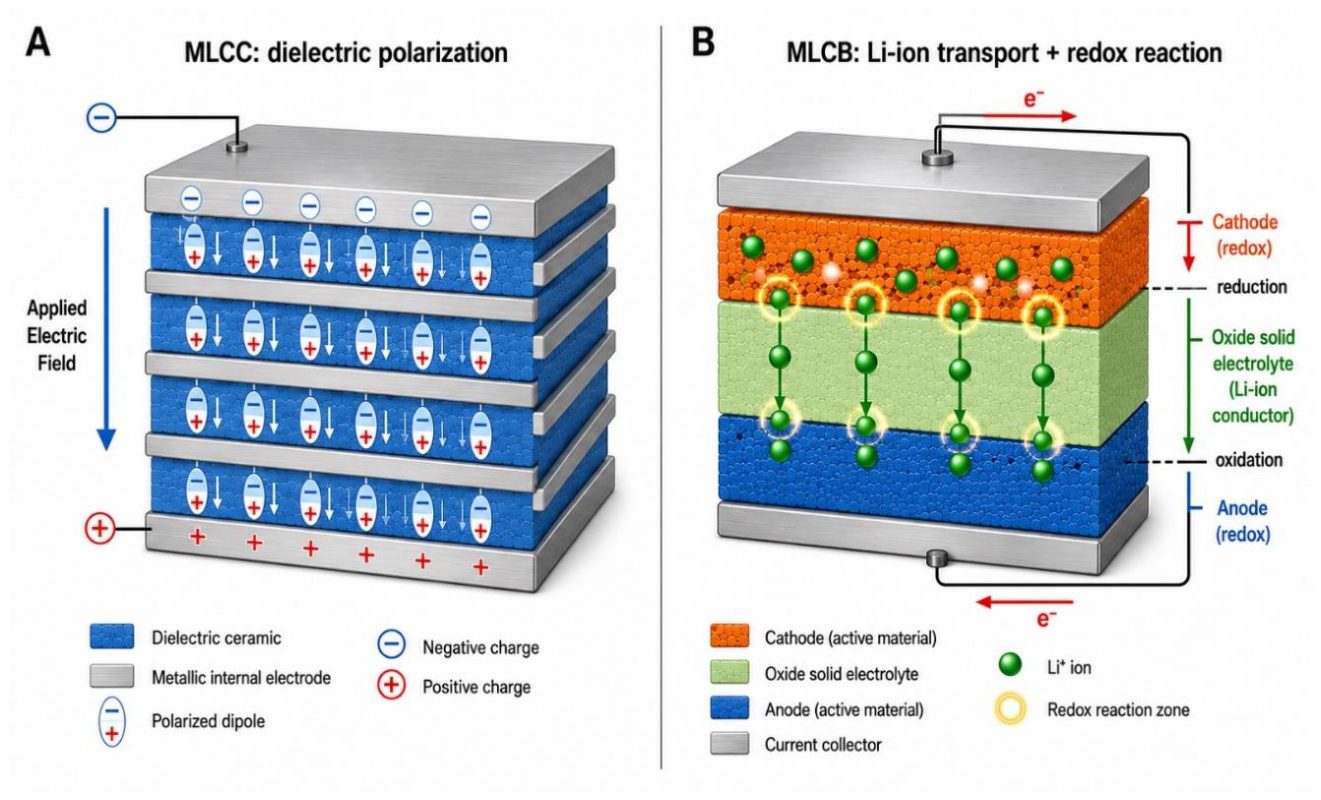
Figure 3.
Classification of oxide solid electrolytes.
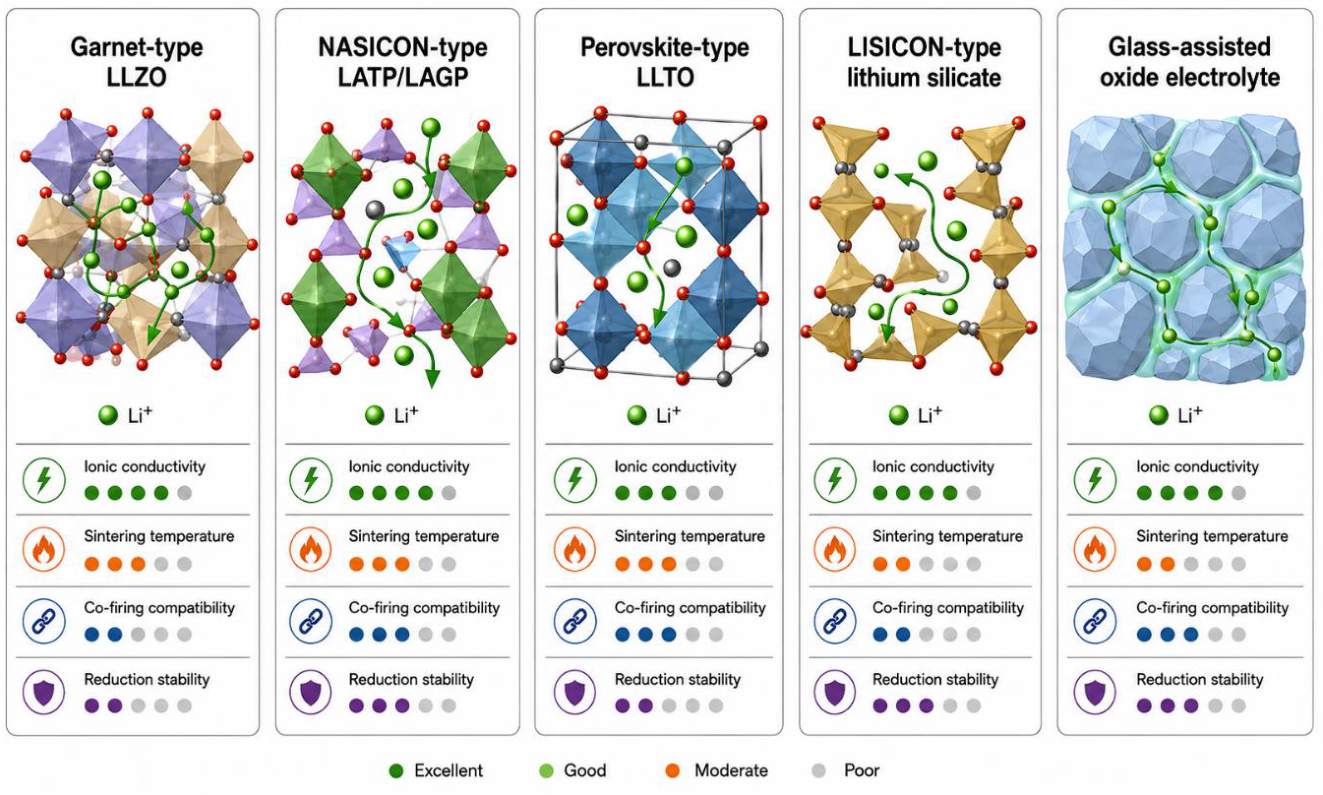
Figure 4.
Electro-chemo-mechanical degradation mechanisms of cathode materials in multilayer ceramic batteries.
Figure 4.
Electro-chemo-mechanical degradation mechanisms of cathode materials in multilayer ceramic batteries.
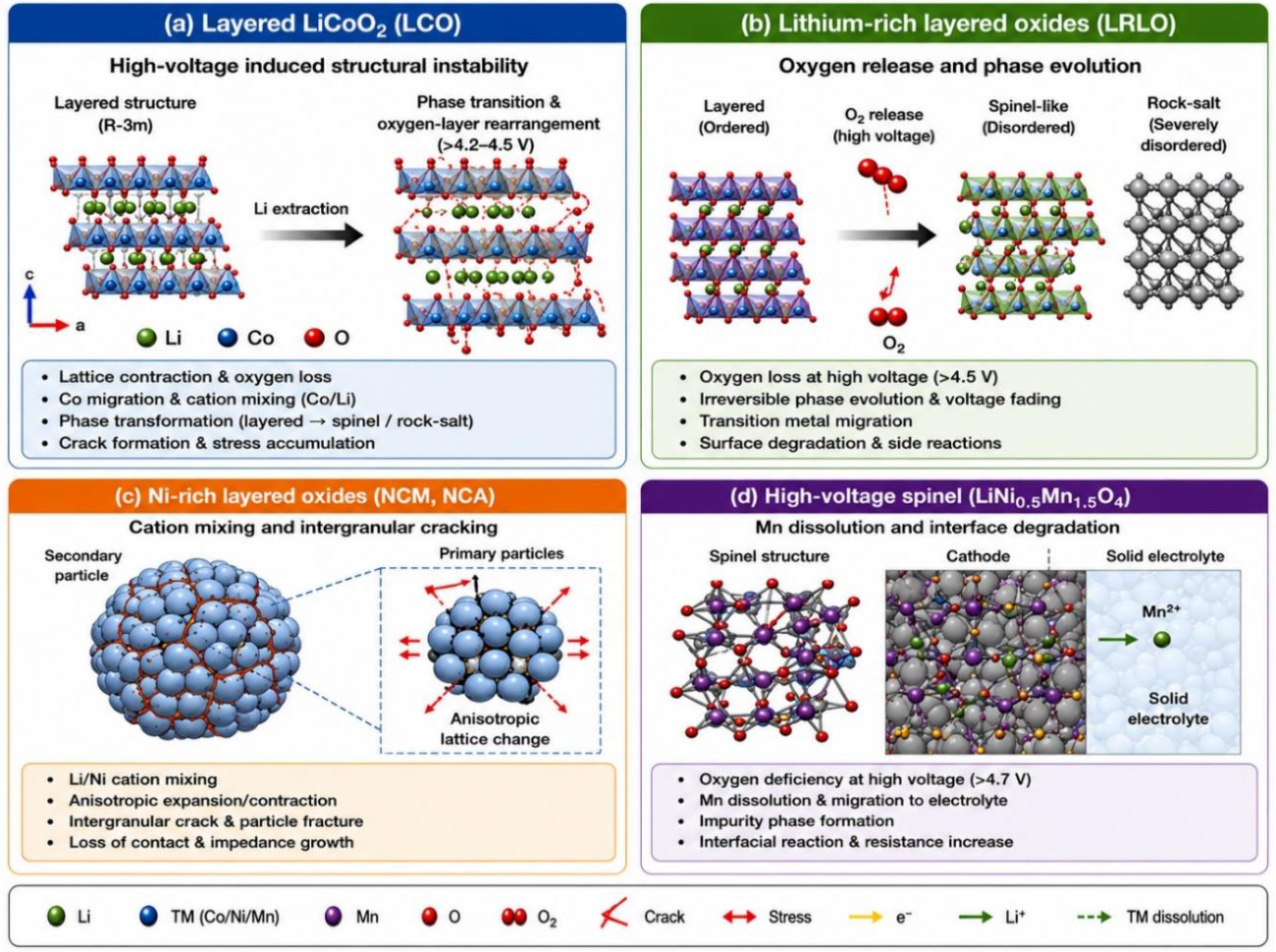
Figure 5.
Structural stabilization and interface-engineering strategies for multilayer ceramic battery cathodes.
Figure 5.
Structural stabilization and interface-engineering strategies for multilayer ceramic battery cathodes.
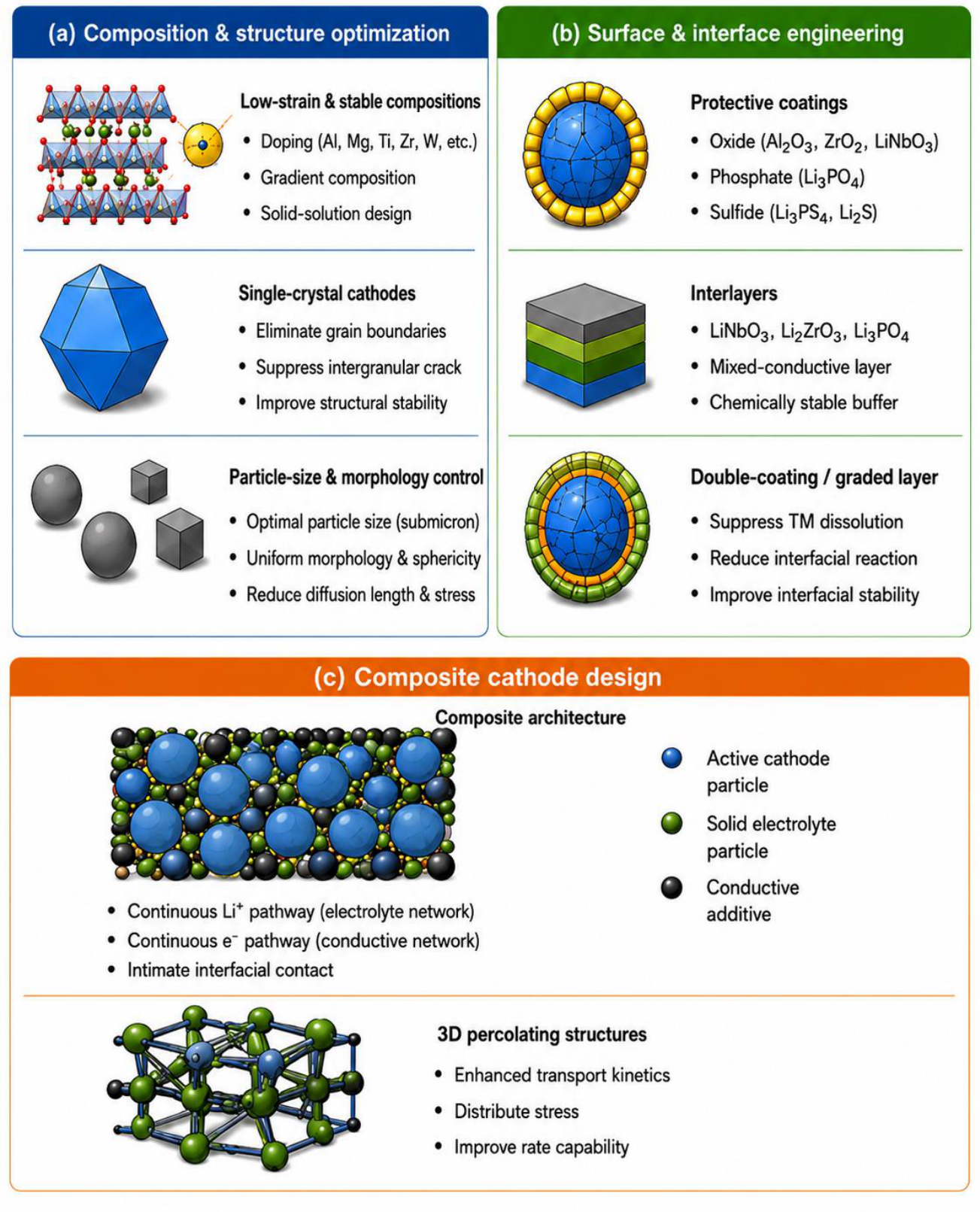
Figure 6.
Electro-chemo-mechanical degradation mechanisms and stabilization strategies of anode materials in multilayer ceramic batteries.
Figure 6.
Electro-chemo-mechanical degradation mechanisms and stabilization strategies of anode materials in multilayer ceramic batteries.
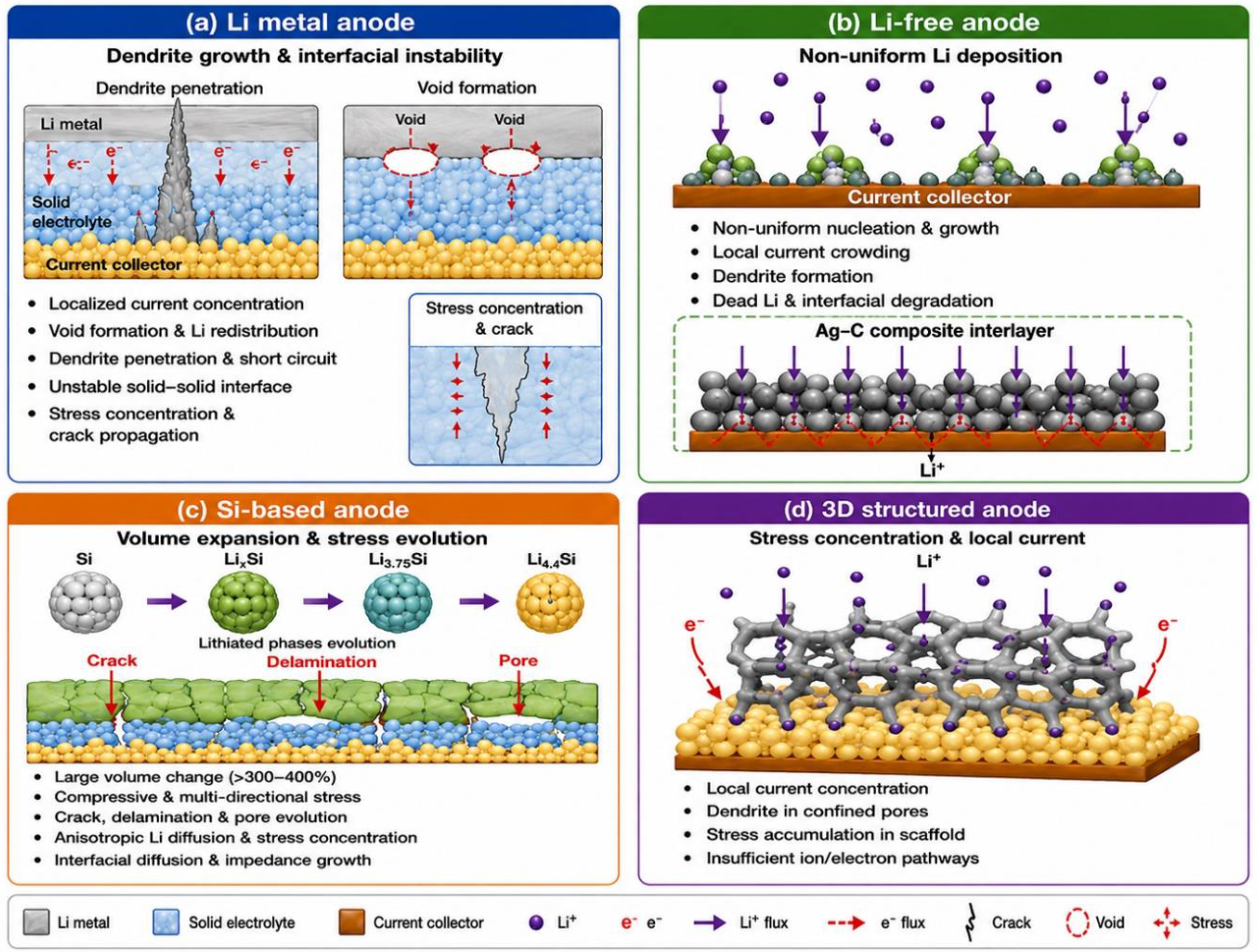
Figure 7.
Representative MLCC-derived manufacturing process flow for oxide-based MLCBs, including slurry preparation, tape casting, screen printing, lamination, debinding, co-firing, termination, plating, and inspection. The key divergence from conventional MLCC processing is the need to control lithium retention, solid-electrolyte redox stability, electrode/electrolyte interfacial reactions, and multilayer shrinkage matching.
Figure 7.
Representative MLCC-derived manufacturing process flow for oxide-based MLCBs, including slurry preparation, tape casting, screen printing, lamination, debinding, co-firing, termination, plating, and inspection. The key divergence from conventional MLCC processing is the need to control lithium retention, solid-electrolyte redox stability, electrode/electrolyte interfacial reactions, and multilayer shrinkage matching.
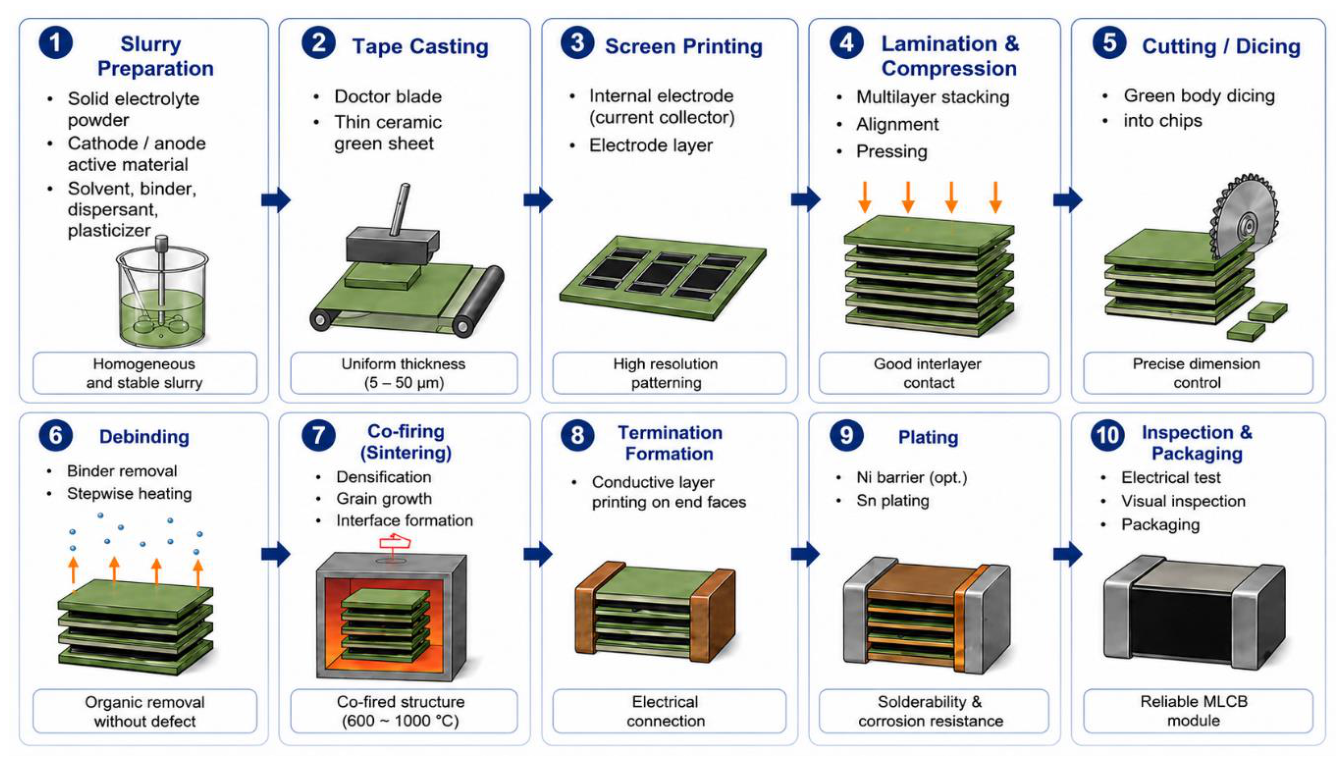
Figure 8.
Schematic illustration of representative microstructural defects and interfacial degradation mechanisms in MLCBs.
Figure 8.
Schematic illustration of representative microstructural defects and interfacial degradation mechanisms in MLCBs.
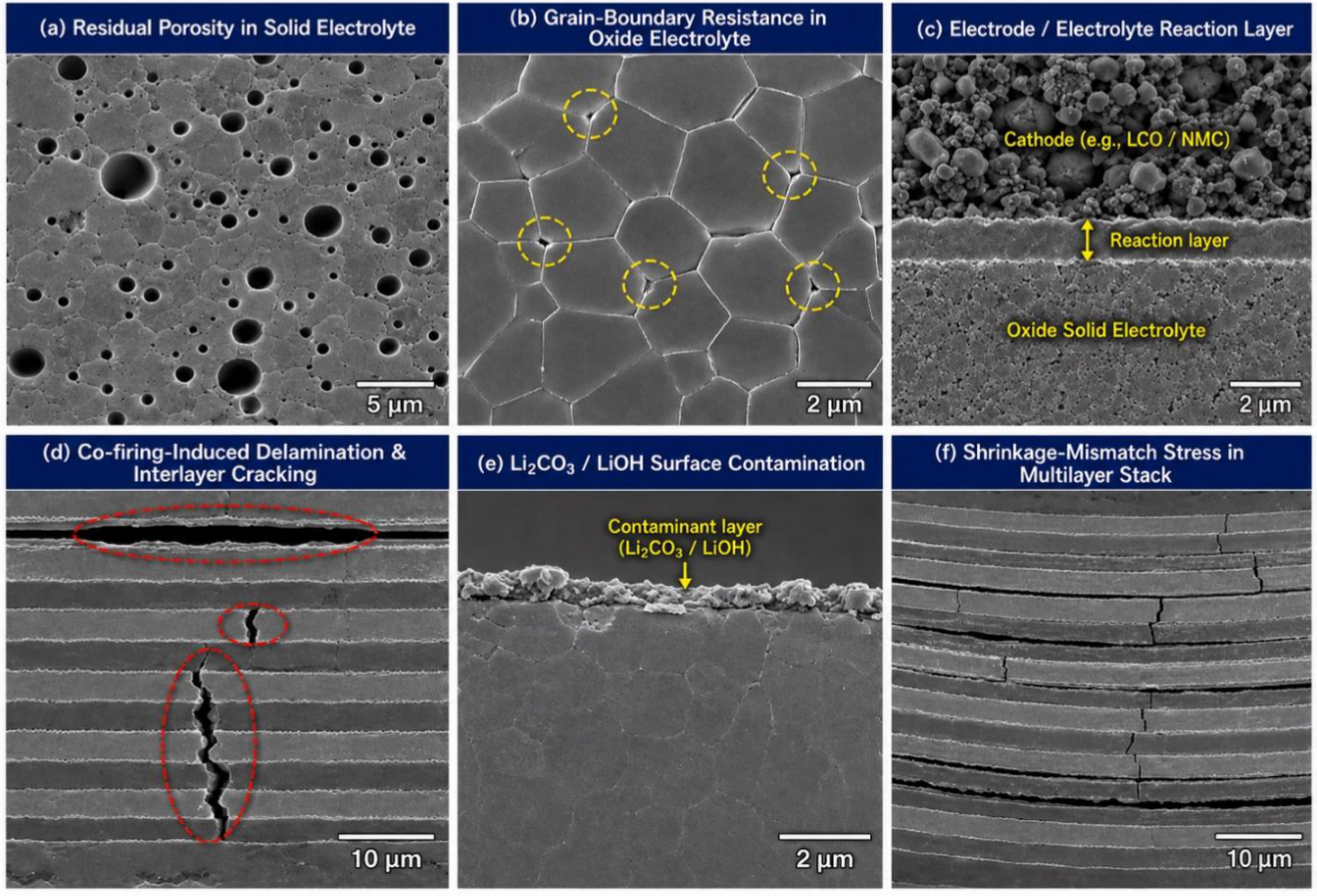
Figure 9.
Qualitative patent and industrial trend map of multilayer ceramic batteries (MLCBs) and oxide-based multilayer all-solid-state batteries, compiled from representative public corporate disclosures and patent documents [16,17,18,19,20]. The map should be interpreted as a representative landscape rather than a complete quantitative patent census.
Figure 9.
Qualitative patent and industrial trend map of multilayer ceramic batteries (MLCBs) and oxide-based multilayer all-solid-state batteries, compiled from representative public corporate disclosures and patent documents [16,17,18,19,20]. The map should be interpreted as a representative landscape rather than a complete quantitative patent census.
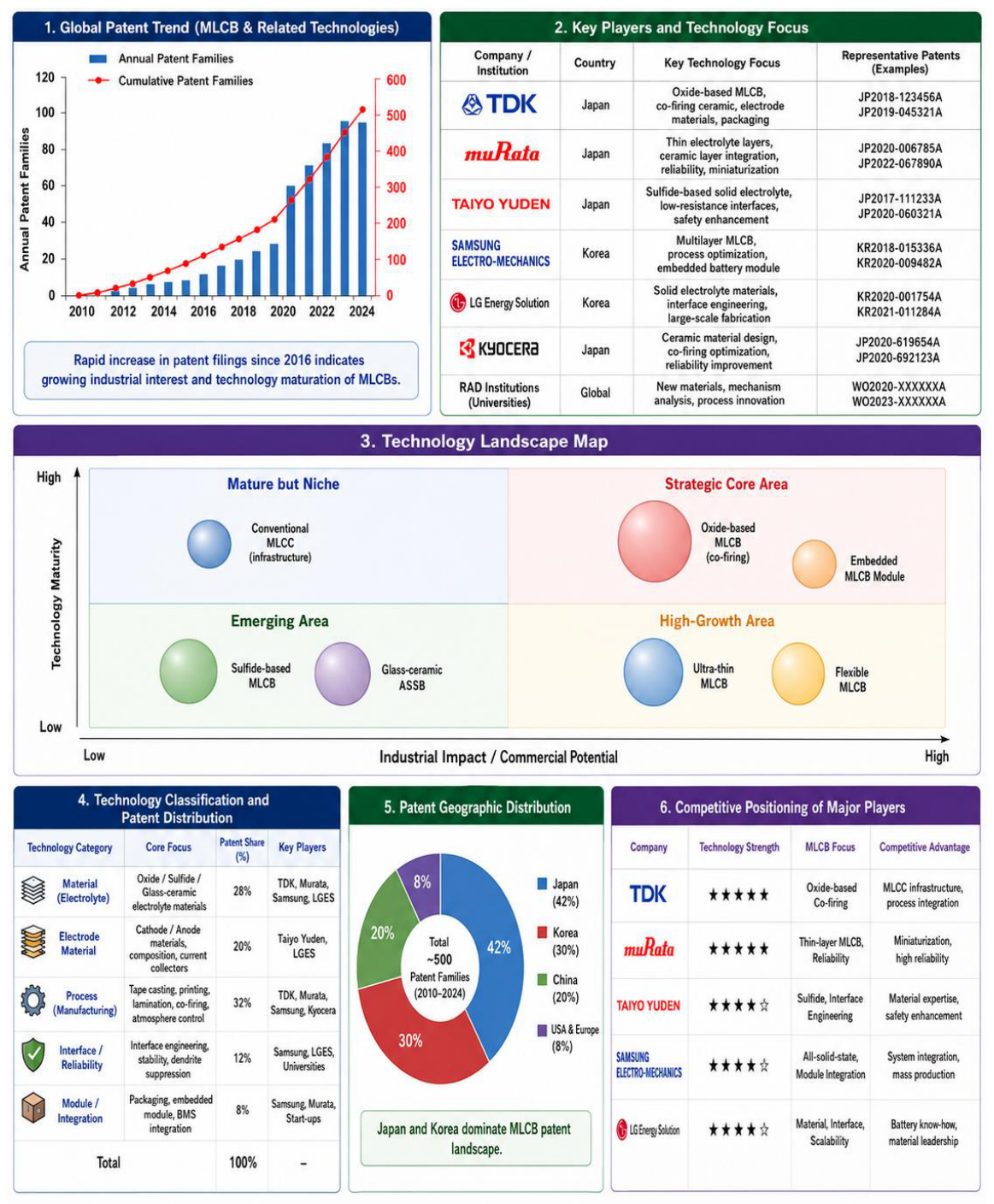
Figure 10.
Representative applications and future perspectives of MLCBs, including IoT devices, wearable electronics, AI hardware, semiconductor packaging, medical implants, and embedded ceramic-integrated energy systems.
Figure 10.
Representative applications and future perspectives of MLCBs, including IoT devices, wearable electronics, AI hardware, semiconductor packaging, medical implants, and embedded ceramic-integrated energy systems.
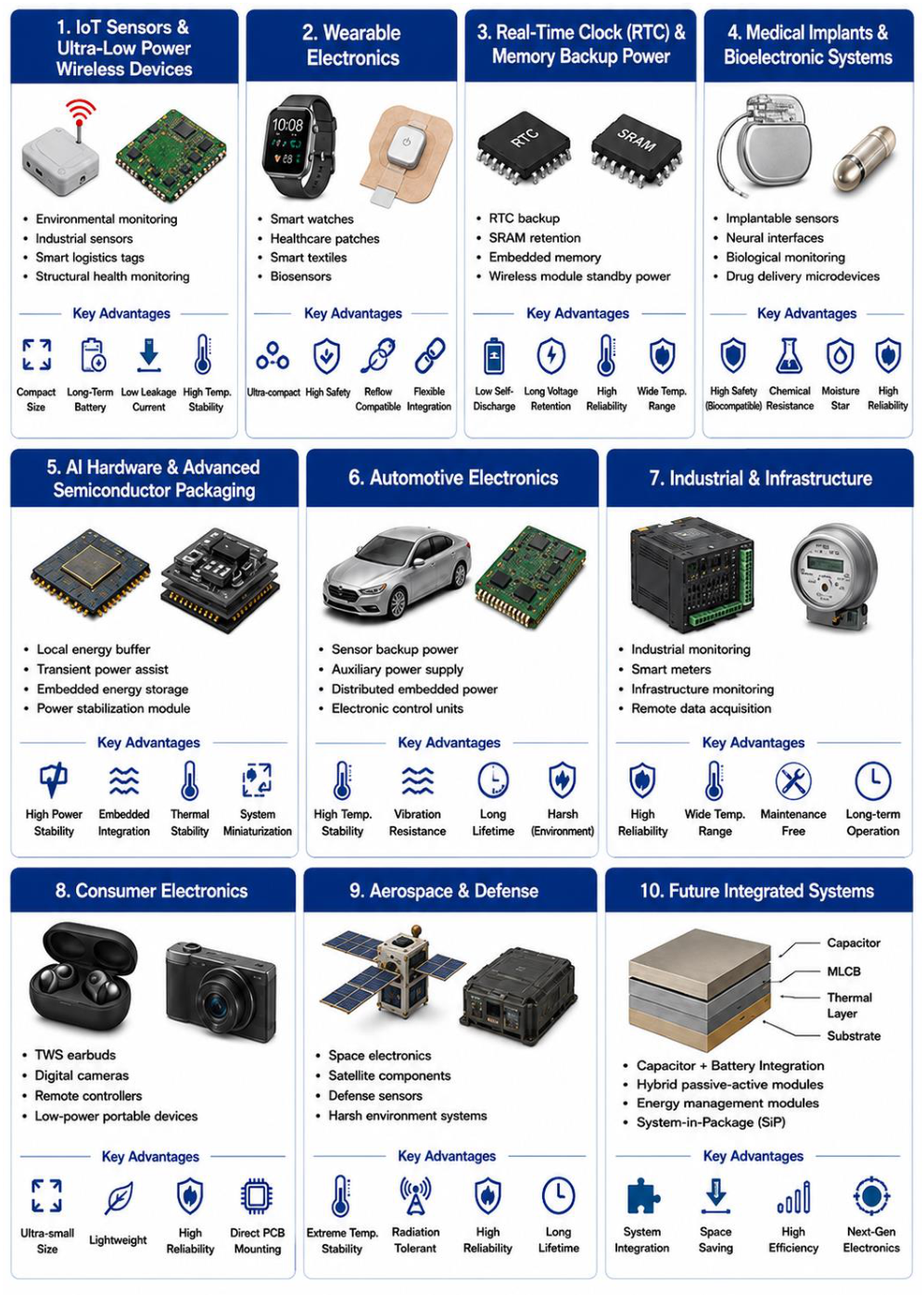

Table 1.
Representative oxide solid electrolytes relevant to MLCBs.
| Material | Structure | Conductivity (RT) | Sintering temp. | Advantages | Key challenges for MLCBs |
|---|---|---|---|---|---|
| LLZO | Garnet | ~10⁻³ S cm⁻¹ | 1100–1250 °C | High ionic conductivity; wide electrochemical window; Li-metal compatibility | High sintering temperature; Li volatilization; secondary phases; shrinkage mismatch |
| LATP | NASICON | 10⁻⁴–10⁻³ S cm⁻¹ | 850–1000 °C | Good air stability; relatively low sintering temperature; ceramic-process compatibility | Ti⁴⁺ reduction; electronic leakage; grain-boundary resistance |
| LAGP | NASICON | 10⁻⁴–10⁻³ S cm⁻¹ | 850–950 °C | Good densification; relatively high effective conductivity | Ge cost; interfacial instability; compositional control |
| LLTO | Perovskite | 10⁻⁴–10⁻³ S cm⁻¹ (bulk) | 1000–1100 °C | High bulk ionic conductivity | High grain-boundary resistance; Ti reduction; poor co-firing compatibility |
| Li₄SiO₄-based | LISICON | ~10⁻⁴ S cm⁻¹ or lower | 900–1000 °C | Chemical stability; moderate processing temperature | Lower conductivity; limited high-power capability |
| Glass-assisted oxide | Glass-ceramic composite | Composition-dependent | Lower than parent oxide when glass is excessive | Low-temperature sintering; grain-boundary wetting; shrinkage matching | Excess glass may reduce conductivity and mechanical reliability |
Table 2.
Representative characteristics of multilayer ceramic capacitors (MLCCs), multilayer ceramic batteries (MLCBs), thin-film all-solid-state batteries (ASSBs), and conventional microbatteries.
Table 2.
Representative characteristics of multilayer ceramic capacitors (MLCCs), multilayer ceramic batteries (MLCBs), thin-film all-solid-state batteries (ASSBs), and conventional microbatteries.
Disclaimer/Publisher’s Note: The statements, opinions and data contained in all publications are solely those of the individual author(s) and contributor(s) and not of MDPI and/or the editor(s). MDPI and/or the editor(s) disclaim responsibility for any injury to people or property resulting from any ideas, methods, instructions or products referred to in the content. |
© 2026 by the authors. Licensee MDPI, Basel, Switzerland. This article is an open access article distributed under the terms and conditions of the Creative Commons Attribution (CC BY) license (http://creativecommons.org/licenses/by/4.0/).
Copyright: This open access article is published under a Creative Commons CC BY 4.0 license, which permit the free download, distribution, and reuse, provided that the author and preprint are cited in any reuse.


