

Submitted:
03 June 2026
Posted:
08 June 2026
You are already at the latest version
Abstract
Bioanalytical methods to quantitate conjugated payloads are essential for assessing antibody-drug conjugate (ADC) stability and pharmacokinetics (PK). Dual-payload ADCs present analytical challenges; different linker chemistries can require complex digestion conditions and to perform the cleavage. Developing separate methods for each linker combination can be time and resource demanding. Rat tritosomes—purified lysosomal fractions from Triton-treated rat liver—provide a comprehensive enzymatic mixture that mimics the lysosomal environment. The presented bioanalytical method combines immunoaffinity purification with tritosome-mediated digestion for simultaneous quantitation of dual conjugated payloads. The method was applied to a model dual-payload ADC containing two different cytotoxic payloads, conjugated using different enzymatically cleavable linkers, with not related Dar (drug-to-antibody-ratio). Method validation in mouse plasma demonstrated excellent accuracy (bias ± 20%, LLOQ and ULOQ ± 25%) and precision (coefficient of variation CV% ≤ 20%, LLOQ and ULOQ ± 25%) across all concentration levels (lower to upper limit of quantitation ,LLOQ to ULOQ) for both payloads, with 100% of quality control samples (QCs) meeting acceptance criteria for hybrid LC-MS/MS quantitation methods. This tritosome-based approach provides a unified, efficient platform for multi-payload ADC bioanalysis, eliminates linker-specific method optimization and enables robust support for preclinical studies. The method has been tested for accuracy and precision on 4 different model ADCs and employed to quantify the conjugated payloads in in-vivo samples from a homozygous hFcRn transgenic mouse model (Tg32) PK study, resulting in reliable data in accordance with total antibody measurements.
Keywords:
antibody-drug conjugates
; dual-payload
; tritosome
; bioanalysis
; conjugated payload
1. Introduction
Antibody–drug conjugates (ADCs) couple the specificity of monoclonal antibodies with potent small-molecule payloads via engineered linkers. They enable targeted tumor cell killing while aiming to limit systemic exposure compared to conventional chemotherapy. This results in an increased therapeutic window and improved patient compliance [1,2]. Rapid advances in payloads, linkers, and conjugation chemistries have expanded ADC design space and motivated strategies to overcome resistance and tumor heterogeneity [3].
Dual-payload ADCs represent the next step. They co-deliver two distinct drugs to the same target cell to achieve complementary or synergistic mechanisms, mitigate cross-resistance, and potentially widen the therapeutic index. In these constructs, site-specific, homogeneous conjugation and careful selection of payload pairs and ratios are required to balance efficacy and toxicity. While multiple dual-payload designs show enhanced activity in preclinical models, clinical validation is still pending, underscoring the need for robust translational frameworks to guide development [4], [5].
Linker architecture and controlled intracellular cleavage are central to ADC performance. Enzyme-sensitive peptide linkers (e.g., cathepsin B–labile) are designed to remain stable in circulation and cleave post-internalization within lysosomes to trigger payload release; this paradigm is widely implemented across approved and clinical-stage ADCs [2]. Beyond chemistry, linker length and the conjugation microenvironment can modulate stability and release kinetics. Shorter linkers may be sterically shielded by the antibody, thereby improving in-circulation stability, and—given identical linkers—the conjugation site can alter release kinetics detectable in assays of antibody-conjugated payload [6]. Notably, for some constructs (e.g., vcMMAE-based ADCs), cathepsin B cleavage itself may be relatively insensitive to drug location or antibody carrier, highlighting context-dependent effects of conjugation position [1].
Sensitive bioanalytical methods are crucial for quantifying conjugated payloads, characterizing linker stability and cleavage, and defining pharmacokinetics across the discovery, preclinical, and clinical stages. For cleavable linkers, targeted liquid chromatography coupled to mass spectrometry (LC–MS/MS) assays that enzymatically release the payload ex vivo (e.g., using purified cathepsin B for Val-Cit linkers) enable the selective measurement of antibody-conjugated payload and complement immunoassays for total antibody and intact ADC, as well as assays for free drug and metabolites [7,8,9,10,11,12].
In dual payload ADCs, bioanalytical characterization must further resolve each payload’s conjugated and unconjugated forms, potential inter payload interactions, and drug to antibody ratio (DAR) distributions across conjugation sites, all while maintaining assay selectivity and avoiding cross interference. These requirements place a premium on orthogonal methods—combining targeted LC–MS/MS (with enzymatic or chemical release), immunocapture workflows, intact and subunit mass spectrometry, and cell based functional readouts—to ensure accurate quantitation and mechanism aware interpretation across discovery, preclinical development, and clinical translation [6,7,8,11].
This work focuses on dual-payload ADCs and presents strategies for setting up and validating a bioanalytical method to quantify dual-conjugated payloads in preclinical matrices. The method defines the analytes and species to be measured, implements enrichment and controlled release (followed by LC–MS to distinguish each payload and its metabolites), and performs validation tests to assess selectivity, sensitivity, precision, matrix effects and dilution linearity. The present work introduces, for the first time, lysosomal enzymatic cleavage of linkers applied to in-vivo samples for quantitation purposes. Existing quantitation methods dedicated to the conjugated payload focused on optimizing linker molecular specificities, like valine-citrulline linkers, cleaved by cathepsin B or papain [13,14] and ß-glucuronide linker, cleaved by ß-glucuronidase enzyme [15]. Choosing a specific enzyme for linker payload hydrolysis may collide with digestion parameter optimization for payload release. Considering a multiple payload release reaction from a single ADC, the number of variables to consider can complicate assay development. The use of lysosome extracts as an in vitro enzymatic machinery for linker-payload cleavage may help target various linker-payload constructions with different chemistries, as well as antibody fragmentation to enhance payload release [16]. The proteolytic machinery in lysosomal extracts does not require the fine-tuning of enzymatic concentrations, as protein digestion occurs in high-quality and ready-to-use organellar microenvironments that mimic in vivo protein degradation. Lysosome extracts can be contaminated by other organelles, which may affect the proteolytic machinery and the digestion yield of therapeutic proteins [17]. Strategic interventions on lysosomal bilayer composition after the administration of less dense polymers (such as Triton WR1339 or Tyloxapol) in living rats have generated specific lysosomes, named tritosomes, characterized by a distinct lipid profile and lower density. This feature facilitates the easier separation of lysosomal vesicles from other isopycnic organelles (such as mitochondria and peroxisomes) in discontinuous density gradient solutions, which provides a less contaminated final product for metabolic stability and pharmacokinetic/pharmacodynamic (PK/PD) analysis [18].
Integrating the lysosomal step into dual-payload ADC tool degradation can ensure that payload quantitation reflects intracellular mechanisms through biologically relevant processing and time-resolved kinetic profiling rather than relying on single enzyme cleavages. Together, these features demonstrate that lysosomal enzymatic release can broaden applicability. This enables quantitative analysis of dual-payload ADCs bearing diverse cleavable linkers, and supports more mechanistically faithful PK/PD interpretation and design optimization [4]. This method was validated for linearity, accuracy and precision, sensitivity, selectivity, matrix effect, carryover, recovery and sample dilution on a tool ADC (ADC A) bearing enzymatically linked the payload A (DAR X) and a different enzymatically linker attached to payload B (DAR Y) to explore robustness and reliability. Tests related to the single payloads, as were already explored in house in previous studies about the specific small molecules, were not repeated as were out of the scope of this work. Then it has been verified for accuracy and precision to a total of 4 tool ADCs with the same linker payloads and DARs on different conjugation sites.
2. Results
To initiate method set up, the choice between human lysosome extracts and rat tritosomes as lysosomal machinery was guided by different factors. As a first main consideration, the standardization of tritosomes using Sprague-Dawley rats was preferred over human lysosome extracts due to the need for human donors and reduced pool availability. Tritosomes afford a more consistent extract composition, making them suitable to satisfy critical reagent requirements in late stages of biological methods and avoiding batch-to-batch variability. Cost considerations gave further reasons for the selection of tritosomes over human-derived lysosomes as a balanced choice from a project budget management perspective. Human lysosome extracts have the advantages of presenting human-specific enzymatic isoforms, maintaining the physiological lipidome, and mimicking clinical behavior. However, these advantages are offset by lower purity regarding cell contaminants such as mitochondria or peroxisomes, which can cause interference with payloads. On the contrary, the presence of Tyloxapol in rat liver tritosomes is not physiological, but allows to obtain an increased purity of the lysosomal extract, together with an enzymatically enriched environment and a higher level of standardization. The use of Tyloxapol for the separation minimizes interference from cellular contaminants, while the enriched enzymatic environment provides high concentrations of cathepsins and nucleases, ideal for high yield of digestion. This taken into consideration, the independence from human sources allows to more easily obtain lysosomal fractions from a larger pool of animals instead of a reduced number of human donors, providing a much better purified matrix combined with reduced risk of cellular contaminants that could provide unexpected interferences or interactions with the liberated payloads. A multi-analyte method has been developed resulting in reproducible and reliable quantitation for both the payloads. The method uses a unique digestion for both the linkers, employing rat liver tritosomes. The method was solid and applicable on high-throughput parallel procedure using the 96-well format, satisfying acceptance criteria in the validation tests and being applied on in-vivo samples deriving from a PK study. Final protocol employed 3 µL of mouse plasma sample to perform immune-purification using a generic anti-human capture, followed by washing steps to isolate the circulating human-antibody based ADC from plasma contaminants and free payload. Tritosome based digestion was then performed on the purified ADC to let the enzymes cleave the different linkers. After overnight digestion incubation, protein precipitation by organic solvent, evaporation and resuspension were applied to submit the samples to LC-MS detection. The complete protocol is described in the materials and methods and depicted in Figure 1.
2.1. Method Validation
2.1.1. Method Validation Results
Method validation results met the acceptance criteria internally applied for hybrid bioanalytical methods to quantitate each conjugated payload in a range of ADC concentration from 5.0 to 1000 nM.
Main parameter results for each of the payloads are reported in Table 1.
2.1.2. Recovery Result Evaluation
Recovery was further explored to understand the impact of digestion and immunocapture for each analyte. Overall method recovery was reproducible, with CV% below the 20% acceptance criteria (Table 2). Additional investigation into analyte recovery was conducted across different concentration levels to determine whether immunocapture or digestion effects may cause discrepancies in analyte signals. Recovery % values were lower without the immunocapture step, with a marked effect observed for the conjugated payload A analyte (Figure 2B). Comparative analysis across quality control levels showed a significant difference (p-value < 0.05) between immunocaptured samples and their relative counterparts at each level. T-test analysis confirmed that the immunocapture step enhanced peak areas, regardless of analyte concentration, compared with control sample areas (where no immunoaffinity was performed). These results can be related to the excess of protein background in the control samples, which is likely to interfere with the activity of lysosomal hydrolytic enzymes on the targeted drug. Therefore, the broader activity of specific classes of enzymes on matrix substrates can significantly reduce the release of the payload linked via enzymatically cleavable linkers, depending on the enzyme class. On the other hand, the release of payload B appeared less influenced by the presence of mouse plasma substrates (Figure 2A). This was likely due to the greater specificity of the specific enzymes needed for its cleavage and resulted in outcomes closer to those of the immunopurified samples. Nonetheless, sample drug isolation via immunocapture showed a significant increase in payload B signal in high concentration (H) QC levels, whereas no significant signal enhancement (p-value > 0.05) was observed in low and medium (L and M) QC samples (Figure 3).
2.2. Method Application to In-Vivo PK Samples
The method was tested for accuracy and precision and applied to in-vivo PK samples on 4 different test ADCs, here named from letter A to D, with different conjugation positions but constant nominal DAR (payload A = X, payload B = Y). Applicability for each tested ADC was verified on reproducibility and linearity evaluating a standard calibration curve (range 5-1000 nM ADC) and 5 replicates on 5 concentration levels. In terms of sensitivity, this meant an LLOQ sensitivity of the method below 10 ng/mL for both the payloads. While for ADC A an extended validation was performed, covering multiple tests, condensed results for ADCs from B to D are shown in Table 3. In-vivo PK samples deriving from a hFcRn Tg32 mouse study were previously analyzed by ligand binding assay for total antibody quantitation.
Pharmacokinetic profiles obtained from the conjugated payload quantitation from the 4 different ADCs were consistent with the total antibody concentrations obtained by the ligand binding assay. Analytical method sensitivity allowed to follow the PK profile up tp the last sampling time (672 h). The quantitative analysis allowed drug to antibody ratio monitoring (DAR) during the entire PK experiment and the assessment of the stability of the linker payload for the entire study. The ratio between conjugated payload and total antibody calculated at 0.167 h was considered as the initial DAR value, then the in vivo DAR vs time variation was monitored providing precious information on ADC in vivo stability. Normalization reduced potential BIAS effects between orthogonal methods and allowed us to explore how the DAR evolved over time (Figure 4).
3. Discussion
An innovative methodology has been described which allows a universal approach to cleavable linker ADCs for LC-MS conjugated payload quantitation. The intrinsic nature of linker-payloads developed for ADCs require the mechanism for payload release in lysosomes to occur naturally, in order to exert the warhead effect in cells. The present protocol simplifies sample preparation, and mimics the environment and reactions that occur in the lysosomes to provide with the released payload for quantitation. The method showed robustness and reliability on quantifying two different payloads conjugated with different linkers at the same time. In this context, lysosome extracts provide the environment needed for the cleavage of multiple enzyme-targeted linkers. The immunocapture step showed an increase in the yield of conjugated payload, reducing the complexity of the substrate for digestion and excluding the quantitation of free payload. All the validation parameters considered were satisfied, thereby presenting this solution as a potential universal sample preparation protocol for conjugated payload or multiple conjugated payloads quantitation, reducing the number of experiments and time that single or combined digestions might require.
4. Materials and Methods
4.1. ADC Molecule, Reagents and Reference Animal Plasma Matrix
An internal “tool” ADC molecule based on a human antibody conjugated with payloads A and B via, respectively, two different enzymatically cleavable linkers, requiring two different typologies of enzymes for the cleavage, was used as test molecule for method development and evaluation. Drug to antibody ratio was internally verified by LC-MS for both the payloads to verify the nominal conjugation rate.
A biotinylated immunocapture reagent employed in a magnetic bead-based purification step was Biotin-SP conjugated AffiniPure Goat Anti-Human IgG, Fcγ fragment specific (cat. 109-065-098, Jackson Immuno Research, West Grove, PA, USA). Streptavidin Mag Sepharose beads (GE28-9857-99, Cytiva, Marlborough, MA, USA) were coated with the biotinylated immunocapture reagent. Phosphate-buffered saline (PBS) for coating and immunocapture steps were acquired by Merck KgaA (cat. 18912-014, Merck KgaA, Darmstadt, Germany).
Sprague Dawley (SD) Rat Liver Tritosomes were used for the enzymatic digestion of ADCs and their relative linkers; Tyloxapol-treated, Mixed Gender, Pool of 160, 0.25 mL at 2.5 mg of protein per mL in a suspension medium of 250 nM Sucrose with 20 mM HEPES, pH 7.4 (cat. R0610.LT) were obtained by XenoTech, BIOIVT, and used together with associated 10X catabolism buffer (cat. K5200, XenoTech, BIOIVT, Kansas City, KS, USA). DL-Dithiothreitol (DTT) solution 1 M was purchased from Sigma Aldrich (cat. 646563 Supelco, Merck KGaA).
C57 Mouse gender pooled plasma with K2EDTA as anticoagulant was obtained from BIOIVT and used for target molecule dilutions, calibration curve preparation and spiked samples, and as reference matrix for control blanks.
LC-MS dedicated solvents, LC-MS grade Water, LC-MS grade Acetonitrile, Analytical grade Methanol and analytical grade 2-Propanol (Sigma-Aldrich, Merck KGaA) were used for liquid phase preparations, buffers and solutions. Formic Acid 99% LC-MS grade (cat. 85048.051, VWR) was used as acidic modifier for chromatography phases and resuspension solution. To normalize the payload steps and detection, deuterium labelled versions of payload A and B were employed as Internal Standard (IS), provided by external suppliers. Aqueous Internal Standard solution with a final concentration of 50 ng/mL for both the IS molecules was used and applied in the digestion step.
4.2. Calibration Curves and Spiked Sample Preparation
Target molecules were diluted in mouse plasma matrix to a concentration of 1530 µg/mL ADC. The calibration curve was prepared starting from the 10 µM ADC solution in a range from 5 to 1000 nM concentration in terms of ADC, with 9 calibration standard points: 5, 10, 50, 100, 250, 500, 750, 900 and 1000 nM. Three additional concentration levels were chosen and obtained by independent dilutions in mouse plasma matrix as QC check with levels L (15 nM ADC), M (300 nM ADC) and H (800 nM ADC).
4.3. Mag Sepharose Beads COATING for immunocapture
To prepare the immunocapture support and remove storage buffer, 15 µL of streptavidin magnetic bead slurry per sample were added to 35 µL of PBS buffer per number of samples (ex. per 10 samples: 150 µL of bead slurry added to 350 µL of PBS) and washed for 1 min on an inverter at room temperature. After mixing on an inverter, the beads were immobilized using a magnetic support and liquid phase discarded and replaced with 50 µL per number of samples of PBS (ex. per 10 samples: 500 µL of PBS). After removing from the magnetic rack and resuspending the beads, tubes were mixed on the inverter for 1 min at room temperature. This washing step was repeated to reach a total of 3 PBS washing steps. After the last washing step, beads were resuspended in 38 µL per number of samples of PBS (ex. per 10 samples: 380 µL of PBS) and 12 µL per number of samples of biotinylated immunocapture reagent (ex. per 10 samples: 120 µL of biotinylated immunocapture reagent). Tubes were mixed on the inverter at room temperature for two hours to allow immunocapture coating on the streptavidin magnetic beads. At the end of the 2-hour coating step, the excess of immunocapture reagent was washed away by 3 PBS washing steps as illustrated for storage buffer removal. After the last washing step, magnetic beads were resuspended in 150 µL per number of samples of PBS (ex. per 10 samples: 1.5 mL of PBS) and immediately used or stored in refrigerated conditions for up to 1 week.
4.4. Immunocapture Protocol
Immunocapture was performed in Thermo KingFisher 96 Deepwell plates (Thermo Fisher Scientific, Waltham, MA, USA). Keeping the plate on a magnetic holder, 350 µL of PBS were dispensed in each well followed by 150 µL of coated magnetic beads and 3 µL of sample. The immunocapture step was carried out on Thermomixer (Eppendorf, Hamburg, Germany) for 120 min at 22 °C, 1000 rpm shaking. After the immunocapture step, non-specific IgG were removed from the magnetic beads with a double-wash step using PBS 1X (500 μL) using the ThermoFisher King Fisher automated platform. The beads were then washed with LC-MS H2O (500 μL) to remove excess PBS 1X salts and were eventually released in 120 μL LC-MS H2O for downstream applications.
4.5. Digestion by Rat Tritosome Protocol
Digestion by Rat tritosomes was performed on the magnetic beads in the KingFisher 96 Deepwell plate. To remove the 120 µL of water used for elution, the plate was maintained on a magnetic plate holder, to not remove the magnetic beads carrying the target ADC. After 120 µL of water removal, 50 µL of digestion mix containing Internal Standard were added in each well, excluding control blanks. A different mix containing water instead of the aqueous IS solution was applied in the control blank wells, Digestion mix composition per sample was 37.5 µL of Internal Standard solution (IS payload A 50 ng/mL, IS payload B 50 ng/mL, in water), 5 µL of DTT 20 mM, 5 µL of catabolism buffer (Sodium Acetate, pH 5.0) and 2.5 µL of Tritosome fraction mix, for a total volume of 50 µL. For control blank samples, the Internal standard solution was replaced with LC-MS water. After the digestion mix dispensation, the plate was closed with an adhesive sealer and removed from the magnetic holder, carefully resuspending the beads. Digestion was carried out in Thermomixer with ThermoTop® at 37 °C, 1000 rpm, overnight (19 h +/- 1 h).
4.6. Protein Precipitation and Concentration
After the overnight digestion, the KingFisher 96 Deepwell plate was moved to the magnetic holder to immobilize the magnetic beads, and 40 µL of the digestion mix were moved to a new low-binding 2 mL Deepwell 96-well plate (QuanRecovery with MaxPeak, 700 µL, p/n 41121806 by Waters, Milford, MA, USA). In the new plate, 320 µL of Precipitation reagent (Acetonitrile:Methanol 95:5) were added to each well and mixed on Thermomixer (T=22 °C, 1000 rpm) for 5 mins to precipitate protein residuals. After the mixing step, the plate was centrifuged at 3000 rpm for 10 mins (T=4 °C). After the centrifugation step, 300 µL of supernatant were moved to a new 96-well plate and the organic solvent was evaporated using a GenVac evaporator (Genvac, SP Scientific, Warminster, PA, USA), following a 70-min total time program (program: HPLC, Time to Final Stage: 30 min, Final Stage Time: 40 min, max T limit= 70 °C). After evaporation, 150 µL of Phase A (H2O:ACN 95:5, 0.1% Formic Acid) was pipetted to each well for analyte resuspension and mixed on Thermomixer for 30 min at 10 °C, 1000rpm, before LC-MS detection.
4.7. LC-MS Detection
Liquid chromatography separation was performed on a SCIEX Exion LC system AD Series (SCIEX, Framingham, MA, USA), equipped with a Phenomenex Kinetex 2.6 µm PS C18 100 Å 2.1x100 mm column (Phenomenex, Torrance, CA, USA) . Autosampler temperature was set to 10 °C. Separation was achieved using 1 min isocratic in 100% Phase A (H2O:ACN 95:5, 0.1% Formic Acid) followed by a 3.5 min gradient to 40% Phase B (ACN:H2O 95:5, 0.1% Formic Acid) with a flow of 0.6 mL/min. After separation, 100% Phase B was reached in 0.5 min to wash the column and maintained for 1.5 min. After the washing step, a multi-step process to avoid carryover was applied, going to 0% Phase B in 0.5 min, then back to 100% Phase B in 0.5 min and again 0% Phase B in 0.5 min. The column was then equilibrated for 2 min, for a total chromatography run time of 10 min. The column oven temperature was set to 40 °C for the entire chromatographic run duration. The needle valve was rinsed internally and externally using a sequence of strong washes (H2O:ACN:MeOH:2-Propanol 25:25:25:25) and Phase A during the wash phase of the gradient in every chromatography run. LC flow was directed to waste by the diverter valve from injection to min 2, then to the Mass Spectrometer from min 2 to 5 and again to waste during washing and equilibrating steps. Mass Spectrometry detection was performed using a SCIEX 6500+ Triple quadrupole system equipped with a Turbo Ion V ESI source operated in positive mode. Detection was performed in MRM mode using dedicated periods for each analyte and optimized source and MS conditions for each analyte, payload A and B. For quantitation, the area ratio obtained by the area of each analyte multiple transitions trace and the related internal standard was used.
4.8. Method Validation
To verify method performance and reliability, a total of 5 analytical runs were performed to evaluate:
- -
- Linearity
- -
- Accuracy and Precision
- -
- Sensitivity
- -
- Selectivity
- -
- Carryover
- -
- Matrix Effect
- -
- Recovery
- -
- Effect of Dilution
Details, concentration levels and number of replicates for each test are described in Table 4. Quantitative calculations and parameters such as Method Linearity, Accuracy and Precision (Intra and Inter run), Carryover, Matrix Effect, Recovery and Sample Dilution were quantified and calculated using the internal Laboratory Information Management System (Watson LIMS) (Thermo Scientific). Metadata (consisting in an integrated peak area for analytes and IS) were imported from Analyst software to LIMS, and curve regression and quantitation of spiked samples were performed in the LIMS environment. The acceptance criteria refer to internal procedures which reflect the guideline set forth in January 2023—International Council of Harmonization (ICH) guideline M10 on bioanalytical method validation and study sample analysis (Step5), reflected also in Food and Drug Administration (FDA) Guidance for Industry—Bioanalytical Method Validation.
4.9. Post Spike Solution Preparation for Recovery Evaluation Test and Matrix Effect
For recovery evaluation, the full protocol dilution factor of the method starting from 3 µL of samples was calculated and 3 different solutions were prepared as 10X of the calculated absolute resulting concentration at the different QC levels. The global dilution factor for the overall protocol has been calculated as 75 fold. Solutions were prepared in Phase A, starting from 10 µg/mL stocks in H2O:ACN 50:50. Post spike solutions at 10X concentrations were prepared for each of the QC level, calculated on the final relative concentration of the payloads. 15 µL of each of the different 10X solutions were then spiked in 135 µL of resuspended extracted blank sample to be considered as absolute reference 100% for the recovery testing. 15 µL of the same solutions were spiked in Phase A as reference 100% for matrix effect assay.
4.10. In-Vivo Tg32 PK Study
Mouse plasma samples were obtained from an in-vivo PK study conducted on the different ADCs: A, B, C and D. The study was carried out at RBM Merck Italy in accordance with Italian law No. 26 of March 4, 2014 and Merck animal welfare policy. RBM Merck Italy is fully authorized by the Italian Ministry of Health to run in vivo studies.
The study consisted of a single iv injection in huFcRn Tg32 homozygous mice (Strain: B6.Cg-Fcgrttm1Dcr Tg(FCGRT)32Dcr/DcrJ) to evaluate PK behavior of the 4 ADCs up to 672 hours. Each group was composed of 3 animals; all mice were treatment-naive males and females between the age of
5 and 7 weeks. The ADCs were diluted in a 10 mM Histidine, 40 mM NaCl, 6% Trehalose, 0.05% Tween 20, pH 5.5 formulation buffer and administered as single intravenous doses of 3 mg/kg into the tail vein with a dose volume of 5 mL/kg,. Ten blood samples (20 uL) were collected using a serial sampling approach by microsampling technique: 0.167, 6, 24, 48, 96, 168, 240, 360, 504 and 672 hours . Samples were centrifuged at 4 °C for 10 minutes at 2500 g and then stored at -80 °C until analysis. Plasma samples were analyzed by ligand binding method for total Ab quantitation, then pooled and used for conjugated payload quantitation.
4.11. Total Antibody Quantitation
For total antibody quantitation, MSD GOLD 96-well Quickplex plates coated with streptavidin are blocked twice with 200 μL SuperBlock® Blocking Buffer for each well for 5 min at RT. The plates are then washed three times with 200 μL of PBS 1x containing 0.05% Tween-20. MSD GOLD 96-well Quickplex plates are then saturated with 50 μL per well of biotinylated polyclonal goat anti-human IgG (Fc fragment-specific) at 450 rpm for 1 h at RT. After the coating step, the plates are washed three times with PBS 1x, 0.05% Tween-20 and then 50 μL of 1:100 diluted samples are pipetted and incubated on MSD plates at 450 rpm for 1 h at RT. After three washing steps with PBS 1x 0.05% Tween-20, 50 μL of SULFO-TAG reagent in PBS 1x, 0.05% Tween-20, 1% BSA are mixed in each well at 450 rpm for 1 h at RT. After the three washing steps with PBS 1x 0.05% Tween-20, 150 μL of MSD Read Buffer T 2X are added to each well, and the plate is finally read on Meso Quickplex SQ120 plate reader within 5 ± 1 minutes.
Author Contributions
Conceptualization, F. Molinaro and L. Barbero.; methodology, F. Molinaro, G. S. Colangelo and P. Cocco.; method validation, P. Cocco and G.S. Colangelo; writing—original draft preparation, F. Molinaro, G. S. Colangelo and L. Barbero; writing—review and editing, A. Di Ianni.; F. Riccardi Sirtori, D. Knapp-Buehle; supervision, K. Cowan.; project administration, D. Knapp-Buehle. All authors have read and agreed to the published version of the manuscript.
Funding
This research was funded internally by Merck KGaA, Darmstadt, Germany.
Institutional Review Board Statement
All parts of this study plan concerning animal care and using have been approved by the RBM Designated Veterinarian, Animal Welfare Officer and Animal Using Protocol Responsible according to the “Protection of animals, housing and welfare” guaranteed in line with Italian Health Authority D.Lgs No. 26 of March 4, 2014. Protection of animals used, housing and welfare are guaranteed according to the Italian D.Lvo No. 26 of March 4, 2014. Physical facilities for accommodation and care of animals are in accordance with the provisions of the Italian D.Lvo 2014/26 and of Directive 2010/63/EU. The Institute is fully authorized by Italian Ministry of Health. Project: “Determination of pharmacokinetic profile of potential biopharmaceutical drugs by transgenic hu FcRn mice” Authorization n° 986/2024-PR 14/10/2024 by Italian Ministry of Health.
Informed Consent Statement
Not applicable.
Data Availability Statement
The data presented in this study are available in this article or on request from the corresponding authors. Access to some data may be subject to proprietary restrictions and requires approval by Merck KGaA, Darmstadt, Germany.
Conflicts of Interest
All authors are employees of Merck KGaA, Darmstadt, Germany. The funder had no role in the design of the study; in the collection, analyses, or interpretation of data; or in the writing of the manuscript. The funder was involved in the decision to publish, specifically in reviewing the manuscript to ensure that no proprietary, commercially sensitive, or confidential information was disclosed.
Abbreviations
The following abbreviations are used in this manuscript:
| ADC | Antibody-drug conjugate |
| ALOQ | Above limit of quantitation |
| AN | Analyte |
| CAD | Collision activated dissociation gas |
| CE | Collison energy |
| CUR | Curtain gas |
| CV | coefficient of variation % |
| CXP | Collision cell exit potential |
| DAR | Drug to Antibody Ratio |
| Dil | Dilution |
| DP | Declustering potential |
| DTT | DL-Dithiothreitol |
| EP | Entrance potential |
| ESI | Electrospray ionization |
| FDA | Food and Drug Administration |
| H | High |
| HPLC | High pressure liquid chromatography |
| huFcRn | human neonatal fragment crystallizable receptor |
| ICH | International Council of Harmonization |
| IgG | Immunoglobuline G |
| IS | Internal standard |
| K2EDTA | dipotassium ethylenediaminetetraacetic acid |
| L | Low |
| LC-MS or LC-MS/MS | Liquid chromatography tandem Mass Spectrometry |
| LIMS | Laboratory information management system |
| LLOQ | Lower Limit of Quantitation |
| M | Medium |
| ME | Matrix effect |
| MRM | Multiple reaction monitoring |
| PBS | Phosphate-buffered saline |
| PK | Pharmacokinetics |
| PK/PD | Pharmakokinetic / Pharmacodynamic |
| QC | Quality control |
| rpm | round per minute |
| RT | Room temperature |
| SD | Sprague Dawley rat strain |
| SS | Spiked sample |
| SSH | Spiked sample high QC level |
| SSL | Spiked sample low QC level |
| SSLLOQ | Spiked sample lower Limit of Quantitation |
| SSM | Spiked sample medium QC level |
| SSULOQ | Spiked sample upper Limit of Quantitation |
| Tg32 | Tg32 human FcRn transgenic mouse model |
| ULOQ | Upper Limit of Quantitation |
| vcMMAE | valine-citrulline Mono-methyl Auristatin E |
References
- Ducry, L.; Stump, B. Antibody-Drug Conjugates: Linking Cytotoxic Payloads to Monoclonal Antibodies. Bioconjug. Chem. 2010, 21, 5–13. [Google Scholar] [CrossRef] [PubMed]
- Fu, Z.; Li, S.; Han, S.; Shi, C.; Zhang, Y. Antibody Drug Conjugate: The “Biological Missile” for Targeted Cancer Therapy. Signal Transduct. Target. Ther. 2022, 7. [Google Scholar] [CrossRef] [PubMed]
- Wang, Z.; Li, H.; Gou, L.; Li, W.; Wang, Y. Antibody–Drug Conjugates: Recent Advances in Payloads. Acta Pharm. Sin. B 2023, 13, 4025–4059. [Google Scholar] [CrossRef] [PubMed]
- Wen, M.; Yu, A.; Park, Y.; Calarese, D.; Gerber, H.P.; Yin, G. Homogeneous Antibody-Drug Conjugates with Dual Payloads: Potential, Methods and Considerations. MAbs 2025, 17, 1–21. [Google Scholar] [CrossRef] [PubMed]
- Tao, J.; Gu, Y.; Zhou, W.; Wang, Y. Dual-Payload Antibody-Drug Conjugates: Taking a Dual Shot. Eur. J. Med. Chem. 2025, 281, 116995. [Google Scholar] [CrossRef] [PubMed]
- Su, D.; Zhang, D. Linker Design Impacts Antibody-Drug Conjugate Pharmacokinetics and Efficacy via Modulating the Stability and Payload Release Efficiency. Front. Pharmacol. 2021, 12, 1–8. [Google Scholar] [CrossRef] [PubMed]
- Rago, B.; Tumey, L.N.; Wei, C.; Barletta, F.; Clark, T.; Hansel, S.; Han, X. Quantitative Conjugated Payload Measurement Using Enzymatic Release of Antibody-Drug Conjugate with Cleavable Linker. Bioconjug. Chem. 2017, 28, 620–626. [Google Scholar] [CrossRef] [PubMed]
- Di Ianni, Andrea; Cowan, Kyra; Federico Riccardi Sirtori, L.B. Unlocking the Complexity of Antibody-Drug Conjugates: A Cut-Ting-Edge LC-HRMS Approach to Refine Drug-to-Antibody Ratio Measurements with Highly Reactive Payloads 2025, Submitted.
- Barbero, L.M.; Di Ianni, A.; Molinaro, F.; Cowan, K.J.; Riccardi, F. Hybrid Liquid Chromatography High Resolution and Accuracy Mass Spectrometry Approach for Quantification of Antibody-Drug Conjugates at the Intact Protein Level in Biological Samples. Eur. J. Pharm. Sci. 2023, 188, 106502. [Google Scholar] [CrossRef] [PubMed]
- Riccardi Sirtori, F.; Di Ianni, A.; Crosasso, C.; Bertotti, E.; Molinaro, F.; De Salve, I.; Barbero, L.; Cowan, K.J. Evolving Bioanalytical Strategies in the Wake of Pioneering Biotherapeutics. Bioanalysis 2025, 00, 1–18. [Google Scholar] [CrossRef] [PubMed]
- Beaumont, M.; Tomazela, D.; Hodges, D.; Ermakov, G.; Hsieh, E.; Figueroa, I.; So, O.-Y.; Song, Y.; Ma, H.; Antonenko, S.; et al. Antibody-Drug Conjugates: Integrated Bioanalytical and Biodisposition Assessments in Lead Optimization and Selection. AAPS Open 2018, 4. [Google Scholar] [CrossRef]
- Xu, W.; Luo, L.; Matta, M.; Helmy, R.; Vazvaei-smith, F.; Matta, M.; Helmy, R.; Vazvaei-smith, F. Strategy for Streamlining Antibody—Drug Conjugate Pharmacokinetic Assays ABSTRACT. Bioanalysis 2026, 18, 179–188. [Google Scholar] [CrossRef] [PubMed]
- Sanderson, R.J.; Nicholas, N.D.; Lee, C.B.; Mae, S.; Lyon, R.P.; Benjamin, D.R.; Alley, S.C.; Sanderson, R.J.; Nicholas, N.D.; Lee, C.B.; et al. Antibody-Conjugated Drug Assay for Protease- Cleavable Antibody—Drug Conjugates Antibody-Conjugated Drug Assay for Protease-Cleavable Antibody—Drug Conjugates. 2016, 6180. [Google Scholar] [CrossRef]
- Li, Y.; Gu, C.; Gruenhagen, J.; Yehl, P.; Chetwyn, N.P.; Colin, D.; Li, Y.; Gu, C.; Gruenhagen, J.; Yehl, P.; et al. An Enzymatic Deconjugation Method for the Analysis of Small Molecule Active Drugs on Antibody-Drug Conjugates on Antibody-Drug Conjugates. 2016, 0862. [Google Scholar] [CrossRef]
- Dorywalska, M.; Strop, P.; Melton-witt, J.A.; Hasa-moreno, A.; Farias, S.E.; Casas, M.G.; Delaria, K.; Lui, V.; Poulsen, K.; Loo, C.; et al. E Ff Ect of Attachment Site on Stability of Cleavable Antibody Drug Conjugates. 2015. [Google Scholar] [CrossRef]
- Cai, T.; Shi, L.; Guo, H.; Li, R.; Cao, W.; Shen, L.; Zhu, M. Detection and Characterization of In Vitro Payload-Containing Catabolites of Noncleavable Antibody-Drug Conjugates by High- Resolution Mass Spectrometry and Multiple Data Mining Tools S. Drug Metab. Dispos. 2023, 51, 591–598. [Google Scholar] [CrossRef] [PubMed]
- Leighton, F.; Poole, B.; Beaufay, H.; Baudhuin, P.; Coffey, J.W.; Fowler, S.; Duve, C.D.E. THE LARGE-SCALE SEPARATION OF PEROXISOMES, MITOCHONDRIA, AND LYSOSOMES FROM THE LIVERS OF RATS INJECTED WITH TRITON WR-1339 Improved Isolation Procedures, Automated Analysis, Biochemical and Morphological Properties of Fractions. J. Cell Biol. Abstract. 1968, 37, 482–513. [Google Scholar] [CrossRef] [PubMed]
- Wattiaux, R.; Wattiaux-De Coninck, S. Influence of the Injection of “Triton WR-1339” on Lysosomes of a Rat Transplantable Hepatoma. Nature 1967, 216, 1132–1133. [Google Scholar] [CrossRef] [PubMed]
- Author 1, A.B. Title of Thesis. Level of Thesis, Degree-Granting University, Location of University, Date of Completion.
- Title of Site. Available online: URL . (accessed on Day Month Year).
Figure 1.
Schematic representation of conjugated-payload quantitation workflow from dual-payload ADC tools in mouse plasma samples. Samples from relevant PK species (Tg32 mouse models) were collected in storage tubes. Strerptavidin magnetic beads were functionalized with an appropriate capture reagent (e.g., biotinylated goat anti-human IgG Fcγ fragment specific) and mixed with aliquots of the samples. After the immunocapture step, tritosome preparation was applied directly to the magnetic bead suspension and incubated overnight at 37 °C. The reaction mixture underwent protein precipitation in an organic solvent, discarding a protein pellet enriched with lysosomal enzymes. The supernatant was evaporated, and the payloads were resuspended under acidic conditions before LC-MS/MS quantitation. Finally, data from LC-MS analysis were analyzed using dedicated statistical software. The figure was generated using BioRender.
Figure 1.
Schematic representation of conjugated-payload quantitation workflow from dual-payload ADC tools in mouse plasma samples. Samples from relevant PK species (Tg32 mouse models) were collected in storage tubes. Strerptavidin magnetic beads were functionalized with an appropriate capture reagent (e.g., biotinylated goat anti-human IgG Fcγ fragment specific) and mixed with aliquots of the samples. After the immunocapture step, tritosome preparation was applied directly to the magnetic bead suspension and incubated overnight at 37 °C. The reaction mixture underwent protein precipitation in an organic solvent, discarding a protein pellet enriched with lysosomal enzymes. The supernatant was evaporated, and the payloads were resuspended under acidic conditions before LC-MS/MS quantitation. Finally, data from LC-MS analysis were analyzed using dedicated statistical software. The figure was generated using BioRender.
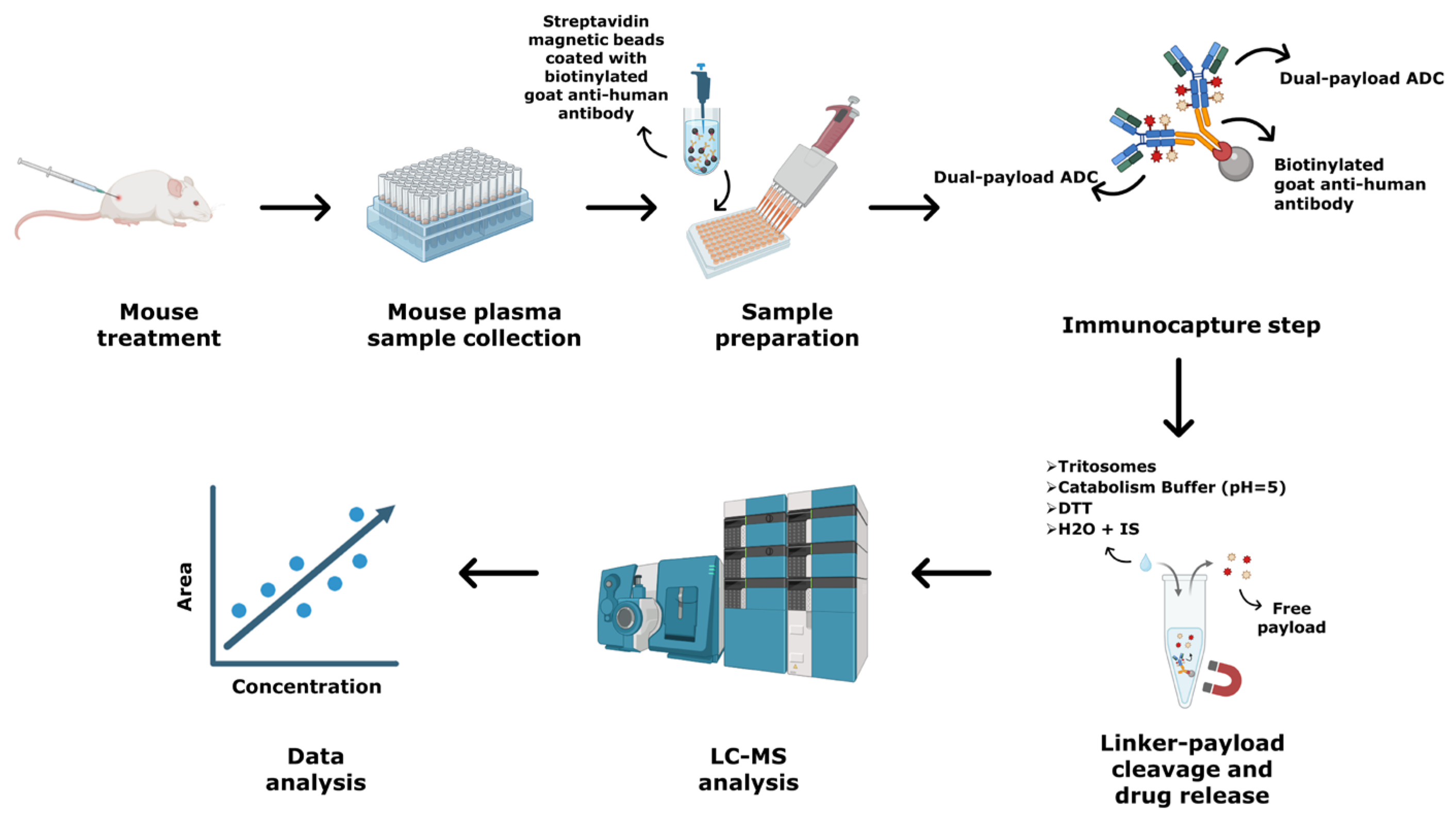
Figure 2.
Recovery % of Payload A (A) and Payload B (B) analytes in immunocapture and quality control samples at each tested concentration level. Data represent n = 3 independent replicates.
Figure 2.
Recovery % of Payload A (A) and Payload B (B) analytes in immunocapture and quality control samples at each tested concentration level. Data represent n = 3 independent replicates.
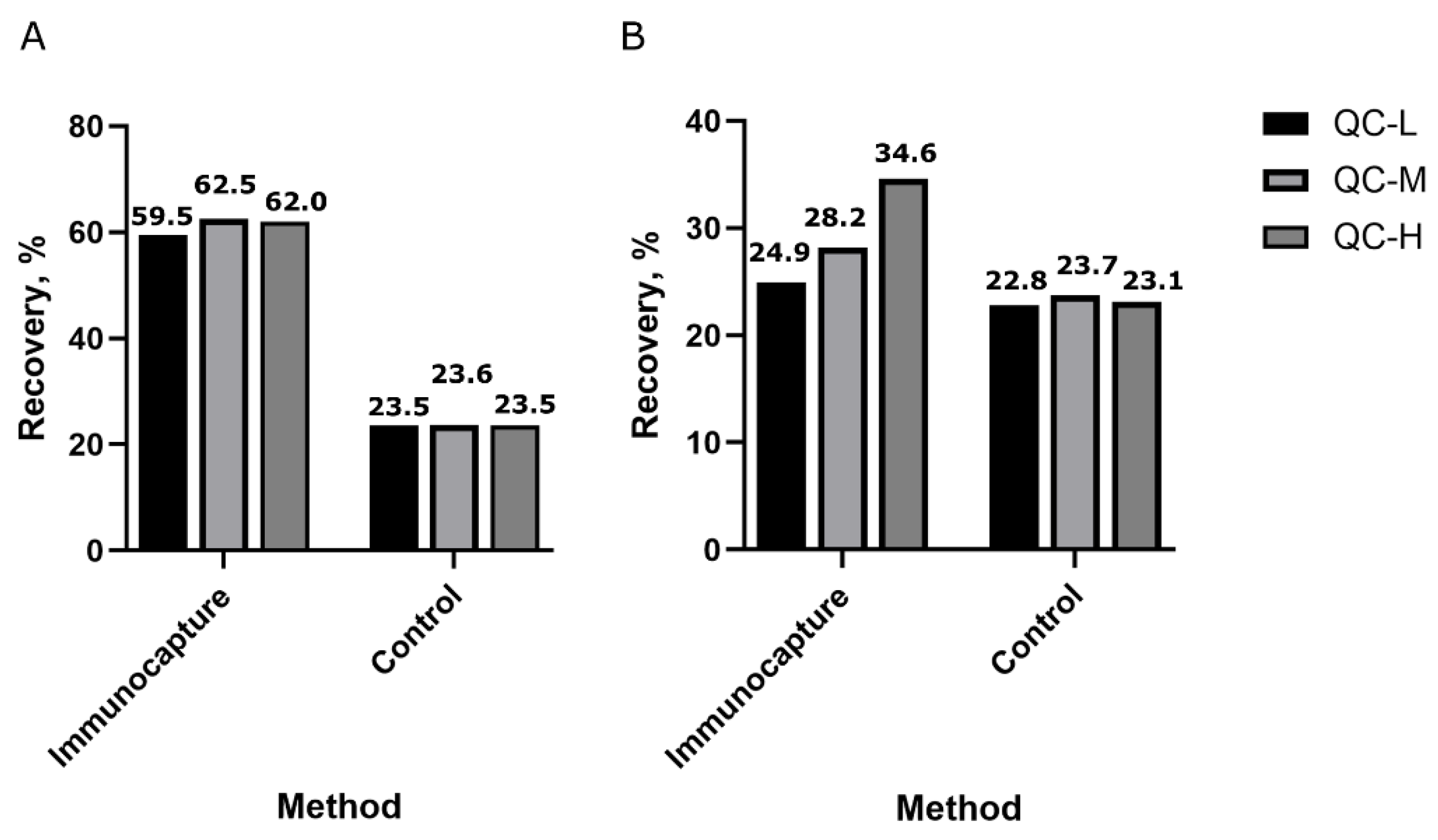
Figure 3.
Analysis of the effect of immunocapture step in analyte signals across QC samples. Multiple t-test analysis was performed for each level of QC samples comparing analyte signals between immunocapture and control samples. A. t-test analysis on payload A peak area showed significant differences across all QC-levels, proving the effect of immunocapture on increasing analyte signal compared to control. B. t-test analysis on payload B peak area across all QC samples only revealed significant differences at high concentrations (QC-H), whereas no significant variation was highlighted in low and medium concentrations (QC-L and QC-M). The results are from n=3 independent measurements. According to p-values, the level of significance (p-value) is as reported: ns > 0.05; * < 0.05; ** < 0.01; *** < 0.001.
Figure 3.
Analysis of the effect of immunocapture step in analyte signals across QC samples. Multiple t-test analysis was performed for each level of QC samples comparing analyte signals between immunocapture and control samples. A. t-test analysis on payload A peak area showed significant differences across all QC-levels, proving the effect of immunocapture on increasing analyte signal compared to control. B. t-test analysis on payload B peak area across all QC samples only revealed significant differences at high concentrations (QC-H), whereas no significant variation was highlighted in low and medium concentrations (QC-L and QC-M). The results are from n=3 independent measurements. According to p-values, the level of significance (p-value) is as reported: ns > 0.05; * < 0.05; ** < 0.01; *** < 0.001.
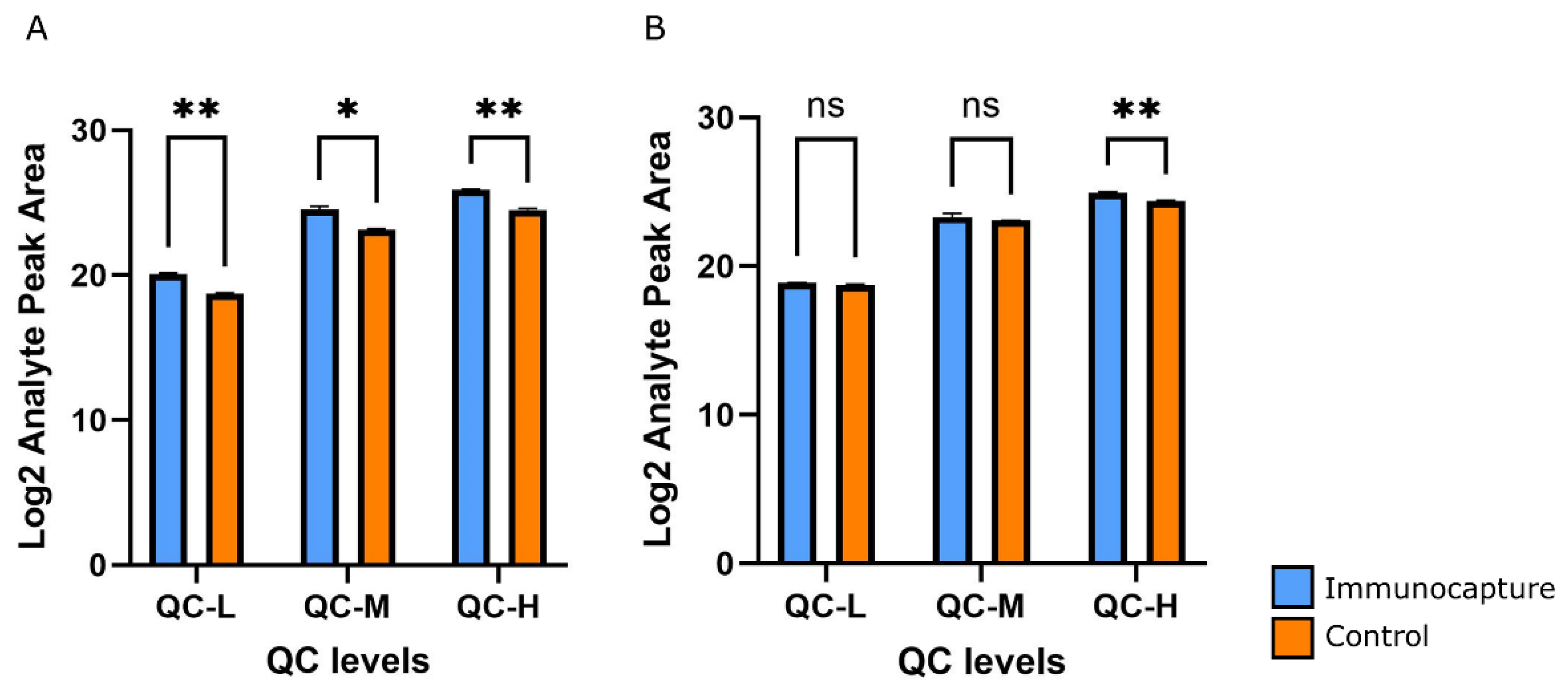
Figure 4.
normalized DAR as % of first timepoint results for tested ADCs (A, B, C, D) in PK study in hFcRn Tg32 mice, dotted lines mark the +/- 20% variability from the t0 value, considered as 100%.
Figure 4.
normalized DAR as % of first timepoint results for tested ADCs (A, B, C, D) in PK study in hFcRn Tg32 mice, dotted lines mark the +/- 20% variability from the t0 value, considered as 100%.
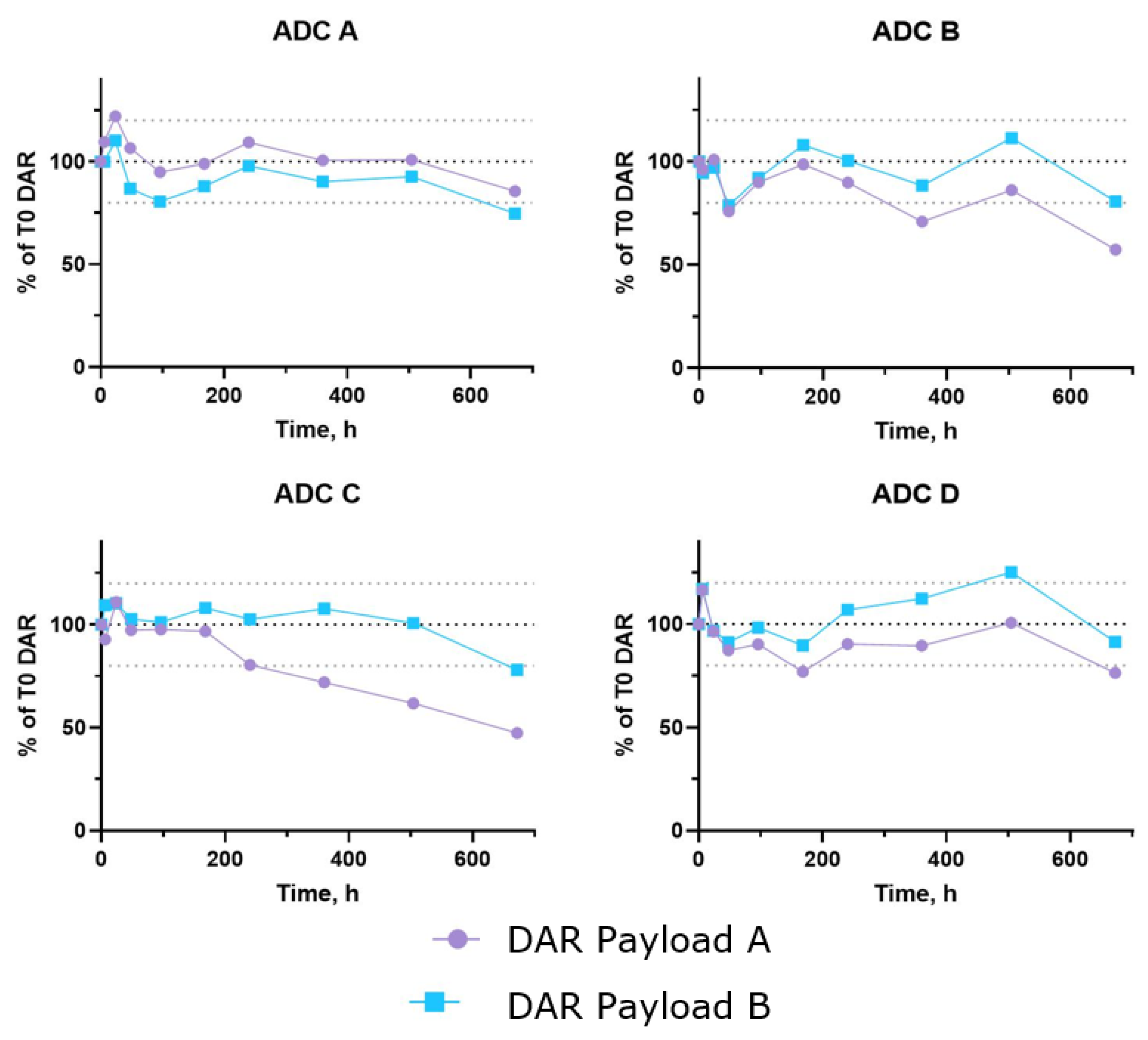

Table 1.
Main validation results for both conjugated payloads.
| Test | Parameter | Acceptance Criteria | payload A | payload B |
|---|---|---|---|---|
| Method Linearity | Calibration curve | %Bias within ± 20.0% (± 25.0% at the LLOQ) | overall %BIAS: > -8.7, < 12.1 |
overall %BIAS: > -6.7, < 9.1 |
| 75% of all calibration samples must be within the accuracy range | 100% | 100% | ||
| Accuracy & Precision | Intra-run | Mean %Bias within ± 20.0% (±25.0% at the LLOQ) | Mean %BIAS: > -8.3, < 11.3 |
Mean %BIAS: > -13.1, < 14.4 |
| %CV ≤ 20.0% (≤ 25.0% at the LLOQ) | %CV: > 1.4, < 17.9 | %CV: > 2.4, < 15.9 | ||
| Inter-run | Mean %Bias within ± 20.0% (± 25.0% at the LLOQ) | Mean %BIAS: > -3.9, < -0.1 |
Mean %BIAS: > -7.4, < 1.5 |
|
| %CV ≤ 20.0% (≤ 25.0% at the LLOQ) | %CV: > 4.9, < 14.1 | %CV: > 6.8, < 16.9 | ||
| Sensitivity | Covered in intra-run accuracy & precision | SIGNAL to NOISE (average area LLOQ / average area Blank) > 5 |
24.9 | 15.3 |
| Sample Dilution | Effect of dilution | Exceeding sample: resulting ALOQ | Dilution 6: ALOQ | Dilution 6: ALOQ |
| dilution within the calibration range: Mean %Bias within ± 20.0% | Dil 22.5: 10.5% Dil 50: 7.3% |
Dil 22.5: 12.8% Dil 50: 7.7% |
||
| dilution within the calibration range: %CV ≤ 20.0% | Dil 22.5: 0.2% Dil 50: 1.8% |
Dil 22.5: 1.6% Dil 50: 5.4% |
||
| Carryover | Carryover | Analyte response after ULOQ must be ≤ 25.0% LLOQ peak area in the 3 Accuracy & Precision runs (n=3) | 5.1% | 9.1% |
| IS response after ULOQ must be ≤ 5.0% of IS area in Control Blank IS sample in the 3 Accuracy & Precision runs (n=3) | 0.0 | 0.1 | ||
| Selectivity | Matrix samples (matrix selectivity) | Analyte response in Blank samples (average) ≤ 20.0% analyte response in SSLLOQ (average) | 4.0 | 6.5 |
| IS response in blank samples (average) ≤ 5.0% average IS peak area in calibration curve | 0.0 | 0.0 | ||
| Matrix fortified with IS | Analyte response in control Blank IS ≤ 20.0% mean analyte area in SSLLOQ | 2.7 | 9.3 | |
| Matrix Effect | Matrix Effect | AN and IS ME should be eliminated or minimized. %CV normalized IS ≤ 20.0% at each level. |
SSL = AN ME: 1.04, IS ME: 1.04 | SSL = AN ME: 0.98, IS ME: 0.97 |
| SSH =AN ME: 1.10, IS ME: 1.05 | SSH =AN ME: 1.03, IS ME: 1.00 | |||
| SSL = AN %CV: 1.0, IS %CV: 3.8 | SSL = AN %CV: 2.0, IS %CV: 3.1 | |||
| SSH = AN %CV: 10.0, IS %CV: 3.8 | SSH = AN %CV: 1.0, IS %CV: 1.0 | |||
| Recovery | Method Recovery | Analyte recovery should be consistent and reproducible. | L: 59.5% M: 62.5% H: 62.0% |
L: 24.9% M: 28.2% H: 34.6% |
Table 2.
Recovery evaluation results for payload A and payload B, as absolute reference (100%), application of immunocapture and digestion (Full protocol) and digestion only (w/o immunocapture).
Table 2.
Recovery evaluation results for payload A and payload B, as absolute reference (100%), application of immunocapture and digestion (Full protocol) and digestion only (w/o immunocapture).
| Payload A | ||||||||||||
|---|---|---|---|---|---|---|---|---|---|---|---|---|
| QC-level | Response Absolute reference (100%) |
Response Full protocol |
Recovery (%) | Response w/o immunocapture |
Recovery (%) | |||||||
| L | Mean | 1832349.83 | 1089799.60 | 59.5 | 430322.33 | 23.5 | ||||||
| n | 3 | 3 | 3 | |||||||||
| %CV | 1.0 | 7.9 | 4.8 | |||||||||
| M | Mean | 39150336.17 | 24454063.73 | 62.5 | 9257682.97 | 23.6 | ||||||
| n | 3 | 3 | 3 | |||||||||
| %CV | 3.5 | 15.8 | 5.6 | |||||||||
| H | Mean | 102123819.23 | 63292591.87 | 62.0 | 23984189.77 | 23.5 | ||||||
| n | 3 | 3 | 3 | |||||||||
| %CV | 3.1 | 2.3 | 7.2 | |||||||||
| Overall (%) Recovery | Mean | 47702168.41 | 29612151.73 | 62.1 | 11224065.02 | 23.5 | ||||||
| n | 9 | 9 | 9 | |||||||||
| Payload B | ||||||||||||
| QC-level |
Response Absolute reference (100%) |
Response Full protocol |
Recovery (%) |
Response w/o immunocapture |
Recovery (%) | |||||||
| L | Mean | 1922602.1 | 478558.0 | 24.9 | 438528.9 | 22.8 | ||||||
| n | 3 | 3 | 3 | |||||||||
| %CV | 0.37 | 1.40 | 3.34 | |||||||||
| M | Mean | 37055462.9 | 10466628.1 | 28.2 | 8774767.4 | 23.7 | ||||||
| n | 3 | 3 | 3 | |||||||||
| %CV | 0.98 | 17.18 | 2.23 | |||||||||
| H | Mean | 95102277.8 | 32943762.8 | 34.6 | 21957249.7 | 23.1 | ||||||
| n | 3 | 3 | 3 | |||||||||
| %CV | 3.3 | 1.94 | 3.26 | |||||||||
| Overall (%) Recovery | Mean | 44693447.6 | 14629649.63 | 32.7 | 10390182.00 | 23.2 | ||||||
| n | 9 | 9 | 9 | |||||||||
Table 3.
Condensed applicability results for each of the tested ADCs as CV% and applicability on 5 concentration levels; n=5 independent measurements.
Table 3.
Condensed applicability results for each of the tested ADCs as CV% and applicability on 5 concentration levels; n=5 independent measurements.
| ADC ID | Payload A | |||||||||
|---|---|---|---|---|---|---|---|---|---|---|
| LLOQ (5 nM ADC) |
L (15 nM ADC) |
M (300 nM ADC) |
H (800 nM ADC) |
ULOQ (1000 nM ADC) |
||||||
| CV % | BIAS | CV % | BIAS | CV % | BIAS | CV % | BIAS | CV % | BIAS | |
| ADC-B | 10.8 | 15.3 | 5.0 | -1.9 | 1.4 | -0.7 | 2.0 | -3.8 | 2.1 | -6.5 |
| ADC-C | 0.8 | 4.9 | 7.3 | -9.0 | 1.5 | -2.9 | 1.8 | -0.7 | 4.1 | 1.3 |
| ADC-D | 2.8 | -4.8 | 1.2 | -6.3 | 6.1 | 8.7 | 5.0 | 4.3 | 3.9 | 2.5 |
| ADC ID | Payload B | |||||||||
|
LLOQ (5 nM ADC) |
L (15 nM ADC) |
M (300 nM ADC) |
H (800 nM ADC) |
ULOQ (1000 nM ADC) |
||||||
| CV % | BIAS | CV % | BIAS | CV % | BIAS | CV % | BIAS | CV % | BIAS | |
| ADC-B | 9.2 | 14.7 | 3.3 | 0.2 | 1.9 | 2.2 | 3.3 | 0.1 | 2.2 | -2.2 |
| ADC-C | 4.3 | -9.3 | 2.5 | -7.5 | 1.4 | 0.1 | 2.0 | 0.4 | 2.7 | 0.7 |
| ADC-D | 4.1 | -2.7 | 3.6 | -0.4 | 2.3 | 4.5 | 1.5 | 3.0 | 2.3 | 0.7 |
Table 4.
Method validation parameters.
| Test | Parameter | Batches | Concentration Levels | n | Acceptance Criteria |
|---|---|---|---|---|---|
| Method Linearity | Calibration curve | Included in each run | 10, additionally control blank and control blank IS | 1 | %Bias within ± 20.0% (± 25.0% at the LLOQ) |
| 75% of all calibration samples must be within the accuracy range | |||||
| Accuracy & Precision |
Intra-run | 1 | 5 (SSLLOQ, SSL, SSM, SSH, SSULOQ) | 5 | Mean %Bias within ± 20.0% (± 25.0% at the LLOQ) |
| %CV ≤ 20.0% (≤ 25.0% at the LLOQ) | |||||
| Inter-run | 3 (2+Intra-run) |
5 (SSLLOQ, SSL, SSM, SSH, SSULOQ) | 5 | Mean %Bias within ± 20.0% (± 25.0% at the LLOQ) | |
| %CV ≤ 20.0% (≤ 25.0% at the LLOQ) | |||||
| 3 runs passed. If one run failed, repeat it in a subsequent run | |||||
| Sensitivity | Covered in intra-run accuracy & precision | SIGNAL / NOISE (average area LLOQ / average area Blank) > 5 |
|||
| Carryover | Carryover | Included in each run (Control Blank next to ULOQ calibration standard, evaluated in each run) |
Analyte response after ULOQ must be ≤ 25.0% LLOQ peak area | ||
| IS response after ULOQ must be ≤ 5.0% of IS area in Control Blank IS sample | |||||
| Selectivity | Matrix samples (matrix selectivity) |
Covered with SSLLOQ, Control Blank and Control Blank IS in another test | Analyte response in Blank samples (average) ≤ 20.0% analyte response in SSLLOQ (average) | ||
| IS response in blank samples (average) ≤ 5.0% average IS peak area in calibration curve | |||||
| Matrix fortified with IS |
Covered with SSLLOQ, Control Blank and Control Blank IS in another test | Analyte response in control Blank IS ≤ 20.0% mean analyte area in SSLLOQ | |||
| Matrix Effect |
Matrix Effect | 1 | 2 (SSL and SSH) | 3 | Analyte and IS ME should be removed or minimized |
| %CV normalized IS ≤ 20.0% at each level | |||||
| Recovery | Method Recovery |
1 | 3 (SSL, SSM and SSH) | 3 | Analyte and internal standard recovery should be consistent and reproducible |
| Sample Dilution |
Effect of dilution |
1 | Stock 10000 nM. Dilutions applied: 1:6, 1:22.5, 1:50 |
3 | Exceeding sample: resulting ALOQ |
| Dilution within the calibration range: Mean %Bias within ± 20.0% | |||||
| Dilution within the calibration range: %CV ≤ 20.0% | |||||
Disclaimer/Publisher’s Note: The statements, opinions and data contained in all publications are solely those of the individual author(s) and contributor(s) and not of MDPI and/or the editor(s). MDPI and/or the editor(s) disclaim responsibility for any injury to people or property resulting from any ideas, methods, instructions or products referred to in the content. |
© 2026 by the authors. Licensee MDPI, Basel, Switzerland. This article is an open access article distributed under the terms and conditions of the Creative Commons Attribution (CC BY) license (http://creativecommons.org/licenses/by/4.0/).
Copyright: This open access article is published under a Creative Commons CC BY 4.0 license, which permit the free download, distribution, and reuse, provided that the author and preprint are cited in any reuse.


