

Submitted:
05 June 2026
Posted:
08 June 2026
You are already at the latest version
Abstract
Habitat loss and fragmentation are among the major drivers of genetic diversity decline, because they reduce landscape connectivity and restrict gene flow among populations, while reducing carrying capacity and effective population sizes. Small and isolated populations are extremely vulnerable to the effects of genetic drift, which leads to loss of genetic diversity and adaptive potential, as well as elevated inbreeding, increasing the likelihood of extinction. Genetic analyses can identify recently isolated populations experiencing heightened risk of extinction through genetic problems, so genetic management can be planned. In species with historically large effective population sizes, genetic evidence of isolation, such as reduced genetic diversity or increased genetic differentiation among locations, can be slow to register the effects of isolation. In such cases, individual-based (rather than population-level or before-and-after) analyses can show responses more rapidly. Malleefowl Leipoa ocellata is an iconic long-lived, mound-building Australian bird occurring in fire-prone arid areas. We used genome-wide SNPs to evaluate range-wide and population-specific genetic structure, and compared pair-kinships within populations of different degrees of isolation and size. We found evidence of strong genetic drift and emerging small-scale population structure affecting most small, isolated populations. We synthesize a decision-support framework for genetic management for long-term persistence in fragmented landscapes of species with limited genetic data, and apply it to malleefowl to provide clear recommendations for species management. We conclude that small and isolated populations of malleefowl require urgent interventions.
Keywords:
genetic management
; inbreeding
; extinction
; Malleefowl Leipoa ocellata
; augmented gene flow
; small populations
; genetic health
1. Introduction
Global biodiversity is declining at unprecedented rates, driven primarily by habitat loss, fragmentation, climate change, altered disturbance regimes, and overexploitation (Díaz et al. 2019; IPBES 2019). Increasingly, this biodiversity crisis is being recognised not only as a loss of species, but also as a profound erosion of genetic diversity—the foundational level of biodiversity that underpins population viability and adaptive capacity (Sgrò, Lowe, and Hoffmann 2011; Mualim et al. 2026). Widespread declines in genetic diversity have been demonstrated across taxa, including in historically widespread and numerically common species, raising concerns that genetic erosion may be occurring well before demographic collapse becomes apparent (Shaw et al. 2025).
Habitat loss and fragmentation are among the major drivers of genetic diversity decline because they reduce landscape connectivity and restrict gene flow among populations, while also reducing carrying capacity and effective population size (Haddad et al. 2015; Radford et al. 2021). Small and isolated populations are particularly vulnerable to extinction due to the combined effects of environmental, demographic and genetic stochasticity (Frankham et al. 2017). Extreme environmental events, such as droughts and high-intensity wildfires, can cause rapid population declines, and reduced population size accelerates genetic drift, leading to the loss of genetic diversity and ability to adapt to environmental changes, increased population differentiation, increased inbreeding and associated loss of fitness (Frankham et al. 2017). In time, insufficient gene flow can lead to extinction of small populations (Saccheri et al. 1998).
Fire regimes are changing globally, with increases in fire frequency, extent, and severity documented in many fire-prone landscapes, resulting in longer ecosystem recovery times and greater ecological impacts across biomes (Bowman et al. 2020; Canadell et al. 2021; Lv et al. 2025; Biswas, Dowdy, and Chand 2026). In fragmented landscapes, where limited dispersal constrains demographic and genetic recovery between disturbance events, fires can disproportionately impact small and isolated populations, increasing the risk of local extinctions (Driscoll et al. 2021; Plumanns-Pouton et al. 2025). Maintaining or restoring habitat connectivity is increasingly recognised as a key strategy for conserving genetic diversity, facilitating gene flow, and reducing extinction risk in landscapes subject to frequent or large-scale disturbance (Haddad et al. 2015; Keeley et al. 2019). When restoring physical landscape connectivity is impractical, gene flow can be increased through human-assisted translocations (Weeks et al. 2015; Pavlova et al. 2025).
Development of practical and implementable genetic management strategies is often constrained by limited genetic and demographic data, particularly for less-studied species. However, an extensive body of empirical studies, theoretical work, and population viability modelling has demonstrated that, when combined with basic knowledge of species biology and life history, even relatively simple genetic metrics can provide sufficient information to guide management decisions (Frankham et al. 2017; Frankham et al. 2019). Decision-support frameworks that explicitly weigh the risks and benefits of gene flow from various sources while also considering risk of inaction (Frankham et al. 2011; Liddell, Sunnucks, and Cook 2021) allow practitioners to make informed decisions even when data are incomplete, by applying well-established principles and global data (e.g. concerning impacts of inbreeding, genetic drift, and outbreeding depression). As a result, genetic management can be proactively implemented to improve genetic health and enhance population persistence (Pavlova et al. 2014; Harrisson et al. 2016; Pavlova et al. 2017; Zilko et al. 2020), with positive outcomes emerging (Lutz et al. 2021; Pavlova et al. 2023). In this study, we synthetize a generalised, decision-support framework for genetic management under data-limited conditions, using an iconic Australian bird as a case example, providing a transferable protocol applicable to other species facing similar conservation challenges.
The malleefowl Leipoa ocellata, a long-lived mound-building Australian megapode occurring in fire-prone southern and central Australian arid and semi-arid woodlands and shrublands, provides a valuable model for examining the genetic consequences of habitat fragmentation and isolation in a fire-prone ecosystem. Known to many Indigenous communities as Ngaṉamara, Gnow, Lowan, Ngamarla, and other names (DCCEEW 2024), malleefowl is a culturally significant and often totemic species for Australian Traditional Owners, holding deep ecological, spiritual, and cultural importance across the mallee and southern desert bioregions (https://www.indigenousdesertalliance.com/what-we-do/desert-projects/significant-species/malleefowl, https://www.bushheritage.org.au/species/malleefowl). Once widespread across semi-arid mallee vegetation, malleefowl populations have declined greatly over the last century due to land clearing, altered fire regimes, predation, and habitat degradation, resulting in a highly fragmented distribution (DCCEEW 2024) (Figure 1).
Malleefowl is listed as Vulnerable under the Environment Protection and Biodiversity Conservation Act 1999 and under IUCN 2002 criteria (DCCEEW 2024). Species-wide population size has been estimated at about 25,000 breeding individuals (Benshemesh et al. 2021) based on breeding densities recorded in the National Malleefowl Monitoring Program (Benshemesh et al. 2018) and extrapolated across species range. Rapid declines in the last three generations have been inferred from habitat loss and recorded in monitoring programs (Benshemesh et al. 2020), with further declines highly likely given predictions of a drying climate and increased probability of more frequent large fires (Benshemesh et al. 2021; Stenhouse and Moseby 2022; DCCEEW 2024).
The distinctive life history of malleefowl shapes dispersal, gene flow, and population dynamics. Malleefowl are megapodes and breed in large incubation mounds that require near-daily maintenance to regulate egg temperature. Breeding adults are socially monogamous and males and females both participate in the construction and maintenance of their incubator mound, although during the egg-laying period (September to January) the sexes lead more separate lives as the female forages for egg production while the male regulates mound incubation temperature (Frith 1956; Frith 1959; Weathers, Seymour, and Baudinette 1993; Neilly et al. 2021). Usually, an active mound represents a single male-female pair, although a case where one male tended two mounds with different females has been recorded (Weathers, Weathers, and Seymour 1990). Reproductive output per female is typically 15–30 eggs per season (Frith 1959; Benshemesh 1992; Priddel and Wheeler 2005) in non-drought years with relatively high hatching success under favourable conditions. Chicks hatch fully independent and receive no parental care, dispersing immediately after emergence. Juveniles and adults rarely fly but are capable of movements over several kilometres by foot, with recorded daily dispersal events exceeding 10 km for adults (Stenhouse and Moseby 2022) and 6 km for newly hatched chicks (Benshemesh 1992); there is some evidence that dispersal may be female-biased (Stenhouse et al. 2022). Cleared land provides a barrier to dispersal (Stenhouse and Moseby 2022), and it is not uncommon for the species to persist in small (<500 ha) remnant patches of suitable habitat surrounded by cleared land where they are somewhat isolated from other populations. Large fires covering tens of thousands of hectares occur frequently in malleefowl habitats, threatening the species by reducing population size and rendering habitats unsuitable for breeding for 15-20 years (Benshemesh et al. 2021).
Despite its broad distribution, vulnerable conservation status and unusual life history, the malleefowl has not yet been subject to a published range-wide population genetic assessment. The only evidence for large-scale genetic structure comes from an unpublished mitochondrial ND2 study, which suggested historical isolation between eastern and western populations separated by the Flinders Ranges (Cope et al. 2014).
Historically high connectivity within each part of the malleefowl range likely facilitated extensive gene flow and accumulation of substantial genetic diversity prior to non-Indigenous human colonisation of Australia beginning ~200 years ago. Due to well-recognized time-lags between demographic change and genetic response, genetic erosion associated with recent habitat loss and fragmentation may not yet be detectable in malleefowl populations, as it is common in species with historically large effective population sizes and long generation time (Landguth et al. 2010; Tang et al. 2024; Mualim et al. 2026). Under such conditions, populations may retain high levels of neutral genetic diversity despite being on a trajectory toward future inbreeding and loss of adaptive potential.
Empirical evidence from the Eyre Peninsula (South Australia west of Flinders Ranges) population of malleefowl supports this interpretation. Using genome-wide SNP data, Stenhouse et al. (2022) detected only weak population genetic subdivision across a highly fragmented agricultural landscape, despite land-use changes, habitat configuration and limited dispersal and low contemporary gene flow through the agricultural matrix. The authors concluded that fragmentation has begun to disrupt connectivity but that substantial genetic erosion has likely not yet occurred, consistent with delayed genetic responses (Stenhouse et al. 2022).
Whereas Stenhouse et al. (2022) suggested that maintaining connectivity among multiple populations is critical, a recent simulation study (Tang et al. 2024) found that, through reductions in population size and increased genetic drift, habitat loss has a stronger negative effect on genetic diversity than does fragmentation per se. These findings led them to conclude that conserving fewer, larger populations may be optimal for maintaining genetic diversity. The differences between these perspectives become relevant under changing disturbance regimes, because large habitat fragments harbouring larger malleefowl populations are vulnerable to extreme, landscape-scale fires, increasing the risk of local or regional population collapse. Under such conditions, smaller, spatially separated populations may function as important reservoirs of genetic diversity, facilitating post-disturbance recovery through natural recolonisation where connectivity is maintained, or through assisted gene flow and translocations where it is not. Also, smaller populations were unexpectedly found to experience relatively high levels of breeding activity, possibly because they are biased towards better-quality habitat (Benshemesh et al. 2020). Thus, it is important to evaluate genetic health of the small, isolated populations and what level of natural gene flow the agricultural matrix around these populations can still support (Amos et al. 2014; Radford et al. 2021). Such data would inform genetic management strategies to prevent genetic problems in isolated populations and increase populations’ capacities to adapt to changing environments (Ralls et al. 2018; Frankham et al. 2019). Even where genetic signals of fragmentation are currently weak, proactive management to maintain or restore gene flow among populations might be essential to buffer against genetic drift and catastrophic demographic loss (Mualim et al. 2026).
In this study, we extend geographic sampling and apply population genetic analyses of genome-wide data to test for historical genetic isolation between western and eastern malleefowl populations. We test for decline in heterozygosity and increased relatedness in small, isolated habitat patches compared to moderately isolated and connected populations. Given the large size of historical malleefowl populations, we predict that the isolation of small populations facilitated genetic drift, expressed as increased population differences among locations, elevated pairwise kinships within locations, and reduced heterozygosity compared to larger and/or more connected populations. We co-analyse populations from Western Australia (WA) and Southern Australia (SA) west of the Eyre Peninsula, and populations from New South Wales (NSW) and Victoria (VIC) east of the Flinders Ranges, providing the first broad-scale assessment of historical genetic structure and connectivity across the species’ contemporary range. Finally, we synthesize a decision-support framework for genetic management of species with limited genetic data, and apply it to malleefowl to provide recommendations for species management for long-term persistence under climate change and altered disturbance regimes.
2. Materials & Methods
2.1. Sampling, Sites and Isolation Categories
Malleefowls’ low density, cryptic behaviour, and reliance on discrete nesting mounds, make individuals difficult to detect and sample. Samples for analysis were chosen from 1140 samples comprising shed feathers collected opportunistically by volunteers monitoring breeding density (83% of samples), membranes from hatched eggs collected during mound excavations and/or artificially incubated eggs (13%), and samples from malleefowl found dead from roadkill or other causes (4% of samples). From this assortment, we selected 282 samples for sequencing (see below), by attempting random selection while avoiding duplicate samples per individual as much as possible (e.g. selecting samples collected in the same season from disparate locations), and with preference to the most recent samples.
Populations (Table 1, Figure 1) were defined by geographic location and landscape connectivity. Population size was estimated from counts of active mounds at 201 sites across Australia from the National Malleefowl Monitoring Program. Across most of the species’ arid range, breeding densities are low (<1 pair per 100 km2) but the potential range is extensive. In more mesic areas, densities can reach 4 breeding pairs per km2, although agricultural clearing has greatly reduced the amount of suitable habitat. As malleefowl breeding densities vary depending on environmental conditions, particularly rainfall, we chose the highest breeding density recorded during a five-year period (2015 to 2020) as indicative of the breeding population size at each site.
Isolation was classified from visual assessment of habitat continuity in Google Earth imagery. Because malleefowl are largely ground-dwelling and unlikely to disperse across cleared land (Stenhouse and Moseby 2022), cleared land was treated as a dispersal barrier. Populations were classified as highly isolated if movement to the nearest neighbouring population required crossing at least 10 km of cleared land, moderately isolated if habitat connections were tenuous or uncertain, and connected if populations were linked by continuous habitat.
For sequencing, we used 282 samples collected across 29 sites (hereafter, populations; Appendix A1; Figure 1). Samples included feathers collected from 2013 to 2024 (n=223), hatched egg membranes collected from 2021 to 2024 (n=45), tissue samples ranging from quite fresh to desiccated or degraded remnants (n=10), and buccal swabs (n=4). Fresh (wet) egg membrane samples were preserved in ethanol (n=14), whereas dry membrane samples (of unknown age, ranging from a few days to a few months) were kept in paper envelopes (n=31).
2.2. DNA Extraction, Sequencing, Genotyping and Calculating Autosomal Heterozygosity
Samples were sent to Diversity Arrays Technology (DArT) for DNA extraction, reduced-representation library preparation and sequencing. Raw Illumina sequencing reads were used for reference-genome genotyping (below).
We used the malleefowl draft reference genome (23,112 scaffolds) assembled by The Bird 10,000 Genomes (B10K) Project and made available by Guojie Zhang (Zhejiang University, China) through project website https://b10k.com/index/home/login.html for reference-based genotyping. To detect sex chromosomes in the reference genome for downstream analyses, scaffolds were mapped to chicken genome GCF_016699485.2, using minimap2 (Li 2018). Scaffolds that mapped to chicken chromosome W, Z, or both, were considered as belonging to sex chromosomes (hereafter W-scaffolds, Z-scaffolds, and gametolog-scaffolds, respectively). Repetitive regions were identified using RepeatModeller 2.0 (Flynn et al. 2020) and RepeatMasker 4.1.0 (Smit, Hubley, and Green 2013-2015). Raw DArT reads were mapped to the malleefowl draft reference genome using BWA-MEM 0.7.17 (Li and Durbin 2009; Li 2013). The resulting BAM files were sorted with SAMtools sort (Danecek et al. 2021). The sorted BAM files, the draft genome in fasta format, and a BED file with information on sex-chromosomes and repetitive regions were used as input for Module 1 of JeDi pipeline (Pavlova et al. 2025). This module was used to genotype samples with BCFtools (Danecek et al. 2021), filter out genotypes with fewer than 15 reads (minDP=15) and doubletons (rare alleles that appear in a homozygous state in a single individual per dataset) using VCFtools (Danecek et al. 2011), and calculate per-individual autosomal heterozygosity using piawka (https://github.com/novikovalab/piawka) after excluding sex-chromosomes and repetitive regions. JeDi scales the number of variable sites by the total number of called sites (i.e., variable and invariable ones), while considering 3- and 4-allelic loci, and accounting for missing data—all essential for unbiased estimates of heterozygosity (Sopniewski and Catullo 2024; Pavlova et al. 2025). Assuming DArTseq tags are a random representation of genome diversity, such estimates should be comparable across populations, time scales and species (Pavlova et al. 2025). We note that SNP datasets required as input for other population analyses (see below) excluded non-biallelic loci.
Poor-quality samples, such as old feathers or egg membranes, are expected to have high proportions of missing genotypes per individual, which may result in estimates of heterozygosity samples that could be biased in either direction (Schmidt et al. 2021). On one hand, degraded DNA can increase the prevalence of false alleles due to sequencing and amplification errors, potentially inflating heterozygosity estimates. On the other hand, reduced heterozygosity may arise from technical artefacts associated with low DNA concentration in the samples, which require a large number of PCR cycles to achieve sufficient DNA concentrations, in turn increasing the prevalence of PCR duplicates, leading to heterozygote under-calling. In addition, stringent call rate thresholds tend to disproportionately remove heterozygous sites hence underestimating heterozygosity (Sopniewski and Catullo 2024). To test for biases in our dataset, we plotted individual-based autosomal heterozygosity against proportion of missing loci per individual: reliable estimates of heterozygosity are expected to be independent of the amount of missing data per individual. We also tested whether proportion of missing data per individual is correlated with overall low read depth per sample.
2.3. Filtering of SNP Dataset
Iterative filtering was conducted following (Stenhouse et al. 2022). To generate our SNP datasets, non-biallelic sites, and sites scored for fewer than 20% of individuals were removed from the vcf file produced by JeDi using vcftools. The remaining analyses were performed in R 4.0.5 (R Core Team 2022) using RStudio v1.2.5042 (RStudio Team 2020). The filtered vcf file was imported to R and converted to a genlight object using library vcfR (Knaus and Grünwald 2017). Individuals missing >60% of genotyped loci and loci lacking scores in >60% of individuals were filtered out in R package dartR v2.0.4 (Mijangos et al. 2022). Further filtering was conducted in package wrapper SambaR (de Jong et al. 2021): loci lacking scores in >20% of individuals were removed; to reduce the number of physically linked SNPs, the dataset was thinned by retaining a single SNP per 50,000 bp. The resulting dataset of 4,753 autosomal SNPs scored for 112 individuals was used for kinship analyses. For analyses of population structure, individuals missing >50% of loci were further removed, as were three samples that were inferred a likely duplicate, or likely mislabelled samples (see below); this resulted in 94 unique individuals (Table 1).
2.4. Molecular Sexing
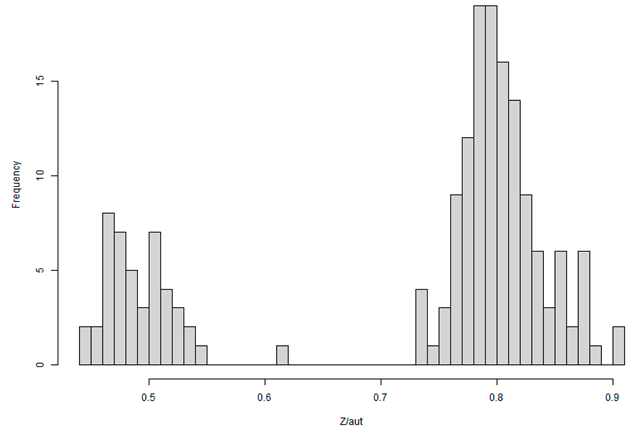
To determine the sex of each individual, we calculated the mean read depth across Z- and autosomal-scaffolds. The rationale is that females, being the heterogametic sex in birds (ZW), carry only one Z chromosome and should therefore exhibit approximately half the read depth on Z-scaffolds relative to autosomal scaffolds, while males (ZZ) should show comparable read depths across both. We used SAMtools bedcov (v1.9) to calculate the summed per-base read depth across Z-linked and autosomal scaffolds for each individual, then divided by total scaffold length to obtain mean read depth estimates. To control for variation in overall sequencing depth across individuals, we calculated a standardized Z-to-autosomal ratio by dividing Z-read depth by autosomal-read depth. This approach yielded the expected bimodal distribution (Appendix A2); individuals with a Z-to-autosomal ratio around 0.5 (i.e., < 0.65) were identified as females, while the remaining individuals with Z-to-autosomal ratio close to 1 (i.e., >0.70) were classified as males.
2.5. Tests of Sex Ratio Differences
We analysed male-to-female (M:F) sex ratio for all genotyped birds, for birds of different ages (chicks vs adults) and for birds sampled in populations with different level of fragmentation (high, moderate and connected). Age was defined based on sample type: chick carcass, fresh chick tissue or hatched egg fragments were considered chick samples; feathers and roadkill tissue were considered adult samples. We used binomial goodness-of-fit tests to test whether sex-ratios deviated significantly from 1:1 for all samples, for chicks only, adults only and adults from each level of fragmentation. We then used Fisher’s exact test to test for significant difference in sex-ratio between chicks and adults, and a chi-square contingency test to test whether adult sex-ratio was statistically different across fragmentation levels. We also used Cochran–Armitage trend test to test for statistical significance of directional change in sex-ratio across fragmentation levels.
2.6. Range-Wide Population Genetic Structure
We used Sambar to assess population structure across Australia, and separately within WA/SA and VIC/NSW populations. Two methods were used: (1) principal coordinates analysis (PCoA) based on Euclidean distances, which are less sensitive to heterozygosity biases and more reflective of recent drift compared to Nei’s distances, which are more reflective of historical divergence and hence were not used here, and (2) Admixture, implemented in the package Lea; both run using SambaR. We applied the cross−entropy criterion in admixture to indicate the most likely number of genetic clusters (Frichot and François 2015). However, variation in population size (i.e. strength of genetic drift) and time since divergence between populations at different hierarchical levels of structure can yield geographically meaningful results at different number of genetic clusters (K), so accordingly we explored other K-value that produced potentially biologically meaningful results.
2.7. Kinship Between Individuals in Habitat Patches with Different Degrees of Isolation
Increased kinship of individuals over time is a sign of increased inbreeding. To identify and remove identical genotypes from further analyses, and to identify highly related pairs of individuals within the same site, pairwise kinship was estimated using SambaR, and King-robust kinship (Manichaikul et al. 2010), designed to be robust to population structure and low-quality sequencing data. King-robust values were used to categorize degree of kinship between pairs of individuals: values that are negative or close to zero indicate unrelated individuals, 0.125- second degree kinship (half sibs or grandparent- grandoffspring), 0.25- first degree kinship (parent-offspring or full sibs), 0.5 represents monozygotic twins or two samples from the same individual. Due to missing data bringing down these benchmarks, we used kinship >0.3 to identify identical genotypes, following an earlier malleefowl study (Stenhouse et al. 2022).
In order to test whether isolated populations have higher values of mean pair-kinship compared to moderately isolated or connected populations, we calculated mean pair-kinship per population by averaging all pairwise values (including self-to-self kinships) within populations. We interpreted results only for populations with 4 or more samples because self-to-self kinship values tend to inflate mean pair-kinship values for populations with few samples.
To assess individual dispersal capacity, we aimed to calculate physical distances between first-degree kin pairs. Because all but one close-kin pairs were within-population (Appendix A3), the attempt is not reported in results. The only exception was a third-degree kinship pair of birds separated by 75 km of straight distance: JB0106 from connected hattah (4 on Figure 1) and JB0845 from nearby isolated cobram (12 of Figure 1).
2.8. A Decision-Support Framework for Genetic Management Recommendations
We synthesized a decision-support framework for genetic management underpinned by the content of two books on genetic management (Frankham et al. 2017; Frankham et al. 2019) (summarized in Table 2, with a full version in Appendix A4). This extends earlier approaches to decision-making applied to several endangered species (Pavlova et al. 2014; Harrisson et al. 2016; Pavlova et al. 2017; Zilko et al. 2020).
3. Results
3.1. Sample Quality
Of a total of 282 samples, 177 (62.8%) produced DNA that resulted in sequencing data. Failed samples included all cheek swab samples and tissue taken from desiccated or rotten carcasses transferred to 100% ethanol, 42% of dry egg membrane samples, 37% of dry feathers and 14% of ethanol-preserved egg membranes (Appendix A5). Sample type was a significant (p<0.05) predictor of missing data, with fresh tissues and egg membranes in ethanol shown to be the best types of samples, followed by dry feather samples (Appendix A5). The final dataset of 94 unique individuals (repeated and mislabelled individuals removed) missing <50% of loci contained 69 feather samples, 12 dry egg membrane samples, 10 membrane in ethanol samples, and 3 tissues in ethanol.
3.2. Mapping, Sexing, Filtering
A total of 454 scaffolds from the malleefowl draft reference genome (out of 23,112 scaffolds) mapped to the sex chromosomes of the chicken genome GCF_016699485.2 (357 to the Z chromosome, 49 to the W, and 48 to both). The remaining scaffolds (i.e., inferred to be autosomal) ranged in length from 162 to 12,625,250 bp (mean = 41,567.4 bp, median = 783.5 bp, N50 = 2,708,757 bp, L50 = 98). Of 177 genotyped individuals, 45 were inferred to be female, and 132 male.
A less-filtered dataset used for kinship analyses comprised 112 samples missing <60% genotypes (including 3 samples inferred to be repeated or mislabelled and later removed) from 27 sites (populations), of which 9 were isolated, 8 had some level of connectivity, and 10 were connected; Table 1). The dataset of 94 unique individuals (23 females, 71 males) with <50% missing data was sampled from 26 populations (Table 1). Only 11 populations in the larger dataset and 8 in smaller dataset had 5 or more samples.
3.3. Dependence of JeDi Autosomal Heterozygosity on Proportion of Missing Genotypes
Estimates of individual autosomal heterozygosity by JeDi (i.e., considering invariable and variable positions) ranged > 5-fold and were negatively correlated to the proportion of missing genotypes per individual (p<0.001, adjusted R-squared=0.519; Figure 2). Samples with higher proportions of missing genotypes also had higher mean and variance of read depths for the genotyped loci. High read depth coupled with high proportion of missing loci is consistent with the expectation of PCR duplicates (i.e. selective amplification of one of the alleles at a locus during library preparation of poor-quality samples) driving heterozygosity downward for some samples. In other cases, read depth remained steady or declined with increased proportion of missing loci, as would be expected from extremely low quantity of DNA template. Thus, read depth is not a reliable indicator of genotype quality, because while high-quality samples are expected to have high read-depth, some poor-quality samples can also yield in high read depth, together with selective allele amplification and/or allelic dropout, and large proportion missing loci. Only a few individuals appear to have heterozygosity that is independent of the proportion of missing data, suggesting that for the great majority of individuals in this dataset, heterozygosity could not be reliably interpreted. Because estimates of inbreeding are tightly linked to heterozygosity, inbreeding coefficients are also likely to be unreliable.
3.4. Population Structure
Our analysis of genetic structure in PCoA using range-wide samples (Figure 3) and VIC/NSW only samples (Appendix A6) separated three small and strongly isolated populations into their own PCA space. PC1 clustered eight individuals from the small and isolated VIC population wychi (30 on Figure 1) from the other individuals in the dataset. PC2 separated eight individuals from the small and isolated NSW population yalgogrin (31 on Figure 1), and to a smaller degree three individuals from the isolated NSW population tallimba (27 on Figure 1), from individuals sampled in all the States. Prominent separation of three isolated populations by PCoA analyses of genetic structure indicates that genetic drift has already strongly affected the most isolated populations. Separate PCoA analysis of western (WA/SA) populations did not detect any inter-population structure (PC1 separated three ravens individuals from the remaining individuals, Appendix A6), consistent with high effective population size and/or ongoing gene flow among the sampled western region.
The cross−entropy criterion for analysis of admixture on range-wide samples showed K=3 as the most likely number of genetic clusters (Figure 4; Appendix A7). The K=3 analysis was most consistent with the PCoA: it assigned the eight individuals from the small and isolated wychi population (VIC) >0.6 membership in their own genetic cluster (green on Figure 4), the eight individuals from the small and isolated yalgogrin population (NSW) >0.8 membership in the second cluster (blue on Figure 4), whereas the remaining individuals from WA, SA and VIC predominantly belonged to the third cluster (blue-green on Figure 4). Interestingly, three individuals–JB0029 from isolated tallimba (NSW; 27 on Figure 1), JB0106 from connected hattah (VIC; 4 on Figure 1), and JB0861 from connected cnsw (NSW; 2 on Figure 1)–shared >0.4 membership in the yalgogrin-dominated cluster (blue on Figure 4), suggesting they each might have had an immigrant ancestor from the yalgogrin population. Additional VIC individuals intermingled with SA/WA populations on the K=3 analysis, suggesting historical connectivity.
The analysis assuming five genetic clusters (K=5) separated SA/WA from both VIC and NSW, suggesting that contemporary connectivity between western and eastern populations might be limited. Given previous unpublished reports of mitochondrial (i.e. relatively old) sequence divergence between western (WA/SA) and eastern (NSW/VIC) populations, it appears that eastern and western populations with historically large effective population size (and weak genetic drift) still share much ancestral diversity, while drifting apart due to isolation-by distance with additional gene flow limitations due to habitat fragmentation. Meanwhile, the strongest evidence of structure (on lower K analyses) is observed for populations that experienced the strongest genetic drift: those that were isolated recently into extremely small habitat fragments that can support only a few breeding adults (Table 1). A similar pattern was observed for other species previously widespread and recently isolated into small populations of different sizes (Pavlova et al. 2017; Pavlova et al. 2025).
Separate Admixture analysis of eastern populations (NSW/VIC) run assuming five genetic clusters (K=5) identified four clusters of individuals (Appendix A8). In addition to previously identified yalgogrin and wychi, it separated two VIC populations: strongly isolated cassin (VIC; 11 on Figure 1) and moderately isolated mali (19 on Figure 1), although the latter appeared to be connected to, or share ancestral variation with, other VIC/NSW populations. Finally, separate Admixture analysis of western populations (WA and SA) did not detect any meaningful structure (not shown).
3.5. Kinship
King-robust scores ranged from -3.25 to 0.35, with the maximum value being for feather samples JB0639 and JB0589 collected from the same WA site (ravens) site in 2023, which we consider the same individual (Figure 5). Consequently, we excluded JB0589 from the mean pair-kinship calculations.
Kinship analysis detected 10 first-degree kin pairs (excluding two pairs involving JB0589), 18 second-degree kin pairs, and 15 third-degree kin pairs (Appendix A3). In all but three cases both members of a pair (i.e. relatives) were sampled from one of six populations: four strongly isolated ones–cassin (6 pairs, up to 3 relatives per individual), cobram (1 pair), wychi (15 pairs, up to 5 relatives per individual), yalgogrin (15 pairs, up to 4 relatives per individual), and two medium-isolated sites–mali (1 pair) and ravens (2 pairs). Four of these populations are in VIC, one (yalgogrin) in NSW, one (ravens) in WA.
Three pairs of relatives were sampled from different populations. One was a pair of third-degree relatives including a bird from connected hattah (JB0106; 4 on Figure 1) and a bird from isolated nearby cobram (JB0845; 12 of Figure 1). This indicates that either some level of cross-generational gene flow still occurs in this area, or–given the longevity of malleefowl–occurred prior to fragmentation. The other two pairs included birds sampled from different States (VIC and WA): a first-degree (JB0648-JB0628) and a third-degree kin pair (JB0266-JB0588). The VIC samples in each pair (JB0648 and JB0266) had a WA genotype on the Admixture K=5 analysis, thus they both likely represent a mislabelled sample. On this basis, JB0648 and JB0266 were removed from the mean pair-kinship calculations. None of the connected sites had close relatives sampled, despite some having up to 7 sampled individuals (Table 1).
Mean within-population pair-kinship supported elevated kinship in small and isolated populations compared to connected or moderately connected ones (Table 1). Two of the three isolated populations with n>4 (yalgogrin and wychi) had mean pair-kinship values >0.05; none of the four moderately isolated populations (bw, mali, nurcoung, ravens), or the four connected populations (sa, annuello, wyperfeld, LD) had a positive value (mean <0).
3.6. Sex Ratio Differences
Sex ratios were significantly male-biased (binomial test, p < 0.001) in the overall dataset and adults (M:F ratio=3.44), considered together, or grouped by different fragmentation levels (Appendix A9). Male-bias in chicks was not significant (p=0.09). Sex-bias of adults and chicks did not differ significantly (Fisher’s exact test p>0.05). Although adult male-bias tended to be stronger in isolated populations (M:F ratio=3.57) compared to moderately isolated (3.14) and connected (3.08) populations, the ratios did not differ significantly (chi-squared test p>0.05) and the trend was not statistically significant (Cochran–Armitage test, p >0.05).
3.7. Genetic Management Recommendations
Applying the decision-support framework (Table 2, Appendix A4) to malleefowl demonstrates how robust genetic management recommendations can be developed despite data limitations, as follows.
Step 1: Define conservation goals. All relevant stakeholders agree on the primary goal: maintaining viable, genetically healthy populations. Reconnecting habitat patches isolated by recent human activities is strongly supported as a means to achieve this goal, given evidence of elevated kinship, pronounced genetic drift, and fragmentation-driven isolation, all of which indicate increasing extinction risk if left unmanaged.
Step 2: Assess population distinctiveness. Genetic analyses suggest there are no distinct subspecies or races and none are currently recognised (DCCEEW 2024). Likewise, the genetic structure analyses in this paper (PCoA in Figure 3, Admixture analysis in Figure 4, kinship analyses) show only weak broad-scale differentiation between eastern and western regions, notwithstanding pronounced differentiation in small, recently isolated populations. This suggests that most populations are not deeply distinct and hence are appropriate candidates for managed gene flow. In contrast, differentiation in small fragments reflects drift in isolation rather than long-term adaptive divergence, which is a genetic problem to solve rather than a reason to manage populations separately (Liddell, Sunnucks, and Cook 2021).
Step 3: Assess reproductive biology & ploidy. Birds are overwhelmingly diploid. Although rare instances of triploidy have been documented in domestic or experimental contexts (Thorne, Collins, and Sheldon 1991), these are not evolutionarily persistent and have no practical relevance for conservation management. The biology of the malleefowl—largely monogamous, with female-biased dispersal over substantial distances—is suggestive of a largely outbreeding genetic system, consistent with modest subpopulation fixation indices (Stenhouse et al. 2022) within local groupings of individuals. As outbreeding diploid species, malleefowl would be expected to adhere to standard expectations that inbreeding and drift will rapidly reduce fitness in small populations, and populations would be expected to benefit from genetic rescue.
Step 4. Create strategy for implementation of genetic management
4.1 Diagnose genetic problems
4.1a Diagnose elevated inbreeding and reduced genetic diversity––In this study, direct estimates of heterozygosity and inbreeding coefficients were unreliable due to sample quality, but see 4.1b for comments on effective population sizes and inbreeding risk. Stenhouse et al. (2022) inferred the onset of loss of genetic variation in small, isolated populations of the species.
4.1b Diagnose altered connectivity––Previous work showed that malleefowl populations are somewhat genetically heterogeneous across the Eyre Peninsula, ascribed to impacts of habitat fragmentation driving differentiation by decreasing opportunities for gene flow (Stenhouse et al. 2022). Similarly, multiple lines of evidence in this paper—including strong PCoA separation particularly of small and isolated populations (Figure 3), elevated within-population kinship (>0.05) in some isolated populations, and clustering in admixture analyses (Figure 4.)—suggest reduced gene flow, small effective population sizes, and emerging inbreeding risk.
4.1c Diagnose reduced adaptive potential––The conclusions summarized under 4.1b indicate that malleefowl are likely to be subject to reduced adaptive potential. As a species occupying in fire-prone arid and semi-arid woodlands and shrublands in a continent experiencing substantial changes in aridity and temperature, and experiencing habitat fragmentation, malleefowl are expected to benefit from increased ability to adapt. Winter rainfall is a strong positive predictor of breeding activity, as is time since fire, but both are expected to reduce under climate change (Benshemesh et al. 2020). For example, winter rainfall decreased by 37% over 30 years in the sites studied by Benshemesh et al. (2020). Enhanced evolutionary potential through managed gene flow would be expected to be beneficial for such a situation.
Step 4.2: Scope source populations. Larger, connected populations in SA/WA and some VIC/NSW populations provide logical candidate sources of gene flow, as they show weaker structure, lower kinship, and signs of retained historical connectivity. If these sources were unavailable for practical reasons, there would still be benefit in translocations among differentiated small populations. Explicit testing of the impacts of sourcing immigrants on the donor populations would be ideal (Mitchell et al. 2022); otherwise, using only modest numbers of individuals and/or swapping individuals between source and recipient locations should have minimal impacts on the source, to be confirmed with monitoring.
Step 4.3: Assess risk of outbreeding depression, loss of local adaptation, or other negative consequences
4.3a Assess risk of outbreeding depression––The presence of admixed individuals and inferred recent migrants indicates that gene flow has occurred without apparent negative effects, suggesting low risk of outbreeding depression; the main genetic risk is therefore continued isolation rather than mixing. Low historical genetic structure across the species suggests that local adaption would be minor, likely eclipsed by the rate of environmental change ((Stenhouse et al. 2022); this study; Weeks, Stoklosa, and Hoffmann (2016)).
4.3b Assess risk of genetic swamping––Genetic swamping is a negligible concern for malleefowl because there are no known desirable local gene pools to maintain in isolation, and levels of gene flow can be controlled by the rate of movement of individuals between habitat remnants, coupled with monitoring of outcomes in the relevant locations.
Step 4.4 Evaluate benefit–risk
4.4a Benefit–risk of gene flow to recipient population––Given the strong signals of genetic drift and elevated kinship in isolated populations, and the absence of evidence for significant risks of gene flow, the expected benefits of genetic rescue (reduced inbreeding and increased genetic variation and adaptive potential) likely outweigh risks. The only PVA available for malleefowl (Bode and Brennan 2011) suggests that an isolated population of 32 adults would likely go extinct in 20-years without management actions due to high adult mortality. But this PVA does not incorporate genetic effect on fitness. The finding that many malleefowl populations are beginning to experience genetic problems but have not suffered considerable genetic erosion favours proactive action (Stenhouse et al. 2022). Furthermore, population trajectories for most malleefowl populations are downwards, despite considerable conservation efforts (Benshemesh et al. 2020), which would be expected to continue if genetic management is not undertaken. Malleefowl breeding activity decreased by several percent per year between 1989 and 2017 in South Australia and Western Australia, consistent with other studies (Benshemesh et al. 2020). Likewise, declines and some local extinctions have occurred in small habitat patches throughout the species range. Thus, the risk of inaction (not conducting genetic management interventions with a strong evidence-base of effectiveness) is high. In contrast, the risk of unfavourable outcomes from gene flow are low, as indicated in Step 4.3.
4.4b Cost-benefit of interventions––The proposed implementation could be readily incorporated into existing activities and would have minor cost implications: for example, the National Malleefowl Recovery Group coordinates the monitoring of malleefowl breeding at over 150 sites across the species range, largely through the efforts of citizen scientists in a national collaboration with land management agencies, and academic researchers (Benshemesh et al. 2020). Moving eggs among sites is the easiest, most efficient and least disruptive translocation strategy for malleefowl. It could be done at scale: a small number (~5) teams of 2-3 trained volunteers or Indigenous rangers under an oversight of a geneticist could feasibly translocate hundreds of eggs in a few days. The cost of such management action would be outweighed by improved population persistence through effective avoidance of inbreeding in isolated populations and augmented gene flow.
Step 4.5: Implement and monitor
4.5a Implementation strategy––We recommend implementing assisted gene flow for all populations with fewer than ~500 breeding pairs, with priority given to the smallest and most isolated populations that already exhibit genetic risk (e.g. elevated kinship or strong genetic drift). Management should prioritise restoring connectivity, either through restoring connectivity through habitat or assisted gene flow (e.g. translocations). An implementation plan should be developed collaboratively with all relevant stakeholders, including Indigenous groups and population genetic experts. Translocations could be integrated into the natural breeding season (November–March). The National Malleefowl Recovery Group routinely monitors over 500 active nesting mounds, each typically containing 8–12 viable eggs, providing a practical opportunity for large-scale interventions. Eggs can be carefully excavated and temporarily placed in controlled incubation conditions for transport to recipient sites. At these sites, eggs can be inserted into active mounds and incorporated into existing clutches for natural incubation. When correctly positioned, the addition of eggs is unlikely to disrupt incubation of existing eggs. Importantly, evidence suggests that such translocations may also confer ecological benefits. Where appropriate, a subset of eggs from donor mounds could simultaneously be redistributed among sites to maximise genetic mixing without compromising local recruitment. Following short transport times, eggs are returned to near-natural incubation conditions, allowing chicks to hatch and disperse naturally. Benshemesh et al. (2020) showed that some small, isolated populations are performing better demographically than larger populations, likely due to higher habitat quality. Translocating eggs into these sites may therefore increase recruitment by placing offspring into environments with higher survival prospects. Because malleefowl are long-lived and may breed for 10–20 years, translocations should be sustained over multiple breeding seasons (e.g. 5–10 years) to ensure that introduced individuals survive to maturity and contribute to the breeding population. The success of translocations can be evaluated through follow-up monitoring, including excavation of recipient mounds to assess hatching rates and short-term outcomes.
4.5b Monitoring and adaptive management––The National Malleefowl Recovery Group (NMRG), under the auspices of the national recovery team, is well placed to coordinate and implement a genetic monitoring program integrated within existing management frameworks (Hauser et al. 2019; DCCEEW 2024). High-quality sampling (blood on FTA cards, or ethanol-preserved tissue, blood, or fresh egg membrane) should be used to establish baseline genetic diversity and enable tracking of relatedness, connectivity, and effective population size. Interventions should follow an adaptive management approach, with key parameters—number of eggs moved, frequency of translocations, and choice of source and recipient populations—refined over time. Targets will vary among populations and should be determined collaboratively with managers, geneticists, ecologists, and Traditional Owners. As an initial guideline, reciprocal (two-way) egg translocations between large and isolated populations could be conducted annually for at least 5 years. Each exchange may involve approximately 10–12 eggs (i.e. a full mound), representing ~50% of seasonal reproductive output while remaining logistically feasible. Annual repetition is recommended because recruitment is variable and often low, meaning single interventions are unlikely to have lasting genetic effects. Translocations at this scale are operationally feasible (e.g. excavation and exchange of mound contents between paired sites within a day), and small populations of a few breeding pairs could be managed effectively. Genetic monitoring should occur 2–3 breeding seasons after translocated individuals reached maturity. Monitoring should also include demographic outcomes where possible to assess combined genetic and ecological benefits. Analyses should assess the success of translocations, modify the intensity and frequency of translocations, and assess which of the gene flow sources are more beneficial. This iterative process of intervention, monitoring, and adjustment will allow optimisation of gene flow strategies and improved conservation outcomes.
4. Discussion
In this study, we synthetized and applied a decision-support framework for genetic management for species persistence in fragmented landscapes, using malleefowl as an example case. We demonstrated how biologically meaningful patterns of connectivity/isolation and genetic health could be produced by a genetic dataset limited in sample sizes, sample quality and resulting genotypic data quality, to inform conservation genetic risk-assessment.
Despite historically large effective population sizes of malleefowl, and expectation of time lag between fragmentation and ability to detect the signals of genetic drift, we found a signal of strong population structure and increased relatedness for multiple small and isolated populations (e.g. wychi, yalgogrin, tallimba, cassin). This likely reflects lack of immigration and strong genetic drift due to extremely small effective population sizes of these populations. Elevated relatedness/kinship observed within these fragments is expected to increase the risk of harmful inbreeding depression and probability of population extinction, unless active translocations are commenced to augment gene flow into these small populations and increase effective population sizes (Frankham et al. 2017). Simulations studies show that a short-term effective population size (e.g. one approximated by the number of unrelated breeders in one generations) of at least 200 is required to prevent inbreeding depression from accumulating in a few generations. Given that 17 out of 26 populations assessed here had fewer than 100 breeding pairs, as indicated by attended mounds, and all isolated populations had fewer than 10 breeding pairs, these populations are likely to dwindle to extinction in few generations, even in benign environments. As climate change increases the frequency and severity of environmental disturbances, this trajectory will only accelerate. In long-lived species, highly inbred populations might linger–and even grow–until the most outbred individuals stop breeding or die (Taylor et al. 2017).
Predominance of close kin pairs in, and positive mean population kinship estimates for, small isolated populations of malleefowl provided evidence of small population size. In time, restricted dispersal might result in loss of genetic diversity by drift, which can lead to loss of populations’ abilities to adapt to future environmental changes. A population needs to have a long-term effective population size of 1000 to prevent loss of genetic diversity through drift and enable accumulation of new variation through mutations to fuel climate adaptation (Frankham, Bradshaw, and Brook 2014). In cases such as malleefowl with current limitations on habitat availability, it is recommended to manage fragments as a metapopulation, regularly reconnecting them by gene flow (Pavlova et al. 2025). Genetic monitoring should be conducted to optimize gene flow and ensure that each population actually attains target levels of new diversity (Pavlova et al. 2025).
Evidence of genetic diversity erosion and increased relatedness and inbreeding in small isolated or moderately-isolated malleefowl populations suggests that maintaining healthy insurance populations of malleefowl in small habitat fragments (e.g. to use as sources of gene flow to rehabilitate habitat destroyed by fires) will require frequent augmented gene flow among populations (e.g. via swapping). Limited carrying capacity in small patches means that some local eggs can be translocated to other populations, necessitating metapopulation-level genetic management.
At broader spatial scales, admixture analyses suggested differentiation between western (SA/WA) and eastern (NSW/VIC) populations, consistent with limited contemporary connectivity, and mitochondrial evidence of historical divergence (Cope et al. 2014). Nevertheless, this large-scale structure was relatively weak, compared to the pronounced differentiation observed among small, recently isolated populations. Better quality genomic data are required to test whether some gene flow still occurs at the intersection of lineages. Regardless of whether or not gene flow is occurring currently, the lack of strong large-scale structure suggests that the risk of outbreeding depression while cross-translocating individuals from eastern to western populations is low, and negligeable for mixing any populations within eastern or western groups. While carrying a low risk of outbreeding depression, reconnecting distant populations might bring stronger benefits than reconnecting nearby populations (Frankham et al. 2011).
Whole genome sequencing data from a few high-quality samples might allow testing for contemporary isolation between eastern and western populations, by providing mitogenome sequencing to confirm the degree of restriction of maternal gene flow (as mitogenomes are inherited almost exclusively from mothers in most animals), and compare it with nuclear gene flow (Morales et al. 2017). Nevertheless, in some species of bird with female-biased dispersal, nuclear gene flow may persist via male-mediated gene flow even when female gene flow is restricted by selection (Pavlova et al. 2013; Low et al. 2024).
The strong influence of sample type on genotyping success highlights the importance of carefully designed sampling strategies in wildlife genetics studies. While fresh tissue and egg membranes preserved in ethanol yielded higher-quality data, only ~34% of opportunistically-collected samples (e.g. feathers) produced usable genotypes. Importantly, we conclusively show that genetic diversity (and by inference, inbreeding) cannot be reliably estimated from standard genomewide sequencing of the degraded samples, even when applying sophisticated workflows designed to reduced biases in estimates (Pavlova et al. 2025). This limitation underscores the need for targeted sampling of high-quality biological material when establishing genetic baselines for long-term monitoring. Such material can include blood samples from chicks used for genetic augmentation or fresh egg membrane samples rinsed of debris, and stored in ethanol. Creating a targeted SNP-array can further cut sequencing costs (Helyar et al. 2011). Notably, kinship-based metrics proved useful even in the context of reduced data quality, suggesting that relatedness analyses may provide a particularly valuable tool for detecting early genetic risk.
Male bias was previously reported in the samples from SA malleefowl population (11 females to 25 males) (Stenhouse et al. 2022). Malleefowl feathers collected from active mounds (the main source of adult samples) were expected to be mostly from males. This is because during the egg-laying season, males spend most of their time near their mound, maintaining the incubation temperature and protecting the mound from weather and intruders. In contrast, females actively forage to produce large eggs, and may come to the mound only to lay, every 4-5 days.
We did not find statistical support for differences in sex ratio among fragmentation levels. However, the observation that more fragmented landscapes tended to have fewer females per male warrants further investigation. Feather samples were collected at active mounds attended by a single male and generally laid in by one female. A reduction of female presence at mounds in isolated habitats would be expected to result in fewer active mounds; however, excavations indicate that active mounds—even in isolated populations in VIC and NSW—consistently contain eggs. One possible explanation is that females spend less time at individual mounds in isolated areas, resulting in fewer detected female feathers. Alternatively, males in larger and more connected populations may have their mounds used by multiple females, whereas single females may predominate in more isolated patches. Female scarcity in isolated habitats could potentially facilitate polyandry if males are unable to effectively monopolise females during the egg-laying period (Armansin et al. 2020), although this has not been documented in malleefowl (but two active mounds with different females (although males may maintain two mounds with different females; Weathers, Weathers, and Seymour 1990). If these mechanisms operate, fewer eggs per mound would be expected in isolated populations relative to connected ones. Additionally, different patterns of relatedness might emerge, such as more paternal half-siblings within mounds in connected populations and more maternal half-siblings among neighbouring mounds in isolated populations. Further data are required to evaluate these hypotheses.
Stronger male-bias in isolated landscapes, if confirmed with additional sampling, would be consistent with elevated female-based mortality during dispersal into fragmented landscapes. Habitat isolation was inferred to disrupt dispersal of female brown treecreepers, resulting in many isolated habitat patches lacking females (Cooper, Walters, and Ford 2002). Under inbreeding, we could also expect higher mortality of the heterogametic sex (female birds) due to higher susceptibility to genetic problems (i.e., Haldane’s rule; Laurie 1997; Orr 1997). Stronger male-bias in isolated sites, consistent with female-biased dispersal being reduced by isolation, was observed in yellow-tufted honeyeater and eastern yellow robin (Harrisson et al. 2014; Radford et al. 2021). Higher female mortality due to inbreeding was suggested for the helmeted honeyeater (Pavlova et al. 2023).
Management Recommendations
Assisted gene flow through targeted translocations could help restore connectivity of malleefowl populations and reduce genetic drift, particularly where natural dispersal is constrained. We recommend that assisted gene flow be conducted into all populations smaller than 500 breeding pairs, with priority given to the smallest populations that already show signatures of genetic problems. At the same time, improving sampling strategies to prioritise high-quality genetic material will be essential for establishing baseline estimates of genetic diversity and monitoring future change. Genetic monitoring conducted annually after the first translocated individuals reach maturity, to a) assess the success of translocations and adjust methods if needed, b) modify the intensity and frequency of translocations, and c) assess which of the multiple gene flow options are more beneficial. Genetic parameters for monitoring success are described in Box 1 of Pavlova et al. (2025).
The approach for genetic management we applied here to the malleefowl should be useful for comparable systems with little genetic data available.
Author Contributions
Conceptualization: AP, JB, PS; methodology: AP, PS; formal analysis: AP, DARR, PS; investigation: all authors; data curation: AP, DARR; writing—original draft preparation: AP; writing—review and editing: all authors; visualization: AP; project administration: AP, JB; funding acquisition: AP, JB, PS. All authors have read and agreed to the submitted version of the manuscript.
Funding
This work was supported by National Malleefowl Recovery Group (NMRG). The Australian Avian Genomics Initiative Consortium contributed to generation of data used in this publication; this initiative is supported by funding from Bioplatforms Australia, enabled by the Commonwealth Government National Collaborative Research Infrastructure Strategy (NCRIS). DARR was supported by Australian Research Council Linkage Grant LP220200856 to Monash University and La Trobe University, with Partner Organisations Zoos Victoria, Department of Energy, Environment and Climate Action (DEECA), Commonwealth Scientific and Industrial Research Organisation (CSIRO), NSW Department of Primary Industry, Diversity Arrays Technology (DArT), and Revive and Restore (R&R, through funding from R&R’s Catalyst Science Fund). A research agreement with DEECA’s Melbourne Strategic Assessment with PS and AP contributed to the synthesis of the decision-support framework further developed here.
Data Availability Statement
DArT sequencing data used in this study is available via website Bioplatforms Australia’s Australian Avian Gnomic Initiative Data Portal https://bioplatforms.com/project/australian-avian-genomics-initiative/. Genotype vcf file and metadata will be available on Bridges data repository at doi:10.26180/32515464 upon publication, currently available at private link https://figshare.com/s/fe549e7f54b9809cae8d.
Acknowledgements
We are grateful to the National Malleefowl Recovery Group and Wildlife Genetic Management Hub for funding this work. We acknowledge the contribution of the Australian Avian Genomics Initiative Consortium in the generation of genomic data used in this publication. The Initiative is supported by funding from Bioplatforms Australia, enabled by the Commonwealth Government National Collaborative Research Infrastructure Strategy (NCRIS). DARR was supported by Australian Research Council Linkage Grant LP220200856 to Monash University and La Trobe University, with Partner Organisations Zoos Victoria, Department of Energy, Environment and Climate Action (DEECA), Commonwealth Scientific and Industrial Research Organisation (CSIRO), NSW Department of Primary Industry, Diversity Arrays Technology (DArT), and Revive and Restore (R&R, through funding from R&R’s Catalyst Science Fund). A research agreement with DEECA’s Melbourne Strategic Assessment with PS and AP contributed to the synthesis of the decision-support framework further developed here. We thank collectors throughout Australia for submitting samples, particularly: Rodney Guest, Allan Harvey, Ross Macfarlane, Mirinda Thorpe & Iestyn Hosking, Judy Irvin & David Thompson, Whimpey Reichelt and Sean Clarke, Shana Nerenberg & Djandak Rangers, Rosemary Jasper, Jenn Lavers & ETNTAC Rangers, Liz Kington, Kiera Mews and Elise Pinto (Northern Star Resources), Kier Douthie, Jim Underwood, regional staff of AWNRM, EPNRM, and WCMA, and citizen scientists involved in monitoring malleefowl. We also thank Guojie Zhang and the Bird 10,000 Genomes (B10K) Project for making malleefowl draft genome available, Sophie Mazard (Bioplatforms Australia) for logistical help, Kasey McClay for lab assistance, Aleksandra Ostrowska for preliminary analyses of VIC and NSW genetic data. We thank Prof. Natalja Škute, the Guest Editor of the Diversity Special Issue "Genetic Diversity of Natural Animal Populations: The Influence of Anthropogenic Factors" for the invitation to contribute a Feature Paper.
Conflicts of Interest
The authors declare no conflicts of interest.
Appendix A1. Sampling locations (aka populations) and sample types for all 282 samples used in this study.
| State/ Landscape Code | Populations | Egg Membrane Dry | Egg Membrane in Ethanol | Feather Dry | Cheek Swab in Ethanol | Tissue in Ethanol | Total |
| NSW | 9 | 10 | 2 | 4 | 3 | 28 | |
| 2 | connected cnsw | 2 | 2 | ||||
| 10 | connected wnsw | 2 | 2 | ||||
| 27 | isolated tallimba | 4 | 2 | 4 | 1 | 11 | |
| 31 | isolated yalgogrin | 5 | 6 | 2 | 13 | ||
| SA | 12 | 12 | |||||
| 7 | connected sa | 10 | 10 | ||||
| 16 | isolated medium munya | 2 | 2 | ||||
| VIC | 22 | 4 | 172 | 5 | 203 | ||
| 1 | connected annuello | 12 | 12 | ||||
| 3 | connected e wyperfeld | 12 | 12 | ||||
| 4 | connected hattah | 10 | 1 | 11 | |||
| 5 | connected LD | 2 | 2 | 10 | 14 | ||
| 6 | connected medium sBD | 2 | 2 | 8 | 1* | 13 | |
| 8 | connected sunset | 15 | 15 | ||||
| 11 | isolated cassin | 7 | 8 | 1 | 16 | ||
| 12 | isolated cobram | 3 | 7 | 1+1* | 12 | ||
| 13 | isolated dennying | 5 | 5 | ||||
| 15 | isolated iluka | 2 | 2 | ||||
| 17 | isolated medium bw | 10 | 10 | ||||
| 19 | isolated medium mali | 2 | 18 | 20 | |||
| 20 | isolated medium nurcoung | 13 | 13 | ||||
| 21 | isolated medium paradise | 10 | 10 | ||||
| 24 | isolated medium wathe | 10 | 10 | ||||
| 28 | isolated wandown | 13 | 13 | ||||
| 30 | isolated wychi | 6 | 9 | 15 | |||
| WA | 37 | 2 | 39 | ||||
| 9 | connected wa | 11 | 11 | ||||
| 14 | isolated fosters | 4 | 4 | ||||
| 18 | isolated medium corack | 7 | 2* | 9 | |||
| 22 | isolated medium ravens | 10 | 10 | ||||
| 25 | isolated meredin | 2 | 2 | ||||
| 26 | isolated oldwell | 3 | 3 | ||||
| Total | 31 | 14 | 223 | 4 | 10 | 282 |
Note: wandown populations is not included in Table 1 of the main manuscript, as it’s single individual clustered with WA and was inferred to be mislabelled. The four tissue marked with asterisks were degraded before placed in ethanol (these did not produce any useful DNA; Appendix A5).
Appendix A2. Histogram of the average read depth coverage for loci mapped to malleefowl Z-linked scaffolds, scaled by the average read depth for autosomal loci.
Individuals with Z/auto ratio <0.6 were assigned to females, those with Z/auto ratio >0.7 to males. One individual (JB0791 from iso cassin) had intermediate value on this metric, but was identified as a female based on similar read depth on Z and W-linked scaffolds.
Appendix A3.Pairs of closely related individuals estimated from 112-individual dataset with at least half genotypes present; kingrobust- kinship coefficient (seeFigure 5of the main manuscript). Red highlight indicates individuals with repeated genotype or a mislabelled sample, which were excluded from calculation of mean population kinship.
| Close Kin Degree | ind1 | pop1 | state1 | ind2 | pop2 | state2 | n loci1 | n loci2 | Kingrobust Kinship |
| 1 | JB0030 | yalgogrin | NSW | JB0105 | yalgogrin | NSW | 4746 | 4465 | 0.265 |
| 1 | JB0031 | yalgogrin | NSW | JB0857 | yalgogrin | NSW | 4741 | 4690 | 0.195 |
| 1 | JB0210 | wychi | VIC | JB0728 | wychi | VIC | 4737 | 4475 | 0.251 |
| 1 | JB0210 | wychi | VIC | JB0729 | wychi | VIC | 4737 | 4263 | 0.226 |
| 1 | JB0589 | ravens | WA | JB0639 | ravens | WA | 3924 | 3522 | 0.351 |
| 1 | JB0589 | ravens | WA | JB0640 | ravens | WA | 3924 | 3524 | 0.187 |
| 1 | JB0628 | corack | WA | JB0648 | wandown | VIC | 3552 | 3792 | 0.181 |
| 1 | JB0693 | mali | VIC | JB0707 | mali | VIC | 4551 | 4706 | 0.227 |
| 1 | JB0728 | wychi | VIC | JB0729 | wychi | VIC | 4475 | 4263 | 0.267 |
| 1 | JB0731 | wychi | VIC | JB0732 | wychi | VIC | 4240 | 4145 | 0.259 |
| 1 | JB0731 | wychi | VIC | JB0736 | wychi | VIC | 4240 | 4101 | 0.245 |
| 1 | JB0732 | wychi | VIC | JB0736 | wychi | VIC | 4145 | 4101 | 0.287 |
| 2 | JB0028 | yalgogrin | NSW | JB0030 | yalgogrin | NSW | 4735 | 4746 | 0.121 |
| 2 | JB0028 | yalgogrin | NSW | JB0031 | yalgogrin | NSW | 4735 | 4741 | 0.121 |
| 2 | JB0028 | yalgogrin | NSW | JB0105 | yalgogrin | NSW | 4735 | 4465 | 0.104 |
| 2 | JB0028 | yalgogrin | NSW | JB0857 | yalgogrin | NSW | 4735 | 4690 | 0.098 |
| 2 | JB0028 | yalgogrin | NSW | JB0859 | yalgogrin | NSW | 4735 | 4571 | 0.165 |
| 2 | JB0030 | yalgogrin | NSW | JB0857 | yalgogrin | NSW | 4746 | 4690 | 0.093 |
| 2 | JB0031 | yalgogrin | NSW | JB0105 | yalgogrin | NSW | 4741 | 4465 | 0.159 |
| 2 | JB0105 | yalgogrin | NSW | JB0857 | yalgogrin | NSW | 4465 | 4690 | 0.141 |
| 2 | JB0210 | wychi | VIC | JB0731 | wychi | VIC | 4737 | 4240 | 0.125 |
| 2 | JB0210 | wychi | VIC | JB0732 | wychi | VIC | 4737 | 4145 | 0.119 |
| 2 | JB0210 | wychi | VIC | JB0736 | wychi | VIC | 4737 | 4101 | 0.121 |
| 2 | JB0274 | cassin | VIC | JB0791 | cassin | VIC | 3623 | 4458 | 0.153 |
| 2 | JB0639 | ravens | WA | JB0640 | ravens | WA | 3522 | 3524 | 0.113 |
| 2 | JB0728 | wychi | VIC | JB0731 | wychi | VIC | 4475 | 4240 | 0.106 |
| 2 | JB0728 | wychi | VIC | JB0732 | wychi | VIC | 4475 | 4145 | 0.11 |
| 2 | JB0729 | wychi | VIC | JB0732 | wychi | VIC | 4263 | 4145 | 0.103 |
| 2 | JB0791 | cassin | VIC | JB0800 | cassin | VIC | 4458 | 4223 | 0.115 |
| 2 | JB0800 | cassin | VIC | JB0804 | cassin | VIC | 4223 | 4281 | 0.097 |
| 3 | JB0009 | yalgogrin | NSW | JB0028 | yalgogrin | NSW | 4121 | 4735 | 0.071 |
| 3 | JB0009 | yalgogrin | NSW | JB0860 | yalgogrin | NSW | 4121 | 4689 | 0.06 |
| 3 | JB0030 | yalgogrin | NSW | JB0031 | yalgogrin | NSW | 4746 | 4741 | 0.088 |
| 3 | JB0031 | yalgogrin | NSW | JB0859 | yalgogrin | NSW | 4741 | 4571 | 0.044 |
| 3 | JB0106 | hattah | VIC | JB0845 | cobram | VIC | 4664 | 4713 | 0.063 |
| 3 | JB0266 | wathe | VIC | JB0588 | ravens | WA | 4733 | 4608 | 0.056 |
| 3 | JB0273 | cassin | VIC | JB0791 | cassin | VIC | 4688 | 4458 | 0.069 |
| 3 | JB0275 | cassin | VIC | JB0791 | cassin | VIC | 3880 | 4458 | 0.059 |
| 3 | JB0555 | wychi | VIC | JB0566 | wychi | VIC | 3383 | 3843 | 0.067 |
| 3 | JB0588 | ravens | WA | JB0592 | ravens | WA | 4608 | 4745 | 0.066 |
| 3 | JB0728 | wychi | VIC | JB0736 | wychi | VIC | 4475 | 4101 | 0.086 |
| 3 | JB0729 | wychi | VIC | JB0731 | wychi | VIC | 4263 | 4240 | 0.073 |
| 3 | JB0791 | cassin | VIC | JB0804 | cassin | VIC | 4458 | 4281 | 0.074 |
| 3 | JB0844 | cobram | VIC | JB0845 | cobram | VIC | 3996 | 4713 | 0.082 |
| 3 | JB0857 | yalgogrin | NSW | JB0859 | yalgogrin | NSW | 4690 | 4571 | 0.073 |
Appendix A4. Decision-support framework for genetic management of populations of wildlife species, applicable when data are limited
A text book (Frankham et al. 2017) and practical guide (Frankham et al. 2019) about genetic management of fragmented animal and plant populations present a number of decision-trees to support wildlife managers and their advisors in making decisions about genetic management of the populations with which they are concerned. The major messages of those books are synthesized in Ralls et al. (2018) and Liddell et al. (2021), and are consistent with the overwhelming majority of the field of evolutionary genetics (e.g. Hoffmann et al. 2021; Willi et al. 2022). The framework presented here attempts to compile the major concepts into a tractable decision-support tool. Malleefowl are used as an example of application to a diploid species that usually outbreeds.
Step 1. Define conservation goals
- Key question: Are there conservation goals other than maintaining viable, genetically healthy populations?
The assessment of costs, risks and benefits of alternative management actions depends critically on clearly defined conservation goals, especially when stakeholders pursue competing objectives.
A common conservation goal is to promote viable populations that have good fitness, robust demography, and low extinction risk. Such populations typically have low inbreeding, high genetic variation, and good ability to adapt evolutionarily. Progress towards such goals in the face of small, isolated populations typically involves judicious mixing of genetically different populations (Frankham 2015; Frankham et al. 2019).
Alternatively, stakeholders may sometimes suggest avoiding crossing populations for reasons including notions of maintaining genetic ‘purity’, concerns about loss of fitness or local adaptation under genetic mixing, or cultural/historical considerations. Some such considerations may be well-founded, but many are not evidence-based nor consistent with best-practice interpretation of available data (Liddell et al. 2021). Maintaining populations as isolated, small, inbred units lacking genetic variation will usually run counter to minimizing extinction risk, whereas crossing appropriately different populations will usually enhance fitness and reduce extinction risk (Frankham 2015; Weeks et al. 2016; Ralls et al. 2018).
Accordingly, any conservation goals other than reducing extinction risk should be explicitly identified, along with their evidence-base. It should be ensured that stakeholders understand when and how application of uniqueness/purity/separate management concepts could entail significant elevation of extinction risk.
Step 2. Examine knowledge of distinctiveness of within-species populations and relationships with any relevant closely-related species
- Key question: Is there uncertainty about relationships among populations and species that requires resolution before making genetic management decisions?
Among- and within-species evolutionary relationships may be well-understood, in which case the population units for consideration as potential sources and recipients of gene flow in management options may be clear.
This information and its evidence-base should be reviewed, because assertions that populations are distinct are frequently based on little, no, or misinterpreted evidence, leading to recommendations for populations to be managed separately even though this will typically be counter to conservation goals (Weeks et al. 2016; Liddell et al. 2021). The Conservation Genetics Specialist Group of the International Union for the Conservation of Nature has recently provided an approach for characterizing levels of distinctiveness of populations based on different types of evidence concerning the likelihood that a given population harbours distinct evolutionary history and adaptive differences (Geue et al. 2026). Geue et al. (2026) say explicitly that the procedure for defining Evolutionary Significant Units (ESUs) is separate from the process of making genetic management decisions: promoting an amount of gene flow among ESUs may be the course of action most likely to prevent their extinction.
Population- and species relationships are typically readily resolved with genetic marker data, which are increasingly already available or feasible to obtain. It is sometimes tractable to examine the consequences of crossing different populations through outcomes of test crosses that have already occurred, or can be conducted. Knowledge of levels and timing of gene flow (notably past vs ongoing) among populations is particularly useful for characterizing distinctiveness and predicting the likely consequences of enhanced gene flow among populations (e.g. as done for a critically endangered bird, Pavlova et al. 2014 and Harrisson et al. 2016).
Step 3. Characterize the natural reproductive mode and ploidy level(s) of populations under consideration
The natural reproductive mode and ploidy level of species can have major impacts on genetic management recommendations (chapter 8 of Frankham et al. 2017). This information is often known, can be deduced from available data, or can be predicted from biology of the species or its relatives.
- If the population naturally outbreeds and is diploid, continue to Step 4
Diploid species that naturally outbreed are a common and relatively well-understood class of organism in regards to genetic management. Alternative reproductive modes and life histories may benefit from adjustments (below).
- If the population has a reproductive mode other than outbreeding, and/or is non-diploid, consider implications/adjustments to genetic management recommendations
Management of species with levels of ploidy other than diploid, and reproductive modes other than outbreeding, may require adjustments to the genetic management recommendations that would be applied to outbreeding diploids. A full account of these adjustments is out of the scope of this article, but is given in chapter 8 of Frankham et al. (2017).
Step 4. Workflow for the implementation of genetic management
4.1 Evaluate whether populations are isolated, inbred, low in genetic variation, or low in ability to respond evolutionarily to existing and upcoming threats
The relationship between inbreeding and inbreeding depression (the harm from inbreeding) is well-understood from experiments and wild populations, and reducing inbreeding is highly successful in increasing fitness (Frankham 2015; Hoffmann et al. 2021; Willi et al. 2022). Likewise, the relationship between levels of genetic variation and ability to adapt to environmental threats is well-established, and greater ability to evolve can significantly reduce extinction risk (Frankham 2015; Ørsted et al. 2019; Willi et al. 2022; Olazcuaga et al. 2023).
Accordingly, it a key step in decision-making to understand whether a given population has genetic problems that would be likely to be worth solving with genetic management.
- Do genetic marker data (or proxies) indicate inbreeding / loss of genetic variation?
Populations’ inbreeding level can be estimated using genetic data, or pragmatic proxies in cases where data are not available but decisions must be made (Hoban et al. 2024a, b, c).
Some key indicators include:
a. individuals and populations with inbreeding coefficients >0.1, or having lost >10% of their heterozygosity, are assumed to be harmfully inbred (Frankham et al. 2017).
A pragmatic metric of population inbreeding levels is , where Hinbred is the heterozygosity of the population of interest, and Houtbred comes from a relevant outbred reference sample such as a historic sample of the population or a ‘fair comparison’ population (Frankham et al. 2017 equation 11.1).
b. Effective population size (Ne) estimates: Ne <100 flags likely inbreeding problems, and Ne <1000 flags likely reduced ability to adapt to new threats (Frankham et al. 2014).
If population-specific genetic Ne estimates are unavailable, guidance can be derived from estimating census size N and applying the best-available estimates of Ne /N ratio from other species with comparable biology such as mating system. A compilation of all findable, good estimates of Ne /N ratio available in 2018 was given in Appendix 2 of Frankham et al. (2019). In the absence of better information, the average Ne /N ratio for wildlife is ~10% (Frankham et al. 2017).
- Is there evidence of reduced gene flow, increased functional isolation of populations, or other disruptions to evolved population attributes?
Larger, better-connected populations are typically genetically and demographically healthier than smaller, less-connected ones; without conservation genetic interventions, small, isolated populations nearly always suffer genetic harm over time that decreases population viability (Frankham et al. 2017; Hoffmann et al. 2021; Willi et al. 2022). Accordingly, evidence of reduced mobility of individuals and gene flow and increased population genetic differences among locations should prompt consideration of promoting enhanced gene flow. Genetic indicators of gene flow and genetic difference are often available or readily attained. In addition to estimates of gene flow and population genetic differentiation, indicators of genetic isolation include associations between levels of habitat fragmentation and genetic or phenotypic parameters, increased spatial genetic autocorrelation, reduced dispersal of one or both sexes leading to increased kinship or sex-ratio distortions, and disruptions of phenotypes e.g. song characters and spatial distribution (Amos et al. 2014; Harrisson et al. 2012, 2014; Pavlova et al. 2012; Goretskaia et al. 2018; Liddell et al. 2021; Radford et al. 2021).
In the absence of population genetic data, information about population contractions / declines / fragmentation can be informative: populations of wildlife species that have suffered great loss of habitat and fragmentation will nearly always experience reduced gene flow (Frankham et al. 2017; Hoffmann et al. 2021; Willi et al. 2022; Shaw et al. 2025).
- Is there a reason that increased ability to adapt, including climate-preparedness, would not be beneficial?
Most species will benefit from enhanced ability to adapt to climate- and other human-induced environmental change. Elevated genetic diversity improves the capacity for rapid adaptation to climate change, in part by fuelling natural selection, and in part by allowing natural selection to work more efficiently because of higher heterozygosity and effective population size (Frankham 2015; Ørsted et al. 2019; Hoffmann et al. 2021; Willi et al. 2022; Olazcuaga et al. 2023). Accordingly, it is reasonable to assume that genetic augmentation promoting adaptive potential including climate-preparedness will have positive outcomes hence should be the default recommendation in genetic management, unless there are well-validated reasons otherwise. Greater genomewide variation will usually provide enhanced ability to adapt, although in some cases it might be possible to emphasize the provision of variation that has heightened potential for promoting desirable outcomes (Harrisson et al. 2014; Prober et al. 2015; Ørsted et al. 2019; Hoffmann et al. 2021; Willi et al. 2022; Olazcuaga et al. 2023).
- Are there reproductive mode and/or ploidy considerations that adjust predictions of the likelihood of genetic problems occurring in populations of conservation concern?
Species with biology other than outbreeding diploidy are subject to altered expectations for the accrual of genetic problems when populations become small and isolated (chapter 8 of Frankham et al. 2017), pertinent to cost-benefit assessments of different management actions. Some main examples follow.
Polyploids compared to diploids are expected to be less vulnerable to inbreeding depression, to loss of genetic variation in small populations with limited gene flow, and to experience less differentiation among them. Self-incompatible polyploids may suffer strong mate limitation in small populations.
In some mixed-ploidy species, interploidy gene flow provides selectively important variation. On the other hand, offspring from diploid and tetraploid crosses are triploid and often have reduced fertility, in which case, recommendations for separate management of different-ploidy populations may be appropriate. Some tetraploids have increased fitness in extreme or competitive habitats than do their diploid relatives. Finally, if different ploidies have unique evolutionary histories and associated distinctiveness, there can be values-based concerns about merging them, distinct from population viability considerations.
Asexual species management benefits from consideration of clonal diversity: certain clones may be highly fit, but having a greater number of clones is likely to be beneficial under variable environments.
Species that naturally inbreed may be relatively resistant to inbreeding depression owing to evolutionary adaptation to inbreeding, in which case, low individual genetic variation (heterozygosity) may not be particularly harmful for them.
Self-incompatible species tend to resist loss of genetic diversity and exhibit low population divergence, but suffer mate limitation in small populations.
4.2 Identify candidate source populations that could be used to alleviate genetic problems
- Can source populations of immigrants be identified that are more diverse than and/or differentiated from target recipient populations?
Appropriate genetic marker data can identify genetically-appropriate source populations for alleviating genetic problems in populations of concern. Appropriate sources will be more genetically diverse than the populations they are intended to genetically augment, or, if not more diverse, should contain genetic variation not present in the targets.
In the absence of genetic data or the ability to acquire them, it may be reasonable to estimate promising candidate sources, eg large populations not known to have experienced strong or prolonged population size contractions will tend to be the most effective sources (Weeks et al. 2011; Pickup et al. 2013).
The genetic and demographic impacts on source populations can be assessed by genetically-informed PVA (Pacioni et al. 2019; Mitchell et al. 2022).
4.3 Evaluate the likelihood that gene flow into target recipient populations from source populations will cause outbreeding depression, loss of local adaptation, or other consequences counter to the conservation goals
- Do any genetic marker data, field observations or experimental crosses indicate previous successful gene flow?
The more recently gene flow between two populations occurred without negative consequences, the better the evidence that outbreeding depression should not be problematic under enhanced gene flow. Alternatively, if crossing has led to negative consequences, this needs to be considered in cost-benefit decision-making, noting that some outbreeding depression may be acceptable if there are sufficiently large counteracting benefits (Liddell et al. 2021). Genetic data estimating recent successful breeding/gene flow, natural observations of breeding, or breeding experiments can all be informative.
- Are there reproductive mode and/or ploidy considerations that adjust predictions of the likelihood of undesired consequences of augmenting gene flow among populations of conservation concern?
Species with biology other than outbreeding diploidy are subject to altered expectations for outcomes of augmented gene flow that are counter to conservation goals (chapter 8 of Frankham et al. 2017), pertinent to cost-benefit assessments of different management actions. Some main examples follow.
Polyploids compared to diploids are expected to experience less differentiation among populations hence less outbreeding depression. In some mixed-ploidy species, interploidy gene flow can lead to reduced fertility, but also provide selectively important variation.
Strict Asexuals do not interbreed so cannot experience outbreeding depression.
Naturally inbreeding species may experience higher local adaptation hence elevated outbreeding depression if crossed.
Self-incompatible species tend to maintain genetic diversity and low population divergence, suffer less outbreeding depression, and make major gains from genetic rescue. However, they suffer mate limitation in small populations because these lose genetic variation at the genes controlling mate-acceptance.
- Can genetic swamping be avoided when mixing gene pools?
Appropriately managed gene flow may be consistent with conservation goals that include maintaining separate population units, because suitable levels of gene flow can lead to increased persistence without homogenization of units (Zilko et al. 2021). The success of achieving evidence-based gene flow targets can be assessed under an adaptive management framework (Harrisson et al. 2016; Pavlova et al. 2023).
4.4 Assess whether any benefit of genetic management is sufficiently large to be worth the risk and investment
- Has a genetically-informed PVA been conducted?
Genetically-informed PVAs are often critical for assessing whether genetic problems are sufficiently large to be worth solving, and comparing the risk of intervention with the risk of not intervening (Liddell et al. 2021). PVAs can estimate the chance of extinction through inbreeding depression over a given time period, hence quantifying the risk of not conducting genetic management to alleviate inbreeding (eg Harrisson et al. 2016). Levels of inbreeding depression can be estimated empirically, but this is challenging and hence rare, particularly in long-lived species for the most meaningful estimates—lifetime reproductive success (eg Harrisson et al. 2019; Ziko et al. 2020). When species-specific estimates of inbreeding depression are unavailable or cannot be readily applied in the PVA environment, average values from relevant species can be applied (Frankham et al. 2017, 2019).
- Consider the balance between benefits andrisk of gene flow to recipient population
Some initial outbreeding depression can be acceptable if there is also substantial genetic rescue.
If estimates for effective inbreeding coefficients are >0.1 there are likely to be good fitness benefits from alleviating inbreeding (Frankham 2015). Genetic augmentation typically has multiple benefits: suitable immigration will usually improve evolutionary potential at the same time as reducing inbreeding.
If restoring gene flow is associated with little genetic risk, likely offers substantial benefits or extinction is likely without intervention, gene pool mixing should be beneficial: full risk-benefit analysis could be conducted (eg Harrisson et al. 2016).
- Are there reproductive mode and/or ploidy considerations that adjust predictions of the likelihood of genetic rescue benefits?
Assessments of the likely benefits of genetic rescue for species that are not diploid outbreeders are subject to some adjustments (chapter 8 of Frankham et al. 201). Some main examples follow.
Polyploids experience positive genetic rescue effects.
Strict Asexuals do not interbreed so cannot experience genetic rescue. However, many asexual species are not strictly so, and experience some gene flow. In either case, genetic rescue can add genotypes to a location, which will typically be beneficial.
Naturally inbreeding species tend to gain relatively low and short-lived benefit from genetic rescue (any initial gain in fitness will be rapidly lost through inbreeding). Nonetheless, genetic rescue can add more genotypes to a location, which will typically be beneficial unless local adaptation is very strong and environmental conditions very stable.
Self-incompatible species tend to make major and enduring gains from genetic rescue.
- Consider whether benefits of genetic management are sufficiently large to be worth the investments in resources, effort and time
The expected fitness and survival benefits of augmented gene flow should be weighed against the practical costs and risks of implementation, including financial cost, logistical feasibility, and stakeholder support. In many cases, the costs of intervention are modest relative to the long-term risks of inaction, particularly where populations are small, isolated, and at risk of inbreeding depression or loss of adaptive potential. Genetic management should be prioritised where both risk and potential benefit are high, for example in populations that are small and isolated, or show evidence of genetic problems. Feasibility should also be explicitly assessed, including availability of suitable source populations or individuals, logistical constraints of translocation or habitat restoration, capacity for ongoing monitoring and adaptive management and engagement and agreement among stakeholders.
Conducting genetic management within an adaptive management framework is strongly recommended, as it allows benefits, risks, and cost-effectiveness to be evaluated in real time. This ‘learning-by-doing’ approach enables refinement of intervention strategies and supports evidence-based allocation of resources over time.
4.5 If proceeding with genetic management, construct effective implementation, ideally in an adaptive-management framework with monitoring and feedback
Genetic management is only one contributor to conservation management, as made explicit by the ‘One Plan Approach (Myers et al. 2013): ‘The One Plan Approach for a species integrates all issues, populations, conditions of management, responsible parties, and resource considerations into a single conservation management strategy. A component of this approach is typically population viability analysis that assesses the combined biological impacts of deterministic factors (habitat loss, over-exploitation, pollution, and introduced species) and stochastic events (demographic, environmental and genetic stochasticity, and catastrophes) on extinction risk and compares alternative management options in species recovery programs.’ (Frankham et al. 2026).
‘Learning by doing’: any management intervention would ideally be conducted in a design approximating experiments that can yield transferrable conclusions concerning the effectiveness of different practical approaches to genetic management.
- Habitat reconnection and management for condition
While natural connectivity is preferable to translocations if it can be achieved, translocations might be necessary as a supplement or at least stop-gap until habitat can be repaired.
Sufficient high-quality habitat is essential for population viability, genetic connectivity and retention of genetic diversity. The larger and faster-growing populations are, the more genetic variation they will retain.
- Translocations
Translocations can be a core strategy to maintain gene flow, and populate new suitable sites, notwithstanding the challenges of conservation translocations (Berger-Tal et al. 2019; Morris et al. 2021).
An intended outcome is to elevate genetic diversity rapidly to reduce the harm of inbreeding in the following years/generations, and to improve capacity for rapid adaptation, for example to climate change (Ørsted et al. 2019; Olazcuaga et al. 2023).
- Captive breeding / ex-situ propagation
Captive breeding provides opportunities for testing key information, which may be preferable to undertaking this in the wild, eg determining the consequences of genetic mixing between populations prior to release into the wild.
Captive breeding can be useful for increasing numbers of individuals for release, disease-control, ensuring mating between individuals from different populations occur, and making best use of limiting numbers of individuals.
- Which life stages to move
Many biological and logistic factors affect the success of conservation translocations (Morris et al. 2021; Bellis et al. 2023). Accordingly, species-expert knowledge should be applied. Factors to consider include success rates due to species biology including mate choice, genetic self-(in)compatibility, territoriality and Allee effects, plus logistics including availability of individuals and management of disease transmission.
- Determine which sources/individuals, how many, when to stop, monitoring
There will often be constraints to availability of migrants vs ideal needs, but an important principle is that some gene flow is better than none (Frankham et al. 2017, 2019).
Simple equations can provide suitable starting points. For example, Frankham et al. 2017 equation 12.2 can be used to estimate the approximate proportion of a population that needs to be derived from genetically different/more-diverse migrants to reduce inbreeding coefficients to target levels if genetic rescue is done in one translocation,
where:
fO is the proportion of the population that are unrelated migrants, FPooled is the (target) inbreeding coefficient in the pooled population after migration and random breeding, and FI is the inbreeding level in the inbred population.
Genetic monitoring data are extremely useful for a range of purposes for management of species, including:
- identifying populations in need of genetic augmentation
- identifying suitable sources
- estimating the number of individuals that would need to be moved to reduce the inbreeding coefficient to an acceptably low level (above)
- monitoring outcomes of interventions.
Genetic analysis of all source and donor populations will provide essential baseline data on genetic diversity and health of each population prior to translocations, and allow estimation of genetically effective population sizes.
Conducting genetic management will be most effective if done in an adaptive management framework with species-appropriate monitoring, including periodic genetic assessments (eg Pavlova et al. 2024a, b).
Appendix A5. Dependence of the proportion of missing loci (variable and invariable) per individual (coloured points) on sample kind or a state.
We used a linear model to test for differences in the proportion of missing data among samples, with sample kind (Figure A5.1 and A5.2) and state (Figure A5.3) as predictors. The model was statistically significant overall (F₇,₂₇₄ = 5.20, p <0.001), explaining a modest proportion of the variation in missing data (adjusted R² = 0.095). Sample kind influenced missing data: compared with dry egg membrane, egg membrane preserved in ethanol had significantly lower proportions of missing data, whereas swabs in ethanol showed significantly higher proportion. Dried feathers and tissue in ethanol (which included desiccated and degraded samples) did not differ significantly from dry egg membrane. These results suggest that ethanol-preserved tissue and egg membrane, followed by dry feathers, result in better quality data. Relative to NSW, samples from VIC and WA showed significantly higher proportions of missing data, while the effect for SA was not significant (Figure A5.3).
Figure A5.1.
Proportion of missing loci for all 282 samples that were sent for sequencing, including those that failed to produce DNA of sufficient quality to create sequencing libraries (these have proportion of missing loci=1); y-axis is proportion of total (unfiltered) loci in the dataset.
Figure A5.1.
Proportion of missing loci for all 282 samples that were sent for sequencing, including those that failed to produce DNA of sufficient quality to create sequencing libraries (these have proportion of missing loci=1); y-axis is proportion of total (unfiltered) loci in the dataset.
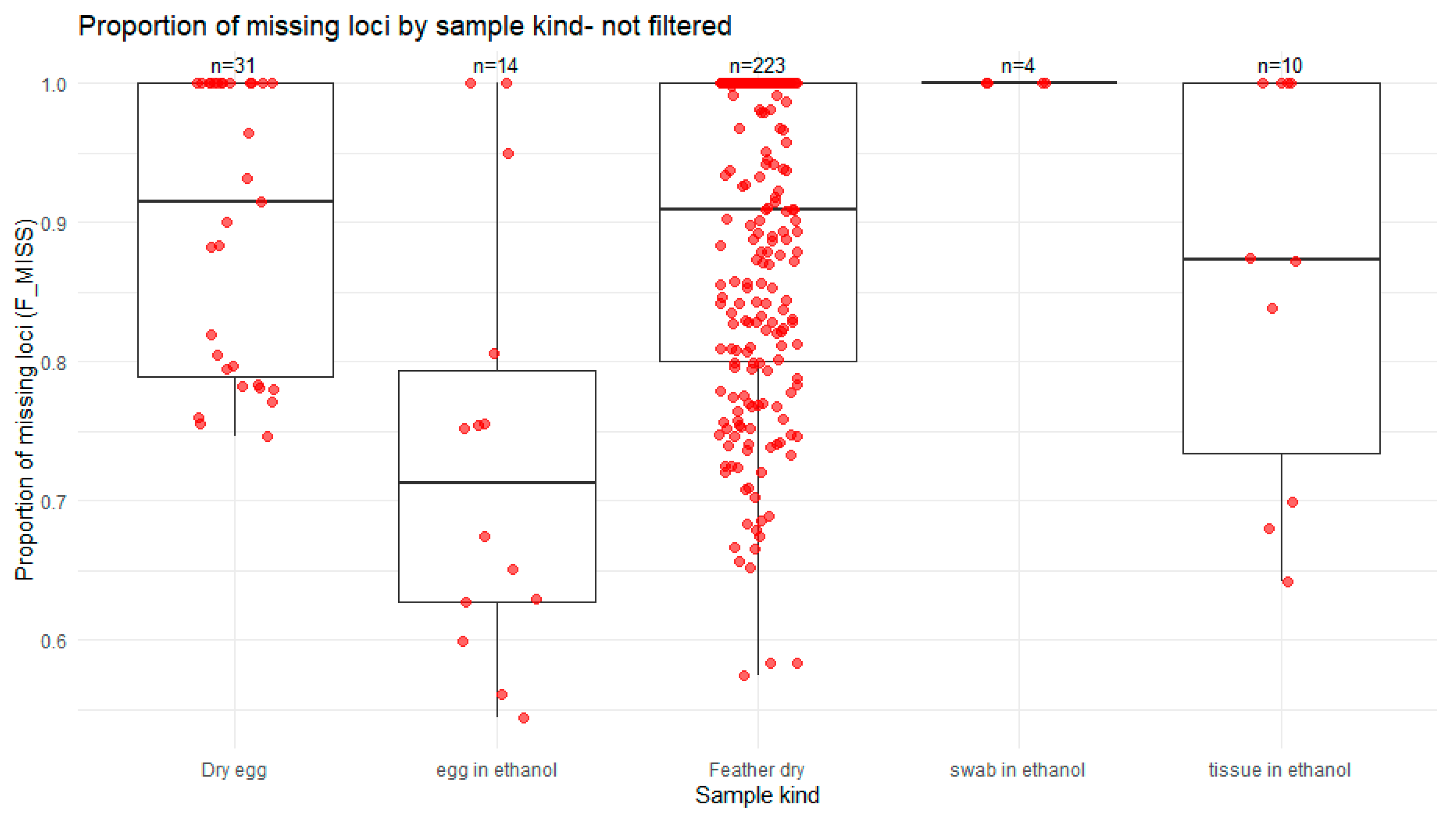
Figure A5.2.
Proportion of missing loci after removal of loci missing in >20% of individuals across different sample types, for 177 samples that produced sequencing data.
Figure A5.2.
Proportion of missing loci after removal of loci missing in >20% of individuals across different sample types, for 177 samples that produced sequencing data.
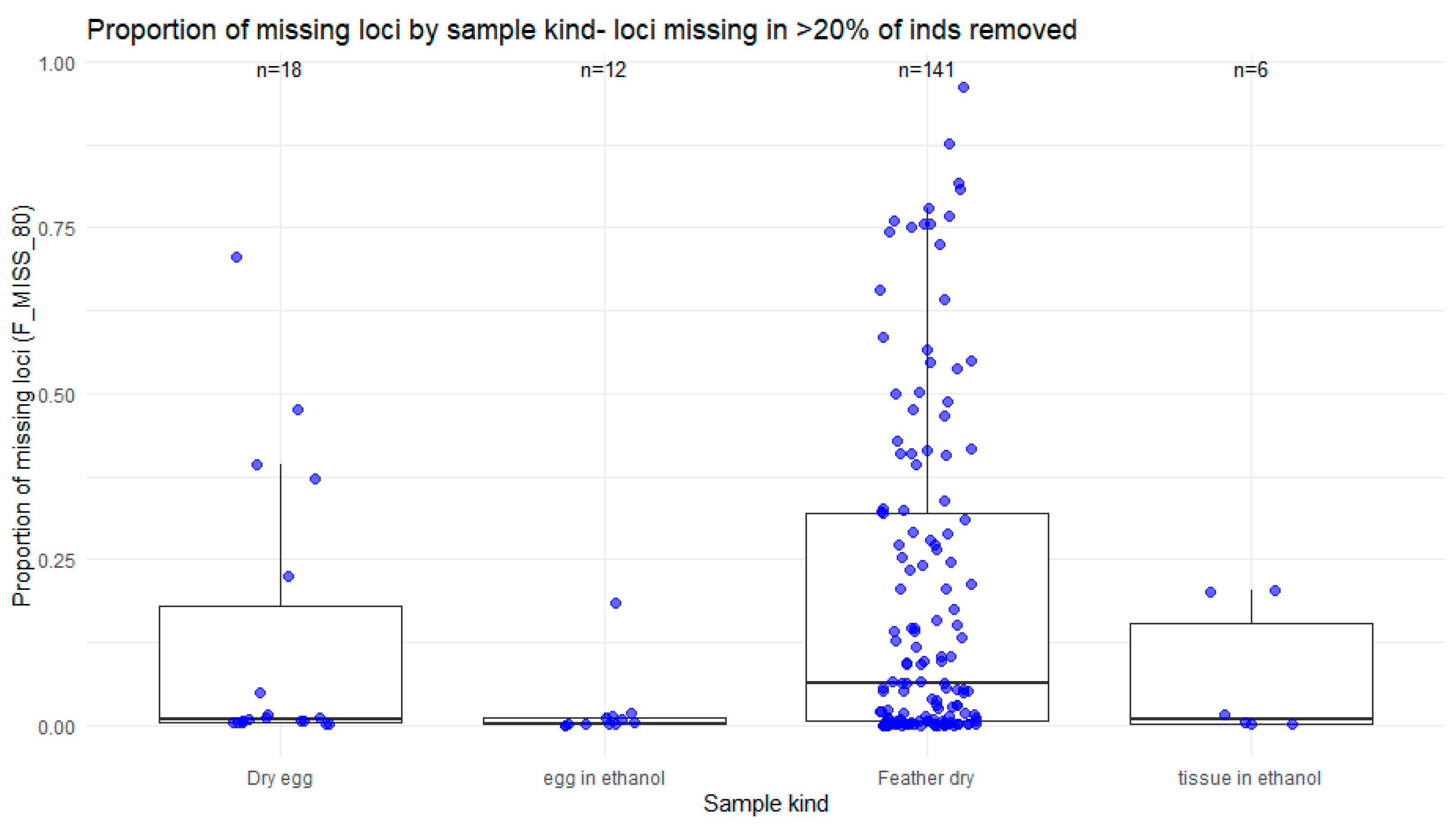
Figure A5.3.
Proportion of missing loci after removal of loci missing in >20% of individuals across States where sample collection occurred.
Figure A5.3.
Proportion of missing loci after removal of loci missing in >20% of individuals across States where sample collection occurred.
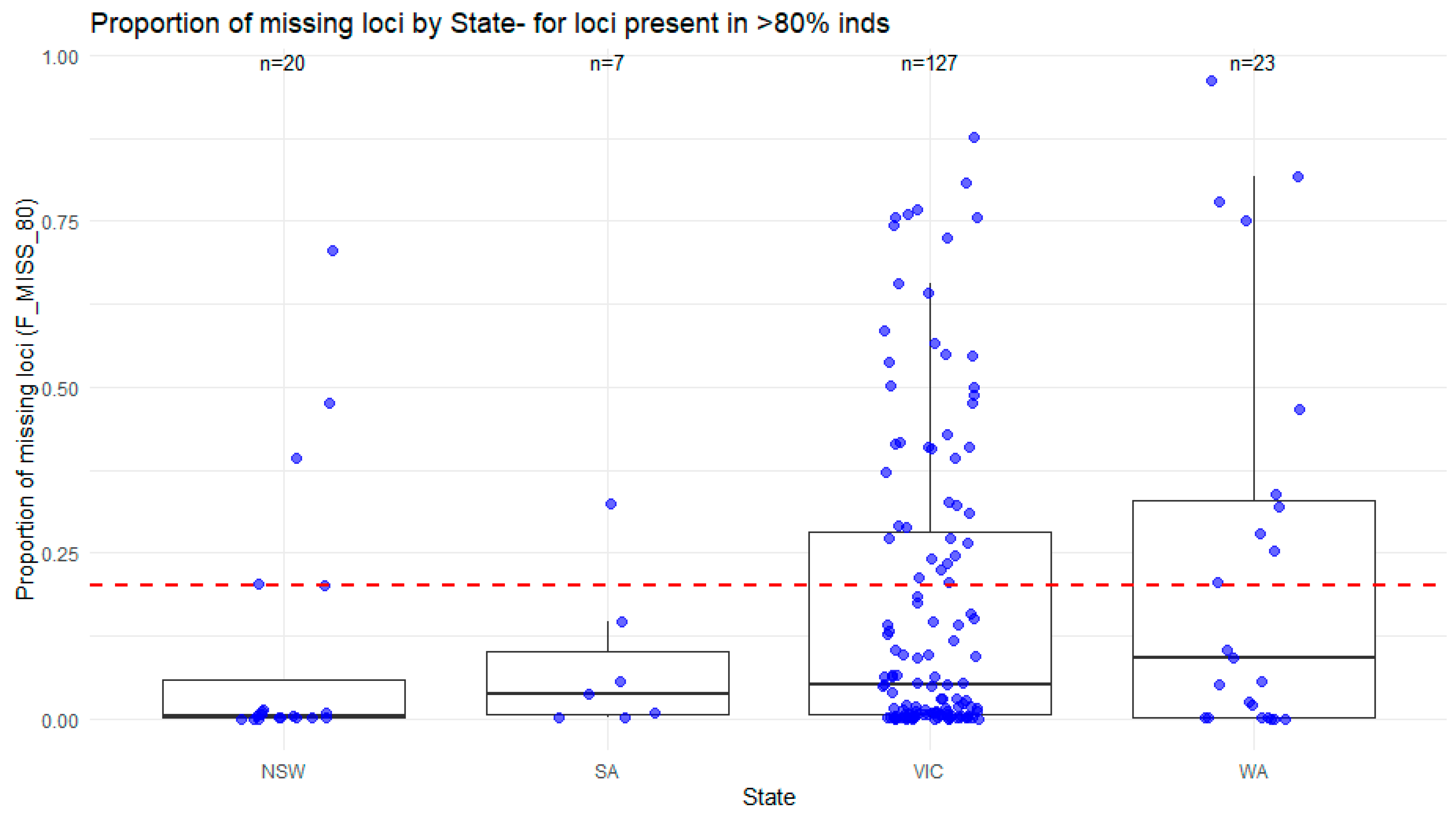
Appendix A6. PCoA Analysis on Euclidean Distances for Eastern (VIC/NSW) and Western (WA/SA) Populations
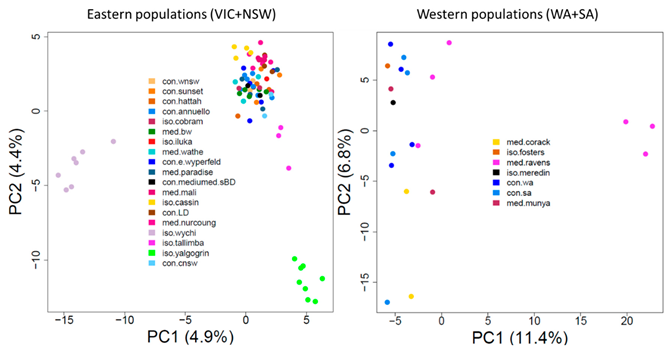
Appendix A7. Cross-entropy criterion analysis of Admixture for all populations (top), eastern populations (bottom left) and western populations (bottom right).
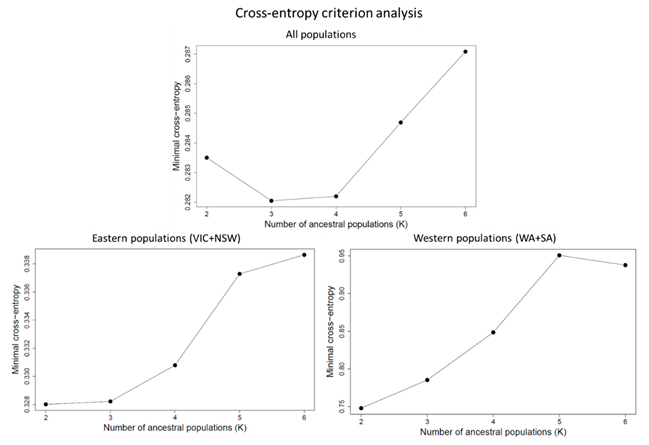
Appendix A8: Results of Admixture analysis of Eastern populations (NSW/VIC) that assumed from two (K=2) to six (K=6) genetic clusters.
Each column is an individual, colour indicates a genetic cluster, Y-axis shows proportion of membership of each individual in different genetic clusters. Samples are arranged roughly in geographical order (northwest→southwest→southeast→northeast). Populations are separated by white lines and labelled as codes above the plots, or as population names below the plots (see Table 1 for complete list of population names).
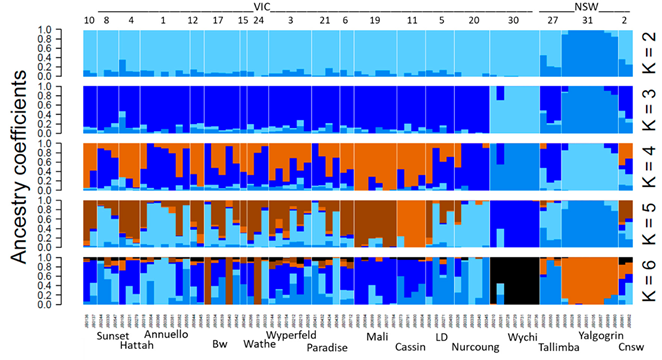
Appendix A9: Binomial test tests probability of being a male deviating from 0.5.
| All Birds | |||||||
| Age | F | M | Total | M:F | Binomial Test P | 95% CI | Estimate (Prop of Males) |
| Chicks | 12 | 23 | 35 | 1.92 | 0.09 | 0.48-0.81 | 0.66 |
| Adults | 33 | 106 | 139 | 3.21 | <0.001 | 0.68-0.83 | 0.76 |
| Total | 45 | 129 | 174 | 2.87 | <0.001 | 0.67-0.80 | 0.74 |
| Adults only, any quality | |||||||
| Fragmentation | F | M | Total | M:F | Binomial test P | 95% CI | Estimate (prop of males) |
| high | 7 | 25 | 32 | 3.57 | <0.001 | 0.65-0.84 | 0.78 |
| medium | 14 | 44 | 58 | 3.14 | <0.001 | 0.63-0.86 | 0.76 |
| connected | 12 | 37 | 49 | 3.08 | <0.001 | 0.61-0.87 | 0.76 |
| Total | 33 | 106 | 139 | 3.21 | <0.001 | 0.68-0.83 | 0.76 |
| Adults only, high quality genotypes | |||||||
| Fragmentation | F | M | Total | M:F | Binomial test P | 95% CI | Estimate (prop of males) |
| high | 1 | 7 | 8 | 7.00 | 0.07 | 0.47-1 | 0.88 |
| medium | 5 | 25 | 30 | 5.00 | <0.001 | 0.65-0.94 | 0.83 |
| connected | 9 | 23 | 32 | 2.56 | 0.02 | 0.53-0.86 | 0.72 |
| Total | 15 | 55 | 70 | 3.67 | <0.001 | 0.67-0.87 | 0.79 |
References
- Amos, J. N.; Harrisson, K. A.; Radford, J. Q.; White, M.; Newell, G.; Mac Nally, R.; Pavlova, A. Species- and sex-specific connectivity effects of habitat fragmentation in a suite of woodland birds. Ecology 2014, 95, 1556–1568. [Google Scholar] [CrossRef]
- Armansin, N. C.; Stow, A. J.; Cantor, M.; Leu, S. T.; Klarevas-Irby, J. A.; Chariton, A. A.; Farine, D. R. Social barriers in ecological landscapes: the social resistance hypothesis. Trends in Ecology & Evolution 2020, 35, 137–148. [Google Scholar] [CrossRef] [PubMed]
- Benshemesh, J. The conservation ecology of malleefowl, with particular regard to fire; Monash University; Clayton, Victoria, Australia, 1992. [Google Scholar]
- Benshemesh, J.; Southwell, D.; Barker, R.; McCarthy, M. Citizen scientists reveal nationwide trends and drivers in the breeding activity of a threatened bird, the malleefowl (Leipoa ocellata). Biological Conservation 2020, 246, 108573. [Google Scholar] [CrossRef]
- Benshemesh, J.; Southwell, D.; Burnard, T.; Teixeira, S.; Garnett, S. Malleefowl, Leipoa ocellata. In The Action Plan for Australian Birds 2020; Garnett, S. T., Baker, G. B., Eds.; Melbourne; CSIRO Publishing, 2021. [Google Scholar]
- Benshemesh, J.; Southwell, D. M.; Lahoz-Monfort, J. J.; Hauser, C.; Rumpff, L.; Bode, M.; Wintle, B. The national malleefowl monitoring effort: citizen scientists, databases and adaptive management. In Monitoring Threatened Species and Ecological Communities; Legge, S., Lindenmayer, D., Eds.; N. e. a.Robinson; CSIRO Publishing, 2018. [Google Scholar]
- Biswas, S.; Dowdy, A.; Chand, S. Increasing trends in the severity of Australian fire weather conditions over the past century. arXiv 2026, arXiv:2603.24867. [Google Scholar] [CrossRef]
- Bode, M.; Brennan, K. E. Using population viability analysis to guide research and conservation actions for Australia's threatened malleefowl Leipoa ocellata. Oryx 2011, 45, 513–521. [Google Scholar] [CrossRef]
- Bowman, D. M.; Kolden, C. A.; Abatzoglou, J. T.; Johnston, F. H.; van der Werf, G. R.; Flannigan, M. Vegetation fires in the Anthropocene. Nature Reviews Earth & Environment 2020, 1, 500–515. [Google Scholar] [CrossRef]
- Canadell, J. G.; Meyer, C.; Cook, G. D.; Dowdy, A.; Briggs, P. R.; Knauer, J.; Haverd, V. Multi-decadal increase of forest burned area in Australia is linked to climate change. Nature Communications 2021, 12, 6921. [Google Scholar] [CrossRef]
- Cooper, C. B.; Walters, J. R.; Ford, H. Effects of remnant size and connectivity on the response of Brown Treecreepers to habitat fragmentation. Emu 2002, 102, 249–256. [Google Scholar] [CrossRef]
- Cope, T. M.; Mulder, R. M.; Dunn, P. O.; Donnellan, S. C. Conservation genetics of Malleefowl. In Paper read at Proceedings of the 5th National Malleefowl Forum, at Dubbo, New South Wales; 2014. [Google Scholar]
- Danecek, P.; Auton, A.; Abecasis, G.; Albers, C. A.; Banks, E.; DePristo, M. A.; Sherry, S. T. The variant call format and VCFtools. Bioinformatics 2011, 27, 2156–2158. [Google Scholar] [CrossRef]
- Danecek, P.; Bonfield, J. K.; Liddle, J.; Marshall, J.; Ohan, V.; Pollard, M. O.; Davies, R. M. Twelve years of SAMtools and BCFtools. GigaScience 2021, 10, giab008. [Google Scholar] [CrossRef]
- DCCEEW. National Recovery Plan for the Malleefowl (Leipoa ocellata) edited by E. Department of Climate Change, the Environment and Water; Canberra; CC BY 4.0, 2024. [Google Scholar]
- de Jong, M. J.; de Jong, J. F.; Hoelzel, A. R.; Janke, A. SambaR: An R package for fast, easy and reproducible population-genetic analyses of biallelic SNP data sets. Molecular Ecology Resources 2021, 21, 1369–1379. [Google Scholar] [CrossRef]
- Díaz, S.; Settele, J.; Brondízio, E. S.; Ngo, H. T.; Agard, J.; Arneth, A.; Chan, K. M. Pervasive human-driven decline of life on Earth points to the need for transformative change. Science 2019, 366, eaax3100. [Google Scholar] [CrossRef]
- Driscoll, D. A.; Armenteras, D.; Bennett, A. F.; Brotons, L.; Clarke, M. F.; Doherty, T. S.; Sitters, H. How fire interacts with habitat loss and fragmentation. Biological Reviews 2021, 96, 976–998. [Google Scholar] [CrossRef]
- Flynn, J. M.; Hubley, R.; Goubert, C.; Rosen, J.; Clark, A. G.; Feschotte, C.; Smit, A. F. RepeatModeler2 for automated genomic discovery of transposable element families. Proceedings of the National Academy of Sciences 2020, 117, 9451–9457. [Google Scholar] [CrossRef] [PubMed]
- Frankham, R.; Ballou, J. D.; Eldridge, M. D. B.; Lacy, R. C.; Ralls, K.; Dudash, M. R.; Fenster, C. B. Predicting the probability of outbreeding depression. Conservation Biology 2011, 25, 465–475. [Google Scholar] [CrossRef] [PubMed]
- Frankham, R.; Ballou, J. D.; Ralls, K.; Eldridge, M.; Dudash, M. R.; Fenster, C. B.; Sunnucks, P. A Practical Guide for Genetic Management of Fragmented Animal and Plant Populations; Oxford; Oxford University Press, 2019. [Google Scholar]
- Frankham, R.; Ballou, J. D.; Ralls, K.; Eldridge, M. D. B.; Dudash, M. R.; Fenster, C. B.; Sunnucks, P. Genetic management of fragmented animal and plant populations; Oxford; Oxford University Press, 2017. [Google Scholar]
- Frankham, R.; Bradshaw, C. J. A.; Brook, B. W. Genetics in conservation management: Revised recommendations for the 50/500 rules, Red List criteria and population viability analyses. Biological Conservation 2014, 170, 56–63. [Google Scholar] [CrossRef]
- Frichot, E.; François, O. LEA: an R package for Landscape and Ecological Association studies. Methods in Ecology and Evolution 2015, 6, 925–929. [Google Scholar] [CrossRef]
- Frith, H. Temperature regulation in the nesting mounds of the mallee-fowl, Leipoa ocellata Gould. CSIRO Wildlife Research 1956, 1, 79–95. [Google Scholar] [CrossRef]
- Frith, H. J. Breeding of the mallee-fowl, Leipoa ocellata Gould (Megapodiidae). CSIRO Wildlife Research 1959, 4, 31–60. [Google Scholar] [CrossRef]
- Haddad, N. M.; Brudvig, L. A.; Clobert, J.; Davies, K. F.; Gonzalez, A.; Holt, R. D.; Collins, C. D. Habitat fragmentation and its lasting impact on Earth’s ecosystems. Science Advances 2015, 1, e1500052. [Google Scholar] [CrossRef]
- Harrisson, K. A.; Pavlova, A.; Amos, N.; Radford, J.; Sunnucks, P. Does reduced mobility through fragmented landscapes explain patch extinction patterns for three honeyeaters? Journal of Animal Ecology 2014, 83, 616–627. [Google Scholar] [CrossRef] [PubMed]
- Harrisson, K. A.; Pavlova, A.; Gonçalves da Silva, A.; Rose, R.; Bull, J. J.; Lancaster, M.; Sunnucks, P. Scope for genetic rescue of an endangered subspecies though re-establishing natural gene flow with another subspecies. Molecular Ecology 2016, 25, 1242–1258. [Google Scholar] [CrossRef]
- Hauser, C. E.; Southwell, D.; Lahoz-Monfort, J. J.; Rumpff, L.; Benshemesh, J.; Burnard, T.; Bode, M. Adaptive management informs conservation and monitoring of Australia's threatened malleefowl. Biological Conservation 2019, 233, 31–40. [Google Scholar] [CrossRef]
- Helyar, S. J.; Hemmer-Hansen, J.; Bekkevold, D.; Taylor, M. I.; Ogden, R.; Limborg, M. T.; Nielsen, E. E. Application of SNPs for population genetics of nonmodel organisms: new opportunities and challenges. Molecular Ecology Resources 2011, 11, 123–136. [Google Scholar] [CrossRef] [PubMed]
- IPBES. Global assessment report on biodiversity and ecosystem services of the Intergovernmental Science-Policy Platform on Biodiversity and Ecosystem Services (Version 1). In Zenodo; Brondizio, J. S. E. S., Díaz, S., Ngo, H. T., Eds.; Bonn, Germany; IPBES secretariat, 2019. [Google Scholar] [CrossRef]
- Keeley, A. T.; Beier, P.; Creech, T.; Jones, K.; Jongman, R. H.; Stonecipher, G.; Tabor, G. M. Thirty years of connectivity conservation planning: An assessment of factors influencing plan implementation. Environmental Research Letters 2019, 14, 103001. [Google Scholar] [CrossRef]
- Knaus, B. J.; Grünwald, N. J. vcfr: a package to manipulate and visualize variant call format data in R. Molecular Ecology Resources 2017, 17, 44–53. [Google Scholar] [CrossRef]
- Landguth, E. L.; Cushman, S. A.; Schwartz, M. K.; McKelvey, K. S.; Murphy, M.; Luikart, G. Quantifying the lag time to detect barriers in landscape genetics. Molecular Ecology 2010, 19, 4179–4191. [Google Scholar] [CrossRef]
- Laurie, C. C. The weaker sex is the heterogametic sex: 75 years of Haldane's rule. Genetics 1997, 147, 937–951. [Google Scholar] [CrossRef]
- Li, H. Aligning sequence reads, clone sequences and assembly contigs with BWA-MEM. arXiv 2013, arXiv:1303.3997. [Google Scholar] [CrossRef]
- Li, H. Minimap2: pairwise alignment for nucleotide sequences. Bioinformatics 2018, 34, 3094–3100. [Google Scholar] [CrossRef]
- Li, H.; Durbin, R. Fast and accurate short read alignment with Burrows–Wheeler transform. Bioinformatics 2009, 25, 1754–1760. [Google Scholar] [CrossRef] [PubMed]
- Liddell, E.; Sunnucks, P.; Cook, C. N. To mix or not to mix gene pools for threatened species management? Few studies use genetic data to examine the risks of both actions, but failing to do so leads disproportionately to recommendations for separate management. Biological Conservation 2021, 256, 109072. [Google Scholar] [CrossRef]
- Low, G. W.; Pavlova, A.; Gan, H. M.; Ko, M.-C.; Sadanandan, K. R.; Lee, Y. P.; Sunnucks, P. Accelerated differentiation of neo-W nuclear-encoded mitochondrial genes between two climate-associated bird lineages signals potential co-evolution with mitogenomes. Heredity 2024, 133, 342–354. [Google Scholar] [CrossRef] [PubMed]
- Lutz, M.; Tonkin, Z.; Yen, J. D.; Johnson, G.; Ingram, B.; Sharley, J.; Pavlova, A. Using multiple sources during reintroduction of a locally extinct population benefits survival and reproduction of an endangered freshwater fish. Evolutionary Applications 2021, 14, 950–964. [Google Scholar] [CrossRef] [PubMed]
- Lv, Q.; Chen, Z.; Wu, C.; Peñuelas, J.; Fan, L.; Su, Y.; Hu, J. Increasing severity of large-scale fires prolongs recovery time of forests globally since 2001. Nature ecology & evolution 2025, 9, 980–992. [Google Scholar]
- Manichaikul, A.; Mychaleckyj, J. C.; Rich, S. S.; Daly, K.; Sale, M.; Chen, W.-M. Robust relationship inference in genome-wide association studies. Bioinformatics 2010, 26, 2867–2873. [Google Scholar] [CrossRef]
- Mijangos, J. L.; Gruber, B.; Berry, O.; Pacioni, C.; Georges, A. dartR v2: an accessible genetic analysis platform for conservation, ecology, and agriculture. Methods in Ecology and Evolution. 2022.
- Mitchell, W. F.; Boulton, R. L.; Sunnucks, P.; Clarke, R. H. Are we adequately assessing the demographic impacts of harvesting for wild-sourced conservation translocations? Conservation Science and Practice 2022, 4, e569. [Google Scholar] [CrossRef]
- Morales, H.; Sunnucks, P.; Joseph, L.; Pavlova, A. Perpendicular axes of differentiation generated by mitochondrial introgression. Molecular Ecology 2017, 26, 3241–3255. [Google Scholar] [CrossRef]
- Mualim, K. S.; Spence, J. P.; Weiß, C.; Selmoni, O.; Lin, M.; Exposito-Alonso, M. Large future genetic diversity losses are predicted from conservation indicators even with habitat protection. Proceedings of the National Academy of Sciences 2026, 123, e2514371123. [Google Scholar] [CrossRef]
- Neilly, H.; Wells, D. E.; Pascoe, T.; Cale, P. Malleefowl Leipoa ocellata breeding behaviour: Insights from citizen science camera surveillance. Australian Field Ornithology 2021, 38, 87–98. [Google Scholar] [CrossRef]
- Orr, H. A. Haldane's rule. Annual Review of Ecology and Systematics 1997, 195–218. [Google Scholar] [CrossRef]
- Pavlova, A.; Amos, J. N.; Joseph, L.; Loynes, K.; Austin, J. J.; Keogh, J. S.; Sunnucks, P. Perched at the mito-nuclear crossroads: divergent mitochondrial lineages correlate with environment in the face of ongoing nuclear gene flow in an Australian bird. Evolution 2013, 67, 3412–3428. [Google Scholar] [CrossRef]
- Pavlova, A.; Beheregaray, L. B.; Coleman, R.; Gilligan, D.; Harrisson, K. A.; Ingram, B. A.; Sunnucks, P. Severe consequences of habitat fragmentation on genetic diversity of an endangered Australian freshwater fish: a call for assisted gene flow. Evolutionary Applications 2017, 10, 531–550. [Google Scholar] [CrossRef] [PubMed]
- Pavlova, A.; Petrovic, S.; Harrisson, K. A.; Cartwright, K.; Dobson, E.; Hurley, L. L.; Sunnucks, P. Benefits of genetic rescue of a critically endangered subspecies from another subspecies outweigh risks: Results of captive breeding trials. Biological Conservation 2023, 284, 110203. [Google Scholar] [CrossRef]
- Pavlova, A.; Selwood, P.; Harrisson, K. A.; Murray, N.; Quin, B.; Menkhorst, P.; Sunnucks, P. Integrating phylogeography and morphometrics to assess conservation merits and inform conservation strategies for an endangered subspecies of a common bird species. Biological Conservation 2014, 174, 136–146. [Google Scholar] [CrossRef]
- Pavlova, A.; Tonkin, Z.; Pearce, L.; Robledo-Ruiz, D. A.; Lintermans, M.; Ingram, B. A.; Sunnucks, P. A shift to metapopulation genetic management for persistence of a species threatened by fragmentation: the case of an endangered Australian freshwater fish. Molecular Ecology 2025, 34, e70005. [Google Scholar] [CrossRef] [PubMed]
- Plumanns-Pouton, E.; Santos, J. L.; Aponte, C.; Brotons, L.; Kelly, L. T.; Mason, S. C., Jr.; Keith, D. A. The Mechanisms Through Which Fire Drives Population Change in Terrestrial Biota. Global Change Biology 2025, 31, e70479. [Google Scholar] [CrossRef] [PubMed]
- Priddel, D.; Wheeler, R. Fecundity, egg size and the influence of rainfall in an isolated population of malleefowl (Leipoa ocellata). Wildlife Research 2005, 32, 639–648. [Google Scholar] [CrossRef]
- R: A language and environment for statistical computing. R Foundation for Statistical Computing, Vienna, Austria; Available online: https://www.R-project.org/.
- Radford, J. Q.; Amos, J. N.; Harrisson, K.; Sunnucks, P.; Pavlova, A. Functional connectivity and population persistence in woodland birds: Insights for management from a multi-species conservation genetics study. Emu - Austral Ornithology 2021, 121, 147–159. [Google Scholar] [CrossRef]
- Ralls, K.; Ballou, J. D.; Dudash, M. R.; Eldridge, M. D. B.; Fenster, C. B.; Lacy, R. C.; Frankham, R. Call for a paradigm shift in the genetic management of fragmented populations. Conservation Letters 2018, 11, 1–6. [Google Scholar] [CrossRef]
- RStudio: Integrated Development for R; RStudio, PBC; Boston, MA; Available online: http://www.rstudio.com/.
- Saccheri, I.; Kuussaari, M.; Kankare, M.; Vikman, P.; Fortelius, W.; Hanski, I. Inbreeding and extinction in a butterfly metapopulation. Nature 1998, 392, 491–494. [Google Scholar] [CrossRef]
- Schmidt, T. L.; Jasper, M.; Weeks, A. R.; Hoffmann, A. A. Unbiased population heterozygosity estimates from genome-wide sequence data. Methods in Ecology and Evolution 2021, 12, 1888–1898. [Google Scholar] [CrossRef]
- Sgrò, C. M.; Lowe, A. J.; Hoffmann, A. A. Building evolutionary resilience for conserving biodiversity under climate change. Evolutionary Applications 2011, 4, 326–337. [Google Scholar] [CrossRef]
- Shaw, R. E.; Farquharson, K. A.; Bruford, M. W.; Coates, D. J.; Elliott, C. P.; Mergeay, J.; Grueber, C. E. Global meta-analysis shows action is needed to halt genetic diversity loss. Nature 2025, 638, 704–710. [Google Scholar] [CrossRef]
- RepeatMasker Open-4.0. Available online: http://www.repeatmasker.org.
- Sopniewski, J.; Catullo, R. A. Estimates of heterozygosity from single nucleotide polymorphism markers are context-dependent and often wrong. Molecular Ecology Resources 2024, 24, e13947. [Google Scholar] [CrossRef]
- Stenhouse, P.; Moseby, K. Trends in breeding activity of the threatened Malleefowl (Leipoa ocellata): what can we expect under a changing climate? Emu-Austral Ornithology 2022, 122, 51–60. [Google Scholar] [CrossRef]
- Stenhouse, P.; Onley, I. R.; Mitchell, K. J.; Moseby, K. E.; Austin, J. J. Spatial genetic structure and limited gene flow in fragmented populations of the threatened Malleefowl (Leipoa ocellata). Ecological Genetics and Genomics 2022, 24, 100127. [Google Scholar] [CrossRef]
- Tang, Q.; Fung, T.; Hart, D. E. T.; Rheindt, F. E. Rate and extent of genetic diversity loss under non-equilibrium scenarios of habitat loss. Biological Conservation 2024, 289, 110381. [Google Scholar] [CrossRef]
- Taylor, H. R.; Colbourne, R. M.; Robertson, H. A.; Nelson, N. J.; Allendorf, F. W.; Ramstad, K. M. Cryptic inbreeding depression in a growing population of a long-lived species. Molecular Ecology 2017, 26, 799–813. [Google Scholar] [CrossRef]
- Thorne, M.; Collins, R.; Sheldon, B. Triploidy and other chromosomal abnormalities in a selected line of chickens. Genetics Selection Evolution 1991, 23, 212s–216s. [Google Scholar] [CrossRef]
- Weathers, W. W.; Seymour, R. S.; Baudinette, R. V. Energetics of mound-tending behaviour in the malleefowl, Leipoa ocellata (Megapodiidae). Animal Behaviour 1993, 45, 333–341. [Google Scholar] [CrossRef]
- Weathers, W. W.; Weathers, D. L.; Seymour, R. S. Polygyny and reproductive effort in the Malleefowl Leipoa ocellata. Emu-Austral Ornithology 1990, 90, 1–6. [Google Scholar] [CrossRef]
- Weeks, A. R.; Moro, D.; Thavornkanlapachai, R.; Taylor, H. R.; White, N. E.; Weiser, E. L.; Heinze, D. Conserving and enhancing genetic diversity in translocation programs. In Advances in Reintroduction Biology of Australian and New Zealand Fauna; Armstrong, D., Hayward, M., Moro, D., Seddon, P. J., Eds.; Melbourne; CSIRO Publishing, 2015. [Google Scholar]
- Weeks, A. R.; Stoklosa, J.; Hoffmann, A. A. Conservation of genetic uniqueness of populations may increase extinction likelihood of endangered species: the case of Australian mammals. Front Zool 2016, 13, 31. [Google Scholar] [CrossRef]
- Zilko, J. P.; Harley, D. K.; Hansen, B.; Pavlova, A.; Sunnucks, P. Accounting for cryptic population structure enhances detection of inbreeding depression with genomic inbreeding coefficients: an example from a critically endangered marsupial. Molecular Ecology 2020, 29, 2978–2993. [Google Scholar] [CrossRef]
- Amos, J.N.; Harrisson, K.A.; Radford, J.Q.; White, M.; Newell, G.; Mac Nally, R.; Sunnucks, P.; Pavlova, A. Species- and sex-specific connectivity effects of habitat fragmentation in a suite of woodland birds. Ecology 2014, 95, 1556–1568. [Google Scholar] [CrossRef]
- Bellis, J.; Osazuwa-Peters, O.; Maschinski, J.; Keir, M.J.; Parsons, E.W.; Kaye, T.N.; Kunz, M.; Possley, J.; Menges, E.; Smith, S.A.; Roth, D.; Brewer, D.; Brumback, W.; Lange, J.J.; Niederer, C.; Turner-Skoff, J.B.; Bontrager, M.; Braham, R.; Coppoletta, M.; Holl, K.D.; Williamson, P.; Bell, T.; Jonas, J.L.; McEachern, K.; Robertson, K.L.; Birnbaum, S.J.; Dattilo, A.; Dollard, J.J., Jr.; Fant, J.; Kishida, W.; Lesica, P.; Link, S.O.; Pavlovic, N.B.; Poole, J.; Reemts, C.M.; Stiling, P.; Taylor, D.D.; Titus, J.H.; Titus, P.J.; Adkins, E.D.; Chambers, T.; Paschke, M.W.; Heineman, K.D.; Albrecht, M.A. Identifying predictors of translocation success in rare plant species. Conserv Biol. 2023, 38, e14190. [Google Scholar] [CrossRef]
- Berger-Tal, O.; Blumstein, D.T.; Swaisgood, R.R. Conservation translocations: a review of common difficulties and promising directions. Animal Conservation 2020, 23, 121–131. [Google Scholar] [CrossRef]
- Byers, O.; Lees, C.; Wilcken, J.; Schwitzer, C. The “One Plan” approach: the philosophy and implementation of CBSG’s approach to integrated species conservation planning. WAZA Magazine 2013, 14, 2–5. [Google Scholar]
- Frankham, R. Genetic rescue of small inbred populations: meta-analysis reveals large and consistent benefits of gene flow. Molecular Ecology 2015, 24, 2610–2618. [Google Scholar] [CrossRef]
- Frankham, R.; Bradshaw, C.J.A.; Brook, B.W. 50/500 rules need upward revision to 100/1000-Response to Franklin et al. Biological Conservation 2014, 176, 286–286. [Google Scholar] [CrossRef]
- Frankham, R.; Ballou, J.D.; Ralls, K.; Eldridge, M.D.B.; Dudash, M.R.; Fenster, C.B.; Lacy, R.C.; Sunnucks, P. Genetic Management of Fragmented Animal and Plant Populations; Oxford University Press; Oxford, 2017. [Google Scholar]
- Frankham, R.; Ballou, J.D.; Ralls, K.; Eldridge, M.D.B.; Dudash, M.R.; Fenster, C.B.; Lacy, R.C.; Sunnucks, P. A Practical Guide for Genetic Management of Fragmented Animal and Plant Populations; Oxford University Press; Oxford, 2019. [Google Scholar]
- Frankham, R.; Ballou, J.D.; Grueber, C.E.; Pickup, M.; Stow, A.J.; Sunnucks, P. Introduction to Conservation Genetics and Genomics, Third edition; Cambridge University Press, 2026. [Google Scholar]
- Geue, J.C.; Bertola, L.D.; Bloomer, P.; Brüniche-Olsen, A.; da Silva, J.M.; DeWoody, J.A.; Fedorca, A.; Godoy, J.A.; Grueber, C.E.; Hunter, M.E.; Hvilsom, C.; Kopatz, A.; MacDonald, A.J.; Jensen, E.; Pérez-Espona, S.; Piaggio, A.J.; Pierson, J.; Russo, I.M.; Senn, H.; Segelbacher, G.; Sunnucks, P.; van Oosterhout, C.; Leigh, D.M. A practical framework for identifying genetic subpopulations and ESUs: insights for IUCN assessments and broader management; Bioscience, 2026. [Google Scholar]
- Goretskaia, M.I.; Beme, I.R.; Popova, D.V.; Amos, N.; Buchanan, K.L.; Sunnucks, P.; Pavlova, A. Song parameters of the fuscous honeyeater Lichenostomus fuscus correlate with habitat characteristics in fragmented landscapes. Journal of Avian Biology 2018, 49, e01493. [Google Scholar] [CrossRef]
- Harrisson, K.A.; Pavlova, A.; Amos, J.N.; Takeuchi, N.; Lill, A.; Radford, J.Q.; Sunnucks, P. Fine-scale effects of habitat loss and fragmentation despite large-scale gene flow for some regionally declining woodland bird species. Landscape Ecology 2012, 27, 813–827. [Google Scholar] [CrossRef]
- Harrisson, K.A.; Pavlova, A.; Telonis-Scott, M.; Sunnucks, P. Using genomics to characterize evolutionary potential for conservation of wild populations. Evolutionary Applications 2014, 7, 1008–1025. [Google Scholar] [CrossRef]
- Harrisson, K.A.; Pavlova, A.; da Silva, A.G.; Rose, R.; Bull, J.K.; Lancaster, M.L.; Murray, N.; Quin, B.; Menkhorst, P.; Magrath, M.J.L.; Sunnucks, P. Scope for genetic rescue of an endangered subspecies though re-establishing natural gene flow with another subspecies. Molecular Ecology 2016, 25, 1242–1258. [Google Scholar] [CrossRef]
- Harrisson, K.A.; Magrath, M.J.L.; Yen, J.D.L.; Pavlova, A.; Murray, N.; Quin, B.; Menkhorst, P.; Miller, K.A.; Cartwright, K.; Sunnucks, P. Lifetime fitness costs of inbreeding and being inbred in a critically endangered bird. Current Biology 2019, 29, 1–7. [Google Scholar] [CrossRef]
- Hoban, S.; da Silva, J.M.; Hughes, A.; Hunter, M.E.; Stroil, B.K.; Laikre, L.; Mastretta-Yanes, A.; Millette, K.; Paz-Vinas, I.; Bustos, L.R.; Shaw, R.E.; Vernesi, C.; Funk, C.; Grueber, C.; Kershaw, F.; Macdonald, A.; Meek, M.; Mittan, C.; O'Brien, D.; Ogden, R.; Segelbacher, G.; Coalition Conservation, G. Too simple, too complex, or just right? Advantages, challenges, and guidance for indicators of genetic diversity. BioScience 2024a, 74, 269–280. [Google Scholar] [CrossRef]
- Hoban, S.; Paz-Vinas, I.; Shaw, R.E.; Castillo-Reina, L.; Silva, J.; Dewoody, J.A.; Ekblom, R.; Fedorca, A.; Forester, B.R.; Funk, W.C.; Geue, J.C.; Heuertz, M.; Hollingsworth, P.M.; Hughes, A.C.; Hunter, M.E.; Hvilsom, C.; Ishihama, F.; Jordan, R.; Stroil, B.K.; Kershaw, F.; Khoury, C.K.; Koeppae, V.; Laikre, L.; Macdonald, A.J.; Mastretta-Yanes, A.; Meek, M.H.; Mergeay, J.; Millette, K.L.; O'Brien, D.; Rincon-Parra, V.J.; Rodriguez-Morales, M.A.; Schuman, M.C.; Segelbacher, G.; Sunnucks, P.; Taylor, R.S.; Thurfjell, H.; Vernesi, C.; Grueber, C.E. DNA-based studies and genetic diversity indicator assessments are complementary approaches to conserving evolutionary potential. Conservation Genetics 2024b, 25, 1147–1153. [Google Scholar] [CrossRef]
- Hoffmann, A.A.; Miller, A.D.; Weeks, A.R. Genetic mixing for population management: From genetic rescue to provenancing. Evolutionary Applications 2021, 14, 634–652. [Google Scholar] [CrossRef]
- Liddell, E.; Sunnucks, P.; Cook, C.N. To mix or not to mix gene pools for threatened species management? Few studies use genetic data to examine the risks of both actions, but failing to do so leads disproportionately to recommendations for separate management. Biological Conservation 2021, 256, 109072. [Google Scholar] [CrossRef]
- Love Stowell, S.M.; Pinzone, C.A.; Martin, A.P. Overcoming barriers to active interventions for genetic diversity; Biodiversity and Conservation, 2017; pp. 1–13. [Google Scholar]
- Morris, S.D.; Brook, B.W.; Moseby, K.E.; Johnson, C.N. Factors affecting success of conservation translocations of terrestrial vertebrates: A global systematic review. Global Ecology and Conservation 2021, 28, e01630. [Google Scholar] [CrossRef]
- Olazcuaga, L.; Lincke, B.; DeLacey, S.; Durkee, L.F.; Melbourne, B.A.; Hufbauer, R.A. Population demographic history and evolutionary rescue: Influence of a bottleneck event. Evolutionary Applications 2023, 16, 1483–1495. [Google Scholar] [CrossRef]
- Ørsted, M.; Hoffmann, A.A.; Sverrisdóttir, E.; Nielsen, K.L.; Kristensen, T.N. Genomic variation predicts adaptive evolutionary responses better than population bottleneck history. PLOS Genetics 2019, 15, e1008205. [Google Scholar] [CrossRef]
- Pacioni, C.; Wayne, A.F.; Page, M. Guidelines for genetic management in mammal translocation programs. Biological Conservation 2019, 237, 105–113. [Google Scholar] [CrossRef]
- Pavlova, A.; Amos, J.N.; Goretskaia, M.I.; Beme, I.R.; Buchanan, K.L.; Takeuchi, N.; Radford, J.Q.; Sunnucks, P. Genes and song: genetic and social connections in fragmented habitat in a woodland bird with limited dispersal. Ecology 2012, 93, 1717–1727. [Google Scholar] [CrossRef]
- Pavlova, A.; Selwood, P.; Harrisson, K.A.; Murray, N.; Quin, B.; Menkhorst, P.; Smales, I.; Sunnucks, P. Integrating phylogeography and morphometrics to assess conservation merits and inform conservation strategies for an endangered subspecies of a common bird species. Biological Conservation 2014, 174, 136–146. [Google Scholar] [CrossRef]
- Pavlova, A.; Petrovic, S.; Harrisson, K.A.; Cartwright, K.; Dobson, E.; Hurley, L.L.; Lane, M.; Magrath, M.J.L.; Miller, K.A.; Quin, B.; Winterhoff, M.; Yen, J.D.L.; Sunnucks, P. Benefits of genetic rescue of a critically endangered subspecies from another subspecies outweigh risks: Results of captive breeding trials. Biological Conservation 2023, 284, 110203. [Google Scholar] [CrossRef]
- Pavlova, A.; Pearce, L.; Sturgiss, F.; Lake, E.; Sunnucks, P.; Lintermans, M. Immediate genetic augmentation and enhanced habitat connectivity are required to secure the future of an iconic endangered freshwater fish population. Evol Appl 2024a, 17, e70019. [Google Scholar] [CrossRef]
- Pavlova, A.; Schneller, N.M.; Lintermans, M.; Beitzel, M.; Robledo-Ruiz, D.A.; Sunnucks, P. Planning and implementing genetic rescue of an endangered freshwater fish population in a regulated river, where low flow reduces breeding opportunities and may trigger inbreeding depression. Evolutionary Applications 2024b, 17, e13679. [Google Scholar] [CrossRef]
- Pickup, M.; Field, D.L.; Rowell, D.M.; Young, A.G. Source population characteristics affect heterosis following genetic rescue of fragmented plant populations. In Proceedings of the Royal Society B-Biological Sciences; 2013; 280. [Google Scholar]
- Prober, S.M.; Byrne, M.; McLean, E.H.; Steane, D.A.; Potts, B.M.; Vaillancourt, R.E.; Stock, W.D. Climate-adjusted provenancing: a strategy for climate-resilient ecological restoration. Frontiers in Ecology and Evolution 2015, 3. [Google Scholar] [CrossRef]
- Radford, J.Q.; Amos, N.; Harrisson, K.; Sunnucks, P.; Pavlova, A. Functional connectivity and population persistence in woodland birds: insights for management from a multi-species conservation genetics study. Emu - Austral Ornithology 2021, 121, 147–159. [Google Scholar] [CrossRef]
- Ralls, K.; Ballou, J.D.; Dudash, M.R.; Eldridge, M.D.B.; Fenster, C.B.; Lacy, R.C. Call for a paradigm shift in the genetic management of fragmented populations. Conservation Letters 2018, 11, 1–6. [Google Scholar] [CrossRef]
- Weeks, A.R.; Sgro, C.M.; Young, A.G.; Frankham, R.; Mitchell, N.J.; Miller, K.A.; Byrne, M.; Coates, D.J.; Eldridge, M.D.B.; Sunnucks, P.; Breed, M.F.; James, E.A.; Hoffmann, A.A. Assessing the benefits and risks of translocations in changing environments: a genetic perspective. Evolutionary Applications 2011, 4, 709–725. [Google Scholar] [CrossRef]
- Weeks, A.R.; Stoklosa, J.; Hoffmann, A.A. Conservation of genetic uniqueness of populations may increase extinction likelihood of endangered species: the case of Australian mammals. Frontiers in Zoology 2016, 13, 31. [Google Scholar] [CrossRef] [PubMed]
- Willi, Y.; Kristensen, T.N.; Sgrò, C.M.; Weeks, A.R.; Ørsted, M.; Hoffmann, A.A. Conservation genetics as a management tool: The five best-supported paradigms to assist the management of threatened species. Proceedings of the National Academy of Sciences 2022, 119, e2105076119. [Google Scholar] [CrossRef] [PubMed]
- Zilko, J.P.; Harley, D.; Hansen, B.; Pavlova, A.; Sunnucks, P. Accounting for cryptic population substructure enhances detection of inbreeding depression with genomic inbreeding coefficients: an example from a critically endangered marsupial. Molecular Ecology 2020, 29, 2978–2993. [Google Scholar] [CrossRef]
- Zilko, J.P.; Harley, D.; Pavlova, A.; Sunnucks, P. Applying population viability analysis to inform genetic rescue that preserves locally unique genetic variation in a critically endangered mammal. Diversity 2021, 13, 382. [Google Scholar] [CrossRef]
Figure 1.
Google Earth image with geographic location of populations (yellow polygons; numbers indicate location codes) and 95 unique genotypes (black markers) used in the analyses. Top map shows all samples, bottom map zooms into VIC and NSW samples.
Figure 1.
Google Earth image with geographic location of populations (yellow polygons; numbers indicate location codes) and 95 unique genotypes (black markers) used in the analyses. Top map shows all samples, bottom map zooms into VIC and NSW samples.
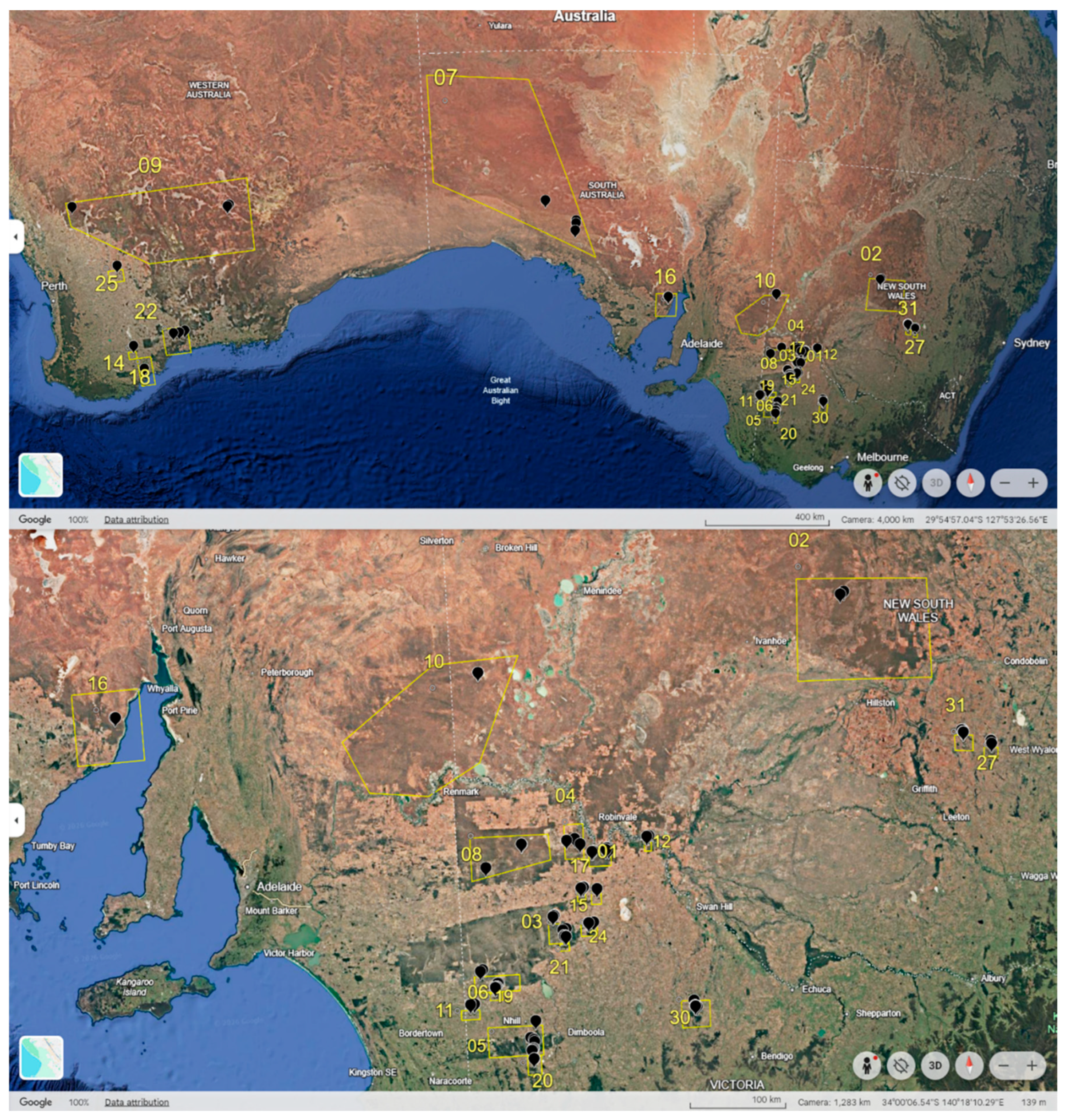
Figure 2.
Testing for dependence of autosomal heterozygosity on proportion of missing loci (left plot) and relationship between mean read depth and proportion of missing loci (right plot). Both tests suggest that heterozygosity estimates from low quality samples are likely to be strongly biased and thus should not be interpreted.
Figure 2.
Testing for dependence of autosomal heterozygosity on proportion of missing loci (left plot) and relationship between mean read depth and proportion of missing loci (right plot). Both tests suggest that heterozygosity estimates from low quality samples are likely to be strongly biased and thus should not be interpreted.
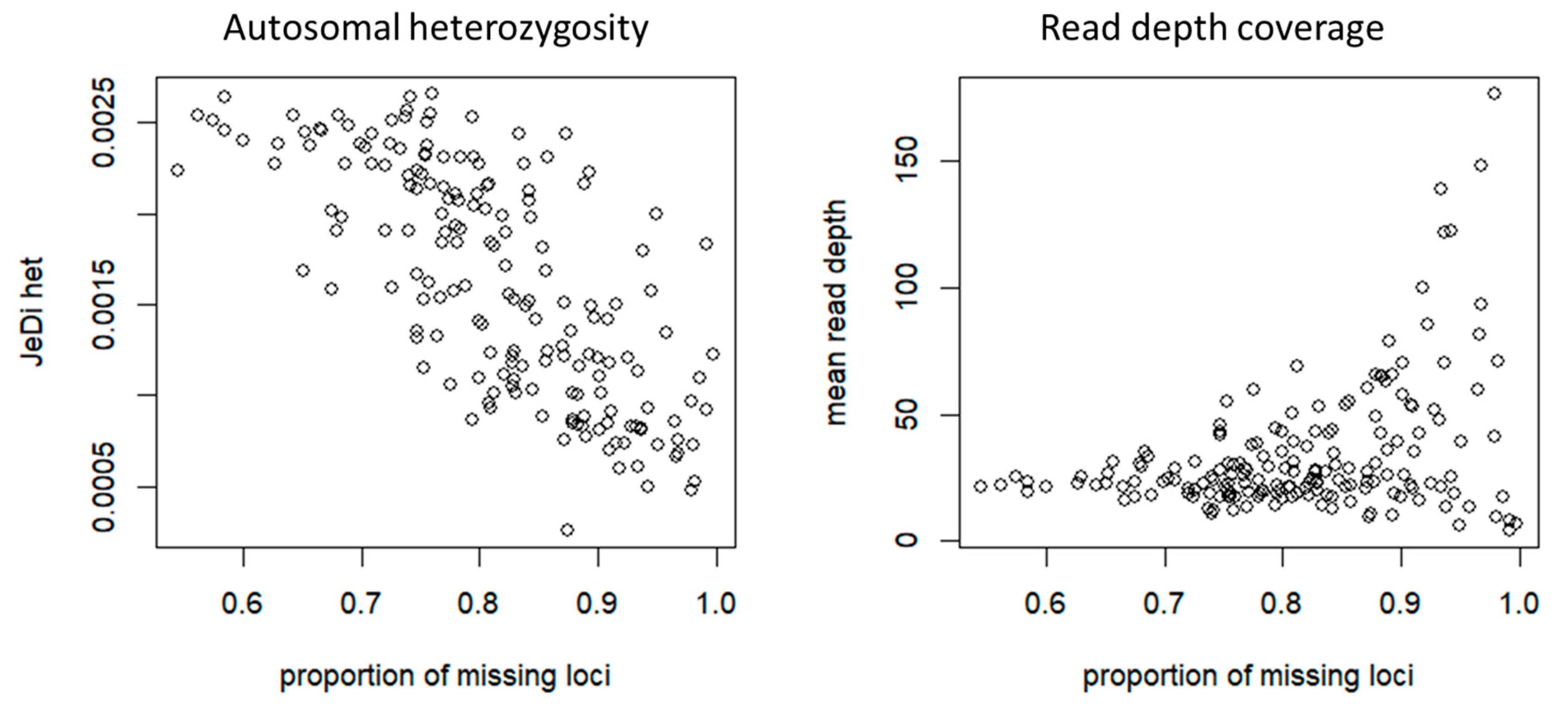
Figure 3.
PCoA on Euclidean distances of range-wide samples. Each point represents an individual genotype, colours indicate States, numbers are population codes on Figure 1.
Figure 3.
PCoA on Euclidean distances of range-wide samples. Each point represents an individual genotype, colours indicate States, numbers are population codes on Figure 1.
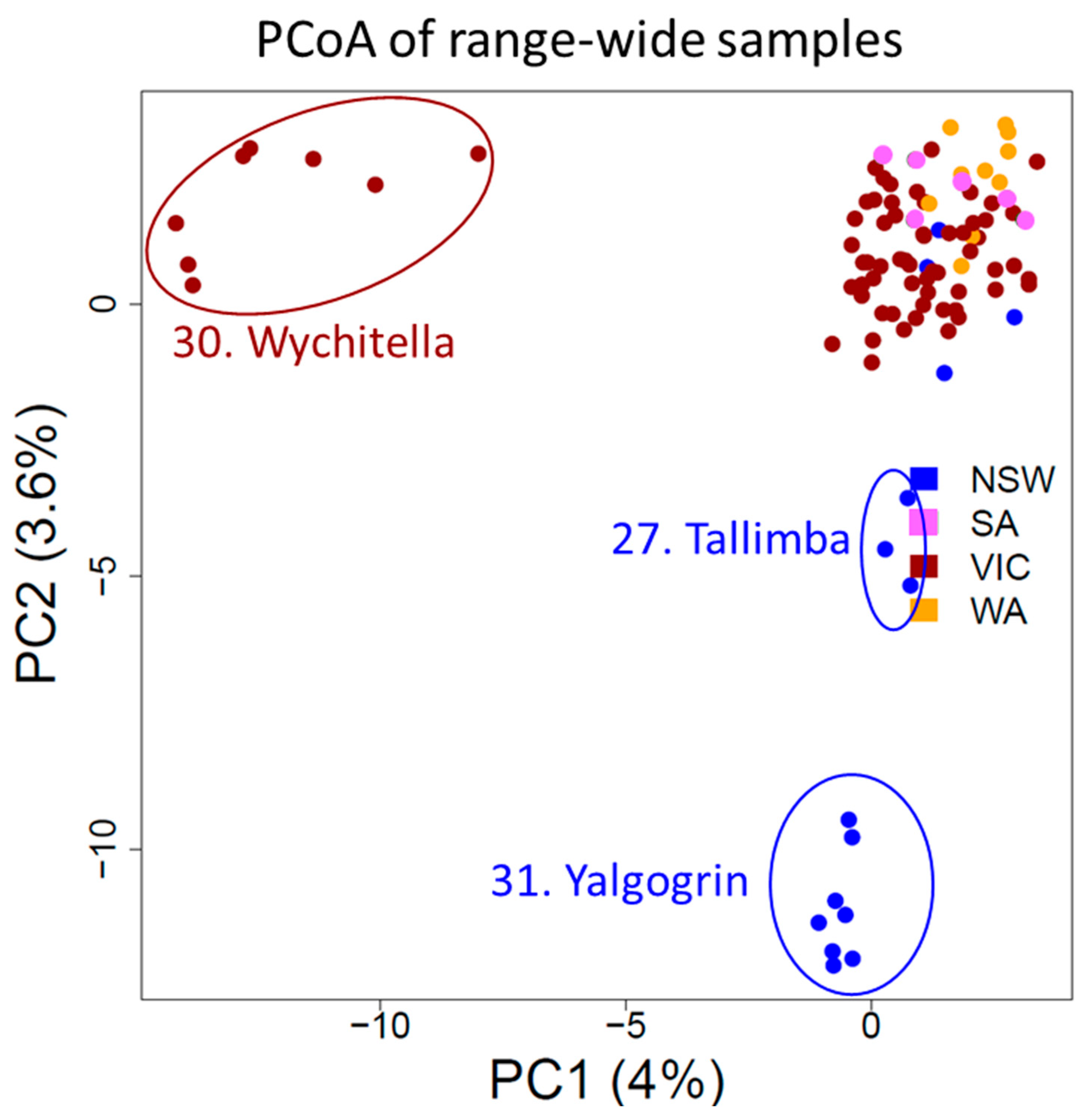
Figure 4.
Admixture analysis that assumed two (K=2) to six (K=6) genetic clusters. Each column is an individual, colour indicates a genetic cluster, Y-axis shows proportion of membership of each individual in different genetic clusters. Samples are arranged roughly in geographical order (west to east), populations are separated by white lines and labelled as codes above the plots, or as population names below the plots (see Table 1 for complete list of population names). K=3, suggested as the best number of clusters by the cross−entropy criterion (Appendix A7), separates wychi and yalgogrin from other populations, while K=5 also separates western populations (SA+WA) from the remaining eastern ones (NSW + VIC).
Figure 4.
Admixture analysis that assumed two (K=2) to six (K=6) genetic clusters. Each column is an individual, colour indicates a genetic cluster, Y-axis shows proportion of membership of each individual in different genetic clusters. Samples are arranged roughly in geographical order (west to east), populations are separated by white lines and labelled as codes above the plots, or as population names below the plots (see Table 1 for complete list of population names). K=3, suggested as the best number of clusters by the cross−entropy criterion (Appendix A7), separates wychi and yalgogrin from other populations, while K=5 also separates western populations (SA+WA) from the remaining eastern ones (NSW + VIC).
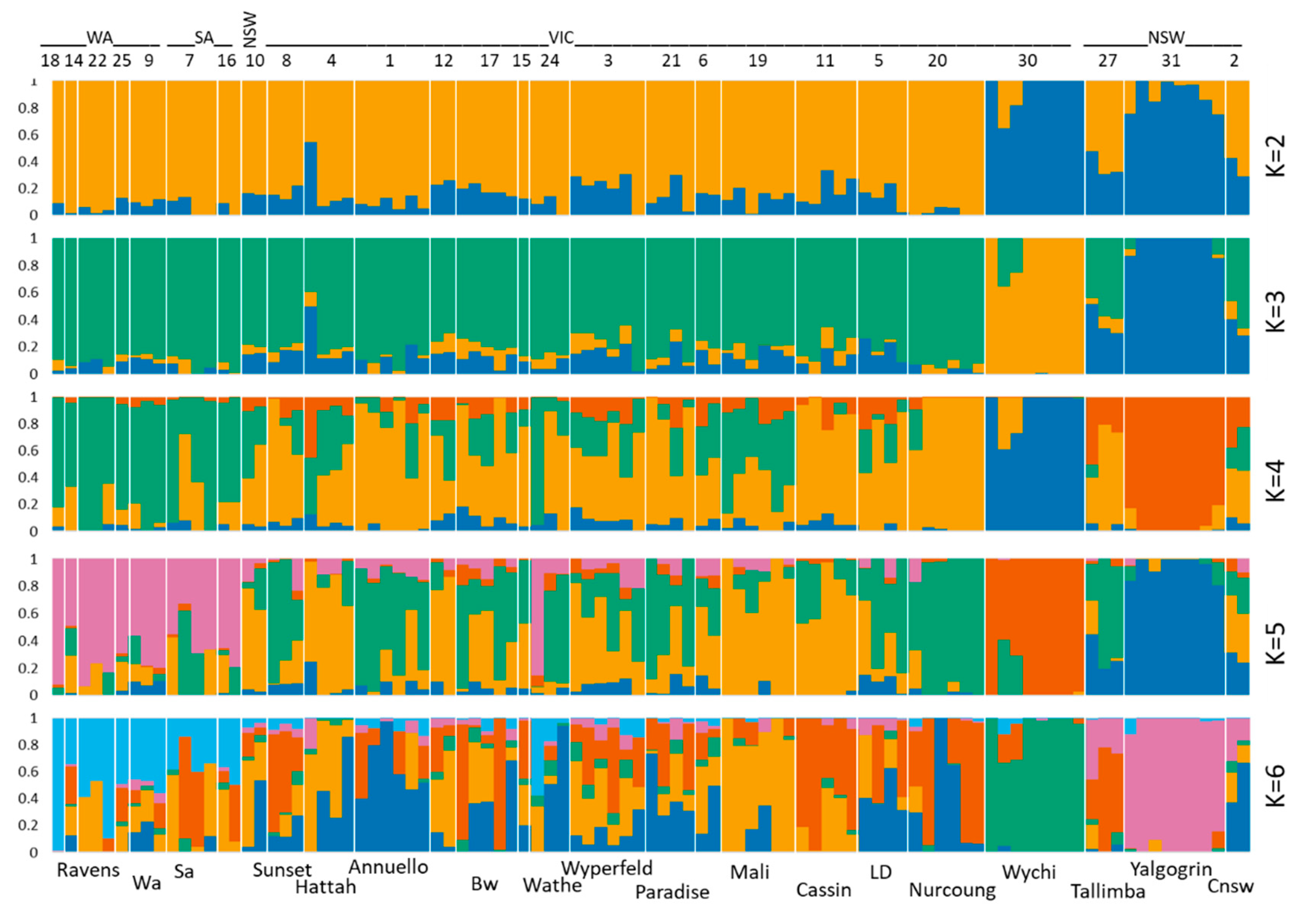
Figure 5.
Histogram of positive king-robust pair-kinship values.
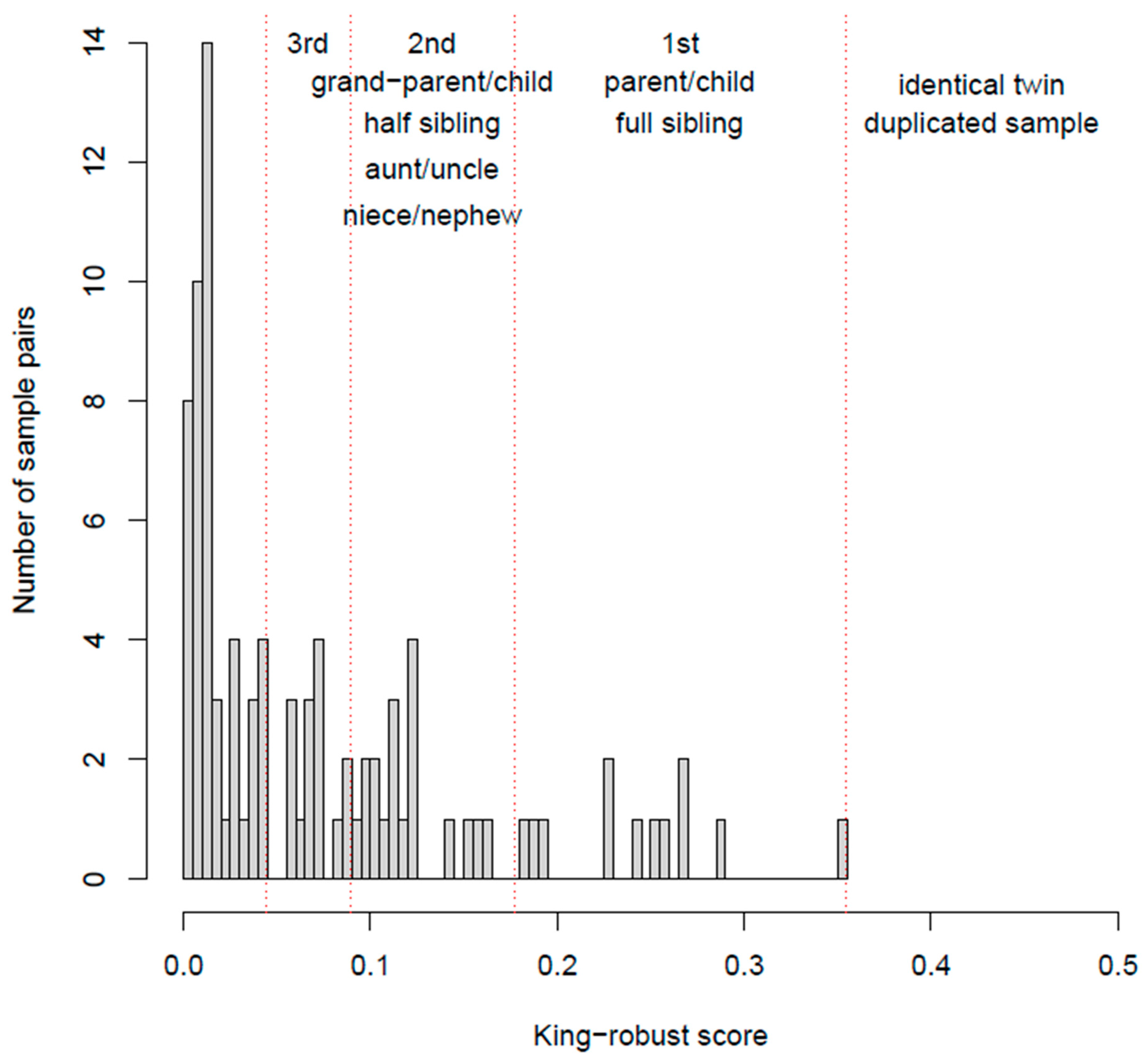

Table 1.
Population codes (used Figure1), names, states, isolation status, per-population sample sizes for 112 individuals with less than half genotypes missing (and–in parentheses–for 94 unique individuals with <20% genotypes missing, excluding potentially mislabelled individuals; this dataset was used for final PCoA and Admixture analysis), estimates of population sizes (see Methods), distance to the closest neighbouring population in kilometers, the number of close-kin pairs (Appendix A3) and mean pair-kinships per population. Extremely small and isolated populations are highlighted in yellow, connected populations in green (landscape codes of connected populations: 9 and 7; 2 and 10; 1, 4 and 8; 3 and 6); populations with moderate connectivity are not highlighted. Asterisks indicate cases with uncertain connectivity and suitability of habitat links.
Table 1.
Population codes (used Figure1), names, states, isolation status, per-population sample sizes for 112 individuals with less than half genotypes missing (and–in parentheses–for 94 unique individuals with <20% genotypes missing, excluding potentially mislabelled individuals; this dataset was used for final PCoA and Admixture analysis), estimates of population sizes (see Methods), distance to the closest neighbouring population in kilometers, the number of close-kin pairs (Appendix A3) and mean pair-kinships per population. Extremely small and isolated populations are highlighted in yellow, connected populations in green (landscape codes of connected populations: 9 and 7; 2 and 10; 1, 4 and 8; 3 and 6); populations with moderate connectivity are not highlighted. Asterisks indicate cases with uncertain connectivity and suitability of habitat links.
| State | Pop Code (Figure 1) | Pop Name | Degree of Isolation | Sample Size | Pop Size Estimate | Km to Closest Neighbour | N of close-Kin pairs | Mean Pair-Kinship |
| NSW | 2 | cnsw | connected | 2 (2) | 1800 | NA | 0.337 | |
| 10 | wnsw | connected | 2 (2) | 1800 | NA | 0.319 | ||
| 27 | tallimba | high | 3 (3) | 2 | 127 | 0.189 | ||
| 31 | yalgogrin | high | 8 (8) | 7 | 97 | 15 | 0.124 | |
| SA | 7 | sa | connected | 5 (4) | 5880 | NA | -0.264 | |
| 16 | munya | medium | 2 (2) | 16 | 15* | 0.248 | ||
| VIC | 1 | annuello | connected | 7 (7) | 2200 | NA | -0.236 | |
| 3 | wyperfeld | connected | 6 (6) | 800 | NA | -0.024 | ||
| 4 | hattah | connected | 3 (3) | 2200 | NA | 0.245 | ||
| 5 | LD | connected | 7 (4) | 40 | NA | -0.383 | ||
| 6 | sBD | connected | 3 (2) | 800 | NA | -0.044 | ||
| 8 | sunset | connected | 3 (3) | 2200 | NA | -0.058 | ||
| 11 | cassin | high | 7 (5) | 5 | 24 | 6 | -0.082 | |
| 12 | cobram | high | 2 (2) | 3 | 8 | 1 | 0.361 | |
| 13 | dennying | high | 1 (0) | 3 | 3 | 0.500 | ||
| 15 | iluka | high | 1 (1) | 2 | 4 | 0.500 | ||
| 17 | bw | medium | 5 (5) | 50 | 2 | 0.000 | ||
| 19 | mali | medium | 8 (6) | 30 | 6 | 1 | -0.048 | |
| 20 | nurcoung | medium | 6 (6) | 20 | 6 | -0.495 | ||
| 21 | paradise | medium | 4 (4) | 15 | 1 | -0.081 | ||
| 24 | wathe | medium | 2 (2) | 15 | 1 | 1 | 0.147 | |
| 30 | wychi | high | 9 (8) | 4 | 136 | 15 | 0.059 | |
| WA | 9 | wa | connected | 4 (3) | 5880 | NA | 0.034 | |
| 14 | fosters | high | 1 (1) | 5 | 34 | 0.500 | ||
| 18 | corack | medium | 2 (1) | 50 | 15 | 0.221 | ||
| 22 | ravens | medium | 5 (3) | 80 | 90* | 2 | -0.081 | |
| 25 | meredin | high | 1 (1) | 5 | 10 | 0.500 |
Table 2.
Decision-support framework for genetic management of fragmented populations under data-limited conditions. The framework integrates key principles from conservation genetics into a structured series of questions and management options that can be applied even when genetic and demographic data are incomplete. Importantly, even limited information—such as fragmentation history, basic genetic structure, or kinship estimates—can provide sufficient evidence to guide decision-making. The approach relies on general, well-supported principles demonstrated across taxa, including the effects of genetic drift, inbreeding, and gene flow on population viability. Rather than requiring comprehensive datasets, the framework enables practitioners to interpolate from theory, empirical studies, and comparative knowledge to evaluate risks and benefits of alternative actions. Across most scenarios, increasing gene flow is considered the default management strategy to reduce inbreeding and enhance adaptive potential, unless there is strong evidence that such interventions would be detrimental (e.g. due to outbreeding depression or important adaptive differentiation).
Table 2.
Decision-support framework for genetic management of fragmented populations under data-limited conditions. The framework integrates key principles from conservation genetics into a structured series of questions and management options that can be applied even when genetic and demographic data are incomplete. Importantly, even limited information—such as fragmentation history, basic genetic structure, or kinship estimates—can provide sufficient evidence to guide decision-making. The approach relies on general, well-supported principles demonstrated across taxa, including the effects of genetic drift, inbreeding, and gene flow on population viability. Rather than requiring comprehensive datasets, the framework enables practitioners to interpolate from theory, empirical studies, and comparative knowledge to evaluate risks and benefits of alternative actions. Across most scenarios, increasing gene flow is considered the default management strategy to reduce inbreeding and enhance adaptive potential, unless there is strong evidence that such interventions would be detrimental (e.g. due to outbreeding depression or important adaptive differentiation).
| Step | Key Question | Evidence / Indicators (even if Limited) |
Example Management Options |
|---|---|---|---|
| 1. Define conservation goals | Are goals focused on persistence vs maintaining “purity” or uniqueness? | Stakeholder priorities, cultural values, threat status, evidence for local adaptation | Persistence-focused: promote gene flow, genetic rescue; Purity-focused: manage separately (acknowledge higher extinction risk); explicitly weigh trade-offs |
| 2. Assess population distinctiveness | Are populations evolutionarily or adaptively distinct? | Genetic markers (genetic distance, non-shared alleles, clustering), phylogeography, morphology, levels of gene flow, ESU assessments | If weak differentiation → consider gene flow; if strong + adaptive differences → consider no or only cautious/targeted mixing; test crosses where feasible |
| 3. Assess reproductive biology & ploidy | Is the species an outbreeding diploid? | Genetic data, life history, mating system, ploidy, comparisons with related taxa | Outbreeding diploid → apply standard framework; if not outbreeding diploid (e.g. inbreeding, asexual or polyploid) → adjust expectations (e.g. reduced inbreeding depression, mate limitation issues) following Frankham et al. 2017 chapter 8, and key examples in Appendix A4 |
| 4. Create strategy for implementation of genetic management | |||
| 4.1 Diagnose genetic problems | For species that are not outbreeding diploids, see Step 3 | ||
| 4.1a Diagnose elevated inbreeding and reduced genetic diversity | Is there evidence of inbreeding or low diversity? | Heterozygosity decline (>10%), inbreeding increase F > 0.1, effective population size Ne < 100 (inbreeding problem) or < 1000 (adaptation problem), kinship increase, sex-ratio distortions, fragmentation history (proxy) | If yes → consider genetic augmentation or rescue and/or restoring connectivity; if no → monitor but pre-emptively maintain connectivity |
| 4.1b Diagnose altered connectivity | Are dispersal and gene flow reduced, spatial-genetic patterns disrupted, or are populations fragmented? | Reduced gene flow or dispersal estimates for one or both sexes, elevated kinship, stronger genetic structure (genetic distance, PCoA, admixture, spatial-genetic autocorrelation, altered association with habitat), demographic decline, landscape fragmentation | Habitat restoration; corridors/stepping-stones; assisted gene flow / translocations if restoring natural connectivity not feasible |
| 4.1c Diagnose reduced adaptive potential | Is there any reason that increased adaptive capacity would not be beneficial? | Genetic diversity and inbreeding data, climate projections, environmental change, population decline trends | Default: increase diversity via gene flow; consider climate-adjusted sourcing if relevant |
| 4.2 Scope source populations | Are suitable donor populations available? | Genetic diversity levels, population size, absence of bottlenecks; genetic difference from target recipient population including presence of unique alleles | Use larger or less inbred populations; prioritise sources with higher diversity or novel variation |
| 4.3 Assess risk that management interventions will cause outbreeding depression, loss of local adaptation, or other consequences counter to conservation goals | |||
| 4.3a Assess risk of outbreeding depression | Is there evidence that mixing populations may reduce fitness? | Past gene flow success, experimental crosses, ecological differentiation, time since divergence | If low risk, proceed; if uncertain, apply cautious mixing, staged or experimental translocations; weigh risks vs benefits. For species that are not outbreeding diploids, see Step 3 |
| 4.3b Assess risk of genetic swamping | Could mixing homogenise distinct populations? | Relative population sizes, dispersal rates, migration rates | Use controlled gene flow (small, repeated inputs); adaptive management to maintain differentiation if desired |
| 4.4 Evaluate benefit–risk | |||
| 4.4a Benefit–risk of gene flow to the recipient population | Are the biological benefits of intervention greater than risks? | PVA (genetic/demographic), estimates of inbreeding depression, extinction risk | If high extinction risk, intervene; if low risk, monitor; consider that moderate outbreeding depression may be acceptable if rescue benefits outweigh it within the management timeframe |
| 4.4b Cost-benefit of interventions | Are interventions feasible and justified? | Cost, effort, logistics, stakeholder support | Prioritise populations with highest risk and highest expected benefit |
| 4.5 Implement and monitor | |||
| 4.5a Implementation strategy | How should gene flow be implemented? | Species biology, dispersal, reproduction, disease risk | Translocations, assisted migration, staged introductions, mixing at breeding sites, experimental designs |
| Can natural connectivity be restored? | Habitat condition, landscape barriers, cost and availability of land | Prefer habitat restoration where possible; use translocations as supplement or interim solution | |
| Which individuals, how many, how often? | Population size (N), estimated Ne/N, inbreeding levels, availability of individuals | Small but repeated gene flow is often effective; simple models (e.g. proportion of migrants needed) can be used, or more sophisticated ones | |
| 4.5b Monitoring and adaptive management | Are outcomes monitored and feedback incorporated? | Genetic monitoring (diversity, kinship), demographic trends, fitness measures | Adaptive management: adjust gene flow intensity, source choice and timing based on outcomes |
Disclaimer/Publisher’s Note: The statements, opinions and data contained in all publications are solely those of the individual author(s) and contributor(s) and not of MDPI and/or the editor(s). MDPI and/or the editor(s) disclaim responsibility for any injury to people or property resulting from any ideas, methods, instructions or products referred to in the content. |
© 2026 by the authors. Licensee MDPI, Basel, Switzerland. This article is an open access article distributed under the terms and conditions of the Creative Commons Attribution (CC BY) license (http://creativecommons.org/licenses/by/4.0/).
Copyright: This open access article is published under a Creative Commons CC BY 4.0 license, which permit the free download, distribution, and reuse, provided that the author and preprint are cited in any reuse.


