
Submitted:
05 June 2026
Posted:
08 June 2026
You are already at the latest version
Abstract
The ultra-sensitive heavy oil reservoirs are characterized by high crude oil viscosity, poor fluidity, high clay content, and loose cementation, leading to easy blockage of pore throats by oil-sand sludge during development. The shengli jinjia oilfield, with a permeability ranging from 300 to 1470mD, has encountered prominent issues such as difficulties in injection, displacement, and production when employing various development methods including water flooding and thermal recovery. To address these challenges, we have designed a series of systems, including a functional microbial-mineral modified desensitization-chemical viscosity reduction dual-effect agent, a self-growing gel dispersant for mobility control in injection-production processes, and a high-temperature-resistant, low-molecular-weight polymer-based nano-SiO₂ sensitivity-inhibiting clay stabilizer for injection-production operations. Additionally, a low-damage deep acidizing system has been developed for blocked pore throats, and for near-wellbore mud cake blockages, a non-sensitive, highly conductive, graded sand-retaining artificial wellbore has been established through mixed flushing, thereby enhancing the flow area. The mechanisms of enhanced oil recovery through biological-chemical desensitization and viscosity reduction have been elucidated. Laboratory experimental results demonstrate that mineral-modified bacteria significantly inhibit clay swelling by promoting the conversion of montmorillonite to illite through the reduction of structural iron, achieving a swelling prevention rate of up to 62%. Functional chemical viscosity reduction enables the heavy oil to flow effectively, while the self-growing gel dispersant, after dispersion and migration, stably adsorbs onto particle surfaces, blocking large pore channels and exhibiting strong resistance to erosion, thereby inhibiting channeling flow. The novel composite oil recovery and displacement systems demonstrate synergistic effects in biological-chemical desensitization and viscosity reduction, mobility control, and operational sensitivity inhibition, achieving an oil recovery rate of 46.5%, which represents a 26.3% increase compared to the conversion from water flooding to biological-chemical viscosity reduction flooding. After switching from water flooding to biological-chemical desensitization and viscosity reduction combined flooding in two experimental well groups in the jinjia oilfield, the oil production capacity of individual wells increased by 2.8 times, and the water cut decreased by 12 percentage, significantly improving development effectiveness and economic benefits. This transformation from "increased water production without increased oil production" during the water flooding stage to "increased fluid production with increased oil production" has been realized, providing valuable insights for the low-cost development of ultra-sensitive reservoirs.
Keywords:
Ultra-sensitive
; heavy oil reservoir
; biological-chemical desensitization and viscosity reduction
; oil displacement mechanism
; mobility control
; synergistic application
1. Introduction
Relapsed or refractory (R/R) non-Hodgkin lymphoma (NHL) continues to represent a major therapeutic challenge despite substantial advances in frontline immunochemotherapy and transplantation strategies. Although salvage chemotherapy followed by autologous stem cell transplantation (ASCT) remains the standard treatment approach for transplant-eligible patients [1], outcomes remain suboptimal [2], particularly among those with primary refractory disease, early relapse, or biologically aggressive histologic subtypes. Achieving adequate disease control before ASCT has consistently been recognized as one of the most important prognostic factors associated with long-term survival in aggressive lymphomas [3].
Several platinum- or ifosfamide-based salvage regimens, including ICE (ifosfamide, carboplatin, etoposide), DHAP (dexamethasone, cytarabine, cisplatin), GDP (gemcitabine, dexamethasone, cisplatin), and ESHAP (etoposide, methylprednisolone, cytarabine, cisplatin), have been extensively used in the management of R/R NHL [2,4]. Although these regimens can achieve meaningful response rates, they are frequently associated with considerable hematologic toxicity, infectious complications, hospitalization requirements, and inconsistent stem cell mobilization outcomes. In addition, no universally accepted salvage standard currently exists across the heterogeneous spectrum of NHL subtypes [5].
Peripheral T-cell lymphomas (PTCL) constitute a particularly aggressive subgroup of NHL characterized by poor prognosis, frequent chemoresistance, and inferior survival compared with aggressive B-cell lymphomas. Salvage treatment options for PTCL remain limited, and durable remissions are difficult to achieve even in transplant-eligible patients [6]. Consequently, there is an ongoing need for effective and tolerable salvage regimens capable of inducing rapid disease control while preserving transplant feasibility [7].
The BEGEV regimen, consisting of bendamustine, gemcitabine, vinorelbine, and prednisolone, was initially developed as a salvage strategy for relapsed/refractory classical Hodgkin lymphoma [8]. Importantly, several components of the regimen, particularly bendamustine- and gemcitabine-based combinations, have independently demonstrated meaningful activity in relapsed/refractory NHL across both B-cell and selected T-cell lymphoma subtypes [4,9,10]. In addition to antitumor efficacy, these approaches have attracted interest because of their relatively manageable toxicity profiles and potential feasibility before stem cell transplantation. Previous studies of BEGEV in Hodgkin lymphoma also demonstrated high complete response rates, favorable stem cell mobilization outcomes, and acceptable tolerability [8]. However, evidence regarding the efficacy of BEGEV specifically in NHL, particularly in PTCL, remains extremely limited.
Given the limited available data and the biological rationale supporting bendamustine- and gemcitabine-based salvage approaches, we retrospectively evaluated the real-world efficacy, safety, transplantation outcomes, and survival results of the BEGEV regimen in patients with relapsed/refractory NHL treated at our institution, including an exploratory analysis of PTCL patients.
2. Methods
2.1. Study Design and Patients
This retrospective single-center study included 68 consecutive adult patients with R/R NHL who received the BEGEV regimen as salvage therapy at our institution. Eligible patients had histologically confirmed NHL according to the World Health Organization classification and had experienced either relapsed or refractory disease following at least one prior line of systemic therapy.
Clinical, pathological, and treatment-related data were retrospectively collected from institutional electronic medical records. Baseline characteristics included age, sex, Eastern Cooperative Oncology Group (ECOG) performance status, histologic subtype, Ann Arbor stage, bulky disease, extranodal involvement, bone marrow infiltration, lactate dehydrogenase (LDH) levels, International Prognostic Index (IPI), Prognostic Index for T-cell lymphoma (PIT), CD20 expression, ALK status, and double-hit/triple-hit biology when available.
2.2. Treatment Protocol
The BEGEV regimen consisted of bendamustine 90 mg/m² on days 2 and 3, gemcitabine 800 mg/m² on days 1 and 4, vinorelbine 20 mg/m² on day 1, and prednisolone 100 mg on days 1–4. Treatment cycles were repeated every 21 days when clinically appropriate [8]. Dose modifications were performed according to hematologic and non-hematologic toxicities. Supportive care included granulocyte colony-stimulating factor (G-CSF), antimicrobial prophylaxis, and transfusion support when clinically indicated. Hospitalization decisions were made at the discretion of the treating physician.
Patients achieving adequate disease control following salvage therapy were considered eligible for ASCT or allogeneic stem cell transplantation according to institutional transplantation criteria and overall clinical evaluation.
2.3. Response Assessment and Toxicity Evaluation
Treatment response was assessed using positron emission tomography/computed tomography (PET/CT) according to the Lugano 2014 classification criteria [11]. Responses were categorized as complete response (CR), partial response (PR), stable disease (SD), or progressive disease (PD).
Adverse events occurring during BEGEV administration were retrospectively evaluated and graded according to the Common Terminology Criteria for Adverse Events (CTCAE) version 5.0 (National Cancer Institute, 2017). Hematologic and non-hematologic toxicities were analyzed descriptively.
2.4. Study Endpoints
The primary endpoint of the study was the objective response rate (ORR), defined as the proportion of patients achieving complete response (CR) or partial response (PR) according to the Lugano 2014 classification criteria following BEGEV therapy. Secondary endpoints included CR and PR rates reported separately; progression-free survival (PFS) and overall survival (OS), including median survival estimates and 12- and 24-month survival rates; transplantation feasibility and outcomes following autologous or allogeneic stem cell transplantation; and the incidence of grade ≥3 hematologic and infectious adverse events, including febrile neutropenia. Exploratory subgroup analyses were performed according to lymphoma subtype (DLBCL vs. PTCL), prior bendamustine exposure, and line of BEGEV administration. ORR and response component rates were summarized with corresponding 95% confidence intervals (CI).
2.5. Statistical Analysis
Descriptive statistics were used to summarize baseline characteristics, treatment responses, transplantation outcomes, and toxicity data.
Progression-free survival (PFS) was calculated from the initiation of BEGEV therapy to disease progression, relapse, or death from any cause. Overall survival (OS) was calculated from BEGEV initiation until death from any cause or last follow-up. Survival curves were estimated using the Kaplan–Meier method and compared using the log-rank test. Median survival estimates were reported with corresponding 95% confidence intervals (CI) when applicable. A p-value <0.05 was considered statistically significant. Statistical analyses were performed using IBM SPSS Statistics software (IBM Corp., Armonk, NY, USA).
2.6. Ethics Statement
This retrospective study was approved by the Acıbadem Mehmet Ali Aydınlar University Medical Research Ethics Committee (ATADEK) (Approval No: 2026-06/61; Date: March 26, 2026). The study was conducted in accordance with the principles of the Declaration of Helsinki. Due to the retrospective design of the study, the requirement for informed consent was waived by the ethics committee.
3. Results
A total of 68 patients with relapsed/refractory non-Hodgkin lymphoma (R/R NHL) treated with the BEGEV regimen were included in the analysis. The median age at BEGEV initiation was 55.5 years (range, 20–81), and 43 patients (63.2%) were male. Histologic subtypes were predominantly aggressive B-cell lymphomas, including diffuse large B-cell lymphoma (DLBCL) and high-grade B-cell lymphoma variants, followed by follicular lymphoma and peripheral T-cell lymphoma subtypes. Among patients with available data, most presented with advanced-stage disease, with stage III–IV disease documented in 41 of 57 evaluable patients (71.9%). Bulky disease was present in 27 of 59 evaluable patients (45.8%). ECOG performance status was 0–1 in 36 of 51 patients with available ECOG data (70.6%). Baseline demographic, clinical, and disease characteristics are summarized in Table 1.
Among patients with available prognostic data, most B-cell lymphoma patients had intermediate- or high-risk disease according to the International Prognostic Index (IPI). Treatment exposure before BEGEV initiation was heterogeneous and reflected the cohort’s heavily pretreated nature. Most patients had previously received anthracycline-based frontline immunochemotherapy, predominantly R-CHOP- or CHOEP-like regimens.
BEGEV was administered mainly in later salvage settings, most commonly as third-line therapy. Specifically, the regimen was used as second-line therapy in 1 patient (1.5%), third-line therapy in 53 patients (77.9%), fourth-line therapy in 11 patients (16.2%), and fifth-line or later therapy in 3 patients (4.4%). Previous salvage regimens most frequently included ESHAP-based approaches, followed by GEMOX-, DHAP-, and ICE-based regimens. Several patients had also previously received bendamustine-containing therapies, lenalidomide-based regimens, brentuximab vedotin, radiotherapy, and prior autologous stem cell transplantation.
Response assessments were available in 56 patients. The overall response rate (ORR) was 73.2% (41/56), including complete response (CR) in 29 patients (51.8%) and partial response (PR) in 12 patients (21.4%). Stable disease (SD) and progressive disease (PD) were observed in 5 patients (8.9%) and 10 patients (17.9%), respectively. Response evaluation was unavailable in the remaining 12 patients because of incomplete radiologic assessment or insufficient retrospective follow-up data. Detailed treatment response outcomes are summarized in Table 2.
Following BEGEV therapy, 25 patients (36.8%) were successfully bridged to autologous stem cell transplantation (ASCT). Subsequently, 8 patients (11.8%) underwent allogeneic stem cell transplantation, including several who had previously received ASCT. Overall, 30 unique patients proceeded to at least one transplantation procedure after BEGEV therapy. Patients bridged to allogeneic transplantation generally achieved CR or PR following BEGEV, supporting the regimen’s ability to provide clinically meaningful disease control even in highly refractory disease. Detailed patient flow and transplantation trajectories following BEGEV therapy are illustrated in Figure 1.
For survival analyses stratified by post-BEGEV transplantation status, patients with heterogeneous prior allo-SCT pathways or with uncertain transplant documentation were excluded to maintain analytical consistency. Overall, 6 patients were excluded from comparative transplantation survival analyses for these reasons. Comparative survival analyses were therefore performed in 62 evaluable patients with clearly documented transplantation and follow-up data. Median progression-free survival (PFS) was 4 months, while median overall survival (OS) was 26 months. Estimated 12-month and 24-month OS rates for the entire cohort were 81.5% and 52.8%, respectively. Estimated 12-month and 24-month PFS rates were 17.6% and 13.2%, respectively. Patients who underwent transplantation following BEGEV demonstrated significantly improved survival outcomes compared with non-transplanted patients. Post-BEGEV transplantation was associated with superior overall survival (log-rank p = 0.012) and progression-free survival (log-rank p = 0.011) (Figure 2A–B). Kaplan–Meier analyses for the entire cohort are presented in Figure 2C–D.
Treatment-related adverse events were predominantly hematologic and generally manageable. The most frequently observed toxicities included neutropenia, febrile neutropenia, anemia, thrombocytopenia, nausea/vomiting, mucositis, infectious complications, and fever. Febrile neutropenia and cytopenias represented the most clinically significant adverse events. Four deaths occurred during follow-up in temporal association with treatment. These events generally occurred in the setting of advanced progressive disease and infectious complications. However, due to the retrospective study design and the cohort's advanced disease status, definitive attribution to treatment-related toxicity could not be established. Treatment-related adverse events are summarized in Table 3.
Overall, BEGEV demonstrated substantial antitumor activity with a manageable safety profile in this heavily pretreated R/R NHL cohort. The regimen enabled successful bridging to ASCT in a considerable proportion of patients and facilitated allogeneic transplantation in selected high-risk cases.
Adverse events were graded according to the Common Terminology Criteria for Adverse Events, version 5.0 (CTCAE v5.0). Patients may have experienced multiple adverse events and/or more than one toxicity grade during treatment. Treatment-related attribution could not be definitively established for all grade 5 events because of the retrospective nature of the study.
4. Discussion
In this retrospective real-world study, the BEGEV regimen demonstrated clinically meaningful activity with a manageable safety profile in patients with relapsed/refractory non-Hodgkin lymphoma treated across multiple lines of salvage therapy. Despite the heterogeneous and heavily pretreated nature of the cohort, BEGEV achieved a favorable overall response rate and enabled successful bridging to stem cell transplantation in a considerable proportion of patients. In addition, patients proceeding to transplantation demonstrated significantly improved survival outcomes, further supporting the potential role of BEGEV as a bridge-to-transplant strategy in appropriately selected transplant-eligible patients.
Salvage treatment in relapsed/refractory NHL remains challenging, particularly in patients with primary refractory disease, early relapse, aggressive histologic subtypes, or prior exposure to intensive chemotherapy. Although platinum- and ifosfamide-based regimens such as ICE, DHAP, GDP, and ESHAP continue to be widely used in clinical practice, these approaches are frequently associated with substantial hematologic toxicity, infectious complications, hospitalization requirements, and variable stem cell mobilization outcomes [12,13,14]. In this setting, bendamustine- and gemcitabine-containing combinations have attracted growing interest because of their relatively favorable balance between efficacy and tolerability. Nevertheless, clinical data specifically evaluating BEGEV in NHL remain extremely limited, particularly outside the Hodgkin lymphoma setting [14,15].
The efficacy outcomes observed in our cohort appear clinically relevant in light of the adverse baseline characteristics and heavily pretreated nature of the study population. Most patients had advanced-stage disease, extranodal involvement, elevated LDH levels, and multiple prior treatment exposures before BEGEV initiation. Despite these unfavorable features, BEGEV achieved an ORR exceeding 70%, with more than half of evaluable patients achieving complete remission. This response pattern compares favorably with several reported salvage approaches in R/R aggressive NHL, particularly considering that most patients in our cohort received BEGEV beyond the second-line setting [16,17]. Importantly, a substantial proportion of patients proceeded to transplantation, supporting the feasibility of BEGEV as a cytoreductive bridge before definitive consolidation therapy [18].
One of the most notable findings of the present study was the significant survival advantage observed among transplanted patients. Kaplan–Meier analyses demonstrated superior overall survival and progression-free survival in patients who successfully proceeded to transplantation following BEGEV therapy. Although this observation likely reflects both treatment responsiveness and transplant eligibility, it further supports the clinical utility of BEGEV as a bridge-to-transplant strategy capable of achieving sufficient disease control before definitive consolidation therapy. These findings are particularly relevant given that pre-transplant metabolic remission, especially PET negativity before ASCT, has consistently been associated with improved long-term survival outcomes in aggressive lymphomas [3,19,20].
Another clinically important aspect of our study was the inclusion of patients with PTCL, a subgroup historically associated with poor outcomes, frequent chemoresistance, and limited salvage treatment options. Although the PTCL cohort in our study was relatively small and exploratory in nature, several patients achieved clinically meaningful responses following BEGEV therapy. While definitive conclusions cannot be drawn because of the limited sample size and cohort heterogeneity, these observations may suggest potential activity of BEGEV in selected PTCL patients and support further investigation of bendamustine- and gemcitabine-based approaches in this particularly challenging disease setting [6,7,21].
The toxicity profile observed in our cohort was generally manageable and broadly consistent with the known safety characteristics of bendamustine- and gemcitabine-based salvage regimens [22,23]. Hematologic toxicities, particularly neutropenia and febrile neutropenia, represented the most clinically significant adverse events. Nevertheless, no unexpected toxicity signals were identified, and the overall safety profile appeared acceptable in the context of salvage therapy for aggressive lymphoma. Importantly, the regimen remained feasible in routine clinical practice and did not appear to compromise subsequent transplantation strategies in responding patients.
4.1. Limitations
This study has several limitations, primarily related to its retrospective single-center design and the relatively heterogeneous patient population. The inclusion of multiple lymphoma subtypes and patients treated across different salvage lines may have influenced treatment outcomes and limited subgroup comparisons. In addition, the PTCL subgroup was relatively small, precluding definitive conclusions regarding efficacy in this setting.
Some prognostic variables were unavailable in a subset of patients because of the retrospective nature of data collection. Furthermore, patients proceeding to transplantation likely represented a more favorable subgroup with better treatment response and performance status, which may have contributed to the observed survival advantage in transplanted patients. Finally, attribution of certain grade 5 events to treatment-related toxicity versus disease progression could not always be clearly distinguished during retrospective review.
5. Conclusion
In conclusion, BEGEV appears to be an effective and feasible salvage regimen in patients with relapsed/refractory NHL, demonstrating meaningful response rates, manageable toxicity, and favorable transplantation feasibility in routine clinical practice. The significant survival advantage observed among transplanted patients further supports the clinical utility of BEGEV before stem cell transplantation. In addition, the exploratory activity observed in PTCL patients is clinically noteworthy given the limited treatment options available in this setting.
Although prospective validation remains necessary, our findings provide real-world evidence supporting the use of BEGEV in both B-cell and selected T-cell lymphomas and suggest that this regimen may represent a valuable salvage option in heavily pretreated patients.
Ethics Statement
The study was conducted in accordance with the Declaration of Helsinki and approved by the institutional ethics committee.
Funding
No external funding was received for this study.
Data Availability Statement
The datasets generated and/or analyzed during the current study are available from the corresponding author on reasonable request.
Conflicts of Interest
The authors declare no conflict of interest.
References
- Philip, T.; Guglielmi, C.; Hagenbeek, A.; Somers, R.; Van Der Lelie, H.; Bron, D.; et al. Autologous bone marrow transplantation as compared with salvage chemotherapy in relapses of chemotherapy-sensitive non-Hodgkin's lymphoma. N. Engl. J. Med. 1995, 333(23), 1540–5. [Google Scholar] [CrossRef]
- Gisselbrecht, C.; Glass, B.; Mounier, N.; Singh Gill, D.; Linch, D.C.; Trneny, M.; et al. Salvage regimens with autologous transplantation for relapsed large B-cell lymphoma in the rituximab era. J. Clin. Oncol. 2010, 28(27), 4184–90. [Google Scholar] [CrossRef]
- Sauter, C.S.; Matasar, M.J.; Meikle, J.; Schoder, H.; Ulaner, G.A.; Migliacci, J.C.; et al. Prognostic value of FDG-PET prior to autologous stem cell transplantation for relapsed and refractory diffuse large B-cell lymphoma. Blood J. Am. Soc. Hematol. 2015, 125(16), 2579–81. [Google Scholar] [CrossRef]
- Crump, M.; Kuruvilla, J.; Couban, S.; MacDonald, D.A.; Kukreti, V.; Kouroukis, C.T.; et al. Randomized comparison of gemcitabine, dexamethasone, and cisplatin versus dexamethasone, cytarabine, and cisplatin chemotherapy before autologous stem-cell transplantation for relapsed and refractory aggressive lymphomas: NCIC-CTG LY. J. Clin. Oncol. 2014, 32(31), 3490–6. [Google Scholar] [CrossRef] [PubMed]
- Czyż, A. Progress in the diagnosis and treatment of diffuse large B-cell lymphoma—State of the art. Acta Haematol. Pol. 2025, 87–95. [Google Scholar] [CrossRef]
- Mak, V.; Hamm, J.; Chhanabhai, M.; Shenkier, T.; Klasa, R.; Sehn, L.H.; et al. Survival of patients with peripheral T-cell lymphoma after first relapse or progression: spectrum of disease and rare long-term survivors. J. Clin. Oncol. 2013, 31(16), 1970–6. [Google Scholar] [CrossRef] [PubMed]
- Moskowitz, A.J.; Stuver, R.N.; Horwitz, S.M. Current and upcoming treatment approaches to common subtypes of PTCL (PTCL, NOS; ALCL; and TFHs). Blood 2024, 144(18), 1887–97. [Google Scholar] [CrossRef]
- Santoro, A.; Mazza, R.; Pulsoni, A.; Re, A.; Bonfichi, M.; Zilioli, V.R.; et al. Bendamustine in combination with gemcitabine and vinorelbine is an effective regimen as induction chemotherapy before autologous stem-cell transplantation for relapsed or refractory Hodgkin lymphoma: final results of a multicenter phase II study. J. Clin. Oncol. 2016, 34(27), 3293–9. [Google Scholar] [CrossRef]
- Damaj, G.; Gressin, R.; Bouabdallah, K.; Cartron, G.; Choufi, B.; Gyan, E.; et al. Results from a prospective, open-label, phase II trial of bendamustine in refractory or relapsed T-cell lymphomas: the BENTLY trial. J. Clin. Oncol. 2013, 31(1), 104–10. [Google Scholar] [CrossRef]
- Ohmachi, K.; Niitsu, N.; Uchida, T.; Kim, S.J.; Ando, K.; Takahashi, N.; et al. Multicenter phase II study of bendamustine plus rituximab in patients with relapsed or refractory diffuse large B-cell lymphoma. J. Clin. Oncol. 2013, 31(17), 2103–9. [Google Scholar] [CrossRef] [PubMed]
- Cheson, B.D.; Fisher, R.I.; Barrington, S.F.; Cavalli, F.; Schwartz, L.H.; Zucca, E.; et al. Recommendations for initial evaluation, staging, and response assessment of Hodgkin and non-Hodgkin lymphoma: the Lugano classification. J. Clin. Oncol. 2014, 32(27), 3059–67. [Google Scholar] [CrossRef]
- Frontzek, F.; Karsten, I.; Schmitz, N.; Lenz, G. Current options and future perspectives in the treatment of patients with relapsed/refractory diffuse large B-cell lymphoma. Ther. Adv. Hematol. 2022, 13, 20406207221103321. [Google Scholar] [CrossRef]
- Phillips, T.; Zhou, Z.; Gutierrez, C.; Shao, A.; Boyd, M.; Noshad, S.; et al. Real-world treatment patterns and characteristics of patients with diffuse large B-cell lymphoma (DLBCL): a retrospective analysis of US commercial and Medicare claims (2017–2024). Leuk. Lymphoma 2026, 1–11. [Google Scholar] [CrossRef]
- Gong, I.Y.; Kuruvilla, J. Management of relapsed/refractory DLBCL in the era of novel agents and new approaches. Leuk. Lymphoma 2026, 1–29. [Google Scholar] [CrossRef] [PubMed]
- Stefoni, V.; Argnani, L.; Carella, M.; Casadei, B.; Morigi, A.; Lolli, G.; et al. BEGEV salvage regimen in relapsed/refractory classical Hodgkin lymphoma: a real-life experience. J. Cancer Res. Clin. Oncol. 2023, 149(3), 1043–7. [Google Scholar] [CrossRef]
- Kim, J.; Cho, J.; Yoon, S.E.; Kim, W.S.; Kim, S.J. Efficacy of salvage treatments in relapsed or refractory diffuse large B-cell lymphoma including chimeric antigen receptor T-cell therapy: a systematic review and meta-analysis. Cancer Res. Treat. Off. J. Korean Cancer Assoc. 2023, 55(3), 1031–47. [Google Scholar] [CrossRef] [PubMed]
- Sehn, L.H.; Hertzberg, M.; Opat, S.; Herrera, A.F.; Assouline, S.; Flowers, C.R.; et al. Polatuzumab vedotin plus bendamustine and rituximab in relapsed/refractory DLBCL: survival update and new extension cohort data. Blood Adv. 2022, 6(2), 533–43. [Google Scholar] [CrossRef]
- Yagi, Y.; Kanemasa, Y.; Sasaki, Y.; Sei, M.; Matsuo, T.; Ishimine, K.; et al. Clinical outcomes in transplant-eligible patients with relapsed or refractory diffuse large B-cell lymphoma after second-line salvage chemotherapy: A retrospective study. Cancer Med. 2023, 12(17), 17808–21. [Google Scholar] [CrossRef] [PubMed]
- Sugio, T.; Baba, S.; Mori, Y.; Yoshimoto, G.; Kamesaki, K.; Takashima, S.; et al. Prognostic value of pre-transplantation total metabolic tumor volume on 18fluoro-2-deoxy-d-glucose positron emission tomography–computed tomography in relapsed and refractory aggressive lymphoma. Int. J. Hematol. 2022, 116(4), 603–11. [Google Scholar] [CrossRef]
- Ulaner, G.A.; Goldman, D.A.; Sauter, C.S.; Migliacci, J.; Lilienstein, J.; Gönen, M.; et al. Prognostic value of FDG PET/CT before allogeneic and autologous stem cell transplantation for aggressive lymphoma. Radiology 2015, 277(2), 518–26. [Google Scholar] [CrossRef]
- Bellei, M.; Foss, F.M.; Shustov, A.R.; Horwitz, S.M.; Marcheselli, L.; Kim, W.S.; et al. The outcome of peripheral T-cell lymphoma patients failing first-line therapy: a report from the prospective, International T-Cell Project. Haematologica 2018, 103(7), 1191. [Google Scholar] [CrossRef] [PubMed]
- Lachance, S.; Bourguignon, A.; Boisjoly, J.-A.; Bouchard, P.; Ahmad, I.; Bambace, N.; et al. Impact of implementing a bendamustine-based conditioning regimen on outcomes of autologous stem cell transplantation in lymphoma while novel cellular therapies emerge. Transplant. Cell. Ther. 2023, 29(1), 34. e1–e7. [Google Scholar] [CrossRef] [PubMed]
- Vacirca, J.L.; Acs, P.I.; Tabbara, I.A.; Rosen, P.J.; Lee, P.; Lynam, E. Bendamustine combined with rituximab for patients with relapsed or refractory diffuse large B cell lymphoma. Ann. Hematol. 2014, 93(3), 403–409. [Google Scholar] [CrossRef] [PubMed]
Figure 1.
Patient flow and transplantation trajectories following BEGEV therapy in 68 patients with relapsed/refractory non-Hodgkin lymphoma (R/R NHL). Twenty-five patients were successfully bridged to autologous stem cell transplantation (ASCT) following BEGEV therapy, including 3 patients who subsequently proceeded to allogeneic stem cell transplantation (allo-SCT). An additional 5 patients with prior ASCT later underwent allo-SCT after BEGEV therapy. Overall, 8 patients underwent allo-SCT.
Figure 1.
Patient flow and transplantation trajectories following BEGEV therapy in 68 patients with relapsed/refractory non-Hodgkin lymphoma (R/R NHL). Twenty-five patients were successfully bridged to autologous stem cell transplantation (ASCT) following BEGEV therapy, including 3 patients who subsequently proceeded to allogeneic stem cell transplantation (allo-SCT). An additional 5 patients with prior ASCT later underwent allo-SCT after BEGEV therapy. Overall, 8 patients underwent allo-SCT.
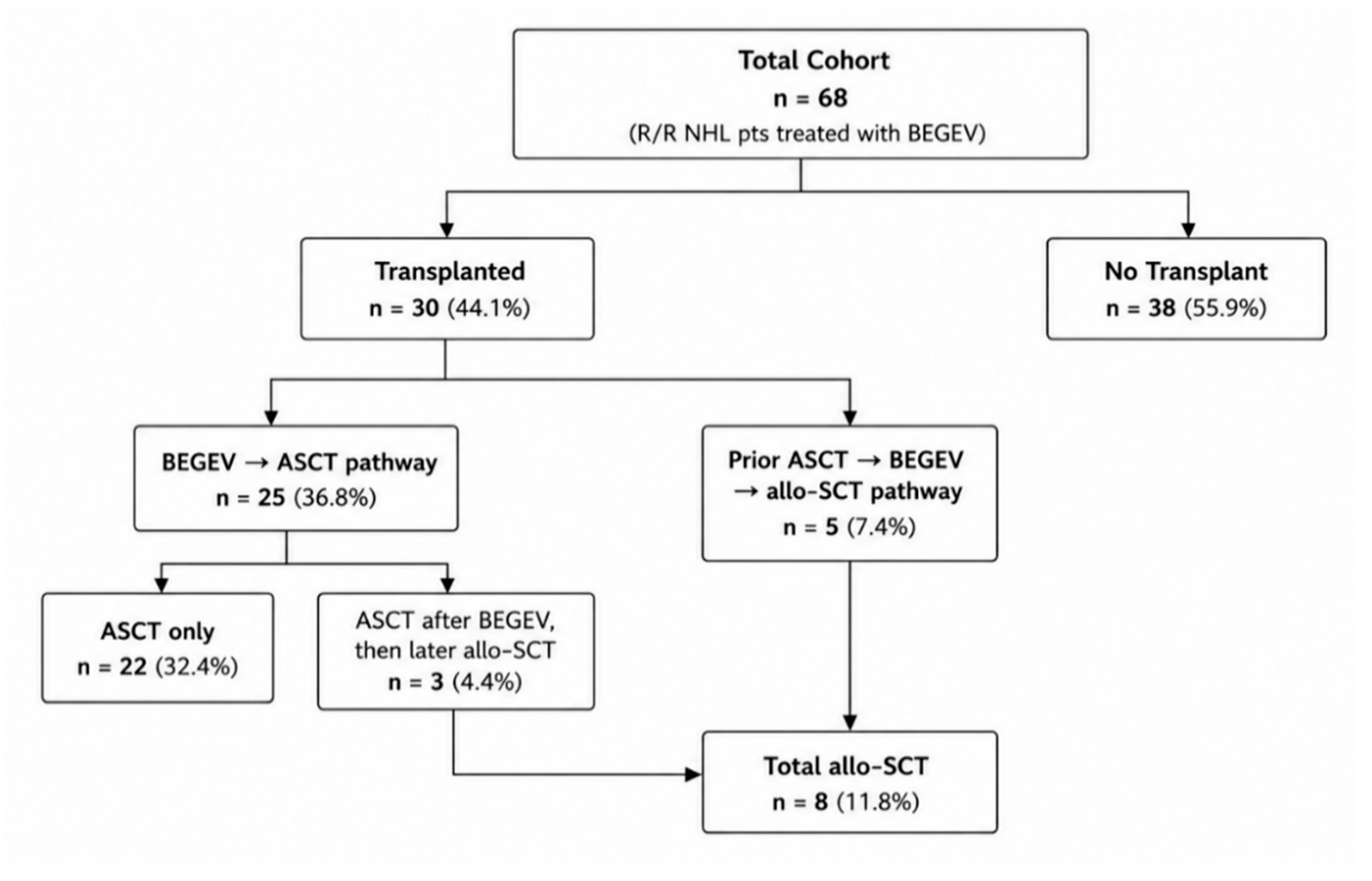
Figure 2.
Kaplan–Meier survival analyses following BEGEV therapy. (A) Overall survival (OS) according to post-BEGEV transplantation status. (B) Progression-free survival (PFS) according to post-BEGEV transplantation status. (C) OS for the entire cohort. (D) PFS for the entire cohort.
Figure 2.
Kaplan–Meier survival analyses following BEGEV therapy. (A) Overall survival (OS) according to post-BEGEV transplantation status. (B) Progression-free survival (PFS) according to post-BEGEV transplantation status. (C) OS for the entire cohort. (D) PFS for the entire cohort.
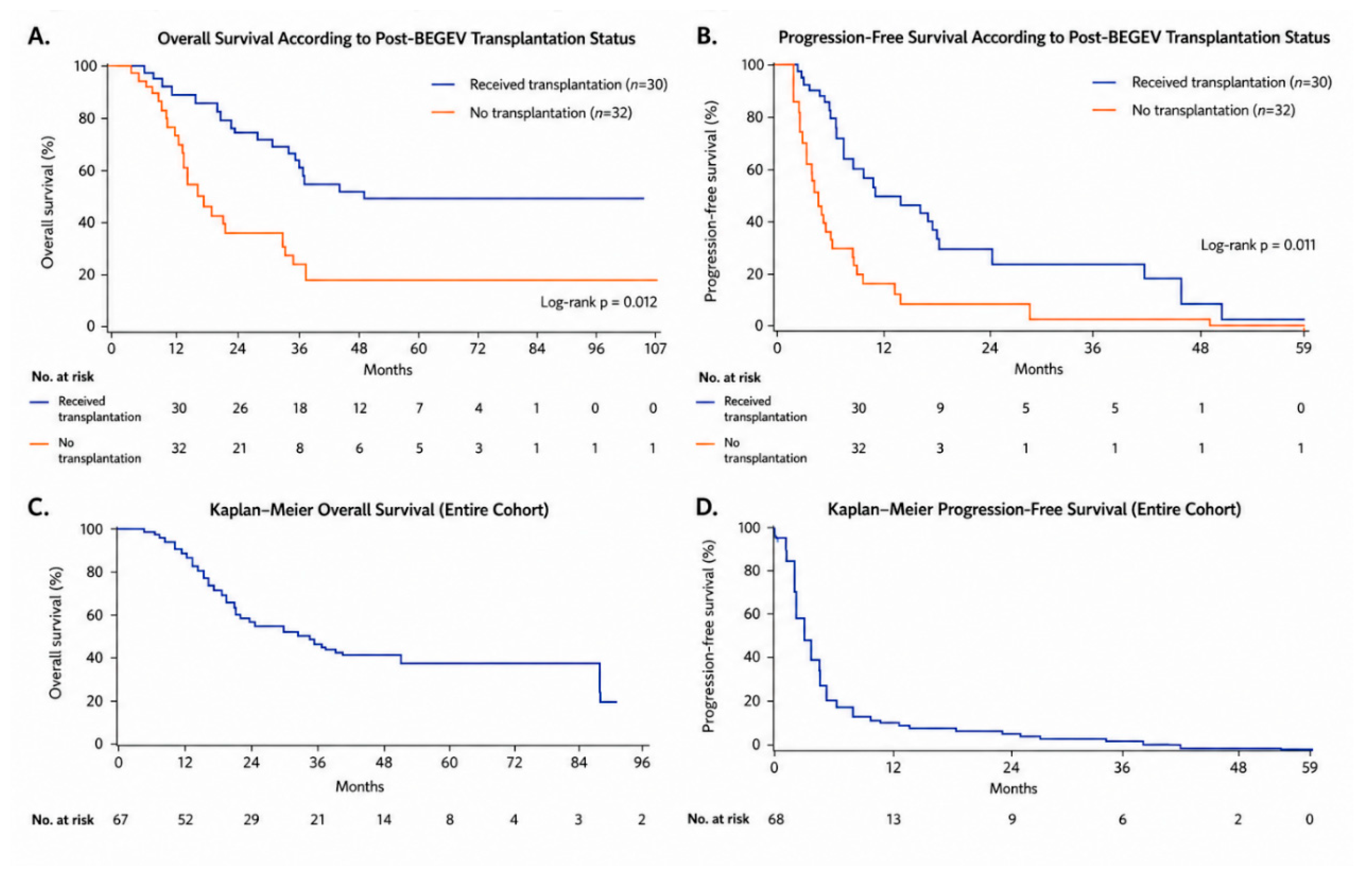

Table 1.
Baseline Clinical and Disease Characteristics.
| Variable | n (%) or value |
|---|---|
| Median age, years (range) | 55.5 (20–81) |
| Male sex | 43 (63.2%) |
| ECOG 0–1* | 36/51 (70.6%) |
| Stage III–IV disease* | 41/57 (71.9%) |
| Bulky disease* | 27/59 (45.8%) |
| DLBCL | 49 (72.1%) |
| Follicular lymphoma | 10 (14.7%) |
| Peripheral T-cell lymphoma | 5 (7.4%) |
| Mantle cell lymphoma | 2 (2.9%) |
| Burkitt lymphoma | 1 (1.5%) |
| Marginal zone/MALT lymphoma | 1 (1.5%) |
| Second-line BEGEV | 1 (1.5%) |
| Third-line BEGEV | 53 (77.9%) |
| Fourth-line BEGEV | 11 (16.2%) |
| Fifth-line or later BEGEV | 3 (4.4%) |
ECOG, Eastern Cooperative Oncology Group; DLBCL, diffuse large B-cell lymphoma; MALT, mucosa-associated lymphoid tissue. Percentages marked with an asterisk (*) were calculated among evaluable patients with available data.
Table 2.
Treatment Response Outcomes.
| Outcome | n (%) |
|---|---|
| Total cohort | 68 |
| Evaluable patients | 56 |
| Overall response rate (ORR = CR + PR) | 41 (73.2%) |
| CR | 29 (51.8%) |
| PR | 12 (21.4%) |
| SD | 5 (8.9%) |
| PD | 10 (17.9%) |
| Non-evaluable patients | 12 |
ORR, overall response rate; CR, complete response; PR, partial response; SD, stable disease; PD, progressive disease.
Table 3.
Adverse Events Observed During BEGEV Therapy (n=68).
| Adverse Event | Grade 1 n (%) | Grade 2 n (%) | Grade 3-4 n (%) | Grade 5 n (%) |
|---|---|---|---|---|
| Neutropenia | 1 (1.5) | 12 (17.6) | 13 (19.1) | 0 |
| Febrile neutropenia | 0 | 2 (2.9) | 12 (17.6) | 0 |
| Anemia | 1 (1.5) | 6 (8.8) | 5 (7.4) | 0 |
| Thrombocytopenia | 1 (1.5) | 6 (8.8) | 3 (4.4) | 0 |
| Nausea/Vomiting | 2 (2.9) | 2 (2.9) | 3 (4.4) | 0 |
| Mucositis | 0 | 0 | 3 (4.4) | 0 |
| Infection | 0 | 3 (4.4) | 1 (1.5) | 0 |
| Fever | 1 (1.5) | 1 (1.5) | 0 | 0 |
| Fatal adverse events* | 0 | 0 | 0 | 4 (5.9) |
Disclaimer/Publisher’s Note: The statements, opinions and data contained in all publications are solely those of the individual author(s) and contributor(s) and not of MDPI and/or the editor(s). MDPI and/or the editor(s) disclaim responsibility for any injury to people or property resulting from any ideas, methods, instructions or products referred to in the content. |
© 2026 by the authors. Licensee MDPI, Basel, Switzerland. This article is an open access article distributed under the terms and conditions of the Creative Commons Attribution (CC BY) license (http://creativecommons.org/licenses/by/4.0/).
Copyright: This open access article is published under a Creative Commons CC BY 4.0 license, which permit the free download, distribution, and reuse, provided that the author and preprint are cited in any reuse.


