
Submitted:
04 June 2026
Posted:
05 June 2026
You are already at the latest version
Abstract
In breast cancer, current knowledge of the associations between clinicopathologic characteristics, genetic changes, and subtype-specific patterns remain unclear. This research investigated how pathological and clinical variables affect the actionability of NGS-based tumor molecular data. Materials and methods: 227 breast cancer patients referred to Genekor’s laboratory for tumor molecular profile analysis were included in the study. Pathology records, available in all cases, were used to assess critical clinicopathological features including HER2, ER, PR, Ki67, grade, metastatic site, and age. A 1021 gene NGS-based multigene panel was utilized to assess tumors’ biology alongside tumor mutational burden (TMB) and microsatellite instability (MSI) Results: Comprehensive genomic profiling revealed that 95.6% of the patients harbored at least one oncogenic or likely oncogenic alteration, highlighting the high diagnostic yield of NGS-based testing. Distinct subtype-specific patterns were observed: HR+/HER2-tumors were enriched for PIK3CA and ESR1 gene alterations, while Triple Negative Breast Cancer (TNBC) was dominated by TP53 alterations. Clinically actionable alterations were most common in HR+/HER2-tumors (~60% on-label), whereas TNBC more often harbored off-label or trial-associated targets. The inclusion of tumor-agnostic biomarkers (TMB/MSI) increased on-label actionability up to 64.5% in ER−/PR+ tumors. primarily driven by TMB-high cases. Median TMB values were low, and age was the only independent predictor. Furthermore, the presence of actionable alterations was significantly higher in metastatic tumors, and TP53 alterations were associated with aggressive tumor characteristics.Conclusions: Comprehensive NGS-based genomic profiling identifies clinically actionable alterations in over half of breast cancer patients, with substantial variability across molecular subtypes. The HR+/HER2-subtype demonstrates the highest prevalence of on-label actionable biomarkers. These findings support the routine implementation of comprehensive genomic profiling, especially in metastatic HER2-negative breast cancer, to guide precision oncology strategies and enable enrollment in biomarker-driven clinical trials.
Keywords:
breast cancer
; NGS
; TMB
; genomic profiling
; molecular subtypes
; HER2
; actionable alterations
; precision oncology
1. Introduction
Individualized cancer management has evolved from a viable option to an essential component of care across virtually all tumor types. It is facilitated by technological advancements, particularly in next-generation sequencing (NGS), which enable the accurate, precise, and cost-effective characterization of the tumor profile through the gold-standard analysis of formalin-fixed paraffin-embedded cancer tissue and is supported by established guidelines in clinical practice [1,2,3]. Additionally, liquid biopsy analysis provides a minimally invasive alternative in case of disease progression or when tissue is unavailable [4].
In breast cancer (BC) in particular, NGS-based tumor molecular profile analysis is imperative, given the increasing number of biomarker-based targeted drug approvals, particularly in the HER2-negative cohorts [5]. In HR+/HER2– advanced breast cancer, the clinically actionable genomic alterations with on-label targeted therapies include PIK3CA mutations, which activate the PI3K–AKT pathway and confer sensitivity to combination treatment with fulvestrant plus either PI3K inhibition (alpelisib) or AKT inhibition (capivasertib), as well as alterations within the AKT pathway, including AKT1 mutations and PTEN loss-of-function, which are associated with therapeutic benefit from fulvestrant+capivasertib [6,7,8]. Moreover, mutations in the ESR1 gene frequently emerge as a resistance mechanism to aromatase inhibitors, with two oral selective estrogen receptor degraders already approved (elacestrand and imlunestrant) and a third, camizestrant, being currently in late-stage development [9,10,11,12].
In HER2-negative breast cancer, germline BRCA1/2 pathogenic variants are established predictive biomarkers for PARP inhibitor (PARPi) therapy. Currently, two PARPis are approved in this setting: Olaparib (for high-risk early-stage and metastatic disease) and talazoparib (for metastatic disease) [13,14,15,16]. This represents a major advance, especially for triple-negative breast cancer (TNBC) patients, who lacked, until recently, any type of targeted therapy. ERBB2 (HER2) amplification/overexpression remains a canonical biomarker for HER2-directed therapy, classically defined by Immunohistochemistry (IHC) and/or In Situ Hybridization (ISH), although targeted NGS can also detect, in addition to ERBB2 copy-number amplification, complementary genomic HER2 events [17].
In addition to breast cancer-specific biomarkers, NGS allows for the identification of tumor-agnostic alterations, such as NTRK1/2/3 gene fusions, RET fusions, and BRAF V600E alterations [18,19,20,21,22,23]. Furthermore, the analysis of agnostic genomic markers, such as Microsatellite Instability (MSI) and Tumor Mutation Burden (TMB), may facilitate the selection of matched treatments, regardless of tumor type [24,25,26].
The type and relative amount of actionable information, however, vary across tumor histological subtypes and may be influenced by clinicopathological factors [27]. Histopathological analysis of the tumor provides the most established predictive and prognostic biomarkers, while assessment of ER, PR, and HER2 status is indispensable for assigning patients to specific disease subtypes with differential treatment implications. Several studies have shown that HR+/HER2− tumors often present an increased rate of PIK3CA mutations, but fewer TP53 mutations [28,29]. In contrast, Triple-negative breast cancers exhibit higher frequencies of TP53 mutations and harbor a higher rate of pathogenic BRCA1/2 variants [30]. Furthermore, additional clinicopathological factors, including age, grade, metastatic status, and Ki67 status, may affect the variability and actionability of NGS-derived somatic alterations. It has been reported, for example, that younger patients more frequently exhibit GATA3 and BRCA1/2 alterations, while older patients have higher rates of KMT2C/PTEN/MAP3K1/CDH1 mutations [29,31]. The complex associations between the Ki67 proliferation index and genomic alterations in breast cancer are not fully understood and require further investigation. Ki67 positivity seems to correlate with TP53 mutations, particularly in triple-negative tumors, but this association may be largely explained by subtype-specific biology rather than a direct relationship between proliferation and TP53 status [32,33]. Conversely, PIK3CA mutations frequently correlate with reduced Ki67 expression, suggesting that these alterations are more prevalent in less-proliferative luminal breast cancers [34].
Furthermore, the mutational profiles observed in metastatic locations can diverge significantly from those present in the primary tumor, a consequence of clonal evolution and the selective pressures imposed by prior therapeutic interventions. Therefore, key drivers of resistance, such as ESR1, AKT1, FGFR1, and PTEN and RB1 alterations, are significantly enriched in metastatic populations [28,35,36] Although concordance for major drivers such as TP53 alterations and ERBB2 amplification is substantial, exceeding 75%, a significant proportion of mutations, ranging from 10% to 45%, may be exclusive to the metastatic [35,36]. This discrepancy implies that profiling only the primary tumor could overlook crucial therapeutic targets that emerge as the disease progresses.
Based on current evidence, a significant knowledge gap exists regarding the prevalence of several tumor biomarkers, including gene alterations and ICI-related TMB values, across BC subtypes. Therefore, the objective of this study was to investigate the molecular landscape and clinical actionability of comprehensive genomic profiling in a cohort of 227 breast cancer patients. The study focused on the relationship between clinicopathologic features and genomic alterations, as well as subtype-specific patterns. The population was enriched for HER2-negative tumors referred for molecular testing to identify targeted alterations for treatment.
2. Methods
227 breast cancer patients referred to our laboratory from January 2024 to March 2026 for tumor molecular profile analysis were included in the study. Pathology records, available in all cases, were used to assess critical pathology features that may influence tumor biologic profiling results. Informed consent was obtained from all patients, who agreed to have their tumor genetic material analyzed for disease management and to the anonymized use of their genetic records for research purposes.
Tissue Selection and Nucleic Acid Isolation
Formalin-fixed and paraffin-embedded (FFPE) tumor biopsies were obtained, and sections stained with hematoxylin and eosin were reviewed by a qualified pathologist to ensure the appropriateness of the material for NGS analysis and the presence of a tumor area with tumor cell content (TCC) exceeding 20%. The MagMAX™ Total Nucleic Acid Isolation Kit (Thermo Fisher Scientific, Waltham, MA, USA) was subsequently employed to isolate genomic DNA.
NGS Procedure Data Analysis and Interpretation
The Oncology Multi-Gene Variant Assay (GenePlus, Beijing, China) was used to perform targeted next-generation sequencing (NGS). This qualitative in vitro diagnostic test can detect variants in 1021 tumor-related genes and gene rearrangements/fusions in 38 genes. The test also provides information on immune-response biomarkers, such as TMB score and MSI status. Library preparation and pre-capture library target enrichment were conducted in accordance with previously described procedures [1]. The DNBSEQ-G400 and/or the DNBSEQ-T7 sequencing platforms (MGI Tech Co., Ltd., Shenzhen, China) were used for sequencing.
A pertinent analytical bioinformatics pipeline was employed by the Gene Box platform (GenePlus, Beijing, China) to analyze and interpret the raw NGS data.
Oncogenicity of the resulting variants was evaluated using the Somatic Oncogenicity standard operating procedure developed by Clinical Genome Resource (ClinGen), Cancer Genomics Consortium (CGC), and the Variant Interpretation for Cancer Consortium (VICC) to help establish the oncogenicity of variants [37]. Therefore, variants were classified as oncogenic, likely oncogenic, Variants of Uncertain Significance (VUS), likely benign, or benign. Only variants classified as oncogenic or likely oncogenic were subsequently considered for therapeutic actionability assessment. VUS were reported but not considered actionable, while benign/likely-benign variants were not reported. Actionable alterations were categorized by tier according to the tiering categories proposed by the Association for Molecular Pathology / American Society of Clinical Oncology / College of American Pathologists (AMP/ASCO/CAP) framework for somatic variant interpretation [38]. Tier I, Level A variants were assigned as on-label, whereas Tier II variants were subdivided for reporting purposes into off-label and clinical-trial associated alterations, generally corresponding to Level C evidence. This approach is consistent with current recommendations that consider oncogenicity and clinical actionability as related, but distinct, dimensions of somatic variant interpretation.
Statistical Analysis
Continuous variables were summarized as median (IQR) and categorical variables as n (%). HR positivity was defined as ER and/or PR positivity. HER2 status was assigned from FISH/IHC results, and tumors were categorized as HR+/HER2-, triple-negative, HER2+/HR-, HER2+/HR+, or unclassified. Gene-prevalence associations with clinicopathologic features were assessed using Fisher’s exact test and reported as ORs with 95% CIs. TMB was analyzed as a continuous variable and, where indicated, as TMB-high (≥10 mut/Mb); Mann–Whitney U, Kruskal–Wallis, and Spearman correlation tests were used as appropriate. To identify independent predictors of tumor mutational burden (TMB), multivariable linear regression was performed using complete-case analysis. TMB was log10-transformed (log10(TMB + 0.1)) due to right skewness (skewness = 6.28). Predictors included age (continuous), grade (grade 3 vs grades 1-2), Ki67 proliferation index (continuous), breast cancer subtype (HR+/HER2-, triple-negative, HER2+, or other/unclassified, with HR+/HER2- as reference), and TP53 alteration status (yes vs no). Variance inflation factors (VIF) were calculated to assess multicollinearity. The analysis included 105 patients with complete data for all predictors and outcomes. Statistical plots were generated in Python 3.13.12 using pandas 2.2.3, SciPy 1.17.0, matplotlib 3.10.8, and seaborn 0.13.2.
To address multiple testing, the Benjamini-Hochberg false discovery rate (FDR) correction was applied to gene-subtype and gene-clinicopathologic association tests, with FDR-adjusted q-values <0.05 considered statistically significant. Multivariable logistic regression was performed to identify independent predictors of on-label biomarker presence, with covariates including age (continuous), breast cancer subtype (categorical), metastatic status (binary), Ki67 (continuous), and tumor grade (grade 3 vs grade 1-2). Cohen’s kappa coefficients for concordance analyses are reported with 95% confidence intervals calculated via bootstrap resampling (1000 iterations).
3. Results
3.1. Cohort Description
227 breast cancer patients referred to our laboratory from January 2024 to March 2026 for tumor molecular profile analysis were included in the study. The median age at the time of diagnosis was 53 years (IQR 46–62.5). Pathology records were available in all cases and were used to assess critical pathological features that may influence tumors’ biologic profiling results.
Metastatic disease was documented in 150 of 227 cases. HER2 immunohistochemistry was positive (3+) in 7/227 cases; when HER2 status was defined clinically using immunohistochemistry and/or FISH, 8/227 cases were HER2-positive. Hormone receptor (HR) records were available for 224/227 cases. A positive HR result was documented in 142 patients. By combined pathological subtype, 112 tumors were HR+/HER2-, 69 were triple-negative, 5 were HER2+/HR-, and 3 were HER2+/HR+. Tumor cases lacking definitive subtype assignment, including equivocal or incomplete HER2 assessment, were categorized as other/unclassified (Figure 1).
3.2. Molecular Profile Analysis in the Entire Cohort
In the entire cohort, 217 (95.6%) harbored at least one reported oncogenic or like oncogenic somatic genomic alteration, while at least one variant of uncertain significance was detected in 203/227 cases (89.43%). Overall, VUS accounted for 801 of the 2374 total detected variants (33.74%).
At the patient level, 202 tumors (89.00%) showed at least one SNV/indels, 158 (69.60%) had at least one CNV, and 14 (6.17%) had at least one rearrangement. The most frequent genes among SNVs/indels were TP53, PIK3CA, ESR1, GATA3, and RB1, whereas the most frequent CNVs involved MYC, CCND1, FGF19, FGFR1, FGF4, and FGF3. Rearrangement (fusion) events were rare and were most commonly represented by FGFR1- and FGFR2-related fusions (5 cases), with additional notable ROS1 and NTRK1 fusions. Most of the remaining rearrangements were of unknown actionability.
Tumor mutational burden (TMB) data were available for 222 cases, with a median of 6.59 mut/Mb (IQR 3.68–8.52), whereas microsatellite instability-high (MSI-H) status was identified in 3 tumors. Overall, TP53 was the most frequently altered gene (44.05%), followed by PIK3CA (33.92%) and ESR1 (16.74%).
Alterations in Homologous Recombination Repair (HRR) genes, particularly BRCA1 and BRCA2, are key biomarkers for PARPi-targeted therapy. Even though PARPi approval in breast cancer is based on BRCA1/2 germline alterations, increasing evidence supports the predictive utility of BRCA1/2 somatic alterations, as well as of other genes of the HRR pathway [39,40]. In addition, somatic testing may detect both somatic and germline alterations, increasing the amount of actionable information. In the overall cohort, alterations in BRCA1 and/or BRCA2 were detected in 16/227 cases (7.05%), including BRCA1 alterations in 7 cases (3.08%) and BRCA2 alterations in 10 cases (4.41%). One tumor sample exhibited simultaneous losses of both BRCA1 and BRCA2 genes. In addition, at least one HRR gene alteration was present in 63/227 tumors (27.75%). When tumors were classified according to the highest-risk HRR alteration present, 9.25%, 11.45%, and 7.05% were assigned to the high-, intermediate-, and low-risk categories, respectively. 15 tumors carried more than one HRR gene alteration. High-penetrance HRR genes comprised BRCA1, BRCA2, and PALB2; intermediate-penetrance HRR genes comprised ATM, BARD1, BRIP1, NBN, RAD51C, RAD51D, and CHEK2 truncating variants; and low-penetrance HRR genes comprised ATR, BLM, FAM175A, FANCA, FANCL, FANCM, MRE11, RAD50, RAD51B, and CHEK2 missense variants
3.3. Molecular Profile Analysis per Breast Cancer Subtype and Actionability
3.3.1. NGS-Based and IHC HER2 Results Concordance
For concordance analysis, HER2 status by pathology was compared with ERBB2 amplification/copy number gain detected by NGS in 191 cases with definitive clinical HER2 status (IHC 3+ or IHC 2+and FISH positive). Overall agreement was 96.9% (185/191), with Cohen’s κ = 0.650 (95% CI 0.321–0.883), indicating substantial concordance. Among 8 IHC HER2-positive tumors, 6 (75%) showed ERBB2 amplification by NGS (sensitivity 75.0%). Among 183 clinically HER2-negative tumors, 179 showed no amplification by NGS (specificity 97.8%).
3.3.2. Gene Alteration Frequencies per BC Subgroup
The tumor molecular profile analysis revealed distinct subtype-specific patterns among HER-/HR+, TNBC and HER2+ tumors. In our cohort, HR+/HER2- tumors (61.23%) were enriched for PIK3CA (41.01%), ESR1 (20.86%), and GATA3 (20.14%) alterations, whereas TNBC (33.92%) was dominated by TP53 alterations (70.13%). The small HER2-positive subgroup (3.52%) showed frequent ERBB2 (62.50%), TP53 (75.00%), and PIK3CA (50.00%) alterations. After FDR correction, the following associations remained statistically significant (q<0.05): TP53 enrichment in TNBC (q=3.4×10⁻⁷), TP53 depletion in HR+/HER2- tumors (q=1.3×10⁻⁷), ESR1 enrichment in HR+/HER2- tumors (q=0.00018), ESR1 depletion in TNBC (q=0.00019), GATA3 enrichment in HR+/HER2- tumors (q=0.0034), GATA3 depletion in TNBC (q=0.0018), and PIK3CA depletion in TNBC (q=0.022).These findings support marked differences in genomic architecture across pathological subtypes and align with published subtype-associated genomic patterns in breast cancer (Figure 2).
3.3.3. Subgroup Differences in the Frequency of Clinically Actionable Predictive Biomarkers
Breast cancer-specific approved biomarker-drug associations represented in this cohort included biomarkers associated with approved targeted therapy for HR+/HER2- disease (PIK3CA, ESR1, AKT1, and PTEN loss), biomarkers with approved indications for HER2-negative breast cancer (BRCA1 and BRCA2 germline variants), and ERBB2 amplification, which defines HER2-directed therapy and is conventionally established by IHC/ISH, although it was also detectable by the NGS assay implemented in this cohort [5,40]. In addition, tumor-agnostic biomarkers were identified, including an NTRK1 fusion and a BRAF V600E mutation, while incorporation of TMB-high and MSI-high status further broadened detection of potentially actionable alterations [18,25]. Comparison across clinicopathologic subtype groups showed that several biomarkers were detectable beyond the subtype in which their matched therapies are most commonly used, although at different frequencies (Figure 3). PIK3CA alterations were significantly more frequent in HR+/HER2- tumors than in triple-negative tumors (41.07% vs 18.84%, Fisher’s exact p=0.002), and ESR1 alterations were likewise present almost exclusively in HR+/HER2- disease (21.43%), consistent with their established relevance in metastatic HR-positive/HER2-negative breast cancer. Moreover, PTEN loss was more prevalent in TNBC than in HR+/HER2- tumors (10.14% vs 2.68%, p=0.045), although this did not remain significant after FDR correction (q>0.05). BRCA1 alterations were numerically more frequent in TNBC than in HR+/HER2- tumors (5.80% vs 0.90%, Fisher’s exact p=0.072), whereas BRCA2 alterations were more frequent in HR+/HER2- tumors than in TNBC (6.31% vs 2.90%, p=0.486); however, neither comparison reached statistical significance. ERBB2 amplification was concentrated in HER2-positive tumors (80.0% in HER2+/HR- and 66.7% in HER2+/HR+) and in a subset of unclassified tumors (10.53%), whereas it was not detected in the HR+/HER2- or triple-negative groups. Overall, these results indicate that clinically relevant biomarkers may be distributed across breast cancer subtypes beyond their canonical treatment indication, albeit with marked differences in prevalence.
Breast cancer in general shows low TMB values, which was also the case in our cohort, with a slightly increased positivity rate, probably attributed to the metastatic patients. TMB-high status was observed in 14.29% of HR+/HER2- tumors, 14.49% of triple-negative tumors, and 18.42% of the unclassified tumors (whereas no TMB-high cases were identified in the HER2-positive subgroups. Only modest variation across clinicopathologic subtypes was observed with median TMB ranging from 4.95 in HR+/HER2- tumors to 7.62 in unclassified tumors.
3.3.4. Subgroup Differences in the Actionability of Tumor Molecular Profiling Outcome
To evaluate the utility of molecular testing for each breast cancer subtype, the actionability of the results obtained was also assessed. When each patient was assigned to a single category according to the most actionable alteration identified, on-label biomarkers were most frequent in HR+/HER2- tumors (66/111, 59.46%) and in other/unclassified tumors (21/39, 53.85%), whereas triple-negative tumors were more often classified in the clinical-trial tier (30/69, 43.48%) or off-label tier (23/69, 33.33%). When TMB-high and MSI-high were also considered, the proportion of cases assigned to the on-label tier increased from 44.93% to 51.10%. Under this framework, on-label findings were observed in 64.29% of HR+/HER2- tumors, 24.64% of triple-negative tumors, and 60.53% of the unclassified tumors (Figure 4). In total, 14 additional cases moved into the on-label tier: 5 in HR+/HER2-, 6 in triple-negative tumors, and 3 in other/unclassified tumors. Of these 14 newly on-label cases, 12 were added because of TMB-high alone, 1 because of MSI-high alone, and 1 because of both TMB-high and MSI-high.
3.3.5. Additional Clinicopathologic Correlates of Actionability and TMB
To further explore the clinical context of molecular findings, we assessed whether additional available clinicopathological features such as age, Ki67, grade, and metastatic status were associated with the prevalence of on-label biomarkers, the overall burden of actionable alterations (on-label, off-label, and clinical trial-associated alterations), and TMB.
Our results showed that patients with on-label biomarkers were older than those without on-label findings (median age 54.5 vs 51.0 years, p=0.038), although age was not associated with actionable burden (ρ=0.011, p=0.869); by contrast, age showed a weak positive correlation with TMB (rho=0.199, p=0.0028).
Moreover, the Ki67 proliferation index was reduced in patients with on-label biomarkers, who had lower Ki67 values compared to those without on-label biomarkers (median 30% vs 40%, p=0.0010), while Ki67 showed a weak positive correlation with actionable burden (ρ=0.172, p=0.0235 ) but not with TMB (ρ=0.098, p=0.206).
Tumor grade was associated with actionable burden (p=0.0030), which increased from a median of 1 in grade 1 tumors to 2 in grade 2 and 3 in grade 3 tumors, but grade was not significantly associated with on-label biomarker prevalence (p=0.062) or TMB (p=0.188).
Finally, metastatic tumors were more likely than non-metastatic tumors to harbor on-label biomarkers (52.0% vs 30.3%, p=0.0019) and had a higher actionable burden (median 3 vs 2, p=0.0010), whereas TMB did not differ significantly according to metastatic status (p=0.877) (Table 1).
3.3.6. Variability in Gene Alterations Across Clinicopathological Features
Exploratory gene-level analyses identified only a limited number of robust clinicopathologic associations. Among on-label biomarkers, as expected, ESR1 was associated with metastatic disease, as expected for a secondary resistance alteration. Moreover, PIK3CA alterations were associated with lower Ki67 values (30% vs 40%, p=0.0012). All other genes with on-label indications showed no significant associations with the clinicopathological variables examined, although interpretation was limited by the low number of positive cases for several alterations.
TP53, the gene harboring the highest number of somatic alterations in this cohort, is known to be associated with poor prognosis in breast cancer. In the present series, TP53 alterations were significantly enriched in triple-negative tumors (OR 4.17, p=1.67×10⁻⁶) and depleted in HR+/HER2- disease (OR 0.26, p=1.22×10⁻⁶). TP53-altered tumors also displayed features of biologically aggressive disease, including higher grade, lower hormone receptor positivity, higher proliferative activity, higher TMB, and greater overall biomarker burden (Figure 5).
3.3.7. Multivariable Predictors of Tumor Mutational Burden
To identify independent predictors of tumor mutational burden (TMB), we performed multivariable linear regression analysis including age, tumor grade, Ki67 proliferation index, breast cancer subtype, and TP53 alteration status as covariates. Due to missing data for grade and Ki67, complete-case analysis was performed on 105 of 227 patients (46.3%). In the adjusted model, age was the only statistically significant independent predictor of TMB (β = 0.0047 per year, 95% CI 0.001–0.009, p = 0.016), indicating a modest increase in TMB with advancing age (Figure 6). Although TP53-altered tumors showed a trend toward higher TMB compared with TP53 wild-type tumors (β = 0.104, 95% CI -0.033 to 0.241, p = 0.135), this association did not reach statistical significance in the multivariable model. Tumor grade (grade 3 vs 1-2: β = 0.048, p = 0.552), Ki67 proliferation index (β = -0.0003, p = 0.907), and breast cancer subtype (all p > 0.8) showed no independent association with TMB. The overall multivariable model had low explanatory power (adjusted R2 = 0.023) and was not statistically significant (F-test p = 0.233), suggesting that TMB variability in this cohort is largely driven by factors not captured by standard clinicopathologic and molecular variables. Variance inflation factor analysis confirmed acceptable multicollinearity (maximum VIF = 8.09 for subtype variables).
In addition, a multivariable logistic regression model was performed to identify independent predictors of on-label biomarker presence. The model included age (continuous), breast cancer subtype (categorical), metastatic status (yes/no), Ki-67 (continuous), and tumor grade (grade 3 vs 1–2) as covariates.
The triple-negative subtype was independently associated with significantly lower odds of harboring an on-label biomarker compared to the HR+/HER2-subtype (OR = 0.204, 95% CI: 0.059–0.705, p = 0.012). No other variables showed a statistically significant independent association in the multivariable model.
4. Discussion
NGS-based tumor molecular profiling may provide valuable information on tumor biology and constitutes an important tool for guiding the assignment of targeted treatments across various tumor types, including breast cancer [27]. Most of the approvals, though, concern HER2-negative BC and mainly the HR+/HER2- subtype. This study examined the molecular landscape and clinical actionability of comprehensive genomic profiling in a cohort of 227 breast cancer patients, with a particular emphasis on subtype-specific patterns and the relationship between clinicopathologic features and genomic alterations. The population was enriched to HER2-negative tumors referred for molecular testing with the aim of identifying targeted alterations for treatment purposes.
Moreover, a secondary finding of our study was the high concordance between ERBB2 copy-number amplification detected by NGS and HER2 status defined by conventional IHC/FISH (about 97% agreement). Although IHC and FISH remain the gold standard for HER2 assessment in clinical practice, NGS-based detection offers the advantage of simultaneously assessing ERBB2 status alongside other actionable alterations, thereby delivering a more comprehensive genomic profile in a single assay [17]. Additionally, NGS analysis has the potential to identify rare ERBB2-activating mutations and non-amplification mechanisms of HER2 pathway activation, which may have emergent therapeutic relevance [41]. For example, NGS is uniquely capable of identifying activating ERBB2 point mutations—found in up to 8% of ER-positive carcinomas—which may respond to anti-HER2 regimens such as neratinib even in the absence of gene amplification [42]. In our cohort 8/18 alterations in the ERBB2 gene detected by NGS concerned activating alterations.
Clinical Utility of Comprehensive Genomic Profiling Across Breast Cancer Subtypes
Our findings provided evidence about the clinical utility of NGS-based tumor profiling. Identifying actionable alterations related to on-label or off-label treatment in up to 70% of the HR+/HER2- tumors and in almost 50% of the TNBC patient tumors [17]. Nevertheless, the nature and frequency of actionable biomarkers differ substantially across molecular subtypes.
HR+/HER2- tumor, as expected, showed the highest prevalence of on-label biomarker detection, with more than half of patients testing positive. These tumors appeared to be driven predominantly by alterations in PIK3CA (41.0%) and ESR1 (20.9%), both of which are now approved as biomarkers in the metastatic HR+/HER2- setting. These findings align with prior studies showing that PIK3CA constitutes a key oncogenic driver in luminal breast cancer [28,34]. Moreover, the high ESR1 prevalence was attributed to metastatic BC patients in our cohort having received multiple lines of endocrine therapy, since such alterations emerge almost exclusively as secondary resistance mechanisms following endocrine therapy in metastatic disease [12,35,43]. In contrast, TNBC tumors were more frequently assigned to the off-label and clinical trial-associated tier (76.81%), reflecting the relative scarcity of approved targeted therapies for TNBC and the ongoing reliance on investigational agents targeting alterations such as AKT pathway components, DNA damage repair deficiencies, and immune checkpoint inhibitors [44,45,46,47,48]. Therefore, the continued unmet need for biomarker-driven therapeutic strategies in triple-negative breast cancer is confirmed by these results. These results are also consistent with recent real-world evidence studies demonstrating that comprehensive genomic profiling in breast cancer identifies targetable alterations in 40–60% of cases, although the specific distribution of actionable biomarkers varies according to tumor subtype and disease stage [27,31].
Value of Tumor-Agnostic Biomarkers: TMB and MSI in Breast Cancer
Furthermore, our results highlight the added value of incorporating ICI-related genomic signatures, namely TMB and MSI status, in expanding the therapeutic landscape beyond subtype-specific genomic alterations. In fact, in our study, the addition of such molecular biomarkers increased on-label biomarker positivity to 64,29% vs 59,82% for the HR+/HER2- group and to 24,64% vs 15,94% for TNBC tumors. As expected, this increase was driven almost entirely by TMB-high status rather than MSI-high, consistent with the known rarity of MSI-high tumors in breast cancer [49,50]. While breast cancer is generally characterized by low-to-moderate TMB compared with tumor types such as melanoma or non-small cell lung cancer, a subset of cases (14.5% in our cohort) met the TMB-high threshold [51]. Importantly, TMB-high status was distributed across subtypes, ranging from 14.3% in HR+/HER2- tumors to 18.4% in tumors with unknown pathological status, suggesting that TMB assessment may identify candidates for immune checkpoint inhibition independent of conventional pathological classification.
Moreover, multivariable analysis revealed that age was the only independent predictor of TMB in our cohort, with a modest positive association (β=0.0047 per year, p=0.016). No other biological or pathological feature evaluated predicted TMB status after adjustment for other variables, including TP53 alteration status, tumor grade, Ki67, and breast cancer subtype. The model’s overall explanatory power was low (adjusted R2 = 0.023), suggesting that the variability in TMB in breast cancer is primarily driven by factors not captured by standard clinicopathologic features. These findings align with previous studies showing that older patients and metastatic tumors are more likely to have a positive TMB result, probably reflecting the accumulation of DNA damage over time [52,53]. The association between TMB and clinicopathological features such as histological subtype and tumor mutation profile remains unclear, though invasive lobular carcinoma and metastatic samples tend to show higher levels [52]. TMB levels. Despite these findings, the overall extent of benefit from ICIs in TMB-high breast cancer patients has not been definitively established, highlighting the need for further research integrating genomic and clinical factors [54].
TP53 as a Marker of Aggressive Tumor Biology
TP53, the “gatekeeper” of the genome, was the most frequently altered gene in our cohort (44.1%), consistent with the expected high mutation prevalence of this gene. Even though agents targeting this common genetic alteration are missing, TP53 analysis may provide valuable prognostic information. Consistent with prior knowledge, TP53 mutations were enriched in high-grade, HR-negative, and triple-negative BC [55,56,57]. In the cohort analyzed, TP53 alterations were significantly enriched in triple-negative tumors (OR 4.17) and depleted in HR+/HER2- disease (OR 0.26). Beyond subtype association, TP53-altered tumors also displayed features of biologically aggressive disease, including higher grade, lower hormone receptor positivity, higher proliferative activity, higher TMB, and greater overall biomarker burden. Additionally, a modest but not statistically significant association in multivariable analysis was observed between TP53 alterations and higher TMB than in TP53-wild-type tumors (median 6.72 vs 4.80 mut/Mb, p=0.013).
The biological significance of TP53 as a marker of aggressive disease has already been documented [55,56,57]. Moreover, although loss of TP53 function is not a direct therapeutic target, its status may indirectly inform treatment decisions. For example, TP53-mutant tumors may be more sensitive to DNA-damaging chemotherapy or PARP inhibition in the setting of concurrent homologous recombination deficiency, and emerging evidence suggests that TP53 status may modulate the response to immune checkpoint blockade in certain contexts [55,57]. Our findings support the value of including TP53 status in comprehensive genomic reports, not as an actionable biomarker per se, but as a clinically relevant indicator of tumor biology that may guide therapeutic strategy and inform prognosis.
Clinicopathologic Correlates with Molecular Actionability
An important secondary aim of this study was to examine whether routine clinicopathologic features were associated with the presence of actionable biomarkers. Our results demonstrated that metastatic disease was the strongest predictor of on-label biomarker presence (52.0% vs 30.3%), mainly driven by the secondary arising of ESR1 alterations following endocrine treatment(35). On the contrary, other targetable alterations, such as PIK3CA gene variants, remained stable among metastatic and non-metastatic patients, consistent with the fact that they likely represent early events in BC oncogenesis [58,59]. Interestingly, we observed that patients with on-label biomarkers were older (median 54.5 vs 51.0 years, p=0.038) and had lower Ki67 values (median 30% vs 40%, p=0.001) compared with patients without on-label biomarkers (Figure 7). The observed associations might be attributable to the greater frequency of HR+/HER2 tumors within the study cohort. These tumors are more frequently diagnosed in elderly populations and exhibit lower proliferation rates. Conversely, although tumor grade correlated with overall actionable burden, it did not correlate with the prevalence of on-label biomarkers. This suggests that higher-grade tumors may accumulate more genomic alterations, even if these alterations are not directly linked to currently approved therapeutic targets.
Limitations
Several limitations of this study should be considered. First, the studied cohort consisted of patients referred to a single diagnostic laboratory due to the necessity of targeted treatment assignment and is not representative of the broader breast cancer population. It was enriched in metastatic cases, representing 66% of the entire cohort, whereas among cases with known pathological features, 95% were HER2-negative, with a high prevalence of HR+/HER2- disease, given the greater number of on-label indications available in this subgroup. Therefore, documented conclusions about the tumor biology were not possible for the HER2-positive tumors (n=8). Moreover, clinicopathologic data were not available for all patients; Ki67 values were missing in 23.8% of cases and tumor grade in 46.3%, limiting the power of multivariable analyses. In addition, follow-up data, information on prior treatments, and the extent to which the actionable findings provided were not utilized were not available. Finally, the limited number of patients analyzed compromises the generalizability of the results.
Clinical Implications and Future Directions
Our findings add to the existing evidence of the necessity of applying comprehensive NGS-based tumor profiling to identify clinically actionable alterations in the majority of breast cancer patients, with actionability rates exceeding 50% when tumor-agnostic biomarkers are included. The clinical utility is highest in HR+/HER2- disease, where on-label biomarkers such as PIK3CA and ESR1 mutations are common, but extends across all subtypes and may lead to less frequent targetable driver and tumor-agnostic alterations. The utility is enhanced with the addition of ICI-related genomic signatures, such as TMB and MSI. Moreover, understanding of tumor biology may give us a better picture of tumors’ biological profile, reveal emerging secondary alterations in metastatic tumors related to tumor progression, and provide prognostic information based on not yet targetable but of prognostic utility alterations such as TP53 disrupting variants.
Prospective studies are needed to evaluate whether genomic profiling-guided treatment selection may improve clinical outcomes compared with standard-of-care approaches.
5. Conclusion
Comprehensive NGS-based genomic profiling identifies clinically actionable alterations in more than half of breast cancer patients, with marked differences in actionability across molecular subtypes. HER2-negative tumors show a high prevalence of actionable biomarkers, with HR+/HER2- subtype showing the highest on-label biomarkers rate in accordance with current on-label indications. Our findings highly support the routine use of comprehensive genomic profiling, especially in metastatic breast cancer with HER2-negative tumors, to inform precision medicine strategies and facilitate enrollment in biomarker-selected clinical trials.
Acknowledgments
The Authors would like to thank all patients for allowing the anonymous use of their genetic analysis results for research purposes. The Authors also acknowledge the contribution of participating clinicians and institutions, as well as the molecular biologists of GENEKOR’s Laboratory for performing the NGS-based analyses and the bioinformaticians for their contribution to the statistical analysis.
Conflicts of Interest
The Authors declare that they have no conflicts of interest.
Author Contributions
Conceptualization: E.P. Methodology: E.P., V.V. Formal analysis: E.P. Data curation: E.P., M.St., M.Ma., P.K., X.X., G.Pe., I.F., K.L., D.Ma., A.E., D.Al., C.Kal., C.Kan., N.Ka., I.Ko., C.Kav., A.Kok., N.P., A.S., E.S., S.T., S.F., C.D., G.L., F.Ko., E.B., A.Kou., A.Kot. Investigation: E.P., V.V. Resources: M.St., M.Ma., P.K., X.X., G.Pe., I.F., K.L., D.Ma., A.E., D.Al., C.Kal., C.Kan., N.Ka., I.Ko., C.Kav., A.Kok., N.P., A.S., E.S., S.T., S.F., C.D., G.L., F.Ko., E.B., A.Kou., A.Kot. Project administration: E.P. Supervision: V.V. Validation: E.P., V.V. Visualization: E.P. Writing – original draft: E.P. Writing – review & editing: All authors.
Funding
This research received no external funding.
References
- Meintani, A.; Ozdogan, M.; Touroutoglou, N.; Papazisis, K.; Boukovinas, I.; Bilir, C.; et al. Comprehensive Evaluation of a 1021-Gene Panel in FFPE and Liquid Biopsy for Analytical and Clinical Use. Int. J. Mol. Sci. 2025, 26(13). [Google Scholar] [CrossRef] [PubMed]
- Mosele, M.F.; Westphalen, C.B.; Stenzinger, A.; Barlesi, F.; Bayle, A.; Bièche, I.; et al. Recommendations for the use of next-generation sequencing (NGS) for patients with advanced cancer in 2024: a report from the ESMO Precision Medicine Working Group. Ann. Oncol. 2024, 35(7), 588–606. [Google Scholar] [CrossRef] [PubMed]
- Chakravarty, D.; Johnson, A.; Sklar, J.; Lindeman, N.I.; Moore, K.; Ganesan, S.; et al. Somatic Genomic Testing in Patients With Metastatic or Advanced Cancer: ASCO Provisional Clinical Opinion. J. Clin. Oncol. 2022, 40(11), 1231–58. [Google Scholar] [CrossRef] [PubMed]
- Florou-Chatzigiannidou, C.; Papadopoulou, E.; Metaxa-Mariatou, V.; Tsantikidi, A.; Maxouri, S.; Tsaousis, G.; et al. Implementation of a 1021-gene liquid biopsy assay for real-world tumor genomic profiling in oncology practice. Sci. Rep. 2026, 16(1). [Google Scholar] [CrossRef] [PubMed]
- Crocamo, S.; Dos Santos, E.C.; Abdelhay, E. Advances in Breast Cancer Research: Immunological, Pathological, and Pharmacological Perspectives for Improving Patient Outcomes. Int. J. Mol. Sci. 2026, 27(4). [Google Scholar] [CrossRef] [PubMed]
- André, F.; Ciruelos, E.; Rubovszky, G.; Campone, M.; Loibl, S.; Rugo, H.S.; et al. Alpelisib for PIK3CA -Mutated, Hormone Receptor–Positive Advanced Breast Cancer. N. Engl. J. Med. 2019, 380(20), 1929–40. [Google Scholar] [CrossRef]
- Walsh, R.J.; Ong, R.; Cheo, S.W.; Low, P.Q.J.; Jayagopal, A.; Lee, M.; et al. Molecular profiling of metastatic breast cancer and target-based therapeutic matching in an Asian tertiary phase I oncology unit. Front Oncol. 2024, 14. [Google Scholar] [CrossRef]
- Turner, N.C.; Oliveira, M.; Howell, S.J.; Dalenc, F.; Cortes, J.; Gomez Moreno, H.L.; et al. Capivasertib in Hormone Receptor-Positive Advanced Breast Cancer. N Engl. J. Med. 2023, 388(22), 2058–70. [Google Scholar] [CrossRef] [PubMed]
- Bidard, F.C.; Kaklamani, V.G.; Neven, P.; Streich, G.; Montero, A.J.; Forget, F.; et al. Elacestrant (oral selective estrogen receptor degrader) Versus Standard Endocrine Therapy for Estrogen Receptor-Positive, Human Epidermal Growth Factor Receptor 2-Negative Advanced Breast Cancer: Results From the Randomized Phase III EMERALD Trial. J. Clin. Oncol. 2022, 40(28), 3246–56. [Google Scholar] [CrossRef] [PubMed]
- Shah, M.; Lingam, H.; Gao, X.; Gittleman, H.; Fiero, M.H.; Krol, D.; et al. US Food and Drug Administration Approval Summary: Elacestrant for Estrogen Receptor-Positive, Human Epidermal Growth Factor Receptor 2-Negative, ESR1-Mutated Advanced or Metastatic Breast Cancer. J. Clin. Oncol. 2024, 42(10), 1193–201. [Google Scholar] [CrossRef] [PubMed]
- Curigliano, G.; O’Shaughnessy, J.; Bidard, F.C.; Casalnuovo, M.L.; Kim, S.B.; Tokunaga, E.; et al. Patient-reported outcomes and qualitative interviews in patients with estrogen receptor-positive/human epidermal growth factor receptor 2-negative advanced breast cancer: results from the phase III EMBER-3 trial. ESMO Open 2026, 11(4), 106945. [Google Scholar] [CrossRef] [PubMed]
- Mayer, E.L.; Bidard, F.C.; Park, Y.H.; Janni, W.; Ma, C.; Cristofanilli, M.; et al. Patient-reported outcomes in the SERENA-6 trial of camizestrant plus CDK4/6 inhibitor in patients with advanced breast cancer and emergent ESR1 mutations during first-line endocrine-based therapy. Ann. Oncol. 2026, 37(2), 180–93. [Google Scholar] [CrossRef] [PubMed]
- Robson, M.; Im, S.A.; Senkus, E.; Xu, B.; Domchek, S.M.; Masuda, N.; et al. Olaparib for Metastatic Breast Cancer in Patients with a Germline BRCA Mutation. N Engl. J. Med. 2017, 377(6), 523–33. [Google Scholar] [CrossRef] [PubMed]
- Tung, N.M.; Robson, M.E.; Ventz, S.; Santa-Maria, C.A.; Nanda, R.; Marcom, P.K.; et al. TBCRC 048: Phase II Study of Olaparib for Metastatic Breast Cancer and Mutations in Homologous Recombination-Related Genes. J. Clin. Oncol. 2020, 38(36), 4274–82. [Google Scholar] [CrossRef] [PubMed]
- Tutt, A.N.J.; Garber, J.E.; Kaufman, B.; Viale, G.; Fumagalli, D.; Rastogi, P.; et al. Adjuvant Olaparib for Patients with BRCA1 - or BRCA2 -Mutated Breast Cancer. N. Engl. J. Med. 2021, 384(25), 2394–405. [Google Scholar] [CrossRef] [PubMed]
- Litton, J.K.; Rugo, H.S.; Ettl, J.; Hurvitz, S.A.; Gonçalves, A.; Lee, K.H.; et al. Talazoparib in Patients with Advanced Breast Cancer and a Germline BRCA Mutation. N Engl. J. Med. 2018, 379(8), 753–63. [Google Scholar] [CrossRef] [PubMed]
- Pfarr, N.; Penzel, R.; Endris, V.; Lier, C.; Flechtenmacher, C.; Volckmar, A.L.; et al. Targeted next-generation sequencing enables reliable detection of HER2 (ERBB2) status in breast cancer and provides ancillary information of clinical relevance. Genes Chromosom. Cancer 2017, 56(4), 255–65. [Google Scholar] [CrossRef] [PubMed]
- Kim, J.; Kim, H.S.; Nam, M.; Chae, Y.K. Tissue-agnostic biomarkers in solid tumors: current approvals and emerging candidates. Cancer Metastasis Rev. 2025, 44(3), 58. [Google Scholar] [CrossRef] [PubMed]
- Gouda, M.A.; Subbiah, V. Expanding the Benefit: Dabrafenib/Trametinib as Tissue-Agnostic Therapy for BRAF V600E-Positive Adult and Pediatric Solid Tumors. Am. Soc. Clin. Oncol. Educ. Book 2023, 43, e404770. [Google Scholar] [CrossRef] [PubMed]
- Marcus, L.; Donoghue, M.; Aungst, S.; Myers, C.E.; Helms, W.S.; Shen, G.; et al. FDA Approval Summary: Entrectinib for the Treatment of NTRK gene Fusion Solid Tumors. Clin. Cancer Res. 2021, 27(4), 928–32. [Google Scholar] [CrossRef] [PubMed]
- Cocco, E.; Scaltriti, M.; Drilon, A. NTRK fusion-positive cancers and TRK inhibitor therapy. Nat. Rev. Clin. Oncol. 2018, 15(12), 731–47. [Google Scholar] [CrossRef] [PubMed]
- Subbiah, V.; Velcheti, V.; Tuch, B.B.; Ebata, K.; Busaidy, N.L.; Cabanillas, M.E.; et al. Selective RET kinase inhibition for patients with RET-altered cancers. Ann. Oncol. 2018, 29(8), 1869–76. [Google Scholar] [CrossRef] [PubMed]
- Duke, E.S.; Bradford, D.; Marcovitz, M.; Amatya, A.K.; Mishra-Kalyani, P.S.; Nguyen, E.; et al. FDA Approval Summary: Selpercatinib for the Treatment of Advanced RET Fusion-Positive Solid Tumors. Clin. Cancer Res. 2023, 29(18), 3573–8. [Google Scholar] [CrossRef] [PubMed]
- Marcus, L.; Lemery, S.J.; Keegan, P.; Pazdur, R. FDA Approval Summary: Pembrolizumab for the Treatment of Microsatellite Instability-High Solid Tumors. Clin. Cancer Res. 2019, 25(13), 3753–8. [Google Scholar] [CrossRef] [PubMed]
- Marcus, L.; Fashoyin-Aje, L.A.; Donoghue, M.; Yuan, M.; Rodriguez, L.; Gallagher, P.S.; et al. FDA Approval Summary: Pembrolizumab for the Treatment of Tumor Mutational Burden-High Solid Tumors. Clin. Cancer Res. 2021, 27(17), 4685–9. [Google Scholar] [CrossRef] [PubMed]
- Diaz, L.A.; Le, D.; Maio, M.; Ascierto, P.A.; Geva, R.; Motola-Kuba, D.; et al. Pembrolizumab in microsatellite instability high cancers: Updated analysis of the phase II KEYNOTE-164 and KEYNOTE-158 studies. Ann. Oncol. 2019, 30, v475. [Google Scholar] [CrossRef]
- Mohd Zuhdi, N.F.; Siddig, A.; Mohd Nafi, S.N.; Md Salleh, M.S.; Yahya, M.M.; Wan Zain, W.Z.; et al. Next-generation sequencing in breast cancer: current clinical applications and future directions. Ann. Med. 2025, 57(1). [Google Scholar] [CrossRef]
- Corti, C.; Martin, A.R.; Kurnia, P.T.; Gómez Tejeda Zañudo, J.; Abravanel, D.L.; Hughes, M.E.; et al. Clinicopathological features and genomics of ER-positive/HER2-negative breast cancer relapsing on adjuvant abemaciclib. ESMO Open 2025, 10(6), 105126. [Google Scholar] [CrossRef]
- Van Alsten, S.C.; Love, M.I.; Calhoun, B.C.; Butler, E.N.; Perou, C.M.; Hoadley, K.A.; et al. Genomic Analysis Reveals Racial and Age-Related Differences in the Somatic Landscape of Breast Cancer and the Association with Socioeconomic Factors. Cancer Res. 2025, 85(7), 1327–40. [Google Scholar] [CrossRef]
- Varzaru, V.B.; Vlad, T.; Popescu, R.; Vlad, C.S.; Moatar, A.E.; Cobec, I.M. Triple-Negative Breast Cancer: Molecular Particularities Still a Challenge. Diagnostics 2024, 14(17), 1875. [Google Scholar] [CrossRef]
- Heeke, A.L.; Sha, W.; Feldman, R.; Fisher, J.; Hadzikadic-Gusic, L.; Symanowski, J.T.; et al. The Genomic Landscape of Breast Cancer in Young and Older Women. Clin. Breast Cancer 2024, 24(7), 630–638.e3. [Google Scholar] [CrossRef] [PubMed]
- Vellichirammal, N.N.; Tan, Y.D.; Xiao, P.; Eudy, J.; Shats, O.; Kelly, D.; et al. The mutational landscape of a US Midwestern breast cancer cohort reveals subtype-specific cancer drivers and prognostic markers. Hum. Genom. 2023, 17(1), 64. [Google Scholar] [CrossRef] [PubMed]
- Pan, Y.; Yuan, Y.; Liu, G.; Wei, Y. P53 and Ki-67 as prognostic markers in triple-negative breast cancer patients. PLoS ONE 2017, 12(2), e0172324. [Google Scholar] [CrossRef] [PubMed]
- Feng, Y.; Song, Q.; Yan, L.; Li, R.; Yang, M.; Bu, P.; et al. Predicting breast cancer prognosis using PR and PIK3CA biomarkers: a comparative analysis of diagnostic groups. BMC Cancer 2025, 25(1), 68. [Google Scholar] [CrossRef] [PubMed]
- Bhave, M.A.; Quintanilha, J.C.F.; Tukachinsky, H.; Li, G.; Scott, T.; Ross, J.S.; et al. Comprehensive genomic profiling of ESR1, PIK3CA, AKT1, and PTEN in HR(+)HER2(−) metastatic breast cancer: prevalence along treatment course and predictive value for endocrine therapy resistance in real-world practice. Breast Cancer Res. Treat. 2024, 207(3), 599–609. [Google Scholar] [CrossRef]
- van Geelen, C.T.; Savas, P.; Teo, Z.L.; Luen, S.J.; Weng, C.F.; Ko, Y.A.; et al. Clinical implications of prospective genomic profiling of metastatic breast cancer patients. Breast Cancer Res. 2020, 22(1), 91. [Google Scholar] [CrossRef]
- Horak, P.; Griffith, M.; Danos, A.M.; Pitel, B.A.; Madhavan, S.; Liu, X.; et al. Standards for the classification of pathogenicity of somatic variants in cancer (oncogenicity): Joint recommendations of Clinical Genome Resource (ClinGen), Cancer Genomics Consortium (CGC), and Variant Interpretation for Cancer Consortium (VICC). Genet. Med. 2022, 24(5), 986–98. [Google Scholar] [CrossRef]
- Richards, S.; Aziz, N.; Bale, S.; Bick, D.; Das, S.; Gastier-Foster, J.; et al. Standards and guidelines for the interpretation of sequence variants: a joint consensus recommendation of the American College of Medical Genetics and Genomics and the Association for Molecular Pathology. Genet Med. 2015, 17(5), 405–24. [Google Scholar] [CrossRef] [PubMed]
- Batalini, F.; Madison, R.W.; Sokol, E.S.; Jin, D.X.; Chen, K.T.; Decker, B.; et al. Homologous Recombination Deficiency Landscape of Breast Cancers and Real-World Effectiveness of Poly ADP-Ribose Polymerase Inhibitors in Patients With Somatic BRCA1 / 2, Germline PALB2, or Homologous Recombination Deficiency Signature. JCO Precis Oncol. 2023, (7). [Google Scholar] [CrossRef]
- Rashmi Kumar, N.; Schonfeld, R.; Gradishar, W.J.; Lurie, R.H.; Moran, M.S.; Abraham, J.; et al. NCCN Guidelines Version 2.2026 Breast Cancer [Internet]. 2026. Available online: https://www.nccn.org/.
- Grinda, T.; Pistilli, B. Are ERBB2 mutations a ‘ready for routine use’ target in patients with metastatic breast cancer? ESMO Open 2023, 8(5), 101832. [Google Scholar] [CrossRef]
- Varga, Z.; Maccio, U. Molecular pathology in breast disease: diagnostic, prognostic, and therapeutic tools. Virchows Arch. 2024, 484(2), 247–61. [Google Scholar] [CrossRef]
- Venetis, K.; Pepe, F.; Pescia, C.; Cursano, G.; Criscitiello, C.; Frascarelli, C.; et al. ESR1 mutations in HR+/HER2-metastatic breast cancer: Enhancing the accuracy of ctDNA testing. Cancer Treat. Rev. 2023, 121, 102642. [Google Scholar] [CrossRef] [PubMed]
- Li, H.; Chang, Y.; Jin, T.; Zhang, M. Progress of PD-1/PD-L1 immune checkpoint inhibitors in the treatment of triple-negative breast cancer. Cancer Cell Int. 2025, 25. [Google Scholar] [CrossRef]
- Sofianidi, A.; Dumbrava, E.; Syrigos, K.; Nasrazadani, A. Triple-Negative Breast Cancer and Emerging Therapeutic Strategies: ATR and CHK1/2 as Promising Targets. Cancers 2024, 16. [Google Scholar] [CrossRef]
- Xiong, N.; Wu, H.; Yu, Z. Advancements and challenges in triple-negative breast cancer: a comprehensive review of therapeutic and diagnostic strategies. Front Oncol. 2024, 14. [Google Scholar] [CrossRef]
- Emara, H.; Allam, N.; Youness, R. A comprehensive review on targeted therapies for triple negative breast cancer: an evidence-based treatment guideline. In Discover Oncology; 2025; p. 16. [Google Scholar] [CrossRef]
- Zhang, H.P.; Jiang, R.Y.; Zhu, J.Y.; Sun, K.N.; Huang, Y.; Zhou, H.H.; et al. PI3K/AKT/mTOR signaling pathway: an important driver and therapeutic target in triple-negative breast cancer. Breast Cancer 2024, 31, 539–51. [Google Scholar] [CrossRef] [PubMed]
- Landre, T.; Des Guetz, G. Microsatellite instability-high status as a pan-cancer biomarker for immunotherapy efficacy. Cancer Immunol. Immunother. 2025, 74(4). [Google Scholar] [CrossRef] [PubMed]
- Bonneville, R.; Krook, M.A.; Kautto, E.A.; Miya, J.; Wing, M.R.; Chen, H.Z.; et al. Landscape of Microsatellite Instability Across 39 Cancer Types. JCO Precis Oncol. 2017. [Google Scholar] [CrossRef] [PubMed]
- Barroso-Sousa, R.; Pacífico, J.P.; Sammons, S.; Tolaney, S.M. Tumor Mutational Burden in Breast Cancer: Current Evidence, Challenges, and Opportunities. In Cancers; Multidisciplinary Digital Publishing Institute (MDPI), 2023. [Google Scholar] [CrossRef]
- Takano, Y.; Mizuno, K.; Iwase, M.; Morita, S.; Torii, N.; Kikumori, T.; et al. Tumor mutational burden status and clinical characteristics of invasive lobular carcinoma of the breast. Breast Cancer 2025, 32, 816–25. [Google Scholar] [CrossRef] [PubMed]
- Mai, N.; Safonov, A.; Marra, A.; Chen, Y.; Chandarlapaty, S.; Razavi, P.; et al. Immune checkpoint inhibition for the treatment of metastatic breast cancer with high tumor mutational burden: Real world clinical and genomic correlates of response. J. Clin. Oncol. 2024. [Google Scholar] [CrossRef]
- Zgura, A.; Chipuc, S.; Bacalbasa, N.; Haineala, B.; Rodica, A.; Sebastian, V. Evaluating Tumour Mutational Burden as a Key Biomarker in Personalized Cancer Immunotherapy: A Pan-Cancer Systematic Review. Cancers 2025, 17. [Google Scholar] [CrossRef]
- Hwang, S.H.; Baek, S.; Lee, M.; Kook, Y.; Bae, S.; Ahn, S.; et al. Clinical Relevance of TP53 Mutation and Its Characteristics in Breast Cancer with Long-Term Follow-Up Date. Cancers 2024, 16. [Google Scholar] [CrossRef]
- Qayoom, H.; Haq, B.U.; Sofi, S.; Jan, N.; Jan, A.; Mir, M. Targeting mutant p53: a key player in breast cancer pathogenesis and beyond. Cell Commun. Signal 2024, 22. [Google Scholar] [CrossRef]
- Zwimpfer, T.; Heidinger, M.; Coelho, R.; Stiegeler, N.; Schwab, F.; Montavon, C.; et al. TP53 Mutations and Phosphatidylinositol 3-Kinase/AKT Pathway Alterations Are Key Determinants of Breast Cancer Outcome Independent of Subtype and Stage. JCO Precis Oncol. 2025, 9. [Google Scholar] [CrossRef]
- Schagerholm, C.; Robertson, S.; Toosi, H.; Sifakis, E.; Hartman, J. PIK3CA mutations in endocrine-resistant breast cancer. Sci. Rep. 2024, 14. [Google Scholar] [CrossRef]
- Sokolova, T.; Yanus, G.; Aleksakhina, S.; Belysheva, Y.; Chernyakova, A.; Zharnakova, Y.; et al. Clinical and Morphological Features of ER-Positive HER2-Negative Breast Tumors with PIK3CA Mutations in Russian Patients. Cancers 2025, 17. [Google Scholar] [CrossRef]
Figure 1.
Flow diagram of the total breast cancer cohort (n = 227) stratified by molecular subtype.
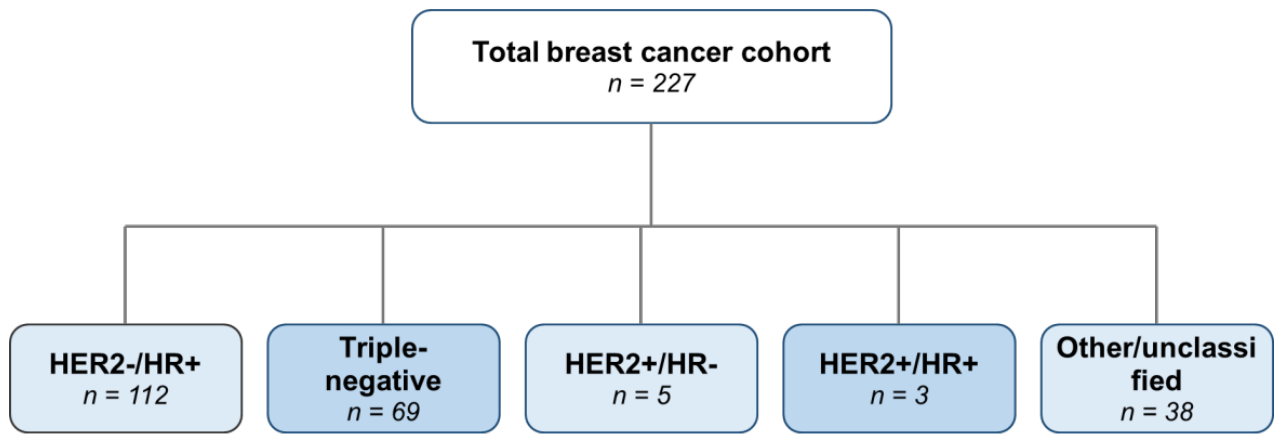
Figure 2.
Heatmap of the 15 most commonly altered genes in the entire cohort of breast cancer patients, and by pathological subtype. Only oncogenic and likely oncogenic alterations were included. Cell values indicate the percentage of tumors harboring each biomarker alteration, and the color scale reflects relative frequency. For all genes, both CNVs and SNVs/indels were considered.
Figure 2.
Heatmap of the 15 most commonly altered genes in the entire cohort of breast cancer patients, and by pathological subtype. Only oncogenic and likely oncogenic alterations were included. Cell values indicate the percentage of tumors harboring each biomarker alteration, and the color scale reflects relative frequency. For all genes, both CNVs and SNVs/indels were considered.
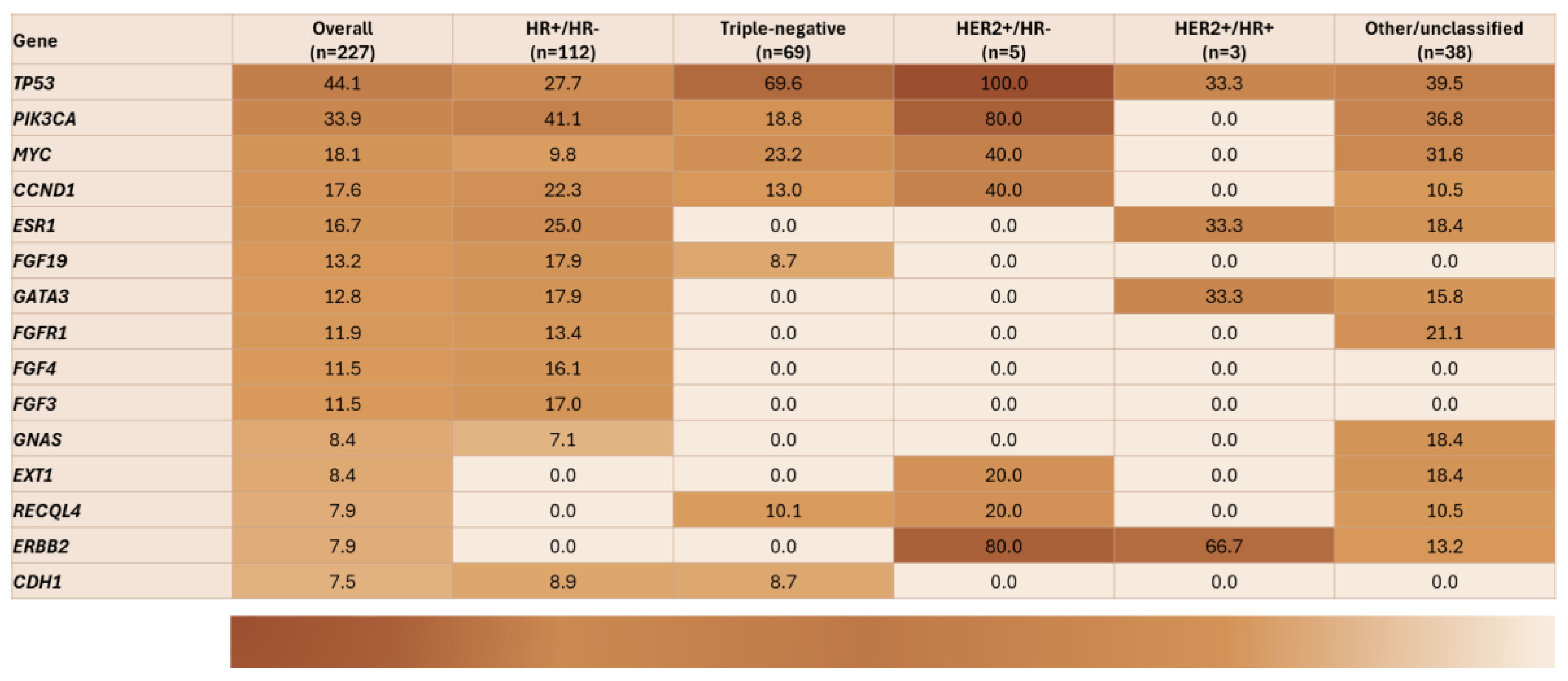
Figure 3.
Heatmap of on-label breast cancer biomarkers by pathological subtype. The heatmap shows all known biomarkers approved in at least one breast cancer subtype and their distribution across subgroups. Cell values indicate the percentage of tumors harboring each biomarker alteration, and the color scale reflects relative frequency. For ESR1 and PIK3CA, only SNVs were considered based on the drugs’ approval. For ERBB2, only copy-number amplification events were considered. For BRCA1 and BRCA2, all alteration types were included.
Figure 3.
Heatmap of on-label breast cancer biomarkers by pathological subtype. The heatmap shows all known biomarkers approved in at least one breast cancer subtype and their distribution across subgroups. Cell values indicate the percentage of tumors harboring each biomarker alteration, and the color scale reflects relative frequency. For ESR1 and PIK3CA, only SNVs were considered based on the drugs’ approval. For ERBB2, only copy-number amplification events were considered. For BRCA1 and BRCA2, all alteration types were included.
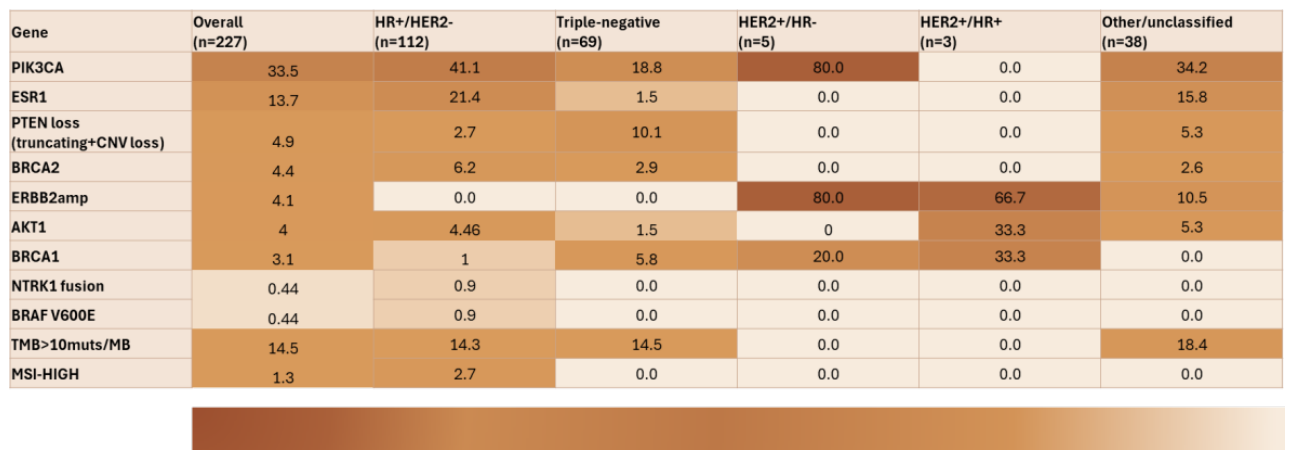
Figure 4.
Biomarker actionability by breast cancer subgroup, including TMB/MSI results. Each patient was assigned to a single category based on the highest level of actionability.
Figure 4.
Biomarker actionability by breast cancer subgroup, including TMB/MSI results. Each patient was assigned to a single category based on the highest level of actionability.
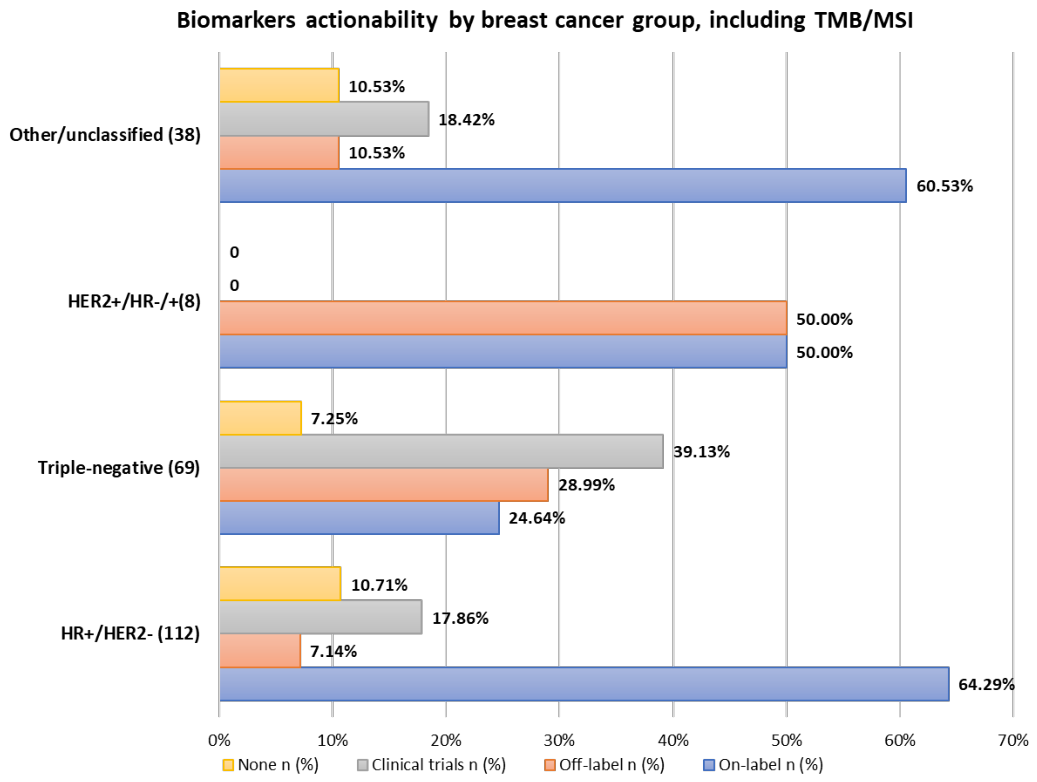
Figure 5.
A. Association of TP53 alterations with subtype, clinicopathologic features, and genomic complexity. Summary of odds-ratio-based associations between TP53 alterations and categorical clinicopathologic features. The vertical line indicates OR = 1; values >1 denote enrichment and values <1 denote inverse association or depletion. B. Panel B shows boxplots of Ki67, TMB, and biomarker burden according to TP53 status. Center lines indicate medians, boxes indicate interquartile ranges, and whiskers indicate 1.5 × IQR. P values were calculated using the Mann–Whitney U test.
Figure 5.
A. Association of TP53 alterations with subtype, clinicopathologic features, and genomic complexity. Summary of odds-ratio-based associations between TP53 alterations and categorical clinicopathologic features. The vertical line indicates OR = 1; values >1 denote enrichment and values <1 denote inverse association or depletion. B. Panel B shows boxplots of Ki67, TMB, and biomarker burden according to TP53 status. Center lines indicate medians, boxes indicate interquartile ranges, and whiskers indicate 1.5 × IQR. P values were calculated using the Mann–Whitney U test.
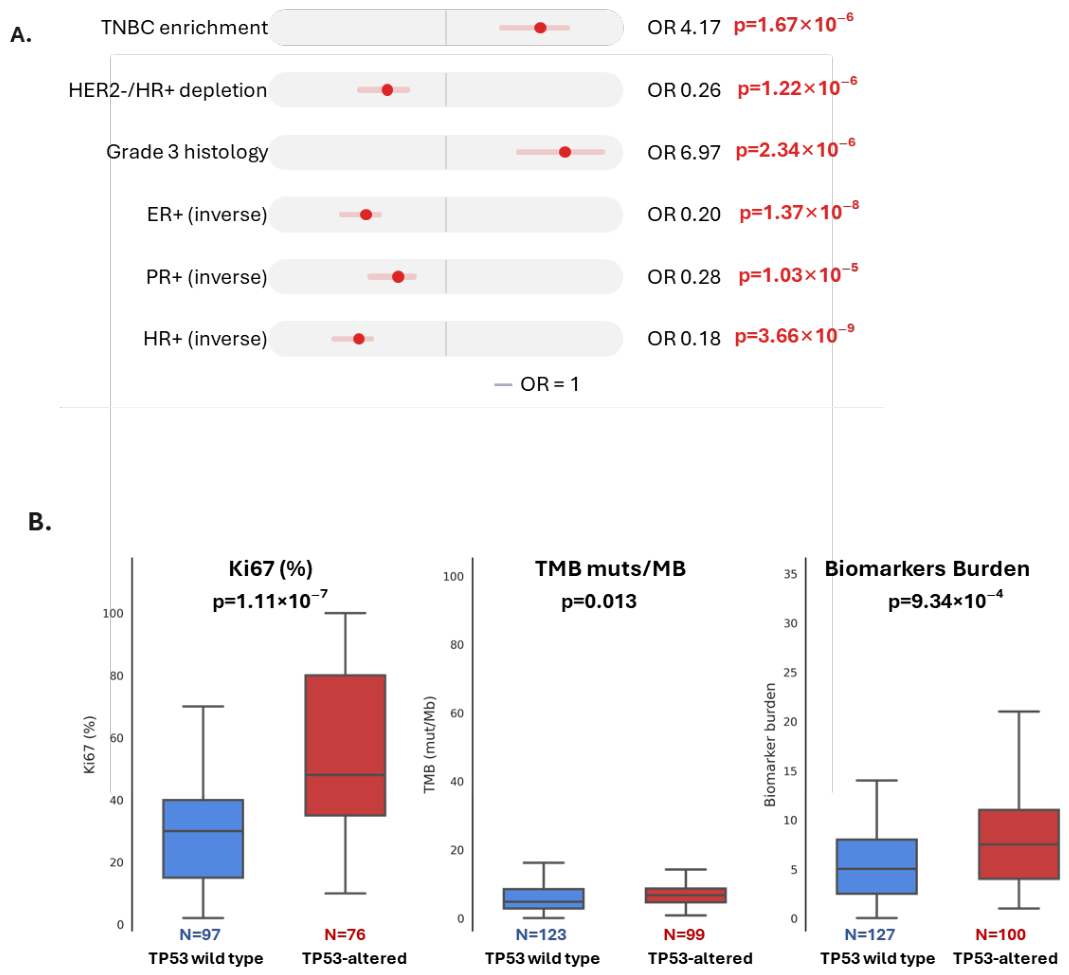
Figure 6.
Multivariable linear regression analysis of factors associated with TMB (n = 105). Forest plot showing beta coefficients (points) and 95% confidence intervals (horizontal lines) for the association between clinicopathological variables and log10-transformed TMB. The dashed vertical line indicates no effect (β = 0).
Figure 6.
Multivariable linear regression analysis of factors associated with TMB (n = 105). Forest plot showing beta coefficients (points) and 95% confidence intervals (horizontal lines) for the association between clinicopathological variables and log10-transformed TMB. The dashed vertical line indicates no effect (β = 0).
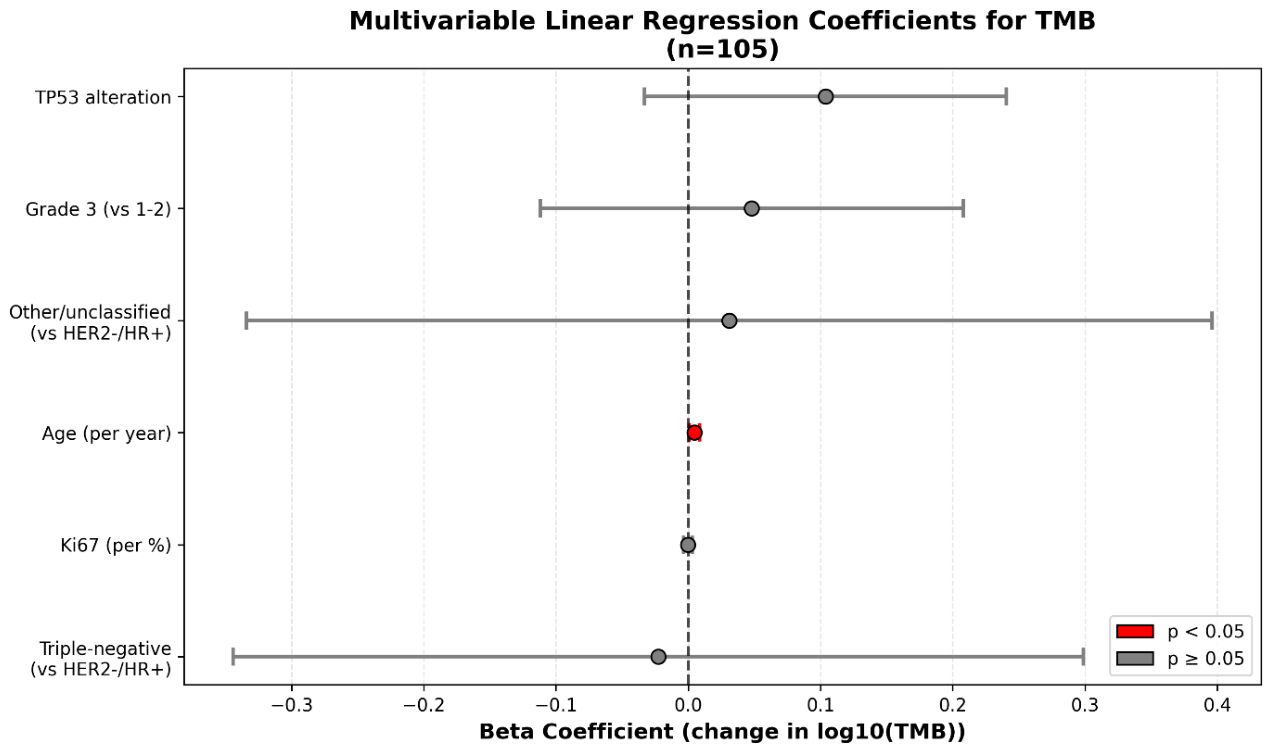
Figure 7.
Summary of the correlations among various Clinicopathologic features and with molecular actionability. Molecular features included: On-label variant detection, actionable burden (summary of on and off label mutations) and TMB.
Figure 7.
Summary of the correlations among various Clinicopathologic features and with molecular actionability. Molecular features included: On-label variant detection, actionable burden (summary of on and off label mutations) and TMB.
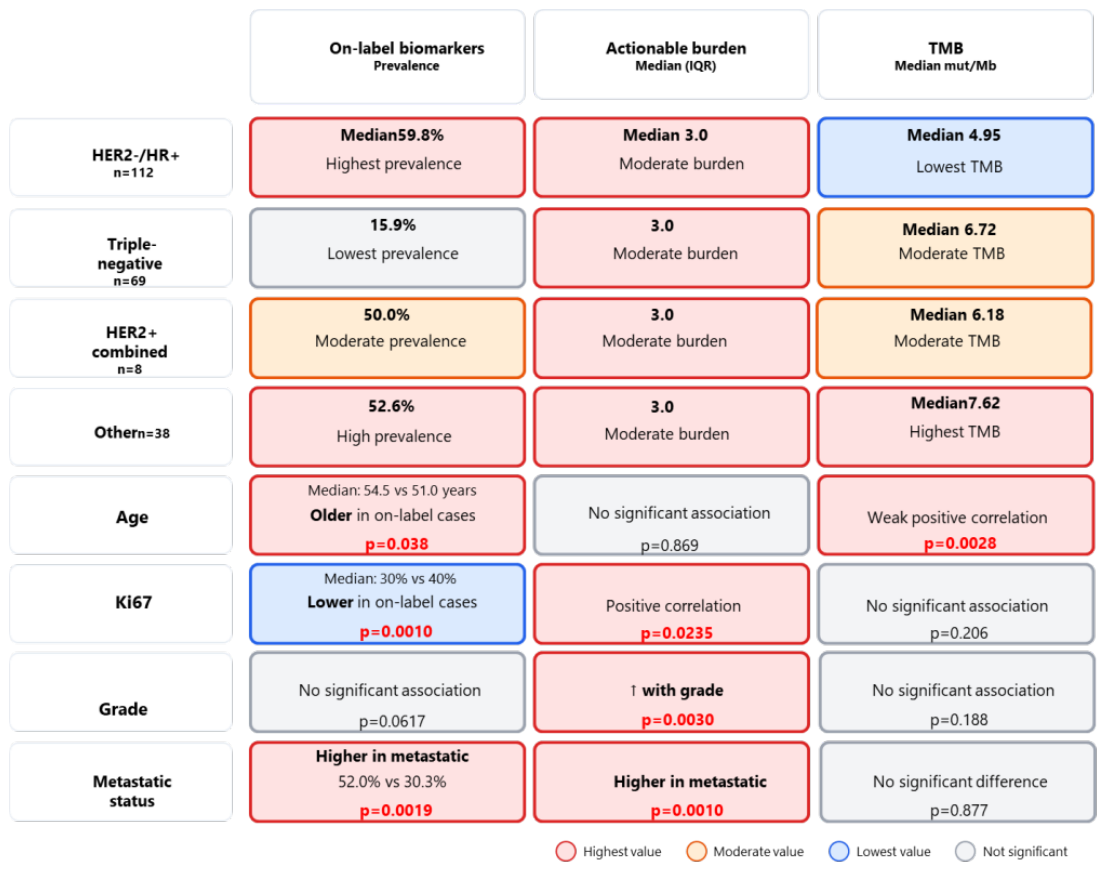

Table 1.
Clinicopathological Correlates of Actionability and Tumor Mutational Burden.
| Variable | On-label biomarkers | Actionable burden | TMB |
| Age | ↑ in on-label cases (p=0.038) | NS (p=0.869) | weak positive correlation (p=0.0028) |
| Ki67 | ↓ in on-label cases (p=0.0010) | positive correlation (p=0.0235) | NS (p=0.206) |
| Grade | NS (p=0.0617) | increases with grade (p=0.0030) | NS (p=0.188) |
| Metastatic status | higher in metastatic tumors (p=0.0019) | higher in metastatic tumors (p=0.0010) | NS (p=0.877) |
Symbols: ↑ Increased, ↓ decreased, NS: Not statistically significant.
Disclaimer/Publisher’s Note: The statements, opinions and data contained in all publications are solely those of the individual author(s) and contributor(s) and not of MDPI and/or the editor(s). MDPI and/or the editor(s) disclaim responsibility for any injury to people or property resulting from any ideas, methods, instructions or products referred to in the content. |
© 2026 by the author. Licensee MDPI, Basel, Switzerland. This article is an open access article distributed under the terms and conditions of the Creative Commons Attribution (CC BY) license.
Copyright: This open access article is published under a Creative Commons CC BY 4.0 license, which permit the free download, distribution, and reuse, provided that the author and preprint are cited in any reuse.


