
Submitted:
05 June 2026
Posted:
05 June 2026
You are already at the latest version
Abstract
Tree cover near buildings has become a growing concern for homeowner insurance companies in hurricane-prone areas due to the potential for storm damage. Policies requiring the removal of trees located near or overhanging homes as a precondition for new coverage are not new to Florida, but they have become increasingly common as a risk-mitigation strategy. In this study, visual canopy analysis was used to interpret 3,500 random points across Florida, United States, in order to assess the potential statewide impacts of these tree-removal policies. Results indicate that insurance-related pruning and removal mandates could reduce Florida’s overall canopy coverage in developed areas by 588.5 square kilometers. Using ecosystem service models, this reduction was estimated to result in the loss of approximately 6,074 tonnes of air-pollutant removal capacity, more than 11.1 billion liters of avoided stormwater runoff, and 294,250 tonnes of carbon sequestration annually. These findings may help guide public policy and insurance industry practices by highlighting the broader ecological and economic consequences of large-scale tree removal in developed areas.
Keywords:
urban tree canopy
; canopy loss
; homeowners' insurance
; hurricanes
Introduction
Urban tree canopy is a crucial component of urban ecosystems. Trees improve air and water quality, sequester carbon, regulate temperature, and provide habitat for local wildlife (Tyrväinen et al., 2005). For humans, trees can also enhance overall health and well-being as well as control residential heating and cooling demands through shading and wind-shielding effects (Suhendy et al., 2026; Huang et al., 1990). Collectively, these benefits and other benefits can translate into economic gains for communities through increased property values and reduced infrastructure costs (Song et al., 2018).
However, as the frequency and intensity of natural disasters continue to increase, tree canopy in developed areas is facing growing scrutiny from insurance companies. Weather-related losses and insurance payouts have risen accordingly (Grace & Klein, 2009), prompting carriers to look for ways to reduce their exposure to risk. As a result, some insurers have withdrawn from high-risk areas altogether, while others have implemented stricter underwriting requirements.
To evaluate risk at individual properties, insurance carriers are increasingly using site inspections, including those drawing on aerial imagery, to assess the potential for tree failure and associated property damage during windstorms. These tools allow insurers to assess homes from above and identify branches that overhang roofs or are located within a specified distance of a structure (Ibrahim et al., 2025). In many cases, insurers do not consider arborists’ professional risk assessments when evaluating these trees (Gauldin et al., 2025). Arborists are often only brought in when homeowners question if tree pruning or removal is truly required.
These policy changes are largely driven by the frequency of tree failures during hurricanes. However, claims data do not account for the vast majority of trees that withstand hurricanes intact (Klein et al., 2020; Nelson et al., 2022) and therefore continue to generate ecosystem services without contributing to insurance payouts. Assessing a tree’s actual risk involves more than simple proximity to a structure. Factors such as species, age, health, and structural condition all influence failure potential, as do site-specific conditions including soil characteristics and hurricane intensity (Duryea & Kampf, 2007). Nevertheless, homeowners in hurricane-prone areas like Florida, United States are receiving notices from insurance carriers, based on site and aerial assessments, requiring tree removal as a prerequisite for new coverage. If implemented at scale, these requirements could significantly reduce Florida's overall canopy cover.
Aerial imagery is commonly used to estimate canopy cover across large geographic areas. Because similar methods are also widely used by the insurance industry to assess property risk (Ibrahim et al., 2025), aerial interpretation provides an efficient approach for evaluating the potential effects of these emerging policies. This study aims to quantify how insurance-related tree removal requirements could affect statewide canopy cover in Florida, United States through an aerial assessment estimating the total land area at risk. In addition, we apply a commonly used ecosystem service model to estimate the broader environmental consequences of canopy loss as it relates to air pollutant removal, stormwater runoff, and carbon sequestration.
Methods
This study was conducted in the state of Florida, United States. Florida is a peninsula located in the southeastern United States between the Gulf of Mexico and the Atlantic Ocean. The state has a humid subtropical to tropical climate characterized by high temperatures, heavy rainfall, frequent thunderstorms, and recurring tropical cyclones (Black, 1993). Due to its geographic location, Florida is vulnerable to hurricanes, especially during the Atlantic hurricane season from June through November (Truchelut et al., 2022). In recent years, hurricane-related losses have increased substantially, contributing to higher frequencies and costs of homeowner insurance payouts (Ibrahim et al., 2025).
To gauge what pruning and removal requirements homeowners were facing, insurance letters and insights were collected from tree care professionals working in the state. These professionals were asked to share their experiences with such policies via a post on a professional social media networking site (LinkedIn; LinkedIn Corp., Sunnyvale, CA, United States). Responses revealed two main conditions of concern for insurance companies working in the state: trees directly overhanging homes or within ~3 m (10 feet) of the structure.
As aerial interpretations are often used by insurance companies to determine the likelihood of a tree impacting a home (Ibrahim et al., 2025), it was also used in this study to assess the effects of these new policies. To complete the aerial assessment, a geographic information system (ArcGIS Pro, Esri, Redlands, CA, United States) was used. GIS online provides free downloads of up to date aerial imagery which was used as the basemap for this study (Esri, 2026). The boundary of the study area was delineated using a shapefile obtained from the Florida Department of Transportation (Florida Department of Transportation, 2019).
A dot-based visual assessment method, a random sampling technique commonly used in forestry, was then applied (Nowak et al., 1996) as it provides a reliable and efficient means of evaluating canopy cover (Clymire-Stern et al., 2022). A total of 3,500 random points were generated within the Florida boundary. Points were used to assess whether trees overhang a home, and a 3.048 m (10 ft) buffer was applied around each point to determine when canopy fell within the predetermined proximity threshold of a structure.
The first author interpreted all 3,500 points at a scale of 1:150 and zoomed out as needed to make the correct assessment. Points were assessed and noted if the canopy was directly overhanging a structure or within the proximity threshold. Figure 1 shows an example where a point falls on a canopy overhanging a structure. Figure 2 shows an example where a point falls on the canopy within the proximity threshold of a structure, as indicated by the buffer ring. No distinction was made between residential, commercial, or industrial structures. The second author reviewed all points coded as overhanging or within the proximity threshold to confirm agreement with the interpretations.
Total canopy loss was estimated based on a total Florida area of 138,888.11 km² (Florida Department of Transportation, 2019). Standard error was calculated as:
Where p = n/N, n is the number of points with canopy overhanging or in close proximity to structures, and N is the total number of points (Parmehr et al., 2016). Ecosystem services were estimated from total canopy area using the i-Tree Canopy model (USDA Forest Service, n.d.).
Results and Discussion
This study evaluated the potential impact of new Florida homeowners' insurance policies on statewide canopy cover. Results indicate that implementation of these policies could affect 0.4% (SE = 0.113%) of the study area, equivalent to approximately 588.5 km² of canopy loss. Of this, 15% would result from trees directly overhanging structures, with the remainder attributable to trees falling within the 10-foot proximity threshold. This estimate would increase if insurance companies expand the required clearance distance in the future.
Florida's statewide urban canopy cover is currently estimated at approximately 30% (Koeser et al., 2022). The state's population is heavily urbanized, with 97% of Floridians residing in metropolitan areas (Bureau of Economic and Business Research, 2021). Any canopy loss resulting from these insurance policies would disproportionately affect the urban forest, as that is where the majority of insured structures are located. To contextualize this loss, urban tree canopy data from the 300 largest cities in Florida were used for comparison, with canopy percentages drawn from Salisbury et al. (2022) and converted to square kilometers. By this measure, the projected loss would be equivalent to the complete removal of all urban tree canopy in Tampa, Orlando, St. Petersburg, Tallahassee, Fort Lauderdale, and Lakeland combined (Table 1).
The projected canopy loss would have significant consequences for developed environments. Trees provide a range of ecosystem services, including carbon sequestration, stormwater runoff mitigation, and air quality improvement through pollutant filtration (Tyrväinen et al., 2005). To quantify these impacts, the i-Tree Canopy tool was used to estimate ecological benefits based on canopy area, including air pollutant removal, hydrological benefits, and carbon storage, along with their associated monetary values (USDA Forest Service, n.d.).
Major air pollutants filtered by trees include carbon monoxide, nitrogen dioxide, ozone, sulfur dioxide, and particulate matter. The projected loss of 588.5 km² of canopy would eliminate an estimated 6,074.49 tonnes of annual pollutant removal, with associated costs of approximately $44.4 million per year. Trees also play an important role in stormwater management. The same canopy loss is estimated to result in an additional 1.11 × 10¹⁰ liters of stormwater runoff annually, representing approximately $26.2 million in added management costs.
Trees also contribute substantially to carbon storage and sequestration. The projected loss of 588.5 km² of canopy would eliminate an estimated 22.4 million tonnes of carbon sequestration annually. To put this in perspective, that is equivalent to the annual emissions of approximately 5.24 million gasoline-powered passenger vehicles or 5.9 coal-fired power plants (United States Environmental Protection Agency, 2024).
Trees also provide shading and thermal buffering benefits for residential structures. By blocking incoming sunlight and reducing wind exposure, trees help regulate temperatures around buildings, lowering heating and cooling demands (Huang et al., 1990). This reduced energy demand represents an important source of avoided carbon emissions, separate from and in addition to the direct carbon sequestration provided by trees. The removal of trees in close proximity to or overhanging homes would therefore increase residential energy consumption, offsetting some of the carbon benefits that the remaining urban forest provides.
Another important consideration is whether the trees flagged as risks by insurance carriers actually pose a threat to the home. While insurance carriers rely on proximity as their sole criterion, a formal risk assessment conducted by a certified arborist considers a much broader range of factors. These include tree condition (decay, dead or dying branches, disease) as well as structural and site factors such as lean, root damage, soil type or disturbance, and species (Koeser et al., 2020). Taken together, these factors determine the likelihood of tree failure and the probability of impact on a nearby structure (i.e., tree risk). Relatively few trees found in urban populations have elevated risk (Koeser et al., 2020). Moreover, a tree in close proximity to a structure may pose little actual risk regardless of its likelihood of failure if it is leaning away from the home, a condition that may not be readily apparent from aerial imagery. Furthermore some studies show that based on wind patterns and locations of trees some structures can see a decrease in wind pressure creating a protective effect on the home rather than a risk (Ibrahim et al., 2025).
Research has examined how well arborist-conducted risk assessments predict tree failure during hurricanes. Following Hurricane Matthew, a team of arborists with an industry risk assessment qualification (Dunster et al., 2017) who had assessed trees in the affected area prior to the storm conducted a post-storm reassessment. They found that 93% of surveyed trees survived intact, 6% experienced partial failure, and 1% experienced whole-tree failure (Koeser et al., 2020). Comparison with the pre-storm assessments revealed strong predictive accuracy: “94.1% of trees rated as having an "imminent" likelihood of failure were damaged, compared to 38.8% of those rated "probable," 15.3% rated "possible," and 0.0% rated "improbable’” (Koeser et al., 2020). These findings suggest that formal arborist risk assessments are effective at identifying trees likely to fail during hurricane conditions.
Similarly, studies examining tree failure rates after Hurricane Irma produced comparable results. In a Naples, FL study, 74% of surveyed trees sustained no damage, 4% sustained only minor damage requiring minimal corrective pruning, 6% sustained significant damage requiring major corrective pruning, and 15% were whole-tree failures such as uprooted trees or trees requiring removal (Klein et al., 2020). A Tampa, FL study inventoried trees in 2015 prior to the hurricane and found results similar to those from Naples, with failure rates generally increasing as pre-storm likelihood-of-failure ratings increased (Nelson et al., 2022). These findings further support the conclusion that risk assessments conducted by certified arborists can more accurately predict the likelihood of failure than proximity to a structure alone. By partnering with certified arborists to evaluate tree risk, insurance carriers could better predict outcomes and reduce unnecessary tree removals — and the costs homeowners bear as a result.

Table 2.
Estimated Annual Ecosystem Service Losses Associated with Urban Tree Canopy Removal in Florida.
Table 2.
Estimated Annual Ecosystem Service Losses Associated with Urban Tree Canopy Removal in Florida.
| Service Type | Description | Removal Rate (t/year) | Monetary Value (per t) | Estimated Value (Annual) |
| Air Pollution | Carbon Monoxide (CO) | 120.64 | $1,469.94 | $177,337.24 |
| Nitrogen Dioxide (NO2) | 381.94 | $394.62 | $150,719.78 | |
| Ozone (O3) | 4052.41 | $3,118.59 | $12,637,808.42 | |
| Particulates less than 10 microns (PM10) | 1,222.90 | $6,909.77 | $8,449,978.46 | |
| Particulates less than 2.5 microns (PM2.5) | 175.37 | $131,163.73 | $23,002,576.82 | |
| Sulfur Dioxide (SO2) | 121.23 | $128.78 | $15,612.13 | |
| Type | Description | Removal Rate (L/year) | Monetary Value (per 1000 L) | Estimated Value (Annual) |
| Hydrological | Avoided Runoff | 1.11 × 10¹⁰ | $2.36 | $26,253,620.58 |
| Type | Description | Sequestered/Stored Carbon (t) | Monetary Value (per t) | Estimated Value |
| Carbon | Annual Sequestration (CO2) | 294,250.00 | $447.00 | $131,529,750.00 |
| Annual Sequestration (CO2e) | 1,078,897.05 | $130.09 | $140,353,717.23 | |
| Carbon Stored In Trees (CO2) | 4,522,504.80 | $447.00 | $2,021,559,645.60 | |
| Carbon Equiv. Stored In Trees (CO2e) | 16,582,517.60 | $130.09 | $2,157,219,714.58 |
Conclusion
While the removal of trees in close proximity to structures may seem straightforward from an insurance carrier's perspective, it places an often unnecessary financial burden on homeowners who must prune or remove trees that, based on prior hurricane research, are unlikely to impact homes during a storm or may even reduce the impacts of wind on the structure. Moreover, removing trees solely based on proximity to structures risks eliminating large portions of the urban forest without accounting for the full ecological value or actual risk of individual trees. These trees provide critical benefits to urban environments, and their loss would carry significant remediation costs for the state.
If all trees identified under these policies were removed, Florida's canopy cover in developed areas would be reduced by an estimated 588.5 km². This would result in the loss of ecosystem services including air pollutant removal, stormwater mitigation, and carbon sequestration, representing a substantial annual monetary loss. When factoring in increased residential energy costs associated with canopy loss, the long-term economic and environmental consequences of widespread tree removal may outweigh the short-term risk reduction benefits sought through current insurance practices. These findings underscore the importance of balancing risk management with long-term environmental sustainability.
As climate change continues to increase the frequency and intensity of severe weather events, conflicts between risk reduction and environmental conservation are likely to grow. This study emphasizes the need for collaboration among insurance carriers, arborists, and policymakers to develop risk management strategies that protect both property and urban forests.
Acknowledgments
While all text was generated by the authors, copy editing was conducted with the assistance of a large language model (Claude, Anthropic, San Francisco, CA, USA).
References
- Black, R. Florida climate data; (Circular EES-5); Florida Cooperative Extension Service, Institute of Food and Agricultural Sciences, University of Florida, 1993; https://p2infohouse.org/ref/08/07352.pdf.
- Bureau of Economic and Business Research. Florida population: Census summary 2020; University of Florida, College of Liberal Arts and Sciences, 2020; https://bebr.ufl.edu/wp-content/uploads/2022/01/census_summary_2020.pdf.
- Clymire-Stern, E.F.; Hauer, R.J.; Hilbert, D.R.; Koeser, A.K.; Buckler, D.; Buntrock, L.; Larsen, E.; Timilsina, N.; Werner, L.P. Comparison between artificial and human estimates in urban tree canopy assessments. Land 2022, 11(12), 2325. [Google Scholar] [CrossRef]
- Dunster, J. A.; Smiley, E. T.; Matheny, N. P.; Lilly, S. Tree risk assessment manual, 2nd ed.; International Society of Arboriculture; p. 201.
- Duryea, Mary L.; Kampf, Eliana. “Wind and Trees: Lessons Learned from Hurricanes: FOR 118 FR173, 9 2007”. EDIS 2007 (20). Gainesville, FL. 20. [CrossRef]
- Esri. World imagery map [Map]. ArcGIS Online. 2026. https://www.arcgis.com/home/item.html?id=10df2279f9684e4a9f6a7f08febac2a9.
- Florida Department of State. Quick facts. Florida Department of State, n.d. https://dos.fl.gov/florida-facts/quick-facts/.
- Florida Department of Transportation. Detailed Florida state boundary [Data set]. FDOT Open Data Hub. 2019. https://gis-fdot.opendata.arcgis.com/datasets/fdot::detailed-florida-state-boundary/about.
- Gauldin, M.; Gordon, J.; Brodbeck, A.; Calabria, J. Exploring trust and communication between insurers, arborists, and homeowners. Urban For. Urban Green. 2025, 113, 129003. [Google Scholar] [CrossRef]
- Grace, M.F.; Klein, R.W. The Perfect Storm: Hurricanes, Insurance, and Regulation. Risk Manag. Insur. Rev. 2009, 12, 81–124. [Google Scholar] [CrossRef]
- Huang, Y. J.; Akbari, H.; Taha, H. The wind-shielding and shading effects of trees on residential heating and cooling requirements. ASHRAE Trans. 1990, 96(1), 1403–1411. [Google Scholar]
- Ibrahim, H.A.; Ahmed, F.; Metwally, O.; Elawady, A.; Pinelli, J.-P. Balancing protection and risk: Understanding the dual impact of trees on low-rise buildings during extreme wind events. J. Wind Eng. Ind. Aerodyn. 2025, 265, 106179. [Google Scholar] [CrossRef]
- Klein, R. W.; Koeser, A. K.; Kane, B.; Landry, S. M.; Shields, H.; Lloyd, S.; Hansen, G. Evaluating the likelihood of tree failure in Naples, Florida (United States) following Hurricane Irma. Forests 2020, 11(5), 485. [Google Scholar] [CrossRef]
- Koeser, A.K.; Smiley, E.T.; Hauer, R.J.; Kane, B.; Klein, R.W.; Landry, S.M.; Sherwood, M. 2020. Can professionals gauge likelihood of failure? – Insights from tropical storm. 2020. [Google Scholar]
- Matthew. Published in Urban Forestry & Urban Greening. [CrossRef]
- Nelson, M. F.; Klein, R. W.; Koeser, A. K.; Landry, S. M.; Kane, B. The impact of visual defects and neighboring trees on wind-related tree failures. Forests 2022, 13(7), 978. [Google Scholar] [CrossRef]
- Nowak, D.J.; Rowntree, R.A.; McPherson, E.G.; Sisinni, S.M.; Kerkmann, E.R.; Stevens, J.C. Measuring and analyzing urban tree cover. Landsc. Urban Plan. 1996, 36(1), 49–57. [Google Scholar] [CrossRef]
- Parmehr, E. G.; Amati, M.; Taylor, E. J.; Livesley, S. J. Estimation of urban tree canopy cover using random point sampling and remote sensing methods. Urban For. Urban Green. 2016, 20, 160–171. [Google Scholar] [CrossRef]
- Salisbury, A.; Koeser, A.; Hauer, R.; Hilbert, D.; Abd-Elrahman, A.; Andreu, M.; Britt, K.; Landry, S.; Lusk, M.; Miesbauer, J.; Thorn, H. The legacy of hurricanes, historic land cover, and municipal ordinances on urban tree canopy in Florida (United States). Front. For. Glob. Change 2022, 5, 742157. [Google Scholar] [CrossRef]
- Song, X.P.; Tan, P.Y.; Edwards, P.; Richards, D. The economic benefits and costs of trees in urban forest stewardship: A systematic review. Urban For. Urban Green. 2018, 29, 162–170. [Google Scholar] [CrossRef]
- Suhendy, C.C.V.; Koeser, A.K.; Klein, R.W.; Warner, L.; van den Bosch, M.; Hansen, G. The influence of urban forest on stress levels among adults aged 45 and older: An environmental and socioeconomic analysis in Florida, US. Trees For. People 2026, 23, 101118. [Google Scholar] [CrossRef]
- Truchelut, R.E.; Klotzbach, P.J.; Staehling, E.M.; et al. Earlier onset of North Atlantic hurricane season with warming oceans. Nat. Commun. 2022, 13, 4646. [Google Scholar] [CrossRef] [PubMed]
- Tyrväinen, L.; Pauleit, S.; Seeland, K.; de Vries, S. Benefits and Uses of Urban Forests and Trees. In Urban Forests and Trees; Konijnendijk, C., Nilsson, K., Randrup, T., Schipperijn, J., Eds.; Springer: Berlin, Heidelberg, 2005. [Google Scholar] [CrossRef]
- United States Environmental Protection Agency. Greenhouse gas equivalencies calculator. 2024. https://www.epa.gov/energy/greenhouse-gas-equivalencies-calculator#results.
- USDA Forest Service. (n.d.). i-Tree Canopy. i-Tree Tools. Retrieved May 18, 2026. https://canopy.itreetools.org/benefits.
Figure 1.
This image shows a data point that falls over both the canopy and a home.
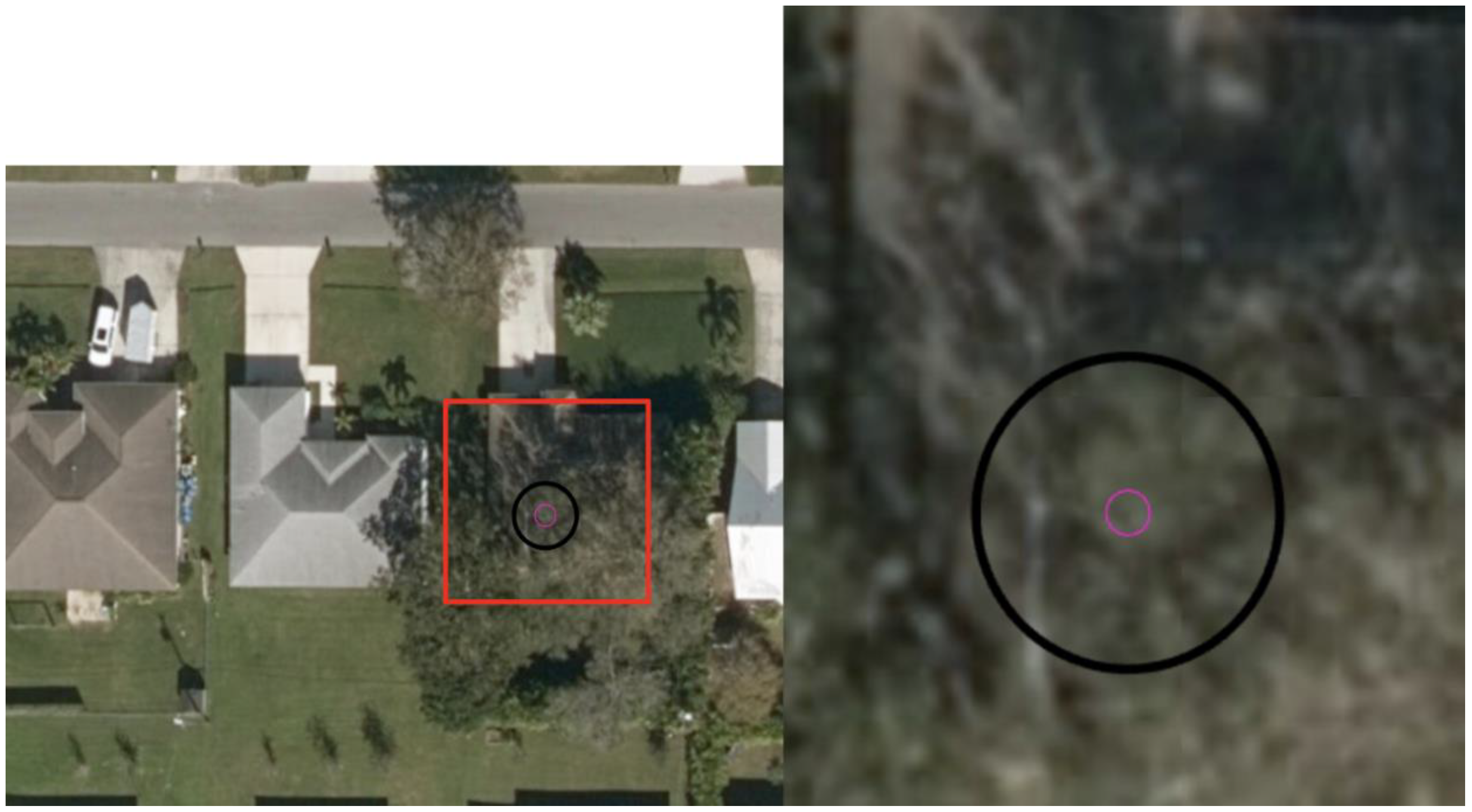
Figure 2.
This photo shows an example of the data point being over the canopy and a home in the buffer region.
Figure 2.
This photo shows an example of the data point being over the canopy and a home in the buffer region.
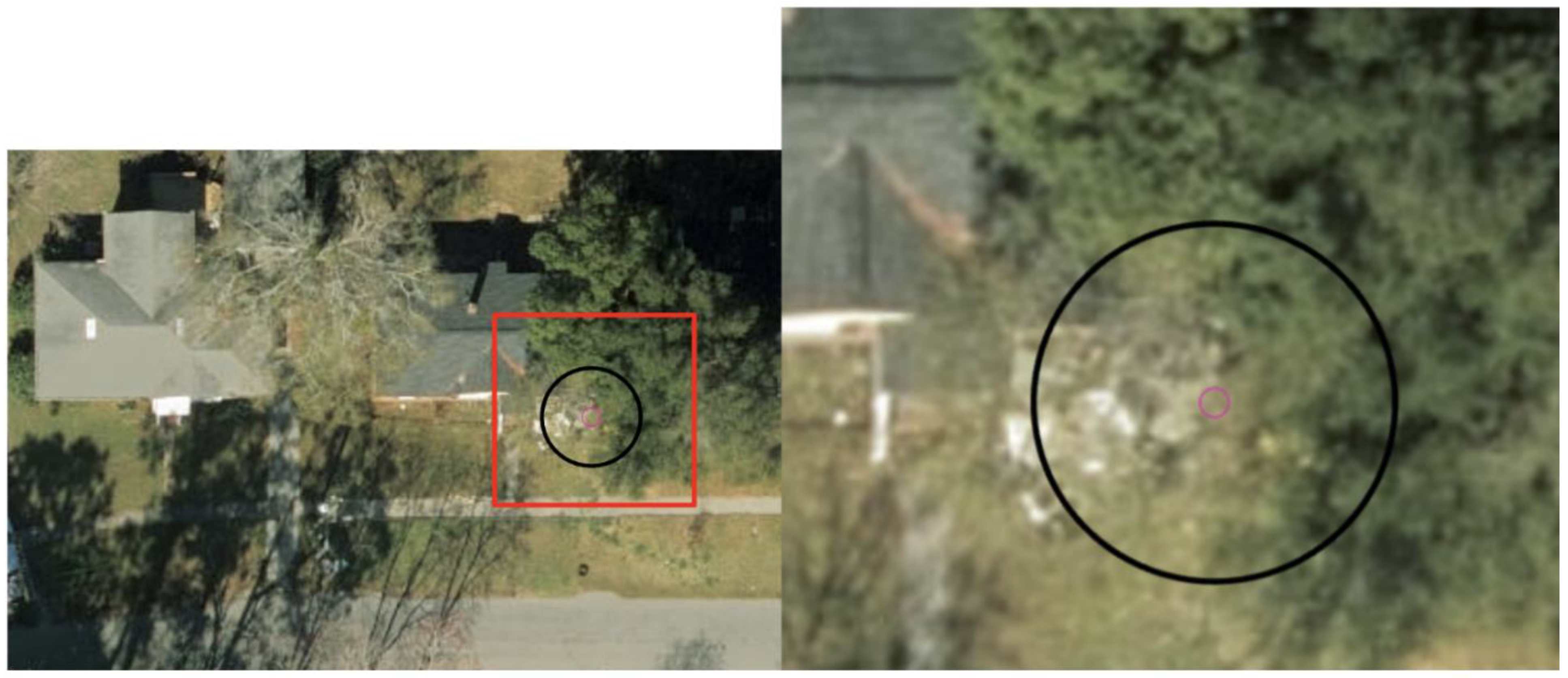
Table 1.
Tree Canopy Loss Per City.
| City Name | Population | Total Area (km²) | Urban Tree Canopy (%) | Canopy Area (km²) |
|---|---|---|---|---|
| Tampa | 401,618 | 453.2 | 37.9 | 170.9 |
| Orlando | 319,758 | 284.9 | 27.6 | 77.7 |
| St Petersburg | 262,732 | 349.6 | 34.1 | 119.1 |
| Tallahassee | 201,875 | 266.8 | 50.5 | 134.7 |
| Fort Lauderdale | 185,604 | 36 | 26.1 | 23.31 |
| Lakeland | 119,961 | 75 | 32.2 | 62.16 |
| Total | 588.32 |
Disclaimer/Publisher’s Note: The statements, opinions and data contained in all publications are solely those of the individual author(s) and contributor(s) and not of MDPI and/or the editor(s). MDPI and/or the editor(s) disclaim responsibility for any injury to people or property resulting from any ideas, methods, instructions or products referred to in the content. |
© 2026 by the authors. Licensee MDPI, Basel, Switzerland. This article is an open access article distributed under the terms and conditions of the Creative Commons Attribution (CC BY) license (http://creativecommons.org/licenses/by/4.0/).
Copyright: This open access article is published under a Creative Commons CC BY 4.0 license, which permit the free download, distribution, and reuse, provided that the author and preprint are cited in any reuse.


