
Submitted:
04 June 2026
Posted:
05 June 2026
You are already at the latest version
Abstract
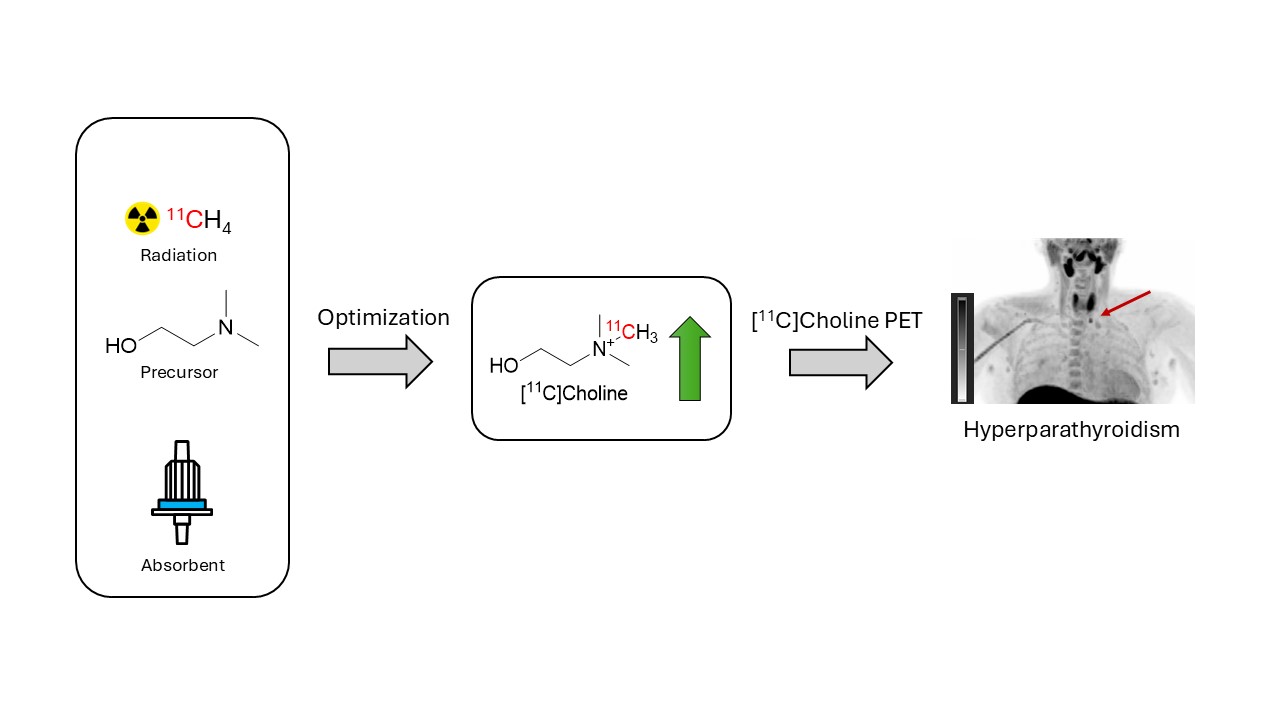
[¹¹C]Choline ([¹¹C]CHO) has reemerged as a radiopharmaceutical tracer for positron emission tomography (PET) diagnostics and optimized synthesis setups are thus needed to meet the increased demand, often on existing production lines. Originally, [¹¹C]CHO has experienced a decline in use for PET diagnostics, particularly in prostate cancer imaging due to radiopharmaceuticals with higher target specificity. However, recent studies have demonstrated superior sensitivity and diagnostic accuracy of [¹¹C]CHO for localizing autonomous adenomas in primary hyperparathyroidism (PHPT) compared to conventional ⁹⁹ᵐTc-sestamibi scintigraphy. The PET-scan is used prior to surgery, but not for the diagnosis of PHPT. The patient compliance is high due to the relatively short time in the scanner. With this renewed clinical relevance, optimization of [¹¹C]CHO synthesis is warranted, as standard production protocols typically yield only 2.5–3.0 GBq. In this study, three critical steps in the synthesis process on a TracerMaker module were systematically evaluated and optimized. (1) Extending the irradiation time from 25 to 42 minutes produced no significant increase in radiochemical yield (RCY). (2) Increasing the precursor, dimethylaminoethanol (DMAE) loading volume to 150 µL divided across two serially connected Sep-Pak Accell CM Plus Light cartridges resulted in a twofold RCY increase but also elevated residual DMAE levels in the final product. (3) Increasing washing volumes of ethanol and water did not improve purification efficiency; however, replacing the two stacked cartridges (2 × 130 mg) with a single cartridge containing a higher sorbent mass (360 mg) achieved effective DMAE removal while maintaining high RCY. These findings demonstrate a practical route for optimizing [¹¹C]CHO synthesis to meet the growing clinical demand of [¹¹C]CHO for imaging of PHPT.
Keywords:
[11C]Choline
; radiopharmaceuticals
; radiosynthesis
; pet imaging
; primary hyperparathyroidism
; TracerMaker
Introduction
The radiopharmaceutical [11C]choline ([11C]CHO) has recently seen a resurgence in relevance as a tool for localizing hyperactive adenomas giving rise to primary hyperparathyroidism (PHPT) by use of positron emission tomography (PET).[1,2] This has occurred after a steady decline in the original intended use of [11C]CHO as a PET tracer for prostate cancer.
[11C]CHO was developed in 1998 as a 11C labelled version of the biomolecule choline and as an alternative to [18F]fluorodeoxyglucose ([18F]FDG) for prostate cancer PET imagining.[3] Despite [18F]FDG being the most widely used radiotracer in oncological PET imaging, the urinary excretion of [18F]FDG leads to a high background signal in PET images of the pelvic region, thus limiting its diagnostic accuracy.[4] However, choline an essential component in phospholipid membrane synthesis, and thus [11C]CHO capitalizes on the elevated choline uptake and phospholipid turnover observed in prostate cancer cell.[3] Unlike [18F]FDG, [11C]CHO is predominantly cleared by the liver, resulting in accumulation of radioactivity in the bile duct and thus lower signal interference in the pelvic region.[3] This property made [11C]CHO a valuable tool for localizing primary prostate tumours in cases where [18F]FDG was suboptimal.[5] Following several years of clinical use, [11C]CHO was gradually supplanted by more specific radiopharmaceuticals, such as [68Ga]PSMA-11[6] and [18F]FPSMA[7], which target the prostate specific membrane antigen (PSMA) protein.[8] These next-generation tracers demonstrated higher affinity for prostate tumor tissue, leading to a decline in the clinical use of [11C]CHO.
Recently, studies have highlighted a renewed diagnostic role for [11C]CHO in patients with PHPT, a condition characterized by excessive secretion of parathyroid hormone (PTH) due to overactive parathyroid glands.[9] In most cases, this hyper functionality results from benign adenomas within these small endocrine glands, although, in rare instances, malignant tumors located near or within the thyroid lobes can be responsible. Parathyroidectomy (PTX) is the definitive treatment of patients with PHPT. To achieve optimal outcomes and minimize surgical morbidity, accurate preoperative localization of the adenoma is essential. Traditionally, technetium-99m-sestamibi (99mTc-MIBI) scintigraphy has been the first line method for detection of primary parathyroid adenomas (PTA), however this method lacks in sensitivity and often results in false-negative results.[10,11] In comparison, [11C]CHO has demonstrated markedly higher sensitivity and specificity in the detection of primary hyper parathyroid adenomas (PHPTA),[2,12] as well as superior performance in identifying ectopic adenomas compared with 99mTc-MIBI SPECT imaging.[13] In patients in whom PTX is being considered, [11C]CHO PET is now used both for primary localization of the adenoma and in cases where 99mTc-MIBI scintigraphy has failed to identify the adenoma.[14] This is already reflected at our production facility where approximately 100 patients with PHPT were scanned annually in 2023-2025 at Herlev Hospital.
A major limitation of [11C]CHO PET/CT is the short half-life of 11C (t½ = 20,34 min.), which necessitates an on-site cyclotron. Furthermore, efficient radiopharmaceutical production requires rapid and straightforward synthesis procedures capable of delivering high radioactive yields to meet clinical demand. Thus, the increased demand for [11C]CHO in combination with the short half-life of 11C highlights the need for optimized synthesis protocols.
In the original synthesis reported in 1998, [11C]CHO was synthesized via a one-step bimolecular nucleophilic substitution (SN2) reaction between [11C]methyl iodide ([11C]CH3I) and dimethylaminoethanol (DMAE), shown in Figure 1.[3] This synthesis was performed in a reaction vial following purification on a cation exchange cartridge.[3]
The radioactive precursor, [11C]CH3I, is obtained via the 14N(p,α)11C nuclear reaction by proton bombardment of either 14N + 5-10% H2 gas (“CH4 target”) or 14N + 0.5-1.0% O2 gas (“CO2 target”). This produces either [11C]CH4 or [11C]CO2, respectively. The [11C]CH4 is converted directly into [11C]CH3I by reaction with iodine (I2) at >700 °C, whereas [11C]CO2 is reduced into [11C]CH4 before reacted with I2 to form [11C]CH3I (Figure 2a).[15,16]
Although the direct [11C]CH₄ production from the CH₄ target is less time-consuming than the CO2-based route, which is advantageous given the short half-life of 11C, the CO2-route typically yields higher overall radioactivity.[17] Contrarily, the CO2-route has a reduced molar activity, which may result from inadvertent introduction of atmospheric carbon dioxide during CO2 trapping and processing. Maintaining high molar activity is particularly crucial for tracers targeting low-density biological receptors, such as those in neuroimaging applications.[18] Conversely, a high molar activity can lead to radiolytic decomposition, a phenomenon that can be mitigated by introducing radical scavengers such as ascorbic acid.[19] Thus, the use of a CO₂ target is generally preferred for [11C]CHO production in the context of imaging PTA, as high molar activity is not a critical requirement. However, due to equipment constraints, we are currently limited to one [11C]CH₄ gas target, thus, switching to a [11C]CO2 target is not possible.
In this study we focused our efforts on optimizing the [11C]CHO synthesis using a [11C]CH₄ gas target installed on a IBA 18 MeV cyclone 18/18 cyclotron (Figure 2b). The synthesis is almost identical to the original literature, except that DMAE is loaded directly onto the cation exchange cartridge. The synthesis is conducted on a TracerMaker module (Figure 2c). Three key parameters for the [11C]CHO synthesis process are evaluated; irradiation time, precursor loading, and purification efficiency with the aim of enhancing radiochemical yield (RCY) while maintaining product specifications within clinically acceptable limits.
Results and Discussion
The synthesis of [11C]CHO can be divided into three key steps with potential for optimization. The first step is the formation of [11C]CH3I, the second is the reaction of DMAE with [11C]CH3I on the cartridge, and the third is purification of the product. The parameters of the validated standard synthesis for clinical use at the Department of Nuclear Medicine, Herlev Hospital are summarized in Table 1 and serve as the basis for the optimization. Moreover, the product specifications for human use are included in the electronic supplementary information (ESI) (Table S1).
Cyclotron [11C]CH4 Target Irradiation Times
In a regular routine production of [11C]CHO, the target is irradiated for approximately 20-25 minutes which roughly equals to one half-life of 11C (t½ = 20.13 min.). Studies show that irradiating for one half-life would result in a saturation of 50%, and two half-lives results in a saturation of 75% etc.[20] However, an increase in irradiation time did not translate into an increased in end-of-synthesis (EOS) yield of [11C]CHO on the presented setup (Figure 3a).
A possible explanation for this observation could be saturation of the HayeSep D column during trapping of [11C]CH4. The TracerMaker module has built-in radio detectors at the HayeSep trap and by the solid phase extraction (SPE) cartridge (ESI section 2, Figure S1). The radio detector on the HayeSep trap shows, that the highest radioactivity level is achieved after 25 minutes of bombardment. Additional bombardment to 42 minutes did not improve the trapping of [11C]CH4. According to studies, adsorption of gas species like [11C]CH4 and competing N2 on the HayeSep D column is correlated to the column temperature. Trapping of [11C]CH4 at low temperatures is favorable but also show a degree of N2 adsorption. The amount of radioactive [11C]CH4 compared to the amount of N2 present in the target is abysmal (parts per trillion) and therefore, the saturation of HayeSep D with N2 is a possible hypothesis.[21]
Increasing the temperature from −125 °C to −100 °C to lower N2 adsorption did not result in a significant increase in EOS yield (Figure 3b). Additionally, lowering the temperature further (−145 °C) to enhance [11C]CH4 adsorption did not improve the yield either. A possible solution would be to increase the amount of HayeSep D to improve trapping. However, since the TracerMaker module is used for routine clinical production, this solution is not considered practical. Furthermore, packing of a HayeSep D column is both time-consuming and technically challenging. Given this limitation, we therefore pursued alternative approaches to enhance the radioactive yield.
Number of SPE Cartridges and Amount of DMAE
The reaction of [11C]CH3I with DMAE occurs on the SPE cartridge through a simple SN2 reaction. In the validated [11C]CHO synthesis, one SPE cartridge is loaded with 50 µL DMAE (Table 1). It was hypothesized that the yield would proportionally increase with the amount of precursor. To test this, experiments with increased DMAE amounts from 50 µL to 200 µL on 1-3 SPE cartridges, respectively, were carried out. Furthermore, another commercially available cartridge with a larger amount of sorbent (360 mg) was tested. The parameters and results for the different [11C]CHO synthesis are summarized in Figure 4. Moreover, detailed synthesis information and results are also given in Table S2 (ESI, Section 2).
As shown in Figure 4a, using one 130 mg SPE cartridge loaded with 50 µL DMAE afforded 3.19 ± 0.69 GBq (n = 143) of [11C]CHO at EOS. Increasing the amount of DMAE from 75-150 µL improved the yields to approximately 4.2-4.7 GBq. The experiment shows that the loading capacity for one 130 mg SPE cartridge is up to 150 µL DMAE. With this knowledge in hand, we decided to load 2 × SPE cartridges with 150 µL DMAE on each (Figure 4b), to investigate whether the yield could be further optimized. The experiment showed a small increase to 5.12 GBq of [11C]CHO at EOS. However, when the amount of DMAE on each cartridge was reduced to 75 µL the yield increased to 5.74 GBq. A further reduction in the amount of DMAE on each cartridge did not show any further increase of the yield (Figure 4b). Adding a third cartridge with the same total loading volume (150 µL) did not improve the yield significantly (Figure 4c) and previous results indicated that increasing the volume to more than 75 µL/cartridge did not improve the yield. These results show that the optimal approach with multiple SPE cartridges, is 2 × cartridges loaded with 75 µL DMAE on each cartridge.
As depicted in Table S2 and Figure S2 of the ESI, increasing the amount of DMAE resulted in an increased amount of unreacted DMAE in the final product. Although the amount of DMAE was within specification, it was decided to investigate how the concentration of DMAE from the final product could be reduced. Doubling the washing volumes during purification (2 × 5 mL EtOH, 2 × 5 mL H2O) only reduced the amount of DMAE negligibly (see ESI Figure S3a). It is hypothesized that the connection between the two stacked SPE cartridges may have introduced a dead space, which allows residual DMAE to be retained during purification. Thus, the single cartridge with larger sorbent capacity of 360 mg sorbent (WAT020550, Waters) was evaluated as a replacement for the two stacked cartridges. This adjustment demonstrated purification efficiency, with greater removal of DMAE from the final product, while maintaining comparable [11C]CHO EOS yield of 4.71 GBq (ESI Figure S3b). This observation supports the hypothesis, that the connection between the two cartridges constitutes a dead space wherein DMAE accumulates.
Clinical Use of [11C]Choline
At the Department of Nuclear Medicine, Herlev Hospital approx. 100 patients with PHPT underwent PET scans with [11C]CHO annually in 2023-2025. Figure 5a illustrates a [11C]CHO PET scan of a patient with PHPT. Prior to this scan, a parathyroid subtraction scintigraphy with 99mTc-MIBI including SPECT/CT was performed without identification of any convincing focal findings, and a subsequent bilateral neck exploration failed to localize a parathyroid adenoma. The [11C]CHO PET scan demonstrated focal choline uptake in a 10 mm hypodense soft-tissue mass inferior to the left thyroid lobe. A minimal invasive PTX was performed, and the intraoperative measured PTH-level showed a 75% decline 20 minutes after excision of the adenoma, consistent with biochemical cure.
Materials and Methods
The DMAE, sterilizing filter (Millex-GS, 0.22 µm, SLGSV255F) and ventilation filter (Millex-PVDF, 0.22 µm, SLGV004SL) were obtained from Sigma-Aldrich/Merck. Both types of solid phase extraction (SPE) cartridges; Sep-Pak Accell CM Plus Light 130 mg sorbent (WAT023531) and 360 mg sorbent (WAT020550), were obtained from WatersTM. Standard reagents such as ethanol, sterile water (water for injection), and isotonic saline were supplied by the Herlev University Hospital Pharmacy. The raw materials are stored at room temperature. The [11C]CH4 is obtained by bombardment of 95% N2 + 5% H2 target gas through the 14N(p,α)11C nuclear reaction using a IBA 18 MeV cyclone 18/18 cyclotron (beam current: 27 µA, irradiation time: 25-29 min.). The synthesis and product purification were performed on a TracerMaker module from Scansys Laboratorieteknik ApS and executed by an automated sequence of operations. A detailed description of the radiosynthesis of [11C]Choline on TracerMaker is described in the ESI section S1. The quality of the final product is verified by various analytical tools and must be within specifications set according to Ph. Eur. The content of DMAE was quantified by high-performance liquid chromatography (HPLC) and the ethanol content was quantified by gas chromatography (GC). Precursor purity is examined by GC and the pH level was determined by pH strips. The specific analyses are described in the ESI section 5. These quality controls must be within the site-specific approved specifications before the product can be utilized in patients. The full list of specifications is shown in the ESI section 1 (Table S1). A detailed description for each method can be found in the ESI.
Product Quality Control and Analyses
All batches for human use subjected to QC tests prior to release in accordance with the respective compassionate use permits issued by the Danish Medicines Agency. The analytical methods used for QC are generally validated in line with European Pharmacopoeia (Ph. Eur. 11.0; monograph 04/2018:2462)). Details on the QC procedures, equipment (dose calibrator, endotoxin test, GC, HPLC, and pH), and drug specifications are described in the ESI (Section S5 and S1).
Statistical Methods
The general data is presented as the average value ± the standard deviation. The data processing was performed in Microsoft Excel, by use of the built-in statistical functionalities.
Ethical Treatment of Humans and Animals
The clinical data were retrieved from the database of existing patient PET scans obtained as part of routine clinical practice. The diagnoses are sufficiently common for specific scans to be discussed without compromising the privacy and confidentiality of the subjects in question. These considerations warrant the absence of ethics committee/review board approval.
Conclusion
Optimization of the [11C]CHO synthesis on the TracerMaker module was investigated for three parameters to improve the RCY. (1) Extending the target irradiation time in the production of [11C]CH3 gas did not result in an increase of the yield. (2) Increased precursor concentration led to a twofold improvement of the yield (5.74 GBq) when loaded 2 × 75 uL of DMAE onto two stacked SPE cartridges (130 mg sorbent); however, this also led to an increased amount of DMAE in the final product. (3) Attempts to improve precursor clearance by increasing the washing volumes of ethanol (2 × 5 mL) and water (2 × 5 mL) did not reduce the amount of DMAE remarkably. However, replacement of the two stacked cartridges (2 × 130 mg) with a single SPE cartridge containing a higher sorbent mass (360 mg) achieved effective precursor removal while maintaining high radioactive yield. An optimized synthesis protocol was established using a single SPE cartridge containing 360 mg of sorbent loaded with 150 µL of DMAE, resulting in a higher radioactive yield (4.71 GBq) compared to the standard synthesis protocol (3.19 GBq). These results serve as a potential inspiration for other radiopharmaceutical production sites, which seek to improve their existing [11C]CHO production yields or establish a [11C]CHO production line.
Supplementary Materials
The following supporting information can be downloaded at the website of this paper posted on Preprints.org.
Author Contributions
Conceptualization, T.H.V.H.; data curation, T.H.H., A.B.A.A., C.B.C. and L.T.J; visualization, T.H.H., A.B.A.A. and C.B.C; writing – original draft preparation, T.H.H. and A.B.A.A.; writing – review and editing, T.H.H., A.B.A.A., V.L.A., C.B.C. and T.H.V.H.; Supervision, T.H.H.; All authors have read and agreed to the published version of the manuscript.
Funding
This research received no external funding.
Institutional Review Board Statement
Not applicable.
Informed Consent Statement
Not applicable.
Data Availability Statement
Data can be requested by contacting the corresponding author.
Acknowledgments
The authors thank the staff members involved in the production and quality analysis of [11C]Choline and for the PET scanning of the patients at the Department of Nuclear Medicines, Copenhagen University Hospital Herlev and Gentofte Hospital.
Conflicts of Interest
The authors declare no conflict of interest.
References
- Parvinian, A.; Martin-Macintosh, E.L.; Goenka, A.H.; Durski, J.M.; Mullan, B.P.; Kemp, B.J.; Johnson, G.B. (11)C-Choline PET/CT for Detection and Localization of Parathyroid Adenomas. AJR Am. J. Roentgenol. 2018, 210(2), 418–422. [Google Scholar] [CrossRef] [PubMed]
- Liu, Y.; Dang, Y.; Huo, L.; Hu, Y.; Wang, O.; Liu, H.; Chang, X.; Liu, Y.; Xing, X.; Li, F.; Liao, Q.; Hacker, M.; Li, X.; Kreissl, M.C. Preoperative Localization of Adenomas in Primary Hyperparathyroidism: The Value of (11)C-Choline PET/CT in Patients with Negative or Discordant Findings on Ultrasonography and (99m)Tc-Sestamibi SPECT/CT. J. Nucl. Med. 2020, 61(4), 584–589. [Google Scholar] [CrossRef] [PubMed]
- Hara, T.; Kosaka, N.; Kishi, H. PET imaging of prostate cancer using carbon-11-choline. J. Nucl. Med. 1998, 39(6), 990–995. [Google Scholar] [PubMed]
- Jadvar, H. Prostate cancer: PET with 18F-FDG, 18F- or 11C-acetate, and 18F- or 11C-choline. J. Nucl. Med. 2011, 52(1), 81–89. [Google Scholar] [CrossRef] [PubMed]
- Scher, B.; Seitz, M.; Albinger, W.; Tiling, R.; Scherr, M.; Becker, H.C.; Souvatzogluou, M.; Gildehaus, F.J.; Wester, H.J.; Dresel, S. Value of 11C-choline PET and PET/CT in patients with suspected prostate cancer. Eur. J. Nucl. Med. Mol. Imaging 2007, 34(1), 45–53. [Google Scholar] [CrossRef] [PubMed]
- Eder, M.; Schäfer, M.; Bauder-Wüst, U.; Hull, W.-E.; Wängler, C.; Mier, W.; Haberkorn, U.; Eisenhut, M. 68Ga-Complex Lipophilicity and the Targeting Property of a Urea-Based PSMA Inhibitor for PET Imaging. Bioconjugate Chem. 2012, 23(4), 688–697. [Google Scholar] [CrossRef] [PubMed]
- Cardinale, J.; Schäfer, M.; Benešová, M.; Bauder-Wüst, U.; Leotta, K.; Eder, M.; Neels, O.C.; Haberkorn, U.; Giesel, F.L.; Kopka, K. Preclinical Evaluation of 18F-PSMA-1007, a New Prostate-Specific Membrane Antigen Ligand for Prostate Cancer Imaging. J. Nucl. Med. 2017, 58(3), 425–431. [Google Scholar] [CrossRef] [PubMed]
- Chang, S.S. Overview of prostate-specific membrane antigen. Rev. Urol. 2004, 6 Suppl 10 (Suppl 10), S13–18. [Google Scholar] [PubMed]
- Silverberg, S.J.; Bilezikian, J.P. Primary Hyperparathyroidism: Still Evolving? J. Bone Mineral. Res. 2009, 12(5), 856–862. [Google Scholar] [CrossRef] [PubMed]
- Thompson, G.B.; Mullan, B.P.; Grant, C.S.; Gorman, C.A.; van Heerden, J.A.; O'Connor, M.K.; Goellner, J.R.; Ilstrup, D.M. Parathyroid imaging with technetium-99m-sestamibi: an initial institutional experience. Surgery 1994, 116(6), 966-972; discussion 972-963. [Google Scholar]
- Eslamy, H.K.; Ziessman, H.A. Parathyroid Scintigraphy in Patients with Primary Hyperparathyroidism: 99mTc Sestamibi SPECT and SPECT/CT. RadioGraphics 2008, 28(5), 1461–1476. [Google Scholar] [CrossRef] [PubMed]
- Chandra, P.; Nandy, D.; Saini, S. (18) F-Fluorocholine PET-CT Outshines Sestamibi Scintigraphy in Detecting Parathyroid Adenomas in the Background of Hashimoto's Thyroiditis. World J. Nucl. Med. 2023, 22(4), 289–292. [Google Scholar] [PubMed]
- Orevi, M.; Freedman, N.; Mishani, E.; Bocher, M.; Jacobson, O.; Krausz, Y. Localization of parathyroid adenoma by ¹¹C-choline PET/CT: preliminary results. Clin. Nucl. Med. 2014, 39(12), 1033–1038. [Google Scholar] [CrossRef] [PubMed]
- Quak, E.; Lasne-Cardon, A.; Cavarec, M.; Lireux, B.; Bastit, V.; Roudaut, N.; Salaun, P.-Y.; Keromnes, N.; Potard, G.; Vaduva, P.; Esvant, A.; Jegoux, F.; de Crouy-Chanel, O.; Devillers, A.; Guery, C.; Lasnon, C.; Ciappuccini, R.; Legrand, B.; Estienne, A.; Christy, F.; Grellard, J.-M.; Bardet, S.; Clarisse, B. F18-Choline PET/CT or MIBI SPECT/CT in the Surgical Management of Primary Hyperparathyroidism: A Diagnostic Randomized Clinical Trial. JAMA Otolaryngology–Head Neck Surg. 2024, 150(8), 658–665. [Google Scholar] [CrossRef] [PubMed]
- Comar, D.; Cartron, J.-C.; Maziere, M.; Marazano, C. Labelling and metabolism of methionine-methyl-11C. Eur. J. Nucl. Med. 1976, 1(1), 11–14. [Google Scholar] [CrossRef] [PubMed]
- Taddei, C.; Gee, A.D. Recent progress in [11C]carbon dioxide ([11C]CO2) and [11C]carbon monoxide ([11C]CO) chemistry. J. Label. Compd. Radiopharm. 2018, 61(3), 237–251. [Google Scholar] [CrossRef] [PubMed]
- Andersen 1 SL, Ebbe Klit Grove 3, Niels Langkjaer 4, Dan Fuglø 1 and Tri Hien Viet Huynh. Multicenter Experience with Good Manufacturing Practice Production of [11C]PiB for Amyloid Positron Emission Tomography Imaging. Pharmaceuticals, 2024; 17.
- Vanessa, G.-V.; Vijay, G.; Jacek, K.; Jordi, L. Specific Activity of 11C-Labelled Radiotracers: A Big Challenge for PET Chemists. In Positron Emission Tomography; Chia-Hung, H., Ed.; IntechOpen: Rijeka, 2012; p. Ch. 7. [Google Scholar]
- Fukumura, T.; Nakao, R.; Yamaguchi, M.; Suzuki, K. Stability of 11C-labeled PET radiopharmaceuticals. Appl. Radiat. Isot. 2004, 61(6), 1279–1287. [Google Scholar] [CrossRef] [PubMed]
- Cyclotron Produced Radionuclides: Principles and Practice; INTERNATIONAL ATOMIC ENERGY AGENCY: Vienna, 2009.
- Eyer, S.; Stadie, N.; Borgschulte, A.; Emmenegger, L.; Mohn, J. Methane preconcentration by adsorption: A methodology for materials and conditions selection. Adsorption 2014, 20. [Google Scholar] [CrossRef]
Figure 1.
One step synthesis of [11C]Choline.
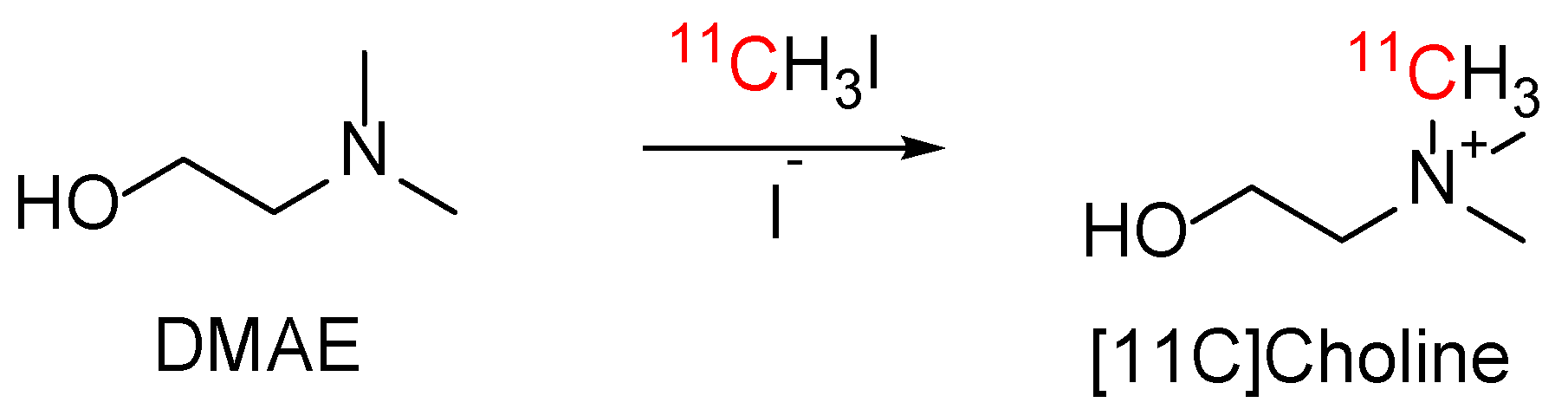
Figure 2.
Schematic overview of [11C]CHO synthesis at Herlev Hospital. The radioactive precursor [11C]CH4 can be produced via two distinct pathways, both utilizing the 14N(p,α)11C nuclear reaction through proton bombardment of either 14N+O2 or 14N+H2 target gas. Pathway (a) [11C]CO2 is initially generated and subsequently reduced to [11C]CH4 using a nickel catalyst. Pathway (b) [11C]CH4 is produced directly from 14N and H2. c) The [11C]CH3I is then reacted with dimethylaminoethanol (DMAE) preloaded on a QMA cartridge to yield [11C]CHO, followed by purification with ethanol and water, and final elution with saline to afford the decided product. All synthesis steps are performed automatically using a TracerMaker module.
Figure 2.
Schematic overview of [11C]CHO synthesis at Herlev Hospital. The radioactive precursor [11C]CH4 can be produced via two distinct pathways, both utilizing the 14N(p,α)11C nuclear reaction through proton bombardment of either 14N+O2 or 14N+H2 target gas. Pathway (a) [11C]CO2 is initially generated and subsequently reduced to [11C]CH4 using a nickel catalyst. Pathway (b) [11C]CH4 is produced directly from 14N and H2. c) The [11C]CH3I is then reacted with dimethylaminoethanol (DMAE) preloaded on a QMA cartridge to yield [11C]CHO, followed by purification with ethanol and water, and final elution with saline to afford the decided product. All synthesis steps are performed automatically using a TracerMaker module.
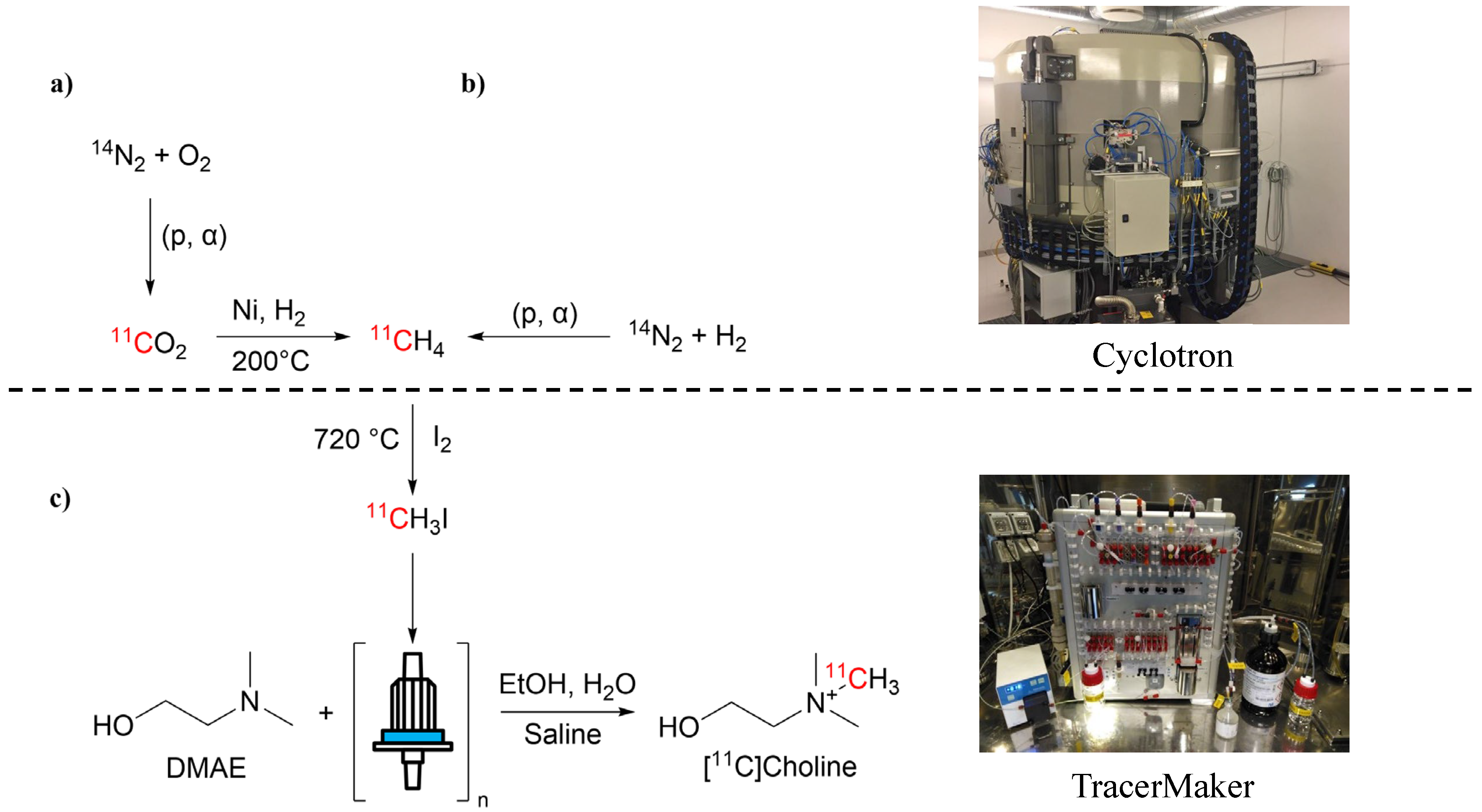
Figure 3.
a) End-of-Synthesis yield (EOS) [GBq] of [11C]CHO when irradiating for roughly one (25 min., blue bar) and two (42 min. orange bar) half-lives. b) The EOS yield of [11C]CHO when increasing the temperature of HayeSep D. Experiments were performed once (n = 1) while at −125 °C (n = 2).
Figure 3.
a) End-of-Synthesis yield (EOS) [GBq] of [11C]CHO when irradiating for roughly one (25 min., blue bar) and two (42 min. orange bar) half-lives. b) The EOS yield of [11C]CHO when increasing the temperature of HayeSep D. Experiments were performed once (n = 1) while at −125 °C (n = 2).
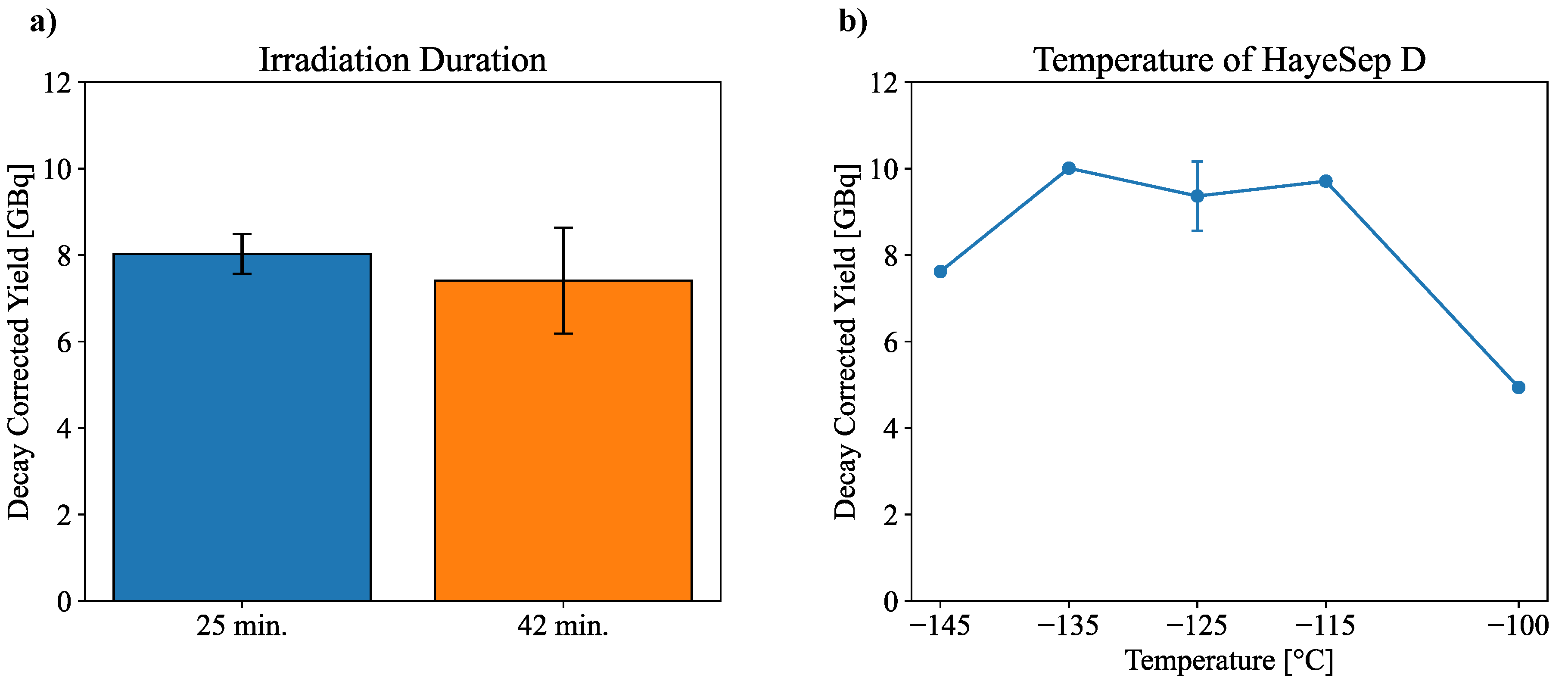
Figure 4.
On-Cartridge reaction of DMAE and [11C]CH3I with increasing load of DMAE. Yields are measured at the EOS as soon as possible and not decay corrected. The experiment with 3 × cartridges is performed once (n = 1), while the remaining experiments are performed in duplicates as minimum. (a) Experiments with 1 × 130 mg adsorbent solid phase extraction (SPE) cartridge. (b) With 2 × stacked 130 mg adsorbent SPE cartridges. (c) With 3 × stacked 130 mg adsorbent SPE cartridges. (d) With 1 × SPE cartridge containing 360 mg adsorbent.
Figure 4.
On-Cartridge reaction of DMAE and [11C]CH3I with increasing load of DMAE. Yields are measured at the EOS as soon as possible and not decay corrected. The experiment with 3 × cartridges is performed once (n = 1), while the remaining experiments are performed in duplicates as minimum. (a) Experiments with 1 × 130 mg adsorbent solid phase extraction (SPE) cartridge. (b) With 2 × stacked 130 mg adsorbent SPE cartridges. (c) With 3 × stacked 130 mg adsorbent SPE cartridges. (d) With 1 × SPE cartridge containing 360 mg adsorbent.
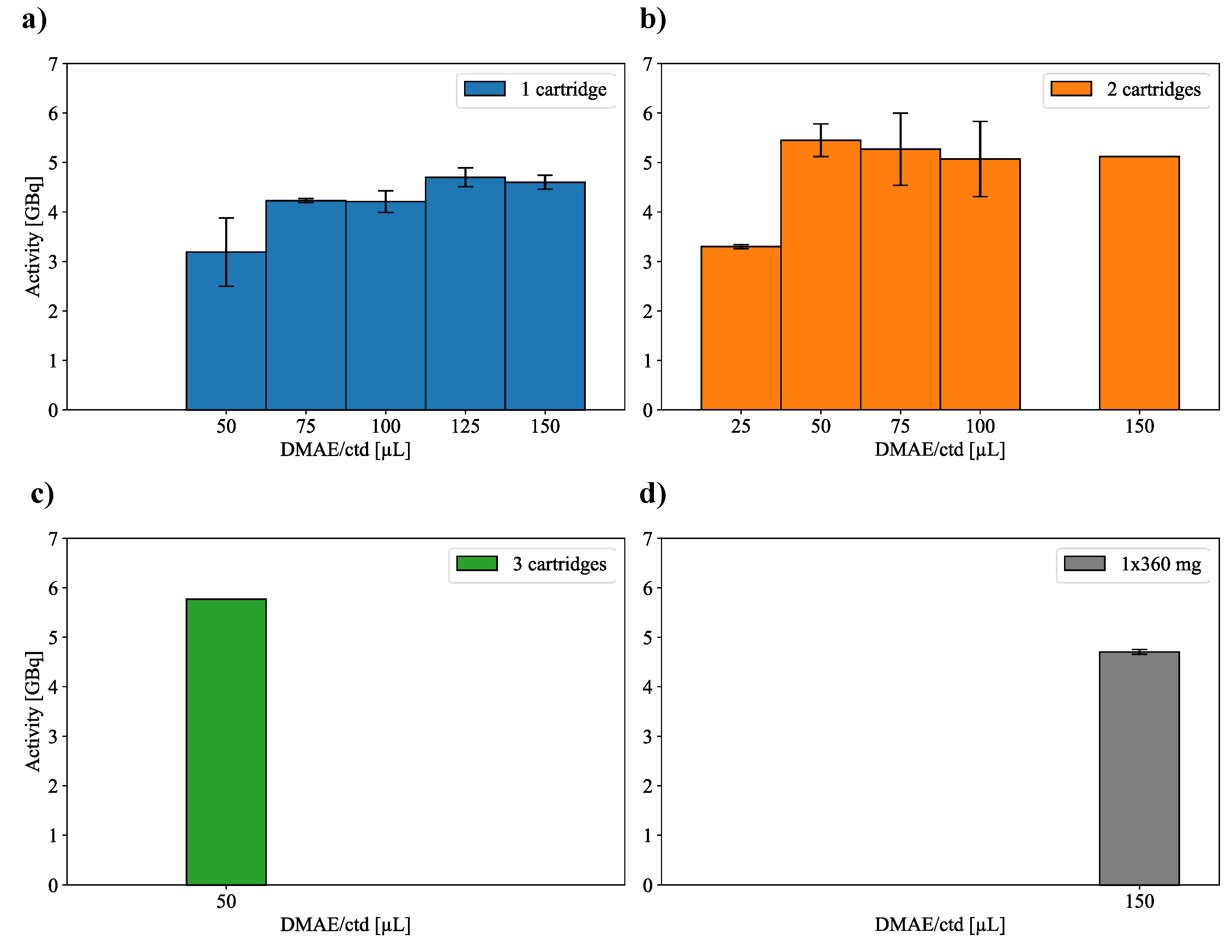
Figure 5.
A parathyroid adenoma in the left inferior parathyroid region (red arrow) is visualized on (a) [11C]CHO PET maximum intensity projection (MIP), (b) axial fused [11C]CHO PET/CT image and (c) axial CT image.
Figure 5.
A parathyroid adenoma in the left inferior parathyroid region (red arrow) is visualized on (a) [11C]CHO PET maximum intensity projection (MIP), (b) axial fused [11C]CHO PET/CT image and (c) axial CT image.
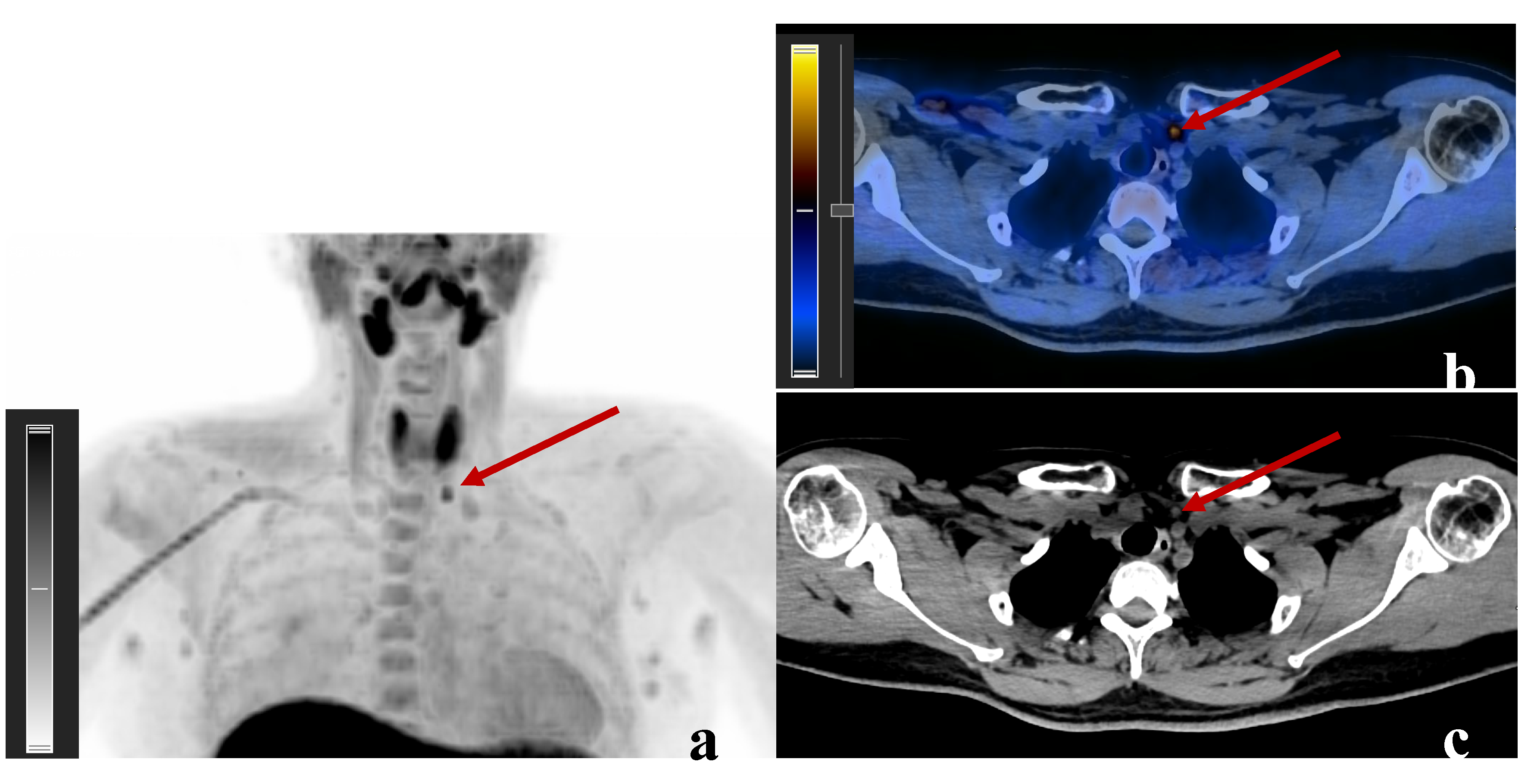

Table 1.
Conditions for validated [11C]CHO synthesis. EOB: end-of-bombardment, i.e., theoretical starting activity of the radioactive precursor, [11C]CH4. EOS: end-of-synthesis, i.e., measured activity of the final product, [11C]CHO.
Table 1.
Conditions for validated [11C]CHO synthesis. EOB: end-of-bombardment, i.e., theoretical starting activity of the radioactive precursor, [11C]CH4. EOS: end-of-synthesis, i.e., measured activity of the final product, [11C]CHO.
| Parameter | Amount |
| Activity EOB [mCi] | 1027 ± 208 |
| Irradiation time [min] | 20-25 |
| DMAE Load [µL] | 50 |
| Cartridge sorbent [mg] | 130 |
| Number of Cartridges | 1 |
| Purification with EtOH [mL] | 5 |
| Purification with H2O [mL] | 5 |
| Elution with saline [mL] | 5 |
| Average results* [n = 143]: | |
| Residual DMAE [µg/mL] | 5.87 ± 8.58 |
| Yield EOS [GBq] | 3.19 ± 0.69 |
* Results date back from 2023 to 2025.
Disclaimer/Publisher’s Note: The statements, opinions and data contained in all publications are solely those of the individual author(s) and contributor(s) and not of MDPI and/or the editor(s). MDPI and/or the editor(s) disclaim responsibility for any injury to people or property resulting from any ideas, methods, instructions or products referred to in the content. |
© 2026 by the authors. Licensee MDPI, Basel, Switzerland. This article is an open access article distributed under the terms and conditions of the Creative Commons Attribution (CC BY) license (http://creativecommons.org/licenses/by/4.0/).
Copyright: This open access article is published under a Creative Commons CC BY 4.0 license, which permit the free download, distribution, and reuse, provided that the author and preprint are cited in any reuse.


