

Submitted:
04 June 2026
Posted:
05 June 2026
You are already at the latest version
Abstract
Environmental concerns arising from the utilization of fossil-based resources in elec-tricity generation have emerged as a pressing global issue. In order to achieve the ob-jective of net-zero emissions in this sector, it is imperative to undergo an ecological transition, in which renewable sources, such as photovoltaic (PV) and wind energy, assume a central role. However, the deployment of these sources also necessitates the parallel operation of Energy Storage Systems (ESS) to compensate for their intermittent characteristics, thereby ensuring the stability of the power network. In the context of large-scale power plants, the construction of conventional low-voltage (LV) battery racks does not appear to represent an optimal technological approach, while the utili-zation of medium-voltage (MV) racks emerges as a potential solution, with the objective of enhancing the system's competitiveness in terms of energy efficiency and cost. As the conversion system is regarded as a significant contributor in the overall cost of the BESS, this study focuses on the analysis of DC/AC converters in order to clarify the afore-mentioned statement. Firstly, a comparison of the conventional LV and the proposed MV converter is presented in terms of electrical performance. Subsequently, a Life Cycle Assessment (LCA) analysis is applied to the constitutive components of the converter in order to evaluate their environmental impact. The findings indicate that the proposed MV DC/AC converter utilizing cutting-edge 3.3 kV Silicon Carbide (SiC) power modules exhibits enhanced efficiency and a reduction in environmental impact when compared to the LV converter.
Keywords:
SiC power module
; Active Neutral Point Clamped
; life cycle assessment
; medium voltage
; energy storage system
; battery racks
; climate change
; materials sustainability
; environmental footprint
1. Introduction
1.1. Renewable Energies and Power Electronics Trends
Environmental concerns arising from the combustion of conventional resources in the production of electricity have become a matter of global significance. The objective of net emission by 2050 is set to encourage a substantial ecological transition, with renewable energies such as photovoltaic (PV) and wind power being recognized as the principal drivers [1] of this energy revolution. Whilst renewable energy sources have been found to be less constant than traditional resources, large-scale deployment of renewables does require the parallel operation of a high-power Energy Storage System (ESS) to compensate for their intermittent characteristics, thus ensuring the stability of power networks [2]. Consequently, the ESS and renewable power plants are interconnected. As asserted by [3], the aggregate power generation is projected to reach approximately 2,000 GW by the year 2050 for energy storage systems (ESS) and 5,000 GW for solar farms. Recent studies have indicated that low-voltage (LV) photovoltaic (PV) systems, particularly their power-electronics-based direct/alternating (DC/AC) current conversion stage, have experienced an increase in voltage, extending from 600 volts to 1500 volts on the DC side and from 300 volts to 800 volts on the AC side, respectively. This development enhances the competitiveness of the overall system in terms of efficiency and cost effectiveness. The development of ESS is also subject to this tendency; and, battery racks are currently standardized to operate at 1500 V [4]. As power capacity tends to increase, it is to be expected that higher voltage levels are being investigated. This means that power converters in renewable plants and energy storage systems (ESS) are increasingly being subjected to medium-voltage (MV) levels.
From this standpoint, the present study makes a comparative contribution to the existing literature through the analysis of LV and MV ESS DC/AC converters, with a focus on their electrical performance and environmental impact. The LV DC/AC converter is an exemplar case study, integrating classic Silicon Insulated Gate Bi-Polar Transistor (Si-IGBT) technology. In contrast, the MV model employs state-of-the-art 3.3-kV Silicon Carbide Metal-Oxide Field-Effect Transistor (SiC MOSFET) power modules.
1.2. Materials and Resources Savings
The present article adopts the Life Cycle Assessment (LCA) methodology to evaluate the environmental impact of two different utility-scale (>3 MW) energy storage systems (ESS), considering their manufacturing process.
LCA is a well-known, internationally standardized and comprehensive methodology that quantifies the consumption of resources (i.e., raw materials, energy, waste, etc.) and related emissions all over the life cycle of a product or process. Introduced since the 1980s, it has become a potent eco-design strategy instrument both for commercialized and new generation products.
The methodology of LCA is defined in accordance with international standards [5,6] and is structured in four iterative steps, i.e.:
- Goal and Scope definition sets up the parameters and methodologies behind the assessment, including any aspect to be defined and clarified, such as: the objective of the study, the system boundary, the functional unit (metric of the study), assumptions and limitations;
- Life Cycle Inventory (LCI) involves the systematic collection and review of data on input and output flows (in terms of energy, materials, waste, etc.) at each stage of a product's life cycle;
- Life Cycle Impact Assessment (LCIA) is a process which involves the calculation and evaluation of the potential environmental impacts arising from the LCI, directly on a dedicated LCA software;
- Interpretation of results is the conclusive step, supported by a hotspot analysis which enables lessons learnt to be disclosed to public audience.
The present article includes the environmental comparative assessment of LV vs. MV power converters that have been dedicated to energy storage systems through LCA methodology. The LCA models are centered on the manufacturing steps of the life cycle, since it is assumed that the other phases (e.g., installation, use/operation, disposal) are the same between the two configurations for a fair comparison, based on the final service provided by each assessed system. Consequently, these phases are outside the scope of the analysis, which has a “cradle-to-gate” approach. The various phases of the LCA process are outlined in the dedicated sections of the article.
1.3. Structure of the Paper
The structure of the paper is outlined as follows. After Introduction (Section 1), in Section 2 the general structure of the two converters under consideration is clearly detailed. In Section 3, an analytical approach is employed to facilitate a comparison of their electrical performance. The fourth section is dedicated to the environmental impact analysis of the constituent components of the two configurations, as determined by life cycle assessment (LCA). The paper concludes in Section 5 with a synthesis of the salient features drawn from the study.
2. Comparison of the Bill of Materials for Low- and Medium-Voltage BESS Power Converters
2.1. LV Si-IGBT Based DC/AC Converter (Reference Case)
Each leg of the circuit is composed of four switches, and thus twelve switches are required to build the entire topology (Figure 1). A comparative analysis of power modules has been conducted, in which two distinct references were selected for analysis: 1,700 V / 800 A (IGBT 1) and 1,200 V / 600 A (IGBT 2) [7]. A study was conducted on the configuration of the capacitors with the objective of reducing the size of the converter. Consequently, a single DC-Bus consists of 30 capacitors, each with a capacity of 1,500 µF (900 V / 100 A). The complete Power Conversion Unit (PCU) consists of four 625 kVA Power Converter Modules (PCMs). Each PCM includes a DC bus, a T-type inverter, and an output LCL filter. In this reference case, power injection is performed at the 480 V low-voltage level.
The LCL filter is designed according to standard design guidelines reported in the literature, where the converter-side inductance is selected based on allowable current ripple, the capacitor is constrained by reactive power limits (typically 3–5% of rated power), and the filter resonance frequency is chosen to meet harmonic distortion requirements [8].

Table 1.
2.5-MVA low voltage T-Type DC/AC converter filter for a THD of less than 3%. Four LCL filters are required for the complete converter (4x625kVA reference case).
Table 1.
2.5-MVA low voltage T-Type DC/AC converter filter for a THD of less than 3%. Four LCL filters are required for the complete converter (4x625kVA reference case).
| LV conf. (reference case) |
Output filter Components for one PCM |
|---|---|
| 150 | |
| 430 | |
| 50 |
2.2. Advanced MV SiC-MOSFET Based DC/AC Converter
The second topology consists of a 3 MW ANPC DC/AC Power Conversion Unit (PCU) [9] comprising two 1.5 MVA Power Converter Modules (PCMs). The PCU operates with a 3-kV input voltage, enabling the series connection of two battery racks with a grounded midpoint (Figure 2). Therefore, the complete PCU requires two DC buses, two 1.5 MVA ANPC converters, and two three-phase ANPC output filters. The ANPC topology provides three voltage levels. A variety of modulation types can be utilized to regulate switching operations. In this particular instance, an Outer Switch Modulation Mode (OSMM) is employed [10]. This choice facilitates the reduction of switching loops. The utilization of a transformer with a rating of 2 100 V/20 kV is employed for the purpose of injecting electricity into the grid, representing a significantly higher voltage level compared to the reference case.
Each individual leg of the circuit is composed of six switches, indicating that three 2L power modules are required to form a single leg. The power modules are composed of two switches. Two distinct categories of power modules have been implemented: MOS 1 and MOS 2 (3.3 kV / 750 A), and IGBT 1 (3.3 kV / 600 A). The DC-Bus utilizes a total of 12 capacitors, each with a capacity of 220 µF, a voltage rating of 1,900 V, and a current rating of 65 A.
3. Recap of the Components Characteristics and LCA Calculations
3.1. LV vs MV Bill of Materials
This study underscores the variation in design between the low-voltage and medium-voltage converters. Power modules of varying dimensions are implemented, consequently resulting in disparate thermal resistances. The calculation of the output filter is of particular importance. The same method is used for both cases. The implementation of a 3D model [9] is finally achieved for the purpose of estimating the geometry of the busbar. The capacitors are the most significant components in determining the converter's overall dimensions. The substantial quantity of capacitors can principally be explained by the elevated input current of the LV configuration converter.
3.2. Goal & Scope of the LCA Analysis
The objective of the LCA analysis delineated in the present article is to compare the environmental impacts associated with the production of two energy storage systems (ESS) configurations at the utility scale (>3 MW). The analysis is centered on the manufacturing stage of the life cycle of a DC-AC converter. It is hypothesized that the other stages (e.g., installation, operation, and disposal) remain relatively constant between the two configurations under consideration for a fair comparison. Consequently, the approach could be defined as "cradle-to-gate" from the perspective of product manufacturing. The functional unit (FU) is defined as "n.1 DC-AC Power Converter for the Utility ESS," applicable to both standard and MV configurations.
3.3. Life Cycle Inventory (LCI) Analysis
The Life Cycle Inventory (LCI) of the present study is reported in Table 3, referring to the functional unit defined in the Goal & Scope (i.e., n.1 DC-AC Power Converter for the Utility ESS).
As previously stated, the final mass of the two components is different, as is their output, but their functionality remains constant, as it is designed for a fair comparison. The LV power converter (PC) has a rated power of 2.5 MVA, while the MV one is designed for 3 MVA. A specific degree of precision is implemented during the assembly process, with the objective of minimizing the relative weight of the components. In the present study, the components enumerated in Table 2 were all incorporated into the life cycle assessment analysis. These components were also the target of the applied innovation process in the field of electronics. It is hypothesized that certain components (including but not limited to DC and AC breakers, gate drivers, and fuses, along with the casing) fall outside the scope of this study, since only negligible modifications are observed between the two configurations.
The LCA models examined in this article have been developed on GaBi™ 10.6.1 software [11] (database version: 2022.1), wherein suitable datasets have been selected from the ecoinvent© 3.8 (allocation, cut-off by classification) database [12], based on the manufacturers' information. In the interest of maintaining confidentiality, the nomenclature of the dataset is obscured, with only the relative masses of components being disclosed. From geographical perspective, the primary data sources for Europe and Asia are predominantly referenced.
4. Discussion
4.1. Intermediate Conclusions: LCIA Results and Discussion → RINA
The environmental impact assessment is performed in accordance with the Environmental Footprint (EF) 3.0 methodology [13]. This method encompasses 16 principal impact categories associated with a specific indicator. For the present study, eight of the most representative impact categories (according to [14] and their relative significance for the topic) are priority considered for the LCA of DC/AC power converters, i.e., Acidification, Climate Change (total), Human Toxicity (total), Land Use, Ozone Depletion, Resource Use (fossil), Resource Use (mineral and metals), and Water Use. The results of the assessment are referenced for the functional unit of the study and presented for each configuration, then finally the main outcomes are compared and discussed.
In this section, the global results of the life cycle assessment (LCA) for the manufacturing of the standard LV configuration are examined. These results can be found in Table 4, split per sub-component and finally expressed for the functional unit of the analysis.
The results of the study indicate that the overall impact assessment associated with the LV configuration is 3.55E+05 kg CO2 eq. for the Climate Change category, which is globally associated with the environmental footprint of a product.
As further step, the contribution analysis is introduced to identify the relative relevance, per each impact category, associated with each considered converter's component. As illustrated in Figure 3, the analysis indicates that the most significant contribution is derived from the production of DC capacitors, a process that necessitates substantial utilization of chemicals and resources. Furthermore, the MV/MV Transformer has been identified as a significant contributor to environmental impact, primarily due to its reliance on cast iron and the substantial energy and resource (e.g., water) consumption inherent in its manufacturing process.
A further investigation also focuses on materials use and contribution breakdown, considering one of the most representative and well-known indicators, i.e., Climate Change-total. As illustrated in Figure 4, in the LV configuration, the capacitor (film type) production accounts for the highest share (87.52%) of Climate Change impacts, followed by aluminium (5.01%). The result of this study confirms the calculation of the contribution analysis, and it is also justified by the high mass of the related components (order of magnitude: tonnes) and by the huge value-chains of resources consumed (energy, water) of the identified hotspots.
4.2. MV Configuration
Table 5 reports the results of Life Cycle Impact Assessment (LCIA) for the MV configuration, spit per each sub-components and finally expressed for the FU. In details, the MV configuration presents 4.73E+04 kg CO2 eq. for Climate change-total, as main indicator of the overall environmental footprint of the product.
The contribution analysis of the components provides insight into the relevance of these entries to each impact category (Figure 5). In this configuration, the manufacturing of the MV/MV transformer exhibits the most significant impact, followed by the DC capacitor, which substantially reduces its relevance with respect to the baseline. This further underscores the substantial impact of the processing route for these components, attributable to the substantial masses involved and the considerable resource consumption (materials and energy) required.
A breakdown analysis is conducted on the utilization of materials, focusing on the most salient impact indicator, i.e., Climate Change-total. As illustrated in Figure 6, the distribution of shares by materials on the selected EF 3.0 indicator reveals that capacitor (film type) holds the predominant percentage at 37.44%, followed by cast iron (32.37%). Below 11% is the contribution of other metals, e.g. aluminium (10.81%) and far below copper (1.32%). As previously observed, the manufacturing process of cast iron is notably material and energy-intensive, thereby significantly contributing to the overall environmental impact assessment of the selected product, while film capacitor production confirms to be energy-demanding.
4.3. Comparison of Configurations
The comparative LCA performed on the two different Utility ESS configurations (LV vs MV) points out that the MV solutions has a minor environmental impact with respect to the standard setup. Indeed, the total results of the two configurations, per each considered EF 3.0 impact categories, are reported in Table 6.
The comparison between standard and MV configurations about impact assessment reports a significant reduction of environmental burdens for the MV solutions in quite all impact categories. Maximum reductions are expressed by “Resource use. minerals and metals” (-93.39%). “Acidification” (-89.34%) and “Ozone depletion” (-88.25%) impact categories: in fact an optimized design and mass balance (weigh saving is 18% in MV setup), accompanied by a careful selection of components, has allowed to reduce the presence of the most impacting materials, with positive reflections on the overall impact assessment of the product.
The only category which reports an increase in its burdens for the MV configuration is “Water use” (+8.36%). As previously observed, this category is quite totally (>99%) associated to the manufacturing of the MV/MV Transformer in novel setup and, since the weight of this component is higher in the MV configuration, also the associated impact has reflected an increase.
In conclusion, the overall impact assessment on the manufacturing of the MV configuration is lower than the LV one; hence, the selection of components and their materials have been improved, in order to obtain a more powerful device (3 MVA), with a lower environmental impact.
5. Conclusions
The rapid deployment of renewable electricity generation and the parallel need for large-scale Energy Storage Systems (ESS) capable of ensuring grid stability while minimizing environmental burdens drive researchers towards more sustainable and efficient solutions. As power ratings increase, conventional low-voltage (LV) battery energy storage architectures reveal structural and environmental limitations, particularly due to high currents, oversized components, and material-intensive designs. In this context, medium-voltage (MV) solutions based on advanced power electronics emerge as a promising alternative, yet their environmental performance has remained insufficiently quantified.
To address this gap, this paper provides a combined technical and environmental comparison between a conventional LV DC/AC converter and an innovative MV converter employing 3.3 kV silicon carbide (SiC) technology. The environmental evaluation was conducted using a Life Cycle Assessment (LCA) approach, following ISO 14040/14044 standards and the Environmental Footprint (EF) 3.0 methodology. The analysis adopted a cradle-to-gate perspective and focused on the manufacturing phase, assuming comparable impacts during installation, operation, and end-of-life. The functional unit was defined as one DC/AC power converter for utility-scale ESS, ensuring a fair comparison between the two configurations despite differing rated powers and internal bill of materials.
The LCA results clearly demonstrate the environmental advantages of the MV configuration. Across nearly all impact categories—including Climate Change, Acidification, Ozone Depletion, Resource Use (both fossil and minerals & metals), and Land Use—the MV solution shows substantial reductions, with Climate Change impacts decreasing by approximately 87% compared to the LV reference case. These improvements are primarily driven by a more efficient design, reduced quantities of high-impact components (notably DC capacitors), and an optimized bill of materials enabled by higher operating voltages. In addition, the MV converter exhibits a markedly higher power-to-mass ratio, highlighting improved material efficiency alongside enhanced electrical performance. This improvement is clearly linked to the use of 3.3 kV SiC semiconductors, whose exceptional switching performance enables higher power density and more compact converter designs.
The only impact category showing an increase for the MV configuration is Water Use, largely attributable to the higher mass and manufacturing intensity of the MV/MV transformer. Nevertheless, this trade-off does not outweigh the overall environmental benefits observed.
In conclusion, the results confirm that medium-voltage ESS power converters based on 3.3kV SiC power semiconductors represent a technically and environmentally superior solution for future utility-scale storage applications. The integration of performance analysis and LCA proves essential for guiding sustainable design choices in next-generation power electronics and energy infrastructures.
Author Contributions
Conceptualization and LCA methodology, Gloria Anna Carallo; power electronics design and simulation, Jérémy Martin and Anthony Bier; LCA inventory and impact analysis, Gloria Anna Carallo. Writing—original draft preparation, Gloria Anna Carallo and Jérémy Martin. All authors contributed to reviewing, editing, and refining the manuscript. All authors have read and approved the final version of the manuscript.
Funding
This research was funded by the European Union under the Horizon 2020 program, TALENT project (Grant Agreement No. 864459, DOI: 10.3030/864459), coordinated by Fundación CARTIF.
Acknowledgments
The authors would like to acknowledge the valuable contribution of Luc Bimmel, former intern at CEA, who participated in the preliminary design study of the reference converter and carried out simulation work on the advanced converter’s topologies. The authors also gratefully acknowledge Didier Prignon from CEFEM for providing material data, including copper and iron mass breakdowns for distribution transformers, and inductors which were essential for the life cycle assessment of the study. The authors would also like to thank Jean-François Roche from ARCEL for his valuable contributions to the design of the medium-voltage power stack. Finally, the authors thank all collaborators involved in technical discussions and exchanges that contributed to this work.
Conflicts of Interest
The authors declare no conflicts of interest.
Abbreviations
The following abbreviations are used in this manuscript:
| PV | photovoltaic |
| ESS | Energy Storage System |
| LV | Low Voltage |
| MV | Medium Voltage |
| BESS | Battery Energy Storage System |
| LCA | Life cycle assessment |
| SiC | Silicon Carbide |
| DC | Direct Current |
| AC | Alternating Current |
| Si | Silicon |
| IGBT | Insulated Gate Bi-Polar Transistor |
| MOSFET | Metal Oxide Field Effect Transistor |
| LCI | Life Cycle Inventory |
| LCIA | Life Cycle Impact Assessment |
| PC | Power Converter |
| ANPC | Active Neutral Point Clamped |
| OSMM | Outer Switch Modulation Mode |
| EF | Environmental Footprint |
| PCU | Power Conversion Unit |
| PCM | Power Converter Module |
| 2L | Two Level power module |
References
- International Renewable Energy Agency World Energy Transitions Outlook 2024: 1.5°C Pathway. IRENA Rep. 2024, pp. 1–312.
- International Energy Agency Global Energy Review 2026. IEA Rep. 2026, pp. 1–210.
- International Renewable Energy Agency World Energy Transitions Outlook 2024: 1.5°C Pathway. IRENA Rep. 2024, pp. 1–312.
- V. Bisinella, T. H. Christensen, and T. F. Astrup, “Future scenarios and life cycle assessment: systematic review and recommendations,” Int J Life Cycle Assess, vol. 26, no. 11, pp. 2143–2170, Nov. 2021. [CrossRef]
- International Organization for Standardization ISO 14040:2021 Environmental Management—Life Cycle Assessment—Principles and Framework. ISO Stand. 2021.
- International Organization for Standardization ISO 14044:2021 Environmental Management—Life Cycle Assessment—Requirements and Guidelines. ISO Stand. 2021.
- H. Komatsu, T. Katayama, and N. Kawakami, “Development of Large-Capacity Converter for Battery Energy Storage Systems,” in 2018 International Power Electronics Conference (IPEC-Niigata 2018 -ECCE Asia), Niigata: IEEE, May 2018, pp. 1346–1350. [CrossRef]
- Shah, S. “Step-by-step design of an LCL filter for three-phase grid interactive converter.”. [CrossRef]
- Beye M.; Bimmel L.; Bier A.; Martin J. Multilayer busbars for medium voltage ANPC converter dedicated to battery energy storage systems. EPE'22 ECCE Europe ISBN: 978-9-0758-1539-9.
- Jiao, Y.; Lu, S.; Lee, F. C. “Switching Performance Optimization of a High Power High Frequency Three-Level Active Neutral Point Clamped Phase Leg.” IEEE Transactions on Power Electronics, vol. 29, no. 7, pp. 3255–3266, 2014. [CrossRef]
- Sphera. “LCA Database (Life Cycle Assessment database platform). Sphera, 2026. Accessed: May 11, 2026. Available: https://lcadatabase.sphera.com/.
- ecoinvent database 3.8 – Cut-off system model (Allocation, cut-off by classification). Sphera ecoQuery, version 3.8. Accessed: May 11, 2026. Available: https://ecoquery.ecoinvent.org/3.8/cutoff.
- Fazio, S.; Biganzioli, F.; De Laurentiis, V.; Zampori, L.; Sala, S.; Diaconu, E. “Environmental Footprint reference packages 3.0 (EF 3.0) – Archive.” European Commission, Joint Research Centre (JRC). Accessed: May 11, 2026. Available: https://eplca.jrc.ec.europa.eu/LCDN/EF_archive.html.
- Sala S.; Crenna E.; Secchi M.; Pant.R. Global normalisation factors for the environmental footprint and Life Cycle Assessment. LU: Publications Office, 2017. Accessed: May 07, 2026. Available: https://data.europa.eu/doi/10.2760/775013.
Figure 1.
2.5 MVA low voltage T-Type DC/AC low voltage PCU composed of four identical PCMs (4x625kVA : reference case).
Figure 1.
2.5 MVA low voltage T-Type DC/AC low voltage PCU composed of four identical PCMs (4x625kVA : reference case).
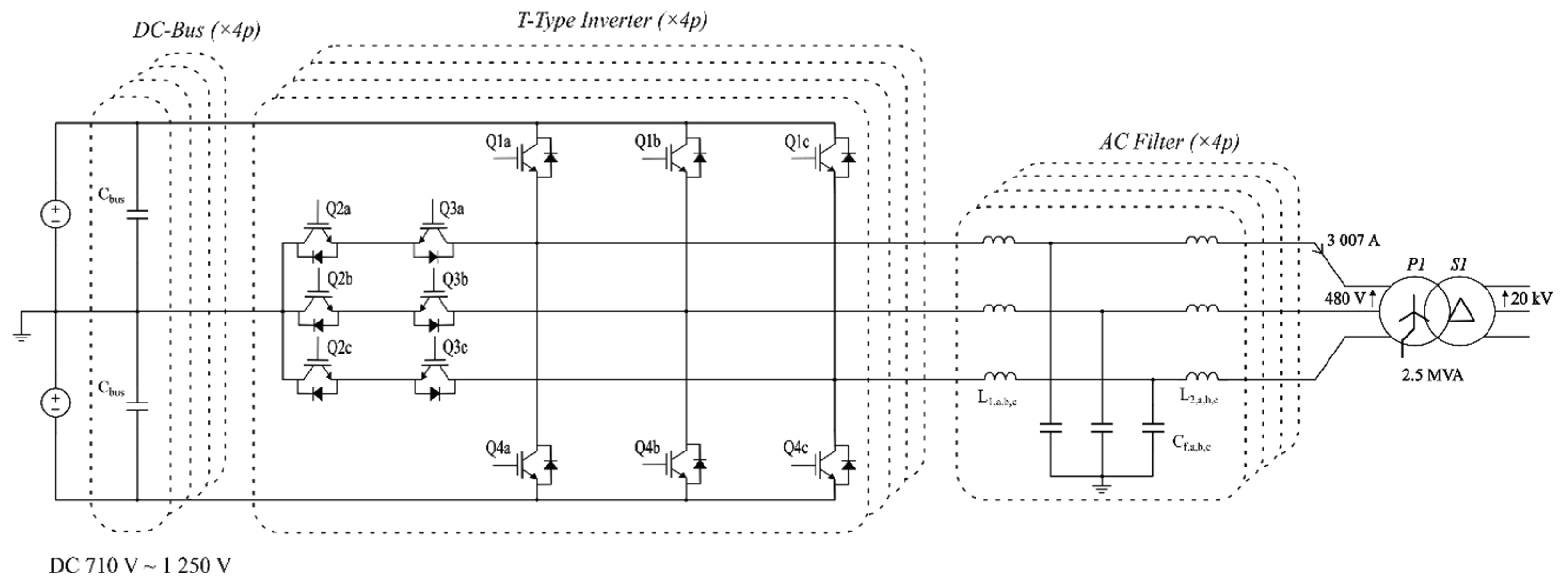
Figure 2.
3-MVA medium voltage ANPC DC/AC PCU for comparison with the reference case.
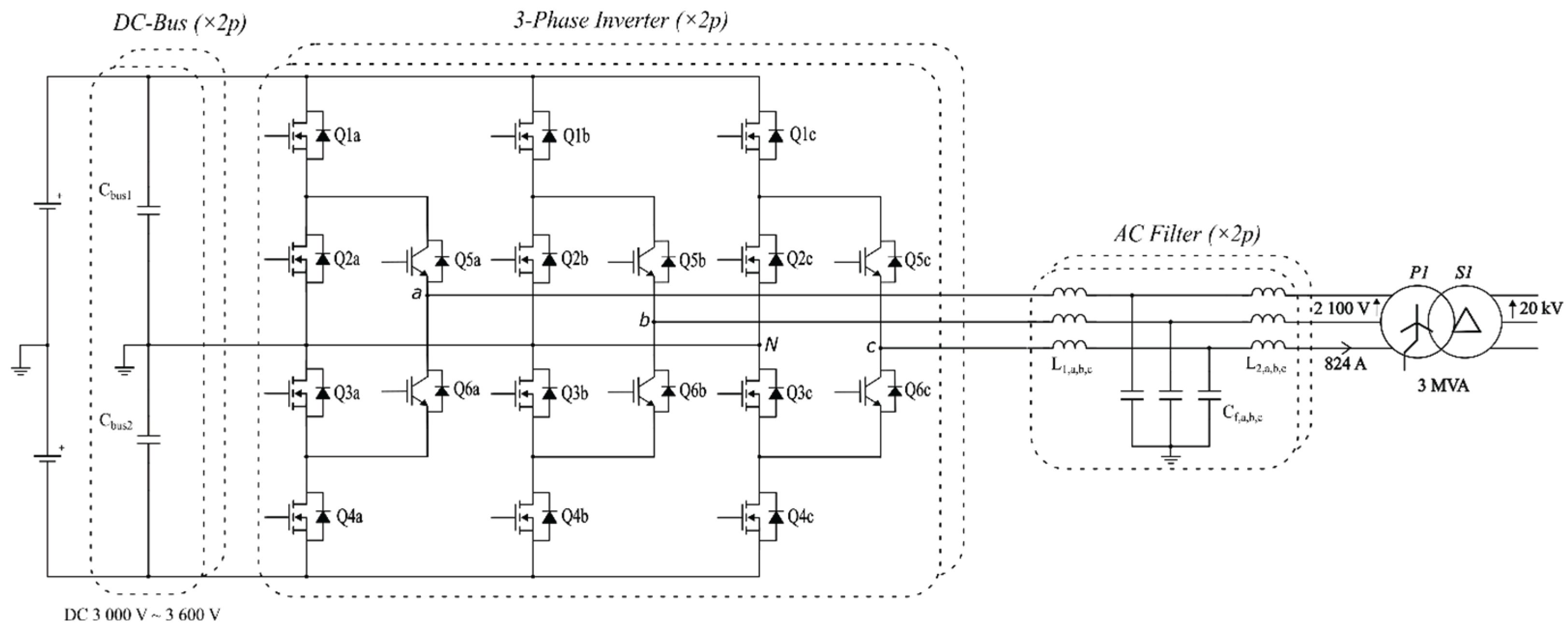
Figure 3.
Contribution analysis on LCIA results for LV configuration.
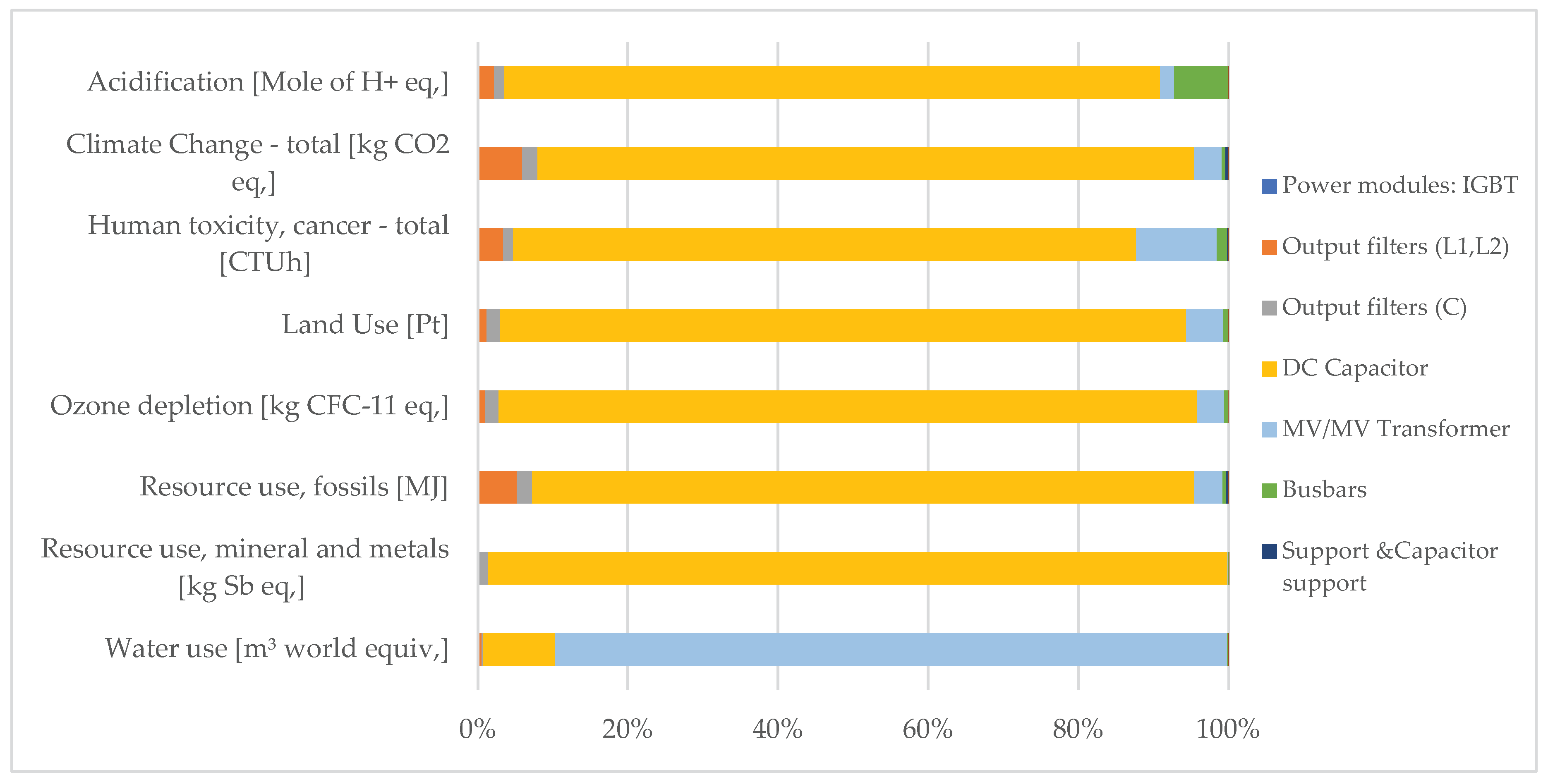
Figure 4.
Materials contribution on Climate change-total for LV configuration.
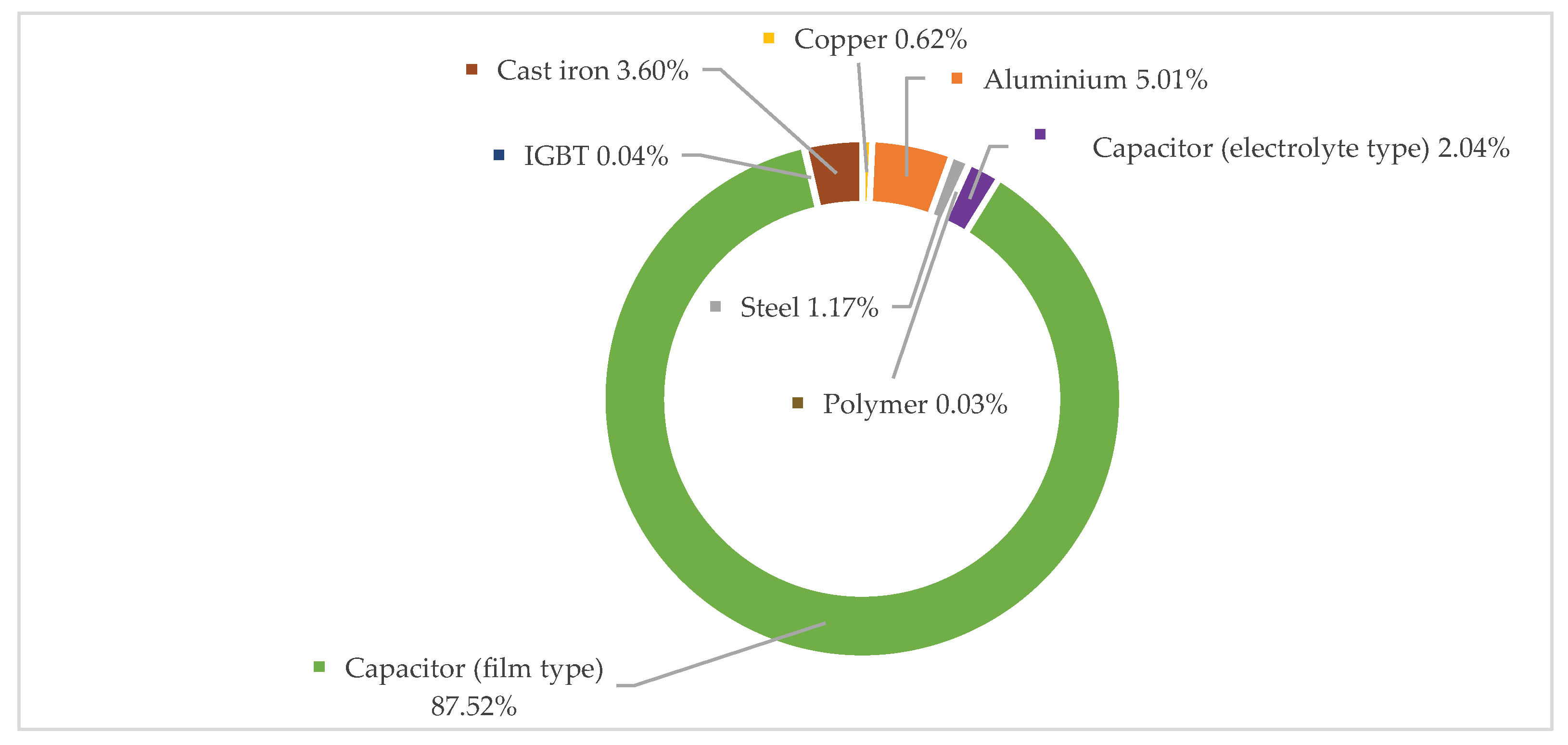
Figure 5.
Contribution analysis for LCIA results on MV configuration.
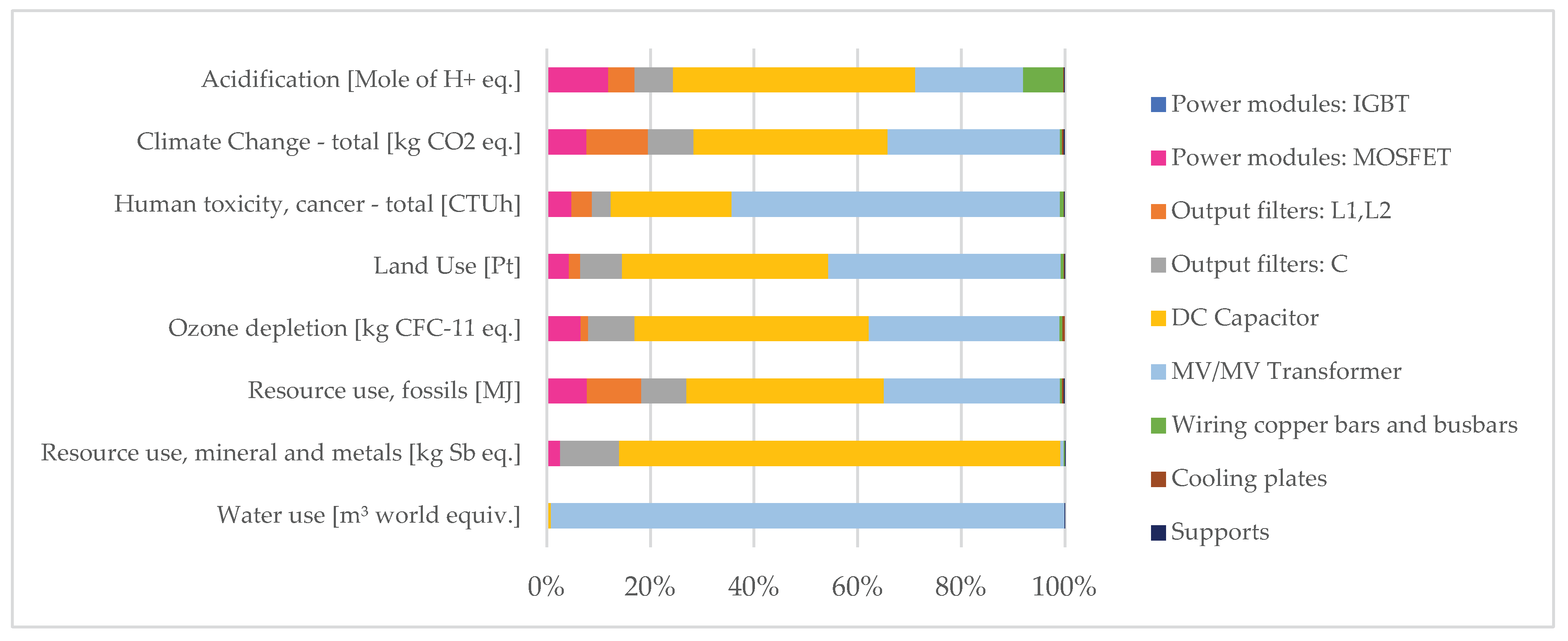
Figure 6.
Materials contribution on Climate change-total for the innovative configuration.
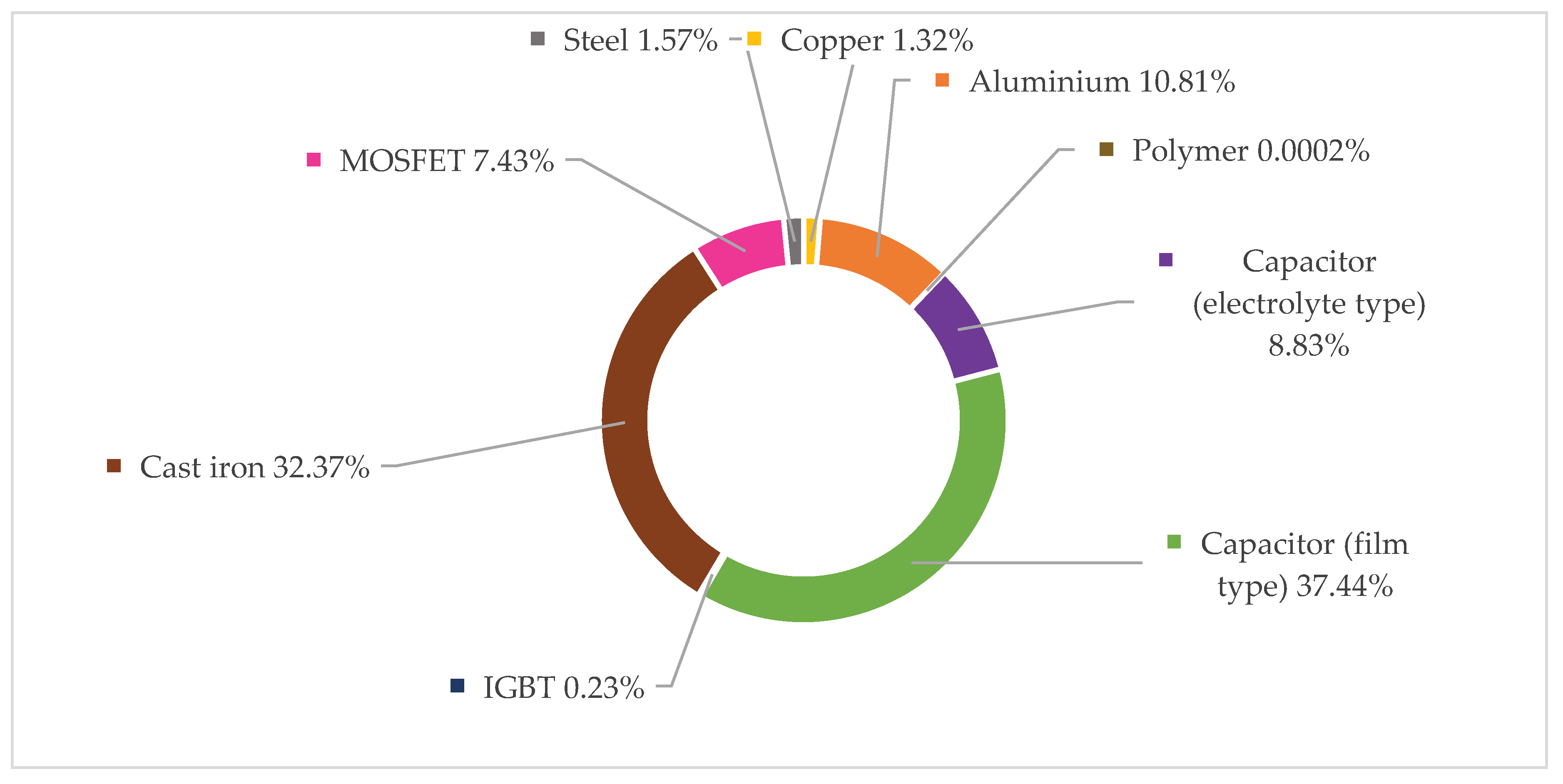
Table 2.
3-MVA LCL filter, MV configuration converter two LCL filters are required for the complete PCU (2x1.5MVA).
Table 2.
3-MVA LCL filter, MV configuration converter two LCL filters are required for the complete PCU (2x1.5MVA).
| MV conf. | Output filter Components for one PCM |
|---|---|
| 400 | |
| 60 | |
| 250 |
Table 3.
Life Cycle Inventory (LCI) of the DC-AC converter in both configurations.
| Component for one PCU | LV configuration 2.5MVA (4 PCM) |
MV configuration 3 MVA (2 PCM) |
|---|---|---|
| Power modules: IGBT [tonnes] | 1.13E-02 | 4.80E-03 |
| Power modules: MOSFET [tonnes] | IGBT Only | 9.60E-03 |
| Output filters: L1 per PCU [tonnes] whose: |
1.64E+00 Al: 3.48E-01 Steel: 1.29E+00 |
7.56E-01 Al: 1.86E-01 Steel: 5.70E-01 |
| Output filters: L2 per PCU [tonnes] whose: |
6.48E-01 Al: 1.08E-01 Steel: 5.40E-01 |
3.42E-01 Al: 7.2E-02 Steel: 2.70E-01 |
| Output filters: Cf per PCU [tonnes] | 2.52E-02 | 2.90E-02 |
| DC Capacitor [tonnes] | 1.01E+00 | 1.15E-01 |
| Busbars [tonnes] | 5.04E-01 | 1.17E-01 |
| Cooling plates per PCU [tonnes] | 6.65E-02 | 6.65E-02 |
| Supports [tonnes] | 1.26E-01 | 3.66E-02 |
| MV/MV Transformer [tonnes]per PCU whose: |
4.90E+00 Fe: 4.00E+00 Cu: 9.00E-01 |
5.80E+00 Fe: 4.80E+0 Cu: 1.00E+00 |
| Total mass [tonnes] | 8.94E+00 | 7.29E+00 |
| Ratio [MVA/tonnes] | 0.26 | 0.4 |
Table 4.
Life Cycle Impact Assessment (LCIA) for LV configuration.
| EF 3.0 Indicator [Unit] |
Power modules: IGBT | Output filters: L1,L2 |
Output filters: C |
DC Capacitor |
MV/MV Transformer | Busbars | Supports | Cooling plates | TOTAL per FU |
|---|---|---|---|---|---|---|---|---|---|
| Acidification [Mole of H+ eq.] | 7.77E+00 | 7.56E+01 | 5.20E+01 | 3.31E+03 | 7.17E+01 | 2.70E+02 | 3.23E+00 | 6.61E-01 | 3.79E+03 |
|
Climate Change - total [kg CO2 eq.] |
6.14E+02 | 2.04E+04 | 7.24E+03 | 3.10E+05 | 1.31E+04 | 1.81E+03 | 1.29E+03 | 1.35E+02 | 3.55E+05 |
| Human toxicity. cancer - total [CTUh] | 1.04E-06 | 1.67E-05 | 6.76E-06 | 4.33E-04 | 5.62E-05 | 7.06E-06 | 8.80E-07 | 8.56E-08 | 5.22E-04 |
| Land Use [Pt] | 2.60E+03 | 2.66E+04 | 4.53E+04 | 2.26E+06 | 1.22E+05 | 1.73E+04 | 5.87E+02 | 4.08E+02 | 2.47E+06 |
| Ozone depletion [kg CFC-11 eq.] | 5.39E-05 | 1.76E-04 | 4.26E-04 | 2.17E-02 | 8.44E-04 | 1.22E-04 | 8.24E-12 | 1.16E-05 | 2.33E-02 |
| Resource use. fossils [MJ] | 1.00E+04 | 2.75E+05 | 1.10E+05 | 4.80E+06 | 2.05E+05 | 2.62E+04 | 1.39E+04 | 2.47E+03 | 5.45E+06 |
| Resource use. mineral and metals [kg Sb eq.] | 1.26E-01 | 2.66E-02 | 4.55E+00 | 3.44E+02 | 1.26E-01 | 3.49E-01 | 4.90E-03 | 4.74E-04 | 3.49E+02 |
| Water use [m³ world equiv.] | 3.55E+03 | 3.24E+03 | 2.70E+03 | 1.26E+05 | 1.18E+06 | 1.53E+03 | 8.32E+02 | 7.29E+01 | 1.32E+06 |
Table 5.
Life Cycle Impact Assessment (LCIA) for MV configuration.
| EF 3.0 Indicator [Unit] |
Power modules: IGBT | Power modules: MOSFET | Output filters: L1,L2 | Output filters: Cf | DC Capacitor |
MV/MV Transformer | Busbars | Supports | Cooling plates | TOTAL per FU |
|---|---|---|---|---|---|---|---|---|---|---|
| Acidification [Mole of H+ eq.] | 1.39E+00 | 4.66E+01 | 2.06E+01 | 3.00E+01 | 1.89E+02 | 8.42E+01 | 3.14E+01 | 2.38E-01 | 6.61E-01 | 4.04E+02 |
|
Climate Change - total [kg CO2 eq.] |
1.10E+02 | 3.52E+03 | 5.63E+03 | 4.18E+03 | 1.77E+04 | 1.57E+04 | 2.11E+02 | 9.56E+01 | 1.35E+02 | 4.73E+04 |
| Human toxicity. cancer - total [CTUh] | 1.87E-07 | 4.86E-06 | 4.20E-06 | 3.88E-06 | 2.48E-05 | 6.72E-05 | 8.21E-07 | 6.49E-08 | 8.56E-08 | 1.06E-04 |
| Land Use [Pt] | 4.65E+02 | 1.35E+04 | 7.04E+03 | 2.61E+04 | 1.29E+05 | 1.46E+05 | 2.01E+03 | 4.34E+01 | 4.08E+02 | 3.24E+05 |
| Ozone depletion [kg CFC-11 eq.] | 9.62E-06 | 1.70E-04 | 4.03E-05 | 2.45E-04 | 1.24E-03 | 1.01E-03 | 1.42E-05 | 6.09E-13 | 1.16E-05 | 2.74E-03 |
| Resource use. fossils [MJ] | 1.79E+03 | 5.44E+04 | 7.56E+04 | 6.30E+04 | 2.75E+05 | 2.45E+05 | 3.05E+03 | 1.02E+03 | 2.47E+03 | 7.21E+05 |
|
Resource use. mineral and metals [kg Sb eq.] |
2.24E-02 | 5.72E-01 | 6.17E-03 | 2.62E+00 | 1.97E+01 | 1.41E-01 | 4.06E-02 | 3.62E-04 | 4.74E-04 | 2.31E+01 |
| Water use [m³ world equiv.] | 6.33E+02 | 1.62E+03 | 7.90E+02 | 1.55E+03 | 7.19E+03 | 1.41E+06 | 1.78E+02 | 6.14E+01 | 7.29E+01 | 1.43E+06 |
Table 6.
Comparison of total LCIA results (LV vs MV configuration).
| EF 3.0 Indicator [Unit] | LV configuration | MV configuration | Variation [%] |
|---|---|---|---|
| Acidification [Mole of H+ eq.] | 3.79E+03 | 4.04E+02 | -89.34% |
|
Climate Change - total [kg CO2 eq.] |
3.55E+05 | 4.73E+04 | -86.65% |
| Human toxicity. cancer - total [CTUh] | 5.22E-04 | 1.06E-04 | -79.69% |
| Land Use [Pt] | 2.47E+06 | 3.24E+05 | -86.88% |
| Ozone depletion [kg CFC-11 eq.] | 2.33E-02 | 2.74E-03 | -88.25% |
| Resource use. fossils [MJ] | 5.45E+06 | 7.21E+05 | -86.76% |
|
Resource use. mineral and metals [kg Sb eq.] |
3.49E+02 | 2.31E+01 | -93.39% |
| Water use [m³ world equiv.] | 1.32E+06 | 1.43E+06 | +8.36% |
Disclaimer/Publisher’s Note: The statements, opinions and data contained in all publications are solely those of the individual author(s) and contributor(s) and not of MDPI and/or the editor(s). MDPI and/or the editor(s) disclaim responsibility for any injury to people or property resulting from any ideas, methods, instructions or products referred to in the content. |
© 2026 by the authors. Licensee MDPI, Basel, Switzerland. This article is an open access article distributed under the terms and conditions of the Creative Commons Attribution (CC BY) license (http://creativecommons.org/licenses/by/4.0/).
Copyright: This open access article is published under a Creative Commons CC BY 4.0 license, which permit the free download, distribution, and reuse, provided that the author and preprint are cited in any reuse.


