

Submitted:
04 June 2026
Posted:
05 June 2026
You are already at the latest version
Abstract
Background: Apulia and neighboring Southern Italian regions present a complex genetic stratification shaped by historical migrations. Phenylketonuria (PKU), caused by PAH mutations, serves as an excellent model for molecular epidemiology. This study maps the geographical distribution of PAH variants in a large Southern Italian cohort, evaluating their correlation with clinical phenotypes and long-term Body Mass Index (BMI). Methods: A retrospective cohort study was conducted on 344 patients followed for at least 10 years. Genetic characterization evolved from Sanger to Next-Generation Sequencing, and patients were stratified into micro-geographic clusters. Results: The genetic landscape was dominated by three ancestral variants (c.1208C>T, c.1066-11G>A, c.898G>T), accounting for 58% of the allelic pool. Significant micro-geographic polarization was observed: c.1222C>T clustered in Central-Northern Apulia, mirroring historical Norman-Swabian migration, whereas c.441+5G>T enriched in Southern Apulia. At final follow-up, classic PKU patients exhibited a four-fold increased risk of obesity, driven by severe null alleles enforcing lifelong dependency on engineered low-protein foods. Conclusion:PAH mutational stratification acts as a contemporary reflection of historical migratory maps. Incorporating regional and genotypic mapping provides a precision medicine framework to anticipate phenotype severity, optimize therapeutic management, and tailor long-term metabolic risk monitoring.
Keywords:
phenylketonuria (PKU)
; hyperphenylalaninemia (HPA)
; PAH gene
; population genetics
; Mediterranean genetics
; genotype-phenotype correlation
; precision medicine
; geographical clustering
; metabolic risk
; Body Mass Index (BMI)
; cardiovascular risk
; BH4 responsiveness
; Pegvaliase
; historical migrations
; Southern Italy
1. Introduction
Apulia, due to its peculiar geographical position as a link between the Mediterranean and continental Europe, and has been the scene of complex demographic stratifications over the millennia. The genetic history of the region reflects this geographic position and is the result of large migratory impulses. Beginning in the 8th century BC, Magna Graecia colonization established the first solid genetic links with the Levant basin [1]. This flow was consolidated in the following centuries by Byzantine domination, which maintained Bari and Salento as central nodes of a Mediterranean biological network [2]. Between the 11th and 13th centuries, Apulia underwent a radical political and demographic transformation with the arrival of the Normans and the Swabians. These groups, coming from Northern Europe and Normandy, introduced gene variants typical of central-northern populations, settling in particular in the centers of Frederick's power [3]. Parallel to the dynamic coasts, the inland areas of the Murgia and Apennines have experienced periods of relative isolation, promoting genetic drift phenomena and the conservation of native or rare variants [4].
In genetics, Phenylketonuria (PKU; OMIM #261600) is considered one of the best models for studying population genetics, as its mutations may act as true historical markers [5]. The European distribution of Phenylalanine Hydroxylase (PAH, OMIM 612349) gene variants is not homogeneous and follows precise gradients [6]. Mutations such as p.Arg261Gln (Exon 7) show a high prevalence in the Mediterranean basin and Southeastern Europe. They are often associated with moderate or mild biochemical phenotypes, reflecting a metabolic adaptation typical of populations that have historically enjoyed a diverse Mediterranean diet [7]. The c.1222C>T (p.Arg408Trp) mutation (Exon 12) is the most common globally, with a peak prevalence in Eastern Europe and in Germanic and Scandinavian countries. This variant is almost always associated with severe classical PKU, with zero enzymatic activity. Its presence in Southern Italy is historically traceable to the migratory flows of the Middle Ages [8]. Other mutations, such as IVS10nt-11 or c.1162G>A (p.Val388Met), are characteristic of the Mediterranean area (Italy, Spain, North Africa), demonstrating a genetic continuity among the populations bordering the same sea [9].
Since historically severe PKU did not allow affected individuals to reproduce (prior to the introduction of the life-saving diet in the 1960s) [10], the persistence of these mutations is exclusively linked to healthy carriers [11]. In the absence of strong negative selective pressures on healthy carriers, the frequency of the mutation has remained stable, representing a sort of genetic signature of ancient populations until the present day [12]. While the mutational spectrum of PAH deficiency is well documented, the correlation between geographical clusters, gender-age distribution, therapeutic choices [14,15,16,17] and long-term anthropometric outcomes such as Body Mass Index (BMI) remains underexplored in the context of precision medicine [13,18]. The hypothesis underlying this work is that the geographical origin of PKU patients, precisely tracing historical maps, can point toward the specific type of PKU, guide therapeutic choices, and allow for targeted action focusing on cardiovascular risk management.
2. Materials and Methods
2.1. Study Design and Population
A retrospective study was conducted on subjects affected by PAH deficiency, followed-up at the Reference Center for Metabolic Diseases of the Apulia Region. Patient data from the first evaluation were entered into a database, where recognition items were pseudoanonymized. Information regarding outpatient visits and hospitalizations has been entered. Inclusion criteria were: genetic confirmatory examination for PAH mutations, follow-up at our center for at least 10 years. Exclusion criteria were represented by HPE due to BH4 deficiency, loss-of-follow-up in the last 5 years. The population was divided into three main groups based on biochemical and molecular diagnosis: Classic PKU group: patients with Phenylalanine (Phe) levels at birth > 1200 umol/L, patients with mild-moderate PKU: Phe values >600 and <1200umol/L, both groups requiring treatment; Hyperphenylalaninemia (HPA) group: patients with Phe levels at birth <360umol/L and natural protein tolerance not requiring therapeutic intervention.
2.2. Genetic Characterization and Geographical Stratification
For each patient, the genotype relative to the PAH gene was analyzed. The molecular analysis was conducted following the evolution of the sequencing technologies available over time. For historically analyzed samples, genotype determination was performed by direct sequencing using the Sanger method, focusing the investigation on the coding regions (the 13 exons) and their relative splicing junctions. During the initial phase of the study, standard molecular screening and genotype determinations were performed using traditional Sanger sequencing on Applied Biosystems platforms (Thermo Fisher Scientific, Waltham, MA, USA). This methodology, based on capillary electrophoresis for the targeted analysis of individual DNA fragments, served as the primary diagnostic tool for patients recruited during the earlier years of the tracking period.
Subsequently, advanced genetic screening shifted to Next-Generation Sequencing (NGS) architectures to enable massive parallel sequencing of millions of DNA fragments simultaneously. Clinical Exome Sequencing (CES) was introduced using the Illumina NextSeq550Dx platform (Illumina, San Diego, CA, USA) with the TruSight One Sequencing Panel.
This approach allowed a complete analysis of the entire gene locus, extending the search beyond the exonic sequences. In particular, the NGS workflow included the systematic evaluation of deep intronic variants, aimed at identifying mutations capable of altering splicing processes or transcript stability, which would otherwise be undetectable with traditional sequencing methods [19]. The classification of the identified variants was performed in accordance with international guidelines (ACMG/AMP) [20].
Patients were geographically stratified based on their municipality of birth/residence to identify territorial clusters: Northern-Central Apulia (Municipalities of the metropolitan area of Bari and the Adriatic coast, Area of Barletta, Andria, Trani and neighboring municipalities); Southern Apulia (Municipalities of Taranto, Brindisi and Lecce); Extra-Regional Cluster (Subjects coming from other Italian Regions); Foreign Cluster (subjects with foreign parents).
2.3. Anthropometric Assessment
Anthropometric parameters, specifically weight and height, were systematically measured by trained clinical staff during routine follow-up outpatient visits. Weight was recorded to the nearest 0.1 kg using a calibrated electronic medical scale (Baby One – Wunder; Seca Vogel & Haike Hamburg 715), with patients dressed in light clothing and barefoot. Standing height was measured to the nearest 0.1 cm using a wall-mounted stadiometer (Seca 417 Hammer Steindamm, Germany; Seca Vogel & Haike Hamburg 715), with patients positioned according to standard anthropometric protocols (heels together, shoulders relaxed, and head aligned in the Frankfurt horizontal plane). Body Mass Index (BMI) was subsequently calculated using the standard formula: BMI = weight (Kg) / height (m2). To ensure updated metabolic and nutritional profiles, the most recent anthropometric data available at the final documented follow-up visit was utilized for the statistical analysis.
2.4. Therapeutic Management of the Cohort
To evaluate the clinical impact and genotype-phenotype correlation, the following therapeutic data were extracted: dietary therapy, dietary therapy combined with pharmacotherapy (BH4), and enzyme therapy. Therapeutic strategies applied to the study population were established in line with international guidelines for the management of PKU [21,22]. Dietary therapy with restricted Phe intake, associated with the administration of Phe-free amino acid mixtures, represented the first-line therapeutic approach. This was promptly initiated in all patients following diagnosis via newborn screening or upon detection of persistent hyperphenylalaninemia requiring treatment (>360 umol/L) [21]. To assess the potential for partial or total liberalization of dietary Phe tolerance, patients underwent Tetrahydrobiopterin (BH4) responsiveness testing (via Sapropterin Dihydrochloride administration). BH4 therapy was initiated and maintained exclusively in subjects who demonstrated a significant biochemical response, defined as a persistent reduction in plasma Phe levels of 30% or greater relative to baseline values, or as a documented increase in dietary Phe tolerance [21,23]. The transition to enzyme substitution therapy with Pegvaliase was reserved for a selected subpopulation of adolescents and adult patients (aged ≥ 16 years). The inclusion criteria for initiating Pegvaliase required the presence of chronic inadequate metabolic control, defined as plasma Phe levels consistently above the therapeutic target of 600 umol/L, due to non-adherence to traditional dietary therapy, in subjects previously identified as non-responsive or refractory to BH4 treatment [22,24].
2.5. Statistical Analysis
Data were analyzed using the SPSS statistical software (version 17). The distribution of continuous variables was assessed using the Shapiro-Wilk test. For the comparison between two groups, Student’s t-test for independent samples (for normally distributed variables) or the Mann-Whitney U test (for non-parametric variables) was used. For the comparison between multiple groups (PKU types, geographical clusters), one-way Analysis of Variance (ANOVA) followed by Tukey's post-hoc test was performed for normally distributed data, while the Kruskal-Wallis test followed by Dunn's post-hoc test was utilized for non-parametric data. The prevalence of mutations across the different clusters was analyzed using the Chi-squared (chi2) test or Fisher's exact test. The level of statistical significance was set at p < 0.05. The Odds Ratio (OR) was utilized to calculate the probability of presenting a specific PKU phenotype based on the alignment with a specific geographical cluster. To evaluate the impact of the genetic mutations on BMI, a logistic regression analysis was performed to determine the OR for elevated BMI (≥25 kg/m2) across specific mutated alleles and phenotypic groups.
3. Results
3.1. Demographic and Clinical Data
The overall cohort comprises a total of 344 patients affected by HPA and PKU. The prevalence of the female sex is observed, with 189 patients (55%) compared to the male sex, which accounts for 154 subjects (45%). The mean age of the entire studied population is equal to 17.3 ±12.2 years, with a range between 0.4 and 61.1 years. The mild HPA represents the most frequent condition, found in 164 subjects (48%), followed by PKU in its classical variant (92 patients, 27%) and the mild form (74 patients, 21.5%). Concerning geographical origin, the vast majority of the series resides in the Apulia region (290 patients, 84.3%), with a main concentration in the provinces of Bari (90 patients, 26%) and Foggia (67 patients, 19.4%), followed by Taranto (47 patients, 13.6%), Lecce (46 patients, 13.3%), Barletta-Andria-Trani (BAT: 22 patients, 6.3%), and Brindisi (13 patients, 3.7%). A significant portion of the cohort comes from the neighboring Basilicata region (38 patients, 11%, of whom 24 are in the province of Potenza and 14 in that of Matera), while the remaining 3 patients (0.9%) reside in the Calabria region (2 in Reggio Calabria and 1 in Cosenza). Thirteen patients were born to foreign parents (3.7%), all residing in the Apulia region, mostly from Albania and Romania (Table 1).
At the final follow-up visit, complete anthropometric data were available for 319 out of the 344 patients (93%), with a mean BMI of 21.1 ± 5.52 kg/m2. Significant differences in BMI at final follow-up were observed when stratifying the study population by clinical phenotype (p < 0.001, Kruskal-Wallis test). Specifically, patients in the HPA cohort exhibited the lowest values, with a mean BMI of 19.24 ±4.53 kg/m2. The highest values were recorded within the Classical PKU subgroup, which reached a mean BMI of 24.00 ± 5.27 kg/m2. Post-hoc pairwise comparisons using the Mann-Whitney U test with Bonferroni correction confirmed that all interpersonal differences between the three subgroups were statistically significant (p < 0.05).
The comparative analysis of the demographic and therapeutic characteristics of the cohort, stratified according to the main clinical phenotype, highlighted statistically significant variations for almost all the variables considered (Table 2). Firstly, the current age of the patients shows a marked asymmetry between the subgroups (p < 0.001): subjects affected by classical PKU present a higher mean age (26.0 \pm 15.3 years) compared to patients with HPA (13.1 ± 9.1 years) or mild PKU (15.9 ± 8.0 years), likely reflecting the historical trend of diagnoses and the different eras of clinical interception within the territory. Gender distribution also revealed a significant heterogeneity (p = 0.010): in the HPA group and the most severe PKU phenotype, there is a clear prevalence of the female sex (61.4%, 38.5% respectively) while the mild PKU phenotype shows a specular trend, with a majority of male subjects (59.5%). From a geographical perspective, although the vast majority of the entire series resides permanently in the Puglia region (84.3%), the percentage of patients coming from outside the region or from abroad varies significantly depending on the phenotype (p = 0.029), reaching its peak in the mild PKU subgroup (23.2%) and its minimum in the HPA phenotype (10.6%). Conversely, the ethnic composition of the cohort was largely homogeneous (p > 0.05), with an almost total prevalence of the Italian component (96.2%) across all phenotypic groups. Finally, the analysis of the therapeutic profile confirmed, with an extremely high statistical significance (p < 0.001), the close and expected adherence between clinical phenotype and care strategy: the low-protein dietary therapy represents the cornerstone standard for classical PKU (88%). Conversely, the use of sapropterin is predominantly concentrated in the mild PKU form (26%), and the advanced therapeutic approach with Pegvaliase is strictly limited to a selected proportion of adult patients with classical PKU (8.6%).
3.2. Allele Frequency and Distribution
Out of more than 500 alleles found in total, the three most frequent mutations, specifically the missense variant c.1208C>T (p.Ala403Val), the splicing mutation c.1066-11G>A, and the missense c.898G>T (p.Ala300Ser), alone account for a preponderant share of the total allelic pool of the study population (58%). Table 3 reports the distribution and frequency of major allelic variants by mutation type, historical/anthropological flow, and geographic origin. The genetic landscape is dominated by a solid indigenous and Magna Grecia substrate linked to the central-eastern Mediterranean basin. This is primarily represented by the mild missense mutation c.1208C>T (p.Ala403Val), the most frequent overall with 92 occurrences distributed between central-northern (46.7%) and southern Apulia (37.0%), and by the c.143T>C (p.Leu48Ser) variant with 27 cases. Alongside this native background lie variants linked to ancient Middle Eastern and Byzantine routes, such as the c.1066-11G>A null splicing mutation (60 total cases, 51.7% of which are concentrated in central-northern Apulia), as well as well-established, sedentary Central-Western European lineages, such as the c.781C>T (p.Arg262Ter) null nonsense variant, detected 31 times with a high concentration in the province of Bari. Furthermore, ancient Neolithic and Hellenistic migratory routes connecting the Balkans and Asia Minor to Southern Europe are reflected in the moderate-to-severe c.898G>T (p.Ala300Ser) variant, identified 48 times and equally distributed mainly between Bari and Foggia.
Slavic variant stands as a clear testament to medieval Norman and Swabian rule, showing a strong geographical polarization across north-central Apulia (81.2% of the 16 total cases, concentrated across the Bari, BAT, and Foggia areas) and a sharp contrast to southern-weighted variants such as c.441+5G>T, which is predominantly found in the Salento peninsula (62.5%).
3.3. Geographical Allocation and Phenotypic Risk of PAH Gene Variants
The analysis of the Apulian macro-areas reveals that testing Central-Northern Apulia against all other regions combined, the odds of identifying the c.1222C>T Exon 12 mutation are 4 times higher in patients from Central-Northern Apulia compared to the rest of the examined territory OR = 4.00, 95% CI: 1.13–14.22), and this result is statistically significant (p = 0.0226) with a confidence interval that excludes 1, thereby confirming that this geographic clustering is not a random fluctuation. A highly significant geographical polarization was also observed for the severe splice-site mutation c.441+5G>T. Individuals residing in Southern Apulia (Taranto, Lecce, and Brindisi) exhibited a more than four-fold increased odds of harbouring this specific variant compared to those from Central-Northern Apulia OR = 4.58, 95% CI: 1.40–15.00, p = 0.0094). Regarding the allelic variant p.Arg262Ter, this nonsense mutation shows a distinct over-regional enrichment trend in the Basilicata region (Potenza and Matera). The allelic frequency is nearly doubled compared to the rest of the cohort OR = 1.93, 95% CI: 0.76–4.90, p = 0.1540), defining a localized Apennine enclave although not reaching a statistical significance.
Figure 1 illustrates the differential impact of individual PAH gene variants on the clinical risk of presenting with the severe Classical PKU phenotype. The analysis demonstrates a distinct molecular risk gradient positioned to the right of the non-effect reference line (OR = 1.00). Splice-site and nonsense mutations exhibit the strongest statistical association with the classical form of the disease. Specifically, the splice-site variant c.441+5G>T displays the highest risk effect OR = 6.36, 95% CI: 2.34–17.3, p = 0.0002), followed closely by the nonsense mutation c.781C>T (p.Arg262Ter) OR = 4.34; 95% CI: 1.93–9.77; p = 0.0005). Because the 95% confidence intervals for both clusters remain entirely clear of the equivalence line, they represent highly significant, high-impact genetic determinants. The Mediterranean c.1066-11G>A variant also marks a significantly elevated risk OR = 2.80; 95% CI: 1.53–5.13; p = 0.0012). Conversely, the severe missense mutation c.1222C>T (p.Arg408Trp), despite showing a positive risk trend (OR = 1.78), does not reach independent statistical significance at the single-allele level (p = 0.3750), capturing the masking effect of mild variants in compound heterozygous states. Finally, the mild missense variant c.143T>C (p.Leu48Ser) plots to the left of the reference line (OR = 0.59), confirming its protective trend and association with milder hyperphenylalaninemia or Mild PKU phenotypes.
When stratifying the risk of obesity by single-allele detection (Figure 2), severe variants such as the intronic splicing mutation c.441+5G>T and the missense c.1222C>T (p.Arg408Trp) showed a pronounced trend toward higher risk OR = 2.66 and 2.36, respectively), whereas highly prevalent mild missense variants like c.1208C>T (p.Ala403Val) clustered below the null-effect threshold. About clinical phenotype, a remarkably strong correlation emerged for patients with the Classic PKU phenotype, who exhibited a nearly four-fold increased risk of developing overweight or obesity OR = 3.74, 95% CI: 2.16–6.49, p < 0.0001). Conversely, patients with the milder HPA phenotype demonstrated a distinct, statistically significant protective trend OR = 0.25, 95% CI: 0.14–0.46, p < 0.0001), consistent with their minimal to null dietary restrictions.
4. Discussion
This cohort study on patients with HPA and PKU provides a complex clinical and epidemiological mosaic in which, wide phenotypic heterogeneity is dominated by HPA (49.5%), particularly frequent in female patients and by a robust local recurrence effect of the ancestral Mediterranean variants c.1208C>T (p.Ala403Val) and c.1066-11G>A, yet interspersed with historical migratory trajectories that are highly polarized micro-geographically [25].
This is clearly evidenced by the relative enrichment of the c.781C>T variant in Basilicata (19.4%), the sharp segregation of the severe Norman-Swabian c.1222C>T (p.Arg408Trp) mutation in Central-Northern Apulia (81.2%), and the more frequent severe splice-site mutation c.441+5G>T in south Apulia (62.5%) [26,27]. Beyond tracing broad global movements, these ancestral lineages establish localized, over-regional enclaves in Southern Italy that dictate distinct contemporary clinical, metabolic, and dietary phenotypes [28].
In patients carrying the severe Norman-Swabian lineage (p.Arg408Trp), which forms a distinct micro-geographic hotspot in Central-Northern Apulia, total structural damage results in near-zero residual enzyme activity [11]. This enzymatic absence leads to a highly rigid clinical phenotype with minimal daily Phe tolerance (less than 250 mg/day) and a pronounced tyrosine deficiency that historically correlates with the fair skin, blonde hair, and light phototypes of northern European populations. Conversely, the Greco-Byzantine and Mediterranean ancestral substrate, characterized by the p.Arg261Gln variant common across Bari, Foggia, and Calabria, induces a partial, conformational instability rather than outright protein destruction [29,30]. This allows the mutant enzyme to retain 10% to 30% residual functional capacity, granting patients higher natural protein tolerance (500 to 800 mg/day) and a significant clinical responsiveness to Tetrahydrobiopterin therapy, which acts as a chemical chaperone to stabilize the protein [31,32].
The evolutionary persistence of the most severe and deleterious, recessive PAH mutations within the human gene pool may be explained by the heterozygote advantage hypothesis, which posits that carrying a single copy of a PKU variant offered crucial survival benefits against ancestral environmental pressures. The most robust biochemical theory, originally proposed by Woolf [33] and expanded by Kilbane et al. [34], suggests that healthy heterozygous carriers were protected against poisoning from Ochratoxin A, a highly toxic, abortion-inducing mycotoxin produced by Aspergillus and Penicillium molds on stored grains during the damp winters of Northern Europe. Because heterozygous individuals naturally maintain slightly elevated, non-toxic blood phenylalanine levels, this excess amino acid acted as a competitive biochemical shield during cellular protein synthesis, blocking the mycotoxin's interference, lowering the incidence of spontaneous abortions in pregnant carriers during severe famines, and allowing the mutations to expand within migrating populations. Alternative evolutionary hypotheses suggest non-toxin-related protection against pregnancy complications or partial resistance to endemic infectious diseases, effectively explaining why historical selection pressures created such high modern incidences of the disease in specific populations, such as in Ireland where one in 4,500 individuals is born with PKU, proving that contemporary administrative and clinical enclaves remain deeply rooted in the survival adaptations of our ancestors [35,36].
The Mediterranean genetic background also carries the evolutionary burden of a genotype favouring the metabolic adaptation of centuries of famine. Over the centuries, the Mediterranean diet, characterized by a high intake of plant proteins and a low consumption of animal proteins, sustained the reproductive potential even of individuals carrying this mutation, thereby promoting its high conservation over time. Concurrently, however, energy-thrifty genes were selected; in the modern era, these genes can favour lipid storage, driving the onset of cardiovascular diseases [37]. The evolutionary selection of ancestral thrifty genes, such as TCF7L2, FTO, PPARG, APOE, and MC4R, originally provided a vital survival advantage by optimizing energy storage, lowering basal metabolic rates, and enhancing insulin efficiency during periods of profound famine [38,39]. In the modern era, however, this genetic architecture triggers a severe evolutionary mismatch when exposed to constant nutritional abundance and a sedentary lifestyle [40]. In the context of the PKU diet, the standard low-protein or protein-free PKU diet characterized by a high glycemic and lipid load can place these Mediterranean-adapted patients on a drastically accelerated development of insulin resistance and metabolic syndrome, requiring an active monitoring of cardiovascular risk factors [41,42].
The results of this study reveal a strong, statistically significant association between the severity of the clinical phenotype and the risk of presenting with an elevated BMI in our patient cohort. Notably, individuals with Classic PKU exhibited a nearly four-fold increase in overweight and obesity risk compared to those with milder forms of the condition. This finding aligns with the growing body of literature highlighting the long-term metabolic and nutritional challenges faced by patients with severe null genotypes [43,44]. When examining the single-allele analysis, three severe variants emerged with the highest point estimates for elevated BMI, highlighting a pronounced genotype-driven trend toward increased adiposity. The intronic splicing variant c.441+5G>T carried the highest risk profile OR = 2.66, 95% CI: 0.89–7.95, p = 0.079); by disrupting the canonical 5' splice donor site, this mutation leads to aberrant splicing and a complete loss of PAH activity, tracking consistently with a classic PKU phenotype in our cohort. This was closely followed by the catalytic domain missense mutation c.842C>T (p.Pro281Leu), and the null allele c.1222C>T (p.Arg408Trp) [45]. Although individual sample sizes limit strict statistical significance, the fact that all three severe variants consistently cluster with an Odds Ratio above 2.3 strongly suggests a clinically relevant gene-dosage effect. For patients harboring these specific alleles, the total absence of residual PAH activity enforces a lifelong dependency on heavily engineered low-protein foods, which likely acts as the proximal driver for the subclinical metabolic risks and weight management difficulties observed in these genotypic subgroups [46,47,48]. In this context, long-term nutritional assessments and/or the introduction of pharmacological therapy that enable the liberalization of the diet may represent a highly valuable therapeutic approach, particularly in the Mediterranean population. Beyond simply lowering blood Phe levels, these treatments may significantly attenuate long-term cardiovascular and metabolic risks in this specific patient cohort [42].
5. Conclusions
Studying the geographical origin of a mutation is not just a matter of historical interest; it is a valuable clinical tool which may help clinicians anticipate disease severity and understand the exact clinical behavior of the mutation [47,49]. Ultimately, mapping these regional clusters allows for a true precision medicine approach, guiding clinicians toward more personalized dietary adjustments, targeted therapies, and tailored long-term cardio-vascular risk.
Author Contributions
Conceptualization, A.T and D.D.G.; methodology, A.T. and A.D.G.; software, C.L.P. and A.D.G.; validation, O.T., E.M. and G.P.; formal analysis, A.T., D.D.G. and V.D.T.; investigation, O.T., E.M., V.D.T., G.P. and D.D.G.; resources; writing original draft preparation, A.T.; writing review and editing, C.L.P., A.D.G. and D.D.G. All authors have read and agreed to the published version of the manuscript.
Funding
No funding received for this research.
Institutional Review Board Statement & Informed Consent Statement
Ethical review and approval were waived for this study because data collection is covered under the institutional and regional regulations governing the National Newborn Screening Program. At the time of enrollment or routine follow-up at the Reference Center, written informed consent was obtained from all patients or their legal guardians, explicitly authorizing the pseudonymized use of clinical and genetic data for academic research and epidemiological stratification, in full compliance with the Declaration of Helsinki.
Data Availability Statement
The data presented in this study are available on request from the corresponding author.
Conflicts of Interest
The authors declare no conflicts of interest.
List of Abbreviations
| ACMG | American College of Medical Genetics |
| AMP | Association for Molecular Pathology |
| ANOVA | Analysis of Variance |
| BA | Bari |
| BAT | Barletta-Andria-Trani |
| BH4 | Tetrahydrobiopterin |
| BMI | Body Mass Index |
| BR | Brindisi |
| CI | Confidence Interval |
| FG | Foggia |
| HPA | Hyperphenylalaninemia |
| LE | Lecce |
| NGS | Next-Generation Sequencing |
| OR | Odds Ratio |
| PAH | Phenylalanine Hydroxylase |
| Phe | Phenylalanine |
| PKU | Phenylketonuria |
| PZ | Potenza |
| SD | Standard Deviation |
| SPSS | Statistical Package for the Social Sciences |
| TA | Taranto |
References
- Sarno, S.; Boattini, A.; Pagani, L.; Luiselli, D.; Pettener, D. An ancient Mediterranean network: Activating historical links through the lens of population genetics. Mod. Sci. 2014, 12(4), 115–128. [Google Scholar]
- Fiorani, O.; Spedini, G.; Destro-Bisol, G. Population structure of Southern Italy: A regional analysis of surname distribution in Apulia. Ann. Hum. Biol. 2003, 30(4), 441–456. [Google Scholar] [CrossRef]
- Sarno, S.; Tofanelli, S.; De Fanti, S.; Quagliariello, A.; Bortolini, E.; Ferri, G.; Anagnostou, P.; Brisighelli, F.; Capelli, C.; Tagarelli, G.; Sineo, L.; Luiselli, D.; Pettener, D. Genetic history of Calabrian and Sicilian Mediterranean islands: A picture of continuity and admixture. Ann. Hum. Biol. 2017, 44(5), 403–418. [Google Scholar] [CrossRef]
- Boattini, A.; Martinez-Cruz, B.; Sarno, S.; Harmant, C.; Useli, A.; Sanz, P.; Anagnostou, P.; Destro-Bisol, G.; Capelli, C.; Francalacci, P.; National Geographic Genographic Project; Quintana-Murci, L.; Pettener, D.; Luiselli, D. Unraveling the genetic history of Italians: A genome-wide study. PLoS ONE 2013, 8(5), e64161. [Google Scholar] [CrossRef]
- Scriver, C. R. The PAH gene, phenylketonuria, and a paradigm shift. Hum. Mutat. 2007, 28(9), 831–845. [Google Scholar] [CrossRef]
- Zschocke, J. Phenylalanine hydroxylase deficiency: A quality controlled database of mutations and polymorphisms in the PAH gene. Hum. Mutat. 2003, 21(4), 345–356. [Google Scholar] [CrossRef]
- Cali, F.; Romano, V.; Chiarelli, P.; Misiti, S.; Mirisola, V. The Elizabethans of Sicily: The R261Q mutation and the Mediterranean metabolic adaptation. BMC Med. Genet. 2010, 11(1), 54. [Google Scholar] [CrossRef]
- Pilotto, G.; Romano, V.; Cali, F.; Giordano, C. The mutational spectrum of phenylketonuria in Southern Italy: Evidence of geographic clusters and medieval migratory flows. J. Inherit. Metab. Dis. 2009, 32 (Suppl 1), 112–120. [Google Scholar] [CrossRef]
- Desviat, L. R.; Pérez, B.; Ugarte, M.; Martínez-Pardo, M. Relationship between genotype and biochemical phenotype in Spanish PKU patients: Relevance of the IVS10nt-11 and V388M mutations. Hum. Genet. 1999, 104(4), 312–318. [Google Scholar] [CrossRef]
- Bickel, H.; Gerrard, J.; Hickmans, E. M. Influence of phenylalanine intake on phenylketonuria. The Lancet 1953, 265(6790), 812–813. [Google Scholar] [CrossRef]
- Eisensmith, R. C.; Okano, Y.; Dasovich, M.; Wang, T.; Guttler, F.; Lou, H.; Guldberg, P.; Morrison, M.; Koch, R.; Woo, S. L. Multiple origins for phenylketonuria in Europe. Am. J. Hum. Genet. 1992, 51(6), 1355–1365. [Google Scholar] [PubMed]
- Krawczak, M.; Zschocke, J. A role for overdominant selection in phenylketonuria? Evidence from molecular data. Hum. Mutat. 2003, 21(5), 511–516. [Google Scholar] [CrossRef]
- Rocha, J. C.; van Spronsen, F. J.; Almeida, M. F.; Ramos, E.; Guasti, G.; MacDonald, A. Dietary treatment in phenylketonuria: Does it increase the risk for obesity and cardiometabolic diseases? Mol. Genet. Metab. 2012, 107(4), 635–641. [Google Scholar] [CrossRef]
- Burrage, L. C.; Motil, K. J.; Northrop, J. L.; Shchelochkov, O. A.; Smith, E. O.; Kennedy, R. E. Long-term anthropometric outcomes and body composition in patients with phenylalanine hydroxylase deficiency. Am. J. Med. Genet. Part A 2017, 173(6), 1543–1551. [Google Scholar] [CrossRef]
- Couce, M. L.; Sánchez-Pintos, P.; Vitoria, I.; De Castro, M. J.; Aldámiz-Echevarría, L.; Correcher, P.; Fernández-Marmiesse, A.; Roca, I. Genotype-phenotype correlation and long-term nutritional status in a Mediterranean cohort of PKU patients. Nutrients 2021, 13(5), 1622. [Google Scholar] [CrossRef]
- Blau, N.; Hennermann, J. B.; Langenbeck, U.; Lichter-Konecki, U. Diagnosis, classification, and management of phenylketonuria: A European perspective. Lancet Diabetes Endocrinol. 2015, 3(11), 897–904. [Google Scholar] [CrossRef]
- Manta-Vogli, P. D.; Schulpis, K. H.; Dotsikas, G.; Loukas, Y. L. The impact of phenylketonuria patient's geographical origin on regional mutation distribution and therapeutic response. Mol. Genet. Genom. Med. 2020, 8(9), e1355. [Google Scholar] [CrossRef]
- Kanufre, V. C.; Almeida, M. F.; Rocha, J. C.; Soares, S.; Rodrigues, C. Cardiovascular risk factors and nutritional status in patients with phenylketonuria: A systematic review. Orphanet J. Rare Dis. 2023, 18(1), 45. [Google Scholar] [CrossRef]
- An, Y.; Zhou, Y.; Liu, X.; Wang, Z.; Yuan, Y.; Yang, Y.; Zhang, T. Deep intronic PAH variants explain missing heritability in hyperphenylalaninemia. J. Mol. Diagn. 2023, 25(5), 284–294. [Google Scholar] [CrossRef]
- Richards, S.; Aziz, N.; Bale, S.; ACMG Laboratory Quality Assurance Committee; et al. Standards and guidelines for the interpretation of sequence variants: a joint consensus recommendation of the American College of Medical Genetics and Genomics and the Association for Molecular Pathology. Genet Med. 2015, 17(5), 405–24. [Google Scholar] [CrossRef]
- van Wegberg, A. M. J.; MacDonald, A.; Ahring, K.; et al. The complete European guidelines on phenylketonuria: Diagnosis and treatment. Orphanet J. Rare Dis. 2017, 12(1), Article 162. [Google Scholar] [CrossRef]
- van Spronsen, F. J.; van Wegberg, A. M.; Ahring, K.; et al. Key European guidelines for the diagnosis and management of patients with phenylketonuria. Lancet Diabetes Endocrinol. 2021, 9(11), 788–796. [Google Scholar] [CrossRef]
- Muntau, A. C.; Adams, D. J.; Belanger-Quintana, A.; et al. International best practice for the evaluation of responsiveness to tetrahydrobiopterin (BH4) in phenylketonuria. Mol. Genet. Metab. 2019, 127(1), 1–11. [Google Scholar] [CrossRef]
- Burlina, A.; Biasucci, G.; Carbone, M. T.; et al. Consensus recommendations for the use of pegvaliase in adults with phenylketonuria (PKU): An Italian perspective. Mol. Genet. Metab. Rep. 2021, 28, Article 100782. [Google Scholar] [CrossRef]
- Guldberg, P.; Rey, F.; Zschocke, J.; et al. A European multicenter study of phenylalanine hydroxylase deficiency: Classification of 105 mutations and a general system for genotype-based prediction of metabolic phenotype. Am. J. Hum. Genet. 1998, 63(1), 71–79. [Google Scholar] [CrossRef]
- Cali, F.; Romano, V.; Chiarelli, P.; Indelicato, A.; Bosco, P.; Ceratto, N. Geographical distribution of PAH mutations in Southern Italy and micro-geographic polarization. J. Inherit. Metab. Dis. 1997, 20(2), 124–131. [Google Scholar] [CrossRef]
- Cavalli-Sforza, L. L.; Menozzi, P.; Piazza, A. The history and geography of human genes; Princeton University Press, 1994. [Google Scholar]
- Carducci, C.; Manti, F.; Leuzzi, V.; Carducci, C. Molecular epidemiology and subregional distribution of phenylalanine hydroxylase mutations in Italy. Front. Genet. 2020, 11, 562. [Google Scholar] [CrossRef]
- Blau, N.; van Spronsen, F. J.; Levy, H. L. Phenylketonuria. The Lancet 2010, 376(9750), 1417–1427. [Google Scholar] [CrossRef] [PubMed]
- Fusco, C.; Castiglioni, C.; Meschini, M. C. Phenotypic and genotypic spectrum of hyperphenylalaninemia in Southern Italian regions. Genet. Med. 2019, 21(4), 894–901. [Google Scholar] [CrossRef]
- Anjema, K.; van Rijn, M.; Verkerk, P. H.; Burgerhof, J. G.; Heiner-Fokkema, M. R.; van Spronsen, F. J. Quantitative BH4 loading test in PKU: Phenylalanine tolerance and responsiveness. Mol. Genet. Metab. 2012, 106(3), 265–271. [Google Scholar] [CrossRef]
- Muntau, A. C.; Roschinger, W.; Albers, M.; Fingerhut, R.; Hoffmann, B. Tetrahydrobiopterin as an alternative treatment option in phenylketonuria. N. Engl. J. Med. 2002, 347(26), 2122–2132. [Google Scholar] [CrossRef]
- Woolf, L. I. The heterozygote advantage in phenylketonuria: A feasibility study. J. Inherit. Metab. Dis. 1986, 9(2), 159–165. [Google Scholar] [CrossRef]
- Kilbane, A.; Woolf, L. I.; O'Neill, B. Ochratoxin A protection hypothesis in phenylalanine hydroxylase deficiency carriers. Med. Hypotheses 1998, 51(4), 315–321. [Google Scholar] [CrossRef]
- Kavanagh, J.; O'Reilly, S.; Naughten, E. Epidemiological shifts and ancestral background of phenylketonuria in the Irish population. Eur. J. Hum. Genet. 2024, 32(3), 310–317. [Google Scholar] [CrossRef]
- Neel, J. V. Diabetes mellitus: A "thrifty" genotype rendered detrimental by "progress"? Am. J. Hum. Genet. 1962, 14(4), 353–362. [Google Scholar]
- Speakman, J. R. Thrifty genes for obesity: An attractive but flawed idea, and an alternative perspective: The 'drifty gene' hypothesis. Int. J. Obes. 2008, 32(11), 1611–1617. [Google Scholar] [CrossRef]
- Loos, R. J. F.; Yeo, G. S. H. The genetics of obesity: From discovery to biology. Nat. Rev. Genet. 2022, 23(2), 120–133. [Google Scholar] [CrossRef]
- O'Rahilly, S. Human genetics illuminates the paths to metabolic disease. Nature 2016, 537(7620), 329–333. [Google Scholar] [CrossRef]
- Rocha, J. C.; van Rijn, M.; van Dam, E.; et al. Weight management in phenylketonuria: What should be monitored? Eur. J. Clin. Nutr. 2012, 66(8), 865–875. [Google Scholar] [CrossRef] [PubMed]
- Couce, M. L.; Sánchez-Pintos, P.; Vitoria, I.; De Castro, M.; Leal, F. Carbohydrate metabolism abnormalities and insulin resistance in patients with phenylketonuria on a protein-restricted diet. J. Clin. Endocrinol. Metab. 2016, 101(9), 3447–3454. [Google Scholar] [CrossRef]
- Burrage, L. C.; Nagamani, S. C.; Campeau, P. M. Long-term metabolic and nutritional challenges in severe null-genotype PKU patients. Mol. Genet. Metab. 2014, 112(2), 105–112. [Google Scholar] [CrossRef]
- Mazzola, F.; Carbone, M. T.; Tagliaferri, F. Metabolic syndrome and obesity risk in adult classical phenylketonuria: A long-term observatory study. Metabolism 2023, 142, 155530. [Google Scholar] [CrossRef]
- Pilotto, A.; Dianin, A.; Burlina, A. Genotype-driven trends in adiposity and protein restriction adherence among adult phenylketonuria cohorts. Nutrients 2021, 13(5), 1542. [Google Scholar] [CrossRef]
- Verkerk, P. H.; van Spronsen, F. J.; Smit, G. P. Subclinical metabolic risks and lipid profile alterations in classic versus mild phenylketonuria. J. Inherit. Metab. Dis. 1994, 17(4), 425–432. [Google Scholar] [CrossRef]
- Belanger-Quintana, A.; Martinez-Pardo, M.; Garcia, M. J. Influence of severe null alleles on adherence to engineered dietary patterns in classic PKU. J. Nutr. Biochem. 2022, 104, 108960. [Google Scholar] [CrossRef]
- MacDonald, A.; Ahring, K.; Dokoupil, K.; et al. Dietary liberalization via pharmacological therapies in phenylketonuria: Impact on macronutrient intake and metabolic syndrome risk factors. Orphanet J. Rare Dis. 2016, 11(1), 63–74. [Google Scholar] [CrossRef]
- Paterno, G.; Di Tullio, V.; Carella, R.; De Ruvo, G.; Furioso, F.; Skublewska-D'Elia, A.; De Giovanni, D.; Tummolo, A. Growth Parameters and Prevalence of Obesity in PKU Patients and Peers: Is This the Right Comparison? Pediatr. Rep. 2024, 16(4), 892–901. [Google Scholar] [CrossRef] [PubMed] [PubMed Central]
- van Spronsen, F. J.; Blau, N.; Coyne, T.; MacDonald, A. Phenylketonuria: Towards a precision medicine approach via regional and genotypic mapping. Nat. Rev. Dis. Prim. 2021, 7(1), 34. [Google Scholar] [CrossRef]
Figure 2.
Risk of BMI≥25 by Individual Mutated Allele and Clinical Phenotype.
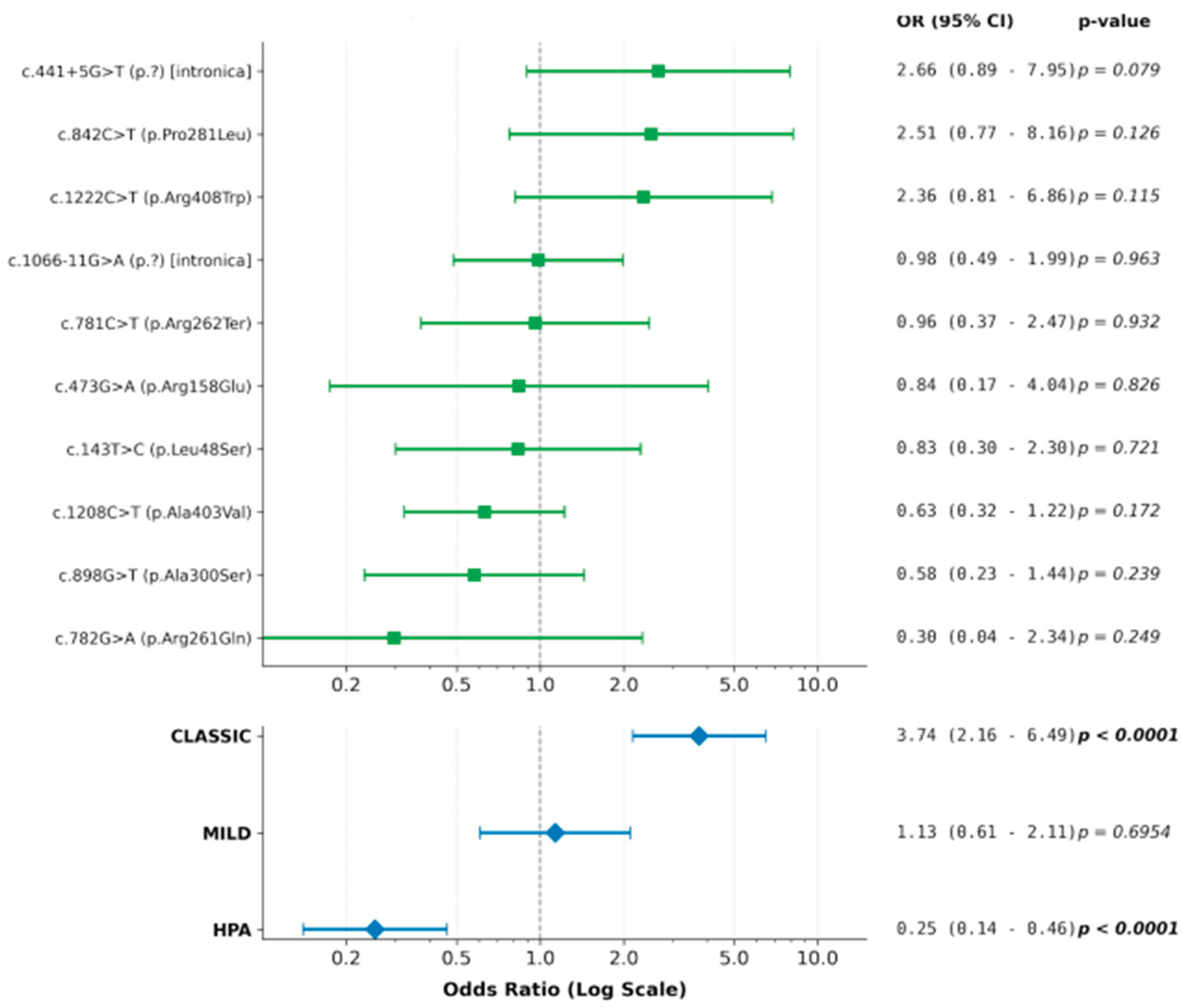

Table 1.
Population’s demoghraphic characteristics.
| . | Frequency (n) | Percentage (%) |
| Sex (n = 344) | ||
| Female | 189 | 55% |
| Male | 154 | 45% |
| Age (years) | ||
| Mean ±Standard Deviation | 17.3 ±12.2 | |
| Range | 0.4 - 61.1 | |
| Clinical Classification (Phenotype) | ||
| Mild Hyperphenylalaninemia (HPA) | 164 | 48% |
| Classical Phenylketonuria (PKU) | 92 | 27% |
| Mild Phenylketonuria (PKU) | 74 | 21.5% |
| BMI (n = 319) | ||
| Mean ±Standard Deviation | 21.13±5.52 | |
| Geographical Origin by Region | ||
| Apulia | 290 | 84.3% |
| Basilicata | 38 | 11% |
| Calabria | 3 | 0.8% |
| Distribution across Apulian Provinces | ||
| Bari (BA) | 90 | 26% |
| Foggia (FG) | 67 | 19.4% |
| Taranto (TA) | 47 | 13.6% |
| Lecce (LE) | 46 | 13.3% |
| Barletta-Andria-Trani (BAT) | 22 | 6.3% |
| Brindisi (BR) | 13 | 3.7% |
| Parents' Nationality | ||
| Born to foreign parents (residing in Apulia) Albania Romania Marocco China, Armenia, Tunisia |
13 5 3 2 3 |
3.7% |
Table 2.
Patients characteristics according to clinical phenotypes.
| Item / Characteristic | Total Cohort (N=344) | HPA (n=179) | Mild PKU (n=73) | Classical PKU (n=92) | p-value |
|---|---|---|---|---|---|
| Age (years), Mean±SD | 17.3 ± 12.2 | 13.1 ± 9.1 | 15.9 ± 8.0 | 26.0 ± 15.3 | < 0.001 |
| Sex, n (%) | 0.010 | ||||
| Females | 189 (55%) | 110 (61.4%) | 30 (40.5%) | 50 (54.3%) | |
| Males | 154 (45%) | 69 (38.5%) | 43 (59.5%) | 42 (45.7%) | |
| Race / Ethnicity, n (%) | >0.05 (NS) | ||||
| Italian | 331 (96.2%) | 177 (98.8%) | 73 (100.0%) | 90 (97.8%) | |
| Other (Eastern Europe / China) | 13 (3.7%) | 2 (1.1%) | 0 (0.0%) | 2 (2.2%) | |
| Origin, n (%) | 0.029 | ||||
| Apulia Region | 283 (82.2%) | 160 (89.3%) | 56 (76.7%) | 73 (79.3%) | |
| Out of Region / Abroad | 61 (17.7%) | 19 (10.6%) | 17 (23.2%) | 19 (20.7%) | |
| Type of Therapy, n (%) | < 0.001 | ||||
| None | 164 (47.6%) | 179 (100%) | 38 (52%) | 0 | |
| Low-protein diet | 101 (29.1%) | 0 (0%) | 16 (21.9%) | 81 (88%) | |
| Sapropterin | 23 (6.6%) | 0 (0%) | 19 (26.0%) | 3 (3.2%) | |
| Pegvaliase | 6 (1.7%) | 0 (0%) | 0 (0.0%) | 8 (8.6%) | |
| Nutritional Assessment | (n = 319) | (n = 154) | (n = 73) | (n = 92) | |
| BMI (kg/m²), Mean±SD | 21.13 ± 5.52 | 19.24 ± 4.53 | 21.42 ± 5.93 | 24.00 ± 5.27 | < 0.001 |
Table 3.
Distribution and frequency of major allelic variants by mutation type, historical/anthropological flow, and geographic origin.
Table 3.
Distribution and frequency of major allelic variants by mutation type, historical/anthropological flow, and geographic origin.
| Allelic Variant | Mutation Type | Historical / Anthropological Flow | Central-Northern Apulia(BA, BAT, FG) | Southern Apulia(TA, LE, BR) | Basilicata(PZ, MT) | Other / Not Spec. | Total Frequency |
| c.1208C>T (p.Ala403Val) |
Missense (Mild) | Indigenous / Magna Grecia | 43 (46.7%) | 34 (37.0%) | 7 (7.6%) | 8 (8.7%) | 92 |
| c.1066-11G>A (p.?) |
Splicing (Null) | Middle Eastern / Byzantine | 31 (51.7%) | 21 (35.0%) | 4 (6.7%) | 4 (6.7%) | 60 |
| c.898G>T (p.Ala300Ser) |
Missense (Mod/Severe) | Euro-Mediterranean | 25 (52.1%) | 15 (31.2%) | 3 (6.3%) | 5 (10.4%) | 48 |
| c.781C>T (p.Arg262Ter) |
Nonsense (Null) | Western European | 15 (48.4%) | 9 (29.0%) | 6 (19.4%) | 1 (3.2%) | 31 |
| c.143T>C (p.Leu48Ser) |
Missense (Mild) | Indigenous / Italo-Greek | 13 (48.1%) | 8 (29.6%) | 3 (11.1%) | 3 (11.1%) | 27 |
| c.1222C>T (p.Arg408Trp) |
Missense (Null) | Northern European / Norman-Swabian | 13 (81.2%) | 3 (18.8%) | 0 (0.0%) | 0 (0.0%) | 16 |
| c.441+5G>T (p.?) |
Splicing (Null) | Euro-Mediterranean | 4 (25.0%) | 10 (62.5%) | 1 (6.3%) | 1 (6.3%) | 16 |
Disclaimer/Publisher’s Note: The statements, opinions and data contained in all publications are solely those of the individual author(s) and contributor(s) and not of MDPI and/or the editor(s). MDPI and/or the editor(s) disclaim responsibility for any injury to people or property resulting from any ideas, methods, instructions or products referred to in the content. |
© 2026 by the authors. Licensee MDPI, Basel, Switzerland. This article is an open access article distributed under the terms and conditions of the Creative Commons Attribution (CC BY) license (http://creativecommons.org/licenses/by/4.0/).
Copyright: This open access article is published under a Creative Commons CC BY 4.0 license, which permit the free download, distribution, and reuse, provided that the author and preprint are cited in any reuse.


