
Submitted:
04 June 2026
Posted:
05 June 2026
You are already at the latest version
Abstract
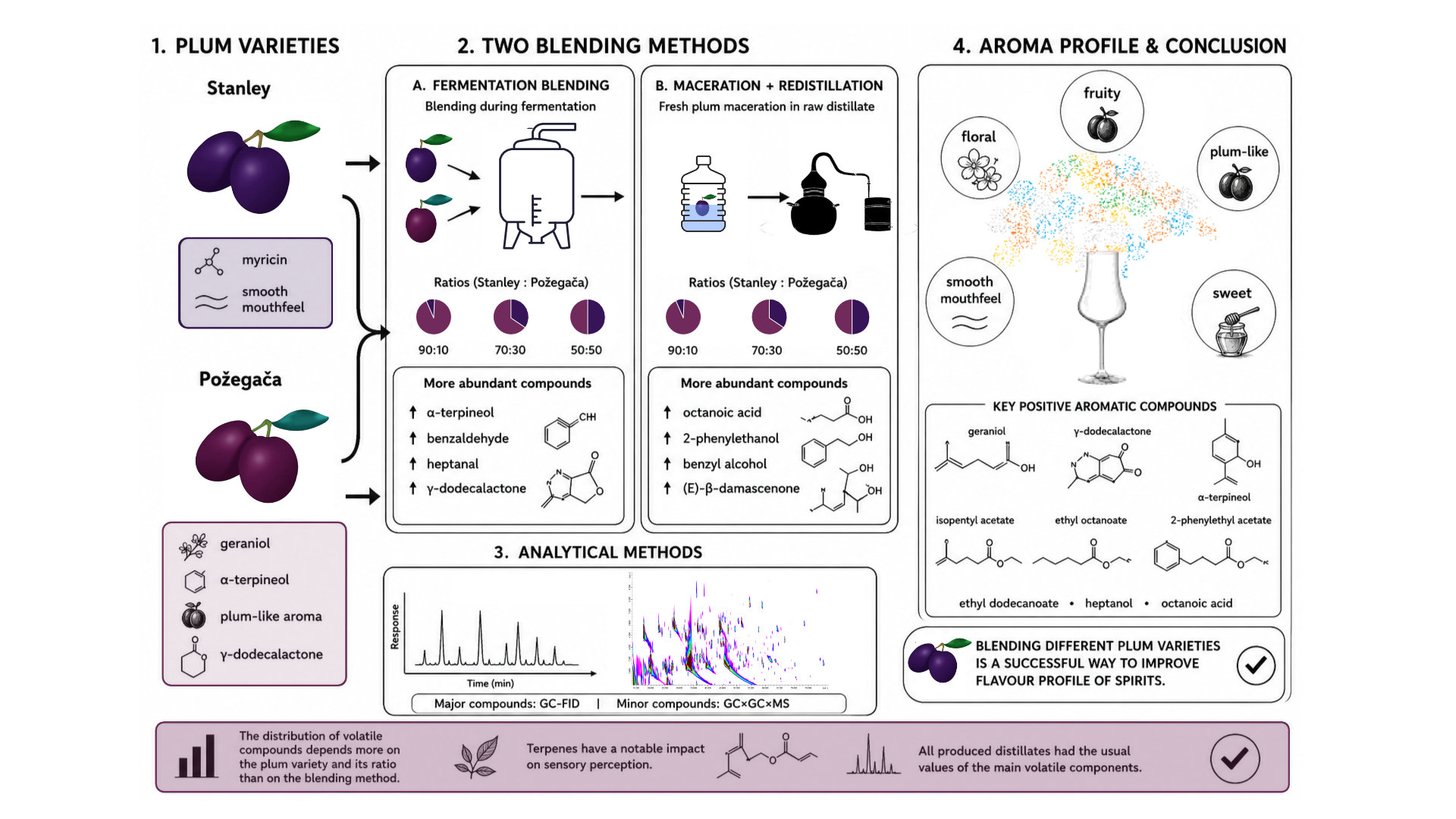
This study looked at the distribution of major and minor volatile components in distillates created by combining two plum types, Stanley and Požegača. Two methods of blending were used: (i) during fermentation and (ii) by macerating fresh Požegača in raw Stanley distillate and then redistilling the mixture. Plums were combined in three different ratios: 90:10, 70:30, and 50:50. The blending was done to enhance the plum aroma of the drinks. Major volatile components were measured by GCxFID analysis, while minor components were measured using GCxGCxMS. All produced distillates had the usual values of the main volatile components. Compared to the blending procedure, the distribution of minor volatile components in the samples varied more according to the plum variety and its ratio in the blend. Nevertheless, samples made by fermentation mixing had higher concentrations of α-terpineol, heptanal, benzaldehyde, and γ-dodecalactone. Fresh plum maceration yielded significantly higher concentrations of benzyl alcohol, 2-phenylethanol, octanoic acid, and (E)-β-damascenone. The sensory perception of spirits is significantly influenced by terpenes. Stanley spirits are distinguished for myrcene, which gives them a pleasing mouthfeel. Geraniol α-terpeneol and γ-dodecalactone, which are more typical for Požegača spirit, have a positive impact on the plum like odour of spirits. Isopentyl acetate, ethyl octanoate, 2-phenylethyl acetate, ethyl dodecanoate, heptanol, and octanoic acid were other positive aromatic compounds. Blending different plum varieties is a successful way to improve the flavour profile of spirits.
Keywords:
plum spirits
; aroma compounds
; fermentation
; maceration
Copyright: This open access article is published under a Creative Commons CC BY 4.0 license, which permit the free download, distribution, and reuse, provided that the author and preprint are cited in any reuse.


