

Submitted:
03 June 2026
Posted:
05 June 2026
You are already at the latest version
Abstract
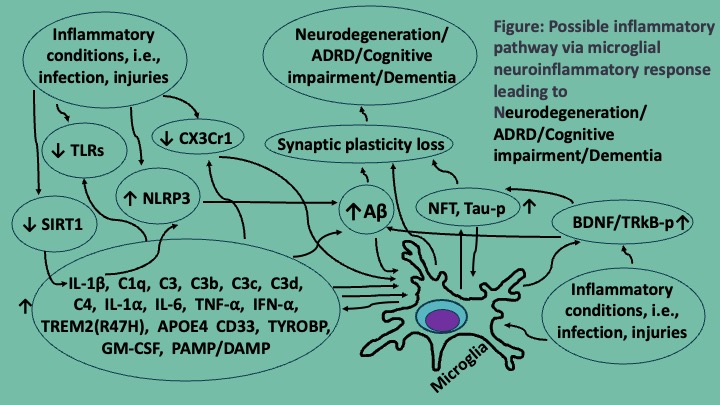
Neuroinflammation is considered as one of the core pathogenic factors of neurodegeneration in Alzheimer disease (AD) and related dementias (RD). It is also associated with other two hallmarks of AD dementia, i.e., amyloid beta (Ab) and neurofibrillary tangles (NFT), and increasingly considered as the third hallmark of AD. Abnormality in microglial pathway plays a crucial role in the neuroinflammation of AD and RD. Microglia dysfunction is linked to many neuroinflammatory signaling pathways towards the progress of developing neurodegeneration resulting to cognitive deficits or dementia. Currently, several therapeutic approaches aim to target inflammatory regulators for AD treatment, and microglia is considered as one of the vital targets. In this article we intend to highlight and discuss various microglia mediated signaling pathways that link to chronic neuroinflammation and cognitive dysfunction/dementia in AD and other diseases. This could help us to understand the degree of microglial association with the disease pathophysiology through analyzing various studies in last few decades including the latest reports. We also aim to highlight the pathways that are more and less conclusively established and determine possible pathways which may help in further exploration and narrowing down or expanding the area of studies that requires further research. AD and RD are one of the most leading causes of death in the world and there is no appropriate drug available for cure or prevention of the disease. Further research is an absolute requirement for better understanding the mechanisms underlying the disease pathophysiology and better planning of basic/therapeutic research and clinical trials. We also provide up-to-date clinical trials that used inflammatory targeting drugs and discuss the failures and promising drug targets.
Keywords:
neuroinflammation
; microglia
; cognitive impairment
; Alzheimer’s disease and related dementias
Copyright: This open access article is published under a Creative Commons CC BY 4.0 license, which permit the free download, distribution, and reuse, provided that the author and preprint are cited in any reuse.


