
Submitted:
04 June 2026
Posted:
05 June 2026
You are already at the latest version
Abstract
Increasingly stringent fire safety, environmental, and occupational health regulations have accelerated the development of sustainable fire-resistant materials. WEICs have gained attention as multifunctional passive fire protection systems due to their strong substrate adhesion, low volatile organic compound emissions, and environmentally compatible formulations. This review highlights recent advances in epoxy-based intumescent composite coatings, focusing on how formulation design and microstructural characteristics influence fire-protective performance. Key flame-retardant mechanisms, including thermal degradation, chemical transformation, and char expansion behaviour, are discussed within heterogeneous composite systems. Emphasis is placed on the synergistic interactions among acid sources, carbon-forming agents, and blowing agents, as well as on incorporating fillers and reinforcing phases to enhance thermal insulation and expansion stability. Emerging strategies involving nanostructured reinforcements, bio-based additives, and hybrid composites are also evaluated for their potential to enhance char strength, mechanical durability, and heat resistance. Despite notable progress, challenges remain in long-term durability, interfacial compatibility, economic feasibility, and large-scale implementation, highlighting the need for halogen-free, low-toxicity intumescent coating technologies.
Keywords:
advanced materials
; fire safety
; flame-retardant
; intumescent coating
; volatile organic compounds
; waterborne epoxy
1. Introduction
The rapid pace of urban development, rising energy demands, and the widespread construction of high-rise buildings have significantly increased the need for advanced fire-protection strategies and expertise, especially in composite-based structural applications. In recent decades, the expansion of infrastructure, including housing, commercial complexes, and industrial facilities, has heightened the need for robust fire safety measures to mitigate risks and protect occupants and assets [1,2,3]. Moreover, future international regulations are anticipated to prioritise flame-retardant composite systems that not only comply with stringent fire-protection standards but also promote environmental sustainability and safeguard human health [4,5,6,7].
To address these challenges, WEICs have been considered a sustainable and eco-friendly alternative to traditional solvent-based fire-protective coatings [8,9,10,11,12]. Unlike solvent-based systems, which emit high levels of volatile organic compounds (VOCs) and pose environmental and health hazards, waterborne formulations significantly reduce VOC emissions while maintaining robust fire protection. This transition reflects the growing demand for environmentally friendly materials in fire protection, particularly across sectors such as construction, transportation, and the oil and gas industry, where fire risks are notably high [13,14,15].
Intumescence occurs when a charred protective layer forms upon exposure to heat or flame, serving as an insulating shield that reduces heat and combustible-gas transfer. This procedure is vital for delaying structural degradation during fire incidents, providing time for evacuation, and reducing damage [16,17,18]. The performance of WEICs depends heavily on the synergy between three primary ingredients: the acid donor, carbon provider, and gas-releasing agent. Ongoing research focuses on optimising these formulations to enhance fire protection while strengthening mechanical integrity to ensure sustained performance under demanding conditions. The synergy between acid, carbon, and gas sources leads to efficient intumescent barrier formation, reduced heat transfer, limited oxygen ingress, suppressed volatile release, and slowed combustion [19,20].
When the acid, gas, and carbon (char) sources are combined in an intumescent flame-retardant system, they act synergistically to form an effective protective barrier during fire or heat exposure. Upon heating, the acid source, typically a phosphorus-containing compound such as ammonium polyphosphate (APP), decomposes by releasing phosphoric acid. This acid acts as a dehydrating agent, catalysing the carbonisation of the carbon-rich component. As a result, the carbon source, typically a polyhydroxy compound such as pentaerythritol (PENTA), undergoes dehydration, forming a solid, thermally stable carbonaceous char that serves as the structural backbone of the intumescent layer. Simultaneously, the gas source, such as melamine (MEL) or urea, thermally decomposes, releasing non-flammable gases, including ammonia, nitrogen, and water vapour. These gases expand the softening carbon matrix, causing the char to puff and form a thick, multicellular foam structure [21,22].
This expanded intumescent char serves as a crucial barrier between the heat source and the underlying material. It significantly reduces heat transfer by providing thermal insulation, effectively shielding the substrate from high temperatures. In addition, the char layer limits oxygen diffusion to the material’s surface, suppressing oxidation reactions and slowing combustion. It also acts as a physical seal, minimising the release of flammable decomposition gases from the substrate. Altogether, acid-induced charring, carbon backbone formation, and gas-induced expansion result in a robust, thermally protective layer that enhances the material’s fire resistance by delaying ignition, reducing flame spread, and preserving structural integrity during fire exposure [23].
Significant research has focused on enhancing the performance of WEICs by incorporating novel flame-retardant agents, advanced nanomaterials, and combined reinforcement strategies. Novelties such as graphene oxide (GO) [24,25,26], nano titanium dioxide (TiO2) [27,28,29,30,31], and bio-based fillers [32,33,34,35,36,37,38,39,40,41] have demonstrated their potential to strengthen char structures and configurations by enhancing thermal stability and mechanical performance. Furthermore, researchers are striving to refine curing processes to improve adhesion properties and ensure compatibility with diverse substrates, thereby expanding the applicability of these WEICs across multiple industries [42,43,44]. With the high demand for high-performance fire protection solutions, WEICs have developed as a key technology that balances fire safety with environmental responsibility. Ongoing research and development efforts will be instrumental in shaping the future of fire-retardant coatings, ensuring safer, more resilient infrastructure worldwide.
Recent studies have extensively investigated the flame-retardant mechanisms influencing thermal degradation in polymer-based materials, with a particular focus on intumescent coatings [40,45,46,47,48,49,50], as shown in Figure 1. Given the growing fire-safety challenges in modern infrastructure and industrial applications, there is a pressing need to understand how flame-retardant systems function at the molecular level to enhance fire resistance. Researchers have systematically examined the intricate chemical and physical changes that occur within the polymer matrix under high-temperature and standard fire-exposure conditions [51,52,53,54,55].
The fire resistance of intumescent coatings is primarily governed by three key processes: dehydration, char formation, and the development of a durable, heat-resistant char layer. During the initial phase of thermal degradation, dehydration is vital because it removes water and volatile compounds, thereby limiting the formation of flammable gases that can contribute to combustion. This step is typically promoted by acid catalysts, such as APP, which facilitate crosslinking of carbon-rich compounds and promote the formation of a protective char layer [45,46,56,57,58].
Char formation is a key process in flame retardancy, in which organic materials decompose under heat to form a protective carbon-rich layer. This char acts as both a thermal and physical barrier, restricting heat and mass transfer between the flame and the underlying material. The effectiveness and integrity of the char are primarily influenced by the composition of the intumescent coating system, particularly the inclusion of carbon donors (e.g., PER, phosphoric acid derivatives) and synergistic components (e.g., metal oxides and nanomaterials) [30,59,60,61].
The development of a robust, heat-resistant char layer is essential for providing long-lasting fire protection for substrates. This protective barrier must possess strong mechanical integrity, low thermal conductivity, and oxidation resistance to sustain its effectiveness during prolonged fire exposure. To increase char stability, researchers have incorporated materials such as graphene oxide, nano titanium dioxide, layered silicates, and bio-based fillers, which reinforce char strength and structural cohesion [26,62,63,64,65]. These developments not only improve flame resistance but also enhance the coating’s durability against mechanical wear and environmental conditions.
The molecular structures of flame-retardant compounds largely support the relationships between these physical and chemical processes. Thermal degradation pathways are influenced by the polymer’s backbone architecture, functional groups, and the decomposition behaviour of fire-retardant additives [46,52,56,66,67,68,69]. Sophisticated analytical methods, such as thermogravimetric analysis (TGA), Fourier transform infrared spectroscopy (FTIR), and scanning electron microscopy coupled with energy-dispersive spectroscopy (SEM-EDS), have provided critical insights into these mechanisms, enabling the development of more practical and environmentally friendly intumescent coatings that meet industry standards.
As fire safety regulations become more rigorous, future research will prioritise refining flame-retardant formulations, developing nanocomposite materials, and enhancing the multifunctional capabilities of intumescent coatings. Gaining more profound insights into thermal degradation mechanisms and char formation processes will be essential for developing next-generation fire protection materials that offer superior performance and environmental sustainability.
This review offers a detailed technical analysis of recent developments in flame-retardant systems for WEICs, a dynamic field driven by the growing need for high-performance, environmentally sustainable fire protection solutions in composite-based structural applications. It systematically investigates key flame-retardant mechanisms, highlighting intricate chemical transformations during thermal decomposition, the generation of intermediate compounds, and the kinetics of char formation. These key factors influence the fire resistance of the coatings. Special attention is given to the roles of acid catalysts, carbonising agents, and gas-phase flame retardants in controlling combustion behaviour and improving the fire-protection efficiency of epoxy composite coating systems [70,71,72,73,74,75,76,77,78,79,80,81]. Table 1 compares the synthesis processes of conventional solvent-borne and waterborne epoxy intumescent paint systems.
Beyond the basic mechanisms, this review explores recent advancements and cutting-edge technologies that have significantly enhanced the performance of intumescent coatings. Innovative flame-retardant additives, including graphene oxide, layered silicates, metal-organic frameworks (MOFs), and bio-based reinforcements, have demonstrated significant potential to enhance char formation, mechanical strength, and thermal stability. The integration of nanomaterials and hybrid synergistic systems has become a prominent research focus, providing superior fire resistance through improved barrier properties and catalytic effects [32,52,82,83,84,85,86,87,88,89,90].
This paper also provides a thorough evaluation of structure-property relationships, analysing how the molecular design and composition of flame-retardant additives influence thermal stability, mechanical strength, adhesion performance, and expansion characteristics of intumescent coatings. These aspects are particularly crucial for industries such as aerospace, automotive, and structural engineering, where coatings must withstand high thermal and mechanical stresses while maintaining their fire protection efficiency [19,51,67,91,92,93,94,95].
Beyond performance characteristics, this review provides an in-depth assessment of the environmental implications of WEICs. Given growing concerns about sustainability, toxicity, and biodegradability, waste management is widely discussed. The transition from traditional halogenated flame retardants to eco-friendly phosphorus-, nitrogen-, and silicon-based alternatives is analysed, along with the impact of emerging biodegradable polymers and green synthesis approaches. The potential release of hazardous degradation by-products during combustion is also considered, highlighting the need for low-emission, non-toxic formulations [8,9,96,97,98].
As is well known, epoxy is among the most widely utilised materials in surface coating applications [99]. Epoxy resins serve as vital binders in protective coatings owing to their excellent corrosion resistance, chemical durability, and strong adhesion to various substrates [100,101]. A widely used variant, diglycidyl ether of bisphenol-A (DGEBA), is produced through the reaction of epichlorohydrin and bisphenol-A with a basic catalyst. The chemical structure of DGEBA is depicted in Figure 2. Epoxy resins are defined as compounds or mixtures that contain one or more epoxy (also known as oxirane or ethoxyline) groups - three-membered oxide rings. These resins undergo polymerisation via their epoxide or hydroxyl groups upon cross-linking with a curing agent, forming a robust three-dimensional network.
To provide a quantitative and comparative perspective, this review systematically analyses various flame-retardant formulations under different operating conditions. Empirical data from peer-reviewed studies are synthesised to provide a comprehensive benchmarking analysis evaluating thermal stability, fire resistance rating, char expansion efficiency, and mechanical durability. The merits and limitations of conventional, advanced, and next-generation flame-retardant systems are critically examined, enabling researchers and industry professionals to make informed decisions regarding material selection and performance optimisation.
Ultimately, this review not only brings together current knowledge but also highlights critical research gaps and potential avenues for future research in WEICs. By integrating insights from materials science, polymer chemistry, and fire protection engineering, it provides a systematic framework for developing next-generation flame-retardant materials that balance high-performance fire safety with environmental sustainability, as shown in Figure 3.
The following sections of this review will provide an in-depth technical assessment of the key principles and performance attributes governing WEICs. This assessment will cover material composition, reaction mechanisms, thermal degradation behaviour, and overall fire resistance efficiency. Particular attention will be given to the impact of different flame-retardant additives, including phosphorus-based compounds, nanomaterials, bio-based fillers, and hybrid reinforcements, on the structural integrity, adhesive strength, and effectiveness of char formation in these coatings at elevated temperatures. Furthermore, essential processing parameters, including coating thickness, curing techniques, and dispersion methods, will be examined for their impact on optimising fire protection performance.
To facilitate a structured comparative assessment, this review will systematically analyse experimental data from peer-reviewed studies, industrial case reports, and standardised fire resistance evaluations. Critical performance metrics, including LOI, TGA, cone calorimetry, and UL-94 classifications, will be used to evaluate thermal stability, expansion efficiency, and combustion suppression across different coating formulations [102,103,104,105]. By adopting a data-driven approach, this analysis aims to provide a quantitative comparison of the advantages and limitations of various flame-retardant systems, offering key insights for selecting the most suitable materials for specific fire protection requirements.
The final section will propose strategic directions to overcome current limitations and advance this field. Key factors will include enhancing long-term durability, improving industrial applicability, and optimising cost-effectiveness. The discussion will also emphasise the importance of sustainability and regulatory compliance, advocating for the development of low-toxicity, biodegradable, and halogen-free formulations that align with evolving environmental standards. Additionally, emerging innovations such as intelligent flame-retardant technologies and self-healing coatings will be discovered for their potential to revolutionise fire-resistant polymer coatings.
2. Review of Intumescent Fire Protective Coatings
In the last ten years, intumescent coating technologies have been extensively reviewed through a wide range of scientific and engineering lenses, with key contributions outlined in Table 2. Taken together, these studies map the current landscape of intumescent coatings by analysing formulation concepts, fire-retardant mechanisms of action, thermal barrier effectiveness, and performance requirements across different application sectors. Despite notable advances, the literature repeatedly highlights persistent limitations and unresolved research questions, particularly regarding formulation refinement, the lack of harmonised performance evaluation frameworks, and uncertainties regarding long-term service reliability [105].
Despite their environmental and occupational safety advantages, WEICs generally exhibit lower durability than solvent-based systems under prolonged environmental exposure as shown in Table 3. Quantitative studies have demonstrated that accelerated UV ageing, cyclic humidity exposure, thermal cycling, and salt-spray conditions can significantly reduce adhesion strength, char expansion ratio, and fire-protection efficiency. For example, adhesion retention of WEICs after accelerated ageing may decrease from approximately 95% to below 70%, while water uptake may increase from 3-5 wt.% to 8-15 wt.% depending on formulation chemistry and crosslinking density. Furthermore, post-ageing cone calorimetry studies reported increases in peak heat release rate (PHRR) of approximately 10-40% due to degradation of the intumescent network and reduced char integrity. The incorporation of graphene oxide, nano-TiO2, layered silicates, and reactive phosphorus-nitrogen systems has shown promise in mitigating these durability-related degradations by enhancing barrier properties and reinforcing char structures [106,107,108,109].
A recurring theme in formulation-focused reviews is the difficulty of achieving an optimal balance between flame-retardant performance and essential coating properties, including mechanical robustness, resistance to environmental exposure, and processing reliability. Deficiencies, including inadequate water resistance, weak interfacial bonding to steel substrates, structural instability of the expanded char, and performance degradation under repeated thermal, humid, and corrosive conditions, continue to constrain existing systems [110]. At the same time, many authors highlight limitations in current fire-testing approaches, noting the lack of standardised methods that reliably translate laboratory-scale results into predictions of real-fire behaviour and long-term in-service performance [111]. Moreover, durability-related issues, including ageing phenomena, weathering effects, additive migration, and progressive deterioration of the intumescent char, are increasingly recognised as key barriers to widespread deployment in demanding industrial environments, including civil infrastructure, petrochemical facilities, and offshore installations [112,113,114,115,116].
Earlier review efforts primarily focused on solvent-borne intumescent coatings, reflecting their favourable film-forming properties, strong adhesion, and comparatively consistent fire-protection performance. In contrast, contemporary reviews document a clear and ongoing transition toward water-based intumescent systems. This shift is primarily attributed to stricter regulatory controls on volatile organic compound (VOC) emissions, alongside growing awareness of environmental, health, and safety risks associated with solvent-based formulations. Concurrently, rising expectations for sustainable and low-impact fire-protection solutions have further stimulated interest in waterborne alternatives [117,118,119].
Despite their environmental and occupational safety advantages, water-based intumescent coatings are often reported to underperform traditional solvent-based systems in terms of fire resistance and long-term durability. Consequently, recent review articles increasingly advocate adopting advanced materials engineering approaches, such as hybrid polymer matrices, multifunctional and nanoscale fillers, and synergistic flame-retardant systems, to overcome these deficiencies without compromising regulatory compliance. Collectively, these insights reinforce the need to continue investigating innovative formulation strategies, more representative performance assessment techniques, and durability-focused design concepts to enable the development of next-generation intumescent coating technologies.
The majority of existing reviews focus on two principal themes: fire-testing methodologies and the chemical mechanisms underlying intumescence. For water-based intumescent coatings, establishing reliable, repeatable, and representative fire-testing approaches is particularly critical, as their fire performance is strongly influenced by drying behaviour, residual moisture, and film-formation processes. Many laboratory-scale fire tests rely on simplified experimental configurations that limit reproducibility, general applicability, and predictive modelling, especially for systems whose performance is sensitive to ambient humidity and curing conditions waterborne [110,116]. In addition, the relevance of standardised fire-testing protocols has been questioned, as real fire scenarios often involve non-uniform heat fluxes and transient temperature profiles that deviate significantly from prescribed testing conditions. These differences can substantially influence expansion characteristics, char stability, cohesion, and adhesion in water-based intumescent coatings [120]. Consequently, the effects of heating rate, thermal intensity, and exposure duration on the fire-protective behaviour of waterborne intumescent systems require more systematic and comprehensive investigation [121].
The review by Fu et al. highlights significant progress in inorganic-dominant intumescent coatings, particularly in improving thermal stability and char robustness. However, key gaps remain in understanding structure-property relationships, ensuring long-term durability, integrating inorganic systems with water-based binders, and establishing reliable fire-testing methodologies representative of real-fire scenarios [122].
Alongi, Han, and Bourbigot provide a thorough review of the development of intumescence for flame-retardant applications, highlighting both conventional methods and recent innovations, particularly those driven by novel chemical approaches and nanotechnology. The review covers core principles of intumescence, including chemical composition and thermal/rheological behaviour, presents new insights from modelling and simulation, and compares traditional coatings with emerging systems across diverse polymer types and substrates, such as metals, wood, plastics, films, and fabrics, including applications using layer-by-layer assembly [123].
Alongside developments in fire-testing methodologies, significant progress has been made in formulation engineering. Numerous studies have explored a wide range of intumescent components, including acid sources, carbonific agents, blowing agents, polymeric binders, fillers, and nano-scale additives, as well as their individual and synergistic effects on char formation and fire resistance [102,103,104,105]. In water-based intumescent coatings, the presence of water further complicates the formulation, necessitating careful selection and optimisation of binders, dispersants, and stabilising agents to ensure homogeneous dispersion and long-term stability. Precise control over the sequence and kinetics of thermochemical reactions is essential to promote effective char expansion. At the same time, additional emphasis must be placed on char coherence, structural integrity, and thermal stability during fire exposure [114].
Despite these advancements, several challenges remain specific to water-based intumescent coatings. Issues related to moisture sensitivity, resistance to environmental ageing, and mechanical durability continue to restrict their broader application, particularly in outdoor or harsh industrial environments. Compared with solvent-based systems, waterborne intumescent coatings generally exhibit greater susceptibility to degradation under prolonged exposure to humidity, cyclic wet-dry conditions, and mechanical stresses. As highlighted in multiple reviews, further research is required to enhance the weather resistance, adhesion strength, abrasion resistance, and long-term mechanical performance of water-based intumescent coatings without sacrificing their fire-protective effectiveness [103,105,113]. Addressing these limitations is critical for advancing water-based intumescent coatings as environmentally compliant, durable, and high-performance fire-protection solutions suitable for both indoor and industrial applications.
3. Technical Analysis of Flame-Retardant Mechanisms
3.1. Fundamental Principles of Intumescence in Waterborne Epoxy Coatings
Intumescence in flame-retardant coatings is achieved through a sequence of interrelated physical and chemical reactions that, when subjected to elevated temperatures, combine to form a highly insulating protective layer. These coatings typically consist of three key components: an acid source, a carbon donor, and a gas-generating agent, each contributing to char formation and expansion. The acid source, often APP or other polyphosphates, initiates dehydration reactions that extract water molecules from the carbon donor. This process helps minimise the release of flammable volatiles and facilitates polymerisation and cross-linking, ultimately yielding a robust carbon-rich structure [44,47,57,124,125,126,127].
The carbon donor, typically PENT or its derivatives, undergoes controlled thermal decomposition to form a dense char layer that serves as a thermal insulator and a barrier to oxygen infiltration. The strength and integrity of this char are critical to the coating’s fire protection performance, influencing its thermal stability, mechanical resilience, and oxidation resistance. Simultaneously, the gas-releasing component, such MEL, decomposes at high temperatures, releasing noncombustible gases, including ammonia and nitrogen. This reaction causes the softened char to expand into a lightweight, porous structure, further enhancing its insulating properties and significantly minimising heat transfer to the underlying material [64,128,129,130].
The interaction of these components results in the development of an adaptive intumescent barrier that reduces ignition risk, slows flame spread, and limits heat exposure to the substrate. To enhance the effectiveness of this protective system, recent studies have focused on advanced formulations incorporating nanomaterials such as graphene oxide and carbon nanotubes, as well as bio-based flame retardants. These additives strengthen the char structure, improve thermal stability, and offer eco-friendly alternatives to conventional flame-retardant solutions. Additionally, incorporating layered silicates and other nanostructured fillers has been shown to reinforce the char structure, improving its resistance to mechanical and thermal degradation and thereby significantly enhancing the fire protection performance of intumescent coatings. [23,131,132,133].
3.2. Chemical Mechanisms and Thermal Degradation Pathways of Intumescent Coating
The thermo-oxidative degradation of WEICs proceeds via several concurrent reaction pathways. The initial step in epoxy resin degradation is the cleavage of ether linkages in the polymer backbone. TGA demonstrates that waterborne epoxy matrices undergo two primary stages of degradation: the first involves weight loss due to the evaporation of absorbed water and the commencement of resin curing degradation (200 to 300 °C), followed by a substantial weight loss at higher temperatures (300 to 500 °C) associated with char formation [134,135,136,137].
Chemical reactions induced by thermal degradation have been studied using techniques such as Fourier transform infrared spectroscopy (FTIR), differential scanning calorimetry (DSC), and mass spectrometry [138]. In many systems, degradation begins with the rapid depolymerisation initiated by acid-catalysed cleavage. Subsequent crosslinking and char formation involve complex condensation reactions. Specifically, the reaction mechanisms (As shown in Figure 4) are presented as follows [17,139,140]:
R-OH + H2PO4− → R-O-PO3H− + H2O
R-O-PO3H− + Melamine → Crosslinked char structure + N2↑ + H2O
Changes in the chemical composition of the acid source or carbon source can influence the yield and stability of the char. For instance, phosphorus-nitrogen synergistic systems have been reported to yield greater char yield, with studies comparing APP with novel organophosphorus compounds demonstrating up to a 50% improvement in char stability under oxidative conditions [141,142,143]. The degradation kinetics under controlled thermal-ramping conditions typically follow first-order reaction models; however, recent studies have reported second-order effects under non-isothermal conditions induced by rapid heating [46,144].
Organic intumescent coatings achieve fire protection through a coordinated system composed of four essential components: a polymeric binder, an acid-generating compound, a char-forming agent, and a gas-releasing species. Additional modifiers are commonly used to tailor specific properties, such as thermal resistance, mechanical stability, and coating integrity. A simplified representation of the intumescence process is presented in Figure 5, which also outlines representative reactions involving widely used constituents such as APP, PENT, and MEL. The temperature intervals associated with each transformation stage are strongly dependent on formulation parameters and experimental conditions [106].
Under ambient conditions, intumescent coatings function similarly to conventional protective or decorative coatings. Upon thermal exposure, the acid precursor (e.g., APP) decomposes while the polymer matrix softens, forming a viscous, deformable phase. Simultaneously, thermal breakdown of the blowing component (e.g., MEL) generates non-flammable gases that become entrapped within the softened matrix, initiating volumetric expansion. These gases nucleate into fine cells, typically tens of micrometres in size, resulting in foaming and substantial thickening of the coating layer.
At the same time, the released acidic species catalyse esterification reactions between the acid source and the carbon precursor (e.g., PER), followed by progressive carbonisation as the temperature increases. Binder decomposition can further contribute to char development. The resulting expanded structure forms a low-density, porous carbonaceous layer with reduced thermal conductivity, thereby impeding heat transfer to the substrate. Expansion ceases once gas generation is complete or when increased char viscosity prevents further bubble retention. At elevated temperatures, the consolidated multicellular char may undergo additional exothermic degradation or oxidation, accompanied by the release of CO and CO2 [46].
Advanced computational models have been developed to simulate char formation. These models combine mass and heat-transfer equations to predict the evolution of char thickness and porosity. Quantitative assessments show that nanofiller-based coatings have lower effective thermal conductivity, typically 0.1-0.3 W/(m·K), compared to traditional coatings (around 0.35-0.5 W/(m·K)), consistent with experimental data demonstrating enhanced thermal insulation [141,142,143].
3.3. Structure-Property Relationships of Flame Retardants
The effectiveness of flame retardants in waterborne epoxy coatings is closely linked to their molecular structure and how well they disperse within the polymer matrix. Recent research has concentrated on modifying the chemical properties of additive components to enhance both the flame resistance and mechanical strength of the resulting coating.
The incorporation of hyperbranched polymers and specially designed reactive oligomers has led to enhanced compatibility with epoxy resin. This compatibility is crucial for achieving a homogeneous microstructure, whereby the flame-retardant additives are uniformly dispersed and interact both physically and chemically with the matrix. Structure-property relationship studies have demonstrated that:
- The use of nanostructured fillers, such as montmorillonite clay modified with organic cations, leads to improvements in both barrier properties and mechanical integrity. Transmission electron microscopy (TEM) images provide compelling evidence that well-exfoliated clay platelets form tortuous pathways that effectively restrict mass and heat transfer. This mechanism can be quantitatively assessed by a reduction in the effective diffusion coefficient of up to 40% relative to unmodified coatings [152,153,154].
- Unlike additive systems, reactive flame retardants offer the potential for covalent bonding between the flame-retardant molecule and the epoxy matrix. This chemical linkage is shown to significantly retard the mobility of degradation intermediates, thereby enhancing char formation and stability.
A crucial aspect of structure-property analysis in modern coatings research is the use of advanced spectroscopic and calorimetric techniques. For instance, coupling FTIR with TGA/DSC allows for real-time monitoring of both chemical changes and the energy profile during thermal degradation. Recent studies have shown that incorporating specific functional groups, such as phosphonate and phosphinoxide moieties, can reduce the activation energy for charring reactions by 15-20 kJ/mol compared to traditional phosphate groups [155,156,157,158,159,160].
3.4. Breakthrough Technologies and Novel Approaches
In recent years, innovation in flame-retardant materials has accelerated markedly as researchers seek solutions that meet increasingly rigorous environmental and health standards while maintaining strong fire resistance. Within this context, bio-derived and hybrid organic-inorganic flame-retardant systems have gained prominence as advanced alternatives to conventional halogen-based and exclusively mineral formulations. These emerging systems are widely regarded as capable of delivering reliable fire-protection performance while mitigating toxicity, enhancing sustainability, and complying with regulatory constraints.
Unlike halogenated flame retardants, which are often linked to the formation of hazardous and corrosive combustion products, bio-based flame-retardant components are generally associated with lower ecological impact and greater compatibility with sustainable material life cycles. Consequently, recent investigations have prioritised incorporating naturally sourced macromolecules, such as chitosan, lignin, starch, and phytic acid, into flame-retardant architectures. When used alongside established phosphorus-containing additives, these bio-derived constituents contribute to condensed-phase flame-retardant processes, leading to increased char production, improved structural integrity of the protective layer, and more effective inhibition of heat and mass transfer during combustion [157,158,159,160].
Among these materials, chitosan-based systems have received significant attention due to their nitrogen-rich structure, favourable film-forming characteristics, and inherent tendency to promote char formation. In combination with phosphorus-based flame retardants, chitosan facilitates the formation of robust intumescent char through synergistic dehydration, crosslinking, and expansion mechanisms. Likewise, lignin-derived additives, characterised by their aromatic frameworks and high carbon content, serve as efficient carbon precursors, strengthening the resulting char layer upon interaction with acidic phosphorus species. Such hybrid formulations frequently demonstrate enhanced flame-retardant performance compared to single-component systems, while also allowing for reduced additive concentrations and minimising adverse effects on mechanical behaviour [165].
In addition to improved fire resistance, bio-based and hybrid organic-inorganic flame-retardant systems offer notable environmental compatibility and sustainability advantages. Replacing a portion of petroleum-based or mineral fillers with renewable bio-resources lowers overall material intensity and ecological burden. Furthermore, many studies report a significant reduction in the evolution of toxic smoke and the release of corrosive gases during combustion, a feature particularly valuable for applications in construction, transportation, and protective coating technologies, where occupant safety and exposure risks are of paramount concern [166,167].
Taken together, these developments reflect a broader transition in flame-retardant material design from traditional, single-purpose additives toward multifunctional, synergistic systems that simultaneously address fire safety, environmental impact, and material performance. As outlined in Table 4, the expanding body of research indicates that bio-based and hybrid organic-inorganic flame retardants represent a viable and forward-looking strategy for developing safer, more sustainable, and high-efficiency fire-protection solutions, while also providing a foundation for further advances through molecular engineering and composite system optimisation.
An emerging strategy that has gained increasing attention in recent flame-retardant research involves incorporating metal-organic frameworks (MOFs) as functional additives into polymeric and coating-based fire-protection systems. Owing to their crystalline architecture, extensive internal surface areas, and highly adjustable pore structures, MOFs offer a level of structural and chemical tunability that is not readily achievable with conventional flame-retardant fillers. These characteristics allow MOFs to interact with thermal degradation products at a molecular scale, thereby influencing flame-retardant pathways in a highly controlled manner.
Mechanistic investigations reported in the recent literature indicate that MOFs can exert flame-retardant action through multiple complementary mechanisms. During thermal exposure, the porous framework of MOFs enables the adsorption and confinement of volatile degradation products and reactive radicals, thereby reducing the availability of combustible intermediates in the gas phase. Simultaneously, the metal centres and organic linkers within MOFs have been shown to promote condensed-phase reactions, thereby facilitating catalytic charring that enhances carbonaceous residue formation. This dual functionality contributes to the formation of a denser, more thermally stable char layer, which plays a critical role in shielding the underlying substrate from heat and flame propagation [168,169,170,171].
In addition to their catalytic role, MOFs also provide a pronounced physical barrier effect. As part of the coating matrix, well-dispersed MOF particles increase the tortuosity of diffusion pathways for oxygen and flammable gases, thereby restricting mass transfer between the flame zone and the underlying material. This barrier effect, combined with improved char cohesion, effectively suppresses heat release and delays ignition. Such synergistic behaviour distinguishes MOFs from traditional mineral fillers, which often rely predominantly on physical dilution or endothermic decomposition mechanisms [172,173,174].
Quantitative performance assessments further support the effectiveness of MOF-based flame-retardant systems. Experimental data from multiple studies demonstrate that coatings incorporating optimised MOF formulations exhibit measurable improvements in fire resistance, as reflected in higher limiting oxygen index (LOI) values than those of reference or unmodified systems. These improvements, summarised in Table 5, highlight the sensitivity of flame-retardant performance to MOF composition, loading level, and interfacial compatibility with the host matrix [168,169,170,171,172,173,174].
Overall, the growing body of evidence suggests that MOFs are a promising class of multifunctional flame-retardant additives that integrate catalytic, adsorption, and barrier effects within a single material platform. Their structural versatility offers significant opportunities to tailor flame-retardant behaviour through the rational design of metal nodes, organic linkers, and pore environments. As a result, MOF-based systems are increasingly regarded as a forward-looking approach for advancing next-generation fire-protective coatings and composite materials, particularly where high efficiency and low additive loading are required.
Despite significant progress in advanced flame-retardant systems, several technical constraints continue to impede their widespread implementation, particularly in waterborne epoxy-based formulations. One of the most persistent challenges arises from the difficulty of achieving homogeneous dispersion of nanomaterials within the polymer matrix. Owing to their high surface energy and strong interparticle attractions, nanofillers are prone to agglomeration, which undermines their effective interaction with the surrounding epoxy network and limits their contribution to flame-retardant performance.
In addition to aggregation, interfacial incompatibility between nanomaterials and the aqueous epoxy environment further complicates dispersion stability. Poor interfacial bonding can lead to phase separation, sedimentation during storage, and non-uniform microstructures after curing, all of which negatively affect both fire resistance and mechanical properties. To address these issues, considerable research effort has focused on developing surface modification strategies to enhance the chemical affinity between nanomaterials and waterborne epoxy matrices. Such approaches include grafting functional groups onto nanofiller surfaces, tailoring surface polarity, and introducing reactive moieties that can participate in epoxy cross-linking reactions.
In parallel with these chemical modification strategies, advances in processing techniques have also been investigated to enhance the dispersion of nanomaterials. High-shear mixing, ultrasonic treatment, and controlled in situ incorporation methods have been reported to improve the initial distribution and reduce agglomerate size. However, maintaining dispersion stability throughout formulation, storage, and application remains a significant challenge, particularly in large-scale or industrial coating processes, where processing conditions are less tightly controlled.
Similar to reactive flame retardants, silane-based coupling agents have emerged as a promising means to improve interfacial compatibility between inorganic nanomaterials and organic epoxy matrices [175,176,177]. By forming covalent or hydrogen-bonded linkages at the filler-matrix interface, silanes can enhance dispersion stability and promote more effective stress transfer and char formation during combustion. Nevertheless, translating these laboratory-scale successes into consistent uniform dispersion at industrial production scales remains a formidable challenge. Factors such as processing time, equipment limitations, formulation viscosity, and cost constraints must be carefully balanced to ensure scalability and reproducibility [178,179,180].
Overall, these unresolved issues highlight the necessity for integrated strategies that combine material surface engineering with process optimisation. Achieving reliable dispersion of nanomaterials in waterborne epoxy systems will be critical not only for maximising flame-retardant efficiency but also for ensuring long-term coating stability and performance under practical service conditions. Addressing these challenges remains an active area of research and a key prerequisite for the commercial adoption of next-generation, nanostructured flame-retardant coatings.
4. Applications and Performance Evaluation
4.1. Commercial and Industrial Relevance
The practical deployment of WEIC extends across multiple industries, including construction, transportation, and electronics. For instance, in the construction sector, these coatings are used to provide fire protection to steel structures and concrete elements. In transportation, they safeguard the cabin interiors and critical components from fire-induced damage. The electronics industry benefits particularly from coatings that maintain performance at limited thicknesses while offering robust fire retardancy, thereby protecting circuit boards and components.
The performance of these coatings has typically been assessed through standardised flammability tests, including the UL-94 vertical burn test, cone calorimetry, and LOI measurements. Although LOI, UL-94 vertical burning, TGA, and cone calorimetry are widely used to evaluate flame-retardant performance, these methods primarily function as laboratory-scale screening tools and do not fully represent real-fire scenarios involving structural loading, hydrocarbon flame exposure, non-uniform heat flux, and prolonged thermal attack. Therefore, large-scale fire-resistance standards such as ASTM E119, UL 1709, BS 476, ISO 834, and EN 13381 are essential for evaluating the practical fire endurance of WEICs applied to structural steel substrates as presented in Table 6. The relationship between small-scale combustion tests and large-scale structural fire performance remains an important research challenge requiring further standardisation and correlation studies [106,110,112].
Cellulosic and hydrocarbon fires exhibit different fire behaviors and therefore require different intumescent coating design strategies. Cellulosic fires, commonly associated with wood, paper, and building contents, follow standard fire curves such as ISO 834 and develop relatively gradually, reaching approximately 945-1000 °C within 2 hours. Under these conditions, waterborne epoxy intumescent coatings form an expanded insulating char layer through the synergistic action of an acid source, carbon source, and blowing agent to protect steel substrates from heat transfer [110].
In contrast, hydrocarbon fires occur in petrochemical and offshore facilities involving fuels such as petrol, diesel, and natural gas. These fires follow hydrocarbon fire curves (e.g., UL 1709) with extremely rapid temperature rise up to 1000-1100 °C within minutes. Such severe exposure requires intumescent coatings with higher thermal stability, stronger char integrity, improved adhesion, and resistance to thermal shock and erosion. Therefore, hydrocarbon-grade systems commonly incorporate epoxy-based formulations, ceramic-forming fillers, nanomaterials, expandable graphite, and multilayer protective systems consisting of primers, intumescent layers, and weather-resistant topcoats. Consequently, intumescent coating formulations must be specifically tailored according to the expected fire scenario and service environment.
Recent publications have provided quantitative evidence that coatings formulated with advanced flame-retardants can meet or exceed the performance criteria set by international standards. For example, coatings incorporating hybrid organic-inorganic systems have achieved UL-94 V-0 ratings while simultaneously reducing heat release rates by approximately 30-50% compared to control formulations, as shown in Table 7 [181,182,183,184,185,186].
4.2. Quantitative Comparison of Flame Retardant Systems
A comparative analysis of the quantitative data summarised in Table 8 reveals several consistent performance trends across different flame-retardant systems, particularly in the interplay among limiting oxygen index (LOI), heat release rate (HRR), char yield, and time-to-ignition metrics [47,184,185,186,187]. Collectively, these parameters provide insight into the underlying mechanisms of flame retardancy and their associated trade-offs.
A general trend across the reviewed systems is that formulations with elevated LOI values exhibit greater resistance to sustained combustion. Higher LOI values are commonly associated with enhanced condensed-phase activity, particularly increased char formation and improved char stability. However, an increase in LOI does not always correspond to a proportional reduction in peak HRR. In several cases, materials with relatively high LOI values still exhibit moderate-to-high HRR peaks, indicating that although ignition resistance and flame sustainability improve, the intensity of heat release following ignition may remain significant. This divergence highlights the limitation of relying on LOI as a standalone performance indicator.
In contrast, systems that exhibit substantial reductions in peak HRR often incorporate additives or fillers that enhance physical barrier effects or suppress gas-phase radicals. These formulations typically restrict heat feedback to the substrate and slow fire growth once ignition has occurred. However, such reductions in HRR are not always accompanied by high LOI values, suggesting that mechanisms that suppress heat release may not necessarily enhance ignition resistance to the same extent. This observation underscores a fundamental trade-off between ignition control and fire growth suppression.
Char yield data further support these interpretations. Higher residual char percentages generally correlate with increased LOI values and improved post-ignition protection, as the formation of a continuous, cohesive char layer limits heat and mass transfer. Nevertheless, high char yield alone does not guarantee low HRR if the char structure lacks sufficient mechanical integrity or thermal stability. In some formulations, porous or cracked char layers allow continued volatilisation and oxygen ingress, resulting in sustained heat release despite high char residue.
Time-to-ignition measurements provide additional context to these trade-offs. Formulations that significantly delay ignition often incorporate components that absorb heat, release inert gases, or promote early-stage char formation. These systems typically show improvements in LOI but may not achieve the lowest HRR values. Conversely, materials optimised for HRR suppression may ignite relatively early but exhibit slower fire growth rates thereafter. This inverse relationship further reinforces the need for multi-parameter evaluation when assessing flame-retardant performance.
Overall, the data presented indicate that no single flame-retardant strategy simultaneously maximises LOI, minimises HRR, increases char yield, and delays ignition. Instead, optimal fire performance is achieved through synergistic formulation design that balances ignition resistance, heat release suppression, and char stability. These findings highlight the importance of integrated performance assessment and provide a clear rationale for the continued development of multifunctional flame-retardant systems that address multiple fire-behaviour criteria simultaneously [187,188,189,190].
These formulations highlight the integration of advanced additives, whether through synergistic phosphorus-nitrogen interactions, nano clay incorporation, or MOF enhancement, resulting in statistically significant improvements over conventional systems. In numerous cases, incorporating a reactive flame-retardant component, rather than a simple additive, has demonstrated improved adhesion to the epoxy matrix and greater durability under thermal cycling.
Moreover, the adoption of in situ analytical tools, such as high-speed thermomechanical analysis (TMA) and real-time TGA-FTIR coupling, has allowed researchers to derive kinetic rate constants and activation energies. For instance, a recent study reported an activation energy of approximately 85 kJ/mol for char formation in MOF-enhanced formulations, compared with 100 kJ/mol for conventional systems, indicating a modified degradation pathway that favours more rapid char formation under fire scenarios [46,191,192,193,194,195].
4.3. Case Studies and Field Applications
Several field studies have demonstrated the commercial viability of advanced flame-retardant coatings. A notable case study in the European construction industry compared the performance of traditional solvent-based coatings with that of WEICs enhanced with bio-based flame retardants. The study found that the waterborne variant not only achieved flame-retardant performance comparable to or better than the solvent-based variant but also significantly reduced VOC emissions, thereby aligning with the latest environmental directives [196,197,198,199,200,201].
In automotive applications, intumescent coatings have been utilised for fire protection of steel components in engine compartments and structural elements of high-speed trains. Accelerated ageing and fire endurance tests indicate that formulations with optimised nano-additives exhibit superior resistance to microcracking and char spallation. Such performance is critical to ensure that the protective barrier maintains its integrity under high thermal stress.
Beyond industrial applications, emerging research is investigating the use of these coatings in advanced electronics packaging. In microelectronic devices, where heat dissipation is critical, the challenge lies in designing ultra-thin coatings that can form an effective char barrier without compromising electrical insulation. Recent pilot studies have demonstrated that flame-retardant additives based on silicon-phosphorus complexes, when incorporated into nanolayered coatings, can achieve both high LOI values and excellent dielectric properties.
5. Challenges and Environmental Considerations
5.1. Technical Limitations and Processing Challenges
While recent advances in flame-retardant formulations for WEICs are promising, several technical challenges remain. A primary concern in scaling these innovations for industrial production is ensuring uniform dispersion of nano-additives in the epoxy resin. In many cases, high surface energy and a tendency toward nanoparticle agglomeration can lead to inhomogeneities that adversely affect both mechanical properties and flame-retardant performance. Techniques such as high-shear mixing, ultrasonication, and the use of dispersing agents have been developed to mitigate these issues. Yet, reproducibility remains a challenge when transitioning from the laboratory to industrial scales, as shown in Figure 6.
Another technical limitation concerns the durability of the char layer under repeated thermal cycling and mechanical stress. Although enhanced formulations show robust initial performance in standard fire tests, real-world conditions often involve long-term exposure to fluctuating temperatures, moisture ingress, and sustained mechanical loads. Under such conditions, the integrity of the char layer may become compromised. Long-term durability studies using accelerated weathering and cyclic thermal analysis have shown that adding reactive flame retardants that chemically anchor to the epoxy matrix can improve char adhesion; however, the optimal formulation balance remains under investigation.
Beyond laboratory-scale formulation optimisation, manufacturability and industrial scalability remain critical barriers to the commercial implementation of WEICs. Parameters such as shelf life, sedimentation stability, viscosity control, curing consistency, coating-thickness uniformity, sprayability, repairability, and batch-to-batch reproducibility significantly influence coating quality and fire-protection reliability. Nanofiller agglomeration during storage may result in sedimentation and inconsistent thermal performance, whereas incomplete curing and residual water entrapment can weaken adhesion and reduce char integrity during fire exposure. In practical field applications, additional challenges include substrate preparation, environmental humidity during application, maintaining coating thickness, and quality assurance in large-scale spraying operations. Consequently, future studies should prioritise scalable formulation strategies that maintain long-term storage stability, consistent rheological behaviour, and reproducible fire performance under industrial manufacturing and on-site application conditions [174,175,176].
5.2. Environmental Impact: Toxicity and Biodegradability
Environmental considerations are of paramount importance in the selection and formulation of flame retardants. Historically, many effective flame retardants have been based on halogenated compounds, which are now under scrutiny due to their persistence in the environment, bioaccumulative potential, and toxicological concerns. The transition to waterborne systems naturally reduces VOC emissions; however, the flame-retardant additives themselves must also be evaluated for their environmental impact.
Recent studies have emphasised the use of both in vitro assays and animal models to evaluate the ecotoxicological profiles of phosphorus-based and nitrogen-containing flame retardants. For example, quantitative structure-activity relationship (QSAR) models have been utilised to assess the toxicity of newly developed organophosphorus compounds. Research findings suggest that incorporating bulky substituents or bio-based functional groups can help reduce toxicity concerns while preserving the effectiveness of flame retardancy [202,203,204,205,206]. Furthermore, the biodegradability of flame retardants is a growing concern. Recent work has demonstrated that bio-based flame retardants, derived from renewable sources such as lignin or chitosan, exhibit improved biodegradation profiles compared to their synthetic counterparts. However, challenges remain in matching their thermal performance with that of traditional compounds.
In addition to toxicity and biodegradability, the waste management of spent coatings must be addressed. Current research focuses on environmentally benign recycling or disposal mechanisms [207,208,209,210,211,212,213]. Some promising approaches involve designing intrinsically recyclable flame-retardant systems via reversible chemical linkages. Pilot-scale studies have successfully demonstrated that coatings with dynamic covalent bonds can be reprocessed, significantly reducing hazardous waste flows. These research findings collectively underscore progress in developing recyclable flame-retardant coatings and composites to minimise dangerous waste and support sustainable material management practices.
Although WEICs significantly reduce VOC emissions compared with conventional solvent-borne coatings, sustainability assessment should also include smoke toxicity, toxic gas evolution, biodegradability, ecotoxicity, and life-cycle environmental impacts as shown in Table 9. Conventional solvent-borne intumescent coatings may contain VOC contents exceeding 350-450 g/L, whereas advanced WEICs commonly exhibit VOC levels below 50-100 g/L. In addition, phosphorus-nitrogen flame retardants and bio-based additives, such as lignin and chitosan, generally exhibit lower smoke toxicity and improved biodegradation profiles compared with halogenated systems. However, certain advanced additives, including MOFs, nanostructured fillers, and bioengineered flame retardants, may introduce trade-offs in synthesis complexity, economic feasibility, large-scale manufacturability, recyclability, and end-of-life management. Consequently, future WEIC development should integrate quantitative life-cycle assessment (LCA), ecotoxicity analysis, and circular economy principles into flame-retardant formulation design [6,7,218,219,220,221,222,223,224,225].
5.3. Quantitative Environmental Performance Comparisons
To comprehensively compare the environmental performance of various flame-retardant systems, several metrics have been proposed. These include emission factors, biodegradation half-lives, and ecotoxicity indices. Recent comparative studies have found that [211,212,213]:
- Emission Factors: Waterborne epoxy intumescent coatings typically exhibit a 40-60% reduction in VOC emissions compared to traditional solvent-based formulations. When enhanced with bio-based flame retardants, the net environmental burden is further reduced by approximately 20% due to lower harmful emissions.
- Biodegradation: Bio-based flame retardants such as those derived from lignin show half-lives that are 30 to 50% shorter than conventional synthetic counterparts, indicating a higher rate of natural decomposition under conducive conditions.
- Toxicity Indices: In vitro cytotoxicity tests have revealed that formulations engineered with modified phosphorus-nitrogen systems exhibit lower toxicity indices, with a reduction in reactive oxygen species generation of up to 35% relative to halogenated systems.
These quantitative assessments underscore the importance of integrating environmental metrics into the design and selection of flame-retardant systems. Nonetheless, trade-offs often exist between maximising flame retardancy and minimising adverse environmental impacts, necessitating further research into multi-criteria optimisation.
5.4. Knowledge Gaps and Research Priorities
Despite significant progress in sustainable flame-retardant coatings, several critical knowledge gaps remain unresolved [102]. Future research should focus on understanding the balance between char expansion, char strength, and coating adhesion, since excessive expansion may weaken char integrity and promote cracking or delamination during fire exposure [101,105] The effects of residual water and incomplete curing in waterborne systems also require further investigation, as moisture retention may alter thermal degradation behaviour, reduce crosslink density, and negatively affect long-term fire performance.
Another important challenge is clarifying why some formulations significantly improve the LOI but show only a limited reduction in PHRR, indicating that ignition resistance alone may not accurately predict real-fire behaviour [226]. More comprehensive multi-parameter fire testing and mechanistic studies are therefore required [105]. In addition, long-term durability and environmental ageing remain major concerns, as moisture ingress, UV exposure, oxidation, hydrolysis, additive migration, and interfacial degradation may substantially reduce coating effectiveness over time.
Advanced additives such as nanomaterials and MOFs offer promising improvements in smoke suppression, thermal stability, and char reinforcement; however, their long-term ecotoxicity, environmental persistence, recyclability, and end-of-life behaviour remain insufficiently understood. Future sustainable flame-retardant systems should therefore integrate fire safety, environmental sustainability, durability, scalability, and circular-economy considerations through interdisciplinary research approaches.
6. Outlook and Future Research Directions
6.1. Emerging Trends and Breakthrough Opportunities
The current trajectory in the development of flame-retardant systems for waterborne epoxy coatings is marked by a transition towards multi-functional, sustainable, and high-performance formulations. Several emerging trends can help shape future research:
- Nanotechnology Integration: Continued efforts to improve the dispersion and stability of nano-additives such as graphene, carbon nanotubes, and modified clay minerals are expected to yield coatings with superior thermal and mechanical properties. Advanced dispersion techniques, including in situ polymerisation and surface functionalization, are critical to these developments [227,228,229,230,231,232].
- Bio-based and Renewable Additives: Combining renewable resources with conventional flame retardants offers a promising route to enhance sustainability. Research on bio-based compounds derived from agricultural waste streams is gaining momentum, with early results indicating performance comparable to synthetic alternatives [6,7,233,234,235].
- Smart and Responsive Coatings: The integration of innovative materials that can respond dynamically to changes in temperature or other fire-related stimuli is an area of great potential. Such materials could modulate the rate of char formation or even trigger self-healing mechanisms upon damage to the coating [236,237,238,239,240].
- Advanced Characterisation Techniques: Improved analytical techniques, including synchrotron radiation-based spectroscopy and in situ electron microscopy, will continue to enhance our understanding of flame-retardant mechanisms at molecular and nanoscale levels. This deeper insight is crucial for the rational design of next-generation coatings [241,242,243].
6.2. Research Challenges and Methodological Considerations
Despite significant advancements, several research challenges remain that must be addressed to realise the potential of flame-retardant waterborne epoxy systems fully:
- Interfacial Interactions: Understanding the detailed chemical interactions at the flame retardant-epoxy interface is imperative. Future work should focus on advanced spectroscopic and computational methods to model these interfaces, which are critical for optimising flame retardancy and mechanical durability [247,248,249].
- Trade-offs Between Flame Retardancy and Environmental Impact: As flame retardants evolve, a holistic approach that considers both technical performance and environmental sustainability is necessary. Multi-disciplinary collaboration between materials scientists, chemists, and environmental engineers will be required to develop formulations that deliver optimal performance while adhering to regulatory and sustainability guidelines [6,126,250,251,252].
The synthesis of environmentally benign yet high-performance flame retardants remains a priority. Emerging research would benefit from data-driven approaches that incorporate machine learning algorithms to predict structure-property relationships and optimise formulations based on both performance and ecological indices.
6.3. Future Perspectives on Environmental and Waste Management Strategies
Beyond advances in formulation, comprehensive efforts are needed to account for the full life cycle of flame-retardant composite coatings, encompassing synthesis, application, service performance, and end-of-life management. Addressing these stages holistically is critical to ensure that waterborne epoxy intumescent composite coatings deliver high fire protection while minimising their environmental footprint. Future research directions may include, as illustrated in Figure 7:
- Recyclable Composite Coating Systems: Developing composite coatings with reversible or degradable chemical linkages can enable efficient recycling, reprocessing, or refurbishment. Such strategies have the potential to substantially reduce waste generation and environmental impact while maintaining the mechanical and fire-protection performance of structural composite assemblies [253,254,255,256].
- Green Synthesis of Flame-Retardant Additives: The implementation of sustainable and energy-efficient synthesis routes, particularly for phosphorus- and nitrogen-containing flame retardants, is critical for minimising hazardous by-products and lowering overall energy consumption. Incorporating these green additives into waterborne epoxy composite matrices can provide effective fire resistance while supporting environmentally responsible material production [257,258,259].
- Comprehensive Life Cycle Analyses (LCA) for Composite Coatings: Conducting LCA studies tailored explicitly to flame-retardant composite coating systems is essential to quantify their environmental performance across all stages from raw material extraction to disposal or recycling. Integrating laboratory-scale experimental data with industrial-scale process information enables robust benchmarking and the identification of optimisation opportunities, ultimately guiding the design of safer, more sustainable composite fire-protection solutions [260].
Looking ahead, the development of next-generation flame-retardant composite coatings will be guided by the convergence of materials innovation, computational modelling, and interdisciplinary collaboration. Predictive simulation tools can optimise filler distribution, char formation, and thermal and mechanical performance prior to experimental trials, thereby accelerating the rational design of multifunctional coating-composite systems. The overarching goal is to engineer composite-based flame-retardant coatings that not only meet rigorous fire safety standards but also comply with global sustainability frameworks, including reduced VOC emissions, recyclability, and a low ecological footprint. Such coordinated efforts will enable the creation of durable, high-performance, and environmentally conscious composite coatings for applications in modern infrastructure, industrial facilities, and safety-critical composite structures.
7. Conclusions
In recent years, research on flame-retardant waterborne epoxy intumescent coatings has accelerated significantly, emerging as a multidisciplinary field at the intersection of materials science, polymer chemistry, nanotechnology, environmental engineering, and composite materials technology. Within protective composite systems, these coatings serve as multifunctional layers that enhance the fire resistance of structural composites and hybrid metallic-composite assemblies. This review offers an in-depth analysis of the mechanisms underpinning flame retardancy in waterborne epoxy intumescent composite coatings, including thermal decomposition processes, char formation and expansion dynamics, and the key structure–property relationships governing thermal stability, interfacial adhesion, and overall fire-protective performance.
Recent research trends reveal an increasing incorporation of nanomaterials, metal-organic frameworks (MOFs), layered double hydroxides, and bio-based flame-retardant additives within epoxy-based hybrid composite systems. These approaches reflect a deliberate shift toward engineered composite formulations that integrate multiple flame-retardant mechanisms, such as catalysed char formation, physical barrier effects, and gas-phase inhibition, while simultaneously meeting environmental regulations and sustainability targets.
Despite the notable advances of the last five years, several challenges persist. Achieving stable, uniform dispersion of nanofillers in waterborne epoxy composite matrices remains difficult due to aggregation and interfacial incompatibility. Long-term durability under environmental stresses, including moisture exposure, UV radiation, and cyclic thermal loading, continues to pose problems and balancing high fire-protection efficiency with ecological and regulatory compliance remains a delicate task. A review of more than 200 peer-reviewed studies indicates that, although innovative composite formulations can improve char formation and fire resistance, optimising these systems requires careful attention to trade-offs among fire performance, processability, mechanical integrity, and sustainability.
Future efforts should emphasise the development of advanced processing and fabrication strategies tailored to flame-retardant coating-composite systems. In parallel, enhanced characterisation methods are needed to relate char morphology, thermal degradation behaviour, and mechanical properties across multiple scales. Incorporating life-cycle assessments and sustainability analyses into the design of composite coatings will also be crucial. Such integrative, multidisciplinary approaches are expected to enable the development of next-generation waterborne epoxy intumescent composite coatings that combine long-lasting fire protection, environmental resilience, and reduced ecological impact, thereby meeting the evolving demands of safety-critical and sustainable composite applications.
Acknowledgments
The authors gratefully acknowledge the contributions of researchers worldwide whose work has enriched our understanding of flame-retardant systems. Their pioneering studies and detailed experimental insights have been instrumental in shaping the current research landscape on waterborne epoxy intumescent coatings. Financial support from the Yayasan Universiti Teknologi Petronas-Fundamental Research Grant (YUTP-FRG (015LC0-595) is highly appreciated.
References
- Meacham, B.J. Fire safety of existing residential buildings: Building regulatory system gaps and needs. Fire Saf. J. 2023, 140, 103902. [Google Scholar] [CrossRef]
- Wang, Y.; Zheng, R.; Li, M. Risk assessment of fire safety in large-scale commercial and high-rise buildings based on intuitionistic fuzzy and social graph. J. Build. Eng. 2024, 89, 109165. [Google Scholar] [CrossRef]
- Dabous, S.A.; Shikhli, A.; Shareef, S.; et al. Fire prevention and mitigation technologies in high-rise buildings: A bibliometric analysis from 2010 to 2023. Ain Shams Eng. J. 2024, 15, 103010. [Google Scholar] [CrossRef]
- Page, J.; Whaley, P.; Bellingham, M.; Birnbaum, L.S.; et al. A new consensus on reconciling fire safety with environmental & health impacts of chemical flame retardants. Environ. Int. 2023, 173, 107782. [Google Scholar] [CrossRef]
- Boer, J.D.; Harrad, S.; Sharkey, M. The European regulatory strategy for flame retardants-the right direction but still a risk of getting lost. Chemosphere 2024, 347, 140638. [Google Scholar] [CrossRef]
- Mensah, R.A.; Shanmugam, V.; Narayanan, S. A review of sustainable and environment-friendly flame retardants used in plastics. Polym. Test. 2022, 108, 107511. [Google Scholar] [CrossRef]
- Costes, L.; Laoutid, F.; Brohez, S.; et al. Bio-based flame retardants: When nature meets fire protection. Mater. Sci. Eng. R Rep. 2017, 117, 1–25. [Google Scholar] [CrossRef]
- Wang, Y.; Liu, J.; Wang, H.; et al. Flame retardant properties of waterborne epoxy intumescent coatings reinforced by polydopamine@KH560/carbon nitride/graphene ternary system. Colloids Surf. A Physicochem. Eng. Asp. 2021, 620, 126506. [Google Scholar]
- Liu, Q.; Luo, H.; Gao, Z.; et al. Preparation of waterborne intumescent flame-retardant coatings using adenosine-based phosphonates for wood surfaces. Prog. Org. Coat. 2024, 187, 108061. [Google Scholar] [CrossRef]
- Ji, J.; Huang, S.; Liu, S.; et al. A novel biomass-derived Schiff base waterborne epoxy coating for flame retardation and anti-bacteria. Polym. Degrad. Stab. 2022, 199, 109910. [Google Scholar] [CrossRef]
- Juhl, M.; Hauschild, M.Z.; Dam-Johansen, K. An eco-strategy for development of more sustainable coatings. Prog. Org. Coat. 2024, 197, 108781. [Google Scholar] [CrossRef]
- Liu, Z.; Dai, M.; Zhang, Y.; Gao, X.; et al. Preparation and performances of novel waterborne intumescent fire retardant coatings. Prog. Org. Coat. 2016, 95, 100–106. [Google Scholar] [CrossRef]
- Yang, C.; Liang, T.; Chiang, C.; et al. Development of Eco-Friendly synergistic intumescent flame retardants for enhanced thermal stability and fire resistance of biomass TPU composites. Compos.-A Appl. Sci. Manuf. 2025, 193, 108844. [Google Scholar] [CrossRef]
- Li, X.; Xu, Y.; An, X.; et al. Eco-friendly and efficient flame retardant rigid polyurethane foam reinforced with lignin and silica aerogel. Int. J. Biol. Macromol. 2025, 304, 140947. [Google Scholar] [CrossRef]
- Morsy; El-marghany, A.; Rana, D.; et al. Development of eco-friendly flame-retardant polyurethane using sustainable additives. J. Mol. Liq. 2024, 414, 126078. [Google Scholar] [CrossRef]
- Jimenez, M.; Duquesne, S.; Bourbigot, S. Intumescent fire protective coating: Toward a better understanding of their mechanism of action. Thermochim. Acta. 2006, 449, 16–26. [Google Scholar] [CrossRef]
- Zhou, S.; Song, L.; Wang, Z.; et al. Flame retardation and char formation mechanism of intumescent flame retarded polypropylene composites containing melamine phosphate and pentaerythritol phosphate. Polym. Degrad. Stab. 2008, 93, 1799–1806. [Google Scholar] [CrossRef]
- Zhu, Y.; Zhang, F.; Xing, L.; et al. Construction and verification of a heat transfer model for intumescent coatings. Prog. Org. Coat. 2022, 167, 106868. [Google Scholar] [CrossRef]
- Tang, D.; Zhu, L.; Li, X.; et al. Reinforced intumescent char combined with hollow glass microspheres to improve the fire-retardant and heat-insulation properties of fireproof coatings. Prog. Org. Coat. 2024, 197, 108839. [Google Scholar] [CrossRef]
- Nørgaard, K.P.; Dam-Johansen, K.; Català, P.; et al. Investigation of char strength and expansion properties of an intumescent coating exposed to rapid heating rates. Prog. Org. Coat. 2013, 76, 1851–1857. [Google Scholar] [CrossRef]
- Caron, M.; Tayeb, K.B.; Bourbigot, S.; Fontaine, G. Re-examination of the intumescence mechanism of fire retarded PP with APP/pentaerythritol/zeolite-4A using advanced spectroscopic techniques. Polym. Degrad. Stabil. 2024, 230, 111040. [Google Scholar] [CrossRef]
- Chane-Yuan, Y.; Ting-Yu, L.; Chin-Lung, C.; et al. Development of Eco-Friendly synergistic intumescent flame retardants for enhanced thermal stability and fire resistance of biomass TPU composites. Compos.-A Appl. Sci. Manuf. 2025, 193, 108844. [Google Scholar] [CrossRef]
- Nazrun, T.; Hassan, M.K.; Hasnat, M.R.; et al. Comprehensive review on intumescent coatings: Formulation, manufacturing methods, research development, and issues. Fire 2025, 8, 155. [Google Scholar] [CrossRef]
- Shahidi, S.; Mohammadi, S. Synergistic effect of nano hybrid multi-layered graphene oxide/talc and silica fume on the fire and water -resistance of intumescent coatings. Prog. Org. Coat. 2023, 183, 107736. [Google Scholar] [CrossRef]
- Chen, C.; Xiao, G.; Zhong, F.; et al. Synergistic effect of carbon nanotubes bonded graphene oxide to enhance the flame retardant performance of waterborne intumescent epoxy coatings. Prog. Org. Coat. 2022, 162, 106598. [Google Scholar] [CrossRef]
- Kabeb, S.M.; Hassan, A.; Mohamad, Z.; et al. Intumescent flame retardant coating based on graphene oxide and halloysite nanotubes. Mater. Today Proc. 2022, 51, 1288–1292. [Google Scholar] [CrossRef]
- Chaisaenrith, P.; Taksakulvith, P.; Pavasupree, S. Effect of nano titanium dioxide in intumescent fireproof coating on thermal performance and char morphology. Mater. Today Proc. 2021, 47, 3462–3467. [Google Scholar] [CrossRef]
- Hansen-Bruhn; Marks, M.J.; Hinge, M. Is titania acting as a synergist in intumescent fire retardant coatings designed for improving reaction to fire of wood? Fire Saf. J. 2024, 143, 104075. [Google Scholar] [CrossRef]
- Chaisaenrith, P.; Chobpattana, V.; O-charoen, N.; et al. Enhancement of an intumescent fire shield paint from the nanotube rutile mineral for the fire performance of steel structures. Case Stud. Constr. Mater. 2024, 21, e03974. [Google Scholar] [CrossRef]
- Beheshti; Heris, S.Z. Experimental investigation and characterisation of an efficient nanopowder-based flame retardant coating for atmospheric-metallic substrates. Powder Technol. 2015, 269, 22–29. [Google Scholar] [CrossRef]
- Dong, S.; Xiao, G.; Chen, C.; et al. Polydopamine enwrapped titanium dioxide-assisted dispersion of graphene to strengthen fire resistance of intumescent waterborne epoxy coating. Prog. Org. Coat. 2021, 157, 106291. [Google Scholar] [CrossRef]
- Zhan, W.; Li, L.; Chen, L.; et al. Biomaterials in intumescent fire-retardant coatings: A review. Prog. Org. Coat. 2024, 192, 108483. [Google Scholar] [CrossRef]
- Wu, D.; Yang, M.; Wu, T.; et al. Green one-step modification of spent coffee grounds as synergistic bio-based flame retardant for waterborne epoxy resin. Prog. Org. Coat. 2024, 191, 108409. [Google Scholar] [CrossRef]
- Ji, J.; Huang, S.; Liu, S. A novel biomass-derived Schiff base waterborne epoxy coating for flame retardation and anti-bacteria. Polym. Degrad. Stab. 2022, 199, 109910. [Google Scholar] [CrossRef]
- Zheng, S.; Bellido-Aguilar, D.A.; Hu, J.; et al. Waterborne bio-based epoxy coatings for the corrosion protection of metallic substrates. Prog. Org. Coat. 2019, 136, 105265. [Google Scholar] [CrossRef]
- Liu, Z.; Dai, M.; Zhang, Y.; et al. Preparation and performances of novel waterborne intumescent fire retardant coatings. Prog. Org. Coat. 2016, 95, 100–106. [Google Scholar] [CrossRef]
- Beh, J.H.; Yew, M.K.; Yew, M.C.; et al. Characterization and fire protection properties of rubberwood biomass ash formulated intumescent coatings for steel. J. Mater. Res. Technol. 2021, 14, 2096–2106. [Google Scholar] [CrossRef]
- Yew, M.C.; Sulong, N.H.R.; Yew, M.K.; et al. Eggshells: A novel bio-filler for intumescent flame-retardant coatings. Prog. Org. Coat. 2015, 81, 116–124. [Google Scholar] [CrossRef]
- Yew, M.C.; Sulong, N.H.R.; Yew, M.K.; et al. The formulation and study of the thermal stability and mechanical properties of an acrylic coating using chicken eggshell as a novel bio-filler. Prog. Org. Coat. 2013, 76, 1549–1555. [Google Scholar] [CrossRef]
- Zhong, F.; Yang, X.; Chen, C.; et al. Flame protection capability of waterborne epoxy coatings enhanced by inorganic-organic phenyl zirconium phosphate anchored boron nitride. Prog. Org. Coat. 2023, 184, 107885. [Google Scholar] [CrossRef]
- Chek, Y.W.; Ang, D.T. Progress of bio-based coatings in waterborne system: Synthesis routes and monomers from renewable resources. Prog. Org. Coat. 2024, 188, 108190. [Google Scholar] [CrossRef]
- Zeng, Y.; Weinell, C.E.; Dam-Johansen, K.; et al. Effects of coating ingredients on the thermal properties and morphological structures of hydrocarbon intumescent coating chars. Prog. Org. Coat. 2020, 143, 105626. [Google Scholar] [CrossRef]
- Wang, Z.; Gong, G.; Gao, L.; et al. Preparation and performance of intumescent water-based coatings with both thermal insulation and flame retardant functions. Chem. Eng. J. 2024, 480, 148165. [Google Scholar] [CrossRef]
- Li, Y.; Yang, X.; Lu, B. Preparation and curing properties of waterborne epoxy emulsified asphalt/DMP-30 composites. Case Stud. Constr. Mater. 2023, 18, e01869. [Google Scholar] [CrossRef]
- Tang, G.; Shang, C.; Qin, Y.; et al. Current advances in flame-retardant performance of tunnel intumescent fireproof coatings: A review. Coatings 2025, 15, 99. [Google Scholar] [CrossRef]
- Jiang, G.; Xu, X.; Zhang, J.; et al. Pyrolysis characteristics and reaction mechanism of intumescent fire-retardant coating with thermogravimetry/Fourier transform infrared analysis. J. Anal. Appl. Pyrolysis. 2024, 177, 106306. [Google Scholar] [CrossRef]
- Feng, C.; Liang, M.; Chen, W.; et al. Flame retardancy and thermal degradation of intumescent flame retardant EVA composite with efficient charring agent. J. Anal. Appl. Pyrolysis. 2015, 113, 266–273. [Google Scholar] [CrossRef]
- Dzulkafli, H.H.; Ahmad, F.; Ullah, S.; et al. Effects of talc on fire retarding, thermal degradation and water resistance of intumescent coating. Appl. Clay Sci. 2017, 146, 350–361. [Google Scholar] [CrossRef]
- Ng, Y.H.; Dasari, A.; Tan, K.H.; et al. Intumescent fire-retardant acrylic coatings: Effects of additive loading ratio and scale of testing. Prog. Org. Coat. 2021, 150, 105985. [Google Scholar] [CrossRef]
- Rashid, M.; Chetehouna, K.; Settar, A.; et al. Kinetic analysis of the thermal degradation of an intumescent fire retardant coated green biocomposite. Thermochim. Acta. 2022, 711, 179211. [Google Scholar] [CrossRef]
- Yew, M.C.; Sulong, N.H.R.; Yew, M.K.; et al. Influences of flame-retardant fillers on fire protection and mechanical properties of intumescent coatings. Prog. Org. Coat. 2015, 78, 59–66. [Google Scholar] [CrossRef]
- He, W.; Song, P.; Yu, B.; et al. Flame retardant polymeric nanocomposites through the combination of nanomaterials and conventional flame retardants. Prog. Mater. Sci. 2020, 114, 100687. [Google Scholar] [CrossRef]
- Bayerl, T.; Brzeski, M.; Martínez-Tafalla, M.; et al. Thermal degradation analysis of short-time heated polymers. J. Thermoplast. Compos. Mater. 2013, 28, 390–414. [Google Scholar] [CrossRef]
- Ramgobin; Fontaine, G.; Bourbigot, S. Thermal degradation and fire behavior of high performance polymers. Polym. Rev. 2019, 59, 55–123. [Google Scholar] [CrossRef]
- Vahabi, H.; Sonnier, R.; Ferry, L. Effects of ageing on the fire behaviour of flame-retarded polymers: A review. Polym. Int. 2015, 64, 313–328. [Google Scholar] [CrossRef]
- Sharma, V.; Agarwal, S.; Mathur, A.; et al. Advancements in nanomaterial based flame-retardants for polymers: A comprehensive overview. J. Ind. Eng. Chem. 2024, 133, 38–52. [Google Scholar] [CrossRef]
- Xu, B.; Shao, L.; Wang, J.; et al. Enhancement of the intumescent flame retardant efficiency in polypropylene by synergistic charring effect of a hypophosphite/cyclotetrasiloxane bi-group compound. Polym. Degrad. Stab. 2020, 181, 109281. [Google Scholar] [CrossRef]
- Yan, Y.; Dong, S.; Jiang, H.; et al. Efficient and durable flame-retardant coatings on wood fabricated by chitosan, graphene oxide, and ammonium polyphosphate ternary complexes via a layer-by-layer self-assembly approach. ACS Omega 2022, 7, 29369–29379. [Google Scholar] [CrossRef]
- Tang, B.; Feng, W.; Guo, J.; et al. Hydrophobic modification of pentaerythritol and its application in fire-retardant coatings for steel structures. Prog. Org. Coat. 2020, 138, 105391. [Google Scholar] [CrossRef]
- Hasannezhad; Amirpoor, S.; Dolati, A.; et al. Boosting the efficiency of water-based intumescent coatings with fumed silica nanoparticles: A synergistic approach. Mater. Today Commun. 2024, 41, 111126. [Google Scholar] [CrossRef]
- Vakhitova, L.; Kalafat, K.; Vakhitov, R.; et al. Improving the fire-retardant performance of industrial reactive coatings for steel building structures. Heliyon 2024, 10, e34729. [Google Scholar] [CrossRef]
- Zhang, Q.; Wang, Q.; Li, Y.; et al. Effects and mechanisms of ultralow concentrations of different types of graphene oxide flakes on fire resistance of water-based intumescent coatings. Coatings 2024, 14, 162. [Google Scholar] [CrossRef]
- Becenen, N.; Erdoğan, S. Chitosan and nano-TiO2 coating improves the flame retardancy of dyed and undyed denim fabrics by increasing the charring. J. Ind. Text. 2022, 51, 1252S–1278S. [Google Scholar] [CrossRef]
- Yew, M.C.; Sulong, N.H.; Yew, M.K. Fire propagation performance of intumescent fire protective coatings using eggshells as a novel biofiller. Sci. World J. 2014, 2014, 805095. [Google Scholar] [CrossRef]
- Yew, M.C.; Sulong, N.H.R. Fire-resistive performance of intumescent flame-retardant coatings for steel. Mater. Des. 2012, 34, 719–724. [Google Scholar] [CrossRef]
- Shi, X.; Li, X.; Li, Y.; et al. Flame-retardant strategy and mechanism of fiber reinforced polymeric composite: A review. Compos. B Eng. 2022, 233, 109663. [Google Scholar] [CrossRef]
- Gupta, R.; Singh, M.K.; Rangappa, S.M. Recent progress in additive inorganic flame retardants polymer composites: Degradation mechanisms, modeling and applications. Heliyon 2024, 10, e39662. [Google Scholar] [CrossRef]
- Liu, D.; Zhao, W.; Cui, Y.; et al. Influence of the chemical structure on the flame retardant mechanism and mechanical properties of flame-retardant epoxy resin thermosets. Macromol. Mater. Eng. 2022, 307, 2200169. [Google Scholar] [CrossRef]
- Murad, M.S.; Hamzat, A.K.; Asmatulu, E.; et al. Flame-retardant fiber composites: Synergistic effects of additives on mechanical, thermal, chemical, and structural properties. Adv. Compos. Hybrid. Mater. 2025, 8, 31. [Google Scholar] [CrossRef]
- Taheri, M.; Jahanfar, M.; Ogino, K. Synthesis of acrylic resins for high-solids traffic marking paint by solution polymerization. Des. Monomers Polym. 2019, 22, 213–225. [Google Scholar] [CrossRef]
- Ai, D.; Mo, R.; Wang, H.; Lai, Y.; Jiang, X.; Zhang, X. Preparation of waterborne epoxy dispersion and its application in 2K waterborne epoxy coatings. Prog. Org. Coat. 2019, 136, 105258. [Google Scholar] [CrossRef]
- Nazrun, T.; Hassan, M.K.; Hasnat, M.R.; Hossain, M.D.; Ahmed, B.; Saha, S. A comprehensive review on intumescent coatings: Formulation, manufacturing methods, research development, and issues. Fire 2025, 8, 155. [Google Scholar] [CrossRef]
- Li, Y.; Cao, C.-F.; Chen, Z.-Y.; Liu, S.-C.; Bae, J.; Tang, L.-C. Waterborne intumescent fire-retardant polymer composite coatings: A review. Polymers 2024, 16, 2353. [Google Scholar] [CrossRef]
- Tirumkudulu, M.S.; Punati, V.S. Solventborne polymer coatings: Drying, film formation, stress evolution, and failure. Langmuir 2022, 38, 2409–2414. [Google Scholar] [CrossRef]
- Wegmann, A. Chemical resistance of waterborne epoxy/amine coatings. Prog. Org. Coat. 1997, 32, 231–239. [Google Scholar] [CrossRef]
- Pei, Y.; Liu, N.; Liu, S.; Guan, H.; Guo, Z.; Li, Q.; Han, W.; Cai, H. Investigation of odor emissions from coating products: Key factors and key odorants. Front. Environ. Sci. 2022, 10, 1039842. [Google Scholar] [CrossRef]
- Seeger, S.; Wensing, M. Emissions from low-VOC and zero-VOC paints – valuable alternatives to conventional formulations also for use in sensitive environments? Build. Environ. 2015, 85, 243–252. [Google Scholar] [CrossRef]
- van Mechelen, J.L.M. Dynamics of the stratification process in drying colloidal dispersions studied by terahertz time domain spectroscopy, 2014. arXiv arXiv:1411.1884.
- Končan Volmajer, N.; Steinbücher, M.; Berce, P.; Venturini, P.; Gaberšček, M. Electrochemical impedance spectroscopy study of waterborne epoxy coating film formation. Coatings 2019, 9, 254. [Google Scholar] [CrossRef]
- Yomo, S. Effects of organic solvent on curing behavior and storage stability for waterborne paint containing catalyst encapsulated in micelles. Coatings 2021, 11, 722. [Google Scholar] [CrossRef]
- Xu, J.; Wang, J.; Wen, S.; Ding, S.; Song, J.; Jiang, S.; Wang, H. Preparation and dispersion performance of hydrophobic fumed silica aqueous dispersion. Polymers 2023, 15, 3502. [Google Scholar] [CrossRef]
- Huo, S.; Liu, Z.; Wang, J. Thermal properties and flame retardancy of an intumescent flame-retarded epoxy system containing phosphaphenanthrene, triazine-trione and piperidine. J. Therm. Anal. Calorim. 2020, 139, 1099–1110. [Google Scholar] [CrossRef]
- Wen, O.Y.; Tohir, M.Z.M.; Yeaw, T.C.S.; et al. Fire-resistant and flame-retardant surface finishing of polymers and textiles: A state-of-the-art review. Prog. Org. Coat. 2023, 175, 107330. [Google Scholar] [CrossRef]
- Yin, X.; Pang, H.; Luo, Y.; et al. Eco-friendly functional two-component flame-retardant waterborne polyurethane coatings: A review. Polym. Chem. 2021, 12, 5400–5411. [Google Scholar] [CrossRef]
- W, H.; Du, X.; Wang, S.; et al. Improving the flame retardancy of waterborne polyurethanes based on the synergistic effect of P-N flame retardants and a Schiff base. RSC Adv. 2020, 10, 12078–12088. [Google Scholar]
- Huang, G.; Pan, Y.; Liu, L.; et al. Metal-organic frameworks and their derivatives for sustainable flame-retardant polymeric materials. Adv. Nanocomps. 2025, 2, 1–14. [Google Scholar] [CrossRef]
- Attia, N.F. Nanoporous carbon doped with metal oxide microsphere as renewable flame retardant for integrating high flame retardancy and antibacterial properties of thermoplastic polymer composites. J. Therm. Anal. Calorim. 2023, 148, 5335–5346. [Google Scholar] [CrossRef]
- Li, T.; Wang, X.; Wang, Y.; et al. Fe3O4 and Ag micro/nano coating for high-efficiency flame retardancy and electromagnetic interference shielding. Prog. Org. Coat. 2023, 181, 107563. [Google Scholar] [CrossRef]
- Ding, F.; Liu, J.; Zeng, S.; et al. Biomimetic nanocoatings with exceptional mechanical, barrier, and flame-retardant properties from large-scale one-step coassembly. Sci. Adv. 2017, 3, e1701212. [Google Scholar] [CrossRef]
- Rabajczyk; Zielecka, M.; Popielarczyk, T.; et al. Nanotechnology in fire protection-application and requirements. Materials 2021, 14, 7849. [Google Scholar] [CrossRef]
- Zhou, Z.; Zhang, Z.; Huang, J.; et al. Water-based intumescent fire resistance coating containing organic-modified glass fiber for steel structure. J. Clean. Prod. 2024, 442, 140897. [Google Scholar] [CrossRef]
- Fu, A.; Ulusoy, B.; Ahmadi, H.; et al. Mechanistic study of a silicon-based intumescent coating system. Prog. Org. Coat. 2024, 190, 108354. [Google Scholar] [CrossRef]
- Huo, S.; Song, P.; Yu, B.; et al. Phosphorus-containing flame retardant epoxy thermosets: Recent advances and future perspectives. Prog. Polym. Sci. 2021, 114, 101366. [Google Scholar] [CrossRef]
- Liu, S.; Kuan, C.; Ke, C.; et al. Preparation and properties of bio-based intumescent flame retardant containing chitosan functionalized ammonium polyphosphate for polyurethane. J. Ind. Eng. Chem. 2023, 127, 303–320. [Google Scholar] [CrossRef]
- Tang, G.; Gong, Z.; Liu, M.; et al. Enhancing flame resistance properties and water resistance of rigid polyurethane foam using microencapsulation. Case Stud. Therm. Eng. 2025, 66, 105738. [Google Scholar] [CrossRef]
- Guo, X.; Li, X.; Hua, Y.; et al. A novel phosphoramidate-based eco-friendly flame retardant for epoxy resins: Enhanced mechanical properties and fire safety. Polym. Degrad. Stab. 2025, 233, 111172. [Google Scholar] [CrossRef]
- Ou, M.; Cui, J.; Zhao, Z.; et al. Solvent-free intumescent fire protection epoxy coatings with excellent smoke suppression, toxicity reduction, and durability enabled by a micro/nano-structured P/N/Si-containing flame retardant. Prog. Org. Coat. 2023, 183, 107762. [Google Scholar] [CrossRef]
- Zhan, W.; Chen, L.; Cui, F.; et al. Effects of carbon materials on fire protection and smoke suppression of waterborne intumescent coating. Prog. Org. Coat. 2020, 140, 105491. [Google Scholar] [CrossRef]
- Zhavoronok, E.; Senchikhin, I.; Vysotskii, V.; et al. Effect of the nature and associate structure of an epoxy oligomer on the rate of its curing with diamine. Polym. Sci. Ser. B. 2017, 59, 421–429. [Google Scholar] [CrossRef]
- Jin, F.L.; Li, X.; Park, S.J. Synthesis and application of epoxy resins: A review. J. Ind. Eng. Chem. 2015, 29, 1–11. [Google Scholar] [CrossRef]
- Zheng, S.; Pascault, J.; Williams, R. Epoxy Polymers: New Materials and Innovations; Pascault, J.P., Williams, R.J.J., Eds.; 2010. [Google Scholar]
- Puri, R.G.; Khanna, A.S. Intumescent coatings: A review on recent progress. J. Coat. Technol. Res. 2017, 14, 1–20. [Google Scholar] [CrossRef]
- Yasir, M.; Ahmad, F.; Yusoff, P.S.M.M.; Ullah, S.; Jimenez, M. Latest trends for structural steel protection by using intumescent fire protective coatings: A review. Surf. Eng. 2020, 36, 334–363. [Google Scholar] [CrossRef]
- Mariappan, T. Recent developments of intumescent fire protection coatings for structural steel: A review. J. Fire Sci. 2016, 34, 120–163. [Google Scholar] [CrossRef]
- Weil, E.D. Fire-protective and flame-retardant coatings - a state-of-the-art review. J. Fire Sci. 2011, 29, 259–296. [Google Scholar] [CrossRef]
- Alongi, J.; Han, Z.; Bourbigot, S. Intumescence: Tradition versus novelty. Prog. Polym. Sci. 2015, 51, 28–73. [Google Scholar] [CrossRef]
- Anees, S.M.; Ali, M.; Alengaram, U.J. A review of the environmental durability of intumescent coatings for steel. J. Build. Eng. 2018, 20, 65–74. [Google Scholar] [CrossRef]
- Wang, Y.; Liu, J.; Xu, M.; et al. Durability and fire performance of waterborne intumescent coatings under accelerated ageing conditions. Prog. Org. Coat. 2022, 166, 106798. [Google Scholar] [CrossRef]
- Camino, G.; Costa, L.; Martinasso, G. Intumescent fire-retardant systems. Polym. Degrad. Stab. 1989, 23(4), 359–376. [Google Scholar] [CrossRef]
- Lucherini, C. Maluk, Intumescent coatings used for the fire-safe design of steel structures: A review. J. Constr. Steel Res. 2019, 162, 105712–105724. [Google Scholar] [CrossRef]
- Zielecka, M.; Rabajczyk, A.; Cygańczuk, K.; Pastuszka, Ł.; Jurecki, L. Silicone resin-based intumescent paints. Materials 2020, 13, 4785–4803. [Google Scholar] [CrossRef]
- Ghiji, M.; Joseph, P.; Guerrieri, M. Some recent developments and testing strategies relating to the passive fire protection of concrete using intumescent coatings: A review. J. Struct. Fire Eng. 2023, 14, 61–89. [Google Scholar] [CrossRef]
- Mohd Sabee, M.M.S.; Itam, Z.; Beddu, S.; Zahari, N.M.; Mohd, N.L.; Kamal; Mohamad, D.; Zulkepli, N.A.; Shafiq, M.D.; Abdul Hamid, Z.A. Flame retardant coatings: Additives, binders, and fillers. Polymers 2022, 14, 2911–2944. [Google Scholar] [CrossRef]
- de Silva, D.; Nuzzo, I.; Nigro, E.; Occhiuzzi, A. Intumescent coatings for fire resistance of steel structures: Current approaches for qualification and design. Coatings 2022, 12, 696–713. [Google Scholar] [CrossRef]
- Wang, K.; Le, H. The development of cement-based, intumescent and geopolymer fire-retardation coatings for metal structures: A review. Coatings 2023, 13, 495–517. [Google Scholar] [CrossRef]
- Dreyer, J.A.H.; Weinell, C.E.; Dam-Johansen, K.; Kiil, S. Review of heat exposure equipment and in-situ characterisation techniques for intumescent coatings. Fire Saf. J. 2021, 121, 103264–103282. [Google Scholar] [CrossRef]
- Anees, S.M.; Dasari, A. A review on the environmental durability of intumescent coatings for steels. J. Mater. Sci. 2018, 53, 124–145. [Google Scholar] [CrossRef]
- Alongi, J.; Han, Z.; Bourbigot, S. Intumescence: Tradition versus novelty. A comprehensive review. Prog. Polym. Sci. 2014, 51, 28–73. [Google Scholar] [CrossRef]
- Shi, L.; Chew, M.Y.L. A review of fire processes modeling of combustible materials under external heat flux. Fuel 2013, 106, 30–50. [Google Scholar] [CrossRef]
- Morys, M.; Häßler, D.; Krüger, S.; Schartel, B.; Hothan, S. Beyond the standard time-temperature curve: Assessment of intumescent coatings under standard and deviant temperature curves. Fire Saf. J. 2020, 112, 102951–102966. [Google Scholar] [CrossRef]
- Lucherini; Hidalgo, J.P.; Torero, J.L.; Maluk, C. Influence of heating conditions and initial thickness on the effectiveness of thin intumescent coatings. Fire Saf. J. 2021, 120, 103078–103088. [Google Scholar] [CrossRef]
- Fu, A.; Ulusoy, B.; Ahmadi, H.; Wu, H.; Dam-Johansen, K. Intumescent coatings: Comprehensive advances with a focus on inorganic-dominant systems. Prog. Org. Coat. 2025, 199, 108939. [Google Scholar] [CrossRef]
- Li, Y.; Cao, C.-F.; Chen, Z.-Y.; Liu, S.-C.; Bae, J.; Tang, L.-C. Waterborne intumescent fire-retardant polymer composite coatings: A review. Polymers 2024, 16, 2353. [Google Scholar] [CrossRef]
- Chen, X.; Chen, Y. Synthesis of a hydrogen-bonded complex intumescent flame retardant through supramolecular complexation and its application in LDPE foam. RSC Adv. 2017, 7, 31298–31309. [Google Scholar] [CrossRef]
- Covello, J.P.; Price, E.J.; Wnek, G.E. Tannic acid’s role as both char former and blowing agent in epoxy-based intumescent fire retardants. SPE polym. 2024, 5, 182–191. [Google Scholar] [CrossRef]
- Zhang, J.; Guo, Y.; Shao, W.; et al. Benign design of intumescent fire protection coatings for steel structures containing biomass humic acid as carbon source. Constr. Build. Mater. 2023, 409, 134001. [Google Scholar] [CrossRef]
- Yan, L.; Xu, Z.; Wang, X.; et al. Preparation of a novel mono-component intumescent flame retardant for enhancing the flame retardancy and smoke suppression properties of epoxy resin. J. Therm. Anal. Calorim. 2018, 134, 1505–1519. [Google Scholar] [CrossRef]
- Yang, R.; Ma, B.; Zhao, H.; et al. Preparation, thermal degradation, and fire behaviors of intumescent flame retardant polypropylene with a charring agent containing pentaerythritol and triazine. Ind. Eng. Chem. Res. 2016, 55, 5298–5305. [Google Scholar] [CrossRef]
- Wang, Z.; Lv, P.; Hu, Y.; et al. Thermal degradation study of intumescent flame retardants by TG and FTIR: Melamine phosphate and its mixture with pentaerythritol. J. Anal. Appl. Pyrolysis. 2009, 86, 207–214. [Google Scholar] [CrossRef]
- Mohd Sabee, M.M.S.; Itam, Z.; Beddu, S.; et al. Flame retardant coatings: Additives, binders, and fillers. Polymers 2022, 14, 2911. [Google Scholar] [CrossRef]
- Wang, P.; Liao, D.; Hu, X.; et al. Facile fabrication of biobased PNC-containing nano-layered hybrid: Preparation, growth mechanism and its efficient fire retardancy in epoxy. Polym. Degrad. Stab. 2019, 159, 153–162. [Google Scholar] [CrossRef]
- Wang; Huo, S.; Ye, G.; et al. Phenylboronic acid-decorated ZrP nanosheets for enhancing fire resistance, smoke suppression, and water/acid/alkali tolerance of intumescent coatings. Colloids Surf. A Physicochem. Eng. Asp. 2022, 655, 130292. [Google Scholar] [CrossRef]
- Song, K.; Ganguly, I.; Eastin, I.; et al. Lignin-modified carbon nanotube/graphene hybrid coating as efficient flame retardant. Int. J. Mol. Sci. 2017, 18(11), 2368. [Google Scholar] [CrossRef]
- Anderson, B.J. Thermal stability of high temperature epoxy adhesives by thermogravimetric and adhesive strength measurements. Polym. Degrad. Stab. 2011, 96(10), 1874–1881. [Google Scholar] [CrossRef]
- Ma, C.; Sánchez-Rodríguez, D.; Kamo, T. A comprehensive study on the oxidative pyrolysis of epoxy resin from fiber/epoxy composites: Product characteristics and kinetics. J. Hazard. Mater. 2021, 412, 125329. [Google Scholar] [CrossRef]
- Saha, S.; Shirsat, A.N.; Tripathi, V.S.; et al. Combining thermogravimetry-mass spectrometry and target factor analysis for rapid characterization of volatiles from degradation of epoxy paint. Anal. Sci. Adv. 2025, 6(1), e202400047. [Google Scholar] [CrossRef]
- Hongqiang, Q.; Weihong, W.; Jianwei, H.; et al. Intumescent flame retardancy and thermal degradation of epoxy resin filled with ammonium polyphosphate using thermogravimetric analysis-Fourier transform infrared spectroscopy and thermogravimetric analysis-mass spectrometry. J. Macromol. Sci. B. 2014, 53, 278–295. [Google Scholar] [CrossRef]
- Liu, Y.; Liang, H.; Xiong, L.; et al. Thermal degradation mechanism of UV curable intumescent flame retardant coating based on acryloyloxyethylneopentyl phosphate. Asian J. Chem. 2015, 27, 621–624. [Google Scholar] [CrossRef]
- Zhang, Y.; Li, X.; Fang, Z.; et al. Mechanism of enhancement of intumescent fire retardancy by metal acetates in polypropylene. Polym. Degrad. Stab. 2017, 136, 139–145. [Google Scholar] [CrossRef]
- Cui, M.; Li, J.; Qin, D.; et al. Intumescent flame retardant behavior of triazine group and ammonium polyphosphate in waterborne polyurethane. Polym. Degrad. Stab. 2021, 183, 109439. [Google Scholar] [CrossRef]
- Shi, J.; Song, X.; Wang, F.; et al. Phosphorus- and nitrogen-bridged chitooligosaccharide as an effective flame-retardant coating of fiber cardboard. ACS Sustain. Chem. Eng. 2025, 13, 3413–3422. [Google Scholar] [CrossRef]
- Keibal, N.A.; Kablov, V.F.; Kochetkov, V.G.; et al. A study of phosphorus-nitrogen-containing modifier with polyfunctional action in polymer systems. Polym. Sci. Ser. D 2024, 17, 266–272. [Google Scholar] [CrossRef]
- Yang, G.; Wu, W.; Wang, Y.; et al. Synthesis of a novel phosphazene-based flame retardant with active amine groups and its application in reducing the fire hazard of epoxy resin. J. Hazard. Mater. 2019, 366, 78–87. [Google Scholar] [CrossRef]
- Jiao; Zhang, C.; Dong, J.; et al. Combustion behavior and thermal pyrolysis kinetics of flame-retardant epoxy composites based on organic–inorganic intumescent flame retardant. J. Therm. Anal. Calorim. 2015, 119, 1759–1767. [Google Scholar] [CrossRef]
- Zhang, L.; Hu, Y.; Li, M. Combined heat transfer mechanisms in the porous char layer formed from the intumescent coatings under fire. Coatings 2021, 11(2), 200. [Google Scholar] [CrossRef]
- Hongqiang, Q.; Weihong, W.; Jianwei, H.; et al. Intumescent flame retardancy and thermal degradation of epoxy resin filled with ammonium polyphosphate using thermogravimetric analysis-Fourier transform infrared spectroscopy and thermogravimetric analysis-mass spectrometry. J. Macromol. Sci. B 2014, 53, 278–295. [Google Scholar] [CrossRef]
- Tian, N.; Delichatsios, M.A.; Zhang, J.; et al. A methodology and a simple engineering fire performance model for intumescent fire retardant coatings. Fire Saf. J. 2018, 98, 120–129. [Google Scholar] [CrossRef]
- Chen, Y.; Li, L.; Qian, L. The pyrolysis behaviors of phosphorus-containing organosilicon compound modified ammonium polyphosphate with different phosphorus-containing groups, and their different flame-retardant mechanisms in polyurethane foam. RSC Adv. 2018, 8, 27470–27480. [Google Scholar] [CrossRef]
- Yang, H.; Yu, Y.; Zhang, H. Effect mechanism of phosphorous-containing additives on carbon structure evolution and biochar stability enhancement. Biochar 2024, 6, 39. [Google Scholar] [CrossRef]
- Zheng, Y.; Li, X.; Zhang, Y. Enhancing flame retardancy of epoxy resins by incorporating phosphorus-rich additives: A TGA study. J. Appl. Polym. Sci. 2023, 140, e53123. [Google Scholar]
- Wang, L.; Chen, S.; Liu, J. Synergistic effects of phosphorus and nitrogen additives on char formation in polymer composites. Polym. Degrad. Stab. 2023, 205, 110123. [Google Scholar]
- Idumah, C.I.; Okonkwo, U.C.; Obele, C.M. Recently emerging advancements in montmorillonite polymeric nanoarchitectures and applications. Clean. Mater. 2022, 4, 100071. [Google Scholar] [CrossRef]
- Zhang, Y.; Wang, J.; Liu, X. Interlayer structure and dynamic properties of CTMAB–montmorillonite: Experiment and molecular dynamics. RSC Adv. 2023, 13, 12345–12356. [Google Scholar] [CrossRef]
- Carrera, A.L.; Campos, E.A.; Pessan, L.A. Barrier properties and structural study of nanocomposite of HDPE/montmorillonite modified with polyvinylalcohol. J. Chem. 2013, 679567. [Google Scholar] [CrossRef]
- Markwart, J.C.; Battig, A.; Zimmermann, L.; et al. Systematically controlled decomposition mechanism in phosphorus flame retardants by precise molecular architecture: P-O vs P-N. ACS Appl. Polym. Mater. 2019, 1, 1118–1128. [Google Scholar] [CrossRef]
- Markwart, J.C.; Battig, A.; Urbaniak, T.; et al. Intrinsic flame retardant phosphonate-based vitrimers as a recyclable alternative for commodity polymers in composite materials. Polym. Chem. 2020, 11, 4933–4941. [Google Scholar] [CrossRef]
- Blake, N.; Turner, Z.R.; Buffet, J.; et al. Flame retardant phosphonate-functionalised polyethylenes. Polym. Chem. 2023, 14, 3175–3185. [Google Scholar] [CrossRef]
- Schartel, B. Phosphorus-based flame retardancy mechanisms-old hat or a starting point for future development? Materials 2010, 3, 4710–4745. [Google Scholar] [CrossRef]
- Zheng, Z.; Liu, S.; Wang, B.; et al. Preparation of a novel phosphorus- and nitrogen-containing flame retardant and its synergistic effect in the intumescent flame-retarding polypropylene system. Polym. Compos. 2015, 36, 1606–1619. [Google Scholar] [CrossRef]
- Özer, M.S.; Gaan, S. Recent developments in phosphorus based flame retardant coatings for textiles: Synthesis, applications and performance. Prog. Org. Coat. 2022, 171, 107027. [Google Scholar] [CrossRef]
- Yang, H.; Yu, B.; Xu, X.; et al. Lignin-derived bio-based flame retardants toward high-performance sustainable polymeric materials. Green Chem. 2020, 22, 2129–2161. [Google Scholar] [CrossRef]
- Xu, Y.; Zhang, W.; Qiu, Y.; et al. Preparation and mechanism study of a high efficiency bio-based flame retardant for simultaneously enhancing flame retardancy, toughness and crystallization rate of poly (lactic acid). Compos. B Eng. 2022, 238, 109913. [Google Scholar] [CrossRef]
- Wang, M.; Yin, G.; Yang, Y.; et al. Bio-based flame retardants to polymers: A review. Adv. Ind. Eng. Polym. Res. 2023, 6, 132–155. [Google Scholar] [CrossRef]
- Goliszek, M.; Podkościelna, B.; Rybiński, P.; et al. Toward a green economy: Lignin-based hybrid materials as functional additives in flame-retardant polymer coatings. J. Polym. Res. 2024, 31, 316. [Google Scholar] [CrossRef]
- Won, S.; Jung, M.; Bang, J.; et al. Lignin-based flame retardant via sequential purification-nanoparticle formation, and NP coupled chemical modification. Int. J. Biol. Macromol. 2024, 281, 136499. [Google Scholar] [CrossRef] [PubMed]
- Xu, Y.; Zhang, K.; Wang, J.; et al. Biopolymer-based flame retardants and flame-retardant materials. Adv. Mater. 2025, 2414880. [Google Scholar] [CrossRef] [PubMed]
- Chen, M.; Guo, Q.; Yuan, Y.; et al. Recent advancements of bio-derived flame retardants for polymeric materials. Polymers 2025, 17, 249. [Google Scholar] [CrossRef]
- Sang, L.; Cheng, Y.; Yang, R.; et al. Polyphosphazene-wrapped Fe-MOF for improving flame retardancy and smoke suppression of epoxy resins. J. Therm. Anal. Calorim. 2021, 144, 51–59. [Google Scholar] [CrossRef]
- Shen, R.; Quan, Y.; Zhang, Z.; et al. Metal-organic framework as an efficient synergist for intumescent flame retardants against highly flammable polypropylene. Ind. Eng. Chem. Res. 2022, 61, 7292–7302. [Google Scholar] [CrossRef]
- Wang, L.; Hu, X.; Mao, Z.; et al. Phosphorylated metal-organic framework for reducing fire hazards of poly(methyl methacrylate). Polymers 2022, 14, 4871. [Google Scholar] [CrossRef]
- Lyu, P.; Hou, Y.; Hu, J.; et al. Composites filled with metal organic frameworks and their derivatives: Recent developments in flame retardants. Polymers 2022, 14, 5279. [Google Scholar] [CrossRef]
- Yue, Z.; Lin, J.; Yang, D.; et al. In situ growth of nano-MOFs on ammonium polyphosphate particles for boosting flame retardancy, smoke suppression and mechanical properties of epoxy. J. Mater. Sci. 2022, 57, 20082–20094. [Google Scholar] [CrossRef]
- Qiu, X.; Wu, C.; Lin, J.; et al. Construction of MOFs-based nanocomposites and their application in flame retardant polymers: A review. Polym. Degrad. Stab. 2024, 229, 110982. [Google Scholar] [CrossRef]
- Huang, G.; Pan, Y.; Liu, L.; et al. Metal-organic frameworks and their derivatives for sustainable flame-retardant polymeric materials. Adv. Nanocomps. 2025, 2, 1–14. [Google Scholar] [CrossRef]
- Yang, W.; Zhang, Y.; Timothy, A.C.; et al. Synthesis of phosphorus-containing silane coupling agent for surface modification of glass fibers: Effective reinforcement and flame retardancy in poly(1,4-butylene terephthalate). Chem. Eng. J. 2017, 321, 257–267. [Google Scholar] [CrossRef]
- Arslan, C.; Dogan, M. The effects of silane coupling agents on the mechanical properties of basalt fiber reinforced poly(butylene terephthalate) composites. Compos. B Eng. 2018, 146, 145–154. [Google Scholar] [CrossRef]
- Xu, Y.; Zhou, R.; Mu, J.; et al. Synergistic flame retardancy of linear low-density polyethylene with surface modified intumescent flame retardant and zinc borate. Colloids Surf. A Physicochem. Eng. Asp. 2022, 640, 128400. [Google Scholar] [CrossRef]
- Sheng, Y.; Ahmed, A.T.; Jia, H.; et al. Preparation and characterization of low flammable asphalt for tunnel pavements. Constr. Build. Mater. 2022, 359, 129559. [Google Scholar] [CrossRef]
- Min; Wei, L.; Ding, X.; et al. Research on the synergistic flame retardation of epoxy resin through surface-modified aluminum diethylphosphinate in conjunction with DOPO and CFA. React. Funct. Polym. 2024, 201, 105943. [Google Scholar] [CrossRef]
- Hu, Y.; Liu, Y.; Zheng, S.; et al. Progress in application of silane coupling agent for clay modification to flame retardant polymer. Mol. 2024, 29, 4143. [Google Scholar] [CrossRef]
- Jian, R.; Wang, P.; Duan, W.; et al. Synthesis of a novel P/N/S-containing flame retardant and its application in epoxy resin: Thermal property, flame retardance, and pyrolysis behavior. Ind. Eng. Chem. Res. 2016, 55(44), 11520–11527. [Google Scholar] [CrossRef]
- Qiu, Y.; Qian, L.; Feng, H.; et al. Toughening effect and flame-retardant behaviors of phosphaphenanthrene/phenylsiloxane bigroup macromolecules in epoxy thermoset. Macromol. 2018, 51, 9992–10002. [Google Scholar] [CrossRef]
- Xu, W.; Wang, G.; Xu, J.; et al. Modification of diatomite with melamine coated zeolitic imidazolate framework-8 as an effective flame retardant to enhance flame retardancy and smoke suppression of rigid polyurethane foam. J. Hazard. Mater. 2019, 379, 120819. [Google Scholar] [CrossRef]
- Hu, X.; Yang, H.; Jiang, Y.; et al. Facile synthesis of a novel transparent hyperbranched phosphorous/nitrogen-containing flame retardant and its application in reducing the fire hazard of epoxy resin. J. Hazard. Mater. 2019, 379, 120793. [Google Scholar] [CrossRef]
- Luo, H.; Rao, W.; Zhao, P.; et al. An efficient organic/inorganic phosphorus-nitrogen-silicon flame retardant towards low-flammability epoxy resin. Polym. Degrad. Stab. 2020, 178, 109195. [Google Scholar] [CrossRef]
- Wang, H.; Li, X.; Su, F.; et al. Core-shell ZIF67@ZIF8 modified with phytic acid as an effective flame retardant for improving the fire safety of epoxy resins. ACS Omega 2022, 7, 21664–21674. [Google Scholar] [CrossRef]
- Bourbigot, S.; Sarazin, J.; Bensabath, T.; et al. Intumescent polypropylene: Reaction to fire and mechanistic aspects. Fire Saf. J. 2019, 105, 261–269. [Google Scholar] [CrossRef]
- Qin, Y.; Li, M.; Huang, T.; et al. A study on the modification of polypropylene by a star-shaped intumescent flame retardant containing phosphorus and nitrogen. Polym. Degrad. Stab. 2022, 195, 109801. [Google Scholar] [CrossRef]
- Shen, R.; Quan, Y.; Zhang, Z.; et al. Metal-organic framework as an efficient synergist for intumescent flame retardants against highly flammable polypropylene. Ind. Eng. Chem. Res. 2022, 61, 7292–7302. [Google Scholar] [CrossRef]
- Ma, T.; Gu, W.; Wang, Y.; et al. Thermal degradation and flame retardancy prediction of Fe, Al, and Cu-based metal-organic framework and polyethylene terephthalate nanocomposites using DFT calculation. Polymer 2022, 263, 125496. [Google Scholar] [CrossRef]
- Zhang, J.; Shang, F.; Huang, Y.; et al. Pyrolysis characteristics, reaction mechanisms and gas emission of organic fireproof plugging materials by TG-FTIR-MS. J. Therm. Anal. Calorim. 2023, 148, 12751–12760. [Google Scholar] [CrossRef]
- Ma, T.; Wang, W.; Wang, R. Thermal degradation and carbonization mechanism of Fe-based metal-organic frameworks onto flame-retardant polyethylene terephthalate. Polymers 2023, 15, 224. [Google Scholar] [CrossRef]
- Yao, T.; Yang, R.; Sun, C.; et al. Pyrolysis kinetics of lignin-based flame retardants containing MOFs structure for epoxy resins. Molecules 2023, 28, 2699. [Google Scholar] [CrossRef]
- Akinyi, C.; Iroh, J.O. Thermal decomposition and stability of hybrid graphene-clay/polyimide nanocomposites. Polymers 2023, 15, 299. [Google Scholar] [CrossRef]
- Xia, S.; Zhao, Q.; Ji, J.; et al. Impact of water-based coating substitution on VOCs emission characteristics for the surface-coating industries and policy effectiveness: A case study in Jiangsu Province, China. Atmosphere 2023, 14, 662. [Google Scholar] [CrossRef]
- Li, Y.; Cao, C.-F.; Chen, Z.-Y.; et al. Waterborne intumescent fire-retardant polymer composite coatings: A review. Polymers 2024, 16, 2353. [Google Scholar] [CrossRef]
- Sun, S.; Yu, Q.; Yu, B.; et al. New progress in the application of flame-retardant modified epoxy resins and fire-retardant coatings. Coatings 2023, 13, 1663. [Google Scholar] [CrossRef]
- Huang, Y.; Zhou, Q.; Li, L.; et al. Construction of waterborne flame-retardant itaconate-based unsaturated polyesters and application for UV-curable hybrid coatings on wood. Prog. Org. Coat. 2023, 183, 107826. [Google Scholar] [CrossRef]
- Mokhena, T.C.; Shingange, K.; Mapukata, S. Future trends for bio-based flame-retardant materials. In Biomaterials as Green Flame Retardants. Engineering Materials; Mokhena, T.C., Mochane, M.J., Sadiku, E.R., Ray, S.S., Eds.; Springer: Singapore, 2024. [Google Scholar]
- Zou, Y.; Zhang, Y.; Li, P.; et al. Water-resistant, transparent, and highly efficient flame-retardant wood coating. Ind. Crop. Prod. 2025, 223, 120061. [Google Scholar] [CrossRef]
- Cao, Z.; Xu, F.; Covaci, A.; et al. Distribution patterns of brominated, chlorinated, and phosphorus flame retardants with particle size in indoor and outdoor dust and implications for human exposure. Environ. Sci. Technol. 2014, 48, 8839–8846. [Google Scholar] [CrossRef]
- Sun, L.; Tan, H.; Peng, T.; et al. Developmental neurotoxicity of organophosphate flame retardants in early life stages of Japanese medaka (Oryzias latipes). Environ. Toxicol. Chem. 2016, 35, 2931–2940. [Google Scholar] [CrossRef]
- Yao, C.; Yang, H.; Li, Y. A review on organophosphate flame retardants in the environment: Occurrence, accumulation, metabolism and toxicity. Sci. Total. Environ. 2021, 795, 148837. [Google Scholar] [CrossRef]
- Liu, Y.; Ma, X.; Le, Y.; et al. Organophosphorus flame retardants and metabolic disruption: An in Silico, in Vitro, and in Vivo study focusing on Adiponectin Receptors. Environ. Health Perspect. 2024, 132, 117003. [Google Scholar] [CrossRef]
- Banerjee, P.; Ulker, O.; Ozkan, I.; et al. The investigation of the toxicity of organophosphorus flame retardants (OPFRs) by using in silico toxicity prediction platform ProTox- 3.0. Toxicol. Mech. Methods. 2025, 35, 32–42. [Google Scholar] [CrossRef]
- Li, X.; Zhang, J.; Zhang, L.; et al. Recyclable flame-retardant epoxy composites based on disulfide bonds: Flammability and recyclability. Compos. Commun. 2021, 25, 100754. [Google Scholar] [CrossRef]
- Chen, J.; Lu, J.; Pu, X.; et al. Recyclable, malleable and intrinsically flame-retardant epoxy resin with catalytic transesterification. Chemosphere 2022, 294, 133778. [Google Scholar] [CrossRef]
- Zhang, J.; Zeng, F.; Liu, B.; et al. A biomimetic closed-loop recyclable, long-term durable, extreme-condition resistant, flame-retardant nanocoating synthesized by reversible flocculation assembly. Mater. Horiz. 2023, 10, 4551–4561. [Google Scholar] [CrossRef]
- Klingler, W.W.; Bifulco, A.; Polisi, C.; et al. Recyclable inherently flame-retardant thermosets: Chemistry, properties and applications. Compos. B Eng. 2023, 258, 110667. [Google Scholar] [CrossRef]
- Zeng; He, L.; Ma, J.; et al. Microcage flame retardants with complete recyclability and durability via reversible interfacial locking engineering. Mater. Horiz. 2024, 11, 1867. [Google Scholar] [CrossRef]
- Ding; Wang, J.; Yu, P.; et al. Rapidly recyclable, monomer recovery and flame-retardant bio-based polyimine networks. Chem. Eng. J. 2024, 481, 148024. [Google Scholar] [CrossRef]
- Berner, V.; Huegun, A.; Hammer, L.; et al. Thermal and flame retardant properties of recyclable disulfide based epoxy vitrimers. Polym. Degrad. Stab. 2025, 233, 111145. [Google Scholar] [CrossRef]
- Segev, O.; Kushmaro, A.; Brenner, A. Environmental impact of flame retardants (persistence and biodegradability). Int. J. Environ. Res. Public Heal. 2009, 6, 478–491. [Google Scholar] [CrossRef]
- Jonkers, N.; Krop, H.; van Ewijk, H.; et al. Life cycle assessment of flame retardants in an electronics application. Int. J. Life Cycle Assess. 2016, 21, 146–161. [Google Scholar] [CrossRef]
- Samani, P.; van der Meer, Y. Life cycle assessment (LCA) studies on flame retardants: A systematic review. J. Clean. Prod. 2020, 274, 123259. [Google Scholar] [CrossRef]
- Ma, P.; Siddiqui, N.A.; Marom, G.; et al. Dispersion and functionalization of carbon nanotubes for polymer-based nanocomposites: A review. Compos.-A Appl. Sci. Manuf. 2010, 41, 1345–1367. [Google Scholar] [CrossRef]
- Das, S.; Wajid, A.S.; Shelburne, J.L.; et al. Localized in situ polymerization on graphene surfaces for stabilized graphene dispersions. ACS Appl. Mater. Interfaces 2011, 3, 1844–1851. [Google Scholar] [CrossRef]
- Patel, R.; Chaudhary, M.L.; Patel, Y.N.; et al. Fire-resistant coatings: Advances in flame-retardant technologies, sustainable approaches, and industrial implementation. Polymers 2025, 17(13), 1814. [Google Scholar] [CrossRef]
- Wang, X.; Kalali, E.N.; Wan, J.-T.; et al. Carbon-family materials for flame retardant polymeric materials. Prog. Polym. Sci. 2017, 69, 22–46. [Google Scholar] [CrossRef]
- Lu, S.-Y.; Hamerton, I. Recent developments in the chemistry of halogen-free flame retardant polymers. Prog. Polym. Sci. 2002, 27, 1661–1712. [Google Scholar] [CrossRef]
- Costes, L.; Laoutid, F.; Aguedo, M.; et al. Phytic acid-lignin combination as a bio-based flame retardant system for polymers. Eur. Polym. J. 2017, 94, 270–285. [Google Scholar] [CrossRef]
- Samani, P.; van der Meer, Y. Life cycle assessment (LCA) studies on flame retardants: A systematic review. J. Clean. Prod. 2020, 274, 123259. [Google Scholar] [CrossRef]
- Chen, M.; Guo, Q.; Yuan, Y.; et al. Recent advancements of bio-derived flame retardants for polymeric materials. Polymers 2025, 17, 249. [Google Scholar] [CrossRef]
- Singh, M.K.; Rangappa, S.M.; Misra, M.; et al. Recent advancements in nanostructured flame-retardants: Types, mechanisms, and applications in polymer composites. Nano-Struct. Nano-Obj. 2025, 42, 101468. [Google Scholar] [CrossRef]
- Song, K.; Pan, Y.-T.; Zhang, J.; et al. Metal-organic frameworks-based flame-retardant system for epoxy resin: A review and prospect. Chem. Eng. J. 2023, 468, 143653. [Google Scholar] [CrossRef]
- Babrauskas, V.; Peacock, R.D. Heat release rate: The single most important variable in fire hazard. Fire Saf. J. 1992, 18, 255–272. [Google Scholar] [CrossRef]
- Kim, S.W.; Kim, T.; Kim, Y.S.; et al. Surface modifications for the effective dispersion of carbon nanotubes in solvents and polymers. Carbon 2012, 50, 3–33. [Google Scholar] [CrossRef]
- Nguyen, V.S.; Rouxel, D.; Vincent, B. Dispersion of nanoparticles: From organic solvents to polymer solutions. Ultrason. Sonochem. 2014, 21, 149–153. [Google Scholar] [CrossRef]
- Qamar, S.; Ramzan, N.; Aleem, W. Graphene dispersion, functionalization techniques and applications: A review. Synth. Met. 2024, 307, 117697. [Google Scholar] [CrossRef]
- Rahman, M.M.; Khan, K.H.; Parvez, M.N.H.; et al. Polymer nanocomposites with optimized nanoparticle dispersion and enhanced functionalities for industrial applications. Process. 2025, 13, 994. [Google Scholar] [CrossRef]
- Jeong, S.H.; Park, C.H.; Song, H.; et al. Biomolecules as green flame retardants: Recent progress, challenges, and opportunities. J. Clean. Prod. 2022, 368, 133241. [Google Scholar] [CrossRef]
- Morsy, A.; Kandil, S.; Hassan, A.; et al. Eco-conscious flame retardants for enhanced fire resistance in natural fiber reinforced polymers composite: A review bio-based, and industry implications. Chemosphere 2025, 377, 144360. [Google Scholar] [CrossRef]
- Li, J.; Cao, Q.; Zhao, Y.; et al. Bio-based flame retardant for manufacturing fire safety, strong yet tough versatile epoxy resin. Compos. B Eng. 2024, 276, 111362. [Google Scholar] [CrossRef]
- Zeng, Q.; Zhao, Y.; Lai, X.; et al. Skin-inspired multifunctional MXene/cellulose nanocoating for smart and efficient fire protection. Chem. Eng. J. 2022, 446, 136899. [Google Scholar] [CrossRef]
- Yang, F.; Zhao, H.; Wang, Y.; et al. Flame-retardant AlOOH/graphene oxide composite coating with temperature-responsive resistance for efficient early-warning fire sensors. Colloids Surf. A Physicochem. Eng. Asp. 2022, 648, 129326. [Google Scholar] [CrossRef]
- You, P.; Zhang, P.; Chen, P.; et al. Strong, self-healing and flame-retardant elastomer composite based on epoxidized natural rubber, polylactic acid, chitosan and guanidine phosphate. J. Polym. Res. 2024, 31, 65. [Google Scholar] [CrossRef]
- Ma, Z.; Feng, J.; Huo, S.; et al. Mussel-inspired, self-healing, highly effective fully polymeric fire-retardant coatings enabled by group synergy. Adv. Mater. 2024, 36, 2410453. [Google Scholar] [CrossRef]
- Lei, Y.; Chan, Q.N.; Xu, L.; et al. Smart retardant materials for fire alarm systems: Integrating flame retardancy and early detection technologies. Adv. Compos. Hybrid. Mater. 2025, 8, 112. [Google Scholar] [CrossRef]
- Ding, F.; Liu, J.; Zeng, S.; et al. Biomimetic nanocoatings with exceptional mechanical, barrier, and flame-retardant properties from large-scale one-step coassembly. Sci. Adv. 2017, 3, e1701212. [Google Scholar] [CrossRef]
- Lazar, S.T.; Kolibaba, T.J.; Grunlan, J.C. Flame-retardant surface treatments. Nat. Rev. Mater. 2020, 5, 259–275. [Google Scholar] [CrossRef]
- Chopra, S.; Banshiwal, J.K.; Singh, A.; et al. Sophisticated characterization techniques for structure-property evaluation of functional coatings. In Functional Coatings: Innovations and Challenges; Arya, R.K., Verros, G.D., Davim, J.P., Eds.; 2024. [Google Scholar]
- Yuan, B.; Chen, G.; Zou, Y.H.; et al. Alumina nanoflake-coated graphene nanohybrid as a novel flame retardant filler for polypropylene. Polym. Adv. Technol. 2019. [Google Scholar] [CrossRef]
- He, W.; Song, P.; Yu, B.; et al. Flame retardant polymeric nanocomposites through the combination of nanomaterials and conventional flame retardants. Prog. Mater. Sci. 2020, 114, 100687. [Google Scholar] [CrossRef]
- Petkovska, J.; Mladenovic, N.; Marković, D.; et al. Flame-retardant, antimicrobial, and UV-protective lignin-based multilayer nanocoating. CS Appl. Polym. Mater. 2022, 4, 4528–4537. [Google Scholar] [CrossRef]
- Zhang, W.; Fina, A.; Ferraro, G.; et al. FTIR and GCMS analysis of epoxy resin decomposition products feeding the flame during UL 94 standard flammability test. Application to the understanding of the blowing-out effect in epoxy/polyhedral silsesquioxane formulations. J. Anal. Appl. Pyrolysis. 2018, 135, 271–280. [Google Scholar] [CrossRef]
- Yang, Y.; Wang, R.; Leng, Y. An integrated multi-functional thermal conductive and flame retardant epoxy composite with functionalized carbon nitride nanosheets. Polymers 2023, 15, 3143. [Google Scholar] [CrossRef]
- Marti, J.; de la Vega, J.; Wang, D.; Oñate, E. Numerical Simulation of Flame Retardant Polymers Using a Combined Eulerian-Lagrangian Finite Element Formulation. Appl. Sci. 2021, 11, 5952. [Google Scholar] [CrossRef]
- Wang, N.; Chen, S.; Li, L.; et al. An environmentally friendly nanohybrid flame retardant with outstanding flame-retardant efficiency for polypropylene. J. Phys. Chem. C. 2021, 125, 5185–5196. [Google Scholar] [CrossRef]
- Xu, J.; Zhi, Y.; Chen, L.; et al. Environmental and performance assessment of hydrophobic and flame-retardant cotton fabrics modified with functional integrated graphene. J. Mater. Sci. 2022, 57, 4104–4117. [Google Scholar] [CrossRef]
- Kolya, H.; Kang, C.-W. Eco-friendly polymer nanocomposite coatings for next-generation fire retardants for building materials. Polymers 2024, 16, 2045. [Google Scholar] [CrossRef]
- Fortman, D.J.; Brutman, J.P.; De Hoe, G.X.; et al. Approaches to sustainable and continually recyclable cross-linked polymers. ACS Sustain. Chem. Eng. 2018, 6, 11145–11159. [Google Scholar] [CrossRef]
- Su, X.; Zhou, Z.; Liu, J.; et al. A recyclable vanillin-based epoxy resin with high-performance that can compete with DGEBA. Eur. Polym. J. 2020, 140, 110053. [Google Scholar] [CrossRef]
- Memon; Wei, Y.; Zhu, C. Recyclable and reformable epoxy resins based on dynamic covalent bonds - Present, past, and future. Polym. Test. 2022, 105, 107420. [Google Scholar] [CrossRef]
- Chen, B.; Liu, X.; Liu, J.; et al. Intrinsically self-healing, reprocessable and recyclable epoxy thermosets based on dynamic reversible urea bonds. React. Funct. Polym. 2022, 172, 105184. [Google Scholar] [CrossRef]
- Liu, Y.; Zhang, Y.; Fang, Z. Design, synthesis, and application of novel flame retardants derived from biomass. BioRes 2012, 7, 4914–4925. [Google Scholar] [CrossRef]
- Ye, G.; Huo, S.; Wang, C.; et al. One-step and green synthesis of a bio-based high-efficiency flame retardant for poly (lactic acid). Polym. Degrad. Stab. 2021, 192, 109696. [Google Scholar] [CrossRef]
- Guo; Wang, X.; Li, Y.; et al. Synthesis of bio-based toughening phosphorus-nitrogen flame retardant and study on high toughness EPS flame retardant insulation sheet. Polym. Degrad. Stab. 2023, 218, 110560. [Google Scholar] [CrossRef]
- Dong; Xue, Y.; Huang, H.; et al. Facile synthesis of soybean protein-based phosphorus-nitrogen flame retardant for poly(lactic acid). Polym. Degrad. Stab. 2023, 214, 110412. [Google Scholar] [CrossRef]
- Tan, S.; Wang, X.; Xu, R.; et al. Synthesis of biobased Phosphorus-Nitrogen-Silicon ceramizable flame retardant and its flame retardancy effects on EPS. Chem. Eng. J. 2024, 497, 154773. [Google Scholar] [CrossRef]
- Escamilla, M.; Paul, R. Chapter 26 - Methodology for testing the life cycle sustainability of flame retardant chemicals and nanomaterials. In Polymer Green Flame Retardants; Papaspyrides, C.D., Kiliaris, P., Eds.; Elsevier, 2014; pp. 891–905. [Google Scholar]
Figure 1.
Underlying flame-retardant mechanism of intumescent coatings.
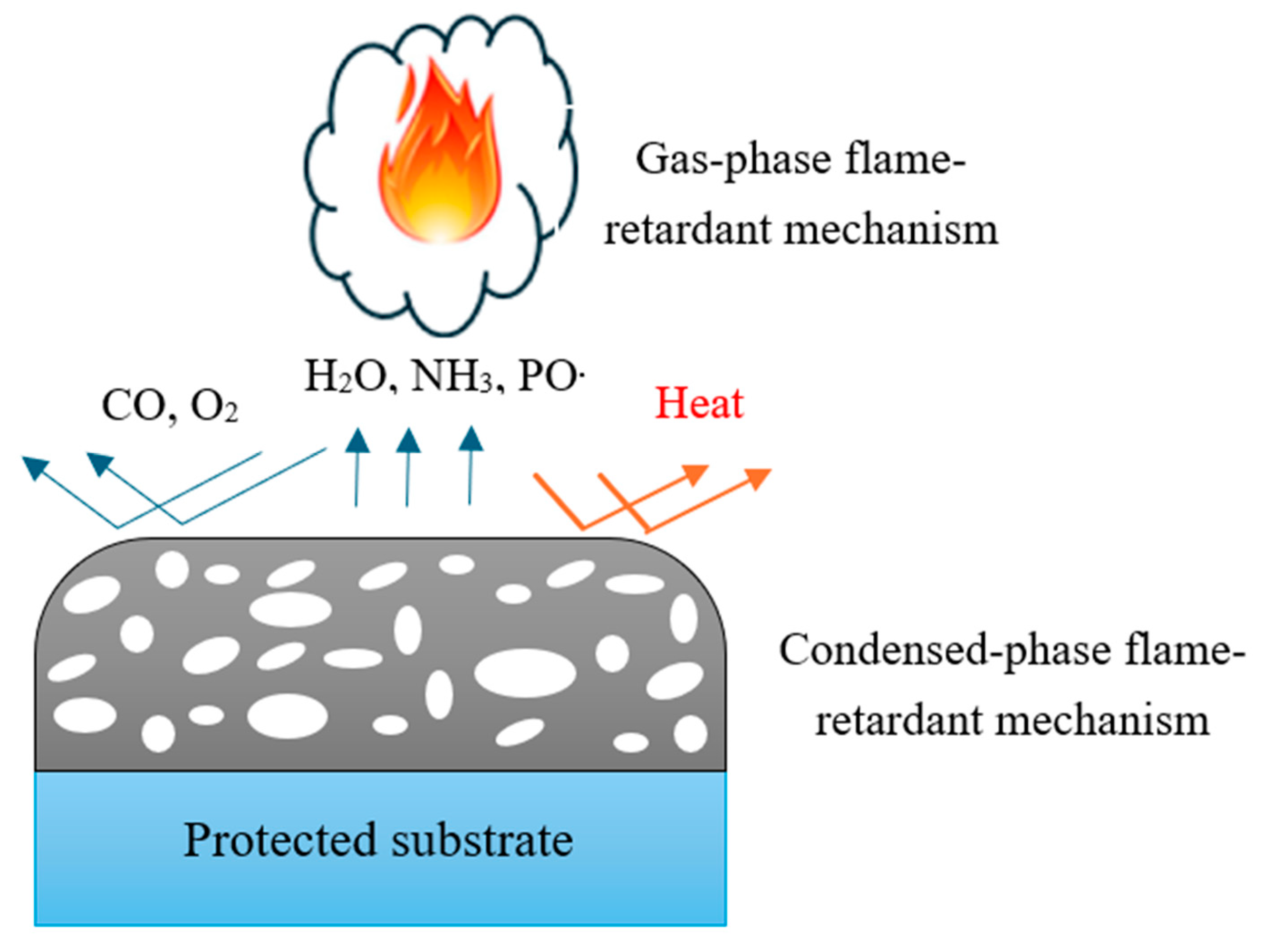
Figure 2.
Chemical structure of DGEBA.
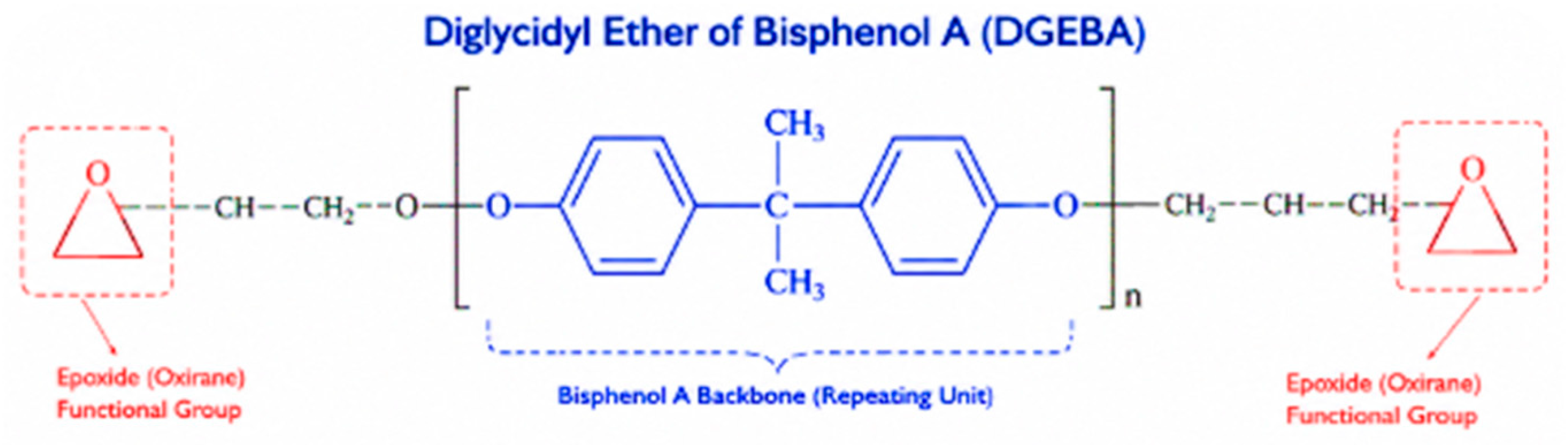
Figure 3.
Systematic framework for the development of high-performance and environmentally friendly fire protection materials, highlighting material design, fire protection mechanisms, performance evaluation, and sustainability considerations.
Figure 3.
Systematic framework for the development of high-performance and environmentally friendly fire protection materials, highlighting material design, fire protection mechanisms, performance evaluation, and sustainability considerations.
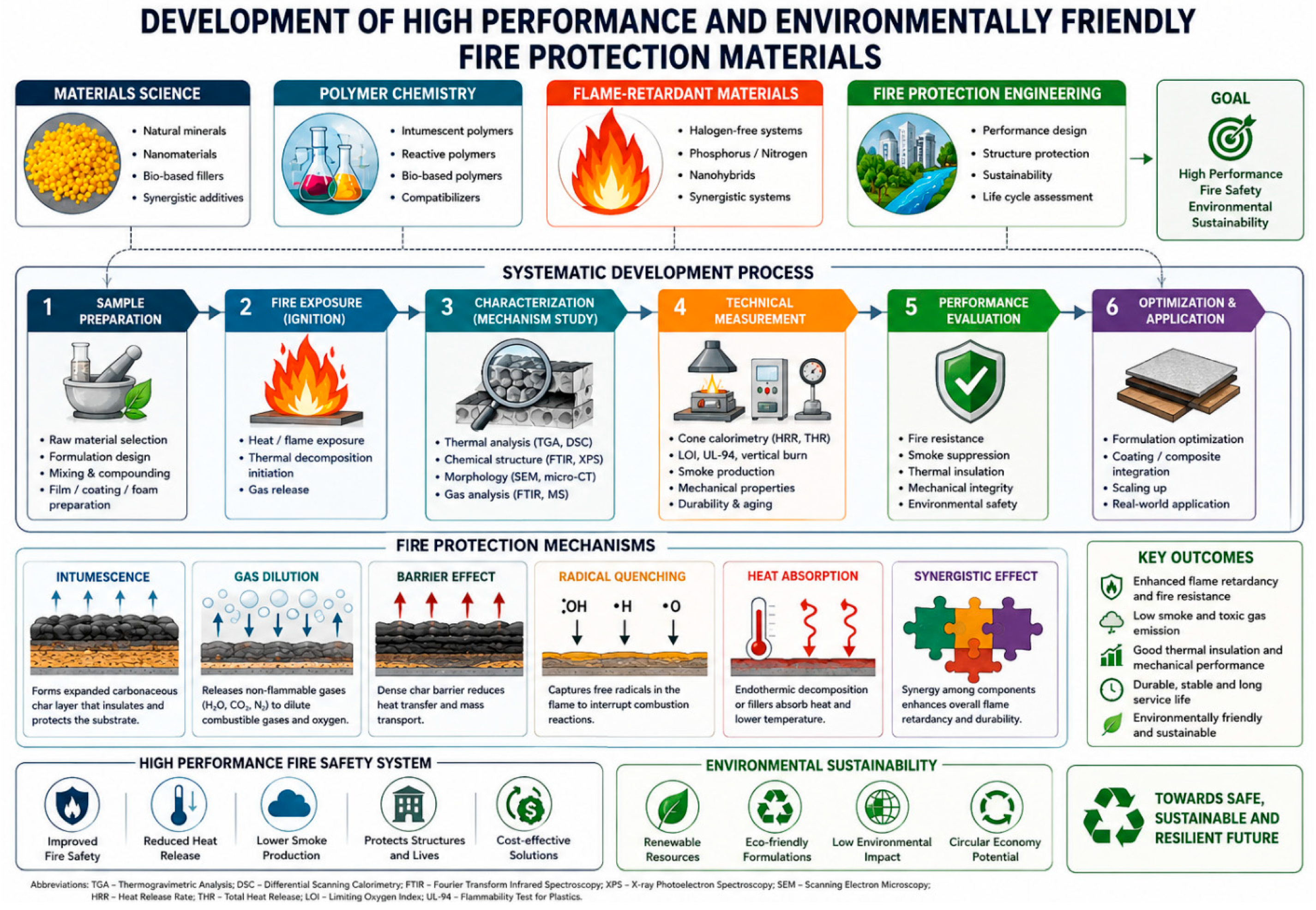
Figure 4.
The reaction mechanisms of the subsequent crosslinking and char formation involve complex condensation reactions.
Figure 4.
The reaction mechanisms of the subsequent crosslinking and char formation involve complex condensation reactions.
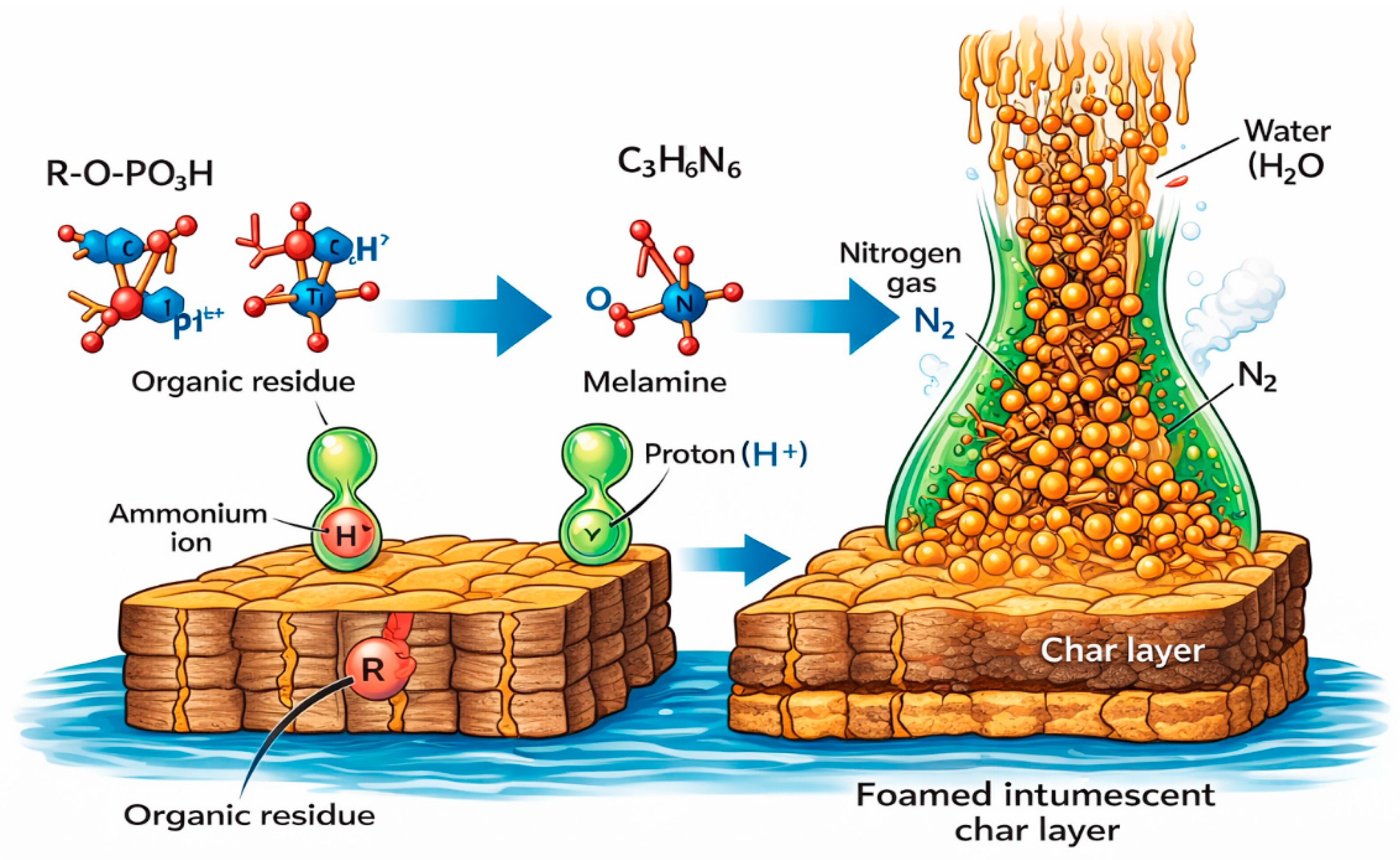
Figure 5.
Schematic representation of the distinct stages involved in the intumescence of a model organic intumescent coating, together with approximate temperature intervals [110].
Figure 5.
Schematic representation of the distinct stages involved in the intumescence of a model organic intumescent coating, together with approximate temperature intervals [110].
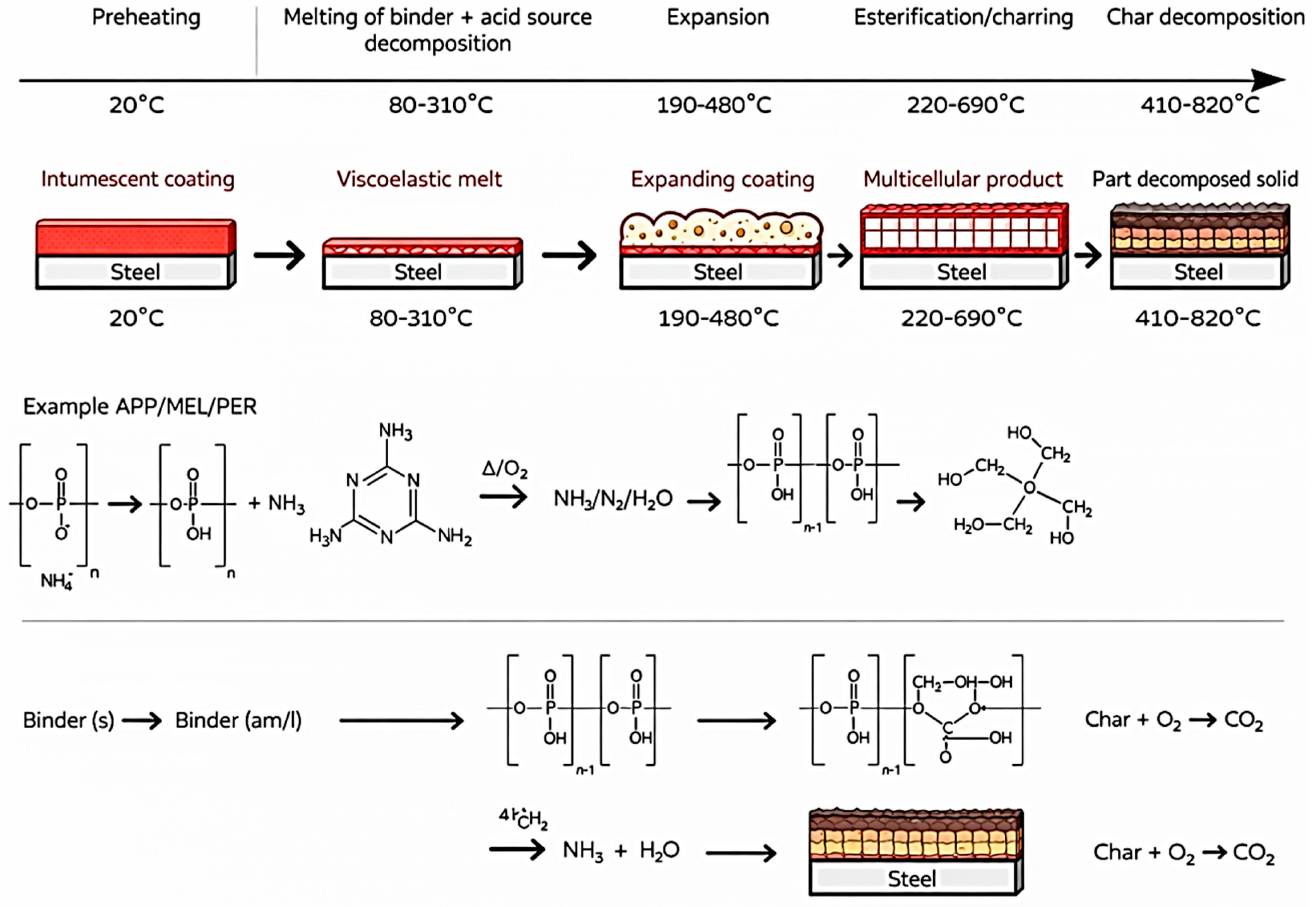
Figure 6.
Techniques challenge from laboratory to industrial scales.
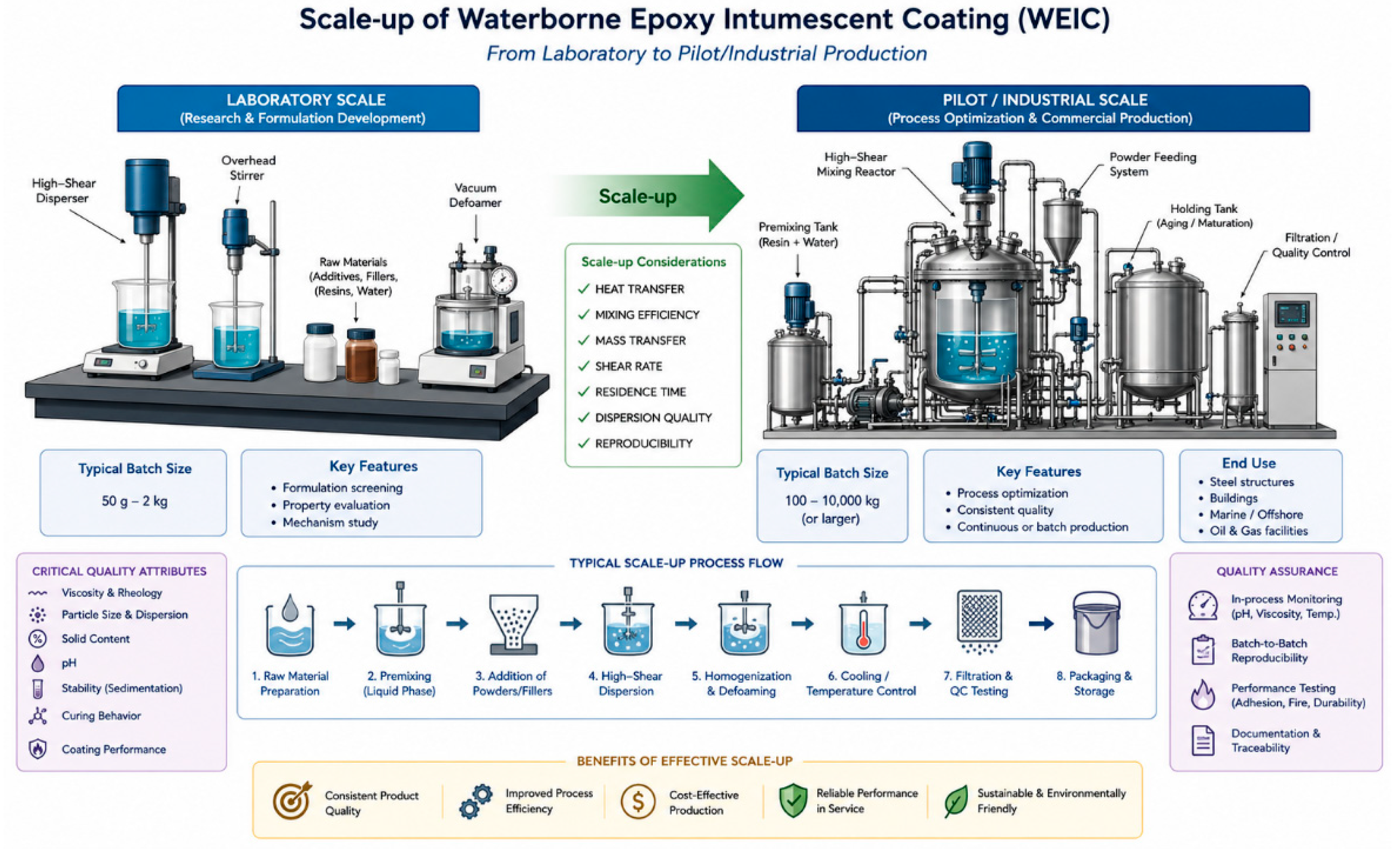
Figure 7.
Future perspectives on environmental and waste-management strategies for flame-retardant coatings.
Figure 7.
Future perspectives on environmental and waste-management strategies for flame-retardant coatings.
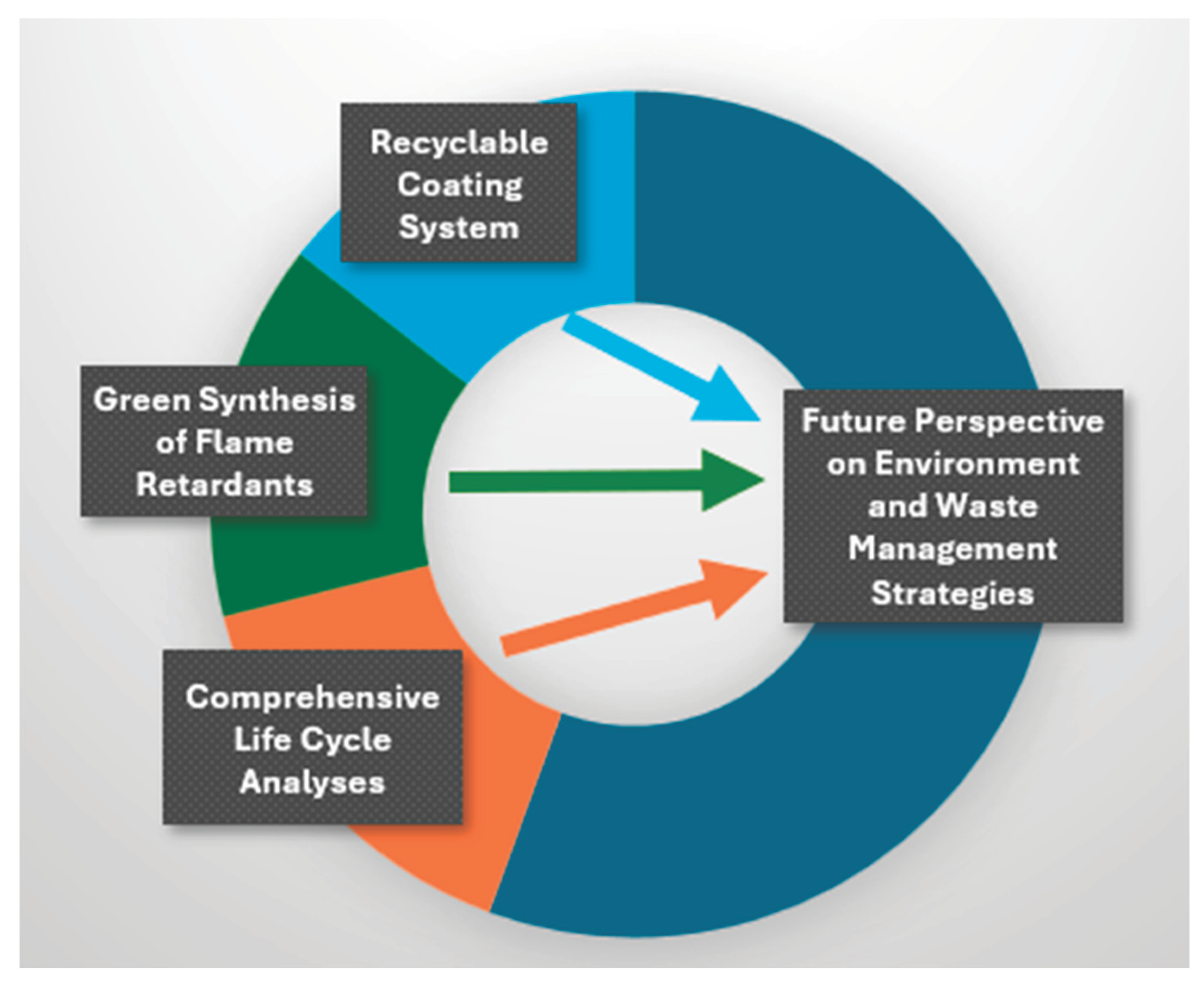

Table 1.
Comparison of the synthesis processes between conventional solvent-borne and waterborne epoxy intumescent paint systems.
Table 1.
Comparison of the synthesis processes between conventional solvent-borne and waterborne epoxy intumescent paint systems.
| Aspect | Conventional Solvent-Borne Intumescent Coatings | Waterborne Epoxy Intumescent Coatings |
| Binder system | Typically, acrylic or alkyd binders are dissolved in organic solvents such as toluene or xylene [70]. | Waterborne epoxy resin dispersions stabilised via emulsifiers or chemical modification (e.g., hydrophilic end-group grafting) [71]. |
| Preparation/Mixing | Blend IFR additives with solvent-based binder and fillers using high-speed mixing until homogeneous; typically, lower viscosity [72]. | Waterborne epoxy dispersion is prepared via phase-inversion (W/O → O/W) or chemical modification; then mixed with flame-retardant additives at ambient temperature with controlled shear [73]. |
| Typical processing conditions | Ambient or elevated temperature blending; solvents removed during drying/curing; sensitive to humidity during application [74]. | Room-temperature mixing and application; no organic solvent evaporation step; curing via amine hardener in aqueous medium after water evaporation [75]. |
| VOC/environmental impact | High VOC content; regulated; significant odour and flammability during application [76]. | Low or zero VOC; environmentally friendly; safe for indoor use and CE or LEED compliance [77]. |
| Drying/Curing | Solvent evaporation-driven; surface skin formation can impede through-drying; drying time varies with thickness and ambient conditions (5-15 days) [78]. | Water evaporation leads to rapid through-drying, no skinning, a shorter overcoating interval, and curing via an amine crosslinker in the epoxy resin [79]. |
| Formulation stability/shelf-life | Generally stable in sealed containers; solvent retention ensures viscosity consistency [80]. | More sensitive to sedimentation, temperature (e.g., cold storage) and particle size; emulsifiers are necessary to maintain dispersion and shelf stability [81]. |
Table 2.
Summary of literature reviews on intumescent coatings published between 2015 and 2025.
| Reference | Title | Focus of Review | Knowledge Gaps Identified |
| [118] | Intumescent coatings: Comprehensive advances with a focus on inorganic-dominant systems | The review summarises recent advances in inorganic-dominant intumescent coatings, focusing on intumescence mechanisms, the role of inorganic fillers and synergistic additives, char formation and stability, and comparisons with organic-dominant systems for high-temperature fire protection applications. | Key gaps include limited understanding of inorganic–binder interactions, challenges in maintaining char adhesion and integrity, poor compatibility with water-based/low-VOC binders, insufficient data on long-term durability, lack of standardised fire-testing methods, and limited studies on scalability and practical application. |
| [119] | Waterborne Intumescent Fire-Retardant Polymer Composite Coatings: A Review | Systematic overview of waterborne intumescent coatings focusing on composition, mechanisms, functional fillers, and performance metrics. | Challenges in sustainability (petroleum reliance), required coating thickness for performance, water resistance/weathering issues, and optimisation of formulation synergy. |
| [107] | The Development of Cement-Based, Intumescent, and Geopolymer Fire-Retardation Coatings for Metal Structures: A Review | Traditional protective coating approaches applied to metal substrates, encompassing cementitious and intumescent systems; Geopolymer-based coatings for metallic structures, with emphasis on bonding performance, fire protection capability, resistance to chemical attack, and dimensional stability; A comparative assessment of conventional coating technologies versus geopolymer coating systems. |
- Geopolymer coatings offer better workability, higher strength, chemical and heat resistance, and lower environmental impact. - Further research is needed on adhesion, weight reduction, multifunctionality, and standardisation of materials and fabrication. |
| [109] | Flame-retardant Coatings: Additives, Binders, and Fillers | Heat-induced breakdown and combustion behaviour of fire-resistant coatings; Representative flame-retardant components, including binders, fillers, and functional additives, are used in these systems. |
- Choosing appropriate materials in a flame-retardant formulation is crucial to limit fire propagation. - Both theoretical analysis and experimental evaluation of the coating’s mechanisms are essential before practical use. - Intumescent coatings mitigate flame spread by generating a protective, multicellular char layer. |
| [112] | Review of heat exposure equipment and in-situ characterisation techniques for intumescent coatings | Established industrial protocols for assessing the fire performance of intumescent coatings; Strengths and limitations of laboratory-based fire-testing methods; Overview of in-situ techniques used to characterise intumescent coatings. |
Accurate and reproducible characterisation methods are essential for comparing studies. While direct flames offer quick testing with undefined thermal conditions, radiative heaters provide controlled conditions but differ from real fires, and furnace experiments can simulate realistic fire scenarios yet require adjustments to measure key parameters effectively. |
| [111] | Silicone Resin-Based Intumescent Paints | Design and formulation of silicone-containing intumescent coatings; Effects on the thermal behaviour of the silicone matrix and characteristics of the resulting char. - Chemical structure of silicone - Fillers |
- Advanced predictive models are required to assess the behaviour of silicone-based coatings accurately. - Development of coatings tailored for a variety of applications is necessary. |
| [103] | Latest trends for structural steel protection by using intumescent fire protective coatings: A review | Influence of process and operational conditions on intumescent coating performance; Chemical composition and formulation aspects of intumescent coatings, including:
|
Assessing char strength under fire conditions remains challenging and calls for innovative characterisation methods, while the effects of environmental weathering, such as UV and humidity, are not well understood. Additionally, the development of low-phosphorus coatings to reduce toxicity and the study of combustion-related gases require further attention. |
| [110] | Intumescent coatings used for the fire-safe design of steel structures: A review | Current design approaches based on standard testing face limitations, highlighting the need for advanced fire-testing methods and a better understanding of the key factors that determine intumescent coating performance under fire conditions. | The impact of non-standard heating conditions on intumescent coatings warrants further investigation, as different experimental setups reveal distinct aspects of intumescence and fundamental studies remain needed. Standardised testing methods and simplified empirical models are essential for generating comparable data and enabling performance prediction. |
| [107] | A review of the environmental durability of intumescent coatings for steel | The weathering resistance of intumescent coatings is influenced by water absorption, additive leaching, and changes in chemical composition. Environmental exposure can also affect fire protection, while UV-induced polymer degradation, blister formation, and increased substrate corrosion pose additional challenges. | - Poor weathering durability remains a key challenge, as accelerated ageing significantly reduces both fire protection and mechanical performance. - Strategies reported to address this include adding fillers, increasing cross-link density, and using sacrificial layers. - Further research, particularly quantitative studies, is needed. - The effects of temperature, UV exposure, and moisture cycling on mechanical stresses within the coatings are not well understood. |
| [102] | Intumescent coatings: A review of recent progress | Categorisation of intumescent coating types; Chemical composition of intumescent coatings, with emphasis on: Variations in formulations of organic intumescent systems Influence of binders, fillers, pigments, and additives |
Applying intumescent coatings on-site is challenging due to low fire ratings, multiple layers, and long drying times, while water sensitivity and poor corrosion resistance limit their outdoor use. Weak adhesion to substrates can lead to layer detachment, but incorporating nanofillers, nanoclays, surface-modified ingredients, and vitreous fillers offers potential for high-performance formulations. |
| [104] | Recent developments of intumescent fire protection coatings for structural steel: A review | The chemical composition and formulation of intumescent coatings cover: Key components, including binders, flame-retardant agents, fillers, and functional modifiers; Decomposition mechanisms and reaction kinetics; Overview of testing procedures and characterisation techniques. |
- Choosing appropriate components, particularly binders and additives, is essential to achieve effective intumescence and fire protection. - Traditional coatings face limitations in terms of:
|
| [114] | Intumescence: Tradition versus novelty. A comprehensive review | Conventional approaches in intumescent coating research are reviewed, alongside innovative formulations incorporating new acid and carbon sources, synergistic additives, nanomaterials, and polymer composites. | While composition influences intumescence and fire protection, factors such as expansion behaviour, structural integrity, and flexibility are also critical, underscoring the need for improved testing methods, such as high-rate TGA. |
Table 3.
Quantitative durability performance of WEICs before and after ageing exposure.
| Ageing Condition | Performance Metric | Before Ageing | After Ageing | Main Degradation Mechanism | Reference |
| Accelerated weathering | PHRR | 120 kW/m2 | 165 kW/m2 | Char degradation | [106] |
| UV ageing (500–1000 h) | Adhesion strength | 4.8 MPa | 3.2 MPa | Polymer photo-oxidation | [107] |
| Humidity exposure (95% RH) | Water uptake | 3–5 wt.% | 8–15 wt.% | Moisture diffusion | [108] |
| Salt spray exposure | Fire-rating retention | 120 min | 90 min | Corrosion-assisted debonding | [109] |
Table 4.
Summary of waterborne epoxy intumescent coatings integrating bio-based and chitosan-based or lignin-derived compounds.
Table 4.
Summary of waterborne epoxy intumescent coatings integrating bio-based and chitosan-based or lignin-derived compounds.
| No. | Methodology | Key findings | Reference |
| 1 | This review examines the use of both unmodified and chemically modified lignin (incorporating phosphorus and/or nitrogen) as flame retardants in various polymers, along with their synergistic interactions with other additives. | Lignin-based systems showed strong flame-retardant potential due to high char formation. Modified lignins further improved performance, highlighting their promise as sustainable alternatives to conventional flame retardants. | [161] |
| 2 | Comprehensive literature analysis on pyrolysis behaviour, chemical modification (e.g., phosphorylation), and integration techniques for biopolymers in polymer matrices. | Biopolymers have inherent flame-retardant potential. Modified biopolymers enhance char formation and reduce flammability. Integration challenges include mechanical compatibility and scalability. | [162,163] |
| 3 | Lignin and TiO2 (commercial and lab-synthesised) were incorporated into epoxy resin (Epidian 601) to create flame-retardant coatings. Hybrid additives were analysed using cone calorimetry, thermal and mechanical tests, and optical profilometry. |
Lignin/TiO2 hybrids enhanced flame retardancy, with lignin showing the best fire suppression. Coatings exhibited thermal stability up to 360 °C, Shore D hardness of 80.36-86.28, and good dispersion, supporting their potential as eco-friendly alternatives to synthetic additives. | [164] |
| 4 | The review examines the pyrolysis behaviour of non-food-based biopolymers (e.g., cellulose, chitin/chitosan, alginate, lignin) and explores their chemical modification via covalent, ionic, and coordination bonding. It also covers integration techniques into polymer matrices to create flame-retardant materials. | Biopolymer-based flame retardants have strong potential due to their eco-friendly, sustainable nature. Key challenges remain in maintaining performance and scalability for broader fire safety applications. | [165,166] |
| 5 | Reviewed various bio-derived flame retardants, including those based on chitosan and lignin, emphasising their flame-retardant properties and compatibility with different polymer matrices. | It was emphasised that bio-derived flame retardants can promote char formation and enhance the fire safety of polymeric materials while remaining environmentally sustainable. | [167] |
Table 5.
Summary of the incorporation of metal-organic frameworks as flame-retardant additives.
| No. | Methodology | Key findings | Reference |
| 1 | Fe-MOF wrapped with polyphosphazene, tested in epoxy resin. | Enhanced flame retardancy and reduced smoke release. | [168] |
| 2 | The incorporation of ZIF-8 into the intumescent flame-retardant system enhances its flame resistance and reduces smoke emissions. | Improved fire resistance and reduced heat release rate. | [169] |
| 4 |
Further research is required to explore the potential applications of new MOFs in flame-retardant polymers, and studies on current MOFs could be integrated with other innovative materials containing flame-retardant elements or groups. | MOFs have shown impressive flame-retardant properties and are cost-effective. | [171] |
| 5 | Nano-MOFs were synthesised on APP and integrated into epoxy. | Improved flame resistance, reduced smoke emission, and enhanced mechanical properties. | [172] |
| 6 | Developing advanced multi-component flame retardants and exploring their synergistic mechanisms are crucial to improving flame-retardant effectiveness. | Combining these two components into an organic-inorganic hybrid enhances compatibility between the polymer matrix and the flame retardant and enables adjustable properties that enhance multifunctional performance. | [173] |
| 7 |
This review provides a comprehensive overview of recent advancements in the research on sustainable polymer/MOF nanomaterials. | This review examines recent progress and approaches in integrating MOF-based flame retardants with biomass materials, highlighting the flame-retardant mechanisms of MOF/biomass nanocomposites to inform future design developments in the field. | [174] |
Table 6.
Comparison of fire testing and durability standards for WEICs evaluation.
| Standard Test | Purpose | Advantages | Limitations | Relevance to WEICs Applications |
| LOI (ASTM D2863) | Oxygen concentration for sustained combustion | Simple screening | Limited fire realism | Preliminary flammability |
| UL-94 | Burning classification | Rapid comparison | No structural relevance | Self-extinguishing behaviour |
| TGA | Thermal degradation analysis | Thermal stability data | Non-fire condition | Decomposition kinetics |
| Cone calorimetry (ISO 5660) | Heat release analysis | HRR and smoke data | Small-scale testing | Fire growth behaviour |
| ASTM E119 | Structural fire endurance | Realistic fire exposure | Expensive | Structural steel protection |
| UL 1709 | Hydrocarbon fire testing | Petrochemical relevance | Severe conditions | Offshore and oil & gas |
| EN 13381 | Passive fire protection | Structural simulation | Complex setup | Steel structure evaluation |
Table 7.
Coatings incorporating hybrid organic-inorganic systems have reached UL-94 V-0 ratings while simultaneously reducing heat release rates.
Table 7.
Coatings incorporating hybrid organic-inorganic systems have reached UL-94 V-0 ratings while simultaneously reducing heat release rates.
| No. | Methodology | Key findings | Reference |
| 1 | Prepared DOPO-ABZ by reacting DOPO with 2-aminobenzothiazole and added 7.5 wt% to epoxy resin. | Achieved LOI of 33.5% and UL-94 V-0 rating, indicating enhanced flame retardancy. | [181] |
| 2 | DDSi-n, a phosphaphenanthrene/phenyl siloxane macromolecule, was synthesised and integrated into epoxy resin at an 8% loading. | Achieved UL-94 V-0 rating with a limiting oxygen index (LOI) of 34.8%. Impact strength increased by approximately 140%. | [182] |
| 3 | Substituted 2-methyl imidazolyl ester with triazole to create N-ZIF-8; incorporated 10 wt% into RPUF. | Reduced PHRR by 28.8% compared to pure RPUF and increased char residue by 17.7%, indicating improved flame retardancy. | [183] |
| 4 | HPNFR was synthesised by transesterification of dimethyl methylphosphonate and tris(2-hydroxyethyl) isocyanurate, and then incorporated at 4 wt% into epoxy thermosets. | Achieved UL-94 V-0 rating with LOI of 34.5%, indicating significant flame retardancy. | [184] |
| 5 | A flame-retardant was synthesised via the Kabachnik-Fields reaction, followed by incorporation into epoxy resins via the sol-gel method. | The synergistic interaction between phosphaphenanthrene and silicon groups resulted in improved charring and enhanced flame retardancy. | [185] |
| 6 | ZIF-8 (1.0 g) and MEL (2.0 g) were dissolved in ethanol, combined, sonicated for 2 hours, and refluxed for 4 hours at 90 °C. Afterwards, the product was centrifuged, rinsed with ethanol, and vacuum-dried at 70 °C overnight to yield MEL-coated ZIF-8. | The LOI test results showed that the LOI value of RPUF increased from 19.4% to 25.4% upon incorporation of 10 wt% ZMD. | [186] |
Table 8.
Quantitative performance metrics for various flame-retardant formulations in waterborne epoxy coatings.
Table 8.
Quantitative performance metrics for various flame-retardant formulations in waterborne epoxy coatings.
| Formulation | Description | LOI (%) | HRR Reduction (%) | Char Yield (%) | Reference |
| Formulation A: Conventional intumescent system. | Covers conventional intumescent formulations with LOI around 28-30% and modest HRR/char improvements. | 28-30 | ~25 | ~18 | [187] |
| Formulation B: Phosphorus-nitrogen synergistic system. | Discusses the formulation and performance of phosphorus-nitrogen synergistic systems with LOI ~31%, HRR reduction ~35%, and improved char yield | 31-33 | ~35 | ~25 | [188] |
| Formulation C: Hybrid organic-inorganic system with nanoclay. | Details the hybrid organic-inorganic system using nanoclay, reporting LOI up to 34% and ~40% HRR reduction. | 32-34 | ~40 | ~30 | [189] |
| Formulation D: MOF-enhanced System. | Focuses on MOF-based systems achieving high LOI (up to 36%) and substantial HRR reductions. | 33-36 | ~45 | ~32 | [190] |
Table 9.
Environmental and sustainability comparison of flame-retardant systems.
| Sustainability parameter | Literature findings | References |
| VOC content | Waterborne coatings substantially reduce VOC emissions compared with solvent-borne systems. | [218] |
| Smoke release | Halogen-free systems generally exhibit lower smoke formation than brominated systems. Nanomaterials improve smoke suppression via thermal barrier effects. | [219] |
| Toxic gas generation | Brominated flame retardants may release corrosive and toxic gases such as HCl, HBr, and dioxin-like compounds during combustion. | [220] |
| Biodegradability | Lignin, tannic acid, phytic acid, starch, and chitosan systems show improved sustainability and biodegradability potential. | [221,223] |
| Ecotoxicity | Brominated systems showed higher terrestrial ecotoxicity and persistence compared with halogen-free systems. | [222] |
| Life-cycle assessment | Waste treatment and end-of-life management are critical contributors to environmental impacts associated with flame retardants. | [222] |
| Durability and long-term stability | Durability and environmental ageing remain major barriers for sustainable flame-retardant systems. | [223] |
| Fire performance efficiency | Nanostructured additives improve thermal shielding and char stability at low concentrations. | [224] |
| Scalability and cost | MOF-based and nanostructured additives remain expensive and difficult to scale industrially. | [225] |
Disclaimer/Publisher’s Note: The statements, opinions and data contained in all publications are solely those of the individual author(s) and contributor(s) and not of MDPI and/or the editor(s). MDPI and/or the editor(s) disclaim responsibility for any injury to people or property resulting from any ideas, methods, instructions or products referred to in the content. |
© 2026 by the authors. Licensee MDPI, Basel, Switzerland. This article is an open access article distributed under the terms and conditions of the Creative Commons Attribution (CC BY) license.
Copyright: This open access article is published under a Creative Commons CC BY 4.0 license, which permit the free download, distribution, and reuse, provided that the author and preprint are cited in any reuse.


