

Submitted:
02 June 2026
Posted:
05 June 2026
You are already at the latest version
Abstract
The industrial sector accounts for 34% of global energy consumption, with heat representing 74%, predominantly derived from fossil fuels. Solar Heat for Industrial Processes (SHIP) offers a viable decarbonisation route for low-to-medium temperature applications (80–250∘C)—a range that includes processes such as tequila production. Yet integrated techno-exergo-economic assessments for small-scale, modular systems in agro-industrial contexts remain scarce. This study presents a technical, thermodynamic, and economic evaluation of a 2.5 MWth parabolic trough collector system with thermocline thermal energy storage, integrated into a tequila production facility in Jalisco, México. A parametric analysis across seven solar multiple configurations identifies SM = 1.258 as the economic optimum, yielding an annual solar fraction of 32.0%, a CO2 reduction of 33.5%, a levelised cost of heat of 75.19 USD/MWhth (16.3% below the fuel-oil baseline), and a payback period of 13.39 years under full accelerated depreciation. The system’s exergy efficiency (23–28%) is nearly four times that of the stand-alone boiler (6.31%); the analysis further quantifies diminishing returns beyond SM ≈ 1.4 and demonstrates that México’s accelerated depreciation provision substantially broadens the economically feasible design space. These findings provide a replicable techno-exergo-economic framework for SHIP integration in gas-constrained, high-irradiation industrial regions, supporting decarbonisation efforts in emerging economies.
Keywords:
solar heat for industrial processes (SHIP)
; parabolic trough collector
; techno-economic assessment
; exergy analysis
1. Introduction
The world faces significant challenges related to energy consumption and environmental sustainability, primarily driven by greenhouse gas emissions from fossil fuels. According to recent data, global energy consumption reached 399 EJ in 2022, with only 12.9% derived from renewable sources [1]. The industrial sector accounts for 34% of global energy use, consuming 135.66 EJ in 2021, of which 83.2% originated from non-renewable sources. Notably, 74% of industrial energy is consumed as heat, with less than 1% supplied by solar thermal technologies [1]. This reliance on fossil fuels for thermal energy represents a critical decarbonisation challenge.
Industrial heat decarbonisation requires eliminating fossil fuel dependency in heating processes, which contribute substantially to global carbon dioxide emissions [2,3]. High-temperature processes exceeding 400 °C depend heavily on natural gas and coal, presenting technical and economic barriers to net-zero objectives. Energy-intensive industries such as steel, cement, and chemicals require energy-dense fuels, making low-carbon alternatives like green hydrogen or electrification both costly and infrastructure-intensive [3,4,5]. Although waste heat recovery offers efficiency improvements, its potential often diminishes during transitions to electrified processes, biomass integration, or waste heat revalorisation, further complicating decarbonisation strategies.
A diversified portfolio of solutions is essential to overcome these challenges. Electrification via resistive heating or heat pumps addresses lower thermal demands, while hydrogen offers potential for extreme heat applications if production scales sufficiently [6,7]. Hybrid approaches, including molten salt storage or carbon capture integrated with concentrated solar power, provide flexible, cost-effective pathways to decarbonisation [7,8]. These integrated systems demonstrate the versatility required to manage intermittent renewable inputs and could eliminate billions of tonnes of emissions with large-scale deployment.
In México, the industrial sector consumes 22.79% of the country’s total energy, equivalent to over 940 PJ, with heavy reliance on non-renewable sources significantly contributing to greenhouse gas emissions [9]. This underscores the urgent need for decarbonisation strategies aligned with Sustainable Development Goal 7: ensuring affordable and clean energy for all [10]. Solar energy presents a viable pathway to reduce emissions and enhance sustainability in this context.
Solar Heat for Industrial Processes (SHIP) utilises solar thermal collectors to supply renewable heat directly to industrial operations, displacing fossil fuels in boilers and steam systems. This technology primarily targets low- to medium-temperature requirements (80–250 °C), addressing over 50% of global industrial heat demand in sectors such as food processing, textiles, and chemicals [11,12,13]. SHIP implementations employ diverse collector types, including flat-plate, evacuated tube, parabolic trough, and Fresnel designs, integrated via steam loops or hot water circuits. Thermal storage solutions such as thermocline tanks provide dispatchable heat, achieving solar fractions exceeding 50% even in variable climates [11,13,14,15]. By the end of 2024, over 1300 SHIP systems worldwide delivered a cumulative capacity of 1071 MWth, demonstrating significant economic and environmental benefits [11,16].
Concentrated Solar Thermal (CST) technologies, particularly Parabolic Trough Collectors (PTCs), extend SHIP applications to higher temperatures (250–500 °C), addressing intensive thermal demands in sectors such as food, chemicals, and petroleum. These systems focus solar radiation onto receiver tubes containing heat transfer fluids such as thermal oil or molten salts, achieving conversion rates up to 80% in steam applications [17,18,19,20,21]. PTCs offer high energy density and can achieve solar fractions exceeding 50%, with levelised costs of heat as low as 36.9 EUR/MWh in optimal locations [17,18,20,22,23,24]. However, solar intermittency necessitates collector field oversizing, increasing land and material costs [17,19,20,22,23,24,25]. Thermal Energy Storage (TES) systems mitigate this by storing surplus daytime energy, boosting capacity factors to 46% and enabling 30–95% decarbonisation of industrial processes [17,18,19,22,23,24].
Industries with high thermal energy demands, such as tequila production, face distinct decarbonisation challenges due to their need for consistent medium-temperature heat and reliance on fossil fuels, particularly in regions with limited natural gas availability [26]. Although some tequila producers have adopted biomass boilers, constraints related to plant size and biomass availability limit this approach [26,27,28]. The Mexican tequila industry relies heavily on fuel oil to meet its intensive thermal requirements, yet the region benefits from high solar irradiance. Despite this, solar thermal hybridisation remains largely unexplored for this industry. Current research often focuses on theoretical or large-scale installations and lacks integrated techno-exergo-economic analyses for small-scale, modular PTC systems retrofitted into existing industrial sites.
This study addresses these gaps by conducting a comprehensive technical, exergetic, and economic evaluation of a small-scale PTC system integrated into a tequila production facility. The primary objectives are:
- 1.
- To model and simulate the annual performance of a small-scale PTC system with thermal energy storage, assessing its capacity to meet specific steam demands.
- 2.
- To perform a parametric analysis over the solar multiple (i.e., solar field size) to identify the optimal design that balances energy delivery, cost, and operational reliability.
- 3.
- To conduct combined energy and exergy analyses, identifying thermodynamic inefficiencies under varying climatic conditions.
- 4.
- To evaluate economic viability using the Levelised Cost of Heat (LCOH) and sensitivity analysis, while quantifying greenhouse gas emission reductions.
- 5.
- To propose a replicable assessment framework for integrating SHIP technologies in regions with high solar irradiance and limited natural gas access.
By providing this integrated analysis, including a systematic exploration of solar field oversizing, this research establishes a scalable framework for industrial decarbonisation, offering a robust strategy for transitioning away from liquid fossil fuels in high-irradiation, gas-constrained regions.
2. Materials and Methods
2.1. Case Study Description
This study analyses the technical feasibility of integrating a parabolic trough collector (PTC) system into a large-scale tequila production facility located in Tequila, Jalisco, México. The plant operates a dual-boiler configuration to supply continuous, high-pressure saturated steam. This analysis focuses on the 2025 load demand profile, detailed in Table 1, which corresponds to 7728 operating hours per year and represents a service factor of 0.88.
The site provides favourable geographical conditions for a Solar Heat for Industrial Processes (SHIP) installation. It receives an annual solar irradiance of 2518.7 kWh m−2, 4122 annual sunshine hours, and an average direct normal irradiance of 611 W m−2 [29]. These solar characteristics meet or exceed the recommended thresholds for economically viable SHIP implementation, as recent literature confirms [30,31,32].
The facility satisfies its thermal energy demand through two distinct units: a 7.8 MWth biomass boiler and a 9.81 MWth fuel-oil boiler. The biomass unit consumes 898.58 kg h−1 of agave bagasse, a solid biofuel by-product from the milling process with a higher heating value of 16840 kJ kg−1. This biomass supply remains stable, is considered carbon-neutral, and provides sufficient fuel to maintain the boiler’s rated output, thus representing an optimised component of the plant’s existing energy portfolio.
Conversely, the 9.81 MWth boiler operates entirely on fuel oil, consuming 1065 kg h−1. This dependence constitutes the primary source of both carbon emissions and economic exposure. Volatile fossil fuel prices, illustrated in Figure 1, and the absence of regional natural gas infrastructure exacerbate this vulnerability. Consequently, this study focuses on displacing fossil fuel consumption in this boiler through solar thermal integration. The proposed strategy incorporates a dedicated solar thermal system designed to increase the facility’s renewable energy share from 44.29% to at least of 60%, while achieving substantial reductions in fuel oil consumption.
2.1.1. Solar Thermal System Design
This study proposes a 2.5 MWth SHIP system to achieve a minimum renewable energy share of 60% at the tequila facility. The system supplies medium-temperature heat, directly increasing the plant’s renewable energy contribution. The solar field uses Therminol-VP1 as the heat transfer fluid (HTF) because of its thermal stability at operating temperatures up to 400 °C [34]. We selected the Power Trough 250 (PT250) model, a small-scale parabolic trough collector optimised for industrial integration in México [35]. The system incorporates a centralised thermocline thermal energy storage (TES) unit with a 5-hour capacity, using Hitec-XL salt. This configuration buffers solar intermittency, ensures operational stability, and maximises the utilisation of available solar irradiance. The TES unit maintains a more consistent steam supply to the process headers, reducing the need for auxiliary fossil fuel firing. Two helical coil heat exchangers facilitate thermal energy transfer between the solar HTF loop and the facility’s existing steam header, enabling charging and discharging of the TES tank. Table 2 details the system’s key operating specifications, and Figure 2 presents a schematic layout of the proposed installation.
2.2. System Modelling Framework
The proposed SHIP system integrates a parabolic trough collector (PTC) solar field, a single-node thermocline thermal energy storage (TES) unit, two helical coil heat exchangers (HX), and the existing fuel-oil boiler. We evaluate system performance using a validated, non-iterative thermohydraulic model coupled with comprehensive energy (first law) and exergy (second law) analyses on an hourly basis.
2.2.1. System Configuration And Thermohydraulic Modelling
A validated thermohydraulic routine forms the core of the model, tracking the temperature and pressure evolution of the Therminol VP-1 heat transfer fluid (HTF) through the solar field. We characterise PTC performance by segmenting the receiver tubes into discrete heat collector elements (HCEs). This discretisation allows us to account precisely for beam solar irradiation, optical and thermal losses, and the resultant HTF temperature gain. The model demonstrates predictive robustness with a relative squared error (RSE) below 3% against experimental data for both temperature and pressure calculations [36].
The heat transfer model integrates established Nusselt relationships through functional transformations, eliminating the traditional iterative dependency on convective heat transfer coefficients (h) and friction factors (f). This approach enhances computational efficiency by creating separable variable functionals () [36]. Equation (1) presents the governing energy balance equations for an HCE, illustrating the relevant heat fluxes shown in Figure 3:
where represents the peak optical efficiency, is the incidence angle modifier (Figure 4) determined via ray-tracing [37], W is the collector aperture width, is the direct normal irradiance (DNI), k is thermal conductivity, T is temperature, d is diameter, is the Stefan-Boltzmann constant, and is emittance.
We express the net energy balance for a PTC module of length L as:
where is the collector aperture area, is a soiling factor (0.92 in this study), and represents conductive, convective, and radiative losses.
2.2.2. Solar Field and System Sizing
We size the solar field according to the proposed 2.5 MWth load that the system must supply to the facility. We define the solar multiple () as the ratio of the designed solar field thermal output () to the nominal solar contribution for the load ():
where is the total HTF mass flow rate, is the specific heat of the HTF, and is the design temperature rise across the field.
We set the HTF flow rate per collector loop to maintain turbulent flow, which ensures appropriate heat transfer between the receiver tube and the HTF and avoids overheating, thereby preserving the receiver tube’s integrity. From this, we determine the number of parallel loops, , and the total number of collectors, . We fix the design point at solar noon on the spring equinox to ensure year-round reliability and a minimum production baseline from the SHIP system.
We size the TES to store surplus energy from periods of high solar irradiation. Equation (4) calculates the required storage volume, , based on the desired storage duration, , and the thermal energy density of the HTF:
2.2.3. Storage and Hourly Dispatch Model
We model the TES as a single, one-node tank. Equation (5) updates the state of charge in terms of energy on an hourly basis:
where is the discharge energy efficiency. We calculate the corresponding average temperature, , from . We then derive the exergy stored, , from Equation (12) using . The hourly dispatch follows this sequence: we first send direct solar power to the process, . Next, any surplus solar power, , charges the TES, subject to power and capacity limits. For any thermal deficit, we discharge . Finally, the boiler supplies any remaining unmet load: .
2.2.4. Energy and Exergy Analysis Framework
We conduct an hourly analysis to determine the system’s instantaneous and period-integrated performance. The dispatch logic prioritises direct solar use, then TES discharge, with the fuel oil boiler covering any remaining deficit.
We define the instantaneous total energy efficiency, , as the ratio of the useful thermal energy delivered to the process to the total primary energy input:
where is the solar energy rate captured by the PTCs, and is the power delivered by the fuel. The useful thermal energy delivered to the process, , comprises three distinct contributions:
where:
- represents the portion of solar thermal power from the PTC field () that reaches the process directly without passing through storage;
- is the thermal power discharged from the TES to the process (positive during discharge);
- is the useful heat supplied by the fuel-oil boiler to meet any remaining process demand.
We calculate each contribution using the respective component efficiencies. The direct solar contribution derives from the solar field energy efficiency (Eq. (9)), accounting for the solar input :
The fuel-oil boiler supplies the useful heat required when solar energy and storage cannot meet the load. This contribution depends on the boiler’s energy efficiency, (Table 2), and the fuel mass flow rate:
Both and account for the heat exchanger’s energy efficiency ( [40], Eq. (11)) in transferring thermal energy from the HTF loop to the process steam header. This formulation ensures consistent coupling between the solar field, storage, and process loads. We calculate the helical coil heat exchanger’s efficiency () from its number of transfer units () and heat capacity rate ratio (). For a coil where the external fluid has a large heat capacity, the heat exchanger behaves analogously to a single-stream heat exchanger with , i.e., [41,42].
Exergy analysis quantifies the quality of energy flows. The specific physical exergy of the HTF is:
where is the ambient temperature and v is the specific volume.
We calculate the exergy input from solar radiation using the endoreversible MPD model [43,44]:
and , is the Stefan–Boltzmann constant, is the ambient temperature, is the thermal conductance of the solar concentrator, and is the absorber optimum temperature.
We determine the chemical exergy of the fuel oil, , using the following correlation [45]:
where C, H, O, N, S, and A represent the weight percentages (dry basis) of carbon, hydrogen, oxygen, nitrogen, sulfur, and ash in the fuel, respectively. For the fuel oil in this study, the composition is 84.84% C, 7.75% H, 6.56% S, 0.64% O, 0.2% N, and 0% A. The exergy supplied by the fuel oil is , where derives from Equation (14).
We define the exergy efficiency of the solar field and the heat exchanger, respectively, as:
The instantaneous total exergy efficiency of the integrated system is:
where represents the total exergy rate delivered to the process. This term comprises:
- : the exergy rate from direct solar heat, which we calculate by applying Equation (12) to ;
- : the exergy rate from TES discharge, where the exergy of a heat stream delivered at temperature is ;
- : the exergy rate from the fuel-oil boiler, accounting for the boiler’s exergy efficiency.
Both and incorporate the exergy efficiency of the heat exchanger (Equation (16)) in transferring exergy from the HTF loop to the process.
2.3. Performance, Economic, and Environmental Metrics
We employ several key parameters to assess the performance of the solar-assisted system on an annual basis. These parameters include the solar fraction and its exergy-based counterpart, the fuel saved fraction, the capacity factor, a storage cycling factor, and time-averaged energy and exergy efficiencies. These metrics offer complementary insights into the system’s energy balance, exergetic quality, economic operation, component utilisation, and thermodynamic performance.
2.3.1. Energy-Based and Exergy-Based Solar Fraction
The energy-based solar fraction () indicates the direct contribution of solar energy to the overall process load. We formally define it as the ratio of the useful thermal energy supplied by the solar collector array and the thermal energy storage system to the total energy demand over a given period, typically one year. Equation (18) expresses this relationship:
where is the useful energy delivered directly by the solar collectors to the process, is the energy discharged from the thermal energy storage (TES) to meet the load, and is the total energy required to meet the process load over the same accounting period. These terms correspond to the cumulative hourly values of and defined in Eqs. (8) and the dispatch logic, respectively. A higher solar fraction indicates that a greater proportion of the heat demand originates from solar-derived sources, thereby reducing reliance on auxiliary energy. However, designing for a very high solar fraction often entails diminishing returns because it requires a disproportionately larger collector installation area and increased thermal storage capacity to bridge low-irradiance periods. These factors can compromise the economic and spatial feasibility of the project.
While the conventional solar fraction accounts for energy quantity, an exergy-based solar fraction () provides insight into the quality of the supplied energy. We define this metric as the ratio of the exergy delivered by the solar collectors and the TES to the total exergy output required by the process:
where is the exergy content of the useful heat from the solar collectors, is the exergy of the heat discharged from storage, and is the total exergy output required by the process. Both and incorporate the exergy efficiency of the heat exchanger (Eq. (16)) in transferring exergy from the HTF loop to the process. This formulation recognises that not all thermal energy is equally useful for performing work; for instance, a lower-temperature heat source carries less exergy. Therefore, the exergy-based fraction offers a more nuanced evaluation of how effectively the system’s solar input matches the thermodynamic quality demanded by the process.
2.3.2. Fuel Saved Fraction and Capacity Factor
The fuel saved fraction () quantifies the reduction in auxiliary fuel consumption achieved by integrating solar energy. We define it as the fraction of boiler energy or fuel saved relative to a baseline scenario in which a boiler-only system meets the entire load:
where is the fuel consumed by the boiler in the baseline case, and is the fuel consumed by the auxiliary heater in the solar-assisted configuration. This parameter directly reflects the fossil fuel savings and the associated reduction in operational costs and emissions.
In contrast to these load-based metrics, the capacity factor () measures how effectively the system utilises its hardware. Although the term often applies to electricity generation, we adapt its underlying principle here to evaluate the solar thermal plant. We define it as the ratio of the actual energy output from the system over a given period to the theoretical maximum energy output generated if the system operated continuously at its nominal power output throughout that entire period:
where is the actual energy output from the solar field over the time period , and is the nominal design energy output of the system. A high capacity factor indicates that the installed infrastructure—including the solar collectors and the power block—operates intensively and consistently, which dramatically improves the economic viability of the plant by optimising the return on capital investment.
2.3.3. Storage Cycling Factor and Time-Averaged Efficiencies
To characterise the utilisation of the thermal energy storage, we introduce a storage cycling factor. This parameter, evaluated over a given period, indicates how many times the nominal energy capacity of the TES is effectively used:
where is the average discharge rate from the TES over the period , and is the nominal energy storage capacity. This cycling factor provides insight into the operational intensity of the storage unit. A higher number of cycles over a season, for example, suggests that the store charges and discharges frequently, which may affect its thermal performance and long-term durability.
Finally, we evaluate the overall thermodynamic performance of the system by computing time-averaged energy and exergy efficiencies. Unlike instantaneous efficiencies, which fluctuate with operating conditions, these values integrate the respective instantaneous efficiencies over the entire year. We define the time-averaged total energy efficiency () as:
Similarly, we define the time-averaged total exergy efficiency () as:
These integrated efficiencies provide a robust, single-figure assessment of the system’s ability to convert incoming energy and exergy resources into useful products over a full year of operation. They thus complement the other metrics by capturing the cumulative effect of part-load behaviour and transient conditions.
2.3.4. Economic Assessment Methodology
The analysed process involves different investment and operational costs. Therefore, we compare two scenarios for the steam supply to the factory: the fuel-oil scenario (FF) and the solar field integration scenario (SHIP). Using the economic data from both cases, we apply the present value method, conduct a cost distribution analysis, and determine the payback period to evaluate the feasibility of using a SHIP system. We define the cash flow benefit of using the more economic technology as:
where is the total generation cost using the fuel-oil boiler, and is the total generation cost using the SHIP system. The total energy generation cost (for both FF and SHIP) includes:
where the operating expenditure () accounts for the day-to-day operational costs: . Here, is the total fuel cost, is the total electricity cost, is the operation and maintenance cost, and is the amortisation cost. For the fuel cost, we consider the monthly price of fuel oil, as detailed in Table 3. Table 4 displays the OPEX and CAPEX costs for the FF scenario. These values correspond to a 9.81 MWth fuel-oil boiler, which we scale down proportionally to the solar field’s rated design in subsequent calculations to maintain a consistent energy basis.
For the SHIP system, we compute the fuel cost from the remaining annual fuel-oil consumption required to supply the unmet process demand (). We assume that operation and maintenance costs equal 10% of the CAPEX. For electricity cost, we consider the electricity usage (0.1104 USD/kWh), the demand charges for capacity (24.2193 USD/kW), distribution (4.2709 USD/kW), and VAT (16%) [46]. We compute the amortisation cost as:
where is the capital recovery factor:
where n is the useful economic life of the asset, and is the loan interest rate. The difference between and arises because the fuel-oil boiler is an existing asset that has already been fully paid off and therefore carries no active loan. In contrast, we assume that the SHIP system receives financing through a loan at an interest rate of 7% [47].
For the SHIP system, the CAPEX comprises:
where each C represents the individual cost of the parabolic trough collectors (PTC), the circulation pump (P), the storage tank (ST), the charging heat exchanger (HX,ch), the discharging heat exchanger (HX,dis), the Therminol-VP1 (VP1), the Hitec XL salt (HITECXL), civil works (CW), engineering design fees (EDF), and contingency (CN). We assume that EDF and CN costs each amount to 5% of the total CAPEX. Suppliers in México provide the following costs: 1041.691 USD for 10 m2 of PTC concentrating area, 15370.01 USD/m3 for Therminol VP1, and 1.7 USD/kg for Hitec XL. For the costs of the storage tank, the heat exchangers, and the circulating pump, we estimate these using the equipment purchased cost at a reference year () [48]:
where X is the equipment’s capacity or size parameter, and are equipment-specific constants, as Table 5 shows. If the size parameter falls outside the range in Table 5, we escalate the cost with a power law. Additionally, we update the costs for the analysis year by applying a cost index (I) [48]. Equation (31) estimates the updated cost, where the reference cost index () is 397 for CEPCI 2001 data, the 2025 index (I) is 806.7 [48,49], and is the reference capacity or size parameter.
Because fuel oil prices fluctuate (see Figure 1), the benefit B varies over the years. The total fuel costs () in both scenarios escalate annually, and historical data indicate a long-term average annual escalation rate . Equation (32) updates the fuel costs accordingly. Under the Mexican Income Tax Law (LISR) [50], initial investments in machinery and equipment for renewable energy generation receive a 100% accelerated depreciation rate, allowing full deduction within a single fiscal year. The tax shield accrues as a one-time cash benefit in year 1. Equation (33) calculates this shield, where d is the deduction fraction (0 to 1) and is the corporate tax rate (0.30 for México [47]):
With escalating benefit B due to rising fuel oil prices and including the tax shield, we compute the payback period using the cumulative cash flow approach:
The payback period is the year where changes from negative to positive. For precision, we interpolate:
where the cash flow () is:
We compute the net present value (), including the tax shield, using Eq. (37). The project is viable and should be accepted if . We also calculate the internal rate of return from Eq. (38), where the decision rule is that the project is viable when (the discount rate):
Finally, we compute the levelised cost of heat (). This metric expresses the total cost of generating heat per unit of energy delivered [51], allowing a direct comparison between the FF and SHIP scenarios on an equal footing. Among the various definitions for calculating , we adopt the IEA SHC Task 54 formula [52]:
2.3.5. Greenhouse Gas Emission Reductions
We calculate the reduction in greenhouse gas (GHG) emissions achieved by displacing fuel oil using its emission factor () according to Eq. (40), together with the energy supplied by the fuel oil. The IPCC Guidelines for National Greenhouse Gas Inventories provide the emission factors, which standardise GHG emissions accounting for fossil fuels [53]. For fuel oil, the emission factors are: kgCO2/TJ, kgCH4/TJ, and kgN2O/TJ.
2.4. Design Point
The design point conditions establish the fundamental baseline for sizing solar thermal installations because they define the operational parameters at which the system optimises its peak performance. These parameters—primarily direct normal irradiance (), ambient temperature (), and wind speed ()—collectively determine the necessary aperture area for the solar field to satisfy the specific process heat demand. For this study, we set the design point to the spring equinox (March 21) at solar noon. This selection identifies the period of minimum solar zenith angle and maximum optical efficiency, thereby providing a standardised framework for evaluating the system under peak potential solar gain [54,55]. This approach ensures that the solar field reaches its full thermal capacity without exceeding the safety thresholds of the heat transfer fluid (HTF).
The operational temperature range adheres to the technical specifications of the PT250 collector, which was manufactured by Inventive Power [35]. These thermal limits facilitate high-efficiency heat transfer while preserving the thermophysical stability of the HTF under concentrated solar flux. Table 6 summarises the boundary conditions and environmental parameters that we adopt for the design point. By anchoring the methodology to these rigorous conditions, the model establishes a robust framework for performance prediction and confirms the technical viability of the SHIP system during peak thermal production intervals.
3. Results
3.1. Design Point System Performance
The system is evaluated at the design point, defined as solar noon on the spring equinox (21 March), at which the solar zenith angle reaches its minimum, thereby maximising optical efficiency and providing a standardised baseline for performance comparison. To explore the trade-off between solar field size, thermal storage capacity, and conversion efficiency, the solar multiple () is varied across a range of feasible configurations. Table 7 presents the key parameters obtained from the solar field simulation for each effective value arising from the integer-module constraint.
Parametric simulations were initially conducted using a nominal increment of 0.1, spanning from 1.1 to 1.9. Because the physical solar field must accommodate an integer number of collector modules, however, the actual values deviate slightly from these nominal targets. In certain cases—such as the transitions between and , or between and —the required module count remains constant, yielding identical field configurations for consecutive nominal targets.
The solar field maintains constant inlet and outlet temperatures throughout all scenarios. Consequently, the temperature rise per loop and the specific heat load per collector remain uniform. The number of PTCs per loop is fixed at 62, preserving identical thermohydraulic conditions across all configurations. As a result, the Reynolds number remains constant at and the pressure drop at 11.088 bar for every case. The values reported in Table 7 therefore represent the effective solar multiples and their associated performance metrics at the actual installed capacity for each design-point configuration.
Table 7 reveals several important trends. As the solar multiple increases from 1.119 to 1.957, the total HTF mass flow rate, the number of parallel loops, the total aperture area, the TES volume, and the charging heat exchanger area all increase proportionally—a direct consequence of scaling the solar field. The Reynolds number and pressure drop remain invariant across all values, confirming that the loop architecture and thermohydraulic conditions are consistent for every configuration.
Both the total energy efficiency () and the total exergy efficiency () decline monotonically with increasing solar multiple: falls from 0.4616 at to 0.2638 at , whilst decreases from 0.1995 to 0.1140 over the same range. This monotonic decline reflects the diminishing marginal utilisation of the collector area as the solar field grows beyond the process heat demand. Moreover, is consistently lower than across all configurations—at , for instance, compared with —a gap attributable to the
thermodynamic irreversibilities inherent in the solar receiver and heat exchangers.
Figure 6a–c present the hourly profiles of thermal power output, energy efficiency, and exergy efficiency, respectively, over the design day for each configuration. Performance is lower during morning and evening hours owing to increased incidence angles and elevated thermal losses, whilst near-noon operation approaches the peak values reported in Table 7. As increases, the peak thermal power rises substantially, generating a growing surplus available for storage in the TES.
Figure 6b shows that remains close to the boiler-dominated level during periods of negligible solar contribution, but decreases markedly during hours of significant solar input. This reduction becomes more pronounced at higher values, demonstrating that enlarging the collector field beyond the process demand progressively degrades first-law performance owing to a greater fraction of incident radiation being dissipated through optical and thermal loss mechanisms.
The exergy efficiency, , exhibits a complementary but opposing behaviour (Figure 6c): values during the solar operating window are higher than those recorded during boiler-dominated periods, reflecting improved thermodynamic matching between solar heat delivery and process demand. Although larger values introduce additional irreversibilities—associated with optical interception, thermal losses, and heat transfer across finite temperature differences—the exergy efficiency of the SHIP system remains substantially higher than the fuel-only baseline across all configurations. The physical mechanisms underpinning these opposing trends in and are examined in Section 4.
3.2. Annual System Performance
The direct contribution of solar energy to the overall process load is quantified using the energy-based solar fraction (Equation (18)) and the exergy-based solar fraction (Equation (19)). Figure 7 shows that as increases, the energy solar fraction rises by approximately 36% across the full parametric range, whilst the exergy solar fraction increases by approximately 33.8%. Both metrics increase most rapidly at the lowest values—a relative change of approximately 10% between and —before the rate of increase falls to below 1% per unit for values above 1.4. Beyond this threshold, each incremental addition of collector area yields a marginal improvement in solar fraction of less than one percentage point, indicating a regime of clearly diminishing returns.
To supply the 2.5 MWth process demand exclusively from the fuel-oil boiler, the facility would consume 1,841.13 tonnes of fuel oil per year. Figure 8 presents the fuel saving fraction () across the parametric range. As increases, the rises from approximately 20.8% to 27.9%, with a mean of 25.7%. The increases most rapidly at low values—a relative change of 17.8% between the first two data points—before the rate of increase falls steadily to below 1.5% beyond . The SHIP system thus reduces fuel-oil consumption across all configurations, though the incremental savings per unit of added collector area diminish substantially beyond the intermediate range.
The utilisation of the SHIP installation is assessed using the capacity factor () defined in Equation (21). Figure 9 presents the results. Over the full parametric range, the varies between 22.7% and 28.8%, with a mean of 25.4%. This variation of less than 10% across all values indicates that the solar field and TES system contribute consistently to the process load, with limited sensitivity to solar field size.
The thermal energy storage utilisation is assessed using the cycling factor defined in Equation (22). Figure 10 shows that the peak number of effective TES cycles occurs at . At lower values, the limited solar field output reduces the charging opportunity whilst the deployed TES volume is smaller; at higher values, the TES volume grows substantially, reducing the cycle count despite greater solar input. The variability among cycling factors spans above and below the mean value, indicating that an intermediate most effectively matches the usable solar surplus to the storage volume.
Figure 11 presents the annual average total energy efficiency () and the annual average total exergy efficiency (), as defined in Equations (6) and (17). The energy efficiency consistently exceeds the exergy efficiency across all values: ranges from 73.9% to 58.2% (mean: 66.1%), whilst ranges from 28.6% to 23.4% (mean: 26.1%). Both efficiencies decrease monotonically with increasing as the larger solar field incurs greater thermal losses and generates additional irreversibilities. For comparison, the stand-alone fuel-oil boiler achieves an energy efficiency of 87.8% but an exergy efficiency of only 6.31%. Although the SHIP system exhibits a lower energy efficiency than the boiler alone, the exergy efficiency of even the largest configuration (23.4%) is nearly four times higher than that of the boiler (6.31%), reflecting the superior thermodynamic quality of solar heat relative to combustion heat for this medium-temperature application. These annual efficiency values are consistent with those reported for analogous medium-temperature SHIP applications in the food and beverage industry.
The annual performance results collectively indicate that an optimal range exists between approximately 1.2 and 1.5. Within this range, the solar fraction and fuel saving fraction achieve more than 90% of their maximum potential increase, whilst the capacity factor and TES cycle count remain near their peak values. Beyond , marginal benefits diminish and both efficiency metrics continue to decline without commensurate gains in renewable energy contribution.
3.3. Economic and Environmental Assessment Results
The economic analysis is conducted for five tax shield scenarios corresponding to deduction fractions (d) of 0%, 25%, 50%, 75%, and 100% of the applicable corporate tax rate (30%), consistent with current Mexican fiscal policy incentivising renewable energy adoption in the industrial sector.
The payback period (Equation (35)) is computed for each deduction scenario across the full range of solar multiples. Figure 12 presents these results. The shortest payback period occurs at for all deduction scenarios, ranging from 13.39 years with full (100%) deduction to 15.56 years without deduction. Both under-sized and over-sized configurations yield longer payback periods: at with 100% deduction the period rises to 14.08 years, whilst at with 100% deduction it reaches 19.71 years. The maximum payback period of 21.61 years, recorded at with 0% deduction, remains within the estimated useful asset life of 25 years; however, the economic benefit in such an extreme case would be negligible.
Figure 13 presents the net present value (Equation (37)) for the same deduction scenarios. The highest is achieved at across all deduction levels: 0.87 million USD with 100% deduction and 0.20 million USD without deduction. For , the becomes negative under the zero-deduction scenario. With 100% deduction, a positive is maintained up to (0.26 million USD), but the turns negative at and above. These results indicate that the SHIP system meets minimum profitability thresholds only within a restricted range of solar multiples and only when fiscal incentives are applied.
The internal rate of return () is evaluated using Equation (38). Figure 14 summarises the results for each deduction scenario. The discount rate () serves as the viability benchmark. At the optimal , the exceeds the discount rate for all deduction levels, reaching 9.51% with 100% deduction. For values above or below this optimum, the decreases. With 100% deduction, the remains above the discount rate until (6.40%), but falls below at (5.36%). Without any deduction, the exceeds the discount rate only for (7.28%) and (6.64%); all larger configurations yield values below 6.75%.
The levelised cost of heat (Equation (39)) is computed for each configuration and compared against the fuel-oil baseline in Figure 15. The baseline is 89.78 USD/MWhth. All SHIP configurations produce a lower than the baseline, regardless of solar multiple or deduction scenario. The minimum occurs at with 100% deduction, at 75.19 USD/MWhth—a reduction of 16.3% relative to the baseline. Without deduction, the at the same is 78.25 USD/MWhth, still 12.9% below the baseline. The increases modestly at larger values but does not exceed the baseline within the analysed range, demonstrating that SHIP integration is cost-competitive across all assessed configurations.
Across all economic metrics, consistently emerges as the optimal configuration, yielding the shortest payback period, the highest , the lowest , and the highest for every deduction scenario considered.
Figure 16 presents the annual greenhouse gas emissions for the fuel-oil baseline and for each SHIP configuration. The baseline boiler emits 5,491,994 kg of CO2, 213 kg of CH4, and 42.6 kg of N2O per year. SHIP integration achieves substantial reductions in all three species. For CO2, the smallest reduction occurs at (31.85%) and the largest at (37.96%); the recommended configuration () achieves a CO2 reduction of 33.5%, consistent with the figure reported in the Abstract. The mean CO2 reduction across all configurations is approximately 36.0%. Reductions in CH4 and N2O follow proportional trends. These results confirm a meaningful environmental benefit from solar thermal integration, irrespective of the fiscal regime applied.
The annual performance, economic, and environmental results collectively demonstrate that represents the optimal configuration across all assessed criteria. These findings provide the basis for the holistic discussion of trade-offs between solar field size, thermodynamic performance, and financial viability presented in Section 4.
4. Discussion
The parametric analysis reveals a consistent pattern of diminishing returns across thermodynamic, operational, and economic metrics as the solar multiple increases beyond approximately 1.4. The following discussion interprets these findings within the context of fundamental thermodynamic principles, assesses the economic and environmental implications of the optimal design, and situates the results within the broader literature on solar heat for industrial processes.
The opposing behaviour of and observed in Figure 6b,c warrants specific thermodynamic interpretation. When the fuel-oil boiler operates alone at full load, it maintains a stable flame with low excess air and modest standby losses, yielding a high first-law efficiency. The introduction of solar heat forces the boiler to modulate to a lower firing rate, and part-load operation incurs several thermodynamic penalties: the burner requires a higher excess air fraction, fixed radiation and jacket losses represent a larger proportion of the reduced fuel input, and intermittent solar availability causes on–off cycling with associated purge and re-ignition losses. These effects collectively reduce the boiler’s fuel-to-heat conversion efficiency, causing the ratio in Equation (6) to fall even though absolute fuel consumption decreases. As Figure 6b illustrates, the instantaneous energy efficiency throughout the day is lower at higher solar multiples because the boiler operates for extended periods at very low firing rates, where its first-law performance is poorest.
The exergy efficiency responds differently. Equation (17) compares the exergy of the delivered process heat—which remains essentially unchanged—against the exergy of the fuel consumed. Solar radiation enters the system as a thermodynamic input that does not feature in the denominator of Equation (17); as the solar field supplies a growing share of the load, the fuel exergy input falls substantially whilst the numerator remains approximately constant. Consequently, rises with increasing , as confirmed by Figure 6c. This improvement reflects more efficient utilisation of the purchased, high-quality exergy resource, even though the total entropy generation of the plant as a whole may increase.
The physical basis for these opposing trends lies in the redistribution of entropy generation between subsystems. Combustion of a high-exergy fuel to produce low-temperature process heat is inherently irreversible and causes substantial exergy destruction; when solar heat displaces part of the fuel, the irreversibilities associated with the fuel-oil boiler diminish significantly. The solar collector itself introduces its own source of irreversibility—absorbing high-exergy solar radiation and delivering a fluid at moderate temperature—yet this solar-driven irreversibility carries no direct operating cost. Consequently, the fuel-based exergy efficiency improves even if total plant entropy generation does not decrease. Conversely, falls because the boiler’s part-load degradation outweighs the benefit of the solar contribution in a metric that relates only fuel input to useful heat output. These two metrics are therefore complementary: penalises the operational inefficiency of the boiler at part load, whilst rewards the displacement of high-exergy fuel by solar radiation. This analysis illustrates why the performance of a SHIP plant cannot be assessed adequately from a first-law perspective alone.
The diminishing returns observed in the solar fraction and fuel saving fraction are a direct consequence of the fixed process demand and limited storage duration. When the solar field is oversized beyond the point at which the process can absorb all generated heat during peak solar hours, the excess must be dissipated. According to Equations (18) and (19), the useful energy and exergy delivered to the process cannot exceed the total demand. As the field grows larger, an increasing fraction of the installed collector area operates under conditions where the generated heat finds no sink: early morning and late afternoon hours are already thermally marginal, and midday surpluses become disproportionately large. Consequently, the ratio of usable to collected energy falls, causing the solar fractions to plateau relative to investment. The follows the same logic: curtailed solar energy displaces no fuel, and once reaches the level at which all usable insolation hours are captured, the auxiliary boiler’s annual consumption reaches a lower bound that cannot be further reduced by increasing the field size alone. The fixed storage duration (5 hours) limits how much surplus can be shifted temporally; beyond this buffer capacity, further field expansion yields no additional fuel displacement.
The thermal energy storage cycles peak at , confirming this configuration as the point of optimal matching between usable solar surplus and storage volume. At lower values, the limited field output reduces the frequency and depth of charging; at higher values, the TES volume grows more rapidly than the available surplus, reducing cycling intensity despite greater solar input. In contrast, the capacity factor shows little sensitivity to , ranging only from 22.7% to 28.8% across the entire parametric sweep. This near-invariance indicates that the solar field and TES contribute consistently to the process load irrespective of field size—a useful insight for preliminary design, as it suggests that modest over-sizing does not significantly impair utilisation intensity.
From an economic standpoint, emerges as the clear optimum across all metrics. The non-linear economic response to field size arises from two opposing effects. Under-sizing fails to capture sufficient solar energy, leaving the facility reliant on expensive fuel oil and foregoing potential savings. Over-sizing increases without proportional fuel savings, because excess energy is curtailed and the boiler already operates at its minimum fuel consumption floor during periods of solar availability. Consequently, the marginal economic benefit of each additional collector unit diminishes rapidly beyond the optimum. Both under-sized () and over-sized () configurations yield inferior economic indicators across all metrics.
Mexican fiscal policy plays a determinative role in extending the economically feasible design space. The 100% accelerated depreciation provision of the Mexican Income Tax Law (LISR) [50] substantially improves project viability at the optimal . With no deduction applied, the SHIP system delivers a positive only for , and the exceeds the discount rate for the same restricted range. With 100% deduction, a positive is maintained up to , and the remains above the discount rate until . At the optimum (), the 100% deduction reduces the payback period by approximately two years (from 15.56 to 13.39 years) and increases the by a factor of more than four (from 0.20 to 0.87 million USD) relative to the no-deduction case. Without this incentive, the project would remain marginally attractive only at the smallest values, and would become financially unviable for . These results confirm that accelerated depreciation substantially broadens the feasible design space and is a critical enabling condition for SHIP investment in the Mexican industrial context.
The greenhouse gas reductions achieved by the SHIP system range from 31.85% to 37.96% for CO2 emissions, with proportional reductions in CH4 and N2O. In absolute terms, even the smallest configuration () avoids approximately 1749 tonnes of CO2 per year, whilst the largest () avoids approximately 2085 tonnes per year. For a single industrial facility, these reductions are substantial. México’s Nationally Determined Contributions under the Paris Agreement [57] commit the country to a 22% reduction in greenhouse gas emissions by 2030 relative to a business-as-usual baseline, whilst the General Law on Climate Change mandates a 30% reduction in short-lived climate pollutants by 2030 [58]. Solar thermal integration in energy-intensive industries such as tequila production offers a direct and scalable pathway to contribute to these targets. Moreover, the facility already employs agave bagasse in a biomass boiler; the addition of solar thermal complements this existing renewable source, reduces dependence on imported fuel oil, and enhances the plant’s resilience to fossil fuel price volatility.
Our annual energy solar fraction (31.8–38.0%) lies within the range reported for continuous agro-industrial processes such as distillation and pasteurisation (typically 30–50%), though it is lower than the values of 50–60% achievable where longer thermal storage permits solar heat to be shifted across extended periods [59,60]. The average annual energy efficiency of the SHIP system (58–74%) compares favourably with published values for parabolic trough systems in industrial applications (typically 40–70%) [30,59,60]. The exergy efficiency (23–28%) is consistent with the range reported for medium-temperature solar thermal systems (20–35%) [38], though the relatively high process return temperature (48°C) in the present case reduces heat exchanger exergy efficiency compared with systems operating with lower return temperatures. The of 75–80 USD/MWhth is competitive with the 70–110 USD/MWhth range cited in recent reviews for medium-temperature SHIP installations [30,60,61]. The lower bound of this published range typically applies to large-scale installations in high-irradiation regions, whilst the upper bound corresponds to smaller systems or less favourable solar resources. The present results, positioned at the lower end of this range, indicate that small-scale PTC systems can be cost-competitive in high-irradiation regions such as western México, particularly when supported by fiscal incentives.
Several limitations constrain the interpretation and generalisability of these results. First, the thermohydraulic model employs a constant soiling factor () and hourly-averaged meteorological data, which do not capture the effects of partial cloud cover, rapid transients, or seasonal soiling variability—factors that may be significant in the dust-prone environment of Jalisco. Second, the TES is modelled as a one-node tank, which represents a deliberate simplification relative to the thermocline design described in Section 2.2.3; this approximation neglects thermal stratification and may moderately overestimate storage performance. Third, the economic assessment excludes parasitic pumping losses and does not account for component degradation over the system’s operational lifetime. Fourth, perfect controllability of boiler modulation is assumed; in practice, part-load efficiency curves may introduce additional penalties that would further affect the energy efficiency results. These simplifications may collectively lead to a moderate overestimation of long-term economic performance, and should be addressed in future work.
Despite these limitations, the modular nature of the PT250 collector permits straightforward scaling to other heat loads and process configurations. The methodology developed here can be replicated for a different facility by adjusting the design-point DNI, process temperature requirements, and local fuel price. The optimal solar multiple is likely to shift with these parameters: a lower solar resource would favour a larger to achieve an equivalent solar fraction, whilst a higher fuel price would improve the economic case for a larger by increasing the marginal benefit of fuel displacement.
The central trade-off revealed by this study may be stated as follows: increasing the solar multiple raises the renewable energy share and the absolute greenhouse gas savings, but it degrades both energy and exergy efficiencies whilst diminishing economic returns. Beyond an optimal of approximately 1.26, the marginal benefits of additional collector area become negligible under current operating and fiscal conditions. For industrial practitioners in high-irradiation, gas-constrained regions, the principal practical implication of these findings is that oversizing a solar field beyond a moderate multiple of approximately 1.3–1.5 is unlikely to be technically or economically justified. Optimal system design requires a joint assessment of thermodynamic performance, capital cost, and applicable fiscal policy. The replicable assessment framework developed here is intended to facilitate such analysis for other agro-industrial facilities seeking to accelerate the adoption of solar heat for industrial processes.
5. Conclusions
This study conducted a comprehensive techno-exergo-economic evaluation of a small-scale parabolic trough collector system integrated into a tequila production facility in Jalisco, México. A validated, non-iterative thermohydraulic model was developed and coupled with first-law and second-law analyses; a parametric sweep across seven solar multiple configurations was subsequently performed to identify the optimal system design and to characterise the trade-offs between thermodynamic performance, fuel displacement, and financial viability.
The analysis identifies as the economic optimum across all assessed criteria. This configuration achieves an annual energy solar fraction of 32.0%, reduces CO2 emissions by 33.5% relative to the fuel-oil baseline, and delivers a levelised cost of heat of 75.19 USD/MWhth—16.3% below the baseline—together with a net present value of 0.87 million USD, an internal rate of return of 9.51%, and a payback period of 13.39 years under full accelerated depreciation. The annual exergy efficiency of the integrated system (23–28%) is nearly four times that of the stand-alone fuel-oil boiler (6.31%), confirming the superior thermodynamic quality of solar heat for medium-temperature process applications. A consistent pattern of diminishing returns is observed beyond : beyond this threshold, additional collector area yields negligible improvements in solar fraction and fuel displacement whilst progressively degrading both energy and exergy efficiencies.
A notable thermodynamic finding of this study is the opposing response of the first-law and second-law efficiencies to increasing solar multiple: decreases owing to boiler part-load degradation, whilst improves as the displacement of high-exergy fuel reduces combustion irreversibilities. This divergence demonstrates that the performance of a hybrid solar–fossil system cannot be assessed adequately from a first-law perspective alone, and underscores the necessity of combined energy and exergy analyses in the evaluation of SHIP installations. The study further establishes that México’s 100% accelerated depreciation provision under the Income Tax Law (LISR) is a critical enabling condition: at the optimal configuration, this incentive reduces the payback period by approximately two years and increases the net present value by a factor of more than four relative to the no-deduction scenario, substantially broadening the economically feasible range of solar field sizes.
These findings contribute a replicable techno-exergo-economic framework for SHIP implementation in gas-constrained, high-irradiation industrial regions, complementing existing literature that has primarily addressed large-scale or purely theoretical installations. Unlike prior studies, this work integrates a systematic solar field oversizing analysis, quantifies the diminishing-returns threshold at , and demonstrates the determinative role of fiscal policy in small-scale industrial SHIP applications. Several limitations constrain the scope of these results: the thermohydraulic model employs a constant soiling factor and hourly-averaged meteorological data; the thermal energy storage is represented as a single node—a deliberate simplification relative to the thermocline design that may moderately overestimate storage performance; and the economic assessment excludes parasitic pumping losses and component degradation over the operational lifetime. Collectively, these simplifications may lead to a moderate overestimation of long-term economic performance.
Future research should incorporate dynamic soiling models and stochastic weather simulations to better represent performance variability under real operating conditions. Investigating hybrid configurations that combine solar thermal with heat pump or biomass supplementation presents a promising avenue for improving both exergetic performance and economic outcomes. Extending the present framework to other agro-industrial sectors across Latin America could accelerate broader adoption of solar process heat and contribute meaningfully to regional decarbonisation targets. This study establishes that small-scale parabolic trough systems are technically and economically viable for medium-temperature industrial process heat in high-irradiation, fossil-fuel-dependent contexts, offering a scalable decarbonisation pathway consistent with México’s Nationally Determined Contributions under the Paris Agreement.
Author Contributions
Conceptualisation, E.G.-M. and M.D.D.-G.; methodology, E.G.-M.; software, E.G.-M.; validation, E.G.-M.; formal analysis, E.G.-M.; investigation, E.G.-M. and M.D.D.-G.; resources, M.D.D.-G.; data curation, E.G.-M.; writing—original draft preparation, E.G.-M. and M.D.D.-G.; writing—review and editing, E.G.-M. and M.D.D.-G.; visualisation, E.G.-M.; supervision, M.D.D.-G.; project administration, M.D.D.-G.; funding acquisition, E.G.-M. and M.D.D.-G. All authors have read and agreed to the published version of the manuscript.
Funding
This research was partially funded by the Consejo Mexiquense de Ciencia y Tecnología (COMECyT) grant CAT2024-0112 for the AESCo project.
Data Availability Statement
The raw data supporting the conclusions of this article will be made available by the authors on request.
Conflicts of Interest
The authors declare no conflicts of interest.
References
- REN21. Renewables 2024 Global Status Report Collection, Renewables in Energy Demand. Technical report, REN21 Secretariat, 2024.
- Yu, Z. Grand Challenges in Heat Decarbonisation. Frontiers in Thermal Engineering 2022, 2. [CrossRef]
- Leicher, J.; Giese, A.; Wieland, C. Electrification or Hydrogen? The Challenge of Decarbonizing Industrial (High-Temperature) Process Heat. J — Multidisciplinary Scientific Journal 2024, 7, 439–456. [CrossRef]
- Beck, A.; Unterluggauer, J.; Helminger, F.; Solís-Gallego, I. Decarbonisation Pathways for the Finishing Line in a Steel Plant and Their Implications for Heat Recovery Measures. Energies 2023, 16, 852. [CrossRef]
- Considine, B.; Coughlan, P.; Murali, M.K.; Gill, L.; Moher, L.; Novakowski, L.; McNabola, A. Resource Monitoring and Heat Recovery in a Wastewater Treatment Plant: Industrial Decarbonisation of the Food and Beverage Processing Sector. Water 2025, 17, 3419. [CrossRef]
- Trevisan, S.; Buchbjerg, B.; Höeg, A.; Guedez, R. Techno-Economic Comparative Assessment of High Temperature Heat Pump Architectures for Industrial Pumped Thermal Energy Storage. In Proceedings of the Volume 6: Education; Electric Power; Energy Storage; Fans and Blowers. American Society of Mechanical Engineers, 6 2024. [CrossRef]
- Pandit, J.K.; Chan, K.S. Cost-effective and modular CO2 capture to support decarbonisation for oil and gas, industrial and hard-to-abate sectors. Australian Energy Producers Journal 2024, 64, S186–S190. [CrossRef]
- O’Rourke, P.; Mignone, B.K.; Kyle, P.; Chapman, B.R.; Fuhrman, J.; Wolfram, P.; McJeon, H. Supply and Demand Drivers of Global Hydrogen Deployment in the Transition toward a Decarbonized Energy System. Environmental Science & Technology 2023, 57, 19508–19518. [CrossRef]
- SENER. Balance Nacional de Energía 2022. Technical report, Secretaría de Energía, 2023.
- UN. Sustainable Developmenet Goals, 2024.
- Marzouk, O.A. Solar Heat for Industrial Processes (SHIP): An Overview of Its Categories and a Review of Its Recent Progress. Solar 2025, 5, 46. [CrossRef]
- Bartali, R. Decarbonization of industrial processes: technologies, applications and perspectives of low-temperature solar heat (80-150°C). In Proceedings of the Proceedings of the ISES EuroSun 2020 Conference – 13th International Conference on Solar Energy for Buildings and Industry. International Solar Energy Society, 2020, pp. 1–13. [CrossRef]
- Tasmin, N.; Farjana, S.H.; Hossain, M.R.; Golder, S.; Mahmud, M.A.P. Integration of Solar Process Heat in Industries: A Review. Clean Technologies 2022, 4, 97–131. [CrossRef]
- Kamerling, S.; Vuillerme, V.; Rodat, S. Solar Field Output Temperature Optimization Using a MILP Algorithm and a 0D Model in the Case of a Hybrid Concentrated Solar Thermal Power Plant for SHIP Applications. Energies 2021, 14, 3731. [CrossRef]
- Kumar, L.; Hasanuzzaman, M.; Rahim, N.A.; Sleiti, A.K. Thermoeconomic Analysis of a Solar-Assisted Industrial Process Heating System. International Journal of Energy Research 2024, 2024. [CrossRef]
- Bolognese, M.; Crema, L.; Luca, P.; Viesi, D.; Bartali, R. Solar Thermal Technologies for Low-Carbon Industrial Processes: Dynamic Modelling, Techno-Economic Analysis and Environmental Impact. In Proceedings of the The First World Energies Forum-Current and Future Energy Issues. MDPI, 9 2020, p. 14. [CrossRef]
- Giampietro, D.; Stefanizzi, M.; Fornarelli, F.; Dambrosio, L.; Nicolini, D.; Miliozzi, A.; Camporeale, S.M. Energy and Cost Analysis of Concentrated Solar Thermal Plants Integrated With Latent Heat Thermal Energy Storage for the Decarbonization of Industrial Processes. In Proceedings of the Volume 6: Education; Electric Power; Energy Storage; Fans and Blowers. American Society of Mechanical Engineers, 6 2024. [CrossRef]
- Kamel, M.; Shamsi, A.A.; Alblooshi, N.; Alhashidi, I. Decarbonizing Industrial Processes with Thermal Energy Storage Parabolic Trough System. In Proceedings of the ADIPEC. SPE, 11 2024. [CrossRef]
- Colombi, M.; Colbertaldo, P.; Romano, M.C.; Binotti, M. Hybrid Concentrated Solar Thermal and Wind Resistive Heating Systems as Key for Competitive Low Emission Industrial Process Heat Generation. SolarPACES Conference Proceedings 2025, 3. [CrossRef]
- Değirmenci, D.; Güner, L.; Taylan, O.; İnceoğlu, D.N.; Sakallı, S.; Ünal, E. Comparative Analysis of Solar Tower and Parabolic Trough Systems for Solar Heat in a Steel Industry. International Sustainable Energy Conference - Proceedings 2024, 1. [CrossRef]
- Wu, C.; Zhao, Y.; Li, W.; Fan, J.; Xu, H.; Ling, Z.; Yuan, D.; Zeng, X. Concentrated Solar Thermal Power Technology and Its Thermal Applications. Energies 2025, 18, 2120. [CrossRef]
- Kamel, M. Decarbonizing Industrial Processes with Thermal Energy Storage Parabolic Trough System. In Proceedings of the SPE Gas & Oil Technology Showcase and Conference. SPE, 2025, p. D012S004R001.
- Akello, P.O.O.; Saoke, C.O.; Kamau, J.N.; Ndeda, J.O.H. Modeling and performance analysis of solar parabolic trough collectors for hybrid process heat application in Kenya’s tea industry using system advisor model. Sustainable Energy Research 2023, 10, 7. [CrossRef]
- Khaitmukhamedov, A.; Jalilov, D.; Abdulkhaev, O. Modeling and Optimization of Parameters for Parabolic Trough Collectors in Solar Heat for Industrial Processes: A Case Study in Tashkent. Renewable Energies, Environment and Power Quality Journal 2025, 3, 191–197. [CrossRef]
- Sallaberry, F.; de Jalon, A.G.; Miguel, E.S.; Mariblanca, A.M.; Cubero, S.; Valenzuela, L. Summary of Standardization for Concentrating Solar Plants in Industrial Processes. SolarPACES Conference Proceedings 2025, 3. [CrossRef]
- Duran García, M.D.; Weber, B.; Jiménez García, J.; González-Mora, E. The application of solid biofuels as a source of process energy in Mexico: case studies using agave and coffee waste. Biofuels, Bioproducts and Biorefining 2021, 15, 1233–1244.
- Lara-Topete, G.O.; Castanier-Rivas, J.D.; Gradilla-Hernández, M.S.; González-López, M.E. Life cycle assessment of agave bagasse management strategies: PLA biocomposites versus conventional waste disposal practices. Sustainable Chemistry and Pharmacy 2024, 37, 101435.
- Romero-Cano, L.A.; Zárate-Guzmán, A.I.; Nájar-Guzmán, R.; Warren-Vega, W.M.; Campos-Rodríguez, A. Simulation of a steam generation plant useful in the Tequila production process employing different fuels as a novel strategy for environmental impact assessment. Journal of Cleaner Production 2024, 440, 140983.
- NLR. NSRDB: National Solar Radiation Database, 2025.
- Pag, F.; Gruber, W.; Fluch, J. Technology Position Paper. Solar Heat for Industrial Processes (SHIP). Technical report, IEA Solar Heating and Cooling Programme, 2024. [CrossRef]
- Payá, J.; Cazorla-Marín, A.; Arpagaus, C.; Ciganda, J.L.C.; Hassan, A.H. Low-Pressure Steam Generation with Concentrating Solar Energy and Different Heat Upgrade Technologies: Potential in the European Industry. Sustainability 2024, 16, 1733. [CrossRef]
- Cardemil, J.M.; Pino, A.; Starke, A.; Calderón-Vásquez, I.; Wolde, I.; Felbol, C.; Lemos, L.F.; Bonini, V.; Arias, I.; Sarmiento, C.; et al. Guidelines for Simulation Tools and Monitoring the Performance of SHIP Systems. Technical report, IEA Solar Heating and Cooling Programme, 2024. [CrossRef]
- PEMEX. Base de Datos Institucional, 2026.
- Therminoil. Therminol Heat Transfer Fluids by Eastman, 2020.
- Inventive Power. POWER TROUGH 250, 2013.
- González-Mora, E.; Durán-García, M.D. Alternative Approach for Thermo-Hydraulic Modeling of Direct Steam Generation in Parabolic Trough Solar Collectors. Journal of Thermal Science and Engineering Applications 2024, 16, 1–12. [CrossRef]
- Wendelin, T. SolTRACE: A New Optical Modeling Tool for Concentrating Solar Optics. In Proceedings of the International Solar Energy Conference, 2003. [CrossRef]
- González-Mora, E.; Durán-García, M.D.; Álvaro Lentz-Herrera. A Comprehensive Analysis of Solar Heating for Industrial Processes (SHIP) Integration in a Mexican Food Industry. In Proceedings of the 37th International Conference on Efficiency, Cost, Optimization, Simulation and Environmental Impact of Energy Systems (ECOS 2024). ECOS 2024, 2024, pp. 240–250. [CrossRef]
- González-Mora, E.; Durán-García, M.D.; Álvaro Lentz-Herrera. Expected Year Performance and Economic Evaluation for the Integration of a Small-Scale PTC in a Tequila Company. In Proceedings of the 38th International Conference on Efficiency, Cost, Optimization, Simulation and Environmental Impact of Energy Systems (ECOS 2024). ECOS 2025, 2025.
- González-Mora, E. A Rational Efficiency Definition for Heat Exchangers. System Research in Energy 2025, 2025, 123–134. [CrossRef]
- Bejan, A.; Kraus, A.D. Heat transfer handbook; Vol. 1, John Wiley & Sons, 2003.
- Bejan, A. Heat Transfer: Evolution, Design and Performance; John Wiley & Sons, 2022.
- González-Mora, E.; Poudel, R.; Durán-García, M.D. A practical upper-bound efficiency model for solar power plants. Journal of Non-Equilibrium Thermodynamics 2023. [CrossRef]
- González-Mora, E. A framework for teaching the efficiency of realistic work extractors from thermal reservoirs. European Journal of Physics 2026, 47, 015103. [CrossRef]
- Song, G.; Xiao, J.; Zhao, H.; Shen, L. A unified correlation for estimating specific chemical exergy of solid and liquid fuels. Energy 2012, 40, 164–173. [CrossRef]
- Comisión Federal de Electricidad. Tarifas finales del Suministro Básico que deberá aplicar la Comisión Federal de Electricidad, en la modalidad de Suministradora de Servicios Básicos a sus usuarios, a partir del 1 de noviembre de 2025. Diario Oficial de la Federación, 2025. Oficio número F00.06.UE/3288/2025.
- Banco de México. Sistema de Información Económica (SIE), 2026. Consultado el 22 de abril de 2026.
- Turton, R.A.; Shaeiwitz, J.A.; Bhattacharyya, D.; Whiting, W.B. Analysis, synthesis and design of chemical processes, 5 ed.; Pearson education, 2018.
- Chemical Engineering. 2025 CEPCI Updates: July (Prelim.) and June (Final). https://www.chemengonline.com/2025-cepci-updates-july-prelim-and-june-final/?printmode=1, 2025.
- H. Congreso de la Unión. Ley del Impuesto sobre la Renta. Diario Oficial de la Federación, 2021. Última reforma publicada el 23 de abril de 2021.
- Gruber-Glatzl, W.; Nitz, P. Update on SHIP Technology Costs & SHIP Business and Financing Models. Report D.E2 and D.E3 IEA SHC Task 64 | IEA SolarPACES Task IV, International Energy Agency (IEA) Solar Heating and Cooling Programme (SHC), 2024. [CrossRef]
- Veynandt, F.; Ramschak, T.; Louvet, Y.; Köhl, M.; Fischer, S. LCOH Calculation Method: Comparison Between Task 54 and Solar Heat Worldwide. INFO Sheet A13 IEA-SHC Task 54, International Energy Agency (IEA) Solar Heating and Cooling Programme (SHC), 2018.
- IPCC. 2006 IPCC Guidelines for National Greenhouse Gas Inventories. Technical report, IGES, 2006.
- Duffie, J.A.; Beckman, W.A. Solar Engineering of Thermal Processes, 4 ed.; John Wiley & Sons, Inc., 2013; p. 936.
- Wang, Z. Design of Solar Thermal Power Plants; Elsevier Science, 2019.
- Sengupta, M.; Xie, Y.; Lopez, A.; Habte, A.; Maclaurin, G.; Shelby, J. The National Solar Radiation Data Base (NSRDB). Renewable and Sustainable Energy Reviews 2018, 89, 51–60. [CrossRef]
- Agreement, P. Paris agreement. In Proceedings of the report of the conference of the parties to the United Nations framework convention on climate change (21st session, 2015: Paris). Retrived December. HeinOnline, 2015, Vol. 4, p. 2.
- Cámara de Diputados del H. Congreso de la Unión. Ley General de Cambio Climático. Diario Oficial de la Federación, 2012. Nueva Ley publicada el 6 de junio de 2012. Última reforma publicada el 1 de abril de 2024.
- Guillen-Angel, J.; Julian, I. Evaluation of Technical Feasibility of Solar Heat Integration in Agri-Food Industries. Processes 2023, 11. [CrossRef]
- Traslosheros-Zavala, K.G.; Zavala-Guillén, I.; Acuña-Ramírez, A.; Cervantes-Astorga, M.; Sauceda-Carvajal, D.; Carranza-Chávez, F.J. Modeling of a Solar Thermal Plant to Produce Hot Water and Steam for a Brewery Factory. Energies 2024, 17. [CrossRef]
- Holler, S.; Winkelmann, A.; Pelda, J.; Salaymeh, A. Feasibility study on solar thermal process heat in the beverage industry. Energy 2021, 233, 121153. [CrossRef]
Figure 1.
Historical fuel oil prices [33].
Figure 1.
Historical fuel oil prices [33].
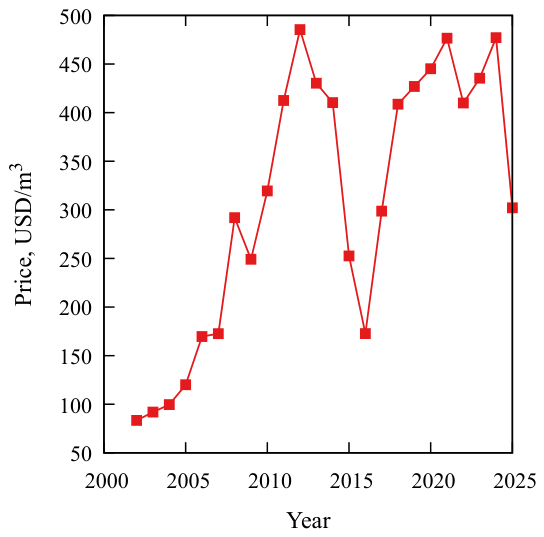
Figure 2.
Schematic diagram of the solar thermal installation.
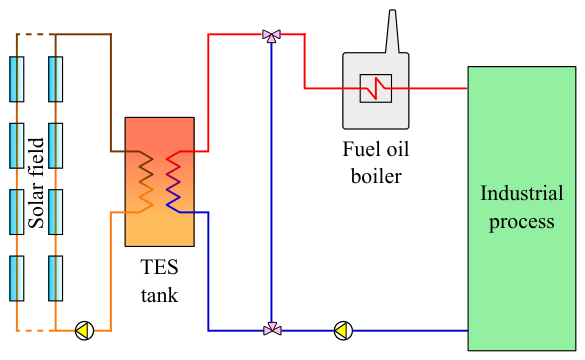
Figure 3.
Heat fluxes over the receiver in the parabolic trough collector.
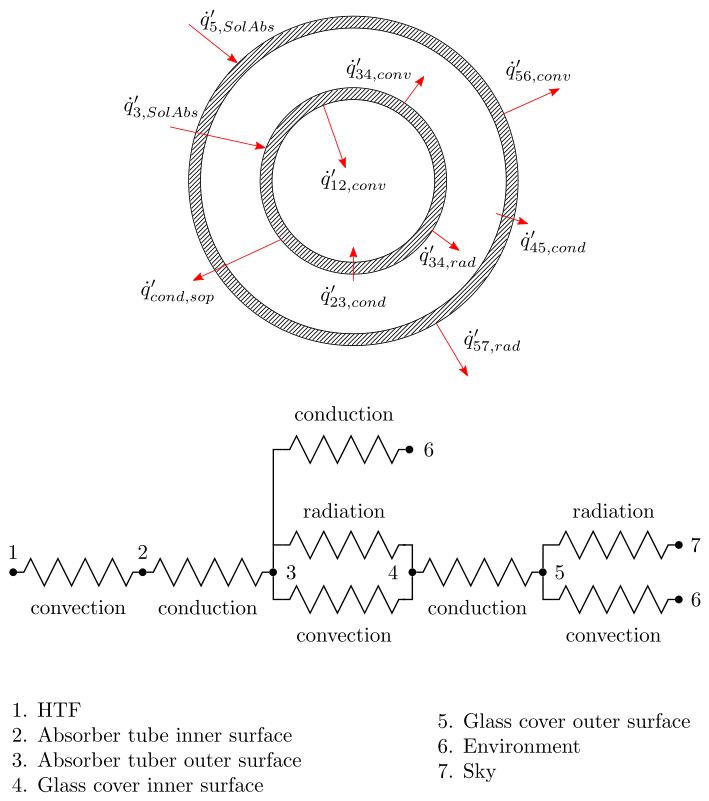
Figure 4.
Incidence angle modifier (IAM) for the PT250 collector.
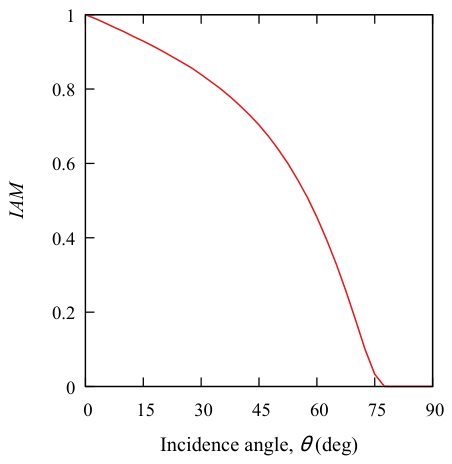
Figure 5.
Thermal losses per unit length for the PT250 collector as a function of the temperature difference between the HTF and ambient () for various DNI levels.
Figure 5.
Thermal losses per unit length for the PT250 collector as a function of the temperature difference between the HTF and ambient () for various DNI levels.
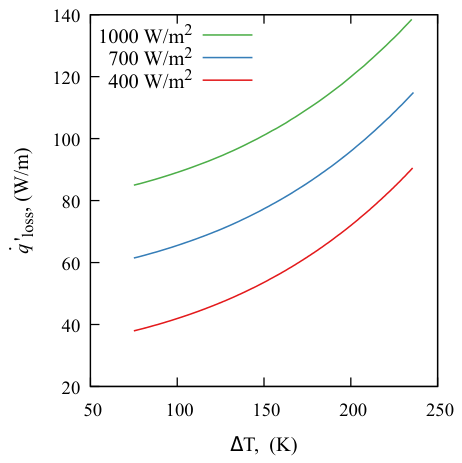
Figure 6.
Design day performance. (a) Solar field thermal power output. (b) SHIP energy efficiency. (c) SHIP exergy efficiency.
Figure 6.
Design day performance. (a) Solar field thermal power output. (b) SHIP energy efficiency. (c) SHIP exergy efficiency.
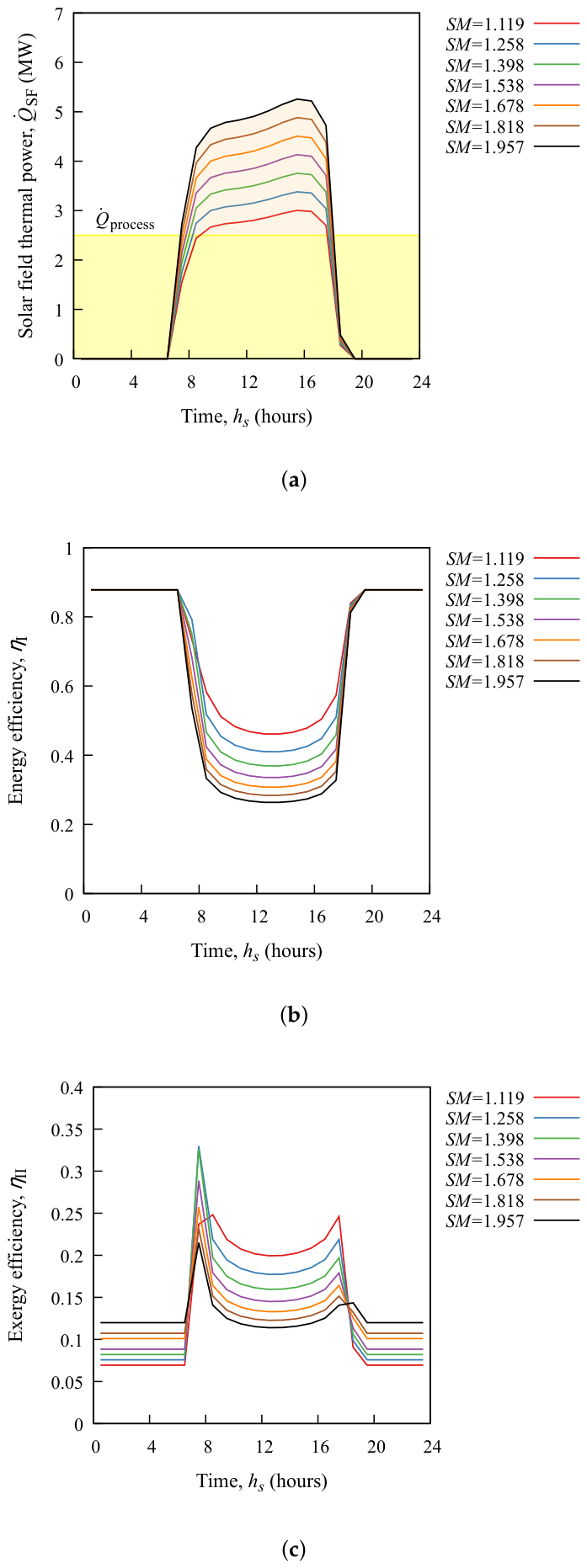
Figure 7.
Energy and exergy solar fraction of the parametric analysis.
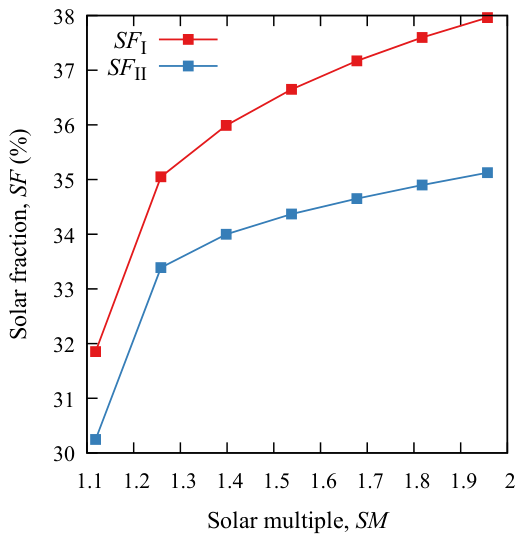
Figure 8.
Fuel saving fraction of the parametric analysis.
Figure 9.
Capacity factor of the parametric analysis.
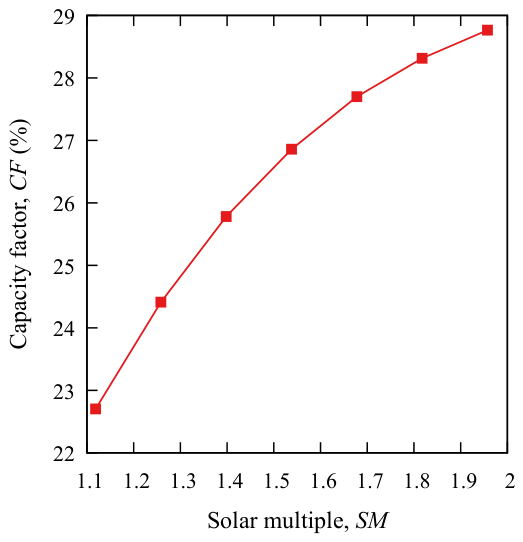
Figure 10.
Storage cycling factor of the parametric analysis.
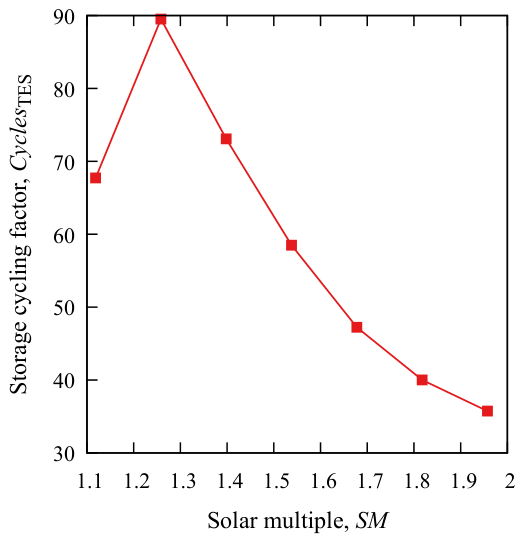
Figure 11.
Efficiency of the parametric analysis.
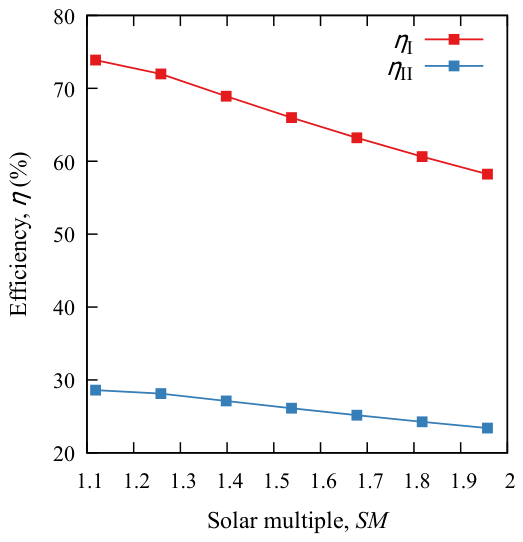
Figure 12.
Payback period of the parametric analysis.
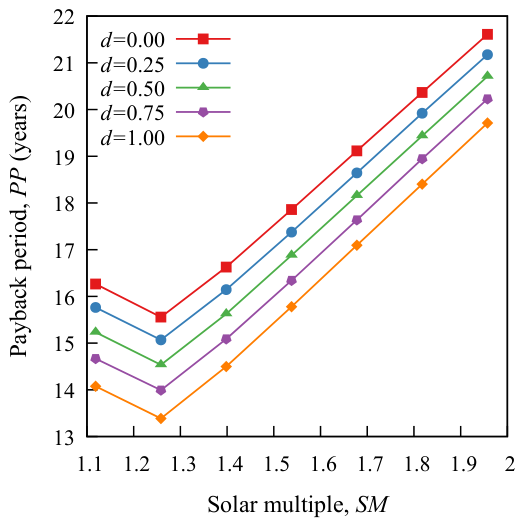
Figure 13.
Net present value of the parametric analysis.
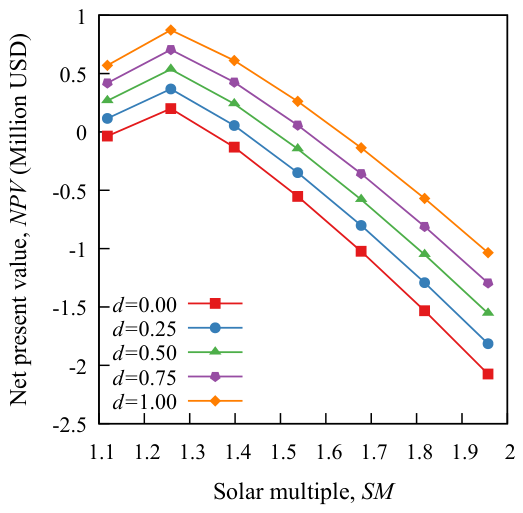
Figure 14.
Interest rate return of the parametric analysis.
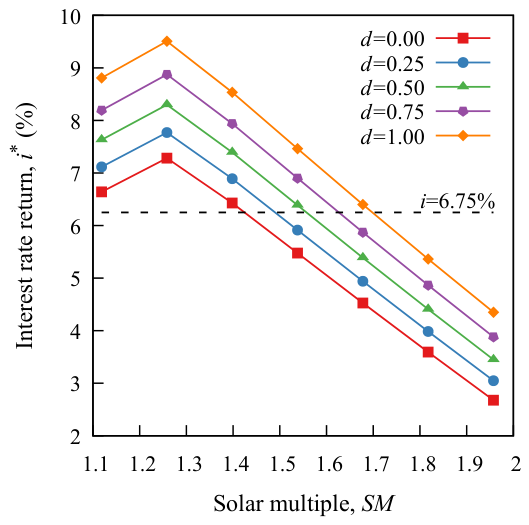
Figure 15.
Levelised cost of heat of the parametric analysis.
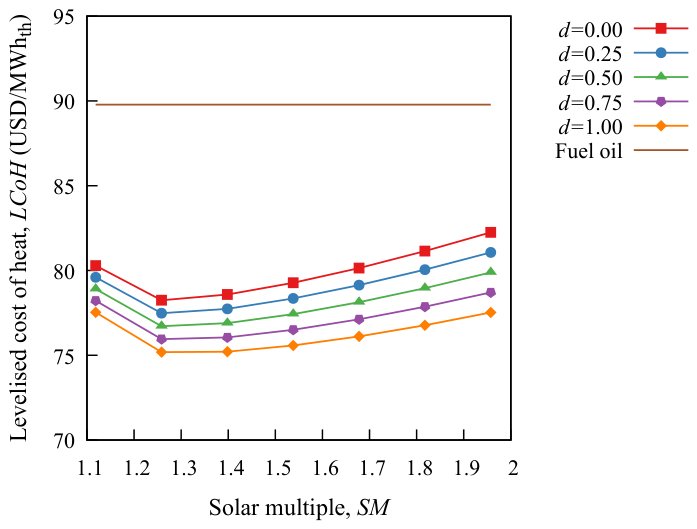
Figure 16.
Greenhouse gas emissions of the parametric analysis.
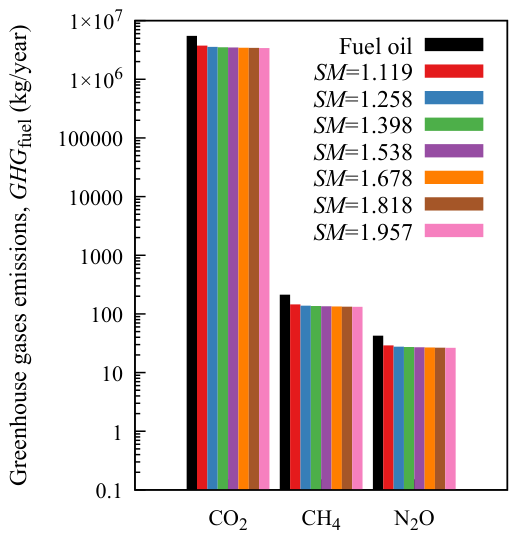

Table 1.
Annual operating profile of the tequila distillery.
| Month | Scheduled downtime days | Total operating days |
|---|---|---|
| January | 1, 12, 26 | 28 |
| February | 9, 23 | 26 |
| March | 9, 17, 18, 19, 20, 21, 22, 23 | 23 |
| April | 6, 20 | 28 |
| May | 1, 4, 18 | 28 |
| June | 1, 15, 29 | 27 |
| July | 13,27 | 29 |
| August | 10, 24 | 29 |
| September | 7, 15, 16, 17, 18, 19,20, 21 | 22 |
| October | 5, 19 | 29 |
| November | 2, 16, 30 | 27 |
| December | 12, 14, 25, 28 | 27 |
| Parameter | Symbol | |
|---|---|---|
| Parabolic trough collector | ||
| Width, (m) | W | 2.5 |
| Focal length, (m) | f | 0.930 |
| Aperture area, (m2) | 10 | |
| Outer receiver diameter, (m) | 0.040 | |
| Inner receiver diameter, (m) | 0.037 | |
| Glass cover outer diameter, (m) | 0.0572 | |
| Glass cover inner diameter, (m) | 0.0542 | |
| Peak optical efficiency | 0.7464 | |
| Industrial process conditions | ||
| Inlet thermal load temperature, (°C) | 181.3 | |
| Outlet return temperature, (°C) | 48 | |
| Thermal load mass flow rate, (ton/h) | 3.49 | |
| Working pressure, (bar) | 10.34 | |
| Minimum process heat requirement, (MW) | 2.5 | |
| Fuel oil lower heat value, (MJ/kg) | 37.78 | |
| Boiler energy efficiency, (%) | 87.8 | |
| Boiler exergy efficiency, (%) | 6.31 | |
| Thermal energy storage | ||
| Storage time, (h) | 5 |
Table 3.
Fuel oil cost for 2025 [33].
Table 3.
Fuel oil cost for 2025 [33].
| Month | Price, USD/m3 |
|---|---|
| January | 514.595 |
| February | 490.636 |
| March | 454.177 |
| April | 421.364 |
| May | 413.551 |
| June | 473.449 |
| July | 444.281 |
| August | 394.801 |
| September | 397.405 |
| October | 360.946 |
| November | 337.508 |
| December | 302.090 |
Table 4.
Fuel oil boiler cost data.
| Parameter | Value, 1000 USD |
|---|---|
| CAPEX1 | 429.4 |
| Electricity cost | 42.4 |
| Operation and maintenance cost1 | 208.5 |
1 Supplied by the manufacturer.
Table 5.
Equipment’s capacity or size parameter cost data [48].
Table 5.
Equipment’s capacity or size parameter cost data [48].
| Equipment | Capacity units | Min. size | Max. size | |||
|---|---|---|---|---|---|---|
| Heat exchanger (Centrifugal) | 3.3892 | 0.0536 | 0.1538 | Shaft power, kW | 1 | 300 |
| Pump (Spiral tube) | 3.9912 | 0.0668 | 0.2430 | Area, m2 | 1 | 100 |
| Storage tank (API-fixed roof) | 4.8509 | -0.3973 | 0.1445 | Volume, m3 | 90 | 30000 |
Table 6.
Design point conditions [56].
Table 6.
Design point conditions [56].
| Parameter | Symbol | |
|---|---|---|
| Weather conditions | ||
| Direct normal irradiance, (W/m2) | 746 | |
| Ambient temperature, (°C) | 31.8 | |
| Ambient pressure, (bar) | 0.889 | |
| Wind speed, (m/s) | 4.8 | |
| Insolation hours, (h) | 10 | |
| Location | ||
| Latitude, (deg) | 20.88 | |
| Longitude, (deg) | -103.84 | |
| Altitude, (m) | 1201 | |
| Solar field HTF conditions | ||
| Inlet temperature, (°C) | 190 | |
| Outlet temperature, (°C) | 240 |
Table 7.
SHIP installation design operating conditions.
| Parameter | Symbol | |||||||
|---|---|---|---|---|---|---|---|---|
| Total HTF mass flow rate, (kg/s) | 32.5213 | 36.5865 | 40.6517 | 44.7168 | 48.7820 | 52.8472 | 56.9123 | |
| Number of loops | 8 | 9 | 10 | 11 | 12 | 13 | 14 | |
| Number of total PTC | 496 | 558 | 620 | 682 | 744 | 806 | 868 | |
| Total concentration area, (ha) | 0.496 | 0.558 | 0.620 | 0.682 | 0.740 | 0.806 | 0.868 | |
| Total energy efficiency | 0.4616 | 0.4103 | 0.3693 | 0.3354 | 0.3077 | 0.2840 | 0.2638 | |
| Total exergy efficiency | 0.1995 | 0.1773 | 0.1596 | 0.1453 | 0.1330 | 0.1227 | 0.1140 | |
| TES volume, (m3) | 161.1676 | 181.3135 | 201.4594 | 221.6053 | 241.7513 | 261.8972 | 282.0431 | |
| Charging heat exchanger area, (m2) | 116.5106 | 131.0744 | 145.6383 | 160.2021 | 174.7659 | 189.3297 | 203.8936 | |
| Discharging heat exchanger area, (m2) | 123.4575 | 123.4575 | 123.4575 | 123.4575 | 123.4575 | 123.4575 | 123.4575 |
Disclaimer/Publisher’s Note: The statements, opinions and data contained in all publications are solely those of the individual author(s) and contributor(s) and not of MDPI and/or the editor(s). MDPI and/or the editor(s) disclaim responsibility for any injury to people or property resulting from any ideas, methods, instructions or products referred to in the content. |
© 2026 by the authors. Licensee MDPI, Basel, Switzerland. This article is an open access article distributed under the terms and conditions of the Creative Commons Attribution (CC BY) license (http://creativecommons.org/licenses/by/4.0/).
Copyright: This open access article is published under a Creative Commons CC BY 4.0 license, which permit the free download, distribution, and reuse, provided that the author and preprint are cited in any reuse.


