

Submitted:
02 June 2026
Posted:
04 June 2026
You are already at the latest version
Abstract
Eph receptor A10 (EphA10) is undetectable in most normal tissues, and the increased expression has been shown to correlate with tumor progression and poor prognosis. Therefore, EphA10 is a promising therapeutic target with minimal adverse effects. The EphA10-targeting strategies, including monoclonal antibodies (mAbs), antibody–drug conjugates (ADCs), bispecific Abs, and chimeric antigen receptor (CAR) T cells, have been developed in preclinical studies. Therefore, mAbs that specifically recognize cell sur-face-expressing EphA10 are essential for developing novel therapeutic modalities. In this study, we established novel anti-human EphA10 mAbs using the Cell-Based Immun-ization and Screening (CBIS) method. Among them, Ea10Mab-3 reacted with EphA10-overexpressed Chinese hamster ovary-K1 (CHO/EphA10) and glioblastoma cell line (LN229/EphA10) in flow cytometry. The binding affinities (KD values) were deter-mined as 2.6 × 10⁻¹⁰ M for CHO/EphA10 and 3.0 × 10⁻⁹ M for LN229/EphA10. Furthermore, Ea10Mab-3 did not exhibit cross-reactivity with other Eph receptor-overexpressed CHO-K1. These results indicate that Ea10Mab-3 is a specific, high-affinity mAb that is expected to be used for mAb-based tumor diagnosis and therapy.
Keywords:
EphA10
; cell-based immunization and screening
; monoclonal antibody
; flow cytometry
1. Introduction
The erythropoietin-producing hepatocellular carcinoma (Eph) receptors are the largest group of receptor tyrosine kinases (RTKs), comprising 14 members [1]. Based on their sequence similarity and ligand selectivity, Eph receptors are classified into two subgroups: A type of Eph receptors (EphA1 to A8, EphA10) and B type of Eph receptors (EphB1 to B4, EphB6) [2]. EphA receptors mainly bind to five ligands (ephrin-A1 to A5), which are glycosylphosphatidylinositol (GPI)-anchored type ligands. EphB receptors bind to three transmembrane ligands (ephrin-B1 to B3) [3].
Upon cell–cell contact, both ephrins and Eph receptors initiate signal transduction in each of the ligand- and receptor-expressing cells [4,5]. The signaling initiated by the ephrin-bound Eph receptors is called “forward signaling”. In contrast, the signaling initiated by the Eph-bound ephrins is called “reverse signaling” [4,5]. The Eph forward signaling transduces intracellular signaling pathways such as Ras/MAPK, PI3K-Akt/PKB, and Rho/Rac GTPase pathway through interactions with various effector proteins [6,7]. The ephrin–Eph receptor system plays critical roles in embryonic development and tissue homeostasis [1].
Among 14 Eph receptors, EphB6 and EphA10 are pseudokinases which lack catalytic activity [8]. Still, they play crucial roles in signal transduction [6] and tumor development through the deregulated expression [9]. By a structural modeling of EphB6 and EphA10, EphA10 resembles the autoinhibited insulin RTK and the Wnt-binding RTK pseudokinases, EphB6 resembles ErbB3 in having an unprotected ATP-binding site [10]. The mechanisms by which EphA10 and EphB6 modulate Eph receptor signaling are of considerable interest and underscore the importance of catalysis-independent functions across the Eph receptor family [6].
EphA10 is absent from normal tissues except the male testis [9,11]. In contrast, EphA10 expression is observed in malignant tumor cells and has been associated with poor clinical outcomes in breast, lung, gallbladder, and pancreatic cancers [12,13,14,15]. In breast cancer, EphA10 expression correlates with lymph node metastasis, advanced tumor stage, and immunosuppression through PD-L1 upregulation and reduced NK cell–mediated cytotoxicity [16,17,18]. Although the contribution of EphA10 to antitumor immunity remains poorly understood, its tumor-associated expression profile highlights EphA10 as a promising target for breast cancer therapy [19].
The EphA10-targeting strategies, including monoclonal antibodies (mAbs) [9,20], antibody–drug conjugates (ADCs) [21], bispecific Abs [22,23] and chimeric antigen receptor (CAR) T cells [24], have been developed in preclinical studies. Although EphA10-targeting therapies have shown therapeutic potential in EphA10-positive tumors, their clinical application remains limited. In those studies, EphA10 expression in cancer cell lines was mainly detected by quantitative PCR [20], western blotting [25], and immunohistochemistry [18,20]. Furthermore, the antitumor effects of anti-EphA10 mAbs or their modalities were mainly evaluated EphA10-overexpressed human cancer cells [9,24]. MAbs that detect cell-surface-expressed endogenous EphA10 by flow cytometry remain limited.
The Cell-Based Immunization and Screening (CBIS) method enables the generation of diverse monoclonal antibodies (mAbs) against membrane proteins. The CBIS method includes immunization of antigen-overexpressed cells and flow cytometry-based high-throughput screening of hybridoma supernatants. By employing this strategy, we have developed mAbs against RTKs, including the epidermal growth factor receptor (EGFR) family [26,27] and Eph receptors [28,29]. These mAbs recognize multiple epitopes, including linear, conformational, and glycosylation-related epitopes, and are applicable to flow cytometry. In this study, we used the CBIS method to establish novel anti-EphA10 mAbs for flow cytometry.
2. Materials and Methods
2.1. Cell Lines and Stable Transfectants
Chinese hamster ovary (CHO)-K1, LN229 glioblastoma, P3X63Ag8U.1 (P3U1) myeloma, and breast cancer cell lines, such as MDA-MB-231 and MDA-MB-468, were obtained from the American Type Culture Collection (Manassas, VA, USA). MCF-7 was obtained from the Cell Resource Center for Biomedical Research Institute of Development, Aging and Cancer, Tohoku University (Miyagi, Japan). EphA10 cDNA (NM_001099439, Catalog No. RC218374, OriGene Technologies, Inc., Rockville, MD, USA) plus an N-terminal MAP16 tag and an N-terminal PA16 tag were subcloned into a pCAG-Ble vector [FUJIFILM Wako Pure Chemical Corporation (Wako), Osaka, Japan]. Afterward, plasmids were transfected into CHO-K1 and LN229 cells using the Neon transfection system (Thermo Fisher Scientific, Inc., Waltham, MA, USA). Stable transfectants [CHO/PA16-EphA10 (CHO/EphA10) and LN229/MAP16-EphA10] were subsequently selected by a cell sorter (SH800, Sony Corp., Tokyo, Japan) using an anti-MAP16 tag mAb (PMab-1) and an anti-PA16 tag mAb (NZ-1), respectively. After sorting, cultivation was conducted in a medium containing 0.5 mg/mL Zeocin (InvivoGen, San Diego, CA, USA). Other Eph receptor-expressing CHO-K1 cells (e.g., CHO/EphA1) were established as previously reported [28]. CHO-K1, P3U1, and Eph receptor-overexpressed CHO-K1 were cultured as described previously [28].
2.2. Hybridoma Production
Two 5-week-old female BALB/cAJcl mice (CLEA Japan, Tokyo, Japan) were intraperitoneally immunized with LN229/MAP16-EphA10 (1 × 10⁸ cells/mouse) at 6 weeks of age. Alhydrogel adjuvant 2% (InvivoGen) was added to the immunogen cells in the first immunization. Three additional injections of LN229 EphA10 (1 × 10⁸ cells/mouse) were conducted intraperitoneally without the adjuvant every week. A last booster injection was also performed with 1 × 10⁸ cells/mouse of LN229/EphA10 two days before harvesting spleen cells from mice. The cell fusion of P3U1 myeloma cells with the harvested splenocytes were described previously [30]. On day 6 after cell fusion, the hybridoma supernatants were screened by flow cytometry using CHO/EphA10 and parental CHO-K1 cells. Anti-EphA10 mAbs were purified from the hybridoma supernatants using Ab-Capcher (ProteNova, Kagawa, Japan).
2.3. Flow Cytometry
Cells were harvested using 1 mM EDTA (Nacalai Tesque, Inc.) and incubated with primary mAbs in phosphate-buffered saline (PBS) containing 0.1% bovine serum albumin (blocking buffer) for 30 minutes at 4 °C. Subsequently, they were stained with Alexa Fluor 488-conjugated anti-mouse IgG (diluted 1:2000, Cell Signaling Technology, Inc., Danvers, MA, USA) prior to analysis using the SA3800 Cell Analyzer (Sony Corp.). Flow cytometric data were acquired on an SA3800 Cell Analyzer (Sony Corp., Tokyo, Japan) by collecting 5,000 events. Cells were gated on forward scatter (FSC) and side scatter (SSC), and fluorescence intensity was analyzed using FlowJo software (BD Biosciences, Franklin Lakes, NJ, USA).
2.4. Determination of the Binding Affinity by Flow Cytometry
CHO/EphA10 and LN229/EphA10 were suspended in 100 μL serially diluted Ea10Mab-3, after which Alexa Fluor 488-conjugated anti-mouse IgG (dilution rate: 1:200) was added. The data (10,000 events) were collected with the SA3800 Cell Analyzer, and the geometric mean (GeoMean) was calculated in FlowJo. The fitting binding isotherms (vertical axis, GeoMean; horizontal axis, mAb concentration) determined the dissociation constant (KD) values to built-in one-side binding models of GraphPad Prism 6 (GraphPad Software, Inc., La Jolla, CA, USA).
2.5. Immunohistochemistry
Formalin-fixed paraffin-embedded (FFPE) CHO/EphA10 and CHO-K1 cell blocks were prepared using iPGell (Genostaff Co., Ltd., Tokyo, Japan). Immunohistochemistry was performed using the VENTANA BenchMark ULTRA PLUS (Roche Diagnostics, Indianapolis, IN, USA). The FFPE cell sections were stained with Ea10Mab-3 (10 μg/mL) or an anti-PA16 tag mAb, NZ-33 (0.1 μg/mL) [31] using the ultraView Universal DAB Detection Kit (Roche Diagnostics).
3. Results
3.1. Development of an Anti-EphA10 mAb, Ea10Mab-3 Using the CBIS Method
To establish mAbs targeting EphA10, we employed the CBIS method. LN229/EphA10 (1 × 10⁸ cells) were injected intraperitoneally five times into two BALB/cAJcl mice (Figure 1A). Splenocytes were fused with myeloma P3U1 cells to generate hybridomas, which were plated in 96-well plates (Figure 1B). Hybridoma supernatants were screened to identify those positive for CHO/EphA10 and negative for CHO-K1 (Figure 1C). Flow cytometric screening identified 19 out of 956 wells (2.0%) that showed strong signals with CHO/EphA10 cells compared with CHO-K1 cells. Limiting dilution was then performed, and a total of 4 clones producing anti-EphA10 mAbs were established. Supernatants were further evaluated for use in flow cytometry (Figure 1D). Finally, clone Ea10Mab-3 (IgG1, κ) was selected by the reactivity and specificity. As shown in Figure 2, Ea10Mab-3 recognized CHO/EphA10. Importantly, Ea10Mab-3 did not react with the other 13 Eph receptors (EphA1 to A8, B1 to B4, and B6) overexpressed in CHO-K1. This result indicates that Ea10Mab-3 is an anti-EphA10-specific mAb.
3.2. Investigation of the Reactivity of Ea10Mab-3 Using Flow Cytometry
We investigated the reactivity of Ea10Mab-3 using flow cytometry. Results showed that Ea10Mab-3 recognized CHO/EphA10 dose-dependently (Figure 3A). Ea10Mab-3 did not react with the parental CHO-K1 cell line (Figure 3B). Furthermore, Ea10Mab-3 exhibited a dose-dependent reaction to LN229/EphA10, which was used as the immunogen (Figure 3C). Ea10Mab-3 did not react with parental LN229 (Figure. 3B). We also attempted to detect the endogenous EphA10 in breast cancer cell lines (MDA-MB-231, MDA-MB-468, and MCF-7), which were detected by flow cytometry [21]. However, Ea10Mab-3 could not detect endogenous EphA10 (Supplementary figure S1). These results indicate that Ea10Mab-3 can detect overexpressed EphA10 in flow cytometry.
3.3. Determination of the Binding Affinity of Ea10Mab-3 Using Flow Cytometry
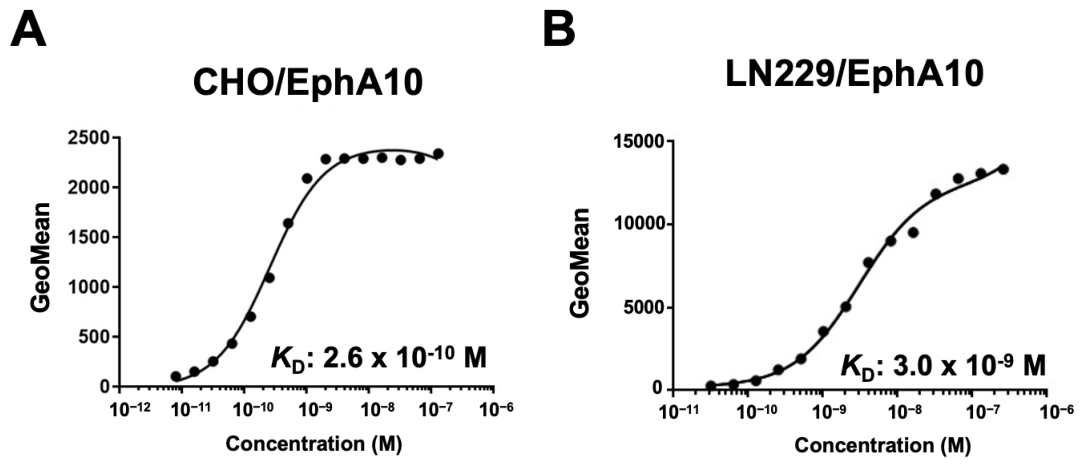
To evaluate the binding affinity of Ea10Mab-3, flow cytometry was performed using CHO/EphA10 and LN229/EphA10 cells. The KD values of Ea10Mab-3 for CHO/EphA10 and LN229/EphA10 were 2.6 × 10⁻¹⁰ M and 3.0 × 10⁻⁹ M, respectively (Figure 4). These results indicate that Ea10Mab-3 has a high affinity to EphA10-overexpressed cells.
We also performed immunohistochemistry to detect EphA10; however, Ea10Mab-3 could not detect EphA10 in CHO/EphA10 (Supplementary figure S2).
4. Discussion
This study developed and characterized a novel anti-human EphA10 mAb, Ea10Mab-3, which is suitable for flow cytometry. Ea10Mab-3 recognizes EphA10-overexpressed CHO-K1 and LN229 in flow cytometry (Figure 3). However, Ea10Mab-3 could not detect EphA10 in western blotting and immunohistochemistry (Supplementary figure S2), suggesting that Ea10Mab-3 recognizes conformational epitopes. The other 3 clones are also suitable for flow cytometry but not western blotting and immunohistochemistry (https://www.med-tohoku-antibody.com/topics/antibody_bank.htm, accessed on 1 June 2026).
Ea10Mab-3 did not show cross-reactivity to other 13 Eph receptors, including EphA and EphB (Figure 2), and exhibited a superior affinity to EphA10-overexpressed cells (Figure 4). However, Ea10Mab-3 could not detect endogenous EphA10 in breast cancer cell lines (MDA-MB-231, MDA-MB-468, and MCF-7, Supplementary figure S1), in which it was reported to be detected by a humanized anti-EphA10 mAb [21]. The mAb was originally derived from the mouse anti-EphA10 mAb clone #9, as described in the previously reported [24]. Clone #9 was established by immunization with a recombinant extracellular domain of EphA10 into BALB/c mice. The cross-reactivity of clone #9 was confirmed by enzyme-linked immunosorbent assay against 8 EphA members but not 5 EphB members. Among the established 4 Ea10Mabs, Ea10Mab-1 cross-reacted with EphB2 and EphB3, and Ea10Mab-4 cross-reacted with EphB2 and EphA8. Since an EphB2-specific mAb, Eb2Mab-12 recognized MDA-MB-231 cells [32], the cross-reactivity of clone #9 to EphB members seems to be investigated.
Anti-EphA10 mAbs have been developed and evaluated in several preclinical studies [9,22,24]. Most mAbs have been shown to recognize EphA10-overexpressed cell lines but not endogenous EphA10 in flow cytometry [9,22,24]. In immunohistochemistry of CHO/EphA10, PA16-tagged EphA10 was expressed not only in the plasma membrane but also in the cytoplasm (Supplementary figure S2B). In the case of CHO/EphA2, an anti-EphA2 mAb, Ea2Mab-7 clearly showed the membranous staining [29]. These results suggest that EphA10 is subject to internalization or that the cell-surface expression is restricted. Endocytosis of Eph/ephrin proteins is a key principle responsible for diverse biological responses including adhesion versus repulsion and increased versus decreased motility [33]. Since the mechanism of EphA10 endocytosis has not been investigated, elucidating it and identifying EphA10 membrane-positive cancer cell lines are essential. Furthermore, the internalization of anti-EphA10 mAbs has been reported in several studies [12,34]. A high-affinity anti-EphA10 mAb, Ea10Mab-3, would help the study of EphA10 endocytosis, which may contribute to the development of ADC for tumor therapy.
Supplementary Materials
The following supporting information can be downloaded at the website of this paper posted on Preprints.org, Figure S1: Flow cytometric analysis of Ea10Mab-3 in breast cancer cell lines. Figure S2: Immunohistochemistry using Ea10Mab-3 and NZ-33 in formalin-fixed paraffin-embedded cell blocks.
Author Contributions
Conceptualization, M.K.K. and Y.K.; investigation, K.S., H.Suzuki, T.N., Y.O., R.I., H.Satofuka, T.T., and; writing—original draft preparation, H.S.; writing—review and editing, Y.K.; project administration, Y.K.; funding acquisition, H.S. and Y.K. All authors have read and agreed to the manuscript.
Funding
This research was supported in part by the Japan Agency for Medical Research and Development (AMED) under Grant Numbers JP26am0521010 (to Y.K.), JP26ama121008 (to Y.K.), JP25ama221153 (to Y.K.), and JP25ama221339 (to Y.K.), and by the Japan Society for the Promotion of Science (JSPS) Grants-in-Aid for Scientific Research (KAKENHI) grant no. 25K10553 (to Y.K.) and 26K02289 (to H.Suzuki).
Institutional Review Board Statement
The animal study protocol was approved by the Animal Care and Use Committee of Tohoku University (Permit number: 2022MdA-001) for studies involving animals.
Informed Consent Statement
Not applicable.
Data Availability Statement
All related data and methods are presented in this paper. Additional inquiries should be addressed to the corresponding authors.
Conflicts of Interest
The authors declare no conflict of interest involving this article.
References
- Pasquale, E.B. Eph receptors and ephrins in cancer progression. Nat Rev Cancer 2024, 24, 5-27. [CrossRef]
- Pasquale, E.B. Eph receptor signaling complexes in the plasma membrane. Trends Biochem Sci 2024, 49, 1079-1096. [CrossRef]
- Lisabeth, E.M.; Falivelli, G.; Pasquale, E.B. Eph receptor signaling and ephrins. Cold Spring Harb Perspect Biol 2013, 5. [CrossRef]
- Pasquale, E.B. Eph-ephrin bidirectional signaling in physiology and disease. Cell 2008, 133, 38-52. [CrossRef]
- Pasquale, E.B. Eph receptor signalling casts a wide net on cell behaviour. Nat Rev Mol Cell Biol 2005, 6, 462-475. [CrossRef]
- Liang, L.Y.; Patel, O.; Janes, P.W.; Murphy, J.M.; Lucet, I.S. Eph receptor signalling: from catalytic to non-catalytic functions. Oncogene 2019, 38, 6567-6584. [CrossRef]
- Kania, A.; Klein, R. Mechanisms of ephrin-Eph signalling in development, physiology and disease. Nat Rev Mol Cell Biol 2016, 17, 240-256. [CrossRef]
- Liang, L.Y.; Roy, M.; Horne, C.R.; Sandow, J.J.; Surudoi, M.; Dagley, L.F.; Young, S.N.; Dite, T.; Babon, J.J.; Janes, P.W.; et al. The intracellular domains of the EphB6 and EphA10 receptor tyrosine pseudokinases function as dynamic signalling hubs. Biochem J 2021, 478, 3351-3371. [CrossRef]
- Nagano, K.; Maeda, Y.; Kanasaki, S.; Watanabe, T.; Yamashita, T.; Inoue, M.; Higashisaka, K.; Yoshioka, Y.; Abe, Y.; Mukai, Y.; et al. Ephrin receptor A10 is a promising drug target potentially useful for breast cancers including triple negative breast cancers. J Control Release 2014, 189, 72-79. [CrossRef]
- Sheetz, J.B.; Mathea, S.; Karvonen, H.; Malhotra, K.; Chatterjee, D.; Niininen, W.; Perttilä, R.; Preuss, F.; Suresh, K.; Stayrook, S.E.; et al. Structural Insights into Pseudokinase Domains of Receptor Tyrosine Kinases. Mol Cell 2020, 79, 390-405.e397. [CrossRef]
- Aasheim, H.C.; Patzke, S.; Hjorthaug, H.S.; Finne, E.F. Characterization of a novel Eph receptor tyrosine kinase, EphA10, expressed in testis. Biochim Biophys Acta 2005, 1723, 1-7. [CrossRef]
- Wang, A.; Zhu, J.; Li, Y.; Jiao, M.; Zhang, S.; Ding, Z.L.; Huang, J.A.; Liu, Z. Comprehensive analysis of Epha10 as a predictor of clinical prognosis and immune checkpoint therapy efficacy in non-small cell lung cancer. Sci Rep 2024, 14, 19623. [CrossRef]
- Shin, W.S.; Park, M.K.; Lee, Y.H.; Kim, K.W.; Lee, H.; Lee, S.T. The catalytically defective receptor protein tyrosine kinase EphA10 promotes tumorigenesis in pancreatic cancer cells. Cancer Sci 2020, 111, 3292-3302. [CrossRef]
- Yan, H.X.; Li, Q.L.; Cai, W.W.; Tang, D.; Wang, B.; Liu, X.; Liu, Z.D.; Yang, Z.L. EphA10 and EphB3 are prognostic markers in gallbladder squamous cell/adenosquamous carcinomas and adenocarcinomas. Int J Clin Exp Pathol 2018, 11, 512-525.
- Li, Y.; Jin, L.; Ye, F.; Ma, Q.; Yang, Z.; Liu, D.; Yang, J.; Ma, D.; Gao, Q. Isoform expression patterns of EPHA10 protein mediate breast cancer progression by regulating the E-Cadherin and β-catenin complex. Oncotarget 2017, 8, 30344-30356. [CrossRef]
- Zhao, W.; Liu, L.; Li, X.; Xu, S. EphA10 drives tumor progression and immune evasion by regulating the MAPK/ERK cascade in lung adenocarcinoma. Int Immunopharmacol 2022, 110, 109031. [CrossRef]
- Yang, W.H.; Cha, J.H.; Xia, W.; Lee, H.H.; Chan, L.C.; Wang, Y.N.; Hsu, J.L.; Ren, G.; Hung, M.C. Juxtacrine Signaling Inhibits Antitumor Immunity by Upregulating PD-L1 Expression. Cancer Res 2018, 78, 3761-3768. [CrossRef]
- Nagano, K.; Kanasaki, S.; Yamashita, T.; Maeda, Y.; Inoue, M.; Higashisaka, K.; Yoshioka, Y.; Abe, Y.; Mukai, Y.; Kamada, H.; et al. Expression of Eph receptor A10 is correlated with lymph node metastasis and stage progression in breast cancer patients. Cancer Med 2013, 2, 972-977. [CrossRef]
- Psilopatis, I.; Souferi-Chronopoulou, E.; Vrettou, K.; Troungos, C.; Theocharis, S. EPH/Ephrin-Targeting Treatment in Breast Cancer: A New Chapter in Breast Cancer Therapy. Int J Mol Sci 2022, 23. [CrossRef]
- Nagano, K.; Yamashita, T.; Inoue, M.; Higashisaka, K.; Yoshioka, Y.; Abe, Y.; Mukai, Y.; Kamada, H.; Tsutsumi, Y.; Tsunoda, S. Eph receptor A10 has a potential as a target for a prostate cancer therapy. Biochem Biophys Res Commun 2014, 450, 545-549. [CrossRef]
- Safaei, M.; Li, Y.C.; Chen, C.Y.; Hsieh, P.H.; Venkataraman, S.; Huang, W.C.; Cheng, W.C.; Yamaguchi, H.; Chen, Y.F.; Ho, Y.S.; et al. Targeting ephrin receptor A10 with antibody-drug conjugates for breast cancer. Cancer Lett 2026, 639, 218225. [CrossRef]
- Taki, S.; Kamada, H.; Inoue, M.; Nagano, K.; Mukai, Y.; Higashisaka, K.; Yoshioka, Y.; Tsutsumi, Y.; Tsunoda, S. A Novel Bispecific Antibody against Human CD3 and Ephrin Receptor A10 for Breast Cancer Therapy. PLoS One 2015, 10, e0144712. [CrossRef]
- Kamada, H.; Taki, S.; Nagano, K.; Inoue, M.; Ando, D.; Mukai, Y.; Higashisaka, K.; Yoshioka, Y.; Tsutsumi, Y.; Tsunoda, S. Generation and characterization of a bispecific diabody targeting both EPH receptor A10 and CD3. Biochem Biophys Res Commun 2015, 456, 908-912. [CrossRef]
- Cha, J.H.; Chan, L.C.; Wang, Y.N.; Chu, Y.Y.; Wang, C.H.; Lee, H.H.; Xia, W.; Shyu, W.C.; Liu, S.P.; Yao, J.; et al. Ephrin receptor A10 monoclonal antibodies and the derived chimeric antigen receptor T cells exert an antitumor response in mouse models of triple-negative breast cancer. J Biol Chem 2022, 298, 101817. [CrossRef]
- Chen, Y.L.; Yen, Y.C.; Jang, C.W.; Wang, S.H.; Huang, H.T.; Chen, C.H.; Hsiao, J.R.; Chang, J.Y.; Chen, Y.W. Ephrin A4-ephrin receptor A10 signaling promotes cell migration and spheroid formation by upregulating NANOG expression in oral squamous cell carcinoma cells. Sci Rep 2021, 11, 644. [CrossRef]
- Itai, S.; Yamada, S.; Kaneko, M.K.; Chang, Y.W.; Harada, H.; Kato, Y. Establishment of EMab-134, a Sensitive and Specific Anti-Epidermal Growth Factor Receptor Monoclonal Antibody for Detecting Squamous Cell Carcinoma Cells of the Oral Cavity. Monoclon Antib Immunodiagn Immunother 2017, 36, 272-281. [CrossRef]
- Itai, S.; Fujii, Y.; Kaneko, M.K.; Yamada, S.; Nakamura, T.; Yanaka, M.; Saidoh, N.; Chang, Y.W.; Handa, S.; Takahashi, M.; et al. H(2)Mab-77 is a Sensitive and Specific Anti-HER2 Monoclonal Antibody Against Breast Cancer. Monoclon Antib Immunodiagn Immunother 2017, 36, 143-148. [CrossRef]
- Ubukata, R.; Suzuki, H.; Hirose, M.; Satofuka, H.; Tanaka, T.; Kaneko, M.K.; Kato, Y. Establishment of a highly sensitive and specific anti-EphB2 monoclonal antibody (Eb2Mab-12) for flow cytometry. Microbes & Immunity 2025, 0. [CrossRef]
- Satofuka, H.; Suzuki, H.; Tanaka, T.; Li, G.; Kaneko, M.K.; Kato, Y. Development of an anti-human EphA2 monoclonal antibody Ea(2)Mab-7 for multiple applications. Biochem Biophys Rep 2025, 42, 101998. [CrossRef]
- Ubukata, R.; Suzuki, H.; Hirose, M.; Satofuka, H.; Tanaka, T.; Kaneko, M.K.; Kato, Y. Establishment of a highly sensitive and specific anti-EphB2 monoclonal antibody (Eb2Mab-12) for flow cytometry. MI 2025. [CrossRef]
- Fujisawa, S.; Yamamoto, H.; Tanaka, T.; Kaneko, M.K.; Suzuki, H.; Kato, Y. Development and Characterization of Ea7Mab-10: A Novel Monoclonal Antibody Targeting EphA7. Preprints 2025. [CrossRef]
- Ubukata, R.; Ohishi, T.; Kaneko, M.K.; Suzuki, H.; Kato, Y. EphB2-Targeting Monoclonal Antibodies Exerted Antitumor Activities in Triple-Negative Breast Cancer and Lung Mesothelioma Xenograft Models. Int J Mol Sci 2025, 26. [CrossRef]
- Pitulescu, M.E.; Adams, R.H. Eph/ephrin molecules--a hub for signaling and endocytosis. Genes Dev 2010, 24, 2480-2492. [CrossRef]
- Zang, X.; Ding, H.; Zhao, X.; Li, X.; Du, Z.; Hu, H.; Qiao, M.; Chen, D.; Deng, Y.; Zhao, X. Anti-EphA10 antibody-conjugated pH-sensitive liposomes for specific intracellular delivery of siRNA. Int J Nanomedicine 2016, 11, 3951-3967. [CrossRef]
Figure 1.
Development of anti-EphA10 mAbs by the CBIS method. (A) LN229/EphA10 cells were immunized into two female mice (B). The spleen cells isolated from antigen-immunized mice were fused with mouse myeloma P3U1 cells. (C) The culture supernatants of hybridoma were screened by flow cytometry using CHO-K1 and CHO/EphA10 to select EphA10-specific mAb-producing hybridomas. (D) Single hybridoma clones were obtained by limiting dilution. Finally, Ea10Mab-3 (mouse IgG1, kappa) was selected by the reactivity and specificity.
Figure 1.
Development of anti-EphA10 mAbs by the CBIS method. (A) LN229/EphA10 cells were immunized into two female mice (B). The spleen cells isolated from antigen-immunized mice were fused with mouse myeloma P3U1 cells. (C) The culture supernatants of hybridoma were screened by flow cytometry using CHO-K1 and CHO/EphA10 to select EphA10-specific mAb-producing hybridomas. (D) Single hybridoma clones were obtained by limiting dilution. Finally, Ea10Mab-3 (mouse IgG1, kappa) was selected by the reactivity and specificity.
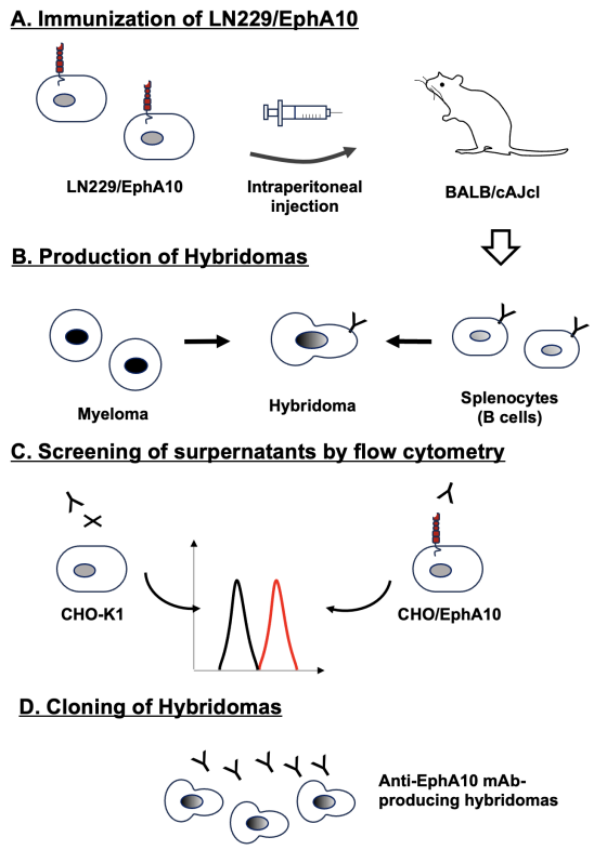
Figure 2.
Cross-reactivity of Ea10Mab-3 to Eph receptor-overexpressed CHO-K1. The fourteen Eph receptor-overexpressed CHO-K1 cells were treated with 10 µg/mL of Ea10Mab-3 (red line) followed by anti-mouse IgG conjugated with Alexa Fluor 488. Fluorescence data were collected using the SA3800 Cell Analyzer. Black line, control (blocking buffer with no primary antibody).
Figure 2.
Cross-reactivity of Ea10Mab-3 to Eph receptor-overexpressed CHO-K1. The fourteen Eph receptor-overexpressed CHO-K1 cells were treated with 10 µg/mL of Ea10Mab-3 (red line) followed by anti-mouse IgG conjugated with Alexa Fluor 488. Fluorescence data were collected using the SA3800 Cell Analyzer. Black line, control (blocking buffer with no primary antibody).
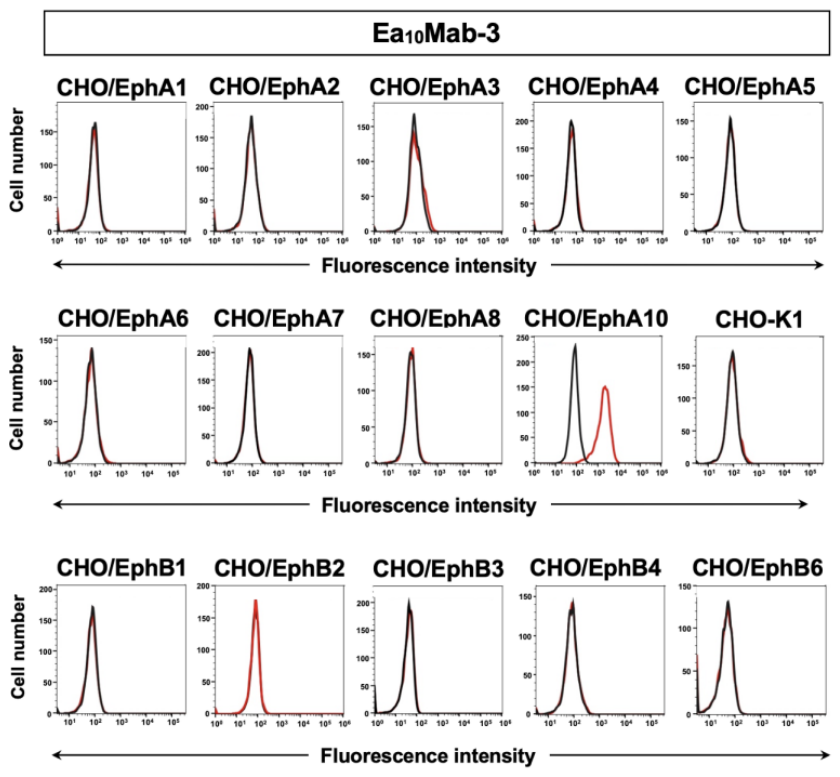
Figure 3.
Flow cytometric analysis of Ea10Mab-3 against EphA10-overexpressed cells. CHO/EphA10 (A), CHO-K1 (B), LN229/EphA10 (C), and LN229 (D) were treated with 0.01–10 µg/mL of Ea10Mab-3 (red line). The cells were then treated with Alexa Fluor 488-conjugated anti-mouse IgG. Fluorescence data were collected using the SA3800 Cell Analyzer. Black line, control (blocking buffer with no primary antibody).
Figure 3.
Flow cytometric analysis of Ea10Mab-3 against EphA10-overexpressed cells. CHO/EphA10 (A), CHO-K1 (B), LN229/EphA10 (C), and LN229 (D) were treated with 0.01–10 µg/mL of Ea10Mab-3 (red line). The cells were then treated with Alexa Fluor 488-conjugated anti-mouse IgG. Fluorescence data were collected using the SA3800 Cell Analyzer. Black line, control (blocking buffer with no primary antibody).
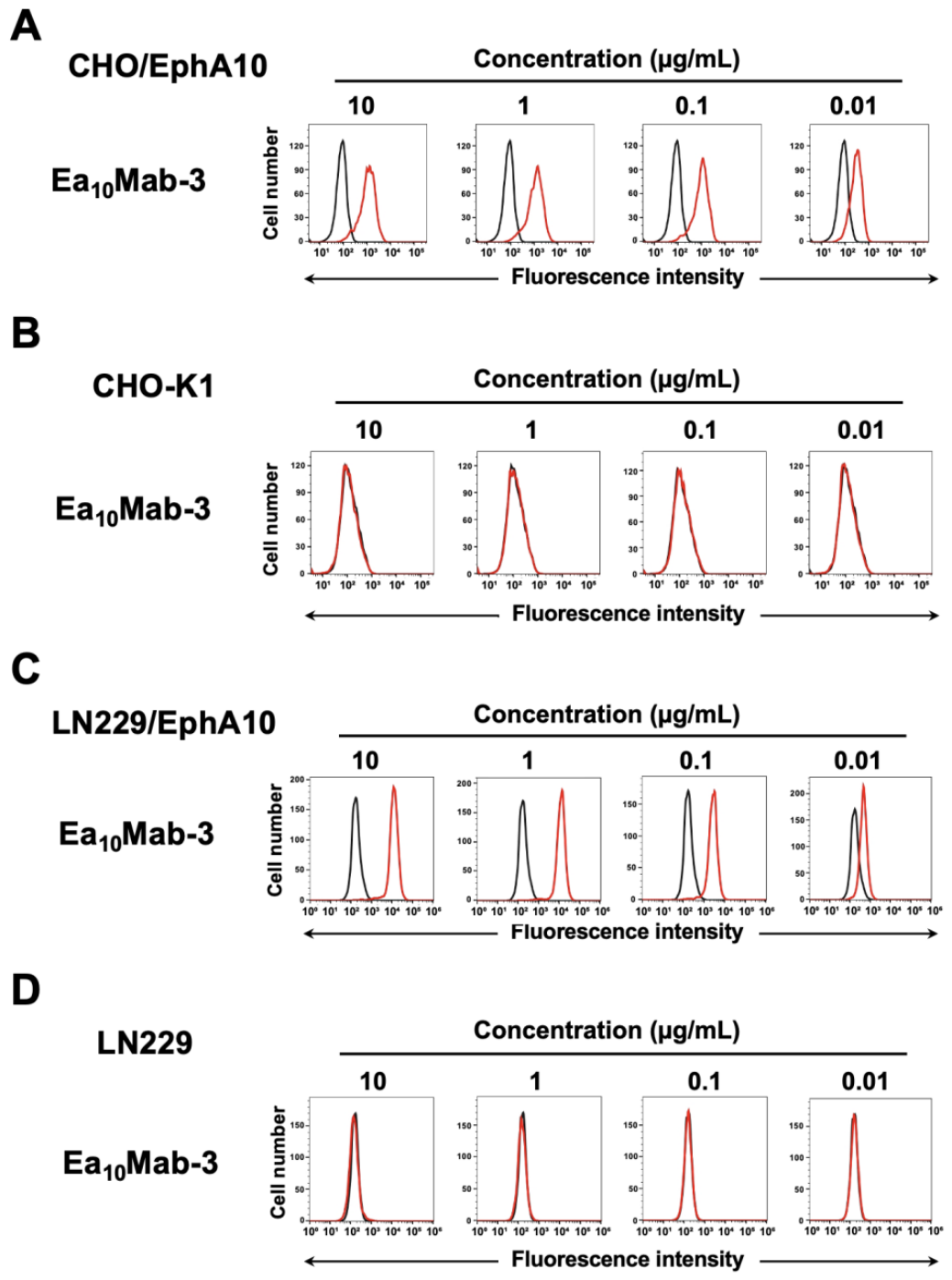
Figure 4.
Evaluation of the KD values of Ea10Mab-3. CHO/EphA10 (A) and LN229/EphA10 (B) were suspended in serially diluted Ea10Mab-3. After treatments of Ea10Mab-3, cells were treated with Alexa Fluor 488-conjugated anti-mouse IgG. Subsequently, the geometric mean values from the fluorescence data were obtained. The KD values were calculated using GraphPad PRISM 6 software.
Figure 4.
Evaluation of the KD values of Ea10Mab-3. CHO/EphA10 (A) and LN229/EphA10 (B) were suspended in serially diluted Ea10Mab-3. After treatments of Ea10Mab-3, cells were treated with Alexa Fluor 488-conjugated anti-mouse IgG. Subsequently, the geometric mean values from the fluorescence data were obtained. The KD values were calculated using GraphPad PRISM 6 software.
Disclaimer/Publisher’s Note: The statements, opinions and data contained in all publications are solely those of the individual author(s) and contributor(s) and not of MDPI and/or the editor(s). MDPI and/or the editor(s) disclaim responsibility for any injury to people or property resulting from any ideas, methods, instructions or products referred to in the content. |
© 2026 by the authors. Licensee MDPI, Basel, Switzerland. This article is an open access article distributed under the terms and conditions of the Creative Commons Attribution (CC BY) license (http://creativecommons.org/licenses/by/4.0/).
Copyright: This open access article is published under a Creative Commons CC BY 4.0 license, which permit the free download, distribution, and reuse, provided that the author and preprint are cited in any reuse.


