

Submitted:
03 June 2026
Posted:
04 June 2026
You are already at the latest version
Abstract
Proteins and polysaccharides represent fundamental biopolymers in food systems, whose interactions critically determine structural and nutritional properties. While conventional reviews have extensively examined protein-polysaccharide complexes (PPC), few have systematically addressed the role of modern physical processing techniques, particularly ultrasound, in modulating these interactions. As an emerging non-thermal technology, ultrasound induces unique cavitation and mechanical effects that profoundly influence both covalent and non-covalent interactions between proteins and polysaccharides, enabling the formation of novel structural complexes with enhanced functional attributes. This review uniquely focuses on the mechanistic pathways through which ultrasound promotes protein-polysaccharide complexation, systematically detailing its impact on covalent and non-covalent interactions, and resultant techno-functional properties such as solubility, emulsification, and foaming. It further explores innovative applications of these complexes across emulsions, gels, bioactive compound encapsulation, and edible packaging films. Critically, this work identifies specific future research priorities, including the correlation between ultrasound parameters and interaction dynamics, synergistic use of ultrasound with complementary processing methods, structural identification of novel conjugates, and in vivo digestion and safety evaluation of ultrasound-modified complexes. By integrating mechanistic insights with application-oriented analysis, this review provides a foundational framework for advancing the design of functional protein-polysaccharide systems using ultrasound, supporting ongoing innovation in sustainable food science.
Keywords:
protein-polysaccharide complexes
; ultrasound
; covalent and non-covalent interaction
; techno-functional properties
; food applications
1. Introduction
Proteins and polysaccharides constitute two essential classes of biological macromolecules in food systems. Natural proteins, predominantly sourced from animal-derived products (e.g., meat, fish, dairy) and plant-based materials (e.g., legumes, nuts), serve dual roles as nutrient providers and functional modulators [1]. Their unique three-dimensional conformations govern physicochemical properties that directly influence textural characteristics, flavor retention, and processing stability. Polysaccharides, which are complex carbohydrates composed of monosaccharide units linked by glycosidic bonds, are primarily extracted from diverse sources such as cereal grains, tubers, and fruits [2]. Common polysaccharides like starch [3], sodium alginate [4] pectin [5], and chitosan [6] are widely utilized in food and biomedicine due to their abundance, renewability, biodegradability, and health-promoting effects, such as prebiotic activity and immune modulation. Their broad applications span food systems (e.g., as thickeners, stabilizers, and edible films) and biomedical fields (e.g., drug delivery carriers), underscoring their functional versatility [7].
Recent investigations indicate that protein-polysaccharide complexes (PPC) not only preserve the nutritional attributes of their constituent macromolecules but also demonstrate enhanced functional characteristics compared to individual components (Figure 1A) [8,9]. These complexes play a crucial role in controlling the macroscopic properties of food, such as stability, texture, and flavor, and are instrumental in developing delivery systems for bioactive compounds [10], producing edible packaging [11], and supporting biological functions [12]. The formation of these complexes relies on various intermolecular interactions, including covalent bonds, electrostatic forces, hydrophobic interactions, hydrogen bonding, and van der Waals forces, which are influenced by factors such as biopolymer concentration, pH, and ionic strength [13]. Therefore, it is essential to develop efficient strategies for precisely manipulating the interactions between proteins and polysaccharides to fabricate multi-functional complexes.
The emergence of interdisciplinary approaches has promoted the application of advanced physical processing technologies, including ultra-high pressure [14], microwave [15], cold plasma[16] and ultrasound [17], into food research. Among these, ultrasound stands out as an eco-friendly, efficient, and versatile technology that has been extensively applied in extraction [17], enzymatic hydrolysis [18], and fermentation [19]. Substantial evidence indicates that ultrasound can modify the structural characteristics of various proteins and polysaccharides, such as soy protein isolate (SPI) [20], Beef Tenderloins protein [21], pectin [22] and starch [23], thereby modulating their physicochemical and techno-functional properties. Furthermore, bibliometric analysis of Web of Science literature over the past decade (Figure 1B) reveals a consistent growth in publications related to ultrasound-treated proteins, polysaccharides, and their binary complexes, reflecting increasing recognition of this field. However, studies focusing on individual components significantly outnumber those dedicated to binary composite systems. This disparity not only highlights a notable research gap but also underscores the considerable potential for investigating ultrasound-mediated PPC.
While previous reviews have covered the general effects of ultrasound on individual biopolymers or traditional complexation methods for PPC [24,25], a critical and systematic examination of the specific role of ultrasound in driving and modulating protein-polysaccharide interactions is notably absent from the literature. Existing reviews often treat ultrasound as a peripheral technique or focus narrowly on its application in modifying single components, thereby failing to address the unique synergistic effects and mechanistic pathways that emerge specifically in binary composite systems under sonication. To the best of our knowledge, no comprehensive review has hitherto been dedicated to synthesizing the mechanisms, functional property enhancements, and diverse applications of complexes formed specifically via ultrasound-induced interactions between proteins and polysaccharides. This critical gap is explicitly highlighted in the comparative overview provided in Table 1, which delineates the unique contributions of this review against the backdrop of earlier studies.
Therefore, this review aims to address this gap by elucidating the mechanistic pathways through which ultrasound promotes both covalent and non-covalent interactions between proteins and polysaccharides. It systematically details the effects of ultrasound on the functional properties of the resulting complexes, such as solubility, emulsification, and foaming capacity, and explores their advanced applications in emulsions, gels, bioactive compound encapsulation, and packaging films. Finally, specific future research priorities are outlined to guide the development of innovative and sustainable food systems based on ultrasound-assisted PPC.
2. Underlying Mechanisms of Ultrasound in the Formation of PPC
2.1. Acoustic Cavitation, Mechanical and Chemical Effects
Ultrasound is defined as an elastic wave with a vibration frequency exceeding the upper threshold of human auditory perception, typically from 16 kHz to 10 MHz [32]. In protein-polysaccharide systems, high-intensity ultrasound (20–100 kHz, 10–1000 W/cm²) operates primarily through three interrelated mechanisms, namely cavitation, mechanical, and chemical effects, with acoustic cavitation being the foundational phenomenon [33,34]. This implosive collapse generates extreme local conditions, including temperatures of 2000–5000 K and pressures of 300–1200 bar, and gives rise to intense shear forces, micro-jets, and turbulence [35,36]. The extreme local conditions and intense physical forces generated by cavitation bubble collapse are directly responsible for the prominent mechanical effects. This combination preferentially disrupts rigid structural elements in biopolymers, promoting protein unfolding and polysaccharide scission [37,38]. The resultant increase in molecular flexibility and exposure of buried functional groups, coupled with cavitation-induced micro-turbulence, collectively enhance molecular interaction and complex formation by dramatically increasing collision frequency and reducing diffusion limitations [27]. Beyond these structural and kinetic impacts, ultrasound also generates significant thermal and chemical effects. The propagation of ultrasound inevitably induces thermal effects due to continuous energy absorption, and an appropriate temperature rise can facilitate faster reaction rates and boost enzyme activity [39]. Concurrently, the radical species generated from acoustic cavitation can initiate specific chemical interactions, such as facilitating the covalent conjugation between proteins and polyphenols, and promoting the Maillard reaction between proteins and polysaccharides [40]. These interconnected mechanisms are exemplified in practical applications. For instance, the work by Ding et al. on soybean protein isolate demonstrates how cavitation and mechanical effects synergistically enhance extraction efficiency and modify protein structures [41]. Similarly, the improved grafting efficiency in tea pectin-egg white protein conjugates [42] and the accelerated Maillard reaction in sweet potato protein hydrolysates underscore the critical role of ultrasound-induced chemical and thermal effects in improving reaction efficiency and product functionality [43]. It is worth noting that while ultrasound, high-pressure, and cold plasma all fall under the umbrella of non-thermal physical processing technologies, their mechanisms and resultant effects on protein-polysaccharide systems differ markedly. High-pressure processing induces conformational changes in biopolymers through uniform hydrostatic pressure, often enhancing hydrogen bonding and hydrophobic interactions without covalent bond formation [44]. Cold plasma modifies surface chemistry via reactive oxygen and nitrogen species, promoting cross-linking and functional group oxidation [45]. In contrast, ultrasound combines mechanical shear, microjetting, and free radical generation, enabling both structural disruption and covalent conjugation (e.g., Maillard reaction) in a single treatment. These differences underscore the need for technology-specific optimization when designing functional PPC.
2.2. Optimization of Ultrasonic Parameters for the Complex Formation
To achieve optimal processing results, various ultrasound working parameters such as ultrasound mode, power, frequency, working time, and amplitude are extensively researched. The majority of research has conducted single-factor experiments or orthogonal tests to refine the ultrasound parameters for optimal processing outcomes [46]. Manoj et al. investigated the preparation of whey protein isolate-gellan gum complexes using ultrasound-assisted thermal treatment [47]. Through single-factor experiments, they identified the optimal ultrasound treatment conditions for the degree of glycation of the conjugate as a power of 400 W, a temperature of 70°C, a duty cycle of 50%, and a total treatment time of 60 min. These parameters directly influence the extent of structural modification in proteins and polysaccharides, thereby affecting the interaction forces and functional properties of the resulting complexes.
Furthermore, in alignment with the varied methodologies for ultrasound generation, two principal types of ultrasound equipment have been developed, namely probe-based ultrasound system and bath-based ultrasound system (Figure 2B) [48]. The choice of equipment significantly affects the efficiency of PPC formation. Probe ultrasound has extensive applications in the treatment of small volume samples, as its piezoelectric transducer can be directly immersed into the solvent. In comparison to the ultrasound bath, the ultrasound probe exhibits a more robust mass transfer effect and greater ultrasound power. This is primarily because the ultrasound probe should be directly immersed in the solution, which enhances the contact area with the material and minimizes mass transfer loss [49]. This is particularly beneficial for promoting interactions between proteins and polysaccharides. Although the ultrasound apparatus of the probe presents certain inherent drawbacks, such as the significant rise of the temperature in the treated sample that could negatively impact its integrity, as well as the inconsistency in the ultrasound exposure received by the sample [50]. In addition to the aforementioned ultrasound equipment, our research group has also innovated several novel ultrasound devices, including pulsed ultrasound equipment, swept frequency ultrasound equipment, sequential multi-frequency ultrasound equipment, and synchronous multi-frequency ultrasound equipment, among others, which have been thoroughly detailed in previous reviews [51]. These advanced systems offer improved energy distribution and treatment uniformity, which are advantageous for controlling the interaction between proteins and polysaccharides. In contrast to fixed frequency ultrasound, the energy distribution of sweep frequency and multi-frequency ultrasound exhibits greater uniformity, facilitating a more effective resonance within the material [52]. A novel dual-frequency (20/40 kHz) pulsed ultrasound strategy was employed to fabricate zein-pectin nanoemulsions for kaempferol loading [53]. This approach proved more effective than the conventional single-frequency continuous mode, yielding superior outcomes in key metrics including EAI, ESI, embedding rate, antioxidant activity (hydroxyl radical scavenging), zeta potential, and particle size. The implosion of cavitation bubbles induced by low-frequency irradiation has the potential to generate not only new cavitation nuclei for its own process but also for other ultrasound irradiations. Consequently, the implementation of multi-frequency operation may yield a greater cavitation output compared to conventional mono-frequency irradiation [54]. Generally speaking, by focusing on various food raw materials, a meticulous design of ultrasound equipment that leverages the inherent properties of ultrasound can yield more vigorous and uniform cavitation activities, presenting promising opportunities for enhancing protein–polysaccharide interactions in food production and related scientific research.
3. Ultrasound-Assisted Preparation of PPC by Changing Intermolecular Interactions
It is well known that there may be synergistic or antagonistic interactions between different types of biopolymers, resulting in great changes in the functional properties of PPC. The formation of PPC is mainly through intermolecular interactions, which can be divided into two types of intermolecular non-covalent and covalent forces[55,56]. Proteins and polysaccharides are macromolecules with spatial structure. The effect of ultrasound on PPC systems essentially involved altering the structures of native macromolecular proteins and polysaccharides to modulate the exposure of interaction sites, thereby influencing their intermolecular interactions (Figure 3A). An in-depth understanding of how ultrasound regulates the interaction between proteins and polysaccharides will be conducive to the manipulation of novel structures and physicochemical properties of PPC in food systems.
3.1. Ultrasound-Assisted Preparation of Non-Covalent PPC (NPP)
The non-covalent interaction between proteins and polysaccharides often transpires in solution, leading to a homogeneous or heterogeneous state, which may result in one of the configurations shown in Figure 3B. This process of dynamic equilibrium encompasses electrostatic contacts, hydrophobic interactions, van der Waals forces, or hydrogen bonds, contingent upon the characteristics of the biopolymers and the ambient circumstances [57]. At low concentrations of proteins and polysaccharides in the solution, both components are co-soluble and stable owing to the prevailing mixing entropy [57,58]. With a rise in biopolymer concentration, either association or separation can transpire. A robust attraction exists between oppositely charged protein and polysaccharide molecules, leading to their electrostatic complexation [57]. This process initially results in the formation of soluble complexes that can be stabilized in solutions. As the system's free energy decreases, the primary soluble macromolecular complex further interact with each other, forming electrically neutral aggregates, which culminates in phase separation, referred to as aggregation or associative phase separation [58]. Conversely, biopolymers with identical charges would induce significant electrostatic repulsion between protein and polysaccharide molecules, leading to phase separation and the establishment of a biphasic solution, wherein each phase comprises a biological macromolecule [59]. Moreover, the hydrogen bond is a weak contact force resulting from the partial positive charge of a hydrogen atom attracting atoms with greater electronegativity in a different molecule. The pH value of a solution above the protein's isoelectric point can impart a negative charge to the protein, similar to that of the polysaccharide, leading to the formation of a hydrogen bond between the protein and the polysaccharide. The van der Waals force arises from weak electrostatic interactions between permanent and instantaneous dipoles of adjacent molecules, and when the molecules approach one another, the gravitational attraction intensifies. The connection between the hydrophobic groups of proteins and polysaccharides is termed hydrophobic interaction, often occurring when the hydrophobic groups are exposed owing to structural changes in proteins and polysaccharides, influenced by the external environment [60].
The environmental conditions and physicochemical properties of proteins and polysaccharides significantly influence the interaction of NPP. For instance, Wang, et al. [61] indicated that hydrogen bonding was the primary force in the interaction between okra polysaccharide and myofibrillar protein. The incorporation of okra polysaccharide revealed the hydrophobic groups of myofibrillar protein and enhanced the quantity of hydrophobic interactions between the two components. The heat treatment of myofibrillar protein, along with the incorporation of varying proportions of okra polysaccharide, altered the interactions between these components to different extents. This included changes in ionic bonds, hydrogen bonds, disulfide bonds, and hydrophobic interactions, which in turn influenced the gel properties of myofibrillar protein. In recent years, ultrasound has been increasingly utilized to modulate the intermolecular forces between proteins and polysaccharides. Kang et al. conducted a study on the impact of ultrasound on the mechanical, structural, and physicochemical properties of pullulan/oat protein/nisin composite film. The findings indicated that ultrasound disrupted the original macromolecular structure of pullulan and oat protein, significantly enhancing the intermolecular hydrogen bonding force [62]. This alteration resulted in the rearrangement and aggregation of macromolecular substances. Numerous scientific reports indicate that hydrogen bonds, electrostatic interactions, and hydrophobic effects serve as the primary driving forces behind the formation of resveratrol-zein-gum Arabic colloidal nanoparticles. Furthermore, ultrasound treatment notably improved the hydrogen bond and electrostatic interaction, leading to the development of ternary composite nanoparticles characterized by small particle size and uniform density [63]. Although numerous studies confirm ultrasound’s ability to modulate non-covalent interactions [64,65,66], the direction and magnitude of these effects appear context-dependent and occasionally contradictory. For instance, while Kang et al. reported enhanced hydrogen bonding in pullulan/oat protein composites [47], other systems exhibited ultrasound-induced disruption of electrostatic complexes due to cavitation shear [67]. This variability suggested that ultrasound’s impact depended critically on the relative strength of existing interactions and the structural rigidity of the biopolymers involved. A major limitation in this domain is the indirect nature of interaction measurements (e.g., through spectroscopic shifts or solubility changes), which provided circumstantial evidence but failed to quantify binding affinities or kinetics directly. Future work should employ techniques like isothermal titration calorimetry or surface plasmon resonance to establish causative relationships between ultrasonic parameters and interaction energetics.
3.2. Ultrasound-Assisted Preparation of Covalent PPC (CPP)
The covalent interaction that occurs between proteins and polysaccharides fundamentally constitutes a glycosylation reaction. The creation of covalent complexes between proteins and polysaccharides can enhance their rheological characteristics, emulsifying capabilities, foaming abilities, thermal stability, and various other processing attributes, surpassing the performance of the individual components alone [68,69]. The preparation methods of CPP usually include chemical crosslinking, Maillard reaction and enzyme crosslinking (Figure 3C). In general, a condensation reaction transpires between the neutral amino group of a protein molecule, particularly the z-amino group of lysine, and the electrophilic carbonyl group of a polysaccharide molecule, resulting in the formation of N-glucosamine and the release of a water molecule. This unstable N-glucosamine experiences an irreversible Amadori electron rearrangement, resulting in the formation of a PPC characterized by a 1-amino-1-deoxyketo sugar structure (Figure 3D) [70]. In the context of preparing PPC through the Maillard reaction, it is noteworthy that polysaccharides, characterized by their diminished reducibility and pronounced molecular steric hindrance, tend to limit the Maillard reaction to its preliminary phase. This phenomenon effectively hinders the formation of colored compounds [71]. Moreover, the steric hindrance presented by polysaccharides serves to inhibit the transition denaturation and aggregation of proteins to a degree, thereby safeguarding the intrinsic functional properties of the proteins themselves [82]. Moreover, the conditions under which the Maillard reaction occurs are relatively gentle. It has been observed that, aside from the newly established covalent bond (N-C), the overall structure of the original protein molecule remains largely unaltered, and no detrimental or toxic byproducts of the Maillard reaction have been produced. The enzymatic method for the preparation of CPP offers notable advantages, including high efficiency, robust safety, and elevated specificity. The enzymes frequently employed include peroxidase, microbial transglutaminase, and laccase. Using the preparation of CPP via glutaminase as an example, the underlying principle involves the catalysis of the acyl transfer reaction between the acyl donor present in the protein polypeptide chain and the primary amino group on the amino sugar. This process aims to incorporate the sugar molecule with the primary amino group into the protein molecule, thereby resulting in the formation of the glycosylated protein[83,84].
Ultrasound is extensively employed to enhance the covalent interaction between proteins and polysaccharides for the preparation of CPP. Over the last ten years, the synthesis of CPP through ultrasound-assisted Maillard reaction has garnered increasing interest within the food industry. The pertinent research is presented in Table 2, which indicates that the PPC synthesized through ultrasound-assisted Maillard reaction exhibit superior performance compared to the products derived from conventional methods. For instance, ultrasound treatment not only accelerates the glycosylation reaction between whey protein isolate (WPI) and gum Arabic (a grafting degree of 11.20% could be achieved with only 20 min of ultrasound treatment, compared to 48 hours required for conventional heating) (Figure 4A), but also enhanced the solubility and emulsifying activity of the resulting complexes [85]. In a separate work, the enzymatic hydrolysate derived from chicken liver protein underwent ultrasound treatment at an output power of 200 W for a duration of 12 min, which was subsequently combined with xylose in a 1:1 ratio to facilitate the Maillard reaction. The findings indicated that the application of ultrasound treatment resulted in an enhanced degree of the Maillard reaction, optimized amino acid utilization, and diversified the array of volatile compounds produced [69]. The combination of myofibrillar protein and dextran underwent ultrasound treatment prior to the wet thermal reaction and in contrast to traditional heating methods, ultrasound treatment increased the degree of graft and the content of advanced Maillard reaction products in a reduced timeframe. The explanation was linked to a significant unfolding of the protein due to ultrasound treatment, the reduction of α-helix content, and the increased exposure of a large number of amino acids containing hydrophobic and sulfhydryl groups to the glycosylation reaction (Figure 4B-C) [86]. This was substantiated through secondary structure analysis, endogenous fluorescence analysis, and browning intensity analysis experiments. It is worth noting that, in addition to influencing the flavor, color, and structure of the formed PPC, Habinshuti et al. also reported that ultrasound altered the molecular weight distribution of the conjugates, leading to a higher proportion of lower molecular weight fractions (200–3,000 Da) [43] (Figure 4D). Moreover, ultrasound was also employed to facilitate the combination of transglutaminase for the treatment of Qingke protein. The findings indicated that ultrasound enhanced the cross-linking degree of Qingke protein through the action of transglutaminase, significantly augmenting its water and oil holding capacity, apparent viscosity, foaming ability, and EAI. It was unexpected to discover that when the quantity of gluten incorporated ranged from 60 g/kg to 70 g/kg, the noodle quality of Qingke protein closely resembled that of wheat noodles by treating with a combination of ultrasound and transglutaminase, which might be attributed to the alteration of the Qingke protein structure [87]. The alteration of peanut protein structure through ultrasound synergistic transglutaminase has significantly enhanced the quality of its resultant products [88]. It is readily apparent that a significant portion of current research regarding ultrasound-assisted preparation of CPP focuses on the refinement of ultrasound parameters, as well as the exploration of the structural and functional characteristics of modified proteins. A significant, though underdiscussed, limitation of ultrasound-assisted Maillard reaction is the poor controllability over reaction regioselectivity and product composition. While ultrasound accelerates glycosylation, it also promotes side reactions, including advanced glycation end product (AGE) formation, which may impart undesirable color, flavor, or potential health concerns. The study by Habinshuti et al. [43] revealing a shift toward lower molecular weight fractions underscores ultrasound’s potential to fragment biopolymers, raising questions about whether functional improvements come at the cost of structural integrity. Moreover, current literature predominantly reports successful cases, leaving failures or optimization challenges largely undocumented. This publication bias limits understanding of ultrasound’s boundaries. Future research should pay more attention on the separation, purification, and identification of novel CPP substances synthesized through ultrasound-assisted methods, followed by the assessment of their safety or toxicity.
4. Techno-Functional Properties of Ultrasound-Assisted PPC
It is widely recognized that PPC are extensively utilized in the food industry. These substances serve as alternatives to fat, acting as emulsifiers, thickeners, or stabilizers, thereby improving the texture and rheological properties of food products. The advancement of PPC in functional foods holds considerable importance, as it can contribute to the structuring of these foods and enhance their functional properties.
4.1. Solubility Enhancement Through Ultrasound-Assisted Complexation
Solubility, a fundamental characteristic of protein, is intricately linked to its functional qualities, including emulsification and dispersion [89]. The solubility of protein directly influences its application in meat processing, beverage production, and other food industries. The equilibrium between hydrophilicity and hydrophobicity on the protein surface can influence protein solubility. A reduction in hydrophobic points and an elevation in charge density enhance the water solubility of protein. Furthermore, at pH levels below and beyond the isoelectric point, increased ion hydration and electrostatic repulsion result in enhanced protein solubility. The enhancement of protein structure can directly influence the surface charge and hydrophobicity of protein, thereby impacting its solubility [90]. In our recent work, it was discovered that ultrasound-assisted pH adjustment therapy significantly enhanced the levels of β-sheet, ultraviolet absorbance and fluorescence intensity in the mulberry leaf protein, resulting in a loose and disordered microstructure of the sample [91]. Consequently, the solubility of the mulberry leaf protein enhanced by 281.74% as compared with the traditional method. Multiple studies have shown that the covalent bonding between proteins and polysaccharides may enhance their solubility, leading to the widespread usage of polysaccharides with high solubility throughout a wide range of pH spectra. The solubility of oat protein isolate (OPI) was markedly enhanced after covalent contact with Pleurotus ostreatus β-glucan during wet heating. At a pH of 5.0, which is near its isoelectric point of 4.7, the solubility of OPI and its conjugates could reach 10.25% and 50.846%, respectively. The conjugation process altered the lowest solubility of OPI to a more acidic pH, around 3.0 [92]. In a parallel study, researchers observed a comparable result, revealing that the conjugation of zein hydrolysate with chitosan oligosaccharides significantly enhanced its solubility within the pH range of 5-7 [93].
Moreover, ultrasound-assisted glycosylation has been shown to be an efficient, safe, and straightforward commercial method for generating highly soluble proteins. The solubility of ovalbumin after ultrasound-assisted glycosylation was much superior to that of the native protein group, and the solubility progressively improved with extended reaction time, achieving maximum solubility at 120 min [94]. After the ultrasound-assisted glycosylation of rice protein and dextran, the solubility of rice protein significantly increased. Ultrasound methods accelerated the glycosylation process and produced a greater quantity of high molecular weight components compared to the traditional hydrothermal method, resulting in an increased grafting degree and a reduced percentage of arginine and lysine [95]. The enhanced solubility, as previously noted, may be elucidated by many subsequent factors. The attachment of hydrophilic polysaccharides is a universally acknowledged strategy, but the efficacy is highly dependent on the molecular weight and chain conformation of the polysaccharide. For instance, large, bulky polysaccharides might provide steric stabilization but could also hinder effective conjugation or mask functional groups if not properly aligned through ultrasonic mixing (Figure 5A). Furthermore, while ultrasound generally promotes glycosylation, excessive energy input can sometimes lead to over-aggregation or surface cross-linking, which paradoxically reduces solubility, as hinted at by the structural disorder observed in some protein-polysaccharide systems. This non-linear relationship between ultrasound intensity and solubility enhancement underscores the need for precise parameter control. A significant knowledge gap remains in predicting the exact combination of ultrasonic parameters and biopolymer pairs that will reliably shift the isoelectric point and maximize solubility across a broad pH range, rather than in isolated conditions.
4.2. Emulsifying Properties Tailored by Ultrasound Treatment
Emulsification is the process whereby one liquid is evenly disseminated in another immiscible liquid, such as oil in water, in the form of minute droplets, resulting in an emulsion, facilitated by the addition of a suitable emulsifier and strong agitation [96]. Due to their unique amphiphilic and nutritional properties, proteins and polysaccharides are among the most accessible natural components used in food emulsions. Nonetheless, the emulsion cannot be maintained for a prolonged duration by protein or polysaccharide alone. Certain factors in food processing and the internal environment may influence protein stability, like inappropriate pH levels, ionic strength, digestive enzymes, and elevated temperatures that may lead to protein precipitation, aggregation, hydrolysis, and denaturation, ultimately destabilizing the created emulsion. Despite with excellent biocompatibility, stability, and low toxicity, several edible polysaccharides possess low surface activity and high hydrophilicity, rendering them inadequate as emulsifiers. The unique emulsifier resulting from the interaction between protein and polysaccharide has garnered significant interest, since it optimally utilizes the benefits of both components and successfully stabilizes the emulsion [97]. Reports indicate that the synthesized amphiphilic PPC can be securely affixed at the oil-water interface via the protein's hydrophobic region, resulting in the formation of a viscoelastic layer, while the polysaccharide region offers substantial steric hindrance to inhibit flocculation and coalescence. Mahdi, et al. [98] investigated the impacts of gum arabic, maltodextrin, and whey protein on the characteristics of oil-in-water emulsions containing citrus essential oil. The findings indicated that the quality of the emulsion produced by the PPC wall material surpassed that of the emulsion created using a single wall material. Another research explored the emulsifying characteristics of Maillard reaction products derived from myofibrillar protein and dextran. They discovered that the molecular weight of dextran (40, 70, and 150 kDa) was significantly correlated with the emulsifying activity of the resultant product, with the formulation containing 70 kDa dextran exhibiting the optimal emulsifying capacity and stability [86].
Compared to conventional methods, ultrasound treatment markedly improved the emulsifying capacity of the rapeseed protein isolate-dextran conjugate [99]. This enhancement primarily resulted from ultrasound-facilitated effective conjugation between the components, which promoted the formation of additional hydroxyl groups and generated honeycomb-like surface structures, consequently enhancing system hydrophilicity; these synergistic structural modifications collectively contributed to a substantial increase in interfacial protein adsorption (Figure 5B). The slit divergent ultrasound was shown to augment the glycosylation process between SPI and lentinan by altering the secondary structure of soybean protein isolate, hence enhancing its utilization rate. The physical stability of the emulsion complex was significantly enhanced [100]. Two prominent indices that characterize the emulsifying properties of PPC are the emulsifying activity index (EAI) and the emulsion stability index (ESI). The former illustrates the protein's capacity to adsorb at the interface, whilst the latter demonstrates how the protein imparts strength to the emulsion, enabling it to endure structural alterations over a certain duration [101]. Multi-frequency power ultrasound was used to modulate the complexation of sodium caseinate and pectin to enhance the emulsifying characteristics of the resultant complex. The findings indicated that the EAI and ESI of the caseinate-pectin complex were elevated by 33.12% and 7.27%, respectively, after ultrasound treatment at a frequency of 60 kHz, a power density of 50 W/L, and a duration of 25 min [102]. The emulsifying properties of SPI-citrus pectin complexes are influenced by ultrasound operational parameters, demonstrating a dose-dependent relationship. In a systematic investigation by Ma et al. [103], the EAI and ESI of SPI-CP complexes reached maximum values at an ultrasonic power of 630 W, with increases of 44.1% and 24.68%, respectively, whereas a higher power of 720 W resulted in diminished performance. The dose-dependent relationship between ultrasound intensity and emulsification enhancement presents both an opportunity and a limitation. As illustrated by Ma et al., exceeding an optimal power threshold (630 W for SPI-CP) diminishes emulsion stability, likely due to protein aggregation and interfacial film disruption [103]. This non-monotonic response pattern is frequently observed but rarely predictive, complicating scale-up and generalization. Furthermore, many studies evaluate emulsification under idealized laboratory conditions (e.g., pure oil phases, standardized pH), overlooking performance in complex food matrices containing salts, sugars, or competing surfactants. The exceptional EAI and ESI values reported for model systems may not translate directly to real foods, where interfacial competition and environmental stressors challenge long-term stability. This pattern was consistent with observations by Liu et al. [104], who reported that suboptimal ultrasonic conditions did not improve the emulsifying properties of sodium caseinate-pectin complexes, indicating a generalizable nonlinear effect of ultrasound on protein-polysaccharide systems. Collectively, these studies demonstrate that ultrasound-mediated improvements in emulsifying properties are constrained to a specific operational range rather than following a monotonic trend. A key challenge in optimizing this technology lies in balancing the constructive and disruptive effects of cavitation. Currently, identifying optimal ultrasonic parameters for different PPC combinations relies largely on empirical approaches, as predictive models remain underdeveloped. Future work should aim to establish quantitative relationships between ultrasonic parameters, such as power, frequency, duration, and mode, and structural characteristics of the complexes, including particle size distribution, interfacial behavior, and molecular flexibility. Advancing the mechanistic understanding of how ultrasound affects protein unfolding, polysaccharide adsorption, and interfacial rheology will facilitate a shift from empirical optimization to rational design, ultimately supporting the development of efficient and adaptable ultrasonic processing strategies for diverse emulsion-based applications.
4.3. Foaming Characteristics Improved via Ultrasound Modification
The stability of foam formation enhances the product's structure and sensory qualities. Mayonnaise is a widely recognized culinary item that relies on its capacity to foam, serving as a concentrated emulsion of oil and water. Proteins are extensively utilized in aeration systems due to their unique structure, which features hydrophilic groups oriented towards the water phase and hydrophobic groups directed towards the air phase [105]. The foaming capacity, often referred to as foaming capacity and foam stability, represents essential characteristics of protein foams. Foaming stability is essential for maintaining the desired appearance of the foam and can be assessed by evaluating the reduction in foam volume over time. In contrast, foaming capacity pertains to the solution's ability to incorporate air, which is generally measured by observing the variation in foam volume [106]. For optimal foam formation and stability, proteins must diffuse rapidly and adsorb effectively at the air-water interface to establish a robust adsorption layer. The adsorption of protein has been demonstrated to be closely dependent on the interaction of particle size, surface hydrophobicity, molecular flexibility, and surface charge [107]. Natural proteins present challenges in stabilization at the interface due to inherent structural defects and imbalances in surface hydrophilicity. A significant body of research has demonstrated that the foaming quality of proteins can be enhanced through the incorporation of hydrophilic polysaccharides or the application of ultrasound technology to alter their surface hydrophobicity. Ultrasound-assisted glycosylation treatment enhanced the foaming ability of brewer's grains protein from 82.22% to 165.10%, while foam stability improved from 10.60% to 131.20%. The foam collapse rate of proteins treated with ultrasound-assisted glycosylation was found to be lower compared to those subjected to either ultrasound or traditional wet-heat glycosylation treatments. It can be concluded that ultrasound and glycosylation are effective methods for producing brewer's grains protein-maltose conjugates with outstanding foaming properties [108].
The application of ultrasound-assisted pH-shifting treatment yielded optimal foam performance in chickpea protein isolate, a phenomenon attributed to the minimized particle size, zeta potential, interfacial tension, maximum solubility, and enhanced surface hydrophobicity of the treated protein [109]. Furthermore, the associated rise in free sulfhydryl content and α-helix content facilitated the adsorption of the treated protein at the gas-liquid interface, thereby contributing to the formation of a more stable foam. Typically, the three fundamental mechanisms contributing to foam instability are coalescence, disproportionation (coarsening), and drainage [82]. The adsorption of the PPC at the interface has the potential to create a more substantial and rigid barrier, thereby effectively postponing the foam's disproportionation. Moreover, the introduction of polysaccharides can enhance viscosity and obstruct liquid pathways, consequently diminishing drainage flow and thereby augmenting foam stability (Figure 5C). The investigation into whey protein-stabilized foam reveals that incorporating corn starch granules significantly improved the surface charge of the protein and the turbidity of the system. Additionally, as a microgel particle, corn starch granules augmented the mechanical properties of the interfacial protein film, consequently prolonging the foam's stability [110]. Additionally, the investigation into the impact of ultrasound-assisted incorporation of varying concentrations (0-0.8%, m/v) of flaxseed gum on the foaming characteristics of egg white protein revealed that the synergy between ultrasound and flaxseed gum significantly enhanced foaming stability. It is noteworthy that the application of ultrasound treatment in isolation enhanced the foaming capacity of the protein, albeit at the expense of the stability of the resultant foam. The incorporation of flaxseed gum resolved this limitation, which significantly diminished the sulfhydryl content and surface hydrophobicity of egg white protein while enhancing the average particle size and polydispersity index value, thus refining the protein's microenvironment and promoting foaming stability [111]. The observation that ultrasound treatment alone enhanced foaming capacity at the expense of stability suggested a potential mechanism whereby the process generated protein fragments that adsorbed rapidly but exhibited poor cohesion. The fact that incorporating polysaccharides such as flaxseed gum resolves this limitation demonstrates that the functional outcome stems from synergistic interactions with other compositional factors, not from ultrasound alone. This insight leads to a more constructive proposition, positing that ultrasound and polysaccharides play distinct yet complementary roles in modifying protein foaming properties. Consequently, future research should prioritize the systematic optimization of combined ultrasound and polysaccharide conditions, thereby moving beyond the fine-tuning of ultrasonic parameters alone to achieve precise enhancement of foam characteristics. Ultimately, the efficacy and stability of these model system-based findings within complex food matrices remain a critical unknown, which constrains their industrial applicability.
5. Application of Sonicated PPC in the Food Industry
Proteins and polysaccharides represent biodegradable biopolymers, characterized by a chain-like structure that bears resemblance to synthetic constructs. The fundamental components of these biopolymers consist of linear or branched/cross-linked nucleotides, amino acids, and various sugars. Previous research has demonstrated that ultrasound treatment can modify the secondary, tertiary, and spatial configurations of these composite units to a degree by enhancing molecular interactions, thereby influencing their functional characteristics, including gelation, foaming, emulsification, and film formation. The alterations in the functional characteristics of PPC induced by ultrasound can significantly influence their extensive utilization in food emulsions, drug delivery systems, packaging, and other pertinent domains (Figure 6). Therefore, we further discuss the effect of ultrasound on the applications of PPC, with expanded coverage of practical implementations, regulatory considerations, and safety aspects.
5.1. Ultrasound-Stabilized Emulsions Using Protein-Polysaccharide Complexes
Ultrasound has been shown to enhance the emulsification efficacy of PPC and to augment the stability of the resultant emulsion. The PPC combination may undergo ultrasound treatment, which indirectly influences the stability of the resulting emulsion by altering the intermolecular contact forces and the macromolecular structure of the complex. Following ultrasound treatment of the fish myofibrillar protein-xanthan gum mixture, a solution comprising 90% (v/v) ultrasound fish myofibrillar protein-xanthan gum mixture and 10% (v/v) soybean oil was emulsified at 18,000 rpm. The results indicated that the emulsion subjected to 300 W ultrasound exhibited optimal stability, minimal particle size, reduced surface tension (26.7 mNm⁻¹), and the highest absolute value of ζ-potential (25.4 mV), as corroborated by confocal laser scanning microscopy images [112].
Ultrasound treatment altered the electrostatic interaction between pectin and whey protein concentrate. Rheological and turbidimetric analyses indicated that ultrasound diminished the viscosity of the suspension and the dimensions of the biopolymer complex. The emulsion stabilized by the ultrasonically prepared complex exhibited shear-thinning behavior, with a slight increase in apparent viscosity corresponding to elevated oil content, remaining stable over a period of seven days [113]. Conversely, ultrasound may be used to treat the emulsion created by PPC, which directly influences the emulsion's stability. Zhao, et al. [114] employed an ultrasound processor to treat the crude emulsion generated by pea protein isolate-xylan conjugates. In comparison to pea protein isolate stabilized nanoemulsions, the emulsions resulting from ultrasound treatment exhibited a smaller average droplet size (189.4 ± 0.45 nm), a more uniform droplet distribution, a greater absolute zeta-potential value (44.8 ± 0.22 mV), and an increased interfacial protein adsorption content. An emulsion stabilized by SPI-pectin complexes underwent high-intensity ultrasound treatment, which demonstrated enhanced emulsion aggregation, decreased interfacial tension, and reduced apparent viscosity. Moreover, ultrasound treatment significantly decreased the creaming index and improved the storage durability of the emulsion [115]. Furthermore, high-intensity ultrasound facilitated the development of SPI-pectin emulsion gels by augmenting the interaction between SPI and pectin. Ultrasound treatment altered the crystallinity of the emulsion gel, resulting in a more homogeneous and denser structure. Ultrasound treatment significantly enhanced the water retention capacity, chemical stability, and bioavailability of the incorporated β-carotene in the emulsion gel [116]. The emulsion produced by ultrasound-assisted PPC exhibited superior emulsion performance, attributable to the following factors. Ultrasound facilitated the efficient binding of protein to hydrophilic polysaccharide, enhanced protein solubility, and elevated the effective concentration and mobility of protein in the aqueous solution. Secondly, ultrasound revealed the hydrophobic and hydrophilic groups of the protein by altering its shape. Conformational alterations also provided a more adaptable structure for proteins, enabling them to move and adsorb to the oil-water interface more rapidly than native proteins, and to reorganize at the interface membrane. Essentially, emulsion systems are extensively utilized in a wide range of food products, including meat products, beverages, sauces, mayonnaise, and dairy items such as ice cream, yogurt, and infant formula. For instance, Liu et al. investigated the use of water-in-oil-in-water (W/O/W) emulsion gels formed by sodium caseinate and sodium alginate as fat replacers in fermented sausages [117]. Their findings demonstrated that incorporating these emulsion gels improved the microstructure and texture of the sausages, while also reducing cooking loss, pH, and nitrite residue, alongside enhancing water-holding capacity and antioxidant activity. Similarly, Li et al. [118] employed whey protein emulsion gel particles as stabilizers and fat substitutes in low-fat yogurt, successfully producing yogurt with higher firmness and a denser structure compared to control samples. While numerous studies have highlighted the considerable potential of PPC systems in emulsion applications, practical research on the real-food application of emulsions stabilized by ultrasound-assisted PPC remains scarce [100]. While laboratory-scale results are promising, significant barriers impede industrial adoption of ultrasound-stabilized emulsions. Energy consumption for large-volume sonication remains prohibitive for low-value applications, and the scalability of uniform cavitation distribution in industrial reactors is technically challenging. Probe systems, though efficient, suffer from erosion and potential metal contamination, while bath systems exhibit variable spatial energy distribution. Moreover, most studies assess storage stability over days or weeks, whereas commercial products require months of shelf life, highlighting a critical gap between research and industrial. Nonetheless, this area holds significant promise and is of great importance for future advancements.
5.2. Ultrasound-Fabricated Gels and Texturized Foods
Over the last few decades, gels derived from food proteins, such as myofibrillar protein, SPI, and shrimp protein, along with polysaccharides like alginate, carrageenan, and chitosan, have been extensively applied to develop various food gel products like meat products, dairy items, gels, tofu, and more[119,120]. Polysaccharides and proteins are capable of forming gels independently, however, the resulting gel is susceptible to environmental influences like salt ions, pH, and heat, which can lead to a loss of its gel characteristics. In contrast to individual proteins or polysaccharides, gels formed from protein and polysaccharide combinations demonstrate superior efficacy in managing gel texture and exhibit a wider range of phase behavior. Additionally, the integration of the unique benefits of proteins with nutritional roles and polysaccharides exhibiting remarkable rheological properties guarantees that the composite gel possesses diverse structures and enhanced nutritional values. For instance, the characteristics of SPI gels are affected by various edible polysaccharides such as concentrated resins, xanthan gum, and carrageenan. The inclusion of polysaccharides, particularly xanthan gum, enhanced the support and creep recovery capabilities of the SPI gel. In comparison to the SPI gel, the resulting hybrid gel exhibited better water retention and a more robust network structure [121]. Additionally, hot gel polysaccharide and cold gel polysaccharide exhibited distinct effects on the gelling behaviors of potato protein. The addition of cold-set polysaccharides, such as agar and gellan gum, resulted in an increase in the shear modulus and hardness of the heated gels. In contrast, the incorporation of heat-set polysaccharides like methyl cellulose led to a decrease in these properties, especially at refrigerator temperatures. Following the mixing of potato protein and polysaccharide, a phase separation mechanism took place. Notably, the composite gel that included methyl cellulose experienced significant water loss during heating. This phenomenon may be attributed to the irreversible denaturation of the protein at elevated temperatures and the heightened hydrophobicity of the complex [122].
In the study of Chen, et al. [123], it was discovered that a suitable quantity of flaxseed gum might enhance the gel strength of SPI. Excessive flaxseed gum may induce gel structural disorder by phase separation, thus diminishing the stability of SPI gel. The current integration of protein and polysaccharide significantly enhances the gel characteristics of protein. Given the abundant yet underutilized resources of both protein and polysaccharide, research focused on optimizing the types of raw materials, their ratios, and the selection of gelation techniques for the sophisticated design of mixed food gel structures remains in its nascent stages. Ultrasound technology is an emerging non-thermal processing method that has shown efficacy in enhancing gel characteristics. Research indicates that ultrasound can enhance the interaction between kidney bean dietary fiber (KSDF) and duck myofibrillar protein (MP), thereby augmenting the physicochemical properties of the gel matrix, and the incorporation of 1% KSDF with 400 W ultrasound treatment markedly elevated gel strength by 109.58% and increased solubility by 213.42%. The ultrasound-mediated KSDF-MP contact significantly enhanced the hydrophobic interactions of proteins, resulting in a denser network structure of the MP gel [124]. Moreover, superior gelling properties were achieved when chicken plasma protein was subjected to ultrasound-assisted konjac glucomannan treatment. In comparison to untreated plasma protein gelation, the incorporation of konjac glucomannan and ultrasound treatment alone, the ultrasound-assisted konjac glucomannan treatment significantly improved the rheological characteristics, gel strength, and water retention capacity of the resultant gel, leading to the highest levels of hydrophobicity and disulfide bond content, which were the primary determinants influencing heat-induced gel formation [125]. The ultrasound-treated SPI-lemon pectin composite hydrogel demonstrated a denser and more organized structure, increased surface hydrophobicity, and enhanced adhesive strength compared to the untreated variant. Furthermore, the composite hydrogel sample subjected to ultrasound for 20 min was found to enhance the targeted release of Lactobacillus plantarum in the colon and increase the survival rate of probiotics during UV irradiation [126]. In summary, ultrasound treatment may enhance the gel characteristics of composite gels by altering the contact forces between proteins and polysaccharides, as well as the structure of the complex. Furthermore, Li et al.[127] employed ultrasound technology to fabricate an ovalbumin-gellan gum emulsion gel and systematically investigated the effect of ultrasonication time on its 3D printing precision. Their results revealed a non-linear relationship between ultrasonication duration and printing accuracy, which initially increased but subsequently decreased after a specific time point. The optimum printing accuracy (15%) was achieved at an ultrasonication time of 3.5 min, demonstrating that ultrasonic treatment significantly enhances the printability of emulsion gels. Although this study highlighted the potential of ultrasound in improving the printing performance of PPC gels, the practical application of such ultrasonically-prepared gels in food manufacturing remains limited. Future research should prioritize expanding the functional applications of ultrasound-assisted composite gels. Key directions include developing controlled release systems for nutrient delivery, advancing precision manufacturing through 3D food printing, and engineering satiety-enhancing functional foods. Such efforts are crucial for facilitating the transition of these advanced materials from laboratory-scale research to food industrial implementation.
5.3. Ultrasound-Enabled Delivery Systems for Bioactive Compounds
The inherent biological activities, diverse functional qualities, and potential health benefits of bioactive compounds have sparked considerable interest in their application within the food industry [128]. Nonetheless, their reliability and performance in industrial contexts are undermined by their vulnerability to environmental factors. Recent research indicates that encapsulation within natural biopolymers serves as an effective strategy for enhancing the functionality of bioactive compounds and their potential applications [129]. The PPC has demonstrated its efficacy as an appropriate encapsulation material, enhancing the environmental compatibility and stability of bioactive substances while facilitating controlled release throughout the drug delivery process [130]. Markman and Livney employed casein-maltodextrin conjugates to create nanocarriers for concentrated transparent beverages, successfully nano-encapsulating the hydrophobic nutrients vitamin D and epigallocatechin gallate within these formulations [131]. Soluble soybean polysaccharide and highly nutritious soybean protein isolate can create a novel type of environmentally friendly 'core-shell' nanocomposites via non-covalent electrostatic interaction for the delivery of hyperoxide. This system achieved an impressive loading rate of 85.56% at pH 3.5, effectively safeguarding the chemical stability of hyperoxide [132]. Carpenter and colleagues employed pea protein isolate along with polysaccharides to encapsulate α-tocopherol [133]. Research indicated that various polar polysaccharides, including gum arabic, tragacanth gum, and tara gum, along with the protein/polysaccharide ratio, influenced the particle size of the resultant nanoparticles, the microencapsulation efficiency, and the release dynamics of α-tocopherol. Moreover, the electrostatic interactions arising from varying polarities lead to intriguing acid stability within the formed ternary system at both 1:1 and 2:1 ratios of protein to gum arabic or tara gum, respectively. Notably, the mixture of pea protein isolates and tara gum exhibits a more robust gastrointestinal protective behavior compared to the pea protein isolate-arabic gum matrix. The physicochemical properties of nanoparticles composed of protein-polysaccharide-bioactive substances are fundamentally influenced by the specific types, ratios, and preparation techniques of the proteins and polysaccharides derived from natural sources. Consequently, it is imperative that the entire preparation process is meticulously designed and regulated.
In recent years, the application of ultrasound has emerged in the investigation of PPC aimed at safeguarding bioactive substances. The utilization of ultrasound-assisted emulsification techniques involving WPI and modified starch for the incorporation of sunflower oil has demonstrated the formation of a kinetically stable emulsion [134]. Additionally, Gong, Gong, et al. [135] employed an ultrasound-assisted pectin-chitosan complex for the encapsulation of cinnamaldehyde. The findings indicated an encapsulation efficiency reaching 93% following ultrasound treatment, and it was observed that at temperatures exceeding 150℃, the retention rate of the encapsulated cinnamaldehyde surpassed that of its unencapsulated counterpart. The underlying mechanism was that free radicals generated by high-frequency sound waves could expedite chemical reactions, including the formation of amide bonds and hydrogen bonds between the amino groups of free chitosan and the carboxyl functional groups of pectin, ultimately leading to the creation of stable microcapsules. Ren, et al. [136] indicated that, in contrast to the conventional method, the application of 28/40 kHz dual-frequency ultrasound significantly enhanced the encapsulation efficiency and loading capacity of resveratrol within corn gluten-chitosan complexes, achieving values of 65.2% and 5.9%, respectively. The research conducted by Liu et al. yielded comparable findings, which were ascribed to the enhancement of hydrogen bonding and electrostatic interactions within the ternary system due to ultrasound treatment [63]. This process facilitated the formation of dense and uniform composite nanoparticles characterized by a small particle size. Furthermore, in our recent work, ultrasound enhanced the interaction between SPI and purity gum ultra, resulting in the creation of a complex that co-encapsulates a mixture of borage seed oil and peppermint oil. In addition, the quaternary nanoparticles produced through ultrasound demonstrated a significant antioxidant effect as well as improved bioavailability. It can be inferred that the ultrasound-assisted SPI-purity gum ultra complex offers a promising path as a co-embedded nanocarrier for functional foods and nutritional health products, noted for its enhanced stability and bioavailability [137].
While ultrasound undoubtedly improves encapsulation efficiency and loading capacity, a critical assessment reveals that the current research focus is somewhat narrow. The field would benefit from a more rigorous investigation into the biological fate of these delivery systems. High encapsulation efficiency is a positive initial indicator, but it does not guarantee successful targeted release or enhanced bioavailability in vivo. The improved bioavailability is promising, but these findings need validation through simulated gastrointestinal models and ultimately in vivo studies to confirm the purported health benefits. Furthermore, the impact of ultrasound-induced free radicals on the stability and integrity of the encapsulated bioactive compounds themselves, particularly oxygen- or heat-sensitive molecules, is a potential drawback that is seldom addressed. The long-term chemical stability of the encapsulates and the potential for off-flavor generation due to lipid oxidation or Maillard reaction during sonication are critical aspects that must be evaluated for commercial viability.
5.4. Ultrasound-Engineered Edible Packaging Films
Traditional plastic packaging materials have emerged as a significant source of pollution in the food industry, largely due to their non-biodegradability and inadequate waste management systems, raising considerable concern within society. Recently, both industry and academia have directed their research efforts towards sustainable materials, particularly biodegradable polymers. The most prevalent biopolymers utilized in the production of packaging film are proteins and polysaccharides, and their combination has the potential to yield a composite of superior quality compared to their individual use. The combination of protein and polysaccharide enhances the tensile strength and elongation at break of the complex film. This improved interaction can boost the barrier properties against water vapor and oxygen, rendering the PPC ideal for food packaging films [138]. When pectin and nano-chitosan were combined at a 1:1 (w/w) ratio, the resulting composite film exhibited remarkable performance indicator with a tensile strength of 8.96 MPa, water solubility of 37.5%, water vapor permeability of 0.2052 g·mm/m²·day·kPa, and oxygen permeability of 47.67 cc·mm/m²·day. The composite film created has the potential to effectively delay food spoilage by inhibiting the growth of Colletotrichum, Saccharomyces cerevisiae, Aspergillus niger, and Escherichia coli [139]. Alongside the examination of the protein to polysaccharide ratio, a thorough investigation was conducted on how various polysaccharides (chitosan, carrageenan, and sodium alginate) influence the film-forming characteristics of gelatin. This included an analysis of mechanical properties, optical properties, hydrophilicity, thermal stability, and structural properties, which were systematically studied and discussed in the literature [140].
The amalgamation of protein and polysaccharide may enhance the efficacy of the resultant film to some degree; yet, their complex nature might adversely influence the film's performance. Consequently, several tactics have been used to optimize the performance of the combination, including the incorporation of co-biopolymers, nanomaterials, crosslinking agents, high pressure, and ultrasound treatment [11,141]. Wang, et al. [142] documented the influence of ultrasound on the characteristics of edible composite films composed of rice protein hydrolysates and chitosan. The findings indicated that ultrasound treatment diminished the particle size and viscosity of chitosan by augmenting the interaction between the two components, improved the oxygen barrier properties of the film, and resulted in the establishment of a compact protein-polysaccharide network structure. Furthermore, the increased hydration induced by ultrasound may further boost the permeability of the composite film. The application of high-intensity ultrasound in conjunction with transglutaminase (TG) treatment has been documented to yield a notable increase in thickness, a reduction in elongation percentage, and an enhancement in tensile strength of quinoa protein/chitosan composite edible films. The resultant composite film exhibits exceptional thermal stability. These outcomes are ascribed to the ultrasound's facilitation of TG's crosslinking capacity, leading to alterations in the covalent bonds between quinoa protein and chitosan, as substantiated by Fourier transform infrared spectra [143].
Biodegradable films infused with bioactive compounds are referred to as active packaging, representing a significant innovation in the food industry. Kang et al. created a novel nisin-loaded oat protein/pullulan film utilizing ultrasound and the findings indicated that ultrasound treatment not only enhanced the mechanical properties of the film but also improved intermolecular hydrogen bonding, diminished anisotropy, and resulted in a more regular and uniform surface [62]. Furthermore, the engineered film significantly inhibited the deterioration of fresh strawberries and extended their shelf life. In a complementary study, ultrasound was also employed to fabricate a pullulan-sodium alginate composite film loaded with clove essential oil. The resulting film exhibited remarkable physico-mechanical properties and potent antimicrobial activity, which effectively suppressed postharvest moisture loss and hardness reduction in mushrooms, concurrently helping to maintain their brighter appearance [144]. Although ultrasound technology has been extensively employed in fabricating biodegradable films, and protein- and polysaccharide-based films produced via sonication have been widely studied for preserving fruits, vegetables, and seafood, research on developing active intelligent packaging using ultrasonic methods remains in its infancy. Despite this nascent stage, the prospects for future advancements are considerable. Furthermore, the practical application of these ultrasound-assisted films in real food systems and a deeper understanding of their preservation mechanisms require further investigation. From a regulatory and safety standpoint, a critical yet frequently overlooked aspect is that edible films must comply with food contact material regulations. While ultrasound itself is generally recognized as safe, the structural modifications it induces in biopolymers and any newly formed compounds (e.g., cross-linkers or high concentrations of Maillard reaction products) necessitate thorough evaluation.
A critical yet underexplored limitation of ultrasound-engineered films is the potential compromise between mechanical strength and biodegradability. While cross-linking induced by ultrasound and transglutaminase enhances tensile strength, it may also retard biodegradation, which is a key selling point for sustainable packaging. Furthermore, the migration of ultrasound-generated fragments (e.g., peptide-polysaccharide complexes) into food simulants requires rigorous safety assessment, particularly when Maillard reaction products or free radicals are involved. Current literature lacks comprehensive migration studies and toxicological evaluations, creating regulatory uncertainties for commercial application. From a regulatory and safety standpoint, a critical yet frequently overlooked aspect is that edible films must comply with food contact material regulations. While ultrasound itself is generally recognized as safe, the structural modifications it induces in biopolymers and any newly formed compounds (e.g., cross-linkers or high concentrations of Maillard reaction products) necessitate thorough evaluation. This is essential to ensure these modifications do not introduce allergens or toxic compounds, nor lead to unacceptable levels of substance migration into the food product.
6. Conclusion and Perspectives
This review has systematically elucidated the pivotal role of ultrasound in modulating protein-polysaccharide interactions, a process whose mechanistic pathways and functional outcomes are synthetically illustrated throughout the presented figures. The foundational acoustic cavitation phenomenon (Figure 2A) and the equipment employed (Figure 2B) underpin all subsequent modifications. As detailed in Figure 3, ultrasound primarily facilitates two distinct interaction pathways: the covalent route (e.g., Maillard reaction, enzymatic cross-linking; Figure 3C-D) and the non-covalent route (e.g., electrostatic, hydrophobic, hydrogen bonding; Figure 3B), by altering the structure of individual biopolymers to expose interaction sites (Figure 3A). The efficacy of these ultrasound-induced complexes is demonstrated by their enhanced properties, such as grafting degree and structural changes (Figure 4), which directly translate into superior techno-functional performance, including solubility, emulsification, and foaming (Figure 5). Ultimately, these improvements enable a wide spectrum of advanced applications in the food industry, from emulsions and gels to delivery systems and packaging films (Figure 6). Despite the significant progress, translating these findings into industrial practice and advancing the field requires addressing several specific challenges:
1. Standardization and optimization of ultrasound protocols: Future research must establish quantitative correlations between specific ultrasound parameters (power, frequency, duration, mode) and the resulting structural and functional outcomes. Developing standardized protocols is crucial for ensuring reproducibility and comparability across studies.
2. Bridging the scale-up gap: A critical challenge lies in the transition from laboratory to industrial scale. Research should focus on reactor design for uniform energy distribution in large volumes, energy efficiency optimization, and addressing the economic barriers for widespread adoption, especially for small-scale processors.
3. Comprehensive safety, toxicology, and regulatory evaluation: Beyond functional properties, the long-term stability, sensory impact, and potential toxicity or allergenicity of ultrasound-modified complexes warrant thorough investigation. Particular emphasis should be placed on in vivo digestion studies, the allergenicity of newly formed conjugates, and the formation and migration of potentially harmful compounds (e.g., advanced glycation end products) to ensure consumer safety. Establishing a clear regulatory pathway for these novel food structures is imperative for market entry.
4. Mechanistic elucidation and synergistic technologies: Advanced in-situ analytical techniques are needed to real-time monitor the structural dynamics during sonication. Furthermore, exploring synergies between ultrasound and other physical fields or enzymatic treatments could unlock new pathways for creating novel functional complexes.
5. Synergistic use of ultrasound with complementary green technologies: Future studies should explore the combined use of ultrasound with other physical methods such as high-pressure homogenization, cold plasma, or pulsed electric fields. Such hybrid approaches may leverage the unique advantages of each technology, for instance, ultrasound’s cavitation with plasma’s surface reactivity, to achieve synergistic improvements in complex formation, functional properties, and process efficiency, while mitigating individual limitations.
Addressing these targeted priorities through multidisciplinary collaboration will be pivotal in fully leveraging ultrasound technology to design the next generation of sustainable and high-quality food products.
Author Contributions
Qiufang Liang: Investigation, Conceptualization, Writing-review & editing, Funding acquisition. Panpan Cao: Data curation, Writing-original draft, Formal analysis. Yunxia Du: Formal analysis, Writing-review & editing. Haile Ma: Supervision, Conceptualization. Abdur Rehman: Writing-review & editing. Mingming Zhong: Supervision, Investigation. Yufan Sun: Writing-review & editing. Xiaofeng Ren: Supervision, Funding acquisition.
Data Availability Statement
There are no conflicts of interest to declare. This article does not contain any studies involving human or animal subjects.
Acknowledgments
The authors wish to express their appreciation for the support obtained from the Natural Science Foundation of China (Grants No. 32302278); Youth Foundation of Jiangsu Province (BK20220525); General Program of Jiangsu Education Department (22KJB550004); Priority Academic Program Development of Jiangsu Higher Education Institutions (PAPD).
References
- Li, N.; Huang, J.; Chen, C.; Yu, H.Y.; Tian, H.X. Construction of protein-polysaccharide complexes: Category, organoleptic impaction and application in the food industry. Int. J. Biol. Macromol. 2025, 321. [Google Scholar] [CrossRef]
- Li, X.L.; Zhang, Z.H.; Qi, X.H.; Li, L.; Zhu, J.; Brennan, C.S.; Yan, J.K. Application of nonthermal processing technologies in extracting and modifying polysaccharides: A critical review. Compr. Rev. Food Sci. Food Saf. 2021, 20, 4367–4389. [Google Scholar] [CrossRef]
- Zhang, J.Y.; Liu, Y.H.; Wang, P.; Zhao, Y.S.; Zhu, Y.; Xiao, X. The Effect of Protein-Starch Interaction on the Structure and Properties of Starch, and Its Application in Flour Products. Foods 2025, 14. [Google Scholar] [CrossRef] [PubMed]
- Wang, W.N.; Huang, Y.Y.; Pan, Y.; Dabbour, M.; Dai, C.H.; Zhou, M.; He, R.H. Sodium Alginate Modifications: A Critical Review of Current Strategies and Emerging Applications. Foods 2025, 14. [Google Scholar] [CrossRef]
- Wahia, H.; Zhou, C.S.; Sarpong, F.; Mustapha, A.T.; Liu, S.L.; Yu, X.J.; Li, C. Simultaneous optimization of Alicyclobacillus acidoterrestris reduction, pectin methylesterase inactivation, and bioactive compounds enhancement affected by thermosonication in orange juice. J. Food Process. Preserv. 2019, 43. [Google Scholar] [CrossRef]
- Al-Maqtari, Q.A.; Al-Gheethi, A.A.S.; Ghaleb, A.D.S.; Mahdi, A.A.; Al-Ansi, W.; Noman, A.E.; Al-Adeeb, A.; Odjo, A.K.O.; Du, Y.H.; Wei, M.P.; et al. Fabrication and characterization of chitosan/gelatin films loaded with microcapsules of Pulicaria jaubertii extract. Food Hydrocoll. 2022, 129. [Google Scholar] [CrossRef]
- Thivya, P.; Gururaj, P.N.; Reddy, N.B.P.; Rajam, R. Recent advances in protein-polysaccharide based biocomposites and their potential applications in food packaging: A review. Int. J. Biol. Macromol. 2024, 268. [Google Scholar] [CrossRef]
- Liu, Y.X.; Liu, Y.; Zhong, M.M.; Tuly, J.A.; Dong, W.J.; Ren, X.F.; Ma, H.L. Protein-Polysaccharide Complexes for O/W Emulsions: Structural Engineering and Their Relevance to Food Stability and Safety. Compr. Rev. Food Sci. Food Saf. 2025, 24. [Google Scholar] [CrossRef]
- Siddiquy, M.; Jiaojiao, Y.; Rahman, M.H.; Iqbal, M.W.; Al-Maqtari, Q.A.; Easdani, M.; Yiasmin, M.N.; Ashraf, W.; Hussain, A.; Zhang, L. Advances of Protein Functionalities Through Conjugation of Protein and Polysaccharide. Food Bioprocess Technol. 2024, 17, 2077–2097. [Google Scholar] [CrossRef]
- Huang, L.R.; Chen, Y.; Ding, S.; Qu, L.L.; He, R.H.; Dai, C.H. Emulsification and encapsulation properties of conjugates formed between whey protein isolate and carboxymethyl cellulose under acidic conditions. Food Chem. 2024, 430. [Google Scholar] [CrossRef] [PubMed]
- Roy, S.; Malik, B.; Chawla, R.; Bora, S.; Ghosh, T.; Santhosh, R.; Thakur, R.; Sarkar, P. Biocompatible film based on protein/polysaccharides combination for food packaging applications: A comprehensive review. Int. J. Biol. Macromol. 2024, 278. [Google Scholar] [CrossRef]
- Aktas, H.; Custodio-Mendoza, J.; Szpicer, A.; Pokorski, P.; Samborska, K.; Kurek, M.A. Polysaccharide-potato protein coacervates for enhanced anthocyanin bioavailability and stability. Int. J. Biol. Macromol. 2024, 282. [Google Scholar] [CrossRef] [PubMed]
- Fu, L.; Ding, F.Y.; Huang, X.W.; Zou, X.B. Recent advances in polysaccharide-protein complex coacervates for food applications. Colloids Surf. B-Biointerfaces 2025, 256. [Google Scholar] [CrossRef]
- Li, J.; Liu, M.; Qin, G.; Wu, X.; Li, M.; Sun, L.; Dang, W.; Zhang, S.; Liang, Y.; Zheng, X.; et al. Classification, gelation mechanism and applications of polysaccharide-based hydrocolloids in pasta products: A review. Int. J. Biol. Macromol. 2023, 248. [Google Scholar] [CrossRef]
- Ahmad, N.; Hussain, A.; Khan, S.; Korma, S.A.; Hussain, G.; Aadil, R.M.; Siddique, R.; Ali, A.; Shabbir, U.; Haq, A.U.; et al. Impact of thermal extrusion and microwave vacuum drying on fatty acids profile during fish powder preparation. Food Sci. Nutr. 2021, 9, 2743–2753. [Google Scholar] [CrossRef]
- Umair, M.; Sultana, T.; Xun, S.; Jabbar, S.; Rajoka, M.S.R.; Albahi, A.; Abid, M.; Ranjha, M.; El-Seedi, H.R.; Xie, F.W.; et al. Advances in the application of functional nanomaterial and cold plasma for the fresh-keeping active packaging of meat. Food Sci. Nutr. 2023, 11, 5753–5772. [Google Scholar] [CrossRef] [PubMed]
- Dzah, C.S.; Duan, Y.; Zhang, H.; Wen, C.; Zhang, J.; Chen, G.; Ma, H. The effects of ultrasound assisted extraction on yield, antioxidant, anticancer and antimicrobial activity of polyphenol extracts: A review. Food Biosci. 2020, 35. [Google Scholar] [CrossRef]
- Musa, A.; Gasmalla, M.A.A.; Ma, H.; Sarpong, F.; Wali, A.; Awad, F.N.; Duan, Y. Effect of a multi-frequency counter-current S-type ultrasound pretreatment on the defatted corn germ protein: enzymatic hydrolysis, ACE inhibitory activity and structural characterization. Food Funct. 2019, 10. [Google Scholar] [CrossRef]
- Umego, E.C.; He, R.H.; Huang, G.P.; Dai, C.H.; Ma, H.L. Ultrasound-assisted fermentation: Mechanisms, technologies, and challenges. J. Food Process. Preserv. 2021, 45. [Google Scholar] [CrossRef]
- Ding, X.; Li, Y.; Ma, H. The aggregation, structures and emulsifying properties of soybean protein isolate induced by ultrasound and acid. Food Chem. 2019. [Google Scholar]
- Ouyang, N.N.; Guo, L.N.; Hong, C.; Wang, Y.C.; Guo, Y.T.; He, R.H.; Ma, H.L. Effects of Different Multi-frequency Ultrasonic Modes Assisted Low-temperature Marination On NaCl Diffusion and Protein Structure of Beef Tenderloins. Food and Bioprocess Technology 2025. [Google Scholar] [CrossRef]
- Chen, T.T.; Zhang, Z.H.; Wang, Z.W.; Chen, Z.L.; Ma, H.L.; Yan, J.K. Effects of ultrasound modification at different frequency modes on physicochemical, structural, functional, and biological properties of citrus pectin. Food Hydrocoll. 2021, 113. [Google Scholar] [CrossRef]
- Wang, Y.X.; Guo, Y.; Zhu, Z.T.; Ding, Y.; Yang, Y.C.; Wang, D.X.; Li, Z.M.; Guo, Y.X.; Chen, X.M. Research on Physicochemical Properties and In Vitro Digestive Characteristics of High-Amylose Corn Starch-Ultrasound-Treated Waxy Rice Flour Blends. Foods 2025, 14. [Google Scholar] [CrossRef]
- Feng, Y.Q.; Juliet, I.C.; Wen, C.T.; Duan, Y.Q.; Zhou, J.; He, Y.Q.; Zhang, H.H.; Ma, H.L. Effects of multi-mode divergent ultrasound pretreatment on the physicochemical and functional properties of polysaccharides from Sagittaria sagittifolia L. Food Biosci. 2021, 42. [Google Scholar] [CrossRef]
- Cheng, Y.; Donkor, P.O.; Ren, X.F.; Wu, J.; Agyemang, K.; Ayim, I.; Ma, H.L. Effect of ultrasound pretreatment with mono-frequency and simultaneous dual frequency on the mechanical properties and microstructure of whey protein emulsion gels. Food Hydrocoll. 2019, 89, 434–442. [Google Scholar] [CrossRef]
- Wang, X.; Zhang, L.; Chen, L.; Wang, Y.; Okonkwo, C.E.; Yagoub, A.A.; Wahia, H.; Zhou, C.S. Application of ultrasound and its real-time monitoring of the acoustic field during processing of tofu: Parameter optimization, protein modification, and potential mechanism. Compr. Rev. Food Sci. Food Saf. 2023, 22, 2747–2772. [Google Scholar] [CrossRef] [PubMed]
- Warnakulasuriya, S.N.; Nickerson, M.T. Review on plant protein-polysaccharide complex coacervation, and the functionality and applicability of formed complexes. J. Sci. Food Agric. 2018, 98, 5559–5571. [Google Scholar] [CrossRef] [PubMed]
- Ma, Y.; Xu, M.; Wang, W.; Li, X.; Ding, X. Ultrasound assisted complexation of soybean peptide aggregates and soluble soybean polysaccharide: pH optimization, structure characterization, and emulsifying behavior. Food Res. Int. 2025, 201. [Google Scholar] [CrossRef]
- Sun, X.; Ding, L.; Zhang, L.; Chen, F.; Lai, S. Interaction mechanisms of peanut protein isolate and high methoxyl pectin with ultrasound treatment: The effect of ultrasound parameters, biopolymer ratio, and pH. Food Chem. 2023, 429. [Google Scholar] [CrossRef]
- Qayum, A.; Rashid, A.; Liang, Q.; Wu, Y.; Cheng, Y.; Kang, L.; Liu, Y.; Zhou, C.; Hussain, M.; Ren, X.; et al. Ultrasonic and homogenization: An overview of the preparation of an edible protein–polysaccharide complex emulsion. Compr. Rev. Food Sci. Food Saf. 2023, 22, 4242–4281. [Google Scholar] [CrossRef]
- Li, J.; Information, V.F.A.; Li, L.; liliangneau@163.com; Information, V.F.A.; Li, J.; Information, V.F.A.; Li, L.; liliangneau@163.com; Information, V.F.A. Physical modification of vegetable protein by extrusion and regulation mechanism of polysaccharide on the unique functional properties of extruded vegetable protein: a review. [CrossRef] [PubMed]
- Xu, B.G.; Feng, M.; Tiliwa, E.S.; Yan, W.Q.; Wei, B.X.; Zhou, C.S.; Ma, H.L.; Wang, B.; Chang, L. Multi-frequency power ultrasound green extraction of polyphenols from Pingyin rose: Optimization using the response surface methodology and exploration of the underlying mechanism. Lwt-Food Sci. Technol. 2022, 156. [Google Scholar] [CrossRef]
- Mustapha, A.T.; Wahia, H.; Ji, Q.H.; Fakayode, O.A.; Zhang, L.; Zhou, C.S. Multiple-frequency ultrasound for the inactivation of microorganisms on food: A review. J. Food Process Eng. 2024, 47. [Google Scholar] [CrossRef]
- Li, K.X.; Ma, H.L.; Li, S.J.; Wang, C.Y. Numerical simulation of three physical fields in counter-current ultrasound. J. Food Process Eng. 2024, 47. [Google Scholar] [CrossRef]
- Khan, A.A.; Ullah, M.W.; Qayum, A.; Khalifa, I.; Ul-Islam, M.; Bacha, S.A.S.; Zeb, U.; Yao, F.J.; Alharbi, S.A.; Shrahili, M.; et al. Structure-property relationship of ultrasound-assisted nanoemulsion-impregnated bioactive polysaccharide films for enhanced shelf life of mushrooms. Food Packag. Shelf Life 2024, 46. [Google Scholar] [CrossRef]
- Hussain, M.; Zhong, H.; Hussain, K.; Manzoor, M.F.; Qayum, A.; Liu, X.F.; Xu, J.; Hussain, A.; Ahsan, H.M.; Guan, R.F. Emerging high intensity ultrasound for soymilk in boosting bioactivity, amino acids release, reducing anti-nutritional factors and allergenicity. Food Biosci. 2024, 59. [Google Scholar] [CrossRef]
- Yan, J.K.; Wang, C.; Yu, Y.B.; Wang, Z.W.; Chen, X.; Zhu, J.; Li, L. Preparation,physicochemical and structural characterizations,and bioactivities of polysaccharides from Corbicula fluminea industrial distillate. Food Biosci. 2022. [Google Scholar] [CrossRef]
- Dabbour, M.; He, R.; Mintah, B.; Tang, Y.; Ma, H. Ultrasound assisted enzymolysis of sunflower meal protein: Kinetics and thermodynamics modeling. J. Food Process Eng. 2018, 41, e12865. [Google Scholar] [CrossRef]
- Cui, R.; Zhu, F. Ultrasound modified polysaccharides: A review of structure, physicochemical properties, biological activities and food applications. Trends Food Sci. Technol. 2021, 107, 491–508. [Google Scholar] [CrossRef]
- Jing, H.; Sun, J.; Mu, Y.Y.; Obadi, M.; McClements, D.J.; Xu, B. Sonochemical effects on the structure and antioxidant activity of egg white protein-tea polyphenol conjugates. Food Funct. 2020, 11, 7084–7094. [Google Scholar] [CrossRef]
- Ding, Y.H.; Ma, H.L.; Wang, K.; Azam, S.M.R.; Wang, Y.Y.; Zhou, J.; Qu, W.J. Ultrasound frequency effect on soybean protein: Acoustic field simulation, extraction rate and structure. Lwt-Food Sci. Technol. 2021, 145. [Google Scholar] [CrossRef]
- Ali, S.; Jin, H.; Yang, Y.; Zhang, Y.; Wang, Y.; Li, E.; Fan, X.; Song, Y.; Sun, Y.; Cai, Z. Role of ultrasound and pectin in regulating the foaming properties and baking applications of liquid egg white. Int. J. Biol. Macromol. 2025, 286. [Google Scholar] [CrossRef]
- Habinshuti, I.; Mu, T.; Zhang, M. Structural, antioxidant, aroma, and sensory characteristics of Maillard reaction products from sweet potato protein hydrolysates as influenced by different ultrasound-assisted enzymatic treatments. Food Chem. 2021, 361, 130090. [Google Scholar] [CrossRef]
- Khalifa, I.; Sobhy, R.; Zou, X.B.; Nawaz, A.; Walayat, N.; Harlina, P.W.; Abdelkader, T.K.; Ahmed, M.; Maqsood, S. CO2-moderate-pressure 2-moderate-pressure enhances phytonutrients and prolongs shelf-life of flowable smoothie formulated from quadrable functional vegetables. Food Chem.-X 2024, 23. [Google Scholar] [CrossRef]
- Arslan, M.; Zareef, M.; Afzal, M.; Tahir, H.E.; Li, Z.H.; Aalim, H.; Abaker, H.M.A.; Zou, X.B. Innovative Non-Thermal Processing Technologies for Shelf Life Extension and Retention of Bioactive Compounds in Liquid Foods: Current Status and Future Prospects. Foods 2025, 14. [Google Scholar] [CrossRef]
- Wang, Y.C.; Xu, K.K.; Lu, F.; Wang, Y.N.; Ouyang, N.N.; Ma, H.L. Application of ultrasound technology in the field of solid-state fermentation: increasing peptide yield through ultrasound-treated bacterial strain. J. Sci. Food Agric. 2021, 101, 5348–5358. [Google Scholar] [CrossRef]
- Dev, M.J.; Pandit, A.B.; Singhal, R.S. Ultrasound assisted vis-a-vis classical heating for the conjugation of whey protein isolate-gellan gum: Process optimization, structural characterization and physico-functional evaluation. Innov. Food Sci. Emerg. Technol. 2021, 72. [Google Scholar] [CrossRef]
- Azam, S.M.R.; Ma, H.L.; Xu, B.G.; Devi, S.; Siddique, M.A.; Stanley, S.L.; Bhandari, B.; Zhu, J.S. Efficacy of ultrasound treatment in the removal of pesticide residues from fresh vegetables: A review. Trends Food Sci. Technol. 2020, 97, 417–432. [Google Scholar] [CrossRef]
- Guo, L.N.; Zhang, X.Y.; Guo, Y.T.; Chen, Z.Y.; Ma, H.L. Evaluation of ultrasonic-assisted pickling with different frequencies on NaCl transport, impedance properties, and microstructure in pork. Food Chem. 2024, 430. [Google Scholar] [CrossRef]
- Umego, E.C.; He, R.H.; Ren, W.B.; Xu, H.N.; Ma, H.L. Ultrasonic-assisted enzymolysis: Principle and applications. Process Biochem. 2021, 100, 59–68. [Google Scholar] [CrossRef]
- Wen, C.; Zhang, J.; Zhang, H.; Dzah, C.S.; Zandile, M.; Duan, Y.; Ma, H.; Luo, X. Advances in ultrasound assisted extraction of bioactive compounds from cash crops – A review. Ultrason. Sonochemistry 2018, 48, 538–549. [Google Scholar] [CrossRef] [PubMed]
- Xu, X.; Zhang, L.; Feng, Y.B.; Yagoub, A.A.; Sun, Y.H.; Ma, H.L.; Zhou, C.S. Vacuum pulsation drying of okra (Abelmoschus esculentus L. Moench): Better retention of the quality characteristics by flat sweep frequency and pulsed ultrasound pretreatment. Food Chem. 2020, 326. [Google Scholar] [CrossRef]
- Qu, W.; Deng, X.; Li, Y.; Zhou, C.; Ma, H. Enhancing function, stability, and intracellular uptake of kaempferol in zein-pectin nanoemulsions by a novel dual-frequency pulsed ultrasound system. Food Hydrocoll. 2025, 168. [Google Scholar] [CrossRef]
- Alenyorege, E.A.; Ma, H.L.; Ayim, I.; Aheto, J.H.; Hong, C.; Zhou, C.S. Effect of multi-frequency multi-mode ultrasound washing treatments on physicochemical, antioxidant potential and microbial quality of tomato. J. Food Meas. Charact. 2019, 13, 677–686. [Google Scholar] [CrossRef]
- Korin, A.; Youssef, M.; Albahi, A.; Li, Y.; El-Sharnouby, G.; Wang, Z.J.; Salah, M.; Maqsood, S.; Khalifa, I.; Li, B. Whey Protein Microcapsules Coated With Anionic Polysaccharides Enhance EGCG Bio-Accessibility Through Protein-Ligand Interactions. J. Food Process Eng. 2025, 48. [Google Scholar] [CrossRef]
- Zhang, N.; You, J.L.; Yan, X.L.; Ji, H.C.; Ji, W.X.; Liu, Z.Y.; Zhang, M.; Liu, P.; Yue, P.P.; Ullah, Z.; et al. Okra Flower Polysaccharide-Pea Protein Conjugates Stabilized Pickering Emulsion Enhances Apigenin Stability, Bioaccessibility, and Intestinal Absorption In Vitro. Foods 2025, 14. [Google Scholar] [CrossRef]
- Warnakulasuriya, S.N.; Nickerson, M.T. Review on plant protein–polysaccharide complex coacervation, and the functionality and applicability of formed complexes. J. Sci. Food Agric. 2018, 98, 5559–5571. [Google Scholar] [CrossRef]
- Li, Y.; Zhang, X.; Zhao, Y.; Ding, J.; Lin, S. Investigation on complex coacervation between fish skin gelatin from cold-water fish and gum arabic: Phase behavior, thermodynamic, and structural properties. Food Res. Int. 2018, 107, 596–604. [Google Scholar] [CrossRef] [PubMed]
- Fontes-Candia, C.; Díaz-Piero, L.; Vega-Gómez, L.M.; Molina-Gilarranz, I.; Martínez-Sanz, M. Relevance of Protein–Polysaccharide Interactions on Nutritional Quality and Gastrointestinal Digestion of Protein-Based Foods. J. Agric. Food Chem. 2025, 73, 4998–5004. [Google Scholar] [CrossRef] [PubMed]
- Albano, K.M.; Cavallieri, Â.L.F.; Nicoletti, V.R. Electrostatic interaction between proteins and polysaccharides: Physicochemical aspects and applications in emulsion stabilization. Food Rev. Int. 2018, 35, 54–89. [Google Scholar] [CrossRef]
- Wang, X.; Li, M.Z.; Shi, T.; Monto, A.R.; Yuan, L.; Jin, W.A.; Gao, R.C. Enhancement of the gelling properties of Aristichthys nobilis:: Insights into intermolecular interactions between okra polysaccharide and myofibrillar protein. Curr. Res. Food Sci. 2024, 9. [Google Scholar] [CrossRef]
- Kang, L.X.; Liang, Q.F.; Chen, H.X.; Zhou, Q.S.; Chi, Z.Z.; Rashid, A.; Ma, H.L.; Ren, X.F. Insights into ultrasonic treatment on the properties of pullulan/oat protein/nisin composite film:mechanical, structural and physicochemical properties. Food Chem. 2023, 402. [Google Scholar] [CrossRef]
- Liu, Y.X.; Liang, Q.F.; Liu, X.Q.; Raza, H.; Ma, H.L.; Ren, X.F. Treatment with ultrasound improves the encapsulation efficiency of resveratrol in zein-gum Arabic complex coacervates. Lwt-Food Sci. Technol. 2022, 153. [Google Scholar] [CrossRef]
- Tian, L.; Roos, Y.H.; Biliaderis, C.G.; Miao, S. Comparative study of interaction and complex formation of Tremella fuciformis polysaccharide with whey protein, lentil protein, and soy protein isolates. Food Hydrocoll. 2025, 159. [Google Scholar] [CrossRef]
- Wang, Y.; Ji, M.; Xing, M.; Bao, A.; Wang, D.; Li, L.; Song, G.; Yuan, T.; Gong, J. Effects of ultrasound and thermal treatment on the interaction between hyaluronic acid and lactoferrin: Preparation, structures and functionalities. Int. J. Biol. Macromol. 2024, 272. [Google Scholar] [CrossRef] [PubMed]
- Zhao, C.; Miao, Z.; Yan, J.; Liu, J.; Chu, Z.; Yin, H.; Zheng, M.; Liu, J. Ultrasound-induced red bean protein–lutein interactions and their effects on physicochemical properties, antioxidant activities and digestion behaviors of complexes. Lwt 2022, 160. [Google Scholar] [CrossRef]
- Huang, Z.G.; Zhang, G.L.; Qie, A.X.; Li, Q.L.; Bi, C.H.; Gao, F. Effect of ultrasound intervention timing on the formation mechanism and emulsifying properties of chickpea protein isolate-citrus pectin complexes. Food Chem. 2025, 469. [Google Scholar] [CrossRef]
- Li, Y.L.; Jia, S.F.; Zhang, Y.B.; Huang, L.R.; He, R.H.; Ma, H.L. Characterization of the interaction between allicin and soy protein isolate and functional properties of the adducts. J. Sci. Food Agric. 2023, 103, 5156–5164. [Google Scholar] [CrossRef]
- Chen, X.; Zou, Y.; Wang, D.Y.; Xiong, G.Y.; Xu, W.M. Effects of ultrasound pretreatment on the extent of Maillard reaction and the structure, taste and volatile compounds of chicken liver protein. Food Chem. 2020, 331. [Google Scholar] [CrossRef]
- Zhang, N.N.; Zhou, Q.; Fan, D.M.; Xiao, J.B.; Zhao, Y.L.; Cheng, K.W.; Wang, M.F. Novel roles of hydrocolloids in foods: Inhibition of toxic maillard reaction products formation and attenuation of their harmful effects. Trends Food Sci. Technol. 2021, 111, 706–715. [Google Scholar] [CrossRef]
- Marianne N. Lund, a.C.R. Control of Maillard Reactions in Foods Strategies and Chemical Mechanisms. Agric. Food Chem. 2017, 65, 4537–4552. [CrossRef]
- Liu, X.; Yang, Q.; Yang, M.; Du, Z.; Wei, C.; Zhang, T.; Liu, B.; Liu, J. Ultrasound-assisted Maillard reaction of ovalbumin/xylose: The enhancement of functional properties and its mechanism. Ultrason. Sonochemistry 2021, 73. [Google Scholar] [CrossRef] [PubMed]
- Zhang, J.X.; Wen, C.T.; Duan, Y.Q.; Zhang, H.H.; Ma, H.L. Structure and functional properties of watermelon seed protein-glucose conjugates prepared by different methods. Lwt-Food Sci. Technol. 2022, 155. [Google Scholar] [CrossRef]
- Dev, M.J.; Pandit, A.B.; Singhal, R.S. Ultrasound assisted vis-à-vis classical heating for the conjugation of whey protein isolate-gellan gum: Process optimization, structural characterization and physico-functional evaluation. Innov. Food Sci. Emerg. Technol. 2021, 72. [Google Scholar] [CrossRef]
- Gao, K.; Xu, Y.; Rao, J.; Chen, B. Maillard reaction between high-intensity ultrasound pre-treated pea protein isolate and glucose: Impact of reaction time and pH on the conjugation process and the properties of conjugates. Food Chem. 2024, 434. [Google Scholar] [CrossRef]
- Wang, Z.; Han, F.; Sui, X.; Qi, B.; Yang, Y.; Zhang, H.; Wang, R.; Li, Y.; Jiang, L. Effect of ultrasound treatment on the wet heating Maillard reaction between mung bean [Vigna radiate (L.)] protein isolates and glucose and on structural and physico-chemical properties of conjugates. J. Sci. Food Agric. 2015, 96, 1532–1540. [Google Scholar] [CrossRef]
- Li, K.; Wang, J.; Zhao, P.; Julian McClements, D.; Liu, X.; Liu, F. Effect of ultrasound-assisted Maillard reaction on glycosylation of goat whey protein: Structure and functional properties. Food Chem. 2024, 441. [Google Scholar] [CrossRef] [PubMed]
- Abdelhedi, O.; Mora, L.; Jemil, I.; Jridi, M.; Toldrá, F.; Nasri, M.; Nasri, R. Effect of ultrasound pretreatment and Maillard reaction on structure and antioxidant properties of ultrafiltrated smooth-hound viscera proteins-sucrose conjugates. Food Chem. 2017, 230, 507–515. [Google Scholar] [CrossRef]
- Fu, J.-j.; Yu, J.-x.; He, F.-y.; Huang, Y.-n.; Wu, Z.-p.; Chen, Y.-w. Physicochemical and functional characteristics of glycated collagen protein from giant salamander skin induced by ultrasound Maillard reaction. Int. J. Biol. Macromol. 2024, 254. [Google Scholar] [CrossRef]
- Dong, Z.Y.; Liu, W.; Zhou, Y.J.; Ren, H.; Li, M.Y.; Liu, Y. Effects of ultrasonic treatment on Maillard reaction and product characteristics of enzymatic hydrolysate derived from mussel meat. J. Food Process Eng. 2019, 42. [Google Scholar] [CrossRef]
- Chen, X.; Zou, Y.; Wang, D.; Xiong, G.; Xu, W. Effects of ultrasound pretreatment on the extent of Maillard reaction and the structure, taste and volatile compounds of chicken liver protein. Food Chem. 2020, 331. [Google Scholar] [CrossRef]
- Kan, X.; Chen, G.; Zhou, W.; Zeng, X. Application of protein-polysaccharide Maillard conjugates as emulsifiers: Source, preparation and functional properties. Food Res. Int. 2021, 150. [Google Scholar] [CrossRef] [PubMed]
- Zhou, Z.X.; Chen, Y.J.; Sheng, M.M.; Cui, F.J.; Chen, C.; Shi, J.C.; Shu, X.Q.; Chen, Z.W. Improving flavor of strong fragrant rapeseed oils by supplementing commercial peptides and sugars. Food Chem.-X 2024, 24. [Google Scholar] [CrossRef] [PubMed]
- Wu, T.; Liu, C.; Hu, X. Enzymatic synthesis, characterization and properties of the protein-polysaccharide conjugate: A review. Food Chem. 2022, 372, 131332. [Google Scholar] [CrossRef]
- Chen, W.; Ma, X.; Wang, W.; Lv, R.; Guo, M.; Ding, T.; Ye, X.; Miao, S.; Liu, D. Preparation of modified whey protein isolate with gum acacia by ultrasound maillard reaction. Food Hydrocoll. 2019, 95, 298–307. [Google Scholar] [CrossRef]
- Li, Z.; Zheng, Y.; Sun, Q.; Wang, J.; Guo, Z. Structural characteristics and emulsifying properties of myofibrillar protein-dextran conjugates induced by ultrasound Maillard reaction. Ultrason. Sonochemistry 2021, 72, 105458. [Google Scholar] [CrossRef]
- Li, A.J.; Guo, Z.H.; Wang, Z.R.; Yang, Q.Q.; Wen, L.Y.; Xiang, X.W.; Kan, J.Q. Effect of multiple-frequency ultrasound-assisted transglutaminase dual modification on the structural, functional characteristics and application of Qingke protein. Ultrason. Sonochemistry 2023, 94. [Google Scholar] [CrossRef]
- Zhao, C.; Wang, F.; Yang, X.; Mao, Y.; Qi, Q.; Zheng, M.; Xu, X.; Cao, Y.; Wu, Y.; Liu, J. Synergistic influence of ultrasound and dietary fiber addition on transglutaminase-induced peanut protein gel and its application for encapsulation of lutein. Food Hydrocoll. 2023, 137. [Google Scholar] [CrossRef]
- Mao, C.; Wu, J.; Zhang, X.Z.; Ma, F.P.; Cheng, Y. Improving the Solubility and Digestibility of Potato Protein with an Online Ultrasound-Assisted PH Shifting Treatment at Medium Temperature. Foods 2020, 9. [Google Scholar] [CrossRef]
- Xu, H.N.; Pan, J.Y.; Dabbour, M.; Mintah, B.K.; Chen, W.; Yang, F.; Zhang, Z.L.; Cheng, Y.; Dai, C.H.; He, R.H.; et al. Synergistic effects of pH shift and heat treatment on solubility, physicochemical and structural properties, and lysinoalanine formation in silkworm pupa protein isolates. Food Res. Int. 2023, 165. [Google Scholar] [CrossRef]
- Li, K.; Wu, Q.Y.; Jia, J.Q. Effect of ultrasound-assisted pH shift treatment on structure and functional properties of mulberry leaf protein. Process Biochem. 2025, 156, 244–254. [Google Scholar] [CrossRef]
- Zhong, L.; Ma, N.; Wu, Y.L.; Zhao, L.Y.; Ma, G.X.; Pei, F.; Hu, Q.H. Characterization and functional evaluation of oat protein isolate-Pleurotus ostreatus β-glucan conjugates formed via Maillard reaction. Food Hydrocoll. 2019, 87, 459–469. [Google Scholar] [CrossRef]
- He, W.Y.; Tian, L.; Fang, F.; Chen, D.; Federici, E.; Pan, S.Y.; Jones, O.G. Limited hydrolysis and conjugation of zein with chitosan oligosaccharide by enzymatic reaction to improve functional properties. Food Chem. 2021, 348. [Google Scholar] [CrossRef]
- Chen, B.Y.; Chen, L.; Li, C.; Huang, W.H.; Zhao, Y.A.; Ai, C.; Teng, H. Ultrasound-assisted glycosylation of ovalbumin and dextran conjugate carrier for anthocyanins and their stability evaluation. Ultrason. Sonochemistry 2024, 109. [Google Scholar] [CrossRef] [PubMed]
- Chen, X.W.; Zhao, H.Q.; Wang, H.; Xu, P.J.; Chen, M.L.; Xu, Z.; Wen, L.; Cui, B.; Yu, B.; Zhao, H.B.; et al. Preparation of high-solubility rice protein using an ultrasound-assisted glycation reaction. Food Res. Int. 2022, 161. [Google Scholar] [CrossRef]
- Huang, L.R.; Ding, X.N.; Li, Y.L.; Ma, H.L. The aggregation, structures and emulsifying properties of soybean protein isolate induced by ultrasound and acid. Food Chem. 2019, 279, 114–119. [Google Scholar] [CrossRef] [PubMed]
- Wang, Y.X.; Li, M.; Wen, X.; Tao, H.T.; Wang, K.L.; Fu, R.; Tao, H.X.; Wang, F.Y.; Chen, N.; Ni, Y.Y. Conformational changes and the formation of new bonds achieving robust nanoemulsions by electrostatic interactions between whey protein isolate and chondroitin sulfate. Food Hydrocoll. 2023, 136. [Google Scholar] [CrossRef]
- Mahdi, A.A.; Mohammed, J.K.; Al-Ansi, W.; Al-Maqtari, Q.A.; Al-Adeeb, A.; Cui, H.Y.; Lin, L. Stabilization of the oil-in-water emulsions of Citrus reticulata essential oil by different combinations of gum arabic/maltodextrin/whey protein. J. Food Process. Preserv. 2022, 46. [Google Scholar] [CrossRef]
- Thirunavookarasu, N.; Kumar, S.; Rawson, A. Effect of ultrasonication on the protein–polysaccharide complexes: a review. J. Food Meas. Charact. 2022, 16, 4860–4879. [Google Scholar] [CrossRef]
- Wen, C.T.; Zhang, J.X.; Qin, W.; Gu, J.Y.; Zhang, H.H.; Duan, Y.Q.; Ma, H.L. Structure and functional properties of soy protein isolate-lentinan conjugates obtained in Maillard reaction by slit divergent ultrasonic assisted wet heating and the stability of oil-in-water emulsions. Food Chem. 2020, 331. [Google Scholar] [CrossRef]
- Sun, J.; Liu, T.M.; Zhang, F.; Huang, Y.Q.; Zhang, Y.; Xu, B. Tea polyphenols on emulsifying and antioxidant properties of egg white protein at acidic and neutral pH conditions. Lwt-Food Sci. Technol. 2022, 153. [Google Scholar] [CrossRef]
- Liu, Y.X.; Liang, Q.F.; Liu, Y.; Rashid, A.; Qayum, A.; Ma, H.L.; Ren, X.F. Effects of multi-frequency ultrasound on sodium caseinate/pectin complex: Emulsifying properties, interaction force, structure and correlation. Int. J. Biol. Macromol. 2023, 242. [Google Scholar] [CrossRef]
- Ma, X.B.; Yan, T.Y.; Hou, F.R.; Chen, W.J.; Miao, S.; Liu, D.H. Formation of soy protein isolate (SPI)-citrus pectin (CP) electrostatic complexes under a high-intensity ultrasonic field: Linking the enhanced emulsifying properties to physicochemical and structural properties. Ultrason. Sonochemistry 2019, 59. [Google Scholar] [CrossRef]
- Liu, Y.; Liang, Q.; Liu, Y.; Rashid, A.; Qayum, A.; Tuly, J.A.; Ma, H.; Miao, S.; Ren, X. Sodium caseinate/pectin complex-stabilized emulsion: multi-frequency ultrasound regulation, characterization and its application in quercetin delivery. Food Hydrocoll. 2024, 156. [Google Scholar] [CrossRef]
- Yang, J.; Peng, D.F.; Jin, W.P.; Geng, F.; Cheng, C.; Wang, L.; Zhang, H.H.; Duan, Y.Q.; Deng, Q.C. Redesign of air/oil-water interface via physical fields coupled with pH shifting to improve the emulsification, foaming, and digestion properties of plant proteins. Crit. Rev. Food Sci. Nutr. 2023. [Google Scholar] [CrossRef]
- Zhao, M.Y.; Liu, L.Y.; Wang, G.; Awais, M.; Tong, L.T.; Fan, B.; Hu, A.J.; Wang, F.Z. Comparative study on the foam and air-water interface properties of ethanol-soluble and non-ethanol components in wheat aqueous phase protein. Food Hydrocoll. 2024, 150. [Google Scholar] [CrossRef]
- Gharbi, N.; Labbafi, M. Influence of treatment-induced modification of egg white proteins on foaming properties. Food Hydrocoll. 2019, 90, 72–81. [Google Scholar] [CrossRef]
- Li, Q.; Li, W.Y.; Li, L.; Zong, X.Y.; Coldea, T.E.; Yang, H.R.; Zhao, H.F. Enhancing the foaming properties of brewer's spent grain protein by ultrasound treatment and glycation reaction. Food Funct. 2023, 14, 2781–2792. [Google Scholar] [CrossRef]
- Wang, L.; Zhang, H.; Li, H.; Zhang, H.; Chi, Y.; Xia, N.; Li, Z.; Jiang, L.; Zhang, X.; Rayan, A.M. Fabrication and digestive characteristics of high internal phase Pickering emulsions stabilized by ovalbumin-pectin complexes for improving the stability and bioaccessibility of curcumin. Food Chem. 2022, 389. [Google Scholar] [CrossRef]
- Liu, J.X.; Xin, J.Y.; Gao, T.T.; Wang, G.R.; Xia, C.G. Effect of Corn Starch Granules on Stabilizing the Foam Structure of Ultrasonically Modified Whey Isolate Protein. Foods 2022, 11. [Google Scholar] [CrossRef]
- Tian, Y.; Pi, J.Z.; Lv, J.R.; Chen, Y.X.; Ma, M.H.; Fu, X. The impact of ultrasound treatment combined with flaxseed gum on the foaming properties of egg white. Food Hydrocoll. 2024, 148. [Google Scholar] [CrossRef]
- Xiong, Y.; Li, Q.R.; Miao, S.; Zhang, Y.; Zheng, B.D.; Zhang, L.T. Effect of ultrasound on physicochemical properties of emulsion stabilized by fish myofibrillar protein and xanthan gum. Innov. Food Sci. Emerg. Technol. 2019, 54, 225–234. [Google Scholar] [CrossRef]
- Albano, K.M.; Nicoletti, V.R. Ultrasound impact on whey protein concentrate-pectin complexes and in the O/W emulsions with low oil soybean content stabilization. Ultrason. Sonochemistry 2018, 41, 562–571. [Google Scholar] [CrossRef]
- Zhao, D.; Ge, Y.H.; Xiang, X.R.; Dong, H.M.; Qin, W.; Zhang, Q. Structure and stability characterization of pea protein isolate-xylan conjugate-stabilized nanoemulsions prepared using ultrasound homogenization. Ultrason. Sonochemistry 2022, 90. [Google Scholar] [CrossRef]
- Wang, T.; Wang, N.; Li, N.; Ji, X.R.; Zhang, H.W.; Yu, D.Y.; Wang, L.Q. Effect of high-intensity ultrasound on the physicochemical properties, microstructure, and stability of soy protein isolate-pectin emulsion. Ultrason. Sonochemistry 2022, 82. [Google Scholar] [CrossRef]
- Zhang, X.; Chen, X.; Gong, Y.H.; Li, Z.Y.; Guo, Y.F.; Yu, D.A.Y.; Pan, M.Z. Emulsion gels stabilized by soybean protein isolate and pectin: Effects of high intensity ultrasound on the gel properties, stability and 13-carotene digestive characteristics. Ultrason. Sonochemistry 2021, 79. [Google Scholar] [CrossRef]
- Yang, L.; Zhang, X.Y.; Ma, N.; Chen, W.W.; Ding, X.; Jiang, Z.P.; Xiao, R.; Zhang, H.Y. Effect of sodium caseinate and sodium alginate W/O/W emulsion gel loaded with Aronia melanocarpa proanthocyanidins as fat substitutes on the quality of fermented sausages. Food Chem.-X 2025, 29. [Google Scholar] [CrossRef]
- A, H.L.; A, T.L.; A, X.Z.; A, C.Y.; A, H.L.; B, W.C.; A, J.Y. Utilization of thermal-denatured whey protein isolate-milk fat emulsion gel microparticles as stabilizers and fat replacers in low-fat yogurt. LWT, 2021. [Google Scholar]
- Yan, J.N.; Zhang, Z.J.; Lai, B.; Wang, C.; Wu, H.T. Recent advances in marine-derived protein/polysaccharide hydrogels: Classification, fabrication, characterization, mechanism and food applications. Trends Food Sci. Technol. 2024, 151. [Google Scholar] [CrossRef]
- Wang, W.J.; Shen, M.Y.; Jiang, L.; Song, Q.Q.; Liu, S.C.; Xie, J.H. Influence of Mesona blumes polysaccharide on the gel properties and microstructure of acid-induced soy protein isolate gels. Food Chem. 2020, 313. [Google Scholar] [CrossRef]
- Bi, C.H.; Qie, A.X.; Wang, X.Y.; Zhou, T.; Chi, S.Y.; Liu, Y.; Tian, B. Effects of the addition of edible polysaccharides on the properties of soybean protein isolate gels. Int. J. Agric. Biol. Eng. 2024, 17, 241–248. [Google Scholar] [CrossRef]
- Ryu, J.K.; McClements, D.J. Impact of heat-set and cold-set gelling polysaccharides on potato protein gelation: Gellan gum, agar, and methylcellulose. Food Hydrocoll. 2024, 149. [Google Scholar] [CrossRef]
- Chen, C.; Ma, P.; Jiang, S.; Bourouis, I.; Pang, Z.; Liu, X.; Wang, P. Effect of Flaxseed Gum on the Textural, Rheological, and Tribological Properties of Acid-Induced Soy Protein Isolate Gels. Polymers 2023, 15. [Google Scholar] [CrossRef]
- Wu, Y.; Du, Q.W.; Fan, X.K.; Zhou, C.Y.; He, J.; Sun, Y.Y.; Xia, Q.; Pan, D.D. Interaction between Kidney-Bean Polysaccharides and Duck Myofibrillar Protein as Affected by Ultrasonication: Effects on Gel Properties and Structure. Foods 2022, 11. [Google Scholar] [CrossRef] [PubMed]
- Zou, Y.; Lu, F.Y.; Yang, B.; Ma, J.J.; Yang, J.; Li, C.; Wang, X.; Wang, D.Y.; Xu, W.M. Effect of ultrasound assisted konjac glucomannan treatment on properties of chicken plasma protein gelation. Ultrason. Sonochemistry 2021, 80. [Google Scholar] [CrossRef]
- Liu, Y.; Dong, L.; Li, Y.; Chen, Q.; Wang, L.; Farag, M.A.; Liu, L.; Zhan, S.; Wu, Z.; Liu, L. Soy protein isolate-citrus pectin composite hydrogels induced by TGase and ultrasonic treatment: Potential targeted delivery system for probiotics. Food Hydrocoll. 2023, 143. [Google Scholar] [CrossRef]
- Li, R.; Wang, N.; Ma, C.; Wang, J.; Wang, J.; Yang, X. Effect and mechanism of ultrasound time and storage time on physicochemical properties, 3D printing accuracy, and microstructure of ovalbumin–gellan gum emulsion gels. Food Chem. 2025, 477. [Google Scholar] [CrossRef] [PubMed]
- Zhang, D.; Ahlivia, E.B.; Bruce, B.B.; Zou, X.B.; Battino, M.; Savic, D.; Katona, J.; Shen, L.Q. The Road to Re-Use of Spice By-Products: Exploring Their Bioactive Compounds and Significance in Active Packaging. Foods 2025, 14. [Google Scholar] [CrossRef]
- Lin, L.; Chen, W.Q.; Li, C.Z.; Cui, H.Y. Enhancing stability of Eucalyptus citriodora essential oil by solid nanoliposomes encapsulation. Ind. Crops Prod. 2019, 140. [Google Scholar] [CrossRef]
- Wu, L.X.; Qiao, Z.R.; Cai, W.D.; Qiu, W.Y.; Yan, J.K. Quaternized curdlan/pectin polyelectrolyte complexes as biocompatible nanovehicles for curcumin. Food Chem. 2019, 291, 180–186. [Google Scholar] [CrossRef]
- Markman, G.; Livney, Y.D. Maillard-conjugate based core–shell co-assemblies for nanoencapsulation of hydrophobic nutraceuticals in clear beverages. Food Funct. 2012, 3, 262–270. [Google Scholar] [CrossRef]
- Wu, D.; Tang, L.; Zeng, Z.; Zhang, J.; Hu, X.; Pan, Q.Q.; Geng, F.; Li, H. Delivery of hyperoside by using a soybean protein isolated-soy soluble polysaccharide nanocomplex: Fabrication, characterization, and in vitro release properties. Food Chem. 2022, 386. [Google Scholar] [CrossRef] [PubMed]
- Carpentier, J.; Conforto, E.; Chaigneau, C.; Vendeville, J.E.; Maugard, T. Microencapsulation and controlled release of α-tocopherol by complex coacervation between pea protein and tragacanth gum: A comparative study with arabic and tara gums. Innov. Food Sci. Emerg. Technol. 2022, 77. [Google Scholar] [CrossRef]
- Meireles; M., A.A.; Silva; Keven, E.; Cunha; Rosiane, L.; Hubinger; Miriam, D.; Azevedo; Viviane, M. Ultrasound-assisted encapsulation of annatto seed oil: Whey protein isolate versus modified starch. Food Hydrocoll. 2016. [Google Scholar]
- Gong, C.; Lee, M.C.; Godec, M.; Zhang, Z.; Abbaspourrad, A. Ultrasonic encapsulation of cinnamon flavor to impart heat stability for baking applications. Food Hydrocoll. 2020, 99. [Google Scholar] [CrossRef]
- Ren, X.; Hou, T.; Liang, Q.; Zhang, X.; Hu, D.; Xu, B.; Chen, X.; Chalamaiah, M.; Ma, H. Effects of frequency ultrasound on the properties of zein-chitosan complex coacervation for resveratrol encapsulation. Food Chem. 2019, 279, 223–230. [Google Scholar] [CrossRef]
- Rehman, A.; Khalifa, I.; Rasheed, H.A.; Iqbal, M.W.; Shoaib, M.; Wang, J.X.; Zhao, Y.J.; Liang, Q.F.; Zhong, M.M.; Sun, Y.F.; et al. Co-encapsulation of borage seed oil and peppermint oil blends within ultrasound-assisted soy protein isolate/purity gum ultra complex nanoparticles: Fabrication, structural interaction mechanisms, and in vitro digestion studies. Food Chem. 2025, 463. [Google Scholar] [CrossRef]
- Lin, D.; Lu, W.; Kelly, A.L.; Zhang, L.; Zheng, B.; Miao, S. Interactions of vegetable proteins with other polymers: Structure-function relationships and applications in the food industry. Trends Food Sci. Technol. 2017, 68, 130–144. [Google Scholar] [CrossRef]
- Ngo, T.M.P.; Nguyen, T.H.; Dang, T.M.Q.; Tran, T.X.; Rachtanapun, P. Characteristics and Antimicrobial Properties of Active Edible Films Based on Pectin and Nanochitosan. Int. J. Mol. Sci. 2020, 21. [Google Scholar] [CrossRef]
- Chen, H.R.; Lan, X.N.; Guan, X.; Luo, R.W.; Zhang, Q.; Ren, H.F.; Xu, Z.; Tang, J. Comparative study on the effects of chitosan, carrageenan, and sodium alginate on the film-forming properties of fish skin gelatin. Lwt-Food Sci. Technol. 2024, 199. [Google Scholar] [CrossRef]
- Kang, L.; Liang, Q.; Chen, H.; Zhou, Q.; Chi, Z.; Rashid, A.; Ma, H.; Ren, X. Insights into ultrasonic treatment on the properties of pullulan/oat protein/nisin composite film:mechanical, structural and physicochemical properties. Food Chem. 2023, 402, 134237. [Google Scholar] [CrossRef] [PubMed]
- Wang, L.; Ding, J.; Fang, Y.; Pan, X.; Fan, F.; Li, P.; Hu, Q. Effect of ultrasonic power on properties of edible composite films based on rice protein hydrolysates and chitosan. Ultrason. Sonochemistry 2020, 65. [Google Scholar] [CrossRef] [PubMed]
- Vera, A.; Tapia, C.; Abugoch, L. Effect of high-intensity ultrasound treatment in combination with transglutaminase and nanoparticles on structural, mechanical, and physicochemical properties of quinoa proteins/chitosan edible films. Int. J. Biol. Macromol. 2020, 144, 536–543. [Google Scholar] [CrossRef]
- Rashid, A.; Qayum, A.; Bacha, S.A.S.; Liang, Q.F.; Liu, Y.X.; Kang, L.X.; Chi, Z.Z.; Chi, R.H.; Han, X.; Ekumah, J.N.; et al. Preparation and functional characterization of pullulan-sodium alginate composite film enhanced with ultrasound-assisted clove essential oil Nanoemulsions for effective preservation of cherries and mushrooms. Food Chem. 2024, 457. [Google Scholar] [CrossRef] [PubMed]
- Zhou, L.; Zhang, W.; Wang, J.; Zhang, R.; Zhang, J. Comparison of oil-in-water emulsions prepared by ultrasound, high-pressure homogenization and high-speed homogenization. Ultrason. Sonochemistry 2022, 82, 105885. [Google Scholar] [CrossRef] [PubMed]
- Zhang, X.; Wang, Y.; Li, Z.; Li, Y.; Qi, B. Effects of polysaccharide type on the structure, interface behavior, and foam properties of soybean protein isolate hydrolysate-polysaccharide Maillard conjugates. Food Hydrocoll. 2024, 151. [Google Scholar] [CrossRef]
Figure 1.
(A) Schematic overview of the primary sources of proteins and polysaccharides, and the enhanced functional properties and diverse applications of their complexes. (B) Annual publication trends from 2015 to 2024 on ultrasound-treated proteins, polysaccharides, and their binary complexes (data sourced from the Science Direct database).
Figure 1.
(A) Schematic overview of the primary sources of proteins and polysaccharides, and the enhanced functional properties and diverse applications of their complexes. (B) Annual publication trends from 2015 to 2024 on ultrasound-treated proteins, polysaccharides, and their binary complexes (data sourced from the Science Direct database).
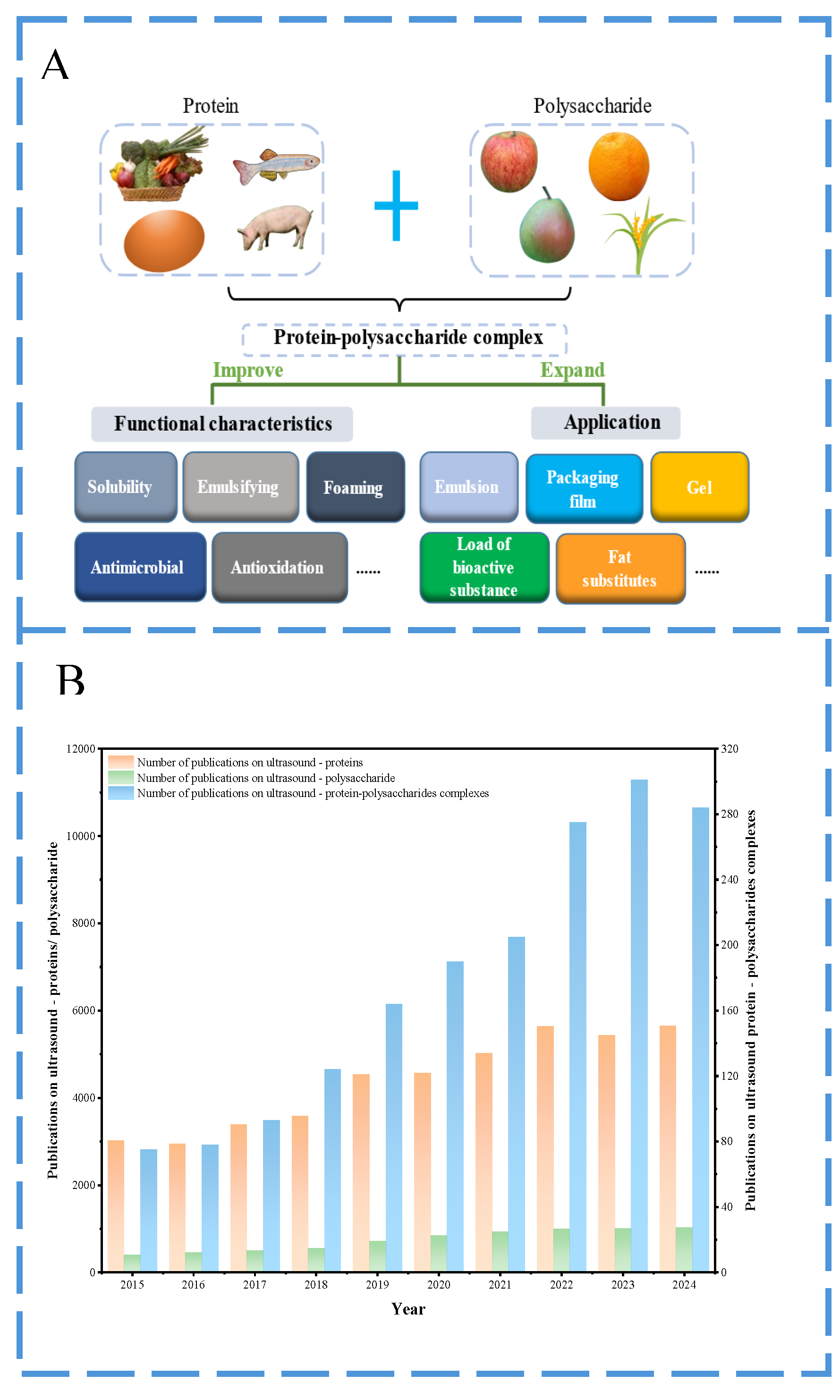
Figure 2.
(A) Fundamental mechanisms of ultrasound action: illustrating the physical (e.g., shear, microjets), mechanical (e.g., turbulence), and chemical (e.g., radical generation) effects arising from acoustic cavitation. (B) Classification of common ultrasound equipment types (probe vs. bath-based systems) used in the preparation of PPC.
Figure 2.
(A) Fundamental mechanisms of ultrasound action: illustrating the physical (e.g., shear, microjets), mechanical (e.g., turbulence), and chemical (e.g., radical generation) effects arising from acoustic cavitation. (B) Classification of common ultrasound equipment types (probe vs. bath-based systems) used in the preparation of PPC.
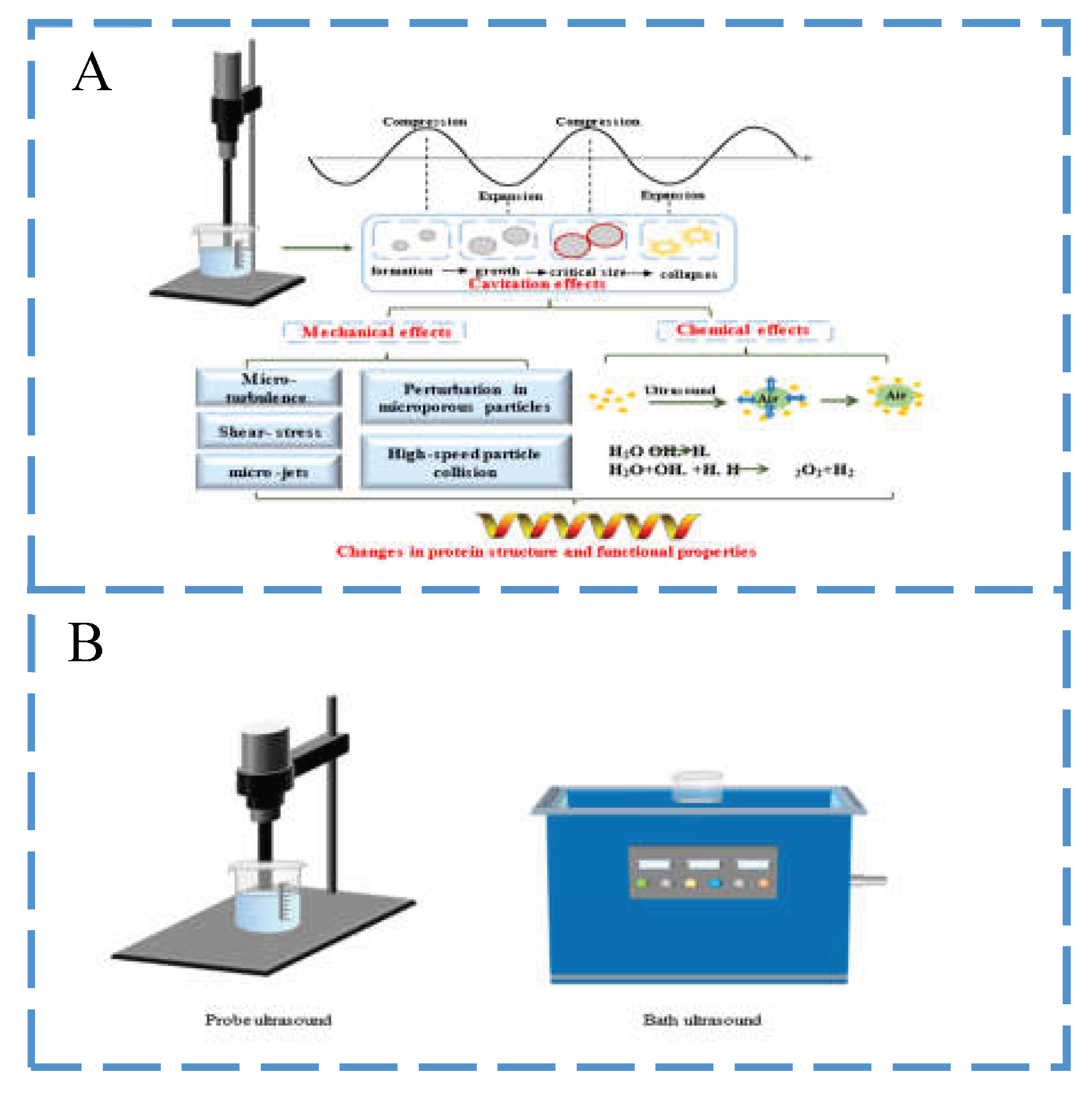
Figure 3.
Schematic illustration of the mechanisms underlying ultrasound-assisted protein-polysaccharide complexation. (A) Proposed mechanism for the structural modification of proteins and polysaccharides induced by ultrasound. (B) Primary configurations of non-covalent complexes mediated by electrostatic, hydrophobic, hydrogen bonding, and van der Waals interactions. (C) Principal pathways for the preparation of covalent complexes, including chemical crosslinking, enzymatic crosslinking, and the Maillard reaction. (D) Detailed chemical process of the Maillard reaction between proteins and polysaccharides.
Figure 3.
Schematic illustration of the mechanisms underlying ultrasound-assisted protein-polysaccharide complexation. (A) Proposed mechanism for the structural modification of proteins and polysaccharides induced by ultrasound. (B) Primary configurations of non-covalent complexes mediated by electrostatic, hydrophobic, hydrogen bonding, and van der Waals interactions. (C) Principal pathways for the preparation of covalent complexes, including chemical crosslinking, enzymatic crosslinking, and the Maillard reaction. (D) Detailed chemical process of the Maillard reaction between proteins and polysaccharides.
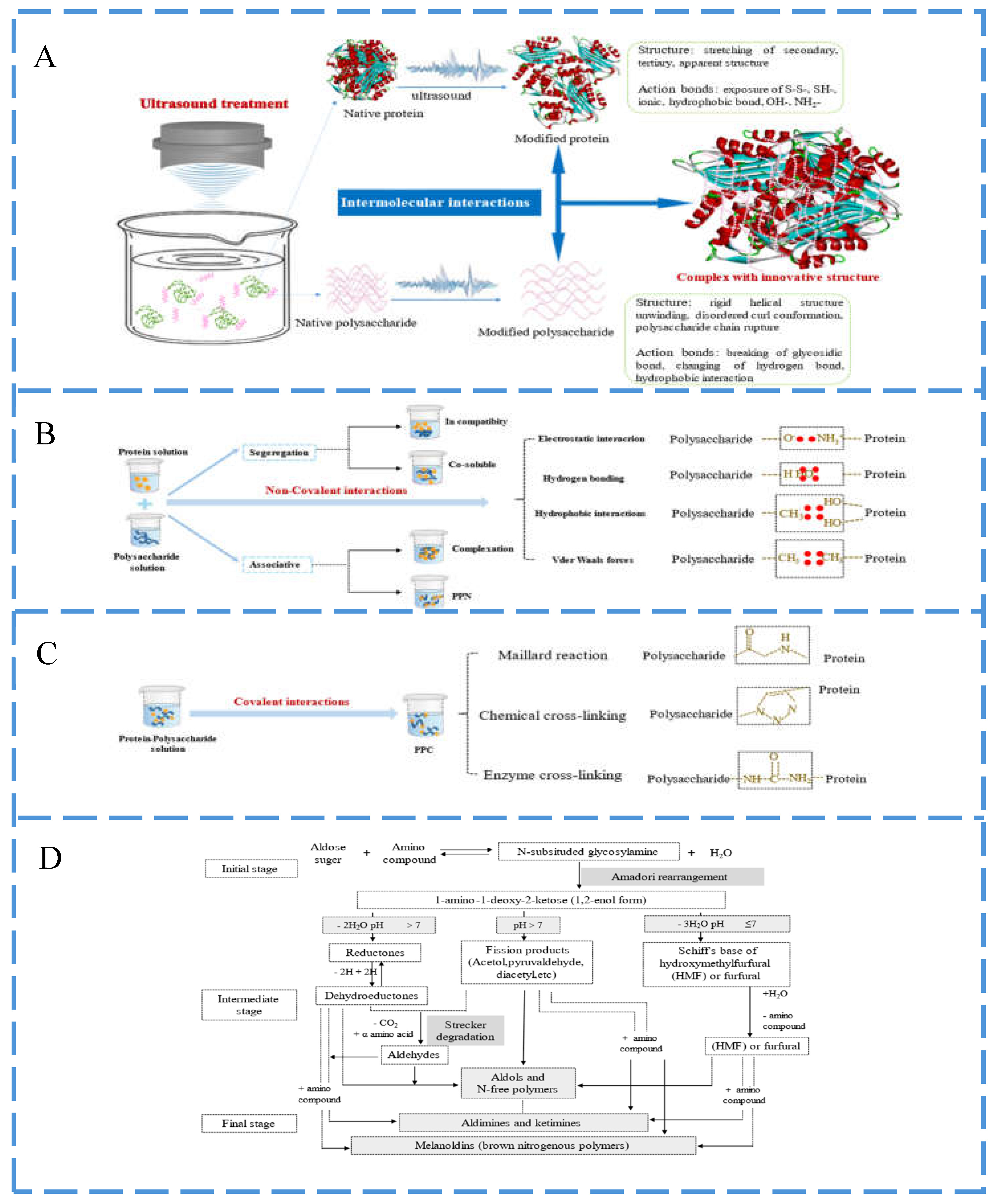
Figure 4.
Effect of ultrasound on the properties of the PPC. Degree of graft (A) [85]; secondary structure composition (B) and fluorescence absorption and SH content (C) [86]; molecular weight percentage (D) [43].
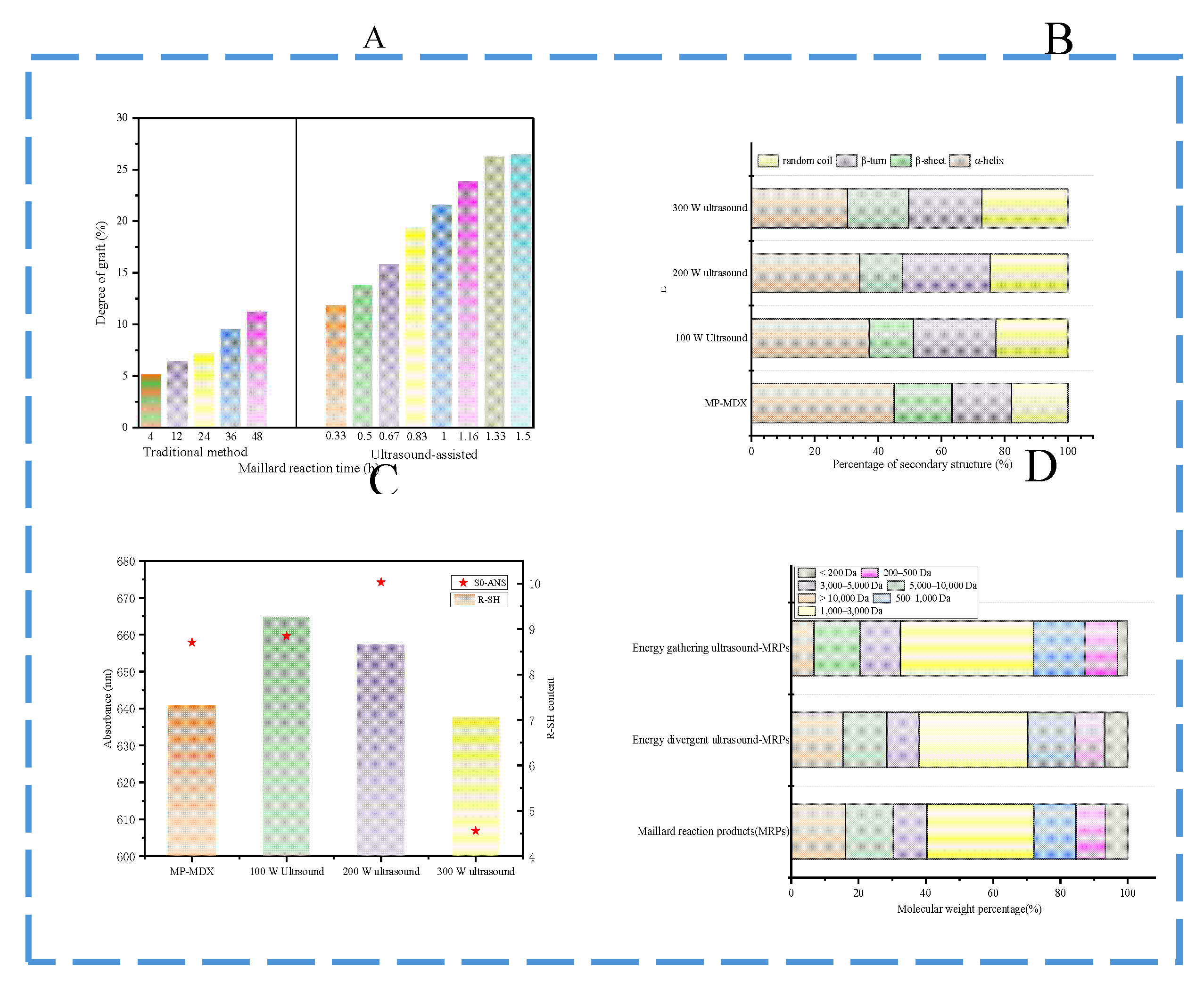
Figure 5.
Potential mechanisms of ultrasound to enhance the solubility (A), emulsifying properties (B) and foaming properties (C) of PPC. The microscopic morphologies of the above three diagrams are from Chen. et al., [94], Zhou et al. [145] and Zhang et al. [146], respectively.
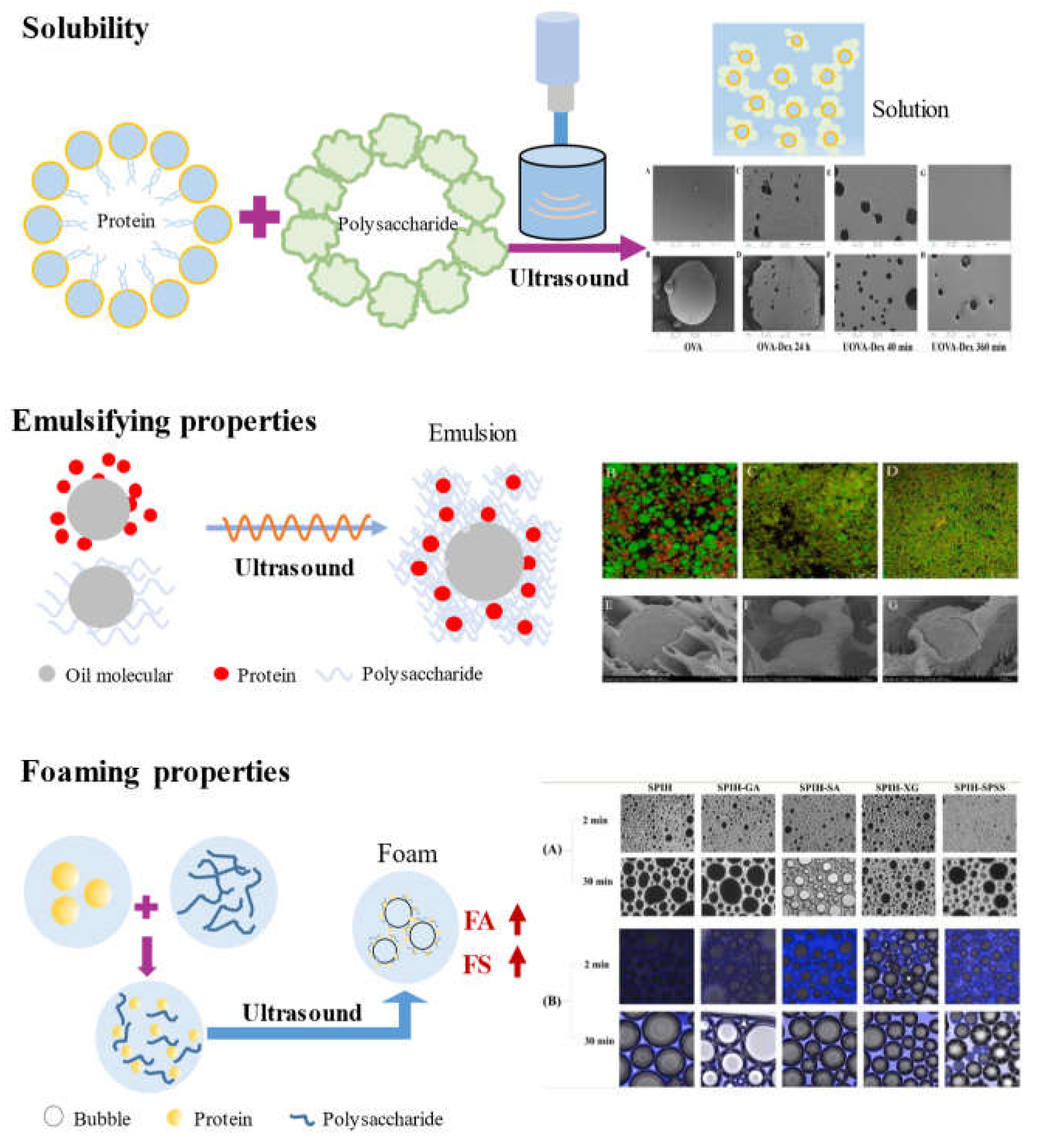
Figure 6.
A specific application regarding ultrasound-assisted preparation of PPC.
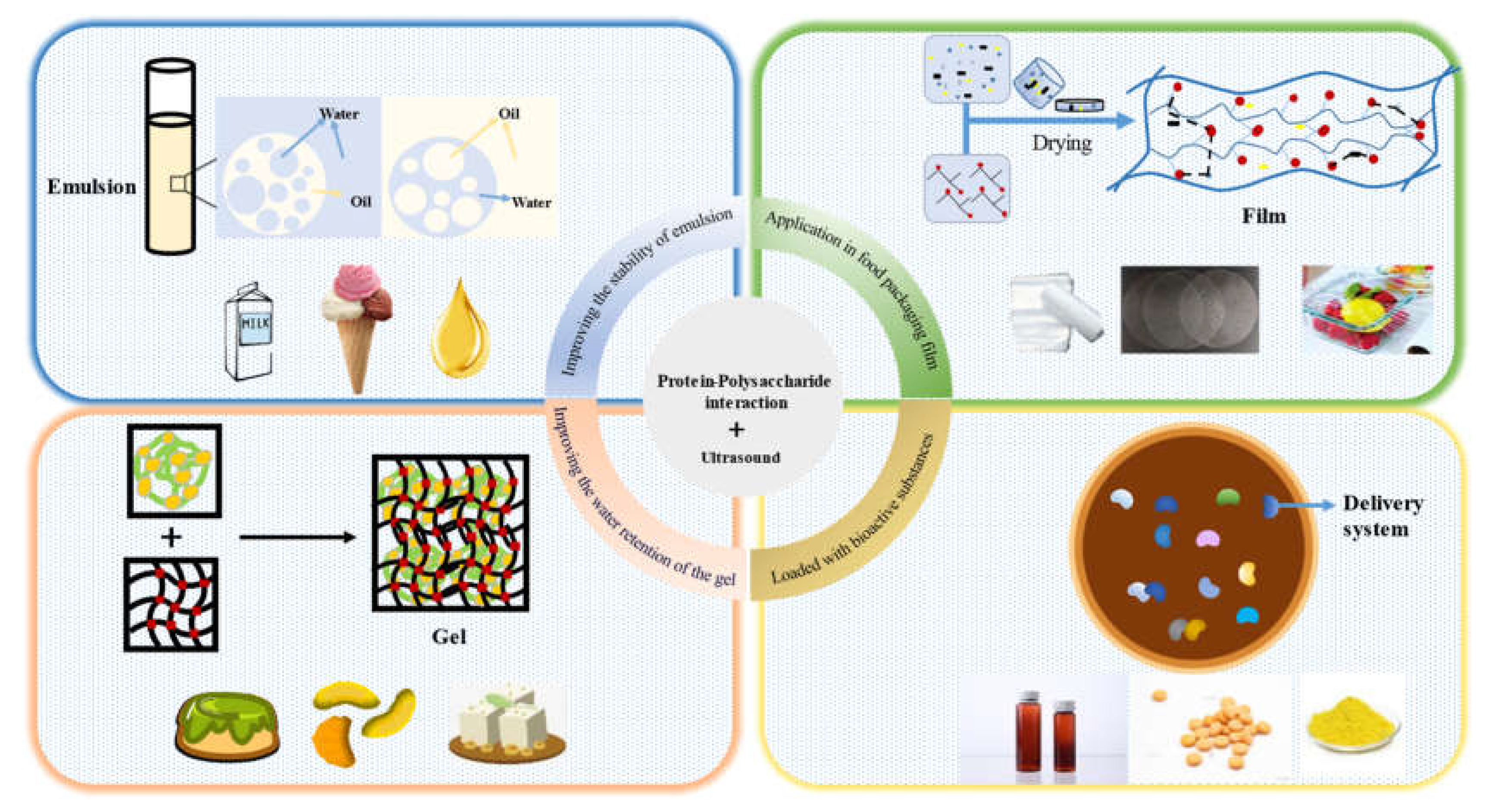

Table 1.
Comparative overview of this review versus earlier related reviews.
| Aspect | Earlier Reviews | This Review |
|---|---|---|
| Scope | Often focused on individual biopolymers (proteins or polysaccharides) or general complexation methods [26,27]. | Systematically focuses on ultrasound-induced binary protein-polysaccharide complexes. |
| Mechanistic emphasis | Limited or fragmented coverage of ultrasound's role in modulating interactions [28,29]. | Comprehensively details ultrasound's effects on both covalent and non-covalent interaction pathways. |
| Functional properties | Broad overview of techno-functional properties without ultrasound-specific analysis [27,30]. | In-depth analysis of ultrasound-enhanced solubility, emulsification, and foaming properties. |
| Application focus | General applications in food systems; limited linkage to ultrasound processing [30,31]. | Advanced applications in emulsions, gels, encapsulation, and edible films enabled by ultrasound. |
| Future Outlook | Generic recommendations for future research [30]. | Specific, prioritized research directions (e.g., parameter-function correlation, safety, scale-up). |
Table 2.
The PPC prepared by ultrasound-assisted Maillard reaction showed better properties compared to the products obtained by the traditional method.
Table 2.
The PPC prepared by ultrasound-assisted Maillard reaction showed better properties compared to the products obtained by the traditional method.
| Biopolymer Sources | Conventional method | Ultrasound conditions | Results | References | ||
| Protein: Ovalbumin (OVA) Polysaccharides: Xylose (XY) |
1 mg/mL of OVA, 3:1 of XY/OVA, pH 7.0, 50 ℃ | 20-25 kHz, 189.5 W, 61.2 min | Glycosylation degree (DG)↑, foaming ↑, emulsifying ↑ | [72] | ||
| Protein: watermelon seed protein Polysaccharides: glucose (GL) |
10 mg/mL of WPI, WPI-GA ratio 1:1, pH 10, 90 °C | 25 kHz, 100-300 W, 10-60 min | Solubility ↑, foaming properties ↑, emulsifying properties ↑, thermal stability ↑, antioxidant activities ↑ | [73] | ||
| Protein: WPI Polysaccharides: Gellan gum (GG) | 0.5-1.5 mg/mL of WPI, WPI-GG ratio 1:2, pH 10, 70 °C | 100-500 W, 20-80 min | DG ↑, the emulsifying ↑, foaming ↑, solubility ↑ | [74] | ||
| Protein: Pea protein isolate (PPI) Polysaccharides: GL | 10 mg/mL of WPI, PPI-GL ratio 5:1, pH 10, 80°C, 0, 6, 12, 18, and 24 h | 150-450 W, 5 min | Solubility↑, hydrophobicity↑, DG↑, foaming↑, emulsification ↑ | [75] | ||
| Protein: Mung bean protein isolates (MBPI) Polysaccharides: GL | 10 mg/mL of MBPI, MBPI-GL ratio 1:1, pH 7.8, 24 h and 80°C | 20 kHz, 100-450 W, 10-20 min | Solubility ↑, emulsifying activity ↑, emulsion stability ↑, surface hydrophobicity ↑ | [76] | ||
| Protein: Goat whey protein (GWP) Polysaccharides: GA | 20 mg/mL of MBPI, MBPI-GL ratio 4:3, pH 7, 80°C | 20-25 kHz, 200-600 W, 10-50 min | DG↑, solubility↑, emulsification↑, foaming↑ | [77] | ||
| Protein: Smooth hound viscera protein (SHV) hydrolysates Polysaccharides: Sucrose (SU) | 20 mg/mL of SHV, SHV-SU ratio 1:1, 2 h and 90°C | 25 kHz, 160 W /cm2, 30 min, 40℃ | DG ↑, antioxidant activity ↑ | [78] | ||
| Protein: Chinese giant salamander skin collagen(CGSS) Polysaccharides: G /XY | 10 mg/mL of CGSS, CGSS-GL-XY ratio 0.3:7.5:7.5, 1 h and 80°C | 600 W, 1 h, 80°C | DG ↑, surface hydrophobicity ↑, antioxidant activity ↑ | [79] | ||
| Protein: Mussel meat protein hydrolysate (MMP) Polysaccharides: G /XY |
30 mg/mL of MMP, MMP-GL ratio 97:2:1, 2 h and 115°C, pH 6 | 25 kHz, 300 W, 2 h | Antioxidant activity ↑ | [80] | ||
| Protein: Chicken liver protein (CLP) Polysaccharides: XY | 50 mg/mL of CLP, CLP-XY ratio 1:1, 1.5 h and 120°C, pH 6 | 200 W, 12 min | The utilization rate of amino acids↑ | [81] | ||
Disclaimer/Publisher’s Note: The statements, opinions and data contained in all publications are solely those of the individual author(s) and contributor(s) and not of MDPI and/or the editor(s). MDPI and/or the editor(s) disclaim responsibility for any injury to people or property resulting from any ideas, methods, instructions or products referred to in the content. |
© 2026 by the authors. Licensee MDPI, Basel, Switzerland. This article is an open access article distributed under the terms and conditions of the Creative Commons Attribution (CC BY) license.
Copyright: This open access article is published under a Creative Commons CC BY 4.0 license, which permit the free download, distribution, and reuse, provided that the author and preprint are cited in any reuse.


