

Submitted:
03 June 2026
Posted:
04 June 2026
You are already at the latest version
Abstract
Linking community variation to environmental gradients is central to reservoir ecology and monitoring, yet the strength of detected associations can depend on how community change is represented. Using phytoplankton surveys from a tropical reservoir (Corumbá River, Brazil) sampled across wet and dry seasons, we compared taxonomic beta diversity with two functional representations: Reynolds functional groups and a set of widely used morphological traits combined into functional beta-diversity indices. We partitioned beta diversity into turnover and richness-difference components and quantified environment–community associations with constrained ordination. Overall, the representation chosen altered both the magnitude and the seasonal consistency of environmental associations: trait-based indices (particularly dendrogram-based metrics weighted by biovolume) tended to show stronger associations with environmental gradients related to mixing, light availability and nutrients, whereas functional groups and species-level data emphasized complementary aspects of community change. Turnover and richness-difference components did not respond uniformly across representations, highlighting that component choice can shift ecological interpretation. Rather than providing a universal ‘best’ approach, our results suggest practical trade-offs among representations when the goal is to detect and interpret environmental structuring along reservoir gradients, especially during highly dynamic conditions typical of early post-impoundment phases.
Keywords:
reservoir ecology
; beta diversity partitioning
; turnover
; richness difference
; functional traits
; Reynolds functional groups
; longitudinal gradient
; seasonality
; monitoring
1. Introduction
The environment shapes community composition across space and time [1], and understanding this variation is a core objective in freshwater ecology and reservoir management [2]. However, the question of which attribute of the communities is best to trace the effect of environmental change has no definitive answer [3,4,5].
Traditional measures such as the number of species (richness) may not always follow the spatial and temporal variation of the environment, whereas the variation in species composition and abundance (beta diversity) can be more informative [6]. However, even taxonomic turnover may not map directly onto changes in ecological roles. In this sense, environmental processes seemed to be more related to functional attributes than to taxonomic ones [7]. Functional approaches aim to represent community change in terms that are more directly linked to organismal strategies and environmental constraints, potentially improving interpretability and transferability across systems [8,9].
The advantage of functional attributes on the taxonomic ones relies on the causal relationships that can be established between environmental variation and the features of species [4,10]. For example, in the case of phytoplankton, the mixing of water columns relates to the kind of organisms that can domain in a particular habitat. In stratified water bodies (null mixing) heavy phytoplankters cannot survive since they have high sinking rates, while organisms with features enhancing buoyancy (e.g., gas vesicles) can domain [11].
For phytoplankton, phycologists have suggested grouping species into functional groups based on their shared morphological, physiological, and ecological features [9,12], which has been used to test ecological questions, e.g., [13], understand the effects of environmental changes [14], and propose it as a monitoring tool [15,16]. However, the functional group approach has been criticized for assuming that the species in a particular group are ecological equivalents, thereby failing to recognize the variability that species in a group may exhibit [17]. In contrast, the analysis of functional traits and measures based on them may be better in assessing environmental variation since they consider all possible values and combinations of species features present in communities [18].
Beta diversity provides a descriptive quantification of among-site or among-time compositional variation. Partitioning beta diversity into turnover and richness-difference components can be useful to characterize whether variation is driven mainly by species replacement or by gains/losses, but these components are not direct measures of dispersal limitation or environmental filtering without additional evidence [19,20,21]. Importantly, functional patterns remain derived from species composition; therefore, taxonomic and functional beta diversity should be viewed as alternative representations of the same underlying community variation rather than independent ‘responses’ [9,22].
Here we evaluate how taxonomic composition, functional groups and trait-based functional indices capture phytoplankton beta diversity and its association with environmental gradients in the Corumbá reservoir (Central Brazil). This system has been described as strongly structured along a directional longitudinal template in which hydrodynamics and limnological gradients covary [16], providing an opportunity to test how representation and beta components influence detected environment–community associations.
We addressed three questions: (i) does the strength and seasonal consistency of environment–community associations depend on whether beta diversity is represented taxonomically, by functional groups, or by trait-based indices? (ii) do turnover and richness-difference components show consistent environmental associations across representations? and (iii) does abundance weighting (biovolume) alter these associations relative to incidence-based metrics?
By framing the comparison as sensitivity and interpretability trade-offs among representations, we aim to inform the choice of metrics for reservoir monitoring and for ecological inference along strong environmental gradients.
2. Materials and Methods
2.1. Study Area
The Corumbá reservoir is located on the Corumbá River in the state of Goiás (Central Brazil, 15°79' S and 48°31' W). Its formation process was completed in November 1996, flooding an area of 65 km2, with an average depth of 23 m, and an approximate hydraulic residence time of 30 days. Its drainage area comprises approximately 27,800 km2, with its main tributaries being the Santo Antônio, Peixe, and Pirapetinga rivers. It experiences distinct hydrological periods, characterized by a rainy (November to May) and a dry (June to October) season.
2.2. Sample Collection and Analysis
Biological and environmental samples as well as in situ measurements were performed every six months between April 1997 and September 1999 (six sampling campaigns). Samples were collected in nine sites on the main channel of the Corumbá River (n = 48) embracing the lotic (R0 and R1), transition (R2 – R4), and lacustrine (R5 – R8) reservoir regions. However, in two sampling campaigns samples were lost (April 1997, two sites - R0 and R2; March 1999, four sites – R3, R5, R6, and R7).
Phytoplankton samples for quantitative analyses were collected from the sub-surface (at approximately~ 30 cm) depth directly using glass bottles (200 ml glass bottles) and fixed with acetic Lugol's solution 1%. Phytoplankters individuals (cells, colonies, and filaments) were counted in random fields using an inverted microscope the quantitative samples following the Utermöhl method [23,24]. Random fields were selected until at least 400 individuals (cells, colonies, and filaments) were counted. Density was expressed as individuals per milliliter (ind mL−1).
The cellular volume was calculated by approximating their shape to geometric forms [25]. The biovolume of each taxon was then multiplied by its density to calculate the biovolume in each sample, which was expressed as cubic millimeters per liter (mm3 L−1).
Important abiotic parameters for phytoplankton development were measured. Water temperature, pH, dissolved oxygen, electrical conductivity, turbidity and the maximum depth (Zmax) were measured in situ with digital portable potentiometers. The mixing zone (Zmix) was estimated according to the temperature profile of the water column, euphotic zone depth (Zeu) was measured using a radiometer. The ratio between the euphotic and mixing depths (Zeu:Zmix) was used as a measure of light availability (Jensen et al., 1994), while the ratio Zmix:Zmax was used as measure for mixing of water columns. Discharge, water residence time and precipitation data were provided by FURNAS Centrais Elétricas.
Water samples were collected to determine nutrients concentrations in laboratory. Total phosphorus (TP), dissolved phosphorus (DP), soluble reactive phosphorus (SRP), total Kjeldahl nitrogen (TKN), nitrate (N-NO3-) and ammonium (N-NH4+) were determined following the methods described in (APHA, 2005). The concentration of dissolved inorganic nitrogen (DIN) was calculated as the total of the amounts of nitrate, and ammonium.
2.3. Data Analysis
Environmental variation was summarized using principal component analysis (PCA) on standardized abiotic variables to visualize the dominant seasonal and longitudinal gradients. PCA scores were used for interpretation only; hypothesis testing of community–environment relationships was conducted with constrained ordination.
For taxonomic analyses we built community matrices using (i) species occurrence and (ii) species biovolume. Biovolume was used as an abundance proxy because it integrates cell size and density and is routinely applied to phytoplankton dominance and productivity-related questions. Functional-group matrices were constructed by aggregating species data into Reynolds functional groups for the same two data types (occurrence and biovolume).
Trait-based functional beta diversity was calculated from a compact set of morphological traits (including life form and cell size; Table 1) that has been widely used in freshwater phytoplankton functional ecology and is mechanistically linked to key reservoir constraints (mixing/turbulence, light climate and nutrient regime). The trait set was intentionally kept parsimonious to maintain comparability with previous studies and to avoid over-parameterization given the sampling design [9,26].
We computed total beta diversity and its turnover and richness-difference components using incidence- and abundance-based dissimilarities (Table 2). For incidence data we used Jaccard dissimilarity and its partitioning; for quantitative data we used the Ruzicka dissimilarity and its corresponding decomposition. Trait-based functional dissimilarities were calculated with dendrogram- and multidimensional approaches, using both incidence and biovolume weighting when applicable [19,20,21,27].

Table 1.
Functional traits used for the functional beta diversity calculations. The presence of the trait is indicated by one, while the absence is indicated by zero. The GALD (greatest axial linear dimension) is continuous measurement. The life forms consider the cellular arrangement of each specimen: Unicellular: single-cell organisms. Filament: linear arrangement of cells intercommunicated by plasmodesmos or a linear chain of cells [28]. Colony: arrangement of multiple cells. Cenobium: when the number and arrangement of cells are determined from the origin of the organism and remains constant [29].
Table 1.
Functional traits used for the functional beta diversity calculations. The presence of the trait is indicated by one, while the absence is indicated by zero. The GALD (greatest axial linear dimension) is continuous measurement. The life forms consider the cellular arrangement of each specimen: Unicellular: single-cell organisms. Filament: linear arrangement of cells intercommunicated by plasmodesmos or a linear chain of cells [28]. Colony: arrangement of multiple cells. Cenobium: when the number and arrangement of cells are determined from the origin of the organism and remains constant [29].
| Trait | State | Related processes |
|---|---|---|
| Bristle | 1 - 0 | Grazing avoiding |
| Flagellum | 1 - 0 | Buoyancy |
| Spines | 1 - 0 | Grazing avoiding |
| Silica | 1 - 0 | Resistance to mechanical damage |
| Mucilage | 1 - 0 | Resources taking, desiccation avoidance |
| Aerotope | 1 - 0 | Buoyancy |
| Process | 1 - 0 | Buoyancy |
| GALD | µm | Grazing avoiding |
| Life form | Filament – Coenobium – Colony - Unicellular | Grazing avoiding, resources taking, buoyancy |
Table 2.
Dissimilarity measures and their components. Reference includes papers related to dissimilarity calculations or decomposing beta diversity.
Table 2.
Dissimilarity measures and their components. Reference includes papers related to dissimilarity calculations or decomposing beta diversity.
| Community attribute | Distance or method | Beta diversity components | Abbreviation | Reference | |
|---|---|---|---|---|---|
| Species occurrence | Jaccard | Turnover | Rich. Diff. | sp.occu | [27] |
| Species biovolume | Ruzicka | Turnover | Rich. Diff. | sp.biovol | |
| FG occurrence | Jaccard | Turnover | Rich. Diff. | FG.occu | |
| FG biovolume | Ruzicka | Turnover | Rich. Diff. | FG.biovol | |
| Functional traits + occurrence | Convex hull | Turnover | Nestedness | mFD.index | [30] |
| Functional traits + occurrence | Dendrograms | Turnover | Rich. Diff. | bFD.index.occu | [31,32] and later expanded functional diversity by [21] |
| Functional traits + biovolume | Dendrograms | Turnover | Rich. Diff. | bFD.index.biovol | |
To compare differences in the raw values of total beta diversity and its components among the different dissimilarity measures (e.g., sp.occu, FG.biovol, etc.), we used beta regression (GLM with beta error). Analyses were conducted separately for the dry and rainy seasons and for each component (Total, Turnover, Richness difference). The overall effect of the measure was summarized as Chi2 tables to condense the information in a clear and comparable way, and pairwise comparisons among measures were performed with the emmeans package [33], which is based on estimated marginal means (least-squares means) and performs pairwise contrasts while adjusting for model structure [33]. In addition, we evaluated temporal differences for each dissimilarity measure by including season as a fixed factor and sampling as a random factor, since three independent samplings were available within both seasons.
To evaluate the strength of the relationship between the standardized environmental factors and the different dissimilarity measures at each sampling, we used distance-based redundancy analyses (dbRDA). For each case, we used the forward-selection procedure [34] to select the significant environmental factors (P < 0.05, 999 permutations). With the variance inflation factor (VIF) we examined the collinearity of the explanatory factors and removed those with VIF >10 [35]. As a strength measure of the environment–dissimilarity relationship, we considered the adjusted R2 calculated from the dbRDA, as these correct the influence of the number of explanatory variables allowing us to compare the results from the different samplings and dissimilarity measures [36].
We did not include an explicit spatial eigenfunction term (e.g., dbMEM/PCNM) because sampling units follow a strongly directional longitudinal gradient where spatial structure is largely expressed through hydrodynamic and limnological gradients already represented by measured predictors [16]. Therefore, inferences are limited to environment–community associations along this longitudinal template, and we do not attempt to partition pure spatial versus environmental effects.
We then compared adjusted R2 values among dissimilarity measures to determine which were more sensitive to environmental variation. Because adjusted R2 values ranged between 0 and 1, we applied beta regression (GLM with beta error), using a zero-inflated beta model when the response contained zeros (i.e., no detectable environment–community relationship). Analyses were performed separately for each beta-diversity component (Total, Turnover, Richness difference) and for each season. The overall effect of the measure was summarized as Chi2 table.
We further evaluated temporal differences for each dissimilarity measure (within each beta-diversity component) by including season as a fixed factor and sampling as a random factor. For Richness Difference in the rainy season, the measures bFD.index.biovol and FG.occu were excluded because they consistently yielded zeros, indicating that the environment did not influence community variation under those metrics. Model diagnostics were checked with DHARMa [37], and regressions were fitted with glmmTMB [38]. Beta-diversity measures based on traits and convex hull were computed with the mFD package [39], while dendrogram-based indices were obtained with the BAT package [40]. Beta-diversity values and their components based on species and functional groups were calculated with adespatial [41]. Visualizations were produced with ggplot2 ([42]. All analyses were conducted in R [43].
3. Results
3.1. Environmental Seasonal Variation
Seasonality seemed to affect the environmental conditions in the study zone as revealed in the first axis of the PCA (Figure 2). Rainy periods were related to higher water flow (FR) and mixing of the water column, while dry showed higher conductivity, pH, and dissolved oxygen (Table 3). The second PCA axis revealed a spatial gradient in the abiotic conditions for both seasons, with lotic regions related to higher phosphorus concentration, and Zeu:Zmax and Zmix:Zmax ratios, while lentic conditions related to higher light availability (Zeu) and depth.
3.2. Beta Diversity Variation
Total diversity values (βT) varied among measures (Figure 3, Table 4). The measures based on species showed higher values, followed by FG.biovol, and bFD.index.biovol. Lower values were related to measures using species/FG occurrence in its calculus (bFD.index.occu, FG.occu, mFD.index). Turnover (βt) also had low correspondence among measures in both the rainy and dry seasons (supplementary material). Higher βt was observed for measures based on species while lower values were related to dendrogram-based measures (Figure 2). For richness difference/nestedness (βd), higher values were shown by bFD.index.biovol while the other measures did not show differences among them.
In general, we observed changes in the relative contribution of beta-diversity components from species-based to functional indices. At the species level, turnover (βt) dominated, but its contribution progressively decreased through RFG and functional indices, whereas richness difference (βd) gained importance along that gradient. In dendrogram-based measures, particularly when biovolume was considered, turnover was lower and richness difference became the main contributor (Figure 6).
In the case of the seasonal variation, just mFD.index, FG.biovol and sp.biovol showed differences for βT, with higher values in the rainy season. For βt, mFD.index, FG.biovol, sp.biovol, and sp.occu showed variation with higher values in the rainy season. Only sp.occu showed a difference for βd, with higher values in the dry (Table 5).
3.2. Effect of Environment on Beta Diversity
In relation to the effect of the environment on beta diversity, in the dry seasons there were no differences among measures for any beta diversity component (Figure 4, Table 4). In the Rainy season, βT did not varied among metrics, while bFD.index.biovol showed the lowest explanation for βt, being lower than FG.biovol, mFD.index, sp.biovol, and sp.occu. In the case of βd, bFD.index.occu showed the highest explanation. Cases of null explanation of the environment on community variation were related mainly to the richness difference (Figure 5), related to the fact that no one explanatory factor was selected in the forward procedure (supplementary material, Table A2).
Considering the seasonal variation of the beta diversity component for each measure, no variation was observed in βT for any measure (Table 6). For βt, only mFD.index and FG.occu varied, with higher explanation in the rainy season. For βd, bFD.index.occu and sp.occu showed higher explanation in the rainy season, while sp.biovol had a higher explanation in the dry season (Table 4).
In general, we observed that explanation of environment on communities related to richness differences follow or expectation, increasing in a gradient from species to functional indices, especially related to biovolume (Figure 6).
4. Discussion
Our results showed that the detected strength of environment–community association depend as much on the chosen representation (species, functional groups or traits) as on the beta-diversity component analyzed. This reinforces an important point: taxonomic and functional beta diversity are not independent responses, but different representations of the same underlying compositional variation that emphasize different ecological information and levels of aggregation.
Species-based measures reflected higher turnover (βt) than traits-based measures, suggesting that the change in species composition (or the species abundance) was not consistent with the functional turnover of the community. In other words, while communities can show higher rates of species substitutions it does not necessarily reflect higher rates of functional change. Such a situation indicates that the substitution of some species did not modify the functional characteristics of the communities.
It occurs since species in the communities can be functionally redundant and their contribution to the functional attributes of the community may be equivalent. For instance, species from the same genera may share features. Of course, the functional similarity of redundancy will also depend on the functional features considered in the calculus.
Although we did not evaluate the level of functional redundancy, we evidenced that in the case of the functional groups, some RFGs were represented by a high number of species while others were poorly represented (Table A1). For instance, considering the total diversity registered in the study, the RFG – F, composed of colonial Chlorophytes and associated with low nutrient concentration, was represented by 38 taxa, while the RFGs – X2 and SN, tolerant to stratification and to light – and nitrogen-deficient conditions, were represented by one taxon at each case. Moreover, five RFGs embraced almost 69% of the total observed richness, which means that those groups were highly represented over space, reducing the functional variation despite species shifts.
In the case of the richness difference (βd), we observed that the spatial variation was higher at the functional approach based on dendrograms and weighted by biovolume, and lower for species. This indicates that functional variation in our study area was more related to shifts in the relative weight of traits than to pure species replacement. In other words, dominant taxa at each site disproportionately determined the functional space, so that local differences emerged from the traits that were favored under local conditions (e.g., buoyancy-related features). Thus, functional richness differences revealed ecologically meaningful changes in the importance of traits across sites, even when species turnover alone did not capture them.
Environmental Associations Across Representations and Beta Components
There was no significant difference among measures when considering total beta diversity. This lack of difference may result from contrasting patterns in the individual components (e.g., stronger environmental relationships for functional groups in turnover, but for species in richness differences), which can cancel each other out when combined into a single total metric.
These findings highlight the importance of analyzing beta diversity components separately, as they are shaped by distinct ecological processes [19,27,44]. However, our approach considering species, functional groups, and traits allow us to suggest that taxonomic and functional turnover, as well as differences in local species and functional richness, may be influenced by different sets of drivers
Although all beta diversity components may respond to broad mechanisms such as dispersal limitation and environmental filtering [45], our results showed that the specific drivers and the strength of their relationships with the environment likely vary depending on the beta diversity component and the dissimilarity metric used and biodiversity facet. Furthermore, those relationships and the specific drivers may also shift in response to natural environmental change and could be influenced by anthropogenic disturbances [46].
Although we identified some differential associations between biodiversity facets and the environment, as well as between the methods used to evaluate dissimilarity, the results did not fully align with our expectations. For instance, and as shown above, the relationship between communities and the environment (considering total dissimilarity) did not differ significantly among species, functional groups, and traits. Moreover, clear differences were observed only during the rainy season.
One possible explanation for null differences during the dry season, is that local environmental conditions at each sampling point exerted more heterogeneous selective pressure on communities, promoting different traits. Indeed, spatial environmental heterogeneity is expected to increase in dry season [47]. Some of these traits may be directly captured by our functional trait or group-based metrics, while others may be embedded within species-level variation that is not explicitly represented in our chosen functional traits. This situation is not unique to our study area. Similar patterns have been reported in subtropical lowland rivers from urbanized areas, where species-level attributes, rather than functional traits, more effectively reveal the influence of the environment on phytoplankton communities [48].
In this sense, the relationship environment–community relationships may differ between species and functional groups, because the traits used to define groups do not necessarily reflect those traits being filtered by environmental conditions [13]. Indeed, our results showed that oxygen concentration and water residence time were significant predictors of beta diversity only at the species level. Therefore, for turnover during the rainy season, these environmental drivers appear to be the main factors shaping community composition. However, the selected traits and functional groups did not respond clearly to these variables, suggesting a mismatch between the traits used in the analysis and those mediating species–environment interactions.
Thus, in some locations, environmental effects may be stronger at the species level, in others at the group level, and in others at the level of individual traits, depending on the main drivers and the traits affected (which are not necessarily represented in groups or in the selected traits). As a result, we may observe overall weak or null differences in how each biodiversity facet responds to environmental variation. Interestingly, this explanation could apply both to community turnover and to differences in the number of species, functional groups, and traits.
On the other hand, our expectations were met when focusing on the richness difference component. In this case, trait-based richness differences showed the strongest relationship with environmental variation. However, in general, the effect of the environment on richness difference was weaker than for turnover.
The weaker relationship between species-based richness differences and environmental variables may be explained by the fact that biodiversity responses to environmental change often manifest primarily as shifts in community composition rather than in species richness itself [6]. Species richness is shaped by multiple underlying components, including individual aggregation, population density, and the species abundance distribution (SAD) ([49]. The contribution of these components to richness can vary substantially depending on environmental conditions and anthropogenic disturbance [50]. Despite this variability, the combined effect of opposing contributions may result in no net change in richness values. Consequently, species richness variation often exhibits weak or inconsistent associations with environmental gradients.
In contrast, richness differences based on functional traits are conceptually linked to the volume of the functional space occupied by each community [26]. This space reflects the range of traits present and, by extension, the range of ecological strategies available. Differences in this functional volume between sites may be related to niche availability and differentiation, as larger trait volumes imply a broader set of resource use strategies or ecological roles being fulfilled.
In this sense, the stronger relationship between functional trait-based richness and the environment may result from the fact that trait expression is directly linked to niche occupancy [51]. Communities that differ in functional richness may be responding to environmental filters that constrain which traits, and thus which strategies, are viable in each context. Therefore, variation in functional richness across sites may better reflect differences in ecological opportunities or constraints, enhancing the environment–community relationship for this component.
In our case, this pattern was particularly evident for dendrogram-based metrics weighted by biovolume, which showed the strongest environmental association. This suggests that, although functional traits were broadly distributed across sites (leading to low functional turnover), the relative importance of those traits varied considerably among locations. As a result, differences in the weight of dominant traits, rather than their mere presence, shaped the functional space and strengthened the link to environmental gradients.
From a practical perspective, these results argue against a single ‘best’ metric for reservoir studies. Instead, the choice should reflect the question: species data are essential when the aim is biodiversity accounting and detecting taxon-specific replacements; functional groups offer an interpretable ecological template; and trait-based indices can provide sensitive detection of shifts in dominant strategies, particularly when abundance information is available.
Finally, the dataset represents an early post-impoundment period, when reservoirs can exhibit pronounced ecological reorganization. While this limits direct extrapolation to mature reservoirs, it also provides a useful window to evaluate metric sensitivity under highly dynamic conditions, an important context for monitoring newly impounded systems and for interpreting ecological trajectories [16].
Overall, framing taxonomic and functional beta diversity as complementary representations helps reconcile apparent differences among metrics and reduces the risk of over-interpreting patterns as processes. Using multiple representations can therefore strengthen inference about how reservoir gradient’s structure phytoplankton communities. Future work could extend these comparisons by explicitly quantifying functional redundancy and by partitioning spatially structured environmental variation, but the present results already provide guidance for choosing beta-diversity representations in reservoir monitoring and comparative limnology.
5. Conclusions
Detecting environmentally structured phytoplankton variation along reservoir gradients depends on both how beta diversity is represented and how it is partitioned. Species, functional groups and trait-based indices capture complementary aspects of the same underlying community change, and their apparent performance differences largely reflect the level of aggregation and the weighting scheme used. In the Corumbá reservoir, abundance-weighted trait-based indices were particularly sensitive to environmental gradients, whereas species- and functional-group approaches provided complementary ecological information. We recommend selecting representations based on study objectives (monitoring sensitivity versus interpretability versus taxon-specific information) and, when possible, combining them to strengthen inference in reservoir ecology.
Supplementary Materials
The following supporting information can be downloaded at the website of this paper posted on Preprints.org.
Author Contributions
Conceptualization, A.P. and L.R.; methodology, A.P. and L.R.; formal analysis, A.P.; investigation, A.P. and L.R.; data curation, A.P. and L.R.; visualization, A.P. and L.R.; writing—original draft preparation, A.P.; writing—review and editing, A.P. and L.R. Both authors contributed equally to all stages of the study. Both authors have read and agreed to the published version of the manuscript.
Funding
The study was supported by Furnas Centrais Elétricas S.A. and by the Núcleo de Pesquisas em Limnologia, Ictiologia e Aquicultura (Nupélia).
Data Availability Statement
The data that support the findings of this study are available from the corresponding author upon reasonable request.
Acknowledgments
We are grateful to the Nupélia Limnology laboratory for assistance with physical and chemical water analyses and to the Phytoplankton laboratory for assistance in collecting and identifying de species.
Conflicts of Interest
The authors declare no conflicts of interest.
Appendix A
Table A1.
Species richness for each one Reynolds functional group (RFG).
| RFG | Species Richness | RFG | Species Richness |
|---|---|---|---|
| MP | 12 | S1 | 5 |
| J | 34 | E | 3 |
| F | 38 | M | 2 |
| X1 | 14 | D | 3 |
| K | 3 | X3 | 2 |
| C | 2 | SN | 1 |
| P | 5 | Z | 1 |
| X2 | 1 | A | 4 |
| L0 | 6 | W1 | 6 |
| Y | 8 | H1 | 3 |
| N | 23 | Total | 176 |
Table A2.
Selected variables for each sampling campaign and dbRDA results. “--”, cases without selected variables.
Table A2.
Selected variables for each sampling campaign and dbRDA results. “--”, cases without selected variables.
| Beta | Measure | Sampling | r2 | r2adjust | Variables | F | P |
|---|---|---|---|---|---|---|---|
| Total | mFD.index | Rainy1 | 25.19 | 12.73 | PSR | 2.02 | 0.041 |
| Total | mFD.index | Rainy2 | 16.35 | 9.38 | DIN | 2.35 | 0.012 |
| Total | mFD.index | Rainy3 | 24.36 | 14.90 | ZeuZmax | 2.58 | 0.005 |
| Total | mFD.index | Dry1 | 30.66 | 15.25 | Zmax + TR | 2.07 | 0.009 |
| Total | mFD.index | Dry2 | 18.12 | 11.30 | O2 | 2.66 | 0.019 |
| Total | mFD.index | Dry3 | 41.58 | 24.88 | DIN, pH | 2.49 | 0.007 |
| Total | FG.biovol | Rainy1 | 42.61 | 28.26 | ZmixZmax + ZeuZmax | 2.97 | 0.001 |
| Total | FG.biovol | Rainy2 | 15.87 | 8.85 | ZmixZmax | 2.26 | 0.011 |
| Total | FG.biovol | Rainy3 | 42.5 | 32.05 | TR + ZmixZmax | 4.07 | 0.001 |
| Total | FG.biovol | Dry1 | 30.56 | 15.12 | cond + ZmixZmax | 1.98 | 0.001 |
| Total | FG.biovol | Dry2 | 16.87 | 9.95 | ZeuZmax | 2.44 | 0.012 |
| Total | FG.biovol | Dry3 | 24.07 | 17.74 | DIN | 3.80 | 0.002 |
| Total | FG.occu | Rainy1 | 27.79 | 19.76 | ZmixZmax | 3.46 | 0.005 |
| Total | FG.occu | Rainy2 | 22.93 | 16.51 | ZmixZmax | 3.57 | 0.001 |
| Total | FG.occu | Rainy3 | 32.54 | 26.92 | TR | 5.79 | 0.001 |
| Total | FG.occu | Dry1 | 33.17 | 18.31 | Zmax + DIN | 2.23 | 0.001 |
| Total | FG.occu | Dry2 | 0 | 0 | -- | 0.00 | 0 |
| Total | FG.occu | Dry3 | 14.19 | 7.04 | DIN | 1.98 | 0.039 |
| Total | sp.biovol | Rainy1 | 19.69 | 10.76 | ZmixZmax | 2.21 | 0.002 |
| Total | sp.biovol | Rainy2 | 24.61 | 10.90 | ZmixZmax + ZeuZmax | 1.80 | 0.001 |
| Total | sp.biovol | Rainy3 | 38.74 | 27.60 | TR + ZmixZmax | 3.48 | 0.001 |
| Total | sp.biovol | Dry1 | 30.7 | 15.30 | pH + temp | 1.99 | 0.002 |
| Total | sp.biovol | Dry2 | 30.37 | 17.70 | ZeuZmax + DIN | 2.40 | 0.001 |
| Total | sp.biovol | Dry3 | 20.72 | 14.11 | DIN | 3.14 | 0.001 |
| Total | sp.occu | Rainy1 | 32.27 | 15.33 | Zmax + ZmixZmax | 1.91 | 0.002 |
| Total | sp.occu | Rainy2 | 21.61 | 15.08 | ZmixZmax | 3.31 | 0.001 |
| Total | sp.occu | Rainy3 | 32.87 | 20.67 | TR + temp | 2.69 | 0.001 |
| Total | sp.occu | Dry1 | 31.05 | 15.72 | TR + DIN | 2.03 | 0.001 |
| Total | sp.occu | Dry2 | 19.07 | 12.32 | ZmixZmax | 2.83 | 0.002 |
| Total | sp.occu | Dry3 | 21.15 | 14.57 | DIN | 3.22 | 0.001 |
| Total | bFD.index.occu | Rainy1 | 29.83 | 22.03 | ZmixZmax | 3.83 | 0.005 |
| Total | bFD.index.occu | Rainy2 | 17.54 | 10.67 | pH | 2.55 | 0.001 |
| Total | bFD.index.occu | Rainy3 | 28.05 | 22.05 | Zmax | 4.68 | 0.004 |
| Total | bFD.index.occu | Dry1 | 33.92 | 19.23 | ZmixZmax + DIN | 2.31 | 0.001 |
| Total | bFD.index.occu | Dry2 | 20.12 | 13.46 | DC | 3.02 | 0.003 |
| Total | bFD.index.occu | Dry3 | 24.15 | 17.83 | DIN | 3.82 | 0.011 |
| Total | bFD.index.biovol | Rainy1 | 38.76 | 23.45 | ZmixZmax + zeuzmax | 2.53 | 0.001 |
| Total | bFD.index.biovol | Rainy2 | 14.82 | 7.73 | ZmixZmax | 2.09 | 0.022 |
| Total | bFD.index.biovol | Rainy3 | 24.17 | 17.86 | ZmixZmax | 3.83 | 0.001 |
| Total | bFD.index.biovol | Dry1 | 38.16 | 24.41 | pH + ZmixZmax | 2.78 | 0.001 |
| Total | bFD.index.biovol | Dry2 | 0 | 0.00 | -- | 0.00 | 0 |
| Total | bFD.index.biovol | Dry3 | 26.33 | 20.19 | DIN | 4.29 | 0.004 |
| Turnover | mFD.index | Rainy1 | 27.14 | 14.99 | o2 | 2.23 | 0.009 |
| Turnover | mFD.index | Rainy2 | 0 | 0 | -- | 0.00 | 0 |
| Turnover | mFD.index | Rainy3 | 24.03 | 14.54 | TR | 2.53 | 0.008 |
| Turnover | mFD.index | Dry1 | 29 | 13.21 | Zmax+ PSR | 1.84 | 0.003 |
| Turnover | mFD.index | Dry2 | 13.59 | 6.39 | pH | 1.89 | 0.003 |
| Turnover | mFD.index | Dry3 | 17.98 | 7.73 | pH | 1.75 | 0.016 |
| Turnover | FG.biovol | Rainy1 | 23.48 | 14.98 | ZmixZmax | 2.76 | 0.014 |
| Turnover | FG.biovol | Rainy2 | 23.38 | 9.45 | ZeuZmax + DIN | 1.68 | 0.001 |
| Turnover | FG.biovol | Rainy3 | 29.61 | 16.81 | Zmax + temp | 2.31 | 0.001 |
| Turnover | FG.biovol | Dry1 | 21.47 | 13.62 | Zmax | 2.73 | 0.001 |
| Turnover | FG.biovol | Dry2 | 12.38 | 5.1 | ZeuZmax | 1.70 | 0.006 |
| Turnover | FG.biovol | Dry3 | 0 | 0 | 0.00 | 0 | |
| Turnover | FG.occu | Rainy1 | 18.63 | 9.58 | ZmixZmax | 2.06 | 0.026 |
| Turnover | FG.occu | Rainy2 | 17.97 | 11.12 | ZmixZmax | 2.63 | 0.001 |
| Turnover | FG.occu | Rainy3 | 17.71 | 10.86 | ZmixZmax | 2.58 | 0.004 |
| Turnover | FG.occu | Dry1 | 16.24 | 7.87 | Zmax | 1.94 | 0.006 |
| Turnover | FG.occu | Dry2 | 10.34 | 2.86 | Zmax | 1.38 | 0.061 |
| Turnover | FG.occu | Dry3 | 0 | 0 | ZmixZmax | 0.00 | 0 |
| Turnover | sp.biovol | Rainy1 | 29.93 | 12.41 | Zmax + ZmixZmax | 1.71 | 0.005 |
| Turnover | sp.biovol | Rainy2 | 20.89 | 14.29 | ZmixZmax | 3.17 | 0.001 |
| Turnover | sp.biovol | Rainy3 | 25.02 | 11.39 | Zmax + temp | 1.84 | 0.001 |
| Turnover | sp.biovol | Dry1 | 19.19 | 11.1 | TR | 2.37 | 0.001 |
| Turnover | sp.biovol | Dry2 | 21.78 | 15.27 | ZmixZmax | 3.34 | 0.001 |
| Turnover | sp.biovol | Dry3 | 12.24 | 4.92 | O2 | 1.67 | 0.006 |
| Turnover | sp.occu | Rainy1 | 32.32 | 15.4 | DC + pH | 1.91 | 0.001 |
| Turnover | sp.occu | Rainy2 | 20.89 | 14.29 | ZmixZmax | 3.17 | 0.001 |
| Turnover | sp.occu | Rainy3 | 34.3 | 14.59 | TR + temp + Zmax | 1.74 | 0.001 |
| Turnover | sp.occu | Dry1 | 19.19 | 11.1 | TR | 2.37 | 0.001 |
| Turnover | sp.occu | Dry2 | 21.78 | 15.27 | ZmixZmax | 3.34 | 0.001 |
| Turnover | sp.occu | Dry3 | 12.24 | 4.92 | O2 | 1.67 | 0.009 |
| Turnover | bFD.index.occu | Rainy1 | 18.73 | 9.7 | ZmixZmax | 2.07 | 0.009 |
| Turnover | bFD.index.occu | Rainy2 | 0 | 0 | -- | 0.00 | 0 |
| Turnover | bFD.index.occu | Rainy3 | 0 | 0 | -- | 0.00 | 0 |
| Turnover | bFD.index.occu | Dry1 | 15.6 | 7.16 | zmax | 1.85 | 0.004 |
| Turnover | bFD.index.occu | Dry2 | 22.77 | 8.7 | Zmax + ZmixZmax | 1.62 | 0.001 |
| Turnover | bFD.index.occu | Dry3 | 9.33 | 1.78 | DC | 1.24 | 0.094 |
| Turnover | bFD.index.biovol | Rainy1 | 18.7 | 9.66 | ZmixZmax | 2.07 | 0.004 |
| Turnover | bFD.index.biovol | Rainy2 | 10.6 | 3.15 | ZmixZmax | 1.42 | 0.004 |
| Turnover | bFD.index.biovol | Rainy3 | 12.44 | 5.14 | ZmixZmax | 1.71 | 0.018 |
| Turnover | bFD.index.biovol | Dry1 | 12.23 | 3.45 | PSR | 1.39 | 0.012 |
| Turnover | bFD.index.biovol | Dry2 | 10.83 | 3.4 | zmax | 1.46 | 0.019 |
| Turnover | bFD.index.biovol | Dry3 | 0 | 0 | -- | 0.00 | 0 |
| Richness.Dif | mFD.index | Rainy1 | 0 | 0 | -- | 0.00 | 0 |
| Richnes.Dif | mFD.index | Rainy2 | 24.05 | 10.24 | ZmixZmax + DIN | 1.74 | 0.008 |
| Richnes.Dif | mFD.index | Rainy3 | 0 | 0 | 0.00 | 0 | |
| Richnes.Dif | mFD.index | Dry1 | 11.5 | 2.65 | O2 | 1.30 | 0.087 |
| Richnes.Dif | mFD.index | Dry2 | 0 | 0 | -- | 0.00 | 0 |
| Richnes.Dif | mFD.index | Dry3 | 38.27 | 30.56 | -- | 4.96 | 0.005 |
| Richnes.Dif | FG.biovol | Rainy1 | 15.41 | 6 | ZeuZmax | 1.64 | 0.004 |
| Richnes.Dif | FG.biovol | Rainy2 | 0 | 0 | -- | 0.00 | 0 |
| Richnes.Dif | FG.biovol | Rainy3 | 0 | 0 | -- | 0.00 | 0 |
| Richnes.Dif | FG.biovol | Dry1 | 0 | 0 | -- | 0.00 | 0 |
| Richnes.Dif | FG.biovol | Dry2 | 10.39 | 2.92 | ZmixZmax | 1.39 | 0.071 |
| Richnes.Dif | FG.biovol | Dry3 | 12.61 | 5.33 | Zmax | 1.73 | 0.009 |
| Richnes.Dif | FG.occu | Rainy1 | 0 | 0 | -- | 0.00 | 0 |
| Richnes.Dif | FG.occu | Rainy2 | 0 | 0 | -- | 0.00 | 0 |
| Richnes.Dif | FG.occu | Rainy3 | 0 | 0 | -- | 0.00 | 0 |
| Richnes.Dif | FG.occu | Dry1 | 0 | 0 | -- | 0.00 | 0 |
| Richnes.Dif | FG.occu | Dry2 | 10.38 | 2.91 | DIN | 1.39 | 0.078 |
| Richnes.Dif | FG.occu | Dry3 | 0 | 0 | -- | 0.00 | 0 |
| Richnes.Dif | sp.biovol | Rainy1 | 12.77 | 3.1 | ZeuZmax | 1.32 | 0.058 |
| Richnes.Dif | sp.biovol | Rainy2 | 0 | 0 | -- | 0.00 | 0 |
| Richnes.Dif | sp.biovol | Rainy3 | 0 | 0 | -- | 0.00 | 0 |
| Richnes.Dif | sp.biovol | Dry1 | 14.8 | 6.27 | O2 | 1.74 | 0.001 |
| Richnes.Dif | sp.biovol | Dry2 | 0 | 0 | -- | 0.00 | 0 |
| Richnes.Dif | sp.biovol | Dry3 | 11.88 | 4.54 | zmax | 1.62 | 0.019 |
| Richnes.Dif | sp.occu | Rainy1 | 0 | 0 | -- | 0.00 | 0 |
| Richnes.Dif | sp.occu | Rainy2 | 11.13 | 3.72 | O2 | 1.50 | 0.049 |
| Richnes.Dif | sp.occu | Rainy3 | 0 | 0 | -- | 0.00 | 0 |
| Richnes.Dif | sp.occu | Dry1 | 12.41 | 3.66 | O2 | 1.42 | 0.062 |
| Richnes.Dif | sp.occu | Dry2 | 0 | 0 | -- | 0.00 | 0 |
| Richnes.Dif | sp.occu | Dry3 | 0 | 0 | -- | 0.00 | 0 |
| Richnes.Dif | bFD.index.occu | Rainy1 | 0 | 0 | -- | 0.00 | 0 |
| Richnes.Dif | bFD.index.occu | Rainy2 | 34.7 | 29.26 | DIN | 6.38 | 0.002 |
| Richnes.Dif | bFD.index.occu | Rainy3 | 36.67 | 25.15 | Zmax + DC | 3.19 | 0.007 |
| Richnes.Dif | bFD.index.occu | Dry1 | 22.73 | 15 | DIN | 2.94 | 0.029 |
| Richnes.Dif | bFD.index.occu | Dry2 | 0 | 0 | -- | 0.00 | 0 |
| Richnes.Dif | bFD.index.occu | Dry3 | 26.84 | 20.74 | DIN | 4.40 | 0.021 |
| Richnes.Dif | bFD.index.biovol | Rainy1 | 0 | 0 | -- | 0.00 | 0 |
| Richnes.Dif | bFD.index.biovol | Rainy2 | 0 | 0 | -- | 0.00 | 0 |
| Richnes.Dif | bFD.index.biovol | Rainy3 | 0 | 0 | -- | 0.00 | 0 |
| Richnes.Dif | bFD.index.biovol | Dry1 | 35.51 | 28.95 | pH | 5.48 | 0.001 |
| Richnes.Dif | bFD.index.biovol | Dry2 | 0 | 0 | -- | 0.00 | 0 |
| Richnes.Dif | bFD.index.biovol | Dry3 | 30.22 | 24.4 | DIN | 5.20 | 0.003 |
Table A3.
Pairwise comparisons among dissimilarity measures for beta-diversity components and adjusted R2 during the rainy season. Results are based on estimated marginal means (emmeans) from GLMs (beta regression). Parameter indicates whether the response is beta-diversity values (“Diversity”) or environmental explanation (“R2 Adjusted”). Estimate is the difference in marginal means (first minus second measure); SE = standard error; df = degrees of freedom; t.ratio = test statistic; p.value = p-values adjusted for multiple comparisons in emmeans. Significant differences (p < 0.05) are highlighted in bold.
Table A3.
Pairwise comparisons among dissimilarity measures for beta-diversity components and adjusted R2 during the rainy season. Results are based on estimated marginal means (emmeans) from GLMs (beta regression). Parameter indicates whether the response is beta-diversity values (“Diversity”) or environmental explanation (“R2 Adjusted”). Estimate is the difference in marginal means (first minus second measure); SE = standard error; df = degrees of freedom; t.ratio = test statistic; p.value = p-values adjusted for multiple comparisons in emmeans. Significant differences (p < 0.05) are highlighted in bold.
| Parameter | Beta diversity component | contrast | estimate | SE | df | t.ratio | p.value |
|---|---|---|---|---|---|---|---|
| Diversity | Total | bFD.index.biovol - bFD.index.occu | 1.130 | 0.138 | 12 | 8.18 | <.0001 |
| bFD.index.biovol - FG.biovol | -0.386 | 0.158 | 12 | -2.45 | 0.259 | ||
| bFD.index.biovol - FG.occu | 0.937 | 0.139 | 12 | 6.77 | 0.0003 | ||
| bFD.index.biovol - mFD.index | 0.222 | 0.145 | 12 | 1.53 | 0.7237 | ||
| bFD.index.biovol - sp.biovol | -0.572 | 0.163 | 12 | -3.50 | 0.0499 | ||
| bFD.index.biovol - sp.occu | -0.010 | 0.149 | 12 | -0.07 | 1 | ||
| bFD.index.occu - FG.biovol | -1.517 | 0.148 | 12 | -10.26 | <.0001 | ||
| bFD.index.occu - FG.occu | -0.193 | 0.127 | 12 | -1.53 | 0.7267 | ||
| bFD.index.occu - mFD.index | -0.908 | 0.134 | 12 | -6.80 | 0.0003 | ||
| bFD.index.occu - sp.biovol | -1.702 | 0.154 | 12 | -11.07 | <.0001 | ||
| bFD.index.occu - sp.occu | -1.140 | 0.138 | 12 | -8.27 | <.0001 | ||
| FG.biovol - FG.occu | 1.324 | 0.148 | 12 | 8.93 | <.0001 | ||
| FG.biovol - mFD.index | 0.608 | 0.154 | 12 | 3.95 | 0.0238 | ||
| FG.biovol - sp.biovol | -0.186 | 0.172 | 12 | -1.08 | 0.9219 | ||
| FG.biovol - sp.occu | 0.376 | 0.158 | 12 | 2.38 | 0.2831 | ||
| FG.occu - mFD.index | -0.715 | 0.134 | 12 | -5.34 | 0.0025 | ||
| FG.occu - sp.biovol | -1.509 | 0.154 | 12 | -9.79 | <.0001 | ||
| FG.occu - sp.occu | -0.947 | 0.138 | 12 | -6.85 | 0.0003 | ||
| mFD.index - sp.biovol | -0.794 | 0.16 | 12 | -4.97 | 0.0045 | ||
| mFD.index - sp.occu | -0.232 | 0.145 | 12 | -1.60 | 0.684 | ||
| sp.biovol - sp.occu | 0.562 | 0.163 | 12 | 3.44 | 0.0553 | ||
| Turnover | bFD.index.biovol - bFD.index.occu | -0.668 | 0.146 | 12 | -4.59 | 0.0082 | |
| bFD.index.biovol - FG.biovol | -1.917 | 0.141 | 12 | -13.62 | <.0001 | ||
| bFD.index.biovol - FG.occu | -1.237 | 0.141 | 12 | -8.79 | <.0001 | ||
| bFD.index.biovol - mFD.index | -1.396 | 0.14 | 12 | -9.97 | <.0001 | ||
| bFD.index.biovol - sp.biovol | -2.397 | 0.144 | 12 | -16.62 | <.0001 | ||
| bFD.index.biovol - sp.occu | -2.370 | 0.144 | 12 | -16.50 | <.0001 | ||
| bFD.index.occu - FG.biovol | -1.249 | 0.125 | 12 | -9.96 | <.0001 | ||
| bFD.index.occu - FG.occu | -0.569 | 0.125 | 12 | -4.54 | 0.009 | ||
| bFD.index.occu - mFD.index | -0.728 | 0.125 | 12 | -5.84 | 0.0011 | ||
| bFD.index.occu - sp.biovol | -1.730 | 0.129 | 12 | -13.40 | <.0001 | ||
| bFD.index.occu - sp.occu | -1.702 | 0.129 | 12 | -13.24 | <.0001 | ||
| FG.biovol - FG.occu | 0.680 | 0.12 | 12 | 5.68 | 0.0015 | ||
| FG.biovol - mFD.index | 0.521 | 0.119 | 12 | 4.39 | 0.0115 | ||
| FG.biovol - sp.biovol | -0.481 | 0.123 | 12 | -3.89 | 0.026 | ||
| FG.biovol - sp.occu | -0.453 | 0.123 | 12 | -3.69 | 0.0366 | ||
| FG.occu - mFD.index | -0.159 | 0.119 | 12 | -1.34 | 0.8237 | ||
| FG.occu - sp.biovol | -1.160 | 0.124 | 12 | -9.39 | <.0001 | ||
| FG.occu - sp.occu | -1.133 | 0.123 | 12 | -9.21 | <.0001 | ||
| mFD.index - sp.biovol | -1.002 | 0.123 | 12 | -8.17 | <.0001 | ||
| mFD.index - sp.occu | -0.974 | 0.122 | 12 | -7.98 | 0.0001 | ||
| sp.biovol - sp.occu | 0.027 | 0.127 | 12 | 0.22 | 1 | ||
| Richness Difference | bFD.index.biovol - bFD.index.occu | 1.178 | 0.254 | 12 | 4.64 | 0.0076 | |
| bFD.index.biovol - FG.biovol | 1.151 | 0.253 | 12 | 4.55 | 0.0088 | ||
| bFD.index.biovol - FG.occu | 1.652 | 0.268 | 12 | 6.17 | 0.0007 | ||
| bFD.index.biovol - mFD.index | 1.290 | 0.259 | 12 | 4.98 | 0.0043 | ||
| bFD.index.biovol - sp.biovol | 1.529 | 0.262 | 12 | 5.83 | 0.0012 | ||
| bFD.index.biovol - sp.occu | 2.089 | 0.287 | 12 | 7.28 | 0.0001 | ||
| bFD.index.occu - FG.biovol | -0.027 | 0.257 | 12 | -0.11 | 1 | ||
| bFD.index.occu - FG.occu | 0.474 | 0.271 | 12 | 1.75 | 0.5987 | ||
| bFD.index.occu - mFD.index | 0.112 | 0.262 | 12 | 0.43 | 0.9993 | ||
| bFD.index.occu - sp.biovol | 0.351 | 0.266 | 12 | 1.32 | 0.8308 | ||
| bFD.index.occu - sp.occu | 0.911 | 0.289 | 12 | 3.15 | 0.0893 | ||
| FG.biovol - FG.occu | 0.501 | 0.27 | 12 | 1.86 | 0.5399 | ||
| FG.biovol - mFD.index | 0.139 | 0.261 | 12 | 0.53 | 0.9977 | ||
| FG.biovol - sp.biovol | 0.379 | 0.265 | 12 | 1.43 | 0.7768 | ||
| FG.biovol - sp.occu | 0.938 | 0.289 | 12 | 3.24 | 0.0761 | ||
| FG.occu - mFD.index | -0.362 | 0.275 | 12 | -1.32 | 0.8316 | ||
| FG.occu - sp.biovol | -0.123 | 0.279 | 12 | -0.44 | 0.9992 | ||
| FG.occu - sp.occu | 0.437 | 0.301 | 12 | 1.45 | 0.767 | ||
| mFD.index - sp.biovol | 0.240 | 0.27 | 12 | 0.89 | 0.9681 | ||
| mFD.index - sp.occu | 0.799 | 0.294 | 12 | 2.72 | 0.1737 | ||
| sp.biovol - sp.occu | 0.559 | 0.297 | 12 | 1.88 | 0.5249 | ||
| R2Adjust | Total | bFD.index.biovol - bFD.index.occu | -0.167 | 0.348 | 6 | -0.48 | 0.9983 |
| bFD.index.biovol - FG.biovol | -0.367 | 0.34 | 6 | -1.08 | 0.914 | ||
| bFD.index.biovol - FG.occu | -0.365 | 0.34 | 6 | -1.07 | 0.9157 | ||
| bFD.index.biovol - mFD.index | 0.229 | 0.37 | 6 | 0.62 | 0.9934 | ||
| bFD.index.biovol - sp.biovol | -0.002 | 0.357 | 6 | -0.01 | 1 | ||
| bFD.index.biovol - sp.occu | -0.126 | 0.35 | 6 | -0.36 | 0.9997 | ||
| bFD.index.occu - FG.biovol | -0.200 | 0.331 | 6 | -0.60 | 0.9941 | ||
| bFD.index.occu - FG.occu | -0.198 | 0.331 | 6 | -0.60 | 0.9943 | ||
| bFD.index.occu - mFD.index | 0.395 | 0.362 | 6 | 1.09 | 0.9101 | ||
| bFD.index.occu - sp.biovol | 0.164 | 0.348 | 6 | 0.47 | 0.9984 | ||
| bFD.index.occu - sp.occu | 0.041 | 0.342 | 6 | 0.12 | 1 | ||
| FG.biovol - FG.occu | 0.002 | 0.322 | 6 | 0.01 | 1 | ||
| FG.biovol - mFD.index | 0.595 | 0.354 | 6 | 1.68 | 0.6485 | ||
| FG.biovol - sp.biovol | 0.364 | 0.34 | 6 | 1.07 | 0.916 | ||
| FG.biovol - sp.occu | 0.241 | 0.333 | 6 | 0.72 | 0.9854 | ||
| FG.occu - mFD.index | 0.593 | 0.354 | 6 | 1.68 | 0.6512 | ||
| FG.occu - sp.biovol | 0.362 | 0.34 | 6 | 1.07 | 0.9177 | ||
| FG.occu - sp.occu | 0.239 | 0.333 | 6 | 0.72 | 0.9859 | ||
| mFD.index - sp.biovol | -0.231 | 0.37 | 6 | -0.62 | 0.993 | ||
| mFD.index - sp.occu | -0.355 | 0.364 | 6 | -0.97 | 0.9431 | ||
| sp.biovol - sp.occu | -0.124 | 0.35 | 6 | -0.35 | 0.9997 | ||
| Turnover | contrast | estimate | SE | df | t.ratio | p.value | |
| bFD.index.biovol - bFD.index.occu | -0.612 | 0.261 | 6 | -2.35 | 0.3507 | ||
| bFD.index.biovol - FG.biovol | -0.973 | 0.188 | 6 | -5.17 | 0.0188 | ||
| bFD.index.biovol - FG.occu | -0.699 | 0.195 | 6 | -3.59 | 0.0917 | ||
| bFD.index.biovol - mFD.index | -1.083 | 0.199 | 6 | -5.44 | 0.0148 | ||
| bFD.index.biovol - sp.biovol | -0.906 | 0.189 | 6 | -4.78 | 0.0271 | ||
| bFD.index.biovol - sp.occu | -1.082 | 0.186 | 6 | -5.82 | 0.0105 | ||
| bFD.index.occu - FG.biovol | -0.360 | 0.234 | 6 | -1.54 | 0.7208 | ||
| bFD.index.occu - FG.occu | -0.087 | 0.24 | 6 | -0.36 | 0.9996 | ||
| bFD.index.occu - mFD.index | -0.471 | 0.243 | 6 | -1.93 | 0.5243 | ||
| bFD.index.occu - sp.biovol | -0.294 | 0.236 | 6 | -1.25 | 0.8534 | ||
| bFD.index.occu - sp.occu | -0.470 | 0.233 | 6 | -2.02 | 0.4842 | ||
| FG.biovol - FG.occu | 0.274 | 0.157 | 6 | 1.74 | 0.6199 | ||
| FG.biovol - mFD.index | -0.110 | 0.163 | 6 | -0.68 | 0.9894 | ||
| FG.biovol - sp.biovol | 0.066 | 0.151 | 6 | 0.44 | 0.9989 | ||
| FG.biovol - sp.occu | -0.110 | 0.146 | 6 | -0.75 | 0.9826 | ||
| FG.occu - mFD.index | -0.384 | 0.171 | 6 | -2.25 | 0.3867 | ||
| FG.occu - sp.biovol | -0.207 | 0.159 | 6 | -1.30 | 0.8307 | ||
| FG.occu - sp.occu | -0.383 | 0.155 | 6 | -2.48 | 0.3066 | ||
| mFD.index - sp.biovol | 0.177 | 0.165 | 6 | 1.07 | 0.9157 | ||
| mFD.index - sp.occu | 0.001 | 0.16 | 6 | 0.01 | 1 | ||
| sp.biovol - sp.occu | -0.176 | 0.148 | 6 | -1.19 | 0.8769 | ||
| Richness Difference | bFD.index.occu - FG.biovol | 1.760 | 0.1196 | 4 | 14.718 | 0.0006 | |
| bFD.index.occu - mFD.index | 1.182 | 0.0975 | 4 | 12.123 | 0.0013 | ||
| bFD.index.occu - sp.biovol | 2.445 | 0.1582 | 4 | 15.453 | 0.0005 | ||
| bFD.index.occu - sp.occu | 2.259 | 0.1461 | 4 | 15.454 | 0.0005 | ||
| FG.biovol - mFD.index | -0.578 | 0.1421 | 4 | -4.068 | 0.0665 | ||
| FG.biovol - sp.biovol | 0.685 | 0.189 | 4 | 3.626 | 0.0947 | ||
| FG.biovol - sp.occu | 0.498 | 0.179 | 4 | 2.784 | 0.1961 | ||
| mFD.index - sp.biovol | 1.263 | 0.1759 | 4 | 7.184 | 0.0093 | ||
| mFD.index - sp.occu | 1.077 | 0.1651 | 4 | 6.521 | 0.0132 | ||
| sp.biovol - sp.occu | -0.187 | 0.2068 | 4 | -0.904 | 0.8825 |
Table A4.
Pairwise comparisons among dissimilarity measures for beta-diversity components and adjusted R2 for the dry season. Results are based on estimated marginal means (emmeans) from GLMs (beta regression). Parameter indicates whether the response is beta-diversity values (“Diversity”) or environmental explanation (“R2 Adjusted”). Estimate is the difference in marginal means (first minus second measure); SE = standard error; df = degrees of freedom; t.ratio = test statistic; p.value = p-values adjusted for multiple comparisons in emmeans. Significant differences (p < 0.05) are highlighted in bold.
Table A4.
Pairwise comparisons among dissimilarity measures for beta-diversity components and adjusted R2 for the dry season. Results are based on estimated marginal means (emmeans) from GLMs (beta regression). Parameter indicates whether the response is beta-diversity values (“Diversity”) or environmental explanation (“R2 Adjusted”). Estimate is the difference in marginal means (first minus second measure); SE = standard error; df = degrees of freedom; t.ratio = test statistic; p.value = p-values adjusted for multiple comparisons in emmeans. Significant differences (p < 0.05) are highlighted in bold.
| Parameter | Beta diversity component | contrast | estimate | SE | df | t.ratio | p.value |
|---|---|---|---|---|---|---|---|
| Diversity | Total | bFD.index.biovol - bFD.index.occu | 0.8521 | 0.167 | 12 | 5.093 | 0.0036 |
| bFD.index.biovol - FG.biovol | -0.3629 | 0.185 | 12 | -1.961 | 0.4819 | ||
| bFD.index.biovol - FG.occu | 0.7314 | 0.167 | 12 | 4.37 | 0.0118 | ||
| bFD.index.biovol - mFD.index | 0.7197 | 0.168 | 12 | 4.275 | 0.0138 | ||
| bFD.index.biovol - sp.biovol | -0.4814 | 0.188 | 12 | -2.554 | 0.2223 | ||
| bFD.index.biovol - sp.occu | -0.2412 | 0.182 | 12 | -1.329 | 0.8267 | ||
| bFD.index.occu - FG.biovol | -1.215 | 0.177 | 12 | -6.875 | 0.0003 | ||
| bFD.index.occu - FG.occu | -0.1207 | 0.158 | 12 | -0.765 | 0.9844 | ||
| bFD.index.occu - mFD.index | -0.1325 | 0.159 | 12 | -0.834 | 0.9761 | ||
| bFD.index.occu - sp.biovol | -1.3336 | 0.18 | 12 | -7.4 | 0.0001 | ||
| bFD.index.occu - sp.occu | -1.0934 | 0.173 | 12 | -6.324 | 0.0006 | ||
| FG.biovol - FG.occu | 1.0944 | 0.177 | 12 | 6.19 | 0.0007 | ||
| FG.biovol - mFD.index | 1.0826 | 0.178 | 12 | 6.092 | 0.0008 | ||
| FG.biovol - sp.biovol | -0.1185 | 0.197 | 12 | -0.603 | 0.9955 | ||
| FG.biovol - sp.occu | 0.1217 | 0.19 | 12 | 0.64 | 0.9938 | ||
| FG.occu - mFD.index | -0.0118 | 0.159 | 12 | -0.074 | 1 | ||
| FG.occu - sp.biovol | -1.2129 | 0.18 | 12 | -6.728 | 0.0003 | ||
| FG.occu - sp.occu | -0.9727 | 0.173 | 12 | -5.624 | 0.0016 | ||
| mFD.index - sp.biovol | -1.2011 | 0.181 | 12 | -6.629 | 0.0004 | ||
| mFD.index - sp.occu | -0.9609 | 0.174 | 12 | -5.525 | 0.0018 | ||
| sp.biovol - sp.occu | 0.2402 | 0.193 | 12 | 1.242 | 0.8647 | ||
| Turnover | bFD.index.biovol - bFD.index.occu | -0.667 | 0.246 | 12 | -2.714 | 0.1754 | |
| bFD.index.biovol - FG.biovol | -1.951 | 0.226 | 12 | -8.637 | <.0001 | ||
| bFD.index.biovol - FG.occu | -1.406 | 0.23 | 12 | -6.099 | 0.0008 | ||
| bFD.index.biovol - mFD.index | -1.06 | 0.236 | 12 | -4.498 | 0.0095 | ||
| bFD.index.biovol - sp.biovol | -2.341 | 0.226 | 12 | -10.369 | <.0001 | ||
| bFD.index.biovol - sp.occu | -2.591 | 0.228 | 12 | -11.362 | <.0001 | ||
| bFD.index.occu - FG.biovol | -1.284 | 0.197 | 12 | -6.512 | 0.0004 | ||
| bFD.index.occu - FG.occu | -0.738 | 0.202 | 12 | -3.649 | 0.0391 | ||
| bFD.index.occu - mFD.index | -0.393 | 0.208 | 12 | -1.893 | 0.5192 | ||
| bFD.index.occu - sp.biovol | -1.673 | 0.197 | 12 | -8.498 | <.0001 | ||
| bFD.index.occu - sp.occu | -1.923 | 0.2 | 12 | -9.618 | <.0001 | ||
| FG.biovol - FG.occu | 0.545 | 0.178 | 12 | 3.066 | 0.1015 | ||
| FG.biovol - mFD.index | 0.891 | 0.185 | 12 | 4.827 | 0.0056 | ||
| FG.biovol - sp.biovol | -0.39 | 0.171 | 12 | -2.273 | 0.3287 | ||
| FG.biovol - sp.occu | -0.64 | 0.175 | 12 | -3.665 | 0.038 | ||
| FG.occu - mFD.index | 0.345 | 0.19 | 12 | 1.816 | 0.5621 | ||
| FG.occu - sp.biovol | -0.935 | 0.178 | 12 | -5.263 | 0.0028 | ||
| FG.occu - sp.occu | -1.185 | 0.181 | 12 | -6.555 | 0.0004 | ||
| mFD.index - sp.biovol | -1.28 | 0.184 | 12 | -6.948 | 0.0002 | ||
| mFD.index - sp.occu | -1.53 | 0.187 | 12 | -8.169 | <.0001 | ||
| sp.biovol - sp.occu | -0.25 | 0.174 | 12 | -1.435 | 0.7746 | ||
| Richness Difference | bFD.index.biovol - bFD.index.occu | 1.1781 | 0.254 | 12 | 4.64 | 0.0076 | |
| bFD.index.biovol - FG.biovol | 1.1509 | 0.253 | 12 | 4.55 | 0.0088 | ||
| bFD.index.biovol - FG.occu | 1.6521 | 0.268 | 12 | 6.174 | 0.0007 | ||
| bFD.index.biovol - mFD.index | 1.2899 | 0.259 | 12 | 4.983 | 0.0043 | ||
| bFD.index.biovol - sp.biovol | 1.5294 | 0.262 | 12 | 5.832 | 0.0012 | ||
| bFD.index.biovol - sp.occu | 2.0887 | 0.287 | 12 | 7.282 | 0.0001 | ||
| bFD.index.occu - FG.biovol | -0.0272 | 0.257 | 12 | -0.106 | 1 | ||
| bFD.index.occu - FG.occu | 0.474 | 0.271 | 12 | 1.752 | 0.5987 | ||
| bFD.index.occu - mFD.index | 0.1118 | 0.262 | 12 | 0.427 | 0.9993 | ||
| bFD.index.occu - sp.biovol | 0.3513 | 0.266 | 12 | 1.32 | 0.8308 | ||
| bFD.index.occu - sp.occu | 0.9107 | 0.289 | 12 | 3.146 | 0.0893 | ||
| FG.biovol - FG.occu | 0.5012 | 0.27 | 12 | 1.855 | 0.5399 | ||
| FG.biovol - mFD.index | 0.139 | 0.261 | 12 | 0.532 | 0.9977 | ||
| FG.biovol - sp.biovol | 0.3785 | 0.265 | 12 | 1.431 | 0.7768 | ||
| FG.biovol - sp.occu | 0.9379 | 0.289 | 12 | 3.244 | 0.0761 | ||
| FG.occu - mFD.index | -0.3622 | 0.275 | 12 | -1.318 | 0.8316 | ||
| FG.occu - sp.biovol | -0.1227 | 0.279 | 12 | -0.44 | 0.9992 | ||
| FG.occu - sp.occu | 0.4367 | 0.301 | 12 | 1.45 | 0.767 | ||
| mFD.index - sp.biovol | 0.2395 | 0.27 | 12 | 0.886 | 0.9681 | ||
| mFD.index - sp.occu | 0.7988 | 0.294 | 12 | 2.721 | 0.1737 | ||
| sp.biovol - sp.occu | 0.5594 | 0.297 | 12 | 1.882 | 0.5249 | ||
| R2Adjust | Total | bFD.index.biovol - bFD.index.occu | 0.3481 | 0.222 | 6 | 1.568 | 0.7056 |
| bFD.index.biovol - FG.biovol | 0.5552 | 0.229 | 6 | 2.421 | 0.3251 | ||
| bFD.index.biovol - FG.occu | 0.7654 | 0.267 | 6 | 2.863 | 0.2025 | ||
| bFD.index.biovol - mFD.index | 0.3666 | 0.223 | 6 | 1.646 | 0.6662 | ||
| bFD.index.biovol - sp.biovol | 0.423 | 0.225 | 6 | 1.884 | 0.5483 | ||
| bFD.index.biovol - sp.occu | 0.5384 | 0.229 | 6 | 2.354 | 0.3482 | ||
| bFD.index.occu - FG.biovol | 0.207 | 0.218 | 6 | 0.948 | 0.9492 | ||
| bFD.index.occu - FG.occu | 0.4173 | 0.258 | 6 | 1.618 | 0.6804 | ||
| bFD.index.occu - mFD.index | 0.0184 | 0.211 | 6 | 0.087 | 1 | ||
| bFD.index.occu - sp.biovol | 0.0748 | 0.213 | 6 | 0.351 | 0.9997 | ||
| bFD.index.occu - sp.occu | 0.1903 | 0.218 | 6 | 0.874 | 0.9644 | ||
| FG.biovol - FG.occu | 0.2102 | 0.264 | 6 | 0.796 | 0.9768 | ||
| FG.biovol - mFD.index | -0.1886 | 0.219 | 6 | -0.862 | 0.9666 | ||
| FG.biovol - sp.biovol | -0.1322 | 0.221 | 6 | -0.599 | 0.9943 | ||
| FG.biovol - sp.occu | -0.0167 | 0.225 | 6 | -0.074 | 1 | ||
| FG.occu - mFD.index | -0.3988 | 0.258 | 6 | -1.544 | 0.7176 | ||
| FG.occu - sp.biovol | -0.3424 | 0.26 | 6 | -1.317 | 0.8243 | ||
| FG.occu - sp.occu | -0.227 | 0.264 | 6 | -0.861 | 0.9667 | ||
| mFD.index - sp.biovol | 0.0564 | 0.214 | 6 | 0.264 | 0.9999 | ||
| mFD.index - sp.occu | 0.1719 | 0.218 | 6 | 0.788 | 0.9779 | ||
| sp.biovol - sp.occu | 0.1155 | 0.22 | 6 | 0.524 | 0.9972 | ||
| Turnover | bFD.index.biovol - bFD.index.occu | -0.307 | 0.516 | 6 | -0.595 | 0.9945 | |
| bFD.index.biovol - FG.biovol | -0.8326 | 0.519 | 6 | -1.605 | 0.6869 | ||
| bFD.index.biovol - FG.occu | -0.2914 | 0.561 | 6 | -0.519 | 0.9973 | ||
| bFD.index.biovol - mFD.index | -0.8661 | 0.486 | 6 | -1.782 | 0.5981 | ||
| bFD.index.biovol - sp.biovol | -0.9556 | 0.482 | 6 | -1.982 | 0.502 | ||
| bFD.index.biovol - sp.occu | -0.9556 | 0.482 | 6 | -1.982 | 0.502 | ||
| bFD.index.occu - FG.biovol | -0.5255 | 0.432 | 6 | -1.215 | 0.8663 | ||
| bFD.index.occu - FG.occu | 0.0156 | 0.483 | 6 | 0.032 | 1 | ||
| bFD.index.occu - mFD.index | -0.5591 | 0.393 | 6 | -1.424 | 0.7757 | ||
| bFD.index.occu - sp.biovol | -0.6486 | 0.388 | 6 | -1.672 | 0.6531 | ||
| bFD.index.occu - sp.occu | -0.6486 | 0.388 | 6 | -1.672 | 0.6531 | ||
| FG.biovol - FG.occu | 0.5412 | 0.485 | 6 | 1.116 | 0.902 | ||
| FG.biovol - mFD.index | -0.0336 | 0.394 | 6 | -0.085 | 1 | ||
| FG.biovol - sp.biovol | -0.123 | 0.389 | 6 | -0.316 | 0.9998 | ||
| FG.biovol - sp.occu | -0.123 | 0.389 | 6 | -0.316 | 0.9998 | ||
| FG.occu - mFD.index | -0.5747 | 0.45 | 6 | -1.278 | 0.8408 | ||
| FG.occu - sp.biovol | -0.6642 | 0.445 | 6 | -1.491 | 0.7433 | ||
| FG.occu - sp.occu | -0.6642 | 0.445 | 6 | -1.491 | 0.7433 | ||
| mFD.index - sp.biovol | -0.0895 | 0.344 | 6 | -0.26 | 0.9999 | ||
| mFD.index - sp.occu | -0.0895 | 0.344 | 6 | -0.26 | 0.9999 | ||
| sp.biovol - sp.occu | 0 | 0.339 | 6 | 0 | 1 | ||
| Richness Difference | bFD.index.biovol - bFD.index.occu | 0.4912 | 0.427 | 6 | 1.151 | 0.89 | |
| bFD.index.biovol - FG.biovol | 1.8907 | 0.576 | 6 | 3.282 | 0.1282 | ||
| bFD.index.biovol - FG.occu | 2.1168 | 0.805 | 6 | 2.631 | 0.2603 | ||
| bFD.index.biovol - mFD.index | 1.0985 | 0.478 | 6 | 2.298 | 0.369 | ||
| bFD.index.biovol - sp.biovol | 1.6499 | 0.543 | 6 | 3.037 | 0.1674 | ||
| bFD.index.biovol - sp.occu | 1.9493 | 0.77 | 6 | 2.531 | 0.2896 | ||
| bFD.index.occu - FG.biovol | 1.3995 | 0.593 | 6 | 2.361 | 0.346 | ||
| bFD.index.occu - FG.occu | 1.6256 | 0.816 | 6 | 1.991 | 0.4974 | ||
| bFD.index.occu - mFD.index | 0.6073 | 0.5 | 6 | 1.216 | 0.866 | ||
| bFD.index.occu - sp.biovol | 1.1587 | 0.561 | 6 | 2.064 | 0.4647 | ||
| bFD.index.occu - sp.occu | 1.4581 | 0.783 | 6 | 1.863 | 0.5584 | ||
| FG.biovol - FG.occu | 0.2261 | 0.893 | 6 | 0.253 | 1 | ||
| FG.biovol - mFD.index | -0.7922 | 0.627 | 6 | -1.263 | 0.8472 | ||
| FG.biovol - sp.biovol | -0.2409 | 0.673 | 6 | -0.358 | 0.9997 | ||
| FG.biovol - sp.occu | 0.0586 | 0.864 | 6 | 0.068 | 1 | ||
| FG.occu - mFD.index | -1.0182 | 0.841 | 6 | -1.211 | 0.868 | ||
| FG.occu - sp.biovol | -0.4669 | 0.875 | 6 | -0.534 | 0.9969 | ||
| FG.occu - sp.occu | -0.1675 | 1.029 | 6 | -0.163 | 1 | ||
| mFD.index - sp.biovol | 0.5513 | 0.598 | 6 | 0.921 | 0.9552 | ||
| mFD.index - sp.occu | 0.8507 | 0.809 | 6 | 1.052 | 0.9223 | ||
| sp.biovol - sp.occu | 0.2994 | 0.845 | 6 | 0.354 | 0.9997 | ||
| sp.biovol - sp.occu | 0.2994 | 0.845 | 6 | 0.354 | 0.9997 |
References
- Thrasher, C.; Grinnell, J. Niche-Relatsh. 1917, Vol. 34.
- Hooper, D.U.; Chapin, F.S.; Ewel, J.J.; Hector, A.; Inchausti, P.; Lavorel, S.; Lawton, J.H.; Lodge, D.M.; Loreau, M.; Naeem, S.; et al. ESA Report EFFECTS OF BIODIVERSITY ON ECOSYSTEM FUNCTIONING: A CONSENSUS OF CURRENT KNOWLEDGE; 2005; Vol. 75. [Google Scholar]
- Devictor, V.; Mouillot, D.; Meynard, C.; Jiguet, F.; Thuiller, W.; Mouquet, N. Spatial Mismatch and Congruence between Taxonomic, Phylogenetic and Functional Diversity: The Need for Integrative Conservation Strategies in a Changing World. Ecol. Lett. 2010, 13, 1030–1040. [Google Scholar] [CrossRef]
- Purschke, O.; Schmid, B.C.; Sykes, M.T.; Poschlod, P.; Michalski, S.G.; Durka, W.; Kühn, I.; Winter, M.; Prentice, H.C. Contrasting Changes in Taxonomic, Phylogenetic and Functional Diversity during a Long-Term Succession: Insights into Assembly Processes. J. Ecol. 2013, 101, 857–866. [Google Scholar] [CrossRef]
- Hillebrand, H.; Blasius, B.; Borer, E.T.; Chase, J.M.; Downing, J.A.; Eriksson, B.K.; Filstrup, C.T.; Harpole, W.S.; Hodapp, D.; Larsen, S.; et al. Biodiversity Change Is Uncoupled from Species Richness Trends: Consequences for Conservation and Monitoring. J. Appl. Ecol. 2018, 55, 169–184. [Google Scholar] [CrossRef]
- Hillebrand, H.; Blasius, B.; Borer, E.T.; Chase, J.M.; Downing, J.A.; Eriksson, B.K.; Filstrup, C.T.; Harpole, W.S.; Hodapp, D.; Larsen, S.; et al. Biodiversity Change Is Uncoupled from Species Richness Trends: Consequences for Conservation and Monitoring. J. Appl. Ecol. 2018, 55, 169–184. [Google Scholar] [CrossRef]
- Gianuca, A.T.; Engelen, J.; Brans, K.I.; Hanashiro, F.T.T.; Vanhamel, M.; van den Berg, E.M.; Souffreau, C.; Meester, L. De Taxonomic, Functional and Phylogenetic Metacommunity Ecology of Cladoceran Zooplankton along Urbanization Gradients. Ecography 2018, 41, 183–194. [Google Scholar] [CrossRef]
- Devictor, V.; Mouillot, D.; Meynard, C.; Jiguet, F.; Thuiller, W.; Mouquet, N. Spatial Mismatch and Congruence between Taxonomic, Phylogenetic and Functional Diversity: The Need for Integrative Conservation Strategies in a Changing World. Ecol. Lett. 2010, 13, 1030–1040. [Google Scholar] [CrossRef] [PubMed]
- Kruk, C.; Huszar, V.L.M.; Peeters, E.T.H.M.; Bonilla, S.; Costa, L.; LüRling, M.; Reynolds, C.S.; Scheffer, M. A Morphological Classification Capturing Functional Variation in Phytoplankton. Freshw. Biol. 2010, 55, 614–627. [Google Scholar] [CrossRef]
- McGill, B.J.; Enquist, B.J.; Weiher, E.; Westoby, M. Rebuilding Community Ecology from Functional Traits. Trends Ecol. Evol. 2006, 21, 178–185. [Google Scholar] [CrossRef] [PubMed]
- Reynolds, C.S.; Huszar, V.; Kruk, C.; Naselli-Flores, L.; Melo, S. Towards a Functional Classification of the Freshwater Phytoplankton. J. Plankton Res. 2002, 24, 417–428. [Google Scholar] [CrossRef]
- Reynolds, C.S.; Huszar, V.; Kruk, C.; Naselli-Flores, L.; Melo, S. Towards a Functional Classification of the Freshwater Phytoplankton. J. Plankton Res. 2002, 24, 417–428. [Google Scholar] [CrossRef]
- Pineda, A.; Bortolini, J.C.; Rodrigues, L.C. Effects of Space and Environment on Phytoplankton Distribution in Subtropical Reservoirs Depend on Functional Features of the Species. Aquat. Sci. 2022, 84. [Google Scholar] [CrossRef] [PubMed]
- Zanco, B.F.; Pineda, A.; Bortolini, J.C.; Jati, S.; Rodrigues, L.C. Phytoplankton Functional Groups Indicators of Environmental Conditions in Floodplain Rivers and Lakes of the Paraná Basin. Acta Limnol. Bras. 2017, 29, e119. [Google Scholar] [CrossRef]
- Abonyi, A.; Leitão, M.; Lançon, A.M.; Padisák, J. Phytoplankton Functional Groups as Indicators of Human Impacts along the River Loire (France). Hydrobiologia 2012, 698, 233–249. [Google Scholar] [CrossRef]
- Rodrigues, L.C.; Pivato, B.M.; Vieira, L.C.G.; Bovo-Scomparin, V.M.; Bortolini, J.C.; Pineda, A.; Train, S. Use of Phytoplankton Functional Groups as a Model of Spatial and Temporal Patterns in Reservoirs: A Case Study in a Reservoir of Central Brazil. Hydrobiologia 2018, 805, 147–161. [Google Scholar] [CrossRef]
- Petchey, O.L.; Gaston, K.J. Extinction and the Loss of Functional Diversity. Proc. R. Soc. B Biol. Sci. 2002, 269, 1721–1727. [Google Scholar] [CrossRef]
- Riva, F.; Mammola, S. Rarity Facets of Biodiversity: Integrating Zeta Diversity and Dark Diversity to Understand the Nature of Commonness and Rarity. Ecol. Evol. 2021, 11, 13912–13919. [Google Scholar] [CrossRef]
- Baselga, A. Partitioning the Turnover and Nestedness Components of Beta Diversity. Glob. Ecol. Biogeogr. 2010, 19, 134–143. [Google Scholar] [CrossRef]
- Baselga, A. The Relationship between Species Replacement, Dissimilarity Derived from Nestedness, and Nestedness. Glob. Ecol. Biogeogr. 2012, 21, 1223–1232. [Google Scholar] [CrossRef]
- Cardoso, P.; Rigal, F.; Carvalho, J.C.; Fortelius, M.; Borges, P.A. V.; Podani, J.; Schmera, D. Partitioning Taxon, Phylogenetic and Functional Beta Diversity into Replacement and Richness Difference Components. J. Biogeogr. 2014, 41, 749–761. [Google Scholar] [CrossRef]
- Padisák, J.; Crossetti, L.O.; Naselli-Flores, L. Use and Misuse in the Application of the Phytoplankton Functional Classification: A Critical Review with Updates. Hydrobiologia 2009, 621, 1–19. [Google Scholar] [CrossRef]
- Lund, J.W.G.; Kipling, C.; Le Cren, E.D. The Inverted Microscope Method of Estimating Algal Numbers and the Statistical Basis of Estimations by Counting. Hydrobiologia 1958, 11, 143–170. [Google Scholar] [CrossRef]
- Utermöhl, H. Mitteilungen Der Internationalen Vereinigung Für Theoretische Und Angewandte. Mitteilungen Der Int. Ver. Für Theor. Und Angew. Limnol. 1958, 9, 1–38. [Google Scholar]
- Sun, J.; Liu, D. Geometric Models for Calculating Cell Biovolume and Surface Area for Phytoplankton. J. Plankton Res. 2003, 25, 1331–1346. [Google Scholar] [CrossRef]
- Villéger, S.; Mason, N.W.H.; Mouillot, D. NEW MULTIDIMENSIONAL FUNCTIONAL DIVERSITY INDICES FOR A MULTIFACETED FRAMEWORK IN FUNCTIONAL ECOLOGY. Ecology 2008, 89, 2290–2301. [Google Scholar] [CrossRef]
- Legendre, P. Interpreting the Replacement and Richness Difference Components of Beta Diversity. Glob. Ecol. Biogeogr. 2014, 23, 1324–1334. [Google Scholar] [CrossRef]
- Bicudo, C.E. de.; Menezes, M. de Algas de Águas Continentais Do Brasil : Chave Para Identificação e Descrições; Rima, 2006; ISBN 857656064X. [Google Scholar]
- Barsanti, L.; Gualtieri, Paolo. Algae : Anatomy, Biochemistry, and Biotechnology; CRC Press/Taylor & Francis Group, 2014; ISBN 9781439867334. [Google Scholar]
- Villéger, S.; Grenouillet, G.; Brosse, S. Decomposing Functional β-Diversity Reveals That Low Functional β-Diversity Is Driven by Low Functional Turnover in European Fish Assemblages. Glob. Ecol. Biogeogr. 2013, 22, 671–681. [Google Scholar] [CrossRef]
- Podani, J.; Schmera, D. A New Conceptual and Methodological Framework for Exploring and Explaining Pattern in Presence - Absence Data. Oikos 2011, 120, 1625–1638. [Google Scholar] [CrossRef]
- Carvalho, J.C.; Cardoso, P.; Gomes, P. Determining the Relative Roles of Species Replacement and Species Richness Differences in Generating Beta-Diversity Patterns. Glob. Ecol. Biogeogr. 2012, 21, 760–771. [Google Scholar] [CrossRef]
- Lenth, R. Emmeans: Estimated Marginal Means, Aka Least-Squares Means 2023.
- Blanchet, F.G.; Legendre, P.; Borcard, D. Modelling Directional Spatial Processes in Ecological Data. Ecol. Modell. 2008, 215, 325–336. [Google Scholar] [CrossRef]
- Legendre, Pierre.; Legendre, Louis. Numerical Ecology; Elsevier, 1998; ISSN ISBN 0444892494. [Google Scholar]
- Peres-Neto, P.R.; Legendre, P.; Dray, P.; Borcard, D. VARIATION PARTITIONING OF SPECIES DATA MATRICES: ESTIMATION AND COMPARISON OF FRACTIONS; 2006; Vol. 87. [Google Scholar]
- Hartig, F.; Lohse, L.; leite, M. de S. DHARMa: Residual Diagnostics for Hierarchical (Multi-Level/Mixed) Regression Models 2024.
- Brooks, M.E.; Kristensen, K.; van Benthem, K.J.; Magnusson, A.; Berg, C.W.; Nielsen, Anders; Skaug, H.J.; Mächler, M.; M. Bolker, B. GlmmTMB Balances Speed and Flexibility Among Packages For-Inflated Generalized Linear Mixed Modeling. R J. 2017, 9, 378–400. [Google Scholar] [CrossRef]
- Magneville, C.; Loiseau, N.; Albouy, C.; Casajus, N.; Claverie, T.; Escalas, A.; Leprieur, F.; Maire, E.; Mouillot, D.; Villéger, S. MFD: An R Package to Compute and Illustrate the Multiple Facets of Functional Diversity. Ecography 2022, 2022. [Google Scholar] [CrossRef]
- Cardoso, P.; Rigal, F.; Carvalho, J.C. BAT – Biodiversity Assessment Tools, an R Package for the Measurement and Estimation of Alpha and Beta Taxon, Phylogenetic and Functional Diversity. Methods Ecol. Evol. 2015, 6, 232–236. [Google Scholar] [CrossRef]
- Dray, S.; Bauman, D.; Blanchet, G.; Borcard, D.; Clappe, S.; Guenard, G.; Jombart, T.; Larocque, G.; Legendre, P.; Madi, N.; et al. Adespatial: Multivariate Multiscale Spatial Analysis 2025.
- Wickham, H. Ggplot2: Elegant Graphics for Data Analysis; Springer, 2016; ISBN 978-3-319-24277-4. [Google Scholar]
- R Core Team R: A Language and Environment for Statistical Computing 2025.
- Socolar, J.B.; Gilroy, J.J.; Kunin, W.E.; Edwards, D.P. How Should Beta-Diversity Inform Biodiversity Conservation? Trends Ecol. Evol. 2016, 31, 67–80. [Google Scholar] [CrossRef]
- Shen, Y.; Zou, Y.; Song, K.; Wan, X. Dispersal Limitation and Environmental Filtering Effects: The Taxonomic and Functional Beta Diversity of Ground Beetles along the Altitudinal Gradient in Chinese Warm-temperature Forests. Ecol. Evol. 2024, 14. [Google Scholar] [CrossRef]
- Pineda, A.; Velho, L.F.M.; de Carvalho, P.; Rodrigues, L.C. How a Mega-Dam in the Amazon’s Largest Tributary Altered the Drivers of Planktonic Communities. Hydrobiologia 2024, 851, 3683–3700. [Google Scholar] [CrossRef]
- Thomaz, S.M.; Bini, L.M.; Bozelli, R.L. Floods Increase Similarity among Aquatic Habitats in River-Floodplain Systems. Hydrobiologia 2007, 579, 1–13. [Google Scholar] [CrossRef]
- Frau, D.; Pineda, A. Phytoplankton Species and Traits Response to a Gradient of Urbanization in Subtropical Lowland Streams. Ecohydrology 2024, 17. [Google Scholar] [CrossRef]
- McGlinn, D.J.; Xiao, X.; May, F.; Gotelli, N.J.; Engel, T.; Blowes, S.A.; Knight, T.M.; Purschke, O.; Chase, J.M.; McGill, B.J. Measurement of Biodiversity (MoB): A Method to Separate the Scale-Dependent Effects of Species Abundance Distribution, Density, and Aggregation on Diversity Change. Methods Ecol. Evol. 2019, 10, 258–269. [Google Scholar] [CrossRef]
- Ortega-Corredor, L.A.; Pineda, A.; Rodrigues, L.C. Flood Pulses Reshape Phytoplankton Richness through Aggregation, Density, and Species Abundance Distribution across Floodplains. Sci. Total Environ. 2025, 1000. [Google Scholar] [CrossRef]
- Kraft, N.J.B.; Valencia, R.; Ackerly, D.D. Functional Traits and Niche-Based Tree Community Assembly in an Amazonian Forest. Science (1979) . 2008, 322, 580–582. [Google Scholar] [CrossRef] [PubMed]
Figure 1.
Location of sampling sites in the influence area of the Corumbá Dam on the Corumbá River.
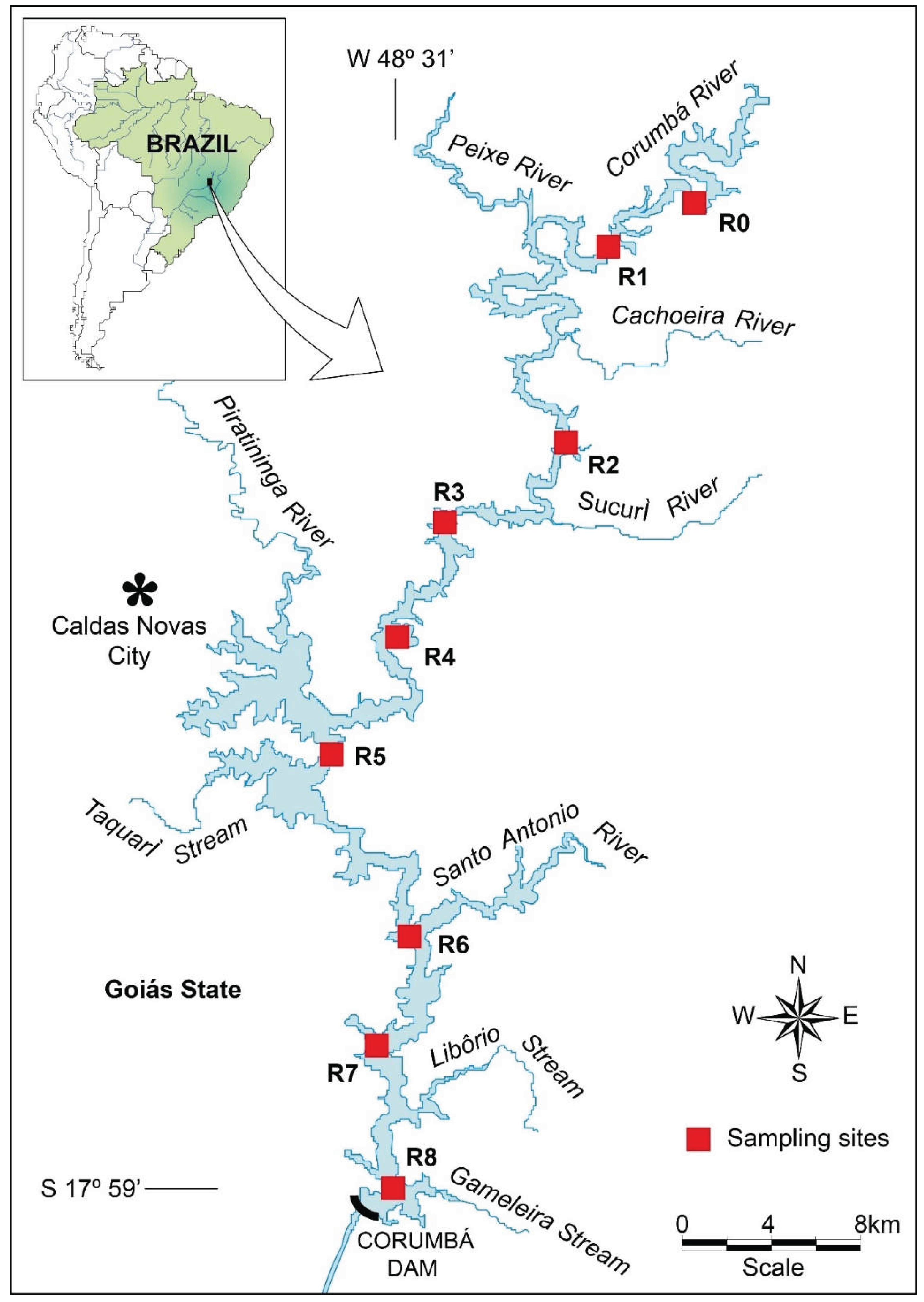
Figure 2.
Seasonal and spatial variation in the environmental conditions in the influence area of the Corumbá Dam. Lo – lotic region; Le – lentic region, Tr – Tributary; Ar – right arm; Al – left arm. DIN – dissolved inorganic nitrogen; SRP – reactive soluble phosphorus; Tur – turbidity; Con – Conductivity; DC – discharge; Zeu – euphotic zone; Zeu:Zmax – Euphotic zone:depth max ratio; Zmix:ZmaxZmixZmax – mixed depth:depth max ratio.
Figure 2.
Seasonal and spatial variation in the environmental conditions in the influence area of the Corumbá Dam. Lo – lotic region; Le – lentic region, Tr – Tributary; Ar – right arm; Al – left arm. DIN – dissolved inorganic nitrogen; SRP – reactive soluble phosphorus; Tur – turbidity; Con – Conductivity; DC – discharge; Zeu – euphotic zone; Zeu:Zmax – Euphotic zone:depth max ratio; Zmix:ZmaxZmixZmax – mixed depth:depth max ratio.
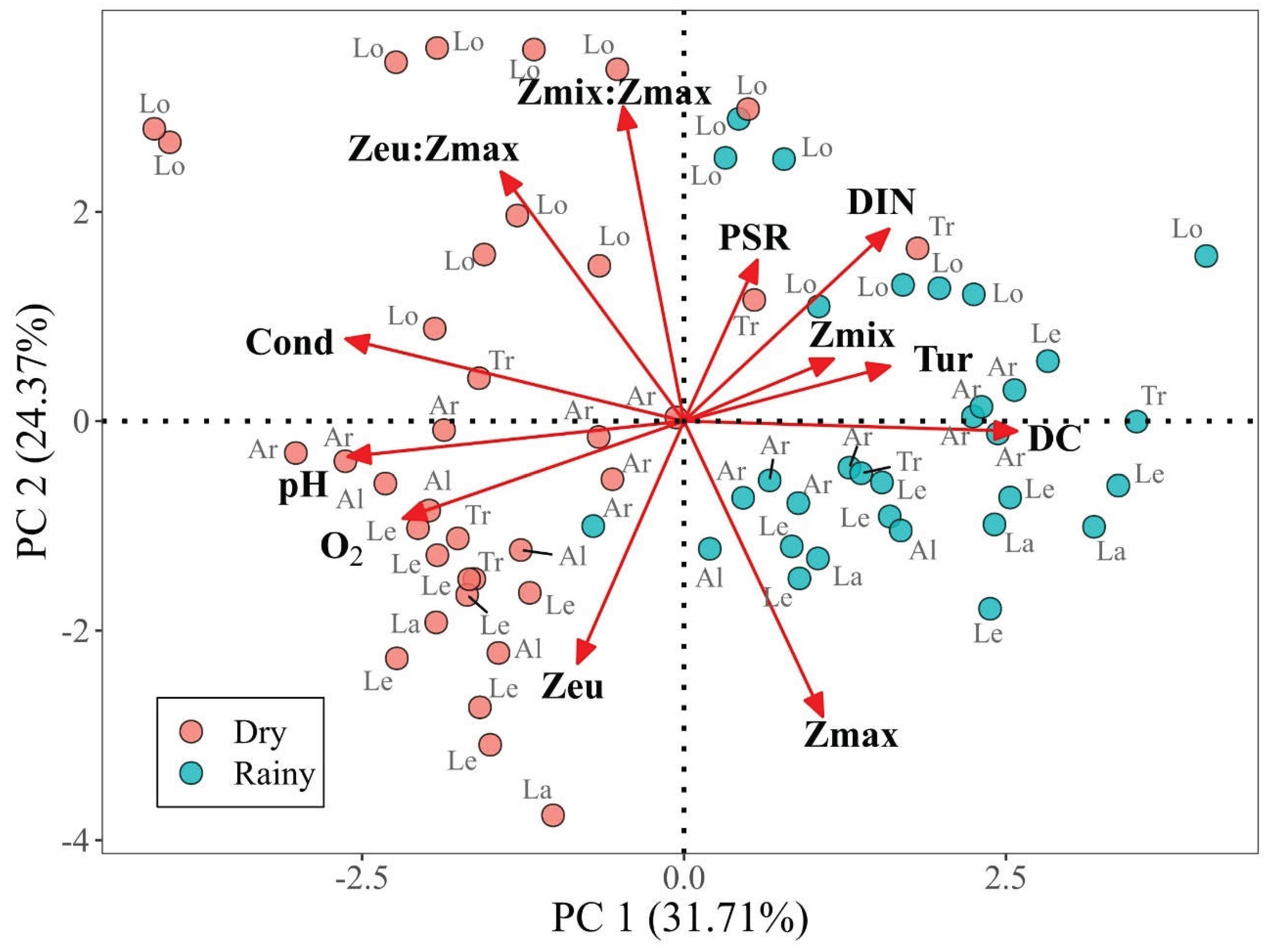
Figure 3.
Variation of beta diversity and its components (Total, Turnover, and Richness Difference) across taxonomic and functional approaches in each season. Please refer to the supplementary material for detailed pairwise comparisons among measures within each season (Table A3 and Table A4).
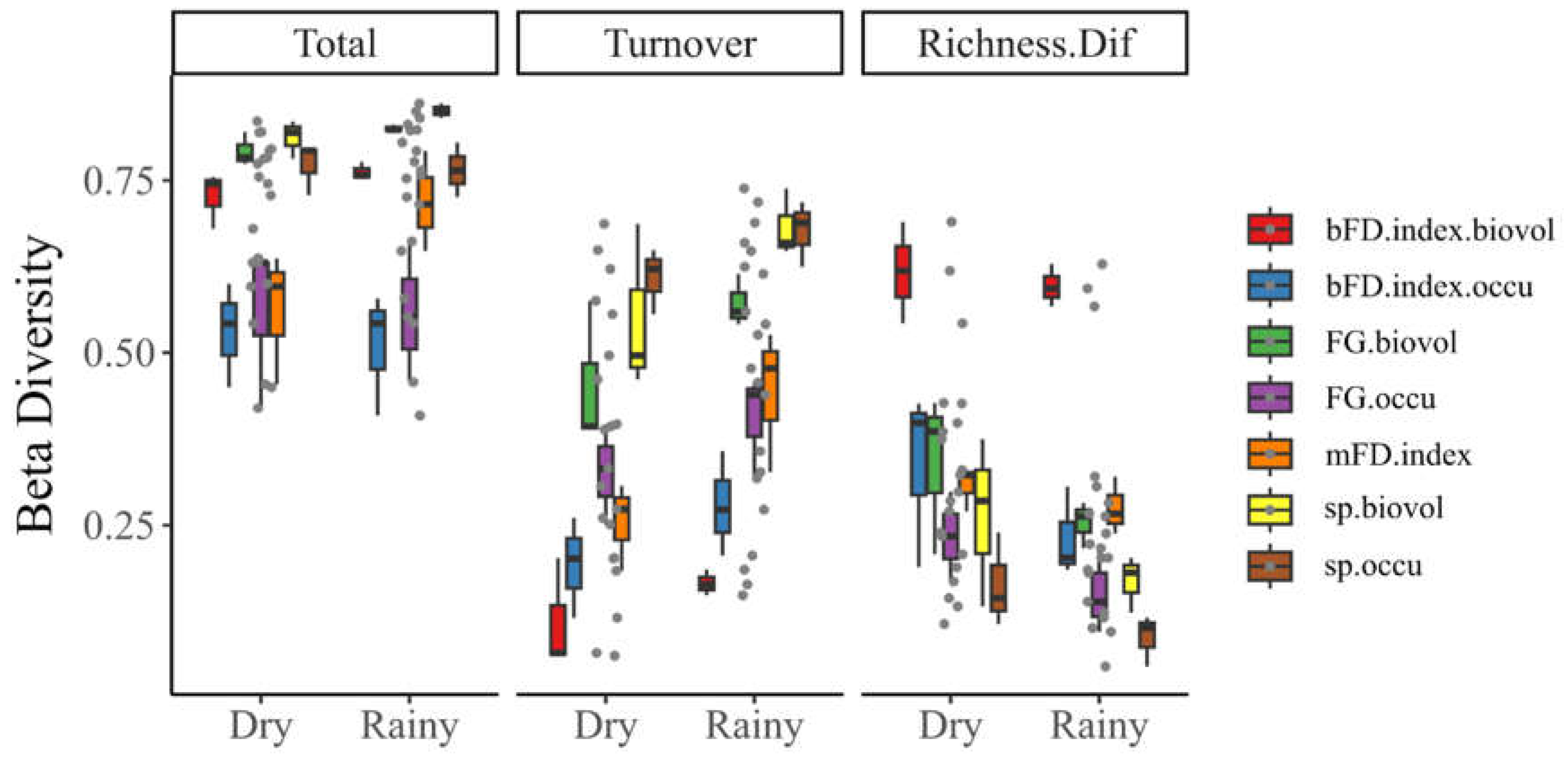
Figure 4.
Seasonal variation in the environmental explanation (adjusted R2) of beta-diversity components (Total, Turnover, and Richness Difference) across different taxonomic and functional approaches. Please refer to the supplementary material for detailed pairwise comparisons among measures within each season (Table A3 and Table A4).
Figure 4.
Seasonal variation in the environmental explanation (adjusted R2) of beta-diversity components (Total, Turnover, and Richness Difference) across different taxonomic and functional approaches. Please refer to the supplementary material for detailed pairwise comparisons among measures within each season (Table A3 and Table A4).
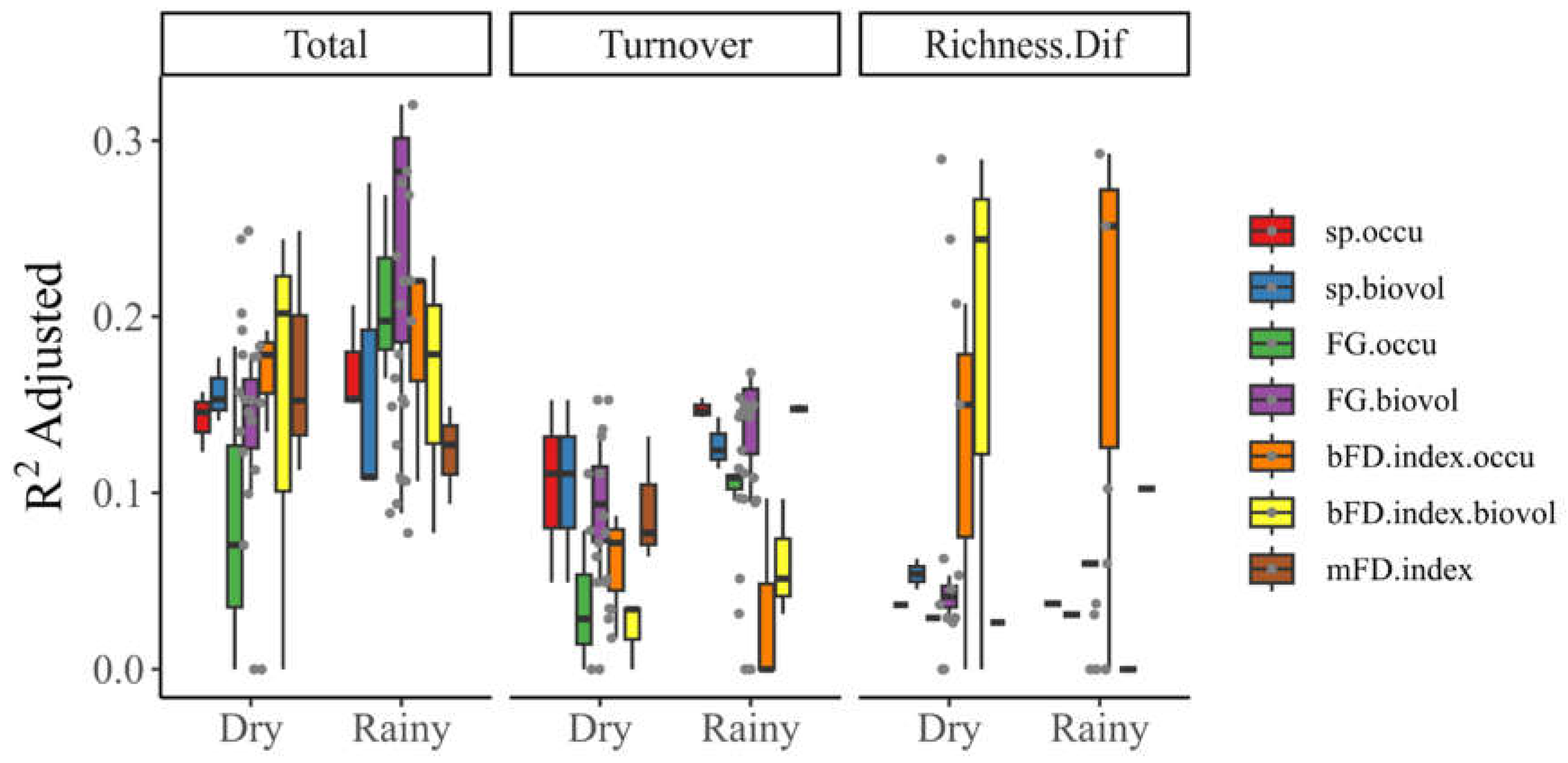
Figure 5.
Environmental explanation (adjusted R2, %) of community variation for each beta-diversity component (Total Beta Diversity, Turnover, Richness Difference) across the different dissimilarity measures. Results are shown separately for the three rainy (Rainy1–3) and dry (Dry1–3) samplings. Blank spaces indicate cases where the environment had no detectable effect on community variation.
Figure 5.
Environmental explanation (adjusted R2, %) of community variation for each beta-diversity component (Total Beta Diversity, Turnover, Richness Difference) across the different dissimilarity measures. Results are shown separately for the three rainy (Rainy1–3) and dry (Dry1–3) samplings. Blank spaces indicate cases where the environment had no detectable effect on community variation.
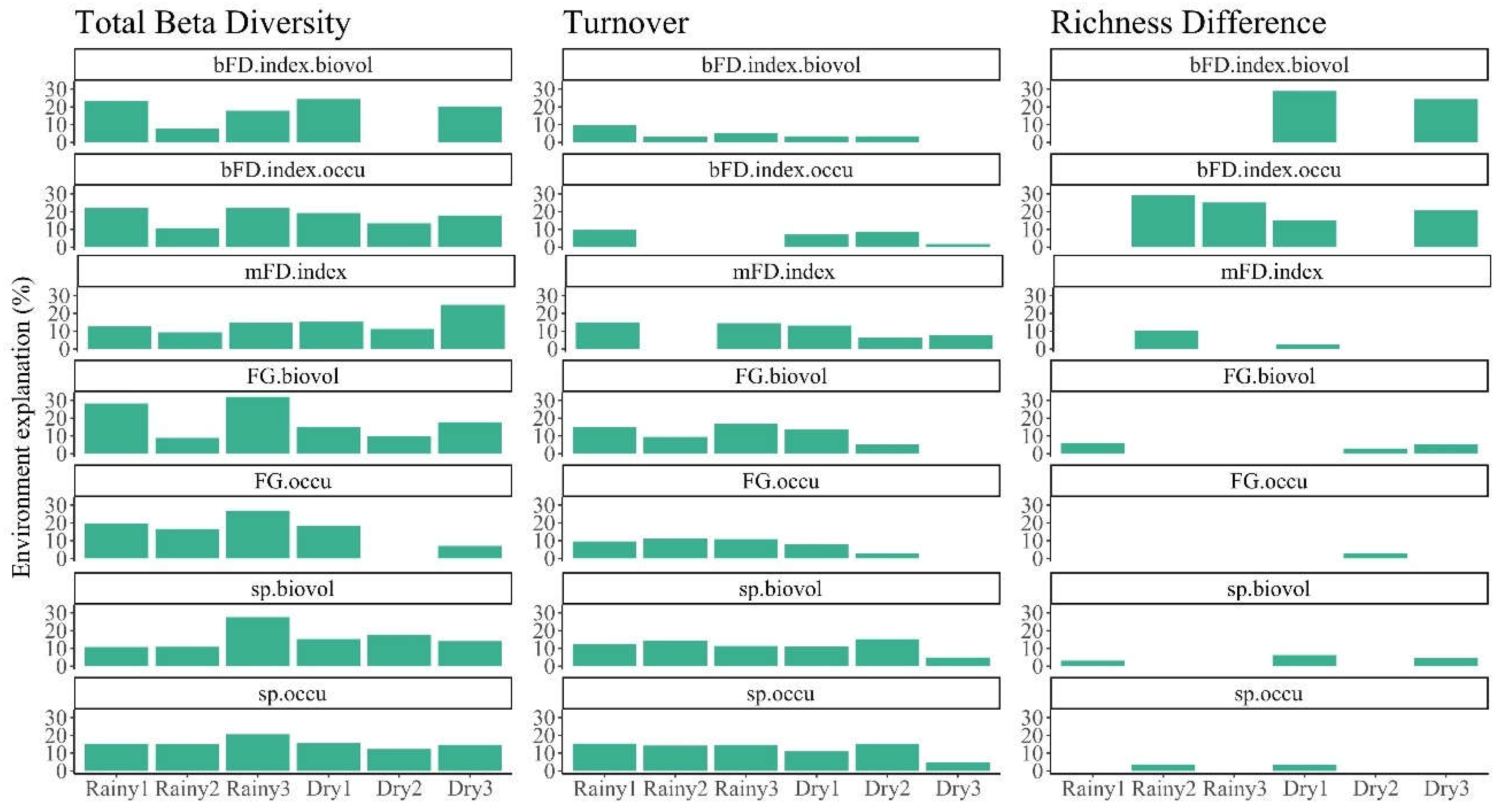
Figure 6.
Variation in the relative contribution of beta-diversity components (Turnover and Richness Difference, top panel) and in the environmental explanation (adjusted R2 × 100, bottom panel) across the different dissimilarity measures. The x-axis order is conceptual (from taxonomic to functional representations) and is used only to facilitate categorical comparison; it does not imply a quantitative gradient or a monotonic trend among measures. Each point represents an independent sampling; fewer points appear in the bottom panel because in some cases no environmental variables were selected, resulting in null explanatory power.
Figure 6.
Variation in the relative contribution of beta-diversity components (Turnover and Richness Difference, top panel) and in the environmental explanation (adjusted R2 × 100, bottom panel) across the different dissimilarity measures. The x-axis order is conceptual (from taxonomic to functional representations) and is used only to facilitate categorical comparison; it does not imply a quantitative gradient or a monotonic trend among measures. Each point represents an independent sampling; fewer points appear in the bottom panel because in some cases no environmental variables were selected, resulting in null explanatory power.
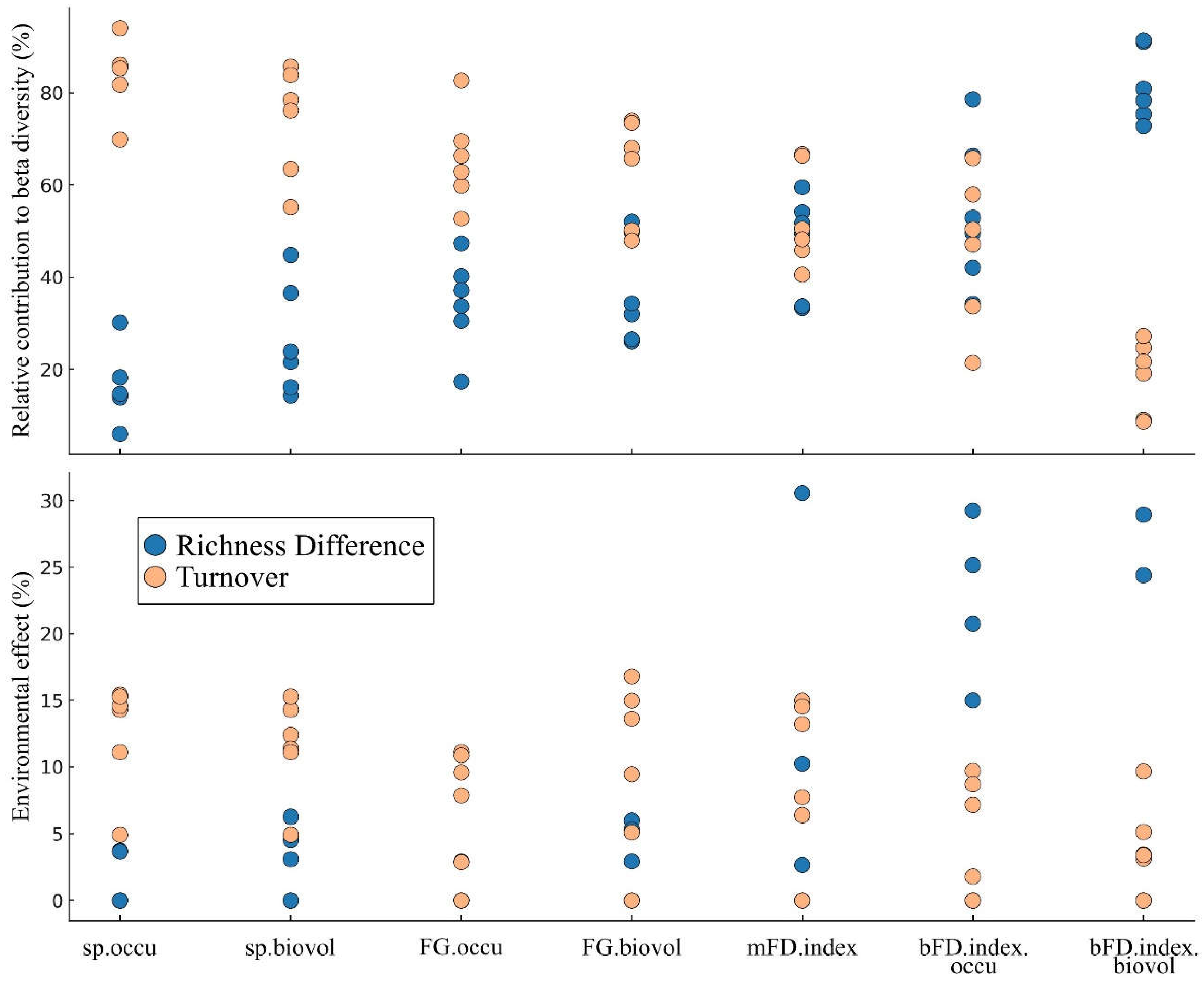
Table 3.
Mean values and coefficient of variation (CV—in %) of the environmental variables measured at the sampling sites during the rainy and dry periods. Temperature -WT (°C), dissolved oxygen - DO (mg L−1), pH, electrical conductivity - Con (µScm−1), turbidity -Tur (NTU), ammonium -NH4+ (µg L−1), nitrate -NO3 - (µg L−1), total Kjeldahl nitrogen—TKN (µg L−1), dissolved phosphorus—DP (µg L−1), soluble reactive phosphorus - SRP (µg L−1), total phosphorus—TP (µg L−1), water residence time—RT (days), Discharge—DC (m3 S−1), euphotic zone—Zeu (m), mixing zone—Zmix (m), maximum zone—Zmax (m), mixing zone/maximum zone ratio—Zmix:Zmax (m), euphotic zone/mixing zone ratio—Zeu:Zmix (m).
Table 3.
Mean values and coefficient of variation (CV—in %) of the environmental variables measured at the sampling sites during the rainy and dry periods. Temperature -WT (°C), dissolved oxygen - DO (mg L−1), pH, electrical conductivity - Con (µScm−1), turbidity -Tur (NTU), ammonium -NH4+ (µg L−1), nitrate -NO3 - (µg L−1), total Kjeldahl nitrogen—TKN (µg L−1), dissolved phosphorus—DP (µg L−1), soluble reactive phosphorus - SRP (µg L−1), total phosphorus—TP (µg L−1), water residence time—RT (days), Discharge—DC (m3 S−1), euphotic zone—Zeu (m), mixing zone—Zmix (m), maximum zone—Zmax (m), mixing zone/maximum zone ratio—Zmix:Zmax (m), euphotic zone/mixing zone ratio—Zeu:Zmix (m).
| Variable | Rainy | Dry | ||
|---|---|---|---|---|
| mean | CV | mean | CV | |
| Zmix | 5.621 | 128 | 5.000 | 120 |
| Zmax | 34.879 | 65 | 32.267 | 70 |
| Zmix:Zmax | 0.371 | 125 | 0.369 | 118 |
| Zeu | 2.739 | 96 | 2.849 | 91 |
| Zeu:Zmax | 0.186 | 148 | 0.217 | 138 |
| WT | 31.388 | 103 | 31.197 | 102 |
| NO3 | 147.603 | 91 | 170.333 | 104 |
| NH4 | 13.926 | 88 | 18.090 | 156 |
| DIN | 161.529 | 83 | 188.424 | 96 |
| TKN | 454.743 | 48 | 454.818 | 46 |
| DP | 9.157 | 34 | 9.873 | 40 |
| SRP | 5.422 | 32 | 5.455 | 31 |
| TP | 20.343 | 58 | 22.377 | 60 |
| O2 | 7.941 | 15 | 7.892 | 18 |
| pH | 7.717 | 12 | 7.845 | 12 |
| Con | 43.338 | 26 | 45.327 | 23 |
| Tur | 37.565 | 166 | 32.437 | 189 |
| DC | 418.241 | 79 | 318.583 | 97 |
| RT | 10.439 | 178 | 8.637 | 216 |
Table 4.
Effect of measure type on observed beta diversity components and adjusted R2 (environmental effect) across seasons. GLM results expressed as Chi2 statistics. Significant effects (p < 0.05) are highlighted in bold. Contrasts are provided in Supplementary Material (Table A3 and Table A4).
| Component | Season | beta diversity | Chisq | Df | Pr(>Chisq) |
|---|---|---|---|---|---|
| Diversity value | Rainy | Total | 208.21 | 6 | 2.20E-16 |
| Turnover | 275.08 | 6 | 2.20E-16 | ||
| Richness difference | 253.90 | 6 | 2.20E-16 | ||
| Dry | Total | 128.76 | 6 | 2.20E-16 | |
| Turnover | 230.35 | 6 | 2.20E-16 | ||
| Richness difference | 69.63 | 6 | 4.88E-13 | ||
| R2 Adjusted | Rainy | Total | 4.43 | 6 | 0.6185 |
| Turnover | 43.12 | 6 | 1.11E-07 | ||
| Richness difference | 637.90 | 4 | 2.2E-16 | ||
| Dry | Total | 10.79 | 6 | 0.09516 | |
| Turnover | 8.46 | 6 | 0.2066 | ||
| Richness difference | 10.30 | 6 | 0.1102 |
Table 5.
Seasonal variation of beta-diversity components (Total, Turnover, Richness difference) calculated with different dissimilarity measures. Estimates represent the effect of the rainy season relative to the dry season (reference). For each model, the table reports the estimate, standard error, z value, and p value from beta regressions (GLM with beta error). Significant results (p < 0.05) are highlighted in bold.
Table 5.
Seasonal variation of beta-diversity components (Total, Turnover, Richness difference) calculated with different dissimilarity measures. Estimates represent the effect of the rainy season relative to the dry season (reference). For each model, the table reports the estimate, standard error, z value, and p value from beta regressions (GLM with beta error). Significant results (p < 0.05) are highlighted in bold.
| Beta component | Measure | Estimate | Std. Error | z value | Pr(>|z|) |
|---|---|---|---|---|---|
| Total | mFD.index | 0.684 | 0.249 | 2.741 | 0.006 |
| FG.biovol | 0.209 | 0.075 | 2.765 | 0.006 | |
| FG.occu | -0.011 | 0.298 | -0.038 | 0.969 | |
| sp.biovol | 0.270 | 0.097 | 2.783 | 0.005 | |
| sp.occu | -0.041 | 0.144 | -0.283 | 0.777 | |
| bFD.index.occu | -0.083 | 0.220 | -0.376 | 0.707 | |
| bFD.index.biovol | 0.182 | 0.103 | 1.760 | 0.078 | |
| Turnover | mFD.index | 0.834 | 0.260 | 3.208 | 0.001 |
| FG.biovol | 0.476 | 0.214 | 2.225 | 0.026 | |
| FG.occu | 0.336 | 0.215 | 1.563 | 0.118 | |
| sp.biovol | 0.549 | 0.262 | 2.095 | 0.036 | |
| sp.occu | 0.300 | 0.139 | 2.163 | 0.031 | |
| bFD.index.occu | 0.491 | 0.282 | 1.740 | 0.082 | |
| bFD.index.biovol | 0.596 | 0.334 | 1.786 | 0.074 | |
| Richness difference | mFD.index | -0.160 | 0.122 | -1.311 | 0.190 |
| FG.biovol | -0.372 | 0.274 | -1.356 | 0.175 | |
| FG.occu | -0.536 | 0.281 | -1.910 | 0.056 | |
| sp.biovol | -0.477 | 0.354 | -1.346 | 0.178 | |
| sp.occu | -0.684 | 0.331 | -2.067 | 0.039 | |
| bFD.index.occu | -0.475 | 0.335 | -1.416 | 0.157 | |
| bFD.index.biovol | -0.093 | 0.158 | -0.589 | 0.556 |
Table 6.
Seasonal variation of adjusted R2 values for beta-diversity components (Total, Turnover, Richness difference) calculated with different dissimilarity measures. Estimates represent the effect of the rainy season relative to the dry season (reference). For each model, the table reports the estimate, standard error, z value, and p value from beta regressions (GLM with beta error). NA values appear when no model could be fitted due to lack of replication in one of the seasons. Significant results (p < 0.05) are highlighted in bold.
Table 6.
Seasonal variation of adjusted R2 values for beta-diversity components (Total, Turnover, Richness difference) calculated with different dissimilarity measures. Estimates represent the effect of the rainy season relative to the dry season (reference). For each model, the table reports the estimate, standard error, z value, and p value from beta regressions (GLM with beta error). NA values appear when no model could be fitted due to lack of replication in one of the seasons. Significant results (p < 0.05) are highlighted in bold.
| Beta component | measure | Estimate | Std. Error | z value | Pr(>|z|) |
|---|---|---|---|---|---|
| Total | mFD.index | -0.338 | 0.264 | -1.276 | 0.202 |
| FG.biovol | 0.437 | 0.412 | 1.059 | 0.290 | |
| FG.occu | 0.663 | 0.343 | 1.933 | 0.053 | |
| sp.biovol | -0.040 | 0.314 | -0.127 | 0.899 | |
| sp.occu | 0.208 | 0.125 | 1.665 | 0.096 | |
| bFD.index.occu | 0.056 | 0.245 | 0.227 | 0.820 | |
| bFD.index.biovol | -0.453 | 0.340 | -1.334 | 0.182 | |
| Turnover | mFD.index | 0.582 | 0.214 | 2.717 | 0.007 |
| FG.biovol | 0.490 | 0.348 | 1.411 | 0.158 | |
| FG.occu | 0.820 | 0.273 | 3.003 | 0.003 | |
| sp.biovol | 0.305 | 0.274 | 1.111 | 0.267 | |
| sp.occu | 0.477 | 0.262 | 1.825 | 0.068 | |
| bFD.index.occu | 0.667 | 0.516 | 1.293 | 0.196 | |
| bFD.index.biovol | 0.443 | 0.375 | 1.180 | 0.238 | |
| Richness difference | mFD.index | 0.028 | 1.011 | 0.028 | 0.978 |
| FG.biovol | 0.428 | 0.272 | 1.573 | 0.116 | |
| FG.occu | 0.000 | NaN | NaN | NaN | |
| sp.biovol | -0.561 | 0.203 | -2.756 | 0.006 | |
| sp.occu | 0.017 | 0.000 | 6028.000 | <2e-16 | |
| bFD.index.occu | 0.547 | 0.151 | 3.612 | 0.000 | |
| bFD.index.biovol | 0.000 | NaN | NaN | NaN |
Disclaimer/Publisher’s Note: The statements, opinions and data contained in all publications are solely those of the individual author(s) and contributor(s) and not of MDPI and/or the editor(s). MDPI and/or the editor(s) disclaim responsibility for any injury to people or property resulting from any ideas, methods, instructions or products referred to in the content. |
© 2026 by the authors. Licensee MDPI, Basel, Switzerland. This article is an open access article distributed under the terms and conditions of the Creative Commons Attribution (CC BY) license (http://creativecommons.org/licenses/by/4.0/).
Copyright: This open access article is published under a Creative Commons CC BY 4.0 license, which permit the free download, distribution, and reuse, provided that the author and preprint are cited in any reuse.


