

Submitted:
03 June 2026
Posted:
04 June 2026
You are already at the latest version
Abstract
Using marine resources’ colouring agents as nutrients, medicaments and in luxury products colouring is rooted in human history. The handy obtainable marine biological pigments (MBPs), consider as inexpensive materials since colourants. They were a part e of blue technology for colouring purposes, as nutrient additives, cosmetic gradients, beauty products, staining addresses and fashion colour in luxury. Today, they still broaden many new applications. They can be concentrated on the bodies of marine creatures providing unique colour, properties and complement activities. They can stand alone to process unique activities. In addition, some are essential for host survival. Out of their primary hosts, they stay either unmodified or can be changed or associated with other micro and/or macromolecules in their secondary hosts (consumers). Few were extracted, purified, identified and formulated as drugs. Many share properties like being antioxidants, having the ability to protect from sunlight (as UV waves) and improving eye vision. They are involved in health protection or illness treatment, as anticancer, anti-inflammatory, anti-neuro-degradation, antiaging, anti-wrinkle, and as antimicrobial. Even they hold many undiscovered properties that make them an uncountable source for de nevo applications with innumerable chances that mastery the colourful fields. This review summarizes the importance of marine pigments and addresses important applicable properties that made them interesting in nutraceutical, medicinal, pharmaceutical, cosmeceutical and industrial applications. In addition, it is concerned with discussing some facts that have attracted the attention of humans in the past today and some expectations for the MBPs future.
Keywords:
marine biological pigments (MBPs)
; drugs
; antioxidants
; anti-inflammatory
; anticancer
; antiaging
; carotenoids
; xanthophylls
; carotenoproteins
1. Introduction
1.1. Pigments, Dyes, Colours, Colourants
The primary difference between pigments and dyes is their solubility. Pigments are solid powder particles, soluble in organic acids, fats and oils and might be slowly dissolved in water. They collectively dissolve in organic solvents (polar and non-polar organic solvents). Dyes are water-soluble colourants that chemically bound into the material. Pigments are essential parts of their primary hosts or (like in the photosynthesis process) and their consumers (as food, colouring agents and drugs) daily life. Many pigments are found in edible foods, like edible marine products [1] or in safe resources include marine resources [2]. They are used for several purposes, as medicine [3], cosmetics [2], and food additives [4,5,6,7]. Natural pigments are safer than synthetic ones. They are consumed through food or purified and used in products that can reach body parts (like skin contact/absorption) [8,9]. They are active molecules that beside have colour can do vital functions or complement the activity of certain macromolecules. For that they are essential (mostly) for their primary hosts (producers) and essential/healthy for their secondary hosts (consumers). Humans come to the end of the food chain, where he might consume the primary host (like algae) or a secondary host that comes at the end of the chain, like fishes. Meanwhile the closer host to the MBPs is more adapted to collect MBPs in its corpus (like cuticles and exoskeletons).
1.2. Natively Coloured, Acquired, Collected, Changed MBPs and Pigment-Less
Materials (including MBPs) are differently absorbed light [10,11]. The wavelengths that did not adsorbed give our eyes the objects’ colours. For that the amount of MBPs is important and can be influenced by the amount of existing sunlight in a particular area. MBPs are responsible not only for colour, protection, but also for essential activities like photosynthesis, and as sensors for the intensity of the sunlight to enable better adaptation and correct survival. They are compounds that can go up/go down as a response to the surrounding environment constituents, like sunlight, salt, pH, oxygen, organic materials and water deepness. Colour might not exist as a built-in compound(s) in the marine creature exoskeletons but come from their bodies and appear through transparent/semitransparent exoskeletons. Or can collect after feeding on a MBPs produces as it is or after modified in their new host. The terminal location in their new host corpus can be responsible for this change, plus the existence of other MBPs types. Not only can the exoskeleton collect pigments but also the body itself. So, the consumer’s final colours can differ from location to another. Cuticle (cuticula) is the superficial, noncellular layer secreted by the hypodermis covering certain organisms secreted by the hypodermis. As an exoskeleton it can be coloured, transparent or semitransparent [12,13,14]. This is the main difference between the outer cover of some shrimps and coloured crabs. It is an important criterion of MBPs is their ability to be collected in some bio-structures [15]. For that, varying food resources and consuming those colourants with safe MBPs is important. Marine pigments’ ability to be collected in different creatures’ corpus units is not restricted to marine species but can be collected in terrestrial creatures. For example, Lesser flamingos (Phoeniconaias minor Geoffroy) in the Ngorongoro Crater, Tanzania get its pink colour of wild flamingos is attributable to Astaxanthin carotenoid, they absorb from their diet of brine shrimp [16]. If fed a carotene-free diet, they would become white. Other species feed on artemia like Flamingolepis liguloides and Anomotaenia tringae [17].
1.3. Kindly Ensure Your Food Quality, Because You Will Become Finally My Food
Humans get some medication indirectly, while they are toxins but after being eaten by a stronger creature like the camel [18]. Marine invertebrate and vertebrate do the same. Marine shrimps are always expensive and hard to be obtained from their natural ecosystem. Mullus barbatus feeds on shrimps and gets special taste if cooked correctly. M. surmuletus (striped, red mullet) exhibits a typical red, orange and yellowish colour with longitudinal stripes that can change through the contraction and expansion of chromatophores, specialized pigment cells. The fish’s vibrant vermilion colour intensifies when stressed or upon death. Common MBPs involved in fish coloration includes melanin, carotenoids and pteridines. Although rare, abnormally pigmented specimens (e.g., bluish, metallic colouring) were reported in the Mediterranean (İzmir Bay) [19]. Or it might be MBPs dependent! In Alexandria (Egypt), inhabitants believe that M. barbatus could be a correct substitution for the shrimp, particularly if fished at the time of shrimp reproduction.
1.4. Even Isolated Lakes Become Coloured
Some seas have given a name of a colour based on their general appearance, which affected by many issues, including their micro/microbiota. In different parts of the world, water ecosystems enable a rare auto-selection for a wonderful algal, the Spirulina platensis. In the Middle East the common belief is ‘’from water, every living creature has been created’’. In Shad 113 years, alongside its first microscopic identification, Spirulina (Arthrospira) was reintroduced to the globe by Dangeard (1940) from a sample collected by Mr C’reach (a pharmacist) from a local market [20]. Arthrospira fusiformis can dominate alkaline lakes where alkalinity [20] and salinity [16] become high. Humans learned from migrant birds to eat Arthrospira. In Ethiopia, farmers and herdsmen living in areas close to the soda lakes make their cattle drink Arthrospira water about once a month believe that it has therapeutic effects and rewards for some lake of dietary food [21]. Rich (1931) reported it to control and dominate phytoplankton in several lakes in the Rift Valley of East Africa [16]. S. platensis (A. platensis) gives Shad-lake its green colour. Shad-Lake’s colour, size, salinity, alkalinity and biodiversity are changed based on the amount of rain fall/year. A. fusiformis dominates the lakes with dense growth that encourages their collection. The wet biomass is filtered on the desert sand. Under the desert sun, it dries safe and fast. After repeating this process, the algae biomass becomes a cake and that cut into small pieces (like biscuits). They may be the first produced edible cake/ biscuit on the earth. Nowadays Arthrospira is a one-unit food/feed and pharmacy and has many useful and amazing products. It was used to produce cyanocobalamin (B12), antioxidant MBPs like β-carotene, tocopherols, and γ-linolenic acid [22]. The deep blue colour of phycocyanin and other extractable MBPs, comprising myxoxanthophyll and zeaxanthin, were widely used being safe colourants for food additive purposes [23].
1.6. Let Us Bring Nature to Our Houses
Out of their natural habitat, many MBPs can be produced if the correct axenic culture is obtained and allowed to grow in microbial-free conditions as a single cell. In such cases, a true pharmaceutical grade can be obtained. For more details refer to Amara and Steinbüchel (2013) [16]. Phycocyanin and Arthrospira’s exopolysaccharide have anticancer, antioxidants, antivirals [24,25], and anti-inflammatories and can be a tonic agent for the immune system [23]. A. platensis proved to have a potent antiviral activity against herpes simplex virus [24,25]. Proof encourages its formulation of different medications applied as antivirals. This importance encourages scientists and investors to build artificial bonds, labs or photobioreactors to obtain pharmaceutical grade products, including the biomass of the MBPs producing algae.
1.7. A Need for Regular Data Update
One can observe the increase in the number of newly identified marine resources, including MBPs by observing new names are not found in the recently published encyclopedias or chemical structures that could not be found in the famous chemical databases. The MBPs in nature are the norm. New structures are regularly discovered [26]. MBPs even decorate the sea environment but they are an essential part of the different biological pathways [27]. These MBPs’ have roles in their host surviving mechanisms, basically photosynthesis, photoprotection, camouflage and attracting partners. The colour intensity mostly changed by changing in the surrounding environment. Micro/microbiota colours are usually blue, green and red. Even in deep water, biota can affect its colour. After Turkey earthquakes (2022), the Alexandria beach turns brownish because of the colour of floated brown algae. In a city like Alexandria, one can see different colours for different aquatic areas. The Mediterranean Sea (white, blue), in its east-south lake Mariout existed (faint green), between saline separate spots (brackish and brines) became red after the raining season. Based on the existing MBPs, the net colour is formed. Macroalgae, which are rich in chlorophylls a and b, seem green. Greenish-brown algae are accredited to Fucoxanthin. The red colour of algae is caused by chlorophylls a, c, d and phycobilins [28]. Specific MBPs give privilege to their host, while they can absorb light in deep water efficiently. Conditions could change the water’s ability to pass light to marine creatures, like water depth, quality, pH, salinity and fluting contents.
2. MBPs Classification Based on Their Producers
MBPs can be categorized based on various criteria. One of them is based on their producers. Chlorophylls are green MBPs for photosynthesis and exist in marine plants. Chlorophyll-a (blue green) [29,30,31] exists in all phytoplankton, red seaweed and green algae. Chlorophyll-b (green, yellow) is exclusive to green algae (Chlorophyta). Chlorophyll-c (yellow green) exists in brown algae (Phaeophyta) and diatoms. Phycobiliproteins, are water-soluble MBPs in cyanobacteria and red algae, comprising phycocyanin and phycoerythrin. Phycoerythrin (red) dominates in red algae (Rhodophyta), allowing them to flourish at great depths. Phycocyanin (Blue) exists in blue-green algae (Cyanophyta) as Spirulina. Carotenoids are variants. Fucoxanthin (brown/orange) exists in brown algae (like kelp and Sargassum). Astaxanthin (red-pink) is extracted from Haematococcus pluvialis (green microalgae) [32], and β-carotene (yellow – orange) is produced by Dunaliella salina [33]. Many of the MBPs from marine vertebrates and invertebrates are largely based on exo-source consumption following by accumulation and might be subject to internal modification/adaptation. Some marine creatures have brilliant colours because of complex/specific metabolic pathways. They include Astaxanthin (pink, red) is the elementary pigment in salmon, shrimp, lobster, besides crayfish, stored as carotenoproteins. Crustacyanin is a pigment-protein complex that turns red Astaxanthin into blue in live lobster shells. Echinochrome [34] (dark brown/red) are quinone MBPs in sea urchins [35]. Tunaxanthin [36] (bright yellow) exists in fish skins and fins (as Yellowtail). Tetrapyrrole (Blue) like Phycoerythrobilin [37] is a pigment found in some nudibranchs (marine molluscs). MBPs from bacteria and microorganisms produce a broad rank of colours with different antimicrobial properties. They include Prodigiosin (deep red) is produced by Serratia and Vibrio bacteria [38,39,40,41,42,43]. Violacein (Violet/Purple) is produced by Chromobacterium violaceum [44]. Indigoidine (Deep Blue) [45] is produced by Phaeobacter [46] and Rheinheimera. Melanin (Dark Brown/Black) is produced by Alteromonas [47]. Scytonemin (yellow green) is sheath pigment domination cyanobacteria used to protect against UV lights [48]. Glaukothalin (Deep Blue) is a specific pigment in marine bacteria in the Wadden Sea [49]. The above simple categorization might be utile to reach the right natural-coloured producers, especially those who are safe nutrients or feed. Meanwhile there is a large hindrance and overlapping based on the MBPs’ original backbone, nature, how it is changed, collected in which body/tissue/liquid part of the cells/tissues/organs/whole organisms and their co-structure, like their associations with different proteins [50]. Based on pigment contents, algae can be categorized into three clear groups: Chlorophyceae (green algae), Phaeophyceae (brown algae), and Rhodophyceae (red algae). For more details kindly refer to Table 1 and Figure 1.
3. MBPs Classification Based on Their Chemical Structure
In this review, classifying MBPs will be based on their chemical structures as the first option. MBPs particularly those with vital crucial biological activities can be classified into three basic classes:
3.1. The First Class: Chlorophyll
Chlorophylls, are greenish lipid-soluble natural MBPs with a porphyrin ring like chlorophyll-a, b, c, d and e plus other types [51]. Chlorophylls are the most important marine pigment that does photosynthesis and can stand alone to process a complete photosynthesis process. It can get more support from other structures, particularly carotenoids. In marine environments, chlorophyll primarily exists in phytoplankton, algae and cyanobacteria. Marine chlorophyll differs from terrestrial chlorophyll in its diversity, collaboration (with other structures), and adaptation to aquatic light and structural variants. Marine chlorophylls are optimized to absorb blue-green light (447-520 nm), which penetrates deepest in the ocean (land plants largely use red and blue light). Marine chlorophylls make up roughly half of global photosynthetic oxygen production. Their levels are highly variable based on nutrients and season, with high concentrations in cold, nutrient-rich polar waters (yellow) and low concentrations in nutrient-poor subtropical regions (blue). Marine cyanobacteria, such as Prochlorococcus, have individualistic chlorophyll variants (divinyl chlorophyll-a and b) and some are even found to have chlorophyll-d or f for low light, far-red absorption. Like terrestrial chlorophyll, the marine variant has a chlorine-ring structure containing a magnesium atom (Mg2+) at its core, essential for capturing light energy. They are labile (unstable) and easily degraded into pheophytins by acidic conditions (loss of Mg2+) or by chlorophyllase enzyme action. They are commonly bound to special pigment-protein complexes to promote the efficiency of light-harvesting, specifically in deep/sunk sea environments where light is scarce. They extract, specifically from micro algae, are recognized for antioxidant, anti-inflammatory and neuroprotective properties. For more details refer to Table 2 and Figure 2.
3.1.1. Chlorophyll-a
Chlorophyll-a known as a universal photosynthetic pigment in marine oxygenic photosynthesis in all marine phytoplankton, algae and cyanobacteria. It converts light energy through the biological system to chemical energy. It is the only pigment that acts as the primary electron donor in the electron transport chain. High concentrations can show healthy, productive ecosystems, but excessive growth is a singe of eutrophication (oxygen depletion). Its distribution is prohibitively influenced by water temperature and nutrient levels, especially nitrogen and phosphorus and salinity. Chlorophyll-a in the ocean is a key proxy for measuring phytoplankton biomass and estimating primary productivity. It includes a chlorine ring, featuring four nitrogen atoms surrounding a central magnesium ion, with a long hydrophobic hydrocarbon tail (phytol) that anchors it to thylakoid membranes. It is essential for absorbing sunlight in the blue (∼430∼430 – 450 nm) and red (∼662∼662 – 680 nm) spectra and driving photosynthesis. Satellite remote sensing measures surface chlorophyll-a concentrations to estimate phytoplankton biomass and track ocean productivity and ecosystem health.
3.1.2. Chlorophyll-b
Chlorophyll-b is an accessory photosynthetic pigment primarily in marine green algae (Chlorophyta), some marine cyanobacteria (prochlorophytes), and Prochlorococcus broadening the light absorption range. Chlorophyll-b stabilize the major light-harvesting complex II (LHC II) in green algae. It absorbs light at different wavelengths better than chlorophyll-a, primarily in the blue range (about 455 nm) and the orange-red range (about 642 nm), transferring this energy to chlorophyll-a, enhancing photosynthetic efficiency in the ocean. In shaded or deep water, marine organisms raise their chlorophyll-b to absorb the specific blue light that penetrates deeper. Bryopsis corticulans show that dissociating Chlorophyll-b from the LHC acts as a photoprotective mechanism against excessive, high light irradiation.
3.1.3. Chlorophyll c
Chlorophyll-c is a blue-green accessory photosynthetic pigment that lacks reduced ring D and the long hydrophobic terpenoid phytol chain (phytol alcohol) imprint chlorophyll a and b, making it more polar and structurally unique. Unlike chlorophyll-a and b; chlorophyll-c MBPs act as Mg-porphyrins rather than Mg-chlorins, with an unsaturated porphyrin ring. In land plants, chlorophyll-b is common. Several marine phytoplankton, specifically photosynthetic Chromista (such as diatoms and dinoflagellates) [54] and haptophytes (such as Emiliania huxleyi) contain significant chlorophyll-c (types c1,c2 ,c3). Chlorophyll-c acts as a light-harvesting accessory pigment, transferring its energy to chlorophyll-a in the LHC. C1 has absorption peaks around 444 – 447nm, 577 – 579nm and 626 – 629nm [54]. c2, has absorption peaks 447 – 450nm, 580 – 581nm and 627 – 629nm [54]. c3 has absorption peaks 452 nm, 585 nm, and 625 – 627nm [55]. At least eight other more subtypes are existed [56]. In solution, it presents a blue-green colour. It features an acrylic acid side chain, which has led to some compounds in this group being named chlorophyllides. Its absorption properties, specifically combined with MBPs like Fucoxanthin, allow marine organisms to efficiently capture the blue green light common in marine habitats. It is incorporated into fucoxanthin-Chlorophyll-a / c protein (FCPs) complex in diatoms and brown algae, where it helps in light-harvesting and potentially photoprotection.
3.1.4. Chlorophyll-d
Chlorophyll-d is an accessory photosynthetic pigment, characterized by Harold Strain and Winston Manning in 1943 [98]. It was uniquely known in Acaryochloris marina in the 1990s [57]. It exists in cyanobacteria, which uses energy captured from sunlight for photosynthesis. Chlorophyllide-d is made from Chlorophyllide-a [58] by chlorophyll synthase. Chlorophyll-d absorbs far-red light, at 710 nm wavelength, just outside the visual range. An organism that contains Chlorophyll-d is adapted to an environment such as moderately deep water, where it can use far-red light for photosynthesis.
3.2. The Biggest Class: The Carotenoids
Carotenoids are lipophilic and linear polyenes, and can be divided into two groups; group I: carotenes (α-, γ-, β-) and lycopenes (when the chain ends with a cyclic group, containing only carbon and hydrogen atoms). And Group II: xanthophylls or oxycarotenoids (like Fucoxanthin, violaxanthin, antheraxanthin, zeaxanthin, lutein, neoxanthin), which have at least one oxygen atom as a hydroxyl group, as an oxy-group, or as a combination of both [99]. Based on their colour; α- and β-carotene, lutein, and zeaxanthin are present in red seaweed; β-carotene, lutein, violaxanthin, neoxanthin, and zeaxanthin are in green seaweed species; and β-carotene, violaxanthin, pheophytins, and fucoxanthin are in brown algae [100]. For more details refer to Figure 3.
Carotenoids have gained as dietary supplements, fortified foods, food dyes, animal feed, pharmaceuticals, and cosmetic products because of their antioxidants, anticancer, and are used to treat ophthalmologic diseases [101]. The term carotene (also carotin, from the Latin carota, “carrot”) is used for many related unsaturated hydrocarbon substances. Carotenes are yellow, orange or red (like the orange colour of the carrot) lipid-soluble natural MBPs of C40 terpenes (having the formula C40Hx [102]). Carotene is an isomer of an unsaturated hydrocarbon act, as photosynthetic MBPs with no oxygen atoms and exist at lower trophic levels [103,104]. Collectively, carotenoids are classified into two major groups: carotenes and xanthophylls. When carotenes are oxygenated, they are named xanthophylls. Primary carotenoids are required for photosynthesis and include β-carotene, violaxanthin and neoxanthin. Secondary carotenoids include α-carotene, zeaxanthin, antheraxanthin and β-cryptoxanthin [103,105]. Carotenes send the light energy they absorb into chlorophyll. Carotenoids can be sorted into different subclasses. One classification is based on the end groups, like: 1) apo/diapo carotenoids (in which one or two terminal fragments were removed); 2) homo carotenoids (with over 40 atoms of carbon, often 50); and 3) nor carotenoids (C37, C38 and C39). Carotenoids can make powerful antioxidants quench singlet oxygen, to be oxidized, isomerized and to scavenge free radicals, important in the etiology of several diseases. They can occur in other organisms because of different kinds of uptake. The liver converts carotenes into vitamin A. Miller et al., evaluated carotenoid antioxidants against radicals and established the following order of activities decreasing lycopene > β-cryptoxanthin > lutein = zeaxanthin > α carotene > echineone > canthaxanthin = Astaxanthin. Some carotenoids can be associated with proteins. When this connotation in stoichiometric proportion is named a true carotenoprotein [106]. Carotenoids are isolated from different algal species includes: Chlorococcum humicola [107], Dunaliella salina [108], Haematococcus pluvialis [109], Odontella aurita, Phaeodactylum tricornutum [110], Spirulina platensis [111], Himanthalia elongata [112], Chlorella vulgaris [113].
3.2.1. Astaxanthin
Astaxanthin is a keto carotenoid that fits in the group of terpenes and is formed from five carbon precursors, isopentenyl diphosphate and dimethylallyl diphosphate. Astaxanthin is acted as an antioxidant [114]. It is produced by some algae (mainly microalgae) [115], plants, bacteria and fungi. Chlorella zofingiensis; (green macroalgae) can produce it through heterotrophic growth. Astaxanthin is found in marine products, such as fish (marine salmon [116] and freshwater fish [117]. The most used microalgae for its production are H. pluvialis and Chlorella zofingiensis [59]. It precious entities in the prevention and treatment of common systematic diseases and/or disorders [118]. It is available on the market in products with various forms, comprising oils, tablets, capsules, syrups, soft, creams, biomass, or ground [119]. AstaPure® (Algatech LTD) produced from microalgae H. pluvialis [120]. Astaxanthin rises mitochondrial function by lowering mitochondrial reactive oxygen species (ROS) while improving ATP production [19]. It has CDB in its polyene backbone explains its ability to quench singlet oxygen [121]. Unlike most antioxidants which work in the inner (as vitamin E and β-carotene) or on the outer side of the membrane (as vitamin C), Astaxanthin stretches through the bilayer membrane and for that it has antiaging potential [122]. Astaxanthin is a dietary supplement for health applications [123] like fighting oxidative stress because of physical exercise, such as athletes [124]. It was safe as a feed additive in the aquaculture and animal feed industries [125]. Astaxanthin is affected by pH, heat and light. It blocks cytokine production and decrease inflammation [126]. It has antimicrobial activity against Helicobacter pylori and reduce gastric inflammation [127]. It can protect skin against different illnesses like rotenone-induced neurotoxicity in Parkinson’s disease [128], traumatic brain injury, hepatic encephalopathy and neuroinflammation in the brain [129]. It improves blood status [130], can cross the blood – brain barrier, and decreases neuronal inflammation [131,132,133], It is 65 times more potent than ascorbic acid; ten times than β-carotene, canthaxanthin, lutein, and zeaxanthin; and 100 times than α-tocopherol [108]. Astaxanthin acts against cardiovascular diseases [134]. It reacts as anticancer [118] anti-obese [118], anti-TB [118], antiviral [118], anti-COVID 19 [118], nephro-protective [118], and fertility-enhancing properties [118]. It has other applications [115,135]. It has antidiabetic [118], and prevents diet-induced insulin resistance [125]. Astaxanthin has antiaging [136] and helps in protecting cognitive function in age and neurodegeneration [137]. Astaxanthin delay the progression of metabolic cataracts [138]. It involves in cataract prevention [139]. Consumption of a supplement represents no risk of toxicity, since the human body is not capable of transforming Astaxanthin into vitamin A [119]. It can be consumed by animals and humans [119]. Astaxanthin can be changed to other carotenoid forms through isomerization, aggregation or esterification. It can scavenge superoxide anion radicals (O2-) [140]. It prevents lipid peroxidation [124]. Astaxanthin aqueous carotenoprotein able to bind to photooxidative stress-inducible was isolated from a eukaryotic macroalgae from Asphalt in Midsummer [141]. It is neuroprotective [142] decrease peroxidation and oxidative DNA damage [143]. Natural Astaxanthin is more active than synthetic Astaxanthin [142] and classified as ‘Generally Recognized as Safe’ (GRAS) by the FDA. It is stable at temperatures varying from 70 °C to 90 °C, making it suitable for food and nutraceutical applications [144]. Interest in natural Astaxanthin is rising substantially. Extracting Astaxanthin, a lipophilic compound, can be carried out with organic solvents and oils [119]. In 2019, the European Food Safety Authority (EFSA) established an acceptable intake of 0.2 mg/day/kg body weight [145].
3.2.2. Crustacyanin (Carotenoprotein Pigment)
Crustacyanin is a unique water-soluble carotenoprotein pigment that shows typical blue, purple, or green-brown hues, present in the exoskeleton of marine crustaceans like lobsters and blue crabs, which accounts for their blue coloration [168]. It generates shell hues and designs in crustaceans, essential for survival, camouflage, mate choice and communication. It aids in stabilizing the otherwise unstable free Astaxanthin within the exoskeleton. A-Crustacyanin includes a grouping of eight β-crustacyanin protein dimers. The native protein, α-Crustacyanin, is a substantial, 320 kDa (atomic mass) multi-subunit assembly made up of eight heterodimeric β-Crustacyanin subunits, which encompass 16 noncovalently associated Astaxanthin molecules [169]. Β-Crustacyanin has two Astaxanthin carotenoids that are stacked, absorbing light 580 – 590nm [170]. The peak wavelength for the β-Crustacyanin dimer is at 580 nm, while α-Crustacyanin shows a bathochromic shift to 632 nm [169]. The attachment of Astaxanthin to the protein moves the absorption peak from 472 nm (red) to about 591 nm (β-Crustacyanin, blue purple) or 632 nm (α-Crustacyanin, blue). Crustacyanins are part of the lipocalin protein family, defined by a β barrel structure that forms a hydrophobic pocket to house the carotenoid. The functional dimeric units (β-Crustacyanin) are made up of two different protein subunits (usually A1/A3 or C1/C2 pairs) that bind with Astaxanthin molecules. The connection between the protein and carotenoid can be easily broken by heat. When cooked, the Crustacyanin denatures, allowing the Astaxanthin to be released and transforming the shell from blue to vibrant red (the original colour of free Astaxanthin). Crustacyanins are soluble in water. Crustacyanin contributes to the antioxidant defence mechanism of the crustacean’s shell, shielding it from lipid peroxidation. The expression of crustacyanin genes rises in reaction to heavy metal or hypoxia stress.
3.2.3. Lutein (Greenish Yellow)
Algae is a reservoir of lutein. Esteban et al. 2009 [33], reported that red algae (Rhodophyta) show a common carotenoid pattern of β-carotene and one to three xanthophylls: lutein, zeaxanthin or anteraxanthin. Lutein is a polyisoprenoid with 40 carbon atoms and cyclic structures at each end of its conjugated chain [146]. H. pluvialis, Scenedesmus spp. (Scenedesmus almeriensis), Chlorella spp., Rhodophyta spp., or Spirulina spp. D. salina and Galdieria sulphuraria have high Lutrin content [61]. Lutein is a yellow carotenoid pigment reported to have beneficial effects on humans, especially the eye. Lutein promotes regenerating normal retinal blood vessels and prevent effects against age-related macular degeneration (AMD) and cataracts [113]. Its production by microalgae was optimized [147]. It was proposed that sunlight induces the conversion of lutein to redder MBPs (like Astaxanthin). Lutein prevents melanin deposits and whitens the skin. Temperature harmed lutein content (higher degradation at 35 °C), and some observed that forming 13-cis-lutein is favoured. For healthy people, food is a proper source of lutein [147]. Lutein is used in cosmetics, pharmaceuticals and food, primarily because of its colour and bioactivities with anticancer properties. Oral lutein supplementation reduces the influence of ultraviolet irradiation [148]. It can repair the skin barrier, capillaries and photoaging skin, reduces erythema and telangiectasia and lightens skin wrinkles. Lutein has a big market share [149] because of its wide range of properties that make it ideal for many applications. It has several protective effects that include antioxidant, anticancer, anti-inflammatory, and cardioprotective activity [150].
3.2.4. Zeaxanthin (Xanthophyll) (Isomer of Lutein)
Zeaxanthin a strong carotenoid (xanthophyll) extract from natural sources, comprising vegetables, plants, macroalgae, cyanobacteria, and microalgae [151]. Zeaxanthin is a structural isomer of lutein. Zeaxanthin along with its isomer meso-zeaxanthin has a key role in eye health, specifically as the dominant pigment in the central part of the human retina, the fovea. It is a lipophilic compound that exists primarily as (3R,3’R)-zeaxanthin, with 11 CDB. It is created by a polyene chain with 11 CDB and ionone rings. Humans cannot synthesize zeaxanthin but can consume it from exo-source. Algae zeaxanthin is found in free-form while in plants it presents as mono and diesters [152]. Zeaxanthin decreases health problems associated with AMD and cataracts. It protects against blue light and reacts as an anti-inflammatory, improves vision, quenches singlet oxygen and lipid peroxy radicals, protects the retina from oxidative stress, and the prevention and treatment of some eye diseases, such as developing macular degeneration and cataracts [153]. Zeaxanthin is a natural sunblock, absorbing harmful high-energy, short-wavelength blue light (400 – 500nm) before it damages the photoreceptor cells in the retina. It is produced technically from D. salina [60], Spirulina, Corallina officinalis, Cyanophora paradoxa, Glaucocystis nostochinearum [60] and Chlorella ellipsoidea. It has proved usefulness in some applications, like skin whitening agents [154], chemotherapy [155], nutraceutical implications and cancer prevention. The ionone rings have a hydroxyl group that can attach to the fatty acids during esterification [156]. This compound and some derivatives (meso-zeaxanthin), have a high antioxidant effect.
3.2.4. Fucoxanthin (Xanthophyll)
It is present in the chloroplasts of eukaryotic algae and is involved in photosynthesis, [157]. This molecule is up to 10% of the total carotenoid [158]. Fucoxanthin has formula C42H58O6 [159]. It is more water-soluble than β-carotene. Fucoxanthin is produced as a secondary metabolite as orange to brown in colour, and it is responsible for colouring algae from the Phaeophyceae family. It was first isolated from Fucus, Dictyota, and Laminaria by Willstätter and Page in 1914 [160]. It is a xanthophyll pigment present in golden-brown unicellular microalgae like Undaria pinnatifida (wakame), Laminaria japonica (kombu), Sargassum, Eisenia, Himathalia, Alaria, or Cystoseira [161]. It was found in diatoms and most other heterokonts, giving them a brown or olive-green colour. Fucoxanthin belongs to non-provitamin-A carotenoids. It existed in Alaria crassifolia, Ascophyllum nodosum, Chaetoseros sp., Cladosiphon okamuranus, Cylindrotheca closterium, Cystoseira hakodatensis, Ecklonia stolonifera, Eisenia bicyclis, Fucus serratus, Hijikia fusiformis, Himanthalia elongata, Ishige okamurae and Fucus vesiculosus [162]. Diatoms are characterized by a golden-brown colour because of their Fucoxanthin and contain up to four times more Fucoxanthin than seaweed [163]. In diatoms like Phaeodactylum tricornutum, Fucoxanthin is protein-bound along with chlorophyll to form a light-harvesting protein complex [164], responsible for up to 60% of the energy transfer to chlorophyll-a [165]. This compound has functional groups like hydroxyl, carboxyl, epoxy, and carbonyl moieties, and it has an allenic bond [160]. It absorbs blue and green light at bandwidth 450 – 540nm, imparting a brownish-olive colour to algae. Fucoxanthin absorbs light primarily in the blue green to yellow-green part of the visible spectrum, peaking at around 510 – 525nm. When bound to protein, the absorption spectrum of Fucoxanthin expands from 450 – 540nm to 390 – 580nm, a range that is useful in aquatic environments [166]. Fucoxanthin acts like an antenna for light-harvesting and energy transfer in the photosystem LHC [167]. It is transferring energy to the chlorophyll – protein complexes with high efficiency [168]. Fucoxanthin is chemically unstable against heat, light and oxygen, which generates rapid degradation. When Fucoxanthin is ingested, it is hydrolysed in the gastrointestinal tract to fucoxanthinol (the primary metabolite) and metabolized in the liver to Amarouciaxanthin-A. It has antidiabetic properties and can decrease the side effects of insulin resistance and decrease blood glucose levels. It has anticancer and antitumor, anti-inflammatory, antimicrobial, antihypertensive, anti-obesity (well-regarded “fat-burning” compound), and anti-angiogenic and its photoprotective and neuroprotective effects [169]. Fucoxanthin was shown to protect against neuronal damage associated with Alzheimer’s disease, traumatic brain injury, cerebral ischemia and hepatic encephalopathy, improve neurological function and make less oxidative stress and brain inflammation [133], scavenges ROS, specifically under low-oxygen (anoxic) conditions. It has low toxicity and is non-genotoxic, even at high doses. It is effective against Gram-positive (as Staphylococcus aureus, Streptococcus agalactiae, Staphylococcus epidermidis), and Gram-negative (as Acinetobacter lwoffii, Escherichia coli, Klebsiella oxytoca, Klebsiella pneumoniae, Proteus mirabilis, Pseudomonas aeruginosa, and Serratia marcescens) bacteria [28]. Fucoxanthin market is estimated to be 120 million dollars by 2022 [170]. Fucoxanthin is used in food as food enriches and is used as antiaging, in cosmetics and as anticancer. [171].
3.2.5. Scytonemin a High-Energy Radiation Shielding Yellow-Brown Pigment
Scytonemin is a high-energy radiation shielding, yellow-brown pigment produced by marine and terrestrial cyanobacteria, comprising Nostoc, Scytonema, Calothrix, Lyngbya, Rivularia, Chlorogloeopsis, and Hyella [64] first discovered in 1849 by Swiss botanist Carl Nägeli [65]. Its structure was solved in 1993 [172]. Scytonemin is a secondary metabolite and an extracellular matrix (sheath) pigment. The biosynthesis in Lyngbya aestuarii was discovered by Balskus, Case and Walsh. It is an aromatic indole alkaloid built from two identical condensation products of tryptophanyl and tyrosyl derived subunits linked through a carbon – carbon bond [172]. Based on the redox conditions, it can exist in two interconvertible forms: a more common oxidized yellow-brown form, insoluble in water and only slightly soluble in organic solvents, such as pyridine, and a reduced form with a bright red colour that is more soluble in organic solvents [173]. Three scytonemin biosynthetic enzymes are needed (ScyA, ScyB and Scy-C) [174]. Scytonemin is deposited in the extracellular sheath. Scytonemin is a lipophilic dimeric indole alkaloid in the extracellular polysaccharide sheath (EPS) that acts as an efficient biomolecule against sun negative effects. It can filter up to 90% of incident UV-A radiation. Its biosynthesis in cyanobacteria is mostly triggered by exposure to UV-A, UV-B and UV-C wavelengths [175] across the violet-blue spectral region, with an in vivo maximum absorption at 370 nm and an in vitro maximum absorption at 386 nm and 252 nm, and with smaller peaks at 212 nm, 278 nm and 300 nm [64]. Cyanobacterial soil crusts warm the soil surface by as much as 10 °C through production and collecting scytonemin MBPs [176]. This effect is caused by dissipating absorbed photons by the scytonemin molecules into heat. It often persists in the sheaths of desiccated or dead cyanobacteria, making it a valuable biomarker for paleoclimatological studies. It allows the transmittance of wavelengths needed for photosynthesis [177]. But it is upregulated in response to oxidative stress, high temperatures and salinity stress. Cyanobacteria that can produce scytonemin mostly inhabit highly insolated terrestrial, freshwater and coastal environments. Such ecosystems include deserts, semideserts, rocks, cliffs, marine intertidal flats and hot springs. Cyclization of the resultant β-ketoacid yields a tricyclic ketone. Oxidation and dimerization yield to the completed natural product. It acts as a potent antioxidant, scavenging radicals to decrease forming ROS and thymine dimers. It protects DNA from damage. It moves forward by the conversion of L-tryptophan to 3-indole pyruvic acid, followed by coupling to p-hydroxyphenylpyruvic acid. Scytonemin has some important natural derivatives, such as dimethoxyscytonemin, tetramethoxyscytonemin and scytonin. It protects the cell passively without requiring continuous metabolic investment during stress conditions like desiccation. Scytonemin is a promising anti-inflammatory, antiproliferative and anti-inflammation.
3.2.6. Tunaxanthin (Carotene) Yellow Pigment
Tunaxanthin is a specific carotenoid pigment, carotene, mainly present in the skin and wings of marine fish, especially those of the Perciformes order (such as yellowtails, seaweed). Marine fish (Perciformes) transform food-derived astaxanthine and luteine into tunaxanthine through intermediates such as zeaxanthine and β-carotene triol. It often occurs in esterified forms in fish. Tunanxanthin is considered a specific carotenoid metabolic pathway marker in fish and is repeatedly analyzed alongside lutein and Astaxanthin. Tunaxanthin is widespread in yellow pigmented marine fish, including the Yellowtail (Seriola quinqueradiata), the Red Sea Bream and the Black Bass. Tunaxanthin is naturally produced in several stereoisomers, an unusual form of the fish’s skin. Tunaxanthin acts as an important antioxidant and helps to protect marine fish from oxidative stress. It offers a greater variety of structures than terrestrial plant carotenoids. Tunaxanthin is part of carotenoids with acetyl or allium bonds. Tunaxanthine is produced mainly by the metabolic conversion of other carotenoids in the diet.
3.2.7. Echinochrome-A
Echinochrome-A is regarded as a safe substance, approved as a medication in Russia for many years. Echinochrome-A one of the MBPs is commonly known as Spinochrome and is a marine phenol compound with potential pharmacological effects [178]. It has a deep red colour in its sodium salt form and serves as the active part in the Russian-approved drug Histochrome®, used for cardiac (cardiovascular problems) and eye-related treatments. It is used to reduce the size of necrotic areas in myocardial infarction. It safeguards the mitochondrial membrane potential and helps maintain ATP levels in heart cells during periods of stress. It reduces cardiomyocyte death by reducing the rapid increase in ROS and preventing mitochondrial dysfunction when blood flow is restored. It was originally isolated from the sea urchin Scaphechinus mirabilis [179]. It has effectively counteracted ROS, including superoxide anion radicals, peroxyl radicals and nitric oxide. Echinochrome-A helps against inflammatory bowel disease, and is considered one of the strongest natural antioxidants [180]. It plays a role in protecting the retina from damage during proliferative and diabetic retinopathy. It can bind to metal ions; particularly iron (Fe2+), which stops starting lipid peroxidation. Echinochrome-A helps reduce inflammatory signals like IL-1β and IL-6 while boosting the anti-inflammatory signal IL-10. It discourages the development of M1 macrophages, which cause inflammation and encourages M2 macrophages. Because of its lipophilic ethyl side chain, Echinochrome-A can reduce swelling in the cornea and speed up the healing of the corneal surface after chemical burns. It can get into cell membranes and shield them from harm. Echinochrome-A is typically obtained from the shells, spines and reproductive organs of sea urchins, such as the Scaphechinus mirabilis species. Echinochrome-A acts on traumatic hemophthalmia, hyphema (blood in the anterior chamber) and retinal haemorrhages. Echinochrome-A strengthens mitochondrial DNA regulatory genes. It can be adapted to oral use through specialized formulations that increase water solubility. It increases mitochondrial content in cells. Echinochrome-A destroys the radicals and actively improves cell energy production. It was found that it targets different diseases by targeting specific molecular signals through biological functions. Echinochrome-A was a nutraceutical to reduce glucose levels, cholesterol and tryglicerides. It has a low toxicity and bioavailability.
3.2.8. β-Carotene (Carotene)
β-carotene acts as a precursor to vitamin A (retinol), with a conversion ability important for vision, immune function and skin health. Β-carotene has two retinyl groups and is metabolized in the mucosa of the human small intestine by β-carotene 15,15’-monooxygenase into retinal, a form of vitamin A for humans and some mammals. Carnivorous animals have a limited ability to convert dietary ionone-containing carotenoids. Pure carnivores, including ferrets, do not have the enzyme β-carotene 15,15’-monooxygenase, preventing them from converting any carotenoids into retinols. Cats can convert a little β-carotene to retinol, but this quantity is not enough for their daily requirements [181]. Marine-derived β-carotene is often favoured over synthetic alternatives because of its safety, environmental friendliness and isomers that enhance biological activity. While synthetic β-carotene is exclusively in the all-transform, marine β-carotene contains a mix of all-trans and 9-cis isomers. Β-carotene can be stored in the liver and body fat and converted to retinal as required. Β-carotene serves as an effective scavenger of ROS and acts as a quencher for singlet oxygen, which aids in stabilizing biological membranes and shielding them from lipid peroxidation. Marine resources like microalgae such as D. salina, can has β-carotene to levels of 10 – 13% of their dry weight when faced with environmental stresses like high salinity, intense light, extreme temperatures and nutrient scarcity. Marine β-carotene has shown anti-inflammatory properties and may lower the risk of cancers, including hepatocellular carcinoma.
3.2.9. β-Cryptoxanthin (Rare Xanthophyll Carotenoid)
β-Cryptoxanthin, a xanthophyll, is a carotenoid pigment that does not dissolve in water. Structurally, it is like β-carotene, differing only by a hydroxyl group. Pure β-cryptoxanthin appears as a red crystalline solid with a metallic sheen. Within the human body, it is transformed into vitamin A (retinol) and is classified as provitamin A. As an antioxidant, β-cryptoxanthin offers protection against free radical damage to cells and DNA, and it promotes the repair of DNA oxidative damage [182]. This substance is a food colouring agent (INS number 161c). It is approved by Australia and New Zealand. The interest in β-Cryptoxanthin shows a positive correlation between its intake and a protective effect against several diseases. It has antitumor activity [183], an anti-inflammatory probably stronger than other carotenoids. It was found in algae, primarily in red algae [184]. Its concentration depends on environmental factors such as season, processing techniques, and storage temperatures [183].
3.2.10. Siphonaxanthin (Rare Xanthophyll Carotenoid)
This compound is predominantly present in species of the Siphonales order, green algae that thrive in deep waters [111]. Chemically, it is a tetraterpene featuring a carotenoid β-cycle with a hydroxyl group at C3 on one end and simple hydration of the most distant double bond. Siphonaxanthin keto carotenoid (rare) [19-(trans-Δ 2-dodecenoate)], is a carotenoid abundantly present in digestible seaweed, Codium fragile (a staple diet in Japan), Caulerpa lentillifera, and Umbraulva japonica [185]. Aasen and Jensen first identified and described it in Saprospira grandis [111]. It has anti-angiogenic activity. Siphonaxanthin suppresses the viability of human leukaemia HL-60 cells 2014 [185]. Siphonaxanthin may show a greater ability to inhibit growth in cancer cells [186]. This strong pro-apoptotic activity is linked to lower expression of Bcl-2, activation of caspase-3, and increased levels of death receptor 5 (DR5) expression [187]. It is anti-angiogenic. Siphonaxanthin has applications in the health care or the food industry [188]. Unlike Fucoxanthin, Siphonaxanthin lacks epoxide or an allenic bond in its chemical structure; however, it features an extra hydroxyl group on the 19th carbon, which may enhance its significant ability to induce apoptosis. It promote effective energy transfer between carotenoids and chlorophylls [189]. It has an essential role in light-harvesting [187]. Siphonaxanthin changes the activities of lipid rafts by localizing in the cell membrane [190]. Siphonaxanthin showed significant anti-angiogenic activity [191]. Siphonaxanthin suppresses the mRNA expression of fibroblast growth factor 2 (FGF-2), its receptor FGFR-1, and their trans-activation factor (EGR-1) [192]. Algae produce it as a defence against activated oxygen generated by light [193]., making Siphonaxanthin a potent antioxidant. It has anti-angiogenic and anti-inflammatory properties [190].
3.2.11. Saproxanthin (Rare Xanthophyll Carotenoid)
Saproxanthin (xanthophyll) is a rare carotenoid in algae, bacteria and archaea. This tetraterpene features a carotenoid cycle structure, hydroxylated at the C3 position on one end group and with a simple hydration of the farthest double bond at the other termination of the compound [194]. Saproxanthin is classified as a xanthophyll. It was first identified and described by Aasen and Jensen in Saprospira grandis [67]. It is known for its potent antioxidant properties. Algae produce saproxanthin to shield themselves from ROS generated by light [193]. In vitro research has shown pure saproxanthin exhibits strong antioxidant activity against lipid peroxidation in rat brain homogenates and offers neuroprotection against L-glutamate toxicity [195].
3.2.12. Myxol (Rare Xanthophyll Carotenoid) Variant of γ-Carotene
Myxol exists predominantly in marine environments but is discovered within freshwater algal species [111]. It is a variant of γ-carotene, either appearing in natural forms, in its free state or bound with fucosides or nitrogenous groups. This pigment is glycosylated at the 2’-OH position rather than the typical 1’-OH location in the molecule [196]. The primary organisms that produce this substance are cyanobacteria, which are collectively called myxophyceae [197]. Both Anabaena and Nostoc are responsible for synthesizing Myxol [198]. In addition to free Myxol, freshwater algae such as Oscillatoria limosa incorporate several bound forms of Myxol, including derivatives such as pro-2’-O-methyl-methylpentoside and 4-keto-Myxol-2’-methylpentoside [199]. Variants of Myxol show antioxidant capabilities that surpass those of zeaxanthin and β-carotene [200]. Myxol has the potential to enhance biological membranes, making them less permeable to oxygen [200]. The Synechococcus sp. Strain PCC7002 synthesizes a unique monocyclic myxoxanthophyll identified as Myxol-2 Fucoside [196]. The 3R,2 S form of Myxol was detected in the Flavobacteriaceae family and in the cyanobacterium Anabaena variabilis [193]. If the enzyme 2-hydroxylase acts on saproxanthin, this carotenoid can be transformed into Myxol. The antioxidant properties of Myxol were shown through its ability to inhibit lipid peroxidation catalysed by free radicals in a rat brain homogenate and through its protective effect against L-glutamate toxicity in a neuronal hybridoma cell line. Supplementing with Myxol may contribute to the strengthening and stabilization of biological membranes.
3.2.13. Diatoxanthin (Rare Xanthophyll Carotenoid) Analogue of Zeaxanthin
Diatoxanthin, an analogue of zeaxanthin, represents a type of xanthophyll found within diatoms and phytoplankton. Diatoms are repeatedly called golden-brown microalgae because of their pigment features, including diatoxanthin [201]. Diatoxanthin contributes to the algae’s protective mechanisms against the harmful effects caused by excessive light exposure. Algae can quickly adjust to fluctuations in light intensity while maintaining their essential biological processes without disruption [202]. Such traits can be harnessed to increase the yield of diatoxanthin. It was suggested to enhance blue light exposure, but it should be within limits, such as 300 µmol photons m-2·s-1 for Euglena gracilis [203].
3.2.14. Diadinoxanthin (Rare Xanthophyll Carotenoid)
Diadinoxanthin is like diatoxanthin and is found only in some groups of algae. These MBPs might be diatom-specific carotenoid [204]. Diadinoxanthin is the inactive form of diatoxanthin, and it can quickly change into the active form when subjected to high light stress. Diadinoxanthin can come from neoxanthin. It is basic to have a simple isomerization of one of the allenic double bonds of the neoxanthin molecule [205]. The antioxidant effect comes from a deep oxidation process that changes Diadinoxanthin into diatoxanthin, which helps reduce harmful singlet oxygen inside the cell and prevents damage to the cell [206].
Carotenoids Analysis
Most carotenoids absorb light between 400 and 500 nm. Carotenoids are analyzed using chromatographic methods, such as liquid chromatography, but gas chromatography is not appropriate because of their heat lability [207,208]. PDA and mass spectrometry (MS) are the most popular detectors. They offer valuable mass and spectroscopic data [207,208,209,210]. Normal and reversed phase columns are used to separate mixtures of carotenoids. The reversed phase column is more common. Molecular weight and fragmentation patterns are two pieces of information from MS. Compounds that do not fit the expected mass can be ruled out using molecular weight. More information is provided by fragmentation patterns to help to identify chemical bonds and functional groups. For MS analysis, a variety of ionization sources is available. Electrospray ionization (ESI) and atmospheric pressure chemical ionization (APCI) are pertinent. Molecular or protonated molecular ions (positive ion mode) are produced when ESI is applied to carotenes and xanthophylls. The positive-mode molecular ions and protonated molecules are seen, while molecular ions and deprotonated molecules are in negative mode [103,208,210]. In APCI the solvent and mobile phases used affect the proportion of the fragments. Polar solvents, such as alcohols, raise the protonated carotenoids. Apolar solvents ease protonated ions [211]. Other analytical parameters are equal between ESI and APCI. APCI yields higher linearity of detector response over carotenoid concentrations. It reaches three orders of magnitude, relevant when the measurement is intended [207]. Photodiode array detectors (PDA) are useful in their analysis. That is explained by CDB (makes up the chromophore). The choice of columns is important. Some columns can separate isomers as contaminants. C18 columns allow separating several carotenoids without isomers [209]. C30 columns enable separating geometrical and structural isomers. Xanthophylls (Polar) elute first then the carotenoids (less polar) [207,212]. They absorb ultraviolet, violet, and blue light, and scatter orange or red light, and yellow light (in low concentrations). UV-Vis spectra need interpreting the shape and maxima of the spectrum. CDB affects the position of long-wave absorbance bands. A rise in this number raises the wavelength of maximal absorption. Most UV spectra display three maximum term fine structures. The highest band (III) and middle band (II) relative proportion can identify carotenoids. Carbonyl function in the end group in conjugation with the polyene chain causes the loss of the fine structure and observing a single, sometimes symmetrical, peak. A bathochromic shift can be found. This structure is responsible for generating the typical UV-Vis spectra with three absorption maxima.
3.3. Class III
Class III: Phycobilins (Phycobiliproteins) [101] are water-soluble and natural fluorescent proteins that can be divided into three types; type I: phycocyanin (blue pigment), type II phycoerythrin (red pigment), and type III: allophycocyanins (light blue pigment), with phycoerythrin being abundant in several red macroalgae species [213]. Billin, Cyanophycin, and Phycocyanobilin structures are represented in Figure 4. Algae, like Spirulina [214], Botryococcus, Chlorella [215], Dunaliella [33], Haematococcus [32], and Nostoc [198], were recognized as outstanding sources of phycobiliproteins. Phycobiliproteins comprising phycocyanin and phycoerythrin. These MBPs have interesting medicinal applications: antioxidant, anticancer, anti-inflammatory, anti-obesity, anti-angiogenic, and neuroprotective [99].
3.3.1. Phycobiliprotein
Phycobiliprotein family encompasses phycocyanin along with allophycocyanin and phycoerythrin. All phycobiliproteins are water-soluble [216]. They cannot exist in the membrane like carotenoids. Phycobiliproteins aggregate to form clusters that adhere to the membrane called phycobilisomes. Allophycocyanin absorbs and emits at longer wavelengths than phycocyanin C or phycocyanin R. Phycocyanins are present in cyanobacteria (also called blue-green algae) [217]. Phycobiliproteins have fluorescent properties used in immunoassay kits.
3.3.2. Phycocyanin
Phycocyanin is from the Greek phyco meaning “algae” and cyanin is from the English word “cyan”, which conventionally means a shade of blue green (close to “aqua”) and comes from the Greek “kyanos” which means a somewhat different colour: “dark blue”. Phycocyanin is a pigment-protein complex from light-harvesting. It is an accessory pigment to chlorophyll. Phycocyanin is a typical light blue colour, absorbing orange and red light, particularly 620 nm and emits fluorescence. The product phycocyanin, of Aphanizomenon flosaquae and Spirulina, is a colouring agent ‘Lina Blue’ or ‘EXBERRY Shade Blue’ and is used in sweets and ice cream. The phycobiliproteins are made of two subunits (alpha and beta) having a protein backbone to which 1 – 2 linear tetrapyrrole chromophores are covalently bound. C-phycocyanin is often found in cyanobacteria, which thrive around hot springs, as it can be stable up to around 70 °C, with identical spectroscopic (light absorbing) behaviours at 20 and 70 °C. Thermophiles contain slightly different amino acid sequences [218]. Phycocyanin is produced by many photoautotrophic cyanobacteria [219]. A. platensis is a micro alga that produces C – phycocyanin [220]. In the mixotrophic culture, the sum of heterotrophic and autotrophic growth separately equalled the mixotrophic growth. Phycocyanobilin is synthesized from heme and inserted into the C-phycocyanin apoprotein into three enzymatic steps. Cyclic heme is oxidized to linear biliverdin Ixα by heme oxygenase and converted to 3Z-phycocyanobilin, the dominant phycocyanobilin isomer, by 3Z-phycocyanobilin: ferredoxin oxidoreductase. Phycocyanin is a highly valuable, water-soluble pigment-protein complex with significant bioactive properties. Marine phycocyanin is a potent antioxidant that neutralizes free radicals, decreases ROS and boosts antioxidant enzymes such as SOD and catalase. It suppresses producing TNF-α, NO and other pro-inflammatory cytokines, making it effective in mitigating inflammation. It shows potential to inhibit tumour cell proliferation, induce apoptosis, and act as a photosensitizer in photodynamic therapy (PDT). It was shown to offer protection against neurodegenerative diseases by decreasing Alzheimer’s-related amyloid-beta production and offering liver protection against toxicity. Some marine strains, such as Synechococcus sp., produce specific types (like R-phycocyanin II) that can have slightly different molecular weights and spectral features compared to freshwater species. Analytical grade phycocyanin (purity ratio A620 /A280 >4.0). Phycocyanin is highly demanded in the food and beverage industry for items like candies, ice cream and dairy products. It is used in antiaging products and skin-brightening creams, offering soothing benefits. Because of its fluorescence, it finds applications flow cytometry, fluorescence microscopy and immunological assays. Phycocyanin plays a key role in the LHC of photosynthesis and is recognized for its potent antioxidant properties [221]. Amara and Amara et al. reported a proposed beneficial use of some bilins in correcting protein folding to decrease the side-effect of miss-folded proteins. They include red bilin; 2.2 1H-Bilin-1(22H)-one, 21H-Bilin-1(24H)-one; 1H-Bilin-1-one and 22H-Biline [222]. Phycocyanin is an oligomeric protein, comprising equal numbers of a and β-subunits (with a molecular weight of about 18 and 21 kDa, respectively) [223]. The αβ-pairs mostly build the pigment as a trimer (αβ)3 or hexamer (αβ)6. Both α and β-subunits have a bilin chromophores, which contain linear tetrapyrrole rings attached to the cysteine amino acid of the apoprotein by thioether linkages [224]. Medical applications of phycocyanin are of interest because of its anti-inflammatory, antiviral, anticancer, immunostimulatory and antioxidant properties [225]. Phycocyanin revealed a significant inhibitory effect on the growth of cancer cells in a time- and dose-dependent manner. Multiple mechanisms were found, comprising inducing apoptosis, cell cycle arrest, inhibiting DNA replication and generating ROS [226]. While apoptosis was significantly increased in cancerous cells, phycocyanin had much lower toxicity in cells from healthy tissues, which makes it a proper candidate for chemotherapeutic applications [227]. Phycobiliproteins include a protein covalently linked to chromophores named phycobilins (i.e., phycocyanin and PE) [228]. These water-soluble proteins are good antioxidants and can be a food colourant [229]. Phycocyanin, a blue-coloured phycobiliprotein produced essentially from the cyanobacteria Arthrospira spp., and PE (pink-coloured protein pigment) of the cyanobacteria Lyngbya spp. Showed anticancer properties against A549 lung cancer cells [99].
3.3.3. Phycoerythrin (Phycobilliprotein)
Rhodophyta (red algae) and cyanobacteria (blue-green algae) are known for their phycobilin MBPs. An important source is Porphyridium purpureum, which has a phycoerythrin content of 5 – 10% of dry weight. Other marine producers include red macroalgae (Gracilaria sp.) and red microalgae (as Porphyridium sp.). By using fresh medium replenishment to prevent metabolic inhibition by secreted exopolysaccharides, high efficiency production is achieved, increasing yields by over 200%. There are two types of phycobilins: (α) phycocyanin, blue and gives the water its colour, and (β) phycoerythrin, red and mostly found in picocyanobacteria, which are tiny picoplanktonic algae that are common in oligotrophic blue ocean waters. Red seaweeds are the main source of R-phycoerythrin, which has four to five absorption peaks (498, 540, and 565 nm). Bangiales (red microalgae) often contain β-phycoerythrin, which typically has peaks at 495 and 545 nm. It functions as an accessory pigment in photosynthesis, allowing algae to thrive in deep water. Phycoerythrin has potent antioxidant potential, capable of scavenging free radicals, decreasing oxidative stress, and acting as a neuroprotective/hepatoprotective agent. Phycoerythrin has anticancer, antiaging, anti-allergic; resisting photooxidative damage, non-toxic pigment was used in food (yogurt, milkshakes) and cosmetics, protective properties against ROS-related damage. Because of its high fluorescence, R – Phycoerythrin is a popular fluorescent probe in immunology, flow cytometry and fluorescence microscopy.
3.4. Other MBPs Varients
3.4.1. Melanins
Melanin usually emerges dark brown or black; the pigment derives its name from “melanos” an old Greek word for black [230]. Melanins are prone to structural degradation, namely decarboxylation by acid treatment, oxidation of catechol moieties by oxygen and ring fission upon alkali treatment [231]. Melanin is a heterogeneous biopolymer. It is produced through the process of oxidative polymerization, which involves phenolic or indolic molecules [232] (Figure 5). The monomers can be diverse; still an indolequinone and dihydroxyindole repeatedly exist. By changing the proportion and bonding pattern, a remarkable number of different melanins can be generated [233]. Dark brown melanins can be in the ink/teguments of respective marine species, being responsible for the dark colours of Octopus sp., sea cucumbers, sand dollars and of respectively other species belonging to the phylum Echinodermata [62]. Melanins are black, brown or, sometimes, yellowish colour that biosynthetically results from oxidizing phenolic metabolites, chiefly tyrosine. Melanin is a structurally complex and functionally diverse natural pigment with diverse applications and much importance [63]. Based on its chemical structure, melanin is generally classified into euMelanin, pyoMelanin, pheoMelanin, neuroMelanin, and alloMelanin [232].. Actinomycetes can produce microbial melanin. Rare marine actinomycetes of the genera Nocardiopsis, Micromonospora, Dietzia, and Salinispora are potential sources of secondary metabolites with varied functions and distinctive molecular structures [234]. Melanin (Black/Dark Brown) of marine bacteria provides significant free radical scavenging. Melanin animal pigment is as well separated from aquatic fungi; this colouring material importantly decreases lung cancer cell viability. Melanin from Halomonas venusta and Streptomyces bellus is used for coloration and UV protection in products similar lipbalms. Melanin from aquatic bacteria, algae, fungi and invertebrates offers antioxidant, radioprotective, immunomodulatory with applications in medical, food, and cosmetic products [235]. Different microorganisms can produce different types of melanin, comprising eumelanin, through a pathway like the mammalian melanin pathway [66]. The marine sponge-associated actinomycete was isolated from the marine sponge Smenospongia sp. From Pramuka Island, Kepulauan Seribu, Indonesia [236]. Fungal melanin has particle sizes in the nanogranule range, but bacterial melanin has comparatively small dimensions. Eumelanins, which is black/dark brown nitrogen-bearing molecules, and pheomelanins display yellowish/brown colour and nitrogen, bear at least one sulfur atom [237]. A third group, allomelanins, was proposed, comprising dark non-nitrogenous MBPs of fungal and bacterial sources [238].
3.4.2. Indigoids “Antique Purple”
Indigoids, known as “Antique purple” or “Tyrian purple,” are the oldest known marine-derived MBPs. Records indicate that they were used in pre-Roman times and were first used commercially in the 13th century BC [239]. 6,60-dibromoindigo is the most well-known indigoid. 6,6’-dibromoindigo was separated from Nucella lapillus by Edward Schunck [240]. This pigment from Murex brandaris L. was first described by Friedlander [241]. Many marine invertebrates were reported to contain it in their oxidized coloured form, known as the keto form. Indigoids are insoluble in water and are repeatedly called vat dyes [302–304]. The purple pigment found in shellfish is produced after the fish dies because of a ruptured hypobranchial gland. This process produces a mixture of its indoxyl sulfates and a desulfating enzyme, oxidized when exposed to air and occasionally sunlight to produce indigos. In addition to 6,6’-dibromoindigo, shellfish purple 6-bromoindigo. Murex trunculus contain indirubin and monobromoindirubins 6,6’-dibromoindirubin [242,243].
3.4.3. Azulenes (Carotenoproteins) Dark Blue
Azulene is an aromatic organic compound and an isomer of naphthalene. Naphthalene is colourless, but azulene is dark blue. The compound is named after its colour, as “azul” is Spanish for blue. Two terpenoids, vetivazulene (4,8-dimethyl-2-isopropylazulene) and guaiazulene (1,4-dimethyl-7-isopropylazulene), which feature the azulene skeleton are found in some marine invertebrates. Azulenes, the striking blue colours of several marine organisms (notably tropical species) that did not correspond to carotenoproteins; did not have a known chemical basis. This was changed by the discovery of azulenes, the first of which were linderazulene and guaiazulene isolated from the gorgonians Paramuricea chamaeleon Koch [244] and Euplexaura erecta Kü [245], respectively. Several shades of blue and purple result from the presence of other guaiazulene and related sesquiterpenoid derivatives. As for its chromophore and colour properties, they can be inferred by studying the features of the related compound azulene. Azulene has shown that its absorption spectrum features an uncommonly low-lying, first excited state S1 ( a result of lower repulsive energy between the two electrons in the almost orthogonal HOMO and LUMO orbitals) [246,247], an uncommonly large S1-S2 energy gap [248], and a rather broad region of transparency between the 380-480 nm region. Other examples of this class include echinofuran, from the gorgonian Echinogorgia praelonga. Ridley [249], and its related compound iso-echinofuran, GUT from Echinogorgia complexa Nutting [250]. Several dihydro derivatives of linderazulene were described, namely 2,3-dihydrolinderazulene from the gorgonian Acalycigorgia sp. [251] and 8,9-dihydrolinderazulene from E. complexa [250]. Like carotenoids, azulenes are highly sensible to photooxidation, with some degradation products having been described [252].
3.4.4. Violacein Dark Violet (Dye for Textiles)
Some marine bacterial strains, such as Chromobacterium, Duganella, Pseudoalteromonas luteoviolacea, Pseudoalteromonas sp (in deep-sea waters) [94], Janthinobacterium species [95], Iodobacter, Rugamonas [96], and Massilia [97], produce the dark violet pigment Violacein as a secondary metabolite. It is a dye for textiles (such as silk and wool) because of its vivid colour. Violacein production is regulated by quorum sensing using acyl-homoserine lactones (AHLs) [253]. The genes necessary for its production, vioABCDE, and the regulatory mechanisms used were investigated in a few Violacein-producing strains [254]. Violacein functions as an immunomodulator and shields cells from heavy metals. Used in lotions and antiaging creams as an antimicrobial and antioxidant. Despite issues with solubility and low production yields, marine-derived Violacein is a promising natural compound for pharmaceutical applications because of its potent antineoplastic properties and low toxicity to normal cells. Violacein has more intriguing commercial applications, particularly in making textiles, medicines and cosmetics. Five proteins are needed for the enzymatic condensing of two tryptophan molecules to produce Violacein. Genetic engineering and synthetic biology are being used to increase the fermentative yields of Violacein [254]. It has antiviral, antifungal, and antitumor properties [255], as well as antiprotozoal, antiparasitic, antimalarial (Plasmodium falciparum), and leishmaniasis (Leishmania amazonensis). Violacein exhibits strong toxicity against a variety of human malignant tumour cell lines, including leukaemia, breast, colon and melanoma. While normal lymphocytes are largely unaffected, it causes specific apoptosis in malignant tumour cells. It has antibacterial activity against Staphylococcus aureus [256] and other Gram-positive pathogens [257]. It is effective against antibiotic-resistant Gram-positive MRSA. It has fungicidal properties and acts against pathogenic fungi like Batrachochytrium dendrobatidis.
3.4.5. Prodigiosin (Tripyrrole Molecule) (Red Pigment)
Prodigiosin, a red pigment with the chemical formula C20H25N3O, mainly comes from secondary metabolites of microorganisms, especially Serratia marcescens (Figure 5). It is a tripyrrole molecule made up of pyrrole (ring A), 3-methoxypyrrole (ring B), and 2-methyl-3-pentylpyrrole (ring C). It is produced by other bacteria, such as S. nematodiphila, S. plymuthica, S. rubidaea, Pseudoalteromonas rubra, Vibrio sp., Janthino bacterium, Pseudomonas putida, Streptomyces coelicolor and Hahella chejuensis [66]. It is an alkaloid with significant pharmacological and industrial potential. It is a linear tripyrrole of three pyrrole rings (A, B and C). Despite being light-sensitive, the pigment shows a clear red hue in acidic environments (maximum absorbance at 535 nm) and turns orange yellow in alkaline ones. Prodigiosin is insoluble in water but easily dissolved in organic solvents. It acts as a potent pro-apoptotic agent against some cancer cell lines (like leukaemia, gastric, colon) by causing DNA cleavage and inducing apoptosis. It shows broad-spectrum antibiotic action against Gram-positive bacteria (like Staphylococcus aureus) and some Gram-negative strains. It is an effective algicide against harmful algal blooms (HABs) by inducing ROS. It can suppress T-cell proliferation. The pigment can be a natural dye and food colourant (because of its anti-spoilage effects).
3.4.6. Glaukothalin (Blue, Marine Bacteria)
The deep blue, non-polar pigment known as glaukothalin is produced by marine bacteria belonging to the genus Rheinheimera strains, which are found in the German Wadden Sea and the Danish Øresund. The Greek terms glaukos (blue) and thalatta (sea) are the source of the name “glaukothalin.” In its pure state, it has a molecular weight of 584.85 g/mol and a vivid blue colour. The formula C34H56N4O4 was discovered through chemical analysis using NMR and MS. It is produced by Rheinheimera species, it is often observed in conjunction with marine organic particles and diatom aggregates. The structure, which has two conjugated heterocyclic halves joined by aliphatic side chains, is symmetrical. Production is significantly increased by the amino acid arginine when low salinity is coupled. Interaction with other bacterial strains affects pigment synthesis. It shows inhibitory effect against some marine bacterial strains belonging to the Bacillus/Clostridium and Cytophaga-Flavobacter-Bacteroides groups. It has strong activity against the crustacean Artemia salina (100% mortality at 0.1 mg/mL), suggesting that it may be a cytotoxic agent. It is thought to function as a competitive agent or defense mechanism against other bacterial strains in the marine environment.
3.4.7. Tetrapyrroles
Marine cyanobacteria have specialized mechanisms to regulate tetrapyrrole biosynthesis in response to fluctuating oxygen levels, often using specialized enzymes (e.g., HemN) that function under anaerobic conditions. Marine diatoms were found to produce tetrapyrrole ligands that complex copper (Cu), mitigating its toxicity in seawater. Marine organisms produce novel tetrapyrrolic compounds (e.g., in Polychaeta worms) that are distinct from those in terrestrial environments, often serving as MBPs for colour and protection. Marine tetrapyrroles display high structural diversity, comprising cyclic types (chlorophyll and heme derivatives) and linear types (phycobilins). Several marine-derived tetrapyrroles are highly photoactive, meaning they absorb light energy and generate ROS in the presence of oxygen, making them effective photosensitizers. Unique structures, such as tolyporphins (bacteriochlorins), were identified in marine cyanobacteria. Tetrapyrroles, known as the “MBPs of life,” are abundant in marine environments and play essential roles in photosynthesis, respiration and light sensing. The MBPs often provide protection against UV-induced damage. Their ability to generate ROS upon light activation makes them excellent candidates for targeted tumour destruction. These molecules commonly chelate metal ions in their centre magnesium in chlorophylls and iron in heme are important for their function in electron transfer. They are used as natural dyes in the food and cosmetic industries. They have four pyrrolic rings and include macrocycles like chlorophyll, heme and linear types, such as phycobilins, often characterized by strong absorption in the UV and visible light regions.
5. Conclusions
The MBPs are variants. Essential types could be classified to three groups. Chlorophylls, carotenoids and phycobiliproteins. Other variants also play roles in giving marine structure their colours. Examples are briefly highlighted in the text. The three main groups play essential biological roles. For their host the most important role is photosynthesis. Afterwards, they give specific colour or help in adapting special conditions like hiding and partner attraction. For their secondary host as well humans are a source of pharmaceutical active gradients include antioxidants and vitamins. They play a role as protective agents against sunlight and vision improvement. But they proved the ability to be used as anti-inflammatory, antiaging, anticancer and anti-obesity. They are essential parts of many pharmaceutical drugs, foods, feeds, pigments, etc. The MBPs are the norm, and few species are only discovered. Some structures are correct alternative to antibiotics. MBPs producer can be consumed as or within a native food, cooked food and processed food. They were also extracted, purified and identified. Many species are produced synthetically. MBPs are used as probes and in diagnostic kits. This review represents the number of important marine pigment types. MBPs is an additional value for the glob bioresources. It is an open trigger. It can add values to the economy of any country and support different economic sectors, including food, feed, drugs, medicines, pharmaceuticals, nutraceuticals and many other promising applications. Some types of MBPs attracted the attention of humans in ancient times and were used as dying stuff, medicine and in cosmetic preparation. Due to the nature of the marine ecosystem, where many structures have not been discovered yet. Structures who are already knows still, in most cases, not well investigated. Due to their dependence on light intensity, marine algae, cyanobacteria and higher algae have variation in their constituents. Figure 6 represent a simplification figure for the flow of the pigments in the nature. Adding this point to the ability of marine creatures to collect different kinds of MBPs in their bodies, those and other issues give large variation and diversity even within the same species. This variation did not restrict to a certain location, or the amount of light received during the photosynthesis process but also on the secondary host genetic machines, their adaptation, capacity to reach marine resources (pigment producers) and the like. Each structure can be a part of certain food chains or in better words existed in different food chains that supply different constituents that can be transfer without modifying or modified in its new host. What is unique in MBPs is their colour which enables fast tracking, isolation, purification and analysis. Naturel coloured species gives us signs to think and to discover useful resources. Coloured species are more recognizable than others. Marine pigments are potent antioxidants. For that and due to their significant antioxidant activity, they reported to have anti-inflammatory, anticancer, anti-perforation, antiaging and any diseases that can be controlled or prevented if antioxidants are applied. Humans can eat single cell algae like Arthrospira platensis but also can eat other creatures that eat those algae who produce MBPs and collect them in their corpus, like salmon, tune fish, shrimps, crabs, etc. There are many issues about MBPs which could not covered in one review, but this review designed to give a range of facts about MBPs where each fact can be a food for thought.
Author Contributions
“Conceptualization, A.A.; validation, A.A.; writing – original draft preparation, A.A.; writing – review and editing, A.A.; visualization, A.A..
Funding
This research received no external funding.
Data Availability Statement
All data are included in this review.
Acknowledgments
The authors acknowledge the Colgate-Palmolive, USA/Egypt member stuff for their encouraging to master many knowledge and tactics for many products; cosmetics; quality control, and the like during his work in Colgate-Palmolive-USA/Egypt as a stuff member in different positions in the quality lab and the production department from 1990-1998 which their memorization encourage him to summarize this review”.
Conflicts of Interest
The authors declare no conflicts of interest.
Abbreviations
| AMD | age-related macular degeneration |
| EFSA | European Food Safety Authority |
| EPS | extracellular polysaccharide sheath |
| FCP | fucoxanthin Chlorophyll-a / c Protein |
| GRAS | Generally Recognized as Safe |
| HAB | harmful algal blooms |
| LHC | light-harvesting complex |
| MBP | marine biological pigments |
| OCR | oxygen consumption rates |
| PDT | photodynamic therapy |
| ROS | reactive oxygen species |
References
- Ramos-Romero, S.; Torrella, J. R.; Pagès, T.; Viscor, G.; Torres, J. L. Edible Microalgae and Their Bioactive Compounds in the Prevention and Treatment of Metabolic Alterations. Nutrients 2021, 13(no. 2). [Google Scholar] [CrossRef] [PubMed]
- Kalasariya, H. S.; Yadav, V. K.; Yadav, K. K.; Tirth, V.; Algahtani, A.; Islam, S.; Gupta, N.; Jeon, B. H. Seaweed-Based Molecules and Their Potential Biological Activities: An Eco-Sustainable Cosmetics. Molecules 2021, 26(no. 17). [Google Scholar] [CrossRef]
- Cadar, E.; Popescu, A.; Dragan, A. M.; Pesterau, A. M.; Pascale, C.; Anuta, V.; Prasacu, I.; Velescu, B. S.; Tomescu, C. L.; Bogdan-Andreescu, C. F.; Sirbu, R.; Ionescu, A. M. Bioactive Compounds of Marine Algae and Their Potential Health and Nutraceutical Applications: A Review. Mar. Drugs 2025, 23(no. 4). [Google Scholar] [CrossRef]
- Arena, R.; Renda, G.; Ottaviani Aalmo, G.; Debeaufort, F.; Messina, C. M.; Santulli, A. Valorization of the Invasive Blue Crabs (Callinectes Sapidus) in the Mediterranean: Nutritional Value, Bioactive Compounds and Sustainable by-Products Utilization. Mar. Drugs 2024, 22(no. 9). [Google Scholar] [CrossRef]
- Peng, J.; Yuan, J. P.; Wang, J. H. Effect of Diets Supplemented with Different Sources of Astaxanthin on the Gonad of the Sea Urchin Anthocidaris Crassispina. Nutrients 2012, 4(no. 8), 922–34. [Google Scholar] [CrossRef]
- Podgórska-Kryszczuk, I. Spirulina-an Invaluable Source of Macro- and Micronutrients with Broad Biological Activity and Application Potential. Molecules 2024, 29(no. 22). [Google Scholar] [CrossRef] [PubMed]
- Xu, J.; Liao, W.; Liu, Y.; Guo, Y.; Jiang, S.; Zhao, C. An Overview on the Nutritional and Bioactive Components of Green Seaweeds. Food Prod. Process Nutr. 2023, 5(no. 1), 18. [Google Scholar] [CrossRef]
- Thiyagarasaiyar, K.; Goh, B. H.; Jeon, Y. J.; Yow, Y. Y. Algae Metabolites in Cosmeceutical: An Overview of Current Applications and Challenges. Mar. Drugs 2020, 18(no. 6). [Google Scholar] [CrossRef]
- Zhao, W.; Yang, A.; Wang, J.; Huang, D.; Deng, Y.; Zhang, X.; Qu, Q.; Ma, W.; Xiong, R.; Zhu, M.; Huang, C. Potential Application of Natural Bioactive Compounds as Skin-Whitening Agents: A Review. J. Cosmet. Dermatol. 2022, 21(no. 12), 6669–87. [Google Scholar] [CrossRef]
- Endo, H.; Moriyama, H.; Okumura, Y. Photoinhibition and Photoprotective Responses of a Brown Marine Macroalga Acclimated to Different Light and Nutrient Regimes. Antioxidants 2023, 12(no. 2). [Google Scholar] [CrossRef] [PubMed]
- Travesso, M.; Missionário, M.; Cruz, S.; Calado, R.; Madeira, D. Combined Effect of Marine Heatwaves and Light Intensity on the Cellular Stress Response and Photophysiology of the Leather Coral Sarcophyton Cf. Glaucum. Sci. Total Env. 2023, 861, 160460. [Google Scholar] [CrossRef]
- Chiou, T. H.; Place, A. R.; Caldwell, R. L.; Marshall, N. J.; Cronin, T. W. A Novel Function for a Carotenoid: Astaxanthin Used as a Polarizer for Visual Signalling in a Mantis Shrimp. J. Exp. Biol. 2012, 215 no. Pt 4, 584–9. [Google Scholar] [CrossRef]
- Heingård, M.; Sjövall, P.; Schultz, B. P.; Sylvestersen, R. L.; Lindgren, J. Preservation and Taphonomy of Fossil Insects from the Earliest Eocene of Denmark. Biology 2022, 11(no. 3). [Google Scholar] [CrossRef]
- Manivasagan, P.; Venkatesan, J.; Sivakumar, K.; Kim, S. K. Actinobacterial Melanins: Current Status and Perspective for the Future. World J. Microbiol. Biotechnol. 2013, 29(no. 10), 1737–50. [Google Scholar] [CrossRef]
- Corato, A.; Le, T. T.; Baurain, D.; Jacques, P.; Remacle, C.; Franck, F. A Fast-Growing Oleaginous Strain of Coelastrella Capable of Astaxanthin and Canthaxanthin Accumulation in Phototrophy and Heterotrophy. Life 2022, 12(no. 3). [Google Scholar] [CrossRef] [PubMed]
- Amara, Amro A.; Steinbüchel, Alexander. New Medium for Pharmaceutical Grade Arthrospira. Int. J. Bacteriol. 2013, 2013, 1–9. [Google Scholar] [CrossRef] [PubMed]
- Sánchez, M. I.; Paredes, I.; Lebouvier, M.; Green, A. J. Functional Role of Native and Invasive Filter-Feeders, and the Effect of Parasites: Learning from Hypersaline Ecosystems. PLoS ONE 2016, 11(no. 8), e0161478. [Google Scholar] [CrossRef] [PubMed]
- El-Baky, N. A.; Al Fattah Amara, A. A. Natural Antimicrobial Therapeutic Peptides: Milk Lactoferricin and Spirulina Platensis Peptides. In Antimicrobials in Pharmaceutical and Medicinal Research; CRC Press, 2023; pp. 19–48. [Google Scholar]
- Kucuksezgin, F.; Kontas, A.; Altay, O.; Uluturhan, E.; Darilmaz, E. Assessment of Marine Pollution in Izmir Bay: Nutrient, Heavy Metal and Total Hydrocarbon Concentrations. Env. Int. 2006, 32(no. 1), 41–51. [Google Scholar] [CrossRef]
- Ciferri, O. Spirulina, the Edible Microorganism. Microbiol. Rev. 1983, 47(no. 4), 551–78. [Google Scholar] [CrossRef]
- Kebede, Elizabeth. Response of Spirulina Platensis (= Arthrospira Fusiformis) from Lake Chitu, Ethiopia, to Salinity Stress from Sodium Salts. J. Appl. Phycol. 1997, 9(no. 6), 551–58. [Google Scholar] [CrossRef]
- Ortega-Calvo, J. J.; Mazuelos, C.; Hermosin, B.; Saiz-Jimenez, C. Chemical Composition Ofspirulina and Eukaryotic Algae Food Products Marketed in Spain. J. Appl. Phycol. 1993, 5(no. 4), 425–35. [Google Scholar] [CrossRef]
- Kato, T. Blue Pigment from Spirulina. New Food Ind. 1994, 29, 17–21. [Google Scholar]
- Sharaf, M.; Amara, A.; Aboul-Enein, A.; Helmi, S.; Ballot, A.; Astani, A.; Schnitzler, P. Molecular Authentication and Characterization of the Antiherpetic Activity of the Cyanobacterium Arthrospira Fusiformis. Pharmazie 2010, 65(no. 2), 132–36. [Google Scholar] [CrossRef]
- Sharaf, M.; Amara, A.; Aboul-Enein, A.; Helmi, S.; Ballot, A.; Schnitzler, P. Antiherpetic Efficacy of Aqueous Extracts of the Cyanobacterium Arthrospira Fusiformis from Chad. Pharmazie 2013, 68(no. 5), 376–80. [Google Scholar] [CrossRef]
- Lai, J. X.; Yu, Z. M.; Song, X. X.; Han, X. T.; Cao, X. H.; Yuan, Y. Q. Phytoplankton Pigment Patterns and Community Structure in the Yangtze Estuary and Its Adjacent Areas. Huan Jing Ke Xue 2013, 34(no. 9), 3405–15. [Google Scholar]
- Yokono, M.; Tomo, T.; Nagao, R.; Ito, H.; Tanaka, A.; Akimoto, S. Alterations in Photosynthetic Pigments and Amino Acid Composition of D1 Protein Change Energy Distribution in Photosystem Ii. Biochim Biophys. Acta 2012, 1817(no. 5), 754–9. [Google Scholar] [CrossRef]
- Peng, Y.; Hu, J.; Yang, B.; Lin, X. P.; Zhou, X. F.; Yang, X. W.; Liu, Y. Chemical Composition of Seaweeds; Elsevier Inc.: Amsterdam, The Netherlands, 2015. [Google Scholar]
- Kolluru, S.; Tiwari, S. P. Modeling Ocean Surface Chlorophyll-a Concentration from Ocean Color Remote Sensing Reflectance in Global Waters Using Machine Learning. Sci. Total Env. 2022, 844, 157191. [Google Scholar] [CrossRef]
- Levi, E. E.; Jeppesen, E.; Nejstgaard, J. C.; Davidson, T. A. Chlorophyll-a Determinations in Mesocosms under Varying Nutrient and Temperature Treatments: In-Situ Fluorescence Sensors Versus in-Vitro Measurements. Open Res. Eur. 2024, 4, 69. [Google Scholar] [CrossRef] [PubMed]
- Zeng, C.; Xu, H.; Fischer, A. M. Chlorophyll-a Estimation around the Antarctica Peninsula Using Satellite Algorithms: Hints from Field Water Leaving Reflectance. Sensors 2016, 16(no. 12). [Google Scholar] [CrossRef] [PubMed]
- Satoh, Akira; Tsuji, Shinji; Okada, Yumika; Murakami, Nagisa; Urami, Maki; Nakagawa, Keisuke; Ishikura, Masaharu; Katagiri, Mikiyuki; Koga, Yoshihiko; Shirasawa, Takuji. Preliminary Clinical Evaluation of Toxicity and Efficacy of a New Astaxanthin-Rich Haematococcus Pluvialis Extract. J. Clin. Biochem. Nutr. 2009, 44(no. 3), 280–84. [Google Scholar] [CrossRef]
- Jin, EonSeon; Feth, Brian; Melis, Anastasios. A Mutant of the Green Alga Dunaliella Salina Constitutively Accumulates Zeaxanthin under All Growth Conditions. Biotechnol. Bioeng. 2002, 81(no. 1), 115–24. [Google Scholar] [CrossRef]
- Artyukov, Aleksandr A.; Zelepuga, Elena A.; Bogdanovich, Larisa N.; Lupach, Natalia M.; Novikov, Vyacheslav L.; Rutckova, Tatyana A.; Kozlovskaya, Emma P. Marine Polyhydroxynaphthoquinone, Echinochrome A: Prevention of Atherosclerotic Inflammation and Probable Molecular Targets. J. Clin. Med. 2020, 9(no. 5), 1494. [Google Scholar] [CrossRef] [PubMed]
- Brasseur, L.; Hennebert, E.; Fievez, L.; Caulier, G.; Bureau, F.; Tafforeau, L.; Flammang, P.; Gerbaux, P.; Eeckhaut, I. The Roles of Spinochromes in Four Shallow Water Tropical Sea Urchins and Their Potential as Bioactive Pharmacological Agents. Mar. Drugs 2017, 15(no. 6). [Google Scholar] [CrossRef] [PubMed]
- Miki, W.; Yamaguchi, K.; Konosu, S. Comparison of Carotenoids in the Ovaries of Marine Fish and Shellfish. Comp. Biochem Physiol. B 1982, 71(no. 1), 7–11. [Google Scholar] [CrossRef]
- Dammeyer, T.; Frankenberg-Dinkel, N. Insights into Phycoerythrobilin Biosynthesis Point toward Metabolic Channeling. J. Biol. Chem. 2006, 281(no. 37), 27081–9. [Google Scholar] [CrossRef] [PubMed]
- D’Aoust, J. Y.; Gerber, N. N. Isolation and Purification of Prodigiosin from Vibrio Psychroerythrus. J. Bacteriol. 1974, 118(no. 2), 756–7. [Google Scholar] [CrossRef]
- Gerber, N. N. Prodigiosin-Like Pigments. CRC Crit. Rev. Microbiol. 1975, 3(no. 4), 469–85. [Google Scholar] [CrossRef]
- Kanagasabhapathy, M.; Yamazaki, G.; Ishida, A.; Sasaki, H.; Nagata, S. Presence of Quorum-Sensing Inhibitor-Like Compounds from Bacteria Isolated from the Brown Alga Colpomenia Sinuosa. Lett. Appl. Microbiol. 2009, 49(no. 5), 573–9. [Google Scholar] [CrossRef]
- Li, P.; He, S.; Zhang, X.; Gao, Q.; Liu, Y.; Liu, L. Structures, Biosynthesis, and Bioactivities of Prodiginine Natural Products. Appl. Microbiol. Biotechnol. 2022, 106(no. 23), 7721–35. [Google Scholar] [CrossRef]
- Padmavathi, A. R.; Abinaya, B.; Pandian, S. K. Phenol, 2,4-Bis(1,1-Dimethylethyl) of Marine Bacterial Origin Inhibits Quorum Sensing Mediated Biofilm Formation in the Uropathogen Serratia Marcescens. Biofouling 2014, 30(no. 9), 1111–22. [Google Scholar] [CrossRef]
- Yamazaki, G.; Nishimura, S.; Ishida, A.; Kanagasabhapathy, M.; Zhou, X.; Nagata, S.; Morohoshi, T.; Ikeda, T. Effect of Salt Stress on Pigment Production of Serratia Rubidaea N-1: A Potential Indicator Strain for Screening Quorum Sensing Inhibitors from Marine Microbes. J. Gen. Appl. Microbiol. 2006, 52(no. 2), 113–7. [Google Scholar] [CrossRef]
- Durán, Nelson; Justo, Giselle Z.; Durán, Marcela; Brocchi, Marcelo; Cordi, Livia; Tasic, Ljubica; Castro, Guillermo R.; Nakazato, Gerson. Advances in Chromobacterium Violaceum and Properties of Violacein-Its Main Secondary Metabolite: A Review. Biotechnol. Adv. 2016, 34(no. 5), 1030–45. [Google Scholar] [CrossRef] [PubMed]
- Breider, S.; Sehar, S.; Berger, M.; Thomas, T.; Brinkhoff, T.; Egan, S. Genome Sequence of Epibacterium Ulvae Strain Dsm 24752(T), an Indigoidine-Producing, Macroalga-Associated Member of the Marine Roseobacter Group. Env. Microbiome 2019, 14(no. 1), 4. [Google Scholar] [CrossRef]
- Beyersmann, P. G.; Chertkov, O.; Petersen, J.; Fiebig, A.; Chen, A.; Pati, A.; Ivanova, N.; Lapidus, A.; Goodwin, L. A.; Chain, P.; Detter, J. C.; Rohde, M.; Gronow, S.; Kyrpides, N. C.; Woyke, T.; Simon, M.; Göker, M.; Klenk, H. P.; Brinkhoff, T. Genome Sequence of Phaeobacter Caeruleus Type Strain (Dsm 24564(T)), a Surface-Associated Member of the Marine Roseobacter Clade. Stand Genom. Sci. 2013, 8(no. 3), 403–19. [Google Scholar] [CrossRef]
- Ghattavi, S.; Homaei, A.; Kamrani, E. Innovative Cuo-Melanin Hybrid Nanoparticles and Polytetrafluoroethylene for Enhanced Antifouling Coatings. Colloids Surf. B Biointerfaces 2025, 246, 114387. [Google Scholar] [CrossRef]
- Rastogi, R. P.; Sinha, R. P.; Moh, S. H.; Lee, T. K.; Kottuparambil, S.; Kim, Y. J.; Rhee, J. S.; Choi, E. M.; Brown, M. T.; Häder, D. P.; Han, T. Ultraviolet Radiation and Cyanobacteria. J. Photochem Photobiol. B 2014, 141, 154–69. [Google Scholar] [CrossRef]
- Grossart, H. P.; Thorwest, M.; Plitzko, I.; Brinkhoff, T.; Simon, M.; Zeeck, A. Production of a Blue Pigment (Glaukothalin) by Marine Rheinheimera Spp. Int. J. Microbiol. 2009, 2009, 701735. [Google Scholar] [CrossRef]
- Schwarz, J. N. Dynamic Partitioning of Tropical Indian Ocean Surface Waters Using Ocean Colour Data - Management and Modelling Applications. J. Env. Manag. 2020, 276, 111308. [Google Scholar] [CrossRef] [PubMed]
- Scheer, Hugo. An Overview of Chlorophylls and Bacteriochlorophylls: Biochemistry, Biophysics, Functions and Applications. In Advances in Photosynthesis and Respiration; Springer Netherlands; pp. 1–26.
- Fernandes, Andrêssa S.; Nogara, Gabriela P.; Menezes, Cristiano R.; Cichoski, Alexandre J.; Mercadante, Adriana Z.; Jacob-Lopes, Eduardo; Zepka, Leila Q. Identification of Chlorophyll Molecules with Peroxyl Radical Scavenger Capacity in Microalgae Phormidium Autumnale Using Ultrasound-Assisted Extraction. Food Res. Int. 2017, 99, 1036–41. [Google Scholar] [CrossRef]
- Cho, MyoungLae; Lee, Hyi-Seung; Kang, Il-Jun; Won, Moo-Ho; You, SangGuan. Antioxidant Properties of Extract and Fractions from Enteromorpha Prolifera, a Type of Green Seaweed. Food Chem. 2011, 127(no. 3), 999–1006. [Google Scholar] [CrossRef] [PubMed]
- Dougherty, Ralph C.; Strain, Harold H.; Svec, Walter A.; Uphaus, Robert A.; Katz, Joseph J. Structure, Properties, and Distribution of Chlorophyll C. J. Am. Chem. Soc. 1970, 92(no. 9), 2826–33. [Google Scholar] [CrossRef]
- Fookes, Christopher J. R.; Jeffrey, S. W. The Structure of Chlorophyll C 3, a Novel Marine Photosynthetic Pigment. J. Chem. Soc. Chem. Commun. 1989, no. 23, 1827. [Google Scholar] [CrossRef]
- Zapata, Manuel; Garrido, José L.; Jeffrey, Shirley W. Chlorophyll C Pigments: Current Status. In Advances in Photosynthesis and Respiration; Springer Netherlands; pp. 39–53.
- Larkum, Anthony W. D.; Kühl, Michael. Chlorophyll D: The Puzzle Resolved. Trends Plant Sci. 2005, 10(no. 8), 355–57. [Google Scholar] [CrossRef]
- Tsuzuki, Yuki; Tsukatani, Yusuke; Yamakawa, Hisanori; Itoh, Shigeru; Fujita, Yuichi; Yamamoto, Haruki. Effects of Light and Oxygen on Chlorophyll D Biosynthesis in a Marine Cyanobacterium Acaryochloris marina. Plants 2022, 11(no. 7), 915. [Google Scholar] [CrossRef]
- Han, Danxiang; Li, Yantao; Hu, Qiang. Astaxanthin in Microalgae: Pathways, Functions and Biotechnological Implications. ALGAE 2013, 28(no. 2), 131–47. [Google Scholar] [CrossRef]
- Sajilata, M. G.; Singhal, R. S.; Kamat, M. Y. The Carotenoid Pigment Zeaxanthin—a Review. Compr. Rev. Food Sci. Food Saf. 2008, 7(no. 1), 29–49. [Google Scholar] [CrossRef]
- Sun, Zheng; Li, Tao; Zhou, Zhi-gang; Jiang, Yue. Microalgae as a Source of Lutein: Chemistry, Biosynthesis, and Carotenogenesis. In Adv Biochem Eng Biotechnol; Springer International Publishing, 2015; pp. 37–58. [Google Scholar]
- Bandaranayake, Wickramasinghe M. The Nature and Role of Pigments of Marine Invertebrates. Nat. Product. Rep. 2006, 23(no. 2), 223. [Google Scholar] [CrossRef] [PubMed]
- Gosset, G. Biotechnological Production of Melanin with Microorganisms. In Bio-Pigmentation and Biotechnological Implementations; Ov, Singh, Ed.; ohn Wiley & Sons, Inc: New York, NY, 2017. [Google Scholar]
- Sinha, Rajeshwar P.; Häder, Donat- P. Uv-Protectants in Cyanobacteria. Plant Sci. 2008, 174(no. 3), 278–89. [Google Scholar] [CrossRef]
- Nägeli, Carl. Gattungen Einzelliger Algen Physiologisch Und Systematisch Bearbeitet; Friedrich Schulthess: Von Carl Nägeli, 1849. [Google Scholar]
- Di Salvo, Eleonora; Lo Vecchio, Giovanna; De Pasquale, Rita; De Maria, Laura; Tardugno, Roberta; Vadalà, Rossella; Cicero, Nicola. Natural Pigments Production and Their Application in Food, Health and Other Industries. Nutrients 2023, 15(no. 8), 1923. [Google Scholar] [CrossRef] [PubMed]
- Wu, Qiang; Fu, Xiao-Ping; Sun, Le-Chang; Zhang, Qian; Liu, Guang-Ming; Cao, Min-Jie; Cai, Qiu-Feng. Effects of Physicochemical Factors and in Vitro Gastrointestinal Digestion on Antioxidant Activity of R-Phycoerythrin from Red Algae Bangia Fusco-Purpurea. Int. J. Food Sci. Amp Technol. 2015, 50(no. 6), 1445–51. [Google Scholar] [CrossRef]
- Piñero Estrada, J. Antioxidant Activity of Different Fractions of Spirulina Platensis Protean Extract. Il Farm. 2001, 56(no. 5-7), 497–500. [Google Scholar] [CrossRef]
- Punampalam, Rajalakshmi; Khoo, Kong Soo; Sit, Nam Weng. Evaluation of Antioxidant Properties of Phycobiliproteins and Phenolic Compounds Extracted from Bangia Atropurpurea. Malays. J. Fundam. Appl. Sci. 2018, 14(no. 2), 289–97. [Google Scholar] [CrossRef]
- Senthilkumar, Namasivayam; Suresh, Veeraperumal; Thangam, Ramar; Kurinjimalar, Chidambaram; Kavitha, Ganapathy; Murugan, Pitchai; Kannan, Soundarapandian; Rengasamy, Ramasamy. Isolation and Characterization of Macromolecular Protein R-Phycoerythrin from Portieria Hornemannii. Int. J. Biol. Macromol. 2013, 55, 150–60. [Google Scholar] [CrossRef]
- Kim, Eun-Young; Choi, Youn Hee; Nam, Taek-Jeong. Identification and Antioxidant Activity of Synthetic Peptides from Phycobiliproteins of Pyropia Yezoensis. Int. J. Mol. Med. 2018. [Google Scholar] [CrossRef] [PubMed]
- Gargouch, Nesrine; Karkouch, Ines; Elleuch, Jihen; Elkahoui, Salem; Michaud, Phillipe; Abdelkafi, Slim; Laroche, Céline; Fendri, Imen. Enhanced B-Phycoerythrin Production by the Red Microalga Porphyridium Marinum: A Powerful Agent in Industrial Applications. Int. J. Biol. Macromol. 2018, 120, 2106–14. [Google Scholar] [CrossRef]
- Abdel-Karim; Hamdy, Omnia; Gheda, Saly Farouk; Ismail, Gehan Ahmed; Abo-Shady, Atef M. Phytochemical Screening and Antioxidant Activity of Chlorella Vulgaris. Delta J. Sci. 2020, 41(no. 1), 81–91. [Google Scholar] [CrossRef]
- El-, Abd; Aty, A.M.; Mohamed, A.A.; Samhan, F.A. “In Vitro Antioxidant and Antibacterial Activities of Two Fresh Water Cyanobacterial Species, Oscillatoria Agardhii and Anabaena Sphaerica.”. J. Appl. Pharm. Sci. 2014, 4, 69. [Google Scholar]
- Ismail, Mona M.; Gheda, Saly F.; Pereira, Leonel. Variation in Bioactive Compounds in Some Seaweeds from Abo Qir Bay, Alexandria, Egypt. Rend. Lincei 2015, 27(no. 2), 269–79. [Google Scholar] [CrossRef]
- Yoshie, Yumiko; Wang, Wei; Petillo, David; Suzuki, Takeshi. Distribution of Catechins in Japanese Seaweeds. Fish. Sci. 2000, 66(no. 5), 998–1000. [Google Scholar] [CrossRef]
- Agregán, Rubén; Munekata, Paulo E.; Domínguez, Ruben; Carballo, Javier; Franco, Daniel; Lorenzo, José M. Proximate Composition, Phenolic Content and in Vitro Antioxidant Activity of Aqueous Extracts of the Seaweeds Ascophyllum Nodosum, Bifurcaria Bifurcata and Fucus Vesiculosus. Effect of Addition of the Extracts on the Oxidative Stability of Canola Oil under Accelerated Storage Conditions. Food Res. Int. 2017, 99, 986–94. [Google Scholar] [CrossRef] [PubMed]
- Ferreres, Federico; Lopes, Graciliana; Gil-Izquierdo, Angel; Andrade, Paula; Sousa, Carla; Mouga, Teresa; Valentão, Patrícia. Phlorotannin Extracts from Fucales Characterized by Hplc-Dad-Esi-Msn: Approaches to Hyaluronidase Inhibitory Capacity and Antioxidant Properties. Mar. Drugs 2012, 10(no. 12), 2766–81. [Google Scholar]
- Liu, Xin; Yuan, Wenqiao; Sharma-Shivappa, Ratna; van Zanten, John. Antioxidant Activity of Phlorotannins from Brown Algae. Int. J. Agric. Biol. Eng. 2017, 10(no. 6), 184–91. [Google Scholar] [CrossRef]
- Allwood, J. William; Evans, Huw; Austin, Ceri; McDougall, Gordon J. Extraction, Enrichment, and Lc-Msn-Based Characterization of Phlorotannins and Related Phenolics from the Brown Seaweed, Ascophyllum Nodosum. Mar. Drugs 2020, 18(no. 9), 448. [Google Scholar] [CrossRef]
- Lee, Yoon-Mi; Yoon, Young; Yoon, Haelim; Park, Hyun-Min; Song, Sooji; Yeum, Kyung-Jin. Dietary Anthocyanins against Obesity and Inflammation. Nutrients 2017, 9(no. 10), 1089. [Google Scholar] [CrossRef]
- Li, Zhongrui; Wang, Bin; Zhang, Qihong; Qu, Youle; Xu, Huanzhi; Li, Guoqiang. Preparation and Antioxidant Property of Extract and Semipurified Fractions of Caulerpa Racemosa. J. Appl. Phycol. 2012, 24(no. 6), 1527–36. [Google Scholar] [CrossRef]
- Farasat, Massoumeh; Khavari-Nejad, Ramazan-Ali; Bagher Nabavi, Seyed Mohammad; Namjooyan, Foroogh. Antioxidant Properties of Two Edible Green Seaweeds from Northern Coasts of the Persian Gulf. Jundishapur J. Nat. Pharm. Prod. 2013, 8(no. 1). [Google Scholar] [CrossRef]
- Zakaria, N. A.; Sulaiman, S. F.; Supardy, A.; Ibrahim, D. Assessment of Antioxidant Activity, Total Phenolic Content and in-Vitro Toxicity of Malaysian Red Seaweed, Acanthophora Spicifera. J. Chem. Pharm. Res. 2011, 3, 182–91. [Google Scholar]
- Emam, M. M.; Mansour, H. A.; Shaaban, A. M.; Mostafa, N. H. Biochemical Constituents and Antioxidant Capacity of Some Seaweeds from Red and Mediterranean Coasts of Egypt. Egypt. J. Bot. 2014, 54, 333–46. [Google Scholar] [CrossRef]
- Devi; Karthikai, Gopalraj; Manivannan, Karunamoorthy; Thirumaran, Ganapathy; Arockiya Aarthi Rajathi, Fatimson; Anantharaman, Perumal. In Vitro Antioxidant Activities of Selected Seaweeds from Southeast Coast of India. Asian Pac. J. Trop. Med. 2011, 4(no. 3), 205–11. [Google Scholar] [CrossRef]
- Xu, Tao; Sutour, Sylvain; Casabianca, Hervé; Tomi, Félix; Paoli, Mathieu; Garrido, Marie; Pasqualini, Vanina; Aiello, Antoine; Castola, Vincent; Bighelli, Ange. Rapid Screening of Chemical Compositions of Gracilaria Dura and Hypnea Mucisformis (Rhodophyta) from Corsican Lagoon. Int. J. Phytocosmetics Nat. Ingred. 2015, 2(no. 1), 8. [Google Scholar] [CrossRef]
- Le Lann, Klervi; Surget, Gwladys; Couteau, Céline; Coiffard, Laurence; Cérantola, Stéphane; Gaillard, Fanny; Larnicol, Maud; Zubia, Mayalen; Guérard, Fabienne; Poupart, Nathalie; Stiger-Pouvreau, Valérie. Sunscreen, Antioxidant, and Bactericide Capacities of Phlorotannins from the Brown Macroalga Halidrys Siliquosa. J. Appl. Phycol. 2016, 28(no. 6), 3547–59. [Google Scholar] [CrossRef]
- Kim, Kil-Nam; Heo, Soo-Jin; Song, Choon Bok; Lee, Jehee; Heo, Moon-Soo; Yeo, In-Kyu; Kang, Kyoung Ah; Hyun, Jin Won; Jeon, You-Jin. Protective Effect of Ecklonia Cava Enzymatic Extracts on Hydrogen Peroxide-Induced Cell Damage. Process Biochem. 2006, 41(no. 12), 2393–401. [Google Scholar] [CrossRef]
- Heffernan, N.; Smyth, T. J.; Soler-Villa, A.; Fitzgerald, R. J.; Brunton, N. P. Phenolic Content and Antioxidant Activity of Fractions Obtained from Selected Irish Macroalgae Species (Laminaria Digitata, Fucus Serratus, Gracilaria Gracilis and Codium Fragile). J. Appl. Phycol. 2014, 27(no. 1), 519–30. [Google Scholar] [CrossRef]
- Naveen, Jayapala; Baskaran, Revathy; Baskaran, Vallikannan. Profiling of Bioactives and in Vitro Evaluation of Antioxidant and Antidiabetic Property of Polyphenols of Marine Algae Padina Tetrastromatica. Algal Res. 2021, 55, 102250. [Google Scholar] [CrossRef]
- Sangha; Singh, Jatinder; Fan, Di; Banskota, Arjun H.; Stefanova, Roumiana; Khan, Wajahatullah; Hafting, Jeff; Craigie, James; Critchley, Alan T.; Prithiviraj, Balakrishnan. Bioactive Components of the Edible Strain of Red Alga, Chondrus Crispus, Enhance Oxidative Stress Tolerance in Caenorhabditis Elegans. J. Funct. Foods 2013, 5(no. 3), 1180–90. [Google Scholar] [CrossRef]
- Tierney, Michelle S.; Smyth, Thomas J.; Hayes, Maria; Soler-Vila, Anna; Croft, Anna K.; Brunton, Nigel. Influence of Pressurised Liquid Extraction and Solid–Liquid Extraction Methods on the Phenolic Content and Antioxidant Activities of IRish Macroalgae. Int. J. Food Sci. Amp Technol. 2012, 48(no. 4), 860–69. [Google Scholar] [CrossRef]
- Yada, Shuichi; Wang, Yi; Zou, Yanshuang; Nagasaki, Keiko; Hosokawa, Kakushi; Osaka, Issey; Arakawa, Ryuichi; Enomoto, Keiich. Isolation and Characterization of Two Groups of Novel Marine Bacteria Producing Violacein. Mar. Biotechnol. 2007, 10(no. 2), 128–32. [Google Scholar] [CrossRef]
- Avguštin, Ambrožič; Jerneja; Žgur Bertok, Darja; Kostanjšek, Rok; Avguštin, Gorazd. Isolation and Characterization of a Novel Violacein-Like Pigment Producing Psychrotrophic Bacterial Species Janthinobacterium Svalbardensis Sp. Nov. Antonie Van. Leeuwenhoek 2012, 103(no. 4), 763–69. [Google Scholar] [CrossRef]
- Sedláček, Ivo; Holochová, Pavla; Sobotka, Roman; Busse, Hans-Jürgen; Švec, Pavel; Králová, Stanislava; Šedo, Ondrej; Pilný, Jan; Staňková, Eva; Koublová, Vendula; Sedlář, Karel. Classification of a Violacein-Producing Psychrophilic Group of Isolates Associated with Freshwater in Antarctica and Description of Rugamonas Violacea Sp. Nov. Microbiol. Spectr. 2021, 9(no. 1). [Google Scholar] [CrossRef]
- Sedláček, Ivo; Holochová, Pavla; Busse, Hans-Jürgen; Koublová, Vendula; Králová, Stanislava; Švec, Pavel; Sobotka, Roman; Staňková, Eva; Pilný, Jan; Šedo, Ondrej; Smolíková, Jana; Sedlář, Karel. Characterisation of Waterborne Psychrophilic Massilia Isolates with Violacein Production and Description of Massilia Antarctica Sp. Nov. Microorganisms 2022, 10(no. 4), 704. [Google Scholar] [CrossRef]
- Manning, Winston M.; Strain, Harold H. Chlorophyll D, a Green Pigment of Red Algae. J. Biol. Chem. 1943, 151(no. 1), 1–19. [Google Scholar] [CrossRef]
- Gupta, Shilpi; Abu-Ghannam, Nissreen. Recent Developments in the Application of Seaweeds or Seaweed Extracts as a Means for Enhancing the Safety and Quality Attributes of Foods. Innov. Food Sci. Amp Emerg. Technol. 2011, 12(no. 4), 600–09. [Google Scholar] [CrossRef]
- Mohamed, S.; Hashim, S. N.; Rahman, A. Seaweeds: A Sustainable Functional Food for Complementary and Alternative Therapy. Trends Food Sci. Technol. 2012, 23, 83–96. [Google Scholar] [CrossRef]
- Vaz; da Silva, Bruna; Moreira, Juliana Botelho; de Morais, Michele Greque; Costa, Jorge Alberto Vieira. Microalgae as a New Source of Bioactive Compounds in Food Supplements. Curr. Opin. Food Sci. 2016, 7, 73–77. [Google Scholar] [CrossRef]
- Marmion, Daniel. Colorants for Foods, Drugs, and Cosmetics. In Kirk-Othmer Encyclopedia of Chemical Technology; Wiley, 2012; pp. 1–46. [Google Scholar]
- Pereira, D. M.; Valentao, P.; Andrade, P. B. Marine Natural Pigments: Chemistry, Distribution and Analysis. Dye. Pigment. “ 2014, 111, 124–34. [Google Scholar] [CrossRef]
- Goodwin, T. W. Biochemistry of the Carotenoids; Chapman and Hall: New York, 1980. [Google Scholar]
- Lichtenthaler, Hartmut K. Chlorophylls and Carotenoids: Pigments of Photosynthetic Biomembranes. In Methods Enzymol; Elsevier, 1987; pp. 350–82. [Google Scholar]
- Cheesman, D. F.; Lee, W. L.; Zagalsky, P. F. Carotenoproteins in Invertebrates. Biol. Rev. 1967, 42(no. 1), 131–60. [Google Scholar] [CrossRef]
- Babadi, Eghbali; Farahnaz; Boonnoun, Panatpong; Nootong, Kasidit; Powtongsook, Sorawit; Goto, Motonobu; Shotipruk, Artiwan. Identification of Carotenoids and Chlorophylls from Green Algae Chlorococcum Humicola and Extraction by Liquefied Dimethyl Ether. Food Bioprod. Process. 2020, 123, 296–303. [Google Scholar] [CrossRef]
- Serejo, Mayara L.; Posadas, Esther; Boncz, Marc A.; Blanco, Saúl; García-Encina, Pedro; Muñoz, Raúl. Influence of Biogas Flow Rate on Biomass Composition During the Optimization of Biogas Upgrading in Microalgal-Bacterial Processes. Environ. Sci. Amp Technol. 2015, 49(no. 5), 3228–36. [Google Scholar] [CrossRef] [PubMed]
- Ranga, R.; Sarada, A. R.; Baskaran, V.; Ravishankar, G. A. Identification of Carotenoids from Green Alga Haematococcus Pluvialis by Hplc and Lc-Ms (Apci) and Their Antioxidant Properties. J. Microbiol. Biotechnol. 2009, 19, 1333–41. [Google Scholar]
- Mok, Il-Kyoon; Yoon, Jung-Ro; Pan, Cheol-Ho; Kim, Sang Min. Development, Quantification, Method Validation, and Stability Study of a Novel Fucoxanthin-Fortified Milk. J. Agric. Food Chem. 2016, 64(no. 31), 6196–202. [Google Scholar] [CrossRef]
- Torregrosa-Crespo, J.; Montero, Z.; Fuentes, J. L.; Reig García-Galbis, M.; Garbayo, I.; Vílchez, C.; Martínez-Espinosa, R. M. Exploring the Valuable Carotenoids for the Large-Scale Production by Marine Microorganisms. Mar. Drugs 2018, 16(no. 6). [Google Scholar] [CrossRef]
- Plaza, M.; Santoyo, S.; Jaime, L.; García-Blairsy Reina, G.; Herrero, M.; Señoráns, F. J.; Ibáñez, E. Screening for Bioactive Compounds from Algae. J. Pharm. Biomed. Anal. 2010, 51(no. 2), 450–55. [Google Scholar] [CrossRef]
- Fábryová, Tereza; Cheel, José; Kubáč, David; Hrouzek, Pavel; Long Vu, Dai; Tůmová, Lenka; Kopecký, Jiří. Purification of Lutein from the Green Microalgae Chlorella Vulgaris by Integrated Use of a New Extraction Protocol and a Multi-Injection High Performance Counter-Current Chromatography (Hpccc). Algal Res. 2019, 41, 101574. [Google Scholar] [CrossRef]
- Al-Amin; Mamun, Md; Rahman, Md Mahbubur; Khan, Fazlur Rahman; Zaman, Fahmida; Reza, Hasan Mahmud. Astaxanthin Improves Behavioral Disorder and Oxidative Stress in Prenatal Valproic Acid-Induced Mice Model of Autism. Behav. Brain Res. 2015, 286, 112–21. [Google Scholar] [CrossRef]
- Davinelli, Sergio; Nielsen, Michael E.; Scapagnini, Giovanni. Astaxanthin in Skin Health, Repair, and Disease: A Comprehensive Review. Nutrients 2018, 10(no. 4), 522. [Google Scholar] [CrossRef]
- Lara, Jose J.; Economou, Maria; Wallace, A. Michael; Rumley, Anne; Lowe, Gordon; Slater, Christine; Caslake, Muriel; Sattar, Naveed; Lean, Michael E. J. Benefits of Salmon Eating on Traditional and Novel Vascular Risk Factors in Young, Non-Obese Healthy Subjects. Atherosclerosis 2007, 193(no. 1), 213–21. [Google Scholar] [CrossRef] [PubMed]
- Maoka, T. Carotenoids in Marine Animals. Mar. Drugs 2011, 9, 278–93. [Google Scholar] [CrossRef]
- Patil, A. D.; Kasabe, P. J.; Dandge, P. B. Pharmaceutical and Nutraceutical Potential of Natural Bioactive Pigment: Astaxanthin. Nat. Prod. Bioprospect 2022, 12(no. 1), 25. [Google Scholar] [CrossRef] [PubMed]
- Ambati, Ranga; Phang, Siew-Moi; Ravi, Sarada; Aswathanarayana, Ravishankar. Astaxanthin: Sources, Extraction, Stability, Biological Activities and Its Commercial Applications—a Review. Mar. Drugs 2014, 12(no. 1), 128–52. [Google Scholar] [CrossRef]
- Barbosa, M.; Valentão, P.; Andrade, P. B. Astaxanthin and Fucoxanthin. In Encyclopedia of Marine Biotechnology; Wiley, 2020; pp. 1391–426. [Google Scholar]
- Stahl, Wilhelm; Sies, Helmut. Antioxidant Activity of Carotenoids. Mol. Asp. Med. 2003, 24(no. 6), 345–51. [Google Scholar] [CrossRef] [PubMed]
- Kidd, P. Astaxanthin, Cell Membrane Nutrient with Diverse Clinical Benefits and Anti-Aging Potential. Altern. Med. Rev. 2011, 16, 355–64. [Google Scholar]
- Brotosudarmo, T. H. P.; Limantara, L.; Setiyono, E.; Heriyanto. Structures of Astaxanthin and Their Consequences for Therapeutic Application. Int. J. Food Sci. 2020, 2020, 2156582. [Google Scholar] [CrossRef] [PubMed]
- Gammone, Maria; Gemello, Eugenio; Riccioni, Graziano; D’Orazio, Nicolantonio. Marine Bioactives and Potential Application in Sports. Mar. Drugs 2014, 12(no. 5), 2357–82. [Google Scholar] [CrossRef]
- Zhuge, Fen; Ni, Yinhua; Wan, Chunyan; Liu, Fen; Fu, Zhengwei. Anti-Diabetic Effects of Astaxanthin on an Stz-Induced Diabetic Model in Rats. Endocr. J. 2021, 68(no. 4), 451–59. [Google Scholar] [CrossRef] [PubMed]
- Maria; Gammone, Alessandra; Graziano, Riccioni; Nicolantonio, D’Orazio. Carotenoids: Potential Allies of Cardiovascular Health? Food Amp Nutr. Res. 2015, 59(no. 1), 26762. [Google Scholar] [CrossRef]
- Bennedsen, Mads; Wang, Xin; Willén, Roger; Wadström, Torkel; Andersen, Leif Percival. Treatment of H. Pylori Infected Mice with Antioxidant Astaxanthin Reduces Gastric Inflammation, Bacterial Load and Modulates Cytokine Release by Splenocytes. Immunol. Lett. 2000, 70(no. 3), 185–89. [Google Scholar] [CrossRef]
- Anguchamy, Veeruraj; Muthuvel, Arumugam. Enhancing the Neuroprotective Effect of Squid Outer Skin Astaxanthin against Rotenone-Induced Neurotoxicity in in-Vitro Model for Parkinson’s Disease. Food Chem. Toxicol. 2023, 178, 113846. [Google Scholar] [CrossRef] [PubMed]
- Zhang, Li; Wang, Handong; Fan, Youwu; Gao, Yongyue; Li, Xiang; Hu, Zhigang; Ding, Ke; Wang, Yujie; Wang, Xiaoliang. Fucoxanthin Provides Neuroprotection in Models of Traumatic Brain Injury Via the Nrf2-Are and Nrf2-Autophagy Pathways. Sci. Rep. 2017, 7(no. 1). [Google Scholar] [CrossRef]
- Pashkow, Fredric J.; Watumull, David G.; Campbell, Charles L. Astaxanthin: A Novel Potential Treatment for Oxidative Stress and Inflammation in Cardiovascular Disease. Am. J. Cardiol. 2008, 101(no. 10), S58–S68. [Google Scholar] [CrossRef]
- Galasso, Christian; Orefice, Ida; Pellone, Paola; Cirino, Paola; Miele, Roberta; Ianora, Adrianna; Brunet, Christophe; Sansone, Clementina. On the Neuroprotective Role of Astaxanthin: New Perspectives? Mar. Drugs 2018, 16(no. 8), 247. [Google Scholar] [CrossRef]
- Fakhri, Sajad; Yosifova Aneva, Ina; Hosein Farzaei, Mohammad; Sobarzo-Sánchez, Eduardo. The Neuroprotective Effects of Astaxanthin: Therapeutic Targets and Clinical Perspective. Molecules 2019, 24(no. 14), 2640. [Google Scholar] [CrossRef]
- Oliyaei, Najmeh; Moosavi-Nasab, Marzieh; Tanideh, Nader; Iraji, Aida. Multiple Roles of Fucoxanthin and Astaxanthin against Alzheimer’s Disease: Their Pharmacological Potential and Therapeutic Insights. Brain Res. Bull. 2023, 193, 11–21. [Google Scholar] [CrossRef] [PubMed]
- Nishida, Yasuhiro; Nawaz, Allah; Kado, Tomonobu; Takikawa, Akiko; Igarashi, Yoshiko; Onogi, Yasuhiro; Wada, Tsutomu; Sasaoka, Toshiyasu; Yamamoto, Seiji; Sasahara, Masakiyo; Imura, Johji; Tokuyama, Kumpei; Usui, Isao; Nakagawa, Takashi; Fujisaka, Shiho; Kunimasa, Yagi; Tobe, Kazuyuki. Astaxanthin Stimulates Mitochondrial Biogenesis in Insulin Resistant Muscle Via Activation of Ampk Pathway. J. Cachexia Sarcopenia Muscle 2020, 11(no. 1), 241–58. [Google Scholar] [CrossRef]
- Mehariya, Sanjeet; Sharma, Neeta; Iovine, Angela; Casella, Patrizia; Marino, Tiziana; Larocca, Vincenzo; Molino, Antonio; Musmarra, Dino. An Integrated Strategy for Nutraceuticals from Haematoccus Pluvialis: From Cultivation to Extraction. Antioxidants 2020, 9(no. 9), 825. [Google Scholar] [CrossRef]
- Al-Amin, Md Mamun; Akhter, Samiha; Tasdid Hasan, Ahmed; Alam, Tanzir; Nageeb Hasan, S. M.; Saifullah, A. R. M.; Shohel, Mohammad. The Antioxidant Effect of Astaxanthin Is Higher in Young Mice Than Aged: A Region Specific Study on Brain. Metab. Brain Dis. 2015, 30(no. 5), 1237–46. [Google Scholar] [CrossRef]
- Grimmig, Bethany; Kim, Seol-Hee; Nash, Kevin; Bickford, Paula C.; Shytle, R. Douglas. Neuroprotective Mechanisms of Astaxanthin: A Potential Therapeutic Role in Preserving Cognitive Function in Age and Neurodegeneration. GeroScience 2017, 39(no. 1), 19–32. [Google Scholar] [CrossRef] [PubMed]
- Yang, Ming; Chen, You; Zhao, Tong; Wang, Zhijun. Effect of Astaxanthin on Metabolic Cataract in Rats with Type 1 Diabetes Mellitus. Exp. Mol. Pathol. 2020, 113, 104372. [Google Scholar] [CrossRef]
- Ishikawa, Sayano; Hashizume, Kouhei; Nishigori, Hideo; Tezuka, Yu; Sanbe, Atsushi; Kurosaka, Daijiro. Effect of Astaxanthin on Cataract Formation Induced by Glucocorticoids in the Chick Embryo. Curr. Eye Res. 2014, 40(no. 5), 535–40. [Google Scholar] [CrossRef] [PubMed]
- Böhm, Fritz; Edge, Ruth; Truscott, T. George. Interactions of Dietary Carotenoids with Singlet Oxygen (1o2) and Free Radicals: Potential Effects for Human Health. Acta Biochim. Pol. 2012, 59(no. 1). [Google Scholar] [CrossRef]
- Kawasaki, Shinji; Mizuguchi, Keisuke; Sato, Masaru; Kono, Tetsuya; Shimizu, Hirofumi. A Novel Astaxanthin-Binding Photooxidative Stress-Inducible Aqueous Carotenoprotein from a Eukaryotic Microalga Isolated from Asphalt in Midsummer. Plant Cell Physiol. 2013, 54(no. 7), 1027–40. [Google Scholar]
- D’Orazio, Nicolantonio; Gammone, Maria Alessandra; Gemello, Eugenio; De Girolamo, Massimo; Cusenza, Salvatore; Riccioni, Graziano. Marine Bioactives: Pharmacological Properties and Potential Applications against Inflammatory Diseases. Mar. Drugs 2012, 10(no. 4), 812–33. [Google Scholar] [CrossRef] [PubMed]
- Si, Pan; Zhu, Chenkai. Biological and Neurological Activities of Astaxanthin (Review). Mol. Med. Rep. 2022, 26(no. 4). [Google Scholar] [CrossRef]
- Martínez-Delgado; Anahí, Alejandra; Khandual, Sanghamitra; Villanueva–Rodríguez, Socorro Josefina. Chemical Stability of Astaxanthin Integrated into a Food Matrix: Effects of Food Processing and Methods for Preservation. Food Chem. 2017, 225, 23–30. [Google Scholar] [CrossRef]
- Bampidis, Vasileios; Azimonti, Giovanna; Bastos, Maria de Lourdes; Christensen, Henrik; Dusemund, Birgit; Kouba, Maryline; Durjava, Mojca Kos; López-Alonso, Marta; López Puente, Secundino; Marcon, Francesca; Mayo, Baltasar; Pechová, Alena; Petkova, Mariana; Ramos, Fernando; Sanz, Yolanda; Villa, Roberto Edoardo; Woutersen, Ruud; Bories, Georges; Brantom, Paul; Renshaw, Derek; Schlatter, Josef Rudolf; Ackerl, Reinhard; Holczknecht, Orsolya; Steinkellner, Hans; Vettori, Maria Vittoria; Gropp, Jürgen. Safety and Efficacy of Astaxanthin-Dimethyldisuccinate (Carophyll® Stay-Pink 10%-Cws) for Salmonids, Crustaceans and Other Fish. EFSA J. 2019, 17(no. 12). [Google Scholar]
- Gruszecki, Wiesław I.; Strzałka, Kazimierz. Carotenoids as Modulators of Lipid Membrane Physical Properties. Biochim. Et. Biophys. Acta (BBA) -Mol. Basis Dis. 2005, 1740(no. 2), 108–15. [Google Scholar] [CrossRef]
- Jia, Yu-Ping; Sun, Lei; Yu, He-Shui; Liang, Li-Peng; Li, Wei; Ding, Hui; Song, Xin-Bo; Zhang, Li-Juan. The Pharmacological Effects of Lutein and Zeaxanthin on Visual Disorders and Cognition Diseases. Molecules 2017, 22(no. 4), 610. [Google Scholar] [CrossRef] [PubMed]
- González, Salvador; Astner, Susi; An, Wu; Pathak, Madhu A.; Goukassian, David. Dietary Lutein/Zeaxanthin Decreases Ultraviolet B-Induced Epidermal Hyperproliferation and Acute Inflammation in Hairless Mice. J. Investig. Dermatol. 2003, 121(no. 2), 399–405. [Google Scholar] [CrossRef]
- Galasso, C.; Corinaldesi, C.; Sansone, C. Carotenoids from Marine Organisms: Biological Functions and Industrial Applications. Antioxidants 2017, 6(no. 4). [Google Scholar] [CrossRef]
- Montuori, E.; Lima, S.; Marchese, A.; Scargiali, F.; Lauritano, C. Lutein Production and Extraction from Microalgae: Recent Insights and Bioactive Potential. Int. J. Mol. Sci. 2024, 25(no. 5). [Google Scholar] [CrossRef]
- Murillo, Ana; Hu, Siqi; Fernandez, Maria. Zeaxanthin: Metabolism, Properties, and Antioxidant Protection of Eyes, Heart, Liver, and Skin. Antioxidants 2019, 8(no. 9), 390. [Google Scholar] [CrossRef] [PubMed]
- Koo; Yi, Song; Cha, Kwang Hyun; Song, Dae-Geun; Chung, Donghwa; Pan, Cheol-Ho. Optimization of Pressurized Liquid Extraction of Zeaxanthin from Chlorella Ellipsoidea. J. Appl. Phycol. 2011, 24(no. 4), 725–30. [Google Scholar] [CrossRef]
- Ma, Le; Lin, Xiao-Ming. Effects of Lutein and Zeaxanthin on Aspects of Eye Health. J. Sci. Food Agric. 2009, 90(no. 1), 2–12. [Google Scholar] [CrossRef]
- Lourenço-Lopes, Catarina; Fraga-Corral, Maria; Jimenez-Lopez, Cecilia; Pereira, Antia G.; Garcia-Oliveira, Paula; Carpena, Maria; Prieto, Miguel A.; Simal-Gandara, Jesus. Metabolites from Macroalgae and Its Applications in the Cosmetic Industry: A Circular Economy Approach. Resources 2020, 9(no. 9), 101. [Google Scholar] [CrossRef]
- Firdous, A. P.; Kuttan, Girija; Kuttan, Ramadasan. Anti-Inflammatory Potential of CarotenoidMeso-Zeaxanthin and Its Mode of Action. Pharm. Biol. 2015, 53(no. 7), 961–67. [Google Scholar] [CrossRef]
- Ravikrishnan, R.; Rusia, Shraddha; Ilamurugan, G.; Salunkhe, Ulhas; Deshpande, Jayant; Shankaranarayanan, J.; Shankaranarayana, M. L.; Soni, Madhu G. Safety Assessment of Lutein and Zeaxanthin (Lutemax™ 2020): Subchronic Toxicity and Mutagenicity Studies. Food Chem. Toxicol. 2011, 49(no. 11), 2841–48. [Google Scholar] [CrossRef]
- Lourenço-Lopes, C.; Jiménez-López, C.; Pereira, A. G.; García-Oliveira, P.; Prieto, M. A.; Simal-Gándara, J. Fucoxanthin Extraction from Algae - Properties and Bioactivities. In Proceedings of the Iberphenol. Iberian Congress on Phenolic Compounds.; Spain: Ourense, 2019. [Google Scholar]
- Maeda, Hayato; Hosokawa, Masashi; Sashima, Tokutake; Takahashi, Nobuyuki; Kawada, Teruo; Miyashita, Kazuo. Fucoxanthin and Its Metabolite, Fucoxanthinol, Suppress Adipocyte Differentiation in 3t3-L1 Cells. Int. J. Mol. Med. 2006. [Google Scholar] [CrossRef]
- Dembitsky, Valery M.; Maoka, Takashi. Allenic and Cumulenic Lipids. Prog. Lipid Res. 2007, 46(no. 6), 328–75. [Google Scholar] [CrossRef]
- Peng, Juan; Yuan, Jian-Ping; Wu, Chou-Fei; Wang, Jiang-Hai. Fucoxanthin, a Marine Carotenoid Present in Brown Seaweeds and Diatoms: Metabolism and Bioactivities Relevant to Human Health. Mar. Drugs 2011, 9(no. 10), 1806–28. [Google Scholar] [CrossRef]
- Willstätter, Richard; Page, Harold J. Untersuchungen Über Chlorophyll. Xxiv. Über Die Pigmente Der Braunalgen. Justus Liebigs Ann. Der Chem. 1914, 404(no. 3), 237–71. [Google Scholar] [CrossRef]
- Menaa, F.; Wijesinghe, U.; Thiripuranathar, G.; Althobaiti, N. A.; Albalawi, A. E.; Khan, B. A.; Menaa, B. Marine Algae-Derived Bioactive Compounds: A New Wave of Nanodrugs? Mar. Drugs 2021, 19(no. 9). [Google Scholar] [CrossRef]
- Wang, Li-Juan; Fan, Yong; Parsons, Ronald; Hu, Guang-Rong; Zhang, Pei-Yu; Li, Fu-Li. A Rapid Method for the Determination of Fucoxanthin in Diatom. Mar. Drugs 2018, 16(no. 1), 33. [Google Scholar] [CrossRef]
- Guglielmi, Gérard; Lavaud, Johann; Rousseau, Bernard; Etienne, Anne-Lise; Houmard, Jean; Ruban, Alexander V. The Light-Harvesting Antenna of the Diatom Phaeodactylum Tricornutum. FEBS J. 2005, 272(no. 17), 4339–48. [Google Scholar] [CrossRef]
- Papagiannakis, Emmanouil; van Stokkum, Ivo H.M.; Fey, Holger; Büchel, Claudia; van Grondelle, Rienk. Spectroscopic Characterization of the Excitation Energy Transfer in the Fucoxanthin–Chlorophyll Protein of Diatoms. Photosynth. Res. 2005, 86(no. 1-2), 241–50. [Google Scholar] [CrossRef]
- Premvardhan, Lavanya; Sandberg, Daniel J.; Fey, Holger; Birge, Robert R.; Büchel, Claudia; van Grondelle, Rienk. The Charge-Transfer Properties of the S2 State of Fucoxanthin in Solution and in Fucoxanthin Chlorophyll-a/C2 Protein (Fcp) Based on Stark Spectroscopy and Molecular-Orbital Theory. J. Phys. Chem. B 2008, 112(no. 37), 11838–53. [Google Scholar] [CrossRef]
- Owens, Thomas G.; Wold, Evarina R. Light-Harvesting Function in the Diatom Phaeodactylum Tricornutum. Plant Physiol. 1986, 80(no. 3), 732–38. [Google Scholar]
- Kajikawa, Takayuki; Okumura, Satoshi; Iwashita, Takashi; Kosumi, Daisuke; Hashimoto, Hideki; Katsumura, Shigeo. Stereocontrolled Total Synthesis of Fucoxanthin and Its Polyene Chain-Modified Derivative. Org. Lett. 2012, 14(no. 3), 808–11. [Google Scholar] [CrossRef]
- Mikami, Koji; Hosokawa, Masashi. Biosynthetic Pathway and Health Benefits of Fucoxanthin, an Algae-Specific Xanthophyll in Brown Seaweeds. Int. J. Mol. Sci. 2013, 14(no. 7), 13763–81. [Google Scholar] [CrossRef]
- Market Reports World. Global Fucoxanthin Market Report 2017; Market Reports World: Pune; India: Pune, 2017. [Google Scholar]
- Ben Ammar, R.; Zahra, H. A.; Abu Zahra, A. M.; Alfwuaires, M.; Alamer, S. Abdulaziz; Metwally, A. M.; Althnaian, T. A.; Al-Ramadan, S. Y. Protective Effect of Fucoxanthin on Zearalenone-Induced Hepatic Damage through Nrf2 Mediated by Pi3k/Akt Signaling. Mar. Drugs 2023, 21(no. 7). [Google Scholar]
- Proteau, P. J.; Gerwick, W. H.; Garcia-Pichel, F.; Castenholz, R. The Structure of Scytonemin, an Ultraviolet Sunscreen Pigment from the Sheaths of Cyanobacteria. Experientia 1993, 49(no. 9), 825–29. [Google Scholar] [CrossRef]
- Garcia-Pichel, Ferran; Castenholz, Richard W. Characterization and Biological Implications of Scytonemin, a Cyanobacterial Sheath Pigment1. J. Phycol. 1991, 27(no. 3), 395–409. [Google Scholar] [CrossRef]
- Balskus, Emily P.; Case, Rebecca J.; Walsh, Christopher T. The Biosynthesis of Cyanobacterial Sunscreen Scytonemin in Intertidal Microbial Mat Communities. FEMS Microbiol. Ecol. 2011, 77(no. 2), 322–32. [Google Scholar] [CrossRef]
- Rastogi, Rajesh P.; Incharoensakdi, Aran. Characterization of Uv-Screening Compounds, Mycosporine-Like Amino Acids, and Scytonemin in the CyanobacteriumLyngbyaSp. Cu2555. FEMS Microbiol. Ecol. 2013, 87(no. 1), 244–56. [Google Scholar] [CrossRef]
- Couradeau, Estelle; Karaoz, Ulas; Chien Lim, Hsiao; Nunes da Rocha, Ulisses; Northen, Trent; Brodie, Eoin; Garcia-Pichel, Ferran. Bacteria Increase Arid-Land Soil Surface Temperature through the Production of Sunscreens. Nat. Commun. 2016, 7(no. 1). [Google Scholar] [CrossRef]
- Ekebergh, Andreas; Sandin, Peter; Mårtensson, Jerker. On the Photostability of Scytonemin, Analogues Thereof and Their Monomeric Counterparts. Photochem. Amp Photobiol. Sci. 2015, 14(no. 12), 2179–86. [Google Scholar] [CrossRef] [PubMed]
- Jeong, Seung; Kim, Hyoung; Song, In-Sung; Lee, Seon; Ko, Kyung; Rhee, Byoung; Kim, Nari; Mishchenko, Natalia; Fedoryev, Sergey; Stonik, Valentin; Han, Jin. Echinochrome a Protects Mitochondrial Function in Cardiomyocytes against Cardiotoxic Drugs. Mar. Drugs 2014, 12(no. 5), 2922–36. [Google Scholar] [CrossRef]
- Mishchenko, N. P.; Fedoreev, S. A.; Bagirova, V. L. Histochrome: A New Original Domestic Drug. Pharm. Chem. J. 2003, 37(no. 1), 48–52. [Google Scholar] [CrossRef]
- Khalaf; Lotfy, Marina; Soliman, Amel Mahmoud; Fahmy, Sohair Ramadan; Mohamed, Ayman Saber. Anti-Thrombotic Mechanisms of Echinochrome a on Arterial Thrombosis in Rats: In-Silico, in-Vitro and in-Vivo Studies. Cardiovasc. Amp Hematol. Agents Med. Chem. 2025, 23(no. 2), 143–60. [Google Scholar] [CrossRef]
- Green, A. S.; Tang, G.; Lango, J.; Klasing, K. C.; Fascetti, A. J. Domestic Cats Convert [2H8]-Β-Carotene to [2H4]-Retinol Following a Single Oral Dose. J. Anim. Physiol. Anim. Nutr. 2011, 96(no. 4), 681–92. [Google Scholar] [CrossRef] [PubMed]
- Lorenzo, Y.; Azqueta, A.; Luna, L.; Bonilla, F.; Dominguez, G.; Collins, A. R. The Carotenoid -Cryptoxanthin Stimulates the Repair of DNA Oxidation Damage in Addition to Acting as an Antioxidant in Human Cells. Carcinogenesis 2008, 30(no. 2), 308–14. [Google Scholar] [CrossRef]
- Jiao, Yanli; Reuss, Laura; Wang, Yu. Β-Cryptoxanthin: Chemistry, Occurrence, and Potential Health Benefits. Curr. Pharmacol. Rep. 2019, 5(no. 1), 20–34. [Google Scholar] [CrossRef]
- Schubert, Nadine; García-Mendoza, Ernesto; Pacheco-Ruiz, Isai. Carotenoid Composition of Marine Red Algae1. J. Phycol. 2006, 42(no. 6), 1208–16. [Google Scholar] [CrossRef]
- Sugawara, Tatsuya; Ganesan, Ponesakki; Li, Zhuosi; Manabe, Yuki; Hirata, Takashi. Siphonaxanthin, a Green Algal Carotenoid, as a Novel Functional Compound. Mar. Drugs 2014, 12(no. 6), 3660–68. [Google Scholar] [CrossRef]
- Srivastava, R. K. Trail/Apo-2l: Mechanisms and Clinical Applications in Cancer. Neoplasia. 2001, 3, 535.46. [Google Scholar] [CrossRef]
- Wang, W.; Qin, X.; Sang, M.; Chen, D.; Wang, K.; Lin, R.; Lu, C.; Shen, J.; Kuang, T. Spectral and Functional Studies on Siphonaxanthin-Type Light-Harvesting Complex of Photosystem Ii from Bryopsis Corticulans. Photosynth. Res. 2013, 117, 267.79. [Google Scholar] [CrossRef]
- Imchen, Temjensangba; Singh, Keisham Sarjit. Marine Algae Colorants: Antioxidant, Anti-Diabetic Properties and Applications in Food Industry. Algal Res. 2023, 69, 102898. [Google Scholar] [CrossRef]
- Akimoto, S.; Yokono, M.; Higuchi, M.; Tomo, T.; Takaichi, S.; Murakami, A.; Mimuro, M. Solvent Effects on Excitation Relaxation Dynamics of a Keto-Carotenoid, Siphonaxanthin. Photochem. Photobiol. Sci. 2008, 7, 1206.09. [Google Scholar] [CrossRef]
- Manabe, Yuki; Hirata, Takashi; Sugawara, Tatsuya. Suppressive Effects of Carotenoids on the Antigen-Induced Degranulation in Rbl-2h3 Rat Basophilic Leukemia Cells. J. Oleo Sci. 2014, 63(no. 3), 291–94. [Google Scholar] [CrossRef] [PubMed]
- Ganesan, P.; Matsubara, K.; Sugawara, T.; Hirata, T. Marine Algal Carotenoids Inhibit Angiogenesis by Down-Regulating Fgf-2-Mediated Intracellular Signals in Vascular Endothelial Cells. Mol. Cell Biochem 2013, 380(no. 1-2), 1–9. [Google Scholar] [CrossRef]
- Gammone, Maria; Riccioni, Graziano; D’Orazio, Nicolantonio. Marine Carotenoids against Oxidative Stress: Effects on Human Health. Mar. Drugs 2015, 13(no. 10), 6226–46. [Google Scholar] [CrossRef] [PubMed]
- Shindo, K.; Misawa, N. New and Rare Carotenoids Isolated from Marine Bacteria and Their Antioxidant Activities. Mar. Drugs 2014, 12(no. 3), 1690–8. [Google Scholar] [CrossRef] [PubMed]
- Kallscheuer, N.; Moreira, C.; Airs, R.; Llewellyn, C. A.; Wiegand, S.; Jogler, C.; Lage, O. M. Pink- and Orange-Pigmented Planctomycetes Produce Saproxanthin-Type Carotenoids Including a Rare C(45) Carotenoid. Env. Microbiol. Rep. 2019, 11(no. 6), 741–48. [Google Scholar] [CrossRef]
- Shindo, Kazutoshi; Kikuta, Kana; Suzuki, Atsuko; Katsuta, Atsuko; Kasai, Hiroaki; Yasumoto-Hirose, Mina; Matsuo, Yoshihide; Misawa, Norihiko; Takaichi, Shinichi. Rare Carotenoids, (3r)-Saproxanthin and (3r,2′S)-Myxol, Isolated from Novel Marine Bacteria (Flavobacteriaceae) and Their Antioxidative Activities. Appl. Microbiol. Biotechnol. 2007, 74(no. 6), 1350–57. [Google Scholar] [CrossRef]
- Graham, Joel E.; Bryant, Donald A. The Biosynthetic Pathway for Myxol-2′ Fucoside (Myxoxanthophyll) in the Cyanobacterium Synechococcus Sp. Strain Pcc 7002. J. Bacteriol. 2009, 191(no. 10), 3292–300. [Google Scholar] [CrossRef]
- Hertzberg, S.; Liaaen-Jensen, S.; Siegelman, H. W. The Carotenoids of Blue-Green Algae. Phytochemistry 1971, 10(no. 12), 3121–27. [Google Scholar] [CrossRef]
- Marasco, Erin K.; Vay, Kimleng; Schmidt-Dannert, Claudia. Identification of Carotenoid Cleavage Dioxygenases fromNostocSp. Pcc 7120 with Different Cleavage Activities. J. Biol. Chem. 2006, 281(no. 42), 31583–93. [Google Scholar] [CrossRef] [PubMed]
- Francis, G. W.; Hertzberg, S.; Andersen, K.; Liaaen-Jensen, S. New Carotenoid Glycosides from Oscillatoria Limosa. Phytochemistry 1970, 9(no. 3), 629–35. [Google Scholar] [CrossRef]
- Hamidi, Masoud; Kozani, Pouya Safarzadeh; Kozani, Pooria Safarzadeh; Pierre, Guillaume; Michaud, Philippe; Delattre, Cédric. Marine Bacteria Versus Microalgae: Who Is the Best for Biotechnological Production of Bioactive Compounds with Antioxidant Properties and Other Biological Applications? Mar. Drugs 2019, 18(no. 1), 28. [Google Scholar] [CrossRef]
- Gastineau, Romain; Davidovich, Nikolai; Hansen, Gert; Rines, Jan; Wulff, Angela; Kaczmarska, Irena; Ehrman, James; Hermann, Dorothée; Maumus, Florian; Hardivillier, Yann; Leignel, Vincent; Jacquette, Boris; Méléder, Vona; Hallegraeff, Gustaaf; Yallop, Marian; Perkins, Rupert; Cadoret, Jean-Paul; Saint-Jean, Bruno; Carrier, Grégory; Mouget, Jean-Luc. Haslea Ostrearia-Like Diatoms. In Advances in Botanical Research; Elsevier, 2014; pp. 441–65. [Google Scholar]
- Kooistra, Wiebe H. C. F.; Gersonde, Rainer; Medlin, Linda K.; Mann, David G. The Origin and Evolution of the Diatoms: Their Adaptation to a Planktonic Existence. In Evolution of Primary Producers in the Sea; Elsevier, 2007; pp. 207–49. [Google Scholar]
- Tanno, Yuri; Kato, Shota; Takahashi, Senji; Tamaki, Shun; Takaichi, Shinichi; Kodama, Yutaka; Sonoike, Kintake; Shinomura, Tomoko. Light Dependent Accumulation of Β-Carotene Enhances Photo-Acclimation of Euglena Gracilis. J. Photochem. Photobiol. B Biol. 2020, 209, 111950. [Google Scholar] [CrossRef]
- Kuczynska, Paulina; Jemiola-Rzeminska, Malgorzata. Isolation and Purification of All-Trans Diadinoxanthin and All-Trans Diatoxanthin from Diatom Phaeodactylum Tricornutum. J. Appl. Phycol. 2016, 29(no. 1), 79–87. [Google Scholar] [CrossRef] [PubMed]
- Dambek, M.; Eilers, U.; Breitenbach, J.; Steiger, S.; Buchel, C.; Sandmann, G. Biosynthesis of Fucoxanthin and Diadinoxanthin and Function of Initial Pathway Genes in Phaeodactylum Tricornutum. J. Exp. Bot. 2012, 63(no. 15), 5607–12. [Google Scholar] [CrossRef]
- Faraloni, Cecilia; Torzillo, Giuseppe. Synthesis of Antioxidant Carotenoids in Microalgae in Response to Physiological Stress; Carotenoids: InTech, 2017. [Google Scholar]
- Rezanka, Tomas; Olsovska, Jana; Sobotka, Miroslav; Sigler, Karel. The Use of Apci-Ms with Hplc and Other Separation Techniques for Identification of Carotenoids and Related Compounds. Curr. Anal. Chem. 2009, 5(no. 1), 1–25. [Google Scholar] [CrossRef]
- van Breemen, Richard B.; Dong, Linlin; Pajkovic, Natasa D. Atmospheric Pressure Chemical Ionization Tandem Mass Spectrometry of Carotenoids. Int. J. Mass Spectrom. 2012, 312, 163–72. [Google Scholar] [CrossRef] [PubMed]
- Ferreres, Federico; Pereira, David M.; Gil-Izquierdo, Angel; Valentão, Patrícia; Botelho, João; Mouga, Teresa; Andrade, Paula B. Hplc-Pad-Atmospheric Pressure Chemical Ionization-Ms Metabolite Profiling of Cytotoxic Carotenoids from the Echinoderm Marthasterias Glacialis (Spiny Sea-Star). J. Sep. Sci. 2010, 33(no. 15), 2250–57. [Google Scholar] [CrossRef] [PubMed]
- Mariutti, Lilian R. B.; Pereira, David M.; Mercadante, Adriana Zerlotti; Valentão, Patrícia; Teixeira, Natércia; Andrade, Paula B. Further Insights on the Carotenoid Profile of the Echinoderm Marthasterias Glacialis L. Mar. Drugs 2012, 10(no. 7), 1498–510. [Google Scholar] [CrossRef]
- Rosenberg, Erwin. Characterisation of Historical Organic Dyestuffs by Liquid Chromatography–Mass Spectrometry. Anal. Bioanal. Chem. 2008, 391(no. 1), 33–57. [Google Scholar] [CrossRef]
- Oliver, Jordi; Palou, Andreu. Chromatographic Determination of Carotenoids in Foods. J. Chromatogr. A 2000, 881(no. 1-2), 543–55. [Google Scholar] [CrossRef]
- Cian, Raúl; Drago, Silvina; De Medina, Fermín; Martínez-Augustin, Olga. Proteins and Carbohydrates from Red Seaweeds: Evidence for Beneficial Effects on Gut Function and Microbiota. Mar. Drugs 2015, 13(no. 8), 5358–83. [Google Scholar] [CrossRef]
- Christaki, Efterpi; Florou-Paneri, Panagiota; Bonos, Eleftherios. Microalgae: A Novel Ingredient in Nutrition. Int. J. Food Sci. Nutr. 2011, 62(no. 8), 794–99. [Google Scholar] [CrossRef] [PubMed]
- Shi, Xian-Ming; Zhang, Xue-Wu; Chen, Feng. Heterotrophic Production of Biomass and Lutein by Chlorella Protothecoides on Various Nitrogen Sources. Enzym. Microb. Technol. 2000, 27(no. 3-5), 312–18. [Google Scholar] [CrossRef]
- Glazer, A. N. Light Guides. J. Biol. Chem. 1989, 264(no. 1), 1–4. [Google Scholar] [CrossRef]
- Ratha, S. K.; Prasanna, R. “Bioprospecting Microalgae as Potential Sources of “Green Energy”—Challenges and Perspectives (Review).”. Appl. Biochem. Microbiol. 2012, 48(no. 2), 109–25. [Google Scholar] [CrossRef]
- Wang, Xin-Quan; Li, Le-Nong; Chang, Wen-Rui; Zhang, Ji-Ping; Gui, Lu-Lu; Guo, Bao-Jiang; Liang, Dong-Cai. Structure of C-Phycocyanin fromSpirulina Platensisat 2.2 Å Resolution: A Novel Monoclinic Crystal Form for Phycobiliproteins in Phycobilisomes. Acta Crystallogr. Sect. D. Biol. Crystallogr. 2001, 57(no. 6), 784–92. [Google Scholar] [CrossRef]
- Buchweitz, M. Natural Solutions for Blue Colors in Food. In Handbook on Natural Pigments in Food and Beverages; Elsevier, 2016; pp. 355–84. [Google Scholar]
- Kuddus, M.; Singh, P.; Thomas, G.; Al-Hazimi, Awdah. Recent Developments in Production and Biotechnological Applications of C-Phycocyanin. BioMed Res. Int. 2013, 2013, 1–9. [Google Scholar] [CrossRef]
- Chaiklahan, Ratana; Chirasuwan, Nattayaporn; Srinorasing, Thanyarat; Attasat, Shewin; Nopharatana, Annop; Bunnag, Boosya. Enhanced Biomass and Phycocyanin Production of Arthrospira (Spirulina) Platensis by a Cultivation Management Strategy: Light Intensity and Cell Concentration. Bioresour. Technol. 2022, 343, 126077. [Google Scholar] [CrossRef]
- Al Fattah Amara; Abd, Amro. The Antisickling Effect of the Arthrospira Platensis Bilins for Liver Protection: A Modeling, Hypothesis, and Food for Thought. SOJ Biochem. 2017, 3(no. 1), 1–12. [Google Scholar] [CrossRef]
- Adir, Noam; Lerner, Natalia. The Crystal Structure of a Novel Unmethylated Form of C-Phycocyanin, a Possible Connector between Cores and Rods in Phycobilisomes. J. Biol. Chem. 2003, 278(no. 28), 25926–32. [Google Scholar] [CrossRef]
- Arteni, Ana A.; Ajlani, Ghada; Boekema, Egbert J. Structural Organisation of Phycobilisomes from Synechocystis Sp. Strain Pcc6803 and Their Interaction with the Membrane. Biochim. Et. Biophys. Acta (BBA) -Bioenerg. 2009, 1787(no. 4), 272–79. [Google Scholar] [CrossRef]
- Liu, Qian; Huang, Yinghong; Zhang, Ronghua; Cai, Tiange; Cai, Yu. Medical Application of Spirulina Platensis Derived C-Phycocyanin. Evid.-Based Complement. Altern. Med. 2016, 2016(no. 1). [Google Scholar] [CrossRef]
- Hao, Shuai; Li, Shuang; Wang, Jing; Zhao, Lei; Yan, Yan; Cao, Qi; Wu, Tingting; Liu, Liyun; Wang, Chengtao. Transcriptome Analysis of Phycocyanin-Mediated Inhibitory Functions on Non-Small Cell Lung Cancer A549 Cell Growth. Mar. Drugs 2018, 16(no. 12), 511. [Google Scholar] [CrossRef]
- Fernández-Rojas, Berenice; Hernández-Juárez, Jesús; Pedraza-Chaverri, José. Nutraceutical Properties of Phycocyanin. J. Funct. Foods 2014, 11, 375–92. [Google Scholar] [CrossRef]
- Pangestuti, Ratih; Kim, Se-Kwon. Seaweed Proteins, Peptides, and Amino Acids. In Seaweed Sustainability; Elsevier, 2015; pp. 125–40. [Google Scholar]
- Saadaoui, Imen; Rasheed, Rihab; Abdulrahman, Nabeel; Bounnit, Touria; Cherif, Maroua; Al Jabri, Hareb; Mraiche, Fatima. Algae-Derived Bioactive Compounds with Anti-Lung Cancer Potential. Mar. Drugs 2020, 18(no. 4), 197. [Google Scholar] [CrossRef]
- Tran-Ly, Anh N.; Reyes, Carolina; Schwarze, Francis W. M. R.; Ribera, Javier. Microbial Production of Melanin and Its Various Applications. World J. Microbiol. Biotechnol. 2020, 36(no. 11). [Google Scholar] [CrossRef]
- Wakamatsu, Kazumasa; Ito, Shosuke. Advanced Chemical Methods in Melanin Determination. Pigment Cell Res. 2002, 15(no. 3), 174–83. [Google Scholar] [CrossRef]
- El-Naggar, N. E. A.; Saber, W. I. A. Natural Melanin: Current Trends, and Future Approaches, with Especial Reference to Microbial Source. Polymers 2022, 14(no. 7), 1339. [Google Scholar] [CrossRef]
- Ito, Shosuke. A Chemist’s View of Melanogenesis. Pigment Cell Res. 2003, 16(no. 3), 230–36. [Google Scholar] [CrossRef]
- Sundar, R.; Sivaperumal, P. Melanin Pigments from Sediment-Associated Nocardiopsis Sp. Marine Actinobacterium and Antibacterial Potential. J. Adv. Pharm. Technol. Res. 2022, 13(no. 5), 88–92. [Google Scholar] [CrossRef]
- Ghattavi, Khadijeh; Homaei, Ahmad; Kamrani, Ehsan; Kim, Se-Kwon. Melanin Pigment Derived from Marine Organisms and Its Industrial Applications. Dye. Pigment. 2022, 201, 110214. [Google Scholar] [CrossRef]
- Pisano, MichaelA; Sommer, MichaelJ; Lopez, MadelynM. Application of Pretreatments for the Isolation of Bioactive Actinomycetes from Marine Sediments. Appl. Microbiol. Biotechnol. 1986, 25(no. 3). [Google Scholar] [CrossRef]
- Ito, Shosuke; Wakamatsu, Kazumasa; d’ischia, Marco; Napolitano, Alessandra; Pezzella, Alessandro. Structure of Melanins. In Melanins and Melanosomes; Wiley, 2011; pp. 167–85. [Google Scholar]
- d’Ischia, Marco; Wakamatsu, Kazumasa; Napolitano, Alessandra; Briganti, Stefania; Garcia-Borron, José-Carlos; Kovacs, Daniela; Meredith, Paul; Pezzella, Alessandro; Picardo, Mauro; Sarna, Tadeusz; Simon, John D.; Ito, Shosuke. Melanins and Melanogenesis: Methods, Standards, Protocols. Pigment Cell Amp Melanoma Res. 2013, 26(no. 5), 616–33. [Google Scholar] [CrossRef]
- Tyssandier, Viviane; Lyan, Bernard; Borel, Patrick. Main Factors Governing the Transfer of Carotenoids from Emulsion Lipid Droplets to Micelles. Biochim. Et. Biophys. Acta (BBA) -Mol. Cell Biol. Lipids 2001, 1533(no. 3), 285–92. [Google Scholar] [CrossRef]
- Schunck, Edward. Lxiv.—Notes on the Purple of the Ancients. J. Chem. Soc. Trans. 35(no. 0 (1879)), 589–96. [CrossRef]
- Friedländer, P. Über Den Farbstoff Des Antiken Purpurs Aus Murex Brandaris. Berichte Der Dtsch. Chem. Ges. 1909, 42(no. 1), 765–70. [Google Scholar] [CrossRef]
- Karapanagiotis, Ioannis; de Villemereuil, Violaine; Magiatis, Prokopios; Polychronopoulos, Panagiotis; Vougogiannopoulou, Konstantina; Skaltsounis, Alexios-Leandros. Identification of the Coloring Constituents of Four Natural Indigoid Dyes. J. Liq. Chromatogr. Amp Relat. Technol. 2006, 29(no. 10), 1491–502. [Google Scholar] [CrossRef]
- Karapanagiotis, Ioannis; Mantzouris, Dimitrios; Cooksey, Chris; Mubarak, Mohammad S.; Tsiamyrtzis, Panagiotis. An Improved Hplc Method Coupled to Pca for the Identification of Tyrian Purple in Archaeological and Historical Samples. Microchem. J. 2013, 110, 70–80. [Google Scholar] [CrossRef]
- Imre, S.; Thomson, R. H.; Yalhi, B. Linderazulene, a New Naturally Occurring Pigment from the Gorgonianparamuricea Chamaeleon. Experientia 1981, 37(no. 5), 442–43. [Google Scholar] [CrossRef]
- Fusetani, N.; Matsunaga, S.; Konosu, S. Bioactive Marine Metabolites I. Isolation of Guaiazulene from the Gorgonianeuplexaura Erecta. Experientia 1981, 37(no. 7), 680–81. [Google Scholar] [CrossRef]
- Heilbronner, E. Ueber Den Induktiven Effekt Der Alkylgruppen. Tetrahedron 1963, 19, 289–313. [Google Scholar] [CrossRef]
- Liu, Robert S. H.; Asato, Alfred E. Tuning the Color and Excited State Properties of the Azulenic Chromophore: Nir Absorbing Pigments and Materials. J. Photochem. Photobiol. C Photochem. Rev. 2003, 4(no. 3), 179–94. [Google Scholar] [CrossRef]
- Beer, Michael; Longuet-Higgins, H. C. Anomalous Light Emission of Azulene. J. Chem. Phys. 1955, 23(no. 8), 1390–91. [Google Scholar] [CrossRef]
- Tanaka, Jun-ichi; Miki, Hajime; Higa, Tatsuo. Echinofuran, a New Furanosesquiterpene from the Gorgonian Echinogorgia Praelonga. J. Nat. Prod. 1992, 55(no. 10), 1522–24. [Google Scholar] [CrossRef]
- Manzo, Emiliano; Ciavatta, Maria Letizia; Lopez Gresa, Maria Pilar; Gavagnin, Margherita; Villani, Guido; Naik, Chandrakant Govind; Cimino, Guido. New Bioactive Hydrogenated Linderazulene-Derivatives from the Gorgonian Echinogorgia Complexa. Tetrahedron Lett. 2007, 48(no. 14), 2569–71. [Google Scholar] [CrossRef]
- Sakemi, S.; Higa, T. 2,3-Dihydrolinderazulene, a New Bioactive Azulene Pigment from the Gorgonianacalycigorgia Sp. Experientia 1987, 43(no. 6), 624–25. [Google Scholar] [CrossRef]
- Alpertunga, Buket; Imre, Sedat; Cowe, Heather J.; Cox, Philip J.; Thomson, Ronald H. A Photo Artefact from Linderazulene. Tetrahedron Lett. 1983, 24(no. 41), 4461–62. [Google Scholar] [CrossRef]
- Park, HyunA; Park, SeoA; Yang, Yung-Hun; Choi, Kwon-Young. Microbial Synthesis of Violacein Pigment and Its Potential Applications. Crit. Rev. Biotechnol. 2021, 41(no. 6), 879–901. [Google Scholar] [CrossRef]
- Myeong, Nu Ri; Seong, Hoon Je; Kim, Hye-Jin; Sul, Woo Jun. Complete Genome Sequence of Antibiotic and Anticancer Agent Violacein Producing Massilia Sp. Strain Nr 4-1. J. Biotechnol. 2016, 223, 36–37. [Google Scholar] [CrossRef]
- Andrighetti-Fröhner, C. R.; Antonio, R. V.; Creczynski-Pasa, T. B.; Barardi, C. R. M.; Simões, C. M. O. Cytotoxicity and Potential Antiviral Evaluation of Violacein Produced by Chromobacterium Violaceum. Memórias Do Inst. Oswaldo Cruz 2003, 98(no. 6), 843–48. [Google Scholar] [CrossRef]
- Choi; Yeol, Seong; Yoon, Kyoung-hye; Lee, Jin Il; Mitchell, Robert J. Violacein: Properties and Production of a Versatile Bacterial Pigment. BioMed Res. Int. 2015, 2015, 1–8. [Google Scholar] [CrossRef]
- Lichstein, H. C.; Van De Sand, V. F. Violacein, an Antibiotic Pigment Produced by Chromobacterium Violaceum. J. Infect. Dis. 1945, 76(no. 1), 47–51. [Google Scholar] [CrossRef]
Figure 1.
Main photosynthesis marine pigments.
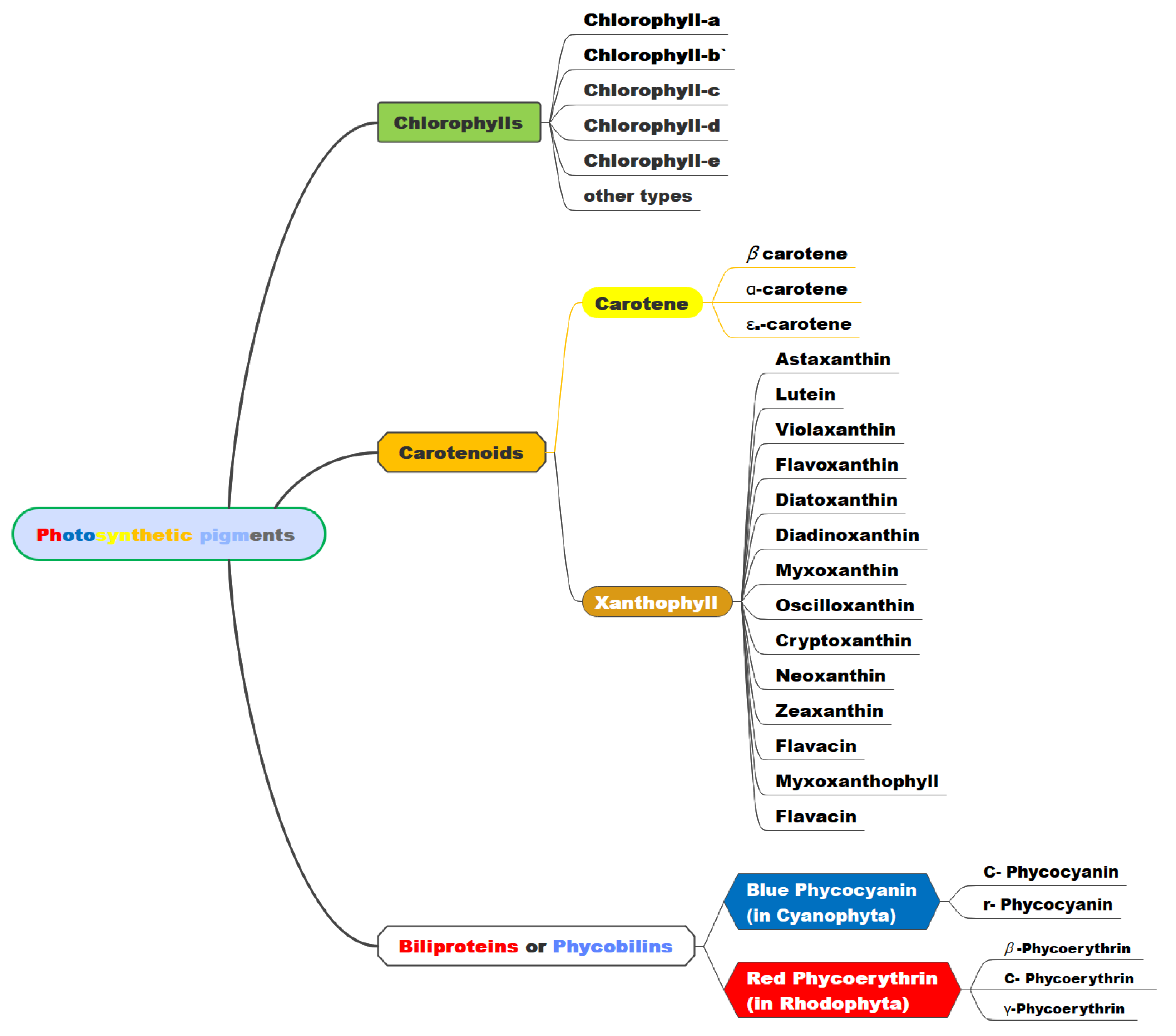
Figure 2.
The chemical structures of Chlorophyll a. b. c. and d.
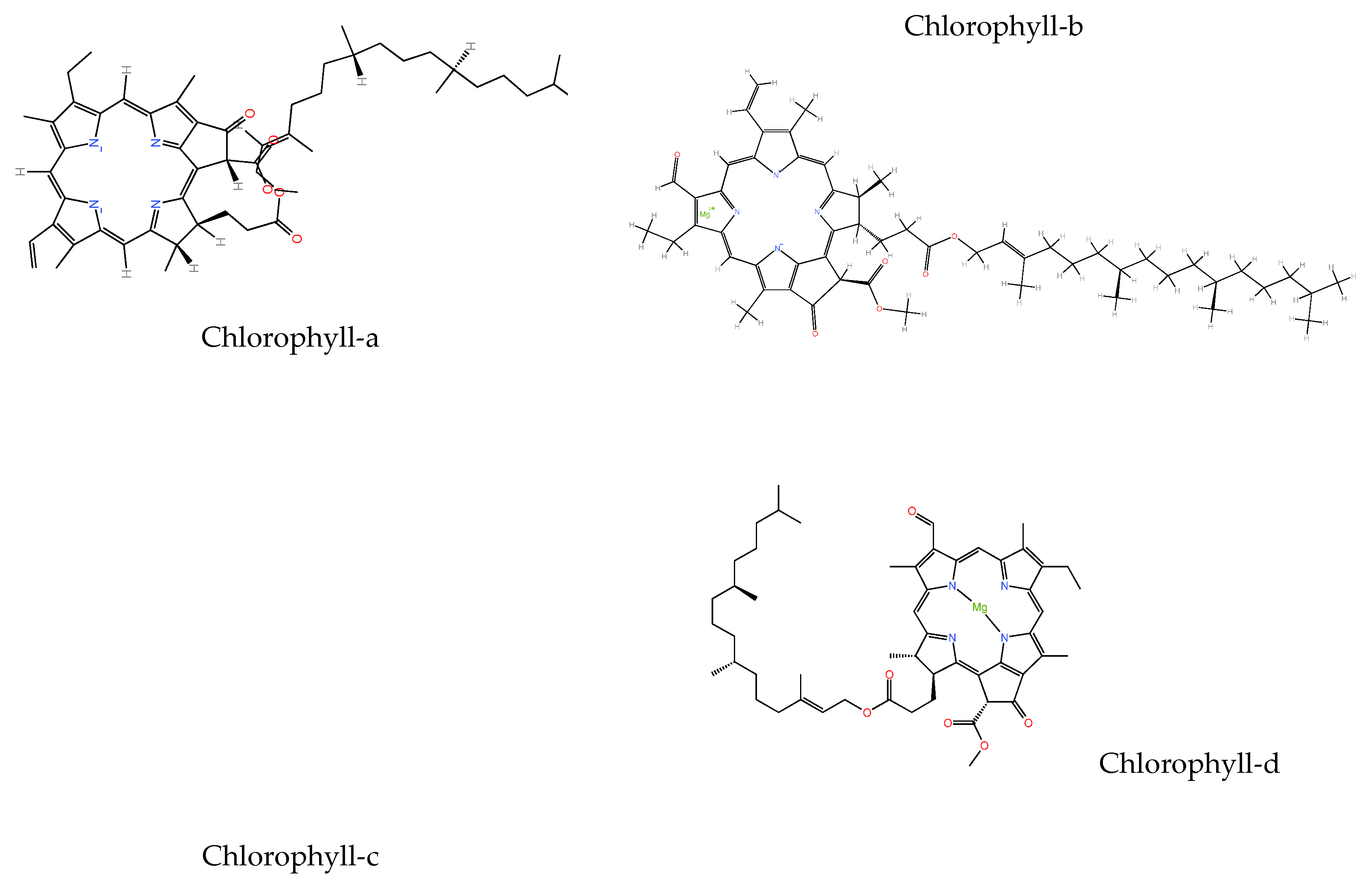
Figure 3.
The chemical structures of some carotenoids.
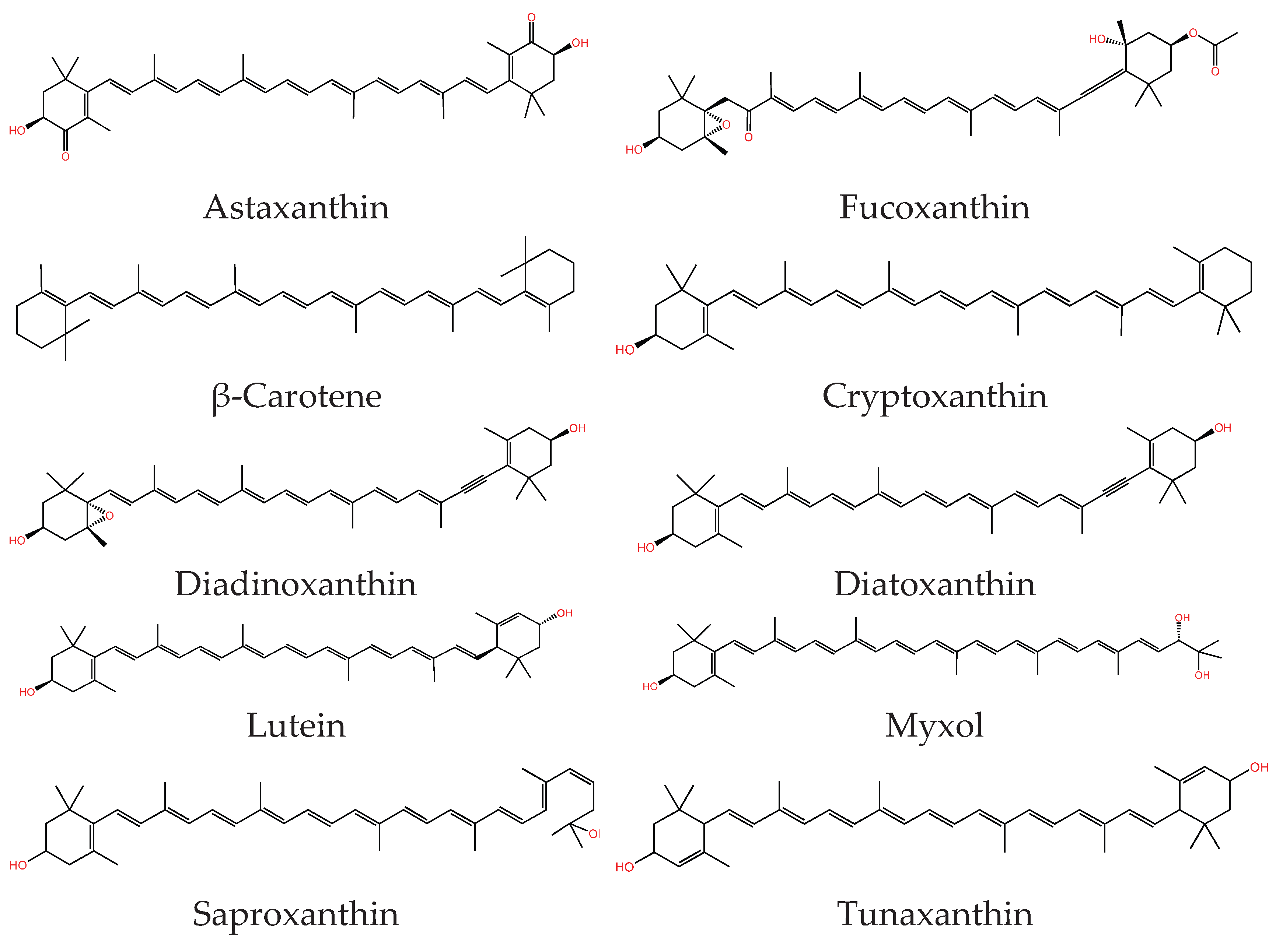
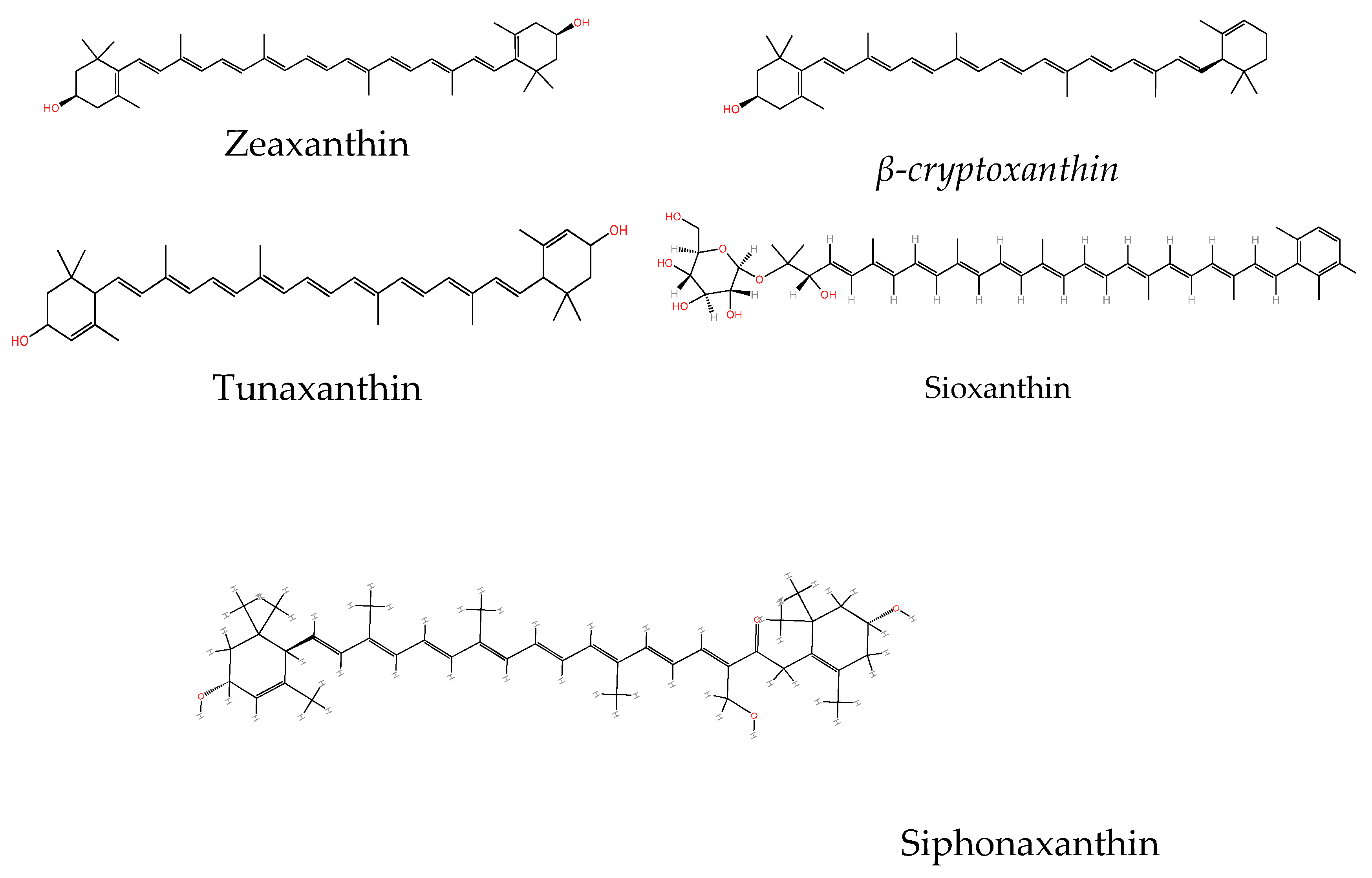
Figure 4.
The chemical structures of Bilin and Phycocyanobilin.
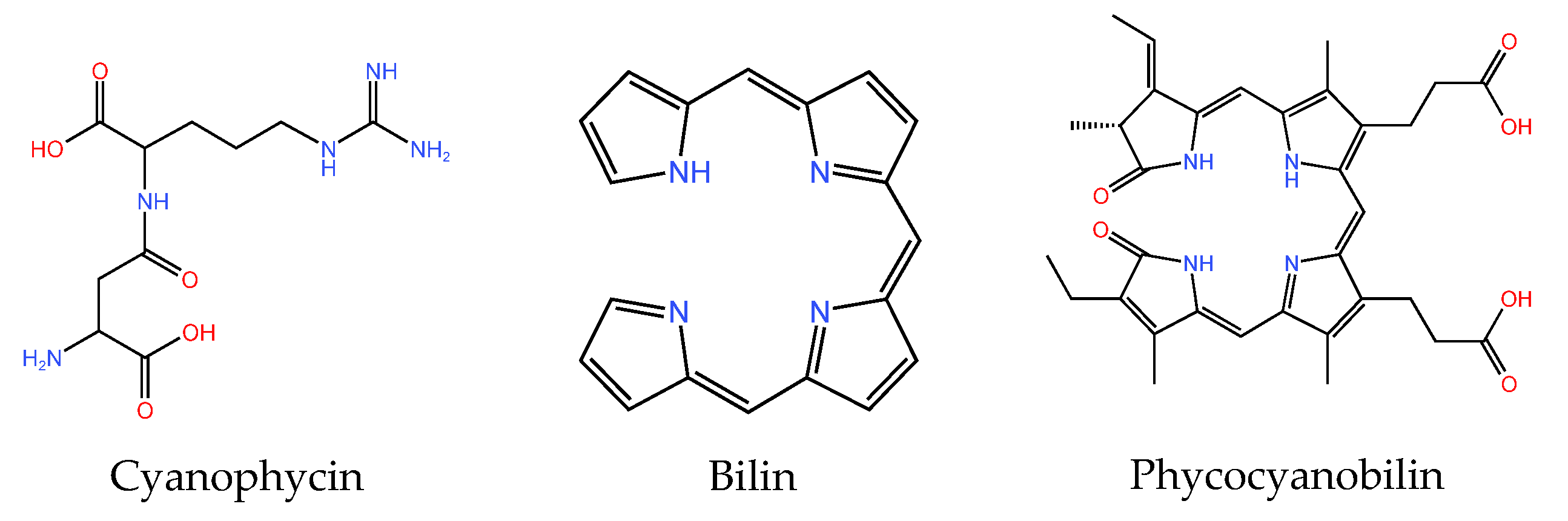
Figure 5.
The chemical structures of some MBPs.
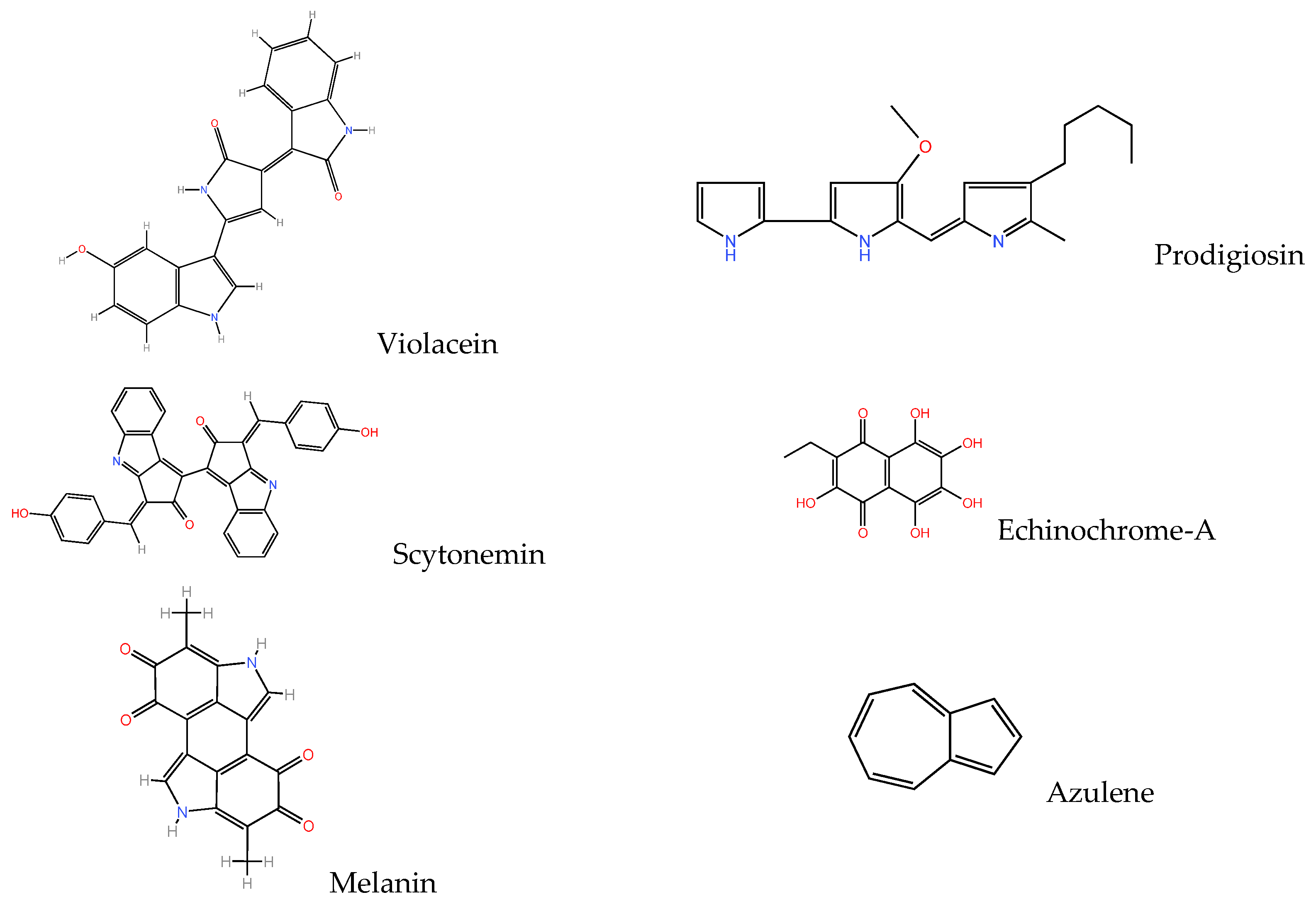
Figure 6.
MBPs start from the sunlight and pass in different food and applications processing.
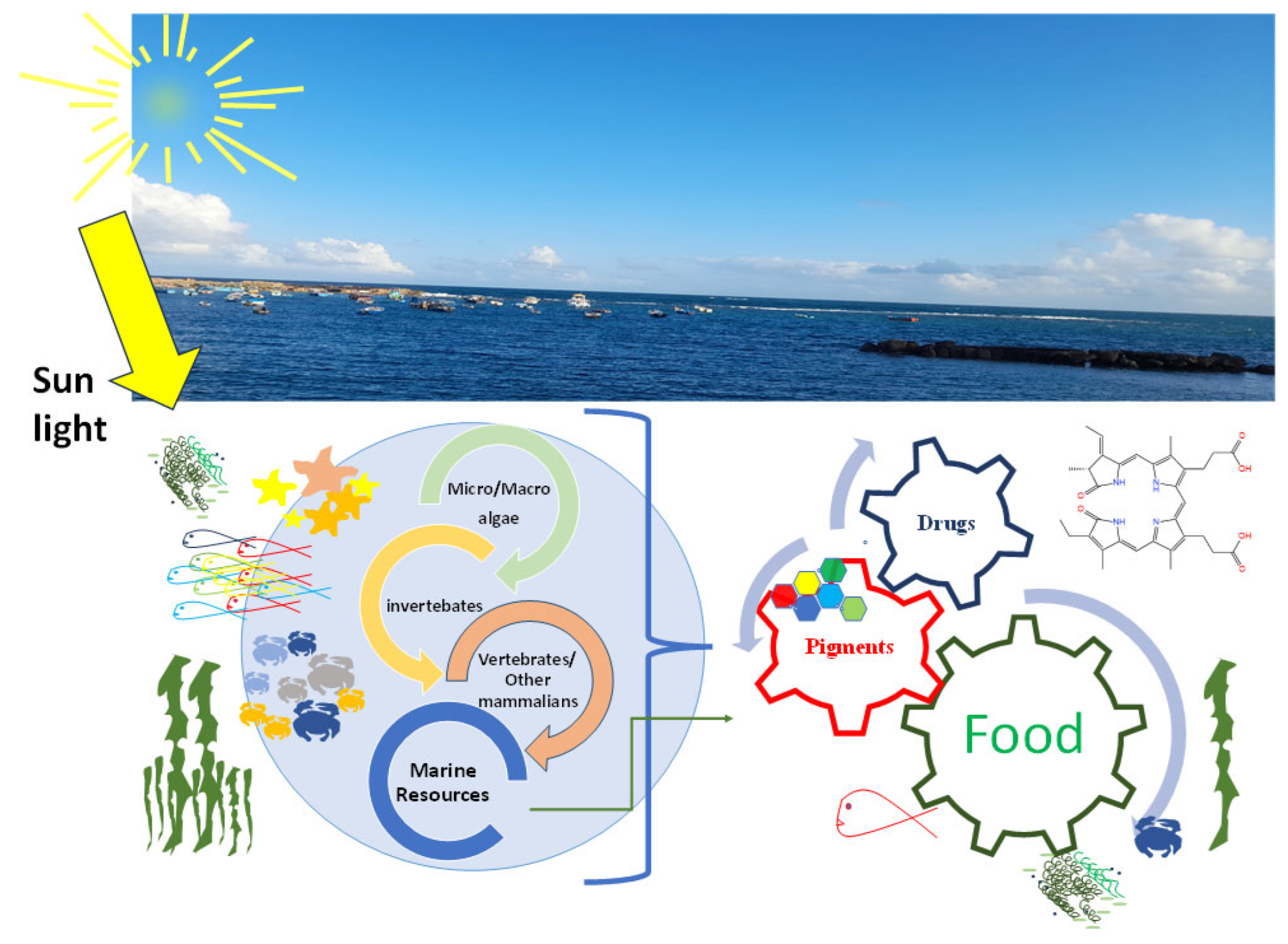

Table 1.
Photosynthetic pigments in algae.
| Class | Chlorophyll | Carotenes | Xanthophylls | Phycobilins or Biliproteins |
|---|---|---|---|---|
| Chlorophyceae | Chlorophyll-a and b | α, β carotene | Astaxanthin, Leutein, Neoranthin, Siphonein, Siphonoxanthin, Cryptoxanthin |
- |
| Xanthophyceae | Chlorophyll-a, e | β -carotene | Flavacin, Flavoxanthin, I.eutrin, Violaxanthin, Neoxanthin | - |
| Chrysophyceae | Chlorophyll-a, e. d, c | β -carotene | Leutein, Violaxanthin, Neoxanthin, Flavacin, Flavoxanthin, Diatoxanthin |
- |
| Bacillariophyceae | Chlorophyll- a and c |
β -carotene ε.-carotene |
Diatoxanthin, Diadinoxanthin, Fucoxanthin | - |
| Phaeophyceae | Chlorophyll-a and c | ε -carotene β -carotene |
Leutin. Violaxanthin, Fucoxatnthin, Neoxanthin, Flavoxanthin | - |
| Rhodophyceae | Chlorophyll-a and d | α-carotene β -carotene |
l.eutein, Violaxanthin, Zeaxanthin, Neoxanthint, Fucoxanthin, Flavoxantlun, Flavacin |
β -Phycoerythrin γ-Phycoerythrin r- Phycocyanin |
| Cyanophyceae | Chlorophyll-a |
β -carotene ε-carotene |
Myxoxanthin, Leutine Violaxanthin Myxoxanthophyll. Flavoxanthin, Oscilloxanthin | C- Phycoerythrin C- Phycocyanin |
Table 2.
Some important MBPs, their colours and producers.
| Pigment/Compound Name | Colour | Source/Type |
|---|---|---|
| Chlorophylls | chlorophylls a and b, seem green. The red colour of algae is caused by chlorophylls a, c, d and phycobilins [28] |
Chlorophyll-a (blue green) [29,30,31] is universal photosynthetic pigment existed in all phytoplankton, red seaweed and green algae. Phormidium autumnale [52] Ulva prolifera [53] Chlorophyll-b is (green, yellow) an accessory photosynthetic pigment. Marine green algae (Chlorophyta), some marine cyanobacteria (prochlorophytes), and Prochlorococcus (green, yellow)Chlorophyll-c is a blue-green accessory photosynthetic pigment. Several marine phytoplankton, specifically photosynthetic Chromista (such as diatoms and dinoflagellates) [54] and haptophytes (such as Emiliania huxleyi) contain significant chlorophyll-c (types c1,c2,c3) [54,55,56]Chlorophyll-d is an accessory photosynthetic pigment Acaryochloris marina [57,58] |
| Astaxanthin | Pink, red | Marine animals (salmon); microalgae H. pluvialis algae (green microalgae) [32]., crustaceans (shrimp, lobsters) salmon, shrimp, lobster, besides crayfish, stored as carotenoproteins The most used microalgae for its production are H. pluvialis and Chlorella zofingiensis [59]. |
| Echinochrome | Dark red/Brown [34] | are quinone MBPs in Sea Urchins |
| Fucoxanthin | Brown, orange | Brown algae (like kelp and Sargassum), diatoms, brown seaweeds (like Undaria pinnatifida and Laminaria spp.). |
| Canthaxanthin | Orange red | Marine animals (Crustaceans) |
| Crustacyanin | is a pigment-protein complex that turns red Astaxanthin into blue in live lobster shells. | Present in the exoskeleton of marine crustaceans like lobsters and blue crabs, which accounts for their blue coloration [168]. |
| Zeaxanthin | Yellow orange | Marine algae/Bacteria. It is produced technically from D. salina [60], Spirulina, Corallina officinalis, Cyanophora paradoxa, Glaucocystis nostochinearum [60] and Chlorella ellipsoidea. |
| Lutein | Greenish yellow | Marine algae. H. pluvialis, Scenedesmus spp. (Scenedesmus almeriensis), Chlorella spp., Rhodophyta spp., or Spirulina spp. D. salina and Galdieria sulphuraria have high Lutrin content [61]. |
| Β-carotene | (yellow – orange) Dunaliella salina [33]. | Marine bacteria/algae. Marine resources like microalgae such as D. salina, can has β-carotene to levels of 10 – 13% of their dry weight |
| Tunaxanthin | Bright Yellow | Marine fish skin [36] and fins (as Yellowtail (Seriola quinqueradiata), Red Sea Bream and the Black Bass). Marine fish (Perciformes) transform food-derived astaxanthine and luteine into tunaxanthine. Tunaxanthin is widespread in yellow pigmented marine fish, including the Yellowtail (Seriola quinqueradiata), the Red Sea Bream and the Black Bass. |
| Phycoerythrin | Red (red purple) | Red algae (Rhodophyta), Cyanobacteria An important source is Porphyridium purpureum |
| Phycocyanin | Blue | Blue green algae (Cyanophyta), Spirulina, Cyanobacteria Aphanizomenon flosaquae and Spirulina |
| Melanin | Dark Brown/Black | Sea Urchins/ some marine organisms, like molluscs and fungi is produced by Alteromonas [47]. Dark colours of Octopus sp., sea cucumbers, sand dollars and of respectively other species belonging to the phylum Echinodermata [62]. Melanins are black, brown or, sometimes, yellowish colour that biosynthetically [63]. |
| Scytonemin | yellow-green (scytonemin); | bacteria, cyanobacteria, fungi [48]. Produced by marine and terrestrial cyanobacteria, comprising Nostoc, Scytonema, Calothrix, Lyngbya, Rivularia, Chlorogloeopsis, and Hyella [64] first discovered in 1849 by Swiss botanist Carl Nägeli [65]. |
| Marennine | blue green | produced by the marine diatom Haslea ostrearia, |
| Prodigiosin | Red (deep red) | Marine Bacteria (Serratia sp) and Vibrio bacteria [38,39,40,41,42,43]. It is produced by other bacteria, such as S. nematodiphila, S. plymuthica, S. rubidaea, Pseudoalteromonas rubra, Vibrio sp., Janthino bacterium, Pseudomonas putida, Streptomyces coelicolor and Hahella chejuensis [66]. |
| Phycobiliproteins | Brightly coloured water-soluble MBPs in cyanobacteria and red algae, comprising phycocyanin and phycoerythrin. |
Cyanobacteria and red algae. Phycocyanin: Blue pigment from Spirulina. Allophycocyanin: Blue green pigment. Phycoerythrin: Red pigment from red algae. Bangia fusco- purpurea [67] Spirulina platentis [68] Bangia atropurpurea [69] Portieria hornemannii [70] Pyropia yezoensis [71]. Porphyridium marinum [72] |
| Flavonoids | Chlorella vulgaris [73], Oscillatoria agardhii [74], Cladophora pellucida [75], Acetabularia ryukyuensis [76], Chondrococcus hornemannii [76], Eisenia bicyclis, [76], Padina minor [76], Turbinaria ornata | |
| Indigoidine | (Deep Blue) [45] | is produced by Phaeobacter [46] and Rheinheimera. Produced by Phaeobacter [46] and Rheinheimera. Melanin (Dark Brown/Black) is produced by Alteromonas [47]. |
| Glaukothalin | (Deep Blue) | marine bacteria in the Wadden Sea [49] marine bacteria belonging to the genus Rheinheimera strains, which are found in the German Wadden Sea and the Danish Øresund. It is produced by Rheinheimera species, it is often observed with marine organic particles and diatom aggregates. |
| Phlorotannins |
Ascophyllum nodosum [77] Cystoseira tamariscifolia [78]Fucus vesiculosus [79]Ascophyllum nodosum [80]Ecklonia cava [81] | |
| Phenolic acids | Caulerpa racemosa, [82], Ulva clathrata, [83], Acanthophora spicifera [84], Gracilaria dura [85], Turbinaria conoides [86], Gracilaria dura [87], Bifurcaria bifurcata, Fucus vesiculosus [77], Halidrys siliquosa [88], Ecklonia cava [89], Fucus ceranoides [90], H. siliquosa [91], Padina tetrastromatica [85], Chondrus crispus [92], Fucus spiralis [93], Ascophyllum nodosum [93], Pelvetia canaliculate [93], Ulva intestinalis [93] | |
| Violacein | Violet/purple | Marine bacteria Chromobacterium violaceum [44]. Some marine bacterial strains, such as Chromobacterium, Duganella, Pseudoalteromonas luteoviolacea, Pseudoalteromonas sp (in deep-sea waters) [94], Janthinobacterium species [95], Iodobacter, Rugamonas [96], and Massilia [97] |
| Tetrapyrrole | (Blue) Phycoerythrobilin [37] | is a pigment found in some nudibranchs (marine molluscs). |
Disclaimer/Publisher’s Note: The statements, opinions and data contained in all publications are solely those of the individual author(s) and contributor(s) and not of MDPI and/or the editor(s). MDPI and/or the editor(s) disclaim responsibility for any injury to people or property resulting from any ideas, methods, instructions or products referred to in the content. |
© 2026 by the authors. Licensee MDPI, Basel, Switzerland. This article is an open access article distributed under the terms and conditions of the Creative Commons Attribution (CC BY) license (http://creativecommons.org/licenses/by/4.0/).
Copyright: This open access article is published under a Creative Commons CC BY 4.0 license, which permit the free download, distribution, and reuse, provided that the author and preprint are cited in any reuse.


