
Submitted:
03 June 2026
Posted:
04 June 2026
You are already at the latest version
Abstract
Population growth is the most basic component of the physical production of a human society, driven by energetic throughput that feeds back to further growth. The expansion of our population and energy systems has significantly altered the climate system that enables human activities. The objective of this study is to show that the changes in the human population and atmospheric CO2, over the last 220 years, can be understood through a sigmoid S-shaped dynamic model fueled by global power and its growth rate. This study analyzed the time series of population size and atmospheric concentration from 1800 to 2020 using a sigmoid model influenced by the power dynamics. Population growth was driven by two forces: the long-term increase in power use and the faster interdecadal changes in power growth rates, while the increase in atmospheric CO2 concentration growth rate is driven by the long-term increase in global power. Our expansionary population dynamic is starting to reach its limits. Population size, atmospheric CO2 concentration, and power (energy/time) were engaged in a positive feedback loop that explained the dynamics of our population system, making our present human societies increasingly vulnerable to collapse.
Keywords:
human expansion
; power
; CO2
; hyperbolic growth
; overlapped sigmoid-trajectories
1. Introduction
Human economic systems have always depended on the transformation of materials and energy [1,2]. Industrial civilization is fundamentally rooted in the exploitation of unpaid work by photosynthetic organisms, which converted solar energy and stored it as fossil fuels over millions of years [3,4,5]. This reliance on power (energy/time) is central to understanding human population and economic growth [5].
From a thermodynamic perspective, population growth is the most fundamental component of the physical production of a human society [6]. Population growth is driven by energetic throughput, which feeds back to further growth [7,8,9]. The global population is an open system that literally lives off environmental resources and exports unusable energy and materials of low structure and high simplicity—in other words, entropy [10]. In consequence, this intrinsic expansive and interdependent dynamics could constrain the general sustainable development goals, in particular those related to the joint achievement of economic growth, decent work, innovation, and climate action.
We face a key challenge: the massive growth of human societies over the past two centuries. This global niche construction is driven by population dynamics, cultural evolution [11], and fossil fuel energy [12,13]. During the Industrial Revolution, population growth was linked with increased technological innovation, economic activity, and energy use [7,8,14,15]. As populations grew and new energy gradients were used, health and life expectancy improved, enabling further population growth. This created a feedback loop: growing populations increased demand for energy and technology, which, in turn, drove further innovation, greater access to resources, and greater environmental pressure. As a result, population and energy use continued to rise [16,17,18].
The idea that human population size could stimulate its own growth by accelerating innovations that increase the dissipation of energy gradients from nature was proposed more than 70 years ago [19]. As the population grows, more minds and labor contribute to technological advances and resource extraction, enabling greater use of energy and resources from the environment. Several studies have examined the positive relationship between population size and growth rates in humans [7,20,21,22,23,24]. Recent human population dynamics are best understood by considering this positive feedback loop: growth enables innovation and expansion, which allow extraction of more resources, in turn fueling further population increases [9,11].
Population growth patterns in various prehistoric societies mirror those during the Industrial Revolution, indicating that this positive feedback loop has operated throughout much of human demographic history, from hunter-gatherers to modern industrial societies [25]. Notably, periods of rapid expansion appear as a “relay” phenomenon [21], with population trajectories following overlapping sigmoid (S-shaped) curves. Hyperbolic dynamics emerge as the envelope of these local curves, reflecting overall self-accelerated expansion.
The expansion of our population and energy system has significantly altered the ecosystems that supply all the materials and energy for human activity [26]. Human societies evolve to maximize usable power—net energy extracted per unit time—by selectively drawing more energy and doing more work, which creates a strong feedback loop [16,27,28] and makes these systems apparently unsustainable [4,11,29].
This article focuses on the relationship between the maximum power principle [29,30], nonequilibrium thermodynamics of growth [10,31,32], and population dynamics theory [33,34,35] to reveal how energy conversion processes have shaped human population dynamics and atmospheric CO2 concentration over the past 220 years.
Thus, the aim is to show that the interconnected growth of population and atmospheric CO2 can be better understood through a series of sigmoid S-shaped models fueled by power (energy/time) dynamics. This article proposes that hyperbolic growth patterns in the human population and atmospheric CO2 concentrations result from an overlapping series of S-shaped trajectories, highlighting the feedback loop between power and population expansion as the central process.
2. Materials and Methods
I defined the system using time series from 1800 to 2020 for population size (N), power (P), and atmospheric CO2 concentration (CO2). The decadal human population estimates (N) for the period 1800-2020 were based on Our World in Data (https://ourworldindata.org/population-growth), and the human population data for the period 1950-2020 are from the UN POP in World Population Prospects 2020. The time series of power by year in Terawatts (Pw) corresponds to the data (https://ourworldindata.org/energy-production-consumption), which corresponds to the amount of total energy consumption measured in Terawatt-hours/year [36], which was converted into an estimation of annual mean power by dividing by the number of annual hours (8760 hours). The data on atmospheric carbon dioxide (CO2) concentration, measured as dry molar fraction (ppm), averaged over a calendar year, are from Antarctic ice core records for the period 1800-1850 (Etheridge et al. 1996, 2001) and from 1960-2020 at the Mauna Loa Observatory (https://gml.noaa.gov/webdata/ccgg/trends/co2/co2_annmean_mlo.txt).
The global population, mean annual power, and atmospheric CO2 concentration growth rates were estimated as follows:
(1),
x represents the corresponding estimates of annual human population size (N), mean annual power (Pw), and atmospheric CO2 (CO2) concentrations between decades. The complete dataset is provided in the electronic supplementary material (Table S1).
Coupled dynamics of the energy, human population, and atmospheric CO2
When the cooperative social and technological pattern of self-accelerating development began, humans began to spread throughout the world, and their population grew well beyond that of any other comparable species. Global human population dynamics over the last 220 years can be considered a process of growth that, by using available energy reserves, can expand into new reserves of materials and energy; this expansion creates positive feedback that further accelerates population growth [7,8].
A key characteristic of historical human population dynamics data is a tendency toward hyper-exponential population growth [19,20,21,22,23,24]. This kind of population process has been derived in the literature in several different ways. Cohen [38] (1995) proposed two coupled Malthus-Condorcet equations for the human population by arguing that human carrying capacity increases with population size. In population ecology, this positive dependence of growth rates and population size represents the classical Allee effect [34] or the “Anti-Verhulst” equation [24]. The analysis began with a diagnostic to determine the timing of hyperbolic growth in the three coupled entities: energy consumption/year, population size, and atmospheric CO2 concentrations. To illustrate hyperbolic behavior, I plot the inverse power use (1/Pw), population (1/N), and CO2 concentration (1/CO2) versus time; the inverse values of the size of the growing entities under hyperbolic growth follow a decreasing straight line [23,24]. Therefore, we can use this dependence to identify unique periods of hyperbolic growth; a change to a slower growth rate (stagnation) will be indicated by an upward bending away from the previous linear negative trajectory. On the other hand, a change toward a faster hyperbolic trajectory will be indicated by the downward bending [24].
Hyperbolic or self-accelerated dynamic processes can arise from the “relaying” phenomenon, as described by Meyer and Vallee [21], in which the dynamics are represented by a series of S-shaped (sigmoid) curves, each corresponding to a local sigmoid curve. Still, the long-term hyperbolic dynamic can be observed as an “envelope” of logistic curves [21]. Global human population and atmospheric CO2 dynamics can be viewed as the “envelope” of two co-evolving open systems [32], both fueled by power dynamics. The analysis began with a sigmoid logistic model [37] for population size and atmospheric CO2 concentrations:
(2).
Where x(t) is the value of the growing entity (population size and atmospheric CO2 concentration), c is the carrying capacity of the population size and atmospheric CO2, tl is the time where x(tl) = c/2, and T is the growth time in years, or the inverse of growth rate T = 1/r, smaller values of parameter T mean higher growth rates. In this study, power (energy consumption/year) (yt) and power growth rates (ry,t) were included as additive perturbation factors by varying the growth time parameter T and the carrying capacity c for the population size and atmospheric CO2 [33]. Equation (2) can be modified to include this hypothesis as:
(3),
the parameter α represents the positive effects of the power on the parameter c, the carrying capacity of the growing entity (population and atmospheric CO2 concentration. On the other hand, the parameters β and γ represent the potential negative effects of the power (yt) and power growth rates (ry,t) on the growth time parameter T. More power or higher power growth rates decrease the growth time parameter T, which means an increase in the growth rate of the population and atmospheric CO2 concentration.
I fitted the time series of population and atmospheric growth rates to model 2 using the nls (nonlinear least squares) function in the R programming language. Models were ranked according to the second-order Akaike’s information criterion (AICc), and I calculated the Akaike’s weights (wi) to infer the relative likelihood of each model [38]. I identified the variable(s) driving the system’s dynamics and quantified the probability that a given hypothesis explains the observed dynamics. It is important to note that, for nonlinear models, the R2 calculated for each model cannot be used to assess goodness of fit or model performance [39]. Consequently, I focused primarily on the AICc and wi results..
3. Results
3.1. Temporal Change in the Hyperbolic Growth Rates
Figure 1a-f depict the overall inverse and total trajectories of global power, population size, and atmospheric CO2 levels. If the negative straight line in the inverse plots remains unchanged, then there is no change in the mechanism of growth. For example, the inverse power plot (1/Pw) showed a negative linear slope between 1800 and 1970 (y = 16.90 -0.00852x; F1,16 = 3358; p = 2.2e-16; R2 = 0.995), and an important decreasing trend in growth rates from 1980 and 2020 (y = 3.179 -0.00155x; F1,4 = 62.62; p = 0.0014; R2 = 0.925) (Figure 1a). Power growth rate decreased by a factor of five between these two periods. The inverse population size plot (1/N) showed a negative linear slope, indicating a hyperbolic growth rate from 1800 to 1980 (y = 8.593e-03 -4.211e-06x; F1,17 = 2759; p = 2.2e-16; R2 = 0.994), for the period 1990-2020, the population growth rate decreased by a factor of two (y = 4.181e-03 -2.008e-06x; F1,2 = 164.9; p = 2.2e-16; R2 = 0.982) (Figure 1b). In contrast, the inverse CO2 plot (1/CO2) showed changes toward a faster hyperbolic trajectory indicated by the observed downward bending trend (Figure 1c). The first sequence between 1800 and 1860 showed a weak negative slope (y = 4.485e-03 -5.295e-07x; F1,5 = 45.15; p = 0.0011; R2 = 0.880), an increasing growth rate between 1870 and 1940 (y = 1.036e-02 -3.683e-06x; F1,6 = 974.4; p = 7.18e-08; R2 = 0.993). The ratio between growth rates showed an increase by a factor of seven in the atmospheric CO2 concentrations (Figure 1c). From 1950 to 2020, the growth rate of the atmospheric CO2 even increased further, by a factor of three (y = 2.600e-02 -1.166e-05x; F1,6 = 468; p = 6.37e-07; R2 = 0.985). In sum, atmospheric CO2 growth rates increased by a factor of twenty-two since 1860.
In Figure 1d, we find that power data Pw(t) from 1800 to 1970 can be well fitted using a hyperbolic model (red broken line) with parameters T = 1384 years, c = 0.092 Terawatts, and the singularity year tl = 1987,
(4).
On the other hand, power dynamic Pw(t) from 1980 to 2020 was fitted by a logistic model (blue broken line; equation 5) with parameters T = 32.63 years, c = 38.80 Terawatts, and time when c/2, tl = 2017.5,
(5).
In Figure 1e, we find that population size data N(t) from 1800 to 1980 can be well fitted using a hyperbolic model (red broken line) with parameters T = -313.22 years, c = -515.06 million people, and the singularity year tl =2018.4,
(6).
On the other hand, population size N(t) from 1990 to 2020 was fitted by a logistic model (blue broken line) with parameters T = 34.76 years, c = 12110 million people, and time when c/2, tl =1999,
(7).
Finally, in Figure 1f, we find that atmospheric CO2 concentration data CO2(t) from 1800 to 2020 can be well fitted using a hyperbolic model (red broken line) with parameters T = -64.61 years, c = -279.80 ppm, and the singularity year tl =2092.83,
(8).
3.2. Coupled Dynamics of the Energy Conversion, Human Population, and Atmospheric CO2
A model for the temporal pattern of population growth rates that includes the positive effect of global power (yt) on parameter c and the negative effect of power growth rate (ry,t) on parameter T was the best model according to AICc values and Akaike’s weights (Table 1). High global power expands human population carrying capacity, while decades-long power growth rates shorten the growth period, thereby increasing the population growth rate. This model is supported by the cumulative wi, indicating a high summed probability (93%) that it is the best model compared with the competing model. This can be interpreted as follows: the expansion of the human population was driven by two forces: the continuous long-term increase in power and faster interdecadal changes in power growth rates, which shifted the temporal pattern of population growth as a series of self-limiting (S-shaped) curves that overlap [21] (Figure 2a; Table 1).
The best model for the temporal pattern of atmospheric CO2 concentration includes global power (yt) and power growth rate (ry,t) as negative effects on parameter T, the growth time in years (Table 1). High global power and an inter-decadal power growth rate decrease the growth time, which in turn increases the CO2 growth rate. This model is supported by the cumulative wi, indicating a high summed probability (52%) of being the best model compared with the competing model. The second-best model was a simpler model with only the negative effect of global power on the growth time parameter T (cumulative wi 37%; Table 1). This can be interpreted as follows: the increase of entropy production in the atmosphere (CO2 concentration) is mainly driven by one force, the continuous long-term increase in global energy consumption, influencing the growth rate of the CO2 concentration (Figure 2b; Table 1). This can explain the acceleration of the atmospheric CO2 concentration during the last decades, while population growth is, by contrast, decelerating (Figure 2).
4. Discussion
The expansion of power use has played a central role in fueling the positive feedback loop of human population and CO2 dynamics over the past two centuries [7,15,40]. The expansive dynamics of our global society over the last 220 years are driven by changes in total global power (energy consumption/time) use and its growth rate, which, in turn, influence population dynamics. The intertwined dynamics of power, population, and atmospheric CO2 growth rates are characterized by different periods of acceleration and stagnation. While power use and population dynamics showed a first period (1800-1970) of accelerated growth, and a stagnation since 1980, the atmospheric CO2 concentration dynamics are characterized by a hyperbolic growth for the studied period (1800-2020).
Our current population growth rates appear to be supported by energy influxes during the first decades after 1950 [41]. The oil and natural gas era transformed social, political, and economic relations from those of the coal age [42]. After 1940, a new energy era emerged, characterized by accelerated population and economic growth and increased human environmental impacts worldwide, the “Great Acceleration” [26]. During this period, there was a shift towards reliance on oil and natural gas [12,43], which caused significant upheaval in power use, population, and the economy after 1940-50. In the oil era, the power growth rate tripled, leading to unprecedented levels of material production, population growth, and environmental degradation [26].
The results showed that from 1970 onward, the dynamics of growth rates in power and population were characterized by diminishing returns [7,8,15,44]. Since 1970, power growth rates have decreased, and population growth rates started to stagnate a decade later. The positive feedback loop between power and population is leading our civilization into a new era of stagnation [8,45]. This trend is closely associated with the observation that the energy return on investment (EROI) of the most important energy sources, such as oil and natural gas, has generally declined over the past fifty years [3,12,44,46]. The results of this study showed that the past increases in power consumption and population size are entering an era of diminishing returns [15].
The model of the temporal pattern of population growth rate showed that global power (yt) and its growth rate (ry,t) are forcing factors diminishing the growth time in years (T). In other words, they increase the human population growth rate. The explosive human expansion since the beginning of the 19th century would result from two forces acting on a single population parameter: the human population growth rate. These two forces, power use and the growth rate, propelled our expansive intrinsic population dynamic system. Access to high-energy reserves (oil and natural gas) increased human civilization’s energy power and turnover rates [44]. So, the human population was involved in a disequilibrium expansive dynamic able to grow and, at the same time, exploit new reserves of raw materials and energy, creating more people, more technology, and new lifestyles that require more energy consumption, closing the loop back by adding more people [8,9,47].
The new energetic environment, in which our primary energy source (oil) was accumulated underground, enabled the observed population trend of accelerated, continuous growth. In the fitted population model, the positive effect of the power growth rate (ry,t) on parameter T can be interpreted as a high-power growth rate increasing the reproductive rate and life expectancy in the global population system. This negative effect on the population parameter T is consistent with the maximum power principle, since the growth rate in power between decades reflects the capacity of the human population to convert that energy flow into physical population growth [4,5,30].
On the other hand, the negative effect of power (yt) on the parameter (T) can be interpreted as a gradual, continuous force that improves our lifestyles and consumption. As an analogy to Alfred J. Lotka’s [30] wheel, global power use was “enlarging the wheel,” while the power growth rate was causing it to “spin faster.” Our expansionary population dynamic is starting to reach its limits. Population size and power are engaged in a positive feedback loop that explains the dynamics of our population and economic system [40], making our present human societies increasingly vulnerable to collapse [15].
The best model for the temporal pattern of atmospheric CO2 concentration is mainly driven by one force: global power (yt), influencing negatively the growth time in years (T). Suggesting that global power use is the driving factor in the dynamics of atmospheric CO2 concentration. Global power is increasing the growth rate of the atmospheric CO2 concentration. In sum, the atmospheric CO2 dynamics are driven by the current size of our socioeconomic system, and the distant past upward trend will influence the future trend in atmospheric CO2 levels [29].
This finding raises the possibility that the climate system could exceed critical thresholds [26], even if we can reduce fossil fuel use in the following decades. It seems that we are trapped between a rock and a hard place. Without a drastic switch to renewable energy sources and a reduction of our civilization’s wealth and size, carbon dioxide atmospheric concentrations will continue to rise. In the nonequilibrium system of our industrial civilization, heat, particles, and CO2 emitted by humans, heat engines, machines, reactors, cars, and planes alter the atmosphere’s chemical composition. The rate of this change is proportional to the total size of our population and power use [17,48].
Our global society appears to be facing a key contradiction, with no obvious way out. If we do not reduce the size of our global society and power use in the coming decades, CO2 levels and temperature increases will exceed habitable limits in many parts of the planet. The end road, it seems to be a radical simplification and reduction of our material production system and population size [49,50]. It seems that only by collapsing the size of our global population and energy consumption system, by shrinking and slowing Lotka’s wheel (Lotka 1922), can our resource demands and waste production decline [51].
The transition to renewable energy sources in the future is likely to result in a significant decrease in per capita net energy availability over the coming decades [52,53,54] because solar and wind energy sources have lower EROI levels than fossil fuels [12,44,55]. The energy return on investment (EROI) levels of renewable energy sources are significantly lower than the thresholds identified in the literature required to sustain the high-power use levels and wealth of current industrial complex societies. A major challenge for humanity will be generating sizeable new energy investments while the power growth rate is declining [3,4,12]. Therefore, the results of this study suggest that the dynamics of this highly interdependent system, population, power, and atmospheric CO2 could constrain the potential for general sustainable development goals and shared socioeconomic pathways (SSPs) [7].
Over the past 60 years, the growth rate of energy has mirrored that of the first three decades of the 20th century, albeit with a population that is four times larger. Many countries are now encountering the constraints on growth outlined in “The Limits to Growth” [56]. Today, many people are still transitioning from agrarian to industrial lifestyles [57,58]. The slowing power growth rates could result in periods of heightened sociopolitical instability and violence. Historically, major energy transitions have often been associated with increased levels of violence and social unrest [59,60]. In the coming decades, we are likely to witness slow growth in energy consumption while the global population exceeds eight billion. Additionally, there has been a rise in signs of political instability, riots, civil unrest, and armed conflicts in recent years [61,62,63]. Today, the global human population-economic system is a giant 20 tera-watt primary power machine. Putting this number in terms of primary-power “laborers”, on average, each of the 8 billion living humans is served by ~32 primary-power “slaves”. Global humanity today is functioning as a 260 billion person-equivalent mega-population [64].
5. Conclusions
We are on the verge of a new era marked by declining energy resources and population growth. This transformation will significantly influence our social, economic, and political structures. The shift to renewable energy sources is expected to reverse the previous transition from agrarian to industrial societies that characterized the last two centuries [59]. We are already observing social and energy-related changes as industrial society transitions to a new, yet undefined, form of social existence [65].
The depletion of fossil fuels is slowing the growth rate of energy consumption, leading to internal tensions, increased inequality, socio-political violence, civil unrest, and pressure on health and social security systems. Many people view these energy constraints as problems created by politicians rather than recognizing them as genuine issues related to energy and population limits [66]. However, a limitation of this study is the use of a simple dynamic model that does not account for the complexities and differences in population size and energy consumption patterns across the world’s societies.
Additionally, we must face the consequences of harmful changes in the Earth’s climate system, the sixth mass extinction, soil erosion, and the loss of ecosystem services [67]. Understanding how our unsustainable society can transition to sustainability is one of the most pressing questions in ecology and social sciences for the twenty-first century. The “extravagant period of prosperity” enjoyed by our industrial civilization will be shorter than any previous social regime [68].
While economic growth remains the primary goal of our industrial society, we must confront the reality of a finite world’s energetic and ecological limitations, as well as the first two laws of thermodynamics [69]. As always, the future of societies will be shaped by how energy is organized, and the potential for living in sustainable and egalitarian communities will depend on how we manage and distribute energy [42].
Supplementary Materials
The following supporting information can be downloaded at the website of this paper posted on Preprints.org. Excel file name xx, R-script file name.
Funding
This research was funded by the Center of Applied Ecology and Sustainability (CAPES; ANID PIA/BASAL AFB240003), and FONDECYT Project #1230075.
Institutional Review Board Statement
Not applicable.
Informed Consent Statement
Not applicable.
Data Availability Statement
The data and the R-scripts are provided in the electronic supplementary materials. Excel file name xx, R-script file name.
Acknowledgments
During the preparation of this manuscript/study, the author used Grammarly for the purposes of English editing and the correction of grammatical errors. The author has reviewed and edited the output and takes full responsibility for the content of this publication.
References
- Kallis, G. Radical dematerialization and degrowth. Philos. Trans. A Math. Phys. Eng. Sci. 2017, 375. [Google Scholar] [CrossRef]
- Krall, L.; Gowdy, J. Dialectical and Evolutionary Materialism: Expanding methodological pluralism in ecological economics. Ecol. Econ. 2025, 230. [Google Scholar] [CrossRef]
- Hall, C.A.S.; Klitgaard, K. Biophysical economics: the economics perspective. Energy and the Wealth of Nations: An Introduction to Biophysical Economics; Hall, C.A.S., Klitgaard, K., Eds.; Springer International Publishing, Germany: Berlin/Heidelberg, 2018; Volume 511, pp. 101–120. [Google Scholar]
- Hall, C. A. S.; McWhirter, T. Maximum power in evolution, ecology and economics. Philos. Trans. A Math. Phys. Eng. Sci. 2023, 381. [Google Scholar] [CrossRef]
- Vermeij, G. The evolution of power: A new understanding of the history of life; Princeton University Press: New Jersey, USA, 2023. [Google Scholar]
- Herrmann-Pillath, C. Constitutive Explanations as a Methodological Framework for Integrating Thermodynamics and Economics. Entropy 2016, (1), 1–18. [Google Scholar] [CrossRef]
- Lima, M. The link between human population dynamics and energy consumption during the Anthropocene. Anthr. Rev. 2025, 12. [Google Scholar] [CrossRef]
- Lima, M.; Berryman, A. A. Positive and negative feedbacks in human population dynamics: future equilibrium or collapse? Oikos 2011, 120, 1301–1310. [Google Scholar] [CrossRef]
- Snyder, B. F. The genetic and cultural evolution of unsustainability. Sustain Sci. 15 1087–1099. [CrossRef] [PubMed]
- Wessling, B. What a coincidence! On Unpredictability, Complexity and the Nature of Time; Springer Nature: Wiesbaden, Germany, 2023. [Google Scholar]
- Ellis, E. C. Ecology in an anthropogenic biosphere. Ecol. Monogr. 2015, 85, 287–331. [Google Scholar] [CrossRef]
- Hall, C. A. S. The history, future, and implications of EROI for society . In Energy Return on Investment: A Unifying Principle for Biology, Economics, and Sustainability; Springer: New York, 2017; p. 174. [Google Scholar]
- Smil, V. Energy and civilization: a history; MIT Press: Cambridge, England, 2017; p. 535. [Google Scholar]
- Johansen, A.; Sornette, D. Finite-time singularity in the dynamics of the world population, economic and financial indices. Phy A Stat. Mech. Appl. 2001, 294, 465–502. [Google Scholar] [CrossRef]
- Taylor, T. G.; Tainter, J. A. The nexus of population, energy, innovation, and complexity. Am. J. Econ. Soc. 2016, 75, 1005–1043. [Google Scholar] [CrossRef]
- Annila, A.; Salthe, S. Economies evolve by energy dispersal. Entropy 2009, 4, 606–633. [Google Scholar] [CrossRef]
- Garrett, T. J. Are there basic physical constraints on future anthropogenic emissions of carbon dioxide? Clim. Change 2011, 104, 437–455. [Google Scholar] [CrossRef]
- Herrmann-Pillath, C. Energy, growth, and evolution: Towards a naturalistic ontology of economics. Ecol. Econ. 2015, 119, 432–442. [Google Scholar] [CrossRef]
- Cailleux, A. L’homme en surexpansion. Bull. Soc. Préhist Fr. 1951, 48(1/2), 62–70. [Google Scholar] [CrossRef]
- Van Von Foerster, H.; Mora, P. M.; Amiot, L. W. Doomsday: Friday, 13 November, AD 2026: At this date human population will approach infinity if it grows as it has grown in the last two millennia. Sci 1960, 132(3436), 1291. [Google Scholar] [CrossRef] [PubMed]
- Meyer, F.; Vallee, J. The dynamics of long-term growth. Tech Forecast Soc. Ch 1975, 7, 285–300. [Google Scholar] [CrossRef]
- Kapitza, S. P. On the theory of global population growth. Physics-Uspekhi 2010, 53, 1287. [Google Scholar] [CrossRef]
- Nielsen, R. W. Mechanism of hyperbolic growth explained. J. Econ. Libr 2016, 3(4), 603–620. [Google Scholar]
- Yakovenko, V. M. The end of hyperbolic growth in human population and CO2 emissions. Phys. A Stat. Mech. Appl. 2025, 661, 130412. [Google Scholar] [CrossRef]
- Lima, M.; Gayo, E. M.; Estay, S. A.; et al. Positive feedbacks in deep-time transitions of human populations. Phil Trans. R Soc. A 2024, 379, 20220256. [Google Scholar] [CrossRef] [PubMed]
- Steffen, W.; Broadgate, W.; Deutsch, L.; Gaffney, O.; Ludwig, C. The trajectory of the Anthropocene: the great acceleration. Anthr. Rev. 2015, 2, 81–98. [Google Scholar] [CrossRef]
- Tainter, J. A. Energy, complexity, and sustainability: A historical perspective. Env. Innov. Soc. Trans. 2011, 1, 89–95. [Google Scholar] [CrossRef]
- Garrett, T. J. No way out? The double-bind in seeking global prosperity alongside mitigated climate change. Earth Syst. Dynam 2012, 3, 1–17. [Google Scholar] [CrossRef]
- Lotka, A. J. Contribution to the energetics of evolution. Proc. Natl. Acad. Sci. 1922, 8, 147–151. [Google Scholar] [CrossRef]
- Odum, H. T.; Pinkerton, R. C. Time’s speed regulator: the optimum efficiency for maximum power output in physical and biological systems. Am. Sci. 1955, 43, 331–343. [Google Scholar]
- Lineweaver, C. H. Beyond the Second Law: Darwinian evolution as a tendency for entropy production to increase. Entropy 2025, 27(8), 850. [Google Scholar] [CrossRef]
- Herrmann-Pillath, C. Towards pragmatist thermodynamics: An essay on the natural philosophy of entropy and sustainability. Entropy 2025, 27(12), 1257. [Google Scholar] [CrossRef]
- Royama, T. Analytical Population Dynamics; Springer Science & Business Media: Berlin, Germany.
- Berryman, A. A. Principles of population dynamics and their application; Stanley Thornes: Cheltenham, UK.
- Turchin, P. Complex Population Dynamics: a theoretical/empirical synthesis; Princeton University Press: Princeton, USA.
- Ritchie, H.; Rosado, P.; Roser, M. Energy OurWorldinData.org. Available online: https://ourworldindata.org/energy’ accesed.
- Verhulst, P. Notice sur la loi que la population suit dans son accroissement. Corresp. Math. Et. Phys. 1838, 10, 113–129. [Google Scholar]
- Burnham, K. P.; Anderson, D. R. Model selection and multimodel inference: a practical information theoretic approach.; Springer Science and Business Media: New York, USA, 2002; p. 485. [Google Scholar]
- Kvalseth, T. O. Note on the R2 measure of goodness of fit for nonlinear models. Bull. Psychon. Soc. 1983, 21, 79–80. [Google Scholar] [CrossRef]
- Krall, L. Bitter Harvest: An Inquiry into the War between Economy and Earth; State University New York Press: Albany, New York, USA, 2022; p. 182. [Google Scholar]
- Garrett, T. J. Long-run evolution of the global economy: 1. Physical basis. Earth’s Future 2014, 2, 127–151. [Google Scholar] [CrossRef]
- Mitchell, T. Carbon democracy. Econ. Soc. 2009, 38, 399–432. [Google Scholar] [CrossRef]
- Fisher-Kowalski, M.; Krausmann, F.; Pallua, I. A socio-metabolic reading of the Anthropocene. Anthr. Rev. 2014, 1, 8–33. [Google Scholar]
- Hall, C. A.; Lambert, J. G.; Balogh, S. B. EROI of different fuels and the implications for society. Energy Policy 2014, 64, 141–152. [Google Scholar] [CrossRef]
- Bonaiuti, M. Are we entering the age of involuntary degrowth? Promethean technologies and declining returns of innovation. J. Clean. Prod. 2018, 197, 1800–1809. [Google Scholar] [CrossRef]
- Laherrère, J.; Hall, C.A.; Bentley, R. How much oil remains for the world to produce? Comparing assessment methods, and separating fact from fiction. Curr. Res. Env. Sustain 2022, 4, 100174. [Google Scholar] [CrossRef]
- Sibani, P.; Rasmussen, S. Human wealth evolution: trends and fluctuations. Phys. A 2020, 558, 124985. [Google Scholar] [CrossRef]
- Garrett, T. J. Long-run evolution of the global economy–Part 2: Hindcasts of innovation and growth. Earth Syst. Dynam 2015, 6, 673–688. [Google Scholar] [CrossRef]
- Odum, H.T.; Odum, E.C. The prosperous way down. Energy 2006, 31, 21–32. [Google Scholar] [CrossRef]
- Hagens, N.J. Economics for the future–Beyond the superorganism. Ecol. Econ. 2020, 169, 106520. [Google Scholar] [CrossRef]
- Garrett, T.J.; Grasselli, M.; Keen, S. Lotka’s wheel and the long arm of history: how does the distant past determine today’s global rate of energy consumption? Earth Syst. Dyn. 2022, 13, 1021–1028. [Google Scholar] [CrossRef]
- King, L.C.; Van Den Bergh, J.C. Implications of net energy-return-on-investment for a low-carbon energy transition. Nat. Energy 2018, 3, 334–340. [Google Scholar] [CrossRef]
- Capellán-Pérez, I.; De Castro, C.; González, L.J.M. Dynamic Energy Return on Energy Investment (EROI) and material requirements in scenarios of the global transition to renewable energies. Energy Strat Rev. 2019, 26, 100399. [Google Scholar] [CrossRef]
- Dupont, E.; Koppelaar, R.; Jeanmart, H. Global available solar energy under physical and energy return on investment constraints. Appl. Energy 2020, 257, 113968. [Google Scholar] [CrossRef]
- de Castro, C.; Capellán-Pérez, I. Standard, point of use, and extended energy return on energy invested (EROI) from comprehensive material requirements of present global wind, solar, and hydro power technologies. Energies 2020, 13, 3036. [Google Scholar] [CrossRef]
- Meadows, D. H.; Meadows, D. L.; Randers, J.; Behrens, W. W., III. The limits to growth: A report to the Club of Rome; Google Scholar, 1972. [Google Scholar]
- Fisher-Kowalski, M.; Haberl, H. Socioecological transitions and global change . In Trajectories of Social Metabolism and Land Use; Klagenfurt University: Vienna, 2007. [Google Scholar]
- Krausmann, F.; Fischer-Kowalski, M.; Schandl, H.; Eisenmenger, N. The global sociometabolic transition: past and present metabolic profiles and their future trajectories. J. Indust Ecol. 2008, 12, 637–656. [Google Scholar] [CrossRef]
- Fischer-Kowalski, M. Analyzing sustainability transitions as a shift between socio-metabolic regimes. Env. Inn. Soc. Trans. 2011, 1, 152–159. [Google Scholar] [CrossRef] [PubMed]
- Fischer-Kowalski, M.; Rovenskaya, E.; Krausmann, F.; Pallua, I.; Mc Neill, J.R. Energy transitions and social revolutions. Tech Forec Soc. Chan 2019, 138, 69–77. [Google Scholar] [CrossRef]
- Turchin, P. End times: elites, counter-elites, and the path of political disintegration; Penguin Press: New York, USA, 2023; p. 352. [Google Scholar]
- Ahmed, N. M. Failing States, Collapsing Systems. Biophysical Triggers of Political Violence; Springer Nature: Cham, Switzerland, 2017; p. 110. [Google Scholar]
- Muñoz-Rodríguez, M.; Ferrero, R.; Luna, J.P.; Lima, M. Squeezed from the top: “Social Outburst” (2019) and elite overproduction. A study of the dynamics of Chilean political instability from the approach of Structural Demographic Theory. PLoS ONE 2024, 19(6), e0299063. [Google Scholar] [CrossRef]
- Patzek, T. W. Thermal Power and Climate Change: A Data-Driven Analysis of Cause and Effect, 1800-2100 2025.
- Sieferle, R. P. The subterranean forest: energy systems and the industrial revolution; White Horse Press, 2001. [Google Scholar]
- Hall, C. A. S. The 50th anniversary of the limits to growth: does it have relevance for today’s energy issues? Energies 2022, 15, 4953. [Google Scholar] [CrossRef]
- Kemp, L.; Xu, C.; Depledge, J.; et al. Climate Endgame: Exploring catastrophic climate change scenarios. Proc. Natl. Acad. Sci. 2022, 119, e2108146119. [Google Scholar] [CrossRef]
- Soddy, F. Cartesian economics: the bearing of physical science upon state stewardship; Hendersons, 1922. [Google Scholar]
- Kümmel, R.; Lindenberger, D.; Paech, N. Energy, entropy, creativity: What drives and slows economic growth; Springer Nature: Berlin, Germany.
Figure 1.
Inverse plots of (a) global power use (1/Pw), (b) global population size (1/N), and (c) atmospheric CO2 concentration (1/CO2) time series, revealing the different hyperbolic trajectories represented by decreasing (increasing) straight lines (red, blue, and black dotted lines; see text). Time series plot of (d) power use (Terawatts), (e) population size (million people), and (f) atmospheric CO2 concentration (ppm) time series during the period 1800-2020. Red broken lines are the fitted hyperbolic models, and blue lines are the fitted logistic models (see text for details).
Figure 1.
Inverse plots of (a) global power use (1/Pw), (b) global population size (1/N), and (c) atmospheric CO2 concentration (1/CO2) time series, revealing the different hyperbolic trajectories represented by decreasing (increasing) straight lines (red, blue, and black dotted lines; see text). Time series plot of (d) power use (Terawatts), (e) population size (million people), and (f) atmospheric CO2 concentration (ppm) time series during the period 1800-2020. Red broken lines are the fitted hyperbolic models, and blue lines are the fitted logistic models (see text for details).
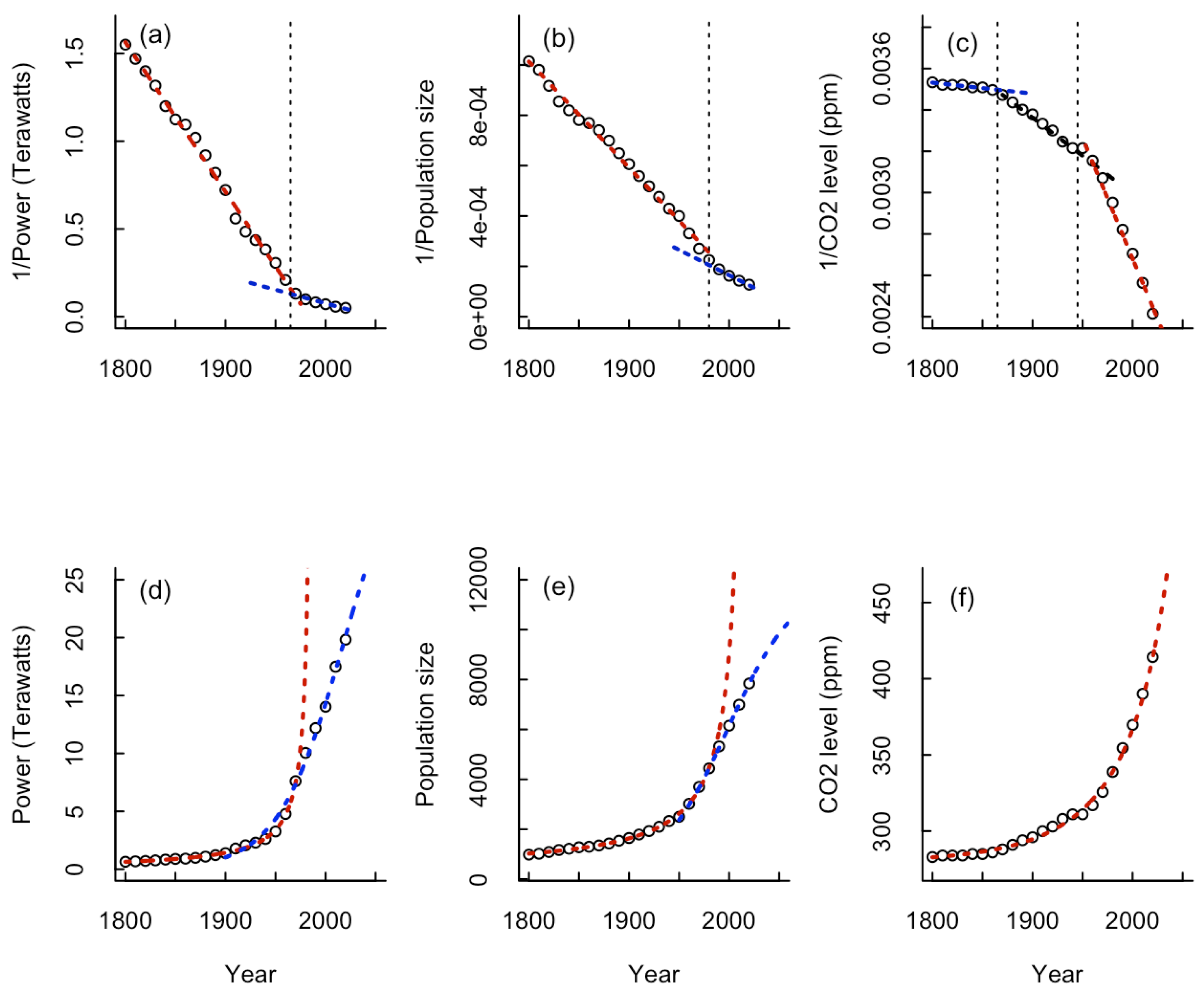
Figure 2.
The self-acceleration process exhibited by the global population size (N) and the atmospheric CO2 concentration (CO2) can be represented by the phenomenon of “relaying” [21], the two variables (N and CO2) are expanding according to a series of overlapped self-limiting (logistic) curves whose parameters (c and T) can be influenced by the global power use (yt) and power growth rates (ry,t). (a) Global time series population size (grey dots) and the corresponding best fitted sigmoid curves (Table 1, red broken lines) using the observed power use and power growth rate values. (b) Atmospheric CO2 concentration (grey dots) and the corresponding best fitted sigmoid curves (Table 1; red broken lines) using the observed power use values. Each plotted curve (red broken lines) is the best-fitted sigmoid curve, inserting the recorded power and power growth rate for the years shown in the graphic.
Figure 2.
The self-acceleration process exhibited by the global population size (N) and the atmospheric CO2 concentration (CO2) can be represented by the phenomenon of “relaying” [21], the two variables (N and CO2) are expanding according to a series of overlapped self-limiting (logistic) curves whose parameters (c and T) can be influenced by the global power use (yt) and power growth rates (ry,t). (a) Global time series population size (grey dots) and the corresponding best fitted sigmoid curves (Table 1, red broken lines) using the observed power use and power growth rate values. (b) Atmospheric CO2 concentration (grey dots) and the corresponding best fitted sigmoid curves (Table 1; red broken lines) using the observed power use values. Each plotted curve (red broken lines) is the best-fitted sigmoid curve, inserting the recorded power and power growth rate for the years shown in the graphic.
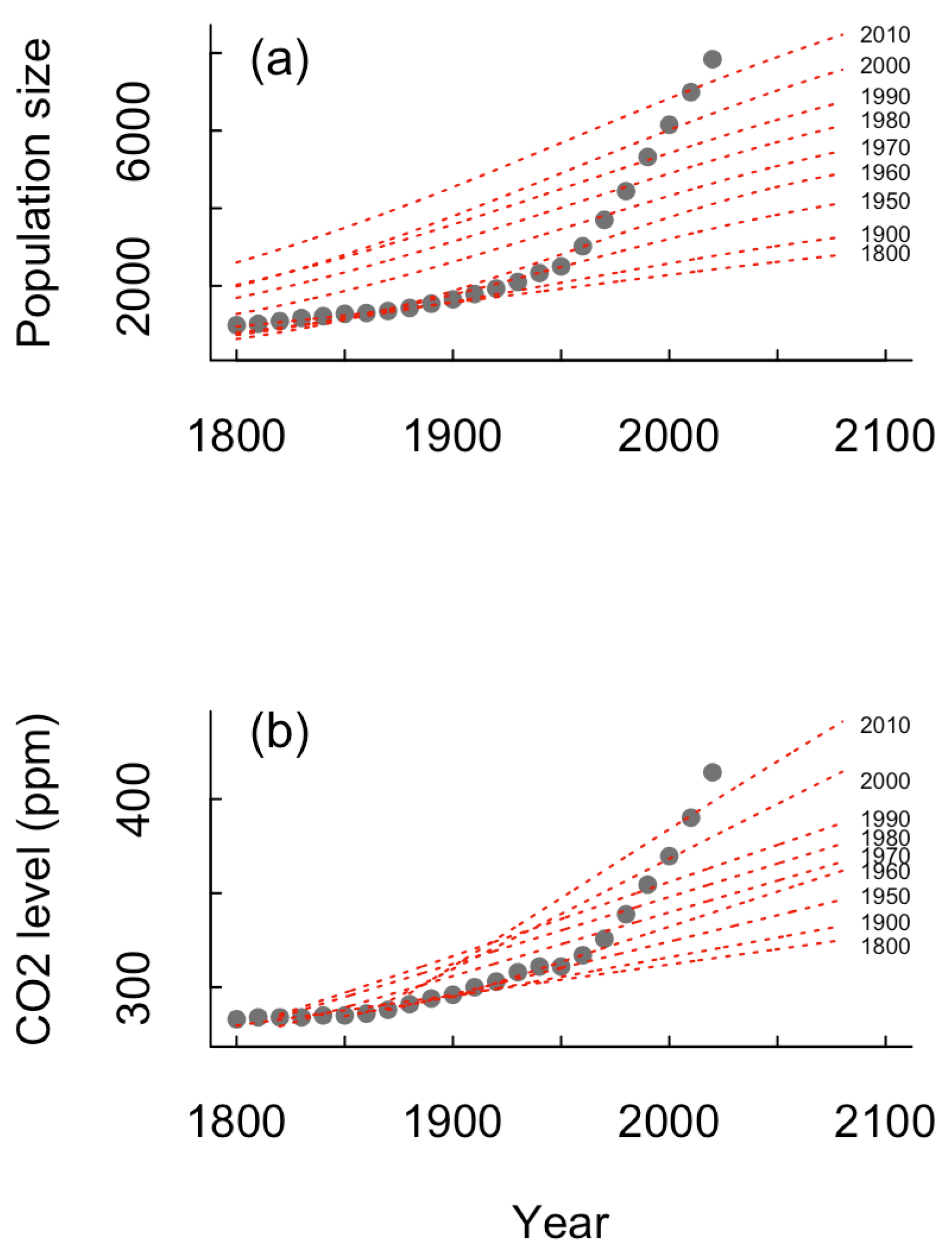

Table 1.
Logistic models for human population and atmospheric CO2 dynamics influenced by global power and power decadal growth rate (Eq. 3) were fitted to the population size and CO2 time series. Parameter values are given in the table’s columns. The model notations are as follows: c is the carrying capacity of the population size and atmospheric CO2, tl is the time where x(tl) = c/2, and T is the growth time in years. Power use (yt) and power growth rates (ry,t) were included as additive perturbation factors by varying the growth time parameter T and the carrying capacity c for the population size and atmospheric CO2. The parameter α represents the positive effects of the power on the parameter c, the carrying capacity of the growing entity (population and atmospheric CO2 concentration. On the other hand, the parameters β and γ represent the potential negative effects of the power (yt) and power growth rates (ry,t) on the growth time parameter T. AICc indicates the Akaike information criteria corrected for the small sample size, wi is Akaike’s weights. The model with the highest support is highlighted in boldface.
Table 1.
Logistic models for human population and atmospheric CO2 dynamics influenced by global power and power decadal growth rate (Eq. 3) were fitted to the population size and CO2 time series. Parameter values are given in the table’s columns. The model notations are as follows: c is the carrying capacity of the population size and atmospheric CO2, tl is the time where x(tl) = c/2, and T is the growth time in years. Power use (yt) and power growth rates (ry,t) were included as additive perturbation factors by varying the growth time parameter T and the carrying capacity c for the population size and atmospheric CO2. The parameter α represents the positive effects of the power on the parameter c, the carrying capacity of the growing entity (population and atmospheric CO2 concentration. On the other hand, the parameters β and γ represent the potential negative effects of the power (yt) and power growth rates (ry,t) on the growth time parameter T. AICc indicates the Akaike information criteria corrected for the small sample size, wi is Akaike’s weights. The model with the highest support is highlighted in boldface.
| Population models | c | tl | T | a | b | g | AICc | AICc | wi | n | p | |
| 2799.86 | 1900.02 | 124.10 | 410.36 | --- | --- | 281.51 | 26.40 | 0 | 23 | 5 | ||
| 58476 | 2670.71 | 208.55 | --- | 7.10 | --- | 274.74 | 18.94 | 0 | 23 | 5 | ||
| 5.96e+05 | 2371 | 82.99 | --- | --- | -13.10 | 323.01 | 67.91 | 0 | 22 | 5 | ||
| 7.09e+08 | 4488 | 19.80 | -2.01e+07 | 1.77 | --- | 267.97 | 12.87 | 0 | 23 | 6 | ||
| 66054.58 | 2747.68 | 220.58 | --- | 7.24 | 7.80 | 260.60 | 5.50 | 0.06 | 22 | 6 | ||
| 3617.14 | 1954.30 | 143.85 | 454.68 | --- | 151.22 | 255.10 | 0.00 | 0.93 | 22 | 6 | ||
| Atmospheric CO2 models | c | tl | T | a | b | g | AICc | AICc | wi | n | p | |
| 580.59 | 1905.02 | 1051.63 | 9.27 | --- | 2213.8 | 130.05 | 11.84 | 0.0 | 22 | 6 | ||
| 534.23 | 1725.75 | 895.74 | 3.57 | -26.03 | --- | 121.71 | 3.52 | 0.09 | 23 | 6 | ||
| 452.00 | 1493.07 | 654.00 | --- | -21.78 | --- | 118.78 | 0.57 | 0.39 | 23 | 5 | ||
| 609.06 | 1965.97 | 1012.66 | --- | -37.46 | 867.78 | 118.21 | 0.00 | 0.52 | 22 | 6 |
Disclaimer/Publisher’s Note: The statements, opinions and data contained in all publications are solely those of the individual author(s) and contributor(s) and not of MDPI and/or the editor(s). MDPI and/or the editor(s) disclaim responsibility for any injury to people or property resulting from any ideas, methods, instructions or products referred to in the content. |
© 2026 by the author. Licensee MDPI, Basel, Switzerland. This article is an open access article distributed under the terms and conditions of the Creative Commons Attribution (CC BY) license.
Copyright: This open access article is published under a Creative Commons CC BY 4.0 license, which permit the free download, distribution, and reuse, provided that the author and preprint are cited in any reuse.


