

Submitted:
03 June 2026
Posted:
04 June 2026
You are already at the latest version
Abstract
CRISPR-associated protein 9 (Cas9)-mediated editing generates numerous point mutations. Existing detection methods, such as ACT-PCR, T7EI endonuclease cleavage, HRM analysis, and high-throughput sequencing, often require stringent conditions, expensive reagents, or specialized instruments. Here, we introduce Mismatch-Enhanced Specific PCR (MES-PCR), a method that offers exceptional sensitivity for detecting point mutations and indels under non-stringent experimental conditions. Combined with quantitative PCR (MES-qPCR), it facilitates the calculation of sgRNA efficiency and enables robust screening for heterozygous point mutations. We validated this method in soybean and Arabidopsis, confirming its reliability and practicality. This approach significantly enhances the efficiency and reduces the cost of mutation screening, presenting a powerful tool to accelerate precision breeding and functional genomics research in crops.

Keywords:
ACT-PCR
; MES-PCR
; point mutation
; CRISPR/Cas9
; genotyping
1. Introduction
Gene editing has become a powerful and widely adopted tool in biological research and breeding, as it allows for the rapid introduction of targeted mutations. Following DNA cleavage by engineered nucleases, repair through non-homologous end joining (NHEJ) results in single-nucleotide variations (point mutations), small insertion or deletion mutations (indels). The subsequent screening and identification of edited alleles constitutes an essential step in the workflow. Current methods for point mutation detection are broadly categorized into PCR-based techniques and sequencing-based technologies. Common PCR-based approaches include Allele-Specific PCR (ARMS-PCR) [1], Annealing Control Temperature PCR (ACT-PCR) [2], PCR/ restriction enzyme (RE) analysis [3], PCR/ ribonucleoprotein (RNP) assay [4], T7EI mismatch cleavage [5], and High-Resolution Melting Analysis (HRMA) [6]. For sequencing-based technologies, Sanger sequencing, next-generation sequencing (NGS, e.g., Hi-TOM[7]), and nanopore sequencing[8] are primarily employed (Table 1).
Collectively, these limitations highlight the demand for a detection method that is simpler, more accurate, and more cost-effective. To bridge this gap, we developed MES-PCR, which integrates the allele-specificity principle of ARMS-PCR with the operational simplicity of ACT-PCR, while effectively overcoming their respective drawbacks. Specifically, MES-PCR incorporates artificially mismatched bases into the primers, which minimizes primer tolerance to sequence mismatches at the 3’ end. This design eliminates the need for precise annealing temperature optimization (i.e., gradient PCR) and enhances the method’s general applicability under standard PCR conditions. Meanwhile, MES-qPCR enables not only the rapid identification of both known and unknown point mutations but also the quantitative assessment of sgRNA editing efficiency and reliable discrimination between heterozygous and homozygous mutants, as successfully validated in both Arabidopsis and soybean in this study. Therefore, MES-PCR provides a robust, accessible, and economical tool for high-throughput genotyping in plant genome editing and breeding programs.
2. Materials and Methods
2.1. DNA Extraction
Grind 100 mg of plant leaf or root tissue into a fine powder in liquid nitrogen. Quickly add 500 μL of CTAB extraction buffer (2% CTAB, 1.21% Tris, 1.86% EDTA, 8.2% NaCl, pH adjusted to 8.0) and mix thoroughly. Incubate in a 65 °C water bath to lyse cells and release DNA. Add an equal volume of chloroform-isoamyl alcohol (24:1) for extraction, mix, and centrifuge. Carefully transfer the upper aqueous phase containing DNA. Add an equal volume of pre-chilled isopropanol to the aqueous phase and centrifuge at 1200 rpm to collect the precipitate. Wash the pellet with 70% ethanol to remove residual salts, air-dry, and dissolve in an appropriate volume of TE buffer to obtain genomic DNA.
2.2. PCR
PCR amplification was performed using Taq DNA polymerase. Each 10 μL reaction contained 40 ng of genomic DNA, 0.5 μM of each specific forward and reverse primer, and 2× Taq Master Mix (2× Rapid Taq Master Mix, Vazyme, China). The thermal cycling conditions were: 95 °C for 3 min; 30 cycles of 95 °C for 15 s, gradient annealing temperatures (from 50 °C to 63 °C) for 15 s for gradient PCR or 55 °C for 15 s for standard PCR, and 72 °C for 15 s; followed by a final extension at 72 °C for 2 min. PCR products were analyzed by 2% agarose gel electrophoresis, and results were analyzed using Bio-RAD Image Lab software.
2.3. Quantitative PCR
Quantitative real-time PCR (qPCR) was performed using 2×SYBR Green PCR Mix (2×SYBR Green PCR Master Mix; Magen, China) with 100 ng of genomic DNA in a 20 μL reaction volume containing 1.0 μM of each specific forward and reverse primer. The thermal cycling conditions were: 95 °C for 3 min; 40 cycles of 95 °C for 15 s, 55 °C for 15 s, and 72 °C for 30 s, with fluorescence signal collection at the end of each cycle. The proportion of mutant DNA was calculated using the formula: mutant (%)=100×(1-2^(-ΔΔCt)). The calculation process is consistent with conventional qRT-PCR. The control F and control R primers (which serve as internal control genes), as well as the MES F and control R primers (which serve as target genes), are used to amplify the wild-type and mutant DNA respectively. After calculating the 2⁻ΔΔCt value, the proportion of mutant DNA is obtained by subtracting this value from 1.
2.4. T7 Endonuclease I (T7EI) Cleavage Assay
Amplify a 1000 bp fragment containing the target site from wild-type and mutant DNA. Mix equal amounts of the two PCR products. Denature at 95 °C for 5 minutes to melt double strands, then slowly cool (at a rate of −2 °C/s from 95 °C to 85 °C, followed by −0.1 °C/s from 85 °C to 25 °C) to allow random reannealing and heteroduplex formation. Add 1 μL of T7EI enzyme, 2.5 μL of 10× Buffer, and ddH₂O to a final volume of 25 μL. Incubate at 37 °C for 15–30 minutes for digestion. Immediately analyze by 2% agarose gel electrophoresis, and quantify band intensities using Bio-RAD Image Lab software. The mutation percentage was calculated as: mutant(%)=100×(1-√(1-(b+c)/(a+b+c))). Where a is the intensity of undigested PCR products, and b and c are the intensities of the two digested products.
3. Results
3.1. Mismatch Primer Design for MES-PCR and Comparative Evaluation with ACT-PCR
Since Cas9-mediated edits predominantly introduce mutations at 2–7 bp upstream of the PAM [9,10], we anchored the 3’ end of our identification primer at the second base upstream of the PAM. To enhance specificity, two mismatched bases were deliberately introduced at positions 7–8 from the primer’s 3’ end (corresponding to 8–9 bp upstream of the PAM), such that the primer’s annealing temperature is approximately 55 °C (Figure 1a). In contrast, ACT-PCR primer is designed with its 3’ end at the first base of the PAM without any mismatch. A common reverse primer was placed approximately 250 bp downstream of the PAM, and an internal control forward primer was designed approximately 50 bp upstream of the PAM (Figure 1a). To facilitate the detection of multiple different mutations in a single PCR run (i.e., using the same thermal cycling program on the same PCR block), it is recommended to use similar amplicon lengths and similar annealing temperatures(e.g., 55 °C). The spatial relationship between these primers is illustrated in Figure 1a.
To assess the sensitivity of the designed primers against mutations, we conducted annealing temperature gradient PCR on two known point-mutated DNA fragments, comparing the performance of MES-PCR primers with conventional ACT-PCR primers. MES-PCR primers efficiently amplified both two wild-type templates at lower annealing temperatures, while showing negligible amplification of mutant fragments even at the minimum temperature tested(Figure 1c). In contrast, ACT-PCR primers could only discriminate one of the two mutated fragments at temperatures above 60 °C and failed to distinguish the other mutation below 63℃, which was located farther from the PAM (Figure 1b). These findings demonstrate that MES-PCR provides a reliable and temperature-tolerant approach for point mutation detection. Its effectiveness does not rely on stringent annealing temperature control, thereby simplifying the genotyping workflow by eliminating the need for temperature gradient optimization.
In cases where quantifying the proportion of edited alleles within a sample is required, we validated the quantitative capability of MES-PCR primers with qPCR platform. Wild-type and mutated PCR products were mixed at predetermined ratios and subjected to MES-qPCR analysis. The results demonstrated that the mutated efficiency calculated by MES-qPCR closely correlated with the expected mixing ratios (Figure 1b), confirming its accuracy in detecting mutation frequencies. Therefore, MES-qPCR can reliably determine the proportion of mutations in DNA samples. Furthermore, since heterozygotes in the T1 generation theoretically contain 50% mutant DNA, this approach also provides an efficient means for screening T1 heterozygous individuals.
Collectively, these results demonstrate that MES-PCR outperforms ACT-PCR in dis criminating wild-type from mutant allele. Its key advantage lies in eliminating the dependency on stringent annealing temperature control, thereby simplifying the workflow by removing the need for temperature gradient optimization; a uniform annealing temperature of 55 °C is typically effective. Furthermore, when integrated with quantitative PCR (MES-qPCR), the method enables accurate quantification of mutation frequencies within DNA samples, providing a reliable tool for assessing sgRNA editing efficiency and screening heterozygous individuals.
3.2. Rapid and Cost-Effective Screening of sgRNA Efficiency by MES-qPCR
For plant species that are challenging to stably transform—such as soybean, which involves a lengthy and low-efficiency process—it is crucial to pre-screen and validate highly efficient sgRNAs before committing to stable transformation. To this end, we designed multiple sgRNAs targeting the soybean genome and employed the Agrobacterium rhizogenes strain K599-mediated hairy root transformation system for rapid efficiency evaluation [11]. Following transformation, genomic DNA was extracted from hairy root, and the editing efficiencies of the sgRNAs were assessed using three complementary methods: T7EI assay, Hi-TOM [7], and MES-qPCR (Figure 2a). Using NGS results as the reference standard, we observed that the T7EI results are consistently underestimated editing frequencies. While MES-qPCR results for some sgRNAs (e.g., gene1-sgRNA2, gene2-sgRNA1, gene2-sgRNA2) showed notable deviations from NGS data, its overall accuracy (MAE=0.15) remained substantially higher than that of the T7EI assay (MAE=0.27).
The T7EI assay is widely adopted for initial screening owing to its simplicity and low cost. however, it is semi-quantitative at best, frequently underestimating editing frequencies and showing variable sensitivity depending on mismatch positions, which can lead to false negatives or ambiguous results[5]. In contrast, NGS is considered the gold standard for precise quantification of editing efficiency and for characterizing the full spectrum of editing outcomes, including indel distribution. Nevertheless, NGS requires expensive instrumentation or service fee, substantial bioinformatics expertise, and longer turnaround times, rendering it less practical for large-scale sgRNA screening prior to stable transformation[7]. MES-qPCR presents a balanced alternative: it retains the simplicity of PCR-based detection while achieving a quantitative accuracy comparable to NGS. Thus, it provides a rapid, cost-effective, and high-throughput-compatible method for assessing sgRNA efficiency, making it particularly suitable for routine screening within plant transformation and editing pipelines.
3.3. Cross-Generational Screening of Heterozygous and Homozygous Mutants in Plants Using MES-PCR
To validate MES-qPCR for genotyping, we first applied it to screen T2 generation knockout lines for three soybean genes. Here, lines with MES-qPCR values greater than 0.85 are classified as homozygous mutants (including compound heterozygotes), those between 0.45 and 0.85 are classified as heterozygous, and those less than 0.45 are classified as wild-type. A total of 9 lines were analyzed, and the mutation status determined by MES-qPCR was consistent with the results from Nanopore sequencing (Figure 3a). We also used MES-PCR to identify these 9 T2 knockout mutations for each of the three genes, respectively. For ease of observation, we mixed the PCR products of the internal control fragment and the MES-PCR fragment and loaded them into the same gel well. The results showed that individuals 1, 3, 4, 5, 6, 7, 8 and 9 carried homozygous mutations in Glyma.02G150200-sgRNA3; individuals 3, 4, 5, 6, 7, 8 and 9 carried homozygous mutations in Glyma.10G023700-sgRNA3; and individuals 3, 4, 5, 6 and 9 carried homozygous mutations in Glyma.19G238300-sgRNA1. Consolidating these results, lines 3, 4, 5, 6 and 9 were readily identified as triple homozygous mutations (Figure 3b).
We next extended the application of MES-qPCR to Arabidopsis thaliana genes. Single sgRNA knockout vectors for three target genes were constructed using the pHEE401e vector system [12] and transformed them into Col-0 plants. MES-qPCR was then employed to identify mutations in the T1 generation (Figure S1a). Lines with mutation probability exceeding 0.5, as estimated by MES-qPCR, were selected for confirmation by Sanger sequencing (Figure S1c). This result confirmed that lines with probabilities near 1 were confirmed as homozygous, while those near 0.5 were heterozygous.
This screening strategy aligns with the practical realities of plant gene editing: T1 populations frequently comprise a mixture heterozygotes, necessitating quantitative methods like MES-qPCR for accurate genotyping. In contrast, homozygous lines in the T2 generation can be rapidly identified using MES-PCR. Following this workflow, we confirmed that T2 lines 3, 5, and 6 of AT5G54380 #1 (derived from T1 #5), and T2 lines 3 and 5 of AT2G21480 #2 (derived from T1 #2), and T2 lines 2, 3, and 6 of AT2G21480 #3 (derived from T1 #7) were homozygous mutants (Figure 3b). It is noteworthy that when using highly efficient sgRNA with the egg cell-specific EC1.2 promoter driving Cas9 expression, which can directly generate homozygous T1 mutations [12] (Figure S2b). Consequently, MES-qPCR establishes a versatile and efficient framework for the identification of edited mutants across different plant generations, from the quantitative analysis of segregating T1 populations to the confirmation of stable homozygotes in subsequent generations.
4. Discussion
In this study, we developed a highly cost-effective, robust, and reliable method for identifying single-base mutations generated by the Cas9 editing system via rational optimized primer design. MES-PCR is conceptually analogous to ACT-PCR but imposes less stringent experimental conditions, enabling clear discrimination between point-mutation from wild-type even at a low and fixed annealing temperatures. Furthermore, it can identify point mutations located at greater distances from the PAM sequence. Combined with quantitative PCR, the method allows calculation of sgRNA efficiency and demonstrates robust screening capability for heterozygous point mutations.
The introduction of two mismatches at positions 7–8 from the 3′ end of the primer may exert negative impacts on PCR performance. In particular, amplification efficiency may be slightly decrease, as reflected by increased Ct values or lower amplicon yield; notably, this effect is relatively minor when the mismatches are weak (e.g., G-T). In contrast, strongly destabilizing mismatches such as A-A or C-C can compromise duplex stability and potentially lead to amplification failure, although we have not observed such case with wild-type DNA in our experiments. If this issue occurs, alternative mismatched combinations can be considered when designing MES-PCR primers. Moreover, the intentionally introduced mismatches may unintentionally reduce the total number of mismatches with certain potential off-target sequences, thereby elevating the risk of non-specific off-target amplification. Accordingly, we strongly recommend performing Primer-BLAST validation following primer design and making appropriate adjustments as needed.
We observed occasional negative values in MES-qPCR quantitation. Under ideal circumstances, the calculated mutation ratios should range from 0 to 1. Out-of-range values likely arise from technical artifacts, including:: 1) DNA sample impurities that impair amplification efficiency (particularly in large-scale extractions workflow); or 2) pipetting inaccuracies during PCR preparation. In such cases, we either classified the samples directly as wild type or repeated the entire detection procedure to ensure reliable genotyping.
Mutations induced by the Cas9 system encompass not only single-nucleotide point mutations but also a substantial fraction of multi-base deletions [9,10]. Such deletions also occur within the sequence targeted by our primers, making MES-PCR broadly applicable to most Cas9-induced mutations. However, rare exceptions may occur—for instance, when an identical base is inserted precisely 2 bp upstream of the PAM, or when the induced mutation matches the artificial mismatches engineered into the primer—such scenarios may prevent discrimination between wild-type and mutation alleles. Fortunately, the occurrence rate of these exceptional events is extremely low, and they exert negligible influence.
Overall, despite the availability of numerous methods for point mutations detection, MES-PCR offers a simpler and more robust strategy for screening point mutations generated by the Cas9 editing system. Nonetheless, this method inherits certain limitations of qPCR, as any factor that compromises PCR amplification may lead to result misinterpretation . External factors mainly include the purity of the DNA sample and the accuracy of pipetting, whereas internal factors primarily involve variable binding efficiencies of distinct mutation types to the same primer. In future work, further optimization of primer design can be explored to minimize PCR-associated errors. Furthermore, we propose the potential use of competitive primers in this system, or the design of structurally advanced ‘self-inhibiting’ primers, to eliminate the need for qPCR during heterozygote identification.
5. Conclusions
MES-PCR is a primer-design-based point mutation screening method. Its core workflow involves introducing two mismatched bases at positions 7–8 from the 3′ end of the forward discrimination primer and performing PCR at a uniform annealing temperature of 55 °C, whereby wild-type templates are efficiently amplified while mutant templates show little to no amplification. When combined with qPCR (MES-qPCR), this system also enables accurate quantification of mutation proportions, supporting reliable evaluation of sgRNA editing efficiency and robust screening of heterozygous mutations. The main advantages of this method are its independence from stringent annealing temperature optimization (eliminating the need for gradient PCR), no reliance on restriction enzyme sites or expensive instruments, experimental simplicity and ultra-low-cost, and detection accuracy superior to T7EI assay and approaching that of NGS.
Supplementary Materials
The following supporting information can be downloaded at the website of this paper posted on Preprints.org: https://doi.org/10.5281/zenodo.20445564, Figure S1: Identification of Arabidopsis T1 knockout lines by MES-qPCR and sanger sequencing.
Author Contributions
Methodology, P.T., B.Y. and X.Z.; resources, P.T., T.L. and B.Y.; investigation, P.T., B.Y., W.L., M.Y., S.L. and Y.Q.; validation, X.Z., W.L. and Z.Y.; visualization, B.Y.; writing—original draft preparation, P.T. and B.Y.; writing—review and editing, X.Z. and W.L.; funding acquisition, X.Z., Z.Y. and W.L. All authors have read and agreed to publish this version of the manuscript.
Funding
This research was supported by National Key Research and Development Program of China (2025YFA0921600) and Natural Science Foundation of China (32470768) grants to X.Z, and Natural Science Foundation of China (32270335) to W.L.
Institutional Review Board Statement
Not applicable.
Informed Consent Statement
Not applicable.
Data Availability Statement
Other relevant data supporting the conclusions of this article are presented within the article or Supplementary Materials.
Acknowledgments
We thank Professor Xu Chen’s team for their support with soybean transformation.
Conflicts of Interest
The authors declare no conflicts of interest.
Abbreviations
The following abbreviations are used in this manuscript:
| MES-PCR | Mismatch-Enhanced Specific Polymerase Chain Reaction |
| MES-qPCR | Mismatch-Enhanced Specific Real-Time Quantitative Polymerase Chain Reaction |
| T7EI | T7 endonuclease I |
| NGS | Next-generation sequencing |
| PAM | Protospacer adjacent motif |
References
- Newton, C.R.; Graham, A.; Heptinstall, L.E.; Powell, S.J.; Summers, C.; Kalsheker, N.; Smith, J.C.; Markham, A.F. Analysis of any point mutation in DNA. The amplification refractory mutation system (ARMS). Nucleic Acids Res 1989, 17, 2503-2516, doi:10.1093/nar/17.7.2503. [CrossRef]
- Wang, C.; Wang, K. Rapid Screening of CRISPR/Cas9-Induced Mutants Using the ACT-PCR Method. Methods Mol Biol 2019, 1917, 27-32, doi:10.1007/978-1-4939-8991-1_2. [CrossRef]
- Shan, Q.; Wang, Y.; Li, J.; Gao, C. Genome editing in rice and wheat using the CRISPR/Cas system. Nat Protoc 2014, 9, 2395-2410, doi:10.1038/nprot.2014.157. [CrossRef]
- Liang, Z.; Chen, K.; Yan, Y.; Zhang, Y.; Gao, C. Genotyping genome-edited mutations in plants using CRISPR ribonucleoprotein complexes. Plant Biotechnol J 2018, 16, 2053-2062, doi:10.1111/pbi.12938. [CrossRef]
- Vouillot, L.; Thelie, A.; Pollet, N. Comparison of T7E1 and surveyor mismatch cleavage assays to detect mutations triggered by engineered nucleases. G3 (Bethesda) 2015, 5, 407-415, doi:10.1534/g3.114.015834. [CrossRef]
- Dahlem, T.J.; Hoshijima, K.; Jurynec, M.J.; Gunther, D.; Starker, C.G.; Locke, A.S.; Weis, A.M.; Voytas, D.F.; Grunwald, D.J. Simple methods for generating and detecting locus-specific mutations induced with TALENs in the zebrafish genome. PLoS Genet 2012, 8, e1002861, doi:10.1371/journal.pgen.1002861. [CrossRef]
- Liu, Q.; Wang, C.; Jiao, X.; Zhang, H.; Song, L.; Li, Y.; Gao, C.; Wang, K. Hi-TOM: a platform for high-throughput tracking of mutations induced by CRISPR/Cas systems. Sci China Life Sci 2019, 62, 1-7, doi:10.1007/s11427-018-9402-9. [CrossRef]
- Wang, Y.; Zhao, Y.; Bollas, A.; Wang, Y.; Au, K.F. Nanopore sequencing technology, bioinformatics and applications. Nature Biotechnology 2021, 39, 1348-1365, doi:10.1038/s41587-021-01108-x. [CrossRef]
- Lu, Q.S.M.; Tian, L. An efficient and specific CRISPR-Cas9 genome editing system targeting soybean phytoene desaturase genes. BMC Biotechnol 2022, 22, 7, doi:10.1186/s12896-022-00737-7. [CrossRef]
- Hans, S.; Zoller, D.; Hammer, J.; Stucke, J.; Spiess, S.; Kesavan, G.; Kroehne, V.; Eguiguren, J.S.; Ezhkova, D.; Petzold, A.; et al. Cre-Controlled CRISPR mutagenesis provides fast and easy conditional gene inactivation in zebrafish. Nat Commun 2021, 12, 1125, doi:10.1038/s41467-021-21427-6. [CrossRef]
- Cai, Y.; Chen, L.; Liu, X.; Sun, S.; Wu, C.; Jiang, B.; Han, T.; Hou, W. CRISPR/Cas9-Mediated Genome Editing in Soybean Hairy Roots. PLoS One 2015, 10, e0136064, doi:10.1371/journal.pone.0136064. [CrossRef]
- Wang, Z.P.; Xing, H.L.; Dong, L.; Zhang, H.Y.; Han, C.Y.; Wang, X.C.; Chen, Q.J. Egg cell-specific promoter-controlled CRISPR/Cas9 efficiently generates homozygous mutants for multiple target genes in Arabidopsis in a single generation. Genome Biol 2015, 16, 144, doi:10.1186/s13059-015-0715-0. [CrossRef]
Figure 1.
Schematic of the MES-PCR strategy and benchmark with ACT-PCR. (a) Primer design for mutation detection. The target DNA region is shown with the sgRNA sequence in blue and the PAM in red. Similar to ACT-PCR design, the MES-PCR assay employs two forward primers (F1, internal control; F2, mutation-specific) and a common reverse primer. The mutation-specific primer (MES F) is designed with its 3’ end at the second base upstream of the PAM and incorporates two deliberate mismatches (red bases) at positions 7–8 from its 3’ end. The internal control and mutation-specific amplicons are approximately 300 bp and 250 bp in length, making them suitable for qPCR analysis. (b) Quantitative capability of MES-qPCR. PCR products from mutant and wild-type DNA were mixed at the indicated ratios (0–100% mutant DNA) and analyzed by MES-qPCR to determine the proportion of mutant DNA. The proportion of mutant DNA (mean ± SD, n=3) closely matched the expected input ratio, validating the method’s accuracy in quantifying mutation frequencies. (c) Comparison of annealing temperature compatibility between ACT-PCR and MES-PCR. Wild-type and mutation templates were amplified using both methods across an annealing temperature gradient (50.0–63.0 °C). The corresponding DNA and primer sequences for one representative target site are shown on the right, highlighting the single-nucleotide mutation (deletion) and the primer mismatches.
Figure 1.
Schematic of the MES-PCR strategy and benchmark with ACT-PCR. (a) Primer design for mutation detection. The target DNA region is shown with the sgRNA sequence in blue and the PAM in red. Similar to ACT-PCR design, the MES-PCR assay employs two forward primers (F1, internal control; F2, mutation-specific) and a common reverse primer. The mutation-specific primer (MES F) is designed with its 3’ end at the second base upstream of the PAM and incorporates two deliberate mismatches (red bases) at positions 7–8 from its 3’ end. The internal control and mutation-specific amplicons are approximately 300 bp and 250 bp in length, making them suitable for qPCR analysis. (b) Quantitative capability of MES-qPCR. PCR products from mutant and wild-type DNA were mixed at the indicated ratios (0–100% mutant DNA) and analyzed by MES-qPCR to determine the proportion of mutant DNA. The proportion of mutant DNA (mean ± SD, n=3) closely matched the expected input ratio, validating the method’s accuracy in quantifying mutation frequencies. (c) Comparison of annealing temperature compatibility between ACT-PCR and MES-PCR. Wild-type and mutation templates were amplified using both methods across an annealing temperature gradient (50.0–63.0 °C). The corresponding DNA and primer sequences for one representative target site are shown on the right, highlighting the single-nucleotide mutation (deletion) and the primer mismatches.
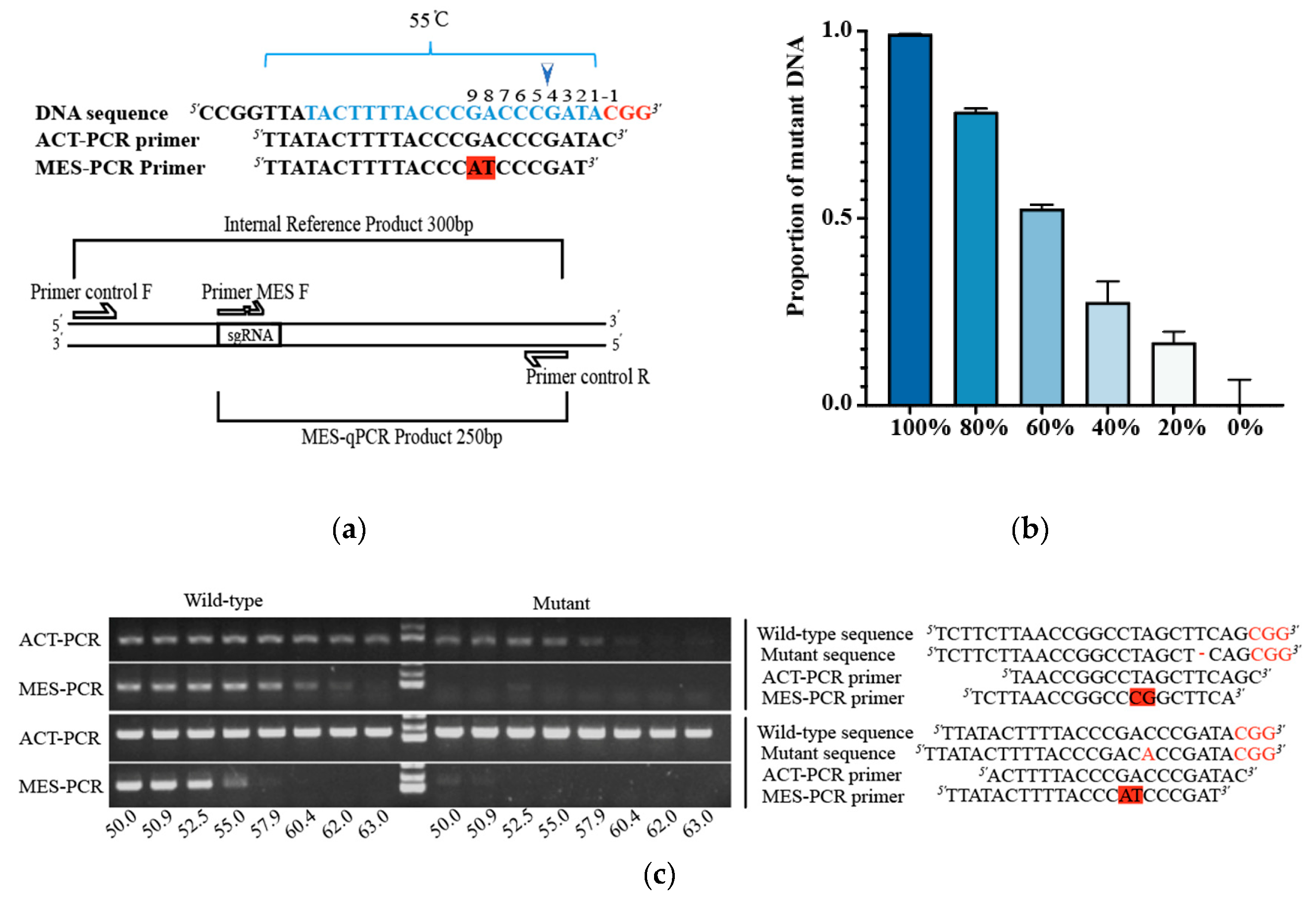
Figure 2.
Comparative benchmarking of three methods for assessing sgRNA editing efficiency in soybean hairy roots. (a) Comparison of editing efficiency detection methods. The editing efficiencies of 17 sgRNAs targeting 7 soybean genes were evaluated in parallel using MES-qPCR (mean ± SD, n=3), NGS and T7EI assay (mean ± SD, n=2). (b) Workflow comparison of three methods. Schematics illustrate the procedural steps and approximate hands-on time required for sgRNA efficiency assessment using NGS, T7EI, and MES-qPCR, highlighting differences in cost, time, and operational complexity.
Figure 2.
Comparative benchmarking of three methods for assessing sgRNA editing efficiency in soybean hairy roots. (a) Comparison of editing efficiency detection methods. The editing efficiencies of 17 sgRNAs targeting 7 soybean genes were evaluated in parallel using MES-qPCR (mean ± SD, n=3), NGS and T7EI assay (mean ± SD, n=2). (b) Workflow comparison of three methods. Schematics illustrate the procedural steps and approximate hands-on time required for sgRNA efficiency assessment using NGS, T7EI, and MES-qPCR, highlighting differences in cost, time, and operational complexity.
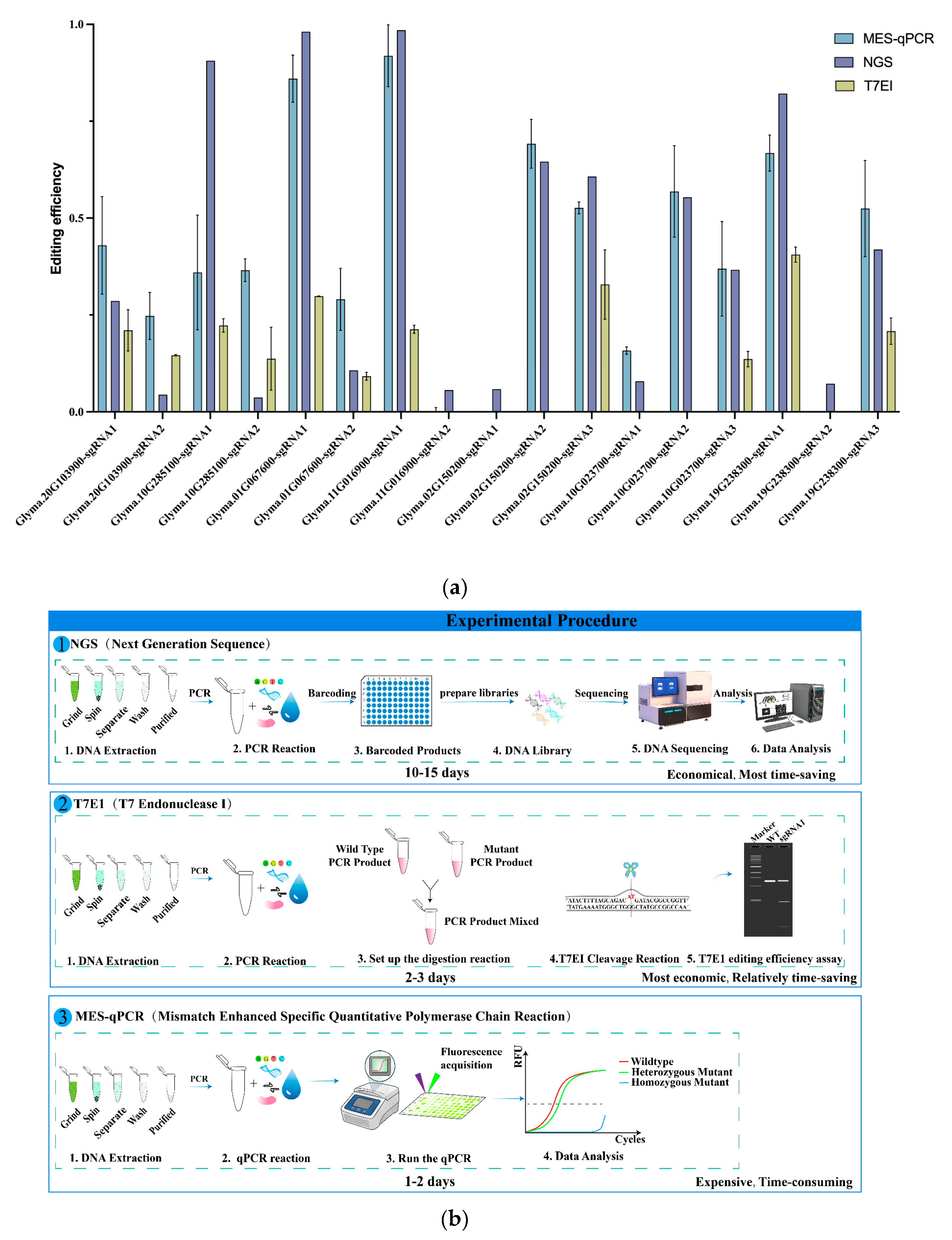
Figure 3.
Accuracy of MES-qPCR in Genotype Detection of Soybean and Arabidopsis.(a) comparison of the MES-qPCR results and the sequencing results in soybean. MES-qPCR results of three target genes in soybean T₂ knockout lines for soybean genotype prediction (mean ± SD, n = 3). (b) Genotyping 9 soybean seedlings in Figure 3a by MES-PCR. The five-pointed star (★) and the triangle (▲) represent the internal control fragment and the MES-PCR fragment, respectively. (c) Genotyping of 7 T2 seedlings from each of the three T1 heterozygous knockout lines shown in Figure S1a by MES-PCR. The five-pointed star (★) and the triangle (▲) represent the internal control fragment and the MES-PCR fragment, respectively.
Figure 3.
Accuracy of MES-qPCR in Genotype Detection of Soybean and Arabidopsis.(a) comparison of the MES-qPCR results and the sequencing results in soybean. MES-qPCR results of three target genes in soybean T₂ knockout lines for soybean genotype prediction (mean ± SD, n = 3). (b) Genotyping 9 soybean seedlings in Figure 3a by MES-PCR. The five-pointed star (★) and the triangle (▲) represent the internal control fragment and the MES-PCR fragment, respectively. (c) Genotyping of 7 T2 seedlings from each of the three T1 heterozygous knockout lines shown in Figure S1a by MES-PCR. The five-pointed star (★) and the triangle (▲) represent the internal control fragment and the MES-PCR fragment, respectively.
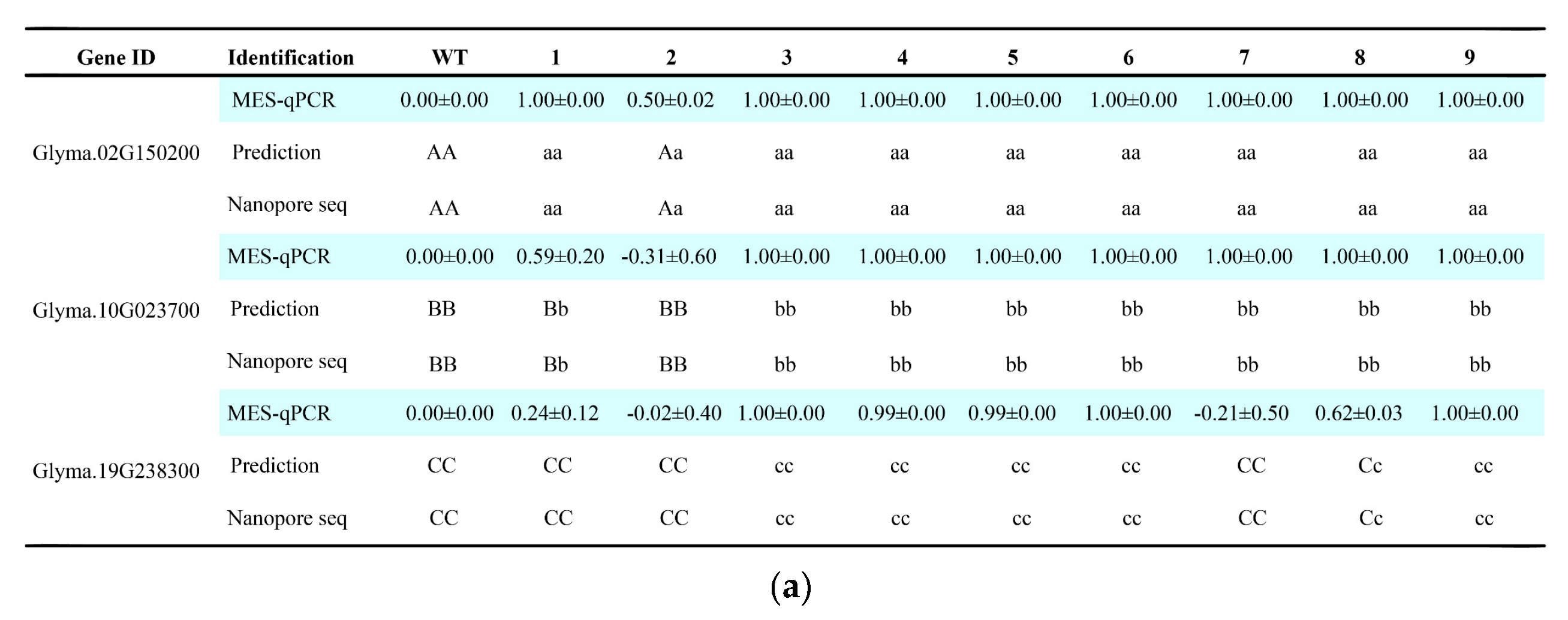
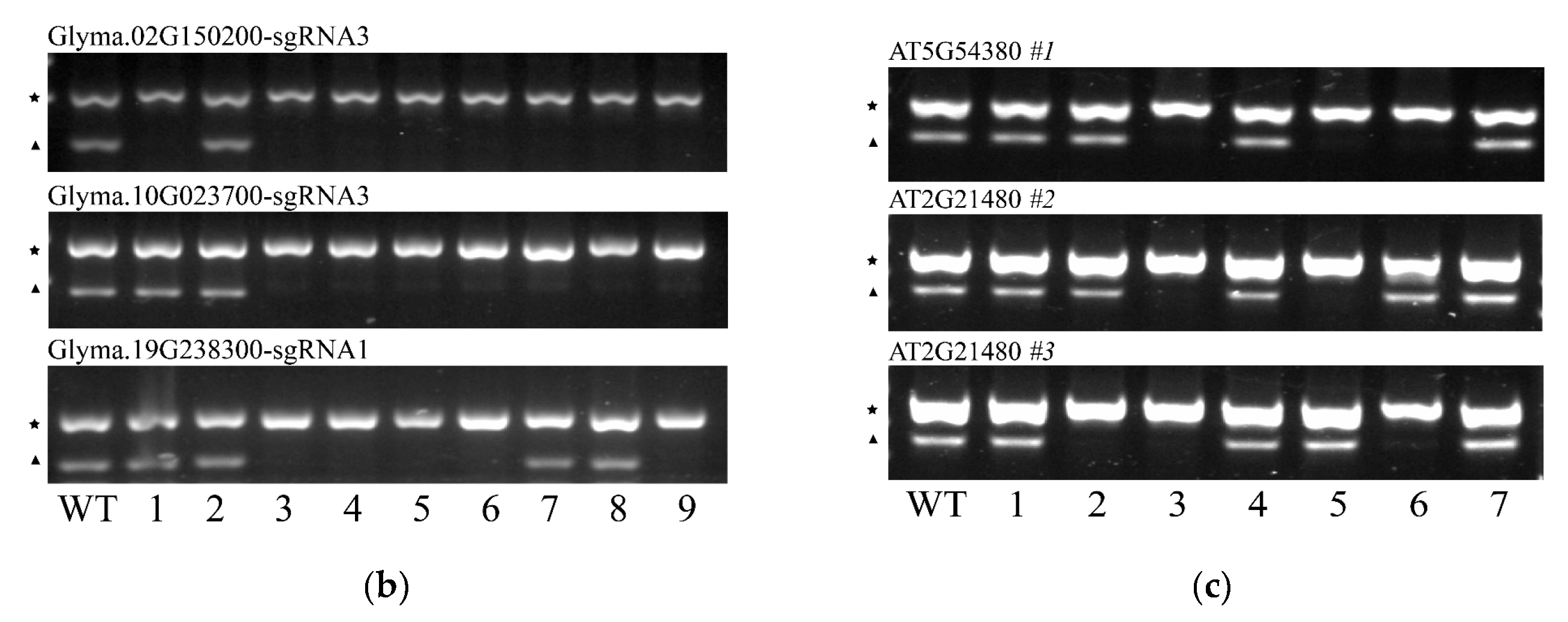

Table 1.
Comparison of present methods for point mutation identification.
| Method | Brief Workflow | Time Required | Cost | Operational Complexity | Result Accuracy |
|---|---|---|---|---|---|
| ARMS-PCR | Design allele-specific primers (with the 3’ end matches target mutation), perform PCR, and detect amplified products by gel electrophoresis. | 2–3 hours | Low | Moderate (due to the requirement for allele-specific primer design) | Moderate (limited to known mutations, possible false positives) |
| ACT-PCR | Determine a critical annealing temperature by gradient PCR; mutants amplicons yield no detectable band on gel. | 3–4 hours | Low | Moderate (requires precise temperature optimization; ineffective for heterozygotes mutation detection) | Moderate (cannot distinguish heterozygotes; sensitive to 1 bp indels) |
| PCR/RE | Amplify target region by PCR, digest with restriction enzyme, and analyze fragments by gel electrophoresis (requires the mutation to disrupt a restriction site). | 3–4 hours | Low | Moderate (requires a suitable restriction site; involves a multiple step procedure) | High (dependent on restriction site availability; underestimates efficiency) |
| PCR/RNP | Assemble the Cas9 protein and sgRNA into a ribonucleoprotein complex in vitro, incubate with PCR products, and detect specific cleavage. | 3–5 hours | Moderate | Relatively complex (requires in vitro assembly of Cas9-sgRNA complexes) | High (high sensitivity, but requires RNP preparation) |
| T7EI | Denature and re-anneal PCR products to form heteroduplexes, digest with T7 endonuclease I, and analyze the cleavage pattern by gel electrophoresis. | 4–5 hours | Low | Moderate (involves enzymatic digestion, and electrophoresis steps) | Low (underestimates editing efficiency; insensitive to small indels) |
| HRMA | Perform real-time PCR followed by high-resolution melting curve analysis to characterize melting profiles. | 2–3 hours | High (requires a HRM instrument) | Simple (process is largely automated) | Moderate (limited sensitivity for G-C/A-T variations) |
| Sanger Sequencing | Amplify target region by PCR, purify product, perform cycle sequencing, and perform capillary electrophoresis for base calling | 1–2 days | Relatively high | Simple (sequencing service available) | High (signals easily masked when allele frequency <10%) |
| NGS (e.g., Hi-TOM) | Design multiplex PCR primers with barcodes, construct a library, perform high-throughput sequencing, and perform bioinformatic analysis to determine mutation events. | 3–5 days | Moderate to high (per-sample cost can be reduced via multiplexing) | Complex (requires sequencing platform and data processing capability) | High (can detect low-frequency mutations; high throughput) |
| Nanopore sequencing | PCR amplify target region, perform library preparation, load onto flow cell, perform real-time sequencing, analyze with bioinformatics tools. | 1–2 days | Low to Medium | Simple (sequencing service available) | Moderate to High (high throughput; point mutation detection limited by native error rate, can be improved via computational correction) |
Disclaimer/Publisher’s Note: The statements, opinions and data contained in all publications are solely those of the individual author(s) and contributor(s) and not of MDPI and/or the editor(s). MDPI and/or the editor(s) disclaim responsibility for any injury to people or property resulting from any ideas, methods, instructions or products referred to in the content. |
© 2026 by the authors. Licensee MDPI, Basel, Switzerland. This article is an open access article distributed under the terms and conditions of the Creative Commons Attribution (CC BY) license (http://creativecommons.org/licenses/by/4.0/).
Copyright: This open access article is published under a Creative Commons CC BY 4.0 license, which permit the free download, distribution, and reuse, provided that the author and preprint are cited in any reuse.


